Research finding · Attention and focus
Task switching
Cognitive control process
Task switching is the act of shifting between cognitive tasks. People move between cognitive tasks often in daily life. Right after a switch, their responses are much slower and, in most cases, more prone to error.[1]
People respond more slowly and are usually more error-prone right after switching tasks.[1] A chance to prepare reduces the switch cost but does not remove it.[1] In studies 2 and 3, pain slowed responses on switching tasks but did not increase switch costs.[2] Bilinguals who code-switch more often show smaller verbal switching costs.[3]
Overview
What task switching means
Everyday life requires frequent shifts between cognitive tasks, such as answering a message and then returning to a page of notes. Psychologists study this ordinary behaviour with a laboratory method called the task-switching paradigm. In the paradigm, a person works through a small set of simple tasks and must switch among them often.[1] A set-switching version of the method asks people to make category judgments about digits, letters or symbols across a series of trials. Such tasks place low demands on movement and on picking out the target, so they give a clearer index of executive function, the set of mental controls that guide planned behaviour.[4]
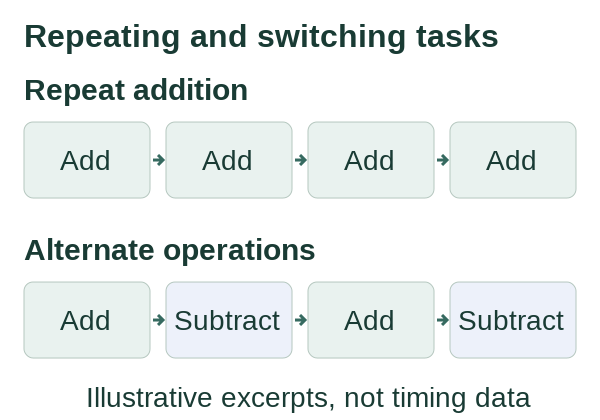
Each trial in the paradigm is either a switch trial or a repetition trial. On a switch trial the task differs from the one just performed; on a repetition trial it stays the same.[1][4] Performance on consecutive same-task trials is compared with performance on task-switch trials. One arrangement alternates tasks in an ABA series, so the person returns to the first task after one trial of the second.[4]
Immediately after a task switch, responses are substantially slower and, usually, more error-prone. This difference is called the switch cost.[1] The cost is transient: performance is relatively poor at first but improves dramatically after one trial.[5] In a set-switching task, a clear switch cost appeared only when tasks alternated from trial to trial. That pattern suggests that inhibition of the previous task set may play a role in the switch cost.[4] The cost is thought to come from carry-over of task-set activation and inhibition, and from the time that reconfiguration takes.[1]
The size of the switch cost depends on conditions, and one condition is how much preparation is allowed. An opportunity for preparation reduces the cost but does not eliminate it.[1] The stimuli matter too: when similar or identical stimuli serve both tasks, the need for control increases. When stimuli uniquely and clearly cue the task, that need is minimized.[5]
The paradigm is meant to capture the mental flexibility people show when they move between activities. Cognitive flexibility is the readiness with which a person can selectively switch between mental processes to produce appropriate behavioural responses. This ability develops over a long period and is compromised in several prevalent neurodevelopmental disorders. Researchers who study flexibility in clinical and developmental settings focus on set shifting and task switching. A 2015 review argued that the field needs more consistent definitions and study of cognitive flexibility.[6]
Main ideas
Inhibition and the n minus 2 cost
In an ABA sequence, task A is performed, then task B, then task A again. In a CBA sequence, task A comes last but was not performed in the first trial.[7] Responses are usually slower on ABA than on CBA sequences, and this gap is called the n minus 2 repetition cost.[7][8]
The standard reading of the cost is that task A is still suppressed from its first appearance when it returns.[7][8] That suppression is assumed to be stronger when the interfering task is highly active at the moment of the switch. One line of evidence comes from changing the response to cue interval, the pause between a response and the cue for the next task. Shorter pauses produce larger n minus 2 repetition costs, which fits the view that a just-performed task is highly active and triggers more inhibition. A 2018 study tested this by controlling for episodic interference, meaning carryover from the specific earlier episode rather than from the task itself. With episodic interference controlled, the n minus 2 repetition cost was considerably reduced. Longer pauses reduced both the inhibition part and the episodic part, and the inhibition part was entirely absent at longer intervals.[7]
Inhibition can also be triggered by the stimulus alone, before any response is chosen. A 2008 study used a version in which the middle task involved only encoding the stimulus for later comparison, with no response selection. Even then, responses were slower on AbA than on CbA sequences. The inhibition appeared only when the stimuli had features relevant to both the finished task and the upcoming one, so the tasks interfered at the stimulus level.[9]
A 2021 study varied stimulus-response (S-R) complexity by using different S-R mappings. Switch costs were larger in the difficult condition than in the moderate and easy conditions. A significant n minus 2 repetition cost appeared under easy complexity, but the cost was reversed under difficult complexity. A second independent sample repeated the difficult condition and replicated the reversed cost. The researchers suggested that task-set inhibition was insignificant once stimulus-response complexity increased, because cognitive resources were assigned differently.[10]
The cost has been proposed as a measure of individual differences in inhibitory control. Kowalczyk and Grange (2017) tested that proposal with participants who performed three task switching paradigms. Significant n minus 2 repetition costs appeared for each paradigm. Split-half reliability tests showed, however, that the cost was not reliable at the level of individual differences. Neither rumination tendencies nor processing speed predicted the cost.[8]
Reconfiguration, memory and binding
One family of explanations says that part of the switch cost comes from reconfiguring the task set, the mental settings that prepare a person to do one task rather than another. Reconfiguration takes time, and these time-consuming processes add to the costs of moving between cognitive tasks. A 2015 study proposed a way to reduce that cost, which it called cognitive caching. The idea is that when people are unsure which task is currently valid, one task set is readied for execution. Other task sets are kept in a pre-active state in a cognitive cache, a kind of standby store. The study used a three-rule task-switching paradigm with varying degrees of task uncertainty. Under high uncertainty, two viable tasks were equally likely to be correct. Under low uncertainty, one task was more likely than the other. When the previous task set had been chosen under high task uncertainty, reconfiguration costs dropped markedly.[11]
Task rules can also shield a response against distraction, and that shielding appears to loosen on switches. In two experiments, participants switched between a noun categorization task and an adjective categorization task while target words were superimposed on distractor pictures. On task repetitions, shielding prevented interference from distractors associated with a competing task, as the lack of interference on adjective task repetitions showed. In the noun task, that reduction weakened interference from noun-related distractors. In the adjective task, spatial distractors caused no interference even with the reduction. The pattern suggests that shielding rests on a processing advantage for task-related information rather than on suppressing distractors.[12]
Memory and control also meet at encoding, because switching changes what gets remembered. In one study, participants switched between classifying objects and classifying words, then took a recognition memory test on the items from the switching phase. Task switching weakened memory for information relevant to the task while strengthening memory for information that was not relevant. That pattern suggests control demands made memory encoding less selective, not that memory declined across the board. Recognition memory strength also gave a trial-by-trial measure of how effective cognitive control had been, and it predicted earlier task-switching performance.[13]
Some switches may be handled by retrieving a stored memory rather than by reconfiguring a task set. In a 2025 experiment, 36 participants completed two conditions. In the four-target condition, only four targets appeared and they repeated throughout the experiment. In the infinite-target condition, targets were not repeated. Compared with the infinite-target condition, task-switching costs were smaller in the four-target condition, while response-congruency effects and the N2 difference wave were larger. The N2 difference wave is a brain response measured as the difference between incongruent and congruent trials. The results suggest that participants spontaneously use a compound retrieval strategy when targets are limited. Earlier work had shown that participants adopt this strategy when not explicitly instructed on task rules, and then task-switching costs cannot reflect cognitive control.[14]
Two experiments used the psychological refractory period dual-task procedure, in which two targets are presented close together, and contrasted a switch condition with a no-switch condition. The N400, a brain response linked to semantic processing, was not affected by the time between targets in the absence of switching. It was strongly weakened at short intervals when the procedure required a move from a perceptual task to a semantic one, or a move between two different semantic tasks. Vachon and Jolicœur take these results to mean that semantic processing and task switching cannot go on at the same time.[15]
Preparation, cues and foreknowledge
A task cue is a signal that tells a person which task to perform on the next item. In a typical experiment, the cue appears shortly before the target, the item the person must judge.[16]
One line of work tested whether a brief burst of alertness could shrink that leftover cost. Participants alternated between two discrimination tasks in random order, and a cue naming the task opened each trial. The researchers produced phasic alertness, a short-lived state of heightened readiness, by showing a striking but uninformative stimulus after the cue. When this alerting stimulus came at an optimal interval before the target or before the cue, response times were faster and the task-switching cost was reduced. The result fits the proposal that alertness helps people overcome competition between retrieved task rules by strengthening the representation of the current goal.[16]
Cues are not the only source of advance information. In one set of experiments, the colour of the target was correlated with which task was required, so the stimulus itself carried redundant information about task identity. Performance was worse when the colour information was invalid than when it was valid, but only in conditions with short task preparation time. The effect was stronger on switch trials than on repetition trials. The researchers concluded that such stimulus-driven influences on the task set matter mainly when they arrive before deliberate preparation has begun.[17]
Cues also differ in what they tell a person. Task cues signal both that the task set must change and which task to carry out. Across two experiments, recordings of brain electrical activity showed that task cues and transition cues both produced a frontal P2 wave and a reconfiguration slow wave. Experiment 2 linked a frontal positivity and a transition parietal slow wave to retrieving the previous task set from memory. These findings suggest that separate brain processes support detecting a change, configuring the task set, and retrieving a recently used task set.[18]
In the composite design, where cue and target appear at the same moment, these signals are absent. One explanation was that participants in that design rely on compound retrieval strategies, learned associations that bypass the task rules. Two experiments tested this by steering participants toward compound retrieval or toward task rules, and the signals were absent in every group regardless of strategy. The disappearance of these signals in the composite design is therefore not explained by compound retrieval.[19]
Some preparation may be shared across very different kinds of switching. In one study, participants were cued to shift spatial attention and to switch between categorization rules within a single paradigm. A conjunction analysis of rapid event-related MRI data found a common transient signal evoked by switch cues in the medial superior parietal lobule for both kinds of control. That points to a single control mechanism that is not tied to one domain.[20]
Strategy switching inside a single task
A person solving a single task can sometimes choose between two different methods, and the question arises whether changing from one method to the other carries a cost of its own. Luwel, Schillemans, Onghena and Verschaffel (2009) examined this question in a numerosity judgement task, in which participants judged how many items a display contained and could apply two cognitive strategies of different complexity. Participants had to switch regularly between the two strategies, and the researchers compared trials on which the strategy changed with trials on which it stayed the same. The study ran two experiments that differed in the kind of stimuli used.[21]
No-go trials and the task-space level
The pattern two trials back did not depend on whether participants could reliably predict that a no-go trial was coming. Effects of a no-go trial in the current trial, by contrast, did depend on that foreknowledge. Scheil and Kleinsorge read the results as an effect on task sets, the mental settings that configure a person for one task, rather than on the response level. On this account, the no-go task gains salience, meaning it stands out more, which raises its activation and in turn produces stronger inhibition.[22]
Conflict adaptation and control adjustments
Conflict adaptation is the up- or down-regulation of control processes according to how likely conflict is and how recently it has occurred. Most of this work has used single-task settings such as the Stroop paradigm, in which people name the ink color of a color word and the word's meaning competes with the required response.[23] In task switching, a person alternates between two tasks on the same stimuli. Stimulus-induced task conflict can be measured with the valency effect, the performance gap between bivalent-congruent trials, in which one stimulus allows two tasks but just one correct response, and univalent trials, in which a stimulus allows a single task.[23][24] If control adjusts to task conflict as it does to response conflict, the valency effect should shrink after bivalent trials and in blocks where bivalent trials are the majority.[24]
Two pre-registered task-switching experiments broadly confirmed both predictions. The valency effect was reduced following bivalent trials, a pattern like the well-known congruency sequence effect, in which interference falls on the trial after an interfering one. That valency sequence effect appeared only when the task repeated, which indicates that these local adjustments are task specific. Task conflict was also reduced in majority-bivalent blocks, resembling the proportion-congruency effect and suggesting that control is recruited in advance when stimulus-based task conflict is frequent. This proportion valency effect appeared only on task-switch trials, so how sustained control adjustments come about remains unsettled.[24]
Three later experiments asked whether task-conflict control adapts briefly or in a lasting way. Experiment 1 ruled out the possibility that the adaptation comes from short-lived increases in attentional biasing after the cue appears. Experiments 2a and 2b found that the mechanisms raising task-conflict control act in a task-specific fashion, which suggests that, unlike single-task paradigms, adaptation here is transient rather than sustained. The researchers conclude that in task-switching contexts conflict adaptation works by modulating reactive control mechanisms triggered after stimulus onset.[23]
Common misconceptions
The n minus 2 repetition cost, the slower response to a task performed recently than to one performed less recently, has been taken up as a way to assess differences between individuals in inhibitory control, although its reliability had not been examined systematically. Seventy-two participants completed three task switching paradigms, and split-half tests of reliability indicated that the cost cannot be trusted as a measure of differences between individuals.[8]
Research
How switch costs are measured
Researchers measure switching with a task-switching paradigm, a procedure that asks people to adapt their behaviour to changing contexts as indicated by a cue.[25] The cue may simply name the task to carry out, which is called explicit cueing, or it may only signal that the task is changing, which is called transition cueing.[26] One study compared proactive task-cuing with proactive transition-cuing. In the first, an early cue signals both a change of task and which task to perform. Kopp and Wessel (2011) also described retroactive transition-cuing, in which the cue that signals a change of task appears later than the target itself.[27]
In one set of three experiments, participants first learned one mapping between cues and tasks, and then the mapping changed for a second phase. A longer preparation time lowered the cost of changing the cue-task mapping, but it did not change the overall pattern of results.[25] Cue timing also shapes which errors appear. Response time switch costs were largest under proactive task-cuing. Perseveration errors, meaning repeats of the previous task when a switch was required, were most common under retroactive transition-cuing. In a separate study, a principal component analysis found two components, one for proactive and one for retroactive cueing, suggesting different processes.[27]
An occasional bivalent stimulus inside a block of univalent trials slows responses on the univalent trials that follow. This spread of slowing is called the bivalency effect. A 2025 study used a triplet design with three tasks in a row. Participants judged a shape's colour as red or blue, a number as odd or even, and a letter's case as lowercase or uppercase. Brain recordings showed the bivalency effect in a smaller N2 and P3a wave over the frontal region for the colour and letter tasks, and it appeared earlier for colour. For the number task, the effect showed up instead as a larger N1 wave and a smaller P2p wave over the parietal region, which suggests the adjustment is specific to each task.[28]
The two designs give different sizes of switch cost. A comparison that controlled for sequential effects in the two preceding trials confirmed that the task-switch cost under transition cueing is larger. That extra cost came mainly from cue processing, the work of reading and applying the cue itself. Cue-task transition congruency affected performance during both cue processing and task processing.[26]
Cues can also carry learning from earlier trials, which complicates any measure built on them. When the cue-task mapping was reversed after training, those old associations got in the way of implementing the new mapping.[25] One 2024 study asked whether benefits from a repeated context, a background feature that is irrelevant to the task, depend on the cue. It used univalent targets and presented no cue at all, so the changing context was never cue-related. Full repetition benefits still appeared, but only when the context came before the target rather than at the same moment. This supports an account in which binding processes link task, response and context on each trial.[29]
How large the costs are
In cued auditory switching, a long CSI led to better performance overall than a short one.[30] The 2006 preparation study found that after a long preparation interval, general task performance was comparable in both experiments, whether the interval varied within or between subjects.[31] A 2025 set of experiments found that a short preparation interval mattered for obtaining a switch cost after cue-only trials. Such trials show a task cue but no target to answer. That cost was more short-lived and faded faster after cue-only trials than after completed trials.[32]
In a 2023 auditory study, participants judged either the pitch or the loudness of a tone as low or high, so both tasks rested on common categories running from low to high. When the two tasks used separate response sets, one manual and one vocal, the congruency effect fell, suggesting less response-based crosstalk and better shielding of each task. Switch costs, however, were increased in that same condition, suggesting less efficient switching between task sets.[30]
Similarity between tasks is a less studied condition, and a 2024 experiment had 31 participants switch among 4 tasks of varying similarity. Similarity between tasks substantially affected performance, with different effects on reaction time and on accuracy. Performance fell significantly within blocks, although learning effects may have offset the impact of mental fatigue across the 5 experimental blocks. The results support the view that neither the interference view nor the reconfiguration view fully explains switch costs once similarity is added. The researchers argued that basic findings on cognitive flexibility may not map linearly onto settings where tasks are often more dissimilar.[33]
The context built by repeat trials matters too, and a 2021 study varied how often the stimulus and the response changed during runs of repeat trials. Participants saw strings of digits and reported either the digit shown or how many digits appeared, depending on stimulus color. A context of frequent change produced smaller switch costs than a context of rare change. Brain recordings showed larger fronto-central N2 amplitudes in the frequent-change context on both repeat and switch trials, read as greater cognitive control. On switch trials, that context also produced smaller P300 amplitudes, which the researchers linked to faster reconfiguration of the task set. The findings suggest that more change during task repetition raises the overall level of cognitive control and the efficiency of switching.[34]
What the brain does during a switch
When a person switches between simple tasks, imaging studies often find more activity in frontal and parietal regions than when a task repeats.[35][36] One early interpretation held that this extra activity marks an active reconfiguration process, in which the brain retunes itself for the new task. A 2012 study tested this idea with a parametric approach, checking which account fit the data better. Across the whole fronto-parietal network, the adaptation account fit the data better than the reconfiguration account. Adaptation here means that repeat trials show weaker activity because the brain has adjusted to the repeated task. That result called the classical reconfiguration interpretation into question and offered first evidence for adaptation of abstract task representations.[35]
In a 2006 fMRI study, participants switched between categorizing faces and categorizing words. Face and word stimuli activate distinguishable cortical regions, so activity in each region could be tracked during the switch. Activity in regions tuned to the task that was currently irrelevant forecast the behavioral cost of switching. This supports the theory that competition between tasks is a critical determinant of behavior. Switching also came with increased activity in a control network that included lateral prefrontal cortex and parietal cortex. Within that network, the study observed dissociations between mechanisms specific to a task and general purpose mechanisms. The findings fit theories of a control hierarchy, with some regions holding rules or goals and others coordinating them.[36]
A 2000 study used event-related fMRI and a task-switching version of the Stroop task, in which people name colors or read words. It found a double dissociation between two regions and two demands. The anterior cingulate cortex (Brodmann's areas 24 and 32) instead showed more activity when people responded to incongruent stimuli. This fits a role in monitoring performance.[37]
A 2003 study combined ERP and fMRI in separate studies using the same paradigm, with left and right keypresses to arrow stimuli lasting 1000 msec. Participants alternated every two trials between answering at stimulus onset (GO) and answering at stimulus offset (WAIT). Withholding an immediate response enhanced the frontal N2 ERP and activated right lateral prefrontal cortex, but only on switch trials. Task switching produced frontal N2 amplification and right ventrolateral prefrontal activation, but only for the WAIT task. The anterior cingulate cortex was the only region activated for both types of switch, more rostrally for WAIT than for GO trials. The study concluded that the frontal N2 and lateral prefrontal activation mark switching into a response-suppression mode, not withholding or switching as such.[38]
Preparation before the stimulus also leaves a measurable electrical trace, according to a 2008 study. When advance preparation was effective, as shown by fast responses, a protracted switch-related component appeared before stimulus onset for about 300 ms. This component showed widespread posterior positivity and concurrent right anterior negativity, with sources mainly in left lateral frontal, right inferior frontal and temporal cortices. When preparation was ineffective or impossible because of a short cue-to-stimulus interval, a similar component with lateral prefrontal generators peaked about 300 ms after the stimulus. The prestimulus component correlated across subjects with a behavioral measure of preparation and was distinct from the P3 and from contingent negative variation. The component was lateralized differently for word and picture cues, which fits a role for verbal self-instruction in getting ready for a switch.[39]
The fronto-parietal network may work as a set of flexible hubs, regions that quickly change their connections to fit the task at hand. A 2013 study found that this network's brain-wide connectivity pattern shifted more than other networks did across a range of task states. The current task could be identified from these connectivity patterns, and the patterns were alike for practiced and novel tasks. Reusing flexible hub patterns may therefore help performance on new tasks.[40]
A 2026 study used a shortened cued-switching task during fMRI scanning in healthy adults. The anterior insular cortex was active during task execution as well as preparation, together with the prefrontal cortex. Its activity boosted activity in the salience network, the prefrontal cortex and motor areas. When no attentional switch occurred, anterior insular activity during task execution correlated negatively with reaction time. Kato and colleagues suggest the region matters both for switching attention and for finishing tasks whether or not a switch occurs.[41]
The reconfiguration account expects extra activity tied to preparing for a new task, while the adaptation account expects weaker activity on repeat trials.[35] Several neuroimaging studies have found no extra brain activity while people prepare for a switch compared with a repeat. Electrophysiological studies have identified possible correlates of preparation, but evidence linking them to performance has been scarce.[39] Simply comparing switch and repeat trials cannot separate the competing explanations, which is why the 2012 study varied demands instead.[35]
Rewards, mood and motivation
In two experiments with 96 participants each, a reward group earned a bonus for good performance in a second phase, while a control group earned nothing. The rewarded group responded faster than the control group. A mathematical model of the response data traced this to a higher drift rate, a measure of how quickly evidence builds toward a decision. The rise in drift rate was consistent with a dopamine-based sharpening of attention under reward.[42] A separate study offered monetary bonuses on some trials of a cued switching task and found better performance and smaller switch costs on those incentive trials.[43]
When a bonus was fixed to particular tasks, switch costs fell to statistical insignificance, even for the task without a bonus. When the bonus-task link changed from trial to trial, the benefit stayed with the well-learned pairing, and a faster bonus task came with a slower task that had no bonus. In that second case, reward expectancy mainly shifted the general level of performance.[44]
A smaller study of 27 college students compared an immediate reward with a delayed one. Immediate rewards improved performance on repeated trials, but the two reward types did not differ on switch trials. The researchers proposed that processing task cues can leave too little capacity to process reward cues. They read this as support for the Expected Value of Control theory, which treats control as allocated according to its expected payoff.[45]
In one study, participants switched between sorting food as sweet or savoury and sorting digits as odd or even. Switch costs were lower for the food task in both tested paradigms and in both groups. Hunger was produced by 14 hours of fasting, and in the alternating-runs paradigm the fasting group showed significantly higher switch costs on the neutral digit task than the control group. Individual differences in restrictive eating were related negatively to switch cost size, but not significantly, and the researchers called for replication.[46] A later study shrank the food image so the digit was visually larger, and the food task still produced reduced switch costs, which argues against visual salience as the explanation. A direct comparison with earlier work showed that visual size changes how large the gap between the tasks is.[47]
Mood has been proposed as a route to greater flexibility. One study used standard videos to induce positive, negative or neutral mood in college students, with 188 in a Stroop-like switching procedure and 129 in a reversal learning task. The mood induction worked, raising amusement and valence in the positive group and repulsion with lower valence in the negative group, yet switch costs did not differ across the mood groups. The researchers concluded that the results do not support the idea that positive mood improves cognitive flexibility.[48]
Norepinephrine is one candidate, and the manipulations tested so far left switch costs unchanged. One set of studies raised norepinephrine, a brain chemical involved in alertness, in several ways. These included a stress manipulation with 48 participants and vagus nerve stimulation at two intensities with 48 participants. A drug was also given in a double-blind crossover design with 24 participants. All of these raised salivary cortisol, a hormone marker of stress, yet none changed the size of switch costs or the benefit of preparation time. The researchers concluded that norepinephrine does not affect these aspects of cognitive flexibility.[49]
Bilingualism and language switching
Researchers ask whether experience in switching between languages carries over to switching between non-verbal tasks. A 2010 study compared monolingual and fluent bilingual college students on a task-switching test. The bilinguals showed smaller switching costs, meaning less slowdown on trials that required a change of task than on trials that repeated the same task. The two groups did not differ in the extra cost of mixed-task blocks over single-task blocks. The researchers concluded that lifelong experience with two languages may sharpen flexible shifting between mental sets, not only the inhibition of competing responses.[50]
Brain imaging gives one reason to expect such transfer. A 2015 study scanned early, highly proficient Spanish-Basque bilinguals with fMRI. Each participant performed a language-switching task and a closely matched non-linguistic switching task. The switch-specific activity in the two tasks overlapped in highly similar brain circuits. De Baene and colleagues described this as direct evidence of shared control circuits, because both tasks were compared within the same people and their requirements were closely matched.[51]
Other studies find that the link depends on the kind of switching and the kind of bilingual.[3][52] A 2012 study measured natural code-switching, the practice of mixing two languages within a conversation, in Cantonese-English bilinguals during a semi-structured conversation. Participants who code-switched more often showed smaller costs when switching between languages in a verbal fluency task. On two non-verbal switching tasks, their performance was not linked to how often they code-switched.[3] A 2013 study of non-proficient Polish-English bilinguals found no relationship between efficiency at switching languages and efficiency at switching non-linguistic tasks. Better language switching did go with better mixing of two non-linguistic tasks, which suggests that keeping two languages active and keeping two tasks active rely on similar control processes.[52]
A 2016 study tested 52 low-proficiency Chinese-English bilinguals and split them into 26 with high cognitive flexibility and 26 with low cognitive flexibility, as measured by the Wisconsin Card Sorting Task. The high-flexibility group showed switch costs of similar size in both directions, in the non-verbal task and in picture naming in the first and second language. The low-flexibility group showed larger costs for one direction than the other in both tasks.[53] A 2021 study of 60 bilinguals and 24 English monolinguals in Australia found that using two languages in a dual-language context went with reduced switching costs. Among the bilinguals, an earlier onset age of active bilingualism and a smaller typological distance between the two languages went with lower mixing costs. The researchers argued that particular dimensions of bilingual experience, rather than bilingualism as a whole, are linked to better cognitive performance.[54]
A 2023 study examined bilinguals in a single-language, nonimmigration context. Ninety young Persian-speaking adults, monolingual and bilingual, completed a non-verbal alternating-runs switching task. Bilinguals who began regular active use of both languages before age eight were classed as early, and the rest as late. Early bilinguals showed a slightly lower global switch cost than monolinguals, but the difference was not significant. Their local switch cost was significantly lower. The researchers concluded that effects of bilingualism on task switching do not appear uniformly across different language contexts.[55]
A 2018 study with Korean-English bilinguals and English monolinguals used a modified Dimensional Change Card Sort task, a sorting game in which the rule for sorting changes. The bilinguals showed smaller single-task switch costs and greater reactivation benefits than the monolinguals. Their advantage in mixing costs was relatively weak, and the groups did not differ on local switch costs. The researchers found no evidence that a basic priming effect explained where the bilingual advantage came from.[56]
Everyday use, limits and open questions
Task switching shows up in ordinary study. Students switched tasks often, with a median task duration of only 31 seconds. About 30% of all tasks were academic, and most of those involved the university's learning management system. Communication tasks made up 18% and recreation tasks 9% of the total. Judd concluded that students manage competing tasks and their time rather inefficiently while studying.[57]
Switching does not only slow a person down; it also leaves a weaker memory of what was seen. The gap grew in the second experiment, which used bivalent material, meaning stimuli that were relevant to both tasks. The researchers suggest that the need to switch tasks hurts the encoding, or storing, of task-relevant information.[58] A virtual classroom study asked whether learners switch tasks during live online lessons rather than stay focused on the content.[59]
In one study, thermal pain induction did not affect performance on either of two alternating runs switching tasks. In two further studies covering 7 versions of the switching task, people with naturally occurring pain responded more slowly than people without pain, on switch trials and repeat trials alike. Pain did not increase switch costs, the extra time a switch adds compared with a repeat. Attridge and colleagues conclude that pain slightly dampens performance overall, disrupting attention even within a trial.[2]
In a sleep study, healthy participants stayed awake for 31 hours and were tested at 11:00h, 17:00h, 23:00h, 05:00h and 11:00h. They alternated between a math task and a spatial-rotation task, and wakefulness had a significant main effect on mean reaction time and on the proportion of correct responses. When participants moved between two different tasks, they slowed down to keep accuracy up, a speed and accuracy trade-off.[60]
Wenzel, Conner and Kubiak (2013) found evidence favoring a cognitive control interpretation of self-control deterioration over the strength model. In a two-task study, positive affect helped later self-control performance only when the two tasks involved different response conflicts, such as resisting sweets followed by a Stroop task. When both tasks were Stroop tasks, with the same conflict, positive affect impaired performance instead.[61]
Strong claims about individual differences in switching run into a measurement problem. A task produces a stable experimental effect when people differ little from one another, but that same low variability makes the task poor at ranking individuals. Across three studies, test-retest reliability for seven classic tasks ranged from 0 to .82, surprisingly low for most of them. The low reliability came from small differences between individuals rather than from noisy measurement. The researchers warn that well-established laboratory tasks may not translate directly into the study of individual differences.[62]
One study measured processing speed, how quickly a person takes in simple information, with an inspection time task and scored switching with a combined speed and accuracy measure. Processing speed predicted average performance in the switching tasks but was unrelated to any specific switching effect, contradicting earlier results. The researchers argue that processing speed and the flexible control of tasks rest on independent mechanisms.[63]
Another study used geometric forms and a visuospatial working memory capacity task, working memory being the small store of information held in mind. Working memory capacity was inversely related to the switch effect in non-decision time, the part of a response that is not spent deciding. Relations with drift rates, a measure of how quickly evidence builds toward a choice, were inconsistent. The researchers suggest that more able participants either needed less time to prepare for a task or chose to spend less time preparing.[64]
Errors in switching tasks can be sorted by the process that produced them, which sharpens what a switch cost means. Task-confusion errors come from a failure to select the right task, while response-confusion errors occur when the right task is chosen but the wrong response is given. Across three experiments, the researchers tested methods for separating these two error types and used the split to examine effects on inhibitory mechanisms.[65]
Numbers, modality and motor preparation
Modality compatibility means that the sense used to present a stimulus matches the sense that will register the response effect. A spoken response is usually heard, so an auditory stimulus paired with a vocal response is compatible, while a visual stimulus paired with a vocal response is not. The proposed explanation is that with incompatible mappings the anticipated effect of each response primes the stimulus modality tied to the competing task, which creates confusion between the tasks. Two experiments tested whether this effect grows when the auditory-vocal coupling is strengthened, first by using spatial-verbal stimuli instead of spatial-location stimuli, and second by requiring temporal discrimination instead of spatial localisation. Both manipulations raised interference specific to the modality, which Friedgen, Koch and Stephan read as evidence that cognitive control in task switching works in a modality-specific way.[66]
Number magnitude processing, the basic ability to judge how large a number is, also appears to depend on cognitive control.[67][68] In one study, participants saw a two-digit number and either judged its parity or compared its magnitude with a standard, depending on a preceding cue. Instead, both congruity effects were reduced after a task switch compared with a task repetition, which the authors attribute to persisting inhibition of the abandoned task set.[67] An earlier study varied, from trial to trial, whether the input and output modalities were compatible during a magnitude comparison task. After a switch in modality compatibility, the numerical distance effect grew larger, while the problem size effect did not.[68]
A 2025 study examined how switching between mapping rules affects motor preparation in young and older adults, using a finger cuing task in which one of 4 fingers (index and middle fingers of both hands) made a single keypress. Participants switched between spatially compatible procues and spatially incompatible anticues, and these informative cues appeared at five intervals from 100 to 850 ms before the target. Procues gave greater preparation benefits than anticues, but only at short preparation intervals, and older adults showed smaller preparation benefits than younger adults, but only at longer intervals. In both age groups, mixing the two mapping rules created mixing costs relative to single-mapping blocks, reflecting substantial deficits in motor preparation that were larger at longer intervals, where proactive control dominates. Adam and Koch propose that taking up a new mapping rule and getting an action ready both call for updating operations in working memory, and these operations bias how responses are selected.[69]
In practice
Age, development and practice
Cognitive flexibility is a component of executive function. In a cued switching test, a cue tells the person which rule to apply on the coming trial. On tests of cognitive flexibility, children score lower than adults. One eye-tracking study followed 48 children aged 8 to 16 years and 51 adults aged 18 to 27 years through the preparation period of each trial. Children looked more often and longer at the cued rule, and their eyes jumped back and forth more between the rule and the response options. Mid-adolescents performed much like adults, which points to a slow maturing of cognitive flexibility.[70]
Electrical recordings of brain activity show that children prepare a new task set more slowly than adults. One study recorded these signals in children aged 9 to 10 years, adolescents aged 13 to 14 years and young adults aged 20 to 27 years. The brain signals suggested that the larger costs came from delayed preparation of the task set in children. Switch costs, the drop in performance on a switch trial compared with a repeat trial, did not differ by age at either interval. Children also seemed to rebuild the task set on some repeat trials, not only on switch trials, which suggests that this process keeps maturing.[71]
In one study, children aged 8 to 11 years were assigned to intensive task switching (72 children), intensive single tasking (74 children) or a passive control group (41 children) for 9 weeks. Mixing costs fell at first in both training groups, but only the switching group kept the improvement to the end of training. Activity in the dorsolateral prefrontal cortex, a front brain region involved in control, decreased with training, and again only the switching group held that decrease. The researchers concluded that training changes performance through more efficient task processing rather than by copying normal maturation.[72]
One small study tested 13 younger adults (mean age 22.31 years) and 13 older adults (mean age 65.85 years) on judgments about a color or an animal. The two groups performed similarly when results were combined across both kinds of judgment. Older adults did worse than younger adults on the conceptual judgments about animals.[73]
A larger study compared young adults aged 19 to 33 years with three older groups aged 64 to 72, 73 to 80 and 82 to 97 years. All three older groups had significantly higher switch costs than the young adults, and the gap was larger with four task rules than with two. The three older groups did not clearly differ from one another. The age gap appeared even after the general slowing of older adults was taken into account.[74]
Switching while walking is harder for older adults too. Fifteen healthy young adults (mean age 27.5 years) and 16 healthy older adults (mean age 70.9 years) took part. They alternated between two visual stepping tasks, avoiding a target or stepping on it, for 2 minutes each across three blocks. Older adults made significantly more step errors in both tasks and showed more interference between the tasks than young adults. The accuracy gap appeared in the front-to-back direction but not in the side-to-side direction. Neither errors nor accuracy showed an interaction between age and trial.[75]
Direct current stimulation of the brain has been tested as a way to boost switching, with mixed results.[76][77] Transcranial direct current stimulation (tDCS) was applied over a brain region in the studies described here. In the first session, when participants were least familiar with the task, stimulation also improved performance on repeat trials, which suggests a general effect on task processing. The researchers noted that further studies are needed to see whether such findings help older people or people with impaired executive function.[76] A second study gave participants real or sham stimulation over the right dorsolateral prefrontal cortex while they did two kinds of switching task. Real stimulation lowered switch costs for unpredictable trials of one task but raised them for both predictable and unpredictable trials of the other.[77]
What this looks like when you study
In one study, 31 participants switched among 4 tasks of varying similarity across 5 experimental blocks.[33] Switch costs were smaller in the four-target condition (36.42 ms) than in the infinite-target condition (72.76 ms).[14]
Students in an open-access computer laboratory had their computer use logged during independent study sessions. Approximately 30% of all tasks were academic, while communication and recreation tasks accounted for 18% and 9% of tasks respectively. Multitasking was very common, particularly when communication tasks were active. Judd drew the conclusion that students handle competing tasks and their study time with limited efficiency.[57]
In a numerosity judgement task, participants switched regularly between an addition strategy and a subtraction strategy. Responses took longer on trials that required a change of strategy than on trials that did not, and the mean cost of a switch was 874 ms; the share of correct answers stayed at the same level. The size of this switch cost did not differ by strategy complexity and tended to shrink as a strategy became more appropriate for a particular problem.[21] In a memory study, participants switched between two semantic classification tasks and were later tested for recognition memory. Memory was lower for switch than for repeat stimuli in both experiments, and the effect was larger when stimuli were bivalent, meaning relevant to both tasks.[58]
Allow preparation time before a switch: switch costs shrink when a cue appears well before the task begins.[1] Reduce the number of competing tasks in a study session, because switching among 4 tasks of varying similarity lowered performance within blocks.[33] Keep study sessions focused: in logged study sessions, the median task lasted only 31 seconds, and up to one half of tasks were unrelated to study.[57] Expect some memory cost from switching: recognition memory was lower for switch than for repeat stimuli.[58]
Key studies
| Year | Study | Sample | Design | Finding |
|---|---|---|---|---|
| 2003 | Monsell[1] | Review of experiments requiring subjects to switch among a small set of simple tasks | Right after a task switch, responses are much slower and, in most cases, more prone to error. Preparation lowers this cost but does not remove it. | |
| 2008 | Sdoia & Ferlazzo[9] | Experiment comparing AbA and CbA task sequences in which the b-task involved only stimulus encoding | Reaction times were slower on AbA than on CbA sequences. This shows that inhibition of the executed task can arise at the stage where the new stimulus is processed. | |
| 2009 | Luwel et al.[21] | numerosity judgement task with strategy switching | Trials that involved a change of strategy took longer to answer than trials without a change, at a mean cost of 874 ms, and the answers were no less accurate. | |
| 2010 | PRIOR & MACWHINNEY[50] | monolingual and fluent bilingual college students | task-switching paradigm comparison | Bilinguals incurred reduced switching costs compared with monolinguals, but did not differ in mixing costs. |
| 2011 | Kopp & Wessel[27] | 36 healthy young adults | proactive and retroactive cued task switching | The largest response time costs of switching appeared under proactive task-cuing, whereas perseveration errors occurred most often under retroactive transition-cuing. |
| 2015 | Judd[57] | students in an open-access computer laboratory | detailed logs of computer use during independent study sessions | Students spent a median of 31 seconds on a task before moving to another, and up to 50% of the tasks they performed were unrelated to study. |
| 2017 | Kowalczyk & Grange[8] | 72 participants | three task-switching paradigms with split-half reliability tests | The n minus 2 repetition cost was not reliable at the individual-difference level. |
| 2019 | Muhmenthaler & Meier[58] | participants in two experiments | task-switching study with subsequent recognition memory test | In both experiments, items encountered on switch trials were remembered less well later than items encountered on repeat trials, and the gap grew larger when the material was bivalent. |
| 2020 | Tona et al.[49] | Study 1a n = 48; Study 1b n = 48; Study 2 n = 24 | stress, vagus nerve stimulation, and pharmacological manipulations | None of the manipulations modulated the size of switch costs or the preparation effect. |
| 2021 | Zheng & Church[70] | eye-tracking study of cued task switching | Children looked at the rule given by the cue more frequently and for longer stretches, and they moved their gaze back and forth between the rule and the response choices more often; participants in mid-adolescence performed much like the adults. | |
| 2023 | Alipour et al.[55] | nonverbal alternating-runs task-switching paradigm | Early bilinguals showed a significantly lower local switch cost than monolinguals, with a slight nonsignificant global switch cost. | |
| 2023 | Kim et al.[75] | voluntary gait adaptability task with repeated task switching | Old adults showed significantly more step errors and more interference effects than young adults. | |
| 2024 | Hinss et al.[33] | 31 participants | behavioural task-switching experiment with 4 tasks of varying similarity across 5 blocks | Similarity between tasks substantially affected performance, and performance decreased significantly within blocks. |
| 2025 | Zhou[14] | 36 participants | task-switching experiment with four-target and infinite-target conditions | Switch costs were smaller in the four-target condition (36.42 ms) than in the infinite-target condition (72.76 ms). |
See also
References
- Monsell, S. (2003). Task switching. Trends in Cognitive Sciences, 7(3), 134-140. doi:10.1016/s1364-6613(03)00028-7
- Attridge, N., Keogh, E., & Eccleston, C. (2016). The effect of pain on task switching: pain reduces accuracy and increases reaction times across multiple switching paradigms. Pain, 157(10), 2179-2193. doi:10.1097/j.pain.0000000000000627
- YIM, O., & BIALYSTOK, E. (2012). Degree of conversational code-switching enhances verbal task switching in Cantonese–English bilinguals. Bilingualism: Language and Cognition, 15(4), 873-883. doi:10.1017/s1366728912000478
- Arbuthnott, K., & Frank, J. (2000). Trail Making Test, Part B as a Measure of Executive Control: Validation Using a Set-Switching Paradigm. Journal of Clinical and Experimental Neuropsychology, 22(4), 518-528. doi:10.1076/1380-3395(200008)22:4;1-0;ft518
- Sumner, P., & Ahmed, L. (2006). Task Switching: The Effect of Task Recency with Dual- and Single-Affordance Stimuli. Quarterly Journal of Experimental Psychology, 59(7), 1255-1276. doi:10.1080/02724980543000187
- Dajani, D. R., & Uddin, L. Q. (2015). Demystifying cognitive flexibility: Implications for clinical and developmental neuroscience. Trends in Neurosciences, 38(9), 571-578. doi:10.1016/j.tins.2015.07.003
- Grange, J. A. (2018). Does Task Activation in Task Switching Influence Inhibition or Episodic Interference? Experimental Psychology, 65(6), 393-404. doi:10.1027/1618-3169/a000423
- Kowalczyk, A. W., & Grange, J. A. (2017). Inhibition in Task Switching: The Reliability of the n − 2 Repetition Cost. Quarterly Journal of Experimental Psychology, 70(12), 2419-2433. doi:10.1080/17470218.2016.1239750
- Sdoia, S., & Ferlazzo, F. (2008). Stimulus-Related Inhibition of Task Set During Task Switching. Experimental Psychology, 55(5), 322-327. doi:10.1027/1618-3169.55.5.322
- Zhao, L., Hu, S., Xia, Y., Li, J., Zhao, J., Li, Y., & Wang, Y. (2021). Stimulus–response complexity influences task-set inhibition in task switching. PeerJ, 9, e10988. doi:10.7717/peerj.10988
- Lange, F., Seer, C., Müller, D., & Kopp, B. (2015). Cognitive caching promotes flexibility in task switching: evidence from event-related potentials. Scientific Reports, 5(1). doi:10.1038/srep17502
- Reisenauer, R., & Dreisbach, G. (2014). The Shielding Function of Task Rules in the Context of Task Switching. Quarterly Journal of Experimental Psychology, 67(2), 358-376. doi:10.1080/17470218.2013.808678
- Richter, F. R., & Yeung, N. (2012). Memory and Cognitive Control in Task Switching. Psychological Science, 23(10), 1256-1263. doi:10.1177/0956797612444613
- Zhou, F. (2025). Exploring the impact of compound retrieval strategy in the task-switching paradigm. Frontiers in Human Neuroscience, 19. doi:10.3389/fnhum.2025.1570551
- Vachon, F., & Jolicœur, P. (2012). On the Automaticity of Semantic Processing during Task Switching. Journal of Cognitive Neuroscience, 24(3), 611-626. doi:10.1162/jocn_a_00149
- Meiran, N., & Chorev, Z. (2005). Phasic Alertness and the Residual Task-Switching Cost. Experimental Psychology, 52(2), 109-124. doi:10.1027/1618-3169.52.2.109
- Rubin, O., & Koch, I. (2006). Exogenous Influences on Task Set Activation in Task Switching. Quarterly Journal of Experimental Psychology, 59(6), 1033-1046. doi:10.1080/02724980543000105
- West, R., Langley, M. M., & Bailey, K. (2011). Signaling a switch: Neural correlates of task switching guided by task cues and transition cues. Psychophysiology, 48(5), 612-623. doi:10.1111/j.1469-8986.2010.01123.x
- Zhou, F., Tian, Z., & Li, X. (2025). Exploring the ERP trace of task-set control in the composite design task-switching paradigm. Frontiers in Human Neuroscience, 19. doi:10.3389/fnhum.2025.1536926
- Chiu, Y. C., & Yantis, S. (2009). A Domain-Independent Source of Cognitive Control for Task Sets: Shifting Spatial Attention and Switching Categorization Rules. The Journal of Neuroscience, 29(12), 3930-3938. doi:10.1523/jneurosci.5737-08.2009
- Luwel, K., Schillemans, V., Onghena, P., & Verschaffel, L. (2009). Does switching between strategies within the same task involve a cost? British Journal of Psychology, 100(4), 753-771. doi:10.1348/000712609x402801
- Scheil, J., & Kleinsorge, T. (2022). No-go trials in task switching: effects on the task-set and task-space level. Psychological Research, 86(4), 1097-1107. doi:10.1007/s00426-021-01566-7
- Moretti, L., & Koch, I. (2026). Task-control adaptation in task switching: Uncovering the mechanisms behind the list-wide proportion valency effect. Memory & Cognition, 54(3), 813-834. doi:10.3758/s13421-025-01782-1
- Moretti, L., Koch, I., & Schuch, S. (2025). Local and global control adjustments to stimulus-based task conflict in task switching. Quarterly Journal of Experimental Psychology, 78(5), 963-977. doi:10.1177/17470218231200442
- Gade, M., & Koch, I. (2007). Cue–task associations in task switching. Quarterly Journal of Experimental Psychology, 60(6), 762-769. doi:10.1080/17470210701268005
- Van Loy, B., Liefooghe, B., & Vandierendonck, A. (2010). Cognitive Control in Cued Task Switching with Transition Cues: Cue Processing, Task Processing, and Cue–Task Transition Congruency. Quarterly Journal of Experimental Psychology, 63(10), 1916-1935. doi:10.1080/17470211003779160
- Kopp, B., & Wessel, K. (2011). Dissociating proactively and retroactively cued task switching: a route towards neuropsychological analyses of cognitive control. Neuropsychological Trends(10). doi:10.7358/neur-2011-010-kopp
- Cao, Y., Wu, J., Liu, G., Sun, F., & Li, F. (2025). Task‐Specific Modulation of Cognitive Control: Electrophysiological Evidence From Bivalency Effect in Task Switching. PsyCh Journal, 14(3), 417-427. doi:10.1002/pchj.70011
- Benini, E., Koch, I., & Philipp, A. M. (2024). Repetition costs in task switching are not equal to cue switching costs: evidence from a cue-independent context. Psychological Research, 88(3), 910-920. doi:10.1007/s00426-023-01904-x
- Nolden, S., & Koch, I. (2023). Preparing auditory task switching in a task with overlapping and non-overlapping response sets. Psychological Research, 87(7), 2228-2237. doi:10.1007/s00426-023-01796-x
- Poljac, E., Haan, A. d., & Galen, G. P. v. (2006). Current Task Activation Predicts General Effects of Advance Preparation in Task Switching. Experimental Psychology, 53(4), 260-267. doi:10.1027/1618-3169.53.4.260
- Yamaguchi, M., & Swainson, R. (2025). Does preparation generate the cost of task switching? A recipe for a switch cost after cue-only trials. Psychological Research, 89(2). doi:10.1007/s00426-025-02107-2
- Hinss, M. F., Brock, A. M., & Roy, R. N. (2024). Double task switching: An investigation into the effects of similarity and task-rule congruency on cognitive flexibility. PLOS ONE, 19(10), e0305675. doi:10.1371/journal.pone.0305675
- Zhuo, B., Zhu, M., Cao, B., & Li, F. (2021). More change in task repetition, less cost in task switching: Behavioral and event‐related potential evidence. European Journal of Neuroscience, 53(8), 2553-2566. doi:10.1111/ejn.15113
- De Baene, W., Kühn, S., & Brass, M. (2012). Challenging a decade of brain research on task switching: Brain activation in the task‐switching paradigm reflects adaptation rather than reconfiguration of task sets. Human Brain Mapping, 33(3), 639-651. doi:10.1002/hbm.21234
- Yeung, N., Nystrom, L. E., Aronson, J. A., & Cohen, J. D. (2006). Between-Task Competition and Cognitive Control in Task Switching. The Journal of Neuroscience, 26(5), 1429-1438. doi:10.1523/jneurosci.3109-05.2006
- MacDonald, A. W., Cohen, J. D., Stenger, V. A., & Carter, C. S. (2000). Dissociating the Role of the Dorsolateral Prefrontal and Anterior Cingulate Cortex in Cognitive Control. Science, 288(5472), 1835-1838. doi:10.1126/science.288.5472.1835
- Swainson, R., Cunnington, R., Jackson, G. M., Rorden, C., Peters, A. M., Morris, P. G., & Jackson, S. R. (2003). Cognitive Control Mechanisms Revealed by ERP and fMRI: Evidence from Repeated Task-Switching. Journal of Cognitive Neuroscience, 15(6), 785-799. doi:10.1162/089892903322370717
- Lavric, A., Mizon, G. A., & Monsell, S. (2008). Neurophysiological signature of effective anticipatory task‐set control: a task‐switching investigation. European Journal of Neuroscience, 28(5), 1016-1029. doi:10.1111/j.1460-9568.2008.06372.x
- Cole, M. W., Reynolds, J. R., Power, J. D., Repovs, G., Anticevic, A., & Braver, T. S. (2013). Multi-task connectivity reveals flexible hubs for adaptive task control. Nature Neuroscience, 16(9), 1348-1355. doi:10.1038/nn.3470
- Kato, M., Kan, S., Ichikawa, N., Takamura, M., & Okada, G. (2026). Activation of the Anterior Insular and Prefrontal Cortices During Attention Switching and Task Execution: A Study Using a Cued-Switching Task and Functional Magnetic Resonance Imaging. Perceptual and Motor Skills. doi:10.1177/00315125261439049
- Weber, T., Fröber, K., & Schuch, S. (2024). Reward-based modulation of task-switching performance: a diffusion model analysis. Attention, Perception, & Psychophysics, 86(2), 680-706. doi:10.3758/s13414-023-02711-7
- Savine, A. C., & Braver, T. S. (2010). Motivated Cognitive Control: Reward Incentives Modulate Preparatory Neural Activity during Task-Switching. The Journal of Neuroscience, 30(31), 10294-10305. doi:10.1523/jneurosci.2052-10.2010
- Kleinsorge, T., & Rinkenauer, G. (2012). Effects of Monetary Incentives on Task Switching. Experimental Psychology, 59(4), 216-226. doi:10.1027/1618-3169/a000146
- Zhao, G., Wang, H., Wu, R., Zhao, Z., Li, S., Wang, Q., & Sun, H. J. (2025). The Impact of Immediate and Delayed Rewards on Task-Switching Performance. Brain Sciences, 15(2), 100. doi:10.3390/brainsci15020100
- Maydych, V., Pöschel, H., Kübler, S., & Schubert, T. (2024). The impact of food stimuli and fasting on cognitive control in task switching. Psychological Research, 88(3), 921-935. doi:10.1007/s00426-023-01884-y
- Langsdorf, L. E., Gümbel, J., Maydych, V., & Schubert, T. (2026). Affective-Motivational Task Content and Stimulus Size Modulate Cognitive Control in Task Switching. Experimental Psychology, 73(1), 8-15. doi:10.1027/1618-3169/a000665
- Nusbaum, A. T., Wilson, C. G., Stenson, A., Hinson, J. M., & Whitney, P. (2018). Induced Positive Mood and Cognitive Flexibility: Evidence from Task Switching and Reversal Learning. Collabra: Psychology, 4(1). doi:10.1525/collabra.150
- Tona, K. D., Revers, H., Verkuil, B., & Nieuwenhuis, S. (2020). Noradrenergic Regulation of Cognitive Flexibility: No Effects of Stress, Transcutaneous Vagus Nerve Stimulation, and Atomoxetine on Task-switching in Humans. Journal of Cognitive Neuroscience, 32(10), 1881-1895. doi:10.1162/jocn_a_01603
- PRIOR, A., & MACWHINNEY, B. (2010). A bilingual advantage in task switching. Bilingualism: Language and Cognition, 13(2), 253-262. doi:10.1017/s1366728909990526
- De Baene, W., Duyck, W., Brass, M., & Carreiras, M. (2015). Brain Circuit for Cognitive Control Is Shared by Task and Language Switching. Journal of Cognitive Neuroscience, 27(9), 1752-1765. doi:10.1162/jocn_a_00817
- Klecha, A. (2013). Language and Task Switching in Polish-English Bilinguals. Psychology of Language and Communication, 17(1), 17-36. doi:10.2478/plc-2013-0002
- Liu, H., Fan, N., Rossi, S., Yao, P., & Chen, B. (2016). The effect of cognitive flexibility on task switching and language switching. International Journal of Bilingualism, 20(5), 563-579. doi:10.1177/1367006915572400
- Khodos, I., Moskovsky, C., & Paolini, S. (2021). Bilinguals’ and monolinguals’ performance on a non-verbal cognitive control task: How bilingual language experience contributes to cognitive performance by reducing mixing and switching costs. International Journal of Bilingualism, 25(1), 189-204. doi:10.1177/1367006920946401
- Alipour, J., Safavizade, A. M., & Hashemian, M. (2023). The impact of age of onset on bilinguals’ task switching performance in a nonimmigration context. Journal of Monolingual and Bilingual Speech, 5(2), 133-152. doi:10.1558/jmbs.23808
- YANG, H., HARTANTO, A., & YANG, S. (2018). Bilingualism confers advantages in task switching: Evidence from the dimensional change card sort task. Bilingualism: Language and Cognition, 21(5), 1091-1109. doi:10.1017/s136672891700044x
- Judd, T. (2015). Task selection, task switching and multitasking during computer-based independent study. Australasian Journal of Educational Technology, 31(2). doi:10.14742/ajet.1992
- Muhmenthaler, M. C., & Meier, B. (2019). Task Switching Hurts Memory Encoding. Experimental Psychology, 66(1), 58-67. doi:10.1027/1618-3169/a000431
- Trabinger, K. (2016). Learners Multitasking (Task Switching) during a Virtual Classroom session: Should teachers be concerned? ASCILITE Publications, 571-579. doi:10.14742/apubs.2016.799
- Ngo, M., Yates, C., Rauffet, P., Grosser, L., Owen, M., Baumeister, J., & Banks, S. (2025). O047 Exploring performance across 31h of wakefulness: a task switching paradigm. Sleep Advances, 6(Supplement_1), A18-A18. doi:10.1093/sleepadvances/zpaf053.047
- Wenzel, M., Conner, T. S., & Kubiak, T. (2013). Understanding the limits of self‐control: Positive affect moderates the impact of task switching on consecutive self‐control performance. European Journal of Social Psychology, 43(3), 175-184. doi:10.1002/ejsp.1936
- Hedge, C., Powell, G., & Sumner, P. (2018). The reliability paradox: Why robust cognitive tasks do not produce reliable individual differences. Behavior Research Methods, 50(3), 1166-1186. doi:10.3758/s13428-017-0935-1
- Li, B., Li, X., Stoet, G., & Lages, M. (2023). Processing Speed Predicts Mean Performance in Task-Switching but Not Task-Switching Cost. Psychological Reports, 126(4), 1822-1846. doi:10.1177/00332941211072228
- Schmitz, F., & Krämer, R. J. (2023). Task Switching: On the Relation of Cognitive Flexibility with Cognitive Capacity. Journal of Intelligence, 11(4), 68. doi:10.3390/jintelligence11040068
- Moretti, L., Koch, I., Steinhauser, M., & Schuch, S. (2023). Disentangling task-selection failures from task-execution failures in task switching: an assessment of different paradigms. Psychological Research, 87(3), 929-950. doi:10.1007/s00426-022-01708-5
- Friedgen, E., Koch, I., & Stephan, D. N. (2021). Modality compatibility in task switching depends on processing codes and task demands. Psychological Research, 85(6), 2346-2363. doi:10.1007/s00426-020-01412-2
- Schliephake, A., Bahnmueller, J., Willmes, K., Koch, I., & Moeller, K. (2022). Cognitive control in number processing: new evidence from number compatibility effects in task-switching. Cognitive Processing, 23(2), 191-202. doi:10.1007/s10339-022-01074-5
- Schliephake, A., Bahnmueller, J., Willmes, K., & Moeller, K. (2021). Cognitive control in number processing: new evidence from task switching. Psychological Research, 85(7), 2578-2587. doi:10.1007/s00426-020-01418-w
- Adam, J. J., & Koch, I. (2025). Exploring the effects of mapping rule switching on motor preparation in young and older adults: evidence from combining response cuing and task switching methodology. Psychological Research, 89(4). doi:10.1007/s00426-025-02150-z
- Zheng, A., & Church, J. A. (2021). A Developmental Eye Tracking Investigation of Cued Task Switching Performance. Child Development, 92(4), 1652-1672. doi:10.1111/cdev.13478
- Manzi, A., Nessler, D., Czernochowski, D., & Friedman, D. (2011). The development of anticipatory cognitive control processes in task‐switching: An ERP study in children, adolescents, and young adults. Psychophysiology, 48(9), 1258-1275. doi:10.1111/j.1469-8986.2011.01192.x
- Schwarze, S. A., Laube, C., Khosravani, N., Lindenberger, U., Bunge, S. A., & Fandakova, Y. (2025). Intensive task-switching training and single-task training differentially affect behavioral and neural manifestations of cognitive control in children. Cerebral Cortex, 35(5). doi:10.1093/cercor/bhaf103
- Lydon, E., & Mudar, R. (2022). Age-related changes in cued task switching. Innovation in Aging, 6(Supplement_1), 544-545. doi:10.1093/geroni/igac059.2065
- Radović, T., Kübler, S., Mikolajczyk, R., Kluttig, A., Maydych, V., & Schubert, T. (2025). Cognitive flexibility in aging: the impact of age range and task difficulty on local switch costs in task switching. Frontiers in Aging Neuroscience, 17. doi:10.3389/fnagi.2025.1619441
- Kim, K., Deller, L., Vinent, M., & Zijlstra, W. (2023). Age-related effects of repeated task switching in a novel voluntary gait adaptability task. Experimental Brain Research, 241(6), 1533-1542. doi:10.1007/s00221-023-06623-8
- Prehn, K., Skoglund, A., & Strobach, T. (2021). Enhancement of task-switching performance with transcranial direct current stimulation over the right lateral prefrontal cortex. Experimental Brain Research, 239(12), 3447-3456. doi:10.1007/s00221-021-06212-7
- Wang, Z., Zhu, R., & You, X. (2021). Anodal Transcranial Direct Current Stimulation-Induced Effects Over the Right Dorsolateral Prefrontal Cortex: Differences in the Task Types of Task Switching. Frontiers in Psychology, 12. doi:10.3389/fpsyg.2021.630239
Cite this page: Atlas Nova editors. (2026). Task switching. Atlas Nova. https://velocer.io/atlas/task-switching/