Technology · Machine learning
Optical character recognition
Text recognition technology from images
Optical character recognition is the process of turning a picture of text into text a computer can edit, search and store.
The input is an image: a scan of a page, a photograph of a sign, a fax, a frame from a camera. The output is a string of characters in a file that word processors, databases and search engines can use. A scanner on its own only produces a coded graphics version of the page, a grid of pixels that graphics software can display but that no program can read as language; recognition is the separate step that decides that this particular arrangement of dark pixels is the letter "A" and writes down "A".[1] Everything else in the field follows from that gap between a picture and a text file.
Key facts
| 88.8 | Best accuracy recognising Arabic air-written letters, neural network on VGG16 features[2] |
|---|---|
| 79.7 | Word recognition accuracy on online handwriting for Graves et al. 2009 recurrent network[3] |
| 92.78 | Average accuracy on children's Arabic letters when trained on child and adult data[4] |
| 8.9 | Time saved per batch of 50 records by OCR-sorted herbarium specimens, Drinkwater et al. 2014[5] |
Overview
Optical character recognition
The work splits naturally into two stages. Scanning digitises the printed page and stores it as an image. Recognition then examines that image and assigns characters to it, producing a new file in a format the user chooses, readable by whatever word processing, statistics or database software the OCR program supports.[1] The division matters because the two stages fail in different ways. A poor scan limits what any recogniser can recover, and a good scan can still be misread.
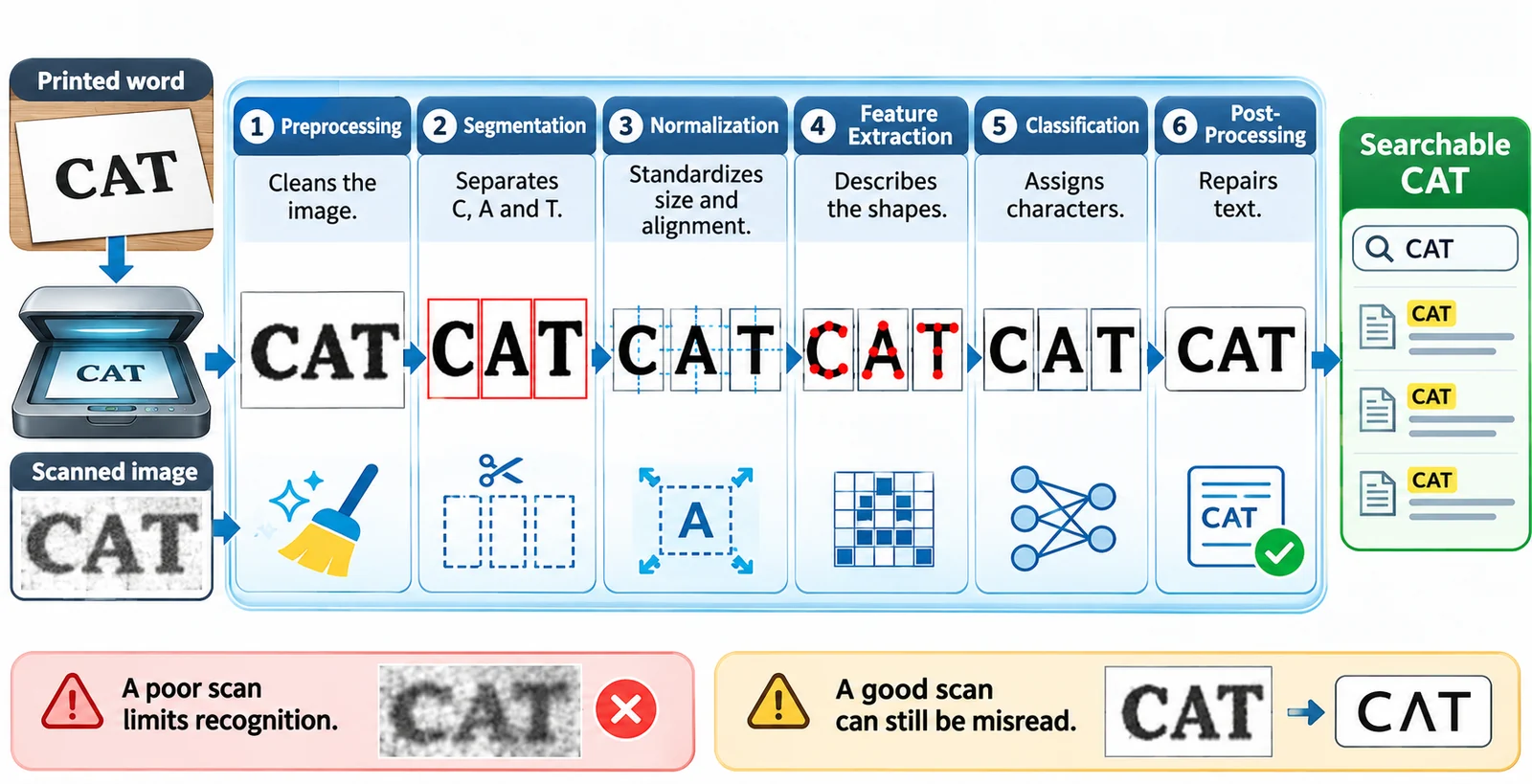
A general OCR system breaks the recognition stage into a chain of steps: preprocessing, segmentation, normalization, feature extraction, classification and post-processing.[6] Preprocessing cleans the image, segmentation cuts it into lines, words and individual characters, and classification decides which character each piece is. The chain is worth keeping in mind because most of the difficulty of the field lives in one link or another rather than in the idea as a whole.
OCR earns its place because so much information arrives as pictures of text. Printed and handwritten documents, invoices, forms and legal papers all carry text that a computer cannot query until it has been converted, and the conversion is what lets a machine search, sort or count what the page says.[2] The same conversion underlies automatic licence plate recognition, where a camera image of a car becomes a registration number that a system can store and check.[7] The value is not the image but the text hidden inside it.
The difficulties are equally concrete. Character shapes vary with typeface, size and image quality, so a recogniser trained on one style of print may stumble on another.[6] In an open environment such as a parking area, illumination changes from hour to hour and makes the same plate harder to read at dusk than at noon. Some characters are ambiguous even to a careful eye: B and 8, O and 0, I and 1, A and 4, C and G, D and O, K and X, along with characters that are broken or partly missing, are among the ambiguous cases that OCR must handle.[7] Handwriting adds the variation of individual hands on top of all this, which is why handwritten recognition remains an open research problem.[8]
OCR turns a picture of text into text a machine can use; the picture is easy to make, the reliable reading is the hard part.
History
From reading machines to neural networks
The idea of a machine that reads has been around longer than the computers that now carry it out. Early automatic reading systems were built to handle machine-printed text, and on that narrow ground they performed impressively; the recognition of handwriting, by contrast, remained an open research problem because the same letter can look so different from one hand to the next.[8] Commercial reading machines of the period were assembled from the same functional parts any OCR system still has: a scanner to capture the page, preprocessing to clean the image, feature extraction to describe each character, and post-processing to repair the output.[9] What has changed across the decades is less the outline of the machine than the method used at its centre.
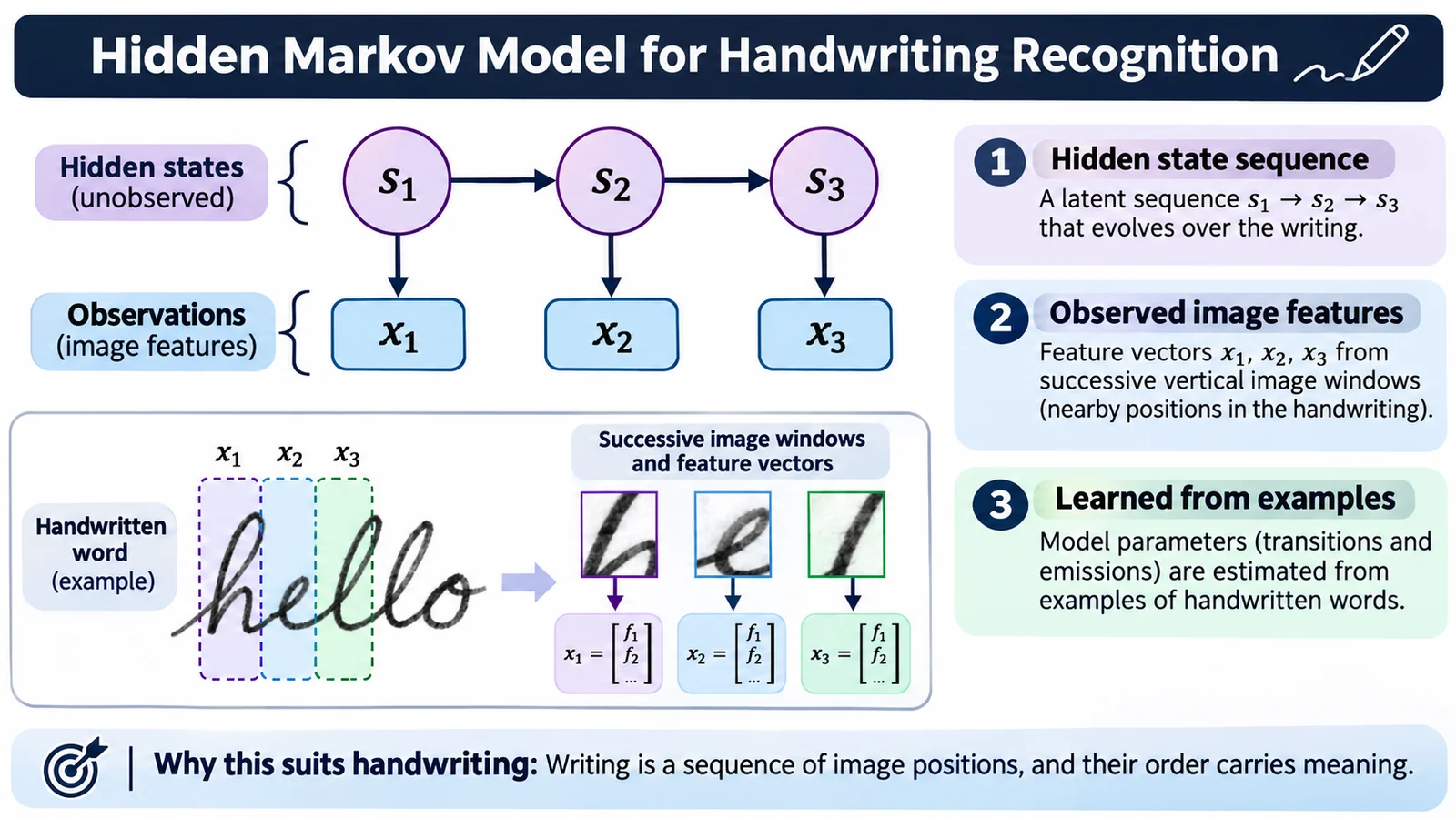
For a long stretch, that centre was a statistical model rather than a set of hand-written rules. Hidden Markov models became the standard tool for offline handwriting recognition: a Markov model is a statistical description of a sequence in which the next state depends only on the current one, and it suits writing because a word is a sequence of strokes and letters whose order carries much of the meaning.[8] The appeal was that the model could be trained on examples instead of being told in advance what each character looked like. The drawback was equally real. Hidden Markov models carried well-known shortcomings, and most systems went on relying on the same ones for decades in both speech and handwriting recognition, while most recent progress was made either through improved preprocessing or through advances in language modeling, with relatively little work on the basic recognition algorithms.[3]
The break came from sequence labelling with neural networks. A recurrent neural network is a network whose connections run in a loop, so that what it has just seen influences what it does next, which lets it read a line of text as a sequence rather than as a bag of separate shapes. A design of this kind, built specifically for data that is hard to segment and contains long-range dependencies running in both directions, reached word recognition accuracies of 79.7 percent on online handwriting and 74.1 percent on offline handwriting across two large unconstrained databases, well ahead of a state-of-the-art hidden Markov model system on the same material.[3] The result mattered less for the two numbers than for what produced them: the network learned to label a whole sequence at once, which sidesteps the awkward business of deciding where one letter ends and the next begins.
That shift did not make the older tools obsolete so much as demote them. A survey of offline recognition describes a field in which Markovian models, both the full hidden Markov models and simpler Markov-chain or n-gram models, established a promising modeling and recognition paradigm, though no standard procedures for building Markov-model-based recognisers could be established. The survey treats handwriting as still an open research problem because of its substantial variation in appearance.[8]
The direction of travel is visible in how the field describes itself. A broad review of handwritten OCR collected 176 articles published between 2000 and 2019 and frames the period as one in which researchers turned to artificial intelligence and machine learning tools to analyse printed and handwritten documents automatically, converting them into electronic form.[10] The framing is telling: the question stopped being how to encode a character's shape by hand and became how to supply enough labelled examples for a model to work the shape out.
None of this happened evenly across scripts or tasks. The machinery that reads clean machine print is not the machinery that reads a scrawled address, and a method that works on one writing system does not transfer for free to another. The sections that follow take up the pipeline step by step, then the classifiers, the learned representations, and the applications where the whole chain has to hold together outside a laboratory.
The history of OCR is a change of method more than a change of machine: the same scanner and the same output, with the decision about what a character looks like increasingly learned from examples rather than written down by hand.
How it works
Scanning, segmenting and classifying a page
A scan is not a neutral copy of a page. The scanner measures light and dark across a grid and records each cell as a number, so what reaches the recogniser is a picture with its own defects: a page fed in slightly crooked, a shadow down one edge, specks of dust, a faint photocopy. Preprocessing is the stage that tries to remove those defects before any character is identified. It is not one operation but a small sequence, and the order and choice of operations shape everything downstream.
Cleaning the image
The first correction is usually geometric. A page scanned at a slight angle produces lines of text that drift upward or downward across the image, and a recogniser that expects horizontal lines will cut words in the wrong places. Skew correction measures that tilt and rotates the image back until the text lines run level.[11] The correction is simple in principle and consequential in practice, because every later step, from finding lines to isolating letters, assumes the text is where it should be.
The image is then reduced to the simplest form that still carries the letters. Binarisation converts a greyscale scan, in which every pixel has a brightness value, into an image of only black and white, so that a pixel is either ink or paper and nothing in between.[11] Thresholding is the usual method: a brightness level is chosen and everything darker becomes ink. The choice of level matters, since too high a threshold turns faint print into blank paper and too low a one turns paper texture into ink. Noise removal follows, clearing isolated dark specks that are not part of any letter, and contrast adjustment pushes ink and paper further apart so that the boundary between them is unambiguous.[6]
These steps are where a pipeline is tuned to its material rather than to text in general. In a study of scanned sleep-study reports, six image preprocessing methods were evaluated, among them gray-scaling, dilation, erosion and increasing contrast, and the authors chose dilation, erosion and contrast for their pipeline because these simple transformations act uniformly on images of differing scanned quality, unlike more complicated thresholding schemes. The same study found that adding structured inputs including word position, page number and numeric value to its language model significantly boosted performance, which shows that cleaning the image and telling the model where things sit on the page are complementary rather than alternative remedies.[12]
Finding the text before reading it
A page is not a single stream of characters. It has a title, columns, a logo, a table, a caption, and the recogniser has to work out which regions contain text and which do not before it can read anything. Document layout analysis is the step that separates textual regions from non-textual ones and establishes the order in which the text is meant to be read. Text line detection then locates the individual lines within those regions. Both are easy on a clean single-column page and hard on a newspaper, a form, or a page in a script whose lines curve.
Work on Persian and Persian-like documents illustrates how much these two steps can matter on their own. A method that combined deep learning models with a voting system to identify regions of interest, and that introduced angle correction and a line curvature elimination algorithm at the line-detection stage, improved the accuracy of Tesseract OCR 5.1.0 by 2.8 percent on the official Iranian newspapers dataset.[13] The recognition engine was not changed at all; only the preparation of the page before it was fed in. That is the useful lesson of layout work: a share of what looks like a reading failure is really a finding failure.
Cutting the page into pieces
Segmentation is the division of a text region into lines, lines into words, and words into the units that will be classified. A common approach decomposes the scanned text into paragraphs using space detection, paragraphs into lines using vertical histograms, lines into words using horizontal histograms, and words into character images using horizontal histograms again.[11] A histogram here means a count of dark pixels along each row or column of the image: a line of text produces a band of rows with many dark pixels separated by bands with few, and the gaps between bands mark where one line ends and the next begins. The same logic, applied along columns, finds the spaces between words.
The output of segmentation is a set of small images, each holding one candidate character, which are normalised to a fixed size so that they can be compared. In one printed-Tamil system each glyph was scaled to 32 by 32 pixels before recognition.[11] Fixing the size removes variation that carries no meaning, since the same letter set in 10-point and 14-point type should be recognised as the same letter, and it lets the classifier work on a uniform input.[4]
Segmentation is also where the chain is most fragile. When characters touch, as they do in cursive scripts and in degraded print, the boundary between them is not visible in the image and the segmenter has to guess. A system that cuts in the wrong place hands the classifier a fragment that resembles no letter at all, and no amount of skill at the classification stage can recover it. This is why scripts that do not separate their characters are consistently harder for OCR than scripts that do, and why later sections return to designs that avoid cutting altogether.
Describing and deciding
Each segmented glyph is then reduced to a set of features, which are measurable properties that distinguish one character from another. The Tamil system extracted character height and width, the number of long and short horizontal lines, the number of long and short vertical lines, horizontally and vertically oriented curves, the number of circles, the number of slope lines, the image centroid and the position of special dots.[11] These are chosen because they match how a person describes a letter: an O is a closed curve, an H is two verticals joined by a horizontal, an i has a dot above a stroke. A collection of such measurements, taken together, defines a character well enough to tell it from the others.
Classification is the decision that follows: given this feature vector, which character is it? The classifier compares the description of the unknown glyph against what it has learned or stored about each possible character and returns the best match. In the Tamil system the features were passed to a support vector machine trained by supervised learning, and the resulting classes were mapped onto Unicode so that the recognised text could be rebuilt in a standard font.[11] The mapping step is easy to overlook but essential: a classifier that returns the label "letter 47" is useless until label 47 is tied to a specific character in a specific encoding.[2]
The final stage is post-processing, which repairs the output using knowledge that the recogniser did not have while looking at individual characters. A dictionary can flag a word that is not a word; a language model can prefer a likely sequence over an unlikely one; rules about the expected shape of a field, such as a date or a plate number, can reject an impossible reading. Post-processing exists because character-level decisions are made in isolation and are therefore blind to context, and a great deal of what looks like recognition error is really a locally plausible decision that a wider view would have corrected.
The pipeline is a chain of narrowing decisions: clean the page, find the text, cut it up, describe each piece, then choose a character. An error introduced early is carried forward and cannot be undone later.
Features, templates and the classifiers that read them
A feature is a number or a small set of numbers that summarises something about a character's shape, chosen so that different letters end up with different values and the same letter ends up with similar ones however it was printed. The idea rests on how people themselves tell letters apart: by overall shape and by features such as strokes, curves, protrusions and enclosures. A recognition system imitates that by calculating topological and geometric properties from the image, properties such as the number of enclosed regions, the presence of a long vertical stroke, or the way a curve bends, and collecting them into a feature vector, the list of measurements that stands in for the character from then on.[14] Once a letter has become a vector, the picture itself can be set aside; everything downstream works on the numbers.
The measurements are obtained by counting pixels in structured ways rather than by any act of looking. The Tamil system described earlier drew on this family of measures, recording character height and width, the counts of long and short horizontal and vertical lines, horizontally and vertically oriented curves, the number of circles, the number of slope lines, the image centroid and the position of special dots.[11] Each measure is crude on its own and ambiguous across the alphabet; taken together they narrow the possibilities sharply, because a letter that shares one property with another usually differs in several of the rest.
Matching against stored shapes
One way to use such descriptions is template matching. A template is a stored reference version of each character, and recognition consists of comparing the unknown glyph against every template and choosing the closest. One system built its templates from the texture and topological features of every uppercase and lowercase letter, digit and symbol in advance, then recognised an input character by measuring the similarity between its extracted features and each stored template and taking the best match.[15] The appeal is transparency: the decision can be inspected, and a failure can be traced to a specific comparison that came out wrong.
Template matching has a weakness that follows directly from how it works. A template is one fixed arrangement, and real print varies in size, slant, stroke weight and noise, so a letter that is the right shape but the wrong thickness may score poorly against its own template. Each image glyph is comprised of 32 by 32 pixels.[11] Normalisation removes variation that carries no meaning, but it cannot remove variation that does, and a heavily degraded or unusual glyph remains hard to match against a single stored form.
The family of classifiers
A classifier is the component that takes a feature vector and returns a character label. Template matching is the simplest member of that family, and the others differ in how much they are willing to learn from examples rather than being told in advance.
Nearest neighbour classification stores examples rather than rules. To classify a new glyph, it measures the distance from that glyph's feature vector to the stored examples and assigns the label of the closest ones, or of the majority among the nearest few. The method needs no training phase in the usual sense, since the examples are the model. Its cost is memory and speed: comparing against a large store of examples for every character on every page adds up.
A support vector machine classifies characters by a supervised learning algorithm. It works well when the classes overlap only slightly and the feature vector is informative, which is why the Tamil system paired its hand-built features with a support vector machine trained by supervised learning.[11] A random forest is a classifier used in these studies. A neural network is one of the classifiers used in these studies.[2][4]
Which of these wins depends on the features it is given and the data it sees, and the differences are not always large. In a study of handwritten Arabic characters, a hybrid method that selected the most useful features with a neighbourhood rough set combined with a binary whale optimisation algorithm was compared against several alternatives on the CENPARMI dataset, and it reported higher recognition accuracy, smaller memory footprint and less processor time than the same approach without the feature selection, and outperformed the other optimisation algorithms it was set against in all its experiments.[16] The lesson is not that one classifier family is best but that the choice of which measurements to keep can matter as much as the choice of decision rule.
Why combining helps
Running several classifiers and pooling their answers can improve on the individual classifiers.[17] The ways of pooling fall into groups according to how much information each classifier offers: some methods suit classifiers that output only a label, others suit those that output a ranked list of candidates, and others suit those that output a probability for each class. Applied to recognising totally unconstrained handwritten numerals, four such combination approaches improved on the individual classifiers they combined, reaching 98.9 percent recognition with 0.90 percent substitution and 0.2 percent rejection on the US zipcode database, and a high-reliability setting of 95 percent recognition with no substitutions and 5 percent rejection.[17] The second figure is the more instructive one: by allowing the system to decline a fifth of the cases, it eliminated wrong answers entirely, which is the right trade when a mistake costs more than a referral.
A feature is a measurement chosen to separate letters; a classifier is the rule that turns measurements into a label, and combining several rules covers the cases where one of them is wrong.
Learning the shapes instead of describing them
Hand-built features work, but they carry an assumption that is easy to miss: someone has to decide in advance which measurements will separate the letters. That decision is a guess about the material, and it is a guess made before the system has seen a single page. A different arrangement removes the guess. Instead of telling the machine what to measure, it is given many labelled examples and left to work out for itself which regularities in the pixels distinguish one character from another.
Convolutional networks as feature learners
A convolutional neural network is a network built to process images. It slides small filters across the picture, each filter computing a weighted sum of a tiny patch of neighbouring pixels, and the result is a map recording where that particular pattern occurs. Early filters respond to simple things, an edge or a corner; later layers combine those responses into larger structures, a curve, a loop, a junction. The weights inside the filters are not designed by hand. They are adjusted during training until the network's answers match the labelled examples, so the features are learned from the data rather than specified by a person.
The practical consequence is that the network discovers which measurements matter for the script it is trained on. A study of children's handwritten Arabic character recognition describes this shift directly: convolutional networks have recently outperformed machine learning techniques that require manually generated features, because they detect and extract distinctive and representative features from the analysed images automatically. The same study notes that the Arabic script is a demanding test of this, with its cursive joins, its dots and diacritics, its diagonal strokes and the alternative shapes a letter takes in the middle of a word.[4] Hand-designed features have to anticipate all of that; a learned representation can absorb it from examples, provided the examples are there.
Reading a line as a sequence
Convolutional networks handle a single character well, but a line of writing is not a collection of independent characters. The letters run together, the boundaries between them are often invisible, and the identity of one shape depends on what sits on either side of it. A recurrent neural network is built for exactly this situation: its connections run in a loop, so the output at one position depends on what the network has just processed, and information can be carried along the sequence. A connectionist system in this context is one built from such networks rather than from a hand-written set of rules.
The design that made this approach work for unsegmented text was built specifically for data that is hard to segment and contains long-range dependencies running in both directions, and it reached word recognition accuracies of 79.7 percent on online handwriting and 74.1 percent on offline handwriting across two large unconstrained databases, well ahead of a state-of-the-art hidden Markov model system on the same material.[3] The important part is not the pair of numbers but what the network was asked to do. It labelled a whole sequence at once, so it never had to commit to where one letter stopped and the next began. The segmentation problem that defeats a cut-then-classify pipeline is not solved; it is avoided.
Training without character boundaries
Avoiding segmentation raises a training question. If the system never marks where characters begin and end, how is it taught what the correct answer is? The answer is to train on the text of the line rather than on its parts, and to let the network learn an alignment between the image and the character string as part of the training process. The Connectionist Temporal Classification algorithm does this: it defines the total probability of the correct output string over all the ways that string could be aligned to the input frames, so the network is never told which frame belongs to which letter.[18]
Calamari, an open-source line recognition package, is built on this principle. Its network architectures are constructed from convolutional layers and long short-term memory layers, a kind of recurrent unit designed to hold information over longer stretches of input, and they are trained with the Connectionist Temporal Classification algorithm; optional use of a graphics processor cuts the computation time for both training and prediction. On the UW3 dataset of modern English it reached a character error rate of 0.11 percent, and on the DTA19 dataset of German Fraktur, an old blackletter typeface, 0.18 percent, considerably outperforming the existing software it was compared against.[18] The second figure is the more striking, because Fraktur is precisely the kind of historical print that hand-built features struggle with.
Hybrid designs
A third arrangement keeps the learned representation but separates the decision from it. A convolutional network is trained to recognise characters, and the intermediate layer that holds its internal description of a glyph is then used as a feature extractor: the picture is passed through the network, the vector of activations at some deep layer is taken as the feature vector, and a separate classifier is trained on those vectors. The network supplies measurements it discovered for itself; the classifier supplies a decision rule that is simple, fast and easy to inspect.
This hybrid pattern appears repeatedly in work on Arabic characters. A review of Arabic handwriting recognition describes this shift directly: convolutional networks have recently outperformed machine learning techniques that require manually generated features, because they detect and extract distinctive and representative features from the analysed images automatically. The same review notes that the Arabic script is a demanding test of this, with its cursive joins, its dots and diacritics, its diagonal strokes and the alternative shapes a letter takes in the middle of a word.[19] The design is attractive when data is limited or when a particular classifier is already trusted, since the expensive part, learning what a character looks like, is done once and the cheap part can be swapped. It also makes the two contributions separable: a poor result can be traced either to a representation that failed to capture the letter or to a decision rule that mishandled a good one.
A convolutional network learns which measurements matter; a recurrent network learns to read a whole line without being told where the letters divide; a hybrid keeps the learned measurements and hands the decision to a separate classifier.
Uses
Parking lots, hospital records and herbarium drawers
The value of OCR shows most clearly where the text it recovers is needed by a machine rather than by a person. A licence plate is a short string, but a parking system cannot act on a photograph of a plate; it needs the registration number as data it can store, compare and query. Automatic licence plate recognition is the OCR task built around that need, and it inherits the general pipeline: capture the vehicle image, locate the plate within it, isolate the characters from the background, and recognise them.[7] Each step is a chance to fail, and the first two are not really OCR at all but the finding work that has to succeed before recognition can begin.


A parking deployment makes the difficulty concrete because it runs outdoors, in real time, on whatever light the day provides. A system built as a new function inside an existing smart parking service used the service's cameras to photograph vehicles arriving at, leaving and standing in the spaces, then applied OCR to extract the plate characters and stored the result in a cloud database, where it could be used to check for stolen vehicles or problems with documentation. The recognition engine was Tesseract 4.0, whose version 4.0 implements a long short-term memory recognition engine, a kind of recurrent network. The team tested different image filters in the preprocessing phase, including the Gaussian Blur filter and Filter 2D, and reported that the system performed better when the bidirectional filter was used under varying illumination, while noting that character recognition remained sensitive to the environment illumination.[7] That last point is the honest summary of the deployment: the chain worked in a real environment, and its weakest link was the image it was handed.
Health records present the same chain with a different cost of error. Scanned documents in electronic health records, the products of faxed records, paper files and outside laboratory reports, are expected to remain part of medical record keeping for the foreseeable future, which makes automated extraction from them a practical necessity rather than a convenience. A pipeline built for this task took scanned sleep study reports through image preprocessing, OCR with Tesseract, and then a language model that read the recovered text, with the goal of pulling out two measurements: the apnea hypopnea index, the average count of apnea and hypopnea events per hour, which is the standard for diagnosing and grading sleep apnea, and oxygen saturation.[12]
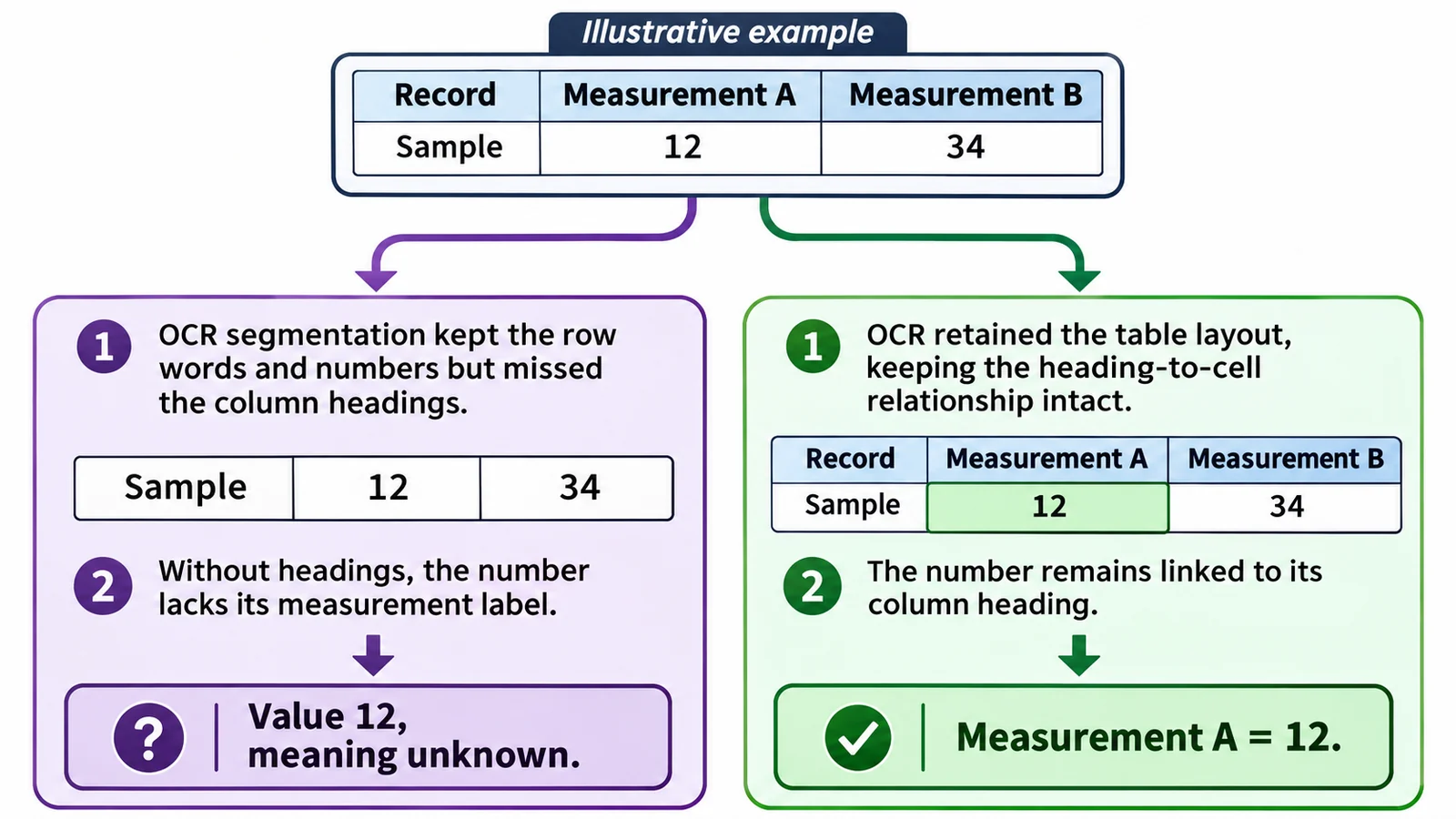
What makes this case instructive is that the OCR stage was not the end of the work and not the only place where accuracy was won or lost. The team evaluated six image preprocessing methods, seven traditional machine learning models and three deep learning sequence models, and also tested whether supplying the document's layout as structured input helped. It did: adding word position in pixels, page number and numeric value as structured inputs significantly boosted performance, with ClinicalBERT with structured input reaching an SaO2 AUROC of 0.9743 (P =.0092).[12] The layout information is a fact about the page that OCR discards when it flattens a document into a stream of characters, and putting it back recovered accuracy that the text alone had lost. The same study found a limit worth naming: a high proportion of the cases the model failed on came from tables, because the segmentation captured only the words to the left and right of a candidate number and never the column headings above it.[12]
Herbarium specimens show a third pattern, where OCR helps without ever being trusted to produce the final record. At the Royal Botanic Garden Edinburgh, specimen images were passed through recognition software and the unparsed output was stored in a single database field, with a copy of the text overlaid on the specimen image saved alongside it. The output was then used to sort specimens before a team of six digitisers entered data by hand, and the trials compared how quickly batches could be processed when they had been sorted using the OCR data against unsorted, random batches. Across 7,200 specimens, the sorted batches were quicker, and the most efficient method of those tested used a protocol entering data into a limited set of fields with records filtered by collector and country, on average 20 minutes, or 8.9 percent, faster per batch of 50 records than the next most efficient method.[5]
The sorting result is the interesting one because it does not depend on the OCR being right. Filtering by collector and country groups together labels with similar layout, locations and handwriting, so a digitiser builds familiarity with a particular hand or a particular geography and reads the next label faster.[5] The recognition output only had to be good enough to put similar specimens in the same pile. Direct use of the OCR text, by contrast, had very little effect on digitisation time, partly because the output format made it awkward to copy several lines at once, and the output carried errors in punctuation, spelling and spacing; it worked only for typed and printed labels, not handwritten ones, and in some cases was poor enough that retyping was faster.[5]
Banking is another deployment where the recognition has to be reliable enough to move money. A cheque carries its amount in a form designed for machines, and the recognition has to be reliable enough to move money. Optical character recognition technology developed by an AT&T team that included its Global Information Solutions arm and Bell Laboratories was what made enhanced self-service machines possible, extending automatic teller machines beyond cash withdrawal and balance inquiry to check cashing and depositing and to direct bill payment through an online system.[20] The pattern across all four cases is the same: the recognition is embedded in a larger process that has its own checks, and its output is judged by whether that process works, not by how many characters it read correctly in isolation.
In deployed systems OCR rarely stands alone: it feeds a sorter, a database or a language model, and the surrounding process absorbs errors the recogniser cannot avoid.
Air writing and pen trajectories
Everything in the pipeline so far begins with a finished image. A page is written, then scanned, and the recogniser works from the marks left behind. There is another way to capture writing, and it changes what the recogniser has to work with. When a pen moves over a digitising tablet, or a finger moves through the air in front of a camera, the writing can be recorded as it happens, as a sequence of positions over time. The result is not a picture of a letter but a record of the movement that made it.


Two ways to capture the same letter
The distinction is drawn in the field as online versus offline recognition. Offline recognition works from a scanned image, with no information about how the marks were laid down. Online recognition works from trajectory data, the path of the pen or finger sampled as it moves, so the system knows the order of the strokes, their direction, and the timing between them.[21] The same letter, written by the same hand, yields two quite different inputs depending on which is used.
Trajectory data removes some of the hardest problems of image recognition and introduces others. A recogniser that knows the order of strokes does not have to guess where one character ends and the next begins from the shape alone, because the pen lifted between them. It also sees features an image cannot show, such as how fast a stroke was drawn and how long the pen paused. What it loses is the finished appearance: an online system never sees the letter as a whole, only the movement that produced it, and it must cope with the fact that the same letter can be drawn with different numbers of strokes in different orders.
The practical home of online recognition has been the pen computer and the touchscreen. A survey of the field in its early period described the state of the art in online handwriting recognition, covering the digitizer technology that captures the pen's path, the shape recognition algorithms applied to it, and the commercial products that shipped it.[22] The same survey set out the contrast with offline recognition that still frames the field. Later work on large-alphabet languages made the case for the online approach sharply: for scripts with thousands of characters, such as Japanese with its Kanji, handwriting input using an online technique is essential for input accuracy and speed, because the characters can be written with wide variation in the number and order of strokes and with significant shape distortion, and a system that captures the strokes directly has more to work with than one that sees only the result.[23]
Writing in the air
Air writing pushes the idea further. Nothing is touched at all. A camera watches a hand move through space, and the recogniser must recover letters from the trajectory of the hand rather than from ink on a surface. The appeal is that it needs no surface and no stylus, which suits settings where a person is moving, speaking with a robot, or working in a virtual space.
Arabic air writing was the target of a system that combined feature extraction from deep convolutional networks with several machine learning classifiers, and that also brought in optical character recognition methods to isolate individual letters from continuous air-written gestures.[2] The problem it addressed is specific to the medium. Air-written letters are not confined to the boundaries of paper or a screen, so the same letter can be formed in a wide range of sizes and trajectories, and there are no fixed reference points or marked start and end strokes to say where one letter stops and the next begins.[2] A recogniser for ink on paper can rely on the page to bound the writing; one for a hand in the air cannot.
The system was trained and tested on a dataset of Arabic air-written letters that includes varied writing styles and hand-sign variations, and the best result came from a neural network classifier applied to features extracted by one of the convolutional models, reaching an accuracy of 88.8 percent. The authors were direct about how that figure should be read: it is lower than accuracies reported for English or other languages, but the comparison is not like for like, because the datasets, techniques and language-specific characteristics differ, and the work was the first to concentrate on Arabic air writing.[2] The caution is the same one that applies across the field, and it is taken up later.
Reading the air without a camera
A camera is not the only sensor that can capture a hand in motion. A system called WiReader used ordinary commercial WiFi equipment, with no camera and no device worn by the writer, to recognise letters written in the air.[24] The approach reads channel state information, the measurements of how a wireless signal is distorted as it travels between transmitter and receiver; a hand moving through the signal path changes those measurements in ways that depend on the path the hand took. The system segmented the collected signal, transformed it, extracted features with cumulative principal components and a multilayer wavelet transform, and classified the resulting energy feature matrix with a long short-term memory network.[24]
Across extensive real-world experiments the system reached an average recognition accuracy of 90.64 percent, and it held up across different user locations, different users and different scenarios.[24] The result is worth pausing on because it shows how far the notion of a writing surface can be stretched. There is no page, no ink and no image; the writing exists only as a disturbance in a radio signal, and the recogniser is reading the disturbance. What such a system gives up in resolution it gains in requiring nothing of the writer beyond a hand.
When the hand cannot move
The most striking use of trajectory data reverses the usual direction of the problem. Instead of a machine reading writing that a person produced, the machine reads the neural activity that would have produced it. A brain-computer interface is a system that records signals from the brain and translates them into commands or text, and one such system was built to decode attempted handwriting from the motor cortex of a participant whose hand was paralysed by spinal cord injury.[25]
The participant attempted to write letters as if by hand, and a recurrent neural network decoded the attempted movements from the recorded neural activity and translated them into text in real time. The system reached typing speeds of 90 characters per minute with 94.1 percent raw accuracy online, and above 99 percent accuracy offline when a general-purpose autocorrect was applied. Those speeds were reported as exceeding those of any other brain-computer interface at the time, and as comparable to the typical smartphone typing speed of people in the participant's age group, which was 115 characters per minute.[25]
The reason handwriting worked well here connects back to the nature of trajectory data. The authors argued on theoretical grounds that temporally complex movements such as handwriting may be fundamentally easier to decode than simple point-to-point movements, because the decoded signal carries more structure per unit of time.[25] A reach toward a target is one movement with a start and an end; a written word is a rapid, highly practised sequence in which each letter follows the last in a learned order. The same property that makes air writing hard to segment, the continuous flow of a practised hand, is what gives the decoder something to lock onto.
Capturing writing as movement rather than as a finished image trades the problems of segmentation for the problems of trajectory, and in the hardest cases, where no hand can move at all, the trajectory being read is the one the brain still produces.
Research
Reading handwriting, printed pages and awkward scripts
A recogniser's accuracy is not one property of the system but a property of the system and the material it is given. The same engine that reads a clean typewritten page almost perfectly can stumble badly on a scrawled address, and a method that sets a record on one script may do poorly on another. Reported accuracies are therefore only meaningful when the task, the script and the test data are named alongside them. Reading the numbers without that context is the most common way to misunderstand the field.
Handwritten lines
The hardest common case is a line of unconstrained handwriting, where letters run together, the boundaries between them are invisible, and the writer's habits are unknown to the system. The recurrent network described earlier was built for exactly this and was tested on two large unconstrained handwriting databases, reaching word recognition accuracies of 79.7 percent on online data and 74.1 percent on offline data, well ahead of a state-of-the-art hidden Markov model system on the same material.[3] The gap between the two figures is itself informative: the online system, which sees the trajectory of the pen, does better than the offline system, which sees only the finished image. The same writing, captured two ways, is two problems of different difficulty.
Those numbers are word accuracies on unconstrained text, and they set a realistic expectation. A system reading four words in five correctly is useful for search and indexing and not yet good enough to replace a human transcriber. The figure also depends on the vocabulary and the material: a recogniser working on a small set of expected words has an easier job than one facing an open vocabulary, because it can use the knowledge of what words are likely to narrow its choices.
Pooling classifiers
One route to better numbers is to stop relying on a single decision rule. Different classifiers misread different characters, so running several and combining their answers can beat any one of them, provided the combination is done with care. The ways of pooling fall into groups according to how much each classifier reveals: some methods suit classifiers that output only a label, others suit those that output a ranked list of candidates, and others suit those that output a probability for each class.[17]
Applied to totally unconstrained handwritten numerals, four such combination approaches improved on the individual classifiers they combined. On the US zipcode database the combined system reached 98.9 percent recognition with 0.90 percent substitution and 0.2 percent rejection, and a high-reliability setting gave 95 percent recognition with no substitutions and 5 percent rejection.[17] The second setting is the more instructive. By allowing the system to decline one case in twenty, it eliminated wrong answers entirely, which is the right trade whenever a mistake costs more than a referral to a person. The same principle underlies any system that flags uncertain readings rather than guessing.
Children's handwriting
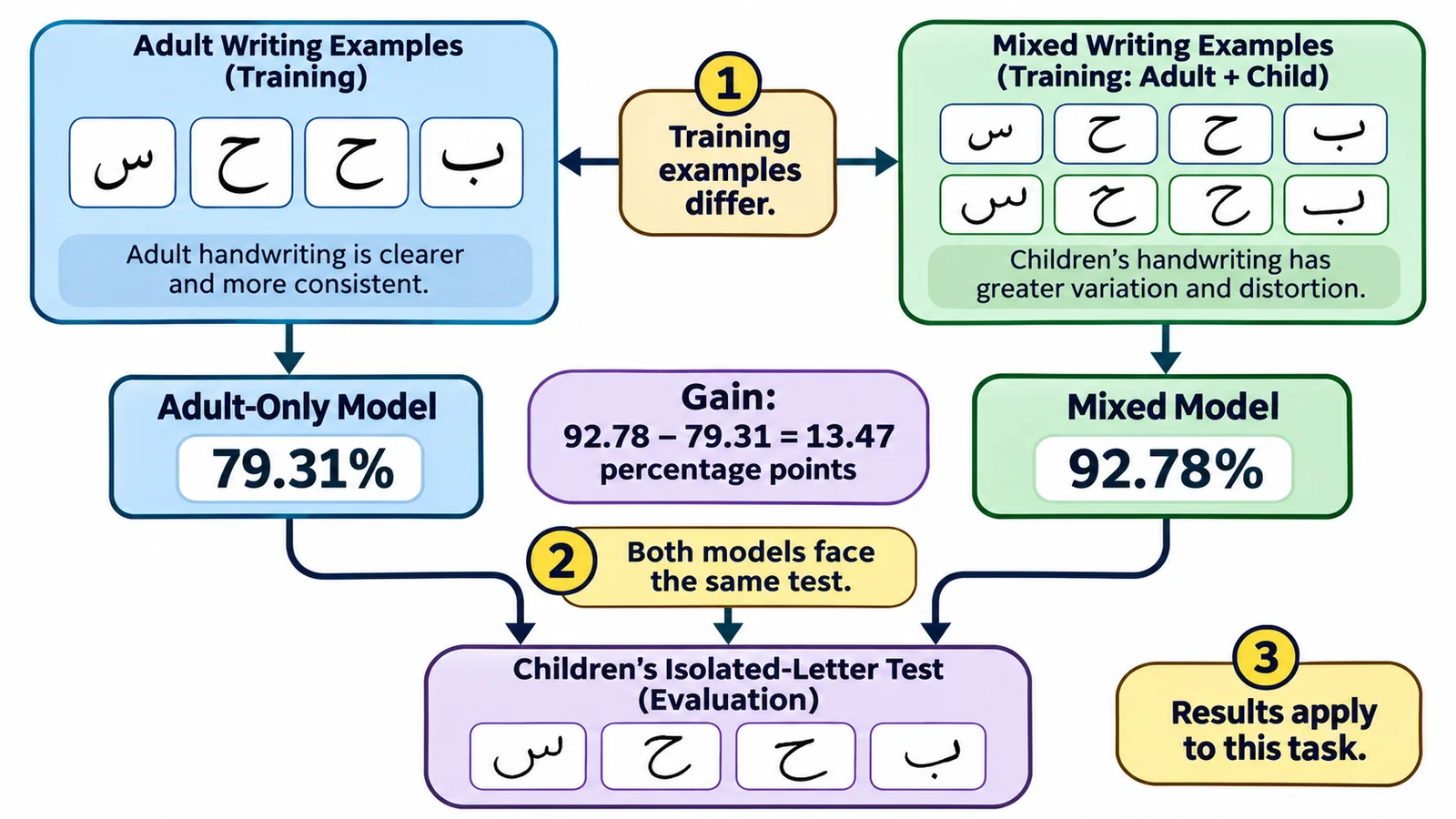
Handwriting varies not only between individuals but between groups, and one group is systematically harder than the rest. Children's handwriting tends to be of lower quality than adults', with more variation and larger distortions, and most recognition systems have been trained and tested on adult data rather than on children's.[4] A system built for adult forms may simply never have seen the shapes a seven-year-old produces.
A study of isolated Arabic letters tested this directly by training one convolutional model on three different diets: children's writing alone, adults' writing alone, and the two combined. Trained on children's data, the model reached an average accuracy of 91.78 percent on a test set of children's letters; trained on children's and adults' data together, it reached 92.78 percent, about a percentage point better. Trained on adult data alone, accuracy fell to 79.31 percent, a drop of more than twelve points from the combined model. The explanation is not that adult data is unhelpful but that it is unrepresentative: adult samples are clearer and more consistent in shape and size, so a model trained only on them never learns to handle the distorted and unclear samples that children produce.[4] Mixing the two gave the model clear examples to learn from and hard examples to generalise to.
Printed pages, old and new
Print is easier than handwriting, but not uniformly so, and the age of the page matters as much as the hand. Historical newspapers and journals are printed in typefaces and languages that modern recognition software was not built around, and the quality of the scan adds to the difficulty. The historical portion of a Finnish newspaper and journal corpus, recognised with commercial software, had an estimated character error rate between 8 and 13 percent, which is too low a quality for reliable search or research on the recovered text.[26] A character error rate counts the proportion of characters the system got wrong, so a rate of 8 to 13 percent means roughly one character in ten is misread, enough to break keyword searches and to corrupt quoted passages.
The corpus was printed in Finland's two main languages, Finnish and Swedish, and in two font families, Blackletter and Antiqua, which is why a single model struggled: the material was not one problem but four. Training a mixed-language model on the whole corpus, with additional training data, brought the error rate down to 1.7 percent on the Finnish test set and 2.7 percent on the Swedish one.[26] The improvement came from matching the model to the material rather than from a better algorithm in the abstract, which is a pattern that recurs wherever recognition is applied to a defined collection.
Scripts with their own conventions pose their own problems. Arabic is written cursively, with dots and diacritics above and below the letters, and a letter takes different shapes depending on where in a word it sits. A review of Arabic OCR found that most published approaches had been evaluated on isolated characters or isolated words under controlled conditions, with few tested on whole pages, and that comparative studies showed the accuracy of existing Arabic commercial systems to be low, under 75 percent for printed text.[27] That figure sits awkwardly beside the much higher numbers reported for isolated Arabic characters, and the discrepancy is the point: recognising a letter in a prepared image is a different task from reading a page.
Scripts that join their letters
Where a script does not separate its characters, segmentation becomes the bottleneck, and systems are built around units other than the single letter. Urdu printed in the Nastaliq style is written in ligatures, joined groups of letters that form a single connected unit, and a recognition system for it took the ligature rather than the character as its unit of recognition. Working from 1,525 unique high-frequency ligatures drawn from a standard Urdu printed-text database, it split each ligature into its main body and its secondary marks, grouped multiple instances of the same ligature into clusters, and trained hidden Markov models on statistical features extracted through sliding windows; on more than 6,000 query ligatures it reported a ligature recognition rate of 92 percent.[28] Recognising ligatures rather than letters sidesteps the question of where one letter ends, because the unit being classified is the connected shape as it actually appears.
Quranic text adds a further layer, since the diacritics that mark vowels are part of the text and must be recognised rather than ignored. A system built on a convolutional network followed by a recurrent one, trained on a new dataset made from a widely printed edition of the Quran, reported 98 percent accuracy on validation data, a word recognition rate of 95 percent and a character recognition rate of 99 percent on its test set.[29] The two rates are worth reading together: characters are recovered almost perfectly while one word in twenty is wrong, because a single misread diacritic can change a word while leaving most of its characters intact.
Accuracy figures are only comparable within the same task, script and test set; a high number on isolated characters and a lower one on whole pages can both be honest.
Risks and limits
Where recognition breaks down
A recognition system fails in ways that follow from the material it is given, and the failures cluster. Some come from the image, some from the characters themselves, some from the layout of the page, and some from the habits of the people who wrote it. Naming them separately is useful because each calls for a different remedy, and because a system that looks weak overall is often strong everywhere except one of these.
When the light changes
Outdoors, the same plate photographed at noon and at dusk is two different images. A parking system built to read licence plates in an open environment was evaluated at different times of day precisely so that illumination variation would be exercised, and the choice of preprocessing filter turned out to matter: the bidirectional filter gave the best performance under varying light, better than the Gaussian blur and the 2D filter it was tested against. Even so, character recognition remained sensitive to the illumination, and the team treated further filter experiments and new deep learning methods as future work.[7] The failure is not that the recogniser cannot read a plate; it is that the image it is handed changes character with the sun, and a method tuned to one lighting condition does not automatically hold in another.
Characters that look like each other
Some errors come from the alphabet rather than the image. Certain pairs of characters are close enough in shape that a recogniser working from a small, noisy picture cannot reliably tell them apart: B and 8, O and 0, I and 1, A and 4, C and G, D and O, K and X, along with characters that are broken or partly missing, are the pairs that most often produce errors in plate recognition.[7] The list is worth noting because it is not random. Each pair differs in one small region, a closed loop against an open one, a stroke against a gap, and a blur or a speck of noise in exactly that region erases the distinction. A recogniser can be perfectly good at the other thirty-odd characters and still fail on these.
The same problem appears in Arabic, where letters differ by dots placed above or below the body of the character. That is a different kind of failure from a blurry photograph. The information needed to decide is not in the character at all, and no improvement to the recogniser's view of that character will supply it.
Labels in poor condition
Paper degrades, and a recogniser inherits the damage. At the Royal Botanic Garden Edinburgh, where specimen labels were passed through recognition software to help with digitisation, the quality of the output varied with the condition of the label, and the output carried errors in punctuation, spelling and spacing.[5] Two limits were sharper still. The software could read typed and printed labels but not handwritten ones, so a portion of the collection was simply out of reach, and in some cases the output was poor enough that retyping the text was faster than correcting what the machine had produced.[5] The last point is the practical sting: a recognition error is not free, because someone has to notice it and fix it, and when errors are dense the correction costs more than the original work.
Handwriting the software cannot read
The Edinburgh case points at a broader boundary. Recognition software trained on print does not transfer to script, and a collection that mixes the two has to be split before either can be handled well. The digitisers' own account of their work makes the human side of this concrete: they preferred working with physical specimens over images, found that reading labels on a screen strained their eyes more, and felt that images took longer to manipulate to get at the label information. Where the handwriting on a set of labels was particularly difficult to read, having two people work on similar specimens helped, because they could discuss the hard cases with each other.[5] A hard hand is not only a machine problem; it slows the people who are checking the machine.
Tables and other structure
A page is not a single column of prose, and a recogniser that flattens it into a stream of characters throws away the arrangement that gave the characters meaning. In the pipeline built to pull two measurements out of scanned sleep study reports, a high proportion of the cases the model failed on came from tables, because the text segmentation captured only the words to the left and right of a candidate number and never the column headings above it.[12] The number was read correctly and attached to the wrong thing. This is a failure of the pipeline rather than of the recogniser, and it is easy to miss, because the recovered text looks clean.
Skewed databases and skewed scholarship
The last failure is the quietest. When a large body of text is digitised and made searchable, the errors in it do not stay in the archive; they shape what researchers find there. A study of Canadian history dissertations found that the Toronto Star was cited 74 times in 1998, a year with 67 dissertations, and 753 times in 2010, a year with 69 dissertations, and it argued that online historical databases have profoundly shaped Canadian historiography, in a shift rarely made explicit.[30] The mechanism is the one described earlier: a keyword search returns what the recogniser managed to transcribe, so a word the software misread is a word the scholar never sees, and a source that is easy to search gets used more than one that is not. The argument is not that the databases are bad but that historians need to understand how recognition works in order to bring methodological rigour to sources they now rely on.[30]
Recognition failures are not all the same kind: some come from a degraded image, some from characters that genuinely look alike, some from structure the pipeline discards, and some from the way a searchable archive quietly steers what gets studied.
The remedies for these failures differ as much as the failures do, and several of them are taken up later: better preprocessing choices, layout supplied to the model as input, correction of the output after recognition, and voting across several models. What does not change is the underlying point. A recognition rate is a statement about a system and a particular body of material together, and the same system can be excellent on one collection and poor on the next.
Later developments
Improving the odds
The failures described so far are not fixed by a single better recogniser. They come from different places in the chain, and the work of improving results has spread across the whole chain in response: the image before recognition, the page layout the model is told about, the resolution of the scan, the text after recognition, and the segmentation step itself. Each intervention targets a specific link, and each is worth judging by how much of the remaining error it removes.
Preparing the image and the page
Preprocessing is the cheapest place to intervene, because it happens before any recognition and can be tuned to a known collection. The sleep-study pipeline evaluated six image preprocessing methods and used gray-scaling, dilation, erosion and contrast; dilation, erosion and contrast are simple transformations with a uniform effect on images of differing scanned quality, unlike complicated thresholding transformations.[12] The reasoning is practical: a method whose effect varies with the input is hard to rely on across a mixed archive, while a simple transformation behaves predictably. Layout is information the recogniser discards when it flattens a page into a stream of characters, and handing it back recovers accuracy that the text alone had lost.
Layout work can also be done before the recogniser ever sees the page. For Persian and Persian-like documents, a method that combined deep learning models with a voting system to identify regions of interest, and that added angle correction and a line curvature elimination algorithm at the line-detection stage, improved the accuracy of Tesseract OCR 5.1.0 by 2.8 percent on the official Iranian newspapers dataset.[13] The recognition engine was untouched. What changed was the preparation of the page, which is the same lesson as the sleep-study result in a different form: a share of what looks like a reading failure is really a finding failure, and finding is easier to fix.
Super-resolution and post-correction
A low-resolution scan sets a ceiling on what any recogniser can recover, because the pixels that would distinguish one character from another were never captured. Super-resolution attacks this by reconstructing a higher-resolution image from a low-resolution one before recognition, using a model trained to infer the missing detail. An entry in the ICDAR2015 Competition on Text Image Super-Resolution applied such a framework to low-resolution inputs and reached an OCR accuracy score of 77.19 percent, comparable to the 78.80 percent obtained from the original high-resolution images.[31] The comparison is the meaningful part: the reconstructed image did not beat the original, but it closed most of the gap, which means a collection scanned at too low a resolution is not necessarily lost.
Post-correction works on the other side of recognition, repairing the output using knowledge the recogniser did not have while looking at individual characters. Finite state methods are one way to do this: a finite state transducer is a model that maps one string to another according to a set of rules or learned correspondences, which suits the task of turning a misread string into a plausible one. In the Finnish newspaper corpus, where commercial software left a character error rate between 8 and 13 percent, the new recognition results with a mixed-language model, voting and post-correction reached 1.7 percent CER on the Finnish test set and 2.7 percent on the Swedish one. The corpus was printed in two languages and two font families, Blackletter and Antiqua, so a single model had been facing four problems at once; training one mixed model on the whole corpus, with additional training data, addressed the recognition side while post-correction addressed what remained.[26]
Voting and learned segmentation
Because different models misread different things, running several and pooling their answers can beat any one of them. Combining classifiers improved performance on handwritten numerals, and the Finnish work found a voting setup that further improved results.[26][17] The cost is computation, since every model must be run on every page, which is why voting tends to be reserved for material where accuracy matters more than throughput.
Segmentation, the step that decides where one character ends and the next begins, has traditionally been handled by fixed rules, and those rules are exactly what fails when characters touch or when a script does not separate its letters. A multi-lingual system replaced the fixed rules with a learned segmenter trained by reinforcement learning, a training method in which a model is rewarded for actions that improve a final score rather than for matching a correct intermediate answer. The system used three neural blocks, a segmenter that partitions a word image into character images, a switcher that assigns a recogniser to each sub-image, and the recognisers themselves, and trained the segmenter with the REINFORCE algorithm so as to minimise the edit distance of the final recognition results rather than to match character boundaries.[32] The design matters because it removes a dependency: supervised training of a segmenter needs character boundary labels, which are expensive to produce, and its objective is sub-optimal because good boundaries are not the same thing as good final text. Training on the final score sidesteps both problems, and the reported results showed significant improvement for multi-lingual scripts and large character-set languages without using character boundary labels.[32]
Improvements cluster by link in the chain: clean and lay out the page, reconstruct resolution that was never captured, correct the text afterwards, and let the segmenter learn from the final score rather than from hand-marked boundaries.
What these directions share is that none of them requires a fundamentally new recogniser. They adjust what the recogniser is given, what it is told, and what is done with its output. That is also their limit: each removes a portion of the error that comes from its own link, and the error that remains is the part no amount of preparation can reach. Which failures those are, and how carefully reported accuracies can be compared across scripts and datasets, is taken up later.
What OCR still cannot do
The limits of optical character recognition are easiest to see when a system is asked to read a whole page of a difficult script rather than a prepared sample of isolated letters. Arabic is the clearest case. A review of Arabic OCR found that most published approaches had been evaluated on isolated characters or isolated words under controlled conditions, with few tested on page-level scripts, and that comparative studies put the accuracy of existing Arabic commercial systems at under 75 percent for printed text.[27]
That figure describes commercial products reading ordinary printed Arabic, not a research prototype on a curated set. The same review notes that most current approaches are offline systems, working from scanned images, with no remarkable contribution to online recognition from trajectory data.[27] The gap between the two kinds of number, high on isolated characters and low on pages, is not a contradiction. It is a statement about what each test asked the system to do.
The scarcity of page-level evaluation is a limit in its own right, because it leaves the field without a shared measure of the task that matters most in practice. A recogniser can be measured on a set of clean, isolated, well-framed characters and score impressively, while the same recogniser facing a photographed document with columns, headers, a stamp and a fold has to find the text before it can read it, and every one of those steps can fail. When most reported results come from the easier setting, the published numbers describe a capability that has not been tested where it will be used.
Training data is the second constraint, and it cuts in two directions. A model learns the writing it is shown, so a collection that differs from the training material in script, typeface, era or hand will be read worse, and the shortfall will not appear in results reported on the training distribution. The Finnish newspaper corpus makes the point concretely: commercial software left a character error rate between 8 and 13 percent on historical material printed in two languages and two font families, and the error rate fell to 1.7 percent on the Finnish test set and 2.7 percent on the Swedish one only after a mixed-language model was trained on the corpus itself with additional training data.[26] The improvement came from matching the model to the material. A collection without the resources to build its own training data stays where the commercial software left it.
The same dependence shows up when the writers are unusual rather than the print. Children's handwriting is of lower quality than adults', with more variation and larger distortions, and most recognition systems have been trained and tested on adult data rather than on children's. A model trained only on adult samples reached 79.31 percent on a test set of children's letters, against 92.78 percent for a model trained on children's and adults' data together.[4] The adult-only model had learned from clear, consistent shapes and had never been shown the distorted ones it would be judged on. The lesson generalises beyond children: a system's accuracy is a property of the system and the material together, and a body of writing that was absent from the training data is a body of writing the system has not really been tested on.
All of this makes comparison across published results treacherous. Reported accuracies are quoted as though they measured a single quantity, but they are produced by different datasets, different techniques and different languages, each with its own difficulties. The authors of the Arabic air-writing system made the point about their own figure of 88.8 percent: it is lower than accuracies reported for English or other languages, but direct comparison is not appropriate, because the datasets, techniques and language-specific characteristics differ, and their work was the first to concentrate on Arabic air writing.[2] A reader who ranked that system against an English one by the two numbers alone would be drawing a conclusion the numbers cannot support.
What remains, then, is not a single unsolved problem but a set of them, each attached to a different link in the chain. Finding text on a cluttered page, reading a script whose letters join and whose dots carry meaning, handling a hand or a typeface the model never saw, and knowing whether a reported figure applies to the material in front of you are separate difficulties with separate remedies. The honest summary of the field is that recognition works well within the conditions it was built and tested for, and that establishing those conditions, for any given system and any given collection, is part of the work rather than a footnote to it.
A recognition rate is a claim about a system and a particular body of material; without the material named, the number says less than it appears to.
Key studies
| Year | Study | Sample | Design | Finding |
|---|---|---|---|---|
| 2012 | Shrivastava[14] | 360 characters from 10 simple fonts and 720 characters from 10 stylised fonts | neural network trained on templates and tested on untrained fonts | Recognition was 85.83% on the simple fonts and 75% on the stylised fonts. |
| 2014 | Jana et al.[15] | recognition experiment matching texture and topological features against stored character templates | In the 70-character test case, accuracy was 94.28% for Berlin Sans and 87.14% for Arial, but only 14.28% for Cambria and 21.42% for Times New Roman. | |
| 2014 | Drinkwater et al.[5] | 7,200 herbarium specimens processed by six digitisers | trials comparing sorted and unsorted batches | Sorting by collector and country with machine-read label text cut the partial-protocol time by 44.7% compared with a random batch. |
| 2015 | Dong et al.[31] | the ICDAR2015 TextSR dataset with Tesseract-OCR 3.02 | super-resolution entry in a competition | Super-resolution raised recognition accuracy on low-resolution images to 77.19%, close to the 78.80% obtained from original high-resolution images. |
| 2020 | Wick et al.[18] | two datasets, UW3 in modern English and DTA19 in German Fraktur | comparison of recognition software with pretraining and voting | Calamari reached a character error rate of 0.11% on UW3 and 0.18% on DTA19, outperforming the existing software. |
| 2020 | Memon et al.[10] | 176 articles published between 2000 and 2019 | systematic literature review | 55 new studies appeared in the last two years, against 59 in the previous eight years. |
| 2020 | Drobac & Lindén[26] | the historical part of the Finnish newspaper and journal corpus, in Finnish and Swedish | training and voting experiments with deep neural networks plus post-correction | The new models reached 1.7% character error rate on the Finnish test set and 2.7% on the Swedish test set. |
| 2020 | Guo et al.[24] | real-world experiments in three scenarios with commercial WiFi devices | device-free air handwriting recognition using wireless signals | WiReader achieved an average recognition accuracy of 90.64%. |
| 2022 | Hsu et al.[12] | 955 scanned sleep study reports | comparison of image preprocessing methods, optical character recognition and language models | At the document level, BERT and ClinicalBERT were 94% to 95% accurate, and the strongest bag-of-word classifiers, kNN and Random Forest, were about 93.5% accurate. |
| 2023 | Alghyaline[27] | a review of Arabic recognition studies from the last decade | literature review with preprocessing and segmentation experiments | Commercial Arabic systems reach under 75% accuracy on printed text, and basic image preprocessing raised accuracy by up to 9% across four systems. |
| 2023 | Nahar et al.[2] | the AHAWP dataset of air-written Arabic letters | deep features from convolutional networks combined with machine learning classifiers and optical character recognition | The best accuracy was 88.8%, using a neural network with the VGG16 model. |
| 2023 | Alwagdani & Jaha[4] | the Hijja child dataset and the AHCD adult dataset of Arabic letters | convolutional network trained on child, adult, or combined data | Training on both datasets raised accuracy to 92.96%, against 91.95% with child data alone and 80.17% with adult data alone. |
See also
References
- Permaloff, A., & Grafton, C. (1992). Optical Character Recognition. PS: Political Science & Politics, 25(3), 523-531. doi:10.2307/419444
- Nahar, K. M. O., Alsmadi, I., Al Mamlook, R. E., Nasayreh, A., Gharaibeh, H., Almuflih, A. S., & Alasim, F. (2023). Recognition of Arabic Air-Written Letters: Machine Learning, Convolutional Neural Networks, and Optical Character Recognition (OCR) Techniques. Sensors, 23(23), 9475. doi:10.3390/s23239475
- Graves, A., Liwicki, M., Fernandez, S., Bertolami, R., Bunke, H., & Schmidhuber, J. (2009). A Novel Connectionist System for Unconstrained Handwriting Recognition. IEEE Transactions on Pattern Analysis and Machine Intelligence, 31(5), 855-868. doi:10.1109/tpami.2008.137
- Alwagdani, M. S., & Jaha, E. S. (2023). Deep Learning-Based Child Handwritten Arabic Character Recognition and Handwriting Discrimination. Sensors, 23(15), 6774. doi:10.3390/s23156774
- Drinkwater, R., Cubey, R., & Haston, E. (2014). The use of Optical Character Recognition (OCR) in the digitisation of herbarium specimen labels. PhytoKeys, 38, 15-30. doi:10.3897/phytokeys.38.7168
- Hamad, K., & Kaya, M. (2016). A Detailed Analysis of Optical Character Recognition Technology. International Journal of Applied Mathematics, Electronics and Computers, 4(Special Issue-1), 244-244. doi:10.18100/ijamec.270374
- Dalarmelina, N. d. V., Teixeira, M. A., & Meneguette, R. I. (2019). A Real-Time Automatic Plate Recognition System Based on Optical Character Recognition and Wireless Sensor Networks for ITS. Sensors, 20(1), 55. doi:10.3390/s20010055
- Plötz, T., & Fink, G. A. (2009). Markov models for offline handwriting recognition: a survey. International Journal on Document Analysis and Recognition (IJDAR), 12(4), 269-298. doi:10.1007/s10032-009-0098-4
- IMPEDOVO, S., OTTAVIANO, L., & OCCHINEGRO, S. (1991). Optical character recognition — a survey. International Journal of Pattern Recognition and Artificial Intelligence, 05(01n02), 1-24. doi:10.1142/s0218001491000041
- Memon, J., Sami, M., Khan, R. A., & Uddin, M. (2020). Handwritten Optical Character Recognition (OCR): A Comprehensive Systematic Literature Review (SLR). IEEE Access, 8, 142642-142668. doi:10.1109/access.2020.3012542
- Seethalakshmi, R., Sreeranjani, T. R., Balachandar, T., Singh, A., Singh, M., Ratan, R., & Kumar, S. (2005). Optical character recognition for printed Tamil text using Unicode. Journal of Zhejiang University-SCIENCE A, 6(11), 1297-1305. doi:10.1631/jzus.2005.a1297
- Hsu, E., Malagaris, I., Kuo, Y. F., Sultana, R., & Roberts, K. (2022). Deep learning-based NLP data pipeline for EHR-scanned document information extraction. JAMIA Open, 5(2). doi:10.1093/jamiaopen/ooac045
- Fateh, A., Fateh, M., & Abolghasemi, V. (2024). Enhancing optical character recognition: Efficient techniques for document layout analysis and text line detection. Engineering Reports, 6(9). doi:10.1002/eng2.12832
- Shrivastava, V. (2012). Artificial Neural Network Based Optical Character Recognition. Signal & Image Processing : An International Journal, 3(5), 73-80. doi:10.5121/sipij.2012.3506
- Jana, R., Chowdhury, A. R., & Islam, M. (2014). Optical Character Recognition from Text Image. International Journal of Computer Applications Technology and Research, 3(4), 240-244. doi:10.7753/ijcatr0304.1009
- Sahlol, A. T., Abd Elaziz, M., Al-Qaness, M. A. A., & Kim, S. (2020). Handwritten Arabic Optical Character Recognition Approach Based on Hybrid Whale Optimization Algorithm With Neighborhood Rough Set. IEEE Access, 8, 23011-23021. doi:10.1109/access.2020.2970438
- Xu, L., Krzyzak, A., & Suen, C. Y. (1992). Methods of combining multiple classifiers and their applications to handwriting recognition. IEEE Transactions on Systems, Man, and Cybernetics, 22(3), 418-435. doi:10.1109/21.155943
- Wick, C., Reul, C., & Puppe, F. (2020). Calamari − A High-Performance Tensorflow-based Deep Learning Package for Optical Character Recognition. Digital Humanities Quarterly, 14(2). doi:10.63744/wnzk3f3ymuez
- El Khayati, M., Kich, I., & Taouil, Y. (2024). CNN-based Methods for Offline Arabic Handwriting Recognition: A Review. Neural Processing Letters, 56(2). doi:10.1007/s11063-024-11544-w
- Jackel, L. D., Sharman, D., Stenard, C. E., Strom, B. I., & Zuckert, D. (1995). Optical Character Recognition for Self-Service Banking. AT&T Technical Journal, 74(4), 16-24. doi:10.1002/j.1538-7305.1995.tb00189.x
- Plamondon, R., & Srihari, S. N. (2000). Online and off-line handwriting recognition: a comprehensive survey. IEEE Transactions on Pattern Analysis and Machine Intelligence, 22(1), 63-84. doi:10.1109/34.824821
- Tappert, C. C., Suen, C. Y., & Wakahara, T. (1990). The state of the art in online handwriting recognition. IEEE Transactions on Pattern Analysis and Machine Intelligence, 12(8), 787-808. doi:10.1109/34.57669
- Wakahara, T., Murase, H., & Odaka, K. (1992). On-line handwriting recognition. Proceedings of the IEEE, 80(7), 1181-1194. doi:10.1109/5.156478
- Guo, Z., Xiao, F., Sheng, B., Fei, H., & Yu, S. (2020). WiReader: Adaptive Air Handwriting Recognition Based on Commercial WiFi Signal. IEEE Internet of Things Journal, 7(10), 10483-10494. doi:10.1109/jiot.2020.2997053
- Willett, F. R., Avansino, D. T., Hochberg, L. R., Henderson, J. M., & Shenoy, K. V. (2021). High-performance brain-to-text communication via handwriting. Nature, 593(7858), 249-254. doi:10.1038/s41586-021-03506-2
- Drobac, S., & Lindén, K. (2020). Optical character recognition with neural networks and post-correction with finite state methods. International Journal on Document Analysis and Recognition (IJDAR), 23(4), 279-295. doi:10.1007/s10032-020-00359-9
- Alghyaline, S. (2023). Arabic Optical Character Recognition: A Review. Computer Modeling in Engineering & Sciences, 135(3), 1825-1861. doi:10.32604/cmes.2022.024555
- Ud Din, I., Siddiqi, I., Khalid, S., & Azam, T. (2017). Segmentation-free optical character recognition for printed Urdu text. EURASIP Journal on Image and Video Processing, 2017(1). doi:10.1186/s13640-017-0208-z
- Mohd, M., Qamar, F., Al-Sheikh, I., & Salah, R. (2021). Quranic Optical Text Recognition Using Deep Learning Models. IEEE Access, 9, 38318-38330. doi:10.1109/access.2021.3064019
- Milligan, I. (2013). Illusionary Order: Online Databases, Optical Character Recognition, and Canadian History, 1997–2010. Canadian Historical Review, 94(4), 540-569. doi:10.3138/chr.694
- Dong, C., Zhu, X., Deng, Y., Loy, C. C., & Qiao, Y. (2015). Boosting Optical Character Recognition: A Super-Resolution Approach. arXiv. doi:10.48550/arxiv.1506.02211 Free full text
- Park, J., Lee, E., Kim, Y., Kang, I., Koo, H. I., & Cho, N. I. (2020). Multi-Lingual Optical Character Recognition System Using the Reinforcement Learning of Character Segmenter. IEEE Access, 8, 174437-174448. doi:10.1109/access.2020.3025769
Cite this page: Atlas Nova editors. (2026). Optical character recognition. Atlas Nova. https://velocer.io/atlas/optical-character-recognition/