

Technology · Machine learning
Overfitting
Modeling error in statistics
Overfitting is capitalizing on the idiosyncrasies of the sample at hand, so that a model fits its training data well but fails to replicate in future samples. It is presented as asking too much from the available data.[1]


Babyak describes overfitting as capitalizing on the idiosyncrasies of the sample at hand, and notes that overfitted models fail to replicate in future samples.[1] In reinforcement learning, agents can overfit even when training rewards are optimal.[2] Overfitted findings create uncertainty about the scientific merit of a result.[1]
Overview
What overfitting means and why it matters
Overfitting is the failure of a model to generalize, meaning to work well on data it has not seen before. A model is overfitting when it scores perfectly on the data it trained on yet does badly on fresh test data.[5] In statistics, the same problem appears as capitalizing on the idiosyncrasies of the sample at hand. Overfitted models will fail to replicate in future samples, which creates considerable uncertainty about the scientific merit of a finding.[1] Overfitting also makes a model overly complex, raises computational costs, and leads to instability.[5]
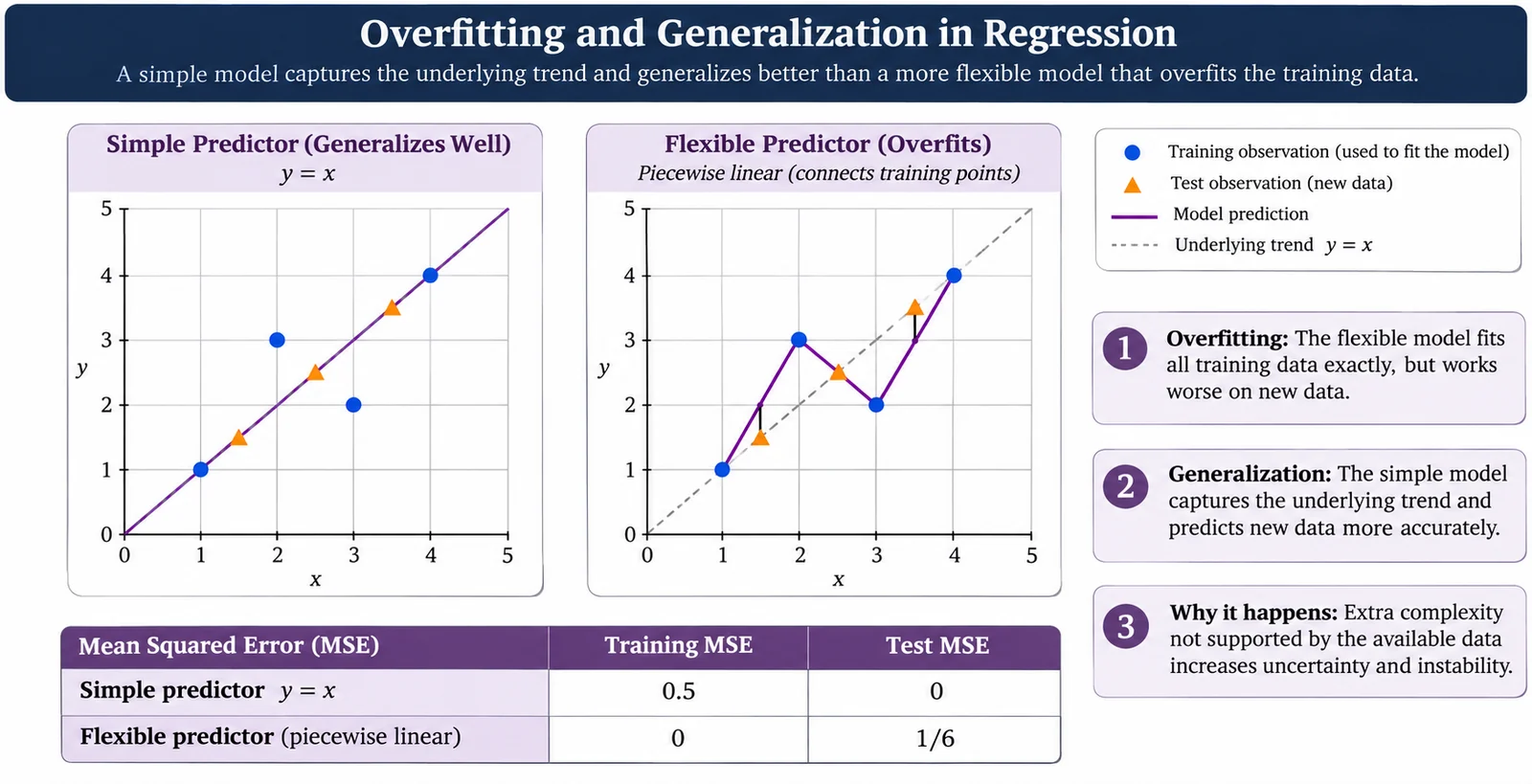
Overfitting is best understood as asking too much from the available data. For any given count of observations, there is a ceiling on how complex a model can be before the uncertainty in its estimates becomes unacceptable. Each degree of freedom spent on the same data, at any step of the analysis, adds to that complexity.[1]
A data set may be too small to support a model that contains every factor. Some factors may be redundant, and including them can affect the model adversely, for example through multicollinearity, which obscures the true relationship between variables. Preselecting factors, centring variables and using cross-validation are strategies that can lower both the chance and the impact of overfitting. In the end, the only sure remedy is to replicate the findings in a different data set.[6]
Several methods are used to tackle overfitting, including regularization, ensemble learning and data augmentation. Zhu reports that these strategies have raised model accuracy well above what traditional training methods achieve.[5] Alternative guards include variable aggregation and the fixing of coefficients in advance. Shrinkage and penalization are among the techniques that take complexity into account and correct for it.[1]
History
Where the idea came from
Successful deep neural networks are very large, yet the gap between their training and test performance can be remarkably small. Conventional wisdom attributed small generalization error to properties of the model family or to regularization techniques used during training. Zhang, Bengio, Hardt, Recht and Vinyals reported that state-of-the-art image classification networks trained with stochastic gradient methods readily fit randomly assigned labels. This happened even when the true images were replaced by completely unstructured random noise.[7]
The puzzle of large networks that still generalize well has been called the non-overfitting puzzle.[8] Dziugaite and Roy computed nonvacuous numerical bounds on generalization error for deep stochastic classifiers that have millions of parameters but only tens of thousands of training examples.[9]
Main ideas
The bias and variance tradeoff explained
A 2019 study of deep networks described a transition like the jamming of granular materials. It separates the underparameterized regime, where fitting cannot be achieved, from the overparameterized one, where it can. Under gradient descent, generalization error passes through three phases as parameters are added. It decays at first, rises to a cusp at the transition point, then decays slowly toward an asymptote as network width grows. Using early stopping made the cusp disappear.[10]
Overtraining is worst at intermediate network sizes, where the effective number of free parameters matches the number of samples. Making a network smaller or larger can reduce it. In that high-dimensional regime, low generalization error required starting with small initial weights. Making networks very large did not harm their generalization, and could reduce overtraining even without early stopping or any regularization.[11]
The puzzle of models that memorize and still generalize
A neural network can be trained until it fits its training data perfectly, including data whose labels are pure noise, and still predict well on new data.[12][13] The pattern appears across many model families, including deep networks, kernel machines, boosting and random forests. It also holds when the training data contain large amounts of label noise, meaning wrong answers attached to the examples. The finding matters because most older theory allowed a perfect fit only when the labels were nearly noise-free.[13]
A 2018 paper by Belkin, Hsu and Mitra gave an early theoretical account of classifiers that fit the training data exactly. The paper analyzed local interpolation schemes, which assign a label to a new point by combining nearby training points. For these schemes the paper proved consistency, meaning the error shrinks toward the best possible as data grow, or near-consistency. The nearest neighbor schemes even reached optimal rates under some standard statistical assumptions. The paper also proposed a way to explain adversarial examples, inputs tweaked slightly to fool a model, and linked the results to kernel machines and random forests.[13]
A 2020 paper by Bartlett, Long, Lugosi and Tsigler asked when a perfect fit in linear regression can still predict accurately. Benign overfitting requires overparameterization: the number of directions in parameter space that matter little for prediction must significantly exceed the sample size. The paper also found that the minimum norm rule nears the best possible accuracy only over a much narrower range of data properties when the data lie in an infinite-dimensional space. That range widens when the data lie in a finite-dimensional space whose dimension grows faster than the sample size.[12]
A 2020 paper by Tsigler and Bartlett extended this analysis to ridge regression, a version of linear regression that penalizes large coefficients. The earlier characterization assumed the data components were independent; the newer work removed that assumption and gave sharp bounds for the bias term as well as the variance term. The results therefore apply to kernel regression and other settings beyond the original case. The extension also describes which part of the true signal the model learns, not only how it damps noise. One striking consequence: Tsigler and Bartlett give general conditions under which the best regularization is negative.[14]
A 2022 paper by Power, Burda, Edwards, Babuschkin and Misra described a related process they called grokking. On small datasets generated by simple algorithms, networks sometimes jumped from random-chance accuracy to perfect generalization. That improvement happened well past the point where the network had already overfit its training data. Smaller datasets required increasing amounts of optimization before generalization appeared. The paper argued that such datasets offer a controlled setting for studying how overparameterized networks generalize beyond memorizing a finite training set.[15]
When overfitting helps and when it is benign
A 2020 paper argues that these errors come from high bias, meaning regularization with local negative effects. In experiments, the more closely a model fit its training samples, the better it resisted adversarial examples.[16]
Overfitting to the training set harmed performance under adversarial perturbation to a very large degree across SVHN, CIFAR-10, CIFAR-100 and ImageNet. The harm appeared under two perturbation models, the l-infinity and l2 norms. The gains of nearly all recent algorithmic improvements on adversarial training could be matched by simply stopping training early. No single remedy, including regularization or data augmentation, improved much on early stopping.[17]
A related line of work adds deliberate variability to a network's responses, mimicking the variability of natural nervous systems. The method, called artificial neural variability, acts as an implicit regularizer of the mutual information between training data and the learned model. Xie and colleagues prove this gives strictly better generalizability, better resistance to label noise, and better resistance to catastrophic forgetting, the overwriting of earlier learning by new tasks. Empirical tests showed the framework relieved overfitting, memorization of noisy labels and forgetting at negligible costs.[18]
A 2021 paper proposes that dreams are the brain's own defense against overfitting. Deep networks face overfitting as they learn, and modelers often reduce it by injecting noise into the inputs. The overfitted brain hypothesis holds that dreams create corrupted sensory inputs from random activity across neural structures, raising generalizability. On this view, losing sleep, and specifically losing dreams, leaves a brain that can memorize and learn but fails to generalize well. The paper surveys evidence from neuroscience and deep learning and offers testable predictions for living subjects and for computer models.[19]
A 2025 paper gives overfitting and regularization a physical reading. It treats a model as a thermodynamic engine that harvests work from data, so that complexity carries an energy cost. Overfitting corresponds to divergent energy dissipation, which the authors name thermodynamic overfitting. Thermodynamic regularization avoids it by charging an energy cost for engine complexity. The resulting method, thermodynamic machine learning, finds models that generalize by maximizing thermodynamic resources during training.[20]
Regularization in statistics and inverse problems
In statistics and engineering, regularization is a mathematical technique for solving inverse problems, which are problems in which the goal is to recover an unknown quantity from indirect measurements rather than to predict an outcome from features.[21][22] A problem is called ill-posed when its solution is not stable: small errors in the measured data can produce large errors in the recovered quantity.[22][23] Regularization methods introduce prior knowledge about the solution and allow a stable approximation of ill-posed inverses.[21]
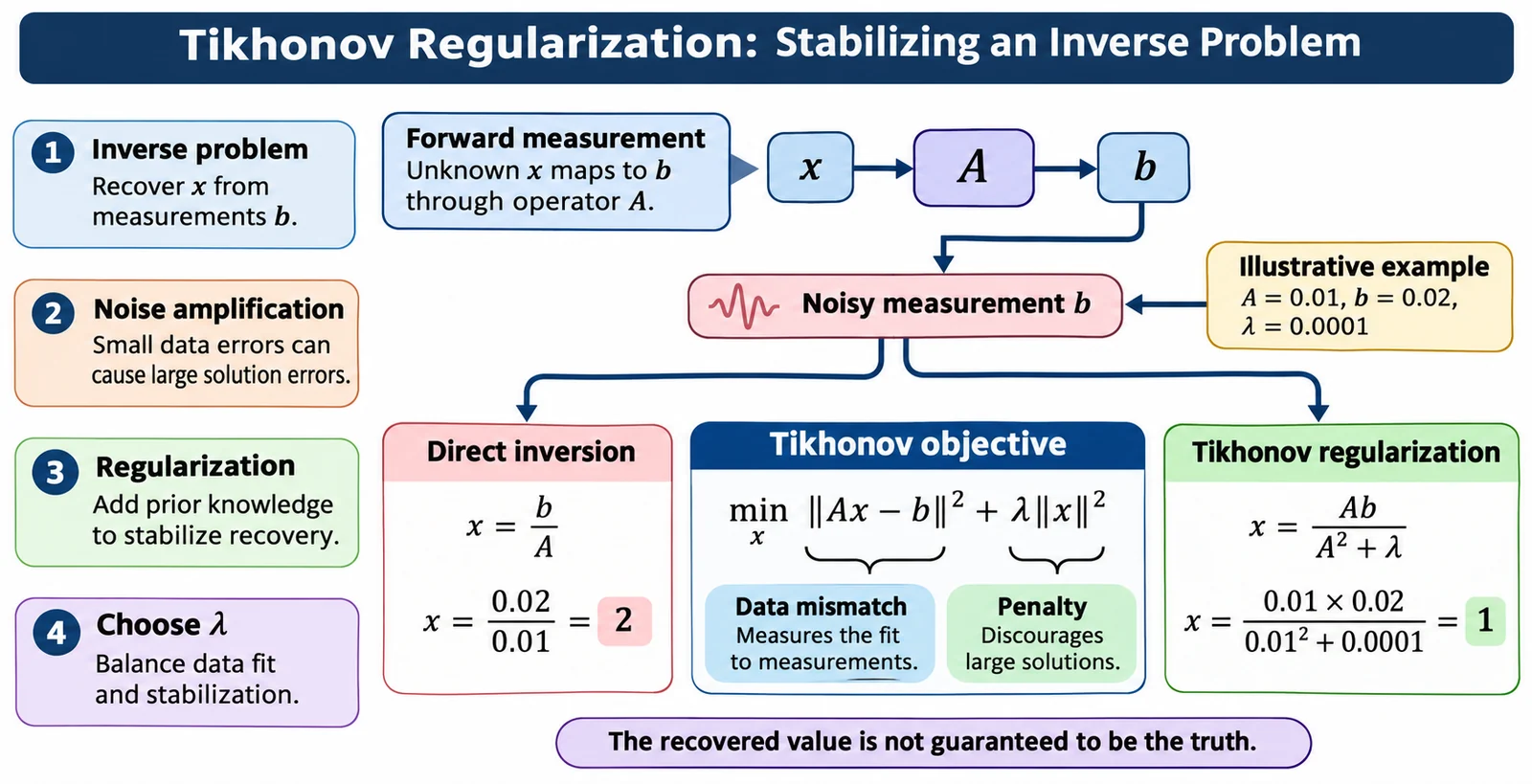
The classical method is associated with Tikhonov, whose 1977 book with Arsenin, Solution of Ill-Posed Problems, is cited as the standard reference in later applications. Tikhonov regularization was applied in 1988 to the treatment of small-angle scattering data, with simple algorithms proposed for convolution equations in data desmearing, covering slit-width and polychromaticity problems, and for polydispersity problems.[24] In 2001, a study of near-field acoustical holography, which reconstructs the pressure and surface velocity of a vibrating structure from pressure measurements made near it, described the reconstruction as a linear, ill-posed inverse problem caused by strongly decaying, evanescentlike waves. That study presented four regularization methods: the standard Tikhonov procedure, an improved version of it, Landweber iteration, and the conjugate gradient approach. It also examined two procedures for choosing the regularization parameter, the Morozov discrepancy principle and generalized cross validation. The equations for planar, cylindrical and spherical geometries were recast as an eigenvalue problem, so regularization could be added to the software with little loss of computational speed.[25]
The choice of the regularization parameter, the number that sets how strongly the prior knowledge constrains the solution, is a central practical question.[23][26] A 2004 study of inverse heat transfer, in which an unknown heat flux along a boundary is recovered from temperature measurements inside a sample, evaluated five methods for selecting this parameter: maximum likelihood, ordinary cross-validation, generalized cross-validation, the L-curve method and the discrepancy principle. Tested on one-dimensional and two-dimensional steady heat conduction problems with known analytical solutions, the Tikhonov method was in general superior to the Levenberg-Marquardt method when the input data errors were noisy.[23] A 1996 analysis of the backward heat equation reconstructs the temperature at an earlier time from noisy data at a later time. It derived how the parameter should depend on the noise level, the bound on the initial state and the time, so as to obtain optimal error estimates.[27]
Regularization theory also supplies error estimates that describe how accurate a regularized solution can be.[26][28] A 1996 paper studied methods that reconstruct the solution of a linear ill-posed problem from noisy data and showed that the accuracy is order optimal when the filter function, the regularization parameter and a scale parameter are chosen properly.[26] A 2007 paper introduced a unifying technique for studying the mean square error of a large class of spectral regularization methods, including spectral cut-off, Tikhonov estimators, nu-methods and the Landweber iteration. Spectral cut-off estimators reach minimax rates, the best possible worst-case error rate, across many smoothness classes and operators. Their practical usefulness is limited, however, because they need a complete spectral decomposition of the operator. Tikhonov estimators are easier to compute, but they still require inverting an operator. They reach minimax rates only within restricted smoothness classes. Iterative methods such as the Landweber iteration converge at the same rate as spectral cut-off while requiring only matrix-vector products.[28]
Over the last two decades, attention has moved away from linear regularization methods toward nonlinear ones. This shift holds even for linear inverse problems.[21] A 2005 paper introduced an iterative regularization procedure based on Bregman distances for inverse problems in image processing, motivated by restoring noisy and blurry images with total variation regularization. The procedure came with convergence results and stopping criteria, and its numerical results for denoising appeared to improve significantly on standard models.[29] Variational methods and techniques derived from them link regularization to image processing and compressed sensing, and related developments connect it to statistical inverse problems, multiscale decompositions and learning theory.[21]
In noise source identification by the inverse boundary element method, the transfer matrix relating field pressure to boundary vibration velocity is often ill-posed and must be regularized before the velocity is reconstructed. A 2019 simulation study of a pulsating sphere compared two regularization methods and two parameter selection methods, then verified the result by reconstructing the vibration of an aluminum plate. Large errors appeared at some frequencies in the reconstruction. Adding more measuring points cut those errors more than moving the measurement plane closer to the sound source did.[30]
Dynamic load identification, which recovers forces acting on a structure from measured responses, is described as complex and inherently ill-posed, and most regularization methods had been limited to purely mathematical numerical examples without application to practical engineering problems. A 2020 paper presented a new regularization method and used it to rebuild multi-source dynamic loads on a hydrogenerator frame from steady-state responses. In simulations the method was more effective and more accurate than the well-known Tikhonov regularization method.[31]
Double descent and benign overfitting
A model that fits its training data exactly is usually expected to fail on new data, yet some very large models do both: they reach zero training error and still predict well on unseen examples.[32][33] The effect is not unique to deep learning. Kernel machines, which compare new examples with stored ones through a similarity function, were trained to zero classification error or near zero regression error. Across six real-world and two synthetic datasets they performed very well on test data, even when the labels were corrupted with a high level of noise. The same experiments showed that Laplacian kernels, a non-smooth kind of kernel, easily fit random labels, which parallels results for neural networks that use the rectified linear unit (ReLU) activation function. Smooth Gaussian kernels needed many more training epochs to fit noisy data, and the similar test performance of overfitted Laplacian and Gaussian classifiers suggests that generalization depends on the properties of the kernel function rather than on the optimization process.[33]
The counterintuitive behavior appears in the error curve as the number of training examples grows, a pattern known as double descent. In neural networks, generalization error peaks when the number of training examples N is roughly equal to the number of parameters P. In simpler models such as linear regression a similar peak occurs when N equals the input dimension D. Both peaks sit at the interpolation threshold, the point where the model can just fit the data, and they are often conflated, but the two scenarios are inherently different. When neural networks are applied to noisy regression tasks, both peaks can appear at once. How large each peak is relative to the other depends on how nonlinear the activation function is, a pattern called sample-wise triple descent. The linear peak at N = D comes only from overfitting the noise in the labels, and it forms earlier during training. The nonlinearity regularizes it implicitly, which is why it becomes prominent only at high noise, where explicit regularization affects it weakly.[34]
Over-parameterized models can overfit even when there is no noise, which runs against classical intuition. They can also show bias even when the student and teacher models match.[35] Feature learning, the process by which a network builds its own representation of the data, can perform worse than lazy training through the random feature kernel or the neural tangent kernel, because learning features can lead to a sparser neural representation. In classification of benchmark image datasets, learning features led in experiments to representations of the image predictors that were sparse and therefore less smooth. This is plausibly why performance deteriorated.[36]
A linear frequency principle model proposes that networks learn low frequencies first, whatever the microscopic details. It argues that when target functions are dominated by low frequencies, networks avoid overfitting.[37] In the attention mechanism of transformer models, token selection shows benign overfitting on classification problems with label noise. Generalization stays high even though the noise is fitted, and generalization arrives late, after an initial phase of overfitting.[38]
Common misconceptions
A common belief is that dropout regularizes every kind of layer equally well, but dropout is often less effective for convolutional layers. Ghiasi and colleagues attributed this to the spatial correlation of activation units, through which information can still flow despite dropout.[4]
In practice
How overfitting shows up in practice
In a breast cancer case study, researchers used health records to predict whether cancer would spread. Overfitting tended to fall as the learning rate, decay, batch size and L2 rose. It tended to rise with momentum, more training epochs and L1.[39]
Healthcare data bring small samples, missing measurements and noisy labels, and tree-based boosting is often used on them. Across four datasets, PaloBoost resisted overfitting and was less sensitive to its hyperparameter settings.[40]
In security work, a 2025 study compared four standard models for spotting phishing emails, which trick people into revealing private information. Using 18,650 labeled emails, support vector machines reached 97.05% accuracy, logistic regression 96.19%, random forests 96.14% and gradient boosting 93.46%. The small differences between the models suggest room for combined or hybrid approaches.[41]
Regularization methods for neural networks
DropBlock is a structured form of dropout that drops all units in a contiguous region of a feature map together. Applying DropBlock to skip connections as well as convolution layers raised accuracy in the reported experiments. Gradually increasing the number of dropped units during training gave better accuracy and made results less sensitive to the settings chosen by the experimenter. On ImageNet classification, a ResNet-50 network with DropBlock reached 78.13% accuracy, more than 1.6% above its baseline. On COCO object detection, DropBlock raised the Average Precision of RetinaNet from 36.8% to 38.4%.[4]
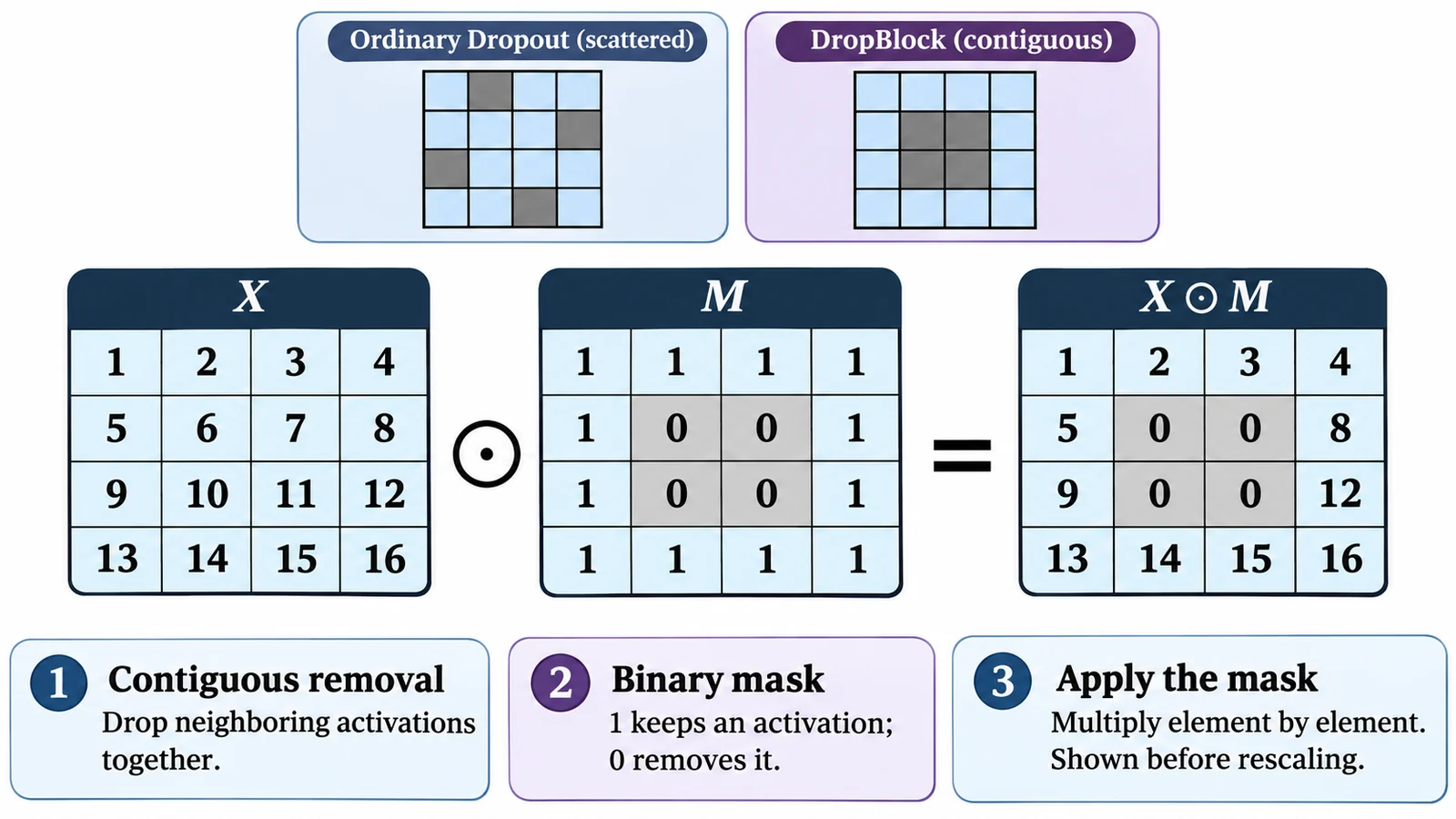
A related idea targets redundancy: oversized networks tend to produce many features that are shifted copies of one another or nearly identical. One 2019 method regularizes both positively and negatively correlated features according to how distinct they are, measured by relative cosine distances. The result is a network that extracts dissimilar features, with less overfitting and better generalization. The method was illustrated on multilayer perceptrons, convolutional networks, sparse autoencoders, gated recurrent units and long short-term memory networks, across MNIST, CIFAR-10, ImageNet and Stanford Natural Language Inference data.[42]
Keeping that measure small pushes the network toward diverse, non-redundant internal representations. Across a range of datasets and architectures, the added loss always reduced overfitting, judged by the gap between training and validation performance. It almost always maintained or increased generalization performance, and it often beat dropout.[43]
The method defines a virtual adversarial loss, a measure of how smooth the predicted label distribution is around each input point. Unlike ordinary adversarial training, it finds the direction of the nudge without using label information, so it also works when most data are unlabeled. The computational cost is relatively low: the approximate gradient needs no more than two pairs of forward and backward passes. With a simple addition based on the entropy minimization principle, which favors confident predictions, virtual adversarial training reached state-of-the-art results for semi-supervised learning on SVHN and CIFAR-10.[44]
Data-side fixes: augmentation and resampling
One defense against overfitting changes the training data itself, either by adding examples or by removing unhelpful ones.[45][46] A 2000 study described a procedure that randomly expands a given training set to fight overfitting in backpropagation-trained multilayer perceptrons. The procedure groups the training set with K-means clustering, which sorts similar examples together, and builds a probability density estimate for each cluster. The number of clusters is chosen so that the combined estimate has minimum differential entropy after global cross-validated shaping.[45]
A 2021 study tested instance reduction, which smooths the decision boundaries before the tree is trained. Noise filters such as ENN, RENN and ALLKNN take out noisy instances, while DROP3 and DROP5 may take out genuine ones. The experiments used 13 benchmark datasets from the UCI machine learning repository, with and without noise added on purpose. Removing border instances improved classification accuracy and reduced tree size, which cut training and classification times. Without added noise, noise filters used without the built-in Reduced Error Pruning gave the best accuracy. ENN, RENN and ALLKNN beat unpruned decision trees on 9, 9 and 8 of the 13 datasets respectively.[46]
Text data can be enlarged too, and a 2021 survey describes augmentation as a training strategy for deep learning on language. Deep learning generally struggles to measure generalization and to characterize overfitting, and augmentations can help build test sets for generalization. Practical tools include consistency regularization, controllers, and offline and online augmentation pipelines.[47]
A 2021 study reports that as a model gains more features, a susceptible model tends to reach overfitting in proportion. Not all characteristics are always important, and some features may only make the data noisier. The study compared nine dimensionality reduction methods, including principal component analysis, linear discriminant analysis, and backward feature elimination. It tested them on two datasets and three models: an artificial neural network, a support vector machine and a random forest classifier. The random forest classifier achieved dimensionality reduction while limiting the overfitting crisis, with gains in accuracy and efficiency over the compared approaches.[48]
Detecting overfitting with validation and tests
Training stops, or a warning is raised, once that holdout error begins to rise. Standard statistical guarantees do not hold when a model is judged on the same data used to train it.[49]
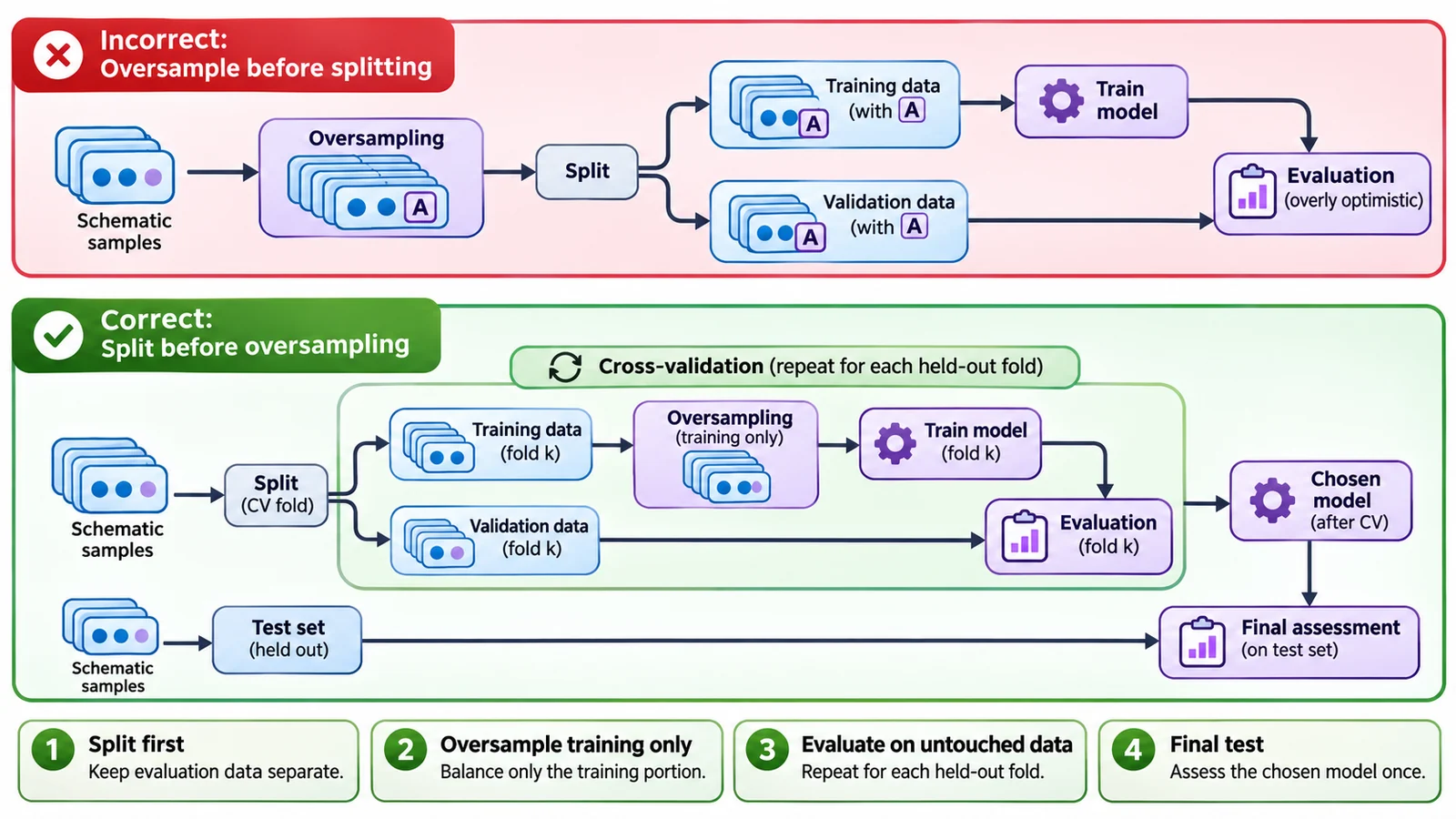
When the data are imbalanced, meaning one class is far rarer than another, cross-validation combined with oversampling remains an open question for researchers outside the topic. A frequent experimental flaw is to apply oversampling algorithms to the entire dataset before splitting it. That mistake produces biased models and estimates that look better than the model really is.[50]
Hyperparameter optimization, the automated search over a model's settings, is very frequently used in machine learning. Searching a large space of settings can overfit the model, and a 2024 study found that optimization did not always give better models. Models with pre-set settings gave similar performance while cutting computational effort by around 10,000 times. The study also stressed the importance of comparing results using exactly the same statistical measures.[51]
A 2025 paper introduced the Overfitting Risk Inequality, a measure that quantifies overfitting by comparing actual training and validation loss curves with an ideal training loss curve. The measure worked across benchmark deep learning models, including Convolutional Neural Networks, Deep Neural Networks, Transformers and Long Short-Term Memory networks. The results suggest the measure is sensitive and accurate at quantifying overfitting.[52]
Overfitting in reinforcement learning
In deep reinforcement learning, large neural networks supply the agent's decisions, and extra training power brings a risk of extra overfitting. A 2018 systematic study of standard agents found that they could overfit in various ways. Agents and learning algorithms that all reached optimal rewards during training could still differ drastically in test performance.[2]
A 2019 paper gave a general framework for analyzing the case where an agent mistakenly correlates reward with such features from the observations. The framework was used to design synthetic benchmarks by modifying only the observation space, while the underlying dynamics of the Markov decision process stayed fixed. The paper calls this observational overfitting: an agent overfits to different observation spaces even when the task itself is unchanged.[53]
Despite breakthrough results on many tasks, agents often fail to generalize beyond the environment they trained in. Work on generalization used a wide variety of tasks and experimental setups, and the literature lacked a controlled assessment of different generalization schemes. A 2018 paper presented a benchmark and experimental protocol with a diverse set of environments, covering both in-distribution and out-of-distribution generalization. Its key finding was that vanilla deep reinforcement learning algorithms generalize better than specialized schemes proposed specifically to tackle generalization.[54]
Overfitting in medicine and the sciences
A 2018 study trained convolutional neural networks, a kind of image-recognition model, to screen chest radiographs for pneumonia. The study used 158,323 chest radiographs from three institutions: 112,120 from the National Institutes of Health Clinical Center, 42,396 from Mount Sinai Hospital and 3,807 from Indiana University Network for Patient Care. Models trained at the National Institutes of Health or at Mount Sinai did worse on data from the other hospital than on internal test data. That same model scored an AUC of 0.815 at Indiana University, a significant drop (P = 0.001). Pneumonia was far more common at Mount Sinai (34.2%) than at the National Institutes of Health (1.2%) or Indiana University (1.0%). Sorting radiographs by hospital system alone therefore achieved an AUC of 0.861 on the joint Mount Sinai and National Institutes of Health dataset. The networks could identify the hospital system of a radiograph for 99.95% of National Institutes of Health images and 99.98% of Mount Sinai images.[3]
Han and Jiang report that an SVM classifier with a Gaussian kernel inevitably runs into overfitting in disease diagnosis, because high-throughput profiling technologies generate large data variations.[55] A 2020 comparison tested three methods for combining multi-omics data, which means linking several kinds of molecular measurements such as RNA and chromatin. The methods were sparse multiple canonical correlation analysis, angle-based joint and individual variation explained, and multi-omics factor analysis. With large samples, all three were consistent and showed no overfitting; with small samples, angle-based joint and individual variation explained gave the most stable results.[56]
A 2014 study of Maxent models, a widely used method for this task, tested data splits and regularization settings on the Caribbean spiny pocket mouse, Heteromys anomalus. A geographically structured split showed high overfitting, while a masked geographically structured split allowed selection of high-performing models on all criteria. Setting regularization two to four times above the default gave substantially less overfitting.[57]
Overfitting in finance and other high-stakes settings
Most firms and portfolio managers rely on backtests, which are historical simulations of performance, to choose strategies and decide how much money to give them. Standard safeguards against overfitting, such as holding back part of the data for a final test, tend to be unreliable and inaccurate in this setting. A 2016 paper proposed a framework that estimates the probability of backtest overfitting, or PBO, using a numerical method called combinatorially symmetric cross-validation (CSCV). The method produced accurate estimates of how likely a given backtest is to be overfit.[58]
A Bayesian approach offers another way to measure the problem. Tested on a class of technical trading strategies, the approach showed that a seemingly profitable strategy can be selected by the naive method.[59]
Ordinary least squares and stepwise selection are widespread in that literature, but both are well known to run into overfitting. The reported R(2), a measure of how much variation a model explains, and the regression coefficients may be inflated. Standard errors and p values may be deflated. The result is a less parsimonious model and conclusions that generalize less well. A 2015 paper noted that these methods were essentially invisible in the behavioral science literature while weaker methods continued to spread.[60]
Legal reasoning may suffer from a similar flaw. A 2026 article argues that precedential reasoning, in which judges and lawyers reconcile earlier rulings to predict a new case, can misattribute causal importance to factors that offer no real guidance.[61]
Ethics has its own version, called moral overfitting. A 2025 paper argues that moral inquiry and scientific inquiry both rely on model-building, so overfitting worries should apply to both.[62]
Artificial intelligence adds a related failure called specification overfitting. A 2024 survey analyzed 74 papers that propose or optimize such metrics.[63]
Penalties, dropout and other training-time remedies
Regularization is the general name for changes made during training that hold a model back from fitting the training data too closely. A 2017 taxonomy sorts these methods by what they alter: the data, the network architecture, the error term, the added penalty term, or the optimization procedure itself.[64] A 2022 survey of convolutional neural networks, the layered models most used for images, groups the techniques into three areas. Data augmentation changes the input data; internal changes modify the feature maps or filters the network produces; label methods transform the labels attached to each input. That survey restricted itself to work no older than five years and to methods whose code is publicly available or built into common frameworks, so its coverage is narrower than the field.[65] A 2025 review covering research from 2006 to 2025 lists L1 and L2 penalties, Elastic Net, dropout and early stopping as the classical methods, alongside newer variants such as probabilistic dropout, Bayesian regularization, adaptive regularizers and hybrid frameworks.[66]
A 2024 study applied four techniques (L1, L2, dropout and early stopping) to six combinations of datasets, leakage models and network topologies in side-channel analysis, a setting where a model is trained to infer secret keys from measurements of a device. All four techniques improved performance in many cases, but L1 and L2 were the most effective, and early stopping was the best choice when training time mattered.[67] A 2025 study applied Lasso, an L1-type penalty that also selects features, to air quality forecasting using data from 16 sensors in Tehran, Iran, from 2013 to 2023. The penalty sharply reduced overfitting and identified the most important attributes, yet prediction of gaseous pollutants stayed weak: R-squared values were 0.80 for PM2.5, 0.75 for PM10, 0.45 for CO, 0.55 for NO2, 0.65 for SO2 and 0.35 for O3. The strong result for particulate matter was attributed to very little missing data, while the poor results for gases were blamed on their rapid variation and chemical interactions.[68]
On the ImageNet Large Scale Visual Recognition Challenge 2013, a 2014 comparison found that dropout worked better than DropConnect, a related method that drops connections between units rather than the units themselves.[69] Results depend on the task: in a 2026 comparison of dropout, L2 regularization and batch normalization on the GTZAN music genre dataset, batch normalization was the most effective, reaching the highest test accuracy at 75.00%, while L2 gave a moderate improvement over the baseline. Dropout used by itself made that model worse at handling new songs, because removing neurons at random interfered with learning stable patterns in how frequency changes over time in spectrograms made from the audio.[70] A 2020 variant called sequence-dropout drops whole feature channels in order of importance rather than units at random, and it gave consistent gains over baseline models on MNIST, CIFAR-10, CIFAR-100 and ImageNet2012.[71] A 2024 study applied dropout inside a long short-term memory network, a model designed for sequences, to forecast inflation in Indonesia, and reported that it addressed overfitting in that prediction task.[72]
Agliari, Alemanno, Aquaro and Fachechi describe strategies for avoiding overfitting that are set in terms of tuning regularization and early stopping. A 2024 analysis of attractor networks, a kind of recurrent model, tied the amount of unlearning in the network to both the regularization hyperparameter and the training time. That link yields strategies framed as regularization and early-stopping tuning.[73] Batch normalization rescales the inputs to each layer during training; in the music genre comparison it was the strongest of the three techniques tested.[70]
Other training-time changes act on the network's structure or on its combination with other models: a 2023 paper replaced the usual activation function with a chaotic neuron model and reported reduced overfitting and lower generalization error on LeNet-5 models trained on MNIST and CIFAR-10.[74] A 2023 ensemble model combined LeNet, VGGNet and DropoutNet for traffic sign recognition. It used 39,209 training images and 12,630 test images from the German Traffic Sign Detection dataset across 43 classes, and reported 98% accuracy on a small dataset and 91% test accuracy on a second.[75] A 2021 method paired an artificial neural network with k-nearest neighbors to predict thermophysical properties of natural gas. The combined model's average absolute relative deviation was 2.5%, against 5.9% for the neural network alone and 19.2% for k-nearest neighbors alone, and it needed less training data.[76]
Not every study finds that regularization helps, and one 2026 analysis of least squares regression problems argues that regularization does not solve overfitting in regression. That analysis shows examples in which the regression curve overfits the data but regularization should not be applied because the problem is well conditioned, and an ill-conditioned problem whose solution shows no overfitting but still needs regularization for numerical stability. The same paper warns that regularization is not harmless. When the singular values of the coefficient matrix do not decay in the required way, applying it produces a large error in the solution.[77] A 2025 review of the field names the lack of understanding of implicit regularization, the shortage of cross-domain comparisons and the need for adaptive, automatic strategies as major gaps.[66]
A systematic review covering 174 primary studies from 2020 to 2025 traced overfitting in image classification to three main sources. These were too little labeled data, overly complex model architectures, and problems with the quality of data and labels. The same review notes that convolutional and transformer-based models have grown increasingly complex and parameter-intensive, and that their ability to generalize depends strongly on large, well-annotated, diverse training sets, a condition that is often hard to meet in medicine, agriculture and industrial inspection.[78]
A separate account describes overfitting as arising when a model is trained for too long and fits the training samples too closely to their labels. The model then loses the predictive rules that would hold on test data. This is commonly attributed to memorizing particular samples, memorizing noise, and forcing a fit to a limited sample using a high number of neurons. The same account argues that most of the overfitting occurs while the model reconciles sharply defined membership ratios. It reports that letting a model negotiate its output representations against the given class labels raised average classification accuracy and lowered the rate of overfitting without other regularization methods, tested on CIFAR 10, CIFAR 100 and MNIST.[79]
One study trained a convolutional neural network, a network built from layers that scan images for local features, on the cifar-10 image set. A shallower model caused underfitting rather than overfitting, while L2 regularization, dropout and data augmentation each reduced overfitting with slight differences between them.[80] A second line of work treats network complexity as a cause of overfitting alongside a lack of training data, and proposes dropping feature channels in sequence rather than at random, reporting consistent gains over baseline models on MNIST, CIFAR-10, CIFAR-100 and ImageNet2012.[71]
An evolutionary experiment on small networks learning a maze task found that random severance of connections gave better generalization than fully connected networks, which the authors read as evidence that sparsity is a central property of neural networks.[81] A recurrent language-model study reports that overfitting becomes more urgent as network scales increase. Its training framework varies the batch size and input dropout together by a user-defined step size. On the Penn Treebank and WikiText-2 corpora it matched other state-of-the-art results while using networks hundreds of times smaller and fewer training epochs.[82]
A 1995 survey of machine learning described a paradox: second-order fitting methods and more thorough searches of decision trees and rule sets, when tested on real datasets, often performed worse than simple gradient descent or greedy search. The survey attributed part of the resolution of that paradox to connections between machine learning and statistics, noting that a learning algorithm is trained on training data but then applied to make predictions elsewhere.[83] A 2008 paper proposed an optimized approximation algorithm that stops training using an estimate of the signal-to-noise-ratio figure, a check on goodness of fit, so that overfitting can be detected from the training error alone without a separate validation set. That algorithm was applied to choosing the number of hidden neurons in a multilayer perceptron and the number of learning epochs in its backpropagation training, using both synthetic and benchmark data sets.[84]
A 2019 analysis located the mechanism of overfitting in deep networks in continuous gradient updating and in the scale sensitivity of the cross entropy loss, a standard measure of how far predicted probabilities fall from the true labels. Separating samples into correctly and incorrectly classified ones showed that the two behave very differently during training, with the loss decreasing on the correct ones and increasing on the incorrect ones. The proposed remedy, a consensus-based classification algorithm, requires agreement among multiple trained models, and the paper states that for statistically independent models the reduction of extrinsic factors is exponential. Trained on just 1000 MNIST samples, the consensus method classified 90% of the test samples and reached 95% accuracy. That figure was higher than the accuracy of each individual model.[85] A 2018 study compared the statistics of convolutional image recognition algorithms to the Ising model, a physics model of interacting spins on a lattice, and evaluated on a two-dimensional square-lattice array how the learning rate and regularization rate affect adaptability for image classification. The results were presented as guidance on preventing both overfitting and underfitting in image recognition tasks.[86]
Overfitting in trees, forests and classical models
A 2025 study trained a decision tree regressor on the Ames Housing dataset, which holds 79 explanatory variables related to home prices, and varied the maximum number of leaves from 2 to 5000. Accuracy improved at first, but beyond 400 leaf nodes the mean absolute error, the average size of the prediction miss, leveled off near 242,906, so extra complexity bought nothing. Too few leaves leave the model underfit, meaning it misses real structure, while too many leaves let it capture spurious patterns, and the study names 400 as the best setting for this dataset. Models with excessive complexity also showed larger swings in error from run to run, which the study treats as a sign of lower reliability.[87] One proposed construction method avoids overfitting by design, needs no hyperparameter tuning (settings chosen before training) and no regularization, and produces smaller, shallower trees than traditional algorithms.[88]
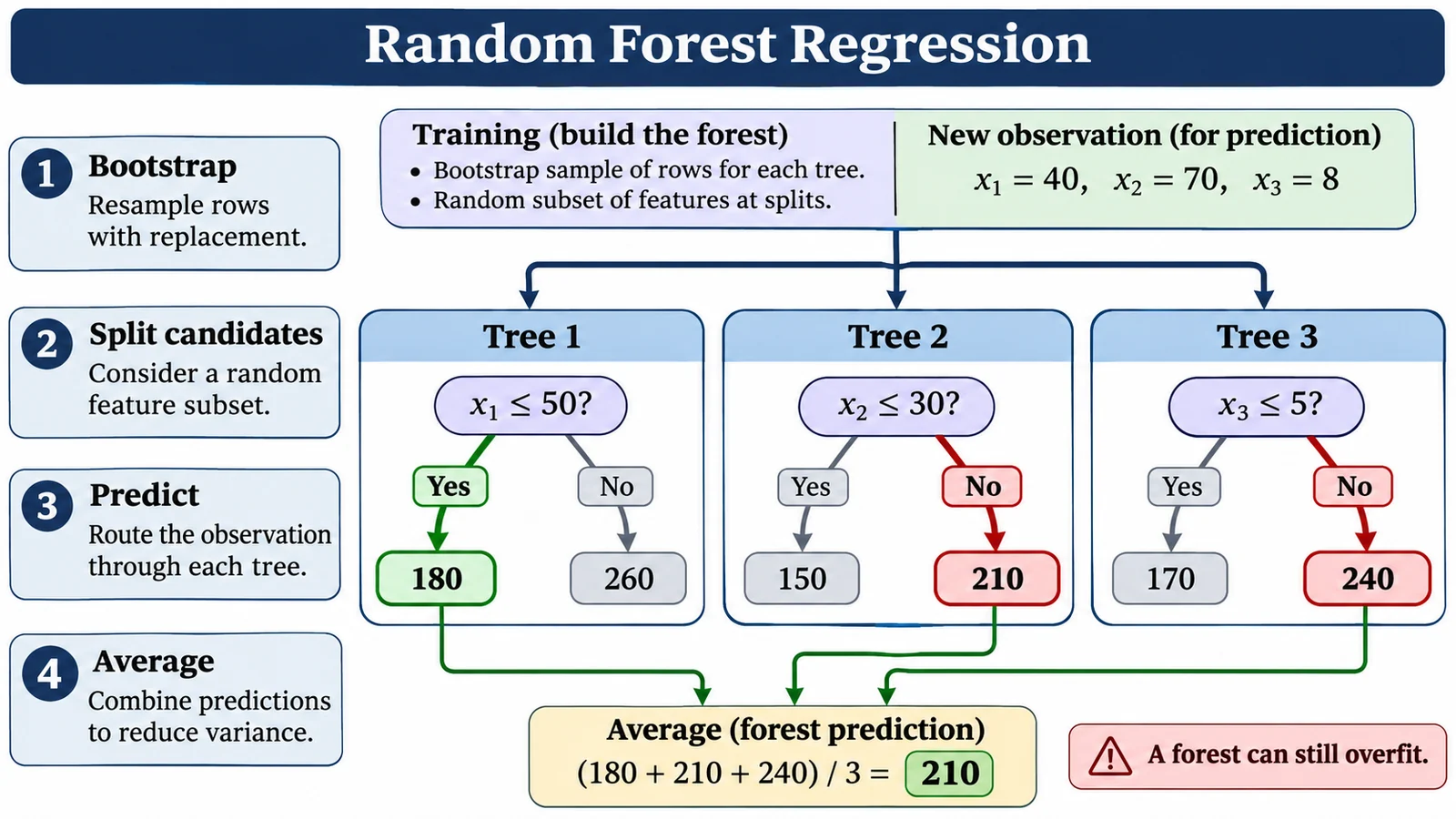
A random forest builds many decision trees on random subsets of the data and combines their outputs, which is one reason it is widely reported to reduce the risk of overfitting. A 2025 review of 40 scientific works found the method strong on high-dimensional data and stable across healthcare, finance, manufacturing and environmental applications, though the review ran no experiments of its own on real datasets.[89] A simulation study published in 2024 examined probability estimates rather than plain classifications, using 48 data-generating mechanisms and 1000 training sets of size 200 or 4000 per mechanism, for 192 scenarios in total. Training areas under the curve (a score where 1 means perfect ranking) sat between 0.97 and 1 in most scenarios, yet the median loss in test discrimination was only 0.025, with a range of 0.00 to 0.13. Heatmap visualizations suggested the forest learned spikes of probability around training events, with clusters of events forming signal and isolated events forming noise. Test performance rose with more events per variable, a larger minimum node size and binary predictors, and the results argue against the common advice to grow trees fully when the goal is probability estimation.[90]
The single-layer perceptron, introduced by Rosenblatt in 1958, cannot classify patterns that a straight line cannot separate, and the 1986 rediscovery of backpropagation, the procedure that adjusts weights from output errors, opened the multilayer version. A multilayer perceptron with many hidden nodes can approximate any function, and a 2022 survey covers its learning, generalization and model selection across seven decades of work.[91] Support vector machines take a different route, mapping data into a higher-dimensional space, and a 2006 introduction to their use in catalysis pairs the method with the Vapnik-Chervonenkis dimension and structural risk minimization, two formal tools for judging how much a model can fit. That treatment stresses overfitting as the central concern when comparing support vector machines with neural networks and induction trees.[92]
Convex regression fits a convex function to data. As the sample size grows, it has been observed to give inconsistent estimates, with very large subgradients close to the boundary. A 2024 paper gives theoretical evidence for this behavior and proposes two estimators that place a bound on the subgradients. It proves that both converge to the true convex function, and that their subgradients converge to its gradient, uniformly across the domain with probability one as the sample size grows without limit. An application to Finnish electricity distribution firms confirmed better predictive power than existing methods.[93]
AdaBoost rarely overfits on low-noise data, but studies with highly noisy patterns have shown that it can. A 2006 paper penalizes skewness in the data distribution during learning, so that a few hardest examples cannot spoil the decision boundary, and derives two regularized variants that matched or beat other regularized AdaBoost algorithms across a wide variety of datasets.[94] Gated experts, described in 1995, combine a gating network with several competing expert networks, each of which learns to predict the conditional mean and adjusts its width to the local noise level. The tests used a computer-generated series that switches between two nonlinear processes, a laser time series from the Santa Fe competition and French daily electricity demand. On all three, the gating network recovered the regimes, and the model overfit less than a single multilayer perceptron because each expert matched its variance to local noise.[95]
High-dimensional data and class imbalance
Many statistical methods were designed for the case where the number of data samples, N, is much larger than the data dimension, p, and maximum likelihood and maximum a posteriori estimation become unreliable when p is of the same order as N, because of overfitting.[96][97] For the Cox proportional hazards model, the main tool of medical statisticians, the literature offers only rules of thumb on how many samples are needed to avoid overfitting.[98] A later analysis extended this approach to arbitrary generalized linear models with possibly correlated covariates and showed that, for the relevant scaling, L2 regularization causes a predictable change in the direction of the coefficient vector.[96][97]
Estimating class probabilities, the chance that a case belongs to each class, matters for medical decisions. It becomes hard when there are more candidate features than cases. Simulation studies built on real datasets found that a certain amount of overfitting can help lower mean square error, a measure of how far estimated probabilities fall from the true ones. A decomposition of mean square error for class probability estimation helps clarify how overfitting relates to prediction accuracy.[99]
In text classification, where data are high-dimensional and sparse, algorithms such as the extreme learning machine suffer from overfitting, and the extent of the problem is not well quantified. A proposed measure called the rate of overfitting lets the problem be measured and identified. A model named AdaBELM reduced overfitting and beat the classical extreme learning machine, decision trees, random forests and AdaBoost on three text datasets, reaching 62.2% higher accuracy than the extreme learning machine.[100]
Class imbalance, in which one class dominates the training data, creates its own form of overfitting in image segmentation, the task of labeling each pixel of an image. When training with limited data and strong imbalance, the distribution of logit activations, the raw scores a network computes before converting them to probabilities, can shift across the decision boundary at test time for the under-represented class, while samples of the well-represented class seem unaffected. This bias produces systematic under-segmentation of small structures, and it was observed consistently across different databases, tasks and network architectures.[101] On the highly imbalanced ISIC-2019 skin lesion dataset, a fine-tuned ResNet-50 model trained on augmented data with focal loss, which assigns weights to hard misclassified images, reached 98.85% accuracy, 95.52% precision and 95.93% recall.[102]
Resampling offers another remedy: SMOTE oversampling creates synthetic examples of the minority class to balance the distribution. In a study of CT kidney stone classification with a convolutional neural network on an imbalanced dataset from a public source, three models were compared: one trained on the imbalanced data, one using data augmentation, and one using SMOTE oversampling. The SMOTE model performed best of the three when tested on private data.[103][104]
Overfitting in scientific and engineering measurement
In soil spectroscopy, a 2017 study built a partial least squares regression model to predict soil carbon content from spectral data using a limited number of samples from two soil orders, Andisol and Ultisol. With a Savitzky-Golay filter for pre-processing, calibration gave R2 = 0.82 and root-mean-squared error (RMSE) = 0.61%, values comparable with other similar studies. Cross-validation then behaved unusually, leading the authors to conclude that the model overfits the data and should not be used on unobserved data.[105]
Single particle electron cryomicroscopy (cryoEM) determines a 3D structure by calculating an initial model and then iteratively refining the orientations of individual particle images and the resulting map. Because high-resolution images contain much more noise than signal, this iteration can reinforce noise in the map and give a false impression of the resolution attained. A 2013 method swaps the Fourier components of the particle image stack beyond a chosen resolution for components taken from a nearby patch of background, or for phases set at random. The substitute noise therefore carries the same spectral power distribution as the original data. Comparing Fourier Shell Correlation (FSC) plots from the experimental map and from the noise-substituted data measures the amount of overfitting and yields an unbiased FSC through a simple formula, even when substantial overfitting is present. Applied to beta-galactosidase images, the test showed that overfitting varied greatly with the processing procedure, and in the best case showed no overfitting and a resolution of ~6 Å.[106]
Genomic selection uses every marker across the genome. The aim is for each quantitative trait locus of a complex trait to be in linkage disequilibrium with at least one marker. In most such models, genetic variance is estimated from training samples that carry many markers unrelated to the trait. A 2017 simulation study showed that this produces severe overfitting when trait heritability is calculated. The study controlled this by cross validation: genetic variance is taken as the variance of genetic values predicted through cross validation, residual variance as the variance of differences between observed and predicted values, and the two components give an unbiased heritability. Heritability calculated this way is equivalent to trait predictability, which reflects how applicable the model is.[107]
Process mining discovers process models automatically from event logs of observed events, such as activities being executed or messages being exchanged. Because one cannot assume all possible behavior has been seen, classical synthesis techniques, which aim at a model that exactly reproduces the log, are unsuitable. Existing techniques generalize to avoid overfitting, but the generalization is often driven by the representation language and crude assumptions about completeness, so parts of a model may overfit while other parts underfit. A 2010 two-step approach first builds a transition system with a configurable method and then synthesizes the model using the theory of regions, letting the user control the balance between overfitting and underfitting.[108]
Forecasting faces a related problem when input variables and errors are autocorrelated in time, as in wind power curve modeling. Model selection by methods such as cross-validation then produces temporal overfitting. Performance drops when responses are predicted for a time domain other than the training period. A 2023 Gaussian process method splits the model into a time-invariant and a time-varying component and uses a thinning-based inference strategy borrowed from Markov chain Monte Carlo sampling. On real wind turbine datasets it improved prediction substantially for a time period different from the training period.[109] Out-of-sample forecast comparisons offer another check: simulations of a general-to-specific procedure found most post-sample tests of equal mean squared error and encompassing roughly correctly sized, with relatively good power.[110]
Robustness, uncertainty and distribution shift
Deep neural networks, the layered models behind much of modern image recognition, can reach apparent human-level performance on benchmark tests and still behave very differently from people.[111] One 2018 study argues that gradient masking, a failure of certain defenses in which the model stops supplying useful gradients to an attacker, is itself a type of overfitting. It can arise without any special defensive measure, merely by slightly changing the initial learning rate of the Adam optimizer from its recommended value.[112]
The word stability is often used loosely, so one 2023 conceptual analysis proposes a common definition. It treats stability as how little a chosen target changes when specific interventions are made to a modifier. That account is meant to cover the several sub-types found in the research literature. These include stability under distribution shifts, stability of predictions, and the stability of algorithmic explanations. The analysis treats stability as distinct from extrapolation, generalization and uncertainty. It argues that stability is an independent epistemic concept rather than a synonym for any of them.[113] A 2025 paper on overfitting describes the practical consequence in similar terms. A model that performs exceptionally well on training data but deteriorates significantly on unseen test data lacks stability and struggles to adapt to complex and dynamic real-world environments.[114]
Simple regularization methods are cheap and were developed to improve generalization rather than to address stability. For that reason they have largely been overlooked as baselines for the stability and uncertainty problems, since they were not designed for them. An extensive empirical evaluation trained image classifiers on CIFAR-100 and ImageNet with state-of-the-art regularization methods. It found that certain of these methods can serve as strong baselines for stability and uncertainty estimation. The authors note that the alternatives usually proposed for these problems, such as Bayesian inference and adversarial training, are typically expensive and complicated.[111]
Overfitting can also take the form of learning features that happen to correlate with the training labels but do not carry over to new data. A 2023 analysis of the gradient flow found that the method favors generalizable features early in training and spurious features later, which accounts for the non-overfitting and overfitting phases respectively. Projecting the gradients onto the low-rank subspace spanned by early-stage gradient flow eigenvectors throughout training eliminated the overfitting problem, and experiments on 11 classification datasets showed consistent gains over the original method and over a competing approach.[115]
A 2025 comparative case study of artificial intelligence in cybersecurity examined events such as the 2017 WannaCry ransomware outbreak. It found that overfitting in security systems depends on choices about resources, upkeep and access to expertise, not only on model design. Organizations with more funding and technical capacity keep their models current. Smaller groups with fewer resources often run outdated systems that leave them open to attacks, a pattern the study links to growing inequality in digital security.[116]
What this looks like in practice
In a study of pneumonia screening, researchers trained convolutional neural networks on chest radiographs from three hospitals and then tested each model on images from the other sites. A model trained at Mount Sinai reached an internal test AUC of 0.802 but only 0.717 on National Institutes of Health data. Zech and colleagues note that pneumonia-screening networks identified the hospital system of a radiograph for 99.95% of NIH images (22,050 of 22,062) and 99.98% of MSH images (8,386 of 8,388), and they state that such system and department differences in disease burden may confound predictions.[3]
In adversarial training, a network is trained to keep its loss low when an adversary is allowed to change its inputs in the worst possible way. Rice, Wong and Kolter trained such networks on SVHN, CIFAR-10, CIFAR-100 and ImageNet under two kinds of perturbation, and found that fitting the training set too closely did great harm to accuracy under attack.[17]
Zhang and colleagues trained state-of-the-art convolutional networks for image classification with stochastic gradient methods on a random labeling of the training data. Zhang and colleagues also gave a theoretical construction in which a simple network of depth two attains perfect finite sample expressivity as soon as it has more parameters than there are data points. Zhang and colleagues note that conventional explanations based on the model family or on regularization techniques fail to account for why large networks generalize well in practice.[7]
Power and colleagues trained networks on small algorithmically generated datasets and watched generalization improve from random chance level to perfect generalization well past the point of overfitting, a process they called grokking.[15] In reinforcement learning, Packer and colleagues built a benchmark covering in-distribution and out-of-distribution generalization and compared specialized schemes with plain algorithms.[54]
Later developments
Open questions and how to teach the topic
A second open question concerns small data, where the number of examples is too small for the number of measured features. A 2020 study ran a large parallel analysis of classification problems and found statistically significant linear overfitting barriers for common machine learning methods. For one deep learning classifier, a long short-term memory network, reliable classification needed a data statistics size at least 13.8 times larger than the feature dimension.[117]
Common detection and prevention methods have constraints, such as requiring changes to the model structure or large computing resources. A 2024 approach trains a classifier on training histories, meaning the record of validation losses over time, and uses it to spot overfit models. It reached an F1 score of 0.91, a combined measure of precision and recall, at least 5% above the best non-intrusive detection method then available. The same classifier stopped training at least 32% of the time earlier than early stopping, the usual prevention method, while returning the best model as often or more often.[118]
The Divide2Conquer method splits data into separate parts and trains identical models on each part, but its standard aggregation treats all subset models equally. That leaves edge models that have overfitted to local noise in the mix. A 2026 method called DUA-D2C weights each subset model by its performance on a shared validation set. The weight uses a score that combines accuracy and normalized prediction entropy, a measure of how uncertain a prediction is. Tests on image, audio and text data showed gains even when added on top of dropout, a standard regularizer.[119]
A 2021 proposal for hands-on training uses workflow-based design of machine learning pipelines and experimentation-based teaching. The training focuses on concepts rather than the underlying mathematics, so it suits introductory courses and can stand alone or sit inside any data science course. It relies on an open-source data science toolbox built for education in machine learning and explorative data analysis, which combines data visualization and machine learning.[120]
A 2024 review lists regularization, dropout and ensemble methods, which combine several models, as ways to reduce the risk of overfitting.[121] For image models, a 2021 method adds maximum pooling dropout in the pooling layer and weight attenuation, a penalty that lowers model complexity. It cut classification error by more than 10% on average against other methods.[122] For deep networks, a 2025 review recommends L1 and L2 penalties, dropout, batch normalization, adaptive learning rate optimizers, gradient clipping and early stopping.[123]
Key studies
| Year | Study | Sample | Design | Finding |
|---|---|---|---|---|
| 2004 | Babyak[1] | Nontechnical review of overfitting in regression-type models, with simulation evidence | Overfitted models fail to replicate in future samples, and three common practices (automated variable selection, pretesting candidate predictors, dichotomization) pose a considerable risk for spurious findings. | |
| 2013 | Chen et al.[106] | two sets of cryo-electron microscopy images of beta-galactosidase, including 6733 particle images on film at 80 keV | high-resolution noise substitution test of 3D map resolution | Overfitting varied greatly by procedure, and in the best case there was no overfitting and a resolution of about 6 angstroms. |
| 2016 | Zhang et al.[7] | state-of-the-art convolutional networks for image classification | systematic experiments with random labels and random noise inputs | Networks easily fit a random labeling of the training data, unaffected by explicit regularization, and depth two networks have perfect finite sample expressivity once parameters exceed data points. |
| 2017 | Jia[107] | 210 recombinant inbred lines with 1619 loci in rice data and simulations | genomic selection analysis with 10-fold cross validation repeated 10 times | Without cross validation heritability appeared unrealistically large, for example 0.60 for yield, while cross validation gave 0.19. |
| 2018 | Zech et al.[3] | 158,323 chest radiographs from 112,120 National Institutes of Health, 42,396 Mount Sinai and 3,807 Indiana University images | cross-sectional study with multiple training cohorts and external testing | Internal performance significantly exceeded external performance in 3 out of 5 natural comparisons, and networks identified hospital system for 99.95% of National Institutes of Health radiographs. |
| 2018 | Ghiasi et al.[4] | ResNet-50 on ImageNet classification and RetinaNet on COCO detection | regularization method experiments | DropBlock reached 78.13% accuracy on ImageNet, more than 1.6% above the baseline, and raised RetinaNet Average Precision from 36.8% to 38.4%. |
| 2018 | Packer et al.[54] | a diverse set of reinforcement learning environments | benchmark and systematic empirical study of generalization schemes | Vanilla deep reinforcement learning algorithms generalized better than specialized schemes proposed to tackle generalization. |
| 2019 | Salman & Liu[85] | 1000 training samples from the MNIST dataset | consensus-based classification experiments | The proposed algorithm achieved 95% accuracy, higher than any individual model, with 90% of the test samples classified. |
| 2020 | Rice et al.[17] | adversarially trained networks on SVHN, CIFAR-10, CIFAR-100 and ImageNet under two perturbation models | empirical study of adversarial training | Overfitting to the training set did great harm to accuracy under attack, and early stopping matched the gains of nearly all recent algorithmic improvements. |
| 2021 | Amro et al.[46] | 13 benchmark datasets from the UCI machine learning repository | empirical experiments with and without intentionally introduced noise | Without built-in pruning, ENN, RENN and ALLKNN beat unpruned decision trees on 9, 9 and 8 of the 13 datasets, in that order. |
| 2021 | Zhang et al.[32] | Systematic experiments with state-of-the-art convolutional networks for image classification | The networks easily fit a random labeling of the training data, and this occurs even when true images are replaced by unstructured random noise. | |
| 2022 | Power et al.[15] | small algorithmically generated datasets | training experiments on neural networks | Generalization improved from random chance level to perfect generalization well past the point of overfitting, and smaller datasets required increasing amounts of optimization. |
| 2024 | Tetko et al.[51] | seven thermodynamic and kinetic solubility datasets | comparison of hyperparameter optimization protocols and graph-based and Transformer CNN methods | Hyperparameter optimization did not always result in better models, pre-set hyperparameters gave similar performance about 10,000 times faster, and Transformer CNN was better in 26 out of 28 pairwise comparisons. |
| 2024 | Li et al.[118] | real-world software samples with trained deep learning models | time series classifier trained on training histories | The approach achieved an F1 score of 0.91, at least 5% higher than the best non-intrusive detection approach, and stopped training at least 32% of the time earlier than early stopping. |
See also
References
- Babyak, M. A. (2004). What You See May Not Be What You Get: A Brief, Nontechnical Introduction to Overfitting in Regression-Type Models: . Psychosomatic Medicine, 66(3), 411-421. doi:10.1097/00006842-200405000-00021
- Zhang, C., Vinyals, O., Munos, R., & Bengio, S. (2018). A Study on Overfitting in Deep Reinforcement Learning. arXiv. doi:10.48550/arxiv.1804.06893 Free full text
- Zech, J. R., Badgeley, M. A., Liu, M., Costa, A. B., Titano, J. J., & Oermann, E. K. (2018). Variable generalization performance of a deep learning model to detect pneumonia in chest radiographs: A cross-sectional study. PLOS Medicine, 15(11), e1002683. doi:10.1371/journal.pmed.1002683
- Ghiasi, G., Lin, T. Y., & Le, Q. V. (2018). DropBlock: A regularization method for convolutional networks. arXiv. doi:10.48550/arxiv.1810.12890 Free full text
- Zhu, Z. (2024). Systematic Optimization of Overfitting Problem in Machine Learning. Highlights in Science, Engineering and Technology, 111, 353-359. doi:10.54097/3tkzrj84
- Cook, J. A., & Ranstam, J. (2016). Overfitting. British Journal of Surgery, 103(13), 1814-1814. doi:10.1002/bjs.10244
- Zhang, C., Bengio, S., Hardt, M., Recht, B., & Vinyals, O. (2016). Understanding deep learning requires rethinking generalization. arXiv. doi:10.48550/arxiv.1611.03530 Free full text
- Poggio, T., Kawaguchi, K., Liao, Q., Miranda, B., Rosasco, L., Boix, X., Hidary, J. D., & Mhaskar, H. N. (2017). Theory of Deep Learning III: explaining the non-overfitting puzzle. arXiv. doi:10.48550/arxiv.1801.00173 Free full text
- Dziugaite, G. K., & Roy, D. M. (2017). Computing Nonvacuous Generalization Bounds for Deep (Stochastic) Neural Networks with Many More Parameters than Training Data. arXiv. doi:10.48550/arxiv.1703.11008 Free full text
- Spigler, S., Geiger, M., d’Ascoli, S., Sagun, L., Biroli, G., & Wyart, M. (2019). A jamming transition from under- to over-parametrization affects generalization in deep learning. Journal of Physics A: Mathematical and Theoretical, 52(47), 474001. doi:10.1088/1751-8121/ab4c8b
- Advani, M. S., Saxe, A. M., & Sompolinsky, H. (2020). High-dimensional dynamics of generalization error in neural networks. Neural Networks, 132, 428-446. doi:10.1016/j.neunet.2020.08.022
- Bartlett, P. L., Long, P. M., Lugosi, G., & Tsigler, A. (2020). Benign overfitting in linear regression. Proceedings of the National Academy of Sciences, 117(48), 30063-30070. doi:10.1073/pnas.1907378117
- Belkin, M., Hsu, D., & Mitra, P. P. (2018). Overfitting or perfect fitting? Risk bounds for classification and regression rules that interpolate. arXiv. doi:10.48550/arxiv.1806.05161 Free full text
- Tsigler, A., & Bartlett, P. L. (2020). Benign overfitting in ridge regression. arXiv. doi:10.48550/arxiv.2009.14286 Free full text
- Power, A., Burda, Y., Edwards, H., Babuschkin, I., & Misra, V. (2022). Grokking: Generalization Beyond Overfitting on Small Algorithmic Datasets. arXiv. doi:10.48550/arxiv.2201.02177 Free full text
- Deniz, O., Pedraza, A., Vallez, N., Salido, J., & Bueno, G. (2020). Robustness to adversarial examples can be improved with overfitting. International Journal of Machine Learning and Cybernetics, 11(4), 935-944. doi:10.1007/s13042-020-01097-4
- Rice, L., Wong, E., & Kolter, J. Z. (2020). Overfitting in adversarially robust deep learning. arXiv. doi:10.48550/arxiv.2002.11569 Free full text
- Xie, Z., He, F., Fu, S., Sato, I., Tao, D., & Sugiyama, M. (2021). Artificial Neural Variability for Deep Learning: On Overfitting, Noise Memorization, and Catastrophic Forgetting. Neural Computation, 33(8), 2163-2192. doi:10.1162/neco_a_01403
- Hoel, E. (2021). The overfitted brain: Dreams evolved to assist generalization. Patterns, 2(5), 100244. doi:10.1016/j.patter.2021.100244
- Boyd, A. B., Crutchfield, J. P., Gu, M., & Binder, F. C. (2025). Thermodynamic overfitting and generalization: energetics of predictive intelligence. New Journal of Physics, 27(6), 063901. doi:10.1088/1367-2630/addf71
- Benning, M., & Burger, M. (2018). Modern regularization methods for inverse problems. Acta Numerica, 27, 1-111. doi:10.1017/s0962492918000016
- Szombathely, M. V., Bräuer, P., & Jaroniec, M. (1992). The solution of adsorption integral equations by means of the regularization method. Journal of Computational Chemistry, 13(1), 17-32. doi:10.1002/jcc.540130104
- Okamoto, K., & Li, B. Q. (2004). Optimal Regularization Methods for Inverse Heat Transfer Problems. Volume 4, 825-834. doi:10.1115/ht-fed2004-56395
- Svergun, D. I., Semenyuk, A. V., & Feigin, L. A. (1988). Small-angle-scattering-data treatment by the regularization method. Acta Crystallographica Section A Foundations of Crystallography, 44(3), 244-250. doi:10.1107/s0108767387011255
- Williams, E. G. (2001). Regularization methods for near-field acoustical holography. The Journal of the Acoustical Society of America, 110(4), 1976-1988. doi:10.1121/1.1404381
- Tautenhahn, U. (1996). Error Estimates for Regularization Methods in Hilbert Scales. SIAM Journal on Numerical Analysis, 33(6), 2120-2130. doi:10.1137/s0036142994269411
- Tautenhahn, U., & Schröter, T. (1996). On Optimal Regularization Methods for the Backward Heat Equation. Zeitschrift für Analysis und ihre Anwendungen, 15(2), 475-493. doi:10.4171/zaa/711
- Bissantz, N., Hohage, T., Munk, A., & Ruymgaart, F. (2007). Convergence Rates of General Regularization Methods for Statistical Inverse Problems and Applications. SIAM Journal on Numerical Analysis, 45(6), 2610-2636. doi:10.1137/060651884
- Osher, S., Burger, M., Goldfarb, D., Xu, J., & Yin, W. (2005). An Iterative Regularization Method for Total Variation-Based Image Restoration. Multiscale Modeling & Simulation, 4(2), 460-489. doi:10.1137/040605412
- Xiao, Y., Song, Q., Li, S., Lv, G., & Ji, Z. (2019). Comparisons of regularization methods and regularization parameter selection methods in sound source identification using inverse boundary element method. Noise Control Engineering Journal, 67(3), 219-227. doi:10.3397/1/376720
- Wang, L., Huang, Y., Xie, Y., & Du, Y. (2020). A new regularization method for dynamic load identification. Science Progress, 103(3). doi:10.1177/0036850420931283
- Zhang, C., Bengio, S., Hardt, M., Recht, B., & Vinyals, O. (2021). Understanding deep learning (still) requires rethinking generalization. Communications of the ACM, 64(3), 107-115. doi:10.1145/3446776
- Belkin, M., Ma, S., & Soumik, M. (2018). To understand deep learning we need to understand kernel learning. arXiv. doi:10.48550/arxiv.1802.01396 Free full text
- d’Ascoli, S., Sagun, L., & Biroli, G. (2021). Triple descent and the two kinds of overfitting: where and why do they appear?*. Journal of Statistical Mechanics: Theory and Experiment, 2021(12), 124002. doi:10.1088/1742-5468/ac3909
- Rocks, J. W., & Mehta, P. (2022). Memorizing without overfitting: Bias, variance, and interpolation in overparameterized models. Physical Review Research, 4(1). doi:10.1103/physrevresearch.4.013201
- Petrini, L., Cagnetta, F., Vanden-Eijnden, E., & Wyart, M. (2023). Learning sparse features can lead to overfitting in neural networks *. Journal of Statistical Mechanics: Theory and Experiment, 2023(11), 114003. doi:10.1088/1742-5468/ad01b9
- Zhang, Y., Luo, T., Ma, Z., & Xu, Z. Q. J. (2021). A Linear Frequency Principle Model to Understand the Absence of Overfitting in Neural Networks. Chinese Physics Letters, 38(3), 038701. doi:10.1088/0256-307x/38/3/038701
- Sakamoto, K., & Sato, I. (2024). Benign Overfitting in Token Selection of Attention Mechanism. arXiv. doi:10.48550/arxiv.2409.17625 Free full text
- Xu, C., Coen-Pirani, P., & Jiang, X. (2023). Empirical Study of Overfitting in Deep Learning for Predicting Breast Cancer Metastasis. Cancers, 15(7), 1969. doi:10.3390/cancers15071969
- Park, Y., & Ho, J. C. (2021). Tackling Overfitting in Boosting for Noisy Healthcare Data. IEEE Transactions on Knowledge and Data Engineering, 33(7), 2995-3006. doi:10.1109/tkde.2019.2959988
- Atanda, O. G., Jeremiah, Y. S., Abiodun, M. K., Lawrence, M. O., Adebiyi, A. A., & Alfa, P. E. (2025). Performance Evaluation of Machine Learning Models for Phishing Email Detection: Analyzing Convergence, Generalization, and Overfitting Dynamics. NIPES Journal of Science and Technology Research, 7(1). doi:10.37933/nipes/7.4.2025.si134
- Ayinde, B. O., Inanc, T., & Zurada, J. M. (2019). Regularizing Deep Neural Networks by Enhancing Diversity in Feature Extraction. IEEE Transactions on Neural Networks and Learning Systems, 30(9), 2650-2661. doi:10.1109/tnnls.2018.2885972
- Cogswell, M., Faruk, A., Girshick, R., Zitnick, L., & Batra, D. (2015). Reducing Overfitting in Deep Networks by Decorrelating Representations. arXiv. doi:10.48550/arxiv.1511.06068 Free full text
- Miyato, T., Maeda, S. I., Koyama, M., & Ishii, S. (2019). Virtual Adversarial Training: A Regularization Method for Supervised and Semi-Supervised Learning. IEEE Transactions on Pattern Analysis and Machine Intelligence, 41(8), 1979-1993. doi:10.1109/tpami.2018.2858821
- Karystinos, G. N., & Pados, D. A. (2000). On overfitting, generalization, and randomly expanded training sets. IEEE Transactions on Neural Networks, 11(5), 1050-1057. doi:10.1109/72.870038
- Amro, A., Al-Akhras, M., Hindi, K. E., Habib, M., & Shawar, B. A. (2021). Instance Reduction for Avoiding Overfitting in Decision Trees. Journal of Intelligent Systems, 30(1), 438-459. doi:10.1515/jisys-2020-0061
- Shorten, C., Khoshgoftaar, T. M., & Furht, B. (2021). Text Data Augmentation for Deep Learning. Journal of Big Data, 8(1). doi:10.1186/s40537-021-00492-0
- Salam, M. A., Taher, A., Samy, M., & Mohamed, K. (2021). The Effect of Different Dimensionality Reduction Techniques on Machine Learning Overfitting Problem. International Journal of Advanced Computer Science and Applications, 12(4). doi:10.14569/ijacsa.2021.0120480
- James, S. (2023). Testing for Overfitting. arXiv. doi:10.48550/arxiv.2305.05792 Free full text
- Santos, M. S., Soares, J. P., Abreu, P. H., Araujo, H., & Santos, J. (2018). Cross-Validation for Imbalanced Datasets: Avoiding Overoptimistic and Overfitting Approaches [Research Frontier]. IEEE Computational Intelligence Magazine, 13(4), 59-76. doi:10.1109/mci.2018.2866730
- Tetko, I. V., van Deursen, R., & Godin, G. (2024). Be aware of overfitting by hyperparameter optimization! Journal of Cheminformatics, 16(1). doi:10.1186/s13321-024-00934-w
- Fan, Y., Huang, H., & Han, H. (2025). Quantifying overfitting in deep learning. Analysis and Applications, 23(05), 705-729. doi:10.1142/s0219530525400068
- Song, X., Jiang, Y., Tu, S., Du, Y., & Neyshabur, B. (2019). Observational Overfitting in Reinforcement Learning. arXiv. doi:10.48550/arxiv.1912.02975 Free full text
- Packer, C., Gao, K., Kos, J., Krähenbühl, P., Koltun, V., & Song, D. X. (2018). Assessing Generalization in Deep Reinforcement Learning. arXiv. doi:10.48550/arxiv.1810.12282 Free full text
- Han, H., & Jiang, X. (2014). Overcome Support Vector Machine Diagnosis Overfitting. Cancer Informatics, 13s1, CIN.S13875. doi:10.4137/cin.s13875
- McCabe, S. D., Lin, D. Y., & Love, M. I. (2020). Consistency and overfitting of multi-omics methods on experimental data. Briefings in Bioinformatics, 21(4), 1277-1284. doi:10.1093/bib/bbz070
- Radosavljevic, A., & Anderson, R. P. (2014). Making better M axent models of species distributions: complexity, overfitting and evaluation. Journal of Biogeography, 41(4), 629-643. doi:10.1111/jbi.12227
- Bailey, D., Borwein, J., López de Prado, M., & Zhu, Q. J. (2016). The probability of backtest overfitting. The Journal of Computational Finance. doi:10.21314/jcf.2016.322
- Witzany, J. (2021). A Bayesian Approach to Measurement of Backtest Overfitting. Risks, 9(1), 18. doi:10.3390/risks9010018
- McNeish, D. M. (2015). Using Lasso for Predictor Selection and to Assuage Overfitting: A Method Long Overlooked in Behavioral Sciences. Multivariate Behavioral Research, 50(5), 471-484. doi:10.1080/00273171.2015.1036965
- Ayres, I., & Listokin, Y. (2026). Legal Overfitting. American Law And Economics Review. doi:10.1093/aler/ahag004
- Powers, A. (2025). Moral overfitting. Philosophical Studies, 182(10), 2721-2740. doi:10.1007/s11098-025-02345-5
- Roth, B., Luz de Araujo, P. H., Xia, Y., Kaltenbrunner, S., & Korab, C. (2024). Specification overfitting in artificial intelligence. Artificial Intelligence Review, 58(2). doi:10.1007/s10462-024-11040-6
- Kukačka, J., Golkov, V., & Cremers, D. (2017). Regularization for Deep Learning: A Taxonomy. arXiv. doi:10.48550/arxiv.1710.10686 Free full text
- Santos, C. F. G. D., & Papa, J. P. (2022). Avoiding Overfitting: A Survey on Regularization Methods for Convolutional Neural Networks. ACM Computing Surveys, 54(10s), 1-25. doi:10.1145/3510413
- Nwakeze, O. M. (2025). Regularization-Based Solutions to Overfitting in Modern Predictive Models: A Review. Methods in Science and Technology Studies, 1(2), 72-80. doi:10.64539/msts.v1i2.2025.370
- Rezaeezade, A., & Batina, L. (2024). Regularizers to the rescue: fighting overfitting in deep learning-based side-channel analysis. Journal of Cryptographic Engineering, 14(4), 609-629. doi:10.1007/s13389-024-00361-5
- Pak, A., Rad, A. K., Nematollahi, M. J., & Mahmoudi, M. (2025). Application of the Lasso regularisation technique in mitigating overfitting in air quality prediction models. Scientific Reports, 15(1). doi:10.1038/s41598-024-84342-y
- Smirnov, E. A., Timoshenko, D. M., & Andrianov, S. N. (2014). Comparison of Regularization Methods for ImageNet Classification with Deep Convolutional Neural Networks. AASRI Procedia, 6, 89-94. doi:10.1016/j.aasri.2014.05.013
- Liu, Q. (2026). Comparing Regularization Techniques for Overfitting in CNN-Based Music Genre Recognition. Theoretical and Natural Science, 156(1), 120-128. doi:10.54254/2753-8818/2026.ch31855
- Qian, L., Hu, L., Zhao, L., Wang, T., & Jiang, R. (2020). Sequence-Dropout Block for Reducing Overfitting Problem in Image Classification. IEEE Access, 8, 62830-62840. doi:10.1109/access.2020.2983774
- Verianto, E. (2024). Penerapan LSTM Dengan Regularisasi Untuk Mencegah Overfitting Pada Model Prediksi Tingkat Inflasi di Indonesia. Simkom, 9(2), 195-204. doi:10.51717/simkom.v9i2.460
- Agliari, E., Alemanno, F., Aquaro, M., & Fachechi, A. (2024). Regularization, early-stopping and dreaming: A Hopfield-like setup to address generalization and overfitting. Neural Networks, 177, 106389. doi:10.1016/j.neunet.2024.106389
- Chen, X., & Wang, Y. (2023). A Chaotic Neuron and its Ability to Prevent Overfitting. Frontiers in Computing and Intelligent Systems, 5(1), 53-61. doi:10.54097/fcis.v5i1.11673
- Shanmugavel, A. B., Ellappan, V., Mahendran, A., Subramanian, M., Lakshmanan, R., & Mazzara, M. (2023). A Novel Ensemble Based Reduced Overfitting Model with Convolutional Neural Network for Traffic Sign Recognition System. Electronics, 12(4), 926. doi:10.3390/electronics12040926
- Chu, J., Liu, X., Zhang, Z., Zhang, Y., & He, M. (2021). A novel method overcomeing overfitting of artificial neural network for accurate prediction: Application on thermophysical property of natural gas. Case Studies in Thermal Engineering, 28, 101406. doi:10.1016/j.csite.2021.101406
- Winkler, J. R. (2026). Overfitting, regularisation and condition estimation in regression. International Journal of Data Science and Analytics, 22(1). doi:10.1007/s41060-025-00906-9
- Budiman, B., Setyanto, A., Sunyoto, A., & Ariatmanto, D. (2026). Overfitting mitigation and training optimization strategies in deep learning-based image classification: A systematic review. JITK (Jurnal Ilmu Pengetahuan dan Teknologi Komputer), 12(1), 376-391. doi:10.33480/jitk.v12i1.7948
- Korhan, N., & Bayram, S. (2023). Negotiated Representations to Prevent Overfitting in Machine Learning Applications. arXiv. doi:10.48550/arxiv.2311.11410 Free full text
- Xia, Z. (2024). Overfitting of CNN model in cifar-10: Problem and solutions. Applied and Computational Engineering, 37(1), 212-221. doi:10.54254/2755-2721/37/20230511
- Gerum, R. C., Erpenbeck, A., Krauss, P., & Schilling, A. (2020). Sparsity through evolutionary pruning prevents neuronal networks from overfitting. Neural Networks, 128, 305-312. doi:10.1016/j.neunet.2020.05.007
- Yuwen, L., Chen, S., & Yuan, X. (2021). G2Basy: A framework to improve the RNN language model and ease overfitting problem. PLOS ONE, 16(4), e0249820. doi:10.1371/journal.pone.0249820
- Dietterich, T. (1995). Overfitting and undercomputing in machine learning. ACM Computing Surveys, 27(3), 326-327. doi:10.1145/212094.212114
- Yinyin Liu, Starzyk, J. A., & Zhen Zhu (2008). Optimized Approximation Algorithm in Neural Networks Without Overfitting. IEEE Transactions on Neural Networks, 19(6), 983-995. doi:10.1109/tnn.2007.915114
- Salman, S., & Liu, X. (2019). Overfitting Mechanism and Avoidance in Deep Neural Networks. arXiv. doi:10.48550/arxiv.1901.06566 Free full text
- Gavrilov, A. D., Jordache, A., Vasdani, M., & Deng, J. (2018). Preventing Model Overfitting and Underfitting in Convolutional Neural Networks: . International Journal of Software Science and Computational Intelligence, 10(4), 19-28. doi:10.4018/ijssci.2018100102
- Chernihiv Polytechnic National University, Chernihiv, Ukraine, Zlobin, M., Bazylevych, V., & Chernihiv Polytechnic National University, Chernihiv, Ukraine (2025). A Data-Driven Approach for Balancing Overfitting and Underfitting in Decision Tree Models. Central Ukrainian Scientific Bulletin. Technical Sciences, 1(11(42)), 14-26. doi:10.32515/2664-262x.2025.11(42).1.14-26
- García Leiva, R., Fernández Anta, A., Mancuso, V., & Casari, P. (2019). A Novel Hyperparameter-Free Approach to Decision Tree Construction That Avoids Overfitting by Design. IEEE Access, 7, 99978-99987. doi:10.1109/access.2019.2930235
- Nugroho, M. W. (2025). Analisis Performa Algoritma Random Forest dalam Mengatasi Overfitting pada Model Prediksi. Jurnal JTIK (Jurnal Teknologi Informasi dan Komunikasi), 9(4), 1562-1571. doi:10.35870/jtik.v9i4.4236
- Barreñada, L., Dhiman, P., Timmerman, D., Boulesteix, A. L., & Van Calster, B. (2024). Understanding overfitting in random forest for probability estimation: a visualization and simulation study. Diagnostic and Prognostic Research, 8(1). doi:10.1186/s41512-024-00177-1
- Du, K. L., Leung, C. S., Mow, W. H., & Swamy, M. N. S. (2022). Perceptron: Learning, Generalization, Model Selection, Fault Tolerance, and Role in the Deep Learning Era. Mathematics, 10(24), 4730. doi:10.3390/math10244730
- Baumes, L. A., Serra, J. M., Serna, P., & Corma, A. (2006). Support Vector Machines for Predictive Modeling in Heterogeneous Catalysis: A Comprehensive Introduction and Overfitting Investigation Based on Two Real Applications. Journal of Combinatorial Chemistry, 8(4), 583-596. doi:10.1021/cc050093m
- Liao, Z., Dai, S., Lim, E., & Kuosmanen, T. (2024). Overfitting Reduction in Convex Regression. arXiv. doi:10.48550/arxiv.2404.09528 Free full text
- SUN, Y., TODOROVIC, S., & LI, J. (2006). Reducing the overfitting of adaboost by controlling its data distribution skewness. International Journal of Pattern Recognition and Artificial Intelligence, 20(07), 1093-1116. doi:10.1142/s0218001406005137
- WEIGEND, A. S., MANGEAS, M., & SRIVASTAVA, A. N. (1995). Nonlinear gated experts for time series: Discovering regimes and avoiding overfitting. International Journal of Neural Systems, 06(04), 373-399. doi:10.1142/s0129065795000251
- Coolen, A. C. C., Sheikh, M., Mozeika, A., Aguirre-Lopez, F., & Antenucci, F. (2020). Replica analysis of overfitting in generalized linear regression models. Journal of Physics A: Mathematical and Theoretical, 53(36), 365001. doi:10.1088/1751-8121/aba028
- Coolen, A. C. C., Sheikh, M., Mozeika, A., Aguirre-López, F., & Antenucci, F. (2020). Replica analysis of overfitting in generalized linear models. arXiv. doi:10.48550/arxiv.2004.06329 Free full text
- Coolen, A. C. C., Barrett, J. E., Paga, P., & Perez-Vicente, C. J. (2017). Replica analysis of overfitting in regression models for time-to-event data. Journal of Physics A: Mathematical and Theoretical, 50(37), 375001. doi:10.1088/1751-8121/aa812f
- Kim, K. I., & Simon, R. (2014). Overfitting, generalization, and MSE in class probability estimation with high‐dimensional data. Biometrical Journal, 56(2), 256-269. doi:10.1002/bimj.201300083
- Feng, X., Liang, Y., Shi, X., Xu, D., Wang, X., & Guan, R. (2017). Overfitting Reduction of Text Classification Based on AdaBELM. Entropy, 19(7), 330. doi:10.3390/e19070330
- Li, Z., Kamnitsas, K., & Glocker, B. (2021). Analyzing Overfitting Under Class Imbalance in Neural Networks for Image Segmentation. IEEE Transactions on Medical Imaging, 40(3), 1065-1077. doi:10.1109/tmi.2020.3046692
- Gayatri, E., & Aarthy, S. L. (2024). Reduction of overfitting on the highly imbalanced ISIC-2019 skin dataset using deep learning frameworks. Journal of X-Ray Science and Technology: Clinical Applications of Diagnosis and Therapeutics, 32(1), 53-68. doi:10.3233/xst-230204
- Kurniawan, W. A., & Salam, M.Kom, A. (2025). Penggunaan Feature Space SMOTE Untuk Mengurangi Overfitting Akibat Imbalance Dataset. Jurnal Transformatika, 22(2), 140-149. doi:10.26623/transformatika.v22i2.8305
- Kurniawan, W. A., & Salam, A. (2024). Penggunaan Feature Space SMOTE Untuk Mengurangi Overfitting Akibat Imbalance Dataset. Techno.Com, 23(2), 328-337. doi:10.62411/tc.v23i2.10215
- Reyna, L., Dube, F., Barrera, J. A., & Zagal, E. (2017). Potential Model Overfitting in Predicting Soil Carbon Content by Visible and Near-Infrared Spectroscopy. Applied Sciences, 7(7), 708. doi:10.3390/app7070708
- Chen, S., McMullan, G., Faruqi, A. R., Murshudov, G. N., Short, J. M., Scheres, S. H. W., & Henderson, R. (2013). High-resolution noise substitution to measure overfitting and validate resolution in 3D structure determination by single particle electron cryomicroscopy. Ultramicroscopy, 135, 24-35. doi:10.1016/j.ultramic.2013.06.004
- Jia, Z. (2017). Controlling the Overfitting of Heritability in Genomic Selection through Cross Validation. Scientific Reports, 7(1). doi:10.1038/s41598-017-14070-z
- van der Aalst, W. M. P., Rubin, V., Verbeek, H. M. W., van Dongen, B. F., Kindler, E., & Günther, C. W. (2010). Process mining: a two-step approach to balance between underfitting and overfitting. Software & Systems Modeling, 9(1), 87-111. doi:10.1007/s10270-008-0106-z
- Prakash, A., Tuo, R., & Ding, Y. (2023). The Temporal Overfitting Problem with Applications in Wind Power Curve Modeling. Technometrics, 65(1), 70-82. doi:10.1080/00401706.2022.2069158
- Clark, T. E. (2004). Can out‐of‐sample forecast comparisons help prevent overfitting? Journal of Forecasting, 23(2), 115-139. doi:10.1002/for.904
- Chun, S., Oh, S. J., Yun, S., Han, D., Choe, J., & Yoo, Y. (2020). An Empirical Evaluation on Robustness and Uncertainty of Regularization Methods. arXiv. doi:10.48550/arxiv.2003.03879 Free full text
- Department of Computer Science, School of Computer, Tokyo Institute of Technology, Yokohama, 226-8503, Japan, Yanagita, Y., & Yamamura, M. (2018). Gradient Masking Is a Type of Overfitting. International Journal of Machine Learning and Computing, 8(3), 203-207. doi:10.18178/ijmlc.2018.8.3.688
- Freiesleben, T., & Grote, T. (2023). Beyond generalization: a theory of robustness in machine learning. Synthese, 202(4). doi:10.1007/s11229-023-04334-9
- Sun, J., Xu, Y., & Li, Y. (2025). Robustness Optimization Strategies for Mitigating Overfitting in Machine Learning Models. Advances in Computer and Communication, 6(3), 139-143. doi:10.26855/acc.2025.07.006
- Ma, C., Liu, Y., Deng, J., Xie, L., Dong, W., & Xu, C. (2023). Understanding and Mitigating Overfitting in Prompt Tuning for Vision-Language Models. IEEE Transactions on Circuits and Systems for Video Technology, 33(9), 4616-4629. doi:10.1109/tcsvt.2023.3245584
- Brad Russell (2025). Understanding Overfitting in AI and its impact on Cybersecurity. World Journal of Advanced Research and Reviews, 27(2), 361-372. doi:10.30574/wjarr.2025.27.2.2859
- Horenko, I. (2020). On a Scalable Entropic Breaching of the Overfitting Barrier for Small Data Problems in Machine Learning. Neural Computation, 32(8), 1563-1579. doi:10.1162/neco_a_01296
- Li, H., Rajbahadur, G. K., Lin, D., Bezemer, C. P., & Jiang, Z. M. (2024). Keeping Deep Learning Models in Check: A History-Based Approach to Mitigate Overfitting. IEEE Access, 12, 70676-70689. doi:10.1109/access.2024.3402543
- Siddiqui, M. S. B., Islam, M. M., & Alam, M. G. R. (2026). DUA-D2C: Dynamic uncertainty aware method for overfitting remediation in deep learning. Complex & Intelligent Systems, 12(5). doi:10.1007/s40747-026-02251-1
- Demšar, J., & Zupan, B. (2021). Hands-on training about overfitting. PLOS Computational Biology, 17(3), e1008671. doi:10.1371/journal.pcbi.1008671
- Diukarev, V., & Starukhin, Y. (2024). Proposed Methods for Preventing Overfitting in Machine Learning and Deep Learning. Asian Journal of Research in Computer Science, 17(10), 85-94. doi:10.9734/ajrcos/2024/v17i10511
- Xiao, M., Wu, Y., Zuo, G., Fan, S., Yu, H., Shaikh, Z. A., & Wen, Z. (2021). Addressing Overfitting Problem in Deep Learning‐Based Solutions for Next Generation Data‐Driven Networks. Wireless Communications and Mobile Computing, 2021(1). doi:10.1155/2021/8493795
- Gupta, R., & Jindal, R. (2025). Impact of Too Many Neural Network Layers on Overfitting. International Journal of Computer Science and Mobile Computing, 14(5), 1-14. doi:10.47760/ijcsmc.2025.v14i05.001
Cite this page: Atlas Nova editors. (2026). Overfitting. Atlas Nova. https://velocer.io/atlas/overfitting/