

Research finding · Memory
Context-dependent memory
Context-dependent memory is the finding that people remember an item better when the setting at retrieval matches the setting in which they learned it.[1][2][3]
In one study, students who read in silence and were tested in silence performed better than students tested in noise.[4] Stress before learning can abolish the benefit of a matching context.[5] One study's application is that studying in silence may help students score better on exams.[4]
Overview
What context-dependent memory means
Context-dependent memory is the finding that people remember something better when the setting in which they recall it resembles the setting in which they learned it. A 2025 study tracked the daily movements of participants for 5 weeks. It used a smartphone app. People were then asked to recall where they had been at a certain date and time. They chose from all the locations they had visited during those 5 weeks.[6]
The effect was not the same everywhere. The 2025 study found that it depended on how often a place had been visited. Places visited less often showed a stronger context-dependent memory effect. They gained more from a matched context than frequently visited locations did. For those low-frequency locations, the benefit also grew with time. It was larger the longer the participant spent in the context. The study calls this context dwelling time.[6]
External states are the surroundings, such as an environment. Internal states include moods and alcohol. Memory retrieval is described as strikingly open to both kinds of state.[7]
State-dependent learning occurs when a response learned in a given internal state drops sharply in retention. This happens once the learner's internal state changes. A 1972 paper in the British Journal of Psychiatry reported this effect. A drug called amylobarbitone sodium produced it.[8]
A 2026 review describes state-dependent learning. In this case, material learned under particular conditions comes back most easily in that same state. The conditions include drug effects. The review names nicotine and ethanol as main substances that affect this process. It reports that nicotine and ethanol given together can produce state-dependent learning. This happens through interactions among neurotransmitters. These occur in brain regions such as the amygdala and hippocampus.[9]
A 2013 study looked at perceptual learning, a form of training that sharpens the senses. Recordings of rhythmic brain activity before and during learning predicted the result. Alpha rhythm is a regular brain wave. Two distinct sources of it predicted up to 64% of the differences in learning success between individuals. General shifts of attention or vigilance did not explain the results. This suggests that learning success depends on the brain state at the time.[10]
In a model of associative memory, stored patterns are tied to one of several background network states, called contexts. A memory is accessible when its own context is active. Otherwise it stays inaccessible. The context works by silencing some neurons and synapses, which reduces interference from memories that belong to other contexts.[11]
How context shapes what we remember
Context-dependent memory means that what a person remembers depends partly on the setting in which the memory was stored and the setting in which it is recalled. Researchers call the first setting the encoding context: the place, time and surroundings present when a memory is formed. They call the second the retrieval context: the conditions present when the person tries to bring the memory back. Memory suffered from reinstatement when the encoding and retrieval contexts did not match. So bringing back a setting is not always helpful.[12]
Physical surroundings are one kind of context, and they can shape memory even on indirect tests that do not ask people to recall anything on purpose. Two experiments used a homophone spelling test, an indirect measure of memory. In both, context reinstatement significantly increased priming. That result suggests the effect does not depend on people inventing their own reminders from memory.[13] Context also organizes personal memory: events with a unique time and place are called episodic autobiographical memories, while factual self-knowledge is called personal semantics. Some personal facts, called experience-near, remain tied to a time and place, whereas experience-far facts have been fully abstracted from any setting.[14]
Context can also be internal, carried by the body's chemical state rather than by the room. In rats, morphine produced state-dependent learning. What an animal learned was tied to the drug state it was in. Temporarily inactivating the central nucleus of the amygdala, a brain region, before training, after training or before testing impaired the learning at each stage.[15]
Drug-linked settings can also carry memory. In rats, a morphine-induced place preference was tied to withdrawal that appeared in the same context. Disrupting the restabilization of that memory reduced withdrawal evoked in the same context, which points to context as a handle for treating relapse.[16]
A broader framework treats physiological state as a hidden, changing condition inside the body that shapes which existing capacities can be used at a given moment. That proposal is a measurement plan, not a validated instrument. Its author states it should not be read as a diagnostic measure or a universal score.[17]
History
Where the idea came from
In 1976, Swanson and Kinsbourne gave hyperactive and nonhyperactive children a learning task in two states. One state came with a stimulant drug called methylphenidate. The other came with a placebo. Each class of learned material was then tested in both states. Swanson and Kinsbourne found state-dependent learning in both directions in the hyperactive children. They found none in the children who were not hyperactive. The report called itself the first on record of state-dependent learning. The drug involved helps human performance rather than harming it.[18]
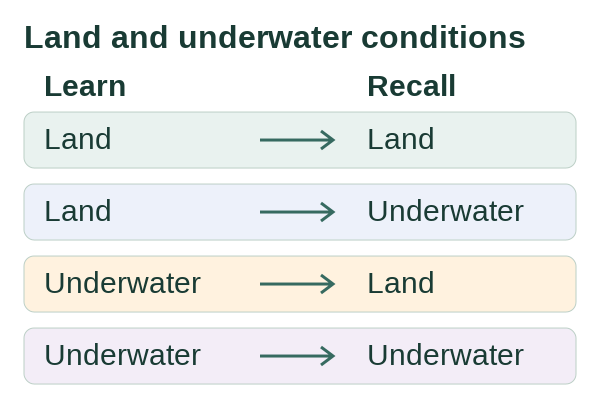
In 1975, Godden and Baddeley had divers learn and recall word lists on land or underwater. Sixteen divers heard the lists and recalled them 4 min later. Each diver took part in all four combinations of learning place and recall place.[19]
A matching context in memory and a retrieval cue raise both hit rates and false alarm rates. That match may leave discrimination unchanged. Discrimination is the ability to tell old from new. Item and context are joined into an ensemble. Matching that group of cues to a cue produces setting-dependent discrimination.[20]
Main ideas
Explaining the effect: the ICE theory
A related idea holds that a brought-back context helps only when it carries diagnostic features. Diagnostic features are details that single out the target episode from competing episodes. In a 2017 study, people memorized word pairs shown with unique or shared background scenes. The original context helped memory, but only when that context was diagnostic of the target episode. Electrical recordings showed an early effect. It tracked the cost of nondiagnostic contexts at retrieval. A later effect reflected easier access in diagnostic contexts. The results suggest that context-dependent episodic memory effects have more than one cause.[21]
Five experiments tested whether matching font color at study and test helped a verbal working memory task. The set size was 4. Across 19 assessments of context reinstatement, just two statistical tests showed facilitation. The researchers measured response times, accuracy and proactive interference, the drag of earlier trials on the current one. A color match largely left all three unchanged. The findings suggest that for meaningful verbal material, context effects are stronger in long-term memory than in working memory.[22]
Odors, sounds and other sensory cues
In two experiments, groups met material with an odorant present, both while learning and while recalling. These groups remembered better than groups without the added smell. The benefit appeared with pleasant odors and with unpleasant ones alike. Smell and emotion are closely linked. So researchers had expected memory to be strongest when the smell's emotional tone matched the material's. That match made no measurable difference. This calls into question the idea that emotional agreement between context and material matters for later memory.[23]
Sounds also carry context, and listeners infer an object's properties from sound in ways that shift with the listening situation. In listening tasks, people judged the shape, weight and material of objects. They did this from the clattering noises those objects made. The acoustic setting was varied. Computer models trained on many sound cues showed that different cues best predicted human judgments in different conditions. The researchers read this as context-dependent inference. This means using different sound cues in different settings. The same pattern appears outside speech. So such inference may be basic to hearing rather than special to language.[24]
Visual features of a place can act as cues too, and eye movements track the search for the right memory. Participants learned two locations for each visual object. They then recalled one location when a contextual cue indicated which was wanted. Before the cue appeared, they often looked at both locations tied to the object. This look-at-both pattern grew more frequent as learning progressed. After the cue, their gaze moved toward the location that fit the context. Memory retrieval was more accurate on trials with the look-at-both pattern. This suggests the pattern serves a function.[25]
The cue-overload hypothesis holds that each cue must share its links among the memories it points to, so extra cues can dilute the help any one gives. Two experiments on recognition memory gave the ICE model minimal support. The cue-overload hypothesis was better supported. The second experiment also found that reinstating the learning context sped recognition reaction times.[26]
Drug states and internal chemical conditions
A drug can act as a context: a memory formed under a drug is often easiest to recall when the same drug is present again.[27][28] Mice were trained on a step-down inhibitory avoidance task. On the test day, the step-down latency measured their memory.[28][29]
Morphine given before training at 5 mg/kg impaired later retrieval compared with saline-treated animals. A pre-test dose of morphine at 5 mg/kg restored the memory that pre-training morphine had weakened.[27] In rats, pre-training morphine from 1 to 15 mg/kg produced the same state-dependent pattern. This was in a passive avoidance task.[30]
Lithium injected after training at 10 and 20 mg/kg shortened the step-down delay on the test day. Giving the same dose before testing reversed that shortening. The strongest response came at 10 mg/kg.[28]
Lithium was injected into the dorsal hippocampus (intra-CA1) after training. At 0.5 and 1 μg per mouse, it impaired memory when retrieval was tested 24 h later. A pre-test injection of 0.5 μg per mouse into the same site reversed the impairment. Scopolamine produced its own state dependence. Each drug could replace the other and reverse the other's memory impairment.[31]
In rats, muscimol is a drug that activates GABA-A receptors. It reduced morphine state-dependent retrieval at 0.01, 0.05 and 0.1 mg/kg. Bicuculline blocks GABA-A receptors. It strengthened the effect of a 1 mg/kg morphine dose at 0.125, 0.25 and 0.5 mg/kg.[30]
For lithium, an NMDA receptor agonist could replace pre-test lithium. D-AP5, which blocks NMDA receptors, disrupted the state dependence.[29] Repeated stimulation of dopamine receptors with apomorphine increased lithium's effect. Blocking D1 or D2 receptors disrupted it.[28]
State-dependent fear memories also keep relying on the hippocampus. This structure usually supports a memory only briefly after learning. A drug activated GABA-A receptors outside the synapse. This produced long-lasting state-dependent fear and disordered signaling between the hippocampus and cortex.[32]
Arousal alone does not create this plasticity. Learning can change synapses in a state-dependent way. It need not change baseline synaptic strength.[33]
Fear, extinction and the cost of shifting context
In fear conditioning, an animal learns that a signal, called a conditioned stimulus, predicts an unpleasant event. Extinction is a later learning process. The signal appears repeatedly without the unpleasant event, and a new memory forms that competes with the original fear memory. Recall of that extinction memory depends on the context, the surrounding place and situation, present during extinction training.[34]
After extinction, rats froze more to the conditioned stimulus outside its extinction context than inside it. Muscimol was used to shut down the dorsal hippocampus in rats. This removed the context effect. After the infusion they froze equally in both contexts. Setting-dependent firing in lateral amygdala neurons was disrupted too.[35]
Human imaging shows that after extinction, the conditioned stimulus engages the ventromedial prefrontal cortex and hippocampus. This engagement is context dependent. It appears in an extinction context but not a conditioning context.[34]
In rats, signaling along the pathway from the hippocampus to the medial prefrontal cortex changed during extinction trials. It recovered with repeated trials as freezing fell. Rats given five footshocks at postnatal day 21 to 25 showed impaired reversal. Both the synaptic inhibition and the freezing decline reversed poorly.[36]
A computer model of the basal amygdala proposed two competing groups of neurons. One handles fear and one handles extinction. Contextual input drives their competition.[37]
Rats were trained in one T-maze context and extinguished in another. On day 5, control animals showed renewal. The memory returned when they were put back in the original context.[38]
In a 2-day study, young and older adults learned to link a signal with an electric shock. They did this in a danger context. They then extinguished it in a safe context. Skin conductance responses measure sweat and arousal. They did not differ between the groups during acquisition or extinction on Day 1. On Day 2, older adults showed impaired recall of extinction. Fear ratings and awareness of the signal-shock link did not differ by age. So aging impaired only extinction, as measured by automatic bodily responses.[39] A drug blocking D2 receptors had no overall effect on extinction or renewal.[38]
Context effects in learning and judgment
In one timing experiment, the gap between the comparison and test intervals changed how accurately people told intervals apart. The gap altered accuracy but did not shift the point of subjective equality, the moment when two intervals seem equal in length. Training on a task with a short gap or a long gap produced very different patterns of generalization. This suggests that different forms of perceptual learning were engaged. The results fit the idea that timing over hundreds of milliseconds is handled locally rather than by one central clock. Fast presentation rates also make temporal discrimination harder.[40]
Color shows a similar split between a direct effect and a context-dependent one. Buechner and Maier (2016) compared red with blue and test-relevant pictures with neutral ones, in four groups of participants. Red raised arousal ratings of the pictures whatever their valence. Valence, the pleasant or unpleasant quality of a stimulus, depended on context: for participants viewing test-relevant pictures, red increased perceptions of negativity compared with neutral pictures. The study concludes that two theories are compatible once arousal and valence are separated. They are the arousal theory of color and the color-in-context theory.[41]
Children read confidence cues differently depending on the kind of question being asked. Three experiments tested ratings of confident and hesitant informants, with N = 180 children. Experiments 1 and 3 used ages 6 to 8, and Experiment 2 used ages 3 to 8. Data were collected from 2016 to 2020 in Canada and the United States. Children rated confidence more positively for factual questions than for moral dilemmas. For subjective questions, children's judgments of confidence and hesitancy did not differ.[42]
Adults' ratings of their own language skills shift with what they have just done. The sample was 186 unbalanced Hebrew-English bilinguals. Self-ratings were collected before and after a multiple-choice vocabulary test in one language. The difficulty of the words was varied. When the vocabulary task was hard, self-ratings in the language of the task went down. This happened whichever language it was. A hard task in the native language also lowered self-ratings in the second language, even though that language was not tested. Ratings taken after the task tended to relate more strongly to vocabulary scores than ratings taken before it. The findings describe self-proficiency judgments as dynamic, context-dependent inferences. They are shaped by prior beliefs and by immediate experience.[43]
How context gates what comes to mind
Peterson and colleagues (2024) report that animals form hierarchical associations to handle that ambiguity. These associations shape cue-elicited behavior and later learning. In animals, a cue that signals reward in one place may signal nothing in another, and the context settles which meaning is retrieved. The surrounding context controls which cue-evoked memory is retrieved. These links shape behavior at the moment of choice. They also bias what the animal learns next.[44]
Ye and colleagues (2026) had healthy adults play a first-person interactive video game. The adults then judged the temporal order of pairs of event moments while functional MRI recorded their brain activity. A pattern of activity in the precuneus, a region near the back of the midline of the brain, tracked how far apart in time two remembered moments had occurred. That pattern covered intervals from less than 1 s to about 18 min. It was stronger for events that shared a common episodic context. Applying inhibitory brain stimulation to the precuneus before retrieval weakened the pattern. Overall blood-oxygen activity stayed unchanged.[45]
Four participants completed a 5-session fMRI study across 3-5 weeks. They recalled whether a probe object matched a target shown before a 3-10 second delay. On half of the trials they remembered location and color. On the other half they remembered location and shape. Decoding of the target's spatial location was on average higher within a session than across sessions. This suggests that these working-memory representations drift from session to session.[46]
How and why it works
Each context imposes a configuration of neuronal and synaptic gating. Gated neurons and synapses have their activity or weights momentarily silenced. Some synapses would destabilize a context's memories. When these are gated off for that context, a process called contextual synaptic refinement, memory capacity improves sharply. The same refinement lets a pattern stay accessible in more than one context.[11]
Research
The main laboratory evidence
One set of two experiments had people hear a word list while sound played in the background. The sound was instrumental music or white noise. Recall was tested 48 hr later. Memory was better and forgetting was less if the same acoustic background was restored. Changing or removing it did not help. The pattern was not symmetric. Some learning happened in quiet conditions. Recall was the same whether the test was quiet, had music, or had white noise. That result suggests the benefit comes from cues that match the learning setting. It does not come from distraction caused by a new sound at test.[2]
Recall was then tested with the original context either brought back or not brought back. A significant context-dependent memory effect appeared for the odor cue. It did not appear for the visual cue.[3]
A cross-over design compared matching and mismatching smells directly. The ambient scent was lemon or lavender. The problem-solving task showed no such matching effect. Lavender at test improved problem solving, whatever the odor at first exposure.[47]
A later study used intranasal Nosa plugs. This is a method for controlling an odorous environment. It tested recall right away and 1 week after encoding. Matching the odor at encoding and at recall helped people freely recall a story. This held when they were tested after a delay. It had no significant effect on recall of a complex figure. It also had none on a word completion task.[48]
Two experiments separated the act of chewing from the mint flavour. Participants either chewed flavorless gum or received mint-flavored strips. This happened at learning, at recall, or at both points. The flavourless gum showed no context-dependent memory effect. None was found with the mint-flavoured strips either. The results raise more doubts about how reliable the previously reported chewing gum effect is.[49]
Music has been tested through tonality, meaning whether a piece is written in a major or a minor key. One experiment used versions of a Chopin waltz. It either reinstated or switched the key at retrieval. This gave minor to minor, major to major, minor to major, and major to minor conditions. Word recall was better in the reinstated-key conditions than in the switched-key conditions. This was especially true for the minor to minor group. The minor key put listeners in a more negative mood than the major key did. Some participants' key switched between learning and recall. Their mood switched too. A path analysis still did not show a reliable mood-mediation effect. The authors suggested that the mind's picture of tonality may itself act as a contextual cue.[50]
With random gating, the networks showed improved memory capacity and differing control of memory stability. This was especially so when neurons rather than synapses were gated. A method called contextual synaptic refinement gates off synapses that destabilise the memory patterns of a given context. This sharply improved capacity and gave more precise control over stability. Refinement also allowed patterns to be accessible in multiple contexts. This included weight matrices that hold no information about the patterns themselves, such as Gaussian random matrices. The paper points to a trade-off between memory capacity and accessibility.[11]
Miller (1981) ran a series of experiments using a selective adaptation technique. The aim was to study how syllable-initial consonants are processed. The pattern of results was the same across two vowel contexts. Transition duration was processed independently of the spectral characteristics of the transitions. Processing of those spectral characteristics did depend on their duration. Miller drew three conclusions: speech processing shows distinct patterns of interaction, the system is not wholly governed by context, and early processing of the signal is analytic rather than holistic.[51]
A cross-linguistic study compared 26 Turkish and 26 Anglo Australian healthy older adults. It looked at their use of nouns, spatial deixis and person deixis. Deixis is a language bridge between spoken language and the communicative context. Its use depends on that context and on the language system itself.[52]
How large the effect is
A 1998 study gave 40 participants an article to read. Some read in silent conditions and some in noisy ones. Reading comprehension was then tested with short answer questions. These measure recall. It was also tested with multiple choice questions, which measure recognition. Both tests showed context effects. Scores were higher when test conditions matched study conditions than when they did not. That result matters because earlier work used lists of unrelated words. It found context effects more often with recall than with recognition. The study's practical suggestion was that students may do better on exams by studying in silence.[4]
In recognition tests, context effects often appear in a particular pattern rather than as a simple gain in accuracy. Probes tested in an old context can draw more hits, which are correct identifications of studied items. They can also draw more false alarms, which are incorrect claims that a new item was studied. This paired rise is called a concordant effect. It is sometimes paired with an advantage in discrimination. That is the ability to tell studied items from new ones. In a 2023 set of experiments, participants studied words placed over photographs. The photographs showed their own university campus or another campus.[53]
One research group noted that environmental context cueing effects have usually been small. Factors that change the effect would therefore be hard to observe in experiments. One example is how similar the study and test contexts are. The strongest effects appeared under three conditions: only one memory target was linked to each video context, intentional item-context encoding was encouraged, and free recall tests were used. A video of the study setting that had not been seen before still helped recall. It worked less well than the video people first viewed. Videos of places with meanings similar to the encoding contexts also brought back recall. They worked less well when the encoding contexts had specific labels. Those labels did not fit the test scene.[54]
Recognition effects also depend on what people do while learning. In one experiment, recollection sensitivity, the ability to retrieve specific details of an earlier event, was context dependent, but familiarity sensitivity, the general sense that something was seen before, was not. Context-dependent recognition appeared only after instructions to encode each item specifically. These direct attention to features of each item. This held whatever the method of stimulus presentation. The findings suggest two things strengthen context-dependent recognition. These are single word presentations and item-specific encoding.[55]
What happens in the brain
Several brain systems help link a memory to the place and setting where it formed.[56][57][58] In rats, large selective lesions on both sides of the hippocampus left object recognition intact. The same rats were impaired only on a task that combined object, place and context. That pattern suggests some kinds of context-dependent recognition do not depend on the hippocampus.[56]
In a context-dependent relational memory task, participants learned where people belonged. Each person belonged in one room in each of two buildings. Room assignment followed a rule. Men and women were placed on opposite sides. The sides switched between buildings. Across two experiments using diffusion tensor imaging, magnetic resonance elastography and functional MRI, the hippocampus and the fornix, a nearby white matter tract, supported relational memory. The ventromedial prefrontal cortex and the uncinate fasciculus supported memory-guided rule use. The uncinate fasciculus is the tract linking that cortex to the temporal lobes. So the two regions add to setting-guided memory in different ways.[57]
Prefrontal activity during recognition depends on the retrieval context itself. In one functional MRI study, right prefrontal activation stayed about the same. This held across levels of retrieval success and effort. That pattern suggested the activation reflects the attempt to retrieve, not success at it. A second experiment kept study and test stimuli the same. It changed only the test instructions. The pattern of right prefrontal activation varied across those retrieval contexts.[59]
The prefrontal cortex also appears to link an item to its setting as the memory forms. Twenty-six participants viewed faces laid over unique background images during functional MRI. Faces were later recognized better in intact contexts than in rearranged ones. This showed successful memory contextualization. Brain activity that predicted later remembering appeared in the left inferior frontal gyrus and the right amygdala. Stronger context-dependent memory went with stronger coupling of the left inferior frontal gyrus. The coupling was to face-responsive and place-responsive areas.[58]
In male macaques, researchers combined optogenetics, which switches cells on or off with light, with multi-channel recording. Rewarding environments produced lasting changes in the baseline firing of dopamine neurons. They also gave brief responses to rewarding events. Neurons in the amygdala responded to environments. They may act on dopamine neurons through an inhibitory projection to the substantia nigra.[60]
Chemogenetic manipulation, which controls cells with designed chemicals, was applied to dentate gyrus ensembles tied to specific contexts. The manipulation restored context-specific neural states in downstream CA1. It also pulled retrieval toward links learned in that context. This fits the encoding specificity principle, the idea that a cue works best when it matches how the memory was stored.[61]
Internal states: stress, drugs and mood
In one 2009 experiment, healthy adults learned where objects were placed in a room. The room smelled of vanilla. Memory was tested 24 hours later. The test was either in the same room or in an unfamiliar room without the odor. Untreated control participants remembered better when the test room matched the learning room. Participants given a stress procedure before learning lost this context-dependent memory boost. The study called this the first demonstration of impaired context-dependent memory after stress.[5]
In the first, skydivers learned words in the air or on the ground. They later recalled them in the same setting or the other one. Recall was poor when words were learned during actual skydiving. For lists learned on land, recall was higher when the recall setting matched the learning setting. The second experiment used a skydiving video instead of a real jump. Recall was higher when learning and recall settings matched, wherever the learning took place. The researchers proposed that under extremely arousing circumstances, cues from the environment or mood are unlikely to be encoded with new information. So they cannot later cue retrieval. They suggested the results apply to jobs such as police work and military special operations. In these jobs, people learn and recall under a lot of emotional stress.[62]
A 2011 study tested whether an avoidant coping style shows up as reduced autobiographical memory specificity. That means fewer specific memories of one's own life. Participants completed two versions of an autobiographical memory test. In one condition, the second was given with threat instructions. Under neutral conditions, avoidance showed no significant link with overgeneral memory. Under threat conditions, the link was significant and clearly stronger. More avoidance went with fewer specific memories and more general ones. High avoiders showed a bigger drop in memory specificity under threat than under neutral conditions. Low avoiders showed no such difference. The study concluded that in nonclinical individuals, this coping style may need the right situation to become active.[63]
Social anxiety offers another case where internal state and external cues meet. A 2025 study compared 118 people with high social anxiety and 113 with low social anxiety. That was 231 in total. Participants recognized faces or houses shown against colored backgrounds. Old items appeared with background colors that matched or did not match. People with high social anxiety showed stronger context-dependent memory for faces. They did not show it for houses. People with low social anxiety showed no such effect. The researchers described this as a domain-specific bias. It appears for social stimuli only. They proposed it as a possible target for treatment.[64]
The stress hormone cortisol has been tested directly. One study gave 60 people 20 mg cortisol or a placebo. They then learned, extinguished, and recalled links between food pictures and outcomes. The pictures were shown in separate settings. Learning during the acquisition and extinction phases was equally good in both groups. Significantly more participants in the cortisol group showed renewal. This is the return of an extinguished response when the context changes. The placebo group did not. Imaging showed that cortisol lowered hippocampus activation during acquisition. It also lowered activity in the ventromedial prefrontal cortex during recall. The researchers concluded that cortisol is a strong modulator of extinction learning and recall. It also promotes renewal.[65]
Lessons from animal learning
In one set of studies, crickets of the species Gryllus bimaculatus learned to approach one odor and avoid another in light. In darkness they learned the reverse. After 3 days of training, the crickets preferred the rewarded odor in the light. In the dark they preferred the other odor, as their training required. Control experiments showed that the background light had no significant effect on forming or retrieving the memory. The exception was when it had been tied to reward during training. The visual context mattered only when the insects had to use it. They used it to settle which odor predicted which outcome.[66]
Extinction is the standard way to weaken a learned response. The animal meets the conditioned stimulus, a cue that once predicted an outcome, without that outcome, and the response fades. Extinction does not erase the original learning. The response can return in several ways. Spontaneous recovery is the return of a response as time passes. Renewal is its return when the animal is tested in a different context. In held honeybees, reinstatement happened and depended on the setting. Changing the color of the light in the setup was enough to mark a new setting. The honeybees appear to learn about the context during extinction. This lets them retrieve one of two opposing memories about the same cue.[67]
Rats were conditioned to fear two sounds. Then each sound was extinguished in its own distinct context. At test, rats froze little to an extinguished sound in the context where it had been extinguished. They froze more to the same sound in the other context. The lateral amygdala is a brain region involved in fear. Most of its neurons fired more strongly to both sounds when they were played outside their own extinction context. Context did not change responses to sounds that had never been extinguished. The researchers proposed that this setting-dependent firing helps the animal. It lets the animal tell which meaning a fear signal carries.[68]
A 2013 study in rats asked where in the brain such context-specific patterns first appear. Rats first learned to fear a sound in one context. Then that fear was extinguished in another context. A day later they heard the sound in the extinction context. They also heard it in a different context. A marker of recent neuronal activity showed context-dependent patterns in three brain areas of extinguished rats. These were the basal amygdala, the lateral amygdala and the infralimbic cortex. The patterns did not appear in rats that were never extinguished. The researchers concluded that extinction learning produces pattern separation. In this, distinct groups of neurons stand for the fear memory after extinction.[69]
The memory was still present after 24 hr and after one week. Blocking protein synthesis right after training hurt retention at one week, but not at 24 hr. Retrieval depended on context. The delay did not appear when the slug was tested on a floor with a different texture.[70]
Preweanling rats were trained on postnatal days 16 and 17. A reminder after extinction brought back an extinguished operant response. This effect depended on the context in which the reminder was given.[71]
The circuitry behind context-dependent odor memory has been mapped in part. Rats learned about a pair of odours. One odour was rewarded in one context and the other odour in a different context. Inactivating the anterior olfactory nucleus, a relay for signals from the hippocampus to the smell system, or the ventral hippocampus, severely impaired performance on this task. Performance was also severely impaired when the anterior olfactory nucleus was inactivated in one hemisphere. The same happened when the hippocampus was inactivated in the other. The results suggest the hippocampus and the anterior olfactory nucleus must communicate.[72]
Virtual environments and designed cues
One 2021 study put people in two virtual scenes with very different meanings. One was an underwater setting, the other a scene on Mars. People recalled items better when the retrieval scene matched the study scene. The advantage was larger for items judged relevant to the context at encoding, the moment of learning. That pattern suggests the effect may depend on items being woven into an active schema.[1]
A 2024 experiment with 240 participants found that people remembered more objects in the same virtual environment as during encoding. The same match came with a cost. People more often falsely recognized similar lure objects. The researchers controlled the virtual objects and environments. A matching object and environment schema helped recall. It did not help recognition.[73]
Designers have also tried to build context into computer screens, not only into rooms. It combined a large screen of projected places with a three-dimensional surround-sound system. The system played background noises that matched those images. A flat-panel monitor showed the information to be remembered. Participants learned and recalled information either in the InfoCockpit or on a standard desktop. The InfoCockpit group showed a 131% memory advantage.[74]
A 2020 study partly repeated Godden and Baddeley's 1980 work on context-dependent recognition memory. It used a lifelike virtual environment in place of the underwater scuba setting. People studied semantic information in the virtual environment. They then scored well on a recognition test. The test took place in the real, material environment. The reverse also held. The results repeated and extended the original findings. The authors support virtual reality training for moving semantic knowledge to new settings.[75]
Not every virtual design produces the effect. A 2023 experiment involved 92 psychology students. They memorized word lists in an indoor virtual environment. They then recalled them in the same indoor scene or an outdoor one. People learned and recalled in different environments. This had no separate effect on memory performance. On average, women recalled significantly more correct words than men. This held whatever the environmental context. The design captured only one effect: changing the setting at recall. It did not capture the role of a specific context in remembering.[76]
When context reinstatement misleads
Matching the place of learning at test usually helps memory, but it can also make memory less accurate. A set of experiments was reported in 2018. People first saw pictures of objects placed over scenes. At test, each object appeared either on its first scene or on a different scene. Showing the original scene again raised correct recognition of old objects, as expected. It also steadily raised the false recognition of similar new objects as old ones. This false recognition appeared in several experiments. It appeared after both immediate and delayed testing. It lasted, and people were highly confident. This held even when participants had been warned that setting can distort memory.[77]
One study used smells to create same-context and changed-context conditions. It used word lists that reliably produce false memories in the lab. In its first experiment, people recalled more correctly when the test setting matched. They did worse when it had changed. In that experiment, false recall showed no effect of context. A second experiment used different odors. It also used a longer retention interval. That interval is the delay between study and test. There, context effects appeared for both true and false memory. Restoring the context improved true memory. At the same time it reduced false memory.[78]
Other work shows that returning to a learning context can change what a memory contains. It does not just change how easily it is found. Memories were automatically reactivated when subjects returned to the original learning context. This is where the updating could occur. In a new context, old memories were not updated. A new episodic memory was formed instead.[79]
Reinstatement can also fail to bring back a memory at all. Rats took part in contextual fear conditioning. A drug that blocks protein synthesis then caused amnesia, a lasting loss of the conditioned response. The amnesia appeared only when the animals were exposed again to the context where the memory had been reactivated. That held no matter when this second viewing happened in the experiment. The same animals had to be tested in several settings and at several times. This was needed to tell a reversed memory from one that was simply not expressed.[80]
Evidence from animals and brain studies
The crab species is Neohelice granulata. Researchers used in vivo calcium imaging to record neurons in the hemiellipsoid bodies, a crustacean memory center. The responses changed with training, and the changes were specific to the stimulus. Training produced changes in the vertical and medial lobes of these bodies. The changes depended on the particular stimulus used. The changes also reflected the context attribute of the memory trace. The study treats this as a core feature of such memory centers. The researchers read this as physiological support for a shared origin of the high-order memory centers across arthropods.[81]
The anterior thalamus, a structure connected to the hippocampus, was not previously known to take part in contextual memory. Law and Smith (2012) tested this by temporarily inactivating it in rats. Rats first learned one list of odor discrimination problems. They then learned a second list. It was in the same context as the first or in a different one. To create interference, some odors were reused across the two lists, and their correct answers were switched, so the two lessons pointed in opposite directions. Temporary inactivation of the anterior thalamus completely abolished this contextual learning advantage. This result was very similar to the effects of hippocampal inactivation.[82]
In humans, fMRI patterns in the left intraparietal sulcus carried group-level information that shifted with the demands of the task. In one fMRI study, participants learned arbitrary groupings of touch stimuli. Identical pairs of stimuli were compared across conditions. Group-specific, context-dependent working memory information was pinpointed to the left intraparietal sulcus, a fold in the parietal cortex. The researchers concluded that these representations adapt as task demands change.[83]
Geerts, Gershman, Burgess and Stachenfeld (2024) built a model. In it, the context used for prediction can be set by the states themselves and by the transitions between them. The model learns several task-specific predictions. It picks among them based on how accurate each has been. It reproduces animal behavior in tasks that require contextual memory and generalization. It links this to hippocampal-dependent contextual decision-making.[84] Blocking CB1 left short-term memory and long-term memory consolidation unaffected.[85]
In practice
Context in classrooms and everyday life
Three experiments in real settings tested junior college students. Their teacher taught their class, and other students they knew led their break. In the first experiment, one group was tested in the same class where they learned the items. Another group was tested during the break at a different place. This was 60 seconds after learning. The second experiment separated the place factor (types of room) from the non-place factor (class versus break). It used a retention interval of one week. Both experiments found clear context-dependent memory. The effect came from changes in the non-place part of the context. It did not come from the place itself.[86]
Sounds can serve as a context for children in ordinary lessons. Two experiments tested school-aged children. They asked whether background noises heard during learning would improve later recall. Hearing the same sound again improved memory for students in grades 2, 3 and 5. The results suggest that sounds, not only pieces of music, are stored in memory. They can act as effective contextual cues for recall. The researchers advised teachers to keep one thing in mind. Sounds in the classroom are stored together with the lesson itself.[87]
Teachers often point to a 1975 study of divers. They recalled words better when recall took place in the same environment, underwater or on land, as learning. A later study repeated that design under conditions closer to real medical training. It added meaningful material: a patient case description. Sixty-three clerks were assigned at random across four conditions. The study compared two settings: a clinical (bedside) setting and an educational (classroom) setting. Both learning and recall were tested. Students recalled a list of words and a patient case. They did this either in the same environment as learning or in the opposite one. The study found no significant advantage for the same context. This held for free recall of the word list and of the patient case propositions. The researchers concluded that physical surroundings alone do not seem to give a same-context advantage in medical education. They said the diver findings should be generalized with care. The researchers suggested that other kinds of context besides the physical one may still improve learning in medical education.[88]
One study used two assessment methods: static and dynamic. It estimated actual and potential levels of functioning for two preschool children. Both children had language impairment at the single-word stage of development. The researchers used information from both kinds of assessment. They predicted when and how quickly the children would perform correctly. One situation was context dependent, which is called treatment. The other did not depend on context (generalization). The results gave clinicians early guidance. They help decide who should get direct treatment. They also help decide how to track learning during therapy.[89]
Practice questions for students
Question: In the object recognition study with rats, what did healthy rats prefer to explore? Answer: a familiar object shown in a different spatiotemporal setting. Not one shown in only a different spatial or temporal context. Question: Which form of recognition survived damage to the hippocampus? Answer: the familiarity-dependent form survived, but the context-dependent form did not.[90] Question: In the shock-probe test, when did hippocampal lesions impair avoidance? Answer: only when rats were tested in the same context where they had been conditioned.[91]
Question: Which brain regions were more active in adults than in children for that advantage? Answer: the lateral prefrontal cortex, the hippocampus and the dorsal striatum.[92] Question: In the study with developing rats, how many days of FGF2 injections helped contextual fear conditioning? Answer: 5 days of injections, from postnatal day 1 to day 5.[93]
Question: What did one injection of FGF2 on postnatal day 1 do to contextual fear conditioning? Answer: it led to no detectable changes in rats tested on postnatal day 16 or day 23.[93] Question 10: In the study of brown-headed cowbirds, what did the researchers show? Answer: Egr1 expression specific to each environment as the birds moved through environments for food reward.[94]
Context effects in classrooms and testing
A 2026 study looked at 944 university students in physical education courses. It found small but significant links between gender and year level and how students experienced the course. Gender differences were strongest in competence-related areas among science majors. They were weaker among humanities majors. For classroom climate, the pattern reversed. The researchers described these findings as associative, meaning group differences may reflect how courses are run rather than fixed traits of students.[95]
Montgomery (1994) measured self-concept, a person's view of their own abilities and worth, in 135 sixth, seventh and eighth graders, using the Multidimensional Self Concept Scale. A 1994 study rated the self-concept of 135 students in sixth, seventh and eighth grades. They included students with learning disabilities, nondisabled students and high-achieving students. Students rated themselves, and teachers and parents rated them too. They used a scale that measures self-concept in several separate areas. Teachers generally underestimated the self-concept of students with learning disabilities and nondisabled students. Parents' ratings of children with learning disabilities and high-achieving children generally matched the children's own reports. Agreement between nondisabled children and their parents varied by the area of self-concept being rated.[96]
Confidence built in one setting does not always carry over to another. A 2026 study followed 12 Indonesian students learning English. They practiced speaking with a chatbot for eight weeks. Interviews showed that the practice felt lower in interpersonal pressure. But students differed in how much they used the feedback and repeated practice on offer. Comfort and confidence gained in that setting did not transfer evenly to speaking with people. The researcher concluded that such practice works best as a low-risk complement to human interaction, not a replacement for it.[97]
What this looks like when you study
In one classroom study, second, third and fifth grade students heard background noises while learning and were tested either with the same sounds or with different ones. In two experiments, bringing back the same sounds improved the children's memory of what they had learned. The authors concluded that sounds, not just pieces of music, get stored in memory. They can also work as memory cues. They advised teachers to know how classroom sounds are stored along with the lesson.[87]
Koens, Cate and Custers (2003) asked medical clerks to learn a word list and a patient case. They did this in a classroom or at a bedside. The clerks then recalled the material in the same place or in the other one. Recall of the case was only slightly better when learning took place at the bedside. The authors warned that results from the diving experiment should not be applied too quickly to medical education.[88]
In a real-world study, 47 participants carried a phone app that tracked their locations for five weeks. Participants chose the correct location more often when the context at recall matched the context at encoding. For those places it grew with the time spent there.[6]
Two studies tested whether matching the sound of study and test changes later memory.[4][87] Ostendorf, Schlüter and Hackländer (2020) found that background noises during learning improved memory in children. The improvement came when the same noises returned at recall.[87] Third, do not assume that matching the room will always help, since a study with medical students found no such advantage.[88]
Criticism
Failed replications and open questions
Participants held two locations in mind. Their brain activity was recorded with EEG. This method measures electrical signals at the scalp. Some cues told people to remember one location. Others told them to forget one location. Both improved performance compared with trials that had no cue. The benefit was significantly greater for the remember cues, so the two kinds of cue did not act in the same way.[98]
In a 2021 experiment, people learned two sets of three-finger movements. Each set was learned at a different computer workplace. Between the two sets, the researchers changed the keyboard, the display orientation, the stimuli, the background color, the response keys, the hand position and the computer. A final free recall test used the features of the first workplace, the second workplace, or new features. Overall recall differed clearly between these test conditions. This suggests the study setting guided retrieval of the movement sequences. Reinstating the first set's context gave lower recall at first, which then became stable. The second set's context gave higher recall that then declined. The researchers concluded that bringing back the context of the first list does not immediately make those items easier to reach. Access improves as retrieval continues.[99]
Studies of motor skill learning have also revised earlier assumptions about how tightly memories are tied to a setting. A 2013 study examined object manipulation and adaptation to a force field, a setup in which a robotic device pushes the hand off course. Older models held that forming a motor memory depends on context. They held that the fading of that memory does not. The 2013 results went against this. Decay depended heavily on context. It was greatest for movements made in the same context. Contexts farther apart showed much less decay.[100]
A 2021 visuomotor study asked a question. Does a disturbance introduced gradually, rather than abruptly, still produce context effects tied to attention? Participants adjusted to a cursor that moved at an angle to their hand. It rose from 0 degrees to 45 degrees across trials. A movement learned while attention was distracted was relearned better under distraction at recall. This supports context-dependent memory even for a gradual disturbance. A second experiment found no difference in recall between two groups. One group did the distracting task early in learning, the other late. The researchers did not settle whether this shows a flexible time window for encoding the attentional state. It could also be a failure to integrate it at all.[101]
A basic assumption of the field is itself under question. The assumption is that objects in an event are the items and background scenes are the context. One idea holds that setting is rebuilt at retrieval, not stored at encoding. So any part of an event could serve as item or context, depending on the question asked. Six experiments used a context reinstatement paradigm, a method that brings back study conditions at test. The test asked about background scenes. Bringing back the focal objects then raised old responses to targets and lures. The effect held even when scenes were irrelevant to the task. Objects were relevant at encoding. The effect then depended on how large the objects and scenes appeared on screen. The results support reconstruction, not encoding. The perceptual properties of stimuli limit how much context shapes retrieval. So does how much they stand out.[102]
Limits and open questions
Amaya, Stott and Smith (2020) report that sign-tracking in rats was sensitive to reinforcer devaluation. This held only when the taste aversion learned in one context transferred to the testing context. In a sign-tracking study, rats learned to press a lever that predicted food, and researchers then tried to reduce the value of the food. Whether the rats' lever pressing changed depended on whether the learned dislike of the food carried over into the testing situation. Then the reduced value of the food strongly shaped lever pressing, both when food was withheld and when the animals could learn from feedback. When the dislike did not transfer, lever pressing stayed high. The study's authors argue that this effect of context can reconcile contradictory findings. The findings concern whether such behavior is flexible or inflexible.[103]
Common misconceptions
Many people assume that bringing back the original context helps memory. In several experiments, reinstating the scene at test increased correct recognition of old objects. It also increased incorrect recognition of similar new objects. People kept making this false recognition with high confidence. They did so even when told in advance that context could distort their answers.[77]
Key studies
| Year | Study | Sample | Design | Finding |
|---|---|---|---|---|
| 1976 | Swanson & Kinsbourne[18] | hyperactive and nonhyperactive children | drug state learning experiment | The hyperactive children showed state-dependent learning in both directions, while the nonhyperactive children did not. |
| 1985 | Smith[2] | background sound word-list experiment | Words learned against instrumental music or white noise were recalled better 48 hours later if the same sound was playing at the test. Changing the sound or removing it gave weaker recall. | |
| 1998 | Grant et al.[4] | 40 participants | reading comprehension study with silent or noisy conditions | Both short answer and multiple choice tests showed better performance when study and test conditions matched. |
| 2001 | Thompson et al.[62] | experienced skydivers | two experiments on arousal and context | Words learned on the ground were recalled better when the test context matched the learning context than when it did not. |
| 2001 | Parker et al.[47] | Cross-over experiments with ambient odours (lemon or lavender) and tests four weeks later. | Reintroducing the same odour improved free recall and recognition of a word list, and spatial learning was best with the same odour at learning and test. | |
| 2003 | Koens et al.[88] | classroom versus bedside recall experiment | No significant same-context advantage appeared for free recall of a word list or a patient case. | |
| 2009 | Schwabe et al.[5] | healthy adults | stress and object-location experiment with vanilla scent | In the control group, memory was better when the test room matched the learning room. Stress before learning removed that advantage. |
| 2018 | Doss et al.[77] | participants in several experiments | object and scene recognition experiments | Context reinstatement increased correct recognition of old objects but also consistently increased incorrect recognition of similar new objects. |
| 2019 | Woods & Dewhurst[78] | participants in two experiments | odor context and false memory experiment | In Experiment 2, context reinstatement improved true memory while simultaneously reducing false memory. |
| 2020 | Ostendorf et al.[87] | 2nd, 3rd and 5th grade students | two classroom experiments with background noises | Reinstating the auditory context improved memory performance for the children. |
| 2021 | Shin et al.[1] | Participants studied and recalled items in two immersive virtual reality contexts, underwater and Mars. | Items were better recalled in the same context as study, and the effect was larger for items deemed context-relevant at encoding. | |
| 2022 | Sorokowska et al.[48] | participants tested with intranasal plugs | odor context experiment with text, figure and priming tasks | When the same odor was present at encoding and at recall, people freely recalled more of a story at the delayed test. The odor made no significant difference to recall of a complex figure or to a word completion task. |
| 2023 | Chocholáčková et al.[76] | 92 psychology students | virtual reality word recall experiment | Women recalled about 20 words on average versus about 16 for men, but changing the virtual environment did not significantly affect recall. |
| 2025 | Choi et al.[6] | 47 participants tracked by smartphone for 5 weeks | real-world location recall experiment | Accuracy was higher when the retrieval place matched the encoding place, and the benefit was strongest for low-frequency locations. |
See also
References
- Shin, Y. S., Masís-Obando, R., Keshavarzian, N., Dáve, R., & Norman, K. A. (2021). Context-dependent memory effects in two immersive virtual reality environments: On Mars and underwater. Psychonomic Bulletin & Review, 28(2), 574-582. doi:10.3758/s13423-020-01835-3
- Smith, S. M. (1985). Background Music and Context-Dependent Memory. The American Journal of Psychology, 98(4), 591. doi:10.2307/1422512
- Pointer, S. C., & Bond, N. W. (1998). Context-dependent Memory: Colour versus Odour. Chemical Senses, 23(3), 359-362. doi:10.1093/chemse/23.3.359
- Grant, H. M., Bredahl, L. C., Clay, J., Ferrie, J., Groves, J. E., McDorman, T. A., & Dark, V. J. (1998). Context-dependent memory for meaningful material: information for students. Applied Cognitive Psychology, 12(6), 617-623. doi:10.1002/(sici)1099-0720(1998120)12:6<617::aid-acp542>3.0.co;2-5
- Schwabe, L., Böhringer, A., & Wolf, O. T. (2009). Stress disrupts context-dependent memory. Learning & Memory, 16(2), 110-113. doi:10.1101/lm.1257509
- Choi, Y., Kim, K., Moon, S., Jung, G., Cha, J. H., & Yim, H. (2025). Context-dependent memory in the real world: the role of frequency and context dwell time. Frontiers in Psychology, 15. doi:10.3389/fpsyg.2024.1489039
- Wang, F., Chen, X., Bo, B., Zhang, T., Liu, K., Jiang, J., Wang, Y., Xie, H., Liang, Z., & Guan, J. S. (2023). State-dependent memory retrieval: insights from neural dynamics and behavioral perspectives. Learning & Memory, 30(12), 325-337. doi:10.1101/lm.053893.123
- Ley, P., Jain, V. K., Swinson, R. P., Eaves, D., Bradshaw, P. W., Kincey, J. A., Crowder, R., & Abbiss, S. (1972). A State-Dependent Learning Effect Produced by Amylobarbitone Sodium. British Journal of Psychiatry, 120(558), 511-515. doi:10.1192/bjp.120.558.511
- Niknamfar, S., Ghazvini, H., Naseri, M., Zarrindast, M., Rafaiee, R., Seyedhosseini Tamijani, S. M., & Razavinasab, M. (2026). The Modulatory Role of Nicotine and Alcohol in State-Dependent Learning and Memory. Addiction and Health, 18, 1602. doi:10.34172/ahj.1602
- Freyer, F., Becker, R., Dinse, H. R., & Ritter, P. (2013). State-Dependent Perceptual Learning. The Journal of Neuroscience, 33(7), 2900-2907. doi:10.1523/jneurosci.4039-12.2013
- Podlaski, W. F., Agnes, E. J., & Vogels, T. P. (2025). High Capacity and Dynamic Accessibility in Associative Memory Networks with Context-Dependent Neuronal and Synaptic Gating. Physical Review X, 15(1). doi:10.1103/physrevx.15.011057
- Staudigl, T., Vollmar, C., Noachtar, S., & Hanslmayr, S. (2015). Temporal-Pattern Similarity Analysis Reveals the Beneficial and Detrimental Effects of Context Reinstatement on Human Memory. The Journal of Neuroscience, 35(13), 5373-5384. doi:10.1523/jneurosci.4198-14.2015
- Smith, S. M., Heath, F. R., & Vela, E. (1990). Environmental Context-Dependent Homophone Spelling. The American Journal of Psychology, 103(2), 229. doi:10.2307/1423144
- Teghil, A., Bonavita, A., Procida, F., Giove, F., & Boccia, M. (2022). Temporal Organization of Episodic and Experience-near Semantic Autobiographical Memories: Neural Correlates and Context-dependent Connectivity. Journal of Cognitive Neuroscience, 34(12), 2256-2274. doi:10.1162/jocn_a_01906
- Noorbakhshnia, M., Rahmani-Samani, P., & Eivani, M. (2020). Lidocaine Reversible Inactivation of the Central Nucleus of Amygdala Impairs Acquisition, Consolidation, and Retrieval of Morphine State-Dependent Learning in Rat. Pharmacology, 105(3-4), 225-230. doi:10.1159/000503726
- Taubenfeld, S. M., Muravieva, E. V., Garcia-Osta, A., & Alberini, C. M. (2010). Disrupting the memory of places induced by drugs of abuse weakens motivational withdrawal in a context-dependent manner. Proceedings of the National Academy of Sciences, 107(27), 12345-12350. doi:10.1073/pnas.1003152107
- Gomez Uncu, Y. M. (2026). Operationalizing the physiological state (P) in nonlinear behavioral systems: a measurement framework for state-dependent dynamics. Frontiers in Psychology, 17. doi:10.3389/fpsyg.2026.1873356
- Swanson, J. M., & Kinsbourne, M. (1976). Stimulant-Related State-Dependent Learning in Hyperactive Children. Science, 192(4246), 1354-1357. doi:10.1126/science.1273596
- Murre, J. M. J. (2021). The Godden and Baddeley (1975) experiment on context-dependent memory on land and underwater: a replication. Royal Society Open Science, 8(11). doi:10.1098/rsos.200724
- Murnane, K., Phelps, M. P., & Malmberg, K. (1999). Context-dependent recognition memory: The ICE theory. Journal of Experimental Psychology: General, 128(4), 403-415. doi:10.1037/0096-3445.128.4.403
- Bramão, I., & Johansson, M. (2017). Benefits and Costs of Context Reinstatement in Episodic Memory: An ERP Study. Journal of Cognitive Neuroscience, 29(1), 52-64. doi:10.1162/jocn_a_01035
- Festini, S. B. (2025). Verbal working memory performance and proactive interference are largely unaffected by matching font color reinstatement. Frontiers in Psychology, 16. doi:10.3389/fpsyg.2025.1688942
- Hackländer, R. P., & Bermeitinger, C. (2017). Olfactory Context-Dependent Memory and the Effects of Affective Congruency. Chemical Senses, 42(9), 777-788. doi:10.1093/chemse/bjx057
- Moore, K., & Traer, J. (2025). Context-dependent auditory inference in environmental sound recognition. The Journal of the Acoustical Society of America, 157(4_Supplement), A117-A117. doi:10.1121/10.0037594
- Paeng, S., & Kim, H. F. (2024). Gaze patterns reflect the retrieval and selection of memories in a context-dependent object location retrieval task. Scientific Reports, 14(1). doi:10.1038/s41598-024-59815-9
- Rutherford, A. (2004). Environmental Context-Dependent Recognition Memory Effects: An Examination of ICE Model and Cue-Overload Hypotheses. The Quarterly Journal of Experimental Psychology Section A, 57(1), 107-127. doi:10.1080/02724980343000152
- Zarrindast, M. R., Askari, E., Khalilzadeh, A., & Nouraei, N. (2006). Morphine State-Dependent Learning Sensitization and Interaction with Nitric Oxide. Pharmacology, 78(2), 66-71. doi:10.1159/000095541
- Zarrindast, M., Madadi, F., & Ahmadi, S. (2009). Repeated administrations of dopamine receptor agents affect lithium-induced state-dependent learning in mice. Journal of Psychopharmacology, 23(6), 645-651. doi:10.1177/0269881108093926
- Rezayat, M., Niasari, H., Ahmadi, S., Parsaei, L., & Zarrindast, M. (2010). N-methyl-D-aspartate receptors are involved in lithium-induced state-dependent learning in mice. Journal of Psychopharmacology, 24(6), 915-921. doi:10.1177/0269881108100093
- Zarrindast, M. R., Noorbakhshnia, M., Motamedi, F., Haeri-Rohani, A., & Rezayof, A. (2006). Effect of the GABAergic System on Memory Formation and State-Dependent Learning Induced by Morphine in Rats. Pharmacology, 76(2), 93-100. doi:10.1159/000089934
- Ghorbanalizadeh-Khalifeh-Mahaleh, B., Taheri, S., Sahengharani, M., Rezayof, A., Haeri-Rohani, A., & Zarrindast, M. R. (2009). Intra-Dorsal Hippocampal Microinjection of Lithium and Scopolamine Induce a Cross State-Dependent Learning in Mice. European Psychiatry, 24(S1). doi:10.1016/s0924-9338(09)71091-0
- Meyer, M. A. A., Corcoran, K. A., Chen, H. J., Gallego, S., Li, G., Tiruveedhula, V. V., Cook, J. M., & Radulovic, J. (2017). Neurobiological correlates of state-dependent context fear. Learning & Memory, 24(9), 385-391. doi:10.1101/lm.045542.117
- Bramham, C. R. (1997). State-dependent suppression of LTP induction after learning: Relation to phasic hippocampal network events. Behavioral and Brain Sciences, 20(4), 614-615. doi:10.1017/s0140525x97231596
- Kalisch, R., Korenfeld, E., Stephan, K. E., Weiskopf, N., Seymour, B., & Dolan, R. J. (2006). Context-Dependent Human Extinction Memory Is Mediated by a Ventromedial Prefrontal and Hippocampal Network. The Journal of Neuroscience, 26(37), 9503-9511. doi:10.1523/jneurosci.2021-06.2006
- Maren, S., & Hobin, J. A. (2007). Hippocampal regulation of context-dependent neuronal activity in the lateral amygdala. Learning & Memory, 14(4), 318-324. doi:10.1101/lm.477007
- Koseki, H., Matsumoto, M., Togashi, H., Miura, Y., Fukushima, K., & Yoshioka, M. (2009). Alteration of synaptic transmission in the hippocampal‐mPFC pathway during extinction trials of context‐dependent fear memory in juvenile rat stress models. Synapse, 63(9), 805-813. doi:10.1002/syn.20657
- Vlachos, I., Herry, C., Lüthi, A., Aertsen, A., & Kumar, A. (2011). Context-Dependent Encoding of Fear and Extinction Memories in a Large-Scale Network Model of the Basal Amygdala. PLoS Computational Biology, 7(3), e1001104. doi:10.1371/journal.pcbi.1001104
- André, M. A. E., & Manahan-Vaughan, D. (2016). Involvement of Dopamine D1/D5 and D2 Receptors in Context-Dependent Extinction Learning and Memory Reinstatement. Frontiers in Behavioral Neuroscience, 9. doi:10.3389/fnbeh.2015.00372
- Battaglia, S., Garofalo, S., & di Pellegrino, G. (2018). Context-dependent extinction of threat memories: influences of healthy aging. Scientific Reports, 8(1). doi:10.1038/s41598-018-31000-9
- Buonomano, D. V., Bramen, J., & Khodadadifar, M. (2009). Influence of the interstimulus interval on temporal processing and learning: testing the state-dependent network model. Philosophical Transactions of the Royal Society B: Biological Sciences, 364(1525), 1865-1873. doi:10.1098/rstb.2009.0019
- Buechner, V. L., & Maier, M. A. (2016). Not always a matter of context: direct effects of red on arousal but context-dependent moderations on valence. PeerJ, 4, e2515. doi:10.7717/peerj.2515
- Woodard, S. R., Lau, P., Severson, R. L., & Birch, S. A. J. (2026). Confidence in context: Children's context-dependent interpretations of informants' confidence and hesitancy. Child Development. doi:10.1093/chidev/aacag076
- Segal, D., & Neveu, A. (2026). Self-rated language proficiency as a context-dependent judgment. Psychonomic Bulletin & Review, 33(5). doi:10.3758/s13423-026-02938-z
- Peterson, S., Chavira, J., Garcia Arango, J. A., Seamans, D., Cimino, E. D., & Keiflin, R. (2024). Partially dissociable roles of the orbitofrontal cortex and dorsal hippocampus in context-dependent hierarchical associations. Current Biology, 34(23), 5532-5545.e3. doi:10.1016/j.cub.2024.10.049
- Ye, Q., Hu, Y., Ku, Y., Appiah, K., & Kwok, S. C. (2026). Context-dependent abstraction of temporal relationships during naturalistic episodic memory. iScience, 29(9), 117391. doi:10.1016/j.isci.2026.117391
- Yuan, Y., Aoi, M., & Serences, J. (2024). Characterizing representational drift via a context-dependent visual working memory task. Journal of Vision, 24(10), 1386. doi:10.1167/jov.24.10.1386
- Parker, A., Ngu, H., & Cassaday, H. J. (2001). Odour and Proustian memory: reduction of context-dependent forgetting and multiple forms of memory. Applied Cognitive Psychology, 15(2), 159-171. doi:10.1002/1099-0720(200103/04)15:2<159::aid-acp694>3.0.co;2-d
- Sorokowska, A., Nord, M., Stefańczyk, M. M., & Larsson, M. (2022). Odor-based context-dependent memory: influence of olfactory cues on declarative and nondeclarative memory indices. Learning & Memory, 29(5), 136-141. doi:10.1101/lm.053562.121
- Johnson, A. J., & Miles, C. (2008). Chewing gum and context‐dependent memory: The independent roles of chewing gum and mint flavour. British Journal of Psychology, 99(2), 293-306. doi:10.1348/000712607x228474
- Mead, K. M. L., & Ball, L. J. (2007). Music tonality and context-dependent recall: The influence of key change and mood mediation. European Journal of Cognitive Psychology, 19(1), 59-79. doi:10.1080/09541440600591999
- Miller, J. L. (1981). Phonetic perception: Evidence for context-dependent and context-independent processing. The Journal of the Acoustical Society of America, 69(3), 822-831. doi:10.1121/1.385593
- MARCH, E. G., & PATTISON, P. (2014). The role of language system in context-dependent language use in Turkish-speaking versus English-speaking older adults. Applied Psycholinguistics, 35(6), 1087-1108. doi:10.1017/s0142716412000707
- Ensor, T. M., Surprenant, A. M., Neath, I., & Hockley, W. E. (2023). Using preexperimental familiarity to compare the ICE and cue-overload accounts of context-dependent memory in item recognition. Journal of Experimental Psychology: Learning, Memory, and Cognition, 49(4), 533-546. doi:10.1037/xlm0001169
- Smith, S. M., Handy, J. D., Angello, G., & Manzano, I. (2014). Effects of similarity on environmental context cueing. Memory, 22(5), 493-508. doi:10.1080/09658211.2013.800553
- Markopoulos, G., Rutherford, A., Cairns, C., & Green, J. (2010). Encoding instructions and stimulus presentation in local environmental context-dependent memory studies. Memory, 18(6), 610-624. doi:10.1080/09658211.2010.497764
- Langston, R. F., & Wood, E. R. (2010). Associative recognition and the hippocampus: Differential effects of hippocampal lesions on object‐place, object‐context and object‐place‐context memory. Hippocampus, 20(10), 1139-1153. doi:10.1002/hipo.20714
- Schwarb, H., Johnson, C. L., Dulas, M. R., McGarry, M. D. J., Holtrop, J. L., Watson, P. D., Wang, J. X., Voss, J. L., Sutton, B. P., & Cohen, N. J. (2019). Structural and Functional MRI Evidence for Distinct Medial Temporal and Prefrontal Roles in Context-dependent Relational Memory. Journal of Cognitive Neuroscience, 31(12), 1857-1872. doi:10.1162/jocn_a_01454
- Zhang, W., van Ast, V. A., Klumpers, F., Roelofs, K., & Hermans, E. J. (2018). Memory Contextualization: The Role of Prefrontal Cortex in Functional Integration across Item and Context Representational Regions. Journal of Cognitive Neuroscience, 30(4), 579-593. doi:10.1162/jocn_a_01218
- Wagner, A. (1998). Prefrontal cortex and recognition memory. Functional-MRI evidence for context-dependent retrieval processes. Brain, 121(10), 1985-2002. doi:10.1093/brain/121.10.1985
- Maeda, K., Inoue, K. i., Takada, M., & Hikosaka, O. (2023). Environmental context-dependent activation of dopamine neurons via putative amygdala-nigra pathway in macaques. Nature Communications, 14(1). doi:10.1038/s41467-023-37584-9
- Coelho, C. A. O., Mocle, A. J., Jacob, A. D., Ramsaran, A. I., Rashid, A. J., Köhler, S., Josselyn, S. A., & Frankland, P. W. (2024). Dentate gyrus ensembles gate context-dependent neural states and memory retrieval. Science Advances, 10(31). doi:10.1126/sciadv.adn9815
- Thompson, L. A., Williams, K. L., & L'Esperance, P. R. (2001). Context-Dependent Memory under Stressful Conditions: The Case of Skydiving. Human Factors: The Journal of the Human Factors and Ergonomics Society, 43(4), 611-619. doi:10.1518/001872001775870377
- Debeer, E., Raes, F., Williams, J. M. G., & Hermans, D. (2011). Context-dependent activation of reduced autobiographical memory specificity as an avoidant coping style. Emotion, 11(6), 1500-1506. doi:10.1037/a0024535
- Sommerfeld, L., Zalmenson, T., Lazarov, A., & Bar-Haim, Y. (2025). Context-dependent memory in social anxiety: Effects of social and non-social information. Behaviour Research and Therapy, 195, 104901. doi:10.1016/j.brat.2025.104901
- Nostadt, A., Merz, C. J., Wolf, O. T., Tegenthoff, M., & Lissek, S. (2023). Cortisol decreases activation in extinction related brain areas resulting in an impaired recall of context-dependent extinction memory. Neurobiology of Learning and Memory, 205, 107844. doi:10.1016/j.nlm.2023.107844
- Matsumoto, Y., & Mizunami, M. (2004). Context-Dependent Olfactory Learning in an Insect. Learning & Memory, 11(3), 288-293. doi:10.1101/lm.72504
- Plath, J. A., Felsenberg, J., & Eisenhardt, D. (2012). Reinstatement in honeybees is context-dependent. Learning & Memory, 19(11), 543-549. doi:10.1101/lm.026831.112
- Hobin, J. A., Goosens, K. A., & Maren, S. (2003). Context-Dependent Neuronal Activity in the Lateral Amygdala Represents Fear Memories after Extinction. The Journal of Neuroscience, 23(23), 8410-8416. doi:10.1523/jneurosci.23-23-08410.2003
- Orsini, C. A., Yan, C., & Maren, S. (2013). Ensemble coding of context-dependent fear memory in the amygdala. Frontiers in Behavioral Neuroscience, 7. doi:10.3389/fnbeh.2013.00199
- Fujisaki, Y., & Matsuo, R. (2017). Context-Dependent Passive Avoidance Learning in the Terrestrial Slug Limax. Zoological Science, 34(6), 532-537. doi:10.2108/zs170071
- Orellana Barrera, E., Arias, C., & Abate, P. (2018). Context-dependent reinstatement of an extinguished operant response in preweanling rats. Behavioral Neuroscience, 132(6), 469-479. doi:10.1037/bne0000264
- Hernandez, N. A., Yang, Y. Y., Linster, C., & Smith, D. M. (2026). Hippocampal communication with the anterior olfactory nucleus is necessary for context-dependent odor memory. Behavioral Neuroscience, 140(4), 211-216. doi:10.1037/bne0000659
- Koch, G. E., & Coutanche, M. N. (2024). Context reinstatement requires a schema relevant virtual environment to benefit object recall. Psychonomic Bulletin & Review, 31(5), 2205-2213. doi:10.3758/s13423-024-02472-w
- Stefanucci, J. K., O'Hargan, S. P., & Proffitt, D. R. (2007). Augmenting Context-Dependent Memory. Journal of Cognitive Engineering and Decision Making, 1(4), 391-404. doi:10.1518/155534307x264870
- Parker, J. A., Kaplan, A. D., Volante, W. G., Abich, J., & Sims, V. K. (2020). Exploring the Encoding Specificity Principle and Context-Dependent Recognition in Virtual Reality. Proceedings of the Human Factors and Ergonomics Society Annual Meeting, 64(1), 1481-1485. doi:10.1177/1071181320641353
- Chocholáčková, M., Juřík, V., Ružičková, A., Jurkovičová, L., Ugwitz, P., & Jelínek, M. (2023). Context-dependent memory recall in HMD-based immersive virtual environments. PLOS ONE, 18(8), e0289079. doi:10.1371/journal.pone.0289079
- Doss, M. K., Picart, J. K., & Gallo, D. A. (2018). The Dark Side of Context: Context Reinstatement Can Distort Memory. Psychological Science, 29(6), 914-925. doi:10.1177/0956797617749534
- Woods, J. A., & Dewhurst, S. A. (2019). Putting false memories into context: the effects of odour contexts on correct and false recall. Memory, 27(3), 379-386. doi:10.1080/09658211.2018.1512632
- Hupbach, A., Hardt, O., Gomez, R., & Nadel, L. (2008). The dynamics of memory: Context-dependent updating. Learning & Memory, 15(8), 574-579. doi:10.1101/lm.1022308
- Alfei, J. M. (2026). From forgetting to remembering: Context-dependent memory recovery after postretrieval disruption. Behavioral Neuroscience, 140(3), 163-172. doi:10.1037/bne0000651
- Maza, F. J., Sztarker, J., Shkedy, A., Peszano, V. N., Locatelli, F. F., & Delorenzi, A. (2016). Context-dependent memory traces in the crab’s mushroom bodies: Functional support for a common origin of high-order memory centers. Proceedings of the National Academy of Sciences, 113(49). doi:10.1073/pnas.1612418113
- Law, L. M., & Smith, D. M. (2012). The anterior thalamus is critical for overcoming interference in a context-dependent odor discrimination task. Behavioral Neuroscience, 126(5), 710-719. doi:10.1037/a0029698
- Velenosi, L. A., Wu, Y. H., Schmidt, T. T., & Blankenburg, F. (2020). Intraparietal sulcus maintains working memory representations of somatosensory categories in an adaptive, context-dependent manner. NeuroImage, 221, 117146. doi:10.1016/j.neuroimage.2020.117146
- Geerts, J. P., Gershman, S. J., Burgess, N., & Stachenfeld, K. L. (2024). A probabilistic successor representation for context-dependent learning. Psychological Review, 131(2), 578-597. doi:10.1037/rev0000414
- Reich, C., Mohammadi, M., & Alger, B. (2008). Endocannabinoid modulation of fear responses: learning and state-dependent performance effects. Journal of Psychopharmacology, 22(7), 769-777. doi:10.1177/0269881107083999
- Isarida, T., & Isarida, T. (1999). Effects of contextual changes between class and intermission on episodic memory. The Japanese journal of psychology, 69(6), 478-485. doi:10.4992/jjpsy.69.478
- Ostendorf, A. L., Schlüter, H., & Hackländer, R. P. M. (2020). Sounds in the classroom: Auditory context-dependent memory in school-aged children. Open Psychology, 2(1), 106-118. doi:10.1515/psych-2020-0101
- Koens, F., Cate, O. T. J. T., & Custers, E. J. F. M. (2003). Context-Dependent Memory in a Meaningful Environment for Medical Education: In the Classroom and at the Bedside. Advances in Health Sciences Education, 8(2), 155-165. doi:10.1023/a:1024993619713
- Olswang, L. B., Bain, B. A., Rosendahl, P. D., Oblak, S. B., & Smith, A. E. (1986). Language learning: moving performance from a context-dependent to -i ndependent state. Child Language Teaching and Therapy, 2(2), 180-209. doi:10.1177/026565908600200205
- Good, M. A., Barnes, P., Staal, V., McGregor, A., & Honey, R. C. (2007). Context- but not familiarity-dependent forms of object recognition are impaired following excitotoxic hippocampal lesions in rats. Behavioral Neuroscience, 121(1), 218-223. doi:10.1037/0735-7044.121.1.218
- Lehmann, H., Carfagnini, A., Yamin, S., & Mumby, D. G. (2005). Context-dependent effects of hippocampal damage on memory in the shock-probe test. Hippocampus, 15(1), 18-25. doi:10.1002/hipo.20024
- Voss, J. L., O’Neil, J. T., Kharitonova, M., Briggs-Gowan, M. J., & Wakschlag, L. S. (2015). Adolescent development of context-dependent stimulus-reward association memory and its neural correlates. Frontiers in Human Neuroscience, 9. doi:10.3389/fnhum.2015.00581
- Graham, B. M., & Richardson, R. (2010). Early-life exposure to fibroblast growth factor-2 facilitates context-dependent long-term memory in developing rats. Behavioral Neuroscience, 124(3), 337-345. doi:10.1037/a0019582
- Grella, S. L., Guigueno, M. F., White, D. J., Sherry, D. F., & Marrone, D. F. (2016). Context-Dependent Egr1 Expression in the Avian Hippocampus. PLOS ONE, 11(10), e0164333. doi:10.1371/journal.pone.0164333
- Li, C., Bailey, R. P., & Samsudin, N. (2026). Pedagogic Framing and Context-Dependent Gender Differences in University Physical Education Experience. Sage Open, 16(3). doi:10.1177/21582440261468596
- Montgomery, M. S. (1994). Self-Concept and Children with Learning Disabilities: Observer-Child Concordance Across Six Context-Dependent Domains. Journal of Learning Disabilities, 27(4), 254-262. doi:10.1177/002221949402700407
- Budiawan, B. (2026). Lower Evaluative Pressure but Context-Dependent Confidence: Indonesian EFL Students’ Experiences of AI-Mediated Speaking Practice. Journal of Literature Language and Academic Studies, 5(3), 145-158. doi:10.56855/j-llans.v5i3.2435
- Nouri, A., & Ester, E. (2020). Mechanisms of attentional priority in Working Memory are context-dependent. Journal of Vision, 20(11), 1342. doi:10.1167/jov.20.11.1342
- Schmidt, M., Frings, C., & Tempel, T. (2021). Context-Dependent Memory of Motor Sequences. Journal of Cognition, 4(1). doi:10.5334/joc.152
- Ingram, J. N., Flanagan, J. R., & Wolpert, D. M. (2013). Context-Dependent Decay of Motor Memories during Skill Acquisition. Current Biology, 23(12), 1107-1112. doi:10.1016/j.cub.2013.04.079
- Liddy, J., Im, H. Y., & Song, J. H. (2021). Attentional context-dependent memory during gradual visuomotor adaptation. Journal of Vision, 21(9), 2701. doi:10.1167/jov.21.9.2701
- Gardette, J., & Bastin, C. (2026). Context in memory is reconstructed based on retrieval questions. Communications Psychology. doi:10.1038/s44271-026-00504-w
- Amaya, K. A., Stott, J. J., & Smith, K. S. (2020). Sign-tracking behavior is sensitive to outcome devaluation in a devaluation context-dependent manner: implications for analyzing habitual behavior. Learning & Memory, 27(4), 136-149. doi:10.1101/lm.051144.119
Cite this page: Atlas Nova editors. (2026). Context-dependent memory. Atlas Nova. https://velocer.io/atlas/context-dependent-memory/