Technology · Language models
Chatbot
Conversational computer program
A chatbot is a computer program that interacts with users using natural language. The first such programs appeared in the 1960s, and their aim was to see whether they could fool users into thinking they were real humans.[1]
In one review, 35 studies tested AI chatbots for mental health, and 15 were randomized trials.[2] In the 17 articles Laranjo and colleagues reviewed, most studies were quasi-experimental rather than randomized, and patient safety was seldom assessed.[3] People may accept health chatbots, but concerns about accuracy and empathy can limit use.[4]
Overview
What a chatbot is
One review calls chatbots a class of intelligent, conversational software agents that natural language input sets in motion. The input can arrive as text, as voice, or as both at once. The reply is conversational output, and when the user gives a command, the system can sometimes carry out a task as well.[6] A second review describes chatbots as computer systems that let a person interact with a computer in natural language.[7] A third calls them intelligent conversational computer systems built to imitate human conversation, so that guidance and support can be supplied automatically.[8] Researchers also use the broader label conversational agent, meaning an intelligent system that handles spoken conversations, text conversations, or both between a machine and a person.[9]
One review names two essential implementation technologies: pattern matching and machine learning.[10] A rule based agent works this way: a system for Arabic text conversations used pattern matching together with rules written for its domain.[9] One survey describes chatbots as software programs that use natural language understanding and processing. The same survey reports that chatbots are not limited to helping a user finish a task, such as booking a film ticket or finding the nearest restaurant. They also offer entertainment, take part in home automation projects, and give business strategy tips.[11]
One review lists business, education and healthcare among the fields where chatbots are widely used.[7] Another review names commercial, healthcare, educational, political, industrial and personal domains.[12] A review of consumer research found four main topics in published work on conversational agents. Those topics are consumers' trust in the agents, natural language processing in building and designing them, communication with them, and their effect on value for users and for business.[13] Chatbots can also do harm: one review notes that they can be used to spread rumors and misinformation, or to attack people for posting their thoughts and opinions online.[6]
One review sets out a complete categorization system for chatbots.[10] Another classifies conversational agents by their abilities and by their main application domains.[12] A third proposes a classification based on current market trends, ease of use and requirements.[11] A review of service agents sorts the communicative behaviors of chatbots, avatars and robots along two dimensions: modality, which covers verbal, nonverbal and appearance cues, and footing, which covers similarity and responsiveness.[14]
One survey states that chatbots face many challenges and limitations in their application.[8] Another review points out possible weaknesses at each stage of the technology's development.[10] A review of service agents found mixed results for some categories of communicative behavior. The same review found that some behaviors effective in exchanges between two people have not yet been studied in conversational agents.[14] One review of conversational agents identifies moral and security issues as areas for future research.[12]
What the word covers
A chatbot is software that imitates human conversation by working with ordinary language, taking in users' questions and replying to them.[15] In this sense it is artificial intelligence software that simulates a chat with a user in natural language, and it can receive questions and answer them or hold casual conversation in a set format.[16][15] Other descriptions treat the chatbot as a program that communicates with users through natural language processing, a branch of artificial intelligence concerned with computer handling of human language.[17] Writers also call such a program a conversational agent, an automated conversational agent, or a chatbot assistant.[18][19]
Chatbots reach users through messaging applications, websites, mobile apps or the telephone.[16] In customer service they answer inquiries, help with purchases and track orders.[16][20] On campuses they supply information on class schedules, campus facilities and administrative procedures, and they answer questions from prospective students about registration.[21][22] As a virtual teacher, a chatbot gives students information and learning materials for a course.[18] Real estate brokerage is another setting where such services have been developed.[17] One account calls the chatbot a product that can serve any area of life, from a simple information search to education or medicine.[19]
History
Early programs and the imitation test
Conversational programs date from the 1960s, when researchers began building software that talked with users in ordinary language.[1][23] The stated aim of that early work was to find out whether such a program could fool users into believing they were talking to a real person. The early aim was to see whether a chatbot could fool users into thinking they were real humans.[1] The best known of these first systems were Eliza, written in the 1960s, and Parry, which followed in the 1970s.[23] A short history of the field traces its development through a series of selected programs, from Eliza to the Tay and Xiaoice systems of later decades.[24]
Mimicking human conversation and entertaining users were never the only purposes such programs were put to. A 2007 survey examined applications in education, information retrieval, business and e-commerce, and described a range of systems with practical uses, including several built on the ALICE/AIML architecture.[1]
By the 2000s, research and development had produced task-completion systems, programs designed to help a user finish a specific job rather than to sustain open conversation. The Defense Advanced Research Projects Agency communicator program is the example given for this stage. The following decade brought intelligent personal assistants such as Siri, which carried conversational interfaces into everyday settings. Social chatbots such as XiaoIce came after these assistants, and their designers set out to build an emotional connection with users by meeting a need for communication, affection and social belonging.[23]
From Eliza to large language models
By 2016, some commentators were calling it the year of the chatbot. Some took the view that chatbot technology would be so disruptive that it would eliminate the need for websites and apps.[25]
Microsoft XiaoIce was built as an artificial intelligence companion meant to form an emotional bond and meet human needs for talk, affection and social belonging. From its 2014 release, XiaoIce reached more than 660 million active users, and many of them formed lasting relationships with it. Large-scale online logs showed an average CPS of 23 for XiaoIce, well above the figure for other chatbots and for conversations between people. A 2020 account described XiaoIce as the most popular social chatbot in the world.[26]
The best perplexity end-to-end trained Meena scored 72% on multi-turn SSA, and the full version with a filtering mechanism and tuned decoding scored 79%. That 79% was 23% higher in absolute SSA than the existing chatbots the developers evaluated.[27]
Recent work has also traced the innovation trajectory of AI chatbots through patent citation networks. The patent covers an AI video chatbot that can bring people back, or digitally resurrect them, in video form. The study argued that technologies designed to appear human-like often skirt credibility and accuracy and likely insert bias.[28]
Rule-based, retrieval and learning approaches
A 2022 critical review of state-of-the-art chatbot designs sorts the computational approaches used to build them and examines their usability across business sectors.[29] One account of a tourist-information chatbot describes combining natural language processing, pattern matching and dialogue generation, with information held in a database that the program searches to identify a sentence and decide how to answer it.[30] A 2015 survey compared design techniques drawn from nine selected papers and gave particular attention to programs that had won the Loebner prize.[31]
Pattern matching depends on a store of conversation rules, and the size of that store can be set by hand or grown from transcripts. Software described in 2005 learned conversational patterns from transcripts of several dialogue collections, among them the British National Corpus of English, a Minnesota corpus of French, a corpus of spoken Afrikaans, a Qur'an Arabic-English parallel corpus and the Dialogue Diversity Corpus of English. From the British National Corpus the program generated more than one million AIML categories, which are conversation rules in a widely used chatbot markup language, a rule set 20 times the size of existing ones. The learned rules transferred to Afrikaans and Qur'anic Arabic, languages with few natural language processing resources, and the authors describe the result as probably the biggest AI knowledge base of its kind at the time.[32] Rule sets of this kind are usually curated by hand in text files and are prone to errors, which has prompted tools that visualize a chatbot's knowledge base and flag possible problems automatically. Two user evaluations of one such tool, developed with domain experts, indicated that it improved the maintainability of chatbot knowledge bases.[33]
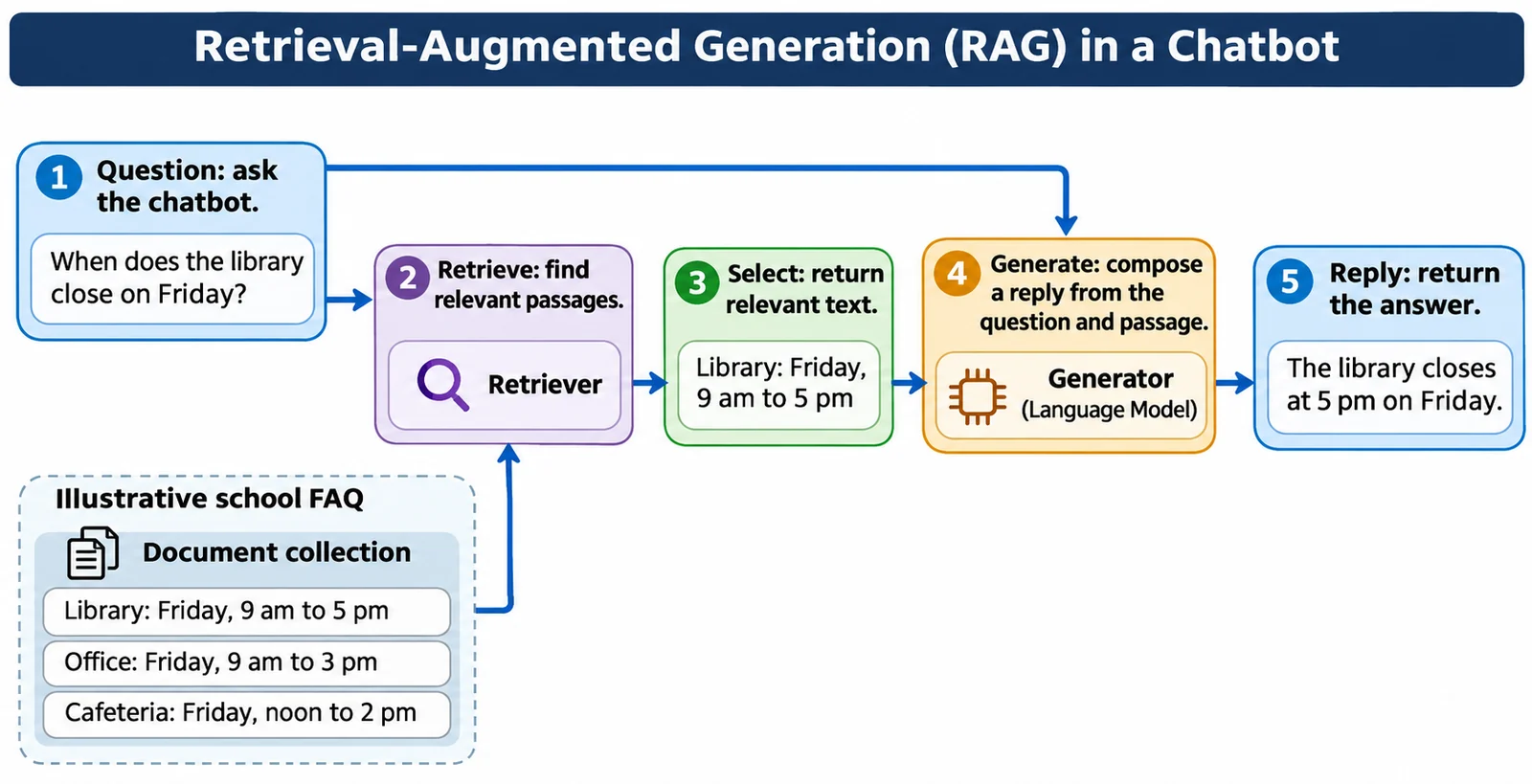
Retrieval designs answer from a body of text rather than from a fixed rule list, and retrieval-augmented generation pairs a search step with a language model that writes the answer.[34][35] A 2024 system called Gemini MultiPDF Chatbot applied retrieval-augmented generation to multiple PDF documents so that replies could draw on several knowledge sources at once.[34] A 2024 study of medical question answering compared open-source models (Flan-T5-Large, LLaMA-2-7B and Mistral-7B) under fine-tuning, retrieval-augmented generation, or both, and reported that fine-tuning and retrieval were both needed for improved performance. That study also found that answering multiple-choice questions by direct choice selection outperformed generating choices with probability confidence scores.[35] A different route combines a hand-built ontology, a structured knowledge base that records how concepts relate, with an autoregressive model, one that predicts each next piece of text from what came before, to fill gaps in the ontology's answers.[36]
Neural generative models learn to produce replies directly from dialogue data, and a 2019 survey of more than 70 publications from the previous 3 years argued that general conversation demands approaches unlike the then state-of-the-art architectures. The survey held that current models fail to take enough priors into account, where a prior is outside information such as the persona or mood of the people talking, and that this shortfall affects conversation quality. Experiments in that work fed mood and persona features into a Transformer model, a neural architecture built on attention mechanisms, alongside raw conversation data from the Cornell Movie-Dialog Corpus.[37]
A 2019 approach called TransferTransfo combined a transfer learning training scheme, in which a model first learns on one task and is then adapted, with a high-capacity Transformer, and fine-tuned it on several unsupervised prediction tasks at once. On the PERSONA-CHAT dataset of the Conversational Intelligence Challenge 2, which is not publicly released, the method set a new state of the art: perplexity 16.28 (45 % absolute improvement), Hits@1 of 80.7 (46 % absolute improvement) and F1 of 19.5 (20 % absolute improvement).[38] A 2024 experiment trained an attentive sequence-to-sequence model, which reads an input sequence and writes an output sequence, on the Cornell Movie-Dialogue Corpus for 10 epochs and then tuned its hyperparameters, the settings fixed before training begins. After optimization the model reached 87% accuracy and a 0.51% loss rate, against 79% accuracy and 1.05% loss before optimization.[39]
One 2023 analysis reported that a chatbot's vocabulary changed with the number of training iterations and that adding data to the training set improved the chatbot's understanding.[40] A 2023 evaluation of keyword detection for closed-domain chatbots, those built for a narrow task such as ordering food or customer support, tested different sets and sizes of samples drawn from the Movielens 20M dataset using deep learning for keyword extraction. Such task-specific chatbots do not need huge training data, the study notes, whereas models relying on very large sample libraries demand more computation time and storage.[41]
The oldest approach fixes replies in advance: a button-based chatbot accepts input through buttons and returns preset answers, while a rule-based system matches typed input against stored patterns.[42][43][44] A hotel chatbot built with the Dialogflow tool combined a button-based model with a natural language processing model, so it could take both kinds of input, and black-box testing found it answered every user input correctly. The same chatbot still answered correctly when the input contained a typo, because the natural language processing component handled the wording.[42]
A retrieval chatbot keeps a store of questions and answers and looks up the closest match instead of composing a reply from scratch.[45][46] One FAQ chatbot for an Indonesian boarding school paired a retriever model, which finds relevant stored passages, with a generator model, which writes the answer, an approach called Retrieval-Augmented Generation. The combination of the SBERT retriever and the IndoBART generator reached 96% accuracy, and SBERT with IdT5 reached 95%, while the E5 model recorded the fastest response at 0.066 detik.[46] Building a chatbot that handles a large amount of knowledge processing can slow its reaction time, and Makhkamova and Kim (2021) propose a cache mechanism to improve response time. Building a chatbot with a large amount of processed knowledge can slow its reaction time, so one design added a cache that stores question-and-answer pairs by keyword relevance and tracks how often each question appears in the conversation history. That cache raised the cache hit ratio and improved the average response time.[45]
Learned, or neural, chatbots use statistical models trained on text rather than hand-written rules.[47][44] Transformer-based large language models, a neural network architecture that captures context in language and trains on large amounts of unlabeled text such as material from the internet, produced the most recent wave of chatbots. As these models grew larger, their performance improved and new abilities appeared. Chatbots built on large language models have matched human-level results on many professional benchmarks, radiology among them.[47] A fine-tuned ChatGPT-3.5 chatbot for an online accessories store reached a validation mean token accuracy of 0.7971 and cut transaction response time, with an independent t-test giving a p-value of 0.0001 for the difference from the old system.[48]
Main ideas
How chatbots produce a reply
One 2018 project addressed this by having the system look up relevant passages from an encyclopedia before answering. Its models retrieved knowledge, read it, and then generated a response grounded in that text. The team released a large dataset of conversations tied to retrieved encyclopedia passages so that others could compare systems.[49]
In MILABOT, reinforcement learning was applied to crowdsourced data and real user interactions. The trained system learned to select an appropriate reply from the models in its ensemble. In tests with real users, it performed significantly better than many competing systems. Because it learns from data, the system is likely to improve as more data arrives.[50]
A 2017 architecture for virtual agents stored episodes from past conversations and recalled them when relevant. Most of what people say in a long conversation is unremarkable, so the system extracted and stored only relevant snippets. Testing showed moderate success in some aspects of the memory-enhanced agents, with work still to be done in others.[51]
Embodied agents and nonverbal behavior
An embodied conversational agent is a computer-generated character that simulates key properties of face-to-face conversation, including speech and nonverbal behavior.[67] One common nonverbal behavior is co-speech gesturing: arm and hand movements that accompany speech.[68]
A 2009 eye-tracking study asked how people distribute their gaze toward agents in complex tutoring systems. In the first study, participants worked with a single-agent tutoring system called AutoTutor, and fixation times showed the agent received most of the attention, even when display size was statistically controlled. In the second study, participants worked with iSTART, and fixations landed on the relevant agents when those agents spoke. Both studies were taken as evidence that people treat animated conversational agents as partners in the communication process.[69]
Participants interacted with three autonomous agents, each able to produce and recognize speech, intonation, facial displays and gesture. One agent gave content-related feedback only, a second added envelope feedback, and a third added emotional feedback such as smiles and looks of puzzlement. Questionnaire ratings and scored videotapes of repetition, hesitation and frustration confirmed that envelope feedback mattered more than emotional feedback in interaction. Users also rated the agents highly for lifelikeness and fluidity of interaction when the agents could give such feedback.[70]
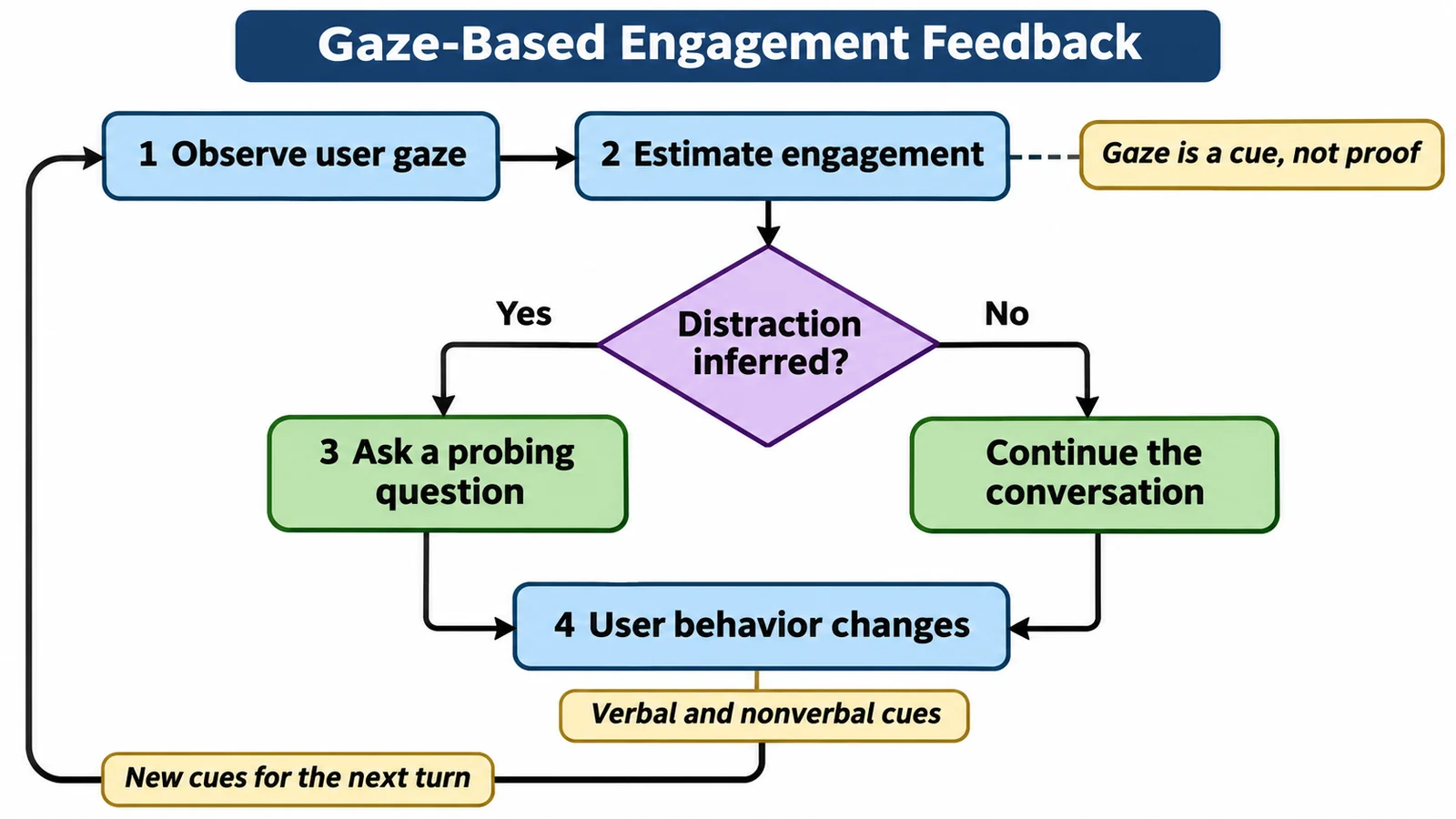
Agents can also read the user's gaze to judge engagement. Built into an animated agent, the model asked probing questions when the user was distracted, and asking at the proper times changed the user's verbal and nonverbal behavior.[71]
In one study of an automated interviewing kiosk, agents embodied as males were perceived as more powerful. Female embodied agents were perceived as more likable. Agents that smiled were perceived as more likable than agents with a neutral demeanor. A second study found that a single sensor measuring vocal pitch gave the system awareness of human stress and deception.[72]
Clinical psychology has taken up embodied agents, but the evidence there is thin. A 2017 scoping review found 54 publications covering 49 studies of agents for mood, anxiety, psychotic, autism spectrum and substance use disorders. More than half of the studies, 26, focused on autism treatment, and agents were used most often for social skills training, in 23 studies. Most applications, 43, were still in development and piloting, and few studies ran controlled research on clinical effects such as reduced symptom severity.[67]
Design choices and their trade-offs
One study followed a chatbot development team inside a major international enterprise and built a planning model from what it observed. The model ties strategic business goals to execution steps and is meant for teams with no experience in chatbot implementation. Its stated aim is to reduce uncertainty and manage decisions and risks across the project lifecycle, raising the chance of success.[73]
Eleven experts compared it with three general-purpose chatbots across 67 health questions, giving 267 assessments in total. The portal chatbot earned the best trustworthiness score (mean 1.21 on a 5-point scale where 1 is best) but the worst scores for clarity (1.53), user-friendliness (1.46) and relevance (1.65). The general-purpose systems showed the opposite pattern. The portal chatbot cited sources in 100% of responses, against 0-3% for the general-purpose systems, and added safety disclaimers in 85% of responses, against 5-18%. It also declined 10.4% of queries that fell outside its knowledge base. The evaluation rated response characteristics only, not effects on health literacy or health outcomes.[74]
Early results from one study indicate that chatbot gender affects users' overall satisfaction and their gender-stereotypical perception. Users were more likely to apply gender stereotypes when the chatbot worked in a subject domain tied to gender stereotypes, such as mechanics, and when its gender did not fit the stereotype. The researchers note that research on gender in chatbot systems is limited and call for larger and more diverse samples to test statistical significance. They also ask whether a male chatbot for technical advice would earn more trust, and whether building one would simply perpetuate the stereotype.[75]
One analysis examined the openings of 100 calls to a Russian municipal call center handled by a chatbot. The ways users phrased their requests, and the silences and overlaps at the start of calls, showed that users treated the chatbot as a conversational partner rather than a voice user interface. The paper proposes that an interaction counts as a conversation when at least one participant can understand all the turns as part of the ongoing exchange.[76]
A nine-month pilot deployed a sexual and reproductive health chatbot in a clinic and a community organization, adjusting its content to updated medical guidelines and preferred language for gender-affirming care. The system received 1749 queries from 425 unique users. One-tenth of the users of the clinic-based chatbot went on to book an appointment for care. The researchers note that generative systems can misinform, hallucinate and reinforce stigma. They describe the pilot as feasible and as showing promise.[77]
Speech, multimodal input and companion robots
Some chatbots are designed around spoken conversation rather than typed text, and some are given a body, a face or a set of sensors.[78][79] An embodied conversational agent is a computer interface built on the skills of human conversation, in which a visible character speaks with the user. Designers of such agents have had to model several properties of human conversation: synchronization, function rather than behavior, multithreadedness and entrainment. Another factor that motivated interface designers was the growing computing capacity in many objects and environments away from the desktop computer. Examples include smart rooms and intelligent toys, in settings as varied as military battlefields and children's museums. Embodied agents also raise the question of whether it is wise to anthropomorphize the interface, that is, to give a machine human-like qualities.[78]
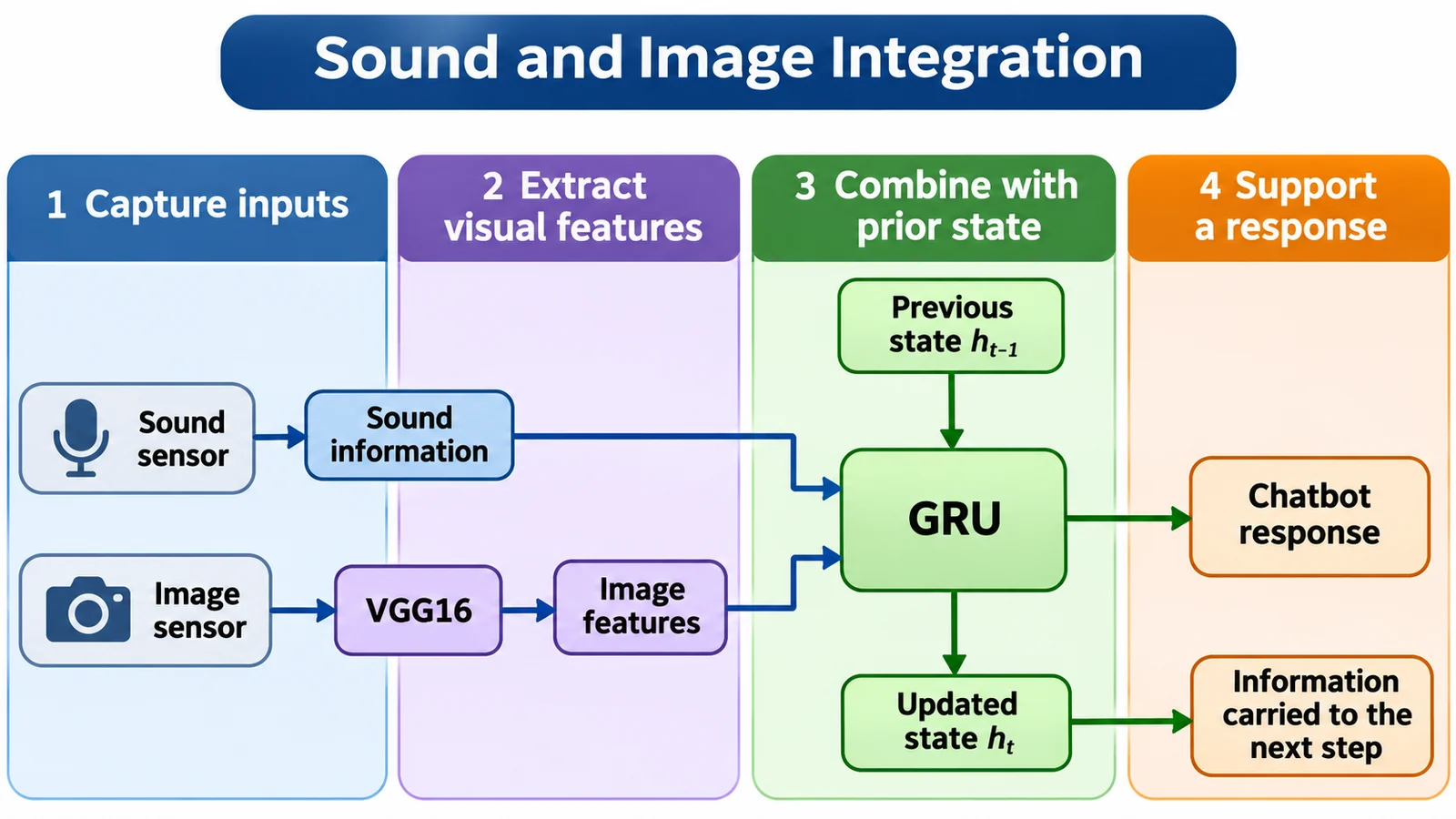
Speech alone can be an incomplete signal for a chatbot, because image information remains vital in various conversation scenarios. When image information is left out, a chatbot may misread the situation and answer wrongly. One proposed model addresses this by combining sound signals with image information in a recurrent neural network, a network that carries information from one step of a sequence to the next. The model replaced the long short-term memory structure with a gated recurrent unit to improve performance, and used a VGG16 model to extract features from the images. In experiments, the combination of sound and image information, gathered by an image sensor and a sound sensor in a companion robot, helped the chatbot model, and the experiment confirmed the feasibility of the approach.[79]
Evaluating these interfaces requires methods drawn from several disciplines. A 2015 account sets out evaluation topics from a conversational perspective. It then explains the social-psychological phenomena that researchers have studied in interaction with embodied conversational agents, and how those phenomena can be used to evaluate such systems. The account presents major evaluation concepts and assessment instruments, both established and new, including questionnaires, annotations and log-files, which are records of the interaction kept by the system. An exemplary evaluation and a set of guidelines give practical information on planning and preparing such evaluations.[80]
Anthropomorphism and human-likeness in service
A field experiment on a large truck-sharing platform randomly assigned 11,000 truck drivers to receive outbound calls from a voice chatbot dispatcher. Disclosing at the start of the call that the caller was a chatbot lowered the probability of a response by around 11%. Adding humanizing features to the voice, namely interjections and filler words, raised response probability by over 5.6%, conversation length by 24.9% and the probability of an intention to accept an order by 10.1%. The operational outcomes still improved when the chatbot disclosed its identity alongside the humanizing features, which suggests that added human-likeness may offset the cost of disclosure. The researchers proposed greater trust between people and algorithms as one explanation, and found that drivers were more willing to disclose information to dispatchers with the humanizing features.[81]
A meta-analysis pooled data from 11,053 individuals interacting with service robots across 108 independent samples to ask whether human-likeness helps or hurts the intention to use such systems. The service literature had reached no consensus on that question, with some firms building humanlike agents to attract users and others building machinelike ones to avoid an uncanny valley, the unease that very humanlike artificial agents are thought to provoke. The analysis identified customer traits such as computer anxiety, sociodemographic factors such as gender, and design features such as physical form as triggers of anthropomorphism, the tendency to attribute human qualities to a machine. Robot characteristics such as intelligence and functional characteristics such as usefulness mediated the effect on use intention, while relational characteristics such as rapport received less support. The size of the effect depended on the type of robot, including its assigned gender, and on the type of service, including possession-processing and mental stimulus-processing services.[82]
A 2 x 2 experiment with 28 participants tested whether a lack of transparency about a conversational agent's nature as chatbot or human made conversations less pleasant, and whether it changed perceived human likeness and affinity for the agent. The experiment did not find that the lack of transparency negatively affected user experience, contrary to what uncanny valley theory would predict. An exploratory analysis of participants' qualitative reports identified three factors that were important to how they assessed the conversations.[83] A systematic review of 40 empirical publications grouped the influences on customer experience with service chatbots into chatbot-related, customer-related and context-related factors, with the chatbot-related group covering functional, system and anthropomorphic features. Across those studies, response relevance and problem resolution were the most influential factors, usually producing positive satisfaction and a higher probability of continued use, purchases and product recommendations.[84]
Marino argues that when a chatbot is given a body, its racial or ethnic identity becomes more apparent. An analysis of chatbots in electronic literature noted that these conversation agents usually appear as text or as a voice without a body. When programmers give them a body, partial or full, other parts of their identity become more visible, racial or ethnic identity in particular.[85] In live-streaming commerce, scenario-based experiments found that an AI host's anthropomorphism and its social conversation cues affected impulsive purchases through two intermediate states, cognitive trust and emotional arousal. The link between social conversation cues and both trust and arousal was stronger than the link for visual anthropomorphism, and the mechanism was roughly consistent across gender groups but differed between groups defined by product involvement and prior AI experience.[86]
Designers face a practical problem in telling users what a chatbot can do, because a natural language interface leaves people unsure which sentences the system will understand. An inspection of popular chatbots using the Semiotic Inspection Method, a technique for analyzing how an interface communicates with its users, identified a series of strategies for conveying features to users, and the findings were consolidated by analyzing further chatbots. How well those features are conveyed may determine whether a user continues chatting.[87] Emotion is treated as an important element in making a machine more human, and a survey of emotionally-aware chatbots found that early systems used simple rule-based approaches while most later ones use neural-based approaches, with most containing an emotion classifier.[88]
Research
Measuring whether a chatbot works
One approach treats evaluation as an organizational routine rather than a single test. A 2023 design science project gathered insights from the literature and from practice to build quality criteria for conversational agents and a blueprint for structuring an evaluation. The project produced a blueprint for structuring an evaluation and for finding areas that need systematic improvement. Lewandowski and colleagues note that many organizations fail to sustain conversational agents because they do not know how to judge and improve their quality.[89]
A 2016 framework for text-based conversational agents rests on the exchange of specific information between the system and the user, called information requirements. Each requirement is tagged to a rule in the chosen domain and must appear in the user's utterance. The framework was designed to be independent of any particular natural language. It was tested on ArabChat, a rule-based agent that uses pattern matching to handle Arabic text conversations. The test took place in a real experiment at Applied Science University in Jordan, where the agent served as an information point advisor for native Arabic students.[9]
The 2022 Chatbot Usability Scale work reported that standardized tools for assessing user satisfaction with chatbots were previously unavailable. The work produced two instruments: a checklist called BOT-Check for checking quality against commonplace principles, and a 15-item questionnaire called BUS-15. BUS-15 has estimated reliability between .76 and .87 and is distributed across five factors.[90]
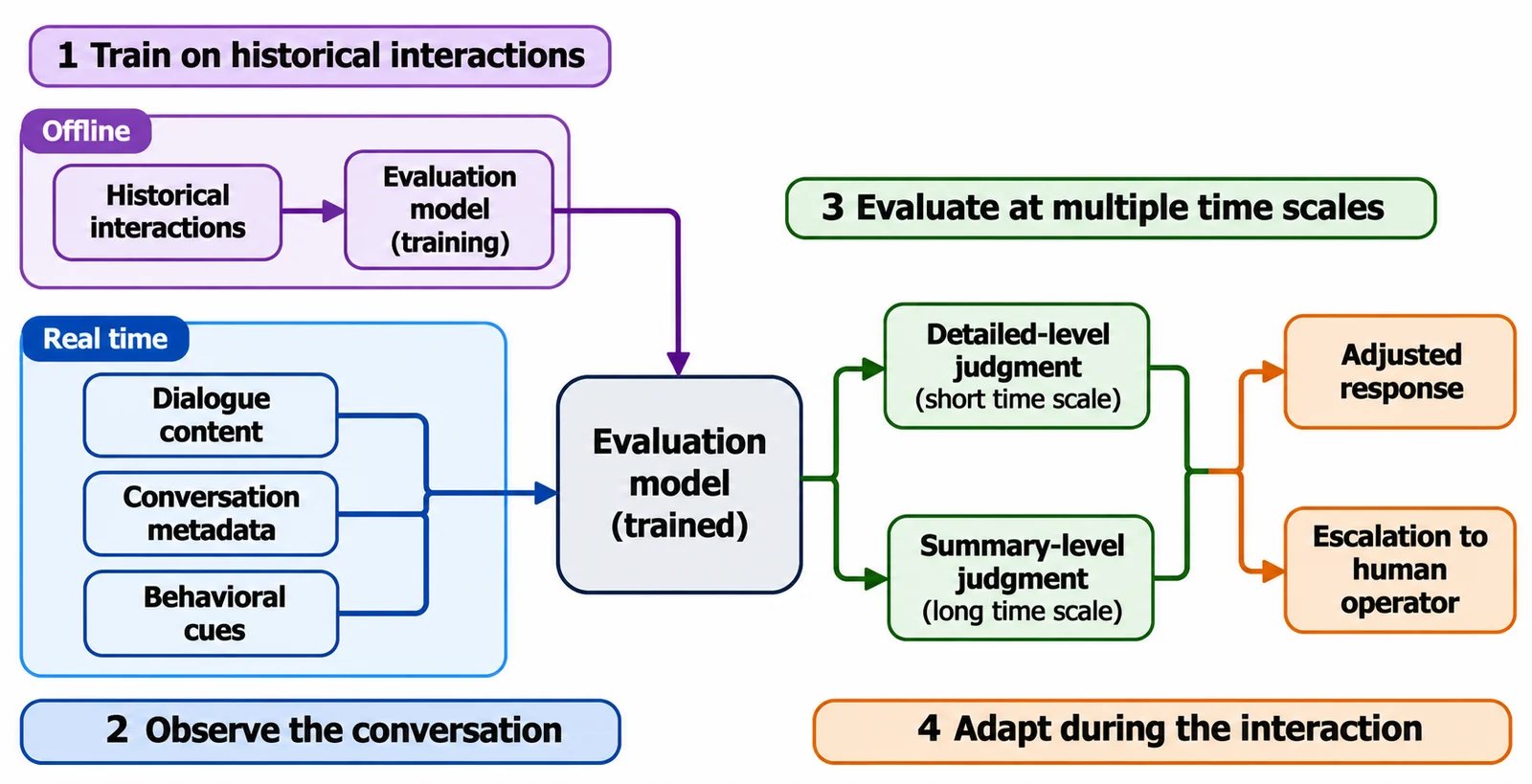
A 2025 article describes machine-learned evaluation methods that use models trained over historical interactions. These models judge user satisfaction from what is said in a dialogue, from metadata about the conversation and from behavioral cues. Hierarchical systems process information at multiple temporal resolutions, giving both detailed and summary-level evaluations of dialogue quality. Applied in real time, such measures let a system adapt during an interaction, for example by adjusting a response or escalating to a human operator.[91]
A 2013 technique uses agent-based dialog simulation to learn new dialog strategies and to evaluate conversational agents. It considerably reduces the effort needed to acquire data for training the dialog model and to explore new strategies. The team defined a set of measures to evaluate the automatically learned strategy and to compare different dialog corpora. They applied the technique to an agent that collects monitored data from patients with diabetes. Compared with an initial corpus, the simulated corpus showed that the agent reduced the time needed to complete dialogs and improved their quality. The agent could then tackle new situations and generate new coherent answers for situations already present in the initial model.[92]
Chatbots in health care and patient messages
A 2018 systematic review searched several databases and found 1513 citations, of which 17 articles covering 14 different conversational agents met its criteria. Half of the agents helped consumers with health tasks such as self-care, and patient safety was rarely evaluated. The review concluded that the field was emerging and that future work needed stronger experimental designs and standardized reporting.[3]
Usability performed well in 27 of 30 studies and satisfaction in 26 of 31, and positive or mixed effectiveness appeared in three-quarters of the studies (23/30). Qualitative feedback from users was more mixed, and the review judged the quality of many studies limited.[93] Most agents in that review ran as smartphone apps (n=23), and only 11 randomized controlled trials appeared.[94] A randomized controlled trial is a research procedure in which subjects are randomly assigned either to an experimental group that receives a treatment or to a control group that receives a different treatment or none, and the outcomes of the groups are compared.[95] Case studies describing how a chatbot was built were the most common report type (n=18), and the review called for evaluation of acceptability, safety and effectiveness.[94]
A 2023 cross-sectional study drew 195 exchanges from October 2022 on a public social media forum, Reddit's r/AskDocs, where a verified physician had answered a public question. Chatbot replies came from ChatGPT, released in November 2022, entered into a fresh session on December 22 and 23, 2022, so no earlier questions carried over. A team of licensed health care professionals judged each pair three times, choosing which reply was better and rating quality and empathy on 5-point scales. Evaluators preferred the chatbot reply in 78.6% of the 585 evaluations (95% CI, 75.0%-81.8%). Physician replies were much shorter, with a mean of 52 words (IQR 17-62) against 211 words (IQR 168-245) for the chatbot. Chatbot replies scored higher on quality: 78.5% were rated good or very good, against 22.1% of physician replies, a prevalence 3.6 times higher. Chatbot replies also scored higher on empathy: 45.1% were rated empathetic or very empathetic, against 4.6% of physician replies, 9.8 times higher.[5]
Thirty-three physicians across 17 specialties wrote 284 questions and graded chatbot answers for accuracy on a 6-point scale and completeness on a 3-point scale. Accuracy had a median of 5.5 (IQR 4.0-6.0), between almost completely and completely correct. Completeness had a median of 3.0 (IQR 2.0-3.0). Median accuracy fell from 6.0 for easy questions to 5.5 for medium and 5.0 for hard ones. Of 36 questions scored 1.0 to 2.0, 34 were asked again 8 to 17 days later and improved, with a median rising from 2.0 to 4.0. A subset regenerated with a newer model version also improved, with mean accuracy rising from 5.2 to 5.7.[96]
A 2024 rapid review of literature from 2017 to 2023 sorted chatbot roles into two themes: remote health services, such as patient support and education, and administrative help for providers. Its benefits fell into two themes, better quality and efficiency of care and cost-effectiveness, while limitations included ethical challenges, medicolegal and safety concerns, technical difficulties and user experience issues.[97] A 2024 report on patient-facing chatbots noted that they can offer 24/7 access to health information, such as symptom assessment and medication reminders, when providers are unavailable.[98]
A 2025 systematic review screened 7752 articles and analyzed 137 studies that tested generative chatbots giving health advice. Most of those studies (136, or 99.3%) evaluated closed-source models and gave too little information to identify the model version. The date of querying was reported in 54 studies (39.4%), and 89 (65.0%) used subjective means to define successful performance.[99] The Chatbot Assessment Reporting Tool (CHART), published in 2025, is a checklist of 12 items and 39 subitems for such studies.[100]
A 2025 scoping review retrieved 3840 titles and reviewed 12 papers covering 13 studies, 8 of which were rated excellent in quality. ChatGPT appeared in 11 studies and GPT-3 in 2, and 4 studies were conducted in the United States. Consumers can obtain accessible, readable and useful information, but negative views of accuracy, trustworthiness, effectiveness and safety act as barriers.[101]
Mental health chatbots and the evidence
A 2020 meta-analysis pooled results for the first time, drawing 12 studies from 1048 citations and covering 8 outcomes.[102] A meta-analysis is a statistical method that combines the estimates from two or more similar studies into one overall estimate of an effect.[103] Only 2 of the 12 studies checked safety, and neither reported adverse events or harms. The reviewers concluded that the evidence could not yet show a clinically important effect, because few studies covered each outcome and those studies carried high risk of bias.[102]
From 7834 records, 35 studies were reviewed and 15 randomized controlled trials entered the meta-analysis. Chatbots significantly reduced depression symptoms, with a Hedge's g of 0.64 and a 95% confidence interval of 0.17 to 1.12.[2] A confidence interval is a range of values below and above an estimate that has a given probability of including the true value.[104] Distress fell by a Hedge's g of 0.7, with a 95% confidence interval of 0.18 to 1.22. Overall psychological wellbeing, however, showed no significant improvement, at a Hedge's g of 0.32 with a confidence interval of -0.13 to 0.78. Effects were larger for chatbots that were multimodal, built on generative AI, or integrated with mobile or instant messaging apps, and for clinical, subclinical and elderly groups.[2]
An earlier mixed-method review from 2019 looked at 13 studies of conversational agents, including robots, in treatment. Only 4 of the 13 were full-scale randomized controlled trials; the rest were feasibility studies, pilot trials and quasi-experiments. All 13 reported reductions in psychological distress after the intervention. Whether the agents helped well-being in nonclinical populations was unclear.[105]
In 2024, 50 participants with mild to moderate anxiety used a chatbot built with ChatGPT for two phases of seven days each. The chatbot delivered mindfulness exercises, cognitive restructuring and breathing techniques, and anxiety symptoms fell by an average of 21.15% in Phase 1 and 20.42% in Phase 2. Participants reported high satisfaction with access and personalization, but the study noted the chatbot could not replicate human empathy.[106]
A 2018 real-world evaluation compared 108 high users of a text-based well-being app with 21 low users, all with self-reported depression. High users improved by a mean of 5.84 points on a depression questionnaire (SD 6.66), against 3.52 points for low users (SD 6.15), a moderate effect size of 0.63. Of the user feedback responses, 67.7% found the experience helpful and encouraging. The researchers asked for validation in much larger samples over longer periods.[107]
Among 1205 users of a free-text chatbot who screened positive for anxiety or depression, the mean alliance score within 5 days was 3.64 (SD 0.81). For 226 users who answered again 3 days later, the mean rose to 3.75 (SD 0.80), a change that was not statistically significant. Mean bond scores of 3.98 and then 4.05 were comparable to scores reported for face-to-face, internet and group cognitive behavioral therapy. Analysis of 950 conversation transcripts found unprompted bonding, such as gratitude, self-disclosed impact and personification.[108]
Most of the 19 designs, 12 of them, were machine learning based, 5 used hybrid engines and 2 were rule based. Human evaluations took place in 16 of the 19 studies, but only 5 focused directly on the agent's empathic features. Every one of those evaluations relied on self-reports, and only 1 study added assessments by experts as well as users. The reviewers called for a clear definition of empathy and standard scales to measure it.[109]
Most instruments, 170 of 203, were self-reported questionnaires, and no validity evidence was cited for 107 of the 203. The reviewers called for an agreed minimum set of outcomes and for more use of instruments that have been validated.[110]
Chatbots in classrooms and language learning
One review analysed 53 articles from recognised digital databases and described existing studies, benefits, challenges and future research areas.[111] Another began with 2,678 publications and narrowed them to 74 relevant papers on chatbots in education.[112] A third review searched journals in the Social Science Citation Index and found that the United States, Taiwan and Hong Kong were the top three contributing countries or regions. It concluded that chatbot research in education is still at an early stage, because few empirical studies test effective learning designs or learning strategies.[113]
In a review of 36 papers, more than half of the chatbots acted as teaching agents, and more than a third acted as peer agents. Over a quarter of the chatbots used a personalized approach that catered to students' learning needs. The chatbots were mainly built on a web platform and mainly taught computer science, language and general education, with a few in engineering and mathematics. Over a third of the chatbots were tested in experiments, and the results chiefly point to better learning and to satisfaction as reported by users.[114]
One review names three main research challenges: matching chatbot evaluations to implementation goals, studying chatbots as mentors for students, and studying how well they adapt.[112] In the studies reviewed, guided learning was the most common instructional approach, and no learning activity was the next most common. Most of those studies used quantitative methods such as analysis of variance, descriptive statistics, t tests and correlation analysis.[113]
The language review drew on 25 empirical studies, and the interaction review found that more than a third of its 36 chatbots were tested in experiments.[115][114] The interaction review recommends that future studies explore how chatbot personality and localization affect subjective satisfaction and learning effectiveness.[114]
Customer service, commerce and daily tasks
A 2021 randomized online experiment tested how design cues and a persuasion trick changed whether users complied with a chatbot's request for service feedback. Making the chatbot seem more human, and making users want to stay consistent with earlier answers, both raised the chance that users complied with the request. The feeling of another person being present, called social presence, carried part of the effect of humanlike design on compliance. The experiment also noted that chatbots often fail to meet customer expectations, which can make users less willing to do what the chatbot asks.[116]
Humanlike design can backfire when the customer is already upset. The practical advice was to design chatbots carefully and to consider the emotional setting, especially when the task is resolving a problem or handling a complaint.[117]
A survey of 299 usable responses found that consumers who saw the chatbot as empathetic and friendly trusted it more. Task complexity weakened the link between friendliness and trust, and telling users that the agent was a chatbot weakened the link between empathy and trust while strengthening the friendliness link. Trust in turn increased reliance on the chatbot and reduced resistance to it in future interactions.[118]
A separate online experiment with 154 valid responses compared a single chatbot that recommends all product categories with several chatbots that each advise on one category. The single-chatbot interface produced higher social presence and stronger trusting beliefs toward the shopping platform than the multi-chatbot interface. Men gave the chatbot higher competence ratings and reported higher purchase intention with the single-chatbot interface than with the multi-chatbot one. The researchers suggested that several chatbots without labels marking their expertise caused confusion and unfamiliarity, which lowered trust in the platform.[119]
Intention rose with the chatbot's expected performance, the habit of using chatbots, the pleasure of using them, a general willingness to use self-service technologies, social influences and humanlike behavior. Problems and inconvenience in communicating with the chatbot lowered intention. The chance that chatbots might take over jobs raised the intention to use them, a positive effect rather than the expected negative one.[120]
Libraries have tested chatbots as a way to answer routine questions around the clock. A pilot at the University of Nebraska-Lincoln built a chatbot named Pixel that stored questions and answers in a database and answered questions about the library and its resources. The service drew an unexpected number of social chatters, so the team added metadata to handle personal chatting and steer questions back to the project's purpose. Most questions were directional or factual, and the database proved practical to revise as library resources and staff changed. The chatbot offered consistent service every hour of the week, replaced complicated navigation and scrolling with targeted answers, and could pass questions to librarians.[121] A survey of the websites of the 20 largest Canadian libraries found that, as of early 2010, artificially intelligent conversational systems were virtually non-existent there.[122]
Risks, limits and open questions
About half of those harmful responses (16%) could have resulted in death if acted upon. Chatbot answers have also varied widely on suicide, intimate partner violence and substance abuse, all sensitive conversations.[123] A systematic scoping review of 81 studies of conversational agents in health interventions placed safety and information quality among its main evaluation categories. That review also reported gaps across its evaluation stages, including feasibility, efficacy, effectiveness and implementation.[124]
One commentary on public health misinformation notes that ChatGPT (GPT-3.5) was released in November 2022 and drew more than 100 million monthly active users. GPT-4 followed in March 2023 and was available to paid subscribers at the time of that writing.[125] A review of 17 health and well-being projects found that safety and privacy remained the major challenges in those domains.[126]
One 2024 comparison tested ChatGPT, Gemini, Perplexity and Claude on questions across several domains. It scored them on factual accuracy, relevance, completeness, coherence, creativity and bias, using both quantitative and qualitative analysis. The comparison reported significant variation between the systems, with each showing strengths and weaknesses in different areas. It described Gemini as showing superior factual accuracy and ChatGPT as strong at generating creative text formats. It described Perplexity and Claude as showing varying levels of bias and interpretability.[127]
A 2023 commentary argues that chatbots can help researchers organize material, produce an initial draft and proofread. The same commentary says chatbot output should never replace human judgment and should always be reviewed by experts before any critical decision or application. It names plagiarism and inaccuracies as ethical risks, and warns of an accessibility gap between high-income and low-income countries if the software becomes paid. It concludes that agreement on how to regulate chatbot use in scientific writing will soon be needed.[128]
The research agenda that remains is broad and was set out in a 2021 interdisciplinary plan for chatbot research. That plan notes only limited knowledge about chatbot impact at the individual, group and societal level. It organizes future work under six topics: users and implications, user experience and design, frameworks and platforms, chatbots for collaboration, democratizing chatbots, and ethics and privacy. The topics were framed with a 5-year perspective and grew out of discussions at a workshop series on chatbot research.[129]
Free-form conversation over a wide range of topics is itself an unsolved problem, according to a 2018 account of a university competition. The competition carried 2.5 million dollars in funding and gave teams live user data, ratings and feedback to work from.[130] Health evaluation faces a matching problem of method, since studies of these systems use many designs and outcome measures. The 81-study review found 59 experimental trials, 15 observational trials and 7 studies with other designs. Most of those studies (72, or 89%) were published in the 5 years before the review. The review's proposed framework sets out 4 evaluation stages, 8 kinds of study design and 7 evaluation categories with 40 subcategories.[124]
Privacy, security and data protection
Chatbots introduce security problems that are not fully settled, and the risks grow as more everyday tasks move to them.[131] A systematic literature review published in 2023 grouped the threats into malicious input, user profiling, contextual attacks and data breaches. Directions it proposed for further work include stronger authentication and authorization mechanisms (checks on who a user is and what that user may do), privacy-enhancing technologies, and better detection and prevention of attacks.[132]
Modern chatbots are no longer rule-based models; they learn from conversation, and a conversation can contain personal information. A 2021 study examined the circumstances under which such data may be used and how chatbots handle it. Many chatbots run on a social or messaging platform whose own terms and conditions govern the data, which adds a layer the chatbot operator does not fully control. That study set out to open discussion of data storage and use drawn from user-chatbot communication and to propose standards for protecting the user.[131] A 2022 paper compared two ways of building chatbots, one with a bot constructor and graphical interface aimed at users without programming skills and one written as scripts in a high-level programming language, and treated information security under both.[133]
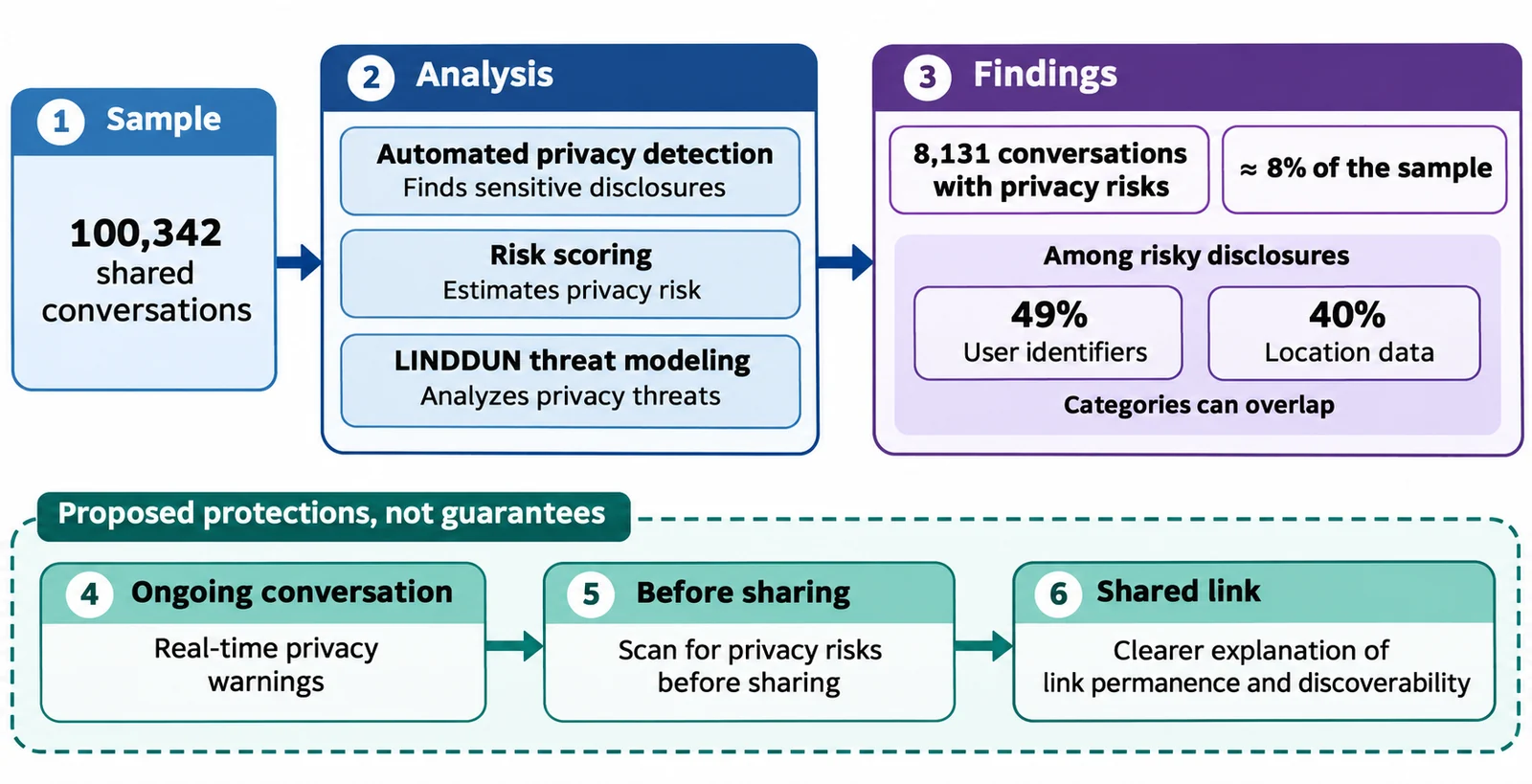
Shared conversations create a separate exposure, because a link to a chat can be passed to other people. A 2026 analysis collected 100 342 conversations from three large language model platforms and ran them through an automated privacy detection pipeline with a risk scoring system and the LINDDUN threat modeling framework, a structured method for cataloguing privacy threats. It found 8 131 conversations (8%) carrying privacy risks from disclosure of private or sensitive data. User identifiers appeared in 49% of the risky disclosures and user location data in 40%, while financial data (4%), health data (3%) and authentication data such as access tokens (3%) appeared in some cases. Longer conversations showed higher privacy risk rates than brief ones, and 60% of private data disclosures in longer conversations occurred in the final quartile of those conversations, which the analysis read as a possible sign that users lose privacy awareness as an interaction deepens. The analysis called for real-time privacy warnings, scanning before a share, and clearer explanation of how permanent and discoverable shared conversation links are.[134]
Bias, fairness and representation
Given those features, the overview describes reducing bias and preserving fairness in modern chatbots as challenging.[135] Bias can also appear in how a chatbot is presented rather than only in what it says. That study notes that most organizational chatbots are gendered as female, through avatars, profile pictures and language, and it argues that such stereotyping can be carried over and repeated by chatbots.[136]
A 2014 analysis of chatbots as electronic literature observed that when programmers give a conversation agent a body, partial or full, aspects of its identity become more apparent, particularly racial or ethnic identity. The analysis asked how racial identity takes shape when a chatbot performs with a body, and what that says about how people build identity on the internet.[85] Alsheddi and Alhenaki (2022) report that research on English-language chatbots is active and presents state-of-the-art solutions, while the Arabic-language research community is still in an immature stage. The review found that researchers have given more attention to education, using retrieval-based approaches in which a chatbot selects a stored response. The generation-based approach, in which it composes a new response, has grown in popularity recently for tasks that need new responses. A hybrid approach that combines the two for ranking several possible responses showed a performance improvement, according to the review.[137]
Most measures of chatbot performance in the reviewed studies relied on human judgement. Bilingual evaluation understudy and accuracy scores came next, and the review found no shared framework for evaluation. The same review reports that human-based metrics are the most used, followed by bilingual evaluation understudy, a score that compares a machine output with reference text, and then accuracy metrics. The review concludes that no common framework for evaluating chatbots has yet been agreed, and that this remains a challenge.[137]
Evaluation benchmarks and leaderboards
Banerjee, Singh, Avadhanam and Srivastava (2023) propose the E2E (End to End) benchmark to evaluate the accuracy and usefulness of chatbot answers, especially answers from chatbots powered by large language models.[138] One approach shows people a pair of answers to the same prompt, asks which is better, and ranks the systems from those choices. Chatbot Arena, an open platform described in 2024, collects such pairwise comparisons from a diverse crowd of users and had gathered over 240K votes by the time of the report. The platform's organizers report that the crowdsourced questions are diverse enough and discriminating enough for the task. They also report that the crowd's votes agree well with those of expert raters. The same report describes the statistical methods used to turn the votes into an efficient and accurate ranking of models.[139]
Chen (2024) proposes the LMStyle Benchmark, a framework that measures the quality of chat-style text style transfer for large language models in an automated and scalable manner.[140] Banerjee, Singh, Avadhanam and Srivastava report that the metric tied to it, based on cosine similarity (a measure of how closely two texts point in the same direction), performed well where some other metrics proved unpredictable.[138] The LMStyle Benchmark, proposed in 2024, targets chat-style text style transfer, the task of giving a chatbot a consistent style or character, and adds an appropriateness score that weighs coherence, fluency and other implicit factors without reference samples. Its experiments found that the new appropriateness measures correlate more highly with human judgments than conventional style strength metrics do. Results were reported for popular models including LLaMA, Alpaca and Vicuna, covering properties such as formality and sentiment strength.[140]
Borisov, Gröger, Mikhael and Schreiber (2026) introduce YapBench, a benchmark for quantifying user-visible over-generation on prompts where a brief answer is ideal, with a primary metric called YapScore that measures excess response length beyond a baseline answer in characters. It uses more than three hundred English prompts in three settings: minimal or ambiguous inputs that call for a short clarification, closed-form factual questions with short stable answers, and one-line coding tasks. Its primary metric, YapScore, counts excess response length beyond a curated minimal-sufficient baseline in characters, so comparisons do not depend on any particular tokenizer (the step that splits text into the units a model processes). Across 76 assistant models the authors observed an order-of-magnitude spread in median excess length, with distinct failure modes by category, including filling silence on ambiguous inputs and adding explanation or formatting overhead to one-line technical requests. The paper notes that preference-based post-training and evaluations judged by language models can reward longer answers even at comparable quality.[141]
Ilieva (2025) treats chatbot selection as a decision across several attributes at once. The proposed framework adapts TOPSIS, a method that ranks options by their similarity to an ideal solution, to interval-valued hesitant Fermatean fuzzy sets, a way of recording uncertain ratings and the hesitation among them. A 2025 framework adapts TOPSIS, a classical method that ranks options by their similarity to an ideal solution, to an interval-valued hesitant Fermatean fuzzy environment, a formalism that records detailed membership degrees and represents hesitation more precisely than classical TOPSIS can. The framework is presented as applicable to static and dynamic evaluations of generative AI chatbots under crisp or fuzzy assessments, and a practical example is given to demonstrate its use in comparing and ranking them.[142] A 2020 review of open-domain chatbots, systems expected to converse on every possible topic in every context, explains various metrics and possible baselines for future systems of that kind.[143]
Judging quality and user response
Researchers judge a chatbot's conversational quality with several kinds of measure. One is the Bot Usability Scale, a standardised tool for comparing user satisfaction after interacting with chatbots; its English version has 15 items.[144][145] The Bot Usability Scale (BUS) is a standardised questionnaire that asks users to rate their satisfaction after interacting with a chatbot, and its English version began as a 15-item scale, BUS-15, produced by an exploratory factorial analysis. A confirmatory factorial analysis, which tests whether a scale's structure holds up in new data, collected 1292 questionnaires from 209 participants who interacted with an overall pool of 26 chatbots, and it produced a shorter 11-item version, BUS-11, that was acceptably reliable. Satisfaction ratings from Spanish, German and Dutch translations of BUS-11 did not differ significantly from the original English version, and BUS-11 correlated positively with a separate usability metric, UMUX-LITE. Age affected the ratings: older participants rated the chatbots as significantly less satisfactory than younger participants did.[144] Other methods read quality from the conversation itself rather than from a questionnaire, and one automatic method detected users' emotional engagement and emotional states during chats with two Japanese-speaking conversational agents, then compared its verdicts with a questionnaire taken afterwards. The automatic results showed similar tendencies to the questionnaire, which the researchers took as support for using the method to evaluate Japanese-speaking conversational agents.[145]
In a survey of 170 respondents who were users of an online shopping service in Medan, Indonesia, chatbot competence and credibility had a positive and significant effect on trust, and trust in turn had a positive and significant effect on purchase intention.[146] An online experiment in China used 260 valid observations. Personalization of a health chatbot's replies raised perceived benefits and self-efficacy, and these in turn mediated the effect on intention to use, but only when a cue of source expertise was also present. Privacy concerns were not influenced by personalization or source expertise and did not significantly affect usage intention.[147]
A randomized factorial experiment on a breast cancer screening outreach chatbot compared a Black woman persona presented as a primary care doctor or as a breast cancer survivor, paired with either a direct or a polite communication style, against a control condition. The doctor-polite condition drew the most trust and the strongest intention to use, and qualitative feedback described the doctor persona as professional and the polite style as friendly. Some participants found the Black woman persona relatable, while others perceived it as stereotyping, patronizing or targeting, and the researchers advised developing culturally tailored personas with caution to avoid perpetuating stereotypes.[148]
A study comparing users in the United States and Japan found similar major attitudes toward chatbots but different weights on their qualities. Japanese users put more weight on functional qualities, and United States users placed greater emphasis on non-functional qualities and appeared more likely to anthropomorphize the chatbot and accept explanations of its algorithmic features.[149] An experiment with 126 participants, in which each person exchanged chat messages with trained research confederates for 30 minutes, found that participants assigned to partners they believed were human reported more positive relationships and higher political interest than those assigned to a bot partner. Liking the partner differed between the perceived partner conditions, and perceived political knowledge varied more in the human conditions.[150] A typology of dialogue steps in ChatGPT-3.5 conversations described the design, structure, language and genre characteristics of the steps the chatbot produced without any prompting about style or genre.[151]
In practice
Trust, adoption and service quality
Acceptance of a chatbot in a service depends on several factors at once. A review of the evidence groups them into factors tied to usage, to the agent, to the user, and to attitudes and evaluations. A systematic review published in 2021 analyzed 18 relevant articles found through a literature search run in July 2019. It proposed a combined model in which acceptance is driven mainly by the benefits of using the system, which agent and user characteristics in turn shape. That review stresses that its model depends on context, because the relevant factors vary with the setting in which the chatbot is used.[152]
A survey of 184 customers in Lebanon found that compatibility, perceived ease of use and social influence each significantly raised initial trust in a chatbot, while performance expectancy did not. Initial trust, in turn, increased the intention to use the chatbot and encouraged customer engagement.[153] A study of 603 online banking customers in Vietnam linked emotional value most strongly to attitude toward banking chatbots, and novelty value most strongly to the intention to use them, with interactivity, perceived intelligence and personalization also examined as chatbot characteristics.[154]
In an experiment with 124 participants from Spain, where digital literacy was higher, and the Czech Republic, where it was lower, people with higher digital literacy rated service received through a chatbot above service received by email. Participants with lower digital literacy preferred email, which they saw as offering greater security, empathy, reliability and information quality, while the higher-literacy group preferred the chatbot for its greater competence at completing the task. Both groups rated the chatbot's responsiveness above that of email.[155] An analysis of bank data found that new product-oriented funds and housing subscription savings were better suited to purchase through customer service than through a chatbot, whereas chatbot service for existing products had a positive effect on banks' net income. The same analysis found that small banking transactions tend to be handled through the chatbot system. That saves transaction and management costs and so has a positive effect on profits.[156]
An empirical study found consistent evidence that faulty conversational interfaces had a significant negative effect on perceived competence, on trust and on positive consumer responses. The same study found that highly anthropomorphized female chatbots engaging in social behaviors shaped positive consumer responses even in the error condition, and that female virtual assistants were much more commonly forgiven for errors than male chatbots.[157] A Wizard-of-Oz experiment, in which participants believed they were dealing with a working system, compared service failure interactions with human agents and with chatbots. Participants interacting with human agents were more likely to soften the negative evaluations that service failures produce, while the chatbot made that negative effect worse, and human agents were perceived as showing higher competence than chatbots.[158]
An evaluation of Polish-speaking commercial chatbots in the business-to-consumer sector covered their visual look, how they were implemented on the website, speech synthesis, the built-in knowledge base and how knowledge was presented. It also covered extra functions, conversational abilities, sensitivity to context, personality traits, personalization options, emergency responses in unexpected situations, and whether users could rate the chatbot and the website. That work argues for a multidimensional evaluation of any commercial chatbot deployment.[159] Usability, meaning whether users can reach their goals efficiently, effectively and satisfactorily, is treated as a critical design factor, and a chatbot with high usability is said to improve the user experience, build trust and promote engagement. A road sign chatbot for road users in Malaysia, designed with activity theory, a framework that focuses on human activities, the tools that mediate them and their context, was tested in a user acceptance test whose participants found it user-friendly, satisfactory and enjoyable.[160]
A framework for the qualitative analysis of customer service chatbot dialogues, developed across several studies with two chatbots and their hosts, was applied to three case examples. The case findings showed how the framework can bring out what drives user experience, such as how relevant the answers are and how helpful the dialogue is. They also showed how it can guide practical improvement of a chatbot and the study of user types and interaction patterns.[161] A randomized experiment with 35 participants compared topic-led conversations, which encourage customers to reflect, with task-led conversations aimed at efficient goal completion, and compared free text interaction with button interaction. Topic-led conversations strengthened anthropomorphism, the impression of a humanlike character, and hedonic quality, the pleasant and engaging side of the experience, but free text interaction did not, reportedly because the chatbot lacked flexibility and adaptivity.[162]
A questionnaire study asked more than 200 chatbot users to describe episodes they found especially satisfying or frustrating. Entertainment value counted as a hedonic strength, while strange and rude responses were a frequent complaint. Older participants mentioned pragmatic attributes more often, and younger participants mentioned hedonic attributes more often.[163]
Trust is often described as a condition for a person to adopt a conversational agent in the first place and to use it well. A systematic review of 29 experimental articles grouped the features that affect trust into five themes. The five were the agent's social intelligence, its voice and communication style, its look, its nonverbal communication, and its performance quality. The review also found that a user's demographics, personality and context of use can moderate how strongly these features affect trust.[164]
A systematic review screened 1958 publications and included 13 studies that tested personalized conversational agents with human subjects. Most of the 13 studies added personalization without a theory of customization and evaluated its impact only partly. Personalized agents were reported to improve user satisfaction, engagement and dialogue quality, but the review found no direct assessment of health outcomes.[165]
A mixed-methods study of health chatbots combined interviews with 29 people and an online survey of 216 people. Interviews raised concerns about accuracy, cyber-security and the inability of such services to empathize. The survey found moderate acceptability, at 67%, among respondents recruited through social media. Acceptability rose with perceived utility (odds ratio 5.10), positive attitude (2.71) and perceived trustworthiness (1.92). It fell with poorer perceived computer skills (0.32) and with dislike of talking to computers (0.77). The researchers concluded that hesitancy about the technology is likely to limit how much people engage with it.[4]
Chatbots in education and campus services
A systematic literature review of chatbots in education examined development methods, practices and guidelines for building a conversational tutor. The review was written to help educators and developers create such assistants for their own courses.[166] A review of graduate theses on chatbots in education in Turkey between 2021 and 2025 reported frequent work on connecting chatbots to learning management systems, on personalized learning support and on academic support systems for teachers.[167]
A quasi-experimental study of 41 fifth-grade pupils in a state secondary school during the 2020-2021 academic year used a chatbot built with Dialogflow and reached through a Telegram group. The chatbot did not raise science achievement significantly compared with the control group, but pupils in the chatbot group reported a better online learning experience and described the tool as useful and fun.[168] Phonological awareness improved for low performers in both conditions, with an advantage for the chatbot (p < .001 interaction), while high performers benefited similarly from both, and the study concluded that conversational agents may reinforce rather than replace the teacher's role.[169] At a technical university, an experiment on differentiated teaching of English grammar through interaction with a generative AI chatbot reported statistical support for the method, though the abstract gives no effect sizes.[170]
Among 144 pre-service teachers in Turkey, groups given either immediate elaborated feedback from a chatbot or delayed peer feedback on instructional videos scored higher on learning performance and intrinsic motivation than a group taught with the videos alone.[171] A family of three experiments in academic settings found students faster at building class diagrams with a chatbot than with an online collaborative tool and more satisfied with the chatbot, and the diagrams tended to be more concise though slightly less complete.[172] A recommendation-based chatbot that used a two-stage Bayesian algorithm and web crawling to supply learning materials matched to each learner's situation reached an accuracy rate of nearly 90% in judging learners' blind spots and finding relevant material.[173]
First-year students in Belgium (N = 89) rated a course-tutor chatbot positively on effectiveness, usability, acceptability and user experience, though scores were lower for motivation and behavior, and they preferred pedagogical and cognitive help over technical help.[174] Among 176 undergraduates in Spain and Poland who used three conversational agents over four weeks, perceptions of ease of use and attitudes were positive while scores for behavioral intention were more moderate, and some gender-related differences appeared in satisfaction with design and topics.[175] A chatbot designed as an e-learning assistant combined a retrieval-based model with a QANet model and could handle everyday conversation as well as course material. It was judged helpful and potentially able to reduce users' feelings of isolation, and it performed better than the platform's teacher counselling service.[176] A syllabus-aware teaching assistant for an undergraduate SQL course was deployed over three consecutive semesters with 170 students and offered hints before solutions rather than direct answers. Students rated ease of use at 4.43 on average, trust rose significantly from 3.29 to 3.58, and self-efficacy changed only slightly; the study presents design principles rather than causal evidence of learning gains.[177]
An exploratory review of chatbots in education and research concluded that AI-based systems can support human expertise and judgment but also carry risks of misuse, and it argued that assessment methods will need to become more creative and innovative as digital assessments give way. The review called for raising awareness, adopting appropriate legislation and strengthening ethical values to protect research and educational systems.[178] A review of large language model chatbots in higher education noted that they can offer personalized learning and asynchronous study but can also undermine academic integrity, and that concerns about output accuracy, misinformation, bias and legal and ethical issues have not been fully resolved.[179]
Health information, screening and clinical support
A systematic review of chatbot work in health care and oncology sorted applications into diagnosis, treatment, monitoring, support, workflow and health promotion. It concluded that even once safety or efficacy is established, human elements in health care will not be replaceable.[180] A scoping review of 45 medical chatbot studies found English to be the most common language of exchange with users (n=23) and identified 4 main modules: text understanding, dialog management, a database layer and text generation. In that sample, pattern matching was the most common technique for text understanding (n=18) and dialog management (n=25), while fixed output was the most common form of text generation (n=36), and only very few studies generated original output. The same review reported a recent, apparent shift toward machine learning based approaches and called for research linking clinical outcomes to particular development techniques.[181]
In a pilot study, general internal medicine physicians wrote clinical cases and correct diagnoses for ten common chief complaints, and the GPT-3 chatbot placed the correct diagnosis within its ten-item differential list in 28/30 cases (93.3%). Physicians were still better than the chatbot within five-item lists (98.3% versus 83.3%, p = 0.03), and the ordering of the chatbot's lists left room for improvement.[182] A cross-sectional study took 200 pairs of patient eye care questions and answers written by ophthalmologists affiliated with the American Academy of Ophthalmology, then asked a masked panel of 8 board-certified ophthalmologists to tell chatbot answers from human ones. Chatbot answers were no more likely than human answers to contain incorrect or inappropriate material (prevalence ratio 0.92, 95% CI 0.77-1.10), to cause harm (0.84, 0.67-1.07) or to differ in extent of harm (0.99, 0.80-1.22).[183] A 2025 study put 27 questions on adult hypothyroidism, built from a 2017 clinical guideline, to ChatGPT-3.5, DeepSeek-V3 and Google Gemini-2.5, and two reviewers scored the replies. All three models scored above 4.5 on a six-point accuracy scale and above 94% on a high-quality rate, yet all produced text that was relatively hard to read, with low Flesch Reading Ease scores and high grade-level scores that generally required college-level or higher education.[184]
Chatbots have also been tested as tools for training clinicians and for teaching procedures.[185][186] ClientBot, a text-based agent trained on an archive of 2354 psychotherapy transcripts, gave trainees real-time feedback on open questions and reflections, which are summary statements of what a client has said. In a randomized study of 151 nontherapists, the group practicing with immediate feedback used 91% (21.4/11.2) more reflections during practice and 76% (14.1/8) more after feedback was removed, compared with a control group given initial education and encouragement (P<.001 for both).[185]
One framework, aimed at rule-based systems with written input and output and a simple personality without embodiment, links metrics, heuristics and checklists to evaluation categories, with five experts judging the relevance of each metric. The resulting framework covers nine aspects from a general perspective, five for response understanding, one for response generation and three for aesthetics, and it treats accessibility and security as matters to settle in the design phase and verify after implementation.[187] A review of AI-based conversational agents for chronic conditions found only 10 eligible papers, 7 of them quasi-experimental and 7 describing prototypes, and reported that evaluation measures were not standardized, which limited comparison across studies.[188]
Safety, dependency and open questions
A recurring concern about generative chatbots is that their design can reproduce and amplify confirmation bias, the tendency to seek information that matches beliefs a person already holds. One analysis of this problem draws on cognitive psychology and computational linguistics to describe how large language models may show such bias in conversation, and it proposes technical interventions, interface redesign and policy measures as responses. The same analysis argues that empirical evaluation and collaboration across disciplines are needed before the bias is well understood.[189] A broader safety question concerns unpredictability: because the algorithms behind chatbots work as a black box, it is impossible to predict in advance how a conversation will unfold. Behavioral research offered little insight into the safety issues raised by rapid deployment of the technology at scale, according to a 2024 paper that examined companion applications, meaning programs designed to give users a synthetic interaction partner.[190]
Field evidence from actual consumer interactions with two different companion systems, a performance test of several commercially available companion systems, and an experiment on reactions to risky or unhelpful replies together pointed to three findings. Companion systems were often unable to recognize signs of distress or respond to them appropriately. Consumers reacted negatively to unhelpful and risky responses, which the paper reads as an emerging reputational risk for companies that build generative systems.[190] An observational study of 10 commercial mental health apps with built-in chatbots, drawing on 3621 reviews from the Google Play Store and 2624 from the Apple App Store, found that improper responses and assumptions about users' personalities led users to lose interest. Users valued the judgment-free setting and felt more comfortable sharing sensitive information, yet even recently developed chatbots lacked the understanding to identify a crisis properly.[191]
A survey of 354 participants tested a model in which motivations shape chatbot dependency through two routes, cognitive reliance and emotional attachment. Information-seeking and efficiency significantly predicted cognitive reliance, which in turn increased dependency, while entertainment showed no significant influence. Companionship, loneliness and anxiety were linked to dependency indirectly through emotional attachment, and loneliness had the strongest indirect effect.[192] The app review likewise reported that users can become overly attached to always-available chatbots and prefer them to interacting with friends and family, and it warned that too much reliance on the technology can bring isolation and insufficient help in a crisis.[191]
A 2024 review of chatbot applications in anxiety management covered publications from 2010 to 2024. It listed among the limitations the lack of human empathy, ethical and privacy concerns about data security, and difficulty in understanding complex human emotions, and it argued that ethical frameworks are needed to protect users and their data.[193] A 2021 review of digital mental health interventions named several topics for future research: how people perceive artificial intelligence, how individual differences matter, and what privacy and ethics require.[194] A 2021 update on digital psychiatry concluded that further work on implementation is needed and set out issues at the patient, provider and policy levels that must be addressed before such technologies can improve mental health research and treatment.[195]
Public services and government encounters
Public bodies have adopted chatbots, computer programs that hold a conversation with a user, to handle routine contact with citizens, and a 2020 review described deployments across a wide range of internet-based public services. The same review noted that chatbots can improve the user experience and shorten waiting times to reach a service, but that their spread through public service delivery has often brought controversy, poor publicity and legal challenges. One reason given is that users and the wider public do not always feel that a chatbot-mediated service shows the values expected of a public service. The review set out a framework for how public service values can be expressed by a chatbot and proposed evaluation criteria for researchers, public managers and citizens.[196]
A systematic review published in 2026 examined 32 journal articles indexed in Scopus and published between 2015 and 2025, selected by the phrase "chatbot in public" in the title under the PRISMA 2020 reporting standard. That review found the use of chatbots in the public sector shaped by technological readiness, policy and user perceptions, and it concluded that success depends not only on artificial intelligence and machine learning capability but also on user experience, trust and citizen engagement. It also reported that the adoption of chatbots in public services remains debated, on the view that it has not yet proved fully effective.[197]
Survey evidence from Estonia tested how citizens weigh a chatbot encounter with a public body, using vignette experiments in which respondents were shown described scenarios. Perceived usefulness and trust in technology correlated significantly with the intended use of chatbots in public encounters. Privacy concerns were related to intended use for service provision but not for information provision. Trust in government, explainability and the amount of information provided showed no relation to intended use.[198]
Some public-sector chatbots have been built to widen access to information rather than to process requests. One project created two dialog systems that supply legal information: one drawing on Government of Canada data to address immigration issues, and one informing bank employees about legal issues tied to their job tasks. The project began from a cost problem. About one in three Canadians faces a legal problem within any three-year span, and legal representation and legal advice cost so much that disadvantaged and vulnerable people are left out and end up representing themselves. The immigration chatbot was released to the research community as an open resource project.[199]
A skill-training chatbot developed by the Digital Empowerment Foundation and the Commonwealth of Learning ran on the Telegram messaging service and taught digital literacy, financial literacy, citizen services and data management. Skillbot offered material in several languages, through lessons, audio, graphics, infographics, flashcards, interactive quizzes and activities. At the time the work was reported, 2400 users had been using it. The developers noted that building, running, promoting and maintaining a mobile app or a web-based learning management system is expensive for organizations. A free messaging platform lowers that cost.[200]
Chatbots in banking, recruitment and law
Pal and Singh report that Indian banks are investing heavily in chatbots and virtual assistants while the features those systems offer remain limited. A study of Indian banks found that private and public sector banks were investing heavily in chatbots and virtual assistants, but that the features available were limited. Most questions answered by these systems were routine ones whose answers already appeared on the banks' websites. Awareness of chatbots and virtual assistants was very low among both customers and employees, which the study said made it necessary to improve the systems' capabilities and to raise awareness of their usefulness.[201]
A study of Nigerian banks reported that a majority had chatbots that supported customer engagement and financial inclusion, with WhatsApp the most frequently used platform. Those chatbots were often branded with a female gender identification, were less responsive beyond their predefined path, and used none of Nigeria's local languages, although the country is multilingual. The study placed responsibility for secure, responsive systems on banks and chatbot developers rather than on users.[202]
A survey of customers of a financial service chatbot tested which qualities predicted satisfaction, trust and intention to use. Four other factors showed no significant effect: likability, appropriateness, technology anxiety and need for interaction.[203] One investment customer service bot built on deep bidirectional transformer models, a neural network design that reads a sentence in both directions, recognized 381 intents, decided when to say it did not know, and passed uncertain questions to human operators. Its developers also corrected accidental spelling errors before classification, because misspelled input significantly lowered the accuracy of intent classification.[204]
In hiring, a 2019 review based entirely on secondary sources such as conceptual papers, peer reviewed articles and websites concluded that chatbots were productive tools in the recruitment process and could help in preparing recruitment strategy for the industry. The review examined how chatbots attracted candidates and supported their engagement, and it identified room for further research on chatbots and recruiters.[205]
Legal aid has been a target for chatbots because cost keeps many people out of the formal system. The other told bank employees about legal issues arising in their work. The two systems drew on a range of representations and classification algorithms, some long established and some recent.[199]
Hospitality, tourism and retail adoption
Studies of chatbots in hotels, tourism and retail ask which features lead customers to accept the technology and to act on it, such as by returning to a service or making a purchase.[206][207][208] A mixed-method study in India interviewed 36 senior managers and executives from travel agencies and surveyed 1,480 customers, then analyzed the survey with partial least squares structural equation modeling, a statistical method for testing chains of cause and effect among measured attitudes. That study found perceived ease of use, perceived usefulness, perceived trust, perceived intelligence and anthropomorphism, meaning the attribution of human qualities to a machine, each predicted the intention to adopt a chatbot for hospitality and tourism. Technological anxiety did not influence adoption intention, and loyalty to traditional human travel agents weakened the link between intention and actual use.[206]
Work on airline customer service applied SERVQUAL, a framework that rates service quality along dimensions such as reliability, responsiveness and empathy, to acceptance of an automated agent. Reliability and perceived usefulness were the most important criteria for intending to reuse the chatbot, and empathy had no significant effect, which the researchers read as a preference for practical value when a transaction may be involved. Tangible elements of the interaction raised perceived ease of use.[208]
Gender cues have been tested directly. One experiment drew on the Stereotype Content Model, which holds that people judge others on warmth and competence, and varied both the warmth of a chatbot's language and the gender assigned to it, then measured perceived trust, helpfulness and competence. The study framed gendered chatbot design as a way stereotypes may be carried into human-machine communication.[136]
Language variety has also been examined. Four experiments found that chatbots using a dialect rather than standard language raised users' intention to co-create value with the service. The effect was carried by higher perceived warmth, perceived competence and social presence, the sense of being with another person. The dialect effect appeared only when the user and the chatbot shared group membership, which Li, Liu, Wang, Wang and Wong treat as evidence that dialects work as cultural markers.[209]
In retail, a survey experiment with 193 Italian millennials manipulated whether a chatbot showed an avatar and whether it used a social-oriented or task-oriented interaction style. The social-oriented style increased perceived social presence, avatar presence had no significant effect, and social presence in turn raised perceived enjoyment, trust and attitude toward the chatbot.[210] A field experiment with a United States clothing retailer automated a used-clothing buy-back in which customers described garments to a chatbot, received a cash offer and printed a shipping label. Human-like features improved transaction outcomes but also made consumers significantly more sensitive to the size of the offer, which the researchers attribute to a shift toward fairness evaluation or negotiation.[211]
Two experimental studies examined anthropomorphic language such as emojis and found that its interaction with a human-like avatar influenced customer engagement, mediated by perceived competence and authenticity. Anthropomorphic language raised perceived competence, and through it authenticity and engagement, only where brand credibility was low. Where brand credibility was high, that effect was not significant.[212] An experiment with 232 participants compared robot-like and human-like chatbots with and without an error: highly human-like designs raised satisfaction when nothing went wrong, but less human-like designs may suit error-prone situations better.[213]
In 23 interviews, users described chatbots that could not understand them or answer their questions. The same accounts named over-enquiry about personal details, fake humanity, poor handoffs to human agents and failure on complicated queries. Thematic analysis of 23 interviews identified failures in comprehending and supplying information, over-enquiry about personal or sensitive information, fake humanity, poor handover to human agents and inability to solve complicated queries. Participants reported anger, frustration, betrayal and passive defeat, and coped by seeking expressive support, active coping, acceptance or withdrawal.[214] Two scenario-based studies with United Kingdom consumers, one in a utilitarian product category (n = 586) and one in a hedonic category (n = 508), found that perceived safety raised perceived ability and empathy, while anthropomorphism raised benevolence and integrity. Those traits increased customer forgiveness after a service failure and reduced the propensity to spread negative word of mouth.[215]
Chatbots in scholarly and academic work
Krumsvik (2025) trained GPT-4 on Norwegian doctoral rubrics and on literature about article-based dissertations to build a synopsis chatbot for PhD candidates. Zielinski and colleagues (2023) revised the WAME recommendations so that editors could set policies on chatbot use in the manuscripts they publish.[216][217] In January 2023 the World Association of Medical Editors issued recommendations on chatbots and generative artificial intelligence in relation to scholarly publications, and it revised them later that year as chatbots spread through scholarly publishing. The revised statement is addressed to editors, to help them write policies for papers in their journals, and to authors and reviewers, to help them attribute chatbot use in their work. It also calls for every journal editor to have access to tools that screen submitted manuscripts, and it names lack of authenticity of content as an emerging concern. The association said it would keep changing the recommendations as the software and its applications develop.[217]
A 2025 exploratory case study in Norway tested whether a chatbot built on GPT-4, a large language model, could act as a sparring partner for doctoral students writing their synopses. The study began from a completion problem: only two-thirds of Norwegian PhD candidates finish their doctorates, partly because article-based dissertations require a synopsis of 60 to 90 pages. National guidelines exist, yet disciplines apply the format with ambiguities and unintended double standards. The researchers trained GPT-4 on Norwegian doctoral rubrics and on literature about article-based dissertations, making the system more specific to the domain and context and more multilingual. Preliminary results showed that PhD supervisors varied in their acceptance of the tool. Of those asked, 60% were sceptical about using AI for academic writing. The chatbot performed well at formative assessment, the ongoing feedback meant to guide a draft rather than grade it, and at handling multimodal illustrations, which combine text with images. The study suggests that conventional theories of formative assessment need updating. AI and chatbots would join them as complementary digital supervisors in doctoral education. Its author describes it as an early-phase exploratory study with several limitations and calls for ethical questions about AI in academia to be addressed.[216]
Mallory argues that chatbot outputs are literally meaningless but fictionally meaningful, and that chatbots can give people knowledge of the world through quasi-testimony. One 2023 argument starts from the widely accepted view in metasemantics, the study of how words come to mean anything, that chatbot outputs should be meaningless, because they are not produced with communicative intentions and the systems do not follow linguistic conventions. The same paper proposes that engagement with chatbots be understood as prop-oriented make-believe: the outputs are literally meaningless but fictionally meaningful, which lets chatbots supply knowledge of the world through quasi-testimony.[218] A 2025 essay argues against treating chatbots as conscious, contending that such assumptions undermine human wellbeing and serve corporate interests over scientific rigor. Hoel draws on cases of harmful sycophantic AI interactions, among them a teen suicide linked to GPT-4o. Hoel also criticizes proposals for AI exit rights and model welfare.[219]
Evidence from field deployments
The developers reported positive acceptance despite technical limitations and called for expert content validation and wider patient testing in future work.[220] A Thai health management system combining a website with a Line chatbot was rated at a high level by 3 experts and by a sample of 33 individuals, and it supported diet planning, exercise and tracking of the user's own health data.[221] A chatbot-psychologist trained with the Rasa NLU approach, a toolkit for extracting meaning from typed messages, answered patients' questions and concerns with a prediction accuracy of about 75 percent.[222]
Some deployments tested chatbots as training and information tools in specific workplaces.[223][224][225] A chatbot called FLOKI, built on IBM Watson Assistant to help maritime trainees learn collision avoidance regulations, was used by 18 second-year nautical science students at a Norwegian university and evaluated with the System Usability Scale.[224] A controlled experiment with flight school students tested a conversational agent called Smart Librarian, designed to support pilots in search tasks. Users' perception of the system's usefulness predicted both task score and time spent, while satisfaction with responses was not a reliable predictor of search performance.[225] In a simulated crowdsourced sensing scenario, 74 percent of users with close to zero training entered natural language that the machine could interpret and that addressed the assigned tasks, while a manipulation meant to increase user-machine interaction did not improve performance as hypothesized.[223]
One agricultural pilot has not yet been tested with real users. SmartSafra is a chatbot for small Brazilian maize and soy farmers that runs entirely through WhatsApp and uses a conversational state machine rather than generative artificial intelligence. It passed functional tests across three scenarios and computed 7 financial indicators, but validation used only simulated data in a controlled setting, with exposure to real farmers left as future work.[226]
What this looks like in practice
In a cross-sectional study, 195 patient questions from a public social media forum were each answered by a verified physician and by a chatbot, and a team of licensed health care professionals evaluated the paired responses in triplicate. Evaluators preferred the chatbot responses in 78.6% of the 585 evaluations, and chatbot answers averaged 211 words against 52 words for physicians. The chatbot's answers were rated good or very good in 78.5% of cases, compared with 22.1% for physicians, and empathetic or very empathetic in 45.1%, compared with 4.6%. The authors suggest that a chatbot could draft replies for clinicians to edit, and that randomized trials could test whether this lowers clinician burnout.[5]
A separate study had 33 physicians across 17 specialties write 284 medical questions, which a chatbot then answered and the physicians graded for accuracy and completeness. The median accuracy score was 5.5 on a 6-point scale, and the median completeness score was 3.0 on a 3-point scale.[96]
A meta-analysis pooled 15 randomized controlled trials of AI-based conversational agents and found significant reductions in depression (Hedge's g 0.64) and distress (Hedge's g 0.7). For overall psychological well-being, the pooled estimate was Hedge's g 0.32 (95% CI -0.13 to 0.78), which did not reach significance.[2] A separate field study of companion chatbots found that mental health crises appeared in a nonnegligible minority of conversations and that the chatbots often failed to recognize signs of distress.[190]
Criticism
Common misconceptions
Alice, built on the Artificial Intelligence Markup Language, won the Loebner Prize in 2000, 2001 and 2004, yet it failed to pass the ultimate Turing Test, partly because chitchat systems built with that language cannot sustain a dialogue for long. The authors attribute the failure partly to the inability of such chitchat systems to maintain a dialogue for a long period of time.[23]
Key studies
| Year | Study | Sample | Design | Finding |
|---|---|---|---|---|
| 2018 | Laranjo et al.[3] | Systematic review of 17 articles covering 14 conversational agents used for health purposes. | Only 2 studies were randomized controlled trials, and patient safety was rarely evaluated. | |
| 2019 | Vaidyam et al.[227] | Systematic review of 10 studies of chatbots in mental health settings. | Satisfaction ratings were high across all studies, but the studies varied widely and needed standardized reporting. | |
| 2020 | Zhou et al.[26] | over 660 million active users since release in 2014 | large-scale online log analysis | XiaoIce achieved an average of 23 conversation turns per session, significantly higher than other chatbots and even human conversations. |
| 2021 | Blut et al.[82] | 11,053 individuals interacting with service robots in 108 independent samples | meta-analysis | Anthropomorphism was strongly related to intention to use a robot (rc = .35), with physical features showing a stronger effect (rc = .51) than nonphysical ones (rc = .35). |
| 2023 | Ayers et al.[5] | 195 exchanges from a public social media forum, each with a physician and a chatbot response, evaluated in triplicate | cross-sectional study | Evaluators preferred chatbot responses in 78.6% of 585 evaluations, and chatbot answers were rated more empathetic (45.1% vs 4.6%). |
| 2023 | Goodman et al.[96] | 284 medical questions written by 33 physicians across 17 specialties | cross-sectional study | The median accuracy score was 5.5 on a 6-point scale, and 34 of 36 low-scoring questions improved when asked again 8 to 17 days later. |
| 2023 | Li et al.[2] | 35 studies, of which 15 randomized controlled trials were pooled | systematic review and meta-analysis | AI-based conversational agents reduced depression (Hedge's g 0.64) and distress (Hedge's g 0.7) but did not significantly improve overall well-being (Hedge's g 0.32). |
| 2023 | Borsci et al.[144] | 1292 questionnaires from 209 participants interacting with 26 chatbots | confirmatory factorial analysis | A shorter 11-item version of the Bot Usability Scale was acceptably reliable, and older participants rated chatbots significantly less satisfactory than younger ones. |
| 2024 | Bull et al.[77] | 425 unique users over nine months | single-arm pilot study | The chatbot received 1749 queries, and one-tenth of clinic-based users went on to schedule an appointment. |
| 2024 | De Freitas et al.[190] | actual consumer interactions with two companion AIs, plus a performance test of several commercial companion AIs | field evidence and performance test | Mental health crises appeared in a nonnegligible minority of conversations, and the chatbots often failed to recognize signs of distress. |
| 2024 | Chiang et al.[139] | over 240K votes from a crowdsourced user base | open platform with pairwise comparison | Crowdsourced human votes were in good agreement with those of expert raters. |
| 2026 | Aleksandrenko & Komenda[74] | 67 health-related questions rated by eleven experts, yielding 267 assessments | multidimensional expert evaluation | The portal chatbot was most trustworthy (mean 1.21) but least clear (1.53), user-friendly (1.46) and relevant (1.65), and cited sources in 100% of responses. |
| 2026 | Xu et al.[81] | 11,000 truck drivers randomly assigned to receive outbound calls from a voice chatbot dispatcher | field experiment | Disclosing the chatbot's identity reduced the response probability by around 11%, while humanizing features raised response probability by over 5.6% and conversation length by 24.9%. |
| 2026 | Borisov et al.[141] | 76 assistant LLMs evaluated on over three hundred English prompts | benchmark evaluation | Median excess response length varied by an order of magnitude across models on brevity-ideal prompts. |
See also
References
- Abu Shawar, B., & Atwell, E. (2007). Chatbots: Are they Really Useful? Journal for Language Technology and Computational Linguistics, 22(1), 29-49. doi:10.21248/jlcl.22.2007.88
- Li, H., Zhang, R., Lee, Y. C., Kraut, R. E., & Mohr, D. C. (2023). Systematic review and meta-analysis of AI-based conversational agents for promoting mental health and well-being. npj Digital Medicine, 6(1). doi:10.1038/s41746-023-00979-5
- Laranjo, L., Dunn, A. G., Tong, H. L., Kocaballi, A. B., Chen, J., Bashir, R., Surian, D., Gallego, B., Magrabi, F., Lau, A. Y. S., & Coiera, E. (2018). Conversational agents in healthcare: a systematic review. Journal of the American Medical Informatics Association, 25(9), 1248-1258. doi:10.1093/jamia/ocy072
- Nadarzynski, T., Miles, O., Cowie, A., & Ridge, D. (2019). Acceptability of artificial intelligence (AI)-led chatbot services in healthcare: A mixed-methods study. DIGITAL HEALTH, 5. doi:10.1177/2055207619871808
- Ayers, J. W., Poliak, A., Dredze, M., Leas, E. C., Zhu, Z., Kelley, J. B., Faix, D. J., Goodman, A. M., Longhurst, C. A., Hogarth, M., & Smith, D. M. (2023). Comparing Physician and Artificial Intelligence Chatbot Responses to Patient Questions Posted to a Public Social Media Forum. JAMA Internal Medicine, 183(6), 589. doi:10.1001/jamainternmed.2023.1838
- Radziwill, N., & Benton, M. C. (2017). Evaluating Quality of Chatbots and Intelligent Conversational Agents. arXiv. doi:10.48550/arxiv.1704.04579 Free full text
- Akma, N., Hafiz, M., Zainal, A., Fairuz, M., & Adnan, Z. (2018). Review of Chatbots Design Techniques. International Journal of Computer Applications, 181(8), 7-10. doi:10.5120/ijca2018917606
- Caldarini, G., Jaf, S., & McGarry, K. (2022). A Literature Survey of Recent Advances in Chatbots. Information, 13(1), 41. doi:10.3390/info13010041
- Hijjawi, M., Bandar, Z., & Crockett, K. (2016). A General Evaluation Framework for Text Based Conversational Agent. International Journal of Advanced Computer Science and Applications, 7(3). doi:10.14569/ijacsa.2016.070304
- Adamopoulou, E., & Moussiades, L. (2020). Chatbots: History, technology, and applications. Machine Learning with Applications, 2, 100006. doi:10.1016/j.mlwa.2020.100006
- Aishwarya Gupta, & Dayananda Sagar College of Engineering (2020). Introduction to AI Chatbots. International Journal of Engineering Research and, V9(07). doi:10.17577/ijertv9is070143
- Allouch, M., Azaria, A., & Azoulay, R. (2021). Conversational Agents: Goals, Technologies, Vision and Challenges. Sensors, 21(24), 8448. doi:10.3390/s21248448
- Mariani, M. M., Hashemi, N., & Wirtz, J. (2023). Artificial intelligence empowered conversational agents: A systematic literature review and research agenda. Journal of Business Research, 161, 113838. doi:10.1016/j.jbusres.2023.113838
- Van Pinxteren, M. M. E., Pluymaekers, M., & Lemmink, J. G. A. M. (2020). Human-like communication in conversational agents: a literature review and research agenda. Journal of Service Management, 31(2), 203-225. doi:10.1108/josm-06-2019-0175
- Han, Z. (2023). The applications of chatbot. Highlights in Science, Engineering and Technology, 57, 258-266. doi:10.54097/hset.v57i.10011
- V C, D. M., R, R., S G, V., & A, A. (2022). Standalone Chatbot Application in Python. International Journal for Research in Applied Science and Engineering Technology, 10(7), 1244-1250. doi:10.22214/ijraset.2022.45445
- Korea Real Estate Society, & Kim, J. (2023). Development of Real Estate Brokerage Services Using Chatbot. Korea Real Estate Society, 69, 97-110. doi:10.37407/kres.2023.41.3.97
- Sabna, E. (2022). Chatbot sebagai guru virtual untuk mata kuliah data mining: Chatbot sebagai guru virtual untuk mata kuliah data mining. Jurnal Ilmu Komputer, 11(2), 110-115. doi:10.33060/jik/2022/vol11.iss2.276
- Kyzyrov, D., & Sapakova, S. (2023). Chatbot assistants: Implementation and analysis of the efficiency. Journal of Problems in Computer Science and Information Technologies, 1(2). doi:10.26577/jpcsit.2023.v1.i2.03
- Amity School of Engineering and Technology Lucknow, Amity University Uttar Pradesh, India, & Singh, R. R. (2024). Chatbot: Chatbot Assistant. Journal of Management and Service Science (JMSS), 4(2), 1-19. doi:10.54060/a2zjournals.jmss.57
- AlFahryan, S., & Suryayusra, S. (2023). Pengembangan Website Chatbot Untuk Kampus Bina Darma. SMATIKA JURNAL, 13(02), 304-317. doi:10.32664/smatika.v13i02.930
- Anindyati, L., Suhendra Suhendra, & Radix Rascalia (2023). Analisis dan Perancangan Aplikasi Chatbot Menggunakan Framework Rasa dan Sistem Informasi Pemeliharaan Aplikasi (Studi Kasus: Chatbot Penerimaan Mahasiswa Baru Politeknik Astra). Jurnal Teknologi Informasi dan Ilmu Komputer, 10(2), 291-300. doi:10.25126/jtiik.20236409
- Shum, H. y., He, X. d., & Li, D. (2018). From Eliza to XiaoIce: challenges and opportunities with social chatbots. Frontiers of Information Technology & Electronic Engineering, 19(1), 10-26. doi:10.1631/fitee.1700826
- ZEMČÍK, M. T. (2019). A Brief History of Chatbots. DEStech Transactions on Computer Science and Engineering(aicae). doi:10.12783/dtcse/aicae2019/31439
- DALE, R. (2016). The return of the chatbots. Natural Language Engineering, 22(5), 811-817. doi:10.1017/s1351324916000243
- Zhou, L., Gao, J., Li, D., & Shum, H. Y. (2020). The Design and Implementation of XiaoIce, an Empathetic Social Chatbot. Computational Linguistics, 46(1), 53-93. doi:10.1162/coli_a_00368
- Adiwardana, D., Luong, M. T., So, D. R., Jamie, H., Fiedel, N., Thoppilan, R., Yang, Z. J., Kulshreshtha, A., Nemade, G., Lu, Y., & Le, Q. V. (2020). Towards a Human-like Open-Domain Chatbot. arXiv. doi:10.48550/arxiv.2001.09977 Free full text
- McGowan, C. (2024). A sociotechnical history of an AI video chatbot: Mapping AI chatbot innovation trajectory for information policy design. Proceedings of the ALISE Annual Conference. doi:10.21900/j.alise.2024.1734
- Luo, B., Lau, R. Y. K., Li, C., & Si, Y. (2022). A critical review of state‐of‐the‐art chatbot designs and applications. WIREs Data Mining and Knowledge Discovery, 12(1). doi:10.1002/widm.1434
- Dhule, P. P. (2019). Chatbot Application for Tourists. International Journal for Research in Applied Science and Engineering Technology, 7(4), 3643-3647. doi:10.22214/ijraset.2019.4610
- A., S., & John, D. (2015). Survey on Chatbot Design Techniques in Speech Conversation Systems. International Journal of Advanced Computer Science and Applications, 6(7). doi:10.14569/ijacsa.2015.060712
- Shawar, B. A., & Atwell, E. S. (2005). Using corpora in machine-learning chatbot systems. International Journal of Corpus Linguistics, 10(4), 489-516. doi:10.1075/ijcl.10.4.06sha
- Hausdorf, A., Müller, L., Scheuermann, G., Niekler, A., & Wiegreffe, D. (2022). Chatbot Explorer: Towards an understanding of knowledge bases of chatbot systems. CSRN, 76-85. doi:10.24132/csrn.3201.10
- Kaif, M., Sharma, S., & Rana, D. S. (2024). Gemini MultiPDF Chatbot: Multiple Document RAG Chatbot using Gemini Large Language Model. International Journal for Research in Applied Science and Engineering Technology, 12(5), 24-30. doi:10.22214/ijraset.2024.61195
- Bora, A., & Cuayáhuitl, H. (2024). Systematic Analysis of Retrieval-Augmented Generation-Based LLMs for Medical Chatbot Applications. Machine Learning and Knowledge Extraction, 6(4), 2355-2374. doi:10.3390/make6040116
- Nguyen, T. T. S., Ho, D. H. T., Nguyen, N. T. A., & Do, P. M. T. (2024). A collaboration of an ontology and an autoregressive model to build an efficient chatbot model. International Journal of Intelligent Information and Database Systems, 16(3), 241-257. doi:10.1504/ijiids.2024.137674
- Csáky, R. (2019). Deep Learning Based Chatbot Models. arXiv. doi:10.48550/arxiv.1908.08835 Free full text
- Wolf, T., Sanh, V., Chaumond, J., & Delangue, C. (2019). TransferTransfo: A Transfer Learning Approach for Neural Network Based Conversational Agents. arXiv. doi:10.48550/arxiv.1901.08149 Free full text
- Wan Ahmad, W. S., & Jambli, M. N. (2024). Improving a deep neural network generative-based chatbot model. ASEAN Engineering Journal, 14(2), 45-52. doi:10.11113/aej.v14.20663
- Fang, J. (2023). Analysis on Chatbot Performance based on Attention Mechanism. Highlights in Science, Engineering and Technology, 39, 151-156. doi:10.54097/hset.v39i.6517
- Gunnam, G. R., Inupakutika, D., Mundlamuri, R., Kaghyan, S., Akopian, D., Chalela, P., & Ramirez, A. G. (2023). Performance evaluation of keyword detection for the chatbot model. Electronic Imaging, 35(3), 359-1-359-5. doi:10.2352/ei.2023.35.3.mobmu-359
- Kusnanda, I. G. R., Sukarsa, I. M., & Susila, A. A. N. H. (2022). Perancangan Chatbot Hotel dengan Model Natural Language Processing Chatbot dan Button Based Chatbot. JITTER : Jurnal Ilmiah Teknologi dan Komputer, 3(1), 711. doi:10.24843/jtrti.2022.v03.i01.p06
- Madhi, Y. E., & Mustafa, B. S. (2024). History of Chatbot from Past to Present. International Research Journal of Innovations in Engineering and Technology, 08(11), 01-05. doi:10.47001/irjiet/2024.811001
- Al-Amin, M., Ali, M. S., Salam, A., Khan, A. A., Ashraf, A., Ullah, A., Alam, M. N., & Chowdhury, S. K. (2024). History of generative Artificial Intelligence (AI) chatbots: past, present, and future development. arXiv. doi:10.48550/arxiv.2402.05122 Free full text
- Makhkamova, O., & Kim, D. (2021). A Conversation History-Based Q&A Cache Mechanism for Multi-Layered Chatbot Services. Applied Sciences, 11(21), 9981. doi:10.3390/app11219981
- Surya, S. A., Heryandi Suradiradja, K., & Handayani, M. (2026). Chatbot dengan RAG untuk Sistem FAQ Pondok Pesantren menggunakan Model Retriever dan Generator: Chatbot dengan RAG untuk Sistem FAQ Pondok Pesantren menggunakan Model Retriever dan Generator. Jurnal SISKOM-KB (Sistem Komputer dan Kecerdasan Buatan), 9(2). doi:10.47970/siskom-kb.v9i2.890
- Bhayana, R. (2024). Chatbots and Large Language Models in Radiology: A Practical Primer for Clinical and Research Applications. Radiology, 310(1). doi:10.1148/radiol.232756
- Sugiarti, As'ad, I., & Hilaluddin, A. (2024). Performance Analysis of Fine-Tuned ChatGPT-3.5 Chatbot for Alni Accessories E-Commerce Service. Open Global Scientific Journal, 3(2), 83-93. doi:10.70110/ogsj.v3i2.70
- Dinan, E., Roller, S., Shuster, K., Fan, A., Auli, M., & Weston, J. (2018). Wizard of Wikipedia: Knowledge-Powered Conversational agents. arXiv. doi:10.48550/arxiv.1811.01241 Free full text
- Serban, I. V., Sankar, C., Mathieu, G., Zhang, S., Lin, Z., Sandeep, S., Kim, T., Michael, P., Chandar, S., Ke, N. R., Rajeshwar, S., Brébisson, A. d., Sotelo, J., Suhubdy, D., Michalski, V., Nguyen, A., Pineau, J., & Bengio, Y. (2017). A Deep Reinforcement Learning Chatbot. arXiv. doi:10.48550/arxiv.1709.02349 Free full text
- Elvir, M., Gonzalez, A. J., Walls, C., & Wilder, B. (2017). Remembering a Conversation – A Conversational Memory Architecture for Embodied Conversational Agents. Journal of Intelligent Systems, 26(1), 1-21. doi:10.1515/jisys-2015-0094
- Skjuve, M., Følstad, A., Fostervold, K. I., & Brandtzaeg, P. B. (2021). My Chatbot Companion - a Study of Human-Chatbot Relationships. International Journal of Human-Computer Studies, 149, 102601. doi:10.1016/j.ijhcs.2021.102601
- Skjuve, M., Følstad, A., Fostervold, K. I., & Brandtzaeg, P. B. (2022). A longitudinal study of human–chatbot relationships. International Journal of Human-Computer Studies, 168, 102903. doi:10.1016/j.ijhcs.2022.102903
- Seeger, A. M., University of Mannheim, Germany, Pfeiffer, J., Justus Liebig University Giessen, Germany, Heinzl, A., & University of Mannheim, Germany (2021). Texting with Humanlike Conversational Agents: Designing for Anthropomorphism. Journal of the Association for Information Systems, 22(4), 931-967. doi:10.17705/1jais.00685
- Hong, Y., Li, X., & Sung, Y. (2026). How anthropomorphism impacts users' self-disclosure and evaluation of empathetic conversational agents. Interacting with Computers, 38(5), 721-730. doi:10.1093/iwc/iwaf042
- Nanos, D., & Lappas, G. (2026). Dynamic Anthropomorphism and Artificial Empathy in Conversational Agents: A Wizard-of-Oz Experimental Evaluation. Digital, 6(2), 28. doi:10.3390/digital6020028
- Bilquise, G., Ibrahim, S., & Shaalan, K. (2022). Emotionally Intelligent Chatbots: A Systematic Literature Review. Human Behavior and Emerging Technologies, 2022, 1-23. doi:10.1155/2022/9601630
- Chaves, A. P., & Gerosa, M. A. (2021). How Should My Chatbot Interact? A Survey on Social Characteristics in Human–Chatbot Interaction Design. International Journal of Human–Computer Interaction, 37(8), 729-758. doi:10.1080/10447318.2020.1841438
- Schuetzler, R. M., Grimes, G. M., & Scott Giboney, J. (2020). The impact of chatbot conversational skill on engagement and perceived humanness. Journal of Management Information Systems, 37(3), 875-900. doi:10.1080/07421222.2020.1790204
- Liu, B., & Sundar, S. S. (2018). Should Machines Express Sympathy and Empathy? Experiments with a Health Advice Chatbot. Cyberpsychology, Behavior, and Social Networking, 21(10), 625-636. doi:10.1089/cyber.2018.0110
- Ho, A., Hancock, J., & Miner, A. S. (2018). Psychological, Relational, and Emotional Effects of Self-Disclosure After Conversations With a Chatbot. Journal of Communication, 68(4), 712-733. doi:10.1093/joc/jqy026
- Jin, E., & Eastin, M. S. (2022). When a Chatbot Smiles at You: The Psychological Mechanism Underlying the Effects of Friendly Language Use by Product Recommendation Chatbots. Cyberpsychology, Behavior, and Social Networking, 25(9), 597-604. doi:10.1089/cyber.2021.0318
- Lekaviciute, V., Auruškevičienė, V., & Reardon, J. (2023). Should Your Chatbot Joke? Driving Conversion Through the Humour of a Chatbot Greeting. Organizations and Markets in Emerging Economies, 14(2(28)), 220-241. doi:10.15388/omee.2023.14.89
- Cao, Y., Chen, T., & Wu, Q. (2024). The Temperature of Feedback Chatbots: an Experiment in Humor Detection. Transactions on Computer Science and Intelligent Systems Research, 5(1), 836-841. doi:10.62051/78a5k715
- Ivković, G. (2024). Many faces of a chatbot: The use of positive and negative politeness trategies in argumentative communication with a chatbot. Folia linguistica et litteraria(49). doi:10.31902/fll.49.2024.9
- Rheu, M. (., Dai, Y. (., Meng, J., & Peng, W. (2024). When a Chatbot Disappoints You: Expectancy Violation in Human-Chatbot Interaction in a Social Support Context. Communication Research, 51(7), 782-814. doi:10.1177/00936502231221669
- Provoost, S., Lau, H. M., Ruwaard, J., & Riper, H. (2017). Embodied Conversational Agents in Clinical Psychology: A Scoping Review. Journal of Medical Internet Research, 19(5), e151. doi:10.2196/jmir.6553
- Wolfert, P., Robinson, N., & Belpaeme, T. (2022). A Review of Evaluation Practices of Gesture Generation in Embodied Conversational Agents. IEEE Transactions on Human-Machine Systems, 52(3), 379-389. doi:10.1109/thms.2022.3149173
- Louwerse, M. M., Graesser, A. C., McNamara, D. S., & Lu, S. (2009). Embodied conversational agents as conversational partners. Applied Cognitive Psychology, 23(9), 1244-1255. doi:10.1002/acp.1527
- Cassell, J., & Thorisson, K. R. (1999). The power of a nod and a glance: Envelope vs. emotional feedback in animated conversational agents. Applied Artificial Intelligence, 13(4-5), 519-538. doi:10.1080/088395199117360
- Ishii, R., Nakano, Y. I., & Nishida, T. (2013). Gaze awareness in conversational agents: Estimating a user's conversational engagement from eye gaze. ACM Transactions on Interactive Intelligent Systems, 3(2), 1-25. doi:10.1145/2499474.2499480
- Nunamaker, J. F., Derrick, D. C., Elkins, A. C., Burgoon, J. K., & Patton, M. W. (2011). Embodied Conversational Agent-Based Kiosk for Automated Interviewing. Journal of Management Information Systems, 28(1), 17-48. doi:10.2753/mis0742-1222280102
- Skuridin, A., & Wynn, M. (2024). Chatbot Design and Implementation: Towards an Operational Model for Chatbots. Information, 15(4), 226. doi:10.3390/info15040226
- Aleksandrenko, H., & Komenda, M. (2026). Design and multidimensional expert evaluation of a national health information portal-integrated generative AI chatbot for health literacy and awareness. DIGITAL HEALTH, 12. doi:10.1177/20552076261481326
- McDonnell, M., & Baxter, D. (2019). Chatbots and Gender Stereotyping. Interacting with Computers, 31(2), 116-121. doi:10.1093/iwc/iwz007
- Korbut, A. (2023). How Conversational are “Conversational Agents”?: Evidence from the Study of Users’ Interaction with a Service Telephone Chatbot. Social Interaction. Video-Based Studies of Human Sociality, 6(1). doi:10.7146/si.v6i1.137249
- Bull, S., Hood, S., Mumby, S., Hendrickson, A., Silvasstar, J., & Salyers, A. (2024). Feasibility of using an artificially intelligent chatbot to increase access to information and sexual and reproductive health services. DIGITAL HEALTH, 10. doi:10.1177/20552076241308994
- Cassell, J. (2000). Embodied conversational interface agents. Communications of the ACM, 43(4), 70-78. doi:10.1145/332051.332075
- Kuo, P. H., Lin, S. T., Hu, J., & Huang, C. J. (2021). Multi-Sensor Context-Aware Based Chatbot Model: An Application of Humanoid Companion Robot. Sensors, 21(15), 5132. doi:10.3390/s21155132
- Weiss, B., Wechsung, I., Kühnel, C., & Möller, S. (2015). Evaluating embodied conversational agents in multimodal interfaces. Computational Cognitive Science, 1(1). doi:10.1186/s40469-015-0006-9
- Xu, Y., Dai, H., & Yan, W. (2026). Identity Disclosure and Anthropomorphism in Voice Chatbot Design: A Field Experiment. Management Science, 72(1), 223-241. doi:10.1287/mnsc.2022.03833
- Blut, M., Wang, C., Wünderlich, N. V., & Brock, C. (2021). Understanding anthropomorphism in service provision: a meta-analysis of physical robots, chatbots, and other AI. Journal of the Academy of Marketing Science, 49(4), 632-658. doi:10.1007/s11747-020-00762-y
- Skjuve, M., Haugstveit, I. M., Følstad, A., & Brandtzaeg, P. B. (2019). Help! Is my chatbot falling into the uncanny valley? An empirical study of user experience in human-chatbot interaction. Human Technology, 30-54. doi:10.17011/ht/urn.201902201607
- Nicolescu, L., & Tudorache, M. T. (2022). Human-Computer Interaction in Customer Service: The Experience with AI Chatbots—A Systematic Literature Review. Electronics, 11(10), 1579. doi:10.3390/electronics11101579
- Marino, M. C. (2014). The Racial Formation of Chatbots. CLCWeb: Comparative Literature and Culture, 16(5). doi:10.7771/1481-4374.2560
- Huang, J., & Ahmad, W. (2026). Mechanism of AI chatbot anthropomorphism on consumer impulse buying in live streaming scenarios based on SOR framework. PLOS One, 21(9), e0357787. doi:10.1371/journal.pone.0357787
- Valério, F. A. M., Guimarães, T. G., Prates, R. O., & Candello, H. (2018). Chatbots Explain Themselves: Designers' Strategies for Conveying Chatbot Features to Users. Journal on Interactive Systems, 9(3). doi:10.5753/jis.2018.710
- Pamungkas, E. W. (2019). Emotionally-Aware Chatbots: A Survey. arXiv. doi:10.48550/arxiv.1906.09774 Free full text
- Lewandowski, T., Kučević, E., Leible, S., Poser, M., & Böhmann, T. (2023). Enhancing conversational agents for successful operation: A multi-perspective evaluation approach for continuous improvement. Electronic Markets, 33(1). doi:10.1007/s12525-023-00662-3
- Borsci, S., Malizia, A., Schmettow, M., van der Velde, F., Tariverdiyeva, G., Balaji, D., & Chamberlain, A. (2022). The Chatbot Usability Scale: the Design and Pilot of a Usability Scale for Interaction with AI-Based Conversational Agents. Personal and Ubiquitous Computing, 26(1), 95-119. doi:10.1007/s00779-021-01582-9
- Guneet Singh Kohli (2025). Online Evaluation of Conversational Agents Using Machine-Learned Metrics. Journal of Information Systems Engineering and Management, 10(61s), 45-55. doi:10.52783/jisem.v10i61s.13328
- Griol, D., Carbó, J., & Molina, J. M. (2013). An automatic dialog simulation technique to develop and evaluate interactive conversational agents. Applied Artificial Intelligence, 27(9), 759-780. doi:10.1080/08839514.2013.835230
- Milne-Ives, M., de Cock, C., Lim, E., Shehadeh, M. H., de Pennington, N., Mole, G., Normando, E., & Meinert, E. (2020). The Effectiveness of Artificial Intelligence Conversational Agents in Health Care: Systematic Review. Journal of Medical Internet Research, 22(10), e20346. doi:10.2196/20346
- Tudor Car, L., Dhinagaran, D. A., Kyaw, B. M., Kowatsch, T., Joty, S., Theng, Y. L., & Atun, R. (2020). Conversational Agents in Health Care: Scoping Review and Conceptual Analysis. Journal of Medical Internet Research, 22(8), e17158. doi:10.2196/17158
- ERIC Thesaurus (n.d.). Randomized Controlled Trials. ERIC Thesaurus. https://eric.ed.gov/?ti=Randomized+Controlled+Trials
- Goodman, R. S., Patrinely, J. R., Stone, C. A., Zimmerman, E., Donald, R. R., Chang, S. S., Berkowitz, S. T., Finn, A. P., Jahangir, E., Scoville, E. A., Reese, T. S., Friedman, D. L., Bastarache, J. A., van der Heijden, Y. F., Wright, J. J., Ye, F., Carter, N., Alexander, M. R., Choe, J. H., & ... Johnson, D. B. (2023). Accuracy and Reliability of Chatbot Responses to Physician Questions. JAMA Network Open, 6(10), e2336483. doi:10.1001/jamanetworkopen.2023.36483
- Laymouna, M., Ma, Y., Lessard, D., Schuster, T., Engler, K., & Lebouché, B. (2024). Roles, Users, Benefits, and Limitations of Chatbots in Health Care: Rapid Review. Journal of Medical Internet Research, 26, e56930. doi:10.2196/56930
- Clark, M., & Bailey, S. (2024). Chatbots in Health Care: Connecting Patients to Information. Canadian Journal of Health Technologies, 4(1). doi:10.51731/cjht.2024.818
- Huo, B., Boyle, A., Marfo, N., Tangamornsuksan, W., Steen, J. P., McKechnie, T., Lee, Y., Mayol, J., Antoniou, S. A., Thirunavukarasu, A. J., Sanger, S., Ramji, K., & Guyatt, G. (2025). Large Language Models for Chatbot Health Advice Studies: A Systematic Review. JAMA Network Open, 8(2), e2457879. doi:10.1001/jamanetworkopen.2024.57879
- The CHART Collaborative (2025). Reporting guideline for chatbot health advice studies: the Chatbot Assessment Reporting Tool (CHART) statement. BMJ Medicine, 4(1), e001632. doi:10.1136/bmjmed-2025-001632
- Bautista, J. R., Herbert, D., Farmer, M., De Torres, R. Q., Soriano, G. P., & Ronquillo, C. E. (2025). Health Consumers' Use and Perceptions of Health Information from Generative Artificial Intelligence Chatbots: A Scoping Review. Applied Clinical Informatics, 16(04), 892-902. doi:10.1055/a-2647-1210
- Abd-Alrazaq, A. A., Rababeh, A., Alajlani, M., Bewick, B. M., & Househ, M. (2020). Effectiveness and Safety of Using Chatbots to Improve Mental Health: Systematic Review and Meta-Analysis. Journal of Medical Internet Research, 22(7), e16021. doi:10.2196/16021
- GET-IT Glossary (plain-language health research terms) (n.d.). meta-analysis. GET-IT Glossary (plain-language health research terms). https://getitglossary.org/term/meta-analysis
- HTA Glossary (health technology assessment) (n.d.). confidence interval (CI). HTA Glossary (health technology assessment). https://htaglossary.net/confidence-interval-%28CI%29
- Gaffney, H., Mansell, W., & Tai, S. (2019). Conversational Agents in the Treatment of Mental Health Problems: Mixed-Method Systematic Review. JMIR Mental Health, 6(10), e14166. doi:10.2196/14166
- Manole, A., Cârciumaru, R., Brînzaș, R., & Manole, F. (2024). Harnessing AI in Anxiety Management: A Chatbot-Based Intervention for Personalized Mental Health Support. Information, 15(12), 768. doi:10.3390/info15120768
- Inkster, B., Sarda, S., & Subramanian, V. (2018). An Empathy-Driven, Conversational Artificial Intelligence Agent (Wysa) for Digital Mental Well-Being: Real-World Data Evaluation Mixed-Methods Study. JMIR mHealth and uHealth, 6(11), e12106. doi:10.2196/12106
- Beatty, C., Malik, T., Meheli, S., & Sinha, C. (2022). Evaluating the Therapeutic Alliance With a Free-Text CBT Conversational Agent (Wysa): A Mixed-Methods Study. Frontiers in Digital Health, 4. doi:10.3389/fdgth.2022.847991
- Sanjeewa, R., Iyer, R., Apputhurai, P., Wickramasinghe, N., & Meyer, D. (2024). Empathic Conversational Agent Platform Designs and Their Evaluation in the Context of Mental Health: Systematic Review. JMIR Mental Health, 11, e58974. doi:10.2196/58974
- Jabir, A. I., Martinengo, L., Lin, X., Torous, J., Subramaniam, M., & Tudor Car, L. (2023). Evaluating Conversational Agents for Mental Health: Scoping Review of Outcomes and Outcome Measurement Instruments. Journal of Medical Internet Research, 25, e44548. doi:10.2196/44548
- Okonkwo, C. W., & Ade-Ibijola, A. (2021). Chatbots applications in education: A systematic review. Computers and Education: Artificial Intelligence, 2, 100033. doi:10.1016/j.caeai.2021.100033
- Wollny, S., Schneider, J., Di Mitri, D., Weidlich, J., Rittberger, M., & Drachsler, H. (2021). Are We There Yet? - A Systematic Literature Review on Chatbots in Education. Frontiers in Artificial Intelligence, 4. doi:10.3389/frai.2021.654924
- Hwang, G. J., & Chang, C. Y. (2023). A review of opportunities and challenges of chatbots in education. Interactive Learning Environments, 31(7), 4099-4112. doi:10.1080/10494820.2021.1952615
- Kuhail, M. A., Alturki, N., Alramlawi, S., & Alhejori, K. (2023). Interacting with educational chatbots: A systematic review. Education and Information Technologies, 28(1), 973-1018. doi:10.1007/s10639-022-11177-3
- Huang, W., Hew, K. F., & Fryer, L. K. (2022). Chatbots for language learning—Are they really useful? A systematic review of chatbot‐supported language learning. Journal of Computer Assisted Learning, 38(1), 237-257. doi:10.1111/jcal.12610
- Adam, M., Wessel, M., & Benlian, A. (2021). AI-based chatbots in customer service and their effects on user compliance. Electronic Markets, 31(2), 427-445. doi:10.1007/s12525-020-00414-7
- Crolic, C., Thomaz, F., Hadi, R., & Stephen, A. T. (2022). Blame the Bot: Anthropomorphism and Anger in Customer–Chatbot Interactions. Journal of Marketing, 86(1), 132-148. doi:10.1177/00222429211045687
- Cheng, X., Bao, Y., Zarifis, A., Gong, W., & Mou, J. (2022). Exploring consumers' response to text-based chatbots in e-commerce: the moderating role of task complexity and chatbot disclosure. Internet Research, 32(2), 496-517. doi:10.1108/intr-08-2020-0460
- Tan, S. M., & Liew, T. W. (2022). Multi-Chatbot or Single-Chatbot? The Effects of M-Commerce Chatbot Interface on Source Credibility, Social Presence, Trust, and Purchase Intention. Human Behavior and Emerging Technologies, 2022, 1-14. doi:10.1155/2022/2501538
- Melián-González, S., Gutiérrez-Taño, D., & Bulchand-Gidumal, J. (2021). Predicting the intentions to use chatbots for travel and tourism. Current Issues in Tourism, 24(2), 192-210. doi:10.1080/13683500.2019.1706457
- Allison, D. (2012). Chatbots in the library: is it time? Library Hi Tech, 30(1), 95-107. doi:10.1108/07378831211213238
- Rubin, V. L., Chen, Y., & Thorimbert, L. M. (2010). Artificially intelligent conversational agents in libraries. Library Hi Tech, 28(4), 496-522. doi:10.1108/07378831011096196
- Miner, A. S., Laranjo, L., & Kocaballi, A. B. (2020). Chatbots in the fight against the COVID-19 pandemic. npj Digital Medicine, 3(1). doi:10.1038/s41746-020-0280-0
- Ding, H., Simmich, J., Vaezipour, A., Andrews, N., & Russell, T. (2024). Evaluation framework for conversational agents with artificial intelligence in health interventions: a systematic scoping review. Journal of the American Medical Informatics Association, 31(3), 746-761. doi:10.1093/jamia/ocad222
- Meyrowitsch, D. W., Jensen, A. K., Sørensen, J. B., & Varga, T. V. (2023). AI chatbots and (mis)information in public health: impact on vulnerable communities. Frontiers in Public Health, 11. doi:10.3389/fpubh.2023.1226776
- Kocaballi, A. B., Sezgin, E., Clark, L., Carroll, J. M., Huang, Y., Huh-Yoo, J., Kim, J., Kocielnik, R., Lee, Y. C., Mamykina, L., Mitchell, E. G., Moore, R. J., Murali, P., Mynatt, E. D., Park, S. Y., Pasta, A., Richards, D., Silva, L. M., Smriti, D., & ... Zubatiy, T. (2022). Design and Evaluation Challenges of Conversational Agents in Health Care and Well-being: Selective Review Study. Journal of Medical Internet Research, 24(11), e38525. doi:10.2196/38525
- Independent Researcher and Analyst, & Jain, S. (2024). A Comparative Assessment of Advanced Conversational Agents: A Multifaceted Evaluation of ChatGPT, Gemini, Perplexity, and Claude. International Journal of Emerging Technology and Advanced Engineering, 14(2), 59-69. doi:10.46338/ijetae0224_07
- Salvagno, M., Taccone, F. S., & Gerli, A. G. (2023). Can artificial intelligence help for scientific writing? Critical Care, 27(1). doi:10.1186/s13054-023-04380-2
- Følstad, A., Araujo, T., Law, E. L. C., Brandtzaeg, P. B., Papadopoulos, S., Reis, L., Baez, M., Laban, G., McAllister, P., Ischen, C., Wald, R., Catania, F., Meyer von Wolff, R., Hobert, S., & Luger, E. (2021). Future directions for chatbot research: an interdisciplinary research agenda. Computing, 103(12), 2915-2942. doi:10.1007/s00607-021-01016-7
- Ram, A., Prasad, R., Khatri, C., Anu, V., Gabriel, R., Liu, Q., Nunn, J., Hedayatnia, B., Cheng, M., Nagar, A., King, E., Bland, K., Wartick, A., Pan, Y., Han, S., Jayadevan, S., Hwang, G., & Pettigrue, A. (2018). Conversational AI: The Science Behind the Alexa Prize. arXiv. doi:10.48550/arxiv.1801.03604 Free full text
- Hasal, M., Nowaková, J., Ahmed Saghair, K., Abdulla, H., Snášel, V., & Ogiela, L. (2021). Chatbots: Security, privacy, data protection, and social aspects. Concurrency and Computation: Practice and Experience, 33(19). doi:10.1002/cpe.6426
- Yang, J., Chen, Y. L., Por, L. Y., & Ku, C. S. (2023). A Systematic Literature Review of Information Security in Chatbots. Applied Sciences, 13(11), 6355. doi:10.3390/app13116355
- Петр Юрьевич, Ф., & Антон Николавевич, Д. (2022). Application of chatbot technologies in ensuring information security. ИНФОРМАЦИЯ И БЕЗОПАСНОСТЬ(3(-)), 331-340. doi:10.36622/vstu.2022.25.3.002
- Mollaeefar, M., Van Landuyt, D., Franken, G., Ebert, N., & Ranise, S. (2026). Chatbot Confessions:~Large-Scale Analysis of Private Data Disclosure in Shared AI Chatbot Conversations. Proceedings on Privacy Enhancing Technologies, 2026(3), 258-277. doi:10.56553/popets-2026-0081
- Xue, J., Wang, Y. C., Wei, C., Liu, X., Woo, J., & Kuo, C. C. J. (2024). Bias and Fairness in Chatbots: An Overview. APSIPA Transactions on Signal and Information Processing, 13(2). doi:10.1561/116.00000064
- Bastiansen, M. H. A., Kroon, A. C., & Araujo, T. (2022). Female chatbots are helpful, male chatbots are competent?: The effects of gender and gendered language on human-machine communication. Publizistik, 67(4), 601-623. doi:10.1007/s11616-022-00762-8
- Alsheddi, A. S., & Alhenaki, L. S. (2022). English and Arabic Chatbots: A Systematic Literature Review. International Journal of Advanced Computer Science and Applications, 13(8). doi:10.14569/ijacsa.2022.0130876
- Banerjee, D., Singh, P., Avadhanam, A., & Srivastava, S. (2023). Benchmarking LLM powered Chatbots: Methods and Metrics. arXiv. doi:10.48550/arxiv.2308.04624 Free full text
- Chiang, W. L., Zheng, L., Sheng, Y., Angelopoulos, A. N., Li, T., Li, D., Zhang, H., Zhu, B. X., Jordan, M. I., Gonzalez, J. E., & Stoica, I. G. (2024). Chatbot Arena: An Open Platform for Evaluating LLMs by Human Preference. arXiv. doi:10.48550/arxiv.2403.04132 Free full text
- Chen, J. (2024). LMStyle Benchmark: Evaluating Text Style Transfer for Chatbots. arXiv. doi:10.48550/arxiv.2403.08943 Free full text
- Borisov, V. V., Gröger, M., Mikhael, M., & Schreiber, R. (2026). Do Chatbot LLMs Talk Too Much? The YapBench Benchmark. arXiv. doi:10.48550/arxiv.2601.00624 Free full text
- Ilieva, G. (2025). Extension of Interval-Valued Hesitant Fermatean Fuzzy TOPSIS for Evaluating and Benchmarking of Generative AI Chatbots. Electronics, 14(3), 555. doi:10.3390/electronics14030555
- Computer Science and Engineering department, R.V College of Engineering, Bengaluru, India., Iyer, P. R., R, A. M., Computer Science and Engineering department, R.V College of Engineering, Bengaluru, India., R., H., & Computer Science and Engineering department, R.V College of Engineering, Bengaluru, India. (2020). Research Perspectives and Advancements in Open Domain Chatbots. International Journal of Engineering and Advanced Technology, 9(4), 1672-1678. doi:10.35940/ijeat.d8734.049420
- Borsci, S., Schmettow, M., Malizia, A., Chamberlain, A., & van der Velde, F. (2023). A confirmatory factorial analysis of the Chatbot Usability Scale: a multilanguage validation. Personal and Ubiquitous Computing, 27(2), 317-330. doi:10.1007/s00779-022-01690-0
- PTASZYNSKI, M., DYBALA, P., RZEPKA, R., & ARAKI, K. (2010). An Automatic Evaluation Method for Conversational Agents Based on Affect-as-Information Theory. Journal of Japan Society for Fuzzy Theory and Intelligent Informatics, 22(1), 73-89. doi:10.3156/jsoft.22.73
- Mutyara, M. R. A., Hasman, H. C. P., Alfifto, A., & Darmansyah, M. R. (2024). Pengaruh Kompetensi dan Kredibilitas Chatbot AI Terhadap Kepercayaan Penggunaan Chatbot AI Pada Pengguna Lazada Di Kota Medan: Pengaruh Kompetensi dan Kredibilitas Chatbot AI Terhadap Kepercayaan Penggunaan Chatbot AI Pada Pengguna Lazada Di Kota Medan. Eqien - Jurnal Ekonomi dan Bisnis, 13(01), 1-13. doi:10.34308/eqien.v13i01.1692
- Liu, Y. l., Yan, W., Hu, B., Li, Z., & Lai, Y. L. (2022). Effects of personalization and source expertise on users’ health beliefs and usage intention toward health chatbots: Evidence from an online experiment. DIGITAL HEALTH, 8, 205520762211297. doi:10.1177/20552076221129718
- Langevin, R., Kalidindi, P., Arriaga, K., Kyle, R. P., Akande, S., Hsieh, G., & Marcotte, L. M. (2026). A randomized factorial experiment to optimize the design of a culturally tailored breast cancer screening outreach chatbot intervention. Frontiers in Digital Health, 8. doi:10.3389/fdgth.2026.1720531
- Shin, D., Al-Imamy, S., & Hwang, Y. (2022). Cross-cultural differences in information processing of chatbot journalism: chatbot news service as a cultural artifact. Cross Cultural & Strategic Management, 29(3), 618-638. doi:10.1108/ccsm-06-2020-0125
- Huang-Isherwood, K. M., Cho, J., Hong, J. W., & Lee, E. (2025). Human or Not?: An Experiment With Chatbot Manipulations to Test Machine Heuristics and Political Self-Concepts. Social Science Computer Review, 43(2), 425-445. doi:10.1177/08944393241252027
- Marquardt, D. (2024). Genre Indicators in ChatGPT Chatbot Dialogue Steps. Poznańskie Studia Polonistyczne. Seria Językoznawcza, 31(1), 149-166. doi:10.14746/pspsj.2024.31.1.8
- Ling, E. C., Tussyadiah, I., Tuomi, A., Stienmetz, J., & Ioannou, A. (2021). Factors influencing users' adoption and use of conversational agents: A systematic review. Psychology & Marketing, 38(7), 1031-1051. doi:10.1002/mar.21491
- Mostafa, R. B., & Kasamani, T. (2022). Antecedents and consequences of chatbot initial trust. European Journal of Marketing, 56(6), 1748-1771. doi:10.1108/ejm-02-2020-0084
- Le, X. C. (2025). Determinants of customer willingness toward chatbot-based online banking services: do perceived values and chatbot characteristics matter? Asia-Pacific Journal of Business Administration. doi:10.1108/apjba-10-2024-0555
- Vena-Oya, J., Castañeda-García, J. A., & Burys, J. (2024). Chatbot Service Quality: An Experiment Comparing Two Countries with Different Levels of Digital Literacy. Tourism and Hospitality, 5(2), 276-289. doi:10.3390/tourhosp5020018
- Hwang, S., & Kim, J. (2021). Toward a Chatbot for Financial Sustainability. Sustainability, 13(6), 3173. doi:10.3390/su13063173
- Toader, D. C., Boca, G., Toader, R., Măcelaru, M., Toader, C., Ighian, D., & Rădulescu, A. T. (2019). The Effect of Social Presence and Chatbot Errors on Trust. Sustainability, 12(1), 256. doi:10.3390/su12010256
- Cai, N., Heo, J., & Yan, J. (2025). Understanding consumer reactions to chatbot service failures: Evidence from a Wizard-of-Oz experiment. Acta Psychologica, 253, 104707. doi:10.1016/j.actpsy.2025.104707
- Kuligowska, K. (2015). Commercial Chatbot: Performance Evaluation, Usability Metrics and Quality Standards of Embodied Conversational Agents. Professionals Center for Business Research, 2(02), 1-16. doi:10.18483/pcbr.22
- Uden, L., & Kasinathan, V. (2025). Enhancing chatbot usability and UX through activity theory: A case of the road sign chatbot. Design+, 2(3), 025060009. doi:10.36922/dp025060009
- Følstad, A., & Taylor, C. (2021). Investigating the user experience of customer service chatbot interaction: a framework for qualitative analysis of chatbot dialogues. Quality and User Experience, 6(1). doi:10.1007/s41233-021-00046-5
- Haugeland, I. K. F., Følstad, A., Taylor, C., & Bjørkli, C. A. (2022). Understanding the user experience of customer service chatbots: An experimental study of chatbot interaction design. International Journal of Human-Computer Studies, 161, 102788. doi:10.1016/j.ijhcs.2022.102788
- Følstad, A., & Brandtzaeg, P. B. (2020). Users' experiences with chatbots: findings from a questionnaire study. Quality and User Experience, 5(1). doi:10.1007/s41233-020-00033-2
- Rheu, M., Shin, J. Y., Peng, W., & Huh-Yoo, J. (2021). Systematic Review: Trust-Building Factors and Implications for Conversational Agent Design. International Journal of Human–Computer Interaction, 37(1), 81-96. doi:10.1080/10447318.2020.1807710
- Kocaballi, A. B., Berkovsky, S., Quiroz, J. C., Laranjo, L., Tong, H. L., Rezazadegan, D., Briatore, A., & Coiera, E. (2019). The Personalization of Conversational Agents in Health Care: Systematic Review. Journal of Medical Internet Research, 21(11), e15360. doi:10.2196/15360
- Ramandanis, D., & Xinogalos, S. (2023). Designing a Chatbot for Contemporary Education: A Systematic Literature Review. Information, 14(9), 503. doi:10.3390/info14090503
- Türk, E., & Yerden, A. U. (2025). Educational use of chatbot-based artificial intelligence applications. Full Text Proceedings Book. doi:10.71284/asc.2025159
- Deveci Topal, A., Dilek Eren, C., & Kolburan Geçer, A. (2021). Chatbot application in a 5th grade science course. Education and Information Technologies, 26(5), 6241-6265. doi:10.1007/s10639-021-10627-8
- Pistre, C., Ballenghein, U., & Aparicio, X. (2026). “AI’m learning to read!”: A kindergarten experiment with a chatbot. Reading and Writing, 39(8), 3193-3215. doi:10.1007/s11145-026-10764-x
- Cherkasova, E. A. (2024). An experiment on the differentiated teaching of English grammar to students at a technical university through educational interaction with a chatbot based on generative AI. Tambov University Review. Series: Humanities, 29(5), 1239-1247. doi:10.20310/1810-0201-2024-29-5-1239-1247
- Fidan, M., & Gencel, N. (2022). Supporting the Instructional Videos With Chatbot and Peer Feedback Mechanisms in Online Learning: The Effects on Learning Performance and Intrinsic Motivation. Journal of Educational Computing Research, 60(7), 1716-1741. doi:10.1177/07356331221077901
- Ren, R., Castro, J. W., Santos, A., Dieste, O., & Acuna, S. T. (2023). Using the SOCIO Chatbot for UML Modelling: A Family of Experiments. IEEE Transactions on Software Engineering, 49(1), 364-383. doi:10.1109/tse.2022.3150720
- Yao, C. B., & Wu, Y. L. (2022). Intelligent and Interactive Chatbot Based on the Recommendation Mechanism to Reach Personalized Learning: . International Journal of Information and Communication Technology Education, 18(1), 1-23. doi:10.4018/ijicte.315596
- Marchal, P., Kumps, A., Floquet, C., Deruwé, O., & De Lièvre, B. (2024). Perceptions et usages d’un chatbot comme tuteur de cours en sciences de l’éducation. Médiations et médiatisations(18), 125-147. doi:10.52358/mm.vi18.410
- Belda-Medina, J., & Calvo-Ferrer, J. R. (2022). Using Chatbots as AI Conversational Partners in Language Learning. Applied Sciences, 12(17), 8427. doi:10.3390/app12178427
- Wu, E. H. K., Lin, C. H., Ou, Y. Y., Liu, C. Z., Wang, W. K., & Chao, C. Y. (2020). Advantages and Constraints of a Hybrid Model K-12 E-Learning Assistant Chatbot. IEEE Access, 8, 77788-77801. doi:10.1109/access.2020.2988252
- Peretz, O., & Zerahia, R. (2026). From Chatbot to Adaptive Syllabus-aware AI-mechanism: LLM Personalized Teaching Assistant in Higher Education. International Journal of Information and Education Technology, 16(7), 1946-1957. doi:10.18178/ijiet.2026.16.7.2656
- Kooli, C. (2023). Chatbots in Education and Research: A Critical Examination of Ethical Implications and Solutions. Sustainability, 15(7), 5614. doi:10.3390/su15075614
- Yigci, D., Eryilmaz, M., Yetisen, A. K., Tasoglu, S., & Ozcan, A. (2025). Large Language Model‐Based Chatbots in Higher Education. Advanced Intelligent Systems, 7(3). doi:10.1002/aisy.202400429
- Xu, L., Sanders, L., Li, K., & Chow, J. C. L. (2021). Chatbot for Health Care and Oncology Applications Using Artificial Intelligence and Machine Learning: Systematic Review. JMIR Cancer, 7(4), e27850. doi:10.2196/27850
- Safi, Z., Abd-Alrazaq, A., Khalifa, M., & Househ, M. (2020). Technical Aspects of Developing Chatbots for Medical Applications: Scoping Review. Journal of Medical Internet Research, 22(12), e19127. doi:10.2196/19127
- Hirosawa, T., Harada, Y., Yokose, M., Sakamoto, T., Kawamura, R., & Shimizu, T. (2023). Diagnostic Accuracy of Differential-Diagnosis Lists Generated by Generative Pretrained Transformer 3 Chatbot for Clinical Vignettes with Common Chief Complaints: A Pilot Study. International Journal of Environmental Research and Public Health, 20(4), 3378. doi:10.3390/ijerph20043378
- Bernstein, I. A., Zhang, Y. (., Govil, D., Majid, I., Chang, R. T., Sun, Y., Shue, A., Chou, J. C., Schehlein, E., Christopher, K. L., Groth, S. L., Ludwig, C., & Wang, S. Y. (2023). Comparison of Ophthalmologist and Large Language Model Chatbot Responses to Online Patient Eye Care Questions. JAMA Network Open, 6(8), e2330320. doi:10.1001/jamanetworkopen.2023.30320
- Ruan, T., Shao, X., Sun, Y., Ju, X., & Cui, J. (2025). Evaluation of accuracy, quality, and readability of information on hypothyroidism provided by different artificial intelligence chatbot models. Frontiers in Public Health, 13. doi:10.3389/fpubh.2025.1698596
- Tanana, M. J., Soma, C. S., Srikumar, V., Atkins, D. C., & Imel, Z. E. (2019). Development and Evaluation of ClientBot: Patient-Like Conversational Agent to Train Basic Counseling Skills. Journal of Medical Internet Research, 21(7), e12529. doi:10.2196/12529
- Goes, L. A. C., Silva, J. V. d. A., & De Campos Filho, A. S. (2024). Avaliação de um assistente virtual inteligente (chatbot) no procedimento de ressuscitação cardiopulmonar. Journal of Health Informatics, 16(Especial). doi:10.59681/2175-4411.v16.iespecial.2024.1256
- Denecke, K. (2023). Framework for Guiding the Development of High-Quality Conversational Agents in Healthcare. Healthcare, 11(8), 1061. doi:10.3390/healthcare11081061
- Schachner, T., Keller, R., & v Wangenheim, F. (2020). Artificial Intelligence-Based Conversational Agents for Chronic Conditions: Systematic Literature Review. Journal of Medical Internet Research, 22(9), e20701. doi:10.2196/20701
- Du, Y. (2025). Confirmation Bias in Generative AI Chatbots: Mechanisms, Risks, Mitigation Strategies, and Future Research Directions. arXiv. doi:10.48550/arxiv.2504.09343 Free full text
- De Freitas, J., Uğuralp, A. K., Oğuz‐Uğuralp, Z., & Puntoni, S. (2024). Chatbots and mental health: Insights into the safety of generative AI. Journal of Consumer Psychology, 34(3), 481-491. doi:10.1002/jcpy.1393
- Haque, M. D. R., & Rubya, S. (2023). An Overview of Chatbot-Based Mobile Mental Health Apps: Insights From App Description and User Reviews. JMIR mHealth and uHealth, 11, e44838. doi:10.2196/44838
- Zhai, N., Ma, X., & Ding, X. (2025). Unpacking AI Chatbot Dependency: A Dual-Path Model of Cognitive and Affective Mechanisms. Information, 16(12), 1025. doi:10.3390/info16121025
- Manole, A., Cârciumaru, R., Brînzaș, R., & Manole, F. (2024). An Exploratory Investigation of Chatbot Applications in Anxiety Management: A Focus on Personalized Interventions. Information, 16(1), 11. doi:10.3390/info16010011
- Boucher, E. M., Harake, N. R., Ward, H. E., Stoeckl, S. E., Vargas, J., Minkel, J., Parks, A. C., & Zilca, R. (2021). Artificially intelligent chatbots in digital mental health interventions: a review. Expert Review of Medical Devices, 18(sup1), 37-49. doi:10.1080/17434440.2021.2013200
- Torous, J., Bucci, S., Bell, I. H., Kessing, L. V., Faurholt‐Jepsen, M., Whelan, P., Carvalho, A. F., Keshavan, M., Linardon, J., & Firth, J. (2021). The growing field of digital psychiatry: current evidence and the future of apps, social media, chatbots, and virtual reality. World Psychiatry, 20(3), 318-335. doi:10.1002/wps.20883
- Makasi, T., Nili, A., Desouza, K., & Tate, M. (2020). Chatbot-mediated public service delivery. First Monday. doi:10.5210/fm.v25i12.10598
- Fithriyah, H., & Nazhesb, M. (2026). Chatbot In The Public Sector: A Systematic Literature Review (Chatbot In Public Sector: Sebuah Kajian Literatur Sistematis). Jurnal Manajemen Pendidikan dan Ilmu Sosial, 7(2), 1643-1653. doi:10.38035/jmpis.v7i2.7859
- Alishani, A., & Homburg, V. (2025). When citizens meet the chatbot: Evidence from a survey vignette experiment in Estonia. Public Policy and Administration. doi:10.1177/09520767251404286
- Queudot, M., Charton, É., & Meurs, M. J. (2020). Improving Access to Justice with Legal Chatbots. Stats, 3(3), 356-375. doi:10.3390/stats3030023
- Sircar, T., Manzar, O., & Kazi, S. (2022). Using Skill Chatbot to Address India’s Skill Shortage and Unemployment. Tenth Pan-Commonwealth Forum on Open Learning. doi:10.56059/pcf10.553
- Pal, S., & Singh, D. (2019). Chatbots and virtual assistant in Indian banks. Industrija, 47(4), 75-101. doi:10.5937/industrija47-24578
- Abdulquadri, A., Mogaji, E., Kieu, T. A., & Nguyen, N. P. (2021). Digital transformation in financial services provision: a Nigerian perspective to the adoption of chatbot. Journal of Enterprising Communities: People and Places in the Global Economy, 15(2), 258-281. doi:10.1108/jec-06-2020-0126
- Lee, M. K., & Park, H. (2019). Exploring Factors Influencing Usage Intention of Chatbot – Chatbot in Financial Service. Journal of Korean Society for Quality Management, 47(4), 755-765. doi:10.7469/jksqm.2019.47.4.755
- Yu, S., Chen, Y., & Zaidi, H. (2021). AVA: A Financial Service Chatbot Based on Deep Bidirectional Transformers. Frontiers in Applied Mathematics and Statistics, 7. doi:10.3389/fams.2021.604842
- Nawaz, N., & Mary, A. (2019). Artificial Intelligence Chatbots are New Recruiters. International Journal of Advanced Computer Science and Applications, 10(9). doi:10.14569/ijacsa.2019.0100901
- Pillai, R., & Sivathanu, B. (2020). Adoption of AI-based chatbots for hospitality and tourism. International Journal of Contemporary Hospitality Management, 32(10), 3199-3226. doi:10.1108/ijchm-04-2020-0259
- Goli, M., Sahu, A. K., Bag, S., & Dhamija, P. (2023). Users' Acceptance of Artificial Intelligence-Based Chatbots: An Empirical Study. International Journal of Technology and Human Interaction, 19(1), 1-18. doi:10.4018/ijthi.318481
- Meyer-Waarden, L., Pavone, G., Poocharoentou, T., Prayatsup, P., Ratinaud, M., Tison, A., & Torné, S. (2020). How Service Quality Influences Customer Acceptance and Usage of Chatbots? Journal of Service Management Research, 4(1), 35-51. doi:10.15358/2511-8676-2020-1-35
- Li, J. (., Liu, S., Wang, Y., Wang, Q., & Wong, J. W. C. (2026). Should chatbots use dialects? Exploring the influence mechanism of chatbot language form on value co-creation intention. Current Issues in Tourism, 29(3), 615-632. doi:10.1080/13683500.2024.2431520
- De Cicco, R., Silva, S. C., & Alparone, F. R. (2020). Millennials' attitude toward chatbots: an experimental study in a social relationship perspective. International Journal of Retail & Distribution Management, 48(11), 1213-1233. doi:10.1108/ijrdm-12-2019-0406
- Schanke, S., Burtch, G., & Ray, G. (2021). Estimating the Impact of “Humanizing” Customer Service Chatbots. Information Systems Research, 32(3), 736-751. doi:10.1287/isre.2021.1015
- Nguyen, M., Casper Ferm, L., Quach, S., Pontes, N., & Thaichon, P. (2023). Chatbots in frontline services and customer experience: An anthropomorphism perspective. Psychology & Marketing, 40(11), 2201-2225. doi:10.1002/mar.21882
- Franke, C., Gröppel-Klein, A., & Matla, N. (2024). Understanding the Influence of Chatbot Human-Likeness on User Satisfaction in Erroneous Customer-Chatbot Interactions. Marketing ZFP, 46(2), 20-31. doi:10.15358/0344-1369-2024-2-20
- Zhang, R. W., Liang, X., & Wu, S. H. (2024). When chatbots fail: exploring user coping following a chatbots-induced service failure. Information Technology & People, 37(8), 175-195. doi:10.1108/itp-08-2023-0745
- Agnihotri, A., & Bhattacharya, S. (2024). Chatbots’ effectiveness in service recovery. International Journal of Information Management, 76, 102679. doi:10.1016/j.ijinfomgt.2023.102679
- Krumsvik, R. J. (2025). Chatbots and academic writing for doctoral students. Education and Information Technologies, 30(7), 9427-9461. doi:10.1007/s10639-024-13177-x
- Zielinski, C., Winker, M. A., Aggarwal, R., Ferris, L. E., Heinemann, M., Lapeña Jr, J. F., Pai, S. A., Ing, E., Citrome, L., Alam, M., Voight, M., & Habibzadeh, F. (2023). Chatbots, generative AI, and scholarly manuscripts: WAME recommendations on chatbots and generative artificial intelligence in relation to scholarly publications. Colombia Medica, 54(3), e1015868. doi:10.25100/cm.v54i3.5868
- Mallory, F. (2023). Fictionalism about Chatbots. Ergo an Open Access Journal of Philosophy, 10(0). doi:10.3998/ergo.4668
- Hoel, E. (2025). Against Treating Chatbots as Conscious. Qeios Ltd. doi:10.32388/substack.uww0mv
- Rodrigues, R. R., Vasconcellos, A. d. S., & De Campos Filho, A. S. (2024). Desenvolvimento de um chatbot na Atenção Primária à Saúde. Journal of Health Informatics, 16(Especial). doi:10.59681/2175-4411.v16.iespecial.2024.1317
- Kunlerd, A. (2024). Developing an Innovative Health Information Service System: The Potential of Chatbot Technology. Suan Sunandha Science and Technology Journal, 11(2), 61-69. doi:10.53848/ssstj.v11i2.862
- Omarov, B., Narynov, S., & Zhumanov, Z. (2022). Development of Chatbot-Psychologist: Dataset, Architecture, Design and Chatbot in Use. Вестник КазАТК, 123(4), 463-471. doi:10.52167/1609-1817-2022-123-4-463-471
- Preece, A., Webberley, W., Braines, D., Zaroukian, E. G., & Bakdash, J. Z. (2017). Sherlock: Experimental Evaluation of a Conversational Agent for Mobile Information Tasks. IEEE Transactions on Human-Machine Systems, 47(6), 1017-1028. doi:10.1109/thms.2017.2700625
- Sharma, A., Undheim, P. E., & Nazir, S. (2023). Design and implementation of AI chatbot for COLREGs training. WMU Journal of Maritime Affairs, 22(1), 107-123. doi:10.1007/s13437-022-00284-0
- Liu, Y. H., Arnold, A., Dupont, G., Kobus, C., Lancelot, F., Granger, G., Rouillard, Y., Duchevet, A., Imbert, J. P., & Matton, N. (2024). User Evaluation of Conversational Agents for Aerospace Domain. International Journal of Human–Computer Interaction, 40(19), 5549-5568. doi:10.1080/10447318.2023.2239544
- Carvalho, M. B., Vasconcelos, A. M. d., & Beuren, A. T. (2026). Smartsafra: Chatbot inteligente para coleta e monitoramento agrícola. Revista Ibero-Americana de Humanidades, Ciências e Educação, 12(7), 1-17. doi:10.51891/rease.v12i7.29020
- Vaidyam, A. N., Wisniewski, H., Halamka, J. D., Kashavan, M. S., & Torous, J. B. (2019). Chatbots and Conversational Agents in Mental Health: A Review of the Psychiatric Landscape. The Canadian Journal of Psychiatry, 64(7), 456-464. doi:10.1177/0706743719828977
Cite this page: Atlas Nova editors. (2026). Chatbot. Atlas Nova. https://velocer.io/atlas/chatbots/
Social chatbots and human-chatbot relationships
The 18 interviewees described early contact as superficial and driven mostly by curiosity. As trust grew, participants engaged in more self-disclosure, meaning they shared personal information about themselves, and the relationship took on emotional weight. In the stable stage, how often people talked to the chatbot could fall, yet the bond still carried substantial affective and social value for them.[52] The 12-week study likewise found that relationships formed gradually and mostly in line with Social Penetration Theory. That study also reported wide variation in when self-disclosure began and in how the relationship then developed.[53]
Participants valued a chatbot that could take part in many kinds of exchanges and that met deeper needs for social contact and self-reflection.[53] The 18 interviewees described the chatbot as accepting, understanding and non-judgmental, qualities they said helped the relationship grow.[52] Unpredictable events and technical difficulties could slow relationship formation and lead people to end it.[53]
Anthropomorphism is the habit of attributing human qualities, such as intentions and emotions, to something nonhuman. Past work found that anthropomorphism can raise trust and connectedness and can prompt people to respond socially to a machine. Nonverbal cues used alone reduced perceived anthropomorphism, but the effect turned positive once verbal or human identity cues were added. Whether the agent was suited to computerlike or humanlike tasks, and how strongly each person tended to anthropomorphize, also shaped the result.[54]
Anthropomorphism also appears to affect how much people reveal about themselves. In one experiment, participants disclosed more information, and more intimate information, to a more anthropomorphized agent than to a less anthropomorphized one. When anthropomorphism was low, affective empathy lowered likability and raised uncanniness.[55]
Adapting socio-emotional behavior during a conversation, rather than holding it fixed, drew better ratings in a controlled experiment with 72 participants. Agents that adapted their anthropomorphic and empathic behavior drew more positive user evaluations on every construct measured, including trust, reliability, satisfaction, service quality, empathy and anthropomorphism.[56] A separate review of 42 articles from the previous decade found that most work on emotionally intelligent chatbots used an open-domain generative design. The problems that work addressed were mainly detecting the user's emotion accurately and generating a fitting emotional response. Almost all used both automatic and manual evaluation, with the BLEU measure the most popular for objective scoring.[57]
A survey of 56 papers on text-based chatbots proposed that designers should give chatbots social characteristics that match what users expect from conversation, so that users do not end up frustrated or dissatisfied. The survey also examined how one social characteristic can affect another, which complicates the design of a consistent personality.[58] Conversational skill itself is judged socially: in a series of studies in which 450 participants talked with agents of varying skill, a more skilled agent was rated as more socially present and more humanlike than a less skilled one.[59]
Empathy has been tested directly in a health advice chatbot that answered questions about a sensitive personal issue. In one experiment 158 participants read a dialogue between the chatbot and a user, and in a second 88 participants interacted with a real chatbot. Across three forms of empathic expression (sympathy, cognitive empathy and affective empathy), users preferred sympathy and empathy to unemotional advice, and the preference was strongest among users who began skeptical that machines could have social and cognitive abilities.[60] Self-disclosure shows a similar pattern: after emotional disclosures, the psychological and relational effects were the same whether participants believed they were talking to a chatbot or to a person.[61]
In a study of a personalized product recommendation chatbot, friendly language raised product attitudes through social presence and then user satisfaction, and prior experience with such chatbots moderated the effect. The same study found that a friendly chatbot obtained higher rates of contact information disclosure from consumers.[62] Humor has been studied mainly in greetings: an experiment found that a humorous welcome message, compared with a neutral one, raised conversion to a sales lead and emotional attachment, with engagement mediating the effect.[63] Humor detection work has approached humor as an indicator of chatbot intelligence and used humor detection and scoring models to rate how well chatbots produce it.[64]
Politeness in the user's own wording appears to matter less than the topic. A test asked a chatbot 10 questions in five pairs, with one question in each pair phrased using positive politeness strategies and the other using negative politeness strategies. Answers did not differ significantly between the two phrasings, the chatbot did not favor one type of politeness strategy, and the longer answers followed the topic rather than the phrasing. All answers gave coherent arguments for a standpoint except one, which offered the opposite standpoint.[65]
In a 2 by 2 experiment, a social support chatbot was labeled an expert or a non-expert and gave either contingent feedback, which responded to the user, or generic feedback. Contingent feedback improved evaluations of the bot and perceived emotional validation regardless of the expertise label. With generic feedback, the bot labeled as an expert was rated worse and produced less emotional validation than the bot labeled a non-expert, a sign that falling short of a high expectation costs more than falling short of a low one.[66]