

Concept · Motivation and self-regulation
Motivation in learning
Motivation in learning is the process that starts and sustains activities aimed at a goal. It is an influential factor in teaching and learning situations, and the success of learning depends on whether learners are motivated.[1][2]
In a study of 1,575 high school students, intrinsic motivation was indirectly and positively related to academic performance through classroom engagement.[3] Highly motivated learners are likely to learn readily, while unmotivated learners may learn very little.[2]
Key facts
| 1,575 | students in a diverse high school studied by Froiland and Worrell (2016)[3] |
|---|---|
| 134 | learners of English in Hungary surveyed by Dörnyei (1990)[4] |
| 116 | students in 4 classes in the digital learning study by Lin, Chen and Liu (2017)[5] |
| 283 | high school geometry students studied by Pokay and Blumenfeld (1990)[6] |
What motivation in learning means
Motivation in learning is the process by which goal-directed activities are started and kept going.[1] One account describes the motivation to learn as the energetic process that gives the whole of learning its drive and its direction.[7] The term names a set of processes rather than a single trait: a 2003 review of research on student motivation groups the field around questions such as what students want, what motivates them in classrooms, and how motivation changes and develops.[8]
The most familiar division separates intrinsic from extrinsic motivation. Intrinsic motivation reflects a natural human tendency to learn and to take in new material, and it remains an important idea in research on learning.[9] When the reason for studying begins inside the student, the motivation is called intrinsic; when it comes from outside, it is called extrinsic. A 2022 questionnaire survey asked 222 first-, second- and third-year students at a Romanian university what raises their motivation to learn and why they learn. It also asked how much time they spend studying each day, whether they follow a set study schedule, and what they do when they meet a learning problem.[7]
Extrinsic motivation is not one thing. It varies considerably in how far the student has taken the reason for acting as their own, so it can express external control or genuine self-regulation.[9] Self-determination theory holds that the best performance comes from actions driven by intrinsic interest or by outside values the learner has accepted as their own, and that meeting needs for autonomy, competence and relatedness supports that motivation.[1]
Motivation matters for teaching because attendance is not the same as wanting to learn. A student's presence in class shows only that children in that society are required to attend school. Highly motivated learners tend to learn readily, while learners who are not motivated may learn very little. Because modern education is compulsory, teachers cannot assume that learners arrive motivated and have a responsibility to make sure they are.[2]
Across five contemporary theories of motivation to learn, the same few themes recur: competence, value, the explanations learners give for their results, and interactions between the individual and the learning setting. Researchers are urged to take care and be exact when they define, operationalise and measure motivational constructs.[1]
Where the main theories came from
Expectancy value theory, which holds that a student's effort depends on the expected chance of success and on how much the task is valued, began with Atkinson in 1964.[11] Later work treated the theory as a basic and integrated framework for understanding learners' motivations and behaviors, their cognitive processes and their achievement.[12] The theory has been widened since 1964 to take in more varied motivational experiences, though one 2016 conceptual paper argued that it still needs to account for the racial opportunity costs that shape the school experience of underrepresented and urban students.[11]
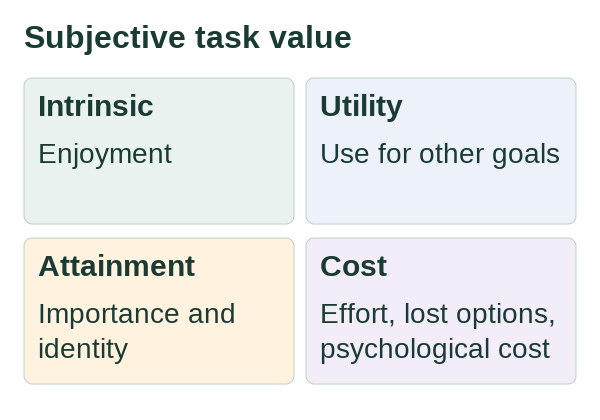
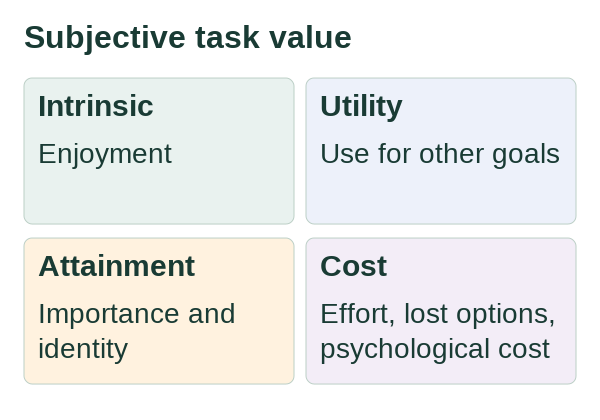
Self-determination theory approaches motivation through its quality rather than its amount, and it rests on two linked ideas. The first is that people tend toward personal growth and a more unified sense of self when their basic psychological needs for competence, relatedness and autonomy are met. The second is that behavior is more enjoyable and contributes more to wellbeing when motivation is internalized, meaning it becomes more closely aligned with the self. A 2015 conceptual overview described the approach as a means of theoretically unifying the many disconnected perspectives found in research on motivation in music learning.[13]
Goal theory concerns the purposes students pursue in class, and a 1992 article set out directions for research on it.[14] Achievement goal orientations later appeared as one of the person-level characteristics, alongside expectancy-value beliefs, in a model of self-regulated learning.[15]
Control-value theory, a leading contemporary theory of achievement emotions, was set out by Pekrun in 2006. A 2012 guide for medical educators described the theory, distinguished types of achievement emotions, and traced their proximal antecedents, the appraisals that come just before an emotion, and their consequences for motivation, learning and performance.[16]
The ARCS-V model takes its name from attention, relevance, confidence, satisfaction and volition, the last meaning the learner's capacity to keep to an intention. The design approach includes a 10-step process and a simplified version for planning lessons and modules, plus a self-reflective checklist an instructor can use to judge which aspects of motivation are satisfactory and which need strengthening. The paper ends with examples of motivational strategies and a case description of an instructional module revised for classroom instruction, blended learning and eLearning.[17]
Interest theory holds that interest is a content-specific motivational characteristic, made up of intrinsic feeling-related and value-related valences, rather than a general orientation toward learning. A 1991 review argued that then-current constructs of motivation left out aspects of interest that classical American and German educational theorists had emphasized. The review reported studies linking interest to the depth of text comprehension, to the use of learning strategies and to the quality of the emotional experience while learning.[18]
A 1983 analysis joined the literature on academic motivation, which defined learning processes only vaguely, with the literature on learning strategies, which rarely measured motivational outcomes, and examined how classroom instruction might develop self-regulated learners.[19] The metacognitive and affective model of self-regulated learning, published in 2011, separates two levels of functioning. At the Task × Person level, where self-regulated learning events take place, metacognitive experiences such as the feeling of difficulty and online affective states drive task motivation and bottom-up self-regulation. The model also posits reciprocal relations between the two levels.[15]
How large the effects are
A meta-analysis is a statistical pooling of many separate studies, and one such pooling combined 54 papers containing 344 separate estimates of the relationship between motivation, learning and personality traits on one side and academic performance on the other. Across those estimates the mean effect size was r = 0.22, where r is a correlation running from 0 (no relationship) upward toward a perfect one. The same pooling found a significant amount of variation between studies in how large the relationship was, and it found no evidence of significant publication bias, the tendency for studies with null results to go unpublished. Income level, publication year, main methodology, cohort gender, sample size, publication type and citation counts were all found to matter for understanding academic performance in that analysis.[20]
A single large high school study shows how much of achievement a motivational model can account for when engagement is placed in the middle of the chain. The study took 1,575 students in a high school that was ethnically and racially diverse. With gender, parent education and prior grade point average held constant, intrinsic motivation to learn was positively related to grade point average indirectly, through classroom engagement. Learning goals also showed a positive direct association with academic performance.[3]
Motivation is also tied to engagement, the observable involvement a student brings to classwork. Among 182 vocational high school students in Padang, achievement motivation and student engagement correlated at r = 0.558, a statistically significant positive relationship at p < 0.01. Achievement motivation accounted for 31 percent of the effective contribution to student engagement in that sample. The scales used in that study reported reliability coefficients of 0.933 for achievement motivation and 0.880 for student engagement.[21]
Large international surveys allow motivation to be examined alongside achievement in a single subject across a whole country. One analysis used Programme for International Student Assessment mathematics scores and questionnaires from 4,855 15-year-old students in Turkey. It found that students who perceived more teacher support also reported more use of learning strategies in mathematics. That relationship ran through math self-efficacy (a student's belief in his or her own capability in the subject), anxiety, intrinsic value and instrumental value. Mathematics achievement on the same assessment was in turn correlated with math self-efficacy and with anxiety. Differences between schools in socioeconomic status were strong predictors of math self-efficacy, anxiety and achievement.[22]
Persistence, meaning continued enrollment rather than grades alone, has been studied by grouping students according to the mixture of goals they hold rather than by single variables. In a large sample of community college students, five such motivational profiles were identified. High levels of mastery approach goals, the aim of learning and improving, combined with moderate levels of performance-approach goals, the aim of doing better than others, formed the ideal combination of motives for grade point average and persistence. The same study framed motivational variables as changeable, in contrast to demographic predictors that are difficult to alter.[23]
Why motivation changes learning
Self-regulated learning is usually described as a function of motivation, cognitive strategy use and metacognition, the monitoring and control of one's own thinking. A 2003 conceptual paper argued that regulating motivation is a further component of self-regulated learning and should be distinguished from motivation, from metacognition and from volition, the process of carrying an intention through to action. The paper reviewed evidence that students use several specific strategies to regulate their own motivation. It also linked those strategies to indicators of students' motivation, cognitive engagement and achievement, and called for research on how such strategies are defined, measured, developed and taught.[24]
Neuroscience adds a mechanism for how reward shapes learning: midbrain dopamine neurons appear to signal a reward prediction error, the gap between the reward expected and the reward received. That signal lets an organism predict future reward and act to raise its probability, and the account has explained a wide range of reinforcement learning findings in animals and humans. The same review noted a limit: dopamine accounts well for habitual, stimulus-response learning, while motivated, goal-directed behavior appears to depend on other neural and cognitive processes as well.[25]
Reward and punishment do not act on learning in the same direction. Arousal qualified the benefit: within participants, high arousal on a trial went with poorer performance, and across participants high arousal cancelled or reversed the advantage of approach motivation. Low-performing, highly aroused participants showed skin conductance responses resembling those of the avoidance group, which suggests that for them an opportunity for reward may produce a learning state like the one produced by threat of punishment.[26]
Interest, goals and emotions
Before and after a year of online mathematics learning, students rated their self-concept, their interest and their values in the subject, so interest was measured as one construct among several. A study of more than 8,000 students in grades 2 to 8 in the United States followed mathematics learning on an online intelligent tutoring system, a program that adjusts tasks to the learner, across the autumn and spring semesters of the 2017-2018 academic year. Engaged concentration, confusion, frustration and boredom were detected from the system's log files. Students who were interested in mathematics showed disengagement early in online problem solving and confusion at later stages, a pattern the researchers read as a sign that interest formed in ordinary classroom mathematics does not carry over easily to online work. Students who began with high self-concept were less frustrated in both semesters, and value showed no such mediated link to affect.[27]
Achievement goal theory distinguishes learning goals, held by students who aim to understand material, from performance goals, held by students who aim to display competence. A path analysis of 1,041 sixth-grade students found that a learning goal orientation was positively related to meaningful learning. A performance goal orientation and self-efficacy, by contrast, were negatively related to the learning approaches students used. Students who believed that knowledge is evolving and handed down by authority were more likely to be self-efficacious and to hold higher learning and performance goal orientations. The relation between learning approaches and achievement ran in the positive direction.[28] A separate study of 166 high school biology students found that those who strongly identified with science and endorsed a mastery goal orientation, one centred on developing understanding, were more likely to report higher levels of transformative experience. Higher engagement of this kind was positively associated with conceptual change in understanding natural selection at the post-test and follow-up assessments, but not in understanding inheritance, and with transfer at the follow-up assessment.[29]
Achievement emotions are the emotions students feel in achievement settings, such as enjoyment of learning, anxiety about tests or boredom during class. It holds that emotions arise from how much control students believe they have over an activity and how much they value it, and that the emotions in turn shape motivation, learning and performance.[30][16]
Teachers, fairness and classroom climate
Two studies by Christophel (1990) found significant correlations between learning and both immediacy and state motivation, meaning the motivation a student feels at a particular moment. Regression analyses showed that nonverbal immediacy and state motivation each predicted learning, partly on their own and partly through shared variance. The pattern suggested that immediacy modifies motivation, which in turn leads to increased learning. A second study addressed the concern that the earlier relationships were an artifact of the same students filling in every questionnaire, and its data indicated they were not.[31]
Punishment raises a separate question about discipline and motivation. Curren (2020) examined Lawrence Kohlberg's idea of a just school community and revised it using self-determination theory, which holds that people are motivated when their needs for autonomy, competence and connection are supported. The revised account sets out five dimensions of a just school community and clarifies the limited value of punishments as motivators. It argues that gaining students' cooperation depends on supporting their needs. Discipline and punishment in schools, it holds, should be diagnostic, educative, restorative and community building. The same account pushes back against schools' growing use of criminal justice responses to student misconduct.[32]
Dangan (2025) surveyed 175 teacher education students and 11 teachers and found no significant difference between the two groups in how they perceived teacher-student interactions. In that sample, teacher-student interactions were significantly related to achievement at the 0.01 level but showed no significant relationship with motivation.[33] Toma (2020) studied 202 university students aged 18 to 31 and found that anxiety about a future career moderated the link between school climate and amotivation, a state of lacking any drive to study, and also the link between the teacher-student relationship and academic motivation.[34]
Odilova and Mashrapova (2026) observed goal setting, interactive tasks and regular teacher feedback in a class of 25 secondary school students, using surveys, classroom observation and records of academic results. The results showed a positive effect of these strategies, with students in a supportive environment described as more active in class and better at understanding the subject. The study also suggested that mixing different techniques can work better than relying on one alone.[35]
Families, parents and support at home
A 2026 review proposed an integrated model, the Integrated Family Support-Motivation-Academic Success (IFSMAS) paradigm, in which internal motivational processes and external support systems interact to produce academic performance outcomes. The review used document and narrative analysis following the PRISMA framework, a set of reporting steps for systematic reviews, and drew on Scopus-indexed journal articles, theoretical papers and review studies published between 2018 and 2026. Its analysis identified five themes. Family support acts as an influence that depends on context; motivation acts as a dynamic mediator; behavioral mechanisms operate in academic success; structural and contextual constraints bear on it; and teacher support works as a compensatory mechanism that is itself structurally constrained.[36]
A 2023 literature review examined how parents figure in learning motivation and student achievement. Parents who teach and guide act as an additional source of teaching outside school, according to that review.[37]
A 2022 questionnaire survey of students in technical faculties examined which educational practices students perceive as favoring the development of their academic motivation, using closed-ended items. That survey located the factors a school can influence within its own domain: interactions between students and teachers, interactions among students, and the selection, processing and adaptation of content, teaching methods and assessment methods. The same paper cites D. Ausubel and F. Robinson (1981), who ranked motivation second among the factors that matter for academic success, just behind academic intelligence.[38]
Motivation in second language learning
Learning a foreign language in a classroom differs from learning a second language in a community where that language is spoken, and researchers have argued that findings from one setting do not carry over directly to the other. A 1990 study drew this distinction sharply: foreign language learning takes place in institutional or academic settings without regular contact with the target language community, whereas second language acquisition is at least partly embedded in the host environment. The study surveyed 134 learners of English in Hungary, described as a typical European foreign language setting, and proposed a motivational construct with four parts: an instrumental subsystem, an integrative subsystem, a need for achievement, and attributions about past failures. The integrative subsystem was itself a cluster of four dimensions rather than a single attitude. Instrumental motives, which concern practical benefits such as exams or career prospects, and the need for achievement mattered most for reaching an intermediate level of proficiency, while integrative motives were associated with the desire to go beyond that level.[4]
Later work widened the set of measures used to study motivation in language courses. A 1995 study of 75 students at a francophone secondary school measured persistence, attention, goal specificity and causal attributions, meaning the reasons students give for their successes and failures, alongside older measures of attitudes and motivation. The students wrote a French essay, and their final course grades were taken from school records. A structural equation model linking these motivational aspects with language attitudes, French language dominance and French achievement was supported by the data, and the added measures improved the account of motivation in language learning.[39]
A 2000 study first tested a scale of intrinsic and extrinsic motivation for second language learning for validity and reliability, then compared the resulting types of motivation with four orientations described earlier by Clément and Kruidenier in 1983. The scale held up psychometrically, and its 7 correlated motivational subscales corresponded with the different orientations.[40]
A 2023 study in a Latin American context compared 230 high school students aged eleven to thirteen in traditional English as a foreign language classes with students in CLIL programs, along with three English teachers and three science teachers. Surveys, interviews and the Academic Motivation Scale were used to collect and analyze the data. The statistical analyses found that students enrolled in CLIL were more motivated to learn English as a second language than students in traditional English as a foreign language instruction.[41]
Teachers looking for ways to raise motivation have used student questionnaires to learn which factors matter to their own classes and which difficulties students face. A 2025 article reports such a questionnaire, developed for students at Ukrainian universities, where English is in great demand but students' proficiency leaves much to be desired. The results are meant to help teachers assess their teaching, identify successful strategies and see which areas need improvement, so that measures to raise motivation can be targeted.[42]
Motivation across subjects and school levels
In physical education, a field study of eighth through tenth grade classes tested a model from self-determination theory, which holds that students are more motivated when lessons meet their needs for autonomy, competence and connection with others. The model proposed that support for autonomy from teachers raises satisfaction of these basic psychological needs, that need satisfaction raises autonomous motivation and perceived competence, that both raise the use of learning strategies, and that strategy use raises participation and grades. Structural equation modeling, a statistical method for testing chains of linked relationships, supported the model, and every indirect link in the chain was also significant.[43] A smaller study of 30 participants in a swimming course at Cikupa, Tangerang, found a positive direct effect of learning motivation on swimming learning outcomes, alongside direct effects of independence and learning quality, with each hypothesis tested at a significance level of 0.05. The study concluded that swimming results can be influenced by raising independence, learning quality and motivation.[44]
A study of long jump reported in 2025 described itself as analyzing visual, auditory and kinesthetic learning styles among 36 of 60 grade II students at a primary school in Dobo. It reported a positive effect of these styles on movement skill outcomes, with a statistical value of 6.926. The abstract of that paper does not report a separate result for motivation, so it cannot be cited as evidence that motivation improved long jump performance.[45] In science, a 2018 study of students measured science process skills, learning motivation and creativity with tests and questionnaires and analyzed the data by regression and correlation. Motivation was related to creativity in learning with a correlation coefficient of 0.55, science process skill was related to creativity with a coefficient of 0.634, and the two together were related to creativity with a coefficient of 0.935.[46]
At the college level, a study of 265 teacher candidates in the bachelor's program at the Bahrain Teachers College used the Academic Motivation Scale together with a demographics survey. Participants scored highest on extrinsic motivation, meaning motivation driven by outside rewards or pressures, and appeared to be externally regulated. The study found no significant differences in types of motivation by specialization, year of study, gender or cumulative grade point average.[47]
An earlier study of undergraduates in science programs noted that many students enter such programs because study in the area is required rather than out of genuine interest in the subject. That study examined an external motivation approach built on a token system called Microbucks, in which students earned tokens as rewards. In the qualitative analysis students responded favorably. The quantitative analysis showed a rise in final grades of up to 9.39 percent.[48] A 2024 paper on mathematics compared descriptive assessment, which describes a student's work in words, with numerical grading.[49]
Digital tools, games and online learning
A quasi-experimental study of 116 students in 4 classes found that digital learning produced more positive effects on learning motivation and on learning outcome than traditional teaching did, and that motivation was positively related to learning gains.[5] A website-based English e-learning platform built with the ADDIE model, a five-stage design process (Analysis, Design, Development, Implementation, Evaluation), was judged feasible by material and media experts, and user trials returned an average score of 90.6, which the study read as evidence of increased motivation.[50]
In a study of 100 ninth-grade female students, the group that studied English with a computerized program in addition to the traditional method outperformed the traditional-only group in both achievement and motivation toward learning English.[51] A survey of 124 second-year non-English majors at a Vietnamese university found that autonomy, clear goals and recognition were the factors that most helped promote motivation in blended courses, while feedback practices and comfortable learning environments needed further improvement.[52] Students of Business English working with massive open online courses alongside class discussion reported high intrinsic motivation, and platform records showed that all of them completed more than half of the assigned tasks.[53]
A meta-analysis of studies published between 2015 and 2020 compared game-based interventions with traditional instruction in schools. It found a medium effect for overall learning (g = .54) and for cognitive learning outcomes (g = .67), a small effect for affective-motivational outcomes (g = .32), and no significant effect for metacognitive outcomes.[54] An earlier model of instructional games described an input-process-output sequence in which game features feed a cycle of user judgments, behavior and feedback, and it noted that researchers did not agree on what the essential features of an instructional game are.[55] A systematic review of 15 game-based systems that reported effects from narratives extended a model from commercial video games so that narratives could be isolated and compared, and it identified narrative features associated with positive effects on engagement, motivation and learning.[56]
A review of 69 articles published from 2020 onward found that research covered students' interaction with AI tools, the development of those tools and their adaptation within educational communities. It left unexplored the central relationship between students and the object of their activity, the relationship that carries intrinsic motive.[57] A survey of 80 teachers and students with early access to ChatGPT in 2023 found that respondents said the tool generally motivated them to develop reading and writing skills. Their attitudes about listening and speaking were neutral, and the study recommended using the tool as a learning aid while calling for further investigation of its negative effects.[58]
Teaching methods that raise motivation
In a mixed-method study of 170 vocational students across three semesters, students generally viewed project-based learning positively and credited it with deepening their grasp of course material and building communication and collaboration skills. The same students named inconsistent instructions from lecturers, tight deadlines and assessments that gave little attention to the learning process as significant barriers to engagement and motivation.[59] A trial of a project-based module on global warming reported that average scores rose from 51 to 85 and that learning motivation increased by 5%.[60] An analysis of project-based learning in an undergraduate course argued that motivational effects are not automatic. They depend on design features such as choice that supports autonomy, scaffolding of competence with responsibility handed over gradually, formative feedback loops, regulation mediated through teams, and structured reflection.[61]
Behavioral contracts set out agreed rules and consequences in writing, and one study examined their use for social science learning at home during the COVID-19 pandemic. The survey drew a proportional random sample of 275 students from a population of 4,225 at an Islamic boarding school in Salatiga City, with lessons delivered over the videoconferencing tool Zoom. Path analysis found a positive and significant influence of innovative learning on learning motivation, on learning activities and on learning achievement, and an indirect influence on achievement through motivation and through activities.[62]
Academic motivation training teaches students directly about motivation, and a quasi-experimental study tested a model of it with 42 female lower secondary students in Tehran. The experimental group of 21 students received eight training sessions while the control group of 21 received no intervention. After controlling for pretest scores, the training produced significant gains in cognitive flexibility (F = 24.82, eta squared = 0.39), academic resilience (F = 32.27, eta squared = 0.46) and academic motivation (F = 43.80, eta squared = 0.53), all at p < 0.001.[63]
Strategy instruction teaches study skills such as cognitive and metacognitive strategies, the planning and monitoring habits often called learning to learn. A 2003 article described training in these strategies as a subject of much interest and research, and grounded the learning-to-learn approach in informational and generative models of learning that emphasize self-regulated and strategic learning.[64]
Testing, grades and pressure
Pressure from grades and from supervisors has been studied together in one setting: the final thesis, a long piece of independent research written one to one with a supervisor. A cross-sectional survey of 217 German psychology students, meaning a survey taken at a single point in time, measured how motivated students perceived their supervisors to be and how much grade pressure the students felt while writing. Students who saw their supervisors as highly motivated reported higher motivation components and less stress, while grade pressure was linked to higher valence, the value placed on a good grade, and also to more stress. In the mediation analysis, a statistical test of whether one variable acts through another, perceived supervisor motivation had a partially mediated positive effect on student motivation, and grade pressure had a net effect of zero after its opposing paths were taken into account. The researchers note that the design cannot establish causality.[66]
An experimental study in a field setting tested how the format used for rating and how often ratings were collected affected students' motivation to rate their peers' contributions to group projects. How students rated their peers and how often they did so interacted significantly in shaping their motivation and their perceptions of their team. The researchers concluded that peer assessment is a complex process in need of further study.[67]
What this looks like when you study
In one study, 222 first- to third-year students at a Romanian university answered a questionnaire about what raises their motivation for learning. The survey asked which reasons lead them to learn, how much time they spend daily on learning, and what they do when they meet a learning problem.[7] In another study, 1,575 students in a diverse American high school completed measures of intrinsic motivation to learn, learning goals, and classroom engagement. Intrinsic motivation was linked to grades indirectly, through classroom engagement, and the model explained 33% of the variance in grade point average.[3]
A study of 135 distance learners used self-assessment questionnaires to relate motivation, learning strategies, self-efficacy and attribution to learning results. Learning motivation and learning strategies each had positive, predictable effects on results, with effect values of 0.76 and 0.63. Self-efficacy and internal attribution, meaning crediting one's own effort, had indirect effects with values of 0.48 and 0.21.[68]
In a quasi-experiment at two universities, 428 second-year undergraduates spent a sixteen-week semester on discipline-embedded projects. Structured coaching sessions modelled goal-setting, progress monitoring, and reflective self-assessment. In the project-based classes, students scored higher after the semester on identified regulation, on intrinsic motivation and on strategic self-regulation than they had before it. The authors recommend iterative scaffolding and formative feedback loops, which means feedback given during the work rather than only at the end.[69]
Odilova and Mashrapova surveyed 25 secondary school students and watched lessons in which teachers set goals, ran interactive tasks and gave feedback at regular intervals. Data came from student surveys, classroom observation, and analysis of academic results over a period of time. The authors suggest that combining different motivational techniques works better than using a single approach.[35]
Teachers can hold an attributional dialogue with a student, in which the student learns to credit achievement to personal effort and to the use of suitable learning strategies. The article shows dialogue pages from a typically achieving learner and from a student with learning disabilities. The dialogue page is a written exchange in which teacher and student discuss why a piece of work turned out as it did, and the student practises crediting the result to personal effort and to the study strategies used. Kozminsky and Kozminsky describe an attributional dialogue in which teachers and students talk through a student's achievement and link it to the student's own effort and to the learning strategies the student used.[70]
Common misconceptions
A common belief holds that children with learning disabilities have little motivation to learn. The reasons usually given are vague, and the causes are often attributed to symptoms such as hyperactivity and a short attention span. The article proposes that these symptoms may mislead the search for true causes, and that lack of motivation may result from the education system rather than from a fault in the child.[71]
Low academic motivation is often named as a cause of cheating and plagiarism among college students, and studies in several countries have reported the link. In longitudinal data on 914 students at four Russian universities, learning motivation became an insignificant predictor once perceived consequences and peer effects were included. The best predictor of both plagiarism and cheating was the perceived prevalence of those behaviors among peers.[72]
Differences between students and open questions
A survey of 234 students in higher education found no significant differences between gender groups in how the learning environment, goal orientation and motivation were related to one another.[73] In the group interview of that study, participants generally lacked clear academic goals, and female participants were reticent about sharing their aspirations. The Indonesian study drew on one rural area and called for future work in more schools across different rural areas to raise the likelihood of generalisability.[74]
Among secondary school students in grades 9 to 11, only autonomous regulations, especially intrinsic motivation, grew more specific to particular academic subjects with age, while controlled regulations stayed relatively stable. Correlations between motivation and self-concept within subjects were stronger over time, which the researchers read as support for the Specificity Hypothesis, the proposal that autonomous motivation becomes tied to particular contexts as it develops.[75] Academic buoyancy, a student's capacity to recover from ordinary setbacks such as a poor grade, has been examined alongside motivation and interest. A 2022 review noted that few studies had addressed how these constructs relate.[76]
In a sample of 252 college students in Turkey, academic intrinsic motivation fully mediated the link between academic self-efficacy and dispositional hope on one side and academic procrastination on the other.[77] A survey of 150 undergraduates in the United Arab Emirates found that binge-watching intensity predicted both academic motivation and academic procrastination. Students with high binge-watching behaviours showed higher procrastination tendencies (F (1,147) = 7.891, p = 0.006) and lower academic motivation (F (2, 146) = 4.326, p = .015).[78]
Interviews with 15 learners in three massive open online courses found enrolment motives that included intrinsic ones such as curiosity, improving personal knowledge and personal interest, and extrinsic ones such as supporting formal education and career development. Those learners used task strategies, self-monitoring and self-management, and their self-management varied with their different motivations.[79] A 2022 article applied self-determination theory to distance music education.[80]
Lifelong learning has drawn attention from educational and business communities, and a 1991 article argued that educational psychologists should build grand theories that integrate principles of learning and motivation and address the whole person in context.[81] Learning analytics dashboards, displays that summarise student data for students or staff, are frequently used in post-secondary settings. A 2023 paper argued that limited work has explored their motivational implications, especially for under-served student populations, who are more likely to take in negative messages about their academic performance. That paper proposed situated expectancy-value theory as a lens for designing and evaluating dashboards. In this framework, motivation depends on how much students expect to succeed and how much they value the task in a given setting, and the aim is that student experiences with dashboards are adaptively motivating.[82]
Measuring motivation and its strategy links
Abdimaulenov (2024) measured student motivation with the Academic Motivation Scale and assessed the internal consistency of the motivation scales with Cronbach's alpha, which ranged from 0.74 to 0.83. Hands and Limniou (2023) adapted items from the Motivated Strategies for Learning Questionnaire and used factor analysis, which suggested a 24-item questionnaire with 6 factors.[83][84] The Academic Motivation Scale is one widely used questionnaire of this kind. In a study of 318 students registered in an online learning system, 263 of them girls and 55 boys, its scales showed internal consistency values, measured by Cronbach's alpha, ranging from 0.74 to 0.83.[83]
The Motivated Strategies for Learning Questionnaire, usually shortened to MSLQ, pairs motivation items with items about study tactics. A 1993 study of first-year students found that 20 of the 25 motivation, learning strategy and learning resource scales it assessed were significantly correlated with course grades and grade point average.[85] Researchers have questioned the MSLQ's length and several of its statements, and a newer instrument built partly from its items, the Diversity of Strategies for Motivation in Learning, was completed by 1,246 students at a university in the northwest of England. A statistical method that groups items answered in similar ways, factor analysis, pointed to a 24-item questionnaire built on 6 factors. These covered test anxiety, self-efficacy, the range of sources a student draws on, study skills, self-regulation and the perceived usefulness of the course.[84]
Leonid and Kanonire (2022) developed a scenario scale of extrinsic motivation toward mathematics and compared it with a traditional self-report scale of the same construct, using a sample of 1,299 primary school students. Both measures showed solid psychometric properties and sound evidence of validity, yet they differed in scores and in factor structure, and the scenario format appeared to measure motivation slightly better than the traditional one. The researchers suggested that further work consider response style and social desirability effects, the tendency of respondents to answer in ways they think are expected.[86]
Wang, Peng, Huang, Hou and Wang (2008) related distance learners' motivation and learning strategies to their learning results, and Clayton, Blumberg and Auld (2010) related motivational beliefs and learning strategies to students' choice of learning environment.[68][87] In a survey of post-secondary students, discriminant analyses found significant differences in motivational beliefs and learning strategies between students who preferred traditional learning environments and those who preferred online or hybrid ones.[87]
The link between motivation scores and achievement is not always found.[88][89] One study looked at 166 early childhood education majors at a university in the United States. Their combined scores on academic motivation and academic self-regulated learning did not predict grade point average, and neither measure correlated with it.[89] A study of upper elementary school students in Banten Province, Indonesia, reached a similar split. Learning strategy, memory and metacognition contributed simultaneously to achievement, with a multiple correlation of 0.795 and a coefficient of determination of 0.632, while learning attitude and learning motivation did not contribute.[88]
Motivation in students with learning difficulties
Studies of children with learning disabilities have asked whether their motivation differs from that of other children, and the answer depends on which comparison group is used. Children with learning disabilities were also the group most likely to believe that other people with power controlled how well they did in school. The groups did not differ in general feelings of control or general competence, and teachers' ratings of the children with learning disabilities differed from their ratings of the comparison groups by more than the children's own ratings did.[90] An earlier study of 48 children with learning and behavior problems and 48 children without them found no significant difference between the groups on a scale of locus of control, the belief that outcomes depend on one's own actions or on outside forces. Within the group with problems, children who scored higher on that scale did significantly better on a coding task (p < .01). On a digit symbol task the effect of the scale depended on whether the child had just experienced success or failure (p < .05).[91]
A 1985 article argued that the usual explanations for weak motivation in children with learning disabilities, such as hyperactivity and a short attention span, are vague and may mislead. It proposed that the education system rather than the child may be the source of the problem. The article described social, environmental and physiological approaches to motivational problems without reporting a study of its own.[71]
A 2021 practitioner article noted that motivation and engagement in mathematics are sometimes compromised in students with disabilities who have a history of frustration and failure. It set out three research-supported strategies for elementary students who have, or are at risk of, emotional and behavioral disorders. Morano and colleagues describe three strategies: praise that names the behavior and token systems that exchange earned tokens for privileges; instruction in self-monitoring and self-regulation to support attention and achievement; and the high-preference strategy, which builds behavioral momentum for nonpreferred tasks. A third was the high-preference strategy, in which a preferred task is placed first to build behavioral momentum for a task the student dislikes.[92]
A longitudinal study followed 302 eighth-grade adolescents, about half of them diagnosed with ADHD, from middle school into high school. Adolescents with ADHD had worse academic motivation at every point measured, yet the motivation of adolescents without ADHD fell at a faster rate across the transition to high school. For adolescents with ADHD, amotivation (the absence of motivation), extrinsic motivation and intrinsic motivation each predicted grade point average, and higher extrinsic and intrinsic motivation also predicted better homework performance and different aspects of mathematics performance. Among youth without ADHD, grade point average was predicted by amotivation and extrinsic motivation alone.[93]
Two small trials have tested whether adding motivational elements to reading instruction helps students at risk for reading difficulties.[94][95] A quasi-experimental pre-test/post-test study looked at 25 third-grade students at risk for reading difficulties (mean age 8.99, SD 0.38). Students who received small-group cognitive reading intervention combined with a program targeting goals, emotions and self-efficacy beliefs made greater gains in reading comprehension and phonological awareness than students who received the cognitive intervention alone. The authors called this preliminary evidence.[94] Gains in reading for the group with ADHD but without reading difficulties were not significant.[95]
A prospective study of 218 students with learning difficulties in their last year of a work-study program surveyed them at the end of the school year and one year later. Fathers' autonomy support went together with autonomous motivation in the models for both transition status and well-being. Friends' autonomy support did so in the transition status model. Autonomous motivation was a positive predictor of both outcomes, and controlled motivation a negative predictor of both.[96]
Motivation and well-being, stress and adjustment
In a survey of Greek undergraduates, autonomous academic motivation was positively related to well-being. A study of primary school children in Ukraine found positive connections between psychological well-being and internal motivation for learning, and negative connections with external motivation.[97][98] Children with a high level of well-being showed cognitive motivation, motivation for self-development and an awareness of why learning mattered to them, alongside an orientation toward high academic performance. Children with a low level of well-being showed pronounced external motivation that reflected mainly the teacher's requirements, a subjective sense of learning difficulties, a negative attitude to learning and a preschool-type motivation with a hedonistic orientation.[98] A survey of 2,941 junior high school students during the Covid-19 pandemic reported a coefficient of 0.64 for achievement motivation on learning behavior, while affiliation motivation showed a coefficient of 0.1 and was not significant. The same study argued that high-quality motivation tends to benefit welfare and low-quality motivation tends to harm it.[99]
Autonomous academic motivation, meaning motivation that comes from the student's own interest and values, went together with higher perceived employability, better academic outcomes and greater well-being. Exploratory analyses pointed to links running in both directions between academic motivation and perceived employability, and between academic motivation and academic outcomes. The findings were read as support for need-supportive learning environments and for combining academic and career-development support where students face uncertainty about employment.[97] In a study of college students in the 2025-2026 school year, overall emotional intelligence and overall motivational learning strategies were both rated high, and a strong positive relationship was found between the two. The strongest dimensions of motivational learning strategies were intrinsic goal orientation and self-regulation of effort, while assessment of homework and test anxiety were weaker and rated moderate.[100]
Stress is one contributor to learning difficulties, and a quasi-experimental study tested a psychological treatment for it in a biology classroom. The study involved 72 eleventh-grade science students in Bandung City, with 36 students receiving Inquiry-Based Stress Reduction, a method for examining stressful thoughts, inside a discovery learning framework, and 36 students taught with the same framework without it. The researchers reported that adding the technique reduced student stress and improved learning performance, motivation and knowledge construction, while decreasing learning difficulties and cognitive anxiety.[101]
For students studying in a foreign country, learning motivation has been examined together with socio-cultural adaptation, the process of adjusting to an unfamiliar culture. A questionnaire study of 40 members of the Ukrainian host society and 34 immigrants to Ukraine found that foreign students' main learning motives were intrapersonal ones. They also named gaining knowledge, mastering a profession and earning a diploma. International students were described as quite susceptible to the influence of teachers' assessments, which the study suggested could be used to raise their learning motivation.[102]
Academic dishonesty is often attributed to low academic motivation, but a longitudinal study of 914 students at four Russian universities questioned how much motivation explains once context is taken into account. In regression analysis, learning motivation became an insignificant predictor of cheating and plagiarism as soon as perceived consequences and peer effects entered the model. Plagiarism rates, unlike cheating rates, were not contingent on the probability of punishment.[72]
Motivation in vocational and higher education settings
Azimdjanovna (2025) tested a project-based learning intervention with 428 second-year undergraduates at two universities over a sixteen-week semester. Yan, Omar, Kamaruzaman and Rasul (2025) surveyed 509 vocational students in nursing and computer science across five regions of Sichuan Province, China.[69][103] One strand of this work draws on self-determination theory, which holds that motivation becomes more self-directed when a setting meets basic needs for autonomy, competence and relatedness. A quasi-experimental study at two universities followed 428 second-year undergraduates studying engineering and education. The study ran across a semester of sixteen weeks. Classroom ethnography and in-depth interviews added qualitative evidence of more metacognitive dialogue and collaborative knowledge construction.[69]
A cross-sectional survey of 509 vocational students majoring in nursing and computer science, drawn from vocational schools in five regions of Sichuan Province in China, compared three forms of extrinsic regulation. External regulation, in which behaviour is driven by rewards or punishments, showed the weakest link to learning motivation. Introjected regulation, where the student acts to avoid guilt or protect self-worth, fell in between, and identified regulation, where the goal has been internalised, showed the strongest link to achievement. The career-aligned structure of vocational training appeared to amplify internalisation, in contrast with general education models that prioritise external rewards. The study recommends teaching strategies that personalise goals around industry-relevant work so that motivation aligns with students' values.[103]
Teaching format has also been tested against motivation at different degree levels. A study that followed groups of students for two academic years compared a flipped classroom (material studied before class, class time used for active work) with a combination of flipped classroom and project-based learning. Control groups were taught in the same flipped environment without the combined method. Bachelor-level students and students in higher vocational education and training significantly improved their learning motivation and achievement under the combined method (p = 0.0001248 and p = 0.0485 respectively), while at the master's level the effect was not significant (p = 0.1000). The researchers called for further work to understand the effects for master's students.[104]
Sim and Kim (2024) interviewed 16 transfer students, analysed 15 datasets, and identified a decline in learning motivation as the central phenomenon and overcoming that decline as the core category. The coding yielded 77 concepts at the first stage, 31 categories at the second and 16 at the third. The study concluded that transfer motivation is a key driver of academic success and personal growth, and that although transfer students experience fluctuations in motivation, they recover and adapt. It recommends that universities develop support programmes to help transfer students adjust to the academic environment.[105]
Self-efficacy, a person's belief in their capacity to carry out the actions a task requires, has been surveyed among future teachers. A single-survey study of 621 preservice teachers at one faculty of education in the 2020-2021 academic year found high levels of both academic self-efficacy and academic motivation. Academic self-efficacy did not differ significantly by gender or year of study, whereas academic motivation differed significantly by gender, year of study, academic achievement and career expectation.[106] Smaller programme evaluations report related gains: a psychological support programme for 20 first-year software non-majors in Gyeonggi-do reduced the negative emotion described as a barrier to software learning and improved digital communication, collaboration capacity and digital efficacy.[107] A teaching case in an introductory marketing subject used an alumni engagement activity during a pandemic-era blended learning regime to raise student motivation, promote new experiences, facilitate networking and encourage collaborative work.[108]
Interventions that target motivation directly
Kozminsky and Kozminsky (2002) describe an attributional dialogue between teachers and students, carried out on dialogue pages, in which students learn to attribute their achievements to their own efforts and to the use of appropriate learning strategies. Dahlia and Akbar (2026) tested a growth mindset intervention with 10 junior high school students, using a one-group pretest-posttest design.[70][109] One approach is attributional dialogue, in which a teacher and a student discuss written pages about a piece of work and practise tracing the result back to the student's own effort and choice of learning strategies. It describes the shift as students coming to credit their own educational efforts, and their use of suitable learning strategies, for their achievements. The account presents the procedure and its example pages rather than a controlled comparison with a group that did not receive the dialogue.[70]
Growth mindset interventions rest on the idea that intelligence and ability can be developed through sustained effort, effective strategies and continued practice. In one study, 10 junior high school students in Indonesia completed a growth mindset program, and their mean score on a mathematics learning motivation questionnaire rose from 54.00 before the program to 84.50 after it. A Wilcoxon signed-rank test gave Z = -2.823 and p = .005, with an effect size of r = .89, which the study describes as very large. The design had no separate comparison group, so the change cannot be separated from other events during the same period.[109]
Constructive feedback, meaning comments intended to guide improvement rather than only to grade, has been tested as a classroom intervention in chemistry. A true experimental study interviewed one headmistress, 3 chemistry teachers and 5 students from the experimental group before and after the intervention, using semi-structured interviews and a focus group discussion. Participants reported that constructive feedback raised students' performance and motivation in chemistry, and that students' self-efficacy (their belief in their own capability) and self-regulation skills developed. The feedback was also reported to help low-scoring students improve their chemistry performance, and the study recommends making it part of daily formative assessment.[110]
A 7-month longitudinal intervention taught 50 secondary school adolescents a subject based on artificial intelligence and measured their perceived competence, autonomy, relatedness and intrinsic motivation at two time points. Statistically significant improvement appeared only in the need for relatedness, regardless of gender and of how often students used information and communication technology for academic or non-academic purposes. Students' initial competence was the main predictor of their initial motivation, and that initial motivation was essential for further improvement after the intervention. Each basic psychological need at the first measurement predicted the same need at the second, with high explained variance.[111]
An automated self-regulated learning management system was built to guide 155 postgraduate students in two online healthcare-related courses through the cognitive, metacognitive and motivational parts of regulating their own learning. Trace data from the system were combined with students' self-reports and analyzed with non-parametric tests. The system helped students practise more effective self-regulated learning behaviours, with positive effects on learning motivation and metacognitive reflection, but its effect on academic performance was inconclusive.[112] A teacher training program built around the Attunement Strategy, developed in Holland, has been described as encouraging evidence for improving classroom practice.[113]
Motivation in science and mathematics classrooms
Four classroom studies test different teaching methods: Student Team Achievement Divisions in Biology, discovery learning against guided inquiry in physics, Children Learning in Science against direct instruction in science, and an inductive-deductive approach in mathematics. One compares discovery learning with guided inquiry in physics. Nurjani (2023) applied the Student Team Achievement Divisions model in a Biology class of 33 students. Fauziah, Arsyad and Helmi (2025) compared discovery learning with guided inquiry among 66 physics students. Arieshandy, Rintayati and Triyanto (2025) compared the Children Learning in Science model with direct instruction for critical thinking skills. Sinaga, Ningtiyas and Mahmuzah (2023) tested a deductive-inductive approach on creative thinking ability and learning motivation.[114][115][116][117]
In a biology classroom at SMAN 7 Sigi in Indonesia, 33 students in class XI IPA 3, 9 boys and 24 girls, were taught with Student Team Achievement Divisions, a cooperative method in which teams of students work together and team scores are compared. Over the even semester of the 2022/2023 academic year, the study reported that this method raised both learning motivation and learning outcomes in the biology class.[114] A qualitative study interviewed 26 science teachers in public schools in Irbid Governorate, Jordan, in the 2023-2024 academic year. The teachers generally held positive attitudes toward integrating science, technology, engineering and mathematics into lessons, and reported that such integration promoted student engagement in research activities. The same teachers described significant obstacles: inadequate physical resources and too little time.[118]
Two Indonesian experiments compared discovery learning, in which students work out principles for themselves, with guided inquiry, in which the teacher structures the investigation, in physics classes. The first used 66 students from classes XI MIPA 1 and XI MIPA 2 at SMAN 1 Woha and found a difference in physics learning outcomes between the two methods. The difference appeared among students with high learning motivation and again among students with low motivation. That study reported no interaction between the teaching model and learning motivation on physics outcomes.[115] Critical thinking scores averaged 89.78 under the Children Learning in Science model and 77.66 under direct instruction, and the analysis of variance gave an F value of 75.61 against a table value of 3.89. The study concluded that the Children Learning in Science model was the more effective of the two for developing critical thinking skills.[116]
In mathematics, a study tested an inductive-deductive approach, which moves between specific examples and general rules, for its effect on creative thinking and learning motivation. The inductive-deductive class produced t values of 2.09 and 10.66, while the conventional class produced -0.848 and -0.94, against a table value of 1.684. Measures of the approach's influence were 6.149 and 6.344 against a table value of 1.960, and the study concluded that the approach was effective for critical thinking and learning motivation while the conventional class was not.[117] A video and quiz intervention with 219 eighth class students, 169 female and 50 male, in six Ashram high schools of the Warangal district used the Students' Motivation Towards Science Learning scale before and after the lessons. The total score rose to 87.38% from 73.28%, an increase the study attributed to tutoring with video lessons and to quizzes given before and after each video. The performance goal variable contributed the largest share of the change, at 33.62%, and some students moved from the moderately motivated category to the highly motivated category.[119]
Winberg and Palm analysed Swedish TIMSS 2011 data and found that motivational characteristics were among the most important variables in models predicting performance in science and mathematics. An analysis of TIMSS 2011 achievement tests in science and mathematics, with an additional motivation questionnaire in Sweden, compared motivational characteristics drawn from five theories of motivation and epistemic beliefs with almost 300 situational factors as predictors of test performance. Models containing all background variables predicted up to 52% of the variation in student performance. Models built only from motivational characteristics predicted up to 27% of performance, while models using a single motivational characteristic predicted 7% on average. Five teacher features were consistently among the strongest predictors of students' motivational characteristics, and together they predicted as much of the variation in those characteristics as the remaining 300 situational variables combined.[120]
Critiques, limits and unresolved questions
A 2026 review of motivation research in AI-mediated collaborative learning reports methodological problems: too much reliance on cross-sectional data, samples that do not represent the wider population, measurement tools not matched to AI settings, and too little analysis at the group level. The same review identified gaps in theoretical integration and in empirical work on how motivation changes over time and how AI itself affects it. It called for unified theoretical models, better measurement instruments, and attention to ethical and practical questions.[121]
Crosby argues that motivation by itself cannot fully account for learner engagement in second and foreign language learning, especially in self-access and autonomous settings where learners must negotiate their own participation. A literature-based review of second language motivation argued that engagement in self-access and autonomous learning cannot be fully explained by motivation by itself.[122]
Key studies
| Year | Study | Sample | Design | Finding |
|---|---|---|---|---|
| 2002 | Chory‐Assad[65] | Survey of college students on distributive and procedural justice in a course | Only perceptions of procedural justice predicted motivation, affective learning and aggression toward the instructor at a statistically significant level. | |
| 2008 | Wang et al.[68] | 135 distance learners | self-assessment questionnaires with path modeling | Learning motivation and learning strategies had positive predictable effects on learning results, with effect values of 0.76 and 0.63. |
| 2012 | Yıldırım[22] | 4,855 15-year-old students in Turkey | multilevel mediation analysis of PISA data | Students who saw their teachers as supportive used learning strategies in mathematics more often, and four motivational beliefs carried that link: math self-efficacy, anxiety, intrinsic value and instrumental value. |
| 2016 | Froiland & Worrell[3] | 1,575 students in an ethnically and racially diverse high school | structural equation model with control variables | In Froiland and Worrell's model, intrinsic motivation to learn reached grade point average through classroom engagement rather than directly, and the variables in the study accounted for 33% of the variance in GPA. |
| 2016 | Cook & Artino[1] | Review of five contemporary theories of motivation to learn | Across the theories, the same concerns recur: competence, value, attributions, and the interplay between individuals and the setting in which they learn. | |
| 2019 | Shmeleva & Semenova[72] | 914 students at four Russian universities | longitudinal regression analysis | Learning motivation became an insignificant predictor of cheating and plagiarism once perceived consequences and peer effects were controlled. |
| 2021 | Nauzeer & Jaunky[20] | 54 papers with 344 estimates | random-effects meta-regression | The mean effect size for motivation, learning and personality traits was r=0.22, with no evidence of significant publication bias. |
| 2021 | Winberg & Palm[120] | Swedish TIMSS 2011 data with almost 300 situational factors | multitheory prediction models | Models with motivational characteristics from several theories predicted up to 27% of performance, against an average of 7% for single characteristics. |
| 2023 | Hands & Limniou[84] | 1,246 students at a university in the northwest of England | questionnaire development with factor analysis | A 24-item questionnaire with 6 factors, including test anxiety, self-efficacy and course utility, predicted academic success and can serve as an early alert tool. |
| 2024 | Köpeczi-Bócz[104] | university students at bachelor, master and higher vocational levels followed for two academic years | cross-sectional comparison with control groups | Combining project-based learning and flipped classroom raised motivation and achievement at bachelor level (p = 0.0001248) and higher vocational level (p = 0.0485), but not at master level (p = 0.1000). |
| 2025 | Partycia et al.[21] | 182 vocational high school students in Padang | quantitative correlational study | Achievement motivation correlated positively with student engagement at r = 0.558, contributing 31% of the effective variance. |
| 2025 | Senior teacher at Tashkent State University of Economics, Uzbekistan & Azimdjanovna[69] | 428 second-year undergraduates at two universities | quasi-experiment over a sixteen-week semester | After the sixteen-week semester, the project-based group scored higher on identified regulation, intrinsic motivation and strategic self-regulation. |
| 2025 | Yan et al.[103] | 509 vocational students in nursing and computer science in Sichuan Province | cross-sectional survey with stratified random sampling | Identified regulation correlated most strongly with learning motivation (r = 0.784), external regulation least (r = 0.658). |
| 2026 | Dahlia & Akbar[109] | 10 junior high school students in Indonesia | one-group pretest-posttest experiment | Mean mathematics learning motivation rose from 54.00 to 84.50, with a very large effect size (r = .89). |
See also
References
- Cook, D. A., & Artino, A. R. (2016). Motivation to learn: an overview of contemporary theories. Medical Education, 50(10), 997-1014. doi:10.1111/medu.13074
- Filgona, J., Sakiyo, J., Gwany, D. M., & Okoronka, A. U. (2020). Motivation in Learning. Asian Journal of Education and Social Studies, 16-37. doi:10.9734/ajess/2020/v10i430273
- Froiland, J. M., & Worrell, F. C. (2016). Intrinsic motivation, learning goals, engagement, and achievement in a diverse high school. Psychology in the Schools, 53(3), 321-336. doi:10.1002/pits.21901
- Dörnyei, Z. (1990). Conceptualizing Motivation in Foreign‐Language Learning*. Language Learning, 40(1), 45-78. doi:10.1111/j.1467-1770.1990.tb00954.x
- Lin, M. H., Chen, H. C., & Liu, K. S. (2017). A Study of the Effects of Digital Learning on Learning Motivation and Learning Outcome. Eurasia Journal of Mathematics, Science and Technology Education, 13(7), 3553-3564. doi:10.12973/eurasia.2017.00744a
- Pokay, P., & Blumenfeld, P. C. (1990). Predicting achievement early and late in the semester: The role of motivation and use of learning strategies. Journal of Educational Psychology, 82(1), 41-50. doi:10.1037/0022-0663.82.1.41
- AUREL VLAICU UNIVERSITY OF ARAD, & ALINA FELICIA, R. (2022). The motivation of learning in students. JOURNAL PLUS EDUCATION, 31(2/2022), 10-20. doi:10.24250/jpe/2/2022/afr/mif
- Pintrich, P. R. (2003). A Motivational Science Perspective on the Role of Student Motivation in Learning and Teaching Contexts. Journal of Educational Psychology, 95(4), 667-686. doi:10.1037/0022-0663.95.4.667
- Ryan, R. M., & Deci, E. L. (2000). Intrinsic and Extrinsic Motivations: Classic Definitions and New Directions. Contemporary Educational Psychology, 25(1), 54-67. doi:10.1006/ceps.1999.1020
- Harlen, W., & Deakin Crick, R. (2003). Testing and Motivation for Learning. Assessment in Education: Principles, Policy & Practice, 10(2), 169-207. doi:10.1080/0969594032000121270
- Seals, C. (2016). Expectancy Value Theory and Racial Opportunity Cost: Racializing Values in Motivation Theory. Urban Education Research & Policy Annuals, 4(2). doi:10.55370/uerpa.v4i2.597
- Wang, Q., & Xue, M. (2022). The implications of expectancy-value theory of motivation in language education. Frontiers in Psychology, 13. doi:10.3389/fpsyg.2022.992372
- Evans, P. (2015). Self-determination theory: An approach to motivation in music education. Musicae Scientiae, 19(1), 65-83. doi:10.1177/1029864914568044
- Blumenfeld, P. C. (1992). Classroom learning and motivation: Clarifying and expanding goal theory. Journal of Educational Psychology, 84(3), 272-281. doi:10.1037/0022-0663.84.3.272
- Efklides, A. (2011). Interactions of Metacognition With Motivation and Affect in Self-Regulated Learning: The MASRL Model. Educational Psychologist, 46(1), 6-25. doi:10.1080/00461520.2011.538645
- Artino, A. R., Holmboe, E. S., & Durning, S. J. (2012). Control‐value theory: Using achievement emotions to improve understanding of motivation, learning, and performance in medical education: AMEE Guide No. 64. Medical Teacher, 34(3), e148-e160. doi:10.3109/0142159x.2012.651515
- Florida State University, USA, & Keller, J. M. (2016). Motivation, Learning, and Technology: Applying the ARCS-V Motivation Model. Participatory Educational Research, 3(2), 1-15. doi:10.17275/per.16.06.3.2
- Schiefele, U. (1991). Interest, Learning, and Motivation. Educational Psychologist, 26(3-4), 299-323. doi:10.1080/00461520.1991.9653136
- Corno, L., & Mandinach, E. B. (1983). The role of cognitive engagement in classroom learning and motivation. Educational Psychologist, 18(2), 88-108. doi:10.1080/00461528309529266
- Nauzeer, S., & Jaunky, V. C. (2021). A Meta-Analysis of the Combined Effects of Motivation, Learning and Personality Traits on Academic Performance. Pedagogical Research, 6(3), em0097. doi:10.29333/pr/10963
- Partycia, P., Ade, F. S., & Kurniawan, H. (2025). Achievement Motivation and Student Engagement: A Quantitative Correlational Study of Vocational High School Students. Altruistik : Jurnal Konseling dan Psikologi Pendidikan, 5(2), 126-132. doi:10.24114/altruistik.v5i2.65087
- Yıldırım, S. (2012). Teacher Support, Motivation, Learning Strategy Use, and Achievement: A Multilevel Mediation Model. The Journal of Experimental Education, 80(2), 150-172. doi:10.1080/00220973.2011.596855
- Fong, C. J., Acee, T. W., & Weinstein, C. E. (2018). A Person-Centered Investigation of Achievement Motivation Goals and Correlates of Community College Student Achievement and Persistence. Journal of College Student Retention: Research, Theory & Practice, 20(3), 369-387. doi:10.1177/1521025116673374
- Wolters, C. A. (2003). Regulation of Motivation: Evaluating an Underemphasized Aspect of Self-Regulated Learning. Educational Psychologist, 38(4), 189-205. doi:10.1207/s15326985ep3804_1
- Daw, N. D., & Shohamy, D. (2008). The Cognitive Neuroscience of Motivation and Learning. Social Cognition, 26(5), 593-620. doi:10.1521/soco.2008.26.5.593
- Murty, V. P., LaBar, K. S., Hamilton, D. A., & Adcock, R. A. (2011). Is all motivation good for learning? Dissociable influences of approach and avoidance motivation in declarative memory. Learning & Memory, 18(11), 712-717. doi:10.1101/lm.023549.111
- (2023). Detected Affect During Online Mathematics Learning Mediate Self-Report Motivation Changes: Examining a Motivation-Affect Regulation Model. Futurity Education, 19-40. doi:10.57125/fed.2023.06.25.02
- Kizilgunes, B., Tekkaya, C., & Sungur, S. (2009). Modeling the Relations Among Students' Epistemological Beliefs, Motivation, Learning Approach, and Achievement. The Journal of Educational Research, 102(4), 243-256. doi:10.3200/joer.102.4.243-256
- Pugh, K. J., Linnenbrink‐Garcia, L., Koskey, K. L. K., Stewart, V. C., & Manzey, C. (2010). Motivation, learning, and transformative experience: A study of deep engagement in science. Science Education, 94(1), 1-28. doi:10.1002/sce.20344
- Artino, A. R., Holmboe, E. S., & Durning, S. J. (2012). Can achievement emotions be used to better understand motivation, learning, and performance in medical education? Medical Teacher, 34(3), 240-244. doi:10.3109/0142159x.2012.643265
- Christophel, D. M. (1990). The relationships among teacher immediacy behaviors, student motivation, and learning. Communication Education, 39(4), 323-340. doi:10.1080/03634529009378813
- Curren, R. (2020). Punishment and motivation in a just school community. Theory and Research in Education, 18(1), 117-133. doi:10.1177/1477878520916089
- Dangan, S. (2025). Exploring the Relationships of Teacher-Student Interactions on Student Motivation and Achievement. JPAIR Institutional Research, 25(1), 143-156. doi:10.7719/irj.v25i1.972
- Toma, R. (2020). The academic climate and student-teacher relationship as determinants of academic motivation. Studia Doctoralia, 11(1), 34-46. doi:10.47040/sd0000081
- Odilova, R., & Mashrapova, S. (2026). The Effect of Classroom Motivation Strategies on Student Academic Performance. Frontline Social Sciences and History Journal, 06(04), 37-40. doi:10.37547/social-fsshj-06-04-05
- Marfil, A. A. (2026). The Interrelationship Between Family Support and Student Motivation: Implications for Academic Achievement. The Interrelationship Between Family Support and Student Motivation: Implications for Academic Achievement, 3(1), 61-75. doi:10.69481/ibfss
- Ernawati, E. (2023). The Role of Parents in Learning Motivation and Student Achievement: a good achievement: a good achievement. JSE Journal Sains and Education, 1(1). doi:10.59561/jse.v1i1.2
- Universitatea Tehnica din Cluj-Napoca, & CRISAN-TAUSAN, L. (2022). Fostering academic motivation from a student-centred perspective. JOURNAL PLUS EDUCATION, 31(2/2022), 227-237. doi:10.24250/jpe/2/2022/lct
- TREMBLAY, P. F., & GARDNER, R. C. (1995). Expanding the Motivation Construct in Language Learning. The Modern Language Journal, 79(4), 505-518. doi:10.1111/j.1540-4781.1995.tb05451.x
- Noels, K. A., Pelletier, L. G., Clément, R., & Vallerand, R. J. (2000). Why Are You Learning a Second Language? Motivational Orientations and Self‐Determination Theory. Language Learning, 50(1), 57-85. doi:10.1111/0023-8333.00111
- Fontalvo Rodriguez, O. D., & Rivadeneira Barreiro, D. M. P. (2023). The impact of Content and Language Integrated Learning on students’ motivation on second language learning: A study on academic motivation to second language learning. Revista Científica Sinapsis, 23(1). doi:10.37117/s.v23i1.889
- Vysotska, O., Gryshchenko, O., & Tsapro, G. (2025). Motivation: Does it make language learning more effective? Continuing Professional Education: Theory and Practice, 82(1), 46-58. doi:10.28925/1609-8595.2025.1.4
- Ulstad, S. O., Halvari, H., Sørebø, Ø., & Deci, E. L. (2016). Motivation, Learning Strategies, and Performance in Physical Education at Secondary School. Advances in Physical Education, 06(01), 27-41. doi:10.4236/ape.2016.61004
- Physical Education, Universitas Negeri Jakarta, Indonesia, & Apriyanty, I. (2021). The Effect of Independence, Learning Quality, And Learning Motivation on Swimming Learning Outcomes. INTERNATIONAL JOURNAL OF MULTIDISCIPLINARY RESEARCH AND ANALYSIS, 04(02). doi:10.47191/ijmra/v4-i2-06
- Yellia Tomasoa, Falerius Somarwain, & Mariana Ditboya Hukubun (2025). The Effect of Learning Model and Motivation on Long Jump Learning Outcomes: The Effect of Learning Model and Motivation on Long Jump Learning Outcomes. Kinestetik : Jurnal Ilmiah Pendidikan Jasmani, 9(2), 328-337. doi:10.33369/jk.v9i2.40335
- Bhakti, Y. B., & Dwi Astuti, I. A. (2018). The Influence Process of Science Skill and Motivation Learning with Creativity Learn. Journal of Education and Learning (EduLearn), 12(1), 30-35. doi:10.11591/edulearn.v12i1.6912
- Farah, A. (2022). Exploring Differences in Academic Motivation Among Teacher Candidates in Higher Education. Journal of Higher Education Theory and Practice, 22(12). doi:10.33423/jhetp.v22i12.5466
- Gallo, M., & Rinaldo, V. (2011). Intrinsic versus extrinsic motivation: A study of undergraduate student motivation in science. Teaching and Learning, 6(1). doi:10.26522/tl.v6i1.379
- (2024). Topic: Grade as a Motivation for Learning Mathematics. Open Access Journal of Applied Science and Technology, 2(1), 01-09. doi:10.33140/oajast.02.01.01
- Fatikhaningrum, Y. L., & Haryanto (2025). E-learning Development for Improving English Learning Motivation in High Schools. Jurnal Media dan Teknologi Pendidikan, 5(4), 829-838. doi:10.23887/jmt.v5i4.100488
- Hijazi, D. A., & AlNatour, A. S. (2020). The Effect of Using Blended Learning Method on Students' Achievement in English and Their Motivation Towards Learning It: Blended Learning, Achievement, and Motivation. International Journal of Virtual and Personal Learning Environments, 10(2), 83-96. doi:10.4018/ijvple.2020070106
- Thi Ngoc Bich, P. (2025). Effects of blended learning on students’ motivation. Journal of Science Educational Science, 60-69. doi:10.18173/2354-1075.2025-0069
- Ogurtsova, O., & Petrova, S. P. (2020). Intrinsic motivation of students during blended learning of business english. Continuing Professional Education: Theory and Practice(1), 55-60. doi:10.28925/1609-8595.2020.1.8
- Barz, N., Benick, M., Dörrenbächer-Ulrich, L., & Perels, F. (2024). The Effect of Digital Game-Based Learning Interventions on Cognitive, Metacognitive, and Affective-Motivational Learning Outcomes in School: A Meta-Analysis. Review of Educational Research, 94(2), 193-227. doi:10.3102/00346543231167795
- Garris, R., Ahlers, R., & Driskell, J. E. (2002). Games, Motivation, and Learning: A Research and Practice Model. Simulation & Gaming, 33(4), 441-467. doi:10.1177/1046878102238607
- Breien, F. S., & Wasson, B. (2021). Narrative categorization in digital game‐based learning: Engagement, motivation & learning. British Journal of Educational Technology, 52(1), 91-111. doi:10.1111/bjet.13004
- Artemova, I. (2024). Bridging Motivation and AI in Education: An Activity Theory Perspective. Digital Education Review(45), 59-67. doi:10.1344/der.2024.45.59-67
- Ali, J. K. M., Shamsan, M. A. A., Hezam, T. A., & Mohammed, A. A. Q. (2023). Impact of ChatGPT on Learning Motivation:: Teachers and Students' Voices. Journal of English Studies in Arabia Felix, 2(1), 41-49. doi:10.56540/jesaf.v2i1.51
- Indrayani, S., Farizka Humolungo, & Dewi Kurniawati (2024). Perception and motivation of students towards project-based learning (pjbl) in language learning. Epigram, 21(2), 167-173. doi:10.32722/epi.v21i2.7197
- Fahri asidiq, P., Wiyatmo, Y., & Ainayah, N. (2025). Project-Based Learning Module on Global Warming to Enhance Students' Conceptual Understanding and Learning Motivation. Jurnal Pendidikan Fisika, 14(1), 123-131. doi:10.24114/jpf.v14i1.66688
- Senior Lecturer at Tashkent State University of Economics, Uzbekistan, & Nasiba, K. (. (2026). Pedagogical Mechanisms For Shaping Students’ Independent Learning Motivation Through Project-Based Learning. European International Journal of Pedagogics, 06(01), 145-149. doi:10.55640/eijp-06-01-36
- Hariyadi, R., & Rasimin, R. (2024). Behavioral Contract Techniques to Increase Social Sciences Learning Motivation in During Covid-19 Pandemic. Behavioral Contract Techniques to Increase Social Sciences Learning Motivation in During Covid-19 Pandemic. doi:10.53555/kuey.v30i4.657
- Javan, F. S., Jahan, F., Rezaei, N., & Mehrafzoon, D. (2026). Effectiveness of an Academic Motivation Training Model on Cognitive Flexibility, Academic Resilience, and Academic Motivation among Female Lower Secondary School Students in Tehran. Journal of Adolescent and Youth Psychological Studies, 7(6), 1-9. doi:10.61838/kman.jayps.5222
- Tuckman, B. W. (2003). The Effect of Learning and Motivation Strategies Training on College Studentsi Achievement. Journal of College Student Development, 44(3), 430-437. doi:10.1353/csd.2003.0034
- Chory‐Assad, R. M. (2002). Classroom justice: Perceptions of fairness as a predictor of student motivation, learning, and aggression. Communication Quarterly, 50(1), 58-77. doi:10.1080/01463370209385646
- Krishna, A., & Grund, J. (2025). Student-Perceived Supervisor Motivation and Grade Pressure as Predictors of German Psychology Students’ Thesis Motivation. Psychology Learning & Teaching, 24(1), 4-19. doi:10.1177/14757257241239622
- Friedman, B. A., Cox, P. L., & Maher, L. E. (2008). An Expectancy Theory Motivation Approach to Peer Assessment. Journal of Management Education, 32(5), 580-612. doi:10.1177/1052562907310641
- Wang, Y., Peng, H., Huang, R., Hou, Y., & Wang, J. (2008). Characteristics of distance learners: research on relationships of learning motivation, learning strategy, self‐efficacy, attribution and learning results. Open Learning: The Journal of Open, Distance and e-Learning, 23(1), 17-28. doi:10.1080/02680510701815277
- Senior teacher at Tashkent State University of Economics, Uzbekistan, & Azimdjanovna, K. (. N. (2025). Mechanisms for Developing Students' Motivation for Independent Learning Through Project-Based Learning Technology. International Journal of Pedagogics, 5(7), 85-88. doi:10.37547/ijp/volume05issue07-19
- Kozminsky, E., & Kozminsky, L. (2002). The Dialogue Page: Teacher and Student Dialogues to Improve Learning Motivation. Intervention in School and Clinic, 38(2), 88-95. doi:10.1177/10534512020380020401
- Kelly, G. (1985). Motivation in Learning Disabled Children. British Journal of Occupational Therapy, 48(11), 340-342. doi:10.1177/030802268504801111
- Shmeleva, E., & Semenova, T. (2019). Academic Dishonesty among College Students: Academic Motivation vs Contextual Factors. Voprosy Obrazovaniya / Educational Studies Moscow(3), 101-129. doi:10.17323/1814-9545-2019-3-101-129
- Eviana, N., Yusrini, L., & Maeenuddin, M. (2026). Unpacking Learning Motivation: How Learning Environment Shapes Learning Motivation through Goal Orientation. IJORER : International Journal of Recent Educational Research, 7(5), 1080-1096. doi:10.46245/ijorer.v7i5.1495
- Subekti, A. S. (2025). Gender Differences in Academic Motivation among Rural Indonesian Junior High School Students. Revista Brasileira de Educação do Campo, 10, e19634. doi:10.70860/ufnt.rbec.e19634
- Chanal, J., & Paumier, D. (2026). Developmental differentiation of academic motivation in self-determination theory. Motivation and Emotion. doi:10.1007/s11031-026-10233-6
- Xu, X., & Wang, B. (2022). EFL Students’ Academic Buoyancy: Does Academic Motivation and Interest Matter? Frontiers in Psychology, 13. doi:10.3389/fpsyg.2022.858054
- BOZGÜN, K., & BAYTEMİR, K. (2022). Academic Self Efficacy and Dispositional Hope as Predictors of Academic Procrastination: The Mediating Effect of Academic Intrinsic Motivation. Participatory Educational Research, 9(3), 296-314. doi:10.17275/per.22.67.9.3
- Kirinyaga University, School of Business & Education, Kenya, & Mathagu, S. W. (2024). Examining the effect of binge-watching on academic motivation and academic procrastination in undergraduate students in the uae. The American Journal of Management and Economics Innovations, 06(11), 63-77. doi:10.37547/tajmei/volume06issue11-07
- Zhu, M., Bonk, C. J., & Berri, S. (2022). Fostering self-directed learning in MOOCs: Motivation, learning strategies, and instruction. Online Learning, 26(1). doi:10.24059/olj.v26i1.2629
- Shaheen, M. (2022). Self-Determination Theory for Motivation in Distance Music Education. Journal of Music Teacher Education, 31(2), 80-91. doi:10.1177/10570837211062216
- McCombs, B. L. (1991). Motivation and Lifelong Learning. Educational Psychologist, 26(2), 117-127. doi:10.1207/s15326985ep2602_4
- Aguilar, S. J. (2023). Using Motivation Theory to Design Equity-Focused Learning Analytics Dashboards. Trends in Higher Education, 2(2), 283-290. doi:10.3390/higheredu2020015
- Abdimaulenov, Z. (2024). Study of student’s academic motivation scale. Педагогика и Методы Обучения(1 (54) 2021), 25-33. doi:10.47344/sdu20bulletin.v54i1.551
- Hands, C., & Limniou, M. (2023). Diversity of Strategies for Motivation in Learning (DSML)—A New Measure for Measuring Student Academic Motivation. Behavioral Sciences, 13(4), 301. doi:10.3390/bs13040301
- Moody, R. (1993). Motivation, Learning Strategies, and Personality. Journal of The First-Year Experience & Students in Transition, 5(1), 37-75. doi:10.65005/154230793813696382
- Leonid, P., & Kanonire, T. (2022). A Comparative Investigation of the Rasch/Guttman Scenario Approach: Measuring Learning Motivation Toward Mathematics in Elementary School. Assessment for Effective Intervention, 48(1), 34-42. doi:10.1177/15345084221091172
- Clayton, K., Blumberg, F., & Auld, D. P. (2010). The relationship between motivation, learning strategies and choice of environment whether traditional or including an online component. British Journal of Educational Technology, 41(3), 349-364. doi:10.1111/j.1467-8535.2009.00993.x
- ., Sudadio, S., Afiati, E., ., Rima, R., ., Dahlia, I., ., Anwar, U. S., & . (2024). Contributions of Learning Attitude, Learning Motivation, Learning Strategy, Memory and Metacognitive toward Upper Elementary Schools Students’ Learning Achievements in Banten Province Indonesia. JOURNAL OF ECONOMICS, FINANCE AND MANAGEMENT STUDIES, 07(03). doi:10.47191/jefms/v7-i3-12
- Cetin, B. (2015). Academic Motivation And Self-Regulated Learning In Predicting Academic Achievement in College. Journal of International Education Research (JIER), 11(2), 95-106. doi:10.19030/jier.v11i2.9190
- Grolnick, W. S., & Ryan, R. M. (1990). Self-Perceptions, Motivation, and Adjustment in Children with Learning Disabilities: A Multiple Group Comparison Study. Journal of Learning Disabilities, 23(3), 177-184. doi:10.1177/002221949002300308
- Hisama, T. (1976). Achievement Motivation and the Locus of Control of Children with Learning Disabilities and Behavior Disorders. Journal of Learning Disabilities, 9(6), 58-63. doi:10.1177/002221947600900610
- Morano, S., Markelz, A. M., Randolph, K. M., Myers, A. M., & Church, N. (2021). Motivation Matters: Three Strategies to Support Motivation and Engagement in Mathematics. Intervention in School and Clinic, 57(1), 15-22. doi:10.1177/1053451221994803
- Smith, Z. R., Flax, M., Becker, S. P., & Langberg, J. (2023). Academic motivation decreases across adolescence for youth with and without attention‐deficit/hyperactivity disorder: Effects of motivation on academic success. Journal of Child Psychology and Psychiatry, 64(9), 1303-1313. doi:10.1111/jcpp.13815
- McBreen, M., & Savage, R. (2022). The Impact of a Cognitive and Motivational Reading Intervention on the Reading Achievement and Motivation of Students At-Risk for Reading Difficulties. Learning Disability Quarterly, 45(3), 199-211. doi:10.1177/0731948720958128
- Zentall, S. S., & Lee, J. (2012). A Reading Motivation Intervention With Differential Outcomes for Students At Risk for Reading Disabilities, ADHD, and Typical Comparisons: “Clever Is and Clever Does”. Learning Disability Quarterly, 35(4), 248-259. doi:10.1177/0731948712438556
- Dubois, P., Guay, F., & St-Pierre, M. C. (2023). School-to-Work Transition of Youth with Learning Difficulties: The Role of Motivation and Autonomy Support. Exceptional Children, 89(2), 216-232. doi:10.1177/00144029221112285
- Maska, L. (2026). Academic motivation, perceived employability, academic outcomes, and well-being in Greek higher education. Discover Psychology, 6(1). doi:10.1007/s44202-026-00627-5
- Moroz, L., & Dubrovynskyi, H. (2025). On the relationship between psychological well-being and learning motivation in primary school children. Psychological Journal(14), 89-97. doi:10.31499/2617-2100.14.2025.328740
- Nuryono, W. (2022). Achievement Motivation, Affiliation Motivation, and Student Learning Behavior During The Covid-19 Pandemic: A Structural Equation Model. Jurnal Inspirasi Pendidikan, 12(1), 40-47. doi:10.21067/jip.v12i1.6643
- MAEM, M. M. R., & PhD, L. C. N. (2026). Emotional Intelligence and Motivation Learning Strategies Among College Students in DMC College Foundation, Inc.: Basis for A Proposed Intervention Program. Journal of Social Science and Human Research Studies, 02(07). doi:10.65150/ep-jsshrs/v2e7/2026-19
- Saputri, N. V. C., Rahmat, A., & Hamdiyati, Y. (2024). Using the ibsr technique as a psychological intervention to alleviate student stress in biology learning: Impacts on motivation, knowledge construction, and cognitive anxiety. Biosfer, 17(2), 508-522. doi:10.21009/biosferjpb.45086
- Odessa National I. I. Mechnikov University, Odessa, Ukraine, & Suslova, V. (2019). Socio-psychological Factors Regulating the Learning Motivation in Foreign Students. Diogenes, 27(1). doi:10.54664/fzmb4740
- Yan, Z., Omar, M., Kamaruzaman, F. M., & Rasul, M. S. (2025). The Influence of Extrinsic Learning Motivation on Vocational Students’ Learning Motivation: A Study of Regulation Types. International Journal of Learning, Teaching and Educational Research, 24(5), 556-578. doi:10.26803/ijlter.24.5.29
- Köpeczi-Bócz, T. (2024). The Impact of a Combination of Flipped Classroom and Project-Based Learning on the Learning Motivation of University Students. Education Sciences, 14(3), 240. doi:10.3390/educsci14030240
- Soc Cognitive Enhancement Intervention, Sim, J., & Kim, J. (2024). Changes in Learning Motivation of University Transfer Students and the Impact of Transfer Motivation: A Grounded Theory Exploration. The Society for Cognitive Enhancement and Intervention, 15(4), 217-239. doi:10.21197/jcei.15.4.11
- ARSLANTAŞ, S. (2021). An Investigation of Preservice Teachers’ Academic Self-Efficacy and Academic Motivation. International Journal of Modern Education Studies, 5(1), 146-167. doi:10.51383/ijonmes.2021.95
- Soc Cognitive Enhancement Intervention, & Park, J. (2024). Development and Effectiveness Verification of SW Learning Motivation Enhancement Program for SW non-major students. The Society for Cognitive Enhancement and Intervention, 15(4), 197-216. doi:10.21197/jcei.15.4.10
- Estima, A. (2024). Blended Learning in Marketing Education: Using Alumni Experiences to Increase Student Motivation. Journal of Higher Education Theory and Practice, 24(6). doi:10.33423/jhetp.v24i6.7023
- Dahlia, I., & Akbar, R. F. (2026). Effect of a Growth Mindset Intervention on Mathematics Learning Motivation Among Junior High School Students. Jurnal Bisnis, Manajemen, dan Ekonomi, 7(3), 218-232. doi:10.47747/jbme.v7i3.3632
- Aslam, R., Khan, N., & Oad, L. (2021). Constructive Feedback, Learning Motivation and Academic Achievement in Chemistry Subject: Qualitative Experiences from Classroom Intervention. Global Educational Studies Review, VI(I), 341-353. doi:10.31703/gesr.2021(vi-i).34
- Galindo‐Domínguez, H., Delgado, N., Urruzola, M., Etxabe, J., & Campo, L. (2025). Using Artificial Intelligence to Promote Adolescents' Learning Motivation. A Longitudinal Intervention From the Self‐Determination Theory. Journal of Computer Assisted Learning, 41(2). doi:10.1111/jcal.70020
- Khiat, H., & Vogel, S. (2022). A self-regulated learning management system: Enhancing performance, motivation and reflection in learning. Journal of University Teaching and Learning Practice, 19(2), 43-59. doi:10.53761/1.19.2.4
- HASTINGS, N. (1992). Questions of motivation. Support for Learning, 7(3), 135-137. doi:10.1111/j.1467-9604.1992.tb00225.x
- Nurjani, N. (2023). Improving Student Motivation and Learning Outcomes Through the Student Team Achievement Divisions Model. Pinisi Journal of Education and Management, 2(2), 137. doi:10.26858/pjoem.v2i2.51414
- Physics Education, Postgraduate Program, Makassar State University, Makassar, Indonesia., Fauziah, F., Arsyad, M., Physics Education, Postgraduate Program, Makassar State University, Makassar, Indonesia., Helmi, H., & Physics Education, Postgraduate Program, Makassar State University, Makassar, Indonesia. (2025). Influence of Discovery Learning Model and Learning Motivation on Physics Learning Outcomes in Students. International Journal of Social Science and Human Research, 08(01). doi:10.47191/ijsshr/v8-i1-06
- Universitas Sebelas Maret, Solo, Indonesia , SD Negeri Bendungan 3 Kedawung, Sragen-Jawa Tengah, Indonesia, Arieshandy, R. A., Rintayati, P., Universitas Sebelas Maret, Solo, Indonesia, Triyanto, T., & Universitas Sebelas Maret, Solo, Indonesia (2025). Comparison of Children Learning in Science Model with Direct Instruction in Developing Critical Thinking Skills in Terms of Learning Motivation in Science Learning. International Journal of Current Science Research and Review, 08(06). doi:10.47191/ijcsrr/v8-i6-20
- Departement of Mathematics Education, Malikussaleh University, Indonesia, Sinaga, N. A., Ningtiyas, F. A., Departement of Mathematics Education, Malikussaleh University, Indonesia, Mahmuzah, R., Departement of Mathematics Education, Malikussaleh University, Indonesia, Zahara, Y., Departement of Mathematics Education, Malikussaleh University, Indonesia, Fatwa, I., & Departement of Mechanical Enginering Vocational Education, Malikussaleh University, Indonesia (2023). The Effect of Deductive-Inductive Learning Approach on Creative Thinking Ability and Learning Motivation. PARADIKMA: JURNAL PENDIDIKAN MATEMATIKA, 16(2), 7-14. doi:10.24114/paradikma.v16i2.46952
- AlAli, R., & Yousef, W. (2024). Enhancing student motivation and achievement in science classrooms through STEM education. STEM Education, 4(3), 183-198. doi:10.3934/steme.2024012
- Spandana, B., Rani, R. N., & Devi, S. S. (2020). Students’ Motivation towards Science Learning (SMTSL) - An Intervention with Video and Quizzes. Current Journal of Applied Science and Technology, 85-91. doi:10.9734/cjast/2020/v39i430534
- Winberg, M., & Palm, T. (2021). Antecedents and Relative Importance of Student Motivation for Science and Mathematics Achievement in TIMSS. Frontiers in Education, 6. doi:10.3389/feduc.2021.575926
- (2026). Breaking Through and Limitations of Existing Frameworks for SDG4: A Critical Review of Studies Related to Learning Motivation. Asian Journal of Research in Education and Social Sciences. doi:10.55057/ajress.2026.8.3.9
- Crosby, A. (2026). Understanding L2 Motivation in Self-Access Learning. Studies in Self-Access Learning Journal, 1(17), 43. doi:10.37237/170104
Cite this page: Atlas Nova editors. (2026). Motivation in learning. Atlas Nova. https://velocer.io/atlas/motivation-in-learning/