Method · Teaching
Flipped classroom
Teaching method
A flipped classroom removes the traditional lecture and replaces it with active in-class tasks and pre-class or post-class work.[1][2]
Students watch prerecorded lectures before class, then attend a quiz or homework on that material followed by a question and answer period.[3] A review of 28 studies found better learning in flipped health courses.[1] When both classes use active learning, flipping may add little.[4]
Overview
What a flipped classroom is
One account says the model uses technology-enhanced pre-class learning to pass on knowledge. In-class interaction is added to improve higher cognitive learning.[6] A 2015 paper offered a broad definition. It noted that the flipped terminology is new. Some approaches now labelled flipped are much older.[2]
A 2024 set of two studies tested whether flipping alone changes learning. No extra activities were added. Psychology students took one of two lecture series. In the non-flipped series, new content was presented in class. In the flipped series, it was presented out of class through lecture recordings. Study 1 had 306 students and Study 2 had 413. Students in the flipped condition showed much higher learning outcomes. These included gaining knowledge, applying knowledge and watching one's own thinking. The researchers concluded that moving the first presentation of new content out of class was enough by itself. It improved outcomes on its own.[7]
History
Where the idea came from
The phrase "flipped classroom" was coined in 2007. It names a teaching approach that fits long-held ideas of student-centered learning. Since then, teachers in many subjects have used it. This ranges from primary schools to settings after secondary school. The practice itself has changed along the way, and so has its name. People now write about flipped classroom, flipped teaching or flipped learning. Some writers treat the labels as interchangeable.[8] A separate history of the model reports that its ideas and practices are older than the label. That history concludes the approach was first described as a concept in its present form in 2000.[9]
In its simplest description, the work normally assigned as homework is done during class. People also call this approach the "inverted classroom". It has entered many classrooms in the West.[10]
One review says the model uses technology that is easy to use and easy to find. This frees class time from lecture. That freed time allows a wider range of learning activities during class. They are teacher-to-student mentoring, peer-to-peer collaboration, and work across subjects.[11]
Research writing on the model has grown quickly over the past decade. A structured review examined all 530 references on flipped or inverted classrooms. These were held in the Scopus database up to mid-June 2016. That review found a slight preference for conference papers. It also found a focus on higher education and on STEM. STEM means science, technology, engineering and math. Most of these studies took place in the United States. The studies were mostly local. The research did not connect much beyond two clusters. They were general education with educational technology, and subject-specific areas. Much of the research also had no base in learning theory. It also lacked a base in instructional design. That design is known from educational technology traditions.[12]
Main ideas
How the model is defined and built
Scholars describe the flipped classroom as a model in which students meet instructional content before class. Class time is then used for discussion, problem solving and group projects.[13] One account calls it an active, student-centered approach. It was formed to raise the quality of the class period.[14]
In this reversed setup, learners watch lectures at home instead of listening to them in class. Students work through online materials on their own before class, at their own pace. Then they deepen their understanding with teachers and classmates during school sessions. The approach blends digital and face-to-face methods.[13] One review notes that scholars define the flipped classroom in different ways.[15]
A 2025 account describes the model as resting on active learning, the use of information and communication technologies, and the central place of the student. Student centrality means that the focus of teaching and learning shifts to the learner.[16] A study of higher education based on published research looks at the flipped classroom in three ways. Teaching methods sit at its centre, relationships between people connect the parts, and judging its results is hard.[17]
A 2019 review traces the theory behind the flipped classroom to Benjamin Bloom's mastery learning.[15] A 2016 review of the literature found inconsistent theoretical frameworks across studies of the method. That review examined five articles published in 2013 and 2014. They compared flipped and traditional classrooms using student assessment outcomes. It concluded that the evidence of better assessment outcomes was inconclusive. It also concluded that the research was limited in scope. The review called for more research to set consistent theoretical frameworks and methods.[18]
Why it might work
A physical chemistry course for life science majors put about half its lecture material online. In-class problem solving was increased, while total class time was reduced. Exam scores in that course rose by nearly 12% after the change. Part of the rise came from students handling the material sooner and more accurately.[19] A 2022 review of 88 studies named out-of-class activities as one of six main factors. These factors shape how well a flipped course works.[20]
In the flipped model, students reach lower-order learning goals before class. They build higher-order skills during class.[20] One paper argues that the model can turn a traditional classroom into an inquiry-based learning setting. In that account, two instructors at different universities moved basic concepts outside class. They gave class time to active problem-based learning.[21]
Students in the flipped setting were judged more competent at handling online tasks. They were also better able to control their own learning outcomes. Survey results showed better peer interaction and more independent learning. The setting had a positive effect on intrinsic motivation. Interviews traced that motivation to recorded lectures, a self-regulated learning environment, class activities and peer interaction. The study concluded that the flipped setting met three basic psychological needs. These were competence, autonomy and relatedness.[22]
A 2020 review sets out the theories behind the flipped classroom and behind cooperative learning. It uses the lens of Vygotsky's theory. The review suggests cooperative learning as one way to use class time in a flipped course. It also notes that research on putting such suggestions into practice is not yet sufficient. There is no clear roadmap for how to do it.[23]
A 2015 paper makes a theoretical case. Flipped approaches might raise student motivation and help manage cognitive load. The same paper sets out six propositions that can be tested. They form a possible research agenda for flipped approaches.[2]
The 2022 review found that several things act between the design and the result. They are the learner's level of self-regulated learning, the teacher's role and motivation, the assessment approach, and guidance during self-study. Structuring the learning process can help with those factors. Training teachers in the skills the model requires can help too.[20]
A 2018 study compared three things: interactive online tutorials, video lectures and textbook-style readings. It held the content and the in-class activities constant. Video lectures gave a small gain over the other two formats. The two groups learned different amounts from pre-class activities. Yet both showed equal learning gains by the final assessment.[24]
Teachers, training and the digital divide
Gnutova (2020) argues that flipped learning is more than swapping homework and classwork. In her account, it requires a radical rethinking of the roles of teacher, student and face-to-face time. A 2020 paper of ideas argues that swapping homework and classwork is only the base principle.[25]
A 2022 study looked at 284 future teachers at the University of Malaga. It found positive views of the method. In that sample, four things predicted how the future teachers viewed it. These were gender, re-watching videos, digital competence and independent learning.[26]
A survey measured knowledge, readiness and use of the flipped classroom. It covered 92 geography education students at UPSI. They came from a group of 120. All three sat at a moderate level. Mean scores were 2.97 for knowledge, 2.83 for readiness and 2.78 for use. Readiness contributed more to use than knowledge did. Readiness accounted for 25.9 percent of the variance in use (R2 = 0.329, F = 21.862, p < 0.05). The study concluded that these future geography teachers had not yet mastered flipped classroom learning strategies.[27]
Carotenuto and Sbaragli (2018) used the flipped approach together with backward design. The course was geometry for future primary teachers at SUPSI in Locarno. Students there said they viewed the approach positively. It took place at a Swiss university college in Locarno. Students there reported positive views of the approach.[28]
A 2026 paper argues that combining pre-class digital materials with in-class collaborative activities strengthens professional readiness among future teachers. That paper treats the model as a strategy aimed at competencies for teacher education. It does not treat it as a purely technological innovation.[29]
Baig and Yadegaridehkordi (2023) reviewed 30 articles published between 2014 and 2023. They found that several technologies were central to the flipped classroom. These were video creation tools, learning management systems, content repositories, collaborative platforms, podcasts and online assessment tools. The same review listed problems that teachers and students face when putting the method in place. It offered ways to ease them.[30] Watching videos was the main pre-class activity. It was reported in 83.33 percent of the projects.[31]
A 2026 systematic review of 20 studies concluded that its effectiveness depends on how well its parts are integrated as a whole system. That review found the model encourages active learning and student participation. This happens when instructional design, independent preparation and face-to-face activities fit together.[32] A 2026 article on higher education says the model encourages students to study theory alone before class. Class time then goes to discussion, problem-solving and hands-on activities.[33]
How the model changes class time
A flipped lesson reverses the usual order of work, so that first contact with new material happens before class and class time is used for something else.[4][34] The out-of-class part often uses video, reading assignments and practice problems. It also uses other digital resources to introduce the concept.[35]
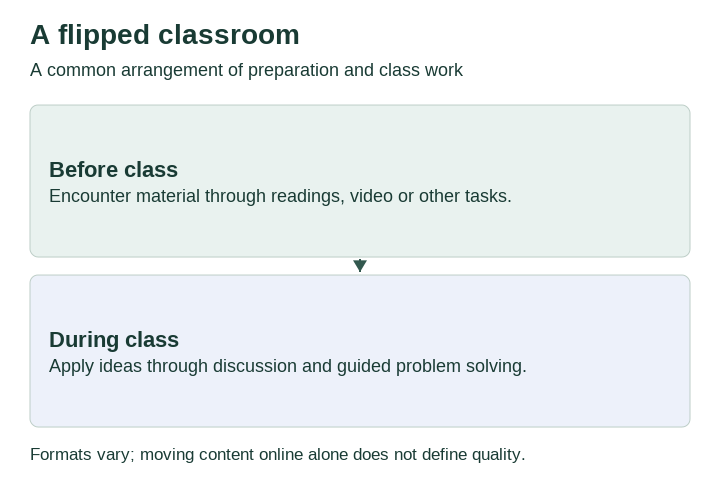
In one version of the method, students get the lesson material ahead of the class meeting, often online. They then come to the face-to-face session already prepared.[36] A brief definition reverses the usual order. Work normally done in class happens outside it, and work normally done outside happens in class.[34]
The face-to-face meeting is where the second half of the model runs. In class, the teacher guides activities that apply concepts. The teacher does not present the material for the first time.[4] In an English literature course, in-class sessions focus on discussions and interactive activities. Students meet the content first through video lectures or readings.[37]
The approach puts students in an active learning situation. It involves them in learning before class begins.[36] One online version, the Synchronous Online Flipped Learning Approach, sets out eight steps. They apply to both the live and the self-paced parts of teaching. Under that framework, students responded well to the group work and homework portions. They judged the live session effective for practising new content and for communication.[38]
The group was 100 third-year dental students. About 60% said the pre-class instructions were clear enough, and 20% gave a neutral response. About 40% agreed that the teaching schedule allowed enough time to prepare for the class. Another 20% strongly agreed, and 40% remained neutral.[36]
One proposed design for large college classes makes class discussion a project that students lead. It sets out four kinds of interaction. These are teacher and students planning together, interaction within groups, interaction between groups, and communication between teacher and students.[39] In a Bhutanese study of 83 students, the flipped arrangement freed an average of up to 13.29% of teaching hours. Students' learning was not affected.[35]
Research
How large are the learning gains
The widest review searched eight electronic reference databases. It combined 272 studies that compared flipped teaching with traditional, lecture-based teaching. That review found a small gain for the flipped classroom in learning. Hedges' g was 0.35, with a 95% confidence interval of 0.31 to 0.40.[40] A confidence interval is a range of values below and above an estimate that has a given probability of including the true value.[41]
The analysis then kept only studies with sufficient statistical power, meaning enough students to detect a real difference. The estimate fell to 0.24 (95% CI 0.18 to 0.31, k = 90). The review also reported that the effect on pass rates was small. The odds ratio was 1.55, with a 95% CI of 1.34 to 1.78 and k = 45. Publication bias likely influenced it.[40] Publication bias is a bias that arises when studies are published or not depending on the nature and direction of their results.[42]
A meta-analysis compared flipped courses with lecture-based courses in higher education.[6] A meta-analysis is a statistical method that combines the estimates from two or more similar studies into one overall estimate of an effect.[43] The set included four randomised controlled trials and 19 quasi-experimental studies. It also included 23 cohort studies.[6] A randomized controlled trial is a research procedure in which subjects are randomly assigned either to an experimental group that receives a treatment or to a control group that receives a different treatment or none, and the outcomes of the groups are compared.[44]
Flipped courses had much better exam scores and course grades. They did not score better on objective structured clinical examinations. The advantage did not appear in randomised controlled trials. It also did not appear in studies outside the USA. It was missing from nursing and other health science fields, and from papers published in 2013 and 2014. The risk of bias was high in 36 of 37 articles. The review urged caution because the studies differed from one another in statistical terms.[6]
A meta-analysis of 28 comparative studies looked at education for health professions. It found a significant overall effect. The effect favored flipped classrooms. The standardized mean difference was SMD = 0.33, 95% CI 0.21 to 0.46, p < 0.001. That review found no sign of publication bias. It covered medical students, residents, doctors and nurses. It also covered learners in fields such as dental and pharmacy education.[1]
A pharmacy meta-analysis included six studies in its qualitative synthesis. It included five studies in its quantitative synthesis. It found no significant difference in final exam scores. Flipped and lecture-based instruction scored the same. Two studies looked at final course score. Neither found a significant difference there.[45]
One meta-analysis covered 23 studies. They included 3,567 students from 14 countries. It found an effect size of d = 0.167 on academic performance. That is a positive but small effect (Q(23) = 78.226, p < .001).[46]
A meta-analysis looked at 13 Master's and doctoral theses from Turkey. It found a significant effect in favor of flipped learning. The result was unlikely to be due to chance. The theses covered science and mathematics education. The effect size was g = 1.223, p < .001, 95% CI 0.667 to 1.769. That review found a high level of variation between studies. It reported larger effects for university students and for flipped learning in small groups.[47]
A meta-analysis of 25 articles looked at secondary education. It confirmed that the flipped classroom works better than traditional instruction for achievement. It used 44 independent data sources and 2,323 participants. The effect was Cohen's d = 0.42, 95% CI 0.20 to 0.63, Z = 3.81, p < .001. Effects were stronger for STEM subjects than for foreign languages and humanities. Effects were larger in studies that ran for a shorter time than in longer ones. They were also larger when no quiz at home was required. Studies without a learning management system showed higher effects than studies that used one.[48]
One review of university studies found the gap between groups was statistically significant. Most studies found higher academic performance in the flipped group. That review also found signs of a possible bias in published articles. The bias favored the flipped classroom method.[49]
Engagement, motivation and self-regulation
Students in a Norwegian mathematics course reported higher engagement in the flipped semester than in the lecture semester. Twelve students were interviewed in depth during a two-semester course. Both semesters had a large amount of active learning. The students named seven features that helped them learn. These included commitment to peers and feeling safe. They also included the instructor relationship and using videos to learn new content. The emotional side of engagement stood out most. This happened when students reflected on their flipped learning.[50]
A Portuguese study of secondary school students took place during the COVID-19 pandemic. It found high behavioural engagement. This showed in task completion, peer interaction and participation. Thinking engagement was highest in sessions built around peer interaction and reflection with the teacher. Satisfaction was the strongest sign of emotional engagement.[51]
Self-regulation results are mixed. One study split 160 university students into a flipped group and a traditional group. The students studied health, engineering and science. At the end of the classes, the flipped group showed much higher self-regulation and social connectedness.[52]
A different study looked at 181 first-year physics students. It found no significant difference in self-regulation overall. This held for a flipped OpenCourseWare group and a distance-learning group. Within the six categories of self-regulation, however, the flipped group scored significantly higher on academic help-seeking, the habit of asking the right person for help.[53]
One analysis used activity records from an undergraduate computer engineering course. The records came from three runs of the course. The course had 1,134 students. It found clear time management tactics. Those tactics were significantly linked to academic performance. They were also linked to different personalised feedback messages.[54]
One common problem is that students skip the pre-class videos. Others watch them only just before class. This can lower achievement. One computer science experiment lasted 10 weeks and had 173 participants. Of these, 78 students used a quiz-based flipped model. The other 73 used a conventional flipped model. The quiz-based model improved learning achievement. It also improved behavioural engagement and agentic engagement.[55]
Adding game elements to class activities is another route to motivation. One experiment had 205 educational science students. Some used a quiz with points and a team leaderboard, while others used exercise sheets. The gamified version had a positive indirect effect on knowledge used for application. It worked through better performance during the learning process. It also raised intrinsic motivation and social relatedness. It had no clear effect on meeting the need for competence.[56]
A four-year study of 242 future teachers compared two courses. One was flipped, and the other was flipped with game elements. The gamified group showed a significant rise in positive attitudes toward learning. This was compared with the plain flipped group. Grades before the study predicted overall attitudes and emotions. Gender made no significant difference in that study.[57]
Use in health professions education
In this model, students study recorded lectures and readings before class. Class time goes to cases, group work and other interactive tasks.[58] A 2017 review said the approach was growing in popularity in health professional education. Instructors reported growing pains in justifying it and managing time. They also struggled to assess its effect on learning.[59] A 2022 review of reviews found most of the underlying studies came from China and the United States. It rated their methods as medium-low in quality.[60]
Support for learning content before class rose (p=0.01). After the course, 89.5% of students preferred the flipped format. Before it, 34.6% did. In that satellite course, final exam results did not differ much from the traditional version taught in 2011.[61]
An earlier pharmacy module covered renal pharmacotherapy. It paired video podcasts with guided inquiry cases. Students' final examination performance improved significantly. Researchers compared this with the previous year's traditional class.[62]
A 2023 meta-analysis combined 22 studies with 4379 participants. It found significantly better student performance with the flipped approach than with traditional lectures. The risk of bias was relatively high, though.[63]
A 2016 systematic review screened 21 titles and abstracts. It included nine studies. It found neutral or positive academic outcomes and mixed satisfaction. No study in the review looked at how the flipped classroom was put into practice.[64]
A 2022 review of 15 reviews covered 274 studies and 34,608 students. It found better results for performance (k = 122), competencies (k = 92) and satisfaction (k = 10).[60] A graduate nursing program has described a flipped design. It uses online lectures and articles based on evidence. It also uses in-class case scenarios and small group discussion.[58]
A 2020 review of the research selected 17 dental education studies. It found the flipped classroom raised student satisfaction in most of them.[65] An emergency medicine residency tried two flipped sessions. They combined videos watched on one's own with small group class time. Of 35 residents, 33 (94%, 95% CI 80%-99%) said the video lecture added to their knowledge. Also, 36 of 38 (95%, 95% CI 82%-99%) liked the format more than a traditional lecture. All 38 residents (100%, 95% CI 89%-100%) found the small group session effective. Residents chose ideal group sizes of 5.5 and 7. Teachers valued checking residents' understanding and giving feedback.[66]
Pre-class work can combine recorded lectures with article and textbook reading. Class time works best with group assignments, presentations, projects or topic discussion. The after-class stage includes course evaluation and self-study. It appeared in only two of the systematic reviews examined in 2022. The evidence overall remains uneven. Reviews call for studies that meet methodological quality standards before the case is settled.[60]
Languages, mathematics and other subjects
A 2020 systematic review looked at 43 articles on the flipped classroom in English language teaching. The method became popular among researchers after 2014. The number of studies rose quickly in 2016 and 2017. Speaking and writing were the language skills studied most often. Mixed and quantitative methods were the most common research designs. Most studies that tested the method reported benefits. The review also found problems in English as a foreign language classes.[67]
A 2023 meta-analysis combined 56 reports on language learning. These covered 61 separate samples and 4,220 participants. Flipped classes did better than traditional classes. The effect size was g = 0.99, with a 95% confidence interval from 0.81 to 1.17. The effect varied a great deal between studies, about 86%. A method for correcting publication bias shrank it to g = 0.58. The 95% confidence interval ran from 0.37 to 0.78. Some journals are not listed in the Social Sciences Citation Index. Reports in those journals tended to find larger effects. Indexed journals, conference proceedings and university theses found smaller effects. The effect did not seem to change with age. It rose with skill level: the higher the learners' level, the larger the effects.[68]
A state university in Turkey took part. There, 47 future English teachers answered an open-ended question. They viewed the flipped classroom positively as part of face-to-face courses. Their answers fell into four groups. These were learning at one's own pace, better preparation in advance, overcoming the limits of class time, and more participation in class.[69]
In another study, 48 sophomore English majors learned English idioms. They were in two required oral training classes. They did so through flipped teaching on a smartphone app and through conventional teaching. The flipped instruction raised motivation. It also clearly improved knowledge of idioms.[70] In the flipped group, the women improved more in self-efficacy than the men.[71]
A small college taught a second-year Organic Chemistry I course. Students watched video lectures as homework. They took a short online quiz before class. Class time went to fixing wrong ideas and applying concepts to problems. It also went to thinking beyond the given examples. Students understood more, and they seemed to do better on exams. They also said they felt more at ease with organic chemistry.[72]
In counselor education, a 2015 article proposed the flipped classroom as an effective approach. It used a case example to show how it could be applied. The article listed advantages and disadvantages. It gave advice for running or studying flipped classrooms.[73]
Reviews that pool many studies generally report better results for flipped classes than for traditional teaching.[74][75] A 2021 meta-analysis of 22 research papers found that flipped teaching raised students' internal motivation and their scores on knowledge tests.[74] A 2024 meta-analysis of 14 primary studies put the overall effect on learning at 0.826. That is a high effect size, with P < 0.001.[75] A 2021 systematic review of articles from 2017 to 2020 concluded that the method shifts teaching from a traditional process to an interactive one.[76]
In English, the pooled evidence is positive, and the meta-analysis reports differences by student major, language learning target, education level and region. English majors and students working on reading comprehension improved most. College learners gained more than high school students.[77]
A 2018 study looked at 56 students in preparatory classes at a Turkish university. After 6 weeks it found a medium effect on grammar learning and on attitudes.[78] A four-week trial took place in a secondary school in Hatay. The flipped group showed a significant gain from pre-test to post-test, and the control group showed none.[79]
In mathematics, one true experiment found better results for a flipped class than for direct instruction, while a quasi-experiment found no effect on students' independence in learning mathematics.[80][81] A quasi-experimental design is a kind of experiment that does not rely on randomly assigning participants to conditions.[82] A true experiment with middle school students at a state school found clearly different test results. The flipped class differed from a class taught directly.[81]
Smaller subject-specific studies report gains in chemistry, physical education and nursing.[83][84][85] A study looked at grade 10 chemistry students at two Vietnamese high schools. The flipped group scored higher on tests and showed more self-learning and engagement.[83] A 2024 study of university physical education at Hankou University reported better learning effectiveness, changed thinking patterns, and gains in social skills.[84]
A 2025 systematic review looked at undergraduate medical and allied health studies published between January 2019 and August 2024. Most reported improvements in performance, satisfaction and engagement. That review found the model worked especially well for clinical reasoning and for keeping knowledge. Some studies, however, showed variable outcomes. This depended on how well the model was carried out and how ready learners were.[86]
Results in specific courses and classrooms
Studies of single courses report a wide range of results, from clear gains to no difference at all.[3][87][88] A 2013 study at one graduate school compared a flipped and a traditional course. The subject was cardiovascular, respiratory and renal physiology. Both groups received the same notes and recorded lectures. The flipped students watched the recordings before class. On the same multiple-choice exams, the flipped group scored higher on the cardiovascular and respiratory sections. That fell short of the usual cutoff for statistical significance (P = 0.06).[3]
A randomized trial in nursing education found no such advantage. Eighty-two nursing students studying for a bachelor's degree took part. They were randomly assigned to a flipped or a traditional classroom. The two groups did not differ significantly on exam questions, quiz scores or course grades. The flipped approach was judged an effective strategy for nursing education.[87]
A veterinary course on professional skills produced a result in the other direction. The study compared 133 students who took the lecture-based version with 64 who took the flipped version. That is 197 in all. Students preferred the flipped format on many characteristics. Yet the traditional group scored higher on a written examination. It had 24 multiple-choice items, with a mean of 21.4 against 20.25.[88]
One explanation for mixed results is that the two formats may help different kinds of thinking. A 2017 study at the University of Utah School of Medicine looked at 28 anatomy items. The items were on a final examination. It sorted them by the level of thinking they required. The same 30 hours of anatomy content went to 101 first-year medical students as lectures in 2013. It went to 104 students in flipped format in 2014. Flipped students did better on items that asked them to analyze material, with a small effect size (r = 0.19). They showed no difference on items that tested knowledge or application.[89]
Naibaho and colleagues (2024) used a one-group pretest and posttest design with 22 fifth graders, and the average score rose from 55 to 81.182. Andiyani and colleagues (2025) ran four action research cycles with 21 students and reported rising scores in each cycle.[90][91] A Barcelona secondary school studied a flipped unit on functions in mathematics. The study looked closely at six classes in the first year of bachillerato. This is the Spanish upper secondary program.[92] A pre-experimental study in Indonesia tested 22 fifth graders. It used procedure text material with 25 multiple-choice questions.[90]
A classroom action research project had 21 students at an Indonesian primary school. Average English scores rose from 57 before the cycles to 79 by the fourth cycle. In that fourth cycle, 86% of students met the completion mark.[91] The unit was on the Pythagorean theorem, in an Italian middle school. It reported greater student approval and more firmly rooted learning. The comparison was with a traditional introduction.[93]
Thirty-four third-year students at Suez University took a listening comprehension test. They took it before and after a flipped unit. Their scores improved significantly (t = 11.341, p < 0.05).[94]
A quasi-experiment had 36 students in the first session and 35 in the next two. It found no significant difference in German grammar achievement or engagement between the flipped and traditional groups.[95] Yet they reported higher motivation, confidence and engagement.[96] Low-proficiency primary students in Malaysia scored higher on a post-test writing task and improved at constructing simple sentences. Separately, 23 tenth graders in Indonesia said the approach improved their speaking skills.[97][98]
What meta-analyses find across many studies
A 2023 review looked at 42 effect sizes from 31 studies on mathematics abilities. It reported a combined effect size of g = 1.05, with p < 0.01.[99] A 2024 review of 172 studies, published between 2010 and 2024, found a small-to-medium effect on academic achievement (g = 0.42). It found a medium effect on student engagement (g = 0.57).[100] For college students, a 2021 review of 20 experimental studies put the overall combined effect size at 0.66.[101]
A 2023 review of 15 studies on speaking ability found a combined effect size of g = 1.25, with p < 0.01. The review places this in the large effect category.[102] A 2025 review of 20 studies on English skills, published between 2019 and 2024, reported g = 0.80, with p < 0.05.[103] A 2024 review of nine studies with 705 participants found a standardized mean difference of 0.85. This was for overall English proficiency. It found 0.84 for knowledge and 0.70 for skills.[104]
A 2026 review looked at 11 effect sizes with 1,091 participants. It found a pooled effect of g = 0.82, with a 95% confidence interval from 0.59 to 1.05 and p < 0.001.[105] Another review, from 2026, covered 30 studies. These had 1,043 students in experimental groups and 970 in control groups. It reported a pooled effect size of 1.094.[106]
A 2024 review covered 42 effect sizes. They came from 31 articles and conference papers published between 2014 and 2024. It reported an overall effect size of 1.06.[107] A 2023 review of high school physics found an average effect size of 1.964 for critical thinking skills. It found 2.058 for learning outcomes.[108]
The 172-study review found stronger effects for behavioral engagement (g = 0.63) and cognitive engagement (g = 0.59). Emotional engagement was weaker (g = 0.48).[100] A 2025 review of 13 studies in physical education reported clear gains in intrinsic motivation, self-efficacy and learning satisfaction. The comparison was with traditional teaching.[109]
A 2025 review of seven studies on motivation in physics found a positive overall influence. The highest and the lowest effect sizes both appeared at the higher education level. That review calls its own result early and asks for more studies based on evidence.[110]
The size of the effect varies a great deal between studies. Reviews report this spread with a statistic called I-squared, given as a percentage.[105][104][111] The mathematics higher-order thinking review reported I-squared = 67.6%. It calls this moderate to substantial heterogeneity.[105]
A 2026 comparison of 16 studies found an I-squared of about 86% for flipped classroom studies. It found about 87% for gamification studies. That comparison reported a flipped classroom effect of g = 1.009, with a significant confidence interval. It reported a gamification effect of g = 0.437. The interval for this effect crossed zero.[111]
In the 172-study review, the effect size fell as education level rose. Primary education showed the strongest effects (g = 0.58).[100] The 2026 higher-order thinking review found education level to be a significant moderator. The 2023 mathematics review found no influence of educational level.[105][99]
The 2026 review of 30 studies found the effect held across educational levels. It also held across sample sizes, years of study and learning media.[106] The 2025 English skills review found differences by education level (Qb = 16.46; p < 0.05). It also found differences by class capacity (Qb = 26.14; p < 0.05).[103] The 2024 review of 172 studies also found that how long the method ran (r = 0.42) and how well it was carried out changed the results. High-quality versions showed much stronger effects.[100]
Evidence from controlled comparisons and reviews
A 2025 meta-analysis pooled 12 controlled trials in clinical medical education. Some were randomized and some were quasi-randomized. Flipped groups scored higher on theoretical scores (SMD = 0.481, 95% CI: 0.214 to 0.748). They also scored higher on composite scores (SMD = 0.642, 95% CI: 0.273 to 1.011). They also scored higher on skills scores (SMD = 0.660, 95% CI: 0.312 to 1.008). Student satisfaction showed no statistically significant difference between the two approaches. The result was SMD = −0.195, 95% CI: −1.081 to 0.691, p = 0.667. That review called for more randomized controlled trials across varied educational settings. The included studies had limitations.[112]
A meta-analysis covered 26 experimental and quasi-experimental studies of gamified flipped classrooms in higher education. It found pooled effects of g = 0.921 for academic achievement and g = 0.735 for motivation and engagement. Popa and Assante treated those figures with caution. The studies differed considerably from one another, and the cognitive results showed signs of small-study effects. Adding games to pre-class activities was linked to higher cognitive effects. The other moderators examined did not explain the variation.[113]
A meta-thematic analysis of 71 qualitative studies concluded that the model raises academic success by making learning more effective. It also raises learning motivation.[114] A systematic review of 15 studies published between 2012 and 2023 found flipped learning effective for mathematics achievement. It worked better than the conventional approach.[115] A meta-analysis of 25 primary school studies noted a shortage of research at that stage.[116]
One quasi-experimental study compared online, flipped and in-class instruction in critical thinking among university students. It also included a control group. All three forms of explicit instruction improved critical thinking skills and attitudes, with a large effect. The flipped setting gave the greatest gains, then online, then in-class.[117] A quasi-experimental study of 37 students in an English for Academic Purposes class reported a rise in critical reading scores. The pre-test mean was 12.4865 and the post-test mean was 18.3243.[118]
In practice
What students think of it
A meta-analysis combined 53 studies and 8,429 students. It compared satisfaction with flipped teaching and with traditional teaching. The flipped model had a weak to moderate positive effect on satisfaction with courses. The effect size was g = 0.36 across 50 studies. Satisfaction with instructors showed a similar effect. Across 26 studies, g was 0.40. Even a classroom that is only slightly flipped was linked to higher satisfaction. Traditional teaching scored lower.[119]
A review of medical students found they strongly valued preparing before class. This was especially true when the online tools were short and easy to reach. Those students also valued interactive small group work in class. They generally preferred the method to lecture-based teaching.[120]
Two undergraduate nutrition courses surveyed 142 students. Most of those who filled in an evaluation liked the flipped method more than traditional teaching.[121] At the University of Malaya, most students had positive views of flipped learning. They would recommend it for other courses and other students. Those students asked for videos that were shorter and more engaging. They also wanted videos set in a realistic setting.[122]
Students in a chemistry course in Nigeria were taught with the flipped strategy. Their average attitude score afterward was much higher than before. That study involved 100 second year Bachelor of Education students. It used a 30-item questionnaire about attitudes.[123]
What students value about the teacher changes when class time is repurposed. In one flipped course, students rated the instructor's role as moderator. They rated it above the role of information-deliverer. For those students, the most important part was more interaction. They also valued learning among students themselves.[124]
Students in a four-week flipped course named two good features. These were coming to class prepared and finishing assignments in class, so that no homework was needed. The same students sorted the problems they met into three groups: motivation, content and learning.[125]
A dental course covered the physiology of the autonomic nervous system. Students who favored the flipped classroom spent more time on the assignment. They also scored higher on the end-of-module quiz.[126] Medical students have raised concerns. Weak preparation before class can limit what the student-centered format delivers. So can too little direction during active sessions.[120]
Flipped learning was reported to help students who were shy or quiet. It also helped international students not fluent in English, and full-time students with more time to learn. Part-time students struggled. They lacked time to take part and to learn the content before class.[122] Students generally believe flipping improves their learning and knowledge. The review that reported this belief noted it has not been clearly shown on assessment tools.[120]
Design choices that change results
In one flipped course, fewer students watched the recorded lectures as the semester went on. Women and older students used the recordings more than other students. Watching the recorded material was linked to a higher final grade in the course. Students could watch more than once, at a convenient time. This freedom seemed to improve their understanding.[127] A trial at the Vrije Universiteit Amsterdam in the Netherlands combined personalized pre-class learning with peer-learning activities in class. That pairing helped students learn more deeply.[128]
Four colleges in Bangladesh took part in the study. First-year honors students in a flipped course did hands-on activities and assignments during class time. The number of students taking active part rose a lot. The study compared this with the traditional lecture-based approach. That trial used digital tools such as Kahoot and Padlet to support learning. The same intervention changed the teacher's role. Students changed from passive learners into active participants. Teachers became facilitators of learning.[129]
A physics course had 66 students. One class used the flipped model adapted to Keller's ARCS model. ARCS stands for Attention, Relevance, Confidence and Satisfaction. That class did better than the traditional lecture class. Its students also showed higher motivation and self-sufficiency.[130]
A trial in a Master's course at the Vrije Universiteit Amsterdam flipped half of the course. The other half stayed as traditional lectures. Students and the tutor gave positive feedback. But not all students agreed that the flipped classroom improved their learning outcomes. The researchers suggested those outcomes could differ. Students' general learning styles and preferences might change them. They called for further study.[128]
A qualitative, longitudinal study gathered 266 interviews over five years. It found that students rated the flipped model positively. A small group of students stayed very critical. They would have preferred a traditional method. That group was mainly put off by being unused to active methods. They were also put off by the learning effort such methods require.[131] The Amsterdam trial found that scaling the model up needs a lot of institutional support. It also needs assessments that can change.[128]
Problems in schools and inclusive settings
Student attitudes in those studies were mixed. Some classes responded well and others less so. From these findings, the reviewers proposed a basic flipped classroom model. They also gave 10 guidelines for handling the challenges.[132]
The early research that exists suggests flipping a classroom can help these students. The article lists some possible benefits. They include more student motivation, differentiated instruction, self-paced lessons, mastery learning, more collaboration, and instant feedback for formative assessment.[133]
A first-year subject on science and sustainability was studied. The students were pre-service teachers, and the method was a multi-method case study. It surveyed students at the end of the semester and recorded the teachers' own reflections. Opinions were divided, however. Students did not agree on whether they preferred a flipped classroom over traditional lectures. On that evidence the team proposed a flipped learning continuum. It has different levels of student-centred learning and autonomy. These are matched to students' learning needs and their readiness for the approach. Some teacher-led instruction may be appropriate inside a flipped classroom. This is especially true for first-year students. It can help students move into higher education.[134]
A 2024 study at the Abai Kazakh National Pedagogical University examined e-learning and flipped classroom use in inclusive education. It used a set questionnaire in Google Forms. Only 34% of the first- and second-year students surveyed wanted to use the flipped classroom at the university. Of the respondents, 66% rated the level as low. The study read this result as a sign of too little attention to modern teaching methods. It could also mean teachers know little about the method. Or they may not want to introduce it. The researchers replied with a training programme centred on students. It combines e-learning principles with flipped classroom technology. It aims at inclusive education. It also aims to raise motivation and academic performance.[135]
A 2018 experiment in Pakistan defined the flipped classroom as video-recorded lectures and podcasts. Students played them back on a computer or portable device. This supports self-developed learning. Prospective teachers were assigned to a flipped group or a non-flipped group. The assignment used paired random sampling based on pretest scores. The non-flipped group was taught by lecture demonstration. After six academic weeks, the two groups differed much in performance. The difference favored the flipped classroom. The study recommended that flipped classroom work become part of professional development courses in Pakistan.[136]
How teachers prepare and run a flipped lesson
In the flipped model, lectures move out of class. They become digital assignments. This frees class time for debate and practice exercises.[137] One design guide is for a foreign language lesson. It sets out a six-part conceptual map for planning a flipped lesson.[138]
Teachers planning a flipped unit also have to weigh the technical side. They must build material for independent study. The teaching questions are not the only issue.[139] A 2014 account describes flipping an undergraduate nursing course. It gives practical strategies for changing how students learn. It also gives the lessons the instructors learned.[140]
The pre-class work is usually a first meeting with new content. It can be passive, such as watching recorded lectures. This was a pathology course in an undergraduate medical programme. Teachers instead built online pre-work aimed at gaining and applying knowledge. Student responses showed that some of these activities helped learning. Others got in the way of it.[139]
Teachers posted instructions and materials on Google Classroom. They then held class discussion over Zoom. That setup ran into problems with internet connection. It also had limited non-verbal responses.[141] Teachers who use the model seem more willing than non-users to make free and open educational resources. They also appear more willing to share them.[142]
In the Bali university, teachers used the online classroom to post instructions and materials as comments. Every student could reach them. The teacher's role shifts once class begins. In the Bali course the teacher acted mainly as a facilitator during the discussion.[141]
In 2021, researchers used the Analytic Hierarchy Process to compare flipped teaching with conventional cognitive learning in Iraqi secondary schools. The comparison weighed teaching techniques, flexibility of learning, how effective the teaching aids were, student participation, and the working environment. Students and teachers in that study favored flipped classroom learning over the conventional approach. The same study concluded that teachers in Iraqi schools would need more preparation. They would need it to shift toward flipped learning.[137]
A methodological proposal built on the flipped model used a structured approach called ClassFlip. It was used with tenth-grade students at a school in Guayaquil. The sample was 18 students. The approach was reported to strengthen students' digital skills. It was also reported to promote independent, collaborative, student-centered learning.[143]
Teachers in that development study said the model was effective, interesting and easy to use.[144] The University of Aconcagua in Chile serves adult evening students in technical careers. Its teachers were encouraged to combine virtual environments with active teaching methods.[145]
What happens in class after the video
In a flipped classroom, students watch the recorded lesson before class. The class meeting itself is used for student-centered learning activities. In these, students work with the material rather than listen to it. The redesigners named problem-based learning and inquiry-oriented strategies. These are examples of what fills the class hour.[146] A ninth grade health education class used the same shift, turning a teacher-centered room into a student-centered one.[147]
A randomised experiment compared two versions of a flipped course with a traditional lecture course. In the first version, students moved through the course at their own pace. Cooperative learning was not actively encouraged. Under that self-paced version, examination scores came out the same. This held for the lecture classes and the flipped class. In that second version, the flipped group scored much higher than the lecture control group.[148]
A chemistry class paired flipped preparation with collaborative problem solving. This method links new knowledge to earlier knowledge through good teamwork in class. The 36 eleventh-grade students prepared at home with mobile learning materials on chemical equilibrium. These included worked examples, practice problems and a practical activity. In class they formed discussion groups to answer a worksheet together. They made posters on equilibrium in daily life. They ran experiments with equipment they designed themselves. The researchers reported that this setup kept students active in the lesson.[149]
A pre-experiment with 21 third-grade students combined flipped preparation with project-based learning. The tasks drew on science, technology, engineering and mathematics. Creativity scores rose by a gain score of 0.42. Problem-solving scores rose by a gain score of 0.49. Both gains were in the moderate range.[150]
A survey asked 61 Form Four students in a history course about a flipped classroom peer instruction model. It measured how much they accepted it. Acceptance was high overall. Students with higher grades reported higher acceptance than students with lower grades. The difference in mean acceptance scores by achievement level was not significant.[151]
In the randomised experiment, flipping without cooperative learning gave no exam advantage over lectures.[148] The chemistry and elementary school studies were small, with 36 and 21 students. The second used a single group tested before and after.[149][150] The peer instruction survey also used 61 students in one subject.[151]
What students report and what frustrates them
The course was nursing administration and management. There, 92% of students said they were satisfied with the teaching method, and 92.9% with the assessment. Only 31.5 % of those nursing students had used the method before. But 83 % wanted it used in more subjects.[85]
A teaching innovation took place at the University of Seville in the 2019-2020 academic year. It involved 136 physical activity and sport sciences students and found high satisfaction in different areas.[152] The students were in their final year of medical school. More than 60% of those who attended flipped classes agreed they would use the same method in future. More than 75% of those medical students agreed the reading materials were useful.[153]
A review argues that the format can raise students' engagement and the interaction between teacher and learners in translation classes. A quasi-experiment with 65 science students in Saudi Arabia found higher learning emotions scores in the flipped group than in the traditional group.[154][155] That flipped group also raised its mean score for learning emotions during the study.[155] The nursing students reported that the method improved their opinion of the content. They also said they found it more useful.[85]
One engineering mathematics course with 118 students used two surveys, with open-ended and closed-ended questions. The surveys explored possible reasons why a flipped classroom can frustrate students. They valued the flexibility, freedom and independence the method gave them. Others said they struggled to adjust their study habits to the format. Group work divided opinion. The paper discussed these experiences using self-determination theory. It also used self-regulated learning theory.[156]
Views also differ between stronger and weaker students in the same course. A survey of an introduction to management course found several big differences in how students saw the flipped model. The gap was between students with grades A to C and students with grades D to F.[157] A study of 49 second-year pre-service teachers found a range of experiences. The challenges pointed mainly to the approach itself and to the technology package.[158] Good communication and responsibility within teams predicted higher self-efficacy and better attitudes.[159]
Conditions that decide whether it works
For the inverted classroom format to work well, students should come to class meetings well prepared. They should have thought about the assigned content and materials. Reading logs, sometimes called learning assessment journals, are notebooks. Guiding questions in them push students to think carefully about the new material before class. These logs were tested in several courses. Combined with just-in-time teaching, they led to clearly more effective use of face-to-face time. An evaluation in two physics teacher education courses found students were clearly more motivated and satisfied. This was despite the supposedly extra work.[160]
In a bachelor course in Philosophy of Science, compulsory flipped workgroups sat at the core. Online knowledge videos and optional joint classes served as preparation. Students did not find the joint classes very stimulating, and they did not see positive learning effects from them. Most preferred to prepare for the workgroups on their own. Learning activities and outcomes still differed a lot between those who attended the joint classes and those who did not.[161]
Instructors have to balance structure against flexibility. Early career students have a limited capacity to manage their own learning. The recommendation is to design assignments and assessment so that students must take part in scaffolding activities. This applies even when those activities are not compulsory.[161]
Accountability alone may not protect learning when class time shrinks. In seven sections of a microeconomics course, all with the same instructor, students watched preclass video lectures. They took daily quizzes and used highly interactive class time. In three of the seven sections, face-to-face time was cut by one-third. Students in the reduced-time format were still responsible for work done outside class. Even so, they scored 4.4% points lower on the cumulative final exam. Student ratings of the course and instructor did not change in a statistically meaningful way.[162]
Two hundred and eighty-nine Brazilian federal university students rated the usability of an online English course. The course was used in the inverted classroom format. Users with more experience were more sensitive to parts of human-computer interaction. These were flexibility, user experience, informational density and feedback. Speaking and writing were the skills hardest to develop in that course.[163]
A review of 25 systematic reviews published between 2000 and 2024 found wide variation in flipped classroom designs. Reporting was also inconsistent, which limited comparison of effect sizes across studies. That review also found a fragmented theoretical basis. It found uneven attention to what students do after class.[164] A study of the flipped classroom in the English as a foreign language classroom found little research supporting its use there.[165] A theoretical study of Czech higher education concluded that effective use in universities depends on context.[166]
Students must complete tasks with materials outside class, so the model depends on their readiness to work on their own.[167] A review of the literature concluded that effective flipped environments depend on careful attention to the warnings and recommendations found in research.[168] A later review of medical teaching reached a similar conclusion, that carefully weighing the cautions and suggestions in the literature may help create successful flipped classrooms.[169]
Evidence on student autonomy is mixed, not all positive. A systematic review collected 38 studies with 2420 students. It found that studies with stronger research designs reported mixed outcomes. That review also noted a scarcity of longitudinal designs with randomized control groups. It found few studies outside universities, and small numbers of participants.[170] Khosa and Burch reported that the approach supported students' need for relatedness. It did so by creating more chances to interact in class.[171]
What this looks like when you study
In a public health course, students watched online content before class and used class time for active learning. Their mean examination score was 88.8%, against 86.4% for an earlier lecture-based year. Those students gave the course a mean overall rating of 4.7 out of 5, against 3.7 to 4.3 in earlier years.[172]
In a physiology course for first-year graduate students, students watched recorded lectures before class. In class they took a quiz or homework worth 25% of the final grade, then worked through problems. Those flipped students scored more than 12 percentage points higher on the cardiovascular and respiratory sections and on the weighted cumulative score. On the renal section they scored about 11 points higher (P = 0.06).[3]
In a randomised experiment, one flipped version let students work at their own pace and produced examination scores no different from lectures. A second flipped version organised cooperative learning activities, and there the post-test and final examination scores were significantly higher than for the lecture group.[148] In an ophthalmology clerkship, 48 fourth-year medical students watched a recorded lecture and read materials before a discussion class, while 47 attended a traditional lecture and did homework afterwards.[173]
In a first-year engineering mathematics course with 118 students, most were satisfied and valued the flexibility, but others struggled to change their study habits or to find motivation to watch the videos. Some of those students were irritated when group members arrived unprepared for group assignments.[156] In a first-year science and sustainability course, the average video was viewed 2.1 to 2.5 times, and about 80% of respondents watched before class. Nearly half of the students who skipped videos said they did not have enough time.[134]
Before class, read or watch the assigned material and answer guiding questions about it in a log, as students did with reading logs in two physics teacher education courses.[160] Check your understanding with the quiz or homework attached to the pre-class material, as students did in the physiology course.[3] Come to class ready to apply the material in group work, and tell your group in advance if you cannot prepare, because unprepared members frustrated classmates in the engineering mathematics course.[156]
Later developments
Open questions and future research
A 2016 study looked at 240 university students in a research methods course. It measured attitudes toward the model, toward video as a learning tool, and toward a course management system used to support it. That study called research on flipped classrooms in higher education a field in its infancy. Little is known about how students perceive learning through the model.[174]
A 2017 study of undergraduate primary education students used a mixed-method design. It had a post-test on attitudes toward instructional materials. It also had a focus group interview. That study argued the model creates a new learning setting built on technology. It therefore needs its own separate research.[175]
A 2014 public health course compared exam scores of flipped students. It used scores from earlier years taught by lecture. It also surveyed students before and after the course. The flipped students got similar examination scores. They also rated their course experience more highly. The report called the results promising. That report recommended more thought and research on the approach. It did not treat the comparison as settled.[172]
A 2016 pilot took place in two early childhood education classes at a Spanish university. It found very high student satisfaction. Even so, students still saw the teacher in class as absolutely necessary.[176] A 2026 paper on foreign language teaching lists four key parts. They are a flexible learning environment, a culture of independent knowledge acquisition, intentional presentation of content, and professional pedagogical support. That paper argues these parts support students' independence, activity and responsibility.[177]
Criticism
Gains compared with active learning alone
The effect sizes varied in direction and size. Their 95% confidence interval included zero. That pattern suggested a lack of strong evidence. Flipping may not improve knowledge gains beyond traditional teaching methods. The review described the flip as a promising way to raise motivation and engagement. It called for stronger evidence on changes in knowledge and skills.[5]
A later critical appraisal in emergency medicine reviewed the medical education literature on the flipped classroom. It found 296 papers. It included 54 in its final review. Of these, 33 were quantitative, 4 qualitative and 17 review papers.[178]
One study looked at a flipped course for basic medical sciences students. It looked at how students adjusted to the format. Most students did their prework in a single sitting shortly before class. Students said they did other tasks less often in the flipped classroom than in lecture courses. Students valued chances to interact with peers and with instructors. They also valued having several ways to be assessed. The study suggested that flipping could bring greater educational gains. Earlier studies reported only small gains in grades. In this course, students said they learned to study on their own. They spent more time on task and used deep and active learning.[179]
Weaknesses of the evidence
That trial also gave pre-tests and post-tests. The flipped group did better on the post-test questions about ocular trauma. More students in the flipped group agreed the classroom helped raise their motivation to learn. They also agreed it improved their understanding of the course materials. Yet students in that group did not prefer the method. They reported more burden and pressure than the lecture group.[173]
A randomized trial used 181 junior-year medical undergraduates. A self-filled questionnaire measured attitudes. It also measured total learning time and study conditions. Its outcome test asked students to analyze 20 electrocardiograms. These came from real clinical cases. Students then handed in reports.[180]
A calculus study based its comparison on three measures. They were a Calculus Baseline Test given as pre-test and post-test, a survey of student engagement, and final exam achievement. It found a normalized gain 13% higher in the flipped group. The failure rate also fell a lot.[181]
A nursing study compared three approaches to learning. One was traditional lecture only. One was lecture with lecture capture back-up. One was flipped classroom with new classroom activities. Students were less happy with the flipped method than with either other method.[182]
The 2016 analysis listed problems in the field as ideas for future research. It named two problems to fix: poor quality video lectures and untrained instructors.[183] The ophthalmology trial concluded that more evaluation and changes are needed. Until then, the approach cannot be widely accepted and used.[173] The electrocardiogram trial called flipped teaching an effective model. It said the model needs more study and should be promoted.[180]
Common misconceptions
Flipped courses often add new learning activities at the same time as they move content out of class, which makes it hard to tell what causes any gain.[7] A randomised experiment found that a flipped version without encouraged cooperative learning produced examination scores no different from lectures, while a version with cooperative learning did better.[148]
Key studies
| Year | Study | Sample | Design | Finding |
|---|---|---|---|---|
| 2013 | Tune et al.[3] | first-year graduate students in physiology | students in both courses took the same multiple-choice exams | Flipped students scored more than 12 percentage points higher on several sections, and the authors credited homework and in-class quizzes. |
| 2013 | Missildine et al.[182] | Quasi-experimental study comparing three approaches in nursing education. | The flipped group had higher examination scores (M = 81.89) than lecture-only (M = 79.79), but students were less satisfied with the flipped method. | |
| 2016 | Foldnes[148] | Norwegian higher education students in a randomised experiment | randomised control-group pretest-posttest experiment | A flipped classroom with cooperative learning raised post-test and final examination scores, while one without cooperative learning did not differ from lectures. |
| 2016 | Nouri[174] | Questionnaire study of 240 university students in a research methods course. | A large majority had a positive attitude toward flipped classrooms, and low achievers reported more positive views than high achievers. | |
| 2017 | Tang et al.[173] | randomised comparison of flipped and traditional instruction | The flipped group scored better on the post-test but reported more burden and pressure and did not prefer the method. | |
| 2018 | HEW & LO[1] | 28 comparative studies in health professions education | meta-analysis of between-subject studies | Flipped classrooms beat traditional classrooms with a standardized mean difference of 0.33, and quizzes at the start of class made the approach more effective. |
| 2018 | Chen et al.[6] | meta-analysis of controlled trials | Flipped classrooms had significantly better examination scores and course grades than lectures, but not better clinical examination scores, and the advantage was not seen in randomised trials. | |
| 2019 | Låg & Sæle[40] | systematic review and meta-analysis | The effect on learning was small, Hedges' g = 0.35, and fell to 0.24 when only studies with sufficient power were analysed. | |
| 2020 | Strelan et al.[119] | 8429 students in 53 studies | meta-analysis of student satisfaction | The flipped classroom had a weak to moderate positive effect on satisfaction with courses, g = 0.36, and with instructors, g = 0.40. |
| 2021 | Wagner et al.[48] | meta-analysis | Flipped classrooms raised achievement with Cohen's d = 0.42, with stronger effects in STEM subjects and in shorter studies. | |
| 2023 | Vitta & Al-Hoorie[68] | 4220 participants in 61 samples of language learners | meta-analysis | Flipped classrooms outperformed traditional ones with g = 0.99, which shrank to 0.58 after a publication-bias correction. |
| 2024 | Bintz et al.[7] | 306 and 413 psychology students in two studies | two studies comparing flipped and non-flipped lecture series | Simply moving new content to out-of-class recordings improved knowledge acquisition, knowledge application and metacognitive monitoring. |
| 2024 | Samaila & Al-Samarraie[55] | 10-week experiment with experimental and control groups | Embedding quiz questions in pre-class videos improved learning achievement and engagement compared with a conventional flipped classroom. | |
| 2026 | Hukom & Khassim[105] | 1091 participants in 11 effect sizes | meta-analysis of experimental and quasi-experimental studies | The flipped classroom had a large effect on mathematical higher order thinking skills, g = 0.82. |
See also
References
- HEW, K. F., & LO, C. K. (2018). Flipped classroom improves student learning in health professions education: a meta-analysis. BMC Medical Education, 18(1). doi:10.1186/s12909-018-1144-z
- Abeysekera, L., & Dawson, P. (2015). Motivation and cognitive load in the flipped classroom: definition, rationale and a call for research. Higher Education Research & Development, 34(1), 1-14. doi:10.1080/07294360.2014.934336
- Tune, J. D., Sturek, M., & Basile, D. P. (2013). Flipped classroom model improves graduate student performance in cardiovascular, respiratory, and renal physiology. Advances in Physiology Education, 37(4), 316-320. doi:10.1152/advan.00091.2013
- Jensen, J. L., Kummer, T. A., & Godoy, P. D. d. M. (2015). Improvements from a Flipped Classroom May Simply Be the Fruits of Active Learning. CBE—Life Sciences Education, 14(1), ar5. doi:10.1187/cbe.14-08-0129
- Chen, F., Lui, A. M., & Martinelli, S. M. (2017). A systematic review of the effectiveness of flipped classrooms in medical education. Medical Education, 51(6), 585-597. doi:10.1111/medu.13272
- Chen, K., Monrouxe, L., Lu, Y., Jenq, C., Chang, Y., Chang, Y., & Chai, P. Y. (2018). Academic outcomes of flipped classroom learning: a meta‐analysis. Medical Education, 52(9), 910-924. doi:10.1111/medu.13616
- Bintz, G., Barenberg, J., & Dutke, S. (2024). Components of the flipped classroom in higher education: disentangling flipping and enrichment. Frontiers in Education, 9. doi:10.3389/feduc.2024.1412683
- Mohan, D. (2018). Flipped Classroom, Flipped Teaching and Flipped Learning in the Foreign/Second Language Post–Secondary Classroom. Nouvelle Revue Synergies Canada(11). doi:10.21083/nrsc.v0i11.4016
- Ağırman, N., & Ercoşkun, M. H. (2022). History of the Flipped Classroom Model and Uses of the Flipped Classroom Concept. Uluslararası Eğitim Programları ve Öğretim Çalışmaları Dergisi, 12(1), 71-88. doi:10.31704/ijocis.2022.004
- Chua, J. S. M., & Lateef, F. A. (2014). The Flipped Classroom: Viewpoints in Asian Universities. Education in Medicine Journal, 6(4). doi:10.5959/eimj.v6i4.316
- Roehl, A., Reddy, S. L., & Shannon, G. J. (2013). The Flipped Classroom: An Opportunity To Engage Millennial Students Through Active Learning Strategies. Journal of Family & Consumer Sciences, 105(2), 44-49. doi:10.14307/jfcs105.2.12
- Lundin, M., Bergviken Rensfeldt, A., Hillman, T., Lantz-Andersson, A., & Peterson, L. (2018). Higher education dominance and siloed knowledge: a systematic review of flipped classroom research. International Journal of Educational Technology in Higher Education, 15(1). doi:10.1186/s41239-018-0101-6
- Chandhrasekhar. M (2025). Challenges and Opportunities : Flipped Classroom for the present day Students. Journal of Advances in General, Technical and Engineering Education, 01(01). doi:10.64164/jagtee250101005
- Ozdamli, F., & Asiksoy, G. (2016). Flipped Classroom Approach. World Journal on Educational Technology: Current Issues, 8(2), 98-105. doi:10.18844/wjet.v8i2.640
- Deng, F. (2019). Literature Review of the Flipped Classroom. Theory and Practice in Language Studies, 9(10), 1350. doi:10.17507/tpls.0910.14
- García Jiménez, E., & Sánchez López, B. (2025). Flipped classroom en Educación Superior: una experiencia enriquecedora en Sociología de la Educación. REDU. Revista de Docencia Universitaria, 23(2), 74-90. doi:10.4995/redu.2025.23588
- Yang, H. (2020). A Reflection on a Trio of Dimensions in Flipped Classroom in Higher Education—A Literature-Based Study. Learning & Education, 9(2), 73. doi:10.18282/l-e.v9i2.1405
- Zuber, W. J. (2016). The flipped classroom, a review of the literature. Industrial and Commercial Training, 48(2), 97-103. doi:10.1108/ict-05-2015-0039
- Gross, D., Pietri, E. S., Anderson, G., Moyano-Camihort, K., & Graham, M. J. (2015). Increased Preclass Preparation Underlies Student Outcome Improvement in the Flipped Classroom. CBE—Life Sciences Education, 14(4), ar36. doi:10.1187/cbe.15-02-0040
- Oudbier, J., Spaai, G., Timmermans, K., & Boerboom, T. (2022). Enhancing the effectiveness of flipped classroom in health science education: a state-of-the-art review. BMC Medical Education, 22(1). doi:10.1186/s12909-021-03052-5
- Love, B., Hodge, A., Corritore, C., & Ernst, D. C. (2015). Inquiry-Based Learning and the Flipped Classroom Model. PRIMUS, 25(8), 745-762. doi:10.1080/10511970.2015.1046005
- Zainuddin, Z., & Perera, C. J. (2017). Exploring students’ competence, autonomy and relatedness in the flipped classroom pedagogical model. Journal of Further and Higher Education, 1-12. doi:10.1080/0309877x.2017.1356916
- Erbil, D. G. (2020). A Review of Flipped Classroom and Cooperative Learning Method Within the Context of Vygotsky Theory. Frontiers in Psychology, 11. doi:10.3389/fpsyg.2020.01157
- Jensen, J. L., Holt, E. A., Sowards, J. B., Heath Ogden, T., & West, R. E. (2018). Investigating Strategies for Pre-Class Content Learning in a Flipped Classroom. Journal of Science Education and Technology, 27(6), 523-535. doi:10.1007/s10956-018-9740-6
- Gnutova, I. I. (2020). From Flipped Classroom to Flipped Learning: Evolution of the Concept and Its Philosophical Foundations. Vysshee Obrazovanie v Rossii = Higher Education in Russia, 29(3), 86-95. doi:10.31992/0869-3617-2020-29-3-86-95
- Colomo Magaña, A., Colomo Magaña, E., Guillén-Gámez, F. D., & Cívico Ariza, A. (2022). Analysis of Prospective Teachers’ Perceptions of the Flipped Classroom as a Classroom Methodology. Societies, 12(4), 98. doi:10.3390/soc12040098
- Mahat, H., Saiful Bahri, S. A., Hashim, M., Nayan, N., & Saleh, Y. (2021). Knowledge, Readiness and Use of Flipped Classroom among Education Geography Student / Pengetahuan, Kesediaan dan Penggunaan Flipped Classroom Dalam Kalangan Pelajar Pendidikan Geografi UPSI. Sains Humanika, 13(2). doi:10.11113/sh.v13n2.1723
- Carotenuto, G., & Sbaragli, S. (2018). Flipped classroom per la formazione insegnanti: una ricerca sulla percezione degli studenti. Didattica della matematica. Dalla ricerca alle pratiche d’aula(3), 7-34. doi:10.33683/ddm.18.3.1
- kizi, T. H. Z. (2026). Flipped Classroom Technology as A Tool for Developing Future Teachers’ Professional Competencies. European International Journal of Pedagogics, 06(05), 315-318. doi:10.55640/eijp-06-05-67
- Baig, M. I., & Yadegaridehkordi, E. (2023). Flipped classroom in higher education: a systematic literature review and research challenges. International Journal of Educational Technology in Higher Education, 20(1). doi:10.1186/s41239-023-00430-5
- Tipula Quispe, N. (2024). Implementación y efectos del Flipped Classroom en el proceso educativo: una revisión integral. Sapiens EduTech Journal, 2(1), 1-16. doi:10.71068/fe7gk942
- Palomino Malca, J. (2026). Flipped Classroom Pedagogical Model: A Systematic Review in Higher Education. Minerva, 7(20), 132-141. doi:10.47460/minerva.v7i20.328
- Jalolova, S. (2026). Application of flipped classroom technology in higher education. Journal of Universal Science Research, 4(4), 125-133. doi:10.66301/jusr/vol4_iss4/art13
- Uluçınar Sağır, Ş., & Sakar, D. (2017). Flipped classroom model in education. International Journal of Social Sciences and Education Research, 3(5 S), 1904-1916. doi:10.24289/ijsser.348068
- Jurmey, P., Lham, T., Lhaden, K., Pema, T., & Rai, B. B. (2022). Flipped Classroom: Prospect in Freeing up Classroom Instructional Hours and Students’ Attitude Towards Flipped Classroom Strategy. Educational Innovation and Practice, 5, 1-16. doi:10.17102/5.1.eip.2022
- Kumar, S., & Usmani, A. (2022). Effectiveness of Flipped Classroom On 3rd Year Students of Oral Medicine Subject to Achieve the Learning Outcome: Flipped Classroom On 3rd Year Students of Oral Medicine. Pakistan Journal of Health Sciences, 103-107. doi:10.54393/pjhs.v3i07.397
- PhD student, Samarkand state university named after Sharof Rashidov, Uzbekistan, & Ibodullayevna, A. S. (2025). Flipped Classroom Model and Cultural Approach: Modern Teaching Strategies for English Literature. International Journal of Pedagogics, 5(1), 128-131. doi:10.37547/ijp/volume05issue01-36
- Havránková, T. (2023). Synchronous Online Flipped Learning Approach (SOFLA): The Flipped Classroom in On-Line Teaching of English Language in College. ACC JOURNAL, 29(3), 16-26. doi:10.2478/acc-2023-0011
- Fang, N., & Cui, J. (2024). A Proposed Flipped Project-Based Flipped Classroom for Teaching in College Large Classes. International Journal of Learning and Teaching, 576-581. doi:10.18178/ijlt.10.5.576-581
- Låg, T., & Sæle, R. G. (2019). Does the Flipped Classroom Improve Student Learning and Satisfaction? A Systematic Review and Meta-Analysis. AERA Open, 5(3). doi:10.1177/2332858419870489
- HTA Glossary (health technology assessment) (n.d.). confidence interval (CI). HTA Glossary (health technology assessment). https://htaglossary.net/confidence-interval-%28CI%29
- HTA Glossary (health technology assessment) (n.d.). publication bias. HTA Glossary (health technology assessment). https://htaglossary.net/publication-bias
- GET-IT Glossary (plain-language health research terms) (n.d.). meta-analysis. GET-IT Glossary (plain-language health research terms). https://getitglossary.org/term/meta-analysis
- ERIC Thesaurus (n.d.). Randomized Controlled Trials. ERIC Thesaurus. https://eric.ed.gov/?ti=Randomized+Controlled+Trials
- Gillette, C., Rudolph, M., Kimble, C., Rockich-Winston, N., Smith, L., & Broedel-Zaugg, K. (2018). A Meta-Analysis of Outcomes Comparing Flipped Classroom and Lecture. American Journal of Pharmaceutical Education, 82(5), 6898. doi:10.5688/ajpe6898
- Kus, M. (2025). Effectiveness of the Flipped Classroom Model in Higher Education: A Meta Analysis Study. Journal of Computer and Education Research, 13(25), 628-653. doi:10.18009/jcer.1625784
- ÖZDEMİR, A. (2021). The Effect Of Flipped Classroom Model On Students' Academic Achievement In Science And Mathematics Education: A Meta-Analysis Study. i-manager's Journal of Educational Technology. doi:10.26634/jet.18.3.18071
- Wagner, M., Gegenfurtner, A., & Urhahne, D. (2021). Effectiveness of the Flipped Classroom on Student Achievement in Secondary Education: A Meta-Analysis. Zeitschrift für Pädagogische Psychologie, 35(1), 11-31. doi:10.1024/1010-0652/a000274
- Sola Martínez, T., Aznar Díaz, I., Romero Rodríguez, J. M., & Rodríguez-García, A. M. (2018). Eficacia del Método Flipped Classroom en la Universidad: Meta-Análisis de la Producción Científica de Impacto. REICE. Revista Iberoamericana sobre Calidad, Eficacia y Cambio en Educación, 17(1). doi:10.15366/reice2019.17.1.002
- Steen-Utheim, A. T., & Foldnes, N. (2018). A qualitative investigation of student engagement in a flipped classroom. Teaching in Higher Education, 23(3), 307-324. doi:10.1080/13562517.2017.1379481
- Ribeirinha, T., & Silva, B. (2024). O envolvimento do aluno no modelo Flipped Classroom implementado na aprendizagem online. Revista Latinoamericana de Tecnología Educativa - RELATEC, 23(1), 43-59. doi:10.17398/1695-288x.23.1.43
- Dr., Self-Development Department, Imam Abdulrahman Bin Faisal University, Saudi Arabia, mtmustafa@iau.edu.sa, & Jdaitawi, M. (2019). The Effect of Flipped Classroom Strategy on Students Learning Outcomes. International Journal of Instruction, 12(3), 665-680. doi:10.29333/iji.2019.12340a
- Sun, J. C., Wu, Y., & Lee, W. (2017). The effect of the flipped classroom approach to OpenCourseWare instruction on students’ self‐regulation. British Journal of Educational Technology, 48(3), 713-729. doi:10.1111/bjet.12444
- Ahmad Uzir, N., Gašević, D., Matcha, W., Jovanović, J., & Pardo, A. (2020). Analytics of time management strategies in a flipped classroom. Journal of Computer Assisted Learning, 36(1), 70-88. doi:10.1111/jcal.12392
- Samaila, K., & Al-Samarraie, H. (2024). Reinventing teaching pedagogy: the benefits of quiz-enhanced flipped classroom model on students' learning outcomes and engagement. Journal of Applied Research in Higher Education, 16(4), 1214-1227. doi:10.1108/jarhe-04-2023-0173
- Sailer, M., & Sailer, M. (2021). Gamification of in‐class activities in flipped classroom lectures. British Journal of Educational Technology, 52(1), 75-90. doi:10.1111/bjet.12948
- Jeong, J. S., & González-Gómez, D. (2026). Examining the impact of flipped classroom learning (FCL) and gamified-flipped classroom learning (G-FCL) on students’ attitudes and emotions toward learning in a university course. Active Learning in Higher Education, 27(3), 389-406. doi:10.1177/14697874251347184
- Critz, C. M., & Knight, D. (2013). Using the Flipped Classroom in Graduate Nursing Education. Nurse Educator, 38(5), 210-213. doi:10.1097/nne.0b013e3182a0e56a
- Persky, A. M., & McLaughlin, J. E. (2017). The Flipped Classroom – From Theory to Practice in Health Professional Education. American Journal of Pharmaceutical Education, 81(6), 118. doi:10.5688/ajpe816118
- Barranquero-Herbosa, M., Abajas-Bustillo, R., & Ortego-Maté, C. (2022). Effectiveness of flipped classroom in nursing education: A systematic review of systematic and integrative reviews. International Journal of Nursing Studies, 135, 104327. doi:10.1016/j.ijnurstu.2022.104327
- McLaughlin, J. E., Griffin, L. M., Esserman, D. A., Davidson, C. A., Glatt, D. M., Roth, M. T., Gharkholonarehe, N., & Mumper, R. J. (2013). Pharmacy Student Engagement, Performance, and Perception in a Flipped Satellite Classroom. American Journal of Pharmaceutical Education, 77(9), 196. doi:10.5688/ajpe779196
- Pierce, R., & Fox, J. (2012). Vodcasts and Active-Learning Exercises in a “Flipped Classroom” Model of a Renal Pharmacotherapy Module. American Journal of Pharmaceutical Education, 76(10), 196. doi:10.5688/ajpe7610196
- Cui, H., Xie, X., Wang, B., & Zhao, Y. (2023). Effectiveness of flipped classroom in pharmacy education – a meta-analysis. BMC Medical Education, 23(1). doi:10.1186/s12909-023-04865-2
- Betihavas, V., Bridgman, H., Kornhaber, R., & Cross, M. (2016). The evidence for ‘flipping out’: A systematic review of the flipped classroom in nursing education. Nurse Education Today, 38, 15-21. doi:10.1016/j.nedt.2015.12.010
- Vanka, A., Vanka, S., & Wali, O. (2020). Flipped classroom in dental education: A scoping review. European Journal of Dental Education, 24(2), 213-226. doi:10.1111/eje.12487
- Young, T., Bailey, C., Guptill, M., Thorp, A., & Thomas, T. (2014). The Flipped Classroom: A Modality for Mixed Asynchronous and Synchronous Learning in a Residency Program. Western Journal of Emergency Medicine, 15(7), 938-944. doi:10.5811/westjem.2014.10.23515
- Turan, Z., & Akdag-Cimen, B. (2020). Flipped classroom in English language teaching: a systematic review. Computer Assisted Language Learning, 33(5-6), 590-606. doi:10.1080/09588221.2019.1584117
- Vitta, J. P., & Al-Hoorie, A. H. (2023). The flipped classroom in second language learning: A meta-analysis. Language Teaching Research, 27(5), 1268-1292. doi:10.1177/1362168820981403
- BASAL, A. (2015). The implementation of a flipped classroom in foreign language teaching. Turkish Online Journal of Distance Education, 0(0). doi:10.17718/tojde.72185
- Chen Hsieh, J. S., Wu, W. C. V., & Marek, M. W. (2017). Using the flipped classroom to enhance EFL learning. Computer Assisted Language Learning, 30(1-2), 1-21. doi:10.1080/09588221.2015.1111910
- Namaziandost, E., & Çakmak, F. (2020). An account of EFL learners’ self-efficacy and gender in the Flipped Classroom Model. Education and Information Technologies, 25(5), 4041-4055. doi:10.1007/s10639-020-10167-7
- Fautch, J. M. (2015). The flipped classroom for teaching organic chemistry in small classes: is it effective? Chemistry Education Research and Practice, 16(1), 179-186. doi:10.1039/c4rp00230j
- Moran, K., & Milsom, A. (2015). The Flipped Classroom in Counselor Education. Counselor Education and Supervision, 54(1), 32-43. doi:10.1002/j.1556-6978.2015.00068.x
- Ralević, L., & Tomašević, B. (2021). Comparing the effectiveness of the flipped classroom model and the traditional instruction model: A meta-analysis. Nastava i vaspitanje, 70(3), 301-318. doi:10.5937/nasvas2103301r
- Sopacua, F., Judijanto, L., Rienovita, E., Sukini, S., Sinaga, N. T., Nurtamam, M. E., Djafri, N., & Santosa, T. A. (2024). The Impact of Flipped Classroom Model on Student’s Learning : Study Meta-analysis. Edumaspul: Jurnal Pendidikan, 8(1), 2001-2005. doi:10.33487/edumaspul.v8i1.8023
- Becerra, L. M. R. (2021). Analysis of Flipped Classroom Methodology in Students: A Systematic Review. Asian Journal of Education and Social Studies, 27-32. doi:10.9734/ajess/2021/v19i130454
- Fitriah, L., Mujiono, M., & Weganofa, R. (2025). The Effect of Flipped Classroom on EFL Learners’ Competence with Different Learning Styles: A Meta-Analysis. Journal of English Language Teaching and Linguistics, 10(1), 27. doi:10.21462/jeltl.v10i1.1498
- Saglam, D., & Arslan, A. (2018). The Effect of Flipped Classroom on the Academic Achievement and Attitude of Higher Education Students. World Journal of Education, 8(4), 170. doi:10.5430/wje.v8n4p170
- Ph.D. Student, corresponding author, Mersin University, Department of Educational Sciences, Mersin, Turkey, aycicekburak@gmail.com, Ayçiçek, B., Yanpar Yelken, T., & Prof., Mersin University, Department of Educational Sciences, Mersin, Turkey, tyanpar@gmail.com (2018). The Effect of Flipped Classroom Model on Students’ Classroom Engagement in Teaching English. International Journal of Instruction, 11(2), 385-398. doi:10.12973/iji.2018.11226a
- Desy Pramita, & Maysarah, S. (2024). Pengaruh model pembelajaran flipped classroom terhadap kemampuan literasi matematis dan kemandirian belajar matematis siswa. Euclid, 11(3), 162-176. doi:10.33603/e.v11i3.8969
- Dilla, N. (2023). Model flipped classroom berbantuan google classroom terhadap hasil belajar matematika. JOURNAL OF MATHEMATICS LEARNING INNOVATION (JMLI), 1(2), 135-150. doi:10.35905/jmlipare.v1i2.3651
- Noba textbook series: Psychology (n.d.). Quasi-experimental design. Noba textbook series: Psychology. https://nobaproject.com/modules/research-designs
- Mau Duc, N., & Thi Ngoc Anh, P. (2025). Developing students' self-learning competency through the flipped classroom model in teaching chemistry for grade 10. Journal of Science Educational Science, 186-196. doi:10.18173/2354-1075.2025-0082
- Ranhua, M. (2024). Exploration and Innovation of College Physical Education Teaching Based on "Flipped Classroom". Journal of Higher Education Teaching, 1(4), 35-39. doi:10.62517/jhet.202415407
- González-Sanz, J. D., Cervera Barajas, A., Abreu Sanchez, A., Pérez Contreras, R. M., Martín Bellido, M. C., & Fernández Martínez, E. (2022). Percepción de los estudiantes de enfermería sobre el flipped classroom y la evaluación continua en Administración y Gestión en Enfermería. Enfermería: Cuidados Humanizados, 11(2), e2833. doi:10.22235/ech.v11i2.2833
- Ehsan, M. T., Mahrukh, Ali, A., Hashmi, M. S. S., Baig, M. Z., & Khan, F. M. (2025). The Effectiveness of Flipped Classroom Models in Undergraduate Medical Education: A Systematic Review: Flipped Classroom Models in Undergraduate Medical Education. Pakistan Journal of Health Sciences, 175-181. doi:10.54393/pjhs.v6i8.3404
- Harrington, S. A., Bosch, M. V., Schoofs, N., Beel-Bates, C., & Anderson, K. (2015). Quantitative Outcomes for Nursing Students in a Flipped Classroom: . Nursing Education Perspectives, 36(3), 179-181. doi:10.5480/13-1255
- Moffett, J., & Mill, A. (2014). Evaluation of the flipped classroom approach in a veterinary professional skills course. Advances in Medical Education and Practice, 415. doi:10.2147/amep.s70160
- Morton, D. A., & Colbert‐Getz, J. M. (2017). Measuring the impact of the flipped anatomy classroom: The importance of categorizing an assessment by Bloom's taxonomy. Anatomical Sciences Education, 10(2), 170-175. doi:10.1002/ase.1635
- Naibaho, H., Simbolon, N., .M, Z., Siregar, F. S., & Purnomo, T. W. (2024). The effect of the flipped classroom learning model on the learning outcomes of fifth grade elementary school students in procedure text material. Jurnal Merah Putih Sekolah Dasar, 2(1), 115-121. doi:10.24114/jmpsd.v2i1.60974
- Andiyani, N. S., Nasihudin, & Mahmud, M. R. (2025). Peningkatan Pemahaman Siswa di Madrasah Ibtidaiyah pada Mata Pelajaran Bahasa Inggris dengan Menerapkan Model Pembelajaran Flipped classroom: Flipped classroom; English Skill; Classroom Action Research; Student Engagement. TADRUSUUN: JURNAL PENDIDIKAN DASAR, 4(2), 119-130. doi:10.62274/tadrusuun.v4i2.246
- Massut Bocklet, M. F., & Rosich Sala, N. (2018). Los videos tutoriales, en casa: la tarea, en clase: Matemáticas con "Flipped Classroom". EDU REVIEW. International Education and Learning Review / Revista Internacional de Educación y Aprendizaje, 6(1), 43-50. doi:10.37467/gka-revedu.v6.1389
- Di Casola, A. (2019). Un’esperienza di flipped classroom nella scuola media. Il teorema di Pitagora. Didattica della matematica. Dalla ricerca alle pratiche d’aula(5), 113-132. doi:10.33683/ddm.18.5.5
- Ahmad, S. Z. (2016). The Flipped Classroom Model to Develop Egyptian EFL Students’ Listening Comprehension. English Language Teaching, 9(9), 166. doi:10.5539/elt.v9n9p166
- Yap, L. L., & Mohammad Yasin, R. (2019). Effectiveness of flipped classroom in german language teaching on students’ achievement and engagement. International Journal of Humanities, Philosophy and Language, 2(8), 249-265. doi:10.35631/ijhpl.280019
- Khoa, N. Y., & Dung, N. T. H. (2025). The flipped classroom approach to enhancing reading skills and engagement among first-year EFL students. Tạp Chí Khoa học Trường Đại học Quốc tế Hồng Bàng, 77-82. doi:10.59294/hiujs2026079
- Faculty of Education, Universiti Kebangsaan Malaysia, Rahim, S., Wahi, W., & Pusat Pengajian Citra Universiti Universiti Kebangsaan Malaysia (2023). Improving Low Proficiency ESL Primary School Students’ Writing Skills using Flipped Classroom. International Journal of Social Science and Human Research, 06(04). doi:10.47191/ijsshr/v6-i4-56
- Anwar, C., & Rohmawati, I. (2022). Students' Perceptions of the Flipped Classroom Approach for Learning Speaking Skills. KnE Social Sciences. doi:10.18502/kss.v7i14.12011
- Endang Sulistyowati, Jul, J. H., & Ali Muhtadi (2023). Meta-Analysis of Flipped Classroom on Students' Mathematics Abilities: Effectiveness and Heterogeneity Analysis. JTP - Jurnal Teknologi Pendidikan, 25(2), 140-159. doi:10.21009/jtp.v25i2.27433
- Azlinda Zainal Abidin, N., Mislave, B., & Abenue Asefuaba, Y. (2024). The Efficacy of Flipped Classroom Models in Improving Student Engagement and Achievement: A Meta-Analysis. Global Synthesis in Education Journal, 2(3), 25-44. doi:10.61667/v180e591
- Zhang, Q., Cheung, E. S. T., & Cheung, C. S. T. (2021). The Impact of Flipped Classroom on College Students’ Academic Performance: A Meta-Analysis Based on 20 Experimental Studies. Science Insights Education Frontiers, 8(2), 1059-1080. doi:10.15354/sief.21.re019
- Senjaya, E. A. A., & Ali Muhtadi (2023). The Effectiveness of the Flipped Classroom Method on Students' Speaking Ability: A Meta-Analysis Study. JTP - Jurnal Teknologi Pendidikan, 25(1), 140-153. doi:10.21009/jtp.v25i1.38632
- Muabidah, U., Rozal, E., & Andriani, R. (2025). Effectiveness of Flipped Classroom Model on EFL Students' English Proficiency: A Meta-Analysis Study. Jurnal Pendidikan Progresif, 15(3), 1543-1557. doi:10.23960/jpp.v15i3.pp1543-1557
- Jantakoon, T., Jantakun, K., Jantakun, T., Noibuddee, A., Pasmala, R., Wannapiroon, P., & Nilsook, P. (2024). The Effectiveness of Flipped Classroom in English Language Learning: A Meta-Analysis. World Journal of English Language, 15(3), 50. doi:10.5430/wjel.v15n3p50
- Hukom, J., & Khassim, S. S. (2026). The effectiveness of the flipped classroom on mathematical higher order thinking skills: a meta-analysis. Arshaka: Pedagogy and Learning Review, 2(1), 63-72. doi:10.65779/arshaka.v2i1.90
- Fatmiyati, N., Juandi, D., & Fatimah, S. (2026). Meta-analysis of flipped classroom model to promote mathematical higher-order thinking. Journal of Education and Learning (EduLearn), 20(2), 945-954. doi:10.11591/edulearn.v20i2.21669
- Pujiriyanto, Handaru, C., & Hukom, J. (2024). Meta-Analysis of The Effectiveness of The Flipped Classroom Model On Students' HOTS in Mathematics. JTP - Jurnal Teknologi Pendidikan, 25(3), 569-583. doi:10.21009/jtp.v25i3.45848
- Indriyani, M. D., Sitompul, S. S., & Habellia, R. C. (2023). Flipped Classroom Meta-Analysis of Critical Thinking Skills and Learning Outcomes in High School Physics Learning. Jurnal Ilmiah Pendidikan Fisika, 7(2), 218. doi:10.20527/jipf.v7i2.7924
- Wu, Q., Han, Z., Hao, Z., Chen, J., & Pan, Y. (2025). Impact of flipped classroom method in physical education on the intrinsic motivation, self-efficacy, and learning satisfaction: A meta-analysis. PLOS One, 20(5), e0324609. doi:10.1371/journal.pone.0324609
- Hudaa, P. M., & Fatmaryanti, S. D. (2025). A Meta-Analysis of the Impact of the Flipped Classroom Learning Model on Students' Motivation in Physics Education. Buletin Edukasi Indonesia, 4(01), 1-6. doi:10.56741/bei.v4i01.756
- Vega, A., Hidayanto, E., & Muksar, M. (2026). A Comparative Meta-analysis of the Effects of Gamification and Flipped Classroom on Secondary School Students’ Mathematics Achievement. Jurnal Pendidikan Matematika dan Sains, 14(2), 357-371. doi:10.21831/jpms.v14i2.96112
- Shi, X. Y., Yin, Q., Wang, Q. W., Lu, B. R., Li, G. X., Huang, S. H., & Sun, Z. G. (2025). Is the flipped classroom more effective than the traditional classroom in clinical medical education: a systematic review and meta-analysis. Frontiers in Education, 9. doi:10.3389/feduc.2024.1485540
- Popa, N. L., & Assante, M. G. (2026). Gamified flipped classroom in higher education: a meta-analysis of (moderated) cognitive and non-cognitive effects. Journal of Applied Research in Higher Education, 18(8), 60-77. doi:10.1108/jarhe-11-2025-0926
- Başaran, M. (2021). Meta-thematic analysis of flipped classroom applications. European Journal of Education Studies, 8(10). doi:10.46827/ejes.v8i10.3929
- G.C., L. (2025). Flipped Learning in Mathematics Classroom: A Systematic Literature Review. Brixton Scholarly Review, 2, 135-149. doi:10.3126/bsr.v2i1.78176
- Galindo-Domínguez, H. (2018). Un meta-análisis de la metodología Flipped Classroom en el aula de Educación Primaria. Edutec. Revista Electrónica de Tecnología Educativa(63). doi:10.21556/edutec.2018.63.983
- Orhan, A. (2023). Comparing the Effectiveness of Online, Flipped, and In-Class Critical Thinking Instruction on Critical Thinking Skills and Dispositions in Higher Education: Flipped Classroom Produces the Greatest Gains. International Journal of Technology in Education, 6(2), 238-259. doi:10.46328/ijte.376
- Yulian, R. (2021). The flipped classroom: Improving critical thinking for critical reading of EFL learners in higher education. Studies in English Language and Education, 8(2), 508-522. doi:10.24815/siele.v8i2.18366
- Strelan, P., Osborn, A., & Palmer, E. (2020). Student satisfaction with courses and instructors in a flipped classroom: A meta‐analysis. Journal of Computer Assisted Learning, 36(3), 295-314. doi:10.1111/jcal.12421
- Ramnanan, C., & Pound, L. (2017). Advances in medical education and practice: student perceptions of the flipped classroom. Advances in Medical Education and Practice, Volume 8, 63-73. doi:10.2147/amep.s109037
- Gilboy, M. B., Heinerichs, S., & Pazzaglia, G. (2015). Enhancing Student Engagement Using the Flipped Classroom. Journal of Nutrition Education and Behavior, 47(1), 109-114. doi:10.1016/j.jneb.2014.08.008
- Zainuddin, Z., & Attaran, M. (2016). Malaysian students’ perceptions of flipped classroom: a case study. Innovations in Education and Teaching International, 53(6), 660-670. doi:10.1080/14703297.2015.1102079
- Nja, C. O., Orim, R. E., Neji, H. A., Ukwetang, J. O., Uwe, U. E., & Ideba, M. A. (2022). Students’ attitude and academic achievement in a flipped classroom. Heliyon, 8(1), e08792. doi:10.1016/j.heliyon.2022.e08792
- McLean, S., & Attardi, S. M. (2023). Sage or guide? Student perceptions of the role of the instructor in a flipped classroom. Active Learning in Higher Education, 24(1), 49-61. doi:10.1177/1469787418793725
- Cabı, E. (2018). The Impact of the Flipped Classroom Model on Students' Academic Achievement. The International Review of Research in Open and Distributed Learning, 19(3). doi:10.19173/irrodl.v19i3.3482
- Xiao, N., Thor, D., & Zheng, M. (2021). Student Preferences Impact Outcome of Flipped Classroom in Dental Education: Students Favoring Flipped Classroom Benefited More. Education Sciences, 11(4), 150. doi:10.3390/educsci11040150
- Heijstra, T. M., & Sigurðardóttir, M. S. (2018). The flipped classroom: Does viewing the recordings matter? Active Learning in Higher Education, 19(3), 211-223. doi:10.1177/1469787417723217
- Goedhart, N. S., Blignaut-van Westrhenen, N., Moser, C., & Zweekhorst, M. B. M. (2019). The flipped classroom: supporting a diverse group of students in their learning. Learning Environments Research, 22(2), 297-310. doi:10.1007/s10984-019-09281-2
- Uddin, M. A., Akter, S., & Mili, N. S. (2023). Introducing Flipped Classroom for Enhancing Learning Outcomes. Praxis International Journal of Social Science and Literature, 6(7), 123-135. doi:10.51879/pijssl/060714
- Aşıksoy, G., & Özdamlı, F. (2016). Flipped Classroom adapted to the ARCS Model of Motivation and applied to a Physics Course. EURASIA Journal of Mathematics, Science and Technology Education, 12(6). doi:10.12973/eurasia.2016.1251a
- Sosa Díaz, M. J., Guerra Antequera, J., & Cerezo Pizarro, M. (2021). Flipped Classroom in the Context of Higher Education: Learning, Satisfaction and Interaction. Education Sciences, 11(8), 416. doi:10.3390/educsci11080416
- Lo, C. K., & Hew, K. F. (2017). A critical review of flipped classroom challenges in K-12 education: possible solutions and recommendations for future research. Research and Practice in Technology Enhanced Learning, 12(1). doi:10.1186/s41039-016-0044-2
- Altemueller, L., & Lindquist, C. (2017). Flipped classroom instruction for inclusive learning. British Journal of Special Education, 44(3), 341-358. doi:10.1111/1467-8578.12177
- Tomas, L., Evans, N. (., Doyle, T., & Skamp, K. (2019). Are first year students ready for a flipped classroom? A case for a flipped learning continuum. International Journal of Educational Technology in Higher Education, 16(1). doi:10.1186/s41239-019-0135-4
- Елеусизкызы, М. (2024). Инклюзивті білім беруде "flipped classroom" технологиясын қолданудың психологиялық ерекшеліктері: Psychological features of the use of "flipped classroom" technology in inclusive education. BULLETIN Series Psychology, 77(4(2023)). doi:10.51889/2959-5967.2023.77.4.013
- Minaz, M., Tabassum, R., & Idrees, M. (2018). An Experimental Study of the Performance of Prospective Teachers of Flipped Classroom and Non-Flipped Classroom. Pakistan Journal of Education, 34(2). doi:10.30971/pje.v34i2.385
- Jasim Mohammed, H., & Ati Daham, H. (2021). Analytic Hierarchy Process for Evaluating Flipped Classroom Learning. Computers, Materials & Continua, 66(3), 2229-2239. doi:10.32604/cmc.2021.014445
- Spynu, L. M. (2022). Designing a foreign language lesson in the Flipped Classroom format. KANT, 42(2), 315-319. doi:10.24923/2222-243x.2022-42.60
- Kenwright, D., Dai, W., Osborne, E., & Grainger, R. (2016). Tips for a Flipped Classroom: What We Wished We Knew Before We Flipped. MedEdPublish, 5, 79. doi:10.15694/mep.2016.000079
- Schlairet, M. C., Green, R., & Benton, M. J. (2014). The Flipped Classroom: Strategies for an Undergraduate Nursing Course. Nurse Educator, 39(6), 321-325. doi:10.1097/nne.0000000000000096
- Gede Irwandika, Ni Made Verayanti Utami, Ni Nyoman Deni Ariyaningsih, & Gede Dharma Arya Wicaksana (2021). Implementing flipped learning through zoom and google classroom in university in bali during covid- 19 pandemic: . Focus Journal Language Review, 1(1). doi:10.62795/fjlg.v1i1.12
- Buchner, J., & Höfler, E. (2020). Der Flipped Classroom als Motor für Open Educational Resources?: Eine Analyse der deutschsprachigen Lehrpersonencommunity. MedienPädagogik: Zeitschrift für Theorie und Praxis der Medienbildung, 34, 67-88. doi:10.21240/mpaed/34/2020.01.24.x
- Rabelo Souza, A. M. (2024). Estrategias didácticas para la transformación digital en el aula: aplicación del Flipped Classroom en educación secundaria. Sapiens EduTech Journal, 2(1), 1-14. doi:10.71068/yyx55c75
- Asmayanti, A., & Yudianda, E. (2026). Integrasi Multimodal dalam Model Flipped Classroom untuk Pembelajaran Menulis Teks Eksplanasi: Multimodal Integration in the Flipped Classroom Model for Teaching Explanatory Writing. Pena : Jurnal Pendidikan Bahasa dan Sastra, 16(2), 37-52. doi:10.22437/pena.v16i2.54518
- Donoso Gormaz, G., & Correa Rojas, R. (2024). Cápsulas Educativas: Potenciando el “Flipped Classroom” en estudiantes vespertinos adultos. FIDES ET RATIO, 27(27). doi:10.55739/w25f6s38
- McLaughlin, J. E., Roth, M. T., Glatt, D. M., Gharkholonarehe, N., Davidson, C. A., Griffin, L. M., Esserman, D. A., & Mumper, R. J. (2014). The Flipped Classroom: A Course Redesign to Foster Learning and Engagement in a Health Professions School. Academic Medicine, 89(2), 236-243. doi:10.1097/acm.0000000000000086
- Chen, L. L. (2016). Impacts of Flipped Classroom in High School Health Education. Journal of Educational Technology Systems, 44(4), 411-420. doi:10.1177/0047239515626371
- Foldnes, N. (2016). The flipped classroom and cooperative learning: Evidence from a randomised experiment. Active Learning in Higher Education, 17(1), 39-49. doi:10.1177/1469787415616726
- Karyadi, P. A., Paristiowati, M., & Afrizal, A. (2020). Analysis the 21st century skills of students in chemical equilibrium learning with flipped classroom-collaborative problem solving model. JTK (Jurnal Tadris Kimiya), 5(1), 48-60. doi:10.15575/jtk.v5i1.7971
- Indhah, S., & Kaniawati, I. (2026). Pengaruh STEM-PJBL Berbasis Flipped Classroom Dalam Meningkatkan Kreativitas Dan Pemecahan Masalah. Jurnal Didaktika Pendidikan Dasar, 10(2), 443-466. doi:10.67686/didaktika.v10i2.2338
- Kaviza, M. (2019). Persepsi Penerimaan Murid Terhadap Pelaksanaan Model Flipped Classroom Peer Instruction dalam Matapelajaran Sejarah: Students Acceptance Perception of Implementation Flipped Classroom Peer Instruction Model on History Subject. ATTARBAWIY: Malaysian Online Journal of Education, 3(2), 39-47. doi:10.53840/attarbawiy.v3i2.33
- Sevillano-Monje, V., Martín-Gutiérrez, Á., & Hervás-Gómez, C. (2022). The Flipped Classroom and the Development of Competences: A Teaching Innovation Experience in Higher Education. Education Sciences, 12(4), 248. doi:10.3390/educsci12040248
- Balasubramanian, K., Sethuraman, V. K., & Ramachandran, B. (2022). A comparative study of students' perception of flipped classroom teaching and traditional classroom teaching among final-year medical students. Journal of Current Research in Scientific Medicine, 8(1), 52-58. doi:10.4103/jcrsm.jcrsm_69_21
- Wei, Y. (2021). Enhancing Teacher–Student Interaction and Students' Engagement in a Flipped Translation Classroom. Frontiers in Psychology, 12. doi:10.3389/fpsyg.2021.764370
- Jdaitawi, M. (2021). Does Flipped Learning Promote Positive Emotions in Science Education? A Comparison between Traditional and Flipped Classroom Approaches. Electronic Journal of e-Learning, 18(6). doi:10.34190/jel.18.6.004
- Nielsen, K. L. (2023). Why Can the Flipped Classroom Frustrate Students? Experiences from an Engineering Mathematics Course. Education Sciences, 13(4), 396. doi:10.3390/educsci13040396
- Beatty, B. J., & Albert, M. (2016). Student perceptions of a flipped classroom management course. Journal of Applied Research in Higher Education, 8(3), 316-328. doi:10.1108/jarhe-09-2015-0069
- Gonzales, R. R. (2019). Flipped Classroom Approach: Experiences from a Philippine State University. The Normal Lights, 13(2). doi:10.56278/tnl.v13i2.1386
- Shin, S., Kwon, K., & Jung, J. (2022). Collaborative Learning in the Flipped University Classroom: Identifying Team Process Factors. Sustainability, 14(12), 7173. doi:10.3390/su14127173
- Abrams, D., & Schadschneider, A. (2023). Einsatz von Reading Logs in Inverted Classroom Veranstaltungen. Lessons Learned, 3(1). doi:10.25369/ll.v3i1.67
- Tromp, C. (2025). Scaffolding the Flipped Classroom to Enhance Students’ Learning Process. Teaching and Learning Inquiry, 13. doi:10.20343/teachlearninqu.13.26
- Smith, K. D. (2021). Is it face time or structure and accountability that matter? Moving from a flipped to a flipped/hybrid classroom. Journal of Applied Research in Higher Education, 13(2), 609-621. doi:10.1108/jarhe-08-2019-0229
- Finardi, K. R., Prebianca, G. V. V., & Schmitt, J. (2015). English distance learning: possibilities and limitations of MEO for the Flipped Classroom. Revista Brasileira de Linguística Aplicada, 16(2), 181-208. doi:10.1590/1984-639820158527
- Yang, J., & Valcke, M. (2026). Flipped Classroom Design as a Driver of Digital Transformation and Sustainable Education in Higher Education: A Systematic Review of Reviews. Sustainability, 18(7), 3582. doi:10.3390/su18073582
- Mehring, J. (2016). Present Research on the Flipped Classroom and Potential Tools for the EFL Classroom. Computers in the Schools, 33(1), 1-10. doi:10.1080/07380569.2016.1139912
- Koribská, I., Chudý, Š., & Plischke, J. (2022). Benefits and Limits of Flipped Classroom Implementation in Higher Education. The New Educational Review, 2022(Vol. 70), 107-117. doi:10.15804/tner.2022.70.4.09
- Luo, Y. (2021). The Opportunities and Limitations of Blended Learning and the Flipped Classroom for Second Language Teaching. BCP Social Sciences & Humanities, 14, 190-194. doi:10.54691/bcpssh.v14i.193
- Uzunboylu, H., & Karagozlu, D. (2015). Flipped classroom: A review of recent literature. World Journal on Educational Technology: Current Issues, 142-147. doi:10.18844/wjet.v7i2.46
- Dsouza, M. J., Divyabharathy, R., & Daniel, J. A. (2025). Benefits and Limitations of Flipped Classroom. Indian Journal of Community Medicine, 50(2), 274-277. doi:10.4103/ijcm.ijcm_535_23
- Galindo-Domínguez, H., & Bezanilla, M. J. (2025). A Critical Systematic Review of the Impact of the Flipped Classroom Methodology on University Students’ Autonomy. Trends in Higher Education, 4(2), 22. doi:10.3390/higheredu4020022
- Khosa, A., & Burch, S. (2023). Flipped Classroom: Students’ Cognitive Needs of Relatedness, Competence, and Autonomy in a Fully-Flipped Program. Journal of University Teaching and Learning Practice, 20(5). doi:10.53761/1.20.5.04
- Galway, L. P., Corbett, K. K., Takaro, T. K., Tairyan, K., & Frank, E. (2014). A novel integration of online and flipped classroom instructional models in public health higher education. BMC Medical Education, 14(1). doi:10.1186/1472-6920-14-181
- Tang, F., Chen, C., Zhu, Y., Zuo, C., Zhong, Y., Wang, N., Zhou, L., Zou, Y., & Liang, D. (2017). Comparison between flipped classroom and lecture-based classroom in ophthalmology clerkship. Medical Education Online, 22(1), 1395679. doi:10.1080/10872981.2017.1395679
- Nouri, J. (2016). The flipped classroom: for active, effective and increased learning – especially for low achievers. International Journal of Educational Technology in Higher Education, 13(1). doi:10.1186/s41239-016-0032-z
- Yilmaz, O. (2017). Flipped Higher Education Classroom: An Application in Environmental Education Course in Primary Education. Higher Education Studies, 7(3), 93. doi:10.5539/hes.v7n3p93
- Sánchez Vera, M. d. M., Solano Fernández, I. M., & González Calatayud, V. (2016). FLIPPED-TIC: Una experiencia de Flipped Classroom con alumnos de Magisterio / FLIPPED-TIC: A Flipped Classroom experience with preservice teachers. Revista Latinoamericana de Tecnología Educativa - RELATEC, 15(3), 69-81. doi:10.17398/1695-288x.15.3.69
- Бурок, Т. Э., & Кравченко, О. В. (2026). Технология Flipped Classroom как разновидность смешанного обучения: Flipped Classroom technology as a type of blended learning. Pedagogical Education, 7(4), 93-97. doi:10.62257/2712-9950-2026-4-93-97
- Kraut, A., Omron, R., Caretta-Weyer, H., Jordan, J., Manthey, D., Wolf, S., Yarris, L., Johnson, S., & Kornegay, J. (2019). The Flipped Classroom: A Critical Appraisal. Western Journal of Emergency Medicine, 20(3), 527-536. doi:10.5811/westjem.2019.2.40979
- McLean, S., Attardi, S. M., Faden, L., & Goldszmidt, M. (2016). Flipped classrooms and student learning: not just surface gains. Advances in Physiology Education, 40(1), 47-55. doi:10.1152/advan.00098.2015
- Rui, Z., Lian-rui, X., Rong-zheng, Y., Jing, Z., Xue-hong, W., & Chuan, Z. (2017). Friend or Foe? Flipped Classroom for Undergraduate Electrocardiogram Learning: a Randomized Controlled Study. BMC Medical Education, 17(1). doi:10.1186/s12909-017-0881-8
- Cronhjort, M., Filipsson, L., & Weurlander, M. (2018). Improved engagement and learning in flipped-classroom calculus. Teaching Mathematics and its Applications: An International Journal of the IMA, 37(3), 113-121. doi:10.1093/teamat/hrx007
- Missildine, K., Fountain, R., Summers, L., & Gosselin, K. (2013). Flipping the Classroom to Improve Student Performance and Satisfaction. Journal of Nursing Education, 52(10), 597-599. doi:10.3928/01484834-20130919-03
- Zainuddin, Z., & Halili, S. H. (2016). Flipped Classroom Research and Trends from Different Fields of Study. The International Review of Research in Open and Distributed Learning, 17(3). doi:10.19173/irrodl.v17i3.2274
Cite this page: Atlas Nova editors. (2026). Flipped classroom. Atlas Nova. https://velocer.io/atlas/flipped-classroom/