
Method · Study methods
Active learning
Teaching method in education
Active learning is teaching in which students take part in their own learning. College science courses are increasingly moving from traditional lecture, where students sit and listen, to active learning, which often involves activities such as clicker questions and group work.[1]
Active learning can include clicker questions and group work in class.[1] A large analysis found active learning raised exam scores and cut failure rates.[2] Typical instructors may use active learning without the elements that improve learning.[3] Active learning can reduce achievement gaps for underrepresented students.[4]
Key facts
| 0.47 | average rise in exam scores, in standard deviations, in Freeman et al. (2014)[2] |
|---|---|
| 33% | reduction in achievement gaps in exam scores, in Theobald et al. (2020)[4] |
| 45% | narrowing of passing-rate gaps, in Theobald et al. (2020)[4] |
| 52 | students interviewed about anxiety in active learning, in Cooper et al. (2018)[1] |
Overview
What active learning means
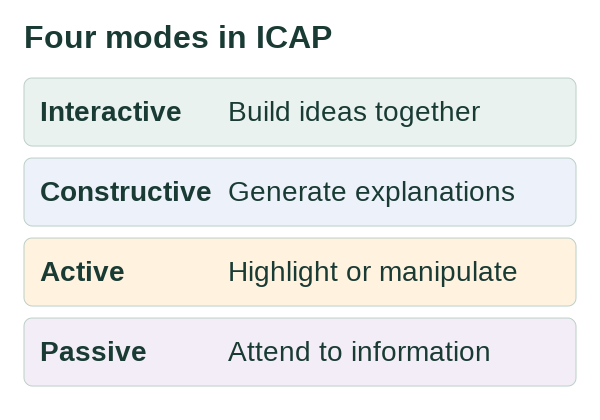
One framework sorts engagement into four modes. It does this by behavior you can observe. They are Interactive, Constructive, Active and Passive. Its main prediction is called the ICAP hypothesis. The framework's authors gathered support for this prediction. The support came from laboratory and classroom studies. These covered note-taking, concept mapping and self-explaining.[5]
A 2006 review said the evidence now supports student-centered, active learning teaching. That evidence comes from the learning sciences and cognitive psychology. It also comes from educational psychology.[6]
A constructivist view goes further. It says learners build their own meaning, and that new learning builds on prior knowledge. In a constructivist classroom, the activities come first. The activities then lead to the concepts. Students build the meanings themselves.[7]
A 2004 critical analysis warned that an active learning method's success depends on more than the method alone. It argued that success depends on a changing link between the method and the learners. The educator sits in between. That analysis concluded that promoting active learning is usually a good thing.[8]
History
Where the idea came from
Constructivism holds that learners build their own meaning. It also holds that new learning rests on prior knowledge. Social interaction and real tasks make it stronger. A 2004 article applied these principles to library instruction. It argued that such teaching creates truly active learning.[7]
Cases teach by asking students to study and reflect on the experience of others. That experience is written up as a case. Cases promote active learning because students take part in the decision making process. Cases also give students problems that are open ended and poorly defined. Solving them calls for judgments and decisions. These are about what an organization can technically do.[9]
An informal network called Active Learning in Engineering Education has promoted active learning since 2001. In 2014 its steering committee asked for discussion of what active learning means. A special issue of the European Journal of Engineering Education followed. More than 40 submissions were reviewed. The issue had eight contributions. They used differing research and active learning approaches.[10]
A 2007 article observed that medical educators often present complex material in ways that block the engagement cognitive researchers recommend. It described seven ways to adapt parts of lectures. It also noted that medical faculty have had little exposure to teaching theory or training.[11]
A 2004 paper noted that the reasons for bringing project work, problem-based learning and cases into engineering rested mostly on practical experience. The paper also said that a clear theoretical background was almost entirely missing. Such a background would explain how active learning works. It proposed metacognition, or thinking about one's own thinking, as a promising basis for setting clear goals. Metacognition means what people know about their own knowledge.[12]
A journal called Active Learning in Higher Education was founded twenty-five years before a 2026 retrospective.[13] Another 2026 paper treated active learning as a changing historical influence. It did not treat it as a fixed pedagogical approach. It placed the term within longer educational traditions. It also placed it within ongoing debates about teaching and learning. These debates include student participation.[14]
Main ideas
Why doing helps memory and thinking
One well-known account of why activity helps is the ICAP framework. Chi and Wylie published it in 2014. The sorting is based on what students visibly do.[5]
A second account points to control over what is studied. A 2016 review reports that memory improves when learners can control the information they meet. This holds compared with situations where control is absent. The review names several mechanisms behind this gain. They include distinctive links between sensing and movement. They also include deeper encoding driven by goal-directed exploration. Attention is also better coordinated with encoding.[15]
Direct evidence on memory comes from a 2008 study of free recall. In free recall, students list what they remember from a course. The 2008 study covered 314 American college students at various course levels. At every course level, students most often listed concepts that active learning exercises had introduced. Videos and lecture material came next.[16]
An experiment tested how well students kept what they learned over time. The experiment took place in an introductory engineering statistics class. One class was taught by traditional lecture. The other stressed group projects and methods where students work together. Retention was measured right after the course and again eight months later. The findings suggest that active learning can help students remember more of the course. This holds for students with average or below average scores.[17]
Designing activities that reach the goal
Graeff (2010) suggests that teachers plan active learning exercises the way organizations plan strategy. They start from students' long-term goals. Graeff's 2010 model of strategic teaching for active learning begins with a question for teachers. Only after that does the teacher name the skills, behaviors and abilities those goals require, and then the course content that builds them. Exercises built this way can imitate the kinds of decisions students will face later. These decisions come up in professional and academic work. The model treats teaching as a kind of strategic planning. Content is chosen to serve the stated goals.[18]
Dyhrberg O'Neill (2025) describes a final oral group exam built around debate. It was aligned with the debate classes that came before it. A 2025 survey asked 98 university students about a final oral group exam built around student debates. Most found it broadly acceptable. That format was linked to higher levels of active participation. It was also linked to learning that students saw as positive. It was linked to training in voluntary debate classes.[19]
A 2024 course in undergraduate research methods added active learning activities. These came alongside traditional lecturing and assignments. Students in that course saw active learning as a useful addition to lectures. It helped them learn core methodological topics in political science.[20]
Hands-on work can miss the intended content. A 2017 workshop on equilibrium and stability concepts showed something about teaching. The same topics can be taught actively in ways that may give very different learning results. The paper notes that recent research suggests not every active learning session improves learning. This is particularly true for conceptual knowledge and deep understanding. Canu, Duque and Gómez (2017) also warn that standardized tests usually assess only declarative knowledge. Measuring a proposal through student perception leaves open what students actually learn in hands-on sessions. The workshop asked participants to design a further activity using approaches that effectively promote the expected learning, drawing on frameworks such as Understanding by Design and Didactical Engineering.[21]
McGreevy and Church (2020) compared student understanding of course material taught with active learning against material taught by lecture. The median percent correct was 92% for lecture learning. It was 100% for Recognition and 100% for Reflective. It was 94.1% for Exchanging, 93.8% for Constructive and 93.3% for Analytical activities.[22] A 2007 study tested five course designs. It ran over two quarters of an introductory biology course for majors.[23]
Research
How large the effects are
Failure rates tell a similar story in the same review. The gains held across science, technology, engineering and mathematics. They were largest in small classes of 50 students or fewer.[2]
Outside the sciences, a meta-analysis of 104 studies compared active instruction with traditional lecturing.[24] A meta-analysis is a statistical method that combines the estimates from two or more similar studies into one overall estimate of an effect.[25] The students were in college humanities and social science programs. Assessment scores were 0.489 standard deviations higher with active instruction. This is based on 111 effect sizes and 15,896 students. The benefit was larger in some subjects. These included sociology, psychology, language, education and economics. It was also larger in small classes of 20 students or fewer. The gain was larger in upper level courses than in introductory ones.[24]
A 2023 meta-analysis looked at K-12 studies. That means kindergarten through twelfth grade. It found 398 studies on academic achievement and 88 on learning retention. Active learning had a significant positive effect on achievement (g = 1.005). This was compared with instruction led by the teacher. The review reported big differences in effect sizes across studies. The effect on achievement varied with subject, level of education, who taught the course, region and group size. The retention effect varied with publication type, subject, educational level, and region. It also varied with how long the experiment ran.[26]
A meta-analysis of 144 studies with 158 effect sizes found a moderate overall effect on attitudes toward the course (g = 0.757). The effect was strong (g = 1.159) when the researcher had also built the attitude scale. It was moderate (g = 0.661) when someone else had built it.[27]
One review notes that methods for measuring learning outcomes have problems. Studies rarely gave a reason for using active learning. The reason could come from theory or from evidence. Most measures of learning relied on what students said about themselves. They focused on knowledge for a specific course.[28]
Fairness and who benefits
The results supported what the researchers called the Carnegie Hall hypothesis. Heavy practice through active-learning exercises helps capable but poorly prepared students more than others.[29] For underrepresented minority students, this rise carried the effect. It showed up on two measures of performance. A sense of social belonging also rose a lot. This was true only for non-URM students.[30]
Most supporting data are pooled across demographic groups. So little is known about fairness in how active learning is carried out. Interviews with students from many backgrounds found barriers to fairness. The barriers appeared in outside-classroom preparation, in inside-classroom activities, and in feedback and assessment.[31]
Little is known about whether current active learning research applies to autistic learners. The analysis called for learning environments that affirm autistic students. It also called for settings that let students lead. It also called for involving autistic people in co-designing adapted active learning approaches.[32]
Research design itself can carry bias, even when the aim is to help students. A 2026 essay argued that unfair and exclusionary practices can enter at any stage of a study. This runs from how it is conceived through how it is shared.[33]
Measuring active learning and its limits
Driessen and colleagues (2020) found that most of the literature on active learning never defined the term. Instead, the authors of those articles often gave examples of specific active-learning strategies. Working from published articles and a survey of 105 people, the review sorted the available definitions and strategies into central themes. It then gave a working definition of active learning. It also gave a strategy guide that defines over 300 active-learning strategies.[34]
A quasi-experimental study in real STEM classrooms tested the top of that scale. It compared students in interactive classrooms with students in constructive ones. Students in the interactive classrooms showed significantly better learning outcomes. The improvement was fairly small. The researchers noted that similar designs without repeated measures would be unlikely to detect an effect of that size.[35]
Shi and colleagues (2020) note that research on technology-enabled active learning environments shows inconsistent results. The results concern students' cognitive learning outcomes. Shi and colleagues (2020) combined the results of many studies. They identified 31 peer-reviewed journal articles on technology-enabled active learning environments. They pooled the results of those articles. It found a larger positive effect on students' cognitive learning outcomes than traditional lecture-based environments produced. The effect was stronger when instructors used individualized learning contexts. It was also stronger when bias was reduced in randomized controlled trials, and in small courses rather than large ones.[36]
A separate study compared two sections of one course. The same instructor taught both with the same activities and materials, one in a traditional room and one in an interactive learning space. Classroom setting made no difference to students' learning overall. Some findings hinted that the interactive room made instruction more effective and efficient.[37]
Liu and colleagues (2026) reviewed 38 randomized controlled trials. The trials covered student-centered active learning in Chinese medical education. They rated the certainty of the evidence as generally low or very low. A 2026 review pooled 38 randomized controlled trials indexed in major Chinese databases. It compared student-centered models with lecture-based learning. These included problem-based, case-based and team-based learning. The student-centered models were linked to better overall academic performance. They were also linked to better theoretical knowledge, case analysis and skill operation. No significant difference appeared for medical record writing. It cited methodological limitations, the Chinese database-only search, data transformation and possible publication bias. Liu and colleagues (2026) cautioned that the results should not be applied directly to medical education everywhere.[38]
What the research reviews conclude
Prince's review of the research found broad but uneven support for active learning methods. A 2004 review in the Journal of Engineering Education examined the evidence for active learning. It defined its common forms for engineering teachers.[39] A 2017 paper by Christie and de Graaff set out the educational philosophies and theories behind active learning in engineering education. That paper offers a readable and solid basis for best practice. It claims no new educational theory of its own.[40]
A 2024 meta-analysis by Karwadi, Zakaria and Syafii pooled studies of active learning in Islamic education, at both school and university level. A mixed learning method had the strongest effect among the methods examined. The review also reported high heterogeneity in effect sizes and called for more studies in varied contexts.[41]
A 2022 meta-analysis by Isdayanti and Aprilia looked at biology in junior and senior high school. It drew on 30 articles from international journals, national journals, accredited journals, proceedings and undergraduate theses. Active learning strategies improved students' cognitive learning outcomes. The average effect size was 0.857, which the review places in the big category. The learning model with the highest effect size was a team quiz, at 0.975, also in the big category. Tests for publication bias found none, and the review reports that about 86% of students passed the minimum completeness score.[42]
A 2022 review of undergraduate medical education searched for articles on student engagement. It selected 21 of them. It argued that medical teachers should use suitable tools to keep students engaged during teaching sessions.[43]
A 2019 longitudinal review described the redesign of an introductory graduate research methods course. The redesign ran over three phases. The later phases added concept mapping, several levels of peer collaboration and competency-based techniques. Assessment results supported the final version.[44]
Studies in specific courses and programs
Some studies compare active learning with lecture by testing students on the same examination. Rao and DiCarlo gave two respiratory physiology classes an identical exam.[45] In psychology of women classes, exam items were coded by how the instructor had presented the material. Classwide performance was recorded across 3 classes. Students scored better on items covered with active learning techniques than on items covered by lecture, autonomous readings or video presentations alone. This held both between and within classes.[46]
A human physiology course for nonmajors used a quasi-experimental Solomon four-group design. It had 141 students at a small west-Texas university. Wilke taught treatment groups with a continuum-based active-learning model for a semester. Control groups were taught by traditional didactic lecture. The treatment groups gained significantly more content knowledge. They also scored significantly higher on self-efficacy. The study found no significant difference in motivation between the groups.[47] In a biochemistry course, study periods and discussion groups replaced lecture classes. A questionnaire measured motivation in 74 students.[48]
In science education, 50 seventh grade students at a public school in Istanbul spent 30 class hours on problem-based active learning. A control group received traditional teaching. The treatment group did better academically. They also had more positive attitudes toward the science course. Their wrong ideas also stayed at the lowest level.[49]
At a Hong Kong university, seminar sessions in two undergraduate programmes used several active learning activities. Questionnaires, interviews and the Study Process Questionnaire measured the results. The activities contributed to independent learning skills and the ability to apply knowledge. They helped create interest in the curriculum and prepare students for future careers.[50]
The part-time students were on campus less than the full-time ones. Their courses, however, involved more contact between teachers and students. They also used active learning approaches more often. Kember and Leung tested a statistical model. In the model, teaching approach and teacher-student relationships shaped capability development. The model fitted the data well. The largest effect came from teaching that required active student involvement and aimed at understanding.[51]
An undergraduate corrosion science and engineering course at KFUPM used several active learning strategies together. These included project-based learning and inquiries built around cases. They also included peer instruction and think-pair-share activities. Student feedback was positive for more than 90% of most survey questions, with a response rate of 89%. Students reported increased motivation and confidence in applying knowledge to engineering problems.[52]
The organic chemistry study involved 40 first-year undergraduates preparing to teach chemistry. Their task was to extract an unidentified mixture of organic compounds. They used solutions that were acidic and basic. More than half of the students said they preferred face-to-face interactions for understanding the material. Students felt online instruction lacked the hands-on interaction needed for practical skills.[53]
A qualitative field study looked at third-semester Arabic education students at UIN Sunan Kalijaga Yogyakarta. It used small group discussion and question-and-answer methods. The methods created an interactive atmosphere and improved understanding of the course. But a lack of preparation and confidence among students was an obstacle.[54] A leadership program held structured 1-hour sessions with experienced leaders. Feedback surveys and testimonials from 72 participants showed gains in leadership knowledge, leader self-efficacy and identity formation.[55]
In practice
Activities teachers actually use
Several classroom techniques have been tested in real courses, and each comes with a setting and a result.[56][57][58][59][60] Clickers are personal response devices. They let students answer a question during a lecture. The answers are collected and shown right away. In large undergraduate physiology lectures, students answered clicker questions if they chose to. The results shown on screen guided the discussion that followed. Students who answered the questions earned better exam results than those who chose not to. The gain was largest for students who had scored below 60% on a previous physiology exam.[56]
Librarians at one university tested clickers in three kinds of instructional sessions. The sessions had different groups of students. They found the devices easy to use and a quick way to make lectures interactive.[61]
Instructors in large introductory Earth Science classes built group exercises around short conceptual questions. The exercises also used Venn diagrams and image analysis. They used concept maps and open-ended questions. Two instructors compared lecture classes with inquiry-based classes. Students preferred the active methods. Students remembered more, and their knowledge of the content did not drop.[62]
In organic chemistry lectures, cooperative learning groups raised the overall pass rate by 20 to 30 percent. The comparison was the traditional lecture format. The teacher reported no drop in standards.[63] Two physical chemistry courses used cooperative groups with computer-based exercises, or cooperative work with occasional short lectures, and both approaches seemed to improve learning and attitudes.[64]
Structured classroom debates ask teams of students to prepare a question outside class. They then argue it in front of their peers. It reported gains in participation beyond the few students who usually speak.[57]
At one medical school, 83 second-year students took 8 pathology modules. Some were taught by team-based learning and some by traditional case-based group discussion. For the whole group, exam performance showed no real difference between the two methods. Students in the lowest academic quarter did better after team-based learning. This held in 4 of the 8 modules. Students also rated their peers' contributions as more helpful in that format.[58]
Photovoice asks students to document social issues with photographs. They then discuss and reflect on them with peers. A semester-long photovoice project took place in an undergraduate College of Education course. It supported growth in critical reflection, critical motivation and critical action. Personal relevance came up as a theme. It made students more engaged in that project.[59]
Journaling is a written form of reflection. Students look back over what happened in practice in order to improve. Nursing educators describe several benefits. Students connect experiences with the classroom and see the perspective of others. They also develop critical thinking.[65]
A Jeopardy-style review game, based on the television show, was proposed to motivate participation, create in-class teamwork and reinforce concepts already taught.[66] In an undergraduate statistics course, students chose the topics, questions and data for a research paper. They then presented their work at student roundtables.[60]
Flipped classrooms and active learning
A flipped classroom moves the first contact with new material out of class. Class time is then used for activities led by the instructor.[67] One review of the literature argues that this setup frees class time from lecture. It opens that time to a wider range of learning activities. The same review says more mentoring from teachers to students may result. It also names more teamwork among peers.[68]
In a mechanical engineering course, students said online lectures before each week helped them. Those students did better than students in the traditional lecture format. They also preferred the new model.[69]
One main question is whether the videos cause the gains. The other is whether the active work done in class does. One study compared an active flipped classroom with an active nonflipped classroom. Both were built on the 5-E learning cycle, and the study found equal satisfaction. In both groups, students said their time with the instructor shaped their learning. It mattered more than the work they did at home. The researchers concluded that the flipped classroom produced no higher learning gains. It also produced no better attitudes. Both versions used an active, constructivist approach. They proposed that gains in either condition most likely come from active teaching.[67]
A study of English language learners tested three formats for flip teaching. It also tested non-flip lessons. Structured and semi-structured flip lessons worked better than lessons that were not flipped. Students also developed better attitudes toward their learning experiences. They put more effort into the process.[70]
A scoping review looked at published studies. It looked at how flipped learning is linked to active learning. The link between flipped learning and active learning was rarely stated clearly. It was also rarely put into practice. The researchers found 435 full-text articles. About 65% of them did not tie their research clearly to a theory or conceptual framework. The other 155 studies used a mix of teaching terms or approaches. Their theoretical and conceptual bases were usually described only in vague terms. There were a few exceptions. The review calls this pattern eclecticism, meaning a mix of approaches. It also notes a reluctance to tie flipped learning to a specific conceptual framework.[71]
Technology, rooms and class size
In one course, grades differed little between a high-technology active learning room and a low-technology one. One evaluation compared two classrooms for the same course. The course was in organizational behaviour and leadership. One used high technology and the other used low technology. Several problems did come up with the high-technology room. The instructors' experiences suggested that many obstacles must be handled first. Only then can such a room be used and assessed well. Many schools spend thousands of dollars on classrooms built around technology. They do this to present themselves as modern. They also do it to suit students who use technology every day. The same source notes that few studies have tested these rooms. They have not been tested against active classes that use little technology.[72]
An active learning classroom is a room built on purpose to support active learning. The design aims to make its effects stronger. It covers young children through university students. A review of peer-reviewed research on these rooms traced the published work back to the first "studio" classrooms and the SCALE-UP program. It continued to the present day. The review gathered findings on learning outcomes. It also gathered findings on student engagement. It also collected findings on what teachers do. It asked which design elements seem to matter most.[73]
One study collected repeated measurements from college students. They were in a two-semester course sequence. It asked how students chose where to enroll and how they felt about learning. Individual attitudes and decisions stayed fairly steady over the study period. But enrollment groups looked very different from one another over time. Classrooms built for active learning were in short supply. This pushed students to sort themselves by their social networks or by their attitudes toward learning. That sorting may push some students out of undergraduate programs. This happens most often to women.[74]
Laptops in a large lecture hall can support hands-on work. They can also pull attention away from the lesson. A study tracked students' behavior and views over three semesters in a row. The students used wireless laptops in lecture halls. An online survey found highly positive views of the laptops. Views about being active in class were less positive. Class observations showed that the laptops encouraged hands-on learning. Students explored ideas and took the lead. They also encouraged meaningful exchanges between students and with the instructor. The same observations found that wireless laptops distract students when used for purposes unrelated to learning.[75]
In online continuing education, the teacher's role changes. The expert becomes a coach and helper. One account covers online continuing education and staff development. It argues that good planning of active strategies leads to the best learning. Feedback from peers, from educators and from technology strongly shapes how satisfied learners are. Online tools let the teacher track who takes part.[76]
A software tool was built for one study. It combined three active learning strategies already tested in face-to-face settings. Students made up questions. They explained their answers and built on them. They got feedback from the teacher and tested their knowledge. The study used a quasi-experimental design. Some groups of participants gained a lot from the tool. These students were compared with students who used their preferred learning strategies on the same content.[77]
In one online course, graduate students made audio files and shared them with peers. Students were happy with the approach. The audio files encouraged students to take part. They also helped students connect and talk with peers. They also increased their learning, though the study lists some drawbacks.[78]
In a case study in Oxford, secondary school students built an augmented reality application. It was a workshop held outside regular classes. All teams in the preview audience built working applications. Several were complex to a striking degree. Students found the lessons enjoyable.[79]
Smaller classes are often seen as a sign of quality. Yet little is known about how instructors change their teaching when class size shrinks. One study looked at how well instructors' first plans matched the specific changes they reported making. The changes came after a university policy shift toward smaller classes. It also looked at the teaching challenges of that shift. The aim was to point to professional development needs for small-class teaching. Some research suggests that teachers of smaller classes more often plan activities centered on learners. These call for physical and mental effort. Examples include group work, simulations and case studies.[80]
What students think and feel
One study looked at 245 students in a college science course built around active learning. Buy-in, meaning students' willingness to accept the method, was positively linked to engagement in self-regulated learning and to course performance.[81] Trust in the instructor also mattered in a course of 245 students. Students who saw their instructor as understanding, accepting and caring were more committed to active learning.[82]
One large class that mixed subjects was repeated four times over four semesters. Class sizes ranged from 125 to 180. Students valued lectures. They also valued being active. Students valued working with others in cooperative learning much less. The most valued activities were the ones that directly helped improve exam performance. This held whether they were active, cooperative or traditional.[83]
One questionnaire study looked at 37 education students at a university in Lebanon. It found that most learners and their instructors favored active learning. The sample was small, and all the students were female.[84]
A randomized cross-over trial used 146 second-year medical students. The same cases were taught twice. One was a passive lecture, the other a large-group interactive session. After the interactive session, students scored 0.27 standard deviations higher on a learning test. The p value was 0.010. Their feeling of learning was 0.56 standard deviations higher in that session (p < 0.001). Learners in the lower 50% of prior achievement gained the most from the active format.[85]
Researchers interviewed 52 students in large active-learning college science courses. They found mixed results. Clicker questions and group work could both raise and lower anxiety. Whether students saw the activity as helping them helped decide which way it went. Cold call and random call, where the instructor picks who answers, only raised anxiety. The main source was fear of negative evaluation. This is the dread of being judged badly while speaking in class without volunteering.[1]
Researchers interviewed 29 students at nine community colleges in the southwestern United States. They looked at what raises and lowers the students' anxiety. Anxiety fell when students felt the activities helped them learn. This happened when activities offered several ways to learn. It also happened when they offered a chance to learn from others.[86]
Personality traits are linked to how students respond to one active learning method. It is a role-playing approach called Reacting to the Past. In one study, 135 students at a United States university completed personality scales. They also answered measures of self-efficacy, enjoyment, engagement and how much they felt they had learned. Extraversion was linked to all of those outcomes. Openness was linked to academic self-efficacy. It was also linked to reported enjoyment. The researchers concluded that support should go above all to shy students. They also said new strategies are needed to reach less careful students.[87]
A separate analysis looked at autistic students. It points to inaccessible spaces, communication differences and institutional structures as hurdles in active learning settings. It calls for autistic people to help design adapted approaches. Then these students can guide their own learning and participation.[32]
Active learning outside the science classroom
Snyder (2003) notes that corporations complain about graduates entering entry-level management positions. These graduates lack critical thinking and creativity skills. Snyder describes active learning exercises meant to build both. A 2003 article described an active learning matrix for business courses. It included exercises, projects and simulations aimed at critical and creative thinking.[88]
A 2026 study of faculty views defined a Live Case Project. It is a course, or part of one, where managers give students a current real-life business challenge. Faculty in that study reported a significant improvement in students' knowledge and skills. This came after live case projects entered the curriculum. The same study found that faculty and administrators often failed to see the benefits. They viewed the workload as excessive, so the projects were often not used.[89]
A 2018 accounting study compared 24 first-year business students in an active learning seminar with 33 students who did not take it. In accounting education, seminar students showed higher motivation. They were also more likely to choose accounting as their major.[90]
In nursing, a 2015 study compared 73 senior students in an active learning program in 2010 with 74 students taught traditionally in 2013. The program combined high-fidelity simulation with situation-based case studies. It also used standardized patients, audio-video playback and reflective activities. Overall nursing competency scores were much higher in the active group. Scores in clinical performance, critical thinking and human understanding were higher too.[91]
A 2001 article described how active learning strategies supported critical thinking. The students were a group of adult nurse practitioners. It did not report outcome numbers.[92]
A 2026 review of music education found 27 eligible studies. Of these, 20 reported usable number data. The authors removed one outlier. The remaining 15 independent effect sizes gave a moderate positive effect of 0.46. The 95% confidence interval ran from 0.22 to 0.70. Educational level and teaching strategy did not significantly change the result. Higher education did show the largest mean effects. The review found wide variation across studies. It found few studies in primary and higher education.[93]
Language classrooms have tested active learning too. An English writing course in Thailand used it to promote writing ability. An Arabic classroom in Indonesia used Gallery Walk sessions to raise participation.[94][95]
A 2025 study looked at 62 third-year English majors in Thailand. It used writing activities built on think-pair-share and collaborative writing. These included peer review and self-assessment. All participants reached the minimum requirements of the writing tasks. Most scored above 70% of the total. Students reported that English proficiency affected the peer review activities. It also affected self-assessment. They also named some drawbacks teachers should expect.[94]
An Arabic classroom at Hasanuddin University in Makassar, Indonesia, had 29 students. They took part in four Gallery Walk sessions. Their participation in the learning process rose significantly. Questionnaire and reflection data showed that the sessions significantly increased students' broad participation in learning.[95]
A 1995 article argued that active learning techniques suit library instruction. It also noted risks to active teaching.[96] A 2025 meta-analysis looked at 20 studies from 2010 to 2023. It found an overall effect size of 0.70. Active learning beat traditional lecturing in school social sciences. Gains held across grades 6 to 10, with slightly higher gains in middle school. The analysis did note possible publication bias. It also noted differing assessment tools.[97] A 2023 review of European studies from 2010 to 2022 found that students in physically active lessons generally did better than those in non-active conditions. That review could not tell whether the gain came from activity in the lesson setting or from physical activity itself.[98]
Canu, Duque and Gómez (2017) question whether hands-on sessions always improve learning. They note that not every active learning session may improve conceptual knowledge. Not every session may deepen understanding.[21]
A 2024 study interviewed 15 college instructors. They named institutional constraints and pressure from standardized testing as barriers to active learning in elementary schools.[99] Two large introductory psychology classrooms had 301 students. Three activities on intelligence testing left students significantly more knowledgeable about multiculturalism and rating it as more important.[100]
The largest summary of college science teaching evidence appeared in 2014. A team led by Scott Freeman published the meta-analysis in the Proceedings of the National Academy of Sciences. The team collected 225 studies. Each compared student performance in undergraduate science, technology, engineering and mathematics courses taught by traditional lecturing with the same courses taught by active learning.[2]
The main result concerned exam scores. Across 158 studies, student performance on exams and concept inventories rose by 0.47 standard deviations under active learning. In plainer terms, exam scores rose by about 6%.[2]
A 2020 follow-up asked a narrower question about fairness. A team led by Elli Theobald tested whether active learning narrows the achievement gap. The gap is the score difference between underrepresented students and their overrepresented classmates. The search covered published and unpublished studies. It produced exam score data from 15 studies with 9,238 students in total. Failure rate data came from 26 studies with 44,606 total students. Bayesian regression analyses showed that active learning cut achievement gaps in exam scores by 33% on average. The same analyses showed that active learning cut gaps in passing rates by 45%.[4]
The size of the benefit depended on how much class time students spent on activities. Only courses that used active learning at high intensity showed narrower achievement gaps. The team proposed the heads-and-hearts hypothesis. It was meant to explain the wide variation among studies. The hypothesis holds that achievement gaps shrink meaningfully only under one condition. A course must combine deliberate practice with inclusive teaching.[4]
Smaller studies point in the same direction.[101][29][102][30] A 2011 study found that a highly structured course design raised performance for all students. It also narrowed the gap between disadvantaged and nondisadvantaged students. It cost no more.[29]
A 2009 redesign of an introductory biology course added active and problem-based learning to every lecture. Over 3 years, it reported better student engagement and satisfaction. It also reported higher final exam performance.[102] A 2017 course enrolled more than 250 students.[30]
Supporting students inside active classrooms
One common support is the learning assistant program. It places advanced undergraduates trained in teaching methods in large active classrooms. These assistants work with students and support them during in-class activities. Learning assistants raise student performance, but how they do so is still unclear. A 2021 study built a questionnaire on the social supports students feel in class. These are the help and encouragement they sense around them. The best fit was a three-part instrument. It had five items on supportive feedback, eight on emotional support, and six on the norms and values of active learning. All three parts went into one regression together. Only informational support, the communication of norms and values, forecast change on two of the three engagement measures. The study suggests learning assistants should say clearly why active learning matters. They should also say that taking part is the classroom norm.[103]
One Summer Bridge program lasted 2 weeks. It taught introductory biology content in an active-learning way. Interviews found that Bridge students had developed detailed views of active learning. This was not an explicit goal. Most Bridge students said they drew on a wider range of strategies to get more out of active learning. Most non-Bridge students did not say this. Bridge students also said they take a fair approach to group work. The findings suggest students can be primed, or prepared in advance. This helps them make the most of active learning for themselves and others.[104]
Young, Mitchell-Yellin and Randall (2025) developed a brief measure of active learning in college classrooms. It is based on students' perceptions. Faculty can use it to check learning as they go. It is cheap and easy to complete. It was built by changing existing instruments. Outside experts then reviewed a draft. After piloting and revision, its internal consistency was acceptable. Agreement between raters was acceptable too. An exploratory factor analysis confirmed that the instrument measures one factor. The researchers propose this factor as active learning. The tool rests on students' perceptions. It is meant for faculty to use formatively, that is, to guide their own teaching development.[105]
McCormack (2026) argues that learning should be designed to empower neurodivergent students. They should be able to engage actively with the material. A 2026 paper describes strategies used to build a module on autistic representation in literature. The module was designed as a neuroaffirmative experience, one that accepts natural variation in thinking. The author argues that standard norms in higher education can push neurodivergent learners to the margins. These norms can limit their access to producing knowledge.[106]
Activities, assessments and classroom formats
A mini-lesson is an assignment in which undergraduate students teach classmates a theoretical concept. They use an excerpt of their own choosing. Students present and watch mini-lessons. They engage actively with course material and meet a diverse set of examples, some of them familiar music.[107]
Student blogs served a similar purpose in an undergraduate positive psychology course. In that course, students recorded three exercises in a blog. The exercises were Three Good Things, Signature Strengths and the Gratitude Letter. Earlier work had found that they raise happiness and positive emotions. Students rated the course with blogs significantly higher than the same course without blogs.[108]
A separate study looked at unrestricted blogging in an academic course. Students wanted to finish the task efficiently and did not pursue critical knowledge construction with vigour. That study concluded that students need preparation. They must learn to combine their informal use of communication technology with academic demands.[109]
Two-stage exams pair a traditional individual exam with a later collaborative exam. They have gained substantial traction in STEM college courses over the last decade. Holding both stages during class sessions can be impractical. One team tested an asynchronous version, where the collaborative part is done unsupervised within 48 hr of the individual exam. Students rated their engagement, collaboration and feedback quality in the asynchronous collaborative exam as equal to standard in-class exams. They also showed signs of retaining the learning.[110]
Exams can also serve as learning activities before the summative assessment. That is the end-of-course evaluation of whether students have met the learning objectives. In a reliability analysis course, students designed their own exam set with solutions, preferably in groups. They received supervision and feedback on the product. The results pointed to a positive effect on learning. Students said the task let them see problems from several angles. It also let them take a more active part.[111]
One example has students hold postures and move to chosen music clips in small groups. They learn five dispositions of the body. Another is a group-of-five exercise. It traces the range from boredom through optimal experience to anxiety.[112]
Game-based learning uses play to set cognitive, emotional and social mechanisms in motion. It is presented as valid for all educational levels and is distinguished from gamification.[113] A four-year quasi-experimental study of 242 pre-service teachers compared flipped classroom learning with a gamified-flipped version. The gamified-flipped group significantly increased positive attitudes toward learning compared with the flipped group, and grades before the study predicted global attitudes and emotions in both groups. Gender made no statistically significant difference.[114]
A survey looked at 537 students in 15 online STEM courses at a large four-year public university. It found that effective courses combined active learning activities, interactive engagement and strong assessments. This held for students of all populations.[115]
One course made WhatsApp part of gradable assignments and of weekly discussions before and after lectures. Undergraduates in the UAE were more engaged with assignments that built the app into their structure. Those students found the discussions beneficial and effective. They also reported increased motivation to take part in the lecture topic.[116]
Classroom design matters too. In 2010 the University of Iowa converted one of its Main Library classrooms into a TILE classroom, short for Transform, Interact, Learn, Engage. The room was technologically rich but designed first for engaged learning. Its layout supported larger classes while keeping the intimacy of a small discussion group.[117]
Michigan State University created classrooms rich in technology for active learning. The aim was to draw students into collaborative work. It also aimed to increase contact between faculty and students.[118]
What this looks like when you study
In a large introductory biology course of more than 250 students, instructors switched from traditional lecturing to active learning and measured the results. The switch closed the gap in learning gains between underrepresented minority students and their classmates. Science self-efficacy, a student's belief in their own ability to do science, rose for all students in that course.[30]
In interviews with 17 engineering professors across the United States, some said they explained the purpose of an activity, and some said they walked around the room. Among the strategies the 17 engineering professors described were grading on participation, inviting questions, and developing a routine.[119] A review of 29 studies found eight such strategies, grouped as explaining, facilitating and planning.[120]
Later developments
Open questions and future directions
Another question is which learning outcomes active learning is linked to. It also concerns how learning is measured. That review called for fuller descriptions, theoretical justifications and suitable research methods. These would make interventions easier to see through.[28]
One design-based research study reviewed 75 undergraduate online courses. It gave each course an active learning score. It then surveyed the learners in those courses about what made learning meaningful. The study produced a method for reviewing courses. It measures active learning in online courses. It also sharpened design principles for instructors, designers and administrators.[121]
One 2026 paper lists human-AI entanglements among the matters of concern. These are for future research on active learning. The first is what counts as purposeful activity beyond simply being active. The same paper asks for approaches that stay curious and questioning. This applies when imagining and designing futures of active learning.[14]
The 2004 analysis called for more research on how far educators and learners change their views. It asked about views on different ways of teaching and learning.[8] A review of 33 articles in nursing education found that a lack of preparation among those involved and a lack of structural support contributed to student dissatisfaction.[122] A mapping study looked at 3,850 papers published from 2000 to 2022. It found thirty-seven different active learning methods used to teach programming.[123]
Criticism
Why teachers hold back
Calls for more student-active learning are frequent. Yet studies find that teaching in higher education is still mostly traditional. The teacher stays at the center. It named three things that must come first. The first is closer matching of research and teaching practices. The second is an infrastructure that supports both. The third is training for staff and the design of learning.[124]
Teachers themselves name barriers that fall into three groups. These are student traits and teaching issues. They also include issues that directly affect faculty. That finding came from four groups of people in a workshop for faculty. They were asked to list the barriers they saw to active learning in their classrooms. Some of the faculty perceptions are correct, and others are not. Understanding these views is described as the first step. It helps in devising strategies to help faculty change how they teach.[125]
One barrier to adoption is instructors' concern about student resistance. A systematic review examined 29 journal articles and conference papers. Each one suggested at least one way to put active learning into practice. Students reported on their own learning, their part in the activities and their satisfaction with the course. These reports were mostly positive. The review found eight strategies in three groups. They came from the 29 studies. Explanation gives students clear answers and reasons for using active learning. Facilitation works with students so the activity works as intended. Planning outside class can improve the experience.[120]
Researchers interviewed 17 engineering professors across the USA. The interviews showed that ways to reduce student resistance generally fall into two broad types. Explanation strategies are to explain the purpose, explain course expectations, and explain activity expectations. Ways to help include going up to students who do not take part. Acting in an encouraging way also helps. They also include grading on participation and walking around the room. They also include inviting questions and building a routine. They include designing activities for participation. Another is using small steps. Four of these strategies came out of the analysis. They had not been studied before in the context of student resistance. The interviews also showed that using the strategies well takes some planned course design.[119]
Survey data came from 1,051 students in 18 introductory engineering courses. It tested whether these strategies matter in practice. Students' views of how instructors used explanation and facilitation strategies strongly affected student resistance. Those perceptions influenced how students engaged with active learning. They also shaped how students rated the course and the instructor.[126]
Some resistance rests on beliefs that do not hold up. One example is the idea that active learning is too hard to use. This applies where students have no prior knowledge of a subject.[127]
Students often arrive expecting the passive role they played for most of their school career. Faculty passed on information. Students memorized it or applied set procedures. In an active setting, faculty become facilitators. Students become active participants who build and test their own mental models.[128]
Changing teachers' behavior in a lasting way is very hard. Programs should start from the beliefs and practices teachers already have. A training program for teachers was tested with 16 elementary school teachers. It used observations, a beliefs survey and a questionnaire. These were given before the program and twice after it. Several parts of feedback during active learning got better. This held in both the short term and the long term. The study concluded that training for teachers can change practice and last. This holds if certain conditions are met.[129]
A separate article gives a step-by-step way to build active learning. It is organized around four parts of teaching. These are setting context, preparing class, delivering class, and improving over time.[130]
When active learning does not help
In 2011, a team looked at introductory biology courses. The courses were picked at random from a list of well-known colleges and universities. The aim was to study instructors who represent a broader population. Earlier positive results came from science education researchers. The team measured how much students learned about natural selection. It found no link between learning gains and the use of active-learning instruction. The researchers argued that most instructors do not deeply understand teaching and learning. Education researchers have built that understanding. Active learning as typical instructors design and carry it out may look like the researcher version. It may still lack the constructivist elements that improve learning. Constructivist means learners build knowledge themselves.[3]
A 2024 medical school trial used a randomized cross-over design. It had 146 second-year students, and each took part in both conditions. In the passive condition, students heard case presentations given as lectures. These had very little interaction. In the interactive condition, they worked in teams on the same cases.[85]
In an accounting information systems course, students worked alone, worked in cooperative groups, or heard a passive lecture on the same topic. Only the students who worked alone scored significantly better on exams than passive learners. Scores of students in the cooperative active setting were not statistically different from those of passive participants. Students in both active settings still gave positive feedback.[131]
An introductory business course used an active class with many kinds of exercises. It did not improve overall mastery of the subject more than a lecture-based class did. The active class did show better results on materials specific to that class.[132]
In one biology course, students in cooperative groups did much better than students who did the same activities alone. The difference appeared on harder questions that asked for longer answers. Two sections of a biology course for nonmajors did the same in-class activities. The same instructor taught both in the same semester with the same materials. Scores on simple multiple-choice tests did not differ much between the sections.[133]
The discussion raised scores on the short answer part. This was a short assessment given after the activity. On the multiple choice portion, the role-play sections did significantly better than the lecture-only group.[134]
The measures of impact rested mostly on what students said about themselves.[28] A 2015 study looked at a widely used active learning scale. It found that adding a few items about mostly online activities raised average scores significantly. The new items also made some differences smaller. These were between on-campus and distance education students.[135]
Common misconceptions
Earlier studies had found that adding active learning to a traditional college science lecture raises student learning, but most of those courses were taught by science education researchers. The authors argue that typical instructors may use activities that look active but lack the elements that build understanding.[3]
In a flipped classroom, content attainment moves outside class and is followed by instructor-facilitated concept application activities in class. Student satisfaction was equal, and both groups ranked contact time with the instructor as more influential than their at-home work.[67]
Key studies
| Year | Study | Sample | Design | Finding |
|---|---|---|---|---|
| 2005 | Koles et al.[58] | 83 Year 2 medical students | prospective crossover design | Team-based learning and case discussion were equally effective overall, but the lowest quartile did better with team-based learning in 4 of 8 modules. |
| 2007 | Machemer & Crawford[83] | survey replicated four times over four semesters in a large cross-disciplinary class of 125 to 180 students | Students valued lectures and being active, but working with others diminished the value significantly. | |
| 2011 | Andrews et al.[3] | introductory biology courses randomly selected from prominent colleges | Study of the relationship between active learning and learning gains in randomly selected introductory biology courses | No association appeared between active-learning frequency and learning gains about natural selection. |
| 2014 | Freeman et al.[2] | 225 studies of undergraduate STEM courses | meta-analysis | Exam and concept-inventory scores rose 0.47 standard deviations under active learning, and students in lecture classes were 1.5 times more likely to fail. |
| 2015 | Jensen et al.[67] | students in an active flipped and an active nonflipped course | quasi-experimental comparison | Low-level and deep conceptual learning were equivalent, and satisfaction was equal. |
| 2017 | Ballen et al.[30] | more than 250 students in an introductory STEM course | course comparison with structural equation modeling | Active learning closed the learning-gain gap between underrepresented and other students and raised self-efficacy for all. |
| 2018 | Nicol et al.[72] | one organizational behaviour and leadership course | classroom comparison | Grades did not differ significantly between high-technology and low-technology active learning rooms. |
| 2018 | Tharayil et al.[119] | 17 engineering professors across the USA | interview study | Instructors used explanation and facilitation strategies, such as explaining purpose and walking around the room, to reduce student resistance. |
| 2018 | Cooper et al.[1] | interview study of 52 students in large-enrollment active learning college science courses | Clicker questions and group work could both increase and decrease anxiety, while cold call and random call only increased it. | |
| 2020 | Theobald et al.[4] | 9,238 students for exam scores and 44,606 for failure rates | meta-analysis with Bayesian regression | Active learning cut exam-score gaps by 33 percent and passing-rate gaps by 45 percent, but only high-intensity classes narrowed gaps. |
| 2023 | Tutal[26] | 398 studies on achievement and 88 on retention, K-12 | meta-analysis | Active learning raised achievement (g = 1.005) and retention (g = 1.204) compared with teacher-led instruction. |
| 2023 | Kozanitis & Nenciovici[24] | 104 studies, 15,896 college students in humanities and social sciences | meta-analysis | Assessment scores were 0.489 standard deviations higher under active instruction, and the benefit was greater for smaller classes of 20 students or fewer than for larger ones. |
| 2024 | Boedeker et al.[85] | 146 second-year medical students | randomized cross-over trial | Team sessions scored 0.27 standard deviations higher than passive lectures, and the lower half of prior achievement gained most. |
| 2025 | Bledsoe & Richardson[87] | 135 students in Study 1 and 211 in Study 2 | two survey studies | In Study 1, extraversion was associated with all outcomes; in Study 2, extraversion and conscientiousness were related to all outcomes. |
See also
References
- Cooper, K. M., Downing, V. R., & Brownell, S. E. (2018). The influence of active learning practices on student anxiety in large-enrollment college science classrooms. International Journal of STEM Education, 5(1). doi:10.1186/s40594-018-0123-6
- Freeman, S., Eddy, S. L., McDonough, M., Smith, M. K., Okoroafor, N., Jordt, H., & Wenderoth, M. P. (2014). Active learning increases student performance in science, engineering, and mathematics. Proceedings of the National Academy of Sciences, 111(23), 8410-8415. doi:10.1073/pnas.1319030111
- Andrews, T. M., Leonard, M. J., Colgrove, C. A., & Kalinowski, S. T. (2011). Active Learning Not Associated with Student Learning in a Random Sample of College Biology Courses. CBE—Life Sciences Education, 10(4), 394-405. doi:10.1187/cbe.11-07-0061
- Theobald, E. J., Hill, M. J., Tran, E., Agrawal, S., Arroyo, E. N., Behling, S., Chambwe, N., Cintrón, D. L., Cooper, J. D., Dunster, G., Grummer, J. A., Hennessey, K., Hsiao, J., Iranon, N., Jones, L., Jordt, H., Keller, M., Lacey, M. E., Littlefield, C. E., & ... Freeman, S. (2020). Active learning narrows achievement gaps for underrepresented students in undergraduate science, technology, engineering, and math. Proceedings of the National Academy of Sciences, 117(12), 6476-6483. doi:10.1073/pnas.1916903117
- Chi, M. T. H., & Wylie, R. (2014). The ICAP Framework: Linking Cognitive Engagement to Active Learning Outcomes. Educational Psychologist, 49(4), 219-243. doi:10.1080/00461520.2014.965823
- Michael, J. (2006). Where's the evidence that active learning works? Advances in Physiology Education, 30(4), 159-167. doi:10.1152/advan.00053.2006
- Cooperstein, S. E., & Kocevar‐Weidinger, E. (2004). Beyond active learning: a constructivist approach to learning. Reference Services Review, 32(2), 141-148. doi:10.1108/00907320410537658
- KANE, L. (2004). Educators, learners and active learning methodologies. International Journal of Lifelong Education, 23(3), 275-286. doi:10.1080/0260/37042000229237
- Richards, L. G., Gorman, M., Scherer, W. T., & Landel, R. D. (1995). Promoting Active Learning with Cases and Instructional Modules. Journal of Engineering Education, 84(4), 375-381. doi:10.1002/j.2168-9830.1995.tb00193.x
- Lima, R. M., Andersson, P. H., & Saalman, E. (2017). Active Learning in Engineering Education: a (re)introduction. European Journal of Engineering Education, 42(1), 1-4. doi:10.1080/03043797.2016.1254161
- Graffam, B. (2007). Active learning in medical education: Strategies for beginning implementation. Medical Teacher, 29(1), 38-42. doi:10.1080/01421590601176398
- Vos, H., & de Graaff, E. (2004). Developing metacognition: a basis for active learning. European Journal of Engineering Education, 29(4), 543-548. doi:10.1080/03043790410001716257
- Brown, S. (2026). Twenty-Five Years of Active Learning in Higher Education: Centring the Student in the Learning Process. Active Learning in Higher Education, 27(2), 281-287. doi:10.1177/14697874261429113
- Børte, K., & Zeivots, S. (2026). Active Learning in Higher Education: Inheriting Pasts and Emerging Futures. Active Learning in Higher Education, 27(2), 207-219. doi:10.1177/14697874261426575
- Markant, D. B., Ruggeri, A., Gureckis, T. M., & Xu, F. (2016). Enhanced Memory as a Common Effect of Active Learning. Mind, Brain, and Education, 10(3), 142-152. doi:10.1111/mbe.12117
- Cherney, I. D. (2008). The effects of active learning on students' memories for course content. Active Learning in Higher Education, 9(2), 152-171. doi:10.1177/1469787408090841
- Kvam, P. H. (2000). The Effect of Active Learning Methods on Student Retention in Engineering Statistics. The American Statistician, 54(2), 136-140. doi:10.1080/00031305.2000.10474526
- Graeff, T. R. (2010). Strategic Teaching for Active Learning. Marketing Education Review, 20(3), 265-278. doi:10.2753/mer1052-8008200307
- Dyhrberg O’Neill, L. (2025). Assessment of student debates in support of active learning? Students’ perceptions of a debate-based oral final exam. Active Learning in Higher Education, 26(2), 327-343. doi:10.1177/14697874241245665
- Jeram, S. (2024). Applying Active Learning in Undergraduate Research Methods. PS: Political Science & Politics, 57(1), 107-112. doi:10.1017/s1049096523000574
- Canu, M., Duque, M., & Gómez, M. (2017). Risks of Active Learning Approach: Missing the Learning Goals. Journal of Modern Education Review, 57. doi:10.15341/jmer(2155-7993)/01.07.2017/007
- McGreevy, K. M., & Church, F. C. (2020). Active Learning: Subtypes, Intra-Exam Comparison, and Student Survey in an Undergraduate Biology Course. Education Sciences, 10(7), 185. doi:10.3390/educsci10070185
- Wenderoth, M. P., Freeman, S., & O'Connor, E. (2007). Prescribed active learning increases performance in introductory biology. The FASEB Journal, 21(5). doi:10.1096/fasebj.21.5.a220
- Kozanitis, A., & Nenciovici, L. (2023). Effect of active learning versus traditional lecturing on the learning achievement of college students in humanities and social sciences: a meta-analysis. Higher Education, 86(6), 1377-1394. doi:10.1007/s10734-022-00977-8
- GET-IT Glossary (plain-language health research terms) (n.d.). meta-analysis. GET-IT Glossary (plain-language health research terms). https://getitglossary.org/term/meta-analysis
- Tutal, Ö. (2023). Active Learning Improves Academic Achievement And Learning Retention In K-12 Settings: A Meta-Analysis. i-manager's Journal on School Educational Technology. doi:10.26634/jsch.18.3.19288
- Tutal, Ö., & Yazar, T. (2022). Active learning promotes more positive attitudes towards the course: A meta‐analysis☆. Review of Education, 10(1). doi:10.1002/rev3.3346
- Hartikainen, S., Rintala, H., Pylväs, L., & Nokelainen, P. (2019). The Concept of Active Learning and the Measurement of Learning Outcomes: A Review of Research in Engineering Higher Education. Education Sciences, 9(4), 276. doi:10.3390/educsci9040276
- Haak, D. C., HilleRisLambers, J., Pitre, E., & Freeman, S. (2011). Increased Structure and Active Learning Reduce the Achievement Gap in Introductory Biology. Science, 332(6034), 1213-1216. doi:10.1126/science.1204820
- Ballen, C. J., Wieman, C., Salehi, S., Searle, J. B., & Zamudio, K. R. (2017). Enhancing Diversity in Undergraduate Science: Self-Efficacy Drives Performance Gains with Active Learning. CBE—Life Sciences Education, 16(4), ar56. doi:10.1187/cbe.16-12-0344
- Nardo, J. E., Chapman, N. C., Shi, E. Y., Wieman, C., & Salehi, S. (2022). Perspectives on Active Learning: Challenges for Equitable Active Learning Implementation. Journal of Chemical Education, 99(4), 1691-1699. doi:10.1021/acs.jchemed.1c01233
- Eadon, L., Peruzzo, F., & Crane, L. (2026). Active Learning for Autistic Learners: Enabling or Disabling? Active Learning in Higher Education, 27(2), 241-252. doi:10.1177/14697874261429882
- Clinton-Lisell, V. (2026). Designing Inclusive and Equitable Research in Active Learning in Higher Education. Active Learning in Higher Education, 27(2), 231-239. doi:10.1177/14697874261424518
- Driessen, E. P., Knight, J. K., Smith, M. K., & Ballen, C. J. (2020). Demystifying the Meaning of Active Learning in Postsecondary Biology Education. CBE—Life Sciences Education, 19(4), ar52. doi:10.1187/cbe.20-04-0068
- Wiggins, B. L., Eddy, S. L., Grunspan, D. Z., & Crowe, A. J. (2017). The ICAP Active Learning Framework Predicts the Learning Gains Observed in Intensely Active Classroom Experiences. AERA Open, 3(2). doi:10.1177/2332858417708567
- Shi, Y., Yang, H., MacLeod, J., Zhang, J., & Yang, H. H. (2020). College Students’ Cognitive Learning Outcomes in Technology-Enabled Active Learning Environments: A Meta-Analysis of the Empirical Literature. Journal of Educational Computing Research, 58(4), 791-817. doi:10.1177/0735633119881477
- Vercellotti, M. L. (2018). Do interactive learning spaces increase student achievement? A comparison of classroom context. Active Learning in Higher Education, 19(3), 197-210. doi:10.1177/1469787417735606
- Liu, J., Su, J., Xia, W., & Hou, M. (2026). Effectiveness of student-centered active learning models versus lecture-based learning in Chinese medical education: a systematic review and meta-analysis of Chinese database–indexed randomized trials. Frontiers in Education, 11. doi:10.3389/feduc.2026.1756947
- Prince, M. (2004). Does Active Learning Work? A Review of the Research. Journal of Engineering Education, 93(3), 223-231. doi:10.1002/j.2168-9830.2004.tb00809.x
- Christie, M., & de Graaff, E. (2017). The philosophical and pedagogical underpinnings of Active Learning in Engineering Education. European Journal of Engineering Education, 42(1), 5-16. doi:10.1080/03043797.2016.1254160
- Karwadi, K., Zakaria, A. R., & Syafii, A. (2024). A review of the effects of active learning on high order thinking skills: a meta-analysis within islamic education. Journal of Education and Learning (EduLearn), 18(1), 97-106. doi:10.11591/edulearn.v18i1.20895
- Isdayanti, A., & Aprilia, N. (2022). A meta-analysis study of implementing active learning strategy to improve students’ cognitive learning outcomes in junior and senior high school for biology subject. Jurnal Penelitian Pendidikan IPA, 7(1), 22-29. doi:10.26740/jppipa.v7n1.p22-29
- Shrivastava, S. R., & Shrivastava, P. S. (2022). Promoting active learning and student engagement in undergraduate medical education. Journal of Medical Society, 36(2), 39-42. doi:10.4103/jms.jms_140_21
- Haughton, N. A. (2019). Active Learning Strategies and Competency-Based Design in Research Education: a Longitudinal Review. Journal of the Scholarship of Teaching and Learning, 19(4). doi:10.14434/josotl.v19i4.25747
- Rao, S. P., & DiCarlo, S. E. (2001). Active learning of respiratory physiology improves performance on respiratory physiology examinations. Advances in Physiology Education, 25(2), 55-61. doi:10.1152/advances.2001.25.2.55
- Yoder, J. D., & Hochevar, C. M. (2005). Encouraging Active Learning Can Improve Students' Performance on Examinations. Teaching of Psychology, 32(2), 91-95. doi:10.1207/s15328023top3202_2
- Wilke, R. R. (2003). The effect of active learning on student characteristics in a human physiology course for nonmajors. Advances in Physiology Education, 27(4), 207-223. doi:10.1152/advan.00003.2002
- Cicuto, C. A. T., & Torres, B. B. (2016). Implementing an Active Learning Environment To Influence Students’ Motivation in Biochemistry. Journal of Chemical Education, 93(6), 1020-1026. doi:10.1021/acs.jchemed.5b00965
- Akınoğlu, O., & Tandoğan, R. Ö. (2007). The Effects of Problem-Based Active Learning in Science Education on Students’ Academic Achievement, Attitude and Concept Learning. EURASIA Journal of Mathematics, Science and Technology Education, 3(1). doi:10.12973/ejmste/75375
- Sivan, A., Leung, R. W., Woon, C. c., & Kember, D. (2000). An Implementation of Active Learning and its Effect on the Quality of Student Learning. Innovations in Education and Training International, 37(4), 381-389. doi:10.1080/135580000750052991
- Kember, D., & Leung, D. Y. P. (2005). The influence of active learning experiences on the development of graduate capabilities. Studies in Higher Education, 30(2), 155-170. doi:10.1080/03075070500043127
- Toor, I. U. (2025). Integrating Active Learning in an Undergraduate Corrosion Science and Engineering Course—KFUPM’s Active Learning Initiative. Sustainability, 17(23), 10704. doi:10.3390/su172310704
- Jakubčinová, J., Feszterová, M., & Silliková, V. (2024). Active Learning in the Extraction of Organic Compounds: A Study of Undergraduate Chemistry Students. Education Sciences, 14(10), 1051. doi:10.3390/educsci14101051
- Hadi Saputra, A. Z., Zamakhsari, Z., & Latipah, E. (2025). Active Learning Strategies In Improving Optimal Learning Among Arabic Education Students. Jurnal Dimensi Pendidikan dan Pembelajaran, 13(2), 298-307. doi:10.24269/dpp.v13i2.12472
- Deng, C., Gulseren, D., & Turner, N. (2025). Microdose Leadership Development: Enhancing Leadership Identity and Self-Efficacy Through Short-Term Active Learning. Active Learning in Higher Education. doi:10.1177/14697874251356246
- Gauci, S. A., Dantas, A. M., Williams, D. A., & Kemm, R. E. (2009). Promoting student-centered active learning in lectures with a personal response system. Advances in Physiology Education, 33(1), 60-71. doi:10.1152/advan.00109.2007
- Oros, A. L. (2007). Let's Debate: Active Learning Encourages Student Participation and Critical Thinking. Journal of Political Science Education, 3(3), 293-311. doi:10.1080/15512160701558273
- Koles, P., Nelson, S., Stolfi, A., Parmelee, D., & DeStephen, D. (2005). Active learning in a Year 2 pathology curriculum. Medical Education, 39(10), 1045-1055. doi:10.1111/j.1365-2929.2005.02248.x
- Longstreth, S., Glovinsky, R., Patil, S., & Salahi, M. (2026). Photovoice as an Active Learning Strategy for Cultivating Critical Consciousness in Undergraduate Education. Active Learning in Higher Education. doi:10.1177/14697874261459631
- Strangfeld, J. A. (2013). Promoting Active Learning: Student-Led Data Gathering in Undergraduate Statistics. Teaching Sociology, 41(2), 199-206. doi:10.1177/0092055x12472492
- Hoffman, C., & Goodwin, S. (2006). A clicker for your thoughts: technology for active learning. New Library World, 107(9/10), 422-433. doi:10.1108/03074800610702606
- McConnell, D. A., Steer, D. N., & Owens, K. D. (2003). Assessment and Active Learning Strategies for Introductory Geology Courses. Journal of Geoscience Education, 51(2), 205-216. doi:10.5408/1089-9995-51.2.205
- Paulson, D. R. (1999). Active Learning and Cooperative Learning in the Organic Chemistry Lecture Class. Journal of Chemical Education, 76(8), 1136. doi:10.1021/ed076p1136
- Hinde, R. J., & Kovac, J. (2001). Student Active Learning Methods in Physical Chemistry. Journal of Chemical Education, 78(1), 93. doi:10.1021/ed078p93
- Blake, T. K. (2005). Journaling; An Active Learning Technique. International Journal of Nursing Education Scholarship, 2(1). doi:10.2202/1548-923x.1116
- Benek-Rivera, J., & Mathews, V. E. (2004). Active Learning with Jeopardy: Students Ask the Questions———. Journal of Management Education, 28(1), 104-118. doi:10.1177/1052562903252637
- Jensen, J. L., Kummer, T. A., & Godoy, P. D. d. M. (2015). Improvements from a Flipped Classroom May Simply Be the Fruits of Active Learning. CBE—Life Sciences Education, 14(1), ar5. doi:10.1187/cbe.14-08-0129
- Roehl, A., Reddy, S. L., & Shannon, G. J. (2013). The Flipped Classroom: An Opportunity To Engage Millennial Students Through Active Learning Strategies. Journal of Family & Consumer Sciences, 105(2), 44-49. doi:10.14307/jfcs105.2.12
- Cho, H. J., Zhao, K., Lee, C. R., Runshe, D., & Krousgrill, C. (2021). Active learning through flipped classroom in mechanical engineering: improving students’ perception of learning and performance. International Journal of STEM Education, 8(1). doi:10.1186/s40594-021-00302-2
- Hung, H. T. (2015). Flipping the classroom for English language learners to foster active learning. Computer Assisted Language Learning, 28(1), 81-96. doi:10.1080/09588221.2014.967701
- Li, R., Lund, A., & Nordsteien, A. (2023). The link between flipped and active learning: a scoping review. Teaching in Higher Education, 28(8), 1993-2027. doi:10.1080/13562517.2021.1943655
- Nicol, A. A., Owens, S. M., Le Coze, S. S., MacIntyre, A., & Eastwood, C. (2018). Comparison of high-technology active learning and low-technology active learning classrooms. Active Learning in Higher Education, 19(3), 253-265. doi:10.1177/1469787417731176
- Talbert, R., & Mor-Avi, A. (2019). A space for learning: An analysis of research on active learning spaces. Heliyon, 5(12), e02967. doi:10.1016/j.heliyon.2019.e02967
- Ralph, M. C., Schneider, B., Benson, D. R., & Ward, D. (2024). Separated by spaces: Undergraduate students re-sort along attitude divides when choosing whether to learn in spaces designed for active learning. Active Learning in Higher Education, 25(2), 197-212. doi:10.1177/14697874221118866
- Barak, M., Lipson, A., & Lerman, S. (2006). Wireless Laptops as Means For Promoting Active Learning In Large Lecture Halls. Journal of Research on Technology in Education, 38(3), 245-263. doi:10.1080/15391523.2006.10782459
- Phillips, J. M. (2005). Strategies for Active Learning in Online Continuing Education. The Journal of Continuing Education in Nursing, 36(2), 77-83. doi:10.3928/0022-0124-20050301-08
- Opre, D., Șerban, C., Veșcan, A., & Iucu, R. (2024). Supporting students’ active learning with a computer based tool. Active Learning in Higher Education, 25(1), 135-150. doi:10.1177/14697874221100465
- Bolliger, D. U., & Armier, D. D. (2013). Active learning in the online environment: The integration of student-generated audio files. Active Learning in Higher Education, 14(3), 201-211. doi:10.1177/1469787413498032
- Jesionkowska, J., Wild, F., & Deval, Y. (2020). Active Learning Augmented Reality for STEAM Education—A Case Study. Education Sciences, 10(8), 198. doi:10.3390/educsci10080198
- Wright, M. C., Bergom, I., & Bartholomew, T. (2019). Decreased class size, increased active learning? Intended and enacted teaching strategies in smaller classes. Active Learning in Higher Education, 20(1), 51-62. doi:10.1177/1469787417735607
- Cavanagh, A. J., Aragón, O. R., Chen, X., Couch, B. A., Durham, M. F., Bobrownicki, A., Hanauer, D. I., & Graham, M. J. (2016). Student Buy-In to Active Learning in a College Science Course. CBE—Life Sciences Education, 15(4), ar76. doi:10.1187/cbe.16-07-0212
- Cavanagh, A. J., Chen, X., Bathgate, M., Frederick, J., Hanauer, D. I., & Graham, M. J. (2018). Trust, Growth Mindset, and Student Commitment to Active Learning in a College Science Course. CBE—Life Sciences Education, 17(1), ar10. doi:10.1187/cbe.17-06-0107
- Machemer, P. L., & Crawford, P. (2007). Student perceptions of active learning in a large cross-disciplinary classroom. Active Learning in Higher Education, 8(1), 9-30. doi:10.1177/1469787407074008
- Daouk, Z., Bahous, R., & Bacha, N. N. (2016). Perceptions on the effectiveness of active learning strategies. Journal of Applied Research in Higher Education, 8(3), 360-375. doi:10.1108/jarhe-05-2015-0037
- Boedeker, P., Schlingmann, T., Kailin, J., Nair, A., Foldes, C., Rowley, D., Salciccioli, K., Maag, R., Moreno, N., & Ismail, N. (2024). Active Versus Passive Learning in Large-Group Sessions in Medical School: A Randomized Cross-Over Trial Investigating Effects on Learning and the Feeling of Learning. Medical Science Educator, 35(1), 459-467. doi:10.1007/s40670-024-02219-1
- Downing, V. R., Cooper, K. M., Cala, J. M., Gin, L. E., & Brownell, S. E. (2020). Fear of Negative Evaluation and Student Anxiety in Community College Active-Learning Science Courses. CBE—Life Sciences Education, 19(2), ar20. doi:10.1187/cbe.19-09-0186
- Bledsoe, R. S., & Richardson, D. S. (2025). The Role of Personality Traits in Responses to Active Learning. Active Learning in Higher Education. doi:10.1177/14697874251372404
- Snyder, K. D. (2003). Ropes, Poles, and Space: Active Learning in Business Education. Active Learning in Higher Education, 4(2), 159-167. doi:10.1177/1469787403004002004
- Kandinskaia, O., Czegledi, A., & Mehrotra, S. (2026). Global Faculty Insights on Active Learning via Live Case Projects. Active Learning in Higher Education. doi:10.1177/14697874261467043
- Sugahara, S., & Dellaportas, S. (2018). Bringing active learning into the accounting classroom. Meditari Accountancy Research, 26(4), 576-597. doi:10.1108/medar-01-2017-0109
- Shin, H., Sok, S., Hyun, K. S., & Kim, M. J. (2015). Competency and an active learning program in undergraduate nursing education. Journal of Advanced Nursing, 71(3), 591-598. doi:10.1111/jan.12564
- Youngblood, N., & Beitz, J. M. (2001). Developing Critical Thinking with Active Learning Strategies: . Nurse Educator, 26(1), 39-42. doi:10.1097/00006223-200101000-00016
- Veniel-Martí, F., Botella-Nicolás, A. M., Pruitt, N., & Pigott, T. (2026). Active Learning in Music Education: A Systematic Review and Meta-Analysis. Update: Applications of Research in Music Education. doi:10.1177/87551233261425936
- Sriwichai, C. (2025). Promoting Undergraduate Students’ Writing Ability Using English Writing Active Learning Activities. rEFLections, 32(3). doi:10.61508/refl.v32i3.283698
- Ridwan, M. (2019). GALLERY WALK; An Alternative Learning Strategy in Increasing Students’ Active Learning. Nady Al-Adab, 16(1), 49. doi:10.20956/jna.v16i1.6662
- Allen, E. E. (1995). Active Learning and Teaching:: Improving Postsecondary Library Instruction. The Reference Librarian, 24(51-52), 89-103. doi:10.1300/j120v24n51_10
- Regional Institute of Education, NCERT Bhopal, Antony, J. P., & Arya, D. R. (2025). Effect of active learning versus traditional lecturing on the learning achievement of school students in social sciences: A meta analysis. BSSS Journal of Education, 14(1), 48-63. doi:10.51767/je1404
- Bailey, R., Ries, F., Heck, S., & Scheuer, C. (2023). Active Learning: A Review of European Studies of Active Lessons. Sustainability, 15(4), 3413. doi:10.3390/su15043413
- Bungati, L. (2024). Improving Learning Achievement in Elementary Schools through an Active Learning Approach. Journal of Education Review Provision, 4(1), 1-5. doi:10.55885/jerp.v4i1.319
- Warren, C. S. (2006). Incorporating Multiculturalism into Undergraduate Psychology Courses: Three Simple Active Learning Activities. Teaching of Psychology, 33(2), 105-109. doi:10.1207/s15328023top3302_5
- Freeman, S., O'Connor, E., Parks, J. W., Cunningham, M., Hurley, D., Haak, D., Dirks, C., & Wenderoth, M. P. (2007). Prescribed Active Learning Increases Performance in Introductory Biology. CBE—Life Sciences Education, 6(2), 132-139. doi:10.1187/cbe.06-09-0194
- Armbruster, P., Patel, M., Johnson, E., & Weiss, M. (2009). Active Learning and Student-centered Pedagogy Improve Student Attitudes and Performance in Introductory Biology. CBE—Life Sciences Education, 8(3), 203-213. doi:10.1187/cbe.09-03-0025
- Hernandez, D., Jacomino, G., Swamy, U., Donis, K., & Eddy, S. L. (2021). Measuring supports from learning assistants that promote engagement in active learning: evaluating a novel social support instrument. International Journal of STEM Education, 8(1). doi:10.1186/s40594-021-00286-z
- Cooper, K. M., Ashley, M., & Brownell, S. E. (2017). A Bridge to Active Learning: A Summer Bridge Program Helps Students Maximize Their Active-Learning Experiences and the Active-Learning Experiences of Others. CBE—Life Sciences Education, 16(1), ar17. doi:10.1187/cbe.16-05-0161
- Young, C., Mitchell-Yellin, B., & Randall, G. K. (2025). Engaging classroom observation: A brief measure of active learning in the college classroom. Active Learning in Higher Education, 26(1), 199-211. doi:10.1177/14697874241229421
- McCormack, F. (2026). Active learning in a neuroaffirmative classroom. Information and Learning Sciences, 127(7-8), 407-428. doi:10.1108/ils-08-2025-0140
- Stephan-Robinson, A. (2018). The Mini-lesson: Active Learning and Engagement in the Undergraduate Classroom. Journal of Music Theory Pedagogy, 32(1). doi:10.71156/2994-7073.1195
- Bridges, K. R., Harnish, R. J., & Sillman, D. (2012). Teaching Undergraduate Positive Psychology: An Active Learning Approach Using Student Blogs. Psychology Learning & Teaching, 11(2), 228-237. doi:10.2304/plat.2012.11.2.228
- Deed, C., & Edwards, A. (2011). Unrestricted student blogging: Implications for active learning in a virtual text-based environment. Active Learning in Higher Education, 12(1), 11-21. doi:10.1177/1469787410387725
- Callaghan, K., Kestin, G., Klales, A., McCarty, L., & Deslauriers, L. (2026). Active learning through flexible collaborative exams: Improving assessments across disciplines. Active Learning in Higher Education, 27(3), 349-365. doi:10.1177/14697874251344293
- Selvik, J. T., & Abrahamsen, E. B. (2024). Exam as an instrument for student-active learning in STEM education – An example from a reliability analysis course. Nordic Journal of STEM Education, 8(1), 11-16. doi:10.5324/njsteme.v8i1.5116
- Strean, W. B. (2010). 6. Moving (Literally) to Engage Students: Putting the (Physically) Active in Active Learning. Collected Essays on Learning and Teaching, 3, 33-37. doi:10.22329/celt.v3i0.3236
- Toro Muñoz, M. Á. (2025). Classroom Play: Key to Active Learning. Mused. Revista de Investigación Musical y Educación(1). doi:10.25115/mused.1.11071
- Jeong, J. S., & González-Gómez, D. (2026). Examining the impact of flipped classroom learning (FCL) and gamified-flipped classroom learning (G-FCL) on students’ attitudes and emotions toward learning in a university course. Active Learning in Higher Education, 27(3), 389-406. doi:10.1177/14697874251347184
- Chen, B., Bastedo, K., & Howard, W. (2018). Exploring Best Practices for Online STEM Courses: Active Learning, Interaction & Assessment Design. Online Learning, 22(2). doi:10.24059/olj.v22i2.1369
- Dahdal, S. (2020). Using the WhatsApp Social Media Application for Active Learning. Journal of Educational Technology Systems, 49(2), 239-249. doi:10.1177/0047239520928307
- Soderdahl, P. A. (2011). Library classroom renovated as an active learning classroom. Library Hi Tech, 29(1), 83-90. doi:10.1108/07378831111116921
- Lee, Y., Boatman, E., Jowett, S., & Guenther, B. (2014). REAL: The Technology-Enabled, Engaged, and Active Learning Classroom. International Journal of Designs for Learning, 5(1). doi:10.14434/ijdl.v5i1.4020
- Tharayil, S., Borrego, M., Prince, M., Nguyen, K. A., Shekhar, P., Finelli, C. J., & Waters, C. (2018). Strategies to mitigate student resistance to active learning. International Journal of STEM Education, 5(1). doi:10.1186/s40594-018-0102-y
- Nguyen, K. A., Borrego, M., Finelli, C. J., DeMonbrun, M., Crockett, C., Tharayil, S., Shekhar, P., Waters, C., & Rosenberg, R. (2021). Instructor strategies to aid implementation of active learning: a systematic literature review. International Journal of STEM Education, 8(1). doi:10.1186/s40594-021-00270-7
- Reilly, C., & Reeves, T. C. (2024). Refining active learning design principles through design-based research. Active Learning in Higher Education, 25(1), 81-100. doi:10.1177/14697874221096140
- Ghezzi, J. F. S. A., Higa, E. d. F. R., Lemes, M. A., & Marin, M. J. S. (2021). Strategies of active learning methodologies in nursing education: an integrative literature review. Revista Brasileira de Enfermagem, 74(1). doi:10.1590/0034-7167-2020-0130
- Calderon, I., Silva, W., & Feitosa, E. (2023). Active Learning Methodologies for Teaching Programming in Undergraduate Courses: A Systematic Mapping Study. Informatics in Education. doi:10.15388/infedu.2024.11
- Børte, K., Nesje, K., & Lillejord, S. (2023). Barriers to student active learning in higher education. Teaching in Higher Education, 28(3), 597-615. doi:10.1080/13562517.2020.1839746
- Michael, J. (2007). Faculty Perceptions About Barriers to Active Learning. College Teaching, 55(2), 42-47. doi:10.3200/ctch.55.2.42-47
- Finelli, C. J., Nguyen, K., DeMonbrun, M., Borrego, M., Prince, M., Husman, J., Henderson, C., Shekhar, P., & Waters, C. K. (2018). Reducing Student Resistance to Active Learning: Strategies for Instructors. Journal of College Science Teaching, 47(5), 80-91. doi:10.2505/4/jcst18_047_05_80
- Scheyvens, R., Griffin, A. L., Jocoy, C. L., Liu, Y., & Bradford, M. (2008). Experimenting with Active Learning in Geography: Dispelling the Myths that Perpetuate Resistance. Journal of Geography in Higher Education, 32(1), 51-69. doi:10.1080/03098260701731496
- Modell, H. I. (1996). Preparing students to participate in an active learning environment. Advances in Physiology Education, 270(6), S69. doi:10.1152/advances.1996.270.6.s69
- Van den Bergh, L., Ros, A., & Beijaard, D. (2014). Improving Teacher Feedback During Active Learning: Effects of a Professional Development Program. American Educational Research Journal, 51(4), 772-809. doi:10.3102/0002831214531322
- Auster, E. R., & Wylie, K. K. (2006). Creating Active Learning in the Classroom: A Systematic Approach. Journal of Management Education, 30(2), 333-353. doi:10.1177/1052562905283346
- Riley, J., & Ward, K. (2017). Active Learning, Cooperative Active Learning, and Passive Learning Methods in an Accounting Information Systems Course. Issues in Accounting Education, 32(2), 1-16. doi:10.2308/iace-51366
- Michel, N., Cater, J. J., & Varela, O. (2009). Active versus passive teaching styles: An empirical study of student learning outcomes. Human Resource Development Quarterly, 20(4), 397-418. doi:10.1002/hrdq.20025
- Linton, D. L., Farmer, J. K., & Peterson, E. (2014). Is Peer Interaction Necessary for Optimal Active Learning? CBE—Life Sciences Education, 13(2), 243-252. doi:10.1187/cbe.13-10-0201
- Powner, L. C., & Allendoerfer, M. G. (2008). Evaluating Hypotheses about Active Learning. International Studies Perspectives, 9(1), 75-89. doi:10.1111/j.1528-3585.2007.00317.x
- Carr, R., Palmer, S., & Hagel, P. (2015). Active learning: The importance of developing a comprehensive measure. Active Learning in Higher Education, 16(3), 173-186. doi:10.1177/1469787415589529
Cite this page: Atlas Nova editors. (2026). Active learning. Atlas Nova. https://velocer.io/atlas/active-learning/