Test · Exams and admissions
Multiple-choice tests
Multiple-choice tests are assessments in which a learner selects answers from a supplied set of options. Multiple-choice tests are widely used in education, yet their effects on what students know are not fully known.[1]
Taking a multiple-choice test can improve later recall of the tested facts.[1] But reading many wrong options can create false knowledge and increase wrong answers later.[1] Properly constructed multiple-choice tests can trigger productive retrieval processes.[2]
Overview
What a multiple-choice test is
Scoring costs are lower than for most free-response assessments.[6] The content of any unit or course of study can be sampled well. Scores from such a test can be reliable, which means they can be trusted.[7]
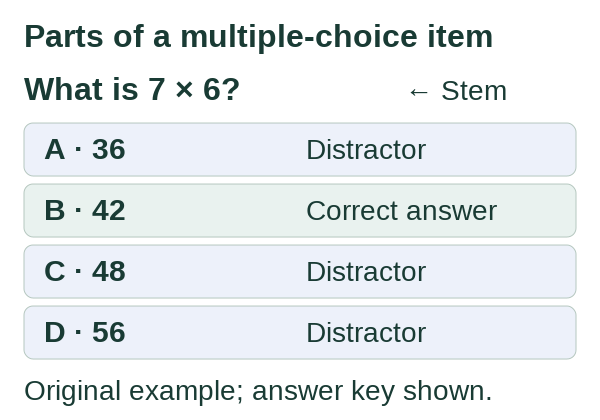
A test can draw on a variety of multiple-choice formats.[7] Bush covered the design of individual questions and issues concerning the question bank as a whole. He also covered the choice of test format and what post-test analysis can reveal. Bush judged pre-test quality assurance fairly simple, though it takes work. After the test, statistical analysis of the answers can reveal more. It demands considerable expertise.[8]
Well-built items can measure skills beyond simple factual recall. These include understanding, critical thinking and problem solving. One of the most serious problems facing educators is writing items that measure more than simple factual recall.[7]
Good items give clear directions and avoid unintended clues. They use accessible vocabulary and test concepts rather than vocabulary. Each item must be reviewed. The review confirms that it tests the skill or knowledge it was designed to test. Review also guards against clues. Such clues let a test-wise student pick the right option for the wrong reason.[6]
Main ideas
How guessing changes scores and reliability
A student who does not know an answer can still pick the right option by luck. Chance success due to guessing contributes to error variance in the score.[9] For a test with a set item structure, that paper gave a formula for the smallest possible standard error of measurement: (N - X) / a. In this expression, N stands for the total number of items and X for the score. The letter a stands for how many choices each item offers.[10]
Suppose the variance of real scores follows a binomial pattern. Then real scores regress on raw scores in a straight line. Under other distributions the regression line bends into a curve. Even then, the straight-line estimating formula comes close to the curved relationship.[11]
A 2003 paper noted that the equations derived in earlier work have not often been used in practical test work. The formulas give a more realistic guide to the reliability gain from changing the number of items or the number of choices. They also cover changes in the means and variances of observed scores.[9]
A 1962 paper described several such procedures. These included the number of correct responses minus the number of wrong responses, minus one-half the wrong responses, or minus one-quarter of them. The usual correction takes the number of wrong responses and divides it by one fewer than the number of options. It then subtracts that amount from the number correct. The paper reported a caution from Doppelt in 1954. Wrong responses do not all follow the laws of chance, because some come from misinformation. Doppelt also said the correction formulas rest on questionable assumptions. One is that all wrong answers plus some right ones are guesses. In his view, corrected scores try to cancel out differences in boldness between students. They do not reveal what a student truly knows. Thurstone argued that chance formulas give weights to errors based on probability theory. Those weights may be considerably wrong for a given examination.[12]
A 1982 paper worked out simple reliability formulas. It did this for matching tests and for multiple-choice tests. The formulas treat lucky guessing as the only source of error variation.[13]
Formula scoring and penalties for wrong answers
Formula scoring is a rule for multiple-choice tests. It subtracts a share of the wrong answers from the number of correct ones. The aim is to reduce score irregularities that come from guessing. Under the usual instructions, candidates should leave an item blank. They should do this when their answer would be a sheer guess among all the choices. A candidate may be unsure but able to rule out one or more options. Then the rule does not ask for the item to be left blank. A 1988 account of the procedure calls it unsuitable for most classroom testing.[14]
The size of the subtraction is set by a share of the number of wrong responses. On average, formula scoring does not penalize candidates who ignore the instructions and guess blindly on every choice. Candidates who hold partial information but leave items blank tend to get lower formula scores. Guessing among the choices that remain would usually help them more. Candidates who hold misinformation may be exceptions to that pattern. Formula scores do not come close to scores from similar fill-in-the-blank tests. The rule also cannot stop very lucky candidates from reaching unrealistically high scores.[14]
Deductions for wrong answers change what candidates do. Some papers subtract marks for errors. On those papers, many candidates leave out large numbers of items because they fear losing marks. In a 1985 multiple-choice paper, candidates who left many items blank made relatively few errors. Fleming interviewed the candidates who had left many items blank. They were advised to attempt more items. This included items where they felt unsure but not wholly ignorant. The whole group got the same advice. Then they took another multiple-choice paper in the same subject in 1987. Their error count rose as well. Even so, their standing relative to their fellow candidates tended to improve. Across the whole group, attempting more items went clearly with a higher rank order.[15]
Instructions and scoring rules have been tested directly in an experiment with some 240 participants. They were randomly assigned to four conditions that differed in how much they discourage guessing. Participants took two computer tests. The tests differed only in their instructions and in how they were scored. As predicted, blank answers rose across the conditions. Wrong and right responses fell. The expected differences in reliability did not appear. The discussion notes that advice to guess in testing contexts has misleading effects on education.[16]
How the scoring rule frames the situation affects how often participants guess. In three experiments, participants were given hypothetical test situations. They were asked how certain they would need to be before answering a question. Guessing rose when participants expected a low grade and so placed themselves in a loss. It also rose when the scoring rule made the situation look like one of possible losses. The final experiment repeated these findings. It used a task modelled on a real test.[17] Theoretical work has set out competing accounts of how guessing should be corrected. It also covers how partial knowledge can be described mathematically.[18]
Rewarding partial knowledge
One such format lets examinees select more than one answer. They do this when they are unsure of the correct one. Negative marking penalises incorrect selections. It subtracts credit for wrong choices. The stated aim is to reward examinees who hold partial knowledge. The comparison group is those who are simply guessing. Bush argued in 2001 that the method pushes examinees to think about their answers more carefully. It also produces results of finer resolution than standard multiple-choice tests.[19]
Rippey proposed in 1970 a system in which students express their distribution of preference across the options and their certainty in that distribution. He argued that such scoring allows the use of types of test items that had been ignored before.[20] A third family asks the test taker to choose any subset of the options. The taker believes this subset contains the one correct answer. Gibbons, Olkin and Sobel devised a scoring system in 1979. It depends on the size of the chosen subset and on whether the correct answer is eliminated. They obtained the mean and variance of the score per item. From these they derived methods for deciding how many items the test should contain. They also compared how efficient subset selection was with conventional scoring. They considered the case of more than one correct answer per item.[21]
A review published in 1989 examined response and scoring methods. These try to capture an examinee's degree of knowledge on each item and turn it into a total score. Frary concluded that the elaborate response and scoring schemes studied so far offer little benefit. Some schemes showed confirmed potential. They could raise internal-consistency reliability. Some methods require extra responding time. That time would also allow a conventional multiple-choice test to be lengthened enough to obtain the same reliability improvement.[22]
A large empirical study published in 1997 compared seven testing methods. The tests came from four content areas. Different examinees took the test under different methods. Examinees showed a surprisingly strong readiness to use what the alternative methods offered. High-ability examinees were, on average, better at judging how much they knew. They therefore stood to gain more from these methods. The testing method and the test content affected each other in systematic ways. No single method came out ahead in every case.[23]
An earlier study published in 1970 gave 211 students their midterm examination. The students were in an educational measurement course, and the exam used one of three procedures. One group took the test under conventional directions. This gave a baseline for comparison. The other groups took it under differential weighting of response alternatives. Others took it under confidence testing instructions. Reliability was estimated by the split-half method. Validity was estimated by correlating midterm scores with final examination scores. Hambleton, Roberts and Traub found some support for one view. More elaborate testing techniques can raise validity. They also suggested how to run studies that settle the question.[24]
How many options an item needs
Textbooks often tell item writers to give each question four or five options. Most testing programs in the United States do so. Reviews of the research, however, suggest that three options may suit most ability and achievement tests. A 1993 study reported how often distractors performed acceptably. Data from three different testing programs showed that items seldom held more than three useful options. The researchers concluded that items with 2 or 3 options may serve testing programs and classroom teachers better.[25]
A 1998 paper noted that measurement textbooks typically recommend four or five options. Most tests still follow that rule. That paper added that more than half a century of theory and evidence points toward three options. This holds for most ability and achievement items.[26]
Several studies have compared three-option and four-option items directly.[27][26] In one undergraduate psychology course, students took five 50-question tests with 4 options in one semester. Students scored significantly better on the 3-option items once chance guessing was corrected for. The improvement may reflect better validity of the items.[27]
A 1998 study used two versions of 90 items, one with four options and one with three. The items appeared in three computerized examinations in successive years. The three-option items tended to be slightly easier, with higher traditional difficulty indexes. They showed no drop in discrimination. Reliability showed no steady change between the versions.[26]
Tests built from three-alternative items have shown psychometric properties similar to those of tests built from five-alternative items. Data from public sector employment tests showed a result. The properties were similar, and development cost and administration time would likely fall. So the researchers argued that three-option items may be preferable for some testing purposes.[28]
A 2011 study built 9 tests of 3-, 4- and 5-choice questions on one science and technology subject. It gave them over a year to 41 pre-service teachers. Items with 3 or 5 choices showed higher reliability than items with 4 choices. No significant differences appeared among the other psychometric properties. By effect size, the 3-choice test was the most effective type. The researcher noted that 3-choice questions are easy to prepare and analyze.[29]
A 1994 study examined an examination taken by 700 candidates. They were seeking certification in a medical specialty. Content experts were very accurate at spotting nonfunctioning options. Their judgments were checked against actual item analysis data. Removing a nonfunctioning option from a five-option item produced a slight, non significant overall rise in item difficulty. Item discrimination showed no significant difference. A test of items with the nonfunctioning option removed was nearly as reliable as the same items in a five-option format. Nonfunctioning options were found by empirical or judgmental methods. Which method was used made no difference to item performance.[30]
Distractors, cueing and response sets
The wrong answers on a multiple-choice item are called distractors. The paper argues they matter for how well the item works. A 2026 paper proposed a 5Ps typology of distractors. The typology covers reading comprehension tests in English as a foreign language. The five types are plausible, peripheral, polyconceptual, prejudicial and pragmatic distractors. The paper argues that distractors can support both the assessment and the learning function of multiple-choice questions.[31]
Distractors can also carry information. A study of 156 first-year student-pharmacists found that answers placed among the distractors helped later recall. Later fill-in-the-blank questions were answered correctly 29% of the time when the earlier distractors held the relevant answer. The rate was 18% when they did not (d = 0.78).[32]
The position of the correct answer is a separate concern. The evidence on it conflicts.[33][34] A 1962 paper noted that positional preference had drawn the most attention. It was the most studied of the possible response sets. That paper cited studies reporting positional preferences in multiple-choice items. It also cited other work finding the format comparatively free of such sets.[33]
A 1970 study assigned over 1000 high school students at random to one of nine forms of a vocabulary test, with the correct answers placed in different positions. An analysis of variance found no significant evidence. It found no positional response set shared across individuals.[34]
The option none of the above has drawn divided advice. A 2015 study tested it directly in a first-year psychology course. Replacing each distractor with none of the above raised question difficulty only when that option was the correct answer. It was used as a distractor in place of the most effective wrong answers. This lowered discrimination, the item's power to separate stronger from weaker students. The study concluded that item writers should avoid none of the above on multiple-choice tests.[35]
A 1982 review found strong evidence of cluing in that format. Cluing raised the percentage of correct scores and reduced test reliability. Albanese (1982) recommended the Type X format instead.[36] A 1993 study gave 34 third- and fourth-year medical students the same items. Mean scores on the multiple-choice version were 11 percentage points higher. On a harder set given to 16 of the students, they were 22 points higher.[37]
Research
Checking item quality with statistics
The mean item discrimination coefficient was +0.25. More than 30% of items had unsatisfactory coefficients less than +0.20. Of the 3819 distractors, 45% were flawed. Some drew fewer than 5% of examinees. Others correlated positively rather than negatively with test scores. Three tests had more than 40% of their items with an unsatisfactory discrimination coefficient. Six tests had more than half of their distractors flawed. Discriminatory power dropped sharply when one or more distractors were positively correlated with test scores. Distractors chosen by less than 5% of examinees affected it only a little.[38]
A 2024 study looked at 688 items on first-year medical exams at one university. It reported a mean difficulty of 0.57±0.21, with 47.5% at the ideal difficulty level. The mean discrimination index was 0.31±0.17. Of the items, 43.6% reached an excellent discrimination level. In that study, 36.8% of distractors were nonfunctional. The number of nonfunctional distractors significantly affected both difficulty and discriminatory ability. The item authors' predictions of difficulty differed significantly from the actual values.[39]
In a 2023 study, subject matter experts rated how suitable each content standard was for multiple-choice questions. They did this before any items were written. Very low suitability ratings predicted easier items. Once item difficulty was controlled, items rated more suitable discriminated better. They were also less likely to carry a nonfunctioning distractor.[40]
Generated items, written by computer from cognitive models, have also been checked with item analysis. A 2016 study used results from a high stakes national medical licensure examination. It found that the generated items measured performance across a broad range of ability levels. Each generated item provided a consistently strong level of discrimination. The incorrect options consistently separated low from high performing examinees.[41]
A 2010 assessment of final nursing examinations compared difficulty values with cognitive learning levels. It also examined discrimination values alongside distracter performance.[42] A 2021 analysis looked at 182 multiple-choice tests from courses at all undergraduate levels at a Canadian university. It set out to establish a baseline for actual classroom tests. That analysis proposed modified measures. These included discrimination measures that leave each item out of the total score, and reliability measures adjusted for test length. It also used its data to revise item-quality guidelines that are widely used.[43] A 2017 review of distractor research found that making distractors has received much less attention than multiple-choice testing in general.[44]
Reliability, validity and test design
A 1952 mathematical analysis defined the ability behind a test as the common factor of the items' tetrachoric intercorrelations, corrected for guessing. Under certain assumptions, the correlation between total score and that ability equals the square root of the test's reliability. The same analysis found that reliability is highest when the variability of item difficulty is smallest. Reliability also peaks when the average item is somewhat easier than the midpoint. That midpoint lies between chance-level correct answers and a perfect score.[45]
A 1952 study of validity reached a related conclusion about the spread of item difficulties. Psychological tests usually contain items of a certain kind. For these items, a test with uniform item difficulty had greater overall validity than one spread across a range of difficulties. It also gave better validity for most cutting scores. The trade-off is flexibility. As the spread of difficulties increases, the test keeps the same validity across a wide range of cutting scores.[46]
Many people believe that speededness inflates the reliability estimates of number-right multiple-choice tests. Attali showed that it does not. When time runs out, examinees guess on the remaining questions. Their answers to those questions fit less well with the rest. This lowers the reliability of the test. One implication comes as a surprise. On a speeded test, adding questions may actually reduce reliability. A 2005 article worked out the mathematical derivations. It showed the effects of speededness on reliability in simulations.[47]
A score can also be a poor measure for one particular student. A student can be so atypical, so unlike other students, that an aptitude score is not a fully appropriate measure. It may not reflect that student's relative ability. A 1979 paper proposed using the student's pattern of multiple-choice answers. The pattern would show whether the score is a good measure of ability. Several indicators of appropriateness were defined. They were evaluated with a simulation of the Scholastic Aptitude Test. Levine and Rubin noted several uses. These were studying alignment errors, exceptional creativity, poor test-taking strategies, and unauthorized access to test items.[48]
Some tests mix multiple-choice items with constructed-response items. These tests raise a further design question: how to link scores across test forms. A 2010 study looked at an all multiple-choice anchor for linking mixed-format tests. It used a nonequivalent groups design, where the two groups taking the forms are not the same people. A multiple-choice-only anchor could effectively link two such forms. This would work if the multiple-choice and constructed-response portions measured the same construct. It could also work if one link stayed the same in both groups. That link is between the multiple-choice portion and the whole test. Anchor linking and a two-stage linking strategy gave identical or nearly identical results. This held for both linear and nonlinear chained linking methods. With post-stratification linking methods, the two-stage strategy produced less bias.[49]
A 2000 simulation study tested a proposed linking method. The results supported the use of the proposed method. The simulations also showed possible linking bias from the traditional linking method. They showed the same for using only multiple-choice anchor items when the test measures more than one dimension.[50]
A 2003 paper proposed an equating method based on item response theory. It was for long-term scale maintenance of a mixed-format test. The method would require collecting actual examinee responses from previous years. It would then require rerating them in a linking study for the current equating. This design removes the effect of any drift from year to year. The drift would be in how the rating team applies its standards. One effect remains. It comes from changes in the ability distribution of examinees. Simulated data illustrated the method. It also showed the possible results of using traditional equating in the wrong way.[51]
Multiple-choice compared with written answers
A test can ask students to pick an answer or to write one. Researchers call the second kind a constructed-response item. In one study, 199 eighth-grade students took mathematical reasoning and verbal comprehension items. The items came in constructed-response, standard multiple-choice and Coombs multiple-choice formats. The formats behaved as equivalent measures in most comparisons. But the constructed-response test of verbal comprehension differed from both multiple-choice versions of that ability. A factor analysis found that a five-factor structure gave a satisfactory account. It explained the shared variance among the 12 tests. Only one of the three smaller factors looked weakly like a format effect.[3]
One hundred and fifty-two university undergraduates in Thailand first answered a test of English structure in constructed-response form. They then answered three multiple-choice versions built from their own wrong answers. Mean scores rose significantly, and individual scores generally rose too. The two sets of scores were still quite closely correlated. Only 26% of responses were the same across formats. This suggests that most of what the multiple-choice items measured depended on the item format itself. Three groups sat different option-number versions of the multiple-choice test. They gave remarkably consistent response patterns.[52]
For plain fact knowledge, item difficulty clearly rises in the open-ended methods. Two online studies gave items on declarative knowledge, meaning facts. The items came in multiple-choice, open-ended and cued open-ended formats. The logistic regression models varied slightly from item to item. Latent variable analyses model the shared variance among items. They indicated that the method of inquiry did not affect what the tests measured.[53]
Kruglak built two teacher-made tests on physics terminology. Each had an essay part and a multiple-choice part. Four groups of students in two general physics courses took them. Test reliabilities, meaning how consistently a test ranks students, tended to be higher for the essay parts. Grader reliabilities of the essay parts were high. Two instructors gave significantly different mean grades. Correlations with total course achievement were moderately high. They tended to be higher for the multiple-choice tests. The study tentatively concluded that the two formats on definitions correlated only low to moderately with each other.[54]
Reading demands are a separate source of difference, because a test in science or social studies can end up measuring reading skill. Reading ability had a significant influence on test performance. Item format did too. Students scored best on items in the matching format. The study drew lessons for judging content validity. That means whether a test really covers the subject it claims to cover.[55]
A taxonomy of seven mathematics assessment components was ordered by cognitive level. It was used to judge which components multiple-choice items can assess well. The results showed that multiple-choice questions can be built to test higher order levels of thinking and learning.[56] In advanced placement computer science and chemistry, restricted factor analysis showed that free-response sections measured largely the same underlying proficiency as multiple-choice sections. Free-response items also showed a significant but relatively small amount of local dependence, which produced a small degree of multidimensionauty, meaning the items were not fully independent of one another.[57]
A sample of 529 nonurban high school students each answered one of four test forms. The forms varied by subject matter and by item order. The multiple-choice tests were significantly more reliable than the true-false tests. This held even after the true-false tests were lengthened to match. The researchers corrected the correlations for imperfect reliability. These corrected values were significantly less than 1.00 for three of the four tests.[58]
Mixing the two formats in one examination raises a practical scoring problem. Multiple-choice marks are often norm-based, while essay marks are criterion-based. One proposal brings multiple-choice marks onto the essay scale. It matches the interquartile ranges of the two sets of marks.[59]
Practice, desirable difficulties and test anxiety
A desirable difficulty is a condition of learning that seems to slow learning down. It improves long-term retention and transfer. Testing is one such difficulty. But researchers have generally thought that only tests requiring clear retrieval produce these benefits, such as free recall and cued recall tests, not multiple-choice tests. A 2015 review of laboratory and classroom research asked one question. Can multiple-choice testing also be designed to promote the retrieval processes that improve learning? The article discusses the properties multiple-choice questions must have to reach that goal. It also covers the thinking strategy students need when answering them.[60]
Guessing when unsure affects test reliability. It also affects how each person performs on multiple-choice tests. A 2019 paper describes the test taker's fallacy. After a run of the same answer choice, a person tends to expect a different answer next. This pattern is called negative recency, and it resembles the gambler's fallacy. It appeared even when the answer sequences may or may not have been random.[61]
Test anxiety can differ by question format. A 2020 study gave 50 female English language learners two vocabulary tests, one multiple-choice and one error identification. The learners were at intermediate and upper-intermediate levels, and they also filled in a questionnaire on anxiety. Anxiety was higher in the group tested with the error identification format. The rise was significant compared with the multiple-choice group. The study also concluded that debilitative anxiety, anxiety that hinders performance, still held students back. It kept them from strong performance during the teaching period.[62]
In practice
Writing items that measure understanding
Schultheis set out guidelines for writing cognitive objectives and multiple-choice questions for pharmacy programs. One set of guidelines advises that each question be clear and concise. It should be written as a complete sentence. The same guidelines ask for one clearly correct or best response. They also ask for no clues that point to the answer. They also advise writing questions in positive terms rather than negative ones.[63]
In one experiment, 142 senior education students took part. There were 82 women and 60 men, and they answered items built in different formats. Whether the stem was stated positively or negatively had no effect on item difficulty or on discrimination. Incomplete stems made items harder than complete stems. They did not change discrimination.[64]
The levels are knowledge, comprehension, application, analysis, synthesis and evaluation. One set of guidelines for pharmacy programs says each objective should name its learning level. Each question should match the level of the objective it tests. The same guidelines note something. Some higher-level questions may be needed to assess the competence level a program aims for.[63] A 2024 article describes a system of criteria for sorting multiple-choice questions by bloom's six levels. The aim is for exams to meet course outcome standards.[65]
Items can also target critical thinking within a single subject. Morrison and Free base their guidelines on McPeck's position. Critical thinking is specific to a discipline.[66] Nursing faculty from one course described how they wrote items at higher cognitive levels. They kept the items matched to the course's critical-thinking objectives.[67]
Published advice is not always followed in practice. A 1990 survey of educational psychology textbooks found 12 guidelines. Their authors recommended these most often. The survey then checked 60 multiple-choice items (N = 1,080) drawn at random from 18 instructor guides. About 60% of the items broke one or more of the 12 guidelines.[68]
Testing as a way to learn
Taking a test can change what a person remembers later. This is called the testing effect. A 2005 study gave students a multiple-choice test. Later it gave them a general knowledge test, with a warning not to guess. Students who had been tested on facts did better on the final cued-recall test. That test asks people to supply an answer after a prompt. The same study found a cost. Reading more wrong options on the first test made students more likely to produce those wrong options later. The researchers warned that multiple-choice testing may create false knowledge by accident.[1]
One common criticism is that a multiple-choice test shows the right answer among the options. Students then only have to recognize it. A 2012 set of two experiments tested a question. Can well-built multiple-choice questions still make students retrieve information actively? When the wrong options were made plausible, students recalled why the right option was right. Both multiple-choice and cued-recall tests helped students keep the tested facts. The multiple-choice test had one advantage. It also helped students recall information about the incorrect options, which the cued-recall test did not.[2]
Feedback, meaning information given after an answer about whether it was right, changes how much a test teaches. In a 2007 study, participants read 12 prose passages of 280 to 300 words. They then took a six-option multiple-choice test on them. Feedback came either immediately or after a delay. It was either the correct answer or a chance to keep answering until the correct answer was found. A later cued-recall test measured performance. Delayed feedback did better than immediate feedback. The type of feedback did not matter. Answer-until-correct and standard feedback gave equal results. The researchers suggested that delaying feedback helps. The information is presented again after a space of time.[69]
Verification feedback only labels a choice correct or incorrect. It kept correct answers as well as full answer feedback did. Verification feedback also let learners correct more of their errors than no feedback did. It was not as effective as answer feedback.[70]
Two kinds of feedback beat simple right/wrong feedback on near and far transfer questions. One focused on concepts and one on the response. Both worked at once and one week later. The two richer feedback types did not differ much from each other.[71]
A 2003 paper reported two experiments on item feedback in multiple-choice tests, and the effects were either negligible or negative. The expected larger benefit for female scores was not found. The expected interaction with gender was not found either. That paper concluded that advice to give item feedback during testing has no basis in theory or in evidence.[72]
A 1976 study gave about 1,400 fifth and sixth graders a multiple-choice test. They got total immediate feedback, partial immediate feedback or no feedback. Students who took the test without feedback scored significantly lower on a later completion-format posttest than either feedback group. That study also found an interaction between achievement level and feedback treatment. It found an unexpected interaction between sex and feedback.[73]
A 2024 mixed methods study of nursing students found that score-only feedback on online formative tests led to more cognitive engagement. It also led to more collaboration and more information seeking. Score-only feedback was also linked to lower satisfaction. The researchers argued that overly directive feedback encourages surface-level learning strategies.[74]
Classroom studies ask whether the laboratory findings hold in real courses. In a large undergraduate course, multiple-choice quizzes were given across the term. Some information was tested and related information was not. On the final exam, students showed learning benefits for the tested information. The researchers had worried that quizzing might impair memory for related but untested material. This did not happen.[75]
A 2018 review asked a question. Do the best practices for measuring learning with multiple-choice tests match the best practices for learning from them? The review found substantial agreement between the two bodies of research. Its overall recommendation was to write questions that are simple in format. The questions should challenge students but let them succeed often, and target the mental processes named in the learning goals.[76]
A 2015 engineering education report described online multiple-choice quizzes used alongside regular classes. Comments and hints came right after each submission. Students accepted the quizzes, and the quizzes proved a useful extra teaching tool. Preparing them did take a huge amount of work.[77]
Feedback, confidence and self-assessment
One remedy is to ask students to record how confident they are in each multiple-choice answer. This improves the quality of the feedback a teacher can give. A multiple-choice question asks the student to pick one or more correct answers from a list. The list follows a question stem. Feedback can inspire a student. It can also demoralise one who cannot understand it or use it to decide what to do next. Advice a student can act on usually has to be personal. Some methods aim to reduce distortion from guessing, such as negative marking and value choice. They make a student pay a penalty for attempting a question that carries uncertainty. A student in doubt may then skip questions. That limits the useful information a grader can get from the answer sheet.[78]
Another answer form is the Immediate Feedback Assessment Technique (IFAT). It gives immediate feedback on each item, and students answer until correct. It also allows partial credit when a student's first response is wrong. It can be used easily in large classes. Undergraduates filled in a questionnaire after using it. They were extremely positive, calling it easy to use and helpful for their learning. They said they strongly wanted to use it for all multiple-choice tests. Liking for the form was not related to personal characteristics or to test performance. This suggests broad appeal to students.[79]
A computerised Constructive Multiple-choice Testing system asks examinees to answer the same question twice. First comes a short answer form, then a multiple-choice form. This gathers information about both formats. Testing time does not rise much. In one study, fifth grade students aged 11 were tested on science. In the other, college students were tested for a grade. In both studies students scored higher in the multiple-choice format. The correlation between the two formats was high, and item discrimination was higher in the short answer format. In some cases students chose a wrong multiple-choice option. They had typed the correct answer in the short answer part.[80]
What this looks like when you study
After that came a final general knowledge test where they were warned not to guess. The earlier test helped final recall. But reading more wrong options (called lures) lowered that benefit and made students more likely to give those lures as answers.[1] A later set of two experiments found that well-built multiple-choice tests can still trigger useful retrieval. This works if the wrong options are made plausible.[2]
In a study of 198 ninth graders, students took mathematics and vocabulary tests in both free-response and multiple-choice form, five weeks apart. For vocabulary, the link between multiple-choice scores and both testwiseness and willingness to take risks was significant in every analysis. This held once free-response scores were held constant. The same pattern did not appear for mathematics scores.[81]
One teacher advised medical students who had skipped many items on a multiple-choice paper. The advice was to answer more items, including ones they were unsure about. Those students later took another paper. They attempted many more items and made more errors, yet their rank in the group tended to rise.[15]
One approach to better feedback in large classes asks students to record their confidence in each multiple-choice answer.[78] A related format is called reward for omission with confidence in knowledge (ROCK). It lets students signal what they know and what they are unsure of. The authors say ROCK finds missing knowledge or wrong beliefs for each student and for the whole class. This helps the teacher plan feedback.[82]
Little, Bjork, Bjork and Angello tested multiple-choice items with plausible wrong options. Such items can prompt students to recall two things. They recall why the right answer is right and why the others are wrong.[2]
If you are unsure, answer items where you can rule out at least one option. Formula scoring is not meant to discourage that kind of guessing.[14] Roediger and Marsh found that reading more wrong options before a test lowered the benefit of testing. It also raised the number of those wrong options chosen on a later test.[1]
Criticism
Early doubts and the case against
In 1967, Hoffmann set out to warn about the defects of widespread mechanized testing in the United States. In 1967, Hoffmann warned that widespread machine-scored testing in the United States carried defects and harmful side effects. The article argued that the people who built such tests, called psychometrists, were not scientific. It said their statistical approach rested on a fallacy. Using sample questions, Hoffmann claimed the tests used ambiguity in place of worthwhile difficulty. He said the problem was worse than that. Hoffmann further charged that the tests encouraged intellectual dishonesty and corrupted education.[83]
Multiple-choice questions ask a student to pick from offered options, while constructed-response questions, such as short answers, essays or problem-solving tasks, ask the student to generate the answer.[84] Certification bodies and academic programs both lean on multiple-choice questions. Many people believe constructed-response questions capture understanding better.[5]
Research from educational psychology has suggested something. Multiple-choice tests can measure the same levels of student mastery as constructed-response tests. Recent studies in some school subjects, however, found the two formats do not always match.[84] Efforts to link the two measures have had only partial success. Some researchers report a close link. Others report none at all.[5]
Hoffmann argued that the tests damage education. The 1967 article presented the defects of mechanized testing as a warning of what can happen when test specialists gain influence over scholars.[83]
Later work has raised a doubt. Can multiple-choice questions be treated as one uniform kind of task?[84][5] A 2005 article proposed that a significant confound in prior experiments was treating multiple-choice questions as all alike. In fact, they may test widely varying levels of student understanding.[84]
A 2010 study suggested an explanation. The knowledge level an item taps may explain why findings on the link between formats differ so much. Kuechler and Simkin examined that idea with 172 tests. The tests were built with care for several introductory programming courses.[5]
Cheating, fairness and open questions
Copying answers from a neighbour is an old worry about multiple-choice tests. It is hard to prove. A proctor may strongly suspect two students. Even so, the proctor may not feel sure enough to bring charges. Even when charges are pressed, an admission of guilt often does not follow. Administrators are then unlikely to act.[85]
So statisticians have built indices that estimate the chance that the match between two answer sheets arose by chance. Such indices serve two purposes. They catch people who copy, and they monitor how common copying is, so that prevention methods can be judged.[86]
One method compares the answers of two students. It looks only at items where both made errors. Cheating is judged likely when the number of identical wrong answers is far above chance. The two students must also have sat close together. This analysis was applied to 90 examinations. It suggested ways to discourage cheating and showed some limits of the procedure.[87]
A later update stressed the need to set an acceptable probability of falsely detecting copying.[88] A newer statistical test treats each answer as the product of knowing, guessing or copying. It assumes that honest examinees reach answers only through the first two. That assumption gives a family of distributions called shifted binomials. The test's power was checked for several sets of parameter values. The same paper warns that extending the test to matched numbers of correct answers would create improper statistical hypotheses.[89]
Whether students should change answers is a separate question with its own evidence. A 1980 study looked at answer changing. It asked how patterns of change relate to the features of the items. Its results resembled earlier findings. They also pointed to further relationships between these variables that had not been given enough attention.[90]
Testwiseness, the set of test-taking skills that are not the subject being tested, can be taught. A 48-item instrument followed. The taught group did significantly better than the control group on every measure of testwiseness.[91]
Testwiseness also seems to tilt scores in favour of particular examinees. Even so, vocabulary scores correlated significantly with testwiseness and with risktaking, without exception. No partial correlation involving achievement motivation or test anxiety reached significance. The conclusion was that multiple-choice tests can favour examinees who are highly testwise and willing to take risks. This was more so on a verbal test than a numerical one.[81]
The multiple-choice format itself has been reported to favour males over females. One study of undergraduates compared a conventional multiple-choice test with a test where takers judged whether their own answers were correct. Males and females scored differently. The gap between their scores shrank when self-assessment was allowed. The paper suggests an explanation. The gap may reflect an alleged difference in cognitive style between the genders.[92]
Offering students a choice of scoring rule may also affect marks. In an experiment, groups of students could pick between two equal scoring rules. Both rules applied to the same multiple-choice test. Choice appeared to raise scores. But students needed to learn how to choose an assessment method, and women seemed to gain more from the option.[93]
Question order is another design feature that has been studied. One study looked at 212 undergraduates in four education courses at an Arab Gulf university. It compared forward and randomized question order. Question order showed no significant main effect. Grade point average did not change how strongly sequencing format and performance were linked. Descriptive trends hinted at slightly higher performance under forward sequencing. The authors gave only cautious support for randomized order as a fairness measure.[94]
Licensure and certification bodies use standardised multiple-choice examinations to award credentials. They assume that scores reflect the quality of clinical reasoning.[95] The format can also complicate an item rather than clarify it. In a Norwegian case, focus-group interviews showed a possible problem. The multiple-choice format may complicate items designed to measure teachers' mathematical knowledge for teaching.[96]
Norris proposed gathering direct evidence on validity. Students would give verbal reports of their thinking on trial items. The aim is to control for students' background beliefs. Those beliefs can threaten both validity and fairness.[97]
How tests are delivered has also been studied. One synthesis covered 81 studies performed between 1997 and 2007. It put the effect size for computer versus paper administration at -.01 weighted and .00 unweighted.[4]
What a multiple-choice test rewards depends partly on how it is scored. The common rule sets one minimum quota of right answers for all students, assuming that a student who does not know answers at random with equal probability. That method may fail if a student cannot copy random selection. Numerical calculations also show how poorly ordinary tests pin down a student's level of knowledge. These tests had 100 or 150 questions, each with five alternatives.[98]
Scoring rules also treat misinformation differently. Under various levels of information and misinformation, misinformation always and necessarily gives expected item scores lower than complete ignorance does. Some response and scoring methods penalise all conditions of misinformation equally. Others vary the penalty with how many wrong choices the misinformed examinee has grouped with the correct one. When information is partial, expected item scores differ a lot from one method to the next. Examinees guess whenever it pays under the rule in use. Guessing sometimes leaves expected item scores unchanged and sometimes lowers them.[99]
The choice of answer options has drawn its own research. Undergraduates took a 40-item general-knowledge test. Keying none of the above as correct made items much harder (d = -1.11). Sometimes examinees correctly chose none of the above. In 45% of those cases they wrote a wrong answer (19%) or wrote nothing (26%). Rescoring to deny credit in those cases caused item discrimination to fall (d = −0.35). So credit earned by examinees with knowledge gaps can make items look more discriminating than they are. DiBattista, Sinnige-Egger and Fortuna advise against using none of the above as an option in multiple-choice items.[100]
A separate set of experiments used 32 participants in each of two studies. The positive testing effect vanished when none of the above was the correct response on the first test. It held when that option was an incorrect response.[101]
Diagnosis and the limits of the format
Conceptual tests in physics have been built to find the specific difficulties students have with particular content. They also judge teaching practices and curriculum.[102] Four-tier tests made up 83.33% of the uses reviewed and five-tier tests 16.67%. The four-tier tests were most often used for optical devices (12%) and for energy and work (10%). Each design has its own strengths and weaknesses for judging what students understand.[103]
The Moses illusion persists in a multiple-choice format. In that format, the correct answer is always available. People are asked how many animals of each kind Moses took on the Ark, and most answer two. Moses does not appear in that biblical story; this is called the Moses illusion. Four experiments had a total of 914 participants. The illusion persisted even when the answer was offered as a multiple-choice list. Money rewards for correct answers reduced the illusion. The reduction was small in both its size and its statistical strength.[104]
Comparisons with open-ended formats show that multiple-choice items tend to be easier. This is not true in every setting. In second-language reading no overall difference appeared, except under four conditions: between-subjects designs, random assignment, items with identical stems, or learners at a high proficiency level.[105]
In clinical examinations, candidates scored significantly higher on objective tests than on free-response tests. Both covered the same content. The gap was larger for junior and less competent students than for more competent doctors. The researchers blamed the difference mainly on one thing. The answer options cue candidates. In a questionnaire, most students gave their view. Free-response tests, they said, gave a truer picture of their clinical ability.[106]
Common misconceptions
It is commonly believed that guessing inflates the reliability of number-right multiple-choice scores. Students often guess on questions they run out of time for. One result is surprising.[47]
Authors of textbooks commonly advise putting four or five choices on each multiple-choice item, and nearly every testing program in the United States follows that practice. Haladyna and Downing reviewed studies on how many choices an item should offer. They concluded that three choices can work well for most tests of ability and achievement.[25]
Key studies
| Year | Study | Sample | Design | Finding |
|---|---|---|---|---|
| 1974 | ROWLEY[81] | 198 ninth grade students | correlational study with free-response and multiple-choice tests | On vocabulary, testwise and risk-taking students were favored by the multiple-choice format [48]. |
| 1988 | FLEMING[15] | medical students taking multiple-choice papers in 1985 and 1987 | advice intervention with follow-up | Students advised to answer more items attempted many more and tended to improve their rank despite more errors [54]. |
| 1988 | Frary[14] | review of formula scoring for multiple-choice tests | Formula scoring reduces score irregularities from guessing but is viewed as inappropriate for most classroom testing. | |
| 1993 | Haladyna & Downing[25] | three testing programs | study of distractor frequency | Test items seldom contained more than three useful options [34]. |
| 1994 | Cizek & O'Day[30] | 700 candidates for certification in a medical specialty | two investigations comparing four- and five-option items | Removing a nonfunctioning option caused a slight, nonsignificant increase in difficulty and no significant change in discrimination [78]. |
| 1997 | Ben-Simon et al.[23] | large-scale empirical study of seven testing methods across four content areas | High-ability examinees were better judges of their knowledge and benefited more from partial-knowledge methods. | |
| 1998 | Delgado & Prieto[26] | comparison of four- and three-option versions across successive years | Three-option items were slightly easier with no decrease in discrimination and no systematic change in reliability [89]. | |
| 2003 | Zimmerman & Williams[9] | mathematical derivation | Guessing adds error variance and lowers reliability, and the formulas show how other error sources combine with it [55]. | |
| 2005 | Roediger & Marsh[1] | experiment with a later cued-recall test | Prior multiple-choice testing aided final recall, but reading more lures lowered that benefit and increased lure answers [3]. | |
| 2007 | Butler et al.[69] | participants who read 12 prose passages | two experiments on feedback type and timing | Delayed feedback beat immediate feedback, while answer-until-correct and standard feedback worked about equally well [10]. |
| 2011 | DiBattista & Kurzawa[38] | 1,198 multiple-choice items from sixteen classroom tests | statistical item analysis | The mean item discrimination coefficient was +0.25, and more than 30% of items had coefficients below +0.20 [19]. |
| 2012 | Little et al.[2] | students in two experiments | experiments comparing multiple-choice and cued-recall tests | Properly built multiple-choice tests triggered productive retrieval and also helped recall of incorrect alternatives [4]. |
| 2014 | DiBattista et al.[100] | undergraduate students taking a 40-item general-knowledge test | experiment on the "none of the above" option | Items keyed to "none of the above" were far harder for students than items with an ordinary key, with an effect size of d = -1.11 [95]. |
| 2024 | Konakcı[39] | 688 multiple-choice questions from first-year medical exams | item analysis with author predictions | The mean difficulty index was 0.57, and 36.8% of distractors were non-functional [104]. |
See also
References
- Roediger, H. L., & Marsh, E. J. (2005). The Positive and Negative Consequences of Multiple-Choice Testing. Journal of Experimental Psychology: Learning, Memory, and Cognition, 31(5), 1155-1159. doi:10.1037/0278-7393.31.5.1155
- Little, J. L., Bjork, E. L., Bjork, R. A., & Angello, G. (2012). Multiple-Choice Tests Exonerated, at Least of Some Charges: Fostering Test-Induced Learning and Avoiding Test-Induced Forgetting. Psychological Science, 23(11), 1337-1344. doi:10.1177/0956797612443370
- Traub, R. E., & Fisher, C. W. (1977). On the Equivalence of Constructed- Response and Multiple-Choice Tests. Applied Psychological Measurement, 1(3), 355-369. doi:10.1177/014662167700100304
- Kingston, N. M. (2008). Comparability of Computer- and Paper-Administered Multiple-Choice Tests for K–12 Populations: A Synthesis. Applied Measurement in Education, 22(1), 22-37. doi:10.1080/08957340802558326
- Kuechler, W. L., & Simkin, M. G. (2010). Why Is Performance on Multiple‐Choice Tests and Constructed‐Response Tests Not More Closely Related? Theory and an Empirical Test*. Decision Sciences Journal of Innovative Education, 8(1), 55-73. doi:10.1111/j.1540-4609.2009.00243.x
- Fuhrman, M. (1996). Developing Good Multiple-Choice Tests and Test Questions. Journal of Geoscience Education, 44(4), 379-384. doi:10.5408/1089-9995-44.4.379
- HALADYNA, T. (2022). Creating multiple-choice items for testing student learning. International Journal of Assessment Tools in Education, 9(Special Issue), 6-18. doi:10.21449/ijate.1196701
- Bush, M. E. (2006). Quality assurance of multiple‐choice tests. Quality Assurance in Education, 14(4), 398-404. doi:10.1108/09684880610703974
- Zimmerman, D. W., & Williams, R. H. (2003). A New Look at the Influence of Guessing on the Reliability of Multiple-Choice Tests. Applied Psychological Measurement, 27(5), 357-371. doi:10.1177/0146621603254799
- Zimmerman, D. W., & Williams, R. H. (1965). Effect of Chance Success Due to Guessing on Error of Measurement in Multiple-Choice Tests. Psychological Reports, 16(3_suppl), 1193-1196. doi:10.2466/pr0.1965.16.3c.1193
- Hamilton, C. H. (1950). Bias and Error in Multiple-Choice Tests. Psychometrika, 15(2), 151-168. doi:10.1007/bf02289198
- Little, E. B. (1962). Overcorrection for Guessing in Multiple-Choice Test Scoring. The Journal of Educational Research, 55(6), 245-252. doi:10.1080/00220671.1962.10882801
- Zimmerman, D. W., & Williams, R. H. (1982). Element of Chance and Comparative Reliability of Matching Tests and Multiple-Choice Tests. Psychological Reports, 50(3), 975-980. doi:10.2466/pr0.1982.50.3.975
- Frary, R. B. (1988). Formula Scoring of Multiple‐Choice Tests (Correction for Guessing). Educational Measurement: Issues and Practice, 7(2), 33-38. doi:10.1111/j.1745-3992.1988.tb00434.x
- FLEMING, P. R. (1988). The profitability of ‘guessing’ in multiple choice question papers. Medical Education, 22(6), 509-513. doi:10.1111/j.1365-2923.1988.tb00795.x
- Prieto, G., & Delgado, A. R. (1999). The Effect of Instructions on Multiple-Choice Test Scores. European Journal of Psychological Assessment, 15(2), 143-150. doi:10.1027//1015-5759.15.2.143
- Bereby‐Meyer, Y., Meyer, J., & Flascher, O. M. (2002). Prospect theory analysis of guessing in multiple choice tests. Journal of Behavioral Decision Making, 15(4), 313-327. doi:10.1002/bdm.417
- Hutchinson, T. P. (1982). Some theories of performance in multiple choice tests, and their implications for variants of the task. British Journal of Mathematical and Statistical Psychology, 35(1), 71-89. doi:10.1111/j.2044-8317.1982.tb00642.x
- Bush, M. (2001). A Multiple Choice Test that Rewards Partial Knowledge. Journal of Further and Higher Education, 25(2), 157-163. doi:10.1080/03098770120050828
- Rippey, R. M. (1970). Rationale for Confidence-Scored Multiple-Choice Tests. Psychological Reports, 27(1), 91-98. doi:10.2466/pr0.1970.27.1.91
- Gibbons, J. D., Olkin, I., & Sobel, M. (1979). A Subset Selection Technique for Scoring Items on a Multiple Choice Test. Psychometrika, 44(3), 259-270. doi:10.1007/bf02294692
- Frary, R. B. (1989). Partial-Credit Scoring Methods for Multiple-Choice Tests. Applied Measurement in Education, 2(1), 79-96. doi:10.1207/s15324818ame0201_5
- Ben-Simon, A., Budescu, D. V., & Nevo, B. (1997). A Comparative Study of Measures of Partial Knowledge in Multiple-Choice Tests. Applied Psychological Measurement, 21(1), 65-88. doi:10.1177/0146621697211006
- HAMBLETON, R. K., ROBERTS, D. M., & TRAUB, R. E. (1970). A comparison of the reliability and validity of two methods for assessing partial knowledge on a multiple‐choice test. Journal of Educational Measurement, 7(2), 75-82. doi:10.1111/j.1745-3984.1970.tb00698.x
- Haladyna, T. M., & Downing, S. M. (1993). How Many Options is Enough for a Multiple-Choice Test Item? Educational and Psychological Measurement, 53(4), 999-1010. doi:10.1177/0013164493053004013
- Delgado, A. R., & Prieto, G. (1998). Further Evidence Favoring Three-Option Items in Multiple-Choice Tests. European Journal of Psychological Assessment, 14(3), 197-201. doi:10.1027/1015-5759.14.3.197
- Landrum, R. E., Cashin, J. R., & Theis, K. S. (1993). More Evidence in Favor of Three-Option Multiple-Choice Tests. Educational and Psychological Measurement, 53(3), 771-778. doi:10.1177/0013164493053003021
- SIDICK, J. T., BARRETT, G. V., & DOVERSPIKE, D. (1994). Three‐alternative multiple choice tests: An attractive option. Personnel Psychology, 47(4), 829-835. doi:10.1111/j.1744-6570.1994.tb01579.x
- Yaman, S. (2011). The Optimal Number of Choices in Multiple-Choice Tests : Some Evidence for Science and Technology Education. The New Educational Review, 2011(Vol. 23), 227-241. doi:10.15804/tner.11.23.1.14
- Cizek, G. J., & O'Day, D. M. (1994). Further Investigation of Nonfunctioning Options in Multiple-Choice Test Items. Educational and Psychological Measurement, 54(4), 861-872. doi:10.1177/0013164494054004002
- Sukserm, P. (2026). Proposing the 5Ps Typology of Distractors for EFL Multiple-Choice Reading Comprehension Tests. Higher Education Studies, 16(1), 350. doi:10.5539/hes.v16n1p350
- Schimmelfing, L. C., & Persky, A. M. (2020). Activating prior knowledge using multiple‐choice question distractors. Medical Education, 54(10), 925-931. doi:10.1111/medu.14162
- Wevrick, L. (1962). Response Set in a Multiple-Choice Test. Educational and Psychological Measurement, 22(3), 533-538. doi:10.1177/001316446202200310
- WILBUR, P. H. (1970). Positional response set among high school students on multiple‐choice tests. Journal of Educational Measurement, 7(3), 161-163. doi:10.1111/j.1745-3984.1970.tb00711.x
- Pachai, M. V., DiBattista, D., & Kim, J. A. (2015). A Systematic Assessment of ‘None of the Above’ on Multiple Choice Tests in a First Year Psychology Classroom. The Canadian Journal for the Scholarship of Teaching and Learning, 6(3). doi:10.5206/cjsotl-rcacea.2015.3.2
- Albanese, M. A. (1982). Multiple-Choice Items with Combinations of Correct Responses: A Further Look at the Type K Format. Evaluation & the Health Professions, 5(2), 218-228. doi:10.1177/016327878200500207
- VELOSKI, J. J., RABINOWITZ, H. K., & ROBESON, M. R. (1993). A solution to the cueing effects of multiple choice questions: the Un‐Q format. Medical Education, 27(4), 371-375. doi:10.1111/j.1365-2923.1993.tb00284.x
- DiBattista, D., & Kurzawa, L. (2011). Examination of the Quality of Multiple-choice Items on Classroom Tests. The Canadian Journal for the Scholarship of Teaching and Learning, 2(2). doi:10.5206/cjsotl-rcacea.2011.2.4
- Konakcı, S. (2024). Item Analysis in Multiple Choice Questions: A Study on Question Difficulty and Authors’ Evaluation. Journal of Basic and Clinical Health Sciences, 8(2), 490-497. doi:10.30621/jbachs.1427464
- Berenbon, R. F., & McHugh, B. C. (2023). Do Subject Matter Experts’ Judgments of Multiple‐Choice Format Suitability Predict Item Quality? Educational Measurement: Issues and Practice, 42(3), 13-21. doi:10.1111/emip.12570
- Gierl, M. J., Lai, H., Pugh, D., Touchie, C., Boulais, A. P., & De Champlain, A. (2016). Evaluating the Psychometric Characteristics of Generated Multiple-Choice Test Items. Applied Measurement in Education, 29(3), 196-210. doi:10.1080/08957347.2016.1171768
- Clifton, S. L., & Schriner, C. L. (2010). Assessing the Quality of Multiple-Choice Test Items. Nurse Educator, 35(1), 12-16. doi:10.1097/nne.0b013e3181c41fa3
- Slepkov, A. D., Van Bussel, M. L., Fitze, K. M., & Burr, W. S. (2021). A Baseline for Multiple-Choice Testing in the University Classroom. Sage Open, 11(2). doi:10.1177/21582440211016838
- Gierl, M. J., Bulut, O., Guo, Q., & Zhang, X. (2017). Developing, Analyzing, and Using Distractors for Multiple-Choice Tests in Education: A Comprehensive Review. Review of Educational Research, 87(6), 1082-1116. doi:10.3102/0034654317726529
- Lord, F. M. (1952). The Relation of the Reliability of Multiple-Choice Tests to the Distribution of Item Difficulties. Psychometrika, 17(2), 181-194. doi:10.1007/bf02288781
- Cronbach, L. J., & Warrington, W. G. (1952). Efficiency of Multiple-Choice Tests as a Function of Spread of Item Difficulties. Psychometrika, 17(2), 127-147. doi:10.1007/bf02288778
- Attali, Y. (2005). Reliability of Speeded Number-Right Multiple-Choice Tests. Applied Psychological Measurement, 29(5), 357-368. doi:10.1177/0146621605276676
- Levine, M. V., & Rubin, D. B. (1979). Measuring the Appropriateness of Multiple-Choice Test Scores. Journal of Educational Statistics, 4(4), 269-290. doi:10.3102/10769986004004269
- Walker, M. E., & Kim, S. (2010). Linking mixed‐format tests using multiple‐choice anchors. ETS Research Report Series, 2010(2). doi:10.1002/j.2333-8504.2010.tb02225.x
- Tate, R. (2000). Performance of a Proposed Method for the Linking of Mixed Format Tests With Constructed Response and Multiple Choice Items. Journal of Educational Measurement, 37(4), 329-346. doi:10.1111/j.1745-3984.2000.tb01090.x
- Tate, R. L. (2003). Equating for Long-Term Scale Maintenance of Mixed Format Tests Containing Multiple Choice and Constructed Response Items. Educational and Psychological Measurement, 63(6), 893-914. doi:10.1177/0013164403251285
- Currie, M., & Chiramanee, T. (2010). The effect of the multiple-choice item format on the measurement of knowledge of language structure. Language Testing, 27(4), 471-491. doi:10.1177/0265532209356790
- Goecke, B., Staab, M., Schittenhelm, C., & Wilhelm, O. (2022). Stop Worrying about Multiple-Choice: Fact Knowledge Does Not Change with Response Format. Journal of Intelligence, 10(4), 102. doi:10.3390/jintelligence10040102
- Kruglak, H. (1965). Experimental Study of Multiple-Choice and Essay Tests. I. American Journal of Physics, 33(12), 1036-1041. doi:10.1119/1.1971143
- Benson, J., & Crocker, L. (1979). The Effects of Item Format and Reading Ability on Objective Test Performance: a Question of Validity. Educational and Psychological Measurement, 39(2), 381-387. doi:10.1177/001316447903900217
- Huntley, B., Engelbrecht, J., & Harding, A. (2009). Can multiple choice questions be successfully used as an assessment format in undergraduate mathematics? Pythagoras, 0(69). doi:10.4102/pythagoras.v0i69.41
- Thissen, D., Wainer, H., & Wang, X. (1994). Are Tests Comprising Both Multiple‐Choice and Free‐Response Items Necessarily Less Unidimensional Than Multiple‐Choice Tests?An Analysis of Two Tests. Journal of Educational Measurement, 31(2), 113-123. doi:10.1111/j.1745-3984.1994.tb00437.x
- Frisbie, D. A. (1974). The Effect of Item Format on Reliability and Validity: a Study of Multiple Choice and True-False Achievement Tests. Educational and Psychological Measurement, 34(4), 885-892. doi:10.1177/001316447403400417
- ASHBY, D., & BARON, D. N. (1986). Harmonizing multiple choice question marks with essay marks. Medical Education, 20(4), 321-323. doi:10.1111/j.1365-2923.1986.tb01373.x
- Bjork, E. L., Soderstrom, N. C., & Little, J. L. (2015). Can Multiple-Choice Testing Induce Desirable Difficulties? Evidence from the Laboratory and the Classroom. The American Journal of Psychology, 128(2), 229-239. doi:10.5406/amerjpsyc.128.2.0229
- Lee, C. J. (2019). The test taker's fallacy: How students guess answers on multiple‐choice tests. Journal of Behavioral Decision Making, 32(2), 140-151. doi:10.1002/bdm.2101
- (2020). Test Anxiety: A Case of ESL Vocabulary Testing Using Multiple-Choice Items and Error Identification Tests. KURMANJ; The Journal of Culture, Humanities and Social Science. doi:10.47176/kurmanj.2.4.1
- Schultheis, N. M. (1998). Writing cognitive educational objectives and multiple-choice test questions. American Journal of Health-System Pharmacy, 55(22), 2397-2401. doi:10.1093/ajhp/55.22.2397
- Violato, C., & Harasym, P. H. (1987). Effects of Structural Characteristics of Stem Format of Multiple-Choice Items on Item Difficulty and Discrimination. Psychological Reports, 60(3_part_2), 1259-1262. doi:10.1177/0033294187060003-251.1
- Trần Thị Cẩm Tú, T., & Ngô Văn, L. (2024). Một số khuyến nghị xây dựng đề thi trắc nghiệm đáp ứng chuẩn đầu ra học phần trên cơ sở thang đo BLOOM: Some recommendations for building multiple-choice tests that meet course outcome standards on the basis of BLOOM scale. TẠP CHÍ KINH TẾ - CÔNG NGHIỆP(39), 78-83. doi:10.63783/dla.2024.050
- Morrison, S., & Free, K. W. (2001). Writing Multiple-Choice Test Items That Promote and Measure Critical Thinking. Journal of Nursing Education, 40(1), 17-24. doi:10.3928/0148-4834-20010101-06
- Su, W. M., Osisek, P. J., Montgomery, C., & Pellar, S. (2009). Designing Multiple-Choice Test Items at Higher Cognitive Levels. Nurse Educator, 34(5), 223-227. doi:10.1097/nne.0b013e3181b2b546
- Ellsworth, R. A., Dunnell, P., & Duell, O. K. (1990). Multiple-Choice Test Items: What Are Textbook Authors Telling Teachers? The Journal of Educational Research, 83(5), 289-293. doi:10.1080/00220671.1990.10885972
- Butler, A. C., Karpicke, J. D., & Roediger, H. L. (2007). The effect of type and timing of feedback on learning from multiple-choice tests. Journal of Experimental Psychology: Applied, 13(4), 273-281. doi:10.1037/1076-898x.13.4.273
- Marsh, E. J., Lozito, J. P., Umanath, S., Bjork, E. L., & Bjork, R. A. (2012). Using verification feedback to correct errors made on a multiple-choice test. Memory, 20(6), 645-653. doi:10.1080/09658211.2012.684882
- Ryan, A., Judd, T., Swanson, D., Larsen, D. P., Elliott, S., Katina Tzanetos, K., Tzanetos, K., & Kulasegaram, K. (2020). Beyond right or wrong: More effective feedback for formative multiple-choice tests. Perspectives on Medical Education, 9(5), 307-313. doi:10.1007/s40037-020-00606-z
- Delgado, A. R., & Prieto, G. (2003). The effect of item feedback on multiple‐choice test responses. British Journal of Psychology, 94(1), 73-85. doi:10.1348/000712603762842110
- Hanna, G. S. (1976). Effects of Total and Partial Feedback in Multiple-Choice Testing Upon Learning. The Journal of Educational Research, 69(5), 202-205. doi:10.1080/00220671.1976.10884873
- Say, R., Visentin, D., Saunders, A., Atherton, I., Carr, A., & King, C. (2024). Where less is more: Limited feedback in formative online multiple‐choice tests improves student self‐regulation. Journal of Computer Assisted Learning, 40(1), 89-103. doi:10.1111/jcal.12868
- Bjork, E. L., Little, J. L., & Storm, B. C. (2014). Multiple-choice testing as a desirable difficulty in the classroom. Journal of Applied Research in Memory and Cognition, 3(3), 165-170. doi:10.1016/j.jarmac.2014.03.002
- Butler, A. C. (2018). Multiple-choice testing in education: Are the best practices for assessment also good for learning? Journal of Applied Research in Memory and Cognition, 7(3), 323-331. doi:10.1016/j.jarmac.2018.07.002
- Fellin, W., & Medicus, G. (2015). Multiple Choice Tests: More than a Time Saver for Teachers. International Journal of Engineering Pedagogy (iJEP), 5(3), 15. doi:10.3991/ijep.v5i3.4376
- Fone, W. (2002). Improving feedback from multiple choice tests. ACM SIGCSE Bulletin, 34(3), 196-196. doi:10.1145/637610.544476
- Dibattista *, D., Mitterer, J. O., & Gosse, L. (2004). Acceptance by undergraduates of the immediate feedback assessment technique for multiple‐choice testing. Teaching in Higher Education, 9(1), 17-28. doi:10.1080/1356251032000155803
- Park, J. (2010). Constructive multiple‐choice testing system. British Journal of Educational Technology, 41(6), 1054-1064. doi:10.1111/j.1467-8535.2010.01058.x
- ROWLEY, G. L. (1974). Which examinees are most favoured by the use of multiple choice tests? Journal of Educational Measurement, 11(1), 15-23. doi:10.1111/j.1745-3984.1974.tb00966.x
- Collignon, S. E., Chacko, J., & Wydick Martin, M. (2020). An Alternative Multiple‐Choice Question Format to Guide Feedback Using Student Self‐Assessment of Knowledge. Decision Sciences Journal of Innovative Education, 18(3), 456-480. doi:10.1111/dsji.12213
- Hoffmann, B. (1967). Multiple-choice tests. Physics Education, 2(5), 247-251. doi:10.1088/0031-9120/2/5/303
- Simkin, M. G., & Kuechler, W. L. (2005). Multiple‐Choice Tests and Student Understanding: What Is the Connection? Decision Sciences Journal of Innovative Education, 3(1), 73-98. doi:10.1111/j.1540-4609.2005.00053.x
- Saupe, J. L. (1960). An Empirical Model for the Corroboration of Suspected Cheating on Multiple-Choice Tests. Educational and Psychological Measurement, 20(3), 475-489. doi:10.1177/001316446002000304
- Frary, R. B., Tideman, T. N., & Watts, T. M. (1977). Indices of Cheating on Multiple-Choice Tests. Journal of Educational Statistics, 2(4), 235. doi:10.2307/1164808
- Bellezza, F. S., & Bellezza, S. F. (1989). Detection of Cheating on Multiple-Choice Tests by Using Error-Similarity Analysis. Teaching of Psychology, 16(3), 151-155. doi:10.1207/s15328023top1603_15
- Bellezza, F. S., & Bellezza, S. F. (1995). Detection of Copying on Multiple-Choice Tests: An Update. Teaching of Psychology, 22(3), 180-182. doi:10.1207/s15328023top2203_4
- van der Linden, W. J., & Sotaridona, L. (2004). A Statistical Test for Detecting Answer Copying on Multiple‐Choice Tests. Journal of Educational Measurement, 41(4), 361-377. doi:10.1111/j.1745-3984.2004.tb01171.x
- Vidler, D., & Hansen, R. (1980). Answer Changing on Multiple-Choice Tests. The Journal of Experimental Education, 49(1), 18-20. doi:10.1080/00220973.1980.11011756
- Dolly, J. P., & Williams, K. S. (1986). Using Test-Taking Strategies to Maximize Multiple-Choice Test Scores. Educational and Psychological Measurement, 46(3), 619-625. doi:10.1177/0013164486463014
- Hassmén, P., & Hunt, D. P. (1994). Human Self‐Assessment in Multiple‐Choice Testing. Journal of Educational Measurement, 31(2), 149-160. doi:10.1111/j.1745-3984.1994.tb00440.x
- Aray, H., & Pedauga, L. (2019). The Value of Choice: An Experiment Using Multiple‐Choice Tests. Educational Measurement: Issues and Practice, 38(3), 20-32. doi:10.1111/emip.12258
- Alyasin, A., El Hajj, M., Harb, H., & Nasser, R. (2026). Exploring Question Order Effects in Multiple-Choice Assessments: Evidence from Undergraduate Education Courses. Education Sciences, 16(7), 1009. doi:10.3390/educsci16071009
- Surry, L. T., Torre, D., & Durning, S. J. (2017). Exploring examinee behaviours as validity evidence for multiple‐choice question examinations. Medical Education, 51(10), 1075-1085. doi:10.1111/medu.13367
- Fauskanger, J., Mosvold, R., Bjuland, R., & Jakobsen, A. (2011). Does the format matter? How the multiple-choice format might complicate the MKT items. NOMAD Nordic Studies in Mathematics Education, 16(4). doi:10.7146/nomad.v16i4.148408
- Norris, S. P. (1988). Controlling for Background Beliefs When Developing Multiple‐Choice Critical Thinking Tests. Educational Measurement: Issues and Practice, 7(3), 5-11. doi:10.1111/j.1745-3992.1988.tb00437.x
- Andrés, A. M., & del Castillo, J. D. L. (1989). Tests and intervals in multiple choice tests: A modification of the simplest classical model. British Journal of Mathematical and Statistical Psychology, 42(2), 251-263. doi:10.1111/j.2044-8317.1989.tb00914.x
- Frary, R. B. (1980). The Effect of Misinformation, Partial Information, and Guessing on Expected Multiple-Choice Test Item Scores. Applied Psychological Measurement, 4(1), 79-90. doi:10.1177/014662168000400109
- DiBattista, D., Sinnige-Egger, J. A., & Fortuna, G. (2014). The “None of the Above” Option in Multiple-Choice Testing: An Experimental Study. The Journal of Experimental Education, 82(2), 168-183. doi:10.1080/00220973.2013.795127
- Odegard, T. N., & Koen, J. D. (2007). “None of the above” as a correct and incorrect alternative on a multiple-choice test: Implications for the testing effect. Memory, 15(8), 873-885. doi:10.1080/09658210701746621
- Engelhardt, P. V. (2009). An Introduction to Classical Test Theory as Applied to Conceptual Multiple-choice Tests. Reviews in Physics Education Research, 2(1), 1-40. doi:10.1119/revperv2.1.2
- Dirman, H. M., Mufit, F., & Festiyed, F. (2022). Review and Comparison of Four-Tier Multiple Choice and Five-Tier Multiple Choice Diagnostic Tests to Identify Mastery of Physics Concepts. Jurnal Penelitian Pendidikan IPA, 8(1), 1-12. doi:10.29303/jppipa.v8i1.838
- Speckmann, F., & Unkelbach, C. (2021). Moses, money, and multiple-choice: The Moses illusion in a multiple-choice format with high incentives. Memory & Cognition, 49(4), 843-862. doi:10.3758/s13421-020-01128-z
- In'nami, Y., & Koizumi, R. (2009). A meta-analysis of test format effects on reading and listening test performance: Focus on multiple-choice and open-ended formats. Language Testing, 26(2), 219-244. doi:10.1177/0265532208101006
- NEWBLE, D. I., BAXTER, A., & ELMSLIE, R. G. (1979). A comparison of multiple‐choice tests and free‐response tests in examinations of clinical competence. Medical Education, 13(4), 263-268. doi:10.1111/j.1365-2923.1979.tb01511.x
Cite this page: Atlas Nova editors. (2026). Multiple-choice tests. Atlas Nova. https://velocer.io/atlas/multiple-choice-tests/