Issue · Student life
Academic integrity
Academic ethics concept
Academic integrity covers the values, behaviour and conduct of academics across their whole practice. Research on it is growing as higher education expands worldwide and concern about professional conduct rises.[1]
Academic integrity is about honesty, trust and ethical conduct in education.[2] A review of 115 articles from western and Chinese literature found that much of the writing is framed in terms of misconduct or academic corruption.[1] Institutions shape student attitudes toward integrity through policies and campus programs.[3]
Key facts
| 115 | articles reviewed by Macfarlane, Zhang and Pun (2014) on academic integrity[1] |
|---|---|
| 702 | survey responses analysed by Bin-Nashwan, Sadallah and Bouteraa (2023) on ChatGPT use[4] |
| 1203 | college students surveyed by Guerrero-Dib, Portales and Heredia-Escorza (2020)[5] |
| 196.25% | rise in contract cheating requests found by Lancaster and Cotarlan (2021)[6] |
Overview
What academic integrity means
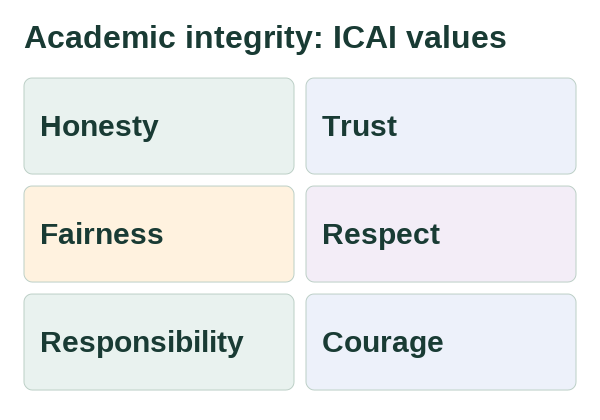
Academic integrity covers the values, behaviour and conduct of academics in all parts of their work.[1] One account names five values that make up academic integrity. They are honesty, fairness, trust, respect and responsibility.[7]
A 2014 review used 115 articles from western and Chinese literature. Research ethics gets the most attention.[1] A 2019 taxonomy built on a European glossary sorted terms into three groups. The groups were integrity, misconduct and neutral terms.[8]
No single definition of academic integrity has been written into code and accepted by everyone. A 2019 article traces the phrase through scholarship that began in the 1960s. It shows how the meaning shifted as an ethical or moral concept.[9]
A 2018 study of a scale took its idea of academic integrity from Keohane (1999). Keohane defined it as a person's commitment to positive values. People act on that commitment to create a good academic situation. That study analysed 32 items with confirmatory factor analysis. The sample was 254 people. In the end, 17 items remained. The reliability score was r = 0.866.[10]
Several overlapping terms sit around academic integrity, and their meanings differ.[8] That article names academic pressure, time limits, weak knowledge of citation rules and the digital age as major causes of plagiarism.[11]
A 2019 article argues that textual errors should leave the moral category of academic integrity. These errors include patchwriting and faulty citation. On this view such errors are cases of bad writing. Teaching, not punishment, should fix them. The article also reviews how textual errors first came to be classed as moral lapses.[9]
Clear terminology matters because the same complex idea is read differently across academic fields. It also differs across places and cultural values. The team that built the 2019 taxonomy settled many disagreements. These were about what terms meant. They did this before publishing it.[8]
The 2014 review adds a limit on what is known. Researchers rely mainly on surveys and questionnaires. They sometimes use document analysis. They use interviews only now and then.[1]
History
How the research field grew
Academic integrity became a research field of its own as higher education expanded across the world. Worry about standards of professional conduct also pushed the topic forward. A 2014 review mapped the main lines of this work in teaching, research and service. The review asked for a stronger focus on spotting ethical practice. It asked for the same focus on unethical practice. It noted that social desirability reporting, the tendency of people to give answers that look good, makes this hard.[1]
A 2021 study tested whether the field's papers actually present integrity in a positive light. It used natural language processing. This is a computer method for analysing large amounts of text. It studied 8,507 academic integrity papers published between 1904 and 2019. The analysis looked at paper titles in two ways. It looked at word pairs, called bigrams. It also looked at sentiment, meaning whether the wording sounds positive or negative. The three most common word pairs were "academic integrity" (2.38%), "academic dishonesty" (2.06%) and "plagiarism detection" (1.05%). Among highly cited papers, negative word pairs were more common than positive ones. The 100 most cited academic integrity papers of all time were three times more likely to have "academic dishonesty" in their titles than "academic integrity". Sentiment analysis gave the same result. In the most cited papers, negative sentiment scored higher than positive sentiment. The study argued that this negative picture has put the history of the field at a disadvantage. It also found that change toward positive integrity is possible. Ten researchers were the most prolific in academic integrity. In more cases than not, the titles of their papers used positive terms.[12]
A 2023 qualitative study used a hermeneutic approach, a method of interpreting what people say in context. It examined how academics see academic integrity. It ran guided listening sessions and sorted the notes by theme. Findings showed that academics hold varied views. These views are shaped by conflicting pressures from academics, students, society and trends in misconduct. The study argued that academic integrity can be presented as an academic skill. That skill is tied to specific values. It recommended changing policies so academic integrity is treated as a skill. It also recommended a developmental approach. This approach goes beyond merely preventing misconduct.[13]
The Academic Integrity Council of Ontario has offered a forum since 2008. It brings together practitioners and representatives from post-secondary institutions in Ontario. The Council supports sharing information. It also promotes good practice in academic integrity. Its work includes a sub-committee on contract cheating. It has been set up and continues its work.[14]
Main ideas
Types of dishonest behaviour
A 2014 paper names plagiarism and cheating on tests. The cheating used text messages or hidden notes. It also names swapping work with other students. It also lists buying essays from students or online. It lists paying someone else to sit an exam.[15] A 2004 review of the literature on plagiarism in the digital age found that even the question of what counts as plagiarism lacked a settled answer.[16]
In spring 1991, class officers at 31 of 40 United States medical schools surveyed second-year students. Of 3,975 students, 2,459 responded, a rate of 62 percent. Thirty-nine percent of those respondents said they had seen some form of cheating by classmates. This was in their first two years of medical education. Asked about earlier stages, 31.4 percent said they cheated in junior high school. In high school, 40.5 percent did. In college the figure was 16.5 percent, and in medical school 4.7 percent.[17]
A 2014 survey of 336 nursing students found that more than half reported cheating. They cheated both in the classroom and in clinical settings. That survey also found a positive link. Students who cheated often in class also cheated often in clinical work.[18]
One large institution collected 421 forms. The forms described alleged academic misconduct. They covered two academic years, from 2007 to 2009. Plagiarism made up 49 percent of the violations. Getting outside help made up 35 percent. About 91.5 percent of reported cases came from undergraduate classes. Freshmen made up 43.5 percent and sophomores 15 percent. Juniors made up 9 percent and seniors 24 percent. About 98 percent of accused students were found responsible. Of those, 80 percent or more received three or more sanctions. The same paper notes that few dishonest acts are ever caught. Even fewer are punished.[15]
One quasi-experimental study tested honesty directly rather than asking about it. In one experiment, 280 students took a basic English test. Teachers marked the papers without leaving marks on them. The papers went back to the students. They were asked to mark their own answers and report a score. Comparing the teacher score with the student score showed how far each student had stretched the truth. More than 62 percent of the students reported their grade completely honestly. Another 26.6 percent showed low honesty. The rest fell short of full integrity. The average gap between the score teachers gave and the score students announced was about two points. Students who rated themselves as sincere were not significantly more honest in practice. This is a gap between what people say about themselves and what they do.[19]
A 2022 study checked a tendency scale first written for undergraduates. It found the scale valid and reliable for graduate students too. The scale covers separate tendencies. They are cheating, dishonesty in homework and projects, dishonesty in research and writing up, and dishonesty about references. For most of these tendencies, the level of graduate study was the strongest variable found. For dishonesty in research and in writing up, the reason for graduate study was the significant variable.[20]
A survey looked at 321 undergraduates at a medium-sized Canadian university. Overall, it found moderately negative attitudes toward academic dishonesty. Three circumstances were most often judged acceptable. They were pressure to keep a scholarship, pressure from parents to do well, and a heavy workload. Some groups were more likely to accept such excuses. They included men and students from higher-income families. They also included students taking more classes. They included students who had seen misconduct more often.[21]
The 1991 medical survey found that cheating rates differed between schools. School traits showed no link. Honor codes had some effect on cheating, though not a large one.[17]
What counts as academic integrity
Academic integrity is the ongoing commitment to values that match ethical practice. That definition comes from the International Centre for Academic Integrity. It was reported in a 2022 study of nursing students in work placements.[22] A 2021 Canadian paper makes a related point about why the topic matters at all. MacLeod (2021) holds that shaping the thinking and morals of society's future leaders is one of the main missions of higher education. MacLeod (2021) argues that without shared ethics, societies can slide into corruption and chaos.[23]
Misconduct is the other side of the same coin. It is behaviour that breaks institutional policy. It also goes against the social norms of the institutional culture. The link between the two was advanced as a view. The findings were called early results.[24]
Fielden and Joyce (2008) note that naming sources properly has drawn much attention in the last five or six years. This is an important part of academic integrity. A 2008 analysis looked at 125 published papers by Australasian authors. It noted that this issue got a lot of attention in the five or six years before the review. The same analysis found that most of the papers examined were about student behaviour. It also found that moral or value judgements about academic integrity were present in the papers. They were often left unstated.[25]
Farah, Johnson and Matiullah (2025) suggest a link. Nursing students who break academic integrity in the classroom might also act dishonestly in the clinical setting. A 2025 interview study looked at undergraduate nursing students in Qatar. Students described academic and clinical integrity in a positive way. Those students named three things that helped them act with integrity. They were institutional support, ethical practice and professional practice. They named peer influence, time pressure and fear of mistakes as barriers. The study also noted a possible link. The researchers reported that these helpers and barriers matched what nursing students say elsewhere in the world.[26]
Common misconceptions
Miller, Shoptaugh and Wooldridge (2011) surveyed 1,086 graduate and undergraduate students. Students who named punitive consequences as their reason for not cheating were more likely to report having cheated in their classes.[27]
Research
Plagiarism and how students understand it
Three common forms are wrong citation, unsuitable quotation and poor paraphrasing. Each can appear in a student thesis. A case study looked at theses by undergraduates learning English as a foreign language. They studied at a private university in Baubau. It found each of these faults in the submitted work. Incorrect citation appeared in the theses of Student 1, Student 2 and Student 3. Inappropriate quotation appeared in those of Student 4 and Student 5. Badly paraphrased material appeared in the theses of Student 6 and Student 7. The analysis concluded that students did not understand how to write citations properly. This gap was the main factor behind the plagiarism found.[28]
Students often copy source text because the original passage is hard to process. This is at least part of the reason. In one experiment, undergraduates were given a two-sentence paragraph from a journal article. They were asked to paraphrase it as well as they could. Between 41% and 68% of the resulting paraphrases counted as plagiarized to some degree. Here that means taking strings of 5 or more words in a row. Also, 52% of the paraphrased paragraphs contained distortions of the original material. These ranged from minor to serious. A second sample paraphrased a similar two-sentence paragraph from a textbook. This paragraph was easier to read. This time between 9% and 19% of the paraphrases showed similar amounts of copied text. A similar share, 50%, contained distortions. Taken together, the results point to a partial cause. Some students plagiarise because hard, unfamiliar text is hard for them to understand.[29]
At a Pakistani university, 106 first-year and 127 final-year electrical engineering students filled in a scale. The scale measured their attitudes to plagiarism. Their attitudes showed no significant change over four years of study. They stayed very lenient and soft toward plagiarism. This happened even with strict rules from the higher education commission and the university. The researchers read this as a sign. Students did not understand what counts as plagiarism.[30]
A survey looked at 86 graduate language students in four departments. It found that 66%, or 57 students, held a neutral attitude. They knew plagiarism was wrong but could put up with it. Another 33%, or 28 students, had a negative attitude. They could not accept plagiarism. Only 1%, or 1 student, had a positive attitude. That student did not think plagiarism was wrong.[31]
Knowing the plagiarism rules does not reliably predict how much text a student actually copies. One study looked at 30 English department students at Mulawarman University. Each had written a short research proposal. The study tested this link with a multiple regression analysis. It found no significant link between awareness of plagiarism and the plagiarism rate. Awareness and writing ability together also showed a link with the plagiarism rate at the same time.[32]
One web-based tutorial was titled Plagiarism: The Crime of Intellectual Kidnapping. It was built as a resource for information literacy. It was also built into the curriculum. Scores from 2,829 student quizzes showed that students struggled with ideas about paraphrasing.[33]
Plagiarism also has a cost beyond penalties. It cuts short the practice of real writing that students need. Students know the possible consequences, yet plagiarism still happens.[34]
One study used both qualitative and quantitative methods. It looked at 121 college students in Israel. Half of the students said their fellow students saw academic dishonesty as acceptable. It reports that academic dishonesty rises when students miss classes. It also rises when students have low self-efficacy, a low belief in their own ability to succeed. It also rises when students attend classes remotely. They use platforms such as Zoom.[35]
A survey of students at eight Japanese universities in 2011 found that they almost overwhelmingly viewed plagiarism as wrong. Those same students believed in the importance of citing works they had used.[36] Cheating was concentrated in quizzes and assignments. These counted less toward the final grade and were watched less closely.[37] A study looked at 155 industrial engineering students at a public university in Lima. It found that 56.1% saw plagiarism in a negative way and 43.9% saw it as irrelevant.[38]
A survey asked 30 postgraduate students training to teach English in Türkiye. Their attitudes toward plagiarism were quite negative. Their attitudes toward reusing their own work were moderate, not negative.[39]
Architecture students in a study of 233 students said plagiarism is not good but is a community issue. They said students should not be punished for it, particularly for self-plagiarism. The architecture students also showed a lack of knowledge about plagiarism.[40] In the Turkish survey, the postgraduate students did not fully understand plagiarism either.[39]
One study compared students from non-English speaking and English speaking backgrounds. It found plagiarism very common overall. It was tied to disregard for Internet material and to real confusion over what counts as plagiarism.[41] Open-ended answers from 607 Hungarian university students raised several themes. These included rules that are hard to pin down, fear of harsh penalties, and a wish for more teaching and awareness.[42] The architecture students named methodological terms and time limits as the leading causes of plagiarism.[40]
A European project collected thousands of questionnaires from students and teachers. It compared their attitudes toward academic writing and their views on plagiarism and its penalties. It also compared their knowledge of institutional policy. The comparison suggested that changes in teachers' attitudes could help. A better understanding of students' educational needs could help too. Institutions could then help students avoid plagiarism more effectively.[43] In the Malaysian study, students who cheated tended to blame instructors for their cheating.[37] The architecture students saw plagiarism as mainly an expert issue.[40]
In the Hungarian sample, males, students who did not work, and students focused on good grades were more likely to justify plagiarism and to see its severity differently.[42] Among architecture students, girls were more sensitive to plagiarism issues than boys. Attitudes also became more positive as grade level increased.[40]
A survey asked 3986 high school students in Grades 10 to 12 in Lebanon about their views on cheating and plagiarism. It looked for differences among grade levels.[44] One belief about culture did not hold up. Japanese students reported more formal teaching in citation methods than people had commonly assumed.[36]
Contract cheating and the essay industry
One study estimated that about 3% to 11% of higher education students may use contract cheating.[45] One international study surveyed 7806 higher education students in 22 languages. Respondents came from Europe, the Americas and Australasia. That study found a positive link with students' own reported outsourcing. The factors were the country and field of study, and how often students thought others were cheating. Personal background factors did not strongly predict contract cheating.[46]
The industry has developed new ways of working internally. Its providers use more and more complex methods to reach potential customers. One analysis compared listings on Fiverr.com, a website where freelancers advertise small jobs. It looked in June 2016 and again in October 2018. Over that period, more providers offered essay writing services. Providers from Kenya and Pakistan rose in particular. More supply came with lower prices. The advertised price per 1000 words fell from $31.73 USD to $5.73 USD. The accounts used by contract cheating providers were also being replaced more often. From these listings, providers on that one site were estimated to earn at least $92,001 USD a year. That figure rests on only one search term on only one micro-outsourcing site. The true income from such sites is likely to be much higher.[47]
Contract cheating companies use stronger marketing. Social media marketing is one of their methods. The aim is to draw potential customers to services that break academic integrity. The same channels let companies recruit academic ghost writers, the people who produce the work. Social media also supports a black market in accounts for contract cheating services. Writers who would not otherwise qualify buy these accounts to work for contract cheating services.[48]
Services also market to students by school subject. One analysis looked at Google search results in the United Kingdom. It covered 19 groups of disciplines. Three groups were shown as heavily used by essay mills. They were Architecture, Building and Planning, Computer Science, and Law. Creative Arts and Design was shown to be at risk of future exploitation. Four reviewed studies ranked how much contract cheating happens in different subjects. They found high numbers in Business and Computing.[49]
A survey of students and teachers in Chinese universities ran from August 2018 to August 2020. The main reason students gave was to get good grades, with a correlation coefficient of 0.1309. Feedback from lecturers on cheating in assignments was also linked to less cheating. The figure was −0.1510.[50]
Focus groups were held with 25 first-year writing students at a private institution in Kuwait in 2020 and 2021. Participants named the chances that online learning gives as a main reason. They also named the mental and physical challenges of that period. Students who did not cheat shared certain traits. They had a competitive spirit and confidence in their own talents. They also had a strong wish to learn. Students with strong moral values also avoided cheating.[51]
Essay mill websites use cues that seem reassuring. These cues help make the product attractive to potential student buyers. Researchers posed as customers and approached five essay mills. They completed a purchase with two of them. The websites also discussed ethics and academic integrity. That talk was not consistent in how it treated the misconduct their services make possible. The two bought assignments were then graded and run through Turnitin. This gave a picture of the quality of the product sold.[52]
Prevalence figures depend on self-report. Few studies have taken an international approach or tested which variables relate to contract cheating. Strategies to reduce the problem may therefore rest on data from other countries or groups. Those groups may not match the variables most strongly tied to outsourcing.[46]
One survey asked 403 university students. Their reasons for not cheating grouped into two higher-order factors and six sub-factors. Three psychological differences helped predict those reasons. They were whether the need for autonomy was met, grit (effort that keeps going), and Machiavellianism. Other reasons for not engaging stood out too. They were students' motivation for learning, their perceived morals and norms, and respect for academic staff in the academic environment.[45]
Why students cheat
A study of 914 students at four Russian universities tested this idea over time. Learning motivation stopped predicting cheating. This happened once students' sense of the consequences and the influence of peers were included. The strongest predictor of both cheating and plagiarism was how common students thought these behaviours were among their peers. Plagiarism rates, unlike cheating rates, did not depend on how likely punishment seemed.[53]
A study of 375 students in Pasuruan Regency, Indonesia, measured peer conformity, academic procrastination and academic dishonesty together. Academic procrastination is the habit of delaying study tasks. It had a positive and significant effect on dishonesty (t = 5.949; p < 0.001). Peer conformity is the tendency to match the behaviour of friends. It had no significant effect (t = 0.679; p = 0.497). Together the two factors explained 8.7% of the differences in dishonesty scores.[54] A separate study of 260 students in Indonesia found that procrastination explained 17.5% of the variation in academic dishonesty.[55]
Students' beliefs about themselves give a mixed picture.[56][57] Locus of control did not significantly predict dishonesty for the non-honors group. Several relationships did appear across the whole sample. They also appeared within the honors and non-honors groups.[56]
Some students focused less on mastery, meaning less focus on learning the material. They also tolerated dishonesty more. These students tended to engage in various types of it.[57]
One survey asked 1,369 students. Slightly over 20% said they had cheated in at least one class during one college term. Students who admitted dishonesty gave their instructors lower overall evaluations. Students who did not admit it gave higher ones.[58]
A study of 705 undergraduate psychology students in Indonesia found that first-year students reported more dishonesty than second-year students. The effect was small. Living arrangements and students' views of lecturer supervision showed no significant effects in that study.[59]
Students' own reasons for not cheating predict how often they do it. A survey of 1,086 graduate and undergraduate students asked why they would not cheat. They were asked about a situation described to them. Students who named punishment were more likely to say they had cheated. They also took less responsibility for supporting integrity. Some students named the value of learning, personal character, or simple rightness. They reported less cheating. They also took more responsibility. Taking responsibility for academic integrity was itself linked to less cheating.[27]
Culture, international students and fairness
A 2016 paper on academic integrity worldwide states that international students seem to cheat in various ways more often than domestic ones.[60] A 2012 review of the literature reported a definite problem in how international students and plagiarism interact in higher education.[61]
A 2018 article argued that teachers in Western universities struggle to understand why international students plagiarise or use sources poorly. The reasons, it said, are many and complex.[62] That article added that a librarian with good bibliographic skills can help. Such a librarian can help students learn to cite sources better.[61]
A 2010 questionnaire study covered 958 students at Pakistani universities. They were at graduate and undergraduate levels. It found that students took part in dishonest acts more often when they thought those acts were less serious. Students also suggested lower or no penalties for the dishonest acts they saw as less serious.[63]
A 2023 analysis examined official academic honesty data. The data came from the largest liberal arts faculty in Canada. The data covered two years. They were collected at the height of the COVID-19 pandemic in Canada. The analysis argued that incidents counted as one student's misconduct point to wider problems. These lie in how higher education teaches and assesses. It stated that online teaching under emergency pandemic conditions made two problems worse. They were poor assessment design and learners who lost interest. At the same time, outside parties offered online services to help students cheat. They aimed at racialised students in particular. The same analysis held that the usual split between domestic and international students in data reporting hides a pattern. Racialised students are caught in academic honesty processes more often than their share would suggest. This holds whatever their visa status is. It concluded that the official data collected today have limits. People must recognise these limits if data-driven decisions are to shape academic integrity policy.[64]
The 2018 article recommended teaching strategies. These help students adjust to the new academic system. It warned against policing their activities. It also warned against damaging their confidence.[62]
The 2012 review noted that libraries and librarians can give real help in deterring and preventing plagiarism.[61] The Hong Kong study suggested its findings could help educators run academic honesty education programs. This is especially true in China, and especially in Hong Kong.[65]
Online learning and the pandemic shift
A 2006 survey looked at 1,262 students at a large, state-funded university. It compared cheating in traditional lecture courses with cheating in online courses.[66]
The COVID-19 pandemic forced universities to close. They moved degree programmes to online delivery. Remote online teaching and assessment were new to many universities. They brought many challenges. One was protecting academic integrity. Invigilated assessments, meaning exams watched over by a supervisor, are often considered more secure. But they were not an option under the conditions of the pandemic. Detecting any cheating in that setting would be very hard.[67]
A 2021 paper on contract cheating described universities with limited skill in the digital world. They had to move quickly to online teaching and assessment. That transition did not create a new problem. It did offer more chances for contract cheating and widened the range of such services.[68]
One study of a file sharing site analysed requests in five STEM subjects. These were Computer Science, Mechanical Engineering, Electrical Engineering, Physics and Chemistry. The site offers homework help and other academic services. Students used it to ask for exam style questions. Contract cheating requests could be posted and answered during a short exam. For these five subjects, the count of student requests rose by 196.25%. The comparison set April 2019 to August 2019 against April 2020 to August 2020. The paper recommended that institutions set up interventions. These would limit the risk such sites pose to educational standards. Online teaching and assessment may continue after the pandemic. That makes this more urgent.[6]
A 2021 paper reported that contract cheating providers seeking quick sales offered $50 COVID-19 discounts. Students also paid online tutors to sit their online exams for them. Others got live help from such providers while sitting examinations. The paper concluded that the illegal services grew faster than the systems meant to curb them. It described failures in systems around the world. No single academic or university could fix them alone.[68]
A 2021 interview study asked 20 faculty members about contract cheating. They taught in English departments at private colleges in Kuwait. All of those faculty members could spot contract cheating easily. Most saw it as a serious problem in higher education. They also saw it as a threat to how reliable language assessment is. They linked it to laziness. They also linked it to social pressure to graduate with a high grade point average. They also linked it to the chances to cheat in online education. Academics had developed some strategies of their own in their courses. But institutions took different steps. At some institutions there were no measures or penalties. This was true for students who paid others to do their work.[69]
Psychology students did a task that paid off for good performance. They were assigned at random to one of three conditions. One was a check mark acknowledging an honor pledge. One was a typed honor pledge, and one was no pledge. Across all conditions combined, 14.1% of students said their own performance was better than it was. That counts as cheating. The chance of cheating did not differ much under the different honor pledge conditions. Students cheated more often late in the semester (20.2% and 16.0%). In the early semester condition, 9.6% cheated.[70]
A machine-learning system learned each student's language patterns from data. This checked student identities and student-made content without disturbing them. The experiments used written assignments by graduate students. The method reached a mean accuracy of 93%. Human performance reached a mean accuracy of 12%. The results suggested that automated tools could help. Such tools might encourage people to take responsibility in online learning.[71]
Generative AI and writing
Students have used such language models to generate ideas, sum up research and write essays.[4] One early review concluded that these technologies could change academia completely. Still, the way they are used could surely weaken academic integrity.[72]
The case against these tools rests on who wrote the work. A student can hand in an essay without adding an original idea. They need not write a single sentence. Writing assistants can paraphrase, summarise and extend texts. Students can give very little of their own input.[73]
Supporters say the tools may raise student engagement, teamwork and access.[74] One commentator made an argument. Co-authoring tools are spreading. Teachers must find creative ways to use them in teaching and learning.[73]
A content analysis of news coverage found little public discussion of one question. Could ChatGPT improve participation and success for students from poor backgrounds? The same analysis found that students' own voices were poorly represented in media articles.[75]
Experiments at two universities in the United Kingdom tested markers. Could they tell AI-assisted work from unaided work? Markers were usually unable to tell the two apart. But generative AI changed how they approached marking. The researchers concluded that current assessment methods can be manipulated. They also concluded that real-world assessments alone cannot protect integrity.[76]
Systematic reviews have tried to weigh these competing claims. One review screened studies published from January 2021 to December 2024. It searched four databases. It included 41 studies that met its criteria. It found that generative AI can raise student engagement and efficiency. It can also bring serious risks of academic dishonesty.[77]
A bibliometric analysis mapped 163 publications from one citation database. It found that AI tools have developed quickly. They threaten to destroy students' academic integrity in higher education. The same analysis reported a lack of research. It found little on how AI can help uphold integrity rather than undermine it. It also noted that AI tools can act as detectors of students who plagiarise. This would need combined effort from public bodies, private firms, academic institutions and society.[78]
Detecting and responding to misconduct
Stylometry is one other option. It uses various features of documents to judge whether two texts were written by the same person. Outside universities, the method is often used to check who wrote a text. Researchers have suggested it as a way to spot bought assignments. A pilot study tested three stylometry systems. These were easy to use and easy to get. The study used simulated cases of contract cheating in academic documents. Average accuracy ranged from 33% to 88.9% across the systems. The best packages looked promising. But the study called for more research on how reliable they are.[79]
Detection is only half of the problem. Proving misconduct is hard. Instructors may find it hard to bring a case through university proceedings. One conceptual paper argues for an approach based on evidence. It would let instructors detect and prosecute contract cheating well and with little waste. The paper calls its outline the "Doping Test" approach. It copies some parts of drug testing in professional sport.[80]
Detection also depends on people reporting what they see, and that carries costs for the staff involved. Researchers interviewed 12 nursing faculty members about facing and reporting misconduct. The educators described serious risks to themselves, in person and at work. Those risks included harm to their relationships with students and with colleagues. The participants saw their main duty as guarding the profession. They said they were willing to bear the burden of being the accuser.[81]
One questionnaire study covered 380 students. They came from different fields and study levels. More than half did not see plagiarism as a widespread problem. They did not know exactly what it consists of. Students in the social sciences knew more about the nature of plagiarism and about detection systems. So did students in the humanities and arts. Students in the natural and exact sciences and in medicine knew less. Students judged the use of plagiarism detection systems to be fair. They also found them fear-inducing.[82]
Some Canadian colleges and universities shared recent data. It reported that misconduct numbers had doubled or risen a lot, by up to 38%. Researchers in the field have noted something. Students need plenty of chances to understand the idea of academic integrity. Two undergraduate students and an instructor described a university-wide contest on academic integrity. They saw it as a chance for students to rethink their own understanding of the topic. It was also a chance to help a community service project.[83]
How common dishonesty is and who reports it
Bretag and colleagues (2014) asked 15,304 students at six Australian universities about academic integrity. Most said they knew their university's academic integrity policy well. Awareness was not the same across groups. International students knew less about academic integrity and about policy. They were also less confident about how to avoid breaches.[84]
Incident records from one Midwestern university showed that academic dishonesty was widespread. It also increased over the six years from 2001 to 2006. In that record, freshmen and sophomores were reported for cheating more often than juniors and seniors. International students were overrepresented compared with domestic students. Charges against female students made up a smaller share than their share of enrollment. Gynnild and Gotschalk (2008) found the commonest offence was students working with peers on tasks set for individual work. Records also depend on who notices and reports. Of the academic staff who responded, 40% said they had taken no steps over a suspected cheating incident. They said they lacked sufficient proof.[85]
At one public university on the American West Coast, reports of international students for academic integrity violations rose almost six-fold. The rise came between the 2009-10 and 2013-14 academic years. Even so, that number was less than 7.5% of those students' total enrollment. Among the reported students, undergraduates outnumbered graduate students. Males outnumbered females, and Chinese students outnumbered other nationalities. Economics majors outnumbered other majors. Cheating on exams was the most common violation. More than half of those reported and suspended for violations graduated, stayed enrolled, or both.[86]
Before the SARS-CoV-2 pandemic, a survey at the University of Lethbridge reached 1,142 students. That was 13% of the student population. It also reached 130 faculty, or 22% of the faculty population. Most of those students and faculty said academic integrity was important. The university had low rates of dishonesty compared with many Canadian universities. After a year of remote teaching, a second survey reached 1,134 students. That was 13.9% of the student population. It also reached 94 faculty, or 15% of all faculty. Most students then said they had more chance to cheat. Yet they still reported low rates of dishonesty. Faculty said they had reported incidents less often during this period.[87]
Eastman, Eastman and Iyer (2008) found that insurance students scored significantly higher on total academic dishonesty than other business students. A survey looked at business and nonbusiness students at two universities. Their scores were lower than those of nonbusiness students, but not by much.[88] At Riga Technical University in Latvia, first-year bachelor's students knew little about the university's academic integrity policy. Students who knew the policy better were less tolerant of violations. They also saw academic integrity as essential to academic and student life.[89]
Why students cheat and what predicts it
Uula and Sulikah (2023) tested whether religiosity and self-control affect academic dishonesty. The study covered 96 accounting education students at the State University of Malang. Uula and Sulikah (2023) collected data with an online questionnaire. They analyzed it with multiple linear regression in SPSS. The finding was stated as a direction rather than a size. Higher self-control went with less dishonesty, and lower self-control went with more.[90]
Herdian and Ningtyas Putri (2025) examined ego depletion, which they describe as ego fatigue. They saw it as a trigger of academic dishonesty during online learning in the COVID-19 pandemic. One study looked at 92 college students during the COVID-19 pandemic. Ego depletion, or a worn-down state of self-control, significantly predicted academic dishonesty and accounted for 16.3% of it. The researchers said ego fatigue pushes students toward an easier academic path. They felt the pandemic had affected this.[91]
A 2006 study of 70 undergraduates found no significant overall link. It compared scores on a religious faith questionnaire with a survey of academic practices. The 2006 data were split by sex. The link was significant for women but not for men. The researchers called for work to check whether that pattern holds.[92]
A 2025 study of 208 students, 176 female and 32 male, reported a significant negative link between religiosity and academic dishonesty. The correlation was -0.202. That paper notes that earlier findings on religiosity have often conflicted. Its own sample was also recruited by convenience.[93]
A survey looked at 976 education students at four colleges in Israel. Of these, 71% said they had cheated at some point in their studies. Only 21% said they would condemn a peer for lacking integrity. Two groups tended to report more ethical behavior. They were students who scored higher on tests of creative thinking, and those who were more emotionally stable. The researchers suggested creative thinking courses in teacher training. They named this as one way to lower dishonesty.[94]
Detection, deterrence and the limits of tools
Ramadhana (2016) notes that unoriginal writing and plagiarism in the digital era can be detected in a digital way. The method is plagiarism detection software.[95] A 2023 study looked at 16 final year English education students in Indonesia. It measured plagiarism before and after students were shown such software. Student papers were first submitted without the students' knowledge. The average level of plagiarism was 50.88%. The students were shown the software and told to check their own writing with it. They were also given development training. Students reacted well to using the software. They saw it as a standard way to submit final assignments and get feedback.[96]
A 2021 account describes bringing in similarity checking software at one polytechnic. It calls the tool a writing improvement aid for students. Training for students and faculty backs it, along with clear assignment instructions.[97] Interviews with MA students writing their theses looked at how they understood plagiarism. They also looked at how the students tried to avoid it and how they viewed an online detection service.[95]
One study looked at summaries by 124 native English speakers. It also looked at summaries by 103 second language writers. Many paraphrases contained copied strings of 5 or more words, though most did not. Deleting words and swapping in synonyms were common strategies. Many students in both groups also changed the grammar of the original. Students who avoided copied language broke the original into its major parts. These include subject, main verb and direct object. They rewrote those parts in a different grammatical form.[98]
A 2021 position paper describes Rogeting. This means swapping words for synonyms from a thesaurus or a digital synonym service. It calls this poor paraphrasing that may lead to plagiarism. The paper sets out methods for spotting text that was Rogeted. It recommends that educators support student writers so they develop their writing skills instead.[99]
One platform makes six multiple-choice questions from a student's writing. It then scores the answers. Quesnel, Guderian and Stoesz (2023) also found a link between platform scores and individual differences in working memory (τB = .391). The researchers suggest that authorship verification may help promote integrity and engagement at scale. That depends on the technology developing further.[100]
Butterworth (2021) describes projects made personal in engineering technology courses. The aim is to engage students and help them follow academic integrity policies better.[101] A 2024 paper treats student engagement and academic integrity as linked problems in online education. It offers tailored assignments as a practical answer to both. It includes details of a method for customisation. Educators can use it to adapt coursework to their own course content.[102]
Personality, emotion and moral disengagement
A survey of 370 university students linked personality traits and general attitudes toward rules to academic dishonesty. Personality traits and attitudes toward rules both significantly predicted academic misconduct.[103] A study of 295 Dutch and Italian students found that psychopathic traits, especially disinhibition, predicted academic dishonesty.[104]
Among 408 students in Indonesia, grit had a significant negative effect on academic dishonesty. The grittier the students, the lower their dishonesty.[105] A survey of 270 pre-university students found a negative link between personal values and academic dishonesty. It was significant at the 0.05 level (r = -0.127). Low personal values were linked to a greater chance of academic dishonesty. Students who scored higher on self-enhancement values cheated more. Those higher on self-transcendence cheated less.[106]
At a religious university, 142 students answered scales on academic dishonesty and religious fundamentalism. The final model explained 24% of the variance in academic dishonesty. The participants disagreed with statements favoring academic dishonesty. They were neutral on religious fundamentalism.[107]
Emotions tied to schoolwork, called achievement emotions, have been studied alongside cheating. A survey looked at 129 international high school students in Thailand. The link between academic dishonesty and achievement emotions was weak. The link was moderate when class level and gender were controlled. Male students found dishonest academic behaviors more acceptable than female students did. Older students agreed with them less than younger ones did.[108] As that fear rose, dishonest tendencies rose too.[109]
Ethical decision-making rose alongside lenient attitudes toward dishonesty. Ethical decision-making also differed by gender, by semester level, and by healthcare employment.[110] A study of 194 students in Brasov found significant links between academic adjustment and academic dishonesty.[111]
Ghostwriters, platforms and commercial services
A 2019 study searched a low-cost outsourcing site for the term "write essay". It found 103 offers from 96 different providers. Most of those providers worked from Kenya. The study put their combined essay business at about US$270,000. The going rate was US$31.73 per 1,000 words, below the price of traditional essay mills.[112] Ghostwriters also work closer to home. In a study across six countries in South East Europe, some students said they worked as academic ghostwriters themselves.[113]
Websites selling these services present themselves as legitimate academic support, not as cheating. An analysis looked at 40 active Spanish platforms and 643 linked advertisements. It found marketing that stressed personalisation, confidentiality and success guarantees. The same platforms offered writing, editing and tutoring packages. They borrowed the language of universities and rarely referred directly to misconduct. The study described legal ambiguity and a growing normalisation of academic outsourcing. It said the advertising often played on students' academic stress.[114]
A search of the United Arab Emirates found 34 separate contract cheating websites that looked genuine. Some of them used university logos to look legitimate. For 29 of the 34, the chance of appearing across search engines, browsers and keywords was significantly above the mean of 2.94, with a standard deviation of 1.89.[115]
Some sites aim at doctoral students. They use language matched to their common difficulties. A text analysis of websites offering thesis writing found appeals to four themes. The themes were balancing work and personal life, the difficulty of doctoral writing, self-efficacy, and moving ahead in an academic career.[116]
A Canadian survey asked 898 international undergraduates. Of these, 30% reported using some form of paid academic support, most often "homework help" websites or tutoring. Follow-up interviews with 23 of them found mixed feelings. Some found the services helpful. Others were uneasy about whether the help was ethical.[117]
In 2020, the Australian Federal Government passed a law. It made it an offence for individuals and businesses to provide or advertise academic cheating services. An analysis of the parliamentary debate argued that it did not agree on what the problem was. It said concern about contract cheating was used to justify more government control of universities.[118]
An earlier legal review noted that students and the services they hire may already commit offences. These include fraud, forgery and conspiracy. It recommended specific offences written into law.[119]
Policy analysis, data systems and open questions
Schools usually keep misconduct records on student files. These records deter cheating and help spot repeat offenders, but the data are rarely studied for wider patterns. One proposal is to use these records to find gaps in student supports. It would also find gaps in policy education and in how assessments are designed. Under this view, effort spent answering individual cases could shift toward early education and better assessment design. The proposal says this would benefit staff and students alike.[120]
Policy documents themselves can be studied systematically. One research team recorded its data collection decisions step by step so other teams could follow them. That account was written to help groups working at a distance. It also helps other people who carry out academic integrity policy analysis.[121]
A Canadian study looked at the published policies of Ontario's 22 English-medium colleges. It used document and content analysis, plus descriptive statistics. Each college was ranked as exemplary, adequate or in need of improvement. The rankings covered areas that included acknowledging different cultural understandings and providing translated material. The study concluded that colleges could do much more to help international students understand academic integrity rules. The paper notes that these rules lie within institutional control.[122]
At one online Canadian university, 228 students and 73 faculty and tutors answered open-ended questions. The questions asked how academic integrity could be improved. Coding the comments produced three groupings of recommendations. They were policy and procedures, compliance and commitment, and resources. The researchers noted that respondents did not always draw a clear line. They did not always separate misconduct from integrity.[123]
An earlier report of the same survey work had 102 faculty and tutors and 146 students. It sorted replies into five groupings. It added plagiarism detection software and a category for other ideas.[124]
Professional programmes have tested honour codes, which are signed pledges about honest conduct, in clinical training. In an undergraduate dental programme, 86.3% of students rated the honour code as relevant. More than 92% said it encouraged the five fundamental values of academic integrity under study. The same share, 86.3%, favoured repeating the honour code every year. Most students, 85.7%, showed a change in how they viewed academic integrity. This came after creative teaching sessions on clinical scenarios. Students asked for academic integrity teaching inside the curriculum. They also said staff should follow an academic integrity policy. The study could not tell whether these changes in perception altered clinical practice during training or after graduation.[125]
A rapid review of 46 scholarly sources found little work that draws together evidence on academic integrity and student mental well-being. The review identified five themes, among them inconsistent definitions, tensions between research paradigms, and a focus on outside stressors rather than the integrity process itself. It also found that mental health is usually studied before a serious event. So we know little about how an alleged or actual violation affects a student. The reviewers recommended that supports for student well-being be built into the procedures that uphold academic integrity.[126]
In practice
Teaching, assessment and prevention
Virtual lectures are electronic resources. They stay open to students all semester. They help students cite sources and avoid breaking integrity rules. The same tool can carry ethics rules to workplaces beyond the university.[127]
A 50-minute workshop used a card game based on scenarios to teach academic integrity. Its first audience was university staff in student and enrolment services. This group included the registrar's office, student services and student wellness.[128]
One study followed a set of scaffolded authentic assessments. These are tasks built in stages that copy real work. The set ended with interactive oral examinations. A survey of that design found that supported tasks, such as interactive orals, help prevent cheating. The more an assessment matched real-world situations, the less likely students were to cheat. Interactive oral exams also helped students build a professional identity, awareness and communication skills. They also supported employability.[129]
Contract cheating means a student gives an assessment to a third party. This counts whether or not money changes hands. Students often paid others to do tasks with none, some or all five factors. So authentic design alone did not guarantee integrity.[130]
Writings on academic integrity have neglected librarians. Yet they can do more than give faculty technical support.[131] Academic advisors and learning strategists see students regularly. They can build honesty into conversations and workshops. That work can start early, in orientations for new students and parents. It can also come up in hard talks about study success and academic decisions.[132]
Faculty engagement is one of the areas that still needs further work. It also calls for approaches tied to practice or to one discipline. The aim is to get faculty involved in integrity activities.[133] Teaching centres can also build integrity into their existing workshops, job aids and one-on-one sessions. It then becomes central to the work rather than an add-on topic.[134]
Institutional policy and campus culture
Academic dishonesty is not only about what happens inside a classroom. The institution itself has a major role in encouraging academic integrity. A 2001 article argued that institutions can change attitudes toward integrity. They can also change what people know about it. They can also make dishonesty happen less often.[3]
One project studied the public online academic integrity policies of all 39 Australian universities. From that analysis they found five core elements of model policy. None of the five elements was ranked above another. The team compared its five elements with best practice guidelines. These came from the Higher Education Academy in the United Kingdom. It concluded that a model policy should give a clear, consistent message from the start. That message should be repeated through the whole document. That message should show a lasting commitment to honesty values. It should also show commitment to the practices that protect them. The project's stated challenge was to build examples that align policy and practice closely. The United Kingdom body had made two separate resources.[135]
One teaching approach makes integrity practices part of the goal of improving student learning. It was proposed in 2008. The argument was that the main approaches had proved fairly ineffective. The shift moves attention away from how educators stop students cheating. It turns to how they can make sure students are learning. The original proposal named several strategies. These were a setting that focused on learning, better teaching, and stronger institutional support for teaching and learning. There were also fewer institutional limits on teaching and learning. A later paper added a fifth strategy. It treats the cheating moment itself as a chance to teach. That fifth strategy was called key for faculty who want few cheating cases and a norm of integrity.[136]
Researchers have used institutional theory to build a model. It shows how integrity becomes part of a college or university. One model sets out four stages in how institutions build academic integrity. It uses a pendulum as its metaphor. A case study showed how the model can help a school find where people resist change. It can also help them build a shared view of the challenges. The model also questions who should lead the process.[137]
Teaching students the rules and skills
A 2025 study built a short course on research ethics. It tested the course on 62 undergraduates in a course on research for learning and teaching. Lawthong (2025) used a two-group pretest-posttest design. Then they received the instructional package and took the posttest. The control group took both tests without the package. The course covered learning goals, teaching, teaching materials and an assessment. After the course, the taught group's knowledge and awareness of plagiarism rose. The rise was statistically significant at .05. The taught group also gained more knowledge than the control group. The difference had the same level of significance. Awareness, however, showed no big difference between the two groups.[138]
A second programme, Academic Integrity Training, worked with 40 final-year students. They were in research proposal courses. It used one group measured before and after, with no comparison group. A paired sample t-test gave t = −3.059 and a significance of p = 0.004. The group's average score rose from 2.52 (SD = 1.56) at pretest to 3.33 (SD = 2.09) at posttest. The designers say the programme uses a personal approach. It aims to reduce plagiarism among graduate students submitting thesis proposals.[139]
CAN (2021) warns about students who never learn to cite sources and give references correctly. Such students may be led to plagiarize in their writing. The review set out to gather teaching approaches for citation and referencing in those classrooms.[140]
Paraphrasing is rarely taught in higher education. Many students reach college without any direct teaching in it. Many believe that swapping in synonyms counts as paraphrasing. Writing centres often limit practice to short transformation activities. These are cut off from any real source, which can strengthen that mistaken belief. One undergraduate university shifted its workshops away from warnings about plagiarism. It moved toward practice that stresses context and the writer's own choices.[141]
Miron and Fenning (2018) describe academic integrity pledges placed at meaningful times along students' developmental paths. They call this one strategy that can be effective. The account reports successes and opportunities for future development but gives no measured outcomes.[142]
Hiebert (2021) describes student-centered strategies. These include good student-instructor relationships, class time to practice skills with feedback, and assignments with choices. Good student-instructor relationships can help students feel recognized and valued. This supports their own inner motivation to work with integrity. Class time to practice assignment skills and get feedback can build students' confidence. They may then attempt the assignment alone. Choice-based assignments let students take ownership of the unique product they make.[143]
One college built a free toolkit called Encouraging Academic Integrity Through a Preventative Framework. It acted after requests for help with misconduct rose. The toolkit begins with the principles of academic integrity. These were set out by the International Centre for Academic Integrity. It then uses a model called the complexity quadrant. The model looks at how integrity is shown and seen. It then discusses assessment design practices meant to prevent breaches of integrity standards.[144] A 2020 survey of science faculty found that their concerns centred on understanding why students cheat, sharing real-world examples of unethical behavior, and finding ways to reduce cheating. The survey data were to be used to build a reference of best practices for the science classroom.[145]
Policy, punishment and fairness in practice
Schofield (2021) describes the University of Dundee's Policy on Academic Misconduct. It classifies plagiarism cases as 1 (very minor), 2 (minor) and 3 (serious). It gives guidance on handling each. Responses range from extra educational support, through a written warning, to a hearing before a formal academic misconduct panel. Schofield (2021) applied the policy to a distance learning masters in medical education. It had a thousand students and over 50 markers. About a third of the students were based overseas. Students handed in work through a service that checks for similarity. They were encouraged to read the similarity report before they finished their submissions. The course team also reported open questions about collaboration versus corroboration. They also raised questions about self-plagiarism in a final capstone assessment.[146]
Eaton, Vogt, Seeland and Stoesz (2023) analyzed the policies of 16 colleges in Alberta and Manitoba. They found differences in who each policy was written for. They also found differences in how much detail it gave, and in its definitions and categories of misconduct. Eaton, Vogt, Seeland and Stoesz (2023) found little mention of contract cheating. They looked at college policies. The researchers called for regular review of policies. Reviews should keep policies in line with current educational expectations and social context.[147]
One community college formed an advisory committee in late 2019. The committee was to revise its policy. It had over twenty stakeholders from five campuses.[148]
Many violations never reach a formal process, because faculty report too few of them. Interviews with faculty at a small Canadian community college found that reporting disturbed relationships with students. It also caused frustration when colleagues chose not to report. Openo and Robinson (2021) also found a gap between faculty and international students in understanding academic integrity. They said that reporting international students for violations brings more serious emotional and relationship problems.[149]
Steeves (2024) traces fairness concerns to white-dominant beliefs. Colonial history carried these ideas into Canadian academic integrity policy and practice. A review of 27 sources found three barriers for marginalized and racialized students. They were ways of knowing and belonging, language use, and citation and attribution systems. The same review found seven fairness strategies in the literature. It proposed applying them across policy development, practice, teaching and advocacy.[150]
Restorative justice is a set of values and principles for responding to harm. It aims to meet needs and repair relationships. It also aims to encourage dialogue and direct accountability. One university has used a restorative approach to academic integrity. A workshop described its benefits next to punitive approaches.[151]
A school of agriculture in Winnipeg used restorative practices. Staff worked with students on repairing integrity and community issues. It rejected traditional punishment. Staff there said these processes improved connections between staff and students. They also said the processes helped students succeed academically.[152]
Detection software, tutorials and student awareness
The aim is to help students understand plagiarism and the rules of academic writing. At a branch campus in the Middle East, undergraduates were surveyed about using one such tool for their writing. Most were second language students. Most participants said the software helped them improve their paraphrasing skills. It also helped them understand how to use citations. Most of those students also said the tool helped them avoid plagiarism. Fewer said it improved their language.[153]
A 2017 analysis of the published evidence reached a narrower conclusion about detection alone. Over the past decade, anti-plagiarism software checks have helped uncover basic forms of textual recycling across journals. A similarity check alone cannot stop the more complex kinds of plagiarism. Several reputable open-access journals have recently withdrawn large batches of plagiarized articles. These episodes show serious gaps in current anti-plagiarism software. Anti-plagiarism software fails to spot manipulative paraphrasing and editing.[154]
Online tutorials are another way institutions try to teach academic integrity. Online tutorials are one educational response to academic dishonesty. Universities are adopting them more often. A study of Montenegrin students used a matching method. It tested how online tutorials relate to four kinds of misconduct. The four were cheating, plagiarism, fabrication or falsification, and helping others to cheat. The online tutorial was useful for raising students' awareness of some types of dishonesty. These were cheating, fabricating or falsifying, and aiding or abetting. For plagiarism, the tutorial still had no effect. Students who passed an academic integrity test received a certificate. This did not make their attitudes to cheating or to fabrication or falsification stronger. The certificate did raise how serious students thought plagiarism was. It also raised how serious they thought helping someone cheat was.[155]
Undergraduates at Penn State Altoona keep getting MLA in-text citations and Works Cited entries wrong. They also struggle to explain why sources should be cited at all. One probable cause is the shrinking number of public school librarians over the past two decades.[156]
A 2008 teaching unit used Bloom's taxonomy, a scheme that orders thinking tasks from simple to complex. It helped students grasp the often unclear boundaries and issues surrounding plagiarism. Students worked through tasks of rising difficulty. These went from building a works cited page to judging scholarly opinions. They also researched the consequences of plagiarism at their school.[157]
At IAI Al Muhammad Cepu, a qualitative study used questionnaires and interviews. It asked how aware students were of plagiarism when writing their academic work. 40 participants filled in the questionnaires. 10 participants, picked at random from 6 departments, took part in interviews. Most of the students involved already understood plagiarism deeply. In semester six they had more chance to practise paraphrasing and other ways to prevent plagiarism.[158]
A survey covered 147 undergraduate and postgraduate veterinary students at GADVASU, Ludhiana. It found plagiarism in both groups. Plagiarism was about as frequent with Internet sources as with print sources for both groups. That result suggests the internet had not changed how often students plagiarized.[159]
A quantitative study collected data from universities in Canada, the United States and Europe. It used two online questionnaires. One was for undergraduate students and one was for professors. Students enter undergraduate programs with uneven command of these skills. One study found that Quebec students expect university to teach these skills. Their professors often assume students already have these skills.[160]
One small case study followed eight Asian and North African students. They were finishing Master's degrees at a UK university. Students and their tutors read the university's definition of plagiarism differently. The students said the support on offer was thin. They also said plagiarism worried them a great deal. The tutors said they had no time for the task. Or they felt someone else should handle it.[161]
Programmes, events and student partnerships
The University of Manitoba ran its first campus-wide academic integrity campaign in Fall 2016. The campaign carries a positive educational message about integrity. It addresses faculty, students and staff alike.[162]
Practitioners from two Manitoba institutions described how they run their integrity events. They also described what drives the planning. This covered college and university settings alike. Their session also covered how such initiatives change over time. It covered what to consider when creating events for a particular campus.[163]
One way to reach students is to leave the classroom. Staff can set up in the middle of campus. At one institution, staff from the Library, the Learning Centre and Student Life ran a series of interactive activities. They set them in a central campus space. This walk-up learning let students explore their own ideas, ask questions and try activities. It happened outside the usual settings of classroom, library and tutoring. The tabling also connected students to services for deeper learning. This was at a campus where academic integrity sat under neither a teaching and learning centre nor a dedicated office.[164]
Contests can turn integrity messages into something students make themselves. In the Spring 2021 semester, Langara College ran a student contest. It was modeled on a project by a Dalhousie instructor. Students were asked to create fun, creative memes about the importance of academic integrity, and the contest ran for two weeks. A shortlist of finalists went up on the college's Instagram account. The college community then voted for the winners. The presenters discussed the goals and outcomes of the contest. They covered how the community interacted with the social media posts.[165]
Some work targets the programme rather than the single course or the whole institution. Research and practice on academic integrity have mostly focused on single instructors, through classroom strategies. Others have focused on whole institutions, through policy. Scholars have asked for attention to patterns across subjects. They also want more focus on the middle levels of higher education institutions. A coordinated approach at the programme level can help students see integrity values in context. It ties them to a disciplinary or professional community. A program-level approach can also teach the skills students need. These skills target the misconduct most common in their field. It can use assessments that carry over into students' later work.[166]
Douglas College built a model of student education on academic integrity. It surrounds students with several points of contact. The model includes a recent update to its policy language. It asks faculty to consider whether an integrity issue might be a learning opportunity rather than a violation. For students, learning points include an academic integrity workshop at orientation. They also include a module on Blackboard for all new students. The college also made modules for Arts and Business programmes. It added in-class teaching from the library and tutoring sessions with peer tutors.[167]
Talks to students can be customized to the group in the room. One presenter went beyond the usual policy overview lecture. The session used interactive, research-based discussion. These discussions looked at the basic causes of following or breaking integrity rules in that group. They also cleared up false beliefs about academic integrity. They also gave explanations, tailored to each case, of why breaking integrity rules causes harm. They pointed to resources for causes such as accidental plagiarism, poor time management and mental health. Examples came from talks to first year undergraduates. They also came from talks to students in a professional program with low adherence. Others went to MSc and PhD students. These students had just gained access to similarity detection reports.[168]
What this looks like when you study
In a study of 62 undergraduates in a research course, the experimental group worked through a package on plagiarism for several lessons, while the control group took only the pretest and posttest. The package used news stories, songs, pictures and video clips, and quick quizzes asked students to sort texts into plagiarized and not plagiarized. After the lessons, the experimental group's knowledge of plagiarism rose significantly, and it scored higher than the control group (F = 5.978, p = .018). Awareness rose in both groups, so the package did not separate them on that measure. Students who received feedback on their research proposals showed more ethical research behaviour than students who received none.[138]
Between 41% and 68% of the paraphrases copied strings of five or more consecutive words, and 52% distorted the original to some degree. When a second sample paraphrased an easier paragraph from a textbook, only 9% to 19% copied such strings, though about 50% still distorted the meaning. The author concluded that some plagiarism comes from students' difficulty in processing complex, unfamiliar text.[29]
At one college, new students attend an academic integrity workshop at orientation and complete a module for all new students. Students can also book tutoring sessions on three topics: understanding and awareness, using sources in your writing, and style and formatting guidelines. In those sessions, students practise paraphrasing and learn to use sources as evidence in their assignments. The college changed its policy language so that faculty may treat an integrity issue as a learning opportunity rather than a violation.[167]
Later developments
Open questions and links to professional life
A 2004 exploratory study surveyed engineering undergraduates at two private universities. The students also worked full-time about six months a year. Those students named similar temptations and hesitations. They faced cheating at college and broken rules at work. Their self-reported cheating in high school was tied to later choices. They chose to cheat in college and to break workplace policies. The study itself calls these results exploratory. It calls them a foundation for later surveys with fixed response choices.[169]
A 2020 survey study looked at 1203 college students in Mexico. Some students said they broke academic integrity rules. The same students also reported dishonest acts in other settings. Some students rated breaking academic rules as less serious. Those students said they committed them more often.[5]
A study of nursing students listed patient safety and professional outcomes among its themes. It called for honesty policies, peer mentoring and role models.[170] A 2020 study covered three Kenyan nursing colleges. It surveyed 222 students and interviewed 12 key informants. About 47% of students reported academic malpractices. Cheating was the commonest form at 71.6%. The main factor was lecturers failing to follow exam policies (OR 2.3; 95% CI 1.2-4.5; 0.01).[171] One presentation describes linking academic integrity to what engineering work expects. It says this strategy can be applied more broadly.[172]
A 2018 commentary on contract cheating says recent studies show a fairly low share of students paying someone else to do their work. It proposes five areas for institutions. They are strategy, policy review, understanding students, assessment practices and staff development.[173] One survey asked 267 online university students in Pakistan. It found most knew little about plagiarism and understood it poorly. That study proposed an Awareness, Support, and Prevention model to address the problem.[174]
Rules against contract cheating are uneven too. A 2020 study in Kosovo found the term poorly defined in university legal documents. People also understood it in different ways. So offenders were not punished. Its online survey found that 5% to 20% of students used contract cheating services. They paid an estimated 100 to 200 euros, and in some cases more than 250 euros.[175]
Key studies
| Year | Study | Sample | Design | Finding |
|---|---|---|---|---|
| 1996 | Baldwin et al.[17] | 2,459 second-year medical students at 31 schools | survey | Thirty-nine percent of respondents reported seeing some form of cheating by classmates in the first two years of medical school. Only 4.7% said they had cheated in medical school, and the best predictor of cheating there was having cheated before. |
| 1999 | Roig[29] | paraphrasing task | Between 41% and 68% of paraphrases of a journal paragraph copied five-word strings, compared with 9% to 19% for an easier textbook paragraph. | |
| 2009 | Mastin et al.[70] | psychology students completing a rewarded task | randomized experiment | 14.1% inflated their performance, with no significant difference between honor pledge conditions, and cheating was higher late in the semester (20.2% and 16.0%) than early (9.6%). |
| 2011 | Miller et al.[27] | 1,086 graduate and undergraduate students | survey | Students who avoided cheating because of penalties reported more cheating, while those citing learning, character or simple rightness reported less. |
| 2014 | Olafson et al.[15] | 421 misconduct forms over two academic years | analysis of institutional records | Plagiarism was 49% of violations and external assistance 35%; about 98% of accused students were found responsible. |
| 2014 | Macfarlane et al.[1] | Literature review of 115 articles from western and Chinese sources | Most literature frames academic integrity as misconduct or corruption, with research ethics the dominant focus. | |
| 2018 | Fass-Holmes[86] | international students reported for integrity violations at one public university | Descriptive statistical analyses of international students reported for academic integrity violations at an American West Coast public university | Reports rose almost six-fold from 2009-10 to 2013-14 but stayed under 7.5% of enrollment, and more than half of suspended students graduated or were retained. |
| 2019 | Remmik et al.[82] | 380 students from different fields and levels | questionnaire survey | More than half did not see plagiarism as widespread or know exactly what it is, and social science and arts students knew more than science and medicine students. |
| 2021 | Lancaster & Cotarlan[6] | questions posted on one homework help site in five STEM subjects | comparative analysis of posted questions | Questions posted rose 74.92% from 2018-19 to 2019-20, and by 196.25% when April to August 2019 was compared with April to August 2020. |
| 2021 | CHOW et al.[21] | 321 undergraduates at a Canadian university | Survey of 321 undergraduate students at a medium-sized Canadian university, analysed with ordinary least-squares regression | The top acceptable reasons for dishonesty were pressure to keep a scholarship, parental pressure, and heavy workload. |
| 2021 | Varsanyi[87] | 1,142 students and 130 faculty before the pandemic, then 1,134 students and 94 faculty | Surveys of students and faculty before the SARS-CoV-2 pandemic and again after a year of remote teaching | Most believed integrity was important and reported low rates of dishonesty, though students felt the opportunity to cheat had increased during remote learning. |
| 2022 | Djokovic et al.[155] | Montenegrin students | Matching method, using a sample of Montenegrin students, to examine online tutorials and four forms of misconduct | An online tutorial improved awareness of cheating, fabrication and aiding dishonesty, but not of plagiarism. |
| 2025 | Lawthong[138] | 62 undergraduate students in a research course | quasi-experiment with pretest and posttest | The experimental group's plagiarism knowledge rose significantly and was higher than the control group's (F = 5.978, p = .018), but awareness did not differ between groups. |
| 2025 | Balalle & Pannilage[2] | Systematic review of 25 studies selected from 1443 articles | AI can support students but usually risks violating basic rules of academic integrity, and it can also be used to detect misconduct. |
See also
References
- Macfarlane, B., Zhang, J., & Pun, A. (2014). Academic integrity: a review of the literature. Studies in Higher Education, 39(2), 339-358. doi:10.1080/03075079.2012.709495
- Balalle, H., & Pannilage, S. (2025). Reassessing academic integrity in the age of AI: A systematic literature review on AI and academic integrity. Social Sciences & Humanities Open, 11, 101299. doi:10.1016/j.ssaho.2025.101299
- Whitley, B. E., & Keith-Spiegel, P. (2001). Academic Integrity as an Institutional Issue. Ethics & Behavior, 11(3), 325-342. doi:10.1207/s15327019eb1103_9
- Bin-Nashwan, S. A., Sadallah, M., & Bouteraa, M. (2023). Use of ChatGPT in academia: Academic integrity hangs in the balance. Technology in Society, 75, 102370. doi:10.1016/j.techsoc.2023.102370
- Guerrero-Dib, J. G., Portales, L., & Heredia-Escorza, Y. (2020). Impact of academic integrity on workplace ethical behaviour. International Journal for Educational Integrity, 16(1). doi:10.1007/s40979-020-0051-3
- Lancaster, T., & Cotarlan, C. (2021). Contract cheating by STEM students through a file sharing website: a Covid-19 pandemic perspective. International Journal for Educational Integrity, 17(1). doi:10.1007/s40979-021-00070-0
- Hinman, L. M. (2002). Academic integrity and the World Wide Web. ACM SIGCAS Computers and Society, 32(1), 33-42. doi:10.1145/511134.511139
- Tauginienė, L., Gaižauskaitė, I., Razi, S., Glendinning, I., Sivasubramaniam, S., Marino, F., Cosentino, M., Anohina-Naumeca, A., & Kravjar, J. (2019). Enhancing the Taxonomies Relating to Academic Integrity and Misconduct. Journal of Academic Ethics, 17(4), 345-361. doi:10.1007/s10805-019-09342-4
- Jamieson, S., & Moore Howard, R. (2019). Rethinking the relationship between plagiarism and academic integrity. Revue internationale des technologies en pédagogie universitaire, 16(2), 69. doi:10.18162/ritpu-2019-v16n2-07
- Ramdani, Z. (2018). Construction of academic integrity scale. International Journal of Research Studies in Psychology, 7(1). doi:10.5861/ijrsp.2018.3003
- Mulenga, R., & Shilongo, H. (2024). Academic Integrity in Higher Education: Understanding and Addressing Plagiarism. Acta Pedagogia Asiana, 3(1). doi:10.53623/apga.v3i1.337
- Lancaster, T. (2021). Academic Dishonesty or Academic Integrity? Using Natural Language Processing (NLP) Techniques to Investigate Positive Integrity in Academic Integrity Research. Journal of Academic Ethics, 19(3), 363-383. doi:10.1007/s10805-021-09422-4
- Davis, A. (2023). Academic integrity in the time of contradictions. Cogent Education, 10(2). doi:10.1080/2331186x.2023.2289307
- McKenzie, A., Miron, J., & Ridgley, A. (2020). Building a Regional Academic Integrity Network: Profiling the Growth and Action of the Academic Integrity Council of Ontario. Canadian Perspectives on Academic Integrity, 3(1), 25-38. doi:10.55016/ojs/cpai.v3i1.69836
- Olafson, L., Schraw, G., & Kehrwald, N. (2014). Academic Dishonesty: Behaviors, Sanctions, and Retention of Adjudicated College Students. Journal of College Student Development, 55(7), 661-674. doi:10.1353/csd.2014.0066
- Ercegovac, Z., & Richardson, J. V. (2004). Academic Dishonesty, Plagiarism Included, in the Digital Age: A Literature Review. College & Research Libraries, 65(4), 301-318. doi:10.5860/crl.65.4.301
- Baldwin, D. C., Daugherty, S. R., Rowley, B. D., & Schwarz, M. D. (1996). Cheating in medical school: a survey of second-year students at 31 schools. Academic Medicine, 71(3), 267-73. doi:10.1097/00001888-199603000-00020
- Krueger, L. (2014). Academic Dishonesty Among Nursing Students. Journal of Nursing Education, 53(2), 77-87. doi:10.3928/01484834-20140122-06
- Zolfaghari, A. (2016). Review of Academic Dishonesty among College Students. Review of European Studies, 8(4), 158. doi:10.5539/res.v8n4p158
- EMİNOĞLU ÖZMERCAN, E., POLAT, B., & NARTGÜN, Z. (2022). Psychometric Properties of Academic Dishonesty Tendency Scale for Graduate Students and Investigating Academic Dishonesty Tendency Levels with CHAID Analysis. Eğitimde ve Psikolojide Ölçme ve Değerlendirme Dergisi, 13(1), 86-104. doi:10.21031/epod.1022731
- CHOW, H., JURDİ-HAGE, R., & HAGE, H. S. (2021). Justifying academic dishonesty: A survey of Canadian university students. International Journal of Academic Research in Education, 7(1), 16-28. doi:10.17985/ijare.951714
- Miron, J., Wilson, R., Freeman, J., & Sears, K. (2022). Academic integrity in upper year nursing students’ work-integrated settings. International Journal for Educational Integrity, 18(1). doi:10.1007/s40979-022-00107-y
- MacLeod, P. (2021). A New Framework for Enhancing (Academic) Integrity. Canadian Perspectives on Academic Integrity, 4(2), 57. doi:10.55016/ojs/cpai.v4i2.74188
- Brooks, T., Marini, Z., & Radue, J. (2011). 13. Linking Academic Integrity and Classroom Civility: Student Attitudes and Institutional Response. Collected Essays on Learning and Teaching, 4, 81-87. doi:10.22329/celt.v4i0.3277
- Fielden, K., & Joyce, D. (2008). An analysis of published research on academic integrity. International Journal for Educational Integrity, 4(2). doi:10.21913/ijei.v4i2.411
- Farah, F., Johnson, J., & Matiullah, J. (2025). Academic and clinical integrity: undergraduate nursing students’ perceptions. International Journal for Educational Integrity, 21(1). doi:10.1007/s40979-025-00188-5
- Miller, A., Shoptaugh, C., & Wooldridge, J. (2011). Reasons Not to Cheat, Academic-Integrity Responsibility, and Frequency of Cheating. The Journal of Experimental Education, 79(2), 169-184. doi:10.1080/00220970903567830
- Suherman, L. O. A., Rahman, F., Fahmi Eryck, M., & Munirah, M. (2022). Plagiarism occur in students’ academic work, exploring impact the EFL (english as foreign language) undergraduate students’ plagiarism in theses writing. ZONAsi: Jurnal Sistem Informasi, 4(1), 52-63. doi:10.31849/zn.v4i1.9647
- Roig, M. (1999). When College Students' Attempts at Paraphrasing Become Instances of Potential Plagiarism. Psychological Reports, 84(3), 973-982. doi:10.2466/pr0.1999.84.3.973
- Javaid, S. T., Sultan, S., & Ehrich, J. F. (2021). Contrasting first and final year undergraduate students' plagiarism perceptions to investigate anti-plagiarism measures. Journal of Applied Research in Higher Education, 13(2), 561-576. doi:10.1108/jarhe-04-2020-0080
- Rodhiya, N., & Hermilia Wijayati, P. (2020). Graduate Students’ Attitude Toward Plagiarism in Academic Writing. KnE Social Sciences. doi:10.18502/kss.v4i4.6484
- Namira, M., Ping, M., & Suhatmady, B. (2021). Plagiarism Awareness and Academic Writing Ability: The Relationship with the EFL Students' Plagiarism Practice. Educational Studies: Conference Series, 1(1). doi:10.30872/escs.v1i1.867
- Jackson, P. A. (2006). Plagiarism Instruction Online: Assessing Undergraduate Students’ Ability to Avoid Plagiarism. College & Research Libraries, 67(5), 418-428. doi:10.5860/crl.67.5.418
- Bethany, R. D. (2016). The Plagiarism Polyconundrum. Journal of International Students, 6(4), 1045-1052. doi:10.32674/jis.v6i4.334
- Yavich, R., & Davidovitch, N. (2024). Plagiarism among Higher Education Students. Education Sciences, 14(8), 908. doi:10.3390/educsci14080908
- Wheeler, G. (2014). Culture of minimal influence: A study of Japanese university students’ attitudes toward plagiarism. International Journal for Educational Integrity, 10(2). doi:10.21913/ijei.v10i2.1006
- Yussof, S. H., & Ismail, S. (2018). Academic dishonesty among accounting students in malaysia. Management and Accounting Review (MAR), 17(1), 19. doi:10.24191/mar.v17i1.579
- Dávila Morán, R. C. (2022). The Perception of Academic Plagiarism in Industrial Engineering Students at a Public University in Lima. Publications, 10(4), 41. doi:10.3390/publications10040041
- ÇİFTÇİ BİRİNCİBUBAR, E. (2023). Investigating attitudes toward plagiarism among post-graduate ELT students. The Literacy Trek, 9(3), 115-134. doi:10.47216/literacytrek.1396406
- Baysen, F., Çakmak, N., & Özsavaş Akçay, A. (2018). Architecture Students’ Attitudes Toward Plagiarism. Bilgi Dünyası, 19(2), 231-253. doi:10.15612/bd.2018.719
- Marshall, S., & Garry, M. (2006). NESB and ESB students' attitudes and perceptions of plagiarism. International Journal for Educational Integrity, 2(1). doi:10.21913/ijei.v2i1.25
- Fajt, B., & Schiller, E. (2025). Hungarian university students’ perceptions of plagiarism. International Journal for Educational Integrity, 21(1). doi:10.1007/s40979-024-00169-0
- Foltýnek, T., Rybička, J., & Demoliou, C. (2014). Do students think what teachers think about plagiarism? International Journal for Educational Integrity, 10(1). doi:10.21913/ijei.v10i1.931
- Bacha, N. N., Bahous, R., & Nabhani, M. (2012). High schoolers’ views on academic integrity. Research Papers in Education, 27(3), 365-381. doi:10.1080/02671522.2010.550010
- Rundle, K., Curtis, G. J., & Clare, J. (2023). Why students do not engage in contract cheating: a closer look. International Journal for Educational Integrity, 19(1). doi:10.1007/s40979-023-00132-5
- Awdry, R., & Ives, B. (2023). International Predictors of Contract Cheating in Higher Education. Journal of Academic Ethics, 21(2), 193-212. doi:10.1007/s10805-022-09449-1
- Lancaster, T. (2020). Commercial contract cheating provision through micro-outsourcing web sites. International Journal for Educational Integrity, 16(1). doi:10.1007/s40979-020-00053-7
- Lancaster, T. (2019). Social Media Enabled Contract Cheating. Canadian Perspectives on Academic Integrity, 2(2), 7-24. doi:10.55016/ojs/cpai.v2i2.68053
- Lancaster, T. (2020). Academic Discipline Integration by Contract Cheating Services and Essay Mills. Journal of Academic Ethics, 18(2), 115-127. doi:10.1007/s10805-019-09357-x
- Wang, Y., & Xu, Z. (2021). Statistical Analysis for Contract Cheating in Chinese Universities. Mathematics, 9(14), 1684. doi:10.3390/math9141684
- Erguvan, I. D. (2022). University students’ understanding of contract cheating: a qualitative case study in Kuwait. Language Testing in Asia, 12(1). doi:10.1186/s40468-022-00208-y
- Medway, D., Roper, S., & Gillooly, L. (2018). Contract cheating in UK higher education: A covert investigation of essay mills. British Educational Research Journal, 44(3), 393-418. doi:10.1002/berj.3335
- Shmeleva, E., & Semenova, T. (2019). Academic Dishonesty among College Students: Academic Motivation vs Contextual Factors. Voprosy Obrazovaniya / Educational Studies Moscow(3), 101-129. doi:10.17323/1814-9545-2019-3-101-129
- Nadziroh, A., & Aulia, L. A. A. (2026). Academic Dishonesty Among College Students: The Role of Peer Conformity and Academic Procrastination. Proyeksi, 21(2), 274. doi:10.30659/jp.21.2.269-281
- dian, H., & Nazah Zamal, S. (2021). Is academic dishonesty related to academic procrastination in student college? EDUCATION, SUSTAINABILITY & SOCIETY, 4(2), 62-65. doi:10.26480/ess.02.2021.62.65
- Rinn, A., Boazman, J., Jackson, A., & Barrio, B. (2014). Locus of control, academic self-concept, and academic dishonesty among high ability college students. Journal of the Scholarship of Teaching and Learning, 88-114. doi:10.14434/v14i4.12770
- Huang, C. L., Yang, S. C., & Chen, A. S. (2015). The Relationships Among Students' Achievement Goals, Willingness to Report Academic Dishonesty, and Engaging in Academic Dishonesty. Social Behavior and Personality: an international journal, 43(1), 27-37. doi:10.2224/sbp.2015.43.1.27
- Stearns, S. A. (2001). The Student-Instructor Relationship's Effect on Academic Integrity. Ethics & Behavior, 11(3), 275-285. doi:10.1207/s15327019eb1103_6
- Kusuma Dewi, D., & Oktavianus, E. (2025). Academic Dishonesty among College Students: Perspectives on academic Year, Living Arrangement, and Lecturer Supervision. SHS Web of Conferences, 224, 07005. doi:10.1051/shsconf/202522407005
- Denisova-Schmidt, E. (2016). The Global Challenge of Academic Integrity. International Higher Education(87), 4-6. doi:10.6017/ihe.2016.87.9494
- Zimerman, M. (2012). Plagiarism and international students in academic libraries. New Library World, 113(5/6), 290-299. doi:10.1108/03074801211226373
- Adhikari, S. (2018). Beyond Culture: Helping International Students Avoid Plagiarism. Journal of International Students, 8(1). doi:10.32674/jis.v8i1.170
- Sajid Nazir, M., & Shakeel Aslam, M. (2010). Academic dishonesty and perceptions of Pakistani students. International Journal of Educational Management, 24(7), 655-668. doi:10.1108/09513541011080020
- Lam, A., & McManus, A. (2023). Exploring Official Academic Integrity Data. Canadian Perspectives on Academic Integrity, 6(1). doi:10.55016/ojs/cpai.v6i1.76772
- Kwong, T., Ng, H., Mark, K., & Wong, E. (2010). Students' and faculty's perception of academic integrity in Hong Kong. Campus-Wide Information Systems, 27(5), 341-355. doi:10.1108/10650741011087766
- Lanier, M. M. (2006). Academic Integrity and Distance Learning. Journal of Criminal Justice Education, 17(2), 244-261. doi:10.1080/10511250600866166
- Gamage, K. A. A., Silva, E. K. d., & Gunawardhana, N. (2020). Online Delivery and Assessment during COVID-19: Safeguarding Academic Integrity. Education Sciences, 10(11), 301. doi:10.3390/educsci10110301
- Hill, G., Mason, J., & Dunn, A. (2021). Contract cheating: an increasing challenge for global academic community arising from COVID-19. Research and Practice in Technology Enhanced Learning, 16(1). doi:10.1186/s41039-021-00166-8
- Erguvan, I. D. (2021). The rise of contract cheating during the COVID-19 pandemic: a qualitative study through the eyes of academics in Kuwait. Language Testing in Asia, 11(1). doi:10.1186/s40468-021-00149-y
- Mastin, D. F., Peszka, J., & Lilly, D. R. (2009). Online Academic Integrity. Teaching of Psychology, 36(3), 174-178. doi:10.1080/00986280902739768
- Amigud, A., Arnedo-Moreno, J., Daradoumis, T., & Guerrero-Roldan, A. E. (2017). Using Learning Analytics for Preserving Academic Integrity. The International Review of Research in Open and Distributed Learning, 18(5). doi:10.19173/irrodl.v18i5.3103
- Eke, D. O. (2023). ChatGPT and the rise of generative AI: Threat to academic integrity? Journal of Responsible Technology, 13, 100060. doi:10.1016/j.jrt.2023.100060
- Yeo, M. A. (2023). Academic integrity in the age of Artificial Intelligence (AI) authoring apps. TESOL Journal, 14(3). doi:10.1002/tesj.716
- Cotton, D. R. E., Cotton, P. A., & Shipway, J. R. (2024). Chatting and cheating: Ensuring academic integrity in the era of ChatGPT. Innovations in Education and Teaching International, 61(2), 228-239. doi:10.1080/14703297.2023.2190148
- (2023). ChatGPT in higher education: Considerations for academic integrity and student learning. Journal of Applied Learning & Teaching, 6(1). doi:10.37074/jalt.2023.6.1.17
- Kofinas, A. K., Tsay, C. H., & Pike, D. (2025). The impact of generative AI on academic integrity of authentic assessments within a higher education context. British Journal of Educational Technology, 56(6), 2522-2549. doi:10.1111/bjet.13585
- Bittle, K., & El-Gayar, O. (2025). Generative AI and Academic Integrity in Higher Education: A Systematic Review and Research Agenda. Information, 16(4), 296. doi:10.3390/info16040296
- Rodrigues, M., Silva, R., Borges, A. P., Franco, M., & Oliveira, C. (2025). Artificial intelligence: threat or asset to academic integrity? A bibliometric analysis. Kybernetes, 54(5), 2939-2970. doi:10.1108/k-09-2023-1666
- Ison, D. (2020). Detection of Online Contract Cheating Through Stylometry: A Pilot Study. Online Learning, 24(2). doi:10.24059/olj.v24i2.2096
- Alin, P. (2020). Detecting and prosecuting contract cheating with evidence – a “Doping Test” approach. International Journal for Educational Integrity, 16(1). doi:10.1007/s40979-020-00056-4
- Fontana, J. S. (2009). Nursing Faculty Experiences of Students' Academic Dishonesty. Journal of Nursing Education, 48(4), 181-185. doi:10.3928/01484834-20090401-05
- Remmik, M., Tasa, T., Roos, L., & Löfström, E. (2019). Students’ views on plagiarism and plagiarism detection systems. Eesti Haridusteaduste Ajakiri. Estonian Journal of Education, 7(1), 157-180. doi:10.12697/eha.2019.7.1.07
- Chaudhuri, A. (2021). Remediation: Understanding Academic Integrity. Canadian Perspectives on Academic Integrity, 4(2), 55. doi:10.55016/ojs/cpai.v4i2.74186
- Bretag, T., Mahmud, S., Wallace, M., Walker, R., McGowan, U., East, J., Green, M., Partridge, L., & James, C. (2014). ‘Teach us how to do it properly!’ An Australian academic integrity student survey. Studies in Higher Education, 39(7), 1150-1169. doi:10.1080/03075079.2013.777406
- Gynnild, V., & Gotschalk, P. (2008). Promoting academic integrity at a Midwestern University: Critical review and current challenges. International Journal for Educational Integrity, 4(2). doi:10.21913/ijei.v4i2.413
- Fass-Holmes, B. (2018). International Students Reported for Academic Integrity Violations: Demographics, Retention, and Graduation. Journal of International Students, 7(3), 644-669. doi:10.32674/jis.v7i3.292
- Varsanyi, S. (2021). Capturing Academic Integrity at the University of Lethbridge. Canadian Perspectives on Academic Integrity, 4(2), 62-63. doi:10.55016/ojs/cpai.v4i2.74220
- Eastman, K. L., Eastman, J. K., & Iyer, R. (2008). Academic Dishonesty: An Exploratory Study Examining Whether Insurance Students Are Different From Other College Students. Risk Management and Insurance Review, 11(1), 209-226. doi:10.1111/j.1540-6296.2008.00138.x
- Anohina-Naumeca, A., Birzniece, I., & Odiņeca, T. (2020). Students’ awareness of the academic integrity policy at a Latvian university. International Journal for Educational Integrity, 16(1). doi:10.1007/s40979-020-00064-4
- Uula, A. H., & Sulikah, S. (2023). Academic Dishonesty in College Students: Do Religiosity and Self-Control Matter? JABE (JOURNAL OF ACCOUNTING AND BUSINESS EDUCATION), 8(2), 120. doi:10.17977/jabe.v8i2.47852
- Herdian, & Ningtyas Putri, N. D. S. (2025). Ego depletion and academic dishonesty in students college during pandemi COVID-19. Education. Innovation. Diversity, 2(3), 6-13. doi:10.17770/eid2021.2.6715
- Huelsman, M. A., Piroch, J., & Wasieleski, D. (2006). Relation of Religiosity with Academic Dishonesty in a Sample of College Students. Psychological Reports, 99(3), 739-742. doi:10.2466/pr0.99.3.739-742
- Daly Ahmad, M., & Mega Risky Qamariah, Y. (2025). From Belief to Behavior: The Correlation of Religiosity With Academic Dishonesty Among College Students. KnE Social Sciences, 10(7), 182-190. doi:10.18502/kss.v10i7.18326
- Eshet, Y., & Margaliot, A. (2022). Does creative thinking contribute to the academic integrity of education students? Frontiers in Psychology, 13. doi:10.3389/fpsyg.2022.925195
- Ramadhana, M. A. (2016). Students Versus Plagiarism: How is Online Plagiarism Detection Service Perceived? Ethical Lingua: Journal of Language Teaching and Literature, 3(2), 89-102. doi:10.30605/25409190.v3.02.89-102
- Ismail, I., & Jabri, U. (2023). Academic Integrity: Preventing Students’ Plagiarism with TURNITIN. Edumaspul: Jurnal Pendidikan, 7(1), 28-38. doi:10.33487/edumaspul.v7i1.5392
- Liang, A., & Maddison, T. (2021). Proactive not punitive: Approaching academic integrity from an educational perspective. Canadian Perspectives on Academic Integrity, 4(1), 134. doi:10.55016/ojs/cpai.v4i1.72824
- Keck, C. (2010). How Do University Students Attempt to Avoid Plagiarism? Writing & Pedagogy, 2(2), 193-222. doi:10.1558/wap.v2i2.193
- Takrimi, A., & Eaton, S. E. (2021). Exploring Rogeting: Implications for academic integrity. Canadian Perspectives on Academic Integrity, 4(1), 110-117. doi:10.55016/ojs/cpai.v4i1.69770
- Quesnel, M., Guderian, R., & Stoesz, B. (2023). Quizzing Students about their Writing: Implications for Deterring and Detecting Contract Cheating, and Promoting Academic Integrity and Greater Engagement. Canadian Perspectives on Academic Integrity, 6(1). doi:10.55016/ojs/cpai.v6i1.76899
- Butterworth, C. (2021). Applied Authentic Assessment in Engineering Technology Courses for Academic Integrity. Canadian Perspectives on Academic Integrity, 4(2), 77. doi:10.55016/ojs/cpai.v4i2.74230
- Weber, J. (2024). Customised assignments in the virtual classroom: Activating student engagement and academic integrity. Advances in Online Education: A Peer-Reviewed Journal, 3(2), 167. doi:10.69554/kcix9991
- Wang, H., & Zhang, Y. (2022). The effects of personality traits and attitudes towards the rule on academic dishonesty among university students. Scientific Reports, 12(1). doi:10.1038/s41598-022-18394-3
- Sirca, C. L., & Billen, E. (2024). Predicting Academic Dishonesty: The Role of Psychopathic Traits, Perception of Academic Dishonesty, Moral Disengagement and Motivation. Journal of Academic Ethics, 22(3), 489-503. doi:10.1007/s10805-024-09506-x
- Herdian, H., & RN Wahidah, F. (2021). Does grit guarantee students do not academic dishonesty? Panorama, 15(29), 13-31. doi:10.15765/pnrm.v15i29.1708
- Nanaware, R. B., & Mahale, S. R. (2024). Academic achievement and prevalence of academic dishonesty among pre-university students: The role of personal values. Towards Excellence, 335-347. doi:10.37867/te160326
- Thomas, D. (2020). Academic dishonesty, religious fundamentalism, among students at a religious university. International Forum Journal, 23(1), 126. doi:10.63201/tgin4155
- Thomas, D. (2017). Academic dishonesty and achievement emotions among international students in Thailand. International Forum Journal, 20(2), 5. doi:10.63201/sssm1021
- BOZDAĞ, B. (2021). Examination of University Students' Fear of Negative Evaluation and Academic Dishonesty Tendencies. Participatory Educational Research, 8(3), 176-187. doi:10.17275/per.21.60.8.3
- Lemon-Howard, R., Bista, K., & Gaulee, U. (2025). Examining influential factors of academic dishonesty and ethical decision-making among community college nursing students. American Journal of STEM Education, 5, 35-57. doi:10.32674/53pwvq79
- Clinciu, A. I., Cazan, A. M., & Ives, B. (2021). Academic Dishonesty and Academic Adjustment Among the Students at University Level: An Exploratory Study. Sage Open, 11(2). doi:10.1177/21582440211021839
- Lancaster, T. (2019). Profiling the international academic ghost writers who are providing low-cost essays and assignments for the contract cheating industry. Journal of Information, Communication and Ethics in Society, 17(1), 72-86. doi:10.1108/jices-04-2018-0040
- Lancaster, T., Glendinning, I., Foltýnek, T., Dlabolová, D., & Linkeschová, D. (2019). The Perceptions of Higher Education Students on Contract Cheating and Educational Corruption in South East Europe. Journal of Educational Thought / Revue de la Pensée Educative, 52(3), 209-227. doi:10.55016/ojs/jet.v52i3.69722
- Comas-Forgas, R., Pavlakis, M., & Álvarez-García, O. (2025). Commercialising academic dishonesty: analysis of contract cheating platforms in Spain. Praxis Educativa, 20(2025), 1-21. doi:10.5212/praxeduc.v.20.25427.054
- Khan, Z. R. (2022). The devil’s in the detail – counting unique and organic contract cheating sites targeting higher education students in the UAE as a call to delegitimize them. International Journal for Educational Integrity, 18(1). doi:10.1007/s40979-022-00114-z
- Kelly, A., & J Stevenson, K. (2021). Students Pay the Price: Doctoral Candidates are Targeted by Contract Cheating Websites. International Journal of Doctoral Studies, 16, 363-377. doi:10.28945/4757
- Heng Hartse, J. (2023). “It Feels Weird Telling You For Sure”: Ambivalence and Uncertainty about Academic Integrity in International Students’ Self-Reports of Using Paid Academic Support Services. Canadian Perspectives on Academic Integrity, 6(1). doi:10.55016/ojs/cpai.v6i1.76920
- Groves, A., & Nagy, V. (2022). Meaningful crime prevention or just an ‘Act’:Discourse Analysis of the criminalisation of contract cheating services in Australia. Crime, Law and Social Change, 78(3), 295-319. doi:10.1007/s10611-022-10025-2
- Steel, A. (2017). Contract cheating: Will students pay for serious criminal consequences? Alternative Law Journal, 42(2), 123-129. doi:10.1177/1037969x17710627
- Vogt, L., & Scurr, C. (2023). Fixes that Fit: Systems Thinking in Academic Integrity. Canadian Perspectives on Academic Integrity, 6(1). doi:10.55016/ojs/cpai.v6i1.76900
- Eaton, S. E., Stoesz, B. M., Thacker, E. J., & Miron, J. B. (2020). Methodological Decisions in Undertaking Academic Integrity Policy Analysis: Considerations for Future Research. Canadian Perspectives on Academic Integrity, 3(1), 83-91. doi:10.55016/ojs/cpai.v3i1.69768
- Gibson, S., & Eamer, A. (2025). Academic Integrity Policy and Support Provisions:: Are Ontario Colleges setting International Students up for Success? Canadian Perspectives on Academic Integrity, 8(2). doi:10.55016/ojs/cpai.v8i2.80233
- Kier, C. A., & Ives, C. (2022). Recommendations for a balanced approach to supporting academic integrity: perspectives from a survey of students, faculty, and tutors. International Journal for Educational Integrity, 18(1). doi:10.1007/s40979-022-00116-x
- Ives, C., & Kier, C. A. (2021). Promising Practices and Emerging Ideas in Academic Integrity Policy Development. Canadian Perspectives on Academic Integrity, 4(2), 35. doi:10.55016/ojs/cpai.v4i2.74167
- Raman, V., & Ramlogan, S. (2020). Academic integrity and the implementation of the honour code in the clinical training of undergraduate dental students. International Journal for Educational Integrity, 16(1). doi:10.1007/s40979-020-00058-2
- Eaton, S. E., Pethrick, H., & Turner, K. L. (2023). Academic Integrity and Student Mental Well-Being: A Rapid Review. Canadian Perspectives on Academic Integrity, 5(2), 34-58. doi:10.55016/ojs/cpai.v5i2.73748
- Guertin, L. (2005). Using virtual lectures to educate students on plagiarism. First Monday. doi:10.5210/fm.v10i9.1277
- Eaton, S. E. (2019). U Have Integrity: A Gamified Approach to Academic Integrity. Canadian Perspectives on Academic Integrity, 2(1), 27-31. doi:10.55016/ojs/cpai.v2i1.68526
- Sotiriadou, P., Logan, D., Daly, A., & Guest, R. (2020). The role of authentic assessment to preserve academic integrity and promote skill development and employability. Studies in Higher Education, 45(11), 2132-2148. doi:10.1080/03075079.2019.1582015
- Ellis, C., van Haeringen, K., Harper, R., Bretag, T., Zucker, I., McBride, S., Rozenberg, P., Newton, P., & Saddiqui, S. (2020). Does authentic assessment assure academic integrity? Evidence from contract cheating data. Higher Education Research & Development, 39(3), 454-469. doi:10.1080/07294360.2019.1680956
- Drinan, P. M., & Gallant, T. B. (2008). Plagiarism and Academic Integrity Systems. Journal of Library Administration, 47(3-4), 125-140. doi:10.1080/01930820802186472
- Javeed, S. (2018). Academic Advisors as Valuable Partners for Supporting Academic Integrity. Canadian Perspectives on Academic Integrity, 1(1), 22-26. doi:10.55016/ojs/cpai.v1i1.52759
- Rahimian, M. (2023). Faculty Engagement in Addressing Academic Integrity Challenges. Canadian Perspectives on Academic Integrity, 6(1). doi:10.55016/ojs/cpai.v6i1.76915
- Cliplef, L., McInnes, V., Munn, C., & Rexe, S. (2021). Championing academic integrity in academic development. Canadian Perspectives on Academic Integrity, 4(1), 142. doi:10.55016/ojs/cpai.v4i1.72852
- Bretag, T., Mahmud, S., Wallace, M., Walker, R., James, C., Green, M., East, J., McGowan, U., & Patridge, L. (2011). Core elements of exemplary academic integrity policy in Australian higher education. International Journal for Educational Integrity, 7(2). doi:10.21913/ijei.v7i2.759
- Bertram Gallant, T. (2017). Academic Integrity as a Teaching & Learning Issue: From Theory to Practice. Theory Into Practice, 56(2), 88-94. doi:10.1080/00405841.2017.1308173
- Gallant, T. B., & Drinan, P. (1969). Toward a Model of Academic Integrity Institutionalization: Informing Practice in Postsecondary Education. Canadian Journal of Higher Education, 38(2), 24-43. doi:10.47678/cjhe.v38i2.508
- Lawthong, N. (2025). The development of a plagiarism instructional package to enhance undergraduate students’ plagiarism knowledge, awareness, and behavior. Kasetsart Journal of Social Sciences. doi:10.34044/j.kjss.2025.46.4.28
- Ramdani, Z., Natanael, Y., Liem, A., Kamil, A. A., Hadiana, D., & Warsihna, J. (2025). Improving students’ academic integrity through academic integrity training (AIT) program in higher education. Journal of Applied Research in Higher Education, 17(5), 1959-1972. doi:10.1108/jarhe-07-2024-0329
- CAN, E. (2021). Review of classroom practices and pedagogical approaches to promote academic integrity in EFL writing classes. The Literacy Trek, 7(1), 78-94. doi:10.47216/literacytrek.935608
- Rossi, S. L. (2021). Moving the Spotlight from Plagiarism to Academic Integrity in Paraphrasing Instruction. Canadian Perspectives on Academic Integrity, 4(2), 42. doi:10.55016/ojs/cpai.v4i2.74170
- Miron, J., & Fenning, K. (2018). Academic Integrity Pledges -- Acculturating Students to Integrity within Canadian Higher Education. Canadian Perspectives on Academic Integrity, 1(2), 46-57. doi:10.55016/ojs/cpai.v1i2.56983
- Hiebert, R. (2021). Building academic integrity using student centered strategies. Canadian Perspectives on Academic Integrity, 4(1), 140. doi:10.55016/ojs/cpai.v4i1.72850
- Kalra, J., & Vogel, V. (2021). Encouraging Academic Integrity Through a Preventative Framework. Canadian Perspectives on Academic Integrity, 4(2), 45. doi:10.55016/ojs/cpai.v4i2.74174
- Parente, A., & Roecklein-Canfield, J. (2020). Strategies for fostering academic integrity in the classroom. The FASEB Journal, 34(S1), 1-1. doi:10.1096/fasebj.2020.34.s1.07239
- Schofield, S. (2021). Academic Integrity: Putting Policy into Practice. Canadian Perspectives on Academic Integrity, 4(2), 27-28. doi:10.55016/ojs/cpai.v4i2.74162
- Eaton, S. E., Vogt, L., Seeland, J., & Stoesz, B. M. (2023). Academic Integrity Policy Analysis of Alberta and Manitoba Colleges. Canadian Perspectives on Academic Integrity, 6(1). doi:10.55016/ojs/cpai.v6i1.76901
- Seeland, J., & Munn, C. (2021). Learn by Doing: An Academic Integrity Policy Revision. Canadian Perspectives on Academic Integrity, 4(2), 33. doi:10.55016/ojs/cpai.v4i2.74165
- Openo, J. A., & Robinson, R. (2021). emotional labour of academic integrity: How does it feel? Canadian Perspectives on Academic Integrity, 4(1), 20-39. doi:10.55016/ojs/cpai.v4i1.71350
- Steeves, M. (2024). Addressing Equity in Academic Integrity. Canadian Perspectives on Academic Integrity, 7(2). doi:10.55016/ojs/cpai.v7i2.77686
- Abramson, A., & Rucker, A. (2023). Building a Culture of Academic Integrity through Restorative Justice. Canadian Perspectives on Academic Integrity, 6(1). doi:10.55016/ojs/cpai.v6i1.76531
- Wilson, K. (2021). An Aggie's Approach to Restorative Academic Integrity Practices. Canadian Perspectives on Academic Integrity, 4(2), 49. doi:10.55016/ojs/cpai.v4i2.74178
- Waigand, A. U. (2019). Using Turnitin to help students understand plagiarism. Learning and Teaching in Higher Education: Gulf Perspectives, 16(1), 2-13. doi:10.18538/lthe.v16.n1.322
- Gasparyan, A. Y., Nurmashev, B., Seksenbayev, B., Trukhachev, V. I., Kostyukova, E. I., & Kitas, G. D. (2017). Plagiarism in the Context of Education and Evolving Detection Strategies. Journal of Korean Medical Science, 32(8), 1220. doi:10.3346/jkms.2017.32.8.1220
- Djokovic, R., Janinovic, J., Pekovic, S., Vuckovic, D., & Blecic, M. (2022). Relying on Technology for Countering Academic Dishonesty: The Impact of Online Tutorial on Students’ Perception of Academic Misconduct. Sustainability, 14(3), 1756. doi:10.3390/su14031756
- Lysiak, L. (2020). Academic Integrity: Developing an Approach Students Can Own! Pennsylvania Libraries: Research & Practice, 8(1), 58-63. doi:10.5195/palrap.2020.217
- Vosen, M. A. (2008). Using Bloom’s Taxonomy to Teach Students about Plagiarism. English Journal, 97(6), 43-46. doi:10.58680/ej20086650
- Linna Endah Nur Wahyuni, & Rohim Habibi (2025). Under Graduate Students’ Sufficient Awareness on Plagiarism for Composing Academic Writing: (A Case Presenting Under Graduate Students’ Awareness on Plagiarism for Composing their Academic Writing, IAI Al Muhammad Cepu in the Academic year 2024/2025). Pro-ELLitera, 3(1), 327-344. doi:10.55719/prora.v3i1.1803
- Singh, N. (2017). Level of awareness among veterinary students of GADVASU towards plagiarism: a case study. The Electronic Library, 35(5), 899-915. doi:10.1108/el-06-2016-0132
- Peters, M. (2023). Are University Students Armed with the Necessary Skill Level to Prevent Plagiarism? Canadian Perspectives on Academic Integrity, 6(1). doi:10.55016/ojs/cpai.v6i1.76948
- Davis, M. (2012). International postgraduate students' experiences of plagiarism education in the UK: Student, tutor and expert perspectives. International Journal for Educational Integrity, 8(2). doi:10.21913/ijei.v8i2.807
- Gervais, L. (2018). Launching an Institutional Academic Integrity Campaign. Canadian Perspectives on Academic Integrity, 1(1), 9-15. doi:10.55016/ojs/cpai.v1i1.43395
- Gervais, L., & Seeland, J. (2021). Hosting academic integrity events: What can you do with academic integrity at your college or university? Canadian Perspectives on Academic Integrity, 4(1), 132. doi:10.55016/ojs/cpai.v4i1.72821
- Salmon, H., & Moist, S. (2023). Building a Culture of Academic Integrity: Meeting Students Where They Are. Canadian Perspectives on Academic Integrity, 6(1). doi:10.55016/ojs/cpai.v6i1.76927
- Hagen, E., & Sander, C. (2021). Student Voices in Academic Integrity. Canadian Perspectives on Academic Integrity, 4(2), 44. doi:10.55016/ojs/cpai.v4i2.74173
- Bens, S. (2023). Coordinating for Academic Integrity at the Program Level. Canadian Perspectives on Academic Integrity, 6(1). doi:10.55016/ojs/cpai.v6i1.76905
- Salmon, H., & Tilley, J. (2021). Scaffolding the Learning Opportunities: Academic Integrity at Douglas College. Canadian Perspectives on Academic Integrity, 4(2), 72-73. doi:10.55016/ojs/cpai.v4i2.74227
- Packalen, K. A. (2023). Make it personal: Tips on customizing academic integrity talks for the audience. Canadian Perspectives on Academic Integrity, 6(1). doi:10.55016/ojs/cpai.v6i1.76924
- Carpenter, D. D., Harding, T. S., Finelli, C. J., & Passow, H. J. (2004). Does academic dishonesty relate to unethical behavior in professional practice? An exploratory study. Science and Engineering Ethics, 10(2), 311-324. doi:10.1007/s11948-004-0027-3
- Woith, W., Jenkins, S. D., & Kerber, C. (2012). Perceptions of Academic Integrity Among Nursing Students: Academic Integrity. Nursing Forum, 47(4), 253-259. doi:10.1111/j.1744-6198.2012.00274.x
- Wamalwa, E. M. W., Okoth, J. M., & Ochanda, D. (2020). Factors Contributing To Academic Dishonesty Among Nursing Students In Kenya Medical Training College Western Kenya. European Journal of Medical and Health Sciences, 2(4). doi:10.24018/ejmed.2020.2.4.407
- Spencer, M. (2021). Integrating Academic Integrity into Future Professions. Canadian Perspectives on Academic Integrity, 4(2), 78. doi:10.55016/ojs/cpai.v4i2.74231
- Morris, E. J. (2018). Academic integrity matters: five considerations for addressing contract cheating. International Journal for Educational Integrity, 14(1). doi:10.1007/s40979-018-0038-5
- Malik, M. A., Mahroof, A., & Ashraf, M. A. (2021). Online University Students’ Perceptions on the Awareness of, Reasons for, and Solutions to Plagiarism in Higher Education: The Development of the AS&P Model to Combat Plagiarism. Applied Sciences, 11(24), 12055. doi:10.3390/app112412055
- Shala, S., Hyseni-Spahiu, M., & Selimaj, A. (2020). Addressing contract cheating in Kosovo and international practices. International Journal for Educational Integrity, 16(1). doi:10.1007/s40979-020-00061-7
Cite this page: Atlas Nova editors. (2026). Academic integrity. Atlas Nova. https://velocer.io/atlas/academic-integrity/