Research finding · College outcomes
Sense of belonging
Psychological feeling of connection
A sense of belonging is the felt experience of being deeply tied to social groups, to physical places, and to experiences shared with others or held alone. It is a fundamental human need that predicts many mental, physical, social, economic, and behavioural outcomes.[1]
Belonging is the feeling of deep connection with groups, places, and experiences.[1] Stronger social relationships were linked to a 50% higher likelihood of survival.[2] Belonging uncertainty makes people sensitive to signs about the quality of their social connections.[3] First-generation students tended to report lower belonging and more depression and stress.[4]
Key facts
| 1.50 | odds ratio for survival with stronger social relationships, Holt-Lunstad and colleagues (2010)[2] |
|---|---|
| 11% | share of Latino students' belonging accounted for by grades, study time, and diverse peer interactions, Lamont Strayhorn (2008)[5] |
| 50% | narrowing of the first-generation course-grade gap by values affirmation, Harackiewicz and colleagues (2014)[6] |
Overview
What a sense of belonging is
People feel a sense of belonging when they experience a deep tie to social groups, to physical places, and to experiences they have alone or with others. A 2021 narrative review describes belonging as a basic human need. It predicts many mental, physical, social, economic, and behavioural outcomes.[1]
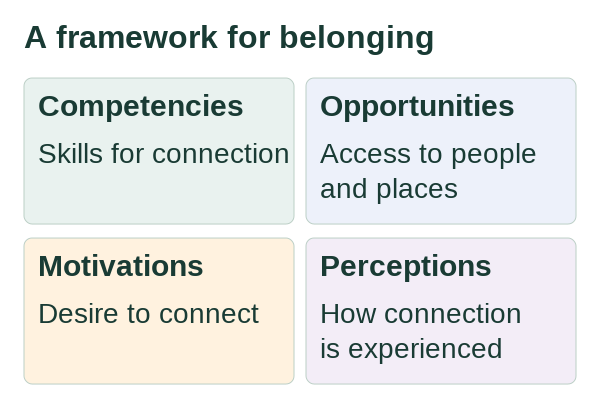
The 2021 review notes that people disagree on how belonging should be defined, measured and built. These differing views have slowed progress on the topic. To address this, the review sets out a new framework that ties four parts together: competencies, opportunities, motivations, and perceptions.[1]
A separate 2026 theoretical paper proposes internalized social exclusion. This is a newly recognized phenomenon in which a student comes to see the self as excluded. That paper sets the idea apart from social exclusion, whether real or only perceived. It describes three dimensions: self-perception, contextual-cognitive, and integrative. It links the phenomenon to emotions that push people out. These include embarrassment, insecurity and otherness.[7]
Social Safety Theory holds that forming and keeping friendly bonds with others is a basic principle behind human behavior. Under the theory, psychological stressors carry a central element. That element is threat to social safety. That element raises the risk of illness. The theory reasons that social conflict, isolation, devaluation, rejection, and exclusion once raised the risk of physical injury and infection. Because of that history, the brain and immune system react in advance to social threat. The theory calls this anticipatory neural-immune reactivity. When such a response lasts, it can raise the risk of viral infections. It can also raise the risk of several conditions linked to inflammation.[8]
The 2022 review argues that a sense of belonging prepares learners to take ownership of learning. It also supports them in doing so. It links this to self-directed learning.[9]
The 2026 paper considers how the lenses of internalized exclusion change the understanding of learning motivation among marginalized students. They are immersing students in the curriculum, reshaping how they think and feel, and building their will to act. The paper presents this framework as conceptual. It also sets out methods to test it with real data in future.[7]
History
Where the idea of belonging comes from
In 1978 a task panel reported to a United States presidential commission on mental health. It urged better care and relief for people suffering from distress syndromes that included loneliness. Few people at the time expected the problem to still need attention 40 years later. A 2011 meta-analysis, a statistical pooling of separate studies, reviewed treatments meant to reduce loneliness and called for well-controlled randomized trials. That review pointed to the rehabilitation of maladaptive social cognition, meaning faulty habits of thinking about other people, as the target such trials should address. By 2015, more evidence supported combined treatments. These pair social or cognitive behavioral therapy with short-term added drug treatment.[10]
A 2004 paper examined place attachment, the bond people form with a setting. It argued that the new economy is weakening ties to people, places and companies. That paper suggested one unintended effect. Place has gained value, and a longing for community has grown. The paper proposed that loyalty to an organization is increasingly decided by social ties and attachment to place.[11]
A 2015 paper in that field defined belonging through the relations individuals have with other people. It also included relations with circulating objects and with changing social, political and cultural settings. On that account, belonging comes into being through individual life stories. It also comes through varied contexts and situated experiences and acts.[12]
A 2009 review traced how that concept changed. It looked at publications by Wenger and colleagues from 1991 to 2002. The earliest version, from 1991, centred on interactions between novices and experts. It also looked at how newcomers build a professional identity. The 1998 book turned to personal growth. It asked how far individuals take part, from the edge of a group to its core. By 2002, managers had also taken up the idea. They used it as a way to make an organization more competitive. The review recommended supporting members as they interact and share knowledge. It also recommended helping them build a sense of belonging. This applies within networks, teams and groups.[13]
One 2021 study surveyed 2,400 on-campus residents at a 4-year university in the southern United States. It got responses from 38% of them, or 920 students. Of those respondents, 581 gave a definition of belonging to their residential community. Those definitions produced three themes. They were space and place, strengthening connections, and outcomes of belonging.[14]
Main ideas
Students who face extra barriers
Students with disabilities form another group whose belonging has been studied closely. A 2015 grounded theory study followed 8 college students through their first year. Most of them had disabilities that are not visible to others. The students' accounts tied the growth of belonging to self-advocacy. They also linked it to social relationships.[15]
Students with learning disabilities often choose not to disclose the disability on admission. They worry about being accepted in the university culture. A two-year study took place at a private, selective, four-year university in the Midwest. It used focus groups and one-on-one interviews. The students were in their first year and had learning disabilities.[16]
The 2025 study interviewed 7 transfer students with disabilities. All were registered with the disability services office at Central University. Each had taken part in a one-on-one orientation with that office. Participants named the parts of the orientation that most shaped their sense of belonging. These were the option to meet virtually and approaches tailored to the individual. They also included providers who were knowledgeable and engaging.[17]
A four-year study of low-income students traced belonging over the whole of college. The sample came from more than 150 four-year institutions. It was made up of students from low-income backgrounds. They had lived through adverse childhood experiences, meaning difficult events in childhood. Having a mentor affected how much students felt they belonged early in college. Campus involvement had positive effects on belonging across the four years. First-generation students began college already feeling they did not belong. The gap grew larger over four years. Campus involvement also helped first-generation students less. It helped peers whose parents went to college more.[18]
Students who struggle in class often feel cut off. That feeling can stop them from asking for help. The University of Cape Town is in South Africa. There, the COVID-19 pandemic and the shift to remote teaching led to a large rise in Black students facing academic exclusion. The university built an academic recovery program. The program aimed to draw these students back into their studies. The aim was to teach help-seeking as a strategy for later success. Researchers studied 270 student submissions from two rounds of the program. They compared help-seeking before and after clear teaching of help-seeking strategies. Help-seeking and belonging rose and fell together. Students who sought help more often said they felt closer to their peers. They also felt closer to the institution. The researchers concluded that the program helped students recover academically.[19]
Common misconceptions
Brown and Papp note that educators, themselves included, tend to expect belonging to hold steady or rise during college. One long-term study followed 355 students from the start of college. White, non-Hispanic, or Latino/a students dropped less.[20]
Studies of students with special educational needs have found mixed results. The results concern their sense of belonging. One study looked at 914 Portuguese students. Those with special educational needs were more rejected and less accepted by peers on average.[21]
Research
Why belonging matters for health and learning
Social connection is more than a comfort. It is linked to whether people live or die. A meta-analysis pooled 148 studies with 308,849 participants. It asked how social ties relate to death rates. People with stronger social relationships were 50% more likely to survive. The odds ratio was 1.50. The survival advantage held whatever the participants' age, sex, health at the start, cause of death, or length of follow-up. The link was strongest for complex measures of social integration, with an odds ratio of 1.91. It was weakest for simply living alone versus living with others, at 1.19.[2]
A 2014 review of social epidemiology found that a lack of positive social relationships is itself a significant risk factor for widespread illness and death. Loneliness makes people more sensitive to social threats. It also pushes them to rebuild social ties. Together these effects lead to higher rates of illness and death in lonely older adults.[22]
For children and adolescents, the evidence points to depression and possibly anxiety. A rapid review published in 2020 found 80 studies. Of these, 63 reported on isolation and loneliness in young people who were previously healthy. Those 63 studies included 51,576 children and adolescents with a mean age of 15.3 years. Loneliness and social isolation were tied to a higher risk of depression. They may also raise the risk of anxiety. This held both when measured and from 0.25 to 9 years afterward. How long loneliness lasted was more strongly linked to mental health symptoms than how intense it felt. The review rated the studies at high risk of bias overall.[23]
A 2012 study tested a questionnaire built from that theory. It used 5 separate samples of different ages and levels of mental health difficulty. The questionnaire's measures were linked to related measures of interpersonal life. They also predicted suicidal thoughts later on.[24]
A 2009 paper tested the theory's main predictions in two samples of young adults. In the first study, low family social support came together with feeling that one does not matter. This predicted current suicidal ideation, beyond depression scores. The second study looked at suicidal young adults in a clinical sample. Low belonging, perceived burdensomeness and lifetime number of suicide attempts together predicted a current suicide attempt.[25]
Interventions to reduce loneliness have been tested, with mixed results. A 2011 meta-analysis sorted programs into four strategies. They were improving social skills and social support. They were also increasing chances for social contact and addressing harmful social thinking. Single-group pre-post studies and nonrandomized comparisons produced larger average effects than randomized comparison studies. Among randomized studies, the most successful programs addressed maladaptive social cognition.[26] The 2017 review noted an urgent need for laboratory and field research. That research should show which interventions are both practical and effective.[27]
How researchers measure belonging
A 2026 revision of that scale was built with adolescents as co-producers. Students helped write and judge the questions. The team tested a draft questionnaire and discussed the results. They reworded or restructured items. Then they produced a revised survey. Statistical analysis showed the new version can measure school connectedness. It can do so in individual schools. Its designers say schools can use it regularly. They can use it at whole-school, year-group or class level.[28]
A second family of scales measures sense of community. Researchers describe it through four characteristics: membership, needs fulfillment, mutual influence, and shared emotional connection. The new scale was tested on 295 college students from three universities, 71.9% of them female. All the scales showed acceptable internal consistency, with Cronbach's alpha and McDonald's omega ranging from .94 to .95. The new scale also moved together with three other measures of classroom community. This supports the claim that it is valid.[29]
A third instrument was built for a narrower purpose. It measures whether students see personal relevance in their learning material. This Sense of Belonging (SB) scale was made for a study of learning endurance. That is the study's term for how well knowledge lasts. The study involved 80 Grade 9 students. They were split into an experimental group and a comparison group. The experimental group was taught science through a contextualized approach. The approach aimed to build a sense of belonging. The comparison group got ordinary instruction. Learning endurance was checked with an immediate test. A delayed test followed one year later. The experimental group scored much higher on the SB scale and kept more knowledge. The gap on both tests was statistically significant (p < 0.05).[30]
Belonging across the school years
A 2025 study interviewed 79 fifth-grade students in Bangladesh, aged 11 to 12. They came from urban and rural schools. The students described belonging in several connected ways, not just one. First, it meant feeling loved and cared for by teachers and classmates. Second, it meant teachers supporting their schoolwork. Third, it meant a feeling of accomplishment when they succeeded in their studies.[31]
Family is the centre of the social and emotional world for small children. In adolescence, students start seeking recognition at school and among friends. A sense of school belonging means feeling accepted, respected, involved and supported. The support comes from parents, teachers and other members of the school community. Two 2017 studies in Lithuania used the PISA 2012 student questionnaire. They covered 4,618 students aged 15 from 216 general and vocational schools.[32][33]
One study looked at school factors and found that belonging depends mainly on teachers. Classmates and parents matter too.[32] The other looked at home factors. It found that family attitudes toward school can strengthen or weaken belonging.[33]
Belonging also shows up in how students treat school property. A 2025 study of 84 high school students measured belonging with an 18-item scale. It measured vandalism with a 21-item questionnaire. Students who felt more belonging at school reported fewer acts of vandalism. The study found this link statistically significant. Male students averaged 39.45 on belonging and 53.03 on vandalism. Female students averaged 56.07 on belonging and 37.59 on vandalism.[34]
A 2023 study used base-year data from the High School Longitudinal Study of 2009. The National Center for Education Statistics collected this sample. The sample is nationally representative. It focused on Asian American and Pacific Islander students. It split them into ethnic subgroups. The aim was to challenge the model minority stereotype, the habit of treating the whole group as one success story. The study held other demographic traits constant. South Asian students reported more school belonging than the overall level. East Asian students reported less. The study also used statistical interaction terms. These show how ethnicity and gender combine. It calls this approach intersectionality. That combined model showed extra differences for Southeast Asian and East Asian students. The study concludes that one universal strategy may not close these gaps. Plans aimed at particular groups may work better.[35]
The college picture in national samples
The pattern by student background flips depending on the type of school. At 4-year schools, minority students report lower belonging than their peers. First-generation students also report lower belonging. At 2-year schools, the opposite holds: those same groups report higher belonging than their peers.[36]
At 4-year schools, first-year belonging goes with better persistence. It also goes with more engagement and better mental health. That holds even after wide adjustment for other student traits.[36]
A later national study followed undergraduates who began college in 2011 and 2012. The sample was 21,700 students. In that sample, a 1-point rise on the 5-point belonging scale went with a 3.4 percentage-point rise. That rise was in finishing a degree within 4 years. These links are also descriptive. They show an association between belonging and degrees, not proof that belonging caused the degrees.[37]
A smaller study followed students over time to ask whether belonging holds steady or shifts during college. It followed the same 355 students over time, collecting their reports more than once. The group was 33.0% male and 67.0% female, 83.2% White, and aged 18 to 21 at the start. Belonging fell steadily over time. It fell as students moved through college. Race and ethnicity changed the size of that drop. Students from minoritized racial or ethnic groups showed steeper drops in belonging.[20]
Race, ethnicity and campus climate
A 2008 study of Latino college students used a nested design. It also used hierarchical analysis. It tested how school and social life affect belonging. Grades, study time and contact with diverse peers shaped Latino students' sense of belonging. These factors accounted for about 11% of it. The same analysis found differences between Latino students and their White counterparts.[5]
A 2013 study of 143 Filipino American students used structural equation modeling.[38] Structural equation modeling builds causal models that relate several observed measures at the same time to a latent, or underlying, variable.[39] Three factors each had a direct influence on whether these students felt they belonged. They were the racial climate on campus and the closeness of their ethnic group. They also included their interactions across cultures. Ethnic group cohesion also had an indirect positive link to belonging. It worked through its direct effect on cross-cultural interactions.[38]
Institutional engagement explained unique variance in belonging. It did so beyond student involvement alone. Student engagement explained 18% of the differences in sense of belonging. The analysis accounted for a range of student traits.[40]
One framework asks institutions to look beyond the individual student. It asks them to examine three levels at once: individual, interpersonal and institutional. Some interventions target only individuals and relationships. These are important, but they risk treating racially and ethnically minoritized students as the problem. Such approaches put changes at the student level ahead of changes to institutional structures and policies. The wider view takes in how organizations run. These practices work together to push institutionally marginalized groups to the edge.[41]
A qualitative study looked at 20 Black first-generation college students at private historically white institutions. It used participant photography with narrative data. These students described small racial slights on campus. They saw these as part of the racial climate.[42]
Discrimination seems to affect mental health partly through belonging. One study looked at 308 students at a mostly white institution. It followed them over three time points. These fell during their first three academic years. To qualify, students had to be one of three things. They had to identify as a historically underrepresented racial or ethnic minority, as economically disadvantaged, or as the first in their family to attend college. Discrimination at time one predicted more depressive symptoms at time three. It also predicted more stress. The link ran through a lower sense of belonging at time two.[43]
A separate study surveyed 4,708 college students. How often they experienced discrimination explained a statistically significant share of the variance in their confidence that they could persist to graduation. Sense of belonging was among the factors held constant. The final model explained 15.5% of the total variance in confidence to persist.[44]
Immigrant, international and language-minority students
Iceland makes a useful case for three reasons. Its immigration history is fairly recent and its population is small. Its school system is broad but homogeneous. A 2026 case study used numbers from Statistics Iceland and OECD reports. It also used academic and institutional studies. It used media coverage as well. The study found that Iceland's school system stresses inclusion and equal access. This gives integration a base to build on. Large barriers remain. These include difficulty learning the language and social isolation. They also include uneven application of policy. The study also warns of a risk. More critical political and public talk about immigration could weaken efforts to build inclusion and belonging.[45]
For undocumented students, belonging can depend on a program's legal status, not just on the campus. Deferred Action for Childhood Arrivals, or DACA, began in 2012. It came by executive order from then-president Obama. A 2021 study analyzed qualitative data. The data came from Latino DACA recipients in California. The data came during the legal challenge brought by the Trump administration. Uncertainty around the program hurt recipients' sense of belonging. This happened even though the program aimed to improve it. Respondents lived in a state with fairly welcoming immigration policy. Yet they said they felt more and more alienated from American society. They also felt unwanted in it. Some also put off major life goals.[46]
International students who move to another country to study face their own set of adjustments. A 2019 interview study examined international students' experiences and sense of belonging on an American college campus. It included what helped or hindered that belonging. The study suggested that social ties to American college students could ease such challenges. Such ties could also support social and cultural integration.[47]
A 2016 study of Chinese international students found that making meaningful ties with American students was harder than expected. Students who wanted American roommates expected an easier shift to United States culture. Inside the residence hall room, cultural differences made communication harder. They made social ties harder too.[48]
A 2026 qualitative study held focus group interviews with 12 international graduate students. They came from diverse disciplines at a predominantly white institution in the northeastern United States. The analysis found six themes. Among them were fragmented social belonging and heavy reliance on ethnic communities. Academic belonging depended on funding and advisor support. It also depended on whether research interests matched. Language skills brought constant pressure to prove oneself. Many participants reported marginalization. It was tied to language-based bias, limited cultural understanding, and underrepresentation. Participants also weighed diversity, equity, and inclusion efforts that only look good against genuine ones. They stressed the importance of physical and symbolic space.[49]
A 2026 study examined how international students' sense of belonging develops across cultural distance groups in Turkish universities. The study ran face-to-face interviews with 30 international students about the past. They came from three groups defined by cultural distance. Their skills ranged from the language-learning stage to advanced proficiency. Cultural distance played a limited role in building a deep sense of belonging. For most participants, that deep belonging was in place by the end of the first year. Academic success did most of the work. Supportive contact with instructors and local students did too.[50]
For Black students who are international, race and nationality can pull in different directions. A 2016 qualitative study interviewed ten Black international students. They attended a historically Black college or university (HBCU). These students were racially Black. But their birthplace and nationality differed from those of their Black American peers. Their views of race and nativity shaped their university experiences. They tried to keep a national identity while adjusting to the campus. They also interacted across cultures with Black Americans. The study recommended treating Black students as a mixed group when designing services, programs, and research.[51]
Gender, sexuality and misgendering
A 2025 paper notes that studies of LGBTQ+ students often treat them as one group. Plurisexual students are studied relatively little. A qualitative study interviewed 19 plurisexual undergraduates. They attended a regional university. Plurisexual means students attracted to more than one gender, such as bisexual and pansexual students. These students described being accepted for their identity while also meeting monosexism, the assumption that attraction to only one gender is normal. They also reported that their identity was ignored or erased on campus. Their sense of belonging shifted with peer interactions and with competition over LGBTQ+ resources. Tensions with faculty also played a part.[52]
Trans and gender diverse students have a gender that differs from the sex assigned to them at birth. They face a specific stressor called misgendering. One survey compared 56 trans and gender diverse students with 212 cisgender students. The trans and gender diverse group reported significantly more misgendering and more felt stigma, meaning the sense of being devalued or judged. The quality of relationships with faculty changed this link. Better relationships reduced the effect of misgendering on felt stigma.[53]
An analysis of the 2017-2018 Healthy Minds Study used self-reports from about 60,200 students. They were at 60 campuses in the United States. LGBQ students reported sexual assault, depressive symptoms and suicidal thoughts more often than heterosexual students. Sexual orientation, sexual assault history and sense of belonging worked together to predict depressive symptoms and suicidality. Among LGBQ students, a high sense of belonging protected mental health after sexual assault. Without it, mental health was worse.[54]
Community colleges serve large and varied student populations. That makes it harder to support particular groups. The account argues that raising feelings of belonging helps keep LGBTQIA2S+ students enrolled. It also notes growing backlash and a surge in legislation against LGBTQIA2S+ people. This is a challenge for community colleges.[55]
Place matters too, and rural settings can add barriers. A reflexive essay examines LGBTQ+ students at institutions in the rural Bible Belt. There, traditionalistic culture and evangelical religiosity combine to block belonging, the essay argues. The essay uses Strayhorn's framework of belonging. It calls for system-wide change, not passive acceptance. It asks institutions to put LGBTQ+ experiences at the center. It also asks them to challenge bureaucratic systems. These systems treat these students as outsiders.[56]
How large the link to grades is
Belonging had moderate positive links with three things. The figures were r = 0.30 for academic motivation, 0.44 for academic interest and 0.36 for academic self-efficacy. The links to direct measures of performance were smaller. Academic performance was r = 0.15 and student retention was r = 0.18. Academic engagement reached r = 0.27. Intention to persist reached r = 0.29. Dropout intention went the other way. The correlation was small and negative, at r = −0.24. The links were stronger in STEM fields. They were also stronger when belonging was measured at the classroom or course level, and in longer academic programs. The authors read this pattern as belonging working mainly as a motivational resource. It also works as a psychosocial resource. It is more tied to confidence and engagement than to grades themselves.[57]
Searches in July 2025 across four databases produced 53 articles for analysis. They were limited to English-language articles from 2000 onwards. Cross-sectional data means a single snapshot in time. It found a small but significant effect of r = −0.26. This came from 53 studies and 143,980 participants. Longitudinal data follow the same people over time. It gave r = −0.16 across 17 studies and 29,944 participants, with high heterogeneity. Three things differed between studies in a steady way. They were the effect size measure used, study quality, and who reported the behavior. Tests of direction found effects running both ways over time. Belonging predicted later behavior problems (14 studies, 25,111 participants, r = −0.17).[58]
What predicts belonging in a classroom
A pre-registered study looked at 1,200 US middle school students aged 11 to 13. It found that teachers' growth mindset and confidence in teaching were positively related to students' belonging in math class. Those teacher beliefs explained 30 to 40% of belonging among classes. The same study found no link. A teacher's own sense of school belonging was unrelated to the belonging students felt in class.[59] Classroom rules matter too. In two Moroccan schools, 238 ninth-grade students reported that how rules were carried out had a positive effect on school belonging.[60]
A survey covered 395 students from five public school boards and one private secondary school, mostly in rural areas. Only humour about the course was linked to a sense of belonging. Humour that put others down was linked to lower belonging. Belonging, in turn, was positively linked to engagement in thinking. It was also linked to engagement in feeling and behavior.[61]
A smaller study looked at 108 postgraduate students in Malaysia. It found that self-enhancing humour raised belonging. Aggressive humour made it lower.[62]
Exposure in both spaces at once was associated with even greater harm to both. Perceived social climate helped explain the link between cyberbullying exposure and belonging.[63] An intervention can change these numbers. The Safe Surfing programme ran with 533 students in 25 fourth- to sixth-grade classes in Israel. It lowered WhatsApp cyberbullying victimization. It also improved classroom climate and sense of class belonging. In the control group, cyberbullying rose and both climate and belonging fell.[64]
Students with special educational needs (SEN, meaning students who need extra support to learn) do not always follow the expected pattern. Peers rejected students with SEN more often and accepted them less often than other students. Even so, their reported sense of belonging was no lower than that of other students. The structure of classroom social networks was linked to belonging in unexpected ways.[21]
Personality predicts belonging in more than one way. A study used data from 398 students measured at two time points. It tested three routes at once: the student's own personality, the classmates' personality, and the fit between the two. All five broad personality traits of each student were linked to sense of belonging. Classmates who were open and agreeable were linked to higher belonging. An interaction appeared for emotional stability. It did not show a match between student and classmates.[65]
In practice
What schools and teachers can change
A study of 606 students in 30 classrooms compared 15 classrooms that took part in a school-based dance intervention for a year with untreated classrooms. Researchers mapped who named whom as a liked classmate. They counted both the nominations a student gave and the nominations a student received. Students in the dance classrooms gained in belonging. Their acceptance of others and acceptance by others rose together.[72]
An intervention can target teachers themselves. A quasi-experimental field study in English secondary schools tested a brief empathic mindset intervention with teachers. The study included 1347 students. The intervention was linked to a greater sense of school belonging and fewer disciplinary sanctions, especially for boys.[73]
In Flanders, the Dutch-speaking region of Belgium, researchers surveyed 3,475 students and 754 teachers in 28 technical and vocational schools. They also surveyed 3,376 students and 461 teachers in 22 academic schools. Students in technical and vocational schools reported a significantly lower sense of belonging than students in academic schools. That difference disappeared once the faculty's trust in students was taken into account. One part of belonging, perceived teacher support, followed a different path. It tracked the lower grade point average of vocational students, not trust.[74]
Lecturers' personalities have been studied as well. A Nigerian survey covered 1,089 undergraduates at four universities in Ekiti State. Students reported a poor sense of belonging, with a mean of 76.31. Faculty members showed high neuroticism, with a mean of 38.67. Conscientiousness predicted belonging positively (r = 0.10). Agreeableness (r = −0.15) and extraversion (r = −0.16) were negatively correlated with it. Faculty traits together explained 24% of the variance in students' belonging. The study recommended training to improve how lecturers interact with students.[75]
Small everyday exchanges may carry much of the culture of belonging. In those moments, the account says, students decide whether they are safe, seen and valued. Often they do not notice.[76]
Researchers surveyed 209 international students at two United States institutions. An advisor's cultural empathy and students' satisfaction with advising each significantly affected belonging. Advisor-advisee rapport did not. Cultural empathy also mediated the effect of advising satisfaction, meaning it carried part of that effect.[77]
At an Australian university, researchers used a design framework called PECS. It built orientation sessions around belonging. Analysis of 572 student surveys found that the sessions improved the orientation experience and helped students feel connected. Many still reported belonging five weeks later.[78]
Meeting basic needs is a further route to belonging in college. One paper proposes that support for food, housing, clothing and transportation protects students against stress, social isolation and disengagement. These can weaken feelings of mattering. The paper presents basic needs supports as promising practices. It calls for new directions in research and policy.[79]
Faculty belong too. One program at a single institution targeted faculty of color and women faculty. The program adapted social psychology research on two ideas. They are the contact hypothesis and belonging. Over the three years after the intervention, a climate survey and institutional records showed greater perceived support for diversity. They also showed smaller gaps in belonging among faculty who have been historically marginalized. The gaps in tenure rates were smaller too.[80]
Online study, pandemic disruption and open questions
Online education has grown fast. Post-traditional students face particular challenges in forming connections. These challenges arise in online learning environments.[81]
A study at a regional Australian university added a set of learning design strategies based on evidence. They went across online units in initial teacher education programmes. Students were asked about these strategies. They reported a stronger sense of belonging within the online university community. They said academics made them feel cared for, valued and supported. They also reported enjoying their learning and feeling less stress. Every design element got positive ratings. But the behaviour of unit coordinators, especially their social capacity, was unexpectedly important.[82]
A survey of online post-traditional learners found a moderate level of belonging overall. Three things stood out as important to that belonging. They were support from the university, a sense of acceptance, and real relationships with faculty and staff. The study found no significant differences between students in different academic programs. It found none between gender groups either. Hispanic students reported a stronger sense of belonging. The researchers say this can be understood within the university's designation as a Hispanic-Serving Institution.[81]
One study compared surveys of Australian students in 2019, before the COVID-19 pandemic, and in 2021, during it. At both time points, students who had thought about dropping out reported much weaker belonging than those who had not. Belonging was positively linked to enjoyment and motivation at university. Before the pandemic, students whose parents had both completed university reported significantly higher belonging than first-generation students. During the pandemic they did not.[83]
First-year students in the fall of 2020 met unusual obstacles to connecting with peers. Classes, residence halls and clubs were all affected. Interviews with 16 seniors described lasting social and emotional effects. They also described institutional policies that offered no planned chances for peer connection after the first year. Some students had positive residential life experiences. They kept up sustained contact through clubs, jobs and educationally purposeful activities. They reported higher belonging across four years, despite pandemic restrictions. Students without those experiences struggled to find belonging. They considered transferring.[84]
A daily diary study followed 2,012 college students in spring 2021. On days when students felt more unsure about belonging, they were less likely to drink. They also drank less overall.[85]
One study surveyed 391 college students. It asked about an access control system that uses face recognition. The system was adopted during the pandemic. Perceived usefulness and perceived ease of use positively predicted the intention to use the system. That intention in turn positively predicted school identity and school belonging. The researchers used halo effect theory and the technology acceptance model.[86]
Social media use shows a negative link with belonging in at least one sample. A correlational study collected responses from 464 college students. They came from many fields of study at one school. Moderate social media addiction and problematic internet use were linked to a lower sense of belongingness. The more students engaged online, the less community they felt within their social environment. The researchers called for a balance of online and offline interaction. They said this would support social integration and well-being.[87]
Programmes and practices that raise belonging
A college transition program of this kind offers a bundle of services. These help students with academic, social and financial barriers. One such program ran at three public college campuses. They served low-income and first-generation students. They also served racial or ethnic minority students. The study covered two cohorts of first-year students. Staff care and support, and students' views of grade check meetings, were significantly related to both belonging and mattering.[88]
Peer mentoring pairs a more experienced student with a less experienced one. At graduate level it has been linked to social support. It is also linked to retention and graduation rates. An exercise science graduate program began a peer mentoring scheme in spring 2021.[89]
At each lunch, about four students on average met with one faculty member. A student assistant joined them. The meal was free. Surveys went out before the lunch, right after it and 1 month later. They gathered 42 responses after the lunch and 28 at one month, and four students gave a 30-minute interview. All eight survey questions showed a significant positive change. The change covered three areas of belonging: academic, social and personal space. Gains in the social and personal space questions tended to last longer. The lunches made belonging more even across years of study, ethnic identities and gender identities.[90]
Before the tour, White students rated their sense of belonging in agriculture at 4.33 on average. Ethnoracial minority students rated theirs at 3.73. White students' belonging did not change (P = 0.55), but minority students' belonging rose from 3.73 to 4.37 (P ≤ 0.01). Imposter tendencies, the feeling of being an intellectual fraud, did not change from pre-test to post-test (P = 0.36).[91]
Researchers have also studied research experiences. In Saudi Arabia, 122 female undergraduate students learning English took a research methods course built around real research. Surveys and written reflections showed high levels of belonging, particularly in acceptance and trust. Students described themselves shifting from language learners to legitimate researchers. In that study, belonging showed no significant link with grade point average.[92]
One medical school created a Cross-Cultural Student Success Retreat. It held day-long events twice a year, in four sessions on self-discovery, self-efficacy, bias and perception, and well-being.[93] A United Kingdom language centre ran an award scheme. It encouraged pre-sessional international students to join extracurricular activities. Such students often face barriers to joining them.[94]
Researchers studied another urban charter school. It served students who had left high school. The study ran over two years and used 47 interviews with 14 students and 2 graduates.[95]
Public events where students present their work can also be designed with belonging in mind. Underserved students said they felt more able to be themselves there than in daily life. Written answers suggested most of the tactics helped. Together they offer a model for other event organizers.[96]
A community group co-developed a comic strip story. The story was made with patients facing a life-limiting illness. It shows a process of making small changes. The shared work was then analyzed for what it showed about identity and social connection at the end of life.[97]
A curator at Melbourne's Immigration Museum describes belonging in a museum as welcome, trust, inclusion and safety. The curator asks whether it can also hold discomfort, such as seeing other people's unbelonging. The article reviews recent exhibitions held there. It covers the museum's successes, stumbles and current challenges.[98]
Belonging among teachers and staff
A 2025 scoping review examined the published research on belonging among primary and secondary school teachers. A scoping review maps what has been published on a topic. The review used more than one method. It grouped the factors that help or hinder teachers' belonging into five themes. Belonging was helped by strong relationships and by alignment between teachers' values and the school's. Supportive leadership and recognition of what individual teachers contribute also helped. It was hindered by discipline problems among students and by time pressures. Other barriers were disconnect from colleagues, too little recognition and unsupportive leadership. The review argues that teachers' belonging needs strengthening. It calls for targeted interventions and policies to do this. It links that belonging to keeping teachers and to students' educational outcomes.[99]
Researchers have studied language teacher identity for two decades. They have studied language teacher emotions more recently. Both lines of work show the two shape each other. Feeling that one belongs tends to go with an insider identity. Feeling out of place goes with peripheral or outsider status. A 2025 qualitative study interviewed 24 experienced language teachers in Germany and Norway. People brought up belonging and not belonging without being asked. These feelings shaped teachers' decisions to become language teachers. They also shaped relationships with colleagues and students. They affected a sense of professional efficacy and ties to school communities. The study notes that little is still known about how veteran language teachers experience belonging.[100]
Pre-service teachers are still in training. They meet belonging unevenly during professional placement, the supervised period of practice in a school. There, belonging depended on relationships and kept changing. It was built through everyday interactions in placement settings. Pre-service teachers felt they belonged when they were valued, welcomed, included, trusted and meaningfully involved in practice. Some practices excluded them, and support came and went. Both weakened their confidence and their forming professional identity. Mentorship mattered greatly. Affirming mentoring that gave support and structure built confidence, agency, teacher efficacy and commitment to the profession. Deficit-oriented mentoring, which focuses on what a trainee lacks, limited opportunities for engagement, feedback and identity development. Inequalities built into institutions also shaped who could get access to belonging. Mentoring that built on strengths helped ease these problems.[101]
A 2021 chapter reports that the shift to online learning suited some teachers and students. Others kept struggling with it. Teachers who struggled in distance learning often complained of feeling isolated and burned out. The chapter also describes the loss of belonging. Students normally develop this in a traditional, face-to-face classroom.[102]
Belonging and the wider community
The factors that held things back were a lack of opportunities and a lack of community awareness. The study used observation, in-depth interviews, and documentation. It called for more effort to awaken a sense of community belonging.[103]
In one experiment, 6-year-old children were placed in a new group. They played a brief ball-tossing game in which group members included or excluded them. Some children were excluded, and some had no interaction with the group. Both shared more resources with their own group than with outsiders. Children who had been included shared equally with both groups. The researcher said these results could shape programs that aim at positive relations between groups.[104]
One study looked at education outside the classroom. There, teaching moves into places beyond the school building. It examined students' needs for competence, autonomy, and relatedness.[105]
An Australian case study of a four-week residential programme reported significant improvements in students' sense of belonging. The first cohort was 58 Year 9 students, aged 14 to 15, who took part alongside 39 boys. The second was 28 girls in a single-sex group. Students' mean academic buoyancy scores, a measure of coping with everyday academic setbacks, were more than a point below reported baseline scores for Australian high school students. Even so, the scores rose a little after the programme.[106]
A systematic review looked at 3668 publications. It included 30 studies published since 1990 on sport in children and adolescents. The most commonly reported benefits were better self-esteem and more social interaction. Fewer symptoms of depression came next. Team sports seemed linked to better health outcomes than solo activities. Their social nature was the likely reason.[107] A separate review of dance for adolescents found 14 studies. It concluded that more research directly focused on belonging is needed.[108]
European Union talk moved away from multiculturalism. The idea of civic integration then became prominent in policies. It also became prominent in social interventions. A case study examined the Cultural Friend Tibro project in western Sweden. The project paired immigrants with local residents in friendship-like relationships. Participants were matched by gender and family situation. They were also matched by possible shared interests. They decided for themselves whether to keep up the relationship.[109]
How belonging is built into campus places
A campus is more than a backdrop to study. Its design can help students feel they belong. Or it can leave them feeling merely tolerated. One 2026 paper argues that space, architecture, symbolism and design politics grant or refuse belonging. That paper examines classroom design and wayfinding, the signs and routes that help people find their way. It also looks at gender-inclusive facilities and culturally symbolic murals. Its attention falls on students who are racially marginalized, the first in their families to attend college, LGBTQIA+, disabled, or religiously diverse. The paper argues that a campus treated as politically neutral is not neutral at all. It says real inclusion requires a radical rethink of how campuses are designed.[110]
Students themselves link the physical setting to their emotional ties to an institution. A qualitative study ran 8 focus groups with 37 participants. They were mostly young and female, and ethnically quite diverse. Belonging was the most common of six major themes. Many themes were not about physical space directly. Nature was the second most mentioned theme. Green space was described as having healing potential for managing stress. Participants described an ideal campus with green, non-smoking spaces. These spaces would stress health promotion.[111]
First-year students build commitment to an institution partly through its physical and cultural features. These features can act as positive or negative forces. One 2022 paper reports that the physical side of a place feeds students' sense of belonging. Students feel a need to build skills for handling the institution's spaces. The same paper finds that newcomers' self-image rises. This happens when they feel they are joining a cultural and social elite. Fitting in rests mainly on good peer relationships.[112]
Residence halls bring belonging into daily life. There, custodians can be important contacts for students. A critical qualitative study examined Latine students at a large public university in California. It used pláticas, a culturally rooted method of informal conversation. It found that custodians acted as cultural connectors. They also acted as stand-in family members. They offered emotional and practical support that shaped students' sense of belonging and academic success. The study recommends formally recognizing what custodians contribute. It also recommends valuing many languages in residential life.[113]
Personal touches also carry meaning. An interview study in Turkey looked at students in on-campus housing. It examined place meaning, sense of belonging, and personalization of rooms and favorite settings. It covered personal, social and place traits. It also covered the role of meaningful objects. It also covered gender differences in how people perceived place attributes.[114]
A student's position within a residence community is linked to belonging. A 2026 comparative study measured this. Over four rounds, the study invited 10,684 on-campus residents. It received 3,051 responses. That is an average completion rate of 29%. Residential leaders reported significantly higher belonging than residents. This held across eight subscales. First-year residential leaders also reported more peer support than first-year residents. The difference was statistically significant.[115]
Design also matters in boarding schools. A study of Aboriginal students in Australian boarding schools showed this. The study used participant action research, in which participants help shape the inquiry. It had 52 participants: 27 current boarders, 18 recent alumni and 7 boarding staff members. Four findings concerned interior design. They were place identity, a need for flexible social interaction rather than an all-or-nothing approach, student participation in ongoing design changes, and space that offers social and cultural relief. The researchers note that these findings report only one particular set of voices.[116]
One 2021 paper looks at rural boarding schools in China. It argues that principals can promote student development. They can do this by building students' sense of belonging to the school.[117]
Belonging in online and distance study
Students who study online or at a distance can still feel that they belong. Researchers have examined how that feeling forms in such courses.[118][119] A survey looked at 209 university students in Surabaya who were taking online courses. Students' views of their classroom activities shaped how connected they felt to their institution. That sense of belonging was linked to self-regulated learning. This means managing and organizing one's own study. The researchers concluded that the social side of an online course matters. It helps students build effective study strategies.[118]
A large study of remote STEM classes found a link. What instructors did was tied to how much students felt they belonged. The study analyzed survey responses from 1589 students in 26 undergraduate courses. The setting was a large research university during the COVID-19 pandemic. Classes fell into four distinct groups. Students in one group reported a higher sense of belonging after the course. Students in another group reported a lower sense. More frequent active learning, meaning activities in which students interact with each other and with the instructor, was associated with a greater sense of belonging. So was being taught by teaching faculty rather than another type of instructor.[120]
In fully asynchronous courses, students work at their own times rather than meeting live. Building belonging in these courses is a known challenge. Students described belonging through six themes. Among them were a class that felt designed for them and a sense of safety. Being noticed by the instructor and a feeling of community were also among them. Only instructors saw the check-in responses. So the community theme reflects students' own reports of connection, not observed interaction. The study had no comparison group, so its findings are best read as suggestive.[119]
Belonging has also been studied as a predictor of whether distance students plan to leave. A survey of 831 distance learning students at a South African university found a racial gap in sense of belonging. Black students scored higher (M = 3.26, SD = 0.84) than white students (M = 2.88, SD = 0.79). Sense of belonging significantly predicted intentions to drop out among both groups.[121]
Group work raises special issues for students who speak English as a second language. A study of three international students examined their use of online collaboration tools. The tools were for group work. It looked at how such tools might support their learning and sense of belonging. These students can face language and cultural disadvantages compared with American peers. That may weaken their sense of belonging in the group and in the class.[122]
At one South African university during the pandemic, support took the form of study devices and data for students, and later a return to face-to-face mental health support. Researchers interviewed 45 undergraduates across all seven faculties. The interviews indicated that these measures helped establish and maintain a strong sense of belonging.[123]
What this looks like when you study
That meant three 90-minute group sessions, with surveys before and after and reflective group discussions. Wyatt (2026) reports that the intervention raised awareness of resources. It also raised feelings of validation. Wyatt argues that colleges should adopt strategies that are culturally responsive. The strategies should also be informed by trauma. These strategies should also center on belonging.[70]
At Vancouver Island University's CREATE event, students present scholarly work. Organizers used seven specific tactics to raise belonging during the 2020-2021 academic year. A post-event survey found that students overall had a strong sense of belonging. Students from underserved groups said they could be themselves more easily at CREATE. This was easier than in their day-to-day lives. The authors offer these tactics as a model. Event organizers can use them to increase belonging. Most of them drew favorable comments in the written responses.[96]
Later developments
Belonging in specific disciplines and majors
Research on belonging in particular fields often asks whether students feel at home in a discipline, not only in a college.[124] A review of women in engineering found unmet belonging needs in many studies. These covered women in college engineering programs. That review links low belonging to many other challenges women face in engineering. Many women also face factors across race and ethnicity. These things make belonging even harder. The review names gender identity threat, meaning the worry of being judged through a negative group stereotype, and male dominance in numbers and norms as major contributors. The situation gets worse as women move further along their career paths.[125]
In computer science, the physical setting itself can signal who belongs. Four studies tested how classroom objects linked to computer scientists affected interest in the field. The stereotypical objects gave a masculine image. This lowered women's sense of ambient belonging, a felt fit with a place based on its cues. It also lowered their later interest in the setting. The same objects had no similar effect on men. The masculine image also kept women's interest from growing. This happened in rooms filled entirely with other women.[126]
A 2026 study looked at 29 current computer science students and recent graduates at four United States universities. It found that theory-heavy coursework made engagement hard. Personally meaningful experiences added to belonging. Several parts of connectedness also shaped it together.[127]
A 2026 narrative review describes belonging as situated and changeable. It can rise and fall through the school day. The review focuses on Black and Latine adolescent students. It looks at them in United States mathematics classrooms. For this group, belonging is especially tied to engagement, persistence and achievement. It lists three points for researchers to consider. The first is setting factors that shape belonging to mathematics. The second is the positionality and framing of studies. The third is recognizing the whole student.[128]
A case study looked at a biology program built for strong belonging. It found limits to what a friendly social climate can do. Ten interviews with biology majors showed something clear. The students had built a strong community among themselves. They also had good ties with particular faculty and staff. That positive social environment did not fully carry over into belonging to the biology department. It also did not fully carry over into involvement there. Students focused strongly on careers tied to medical school. Students who did not share that focus might feel disconnected from the group.[129]
In industrial engineering, a 2026 classroom study tested three course components. They were values affirmation exercises. They also included guest speakers and readings by authors with diverse backgrounds. Belonging to the discipline was measured with a three-item scale. It was measured before and after the parts. Groups given combined interventions showed real gains in belonging. The gains were statistically significant. Some subgroups did too.[124]
A 2026 veterinary review searched 11 databases and screened 1572 records. Only eight studies met the rules for inclusion. Peer interactions can help build belonging. Lack of diversity in the program appeared to hinder it, as did experiences of discrimination and racism. This was especially true for diverse students. Academic performance and satisfaction were also linked to belonging. The evidence overall is limited, and its concepts are inconsistent.[130]
Well-being was the most cited effect of belonging, named in 130 articles. Next came more learning and a growing professional identity. Only 10 articles looked at how belonging affects student attainment. Ethnicity and socio-economic background influenced students' belonging. So did inclusive practice, representation, student support and involvement in clinical practice. Only 26 articles described programs designed to build belonging among medical students. Articles by authors in high-income countries outnumbered those from lower-middle income countries 25-fold. They outnumbered those from low-income countries 50-fold.[131]
Library and information science has little research on how students from different ethnic and racial groups experience their programs. A 2024 grounded theory study, an approach that builds theory from interview data, explored Latine students' experiences through interviews and focus groups. It sought elements that help or hinder their sense of belonging. It offered early findings and a model of belonging for these students.[132]
What belonging predicts beyond grades
Belonging also predicts whether students stay enrolled. Retention researchers have examined this link. A 2002 paper built a survey measure. It measured students' sense of affiliation with their university community. It also measured their identification with it. That measure was designed to clarify which factors contribute to retention, the term for students staying enrolled.[133]
A 2023 survey of 233 first-year students in one agriculture college found that peer support, faculty support and empathetic faculty all predicted belonging in the college. In that sample, about a third of students said they felt isolated.[134] A 2026 conceptual model proposes that three things affect persistence. Mentorship, academic advising and an inclusive institutional climate work mainly through their combined effect on belonging. The model is a set of twelve propositions awaiting tests with longitudinal and multilevel designs, so it is not yet evidence of the pathways it describes.[135]
Belonging is tied to mental health as well as to staying enrolled. A 2014 study using a multi-institutional survey found that first-generation students reported lower belonging than other students. The same study found that first-generation students reported more depression and stress. They also used fewer services.[4]
A 2026 analysis looked at college students recovering from alcohol and other drugs. It sorted students into three groups by belonging and loneliness. The Disconnected group (581 students) reported the most anxiety and depression. The Connected group (850 students) reported the least. Belonging was moderate to high in that sample. The researchers therefore suggested loneliness may matter more for mental health in this group.[136]
Belonging also relates to how students see themselves and their future work. A 2026 analysis looked at 48,832 respondents across Croatia, the Czech Republic, Hungary and Poland. It found that higher reported non-belonging went with lower self-perceived academic performance in all four countries. In most cases, weaker belonging also went with lower perceived employability.[137]
A 2020 study described belonging and self-esteem among high school students. They attended a Catholic college in Antique. It noted that low self-esteem is often linked to depression.[138] Before the course began, students' sense of belonging to those communities predicted their science civic engagement and science identity outcomes.[139]
Belonging has been linked to academic procrastination and to psychological well-being. A 2026 survey looked at 377 vocational college students in Guizhou, China. Academic procrastination negatively predicted school belonging (β = −0.376, p < .001). School belonging in turn positively predicted psychological well-being (β = 0.252, p < .001). It partly mediated the link between procrastination and well-being.[140]
One 2026 study looked at 7,257 Lithuanian students in the OECD PISA 2022 assessment. It found that sense of belonging was the strongest predictor of students' perceived safety at school. Positive teacher-student relationships, life satisfaction and stress resistance were also linked to feeling safe. Bullying and school safety risks were linked in a negative way.[141]
Criticism
Open questions and limits of the evidence
One study looked at blended and remote learning in the 2020/21 academic year. Its authors describe it as small-scale.[142] A study of school layout in Erbil city high schools surveyed 303 students. All were at the same grade level.[143]
A scoping review of belonging in doctoral education began with 1202 items. After screening, it kept 24 articles.[144] A review of belonging and suicide found 16 studies that met its criteria. Almost all were in groups without patients.[145]
A Latvian survey in 2020 asked 317 university students. Both parts of belonging to the country predicted satisfaction with life. That study tested a path model. A path model is a statistical map of how variables may affect one another. It found no direct effects of perceived threats. The one exception was a positive link with relational belonging.[146]
One learning development tutor set out a hypothesis. Creativity in teaching could affect students' sense of belonging to an institution when students do not see it as meaningful knowledge building.[147] One study of school layout used visibility maps of ten high schools chosen at random. It also asked 303 students questions. It found a positive link between how connected a school's layout was and students' sense of belonging. The authors argue that their implications extend beyond Erbil, though the data come from one city.[143]
Key studies
| Year | Study | Sample | Design | Finding |
|---|---|---|---|---|
| 2007 | Walton & Cohen[3] | two experiments with college students, including Black and White students | Led to believe they might have few friends in an intellectual domain, Black students showed a drop in belonging and potential, while White students were unaffected. An intervention that eased doubts about social belonging raised Black students' grades but not White students'. | |
| 2009 | Cheryan et al.[126] | experiments | Changing stereotypical objects in a computer science classroom raised women's interest to the level of male peers. | |
| 2010 | Holt-Lunstad et al.[2] | meta-analysis of 148 studies with 308,849 participants | People with stronger social relationships were 50% more likely to survive (OR = 1.50). The link was strongest for broad measures of social integration (OR = 1.91). | |
| 2014 | Stebleton et al.[4] | multi-institutional survey of first-generation and non-first-generation students at public research universities | First-generation students tended to report lower belonging, greater depression and stress, and lower use of counseling services than non-first-generation students. | |
| 2020 | Gopalan & Brady[36] | nationally representative sample of first-year U.S. college students | national survey | On average, first-year students at U.S. colleges somewhat agree that they belong at their school. At 4-year schools, belonging is lower among racial-ethnic minority students and first-generation students than among their peers. |
| 2021 | Allen et al.[1] | narrative review of studies on belonging, its measurement, and interventions | Belonging predicts many mental, physical, social, economic, and behavioural outcomes, and the review proposes four components: competencies, opportunities, motivations, and perceptions. | |
| 2024 | Freire et al.[21] | 914 Portuguese students, 10% with special educational needs | cross-sectional study | Students with special educational needs were more rejected but did not differ in belonging. |
| 2025 | Brown & Papp[20] | 355 college students | longitudinal study | Belonging decreased over time, and minoritized racial/ethnic students showed steeper drops. |
| 2025 | Wolniak et al.[18] | low-income students at more than 150 four-year institutions | four-year longitudinal study | First-generation students entered with lower belonging, and the gap grew over four years. |
| 2025 | Sithaldeen et al.[19] | 270 student submissions from two program cycles | grounded theory analysis | As help-seeking increased, students reported greater connection to peers and the institution. |
| 2025 | Bohndick et al.[65] | 398 students at two time points | multilevel polynomial analyses | All five personality traits of individual students were related to sense of belonging. |
| 2026 | Bibon & Deblois[30] | 80 Grade 9 students | experimental and comparison groups | The contextualized group scored higher on belonging and retained more science one year later, with p < 0.05. |
| 2026 | Yang et al.[57] | 93,461 postsecondary students in 83 studies | meta-analysis | Belonging correlated 0.15 with performance and -0.24 with dropout intention. |
| 2026 | Goagoses et al.[58] | 53 articles, 143,980 participants cross-sectional | meta-analysis | School belonging correlated -0.26 with externalizing behavior problems cross-sectionally and -0.16 longitudinally. |
See also
References
- Allen, K. A., Kern, M. L., Rozek, C. S., McInerney, D. M., & Slavich, G. M. (2021). Belonging: a review of conceptual issues, an integrative framework, and directions for future research. Australian Journal of Psychology, 73(1), 87-102. doi:10.1080/00049530.2021.1883409
- Holt-Lunstad, J., Smith, T. B., & Layton, J. B. (2010). Social Relationships and Mortality Risk: A Meta-analytic Review. PLoS Medicine, 7(7), e1000316. doi:10.1371/journal.pmed.1000316
- Walton, G. M., & Cohen, G. L. (2007). A question of belonging: Race, social fit, and achievement. Journal of Personality and Social Psychology, 92(1), 82-96. doi:10.1037/0022-3514.92.1.82
- Stebleton, M. J., Soria, K. M., & Huesman, R. L. (2014). First‐Generation Students' Sense of Belonging, Mental Health, and Use of Counseling Services at Public Research Universities. Journal of College Counseling, 17(1), 6-20. doi:10.1002/j.2161-1882.2014.00044.x
- Lamont Strayhorn, T. (2008). Sentido de Pertenencia: A Hierarchical Analysis Predicting Sense of Belonging Among Latino College Students. Journal of Hispanic Higher Education, 7(4), 301-320. doi:10.1177/1538192708320474
- Harackiewicz, J. M., Canning, E. A., Tibbetts, Y., Giffen, C. J., Blair, S. S., Rouse, D. I., & Hyde, J. S. (2014). Closing the social class achievement gap for first-generation students in undergraduate biology. Journal of Educational Psychology, 106(2), 375-389. doi:10.1037/a0034679
- Bytautas, M. (2026). Beyond Perceived Exclusion: A Theory of Internalized Social Exclusion in Schools. Belonging, 2(1), 45-57. doi:10.1177/30290805261427150
- Slavich, G. M. (2020). Social Safety Theory: A Biologically Based Evolutionary Perspective on Life Stress, Health, and Behavior. Annual Review of Clinical Psychology, 16(1), 265-295. doi:10.1146/annurev-clinpsy-032816-045159
- du Toit-Brits, C. (2022). Exploring the importance of a sense of belonging for a sense of ownership in learning. South African Journal of Higher Education, 36(5). doi:10.20853/36-5-4345
- Cacioppo, S., Grippo, A. J., London, S., Goossens, L., & Cacioppo, J. T. (2015). Loneliness: Clinical Import and Interventions. Perspectives on Psychological Science, 10(2), 238-249. doi:10.1177/1745691615570616
- Inalhan, G., & Finch, E. (2004). Place attachment and sense of belonging. Facilities, 22(5/6), 120-128. doi:10.1108/02632770410540333
- Youkhana, E. (2015). A Conceptual Shift in Studies of Belonging and the Politics of Belonging. Social Inclusion, 3(4), 10-24. doi:10.17645/si.v3i4.150
- Li, L. C., Grimshaw, J. M., Nielsen, C., Judd, M., Coyte, P. C., & Graham, I. D. (2009). Evolution of Wenger's concept of community of practice. Implementation Science, 4(1). doi:10.1186/1748-5908-4-11
- Beck, A., Nadler, M., & Grabsch, D. K. (2021). A Content Analysis of College Student-Proposed Definitions of Sense of Belonging to a Residential Community. The Journal of College and University Student Housing, 48(1). doi:10.71348/001c.137512
- Vaccaro, A., Daly-Cano, M., & Newman, B. M. (2015). A Sense of Belonging Among College Students With Disabilities: An Emergent Theoretical Model. Journal of College Student Development, 56(7), 670-686. doi:10.1353/csd.2015.0072
- Hadley, W. (2018). A Sense of Belonging. Journal of College Orientation, Transition, and Retention, 25(2). doi:10.24926/jcotr.v25i2.2116
- Laventrice Ridgeway, & Peggy Delmas (2025). Transfer Students with Disabilities and Sense of Belonging: An Exploration of Individualized Orientation Influence. Journal of College Orientation, Transition, and Retention, 32(1). doi:10.24926/jcotr.v32i1.5846
- Wolniak, G. C., Chen-Bendle, E. C., & Kunzman, T. E. (2025). The Development of Sense of Campus Belonging: A Four-Year Longitudinal Study of Low-Income College Students. Journal of College Student Development, 66(3), 264-283. doi:10.1353/csd.2025.a962920
- Sithaldeen, R., August, L., Phetlhu, O., & Kokolo, B. (2025). Fostering College Students’ Sense of Belonging by Building Help‐Seeking Behaviors in an Academic Recovery Program. New Directions for Higher Education, 2025(209), 9-14. doi:10.1002/he.20527
- Brown, J. K., & Papp, L. M. (2025). Evidence for College Students’ Decreasing Sense of Belonging over Time: Direct and Moderated Results. International Journal of Environmental Research and Public Health, 22(4), 472. doi:10.3390/ijerph22040472
- Freire, S., Roçadas, C., Pipa, J., & Aguiar, C. (2024). Classroom social networks, students' peer‐related social experiences and sense of belonging: The specific case of students with SEN. British Educational Research Journal, 50(4), 1617-1635. doi:10.1002/berj.3989
- Cacioppo, J. T., & Cacioppo, S. (2014). Social Relationships and Health: The Toxic Effects of Perceived Social Isolation. Social and Personality Psychology Compass, 8(2), 58-72. doi:10.1111/spc3.12087
- Loades, M. E., Chatburn, E., Higson-Sweeney, N., Reynolds, S., Shafran, R., Brigden, A., Linney, C., McManus, M. N., Borwick, C., & Crawley, E. (2020). Rapid Systematic Review: The Impact of Social Isolation and Loneliness on the Mental Health of Children and Adolescents in the Context of COVID-19. Journal of the American Academy of Child & Adolescent Psychiatry, 59(11), 1218-1239.e3. doi:10.1016/j.jaac.2020.05.009
- Van Orden, K. A., Cukrowicz, K. C., Witte, T. K., & Joiner, T. E. (2012). Thwarted belongingness and perceived burdensomeness: Construct validity and psychometric properties of the Interpersonal Needs Questionnaire. Psychological Assessment, 24(1), 197-215. doi:10.1037/a0025358
- Joiner, T. E., Van Orden, K. A., Witte, T. K., Selby, E. A., Ribeiro, J. D., Lewis, R., & Rudd, M. D. (2009). Main predictions of the interpersonal–psychological theory of suicidal behavior: Empirical tests in two samples of young adults. Journal of Abnormal Psychology, 118(3), 634-646. doi:10.1037/a0016500
- Masi, C. M., Chen, H. Y., Hawkley, L. C., & Cacioppo, J. T. (2011). A Meta-Analysis of Interventions to Reduce Loneliness. Personality and Social Psychology Review, 15(3), 219-266. doi:10.1177/1088868310377394
- Pietromonaco, P. R., & Collins, N. L. (2017). Interpersonal mechanisms linking close relationships to health. American Psychologist, 72(6), 531-542. doi:10.1037/amp0000129
- Costley, D., & Vega Castillo, M. A. (2026). Reviewing the Psychological Sense of School Membership (PSSM) Scale: An Updated and Student-Centred Version. Belonging, 2(1), 23-44. doi:10.1177/30290805261425764
- Langlais, M. R., Vaux, D., & Orthel, B. D. (2026). Measuring Sense of Community in Higher Education Learning Environments. Belonging. doi:10.1177/30290805261468059
- Bibon, M. B., & Deblois, E. C. B. (2026). Sense of Belonging: A Fundamental Key to Understanding the Endurance of Learning. Belonging, 2(3), 223-248. doi:10.1177/30290805261452826
- Habib, M. A., & Hossain, S. (2025). How do Students Conceptualise a Sense of Belonging at Primary Schools in Bangladesh? Belonging, 1(4), 333-349. doi:10.1177/30290805251404801
- Dukynaitė, R., & Dudaitė, J. (2017). Student’s Sense of School Belonging: School Influence. Pedagogika, 128(4), 80-96. doi:10.15823/p.2017.56
- Dukynaitė, R., & Dudaitė, J. (2017). Student’s Sense of School Belonging: Home Influence. Pedagogika, 125(1), 143-157. doi:10.15823/p.2017.11
- Stefania Klara Mina Te, Nalle, A. P., & Apriliana, I. P. A. (2025). The Relationship between Sense of School Belonging and Acts of Vandalism among Students by Gender. Jurnal Ilmiah Bimbingan Konseling Undiksha, 16(2), 160-167. doi:10.23887/jibk.v16i2.101409
- Jang, S. T. (2023). Sense of School Belonging Among Asian American and Pacific Islander Students in U.S. High Schools: A Critical Quantitative Intersectionality Analysis. Teachers College Record: The Voice of Scholarship in Education, 125(3), 289-318. doi:10.1177/01614681231173019
- Gopalan, M., & Brady, S. T. (2020). College Students’ Sense of Belonging: A National Perspective. Educational Researcher, 49(2), 134-137. doi:10.3102/0013189x19897622
- Brady, S. T., & Gopalan, M. (2026). College Students’ Sense of Belonging: A Graduation Update. Educational Researcher, 55(2), 142-145. doi:10.3102/0013189x251393248
- Maramba, D. C., & Museus, S. D. (2013). Examining the Effects of Campus Climate, Ethnic Group Cohesion, and Cross-Cultural Interaction on Filipino American Students' Sense of Belonging in College. Journal of College Student Retention: Research, Theory & Practice, 14(4), 495-522. doi:10.2190/cs.14.4.d
- ERIC Thesaurus (n.d.). Structural Equation Models. ERIC Thesaurus. https://eric.ed.gov/?ti=Structural+Equation+Models
- A Kitchen, J., & S. Williams, M. (2019). Thwarting the Temptation to Leave College: An Examination of Engagement’s Impact on College Sense of Belonging among Students of Color. Journal for the Study of Postsecondary and Tertiary Education, 4, 067-084. doi:10.28945/4423
- Johnson, R. M. (2022). A socio‐ecological perspective on sense of belonging among racially/ethnically minoritized college students: Implications for equity‐minded practice and policy. New Directions for Higher Education, 2022(197), 59-68. doi:10.1002/he.20427
- Allen, Q. (2025). “In a Way It Certainly Tells Us that We Don’t Belong Here”: Black First-Generation College Students Visualizing Their Sense of Belonging at a Historically White Institution. Urban Education, 60(10), 2695-2727. doi:10.1177/00420859251331548
- Freire, D. S., & Hurd, N. M. (2023). Discrimination and Mental Health Outcomes Among Underrepresented College Students: The Role of Sense of Belonging at Predominantly White Institutions. Emerging Adulthood, 11(3), 654-668. doi:10.1177/21676968231166967
- Jackson, Z. A., Harvey, I. S., & Sherman, L. D. (2023). The Impact of Discrimination Beyond Sense of Belonging: Predicting College Students’ Confidence in Their Ability to Graduate. Journal of College Student Retention: Research, Theory & Practice, 24(4), 973-987. doi:10.1177/1521025120957601
- Sigurðardóttir, S. M. (2026). Developing a Sense of Belonging Among Immigrant Students: The Case of Iceland. Belonging, 2(1), 3-22. doi:10.1177/30290805261417382
- Mallet-García, M. L., & García-Bedolla, L. (2021). Immigration Policy and Belonging: Ramifications for DACA Recipients’ Sense of Belonging. American Behavioral Scientist, 65(9), 1165-1179. doi:10.1177/0002764221996777
- Rivas, J., Burke, M., & Hale, K. (2019). Seeking a Sense of Belonging: Social and Cultural Integration of International Students with American College Students. Journal of International Students, 9(2), 682-704. doi:10.32674/jis.v9i2.943
- Yao, C. W. (2016). Unfulfilled Expectations: Influence of Chinese International Students’ Roommate Relationships on Sense of Belonging. Journal of International Students, 6(3), 762-778. doi:10.32674/jis.v6i3.355
- Paik, E. J., & Braxton, M. (2026). "Belonging is a luxury to us": International graduate students’ sense of belonging at a predominantly White institution in the U.S. Journal of International Students, 16(3), 191-210. doi:10.32674/df9sjd07
- Aydin, G., & Ilhan, E. (2026). University Belonging Across Borders: Evolving Sense of Belonging among International Students From Different Cultural Distance Groups in Turkish Universities. Sage Open, 16(3). doi:10.1177/21582440261465470
- George Mwangi, C. A. (2016). Exploring Sense of Belonging among Black International Students at an HBCU. Journal of International Students, 6(4), 1015-1037. doi:10.32674/jis.v6i4.332
- Copeland, O. M., Nguyen, D. J., & Cooley, L. D. (2025). "Other Queer People Are my Entire Sense of Belonging": Plurisexual Undergraduates' Sense of Belonging at a Regional University. Journal of College Student Development, 66(1), 17-32. doi:10.1353/csd.2025.a951526
- Grapentine, J. M., & Dietch, J. R. (2026). Misgendering, Stigma, and Sense of Belonging among College Students. Journal of College Student Development, 67(4), 456-469. doi:10.1353/csd.2026.a997238
- Backhaus, I., Lipson, S. K., Fisher, L. B., Kawachi, I., & Pedrelli, P. (2020). Sexual assault, sense of belonging, depression and suicidality among LGBQ college students. European Journal of Public Health, 30(Supplement_5). doi:10.1093/eurpub/ckaa165.690
- Bennett, E. (2024). Nurturing a Sense of Belonging in LGBTQIA2S+ Community College Students. Teachers College Record: The Voice of Scholarship in Education, 126(6-7), 214-233. doi:10.1177/01614681241282490
- Rouse, J. W., Moore, T., Dzimah, W., Aggrey, K., Parker, M., & Faidley, E. W. (2025). Reimagining Rural LGBTQ+ Students’ Sense of Belonging In The Bible Belt. College Student Affairs Journal, 43(2), 52-57. doi:10.1353/csj.2025.a973669
- Yang, X., Zhang, D., Wang, X., & Samsudin, S. B. (2026). Sense of belonging and academic outcomes among postsecondary students: a meta-analysis. Frontiers in Psychology, 17. doi:10.3389/fpsyg.2026.1841185
- Goagoses, N., Brosig, K., von Düring, U., & Wilke, J. (2026). A systematic review and meta-analysis of the association between sense of school belonging and externalizing behavior problems. Discover Psychology, 6(1). doi:10.1007/s44202-026-00758-9
- Pyne, J., Grodsky, E., Eklund, K., Schaefer, P., & Vaade, E. (2024). Teacher Mindsets and Student Sense of Classroom Belonging. The Journal of Early Adolescence, 44(5), 579-599. doi:10.1177/02724316231188683
- St-Amand, J., Smith, J., & Rasmy, A. (2022). Empirical Validation of a Model for Predicting Students' Sense of Belonging and School Engagement as a Function of Classroom Management Practices. International Journal of Educational Psychology, 11(2). doi:10.17583/ijep.7508
- St-Amand, J., Smith, J., & Goulet, M. (2024). Is teacher humor an asset in classroom management? Examining its association with students’ well-being, sense of school belonging, and engagement. Current Psychology, 43(3), 2499-2514. doi:10.1007/s12144-023-04481-9
- Mohd Sukor, M. S., Panatik, S. A., & Noordin, N. F. (2019). The Influence of Humor Styles on The Sense of Belonging among University Students. Sains Humanika, 12(1). doi:10.11113/sh.v12n1.1620
- Kashy-Rosenbaum, G., & Aizenkot, D. (2021). Exposure to Cyberbullying and Classroom Social Climate as Predictors of Students' Sense of Belonging in Class in Elementary and Middle Schools. social-issues in israel, 30(1), 95-131. doi:10.26351/siii/30-1/4
- Aizenkot, D., & Kashy-Rosenbaum, G. (2021). The Effectiveness of Safe Surfing Intervention Program in Reducing WhatsApp Cyberbullying and Improving Classroom Climate and Student Sense of Class Belonging in Elementary School. The Journal of Early Adolescence, 41(4), 550-576. doi:10.1177/0272431620931203
- Bohndick, C., Breetzke, J., Klingsieck, K. B., & Buhl, H. M. (2025). Students’ personality impacts sense of belonging of students in different ways. Social Psychology of Education, 28(1). doi:10.1007/s11218-025-10058-0
- Binning, K. R., Kaufmann, N., McGreevy, E. M., Fotuhi, O., Chen, S., Marshman, E., Kalender, Z. Y., Limeri, L., Betancur, L., & Singh, C. (2020). Changing Social Contexts to Foster Equity in College Science Courses: An Ecological-Belonging Intervention. Psychological Science, 31(9), 1059-1070. doi:10.1177/0956797620929984
- Logel, C., Le Forestier, J. M., Witherspoon, E. B., & Fotuhi, O. (2021). A Social-Belonging Intervention Benefits Higher Weight Students’ Weight Stability and Academic Achievement. Social Psychological and Personality Science, 12(6), 1048-1057. doi:10.1177/1948550620959236
- Sheets, E. S., & Young, D. (2024). A Brief Group Social-Belonging Intervention to Improve Mental-Health and Academic Outcomes in BIPOC and First-Generation-to-College Students. Clinical Psychological Science, 12(6), 1179-1194. doi:10.1177/21677026231220060
- Gilani, D., McArthur, D., & Thomas, L. (2024). The Agentic Belonging Workshop: A Quasi-Experimental Evaluation of a Social Belonging Intervention in two English Universities. Student Success. doi:10.5204/ssj.3667
- Wyatt, L. (2026). Surviving to Thriving: An Exploration of the Impacts of Internalized Racism on Retention and Completion of College Among African American Male Undergraduates: Connecting Students, Campus, and Community Through a Social Belonging Intervention. Journal of Social Work and Social Welfare Policy, 4(1). doi:10.33790/jswwp1100190
- C Mwendwa, A., Obondo, A., Mutavi, T., & Kumar, M. (2026). Protocol for a study on social belonging wise intervention to address adverse childhood experiences and improve Kenyan high school students' academic performance and general well-being. F1000Research, 15, 652. doi:10.12688/f1000research.179720.1
- Kreutzmann, M., Zander, L., & Webster, G. D. (2018). Dancing is belonging! How social networks mediate the effect of a dance intervention on students' sense of belonging to their classroom. European Journal of Social Psychology, 48(3), 240-254. doi:10.1002/ejsp.2319
- Doyle, L., Harris, P. R., & Easterbrook, M. J. (2025). An Empathy Intervention Reduces the Gender Gap in School Discipline and Facilitates Belonging. European Journal of Social Psychology, 55(2), 327-341. doi:10.1002/ejsp.3146
- Van Houtte, M., & Van Maele, D. (2012). Students’ Sense of Belonging in Technical/Vocational Schools versus Academic Schools: The Mediating Role of Faculty Trust in Students. Teachers College Record: The Voice of Scholarship in Education, 114(7), 1-36. doi:10.1177/016146811211400706
- Ayanwoye, O. K., Olagundoye, H. F., Ogunjobi, A. O., Ajewole, P. I., Dikko, B. O., & Ogunwole, E. A. (2025). Power of Faculty Members’ Personality Traits in Predicting Students’ Sense of Belonging in Nigerian Universities. Belonging, 1(1-2), 118-139. doi:10.1177/30290805251353097
- Montalvo, T. (2026). Belonging is Built in the Margins: How Micro-Interactions became our Most Powerful Tier 1 Intervention. Legacy: Transformation in Action, 77. doi:10.67428/2026summer12
- Yuan, X., Yang, Y., & McGill, C. (2023). Impact of Academic Advising Activities on International Students' Sense of Belonging. Journal of International Students, 14(3). doi:10.32674/jis.v14i3.5227
- Cooper, R. (2021). PECS: An Evidence-Based Orientation Event Framework for Enhancing Students' Sense of Belonging. Student Success, 12(2), 51-60. doi:10.5204/ssj.1906
- Strayhorn, T. L., Goldrick‐Rab, S., & Williams, J. (2026). Improving College Students’ Sense of Belonging With Basic Needs Supports. New Directions for Higher Education. doi:10.1002/he.70031
- Mallett, R. K., Naqi‐Hasnain, Z., Garbarski, D., Li‐Grining, C., Ensminger, D. C., Tangarife, W., & Ahad, B. (2025). An Intervention to Increase Belonging and Support Retention for Faculty of Color and Women Faculty. Journal of Social Issues, 81(2). doi:10.1111/josi.70009
- Xu, L., & Brown, S. (2024). A Sense of Belonging in Online Post-Traditional Students: What Matters? Online Learning, 28(3). doi:10.24059/olj.v28i3.4562
- Adlington, R., O'Neill, K., Volpe, C. R., & Harrington, I. (2024). Promoting a sense of belonging in university online learning: How and why initial teacher education students experience an increased sense of belonging. Australasian Journal of Educational Technology. doi:10.14742/ajet.9487
- Kelly, M. L., Nieuwoudt, J., Willis, R., & Lee, M. F. (2026). Belonging, Enjoyment, Motivation, and Retention: University Students’ Sense of Belonging Before and During the COVID-19 Pandemic. Journal of College Student Retention: Research, Theory & Practice, 28(1), 92-111. doi:10.1177/15210251241231242
- Hogan, D. V. (2025). The Other ‘Long COVID’: Understanding COVID-19’s Long-Term Impact on College Students’ Sense of Belonging. Belonging, 1(3), 228-247. doi:10.1177/30290805251391623
- Gopalan, M., Jung, J., Shou-Chun, C., Linden-Carmichael, A., & Lanza, S. (2024). College students’ sense of belonging and alcohol use amidst COVID-19: Evidence from a 21-day daily diary study. PLOS ONE, 19(12), e0310496. doi:10.1371/journal.pone.0310496
- Wang, Q., Hou, L., Hong, J. C., Yang, X., & Zhang, M. (2022). Impact of Face-Recognition-Based Access Control System on College Students’ Sense of School Identity and Belonging During COVID-19 Pandemic. Frontiers in Psychology, 13. doi:10.3389/fpsyg.2022.808189
- San Isidro College, Hadjirul, S. A., Bildo, A. J., San Isidro College, Fernandez, C. K., San Isidro College, Sumayang, J., San Isidro College, Taja-on, E., & San Isidro College (2024). Trapped in the Feed: Social Media Addiction, Problematic Internet Use and Sense of Belonging among College Students. Social Science Lens: A World Journal of Human Dynamics and Social Relations, 1(1), 49-61. doi:10.62718/vmca.ssl-wjhdsr.1.1.sc-0724-005
- Cole, D., Newman, C. B., & Hypolite, L. I. (2020). Sense of Belonging and Mattering Among Two Cohorts of First-Year Students Participating in a Comprehensive College Transition Program. American Behavioral Scientist, 64(3), 276-297. doi:10.1177/0002764219869417
- Liu, T., Chen, Y., Hamilton, M., & Harris, K. (2022). Peer Mentoring to Enhance Graduate Students’ Sense of Belonging and Academic Success. Kinesiology Review, 11(4), 285-296. doi:10.1123/kr.2022-0019
- Chan, T. M., Tamura, A. A., & Wang, X. (2025). Improving sense of belonging in biomedical engineering students through student-faculty lunches. Frontiers in Education, 10. doi:10.3389/feduc.2025.1510872
- Drewery, M. L., Cooper, J. V., Waliczek, T. M., & Wickersham, T. A. (2023). An immersive field trip focused on beef production increases the sense of belonging in ethnoracial minority college students. Translational Animal Science, 7(1). doi:10.1093/tas/txad001
- Alhodithi, D. N. I. (2026). Belonging Through Research: How Engaging Undergraduate EFL Students in Authentic Research Experiences Affects Their Sense of Belonging. Journal of Arabic Sciences and Humanities, 5(1), 121-156. doi:10.71422/1658-4058.1006
- Wendel, K., Khan, N., & Haywood, A. M. (2021). Promoting a Sense of Belonging Among Underrepresented Medical Students Through Cross-Cultural Programming. Proceedings of IMPRS, 4(1). doi:10.18060/25810
- Harrop, H., & Hoppitt, S. (2023). All carrot – no stick: an alternative award framework to enhance ‘international’ students’ sense of belonging and engagement in the extracurricular. London Review of Education, 21(1). doi:10.14324/lre.21.1.26
- Marshall, D. T., & Bynum, B. (2026). Exploring Sense of Belonging Among Students Enrolled in an Alternative Urban Charter School. Education Sciences, 16(7), 1011. doi:10.3390/educsci16071011
- Stiwich, K. D., & Ross, V. (2022). Increasing Students’ Sense of Belonging at Research Conferences. Scholarship and Practice of Undergraduate Research, 5(4), 9-15. doi:10.18833/spur/5/4/5
- Roberts, A. (2025). Co-Developing Comics to Enhance a Sense of Belonging, Empathy and Agency in the Final Phase of Life. Belonging, 1(1-2), 174-184. doi:10.1177/30290805251357082
- McFadzean, M. (2025). Finding common ground: Engendering a sense of belonging in museum exhibition spaces. PRISM, 66-89. doi:10.24199/ersd7150
- Wator, J., Patrick, P., & Yip, S. Y. (2025). Teachers’ sense of belonging in school: a scoping review. The Australian Educational Researcher, 52(6), 4269-4297. doi:10.1007/s13384-025-00897-3
- Miller, E. R., & Gkonou, C. (2025). Investigating Entanglements in Experienced Language Teachers’ Sense of Belonging and What Belonging Does. International Journal of Applied Linguistics, 35(3), 977-986. doi:10.1111/ijal.12683
- Ahmmed, M., Evans, T., McLaren, M. R., Dunn, L., Munari, A., & Munari, G. (2026). Belonging, Being and Becoming: Early Childhood Pre-Service Teachers’ Sense of Belonging During Professional Placement. Social Sciences, 15(9), 625. doi:10.3390/socsci15090625
- Heider, K. L. (2021). Isolation, Burnout, and a Lost Sense of Belonging. Distance Learning, 18(1), 25-35. doi:10.1108/dl-07-2021-0004
- Pratiwi, E. M., Bistari, B., Utami, T., Zakso, A., & Atmaja, T. S. (2025). Sense of Belonging Rasau Jaya Community in Increasing Civic Engagement and Virtues. CIVICS: Jurnal Pendidikan Pancasila dan Kewarganegaraan, 10(01), 643-653. doi:10.36805/civics.v10i01.10015
- Park, J. H., & Jin, K. s. (2022). The sense of belonging reduces ingroup favoritism in children. Frontiers in Psychology, 13. doi:10.3389/fpsyg.2022.1059415
- Lauterbach, G. (2023). “Building Roots”—Developing Agency, Competence, and a Sense of Belonging through Education outside the Classroom. Education Sciences, 13(11), 1107. doi:10.3390/educsci13111107
- Cooper, H., Gray, T., Ullman, J., & Curry, C. (2025). Wellbeing, Sense of Belonging, Resilience, and Academic Buoyancy Impacts of Education Outside the Classroom: An Australian Case Study. Behavioral Sciences, 15(8), 1010. doi:10.3390/bs15081010
- Eime, R. M., Young, J. A., Harvey, J. T., Charity, M. J., & Payne, W. R. (2013). A systematic review of the psychological and social benefits of participation in sport for children and adolescents: informing development of a conceptual model of health through sport. International Journal of Behavioral Nutrition and Physical Activity, 10(1), 98. doi:10.1186/1479-5868-10-98
- Sango, P. N., & Pickard, A. (2024). Building a Sense of Belonging in Dance with Adolescents: A Systematic Review. Adolescents, 4(3), 335-354. doi:10.3390/adolescents4030024
- Rodin, L. (2017). From Othering to Belonging: Integration Politics, Social Intervention and the Limits of Cultural Ideology. The Journal of Social Policy Studies, 15(4), 603-616. doi:10.17323/727-0634-2017-15-4-603-616
- Mleta, B., & Mpata, N. (2026). Belonging as infrastructure: How campus environment design shapes sense of belonging among marginalized students. World Journal of Advanced Research and Reviews, 31(1), 001-009. doi:10.30574/wjarr.2026.31.1.1751
- Mulrooney, H. M., & Kelly, A. F. (2020). The university campus and a sense of belonging: what do students think? New Directions in the Teaching of Physical Sciences(15). doi:10.29311/ndtps.v0i15.3590
- Dias, D. (2022). The Higher Education Commitment Challenge: Impacts of Physical and Cultural Dimensions in the First-Year Students’ Sense of Belonging. Education Sciences, 12(4), 231. doi:10.3390/educsci12040231
- Cervantes, C. A., & Hernandez, S. (2025). Familismo and Community Cultural Wealth: Enhancing Sense of Belonging for Latine Students Through Custodian Interactions in Residence Halls. The Journal of College and University Student Housing, 51(3). doi:10.71348/001c.142694
- Dazkir, S. S. (2018). Place Meaning, Sense of Belonging, and Personalization Among University Students in Turkey. Family and Consumer Sciences Research Journal, 46(3), 252-266. doi:10.1111/fcsr.12253
- Nadler, M., & Grabsch, D. K. (2026). Sense of Belonging Among Residential Leaders Versus Residents: A Comparative Study. The Journal of College and University Student Housing, 52(2). doi:10.71348/001c.158863
- Curtin University, Whettingsteel, E., Oliver, R., Curtin University, Tiwari, R., & Curtin University (2020). 'It Would Give You a Space to be Yourself' Increasing a Sense of Belonging for Aboriginal Students in Boarding Schools. Australian and International Journal of Rural Education, 30(2), 84-110. doi:10.47381/aijre.v30i2.253
- Dan, C. (2021). Place and Belonging: How Rural Primary School Principals can Promote Boarders’ Development by Building their Sense of Belonging to School? Journal of Educational Theory and Management, 5(2), 77. doi:10.26549/jetm.v5i2.7879
- Amaliyah, A., Yoenanto, N. H., & Prihastuti, P. (2023). Perception of Classroom Activity, Sense of Belonging, and Self-Regulated Learning in Students Taking Online Learning. Psikostudia : Jurnal Psikologi, 12(2), 257. doi:10.30872/psikostudia.v12i2.10212
- Rojas-Alfaro, R., Ramírez-Casalvolone, N., & Enriquez, J. (2026). “I Feel Like I Belong in This Class”: Belonging in the Asynchronous Online Composition Classroom. Belonging. doi:10.1177/30290805261497147
- Narla, A. V., Edwards, M. M., Bullard, E., Petrie, K. L., & Heinrichsen, E. T. (2025). Classroom Interactions Facilitate a Sense of Belonging in Remote STEM Classes: Lessons from a Large-Scale Quantitative Study. Journal for STEM Education Research, 8(3), 387-407. doi:10.1007/s41979-024-00135-y
- Mtshweni, B. V. (2024). Sense of Belonging as a Predictor of Intentions to Drop Out Among Black and White Distance Learning Students at a South African University. Open Education Studies, 6(1). doi:10.1515/edu-2022-0219
- Chen, X. (2023). Online Collaboration Tools and International Students’ Sense of Belonging in Group Work. Journal of Teaching and Learning with Technology, 12(1). doi:10.14434/jotlt.v12i1.36325
- Mugume, T. (2023). Students' sense of belonging at a South African university during COVID-19. Perspectives in Education, 41(1), 56-73. doi:10.38140/pie.v41i1.6649
- Heier Stamm, J. L., & Milburn, A. B. (2026). Sense of Belonging in the Industrial Engineering Classroom. INFORMS Transactions on Education, 26(2), 134-147. doi:10.1287/ited.2023.0045
- Wilson, D., & VanAntwerp, J. (2021). Left Out: A Review of Women’s Struggle to Develop a Sense of Belonging in Engineering. Sage Open, 11(3). doi:10.1177/21582440211040791
- Cheryan, S., Plaut, V. C., Davies, P. G., & Steele, C. M. (2009). Ambient belonging: How stereotypical cues impact gender participation in computer science. Journal of Personality and Social Psychology, 97(6), 1045-1060. doi:10.1037/a0016239
- Islem, S., Zeng, B., Creps, R., Rowan-Kenyon, H., & Boatman, A. (2026). Developing a Sense of Belonging in Computer Science Through Curricular and Supplemental Educational Experiences. Belonging, 2(3), 281-286. doi:10.1177/30290805261464342
- Harris-Thomas, B., Nicolai, K. D., Chen, X. Y., & Barbieri, C. A. (2026). Examining Black and Latine Students’ Sense of Belonging within the Mathematics Classroom: A Narrative Review. Educational Psychology Review, 38(1). doi:10.1007/s10648-026-10181-0
- Knekta, E., & McCartney, M. (2021). What Can Departments Do to Increase Students’ Retention? A Case Study of Students’ Sense of Belonging and Involvement in a Biology Department. Journal of College Student Retention: Research, Theory & Practice, 22(4), 721-742. doi:10.1177/1521025118788351
- Rivera Munoz, C. A., & Dooley, L. M. (2026). Sense of belonging in veterinary education: A scoping review. Veterinary Record Open, 13(2). doi:10.1002/vro2.70045
- Bull, S., Govender, L., Ramanathan, A., Knight, L., Scott, K., Ubhi, S., & Horsburgh, J. (2026). Exploring sense of belonging in medical students: A scoping review. Medical Education. doi:10.1111/medu.70336
- Long, A. K. (2024). Latine Students’ Sense of Belonging in LIS: A Critical-Constructivist Grounded Theory Study. Proceedings of the ALISE Annual Conference. doi:10.21900/j.alise.2024.1672
- Hoffman, M., Richmond, J., Morrow, J., & Salomone, K. (2002). Investigating “Sense of Belonging” in First-Year College Students. Journal of College Student Retention: Research, Theory & Practice, 4(3), 227-256. doi:10.2190/dryc-cxq9-jq8v-ht4v
- Estepp, C., Doss, W., James, S., Simmons, L., & Johnson, D. (2023). Examining Sense of Belonging Among Freshmen College of Agriculture Students. NACTA Journal, 67(1). doi:10.56103/nactaj.v67i1.137
- Githinji, L. (2026). Belonging-Centered Retention: A Conceptual Model Linking Mentorship, Advising, And Institutional Belonging to Persistence Among Underrepresented STEM Students. JOURNAL OF HUMANITIES AND SOCIAL POLICY, 138. doi:10.56201/jhsp.vol.11.no10.2025.pg138.152
- Tabit, M. B., Whipple, C. R., Kaynak, Ö., Corcoran, C., & Hoyt, A. (2026). Fitting in: Exploring the Relationship Between Recovery Status, Loneliness, and Sense of Belonging on Mental Health Functioning Among College Students. Emerging Adulthood. doi:10.1177/21676968261489851
- Tecilazić, A., Birač, B., & Urošev, S. (2026). Students' sense of belonging as a predictor of self-perceived academic performance and employability: evidence from self-reported non-belonging across four European countries. Frontiers in Education, 11. doi:10.3389/feduc.2026.1751364
- Suan, MSLT, M. M. D., & Magallanes, C. I. (2020). Sense of Belonging and Self-esteem of High School Students in a Catholic College. Philippine Social Science Journal, 3(2), 87-88. doi:10.52006/main.v3i2.174
- Alam, I., Bilinski, T., Bernot, K. M., Cotter, R., Ortiz-Zuazaga, E., Vance-Chalcraft, H. D., & Corwin, L. A. (2025). The Sense of Belonging Quotient: Relating Sense of Belonging to Predictors of Scientific Civic Engagement and Science Identity in Civically Engaged Curricula. CBE—Life Sciences Education, 24(4). doi:10.1187/cbe.24-06-0165
- (2026). The Influence of Academic Procrastination on Psychological Well-being among College Students in Guizhou, China: The Moderated Mediating Effect of Students’ Sense of Belonging and Gender. The Journal of European Economic History, 7(1), 69-83. doi:10.61336/jeeh/26-1-6
- Dudaitė, J., Urbanovič, J., & Prakapas, R. (2026). Belonging Matters Most: Predictors of Students’ Sense of Safety at School. Education Sciences, 16(8), 1276. doi:10.3390/educsci16081276
- Syska, A., & Pritchard, C. (2022). Students’ perceptions of blended and remote learning and its impact upon sense of belonging. Journal of Learning Development in Higher Education(25). doi:10.47408/jldhe.vi25.959
- Hamadameen, S., & Khayat, M. (2026). The Effect of School Layout on Students sense of Belonging. Sulaimani Journal for Engineering Sciences, 12(2), 177-214. doi:10.17656/sjes.10207
- Le, A. T., & Rivera Munoz, C. A. (2026). Sense of belonging in doctoral education: a scoping review. Studies in Graduate and Postdoctoral Education, 1-20. doi:10.1108/sgpe-11-2025-0194
- Hatcher, S., & Stubbersfield, O. (2013). Sense of Belonging and Suicide: A Systematic Review. The Canadian Journal of Psychiatry, 58(7), 432-436. doi:10.1177/070674371305800709
- Kolesovs, A. (2025). Sense of macro-level belonging supported university students’ life satisfaction amid global threats: evidence from Latvia’s first COVID-19 wave. Frontiers in Psychology, 16. doi:10.3389/fpsyg.2025.1677010
- Cramphorn, I. (2025). What if misunderstood creativity in learning creates barriers to participation and impacts students' sense of belonging. Journal of Learning Development in Higher Education(37). doi:10.47408/jldhe.vi37.1762
Cite this page: Atlas Nova editors. (2026). Sense of belonging. Atlas Nova. https://velocer.io/atlas/sense-of-belonging/
Social belonging interventions and their effects
Two studies of the ecological-belonging intervention took place in college science classrooms. The first had 1,215 students and the second had 607. Students in the intervention had higher attendance than students taught as usual. They also had higher course grades. They were also more likely to still be enrolled in college a year later. The gains were largest for groups that had underperformed in the past. Course grades rose for ethnic minority students in introductory biology and for women in introductory physics. Whatever their background, students who attended the intervention classroom had higher cumulative grade point averages 2 to 4 years later.[66]
A trial at 22 colleges tested a social-belonging exercise. Students received it before they arrived on campus. One analysis looked at students with higher body weights. A version of the treatment tailored to each college showed effects in the same direction. The effects were not statistically significant. Exploratory analyses found the effects were the same across races. The weight effects came mainly from women.[67]
A brief group-format belonging intervention was tested with 122 students. It reduced the risk of major depression during the first 2 years of college. Students who reported weaker belonging at the start showed more depressive symptoms and more worry. They also had poorer mental well-being over the 14-month follow-up.[68]
Changes in sense of belonging itself did not differ much across the three groups. Belonging workshop attendees were much more likely than both control groups to continue into their second year of study.[69]
A pilot program for African American male undergraduates ran in the spring semester. It took place at a rural institution that was mostly white. It involved about five hours of activity across three 90-minute group sessions. The study was guided by Post Traumatic Slave Syndrome. This framework links present-day racial trauma to the history of slavery. Results linked internalized racism to a higher risk of dropping out. The signs included pulling away from campus life. They also included holding back from using the help that was there. After the intervention, students were more aware of resources and felt more validated. They were also more willing to seek support.[70]
In Kenya, a protocol describes a planned quasi-experimental study, meaning one that compares groups without assigning students at random. It will recruit 372 students aged 14 to 18 in their second year at two public high schools. The treatment group will get a social belonging intervention over three sessions. The control group stays passive. The study will measure three primary outcomes. They are academic performance, well-being and loneliness. It expects an effect size of 0.5. Its stated goal is to ease the effects of bad childhood experiences. It aims to reduce symptoms of related mental health conditions.[71]