Method · Motivation and self-regulation
Self-regulated learning
Educational psychology concept
Self-regulated learning is learning in which students actively direct their thinking, motivation and behavior. Self-regulated learning includes the cognitive, metacognitive, behavioral, motivational, and emotional aspects of learning. It is an umbrella under which many variables that influence learning are studied together.[1][2]
Self-regulated learning covers thinking, planning, behavior, motivation and emotion in learning.[2] High achieving students reported using more self-regulated learning strategies than students in lower tracks.[3] People often carry a mistaken mental model of how they learn and remember.[4] Teachers can give students information and opportunities to become strategic, motivated and independent learners.[5]
Key facts
| 93% | accuracy predicting achievement group from students' reports of self-regulated learning (Zimmerman & Pons, 1986)[3] |
|---|---|
| 173 | seventh graders studied for motivation, self-regulation and classroom performance (Pintrich & De Groot, 1990)[6] |
| 526 | students surveyed on teacher autonomy support, structure and self-regulated learning (Sierens et al., 2009)[7] |
| 131 | undergraduates randomly assigned to self-regulated learning training or control (Azevedo & Cromley, 2004)[8] |
Overview
What self-regulated learning means
A student who self-regulates can pick hard tasks. That student can also use effective learning strategies. The student can also judge success against personal standards.[9] The idea covers cognitive, metacognitive, behavioral, motivational and emotional sides of learning. That makes it a broad umbrella.[2]
Researchers have called self-regulated learning a powerful learning theory. They say it can help students move knowledge and skills into real-life situations. It is also meant to make students less dependent on their teachers. That applies when they extend and update what they know.[10]
The concept has been defined too broadly. People still poorly understand its basic foundations. One framework centers on three levels of a student's cognitive and motivational repertoire. They are knowledge of the subject, strategy use, and goals.[10]
Self-regulated learning has been proposed as an educational goal. The proposal covers children with disabilities and students who are struggling. Classroom programs can build learning strategies, metacognition and motivation. These programs are described as ways instruction can encourage self-regulated learning.[9]
The two constructs share traits. Telling them apart requires looking beyond a simple feature-by-feature comparison. Both fields have widened their focus. They now look beyond the individual learner to the social setting in which learning happens. Their social dimensions are described as emotional, spatial and political.[11]
Self-directed learning is a third related term. It gives students a larger role in choosing and judging learning materials. Self-directed learning can include self-regulated learning. The reverse is not true. A review of studies in problem-based learning found that self-directed learning and self-regulated learning are both developmental processes.[12]
History
Where the idea came from
A 2001 review compared the leading models. These included models by Boekaerts, Borkowski, Pintrich, Winne and Zimmerman. It compared them on four points: background theories, definitions, parts and empirical work. The review found that the theory behind each model was the main feature that set the models apart. Pintrich and Zimmerman produced the two models that looked most alike. Both drew on social cognitive theory. Borkowski and Winne produced the two models that differed most from the others. Their theoretical roots were the farthest apart.[13]
One paper examines Bandura's social cognitive theory. It looks at how that theory treats agency as a form of self-regulation. A 2004 paper examined this view of agency. It set the view against the history of philosophy. It also set it against recent work in developmental psychology. The paper proposed that this account of agency could be an alternative to constructivist and sociocultural theories of self-regulation in educational psychology.[14]
A 1990 paper argued that skill alone cannot carry self-regulation. The will to regulate, the wanting to do it, comes first and is required. It concluded that programs to build self-regulated learning must combine skill and will.[15]
Paul R. Pintrich built a framework that describes phases of self-regulation. They were forethought, planning and activation; monitoring; control; and reaction and reflection. The same framework named cognition, motivation, behavior and context as the areas in which students regulate. He also asked how the mix of classrooms and schools affects self-regulation. He helped build the MSLQ, a questionnaire. It measures self-regulated learning, cognition and motivation.[16]
A 2007 review gave Winne and Hadwin's model credit for a more complex cognitive architecture. That model put monitoring and control inside every phase of learning. It also made task definition and goal setting separate phases. The review proposed new directions. One was closer study of judgments of learning. Another was how cognitive and task conditions interact. They interact in all phases of learning.[17]
Winne argued in 1995 that self-regulated learning includes some elements that are not deliberate. These are knowledge-based elements built into self-regulation. They are also built into learning more generally. He drew this argument from areas of theory and research. Work on self-regulated learning in educational psychology had not often cited them.[18]
A 1990 paper said self-regulated learners understand, value and take part in academic learning. They do this in ways very different from peers who struggle in school. It held that as children move through formal education, several things develop side by side. These are their beliefs about success and failure. They also include their awareness and attributions, and their metacognition and motivation. School conditions shape the theories about learning that children build. These include how hard tasks are, how help is given and what counts as success. The paper treated self-regulated learning as a good educational result. Teachers can encourage it. Teachers can do this by reducing academic competition and explaining good strategies. They can also help during problem solving. They can build a spirit of collaboration.[19]
Main ideas
The main models and their phases
The models differ in what gets compared and in the standards used for the comparison. The authors separate component models of self-regulated learning from process models. Component models suggest standards for assessment set in advance. Process models suggest online standards. Qualitative standards gave higher assessment validity than quantitative standards. This held for both offline and online standards.[20]
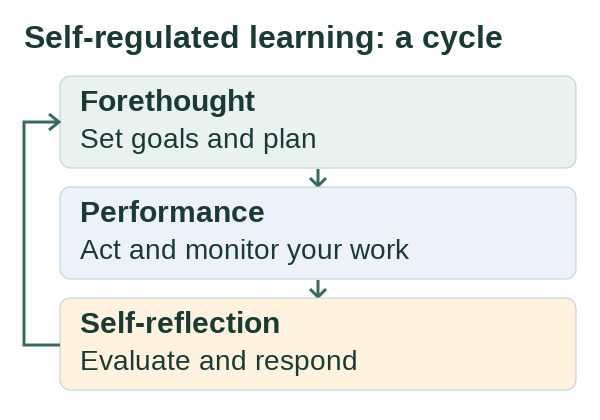
In one model, beliefs about knowledge itself are part of a task's cognitive and emotional conditions. Those beliefs also shape the standards a student sets when goals are produced.[21] At the Person level, motivation appears as beliefs about expectancy and value. It also appears as achievement goal orientations. These traits steer self-regulation from the top down. The two levels are proposed to influence each other in both directions.[22]
Monitoring is an executive process. It turns other processes on and off. This happens as the learner judges thoughts and products while they occur. A review of research on text processing found that monitoring during reading is often far from optimal. This holds even for skilled adults.[23]
Self-reported metacognition relates positively to strategy use. It also relates positively to motivation. Two studies used self-report questionnaires. Students' self-reported metacognition was negatively linked to one thing. It was linked to how accurately they rated their own test performance.[24]
A model of self-regulated learning places personal beliefs about knowledge within the cycle. Epistemic emotions can either help or hinder learning processes and outcomes. Five antecedents are proposed for these emotions. They are control, value, novelty and complexity. They also include the reaching or blocking of knowledge goals. The effects are on planning and goal setting, on motivation, on cognitive and metacognitive strategies, on learning outcomes, and on the antecedents themselves.[25]
Beliefs about knowledge also shape the standards for knowledge. Those standards feed into metacognition. Self-regulated learning may in turn help those beliefs develop.[21]
Goals, self-efficacy and feedback loops
The properties of a goal matter. Research has looked at how specific, how close and how hard goals are. It has also looked at self-set goals and progress feedback. When students see good progress, they feel more able to improve their skills. When students reach a goal while feeling highly capable, they set new and harder goals. Teachers can help by showing students how to set realistic goals and judge their progress. Examples include setting upper and lower goal limits. Others are using games, contracts and conferences.[26]
Students often check their own learning poorly. Their self-assessment, target goals and follow-up learning can all go wrong. In one study, a system had self-regulated learning tools and open learner models. It gave students outside feedback on how they actually performed. That outside feedback helped most students check their performance and set goals. It also helped them carry out and check strategies. Yet some students still needed more support.[27]
One theoretical synthesis argued that research on the two should be closely linked.[28] A study of 306 undergraduates in Korea found a link. How students saw writing feedback predicted their writing self-efficacy. It also predicted their use of self-regulated learning strategies. Those two factors in turn predicted self-regulated writing ability. They also carried the link between feedback perception and that ability. A separate phase had 196 undergraduates. Feedback perception and writing self-efficacy did not predict it.[29]
Self-efficacy also works partly through the strategies students use. The study looked at 449 university students in China. They were learning science in blended courses. Self-efficacy had a direct positive effect on academic performance. The figures were β = 0.317, p < 0.001. It also had an indirect effect through metacognitive strategy use (β = 0.122, p < 0.01). That path explained 27.8% of the total effect. Online learning engagement changed the link between self-efficacy and metacognitive strategies. The link was stronger among high-engagement students (β = 0.592) than low-engagement students (β = 0.469).[30]
Motivation and emotion as part of the cycle
A 2003 article argued that regulating motivation belongs on that list too. It sits beside motivation, cognitive strategy use and metacognition. Those strategies were linked to signs of students' motivation, cognitive engagement, and achievement.[31]
A 1998 study asked 115 college students what strategies they use to manage motivation. Students said they used many cognitive, volitional and motivational strategies. They used them to regulate their level of effort. The study put three motivational problems to students. Students reported using these strategies at different rates across the three. Different parts of motivational regulation were positively linked to students' goal orientation. They were linked to their course grade as well.[32]
Enjoyment and pride in mathematics declined over the school year. Boredom increased. Anxiety stayed fairly stable across the study period. Shifts in positive emotions went hand in hand with shifts in self-regulated learning. They also went with shifts in achievement. The results suggest that will and skill are not enough. Students also need the thrill to succeed in school.[33]
A survey looked at 302 undergraduates in an online course. It studied boredom, frustration and enjoyment, along with elaboration and metacognition. Enjoyment is a positive activating emotion. It predicted elaboration and metacognition in a positive direction. Frustration is a negative activating emotion. It also came out as a positive predictor of metacognition. That second result matched earlier findings from a similar sample.[34]
What age and context change
A study watched Grade 2 and Grade 3 classrooms for 6 months. It found that young children thought carefully about how to manage their writing. Those children showed either a mastery orientation or a performance orientation. Which one applied depended on the tasks in their classrooms. It also depended on the authority structures and the evaluation practices. The findings challenge a common belief. That belief says young children lack the thinking skills that self-regulated learning requires.[35]
A second set of classroom observations and interviews found children from kindergarten through Grade 3 planning, monitoring, solving problems and evaluating. They did this during complex reading and writing tasks. The same work found that the motivational profiles of these young children varied. The pattern was more like older students than had been assumed.[36]
One study looked at 100 seventh graders with a mean age of 12.3 years. Positive motivational beliefs went with higher levels of self-regulated learning. Classroom experience was also linked to motivation and self-regulation. Intrinsic value measured later in the year was tied to classroom experience more strongly. This link was weaker for intrinsic value measured early in the year. Test anxiety acted more like a stable trait. It was linked more strongly to earlier anxiety than to classroom experience.[37]
Ideas about what learning is differ across cultures. The strategies students use may not differ. One study compared secondary school students in Australia and Japan. The Australian students held a narrow, school-based view of learning. The Japanese students saw learning in much broader terms. For them it was a lifelong, hands-on process that led to personal fulfillment. It was not just something that happens at school. Even so, students learning in a Western setting used strategies much like those Japanese students used. In both groups, seeing learning as understanding was linked to greater total use of strategies.[38]
Growth mindset, self-efficacy and intrinsic value each pushed strategy use in its own way. Growth mindset is the belief that ability can grow with effort. It predicted self-regulated learning better than self-efficacy and intrinsic value. Monitoring and effort regulation made significant contributions. They contributed to English language learning achievements. Goal setting and planning did not predict those achievements. The researchers asked for future work on how social and cultural context shapes these links.[39]
Research
How strongly it predicts achievement
A 1990 study of 173 seventh graders looked at eight science classes and seven English classes. Self-regulation, self-efficacy and test anxiety were the best predictors of classroom performance. Which of the three predicted best depended on the outcome measure used. Intrinsic value had no direct influence on performance. But it was strongly linked to self-regulation. It was also linked to the use of cognitive strategies. This held whatever the student's prior achievement level.[6]
A 2025 survey looked at 164 students at two Islamic senior high schools in the Bantul area. Self-efficacy and self-regulated learning together had a significant effect. The effect was on mathematics midterm results.[40]
A 2020 ex post facto study looked at 46 biology education students. They studied at a university in Makassar. That study called the link very strong. It joined self-efficacy and self-regulated learning on one side. Academic achievement was on the other.[41]
A 2023 ex post facto study looked at class XI social studies students in Paiton District. It found that self-regulated learning had a positive effect on critical thinking skills. The coefficient of determination was 28.1%.[42]
A meta-analysis combined 10 research samples. The samples came from articles published between 2018 and 2020. The articles were on mathematical critical reasoning. It found a mean effect size of 0.72, which it placed in the moderate category. Checks for publication bias were not significant.[43]
A 2025 meta-analysis of 61 studies reported an average effect size of .212 between self-regulated learning strategies and overall learning outcomes. The measure was a Pearson correlation coefficient. The link was stronger for emotional outcomes. It was weaker for test scores, behavior and mental health. It was also much higher in the clerkship phase of undergraduate medical education. It was lower in the pre-clerkship phase. Two things made no significant difference to the result. These were the subscale used and the quality of the study.[44]
One long study followed students over time. It tied self-regulated learning to staying in school, not only to grades. A 2008 longitudinal study followed 412 Italian students aged 12 to 22. Self-regulatory efficacy fell steadily from junior high to senior high school. Males showed the larger fall. The less self-regulatory efficacy fell, the better the high school grades. Such students were also more likely to stay in high school. Family income and status were held constant. Some students felt more capable of self-regulated learning in junior high school. They went on to earn better junior high grades. That later efficacy partly carried the effect of junior high grades. It also carried the effect on the likelihood of staying in school.[45]
Not every review finds a clean link, and some report studies that contradict it. A 2022 qualitative meta-analysis of research on self-regulated learning in mathematics noted that several studies link it with learning outcomes.[46]
Does training actually work
Training studies ask a simple question. Can self-regulated learning be taught, and does teaching it raise achievement?[47][48] A 2021 meta-analysis combined 49 studies. It covered 5,786 university students and 251 effect sizes. The overall effect size was g = .38. Academic performance rose by g = .37. Motivational outcomes rose by g = .35. Cognitive strategies rose by g = .32. Effects for single strategies ran from .23 for rehearsal to .61 for attention and concentration.[47]
Course design changed how well training worked. Some courses gave feedback. In those courses, training effects were larger for metacognitive strategies. They were also larger for resource management strategies and for motivation. Cooperative learning setups predicted larger effects for cognitive and metacognitive strategies. Giving learning protocols predicted larger effects for strategies for managing resources. Some programs were built on metacognitive theory. These had higher effects on achievement than programs built on cognitive theories. These were programs aimed at older students. They also aimed at students with lower earlier academic achievement.[47]
A 2022 meta-analysis found the largest effect on second-language learning achievement. The effect size was g = 1.39. Self-efficacy came next (g = 0.45), then strategy use (g = 0.40). Instructional effects were similar across age groups and education levels. How long an intervention lasted and how intense it was significantly changed how well it worked. This was especially true for strategy use and self-efficacy.[48]
People often assume that interventions work because they support self-regulated learning activity. A 2019 meta-analysis tested this. It used a statistical method that combines many studies. The results gave evidence only for partial mediation. Self-regulated learning activity explained part of the effect on achievement in higher education. It did not explain all of it. They also improved achievement. Yet most of the moderators studied explained no significant variance in the effect sizes. This held for study, measurement and intervention moderators. Task motivation and time on task are further factors. They may shape how well an intervention works.[49]
Programs that teach strategies in a structured way have a long research record. Self-Regulated Strategy Development is a writing approach built on strategy instruction and self-regulation. By 1999 it had been studied in over 20 studies.[50]
How researchers measure it
Learning analytics and educational data mining find patterns in large sets of learner data. Few studies have used them to measure or promote self-regulated learning strategies. A review of work from 2008 to 2018 found a problem. Traditional methods built for classrooms were still used to measure self-regulated learning online.[51]
One study used an algorithm called Inductive Miner on 21,629 traces. The traces came from 101 university students in a one-semester course on the Moodle 2.0 platform. The passing group showed many actions linked to group learning. Forums supported those actions. The failing group showed none.[52]
Self-efficacy and confidence to manage learning
Self-regulated learning covers how students plan, organize, self-instruct and self-evaluate. This happens at various stages of learning.[1] A 2025 meta-analysis combined seven studies of university students learning online. The studies were published between 2020 and 2024. They had 1,971 participants in total. It found a large overall link between self-efficacy and self-regulated learning. The correlation was r = 0.66 (p < .001). The studies differed widely from one another, however: heterogeneity was high at I² = 97.6%, so the size of the link is not the same everywhere.[53] Smaller single studies point the same way. Among 410 students at one Indonesian university, self-efficacy and self-regulated learning correlated at 0.466, and among 120 students aged 11 to 15 in Yogyakarta, self-efficacy accounted for 10,6% of the variance.[54][55]
A validation study of 3,760 students in Grades 4 to 11 found a single underlying factor. Its factor pattern coefficients were the same for boys and girls. They were also the same across elementary, middle and high school. Elementary school students reported higher self-efficacy for self-regulated learning. Students in middle and high school reported less.[56]
A 2026 meta-analysis of reliability pooled 78 alpha coefficients. The studies had 32,116 participants in total. The mean raw alpha was .85, and the pooled mean alpha for transformed scores was .869. Only the language of the test predicted reliability. Values were slightly higher in non-English versions (β = −0.221, p = .047). Age group, mode of administration and other features did not.[57]
Klassen (2010) compared 146 early adolescents. Some had learning disabilities and some did not. The study looked at their self-efficacy for self-regulated learning. One study looked at 146 early adolescents. Those with learning disabilities rated both their self-regulatory efficacy and their reading self-efficacy lower than peers without disabilities. A 7-item measure of this confidence held the same factor structure in that sample. It did the same in a validation sample of 208 undergraduates, with and without learning disabilities. Self-regulatory efficacy still predicted the end-of-term English grade. This held after controlling for sex, socioeconomic status, reading self-efficacy and reading score.[58]
What predicts who self-regulates well
Why a student chose a course of study is linked to differences in self-regulated learning. This comes from a 2024 study of 365 students at two universities. A 2024 survey of 365 students in two teacher education programs compared reasons for choosing the major. Some students chose teaching because the field interested them and felt relevant to them. They scored higher on self-regulation than students who chose it for a parent's expectations or as a last choice. The difference between these groups was significant. The study used a questionnaire on career choice motives and self-rated self-regulated learning. It analyzed the data with MANOVA. The 365 observations were conveniently sampled from two universities that run teacher education programs.[59]
Learning motivation and what the study calls self-regulated learning climate both affected three phases of self-regulation. The climate's influence was tied to how much teachers and students interacted. Personality may partly explain how motivation affects self-regulation.[60]
Self-efficacy, a person's belief in their own ability to succeed at a task, is one predictor studied alongside self-regulation. The study looked at 101 psychology students at one Indonesian university. Their self-efficacy and self-regulation correlated at 0.456. Self-regulation and academic achievement correlated at 0.304. Self-efficacy and achievement correlated at 0.263.[61]
A 2024 survey of 563 Chinese college students learning English online found two direct effects. Online learning self-efficacy and informal digital learning of English both raised course satisfaction. Online self-regulated learning partly mediated those links, meaning it carried part of their effect.[62]
A 2025 study looked at 218 vocational high school students. The two together explained 57.1% of the variation in academic flow (F = 143.222, p < 0.05). The study used a correlational method with multiple linear regression.[63] Emotions are a further factor, though the evidence is still fragmented. A 2023 review and meta-analysis of 23 studies published between 2009 and 2020 examined emotions as lasting traits and as passing states.[64]
In practice
Online, blended and open learning
Massive open online courses, or MOOCs, let learning happen anytime and anywhere. Teachers watch students very little in them. Their learners form highly diverse groups. They must decide for themselves how to carry out their learning activities. A systematic review of 35 studies looked at human factors. Gender, cognitive abilities and prior knowledge all shape how well self-regulated learning support works. The same review noted that very few experimental studies had been run inside MOOCs at that point.[65]
One attempt placed three short videos inside three MOOCs. The videos gave instruction in self-regulated learning and study suggestions. The videos helped more students finish the course. Learners who followed the intervention showed more planning and more help seeking. They also showed more persistence. However, few students followed the instructions. Most learners who skipped the videos had already dropped out before reaching them.[66]
The students were in online programs at a large public university in the Southwestern United States. They took a 24-item questionnaire. It covered six areas. These included setting up the environment, setting goals, managing time and judging one's own work. Two samples gave the same five profiles. They ranged from super self-regulators down to non- or minimal self-regulators. The minimal and disorganized profiles were both linked to worse outcomes. One example was lower GPAs.[67]
Hypermedia environments give students random, changing, nonlinear access to text, graphics, animation, audio and video. Too few learners control their learning well enough to make the most of them. Most studies have found that students learn very little with hypermedia. They also fail to use effective thinking strategies or to check their own learning. Training can help. The study put 131 undergraduates into groups at random. One group had a 30-minute session on specific self-regulated learning variables. The other had no training. The trained group changed its mental models of the circulatory system much more than the control group. Its verbal reports showed use of the taught variables.[8]
The flipped classroom moves first contact with material before class. This raises learner autonomy. It also raises the need to self-regulate. One quasi-experimental study ran for eight weeks. It gave 115 eighth-grade students in five classes prompts and clear teaching inside the pre-class videos. The support improved how well students learned. But differences in students' self-regulated learning did not explain the gain. Students were mostly positive about the flipped setting. Yet some clearly disliked the self-regulation instruction. So the support needs to be designed with care.[68]
In an experiment, 60 undergraduates read English passages. A mobile self-regulated learning system clearly raised their learning results. The approach did not raise students' cognitive load. Students also rated the system as useful and effective in interviews and questionnaires.[69]
Students with earlier online learning experience tended to use more effective learning strategies. They also showed higher motivation. Higher motivation went with greater confidence in using technology. It also went with greater satisfaction with the course. Students who felt more confident with technology and more satisfied also earned better final grades. The researchers recommended that instructors design courses to encourage self-regulated learning. They also advised students to set aside a fixed time. That time is for focused work on the course.[70]
School-age learners studied remotely during the COVID-19 pandemic. A 2020 paper described strategies from earlier K-12 online research. The strategies included having students think about how they learn online. They also included support in pacing work and in watching engagement. They also included help for families.[71]
Teachers, classrooms and autonomy support
One study looked at 526 students. Classrooms high in autonomy support were generally also high in structure and order. Structure alone predicted more self-regulated learning only when autonomy support was moderate or high. That study offers practical advice. Help, instructions and expectations work best when offered in an autonomy-supportive way.[7]
In one classroom study, shallow learning strategies went with extrinsic motivation. Intrinsic motivation went with deep thinking. It also went with strategies for monitoring one's own learning. Perceived autonomy, perceived competence and a mastery orientation carried the effect of the classroom environment on intrinsic motivation. The study suggests that lively teaching with high interaction and supportive feedback raises intrinsic motivation and strategy use. So do clear goals that value learning over grades.[72]
In one such program, primary school teachers used six units of learning materials. They used them in regular grade four mathematics lessons. They used one unit each week. The study had 135 fourth graders and compared them with a control group over six weeks. It used a questionnaire, a mathematics test and structured learning diaries. Students who got the training kept their level of self-reported self-regulated learning activities. Control students declined by a significant amount.[73]
Problem- or project-based learning asks students to set goals, monitor, reflect and sustain their motivation. They do this from the start of a project to its end. For many students these processes do not come naturally or easily. So the setting and the teaching practices must be designed to support them. A 2013 paper set out a model. It links problem- or project-based learning to self-regulated learning. It gave guidelines for each phase.[74]
One classroom comparison assigned 61 tenth-grade students to problem-based learning. The other group got teacher-centered, textbook-oriented instruction. The two classes had the same biology teacher.[75]
Learning strategies students actually report using
High-achieving students reported much greater use of 13 categories of self-regulated learning. Students in the other tracks reported less. Students' reports of these strategies predicted their achievement group with 93% accuracy. In regression analyses, the strategy measures predicted standardized achievement test scores better than gender or socioeconomic status indices.[3][76]
Zimmerman and Martinez-Pons (1988) ran factor analyses of the teacher ratings. They also ran factor analyses of students' standardized test scores in mathematics and English. These revealed one main self-regulated learning factor. It accounted for nearly 80% of the explained variance. Two smaller factors were labeled Student Verbal Expressiveness and Achievement.[1]
Strategy reports also come from detailed studies of individual learners in specific settings. Two advanced music students at a conservatoire gave spoken reports during and just after practice. They were preparing a complex piece for performance, and the sessions were videotaped. The two students set specific goals and planned their work strategically. They also gave themselves instructions and used task strategies. They checked their own playing closely at a detailed level. They also judged their own work using criteria that they revised as they worked.[77] A seven-week study of Japanese language learners used a self-study log to help learners see their out-of-class activities and focus on the planning and reflection phases of self-regulated learning. Even in that short period, the learners gained stronger self-reflection skills than a control group.[78]
Interventions that build self-regulation skills
A short training course for first-year university students used a one-group pretest-posttest design. Every participant took the training, and scores were compared before and after. The understanding test gave a t-value of 10,67 with p equal to 0,000. The self-regulated learning behaviour checklist gave a t-value of 9,861 with p equal to 0,000. The SRSS gave a Z-value of -2,092 with p equal to 0,036. The study used a one group pretest-posttest design with 10 participants.[79]
A quasi-experimental study compares existing classes rather than assigning students at random. This one worked with 94 nursing students in China over 12 class hours. One class of 43 received traditional lectures. The other class of 50 received jigsaw teaching. The intervention group scored better than the control group on two measures. These were self-regulated learning ability and learning engagement. The p value was below 0.05. Self-assessment rose over three time points (F = 6.778, p < 0.001). Group mutual assessment rose too (F = 11.037, p < 0.001).[80]
A meta-analysis pools results across separate studies. One such study examined the effects of rubrics. The meta-analysis corrected for publication bias, the tendency of studies with positive results to be published more often. After this correction, rubrics showed a moderate positive effect on academic performance. The figures were g = 0.45, k = 21 and m = 54. The pooled effect on self-regulated learning was small (g = 0.23, k = 5, m = 17). Its confidence interval, the range of plausible values, ran from -0.15 to 0.60. Its confidence interval ran from -0.81 to 0.91. Most of the moderator variables tested were not significant.[81]
A 2009 discussion of four studies on prompting argued that future research needs deeper process analysis. It should use several assessment methods and must account for individual learner characteristics. That discussion also noted a gap in research. We still need to know more about how students actually deal with learning prompts.[82] The effect size did not differ much by strategy type, course type, school level or learning context.[83]
A short online professional learning programme had seven modules. It used written information and video examples from real classrooms. It worked with 91 teacher education students. By the end of the programme, over 85% of participants could give teacher instructions. These included explicit promotion of self-regulated learning or built students' knowledge of it.[84]
A long-term study followed 159 vocational students. It compared classes designed to support self-regulated learning with regular classes. It found differences in the development of cognitive and metacognitive components of learning. It found no clear differences for motivational and emotional components.[85]
How self-regulation develops across schooling
A survey looked at 33 fifth-grade students in one Indonesian primary school. It found self-regulated learning in the high category overall. On that survey's separate indicators, the cognitive and self-reflection scores were high. The performance score fell in the medium category. The researchers called for teachers, schools and parents to help raise performance through learning models, learning media and guidance.[86]
A 2026 mixed-methods study of upper elementary students in digital settings reported that students had begun to form initial planning skills. That study also found clear limits in behavioral control and sustained attention. These appeared when children learned in digital environments.[87]
A questionnaire study looked at Romanian high school pupils in grades 9 to 11. It found low self-efficacy and low self-control, alongside a high level of self-judgement. It found that very few set goals for learning mathematics. About a quarter of those pupils analyzed the task correctly and judged its difficulty correctly. The same pupils showed a high level of self-judgement. Most knew that time spent on mathematics was strongly related to their results. Mathematical results correlated strongly with interest in the subject, task analysis, self-control and perceived task difficulty.[88]
The move from secondary school to university demands a lot of independent learning. That includes planning, monitoring and judging one's own work, and managing motivation and emotion. Many secondary students enter higher education without the skills of an independent, self-regulated learner, and this contributes to considerable student attrition in the first year of university. Vosniadou (2020) argued that secondary schools should give more attention to self-regulated learning. One route is to help teachers learn how to widen what students know about learning. It also covers ways to manage it.[89]
A study looked at 194 preservice teachers. Those given self-regulated learning support did better than unsupported peers on every measure of professional growth. Each setting had a version with support for self-regulated learning and one without. The e-learning group with support scored highest on self-regulated learning ability, pedagogical knowledge and student-centered views.[90]
In medical school, 304 students surveyed at different phases reported views of the learning environment. These views were linked to their metacognition, procrastination and avoidance of help seeking. Students' views of the learning environment shifted with their stage of training. Students who avoided seeking help had lower cumulative medical school grade point averages (r=-0.23, P<.01).[91] Students with disabilities are often given limited chances to build self-regulation skills systematically. This comes from a 2025 mini review of K-12 research.[92]
What this looks like when you study
In a study of 131 undergraduates, students who received a 30-minute training session on self-regulated learning used a hypermedia environment about the circulatory system. The trained students shifted their mental models of the circulatory system significantly more than untrained students did. The training covered specific self-regulated learning variables that earlier empirical work had shown to be useful.[8]
Compliance was low. Most learners who did not comply had dropped out of the course before they encountered the intervention.[66] In a flipped class of 115 eighth graders over eight weeks, videos with prompts and explicit instruction improved learning outcomes.[68]
A source recommends that you set upper and lower goal limits, so a goal has a floor and a ceiling rather than one fixed number. The same source recommends games, contracts, and conferences as ways to teach students to set realistic goals and evaluate their progress.[26]
Later developments
Digital tools, portfolios and artificial intelligence
A 2021 meta-analysis began with 204 studies on self-regulated learning and portfolios. It kept only nine that met its criteria. All nine reported significant changes in students' academic outcomes, and eight of the nine were quantitative. The review grouped its findings under three themes: metacognition, collaboration and motivation.[93] A 2022 review argued that e-portfolios can also support co-regulation, in which other people help shape a learner's regulation. They do this through their connectivity, visibility and circulation.[94]
A 2020 systematic review judged existing dashboards against a well-known model of self-regulated learning. It found that the dashboards were rarely based on learning theory. They could not be suggested to support metacognition. The dashboards also gave no information about effective learning tactics and strategies. Their evaluation had important limits.[95] A 2023 study of a dashboard system for massive open online courses reported that feedback improved. Most learners also agreed with the problems the system detected.[96]
A 2026 meta-analysis of 17 studies found a statistically significant positive average effect of generative artificial intelligence on self-regulated learning. The effect size was Hedges' g = 0.74. Effects were positive across the cognitive, metacognitive, motivational and behavioral dimensions. The two did not differ much (p = 0.564). The studies varied a lot in effect size. Design and intervention duration were significant moderators.[97]
A 2025 review of 14 studies found that AI applications showed potential across the forethought, performance and reflection phases of self-regulated learning. These applications included chatbots and adaptive feedback systems. That review reported a finding. Whether agency is human-centered or AI-centered changes the self-regulated learning model.[98]
A 2025 systematic review reported that ChatGPT helped with goal setting, time management, self-reflection and help-seeking. It also found limits in the tool's specific and adaptive feedback. This was especially true for students with low AI literacy.[99]
A 2025 study looked at 205 university students in a 15-week writing course. They got AI feedback on weekly drafts and revised before submitting. Students valued how quick and specific the feedback was. They raised concerns about its complexity and relevance.[100]
Subject matter and task differences
In mathematics, the classroom climate appears to matter most for these skills, according to a 2024 study of classroom settings and grades. A supportive climate went with the view that mathematics is important. An unsupportive one went with difficulties in the subject. Some students struggle in mathematics. They were affected by settings they saw as demanding in objectives, and by teacher centred instruction. The same conditions, high demands and clear information with invitations to take part, helped some students and created difficulties for others.[101]
A meta-analysis of 22 studies examined self-regulated learning interventions and reading performance. It covered 28 effect sizes and 2735 participants. It included primary and secondary students from 2001 to 2021. Self-regulated learning interventions had a moderate positive effect on reading performance. Hedges' g was 0.48. Monitoring, planning and evaluation helped reading most. Motivational and cognitive strategies helped less. Effects were lower in Western regions than in Taiwan, Indonesia, Turkey and Israel. The review noted possible publication bias.[102]
Self-regulated strategy development is an intervention that teaches writing. It uses six steps and four self-regulation skills. Scores on a writing pretest and posttest rose, and interviews showed that students held positive attitudes toward the instruction.[103]
A 2024 quasi-experiment gave 40 undergraduates at a Chinese university 17 weeks of self-regulated listening instruction. Another 40 received traditional product-oriented instruction. On the post-test of listening proficiency, the instructed group scored above the control group. The effect size was large. The instruction also lifted students' expectancy. It raised the value they placed on understanding spoken English.[104]
In vocabulary, a 2013 longitudinal study followed 115 Japanese university learners of English. A self-regulated learning approach produced a steady rise in self-efficacy, a person's belief in their own ability. It also produced a steady rise in vocabulary knowledge.[105] A 2021 survey of 118 eleventh-grade English students in Indonesia rated their self-regulated learning in the English classroom at an "enough" level. That level was linked to four factors. These were support from the environment, technology, confidence and a desire to learn independently.[106]
Criticism
Limits, criticism and open questions
People often hold a wrong mental model of how they learn and remember. So they misjudge and mismanage their own studying. Their judgments of learning are guesses about what they will later recall. Those guesses are swayed by how fluent the material feels right now. Some societal assumptions and attitudes about learning can also work against people. They can stop people from becoming effective learners.[4]
Academic procrastination is the habit of putting off tasks one means to finish. It fits awkwardly with the picture of a self-regulated learner. Two surveys of 168 and 152 college students linked procrastination to self-efficacy. They also linked it to a work-avoidant goal orientation. Its link to the use of metacognitive strategies was weaker.[110]
In interviews, 16 university students said artificial intelligence applications helped them control their thinking, their learning and their behavior. They did not see them as useful for controlling motivation. Those students also asked designers to consider three things. These were learner identity, learner activeness and learner position.[111]
The students were in their second year of allied health. Those who said they reviewed lectures were more likely to open online lecture recordings. Yet more access went with poorer academic performance. By contrast, handing in assessment tasks early was positively linked to high performance.[112]
A review looked at self-regulated learning in smart learning environments. It found few theory models. Few were designed to support the process there. Most evaluations in that review used quantitative methods. Few studies used mixed methods.[113]
Key studies
| Year | Study | Sample | Design | Finding |
|---|---|---|---|---|
| 1988 | Zimmerman & Martinez-Pons[1] | construct validation with 80 high school students, teacher ratings and achievement tests | Students' strategy reports correlated .70 with teachers' ratings, and one self-regulated learning factor accounted for nearly 80% of explained variance. | |
| 1990 | Pintrich & De Groot[6] | correlational study of 173 seventh graders in science and English classes | Self-regulation, self-efficacy and test anxiety were the best predictors of performance, depending on the outcome measure. | |
| 1998 | Perry[35] | classroom study with teacher questionnaires and observations, plus student questionnaires, observations and interviews | Young children deliberated about how to regulate their writing and showed mastery or performance orientations depending on classroom tasks, authority structures, and evaluation practices. | |
| 2004 | Azevedo & Cromley[8] | 131 undergraduates | randomized experiment with pretest, posttest, and verbal protocols | A 30-minute self-regulated learning training session helped students shift their mental models of the circulatory system significantly more than a control condition did. |
| 2008 | Caprara et al.[45] | 412 Italian students aged 12 to 22 | longitudinal latent growth curve analysis | Perceived efficacy for self-regulated learning declined from junior to senior high school, more for males, and a smaller decline predicted higher grades and staying in school. |
| 2012 | Leidinger & Perels[73] | 135 fourth graders | quasi-experimental pre/post control-group design with a time series | Students given six weekly units of self-regulated learning materials maintained their reported self-regulated learning activities, while control students declined significantly. |
| 2019 | Jansen et al.[49] | studies of self-regulated learning interventions in higher education | meta-analytic structural equation modeling | Interventions improved self-regulated learning activity and achievement, but self-regulated learning activity only partially mediated the effect on achievement. |
| 2020 | Jansen et al.[66] | learners in three massive open online courses | intervention study with trace data | Three short instruction videos raised course completion, and compliant learners showed more planning, help seeking, and persistence, though compliance was low. |
| 2020 | van Alten et al.[68] | 115 eighth-grade students from five classes | quasi-experimental study over eight weeks | Video-embedded self-regulated learning support improved learning outcomes, but the gain could not be explained by differences in students' self-regulated learning. |
| 2021 | Theobald[47] | 5,786 university students in 49 studies | three-level meta-analysis of 251 effect sizes | Extended self-regulated learning training produced an overall effect size of g = .38, with the largest effects for metacognitive strategies (g = .40) and resource management strategies (g = .39). |
| 2022 | Chen[48] | students in second language classrooms across the studies reviewed | meta-analysis of self-regulated learning interventions | The biggest gain appeared in second language achievement (g = 1.39). Self-efficacy came next (g = 0.45), then strategy use (g = 0.40). |
| 2023 | Panadero et al.[81] | meta-analytic review | Rubrics had a moderate positive effect on academic performance (g = 0.45) and a small pooled effect on self-regulated learning (g = 0.23). | |
| 2024 | Xue & Xiao[102] | 2,735 primary and secondary students in 22 studies | meta-analysis of 28 effect sizes | Self-regulated learning interventions had a moderate positive effect on reading performance (Hedges' g = 0.48), with monitoring interventions especially effective. |
| 2025 | Chen et al.[80] | 94 nursing students in two classes | quasi-experimental study with 12 class hours | Jigsaw teaching integrated with self-regulated learning instruction produced higher self-regulated learning ability and engagement than traditional lecture teaching. |
See also
References
- Zimmerman, B. J., & Martinez-Pons, M. (1988). Construct validation of a strategy model of student self-regulated learning. Journal of Educational Psychology, 80(3), 284-290. doi:10.1037/0022-0663.80.3.284
- Panadero, E. (2017). A Review of Self-regulated Learning: Six Models and Four Directions for Research. Frontiers in Psychology, 8. doi:10.3389/fpsyg.2017.00422
- Zimmerman, B. J., & Pons, M. M. (1986). Development of a Structured Interview for Assessing Student Use of Self-Regulated Learning Strategies. American Educational Research Journal, 23(4), 614-628. doi:10.3102/00028312023004614
- Bjork, R. A., Dunlosky, J., & Kornell, N. (2013). Self-Regulated Learning: Beliefs, Techniques, and Illusions. Annual Review of Psychology, 64(1), 417-444. doi:10.1146/annurev-psych-113011-143823
- Paris, S. G., & Paris, A. H. (2001). Classroom Applications of Research on Self-Regulated Learning. Educational Psychologist, 36(2), 89-101. doi:10.1207/s15326985ep3602_4
- Pintrich, P. R., & De Groot, E. V. (1990). Motivational and self-regulated learning components of classroom academic performance. Journal of Educational Psychology, 82(1), 33-40. doi:10.1037/0022-0663.82.1.33
- Sierens, E., Vansteenkiste, M., Goossens, L., Soenens, B., & Dochy, F. (2009). The synergistic relationship of perceived autonomy support and structure in the prediction of self‐regulated learning. British Journal of Educational Psychology, 79(1), 57-68. doi:10.1348/000709908x304398
- Azevedo, R., & Cromley, J. G. (2004). Does Training on Self-Regulated Learning Facilitate Students' Learning With Hypermedia? Journal of Educational Psychology, 96(3), 523-535. doi:10.1037/0022-0663.96.3.523
- Paris, S. G., & Oka, E. R. (1986). Self-Regulated Learning among Exceptional Children. Exceptional Children, 53(2), 103-108. doi:10.1177/001440298605300201
- Boekaerts, M. (1996). Self-regulated Learning at the Junction of Cognition and Motivation. European Psychologist, 1(2), 100-112. doi:10.1027/1016-9040.1.2.100
- Murray, G. (2014). The Social Dimensions of Learner Autonomy and Self-Regulated Learning. Studies in Self-Access Learning Journal, 320-341. doi:10.37237/050402
- Loyens, S. M. M., Magda, J., & Rikers, R. M. J. P. (2008). Self-Directed Learning in Problem-Based Learning and its Relationships with Self-Regulated Learning. Educational Psychology Review, 20(4), 411-427. doi:10.1007/s10648-008-9082-7
- Puustinen, M., & Pulkkinen, L. (2001). Models of Self-regulated Learning: A review. Scandinavian Journal of Educational Research, 45(3), 269-286. doi:10.1080/00313830120074206
- Martin, J. (2004). Self-Regulated Learning, Social Cognitive Theory, and Agency. Educational Psychologist, 39(2), 135-145. doi:10.1207/s15326985ep3902_4
- McCombs, B. L., & Marzano, R. J. (1990). Putting the Self in Self-Regulated Learning: The Self as Agent in Integrating Will and Skill. Educational Psychologist, 25(1), 51-69. doi:10.1207/s15326985ep2501_5
- Schunk, D. H. (2005). Self-Regulated Learning: The Educational Legacy of Paul R. Pintrich. Educational Psychologist, 40(2), 85-94. doi:10.1207/s15326985ep4002_3
- Greene, J. A., & Azevedo, R. (2007). A Theoretical Review of Winne and Hadwin’s Model of Self-Regulated Learning: New Perspectives and Directions. Review of Educational Research, 77(3), 334-372. doi:10.3102/003465430303953
- Winne, P. H. (1995). Inherent details in self-regulated learning. Educational Psychologist, 30(4), 173-187. doi:10.1207/s15326985ep3004_2
- Paris, S. G., & Newman, R. S. (1990). Development Aspects of Self-Regulated Learning. Educational Psychologist, 25(1), 87-102. doi:10.1207/s15326985ep2501_7
- Wirth, J., & Leutner, D. (2008). Self-Regulated Learning as a Competence: Implications of Theoretical Models for Assessment Methods. Zeitschrift für Psychologie / Journal of Psychology, 216(2), 102-110. doi:10.1027/0044-3409.216.2.102
- MUIS, K. R. (2007). The Role of Epistemic Beliefs in Self-Regulated Learning. Educational Psychologist, 42(3), 173-190. doi:10.1080/00461520701416306
- Efklides, A. (2011). Interactions of Metacognition With Motivation and Affect in Self-Regulated Learning: The MASRL Model. Educational Psychologist, 46(1), 6-25. doi:10.1080/00461520.2011.538645
- Pressley, M., & Ghatala, E. S. (1990). Self-Regulated Learning: Monitoring Learning From Text. Educational Psychologist, 25(1), 19-33. doi:10.1207/s15326985ep2501_3
- Sperling, R. A., Howard, B. C., Staley, R., & DuBois, N. (2004). Metacognition and Self-Regulated Learning Constructs. Educational Research and Evaluation, 10(2), 117-139. doi:10.1076/edre.10.2.117.27905
- Muis, K. R., Chevrier, M., & Singh, C. A. (2018). The Role of Epistemic Emotions in Personal Epistemology and Self-Regulated Learning. Educational Psychologist, 53(3), 165-184. doi:10.1080/00461520.2017.1421465
- Schunk, D. H. (1990). Goal Setting and Self-Efficacy During Self-Regulated Learning. Educational Psychologist, 25(1), 71-86. doi:10.1207/s15326985ep2501_6
- Chou, C. Y., & Zou, N. B. (2020). An analysis of internal and external feedback in self-regulated learning activities mediated by self-regulated learning tools and open learner models. International Journal of Educational Technology in Higher Education, 17(1). doi:10.1186/s41239-020-00233-y
- Butler, D. L., & Winne, P. H. (1995). Feedback and Self-Regulated Learning: A Theoretical Synthesis. Review of Educational Research, 65(3), 245. doi:10.2307/1170684
- Hwang, S. (2025). Unpacking the Impact of Writing Feedback Perception on Self-Regulated Writing Ability: The Role of Writing Self-Efficacy and Self-Regulated Learning Strategies. Behavioral Sciences, 15(2), 100. doi:10.3390/bs15020100
- Xie, H. (2026). Self-efficacy and metacognitive strategies in blended science learning: a self-regulated learning perspective. Frontiers in Psychology, 17. doi:10.3389/fpsyg.2026.1780894
- Wolters, C. A. (2003). Regulation of Motivation: Evaluating an Underemphasized Aspect of Self-Regulated Learning. Educational Psychologist, 38(4), 189-205. doi:10.1207/s15326985ep3804_1
- Wolters, C. A. (1998). Self-regulated learning and college students' regulation of motivation. Journal of Educational Psychology, 90(2), 224-235. doi:10.1037/0022-0663.90.2.224
- Ahmed, W., van der Werf, G., Kuyper, H., & Minnaert, A. (2013). Emotions, self-regulated learning, and achievement in mathematics: A growth curve analysis. Journal of Educational Psychology, 105(1), 150-161. doi:10.1037/a0030160
- Artino, A. R., & Jones, K. D. (2012). Exploring the complex relations between achievement emotions and self-regulated learning behaviors in online learning. The Internet and Higher Education, 15(3), 170-175. doi:10.1016/j.iheduc.2012.01.006
- Perry, N. E. (1998). Young children's self-regulated learning and contexts that support it. Journal of Educational Psychology, 90(4), 715-729. doi:10.1037/0022-0663.90.4.715
- Perry, N. E., VandeKamp, K. O., Mercer, L. K., & Nordby, C. J. (2002). Investigating Teacher-Student Interactions That Foster Self-Regulated Learning. Educational Psychologist, 37(1), 5-15. doi:10.1207/s15326985ep3701_2
- Pintrich, P. R., Roeser, R. W., & de Groot, E. A. M. (1994). Classroom and Individual Differences in Early Adolescents' Motivation and Self-Regulated Learning. The Journal of Early Adolescence, 14(2), 139-161. doi:10.1177/027243169401400204
- Purdie, N., Hattie, J., & Douglas, G. (1996). Student conceptions of learning and their use of self-regulated learning strategies: A cross-cultural comparison. Journal of Educational Psychology, 88(1), 87-100. doi:10.1037/0022-0663.88.1.87
- Bai, B., & Wang, J. (2023). The role of growth mindset, self-efficacy and intrinsic value in self-regulated learning and English language learning achievements. Language Teaching Research, 27(1), 207-228. doi:10.1177/1362168820933190
- Rahayu, A., 'Ulya, H., & Dewanti, S. S. (2025). Multiple Regression Analysis: Self-Efficacy, Self-Regulated Learning, Math Learning Outcomes. JNPM (Jurnal Nasional Pendidikan Matematika), 9(3), 212-223. doi:10.33603/jnpm.v9i3.8883
- Anisa, A., Magfirah, N., & Thahir, R. (2020). Peranan Self Efficacy dan Self Regulated Learning Terhadap Prestasi Akademik Mahasiswa: (The Role of Self Efficacy and Self Regulated Learning on Student Academic Achievement). BIODIK, 7(2), 63-70. doi:10.22437/bio.v7i2.12824
- Dimas, A. (2023). The effect of self-regulated learning on critical thinking skills and learning outcomes: Pengaruh self regulated learning terhadap kemampuan berpikir kritis dan hasil belajar. SOLIDARITY: Journal of Social Studies, 3(1), 18-32. doi:10.35719/solidarity.v3i1.82
- Widana, I. W. (2025). Meta-analysis: The relationship between self-regulated learning and mathematical critical reasoning. Education. Innovation. Diversity, 1(4), 64-75. doi:10.17770/eid2022.1.6739
- Zheng, B., & Sun, T. (2025). Self-Regulated Learning and Learning Outcomes in Undergraduate and Graduate Medical Education: A Meta-Analysis. Evaluation & the Health Professions, 48(4), 430-450. doi:10.1177/01632787241288849
- Caprara, G. V., Fida, R., Vecchione, M., Del Bove, G., Vecchio, G. M., Barbaranelli, C., & Bandura, A. (2008). Longitudinal analysis of the role of perceived self-efficacy for self-regulated learning in academic continuance and achievement. Journal of Educational Psychology, 100(3), 525-534. doi:10.1037/0022-0663.100.3.525
- Latifah, K. N., Sukirwan, & Anwar Hadi Firdos Santosa, C. (2022). Meta-Analisis Kualitatif Kajian Ilmiah Self Regulated Learning dalam Pembelajaran Matematika: Qualitative Meta-Analysis of Scientific Studies of Self Regulated Learning in Mathematics Learning. Jurnal Derivat: Jurnal Matematika dan Pendidikan Matematika, 9(2), 134-144. doi:10.31316/jderivat.v9i2.3586
- Theobald, M. (2021). Self-regulated learning training programs enhance university students’ academic performance, self-regulated learning strategies, and motivation: A meta-analysis. Contemporary Educational Psychology, 66, 101976. doi:10.1016/j.cedpsych.2021.101976
- Chen, J. (2022). The effectiveness of self-regulated learning (SRL) interventions on L2 learning achievement, strategy employment and self-efficacy: A meta-analytic study. Frontiers in Psychology, 13. doi:10.3389/fpsyg.2022.1021101
- Jansen, R. S., van Leeuwen, A., Janssen, J., Jak, S., & Kester, L. (2019). Self-regulated learning partially mediates the effect of self-regulated learning interventions on achievement in higher education: A meta-analysis. Educational Research Review, 28, 100292. doi:10.1016/j.edurev.2019.100292
- Harris, K. R., & Graham, S. (1999). Programmatic Intervention Research: Illustrations from the Evolution of Self-Regulated Strategy Development. Learning Disability Quarterly, 22(4), 251-262. doi:10.2307/1511259
- Araka, E., Maina, E., Gitonga, R., & Oboko, R. (2020). Research trends in measurement and intervention tools for self-regulated learning for e-learning environments—systematic review (2008–2018). Research and Practice in Technology Enhanced Learning, 15(1). doi:10.1186/s41039-020-00129-5
- Cerezo, R., Bogarín, A., Esteban, M., & Romero, C. (2020). Process mining for self-regulated learning assessment in e-learning. Journal of Computing in Higher Education, 32(1), 74-88. doi:10.1007/s12528-019-09225-y
- Aji Bagus Priyambodo, Fitri Andriani, & Pramesti Pradna Paramita (2025). Self-Efficacy and Self-Regulated Learning among College Students in Digital Learning: A Meta-analytic Study. Journal of Educational, Health and Community Psychology, 1232-1254. doi:10.12928/jehcp.vi.31416
- Paulina, M., Mutiah, D., & Panaemalae, A. R. A. (2023). THE EFFECT OF SELF EFFICACY ON SELF REGULATED LEARNING AMONG STUDENTS OF STATE ISLAMIC UNIVERSITY DURING ONLINE LEARNING: self efficacy dan self regulated learning pada mahasiswa Islam. Psikis : Jurnal Psikologi Islami, 9(1), 52-60. doi:10.19109/psikis.v9i1.14340
- Yudha, A., & Nugroho, F. (2019). Self regulated learning ditinjau dari efikasi diri siswa: Self regulated learning reviewed from student self effication. Jurnal Psikologi Jambi, 4(1), 25-29. doi:10.22437/jpj.v4i1.8782
- Usher, E. L., & Pajares, F. (2008). Self-Efficacy for Self-Regulated Learning: A Validation Study. Educational and Psychological Measurement, 68(3), 443-463. doi:10.1177/0013164407308475
- Yildirim, O., & Bilican Demir, S. (2026). The Bandura’s Self-Efficacy for Self-Regulated Learning Scale: A Reliability Generalization Meta-Analysis. Psychological Reports. doi:10.1177/00332941261416397
- Klassen, R. M. (2010). Confidence to Manage Learning: The Self-Efficacy for Self-Regulated Learning of Early Adolescents with Learning Disabilities. Learning Disability Quarterly, 33(1), 19-30. doi:10.1177/073194871003300102
- (2024). Teaching Career Choice As Motivations: Effects On Students' Self-Regulated Learning Skills. Teaching Career Choice As Motivations: Effects On Students' Self-Regulated Learning Skills. doi:10.53555/kuey.v30i5.943
- Ma, Y., & Guo, W. Y. (2023). Exploring the Effect of Learning Motivation and Self-Regulated Learning Climate on Undergraduates’ Self-Regulated Learning in Higher Education. International Journal on Social and Education Sciences, 5(2), 354-366. doi:10.46328/ijonses.512
- Agustiani, H., Cahyad, S., & Musa, M. (2016). Self-efficacy and Self-Regulated Learning as Predictors of Students Academic Performance. The Open Psychology Journal, 9(1), 1-6. doi:10.2174/1874350101609010001
- Zheng, Y., & Xiao, A. (2024). A structural equation model of online learning: investigating self-efficacy, informal digital learning, self-regulated learning, and course satisfaction. Frontiers in Psychology, 14. doi:10.3389/fpsyg.2023.1276266
- I Rheny Arum Permitasari, Anjelina, & Siska Adinda Prabowo Putri (2025). Academic Flow in Vocational High School Students in Relatin to Self-Efficacy and Self-Regulated Learning. Jurnal Ilmiah Bimbingan Konseling Undiksha, 16(2), 252-257. doi:10.23887/jibk.v16i2.95770
- Zheng, J., Lajoie, S., & Li, S. (2023). Emotions in self-regulated learning: A critical literature review and meta-analysis. Frontiers in Psychology, 14. doi:10.3389/fpsyg.2023.1137010
- Wong, J., Baars, M., Davis, D., Van Der Zee, T., Houben, G. J., & Paas, F. (2019). Supporting Self-Regulated Learning in Online Learning Environments and MOOCs: A Systematic Review. International Journal of Human–Computer Interaction, 35(4-5), 356-373. doi:10.1080/10447318.2018.1543084
- Jansen, R. S., van Leeuwen, A., Janssen, J., Conijn, R., & Kester, L. (2020). Supporting learners' self-regulated learning in Massive Open Online Courses. Computers & Education, 146, 103771. doi:10.1016/j.compedu.2019.103771
- Barnard-Brak, L., Paton, V. O., & Lan, W. Y. (2010). Profiles in self-regulated learning in the online learning environment. The International Review of Research in Open and Distributed Learning, 11(1), 61. doi:10.19173/irrodl.v11i1.769
- van Alten, D. C. D., Phielix, C., Janssen, J., & Kester, L. (2020). Self-regulated learning support in flipped learning videos enhances learning outcomes. Computers & Education, 158, 104000. doi:10.1016/j.compedu.2020.104000
- Zheng, L., Li, X., & Chen, F. (2016). Effects of a mobile self-regulated learning approach on students’ learning achievements and self-regulated learning skills. Innovations in Education and Teaching International, 1-9. doi:10.1080/14703297.2016.1259080
- Wang, C. H., Shannon, D. M., & Ross, M. E. (2013). Students’ characteristics, self-regulated learning, technology self-efficacy, and course outcomes in online learning. Distance Education, 34(3), 302-323. doi:10.1080/01587919.2013.835779
- Carter Jr, R. A., Rice, M., Yang, S., & Jackson, H. A. (2020). Self-regulated learning in online learning environments: strategies for remote learning. Information and Learning Sciences, 121(5/6), 321-329. doi:10.1108/ils-04-2020-0114
- Young, M. R. (2005). The Motivational Effects of the Classroom Environment in Facilitating Self-Regulated Learning. Journal of Marketing Education, 27(1), 25-40. doi:10.1177/0273475304273346
- Leidinger, M., & Perels, F. (2012). Training Self-Regulated Learning in the Classroom: Development and Evaluation of Learning Materials to Train Self-Regulated Learning during Regular Mathematics Lessons at Primary School. Education Research International, 2012, 1-14. doi:10.1155/2012/735790
- English, M. C., & Kitsantas, A. (2013). Supporting Student Self-Regulated Learning in Problem- and Project-Based Learning. Interdisciplinary Journal of Problem-Based Learning, 7(2). doi:10.7771/1541-5015.1339
- Sungur, S., & Tekkaya, C. (2006). Effects of Problem-Based Learning and Traditional Instruction on Self-Regulated Learning. The Journal of Educational Research, 99(5), 307-320. doi:10.3200/joer.99.5.307-320
- Zimmerman, B. J., & Pons, M. M. (1986). Development of a Structured Interview for Assessing Student Use of Self-Regulated Learning Strategies. American Educational Research Journal, 23(4), 614-628. doi:10.3102/00028312023004614
- Nielsen, S. (2001). Self-regulating Learning Strategies in Instrumental Music Practice. Music Education Research, 3(2), 155-167. doi:10.1080/14613800120089223
- (2025). Autonomous Learning Support Outside the Classroom: Focusing on the Planning and Reflection Phases of Self-Regulated Learning Theory. Studies in Self-Access Learning Journal, 16(4), 635-652. doi:10.37237/160403
- Simanjuntak, E. (2022). Self-Regulated Learning Strategy Training: Improving Self-Regulated Learning of First Year University Students. Jurnal Sains Psikologi, 11(2), 95. doi:10.17977/um023v11i22022p95-108
- Chen, Y., Song, J., Li, M., He, H., Wang, X., Zhou, S., & Wang, L. (2025). Integrating jigsaw teaching into self-regulated learning instruction: an instructional design to improve nursing students’ self-regulated learning. Frontiers in Public Health, 13. doi:10.3389/fpubh.2025.1437265
- Panadero, E., Jonsson, A., Pinedo, L., & Fernández-Castilla, B. (2023). Effects of Rubrics on Academic Performance, Self-Regulated Learning, and self-Efficacy: a Meta-analytic Review. Educational Psychology Review, 35(4). doi:10.1007/s10648-023-09823-4
- Bannert, M. (2009). Promoting Self-Regulated Learning Through Prompts. Zeitschrift für Pädagogische Psychologie, 23(2), 139-145. doi:10.1024/1010-0652.23.2.139
- Guntur, M., & Purnomo, Y. W. (2024). A Meta-Analysis of Self-Regulated Learning Interventions Studies on Learning Outcomes in Online and Blended Environments. Online Learning, 28(3). doi:10.24059/olj.v28i3.4025
- Stephenson, H., Lawson, M. J., Nguyen-Khoa, L. A., Kang, S. H. K., Vosniadou, S., Murdoch, C., Graham, L., & White, E. (2024). Helping teacher education students’ understanding of self-regulated learning and how to promote self-regulated learning in the classroom. Frontiers in Education, 9. doi:10.3389/feduc.2024.1451314
- Mejeh, M., & Held, T. (2022). Understanding the Development of Self-Regulated Learning: An Intervention Study to Promote Self-Regulated Learning in Vocational Schools. Vocations and Learning, 15(3), 531-568. doi:10.1007/s12186-022-09298-4
- STKIP Babunnajah, & Imam Subekhi, A. (2023). Self-Regulated Learning (SRL) analysis of fifth grade students at SDN 2 Kadudampit. Metakognisi Jurnal Kajian Pendidikan, 5(1), 31-40. doi:10.57121/meta.v5i1.45
- Minh, B. T. H., & My, D. T. (2026). Developing Self-Regulated Learning Capabilities in Digital Environments for Upper Elementary Students. Journal of Social Science and Human Research Studies, 02(05). doi:10.65150/ep-jsshrs/v2e5/2026-16
- Marchis, I. (2012). Self-Regulated Learning and Mathematical Problem Solving. The New Educational Review, 2012(Vol. 27), 195-208. doi:10.15804/tner.2012.27.1.16
- Vosniadou, S. (2020). Bridging Secondary and Higher Education. The Importance of Self-regulated Learning. European Review, 28(S1), S94-S103. doi:10.1017/s1062798720000939
- Kramarski, B., & Michalsky, T. (2009). Investigating preservice teachers' professional growth in self-regulated learning environments. Journal of Educational Psychology, 101(1), 161-175. doi:10.1037/a0013101
- Artino, A. R., Dong, T., DeZee, K. J., Gilliland, W. R., Waechter, D. M., Cruess, D., & Durning, S. J. (2012). Achievement Goal Structures and Self-Regulated Learning: Relationships and Changes in Medical School. Academic Medicine, 87(10), 1375-1381. doi:10.1097/acm.0b013e3182676b55
- Aydan, S., & Mamas, C. (2025). Self-regulated learning and students with disabilities: a mini review. Frontiers in Education, 10. doi:10.3389/feduc.2025.1600744
- Segaran, M. K., & Hasim, Z. (2021). Self-regulated learning through eportfolio: A meta-analysis. Malaysian Journal of Learning and Instruction, 18. doi:10.32890/mjli2021.18.1.6
- Lam, R. (2022). E-Portfolios for self-regulated and co-regulated learning: A review. Frontiers in Psychology, 13. doi:10.3389/fpsyg.2022.1079385
- Matcha, W., Uzir, N. A., Gasevic, D., & Pardo, A. (2020). A Systematic Review of Empirical Studies on Learning Analytics Dashboards: A Self-Regulated Learning Perspective. IEEE Transactions on Learning Technologies, 13(2), 226-245. doi:10.1109/tlt.2019.2916802
- Cobos, R. (2023). Self-Regulated Learning and Active Feedback of MOOC Learners Supported by the Intervention Strategy of a Learning Analytics System. Electronics, 12(15), 3368. doi:10.3390/electronics12153368
- Jin, Y., Osman, K., & Arsad, N. M. (2026). The Effects of Generative Artificial Intelligence on Self-Regulated Learning: A Meta-Analysis. Information, 17(10), 1028. doi:10.3390/info17101028
- Lan, M., & Zhou, X. (2025). A qualitative systematic review on AI empowered self-regulated learning in higher education. npj Science of Learning, 10(1). doi:10.1038/s41539-025-00319-0
- Tamrin, M. F. (2025). The effectiveness of chatgpt as learning tools in supporting self-regulated learning in students: A systematic review: Efektivitas chatgpt sebagai learning tools dalam mendukung self-regulated learning pada siswa: Tinjauan sistematis. EDUCATE : Jurnal Teknologi Pendidikan, 10(1), 127-133. doi:10.32832/educate.v10i1.18557
- Campos, M. (2025). AI-assisted feedback in CLIL courses as a self-regulated language learning mechanism: students’ perceptions and experiences. European Public & Social Innovation Review, 10, 1-14. doi:10.31637/epsir-2025-1568
- Samuelsson, J. (2024). Classroom settings, self-regulated learning skills and grades in mathematics. NOMAD Nordic Studies in Mathematics Education, 13(1). doi:10.7146/nomad.v13i1.148076
- Xue, Y., & Xiao, Y. (2024). The Effects of Self-regulated Learning Interventions on Primary and Secondary Students Reading Performance: A Meta-analysis. Lecture Notes in Education Psychology and Public Media, 58(1), 235-245. doi:10.54254/2753-7048/58/20241796
- Phramphun, T., & Tangkiengsirisin, S. (2023). The Effects of Self-Regulated Strategy Development on Writing Skill and Self-Regulated Learning of Thai High School Students. Arab World English Journal, 14(3), 339-350. doi:10.24093/awej/vol14no3.21
- Xu, J., & Luo, K. (2024). Immersing learners in English listening classroom: does self-regulated learning instruction make a difference? Applied Linguistics Review, 15(1), 219-240. doi:10.1515/applirev-2021-0171
- Mizumoto, A. (2013). Enhancing self-efficacy in vocabulary learning: A self-regulated learning approach. Vocabulary Learning and Instruction, 2(1), 15-24. doi:10.7820/vli.v02.1.mizumoto
- Yeni, M., Maizarah, M., & Ridhwan, M. (2021). Students’ Self-Regulated Learning in English Classroom. ELT-Lectura, 8(1), 84-89. doi:10.31849/elt-lectura.v8i1.5596
- Kharroubi, S., & ElMediouni, A. (2024). Conceptual Review: Cultivating Learner Autonomy Through Self-Directed Learning & Self-Regulated Learning: A Socio-Constructivist Exploration. International Journal of Language and Literary Studies, 6(2), 276-296. doi:10.36892/ijlls.v6i2.1649
- Järvelä, S., & Järvenoja, H. (2011). Socially Constructed Self-Regulated Learning and Motivation Regulation in Collaborative Learning Groups. Teachers College Record: The Voice of Scholarship in Education, 113(2), 350-374. doi:10.1177/016146811111300205
- Su, F., Zhao, Y., Zou, D., & Huang, B. (2026). WeChat-based collaborative self-regulated learning program: Exploring self-regulated learning strategy use, writing performance, and learning behaviors. ReCALL, 38(3), 399-419. doi:10.1017/s0958344026100536
- Wolters, C. A. (2003). Understanding procrastination from a self-regulated learning perspective. Journal of Educational Psychology, 95(1), 179-187. doi:10.1037/0022-0663.95.1.179
- Jin, S. H., Im, K., Yoo, M., Roll, I., & Seo, K. (2023). Supporting students’ self-regulated learning in online learning using artificial intelligence applications. International Journal of Educational Technology in Higher Education, 20(1). doi:10.1186/s41239-023-00406-5
- Colthorpe, K., Zimbardi, K., Ainscough, L., & Anderson, S. (2015). Know thy student! Combining learning analytics and critical reflections to develop a targeted intervention for promoting self-regulated learning. Journal of Learning Analytics, 2(1). doi:10.18608/jla.2015.21.7
- Gambo, Y., & Shakir, M. Z. (2021). Review on self-regulated learning in smart learning environment. Smart Learning Environments, 8(1). doi:10.1186/s40561-021-00157-8
Cite this page: Atlas Nova editors. (2026). Self-regulated learning. Atlas Nova. https://velocer.io/atlas/self-regulated-learning/