Concept · Teaching
Teaching practice
Teacher training practicum
Teaching practice is an integral component of teacher training.[1]
Student teachers spend time in schools teaching under supervision.[1] A study of 295 student teachers found both stress and growing skill.[2] In Zimbabwe, most student teachers reported little benefit from mentoring.[3]
Key facts
| 295 | student teachers whose feelings and perceptions about teaching practice were analysed (Caires, Almeida and Vieira, 2012)[2] |
|---|---|
| 224 | student teachers assessed on five dimensions of teaching practice (Caires and Almeida, 2005)[4] |
| 222 | student teachers and mentors surveyed in 31 Zimbabwean primary schools (Maphosa, Shumba and Shumba, 2007)[3] |
| 59 | student teacher journals analysed for concerns about teaching (Poulou, 2007)[5] |
Overview
What teaching practice is and where it comes from
Teaching practice is the part of a teacher education programme in which a student teacher spends time in a school teaching real classes under supervision, rather than only studying teaching in a university classroom.[1][6] The same activity appears in the literature under several names: teaching practice, student teaching, the practicum, and school experience.[1][7][8]
Experiential learning, the idea that people learn by doing and then reflecting on what they did, has been a foundational element of teacher education since the field began. One account of teacher education built on Kolb's Experiential Learning Theory describes a training programme in which trainees learn relevant skills and knowledge through in-person, hands-on approaches. It reports that a large majority of participants developed confidence in teaching through this approach.[9]
The length and timing of the practical component vary between institutions and between countries.[1][8] A study of student teachers in the Vaal area of South Africa followed a group enrolled in a Postgraduate Certificate in Education during 10 weeks of teaching practice.[1][6] That study interviewed all 24 student teachers in the group in semi-structured interviews. It analysed the transcripts by content analysis, a method that sorts recurring statements into themes.[6]
In the Maldives, a study of practicum models surveyed 317 student teachers with a questionnaire and also carried out semi-structured interviews. It used a mixed-methods triangulation design, in which quantitative and qualitative data are combined. The Maldivian study found that teacher education institutions there run different practicum models. Most adopt an integrated model, in which practice is spread through the programme, while some hold a single practicum round towards the end.[8]
The differences between Maldivian institutions are attributed to the absence of a national-level practicum framework. The study recommends that the relevant authorities develop practicum frameworks and standards. The same study recommends revisiting existing practicum structures to give student teachers multiple exposure and an extended period of practice. It also urges reducing the lasting gap between theory and practice in teacher education.[8]
One argument holds that the practicum in teacher education needs to be reconceptualised and restructured, and notes that changes to it have been advocated for some years. That argument distinguishes three levels of change identified in earlier work: organisational, curricular and structural. It contends that such changes are worthwhile only if they come with changes in the values, beliefs, habits, assumptions and ways of doing things held by schools and universities.[10]
A student teacher, sometimes shortened to ST, is a person enrolled in a teacher education programme who is teaching in a school as part of that programme.[1][8] A mentor teacher, also called a supervising or cooperating teacher, is the experienced school teacher who works alongside the student teacher in the classroom; the mentoring relationship has its own section.[1] A practicum model is the pattern an institution uses to place practice within the programme, such as the integrated model or a single round near the end.[8]
Main ideas
Supervision by university staff and tutors
In many preservice teacher education programmes, the person who observes and grades a student teacher in the field is not a regular education professor but a member of special supervisory staff. Arrangements devised to help faculty carry out that work supported them. Over four years of study, that model was found to strengthen the school-university partnership and improve both the practicum and the campus programme. It also helped faculty grow in their knowledge and understanding of schooling. The approach was also time-consuming and raised other challenges for faculty, and the authors conclude that wider adoption would need stronger institutional support.[11]
Work on the school side of supervision has set out competencies for the teachers who supervise practicum students, interns and student teachers in special education. Selecting, supporting and evaluating field-based supervising teachers is described in that work as an important part of teacher-training programmes.[12]
A practicum supervision model published by O'Reilly and Renzaglia (1994) addresses the selection of curriculum content. It also sets out supervision strategies for preservice candidates in the area of severe disabilities.[13]
Mentor teachers and the mentoring relationship
A cooperating teacher, also called a mentor teacher, is the qualified teacher in a placement school who takes a student teacher into the classroom and guides the early attempts at teaching.[14][3] In Zimbabwe, most teacher training colleges attach student teachers on teaching practice to qualified and experienced teachers who serve as their mentors.[3] In Israel, mentor teachers act as representatives of the academic institution inside the host school.[15]
Mentoring also changes the mentors themselves. Seven elementary physical education teachers in the United States who supervised student teachers described the practicum as a positive experience. It increased their reflection on their own teaching and revitalized it. Their beliefs about teaching physical education, and their perceptions of the practicum, changed little from before to after the placement. Mentors with positive views of the practicum shared certain contextual factors and social interactions that differed from those of mentors with negative views.[14]
Student teachers hold expectations about what a mentor should do. A Dutch interview study of 30 student teachers in a one-year programme at Leiden University sorted these into six mentor roles and ten learning activities. About a third of them expected to think critically about their own lessons. None expected mentors to make explicit the practical knowledge behind the mentors' teaching, which the study treats as an additional mentor role worth developing.[16]
Experiences reported by student teachers range from strong support to neglect.[17][18][19] Fourteen third-year accounting student teachers at one open and distance learning institution in South Africa described mixed experiences. Some received professional and pedagogical mentoring, while others found mentorship lacking from some mentor teachers.[17]
Five student teachers of English as a foreign language mostly perceived their mentors positively, citing guidance, motivation, help in designing lesson plans and constructive feedback. Some, however, reported a lack of guidance, support and constructive feedback.[18] In Rwanda, eight student teachers were all paired with mentors, observed their mentors and were observed by them. They valued the mentoring they received, while a few described an unwelcoming reception and unsatisfactory support.[19]
Placement location can shape what mentoring looks like. Fifteen third-year Bachelor of Education students in South Africa kept reflective journals and took part in group debriefing discussions comparing rural and urban placements. In both settings they met mentors ranging from those willing to help them learn about the profession to those reluctant to work with them. The students felt less supported by rural mentors than by urban ones. Rural mentors sometimes left their classes to the student teachers. The study called for school-based mentors to be inducted into university expectations of their role so that they can support student teachers effectively.[20]
Assessment of student teachers on placement
Assessment of a student teacher on placement rests on instruments that record what the trainee does in the classroom, and the design of those instruments shapes what counts as good teaching. A comparative analysis of the teaching practicum assessment instruments used in 2012 by five South African universities offering initial teacher education examined the knowledge that university-appointed tutors and school-based supervising teachers are assumed to need in order to judge a student's teaching competence fairly. The structure and criteria of some instruments treat the assessment of student teaching as a straightforward exercise in verifying that certain technical requirements are met. Other instruments use their structure and criteria to make possible a more professionally based judgement of the competence of student teaching.[21]
The sample comprised 119 males and 103 females, of whom 78 were 300-level and 144 were 400-level students. Teaching performance was satisfactory, and neither gender nor previous teaching experience had a significant influence on it. The study recommended that supervisors, who act as raters, be thoroughly trained in the use of the assessment instrument. Measurement of teaching performance would then be reliable.[22]
Clear and observable indicators for each dimension are meant to allow a full evaluation of whether a trainee can combine professional knowledge with practical skills in real early childhood settings. Such a framework also gives teacher education institutions evidence for checking how far their preparation curricula, practicum experiences and assessment practices match the competencies that early childhood settings require.[23]
Assessment on placement also serves improvement. A study of teaching practice run by the School of Education at Kathmandu University for M.Ed English language teaching student teachers involved 16 student teachers, 100 students, 16 co-teachers and 16 principals of higher education institutions.[24]
Emotions, resilience and becoming a teacher
Emotional labour, the work of managing feelings to meet the demands of a role, appears in a study of 24 Chinese student teachers in Western China, which used focus groups and practicum reports and analysed them thematically. Emotional trajectories differed by context: frustration in urban settings, a duality of pressure and pride in rural settings, and disillusionment in tutoring settings. Four professional dilemmas emerged, including pedagogical authority versus care and membership versus outsider status within legitimate peripheral participation, a framework in which newcomers learn by taking part at the edges of a practice. The others were assistant versus authentic teacher roles, and pedagogical dissonance. These dilemmas compounded emotional labour in the form of surface acting and deep acting and incurred psychological costs.[26]
Conceptual metaphor analysis identified 189 metaphors, and participants chose metaphors with positive or negative connotations in line with their beliefs and attitudes. Some were positive about the practicum. Others described it with negative affective metaphors grouped under the categories of pitfall and vagueness. The contributions of lesson plans and materials were mostly appreciated with positive metaphors. Metaphors grouped under uncertainty and redundancy, however, pointed to a need for supervision and support.[27]
A second metaphor study asked 32 student teachers to keep reflective journals. These were coded and analysed thematically to trace changes in their schemas, the mental frameworks through which they interpret teaching. The metaphors showed that most student teachers experienced both difficulties and enjoyment in the two time frames.[28]
Reflection, feedback and learning from experience
The participants struggled throughout the practicum to develop a coherent teaching philosophy, while their level of reflection on the peer observation tasks improved over the same period.[29] In microteaching, short rehearsed lessons given to peers, a study of 22 Korean preservice teachers of English as a foreign language analysed self-reflection notes and peer feedback checklists. It found four patterns of reflectivity: describing, informing, conforming and reconstructing. Those participants made progress through the microteaching practice.[30]
Electronic portfolios give reflection a place to accumulate. A study of 8 Saudi student teachers used e-portfolio tasks designed to strengthen reflection within a practicum course. The tasks were the teaching philosophy and the peer observations described above.[29]
A peer and a teacher educator annotated the same videos, and each cycle ended in an hour-long collaborative feedback discussion led by the teacher educator. Participants found the video process helpful for making social and emotional experiences visible and concrete. The combination of their own, a peer's and a teacher's annotations raised their awareness of different such experiences. Watching their own lessons and those of peers let them judge teaching situations as a whole. It also let them see how their own social and emotional behaviour connected to their pupils.[31]
Lesson video recordings, observation notes and scores on the Reformed Teaching Observation Protocol, an observation instrument for classroom teaching, were used to detect change. Interviews of 30 to 40 minutes explored why practice shifted.[32] An earlier reform at a Nigerian university introduced reflective teaching into the 2002 to 2003 teaching practice exercise for 304 students in their final and penultimate years. The student teachers reported feeling elated and saw the exercise as an opportunity for professional growth.[33]
An inquiry-based practicum asks student teachers to treat problems of daily classroom life as questions to investigate. In an undergraduate programme in Colombian public schools, 12 student teachers and their mentors worked on difficulties as they arose. They designed, carried out and applied a project suited to their teaching context, and stages of the process were analysed over a year.[34] A social studies methods course linked its students with experienced teachers in a cooperative teaching practicum so that prospective teachers could translate theory into practice through reflective teaching. It drew on a model of effective teacher training and on cooperative team learning.[35]
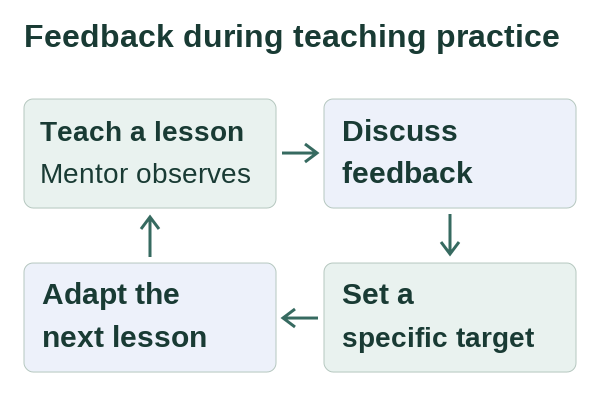
Negative feedback from a mentor or supervisor is a distinct kind of reflective material. A study of 16 student teachers from five teacher education programmes at four universities in Sichuan, Fujian, Guangdong and Macau examined how they coped with negative feedback during practicum. It used narrative reports, semi-structured interviews and teaching documents. The researchers described the responses through feedback literacy, a concept covering the cognitive, emotional and behavioural capacities a person brings to receiving and using feedback. Feedback literacy mediated how the student teachers responded, beginning with their grasp of what the feedback meant and of the conflicts and difficulties it raised. The participants did not necessarily form negative judgments of themselves or of others in response to negative feedback. They regulated their emotions with various strategies, some relying on outside help and some on their own resources.[36]
Classroom assessment and assessment literacy
Classroom assessment during placement asks student teachers to judge pupil learning in ways that match the learning outcomes the curriculum sets out at its intended level of performance. The closer that alignment between curriculum and assessment, the stronger the case that inferences drawn about what pupils know are valid. A study of 309 lesson plans from 65 student teachers, all of whom had already passed coursework in educational measurement, found that during student teaching they did not follow many of the assessment practices their courses recommended. The researchers suggested that putting recommended assessment practices into use may depend on more than holding the required knowledge.[37]
Assessment literacy, the knowledge and skill needed to design, interpret and act on assessments of pupil learning, can develop through action research carried out in the practicum. One action research study, in which student teachers investigated how they assessed their own pupils, drew on interviews, the student teachers' own exams, observations, evaluations of students and reflections, and analysed the material qualitatively. The student teachers came to see a gap between the English as a foreign language curriculum and the assessment practices used in real classrooms. Taking part in the action research also built their self-confidence in preparing to assess pupils, and they formed a tacit understanding of assessment literacy through experience in a real setting.[38]
Self-assessment by student teachers is a related route, and a systematic review of 19 articles examined the research approaches such studies take, the issues student teachers assess during the practicum, and the systems used for self-assessment. The review concluded that self-assessment in the practicum has not yet become a settled, pre-professional mode of learning. It does, however, increase awareness of skills that are essential to the teaching profession, and the review offers staff and tutors guidance on choosing useful self-assessment techniques and adapting them to the practicum.[39]
Special education, disability and diverse classrooms
A phenomenological study of 8 Level 400 student teachers with visual impairment at 3 Colleges of Education in Ghana found that orientation and supervision structures existed but were largely generic and not responsive to disability-specific needs. Support from mentors and schools was inconsistent, while help from peers was a critical but informal mechanism that assisted mobility, lesson preparation and instructional delivery. Participants also reported buildings they could not get into, few assistive resources, weak mentoring and hostile attitudes from some learners and teachers. The study concluded that teaching practice remained inadequately inclusive and recommended disability-responsive frameworks, better mentor training, assistive technologies and improved infrastructure.[40]
In-depth interviews with 12 special education preservice teachers at various stages of 2 teacher education programs in Israel showed developing and changing needs across the program, reflecting different settings and phases of professional experience. The analysis used self-determination theory, which holds that people strive to fulfill three basic needs: competence, autonomy and relatedness. In teacher education research, meeting those needs has been linked to skill development and to the wellbeing of preservice teachers and their students. The programs placed these candidates in various school settings with neurodiverse students, and the study drew implications for how such programs are designed.[41]
Participants perceived university tutors as helping them reflect critically, connect theory with practice and understand inclusion more broadly. School-based mentors promoted learning in place through pedagogical modelling, progressive participation, professional socialisation and relationships built on trust. A qualitative study of 29 final-year early childhood and primary student teachers in Spain, all with additional training in special educational needs, interviewed them after nine-week placements in public and state-subsidised schools. Participants reported being more alert to diversity, feeling more confident as professionals, responding more flexibly in their teaching and committing more strongly to participation and belonging.[42]
In a study of 38 preservice teachers, participants learned about Culturally Responsive Teaching practices in a literacy methods course, built English Language Arts lessons that incorporated them, and taught those lessons to elementary school students at their field placements. Data came from pre- and post-surveys, lesson plans and planning and instruction commentaries from the edTPA, a standardized performance assessment for teacher candidates. The preservice teachers most often planned and carried out three practices: modelling high expectations for all students, promoting respect for student differences, and bringing real-world issues into the classroom. Learning about these practices and applying them in lessons prepared the participants, in their own accounts, to become culturally responsive teachers.[43]
Research
How practicum programmes are organised
A practicum is the supervised period a student teacher spends in a school as part of a teacher education programme, and its organisation varies widely between institutions and countries.[44][45] One basic structural choice is where the student is placed: a single classroom or the school as a whole. Zeichner's 1992 discussion of professional development schools, which are school-university partnerships built around clinical teacher preparation, listed placement in single classrooms rather than schools among the structural obstacles to student teacher learning. The same discussion named the selection of placements, the supervisory relations and the lack of multicultural placements as further structural barriers.[44]
Some programmes place student teachers in pairs rather than alone. A 2006 interview study of preservice teachers who taught in pairs examined the learning environment that paired placement creates for newcomers to the profession. It interpreted the accounts through theories of co-teaching and practical knowledge.[46]
In one South African distance education study, 16 students enrolled for the Postgraduate Certificate in Education had each completed 10 weeks of teaching practice before taking part in semi-structured interviews.[47] A qualitative comparison of primary school teaching practicums in China, Cambodia and Malawi used semi-structured interviews and document analysis. It found different approaches in the three countries, shaped by different environmental expectations, with all three emphasising diverse learning experiences for student teachers. That comparison also described challenges in implementing the practicum and concluded that local school authorities matter for its effectiveness.[45]
Distance education institutions arrange the practicum for students who are not campus-based, and placement becomes an administrative task in its own right.[48][47] A mixed-method study of 65 fourth-year Bachelor of Education students specialising in secondary school teaching at an open and distance learning institution in South Africa found challenges with on-time placement in schools, supervision and mentoring. The study recommended that mentors and university contracted supervisors be regularly trained through workshops. It also suggested the university consider a system letting students place themselves online in approved schools.[48] The earlier study of 16 distance education students reported that all role players needed greater clarity about expected learning outcomes, assessment criteria and lesson plans. It added that students needed placement in schools offering constructive learning environments.[47]
Partnership between universities and schools is a common way of organising placements, and it takes several forms.[49][50] A 2016 focus group study with cooperating teachers and physical education teacher educators found it difficult to reach the curriculum's aim of mutual partnership between the two groups. It analysed the networks, interdependence and power relations involved.[50]
What student teachers gain from placement
Teachers asked about placement in Monduli District, Tanzania, mostly saw it as effective in building student teachers' teaching skills. The survey drew on a target population of 691 public primary school teachers across 63 schools, with a sample of 6 head teachers and 94 teachers from 6 schools. Respondents credited placement with helping student teachers bring theory and practice together and learn life skills around the community. They also credited it with practising the communication skills that build teaching competence. A minority of the teachers took a negative view, reporting that student teachers struggled to handle teaching challenges and to use appropriate communication.[51]
Self-efficacy, a person's belief in their own capacity to carry out a task, is one of the outcomes that placement arrangements appear to shape. A four-year study with a total of 129 preservice elementary teachers compared two institutions. At one, the practicum was not connected to the science methods course or its instructor; at the other, it ran alongside the methods course and was taught by the methods instructor. The concurrent, embedded practicum produced consistent increases in self-efficacy across semesters. After it, preservice teachers showed greater understanding of research-based science teaching practices.[52]
Student teachers in Surkhet, Nepal, reported that teaching practice helped develop qualified, trained and confident teachers. Those English-specialised student teachers also described learning from the strengths of their cooperating schools and from the areas that needed improvement.[53]
A mixed-methods study in Tangerang Selatan, Indonesia, surveyed 199 students in three schools about the teaching quality of their English as a foreign language student teachers and added classroom observation. Teaching quality was defined through eight classroom factors of the dynamic model: orientation, structuring, modelling, application, questioning, building the classroom as a learning environment, assessment, and time management. The student teachers did not yet practise those classroom factors. The study recommended building them into the pedagogical skills curriculum and considering earlier school placements.[54]
Four senior student teachers completed five weeks of practicum in a designated speaking class, and observation, questionnaires and teaching documents were analysed. Their planning, implementation and reflection drew on practical experience. The work centred on freshmen's and sophomores' vocabulary, grammar, pronunciation, fluency and content in daily speaking. The study recommended that student teachers strengthen both theoretical and practical teaching methods through classroom discussion that supports sense-making.[55]
The umbrella case comprised five tetrads, each pairing a student teacher with a cooperating teacher, a university tutor and a school principal, and data were gathered over one academic year. In all five cases support for student learning was to some degree dysfunctional. An official curriculum that valued care for pupils, rich pedagogical content knowledge, planning and assessment, reflection and membership of a community of practice was set against a more powerful unofficial curriculum. The unofficial curriculum pushed student teachers to draw on their own resources and learn pedagogical content knowledge in an isolated, unsupported way. Untrained cooperating teachers and untrained university tutors guided them.[56]
Concerns, anxiety and stress during placement
Whether these worries vary with who the student teacher is has been tested directly in at least one large sample. The researcher concluded that anxiety is a reality student teachers face during placement regardless of gender or academic level, and called for interventions to address it.[57]
Mentors, materials and classroom management
In a survey of 33 student teachers in an English education programme who finished their field placement between January and June 2025, the average rating of difficulty in developing materials was 2.67 on a four-point scale. A higher score means more difficulty. The harder steps were procedural: conducting a needs analysis (2.70), selecting and adapting materials (2.76) and evaluating the materials once made (2.94). Support needs were also rated high (3.28), above all access to teaching resources (3.42) and guidance from mentor teachers (3.30). Direct feedback and reflective supervision from university supervisors scored 3.12.[58]
Managing a class and holding students' attention is a second demand, and one case study of four pre-service teachers of English as a foreign language described six strategies used to raise student engagement.[59] University supervisors observing student teachers in South Africa identified weak coordination between fundamental modules and co-modules as a hindrance to effective classroom management. Those supervisors were also critical of how poorly classroom management skills were implemented. The study recommended that the teaching practice unit set up a compulsory practical demonstration centre using nearby schools before practice teaching officially begins.[60]
Computers add a further set of practical questions, and a 1993 study of student teachers on placement separated personal use of computers from use with children.[61] A later study of 31 elementary student teachers, drawing on observation notes from 347 lessons over an eight-week assignment, found that all of them integrated technology, though they varied substantially in how they did so. Mentor teachers' influence, technology access, skills, pedagogical competence and personal attitudes all had an impact on how technology was applied. Most student teachers followed their mentor's practices, while some took initiative and contributed to their mentors' professional development in technology integration.[62]
Context, culture and inclusion on placement
Placements take student teachers into schools whose pupils may differ from them in language, culture, family income and special educational needs, and the research on this section asks how well practicum programmes prepare them for that difference.[63][64][65] One argument for cultural knowledge rests on sheer diversity: Indonesia is described as having 17.506 islands, 746 languages and 1.128 tribes. A 2018 paper argues that this diversity can itself provoke conflict unless student teachers learn to appreciate differences. The same paper proposes that English student teachers in Indonesia receive lessons carrying multicultural values, so that they can act both as models for their pupils and as carriers of multicultural knowledge.[63] One case study followed a single Chinese practicum student teaching in the Philippines and used interviews, observations and reflective analysis to describe the challenges and opportunities that language educators there face. A 2023 study followed a Chinese practicum student teaching in the Philippines, using interviews, observation and reflective analysis to record the challenges and strategies of language teaching in a multicultural setting.[66]
Evidence on inclusive practice during placement is mixed, and much of it comes from analyses of the reports student teachers write at the end of the practicum.[67][65] The reports that did take up gender, intercultural education, special needs education or classroom inclusion in general described practice that could be transformative for children's lives. Structural habits worked against lasting change. Textbooks, professional isolation, the separation of subjects, an emphasis on academic literacy and summative assessment, which the study calls invariants of educational action, persisted as obstacles.[67]
Strong emotions connected with exclusion could lower self-efficacy, the student teacher's belief in their own capacity to teach, and lead them to avoid inclusive practice. Support, openness and autonomy during placement helped others embrace it. The Chilean study also reports that placement tended to reproduce deficit-centred views of inclusion, in which difficulties are located in pupils, when there was no critical reflection on special needs.[65]
Beliefs held before placement shape what student teachers expect of an inclusive classroom, and a survey in Northern Ireland examined those beliefs in advance of a planned change to school structures. Many students said they supported inclusive policies. Yet they named lack of appropriate preparation, class size, resources, managing other adults and rising numbers of pupils with diverse special educational needs as the key issues to address before the reforms. Despite that stated support, substantial numbers did not believe that removing academic selection was the best way to secure equality of provision for all pupils.[64]
Comparisons across countries show that practicum implementation varies with local conditions, and the studies above place the same basic arrangement in quite different settings.[68][67][64][66][65] Portugal's analysis covered reports from every public higher education institution over the years 2020 to 2023, while the Chilean study examined three primary programmes and the Tanzanian study a single university college.[68][67][65] The Northern Ireland survey captured views before placement began, and the Philippines study followed one intern, so each design limits what can be concluded about placement as a whole.[64][66]
Variations by subject and level
In physical education, 14 senior majors preparing to teach the subject were interviewed before and after a semester-long high school practicum. Before teaching, they worried about classroom management and about facing situations they could not predict. After the practicum, they judged careful lesson preparation to be the foundation of their success, and they were no longer anxious about the student teaching period.[69] A case study of two fourth-year trainee primary teachers in Cyprus found that both believed physical education holds the same status as other curriculum subjects and taught accordingly. Both had already taken a compulsory methods course in elementary physical education and an early field experience. Both treated girls and boys equally and expected every pupil to take part, and both mixed teacher-led and pupil-led formats when organising instruction and practice.[70]
Music placements raise a separate problem: connecting the campus methods course with the school site. A grounded theory study, an approach that builds an explanation from the data rather than testing one in advance, followed 9 undergraduate music education majors in a methods course for secondary school music. It also followed 3 practising teachers who supervised their practicum. The campus course content was adjusted to fit the schools where the students would work. Despite these efforts, the analysis confirmed earlier reports that the on-campus course and the off-campus practicum do not connect.[71]
Reading placements make heavy demands on instructional judgment. The higher performing student teachers found diagnosis, planning, lesson balance and word recognition instruction difficult, and the lower performing ones were more likely to struggle in all seven areas.[72]
In secondary school English writing, a study of Chinese student teachers of English as a foreign language examined how they used a genre-based approach, which teaches the language features and structures of particular text types. The student teachers were somewhat familiar with genre pedagogies. This was especially so in scaffolding, or staged support, for the language features and meaning patterns of the genres taught. They were generally confused about how language, content and context relate. Their teaching rarely made explicit the language and meaning choices suited to a particular audience and situation. The study described a complex interplay between the student teachers' professional knowledge, the difficulties they perceived and their genre instruction in the writing class.[73]
Science placements were studied at a British teacher training institution, where all the students, teachers and tutors on a science teacher training course were interviewed before, during and after the classroom component. The students and the teachers felt the students had not been prepared for or adequately supported by earlier courses, which were too theoretical. The tutors held that practice must follow theory. The tutors' role as assessors interfered with their role as supporters. The teachers felt unprepared and uneasy as the main source of support during the placement.[74]
Business studies student teachers are expected to display pedagogical knowledge, meaning knowledge of teaching, alongside knowledge of their subject content while on placement. Some mentor teachers were satisfied with the student teachers' content and pedagogical knowledge. The study identified areas needing improvement and recommended that teacher educators strengthen the business studies methodology module and its assessments to build classroom management and time management skills.[75]
Placements outside schools change what is available to learn. The setting supported learning from and with fellow student teachers, the development of ownership over the curriculum, and connections to university coursework, and at times it limited those opportunities.[76]
What cooperating teachers think placement is for
Cooperating teachers, the school-based teachers who supervise student teachers during the practicum, describe the placement as an essential part of teacher education. In a survey of 205 cooperating teachers across regions of the Maldives, most held this view, and their answers grouped into three purposes for the practicum. The first purpose is to give student teachers first-hand teaching experience in a real classroom. The second is to support their professional development, and the third is to give them a setting in which to apply theoretical knowledge. The same teachers linked the practicum to growth as reflective practitioners, to stronger teaching competencies, and to the formation of a professional identity. On the strength of these findings the study recommends closer collaboration between teacher education institutions and cooperating teachers, professional development for the cooperating teachers, and varied practicum experiences for student teachers.[77]
A study of 10 preschool practice teachers and 10 preschool student teachers in Istanbul, drawn from 5 state kindergartens and one foundation university, recorded a more mixed judgment. The practice teachers said that having teacher candidates in their classrooms was an advantage, particularly because the candidates helped with art activities. They did not, however, consider the candidates' command of classroom management sufficient. The student teachers in the same study judged their communication with the practice teachers to be good, while saying that the candidates needed to improve how they carried out activities. The student teachers also described the university instruction they had received as theoretical and said they could not carry out activities that might interest the children. The study notes that the practicum is often the first time candidates apply what a four-year undergraduate course has taught them in a real setting.[78]
One cooperating teacher's autobiographical narrative inquiry, a study that interprets a person's own account of events, framed the practicum as a process in which pre-service teachers come to understand how much relationships matter in a class. The same account describes the cooperating teacher's own learning: she came to see the class as an expression of herself and to treat the coordination of relationships inside and outside the classroom as part of her professional development.[79]
How programmes are judged has itself been turned into a measurement problem. One instrument for evaluating teacher practicum programmes was built on the CIPP model, a programme-evaluation framework that examines context, input, process and output. The resulting scale has 21 questions grouped under five sub-variables: preparation, support, conditions, operation and outcomes. Exploratory and confirmatory factor analysis established its validity and reliability. The developers present it as a diagnostic tool for improving programme quality.[80] A satisfaction survey of pre-teachers built on the same CIPP factors found high satisfaction on input and output factors and low satisfaction on context factors. Satisfaction differed significantly by training school, and respondents set out problems and improvements for each of the factors.[81]
Grading disagreements and evaluation quality
Domfeh (2015) describes the arrangement in which universities, short of lecturers able to supervise every trainee, contract tutors or individuals in the localities where students do external teaching practice as mentors or internal supervisors, working alongside university lecturers as external supervisors. The paper sets out to reconcile mentor scores, which it says are often on the high side, with lecturer scores so that the resulting grade reflects the student-teacher's true performance level. It proposes several solutions to this dilemma but reports no data on how far any of them narrows the gap.[82]
Divergence between assessors is not always a defect. Nyaumwe and Mtetwa (2015) examined how lecturers and student peers assessed the same lessons of in-service mathematics student teachers, using case studies of two pairs of teachers, one pair at a state high school and one at a private high school. The lecturer's critique named both strengths and weaknesses of the lesson. The peer's critique held back from pointing out weaknesses. The two critiques were different but complementary, and the study suggests that deploying in-service student teachers in pairs during teaching practice may benefit their professional development in Zimbabwe. The study was prompted by criticism that assessments by college lecturers were failing to produce valid critiques of student teachers' mathematical and pedagogical competencies.[83]
Aspden and McLachlan (2017) examined how assessment of practicum in early childhood initial teacher education was carried out and experienced by student teachers, associate teachers and teacher educators within their institutional contexts. Teacher educators judge the quality of students' teaching practice, along with their attributes, dispositions, skills and knowledge. They also judge whether students are ready to enter the teaching profession. The study reports the challenges the assessors faced in making authentic, appropriate and informed assessment decisions, and it highlights the importance of professional judgment within a relational pedagogy, meaning judgment exercised in the working relationships among student, associate teacher and educator.[84]
Some evidence on what predicts teacher-candidate evaluations comes from a single Western Canadian university. Ralph and Noonan (2004) reported the aggregate evaluations of 17 cohorts of teacher-candidates (n = 374) who completed an extended practicum over a 15-year period, with one researcher serving as College Supervisor for each four-month internship. Final evaluations on nine categories of teaching performance showed varying levels of strength among the skill areas.[85] Ralph (2006) extended the analysis to four factors: grade level taught, school location, year of the internship and gender of the intern, for candidates who completed a 16-week extended practicum in one of the years from 1986 to 2002.[86]
Field assessment is meant to serve learning as well as judgment. Sanga (2026) describes teaching practice field assessment as giving student-teachers room to practise teaching, evaluate themselves and improve across areas of the profession, and argues that it should follow the methods and procedures set by regulatory authorities and academic institutions. The study drew on a total population of 12,076 people and a sample of 99 respondents. These included three deans of faculties of education, three teaching practice coordinators, three heads of departments and three quality assurance officers. The sample also included 20 supervising lecturers selected purposely and 67 student-teachers selected by stratified sampling.[87]
Preparedness, competence and readiness to teach
Whether a teaching practicum leaves a student teacher ready for a classroom of their own is judged differently by the people who supervise them. The faculty advisors, apart from a few issues, regarded the preservice teachers as unprepared to teach, while the cooperating teachers regarded them as prepared. That gap suggests a lack of shared understanding and a mismatch between the two groups' standards and approaches to high-quality teacher preparation. The study was descriptive and exploratory, and the interviews were analyzed with the constant comparison method, in which passages are sorted into categories and compared as new data arrive.[88]
Surveys of student teachers themselves tend to report positive views of what the practicum provides.[89][90] A questionnaire went to 455 students in Early Childhood and Primary Education degrees at a university in the Madrid region. It was given at the end of each practicum period in the 2nd, 3rd and 4th years between 2017/2018 and 2021/2022, with 2019/2020 excluded because of the pandemic. The results showed distinct profiles of perceived benefit and usefulness.[89] Classroom observation and teaching practice were both seen as useful for improving teaching competency, and actual teaching practice contributed most.[90]
Perceived support from cooperating teachers showed strong positive correlations with both competency growth and practicum satisfaction. How well the practicum was carried out overall was also strongly associated with both outcomes. School level, whether the practicum took place at the participant's own former university, practicum timing and observation hours were not significantly related to competency growth or satisfaction, and administrative work was rated less positively than other components. The study concluded that raising the quality and authenticity of core practicum experiences counts for more than lengthening the practicum or adding activity hours.[90] A survey of 82 preservice technical teachers found that support and training had positive effects on preparation across the domains studied, and that gender and school type did not influence perceptions of that support and training.[91]
In a survey of 265 student teachers in South Punjab, pedagogical knowledge and technological knowledge each had a substantial positive impact on teaching practice effectiveness, and self-efficacy correlated strongly with it. Subject matter knowledge had no direct impact on that effectiveness. The authors recommended professional standards for teaching practice, mentorship and coaching in reflection.[92] A quasi-experimental study in Adamawa State, Nigeria, described obstacles that include a shortage of modern equipment and suitable facilities, a gap between theory taught in colleges and actual classroom practice, and scarce support and supervision that can leave student teachers feeling isolated.[93]
Images of teaching before and after placement
Student teachers arrive at placement with pictures of what teaching, teachers and children are like, and those pictures can be measured by asking them to complete metaphors, short comparisons in which one thing is described as another. A study of 126 student teachers at an education faculty in Japan (49 men, 77 women) used metaphor questionnaires before and after student teaching at primary school, with attention to the grade level taught: Grades 1 and 2, 3 and 4, or 5 and 6. For images of teaching, responses on two factors, Dull Event and Live Event, changed, which suggested that the student teachers began to hold more positive, active and clear images of teaching. The grade level taught had no significant effect on any of these changes.[94]
Metaphors generated after first teaching experiences can also be sorted into positive and negative groups. In a qualitative case study of 50 final-year student teachers of English as a foreign language in Türkiye, participants produced metaphors after a three-week observation stage and their first teaching practice. The remaining 24% described negative experiences. They reflected futility, conflict between roles, disorientation and a lack of agency.[95]
A study using Bronfenbrenner's ecological theory of human development, which treats a person as nested in widening circles of setting and culture, followed student teachers through the practicum. Factors in the macrosystem, the outermost layer of culture and social trends, may lie furthest from the student teacher yet still exert a large influence on the other layers and so on the student teacher. The study called for more chances for student teachers to test their beliefs in real professional practice and for more training for mentors and supervisors to support belief development.[96]
In practice
What this looks like when you study
In one South African study, 24 student teachers in a one-year teaching certificate programme spent 10 weeks in schools in the Vaal area. Researchers interviewed each of them with semi-structured interviews, which follow a set of open questions, and analysed the answers for themes. The student teachers reported enriching experiences, but also many challenges that limited how fully they reached the intended outcomes of the placement.[6] A related report on the same programme described the placement as a make or break phase for how student teachers saw the teaching profession.[1]
In Nepal, 80 student teachers placed in 30 cooperative schools answered a structured questionnaire about their on-campus preparation and their school work. During a two-week pre-practice phase, 95.23 percent prepared at least five lesson plans and 57.14 percent presented at least three lessons. Most reported doing well in lesson planning, assessment and classroom instruction, but named peer observation, consistency of supervision and preparation for assessments as difficulties. The authors recommended structured feedback, such as teaching workshops, and encouragement of self-reflection to improve performance.[97]
A study of 33 English education student teachers in Indonesia, who had finished a placement programme running from January to June 2025, measured the difficulty of preparing teaching materials. Challenges reached a moderate level, with a mean of 2.67 on a four-point scale, and time constraints scored 2.86. Coping strategies were high, at a mean of 3.45, and collaborating with mentor teachers scored 3.58.[58]
Later developments
Learning to teach online during a pandemic
When the COVID-19 pandemic closed schools and universities in 2020, teacher education programmes moved teaching practice online, and the form of the practice changed with it.[98][99] A preservice early childhood course in the United States redesigned its spring 2020 practicum around three phases, described as Preparation, Implementation and Reflection, so that student teachers could plan, teach and review lessons at a distance. The online format gave these preservice teachers ways to interact with young children and to reflect on how online communication tools might support children's development and learning.[98]
Student teachers compared the face-to-face and online classrooms constantly, and at first they relied on whether the technology worked to judge whether a lesson had succeeded. In a study of 63 students in a master's programme in teaching English as a foreign language at Masaryk University in Czechia, researchers coded 120 lesson reflections written by students who completed teaching practice through online courses normally held in person. The reflections showed constant comparison between the face-to-face and online classroom, and an initial tendency to judge a lesson's success by whether the technology worked. Over time most of these student teachers came to treat technology as an ordinary platform for teaching, and they adopted technology-specific language for teaching strategies and classroom events.[99]
In one study, teaching practice was carried out independently and online by students, in collaboration with educational institutions near the student's home, and lesson plans and teaching videos were scored to measure professional competencies. In Indonesia, teaching practice was carried out independently and online by students, who partnered with educational institutions near their homes, and supervisors scored lesson plans and recorded teaching videos to judge professional competence. That assessment found competence had developed during the pandemic, though not optimally.[100] A Korean study of online practica in 2020 examined what mentor teachers and student teachers wanted from an online platform, drawing on five Chungcheong provincial schools and interviews with four student teachers from different universities. Mentor teachers valued content showing the flow of the entire practicum, student teachers valued content focused on actual participation in teaching, and both groups valued interactive communication.[101]
In Turkey, early childhood pre-service teachers followed their student teaching practicum through emergency remote teaching without being present in the school context or interacting with the children, and they perceived this arrangement as insufficient for their placement experiences. Turkish early childhood preservice teachers followed their practicum through emergency remote teaching, a term for the temporary move to online instruction under crisis conditions, without being present in a school or interacting with children. A content analysis of their experiences produced three themes: the practices supported only certain competencies, the distance format restricted the field experiences needed to gain the full set of qualifications for early childhood education, and the preservice teachers judged the arrangement insufficient for their placement. The study concluded that regulations are needed for how practice should run under emergency remote teaching.[102]
Mahrus, Rosayanti and Nirwana (2024) surveyed 38 student teachers in East Java, Indonesia, who reported a positive perception of their online teaching practicum and perceived improvement in it. A survey of 38 student teachers at a state university in East Java, Indonesia, who had taken the practicum in their third semester, combined a closed questionnaire with interviews and found positive perceptions of the online practicum and perceived improvement in how it was implemented.[103] A qualitative study in South Africa described student teachers showing adaptability in the shift to remote teaching, positive encounters with online methods and tools, and skills built through that engagement, and it recommended integrating online teaching methods into teacher training programmes.[104] In a postgraduate English language teaching programme in India, one instructor and 11 student teachers took part in a phenomenological study. The study reports that multi-mode delivery, graded feedback at several levels, support materials, collaborative practices and reduced transactional distance, the sense of psychological separation between teacher and learner, came with gains in the knowledge base, confidence and self-efficacy.[105]
Shange and De Jager (2024) describe student teachers' resilience and adaptability during the shift to remote teaching in the COVID-19 pandemic.[104] A self-study of one student teacher's scaffolding, the temporary support a teacher gives while a learner builds a skill, followed six meetings held on a video-conferencing application and used thematic analysis. The student teacher became aware of weaknesses in her scaffolding and improved markedly in later meetings, her students' understanding improved, and she used various graphic organizers and media, though each theme improved along a different path and in a step-by-step manner.[106]
Platforms and digital tools for placement
In one study, 7 teachers (2 infant, 2 elementary and 3 middle school teachers) were interviewed one to one between Nov. 2019 and Mar. 2020 about what they wanted from such a platform. In a 2020 interview study, 7 teachers (2 infant, 2 elementary and 3 middle school) described a placement platform as a support system that reduces the paperwork of on-site practice and helps pre-service teachers connect educational theory with educational practice. The same teachers asked for two things. The platform should help with writing and reviewing documents such as the practicum journal, practice books and teaching guides, and it should prepare student teachers in advance for understanding teaching culture and the attitudes and character of a teacher. The interviews ran from November 2019 to March 2020, once with each participant.[107]
Assessment of the practicum is a second use of digital tools, and one proposal came from South Africa, where students in initial teacher education must complete a compulsory teaching practice module. A 2017 study introduced an interactive e-assessment application to replace the existing assessment model, on the argument that practicum assessment is often marked by student anxiety and by conflict between students and their supervisors. Data came from a sample of 40 teaching practice students and a focus group discussion with 8 of them, and the findings were reported in preparation for the software development stage of the project.[108]
Portfolios give student teachers a place to record and revisit their reasoning.[109][110] At Al-Quds University in Palestine, 16 early childhood student teachers used practicum portfolios. Questionnaire and interview data indicated that the portfolio gave them a way to judge their own work and a stronger capacity to think over what they did in class.[109] Candidates kept the e-portfolio during final practicum, added artefacts showing their grasp of the professional standards for educators in British Columbia, and built a digital narrative describing who they are as educators.[110]
Microblogging and social media have been tried as ways to keep student teachers talking to each other and to their instructors during placement.[111][112] A 2009 case study followed 8 participants who posted messages to Twitter from phones or computers during a practicum, and the messages fell into categories of pedagogy, complexity, emotions, curriculum and planning, and relationships. The 140-character limit was at first difficult and limiting for explaining ideas, yet participants reported that it sharpened their reflective thinking, and a sense of community was an unexpected benefit in what they described as an isolating experience.[112] At an open distance learning institution, 69 economics education student teachers registered for a subject didactics blog set up as a pilot for supporting them during placements. A survey found a positive correlation between how often they used social media and their relationships with peers and instructors and their rating of the quality of instruction and the program.[111]
Digital media also enter the classroom itself during placement. Twenty student teachers at Universitas Islam Majapahit who completed a school-based field study reported through an open-ended questionnaire that digital media benefited both the pre-service teachers and their students, and the study discussed their views on student attitudes and proficiency and the obstacles they met.[113]
Micro-teaching and basic teaching skills
Micro-teaching is the rehearsal of separate teaching skills in short simulated lessons, and student teachers typically complete it on campus before they enter real classrooms.[97][114] Student teachers are people in training to become certified teachers, and their teaching practice combines work in simulated classrooms with work in real ones under the supervision of mentor teachers.[97] One study of micro-teaching courses observed biology education students in the class A group B of 2022/2023 as they taught peers, and scored their lessons against eight aspects of basic teaching skills, meaning the separate abilities a trainee teacher is expected to show. The average score across all eight aspects fell in the very good category, but the individual indicators within those aspects ranged from quite good through good to very good, so some students still sat in the lower two categories on particular skills.[114]
A survey in Kwara State, Nigeria, asked student teachers whether micro-teaching had shaped their later performance on placement. The target population was 904 students in the third year of the Nigeria Certificate in Education programme, known as NCE III, studying business education in colleges of education: 126 in private colleges, 461 in state colleges and 317 in federal colleges. Simple random sampling selected 417 of these students from colleges in Ilorin, and data came from a modified student-teacher assessment form and a questionnaire designed for the study. Respondents reported that micro-teaching influenced their communication skills and their classroom management skills to a moderate extent. The study concluded that gaining the relevant teaching skills is vital to preparing and training teachers. It recommended, among other things, that student teachers in the NCE programme be taught to use communication skills so that their performance during teaching practice improves.[115]
Afriyanti and Adini (2020) found that both female and male students in a micro teaching class used all four kinds of fillers: sound fillers, word fillers, phrase fillers and repetition fillers. A study looked at 60 students who took a micro-teaching subject in 2017/2018, 52 female and 8 male. It drew a quota sample of 8 students, seven female and one male, and found that almost all students used fillers, the sounds and words speakers insert while hesitating or thinking. Both groups used sound fillers, word fillers, phrase fillers and repetition fillers, but the stated reasons differed: the female students gave nervousness, hesitation, divided attention and thinking, while the male student gave only the thinking process. The sample of one male student limits how far that contrast can be generalised.[116]
A quantitative study at Muria Kudus University compared two ways of running preparation classes for 87 students enrolled in Speaking for Instructional Purposes. One approach treated students as adult learners, called an andragogically oriented teaching method, and the other treated them as young learners, called a pedagogically oriented teaching method. The adult-oriented method improved the male students' achievement of teaching practice more effectively than it improved the female students', measured by pre-tests and post-tests of teaching practice in those classes. The same study noted that some schools hosting internships judged the students' teaching less than satisfactory, describing them as less creative and less independent in preparing lessons, particularly in classroom language and in the choice of teaching media.[117]
A survey of 80 student teachers, randomly selected from 100 and placed in 30 cooperative schools across the Surkhet district of Nepal, asked how they rated their on-campus preparation and their off-campus teaching. Respondents generally performed well in both settings, with effective engagement reported in lesson planning, assessment and classroom instruction. The study held that student teachers' performance improves with structured feedback, such as teaching workshops and encouragement to reflect on oneself. It recommended that the department running teaching practice find and put in place strong supervision arrangements.[97]
Placement abroad and across cultures
In the International Teaching Practice Program at Thammasat Wittaya School, Indonesian preservice teachers taught English to Thai students who faced linguistic and cultural barriers in speaking. In one programme, Indonesian pre-service teachers taught English as a foreign language to Thai students at Thammasat Wittaya School, and a descriptive qualitative study examined their methods, barriers and innovations through interviews, classroom observations and documents. Storytelling was the main strategy, carried out through narration modelled by the teacher, group projects, multimedia aids and materials suited to the students' culture. These approaches improved students' speaking, raised participation and built confidence. Barriers included limited vocabulary, pronunciation difficulties, a preference for passive learning and constraints on resources, which the pre-service teachers addressed by scaffolding, motivational support and familiar cultural content.[118]
A case study of four Korean pre-service elementary teachers on a three-week overseas practicum in the United States found two themes in their interviews and final reports. One was confident English teacher agency. The other was teacher agency exercised with full awareness of a different school culture, particularly its teacher assistance system and its approach to managing the classroom environment. The Korean participants described freeing themselves from the burden of the Teaching English in English policy and from conservative Korean school culture.[119]
Observation training can be built into a study abroad placement. Pre-service secondary teachers in Japan who used classroom-observation rubrics while studying abroad noted their host teacher's flexibility in the pace and flow of lessons, techniques for classroom management, and attention to individual students' needs and progress. Introducing the rubric and encouraging discussion about it was a relatively simple step that led these pre-service teachers to observe senior teachers more reflectively and critically.[120]
An in-depth case study in university teacher education in Israel used 23 video-recorded meetings of a learning community. It also used semi-structured interviews with each of the four participants. The study identified six mentor actions that promoted an empathetic and supportive learning environment and encouraged collaborative talk about culturally diverse issues that surfaced during practice teaching. The six actions were offered as a practical framework of tools for mentors leading conversations about diversity in culturally diverse groups.[121]
A northern practicum option was developed at a Western Canadian teacher education program, and a study examined teacher candidates' experiences of it. Drawing on place-conscious theorizing, the study explored how such placements might disrupt settler-colonial narratives, develop understandings of place-based curriculum and pedagogies, and support democratic and ethical approaches to education.[122]
Criticism
Criticism, limits and open questions
Critics of the practicum point to a gap between the training that teacher education programmes promise and the experience that student teachers actually obtain in schools. Interviews with student teachers at Canakkale Onsekiz Mart University in Turkey found that the programme stressed effective practical training. Some students, however, felt their chances of gaining real teaching experience were minimal.[123]
A survey of 100 third-year student teachers at the University of Eldoret in Kenya, who had completed a placement of about 14 weeks, found that their experiences shaped how they viewed the teaching profession. They also met challenges while on placement.[124] In the Philippines, 21 junior and senior student teachers from a private university in Mindanao reported challenges in classroom management, teaching confidence and a lack of teaching resources. Ulla (2016) found that the BSEd and BA English programmes at a private university in Mindanao followed different standard policies for pre-service teacher training. The BSEd-English track aimed at preparing secondary school teachers, and the BA-English track at professionals with strong communication skills.[125]
A much smaller field-based study of 8 practicum students and their cooperating teachers found that both groups perceived gains by the end of the experience. The gains were in planning and delivering instruction, managing classroom social behaviour problems and assessing academic and social behaviour problems. That study also identified 8 roles or individuals and 12 categories of significant events that influenced practicum students during the placement.[126]
A study of 5 pre-service teachers of English as an additional language or dialect, using weekly journals and post-practicum interviews, described how collaboration in an online paired practicum produced shared goals, tool mediation and shared expertise.[127] The evaluation also set out to identify the difficulties faced by practicum teachers and mentors in online mentoring.[128]
A student-centred, collaborative model of practice teaching in social work is presented as an alternative to teaching done for students rather than with them. In it, students help plan and carry out service projects, and the relationship between students and teachers involves less power disparity. The account of that model describes its process and outcomes as owned by the team. It reports that students gain professional values, knowledge and skills and a deeper understanding of civic responsibility, but it does not report a comparison with conventional placements.[129] A study of student teachers using team teaching in flexible learning spaces found both positive and negative experiences. Gains came especially in knowledge about the role of learning environments and in classroom management skills.[130]
Key studies
| Year | Study | Sample | Design | Finding |
|---|---|---|---|---|
| 2001 | Zanting et al.[16] | 30 student teachers at Leiden University | structured interviews with homogeneity analysis | Student teachers' beliefs about mentoring were similar to mentors' beliefs, but nobody expected mentors to explain the practical knowledge behind their teaching. |
| 2007 | Kiggundu[6] | 24 PGCE student teachers at Vaal University of Technology | qualitative study with semi-structured interviews and content analysis | The 24 student teachers on a 10-week placement found the experience enriching, yet they also met many difficulties, and those difficulties markedly reduced how fully they could reach the intended outcomes of the exercise. |
| 2007 | Maphosa et al.[3] | Survey of 222 student teachers and mentors in 31 Zimbabwean primary schools | In the majority of cases student teachers reported they had not benefited very much from mentorship, and mentors appeared unaware of their role. | |
| 2007 | Poulou[5] | Analysis of 59 student teacher journals | Journals revealed a complex pattern of past and future oriented concerns about personal and professional identity, the mission of the profession, and emotional dimensions of teaching. | |
| 2009 | Memorial University of Newfoundland et al.[1] | Semi-structured interviews with all student teachers in a PGCE cohort during 10 weeks of teaching practice in the Vaal area | Despite positive experiences, student teachers faced challenges that affected their perception of the teaching profession. | |
| 2010 | McDonnough & Matkins[52] | 129 preservice elementary teachers across four years | comparison of two field-experience arrangements using interviews and the STEBI-B scale | Where the practicum ran alongside the science methods course and was taught by the methods instructor, preservice teachers' self-efficacy rose in each semester of the four-year study. |
| 2012 | Oluwatayo & Adebule[22] | 222 student teachers (119 males, 103 females) in Ekiti State | assessment of teaching performance over a six-week placement | The 222 student teachers taught to a satisfactory standard, and neither their gender nor any earlier teaching experience made a significant difference to how they performed. |
| 2016 | California State University - Long Beach & Liu[62] | 31 student teachers, with observation notes on 347 lessons | mixed-methods study of technology integration over eight weeks | All participants integrated technology, mainly to provide visuals for attention, engagement and interaction, and most followed their mentor's practices. |
| 2021 | Fořtová et al.[99] | 63 students in a master's programme in teaching English as a foreign language | qualitative coding of 120 lesson reflections from online teaching practice | For most of the 63 student teachers, technology became an ordinary setting for teaching rather than a test of a lesson's success, and they described teaching strategies and classroom events in terms drawn from technology. |
| 2022 | Näykki et al.[31] | 24 student teachers in an international professional teacher education programme | video-assisted collaborative reflection with annotations and reflective writings | Student teachers found video reflection helpful for making socio-emotional experiences visible, though the first self-analysis was the hardest stage. |
| 2023 | Department of Educational Leadership and Management, University of Portsmouth, United Kingdom PO1 2UP Hampshire & Elisha[115] | 417 NCE III business education students in Kwara State | survey with a modified assessment form and questionnaire | Student teachers reported that micro-teaching shaped their communication skills and their classroom management skills to a moderate extent. |
| 2024 | Mbhiza et al.[20] | 15 third-year Bachelor of Education students in South Africa | qualitative study using reflective journals and group debriefing | The 15 student teachers described rural mentors as less supportive than urban ones; some rural mentors left their classes to the student teachers and gave them no chance to watch them teach. |
| 2025 | Islamic University of Maldives & Rasheed[77] | 205 cooperating teachers across the Maldives | survey of perceptions of the practicum's role and purpose | Most cooperating teachers saw the practicum as essential, naming first-hand teaching experience, professional development and applying theory as key purposes. |
| 2026 | Agnellasindiyora & Syafei[58] | 33 English education student teachers in Indonesia | descriptive quantitative survey with interviews | Challenges in developing materials were moderate (M = 2.67), coping strategies high (M = 3.45) and support needs high (M = 3.28). |
See also
References
- Memorial University of Newfoundland, Kiggundu, E., Nayimuli, S., & Vaal University of Technology (2009). Teaching practice: a make or break phase for student teachers. South African Journal of Education, 29(3), 345-358. doi:10.15700/saje.v29n3a129
- Caires, S., Almeida, L., & Vieira, D. (2012). Becoming a teacher: student teachers’ experiences and perceptions about teaching practice. European Journal of Teacher Education, 35(2), 163-178. doi:10.1080/02619768.2011.643395
- Maphosa, C., Shumba, J., & Shumba, A. (2007). Mentorship for students on teaching practice in Zimbabwe: Are student teachers getting a raw deal? South African Journal of Higher Education, 21(2). doi:10.4314/sajhe.v21i2.25637
- Caires, S., & Almeida, L. S. (2005). Teaching practice in Initial Teacher Education: its impact on student teachers' professional skills and development. Journal of Education for Teaching, 31(2), 111-120. doi:10.1080/02607470500127236
- Poulou, M. (2007). Student‐teachers' concerns about teaching practice. European Journal of Teacher Education, 30(1), 91-110. doi:10.1080/02619760600944993
- Kiggundu, E. (2007). Teaching Practice In The Greater Vaal Triangle Area: The Student Teachers Experience. Journal of College Teaching & Learning (TLC), 4(6). doi:10.19030/tlc.v4i6.1572
- Lazarová, B., & Pol, M. (2019). Teaching practice of student teachers: Czechs in search of ways forward. REVISTA PRACTICUM, 4(1), 4-18. doi:10.24310/revpracticumrep.v4i1.9872
- Islamic University of Maldives, & Rasheed, S. (2025). Exploring Practicum Models in Maldivian Teacher Education: Structures, Challenges, And Future Directions. International Journal of Social Science and Human Research, 08(05). doi:10.47191/ijsshr/v8-i5-31
- Mechouat, K. (2024). The Impact of Aligning Kolb’s Experiential Learning Theory with a Comprehensive Teacher Education Model on Preservice Teachers’ Attitudes and Teaching Practice. European Scientific Journal, ESJ, 20(28), 135. doi:10.19044/esj.2024.v20n28p135
- (Dobbins), R. L. C. (2017). Remapping the practicum in teacher education. Waikato Journal of Education. doi:10.15663/wje.v5i0.404
- Beck, C., & Kosnik, C. (2002). Professors and the Practicum: Involvement of University Faculty in Preservice Practicum Supervision. Journal of Teacher Education, 53(1), 6-19. doi:10.1177/0022487102053001002
- Schuster, W., & Stevens, K. B. (1991). Supervising Practicum Students: Establishing Competencies. Teacher Education and Special Education: The Journal of the Teacher Education Division of the Council for Exceptional Children, 14(3), 169-176. doi:10.1177/088840649101400303
- O'Reilly, M., & Renzaglia, A. (1994). A Systematic Approach to Curriculum Selection and Supervision Strategies: A Preservice Practicum Supervision Model. Teacher Education and Special Education: The Journal of the Teacher Education Division of the Council for Exceptional Children, 17(3), 170-180. doi:10.1177/088840649401700304
- Tjeerdsma, B. L. (1998). Cooperating Teacher Perceptions of and Experiences in the Student Teaching Practicum. Journal of Teaching in Physical Education, 17(2), 214-230. doi:10.1123/jtpe.17.2.214
- Nikritin, D., Shaked, H., Avidov-Ungar, O., Livneh, I., & Grinshtain, Y. (2026). The goals of the school-based experience (practicum) in pre-service teacher education: a qualitative study of Israeli mentor teachers' perceptions. Frontiers in Education, 11. doi:10.3389/feduc.2026.1747387
- Zanting, A., Verloop, N., & Vermunt, J. D. (2001). Student teachers’ beliefs about mentoring and learning to teach during teaching practice. British Journal of Educational Psychology, 71(1), 57-80. doi:10.1348/000709901158398
- Gcabashe, N. B., & Mofokeng, L. (2026). Accounting Student Teachers’ Experiences of Mentoring during Teaching Practice. International Journal of Learning, Teaching and Educational Research, 25(1), 177-195. doi:10.26803/ijlter.25.1.9
- Suhandra, I. R., & Ariawan, S. (2023). Exploring EFL Student Teachers’ Experiences on the Roles of Teacher Mentors during Teaching Practicum. Journal of Languages and Language Teaching, 11(4), 901. doi:10.33394/jollt.v11i4.8742
- Njiku, J. (2024). Student Teachers' Experiences as Mentees During the Teaching Practice in Rwanda. Australian Journal of Teacher Education, 49(6). doi:10.14221/1835-517x.6249
- Mbhiza, H. W., Nkambule, T., & Masinire, A. (2024). Student teachers’ mentorship experiences during teaching practice: A comparison of mentor-student dynamics in rural and urban schools. Interdisciplinary Journal of Education Research, 6, 1-14. doi:10.38140/ijer-2024.vol6.05
- Rusznyak, L., & Bertram, C. (2015). Knowledge and judgement for assessing student teaching: a cross-institutional analysis of teaching practicum assessment instruments. Journal of Education(60). doi:10.17159/i60a02
- Oluwatayo, J. A., & Adebule, S. O. (2012). Assessment of Teaching Performance of Student-teachers on Teaching Practice. International Education Studies, 5(5). doi:10.5539/ies.v5n5p109
- Lin, H. C., Chang, Y. H., & Shih, Y. H. (2026). Dimensions of Assessment Indicators for Teacher Education Practicum in Taiwanese Teacher Education Centers: A Case Study of Early Childhood Education. Social Science and Human Research Bulletin, 03(10). doi:10.55677/sshrb/2026-3050-1007
- Subedi, D. (1970). Assessing English Language Teaching Student Teachers on Teaching Practice. Journal of NELTA, 138-145. doi:10.3126/nelta.v14i1.3102
- Kyriacou, C., & Stephens, P. (1999). Student Teachers' Concerns During Teaching Practice. Evaluation & Research in Education, 13(1), 18-31. doi:10.1080/09500799908666943
- Global Studeis Education Association, NIE, Z., & KIM, S. J. (2025). Emotions, Resilience, and Teacher Identity Formation in Teaching Practicum: The Perspective of Chinese Student Teachers. Association of Global Studies Education, 17(3), 359-396. doi:10.19037/agse.17.3.12
- Yüksel, İ. (2019). ELT Preservice Teachers’ Conceptualization of Teaching Practice: A Metaphor Analysis of the Dynamics of Teaching Practice. International Journal of Higher Education, 8(4), 254. doi:10.5430/ijhe.v8n4p254
- Halim, A., Safei, N. H., & Yunianti, S. (2024). Investigating Changes in Student Teachers’ Schema during Teaching Practicum Using Metaphor. AL LUGHAWIYAAT, 5(1). doi:10.31332/alg.v5i1.6029
- Mansour Almusharraf, A. (2020). Student Teachers’ Development of Reflective Practice concerning Teaching Philosophy and Peer Observations. Arab World English Journal, 11(4), 547-564. doi:10.24093/awej/vol11no4.35
- Park, E. (2022). The Reflectivity of EFL Preservice Teachers in Microteaching Practice. International Journal of Learning, Teaching and Educational Research, 21(4), 186-204. doi:10.26803/ijlter.21.4.11
- Näykki, P., Laitinen-Väänänen, S., & Burns, E. (2022). Student Teachers’ Video-Assisted Collaborative Reflections of Socio-Emotional Experiences During Teaching Practicum. Frontiers in Education, 7. doi:10.3389/feduc.2022.846567
- KARAKAYA CIRIT, D., & AYDEMİR, S. (2020). The Effect of Self-Reflection Activities on Preservice Science Teachers’ Classroom Teaching Practices. Journal of Computer and Education Research, 8(15), 28-40. doi:10.18009/jcer.636037
- Ogonor, B. O., & Badmus, M. (2006). Reflective Teaching Practice among Student Teachers: The Case in a Tertiary Institution in Nigeria. Australian Journal of Teacher Education, 31(2). doi:10.14221/ajte.2006v31n2.2
- Rivera, P. M., & Gomez, F. P. (2017). Understanding Student-Teachers’ Performances within an Inquiry-Based Practicum. English Language Teaching, 10(4), 127. doi:10.5539/elt.v10n4p127
- Ferguson, P. (1989). A Reflective Approach to the Methods Practicum. Journal of Teacher Education, 40(2), 36-41. doi:10.1177/002248718904000207
- Yuan, K., Yu, S., & Liu, S. (2024). Understanding student teachers’ learning from negative experiences of feedback during teaching practicum: A feedback literacy perspective. Language Teaching Research. doi:10.1177/13621688241299030
- Campbell, C., & Evans, J. A. (2000). Investigation of Preservice Teachers' Classroom Assessment Practices During Student Teaching. The Journal of Educational Research, 93(6), 350-355. doi:10.1080/00220670009598729
- Güngör, M. A., & Güngör, M. N. (2023). Developing Pre-service Teachers’ Assessment Literacy in the Practicum: An Action Research Study. Australian Journal of Teacher Education, 48(7). doi:10.14221/1835-517x.6182
- Pérez-Torregrosa, A. B., & Gallego-Arrufat, M. J. (2024). Student teachers’ self-assessment during teaching practicum: A literature review. AtoZ: novas práticas em informação e conhecimento, 13, 1-14. doi:10.5380/atoz.v13i0.92347
- Nyavor, M. (2026). Experiences of student teachers with visual impairments on teaching practice (internship) at Colleges of Education in Ghana. Support for Learning, 41(2). doi:10.1111/1467-9604.70049
- Oranim College of Education, Gidalevich, S., Shalev, M., & Oranim College of Education (2022). Changing Needs of Special Education Preservice Teachers in the Practicum. Australian Journal of Teacher Education, 47(4), 21-38. doi:10.14221/ajte.2022v47n4.2
- Muñoz-Martínez, Y., Vera-Lucas, S., Gómez-Puerta, M., & Domínguez-Santos, S. (2026). Qualities of university tutors and school-based mentors for developing inclusive teaching attributes during the practicum: student teachers’ perspectives in Spain. Frontiers in Education, 11. doi:10.3389/feduc.2026.1951439
- Iwa, Y. (2026). Preservice teachers’ culturally responsive teaching practices in ELA lessons in elementary school field experiences. International Journal of Contemporary Educational Research, 13(2), 75-90. doi:10.52380/ijcer.2026.13.2.870
- Zeichner, K. (1992). Rethinking the Practicum in the Professional Development School Partnership. Journal of Teacher Education, 43(4), 296-307. doi:10.1177/0022487192043004009
- Sok, S., Gondwe, F., & Wei, L. (2022). Implementation of Teaching Practicum for Primary School Teachers: China, Cambodia and Malawi Case Studies. African Journal of Teacher Education, 11(1), 190-217. doi:10.21083/ajote.v11i1.6892
- Bowen, M., & Roth, W. M. (2006). Student Teachers’ Perceptions of their Paired Practicum Placement Experiences. Journal of Teaching and Learning, 2(1). doi:10.22329/jtl.v2i1.140
- Du Plessis, E. C., Marais, P., Van Schalkwyk, A., & Weeks, F. (2010). Adapt or die: The views of Unisa student teachers on teaching practice at schools. Africa Education Review, 7(2), 323-341. doi:10.1080/18146627.2010.515401
- MOKOENA, S. (2017). Student teachers’ experiences of teaching practice at open and distance learning institution in south africa. Turkish Online Journal of Distance Education, 122-122. doi:10.17718/tojde.306564
- Weerakoon, S., & Careemdeen, J. D. (2023). The Dynamics of University-School Partnerships in Teacher Education Practicum: A Comprehensive Analysis and Framework for Successful Implementation. Asian Journal of Education and Social Studies, 49(4), 505-514. doi:10.9734/ajess/2023/v49i41228
- Moen, K. M., & Standal, Ø. (2016). Practicum in Physical Education Teacher Education: An Educational Partnership? Sage Open, 6(1). doi:10.1177/2158244016635715
- Laizer, N., Abdi, B., & Mashingia, K. J. (2022). Teachers Perception Towards Effectiveness of Teaching Practice in Improving Student Teachers Teaching Skills in Monduli District, Tanzania. British Journal of Education, 10(12), 77-89. doi:10.37745/bje.2013/vol10n127789
- McDonnough, J. T., & Matkins, J. J. (2010). The Role of Field Experience in Elementary Preservice Teachers' Self‐Efficacy and Ability to Connect Research to Practice. School Science and Mathematics, 110(1), 13-23. doi:10.1111/j.1949-8594.2009.00003.x
- Kandel, R. K., & Bist, R. B. (2024). Perceptions of English Specialized Student Teachers Towards Teaching Practice. English Language Teaching Perspectives, 9(1-2), 15-29. doi:10.3126/eltp.v9i1-2.68715
- Azkiyah, S. N., & Mukminin, A. (2017). In Search of Teaching Quality of EFL Student Teachers through Teaching Practicum: Lessons from a Teacher Education Program. Center for Educational Policy Studies Journal, 7(4), 105-124. doi:10.26529/cepsj.366
- Sumekto, D. R. (2023). Promoting student teachers' teaching practicum within designated speaking class. English Review: Journal of English Education, 11(3), 641-656. doi:10.25134/erjee.v11i3.8587
- Chambers, F. C., & Armour, K. M. (2011). Do as we do and not as we say: teacher educators supporting student teachers to learn on teaching practice. Sport, Education and Society, 16(4), 527-544. doi:10.1080/13573322.2011.589648
- Danner, R. B. (2014). Student Teachers’ Perceptions of Sources of Teaching Practice-Related Anxieties. Journal of Teaching and Teacher Education, 2(1), 47-59. doi:10.12785/jtte/020104
- Agnellasindiyora, A., & Syafei, A. F. R. (2026). Student teachers’ challenges, coping strategies, and support needs in developing teaching materials during teaching practicum. Journal of English Language Teaching, 15(1), 123-139. doi:10.24036/jelt.v15i1.58
- Salsabila, I. (2024). Fostering student engagement during teaching practicum: pre-service EFL teachers’ strategies. Erudita: Journal of English Language Teaching, 4(2). doi:10.28918/erudita.v4i2.9311
- Dube, C. M., Mncube, D., & Uleanya, C. (2023). Exploring Preservice Teachers’ Classroom Management Skills during Teaching Practice: Perspectives of University Supervisors. Space and Culture, India, 11(1), 56-67. doi:10.20896/saci.v11i1.1313
- Downes, T. (1993). Student‐teachers' experiences in using computers during teaching practice. Journal of Computer Assisted Learning, 9(1), 17-33. doi:10.1111/j.1365-2729.1993.tb00260.x
- California State University - Long Beach, & Liu, P. (2016). Technology Integration in Elementary Classrooms: Teaching Practices of Student Teachers. Australian Journal of Teacher Education, 41(3), 87-104. doi:10.14221/ajte.2016v41n3.6
- Floriasti, T. W. (2018). Why do student teachers need cultural knowledge? An example from field teaching practice. ETERNAL (English Teaching Journal), 3(2). doi:10.26877/eternal.v3i2.2240
- Lambe, J., & Bones, R. (2006). Student teachers’ perceptions about inclusive classroom teaching in Northern Ireland prior to teaching practice experience. European Journal of Special Needs Education, 21(2), 167-186. doi:10.1080/08856250600600828
- Herrera-Seda, C., Cárdenas Alarcón, C., & Vanegas-Ortega, C. (2026). Initial Teacher Education for Inclusion: Does Practicum Bring Pre-service Teachers Closer to an Inclusive Approach? Australian Journal of Teacher Education, 51(1). doi:10.14221/1835-517x.7013
- Pan, J., & D. Ricamora, M. S. (2023). Perspectives on Language Teaching in the Philippines: Insights from a Chinese Practicum Student. English Language Teaching and Linguistics Studies, 5(5), p175. doi:10.22158/eltls.v5n5p175
- Moreira, M. A., Silva, M. A., & Afonso, A. S. (2024). Initial teacher education for inclusion, equity, and equality: An analysis of practicum reports. Revista Brasileira de Educação do Campo, 9, e19389. doi:10.70860/ufnt.rbec.e19389
- Mazzuki, B. D. (2025). Preparing Preservice Teachers for Rural Teaching Through Professional Learning During Teaching Practice. The Rural Educator, 46(2), 35-49. doi:10.55533/2643-9662.1508
- Barney, D., Weekes, B., Beus, K., & Stalnaker, J. (2025). Physical Education Teacher Education (PETE) Majors' Perceptions of Participating in a Semester-Long High School PE Practicum. The Physical Educator. doi:10.18666/tpe-2024-v82-i1-12062
- Tsangaridou, N. (2008). Trainee primary teachers' beliefs and practices about physical education during student teaching. Physical Education & Sport Pedagogy, 13(2), 131-152. doi:10.1080/17408980701345667
- Abrahams, F. (2009). Examining the Preservice Practicum Experience of Undergraduate Music Education Majors— Exploring Connections and Dispositions Through Multiple Perspectives A Critical Grounded Theory. Journal of Music Teacher Education, 19(1), 80-92. doi:10.1177/1057083709344044
- Shefelbine, J. L., & Hollingsworth, S. (1987). The Instructional Decisions of Preservice Teachers during a Reading Practicum. Journal of Teacher Education, 38(1), 36-42. doi:10.1177/002248718703800107
- Liu, C., & Chen, M. (2022). A genre-based approach in the secondary school English writing class: Voices from student-teachers in the teaching practicum. Frontiers in Psychology, 13. doi:10.3389/fpsyg.2022.992360
- Maskill, R., & Escovedo, S. S. (1995). The preparation and support of science students’ teaching practice: students’, teachers’ and tutors’ perceptions of what is required. International Journal of Science Education, 17(5), 607-619. doi:10.1080/0950069950170505
- Gcabashe, N. B. (2025). Mentor teachers’ perspectives on the preparedness of student teachers to teach business studies during teaching practice. Perspectives in Education, 43(1), 99-111. doi:10.38140/pie.v43i1.7733
- VanDerHeide, J., & Marciano, J. E. (2022). Preservice Teachers Taking Action: Enacting Teaching Practices and Pedagogical Theories in an After-School Literacy Club Field Experience. Journal of Teacher Education, 73(2), 175-187. doi:10.1177/00224871211033588
- Islamic University of Maldives, & Rasheed, S. (2025). Exploring Cooperating Teachers’ Perceptions About the Role and Purpose of Practicum in Teacher Education. International Journal of Multidisciplinary Research and Analysis, 8(04). doi:10.47191/ijmra/v8-i04-22
- Duygu YALMAN POLATLAR, & KADAKAL, S. (2021). Evaluation of the preschool teaching practice i-II course according to the views of the practice teachers and the student teachers. IEDSR Association, 6(11), 1-20. doi:10.46872/pj.147
- Center For Educational Research, Lee, J. P., SUH, S., & Jeong, S. M. (2022). The Meaning of Teaching Practicum on the Growth of Elementary School Teachers: Focusing on the Experience of a Cooperating Teacher. Korean Journal of Teacher Education, 38(6), 29-54. doi:10.14333/kjte.2022.38.6.02
- (2019). Development of Teacher Practicum Program Evaluation Scales. The Center for Global Teacher Education, Gongju National University of Education, 1(2), 43-52. doi:10.35733/tpr.2019.1.2.43
- The Center for Global Teacher Eudcation, & Park, I. s. (2021). Evaluation of Teacher Practicum Program based on CIPP Evaluation Model. The Center for Global Teacher Education, Gongju National University of Education, 3(2), 1-19. doi:10.35733/tpr.2022.3.2.1.
- Domfeh, C. (2015). Reconciling mentor and residence lecturer’s scores in grading students on teaching practice to be true reflection of students' performance: Reconciling mentor and residence lecturer’s scores in grading students on teaching practice to be true reflection of students' performance. Ghana Journal of Health, Physical Education, Recreation, Sports and Dance (GJOHPERSD), 8, 160-170. doi:10.47963/gjohpersd.v8i.558
- Nyaumwe, L. J., & Mtetwa, D. K. (2015). Efficacy of College Lecturer and Student Peer Collaborative Assessment of In-Service Mathematics Student Teachers' Teaching Practice Instruction. THE MATHEMATICS EDUCATOR, 16(2). doi:10.63301/tme.v16i2.1904
- Aspden, K. M., & McLachlan, C. (2017). A complex act – Teacher educators share their perspectives of practicum assessment. Waikato Journal of Education. doi:10.15663/wje.v22i3.377
- G. Ralph, E., & W. Noonan, B. (2004). Evaluating Teacher-Candidates’ Teaching in the Extended Practicum. Brock Education Journal, 14(1). doi:10.26522/brocked.v14i1.26
- Ralph, E. (2006). Factors Affecting Teacher-Candidates’ Practicum Evaluations. Journal of Teaching and Learning, 3(2). doi:10.22329/jtl.v3i2.101
- Sanga, B. (2026). Teaching practice field assessment and student-teachers’ competence in Tanzanian higher learning institutions. African Journal of Empirical Research, 7(2), 1173-1185. doi:10.51867/ajernet.7.2.99
- Çelik, H., & Zehir Topkaya, E. (2024). Preservice English Teachers’ Preparedness to Teach: Stakeholders’ Perceptions in Teaching Practicum. Journal of Teacher Education, 75(1), 92-106. doi:10.1177/00224871231185369
- García-Noblejas, B. P., Barceló-Cerdá, M. L., Rodríguez-Gómez, I., & López-Gómez, E. (2023). Exploring Student Teacher Perceptions on the Benefits of the Teaching Practicum. Journal of New Approaches in Educational Research, 12(2), 242-257. doi:10.7821/naer.2023.7.1384
- Center For Educational Research, Kang, J., & Ryu, B. (2026). Relationships of Teaching Practicum Experiences with Perceived Teacher Competency Growth and Practicum Satisfaction among Secondary Pre-service Teachers. Korean Journal of Teacher Education, 42(5), 405-434. doi:10.14333/kjte.2026.42.5.16
- Olabiyi, O. S. (2022). Assessing effectiveness of teaching practice towards quality preparation of preservice technical teachers. Jurnal Pendidikan Teknologi dan Kejuruan, 28(2). doi:10.21831/jptk.v28i2.48793
- Qurat ul Ain, Dr. Sadia Mushtaq, & Dr. Darakhshan Siraj (2026). From Training to Teaching: Evaluating Teaching Practice in Teacher Education. The Critical Review of Social Sciences Studies, 4(1), 5256-5267. doi:10.59075/hpeev259
- (2025). Impact of teaching practice on improving the professional performance of student teachers in adamawa state-nigeria. Journal of Scientific Development for Studies and Research, 204-213. doi:10.61212/jsd/307
- Mishima, T., Horimoto, A., & Mori, T. (2010). Changes in the Images of Teaching, Teachers, and Children Expressed by Student Teachers before and after Student Teaching. Psychological Reports, 106(3), 769-784. doi:10.2466/pr0.106.3.769-784
- Yeniel, A., Çevik, M., & Karakas, A. (2025). Beyond words: Metaphorical insights into EFL student-teachers’ perceptions of the teaching practice experiences. TEFLIN Journal - A publication on the teaching and learning of English, 36(2), 323-349. doi:10.15639/teflinjournal.v36i2/323-349
- Yang, X. (2019). An Ecological Examination of Student Teachers’ Belief Development During the Teaching Practicum. English Literature and Language Review(58), 140-150. doi:10.32861/ellr.58.140.150
- Bist, R. B., & Kandel, R. K. (2026). Student Teachers’ In-Campus and Off-Campus Engagement in Teaching Practice. Siddhajyoti Interdisciplinary Journal, 7(1), 100-114. doi:10.3126/sij.v7i1.92551
- Kim, J. (2020). Learning and Teaching Online During Covid-19: Experiences of Student Teachers in an Early Childhood Education Practicum. International Journal of Early Childhood, 52(2), 145-158. doi:10.1007/s13158-020-00272-6
- Fořtová, N., Sedláčková, J., & Tůma, F. (2021). "And My Screen Wouldn't Share": Student-Teachers' Perceptions of ICT in Online Teaching Practice and Online Teaching. Íkala, 26(3), 513-529. doi:10.17533/udea.ikala.v26n3a03
- Raharjo, Asiyah, N., Oviyanti, F., Lestari, E. D., & Raharjo, F. H. (2022). Online Teaching Practice of Preservice Teachers during Pandemic COVID-19. Humanities and Social Sciences Letters, 10(4), 451-462. doi:10.18488/73.v10i4.3114
- Center For Educational Research, Yun Soyoung, Y. S., Lee Woojin, L. W., & Shin Soobum, S. S. (2021). Analyzing the Needs from Mentor Teachers and Student-teachers for the Efficient Implementation of an On-line Teaching Practicum & Exploring Student-teachers’ Actual Experience in On-line Teaching Practica in 2020. Korean Journal of Teacher Education, 37(1), 1-24. doi:10.14333/kjte.2020.37.1.01
- Ozturk, Y., & Gangal, M. (2022). Early childhood student teaching practicum in turkey through emergency remote teaching during the COVID-19 pandemic. Problems of Education in the 21st Century, 80(3), 438-455. doi:10.33225/pec/22.80.438
- Miftahul Mahrus, Novinda Rosayanti, & Gusti Puspita Nirwana (2024). Online Teaching Practicum: Elucidating Student Teachers’ Perception and Improvement in ELT. The Journal of English Literacy Education: The Teaching and Learning of English as A Foreign Language, 10(2), 165-174. doi:10.36706/jele.v10i2.15
- Shange, F. M., & De Jager, S. (2024). Student Teachers’ Resilience During The COVID-19 Pandemic: Navigating Remote Teaching Practice. Research in Social Sciences and Technology, 9(3), 340-350. doi:10.46303/ressat.2024.63
- Nath, P. K. (2026). Facilitating elt students’ professional learning in a practice teaching course through remote teaching: Lessons for future remote teacher education. i-manager's Journal on English Language Teaching, 16(1), 1. doi:10.26634/jelt.16.1.689
- Aji, A. A., Basthomi, Y., & Anugerahwati, M. (2022). Self-Reflective Practice on Scaffolding Skills:A Self-Study during the Student-Teacher's Online Teaching Practicum Process. Jurnal Pendidikan: Teori, Penelitian, dan Pengembangan, 7(12), 621-634. doi:10.17977/2502-471x.2394
- (2020). Case Study of Analysis on Requirements for Online Platform for Teaching Practicum: Focused on Practicum Guidance Teachers’ Opinions. The Center for Global Teacher Education, Gongju National University of Education, 2(1), 13-21. doi:10.35733/tpr.2020.2.1.13
- Davids, M. N. (2017). Student Responses to an ICT-Based E-Assessment Application for the Teaching Practicum/ Teaching Practice MODULE: . International Journal of Information and Communication Technology Education, 13(3), 15-26. doi:10.4018/ijicte.2017070102
- Khales, B., Zaidan, A., & Ihmeideh, F. (2025). The Impact of Using Practicum Portfolio On Early Childhood Student Teachers' Reflective Practice. Australian Journal of Teacher Education, 50(1). doi:10.14221/1835-517x.5906
- Ho Younghusband, C. (2021). E-Portfolios and Practicum in Teacher Education. The Open/Technology in Education, Society, and Scholarship Association Conference, 1(1), 1-5. doi:10.18357/otessac.2021.1.1.59
- Van Wyk, M. M. (2014). Student teachers’ views of social media in an open distance learning teaching practice course. African Journal of Pedagogy and Curriculum, 1. doi:10.63569/r9qdgv24
- Wright, N. (2011). Tweeting to reflect on teaching practicum experiences. Waikato Journal of Education. doi:10.15663/wje.v16i1.71
- Mardiana, W. (2020). Utilizing digital media in EFL classroom: Pre-service teachers teaching practice experience. Journal of English Teaching, Applied Linguistics and Literatures (JETALL), 3(1), 33. doi:10.20527/jetall.v3i1.7814
- Kusmiyati, & Merta, I. W. (2024). Analysis of Students Basic Teaching Skills on Teaching Practice of Micro-Teaching Courses. Jurnal Pijar Mipa, 19(2), 235-239. doi:10.29303/jpm.v19i2.6579
- Department of Educational Leadership and Management, University of Portsmouth, United Kingdom PO1 2UP Hampshire, & Elisha, O. A. (2023). Perceived Influence of Micro-Teaching Skills on Student-Teachers’ Performance in Teaching Practice in Colleges of Education in Kwara State. INTERNATIONAL JOURNAL OF SOCIAL SCIENCE HUMANITY & MANAGEMENT RESEARCH, 2(06). doi:10.58806/ijsshmr.2023.v2i6n03
- Afriyanti, R., & Adini, D. S. (2020). Fillers used by male and female students in practice teaching performance of micro teaching class. TELL-US JOURNAL, 6(1), 13-35. doi:10.22202/tus.2020.v6i1.3541
- Rismiyanto, Saleh, M., Mujiyanto, J., & Warsono (2018). The Effectiveness of Andragogically Oriented Teaching Method to Improve the Male Students’ Achievement of Teaching Practice. English Language Teaching, 11(2), 113. doi:10.5539/elt.v11n2p113
- Natasya, N., & Harisma, R. (2025). Methodological strategies and barriers in teaching EFL of Thai students by Indonesia preservice teachers during the international teaching practice program. JPGI (Jurnal Penelitian Guru Indonesia), 10(1), 103-108. doi:10.29210/026129jpgi0005
- The Korea Association Of Primary English Education, Ahn, S., & Oh, M. (2023). Pre-service Elementary Teachers’ Overseas Teaching Practicum and Development of English Teacher Agency. The Korea Association of Primary English Education, 29(4), 231-249. doi:10.25231/pee.2023.29.4.231
- Cook, M., & Brown, H. (2019). Using the Study Abroad Experience to Augment Preservice Teachers’ Practicum. JALT Postconference Publication, 2018(1), 95. doi:10.37546/jaltpcp2018-13
- Rachamim, M., & Orland-Barak, L. (2024). Mentoring a culturally diverse community of student teachers in practice teaching. International Journal of Mentoring and Coaching in Education, 13(1), 106-121. doi:10.1108/ijmce-02-2023-0018
- Janzen, M. D. (2019). "The Event of Place": Teacher Candidates' Experiences of a Northern Practicum. in education, 25(2), 73-90. doi:10.37119/ojs2019.v25i2.398
- Taskin, C. S. (2006). Student teachers in the classroom: their perceptions of teaching practice. Educational Studies, 32(4), 387-398. doi:10.1080/03055690600948091
- Koross, R. (2016). The Student Teachers’ Experiences during Teaching Practice and Its Impact on their Perception of the Teaching Profession. IRA International Journal of Education and Multidisciplinary Studies (ISSN 2455-2526), 5(2), 76. doi:10.21013/jems.v5.n2.p3
- Ulla, M. B. (2016). Pre-service Teacher Training Programs in the Philippines: The Student-teachers Practicum Teaching Experience. EFL JOURNAL, 1(3). doi:10.21462/eflj.v1i3.23
- Johnson, L. J. (1986). Factors That Influence Skill Acquisition of Practicum Students During a Field-Based Experience. Teacher Education and Special Education: The Journal of the Teacher Education Division of the Council for Exceptional Children, 9(3), 89-103. doi:10.1177/088840648600900301
- Yang, H., & Ross, A. (2024). Preservice EAL/D Teachers’ Relational Agency during Online Paired Practicum. Australian Journal of Teacher Education, 48(7). doi:10.14221/1835-517x.6024
- Knapczyk, D. R., Hew, K. F., & Frey, T. J. (2005). Evaluation of Online Mentoring of Practicum for Limited Licensed Teachers. Teacher Education and Special Education: The Journal of the Teacher Education Division of the Council for Exceptional Children, 28(3-4), 207-220. doi:10.1177/088840640502800407
- Tsien, T. B. K., & Tsui, M. (2007). A Participative Learning and Teaching Model: The Partnership of Students and Teachers in Practice Teaching. Social Work Education, 26(4), 348-358. doi:10.1080/02615470601081654
- Mononen, M., Havu-Nuutinen, S., & Haring, M. (2023). Student teachers’ experiences in teaching practice using team teaching in flexible learning space. Teaching and Teacher Education, 125, 104069. doi:10.1016/j.tate.2023.104069
Cite this page: Atlas Nova editors. (2026). Teaching practice. Atlas Nova. https://velocer.io/atlas/teaching-practice/