Method · Assessment
Rubrics
Assessment scoring tool
A rubric sets out criteria suited to the purpose of an assessment and describes performance on those criteria across a continuum of levels. A true rubric names criteria suited to what the assessment is for, and it spells out how performance on those criteria varies from level to level.[1]
A meta-analysis found a moderate positive effect of rubrics on academic performance.[2] Effects on self-regulation and self-efficacy were small and uncertain.[2] Rubrics can help students judge their own work and see what is expected.[3]
Overview
What a rubric is and where it came from
A rubric is a set of criteria for judging a piece of work. It also describes what different levels of quality look like. Both parts are needed: the criteria name what matters, and the level descriptions say how good is good.[1] One common form lists criteria such as organization, use of examples, paragraph structure and grammar. It gives a score for each. A teacher grading an essay might award 3 for Advanced Proficient, 2 for Proficient and 1 for Partially Proficient on each criterion.[6]
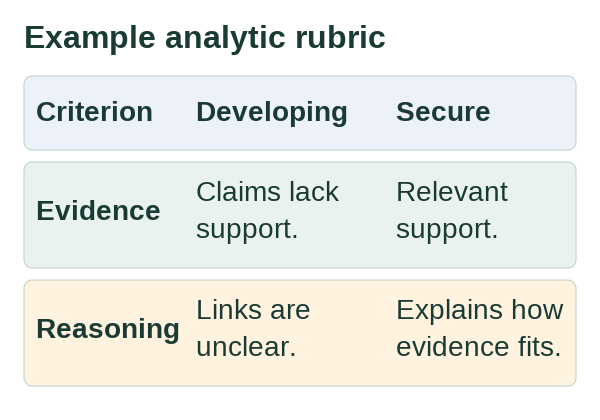
An analytic rubric takes up each criterion on its own. The work is judged separately on each one.[1] A holistic rubric gives the whole piece of work one overall rating. It does not give separate scores for its parts.[7]
A review of studies in higher education from 2005 to 2017 found that the rubrics studied there were mostly analytic and descriptive. They usually had four or five levels of performance. For 7 out of 51 rubrics, the level descriptions used rating-scale language. They counted how many elements appeared. They did not describe quality. Rubrics written that way may be more useful for grading than for learning.[1]
As a scoring tool, a rubric sets consistent criteria for grading. This matters when judgments are complex and subjective.[7] A rubric can be used as a teaching aid. It lays out guidelines while work is still being done. It may lead students to turn in better work.[8]
A rubric can also give teachers a set of categories, chosen in advance, to think with. It helps them decide what is important to teach. It also helps them judge whether it was learned.[6]
Scoring rubrics can also give students something to check their own work against. Students can reflect with them and use them when reviewing a classmate's work.[7] Rubrics are often used in performance assessment. There, students must apply knowledge to a particular setting, and success comes in degrees. Some teachers are slow to use performance assessment. They do not know enough about how to judge a student's performance properly.[9]
The word rubric has been in English since the 1400s. One early meaning was the heading of a chapter or division of a book. It was printed or underlined in red for emphasis. Phillips, writing in 1658, gave as his example a marked sentence in a book, set off with letters in red. The Catholic Church long used the term for directions for conducting Mass. These were printed in red in liturgical books. In law, a rubric was the heading or title of a statute or a section of a legal code. It was again originally in red ink.[6]
Use has grown since, in research and in practice. The word now means very different practices. They range from scoring sheets that teachers keep private. They also include full pictures of quality that students help to write. People often understand the term in imprecise and inconsistent ways. So people judge, require, welcome and resist rubrics for different reasons. One review listed fourteen design elements. These are decision points at which one rubric can differ from another.[10]
Main ideas
How rubrics are built and checked
A rubric is a grid. It pairs stated criteria with levels of achievement.[11] One published account gives teachers a step-by-step method for building rubrics. The rubrics should be valid, reliable and aimed at a stated purpose.[12]
A rubric's content can be split into two parts, Content and Style. Style can be split again into Clarity and Organization. The Content part draws on Bloom's taxonomy. It assesses understanding of the material and the paper's argument. It also assesses analysis, synthesis, evaluation and creation.[13]
A 2018 rubric for assignment descriptions takes a different route. It names the features of a well-designed assignment. It splits each feature into parts that can be measured. It also gives examples of what evidence for each part would look like.[14]
In one weighted design, an array of performance levels is multiplied by an array of task components. That structure gives different weights to dominant and secondary criteria. The most important concepts therefore count for more. The shape of the weight distribution function matters. A uniform distribution is easy to develop and use, especially for large classes. But it fails to recognize dominant components. Step or linear distribution functions allow single and multiple dominant criteria to be modeled. The value of main and secondary parts can be set relative to each other. The authors of that structure note a problem with marking by deducting points for errors. It can underestimate the importance of dominant concepts. It can also produce grades that disagree with academic policies.[15]
Australian universities often have teachers review one another's teaching. Reviewing each other's assessment is a newer practice in higher education. The project borrowed its structure from an existing peer review of teaching. That review used triads and took place at a large Brisbane university. A set of ten questions started conversations among assessors. The courses were undergraduate. They covered teacher education, business, visual arts, occupational therapy and outdoor education. The reported benefits were broad and large for all groups involved. These were students and assessors.[16]
The teachers filled in a questionnaire of twenty-seven items. Their answers showed strong interest in analytic scoring rubrics for correcting students' writing. The total mean reached 3.27 with a standard deviation of 0.65, a high agreement degree. The teachers also rated scoring rubrics highly as precise and effective ways to judge how well learners write.[17]
Research
The evidence that rubrics change performance
After correcting for publication bias, the pooled effect on academic performance was moderate and positive. It was g = 0.45. That figure rested on k = 21 studies and m = 54 effect sizes, with a 95% confidence interval of [0.312, 0.831]. A second measure was the standardized mean change from before to after rubric use. It was SMC = 0.38, with a 95% confidence interval of [0.02, 0.75]. The pooled effects were small: g = 0.23 for self-regulated learning and g = 0.18 for self-efficacy. Both confidence intervals crossed zero. The review tested many variables as possible moderators. Most of them were not significant.[2]
A quasi-experiment compares existing groups instead of assigning people at random. In one study, undergraduates in an elective course did an assignment. They did it with or without a grading rubric in spring and fall 2009. The group without the rubric scored much lower on average than the group that used it. A regression analysis found that using the rubric significantly predicted the assignment outcome. The link was less strong than baseline course knowledge and grade point average.[18] In a study of scientific writing, some students used a detailed rubric while preparing reports. They wrote better reports than students who did not.[19]
Students wrote an essay and revised it with the materials given to their group. They received training in using the tools, then wrote and revised a second essay. The largest benefit went to the students who worked with rubrics. Students with exemplars came next. The combined condition came after that. After training, students improved most at using the tools in the exemplars condition.[20]
One action research project took place at a university in Vietnam. There, 150 English-major freshmen in 6 classes used scoring rubrics for a semester. Their academic writing skills improved significantly. Grades rose and the number of mistakes fell. The report also noted some barriers to using rubrics. These barriers affect teaching and learning academic writing.[21]
A survey asked 27 male TESOL graduate students about rubrics in writing. All of them studied at Kabul Education University. They were mostly positive. That study used a Likert scale questionnaire, a rating scale of fixed response options. It concluded that rubrics can improve writing performance when used well.[22]
Researchers have also studied what teachers know about rubrics. In a study of high school classes, pairs of teachers were matched by course and student ability level. The courses were algebra, biology, English and government. Within each pair, one teacher was picked at random for rubric training. The other went without it. All teachers then gave tests containing both selected-response items, such as multiple-choice questions, and constructed-response items, which ask students to write out an answer. Students of trained teachers did better in 3 of the 8 comparisons. The other 5 comparisons were not significant. The significant differences appeared in algebra, on both item types. They also appeared in biology, on the constructed-response items.[23]
One long-running classroom account describes a conference-style paper project. It took place in a second-level physics course at American University. It ran for 15 years, and a rubric was added recently. The rubric was designed to give feedback while the writing was taking place. It was not only for after the final paper was submitted.[24]
Rubrics and self-assessment
A rubric can help a student judge their own work.[25] Researchers often measure how close the student's own score comes to an expert's score, and call this judgment accuracy.[26][25] In an experiment with 93 high school students, some judged their own science abstracts with a rubric. They were more accurate overall and less biased.[25]
An experiment had 236 learners write a scientific abstract. Descriptions of performance levels made their self-assessment more accurate. Given before revision, they helped only learners who had already written fairly well. For weak writers they did not help, and in some analyses they hindered revision. Given during revision, the descriptions had almost no effect on performance.[27]
Rubrics have also been studied for their links to self-regulated learning.[26][28] A study of 79 pre-service teachers compared rubric self-assessment with instructor feedback against no self-assessment. The group using the scoring guide reached higher achievement. They also used more strategies to manage their own learning. In reflective journals, most of those teachers said self-assessment helped them. It helped them set their own goals, monitor progress and reflect on their learning.[28]
A 2024 paper proposed a wider framework for self-regulation and co-regulation. Rubrics supplied the performance measures. It also reported a prototype system built on it.[29]
A study of 268 elementary and middle school students measured self-efficacy for writing three times. It tracked rubric use over both the short term and the long term. Girls started with higher self-efficacy than boys. Average ratings rose in every condition as students wrote. Long-term rubric use was linked to self-efficacy only among girls.[30]
Rubric-referenced self-assessment was linked to higher essay scores for girls on a historical fiction essay. There was no significant link for boys. Neither group showed an effect on a response to literature essay.[31]
With 116 third and fourth graders, a treatment combining a model paper, student-generated criteria and rubric self-assessment produced a main effect on total writing scores and on every criterion.[4] A similar process with 162 middle school students also showed a main effect of treatment. It appeared on total essay scores. It also appeared on every rubric criterion.[32]
Rubrics can also guide how students choose what to study. The study had 92 participants. They were learning five concepts about how minerals form. Concepts worth more points on a rubric were chosen for study more often. They were also studied slightly longer. The researchers read this as evidence that learners use scoring rubrics to plan their study.[33]
A randomised experiment tested a rubric with three items. The question was whether it sharpened evaluative judgement, the ability to judge the quality of work. It found a small effect size on agreement about the quality of learning resources. Comments showed that criteria beyond the rubric also guided ratings.[34]
Feedback, peer review and classroom routines
A rubric can serve as a tool for feedback. It helps students see their strengths and weaknesses.[35] One proposed routine has students score their own work against a rubric based on criteria. They do this before the instructor sees it. The instructor then reviews the student's self-assessment. The instructor gives feedback on it. The student applies that feedback to the work before submitting it. The student also reflects on how good it is.[36] Rubrics have also been described as a way for teachers to keep reflecting. They can ask how well their instruction serves students.[37]
Peer assessment is one setting where rubrics have been tested directly. A 2024 study randomly split 230 upper-secondary students from nine public school classrooms into a rubric group and a non-rubric group. The students worked on five open-ended items about cell biology. They also took part in online peer assessment. Each student scored five separate responses per question and gave feedback on each one. Both groups improved their learning, and the rubric group improved more, measured by effect size. Male students in the rubric group showed a significant drop in overconfidence. Regression results suggested gender did not affect learning outcomes.[38]
The rubric covered four dimensions: claims, evidence, reasoning, and use of knowledge. Students then compared their scores with their teachers' scores on the same rubric. The quality of students' own written arguments could be predicted from one thing. That was the number of student-teacher agreements on the evidence dimension. It could also be predicted from how many comments students wrote. In those comments they named problems and thought about the assessment. The study concluded that giving students rubrics for judging peers' arguments can lead them to write better arguments.[39]
Oral feedback has been tested alongside rubrics in a software engineering course. The course was about requirements engineering. Both approaches produced statistically significant improvements in learning outcomes. The rubrics did lead to a significant drop in complaints and questions about grades.[40]
In online courses, rubrics have been used to shape how students take part in discussion. The study had 53 Master of Business Administration students. They were in three sections of an online introduction to project management course. It ran from October 2010 to May 2011. A control group of 20 students was compared with two experimental groups of 16 and 17 students. The two experimental groups got a specific grading rubric. They also got instructions meant to start online discussion. The control group got neither. Average postings per student differed statistically between the experimental groups and the control group. They did not differ between the two experimental groups. The results suggest that a rubric designed to engage students can raise online classroom participation.[41]
Completion rubrics have been studied in online courses that students take at their own pace. Completion rubrics let students make informed choices about where to spend time. They can also prioritize their learning needs. The researchers warned that fair assessment systems must consider the classroom setting. Each setting brings its own challenges and chances.[42]
Rubrics for peer assessment have also been checked in medical simulation. Ninety-five third-year medical students in an advanced cardiac life support course took part. Two teachers gave 190 ratings and three peers gave 285 ratings. Each student was assessed once as team leader. The rubric had ten items. It covered electrocardiogram and life support skills, management and mechanisms, and affective domains. Agreement between raters reached an intraclass correlation of 0.78. Cronbach's alpha was 0.83. One peer rater using ten items reached a Phi-coefficient of 0.76, and two raters reached 0.85. Peer and teacher ratings were similar. Peers scored higher on managing scenarios, though. Over 80% of students saw peer assessment positively on a 5-point Likert scale survey. The researchers reported that rubrics can state clear performance criteria. They can also keep grading even and give focused feedback.[43]
Rubrics have also been studied in group learning. A revised teaching program for critical thinking is called ARDESOS v.2. It set out its activities by means of rubrics. It gave students less direct guidance from the instructor. The new version improved all the fundamental dimensions from pre-test to post-test. The improvement was significant. Its effect size (Cohen's d) was significantly higher than the earlier version's. The researchers named two key variables in the improved program. These were specificity and student initiative.[44]
Transparency and sharing rubrics with students
Clarity and familiarity are not the same thing, and one study found a gap between them. A survey asked 281 Arabic-speaking students at a Saudi university about three writing rubrics. The rubrics were used in midterm and final exams. Students mildly agreed that the rubrics were clear. They clearly disagreed that they knew the rubrics well. They also disagreed that they knew why and how the rubrics were used. The study concluded that the quality of these rubrics was insufficient. Unclear or unfamiliar rubrics can leave students confused and frustrated.[45]
Some teachers go further and build the rubric with students, a practice called co-construction. A model of how rubrics are built with students drew on three things. These were a literature review, advice from international assessment experts, and data from students and teachers at three higher education institutions. The model has three tiers. They are background on rubrics and their co-construction, strategies to guide collaboration, and shared scholarship from the project. The authors note tensions behind the practice. One is the belief that students really use rubrics. Another is whether students understand a rubric's purpose and wording.[46]
In one study, 45 postgraduate students completed an online questionnaire. It asked about two rubrics. One was designed for formative feedback, and the other was for summative assessment. The rubric made for formative use helped students grasp the standard of work. Postgraduate study demands that standard. It also helped build their assessment literacy. Students also found the summative rubric useful when moving on to their next assignments.[47]
What changes the effect: subject, age and task
One sociology program used scaffolding rubrics in eight courses. Those courses were one at 100 level, one at 200 level, two at 300 level and four at 400 level.[48] A separate rubric for interdisciplinary writing was built and tested. It was tested on 84 pieces of student work. The work came from college freshmen, sophomores and seniors. The rubric described four levels of interdisciplinary understanding. Those levels were scored on four dimensions. They were purposefulness, disciplinary grounding, integration and critical awareness.[49]
In mathematics, a study in Spain looked at one secondary teacher's view. The teacher saw a rubric as a tool for assessment for learning. The teacher said the rubric made students active in learning. They knew what was expected and worked toward the required level. The same rubric let the teacher check understanding for all students on a daily basis. The costs were also real. The rubric took much time and effort from the teacher and the students, since it was new to them. It asked for many details, and explaining every step in mathematical language was new to them. The study notes that research on rubrics in secondary education is limited.[50]
In science, 19 compulsory school students in Sweden were interviewed. They were asked about a rubric designed for an assignment on force and motion. Three themes came out of their accounts. The rubric gave a sense of control. It was needed for high grades but caused stress, and it encouraged strategic learning.[51]
At undergraduate level, one proposal was a rubric for scientific inquiry in psychology. It would track students' progress in inquiry skills applied to behavior. Its authors argued that applying the rubric can support active learning. It can also support more advanced scientific inquiry.[52]
A rubric made for elementary and secondary science classes was changed. The new use was to sort levels of inquiry in the undergraduate chemistry laboratory. The study scored published and commercial experiments with it. This showed many different uses for the word inquiry.[53]
For concept maps, researchers scored maps from industrial engineering students in 2000 and again in 2002. A whole-piece approach showed that students improved as they moved through the program. Traditional counting methods gave numbers. But a closer look raised doubt about whether those numbers showed real understanding of concepts.[54] In music performance, a teacher's main difficulty is managing how subjective the judgment is. Rubrics are offered as a way to make grading more objective.[55]
Information literacy has its own rubrics. In a first-year research and writing course, a librarian and other faculty built a rubric. It came from course goals and the Association of College and Research Libraries standards. They used it to score students' bibliographies. It checked mastery of the objectives. It also checked use of library-licensed sources versus free web sources. The study concluded that a rubric gave a reliable and objective method for analysis and comparison. It warns that no single assessment approach fits all settings.[56]
Instructors said the rubrics helped them grade written work. Graduate teaching assistants said the rubrics made clear what the instructor expected. Students said they understood what the rubric said. They said they could use its feedback to change later performance.[57]
Scoring guides are still rare in doctoral education. Yet they have been common in undergraduate education for over two decades. One proposal would use custom rubrics for each discipline at the preconfirmation stage. That is the trial period when the most people leave. A review of existing studies found a need for further research. The paper ends by asking whether rubrics have a place in doctoral education at all.[58]
Gifted students form another group whose rubric use has been discussed. The discussion looks at wording, point allocations and student voice. That discussion concerns how a rubric can suit the group. It must still respect each gifted learner's own talents, potential and abilities.[59]
Reliability, validity and scoring quality
Researchers have checked rubrics for validity and reliability.[60] A 2003 study of peer-group rating used a rubric for an oral presentation across 3 years. It covered 107 college biology students and 1577 ratings in all. Students and the instructor used the rubric the same way across the study years. The link between the instructor's assessment and the students' ratings had a slope of 1.0. A generalizability study gave moderate inter-rater reliability values in all years. The scoring guide also seemed fair to both genders. Students' academic strength had no real effect on how they used it.[5]
Some rubrics fail because of how they are built. A 2014 study examined a rubric used to assess student writing in a large testing program. It used a repeating cycle of tryout, redesign and tryout. The evidence suggested a threat to validity. It may be widespread, and it came from design features. The study asked a question. Can rubrics whose categories line up structurally validly assess complex skills? The proposed fix was to rethink how the rubric was built. The aim was to reduce that threat.[61]
A 2026 content analysis looked at 12 English rubrics from public and private senior high schools. Only a minority had performance descriptors that were clearly different from one another. Most used vague terms for judging quality and lacked clear indicators. This made them less useful for guiding assessment and student learning. Teachers who were interviewed named three system-wide problems. These were limited training, time constraints, and reliance on generic online rubrics. The study linked these to subjective scoring.[62]
Some rubrics are written for one particular simulation or task. Others are generic and fit many tasks. The two kinds have been compared directly. In a 2020 nursing study, three instructors rated 29 students on their own. They used both kinds of rubric in two simulations of a patient getting worse. Most students (59%) said the scenario-specific rubric helped their learning more. Also, 52% found it easier to use. All 3 instructors said it helped more when they guided the debriefing. The study concluded that rubrics written for one specific scenario may help learners more. They may be better at showing learners their own gaps in knowledge and performance.[63]
Researchers have compared rubric scoring with essay tests. A 2021 study asked 30 science teachers to rate the work of 30 students. It estimated interrater reliability with Fleiss Kappa. Interrater reliability was higher for restricted response items than for context dependent tasks, and the same held for extended response items scored with an analytic rubric and with a holistic rubric.[64]
Instructors who used an electronic rubric differed from one another. Some were more lenient and some more severe. Instructors differed in how lenient or strict they were. Nine writing instructors were interviewed. They saw advantages in e-rubrics. These were easier scoring, standardization, and fewer student complaints and grade appeals. They were cautiously hopeful about the effect on student writing.[65]
Some rubrics pass checks of reliability and validity. A 2017 test of the Scoring Rubric for Information Literacy measured interrater reliability. It used percentages of agreement and intraclass correlation. It used factor analysis and reliability analysis to test construct validity. It used Pearson correlations to test criterion validity. The rubric seemed reliable and valid for judging information literate performance. It also suited courses in higher education.[66]
A 2026 study looked at 175 third-year dentistry students at the European University of Madrid. It tested two analytic rubrics for preclinical orthodontic practice. The wire-bending rubric had moderate internal consistency (Cronbach's alpha = 0.61). The cephalometry rubric had adequate reliability (alpha = 0.71). Factor analysis matched a one-dimensional structure for both. Scores on the cephalometry practice went with higher marks on the theory exam. Scores on wire-bending showed no such links. The study called its evidence preliminary. It asked for more work with several evaluators. It also asked for samples from more than one center and studies over time.[67]
Newer work asks whether rubrics can be produced quickly without losing quality. A 2026 case study looked at analytic rubrics. ChatGPT made them for English for Academic Purposes assessments. The university was transnational. The study used standards from the Higher Education Quality Council of Ontario. Judges asked whether the rubrics helped instructors grade sample papers the same way. The instructors scored those papers at meetings to make scoring consistent. The study gave recommendations for using such rubrics in English for Academic Purposes assessments.[68]
In practice
Why rubrics spread through schools and colleges
Writing rubrics appeared in the 1960s. Since then, the word rubric has served as a professional term in educational evaluation. Some educators brought the term into teaching. There it named a tool for judging performance and was usually written as writing rubrics.[69] Since then, rubrics have become standard equipment in many kinds of education, from grading students to judging teachers and reviewing curricula.[70]
At Washington State University Vancouver, librarians joined a campus effort to assess a general education program. The program was built on university learning goals, one of them information literacy. They judged student work in an electronic portfolio against rubrics. Their method paired an electronic portfolio with rubrics for judging the work inside it. This let the librarians evaluate their information literacy program.[71]
The Association of American Colleges & Universities built a set of general education rubrics, the VALUE rubrics. Faculty groups from across the country looked at common outcomes to make them. That cross-campus design raised a prospect: measuring student outcomes across campuses, across classrooms and over several rounds.[72]
Rubrics also appear in program evaluation, though Martens (2018) found the practice uncommon there. Where evaluators do use them, education and health programs dominate. There rubrics recode data into another form or describe how an organization is working. They also support judgments that state a value outright. Evaluators apply them during data collection and data analysis. They apply them again when findings are combined into conclusions.[70]
Gilmour, Majeika, Sheaffer and Wehby (2019) examined state teacher evaluation rubrics. One fifth of the standards and indicators concerned classroom management. The amount varied greatly from state to state. It found large variability across states. Those rubrics leaned toward proactive strategies. They often left out specific evidence-based practices that could help teachers improve, and very few addressed student misbehavior.[73]
A separate study in Pakistan used standard rubrics developed with the Government of Pakistan and UNESCO. It observed 225 elementary school teachers, chosen at random. That study concluded that most of those teachers were weak in various teaching skills.[74]
Sanosi (2023) surveyed 112 university students about the Quality Matters rubric, a set of standards for online course quality. The study compared their ratings with its general and specific standards. Sanosi (2023) calls Quality Matters the rubric most widely used and most widely endorsed for checking the quality of online courses. In a mixed-method study, 112 university students answered a 42-item questionnaire based on that rubric. Focus-group interviews helped explain their answers. The students agreed with 71% of the rubric's standards. They valued the standards on privacy, course introduction, assessment and course technology above those on learning objectives, learner support and accessibility.[75] A synthesis of rubrics and instruments used in higher education proposed one rubric for online course design. It was meant as a single reference point for faculty and institutions.[76]
A survey of lecturers in vocational education found that rubrics set clear expectations for students, save instructors grading time, and keep teaching assistants consistent in their marking. The same lecturers said rubrics allow quick and detailed feedback. They also supply data for refining teaching methods.[77] Ling (2025) concluded that a well-built, well-run rubric can assess effectively. It needs steady revision to keep working. The same review argued that the teacher should decide whether to use a rubric at all.[78]
Rubrics as teaching tools, not only grading tools
Andrade (2005) reviews the benefits of rubrics as tools for teaching and for grading alike.[79][80] Stevens and Levi, writing in 2004, described a rubric as a scoring tool. It sets out what an assignment specifically requires. The same book describes a rubric as a detailed description. It sets out what counts as acceptable and unacceptable performance. One review of that book notes that a rubric is not a magic wand. Still, it shows students what meeting an intended goal looks like.[80]
A political science professor argued that rubrics let instructors focus on analytical quality while students work on a variety of assignments. Over time, that professor wrote, instructors can become more alert to the analytical possibilities in assignments that once looked like busywork.[81] In mathematics, a study used the Instructional Quality Assessment rubrics, a set of observation scales, as the frame for professional development. The teachers were in grades 3-8. That study changed a tool. It is usually used to observe teachers, but here teachers used it to reflect on their own instruction.[82]
Bin Dahmash (2025) studied 13 students in a basic English writing course. They used an analytic rubric during their writing. In the short term, the rubric made the requirements clear and served as a benchmark. It also pointed to strengths and weaknesses in the students' writing process. Over the long term, the students in Bin Dahmash's (2025) study reported better self-efficacy and better writing skills. They also reported greater satisfaction and stronger task-management skills.[83]
Two writing teachers did classroom-based action research in a university second-language writing context. They found that rubrics could drive changes in how writing is taught and assessed. That research also reported that rubrics helped students take ownership. Students took charge of the different stages of their writing.[84] A separate study trained undergraduate students to use rubrics to assess sample writing tasks. The students also identified differences and consistencies among them.[85]
In nursing, a 2004 article reported that scoring rubrics point students to areas that need work. They also give credit for items done correctly. Truemper (2004) added that rubrics suit spoken assignments as well as written ones. An instructor can also tailor them to the subject.[86] That simulation-laboratory rubric rested on Tanner's Clinical Judgment Model.[87]
Rubrics written for asynchronous online discussions try to spell out the kinds of engagement students are expected to show. The hope is that students will act on the advice. A 2010 paper judged that this value is real. Basic considerations of course design limit it.[88]
A 2023 qualitative study looked at 15 prospective teachers from four universities. They saw benefits in rubrics for grading, including feedback, motivation, awareness and time management. The same study also found challenges and gaps in how rubrics were used and practiced in the Pakistani education system.[89]
Students and teachers building rubrics together
In an undergraduate Business Chinese course, students moved through stages as the course went on. First they received rubrics, then they contributed to them, and finally they created them. The instructor acted as director and facilitator throughout. Students also judged their own work and each other's, and wrote reflections.[90]
A 2020 study weighed co-construction against a simpler alternative. That alternative gave students exemplars, meaning sample pieces of work, alongside teacher-designed rubrics. The exemplars proved the more effective of the two strategies. Co-construction showed some promise. That study followed an earlier finding, from 2016.[91]
The Business Chinese course used staged involvement to raise student engagement with performance-based tasks. These included practice job interviews and business proposals given to domain experts.[90] Delanoy and Tasmin-Sharmi (2025) studied a foreign language course during the pandemic. Students took part in co-created rubric conversations and received audio feedback. They report that these uses of technology can support learner autonomy and raise performance.[92]
A 2014 study looked at 176 students in three professional education settings. It found that rubrics can convey assessment expectations, and that students may use the criteria to support and self-assess their own performance.[3] Taylor, Kisby and Reedy (2024) concluded from their interviews that students who engage with rubrics well seem to become less anxious.[93]
Picón-Jácome (2013) argues that teachers and students should discuss and agree on a rubric. This promotes fair assessment practices. Picón-Jácome (2013) adds that building a rubric and then scoring with it raises both the validity and the transparency of an evaluation.[94]
Chan and Ho (2019) interviewed 82 people: 78 nursing students and 4 educators. The students and educators named four good practices. These were a standard method of evaluation, objective scoring, guidelines for students' work, and transparency. Chan and Ho (2019) heard about bad practices. Descriptions were too vague to use, and rubrics never said what mark range belonged to each grade.[95]
The 2020 study found co-construction only somewhat promising next to exemplars. It also stressed how students feel when they engage with assessment.[91] A 2012 survey of 35 baccalaureate social work students judged rubrics favourably. But students said the design should be self-explanatory and easy to follow.[96] Wang (2017) studied Chinese university students learning English. The study found that how well a rubric worked in self-assessment depended on features of the rubric itself and on features of the student using it.[97]
When raters ignore the rubric
A rubric can be printed and handed out, yet raters may still judge by their own standards. The raters spoke their thoughts aloud as they scored. Just less than five percent of their statements concerned the issues the guide assesses. The researcher concluded that raters cared more about their own criteria. They cared less about the standards set out in the scale descriptors.[98]
Çetin and İlhan (2017) found that raters using standard rubrics agreed little with one another. With the standard rubrics, agreement among the raters was low. Raters also differed a lot in how strict or lenient they were. With the SOLO-based rubrics, the raters were consistent. Their severity and leniency were similar to each other.[99]
A written rubric may also fall short when the skill being judged is complex, because learners need a rich mental model of what such skills involve. A study compared three groups. 49 learners used video-enhanced rubrics with modelling examples and self-explanation prompts, 54 used textual rubrics, and 50 formed a control group. Both rubric groups consistently outperformed the control group to varying degrees across skills, but no differences were found between the two rubric conditions. The researchers noted that a rubric is textual, which limits how much contextual and dynamic information it can deliver. This includes information about time and behaviour.[100]
What this looks like when you study
One group of students received a rubric that described what each of six quality levels looked like for four criteria. The other half used the same six-point scales but received no description of the levels. The rubric group judged their own abstracts more accurately and showed less bias, and the rubric also lowered the mental effort of self-assessing.[25]
Students compared their assessments with assessments by their teachers, who used the same rubrics. The quality of a student's own written argument could be predicted from how often the student agreed with the teacher on the evidence criterion.[39] In a Vietnam university, 150 English majors used scoring rubrics in academic writing classes for one semester.[21]
Two hundred six students in grades 9 and 10 took part. Each wrote an essay and revised it using a rubric, exemplars (sample pieces of work), both, or neither. The rubric group improved the most, followed by the exemplars group and then the combined group.[20] In a study of 92 learners studying mineral formation, some concepts on the rubric were worth 12, 8 or 4 points. Students chose to study high-value concepts more often and slightly longer than low-value ones.[33]
A teacher can give a criteria-based rubric to students before submission, have them self-assess, then review their self-assessment and give feedback. Students then apply that feedback to their work before handing it in and reflect on its quality.[36]
Criticism
Criticism, weak effects and open questions
One line of criticism holds that rubrics cannot measure complex thinking skills. A 2016 article argued that criteria-based rubrics hold back students from responding on their own terms. It said they also hold back markers from exercising professional judgement. That article also said rubrics encourage compliance. This puts student commitment and creativity at risk. It also claimed that rubrics give marking and grading a false air of objectivity.[101] The essay argued that judging each piece of student work case by case is still a teacher's job. It takes time.[102]
A 2007 essay made an argument. Rubrics and general comments that make language standard do students a disservice. They also weaken the reading and writing experience.[103] A 2015 study of a high school biology classroom suggested a problem. Using a scoring rubric for teaching can weaken the very learning it is meant to support.[104]
Effects on performance differ from one use to another. A 2025 analysis looked at 15 high-quality studies of rubric interventions. It found two features that the successful ones shared. First, teachers explained what the scoring guide contained. They also explained how to use it to guide learning. Second, a good sequence had students make work, then get feedback or self-assess, then revise.[105]
A 2010 review of research in higher education found two studies that linked rubric use to better academic performance. One study did not.[106] A 2015 review looked at studies published from 2005 to 2013. Evidence on performance was positive overall. Evidence on self-regulation of learning was mixed.[107] A 2022 experiment with 93 high school students found that a rubric raised the accuracy of self-assessment. It also lowered cognitive load.[25]
The 2022 experiment noted that hard evidence for the proposed mechanism is fairly scarce. The idea is that rubrics work by helping students judge their own work more accurately.[25] A 2015 review looked at 14 quality rubrics for open educational resources. It found that many lacked rating scales, scoring guides, empirical testing and repeated revisions.[108]
A 2017 study gave a thesis rubric to 105 students. Students valued the rubric. But using it was not linked to ability. Its teachers said they needed more levels of skill. The levels they had could not tell good students from excellent ones.[109]
Common misconceptions
Studies of rubrics in higher education often use the word loosely. Some studies called their assessment tool a rubric when it was in fact a rating scale. Rubrics written in evaluative language, such as calling a paper excellent, do not show students what their work needs to look like.[1]
A 2016 finding by Bacchus, Colvin, Knight and Ritter was that teacher-designed rubrics, alone, may not give students enough clarity about assessment tasks, either before they begin or when they receive feedback. Adding exemplars alongside the rubric was the more effective strategy in that study.[91]
Key studies
| Year | Study | Sample | Design | Finding |
|---|---|---|---|---|
| 2001 | Shafer et al.[23] | high school teachers in algebra, biology, English and government | randomized teacher training study | Students whose teachers had received rubric training outperformed the others in 3 of the 8 comparisons. The differences appeared in algebra on both item types and in biology on constructed-response items. |
| 2003 | Andrade & Boulay[31] | study of 7th- and 8th-grade students writing two essays | For the historical fiction essay, treatment was positively related to girls' scores but not boys' scores; for the response to literature essay, there was no effect for either boys or girls. | |
| 2008 | Andrade et al.[4] | experiment with 116 students in grades 3 and 4 | Treatment and previous achievement each had a main effect on total writing scores. Main effects also appeared on scores for the individual criteria on the rubric. | |
| 2009 | Andrade et al.[30] | study of 268 elementary and middle school students | Girls in the treatment group gained more in self-efficacy than girls in the comparison group. Long-term rubric use was linked to self-efficacy only among girls. | |
| 2010 | Andrade et al.[32] | study of 162 middle school students | Treatment, gender, grade level, writing time and previous achievement each had a main effect on total essay scores. Main effects also appeared on scores for every criterion on the scoring rubric. | |
| 2013 | Lu & Zhang[39] | four secondary classes in a Hong Kong high school | one-year online peer assessment study | Agreement with teacher scores on the evidence criterion predicted the quality of students' own written arguments. |
| 2018 | Brookhart[1] | 46 studies yielding 51 rubrics | review of higher education studies from 2005 to 2017 | Most rubrics were analytic and descriptive, and no relationship was found between rubric type or quality and study results. |
| 2020 | Luctkar-Flude et al.[63] | 29 nursing students | reliability and validity study | Inter-rater reliability was slightly higher for the generic rubric (ICC .759) than the scenario-specific rubric (ICC .748). |
| 2020 | Trinh[21] | 150 English-major freshmen | action research over one semester | Academic writing skills improved significantly, with higher grades and fewer mistakes. |
| 2022 | Krebs et al.[25] | 93 high school students | controlled experiment | Students given a rubric judged their own abstracts more accurately and with less bias, and reported lower cognitive load. |
| 2023 | Panadero et al.[2] | 21 studies with 54 effect sizes | meta-analysis | Rubrics had a moderate positive effect on academic performance (g = 0.45) and small, non-significant effects on self-regulated learning (g = 0.23) and self-efficacy (g = 0.18). |
| 2023 | Lipnevich et al.[20] | experiment with four conditions | Students using rubrics improved writing performance the most, followed by exemplars and then the combined condition. | |
| 2024 | Karaman[28] | 79 pre-service teachers | quasi-experiment with pretest and posttest | The rubric plus instructor feedback group had higher achievement and more self-regulated learning than the no-intervention group. |
| 2025 | Shumaker et al.[33] | 92 learners | experiment on study time | High-value concepts on a rubric were studied more often and slightly longer than low-value concepts. |
See also
References
- Brookhart, S. M. (2018). Appropriate Criteria: Key to Effective Rubrics. Frontiers in Education, 3. doi:10.3389/feduc.2018.00022
- Panadero, E., Jonsson, A., Pinedo, L., & Fernández-Castilla, B. (2023). Effects of Rubrics on Academic Performance, Self-Regulated Learning, and self-Efficacy: a Meta-analytic Review. Educational Psychology Review, 35(4). doi:10.1007/s10648-023-09823-4
- Jonsson, A. (2014). Rubrics as a way of providing transparency in assessment. Assessment & Evaluation in Higher Education, 39(7), 840-852. doi:10.1080/02602938.2013.875117
- Andrade, H. L., Du, Y., & Wang, X. (2008). Putting Rubrics to the Test: The Effect of a Model, Criteria Generation, and Rubric‐Referenced Self‐Assessment on Elementary School Students' Writing. Educational Measurement: Issues and Practice, 27(2), 3-13. doi:10.1111/j.1745-3992.2008.00118.x
- Hafner, J., & Hafner, P. (2003). Quantitative analysis of the rubric as an assessment tool: an empirical study of student peer‐group rating. International Journal of Science Education, 25(12), 1509-1528. doi:10.1080/0950069022000038268
- Cooper, B. S., & Gargan, A. (2009). Rubrics in Education: Old Term, New Meanings. Phi Delta Kappan, 91(1), 54-55. doi:10.1177/003172170909100109
- Waghmare, P. (2022). Rubrics in evaluation: Tool for outcome based education. International journal of health sciences, 4831-4836. doi:10.53730/ijhs.v6ns2.6166
- O'Halloran, C. S., & O'Halloran, R. M. (2001). Recommending Rubrics as Teaching and Learning Tools. Journal of Hospitality & Tourism Education, 13(2), 56-59. doi:10.1080/10963758.2001.10696689
- Frida Yulia, M. (2017). Assessing performance using scoring rubrics: An overview. Kajian Linguistik dan Sastra, 17(2), 174-182. doi:10.23917/kls.v17i2.4536
- Dawson, P. (2017). Assessment rubrics: towards clearer and more replicable design, research and practice. Assessment & Evaluation in Higher Education, 42(3), 347-360. doi:10.1080/02602938.2015.1111294
- O'Donnell, J. A., Oakley, M., Haney, S., O'Neill, P. N., & Taylor, D. (2011). Rubrics 101: A Primer for Rubric Development in Dental Education. Journal of Dental Education, 75(9), 1163-1175. doi:10.1002/j.0022-0337.2011.75.9.tb05160.x
- Gupta, B. L., & Bundela Gupta, P. (2025). A Systematic Approach to Prepare Quality Rubrics. Asian Journal of Management, 139-146. doi:10.52711/2321-5763.2025.00022
- Harrell, M., & Philosophy Documentation Center (2005). Grading According to a Rubric: . Teaching Philosophy, 28(1), 3-15. doi:10.5840/teachphil200528111
- Palmer, M. S., Gravett, E. O., & LaFleur, J. (2018). Measuring Transparency: A Learning-Focused Assignment Rubric. To Improve the Academy, 37(2), 173-187. doi:10.1002/tia2.20083
- Salinas, J. J., & Erochko, J. (2015). Using weighted scoring rubrics in engineering assessment. Proceedings of the Canadian Engineering Education Association. doi:10.24908/pceea.v0i0.5743
- Grainger, P. (2021). Enhancing assessment literacies through development of quality rubrics using a Triad based peer review process. Journal of University Teaching and Learning Practice, 18(4). doi:10.53761/1.18.4.4
- Al-Ghazo, A., & Ta'amneh, I. (2021). Evaluation: and Grading of Students' Writing: Holistic and Analytic Scoring Rubrics. Journal for the Study of English Linguistics, 9(1), 77. doi:10.5296/jsel.v9i1.19060
- Howell, R. J. (2014). Grading rubrics: hoopla or help? Innovations in Education and Teaching International, 51(4), 400-410. doi:10.1080/14703297.2013.785252
- Greenberg, K. P. (2015). Rubric Use in Formative Assessment: A Detailed Behavioral Rubric Helps Students Improve Their Scientific Writing Skills. Teaching of Psychology, 42(3), 211-217. doi:10.1177/0098628315587618
- Lipnevich, A. A., Panadero, E., & Calistro, T. (2023). Unraveling the effects of rubrics and exemplars on student writing performance. Journal of Experimental Psychology: Applied, 29(1), 136-148. doi:10.1037/xap0000434
- Trinh, L. H. (2020). The effectiveness of using scoring rubrics in academic writing to English-majored students. Vietnam Journal of Education, 4(4), 76-82. doi:10.52296/vje.2020.83
- Naderi, R. (2026). The Role of Using Rubrics in TESOL Graduate Students’ Writing Performance at Kabul Education University. International Journal of Current Science Research and Review, 09(04). doi:10.47191/ijcsrr/v9-i4-26
- Shafer, W. D., Swanson, G., Bene, N., & Newberry, G. (2001). Effects of Teacher Knowledge of Rubrics on Student Achievement in Four Content Areas. Applied Measurement in Education, 14(2), 151-170. doi:10.1207/s15324818ame1402_3
- Larkin, T. L. (2015). A Rubric to Enrich Student Writing and Understanding. International Journal of Engineering Pedagogy (iJEP), 5(2), 12. doi:10.3991/ijep.v5i2.4587
- Krebs, R., Rothstein, B., & Roelle, J. (2022). Rubrics enhance accuracy and reduce cognitive load in self-assessment. Metacognition and Learning, 17(2), 627-650. doi:10.1007/s11409-022-09302-1
- Panadero, E., & Romero, M. (2014). To rubric or not to rubric? The effects of self-assessment on self-regulation, performance and self-efficacy. Assessment in Education: Principles, Policy & Practice, 21(2), 133-148. doi:10.1080/0969594x.2013.877872
- Krebs, R., Waldeyer, J., Rothstein, B., Panadero, E., & Roelle, J. (2026). The role of performance level descriptions for the effects of rubrics on self-assessment accuracy and performance. Metacognition and Learning, 21(1). doi:10.1007/s11409-026-09492-y
- Karaman, P. (2024). Effects of using rubrics in self-assessment with instructor feedback on pre-service teachers’ academic performance, self-regulated learning and perceptions of self-assessment. European Journal of Psychology of Education, 39(3), 2551-2574. doi:10.1007/s10212-024-00867-w
- De Campos, D. S., & Ferreira, D. J. (2024). Learning strategy regulation processes with rubrics for learning assessment. Revista Sistemática, 14(4), 932-947. doi:10.56238/rcsv14n4-013
- Andrade, H. L., Wang, X., Du, Y., & Akawi, R. L. (2009). Rubric-Referenced Self-Assessment and Self-Efficacy for Writing. The Journal of Educational Research, 102(4), 287-302. doi:10.3200/joer.102.4.287-302
- Andrade, H. G., & Boulay, B. A. (2003). Role of Rubric-Referenced Self-Assessment in Learning to Write. The Journal of Educational Research, 97(1), 21-30. doi:10.1080/00220670309596625
- Andrade, H. L., Du, Y., & Mycek, K. (2010). Rubric‐referenced self‐assessment and middle school students’ writing. Assessment in Education: Principles, Policy & Practice, 17(2), 199-214. doi:10.1080/09695941003696172
- Shumaker, M. D., Rivers, M. L., & Tauber, S. K. (2025). Point Values on Scoring Rubrics Influence Self-Regulated Learning for STEM Material. Behavioral Sciences, 15(4), 532. doi:10.3390/bs15040532
- Gyamfi, G., Hanna, B. E., & Khosravi, H. (2022). The effects of rubrics on evaluative judgement: a randomised controlled experiment. Assessment & Evaluation in Higher Education, 47(1), 126-143. doi:10.1080/02602938.2021.1887081
- Chowdhury, F. (2018). Application of Rubrics in the Classroom: A Vital Tool for Improvement in Assessment, Feedback and Learning. International Education Studies, 12(1), 61. doi:10.5539/ies.v12n1p61
- Chambers, A. W., & Harkins Monaco, E. (2023). Increasing Student Engagement with Instructor Feedback using Criteria-Based Rubrics as a tool for Self-Assessment. Journal of the Scholarship of Teaching and Learning, 23(2). doi:10.14434/josotl.v23i2.33715
- Skelton, J. (2014). Rubrics And Evaluations. i-manager's Journal on School Educational Technology. doi:10.26634/jsch.9.4.2708
- Fadillah, S. M., & Ha, M. (2024). Using Rubrics to Enhance Accuracy of Peer Assessment and Self-Judgment in Biology Learning. Asia-Pacific Science Education, 10(2), 265-288. doi:10.1163/23641177-bja10080
- Lu, J., & Zhang, Z. (2013). Assessing and Supporting Argumentation with Online Rubrics. International Education Studies, 6(7). doi:10.5539/ies.v6n7p66
- Barney, S., Khurum, M., Petersen, K., Unterkalmsteiner, M., & Jabangwe, R. (2012). Improving Students With Rubric-Based Self-Assessment and Oral Feedback. IEEE Transactions on Education, 55(3), 319-325. doi:10.1109/te.2011.2172981
- Lee, M. R., Carstens, D. S., & Malone, L. C. (2012). Discussion forum rubrics: Using rubrics to enhance and increase project management students' participation in online discussions. Journal of Project, Program & Portfolio Management, 2(2), 35. doi:10.5130/pppm.v2i2.2221
- Koenig, S., Mitchum, C., & Rodrigo, S. (2025). Using Completion Rubrics to Grade Engagement in Online Spaces. Journal of Writing Assessment, 18(1). doi:10.5070/w4.jwa.1240
- Lertsakulbunlue, S., & Kantiwong, A. (2024). Development of peer assessment rubrics in simulation-based learning for advanced cardiac life support skills among medical students. Advances in Simulation, 9(1). doi:10.1186/s41077-024-00301-7
- Saiz Sanchez, C., Fernandez Rivas, S., & Olivares Moral, S. (2014). Collaborative learning supported by rubrics improves critical thinking. Journal of the Scholarship of Teaching and Learning, 10-19. doi:10.14434/josotl.v15i1.12905
- Aldukhayel, D. M. (2017). Exploring Students’ Perspectives toward Clarity and Familiarity of Writing Scoring Rubrics: The Case of Saudi EFL Students. English Language Teaching, 10(10), 1. doi:10.5539/elt.v10n10p1
- Morton, J., Northcote, M., Kilgour, P., & Jackson, W. (2021). Sharing the construction of assessment rubrics with students: A Model for collaborative rubric construction. Journal of University Teaching and Learning Practice, 18(4). doi:10.53761/1.18.4.9
- Holmes, A., Minott, M., & Hopkins, P. (2025). Fixed ‘Formative-Specific' Assessment Rubrics and ‘Formal’ Formative Assessment? What’s the point? Evolving formative assessment processes for a large-scale international student taught master’s Education module. Enhancing Teaching and Learning in Higher Education, 2, 95-130. doi:10.62512/etlhe.21
- Carson, L., & Kavish, D. (2018). Scaffolding Rubrics to Improve Student Writing: Preliminary Results of Using Rubrics in a Sociology Program to Enhance Learning and Mechanical Writing Skills. Societies, 8(2), 34. doi:10.3390/soc8020034
- Mansilla, V. B., Duraisingh, E. D., Wolfe, C. R., & Haynes, C. (2009). Targeted Assessment Rubric: An Empirically Grounded Rubric for Interdisciplinary Writing. The Journal of Higher Education, 80(3), 334-353. doi:10.1080/00221546.2009.11779016
- Gallego-Arrufat, M. J., & Dandis, M. (2016). Rubrics in a Secondary Mathematics Class. International Electronic Journal of Mathematics Education, 9(1), 73-82. doi:10.29333/iejme/282
- Hallström, H., & Levinsson, M. (2024). Matriser, krafter och fysik: Elevers levda erfarenheter av bedömningsmatriser i grundskolans fysikundervisning: Rubrics, forces and physics: Students’ lived experiences of assessment rubrics in compulsory physics teaching. Nordic Studies in Science Education, 20(1), 72-85. doi:10.5617/nordina.10201
- Halonen, J. S., Bosack, T., Clay, S., McCarthy, M., Dunn, D. S., Hill, G. W., McEntarffer, R., Mehrotra, C., Nesmith, R., Weaver, K. A., & Whitlock, K. (2003). A Rubric for Learning, Teaching, and Assessing Scientific Inquiry in Psychology. Teaching of Psychology, 30(3), 196-208. doi:10.1207/s15328023top3003_01
- Fay, M. E., Grove, N. P., Towns, M. H., & Bretz, S. L. (2007). A rubric to characterize inquiry in the undergraduate chemistry laboratory. Chem. Educ. Res. Pract., 8(2), 212-219. doi:10.1039/b6rp90031c
- Besterfield‐Sacre, M., Gerchak, J., Lyons, M. R., Shuman, L. J., & Wolfe, H. (2004). Scoring Concept Maps: An Integrated Rubric for Assessing Engineering Education. Journal of Engineering Education, 93(2), 105-115. doi:10.1002/j.2168-9830.2004.tb00795.x
- Wesolowski, B. C. (2012). Understanding and Developing Rubrics for Music Performance Assessment. Music Educators Journal, 98(3), 36-42. doi:10.1177/0027432111432524
- Knight, L. A. (2006). Using rubrics to assess information literacy. Reference Services Review, 34(1), 43-55. doi:10.1108/00907320610640752
- Reynders, G., Lantz, J., Ruder, S. M., Stanford, C. L., & Cole, R. S. (2020). Rubrics to assess critical thinking and information processing in undergraduate STEM courses. International Journal of STEM Education, 7(1). doi:10.1186/s40594-020-00208-5
- Grainger, P., Carey, M., & Johnston, C. (2024). Why not rubrics in doctoral education? Assessment & Evaluation in Higher Education, 49(8), 1061-1073. doi:10.1080/02602938.2024.2338924
- Kaplan, S. N. (2019). Role of Rubrics and Gifted Students. Gifted Child Today, 42(4), 249-250. doi:10.1177/1076217519862316
- Hadibarata, T., Hidayat, T., & Kwabena, J. (2024). The Use of Scoring Rubrics in University. Acta Pedagogia Asiana, 3(1), 1-12. doi:10.53623/apga.v3i1.312
- Humphry, S. M., & Heldsinger, S. A. (2014). Common Structural Design Features of Rubrics May Represent a Threat to Validity. Educational Researcher, 43(5), 253-263. doi:10.3102/0013189x14542154
- Mohd. Rafi Riyawi, & Zulhiddah (2026). Content analysis of english assessment rubrics used in senior high schools reliability, transparency, and learning outcome alignment. SOSIOEDUKASI : JURNAL ILMIAH ILMU PENDIDIKAN DAN SOSIAL, 14(4), 4359-4367. doi:10.36526/sosioedukasi.v14i4.6704
- Luctkar-Flude, M., Tregunno, D., Sears, K., Pulling, C., Lee, K., & Egan, R. (2020). Reliability and validity of scenario-specific versus generic simulation assessment rubrics. Journal of Nursing Education and Practice, 10(8), 74. doi:10.5430/jnep.v10n8p74
- Wahyuni, L. D., Gumela, G., & Maulana, H. (2021). Interrater Reliability: Comparison of essay’s tests and scoring rubrics. Journal of Physics: Conference Series, 1933(1), 012081. doi:10.1088/1742-6596/1933/1/012081
- ERGUVAN, I. D., & AKSU DÜNYA, B. (2021). Gathering evidence on e-rubrics: Perspectives and many facet Rasch analysis of rating behavior. International Journal of Assessment Tools in Education, 8(2), 454-474. doi:10.21449/ijate.818151
- van Helvoort, J., Brand-Gruwel, S., Huysmans, F., & Sjoer, E. (2017). Reliability and validity test of a Scoring Rubric for Information Literacy. Journal of Documentation, 73(2), 305-316. doi:10.1108/jd-05-2016-0066
- Aguado-Gil, J. M., Arena-Echeverry, S., Suárez-García, A., Gómez-Sánchez, M., & González-Cuevas, G. (2026). Validity and Reliability of Rubrics for Assessment of Preclinical Orthodontic Practices in Dental Students. Dentistry Journal, 14(8), 516. doi:10.3390/dj14080516
- Wang, A., & Wang, J. (2026). Evaluating the validity and reliability of AI-generated rubrics for EAP assessments: A case study in a transnational university. Developing Academic Practice, 2026(Special), 81-98. doi:10.3828/dap.2026.14
- Liang, S. (2024). A Literature Review of English Writing Rubrics. Frontiers in Humanities and Social Sciences, 4(3), 412-419. doi:10.54691/05km2a94
- Martens, K. S. R. (2018). Rubrics in program evaluation. Evaluation Journal of Australasia, 18(1), 21-44. doi:10.1177/1035719x17753961
- Diller, K. R., & Phelps, S. F. (2008). Learning Outcomes, Portfolios, and Rubrics, Oh My! Authentic Assessment of an Information Literacy Program. portal: Libraries and the Academy, 8(1), 75-89. doi:10.1353/pla.2008.0000
- Marchisello, G., & Cuomo, M. (2011). Integrated Learning and the Value of the VALUE Rubrics. HETS Online Journal, 2(1), 47-58. doi:10.55420/2693.9193.v2.n1.94
- Gilmour, A. F., Majeika, C. E., Sheaffer, A. W., & Wehby, J. H. (2019). The Coverage of Classroom Management in Teacher Evaluation Rubrics. Teacher Education and Special Education: The Journal of the Teacher Education Division of the Council for Exceptional Children, 42(2), 161-174. doi:10.1177/0888406418781918
- Haider, Z., Hameed, Q., & Ameen, S. (2015). Applying Standardized Rubrics for Assessing the Instructional Competence of Elementary School Teachers (EST) in Pakistan. Advances in Social Sciences Research Journal, 2(4). doi:10.14738/assrj.24.832
- Sanosi, A. (2023). Students’ Agreement with QM® Rubrics as Benchmarks for Online Course Quality. Electronic Journal of e-Learning, 21(3), 175-187. doi:10.34190/ejel.21.3.2954
- Debattista, M. (2018). A comprehensive rubric for instructional design in e-learning. The International Journal of Information and Learning Technology, 35(2), 93-104. doi:10.1108/ijilt-09-2017-0092
- M., M. (2020). Using Rubrics to Assess E-learning in Vocational Education. Journal of Engineering Education Transformations, 34(0), 49-56. doi:10.16920/jeet/2020/v34i0/157852
- Ling, J. H. (2025). A Review of Rubrics in Education: Potential and Challenges. Indonesian Journal of Innovative Teaching and Learning, 2(1), 1-14. doi:10.64420/ijitl.v2i1.197
- Andrade, H. G. (2005). Teaching With Rubrics: The Good, the Bad, and the Ugly. College Teaching, 53(1), 27-31. doi:10.3200/ctch.53.1.27-31
- Mitchell, A. A. (2006). Introduction to Rubrics: An Assessment Tool to Save Grading Time, Convey Effective Feedback and Promote Student Learning (review). Journal of College Student Development, 47(3), 352-355. doi:10.1353/csd.2006.0033
- Rublee, M. R. (2014). Rubrics in the Political Science Classroom: Packing a Serious Analytical Punch. Political Science and Politics, 47(1), 199-203. doi:10.1017/s1049096513001704
- Candela, A. G., & Boston, M. (2022). Centering Professional Development Around the Instructional Quality Assessment Rubrics. Mathematics Teacher Educator, 10(3), 204-222. doi:10.5951/mte.2021.0013
- Bin Dahmash, N. F. (2025). The analytic use of rubrics in writing classes by language students in an EFL context: students’ writing model and benefits. Frontiers in Education, 10. doi:10.3389/feduc.2025.1588046
- Khairallah, M., & Adra, O. (2025). The multifaceted function of rubrics as formative assessment tools: A classroom-based action research in an L2 writing context. Language Teaching Research, 29(5), 2263-2280. doi:10.1177/13621688221104210
- Garcés-Manzanera, A. (2022). affordances of rubrics in L2 writing in Higher Education: A new approach to enhancing writing conventions. HUMAN REVIEW. International Humanities Review / Revista Internacional de Humanidades, 11(Monográfico), 1-12. doi:10.37467/revhuman.v11.4086
- Truemper, C. M. (2004). Using Scoring Rubrics to Facilitate Assessment and Evaluation of Graduate-Level Nursing Students. Journal of Nursing Education, 43(12), 562-564. doi:10.3928/01484834-20041201-11
- Lasater, K. (2007). Clinical Judgment Development: Using Simulation to Create an Assessment Rubric. Journal of Nursing Education, 46(11), 496-503. doi:10.3928/01484834-20071101-04
- Jackson, K. (2010). What value assessment rubrics in shaping students’ engagement in asynchronous online discussions? ASCILITE Publications, 454-458. doi:10.14742/apubs.2010.2083
- Mir, T. T., Arif, A., & Gul, F. (2023). Assessment Rubrics as Effective Feedback: Prospective Teachers' Perceptions and Practices. Global Educational Studies Review, VIII(II), 293-301. doi:10.31703/gesr.2023(viii-ii).27
- Yu, Q. (2025). Co-Constructed Rubrics for Languages for Specific Purposes Assessment: Enhancing Student Engagement. Global Business Languages, 25. doi:10.4079/gbl.v25.2
- Bacchus, R., Colvin, E., Knight, E. B., & Ritter, L. (2020). When rubrics aren’t enough: Exploring exemplars and student rubric co-construction. Journal of Curriculum and Pedagogy, 17(1), 48-61. doi:10.1080/15505170.2019.1627617
- Delanoy, N., & Tasmin-Sharmi, S. (2025). Reinforcing equity and justice in learning: Using digital co-created rubrics and audio feedback as/for assessment. The Open/Technology in Education, Society, and Scholarship Association Journal, 4(3), 1-17. doi:10.18357/otessaj.2024.4.3.71
- Taylor, B., Kisby, F., & Reedy, A. (2024). Rubrics in higher education: an exploration of undergraduate students’ understanding and perspectives. Assessment & Evaluation in Higher Education, 49(6), 799-809. doi:10.1080/02602938.2023.2299330
- Picón-Jácome, E. (2013). The Role of Rubrics in Fair Assessment Practices. Íkala, Revista de Lenguaje y Cultura, 18(3). doi:10.17533/udea.ikala.14080
- Chan, Z., & Ho, S. (2019). Good and bad practices in rubrics: the perspectives of students and educators. Assessment & Evaluation in Higher Education, 44(4), 533-545. doi:10.1080/02602938.2018.1522528
- Gezie, A., Khaja, K., Chang, V. N., Adamek, M. E., & Johnsen, M. B. (2012). Rubrics as a Tool for Learning and Assessment: What Do Baccalaureate Students Think? Journal of Teaching in Social Work, 32(4), 421-437. doi:10.1080/08841233.2012.705240
- Wang, W. (2017). Using rubrics in student self-assessment: student perceptions in the English as a foreign language writing context. Assessment & Evaluation in Higher Education, 42(8), 1280-1292. doi:10.1080/02602938.2016.1261993
- Shirazi, M. A. (2012). When Raters Talk, Rubrics Fall Silent. Language Testing in Asia, 2(4). doi:10.1186/2229-0443-2-4-123
- Çetin, B., & İlhan, M. (2017). An Analysis of Rater Severity and Leniency in Open-ended Mathematic Questions Rated Through Standard Rubrics and Rubrics Based on the SOLO Taxonomy. Education and Science, 42(189), 217-247. doi:10.15390/eb.2017.5082
- Ackermans, K., Rusman, E., Nadolski, R., Specht, M., & Brand‐Gruwel, S. (2021). Video‐enhanced or textual rubrics: Does the Viewbrics' formative assessment methodology support the mastery of complex (21st century) skills? Journal of Computer Assisted Learning, 37(3), 810-824. doi:10.1111/jcal.12525
- Bennett, C. (2016). Assessment rubrics: thinking inside the boxes. Learning and Teaching, 9(1), 50-72. doi:10.3167/latiss.2016.090104
- Gottlieb, D., & Moroye, C. M. (2016). The perceptive imperative: Connoisseurship and the temptation of rubrics. Journal of Curriculum and Pedagogy, 13(2), 104-120. doi:10.1080/15505170.2016.1191389
- Wilson, M. (2007). Why I Won’t Be Using Rubrics to Respond to Students’ Writing. English Journal, 96(4), 62-66. doi:10.58680/ej20075767
- Tang, X., Coffey, J., & Levin, D. M. (2015). Reconsidering the Use of Scoring Rubrics in Biology Instruction. The American Biology Teacher, 77(9), 669-675. doi:10.1525/abt.2015.77.9.4
- Jonsson, A., Panadero, E., Pinedo, L., & Fernández-Castilla, B. (2025). Using rubrics for formative purposes: identifying factors that may affect the success of rubric implementations. Assessment in Education: Principles, Policy & Practice, 32(2), 192-211. doi:10.1080/0969594x.2025.2486947
- Reddy, Y. M., & Andrade, H. (2010). A review of rubric use in higher education. Assessment & Evaluation in Higher Education, 35(4), 435-448. doi:10.1080/02602930902862859
- Brookhart, S. M., & Chen, F. (2015). The quality and effectiveness of descriptive rubrics. Educational Review, 67(3), 343-368. doi:10.1080/00131911.2014.929565
- Yuan, M., & Recker, M. (2015). Not All Rubrics Are Equal: A Review of Rubrics for Evaluating the Quality of Open Educational Resources. The International Review of Research in Open and Distributed Learning, 16(5). doi:10.19173/irrodl.v16i5.2389
- Prins, F. J., de Kleijn, R., & Tartwijk, J. v. (2017). Students’ use of a rubric for research theses. Assessment & Evaluation in Higher Education, 42(1), 128-150. doi:10.1080/02602938.2015.1085954
Cite this page: Atlas Nova editors. (2026). Rubrics. Atlas Nova. https://velocer.io/atlas/rubrics/