Technology · Online and digital learning
Open educational resources
Freely licensed teaching materials
Overview
What open educational resources are
Open educational resources, or OER, are teaching materials that carry a copyright license allowing people to keep, change and share them. Open educational resources cover a wide range of copyrightable materials. These range from whole courses and textbooks to modules, videos and tests. They come in physical or digital form, all meant to support access to knowledge.[6]
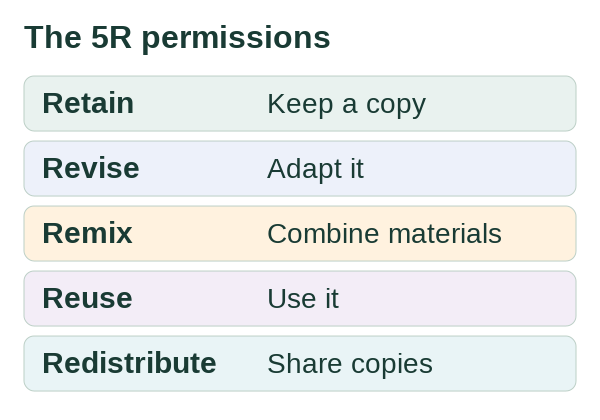
Open educational resources (OER) form the base of a wider idea called Open Education, and teaching that relies on OER is usually grouped under Open Educational Practices or OER-Enabled Pedagogy.[6] A 2018 paper on higher education calls OER important elements that support Open Educational Practices and the Open Education Movement. The same paper reports that little is known about how OER are produced and used, and that this is true for languages other than English.[7] A 2020 paper on engineering education notes that Canadian and international engineering OER efforts exist, but are still broken into separate parts.[8]
History
Where the idea came from
Distance education was traditionally limited in reach, because producing, copying and distributing courses cost too much. New technology made copying almost free, so universities could release course content to millions at little or no cost. Early projects such as OpenCourseWares were described as tools for reaching the universal right to education. That change was said to turn distance education from a classroom alternative into a social transformer.[9]
That forum drew 480 people from 90 countries. One question raised there was whether social authoring could let developed and developing countries build educational resources together.[10]
The Open University UK launched OpenLearn across the whole institution. It gave internal motives and outside drivers for the move.[11] In the Netherlands, the Open Universiteit Nederland ran the OpenER experiment from 2006 to 2008. OpenER offered open resources to link informal and formal learning. It also offered an entry portal to higher education with no barriers. About 10% of visitors said the resources influenced their decision to start a formal academic track. The experiment changed attitudes toward open resources inside the university. It also raised awareness of their value across the Netherlands. Policy-makers and politicians were among those reached.[12]
In the United Kingdom, several agencies funded a national programme that built infrastructure for open resources. The harder challenges concerned the educational value of the deposited material and how it could help and improve learning. The goal was a creative space in which staff and students would build resources together in an active curriculum, with each part depending on the others.[13]
A later line of thinking shifted attention from open content to open practice. The shift drew on the OPAL report, titled Beyond OER: Shifting Focus from Resources to Practices. Ehlers (2025) concluded that open access alone does not open education. It is still a necessary start.[14]
By 2019, writers argued that the nature of open resources changes as educational content changes with new technology. Four kinds of technology were named as shaping this understanding. They were cloud infrastructure, open data, artificial intelligence and decentralized networks. These were said to produce resources that are dynamic and adaptive. They are made at the point of need. They draw on requirements and data sources that keep changing. Such resources would come from shared community-based processes. They would support a teaching approach built on student experiences, not on passing on content. The prediction was that less emphasis would go on publishing and licensing content. Questions of access and interoperability, the ability of systems to work together, would move to the fore.[15]
Main ideas
The cost problem OER addresses
A 2013 report from the Government Accountability Office put the rise in the price of a typical new textbook at 82 percent over the prior decade. A 2018 book review cited it.[16] Chiorescu (2017) cites an estimate that books and supplies cost the average student about 1200 USD a year.[17] Students pay that cost. So do the people who support them and the taxpayers who fund grants and student loans.[18]
A 2026 article in a nursing education journal calls the cost of textbooks and learning activities a big economic barrier for prelicensure nursing students. These are students working toward a first nursing license.[19] A 2017 study at a Virginia community college asked students how they used the money they saved by not buying a textbook. Many students said they put the money back into their education. They paid tuition, bought materials for other courses, or took additional courses. Answers about everyday costs and about savings came next in frequency.[20]
Open educational resources, or OER, are learning materials. They can replace commercial textbooks at little or no cost to students.[18] Open resources can replace costly traditional materials. This can greatly cut the cost of education after high school.[17]
A 2014 study measured the savings students gained at eight colleges. Those colleges had replaced commercial textbooks with open educational resources.[18] A 2017 case study described one college instructor who adopted OER for a College Algebra course. The course was taught in a hybrid model, which mixes in-person and online work.[17]
The Open Resources for Nursing project has released 15 open textbooks, which more than 350 peer reviewers in the United States and Canada have reviewed. More than 1,300 institutions have used those textbooks, and they are used widely around the world. The NCLEX-RN is the licensing exam that nursing graduates must pass, and its pass rate offers one objective measure of student success.[19]
How open licenses work in practice
An open educational resource is usually understood as material that others may get without paying. They may also adapt and reuse it in other settings. Openness is not a simple yes or no quality, however. A 2010 paper describes it as a range, with resources sitting at different points along it. That paper splits reuse into four aspects. Each aspect describes a different level of openness. A resource's license terms and its technical format both affect how open it really is.[2] A 2021 overview likewise treats copyright and licensing as a distinct consideration for open educational resources.[21]
Kinshuk and Jesse note that e-learning tools have long let people write and play back reusable learning objects, or RLOs, that follow common standards. A 2013 paper on mobile authoring reports a common problem: content made on mobile devices often cannot be reused in many settings because it lacks common standards. Authoring tools that follow standards already existed for non-mobile platforms, but that approach misses learning that happens where and when it occurs.[22]
Ashman combined evaluation and quality criteria from 31 articles into one framework for instructors who create or adapt an open textbook. The 2023 framework drew its criteria from 31 articles and combined them into a single set. The criteria cover content, accessibility, technology, open licenses and instructional design, and they add a new category that the author called verification. The author judged earlier rubrics out of date and lacking criteria that matter in a digital setting.[23]
A 2008 study looked at users of one open resource portal. It looked at single and group authorship. It also looked at what helps or blocks reuse. That study aimed to show how open resources can be kept going and steadily improved. It focused on materials that were dynamic, relevant and high quality over time.[24]
Wider use of digital tools and open licences appears to help open educational resources win broader acceptance, for individual teachers and for institutions. The very openness of these resources is changing the relationships between educators, learners and content, and it is becoming a main cause of change. OpenLearn is a major initiative to provide open educational resources from The Open University. Its experience shows that some of these changes can be planned for and others happen without planning. Putting content out openly creates pressures that speed change and get around obstacles.[25]
A case study looks at open educational resources for Canadian copyright education. It describes the tensions involved in that choice. One tension is showing best practices for open content licensing inside material that itself teaches copyright. The case study sets out ways to handle these tensions. One is pairing a commitment to openness with attention to engagement. It also covers finding simple multimedia tools that add interactivity. It covers bringing in voices from outside law and academia while content is written.[26]
A review of financial issues in higher education found that open educational resources produce clear cost savings for students. Even so, almost all funding for building these resources still comes from governments and philanthropies. That pattern points to a gap. What pays off for students differs from what pays off for colleges and universities. The review argues that changes to government policy are required before open resources will be broadly adopted. Such changes would need to bring institutional aims, faculty motivations and student needs into line with one another.[27]
Adapting, remixing and accessibility
Earlier work had already found that open educational resources are revised and remixed at fairly low rates. A 2012 study checked how often openly licensed Flat World Knowledge textbooks were revised or remixed.[28] Remix is often described as one of the most important practices in the field. Yet it is still not mainstream in education. The barriers and limits to remix are not well known.[29]
One project produced the first guide to open educational resources in Portuguese for schoolteachers. The team built it by remixing and translating existing English resources. Choosing design-as-remix raised concerns about licensing, attribution, context and technical standards. The project also looked at culture and unfairness within the open movement.[29]
The number of disabled students is rising worldwide. Many schools and universities have not kept up with their learning needs. As a result, many disabled students leave school or university before finishing. Reusing and remixing are features that led researchers to think open resources could help disabled and functional-diverse students. A systematic review examined 31 papers on functional diversity within open educational resources and open educational practices. It found that accessibility is still in its infancy within open educational resources. Few studies in the review looked at assistive technologies used with open resources.[5]
A 2025 guide describes turning LaTeX documents into accessible HTML and EPUB formats. The guide aims to reduce document processing barriers for three groups. They are the instructor-authors, librarians and instructional designers who run open resource projects. These practitioners are often the ones who must make mathematically intensive documents meet the Americans with Disabilities Act Web Content Accessibility Guidelines AA 2.1 standard. That standard is meant to serve people with print disabilities. It also serves people who use screen readers. Many practitioners do not know existing conversion tools. Others get too little support in using them. The tools include Pandoc, AMS TexML, the LaTeX axessibility package and LaTeXML. The common fallback is tagging a PDF by hand after it is built. That fails to meet sustainability standards. The tagging must therefore be redone every time the source files are edited and recompiled. This harms long-term accessibility and maintainability. The guide offers command-line prompts for users new to the command line. It targets book-length open resources that use a lot of mathematics.[30]
A 2026 review argues that traditional open resources have widened access and cut costs. But their fixed formats often limit engagement and adaptability. Interactive open educational resources add interactive technologies, multimedia and adaptive learning systems.[31]
Quality, sustainability and open practices
A 2015 systematic review examined 14 quality rubrics that had been made for judging open educational resources. The review compared the rubrics on their content, how each one was developed, the settings where each was applied and the support it offered users. The rubrics differed a lot from one another, so users faced a wide range of options. Many of the rubrics lacked rating scales and scoring guides, and they also lacked empirical testing and repeated revision, which raised concerns about whether they were reliable and valid. The rubrics also gave users different amounts of help, which affected how easy they were to use and how useful they were in teaching.[32]
Using and providing open educational resources brings fairly high uncertainty and challenges. In German education, this has created a greater need for quality labels. The labels would cover free educational materials. A 2018 article looked at quality demands for open educational resources in schools and universities. It says debate about these supposedly lower-value teaching materials goes on without pause. Publishers and universities give cc-licensed material to teachers in all education sectors. Platforms for open resources try to show quality through user ratings. The 2018 article argues that these efforts miss something. Open resources and steady open teaching treat users as independent, creative and able teachers and learners. On that view, the current meaning of quality needs critical questioning. So does the circle of people who negotiate it.[33]
Open resources can widen access and raise quality in higher education. But universities and researchers worry about whether these resources can last financially. Learners do not pay to access the resources. Yet the institution pays the costs of producing, keeping and sharing them. In its 2019 recommendation on open educational resources, UNESCO called for more research on sustainability models as a matter of urgency.[34]
A 2019 systematic review looked at open resources and practices in China. It found that several government, organizational and institutional efforts had been launched to support adoption. Several open practices had been put in place. But the review found a continuing need to work on them. It also found a need to study their effects on learning outcomes and behaviours.[35]
Open practices can also involve students as makers of materials rather than only as users. A case study describes Contemporary Issues in Collection Management. It is a library and information studies textbook co-authored by students.[36] A librarian at Kennesaw State University built a shared online worksheet that anyone can edit. It keeps search plans, keywords, possible resources and next steps in one document.[37]
A 2024 article describes cooperation between the Siegen and Wuppertal university sites in the InDigO project, and their design of open educational practices for teacher education focused on inclusion. The article outlines lesson planning and covers hurdles and success conditions for working with open educational resources, paying particular attention to material and its importance in the university setting. Open resources offer specific chances to think critically about one's own teaching and about the teaching of others, and these chances become visible especially in joint discussion. The article concludes that research should keep asking critically how and when teaching moves toward an open culture, and when open resources start to matter.[38]
Open data and open review as teaching tools
Open data means datasets that international organisations, governments, non-governmental organisations and academic researchers have put online for free. The data is released under an open licence. Teachers can treat such datasets as open educational resources. Students then work with the same raw data that researchers and policy-makers generate and use. Through that work, students can see how information is generated, processed, analysed and interpreted. A 2015 paper by Atenas, Havemann and Priego describes these activities. It calls them a way to build transversal skills. These are skills that cut across subjects. The listed skills include digital and data literacies, critical thinking, research, teamwork and global citizenship. The paper also reports results from an exploratory survey. It presents these as a guide for further research rather than as firm evidence.[39]
Traditional peer review means other experts check a paper before publication, and it can be hierarchical and can act as a gatekeeper rather than help a piece of work develop. Collaborative Community Review is a form of open peer review that works against that pattern, putting collegial, collaborative review at its centre. A 2026 paper by Lowenstein and Schopieray argues that Collaborative Community Review also works as a site of pedagogical and community practice. The paper gives examples of the process at work and examples of platforms that host open review for different purposes. It argues that dialogue and collegiality are central, for a more open and inclusive approach to publishing and for wider academic engagement.[40]
A 2025 analysis of selected open educational resource infrastructures found that their metadata, the descriptive information attached to each item, needs improvement before large datasets can be assembled without much extra effort. The gaps include databases that are not complete and identifiers that do not last. They also include missing references and credits for open educational resources. Smaller details are missing too. These are quality information, the year a resource was created, records of versions, and granularity, meaning how finely a resource is divided into parts.[41]
A related 2025 paper notes that open educational resources often lack clear quality assessment procedures. They also vary in granularity. Kullmann proposes the categories Dedicated Learning Content and Learning Design Content to make such resources easier to measure.[42]
An open textbook can be reviewed before publication, and the way that review happens differs from one platform to another. A 2025 study looked at peer review for open educational resource textbooks and found that review practices vary across open platforms. People judging open textbooks often tie that judgment to one thing: did other experts formally review the book before it was published? The same study found a strong preference among adopters and potential authors, who wanted a standard process or guidance for this kind of pre-publication review. The investigation suggested something about views on quality, and standard review options on open platforms could address them and could also support wider use of open textbooks in higher education.[43] One example is Research Methods for Criminal Justice Students by Monica Williams, which a 2025 review described as well designed for undergraduate and graduate students.[44]
One undergraduate intermediate accounting course used a task with free online resources that explained the causes of the subprime lending crisis. Student feedback showed that the assignment improved learning of basic financial literacy concepts and helped students link major economic events to accounting concepts.[45] A 2024 paper gave an overview of scientific work on OER in Brazilian and Latin American library and information science journals during the 2013-2016 quadrennium.[46] Open resources also serve teacher training. A 2024 article sorted Ukrainian and international resources that teach safe internet behavior into three groups: resources from government agencies, resources from non-governmental organizations, and massive open online courses.[47]
Research
Do students learn as much
A 2016 review combined 16 studies of learning outcomes in higher education, and also covered student and teacher views. Across those studies, students generally reached the same learning outcomes with open resources, and they also saved large amounts of money.[3]
At Salt Lake Community College, a study compared courses using open resources with courses using traditional textbooks. The college's open resource effort began in Summer 2014 and had grown to 125 sections by Spring 2016. One statistical method controls for student, instructor and course effects. It found no difference for continuing students in course grade, passing or withdrawing. For new students, there was evidence that open resources raised the average grade. Even so, differences between students mattered far more than the textbook did. This held for grades and for passing or withdrawing. These include background and earlier schooling.[48]
A study at the Community College of Baltimore County compared open and publisher textbooks. It covered 9 courses with high enrollment, from fall 2016 through spring 2021. Across all enrollments, the final course grade was 0.153 higher in courses using open resources. The share of students earning an ABC rose by about 4%. The withdrawal rate fell by 2.6%. Among Pell students, who receive need-based federal aid, the grade gain was 0.331. The ABC share rose by about 9%, and withdrawals fell by 4.8%.[49]
One randomized trial found a benefit for staying enrolled. It found no difference in completion rates or exam scores. In that trial, 215 community college students in online introductory courses were assigned by chance. Some went to open sections and some to publisher sections. Students in the open sections stayed enrolled at a significantly higher rate.[50]
In an online nursing informatics course for an RN-BSN completion program, 70 students used open resources and 73 used a textbook only. Average course grades differed significantly, in favor of the open group (P = .03, r = 0.18). Course satisfaction did not differ between the two groups (P = .41, r = 0.18).[51] In introductory psychology, 63 students were assigned either a commercial or an open textbook. Instructor and student differences were controlled. Content mastery showed no significant differences between the two groups.[52]
Evidence from schools and writing courses
A two-year study worked with 20 middle and high school science teachers who together taught about 3,900 students. These teachers used open textbooks in several different ways, and some of those methods cost more than traditional textbooks. The research team did find and carry out one model of adoption that cut costs by over 50% compared with traditional textbooks. On standardized test scores, students who used the open textbooks showed no clear differences from students of the same teachers in earlier years.[53]
A separate study asked 30 practicing K-12 classroom teachers to judge three kinds of textbooks they used in their own settings. One was copyright-restricted textbooks already used in their classrooms, another was open textbooks from CK-12 and OpenStax, and the third was open textbooks the teachers adapted to their own needs. Teachers rated the open and adapted textbooks highest for quality, and they rated open textbooks higher than copyright-restricted ones. Cost differences may shape some parts of quality, such as how current a book is and whether a newer edition can be adopted.[54]
In the fall semester of 2012, one community college used a set of open resources. The set covered five math courses. That semester, 2,043 students in the five courses used the open access materials. The researchers compared the previous two years on two measures. These were how many students dropped out and how many finished with a C grade or better. Their analysis suggests there was likely no change in these educational outcomes.[4]
The access hypothesis says open resources help learning by giving students access to key course materials. On that account, open resources should help only students who would otherwise lack the materials. The paper uses simulation analysis to show a problem: even so, standard research methods are unlikely to detect the benefit. The paper also reports on research into whether open resources improve learning, and that research has given mixed results. Most studies showed null effects, meaning no measurable difference.[55]
What research shows about learning results
Research on whether open educational resources raise learning results has produced small numbers and divided opinion.[56][57] A 2023 meta-analysis, meaning a study that pools the results of many studies, combined 25 studies with 119,840 participants. It found that open educational resources and open educational practices had a significant but negligible effect on learning achievement. The values were g = 0.07 and p < 0.001. The size of that effect varied with the course subject and the level of education. It also varied with where the studies were done.[57]
A second meta-analysis was by Tlili, Zhang, Lampropoulos and colleagues. It pooled 32 studies with 134,905 participants and reported an effect of g = 0.10 (p < 0.05). That 2025 review analyzed 32 studies with 134,905 participants. The learning it reviewed took place mainly in formal classrooms. It used traditional technologies such as websites and learning management systems.[56] Tlili, Garzón, Salha and colleagues say the scientific literature is divided. Studies disagree about how open resources and practices affect learning achievement.[57]
Tila and Levy compared about two hundred students in business and economics courses at Kingsborough Community College, from Fall 2016 to Fall 2018. Students in courses using open resources performed as well as students using traditional textbooks.[58] A forestry study compared an online open textbook with a respected commercial text; the instructor wrote part of the open book and enrolled students wrote the rest.[59]
LeMire studied course results for more than 1,000 sections. These were three writing courses at an R1 university. Using an open textbook was linked to an overall rise in class GPA. LeMire reports an association between open textbook use and class GPA, not a controlled comparison.[60]
In a survey of teacher respondents, using open educational resources for revision significantly enhanced students' academic performance in science, while remixing and redistribution did not significantly affect student outcomes. Students' first-quarter science average was 83.73. Bais collected data from teacher respondents through a survey questionnaire.[61]
TLS and Kusumah studied eight students who took a calculus course fully online, and the students were satisfied with it. One online calculus course had eight students, and all of them received grades of A. Students said the course met their expectations, though the same students did worse on Unit Test 1 and Unit Test 2 than on other assessments.[62] The two meta-analyses put the average effect at g = 0.07 and g = 0.10.[57][56]
Open educational resources (OER) are free teaching materials with open licences, and researchers have compared courses that use them with courses that use commercial textbooks.[63] The largest summary of this work combined sixteen studies of learning results and twenty studies of opinions, covering 121,168 students or faculty. Across those studies, students using OER reached the same learning outcomes as students using commercial materials, or better.[64] A 2026 study of general psychology compared two sections taught with OER textbooks against two sections taught with commercial textbooks, drawing equally from both kinds of material. The two groups did about the same, and the small effect sizes favored the OER sections.[65]
A quantitative analysis of a large calculus course found that OER materials generally led to no significant change in final exam performance. That analysis also found a significantly positive impact on international students. It found the same for students eligible for Pell Grants.[63] A study of twenty-eight middle schools in Washington State found no significant effect of OER use on school performance in mathematics. In that study, three things had significant effects on math scores. They were student poverty, how long the curriculum had been used, and cohort size.[66]
Some comparisons have found higher grades for OER groups on one measure but not another. One experiment had 114 undergraduates. The OER group got much higher grades in a PowerPoint module. It found no statistically significant difference in an Excel module.[67]
A survey asked 103 calculus students about their homework systems. Some people used a commercial system and others used an open system. Those using the commercial system reported a better experience and spent less time. Homework scores were also higher in the commercial group. The study linked this in part to interactive help built into the commercial system.[68]
A study of 106 first-year university students found one result. Students with a positive view of OER did very well on an achievement test. That study also concluded that understanding learners' online skills, acceptance, perceptions and competencies is needed to plan support that helps students learn difficult concepts.[69]
The evidence has clear limits, and researchers name several of them.[66][65] A review of secondary school research reached a conclusion. More research is needed on how OER affects student learning.[66]
The 2026 psychology study noted that OER quality and effectiveness vary. It also noted that confounding variables have affected earlier research. The study by Skalski, Nienstedt and Rider controlled for variability in instructors and in students, which the authors state had affected earlier research. That study controlled for the instructor and for differences among students.[65]
A study of open textbooks in The Bahamas found the books easy to reach. It also found them well suited to their courses. Their quality varied, though. The 2020 study of open textbooks in The Bahamas called for more work. It asked for ways to increase how faculty adopt, use, adapt and produce OER.[70]
In practice
What students and teachers say
A large effort took place at 8 community colleges in the United States. Most students and teachers there rated their open resources as at least as good as traditional textbooks. The same questionnaire showed that both groups reported meaningful savings in cost. It also showed a range of effects on teaching and on learning.[71] A separate survey looked at over 125 students and 11 faculty from 7 colleges. Most had a positive experience with open textbooks and saw them as high quality.[72]
Students were given either a commercial or an open textbook, and each came in print or digital form. Students using the print version of the open textbook rated its quality higher, above the commercial textbook. The researchers concluded that open textbooks can save money, and that these savings need not cost resource quality.[73]
One criticism of perception surveys is that they often lack a comparison group that would rate ordinary textbooks. A 2019 study looked at this with 925 students, each given either a traditional or an open textbook, in an online or a classroom course. Cuttler (2019) found that students with open textbooks were nearly twice as likely to say they used their textbook at all. Overall ratings of open textbooks were much higher, and they were also higher on 11 of 15 separate measures.[74]
A survey of 223 undergraduates was gathered over 3 years. It found that students liked free materials a great deal. Yet students cared nearly as much about how they get materials and their format as about price.[75]
A survey covered 704 students in 9 courses at an American public research university. It pointed to a less hopeful pattern: students were not reading the assigned textbooks, and instructors were not actively teaching with them. The researcher suggested that high textbook prices may lead instructors to stop using textbooks seriously, while students still buy them.[76]
Libraries, repositories and student partners
A repository of open educational resources is a platform that holds such materials. It helps people find them.[1] A 2017 study looked at 110 of these repositories at universities around the world. Most of the repositories that included at least one sign of reuse had been built only for educational resources. The few that had added them well gave extra information about each resource. They also followed educational standards.[77]
A 2014 review argued that a repository should do more than store content. It should help teachers search for material. They should then be able to reuse, adapt or change it with no cost or copyright barriers. That review set out 10 quality indicators for judging a repository. They included featured resources, user evaluation tools, peer review, keywords, standardised metadata and clear licensing.[1]
A 2017 column described how libraries use these repositories to create and store open educational resources.[78] One university library built two web portals of open educational resources using WEKO, a free software package from Japan. The library gathered records of open materials from its own collections and from partner networks, and put them on one platform where other users could find them.[79]
Faculty members are the main force behind open educational resources, and they need support to understand, find and judge them. The main researcher interviewed librarians and faculty, and the talks covered their shared work to promote and adopt the materials on campus. The findings showed that librarians and faculty worked together, which helped move these initiatives forward.[80]
Students can also take an organized part in this work, not only receive the materials. The library set up the board as a two-way channel linking campus leaders on textbook costs with students, including student government. Its scope covered open educational resources and related topics, including automatic textbook billing and library-licensed resources used as course materials.[81]
Some courses go further and treat students as partners who help create the materials. Undergraduate learning assistants and peer mentors recorded model speeches and also gave support. Reported benefits included removing textbook costs completely, more consistent teaching, greater student confidence and content that was more relevant. The team also met challenges: time limits, gaps in teaching knowledge, practical and technical difficulties, power differences between students and staff, and worries about keeping the work going.[82]
Another route asks students to make open resources as part of graded coursework. A 2023 article reported descriptive case studies of two projects in which students made such resources for assessment. The projects involved 156 students and 3 academics, and the data were both quantitative and qualitative. The activity was guided by a development model for open resources, and the article reported that it helped learners and educators.[83]
Why free materials change student behavior
Nusbaum, Cuttler and Swindell found that some students reported dropping a class because of textbook costs, and they did so more often than their peers. These were marginalized students, first-generation students and ethnic minority students. In one semester at a large public university, half of the Introductory Psychology sections used open educational resources and the other half used the existing commercial textbook. Course performance and views of the book did not differ significantly between the two groups.[84]
A public health nursing study at one institution compared six courses taught in person. One group used only a textbook (n = 125) and the other used only open resources (n = 247). The study compared final grades for 372 students. Beliefs that the materials were needed for classroom success were similar in both groups (p = 0.434).[85]
Hoskins and Gruber found that students judged materials differently for their major and for general education courses. They felt their money was better spent on the major. A survey of 275 undergraduates in a basic public speaking course found positive attitudes toward open resources. Students felt unhappy about textbook costs.[86]
A small Catholic liberal arts college for women in Milwaukee changed its library policy for a related reason. The library had left textbooks out of its collection. It then created an open reserve textbook collection. The collection addressed rising textbook costs, student retention and students' inability to buy required materials.[87]
One doctoral program moved to a model with no course material costs at all. The paper on that case reports that open resources raised engagement. It also reports that they widened views of the curriculum. It also argues that making each student buy materials creates barriers. Students from groups that are underrepresented are especially affected.[88]
Surveys of students who do use free materials report cost as a main reason. A 2026 survey of 150 students at Kurukshetra University in India got back 142 valid questionnaires, a response rate of 94.7%. Those students named cost-effectiveness, improved accessibility, updated information and sustainability as key drivers of their use of open educational resources. Open textbooks were the resource they preferred most, ahead of video lectures, open-access journals and social media platforms. The same survey reported that open educational resources reduce costs and promote collaboration, and it also listed problems with the quality and availability of resources and with technology.[89]
In 2018/2019, Ambrose Alli University in Nigeria had 8,501 students enrolled. A survey drew 250 undergraduates from them. It found that few people knew about open educational resources and few used them. Most of the students there who did use the materials said they did so to get free, quality information. They also wanted to increase their knowledge in their area of study. Those students named two main challenges. They lacked awareness of the resources and knowledge of how to use them.[90] The Kurukshetra survey, by contrast, found students generally aware of open educational resources and actively using them.[89]
A 2025 randomized controlled trial with 4,763 students examined a school system's on-demand tutoring, which students had to choose to use. Students doing poorly were still less likely to sign in. Messages sent to students alone had no effect, though the researchers found hints that these messages cut course failures by four percentage points.[91]
Students in a gateway first-year composition course at a public university reported strong support for an open textbook. That 2025 survey covered 132 undergraduate students and 14 instructors. The results showed two needs. Students should learn before registration that a course uses open materials. They also need help using the textbook's features once class begins.[92]
Interviews with 12 doctoral students in education at Pennsylvania State University found that cost did not affect their course selection. Required textbooks did shape how they viewed the teaching faculty. Those doctoral students got required textbooks in different ways. They tended to buy a personal copy when they expected to use it later in their research.[93]
Teachers adopting and adapting materials
One survey gathered 422 responses from faculty. It analyzed them using Rogers' diffusion of innovation theory. That survey found that relative advantage had a positive effect. It affected how faculty adopted open resources. The same study also reported positive effects of observability and complexity. The researchers concluded that agreeing on benefits is not enough. Institutions must run more initiatives to address trialability, complexity and compatibility.[94]
A survey of engineering mechanics instructors across the United States found that knowledge of open resources was high. Many were interested. Yet in the 2017-2018 academic year, only a few institutions used it widely. Moore and Reinsfelder drew a conclusion. A lack of quality open content for engineering mechanics courses seemed to be the main barrier to wider adoption.[95]
A path analysis with that model compared K-12 educators, higher education professionals and workplace trainers. K-12 educators stood out: they found open resources that could help improve their practice. Kelly recommended designs that are easy to use, with the aim of improving educators' application self-efficacy with open resources.[96] An interview study of university teachers in Germany identified types of practice covering creating, using, editing and publishing open materials. The study used those types to suggest how support services and infrastructure for open resources might be designed.[97]
In South Korea, open resources have been part of K-12 education since 2005. An ethnographic study of 12th grade Korean language arts classes observed lessons, interviewed teachers and gave questionnaires. Teachers used open resources to build lesson plans for different learners. The study argued that open resources are limited in practice when people do not know how to adapt them.[98]
In Kenya, 60 junior secondary English teachers attended a four day workshop. It covered the Open Resources for English Language Teaching. They received materials on CDs and in textbooks. They were also signed up on an online platform. Those teachers were willing to use open resources. But they disagreed on how suitable the resources were and how well they would likely work in Kenyan classrooms. Institutional, cultural, teaching and personal factors shaped those differing views. The study recommended a structured, inclusive approach that starts at the bottom and works upward.[99]
Bradshaw and McDonald studied how open resources from richer countries in the Global North are adapted to a different culture, in a case in Ghana. Facilitators met low bandwidth and hardware problems, and language problems: people whose first language is Twi read Twi less well than English, the national language. They changed the content informally as they went, translated it into Twi, used local stories and pictures, and adapted it through class discussion.[100]
A grant from the Associated Colleges of the Midwest paid for a four-day summer workshop called an Open Education Summer Sprint, which brought biology faculty from five colleges together. They explored, evaluated, adapted and created open resources for their subject. The stated goals were to build collaboration across institutions and to spread the use of open resources through the member colleges.[101]
In one study, two groups of teacher candidates at two universities filled in surveys about open resources. The first group had used an open textbook in a course, and the second had no experience with open resources. The group that used the open textbook rated open resources more positively and was also more likely to want to use them in future classrooms. The study suggests that using open materials during teacher training prepares candidates to use them after graduation. It also reports that many teachers are unfamiliar with open resources, which may slow their spread through institutions.[102]
A survey covered 104 distance learning lecturers at the University of Abuja. They used a four-point scale. They reported awareness of open resources, with a grand mean of 3.27. They also reported readiness to use them (grand mean 3.34). The study found no significant difference between male and female lecturers in awareness (t = 2.164, p = 0.61) or readiness (t = 1.012, p = 0.76). The authors note that few followed a national directive to build university repositories. They link this to limited awareness.[103]
Of these, 54% knew of or had used open resources language processing technologies. Perceived usefulness, subjective values, perceived behavioral control and concentration raised teachers' intention to keep using such tools. Attitude, satisfaction and felt pleasure did not clearly affect that intention.[104]
A study looked at 12 cases at Latin American universities. Teachers working in teams were the main agents of open resource adoption. Public and institutional policies did not cover the use and reuse of open resources. Teachers' reasons for creating resources were mainly internal, such as pleasure in contributing and sharing. They were also outside factors, such as professional development needs. Teachers thought it essential to evaluate the resources they created. That way the resources could be reused to keep improving them. Commercial use and misuse of works were two of the main tensions found.[105]
At Sukhothai Thammathirat Open University in Thailand, 32 faculty members answered a five-point attitude scale about adapting, using and sharing open resources. Most wanted to share and give resources to spread ideas in a knowledge society, and teachers there are encouraged to share for professional improvement and personal satisfaction.[106] A comparative analysis of eight e-books for teaching pedagogical disciplines found that all emphasised links to other study resources and all used digital elements in teaching. The analysis rated resources on several criteria, including when each was published, its length and structure, its purpose, the kinds of links it uses, extra materials and learning activities.[107]
In one study, 50 staff members at a single university did not know the term OER, yet they still had a clear idea of what it meant. Those staff knew the open content repositories inside their own university, and close colleagues borrowed and shared resources with each other, while people further apart did not. Staff would get resources from the internet, yet they were reluctant to put their own materials there. The barriers named in that study were confusion over copyright and a lack of information technology support.[108]
A review of 25 state-funded OER projects in Germany found interest in OER and willingness to use it. It also found doubts, rooted in how complex the topic is and in legal concerns.[109] A survey-based study concluded that attitudes are not the main barrier to OER use. The lack of spread is. In that study, intention and behavior existed only within a broader OER community. That community tied strong emotions and beliefs to the core ideas of OER.[110]
The ratio of use to creation was proposed as one possible measure of adoption.[111] A later questionnaire covered 143 teachers at a Dutch university of applied sciences and included 11 follow-up interviews. It found that teachers often shared resources informally within their own networks, while use of open resources was more limited. Teachers who did use OER mostly took it as-is, and others used it as a source of ideas.[112]
A study of 152 educators in Korea, Japan and the United States used a model of technology acceptance. It compared what shaped their plan to adopt open educational resources. Habit was the strongest predictor of that intention in every culture. Other strong factors varied by country. Performance expectancy mattered in Korea. Social influence mattered in Japan, and price value in the United States. Culture significantly changed three paths in the model. The influence of culture on adoption was substantial.[113]
One review of the literature on financial and other issues describes a project at Athabasca University. The project is ongoing and pays for itself. That project saved the institution a lot of money. Student learning outcomes and persistence rates stayed the same. It also improved parts of the student learning experience. The review used that success to make broad recommendations. The aim was to reduce the organizational barriers to OER adoption.[114] The German review also asked for central contact points in institutions to support and check on staff. It asked for strategies that work at both the institutional and the practical level.[109]
Students as creators of course materials
Most university courses give students textbooks that students had no part in creating, and Alili and Su describe one project that reverses this arrangement by making undergraduates co-authors of the course materials. In one project of this kind, undergraduates joined faculty to make a free interactive e-book for an introductory applied statistics course, delivered on the web. The project team described the evidence on student-faculty partnerships in developing course materials as sparse, especially in a Canadian context and in statistics. Students in that project said taking part deepened their learning and also produced resources for future learners, and faculty gained fresh ideas and new views from the same collaboration.[115]
A college course combined English and human biology, and student teams got a semester-long series of assignments to create open educational resources for a nonmajors biology class. The teams took turns at a series of activities with the goal to "write the book" for the class. The student-made materials were designed to get students involved with course content, and the tasks were set at high cognitive levels. At the end of the semester, students gathered their finished work into a synthesis project and shared it more widely on websites they built themselves.[116]
Public health offers a second example, in an honors course on outbreaks at NC State. Students in the Honors Outbreak course help create open educational resources. These take the form of case studies describing recent public health outbreaks. Groups write sections of an outbreak investigation, and all students work on concept maps, graphics and questions. Students work together to check the facts in the content. They write critical thinking questions for learners. New groups of students each term write fresh case studies. They also draw on the ones already there. The materials carry an open license, so people outside the course can use them. The course design treats students as researchers, authors, reviewers and critical judges of information.[117]
Other co-creation projects ask students to make materials for learners of a language. At Lehman College, CUNY, a project titled "Discovering El Barrio" had Spanish heritage language learners create real materials for students learning Spanish as a second language. The project was offered as another choice beside existing Spanish teaching material, and the paper looks closely at that material.[118] A vocal theatre course took a different route: students researched and judged sources, then wrote zines, small hand-made publications, about vocal warmups. The zines were published as chapters in an openly licensed book designed to grow each semester, and printed copies were put on display in the campus library.[119]
A 2023 survey of university students reported that students are not just users of OER. That study used a survey and a method called partial least squares structural equation modelling. This is a statistical method for testing how several factors relate to one another. It found a significant positive link between students' motivation to create OER and competence and mastery of content, personal development, and a reward system. The same study found significant positive links between students' intention to use OER and perceived ease of use, perceived usefulness, and free access at zero price.[120]
Lessons from national and institutional programs
Pitt reports on two surveys of educators, run in 2013 and in 2014/2015, that asked how people use open educational resources and OpenStax College materials and what people think of them. OpenStax College had published 16 open textbooks. Researchers surveyed educators in 2013 and did so again in 2014 and 2015. Those two surveys asked teachers about their use of the books, their views of the materials, the money saved and the effects on teaching. The report ends with a set of specific recommendations drawn from what the teachers said.[121]
Amiel, Da Cruz Duran and Da Costa studied eight higher education institutions in the Open University of Brazil System. They found general interest and a willingness to share resources. Researchers studied how educational resources were made and shared at eight higher education institutions in the system. They used interviews, focus groups and published documents. They found general interest in sharing, in working together, and in swapping resources informally. They also found open licensing in local repositories and early attempts at institutional policy. Without coordination, much of the work stayed informal and isolated. Most efforts outside federal support were local, and many did not last long.[122]
Sunar, Yükseltürk and Duru studied how academics in Turkey used open educational resources during emergency remote teaching. This followed the end of face-to-face education. Curfews, travel bans and school shutdowns ended face-to-face teaching. Many universities moved quickly to online education. Many academics did not know digital teaching methods well. They had to adapt their lectures to online learning. A mixed-methods study in Turkey found that some academics had not known about open educational resources before the pandemic. They stayed hesitant to use them, even when they had taught online before. Academics of higher rank held the most negative view. The view concerned making campus education fully available online. So did those in architecture, philology and the arts.[123]
Foundation grants from Hewlett, Mellon and Gates helped start the field. But such grants usually pay for examples only. They cannot fund daily operations or spread adoption widely. One proposed answer is a shift from early foundation grants to government and public funding.[124]
In the movement's first decade, from 2001 to 2010, projects were sometimes large but more often not. They came mainly from innovating institutions and individual experts. Mulder writes that many attempts at simple solutions failed. The search for a lasting perspective was never settled. This was a major barrier to bringing open resources into national education systems.[125]
India's higher education system has uneven access to education across regions and too few trained and qualified teachers. A 2016 policy review described several Indian OER initiatives that aim to build strong institutional systems through a national plan for access to quality higher education. Some of those initiatives were designed to increase access to education, and others were designed to build OER-related skills for educators. The review ended by discussing what these efforts mean for open educational practices in India.[126]
In Ukraine, a library-led effort set out to overcome a shortage of modern accessible educational content in the Ukrainian language. The work took place at the Ukrainian State University of Science and Technologies in Dnipro. It rested on three years of research, a pilot project and established ways of supporting open textbooks. That work began a pool of modern Ukrainian open textbooks with a single access point. The access point is the Open Educational Resources Search Index (OERSI). The article named three wartime challenges for libraries. They were too few modern textbooks. They were the inclusiveness of electronic open textbooks, and a long history of systemic linguocide of Ukrainian in textbooks. Its author argued that Ukrainian specialists need a plan, structural changes, revised job duties, new services and training programmes. These would build a roadmap for library OER support.[127]
In Latin America, the LATIn Initiative designed an adoption strategy with defined phases: an Initial Phase, a Generalization Phase and an Institutionalization Phase. The strategy also set out processes and identified the intervention of actors and contexts in the institutions where open textbooks would be used. Its designers argued that open textbook projects need clear plans to last, and those plans must cover how different people in schools and colleges will adopt them.[128] A 2022 study interviewed nine women academics from Venezuela, Costa Rica and Uruguay about their work producing OER for teaching. That study reported that taking part in the open education movement gives these academics a space for empowerment and mobilisation, which supports educational innovation in university teaching.[129]
Athabasca University joined the OER University as a charter member, a 2013 case study reported, and it began exploring the use of OER in course design and production.[130] A 2025 qualitative study looked at librarians at community colleges and found that librarians mostly lead OER adoption, and it depends on them. That study used Diffusion of Innovation Theory and explained how ties between librarians and campus opinion leaders can block or boost OER use. Its results stressed how much social-system features affect whether OER gets adopted.[131]
Tennessee State University ran a monthly program called Got Resources? that met at a local church. It showed the public how to reach OER through the university library's website. The sessions were meant to help attendees feel at ease using the resources for personal research at home.[132] The University of Saskatchewan's I-Portal is a repository that holds Indigenous studies content. It was re-launched in November 2022 with a shorter name, a new front page and new software. The new portal added a search feature and kept the same closed and open access content.[133]
How open materials reach classrooms
A survey of 149 program managers looked at OER projects at United States institutions. It found that committees tend to run them and also tend to offer incentive payments for faculty. The surveyed programs were more likely to offer at least some form of program assessment.[134] Rutgers is a public research university where an open and affordable textbooks program let faculty redesign five courses. These included general chemistry, a microbiology lab and a medical Spanish course. That program reported that students enjoyed the content more, and faculty welcomed the rise in engagement.[135]
DSpace was set up as an open repository at the Library of Independent University, Bangladesh. The repository supports open educational resources. One university library in Bangladesh used DSpace, a free open-source system for building digital repositories, to store and share open educational resources. The report on that library argues that such software suits libraries in developing countries. It costs little and is easy to implement.[136]
At the City Tech library in New York, all full-time librarians were offered paid training. The training was to bring open educational resources into their everyday work.[137] From 2018 to now, activities and feedback at the ZHAW library changed the OER team's focus. It moved from open educational resources to open educational practices.[138]
One action research study examined undergraduate learners and looked at how they adapted to OER-based blended learning and how they saw it. Learners were quite positive about the assessment activities used in that design.[139] In a trial at two universities, researchers tested a teaching approach built on open educational resources that included videos, modular testing and e-textbooks. It was tested with control and experimental groups, and the experimental group showed a significant gain in learning outcomes (chi-squared = 45.55, p < 0.01).[140]
Misra proposed a teacher training module on OER that teacher training institutions and organisations could use. One paper argues that teachers should be trained to use open educational resources and to produce them, and it sets out a training module for teacher training institutions.[141] A workshop had 42 primary school teachers, of whom 10 kept reflective journals on their use of open educational resources. Those teachers said the materials added value to their teaching and reported more student enthusiasm when active learning strategies were used. The workshop expected deep reflection, but their writing did not show it, and the study recommends adding reflective writing to teacher training.[142] A training package for 130 teachers combined online lectures, on-site practice and open educational resources, and it ran over 8 to 13 hours. Teachers' scores rose from a mean of 17.76 before training to 26.33 after it, and their ability to design integrated activities rose from 2.54 to 15.63.[143]
Students using open resources in their own study
A survey of 320 undergraduates in an English for specific purposes course found students generally had a positive emotional response to OER. They cited accessibility, flexibility and fit with course objectives. The study took place in an English for specific purposes course at one university. There, 320 undergraduates answered questionnaires and sat interviews about OER. They said open resources helped them understand course materials and think critically. Yet some still preferred textbooks for certain topics. The same students said they found it hard to summarize and organize the material on their own.[144]
A survey looked at 270 students learning English as a foreign language in Indonesia. It found that most held positive views of OER for improving writing skills. Those views varied with interest factors, such as the type of writing activity. They also varied with experience factors, such as teaching effectiveness and the cost of education.[145]
At the National Open University of Nigeria, 881 students took part in a survey that covered several centres. Students there reported high awareness of OER (mean 2.85) and high access to them (mean 2.85), against a threshold of 2.30. Use correlated significantly with awareness (r=0.49) and with availability (r=0.47).[146]
Universitas Terbuka is in Indonesia, where students in an online tutorial system found OER interesting because it was new to them. They said it helped them understand a topic better, and video was the OER type those students found most interesting.[147] A study of three open distance learning institutions argued that students take part in OER less than expected, which seems tied to what OER can do: promote access, equity and quality. That argument accepts that students need access to information and communication technologies to reach, adapt and use OER.[148]
Three things predicted how valuable and useful students found OER for learning coding: their understanding of OER, their interest in OER and their OER self-efficacy. Minority students at a historically Black college in the southeastern United States used OER to learn computer programming. They did this in a game design course. How students saw OER clearly affected how much they felt they learned. OER self-efficacy, their belief in their own ability to use the resources, did not.[149]
Film students at Aristotle University of Thessaloniki in Greece wanted to use OER in their studies. Many did not know these resources existed. Others did not know that leading institutions offered them.[150]
In one course design, students helped make OER about sustainable development. A two-group pretest-posttest study covered 409 students who studied psychology, economics, education and geography. Some students produced OER on sustainable development, and over time they gained significantly more digital competence than their peers in courses without OER production. The study notes that creating and sharing OER, and using open educational practices, remain limited in higher education for sustainable development.[151] Awareness is not the same as use: at two Indian universities, 94.44% of researchers at one and 95.34% at the other knew about OER, yet frequency of use differed between them.[152] One Indian institute of technology surveyed its community and found awareness of OER was fairly low to moderate, though use had a positive influence.[153]
What this looks like when you study
In a public health nursing course, six course offerings ran from August 2021 to May 2024, and 247 students used only open resources while 125 used only a textbook. The textbook group paid $120 per book, so each semester the class spent $8,400 in total, and the open group paid nothing. Final grades for 372 students showed no significant overall difference, except that the textbook group had a higher rate of A minus grades. Satisfaction with cost reached 88% in the open group and 55% in the textbook group.[85]
Students and faculty there were surveyed about the materials, and their views were generally favorable.[4] In a general psychology study, two sections used open textbooks and two used commercial textbooks, with lectures and exams redesigned to draw equally from both. The two groups performed similarly, students viewed the open books favorably, and reported usage did not differ significantly.[65]
A later meta-analysis of 32 studies with 134,905 participants also found a significant negligible effect, g = 0.10. That review found learners mostly consuming knowledge in a traditional way, in formal classrooms, through websites and learning management systems.[56] Simulations show why small effects are hard to detect: an experiment with 10,000 students has an 89.3% chance of success when 70% of students already had access to materials. The same experiment has a 56.5% chance when access is 80% and only a 19% chance when access is 90%. Before adopting open materials, check how many students in the class already buy the textbook, because that access rate shapes what any comparison can show.[55]
Later developments
Global reach and equity claims
A 2009 paper described India's fast push for economic and social progress. It named wide access to quality higher education as one of its greatest challenges. India's National Knowledge Commission began a process. It set out to explore how open projects could be adopted and adapted. It also aimed to serve as a model for more home-grown efforts. The paper set out issues and recommendations on readiness of organization and infrastructure. This was part of a lasting plan to widen educational opportunity and excellence.[154]
A 2015 overview reported that Canada's areas of expertise in open educational resources were starting to be built upon or copied more widely, across all education and training sectors. Several Canadian institutions offered free courses to Canadians and international learners. British Columbia and Alberta, both in western Canada, supported open resources in major open education initiatives. National efforts included a federal Open Data pilot project, support from the Council of Ministers of Education of Canada for the Open Educational Resource Paris Declaration, and Creative Commons Canada.[155]
Sub-Saharan Africa shows how open resources can reach teachers where they work. It also shows what such projects need to succeed. A 2009 paper described serious challenges for teacher educators in the region. It also described the work of the Teacher Education in Sub-Saharan Africa consortium, known as TESSA. The TESSA consortium was made up of 13 African institutions and 5 international organisations. It delivered teacher education in 9 countries. The group designed and produced a bank of open resources. These would guide teachers' classroom practice in school-based teacher education. The paper drew on TESSA examples and on the University of Fort Hare in South Africa. It sorted integration into three forms: highly structured, loosely structured, and guided use. It listed five success factors: accessibility, adequate resources, support for teachers, fit with local cultural and institutional practices, and sustainable funding.[156]
A 2015 paper argued that open resources can make education free and open to everyone. It treats knowledge as a public good. The same paper named particular limits for small countries. These were a non-English language, and limited resources and support to customize and create materials. They also included teaching built on traditional methods with occasional digital content.[157]
Language itself shapes who can use open materials. A study of search activity found a growing gap between English and other languages. A 2013 study analysed searches about open educational resources from 2007 to 2011 in English, Spanish and Portuguese, using two academic journal databases, one video-sharing site and one document-sharing site. It collected more than 32,860 search results, which showed growing interest in online discussion of open resources across languages, especially outside academic journal databases. The study also reported problems with culture and language that came from the expansion of that discussion.[158]
A social justice framework offers one way to judge whether open resources actually change anything for excluded groups. A 2018 paper started from the movement's aim of affordable access to culturally relevant education for all, and from a view of social justice as equal participation. The paper modified that framework and used the change to analyse how adopting open resources and open educational practices might be judged socially just.[159]
Open questions and future directions
A systematic mapping of the English-language empirical literature found that most studies concern higher education, and few look at schools. Quantitative studies dominate, and most of them rely on surveys. A second line of work focuses on open textbooks, on their lower cost or their quality compared with priced materials.[160] A later bibliometric study of the years 2002 to 2022 reported steady growth in research on open educational resources, with a significant increase in the last six years of that span.[161]
Little is known about how using open educational resources changes what teachers do or alters established classroom practice.[160] Studies of teachers point to a related problem of understanding. A survey in Turkey covered 99 online respondents and six interviewees. Teachers knew of open resources to some degree. But they confused ordinary digital content on the internet with openly licensed material. Weak knowledge of licensing rules was a major issue among those teachers. The same teachers named the time needed to search, select, edit and apply open resources. They called it the greatest challenge to using them.[162]
One proposed model is called Community-based, Open source, Continuous OER Authoring (COCOA). It describes software and services for teams of authors. It also weighs the model's strengths and challenges.[163]
Small projects have also tested cheap ways to share and curate resources. One example combines a blogging platform with search engine optimization. That is the practice of making pages easier to find in search results. That account came from a programme funded in the United Kingdom from 2009 to 2012. It concluded that such an approach offers simple, low-cost options for small-scale projects.[164]
An informal survey of active and inactive collections drew a conclusion. Open initiatives risk the same long-term problems that ended many earlier learning object collections. Those projects clashed with the cultures already in place at the institutions. They struggled to get the operating funds they needed to survive. The same review suggested that open projects can bring institutions real benefits. Earlier collections did not. These include student recruitment and marketing.[165] The broader point is that cultural change in teaching requires principles, practical tools and policy support to line up.[166]
Criticism
Barriers reported in universities and schools
In one faculty study, 50 staff members answered a questionnaire, after 6 colleagues took part in semi-structured interviews. Those staff members did not know the term open educational resources. Sharing happened between close colleagues, and staff were reluctant to place their own materials on the Internet.[167]
A study looked at 11 higher education institutions in Tanzania. It interviewed a random sample of 92 instructors and reviewed documents.[168] A related Tanzanian study drew a random sample of 104 instructors from five higher learning institutions. It tested their answers with regression analysis. Mtebe and Raisamo report that effort expectancy had a significant positive effect on instructors' intention to use open educational resources. Performance expectancy, facilitating conditions and social influence had no significant effect in that sample.[169]
In Ghana, a mixed-methods study surveyed 344 postgraduate students at three public universities. It also interviewed six administrators of open educational resources. Awareness was high. 80.2% of students had heard of open educational resources, and 63.4% said their institution provided them. Even so, 45.9% had never received training or orientation in their use. Training exposure differed a lot across the three universities. Administrators named several supports: orientation, training in finding and judging information, collaboration with faculty, repositories and a help desk. Students did not reach these supports evenly. The researchers concluded that providing resources is necessary but not enough. Support must also be visible, repeated and easy to reach.[170]
Tang, Lin and Qian state that acceptance of open educational resources in K-12 education remains low.[171] A qualitative study examined teachers' experiences with open educational practices. It set out the barriers they saw in K-12 settings.[172]
A later mixed-methods study by Tang, Lin and Qian involved K-12 teachers in open educational practices such as renewable assignments. That study found the practices raised teachers' perceived ease of use. They also raised their self-efficacy, meaning their belief in their own ability to use the resources. However, teachers' intention to use the resources did not improve significantly. The study also noted that during the COVID-19 outbreak K-12 teachers had to adapt quickly. They moved to online teaching with limited resources.[171]
In South-West Nigeria, a correlational survey drew 330 usable questionnaires from a sample of 377 master's degree students, an 88% response rate. Those students could use open educational resources of excellent quality, but they used them very little. Use was negatively correlated with the quality of the system, and the researchers recommended training workshops for students.[173] A survey of 487 academic staff in Chinese private higher education institutions found that performance expectancy, effort expectancy, social influence and facilitating conditions all influenced intentions to adopt the resources.[174]
A 2013 case study of Durban University of Technology described instructors' lack of knowledge and experience of these materials. It called this perhaps the single biggest challenge slowing their use. That study also looked at national and institutional policy. It asked how far each one supports sharing and openness in local higher education.[175]
A 2026 survey looked at four teacher-training institutions in Koraput district, Odisha. It involved 25 teacher educators and 80 student-teachers. Mean awareness scores there were 66.72 for teacher educators and 65.46 for student-teachers. That is about 77 to 79% of the maximum possible score. Most respondents fell in the moderate awareness band. That was 68% of teacher educators and 65% of student-teachers. The report concluded that general awareness had moved faster than the practical conditions. Using these resources requires those conditions. The same was true of the institutional and infrastructural conditions.[176]
At Botswana Open University, a qualitative case study looked at four lecturers. It found that academic staff had too little training in using OER. The same study reported that staff needed adequate information and communication technology (ICT) and connectivity resources.[177]
A survey covered 201 librarians in university libraries in South-West Nigeria. Librarians' ICT skills scored 2.20 on the study's scale, a low level. The availability of ICT training also scored 2.20. Use of OER rose with librarians' ICT skills (r = 0.376, p < .05). It also rose with institutional factors (r = 0.535, p < .05). Each showed a positive linear relationship. Together these two variables accounted for 40% of the variance in that use (R2 = .40).[178] Among student-teachers in Koraput, 40% reported difficulty navigating digital platforms.[176]
Poor or unreliable power supply was the major challenge for the Nigerian librarians, scoring 1.80. The availability of infrastructure was moderate, at 3.01.[178] A survey covered research scholars at Pandit Ravishankar Shukla University, Raipur. Of 100 questionnaires sent out, 67 came back, and poor internet access was a barrier for 29.85%. A small share of those scholars, 11.94%, reported no trouble getting OER.[179] In Koraput, 30% of student-teachers named limited devices or connectivity. Another 35% cited gaps in regional-language and accessible content.[176]
Concerns about the authenticity of information were a barrier for 23.88% of the Raipur research scholars.[179] In Koraput, 55% of teacher educators reported doubts about quality. Also, 50% of student-teachers said they had doubts about whether free materials were legitimate. Teacher educators there also named the time and effort needed to adapt OER (70%). They named lack of training and institutional support, at 60%.[176]
A mixed-methods study of the National Open University of Nigeria surveyed 398 library staff, of whom 273 people answered. Its findings stressed clear policies and strategies for managing OER, including guidelines for acquiring, creating, curating and sharing them.[180] At Botswana Open University, uptake was still slow despite involvement in OER initiatives since 2009. Staff there named two challenges, among others: inadequate funding and too few academic staff.[177] A 2026 review of research on OER in higher education listed problems of assessment quality and problems of adaptation among the issues reported.[181]
A 2021 scoping review found that few studies had shown how OER support various types of interaction for learners with disabilities. Such learners are likely to have trouble interacting with OER, and their modality constraints cause these challenges.[182] A 2018 paper on Indian primary education drew lessons from three children's content organizations. It warned about barriers to adaptation and teaching where traditional ways of teaching are established and trusted.[183]
Critiques, equity and unresolved questions
A 2013 review of the literature on open educational resources set out five critiques of the theories behind the movement. The review argued that the term open is under-theorised. It said the literature backs a two-level arrangement in which the institution is kept in place and also split apart. The review also claimed that the role of teaching is reduced, and it said a learner-centred model rests on humanistic assumptions of unproblematic self-direction. Last, it asked how closely the movement follows economic models of the university.[184]
A 2012 reflection raised questions about the role of teaching in learning. It also asked about a possible shift in how society pictures learners. That shift would move learners from didactic beings, taught by others, to autodidactic beings, who teach themselves. The same reflection asked what part teachers might take in widening access to postsecondary education. That widening could prove radical.[185]
A 2013 article described four types of open educational resource. It placed them within a field of learning theories. It argued that wide adoption of such resources may both limit and speed up the transformation of learning and education.[186]
Regional efforts such as OER Africa and Red REA-LATAM try to balance these gaps. Technology barriers, funding shortages and restrictive licensing models limit how well those initiatives work.[187] A 2025 column asked whether open education carries colonial patterns forward or works to undo them. It also asked whether it truly empowers every member of a learning community. It gave no definite answer. Instead, it invited work that links the movement with decolonial theory and practice.[188]
Accessible textbooks relied on varied teams of experts and advocates. They also relied on funding and on a supportive institution or scholarly community. A lack of time, unfamiliarity with easy-to-use tools, and long-term staffing and maintenance problems created challenges.[189] A 2023 column reported a feasibility study. It found that a professional human audio component might cost too much for creators.[190]
A 2026 critical-integrative review found that formally open resources do not by themselves show that users shape institutional conditions, nor do they show that educational value is achieved. Of about 10,122 records found, 20 studies were included. The review concluded that real co-creation requires effective influence on relevant decisions. An exploratory secondary analysis covered 31 complete cases and left one link estimated without precision: that link is between concerns about publication and willingness to take part. The partial rank correlation was -.18, and the 95% bootstrap confidence interval was [-.49, .23]. That analysis did not look at institutional co-decision-making.[191]
A 2021 exploratory review looked at 16 scholarly articles and research reports. It found that open resources are not available everywhere, though many people think they are. That review concluded that the effectiveness of open resources is still under-researched. It reported a tentative agreement. Institutional support and collaboration frameworks are critical for OER efficacy.[192]
A 2016 meta-analysis of published policy documents argued that ideas of sustainability are among the most important triggers of open educational practices. The same notions are also among the most important obstacles to them. The analysis looked at university policies in Australia and abroad. It asked how far they deal with these issues.[193]
Some barriers come from inside the movement itself rather than from outside it. Mishra argued in 2017 that many barriers to adoption sit within the community of open educational resources advocates. That commentary called for a wider discussion to remove these barriers. It also called for rethinking the idea of open so that it becomes more inclusive. Mishra also warned against treating open educational resources and open education as the same thing. He questioned narrow definitions of the resources.[194]
A systematic review published in 2020 drew on 51 studies of open educational resources. The studies came from countries across the five continents. It found three significant barriers that keep these resources from replacing traditional textbooks. They are discoverability, sustainability and remixing.[195]
A 2012 article asked whether providing open educational resources can realistically close the educational gap.[196] A second 2012 article argued that open resources are often described as enabling equity. In practice, some people still struggle to reach open digital materials for learning. That article said calling resources open is the wrong word when access barriers remain. It argued that fairness must be built into how resources are designed.[197]
Common misconceptions
Debate continues over the quality of free teaching materials, and publishers, universities and platforms have each introduced ways to signal quality, such as user ratings and criteria models. The debate over quality persists, and platforms, publishers and institutions have each proposed quality criteria for open resources.[33]
Opt-in tutoring drew low take-up: 19% of students ever accessed the platform at baseline, and messages to parents and students together raised usage by 46%. The researchers concluded that opt-in resources may widen inequality rather than narrow it. In a randomized controlled trial with 4,763 students, 19% had ever used an on-demand tutoring platform at the start of the study. Students with low performance were less likely than others to sign in. Messages to parents and students together raised usage by 46%, yet take-up stayed low, so opt-in resources may increase inequality instead of reducing it.[91]
Key studies
| Year | Study | Sample | Design | Finding |
|---|---|---|---|---|
| 2012 | Wiley et al.[53] | 20 middle and high school science teachers teaching approximately 3,900 students | two-year adoption study with standardized test comparison | One adoption model reduced costs by over 50%, and test scores showed no apparent difference from previous years with traditional textbooks. |
| 2013 | Hilton III et al.[4] | 2,043 students in five mathematics courses at one community college | comparison with the previous two years on withdrawal and completion | There was likely no change in withdrawal or in completing with a C grade or better, and students collectively saved a significant amount of money. |
| 2015 | Kimmons[54] | 30 practicing K-12 classroom teachers | comparison of teacher evaluations of three textbook types | Open/adapted textbooks were rated highest in quality, and open textbooks were rated higher than copyright-restricted textbooks. |
| 2017 | Winitzky-Stephens & Pickavance[48] | students in 125 sections at Salt Lake Community College by spring 2016 | multilevel modeling of course outcomes | No difference appeared for continuing students, but new students showed evidence of a higher average grade. |
| 2019 | Grimaldi et al.[55] | simulated experiments including one with 10,000 students, plus 42 direct comparisons from 9 publications | simulation analysis of statistical power | A 10,000-student experiment had an 89.3% chance of detecting an effect at 70% access, 56.5% at 80% access and 19% at 90% access. |
| 2023 | Tlili et al.[57] | 25 studies with 119,840 participants | meta-analysis and research synthesis | OER and OEP had a significant yet negligible effect on learning achievement, g = 0.07. |
| 2023 | Faith & Breaux[49] | enrollments in 9 high-enrollment courses at the Community College of Baltimore County from fall 2016 to spring 2021 | preference score matching | Final course grades improved by 0.153, ABC rates rose about 4 percent, and withdrawals fell 2.6 percent. |
| 2025 | Tlili et al.[56] | 32 studies with 134,905 participants | meta-analysis and meta-synthesis using activity theory | OER and OEP had a significant negligible effect, g = 0.10, and learning mostly stayed in formal classrooms with traditional technologies. |
| 2025 | Robinson et al.[91] | 4,763 students in a school system's on-demand tutoring program | randomized controlled trial of behaviorally informed messages | Only 19% ever accessed the platform at baseline, messages to parents and students together raised usage by 46%, and course failures fell by a suggestive four percentage points. |
| 2026 | Lucea & Brewer[85] | 372 undergraduate public health nursing students, 125 in a textbook-only group and 247 in an OER-only group | retrospective quantitative analysis of six course offerings | Overall grades did not differ significantly between the two groups. One exception was a higher rate of A minus grades in the textbook group. Satisfaction with cost was 88% in the OER group and 55% in the textbook group. |
| 2026 | Skalski et al.[65] | controlled comparison with redesigned lectures and exams drawing equally from both sources | The OER and commercial groups performed similarly, with small effect sizes in favor of OER and favorable student views. | |
| 2026 | Ndaago et al.[170] | 344 postgraduate students and six OER administrators at three public universities in Ghana | convergent parallel mixed-methods study | Most students, 80.2%, knew about OER, and 63.4% said their institution provided them. Nearly half, 45.9%, had never had training or orientation on OER. |
| 2026 | Kumar[89] | 150 students at Kurukshetra University, with 142 valid questionnaires | descriptive survey with stratified random sampling | Students were generally aware of and actively used OER, open textbooks were the most preferred resource, and quality and technological barriers remained. |
| 2026 | Bijay Laxmi Nayak[176] | 25 teacher educators and 80 student-teachers in four teacher-training institutions in Koraput district, Odisha | descriptive survey with quantitative and qualitative strands | Mean awareness scores were 66.72 for teacher educators and 65.46 for student-teachers, and the most cited barrier for teacher educators was the time and effort needed to adapt OER, at 70%. |
See also
References
- Atenas, J., & Havemann, L. (2014). Questions of quality in repositories of open educational resources: a literature review. Research in Learning Technology, 22. doi:10.3402/rlt.v22.20889
- Hilton III, J., Wiley, D., Stein, J., & Johnson, A. (2010). The four ‘R’s of openness and ALMS analysis: frameworks for open educational resources. Open Learning: The Journal of Open, Distance and e-Learning, 25(1), 37-44. doi:10.1080/02680510903482132
- Hilton, J. (2016). Open educational resources and college textbook choices: a review of research on efficacy and perceptions. Educational Technology Research and Development, 64(4), 573-590. doi:10.1007/s11423-016-9434-9
- Hilton III, J. L., Gaudet, D., Clark, P., Robinson, J., & Wiley, D. (2013). The adoption of open educational resources by one community college math department. The International Review of Research in Open and Distributed Learning, 14(4). doi:10.19173/irrodl.v14i4.1523
- Zhang, X., Tlili, A., Nascimbeni, F., Burgos, D., Huang, R., Chang, T. W., Jemni, M., & Khribi, M. K. (2020). Accessibility within open educational resources and practices for disabled learners: a systematic literature review. Smart Learning Environments, 7(1). doi:10.1186/s40561-019-0113-2
- Bliss, T., & Tuiloma, S. (2022). Open Educational Resources. EdTechnica. doi:10.59668/371.8286
- Berti, M. (2018). Open Educational Resources in Higher Education. Issues and Trends in Educational Technology, 6(1). doi:10.2458/azu_itet_v6i1_berti
- McSorley, G., D'Entremont, A., Verrett, J., Ibrahim, N., Dickinson, J., Sellens, R., & Salem, D. A. (2020). Open educational resources in undergraduate open educational resources in undergraduate challenges. Proceedings of the Canadian Engineering Education Association (CEEA). doi:10.24908/pceea.vi0.14183
- Caswell, T., Henson, S., Jensen, M., & Wiley, D. (2008). Open Content and Open Educational Resources: Enabling universal education. The International Review of Research in Open and Distributed Learning, 9(1). doi:10.19173/irrodl.v9i1.469
- Stacey, P. (2007). Open educational resources in a global context. First Monday. doi:10.5210/fm.v12i4.1769
- Gourley, B., & Lane, A. (2009). Re‐invigorating openness at The Open University: the role of Open Educational Resources. Open Learning: The Journal of Open, Distance and e-Learning, 24(1), 57-65. doi:10.1080/02680510802627845
- Schuwer, R., & Mulder, F. (2009). OpenER, a Dutch initiative in Open Educational Resources. Open Learning: The Journal of Open, Distance and e-Learning, 24(1), 67-76. doi:10.1080/02680510802627852
- Browne, T., & Newcombe, M. (2009). Open educational resources: A new creative space. ASCILITE Publications, 1170-1179. doi:10.14742/apubs.2009.2157
- Ehlers, U. D. (2025). Extending the Territory: From Open Educational Resources to Open Educational Practices. Journal of Open, Flexible and Distance Learning, 15(2), 1-10. doi:10.61468/jofdl.v15i2.64
- Downes, S. (2019). A Look at the Future of Open Educational Resources. International Journal of Open Educational Resources, 1(2). doi:10.18278/ijoer.1.2.4
- Gaida, J. (2018). Book Review: Affordable Course Materials: Electronic Textbooks and Open Educational Resources. Library Resources & Technical Services, 62(3), 149. doi:10.5860/lrts.62n3.149
- Chiorescu, M. (2017). Exploring Open Educational Resources for College Algebra. The International Review of Research in Open and Distributed Learning, 18(4). doi:10.19173/irrodl.v18i4.3003
- Hilton III, J. L., Robinson, T. J., Wiley, D., & Ackerman, J. D. (2014). Cost-savings achieved in two semesters through the adoption of open educational resources. The International Review of Research in Open and Distributed Learning, 15(2). doi:10.19173/irrodl.v15i2.1700
- Ernstmeyer, K. E., & Christman, E. I. (2026). Open Educational Resources Help Promote Student Success. Journal of Nursing Education, 65(3). doi:10.3928/01484834-20250623-01
- Ikahihifo, T. K., Spring, K. J., Rosecrans, J., & Watson, J. (2017). Assessing the Savings from Open Educational Resources on Student Academic Goals. The International Review of Research in Open and Distributed Learning, 18(7). doi:10.19173/irrodl.v18i7.2754
- Patel, K. J., Prakash, K., & Parekh, Y. R. (2021). Open educational resources: An overview. Towards Excellence, 295-306. doi:10.37867/te130224
- Kinshuk, D., & Jesse, R. (2013). Mobile authoring of open educational resources as reusable learning objects. The International Review of Research in Open and Distributed Learning, 14(2), 28. doi:10.19173/irrodl.v14i2.1535
- Ashman, M. (2023). Framework for Evaluating the Creation and Adaptation of Open Textbooks. The Open/Technology in Education, Society, and Scholarship Association Conference, 3(1), 1-17. doi:10.18357/otessac.2023.3.1.244
- Petrides, L., Nguyen, L., Jimes, C., & Karaglani, A. (2008). Open educational resources: inquiring into author use and reuse. International Journal of Technology Enhanced Learning, 1(1/2), 98. doi:10.1504/ijtel.2008.020233
- Lane, A., & McAndrew, P. (2010). Are open educational resources systematic or systemic change agents for teaching practice? British Journal of Educational Technology, 41(6), 952-962. doi:10.1111/j.1467-8535.2010.01119.x
- Guy, J., McNally, M., Joseph, K., Sheppard, A., & Wakaruk, A. (2019). Strengths and Limitations of Open Educational Resources to Advance Copyright Literacy. Proceedings of the Annual Conference of CAIS / Actes du congrès annuel de l'ACSI. doi:10.29173/cais1110
- Annand, D. (2015). Developing a Sustainable Financial Model in Higher Education for Open Educational Resources. The International Review of Research in Open and Distributed Learning, 16(5). doi:10.19173/irrodl.v16i5.2133
- Hilton III, J. L., Lutz, N., & Wiley, D. (2012). Examining the reuse of open textbooks. The International Review of Research in Open and Distributed Learning, 13(2), 45. doi:10.19173/irrodl.v13i2.1137
- Amiel, T. (2013). Identifying barriers to the remix of translated open educational resources. The International Review of Research in Open and Distributed Learning, 14(1), 126. doi:10.19173/irrodl.v14i1.1351
- Sangha, S. S., & Walz, A. R. (2025). Transforming LaTeX to Accessible and Inclusive Formats: A Guide for Open Educational Resources. Journal of Open Educational Resources in Higher Education, 3(3). doi:10.31274/joerhe.19769
- Ahmadfard, M. (2026). Advancing open learning through interactive open educational resources. Discover Education, 5(1). doi:10.1007/s44217-026-01236-z
- Yuan, M., & Recker, M. (2015). Not All Rubrics Are Equal: A Review of Rubrics for Evaluating the Quality of Open Educational Resources. The International Review of Research in Open and Distributed Learning, 16(5). doi:10.19173/irrodl.v16i5.2389
- Brückner, J. (2018). Eine Frage der Qualität – Qualitätsforderungen an Open Educational Resources in Schule und Hochschule. MedienPädagogik: Zeitschrift für Theorie und Praxis der Medienbildung, 32, 51-62. doi:10.21240/mpaed/32/2018.10.23.x
- Tlili, A., Nascimbeni, F., Burgos, D., Zhang, X., Huang, R., & Chang, T. W. (2023). The evolution of sustainability models for Open Educational Resources: insights from the literature and experts. Interactive Learning Environments, 31(3), 1421-1436. doi:10.1080/10494820.2020.1839507
- Tlili, A., Huang, R., Chang, T. W., Nascimbeni, F., & Burgos, D. (2019). Open Educational Resources and Practices in China: A Systematic Literature Review. Sustainability, 11(18), 4867. doi:10.3390/su11184867
- Pei, W., Deschamps, D., & McNally, M. (2025). Open Pedagogy from Creation to Dissemination: Student Engagement in Open Textbook Publication. Journal of Open Educational Resources in Higher Education, 3(3). doi:10.31274/joerhe.20095
- Ard, S. (2026). Open Pedagogy in Practice. Journal of Open Educational Resources in Higher Education, 4(2). doi:10.31274/joerhe.26106
- Schulte-Buskase, A., & Gruhn, A. (2024). Open Educational Practices mit, durch und trotz Open Educational Resources: (Hochschuldidaktische) Überlegungen zur Arbeit mit Open Educational Resources in der inklusionsorientierten Lehrkräftebildung. MedienPädagogik: Zeitschrift für Theorie und Praxis der Medienbildung, 62, 117-131. doi:10.21240/mpaed/62/2024.11.06.x
- Atenas, J., Havemann, L., & Priego, E. (2015). Open Data as Open Educational Resources: Towards transversal skills and global citizenship. Open Praxis, 7(4), 377. doi:10.5944/openpraxis.7.4.233
- Lowenstein, K., & Schopieray, S. (2026). Using Peer Review to Open Doors. Journal of Open Educational Resources in Higher Education, 4(2). doi:10.31274/joerhe.26111
- Kullmann, S. (2025). Towards OER Statistics: Data Requirements for the Scientometric Analysis of Open Educational Resources. Open Information Science, 9(1). doi:10.1515/opis-2025-0017
- Kullmann, S. (2025). Teaching counts! Open Educational Resources as an object of measurement for scientometric analysis. Quantitative Science Studies, 6, 216-237. doi:10.1162/qss_a_00346
- Seguin, T., & Bischoff, H. (2025). Peer Review of Open Educational Resource Textbooks. The Southeastern Librarian, 73(2). doi:10.62915/0038-3686.2136
- Woo, Y. (2025). OER Review: Research Methods for Criminal Justice Students. Journal of Open Educational Resources in Higher Education, 3(1). doi:10.31274/joerhe.18267
- McDowell, E. A. (2010). Using Open Educational Resources To Help Students Understand The Sub-Prime Lending Crisis. American Journal of Business Education (AJBE), 3(11), 85-92. doi:10.19030/ajbe.v3i11.66
- Alves, J., & Calil Elias Junior, A. (2024). PERSPECTIVES OF OPEN EDUCATIONAL RESOURCES FOR THE LIBRARY-INFORMATION FIELD: Insights from Ranganathan: insights from Ranganathan. Ciência da Informação, 52(2). doi:10.18225/ci.inf.v52i2.7093
- Naumova, V., & Bulvinska, O. (2024). Managing student safety on the internet: Open educational resources to help educators. Osvitolohiya, 13(13), 78-90. doi:10.28925/2412-124x.2024.13.8
- Winitzky-Stephens, J. R., & Pickavance, J. (2017). Open Educational Resources and Student Course Outcomes: A Multilevel Analysis. The International Review of Research in Open and Distributed Learning, 18(4). doi:10.19173/irrodl.v18i4.3118
- Faith, T., & Breaux, G. (2023). Open Educational Resources and Educational Outcomes at a Community College. Teaching and Learning Excellence through Scholarship, 3(1). doi:10.52938/tales.v3i1.2891
- Bol, L., Esqueda, M. C., Ryan, D., & Kimmel, S. C. (2022). A Comparison of Academic Outcomes in Courses Taught With Open Educational Resources and Publisher Content. Educational Researcher, 51(1), 17-26. doi:10.3102/0013189x211052563
- Riley, E., & Carmack, J. K. (2020). Adopting Open Educational Resources in a Nursing Informatics Course: An Evaluation of Student Performance and Course Satisfaction. Nurse Educator, 45(6), 336-338. doi:10.1097/nne.0000000000000806
- Engler, J. N., & Shedlosky-Shoemaker, R. (2019). Facilitating Student Success: The Role of Open Educational Resources in Introductory Psychology Courses. Psychology Learning & Teaching, 18(1), 36-47. doi:10.1177/1475725718810241
- Wiley, D., Hilton III, J. L., Ellington, S., & Hall, T. (2012). A preliminary examination of the cost savings and learning impacts of using open textbooks in middle and high school science classes. The International Review of Research in Open and Distributed Learning, 13(3), 262. doi:10.19173/irrodl.v13i3.1153
- Kimmons, R. (2015). OER Quality and Adaptation in K-12: Comparing Teacher Evaluations of Copyright-Restricted, Open, and Open/Adapted Textbooks. The International Review of Research in Open and Distributed Learning, 16(5). doi:10.19173/irrodl.v16i5.2341
- Grimaldi, P. J., Basu Mallick, D., Waters, A. E., & Baraniuk, R. G. (2019). Do open educational resources improve student learning? Implications of the access hypothesis. PLOS ONE, 14(3), e0212508. doi:10.1371/journal.pone.0212508
- Tlili, A., Zhang, X., Lampropoulos, G., Salha, S., Garzón, J., Bozkurt, A., Huang, R., & Burgos, D. (2025). Uncovering the black box effect of Open Educational Resources (OER) and practices (OEP): a meta-analysis and meta-synthesis from the perspective of activity theory. Humanities and Social Sciences Communications, 12(1). doi:10.1057/s41599-025-04644-y
- Tlili, A., Garzón, J., Salha, S., Huang, R., Xu, L., Burgos, D., Denden, M., Farrell, O., Farrow, R., Bozkurt, A., Amiel, T., McGreal, R., López-Serrano, A., & Wiley, D. (2023). Are open educational resources (OER) and practices (OEP) effective in improving learning achievement? A meta-analysis and research synthesis. International Journal of Educational Technology in Higher Education, 20(1). doi:10.1186/s41239-023-00424-3
- Tila, D., & Levy, D. (2022). Open Educational Resources Adoption Reduces Textbook Costs without Sacrificing Student Performance in Business and Economics Courses at a Community College. Social Education Research, 122-130. doi:10.37256/ser.4120231842
- Stovall, J. P., Laird, S. G., Welford, L., & Williams, A. (2019). Student and Instructor Generated Open Educational Resources Compare Favorably to a Traditional Textbook. Journal of Forestry, 117(4), 370-378. doi:10.1093/jofore/fvz035
- LeMire, S. (2024). Beyond Cost Savings: The Impact of Open Textbooks on Writing Studies Course Grades. Evidence Based Library and Information Practice, 19(2), 51-62. doi:10.18438/eblip30490
- Bais, R. (2025). Open Educational Resources in Science Education: Effects on Teacher Practices and Students' Academic Performance. Journal of Interdisciplinary Perspectives, 3(1). doi:10.69569/jip.2024.0603
- TLS, D. S., & Kusumah, Y. S. (2022). Students' Satisfaction and Performance in the Open Educational Resources (OER): Integrated Online Calculus Course. International Journal of Technology in Education and Science, 6(1), 124-144. doi:10.46328/ijtes.333
- Delgado, H., Delgado, M., & Hilton III, J. (2019). On the Efficacy of Open Educational Resources. The International Review of Research in Open and Distributed Learning, 20(1). doi:10.19173/irrodl.v20i1.3892
- Hilton, J. (2020). Open educational resources, student efficacy, and user perceptions: a synthesis of research published between 2015 and 2018. Educational Technology Research and Development, 68(3), 853-876. doi:10.1007/s11423-019-09700-4
- Skalski, J. E., Nienstedt, C. L., & Rider, M. R. (2026). Open Educational Resources in General Psychology: Benefits and Strong Student Acceptance. Teaching of Psychology, 53(3), 190-200. doi:10.1177/00986283261417329
- Harvey, P., & Bond, J. (2022). The Effects and Implications of Using Open Educational Resources in Secondary Schools. The International Review of Research in Open and Distributed Learning, 23(2), 107-119. doi:10.19173/irrodl.v22i3.5293
- Tsai, C. W., & Shen, P. D. (2014). Do Open Educational Resources and Cloud Classroom Really Improve Students’ Learning?: . International Journal of Information and Communication Technology Education, 10(1), 89-96. doi:10.4018/ijicte.2014010108
- Kersey, S. (2019). Student Perceptions on Teaching and Learning using Open Educational Resources in College Calculus. Journal of Computers in Mathematics and Science Teaching, 38(3), 249-265. doi:10.70725/901733zytebt
- Afolabi, F. (2017). First Year Learning Experiences of University Undergraduates in the Use of Open Educational Resources in Online Learning. The International Review of Research in Open and Distributed Learning, 18(7). doi:10.19173/irrodl.v18i7.3167
- Bethel, E. (2020). Open Textbooks: Quality and Relevance for Postsecondary Study in The Bahamas. The International Review of Research in Open and Distributed Learning, 21(2), 61-80. doi:10.19173/irrodl.v21i2.4598
- Bliss, T., Robinson, T. J., Hilton, J., & Wiley, D. A. (2013). An OER COUP: College Teacher and Student Perceptions of Open Educational Resources. Journal of Interactive Media in Education, 2013(1), 4. doi:10.5334/2013-04
- Bliss, T., Hilton III, J., Wiley, D., & Thanos, K. (2013). The cost and quality of online open textbooks: Perceptions of community college faculty and students. First Monday. doi:10.5210/fm.v18i1.3972
- Jhangiani, R. S., Dastur, F. N., Le Grand, R., & Penner, K. (2018). As Good or Better than Commercial Textbooks: Students’ Perceptions and Outcomes from Using Open Digital and Open Print Textbooks. The Canadian Journal for the Scholarship of Teaching and Learning, 9(1). doi:10.5206/cjsotl-rcacea.2018.1.5
- Cuttler, C. (2019). Students' Use and Perceptions of the Relevance and Quality of Open Textbooks Compared to Traditional Textbooks in Online and Traditional Classroom Environments. Psychology Learning & Teaching, 18(1), 65-83. doi:10.1177/1475725718811300
- Nelson, E., & Riehman-Murphy, C. (2022). Just One Textbook?: Student Perceptions of and Preferences for Open and Affordable Educational Resources. Journal of Open Educational Resources in Higher Education, 1(1). doi:10.13001/joerhe.v1i1.7173
- Wu, Y. (2022). Do OER Textbooks Have Value Beyond Cost Savings?: An Analysis of Student Attitudes and Faculty Teaching Strategies in an American University. Journal of Open Educational Resources in Higher Education, 1(1). doi:10.13001/joerhe.v1i1.7201
- Santos-Hermosa, G., Ferran-Ferrer, N., & Abadal, E. (2017). Repositories of Open Educational Resources: An Assessment of Reuse and Educational Aspects. The International Review of Research in Open and Distributed Learning, 18(5). doi:10.19173/irrodl.v18i5.3063
- Ferguson, C. L. (2017). Open Educational Resources and Institutional Repositories. Serials Review, 43(1), 34-38. doi:10.1080/00987913.2016.1274219
- Leng, C. B., Ali, K. M., & Hoo, C. E. (2016). Open access repositories on open educational resources: Feasibility of adopting the Japanese model for academic libraries. Asian Association of Open Universities Journal, 11(1), 35-49. doi:10.1108/aaouj-06-2016-0005
- Smith, A., Workman, J. L., Hartsell, T., & Hill, D. L. (2023). Open Educational Resources: Collaboration between Community College Librarians and Faculty. Journal of Open Educational Resources in Higher Education, 2(1). doi:10.13001/joerhe.v2i1.7723
- Colby, K., & Gruber, A. M. (2025). A Textbook Equity Student Advisory Board. Journal of Open Educational Resources in Higher Education, 3(1). doi:10.31274/joerhe.17910
- Potter, J. E., Morris, M. R., & Kuehner, O. (2025). From Students to Pedagogical Partners: Collaborative Development of Public Speaking Open Educational Resources. Journal of Open Educational Resources in Higher Education, 3(3). doi:10.31274/joerhe.20102
- Fatayer, M., & Tualaulelei, E. (2023). Making the Most of Cognitive Surplus: Descriptive Case Studies of Student-Generated Open Educational Resources. Education Sciences, 13(10), 1011. doi:10.3390/educsci13101011
- Nusbaum, A. T., Cuttler, C., & Swindell, S. (2020). Open Educational Resources as a Tool for Educational Equity: Evidence From an Introductory Psychology Class. Frontiers in Education, 4. doi:10.3389/feduc.2019.00152
- Lucea, M. B., & Brewer, K. C. (2026). Advancing Equity Through Open Educational Resources in a Public Health Nursing Course: Academic Outcomes and Student Perceptions. Public Health Nursing, 43(4), 1067-1072. doi:10.1111/phn.70129
- Hoskins, N., & Gruber, K. (2025). Why Are We Still Asking Students to Buy Textbooks for General Education? Journal of Open Educational Resources in Higher Education, 3(1). doi:10.31274/joerhe.17789
- Skowronek, D. (2017). Textbooks on open reserve: A pilot project. College & Research Libraries News, 78(11), 607. doi:10.5860/crln.78.11.607
- Adams, K. R. (2026). Beyond the Price Tag. Journal of Open Educational Resources in Higher Education, 4(2). doi:10.31274/joerhe.26105
- Kumar, R. (2026). Usage Pattern of Open Educational Resources (OER) Among University Students: An Exploratory Study. Journal of Educators Online, 23(3). doi:10.9743/jeo.2026.23.3.8
- Igbinovia, M. O., Obinyan, O., & Okumode, V. (2022). Survey of Open Educational Resources Among Undergraduates in a State University in Nigeria. Ghana Library Journal, 27(1), 2-11. doi:10.4314/glj.v27i1.1
- Robinson, C. D., Bisht, B., & Loeb, S. (2025). The Inequity of Opt-in Educational Resources and an Intervention to Increase Equitable Access. Educational Researcher, 54(6), 328-338. doi:10.3102/0013189x251331518
- Baskin, G., & Nourse, K. V. (2025). Exploring Student & Faculty Engagement with an OER Textbook in First-Year Composition. Journal of Open Educational Resources in Higher Education, 3(3). doi:10.31274/joerhe.20077
- Hosoi, M., McGeary, B., & Munip, L. (2022). Doctoral Students’ Perspectives on Textbooks and Open Educational Resources: Needs, Impact, and Future Directions. Journal of Open Educational Resources in Higher Education, 1(1). doi:10.13001/joerhe.v1i1.7205
- Menzli, L. J., Smirani, L. K., Boulahia, J. A., & Hadjouni, M. (2022). Investigation of open educational resources adoption in higher education using Rogers’ diffusion of innovation theory. Heliyon, 8(7), e09885. doi:10.1016/j.heliyon.2022.e09885
- Moore, J., & Reinsfelder, T. (2020). Current Usage Patterns of Open Educational Resources in the Engineering Mechanics Classroom and Barriers to Adoption. Issues in Science and Technology Librarianship(95). doi:10.29173/istl65
- Kelly, H. (2014). A path analysis of educator perceptions of open educational resources using the technology acceptance model. The International Review of Research in Open and Distributed Learning, 15(2). doi:10.19173/irrodl.v15i2.1715
- Schröder, N., & Donat, S. (2022). Praktiken von Hochschullehrenden im Umgang mit Open Educational Resources: Darstellung und Förderung von Anwendungstypen. MedienPädagogik: Zeitschrift für Theorie und Praxis der Medienbildung, 96-112. doi:10.21240/mpaed/00/2022.10.18.x
- Kwak, S. (2017). How Korean Language Arts Teachers Adopt and Adapt Open Educational Resources: A Study of Teachers’ and Students’ Perspectives. The International Review of Research in Open and Distributed Learning, 18(4). doi:10.19173/irrodl.v18i4.2977
- Orwenjo, D. O., & Erastus, F. K. (2021). Teachers’ Perceptions of Open Educational Resources: The Case of Open Resources for English Language Teaching (ORELT) in Kenya. Journal of Learning for Development, 8(3), 582-600. doi:10.56059/jl4d.v8i3.529
- Bradshaw, E., & McDonald, J. K. (2023). Informal Practices of Localizing Open Educational Resources in Ghana. The International Review of Research in Open and Distributed Learning, 24(2), 18-36. doi:10.19173/irrodl.v24i2.7102
- Gresham, N. L., Floyd, R., & Mundt, P. (2026). The OER Sprint: A Model for Discipline Specific Open Educational Resource Collaboration and Development. Journal of Open Educational Resources in Higher Education, 4(3). doi:10.31274/joerhe.25475
- Baker, A. D. (2019). Open Educational Resources in Teacher Preparation Programs: Teacher Candidates' Perceptions of Open Textbooks. International Journal of Teacher Education and Professional Development, 2(1), 52-65. doi:10.4018/ijtepd.2019010104
- Mohammed, I. A., Olatunde-Aiyedun, T. G., & Bello, A. (2024). Distance learning lecturers’ awareness and readiness towards open educational resources. Computers and Children, 3(1), em006. doi:10.29333/cac/15209
- Çalışkan, S., & Güngör, F. (2024). English Teachers' Intentions to Continue Using Open Educational Resources Language Processing Technologies. Cukurova University Faculty of Education Journal, 53(2), 886-923. doi:10.14812/cuefd.1421067
- Rodés, V., Gewerc-Barujel, A., & Llamas-Nistal, M. (2019). University Teachers and Open Educational Resources: Case Studies from Latin America. The International Review of Research in Open and Distributed Learning, 20(1). doi:10.19173/irrodl.v20i1.3853
- Assistant Professor- School of Computer Science & IT, Uttarakhand Open University, India, Pande, D. J., Singh, D. A., Assistant Professor, Central Institute of Educational Technology, National Council for Educational Research and Training, Sri Aurobindo Marg, New Delhi-110096, India., Intaratat, D. K., Associate Professor- School of Communication Arts, Sukhothai Thammathirat Open University, Thailand., Mythili, G., & Deputy Director- Staff Training and Research Institute of Distance Education, Indira Gandhi National Open University, Maidan Garhi, New Delhi, India. (2019). Sharing, Adaptation and Organization of Open Educational Resources: Exploring the Teachers’ Attitude of Sukhothai Thamathirat Open University, Thailand. International Journal of Engineering and Advanced Technology, 9(1), 31-36. doi:10.35940/ijeat.a1016.109119
- Kolář, M., Malach, J., & Vicherková, D. (2024). Open Educational Resources for Teaching Pedagogical Disciplines – Comparative Analysis. The New Educational Review, 2024(Vol. 77), 105-115. doi:10.15804/tner.2024.77.3.08
- Rolfe, V. (2012). Open educational resources: staff attitudes and awareness. Research in Learning Technology, 20(0). doi:10.3402/rlt.v20i0.14395
- Otto, D. (2019). Adoption and Diffusion of Open Educational Resources (OER) in Education. The International Review of Research in Open and Distributed Learning, 20(5). doi:10.19173/irrodl.v20i5.4472
- Otto, D. (2020). Grosse Erwartungen: Die Rolle von Einstellungen bei der Nutzung und Verbreitung von Open Educational Resources. MedienPädagogik: Zeitschrift für Theorie und Praxis der Medienbildung, 21-43. doi:10.21240/mpaed/00/2020.02.26.x
- McKerlich, R. C., Ives, C., & McGreal, R. (2013). Measuring use and creation of open educational resources in higher education. The International Review of Research in Open and Distributed Learning, 14(4). doi:10.19173/irrodl.v14i4.1573
- Baas, M., Admiraal, W., & van den Berg, E. (2019). Teachers’ Adoption of Open Educational Resources in Higher Education. Journal of Interactive Media in Education, 2019(1). doi:10.5334/jime.510
- Jung, I., & Lee, J. (2020). A cross‐cultural approach to the adoption of open educational resources in higher education. British Journal of Educational Technology, 51(1), 263-280. doi:10.1111/bjet.12820
- Annand, D., & Jensen, T. (2017). Incentivizing the Production and Use of Open Educational Resources in Higher Education Institutions. The International Review of Research in Open and Distributed Learning, 18(4). doi:10.19173/irrodl.v18i4.3009
- Alili, N., & Su, X. (2025). Student-Faculty Co-Creation of Open Educational Resources for Learning Applied Statistics with Open Source Software Tools. Journal of Computing, Data, and Exploration, 1(1). doi:10.33137/codex.v1i1.45881
- Roper, L. K., Belk, J., & Smith, R. (2020). Incorporating Writing into College Biology Using Student-Created Open Educational Resources. The American Biology Teacher, 82(5), 344-347. doi:10.1525/abt.2020.82.5.344
- Goller, C. C. (2026). Collaborative learning in action: empowering students as authors of open educational resources case studies on public health. Frontiers in Education, 11. doi:10.3389/feduc.2026.1777686
- Vañó García, I. (2023). A call for critical and open pedagogies in Spanish heritage language instruction: Students as knowledge producers of Open Educational Resources (OERs). EuroAmerican Journal of Applied Linguistics and Languages, 10(1), 21-38. doi:10.21283/2376905x.1.10.1.2742
- Hunsaker, A., & Mickel, B. (2026). Amplifying Voices. Journal of Open Educational Resources in Higher Education, 4(2). doi:10.31274/joerhe.26110
- Adedoyin, O. B., & Altinay, F. (2023). Open educational resources: Evaluation of students' intention to use and motivation to create. British Journal of Educational Technology, 54(6), 1790-1813. doi:10.1111/bjet.13313
- Pitt, R. (2015). Mainstreaming Open Textbooks: Educator Perspectives on the Impact of OpenStax College open textbooks. The International Review of Research in Open and Distributed Learning, 16(4). doi:10.19173/irrodl.v16i4.2381
- Amiel, T., Da Cruz Duran, M. R., & Da Costa, C. J. (2017). Construindo Políticas de Abertura a partir dos Recursos Educacionais Abertos: Uma Análise do Sistema Universidade Aberta do Brasil / Building Open Policy through Open Educational Resources: An analysis of the Open University of Brazil System. Revista Latinoamericana de Tecnología Educativa - RELATEC, 16(2), 161-176. doi:10.17398/1695-288x.16.2.161
- Sunar, A. S., Yükseltürk, E., & Duru, İ. (2022). Analysis on Use of Open Educational Resources during EmergencyRemote Education due to Covid-19: A Case Study in Turkey. Sage Open, 12(4). doi:10.1177/21582440221130299
- Stacey, P. (2013). Government support for open educational resources: Policy, funding, and strategies. The International Review of Research in Open and Distributed Learning, 14(2), 67. doi:10.19173/irrodl.v14i2.1537
- Mulder, F. (2013). The logic of national policies and strategies for open educational resources. The International Review of Research in Open and Distributed Learning, 14(2), 96. doi:10.19173/irrodl.v14i2.1536
- Thakran, A., & Sharma, R. C. (2016). Meeting the challenges of higher education in India through Open Educational Resources: Policies, practices, and implications. Education Policy Analysis Archives, 24, 37. doi:10.14507/epaa.24.1816
- Kolesnykova, T. (2023). Open educational resources and open textbooks in the context of strengthening the leadership potential of higher education libraries in knowledge accessibility. Вісник Книжкової палати(7), 3-15. doi:10.36273/2076-9555.2023.7(324).3-15
- Rodés, V., Podetti, M., Hernández, Y., & Collazos, C. (2015). Strategies for the Adoption of Open Textbooks: The Latin American Open Textbooks Initiative. European Journal of Open, Distance and E-Learning, 17(2), 76-85. doi:10.2478/eurodl-2014-0020
- Rodés Paragarino, V., & Gewerc, A. (2022). Educational Innovation, Open Educational Resources, and Gender in Latin American Universities. Education Sciences, 13(1), 19. doi:10.3390/educsci13010019
- Ives, C., & Pringle, M. M. (2013). Moving to open educational resources at Athabasca University: A case study. The International Review of Research in Open and Distributed Learning, 14(2), 1. doi:10.19173/irrodl.v14i2.1534
- Owolabi, N., Sirgebayeva, A., & Baber, L. (2025). Open Educational Resources as Remedy: Lessons from Community College Librarians in Applying Diffusion of Innovation. Journal of Open Educational Resources in Higher Education, 3(3). doi:10.31274/joerhe.20120
- Troutman, N. (2025). Got Resources? Bringing OER to the Community. Journal of Open Educational Resources in Higher Education, 3(2). doi:10.31274/joerhe.20350
- Lee, D., & Laroque-Bear, S. (2026). The University of Saskatchewan’s I-Portal. Journal of Open Educational Resources in Higher Education, 4(1). doi:10.31274/joerhe.24661
- Bull, J., & Gibney, M. (2022). Programmatic Characteristics of Open Education Initiatives at U.S. Post-Secondary Institutions. Journal of Open Educational Resources in Higher Education, 1(1). doi:10.13001/joerhe.v1i1.7143
- Bridgeman, M. (2020). Open and affordable textbooks: approaches to OER pedagogy. Library Hi Tech News, 37(7), 15-17. doi:10.1108/lhtn-04-2020-0034
- Ahammad, N. (2019). Open source digital library on open educational resources. The Electronic Library, 37(6), 1022-1039. doi:10.1108/el-11-2018-0225
- Thompson, J., & Peach, J. (2023). Making OER Sustainable in the Library. Journal of Open Educational Resources in Higher Education, 2(1). doi:10.13001/joerhe.v2i1.7203
- Krüger, N., & Lüthi, G. (2023). Von Open Educational Resources zu Open Educational Practices: der community-geleitete OER-Ansatz der ZHAW Hochschulbibliothek. Bibliothek Forschung und Praxis, 47(2), 357-369. doi:10.1515/bfp-2023-0001
- Sandanayake, T. C. (2019). Promoting open educational resources-based blended learning. International Journal of Educational Technology in Higher Education, 16(1). doi:10.1186/s41239-019-0133-6
- Batsurovska, I. V., Dotsenko, N. A., Lymar, O. O., Gorbenko, O. A., & Kurepin, V. M. (2025). Implementation of open educational resources in the context of student-centred approach. Educational Dimension, 12, 14-23. doi:10.55056/ed.807
- Misra, P. K. (2012). Training Teachers To Use And Produce Open Educational Resources: A Win-Win Approach. i-manager's Journal of Educational Technology. doi:10.26634/jet.9.2.1940
- Essuman, S. O. (2015). Exploring the Reflective Learning Experiences of Primary School Teachers during the use of Open Educational Resources. Journal of Education and Training, 2(2), 163. doi:10.5296/jet.v2i2.7793
- Santhuenkaew, T., & Athikiat, K. (2026). The development of teacher training materials based on communication skills - integrated STEAM education activities using blended learning with open educational resources. JOURNAL OF INDUSTRIAL EDUCATION, 25(1). doi:10.55003/jie.25110
- Chanh, N. H. (2025). Open Educational Resources from Vietnamese Students’ Perceptions in the Foreign Language Learning Classroom. IJELTAL (Indonesian Journal of English Language Teaching and Applied Linguistics), 10(2), 303. doi:10.21093/ijeltal.v10i2.2103
- Zulaiha, D., & Triana, Y. (2023). Students’ perception toward the use of open educational resources to improve writing skills. Studies in English Language and Education, 10(1), 174-196. doi:10.24815/siele.v10i1.25797
- ODUSANYA, O. S. E. (2026). Awareness, Availability, Accessibility and Utilisation of Open Educational Resources (OERS) among National Open University of Nigeria Learners in Nigeria. Indian Journal Of Adult Education, 87(1), 93-109. doi:10.5958/0019-5006.2026.00007.3
- HARSASI, M. (2015). THE USE OF OPEN EDUCATIONAL RESOURCES IN ONLINE LEARNING: A Study of Students’ Perception. Turkish Online Journal of Distance Education, 0(0). doi:10.17718/tojde.46469
- MPHAHLELE, R. S. S., & MAKOKOTLELA, M. (2020). Discourse on student participation in the Open Distance Learning using Open Educational Resources. Journal of Educational Technology and Online Learning, 3(1), 49-68. doi:10.31681/jetol.658130
- Kuo, Y. T., Kuo, Y. C., & Tseng, H. W. (2025). Exploring Minority Students’ Perceptions of Using Open Educational Resources in a Computer Game Design Course. Education Sciences, 15(3), 381. doi:10.3390/educsci15030381
- Georgiadou, E., & Kolaxizis, I. (2019). Film Students’ Attitude toward Open Educational Resources (OERs) for Film Studies in Greece. Education Sciences, 9(3), 195. doi:10.3390/educsci9030195
- Braßler, M. (2024). Students’ Digital Competence Development in the Production of Open Educational Resources in Education for Sustainable Development. Sustainability, 16(4), 1674. doi:10.3390/su16041674
- Khunte, T. L., & Sahu, H. K. (2025). Satisfaction Level and Awareness of Open Educational Resources among the Research Scholars of IGNTU and MGAHV University: A Study. Journal of Ravishankar University (PART-A), 31(2), 44-55. doi:10.52228/jrua.2025-31-2-5
- Patel, K., & Parekh, Y. (2024). Impact of open educational resources on higher education in open knowledge era: A study among the students of indian institute of technology jodhpur. VIDYA - A JOURNAL OF GUJARAT UNIVERSITY, 3(1), 51-58. doi:10.47413/vidya.v3i1.387
- Kumar, M. S. V. (2009). Open Educational Resources in India’s national development. Open Learning: The Journal of Open, Distance and e-Learning, 24(1), 77-84. doi:10.1080/02680510802627860
- McGreal, R., Anderson, T., & Conrad, D. (2015). Open Educational Resources in Canada 2015. The International Review of Research in Open and Distributed Learning, 16(5). doi:10.19173/irrodl.v16i5.2404
- Thakrar, J., Wolfenden, F., & Zinn, D. (2009). Harnessing Open Educational Resources to the Challenges of Teacher Education in Sub-Saharan Africa. The International Review of Research in Open and Distributed Learning, 10(4). doi:10.19173/irrodl.v10i4.705
- Kurelovic, E. K. (2015). Advantages and Limitations of Usage of Open Educational Resources in Small Countries. International Journal of Research in Education and Science, 2(1), 136. doi:10.21890/ijres.92299
- Cobo, C. (2013). Exploration of open educational resources in non-English speaking communities. The International Review of Research in Open and Distributed Learning, 14(2), 106. doi:10.19173/irrodl.v14i2.1493
- Hodgkinson-Williams, C. A., & Trotter, H. (2018). A Social Justice Framework for Understanding Open Educational Resources and Practices in the Global South. Journal of Learning for Development, 5(3). doi:10.56059/jl4d.v5i3.312
- Otto, D., Schröder, N., Diekmann, D., & Sander, P. (2021). Offen gemacht: Der Stand der internationalen evidenzbasierten Forschung zu Open Educational Resources (OER). Zeitschrift für Erziehungswissenschaft, 24(5), 1061-1085. doi:10.1007/s11618-021-01043-2
- Chandler, R. (2023). Bibliometric Study of Open Educational Resources, Open Textbooks, and Academic Librarianship: Assessing Trends and Scholarly Productivity in Library and Information Science. Journal of Open Educational Resources in Higher Education, 2(1). doi:10.13001/joerhe.v2i1.7877
- Ozdemir, O., & Bonk, C. (2017). Turkish Teachers’ Awareness and Perceptions of Open Educational Resources. Journal of Learning for Development, 4(3). doi:10.56059/jl4d.v4i3.224
- Clontz, S., & Lewis, D. (2025). Community-Based, Open Source, Continuous OER Authoring (COCOA): A Novel Model for Open Educational Resources. Journal of Open Educational Resources in Higher Education, 3(3). doi:10.31274/joerhe.20094
- Rolfe, V. (2016). Web Strategies for the Curation and Discovery of Open Educational Resources. Open Praxis, 8(4), 297. doi:10.5944/openpraxis.8.4.305
- Friesen, N. (2009). Open Educational Resources: New Possibilities for Change and Sustainability. The International Review of Research in Open and Distributed Learning, 10(5). doi:10.19173/irrodl.v10i5.664
- Weimer, V., Grimm, S., Orr, D., & Rasulzade, S. (2026). Open Educational Resources (OER) in Deutschland: Teil eines Open Science Kulturwandels. Zeitschrift für Erziehungswissenschaft. doi:10.1007/s11618-026-01400-z
- Rolfe, V. (2012). Open educational resources: staff attitudes and awareness. Research in Learning Technology, 20(1), 14395. doi:10.3402/rlt.v20i0/14395
- Mtebe, J. S., & Raisamo, R. (2014). Investigating perceived barriers to the use of open educational resources in higher education in Tanzania. The International Review of Research in Open and Distributed Learning, 15(2). doi:10.19173/irrodl.v15i2.1803
- Mtebe, J. S., & Raisamo, R. (2014). Challenges and instructors’ intention to adopt and use open educational resources in higher education in Tanzania. The International Review of Research in Open and Distributed Learning, 15(1). doi:10.19173/irrodl.v15i1.1687
- Ndaago, A. I., Kankam, P. K., & Bentil, W. (2026). Promoting Open Educational Resources: Strategies for Enhancing Usage among Ghanaian Postgraduate Students. Journal of Educational Technology Systems. doi:10.1177/00472395261489942
- Tang, H., Lin, Y. J., & Qian, Y. (2021). Improving K-12 Teachers’ Acceptance of Open Educational Resources by Open Educational Practices: A Mixed Methods Inquiry. Educational Technology Research and Development, 69(6), 3209-3232. doi:10.1007/s11423-021-10046-z
- Tang, H. (2020). A Qualitative Inquiry of K–12 Teachers’ Experience with Open Educational Practices: Perceived Benefits and Barriers of Implementing Open Educational Resources. The International Review of Research in Open and Distributed Learning, 21(3). doi:10.19173/irrodl.v21i3.4750
- Esan, A. O., Ogbomo, M. O., & Ogbomo, E. F. (2025). System quality and use of open educational resources among postgraduate students. Record and Library Journal, 11(1), 37-52. doi:10.20473/rlj.v11-i1.2025.37-52
- Zhang, P., & Sukpasjaroen, K. (2024). Promotion Of Open Educational Resources (OER) Utilization Among Academic Staff In Chinese Higher Education Institutions. Educational Administration: Theory and Practice. doi:10.53555/kuey.v30i3.1399
- Van der Merwe, A. D. (2013). The Durban University Of Technology's Experiences Of Open Educational Resources. International Business & Economics Research Journal (IBER), 12(8), 883. doi:10.19030/iber.v12i8.7986
- Bijay Laxmi Nayak (2026). Open Educational Resources in Teacher Education: Awareness and Barriers among Teacher Educators and Student-Teachers in Koraput, Odisha. International journal of Emerging Voices in Education, 2(9), 1-8. doi:10.59828/ijeve.v2i9.80
- Tladi, L. L., & Seretse, T. E. (2018). Adoption and Use of Open Educational Resources at Botswana Open University. Progressio, 40(1 & 2). doi:10.25159/0256-8853/4711
- Osisanwo, T., Simisaye, A., & Idowu, T. (2023). Influence of librarians ICT skills, institutional factors on the use of open educational resources in nigerian university libraries. Journal of Balkan Libraries Union. doi:10.16918/jblu.1260024
- Sahu, H. K., & Khunte, T. L. (2024). Awareness and Uses of Open Educational Resources by Research Scholars of Pt. Ravishankar Shukla University, Raipur (C.G.): A Survey. Journal of Ravishankar University (PART-A), 31(1), 43-54. doi:10.52228/jrua.2025-31-1-6
- Ailakhu, U. V., & Ibrahim, M. G. (2024). Open educational resources (OER) management: implications for policymakers on the best practices in an open education university libraries in Nigeria. Library Management, 45(5), 273-286. doi:10.1108/lm-01-2024-0013
- Kurgambekov, M., Momenov, B., Zhumabaeva, K., & Kudasova, G. (2026). Problems of open educational resources in higher education. Bulletin of the Khalel Dosmukhamedov Atyrau University, 79(4), 126-137. doi:10.47649/vau.25.v79.i4.12
- Moon, J., & Park, Y. (2021). A Scoping Review on Open Educational Resources to Support Interactions of Learners with Disabilities. The International Review of Research in Open and Distributed Learning, 22(2), 314-341. doi:10.19173/irrodl.v22i1.5110
- Ganapathi, J. (2018). Open Educational Resources: Challenges and Opportunities in Indian Primary Education. The International Review of Research in Open and Distributed Learning, 19(3). doi:10.19173/irrodl.v19i3.3662
- Knox, J. (2013). Five critiques of the open educational resources movement. Teaching in Higher Education, 18(8), 821-832. doi:10.1080/13562517.2013.774354
- Phelan, L. (2012). Politics, practices, and possibilities of open educational resources. Distance Education, 33(2), 279-282. doi:10.1080/01587919.2012.692070
- Tuomi, I. (2013). Open Educational Resources and the Transformation of Education. European Journal of Education, 48(1), 58-78. doi:10.1111/ejed.12019
- Bernard, D. M., & Bendraou, R. (2025). Exploring Sociological Themes in Open Educational Resources: A Critical Pedagogy Perspective. Open Education Studies, 7(1). doi:10.1515/edu-2025-0102
- Gomez-Liendo, M. J. (2025). Open Education: A Colonial or Decolonial Movement? Journal of Open Educational Resources in Higher Education, 3(1). doi:10.31274/joerhe.17986
- Azadbakht, E., & Schultz, T. (2022). Conversations With Open Textbook Authors: The Factors That Help and Hinder Accessibility. Journal of Open Educational Resources in Higher Education, 1(1). doi:10.13001/joerhe.v1i1.7157
- Wiant Cummins, M., & Mason, M. (2023). Equity and Innovation: Adding Human Voice to OERs. Journal of Open Educational Resources in Higher Education, 2(1). doi:10.13001/joerhe.v2i1.7725
- Vindigni, G. (2026). Openness Without Co-Creation? A Critical-Integrative Review of Open Educational Resources and Open Educational Practices Through User Innovation, Open Innovation, and Service-Dominant Logic. Journal of Tertiary Education and Learning, 4(3), 71-100. doi:10.54536/jtel.v4i3.8735
- MARKIN, P. B. (2021). Open educational resources in the context of open access. University Library at a New Stage of Social Communications Development. Conference Proceedings(6), 76-82. doi:10.15802/unilib/2021_249625
- MacKinnon, T., Pasfield-Neofitou, S., Manns, H., & Grant, S. (2016). A Meta-Analysis of Open Educational Communities of Practice and Sustainability in Higher Educational Policy. Alsic, Vol. 19, n° 1. doi:10.4000/alsic.2908
- Mishra, S. (2017). Open educational resources: removing barriers from within. Distance Education, 38(3), 369-380. doi:10.1080/01587919.2017.1369350
- Luo, T., Hostetler, K., Freeman, C., & Stefaniak, J. (2020). The power of open: benefits, barriers, and strategies for integration of open educational resources. Open Learning: The Journal of Open, Distance and e-Learning, 35(2), 140-158. doi:10.1080/02680513.2019.1677222
- Richter, T., & McPherson, M. (2012). Open educational resources: education for the world? Distance Education, 33(2), 201-219. doi:10.1080/01587919.2012.692068
- Willems, J., & Bossu, C. (2012). Equity considerations for open educational resources in the glocalization of education. Distance Education, 33(2), 185-199. doi:10.1080/01587919.2012.692051
Cite this page: Atlas Nova editors. (2026). Open educational resources. Atlas Nova. https://velocer.io/atlas/open-educational-resources/