Technology · AI and adaptive learning
Adaptive learning
Teaching method
Adaptive learning is a way of teaching in which a system adjusts content and tasks to each student's current knowledge level and performance. The system tracks the student and arranges material automatically for the best learning result.[1]
A system can estimate a student's knowledge level and update it from test scores.[1] A review of 36 studies found moderate positive effects on learning outcomes.[2] One study found no differences between adaptive and non-adaptive game conditions.[3] Students in one trial reported more motivation and satisfaction with personalized paths.[4]
Key facts
| 36 | number of experimental and quasi-experimental studies in Hu's 2024 meta-analysis[2] |
|---|---|
| 191 | children in Vanbecelaere and colleagues' 2020 adaptive reading game study[3] |
| 500 | undergraduate students in Andhika and colleagues' 2024 two-semester study[4] |
| 120 | university-level learners in Alisoy's 2025 personalized learning study[5] |
Overview
What adaptive learning means
A 2011 paper describes the aim this way. Give each student the right content at the right time. To do this, the system finds the student's knowledge level. It then tracks how the student uses it. It then arranges content for each student automatically. In the system described in that paper, the model is set up when a student registers for a course. It is then updated from test scores. It is combined with a model of the subject matter. Together they deliver suitable content.[1]
A 2022 review treats personalized and adaptive learning together as a family of platforms and approaches. That review describes personalization as setting unique paths for each learner. It takes account of prior experience, skills and knowledge.[6]
A 2015 conference paper proposed a set of rules. These drew out each student's learning style and learning experience. The rules were built into an adaptive web-based system for a physics lesson. Students who learned in that adaptive system did better. They did better than students in a standard web-based learning setting.[7]
A 2023 paper built an ontology for learning objects. An ontology is a formal map of a subject's concepts and the relations between them. A software tool made these maps from the ontology. It gave learners a space to work in. Learners using the tool had a better success rate. They did better than learners on a system without the ontology and maps. They also reported that people were satisfied.[8]
History
Where the idea came from
Students were split into three groups. One control group had no scaffolds. One group got scaffolds through online conversation, and one got them face to face. Students improved a lot after studying with the system. Face-to-face scaffolds greatly improved learning for high-achievement students. For low-achievement students, however, there were no significant differences. This held with or without scaffolds. The system also helped students take more responsibility for their learning.[9]
Main ideas
How a system builds a learner model
A platform called RiPPLE uses activities created by educators. Students also create activities themselves. From that pool it suggests learning activities matched to each student's knowledge state. That pool is described as crowdsourced, meaning many people contribute items rather than one author or publisher.[10]
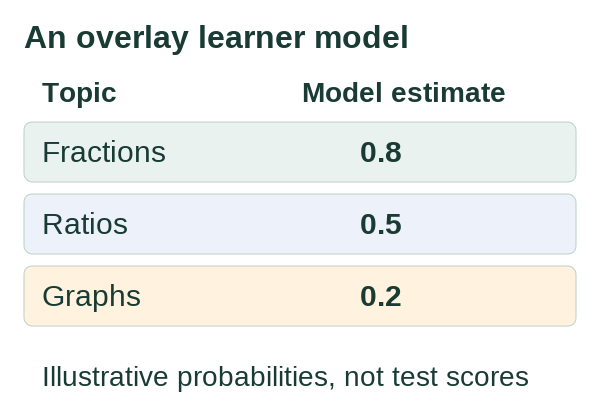
Timing can enter the model as well as correctness. One line of research treats time spent during testing as a predictor of performance. It calls these measures temporal learning analytics. The aim is a working set of such parameters. The set would be built into an adaptive assessment system. That would let feedback services be personalized.[11]
Some systems sort content into small modular pieces. One 2026 study redesigned two topics in an undergraduate course module. The topics became modular learning objects. In these objects, outcomes, materials and assessments are arranged adaptively. A mixed-methods intervention study involved 50 undergraduate students. A regression model predicted personalization well. It explained 44.5% of the differences in learners' perceptions. Content (β = 0.418, p = 0.016) and learning community (β = 0.467, p = 0.005) were significant predictors. The learner interface was not.[12]
Why adaptation may help learning
A separate 2025 experiment compared two groups of students. One group used AI-based learning apps with a personalized method. The other group used traditional methods. The results showed that AI-based applications clearly improved students' self-regulated learning and academic performance. Traditional learning did not do as well.[13]
A 2026 study designed an algorithm that used learning log data. It recommended personalized study time slots. The recommendations helped learners notice productive time slots. They also helped learners align their behavior with their goals. The study noted that such tools can help educators give structured guidance. They can also help give targeted feedback.[14]
One 2020 study argued that adaptive learning environments need self-regulated learners. These learners act on their own. That study built a model of ideas called Adaptive Self-Regulated Learning. It put self-regulation skills into settings that adapt to each learner.[15]
A survey of 849 Japanese university students asked about four things. They were perceived autonomy support, learning preferences, learning strategies, and grade point average. Some of these variables were linked to each other. These included support for autonomy as students saw it, a preference for one class format, and grade point average. Autonomy support included simple acts. One example was explaining the lesson outline to students. Only a few teachers let students choose learning methods, teaching materials, or assignment content. Students with a strong preference for face-to-face learning performed well in either format. Students who slightly preferred distance education did well, especially in distance courses. Students with no preference did the worst. The study suggested that hybrid-flexible courses could support learner autonomy in higher education. Feedback on learning strategies could too.[16]
Design choices and learner control
A mixed-methods study had 320 participants and 24 teachers. Academic performance rose from 62.4 on the pre-test to 78.6 on the post-test. The same study reported a module completion rate of 86.5% and AI-feedback use of 79.4%. It also reported learner engagement of 87.3% and sensor accuracy of 96.2%. Student-centered innovation (β = 0.38) and the effectiveness of learning analytics (β = 0.34) were the strongest predictors of academic achievement.[17]
A different design serves academic advising. Here a system must act before a student has taken any course. One system predicted which students might drop out early. It also generated programme recommendations. It used only signals from before enrolment. It was tested on a public benchmark. The benchmark covered 3630 students across 17 programmes. Combining text with numeric data gave the strongest dropout results after thresholding. The f1-score was about 0.9161 and the MCC about 0.7750. A text-only branch did markedly worse. This suggests that numeric demographics and early curricular totals carried the main signal at that horizon.[18]
Course recommendation in online language education faces a different problem. There are too many resources rather than too few. One system moved language resources from a cloud-central setup to an edge-cloud setup. In the new setup, some processing happens near the learner. It then filtered resources roughly with collaborative filtering, a method that uses the choices of similar learners, and sorted the survivors by content similarity. The experiments that were reported supported this personalized strategy. They found it effective.[19]
A survey of 215 business English students found a strong positive link. Use of smart educational technology went with business language skill and effective communication. It also went with how satisfied students were overall. Students' idea of personalized learning was also significantly positively correlated with their motivation, engagement, and performance.[20]
Some designs aim at young learners across a wide age range. One platform for learners aged 3 to 17 offers 3D pedagogical agents. These agents can be changed to suit the user. It also offers content that adapts. It gives educational visualizations that change dynamically. Its paper outlines a theoretical framework. It also outlines a technical architecture. It projects effect sizes of 0.15 to 0.30 standard deviations. These come from meta-analytic evidence on similar interventions. Those figures are projections. They were not measured in the system itself.[21]
Separating personalized from adaptive learning
A 2025 narrative review of ten recent studies argues that the two terms name different educational purposes. Personalized learning means planned customisation built around a learner's goals, preferences, identity and context. People are at the centre of it. Adaptive learning means real-time changes made by an algorithm. The changes rest on performance data. The review looked at work on intelligent tutoring systems and adaptive platforms. It also covered multi-agent artificial intelligence and human-centred artificial intelligence frameworks. It proposes a model that treats personalisation and adaptivity as related but separate constructs. Each construct needs its own teaching intentions, data models and level of human oversight.[22]
A 2025 paper groups intelligent tutoring systems, adaptive platforms and predictive analytics together. It calls them artificial intelligence technologies that tailor learning to each student.[23] A 2024 paper defines personalized learning as a teaching strategy. It is meant to suit each student's own needs, learning style and ability.[24]
The 2024 article reports that students taught this way engage more. They also keep more of what they learn. They also score higher than students taught by traditional methods.[25]
The 2025 review says that understanding the difference helps prevent misinterpretation. It argues that clear terms guide responsible adoption. They help make sure automation supports human judgement rather than replaces it. The review ends with recommendations for educators, instructional designers and artificial intelligence developers.[22]
Motivation, engagement and self-direction
A 2025 theoretical and analytical study of higher education found that adaptive learning raises students' motivation. That study named three parts of an adaptive setting. These parts had the most promise for motivation. They were individual content, interactive feedback, and digital support for learning. It also reported effects on intrinsic motivation, the drive that comes from inside a person. It also reported effects on self-regulation and on academic responsibility. The motivational effect was stronger when technical solutions were combined with pedagogical support. The study drew on Ukrainian and foreign publications rather than collecting new student data.[26]
The experimental class had 30 students. Their average motivation score rose from 62.34 to 90.78. The first score was in the low category, the second in the very high category. Their average after the same period was 67.12. Independent and paired t-tests gave a significance value of 0.000. The researchers treated adaptive learning as an option for low motivation in mathematics.[27]
It designed and pilot-tested an AI-based adaptive model for higher education. It reported significant gains in learner autonomy, engagement and performance. The model combined a profile of each learner, content delivered adaptively, assessment that shifts as the student works, and analytics on learning.[28]
A 2021 descriptive study used Elitas' e-learning model. It looked at 72 students in an English for Mathematics course. Students' self-regulated learning score had a mean of 88.72. Of these students, 79.17% showed a high level of independence. They used knowledge and experience this way. That study used a one-shot case study design.[29]
A 2026 survey looked at 370 engineering students at one Indonesian university. It studied what predicts how students view learning based on generative AI. Three factors each had a positive effect. They were adaptive learning motivation, technology openness and digital collaboration readiness. Motivation for adaptive learning was the strongest of the three. The researchers also found a pattern of tiers. Motivation for adaptive learning affected how open students were to technology. That in turn strengthened readiness for digital collaboration. The model explained 60.8% of how students saw AI-based learning.[30]
A 2026 review looked at 19 empirical studies. They were published between 2016 and 2026. They were drawn from 5069 records. It looked at adaptive gamification and game-based learning. The focus was preschool and early primary children. Most of those studies reported good results for learning and motivation. But the results were not the same everywhere. Prior knowledge was the most common factor that changed the size of the effect. Benefits were clearest when systems supported children's pacing, prior knowledge, or task difficulty. Some studies showed better learning efficiency, not larger learning gains. In most of the studies only the content was adapted. The game elements stayed the same. Few studies based their design on a clear theory.[31]
A 2026 review looked at AI-based designs for gamified software engineering learning. It reported more engagement and longer-term participation. It also reported a personalized learning pace. It listed the problems that remain. These were common assessment criteria and combining different technologies. System scalability was a third.[32]
A qualitative study looked at 128 first-year accounting students at a South African university. It used an adapted board game and a word association test. Students said they enjoyed it more and felt more excited. The researchers expected engagement and attendance to improve. They expected this when accounting was seen as fun.[33]
A 2026 paper of ideas looked at people and AI working together in adaptive systems. It argued that this teamwork supports personal learning paths and feedback in real time. That paper summed up earlier work. It presented a proposed framework rather than new measurements.[34]
Research
What the overall evidence shows
The type of education technology application used was one moderator, a factor that shifts how strong an effect is. The learning scenario was a second moderator. The duration of application was a third. Other variables did not show significant moderating effects. These were the education phase, such as school or university level, and the disciplinary domain, such as mathematics or language.[2]
A 2022 literature analysis looked at 25 studies on individualized learning. They were published between 2010 and 2022.[35] A 2024 study looked at adaptive systems in K-12 education. K-12 means primary and secondary schooling. It compared control and treatment groups across several schools. The design was quasi-experimental. It found clear gains in achievement. Students in adaptive schools showed higher test score gains than peers in control groups. Students who were struggling caught up. This was especially true in math and reading.[36]
Students in the K-12 study reported more engagement and motivation. They credited this to interactive learning experiences tailored to them. Teachers in that study said the systems helped them adapt lessons to different students. This means fitting teaching to each student's needs.[36]
A 2026 review of AI-based personalized learning covered K-12, higher education and online settings. It also found better engagement and motivation. These came from adaptive content and feedback. That review cited gains in performance in adaptive uses. One was a rise in average scores from 68.4 to 82.7.[37]
The K-12 study found several challenges. They were the cost of setting the system up, the need for ongoing teacher training, and uneven access to technology. Where implementation succeeded there, school leaders backed it. Adequate teacher training was also in place.[36]
The 2026 review listed major obstacles. They were weak infrastructure, unequal access, too little teacher training, risks to data privacy, and institutional resistance to change. It also noted effects that nobody intended. These included learners relying too much on technology and less social interaction between teachers and students.[37]
Studies in particular subjects
A 2022 study with numbers compared a group using an AI-powered adaptive platform with a control group. The subject was mathematics. The experimental group showed higher engagement measures. These included how often students interacted and for how long. They also made larger gains on post-tests.[38]
A 2025 study used mixed methods. It followed 120 university students learning English as a second language. It reported statistically significant gains in language proficiency (p < .001). Vocabulary retention improved by 40%, grammar accuracy by 25% and pronunciation by 35%. These gains were compared with traditional methods.[5]
A smaller experiment tested a system that builds pronunciation perception exercises. It uses word frequency lists and computer-generated speech. It used a pre-test and post-test design. The study had 32 adult Russian speakers learning English. The learners' perceptual gains carried over to new voices but not to untrained words.[39]
It involved 120 undergraduates over 12 weeks. Students in the adaptive group improved much more in web design skill. Students taught in traditional settings improved less. This was judged by pre-test and post-test scores. The study credited the result to three things. These were pathways tailored to each learner, feedback given as students worked, and adaptation driven by data.[40]
In a first study, researchers built a recommendation system for web programming. They used data and feedback. The data came from 41 professional web design engineers. A test group of 13 beginner programmers took part. They worked through 4 weeks of front-end and back-end web development instruction. Interviews afterwards suggested the system's effectiveness was acceptable. A second study built an online platform. It gave feedback in real time and adaptive instruction. Students in the adaptive instruction group did better than those in a fixed instruction group.[41]
One computer science study tested a learning environment called ALMA. The name stands for Adaptive Learning Models from texts and Activities. The environment works in distance learning or blended learning. In blended learning, face-to-face teaching is supported by computer technology.[42]
What changes the size of the effect
A 2023 qualitative study used in-depth interviews and participant observation. It was tested with students at a vocational shipping school in Palopo, Indonesia. It reported a significant positive effect on understanding of material and on learning outcomes.[43]
In the Bukidnon survey, learners had a high level of autonomy. Self-directed learning had the highest mean among the autonomy measures. The same survey found a link between a personalized learning experience and learners' autonomy. It was also linked to how engaged learners were. Relevant and meaningful content had the highest mean of the engagement measures.[44]
What the meta-analyses report
A 2026 meta-analysis combined 69 studies of technology-enhanced adaptive learning. They were published between 2012 and 2021. They covered 9095 primary and secondary students. Technology-enhanced adaptive learning includes intelligent tutoring systems. The combined result was a medium-positive effect. It covered learning results in three areas: thinking, feelings and behaviour.[45]
For affective outcomes, only two moderators were significant. They were feedback type and data collection methods. For behavioural outcomes, two things changed the results a lot. They were learner traits and the hardware used in experimental groups. Four things each changed the summary effect for at least one outcome measure. They were research context, adaptive strategy, technology and study quality.[45]
A 2025 meta-analysis looked only at mathematics. It combined 89 peer-reviewed studies with about 45,000 students. It reported a moderate overall effect size of 0.67. The 95% confidence interval was 0.58 to 0.76. How closely a program was followed strongly changed the effect. High-fidelity implementations produced an effect size of 0.89. Low-fidelity versions produced 0.38. Socioeconomic status also changed the size of the effect. Effects were larger in lower-SES contexts (0.82) than in high-SES contexts (0.54). Tutoring systems that adapt produced bigger effects than systems used only for assessment. Effects also grew when interventions ran longer.[46]
A 2026 review of artificial intelligence in adaptive learning says the question of effectiveness is still open. It needs more study. That review reports gains in student motivation and in understanding of the material. It also notes ethical concerns and a dependence on the quality of input data.[47]
A 2026 scoping review looked at 21 empirical studies in K-12 online and distance education. Most studies reported gains in engagement, motivation and self-regulation. The same review found that the benefits were spread unevenly. They often favoured learners with better resources. This was especially true where teacher mediation and institutional support were modest. It also found that inconsistent definitions blurred the line between genuine intelligence and automated adaptation.[48]
A 2023 review of studies looked at 32 papers. They covered learning analytics and dashboards in adaptive platforms. It found no studies that evaluated the deep or implicit structure of learning activities. All of those studies looked at the surface structure of activities. They also looked at how students, teachers and the platform interacted.[49]
A 2026 review looked at 69 articles on adaptive dashboards. Of these, 44 covered adaptive dashboards for self-regulated learning. It recommends features such as goal-setting, progress tracking, and performance prediction. That review calls for longitudinal designs, which follow students over time. These would test whether these dashboards change self-regulated learning.[50]
Adaptive systems in language learning
After that, the adaptive group gained significantly in every skill tested. F values ran from 19.30 to 44.65 and p values were at or below 1.82 × 10⁻⁵. Effect sizes show a gain in standard deviation units. They were moderate for writing (d = 0.62) and large for listening, speaking and reading (d = 0.84 to 0.93). Learners rated the platform easier to use, more useful and more enjoyable. Those ratings were linked to their gains in proficiency. Qualitative data pointed to higher motivation, more autonomy and less anxiety. The report itself notes its limits. These were a short duration, a sample that was all alike, and how anxiety was measured.[51]
A 2025 design paper describes a mobile application. It uses the Ebbinghaus forgetting curve and a spaced repetition system. These decide when each flashcard comes back. Each card shows a word in text, with its transcription and an example sentence. It also has audio for listening and pronunciation. The translation appears only after a tap, to encourage active recall. Learners swipe right for known items, left for unknown and up for learned. Intervals grow for well-known items and shrink for difficult ones. This follows an SM-2-style model. The paper outlines the effects it expects. Vocabulary would be kept longer, with fewer repeated exposures. It reports no trial results.[52]
Two studies measured outcomes with a pre-test and a post-test.[53][54] The other compared a game-based application with an adaptive application built on artificial intelligence. The comparison lasted four weeks. It involved 120 undergraduate foreign-language teacher trainees in Kazakhstan, with 115 matched across a pre-test and a post-test of parallel twenty-item forms. Scores rose markedly in both groups. An analysis of covariance adjusted for pre-test scores. After that, neither application showed an advantage over the other. Open-ended answers differed by mechanism. The game-based tool was valued for game-like motivation. The adaptive one was valued for adaptivity, feedback and local relevance.[54]
Expert review judged the textbook valid. Lecturers and students judged it practical. Trials found it helped speaking performance and confidence.[55]
A 2022 study at King Saud University used mixed methods. It found that teachers and students often felt stressed by online language learning. They also rated it difficult. It recommended support for both groups. This could be a basis for adaptive teaching methods.[56]
Adaptive learning in mathematics and science
Several studies compare an adaptive system with ordinary teaching in whole classes. They do not use random assignment.[57][58] A quasi-experimental study of ninth-grade natural sciences compared adaptive flipped learning with conventional methods. The experimental group reached a posttest mean of 84.83. The control group reached 69.25. The normalized gain measures improvement from pretest to posttest. For the experimental group, the figure was 43.6%.[57]
A second study had 78 undergraduates. It paired flipped classroom instruction with mastery-oriented adaptive assessment in mathematics. The experimental group's posttest mean was 82.35 (SD = 4.38). The control group's was 67.59 (SD = 7.79), a difference reported as very large (Hedges' g = 2.55). The gap between the groups held up once pretest scores were taken into account. The result was F(1, 75) = 94.73, p < .001.[58]
Other work targets specific topics that students find hard.[59][60] In introductory college physics, students struggled with some vector concepts. This showed up on the test of understanding of vectors (TUV). The question bank for personalized adaptive learning was then changed. Scores on 12 TUV questions were compared across two semesters. The comparison focused on graphic representation, direction and magnitude in unit vector notation. It also covered graphical methods for addition, subtraction and multiplication by a negative scalar.[59]
A pretest-posttest study looked at 192 eleventh-grade students in Costa Rica. It looked at math functions taught through an adaptive platform. The improvement held for both genders. Yet after the intervention, men showed significantly higher performance.[60]
Some evidence comes from reviews and from studies combining adaptive platforms with other teaching methods.[61][62] A review covered research from 2015 to 2024 on adaptive reasoning in mathematics. It reported gains of up to 82.7% with collaborative problem-solving tools.[62] A study in Azerbaijan combined adaptive learning with other teaching methods for physics subcompetences. These included a unit on mathematical modeling. That study used control and experimental groups and reported high effectiveness, while noting that the practical effectiveness of adaptive learning remains debatable.[61]
Adaptive learning in programming and professional subjects
Learning to program has obstacles. An adaptive system can address them. This comes from a 2020 review of the literature. These included ELaC, Java Guide and Java Grader. The review reported that these systems adjust learning content to each student's learning styles and preferences. The review also found that such systems can help students of different abilities learn programming. It weighed the pros and cons of the systems' features and technology. It asked whether they solve the problems met in learning programming.[63]
One later design tied the adaptation to cognitive style. It drew on Fleming's VARK learning style model. A 2025 study built an adaptive programming model for Informatics majors on N. Bruner's method of differentiated instruction. The team put digital teaching modules on the Khan Academy platform. Students took courses matched to how they think and learn. Students in that experiment improved their academic performance by an average of 15%. They also understood algorithms and data structures better.[64]
Engineering courses often give all students the same information at the same pace. They ignore each student's own skills and knowledge. A 2022 paper describes an adaptive e-learning environment. It was built for the Engineering Design course at Ruhr-University Bochum. Its aim was a personalised learning experience, with digital materials provided for each student.[65]
A textile engineering English system was built on a knowledge graph. The graph covered technical terms, engineering processes, equipment and standards. It also used dynamic learner modeling. It reported 86.4% accuracy in recognising terminology. It reported 84.2% accuracy in pulling key information from technical documents.[66]
Anatomy teaching has tried adaptive lessons in a pilot module on liver anatomy. It has also tried them in a set of 21 interactive online lessons.[67][68] A 2024 pilot used a computer tutoring system. It was used in a flipped classroom on liver anatomy. The system personalizes learning with artificial intelligence. The pilot had 123 first-year medicine students. Conscious incompetence, where students know what they cannot yet do, fell from 18.11% at the start to 1.87% at the end. By the end, 98.73% of students showed conscious mastery of the material.[67]
A separate 2024 study looked at 276 first-year allied health students. The study had 21 interactive online adaptive lessons. Completing more of them went with better performance on all three assessment items (p<0.05). Students also felt they understood anatomy better after the lessons (p<0.0001).[68]
A 2025 brief on human resources education argues that traditional teaching no longer prepares future HR professionals for a changing workplace. It pairs adaptive platforms with virtual reality for practice of simulated skills. These platforms use algorithms and data analysis to give each student lessons suited to them.[69]
A 2022 study modeled how four factors relate to students' choice of entrepreneurial behavior. The factors were entrepreneurial motivation, ability, willingness to act, and environment. A 2022 survey looked at college students starting or planning a business. It used structural equation modeling, a statistical method for testing linked hypotheses. All nine hypothesized effects were positive. The entrepreneurial environment had the largest effect on behavior choice, at 0.329. Its effect on entrepreneurial motivation was 0.485. The study notes a 10% success rate for student entrepreneurship.[70]
Adaptive assessment and computerized adaptive tests
A 2023 study built a CAT system for multiple-choice tests. It compared this with a test scored by classical test theory (CTT). The comparison covered 873 students at a state university in Turkey. It ran over three years in three phases. The adaptive system estimated students' success levels with very high reliability. Its scores also had a strong positive link with the paper-and-pencil scores. Students in the adaptive system saw 50% fewer questions than students taking the fixed test.[71]
The tool served students in an Electrical Power Installation Engineering program. Experts judged its items for fit. Analysis with the Rasch model found 10 items that did not fit and 50 that did. The knowledge test had an Alpha reliability of 0.934. A related attitude questionnaire of 8 items showed 0.731. The study reported that the system made it easier for teachers to carry out assessment accurately and practically.[72]
In practice
Evidence from schools and universities
A two-semester study at a mid-sized university followed 500 undergraduates. The students came from several subjects. One group used a standard learning management system. The other used a system linked to adaptive software. The linked group showed a statistically significant gain in academic performance (p < 0.05). Its activity logs and interaction counts were higher too. Students in that group said they valued the personalised paths and timely feedback. They also reported more motivation and satisfaction.[4]
A separate survey looked at 500 students at five institutions. Students using AI-based adaptive systems had significantly better grades than peers in conventional classrooms. They also showed more engagement and higher retention. That survey also listed technical barriers and the initial cost of putting a system in place. It added reluctance to change among educators and students.[73]
An adaptive tool was offered for extra credit. This was in an undergraduate course on management information. The study compared tool use with test grades and course grades. The correlations showed no link between the two. Students who completed the tool and students who skipped it did not differ on any of the four tests. They also did not differ on final course grades. The researcher concluded that the tool served convenience, preference and satisfaction. It did not improve outcomes. The researcher advised random assignment in future studies.[74]
In colleges across Thane District, 40% of educators said they used AI in their teaching. Among students, 80% said they actively used AI tools. Despite that gap, 65% of faculty and 70% of students said they were satisfied with AI-enhanced learning.[75]
Some work on adaptive routes for university courses is still at the design stage. No outcome data has been reported yet. One proposal for a technical university course sets out five stages. They are diagnostic orientation, profiling, route design, corrective and developmental support, and reflective evaluation. Its author expects the method to raise motivation. The author also expects it to improve mastery of theory and practice. The author also expects it to strengthen independent learning. These results are expected, not measured.[76]
Games, scaffolding and collaboration
Digital games are one place where adaptive design has been tested against simpler alternatives. An adaptive game changes task difficulty to match each child's level. It keeps checking how the child is doing. A 2020 study put 191 children in their third year of kindergarten into one of three groups. One group played an adaptive version of a reading game. One group did pen-and-paper exercises. Phonological awareness and letter knowledge improved a lot in all three conditions. The study found no differences between the groups on that improvement. It also found none on reading fluency at post-test. It found none on motivation or self-concept either.[3]
Systems can also adapt the support given to a learner rather than the difficulty of the task. The system then gave multi-level feedback. This feedback was shaped by those skills and by how well the collaboration went. Students were split into an experimental group and a control group. Both groups took part in collaborative problem-solving activities. The adaptive system had a positive effect on student participation. It also helped their collaborative problem-solving skills.[77]
A 2023 study of this resource reappropriation approach combined a literature review with surveys and questionnaires. Educators and students filled them in. The study reports a positive effect on student engagement. It also reports a positive effect on learning outcomes.[78]
Adaptive feedback and scaffolding in practice
One adaptive scaffolding system for middle school physics was built around both the thinking and the motivation sides of learning. In an experiment on velocity and acceleration, the system raised performance and motivational outcomes. Students responded well to it. Some learners knew less. They were also motivated by outside rewards. They gained the most from the scaffolds.[79]
A later classroom study tested adaptive scaffolds in Betty's Brain. In this open-ended setting, middle school students build a causal model. They build it to teach a virtual agent. The system gave feedback in a conversational style. It did this when a student's behaviour or performance changed. Such a change often meant a learning strategy had stopped working. With 98 middle schoolers, the results were mixed. Hints that helped students check and fix their causal models worked better than prompts of encouragement. Students with high and low learning outcomes also responded differently to some hints. This showed in their behaviour and performance after scaffolding.[80]
Adaptive testing is a related kind of support. In it, the difficulty of recall questions changes with the answers given. This ran across three weeks in a row. Exploratory analyses found that the advantage of restudy shrank. It shrank as the retention interval grew. The researchers concluded that adaptive retrieval practice was not generally better. Retention interval and preparation for class may decide when it helps.[81]
Without guidance, students often pick problems that are too simple or too hard. They end up bored or discouraged. A system called JavaGuide guided students in a Java programming course. It pointed them toward suitable questions. A classroom study ran for three semesters. That study confirmed educational and motivational effects of adaptive navigation support.[82]
Guidance can also come from timing rather than content. A model-based adaptive fact-learning system estimated how fast each learner forgets. From that estimate it predicted overall grades. It also predicted answers to single exam questions.[83]
Adaptive rules do not always work better than fixed ones. A 2010 analysis showed that adaptive rules for sharing out study time often fail to give the best plan. This happens when the best allocation jumps sharply as the time budget changes. Logistic learning curves create exactly that kind of jump. Then self-guided study is likely to do poorly compared with learning that is guided well.[84]
Some designers have proposed feeding a learner's current cognitive state into the system. They would use measures such as heart rate and blood pressure. Observation ran over 1,5 month. Psychological and physiological changes differed from person to person. The researchers proposed using such measures to adapt learning. The aim was to match a learner's readiness on a given day.[85]
Adaptive teaching with and without computers
Adaptive teaching is the classroom practice of adjusting instruction to students' needs. It also responds to how well each student understands. At a fine-grained level, researchers also call this contingent support. Research has found such contingent support to work when a teacher works with one student. It also works with a small group. The research stresses how teachers' diagnostic strategies work together with instructional prompts. These prompts aim at tailored support. The teachers in that study rarely changed their approach. This shows a need for professional development.[86]
A qualitative case study looked at one Grade V class in Central Java. It found that differentiated strategies improved students' comprehension in Indonesian language lessons. Success depended on early diagnostic tests and simple technologies. It also depended on teamwork between teachers and parents. Limited resources were still a barrier. So was teachers' readiness to manage classrooms with mixed abilities. Teachers responded by strengthening training and making better use of technology. They also improved communication with parents.[87]
A case study at one secondary school in East Java described an adaptive curriculum. It adjusted lesson materials and put students at the centre of lessons. The curriculum also used formative assessment, which checks understanding during teaching rather than at the end. That study reported gains in student engagement and critical thinking. It also noted limits from differences among participants and from the single location.[88]
One Grade III teacher and four students were watched. The school was a rural elementary school in Central Sulawesi. They used five ways of managing. These were collaborative rule-setting and flexible arrangement of the physical room. They also included structured use of instructional time, persuasive teacher-student interaction, and steady positive reinforcement. Students showed discipline mainly through punctual attendance and completed assignments. Students followed the rules only partly during lessons. A teacher made small zones within the room on the spot. These produced unexpected reductions in off-task behavior. This suggests that arranging space can partly offset scarce resources.[89]
One proposal for faculty development makes an argument. Giving teachers student learning data is not enough. Teachers must also learn how to use it. It recommends one-to-one coaching. A coach from inside the institution works with faculty in a relationship built on trust. Sessions should be held often, in a setting that feels comfortable, safe and inclusive. Senior administrators should back the coaching consistently.[90]
A mixed methods study looked at upper-primary teachers. It also looked at adaptive learning technology. This technology personalizes the curriculum and learning for each learner. It is meant to support learning led by the teacher. The study concluded that automated features can create new challenges for teachers. These go beyond their digital skill and their ability to use certain features, whether real or merely perceived.[91]
A realist review described adaptive expertise as the ability to handle changed situations and shifting circumstances well. The review named five features of work-based learning that support it. These are contexts that are integrative and challenging, reflective practice, interaction with others, guidance, and the traits of the learner.[92]
Adaptive learning for students with disabilities
For students with low vision, simple adaptive print has been tested. A 2025 study made an adaptive activity book for science learning. It was called "Energy for All". It used a design model called ADDIE. The letters stand for analysis, design, development, implementation and evaluation. The participant was one fourth-grade student with monocular visual impairment, meaning impaired vision in one eye. Experts rated the book highly feasible. Media validation scored 89% and content validation scored 90.25%. The average response score was 87.25%. Learning activity went up by 35.3%. Learning outcomes went up by 46.7%.[93]
For blind students, an audio-based model has been tested against ordinary teaching. A 2026 study built an adaptive audio-digital model. It combined self-regulated learning, universal design for learning and cognitive load theory. It also used Vygotsky's zone of proximal development. It drew on Mayer's multimedia learning principles too. The trial involved 20 students with visual impairments at one Indonesian school. They were split into groups of 10, over eight sessions in four weeks. The experimental group gained more in learning independence (N-Gain = 0.60) than the control group (N-Gain = 0.22). The difference was statistically significant (t = 3.87, df = 18, p = 0.001). The effect size was very large (Cohen's d = 2.59).[94] Cohen's d is a measure of effect size based on the difference between two means, where a value near 0.5 counts as a medium effect and a value near 0.8 as a large one.[95] The researchers noted that the small sample and short duration limit how far the results apply.[94]
A meta-analysis of artificial intelligence tutoring systems has studied deaf and hard-of-hearing learners. A 2026 review found 3,121 records across five databases. It kept 18 studies for a qualitative synthesis. It put 15 into the meta-analysis. The review left out digital tools that do not adapt. The combined effect on learning outcomes was moderate (Hedges' g = 0.48, 95% confidence interval 0.35 to 0.61). Results varied a lot between studies (I² = 67%). The largest effects appeared where adaptive support was paired with sign language interpretation. This was clearest for reading and speech development.[96]
A 2017 paper argued that existing virtual learning environments are not built to be flexible. These online systems for delivering courses cannot meet these students' needs. It proposed using semantic web technology. This lets a computer model a learner and their needs. Simple logical rules would then suggest suitable materials from a large store of them. The paper presented combination rules as a foundation for more inclusive environments. It reported no trial of the approach.[97]
Classroom studies of adaptive methods for students with learning difficulties report gains, mostly from small trials. A 2026 quasi-experiment in Iraq studied 60 primary school students with dyslexia, dyscalculia or dysgraphia. It assigned them to two groups of 30. One group had lessons supported by artificial intelligence for eight weeks. It improved in classroom behavior (F(2,58) = 312.85, p<0.001, partial η² = 0.915), while the control group showed no significant change. A 2025 experiment studied 180 students aged 10 to 16. Those using adaptive systems scored better, were more motivated and worked more on their own. A 2026 action research study took place in one Indonesian classroom. It raised the mean score of four students with learning barriers from 35.00 to 70.00, a moderate normalized gain of 0.54.[98][99][100]
Adaptive pacing and support for specific needs
A 2025 conceptual review argues that standard curricula are taught at one uniform pace. Such teaching often falls short of what students with disabilities need. The same review proposes dynamic user profiling, generative AI models that create and modify content in real time, immediate feedback, and long-term progress monitoring as core components. Its claims rest on a systematic review of existing knowledge, not on a trial. It presents a framework for building such systems.[101]
A 2026 study looked at English learning for students with disabilities. It also names pace, task complexity, communication formats and assessment strategies as features adaptive tools can adjust. That study adds a caution. Technology does not replace teaching interaction. How well it works depends on the teacher. The teacher must be able to select and adapt tools to individual needs.[102]
A 2019 prototype for children with autism used adjustable pictures in place of text. Its simple interface followed child computer interaction principles. Its evaluation compared the adaptive system with traditional learning methods. It used observations and an autism treatment evaluation assessment. It reported better skills in everyday tasks.[103]
A 2024 paper describes a framework for reinforcement learning with several goals. It is for pacing instruction in autism. It weighs learning progress against engagement. The framework was tested on a dataset of 847 learners with autism. It reported learning progress gains of 34.7% and a rise in task completion from 72.3% to 89.3%. The paper also reports a 42% drop in educator training needs. This is compared with existing adaptive systems. It states that its fairness measure held across different autism presentations.[104]
A 2023 qualitative case study looked at adapted art instruction. It studied three children with autism. Each lesson plan was built from the results of a first ability test.[105]
A 2026 paper argues that current e-learning platforms deliver static content. As a result, they fail to adapt to changing attention levels and varied learning needs.[106] A 2026 randomized pilot trial gave 40 children with ADHD either eye-tracking-based adaptive content or conventional digital content. The children were aged 6 to under 12 years, and the trial lasted four weeks. The Attention Composite rose from 47.63 at Week 1 to 52.14 at Week 4. The groups differed on some attention measures but not on others. The trial authors call for larger confirmatory studies before the approach is adopted.[107]
A 2025 randomized controlled trial assigned 60 children with ADHD, aged 8 to 12. One group got 8 weeks of EEG-guided adaptive learning. The other got standard educational support. The guided group showed a lower theta/beta ratio and higher frontal alpha power. It also gained in attention span and impulse control. Scores rose in math, reading comprehension, and writing. The paper notes that higher frontal alpha power can also come with anxiety and depression. This may confuse the results.[108]
Other work targets particular learning difficulties. This is a general term for conditions such as dyslexia, dyscalculia and dysgraphia. A 2021 usability study in two phases built five serious games. The games covered different parts of these difficulties. It tested them with 10 special education educators and 23 children. Educators rated the games 8.41 out of 10 on average (SD 0.87) in the first interview. They rated them 8.71 (SD 0.64) in the second. The children averaged 9.07 (SD 0.56). The study compared standard and adaptive difficulty versions. It used average playtime and number of false answers. It reported that the games offer systems that adjust difficulty.[109]
For Down syndrome, a 2025 paper suggests a clustering method. It sorts errors into conceptual, procedural and attentional groups. The paper treats engagement as a changing state rather than a fixed score. But it remains a conceptual model with no trial results.[110]
Some teaching uses sight, hearing, touch and movement together. These multisensory approaches appear in language teaching for children with special needs. A 2026 literature review reports on multisensory strategies. These include picture cards, letter tracing, role play and audio-visual media. They can support vocabulary, reading, writing and speaking for children with special needs. The review adds that effective use requires teacher competence, suitable media, classroom flexibility and adaptation to each category of need.[111] A 2026 review of interactive video describes quizzes, repeated material and self-directed navigation. These features let students work at their own pace.[112]
A 2025 study looked at 40 children aged 6 to 10 with autism or ADHD. It used EEG concentration, facial expressions and game performance. These picked visual, auditory or textual cues in real time. It reported concentration up 22.4% and emotional engagement up 24.8%. Game performance rose 32.1%. The results had p<0.001 and Cohen's d>1.4.[113] Fixation duration and saccade distance did not change much (p = 0.087 for both). The changes did not follow a steady upward pattern.[114]
Adaptive learning in teacher education and classrooms
One published teaching unit shows how a course for preservice teachers can offer personalized learning. The unit sits at the end of a one-credit hour course. The course covers K-12 online and blended teaching. Students work through it on their own. Weekly online check-ins track their progress. Its centre is a choice board, a grid of optional activities. Each student picks a set from it. Here the set is three activities. They cover four blended teaching competency areas from earlier units. Each chosen activity asks the preservice teacher to think about the activity itself. It also asks them to think about their own experiences with personalized learning. The design lets each student spend time on the skills they feel are weak. They can also choose ones they find interesting.[115]
The workshop starts from one idea. Universities now run larger courses. They are still expected to make sure students succeed. That makes timely feedback and real engagement between teachers and students harder. The University of Auckland adopted learning analytics. It was one of several approaches that use technology. They were meant to support teaching and learning at scale. Facilitators also described how universities use the tool now. They use it to improve the student experience and to shape how courses are taught and designed.[116]
A more detailed example is an intervention engine built on learning analytics. It is named the Intelligent Intervention System, or In2S. It delivers three kinds of intervention: instructional, supportive and motivational. Instructional intervention depends on the tasks used to assess learning. Learners see a red, yellow or green signal light for each task. Supportive intervention reaches learners through a dashboard. Motivational intervention uses game elements, such as a leader board, badges and notifications. The learning experience in an e-learning setting lasted nine weeks. Then eight of the most active users took part in focus group interviews. Those learners said the system was useful and wanted to use it in other courses.[117]
Lecture recordings are a common way to make study more flexible. A survey of 664 undergraduate and postgraduate students looked at how they are used. Most respondents treated recordings as extra resources. They did not treat them as a replacement for lectures. They said the recordings did not change their decisions to attend. Students said they used the recordings to prepare for exams and to revise. They also used them to compare notes taken in class. The researchers used descriptive statistics and sentiment analysis together. This was to check the survey results.[118]
Each person got an online questionnaire through a messaging application. It drew responses from 107 teachers in Romanian pre-university education. They replied between February 20 and 23, 2024. Many had made such resources during the COVID-19 pandemic restrictions. At that time they sought new methods and tools for online teaching and assessment. The study names these tools as ways teachers motivate students and improve school results. Teachers adjust methods to fit students' needs.[119]
At university level, one survey of 100 students in Sri Lanka looked at learner qualities. It asked which ones predict use of adaptive learning systems driven by artificial intelligence. Such systems are described as offering personalization of content and dynamic learning pathways. They also give timely feedback on progress. Cognitive engagement had a smaller effect on adoption. The model explained 48.1% of AI adoption.[120]
What this looks like when you study
In one preschool study, 191 children in their third year of kindergarten played a reading game. They played once a week for 30 minutes over 5 weeks. The adaptive game did not produce larger gains than the other conditions. Motivation and self-concept were also similar across groups.[3]
Thirteen new programmers took a four-week course in web development. It covered front-end and back-end work. Each worked from a learning path tailored to that student. The recommendation model matched the actual results for 9 of the 13 students. That is an accuracy rate of 69.23%. The researchers noted that a good learning path does not guarantee good performance. Students differ in self-expectations and diligence.[41]
In an elementary science study, 17 teachers taught 341 students. The topic was floating and sinking. Researchers coded how often teachers adjusted instruction to students' understanding. Adaptive classroom talk predicted students' long-term conceptual understanding. This showed on the final posttest. It did not predict it on the intermediate posttest. The teachers rarely changed their teaching to fit students. The authors advise professional development to build this skill.[86]
In a university course, students read book chapters. They then practised in one of three ways. These were adaptive multiple-choice testing, non-adaptive testing, or restudying. On a surprise test in week 4, restudy did better than both testing conditions. Adaptive testing did the same as non-adaptive testing. Adaptive testing beat non-adaptive testing when the time before a retest grew. It also beat it when students had fully read the assignments.[81]
To study with an adaptive system, first register for the course. The system can then estimate how much you know. Then work through the lessons and activities the system arranges for you, and take the tests it offers.[1]
Suppose you answer a question incorrectly in an adaptive retrieval system. Expect the next question to be easier. The system gradually lowers difficulty after errors. If you are preparing for a test far in advance, consider this. Adaptive testing may help more when the delay before the test is longer.[81]
Later developments
Spreading adaptive systems into institutions
A 2004 systematic review looked at how new ideas spread in service organizations. It set out a model for spreading and keeping new practices. Its authors asked for the model to be tested more widely. They want tests in a range of settings. That review also found clear gaps in knowledge about how diffusion works in organizations.[121]
The history of the idea matters here. The book states that the personalized learning now offered by education technology companies dates back to the 1920s. A 2021 book by journalist Audrey Watters traced teaching machines across the United States. The period ran from 1920 to the 1960s. It also traced the changes in the K-12 school system over those decades.[122]
Teachers who saw long-term benefits were more willing to invest time and effort. They put this into learning and using the tools in their classes.[123] A 2025 review of adaptive systems in mathematics education made a similar point. It named teacher readiness among the challenges that remain. That review argued that adaptive systems work best as additions to teaching. They are not replacements for it. Using them well takes careful design and professional support.[124]
One study used propensity score analysis. It tested a system built inside one institution. This is a quasi-experimental method. It is treated as a workable alternative to randomized controlled trials. Course scores differed in a way that suggested the system had value. The difference was not statistically significant at the 95% confidence level. The same study noted that earlier findings on course scores have been mixed. The research approaches used are part of the reason.[125]
A 2024 evaluation in two Saudi Arabian secondary schools used 40 students. The AI-based system improved performance, especially for low performers. It also made students more satisfied. That study also found problems with technology upgrades. It found problems with teachers' readiness and with students' skill in using information technology.[126]
An engineering course put preclass lessons on an online adaptive platform. This ran over two semesters. It had 146 students. Final examination scores were linked to the raw score of the adaptive lessons.[127] Scores on multiple-choice exams and concept inventories were slightly higher with adaptive lessons. In that online comparison, Pell grant recipients showed the most promising results.[128]
A later study used adaptive platform data to build decision-tree models. These predicted which students would finish with a C or lower. The best model predicted low-performing students with 85% accuracy. It did this in the third week of the course. Yet only 23% of the students who were identified accepted the support offered.[129]
Some evidence about adoption comes from forecasts, not from classrooms. A 2026 study used Monte Carlo simulation. It projected the effects of adaptive platforms in higher education. The method ran thousands of rounds of simulation. That study reported that evidence on long-term effects is still limited. Institutional settings, learner characteristics and technology infrastructures vary.[130]
A 2026 review examined 112 publications from 2006 to 2023. It proposed a teaching framework for technology that promotes self-regulation and cognitive strategies. That review suggested later research should focus on specialized, technology-driven ways to personalize learning.[131]
A 2026 review looked at 76 articles. They were published between January 2023 and May 2025. It found that adaptive settings helped by generative AI can improve personalization. They can also give feedback that responds to the student. That review drew lessons for teacher education programs. It focused on building professional skills. These were for ethical, reflective learning driven by data.[132]
Criticism
Teachers, transparency and fairness
A second line of work asks a question. Are adaptive systems built on teaching principles, or on algorithms alone? One 2026 analysis looked at ten peer-reviewed sources. It argues that design in higher education is still driven mainly by technical and algorithmic concerns. Explicit teaching reasoning does not drive it. That gap limits how well teaching works, the analysis says. It also makes adoption by teaching staff harder. The analysis names four parts that every such system must combine. They are a model of the learner, a model of the subject matter, and a model of teaching. The fourth part is the adaptive engine and its interface. It reports on systems built around an explicit model of teaching. Algorithmic capability alone was not the basis. These give steadier gains in engagement, motivation and academic performance. One principle is keeping teacher agency, meaning teachers' own control over decisions. This applies to teaching guided by algorithms.[133]
A 2026 survey in Kenya got answers from 30 stakeholders at two primary schools. Of these, 33.33% were teachers and 20% were children. Respondents showed a moderate level of computer literacy (73.33%). They also showed a lack of experience with artificial intelligence (60%). Half of them (50%) called teacher training essential or significant. The study also reports that teachers place moderate trust in AI. Just over half (53.34%) reported a significant or moderate effect on learning outcomes. The study proposes options that need little infrastructure. These include virtual tutors and platforms that work through short message service (SMS). These would support inclusive education.[134]
A 2026 mixed-method study surveyed 420 undergraduate students and 60 academic staff. They came from three universities in Nigeria. It found that 64% of respondents used generative AI tools actively to support learning. Also, 58% used learning analytics dashboards regularly. They used them to check performance and get feedback. Using these tools and using the dashboard together predicted better academic performance (β = 0.36, p < 0.01). They also predicted higher student engagement (β = 0.42, p < 0.001). Unregulated use of generative AI went with more concern about plagiarism and academic misconduct (r = 0.31, p < 0.05). The study recommends building educators' skills. It also calls for clear AI policies at institutions. It also recommends checking the impact of teaching as time goes on.[135]
Criticism and open questions
One 2025 study compared two groups. An experimental group was taught with intelligent tutoring systems and adaptive feedback. A control group was taught by conventional methods. That study reported much higher post-test scores for the experimental group. A statistical test gave p < 0.05. The abstract gives no number of participants. So the size of the comparison cannot be judged from it.[136]
Access, equity and low-resource settings
Adaptive learning promises to fit instruction to each student, so a natural question is whether it narrows or widens gaps between students. A 2026 quasi-experiment with 720 students in six institutions ran for 14 weeks. It compared adaptive lessons with ordinary teaching. The adaptive group gained 28.6% on average. The control group gained 14.3%. Students in the lowest achievement quartile, the bottom quarter of the class, improved by 35.8%. The gap between high and low performers fell by 17.6%. Gains were largest in Mathematics at 32.4%, then Science at 29.1%. English Language came next at 24.7%, and Social Studies at 22.9%.[137]
A 2025 article used peer-reviewed evidence and global education reports. It also used cases from low-resource settings. It concluded that adaptive artificial intelligence tools can improve learning outcomes. They can also give early notice when engagement declines, in places short of teachers and materials. The same article named infrastructure, ethical concerns and the need to adjust tools to local context as constraints that call for provisional fairness.[138]
A 2026 framework was made for large African universities with few resources. It treated three things as inputs the system must plan around. They were unstable internet, limited device access and irregular attendance. Its designers argued that most adaptive systems are built for stable settings with good resources. They work poorly where resources are scarce.[139]
Another obstacle is that data is scarce. Adaptive systems depend on records of student interaction. A 2025 paper described the cold-start problem. A new student has too little history for the system to personalize well. The same problem appears in small advanced courses. It also appears where privacy rules limit data collection. The paper proposed a two-stage method. It builds a general model from courses with plenty of data. Then it adjusts the model to a new student after a few interactions. Its evidence came from a simulation, not a real classroom.[140]
Smaller studies in under-resourced settings report positive results. A 2020 intervention with 40 first-year engineering students at a distance education university raised overall pass rates by 25%. A 2023 case study of a polytechnic classroom in Malaysia found that the adaptive design raised students' motivation in mathematics and improved their outcomes.[141][142] Its pass rate had been below 50%. A personalized program gave struggling learners basic steps and excelling students harder tasks. The overall pass rate rose by 25%.[141]
In Malaysia, a public polytechnic ran an adaptive classroom for a Business Mathematics course. It was credited with raising motivation and outcomes among students who differed in prior knowledge and pace. It used questionnaires, interviews and formative assessment. Its findings rest on one course.[142]
Students do not meet these systems in the same way. A survey asked 552 undergraduate science students at six Nigerian universities. Their views differed by level of study and by type of university. Student nurses in a Danish programme reacted very differently to the same adaptive resource.[143][144]
A survey covered 552 science undergraduates. They were at six government universities in South-Western Nigeria. It found more positive views among students at higher levels of study. It also found more positive views in state universities. Gender made no significant difference in that survey.[143]
Common misconceptions
Many people assume that adaptive digital games teach better than non-adaptive games. It gave no larger gains in phonological awareness or letter knowledge. It also produced no larger gains in reading fluency. A non-adaptive version and pen-and-paper exercises did just as well.[3]
Key studies
| Year | Study | Sample | Design | Finding |
|---|---|---|---|---|
| 2020 | Vanbecelaere et al.[3] | 191 children in the third year of kindergarten | study with three conditions | All groups improved phonological awareness and letter knowledge, but the adaptive game produced no larger gains than non-adaptive or pen-and-paper training. |
| 2020 | Greving et al.[81] | field experiment with three conditions: adaptive testing, non-adaptive testing, restudy | Restudy outperformed both testing conditions on a surprise test, but with longer retention intervals and full reading, adaptive testing outperformed non-adaptive testing. | |
| 2022 | Ling & Chiang[41] | 13 beginner programmers in a test group, plus 41 professional web design engineers for model development | two studies: recommendation system development and adaptive instruction platform evaluation | The recommendation model was 69.23% accurate, and students in the adaptive instruction group performed better than those in the fixed instruction group. |
| 2022 | Hardy et al.[86] | 17 teachers and 341 elementary school students | classroom coding study with multilevel regression | Adaptive classroom discourse predicted long-term conceptual understanding on the final posttest, but teachers rarely acted adaptively. |
| 2024 | Andhika et al.[4] | 500 undergraduate students at a mid-sized university | mixed-methods study over two semesters with control and experimental groups | The adaptive learning system integrated with the LMS produced statistically significant improvement in academic performance (p < 0.05) and higher engagement. |
| 2024 | Hu[2] | meta-analysis of 36 experimental and quasi-experimental studies from 31 papers | AI-assisted personalized learning had moderately positive effects on knowledge, competence and emotional development. | |
| 2024 | Alenezi[126] | quasi-experiment in two Saudi secondary schools with 40 students | The AI system improved performance, especially for low performers, and student satisfaction, but teacher readiness and IT literacy were problems. | |
| 2025 | Fransisca[46] | 89 peer-reviewed studies with approximately 45,000 students | meta-analysis | Adaptive learning technologies had a moderate overall effect size of 0.67 on mathematics achievement, with high-fidelity implementations producing 0.89 versus 0.38 for low-fidelity. |
| 2026 | Wang et al.[45] | 69 studies with 9,095 primary and secondary students | meta-analysis | Technology-enhanced adaptive learning had a medium-positive effect on cognitive, affective, and behavioural outcomes, with 12 significant moderators for cognitive outcomes. |
| 2026 | Amiruzzaman & Amiruzzaman[96] | 15 studies in meta-analysis (18 in qualitative synthesis) | systematic review and meta-analysis | AI-based tutoring systems for deaf and hard-of-hearing learners showed a moderate positive effect (Hedges' g = 0.48, 95% CI: 0.35 to 0.61). Effects were strongest when sign language interpretation was combined with adaptive support. |
| 2026 | Ayeoribe & Ayeoribe[137] | 720 students from six educational institutions | quasi-experimental pre-test and post-test control-group mixed-methods study over 14 weeks | The experimental group had a mean learning gain of 28.6% versus 14.3% for the control group, and the achievement gap decreased by 17.6%. |
| 2026 | Liu[51] | quasi-experimental mixed-methods evaluation | The adaptive platform produced significant gains in all language skills, with effect sizes from d = 0.62 for writing to d = 0.84 to 0.93 for listening, speaking, and reading. | |
| 2026 | Wibawa et al.[94] | 20 students with visual impairments (10 experimental, 10 control) | quasi-experimental non-equivalent control group design | The adaptive audio-digital model improved learning independence with an N-Gain of 0.60 versus 0.22 for the control group (Cohen's d = 2.59). |
| 2026 | M. Auezov South Kazakhstan University Kazakhstan, Shymkent et al.[54] | 120 undergraduate students in a foreign-language teacher-training programme, with 115 matched across pre- and post-test | two-group quasi-experimental design over four weeks | Both the gamified and adaptive applications produced similar learning gains, with no advantage for either after controlling for pre-test scores. |
See also
References
- (2011). Student modelling in adaptive e-learning systems. Knowledge Management & E-Learning: An International Journal, 342-355. doi:10.34105/j.kmel.2011.03.025
- Hu, S. (2024). The Effect of Artificial Intelligence-Assisted Personalized Learning on Student Learning Outcomes: A Meta-Analysis Based on 31 Empirical Research Papers. Science Insights Education Frontiers, 24(1), 3873-3894. doi:10.15354/sief.24.re395
- Vanbecelaere, S., Van den Berghe, K., Cornillie, F., Sasanguie, D., Reynvoet, B., & Depaepe, F. (2020). The effectiveness of adaptive versus non‐adaptive learning with digital educational games. Journal of Computer Assisted Learning, 36(4), 502-513. doi:10.1111/jcal.12416
- Andhika, A., Aldila, A. S., Supriyono, L. A., Previana, C. N., & Habibie, D. R. (2024). The Effectiveness of Adaptive Learning Systems Integrated with LMS in Higher Education. Jurnal KomtekInfo, 49-56. doi:10.35134/komtekinfo.v11i2.505
- Alisoy, H. (2025). The Impact of AI-Powered Personalized Learning on ESL Student Outcomes. EuroGlobal Journal of Linguistics and Language Education, 2(2), 89-98. doi:10.69760/egjlle.2500187
- Associate Professor, Dr KRN Centre for Dalit and Minorities Studies, Jamia Millia Islamia, New Delhi-110025, & Kem, D. D. (2022). Personalised and Adaptive Learning: Emerging Learning Platforms in the Era of Digital and Smart Learning. International Journal of Social Science and Human Research, 05(02). doi:10.47191/ijsshr/v5-i2-02
- SRISAWASDI, N., & PANJABUREE, P. (2015). Personal Learning Activity Approach for Developing Adaptive Web-based Learning Systems. International Conference on Computers in Education. doi:10.58459/icce.2015.227
- Jovana Jović, J. J., Jovana Jović, M. R. M., & Miroslava Raspopović Milić, S. C. (2023). Multidimensional Concept Map Representation of the Learning Objects Ontology Model for Personalized Learning. 網際網路技術學刊, 24(5), 1043-1054. doi:10.53106/160792642023092405003
- Chang, M. Y., Tarng, W., & Shin, F. Y. (2009). The Effectiveness of Scaffolding in a Web-Based, Adaptive Learning System: . International Journal of Web-Based Learning and Teaching Technologies, 4(1), 1-15. doi:10.4018/jwbltt.2009091801
- Khosravi, H., Kitto, K., & Williams, J. J. (2019). RiPPLE: A Crowdsourced Adaptive Platform for Recommendation of Learning Activities. Journal of Learning Analytics, 6(3). doi:10.18608/jla.2019.63.12
- Papamitsiou, Z., & Economides, A. A. (2014). Temporal Learning Analytics for Adaptive Assessment. Journal of Learning Analytics, 1(3), 165-168. doi:10.18608/jla.2014.13.13
- Adam, I., Tengku Shariman, T. P. N., & Siran, Z. (2026). Human-centered adaptive e-learning: leveraging learner profiling and adaptive algorithms to enhance satisfaction in digital learning environments. Frontiers in Computer Science, 8. doi:10.3389/fcomp.2026.1826488
- Syarifah Suryana, & Israwati Hamsar (2025). The Impact of AI-Based Learning Applications on Students Self-Regulated Learning Using the Personalized Learning Method. Information Technology Education Journal, 131-140. doi:10.59562/intec.v4i2.7728
- Hsu, C. Y., Horikoshi, I., Li, H., Majumdar, R., & Ogata, H. (2026). Optimizing learning productivity: Personalized recommendations for habit-building through learning analytics. Research and Practice in Technology Enhanced Learning, 21, 045. doi:10.58459/rptel.2026.21045
- Harati, H., Yen, C. J., Tu, C. H., Cruickshank, B. J., & Armfield, S. W. J. (2020). Online Adaptive Learning: A Study of Score Validity of the Adaptive Self-Regulated Learning Model. International Journal of Web-Based Learning and Teaching Technologies, 15(4), 18-35. doi:10.4018/ijwltt.2020100102
- Fujii, A. (2024). Exploring autonomy support and learning preference in higher education: introducing a flexible and personalized learning environment with technology. Discover Education, 3(1). doi:10.1007/s44217-024-00111-z
- Ayeoribe, O. P. (2026). AI-Enabled Smart Wearable Learning Systems for Personalized Education Through Real-Time Sensing and Learning Analytics Innovation. Smart Wearable Technology. doi:10.47852/bonviewswt620211319
- Algarni, S., & Sheldon, F. T. (2025). Personalized Course Recommendations Leveraging Machine and Transfer Learning Toward Improved Student Outcomes. Machine Learning and Knowledge Extraction, 7(4), 138. doi:10.3390/make7040138
- Wang, Z. (2025). Online language education recommendation based on personalized learning and edge computing. Internet Technology Letters, 8(1). doi:10.1002/itl2.408
- Lu, X., & Samah, N. (2024). Research on Intelligent Educational Technology in Business English Education in Building Multi-model Learning Environments and Personalized Learning Paths. Journal of Human Centered Technology, 3(2), 84-92. doi:10.11113/humentech.v3n2.84
- Brandon Fangmbeng Atonte (2025). Personalized AI-driven education: An AI framework for enhanced learning outcomes among school-age children. World Journal of Advanced Engineering Technology and Sciences, 15(1), 2326-2327. doi:10.30574/wjaets.2025.15.1.0453
- Dharam Singh, H. K., & Mohamad, S. K. (2025). Decoupling Personalised and Adaptive Learning in AI-Enhanced Education: A Narrative Review and Conceptual Clarification. Innovative Teaching and Learning Journal, 9(2), 470-483. doi:10.11113/itlj.v9.203
- Taşkın, M. (2025). Artificial Intelligence in Personalized Education: Enhancing Learning Outcomes Through Adaptive Technologies and Data-Driven Insights. Human Computer Interaction, 8(1), 173. doi:10.62802/ygye0506
- Gu, P. (2024). Enhancing Educational Outcomes by Boosting Artificial Intelligence Application in Personalized Learning. Science Insights Education Frontiers, 24(1), 3831-3833. doi:10.15354/sief.24.co346
- Amoako, K., Asante, A., & Owusu, K. (2024). AI-Powered Tools for Personalized Learning in Educational Technology. International Journal of Technology and Modeling, 3(1), 46-56. doi:10.63876/ijtm.v3i1.115
- Z. I. GYRYCH (2025). Adaptive learning in higher education and its effect on students’ motivation. Problems of Engineering Pedagogic Education(85), 41-50. doi:10.26565/2074-8922-2025-85-03
- Arwasih, Arisetyawan, A., & Fitriani, A. D. (2026). Impact of Adaptive Learning Based on Artificial Intelligence on Elementary School Students' Mathematics Learning Motivation. ETNOPEDAGOGI: Jurnal Pendidikan dan Kebudayaan, 3(3), 1-15. doi:10.62945/etnopedagogi.v3i3.872
- Bangun, O. (2025). A, AI-Based Adaptive Learning Mo “AI-Based Adaptive Learning Model to Enhance Students’ Self-Directed Learning in Higher Education”: Design, Implementation, and Evaluation of a Personalized Learning Approach. BiCED Proceeding, 3(1), 128-132. doi:10.30983/biced.v3i1.808
- Jamaan, E. Z., & Arnellis (2021). Using by E-Learning with Information Theory Adaptive Model to Increase Self-Regulated Learning Students. Journal of Physics: Conference Series, 1940(1), 012107. doi:10.1088/1742-6596/1940/1/012107
- Daud Mahande, R. (2026). Predicting Generative AI–Based Learning Among Students: The Roles of Adaptive Learning Motivation, Technology Openness, and Digital Collaboration Readiness. Information Technology Education Journal, 1-10. doi:10.59562/intec.v5i1.2601
- Zourmpakis, A. I. (2026). Adaptive Gamification and Game-Based Learning in Preschool and Early Primary Education: A Systematic Literature Review. Computers, 15(7), 464. doi:10.3390/computers15070464
- Quartulli, A. A., Mignogna, G., Zizzo, V., & Mongiello, M. (2026). Adaptive Architectures for Gamified Learning in Software Engineering: A Systematic Review. Computers, 15(4), 235. doi:10.3390/computers15040235
- Beck, S., & Beck, T. G. (2026). Enhancing the learning process of first-year accounting students using an adaptive board game. Responsible Enterprise Pedagogy, 1-15. doi:10.1108/resep-04-2026-0011
- Kayumov, O. A. (2026). Human–Ai Collaboration in Adaptive Learning Systems: A New Paradigm for Competence Development. American Journal Of Social Sciences And Humanity Research, 06(03), 126-131. doi:10.37547/ajsshr/volume06issue03-28
- Mirari, K. (2022). The Effectiveness of Adaptive Learning Systems in Personalized Education. Journal of Education Review Provision, 2(3), 70-76. doi:10.55885/jerp.v2i3.194
- Chellanthara Jose, B., Ashok Kumar, M., UdayaBanu, T., & Nagalakshmi, M. (2024). Assessing the Effectiveness of Adaptive Learning Systems in K-12 Education. International Journal of Advanced IT Research and Development, 01(01). doi:10.69942/1920184/20240101/02
- Rifai, A., AN, A. N., Wachidi, W., & Budihargo, M. U. (2026). Personalized Learning with Artificial Intelligence: A Systematic Literature Review on Implementation and Outcomes in Educational Settings. Proceeding ISETH (International Summit on Science, Technology, and Humanity), 960-974. doi:10.23917/iseth.6900
- Dabingaya, M. (2022). Analyzing the Effectiveness of AI-Powered Adaptive Learning Platforms in Mathematics Education. Interdisciplinary Journal Papier Human Review, 3(1), 1-7. doi:10.47667/ijphr.v3i1.226
- Qian, M., Chukharev-Hudilainen, E., & Levis, J. (2018). A system for adaptive high-variability segmental perceptual training: Implementation, effectiveness, transfer. Language Learning & Technology, 22(1), 69-96. doi:10.64152/10125/44582
- Kayumov, O. A. (2026). Evaluating the Effectiveness of Adaptive Learning Systems in Developing Web Design Competence: An Empirical Study. International Journal of Pedagogics, 06(03), 362-367. doi:10.37547/ijp/volume06issue03-75
- Ling, H. C., & Chiang, H. S. (2022). Learning Performance in Adaptive Learning Systems: A Case Study of Web Programming Learning Recommendations. Frontiers in Psychology, 13. doi:10.3389/fpsyg.2022.770637
- Gasparinatou, A., & Grigoriadou, M. (2015). Supporting Student Learning in Computer Science Education via the Adaptive Learning Environment ALMA. Systems, 3(4), 237-263. doi:10.3390/systems3040237
- RN, B. I. (2023). Effectiveness of Adaptive Learning Platforms in Accommodating Student Learning Styles. International Journal of Instructional Technology, 2(2), 33-44. doi:10.33650/ijit.v2i2.9330
- Omaña, Y. F., & Ubayubay, R. (2026). Personalized Learning Experience in Information and Communication Technology on Learners’ Autonomy and Engagement. International Journal on Science and Technology, 17(4). doi:10.71097/ijsat.v17.i4.11634
- Wang, J., Tigelaar, D. E. H., Ye, T., & Admiraal, W. (2026). A Meta‐Analysis of Moderators of the Effects of Technology‐Enhanced Adaptive Learning on Primary and Secondary Students' Learning Outcomes. Journal of Computer Assisted Learning, 42(1). doi:10.1002/jcal.70168
- Fransisca, V. (2025). A Meta-Analysis of Adaptive Learning Technologies and Their Effect Sizes on Mathematics Achievement: Moderating Roles of Implementation Fidelity and Socioeconomic Status. Edunity Kajian Ilmu Sosial dan Pendidikan, 4(5), 223-241. doi:10.57096/edunity.v4i5.470
- Ergabylova, А., & Turebayeva, S. (2026). Artificial intelligence in adaptive learning: Effectiveness and prospects. Вестник КазНПУ имени Абая, серия "Педагогические науки", 89(1). doi:10.51889/2959-5762.2026.89.1.024
- Boulhrir, T., Ghreir, H., Hamash, M., & Robert, M. (2026). Artificial Intelligence in Education: Mapping Adaptive Learning and Learning Analytics in K–12 Online, Virtual, and Distance Learning. The International Review of Research in Open and Distributed Learning, 27(2), 122-148. doi:10.19173/irrodl.v27i2.9370
- Tretow-Fish, T. A. B., & Khalid, M. S. (2023). Methods for Evaluating Learning Analytics and Learning Analytics Dashboards in Adaptive Learning Platforms: A Systematic Review. Electronic Journal of e-Learning, 21(5), 430-449. doi:10.34190/ejel.21.5.3088
- Nadine, E. J., Junus, K., Santoso, H. B., Michael, J., & Mannix, I. A. (2026). Features and Strategies of Adaptive Learning Analytics Dashboards for Supporting Self-Regulated Learning: A Systematic Literature Review. Journal of Learning Analytics, 13(2), 105-124. doi:10.18608/jla.2026.9303
- Liu, L. (2026). Adaptive Learning Platforms in English Education: Enhancing Comprehensive Skills and Social Interaction in the Digital Classroom. European Journal of Social Science Education and Research, 13(1), 203-225. doi:10.26417/xscbj161
- Lviv Polytechnic National University, Stasiv, M. A., Luchkevych, M., Lviv Polytechnic National University, Khudyi, A., & Lviv Polytechnic National University (2025). Adaptive Learning Algorithms in a Mobile Application for Foreign Language Learning. Vìsnik Nacìonalʹnogo unìversitetu "Lʹvìvsʹka polìtehnìka". Serìâ Ìnformacìjnì sistemi ta merežì, 18(2), 129-136. doi:10.23939/sisn2025.18.2.129
- Farhanirahma, Izzah, L., & Hadi, M. S. (2021). A smartphone-based adaptive learning approach to enhance students’ learning outcomes in english subject. Getsempena English Education Journal, 8(2). doi:10.46244/geej.v8i2.1430
- M. Auezov South Kazakhstan University Kazakhstan, Shymkent, Zhorabekova, A., Duisenova, M., Kurmasheva, M., Yesnazar, A., О. Zhanibekov South Kazakhstan Pedagogical University Kazakhstan, Shymkent, О. Zhanibekov South Kazakhstan Pedagogical University Kazakhstan, Shymkent, & О. Zhanibekov South Kazakhstan Pedagogical University Kazakhstan, Shymkent (2026). Comparing an artificial intelligence-based adaptive application and a gamified application for mobile english learning among university students in kazakhstan. ӨРЛЕУ ВЕСТИ НЕПРЕРЫВНОГО ОБРАЗОВАНИЯ. doi:10.69927/mqev1679
- Ramasari, M., & Ardayati, A. (2025). Empowering Indonesian University Students’ Spoken English dnd Self-Confidence Through Adaptive Learning Materials. JURNAL PERSPEKTIF PENDIDIKAN, 19(2), 196-213. doi:10.31540/jpp.v19i2.3872
- Alkhatnai, M. A. (2022). Contributing Stressors to Online Language Learning Difficulties at King Saud University: Basis for Adaptive Teaching Methodologies. English Language Teaching, 15(6), 57. doi:10.5539/elt.v15n6p57
- Muminang Muminang, Andi Adam, & Wahyudin Wahyudin (2025). The Effect of Adaptive Learning System Based on Flipped Classroom on Students’ Learning Outcomes in Natural Sciences at SMP Negeri 3 Ma’rang. International Journal of Education and Literature, 4(1), 50-54. doi:10.55606/ijel.v4i1.188
- Riyanto, O. R., & Zaeni, A. (2026). Integrating Flipped Classroom Instruction with Mastery-Based Adaptive Assessment to Support Mathematical Critical Thinking. Indonesian Journal of Teaching and Learning (INTEL), 5(2), 110-122. doi:10.56855/intel.v5i2.2417
- Dubey, A., & Barniol, P. (2023). Enhancing students’ understanding of vectors through personalized adaptive learning. European Journal of Physics, 44(5), 055704. doi:10.1088/1361-6404/ace826
- Díaz Porras, J. A. (2026). Estrategia basada en aprendizaje adaptativo con Inteligencia Artificial para el aprendizaje de funciones matemáticas de estudiantes de secundaria: Adaptive learning based strategy with artificial intelligence for learning mathematical functions of high school students. Revista Digital: Matemática, Educación e Internet, 26(2). doi:10.18845/rdmei.v26i2.8388
- Джалілова, С. (2025). Adaptive Learning in Improving Students' Physics Education. Grani, 28(2), 165-170. doi:10.15421/172554
- Hartati, T., & Muhtar Gozali, S. (2025). Systematic literature review: students' adaptive reasoning in mathematics learning. Jurnal Gantang, 10(1), 155-166. doi:10.31629/jg.v10i1.7221
- Anindyaputri, N. A., Yuana, R. A., & Hatta, P. (2020). Enhancing Students’ Ability in Learning Process of Programming Language using Adaptive Learning Systems: A Literature Review. Open Engineering, 10(1), 820-829. doi:10.1515/eng-2020-0092
- Abai Kazakh National Pedagogical University, Tekesbayeva, N., Oshanova, N., Abai Kazakh National Pedagogical University, Anuarbekovа, G., Abai Kazakh National Pedagogical University, Turashova, S., Abai Kazakh National Pedagogical University, Kami, A., & International Information Technology University (2025). Development and implementation of an adaptive learning model for university students in programming based on cognitive styles. Вестник КазНПУ имени Абая, серия "Педагогические науки", 88(4). doi:10.51889/2959-5762.2025.88.4.004
- Kossack, F., Kattwinkel, D., & Bender, B. (2022). Adaptive E-Learning for the Engineering Design Education at Ruhr-University Bochum. Proceedings of the Design Society, 2, 2313-2322. doi:10.1017/pds.2022.234
- Ji, K. L. (2026). Personalized Textile Engineering English Teaching: An AI-Driven Adaptive Learning System for Optimizing Learning Outcomes. Advanced Electromagnetics, 15(3), 712-721. doi:10.7716/aem.v15i3.3122
- Vertemati, M., Zuccotti, G. V., & Porrini, M. (2024). Enhancing Anatomy Education Throu€gh Flipped Classroom and Adaptive Learning A Pilot Project on Liver Anatomy. Journal of Medical Education and Curricular Development, 11. doi:10.1177/23821205241248023
- Linden, K., & Teakel, S. (2024). An interactive and adaptive learning resource for teaching first-year human anatomy. Journal of University Teaching and Learning Practice, 21(10). doi:10.53761/rsvewq08
- Westover, J. (2025). Transformative HR Education: Integrating Adaptive Learning and Virtual Reality. Human Capital Leadership Review, 17(3). doi:10.70175/hclreview.2020.17.3.1.1
- Yang, D. (2022). The Impact of Adaptive Learning in Entrepreneurial Behavior for College Students. Frontiers in Psychology, 12. doi:10.3389/fpsyg.2021.797459
- YAĞCI, M. (2023). Evaluating knowledge levels of students with a Computerized Adaptive Test. Journal of Teacher Education and Lifelong Learning, 5(2), 921-932. doi:10.51535/tell.1280384
- Hadi, S., Haryanto, H., AM, M. A., Marlina, M., & Rahim, A. (2022). Developing Classroom Assessment Tool using Learning Management System-based Computerized Adaptive Test in Vocational High Schools. Journal of Education Research and Evaluation, 6(1), 143-155. doi:10.23887/jere.v6i1.35630
- Yusuf, I. O., & Yusuf, S. (2026). Assessing the Effectiveness of AI-Based Adaptive Learning Systems in Higher Education. Journal of Educational Leadership in Action, 10(2). doi:10.62608/2164-1102.1208
- White, G. (2020). Adaptive Learning Technology Relationship with Student Learning Outcomes. Journal of Information Technology Education: Research, 19, 113-130. doi:10.28945/4526
- Manju G. Jhuriani (2025). A Study on Effectiveness of AI-Based Adaptive Learning Systems in Colleges in Thane District. Journal of Information Systems Engineering and Management, 10(50s), 1056-1062. doi:10.52783/jisem.v10i50s.10460
- Yuldashbayevna, K. M. (2026). Adaptive Digital Learning Route Method for Teaching the Course “Information Technologies in Technical Systems” To Technical University Students. International Journal of Pedagogics, 06(03), 354-361. doi:10.37547/ijp/volume06issue03-74
- Soltani, K., & Hocine, N. (2025). An Adaptive Learning System to Enhance Collaborative Problem-Solving: An Adaptive Learning System. International Journal of e-Collaboration, 21(1), 1-28. doi:10.4018/ijec.396819
- Zakaria, T., Aammou, S., & Amzil, I. (2023). Resource reappropriation approach: Enhancing student engagement and learning outcomes through personalized content. Conhecimento & Diversidade, 15(39), 213-225. doi:10.18316/rcd.v15i39.11132
- Chen, C. H. (2014). An adaptive scaffolding e-learning system for middle school students’ physics learning. Australasian Journal of Educational Technology, 30(3). doi:10.14742/ajet.430
- Munshi, A., Biswas, G., Baker, R., Ocumpaugh, J., Hutt, S., & Paquette, L. (2023). Analysing adaptive scaffolds that help students develop self‐regulated learning behaviours. Journal of Computer Assisted Learning, 39(2), 351-368. doi:10.1111/jcal.12761
- Greving, S., Lenhard, W., & Richter, T. (2020). Adaptive retrieval practice with multiple‐choice questions in the university classroom. Journal of Computer Assisted Learning, 36(6), 799-809. doi:10.1111/jcal.12445
- Hsiao, I. ‐., Sosnovsky, S., & Brusilovsky, P. (2010). Guiding students to the right questions: adaptive navigation support in an E‐Learning system for Java programming. Journal of Computer Assisted Learning, 26(4), 270-283. doi:10.1111/j.1365-2729.2010.00365.x
- Sense, F., van der Velde, M., & van Rijn, H. (2021). Predicting University Students’ Exam Performance Using a Model-Based Adaptive Fact-Learning System. Journal of Learning Analytics, 8(3), 155-169. doi:10.18608/jla.2021.6590
- Son, L. K., & Sethi, R. (2010). Adaptive Learning and the Allocation of Time. Adaptive Behavior, 18(2), 132-140. doi:10.1177/1059712309344776
- Burov, O. Y., Pinchuk, O. P., Pertsev, M. A., & Vasylchenko, Y. V. (2018). Using the students' state indices for design of adaptive learning systems. Information Technologies and Learning Tools, 68(6), 20. doi:10.33407/itlt.v68i6.2715
- Hardy, I., Meschede, N., & Mannel, S. (2022). Measuring adaptive teaching in classroom discourse: Effects on student learning in elementary science education. Frontiers in Education, 7. doi:10.3389/feduc.2022.1041316
- Saputra, E. C., Nugrahani, F., & Nurnaningsih, N. (2025). Differentiated Learning Strategies: Creating an Adaptive and Inclusive Indonesian Classroom. Jurnal Onoma: Pendidikan, Bahasa, dan Sastra, 11(4), 4204-4220. doi:10.30605/onoma.v11i4.6975
- Kholilur Rahman, K. R., Hidayah, F., Wahyono, I., & Giovany, A. (2024). Development of an Adaptive Curriculum: Enhancing HOTS-Based Learning in the Classroom. International Journal of Instructional Technology, 3(1), 25-37. doi:10.33650/ijit.v3i1.9387
- Tolodo, R., Ratu, B., Pahriadi, P., Herlina, H., & Fasli, M. (2026). Adaptive Classroom Management Strategies and Student Learning Discipline in a Rural Elementary School. Journal of Innovation and Research in Primary Education, 5(2), 2443-2451. doi:10.56916/jirpe.v5i2.3486
- Carlson, E. R. (2022). Fundamental Components of Personalized Coaching Models for Faculty: Addressing Inequities in Learning Outcomes Data. Journal of Assessment in Higher Education, 3(1), 1-20. doi:10.32473/jahe.v3i1.129170
- Moltudal, S. H., Krumsvik, R. J., & Høydal, K. L. (2022). Adaptive Learning Technology in Primary Education: Implications for Professional Teacher Knowledge and Classroom Management. Frontiers in Education, 7. doi:10.3389/feduc.2022.830536
- Groenier, M., Khaled, A., Kamphorst, J., Tankink, T., Endedijk, M., Fluit, C., & Kuijer-Siebelink, W. (2025). Adaptive Expertise Development during Work-Based Learning in Higher Education: A Realist Review. Vocations and Learning, 18(1). doi:10.1007/s12186-025-09366-5
- Hidayah, N., Siswanto, J., & Sumarno (2025). An Adaptive Activity Book in Supporting Inclusive Science Learning for Low-Vision Students. Journal of Education Research and Evaluation, 9(4), 673-680. doi:10.23887/jere.v9i4.105017
- Wibawa, R., Kurniawati, W., & Muzakkir (2026). Development of a Digital Audio-Based Adaptive Learning Model to Improve the Learning Independence of Blind Students in State SLB 1, West Lombok. Journal of Educational Studies, 4(3). doi:10.58218/jes.v4i3.4132
- OpenStax Introductory Business Statistics 2e (n.d.). cohen’s d. OpenStax Introductory Business Statistics 2e. https://openstax.org/details/books/introductory-business-statistics-2e
- Amiruzzaman, S., & Amiruzzaman, M. (2026). AI-Based Tutoring Systems for Deaf and Hard-of-Hearing Learners: A Systematic Review of Computational Architectures, Adaptive Mechanisms, and Meta-Analysis of Learning Outcomes. Impact in Computics, 2, 1-14. doi:10.65500/computics-2026-003
- Nganji, J. T., & Brayshaw, M. (2017). Disability-aware adaptive and personalised learning for students with multiple disabilities. The International Journal of Information and Learning Technology, 34(4), 307-321. doi:10.1108/ijilt-08-2016-0027
- Hussein, Z. H., & Amean A. Yasir (2026). Impact of Artificial Intelligence Assisted Instruction on Classroom Behavior and Adaptive Functioning in Students with Learning Disabilities. Medical Forum Monthly, 37(5). doi:10.60110/medforum.370508
- Tayiba Rasheed (2025). Understand the impact of Adaptive AI learning System on students with learning Disabilities. ACADEMIA International Journal for Social Sciences, 4(3), 785-802. doi:10.63056/acad.004.03.0414
- Haristanti, B. R. M., & Basuki, A. (2026). Adaptive Contextual Problem-Based Learning to Improve Social Studies Outcomes for Students with Learning Barriers in an Inclusive Classroom. Journal of Innovation and Research in Primary Education, 5(2), 3864-3873. doi:10.56916/jirpe.v5i2.3818
- Hassen, M. (2025). Developing Adaptive Learning Technologies with AI for Students with Disabilities. Science Journal of Education, 13(5), 179-187. doi:10.11648/j.sjedu.20251305.14
- Ergasheva, M. (2026). Individualized English Language Learning for Students with Disabilities through Adaptive Educational Technologies. The Journal of Interdisciplinary Human Studies, 2(October Issue), 87-91. doi:10.57033/mijournals-2026-3-0331
- Ismail, K. (2019). Improving the Performance of Children with Autism through an Adaptive Learning System. Israa University Journal for Applied Science, 3, 9-31. doi:10.52865/dyfx9481
- Wangwang Shi, & Yaqing Bai (2024). Adaptive Learning Rate Optimization for Personalized Educational Interventions in Autism Spectrum Disorder: A Multi-Objective Reinforcement Learning Approach. Artificial Intelligence and Machine Learning Review, 5(4), 128-138. doi:10.69987/aimlr.2024.50410
- Alanazi, A. S. (2023). Adaptive Vocational Learning for Children with Autism in Art Skills. Journal of Educational and Social Research, 13(3), 337. doi:10.36941/jesr-2023-0081
- sri ram, p., V, s., & D, D. G. (2026). Adaptive learning assistant for ADHD students. International Journal For Multidisciplinary Research, 8(3). doi:10.36948/ijfmr.2026.v08i03.77921
- Kim, S. C., Lee, S. Y., & Lee, S. W. (2026). Eye-Tracking-Based Digital Therapeutic for ADHD in Children: Development and Preliminary Evaluation of an Adaptive Learning Guide. Healthcare, 14(11), 1486. doi:10.3390/healthcare14111486
- Li, Y., Tian, C., Xu, L., Pei, L., Huang, X., & Wang, X. (2025). EEG‐Guided Adaptive Learning: A New Neuroeducational Approach to the Facilitation of Cognitive Control in ADHD Children. Child: Care, Health and Development, 51(4). doi:10.1111/cch.70113
- Yildirim, O., & Surer, E. (2021). Developing Adaptive Serious Games for Children With Specific Learning Difficulties: A Two-phase Usability and Technology Acceptance Study. JMIR Serious Games, 9(2), e25997. doi:10.2196/25997
- Lutfi, R. (2025). Neutrosophic Clustering in Adaptive AI Learning for Students with Down Syndrome. Journal of Digital Learning and Education, 5(1), 53-66. doi:10.52562/jdle.v5i1.1539
- Dalman, Lestari, F., & Radhitya, B. D. (2026). Multisensory approaches in Indonesian language learning for children with special needs: A literature review on inclusive and adaptive pedagogy. Special and Disability Education Studies, 1(1), 31-37. doi:10.55749/sdes.v1i1.197
- Junaeda, J., Ningsih, N., Lestari, D. A., Bastiana, B., & Faisal, F. (2026). The Role of Interactive Video in Supporting Adaptive Learning for Children with Special Needs. Journal of Innovative and Creativity (Joecy), 6(1), 10706-10711. doi:10.31004/joecy.v6i1.5676
- Faria, D. R., & da Silva Ayrosa, P. P. (2025). Adaptive Neuro-Affective Engagement via Bayesian Feedback Learning in Serious Games for Neurodivergent Children. Applied Sciences, 15(13), 7532. doi:10.3390/app15137532
- Susanti, R., Restian, A., Ristanti, A., & Husamah (2026). Visual Attention Dynamics in Children with Special Needs During Eye-Tracking-Based Adaptive Learning Game Sessions in Pontianak, Indonesia. JPI: Jurnal Pustaka Indonesia, 6(3), 257-269. doi:10.62159/jpi.v6i3.2952
- Short, C. R., & Arnesen, K. T. (2022). Personalized Learning Choice Board for Blended Learning Teacher Preparation. Journal of Technology-Integrated Lessons and Teaching, 1(2), 36-46. doi:10.13001/jtilt.v1i2.7389
- Leichtweis, S. (2020). OnTask: Connecting student data with personalized feedback. Pacific Journal of Technology Enhanced Learning, 2(1), 42. doi:10.24135/pjtel.v2i1.55
- Şahin, M., & Yurdugül, H. (2019). An intervention engine design and development based on learning analytics: the intelligent intervention system (In2S). Smart Learning Environments, 6(1). doi:10.1186/s40561-019-0100-7
- Nkomo, L. M., & Daniel, B. K. (2021). Providing Students with Flexible and Adaptive Learning Opportunities using Lecture Recordings. Journal of Open, Flexible and Distance Learning, 25(1). doi:10.61468/jofdl.v25i1.437
- Chivu, D. E. (2024). Adaptive Learning Components for Pre-University Students. Proceedings of the International Conference on Business Excellence, 18(1), 2699-2705. doi:10.2478/picbe-2024-0225
- Hiranthika, H. M. C. (2026). Evaluating the Influence of Cognitive Engagement, Academic Performance, and Self-Regulated Learning on the Adoption of Artificial Intelligence–Driven Adaptive Learning Systems among University Students in Sri Lanka. Critical Journal of Social Sciences, 2(1). doi:10.66830/qwzp9a52
- GREENHALGH, T., ROBERT, G., MACFARLANE, F., BATE, P., & KYRIAKIDOU, O. (2004). Diffusion of Innovations in Service Organizations: Systematic Review and Recommendations. The Milbank Quarterly, 82(4), 581-629. doi:10.1111/j.0887-378x.2004.00325.x
- Tursunkulova, I. (2022). Teaching Machines: The History of Personalized Learning, 2021. Canadian Journal of Learning and Technology, 48(1). doi:10.21432/cjlt28248
- Simon, P., & Zeng, L. (2024). Behind the Scenes of Adaptive Learning: A Scoping Review of Teachers’ Perspectives on the Use of Adaptive Learning Technologies. Education Sciences, 14(12), 1413. doi:10.3390/educsci14121413
- Namangan State University, Uzbekistan, & Xaytmirzaevna, M. D. (2025). Adaptive Learning Systems In Mathematics Education. International Journal of Pedagogics, 5(10), 122-127. doi:10.37547/ijp/volume05issue10-29
- Lim, L., Lim, S. H., & Lim, W. Y. R. (2023). Efficacy of an Adaptive Learning System on Course Scores. Systems, 11(1), 31. doi:10.3390/systems11010031
- Alenezi, A. (2024). Evaluating the Effectiveness of AI-Powered Adaptive Learning Systems in Secondary Schools. International Journal on Studies in Education, 6(4), 686-700. doi:10.46328/ijonse.264
- Kaw, A., Clark, R., Delgado, E., & Abate, N. (2019). Analyzing the use of adaptive learning in a flipped classroom for preclass learning. Computer Applications in Engineering Education, 27(3), 663-678. doi:10.1002/cae.22106
- Clark, R. M., Kaw, A. K., & Braga Gomes, R. (2022). Adaptive learning: Helpful to the flipped classroom in the online environment of COVID? Computer Applications in Engineering Education, 30(2), 517-531. doi:10.1002/cae.22470
- Kaw, A., Yalcin, A., & Clark, R. (2025). Using Adaptive Learning Platform Data in a Flipped Classroom for Early Detection and Tutoring of Low‐Performing Students. Computer Applications in Engineering Education, 33(2). doi:10.1002/cae.70007
- Asma Amanat, & Muhammad Abdullah Butt (2026). Evaluating the Impact of Adaptive Learning Platforms on Personalized Learning Outcomes and Cognitive Achievement in Higher Education. Social Science Review Archives, 4(2), 2991-3012. doi:10.70670/sra.v4i2.2481
- Adhya, D. H., & Panda, S. (2026). An integrative systematic review analysis of research on technology-enabled personalized learning and self-regulated learning. Smart Learning Environments, 13(1). doi:10.1186/s40561-025-00428-8
- Maryati, I., Harun, M., Gumilar, S., & Rahayu, A. P. (2026). Adaptive Learning and Generative AI in Mathematics Teacher Education: A Systematic Review. International Journal of Review in Mathematics Education, 80-107. doi:10.23917/ijrime.15936
- Eshbekovich, U. J. (2026). Pedagogical and Methodological Foundations for Designing Artificial-Intelligence-Based Adaptive Learning Systems in Higher Education. International Journal of Pedagogics, 6(7), 37-45. doi:10.37547/ijp/volume06issue07-08
- Vincent, B., & Mwau, C. (2026). Stakeholder Perspectives on Optimizing AI-Driven Education Technology for Personalized Learning Outcomes in Kenya's Competency-Based Curriculum. American Journal of Robotics and Intelligent Systems, 1(2), 66-72. doi:10.11648/j.ajris.20260102.12
- Elenode, A. (2026). Adoption of Generative AI and Learning Analytics for Personalized Learning in Nigerian Higher Education: Effects on Student Engagement, Learning Outcomes, and Academic Integrity. Engineering and Applied Sciences, 11(1), 1-5. doi:10.11648/j.eas.20261101.11
- Utami, A. R. (2025). Artificial Intelligence-Enhanced Learning in Science Education to Improve Scientific Literacy, Critical Thinking, and Personalized Learning Outcomes. Scientica Education Journal, 2(2), 9-16. doi:10.62872/sej.v2i2.547
- Ayeoribe, A. E., & Ayeoribe, O. P. (2026). Adaptive learning systems for personalized instruction and achievement gap reduction in diverse classroom environments. Journal of Smart Computing and Quantum Technologies, 2(1), 52-68. doi:10.63456/jscqt-2-1-126
- Madhavarao, S. (2025). Leveraging artificial intelligence to expand access to quality education: Enhancing learning outcomes for atrisk students in low-income communities through personalized AI tools. International Journal of Engineering Applied Sciences and Technology, 10(08), 48-58. doi:10.33564/ijeast.2025.v10i08.006
- Oluwakemi Oseni, K., Abayomi Dawodu, O., & Yusuf, M. (2026). Context-aware explainable adaptive learning framework for large classroom management in resource-constrained african universities. International Journal of Managing Information Technology, 18(3), 21-31. doi:10.5121/ijmit.2026.18302
- Sanchita Kiran (2025). Personalized learning pathways for students using adaptive AI and limited educational data. Adroid Conference Series: Engineering and Technology, 44-55. doi:10.63503/c.acset.2025.5
- Mosia, N. (2020). Adaptive Learning Implementation – A Cognitive Description Experiment for First Year Engineering Students at a Distance Education University. EDEN Conference Proceedings(1), 124-130. doi:10.38069/edenconf-2020-rw-0014
- (2023). Motivating Students to Learn Mathematics in the iGrowMaths Classroom: An Innovative Adaptive Classroom in Business Mathematics Education. International Journal of Advanced Research in Education and Society. doi:10.55057/ijares.2023.5.4.22
- Tijani, B. E., & Adeduyigbe, A. M. (2026). Students’ perception of artificial intelligence in achieving adaptive learning in Nigerian universities. Discover Education, 5(1). doi:10.1007/s44217-026-01292-5
- Nortvig, A. M., Jørnø, R., & Andersen, B. L. (2022). Adoption of an Adaptive Learning Resource, Rhapsode™, in Nurse Education: Students’ Expectations and Experiences. Learning Tech(11), 107-124. doi:10.7146/lt.v7i11.128179
Cite this page: Atlas Nova editors. (2026). Adaptive learning. Atlas Nova. https://velocer.io/atlas/adaptive-learning/