Concept · Development and learning differences
Phonological awareness
Speech sound awareness skill
Phonological awareness is awareness of the sounds in spoken words, shown by abilities such as rhyming, matching initial consonants, and counting phonemes. Children must grasp these spoken sounds to learn reading in alphabetic languages such as English.[1][2]
Teaching phonemic awareness improves reading, with a moderate effect size of 0.53.[3] No study has shown unequivocally that phonological awareness causes better reading.[4]
Key facts
| 0.86 | Effect size of phonemic awareness instruction on children's phonemic awareness, from Ehri et al. (2001).[3] |
|---|---|
| -1.37 | Pooled effect size for phonemic awareness deficit in dyslexia versus age-matched children, from Melby-Lervåg et al. (2012).[5] |
| 72% | Accuracy of brain measures in predicting which children with dyslexia would improve, from Hoeft et al. (2011).[6] |
| 4.4 | Effect size of intensive remedial instruction on broad reading growth, from Torgesen et al. (2001).[7] |
Overview
What phonological awareness means
Phonological awareness is awareness of the sounds in spoken words, not written ones. Children reveal it when they rhyme words. They also reveal it when they match words that start with the same consonant. They reveal it when they count the phonemes in a spoken word. The spoken word dog, for example, is a single physical speech sound. In alphabetic languages, letters usually stand for phonemes. So a child must notice the phonemes in speech to learn how letters and sounds match up.[2] Phonological awareness and phonics instruction are both necessary parts of beginning reading instruction. Each one asks teachers for specialized knowledge.[8]
One study looked at 110 children in grades 4, 5 and 6 who spoke only Kannada. Every group did better on syllable and rime tasks than on phoneme-level tasks. The grades did not differ significantly on those components. Syllable reversal was the exception.[9]
A sample of 113 kindergartners and first graders completed phonological awareness tasks. The tasks were designed to separate task difficulty from linguistic complexity. The measures all loaded on one factor. Sound awareness measured by language complexity was tied more closely to that factor than differences in task were. Stahl and Murray reasoned that children need alphabet knowledge first. Only then can they split onsets from rimes.[2]
McBride-Chang put forward a hypothesis: phonological awareness is made of at least 3 component skills. McBride-Chang's results showed how important speech perception is for phonological awareness. Three phonological awareness tasks each had four language changes built in. These changes also affected how hard single items were.[10]
History
How the idea developed
A 1984 study followed children over time. It followed them from kindergarten into first grade. Some children score poorly in kindergarten on tests of syllable structure. They also score poorly on remembering strings of words. They may go on to have reading problems in first grade. The researchers proposed using these kindergarten tests to screen for children at risk of reading failure.[11]
Work on infancy pointed in a related direction. Babies start with perceptual biases that draw attention to speech. Over the first months of life, these biases come to fit the patterns of the native language. In this account, learning to perceive provides a base. Abstract linguistic units can then be built on it.[12]
A 1997 study followed kindergartners over time. It tracked them from before reading through first grade. Together those three variables predicted 26% of growth in phonological awareness. They also predicted 42% of its final status. Starting level and growth were linked at .51. Children who began with high phonological awareness gained the skill faster. Children low and high in speech perception in kindergarten differed a lot in word decoding by the middle of first grade. Their means were 6.8 and 18.1 words.[13]
Four studies tested 202 children aged 5 to 6 followed for 3 years. They also tested 123 children aged 2 to 5, 38 four-year-olds followed for 2 years, and 826 children aged 4 to 7. In younger children, sensitivity to rhyme could not be told apart from phonemic awareness, segmental awareness or global phonological sensitivity. In older children these skills could be told apart, though they were closely linked. Sensitivity to rhyme strongly predicted the other skills. The researchers concluded that sensitivity to different language units is best seen as one basic ability.[14]
The panel named phonemic awareness, awareness of individual speech sounds, as one of the five parts of reading. A 2022 meta-analysis gathered 46 experimental and quasi-experimental studies. These gave 59 independent samples and 119 effect sizes. Treatment groups held 1892 children and control groups 1747. It found no statistically significant difference by type of instructor. Teachers, computer programs and parents were each effective for at-risk and low-risk students.[15]
A 2022 meta-analysis looked at 12 articles. Average sample ages ran from 4 years 2 months to 9 years 8 months. It examined the link between sound memory and sound awareness. It reported a summary effect size of 0.433 (p <0.001) for the relationship.[16] An effect size is a statistical calculation of how large a measurable effect is, for example the difference between the averages of two groups divided by the standard deviation.[17] The meta-analysis concluded that professionals should think about a child's level of sound memory when planning sound awareness programs.[16]
Main ideas
Awareness and reading across languages
A 10-month study began near the start of formal literacy instruction. It followed children learning to read in English, Spanish, Slovak and Czech. Phoneme awareness, letter-sound knowledge and rapid automatized naming, the speed of naming familiar items such as letters, were measured at the outset. Each one predicted later reading and spelling with about the same importance in all four languages. In that study, verbal memory span did not reliably predict later reading.[18]
A separate study looked at 1,265 children in Grade 2. They came from Finnish, Hungarian, Dutch, Portuguese and French schools. In every language, sound awareness was the factor most closely tied to reading. Its weight was larger in writing systems with less clear spelling.[19]
Turkish has a transparent orthography, where letters match sounds closely. It shows a different pattern again. A Turkish sample of preschool children was followed into Grade 2. Preschool phonological awareness did not reliably predict later reading. It was, however, the strongest long-term link to spelling at the end of Grades 1 and 2. Verbal short-term memory was the most consistent predictor of reading speed in that sample.[20]
Spanish-speaking children just starting to read English took tests of letter naming, Spanish phonological awareness, and word recognition in both languages. This is evidence of cross-language transfer. Speaking skill in either language did not affect word identification.[21] Skills in both languages predicted later sound awareness. There was also some evidence of transfer from the first language to the second.[22] A meta-analysis of the correlational evidence found a moderate to large link between first-language and second-language sound awareness and decoding.[23]
Claims that bilingualism itself boosts phonological awareness have mixed support.[24][25] The first of three studies looked at monolingual and bilingual children from kindergarten to Grade 2. Both groups did equally well on a complex phoneme substitution task. Spanish-English bilinguals did better than English monolinguals on phoneme segmentation. Chinese-English bilinguals did worse. Other measures did not differ.[24] In Britain and Cyprus, bilingual English-Greek children did better than English-only children.[25]
In 48 Saudi university students majoring in English, the surrounding sounds of a phoneme and whether it was new relative to Arabic both affected second-language phonological awareness. Students heard new English phonemes much less accurately than familiar ones. Whether the item was a real word or a non-word also affected how they did.[26]
Links to memory, naming and other skills
A 2012 meta-analysis pooled 235 studies and 995 effect sizes on three measures. These were phonemic awareness (awareness of single sounds), rime awareness (awareness of word endings such as -at) and verbal short-term memory (holding spoken material briefly in mind). In unselected samples, phonemic awareness tracked individual differences in word reading more closely than the other measures did. It stayed reliable after the researchers controlled for verbal short-term memory and rime awareness.[5]
A 2003 meta-analysis of 49 independent samples found only a low link of .38 between sound awareness and fast naming. The two loaded on different factors. Both correlated moderately with real-word reading, at .48 and .46.[27]
A French cross-sequential study looked at 66 kindergartners and 87 first graders. Fast naming explained more of the variance in Grade 1.[28] Variance is a measure of the variation shown by a set of observations, calculated from the squares of their deviations from the mean.[29] Only sound awareness explained outcomes in Grade 2.[28]
A 1999 study found that 4- and 5-year-olds did better on phonological awareness tasks for words than for pseudowords. They also did better for familiar words than less familiar ones. Vocabulary was strongly linked with nonword repetition in 3- to 5-year-olds. Phonological awareness measures accounted for the shared variance. The author suggested that vocabulary growth helps explain why children differ in early phonological awareness.[30]
A 2022 study of late first graders found that musical rhythm perception related to reading fully through phonological awareness and phonological memory.[31] A 2002 study looked at Turkish and American preschoolers. Children high in musical aptitude did much better on all phoneme deletion tasks than children low in musical aptitude.[32]
A 2005 study gave 4 months of music instruction to 43 kindergarten children, with 60 children as controls. It found much greater gains in phoneme segmentation fluency (t=−3.52, df=101, p=.001).[33] In a study of 40 children aged 4 to 6, speech perception was closely linked with rhyme awareness. This held once age, vocabulary and letter knowledge were controlled.[34] A study of 39 children aged 4 and 5 found they were much worse at spotting words with a reversed stress pattern than words mispronounced in other ways.[35]
How awareness grows in young children
Phonological awareness is the ability to think about the sounds in a spoken word.[36] It covers several sizes of sound unit: whole syllables, rhymes, and individual sounds.[37][36] A 2005 review looked at research across fields and cultures. It found a general order of development that holds across languages. The features of a spoken and written language affect how fast this order unfolds. They also affect how far awareness normally goes.[1]
A short study followed 67 preschool children over time. It checked them at three points over a 12-month period. At each point the children took tests of syllable, rime and phoneme awareness. They also took tests of speech, language and letter knowledge. In these children, rime awareness usually came before phoneme awareness. Statistical models of the data showed that articulatory skills, syllable awareness and rime awareness predicted later phoneme awareness.[37]
A 2008 review of high-quality research describes teaching strategies. These come from randomized trials of preschool curricula and interventions. That review notes that many preschool curricula and caregiving settings still lack strong instruction in this area. It also notes that many preschool instructors do not yet have a firm grasp of the developmental sequence. Nor do they know how to build support into a suitable teaching plan.[38] Children taught to segment phonemes improved more on that skill than the other groups. The sample included children as young as 4 years old.[39]
Small-group lessons can work too. Preschoolers with speech and/or language disorders received 15 minutes of lessons twice each week. This lasted two semesters. The first semester focused on rhyming. The second focused on phoneme awareness, the awareness of single speech sounds. The children improved a lot in rhyming and phoneme awareness. The phoneme gains seemed to come from the treatment rather than from maturation. This was compared with a nontreatment group.[40] The delayed control group improved a lot later, between the second and third assessments. A follow-up after two months supported the program's efficacy.[41]
Parents can also play a part. This was an exploratory case study in Christchurch, New Zealand. Three parents ran a sound awareness program at home with their 4-year-old children (n = 4). A researcher coached and modelled for them. The children got better at phoneme identification, blending and segmenting. They also improved in some skills not taught directly, such as phoneme manipulation.[42]
Shared storybook reading with an added focus on phonological awareness helped low-income preschoolers. The experimental group (n = 10) scored higher than the control group (n = 13) on phonological awareness. The two groups did not differ on vocabulary or print awareness.[43]
One preschool program produced no significant differences in written language achievement about two years later.[44] A longitudinal study assessed 240 nursery-class children aged 4 years 5 months. Of these, 41 with poor rhyme awareness were chosen for one-to-one training. Of these 41, 21 were trained in skills that support phonological awareness. The rest got equal training in categorisation skills.[45]
The children had been in mainstream education for about two years. At that point, the trained children and the control group showed no significant differences in written language achievement. Those findings call into question one idea. The idea is that training preschoolers to notice how words sound will help their later literacy.[44] A 2022 systematic review of 10 studies found that sound awareness programs were generally effective. The quality of the methods varied a lot across studies.[46]
Research
Dyslexia, disability and the brain
Dyslexia is a reading difficulty that other causes do not explain. It is tied to problems with phonological processing.[47] A 1992 study compared children with dyslexia, adults diagnosed with dyslexia in childhood, and good readers at several ages and reading levels. The readers with dyslexia did not reach appropriate levels of phoneme awareness. This was true at any age or reading level.[48]
A 2016 review looked at 95 publications, based on 21 independent samples. These studies followed children whose families were at risk of reading disorders. As infants and toddlers, these children showed delayed language development. In preschool they had big trouble with speech sound processes and with broader language skills. They also struggled with early decoding skills, such as letter knowledge, sound awareness and fast naming. At school age, family risk was linked to clearly poor phonological awareness and literacy skills.[49]
Training can change both behavior and brain activity. A 2003 study included 20 children with dyslexia, aged 8 to 12. They took part in a training program built around hearing and speaking language. Training improved their spoken language. It also improved their reading performance. After training, activity rose in several areas of the brain. These included left temporo-parietal cortex and left inferior frontal gyrus.[47]
A 2011 longitudinal study followed 25 children with dyslexia and 20 without it. It ran for 2.5 years. It looked at what predicted later gains in reading.[6]
Water movement in the left arcuate fasciculus matched sound awareness.[50] A 2005 meta-analysis of 19 brain mapping studies found different systems for phonological processing of Chinese characters and of alphabetic words. For alphabetic words, the areas matched three systems proposed earlier. These were a ventral prefrontal system, a left dorsal temporoparietal system and a left ventral occipitotemporal system. Chinese characters used four systems. One was a left dorsal lateral frontal area at Brodmann area 9. Another was a two-sided ventral-occipitotemporal system.[51]
A 2011 meta-analysis, a study that pools many studies, analyzed 57 studies. They tested phonological coding and awareness in 2,078 deaf participants. Half of the studies found statistically significant evidence for these skills. Half did not. Across 25 studies that also tested reading, these skills predicted 11% of the variance in reading skill. That is a low to moderate share. Language ability predicted 35% of the variance in reading proficiency. This was in the 7 studies that measured it.[52]
A 2013 study looked at 50 bilingual deaf children aged 7 to 18. It found that awareness of American Sign Language structure improved with age and reading ability. Their sign language phonological awareness was closely related to their English word recognition and reading comprehension.[53]
A 1995 study compared children with expressive phonological impairments with control children. The impairment means difficulty producing speech sounds, and the mean ages were 70, 79 and 91 months. The impaired group scored well below the control children on phonological awareness and literacy. This held whether or not they had other language problems. Many of these children knew letter sounds. Yet they read and spelled nonwords and real words poorly. A severe impairment at school entry put children at special risk for reading and spelling problems.[54]
A 2008 study looked at 61 preschool children. Those with steady atypical speech errors had poor phonological awareness and were most at risk for literacy difficulties.[55] A 2005 study of 527 children found a small but real overlap between specific language impairment and dyslexia. Children with dyslexia, or with both conditions, did much worse on sound processing than children with language impairment alone. Those children showed only mild deficits.[56]
What shapes whether training works
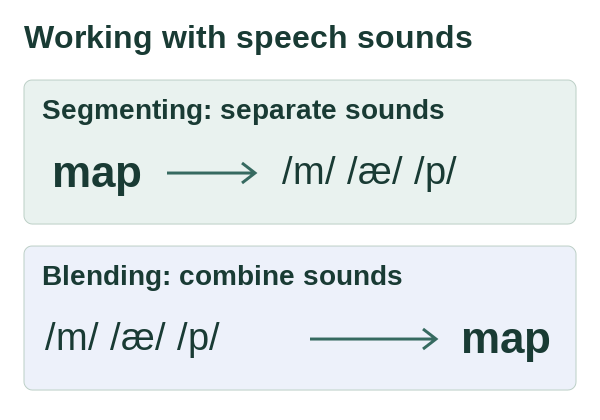
One group was taught two skills directly. These were segmenting (breaking words into separate sounds) and blending (joining sounds into words). A second group trained blending skills only. The study compared these programs on two things. One was phonological awareness, the other word learning.[57]
A 2025 trial in the United Kingdom tested a different content choice. It taught new words by sound and meaning together. The trial followed 273 children aged 5 to 6 for 24 weeks. Classroom teachers gave a vocabulary lesson every day. Both taught groups beat usual classroom instruction on the words taught. All groups scored the same on phonemic awareness and nonword reading. The group taught both sound and meaning reached the highest taught vocabulary and phonic reading scores. Its sound awareness was much higher than the control group's.[58]
The order in which letter sounds and blending are taught can also matter. A pilot study put kindergarten children with weak phonemic segmentation into one of two sequences. Each one combined letter-sound teaching with phonological blending and segmenting. At posttest, early segmentation skill explained only 7% of the variance in segmentation fluency for the integrated group. For the other group it explained 36%. The combined lessons closed the segmentation gap between low-skill and adequate-skill children. That group also scored reliably higher on word reading generalization. This held at posttest and at maintenance.[59] A 2021 case study of widely used kindergarten materials in one state found they did not take orthographic development (learning how written words are structured) sufficiently into account.[60]
Classroom teachers delivered the lessons in one study. Korean third graders learning English took part in another.[61][62] In a quasi-experimental study, five-year-olds got 10 weeks of phonological awareness teaching. Their own classroom teachers gave it. The children who kept the usual reading program were the comparison group. That program included phonics. It did not focus on phonological awareness, the awareness of speech sounds. At the end of the program, 26% of the usual-curriculum group had trouble decoding words. In the instructed group, 6% did. Children with spoken language impairment improved in sound awareness, reading and spelling. Their pattern of response differed from that of children with typical language.[61]
Phoneme awareness predicted English word reading more than rhyme awareness or letter name knowledge did. In that group, rhyme awareness was not linked to phoneme awareness or letter name knowledge. It looked underdeveloped.[62]
A meta-analysis looked at 19 technology-based sound awareness programs from the past decade. It found steady positive effects compared with programs that used no technology, in preschoolers.[63] A critical review picked 22 articles from 137 published over 15 years. They covered technology in preschool and first grade, and the review reported a positive effect on sound awareness. That review called for more careful research to get more precise results.[64]
One study looked at interactive whiteboards used in whole-class online activities. It reported that their touch features and game elements raised motivation and task completion among students with special educational needs. The same study found the technology seemed to engage students with developmental or intellectual disabilities more than traditional literacy activities did.[65] A 2026 Thai study looked at 10 kindergarten children. Their mean score rose from 8.70 to 21.70 after five weeks of phonics instruction with grouped sounds. Its small sample and lack of a comparison group limit causal interpretation and generalizability.[66]
Differences between learners and open questions
Children who grow up with two languages sometimes show stronger speech-sound awareness than children who grow up with one. A study compared preschool classes matched for age (mean 4.8 years). Bilingual Italian-English children did better than English-only children at deleting a spoken morpheme (RAINBOW to BOW). The bilingual group was also better at picking the odd word out from pictured words. This held when the basis was meaning and when it was the first sound. The advantage held for removing word parts and for sorting sounds. This was after the researchers adjusted for scores on the meaning task. The researchers suggested that hearing a second language before learning to read may sharpen metalinguistic skills. These are the ability to think about language itself.[67]
Chinese offers a further test. Mandarin and Cantonese are related, but speakers of each can barely understand the other. One study compared phonological awareness in Cantonese speakers in Guangzhou with Mandarin speakers in Beijing. The researchers described it as the first study of its kind.[68]
Among 146 children, awareness of the first sound of a syllable stayed at chance levels at ages 3 to 5. It then rose to 70% correct in first grade, when Pinyin instruction began. Tone awareness was above chance from the second kindergarten year (age 4). It rose to 74% accuracy in first grade. Syllable and rime awareness grew steadily from ages 3 to 6. A second study looked at 202 preschoolers. Syllable awareness, tone awareness and speeded naming best explained differences in Chinese character recognition.[69]
Onset-rime awareness predicted Chinese reading, but phonemic awareness did not.[70] A meta-analysis of 47 articles (N = 7,956) found the largest correlations between syllable awareness and reading in Spanish, a near-transparent writing system with consistent letter-sound links.[71] A review notes that findings in transparent writing systems do not agree. Some studies match English results. Others find preschool awareness less important or irrelevant.[72]
Blind children who read braille may develop sound awareness differently. Braille uses contractions. Fifteen blind children aged 7 to 12 read more poorly than their age would predict. They also scored below sighted children of the same age on phonological awareness. Blind children segmented heard words less well when the words were written in braille with contractions than without them. The researchers concluded that the nature of the writing system a child learns affects phonological awareness.[73]
Children with speech impairment are more likely to struggle with reading than children with typical speech. Weak stored sound patterns may be one reason. Nine children aged 3.09 to 5.03 years had moderate or severe speech impairment. They and 17 peers with typical speech were assessed three times over 12 months. The children with speech impairment had more trouble judging correct and incorrect word productions. They also had more trouble thinking about newly learned non-words. Their scores on phonological representation tasks were moderately linked to their phonological awareness scores.[74]
Researchers still disagree about how phonological awareness is structured. They disagree about whether its tasks reflect one ability or several related ones. Researchers agree on the definition. It is a conscious awareness of separate speech units, plus the ability to work on them. It is unclear whether tests of phonological awareness measure one underlying ability or several related ones. The link between the idea and the many ways of measuring it is unclear. This causes problems in theory and in practice.[72]
The test chosen matters. The study had 67 first graders and 49 second graders. Segmentation had the weakest link to decoding and added no variance beyond blending.[75] Phonology seems to limit word reading more than sentence understanding. Sound processing in sentence understanding was not linked to other sound processing.[76]
In practice
Teaching and assessing in classrooms
A longitudinal study followed 570 children. Kindergarten measures of phonological awareness and letter identification helped predict reading in 2nd grade. By 2nd grade, phonological awareness and word reading were so closely linked that the awareness measure added nothing to the prediction of 4th-grade reading.[77] An earlier study of first graders found that phonological awareness scores at the start of the year were linked to decoding at the end of the year. Those links were generally much stronger than the links between decoding and verbal or nonverbal intelligence. Several tasks sorted good and poor decoders with about 80% to 90% accuracy.[78]
The people who choose and interpret these tests are not always well prepared for the task. A study of 42 educational diagnosticians from North Texas found gaps in their knowledge. They did not know enough about the parts of reading, including sound awareness and single-sound awareness.[79] A 2024 review of published studies called for ongoing teacher training. It also called for frequent checks on children's progress. That review also urged policymakers to include phonological awareness assessments in screening programs.[80]
A 2003 article on preschool practice names three linked areas of emergent literacy. These are the skills that come before formal reading: sound awareness, print awareness and oral language.[81] A 1991 paper argued that speech-language pathologists, the clinicians who assess and treat speech and language problems, have the training and clinical expertise to help design and run phonological awareness programs.[82]
A 1997 study reported follow-up data on 38 first-grade children. These children had low letter-sound knowledge in kindergarten. The sound awareness advantage did not last into first grade. Even so, that group still did much better than peers on word recognition and reading decoding. The study argued for adding phonological awareness activities to normal classroom reading programs. This includes whole language classrooms.[83]
Some programs train the skill through more than one sense at once. One study lasted six weeks. It looked at 40 Thai first graders learning English, split into two classes of 20. The experimental class got multisensory phonics teaching using visual, auditory, tactile and movement channels. The control class used textbook reading and copying. Mean phoneme identification scores rose from 2.95 to 14.05 in the experimental group. In the control group they rose from 3.05 to 11.35. Interviews with six students found mostly positive views. They also found some trouble with oral confidence, language barriers and performance anxiety.[84]
In a study of 4- to 6-year-olds, parents answered a questionnaire about reading at home. The answers were compared with the children's rhyme and phoneme awareness. A teaching focus in the home and exposure to reading-related media were directly associated with phoneme awareness, and indirectly associated through letter knowledge and vocabulary.[85]
In Turkey, 59 women joined an intensive adult literacy program. After only 90 hours of teaching, they showed big gains in letter and word recognition, sound awareness and spelling. Phonological awareness predicted word recognition and spelling. This matches studies of children.[86]
Instruction for older and struggling readers
Phonemic awareness, the ability to notice and work with the separate sounds in spoken words, can still be taught in the later grades. One study looked at 40 middle school students with learning disabilities and weak phonemic awareness. All of them received the same teaching about speech sounds. On the test of phonemic awareness, the group taught first scored significantly higher than the group taught later, which suggests the lessons had an effect. Their skills improved over time. The lessons produced no group effect on the word identification subtest.[87]
A program built on phonemic awareness tasks also helped students with learning disabilities in the Aseer region. The 40 students were split into an experimental group and a control group. The experimental group did better at memorizing spoken sound sequences. The program was also reported to have a continuing effect on that skill.[88]
Children with speech or language impairment form another group. They can gain from this kind of teaching.[89] Three children received 10 sessions of 30 minutes each, about 5 hours in all. Each had at least one speech sound error pattern and below-average phonological awareness. The sessions combined blending and segmenting activities with practice on 20 trained words. Each session had 70 to 100 productions of the target error pattern. All three children raised the percentage of consonants correct for their error pattern on trained words. They also used the blending and segmenting skills on untrained words. This included words that did not have their error pattern.[90]
A review covered nearly 500 students from preschool through third grade. It found mostly positive results. Responses varied a great deal from one student to another. That review found little evidence that the interventions let students catch up with typically developing peers in phonological and reading skills.[89]
Second-grade teachers and two reading specialists ran a yearlong action research study. They concluded that their older learners with limited English needed more sound awareness teaching to gain letter-sound skills for reading.[91] In a Jordanian government school, second graders received 15 sessions. Each session lasted 40 minutes. They did better than a control group on deleting, substituting and blending sounds. The control group continued with formal classroom instruction. The study called for adding phonological awareness work to the national curriculum.[92]
A meta-analysis combined 46 studies with 3,841 participants. It measured teaching of phonological awareness and phonics for learners of English as a second language. Effects varied with the testing method, the type of intervention and the setting where it took place.[93]
A second meta-analysis looked at native Chinese speakers learning English. It found effects of g = 0.651 for overall English phonological awareness (n = 3137) and g = 0.498 for reading (n = 1506). Students in the upper elementary grades gained the most. Heavier training schedules produced larger effects than lighter ones.[94]
Sound work placed inside a vocabulary class helped adult learners. They did better than a regular vocabulary class without it. In one study, 63 adults learning English as a foreign language were split into two groups. The experimental group got embedded phonological awareness training for 4.5 hours. This came in six meetings of 45 minutes. That group surpassed a control group that attended a regular vocabulary class without such training (p = .017).[95] Students at risk for reading difficulties may need extra help. This help can come through computer programs and with help from parents.[96]
A 1983 study compared three trained kindergarten groups with two control groups. It ran over a 6 to 8 week period. One control group received non-verbal listening practice. The other followed the usual preschool program. Only the highly structured training gave a clear gain in segmenting and blending three-phoneme words. The gain was largest for children who scored poorly before training. Olofsson and Lundberg concluded that prereaders can develop phonemic awareness without formal reading instruction.[97]
A 1994 study assigned 19 low- and middle-achieving first graders at random. They went to a control group or to one of three training versions. The versions increased in richness. The versions ranged from skill and drill alone to skill and drill plus decoding plus reading. Trained and control groups showed no significant differences on phonemic awareness, except on segmentation. One training linked sounds to reading in a conceptual way.[98]
A 1993 study put children aged 4 to 6 into groups at random. They were in a special education preschool. They went to rhyming, blending, segmenting or control conditions. Children improved a lot in each trained category. They showed little or no transfer to other tasks in a category or between categories. Cognitive development, the growth of thinking skills, predicted some outcomes. It did not appear to limit learning of the sound tasks.[99]
All received 67.5 hours of one-to-one teaching. This was two 50-minute sessions per day for 8 weeks. Both programs led to very large gains in general reading skill. The gains stayed stable over a 2-year follow-up. The children had spent their previous 16 months in resource rooms. Measured against their growth there, the effect sizes were 4.4 for one program and 3.9 for the other. Reading accuracy and comprehension reached average levels. For most children, reading speed stayed severely impaired. Within 1 year, 40% of the children no longer needed special education services.[7]
A 2022 meta-analysis combined 138 manuscripts on phonemic awareness teaching for children suspected of having a reading disability. On average, instruction had a medium effect on composite outcomes (g = 0.511) and on segmentation (g = 0.571). Effects were small for blending (g = 0.341) and first sound identification (g = 0.428). They were also small for deletion (g = 0.248). Teaching worked best in kindergarten and first grade. Good results also appeared for older children. Cumulative intervention intensity was not significantly related to how well children performed.[100]
A 2000 New Zealand study followed 61 such children. It also followed 30 typically developing peers aged 5 to 7. The children with impairment received integrated phonological awareness teaching, a traditional speech-language program, or minimal intervention over 4 1/2 months. Children who got phonological awareness teaching gained much more in phonological awareness and reading than the other groups.[101]
What this looks like when you study
One kindergarten study ran small-group training sessions 3 times per week for 7-8 weeks. One program taught both segmenting and blending. Another taught blending only. A third group received a language-experience program. It had no training focused on speech sounds.[57]
In a Swedish study, children received training with a strict structure. They clearly got better at breaking up and joining words with three sounds. The gain was largest among children with poor pretest scores. Other groups showed no clear change.[97]
Criticism
Criticisms and open questions
A 2004 review looked at longitudinal and training studies. It re-checked the evidence that sound awareness comes before reading and directly affects how reading is learned. The reviewers concluded that no study had clearly shown a causal link. No study proved that sound awareness leads to success in reading and spelling. They added that such a study is possible and sketched how it might be designed.[4]
Instead, Scholes argued, that awareness is a limited result of learning to read an alphabetic script. The paper also argued that links between phonemic awareness and reading skill rest on a wrong and possibly harmful definition of reading.[102]
It tracked them through their first two years at school. Children showed awareness of rhyme before they began to read. A phoneme deletion task, however, came only after they had learned to read words. Links between sound awareness scores and later reading often stayed significant. This held after adjusting for verbal ability or sound memory. Controlling for letter knowledge, however, reduced most of those correlations to nonsignificant levels.[103]
A 1999 essay went further. It called systematic phonics an educational hazard. Smith argued that systematic phonics must fail as a way to teach reading. He said it will make reading harder to learn for many children.[104]
A 1999 review looked at 39 studies of phonological awareness intervention. It examined their methods rather than their results. Other flaws were missing or weak checks that the treatment was given as planned. Measurement was not sensitive enough, and samples were poorly described.[105]
Common misconceptions
A study of 19 first graders tested training that linked phonemic skills to reading. It was generally ineffective for low readers. The experimental and control groups did not differ much on phonemic awareness, except for segmentation.[98]
Key studies
| Year | Study | Sample | Design | Finding |
|---|---|---|---|---|
| 1983 | OLOFSSON & LUNDBERG[97] | kindergarten children in three experimental and two control groups | training study over 6 to 8 weeks | The highly structured training condition clearly improved segmenting and blending of three-phoneme words, especially among children with poor pretest scores. |
| 1993 | O'Connor et al.[99] | randomized training study | Children made significant progress in each trained category but showed little or no generalization within or between categories. | |
| 1995 | McBride-Chang[10] | 136 third and fourth graders | structural equation modeling study | Each of three skills, IQ, speech perception and verbal short-term memory, accounted for unique variance in phonological awareness. |
| 2001 | Torgesen et al.[7] | randomized instructional study with 67.5 hours of one-to-one instruction | Both programs produced very large gains (effect sizes 4.4 and 3.9), and 40% of children no longer needed special education within a year. | |
| 2001 | Ehri et al.[3] | Meta-analysis of 52 studies with 96 treatment-control cases | Phonemic awareness instruction had a large effect on phonemic awareness (d = 0.86), a moderate effect on reading (d = 0.53) and spelling (d = 0.59). | |
| 2003 | Carroll et al.[37] | 67 preschool children followed over 12 months | short-term longitudinal study | Rime skills developed earlier than phoneme skills, and articulatory skills plus syllable and rime awareness predicted later phoneme awareness. |
| 2003 | BIALYSTOK et al.[24] | monolingual and bilingual children from kindergarten to Grade 2 in three studies | three studies comparing monolingual and bilingual children | Spanish-English bilinguals outperformed English monolinguals on phoneme segmentation, but Chinese-English bilinguals performed worse. |
| 2003 | Temple et al.[47] | 20 children with dyslexia aged 8 to 12 | functional MRI study before and after remediation | Training raised oral language and reading scores, and activity rose in the left temporo-parietal cortex and the left inferior frontal gyrus. |
| 2004 | Anthony & Lonigan[14] | four studies including 202 five- to six-year-olds, 123 two- to five-year-olds, 38 four-year-olds and 826 four- to seven-year-olds | longitudinal studies | Rhyme sensitivity was indistinguishable from other forms of phonological awareness in younger children, suggesting a single underlying ability. |
| 2004 | Castles & Coltheart[4] | Review of longitudinal and training studies | No study provided unequivocal evidence of a causal link from phonological awareness to reading and spelling success. | |
| 2012 | Melby-Lervåg et al.[5] | 235 studies with 995 effect sizes | meta-analytic review | Children with dyslexia showed a large deficit on phonemic awareness compared with age-matched children (pooled effect size -1.37). |
| 2013 | Carson et al.[61] | quasi-experimental study over 10 weeks | Word decoding difficulties affected 6% of the instructed group versus 26% of the usual-curriculum group. | |
| 2022 | Rice et al.[15] | 46 experimental and quasi-experimental studies with 59 independent samples (1,892 treatment and 1,747 control children) | meta-analysis | Phonemic awareness instruction was moderately effective (g = 0.63), with no significant difference by instructor type, group size, duration or grade level. |
| 2022 | Rehfeld et al.[100] | 138 included manuscripts on children suspected of having a reading disability | meta-analysis | Effects were moderate for composite (g = 0.511) and segmentation (g = 0.571) outcomes, and small for blending (g = 0.341). |
See also
References
- Anthony, J. L., & Francis, D. J. (2005). Development of Phonological Awareness. Current Directions in Psychological Science, 14(5), 255-259. doi:10.1111/j.0963-7214.2005.00376.x
- Stahl, S. A., & Murray, B. A. (1994). Defining phonological awareness and its relationship to early reading. Journal of Educational Psychology, 86(2), 221-234. doi:10.1037/0022-0663.86.2.221
- Ehri, L. C., Nunes, S. R., Willows, D. M., Schuster, B. V., Yaghoub‐Zadeh, Z., & Shanahan, T. (2001). Phonemic Awareness Instruction Helps Children Learn to Read: Evidence From the National Reading Panel's Meta‐Analysis. Reading Research Quarterly, 36(3), 250-287. doi:10.1598/rrq.36.3.2
- Castles, A., & Coltheart, M. (2004). Is there a causal link from phonological awareness to success in learning to read? Cognition, 91(1), 77-111. doi:10.1016/s0010-0277(03)00164-1
- Melby-Lervåg, M., Lyster, S. A. H., & Hulme, C. (2012). Phonological skills and their role in learning to read: A meta-analytic review. Psychological Bulletin, 138(2), 322-352. doi:10.1037/a0026744
- Hoeft, F., McCandliss, B. D., Black, J. M., Gantman, A., Zakerani, N., Hulme, C., Lyytinen, H., Whitfield-Gabrieli, S., Glover, G. H., Reiss, A. L., & Gabrieli, J. D. E. (2011). Neural systems predicting long-term outcome in dyslexia. Proceedings of the National Academy of Sciences, 108(1), 361-366. doi:10.1073/pnas.1008950108
- Torgesen, J. K., Alexander, A. W., Wagner, R. K., Rashotte, C. A., Voeller, K. K. S., & Conway, T. (2001). Intensive Remedial Instruction for Children with Severe Reading Disabilities: Immediate and Long-term Outcomes From Two Instructional Approaches. Journal of Learning Disabilities, 34(1), 33-58. doi:10.1177/002221940103400104
- Piasta, S. B., & Hudson, A. K. (2022). Key Knowledge to Support Phonological Awareness and Phonics Instruction. The Reading Teacher, 76(2), 201-210. doi:10.1002/trtr.2093
- Karibasappa C. Nagaraja, & Sampathkumar (2016). Phonological Awareness among Kannada Speaking Children: Analysis of Performance on Different Components of Phonological Awareness. International Journal of Indian Psychology, 3(4). doi:10.25215/0304.201
- McBride-Chang, C. (1995). What is phonological awareness? Journal of Educational Psychology, 87(2), 179-192. doi:10.1037/0022-0663.87.2.179
- Mann, V. A., & Liberman, I. Y. (1984). Phonological Awareness and Verbal Short-Term Memory. Journal of Learning Disabilities, 17(10), 592-599. doi:10.1177/002221948401701005
- Sebbane, Z. (2008). Phonological Awareness. Traduction et Langues, 7(1), 47-54. doi:10.52919/translang.v7i1.400
- McBride-Chang, C., Wagner, R. K., & Chang, L. (1997). Growth modeling of phonological awareness. Journal of Educational Psychology, 89(4), 621-630. doi:10.1037//0022-0663.89.4.621
- Anthony, J. L., & Lonigan, C. J. (2004). The Nature of Phonological Awareness: Converging Evidence From Four Studies of Preschool and Early Grade School Children. Journal of Educational Psychology, 96(1), 43-55. doi:10.1037/0022-0663.96.1.43
- Rice, M., Erbeli, F., Thompson, C. G., Sallese, M. R., & Fogarty, M. (2022). Phonemic Awareness: A Meta‐Analysis for Planning Effective Instruction. Reading Research Quarterly, 57(4), 1259-1289. doi:10.1002/rrq.473
- Taruna, R. (2022). Phonological Memory And Phonological Awareness In Children: A Meta-Analysis. Jurnal Keterapian Fisik, 105-114. doi:10.37341/jkf.v0i0.380
- ERIC Thesaurus (n.d.). Effect Size. ERIC Thesaurus. https://eric.ed.gov/?ti=Effect+Size
- Caravolas, M., Lervåg, A., Mousikou, P., Efrim, C., Litavský, M., Onochie-Quintanilla, E., Salas, N., Schöffelová, M., Defior, S., Mikulajová, M., Seidlová-Málková, G., & Hulme, C. (2012). Common Patterns of Prediction of Literacy Development in Different Alphabetic Orthographies. Psychological Science, 23(6), 678-686. doi:10.1177/0956797611434536
- Ziegler, J. C., Bertrand, D., Tóth, D., Csépe, V., Reis, A., Faísca, L., Saine, N., Lyytinen, H., Vaessen, A., & Blomert, L. (2010). Orthographic Depth and Its Impact on Universal Predictors of Reading: A Cross-Language Investigation. Psychological Science, 21(4), 551-559. doi:10.1177/0956797610363406
- Babayiğit, S., & Stainthorp, R. (2007). Preliterate phonological awareness and early literacy skills in Turkish. Journal of Research in Reading, 30(4), 394-413. doi:10.1111/j.1467-9817.2007.00350.x
- Durgunoğlu, A. Y., Nagy, W. E., & Hancin-Bhatt, B. J. (1993). Cross-language transfer of phonological awareness. Journal of Educational Psychology, 85(3), 453-465. doi:10.1037/0022-0663.85.3.453
- VERHOEVEN, L. (2007). Early bilingualism, language transfer, and phonological awareness. Applied Psycholinguistics, 28(3), 425-439. doi:10.1017/s0142716407070233
- Melby‐Lervåg, M., & Lervåg, A. (2011). Cross‐linguistic transfer of oral language, decoding, phonological awareness and reading comprehension: a meta‐analysis of the correlational evidence. Journal of Research in Reading, 34(1), 114-135. doi:10.1111/j.1467-9817.2010.01477.x
- BIALYSTOK, E., MAJUMDER, S., & MARTIN, M. M. (2003). Developing phonological awareness: Is there a bilingual advantage? Applied Psycholinguistics, 24(1), 27-44. doi:10.1017/s014271640300002x
- Loizou, M., & Stuart, M. (2003). Phonological awareness in monolingual and bilingual English and Greek five‐year‐olds. Journal of Research in Reading, 26(1), 3-18. doi:10.1111/1467-9817.261002
- Alasmari, A. (2024). Do Linguistic Factors Impact Phonological Awareness in L2? A Study of Phonological Awareness of English by Adult Saudi Learners. Arab World English Journal, 15(2), 337-361. doi:10.24093/awej/vol15no2.21
- Swanson, H. L., Trainin, G., Necoechea, D. M., & Hammill, D. D. (2003). Rapid Naming, Phonological Awareness, and Reading: A Meta-Analysis of the Correlation Evidence. Review of Educational Research, 73(4), 407-440. doi:10.3102/00346543073004407
- Vander Stappen, C., & Reybroeck, M. V. (2022). Relating Phonological Awareness and Rapid Automatized Naming to Phonological and Orthographic Processing of Written Words: Cross‐sequential Evidence from French. Reading Research Quarterly, 57(3), 1065-1083. doi:10.1002/rrq.461
- HTA Glossary (health technology assessment) (n.d.). variance. HTA Glossary (health technology assessment). https://htaglossary.net/variance
- Metsala, J. L. (1999). Young children's phonological awareness and nonword repetition as a function of vocabulary development. Journal of Educational Psychology, 91(1), 3-19. doi:10.1037/0022-0663.91.1.3
- Sousa, J., Martins, M., Torres, N., Castro, S. L., & Silva, S. (2022). Rhythm but not melody processing helps reading via phonological awareness and phonological memory. Scientific Reports, 12(1). doi:10.1038/s41598-022-15596-7
- Peynirciogˇlu, Z. F., Durgunogˇlu, A. Y., & Úney‐Küsefogˇlu, B. (2002). Phonological awareness and musical aptitude. Journal of Research in Reading, 25(1), 68-80. doi:10.1111/1467-9817.00159
- Gromko, J. E. (2005). The Effect of Music Instruction on Phonemic Awareness in Beginning Readers. Journal of Research in Music Education, 53(3), 199-209. doi:10.1177/002242940505300302
- FOY, J. G., & MANN, V. (2001). Does strength of phonological representations predict phonological awareness in preschool children? Applied Psycholinguistics, 22(3), 301-325. doi:10.1017/s0142716401003022
- Wood, C. (2006). Metrical stress sensitivity in young children and its relationship to phonological awareness and reading. Journal of Research in Reading, 29(3), 270-287. doi:10.1111/j.1467-9817.2006.00308.x
- Aruan, E. J. (2023). Phonological Awareness On Preschool Students’ Writing Ability. The Explora, 9(1), 29-36. doi:10.51622/explora.v9i1.1292
- Carroll, J. M., Snowling, M. J., Stevenson, J., & Hulme, C. (2003). The development of phonological awareness in preschool children. Developmental Psychology, 39(5), 913-923. doi:10.1037/0012-1649.39.5.913
- Phillips, B. M., Clancy-Menchetti, J., & Lonigan, C. J. (2008). Successful Phonological Awareness Instruction With Preschool Children: Lessons From the Classroom. Topics in Early Childhood Special Education, 28(1), 3-17. doi:10.1177/0271121407313813
- Yeh, S. S., & Connell, D. B. (2008). Effects of rhyming, vocabulary and phonemic awareness instruction on phoneme awareness. Journal of Research in Reading, 31(2), 243-256. doi:10.1111/j.1467-9817.2007.00353.x
- Kleeck, A. v., Gillam, R. B., & McFadden, T. U. (1998). A Study of Classroom-Based Phonological Awareness Training for Preschoolers With Speech and/or Language Disorders. American Journal of Speech-Language Pathology, 7(3), 65-76. doi:10.1044/1058-0360.0703.65
- Sá, M., Sa-Couto, P., & Lousada, M. (2022). Phonological awareness digital program: a randomized controlled study. Revista de Investigación en Logopedia, 12(1), e77402. doi:10.5209/rlog.77402
- Bennett, H., Denston, A., & Arrow, A. (2023). The effectiveness of a parent-implemented, phonological awareness programme on the phonological awareness skills of preschool children. The Australian Journal of Language and Literacy, 46(2), 125-143. doi:10.1007/s44020-023-00034-6
- Lefebvre, P., Trudeau, N., & Sutton, A. (2011). Enhancing vocabulary, print awareness and phonological awareness through shared storybook reading with low-income preschoolers. Journal of Early Childhood Literacy, 11(4), 453-479. doi:10.1177/1468798411416581
- Layton, L., Deeny, K., Upton, G., & Tall, G. (1998). A pre‐school training programme for children with poor phonological awareness: effects on reading and spelling. Journal of Research in Reading, 21(1), 36-52. doi:10.1111/1467-9817.00041
- Layton, L., Deeny, K., Tall, G., & Upton, G. (1996). Researching and promoting phonological awareness in the nursery class. Journal of Research in Reading, 19(1), 1-13. doi:10.1111/j.1467-9817.1996.tb00082.x
- Sá, M., & Lousada, M. L. (2022). Effectiveness of Phonological Awareness Stimulation in Preschoolers – A Systematic Review. Revista Chilena de Fonoaudiología, 21(1), 1-19. doi:10.5354/0719-4692.2022.64161
- Temple, E., Deutsch, G. K., Poldrack, R. A., Miller, S. L., Tallal, P., Merzenich, M. M., & Gabrieli, J. D. E. (2003). Neural deficits in children with dyslexia ameliorated by behavioral remediation: Evidence from functional MRI. Proceedings of the National Academy of Sciences, 100(5), 2860-2865. doi:10.1073/pnas.0030098100
- Bruck, M. (1992). Persistence of dyslexics' phonological awareness deficits. Developmental Psychology, 28(5), 874-886. doi:10.1037/0012-1649.28.5.874
- Snowling, M. J., & Melby-Lervåg, M. (2016). Oral language deficits in familial dyslexia: A meta-analysis and review. Psychological Bulletin, 142(5), 498-545. doi:10.1037/bul0000037
- Yeatman, J. D., Dougherty, R. F., Rykhlevskaia, E., Sherbondy, A. J., Deutsch, G. K., Wandell, B. A., & Ben-Shachar, M. (2011). Anatomical Properties of the Arcuate Fasciculus Predict Phonological and Reading Skills in Children. Journal of Cognitive Neuroscience, 23(11), 3304-3317. doi:10.1162/jocn_a_00061
- Tan, L. H., Laird, A. R., Li, K., & Fox, P. T. (2005). Neuroanatomical correlates of phonological processing of Chinese characters and alphabetic words: A meta‐analysis. Human Brain Mapping, 25(1), 83-91. doi:10.1002/hbm.20134
- Mayberry, R. I., del Giudice, A. A., & Lieberman, A. M. (2011). Reading Achievement in Relation to Phonological Coding and Awareness in Deaf Readers: A Meta-analysis. Journal of Deaf Studies and Deaf Education, 16(2), 164-188. doi:10.1093/deafed/enq049
- McQuarrie, L., & Abbott, M. (2013). Bilingual Deaf Students’ Phonological Awareness in ASL and Reading Skills in English. Sign Language Studies, 14(1), 80-100. doi:10.1353/sls.2013.0028
- Bird, J., Bishop, D. V. M., & Freeman, N. H. (1995). Phonological Awareness and Literacy Development in Children With Expressive Phonological Impairments. Journal of Speech, Language, and Hearing Research, 38(2), 446-462. doi:10.1044/jshr.3802.446
- Holm, A., Farrier, F., & Dodd, B. (2008). Phonological awareness, reading accuracy and spelling ability of children with inconsistent phonological disorder. International Journal of Language & Communication Disorders, 43(3), 300-322. doi:10.1080/13682820701445032
- Catts, H. W., Adlof, S. M., Hogan, T. P., & Weismer, S. E. (2005). Are Specific Language Impairment and Dyslexia Distinct Disorders? Journal of Speech, Language, and Hearing Research, 48(6), 1378-1396. doi:10.1044/1092-4388(2005/096)
- Torgesen, J. K., Morgan, S. T., & Davis, C. (1992). Effects of two types of phonological awareness training on word learning in kindergarten children. Journal of Educational Psychology, 84(3), 364-370. doi:10.1037/0022-0663.84.3.364
- Brooks, R., Warmington, M., & Thomson, J. (2025). Evaluating the impact of vocabulary instruction on oral vocabulary, phonemic awareness and nonword reading. Reading and Writing, 38(6), 1607-1633. doi:10.1007/s11145-024-10564-1
- Oudeans, M. K. (2003). Integration of Letter-Sound Correspondences and Phonological Awareness Skills of Blending and Segmenting: A Pilot Study Examining the Effects of Instructional Sequence on Word Reading for Kindergarten Children with Low Phonological Awareness. Learning Disability Quarterly, 26(4), 258-280. doi:10.2307/1593638
- Brown, K. J., Patrick, K. C., Fields, M. K., & Craig, G. T. (2021). Phonological Awareness Materials in Utah Kindergartens: A Case Study in the Science of Reading. Reading Research Quarterly, 56(S1). doi:10.1002/rrq.386
- Carson, K. L., Gillon, G. T., & Boustead, T. M. (2013). Classroom Phonological Awareness Instruction and Literacy Outcomes in the First Year of School. Language, Speech, and Hearing Services in Schools, 44(2), 147-160. doi:10.1044/0161-1461(2012/11-0061)
- The English Teathers Association in Korea, & Lee, M. (2023). The Effects of Sub-syllabic Phonological Awareness on Korean Elementary EFL Students’ Word Reading. The English Teachers Association in Korea, 29(1), 41-59. doi:10.35828/etak.2023.29.1.41
- Raposo-Rivas, M., Halabi-Echeverry, A. X., Sarmiento Campos, J. A., & García-Fuentes, O. (2024). Associations among Variables in Technology-Enhanced Phonological Awareness Programmes Based on a Meta-Analysis. Education Sciences, 14(4), 343. doi:10.3390/educsci14040343
- Martinez-Figueira, M. E., Borda-Valderrama, J., Montes-Betancourt, M., & Falla-Ortiz, J. (2023). ICT in the development of phonological awareness: A critical literature review. Digital Education Review(44), 125-132. doi:10.1344/der.2023.44.125-132
- Calota, R., & Vasile, M. (2021). Interactive Whiteboard Use for Developing Phonological Awareness in SEN Students. Review of Psychopedagogy, 10(1), 71-83. doi:10.56663/rop.v10i1.22
- Ocasla, R. (2026). The Effect of Phonics-Based Instruction Using Grouped Sounds on the Phonemic Awareness and Early Reading Skills of Kindergarten 3 Learners in Thailand. QualiSearch Journal of Educational Research and Practice. doi:10.66437/qjerp.v2si.006
- Campbell, R., & Sais, E. (1995). Accelerated metalinguistic (phonological) awareness in bilingual children. British Journal of Developmental Psychology, 13(1), 61-68. doi:10.1111/j.2044-835x.1995.tb00664.x
- Chen, X., Anderson, R. C., Li, W., Hao, M., Wu, X., & Shu, H. (2004). Phonological Awareness of Bilingual and Monolingual Chinese Children. Journal of Educational Psychology, 96(1), 142-151. doi:10.1037/0022-0663.96.1.142
- Shu, H., Peng, H., & McBride‐Chang, C. (2008). Phonological awareness in young Chinese children. Developmental Science, 11(1), 171-181. doi:10.1111/j.1467-7687.2007.00654.x
- Siok, W. T., & Fletcher, P. (2001). The role of phonological awareness and visual-orthographic skills in Chinese reading acquisition. Developmental Psychology, 37(6), 886-899. doi:10.1037/0012-1649.37.6.886
- Míguez‐Álvarez, C., Cuevas‐Alonso, M., & Saavedra, Á. (2022). Relationships Between Phonological Awareness and Reading in Spanish: A Meta‐Analysis. Language Learning, 72(1), 113-157. doi:10.1111/lang.12471
- Gedutienė, R. (2010). The conception of phonological awareness in educational psychology. Psichologija, 41, 7-17. doi:10.15388/psichol.2010.0.2582
- Dodd, B., & Conn, L. (2000). The effect of Braille orthography on blind children’s phonological awareness. Journal of Research in Reading, 23(1), 1-11. doi:10.1111/1467-9817.00098
- Sutherland, D., & Gillon, G. T. (2007). Development of phonological representations and phonological awareness in children with speech impairment. International Journal of Language & Communication Disorders, 42(2), 229-250. doi:10.1080/13682820600806672
- Kilpatrick, D. A. (2012). Phonological Segmentation Assessment Is Not Enough: A Comparison of Three Phonological Awareness Tests With First and Second Graders. Canadian Journal of School Psychology, 27(2), 150-165. doi:10.1177/0829573512438635
- Gray, A., & McCutchen, D. (2006). Young Readers' Use of Phonological Information: Phonological Awareness, Memory, and Comprehension. Journal of Learning Disabilities, 39(4), 325-333. doi:10.1177/00222194060390040601
- Hogan, T. P., Catts, H. W., & Little, T. D. (2005). The Relationship Between Phonological Awareness and Reading: Implications for the Assessment of Phonological Awareness. Language, Speech, and Hearing Services in Schools, 36(4), 285-293. doi:10.1044/0161-1461(2005/029)
- Swank, L. K., & Catts, H. W. (1994). Phonological Awareness and Written Word Decoding. Language, Speech, and Hearing Services in Schools, 25(1), 9-14. doi:10.1044/0161-1461.2501.09
- Chappell, J. C., Stephens, T. L., Kinnison, L., & Pettigrew, J. D. (2009). Educational Diagnosticians’ Understanding of Phonological Awareness, Phonemic Awareness, and Reading Fluency. Assessment for Effective Intervention, 35(1), 24-33. doi:10.1177/1534508409331653
- Nkurunziza, S. (2024). The Role of Phonological Awareness in Early Reading Development. European Journal of Linguistics, 3(3), 15-26. doi:10.47941/ejl.2051
- Pullen, P. C., & Justice, L. M. (2003). Enhancing Phonological Awareness, Print Awareness, and Oral Language Skills in Preschool Children. Intervention in School and Clinic, 39(2), 87-98. doi:10.1177/10534512030390020401
- Catts, H. W. (1991). Facilitating Phonological Awareness: Role of Speech-Language Pathologists. Language, Speech, and Hearing Services in Schools, 22(4), 196-203. doi:10.1044/0161-1461.2204.196
- Ball, E. W. (1997). Phonological Awareness: Implications for Whole Language and Emergent Literacy Programs. Topics in Language Disorders, 17(3), 14-26. doi:10.1097/00011363-199705000-00004
- Limprachan, K., & Phusawisot, P. (2026). Using Multisensory Phonics Instruction in Enhancing Phonemic Awareness Among Thai EFL Primary Learners. Journal of Education and Learning, 15(4), 247. doi:10.5539/jel.v15n4p247
- FOY, J. G., & MANN, V. (2003). Home literacy environment and phonological awareness in preschool children: Differential effects for rhyme and phoneme awareness. Applied Psycholinguistics, 24(1), 59-88. doi:10.1017/s0142716403000043
- Durguno-lu, A. Y., & Ouml;ney, B. (2002). Phonological Awareness in Literacy Acquisition: It's Not Only for Children. Scientific Studies of Reading, 6(3), 245-266. doi:10.1207/s1532799xssr0603_3
- Bhat, P., Griffin, C. C., & Sindelar, P. T. (2003). Phonological Awareness Instruction for Middle School Students with Learning Disabilities. Learning Disability Quarterly, 26(2), 73-87. doi:10.2307/1593591
- Khasawneh, M. A. S. (2021). Problems of Teaching Phonological Awareness to Learning Disabilities Students. GIST – Education and Learning Research Journal, 23, 135-149. doi:10.26817/16925777.961
- Al Otaiba, S., Puranik, C. S., Ziolkowski, R. A., & Montgomery, T. M. (2009). Effectiveness of Early Phonological Awareness Interventions for Students With Speech or Language Impairments. The Journal of Special Education, 43(2), 107-128. doi:10.1177/0022466908314869
- Alvis, J. E., Brumbaugh, K. M., & Tambyraja, S. R. (2024). Effect of Phonological Awareness-Focused Interventions on Phonological Errors and Phonemic Awareness in Young School-Age Children. Seminars in Speech and Language, 45(02), 101-120. doi:10.1055/s-0044-1779038
- SZABO, S. (2010). Older Children Need Phonemic Awareness Instruction, Too. TESOL Journal, 1(1), 130-141. doi:10.5054/tj.2010.215246
- Al Tamimi, Y. (2017). Relevance of Phonological Awareness Intervention to a Jordanian EFL Classroom. The Buckingham Journal of Language and Linguistics, 9, 1-20. doi:10.5750/bjll.v9i0.44
- Murphy Odo, D. (2021). A Meta-Analysis of the Effect of Phonological Awareness and/or Phonics Instruction on Word and Pseudo Word Reading of English as an L2. Sage Open, 11(4). doi:10.1177/21582440211059168
- Jiang, Y., Gai, X., Üstün‐Yavuz, M. S., Zhang, M., & Thomson, J. M. (2023). A meta‐analysis of training effects on English phonological awareness and reading in native Chinese speakers. PsyCh Journal, 12(5), 599-617. doi:10.1002/pchj.675
- Hentasmaka, D., Cahyono, B. Y., Basthomi, Y., & Puspitasari, Y. (2022). The Effect of Embedding Phonological Awareness Training on Adult EFL Learners’ Phonological Awareness Skill. European Journal of Educational Research, volume-11-2022(volume-11-issue-4-october-2022), 2023-2030. doi:10.12973/eu-jer.11.4.2023
- Rice, M., Erbeli, F., & Wijekumar, K. (2024). Phonemic Awareness: Evidence-Based Instruction for Students in Need of Intervention. Intervention in School and Clinic, 59(4), 269-273. doi:10.1177/10534512231156881
- OLOFSSON, Å., & LUNDBERG, I. (1983). Can phonemic awareness be trained in kindergarten? Scandinavian Journal of Psychology, 24(1), 35-44. doi:10.1111/j.1467-9450.1983.tb00473.x
- Weiner, S. (1994). Effects of Phonemic Awareness Training on Low- and Middle-Achieving First Graders' Phonemic Awareness and Reading Ability. Journal of Reading Behavior, 26(3), 277-300. doi:10.1080/10862969409547852
- O'Connor, R. E., Jenkins, J. R., Leicester, N., & Slocum, T. A. (1993). Teaching Phonological Awareness to Young Children with Learning Disabilities. Exceptional Children, 59(6), 532-546. doi:10.1177/001440299305900606
- Rehfeld, D. M., Kirkpatrick, M., O'Guinn, N., & Renbarger, R. (2022). A Meta-Analysis of Phonemic Awareness Instruction Provided to Children Suspected of Having a Reading Disability. Language, Speech, and Hearing Services in Schools, 53(4), 1177-1201. doi:10.1044/2022_lshss-21-00160
- Gillon, G. T. (2000). The Efficacy of Phonological Awareness Intervention for Children With Spoken Language Impairment. Language, Speech, and Hearing Services in Schools, 31(2), 126-141. doi:10.1044/0161-1461.3102.126
- Scholes, R. (1998). The case against phonemic awareness. Journal of Research in Reading, 21(3), 177-188. doi:10.1111/1467-9817.00054
- Blaiklock, K. E. (2004). The importance of letter knowledge in the relationship between phonological awareness and reading. Journal of Research in Reading, 27(1), 36-57. doi:10.1111/j.1467-9817.2004.00213.x
- Smith, F. (1999). Why Systematic Phonics and Phonemic Awareness Instruction Constitute an Educational Hazard. Language Arts, 77(2), 150-155. doi:10.58680/la199985
- Troia, G. A. (1999). Phonological Awareness Intervention Research: A Critical Review of the Experimental Methodology. Reading Research Quarterly, 34(1), 28-52. doi:10.1598/rrq.34.1.3
Cite this page: Atlas Nova editors. (2026). Phonological awareness. Atlas Nova. https://velocer.io/atlas/phonological-awareness/