Learners · Development and learning differences
Learning disabilities
Group of neurodevelopmental disorders
Learning disabilities are a diverse group of disorders. Their etiologies are multifactorial. They reflect genetic influences and dysfunction of brain systems.[1]
Among learning disabilities, the one children are most frequently found to have is dyslexia, also called reading disability.[1] A meta-analysis found higher anxiety scores among students with learning disabilities.[2] Social skill deficits seem to form a regular part of the learning disability experience.[3] Students with learning disabilities interacted with teachers and classmates at much lower rates.[4]
Key facts
| 5% to 8% | School-age children with a memory or cognitive deficit affecting mathematics, in Geary (2004)[5] |
|---|---|
| 75% | Students with learning disabilities showing social skill deficits, across 152 studies in Kavale and Forness (1996)[3] |
| d=.61 | Average anxiety difference between students with and without learning disabilities, in Nelson and Harwood (2011)[2] |
Overview
What the term covers
Learning disabilities is a general term. It names a whole family of conditions, not one condition. Each disorder shows up as clear difficulty in learning and using one or more abilities. The abilities named in the definition are listening, speaking, reading, writing, reasoning and mathematics. A student may struggle with spoken language or with printed words. The struggle may also be with numbers or with the reasoning that links ideas.[6][7]
Two definition statements use these words. One was published in 1981 and one in 1987. Both statements name the same abilities. Both call the disorders built into the person. Both add that the disorders are presumed to be due to central nervous system dysfunction.[6][7]
The definition also says what a learning disability is not. A learning disability may occur alongside other conditions. These include sensory impairment, intellectual disability, and social and emotional disturbance. It may also occur alongside environmental influences. These include cultural differences. They also include too little instruction, or the wrong kind. They also include psychogenic factors, meaning problems with emotional origin. Either way, the definition holds one point. Such conditions or influences do not directly cause the learning disability.[6][7]
A later description draws the same line in other words. A learning disability shows up as serious trouble with reading, arithmetic or writing. That trouble is unexpected for the person's intellectual ability. That description also calls a learning disability a neurobiological disorder. This means a condition rooted in the biology of the brain. It adds that a learning disability is not an emotional disorder. An emotional disorder does not cause it either.[8]
Kirk wrote about the term in 1977. He called the service one of the newest and probably the most controversial. Kirk called specific learning disabilities one of the newest services for exceptional children.[9]
The list of abilities in the definition is what holds these cases under one heading.[6][7] A full evaluation is needed to find the source of a particular student's difficulty. The 2008 description says so. That description also warns about evaluation. A poor or improper evaluation can let a learning disability affect many areas of life.[8]
A qualitative case study looked at six sixth-grade students with mathematics learning disability. It examined how they understood the area of a rectangle. Students differed in how well they structured arrays. This changed depending on the type of problem. Students who used more detailed concept definitions understood rectangular area measurement better.[10]
Another strand is the nonverbal learning disabilities syndrome. It is named this way because its clinical signs are thought to come from deficits. These deficits are mainly nonverbal. Children with this syndrome often speak well after an initial delay in learning speech. Yet a close look shows weaknesses in language skills.[11] An overview from 1998 describes the syndrome as a developmental right-hemisphere brain syndrome. It has personal, social and academic features.[12]
History
How the category was built
The category of learning disabilities took shape in the years after the Soviet satellite Sputnik was launched. After Sputnik, schools raised their reading standards. They also tested students more strictly. Schools also grouped students for instruction by achievement level. Some students could not keep up with the raised standards. They were put into one of five groups. Four of those categories mainly explained why lower class and minority children failed in school. Learning disabilities was devised to account for the failures of white middle class children. It shielded them somewhat from the stigma of failure.[13]
Events near the end of the 1960s and the start of the 1970s changed how the category was used.[13] A 2004 article pressed the point further: one cannot be learning disabled on one's own. A learning disability requires a whole system of interactions. Each must be done at the right moment and in the right way. The stage is the one school provides. That argument holds that learning and learning problems sit in human relationships and activity. They are not only in individual heads.[14]
One writer described how the field moved through early medical models. It then moved through psychological process models. It then passed through behavioral and cognitive strategy phases. The writer called this a history of theoretical and empirical debates and political splits. That writer argued that the four models are far more alike than different. Each one defines, assesses and instructs students in a reductionistic manner, meaning it shrinks a complex problem to a few narrow parts. The same writer said this reductionistic fallacy lies beneath the field's troubles with effectiveness. Those troubles go back to its beginnings.[15]
A 1987 defense of the construct made an argument. The category has conceptual validity despite its definitional problems. That defense stressed the need to keep classification and identification separate. It also stressed the importance of a shared definition of the attribute. The writer argued for a taxonomy, or ordered system of categories. It would cover learning disabilities and the achievement problems that come with them. That writer held that such a system would clear up ambiguities and inconsistencies. It would show how common the condition is and how it shows itself.[16]
A 1986 review of theory in the field noted that broad overviews of paradigms had been fairly rare and limited in scope. That review observed that much of the discussion had been limited to unclear definitions. The definitions themselves limited it. Leaders who cared about the future said more theory development was important. They also wanted a better theoretical base. This would guide research and practice. The review asked for clearer explanation and analysis of major disputes. These disputes were about theories of cause and correction.[17]
The social construction account carries a practical claim about where to look for solutions.[14] The new reading of the category's history drew out lessons for the education reform movement of its own day.[13]
That report also listed the approach's limits in method. It suggested how those limits might prompt further study.[18] A 1979 review described newer theories of learning and reading disabilities. It said they were free of the conceptual and methodological problems that troubled earlier theories. The review presented these frameworks as different ways to explain what causes learning disabilities.[19]
A 1992 article noted that research showed learning disabilities affect people in all nations, languages and cultures. Yet this was not well known and was even disputed. That article profiled Andy Chen, a man from Taiwan with learning disabilities. He became an assistant professor of accounting at Northeastern Illinois University.[20]
A 2007 analysis of practice in Israel described a divided society. That society separates different ethnicities and social groups. The analysis said special education law in Israel reflected that separation. The law also kept it going. Since 2002, the Israeli Ministry of Education has used laws and official guidelines. The aim is to include children with learning disabilities fully in the general education curriculum. There, a response-to-intervention model provides a specialist called a Matal. The Matal handles case management for diagnosis and for prescribing support. The model was still experimental. No one had tested how well it worked yet.[21]
A 2019 study surveyed 113 university students in northern Israel. It asked about specific learning disabilities. Of these, 63 spoke Arabic and 50 spoke Hebrew. Both groups had some knowledge. Arabic-speaking students reported less contact with people who have specific learning disabilities. They also knew less about their competence, and were more willing to offer support.[22]
Main ideas
Definitions, IQ and the discrepancy rule
In 1989, Siegel examined four assumptions behind the use of IQ test scores to define learning disabilities. The first is that intelligence tests measure intelligence. The second is that intelligence and achievement are independent. So a learning disability will not lower an intelligence score. The third is that intelligence scores predict reading. So children with low scores should read poorly.[23]
Children with learning disabilities have deficits in these same areas. So their intelligence scores may come out falsely low. Some children with low intelligence scores read well. So a low score does not always mean poor reading. Poor readers at many intelligence levels showed similar deficits. The deficits were in reading, spelling, language and memory. Siegel concluded that intelligence test scores are not needed to define learning disabilities. She based this on logic and on evidence.[23]
Siegel reviewed the argument about intelligence testing in the context of the case of Guckenberger v. Siegel reviewed the definition and diagnosis questions the case raised. These included who counts as learning disabled. They also included who is qualified to decide. She proposed a simple classification system. In it, people who score below a cutoff on a set of related achievement tests are considered learning disabled. In that system, intelligence test scores carry no weight and serve no purpose. They may even work against some students. Decisions about accommodations, and about who should make them, were still hard problems for the field. Siegel judged that settling them seemed almost impossible. Agreement on procedures for definition, identification and assessment would be needed first.[24]
In 2002, Scruggs and Mastropieri reviewed problems in identification. They also reviewed the alternatives that had been proposed. They argued that no proposed alternative met all the needed criteria. These criteria are used to identify learning disabilities. They wrote that radically altering or removing current conceptions risks throwing out something worth keeping along with what needs to go. They held that overidentification, variability and specificity could be removed. The means were clearer and more consistent state criteria. They also required local schools to follow those criteria strictly. They also argued that special education funds are scarce. Those funds should not be used to fix problems in general education.[25]
In a 1986 questionnaire study, learning disability teachers were asked what their placement teams stressed most in a first placement. They ranked variability within the individual child and the achievement-potential discrepancy at the top. Achievement below grade level and the exclusion of other conditions came alongside them. Weaker processing skills and brain-related problems got less attention.[26]
Identification by response to intervention
Response to intervention, usually shortened to RTI, is a way of identifying learning disabilities. It watches how a child responds to teaching. It is an alternative to traditional identification methods.[27][28] The approach places academic interventions inside general education. It then measures how the student responds to those interventions.[27]
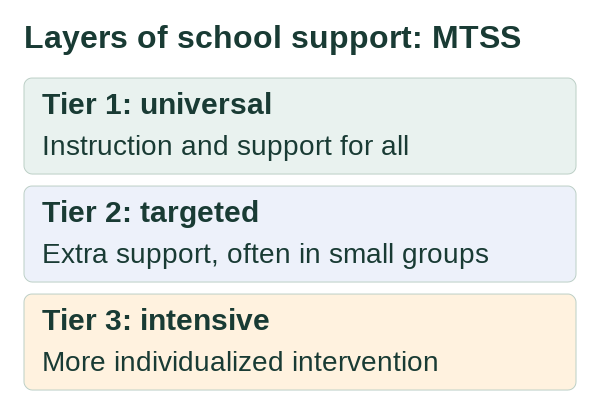
RTI comes in two basic versions.[28] One main question for such models is how many stages, or tiers, of intervention are needed.[27]
A broad consensus holds that early primary and secondary interventions in academic subjects improve overall academic skills. Such programs aim to prevent low achievement. That low achievement often ends in a diagnosis of specific learning disability, or SLD. They also aim to prevent long-term placement in special education. The features of effective prevention programs are generally well established. It is not certain how far these programs actually prevent SLD. Prevention efforts sometimes fail for a child. How to decide SLD eligibility after that is still very much in dispute.[29]
Second-grade students at risk for reading problems, 45 in all, got extra reading teaching each day. After 10 weeks, they were judged against criteria set in advance. The criteria were for leaving the extra instruction. Those who did not meet the criteria were regrouped. They got extra teaching for another 10 weeks. Scores taken before teaching began predicted which students would miss the exit criteria. The scores covered fluency, passage comprehension and rapid naming.[30]
Federal law changed so that RTI became part of identification. The updated Individuals with Disabilities Education Improvement Act is known as IDEA. It no longer required looking at the gap between IQ and achievement. The same law allowed response to intervention as part of SLD evaluation procedures. A 2008 article said RTI was still experimental, both in status and in practice. That article also noted that RTI goals matched No Child Left Behind more closely. Former IDEA rules matched them less closely.[31]
Supporters of a response-to-instruction approach list several possible benefits. Students could be identified by risk rather than by deficit. Identification and instruction could come early. Bias in identification could be reduced. The assessment used to identify a child could be linked to planning that child's instruction. Other questions concern the right amount of instruction. They also concern the need for well-trained staff and for due process.[32]
A 2003 review weighed the evidence on both versions of RTI. It concluded that understanding must grow further. Only then can RTI count as a sound way to identify students with learning disabilities.[28] A 2005 report looked at RTI for learning disabilities. The National Joint Committee on Learning Disabilities wrote it. The committee represents 11 organizations.[33]
The evidence on how best to identify learning disabilities is still disputed.[29][28] One question remains open. What should be done for a child whose response to primary and secondary intervention is inadequate?[29]
After the interventions the average effect size was .76. That is smaller than the pretest figure.[34] An effect size is a statistical calculation of how large a measurable effect is, for example the difference between the averages of two groups divided by the standard deviation.[35]
On some single measures the gap grew. Real word identification rose from 1.06 at pretest to 1.53 at posttest. Passage comprehension rose from 0.45 to 1.43 over the same period. The analysis found that pretest scores and the type of measure used shaped the posttest results. Several features made no significant difference. These were how long the intervention lasted and how many sessions it had. They also covered whether it was one to one or small group. The rule for defining a responder also made no difference. The review concluded that response-to-intervention conditions did not remove the learner differences present before teaching started.[34]
Later work suggests students with learning disabilities are especially sensitive. This shows when the demands of schooling rise. A 2025 paper calls this vulnerability to achievement stressors. It means unusually low achievement. A change in the school setting strains a student's capacity to keep up. Two such shifts were studied in randomized controlled trials. One was the harder fourth-grade fractions curriculum under the Common Core State Standards. The other was the COVID-19 pandemic. It cut instructional structure by disrupting in-person teaching. In both trials, intensive intervention worked better than inclusive instruction for these students. It made their severe achievement gaps smaller.[36]
Assessment and neuropsychological testing
A full evaluation of a child with learning problems checks several mental skills, not just school subjects. A 2005 review of the research literature describes what such an evaluation should measure.[37]
Older theories of learning problems looked for broad mental processes. These were assumed to be shared by most cognitive tasks. Those processes sat far from the actual work of reading, writing, math and science. A 1986 article called the resulting gap the "leap to instruction" problem. The diagnosis does not tell a teacher what to do. Newer work instead names the exact knowledge and skills a school subject requires. That narrower focus makes it easier to find and fix problems. The skills named are the ones a student needs to succeed.[38]
A 1980 survey looked at all learning disability articles in eight major journals over three years. It found serious problems in how children were selected for research. Researchers often failed to describe their samples well. That makes it hard to know whom a finding applies to. The survey also found that a fairly high share of studies used true experiments. The content of the research had changed a great deal from work published before 1970.[39]
People were concerned about standardized testing in both special and regular education. This led researchers to propose curriculum-based assessment. It measures achievement in terms of the local school's curriculum. A schoolwide version of this system has three parts. They are academic skill probes, observation of work habits, and an inventory of the classroom environment.[40]
Earlier still, a behavioral approach set out four stages. They were a baseline assessment and assessment of behavioral components. They also included assessment based on referral. They also included how far assessment results apply to new settings. That approach argued that behavioral information must be reported in a reliable, valid and functional way. It also held that progress can be measured only by direct and continuous observation of observable behavior.[41]
Researchers analyzed essays by 423 university students. They found a three-factor structure across 17 variables. The factors were vocabulary and fluency, syntactic maturity, and vocabulary variety. Students with learning disabilities differed much on vocabulary and fluency and on syntactic maturity. They produced fewer words and fewer different words than their peers. The findings suggest the T-unit may not be the best measure of sentence complexity in adults.[42]
Genetics and the generalist gene finding
First, the genes behind common learning disabilities are mostly the same ones behind ordinary differences in learning ability. Second, a gene that shapes one part of a learning disability shapes other parts too. Third, a gene tied to one learning disability probably also plays a part in others. On this account, a gene linked to reading difficulty may also matter for math difficulty.[43]
Family studies of dyscalculia, a persistent difficulty with arithmetic and number, point in a similar direction. A 2001 study assessed the siblings and parents of children with developmental dyscalculia. It checked for problems with arithmetic, reading and attention. Children entered the dyscalculia group if they had an IQ above 85 and poor arithmetic performance. They also needed a large gap between arithmetic achievement and IQ. The study group had 39 children with dyscalculia and 21 mothers. It also had 22 fathers, 90 siblings and 16 second-degree relatives.[44]
Dyscalculia turned out to be common in these families. The rate was 66% among mothers and 40% among fathers. It was 53% among siblings and 44% among second-degree relatives. The correlation between pairs of siblings was .27. Among siblings of children with dyscalculia, the prevalence estimate ran from 40% to 64%. This was a 95% confidence interval. That range is almost tenfold higher than the rate expected in the general population.[44] A confidence interval is a range of values below and above an estimate that has a given probability of including the true value.[45] In this sample, neither IQ nor attention problems raised the risk of dyscalculia.[44]
Specific learning disorder is a complex condition. Genes play a strong part in it. Its signs differ a good deal from one child to another. The children were on average 8.05 years old. Parents were asked how their children's language and learning developed.[46]
Overlap with ADHD and other conditions
Learning disabilities often occur alongside other conditions. One clinic sample shows how often. One analysis used clinic and school test data from 119 children aged 8 to 16. All were seen at a child diagnostic clinic. Among the children with attention-deficit/hyperactivity disorder (ADHD), 70% also had a learning disability. A learning disability in written expression was twice as common (65%) as one in reading, math, or spelling.[47]
Children with a learning disability and ADHD showed worse learning problems than children with a learning disability alone. Children with ADHD but no learning disability still showed some learning problem. The analysis concluded that learning and attention problems sit on a continuum. They are linked and usually exist together.[47]
One study compared 6- to 11-year-olds with developmental coordination disorder (DCD), a condition that affects motor coordination. It also included children with specific language impairment (SLI). In SLI, language lags for no obvious reason. The children were tested on short-term and working memory for words. They were also tested for space and shape. They were also tested on reading and mathematics. Some children with DCD had typical language skills. They scored below their age level in every memory area tested. The same pattern held in a larger DCD group with varied language abilities. The SLI group was different. It fell short in standard scores only on verbal short-term and working memory tasks.[48]
Memory related to school attainment in different ways in the two groups. In the SLI group, visuospatial working memory was strongly linked to numeracy. In the DCD group, every memory measure was linked to at least one measure of attainment.[48]
A 2025 study looked at 89 students in Grades 3 to 5. It compared students with specific learning disabilities (SLD) and students with attention deficit hyperactivity disorder (ADHD). It also compared students with both conditions and typical peers. Students with both SLD and ADHD showed the greatest difficulties. They took weaker notes and had lower academic motivation than peers. They also had higher test anxiety. Test anxiety in Grade 5 was linked to academic difficulties for students with SLD and with SLD plus ADHD. The study drew on students with formal diagnoses and on students identified as at risk. So its groups mix confirmed cases with suspected ones.[49]
Children with SLI scored lower on writing measures than typical peers of the same age. The average effect size was g = -0.97 across 39 studies. The differences were smaller. In some cases they were still statistically significant. This held when writing was assessed with a contrived response format. It also held with measures created by researchers. It also held when the SLI group included only children with a speech disorder. Children with SLI also scored lower than younger peers with similar language abilities (g = -0.47).[50]
A 2025 review argued that the language deficits tied to specific learning disorder put these children at risk. The risk is problems with social thinking. Examples are recognizing conflict and inferring emotion. That review proposed that clinicians assess language first. Only then should they diagnose and treat the academic and social difficulties of children with specific learning disorder.[51]
Yet children with the syndrome often show well-developed speech. This comes after an early delay in learning to talk. A close look at their language finds real weaknesses. A 1996 paper argued that judging only their speech would mislead.[11]
A 1993 review looked at research on NLD. It also looked at social and emotional functioning. It raised questions about how far the findings generalize and whether they hold for individual children.[52]
Reading and writing difficulties
A later synthesis asked a question. Does adding self-regulation to comprehension teaching make the gains last? The review covered 30 years of research on interventions. It kept only studies that included self-regulation parts. A systematic search found 18 studies from nine research journals that met the stated criteria. Each study was rated for how strong its methods were. The interventions were broken down into their instructional and self-regulation parts. Effect sizes were large right after instruction. They were also large after a delay. This suggests the gains may last.[53]
Writing research on adolescents with learning disabilities is thinner than reading research. The need is large. Many adolescents in the United States write below the level needed for college and work. This holds for students with and without learning disabilities. A 2008 review adapted criteria from a 2007 report on writing. It found 40 studies across six programs of research on writing instruction for these students. From those studies, the review recommended teaching at two levels of support. The programs it examined still offer frameworks for effective teaching. The evidence base is less settled than in reading.[54]
Handwriting and spelling are two basic writing tools. Trouble with them can hold back writing development. Students with learning disabilities usually struggle with both. Such difficulties can get in the way of other writing processes. A 1999 review of handwriting and spelling research and practice argued for two approaches at once. Clear, step-by-step instruction should be paired with natural learning. This lets both basic tools develop as far as possible.[55]
Instruction in the content of writing has its own evidence base. A 2003 article gave examples of approaches based on research. These improve the quality of stories and essays by students with learning disabilities. The examples came from experimental studies. They were gathered in a 2001 meta-analysis of writing intervention research.[56] A meta-analysis is a statistical method that combines the estimates from two or more similar studies into one overall estimate of an effect.[57]
One goal shared by those studies was teaching students to organize writing tasks. It also meant teaching them to come up with ideas about the topic. It meant helping them produce final products that were clear and well organized. The article also described newer research on handwriting and spelling. These are called transcription skills. It showed how teaching these skills affects the quality of writing overall.[56]
A 2001 paper set out six principles. They cover how to prevent writing difficulties and how to build writing skills. The principles included effective writing instruction. They also included teaching tailored to each child's needs. They also included early intervention with extra help. The others were three expectations and practices. These were the expectation that every child will learn to write, the removal of roadblocks to writing, and the use of technology that improves writing performance. The paper noted that many students with learning disabilities have trouble learning the writing process. The roadblocks named in the principles are academic, and some are not academic.[58]
The average effect size was -1.06 for writing quality. For organization it was -1.04. It was -0.89 for vocabulary and -0.81 for sentence fluency. The largest gap of all, -1.14, fell on the conventions of spelling, grammar and handwriting. Genre elements showed a gap of -0.82 and sheer output of written text a gap of -0.87. Writing motivation showed the smallest gap, at -0.42.[59]
Spelling has long been hard for students with learning disabilities. Several decades of research have found language concepts and teaching approaches that help.[60] The 2020 meta-analysis of children with language impairment found a spelling gap of -1.17.[50]
A 2017 meta-analysis gathered 34 repeated reading studies from 1990 to 2014. The students were in kindergarten through grade 12. They had reading disabilities. The 39 independent effect sizes showed positive gains in correct words read per minute. The gains were especially strong in the elementary grades. That analysis found one method worked best. It paired repeated reading with hearing the passage read aloud first.[61]
In a 1988 study, students with learning disabilities generally retold stories as well as nondisabled students. Yet big differences appeared between the groups within each level of analysis. Students made up stories to go with line drawings. Those stories were less well built than stories they retold.[62]
A 1990 study looked at children aged 9-0 to 11-0 years. Students with a history of spoken language impairment did worst on metaphor tasks. Students without such a history did worse than nondisabled peers on every task. The visual metaphor task was the only exception.[63]
A study looked at 111 high school students in special and remedial education classes. They read expository passages less fluently than narrative passages. They also understood them less well. The comprehension gap depended on the kind of question asked. So it was not uniform across all measures.[64]
One review argues that print science texts pack in dense scientific information. That may make reading science the hardest school task for students with learning disabilities. The same review notes that building prior knowledge, adding enhancements to the text, and teaching reading comprehension strategies all improve how well these students understand science text.[65]
Interventions that combined several parts together reached 0.64.[66] A separate synthesis drew on 27 studies of reading interventions taught with social studies content. Of these, 16 gave enough data for a meta-analysis. Those interventions used graphic organizers and mnemonics, which are memory aids. They also used reading and answering questions, guided notes, and instruction with several comprehension components. The overall mean effect size was 1.02. The authors call this a large positive effect.[67]
Writing instruction for these students often relies on incidental teaching rather than explicit teaching. Special education teachers gave more one-to-one and small-group support.[68]
When writing is taught directly, it helps. A meta-analysis combined 43 studies. The students were in Grades 1 through 12 and had documented learning disabilities. It found an overall effect size of 0.74 on writing quality. Strategy instruction teaches steps for planning and carrying out a writing task. It had an effect size of 1.09. Dictation reached 0.55. Goal setting reached 0.57. Process writing reached 0.43. These four were the only subgroups statistically different from zero. Treatments aimed at planning and revising worked only when teaching came with them.[69]
Simpler supports can also help. Students with learning disabilities write better stories when given cue cards. A checklist of story parts helps them too. This scaffold guides the task without teaching new content.[70]
Hypertext is a computer format. A reader can open extra text windows to get more information. In one study, 40 students worked in three groups. One group had lecture only. One had lecture with a computer study guide. The 40 students included 10 with learning disabilities. Another 15 were remedial students. The other 15 were regular education students. Retention test scores were also higher for that group.[71] Some students had access to these study guides and some did not. Those with the guides kept more information in both short-term and long-term memory.[72]
Two researchers called learning a foreign language a very hard task for some of these students.[73] More students with learning disabilities were going to college. The foreign language requirement became a new cause for concern. Evidence shows that these students are likely to have great trouble in foreign language courses. A language-based assessment model was described for diagnosing such problems in college students. The article also described waivers and course substitutions.[74]
A 2023 article argues that foreign language classrooms have not always been open to students with special educational needs and disabilities. That article challenges the notion that this group cannot or should not learn languages. It reports that second language learning is possible for many such learners. It may even help them. This depends on each child's situation and profile. It recommends classroom strategies for inclusion. It does not recommend routine removal from the foreign language classroom.[75]
Some interventions taught strategies for finding the main idea. Others taught summarizing. These had large effects on comprehension. One-on-one instruction or instruction in pairs worked better than large group instruction.[76]
Some adolescent students are learning English and also have learning disabilities. For them, researchers recommend explicit teaching of word reading and academic vocabulary. In the secondary grades, these students have fewer chances to build understanding from subject-area texts.[77]
Mathematics difficulties
A 2004 review put the share of school-age children with some such deficit at 5% to 8%. The review grouped these difficulties into three subtypes of mathematics learning disability. It linked them to memory and thinking deficits that lie underneath. It also discussed possible neural correlates. These are brain features that may go with the deficits.[5] A 1992 article on number fact fluency said math learning disabilities have wide effects. They often cause serious trouble.[78]
The many forms of math learning disability share one feature. Students are weak in fluency with basic number facts. This covers addition, subtraction, multiplication and division. Many students with learning disabilities find the usual method of seatwork drill wholly inadequate. It may even do more harm than good. The 1992 article used cognitive psychology and intervention research. It described how fluency with number facts develops. It gave guidelines for assessment and specific teaching points.[78] A 2026 pilot study looked at children with MLD in Grades 4 to 6. Growth in multiplication fluency predicted how well they did on multiplication word problems.[79]
One place to look for causes of low mathematics achievement among students with learning disabilities is how instructional materials and practices are designed. Using these principles more widely could raise mathematics achievement far higher for students with learning disabilities. This applies to materials and to everyday teaching.[80]
A developmental view asks how children build math knowledge across the school years. A 1997 article from developmental psychology made an argument. U.S. education has shortcomings. These put even children of adequate intellectual ability at risk for low mathematics achievement. Some children's failure reflects a genuine learning disability. The article argued that finding those children requires a complex developmental research agenda. It suggested careful methods, such as clinical interviews and ethnographies. Researchers should weigh how good classroom instruction is. They should also weigh what children already know informally. They should also weigh motivation and specific interventions. They should weigh the different mental processes used in building mathematical understanding. They should also consider children's difficulties across different areas of mathematics. They should consider how children's thinking develops through the school years.[81]
One explanation for trouble with multiplication facts is sensitivity to interference. Interference means that similar facts overlap in memory and make recall harder. This slows the fixing of multiplication facts in long-term memory. A 2026 pilot study tested a digital intervention built around this idea. It compared it with an approach based on deliberate practice. Both groups improved a lot. The approaches did not differ much. Among children with higher sensitivity to interference, however, there was a positive trend. They improved more with the interference-aware approach.[79]
A study followed 221 fourth-grade students with word-problem difficulties through an intervention. Their average age at pretest was 8.8 years. All of these students had received a word-problem intervention in third grade. The intervention helped students learn and remember word problems that involved tables. The intervention did not make some problems easier to learn or remember. These were problems with particular schemas, such as total. There were also problems with irrelevant information. The researchers concluded that the difficulty of a problem feature is not fixed. It can change with instruction.[82]
Structured teaching has been tested directly on geometry. One study compared two versions of a structured model. The model is called Goal-oriented Instruction for Conscious Learning. It combines clear, step-by-step teaching with goal-setting. The goals followed the SMART framework: specific, measurable, achievable, relevant and time-bound. Fifty sixth-grade students in Greece took part. The design was quasi-experimental. They also got better at naming their properties. They got better at calculating volume too.[83]
One quasi-experimental study took place in Karaj. It involved 40 fourth-grade boys with a specific mathematical learning disorder. They were randomly divided into experimental and control groups. The experimental group got the Captain's Log computer program on its own. There were 12 sessions of 50 to 60 minutes. These students had shorter reaction times than the control group. They also showed more visual-spatial ability. This held on post-tests and at a two-month follow-up, with p<0.05.[84] A separate quasi-experimental study gave working memory training to 45 children with specific learning disorder. They were trained in groups, across 12 sessions of 60 minutes each.[85]
A 2014 error analysis compared the mistakes of students with learning disabilities and their peers without disabilities on word problems. The study sorted the errors by type and by how often each type appeared. It reported ways the two groups were alike and ways they differed. It linked them to thinking processes that may lie behind the errors.[86]
The interventions raised word-problem accuracy. The effect size was 1.08. Peer interaction and instruction in how to transfer a method to new problems each produced large effects. The largest effects came from intensive programs in Grade 3. They had 50-minute sessions, 34 in total, whatever the setting.[87]
At secondary school the demands shift toward reasoning, explaining and generalizing. A 2016 review examined 17 experimental studies. They covered interventions for students with learning disabilities, or at risk of them. The review grouped the interventions into heuristic, semantic, and authentic approaches. How well each approach worked varied. The three also differed in how strongly they tied problems to real-world situations.[88]
An earlier review looked at 23 articles published from 1995 to 2006. It found significant gains for secondary students from several practices. These included memory aids called mnemonic strategies. They also included a step-by-step teaching approach. They also included cognitive strategy instruction that involves planning. They included schema-based instruction and contextualized videodisc instruction.[89]
A 1991 review found 30 studies of math teaching strategies for students with learning disabilities. The studies covered rewards and goal-setting during seat work. They also covered specific strategies for computation and for solving problems. These included memory aids, peer mediation and computer-assisted instruction. The authors of nearly every study called their procedure effective. The review called for more research on approaches such as constructivism. It also asked how teaching fits particular learning disabilities.[90] The students became more fluent in computation. The skills held up over time and carried to new problems.[91]
One college general education mathematics course was built around making sense of mathematics. Students explained their work and held discussions with the class. A 2005 classroom report described one section of a general education mathematics course. All three enrolled students had diagnosed learning disabilities related to mathematics. The report came from action research. It discussed what teaching such courses to these students requires.[92]
Working memory training has also been tested in this group. A 2026 quasi-experimental study put 45 children with specific learning disorder into groups of 15.[85]
Vision, hearing and sensory claims
The most common learning disability is reading disability, or dyslexia. It rests on language. Because of this, treatment should target the language problem itself. It should include direct teaching of phonemic awareness, phonics, fluency training, vocabulary and comprehension.[1] A 2009 statement from the American Academy of Pediatrics agreed. Vision problems do not cause primary dyslexia or learning disabilities.[93]
Science does not back treatments based on vision.[1][93] Studies do not back claims that these treat learning disabilities. The list includes visual training, eye muscle exercises and tracking exercises. It also includes behavioral vision therapy, special training glasses, prisms, and colored lenses and filters. No good evidence shows that children who have vision therapy respond better to teaching. This holds for children who do not have it.[1] The 2009 pediatric statement also did not endorse eye exercises, behavioral vision therapy, or tinted filters and lenses. It did not endorse them for improving long-term school performance.[93]
Hearing research points to a real difference. Children with learning disabilities hear sentences in background noise less accurately than other children. In one study, 63 children with diagnosed learning disabilities listened to simple English sentences played in noise. So did 36 children without them. The children with learning disabilities did worse overall. Their disadvantage grew as the noise became louder. Both groups did better when a speaker used clear speech. Neither group needed training to gain this. For many of the children with learning disabilities, clear speech raised their scores. The scores reached the range that the other children reached with ordinary conversational speech.[94]
A 2024 randomized controlled trial in Tehran put 30 students with specific learning disorder into two groups. The experimental group had 15 and the control group had 15. The experimental group had eight sessions of 90 minutes each. The control group had no intervention. The intervention improved scores on social-emotional skills. It also improved how socially able students felt. The gains held at a five-month follow-up. The trial measured social and emotional outcomes, not reading or mathematics.[95]
A 2025 study gave a package using several senses to 30 children. The children were aged 7 to 11. It used colored cubes, flashcards and phonological awareness activities. There were twelve 45-minute sessions. The children were assigned at random to the intervention or to a control group of 15 that got no intervention. The intervention group improved on all measured dimensions of visual perception. It also improved auditory discrimination. Effect sizes ran from 0.17 to 0.64. The gains held at three- and six-month follow-ups.[96] A related 2026 study of 30 children found gains in word reading, nonword reading and word-chain reading.[97]
Technology and assistive tools
Assistive technology means tools that help a person with a disability. These tools use a strong skill to get around a weak one, or make up for it. A 1998 survey described many forms of such technology, both "high" and "low".[98]
At college level, the number of students with learning disabilities rose sharply over several years before 1998. That rise led colleges to build support programs. So did federal law requiring "academic adjustments" for students with disabilities. Assistive technology became one of them.[99]
One reading system is called Strategic Reader. It was built to join two ideas in one digital setting. Students who used the online tool showed big gains in comprehension scores. The growth gap between the online and offline conditions was especially large. This was true for students with learning disabilities. Those students showed a statistically significant rise in scores in only one condition. That condition was online progress monitoring. They found many of its features more helpful than their general education peers did.[100]
A 2022 review looked at virtual reality as a setting for training metacognition. The techniques it covered included clinical hypnosis, neurolinguistic programming, subliminal training, and fast learning. They also included mindfulness and breathing training. All were delivered in virtual reality. The review concluded that virtual reality gives good practice in therapeutic metacognitive techniques. It reported helpful effects in experimental research. The research covered learning disabilities, cognitive impairments, autism, ADHD, depression, anxiety disorders, phobias, and behavioral and emotional disorders. It also argued that therapists, educators, parents and patients could use these techniques. They could use them at home, at school or at work. The review called for building virtual settings for training in thinking about thinking.[101]
Text-only support was enough to move these students toward continued use of the guide. They did not need prompting. Next came short-term and long-term retention of information. Students who could use the hypermedia study guides kept more information than students who could not.[72] The computer study guide worked as well as a lecture. The group using the guide scored higher on posttests and on retention tests.[71]
One study followed three junior high students with writing disabilities. It compared classwork written by hand with classwork written on a computer with a word processor. Handwritten work had more spelling mistakes and more reading errors. Its overall organization and structure were also weaker. The number of words per text showed no clear difference between the two conditions.[102]
A review looked at 7 articles published between 2015 and 2020. It found that digital tools helped students with learning disabilities build learning skills. These tools included smartpens, personal computers and smartphones with suitable applications. The tools also raised their performance.[103]
The insider view of what it means
Adults with learning disabilities have rarely been asked to define the term themselves. This is according to a 1993 article by Reiff, Gerber and Ginsberg. Definitions usually come from professionals in education, psychology, medicine and social policy. That article reports how a group of successful adults with learning disabilities defined the term when asked. Their answers included ideas found in existing definitions. They also included views that come only from living with learning disabilities into adulthood. Some of those perceptions were not accurate in a technical sense. Yet their personal nature shows how learning disabilities affect a life over time. The article argues that any future effort to settle on one definition should consider what adults with learning disabilities say. This matters especially for adults.[104]
A 1996 qualitative study followed 9 students with learning disabilities at a public 4-year university, from kindergarten through college. Over 6 months the researcher read school records, held interviews and watched classrooms. The students described being labeled, stigma and gatekeeping throughout their school years. To manage school, the students used both positive and negative coping methods. Positive techniques included relying on benefactors and using self-improvement methods. They also included using particular strategies and management skills for academic work. Negative techniques centered on "passing." This meant hiding the disability to avoid disclosure and get through school. Passing created tension for the students. The study concludes that such students need to self-advocate.[105]
One study compared 46 students with learning disabilities and 47 students doing normally at school. Their mean age was 12.0 years. On the Piers-Harris Children's Self-Concept Scale, students with learning disabilities showed lower overall self-concepts (p < .01). The gap came mainly from views of their intellectual and school status (p < .001). The two groups did not differ in how they blamed causes. They were alike on internal versus external causes. They were also alike on ability versus effort for failures. Students with lower self-concepts were more likely to blame failures on ability.[106]
Self-monitoring means students watch and record their own behavior. It has improved academic performance for students with learning disabilities. It has also improved task completion, engagement and on-task behaviors. A 2022 article describes positive self-talk as an addition to self-monitoring. In exercise psychology, self-talk strategies have produced further gains. These include greater self-confidence, better task accuracy, more persistence and stronger self-awareness. The article stresses that these interventions should be brought into classrooms. The aim is to improve school and behavior results for students with learning disabilities.[107]
Research
Early signs and screening in young children
Learning disabilities are developmental in nature. They begin before kindergarten and continue into adult life. A 2007 paper in Learning Disability Quarterly covers early identification, services and intervention. It covers children from birth through 4 years. It describes the target group as young children. Their developmental delays may later lead to a diagnosis of learning disability. The delays can appear in cognition, communication, motor and sensory abilities, or in social and emotional adjustment. They can also appear in emergent literacy, the early skills that come before reading and writing. The paper names early warning signs. These include late speech and language, and poor motor coordination. They also include delays in perception, reasoning and social interaction.[108]
Development in each domain may reflect individual differences in the rate and pattern of maturation. It may also reflect environmental factors. These include language exposure and the quality of learning opportunities. Some children get high quality learning chances before kindergarten. These children are less likely to fail in school. They are also less likely to be wrongly labeled with a learning disability in the early grades. Professionals look at factors that raise or lower risk. They also watch each child in a planned way. They check how the child is developing. They then build rich and varied chances to learn. They plan and provide services and supports. They base intervention on assessment data. Such programs are said to fit the child's culture and stage of development. They are sensitive to language and based on scientific evidence. The paper also stresses that families and caregivers take part.[108]
A 2026 study translated an English screening tool for specific learning disorder into Marathi. Marathi is a language of western India. Specific learning disorder is the medical name for a condition that affects brain development. It shows up as trouble with reading, writing, reasoning, mathematics, or understanding and using language. Class teachers from two government Marathi medium schools in Mumbai district gave the Marathi tool to 100 students. There were 20 from each of standards 1 to 5, aged 6 to 10 years. The tool has 60 questions in all, in 3 sections. The sections cover reading, writing, and social and behavioural competency. The study looked at 100 students. Of these, 33 were found to be at risk of a specific learning disorder. The study concludes that the Marathi tool is an effective way for teachers to identify children with specific learning disorder. Teachers use it in classrooms.[109]
The 2007 paper focuses on developmental expectations, not academic ones. The 2007 paper notes that signs of learning disabilities vary with age. They also vary with the learning demands placed on the child.[108]
One study screened children in 528 Italian families at 27 to 30 months. It followed them to an average age of 8.05 years. In that sample, 7.01% of children had a specific learning disorder. This is close to rates reported in similar studies.[46]
Word-finding is another early sign. Children with learning disabilities made many more naming errors than typically learning children. Errors and response times rose on rare words.[110]
Some children with learning disabilities have trouble finding words. These children made more errors and took longer to respond. They also made unusual types of substitution. Children without such problems did about as well as their normal peers.[111]
One outcome study followed children at risk for specific learning disabilities. It covered elementary and middle school. The children had received an intervention. It was built on task analysis of kindergarten curricula and on team teaching. All results were significant for the treatment group compared with an at-risk cohort. They were also similar to a current random group and to national averages.[112] A later study in Malaysian vernacular schools tested computer-assisted early intervention. It was for children who had trouble learning the national language.[113]
How common the diagnosis is and who receives it
A 1991 review of state guidelines found that 40% of states had revised their rules between 1988 and 1990. The review covered all states and the District of Columbia. Of the states examined, 76% named a method for measuring the gap. The gap was between a child's ability and achievement. The method recommended most often was the standard score comparison. The choice of method did not change much how fast a state's identified students rose each year. A state's required gap size did relate significantly to its yearly increase. This held from 1987-88 to 1988-89. More states also set a lowest IQ score. A student who scores below it would not qualify for learning disability services.[114]
The Iowa Learning Disabilities Evaluation Project drew a sample of 917 students with learning disabilities. They were chosen at random within layers of the state's Area Education Agencies. Agency staff completed a survey for each student selected. It covered pupil characteristics. It also covered information about assessments, programs and services. The result was a detailed profile of students with learning disabilities across one state.[115]
An Indiana study compared 906 students with learning disabilities to 836 students. The second group had been referred for special services but were found not eligible. The students with learning disabilities scored much lower than the referred but unlabeled group. They were also more often below grade level in core achievement areas. A large gap between expected and actual achievement was more likely in the labeled group. The Indiana findings matched earlier studies. Those studies described students with learning disabilities as the lowest of the low achievers.[116]
The community college system of California spent 5 years building an eligibility model. In that system, every student evaluated for learning disabilities is assessed with the same model. The model fits that college setting only. The process of building it may apply more widely. The article describing it argues that classification models have usually rested on two things. These are political expediency and clinical folklore.[117]
A 2020 review cites recent studies. These estimate that up to 10% of the world population has a disability that is not apparent. This includes autism and dyslexia. That reflection also notes something about English language learner instructors in higher education. Few have training in learning disabilities. Those instructors are often unsure how to support learners who seem to face extra challenges.[118]
A 2007 account describes a shift in Norway. Politics started the shift in how the country defines learning disabilities. That account traces how the new view affected the recognition of students and the services they receive. It also surveys how the support system is organized and the working methods used. A selection of Norwegian research describes the problems studied, the assessment methods and the interventions used.[119]
A 1986 questionnaire study asked a random sample of learning disabilities teachers a question. Which criteria did their most recent placement meeting stress? Teachers reported the greatest emphasis on variability within the individual child, on a gap between achievement and potential, and on working below grade level. They put less weight on processing deficits and brain dysfunction. Some teachers served only the learning disabilities category. They stressed processing deficits and neurological involvement. They did so more than teachers who served many disability categories.[26]
An analysis of practice in Israel describes a fragmented society. Its schools separate ethnic and social groups. Israel has also developed a response to intervention model. In it, a specialist called a Matal manages diagnostic and prescriptive casework. But its adoption had already changed how learning disabilities are tested and diagnosed.[21]
Some researchers hold that learning disabilities occur in every nation, language and culture. One published profile describes a man from Taiwan with learning disabilities. His school experiences are like those of many children elsewhere.[20] That critique asked for a broader definition. It would give up the idea of a discrepancy.[120]
Memory, attention and processing behind the label
They compared children with and without reading disabilities on short-term and working memory. The review computed 578 effect sizes. The mean effect size across studies was -.89. The 257 short-term memory effect sizes averaged -.61. The 320 working memory effect sizes averaged -.67. Children with reading disabilities were most clearly behind on short-term recall of phonemes and digit sequences. They also did worse on working memory tasks that combine processing with storage. Age, IQ and reading level did not significantly change these memory differences.[121]
A second synthesis, published in 1998, asked a question about the memory gap in reading disability. Does it reflect a developmental lag or a lasting deficit? The clearest disadvantages came from memory demands that required naming visual information. Tasks involving serial recall also caused them. Task and material features predicted the effect sizes better than strategies did. Age, IQ and reading scores did not predict results much. The difficulties held across ages. So the analysis supported a deficit model over a lag model.[122]
A 2018 study grouped 205 children with specific learning disorder by their cognitive profiles. A four-cluster solution fit best. The clusters differed in how often each learning disorder subtype appeared. They also differed in how well they learned. The authors argued that one broad diagnostic category can play down differences in cognitive functioning within it.[123]
A 2010 meta-analysis of 32 studies measured cognitive processing. It asked how far students with specific learning disabilities differ from typical peers. It found effect sizes from moderately large to large. The authors judged these large enough to justify including cognitive processing measures in identification. How such measures should enter eligibility decisions remains controversial. Part of the reason is that their role in diagnosis is uncertain.[124]
Motor coordination has also been studied alongside learning disorder. A 2018 study compared three groups aged 5 to 12. There were 29 children with specific learning disorder and 33 with developmental coordination disorder. The study also had 34 controls. Both clinical groups scored lower than controls on fine motor and handwriting skills. They also scored lower on general coordination. The learning disorder group scored higher than the coordination disorder group on movement control. The authors said a gap exists. It lies between children with learning disorders and typically developing children. This gap could affect self-esteem and inclusion in sport.[125]
What the evidence says about treatments
A 1987 review noted a problem. Research on an approach may exist. But the reports may sit in journals parents and teachers rarely read. When no research exists, claims may reach the public through popular books and newspapers. Magazines or television can also carry them. So parents may hear of an idea before professionals do.[126]
A 1974 review examined optometric developmental vision training. This is a set of eye exercises. It was meant to improve readiness skills in children starting school. It also aimed to fix learning problems in children already enrolled. That review concluded the evidence was too limited to decide whether the programs work. The problem was confounding. Sampling, program procedures and research methods were mixed together. Saying clearly whether the training works would require knowing which parts help which children.[127]
A 1996 article compared a replication study with an earlier meta-analysis. The meta-analysis covered sociometric research on children with learning disabilities. The two reviews agreed in direction and outcomes. But they differed a lot in the moderator variables they identified. Some of that variation was linked to gender, ethnicity and the type of measurement used. The differences were attributed to weak reporting of coding reliability, to different articles being included, and to poor definition of learning disabilities when articles were selected.[128]
Some children with learning disabilities also have mental health problems. For them, the evidence base for psychosocial intervention is described as surprisingly small. A 2007 paper described how this approach is built. It asked what evidence exists for developing it for this group. The paper found surprisingly little written work on psychosocial intervention.[129]
In practice
Instruction that works in classrooms
Classroom research on learning disabilities has asked which teaching moves raise achievement. Reviews of many studies point to a set of them.[130][131] A meta-analysis combined intervention studies for adolescents with learning disabilities. It sorted the programs into 8 instructional factors. Only the organization and explicit practice factor added significant variance to effect size. That share was 16%. That factor had just 2 parts: advanced organization and explicit practice.[131] A companion article turned the same findings into practical guidelines for teachers.[130]
One meta-analysis drew 55 standardized mean effect sizes from 16 articles. Those articles involved 808 participants. The students were in grades 4 to 12. They used organizers in English or reading, science, social studies, and mathematics classes. Posttests measured near and far transfer. Organizers were linked to gains in vocabulary knowledge, comprehension and inferential knowledge. This held across conditions, settings and features. Mean effect sizes ran from moderate to large. The size depended on the type of measure, the type of organizer, and the subject area.[132]
Science is often hard for students with learning disabilities. It asks a lot of many thinking skills at once. A 2011 review described strategies tested for these learners in several areas. The areas were verbal learning of declarative information and processing information in texts. They also included activities-based or experiential learning. They included scientific thinking and reasoning, and differentiated instruction. The review reported clear, positive effect sizes. It concluded that using the strategies would greatly improve science results for students with learning disabilities. The same review also summed up research on teacher behavior. It asked how this affects science achievement for these students.[133]
Teacher enthusiasm has been tested directly, not just described. In one experiment, students with learning disabilities received science instruction over a 2-week period. They were in two junior high special education classrooms. Levels of teacher enthusiasm were switched between the classrooms in a crossover design. More enthusiastic presentations produced significantly higher academic achievement. They also produced lower levels of off-task behavior. Under enthusiastic instruction, preservice teachers rated the students as more interested in the lesson. They also thought the students were likely learning more.[134]
An earlier article argued that intervention studies in learning disabilities lacked a shared plan for the teaching itself. Knowledge here covered declarative, procedural, and metacognitive knowledge. The model was offered as a framework. A researcher could link it to any theory they choose.[135]
A 2008 systematic review covered 20 studies. They included 669 secondary-school students. These students had one of three conditions. They were learning disabilities, emotional and behavioral disorders, or mild developmental disabilities. Mnemonic instruction improved academic performance. This held across study methods, settings, ages and disability groups. Performance was usually measured by recall of word meanings or facts.[136]
Achievement results were mixed overall. Approaches that built in individual accountability and group rewards were more likely to raise achievement. Design problems in the studies limited what the researchers could conclude. The reviewers called for more research. Until then, cooperative learning should not be treated as effective for students with disabilities.[137]
A 1995 study followed six postsecondary students with learning disabilities. They were 5 women and 1 man aged 18 to 36. Each worked on a task important to their studies. Task performance improved. Students also learned about tasks and strategies. They felt more capable and changed how they explained their results. They built and changed strategies, then carried them to new contexts. They began to use strategies on unfamiliar tasks.[138] All three used the skills more steadily in learning support and mainstream classes. Two kept them up over the long term.[139]
A 1991 study looked at 60 junior high students. Students without disabilities usually wrote longer stories. Their stories were also of higher quality. Students were given time and a structure for planning. The structure was a story grammar cue card. After that, the difference between the groups was no longer significant.[140]
A 1992 review argued that most students learn to read naturally. But some need more step-by-step, explicit teaching to become fluent. That review concluded that students with severe learning disabilities can learn to read in a whole language, mainstream classroom. The conditions are extra instruction and a mix of techniques. They also include services matched to each student's needs.[141] A 1992 interview feature presented experts in whole language. A commentary beside it gave the other side of the debate.[142]
School placement and inclusion
Schools put students with learning disabilities in different settings. One study compared two of them directly. A 2002 study compared one inclusive school with one pullout school. It matched the two groups of students on age, gender, ethnicity, socioeconomic status and IQ. Students in the inclusive classrooms earned higher grades. They scored higher or about the same on standardized tests. Those students also broke no more behavior rules than students in the pullout program. They came to school on more days.[160]
A 1995 article set out guidelines for what it called responsible inclusion. The first guideline is that the student and family come first. Teachers should choose to take part in inclusion classrooms rather than be assigned to them. Inclusion classrooms need enough resources. Each school should build and run its own models. Schools should keep a range of services. The service delivery model should be checked regularly. Staff training should also continue over time.[161]
A 1993 study observed 60 general education teachers' classrooms, from kindergarten through grade 12. The classrooms included students with learning disabilities. Observers used the Classroom Climate Scale. They found that few teacher behaviors and classroom practices differed for students with and without disabilities. Student behavior was in fact different. Students with learning disabilities talked with the teacher much less often than their classmates did. They also interacted less with other students. They took part less in classroom activities.[4]
A 1993 study in northern Greece compared students with learning disabilities to their classmates. All were inside the mainstream public school system. The sample was 30 fifth and sixth grade students. Their teachers said they had learning disabilities. All 307 of their classmates formed a comparison group.[162]
Where to teach students with learning disabilities has been much disputed. It is one of the most disputed questions in special education for 40 years. Federal law now requires all students with disabilities to reach the general education curriculum. It also requires them to make adequate yearly progress in it. That has sharpened the debate.[163]
A 1971 study compared two settings. In resource rooms, children visit for short daily periods. In self-contained special classes, children spend the full day. Some children needed the total teaching structure of a full day in a special class. Most of them, however, did as well with short daily visits to a resource room. A matched group in special classes did as well.[164]
A 1995 account described elementary classrooms using the Foxfire approach. This is a learner-centered way of teaching. It described them as communities that serve all children. The teachers in that account used learner-centered instruction. They wanted to give all their students better learning experiences. They did not do it to include children with learning disabilities.[165]
A 2002 meta-analysis compared the self-concept of students with learning disabilities across placements. A meta-analysis is a statistical pooling of many studies. The studies comparing regular classes with resource rooms gave mixed results.[154]
College, work and adult life
A Canadian study looked at 110 students with disabilities that are not visible. Of these, 55 had a specific learning disorder. Another 55 had disabilities linked to mental health. Students with learning disabilities were more likely to plan to graduate than the mental health group. The same study found the two groups differed in age and gender. Their personal circumstances also differed. They also differed in feelings of social isolation on campus. Different factors predicted the intent to graduate for each group. This suggests the two groups may need different academic, social and accommodation support.[166]
A 2016 analysis looked at 63,802 responses to a 2014 university survey. It found that 5.96% of students reported a learning disability. Those students had more trouble with assignments. Duties outside class and their own skill levels added more obstacles. They also sensed more bias against people with disabilities on campus. They were less satisfied with their overall experience.[167]
Academic strategies and test-taking support are practical tools studied for this group.[168][169] One study compared 191 college students with learning disabilities and 190 without. It found no significant difference in grade point average or number of courses taken. Family status also showed no significant difference. Students with learning disabilities did report more difficulty in three kinds of courses. These were humanities, social sciences and foreign language. They invented unusual strategies. They preferred extra oral or visual explanations. Students without disabilities preferred written examples. During examinations, students with learning disabilities had trouble concentrating. They also worried about lack of time. They felt more frustrated, helpless or uncertain than their peers.[169]
A test-taking strategy intervention was tested on university students with learning disabilities. The study used a multiple baseline design. It was an effective intervention for these students. Students with learning disabilities have fewer test-taking skills than peers without disabilities. Poor test-taking skills add to that anxiety.[168]
In the 2016 survey, about one-third of students who reported a learning disability received accommodations. Accommodations were more common among students who were wealthy and who lived alone. They were also more common among students from out of state. This differed from students who reported a learning disability but had no accommodations.[167]
Faculty generally show they are aware of the needs of students with learning disabilities. Faculty and student views differ in several areas that need further attention.[170] One review describes adolescents and adults with learning disabilities as underserved. It also calls them underprepared for the demands of education after high school. That review calls the evidence on postsecondary outcomes for this population extremely bleak. It presents several academic options as other routes from secondary to postsecondary study.[171]
Most of the adults interviewed had adjusted well to adult demands. Of those no longer in college when interviewed, more than 80% held jobs, mostly white collar. Most said their learning disabilities affected them at work or elsewhere in life. Yet they usually did not tell employers about the disability when applying for jobs or once employed. The people who answered were socially active and happy with their social life.[172]
A 2012 review notes that learning disabilities continue into the adult years. It also notes that autonomy and self-determination matter for quality of life in adulthood. That review also reports a lack of research that could guide practice. The research concerns adults with learning disabilities in adult education settings.[173]
How a person comes to understand the disability itself seems to matter for adult adjustment. Researchers have named reframing the learning disabilities experience as a key factor. It helps in finding work and adjusting to adult life. Reframing moves through recognizing the learning disability, understanding it, accepting it, and then forming a plan of action. The argument is that adult life requires successful reframing. It helps people take control of the disability and learn to speak up for themselves.[174]
Stress and emotional strain appear in studies of students with learning disabilities.[175][176] A study looked at university students with specific learning disorders. It found their self-efficacy was lower than that of peers with typical development. They also scored high for academic anxiety. They had emotional problems and trouble with peers.[175]
One study compared 95 college students. Of these, 46 had a specific learning disorder and 49 did not. Students with the disorder reported much more rumination and higher perceived stress. They also reported more trouble with planning and self-control. Trouble with executive function affected the link between the disorder and rumination. Students with both had the highest levels of rumination.[176]
A study of 898 Taiwanese junior high students included 407 with specific learning disabilities. It also included 491 students who were developing typically. Social support eased learning frustration in the group without disabilities. It did not ease it in the disabled group. In that study, learning frustration harmed self-efficacy in students without disabilities. In students with learning disabilities it directly affected well-being. It did not affect self-efficacy. Coping strategies had stronger mediating effects in students with learning disabilities. This suggests the groups cope with stress in different ways.[177]
A 3-year project prepared students with learning disabilities for college. The federal government paid for it. Its participants stayed in postsecondary education after their first year. They did so at higher rates than the general student population. They also gained skills in speaking up for themselves, study strategies, getting along with others and accommodations. Some participants still denied their disability. They held back from asking for accommodations. The project named key elements for a successful transition. These were understanding one's disability and taking mainstream academic courses in high school. A third was practicing accommodations and self-advocacy in those courses. It also listed three steps. Give the student a voice in decisions. Appoint a transition case manager, and plan as a team. The project recommended starting transition work before the ninth grade. It also recommended tracking students until they finished their postsecondary program.[178]
Tests showed lasting problems with processing what they saw and heard. They also showed lasting problems with academic skills. The students had built coping strategies that got around or made up for those deficits.[179]
Adjustment is not only about schoolwork. In one study, 34 university students with learning disabilities reported lower self-esteem. They were compared with 31 students without disabilities. They also reported poorer academic adjustment. Their personal and emotional adjustment was poorer too.[180]
One study looked at 78 university students with a learning disability, ADHD or both. Their self-compassion scores were lower than other researchers had found. Accepting the disability, self-compassion and self-regulated learning were closely linked.[181]
A follow-up study looked at 500 graduates with learning disabilities. They came from three universities in the United States. It found full-time employment, benefits and salary competitive with American workforce statistics. Those figures were also higher than the numbers for adults with learning disabilities who did not finish college.[182]
Only 12% had asked for accommodations at work.[183] A review looked at the first 12 years under the law. It found little research on how workplaces actually treat adults with learning disabilities.[184]
A survey asked 275 people at three day centres in Belfast. More than one-third wanted a job. Their key workers were the staff who supported them. These workers thought one in five could hold down a job. Both shares were higher among people who had work experience placements. Key workers named three common obstacles to paid work. These were poor concentration, poor communication skills and poor motivation.[185]
A 1988 review of the research reached one conclusion. Many children with learning disabilities become adults with learning disabilities.[186] One answer proposed at the school level is cognitive autonomy. It is the set of skills for making decisions and voicing an opinion. It also covers judging consequences and assessing one's abilities. It also covers how others' influence weighs in. Students with learning disabilities often leave school without these skills. The skills are part of self-determination. They matter for college, employment and adult life.[187]
Accommodations, testing and the law
The federal definition of learning disabilities itself has been open to revision. In 1987, a committee of several agencies reported to Congress. It recommended changing the wording of the law. That committee also called for funded research centers that cross disciplines. It also wanted a central clearinghouse to spread information about learning disabilities.[188] The National Joint Committee on Learning Disabilities issued a 1993 statement on teaching these students well in regular classrooms. Its member organizations approved the statement in November 1990.[189]
Scanlon and colleagues answer no. They propose goals and a personal curriculum that draw on the general education curriculum rather than sitting entirely inside it. Scanlon, Calhoon and Berkeley argue for a new vision of FAPE. It should not assume the same outcomes for all students.[190]
Disability laws in Saudi Arabia set a requirement. Higher education institutions must offer special needs learners opportunities equal to those of other students. A study looked at 22 students with learning disabilities at Saudi institutions. There were 16 undergraduates and six postgraduates. It found that more support services were still needed.[191]
The most common accommodation for these teens as they move on is extended time. A meta-analysis by Gregg and Nelson combined studies to ask a narrow question. Do scores from tests taken with extended time alone compare with standard scores? The question covers students with learning disabilities and peers without them. The authors said the results raised more questions than answers. Such studies are about fairness and effectiveness. The question is whether accommodated and standard scores are comparable.[192]
College students with learning disabilities still trail peers without disabilities in three ways. They have lower grade point averages, stay enrolled less often and graduate less often. A study of college freshmen and sophomores with learning disabilities tested one idea. Did academic and social integration explain those differences? Integration did not predict grade point average on its own. Both kinds of integration did predict whether a student planned to stay. The findings suggest that college experience may help explain persistence. High school achievement and background are not the whole story.[193]
In one study, 16 university students with learning disabilities took a timed reading comprehension test. Fifteen students who were doing normally at school did the same. The two groups' scores differed significantly under timed conditions. The students with learning disabilities were given extra time. Their scores then no longer differed significantly from those of the other students. Students who usually achieve normally gained no significant benefit from extra time.[194]
One university looked at the paperwork 415 students submitted over 5 years. The analysis found serious problems in the type and quality of the evaluation reports. These problems included flaws in how complete the assessments were. They also included the use of questionable instruments for this group.[195]
The Americans with Disabilities Act was passed in 1990 and took effect in 1992. A 2003 review gathered empirical studies from the previous 12 years. They covered employees with learning disabilities and their employers.[184] Only 55% said they told others about the disability.[183]
Leaving school and the adult years
A meta-analysis compared adults with reading disabilities to average adult readers. It found deficits in vocabulary, math and spelling. The same analysis found weak naming speed and weak phonological processing. It also found weak verbal memory. Some adults had high verbal IQs (scores above 100). Their word recognition scores were low (below 90). They showed larger gaps than adults whose verbal and reading scores were both low. The review drew out what this means for how such adults are assessed and helped.[196]
Klassen, Tze and Hannok tested whether internalizing problems decline in adulthood or continue. Their results supported the continuance hypothesis. A meta-analysis tested two ideas. One was that anxiety and depressive symptoms decline in adulthood. The other was that they continue. From 171 relevant studies, 15 met the criteria, yielding 48 effect sizes and a total sample of 16,239 people. The overall effect size was medium (d = 0.51, p < .001). Rates in adults were like those found in studies of children and adolescents with learning disabilities.[197]
Some adults with learning disabilities are preparing for the GED. In some areas, these students get less information, fewer materials and fewer teaching strategies than in remedial reading. A 1994 review noted a growing body of materials for adults with learning disabilities in remedial reading. It found no such growth for other areas of Adult Basic Education.[198]
What this looks like when you study
In a pilot study, children in grades 4 to 6 with mathematics learning disabilities practiced multiplication facts in a digital program for several weeks. One group received an interference-aware approach, designed for children whose memory for similar facts is easily confused. The other group used a deliberate practice approach.[79]
The instruction included self-regulation components. The gains held right after instruction and after a time delay.[53] Baker, Gersten and Graham (2003) describe ways to teach students with learning disabilities to plan a writing task. The aim is a final piece that is coherent and organized.[56]
Sanjay, Shetty and Gupta (2026) argue that classroom teachers should know the challenges these students face. The students have specific learning disorder. They add that early screening and early help are useful. These steps help make sure those students get the academic and emotional support they need.[109] McConkey (2003) surveyed more than 400 parents and carers in Northern Ireland.[199]
Later developments
Gifted students who also struggle
Many people find it hard to believe that one child can be gifted and also have learning disabilities. Because of that disbelief, children with both high ability and learning problems are seldom identified. The help they get is often poor.[200]
Psychologists first described gifted students with learning disabilities more than 20 years before a 2006 review. That review covered the topic. In the decade before that review, several sets of identification criteria had been proposed for this group.[201] A 1989 review of the literature found little real research on people who are both gifted and learning disabled. That review also found that intervention programs for these students were described in the literature. Their effectiveness had not been evaluated.[202]
Intellectually gifted students are defined as those who show outstanding ability to handle complexity. The definition also covers strong academic potential. A learning disability is defined as performance in a particular academic area. That performance is much lower than general intellectual ability would predict. That definition also requires that a lack of educational opportunity cannot explain the gap. The lack must be in that academic area. A 2001 article on best practices asked a question. Do gifted students with learning disabilities show masking effects?[203]
A 2006 review argued that research did not back many suggested assessment practices. This was true in psychoeducational assessment.[201] The 2001 article argued against using profile analysis to identify gifted students with learning disabilities. Instead, it proposed guidelines for school psychologists. It also gave suggestions for serving these students within the school.[203]
One is that many people find it hard to believe giftedness and a learning disability can occur together. A 1997 review of policy and practice explored how this group is defined and identified. It also looked at how they are educated. It offered recommendations for making sure these students receive the intervention they need.[200] The 2006 review called for more research. It also set out what this means for current clinical practice.[201]
Learning style research offers one picture of how these students differ from peers. A 1992 study compared 53 high school students with learning disabilities. It also looked at 64 gifted students. All were in grades 10 to 12, aged 15 to 17.[204]
Families, information and cultural setting
A survey asked over 400 parents and carers in Northern Ireland what information families want about severe learning disabilities. Families most often went to social workers and family doctors. They also went to school and centre staff. Voluntary services were rarely used. The same pattern held for the people parents expected to consult in future. Parents asked most about available services and benefits. They also asked about leisure and holidays. Parents of children younger than 10 more often wanted information on education and therapies. Face-to-face contact in the home was the preferred way of receiving it.[199]
In Africa, one review reports no statistical records on learning disabilities in most countries. About 8 percent of school students are thought to have learning difficulties in class. School-leaving examinations there show an average of 30 percent of results below average or failing each year. The review lists many causes. These include crowded classrooms, poverty, health problems, too few experienced teachers, and traditional beliefs. They also include scarce teaching materials, school expectations, and motivation.[205]
In South Korea the field grew quickly. Yet it still lacks agreement on three things. They are a definition, clear criteria for identifying students, and assessment tools for doing so. Teachers and parents there also understand students with learning disabilities poorly or misunderstand them.[206]
Taiwan has named learning disabilities in special education law since 1984. Its official definition and identification criteria closely match those of the United States. Practice differs, and the reported prevalence rate has been very low, under 1 percent. People offered several explanations for that low rate. They include Chinese orthography and regular teachers' compliance with referral procedures. They also include parents' belief that education comes first. Problems with identification procedures count too.[207]
One article describes classroom conditions that help such learners succeed. These conditions also reduce inappropriate referrals to special education. It recommends changing referral and assessment processes for these students. It also gives attention to students who are limited English proficient.[208]
A comparison across countries found that standardised assessments and experts who can deal with the disorder were more often absent. This was more common where schools teach minority and immigrant groups. Multicultural, political, linguistic and economic factors appeared to affect how students were identified. They also seemed to affect how good and how available remediation services were.[209]
One analysis used the Education Longitudinal Study of 2002. It found that social and demographic traits predicted who was identified. Some familiar patterns were confirmed, for males and for language minorities. Differences in socioeconomic status, however, fully explained why African American and Hispanic students were overrepresented. The authors write that the gap between simple and adjusted analyses shows why this research needs multilevel models.[210]
A classroom study argues that labels often overlap. Ethnic, racial and language labels often overlap with labels of supposed mental ability. It calls them haphazard in a regular way and often harmful.[211]
One paper uses social constructionism. It looks at how professionals define learning disability.[212] Another argues that history and culture set what counts as a learning disability. On this view they are not objective fact. They have never been fixed and unchanging. That article also calls segregated schooling neither equal nor fair.[213] A third reviews work on how school failure comes to be seen as student disability. It recommends that the field join the struggle for a strong democratic future.[214]
Countries have different histories, traditions and political circumstances. One commentator argues that learning disability still arises inevitably as a policy concern. In this view, better science alone cannot explain the similarities seen across nations. Instead, nations move toward the construct because they share a sense of its high social cost. That cost is underachievement. Countries answer economic challenges with policies that promote universal education. They then meet the limits of providing effective schooling for all human differences.[215]
A review of that international issue found few exceptions. Most countries followed early United States law on the definition. They also used the gap between potential and achievement to identify students.[209]
Parents described three stages. They were the path to assessment, the assessment itself, and support after diagnosis. The review found that parents of children with specific learning disorders fought a similar battle. They struggled to get a diagnosis and support. Parents of children with other neurodevelopmental disorders fought the same battle. It concluded that parents' needs around the time of assessment go unmet worldwide. Many barriers delay assessment. Support after diagnosis is not enough.[216]
Detailed interviews with parents from eight families produced seven themes. Parents described how they took part in their child's education. They also described good and bad experiences with school staff. They worried that their children would be socially isolated. They also worried about their children's future well-being. They also reported many emotional strains from raising a child with a learning disability. The same families reported both good and bad effects on family life.[217]
A 1985 paper described a model for solving problems by thinking. It was for sharing information with groups of families. It gave three case examples. It suggested the model could lower anxiety.[218]
Criticism
Open questions and disagreements
In 1975 and again in 1981, these experts mostly accepted learning disabilities as a workable category. They also claimed that learning disabilities can be identified by one symptom or by a group of symptoms. Answers varied a lot on how common learning disabilities are among school age children.[219]
How students describe themselves and their difficulties is another open question. A questionnaire study took place at two large public research universities. It included 38 students with learning disabilities and 100 without. The most common metastereotype was about generally low ability, in both groups. Students with learning disabilities more often said intelligence is a fixed trait.[220]
One comparison involved 19 children with learning disabilities and 20 without. All were white fifth graders from a middle-class Midwestern community. The students with learning disabilities showed less knowledge about their own thinking. Their reading comprehension was also lower. They did not differ on self-efficacy, intrinsic orientation or anxiety. They showed no signs of learned helplessness. They did tend to blame outside causes for success and failure. They did this more often than the other students. A cluster analysis found that these differences cut across children with and without learning disabilities.[221]
A 2023 review of meta-analyses listed the role of intelligence as one of four disputed issues. The field is specific learning disabilities. The other three were whether response to instruction reduces the number of children identified. They also asked what role cognitive processes play in identification and treatment. They asked which teaching model works best. The review drew eight general conclusions from the research literature. But these practices have not yet closed the achievement gap with average-performing peers.[222]
A 2005 commentary questioned using response to instruction as a basis for identification. Gerber argued that teachers in schools naturally differ in their ability to respond. They differ in how well they answer differences in how students respond to teaching. That commentary described a model of instructional tolerance. It argued that standard response-to-instruction strategies cannot be used at the desired scale without enormous costs.[223]
A review looked at 23 meta-analyses of reading intervention research. The research involved students with learning disabilities. They were written between 2000 and 2020. The review found that such meta-analyses became more common over time. They also became more transparent.[224]
A review looked at all such studies published over a decade. They came from four leading journals in the field. It found 47 studies with 315 graphs. Most graphs used suitable scaling on the vertical axis, called the ordinate. The graphs did not meet the recommended ratio of the x to y axes. They also missed the recommended number of data points per x-axis unit.[225]
Common misconceptions
People often suggest response to intervention as a way to identify learning disabilities. Fuchs, Mock, Morgan and Young (2003) reviewed the evidence and concluded that much more must be understood before it can be viewed as a valid identification method.[28] Tran, Sanchez, Arellano and Lee Swanson (2011) combined 13 studies of at-risk readers. Do pretest differences in reading-related skills predict who responds to intervention?[34]
Key studies
| Year | Study | Sample | Design | Finding |
|---|---|---|---|---|
| 1996 | Kavale & Forness[3] | Meta-analysis across 152 studies of students with learning disabilities | On average, about 75% of students with learning disabilities showed social skill deficits that distinguished them from comparison samples. | |
| 2000 | Mayes et al.[47] | 119 children ages 8 to 16 evaluated in a child diagnostic clinic | clinical and psychoeducational data analysis | A learning disability was present in 70% of children with ADHD, and a learning disability in written expression was two times more common (65%) than in reading, math, or spelling. |
| 2001 | Shalev et al.[44] | 39 children with developmental dyscalculia, 21 mothers, 22 fathers, 90 siblings, and 16 second-degree relatives | familial aggregation study | The study assessed 39 children with developmental dyscalculia and their relatives. Dyscalculia was found in 66% of the mothers, 40% of the fathers, 53% of the siblings and 44% of the second-degree relatives. |
| 2003 | Vaughn et al.[30] | 45 second-grade students at risk for reading problems | response-to-intervention study with daily supplemental reading instruction | For students who never met the exit criteria, the significant predictors were pretest scores on fluency, passage comprehension, and rapid naming. |
| 2003 | McConkey[199] | over 400 parents and carers of children and adults with severe learning disabilities in Northern Ireland | survey | The most common informants were social workers, school staff, and GPs, and the preferred means of getting information was face-to-face contacts in the home. |
| 2003 | Nowicki[152] | research since 1990 on children with learning disabilities in inclusive classrooms | meta-analysis | Nowicki (2003) compared children with learning disabilities to average- to high-achieving classmates. Teachers rated the social competence of the children with learning disabilities less favorably, with a medium to large effect size, and peer preference ratings showed a similar gap. |
| 2008 | Mason & Graham[54] | 40 studies across six programs of research | literature review of writing instruction for adolescents with learning disabilities | Instruction within two levels of support is recommended for adolescents with learning disabilities. |
| 2011 | Tran et al.[34] | 13 studies yielding 107 weighted effect sizes at posttest | meta-analysis of response-to-intervention literature | Across the 13 studies, response-to-intervention conditions did not offset the learner characteristics measured at pretest, whatever the treatment or the criteria for identifying responders. |
| 2011 | Nelson & Harwood[2] | Meta-analysis of studies of school-aged students with and without learning disabilities | Students with learning disabilities had higher mean anxiety scores, with an overall effect size of d=.61, a medium magnitude. | |
| 2016 | McGregor et al.[167] | 63,802 responses to the 2014 Student Experience in the Research University Survey | survey analysis | Students with self-reported learning disabilities (5.96%) had more difficulty with assignments, sensed more bias, and were less satisfied, and about one-third received accommodations. |
| 2018 | Berkeley & Larsen[53] | 18 studies from nine research journals | quantitative synthesis of reading comprehension intervention research | Berkeley and Larsen (2018) found large effects both right after instruction and after a delay, for reading comprehension strategies that include self-regulation components. |
| 2025 | Lee[49] | 89 students in grades 3 to 5 from two public schools | comparison of students with SLD, ADHD, co-occurring SLD+ADHD, and typical peers | Students with both SLD and ADHD had the most trouble of any group. They scored lowest on note-taking strategies, were less motivated academically, and reported more test anxiety than their peers. |
| 2026 | Julkunen et al.[79] | children with mathematics learning disabilities in grades 4 to 6 | digital intervention pilot study comparing two approaches | Both approaches produced significant gains, and the two groups did not differ significantly from each other. Among children with higher sensitivity to interference, the interference-aware approach showed a positive trend toward greater improvement. |
| 2026 | Sanjay et al.[109] | 100 students in grades 1 to 5 in two government Marathi medium schools in Mumbai | screening tool translation and administration by class teachers | 33 out of 100 students assessed were at risk of having a specific learning disorder. |
See also
References
- Handler, S. M., Fierson, W. M., & the Section on Ophthalmology and Council on Children with Disabilities, American Academy of Ophthalmology, American Association for Pediatric Ophthalmology and Strabismus, and American Association of Certified Orthoptists (2011). Learning Disabilities, Dyslexia, and Vision. Pediatrics, 127(3), e818-e856. doi:10.1542/peds.2010-3670
- Nelson, J. M., & Harwood, H. (2011). Learning Disabilities and Anxiety: A Meta-Analysis. Journal of Learning Disabilities, 44(1), 3-17. doi:10.1177/0022219409359939
- Kavale, K. A., & Forness, S. R. (1996). Social Skill Deficits and Learning Disabilities: A Meta-Analysis. Journal of Learning Disabilities, 29(3), 226-237. doi:10.1177/002221949602900301
- McIntosh, R., Vaughn, S., Schumm, J. S., Haager, D., & Lee, O. (1993). Observations of Students with Learning Disabilities in General Education Classrooms. Exceptional Children, 60(3), 249-261. doi:10.1177/001440299406000306
- Geary, D. C. (2004). Mathematics and Learning Disabilities. Journal of Learning Disabilities, 37(1), 4-15. doi:10.1177/00222194040370010201
- Hammill, D. D., Leigh, J. E., McNutt, G., & Larsen, S. C. (1987). A New Definition of Learning Disabilities. Journal of Learning Disabilities, 20(2), 109-113. doi:10.1177/002221948702000207
- Hammill, D. D., Leigh, J. E., McNutt, G., & Larsen, S. C. (1981). A New Definition of Learning Disabilities. Learning Disability Quarterly, 4(4), 336-342. doi:10.2307/1510735
- SILVER, C., RUFF, R., IVERSON, G., BARTH, J., BROSHEK, D., BUSH, S., KOFFLER, S., & REYNOLDS, C. (2008). Learning disabilities: The need for neuropsychological evaluation. Archives of Clinical Neuropsychology, 23(2), 217-219. doi:10.1016/j.acn.2007.09.006
- Kirk, S. A. (1977). Specific learning disabilities. Journal of Clinical Child Psychology, 6(3), 23-26. doi:10.1080/15374417709532776
- Yılmaz Bilir, E., & Soybaş, D. (2026). Applying Cognitive-Based Assessment to Determine the Area Measurement Understanding of Students With Mathematics Learning Disabilities. Learning Disabilities Research & Practice. doi:10.1177/09388982261477444
- Rourke, B. P., & Tsatsanis, K. D. (1996). Syndrome of nonverbal learning disabilities: Psycholinguistic assets and deficits. Topics in Language Disorders, 16(2), 30-44. doi:10.1097/00011363-199602000-00005
- Matte, R. R., & Bolaski, J. A. (1998). Nonverbal Learning Disabilities: An Overview. Intervention in School and Clinic, 34(1), 39-42. doi:10.1177/105345129803400105
- Sleeter, C. E. (1986). Learning Disabilities: The Social Construction of a Special Education Category. Exceptional Children, 53(1), 46-54. doi:10.1177/001440298605300105
- Dudley-Marling, C. (2004). The Social Construction of Learning Disabilities. Journal of Learning Disabilities, 37(6), 482-489. doi:10.1177/00222194040370060201
- Poplin, M. S. (1988). The Reductionistic Fallacy in Learning Disabilities: Replicating the Past by Reducing the Present. Journal of Learning Disabilities, 21(7), 389-400. doi:10.1177/002221948802100702
- Keogh, B. K. (1987). Learning Disabilities: In Defense of a Construct. Learning Disabilities Research & Practice, 3(1_part_2), 4-9. doi:10.1177/093889828700301a02
- Torgesen, J. K. (1986). Learning Disabilities Theory: Its Current State and Future Prospects. Journal of Learning Disabilities, 19(7), 399-407. doi:10.1177/002221948601900708
- Lovitt, T. C. (1975). Applied Behavior Analysis and Learning Disabilities: Part 1: Characteristics of ABA, General Recommendations, and Methodological Limitations. Journal of Learning Disabilities, 8(7), 432-443. doi:10.1177/002221947500800708
- Wong, B. (1979). The Role of Theory in Learning Disabilities Research Part II. A Selective Review of Current Theories of Learning and Reading Disabilities. Journal of Learning Disabilities, 12(10), 649-658. doi:10.1177/002221947901201004
- Lerner, J., & Chen, A. (1992). Critical Issues in Learning Disabilities. the Cross-Cultural Nature of Learning Disabilities: A Profile in Perseverance. Learning Disabilities Research & Practice, 7(3), 147-149. doi:10.1177/093889829200700306
- Gumpel, T. P., & Sharoni, V. (2007). Current Best Practices in Learning Disabilities in Israel. Learning Disabilities Research & Practice, 22(3), 202-209. doi:10.1111/j.1540-5826.2007.00244.x
- Shecter-Lerner, M., Lipka, O., & Khouri, M. (2019). Attitudes and Knowledge About Learning Disabilities: A Comparison Between Arabic- and Hebrew-Speaking University Students. Journal of Learning Disabilities, 52(3), 247-258. doi:10.1177/0022219419836397
- Siegel, L. S. (1989). IQ Is Irrelevant to the Definition of Learning Disabilities. Journal of Learning Disabilities, 22(8), 469-478. doi:10.1177/002221948902200803
- Siegel, L. S. (1999). Issues in the Definition and Diagnosis of Learning Disabilities: A Perspective on Guckenberger v. Boston University. Journal of Learning Disabilities, 32(4), 304-319. doi:10.1177/002221949903200405
- Scruggs, T. E., & Mastropieri, M. A. (2002). On Babies and Bathwater: Addressing the Problems of Identification of Learning Disabilities. Learning Disability Quarterly, 25(3), 155-168. doi:10.2307/1511299
- Valus, A. (1986). Teacher Perceptions of Identification Criteria Emphasized in Initial Learning Disabilities Placement. Learning Disabilities Research & Practice, 2(1_part_2), 21-25. doi:10.1177/093889828600201a05
- Marston, D. (2005). Tiers of Intervention in Responsiveness to Intervention: Prevention Outcomes and Learning Disabilities Identification Patterns. Journal of Learning Disabilities, 38(6), 539-544. doi:10.1177/00222194050380061001
- Fuchs, D., Mock, D., Morgan, P. L., & Young, C. L. (2003). Responsiveness–to–Intervention: Definitions, Evidence, and Implications for the Learning Disabilities Construct. Learning Disabilities Research & Practice, 18(3), 157-171. doi:10.1111/1540-5826.00072
- Reschly, D. J. (2005). Learning Disabilities Identification: Primary Intervention, Secondary Intervention, and Then What? Journal of Learning Disabilities, 38(6), 510-515. doi:10.1177/00222194050380060601
- Vaughn, S., Linan-Thompson, S., & Hickman, P. (2003). Response to Instruction as a Means of Identifying Students with Reading/Learning Disabilities. Exceptional Children, 69(4), 391-409. doi:10.1177/001440290306900401
- Kavale, K. A., & Spaulding, L. S. (2008). Is Response to Intervention Good Policy for Specific Learning Disability? Learning Disabilities Research & Practice, 23(4), 169-179. doi:10.1111/j.1540-5826.2008.00274.x
- Vaughn, S., & Fuchs, L. S. (2003). Redefining Learning Disabilities as Inadequate Response to Instruction: The Promise and Potential Problems. Learning Disabilities Research & Practice, 18(3), 137-146. doi:10.1111/1540-5826.00070
- (2005). Responsiveness to Intervention and Learning Disabilities. Learning Disability Quarterly, 28(4), 249-260. doi:10.2307/4126964
- Tran, L., Sanchez, T., Arellano, B., & Lee Swanson, H. (2011). A Meta-Analysis of the RTI Literature for Children at Risk for Reading Disabilities. Journal of Learning Disabilities, 44(3), 283-295. doi:10.1177/0022219410378447
- ERIC Thesaurus (n.d.). Effect Size. ERIC Thesaurus. https://eric.ed.gov/?ti=Effect+Size
- Namkung, J. M., & Fuchs, L. S. (2025). Vulnerability to Achievement Stressors: More Evidence That Students With Learning Disabilities Require Intensive Intervention. Journal of Learning Disabilities, 58(4), 274-286. doi:10.1177/00222194241297051
- Semrud-Clikeman, M. (2005). Neuropsychological Aspects for Evaluating Learning Disabilities. Journal of Learning Disabilities, 38(6), 563-568. doi:10.1177/00222194050380061301
- Brown, A. L., & Campione, J. C. (1986). Psychological theory and the study of learning disabilities. American Psychologist, 41(10), 1059-1068. doi:10.1037/0003-066x.41.10.1059
- Torgesen, J. K., & Dice, C. (1980). Characteristics of Research on Learning Disabilities. Journal of Learning Disabilities, 13(10), 5-9. doi:10.1177/002221948001301002
- Bursuck, W. D., & Lessen, E. (1987). A Classroom-Based Model for Assessing Students with Learning Disabilities. Learning Disabilities Research & Practice, 3(1), 17-29. doi:10.1177/093889828700300104
- Lovitt, T. C. (1967). Assessment of Children with Learning Disabilities. Exceptional Children, 34(4), 233-239. doi:10.1177/001440296703400401
- Gajar, A. H. (1989). A Computer Analysis of Written Language Variables and a Comparison of Compositions Written by University Students with and without Learning Disabilities. Journal of Learning Disabilities, 22(2), 125-130. doi:10.1177/002221948902200208
- Plomin, R., & Kovas, Y. (2005). Generalist Genes and Learning Disabilities. Psychological Bulletin, 131(4), 592-617. doi:10.1037/0033-2909.131.4.592
- Shalev, R. S., Manor, O., Kerem, B., Ayali, M., Badichi, N., Friedlander, Y., & Gross-Tsur, V. (2001). Developmental Dyscalculia Is a Familial Learning Disability. Journal of Learning Disabilities, 34(1), 59-65. doi:10.1177/002221940103400105
- HTA Glossary (health technology assessment) (n.d.). confidence interval (CI). HTA Glossary (health technology assessment). https://htaglossary.net/confidence-interval-%28CI%29
- Rinaldi, P., Bello, A., Simonelli, I., & Caselli, M. C. (2023). Is Specific Learning Disorder Predicted by Developmental Language Disorder? Evidence from a Follow-Up Study on Italian Children. Brain Sciences, 13(4), 701. doi:10.3390/brainsci13040701
- Mayes, S. D., Calhoun, S. L., & Crowell, E. W. (2000). Learning Disabilities and ADHD: Overlapping Spectrum Disorders. Journal of Learning Disabilities, 33(5), 417-424. doi:10.1177/002221940003300502
- Alloway, T. P., & Archibald, L. (2008). Working Memory and Learning in Children With Developmental Coordination Disorder and Specific Language Impairment. Journal of Learning Disabilities, 41(3), 251-262. doi:10.1177/0022219408315815
- Lee, J. (2025). Learning Strategies, Motivation, and Test Anxiety among Students with Specific Learning Disabilities, ADHD, and Typical Comparison. Learning Disabilities: A Multidisciplinary Journal, 30(2). doi:10.18666/ldmj-2025-v30-i2-12675
- Graham, S., Hebert, M., Fishman, E., Ray, A. B., & Rouse, A. G. (2020). Do Children Classified With Specific Language Impairment Have a Learning Disability in Writing? A Meta-Analysis. Journal of Learning Disabilities, 53(4), 292-310. doi:10.1177/0022219420917338
- Bailey, K. M., & Im-Bolter, N. (2025). Social Cognitive Processes in Children With Specific Learning Disorder: The Importance of Language. Learning Disability Quarterly, 48(4), 215-226. doi:10.1177/07319487241288531
- Little, S. S. (1993). Nonverbal Learning Disabilities and Socioemotional Functioning: A Review of Recent Literature. Journal of Learning Disabilities, 26(10), 653-665. doi:10.1177/002221949302601003
- Berkeley, S., & Larsen, A. (2018). Fostering Self‐Regulation of Students with Learning Disabilities: Insights from 30 Years of Reading Comprehension Intervention Research. Learning Disabilities Research & Practice, 33(2), 75-86. doi:10.1111/ldrp.12165
- Mason, L. H., & Graham, S. (2008). Writing Instruction for Adolescents with Learning Disabilities: Programs of Intervention Research. Learning Disabilities Research & Practice, 23(2), 103-112. doi:10.1111/j.1540-5826.2008.00268.x
- Graham, S. (1999). Handwriting and Spelling Instruction for Students with Learning Disabilities: A Review. Learning Disability Quarterly, 22(2), 78-98. doi:10.2307/1511268
- Baker, S., Gersten, R., & Graham, S. (2003). Teaching Expressive Writing to Students with Learning Disabilities: Research-Based Applications and Examples. Journal of Learning Disabilities, 36(2), 109-123. doi:10.1177/002221940303600204
- GET-IT Glossary (plain-language health research terms) (n.d.). meta-analysis. GET-IT Glossary (plain-language health research terms). https://getitglossary.org/term/meta-analysis
- Graham, S., Harris, K. R., & Larsen, L. (2001). Prevention and Intervention of Writing Difficulties for Students with Learning Disabilities. Learning Disabilities Research & Practice, 16(2), 74-84. doi:10.1111/0938-8982.00009
- Graham, S., Collins, A. A., & Rigby-Wills, H. (2017). Writing Characteristics of Students With Learning Disabilities and Typically Achieving Peers: A Meta-Analysis. Exceptional Children, 83(2), 199-218. doi:10.1177/0014402916664070
- Sayeski, K. L. (2011). Effective Spelling Instruction for Students With Learning Disabilities. Intervention in School and Clinic, 47(2), 75-81. doi:10.1177/1053451211414191
- Lee, J., & Yoon, S. Y. (2017). The Effects of Repeated Reading on Reading Fluency for Students With Reading Disabilities: A Meta-Analysis. Journal of Learning Disabilities, 50(2), 213-224. doi:10.1177/0022219415605194
- Ripich, D. N., & Griffith, P. L. (1988). Narrative Abilities of Children with Learning Disabilities and Nondisabled Children: Story Structure, Cohesion, and Propositions. Journal of Learning Disabilities, 21(3), 165-173. doi:10.1177/002221948802100309
- Lee, R. F., & Kamhi, A. G. (1990). Metaphoric Competence in Children with Learning Disabilities. Journal of Learning Disabilities, 23(8), 476-482. doi:10.1177/002221949002300805
- Sáenz, L. M., & Fuchs, L. S. (2002). Examining the Reading Difficulty of Secondary Students with Learning Disabilities: Expository Versus Narrative Text. Remedial and Special Education, 23(1), 31-41. doi:10.1177/074193250202300105
- Mason, L. H., & Hedin, L. R. (2011). Reading Science Text: Challenges for Students with Learning Disabilities and Considerations for Teachers. Learning Disabilities Research & Practice, 26(4), 214-222. doi:10.1111/j.1540-5826.2011.00342.x
- Kaldenberg, E. R., Watt, S. J., & Therrien, W. J. (2015). Reading Instruction in Science for Students With Learning Disabilities: A Meta-Analysis. Learning Disability Quarterly, 38(3), 160-173. doi:10.1177/0731948714550204
- Swanson, E., Hairrell, A., Kent, S., Ciullo, S., Wanzek, J. A., & Vaughn, S. (2014). A Synthesis and Meta-Analysis of Reading Interventions Using Social Studies Content for Students With Learning Disabilities. Journal of Learning Disabilities, 47(2), 178-195. doi:10.1177/0022219412451131
- Ciullo, S., Collins, A. A., Graham, S., Kosaraju, S., & Lee, J. w. (2025). Teaching Writing to Students With Learning Disabilities: An Observational Study of Classroom Practices. Learning Disabilities Research & Practice, 40(4), 232-243. doi:10.1177/09388982251341363
- Gillespie, A., & Graham, S. (2014). A Meta-Analysis of Writing Interventions for Students With Learning Disabilities. Exceptional Children, 80(4), 454-473. doi:10.1177/0014402914527238
- Graves, A., & Montague, M. (1991). Using Story Grammar Cueing to Improve the Writing of Students with Learning Disabilities. Learning Disabilities Research & Practice, 6(4), 246-250. doi:10.1177/093889829100600409
- Higgins, K., & Boone, R. (1990). Hypertext Computer Study Guides and the Social Studies Achievement of Students with Learning Disabilities, Remedial Students, and Regular Education Students. Journal of Learning Disabilities, 23(9), 529-540. doi:10.1177/002221949002300902
- Higgins, K., Boone, R., & Lovitt, T. C. (1996). Hypertext Support for Remedial Students and Students with Learning Disabilities. Journal of Learning Disabilities, 29(4), 402-412. doi:10.1177/002221949602900408
- Lerner, J. W., Ganschow, L., & Sparks, R. (1991). Critical Issues in Learning Disabilities: Foreign Language Learning. Learning Disabilities Research & Practice, 6(1), 50-53. doi:10.1177/093889829100600109
- Sparks, R., Ganschow, L., & Javorsky, J. (1992). Diagnosing and Accommodating the Foreign Language Learning Difficulties of College Students with Learning Disabilities. Learning Disabilities Research & Practice, 7(3), 150-160. doi:10.1177/093889829200700307
- Howard, K. B. (2023). Supporting learners with special educational needs and disabilities in the foreign languages classroom. Support for Learning, 38(3), 154-161. doi:10.1111/1467-9604.12449
- Kim, W., Linan–Thompson, S., & Misquitta, R. (2012). Critical Factors in Reading Comprehension Instruction for Students with Learning Disabilities: A Research Synthesis. Learning Disabilities Research & Practice, 27(2), 66-78. doi:10.1111/j.1540-5826.2012.00352.x
- Williams, K. J., & Martinez, L. R. (2019). Supporting Reading Comprehension for Students Who Are Learning English and Have Learning Disabilities. Intervention in School and Clinic, 55(1), 23-31. doi:10.1177/1053451219833019
- Garnett, K. (1992). Developing Fluency with Basic Number Facts: Intervention for Students with Learning Disabilities. Learning Disabilities Research & Practice, 7(4), 210-216. doi:10.1177/093889829200700406
- Julkunen, S., Korhonen, J., & Aunio, P. (2026). Interference Sensitivity in Multiplication Learning: Effects of a Digital Intervention for Children With Learning Disabilities. Learning Disabilities Research & Practice. doi:10.1177/09388982261490608
- Carnine, D. (1997). Instructional Design in Mathematics for Students with Learning Disabilities. Journal of Learning Disabilities, 30(2), 130-141. doi:10.1177/002221949703000201
- Ginsburg, H. P. (1997). Mathematics Learning Disabilities: A View From Developmental Psychology. Journal of Learning Disabilities, 30(1), 20-33. doi:10.1177/002221949703000102
- Lin, X., & Powell, S. R. (2025). The Impact of Intervention on the Learning and Retention of Specific Word-Problem Characteristics of Students With Word-Problem Difficulties. Learning Disabilities Research & Practice, 40(2), 86-95. doi:10.1177/09388982241309121
- Papadam, M., & Agaliotis, I. (2025). Using Structured Instruction and Visuospatial Enhancements for Teaching Solid Shapes’ Properties to Primary Students with Specific Learning Disabilities or Attention Deficit Hyperactivity Disorder. European Journal of Education and Pedagogy, 6(4), 54-61. doi:10.24018/ejedu.2025.6.4.970
- Roozbahani, A. E., & Rouzbhani, M. E. (2022). The effect of computerized cognitive rehabilitation on visual-spatial ability and processing speed of students with a specific mathematical learning disorder. International journal of health sciences, 1338-1352. doi:10.53730/ijhs.v6ns7.11539
- Fasihi, A., Molaei, B., Nadermohammadi, M., & Ghaffari Nouran, O. (2026). Effectiveness of Working Memory Training on Executive Functions and Cognitive Flexibility in Students with Specific Learning Disorder. The Psychological Research in Individuals with Exceptional Needs, 4(1), 1-12. doi:10.61838/kman.prien.5037
- Kingsdorf, S., & Krawec, J. (2014). Error Analysis of Mathematical Word Problem Solving across Students with and without Learning Disabilities. Learning Disabilities Research & Practice, 29(2), 66-74. doi:10.1111/ldrp.12029
- Kong, J. E., Yan, C., Serceki, A., & Swanson, H. L. (2021). Word-Problem-Solving Interventions for Elementary Students With Learning Disabilities: A Selective Meta-Analysis of the Literature. Learning Disability Quarterly, 44(4), 248-260. doi:10.1177/0731948721994843
- Hwang, J., & Riccomini, P. J. (2016). Enhancing Mathematical Problem Solving for Secondary Students with or at Risk of Learning Disabilities: A Literature Review. Learning Disabilities Research & Practice, 31(3), 169-181. doi:10.1111/ldrp.12105
- Maccini, P., Mulcahy, C. A., & Wilson, M. G. (2007). A Follow–Up of Mathematics Interventions for Secondary Students with Learning Disabilities. Learning Disabilities Research & Practice, 22(1), 58-74. doi:10.1111/j.1540-5826.2007.00231.x
- Mastropieri, M. A., Scruggs, T. E., & Shiah, S. (1991). Mathematics Instruction for Learning Disabled Students: A Review of Research. Learning Disabilities Research & Practice, 6(2), 89-98. doi:10.1177/093889829100600205
- Flores, M. M., Hinton, V. M., & Schweck, K. B. (2014). Teaching Multiplication with Regrouping to Students with Learning Disabilities. Learning Disabilities Research & Practice, 29(4), 171-183. doi:10.1111/ldrp.12043
- Sullivan, M. M. (2005). Teaching Mathematics to College Students with Mathematics-Related Learning Disabilities: Report from the Classroom. Learning Disability Quarterly, 28(3), 205-220. doi:10.2307/1593659
- American Academy of Pediatrics, Section on Ophthalmology, Council on Children with Disabilities, American Academy of Ophthalmology, American Association for Pediatric Ophthalmology and Strabismus, & American Association of Certified Orthoptists (2009). Learning Disabilities, Dyslexia, and Vision. Pediatrics, 124(2), 837-844. doi:10.1542/peds.2009-1445
- Bradlow, A. R., Kraus, N., & Hayes, E. (2003). Speaking Clearly for Children With Learning Disabilities: Sentence Perception in Noise. Journal of Speech, Language, and Hearing Research, 46(1), 80-97. doi:10.1044/1092-4388(2003/007)
- Zarei, F. (2024). The Effect of Sensory Processing Intervention on Social-Emotional Skills and Social Competence of Students with Specific Learning Disorder. Journal of Cognition, Behavior, Learning, 1(1), 141-152. doi:10.61838/jcbl.1.1.11
- Sadeghi, D., GholamiToranposhti, M., & Vakili, S. (2025). Improving Visual and Auditory Perception in Students with Specific Learning Disorder with Impairment in Reading through a Multisensory Educational Package. The Psychological Research in Individuals with Exceptional Needs, 3(4), 1-14. doi:10.61838/kman.prien.4736
- Sadeghi, D., GholamiToranposhti, M., & Vakili, S. (2026). Validation of a Multisensory Educational Package and Its Effectiveness on Phonological Awareness and Reading Skills in Students with Specific Learning Disorder with Reading Impairment. Health Psychology and Behavioral Disorders, 4(1), 1-17. doi:10.61838/jhpbd.167
- Lewis, R. B., & Lewis, R. B. (1998). Assistive Technology and Learning Disabilities: Today's Realities and Tomorrow's Promises. Journal of Learning Disabilities, 31(1), 16-26. doi:10.1177/002221949803100103
- Raskind, M. H., & Higgins, E. L. (1998). Assistive Technology for Postsecondary Students with Learning Disabilities: An Overview. Journal of Learning Disabilities, 31(1), 27-40. doi:10.1177/002221949803100104
- Hall, T. E., Cohen, N., Vue, G., & Ganley, P. (2015). Addressing Learning Disabilities With UDL and Technology: Strategic Reader. Learning Disability Quarterly, 38(2), 72-83. doi:10.1177/0731948714544375
- Drigas, A., Mitsea, E., & Skianis, C. (2022). Virtual Reality and Metacognition Training Techniques for Learning Disabilities. Sustainability, 14(16), 10170. doi:10.3390/su141610170
- Hetzroni, O. E., & Shrieber, B. (2004). Word Processing as an Assistive Technology Tool for Enhancing Academic Outcomes of Students with Writing Disabilities in the General Classroom. Journal of Learning Disabilities, 37(2), 143-154. doi:10.1177/00222194040370020501
- Muhibbin, M. A. (2020). Digital Intervention for Students with Learning Disabilities. Analitika, 12(2), 92-97. doi:10.31289/analitika.v12i2.3631
- Reiff, H. B., Gerber, P. J., & Ginsberg, R. (1993). Definitions of Learning Disabilities from Adults with Learning Disabilities: The Insiders' Perspectives. Learning Disability Quarterly, 16(2), 114-125. doi:10.2307/1511133
- Barga, N. K. (1996). Students with Learning Disabilities in Education: Managing a Disability. Journal of Learning Disabilities, 29(4), 413-421. doi:10.1177/002221949602900409
- Cooley, E. J., & Ayres, R. R. (1988). Self-Concept and Success-Failure Attributions of Nonhandicapped Students and Students with Learning Disabilities. Journal of Learning Disabilities, 21(3), 174-178. doi:10.1177/002221948802100310
- Feeney, D. M. (2022). Positive Self-Talk: An Emerging Learning Strategy for Students With Learning Disabilities. Intervention in School and Clinic, 57(3), 189-193. doi:10.1177/10534512211014881
- (2007). Learning Disabilities and Young Children: Identification and Intervention. Learning Disability Quarterly, 30(1), 63-72. doi:10.2307/30035516
- Sanjay, A., Shetty, R., & Gupta, V. (2026). A Marathi Screening Tool For Teachers to identify students with specific learning disorder in primary schools. International Journal For Multidisciplinary Research, 8(3). doi:10.36948/ijfmr.2026.v08i03.82459
- Newman German, D. J. (1979). Word-Finding Skills in Children with Learning Disabilities. Journal of Learning Disabilities, 12(3), 176-181. doi:10.1177/002221947901200310
- German, D. (1984). Diagnosis of Word-Finding Disorders in Children with Learning Disabilities. Journal of Learning Disabilities, 17(6), 353-359. doi:10.1177/002221948401700609
- Rothenberg, J. J. (1990). An Outcome Study of an Early Intervention for Specific Learning Disabilities. Journal of Learning Disabilities, 23(5), 317-319. doi:10.1177/002221949002300512
- Subramaniam, H., Nawi, H. S. A., & Kathan, R. M. (2022). Assessing the Virtual Early Intervention for Children with Learning Disabilities. International Journal of Early Childhood Special Education, 14(1), 1161-1168. doi:10.9756/int-jecse/v14i1.221132
- Frankenberger, W., & Fronzaglio, K. (1991). A Review of States' Criteria and Procedures for Identifying Children with Learning Disabilities. Journal of Learning Disabilities, 24(8), 495-500. doi:10.1177/002221949102400809
- Kavale, K. A., & Reese, J. H. (1992). The Character of Learning Disabilities: An Iowa Profile. Learning Disability Quarterly, 15(2), 74-94. doi:10.2307/1511010
- Mcleskey, j., & Waldron, N. L. (1990). The Identification and Characteristics of Students with Learning Disabilities in Indiana. Learning Disabilities Research & Practice, 5(2_part_2), 72-78. doi:10.1177/093889829000502a02
- Mellard, D. F. (1990). The Eligibility Process: Identifying Students with Learning Disabilities in California's Community Colleges. Learning Disabilities Research & Practice, 5(2), 75-90. doi:10.1177/093889829000500203
- Delaney, T. A., & Hata, M. (2020). Universal Design for Learning in Assessment: Supporting ELLs with Learning Disabilities. Latin American Journal of Content & Language Integrated Learning, 13(1), 79-91. doi:10.5294/laclil.2020.13.1.5
- Thygesen, R. (2007). Students with Learning Disabilities: An Update on Norwegian Educational Policy, Practice, and Research. Learning Disabilities Research & Practice, 22(3), 176-182. doi:10.1111/j.1540-5826.2007.00245.x
- Stanovich, K. E. (1999). The Sociopsychometrics of Learning Disabilities. Journal of Learning Disabilities, 32(4), 350-361. doi:10.1177/002221949903200408
- Swanson, H. L., Xinhua Zheng, & Jerman, O. (2009). Working Memory, Short-Term Memory, and Reading Disabilities: A Selective Meta-Analysis of the Literature. Journal of Learning Disabilities, 42(3), 260-287. doi:10.1177/0022219409331958
- O'Shaughnessy, T. E., & Swanson, H. L. (1998). Do Immediate Memory Deficits in Students with Learning Disabilities in Reading Reflect a Developmental Lag or Deficit?: A Selective Meta-Analysis of the Literature. Learning Disability Quarterly, 21(2), 123-148. doi:10.2307/1511341
- Poletti, M., Carretta, E., Bonvicini, L., & Giorgi-Rossi, P. (2018). Cognitive Clusters in Specific Learning Disorder. Journal of Learning Disabilities, 51(1), 32-42. doi:10.1177/0022219416678407
- Johnson, E. S., Humphrey, M., Mellard, D. F., Woods, K., & Swanson, H. L. (2010). Cognitive Processing Deficits and Students with Specific Learning Disabilities: A Selective Meta-Analysis of the Literature. Learning Disability Quarterly, 33(1), 3-18. doi:10.1177/073194871003300101
- Baldi, S., Caravale, B., & Presaghi, F. (2018). Daily motor characteristics in children with developmental coordination disorder and in children with specific learning disorder. Dyslexia, 24(4), 380-390. doi:10.1002/dys.1595
- Silver, L. B. (1987). A Review of the Current Controversial Approaches for Treating Learning Disabilities. Journal of Learning Disabilities, 20(8), 498-504. doi:10.1177/002221948702000808
- Keogh, B. K. (1974). Optometric Vision Training Programs for Children with Learning Disabilities: Review of Issues and Research. Journal of Learning Disabilities, 7(4), 219-231. doi:10.1177/002221947400700407
- Swanson, H. L. (1996). Meta-Analysis, Replication, Social Skills, and Learning Disabilities. The Journal of Special Education, 30(2), 213-221. doi:10.1177/002246699603000206
- Dagnan, D. (2007). Psychosocial intervention for people with learning disabilities. Advances in Mental Health and Learning Disabilities, 1(2), 3-7. doi:10.1108/17530180200700013
- Swanson, H. L., & Deshler, D. (2003). Instructing Adolescents with Learning Disabilities: Converting a Meta-Analysis to Practice. Journal of Learning Disabilities, 36(2), 124-135. doi:10.1177/002221940303600205
- Swanson, H. L., & Hoskyn, M. (2001). Instructing Adolescents with Learning Disabilities: A Component and Composite Analysis. Learning Disabilities Research & Practice, 16(2), 109-119. doi:10.1111/0938-8982.00012
- Dexter, D. D., & Hughes, C. A. (2011). Graphic Organizers and Students with Learning Disabilities: A Meta-Analysis. Learning Disability Quarterly, 34(1), 51-72. doi:10.1177/073194871103400104
- Brigham, F. J., Scruggs, T. E., & Mastropieri, M. A. (2011). Science Education and Students with Learning Disabilities. Learning Disabilities Research & Practice, 26(4), 223-232. doi:10.1111/j.1540-5826.2011.00343.x
- Brigham, F. J., Scruggs, T. E., & Mastropieri, M. A. (1992). Teacher Enthusiasm in Learning Disabilities Classrooms: Effects on Learning and Behavior. Learning Disabilities Research & Practice, 7(2), 68-73. doi:10.1177/093889829200700203
- Wong, B. Y. L. (1988). An Instructional Model for Intervention Research inLearning Disabilities. Learning Disabilities Research & Practice, 4(1_part_2), 5-16. doi:10.1177/093889828800401a02
- Wolgemuth, J. R., Cobb, R. B., & Alwell, M. (2008). The Effects of Mnemonic Interventions on Academic Outcomes for Youth with Disabilities: A Systematic Review. Learning Disabilities Research & Practice, 23(1), 1-10. doi:10.1111/j.1540-5826.2007.00258.x
- McMaster, K. N., & Fuchs, D. (2002). Effects of Cooperative Learning on the Academic Achievement of Students with Learning Disabilities: An Update of Tateyama‐Sniezek’s Review. Learning Disabilities Research & Practice, 17(2), 107-117. doi:10.1111/1540-5826.00037
- Butler, D. L. (1995). Promoting Strategic Learning by Postsecondary Students with Learning Disabilities. Journal of Learning Disabilities, 28(3), 170-190. doi:10.1177/002221949502800306
- Snyder, M. C., & Bambara, L. M. (1997). Teaching Secondary Students with Learning Disabilities to Self-Manage Classroom Survival Skills. Journal of Learning Disabilities, 30(5), 534-543. doi:10.1177/002221949703000509
- Montague, M., Graves, A., & Leavell, A. (1991). Planning, Procedural Facilitation, and Narrative Composition of Junior High Students with Learning Disabilities. Learning Disabilities Research & Practice, 6(4), 219-224. doi:10.1177/093889829100600405
- Mather, N. (1992). Whole Language Reading Instruction for Students with Learning Disabilities: Caught in the Cross Fire. Learning Disabilities Research & Practice, 7(2), 87-95. doi:10.1177/093889829200700205
- Lerner, J. W., Cousin, P. T., & Richeck, M. (1992). Critical Issues in Learning Disabilities: Whole Language Learning. Learning Disabilities Research & Practice, 7(4), 226-230. doi:10.1177/093889829200700408
- Swanson, H. L., & Malone, S. (1992). Social Skills and Learning Disabilities: A Meta-Analysis of the Literature. School Psychology Review, 21(3), 427-443. doi:10.1080/02796015.1992.12085627
- Stone, W. L., & La Greca, A. M. (1990). The Social Status of Children with Learning Disabilities: A Reexamination. Journal of Learning Disabilities, 23(1), 32-37. doi:10.1177/002221949002300109
- Oliva, A. H., & Greca, A. M. L. (1988). Children With Learning Disabilities: Social Goals and Strategies. Journal of Learning Disabilities, 21(5), 301-306. doi:10.1177/002221948802100513
- Maag, J. W., & Reid, R. (2006). Depression Among Students with Learning Disabilities: Assessing the Risk. Journal of Learning Disabilities, 39(1), 3-10. doi:10.1177/00222194060390010201
- Mishna, F. (2003). Learning Disabilities and Bullying: Double Jeopardy. Journal of Learning Disabilities, 36(4), 336-347. doi:10.1177/00222194030360040501
- Elias, M. J. (2004). The Connection between Social-Emotional Learning and Learning Disabilities: Implications for Intervention. Learning Disability Quarterly, 27(1), 53-63. doi:10.2307/1593632
- Kavale, K. A., & Mostert, M. P. (2004). Social Skills Interventions for Individuals with Learning Disabilities. Learning Disability Quarterly, 27(1), 31-43. doi:10.2307/1593630
- Morrison, G. M., & Cosden, M. A. (1997). Risk, Resilience, and Adjustment of Individuals with Learning Disabilities. Learning Disability Quarterly, 20(1), 43-60. doi:10.2307/1511092
- Margalit, M. (2003). Resilience Model among Individuals with Learning Disabilities: Proximal and Distal Influences. Learning Disabilities Research & Practice, 18(2), 82-86. doi:10.1111/1540-5826.00062
- Nowicki, E. A. (2003). A Meta-Analysis of the Social Competence of Children with Learning Disabilities Compared to Classmates of Low and Average to High Achievement. Learning Disability Quarterly, 26(3), 171-188. doi:10.2307/1593650
- Ochoa, S. H., & Olivarez, A. (1995). A Meta-Analysis of Peer Rating Sociometric Studies of Pupils with Learning Disabilities. The Journal of Special Education, 29(1), 1-19. doi:10.1177/002246699502900101
- Elbaum, B. (2002). The Self–Concept of Students with Learning Disabilities: A Meta–Analysis of Comparisons Across Different Placements. Learning Disabilities Research & Practice, 17(4), 216-226. doi:10.1111/1540-5826.00047
- Dyson, L. L. (2003). Children with Learning Disabilities within the Family Context: A Comparison with Siblings in Global Self–Concept, Academic Self–Perception, and Social Competence. Learning Disabilities Research & Practice, 18(1), 1-9. doi:10.1111/1540-5826.00053
- Forness, S. R., & Kavale, K. A. (1996). Treating Social Skill Deficits in Children with Learning Disabilities: A Meta-Analysis of the Research. Learning Disability Quarterly, 19(1), 2-13. doi:10.2307/1511048
- McIntosh, R., Vaughn, S., & Zaragoza, N. (1991). A Review of Social Interventions for Students with Learning Disabilities. Journal of Learning Disabilities, 24(8), 451-458. doi:10.1177/002221949102400802
- Beaudoin, E. S., Blackburn, S., Hove, I. E., & Sladeczek, I. E. (2025). Interventions Targeting Anxiety in Individuals with Learning Disabilities: A Scoping Review. Learning Disabilities Research & Practice, 40(2), 96-111. doi:10.1177/09388982241295772
- Eid, Y. M. Y. (2022). Emotional Intelligence of Students with Learning Disabilities and Students with Intellectual Disabilities. International Journal of Early Childhood Special Education, 14(1), 152-160. doi:10.9756/int-jecse/v14i1.221020
- Rea, P. J., McLaughlin, V. L., & Walther-Thomas, C. (2002). Outcomes for Students with Learning Disabilities in Inclusive and Pullout Programs. Exceptional Children, 68(2), 203-222. doi:10.1177/001440290206800204
- Vaughn, S., & Schumm, J. S. (1995). Responsible Inclusion for Students with Learning Disabilities. Journal of Learning Disabilities, 28(5), 264-270. doi:10.1177/002221949502800502
- Hatzichristou, C., & Hopf, D. (1993). Students with Learning Disabilities: Academic and Psychosocial Aspects of Adaptation. School Psychology International, 14(1), 43-56. doi:10.1177/0143034393141003
- McLeskey, J., & Waldron, N. L. (2011). Educational Programs for Elementary Students with Learning Disabilities: Can They be Both Effective and Inclusive? Learning Disabilities Research & Practice, 26(1), 48-57. doi:10.1111/j.1540-5826.2010.00324.x
- Sabatino, D. A. (1971). An Evaluation of Resource Rooms for Children with Learning Disabilities. Journal of Learning Disabilities, 4(2), 84-93. doi:10.1177/002221947100400203
- Kugelmass, J. W. (1995). Educating Children with Learning Disabilities in Foxfire Classrooms. Journal of Learning Disabilities, 28(9), 545-553. doi:10.1177/002221949502800903
- Jorgensen, M., Budd, J., Fichten, C. S., Nguyen, M. N., & Havel, A. (2018). Graduation Prospects of College Students with Specific Learning Disorder and Students with Mental Health Related Disabilities. International Journal of Higher Education, 7(1), 19. doi:10.5430/ijhe.v7n1p19
- McGregor, K. K., Langenfeld, N., Van Horne, S., Oleson, J., Anson, M., & Jacobson, W. (2016). The University Experiences of Students with Learning Disabilities. Learning Disabilities Research & Practice, 31(2), 90-102. doi:10.1111/ldrp.12102
- Holzer, M. L., Madaus, J. W., Bray, M. A., & Kehle, T. J. (2009). The Test–Taking Strategy Intervention for College Students with Learning Disabilities. Learning Disabilities Research & Practice, 24(1), 44-56. doi:10.1111/j.1540-5826.2008.01276.x
- Heiman, T., & Precel, K. (2003). Students with Learning Disabilities in Higher Education: Academic Strategies Profile. Journal of Learning Disabilities, 36(3), 248-258. doi:10.1177/002221940303600304
- Houck, C. K., Asselin, S. B., Troutman, G. C., & Arrington, J. M. (1992). Students with Learning Disabilities in the University Environment: A Study of Faculty and Student Perceptions. Journal of Learning Disabilities, 25(10), 678-684. doi:10.1177/002221949202501008
- Gregg, N. (2007). Underserved and Unprepared: Postsecondary Learning Disabilities. Learning Disabilities Research & Practice, 22(4), 219-228. doi:10.1111/j.1540-5826.2007.00250.x
- Greenbaum, B., Graham, S., & Scales, W. (1996). Adults with Learning Disabilities: Occupational and Social Status After College. Journal of Learning Disabilities, 29(2), 167-173. doi:10.1177/002221949602900206
- Gerber, P. J. (2012). The Impact of Learning Disabilities on Adulthood: A Review of the Evidenced-Based Literature for Research and Practice in Adult Education. Journal of Learning Disabilities, 45(1), 31-46. doi:10.1177/0022219411426858
- Gerber, P. J., Reiff, H. B., & Ginsberg, R. (1996). Reframing the Learning Disabilities Experience. Journal of Learning Disabilities, 29(1), 98-101. doi:10.1177/002221949602900112
- Bonuomo, M., Marini, M., Vegni, N., Melogno, S., Torregiani, G., Livi, S., & Di Filippo, G. (2023). Analysis of Psychological and Social Functioning in Undergraduate Students with a Specific Learning Disorder (SLD). Brain Sciences, 13(7), 1020. doi:10.3390/brainsci13071020
- Khouri, M., Massarwe, A., & Cohen, N. (2025). Challenges in higher education: Differences between students with and without specific learning disorder and the moderating role of executive functions. PLOS One, 20(9), e0331375. doi:10.1371/journal.pone.0331375
- Chang, W. F. (2026). Comparison of Stress-Coping Mechanisms Among Students With and Without Specific Learning Disabilities. Learning Disabilities Research & Practice. doi:10.1177/09388982261476726
- Aune, E. (1991). A Transition Model for Postsecondary-Bound Students with Learning Disabilities. Learning Disabilities Research & Practice, 6(3), 177-187. doi:10.1177/093889829100600307
- Cowen, S. E. (1988). Coping Strategies of University Students with Learning Disabilities. Journal of Learning Disabilities, 21(3), 161-164. doi:10.1177/002221948802100308
- Saracoglu, B., Minden, H., & Wilchesky, M. (1989). The Adjustment of Students with Learning Disabilities to University and Its Relationship to Self-Esteem and Self-Efficacy. Journal of Learning Disabilities, 22(9), 590-592. doi:10.1177/002221948902200913
- Willoughby, D., & Evans, M. A. (2019). Self–Processes of Acceptance, Compassion, and Regulation of Learning in University Students with Learning Disabilities and/or ADHD. Learning Disabilities Research & Practice, 34(4), 175-184. doi:10.1111/ldrp.12209
- Madaus, J. W. (2006). Employment Outcomes of University Graduates with Learning Disabilities. Learning Disability Quarterly, 29(1), 19-31. doi:10.2307/30035529
- Madaus, J. W. (2008). Employment Self-Disclosure Rates and Rationales of University Graduates With Learning Disabilities. Journal of Learning Disabilities, 41(4), 291-299. doi:10.1177/0022219407313805
- Gerber, P. J., & Price, L. A. (2003). Persons with Learning Disabilities in the Workplace: What We Know So Far in the Americans with Disabilities Act Era. Learning Disabilities Research & Practice, 18(2), 132-136. doi:10.1111/1540-5826.00069
- McConkey, R., & Mezza, F. (2001). Employment Aspirations of People with Learning Disabilities Attending Day Centres. Journal of Learning Disabilities, 5(4), 309-318. doi:10.1177/146900470100500403
- Smith, J. O. (1988). Social and Vocational Problems of Adults with Learning Disabilities: A Review of the Literature. Learning Disabilities Research & Practice, 4(1), 46-58. doi:10.1177/093889828800400108
- Deniz, F. K. (2023). Cognitive Autonomy for Students With Learning Disabilities. Intervention in School and Clinic, 58(5), 371-377. doi:10.1177/10534512221114419
- Silver, L. B. (1988). A Review of the Federal Government's Interagency Committee on Learning Disabilities Report to the U.S. Congress. Learning Disabilities Research & Practice, 3(2), 73-80. doi:10.1177/093889828800300203
- National Joint Committee on Learning Disabilities (1993). Providing Appropriate Education for Students With Learning Disabilities in Regular Education Classrooms. Journal of Learning Disabilities, 26(5), 330-332. doi:10.1177/002221949302600505
- Scanlon, D., Calhoon, M. B., & Berkeley, S. (2021). Making FAPE Appropriate Now for Students with Learning Disabilities. Learning Disabilities Research & Practice, 36(4), 287-294. doi:10.1111/ldrp.12262
- Abed, M. G., & Shackelford, T. K. (2020). Educational Support for Saudi Students with Learning Disabilities in Higher Education. Learning Disabilities Research & Practice, 35(1), 36-44. doi:10.1111/ldrp.12214
- Gregg, N., & Nelson, J. M. (2012). Meta-analysis on the Effectiveness of Extra time as a Test Accommodation for Transitioning Adolescents With Learning Disabilities: More Questions Than Answers. Journal of Learning Disabilities, 45(2), 128-138. doi:10.1177/0022219409355484
- DaDeppo, L. M. W. (2009). Integration Factors Related to the Academic Success and Intent to Persist of College Students with Learning Disabilities. Learning Disabilities Research & Practice, 24(3), 122-131. doi:10.1111/j.1540-5826.2009.00286.x
- Runyan, M. K. (1991). The Effect of Extra Time on Reading Comprehension Scores for University Students With and Without Learning Disabilities. Journal of Learning Disabilities, 24(2), 104-108. doi:10.1177/002221949102400207
- McGuire, J. M., Madaus, J. W., Litt, A. V., & Ramirez, M. O. (1996). An Investigation of Documentation Submitted by University Students to Verify Their Learning Disabilities. Journal of Learning Disabilities, 29(3), 297-304. doi:10.1177/002221949602900308
- Swanson, H. L. (2012). Adults With Reading Disabilities: Converting a Meta-Analysis to Practice. Journal of Learning Disabilities, 45(1), 17-30. doi:10.1177/0022219411426856
- Klassen, R. M., Tze, V. M. C., & Hannok, W. (2013). Internalizing Problems of Adults With Learning Disabilities: A Meta-Analysis. Journal of Learning Disabilities, 46(4), 317-327. doi:10.1177/0022219411422260
- Westberry, S. J. (1994). A Review of Learning Strategies for Adults with Learning Disabilities Preparing for the GED Exam. Journal of Learning Disabilities, 27(4), 202-209. doi:10.1177/002221949402700401
- McConkey, R. (2003). Information Needs of Parents about Learning Disabilities. Journal of Learning Disabilities, 7(3), 211-219. doi:10.1177/14690047030073002
- Brody, L. E., & Mills, C. J. (1997). Gifted Children with Learning Disabilities: A Review of the Issues. Journal of Learning Disabilities, 30(3), 282-296. doi:10.1177/002221949703000304
- Lovett, B. J., & Lewandowski, L. J. (2006). Gifted Students With Learning Disabilities: Who Are They? Journal of Learning Disabilities, 39(6), 515-527. doi:10.1177/00222194060390060401
- Vaughn, S. (1989). Gifted Learning Disabilities: Is it Such a Bright Idea? Learning Disabilities Research & Practice, 4(2), 123-126. doi:10.1177/093889828900400207
- McCoach, D. B., Kehle, T. J., Bray, M. A., & Siegle, D. (2001). Best practices in the identification of gifted students with learning disabilities. Psychology in the Schools, 38(5), 403-411. doi:10.1002/pits.1029
- Yong, F. L., & McIntyre, J. D. (1992). A Comparative Study of the Learning Style Preferences of Students with Learning Disabilities and Students Who Are Gifted. Journal of Learning Disabilities, 25(2), 124-132. doi:10.1177/002221949202500206
- Abosi, O. (2007). Educating Children with Learning Disabilities in Africa. Learning Disabilities Research & Practice, 22(3), 196-201. doi:10.1111/j.1540-5826.2007.00242.x
- Jung, D. Y. (2007). South Korean Perspective on Learning Disabilities. Learning Disabilities Research & Practice, 22(3), 183-188. doi:10.1111/j.1540-5826.2007.00246.x
- Tzeng, S. (2007). Learning Disabilities in Taiwan: A Case of Cultural Constraints on the Education of Students with Disabilities. Learning Disabilities Research & Practice, 22(3), 170-175. doi:10.1111/j.1540-5826.2007.00243.x
- Ortiz, A. A. (1997). Learning Disabilities Occurring Concomitantly with Linguistic Differences. Journal of Learning Disabilities, 30(3), 321-332. doi:10.1177/002221949703000307
- Sideridis, G. D. (2007). International Approaches to Learning Disabilities: More Alike or More Different? Learning Disabilities Research & Practice, 22(3), 210-215. doi:10.1111/j.1540-5826.2007.00249.x
- Shifrer, D., Muller, C., & Callahan, R. (2011). Disproportionality and Learning Disabilities: Parsing Apart Race, Socioeconomic Status, and Language. Journal of Learning Disabilities, 44(3), 246-257. doi:10.1177/0022219410374236
- McDermott, R., Goldman, S., & Varenne, H. (2006). The Cultural Work of Learning Disabilities. Educational Researcher, 35(6), 12-17. doi:10.3102/0013189x035006012
- Nunkoosing, K. (2000). Constructing Learning Disability: Consequences for men and women with learning disabilities. Journal of Learning Disabilities, 4(1), 49-62. doi:10.1177/146900470000400104
- Reid, D. K., & Weatherly Valle, J. (2004). The Discursive Practice of Learning Disability: Implications for Instruction and Parent—School Relations. Journal of Learning Disabilities, 37(6), 466-481. doi:10.1177/00222194040370060101
- Skrtic, T. M. (2005). A Political Economy of Learning Disabilities. Learning Disability Quarterly, 28(2), 149-155. doi:10.2307/1593616
- Gerber, M. M. (2007). Globalization, Human Capital, and Learning Disabilities. Learning Disabilities Research & Practice, 22(3), 216-217. doi:10.1111/j.1540-5826.2007.00248.x
- Anthony, H., Reupert, A., & McLean, L. (2024). Parent experiences of specific learning disorder diagnosis: A scoping review. Dyslexia, 30(1). doi:10.1002/dys.1757
- Waggoner, K., & Wilgosh, L. (1990). Concerns of Families of Children with Learning Disabilities. Journal of Learning Disabilities, 23(2), 97-98. doi:10.1177/002221949002300204
- Switzer, L. S. (1985). Accepting the Diagnosis: An Educational Intervention for Parents of Children with Learning Disabilities. Journal of Learning Disabilities, 18(3), 151-153. doi:10.1177/002221948501800309
- Tucker, J., Stevens, L. J., & Ysseldyke, J. E. (1983). Learning Disabilities: The Experts Speak Out. Journal of Learning Disabilities, 16(1), 6-14. doi:10.1177/002221948301600102
- May, A. L., & Stone, C. A. (2010). Stereotypes of Individuals With Learning Disabilities: Views of College Students With and Without Learning Disabilities. Journal of Learning Disabilities, 43(6), 483-499. doi:10.1177/0022219409355483
- Pintrich, P. R., Anderman, E. M., & Klobucar, C. (1994). Intraindividual Differences in Motivation and Cognition in Students With and Without Learning Disabilities. Journal of Learning Disabilities, 27(6), 360-370. doi:10.1177/002221949402700603
- Swanson, H. L. (2023). Meta-Analysis of Research on Children With Learning Disabilities. Learning Disabilities: A Multidisciplinary Journal, 28(2). doi:10.18666/ldmj-2023-v28-i2-12307
- Gerber, M. M. (2005). Teachers Are Still the Test: Limitations of Response to Instruction Strategies for Identifying Children with Learning Disabilities. Journal of Learning Disabilities, 38(6), 516-524. doi:10.1177/00222194050380060701
- King, S., Wang, L., Datchuk, S. M., & Rodgers, D. B. (2023). Meta-Analyses of Reading Intervention Studies Including Students With Learning Disabilities: A Methodological Review. Journal of Learning Disabilities, 56(3), 210-224. doi:10.1177/00222194221077688
- Peltier, C., Morano, S., Shin, M., Stevenson, N., & McKenna, J. W. (2021). A Decade Review of Single–Case Graph Construction in the Field of Learning Disabilities. Learning Disabilities Research & Practice, 36(2), 121-135. doi:10.1111/ldrp.12245
Cite this page: Atlas Nova editors. (2026). Learning disabilities. Atlas Nova. https://velocer.io/atlas/learning-disabilities/
Social life, anxiety and bullying
Children with learning disabilities are often less liked than classmates who achieve normally. They are also rejected more often. A 1992 meta-analysis combined studies on social skills. It found this pattern across the research. The same children were more likely to be rated aggressive and immature. They were also rated poor at paying attention. They were also rated as prone to personality problems. Results varied with the rating tool used. They also varied with gender and ethnicity. Social skills improve as children grow older. Yet a gap remains between children with and without learning disabilities.[143]
A 1990 study used sociometric procedures. These measure social standing among peers. It found lower scores for children with learning disabilities than for nondisabled peers. Children with learning disabilities were overrepresented among the rejected and the neglected. They were less common among popular students and average students. Over half of the sample with learning disabilities fell into one of the low status groups. These split about equally between rejected and neglected.[144]
A 1996 meta-analysis looked at 152 studies. It estimated that about 75% of students with learning disabilities show social skill deficits. These set them apart from comparison groups. Group differences of about the same size appeared in all three cases. Teachers, peers or the students themselves did the rating. The review treated these deficits as one part of the learning disability picture. It did not treat them as a reason to change definitions.[3]
A 1988 study interviewed boys aged 8 to 9 and 11 to 13. It asked about four made-up social situations. In open-ended answers, boys with learning disabilities gave goals much less advanced than those of nondisabled boys. The boys with learning disabilities were given a list of strategies and goals to choose from. They picked options as friendly and as sophisticated as those of their peers.[145]
School-aged students with learning disabilities have more anxiety. Peers without these disabilities have less. A 2011 meta-analysis found a statistically significant effect of medium size, d = .61. Results varied a lot from study to study. The anxiety could be reported by a student, a parent or a teacher. Who reported it explained a large share of that variation.[2]
Depression has also drawn attention. A 2006 meta-analysis asked whether students with learning disabilities reach clinical levels of depression. Or do they only score higher on depression measures than peers without learning disabilities?[146]
Little research exists on the link between learning disabilities and bullying. A 2003 review argued that children with learning disabilities face a higher risk of being victimized. It based this on traits they share with children who are bullied.[147]
A 2004 article named these three skill areas as the main source of social relationship difficulties. Most students with learning disabilities face difficulties like these. It described interventions that combine academic and social-emotional learning. One comes from language arts. The others are teaching methods built on multiple intelligences.[148]
A meta-analysis of structured social skills training found a small effect. The review linked the modest results to problems with measurement. It also linked them to how the studies were designed.[149]
A learning disability is best treated as a risk factor. By itself it predicts neither good nor poor outcomes. A 1997 review framed nonacademic outcomes through risk and resilience. It noted that other risk and protective factors interact with the disability. Those factors can sit inside the person or in the family, school and community.[150]
A 2003 commentary on resilience research stressed two mediating factors. One is emotions as inner sources of energy. The other is give-and-take in relationships with adults and with peers. The commentary treated development as repeated, resilient reintegration.[151]
Children with learning disabilities tend to be less accepted by classmates than their peers are.[152][153] Neither grade level nor research design changed that result. The gender of the person doing the rating did.[153]
A second meta-analysis compared children with learning disabilities to classmates. The classmates were average to high achievers. It found medium to large differences in several areas. These were teachers' ratings of social competence, peer preference ratings and positive peer nominations. They also included global self-worth and self-perceptions of scholastic performance. This was compared with low-achieving classmates. The review concluded that children with learning disabilities and low-achieving children both face a greater risk of social difficulty. Average- to high-achieving children face less risk. It also concluded that neither group seems to hold accurate views of how socially accepted they are.[152]
There was one exception. Students in self-contained classrooms in regular schools had lower self-concept. Students at special schools scored higher. One moderator came close to significance. It asked whether students in the regular classroom got the right special education supports and services. The analysis also noted that students differ in the placement they prefer.[154]
A small study of 19 children with learning disabilities compared them with siblings close in age. The children matched their siblings on overall self-concept and on academic self-perception. Their parents, however, rated their social skills lower than the siblings' social skills. They also rated them higher for behavior problems. Those parent ratings were related to the parents' own stress.[155]
Training social skills has produced only small gains. Teachers, peers, and the children themselves judged the training about equally.[156] Training worked better when it chose children with social skills difficulties. It also worked better for children with low peer acceptance. Long-term training helped as well. The review noted that comparing studies is hard. They measure results in different ways.[157]
A 2025 scoping review maps the range of research on a topic. It found 22 peer-reviewed articles. They covered 21 studies of interventions for anxiety in people with learning disabilities. The interventions fell into three types: therapeutic, academic, and combined approaches. Four outcomes appeared. There was less anxiety and better learning and academic performance. There was more positive self-perception and stronger social skills. Fitting the intervention to each person helped it get done. Involving key stakeholders also helped.[158]
Emotional skills themselves have been measured in this group. Age was linked to emotional intelligence in both groups. The study recommended counseling programs. These would improve emotional intelligence. They would also track it over a person's life.[159]