Method · Language models
Prompt engineering
Prompting large language models
Prompt engineering is the process of structuring inputs to large language models. It is a systematic approach to communicating with these models to achieve desired results.[1][2]
Prompts are instructions that enforce rules and ensure specific qualities of output.[3] Well-designed prompts can improve interactions with generative AI in higher education.[4] Poorly constructed prompts lead to unsatisfactory responses from language models.[2]
Key facts
| 62.9% | Highest overall consistency with medical guidelines, achieved by gpt-4-Web with ROT prompting (Wang et al., 2024).[5] |
|---|---|
| 13.79% | Maximum improvement in Pass@1 for code generation over chain-of-thought prompting (Li et al., 2025).[6] |
| 99% | Accuracy on the SCAN benchmark using least-to-most prompting with 14 exemplars (Zhou et al., 2022).[7] |
| 12% | Average performance gain over chain-of-thought across math and financial datasets (Chen et al., 2022).[8] |
Overview
What prompt engineering is
Prompt engineering is the process of designing, testing and improving the text that is sent to an artificial intelligence system, especially a large language model. The aim is to word the request so that the model gives the most relevant, accurate and useful answer it can. The work involves learning how the model reads and reacts to different ways of asking the same thing. It also means adjusting the request to suit each task the model is asked to do. One 2024 book chapter describes the field as interdisciplinary, drawing on knowledge of natural language, of artificial intelligence and of the subject area where the model is used.[9]
A prompt is an instruction given to a large language model to enforce rules, automate processes, or set the qualities of the output. One 2023 paper calls prompts a form of programming, because they customize what the model produces and how it responds. That paper presents a catalog of prompt patterns, which are reusable solutions to common problems, much like patterns used in software design. A single prompt can be built from several patterns combined.[3] A separate 2024 study lists factors that affect how well a prompt works, including its length, complexity, specificity, phrasing, vocabulary, framing and context.[10]
A 2025 study tested prompt techniques on three leading models, Gemma2, LlaMA3 and Mistral, and found methods that improve answers without extensive retraining or fine-tuning.[11] A 2024 study on Korean-language models reported an average improvement of 11.46% over the unmodified query by rewriting the input prompt alone. That result came from a module that split each prompt into objectives and key points before the model saw it.[12] So the prompt engineer edits text at the input, while the fine-tuner trains the model further on a task-specific dataset.[13]
The choice of technique depends on the task, and no single method wins everywhere. In the 2025 comparison, prompts built around step-by-step reasoning helped most on datasets that stress mathematical and logical reasoning. Prompts centered on in-context learning worked better for datasets about understanding natural language. Methods that fetch relevant documents and add them to the prompt, called retrieval-augmented generation, were best where factual accuracy mattered. The best combination also differed from one model to the next, so the approach has to be tuned to both the model and the dataset.[11]
A 2023 conceptual paper treats it as a digital competence and offers a framework of guidelines for writing text prompts.[14] A 2023 article for library staff presents the CLEAR framework, which stands for conciseness, logic, explicitness, adaptability and reflectiveness in prompt writing.[15] A 2024 paper argues that good prompts require a deep understanding of what the model can do and of the specific task at hand. The same paper notes that prompt quality can be affected by the model's training data and by how complex the task is.[16]
History
Where the idea came from
Early work showed that modern neural language models could handle one-off language tasks through zero-shot prompting, meaning a plain instruction with no worked examples. Finding a prompt for a new task, however, required trial and error. A 2022 tool called PromptIDE let users try prompt variations, view their performance and refine them step by step. Its workflow had users focus on model feedback with small data first, then test promising prompts on larger data with quantitative measures.[17]
A 2024 paper by Schmidt, Spencer-Smith, Fu and White argued that understanding of prompts remained largely anecdotal, built on isolated use cases. That fragmented approach limited reliability, especially in mission-critical software environments. The paper proposed a catalog of prompt patterns to support a systematic, disciplined approach to prompt engineering.[18]
A 2024 systematic survey noted that prompt engineering suffered from conflicting terminology and a fragmented view of what makes an effective prompt. It assembled a detailed vocabulary of 33 terms, a taxonomy of 58 prompting techniques for large language models and 40 techniques for other modalities.[19] A 2024 survey by Vatsal and Harsh covered 44 research papers describing 39 prompting methods on 29 natural language processing tasks, most published in the previous two years.[20]
A 2026 taxonomy in Frontiers of Computer Science sorted prompt engineering into four parts: the profile and instruction, knowledge, reasoning and planning, and reliability. It described prompt engineering as refining the content and structure of prompts to improve model performance without changing the model's parameters.[21] A 2025 survey by Debnath and colleagues grouped techniques by application domain and methodological foundation, from zero-shot and few-shot prompting to chain-of-thought reasoning and retrieval-augmented generation.[22]
A 2023 methodology called GPEI, aimed at engineering, set four steps: state the objective, design the prompt, judge the response, then repeat the cycle.[23] A 2026 review by Naser proposed a framework for designing and testing prompts, with guidelines for drafting, version control and multi-tiered evaluation.[24] A 2024 study by Sabbatella and colleagues treated prompt choice as a search problem, since the number of possible prompts grows with vocabulary size raised to the power of prompt length.[25]
Main ideas
The main families of technique
A guide to prompting practice recommends clarity, explicit constraints and iterative refinement of the prompt. It also covers advanced strategies such as controlling temperature and tokens, chaining prompts, and adapting prompts to a specific domain.[26] One multitask experiment asked a single prompt to handle named entity recognition, sentiment analysis and JSON output formatting together.[27]
In a study of multimodal models, which handle images as well as text, general datasets benefited most from in-context learning, tree of thought and retrieval-augmented generation. Mathematical datasets performed best with in-context learning, step-by-step reasoning and tree of thought, while scientific reasoning tasks favored retrieval and step-by-step reasoning. Applying the best strategy per case raised average evaluation scores by 184.3% for general image captioning, 90.3% for mathematical visual question answering and 49.1% for science visual question answering.[28] Other methods, such as Least-to-Most and Tree-of-Thought, added significant length and complexity without proportional accuracy gains. Prompts with more elaborate structure often produced convoluted outputs that challenged human review.[29]
Chain-of-thought and step-by-step reasoning
Chain-of-thought prompting asks a large language model to write out its intermediate reasoning steps before it gives a final answer. The method comes in two main forms, according to a 2022 paper by Zhang, Zhang, Li and Smola. One form adds a short instruction such as "Let's think step by step" to the question. The other supplies a few worked examples, each pairing a question with a reasoning chain that leads to an answer.[30]
Later work tried to remove the hand-crafting, and one route was to let the model write the examples itself. The Auto-CoT method samples a varied set of questions and has the model generate a reasoning chain for each one. Generated chains often contain mistakes, so the method relies on variety among the examples to limit the damage. On ten public reasoning benchmarks with GPT-3, Auto-CoT matched or beat the version that needs manual demonstrations.[30]
A 2023 method called Synthetic prompting starts from a few handcrafted examples and prompts the model to generate more. It alternates a backward step, which writes a question to fit a sampled reasoning chain, with a forward step that expands the chain. On numerical, symbolic and algorithmic reasoning tasks, it outperformed existing prompting techniques.[31]
The three faults are calculation errors, missing-step errors and semantic misunderstanding errors. A zero-shot method first asks the model to divide the whole task into smaller subtasks, then to carry out those subtasks in order. A longer version, PS+, adds more detailed instructions to cut calculation errors and improve the quality of the reasoning steps. Across ten datasets and three kinds of reasoning problem, these zero-shot prompts beat the simple step-by-step prompt on every dataset, using GPT-3. The results were comparable to or better than a program-based zero-shot method and close to an 8-example chain-of-thought prompt on math.[32]
Least-to-most prompting, from Zhou, Hou, Nathan, Wang and colleagues in 2022, also splits a problem into simpler subproblems. It then solves them one after another, so each answer helps with the next subproblem. The aim is to handle problems harder than the examples shown in the prompt, a case the paper calls easy-to-hard generalization. With the GPT-3 code-davinci-002 model and just 14 examples, it reached at least 99% accuracy on every split of the SCAN benchmark. Chain-of-thought prompting reached only 16% on the same benchmark. Models built specially for SCAN were trained on the whole training set of over 15,000 examples.[7]
Program of Thoughts, proposed by Chen, Ma, Wang and Cohen in 2022, keeps reasoning and calculation apart. The model writes its reasoning as a short computer program, and an external computer runs that program to get the answer. Across five math word problem datasets and three financial question-answering datasets, it gained about 12% on average over chain-of-thought prompting. Combined with self-consistency decoding, it reached the best reported results on all the math datasets.[8]
A 2022 scheme called complexity-based prompting selects examples whose chains contain more reasoning steps. It also applies the same idea when choosing among sampled outputs, favoring answers that come from longer chains. With GPT-3 and Codex, it raised accuracy by an average of 5.3 points and by up to 18 points on three math benchmarks and two BigBenchHard tasks. The gains held when the prompt format was altered and when the test data shifted.[33]
Progressive-Hint Prompting, from Zheng, Liu, Xie, Li and Li in 2023, feeds earlier answers back to the model as hints. The model answers, then answers again with its previous answer included, and repeats this over several rounds. The method can be combined with chain-of-thought prompting and with self-consistency. With text-davinci-003, it improved accuracy on GSM8K by 4.2% over a complex chain-of-thought prompt. With self-consistency it cut the number of sampled paths by 46.17%. With GPT-4, scores rose from 89.1% to 91.9% on SVAMP and from 92% to 95.5% on GSM8K.[34]
Contrastive chain-of-thought prompting, from Chia, Chen, Tuan, Poria and Bing in 2023, supplies both valid and invalid reasoning demonstrations. The idea is that the model can learn what mistakes to avoid, as people do from negative examples. An automatic method builds these paired demonstrations, and experiments on reasoning benchmarks show a general improvement over ordinary chain-of-thought prompting.[35] A 2025 paper by Zhang, Wang, Wu and Wang selects demonstrations by their reasoning patterns, meaning the process by which a model reaches its result. Choosing examples by question wording alone can add noise, the paper argues, and pattern-based selection improved results across several reasoning tasks.[36]
Longer reasoning has also been studied as a category of its own. A 2026 survey by Chen, Qin, Liu, Peng, Guan, Wang and colleagues separates long chain-of-thought from the traditional short form. It describes three features of the long form: deep reasoning, extensive exploration and feasible reflection. The survey also examines overthinking and inference-time scaling, two debated effects of letting a model reason at greater length.[37] A 2025 paper by VG and Majji describes a shorter alternative, Chain-of-Draft prompting, which records only essential information. The paper reports gains of 19.4% in coherence and 13.3% in accuracy on complex reasoning tasks, though it has no recorded citations.[38]
Why prompts change model output
Five large-scale experiments tested this using GPT-3, GPT-4 and Llama 3.1 on standard similarity evaluation tasks. Four features of how a prompt is posed, namely order, label, framing and justification, each affected responses across all models. The models showed response-order bias, favoring items by their position, and label bias, favoring items by the names attached to them. Framing and justification changed how strong those two biases were.[39]
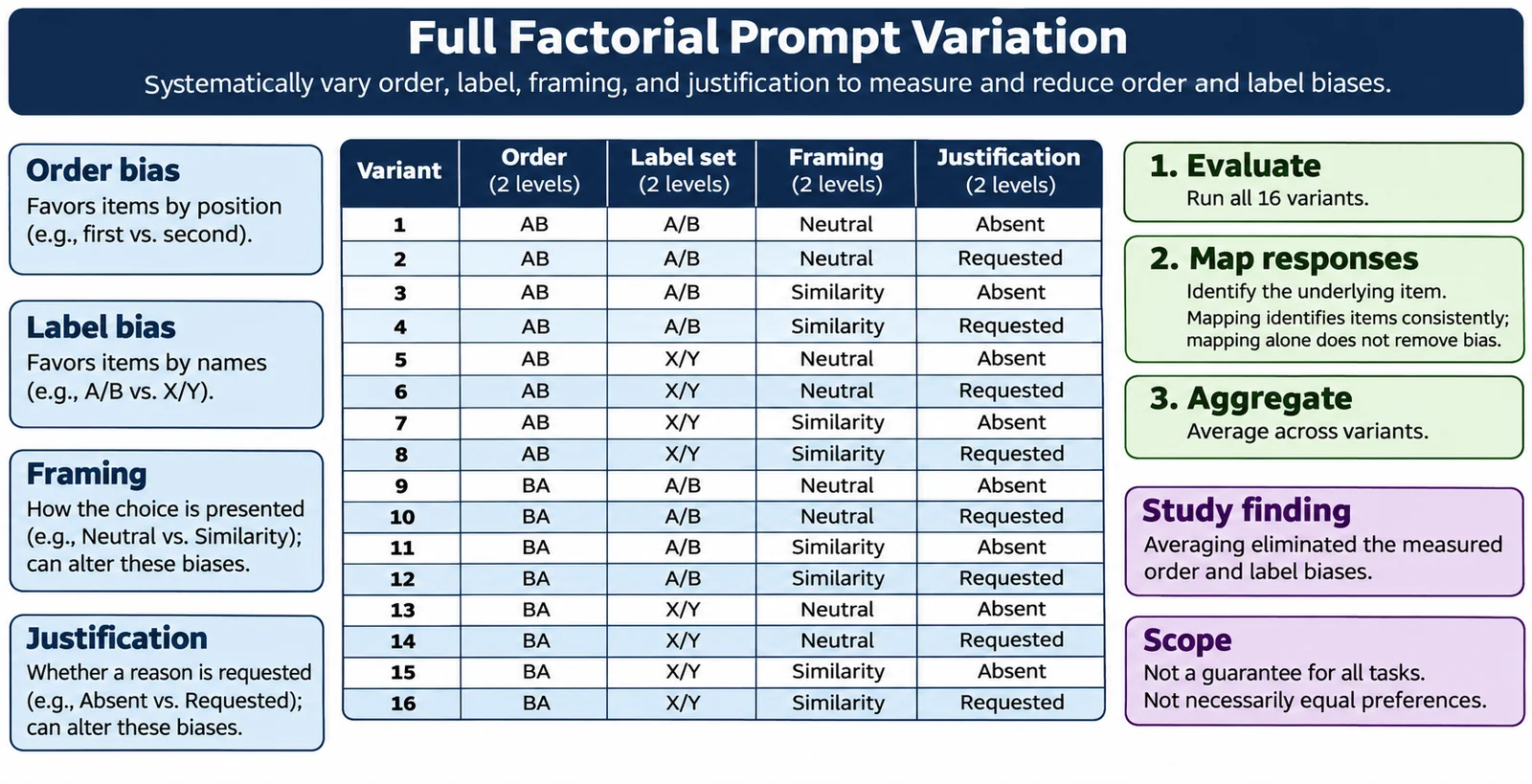
Using uncommon labels reduced but did not eliminate label bias, and it made response-order bias worse in GPT-4. In Llama 3.1, uncommon labels reduced neither bias. Averaging results across many prompts built with a full factorial design, which varies every feature together, eliminated both biases. The team concluded that any single prompt carries characteristics that may interact with hidden associations in language data.[39]
One method treats the instruction as a program and searches a pool of candidate instructions proposed by a model. On 24 language tasks, the automatically generated instructions beat the prior baseline by a large margin. They matched or beat instructions written by human annotators on 19 of those 24 tasks.[40]
One system let GPT-4 apply prompt techniques to itself, gaining 4.4% on Word Sorting and 6.8% on Geometric Shapes. The same system lost 14.8% on a complex task called Checkmate in One.[41] A 2026 study of five software engineering tasks found that techniques built for earlier models may give smaller benefits or even hinder performance on advanced models. In reasoning models, strong built-in reasoning reduced the effect of complex prompts, and simple zero-shot prompting, with no examples given, was sometimes more effective.[42]
Some prompt strategies held up better than others. Strategies using execution feedback, or precise guidance written for the task, remained effective on complex code problems.[42] A 2025 paper argued that explicit prompting techniques are becoming less important as models such as GPT-4.5 and DeepSeek R1 gain stronger reasoning of their own. That paper still reported incremental benefits from explicit prompting in specialized cases.[43]
When prompting helps and when it fails
A well-crafted prompt yields a good response from a generative language model, a system that writes text in reply to an instruction. A poorly constructed prompt leads to an unsatisfactory response.[2] One review of 114 prompt engineering studies in medicine, published between 2022 and 2024, found that many papers left out key details about their prompts.[44]
In one study, researchers wrote three prompts of varying quality for feedback in teacher education. Only the best prompt consistently produced high-quality feedback from ChatGPT-4. With that prompt, the model's feedback beat feedback from novices and, in explanation, questions and specificity, even surpassed expert feedback, while being generated more quickly.[45]
An experiment with 150 participants in Germany, Switzerland and the United Kingdom compared human-only work, unguided human plus AI work, guided work with structured prompting, and AI-only benchmarks. Across 450 evaluated responses, unguided AI use encouraged cognitive offloading, meaning handing mental work to the machine, without improving reasoning quality. Structured prompting significantly reduced offloading and improved both critical reasoning and reflective engagement.[46]
Prompt engineering is also described as a demanding task that calls for a blend of knowledge, skills and abilities.[47] In research workflows, the use of language models for inductive thematic analysis, a method of sorting qualitative data into themes, has often relied on ad hoc prompting. That looseness undermines the reliability, transparency and replicability of the analysis. A structured four-step prompting process has been proposed to make such work more rigorous.[48]
Prompting for images and other media
When the output is a picture rather than text, prompt engineering becomes the task of choosing words that steer a visual model toward a desired result. A 2023 review calls visual prompt engineering a basic method in visual and image artificial general intelligence. That review presents influential large models in the visual domain together with a range of prompt engineering methods used on them, and treats the design of suitable prompts for specific visual tasks as a research direction in its own right.[49]
Text-to-image models generate images from natural language prompts, and a 2023 paper notes that writing effective prompts for a desired image can be hard because natural language is complex and ambiguous. The same paper proposes PromptMagician, a visual analysis system that retrieves similar prompt-image pairs from DiffusionDB, a public collection of image prompts and results, and identifies important and relevant prompt keywords to help users refine their input. The system was demonstrated through two usage scenarios, a user study and expert interviews. The paper reports that it aids prompt engineering and gives the generative text-to-image model more support for creativity.[50]
A 2023 case study in art and design education taught students prompt engineering techniques and asked them to craft multiple prompts while refining their ideas over time, using DALL-E 2 to generate diverse visual outcomes. Participants grew better at judging what the tools could and could not do, and at shaping subject matter to get stronger results. Working through repeated iterations also led them to attend more closely to detail in their work. Students raised ethical worries about copyright and about artists being replaced, but they still valued the tools for sketchbooks and for generating ideas. The study adds that treating AI-generated images as finished products was conceptually intriguing and needs further investigation.[51] A 2025 thesis treats prompt engineering as a key competence of the modern designer, considering principles and techniques for formulating queries to AI, examples across areas of design, and ethical aspects and the effect of AI on the designer's role.[52]
Music generation has been studied in the same way: a 2025 study designed prompts for the SUNO AI music platform around 5 variables (genre, instrument, mood, tempo and implementation method) and analyzed the 120 audio tracks generated from them. Quantitative analysis using audio feature extraction, similarity matrices, clustering and dimensionality reduction found that detailed, structured prompts produced clearer and more predictable musical results. Prompts containing the same instrument or implementation method showed high similarity, while varied combinations showed clear musical diversity, and the study suggests that prompt engineering grounded in musical knowledge can support students' creativity, process-centered learning and reflective musical inquiry.[53] For human pose, a 2025 paper observes that most text-to-pose models depend on detailed low-level prompts that spell out joint configurations, whereas people usually describe actions and intentions in abstract high-level language. The paper introduces CoT-Pose, a framework that applies chain-of-thought reasoning, in which a model works through intermediate steps, to interpret abstract prompts as 3D human poses. The reasoning-enhanced model, the paper reports, produces believable poses that match the meaning of abstract textual inputs.[54]
Multimodal models, which take in both images and text, have been prompted with step-by-step reasoning borrowed from text work, and a 2024 paper proposes Visual Chain-of-thought Prompting for knowledge-based visual reasoning in three stages: see, think and confirm. The see stage scans the image and grounds visual concept candidates. In the think stage a pre-trained large language model picks key visual concepts from the question and generates an answer. The confirm stage then generates a supporting rationale, which a cross-modality classifier checks against the visual context. Tests across several knowledge-based visual reasoning datasets showed that the method beat earlier few-shot learning baselines. It also gave rationales for each reasoning step, making the process transparent, and used less computation than fine-tuning baselines.[55]
A 2025 paper on pathology images notes two problems for multimodal models in that domain: a lack of domain-specific information that can lead to model hallucinations, meaning confident outputs not supported by the evidence, and errors introduced by the extra reasoning steps of chain-of-thought prompting. Its PathCoT method supplies pathology expert knowledge to guide the reasoning and adds a self-evaluation step that compares the direct answer with the chain-of-thought answer, and experiments on the PathMMU dataset demonstrate its effectiveness on pathology visual understanding and reasoning.[56] A 2025 framework called RSVP pairs multimodal chain-of-thought visual prompts with a segmentation module that produces precise segmentation masks, the marked regions of an image. On ReasonSeg it reports gains of up to +6.5 gIoU and +9.2 cIoU, and it reaches 49.7 mAP on SegInW under zero-shot settings.[57]
Experiments using biodiversity as a case study, across models, geographical contexts and the years 2023 to 2024, found repeating patterns in AI-generated imagery. These included idealized depictions shaped by aesthetics and distinct model house styles that persisted over time. The paper also describes large language models serving as research assistants that analyze AI-generated images. That work, it says, is iterative collaboration under supervision rather than full automation.[58]
Automatic and algorithmic prompt optimization
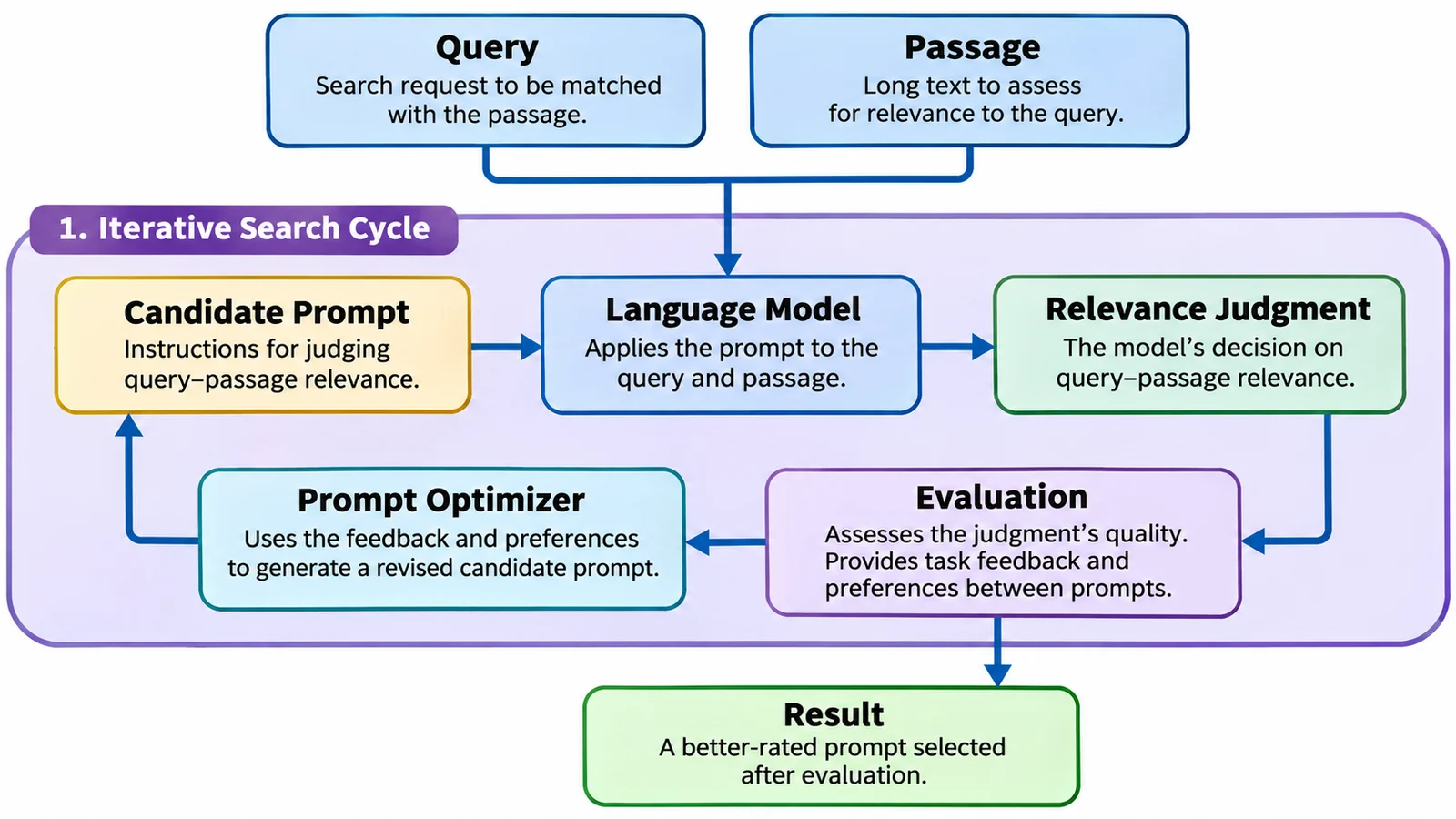
Automatic prompt optimization replaces hand-written instructions with procedures that search for or generate prompts by machine.[59][60] The approach matters most where prompts are long or where the input combines several parts, as in relevance ranking, which takes a query and a long passage together and is harder to optimize than a classification task. One system built for that setting, APEER, refines prompts over repeated rounds using feedback and preference optimization, a procedure that adjusts a prompt toward versions rated better on the task. Across experiments with four large language models and ten datasets, APEER outperformed existing manual prompts described by its authors as state of the art, and the prompts it produced transferred better across tasks and models.[59] A 2025 review of prompt-based methods lists automatically generated prompts among the open research directions, alongside interpretability and steadiness of performance under adversarial or variable inputs.[60]
Bayesian optimization is a search method that builds a statistical model of how a prompt scores and uses it to choose the next prompt to test, and it has been applied to prompt tuning. A 2025 study reports that standard Bayesian optimization struggles with local refinement, insufficient parameter tuning and multiple objectives at once. The study's hybrid framework pairs Bayesian optimization for broad exploration with a genetic algorithm, which mimics evolutionary selection to fine-tune prompt settings, and uses the Non-dominated Sorting Genetic Algorithm II to find Pareto-optimal solutions, meaning settings where no objective can improve without another getting worse. Evaluated on the GLUE benchmark with BERT-based tokenization, the framework reported 95% accuracy, 85% efficiency and 79% interpretability across three benchmark datasets, above conventional Bayesian optimization methods.[61]
Some large language models show order dependency: the position of phrases within a prompt changes how well the model performs the task. A 2026 paper treats this as a design-of-experiments problem and uses order-of-addition experiments, which test different orderings of the same elements, to measure each element's ordering effect and locate its best position. The method was demonstrated by constructing two-level fractional factorial designs with current large language models, and it identified a high-quality prompt configuration for that task.[62]
Other work moves prompt generation into software tooling rather than a separate search loop.[63][64] Impromptu, a model-driven framework published in 2025, offers a domain-specific language for defining multimodal prompts in a modular, tool-independent way, with versioning, prompt chaining and multi-language support, and it can adapt prompts to a particular generative system and validate the quality of the response.[63] A 2025 approach called Semantic Engineering embeds natural-language context directly into program constructs through Semantic Context Annotations, so that prompt generation draws on the semantics already present in code. On a benchmark suite built to reflect realistic AI-integrated applications, the method performed about as well as prompt engineering while demanding much less effort from developers.[64]
Reducing false and unsupported answers
A hallucination, in this context, is a fluent and confident model response that is factually wrong, unsupported by evidence, or inconsistent with the source material. Such errors lower the reliability of question answering, summarization, dialogue and information retrieval systems, most sharply when people rely on the output for consequential decisions.[65]
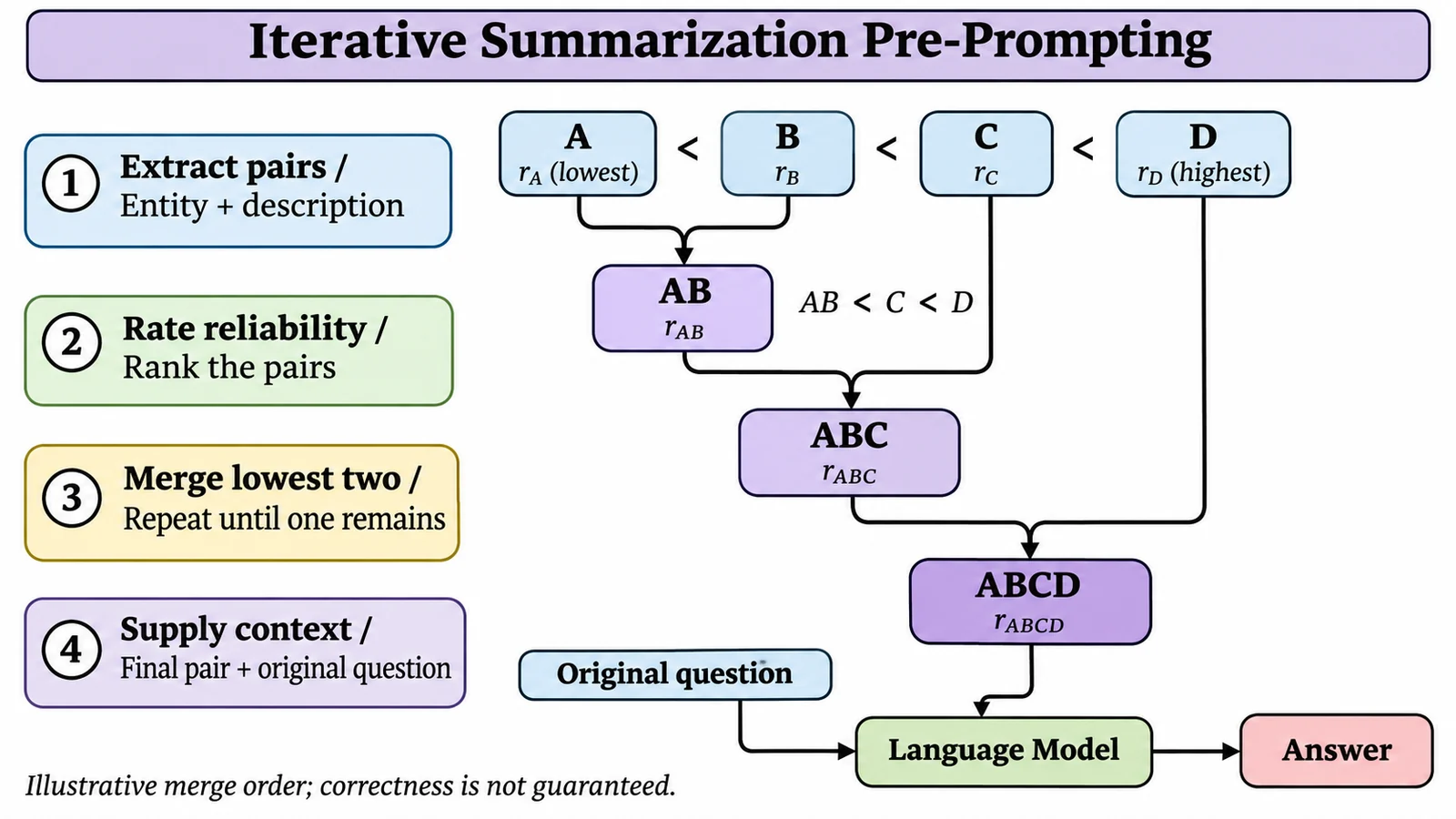
Chain-of-Verification separates answer generation from targeted checking, which improves auditability, but it stays vulnerable when the same model performs the verification without independent evidence.[65] Chain-of-thought prompting, which asks a model to show multi-step reasoning before answering, runs into trouble when the information needed for reasoning is implicit or missing, because it stresses the sequence of steps and overlooks early extraction of key facts. Iterative Summarization Pre-Prompting addresses that gap by extracting entities with their descriptions, rating the pairs for reliability, repeatedly merging the two lowest-ranked pairs until one key pair remains, and feeding that pair with the original question to the model. Experiments reported a 7.1% improvement over existing methods.[66]
Spatial errors form a distinct category: even in simple maze environments, models often fail to plan correct paths. One technique, S2ERS, extracts a graph of entities and relations from a text-based maze description so the model can read spatial relationships. It also inserts a state-action value function into the prompt to keep long reasoning from trapping the model in dead ends, and adds local value tables so the model can output several actions at once with fewer tokens. Tested on ChatGPT 3.5, ERNIE-Bot 4.0 and ChatGLM-6B, it raised the success rate by approximately 29% and the optimal rate by approximately 19% compared with state-of-the-art chain-of-thought methods.[67]
Grounding also draws on the data that surrounds a prompt: cleaning, preprocessing and data enhancement are described as ways to improve the accuracy, diversity and quality of data and so cut down on fabricated output. At the algorithm level, the same account credits prompt engineering, through better problem design and prompt wording, with guiding the model toward more accurate output and further lowering the risk of false content.[68] A broader 2026 synthesis places contextual grounding as one of five layers of reliable prompting, alongside task specification, reasoning scaffolds, tool and action orchestration, and output verification.[69]
Prompting across languages and literatures
Prompting in languages other than English raises questions that English-only work does not, because the model, the data and the evaluation measures may all be scarce for a given language. A 2026 article by Ar. Ramachandran in the Tamilmanam International Research Journal of Tamil Studies examines how artificial intelligence and prompt engineering can be applied to the study of Tamil literature. The paper sets out tasks where such tools can serve Tamil literary study: examining texts, gauging sentiment, producing summaries, translating, and building systems that answer questions. Kannan and Ramachandran describe language models, datasets and evaluation measures built for Tamil, a language with few computational resources, and consider their use in text analysis, sentiment analysis, summarization, translation and question answering. Ramachandran examines Tamil literary research, a field it describes as traditionally built on textual analysis, comparative study and historical approaches, and asks how large language models and prompt engineering could be applied to it. The paper concentrates on the language models, datasets and evaluation metrics built for Tamil, a low-resource language, meaning one with comparatively little digital text for training and testing such systems. It describes uses for those resources in text analysis, sentiment analysis (judging the emotional tone of a passage), summarization, translation and question-answering systems. The same paper sets out challenges and ethical concerns and argues that human expertise remains necessary when these technologies are adopted.[70]
A second line of work treats the prompt itself as a piece of language to be studied, rather than only as a means to an output. A 2024 article by Stetsyk notes that text-based interfaces removed the need for programming skills in human-AI communication, so that writing a text query became the main requirement. The article sets out to identify and describe the linguistic features of prompts, and the prompt parameters that affect how stylistically correct the generated responses are. Its stated aim is a linguistic account of the interaction between people and neural networks that generate text.[71]
A 2026 paper by Saad Rehman Babary argues that prompting is best understood as a linguistic practice rather than only a technical competence, drawing on pragmatics (the study of meaning in context), speech-act theory, register variation and politeness strategies. The paper draws on scholarship published between 2019 and 2026. The works include the original few-shot learning paradigm, surveys of prompting techniques, analyses of human-AI dialogue in the traditions of Grice and of speech-act theory, and educational writing on prompt and AI literacy.[72]
A 2025 framework called PromptBridge addresses the case of a user who does not write in English at all. It is designed for non-English-speaking users such as farmers, local vendors and rural communities, who interact with the system in their native language. The workflow has four steps: accept the input in the preferred language, translate it into English or a machine-readable format, optimize the prompt for accurate interpretation by the AI, and translate the response back into the original language. The framework combines prompt engineering with natural language processing, the automated handling of human language by computer, and its stated aim is more inclusive and accessible communication with AI models.[73]
Prompting as a practical skill for non-experts
A qualitative study of nonexpert teachers characterized how they engaged with ChatGPT and learned from it while building an educational game on financial literacy. A 2025 review of five studies found evidence of intuitive and uninformed prompting by students.[74][75] A qualitative study of nonexpert teachers followed their work with ChatGPT as co-creators of an educational game about financial literacy, and it reported that the teachers picked up prompting habits while using the tool rather than through formal lessons. The same study proposed ways to use ChatGPT to build educational games and suggested that prompt engineering can be learned tacitly through use.[74]
One team argued that existing prompt engineering instructions lack focused training on requirement articulation and instead emphasize strategies that can increasingly be automated, such as adding role-plays or asking the model to think step by step. The team built a training and assessment suite around clear, complete requirements and tested it in a randomized controlled experiment with 30 novices. The requirement-oriented training produced gains of 20% against 1% for conventional prompt engineering training, a gap that automatic prompt optimization could not close, and the quality of the stated requirements correlated directly with the quality of the model's outputs.[76]
Scaffolding, in which support is gradually withdrawn as a learner gains skill, has been tested as a way to teach prompting. A study of postgraduate students in an AI-assisted coding and computational thinking course ran in two parts. The first part looked at how students interacted with a task-oriented chatbot and where their prompt writing ran into difficulty. The second part tested a scaffolding strategy built on Vygotsky's zone of proximal development, delivered in three stages: shared understanding, continuing diagnosis with adjusted support, and withdrawal of that support. The scaffolded group improved significantly on prompt engineering skills and on academic performance, with the largest gains in the stage when support was withdrawn. Qualitative findings also reported greater metacognitive awareness, more confidence, and more critical appraisal of what the AI produced.[77] A guide for university courses likewise recommends scaffolded instruction, arguing that many students adopt generative AI tools widely but lack the skills to use them well.[78]
Agirdag (2026) proposed a capacity called prompting (l)iteracy. It is iterative, since it grows through repeated revision of prompts and reflection on the results, and it is critical, since it attends to the economic logics, language hierarchies and distributed agencies that shape a dialogue with AI. That argument holds that differences in prompting proficiency are likely to reproduce social inequities, and it calls for research that records real prompt and response logs rather than relying on self-report surveys.[79] A related proposal treats prompting in science education as an epistemic practice, one concerned with how knowledge claims are framed, and describes a prompt framing trajectory in which each learner turn can maintain, specify, challenge, repair or transform the organization set by the first prompt.[80]
Prompting beyond text and across disciplines
Prompt engineering extends past text-only chatbots into image generation, where artists face the problem of choosing words that produce a desired artistic result. A 2022 study of text-to-image diffusion models, systems that turn written descriptions into pictures, presented techniques for measuring how specific words and phrases in a prompt affect the output, and offered guidance on selecting prompts for intended effects.[81] Vision-language models, which read images together with text, have been tested on remote-sensing scene classification, the task of labelling satellite views by land use or surface type. Across five variants of the AID benchmark that varied label granularity, class consolidation and augmentation settings, hierarchical prompting consistently beat non-hierarchical prompts and matched or exceeded full fine-tuning while needing substantially less compute.[82]
Spatial reasoning, judging where objects sit relative to one another, responds unevenly to reasoning prompts in vision-language models. Simple chain-of-thought formats, in which the model writes a reasoning step before its answer, failed to help and could even harm original performance, whereas structured multi-stage prompting built on scene graphs, graph-like descriptions of objects and their relations, significantly improved spatial reasoning accuracy. Fine-tuning with Group Relative Policy Optimization, a reinforcement learning method, reached higher Pass@1 accuracy than supervised fine-tuning and held up better under out-of-distribution conditions, while supervised fine-tuning overfit to surface wording and could degrade when test phrasing shifted from "closer to" to "farther from".[83] In a 4 by 2 factorial design, four Gemini models ran under zero-shot and chain-of-thought conditions on 36 bodily gesture clips and 42 vocal prosody recordings. The designated thinking model did not outperform the others, and chain-of-thought prompting helped advanced models but consistently degraded the Flash 2 model in both modalities. The positivity bias, a tendency to favour positive emotions, was replicated in most conditions but was significantly attenuated in Gemini Pro 2 for body gestures, which the researchers read as evidence that architecture rather than prompting may drive such gains.[84]
Interpretive and ethical readings treat a prompt as more than a technical instruction.[85][86] A hermeneutic approach, combining the study of meaning and interpretation with prompt engineering, designed prompts to optimise hermeneuticity rather than factual accuracy across four use cases with humans and ChatGPT as readers and writers. ChatGPT mostly produced readable texts that answered the requests, but raising the specificity of task descriptions led to texts with intensified neutrality, suggesting that optimisation for factual accuracy may work against interpretive value.[85] A 2026 paper argues that prompting is an epistemic and normative act, since prompts shape what information is elicited, which assumptions enter, and which perspectives are privileged. Responsibility for outputs is described as distributed across users, developers, institutions and societies, and some applications cannot be made ethical through better prompting alone.[86]
Bias measurement and cultural reconstruction are two further applications.[87][88] Using carefully engineered prompts and raw bias scores from the Bipartisan Press API, with t-tests and analysis of variance, one study found statistically significant left-leaning bias in 9 of 11 controversial topics tested on GPT-3.0, and the bias varied by topic.[87] Chain-of-thought prompting has been proposed as a way to mitigate political bias by guiding chatbots to reason step by step.[89] In heritage work, narrative data from 5 former residents of Cumhuriyet Neighbourhood in Kayseri, Turkey, was turned into structured seven-category prompts for three image generators. A 30-member residents panel ranked Google Gemini best overall (M = 1.77), and the study concludes that human curatorial oversight and repeated community feedback remain essential for culturally authentic visualisations.[88] A human-centered design account frames biased and exclusionary model output as a prompt engineering problem, and a 2024 paper describes prompt engineering as a blend of creativity, strategic thinking and knowledge of model capabilities, calling for a multidisciplinary approach and ethical attention to prompt manipulation.[90][91]
Prompting in conversational and agent systems
In a conversation, a prompt is not a single instruction but one turn in a sequence, and the design of that sequence has become a subject in its own right. A 2025 systematic review of prompt engineering for conversational AI systems describes the basic principles of prompt design as clarity, contextual framing and instructional phrasing. It adds advanced techniques such as prompt chaining, in which one model output becomes the input to the next step, and few-shot learning, in which a few worked examples are placed in the prompt. The same review examines role-based prompting, in which the prompt assigns the model a stated part to play, and parameter optimization, and it treats bias mitigation and response consistency as the main challenges in dialogue settings. It reports that well-crafted prompts improve output quality across healthcare, finance and education, and it points to automated prompt generation and multimodal applications as emerging trends.[92]
Small wording changes can matter a great deal in agent settings. In a 2025 experiment, language models were asked to predict Dungeons & Dragons player actions and to format them as commands for the Avrae Discord bot, using the FIREBALL dataset. The experiment compared a reasoning model, DeepSeek-R1-Distill-LLaMA-8B, with an instruct model, LLaMA-3.1-8B-Instruct, and found that even a single sentence changed in the prompt could greatly affect the output. For this task the instruct model proved sufficient, and the reasoning model offered no advantage.[93]
Structured prompting schemes extend reasoning across several steps, and a 2025 taxonomy classifies them by the shape of the structure that guides the model, such as a chain, a tree or a graph. The survey calls these shapes reasoning topologies, because the structure takes on a partly spatial form inside the model's context, the working text the model can see at one time. It reports that such schemes improve performance on tasks from logical and mathematical reasoning to planning and creative writing, and that particular design choices produce different patterns of performance and cost.[94] A 2025 survey of the path from chain-of-thought prompting to language agents, systems that follow instructions and act within an environment, describes how chain-of-thought methods were extended to build autonomous agents. That survey lists generalization, efficiency, customization, scaling and safety as open research directions for agents.[95]
A 2026 perspective argues that prompt engineering works well for narrow, single-turn tasks but becomes brittle and costly to maintain as interactions grow longer and involve tools, governance constraints and reliability requirements. The paper treats context engineering as a system-level way of designing and governing the pipeline that decides which data, tool outputs, memory cues and policy limits reach the model, and how each is shaped and checked before delivery. It treats retrieval-augmented generation as a way to acquire context, tool-augmented reasoning as a way to create context through external actions, and memory services as a way to keep context across turns. Design patterns that recur across systems include assembling context on the fly, budgeting and compacting tokens, combining text with other media, managing memory, tracking where content came from, and observing the pipeline. The failure modes the paper anticipates include context drift, loss of provenance, disclosure of private data and unstable evaluation.[96]
Research
How large the gains are
In a 2024 study of clinical text, GPT-3.5 and GPT-4 were asked to pull medical problems, treatments and tests from clinical notes. With a basic prompt that only described the task and the output format, the two models scored relaxed F1 values of 0.634 and 0.804. Adding four prompt components, including notes from the annotation guidelines, error-based instructions and worked examples, raised those scores to 0.794 and 0.861.[97]
On a second task, finding nervous system side effects in vaccine safety reports, the basic prompt gave F1 scores of 0.301 for GPT-3.5 and 0.593 for GPT-4. The full prompt framework lifted those scores to 0.676 and 0.736. Even so, both models stayed below a specialized clinical model called BioClinicalBERT, which reached 0.901 on the first task and 0.802 on the second. The researchers noted that the prompted models needed only a few training samples, which they called very promising.[97]
A 2024 case study tested phishing URL detection, where a model must decide whether a web link is a scam. Prompt engineering with two chat models reached a maximum F1 score of 92.74% on a test set of 1000 samples. Fine-tuning several smaller base models on the same task reached an F1 score of 97.29% and an AUC of 99.56% on that test set.[98]
Fine-tuned GPT-3.5 with zero-shot learning, meaning no worked examples in the prompt, scored 73.17% to 74.23% higher exact match than a prior approach. Without fine-tuning, GPT-3.5 given a few worked examples scored 46.38% to 659.09% higher exact match than the same model with no examples. The authors recommended fine-tuning when data allow it, and few-shot prompting when data are too scarce for training.[13]
A 2025 study of forecasting, meaning predicting future events, tested 38 prompts across four models, including Claude 3.5 Sonnet and GPT-4o. A second experiment added combined prompts, prompts from outside sources, and the reasoning models o1 and o1-mini. Most prompts led to negligible gains, though prompts that mentioned base rates, the usual frequency of an outcome, helped slightly. Some strategies made accuracy much worse, especially telling the model to reason in the manner of Bayesian statistics. The authors suggested that complex tasks may need methods beyond basic prompt refinement.[99]
Structured prompts do better than plain ones on statistical reasoning, according to a 2025 evaluation. That study compared zero-shot, explicit instruction, chain-of-thought and hybrid prompts on artificial datasets with descriptive and inferential tasks. Zero-shot prompting, which gives the model no examples, was enough for basic descriptive tasks. It failed on inferential tasks because the model did not check the assumptions behind each statistical test. Hybrid prompts, which combine explicit instructions, reasoning steps and format rules, gave the most accurate and interpretable results across four scoring criteria. The authors reported that later tests with newer models confirmed the pattern.[100]
Prompt format can change results for a given model: the Gemini-1.5-Flash-8B model gained 21.62 accuracy points when the JSON prompt format was used. The test used 400 sample phrases drawn from real customer conversations with a mobile phone operator.[101] A 2024 study asked several models whether they agreed with osteoarthritis guidelines from the American Academy of Orthopedic Surgeons, repeating each question 5 times. The best combination, gpt-4-Web with a particular prompt style, reached 62.9% overall consistency and 77.5% on strong recommendations. Agreement between repeated answers varied widely, with a Fleiss kappa from -0.002 to 0.984.[5]
A 2025 survey of 243 people with varied educational and professional backgrounds found that users reported greater work efficiency and better results with explicit, structured, context-aware prompts.[102] A 2025 chemistry study reported that prompts carrying domain knowledge beat traditional prompt strategies on capability, accuracy, F1 score and a measure of hallucination drop. The chemistry cases involved the MacMillan catalyst, paclitaxel and lithium cobalt oxide.[103] A 2024 classroom study with 26 undergraduates found that students who mastered prompt engineering obtained higher-quality information from a chatbot.[104]
Chain-of-thought prompting, which asks a model to write out reasoning steps, has shown gains that held up across models and datasets. A small 2024 comparison tested reasoning strategies across six models, including GPT-4 and Flan-T5-xxl, on six question-answering datasets. GPT-4 gained the most and performed best with a prompt that had been found through automated search.[105]
Criticism, limits and open questions
A second doubt is whether a prompt technique that works on one model still works on the next. A 2024 comparison tested six models on six question-answering datasets that need real-world knowledge and logical verbal reasoning, including scientific and medical sets.[105] Some techniques developed for earlier models gave smaller benefits on the advanced models, or even made results worse. Prompts that use execution feedback, meaning the results of running the generated code, or precise task-specific guidance stayed effective for complex code problems.[42]
The newest models increasingly reason on their own, which changes what prompting can add. A 2025 paper's benchmark analyses indicate that this built-in reasoning now handles most reasoning tasks efficiently.[43] The 2026 software engineering study found that reasoning models beat non-reasoning models on tasks needing complex reasoning, but offered little advantage on tasks that do not need reasoning. Those reasoning models may also cost more than the task requires.[42]
In one study, students in a physics class were asked to discuss their wrong exam answers with ChatGPT. Many students asked no follow-up questions or only surface-level ones, such as fact-checking, and they judged the model's replies using personal anecdotes or no reference at all. Students who engaged more deeply with prompting showed higher learning gains than those who prompted only superficially. The researchers argue that learning with these models needs more than prompt engineering, including the habit of asking further questions and judging the answers.[106]
A 2025 survey reviews methods for protecting privacy during in-context learning, a form of prompting in which examples are placed in the prompt without changing the model's parameters. The survey compares these methods, lists resources for building them, and discusses their limitations. It also names areas that need further exploration.[107] With chain-of-thought prompting, gpt-3.5-turbo reached only 53.29% Pass@1 on the HumanEval benchmark, a score for code that passes the tests. A structured variant that asks the model to reason using sequence, branch and loop structures beat chain-of-thought prompting by up to 13.79% in Pass@1.[6]
Security risks and adversarial prompts
A jailbreak prompt is a crafted instruction that leads a large language model to produce content its safety measures are meant to block, and prompt injection is the broader practice of placing such instructions where a model will read them.[108][109] A 2023 empirical study sorted existing jailbreak prompts into ten distinct patterns and three categories, then tested them on ChatGPT versions 3.5 and 4.0 using a dataset of 3,120 jailbreak questions across eight prohibited scenarios. The same study found that the prompts could consistently evade the model's restrictions in 40 use-case scenarios, and it argued that the structure of a prompt matters greatly for whether a jailbreak succeeds.[109] Rule-based filters are poorly suited to this problem because adversarial prompts work through the meaning and context of language rather than through fixed keywords. One proposed defense trains a classifier on transformer-based language models, including BERT, RoBERTa and LLaMA, to label incoming prompts as safe, suspicious or malicious before they reach the model, with a stated target of over 85% detection accuracy and explanations for each decision.[108]
Injection attacks also travel through images. A 2025 study embedded malicious instructions inside a mind map image, a diagram that branches out from a central idea, and relied on the diagram's deliberate lack of explanatory detail. When the model filled in the missing sections, it produced outputs that violated its security constraints, and the method applies to any model able to read text from images. Measured by attack success rate, the share of attempts that got past the safeguards, the mind map method reached 90%, against 30.5% for the best baseline method, roughly three times the success.[110]
Prompts can also serve defense. A 2025 benchmark tested 21 open-source language models, including Llama3, Gemma, Qwen, Phi, DeepSeek and Mistral, on detecting phishing links, which are web addresses built to trick people into revealing credentials or installing malware. Models with at least 27 billion parameters exceeded 90% F1-score, a combined measure of precision and recall, and few-shot prompting gave the highest accuracy, at 91.24% F1 with Llama3.3_70b. Chain-of-thought prompting, which asks the model to reason step by step, significantly lowered accuracy and increased inference time, while smaller models of 7 to 27 billion parameters performed strongly at substantially lower computational cost.[111]
Sensitive data raise a separate risk: generative systems can regenerate or infer mission data even from anonymized or fragmented inputs, a problem the source calls data reconstruction. A 2026 paper on defense and space applications examined tailored prompting as a way to reduce data leakage, bias and confabulation, meaning confident output that is not supported by fact. Its mixed-methods experiments and stakeholder interviews in those industries concluded that systematically applied prompt engineering can significantly reduce the risk of data reconstruction while improving reliability and alignment with ethical aims.[112]
Responsibility, bias and fair use of prompts
Several frameworks treat prompt design as a place to build ethical safeguards into a generative system without changing the model itself.[113][114] The Inclusive Prompt Engineering Model, a modular framework, combines four parts: a memory component for keeping multi-turn conversations consistent, an enhanced chain-of-thought step for checking logic, structured and analogical reasoning modules for tables and cross-domain tasks, and evaluation loops that weigh uncertainty and reduce bias.[113]
Measured bias against particular groups has been approached through prompt-level audits, though the evidence base remains thin. One pilot experiment used a model called ChatGPT 5.1 Thinking to test whether prompt engineering could act as a repair tool for anti-Indigenous bias, applying a rudimentary audit framework of 10 high-level themes, including data sovereignty and cultural safety, and 160 test prompts. The paper describes this as a technical starting point for detection and states that genuine debiasing requires community-driven, participatory design to protect Indigenous knowledge systems. Shiri also notes that empirical research and evaluative benchmarks aimed at Indigenous-specific biases are scarce.[115]
A different line of argument holds that prompt engineering carries assumptions about writing and communication that deserve scrutiny. One critique contends that the concept reflects a belief in writing as the refining and transmitting of information, with the human treated as an imperfect conduit to be replaced by something more optimized. That critique links prompt engineering to a cyberlibertarian wish to push the human further to the periphery and argues that students learning about it should aim to dismantle this narrow view of writing rather than perpetuate it.[116] A related account reframes prompt engineering as an epistemic competence, meaning a skill in building interactions whose knowledge claims can be checked, rather than a set of techniques for better model output. On this view, reasoning models and agentic architectures absorb many formalized strategies into the models themselves, and what remains is the competence to ask pertinent questions, verify sources and judge the reliability of output.[117]
Prompting for assessment and feedback
Automated scoring of student work depends heavily on how the scoring request is worded, and several studies have tested whether more detailed prompts raise agreement with human graders. In an undergraduate history course on Atatürk's Principles and History of Revolution, 72 open-ended responses from 24 students were scored by the course instructor and by seven AI models. The models used five prompts, from a basic zero-shot instruction to a rubric with weighted criteria, partial coverage with language proficiency, and relative scoring. Agreement with the human evaluator was low under unstructured basic prompts but reached r > .80 with structured prompts and explicit rubrics, particularly for Gemini and Claude. The study concluded that prompt design and the definition of criteria matter more than model choice for reducing generosity bias. That bias is the models' systematic tendency to award higher scores than the human rater. The qualitative evidence traced it mainly to rewarding fluent, lengthy and well-structured answers whose factual content was incomplete.[118]
A second strategy, called Reflective Prompt Engineering, treats prompt writing as an iterative discussion in which human experts fold the criteria and wording inferred by the model into later prompts. Applied to open-ended biology items scored with analytic grading rubrics, the method reached Cohen's Kappa above 0.8, a measure of agreement beyond chance, using only 40 to 60 examples. It consistently outperformed a strategy that supplied multiple worked examples without discussion, and it was compared against a BERT-based scoring model in both within-item and cross-item settings.[119] For short-answer formative assessment in middle school Earth Science, a method combining few-shot prompting, active learning and chain-of-thought reasoning, in which the model writes out intermediate reasoning steps, scored responses and supplied explanations for the scores under a human-in-the-loop arrangement.[120]
Feedback quality has been compared directly across prompt quality and across providers. One study built a learning goal containing three errors and a theory-based manual for judging prompt quality, then used three prompts of varying quality to generate feedback from ChatGPT-4 and gave the highest-quality prompt to novices and experts. Only the best prompt produced consistently high-quality feedback, and model and expert feedback were both significantly better than novice feedback, with the model's feedback faster and better than the experts' in explanation, questions and specificity. Jacobsen and Weber concluded that prompt quality is decisive, and that prompting guidelines and human expertise are needed.[121]
For formative assessment design itself, an Australian university's preparatory program tested whether ChatGPT could write quiz questions on TED Talk transcripts used as course readings, submitting three levels of prompts from basic to progressively more detailed and contextualised. The model required well-crafted prompts and progressive training to produce meaningful and relevant responses, and strategic prompting with detail and context yielded more valuable results. The resulting draft quiz questions were potentially viable but still needed further human input to be meaningfully usable.[122]
Prompting in research workflows and data work
Researchers use prompts to pull structured facts out of unstructured text, and controlled comparisons show that the wording of the prompt changes how much the model retrieves. A 2025 study tested five prompt methods across 17 prompt templates on a relation extraction dataset, using the models Mistral 7B, Llama 3 and GPT-4, and scored the output against an ontology built from Wikidata, a public knowledge base of entities and their relations. A simple instruction paired with three examples chosen by a retrieval mechanism, meaning a search step that picks examples similar to the current text, improved extraction for all three models. Reasoning-oriented methods such as chain-of-thought prompting, which asks the model to write out intermediate steps, and Reasoning and Acting did better when given task demonstrations but still did not beat the simpler alternatives. The finding suggests that treating extraction as a reasoning task may not be necessary.[123]
Automatic term extraction, the task of finding domain vocabulary in text, has been studied with students in the loop. In a 2025 experiment, 60 bachelor's students prompted GPT in three iterative steps (initial formulation, intermediate refinement and final adjustment), and a teacher scored each prompt with a rubric of six criteria: clarity, complexity, coherence, creativity, consistency and contextuality. Students' overall rubric grades correlated with GPT's performance at every step, with the highest correlation of 0.87 at the third step. Which criteria mattered shifted between steps: clarity and creativity weighed most at the start, while complexity, coherence and consistency shaped later refinements, and contextuality had no effect at any step. The linguistic accuracy of a prompt outweighed its domain-specific factual content in influencing GPT's output.[124]
Topic classification of news with few labeled examples is a common data problem. A 2025 paper reports that over 65% of vertical news datasets have fewer than 500 samples, and that traditional methods generally score below 0.6 in F1, a combined measure of precision and recall, in such small-sample settings. The proposed framework combined dynamic prompt generation with knowledge distillation, in which a larger teacher model transfers its knowledge to a smaller student model, using 20,000 unlabeled items. On a 10-topic dataset of 3,200 articles it reached an accuracy of 0.785 and a Macro-F1 of 0.763 in the 5-shot scenario, where the model sees five labeled examples per class, which was 9.2% and 7.4% better than a mixed prompt model. An ablation experiment, which removes one component at a time to measure its contribution, attributed the largest gain to the knowledge distillation module, whose removal reduced accuracy by 9.1%.[125]
Synthetic data generation uses a model to produce training examples that fill gaps in an unbalanced dataset. A 2024 study compared three prompting strategies, called basic, composite and similarity prompts, for rebalancing training data with GPT-3.5-turbo and GPT-4. The initial results fell short of what full datasets achieve, though the similarity prompts method outperformed the other methods and showed promise.[126]
Information retrieval from long documents is another research use, and prompt design is one part of the pipeline. A 2024 paper describes a chatbot that accepts multiple PDF files, indexes their text as embeddings in a vector store, and combines a large language model with retrieval-augmented generation, in which relevant passages are fetched and supplied to the model before it answers. The prompt was written to reduce hallucination, the model's tendency to state unsupported content.[127]
Prompting has also been used to probe how models organize concepts internally. A 2026 study applied structured prompts to models from the Gemini, GPT and Claude families plus several open models, counting maximally divergent conceptual regions as a proxy for conceptual diversity. Values varied widely, from 91 for gemini-2.5-flash-preview-05-20 to 7 for claude-3-7-sonnet-20250219. The metric is offered as an indicator of a model's factual knowledge structure and does not directly measure knowledge accuracy.[128]
Prompting for safety, oversight and accuracy
Some research treats the prompt itself as a security boundary, because a maliciously crafted input can override a model's system-level instructions, extract sensitive data or hijack its behavior. A 2026 paper describes ShieldLLM, a real-time filter that combines semantic embeddings from BERT (a language model that turns text into numerical vectors) with a Random Forest classifier, a voting ensemble of decision trees, plus a rule-based layer. It labels each incoming prompt as Safe or Injection Attack within a latency budget under 45 ms. Tested on 10,000 labelled prompts drawn from five sub-categories of injection attack, ShieldLLM reached 96.3% accuracy, 95.8% precision, 95.7% recall and an AUC-ROC of 0.982, a summary score where 1.0 is perfect separation of the two classes. The paper argues that coarse output filters and rule-based blocklists are insufficient against semantically sophisticated attacks.[129]
In health information, a cross-sectional study asked 116 parents aged 18 to 65 (mean age 45.02, standard deviation 10.92) to rate pediatric health text written either by an expert or by ChatGPT working under an expert's supervision. Where differences appeared, the supervised ChatGPT text was rated higher in trustworthiness and accuracy, and parents said they would be more likely to rely on it than on the expert. The study's discussion concludes that human domain expertise should be applied to consumer-facing health information because parents will trust and rely on generated text.[130]
For legal work, a 2026 article treats hallucination, the generation of fluent but false content, as making blind reliance on artificial intelligence a professional hazard. It recommends treating the model as a collaborator that takes on a role, such as a litigator, a contract drafter or a judge, which can improve the accuracy, tone and usefulness of responses.[131]
A reasoning chain produced by chain-of-thought prompting, in which a model writes out intermediate steps, does not necessarily reflect how the model arrived at its answer, a property called faithfulness. Faithful CoT splits the task into translation, in which a language model converts the question into a symbolic reasoning chain, and problem solving, in which a deterministic solver computes the answer from that chain, which guarantees the chain explains the final answer. The method beat standard chain-of-thought on 9 of 10 benchmarks across 4 domains, with relative accuracy gains of 6.3% on Math Word Problems, 3.4% on Planning, 5.5% on Multi-hop Question Answering and 21.4% on Relational Inference.[132]
In practice
Prompting in medicine and health
In 2023 a team built MultiMedQA, a benchmark that joins six existing medical question answering datasets with a new set of questions people searched for online, called HealthSearchQA. The six datasets cover professional medicine, research and consumer queries. The team also proposed a human evaluation framework that rates model answers on factuality, comprehension, reasoning, possible harm and bias. They tested Pathways Language Model 1, a model with 540 billion parameters, and an instruction-tuned variant called Flan-PaLM 2. Using a mix of prompting strategies, Flan-PaLM set a new state of the art on every MultiMedQA multiple-choice dataset. It scored 67.6% on MedQA, which holds questions in the style of the US Medical Licensing Exam. That score surpassed the prior state of the art by more than 17%. Human evaluation still revealed key gaps, so the team introduced instruction prompt tuning, a method that aligns a model to a new domain using a few example prompts. The resulting model, Med-PaLM, performed encouragingly but remained inferior to clinicians. Comprehension, knowledge recall and reasoning improved with model scale and with instruction prompt tuning.[133]
Questions that mix an image with a text query form another medical test, called medical visual question answering. Vision-language models, which read both images and text, tend to give direct answers with no explanation, and that opacity weakens trust in medical settings. A 2025 study proposed a zero-shot chain-of-thought prompt framework, meaning the prompt asks for step-by-step reasoning without any worked examples. The prompt guides the model to break the problem down, weigh visual and contextual cues, and build a stepwise explanation. On the PMC-VQA benchmark of radiological images and expert-level prompts, Gemini 2.5 Pro reached the highest accuracy at 72.48%. Claude 3.5 Sonnet followed at 69.00% and GPT-4o Mini at 67.33%. The study reports that chain-of-thought prompting improved both reasoning transparency and performance on these tasks.[134]
A 2023 survey examined prompting across three kinds of vision-language model: those that turn multimodal input into text, those that match images with text, and those that generate images from text. For each kind it summarized prompting methods, prompting-based applications, and the responsibility and integrity issues that arise. The survey also compared prompting on vision-language models with prompting on language models and on vision models alone.[135]
A 2023 study proposed Multimodal-CoT, a two-stage framework that separates the generation of a rationale, the written reasoning, from the inference of the answer. The framework draws on both text and images, so the rationale can rest on multimodal information. On the ScienceQA and A-OKVQA benchmarks, a model with under 1 billion parameters reached state-of-the-art performance on ScienceQA.[136]
Automated scores on limited benchmarks were the usual way to judge clinical knowledge, which is why the MultiMedQA team added human review.[133] The visual question answering study likewise names interpretability as a barrier to medical use of vision-language models.[134]
Prompting in teaching and learning
One 2024 paper defines prompt engineering as the skill of stating a problem, its context and the limits of the wanted answer to an AI assistant. The aim is a reply that comes back quickly and accurately. The same paper argues that no existing framework of 21st century skills covers this skill well enough to assess it or teach it in schools and universities. It proposes a framework with 4 parts: understanding basic prompt structure, prompt literacy, methods of prompting, and critical online reasoning.[137] A 2024 discussion of AI in education treats prompt engineering as a key skill for drawing specific responses from AI systems, and links it to critical thinking. That discussion draws on a case study at a Swiss university and a narrative review of the literature, and it calls for training educators and adapting curricula.[138]
A 2025 systematic review of prompt engineering in higher education compared experiments that used a variety of prompting frameworks.[4] A second systematic review, published in 2025, examined empirical studies that appeared after ChatGPT was released in late 2022. It sorted prompting strategies into two broad approaches: technique-based prompts, which target specific learning goals, and process-based prompts, which support cognitive engagement and collaborative thinking with AI. The review grouped educational applications into two areas: developing critical skills and automating educational functions.[139]
Several papers offer teachers concrete methods rather than general advice.[140][141] A 2025 article for educators sets out practical strategies, the first being to include essential components it labels Persona, Aim, Recipients, Theme and Structure (PARTS). The second is to write prompts in Concise, Logical, Explicit, Adaptive and Restrictive (CLEAR) language.[140] A related 2025 article for educators also raises ethical and practical concerns, among them bias in AI replies and the need to protect teacher autonomy and professional judgment.[141]
A small 2026 study tested whether a short course could raise students' skill and confidence. The intervention involved 27 undergraduate students in a 100-minute workshop held during a history course at a university in Hong Kong. Students learned prompt engineering strategies and applied them to plan the course's final essay task. The study collected pre-workshop and post-workshop questionnaires, prompt libraries and written reflections. Woo, Wang, Yung and Guo state that a larger sample would be needed to understand such an intervention more thoroughly. They describe the result as a shift away from students learning to engineer prompts haphazardly and intuitively.[142]
A 2024 study of students' AI literacy found that stronger prompt engineering skills go with better quality output from the model. It also found that some parts of AI literacy can shape how well students write prompts and how purposefully they adapt large language models for education. The authors argue for adding AI educational content to current curricula so that students can use generative AI tools effectively.[143] A 2026 study collected data in a Probability Theory course from 385 undergraduate students and analyzed it with a statistical method called PLS-SEM. It reported that prompt engineering ability positively affected the quality of ChatGPT output, with a coefficient of 0.599. Output quality in turn enhanced learning effectiveness, with a coefficient of 0.607.[144]
Prompting as a workplace skill
A 2025 set of three studies tested crowdsourced participants on three tasks: judging the quality of prompts, writing prompts, and refining them. Participants could judge prompt quality and could write descriptive prompts, but they lacked the style-specific vocabulary needed for effective prompting. That result fits the hypothesis that prompt engineering is a new kind of skill, not an intuitive one, and must be acquired first through practice and learning. The same paper ends by imagining four possible futures for prompt engineering.[145]
A 2025 theoretical paper argues that prompt engineering overlaps with question asking, the older skill of formulating good inquiries. Both processes rest on creativity, critical thinking and cognitive flexibility, in the paper's account. From that analysis it proposes strategies for prompt design that is efficient and also engaging. The authors present this as a theoretical contribution, not as an experiment with measured outcomes.[146]
Measuring the skill required a test, and one was published in 2025: the Prompt Engineering Competence Scale, or PECS. The scale was evaluated with data from 437 users. A confirmatory factor analysis found that the one-factor model fit the data well, and the items reliably discriminated between users. Gibreel and Arpaci conclude that the PECS measures a user's level of competence in prompt engineering validly and reliably.[147]
A 2024 systematic literature review examined prompt-driven improvements across key software engineering tasks. It produced a taxonomy, a classification system, that sets out the practical applications of prompt engineering in that field. The taxonomy is offered as a foundational framework for clarifying the roles of prompt engineering and measuring its impact.[148]
A 2025 preprint proposes an interactive chain-of-thought framework that breaks a model's reasoning into defined blocks. Users can inspect, modify and re-run those blocks, which the proposal says encourages active thinking rather than passive reading of answers. The framework adds a lightweight edit-adaptation mechanism, inspired by preference learning, so the system can align with different cognitive styles and intentions. Ethical transparency is handled through explicit metadata disclosure, built-in bias checkpoints and privacy-preserving safeguards. The paper sets out design principles and architecture only; it reports no trial of the framework with users.[149]
Prompting in software and engineering work
Software engineering has become one of the main testing grounds for prompt engineering, the practice of writing and refining the instructions given to a large language model (a program trained on text to produce new text). A 2025 systematic literature review of 42 peer-reviewed journal articles sorted work on prompts for software tasks into four groups. These were prompts written by hand, retrieval-augmented generation (in which the model is supplied with relevant documents before it answers), chain-of-thought prompting (asking the model to write out intermediate reasoning steps), and automatic prompt tuning. The review reports that these approaches often match or surpass traditional fine-tuning, the alternative of retraining a model on task-specific examples, in adaptability and computational efficiency. It also names gaps that limit practical use: no standardized evaluation protocols, sensitivity to prompt brittleness (small wording changes that alter results), and difficulty scaling across varied software applications.[150] A 2026 research agenda, drawn from a structured community discussion at a workshop on empirical prompt engineering for software engineering, lists requirements analysis, coding, testing, documentation, repository analysis and planning among the activities where prompts are now used. That agenda observes that prompts are still created and revised through task-specific, informal practice, with limited support for systematic evaluation, management, traceability and governance.[151]
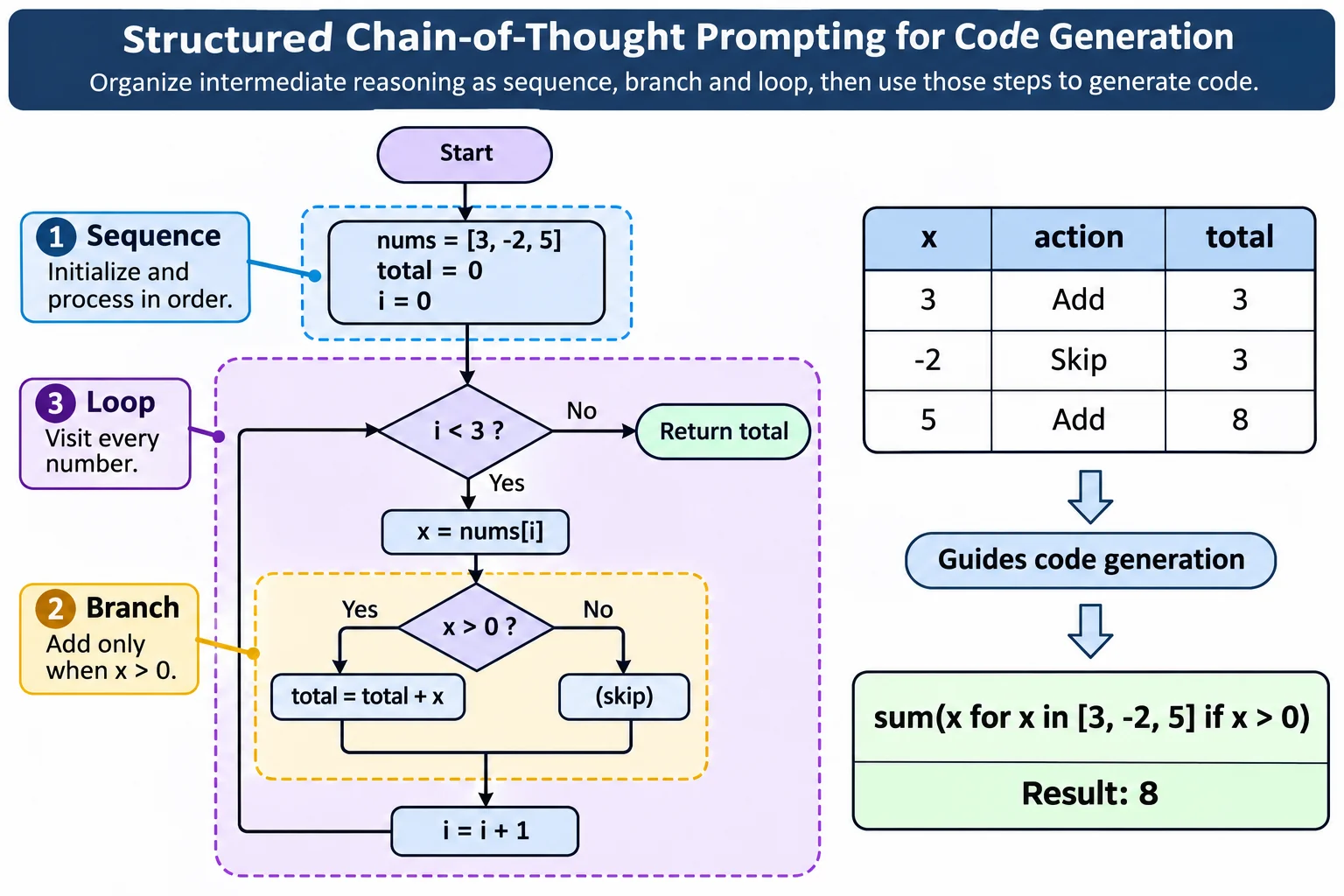
In code generation, a prompting technique that builds intermediate reasoning steps from program structures beat chain-of-thought prompting by up to 13.79% in Pass@1. Standard chain-of-thought prompting was designed for ordinary language generation and has low accuracy in code generation, according to a 2023 study that proposed instead Structured Chain-of-Thought prompting. The method asks the model to build its reasoning steps out of the three program structures from which code is composed: sequence, branch and loop. Human developers also preferred the programs it produced, and the approach held up when the examples included in the prompt were varied.[152]
Data extraction from research papers is another engineering use with reported accuracy figures.[153][154] The ChatExtract method applies a set of engineered prompts to a conversational model so that it finds sentences containing data, extracts the values, and then checks them through follow-up questions that introduce uncertainty and deliberate redundancy. On materials data, precision and recall both came close to 90% with the best conversational models, such as GPT-4, and the method was used to build databases of critical cooling rates for metallic glasses and yield strengths for high entropy alloys.[153] A comparable approach called K-Extract pulls fruit tree disease knowledge from paper abstracts under zero-shot conditions, meaning the model is given no worked examples. The 2025 tests found high accuracy on judgment tasks and simple question answering, with the DeepSeek and Kimi models performing particularly well.[154]
Fault diagnosis in complex technical systems has been studied through prompt-style configurations rather than single prompts. A 2026 study of ship power plants compared a baseline model built on case-based reasoning (solving new problems by reusing past cases) with versions adding probabilistic models and simulation of cascading failures, across nominal, high-load and data-limited scenarios. The basic configuration averaged 82-85% accuracy under nominal conditions but lost efficiency when data were incomplete, while integration with probabilistic models raised accuracy to 88-90%. At a weighting of 0.6 for case-based reasoning, 0.2 for probabilistic models and 0.2 for simulation, the minimum diagnostic error was 6%, accuracy exceeded 93% even with noisy or incomplete data, and type II errors (missed faults) fell by approximately 35% compared with isolated approaches. The study recommends case-based reasoning plus Bayesian networks for stable modes and the full integration for overload or data-limited conditions.[155]
Prompting in law, libraries and public services
A 2024 paper on academic librarianship defines prompt engineering as writing and revising the inputs given to generative AI chatbots so that they return the wanted responses. The paper argues that librarians already teach researchers to refine keyword searches in academic databases and to judge sources critically.[156] A 2023 paper makes a similar case, calling prompt engineering a foundational digital literacy skill and describing the prompt engineering librarian as an extension of reference work, information literacy instruction and digital literacy instruction rather than a replacement for them. That paper also observes that most people approach AI tools without skill, not grasping how the construction of a query affects the quality of the reply.[157] Both papers discuss how libraries and library and information science programs can fold prompt training into existing services and courses.[156][157]
Legal writing has produced its own instructional literature on prompt technique. A 2026 column in Arkansas Law Notes distinguishes iterative prompt refinement, in which a single request is rephrased and adjusted repeatedly, from prompt chaining, in which a series of prompts is linked to work through the stages of a larger problem. Its contract example treats the two as different tools. Refinement might mean rephrasing a request for an indemnity clause until the wording is precise and protective. Chaining would first ask the AI to draft the clause, then use a second prompt to analyze whether it holds up under Arkansas law, and a third to suggest revisions more favorable to the client.[158] A 2026 Italian-language article reads prompt writing in legal technology through Socratic questioning, treating the formulation of prompts as part of a continuing dialogue in which answers are checked as they are produced, provided the method sits inside an intuitionist account of knowledge.[159]
A 2025 paper sets out prompt engineering frameworks for generative AI in credit analysis, a field it describes as traditionally relying on careful data examination, statistical modeling and expert judgment to judge the financial reliability of borrowers and to address the uncertainties of lending.[160] A 2025 applied study proposes open science, prompt engineering and prompt chaining as means of mapping future climate scenarios for family farming. The work is framed by IPCC work on climate justice and just transition. The study reports that the approach raised productivity and scalability and cut time and potential errors. It argues that AI steered by well-structured prompts and chained logical flows can widen access to complex analysis and support public policy. Its workflow is described as replicable for other regions, models, climate scenarios and crops, with the Python scripts deposited on an open access platform in line with the FAIR principles of open science.[161]
Public messaging is a further application. A 2023 study used prompt engineering to generate folic acid awareness messages, folic acid being a vitamin important during pregnancy, and compared them with the most retweeted human-written messages in evaluations by a university sample and by a second sample of young adult women. The AI-generated messages ranked higher on message quality and clarity in both samples, and computational text analysis found them on par with the human tweets in sentiment, reading ease and semantic content. The study presents these results as evidence of the potential of large language models for message generation and discusses theoretical, practical and ethical implications.[162]
Prompting in chemistry and materials research
Large language models, the text-generating systems behind chat tools, have entered chemical research even for users without coding expertise, but applying them directly can produce hallucinations, meaning unreliable or inaccurate information. That risk is worsened by limited data sets and by the inherent complexity of chemical reports. Wording instructions so that a model reasons better, an approach called prompt engineering, has been put forward as a remedy. In chemistry, though, few researchers have taken it up, and many chemists know little about how it works or how to apply it. A 2025 outlook illustrates prompt engineering techniques with examples ranging from metal-organic frameworks (crystalline porous materials built from metal nodes and organic links) and fast-charging batteries to autonomous experiments. The same outlook lists the limits it sees today: results that are partial or skewed, and restrictions that come with models whose code and weights are not open.[163]
Phase diagrams, charts that show which state of a material is stable at a given temperature and composition, have traditionally been annotated by hand, a slow method that is hard to keep current as thermodynamic databases change. A 2024 study proposed a framework based on instruction tuning, in which a model is trained on examples of a task, to annotate phase diagrams automatically from start to finish. The researchers collected high-quality phase diagram images and expert descriptions from handbooks, corrected errors, removed redundancies and formed a golden dataset, then trained models on a subset chosen by hierarchical sampling. The fine-tuned model reached a cosine similarity of 0.8737, a measure of how closely its output matches reference text, and improved phase diagram comprehension accuracy by 7% over untuned models. The study describes itself as the first to propose large language models for automated phase diagram annotation.[164]
Process systems engineering applies modeling, optimization, machine learning and design to chemical processes, and models are increasingly consulted as engineering tools even though their reliability varies by knowledge domain. Confidently presented but incomplete answers pose risks in safety-critical applications. Five independent AI judges scored the answers against rubrics with 7 elements, and a Friedman test confirmed significant differences among models (chi-squared with 4 degrees of freedom = 491.4, p < 0.001), with element coverage ranging from 78.1% for DeepSeek to 60.8% for Llama. A consistent difficulty order held across all models: process design and systems engineering hardest, then machine learning, then optimization, then modeling and simulation. Three domain experts reviewed the scores and broadly confirmed the performance tiers (Spearman rank correlation = 0.416, p < 0.001; intraclass correlation = 0.793). The experts also found a systematic leniency bias in the AI judges of +0.85 points. The ranking of models in the middle of the field was less consistent. The findings indicate that current models can support procedural tasks in process systems engineering but require expert verification for process modeling and optimization, where critical technical elements are often omitted.[165]
Prompting in wireless and networked systems
Wireless networks are one setting where prompt engineering has been studied as a way to adapt large language models without dedicated pretraining. Large language models usually need dedicated pretraining and fine-tuning before they can serve a specific domain such as a wireless network. Those adaptations can be extremely demanding in computing power and data, and most network devices have limited computation power. High-quality networking datasets are also scarce. Prompt engineering takes a different route: prompts are designed to guide the model toward the desired output while the model's parameters stay unchanged.[166]
A 2025 overview by Zhou, Hu, Yuan, Yuan, Wu, Chen and colleagues argues that prompting fits the demands of wireless equipment better than methods that retrain the model. The fit rests on several properties: easier deployment, quick response, and smaller demands on computing power. The overview compares prompting techniques, among them in-context learning, in which examples are placed in the prompt itself, chain-of-thought, in which the model is prompted to work through intermediate steps, and self-refinement, in which the model revises its own output.[166]
Iterative prompting is aimed at network optimization, and self-refined prompting is aimed at network prediction. In case studies, the two schemes reached performance comparable to conventional machine learning techniques. Prompting methods need no dedicated training or fine-tuning of a model. That spares the overview's readers a step it names among the main obstacles to existing machine learning techniques.[166]
Prompting for finance and business operations
Financial news analysis has become a test case for prompt design, because a single article can yield several linked facts that a model must extract in a sensible order. Event-level financial sentiment analysis is the task of pulling a five-part record from a financial news article: the company, its industry, a coarse-grained event, a fine-grained event and the sentiment. A 2026 framework called adaptive reasoning order chain-of-thought trains a model to pick its own query sequence for each article. On the event-level financial sentiment analysis benchmark it set a new best F1 score, a combined measure of precision and recall. The previous best came from retrieval-augmented multipath chain-of-thought prompting. The reported gains held across all subtasks of that benchmark, and the experiments used Chinese news articles.[167]
Prompting in mental health support
Prompt engineering, the practice of arranging the input given to a large language model to steer what it produces, has been applied to mental health support in three broad ways: classifying text, generating supportive or educational text, and answering questions. A 2024 short review described these three task types as the main uses of prompting in digital mental health and discussed the challenges, limitations and ethical considerations that come with them. The review's authors described it as the first attempt to survey the prompt types, methods and tasks used in this area.[168]
Detection work treats a piece of writing as evidence about the writer's mental state, and one 2024 study applied soft prompt templates to anxiety classification on social media. The method kept most parameters of a pre-trained language model frozen and tuned only the prompt, an approach the study calls parameter-efficient prompt engineering, which avoids the large computational cost of fine-tuning a whole model. The test used a balanced Reddit dataset of 356,242 anxiety posts and 354,631 non-anxiety posts, split 70%, 15% and 15% for training, validation and testing. The approach reached an F1 score of 80.5% and 81.8% accuracy, exceeding the MentalBERT benchmark by maximum margins of 4.3% and 4.6%.[169] A separate 2024 paper fine-tuned GPT-4, Llama 2 chat and Gemini with engineered few-shot prompts, in which the model is shown a small number of worked examples. The models diagnosed depression from clinical interviews and online forum text and explained each diagnosis using criteria from the fifth edition of the Diagnostic and Statistical Manual of Mental Disorders.[170]
A 2026 pilot randomized experiment tested whether persuasive features could be built into a prompt for psychoeducational text about depression. In a first phase, 168 participants rated pairs of texts that contrasted high and low levels of four candidate features; source credibility, argument quality and processing fluency raised both perceived credibility and persuasiveness (all p < 0.01), while affective warmth and empathy was dropped. In a second phase, 40 participants were randomized to read passages generated from a prompt containing the retained features (n = 20) or from a baseline prompt (n = 20). The feature-engineered group showed a larger gain in confidence in mental health professionals (t(38) = 3.37, p = 0.002, d = 1.07), and the group effect held after controlling for baseline scores (F(1,37) = 9.31, p = 0.004, partial η2 = 0.20). The authors called the result preliminary and described the study as a pilot.[171]
For chatbots, a 2025 conceptual framework proposed a layered prompt design. One layer screens input for risk as it arrives. A dialogue engine retrieves responses grounded in evidence-based therapies such as cognitive behavioral therapy, acceptance and commitment therapy and dialectical behavior therapy. A safety system with several tiers adds an ethical filter after generation and oversight by a therapist. The framework paper proposed a comparative validation strategy against a baseline model but reported no empirical test of its own.[172]
A 2025 algorithm development and validation study addressed a related risk: a prompt-engineered chatbot can drift from its assigned role as a conversation goes on and become more prone to hallucination, meaning confident output that its sources do not support. The team built an educational chatbot on GPT-4 for schizophrenia that draws on a manual written for people with the condition and their caregivers, and added a critical analysis filter in which a team of prompted model agents reviews and refines each reply. Three human raters scored 36 responses, and the filter produced an acceptable compliance score of at least 2 in 81% (7/36) of responses, against 8.3% (3/36) with it switched off. The authors noted that more rigorous testing in realistic settings is needed.[173]
Prompting in radiology and clinical documentation
Radiology has produced a body of practical writing on how to phrase requests to large language models, the systems that generate text in response to an instruction.[174][175] A 2025 primer for radiologists sets out the basics of prompt engineering, the practice of shaping that instruction to get precise and relevant output, with worked examples.[174] A 2024 article took one clinical case and showed that prompting strategies can steer the chatbot ChatGPT, running on the GPT4 model, toward new tasks while the base model stays untrained. The strategies it describes run from precision prompts, which state the task narrowly, to in-context methods such as few-shot learning, in which a few worked examples are placed in the prompt, and zero-shot learning, in which none are. The same article reports that prompt engineering made the chatbot's output markedly better and more focused. Storing specialized knowledge as embeddings, a numerical representation, gave clearer insight into how the model reached its decisions, which raised trust in them.[175]
Chain-of-thought prompting asks the model to set out intermediate reasoning steps, and self-consistency draws several such lines of reasoning and takes the most common answer. The article illustrates these techniques with practical examples for workplace and clinical use, and it also addresses data privacy and regulatory concerns, closing with an outlook on retrieval-augmented generation, domain-specific models and multimodal models.[176] A 2025 review of fine-tuning and prompt optimization in radiology notes that these models tend to produce information that is untrue or not grounded in fact. Such output can harm patient care and clinical decisions. The review states that both strategies have been shown to be effective in removing these errors.[177]
Translation of reports into plain language has been tested directly. Radiologists scored the translations at an average of 4.27 on a five-point scale, with 0.08 places of information missing and 0.07 places of misinformation per report. For about 37% of the 138 cases in total, the model offered specific suggestions based on findings in the report, and it showed some randomness, occasionally over-simplifying or neglecting information, which a more detailed prompt could mitigate. The newly released GPT-4 significantly improved the quality of translated reports compared with ChatGPT.[178]
Clinical named entity recognition, the task of locating mentions of medical problems, treatments and tests in free text, has been used to measure what prompting can add. With baseline prompts that gave only a task description and format specification, relaxed F1 scores, a combined measure of precision and recall, were 0.634 and 0.804 for MTSamples and 0.301 and 0.593 for the safety reports. Prompts built from annotation guidelines, instructions derived from error analysis, and annotated samples for few-shot learning raised these scores. With all of them, GPT-3.5 and GPT-4 reached 0.794 and 0.861 for MTSamples and 0.676 and 0.736 for the safety reports. The results still trail BioClinicalBERT, a model built for clinical text, at 0.901 for MTSamples and 0.802 for the safety reports, though the prompted models needed few training samples.[179]
Patient messages and disease knowledge graphs form a second line of work.[180][181] A 2024 study trained and validated prompts over three iterations to draft replies to patient medical advice requests with GPT-4, then tested the optimized prompt in a production electronic health record with 69 primary care clinicians. Physician acceptance of draft suitability rose from 62% to 84% (P <.001) in a validation dataset of 200, and 74% of drafts in the test dataset were rated helpful. Patients rated the optimized prompt's message tone (78%) and overall quality (80%) more favorably than the original, and could not tell human from model-written replies in 76% of messages, while 72% of clinicians believed the drafts could reduce cognitive load in handling such messages.[180] For heart failure, a 2024 pipeline applied prompt engineering to schema design, information extraction and knowledge completion, with task-specific templates combined with a TwoStepChat approach. On two datasets that method outperformed a plain prompt and fine-tuned BERT-based baselines, saved 65% of the time compared with manual annotation, and was better suited to extracting out-of-distribution information, meaning entities and relations not seen in training.[181]
Prompting in design and creative work
In design education, a central difficulty is not technical skill with generative tools but design judgment: the ability to make well-substantiated design choices and to explain them. Students often struggle to put their tacit knowledge, meaning know-how they hold but have not stated, into the explicit language of a prompt. A 2025 paper describes Prompt-Craft Cards, a physical toolkit that frames reverse prompt engineering as practice in making design decisions at defined levels of expertise. The toolkit uses three card decks, each supporting a different stage of expertise and knowledge transfer: a Foundational Deck for compositional judgments, an Adaptation Deck for choices about direction, and a Reflection Deck for critical, self-aware inquiry. The paper states that the toolkit's effectiveness will be evaluated through a multi-stage study using think-aloud protocols, in which participants speak their reasoning aloud, within an action research design; no results are reported.[182]
Logo generation has been studied as a prompt optimization problem with measured outcomes. A 2025 study tested 47 prompt combinations. The five variables were prompt clarity, level of detail, thematic description, visual elements and color specification. In validation with 30 graphic designers, visual consistency rose from 65% to 87% and user satisfaction rose from 58% to 82%, compared with unstructured prompts. Iteration efficiency improved by 48.5%, from 6.6 to 3.4 attempts. Manual designers and users experienced with AI applied the framework with comparable effectiveness.[183]
For story writing, one proposal replaces text-only refinement with visual prompt engineering. The method converts a textual prompt into an image with a diffusion model, refines the prompt by comparing the image with the user's expectations, and then generates a story from the refined prompt, repeating until the user is satisfied. The proposal rests on a finding from cognitive research: visual data can be analyzed 60,000 times faster than text. Experiments found that for the same number of iterations, stories generated this way outperformed those generated from text-based prompts in story quality.[184]
Game prototyping has been addressed through a six-step prompting model for prototype game development, built on a prompt engineering methodology the paper calls PE2. The steps include selecting a motive game, defining core mechanics, and generating variant ideas, with learners receiving specific feedback from the AI as they internalize design knowledge. The 2024 study reports that the model may be effective for learning tacit knowledge, but it identifies limits: a lack of validation in real projects and a dependence on the performance of the AI model.[185]
Prompting in education from school to university
Prompt engineering, the practice of designing the natural-language input that steers a large language model, has been studied across schooling levels, from primary classrooms to university courses.[75][186] A systematic review of empirical work published between 2021 and 2024 screened 2,654 papers and analyzed 30 studies on prompting in K-12 STEM education, meaning science, technology, engineering and mathematics. Simple prompting and zero-shot prompting, in which the model receives a task with no worked examples, were the most common approaches in that review. Few-shot prompting (a few examples supplied in the prompt) and chain-of-thought prompting (asking the model to set out intermediate reasoning steps) produced positive outcomes for several educational tasks. GPT-series models dominated the reviewed studies, yet smaller fine-tuned models such as Blender 7B, given effective prompts, outperformed prompting larger models such as GPT-3 in specific contexts. Evaluation methods varied widely, and the review found limited empirical validation in real-world settings.[187]
In English language teaching, a 2024 study built a chatbot on ChatGPT that generated reading comprehension questions matched to learners' proficiency levels. The design drew on Bloom's Taxonomy and on the Common European Framework of Reference for Languages (CEFR). The prompts behind that chatbot combined chain-of-thought and few-shot techniques and were refined through repeated interaction with ChatGPT.[188]
A scoping review of prompt design in English as a Foreign Language pedagogy mapped studies from 2022 to 2025 and found most were conducted in Asia with university students, using qualitative or mixed-method designs. In that review, prompting served mainly writing skills and research competence and supported learner autonomy. It also raised worries about cognitive load, thin teacher guidance and academic integrity. The review described the field as unestablished and called for structured frameworks, ethics-focused research and reliable tools for measuring prompt literacy.[189]
Frameworks for teaching prompting itself have been proposed for university courses. One guide sets out a structured, scaffolded approach to introducing prompt engineering across disciplines, arguing that it builds communication strategies, critical thinking and AI literacy.[78]
Prompt engineering in healthcare practice
In clinical settings, prompt engineering means designing the instructions given to a large language model, a system that predicts text from a prior sequence of words, so that its replies are clinically relevant and accurate.[190][191] A 2024 overview of primary care applications argues that prompts should rest on medical knowledge and follow evidence-based guidelines. Clinicians should also refine and validate them over repeated rounds.[190] A 2025 tutorial for clinicians notes that small changes in wording or structure can greatly affect output quality, which poses difficulties for doctors who are not experts in natural language processing, the field that builds systems for handling human language. The tutorial sets out named techniques for clinical use, among them zero-shot prompting (asking with no worked examples), few-shot prompting (supplying a few examples) and chain-of-thought prompting (asking the model to reason step by step). The tutorial also covers self-consistency prompting, in which several reasoning paths are sampled, and meta-prompting.[192]
A 2025 systematic review following PRISMA guidelines, a standard checklist for reporting such reviews, found only five studies that met its criteria, covering the answering of patient questions and the generation of medical information. The prompt techniques examined included instruction-based prompts, elaborated prompts, prompts that define a role, prompts that define a scene, and prompts carrying domain-specific content. Structured prompting improved accuracy and completeness in several cases, especially when specific formats or custom instructions were used, and readability improved when prompts explicitly asked for simpler language and stated reading levels. Some strategies, however, unintentionally made the text more complex, and effectiveness varied across models and prompt types, so the review called for standardized approaches.[193]
Clinical documentation and history taking have been studied with prompt-based summarization. A 2026 study proposed an approach that collects patient history automatically and uses prompts to turn complex, unstructured notes into short, coherent summaries, with ethical compliance and data privacy built into the design. The study measured how fluent the clinical text fields were and how well their meaning matched a reference, using ROUGE, BLEU and BERTScore. It also applied SHAP-based feature attribution, a method for showing which inputs drove a prediction, to interpret multi-class predictions. Its stated aim was to support early breast cancer diagnosis, and it reports expert validation of the system.[194]
For diagnosis support, a 2024 study prompted GPT-4 to imitate the common clinical reasoning processes of clinicians and found that it could do so without sacrificing diagnostic accuracy. The rationale for such diagnostic reasoning prompts is that a model which supplies an interpretable rationale gives physicians a way to judge whether a response is likely correct and safe to trust for patient care. That addresses the perception of the model as a black box.[195] A 2026 benchmark for microsatellite instability cancers, a class of tumors identified by a genetic marker, tested three models on 511 questions drawn from clinical guidelines and a curated knowledge base, using four prompting strategies under both multiple-choice and open-ended formats. Accuracy dropped substantially in open-ended scenarios, and for strategies without retrieval the main failure was a deficit in internal knowledge. Retrieval-augmented generation proved the most effective intervention, shifting the main bottleneck from missing knowledge to retrieval failures and replacing high-risk fabrications with safer refusals, though it introduced a trade-off in the form of false refusals.[196]
In a study of 5,747 simulated patient complaints about dry eye disease, prompted queries raised accuracy from 80.1% to 99.6% over non-prompted queries. Service Experience scores fell from 95.5 to 84.7 as response time rose, while Medical Quality satisfaction rose from 73.4 to 96.7.[197] A 2023 experiment built a ChatGPT-based dermatology consultation chatbot called Dewy, which used a dermatologist persona and five conversation prompt types built on a recognition-check technique, and surveyed 57 users. The chatbot that answered the opening question while offering optional answers to follow-up questions drew the highest satisfaction, scoring well on efficiency and ease of learning.[198] A 2025 study of dry eye disease used GPT-4.0 and ERNIE Bot-4.0 on 5,747 simulated patient complaints to judge how urgent medical attention was, with a BERT model classifying text as urgent or non-urgent. The authors describe this as a trade-off between accuracy and user satisfaction and call for prompt structures that balance response time against both.[197]
In a 2026 evaluation of data extraction for systematic reviews of sepsis guidelines, prompt engineering strategies produced only modest changes in extraction accuracy across the three models tested.[199] On 1,050 questions from the Registered Dietitian exam, GPT-4o with chain-of-thought plus self-consistency prompting outperformed the other approaches tested, while Gemini 1.5 Pro with zero-shot prompting recorded the highest consistency. For GPT-4o and Claude 3.5, chain-of-thought prompting improved accuracy, and adding self-consistency improved both accuracy and consistency, while retrieval-augmented prompting was particularly effective for GPT-4o on expert-level questions.[200] In a 2026 evaluation of data extraction for systematic reviews of sepsis guidelines, the mean no-error proportion for background data ran from 81.6% (ChatGPT-4o) to 92.4% (Claude 3 Sonnet). For outcome data it ran from 27.8% (Gemini 1.5 Pro) to 80.7% (Claude 3 Sonnet). Chain-of-thought and self-reflection prompts produced only modest changes in extraction accuracy, and self-reflection prompts lengthened processing times to between 52.7 and 107.1 seconds per article.[199]
Teaching prompting to medical students and doctors
Teaching health professionals to write prompts has been proposed as a formal part of medical training rather than a skill picked up by trial and error.[201] A 2023 tutorial aimed at a wide range of health care professionals set out practical recommendations for improving interactions with large language models, the systems that generate text in response to an instruction.[202] A 2023 book written for medical students and their teachers treated prompt engineering as a subject for the classroom, arguing that the same principles that draw good information from a model can push students to think more deeply about a topic. The book examined the anatomy of a good prompt from several angles and worked through examples in anatomy, physiology, pathology, pharmacology and clinical skills.[203]
Three medical trainees writing to Academic Medicine in 2024 argued that prompt engineering belongs in medical school and postgraduate curricula as a core competency. They described well-crafted prompts as carrying pertinent medical history and symptoms, references to current professional guidelines, a stated answer format and level of detail, and notes on ethical and legal rules. The same letter observed that most clinicians at the time learned the limits of these models through self-experimentation.[201]
Empirical work has compared prompt styles on clinical language tasks, and the results favor prompts tailored to the task at hand. The tasks were run on 3 models, GPT-3.5, Gemini and LLaMA-2, and the study contrasted zero-shot prompting, in which the model receives no worked examples, with few-shot prompting, which supplies some. GPT-3.5 reached an accuracy of 0.96 on clinical sense disambiguation with heuristic prompts and 0.94 on biomedical evidence extraction, and it outperformed the other two models across tasks and prompt types. Heuristic prompts and chain of thought prompts worked well across the tasks, and few-shot prompting helped in complex scenarios. Combining prompts in an ensemble drew on the strengths of several at once. The study concluded that tailoring the prompt to the task is vital for strong zero-shot performance in clinical work.[204]
Chain of thought prompting, which asks a model to work through intermediate steps before giving an answer, has received particular attention in medicine. A 2024 review of the technique in nephrology, the branch of medicine dealing with the kidneys, described it as emulating a reasoning style familiar to clinicians and as a step toward making model decisions more comprehensible and accountable.[205] A 2024 study of medical question answering built a modified version of the MedQA-USMLE dataset, called MEDQA-OPEN, that holds open-ended medical questions without answer options together with clinician-approved reasoned answers. Its chain of thought prompt, CLINICR, outperformed a 5-shot chain of thought prompt from earlier work, and a separate approach first explored several possible diagnoses through multiple-choice questions and then narrowed to a final diagnosis.[206] An earlier evaluation on three medical benchmarks found that GPT-3.5 with few-shot and ensemble prompting reached the passing score on MedQA-USMLE (60.2%), MedMCQA (62.7%) and PubMedQA (78.2%), while the open-source Llama 2 70B passed MedQA-USMLE with 62.5% accuracy.[207]
Designed prompts have also been tested on extraction from clinical reports, where the benefit varies with the model and the language. A 2026 benchmark compared four reasoning models on pulling tumor and node staging from esophageal cancer endoscopic ultrasound reports. It used 625 reports for T-staging and 579 for N-staging, drawn from 663 patients treated between 2018 and 2020, under a zero-shot setting with and without a designed prompt in Chinese and English. Average T-staging accuracy was 91.4% for DeepSeek-R1, 89.5% for Qwen3, 84.2% for GPT-4o and 81.3% for Grok-3, and N-staging proved harder for every model, with 84.2%, 68.4%, 65.0% and 51.9% respectively. The largest gap appeared in the Chinese without-prompt T-staging condition, where DeepSeek-R1 beat GPT-4o with an odds ratio of 7.84 (95% CI [4.62-13.30], p < 0.001).[208]
Prompting in engineering and technical work
Code generation has become a common test case for prompt strategies, because a program must match the exact syntax of its language and handle edge cases that ordinary prose does not. A test-based, multi-stage iterative procedure called AlphaCodium raised the accuracy of GPT-4 on the CodeContests dataset of competitive programming problems from 19% with a single well-designed direct prompt to 44% on the validation set, measured as pass@5, the share of problems solved within five attempts. The authors argue that many optimizations developed for natural language generation may not transfer to code tasks.[209] A separate framework for software workflows pairs an uncertainty-guided code-first chain-of-thought strategy, in which the model reasons step by step only when needed, with a self-correction loop aimed at bug propagation and the appearance of features the prompt did not request. That framework is reported to improve code quality and efficiency on common benchmarks in simulation experiments.[210]
Prompting has also been tested on engineering licensure material. One study gave ChatGPT-4 100 representative questions from the Fundamentals of Engineering Civil Exam using zero-shot prompting, meaning no worked examples were supplied. Accuracy reached 100% in Ethics and Professional Practice but fell to 14% in Statics, a calculation-heavy area, for an overall score of 49%. Supplying a single worked example, known as one-shot prompting, was the most effective follow-up strategy, correctly answering 30 of the 51 questions the model had missed. The study concludes that such models should serve as a supplemental tool and that students should be taught how to guide them.[211]
In hardware design, a framework was built to test whether language models can repair security-relevant bugs in Verilog, a language used to describe circuits. The framework supports exploration of prompt designs and model settings, and an ensemble of models repaired all fifteen benchmark bugs, outperforming a dedicated automated hardware bug repair tool on that tool's own suite.[212] In a benchmark on multi-label vulnerability detection in Solidity smart contracts, the best prompt engineering configuration reached a macro F1-score of 0.311, while fine-tuned models reached 0.79, a gap that held across all five model architectures. On a multi-label task, where one Ethereum smart contract may contain several vulnerabilities at once, the best of five prompt strategies reached a macro F1-score of 0.311, a combined measure of precision and recall, while the same models fine-tuned with QLoRA reached 0.79. A 24B-parameter model under the best prompt was outperformed by a 7B fine-tuned model, and chain-of-thought, structured chain-of-thought and step-back prompting gave negligible improvement over zero-shot prompting.[213]
For broader engineering problem solving, a framework called EngiBench assesses knowledge, computation, reasoning and judgment across sub-domains, and a Hierarchical Reasoning Prompting strategy mirrors an engineer's structured thinking through problem decomposition, knowledge application, analytical reasoning and validation. That strategy improved accuracy and consistency over conventional prompting and aligned closely with expert reasoning, though open-ended design, complex simulation and overconfidence remained difficult.[214] In drilling engineering, a system combining a language model, a knowledge base and a standardized tool-calling interface generated wellbore schematics, the diagrams that show the layout of a drilled hole, with a tool-calling success rate above 95% across eight mainstream models.[215]
Prompting in business, auditing and public services
Business operations use prompt design to fit a language model to a narrow operational task, and the choice of technique depends on the problem at hand. A 2025 review of prompts used in business operations tested few-shot prompting (giving the model worked examples), chain-of-thought prompting (asking it to reason step by step) and tree-of-thoughts prompting (having it explore several reasoning branches) on a gold mining problem. The review concluded that prompts must be adapted both to the prompting technique and to the characteristics of the problem, and it presented the approach as a basis for automating tasks and supporting decisions in business settings.[216] In cost accounting, called Kosten- und Leistungsrechnung in German, a 2026 article argues that the usefulness of large language models depends heavily on the instructions they are given. It sets out how to word prompts that produce informative output for that field.[217]
Retail assistance is one setting where prompt wording has been compared directly. A 2025 study cast large language models as shopping-cart assistants that turn a spoken-style command into a fixed data format with three fields: action, product and quantity. The same three prompt designs were applied to every model: a minimal instruction naming the target fields, an extended prompt adding synonym guidance and formatting rules, and a few-shot version with several examples and strict output requirements. Testing used 1,000 synthetic shopping-cart commands generated by a large generative model, each paired with a known correct answer in the same format, and outputs were converted to a table format and compared with those answers. The design holds model input constant so that prompt complexity is the variable under comparison.[218]
Internal audit raises governance questions that go beyond output quality. A 2026 conceptual synthesis combined internal audit standards and governance guidance, risk and security frameworks for large language models, and research on prompt engineering and human interaction with artificial intelligence. The framework treats prompts and the outputs they produce as reviewable working papers subject to rules of evidence, human checking and documentation controls, rather than as informal productivity aids. Structured prompting is said to make assumptions explicit and to limit unsupported inference, which improves repeatability, transparency and professional skepticism. Model output, however, is to serve as intermediate analytical support, not as audit evidence or authoritative judgment.[219]
A 2026 article defines prompt fraud as the deliberate manipulation of prompts so that outputs slip past traditional internal controls and yield misleading or fraudulent artifacts. Such fraud works at the reasoning layer through language rather than through system intrusion, stolen credentials or software vulnerabilities, and it can produce responses that sound convincing while carrying false information or misleading accounts aimed at auditors and decision-makers. The article offers a structured audit framework for detecting and preventing prompt fraud, assesses the control weaknesses that leave organizations exposed, and proposes mitigations in governance, technology and human oversight. It also examines internal and external threat actors, the use of unapproved AI tools inside an organization, and the regulatory and ethical questions raised by AI-assisted fraud. It recommends better audit methods, strong AI management systems and continuous monitoring.[220]
A 2026 study on flood control briefings in the Lixiahe region combined chain-of-thought reasoning for structured information extraction with inverse prompting, a mechanism that uses beam search to improve content relevance, on the DeepSeek-R1 model. Tested on a constructed dataset of flood control records from the Lixia River network covering 2010 to 2024, the method reached an accuracy rate of 95.32% in verification of emotional attributes, 2% to 15% higher than most traditional models. Verification of thematic attributes showed improved fluency and diversity relative to the baseline model. The study presents the method as a way to modernize regional flood control decision-making.[221]
A 2026 preprint describes a preregistered factorial experiment on resume generation. It varies how roles are specified, what constraints are imposed, which translation strategies are used and how output is structured, all for a single open-weight instruction-tuned model. The preprint also expects the benefit of sophisticated prompting to shrink for models with larger parameter counts.[222]
Prompting in enterprise and professional settings
Studies of prompting at work ask how people actually write prompts, rather than how a guide says they should. One analysis of recorded prompt editing sessions sorted the parts of a prompt that users revised and the kinds of changes they made, on the premise that revision habits reveal how users think prompting and models work. That analysis reports that natural language prompts let non-experts interact with large language models in principle, but that prompt design for complex tasks and tasks with specific requirements is not trivial. Effective prompts, in that account, call for skill and knowledge and for significant iteration to learn how a model behaves and to steer it toward a goal.[223] A 2025 taxonomy of prompt patterns for software engineering rests on a systematic literature review conducted in early 2023, a period when large language models still had significant limits on context length and inference capability. The taxonomy treats well-designed prompts as important for usability and reliability, and it presents prompt patterns as a way to get more from a model even as model capabilities change.[224]
A 2024 study tested an iterative prompt template approach on a real classification task, the Forest cover-type problem, which asks for a cover-type value to be predicted from the geospatial characterization of target worldwide areas. The approach integrates files through prompts and evaluates the quality of the responses the model returns, and the researchers compared the model against online and batch learning models. Some online and batch models performed better than the language model, yet the iterative prompt engineering approach improved response quality, with gains from 14% to 32% in accuracy, precision, recall and F1-score.[225]
A 2026 tutorial written for general readers treats prompt engineering as a discipline: a way of converting loose human intent into a structured specification of work for an AI system. It sets out reusable design moves: define the work, supply only the context the answer depends on, assign a role or a panel of roles, and state affirmative quality targets while reserving prohibitions for hard boundaries. For tasks with real consequences, the tutorial adds a structured critique stage and a check of the result. When tools or multi-step actions are involved, it adds operating loops with stated limits and a route for escalation. The tutorial presents itself as a practical guide rather than a benchmarking study. Its framework is offered as principles and checklists meant to stay useful as models and tools change.[226]
Prompt engineering has been proposed as a strategic competency for a national workforce, mapped to Bloom's taxonomy and tied to language proficiency, creativity, critical thinking and interdisciplinary knowledge. A 2025 paper on Malaysia's workforce development examines pathways through its K-12 and tertiary education systems and names digital divides, educator readiness and sociocultural norms as obstacles. Among the norms it cites are deference to authority and aversion to questioning, which the paper says hinder the inquiry-based skills that effective prompting requires.[227] A 2025 commentary argues that prompt engineering offers a cost-effective alternative to full model fine-tuning, and it calls for rigorous prompt audit frameworks and longitudinal A/B testing in real-world environments. The commentary also faults a bibliometric review of 437 Scopus-indexed publications from January 2022 to February 2024 for relying on a single English-language database and for leaving out preprints, non-English sources and qualitative insight into user practices.[228]
Prompting in specialized technical domains
In a crash severity study, Zhen, Shi, Huang, Yang and Liu (2024) built textual narratives from traffic crash tables using a template that carried domain knowledge, and added chain-of-thought reasoning to guide the models in analyzing crash causes before inferring severity. Jung (2026) compared a chain-of-thought prompt with advanced analytical, step-by-step reasoning against a concise, dialogue-type prompt for generating home energy-saving recommendations.[229][230] In biomedical engineering, prompt engineering is described as the craft of writing instructions that draw the wanted response from a large language model, and it is proposed for generating research ideas, designing medical devices and improving the accuracy of clinical diagnoses.[231] A 2024 study of information retrieval in the metaverse, a shared virtual environment, generated 100 questions with the GPT, GEMINI, QWEN and MISTRAL models and found that replies often contained unrelated material. Applying knowledge-based, rule-based, few-shot and template-based prompts refined those replies, and the study reports that the techniques improved retrieval and response generation on measures of accuracy, timeliness, thoroughness and consistency.[232]
Traffic crash analysis turns tabular crash records into short written narratives using a template filled with domain knowledge, then asks the model to judge crash severity as a classification task. Testing GPT-3.5-turbo, LLaMA3-8B and LLaMA3-70B, a 2024 study found that LLaMA3-70B performed best throughout, especially when given no worked examples, and that chain-of-thought prompting, which asks the model to reason in steps before answering, together with domain-informed prompts improved logical reasoning and reduced alignment problems. The step-by-step format also made the model's reasoning visible, showing it weighing environmental conditions, driver behavior and vehicle characteristics.[229]
Crop disease research faces a shortage of field images, since collecting them at scale is labor-intensive and time-consuming, and generative models can supply synthetic samples instead. A 2025 study trained three Stable Diffusion variants on text-to-image generation and fine-tuned them with Dreambooth and Low-Rank Adaptation. The medium variant, SD3.5M, produced 500 synthetic images from 36 in-field samples in 1.5 hours, at an average memory use of 18 GB, power draw of 180 W and total energy of 1.02 kWh per 500 images (0.002 kWh per image) during inference. The study recommends SD3.5M for efficient crop disease data generation.[233]
Household energy advice places a different demand on prompts: recommendations must fit one home's appliances and habits. For an actual household in Austin, Texas, a 2026 study compared a chain-of-thought prompt built for step-by-step analysis against a short dialogue-style prompt. The chain-of-thought prompt reached a mean accuracy of 71.3%, against 29.3% for the concise prompt, and produced appliance-specific, data-driven and context-aware suggestions rather than generic ones.[230]
Reasoning can also fail when a prompt supplies too few or too many worked examples, or examples that fit the target problem poorly. A 2026 method has the model first estimate in a zero-shot pass how many solution steps a problem needs, then uses BM25 retrieval, a keyword-matching search method, to pull the most similar high-quality question-answer pairs and build a few-shot prompt. Across several datasets, the approach improved the accuracy of complex reasoning by varying degrees on multi-step mathematics and interdisciplinary question answering.[234]
Prompting in classrooms and assessment
The wording of an assignment prompt changes which scientific skills students show in their answers. In one study, 110 upper-division biology majors interpreted the same figure from a scientific paper under three prompts that differed in their cues and in the context of the task, framed as an argument-building, a sense-making or a grant-reviewer activity. Answers written by biology faculty provided the standard against which student thinking was compared. The sense-making and grant-reviewer prompts asked students to critique the data and to propose follow-up experiments, and most responses then included those practices. The grant-reviewer prompt led students to weigh the evidence for and against funding the work.[235]
Chain-of-thought prompting, in which a model is guided to set out intermediate reasoning steps, has been tested as a way to improve ideas in student discussion. The data came from 31 students at a two-day student Knowledge Building Design Studio and comprised 721 discourse turns, of which 272 were relevant question and answer pairs, within 149 threads. Student responses were augmented with the chain-of-thought approach and the model's replies were compared with the students' original responses. Two threads illustrated that chain-of-thought-augmented inputs can generate responses that support improvable ideas in knowledge creation.[236]
A chatbot built for self-directed learning and self-assessment was designed to work asynchronously outside the classroom, where one-to-many teacher-led instruction limits student-led work. The designers named it TeacherGAIA and used prompt engineering to steer its interactions toward building knowledge, inquiry-based learning, self-assessment and peer teaching. Those interactions differed from the default transmissionist mode of ChatGPT. Preliminary design and prototyping suggested fidelity to those learning approaches, cognitive guidance and social-emotional support, implemented without pre-specified rules or hard-coding.[237] A guide for nurse educators addresses variability in faculty experience with AI outputs and offers prompting strategies meant to align responses with educational objectives and contextual relevance.[238]
A benchmark study put ChatGPT to work on assessment prompts already in use in ten subjects taught at seven Australian universities, to examine how the tool may affect assessment in engineering education. ChatGPT passed some subjects and excelled with some assessment types, and with little modification to the input prompts it could generate passable responses to many of the assessments. The analysis set a benchmark for ChatGPT's performance as of early 2023, and the authors concluded that changes in current assessment practice are needed.[239]
What this looks like in practice
A clinical team that wants a language model to pull medical problems, treatments and tests out of notes can build a prompt in four layers. The first layer is a baseline prompt that states the task and the output format. The second layer adds the annotation guidelines that human coders would follow. The third layer adds instructions written from an analysis of earlier errors. The fourth layer supplies annotated examples for few-shot learning, in which the model is shown a few worked cases. With baseline prompts alone, GPT-3.5 and GPT-4 reached relaxed F1 scores of 0.634 and 0.804 on the MTSamples notes and 0.301 and 0.593 on the VAERS safety reports. With all four components, the same models reached 0.794 and 0.861 on MTSamples and 0.676 and 0.736 on VAERS.[97]
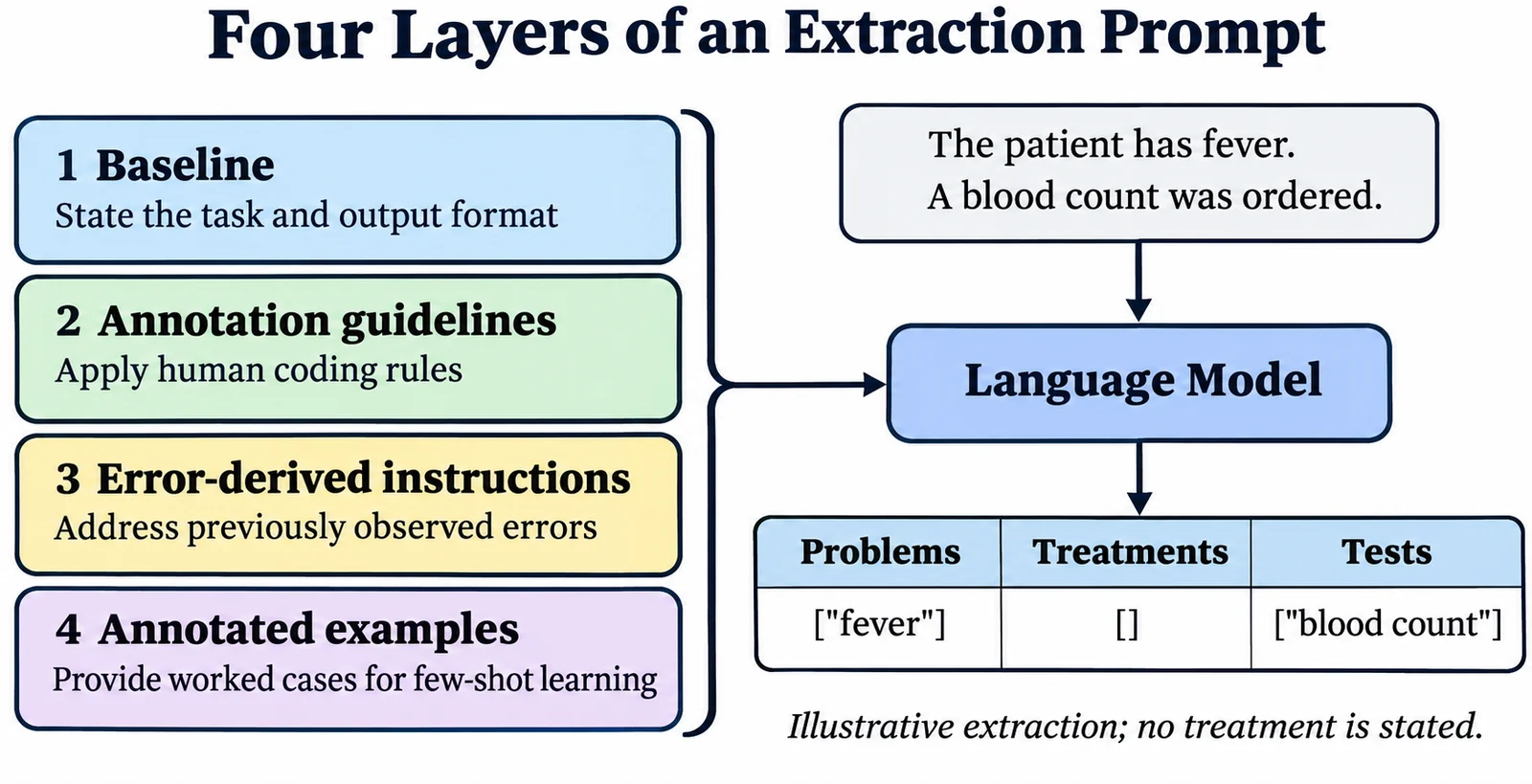
A medical researcher who needs a mean, a median, a standard deviation and an interquartile range can often get them with a single clear request and no examples. The same researcher should not trust a bare request for a significance test, because zero-shot prompting failed in inferential contexts for lack of assumption checking. The study recommends a hybrid prompt that combines explicit instructions, reasoning scaffolds and format constraints. Its authors call prompt design a core competency in AI-assisted medical research and ask for standardized prompt templates and evaluation rubrics.[100]
A software engineer can ask a model to write its reasoning in the three program structures of sequence, branch and loop before it writes code. This structured chain-of-thought prompting beat ordinary chain-of-thought prompting by up to 13.79% in Pass@1, the share of generated programs that pass the tests, on three benchmarks. Human developers also preferred the programs that came from the structured prompts.[152]
A wireless engineer can use iterative prompting for network optimization, letting the model explore the environment and accumulate experience across rounds. In a base-station power control case with three adjacent base stations, the method avoided the cost of dedicated training and fine-tuning. For traffic prediction, a self-refined prompting method cut mean absolute error by 29.72% against GPT-3.5 and by 17.09% against GPT-4. The authors argue that prompting suits network devices because it needs less computation and deploys with more flexibility.[166]
Later developments
Prompts as a subject of study and a job
Prompt engineering has been described as the systematic design and construction of prompts for interaction between people and artificial intelligence systems, and one 2024 paper asks directly whether that work qualifies as a distinct profession. That paper weighs the field's specialized skills, its ethical considerations and its societal impact against the traits of established professions, and it argues that prompt engineering should be recognized as a legitimate profession.[240] A 2026 systematic review treats prompt engineering as a competence for working with large language models, defining it as the design, organization and optimization of inputs so that a generative system returns accurate, relevant and pedagogically meaningful outputs. The same review reports that research on the topic remains scattered across disciplines and educational settings, and it gathers what is known about the motivation, attitudes, knowledge and skills of both learners and educators.[241] An introductory 2024 treatment places prompt design and engineering among the methods needed to get the most from large language models and surveys the tools built for people who write prompts.[242]
University courses have begun to teach the skill and to measure what students gain from it. One self-regulated course at a university trained students in prompt engineering so they could use large language models for self-directed learning and academic English, and it was evaluated with structured questionnaires and surveys. Students improved significantly in prompt engineering skills. Accessible patterns such as Persona proved highly effective, while advanced patterns such as Flipped Interaction gave students trouble. Gains in academic English were largest among students who began with lower proficiency, and engagement and practice time varied across the group. The course also used an AI-driven tool integrated into a learning management system that generated test content, graded it and gave real-time feedback; students valued its intuitive integration and grading accuracy but noted limits in question diversity and adaptability. The study concluded that human oversight is necessary for ethical and effective use of such tools in education.[243]
A teaching case study in German-as-a-foreign-language instruction at the University of Oviedo in Spain combined a theoretical learning phase with a practical phase, guided reflection on the learning process and rubric-based peer evaluation on a course platform. Evaluation by questionnaire with 13 participants pointed to positive learning gains and high acceptance of the teaching instruments, while also identifying difficulties in reflection and peer evaluation. The case study framed its aim as building critical AI literacy alongside prompt engineering skills.[244]
Prompt engineering is often weighed against fine-tuning, the practice of further training a model on additional data. A 2025 analysis compares the two approaches, sets out two classifications of prompts and describes five key prompt engineering techniques, then discusses the strengths and limits of each approach. That analysis identifies combining the methods as a promising direction for further development.[245]
A benchmark study of clinical notes compared prompting and fine-tuning strategies across GPT-3.5 Turbo, GPT-4 and Llama-7B, alongside BERT models and annotations by medical fellows, in identifying patients with metastatic cancer from discharge summaries. Clear, concise prompts that included reasoning steps significantly improved performance, and GPT-4 performed best among all the models tested. In that study, one-shot learning, in which a single worked example is supplied in the prompt, and fine-tuning gave no incremental benefit. Accuracy held even when keywords for metastatic cancer were removed or half of the input tokens were randomly discarded. The researchers read these results as evidence that strategic prompt engineering can let a general model substitute for a specialized model such as PubMedBERT, and as a sign of room to improve open-source models, which they note suit clinical settings better.[246]
Criticism
Common misconceptions
Many people assume that a few small wording changes to a prompt will reliably raise a model's accuracy on a hard task. One forecasting study ran 38 prompts on four models: Claude 3.5 Sonnet, Claude 3.5 Haiku, GPT-4o and Llama 3.1 405B. Most prompts produced negligible gains, and encouraging the model to use Bayesian reasoning strongly lowered accuracy.[99]
Key studies
| Year | Study | Sample | Design | Finding |
|---|---|---|---|---|
| 2022 | Zhou et al.[7] | the SCAN compositional generalization benchmark and other reasoning tasks | prompting experiment with the GPT-3 code-davinci-002 model | Least-to-most prompting solved SCAN in any split with at least 99% accuracy using 14 exemplars, against 16% for chain-of-thought prompting. |
| 2023 | Li et al.[152] | ChatGPT and Codex on the HumanEval, MBPP and MBCPP benchmarks | comparison of structured chain-of-thought prompting with ordinary chain-of-thought prompting | Structured prompting beat chain-of-thought prompting by up to 13.79% in Pass@1. |
| 2023 | Zheng et al.[34] | seven benchmarks including SVAMP, GSM8K, AQuA and MATH | prompting experiments with text-davinci-003 and GPT-4 | With GPT-4, progressive-hint prompting raised SVAMP accuracy from 89.1% to 91.9% and GSM8K from 92% to 95.5%. |
| 2023 | Singhal et al.[133] | six existing medical question answering datasets plus HealthSearchQA | benchmark evaluation of PaLM and Flan-PaLM with human review | On MedQA, which uses US Medical Licensing Exam-style questions, Flan-PaLM answered 67.6% correctly, more than 17% above the previous best. |
| 2023 | White et al.[3] | Catalog of prompt patterns for interacting with large language models. | Prompts are a form of programming that can customize outputs and interactions with a large language model. | |
| 2023 | Heston & Khun[2] | Review of prompt engineering in medical education. | Well-crafted prompts yield good responses, while poorly constructed prompts lead to unsatisfactory responses. | |
| 2024 | Hu et al.[97] | 2 clinical named entity recognition tasks on the MTSamples corpus and VAERS safety reports | benchmark evaluation of GPT-3.5 and GPT-4 with a four-component prompt framework | With all four components, GPT-4 reached relaxed F1 scores of 0.861 on MTSamples and 0.736 on VAERS, up from 0.804 and 0.593 with baseline prompts. |
| 2024 | Hebenstreit et al.[105] | six language models and six question-answering datasets, 11,880 experiments in total | small-scale comparison of zero-shot reasoning strategies | Reasoning strategies beat direct prompting, and GPT-4 benefited most from an automatically discovered prompt. |
| 2025 | Schoenegger et al.[99] | 38 prompts tested on Claude 3.5 Sonnet, Claude 3.5 Haiku, GPT-4o and Llama 3.1 405B | first study: 38 prompts on four models; second study: compound prompts and prompts from external sources, adding the reasoning models o1 and o1-mini | Most prompts produced negligible gains, and encouraging Bayesian reasoning strongly lowered accuracy. |
| 2025 | Brucks & Toubia[39] | 5,760 observations from GPT-3, GPT-4 and Llama 3.1 on similarity tasks | five full-factorial experiments on prompt architecture | GPT-4 selected the first option in 63.21% of cases and selected B over C in 74.27% of cases, and aggregating across prompts removed both biases. |
| 2025 | Shermay et al.[183] | 47 prompt combinations and 30 graphic designers | optimization study using response surface methodology for logo generation | Visual consistency rose from 65% to 87% and user satisfaction from 58% to 82%, while attempts fell from 6.6 to 3.4. |
| 2026 | Woo et al.[142] | 27 undergraduate students in a history course at a university in Hong Kong | mixed methods study of a 100-minute prompt engineering workshop | Students showed higher AI self-efficacy and a stronger grasp of AI concepts after the intervention, according to the study's findings. |
| 2026 | Li et al.[171] | 168 participants in Phase 1 and 40 participants in Phase 2 | pilot randomized experiment on feature-engineered mental health messages | Readers of the feature-engineered texts improved more in confidence in mental health professionals, with t(38) = 3.37 and d = 1.07. |
| 2026 | Özdemir & Aşçi[118] | 72 open-ended responses from 24 students in an undergraduate history course | exploratory case study comparing seven AI models with a human evaluator across five prompts | Agreement with the human evaluator was low for basic zero-shot prompts but above r = .80 with structured prompts and explicit rubrics. |
See also
References
- Chen, B., Zhang, Z., Langrené, N., & Zhu, S. (2025). Unleashing the potential of prompt engineering for large language models. Patterns, 6(6), 101260. doi:10.1016/j.patter.2025.101260
- Heston, T., & Khun, C. (2023). Prompt Engineering in Medical Education. International Medical Education, 2(3), 198-205. doi:10.3390/ime2030019
- White, J., Fu, Q., Hays, S., Sandborn, M., Olea, C., Henry, G., Elnashar, A., Spencer-Smith, J. B., & Schmidt, D. C. (2023). A Prompt Pattern Catalog to Enhance Prompt Engineering with ChatGPT. arXiv. doi:10.48550/arxiv.2302.11382 Free full text
- Lee, D., & Palmer, E. (2025). Prompt engineering in higher education: a systematic review to help inform curricula. International Journal of Educational Technology in Higher Education, 22(1). doi:10.1186/s41239-025-00503-7
- Wang, L., Chen, X., Deng, X., Wen, H., You, M., Liu, W., Li, Q., & Li, J. (2024). Prompt engineering in consistency and reliability with the evidence-based guideline for LLMs. npj Digital Medicine, 7(1). doi:10.1038/s41746-024-01029-4
- Li, J., Li, G., Li, Y., & Jin, Z. (2025). Structured Chain-of-Thought Prompting for Code Generation. ACM Transactions on Software Engineering and Methodology, 34(2), 1-23. doi:10.1145/3690635
- Zhou, D., A, N. S., Hou, L., Jason, W., Nathan, S., Wang, X., Schuurmans, D., Cui, C. M., Bousquet, O., Le, Q. V., & H., E. (2022). Least-to-Most Prompting Enables Complex Reasoning in Large Language Models. arXiv. doi:10.48550/arxiv.2205.10625 Free full text
- Chen, W., Ma, X., Wang, X., & Cohen, W. W. (2022). Program of Thoughts Prompting: Disentangling Computation from Reasoning for Numerical Reasoning Tasks. arXiv. doi:10.48550/arxiv.2211.12588 Free full text
- Lemeš, S. (2024). Prompt Engineering. Artificial Intelligence in Industry 4.0: The future that comes true, 159-170. doi:10.5644/pi2024.215.08
- Rathod, J. D. (2024). Systematic Study of Prompt Engineering. International Journal for Research in Applied Science and Engineering Technology, 12(6), 597-613. doi:10.22214/ijraset.2024.63182
- Son, M., Won, Y. J., & Lee, S. (2025). Optimizing Large Language Models: A Deep Dive into Effective Prompt Engineering Techniques. Applied Sciences, 15(3), 1430. doi:10.3390/app15031430
- Park, D., An, G. t., Kamyod, C., & Kim, C. G. (2024). A Study on Performance Improvement of Prompt Engineering for Generative AI with a Large Language Model. Journal of Web Engineering, 1187-1206. doi:10.13052/jwe1540-9589.2285
- Pornprasit, C., & Tantithamthavorn, C. (2024). Fine-tuning and prompt engineering for large language models-based code review automation. Information and Software Technology, 175, 107523. doi:10.1016/j.infsof.2024.107523
- Korzynski, P., Mazurek, G., Krzypkowska, P., & Kurasinski, A. (2023). Artificial intelligence prompt engineering as a new digital competence: Analysis of generative AI technologies such as ChatGPT. Entrepreneurial Business and Economics Review, 11(3), 25-37. doi:10.15678/eber.2023.110302
- Lo, L. S. (2023). The Art and Science of Prompt Engineering: A New Literacy in the Information Age. Internet Reference Services Quarterly, 27(4), 203-210. doi:10.1080/10875301.2023.2227621
- Bansal, P. (2024). Prompt Engineering Importance and Applicability with Generative AI. Journal of Computer and Communications, 12(10), 14-23. doi:10.4236/jcc.2024.1210002
- Strobelt, H., Webson, A., Sanh, V., Hoover, B., Beyer, J., Pfister, H., & Rush, A. M. (2022). Interactive and Visual Prompt Engineering for Ad-hoc Task Adaptation With Large Language Models. IEEE Transactions on Visualization and Computer Graphics, 1-11. doi:10.1109/tvcg.2022.3209479
- Schmidt, D. C., Spencer-Smith, J., Fu, Q., & White, J. (2024). Towards a Catalog of Prompt Patterns to Enhance the Discipline of Prompt Engineering. ACM SIGAda Ada Letters, 43(2), 43-51. doi:10.1145/3672359.3672364
- Schulhoff, S., Ilie, M., Balepur, N., Kahadze, K., Liu, A., Si, C., Yinheng, L., Gupta, A., Han, H., Schulhoff, S., Dulepet, P. S., Vidyadhara, S., Ki, D., Agrawal, S., Pham, C., Kroiz, G. C., Feileen, L., Tao, H., Srivastava, A., & ... Resnik, P. (2024). The Prompt Report: A Systematic Survey of Prompt Engineering Techniques. arXiv. doi:10.48550/arxiv.2406.06608 Free full text
- Vatsal, S., & Harsh, D. (2024). A Survey of Prompt Engineering Methods in Large Language Models for Different NLP Tasks. arXiv. doi:10.48550/arxiv.2407.12994 Free full text
- Liu, Y. Y., Zheng, Z., Zhang, F., Feng, J. C., Fu, Y. Y., Zhai, J. D., He, B. S., Zhang, X., & Du, X. Y. (2026). A comprehensive taxonomy of prompt engineering techniques for large language models. Frontiers of Computer Science, 20(3). doi:10.1007/s11704-025-50058-z
- Debnath, T., Siddiky, M. N. A., Rahman, M. E., Das, P., Guha, A. K., Rahman, M. R., & Kabir, H. M. D. (2025). A Comprehensive Survey of Prompt Engineering Techniques in Large Language Models. Institute of Electrical and Electronics Engineers (IEEE). doi:10.36227/techrxiv.174140719.96375390/v1
- Velásquez-Henao, J. D., Franco-Cardona, C. J., & Cadavid-Higuita, L. (2023). Prompt Engineering: a methodology for optimizing interactions with AI-Language Models in the field of engineering. DYNA, 90(230), 9-17. doi:10.15446/dyna.v90n230.111700
- Naser, M. Z. (2026). A Review of Prompt Engineering Techniques for Large Language Models. International Journal of Human–Computer Interaction, 42(17), 13768-13802. doi:10.1080/10447318.2025.2607553
- Sabbatella, A., Ponti, A., Giordani, I., Candelieri, A., & Archetti, F. (2024). Prompt Optimization in Large Language Models. Mathematics, 12(6), 929. doi:10.3390/math12060929
- Ekin, S. (2026). Prompt Engineering for ChatGPT: A Quick Guide to Techniques, Tips, and Best Practices. ASEE Journal of Engineering Technology, 43(1), 52-68. doi:10.18260/jet.43.1.5
- Gozzi, M., & Di Maio, F. (2024). Comparative Analysis of Prompt Strategies for Large Language Models: Single-Task vs. Multitask Prompts. Electronics, 13(23), 4712. doi:10.3390/electronics13234712
- Son, M., & Lee, S. (2025). Advancing Multimodal Large Language Models: Optimizing Prompt Engineering Strategies for Enhanced Performance. Applied Sciences, 15(7), 3992. doi:10.3390/app15073992
- -, M. C. (2025). Cost, Complexity, and Efficacy of Prompt Engineering Techniques for Large Language Models. International Journal on Science and Technology, 16(2). doi:10.71097/ijsat.v16.i2.2584
- Zhang, Z., Zhang, A., Li, M., & Smola, A. J. (2022). Automatic Chain of Thought Prompting in Large Language Models. arXiv. doi:10.48550/arxiv.2210.03493 Free full text
- Shao, Z., Gong, Y., Shen, Y., Huang, M., Duan, N., & Chen, W. (2023). Synthetic Prompting: Generating Chain-of-Thought Demonstrations for Large Language Models. arXiv. doi:10.48550/arxiv.2302.00618 Free full text
- Wang, L., Xu, W., Lan, Y., Hu, Z., Lan, Y., Lee, R. K. W., & Lim, E. (2023). Plan-and-Solve Prompting: Improving Zero-Shot Chain-of-Thought Reasoning by Large Language Models. arXiv. doi:10.48550/arxiv.2305.04091 Free full text
- Fu, Y., Peng, H. M., Sabharwal, A., Clark, P. A., & Khot, T. (2022). Complexity-Based Prompting for Multi-Step Reasoning. arXiv. doi:10.48550/arxiv.2210.00720 Free full text
- Zheng, C., Liu, Z., Xie, E., Li, Z., & Li, Y. (2023). Progressive-Hint Prompting Improves Reasoning in Large Language Models. arXiv. doi:10.48550/arxiv.2304.09797 Free full text
- Chia, Y. K., Chen, G., Tuan, L. A., Poria, S., & Bing, L. (2023). Contrastive Chain-of-Thought Prompting. arXiv. doi:10.48550/arxiv.2311.09277 Free full text
- Zhang, Y., Wang, X., Wu, L., & Wang, J. (2025). Enhancing Chain of Thought Prompting in Large Language Models via Reasoning Patterns. Proceedings of the AAAI Conference on Artificial Intelligence, 39(24), 25985-25993. doi:10.1609/aaai.v39i24.34793
- Chen, Q., Qin, L., Liu, J., Peng, D., Guan, J., Wang, P., Hu, M., Zhou, Y., Gao, T., & Che, W. (2026). Towards reasoning era: a survey of long chain-of-thought for reasoning large language models. Science China Information Sciences, 69(6). doi:10.1007/s11432-025-4665-8
- VG, P., & Majji, S. (2025). Chain-of-Draft Prompting: A Structured Approach to Efficient AI Reasoning. International Journal For Multidisciplinary Research, 7(3). doi:10.36948/ijfmr.2025.v07i03.46661
- Brucks, M., & Toubia, O. (2025). Prompt architecture induces methodological artifacts in large language models. PLOS One, 20(4), e0319159. doi:10.1371/journal.pone.0319159
- Zhou, Y., Muresanu, A. I., Han, Z., Paster, K., Pitis, S., Chan, H., & Ba, J. L. (2022). Large Language Models Are Human-Level Prompt Engineers. arXiv. doi:10.48550/arxiv.2211.01910 Free full text
- Kepel, D., & Valogianni, K. (2024). Autonomous Prompt Engineering in Large Language Models. arXiv. doi:10.48550/arxiv.2407.11000 Free full text
- Wang, G., Sun, Z., Ye, S., Gong, Z., Chen, Y., Zhao, Y., Liang, Q., & Hao, D. (2026). Do Advanced Language Models Eliminate the Need for Prompt Engineering in Software Engineering? ACM Transactions on Software Engineering and Methodology, 35(8), 1-33. doi:10.1145/3771933
- -, N. W. (2025). Beyond Prompt Engineering: The Evolution of Reasoning in Advanced Large Language Models. International Journal on Science and Technology, 16(1). doi:10.71097/ijsat.v16.i1.3719
- Zaghir, J., Naguib, M., Bjelogrlic, M., Névéol, A., Tannier, X., & Lovis, C. (2024). Prompt Engineering Paradigms for Medical Applications: Scoping Review. Journal of Medical Internet Research, 26, e60501. doi:10.2196/60501
- Jacobsen, L. J., & Weber, K. E. (2025). The Promises and Pitfalls of Large Language Models as Feedback Providers: A Study of Prompt Engineering and the Quality of AI-Driven Feedback. AI, 6(2), 35. doi:10.3390/ai6020035
- Gerlich, M. (2025). From Offloading to Engagement: An Experimental Study on Structured Prompting and Critical Reasoning with Generative AI. Data, 10(11), 172. doi:10.3390/data10110172
- Frederick, D. E. (2024). Prompt engineering – a disruption in information seeking? Library Hi Tech News, 41(3), 1-7. doi:10.1108/lhtn-03-2024-0037
- Khalid, M. T., & Witmer, A. P. (2026). Prompt Engineering for Large Language Model-Assisted Inductive Thematic Analysis. Social Science Computer Review, 44(3), 442-465. doi:10.1177/08944393251388098
- Wang, J., Liu, Z., Zhao, L., Wu, Z., Ma, C., Yu, S., Dai, H., Yang, Q., Liu, Y., Zhang, S., Shi, E., Pan, Y., Zhang, T., Zhu, D., Li, X., Jiang, X., Ge, B., Yuan, Y., Shen, D., & ... Zhang, S. (2023). Review of large vision models and visual prompt engineering. Meta-Radiology, 1(3), 100047. doi:10.1016/j.metrad.2023.100047
- Feng, Y., Wang, X., Wong, K. K., Wang, S., Lu, Y., Zhu, M., Wang, B., & Chen, W. (2023). PromptMagician: Interactive Prompt Engineering for Text-to-Image Creation. IEEE Transactions on Visualization and Computer Graphics, 1-11. doi:10.1109/tvcg.2023.3327168
- Cotroneo, P., & Hutson, J. (2023). Generative AI tools in art education: Exploring prompt engineering and iterative processes for enhanced creativity. Metaverse, 4(1), 14. doi:10.54517/m.v4i1.2164
- Atlanov, V. (2025). Prompt engineering: A key competence of a modern designer. Scientific and Practical Journal "Materials of Scientific Conferences of the Petro Mohyla Black Sea National University"(1), 15-18. doi:10.34132/mspc2025.01.06.01
- Korean Music Education Society, & Shin, G. (2025). Prompt Engineering for AI Music Creation Learning: Application and Analysis Using SUNO AI. Korean Music Education Society, 54(3), 95-112. doi:10.30775/kmes.54.3.95
- Cha, J., & Kim, J. (2025). CoT-Pose: Chain-of-Thought Reasoning for 3D Pose Generation from Abstract Prompts. arXiv. doi:10.48550/arxiv.2508.07540 Free full text
- Chen, Z., Zhou, Q., Shen, Y., Hong, Y., Sun, Z., Gutfreund, D., & Gan, C. (2024). Visual Chain-of-Thought Prompting for Knowledge-Based Visual Reasoning. Proceedings of the AAAI Conference on Artificial Intelligence, 38(2), 1254-1262. doi:10.1609/aaai.v38i2.27888
- Zhou, J., Zuo, Y., Feng, S., Peng, W., Qi, Z., Zhang, D., & Wei, S. (2025). PathCoT: Chain-of-Thought Prompting for Zero-shot Pathology Visual Reasoning. arXiv. doi:10.48550/arxiv.2507.01029 Free full text
- Yi, L., Jiawang, C., Wu, Y., Li, B., Licheng, T., Ji, Y., Wu, C., Wu, J., & Zhu, W. (2025). RSVP: Reasoning Segmentation via Visual Prompting and Multi-modal Chain-of-Thought. arXiv. doi:10.48550/arxiv.2506.04277 Free full text
- Colombo, G., Niederer, S., & De Gaetano, C. (2026). From prompt engineering to prompt design: Research strategies for visual generative AI. Big Data & Society, 13(2). doi:10.1177/20539517261451462
- Jin, C., Peng, H., Zhao, S., Wang, Z., Xu, W., Han, L., Zhao, J., Kai, Z., Rajasekaran, S., & Metaxas, D. (2024). APEER: Automatic Prompt Engineering Enhances Large Language Model Reranking. arXiv. doi:10.48550/arxiv.2406.14449 Free full text
- Richter, J., Fitzpatrick, D., Fuller, A., Leal, P., & Pittman, L. (2025). Prompt engineering and prompt-tuning: Foundations, advancements and research direction. World Journal of Advanced Research and Reviews, 28(3), 643-654. doi:10.30574/wjarr.2025.28.3.4103
- Narayanaswamy, S. K., & Muniswamy, R. (2025). Achieving Efficient Prompt Engineering in Large Language Models Using a Hybrid and Multi-Objective Optimization Framework. Cybernetics and Information Technologies, 25(2), 67-82. doi:10.2478/cait-2025-0012
- Ying, D. D., Vazquez, A. R., & Xu, H. (2026). Prompt engineering using order-of-addition experiments: An application to generating two-level fractional factorial designs. arXiv. doi:10.48550/arxiv.2607.05537 Free full text
- Morales, S., Clarisó, R., & Cabot, J. (2025). Impromptu: a framework for model-driven prompt engineering. Software and Systems Modeling, 24(6), 1627-1645. doi:10.1007/s10270-024-01235-4
- L., D. J., Savini, K., Thakee, N., Zichen, Z., Krisztian, F., Lingjia, T., & Jason, M. (2025). Prompt Less, Smile More: MTP with Semantic Engineering in Lieu of Prompt Engineering. arXiv. doi:10.48550/arxiv.2511.19427 Free full text
- Lin, J. (2026). Mitigating Hallucinations in Natural Language Generation through Prompt Engineering: A Mechanism- Oriented Narrative Review. Exploring Science Academic Conference Series, 16, 370-377. doi:10.70267/aitia.2026370377
- Zhu, D. H., Xiong, Y. J., Zhang, J. C., Xie, X., & Chun-Ming, X. (2025). Understanding Before Reasoning: Enhancing Chain-of-Thought with Iterative Summarization Pre-Prompting. arXiv. doi:10.48550/arxiv.2501.04341 Free full text
- Zhang, H., Deng, H., Ou, J., & Feng, C. (2025). Mitigating spatial hallucination in large language models for path planning via prompt engineering. Scientific Reports, 15(1). doi:10.1038/s41598-025-93601-5
- Li, Y. (2024). Reduce AI Illusion Based on Data Science Technology and Prompt Engineering. Applied and Computational Engineering, 97(1), 152-156. doi:10.54254/2755-2721/97/20241463
- Chia, S. K. (2026). Prompt Engineering for Reliable Large-Language-Model Interaction: From Instruction Design and Grounding to Evaluation and Prompt-Injection Resilience. CHIATECH JOURNAL, 1(2). doi:10.68232/cj.e026
- முனைவர் அர.கண்ணன், & முனைவர் மா. இராமச்சந்திரன் (2026). செயற்கை நுண்ணறிவு (AI) மற்றும் Prompt Engineering வழி தமிழ் இலக்கிய ஆய்வு: புதிய ஆராய்ச்சி அணுகுமுறைகள்: Tamil Literary Research through Artificial Intelligence (AI) and Prompt Engineering: New Research Approaches. Tamilmanam International Research Journal of Tamil Studies, 12(02), 586-600. doi:10.63300/tm12022026.43
- Stetsyk, M. (2024). The union of linguistics and prompt engineering: linguistic features of prompts to neural networks. Vilnius University Open Series, 155-166. doi:10.15388/sv-i-ii.2024.14
- Saad Rehman Babary (2026). Prompt Engineering as a New Literacy: The Linguistics of Talking to Large Language Models. Journal of Linguistics, Literature and Technology, 1(1), 92-105. doi:10.67649/5wer1g34
- Dr. Santosh K C, D. S. K. C., M Mokshitha, M. M., Mahima C, M. C., Mohammed Anas, M. A., & Abhishek K, A. K. (2025). Prompt Bridge: A Multilingual Prompt Engineering Framework to Bridge Language Barriers in AI Communication. International Journal of Advances in Engineering and Management, 7(4), 1003-1009. doi:10.35629/5252-070410031009
- (2024). Discovering prompt engineering: A qualitative study of nonexpert teachers' interactions with chatgpt. Issues In Information Systems. doi:10.48009/4_iis_2024_117
- Mohamad, S. K., & Dharam Singh, H. K. (2025). Prompt Engineering Frameworks and Their Educational Value in Higher Education. Innovative Teaching and Learning Journal, 9(2), 495-505. doi:10.11113/itlj.v9.204
- Ma, Q., Peng, W., Yang, C., Shen, H., Koedinger, K., & Wu, T. (2025). What Should We Engineer in Prompts? Training Humans in Requirement-Driven LLM Use. ACM Transactions on Computer-Human Interaction, 32(4), 1-27. doi:10.1145/3731756
- Bai, S., Yeung, S. S., & Lo, C. K. (2026). Enhancing the effect of AI-assisted learning: the use of scaffolding strategies to develop students’ prompt engineering skills. Interactive Learning Environments, 1-22. doi:10.1080/10494820.2026.2649547
- Coffin Murray, M. (2025). Bridging the Generative AI Literacy Gap: A Guide to Introducing Prompt Engineering in University Courses. Issues in Informing Science and Information Technology, 22, 010. doi:10.28945/5516
- Agirdag, O. (2026). Beyond Prompt Engineering: Prompting (L)iteracy, Linguistic Capital, and Educational Inequality. Educational Theory, 76(2), 206-223. doi:10.1111/edth.70057
- Tuveri, M. (2026). From Prompt Engineering to Epistemic Prompting: Prompt Trajectories as AI-Mediated Problem Framing in Science Education. arXiv. doi:10.48550/arxiv.2607.11680 Free full text
- Witteveen, S., & Andrews, M. (2022). Investigating Prompt Engineering in Diffusion Models. arXiv. doi:10.48550/arxiv.2211.15462 Free full text
- Chen, T., & Ai, J. (2025). Hierarchical Prompt Engineering for Remote Sensing Scene Understanding with Large Vision–Language Models. Remote Sensing, 17(22), 3727. doi:10.3390/rs17223727
- Binbin, J., Siddharth, A., Tang, Q., & Yvonne, W. (2025). Enhancing Spatial Reasoning in Vision-Language Models via Chain-of-Thought Prompting and Reinforcement Learning. arXiv. doi:10.48550/arxiv.2507.13362 Free full text
- Dery, H., Piterman, D., Elyoseph, Z., Refoua, E., Meinlschmidt, G., Bar, K., Hadar Shoval, D., & Geller, A. (2026). The “Logic” of Emotion: Do Reasoning Models and Chain-of-Thought Prompting Improve GAI’s Non-Verbal Emotion Recognition? European Psychiatry, 69(S1), S646-S647. doi:10.1192/j.eurpsy.2026.11358
- Henrickson, L., & Meroño-Peñuela, A. (2025). Prompting meaning: a hermeneutic approach to optimising prompt engineering with ChatGPT. AI & SOCIETY, 40(2), 903-918. doi:10.1007/s00146-023-01752-8
- Germani, F., & Spitale, G. (2026). The Ethics of Prompt Engineering. arXiv. doi:10.48550/arxiv.2610.23082 Free full text
- Sinha, R. (2023). Statistical Analysis of Bias in ChatGPT Using Prompt Engineering. International Journal for Research in Applied Science and Engineering Technology, 11(6), 1483-1489. doi:10.22214/ijraset.2023.53885
- Kevseroğlu, Ö., Yaşar, İ., & Yıldırım, V. (2026). Reconstructing Lost Urban Memory with Generative AI: An Oral-History Prompt-Engineering Framework. Turkish Journal of Engineering, 10(4), 1667-1676. doi:10.31127/tuje.1967989
- Poosarla, H. (2024). Mitigating Political Bias in Large Language Models Using Chain of thought Prompting Techniques. International Journal for Research in Applied Science and Engineering Technology, 12(1), 876-882. doi:10.22214/ijraset.2024.58057
- Kapil Kumar Goyal (2025). Human-Centered Prompt Engineering: Techniques for Ethical and Inclusive LLM Outputs. International Journal of Scientific Research in Computer Science, Engineering and Information Technology, 11(3), 897-903. doi:10.32628/cseit25113357
- Bozkurt, A. (2024). Tell Me Your Prompts and I Will Make Them True: The Alchemy of Prompt Engineering and Generative AI. Open Praxis, 16(2), 111-118. doi:10.55982/openpraxis.16.2.661
- Panneer Selvam Viswanathan (2025). Prompt Engineering for Conversational AI Systems: A Systematic Review of Techniques and Applications. International Journal of Scientific Research in Computer Science, Engineering and Information Technology, 11(1), 733-741. doi:10.32628/cseit25111276
- Delafuente, P., Honraopatil, A., & Martin, L. J. (2025). Does Reasoning Help LLM Agents Play Dungeons and Dragons? A Prompt Engineering Experiment. arXiv. doi:10.48550/arxiv.2510.18112 Free full text
- Besta, M., Memedi, F., Zhang, Z., Gerstenberger, R., Piao, G., Blach, N., Nyczyk, P., Copik, M., Kwaśniewski, G., Müller, J., Gianinazzi, L., Kubicek, A., Niewiadomski, H., O’Mahony, A., Mutlu, O., & Hoefler, T. (2025). Demystifying Chains, Trees, and Graphs of Thoughts. IEEE Transactions on Pattern Analysis and Machine Intelligence, 47(12), 10967-10989. doi:10.1109/tpami.2025.3598182
- Zhang, Z., Yao, Y., Zhang, A., Tang, X., Ma, X., He, Z., Wang, Y., Gerstein, M., Wang, R., Liu, G., & Zhao, H. (2025). Igniting Language Intelligence: The Hitchhiker’s Guide from Chain-of-Thought Reasoning to Language Agents. ACM Computing Surveys, 57(8), 1-39. doi:10.1145/3719341
- Kovari, A. (2026). Context engineering frames prompt engineering within system level orchestration for large language model applications. Discover Artificial Intelligence, 6(1). doi:10.1007/s44163-026-02312-x
- Hu, Y., Chen, Q., Du, J., Peng, X., Keloth, V. K., Zuo, X., Zhou, Y., Li, Z., Jiang, X., Lu, Z., Roberts, K., & Xu, H. (2024). Improving large language models for clinical named entity recognition via prompt engineering. Journal of the American Medical Informatics Association, 31(9), 1812-1820. doi:10.1093/jamia/ocad259
- Trad, F., & Chehab, A. (2024). Prompt Engineering or Fine-Tuning? A Case Study on Phishing Detection with Large Language Models. Machine Learning and Knowledge Extraction, 6(1), 367-384. doi:10.3390/make6010018
- Schoenegger, P., Jones, C. R., Tetlock, P. E., & Mellers, B. A. (2025). Prompt Engineering Large Language Models' Forecasting Capabilities. arXiv. doi:10.48550/arxiv.2506.01578 Free full text
- Vilakati, S. (2025). Prompt engineering for accurate statistical reasoning with large language models in medical research. Frontiers in Artificial Intelligence, 8. doi:10.3389/frai.2025.1658316
- Pawlik, L. (2025). How the Choice of LLM and Prompt Engineering Affects Chatbot Effectiveness. Electronics, 14(5), 888. doi:10.3390/electronics14050888
- Anam, R. K. (2025). Prompt Engineering and the Effectiveness of Large Language Models in Enhancing Human Productivity. Center for Open Science. doi:10.31219/osf.io/ad9y5_v1
- Liu, H., Yin, H., Luo, Z., & Wang, X. (2025). Integrating chemistry knowledge in large language models via prompt engineering. Synthetic and Systems Biotechnology, 10(1), 23-38. doi:10.1016/j.synbio.2024.07.004
- Wang, M., Wang, M., Xu, X., Yang, L., Cai, D., & Yin, M. (2024). Unleashing ChatGPT's Power: A Case Study on Optimizing Information Retrieval in Flipped Classrooms via Prompt Engineering. IEEE Transactions on Learning Technologies, 17, 629-641. doi:10.1109/tlt.2023.3324714
- Hebenstreit, K., Praas, R., Kiesewetter, L. P., & Samwald, M. (2024). A comparison of chain-of-thought reasoning strategies across datasets and models. PeerJ Computer Science, 10, e1999. doi:10.7717/peerj-cs.1999
- Ding, L., O’Berry, R., Tallent, H., Chhetri G C, S. G., & Gapud, A. (2026). Learning with large language models: beyond prompt engineering. Education and Information Technologies, 31(9), 2877-2901. doi:10.1007/s10639-026-13924-2
- Edemacu, K., & Wu, X. (2025). Privacy Preserving Prompt Engineering: A Survey. ACM Computing Surveys, 57(10), 1-36. doi:10.1145/3729219
- M. Sriram, P. Vishvaas, M. Sai Sreejan, A. Sai Ramana, Mrs. K.B. Pullamma, & Dr. K S R K Sarma (2026). Prompt Analysis in Large Language Models Adversarial Prompt Detection. Research Digest on Engineering Management and Social Innovations, 2(4). doi:10.46647/rdems0204018
- Liu, Y., Deng, G., Xu, Z., Li, Y., Zheng, Y., Zhang, Y., Zhao, L., Zhang, T., Kailong, W., & Liu, Y. (2023). Jailbreaking ChatGPT via Prompt Engineering: An Empirical Study. arXiv. doi:10.48550/arxiv.2305.13860 Free full text
- Lee, S., Kim, J., & Pak, W. (2025). Mind Mapping Prompt Injection: Visual Prompt Injection Attacks in Modern Large Language Models. Electronics, 14(10), 1907. doi:10.3390/electronics14101907
- Nasution, A. H., Monika, W., Onan, A., & Murakami, Y. (2025). Benchmarking 21 Open-Source Large Language Models for Phishing Link Detection with Prompt Engineering. Information, 16(5), 366. doi:10.3390/info16050366
- Glang, J., & Simske, S. J. (2026). Safeguarding Sensitive Data: Prompt Engineering for GenAI. Proceedings of the INCOSE WSRC 2025. doi:10.65351/wsrc25.013
- Torkestani, M. S., Alameer, A., Palaiahnakote, S., & Manosuri, T. (2025). Inclusive prompt engineering for large language models: a modular framework for ethical, structured, and adaptive AI. Artificial Intelligence Review, 58(11). doi:10.1007/s10462-025-11330-7
- Djeffal, C. (2025). Reflexive Prompt Engineering: A Framework for Responsible Prompt Engineering and Interaction Design. arXiv. doi:10.48550/arxiv.2504.16204 Free full text
- Shiri, A. (2026). Assessing Anti-Indigenous Bias in Large Language Models: A Prompt Engineering Pilot Experiment. Proceedings of the Annual Conference of CAIS / Actes du congrès annuel de l'ACSI. doi:10.29173/cais2028
- Halm, M. (2025). The Politics of Prompt Engineering. Critical AI, 3(2). doi:10.1215/2834703x-12095946
- Ciotti, F. (2026). Parlare con le macchine: Il prompt engineering come competenza epistemica. DigitCult - Scientific Journal on Digital Cultures, 11(1), 10-28. doi:10.54103/2531-5994/31801
- Özdemir, Y., & Aşçi, E. (2026). Optimizing AI-based assessment in history education: The impact of prompt engineering on scoring performance in a morphologically rich language. Journal of Educational Technology and Online Learning, 9(3), 374-396. doi:10.31681/jetol.1882892
- Ariely, M., Salman, A., Yarden, A., & Alexandron, G. (2026). Reflective prompt engineering: a new strategy for automated short answer scoring in biology. International Journal of Science Education, 48(15), 2422-2444. doi:10.1080/09500693.2025.2523571
- Cohn, C., Hutchins, N., Le, T., & Biswas, G. (2024). A Chain-of-Thought Prompting Approach with LLMs for Evaluating Students’ Formative Assessment Responses in Science. Proceedings of the AAAI Conference on Artificial Intelligence, 38(21), 23182-23190. doi:10.1609/aaai.v38i21.30364
- Jacobsen, L. J., & Weber, K. E. (2023). The Promises and Pitfalls of LLMs as Feedback Providers: A Study of Prompt Engineering and the Quality of AI-Driven Feedback. Center for Open Science. doi:10.31219/osf.io/cr257
- Lee, D. (2025). Can ChatGPT design formative assessments to encourage preparatory students to engage with TED Talks as course readings? A prompt engineering experiment. Artificial Intelligence in Education, 1(1), 24-41. doi:10.1108/aiie-10-2024-0025
- Polat, F., Tiddi, I., & Groth, P. (2025). Testing prompt engineering methods for knowledge extraction from text. Semantic Web: – Interoperability, Usability, Applicability, 16(2). doi:10.3233/sw-243719
- Nugumanova, A., Alzhanov, A., Mansurova, A., & Mansurova, M. (2025). Exploring the Impact of Students’ Prompt Engineering on GPT’s Performance: A Blockchain-Focused Automatic Term Extraction Experiment. Electronics, 14(11), 2098. doi:10.3390/electronics14112098
- Hu, L. (2025). Topic Classification of Small Sample News Based on Prompt Engineering. Applied and Computational Engineering, 170(1), 101-107. doi:10.54254/2755-2721/2025.26378
- Kochanek, M., Cichecki, I., Kaszyca, O., Szydło, D., Madej, M., Jędrzejewski, D., Kazienko, P., & Kocoń, J. (2024). Improving Training Dataset Balance with ChatGPT Prompt Engineering. Electronics, 13(12), 2255. doi:10.3390/electronics13122255
- Hikov, A., & Murphy, L. (2024). Information retrieval from textual data: Harnessing large language models, retrieval augmented generation and prompt engineering. Journal of AI, Robotics & Workplace Automation, 3(2), 142. doi:10.69554/qafe6376
- Çulha, D. (2026). Probing Maximally Divergent Conceptual Regions in Large Language Models Through Prompt Engineering. JUCS - Journal of Universal Computer Science, 32(6), 876-894. doi:10.3897/jucs.168955
- Kumar, V. (2026). Shieldllm: A Hybrid Adversarial Prompt Injection Detection Framework for Securing Large Language Models. International Journal of Creative and Open Research in Engineering and Management, 02(04), 1-9. doi:10.55041/ijcope.v2i4.463
- Leslie-Miller, C. J., Simon, S. L., Dean, K., Mokhallati, N., & Cushing, C. C. (2024). The critical need for expert oversight of ChatGPT: Prompt engineering for safeguarding child healthcare information. Journal of Pediatric Psychology, 49(11), 812-817. doi:10.1093/jpepsy/jsae075
- McKinney, C. (2026). Prompt Engineering For Lawyers: Blue Pill Or Red Pill: Hallucinations Risks And An Introduction To Prompt Engineering. Arkansas Law Notes, 1. doi:10.54119/aln.mkhp6513
- Qing, L., Havaldar, S., Stein, A., Zhang, L., Rao, D., Wong, E., Apidianaki, M., & Callison-Burch, C. (2023). Faithful Chain-of-Thought Reasoning. arXiv. doi:10.48550/arxiv.2301.13379 Free full text
- Singhal, K., Azizi, S., Tu, T., Mahdavi, S. S., Wei, J., Chung, H. W., Scales, N., Tanwani, A., Cole-Lewis, H., Pfohl, S., Payne, P., Seneviratne, M., Gamble, P., Kelly, C., Babiker, A., Schärli, N., Chowdhery, A., Mansfield, P., Demner-Fushman, D., & ... Natarajan, V. (2023). Large language models encode clinical knowledge. Nature, 620(7972), 172-180. doi:10.1038/s41586-023-06291-2
- Faria, F. T. J., Baniata, L. H., Choi, A., & Kang, S. (2025). Analyzing Diagnostic Reasoning of Vision–Language Models via Zero-Shot Chain-of-Thought Prompting in Medical Visual Question Answering. Mathematics, 13(14), 2322. doi:10.3390/math13142322
- Gu, J., Han, Z. Y., Chen, S., Beirami, A., He, B., Gengyuan, Z., Liao, R., Qin, Y., Tresp, V., & Torr, P. H. S. (2023). A Systematic Survey of Prompt Engineering on Vision-Language Foundation Models. arXiv. doi:10.48550/arxiv.2307.12980 Free full text
- Zhang, Z., Zhang, A., Li, M., Zhao, H. Y., Karypis, G., & Smola, A. J. (2023). Multimodal Chain-of-Thought Reasoning in Language Models. arXiv. doi:10.48550/arxiv.2302.00923 Free full text
- Federiakin, D., Molerov, D., Zlatkin-Troitschanskaia, O., & Maur, A. (2024). Prompt engineering as a new 21st century skill. Frontiers in Education, 9. doi:10.3389/feduc.2024.1366434
- Walter, Y. (2024). Embracing the future of Artificial Intelligence in the classroom: the relevance of AI literacy, prompt engineering, and critical thinking in modern education. International Journal of Educational Technology in Higher Education, 21(1). doi:10.1186/s41239-024-00448-3
- Qian, Y. (2025). Prompt Engineering in Education: A Systematic Review of Approaches and Educational Applications. Journal of Educational Computing Research, 63(7-8), 1782-1818. doi:10.1177/07356331251365189
- Park, J., & Choo, S. (2025). Generative AI Prompt Engineering for Educators: Practical Strategies. Journal of Special Education Technology, 40(3), 411-417. doi:10.1177/01626434241298954
- Correia, A. P., Hickey, S., & Xu, F. (2025). Realizing the possibilities of the large language models: Strategies for prompt engineering in educational inquiries. Theory Into Practice, 64(4), 434-447. doi:10.1080/00405841.2025.2528545
- Woo, D. J., Wang, D., Yung, T., & Guo, K. (2026). Effects of a prompt engineering intervention on undergraduate students' AI self‐efficacy, AI knowledge and prompt engineering ability: A mixed methods study. British Educational Research Journal, 52(2), 1442-1469. doi:10.1002/berj.70087
- Knoth, N., Tolzin, A., Janson, A., & Leimeister, J. M. (2024). AI literacy and its implications for prompt engineering strategies. Computers and Education: Artificial Intelligence, 6, 100225. doi:10.1016/j.caeai.2024.100225
- Thessa Roxana (2026). Analysis of the influence of prompt engineering skills in learning processes utilizing chatgpt : Probability theory: Prompt engineering, chatgpt, efektivitas pembelajaran, kualitas output, performance expectancy, effort expectancy, intensitas penggunaan, artificial intelligence, PLS-SEM, teori peluang. Rabit : Jurnal Teknologi dan Sistem Informasi Univrab, 11(2), 4797-4813. doi:10.36341/rabit.v11i2.8311
- Oppenlaender, J., Linder, R., & Silvennoinen, J. (2025). Prompting AI Art: An Investigation into the Creative Skill of Prompt Engineering. International Journal of Human–Computer Interaction, 41(16), 10207-10229. doi:10.1080/10447318.2024.2431761
- Sasson Lazovsky, G., Raz, T., & Kenett, Y. N. (2025). The Art of Creative Inquiry—From Question Asking to Prompt Engineering. The Journal of Creative Behavior, 59(1). doi:10.1002/jocb.671
- Gibreel, O., & Arpaci, I. (2025). Development and validation of the prompt engineering competence scale (PECS). Information Development. doi:10.1177/02666669251336455
- Sasaki, Y., Washizaki, H., Li, J., Sander, D., Yoshioka, N., & Fukazawa, Y. (2024). Systematic Literature Review of Prompt Engineering Patterns in Software Engineering. 2024 IEEE 48th Annual Computers, Software, and Applications Conference (COMPSAC), 670-675. doi:10.1109/compsac61105.2024.00096
- Yoo, S. (2025). Co-CoT: A Prompt-Based Framework for Collaborative Chain-of-Thought Reasoning. arXiv. doi:10.48550/arxiv.2504.17091 Free full text
- Syahputri, I. W., Budiardjo, E. K., & Putra, P. O. H. (2025). Unlocking the Potential of the Prompt Engineering Paradigm in Software Engineering: A Systematic Literature Review. AI, 6(9), 206. doi:10.3390/ai6090206
- De Martino, V., Broccia, G., Pecorelli, F., Horkoff, J., Coppola, R., Ferraro, A., Motger, Q., McKenzie, E., & Siddeeq, S. (2026). From Prompting to Engineering: A Research Agenda for Prompt Engineering in Software Engineering. ACM SIGSOFT Software Engineering Notes, 51(4), 65-71. doi:10.1145/3844691.3844706
- Li, J., Li, G., Li, Y., & Jin, Z. G. (2023). Structured Chain-of-Thought Prompting for Code Generation. arXiv. doi:10.48550/arxiv.2305.06599 Free full text
- Polak, M. P., & Morgan, D. (2024). Extracting accurate materials data from research papers with conversational language models and prompt engineering. Nature Communications, 15(1). doi:10.1038/s41467-024-45914-8
- Fei, Y., Fan, J., & Zhou, G. (2025). Extracting Fruit Disease Knowledge from Research Papers Based on Large Language Models and Prompt Engineering. Applied Sciences, 15(2), 628. doi:10.3390/app15020628
- Husakovskyi, A. (2026). Prompt engineering for large language models in test case generation. Information Technology and Computer Engineering(23), 22-34. doi:10.31649/vitce/1.2026.22
- Lan, H. (2024). Prompt Engineering for Academic Librarian: Implications and Applications of Prompt Engineering in Academic Librarianship. Journal of Web Librarianship, 18(3), 169-175. doi:10.1080/19322909.2024.2399055
- Lund, B. (2023). The prompt engineering librarian. Library Hi Tech News, 40(8), 6-8. doi:10.1108/lhtn-10-2023-0189
- McKinney, C. (2026). Prompt Engineering For Lawyers: We Will Add Your Distinctiveness To Our Own: Iterative Refinement And Prompt Chaining. Arkansas Law Notes, 1. doi:10.54119/aln.ugce1174
- Di Giorgio, A. (2026). La maieutica nell'era dell'Intelligenza Artificiale: Una rilettura socratica del prompt engineering nel settore legal tech. i-lex, 19(1), 34-50. doi:10.60923/issn.1825-1927/24092
- Deepak Pai (2025). Prompt Engineering Frameworks for Generative AI in Credit Analysis. Journal of Information Systems Engineering and Management, 10(45s), 846-852. doi:10.52783/jisem.v10i45s.9035
- Fontenelle, M. R., Amorim, J. R. A. d., Cruz, M. A. S., & Lima, C. E. P. (2025). Prompt engineering and prompt chaining in artificial intelligence: Tools for mapping future climate scenarios as mechanisms of adaptation and climate justice and just transition promotion. Revista DCS, 22(83), e3456. doi:10.54899/dcs.v22i83.3456
- Lim, S., & Schmälzle, R. (2023). Artificial intelligence for health message generation: an empirical study using a large language model (LLM) and prompt engineering. Frontiers in Communication, 8. doi:10.3389/fcomm.2023.1129082
- Luo, F., Zhang, J., Wang, Q., & Yang, C. (2025). Leveraging Prompt Engineering in Large Language Models for Accelerating Chemical Research. ACS Central Science, 11(4), 511-519. doi:10.1021/acscentsci.4c01935
- Zha, Y., Li, Y., & Lu, X. G. (2024). Enhancing Large Language Model Comprehension of Material Phase Diagrams through Prompt Engineering and Benchmark Datasets. Mathematics, 12(19), 3141. doi:10.3390/math12193141
- Sukpancharoen, S., & Srinophakun, T. R. (2026). Benchmarking AI prompt performance of large language models across chemical process systems engineering domains using multi-judge evaluation. Chemical Engineering Journal Advances, 27, 101375. doi:10.1016/j.ceja.2026.101375
- Zhou, H., Hu, C., Yuan, D., Yuan, Y., Wu, D., Chen, X., Tabassum, H., & Liu, X. (2025). Large Language Models for Wireless Networks: An Overview from the Prompt Engineering Perspective. IEEE Wireless Communications, 32(4), 98-106. doi:10.1109/mwc.001.2400384
- Qian, Z., Lian, J., Guo, W., Chen, T., & He, Q. (2026). Improving Event-Level Financial Sentiment Analysis with Adaptive Reasoning Order Chain-of-Thought Prompting. Intelligent Computing, 5. doi:10.34133/icomputing.0651
- Priyadarshana, Y. H. P. P., Senanayake, A., Liang, Z., & Piumarta, I. (2024). Prompt engineering for digital mental health: a short review. Frontiers in Digital Health, 6. doi:10.3389/fdgth.2024.1410947
- Senanayake, A. L. (2024). Social media anxiety detection using prompt engineering techniques. The 24th International Postgraduate Research Conference. doi:10.64920/iprc2024127
- Dougherty Valley High School, & Agrawal, A. (2024). Illuminate a Novel Approach for Depression Detection with Explainable Analysis and Proactive Therapy using Prompt Engineering. International Journal of Psychiatry, 9(2), 01-12. doi:10.33140/ijp.09.02.02
- Li, A., Yao, S. T., Chen, B. X., Li, X. Y., & Guo, S. Y. (2026). Prompt engineering a large language model with evidence-based persuasive features to improve confidence in mental health professionals: a pilot randomized experiment. Frontiers in Public Health, 14. doi:10.3389/fpubh.2026.1909370
- Boit, S., & Patil, R. (2025). A Prompt Engineering Framework for Large Language Model–Based Mental Health Chatbots: Conceptual Framework. JMIR Mental Health, 12, e75078-e75078. doi:10.2196/75078
- Waaler, P. N., Hussain, M., Molchanov, I., Bongo, L. A., & Elvevåg, B. (2025). Prompt Engineering an Informational Chatbot for Education on Mental Health Using a Multiagent Approach for Enhanced Compliance With Prompt Instructions: Algorithm Development and Validation. JMIR AI, 4, e69820. doi:10.2196/69820
- Lee, J. H., & Shin, J. (2025). Prompt Engineering for Large Language Models: A Primer for Radiologists. Korean Journal of Abdominal Radiology, 8(1), 1-8. doi:10.52668/kjar.2024.00017
- Russe, M. F., Reisert, M., Bamberg, F., & Rau, A. (2024). Improving the use of LLMs in radiology through prompt engineering: from precision prompts to zero-shot learning. RöFo - Fortschritte auf dem Gebiet der Röntgenstrahlen und der bildgebenden Verfahren, 196(11), 1166-1170. doi:10.1055/a-2264-5631
- Dietrich, N., Bradbury, N. C., & Loh, C. (2025). Prompt Engineering for Large Language Models in Interventional Radiology. American Journal of Roentgenology, 225(2). doi:10.2214/ajr.25.32956
- Vahdati, S., Mahmoudi, E., Ganjizadeh, A., Chao, C., & Erickson, B. J. (2025). Decoding large language models for radiology: strategies for fine-tuning and prompt engineering. Radiology Advances, 2(4). doi:10.1093/radadv/umaf024
- Lyu, Q., Tan, J., Zapadka, M. E., Ponnatapura, J., Niu, C., Myers, K. J., Wang, G., & Whitlow, C. T. (2023). Translating radiology reports into plain language using ChatGPT and GPT-4 with prompt learning: results, limitations, and potential. Visual Computing for Industry, Biomedicine, and Art, 6(1). doi:10.1186/s42492-023-00136-5
- Hu, Y., Qingyu, C., Jingcheng, D., Peng, X., Kuttichi, K. V., Zuo, X., Zhou, Y., Li, Z., Jiang, X., Zhiyong, L., Kirk, R., & Xu, H. (2023). Improving Large Language Models for Clinical Named Entity Recognition via Prompt Engineering. arXiv. doi:10.48550/arxiv.2303.16416 Free full text
- Yan, S., Knapp, W., Leong, A., Kadkhodazadeh, S., Das, S., Jones, V. G., Clark, R., Grattendick, D., Chen, K., Hladik, L., Fagan, L., & Chan, A. (2024). Prompt engineering on leveraging large language models in generating response to InBasket messages. Journal of the American Medical Informatics Association, 31(10), 2263-2270. doi:10.1093/jamia/ocae172
- Xu, T., Gu, Y., Xue, M., Gu, R., Li, B., & Gu, X. (2024). Knowledge graph construction for heart failure using large language models with prompt engineering. Frontiers in Computational Neuroscience, 18. doi:10.3389/fncom.2024.1389475
- Aysel, K. (2025). Prompt-Craft Cards: A Toolkit for Developing Design Judgment through Reverse Prompt Engineering. International Conference on AI Research, 5(1), 658-662. doi:10.34190/icair.5.1.4362
- Shermay, Aklani, S. A., & Firmansyah, M. D. (2025). Optimizing Prompt Engineering for AI-Based Logo Generation Using Response Surface Methodology. JURNAL TEKNOLOGI DAN OPEN SOURCE, 8(2), 722-739. doi:10.36378/jtos.v8i2.4959
- Deng, F. (2024). Efficient Visual Prompt Engineering for Creative Story Writing. Journal of Student Research, 13(4). doi:10.47611/jsrhs.v13i4.7705
- Kim, M. (2024). Proposal on Effective AI Prompt Engineering Model for Prototype Game Development. Journal of Korea Game Society, 24(6), 109-118. doi:10.7583/jkgs.2024.24.6.109
- Choi, W. C., & Chang, C. I. (2025). A Survey of Techniques, Key Components, Strategies, Challenges, and Student Perspectives on Prompt Engineering for Large Language Models (LLMs) in Education. MDPI AG. doi:10.20944/preprints202503.1808.v1
- Chen, E., Wang, D., Xu, L., Chen, C., Fang, X., & Lin, J. (2024). A Systematic Review on Prompt Engineering in Large Language Models for K-12 STEM Education. arXiv. doi:10.48550/arxiv.2410.11123 Free full text
- The Korea English Education Society, & Ha, M. J. (2024). Developing a GPT-Based Chatbot Using Advanced Prompt Engineering for English Proficiency Level-Differentiated Reading Questions. The Korea English Education Society, 23(2), 125-156. doi:10.18649/jkees.2024.23.2.125
- Derinalp, P. (2026). From prompts to pedagogy: Mapping prompt engineering in English language education. Journal of Educational Technology and Online Learning, 9(3), 552-567. doi:10.31681/jetol.1985220
- Patil, R., Heston, T. F., & Bhuse, V. (2024). Prompt Engineering in Healthcare. Electronics, 13(15), 2961. doi:10.3390/electronics13152961
- Kleinig, O., Gao, C., Kovoor, J. G., Gupta, A. K., Bacchi, S., & Chan, W. O. (2024). How to use large language models in ophthalmology: from prompt engineering to protecting confidentiality. Eye, 38(4), 649-653. doi:10.1038/s41433-023-02772-w
- Liu, J., Liu, F., Wang, C., & Liu, S. (2025). Prompt Engineering in Clinical Practice: Tutorial for Clinicians. Journal of Medical Internet Research, 27, e72644-e72644. doi:10.2196/72644
- Mudrik, A., Nadkarni, G. N., Efros, O., Soffer, S., & Klang, E. (2025). Prompt Engineering in Large Language Models for Patient Education: A Systematic Review. openRxiv. doi:10.1101/2025.03.28.25324834
- Fathima, M., & Mohammed, M. (2026). An Ethical AI Approach for Disease Diagnosis Using Prompt-Based History Summarisation. Journal of Studies in Science and Engineering, 6(1), 460-487. doi:10.53898/josse2026631
- Savage, T., Nayak, A., Gallo, R., Rangan, E., & Chen, J. H. (2024). Diagnostic reasoning prompts reveal the potential for large language model interpretability in medicine. npj Digital Medicine, 7(1). doi:10.1038/s41746-024-01010-1
- Zhang, Y., Song, J., Bi, C., Zheng, X., Xu, Z., Cao, D., & Shen, B. (2026). Benchmarking Large Language Models and Prompt Engineering Strategies in Microsatellite Instability Cancers: Evaluation Study. Journal of Medical Internet Research, 28, e88614-e88614. doi:10.2196/88614
- Wang, M. H., Jiang, X., Zeng, P., Li, X., Chong, K. K. L., Hou, G., Fang, X., Yu, Y., Yu, X., Fang, J., & Pan, Y. (2025). Balancing accuracy and user satisfaction: the role of prompt engineering in AI-driven healthcare solutions. Frontiers in Artificial Intelligence, 8. doi:10.3389/frai.2025.1517918
- Jung, Y., Ko, W., Lee, Y., & Choi, S. (2023). User Experiment with Prompt Engineering Techniques in a ChatGPT-Based Dermatology Consultation Chatbot. Innovation studies, 18(3), 109-133. doi:10.46251/innos.2023.8.18.3.109
- Oami, T., Okada, Y., Maeda, K., & Nakada, T. a. (2026). Performance of large language models and prompt engineering strategies for data extraction in systematic reviews. Frontiers in Digital Health, 8. doi:10.3389/fdgth.2026.1799623
- Azimi, I., Qi, M., Wang, L., Rahmani, A. M., & Li, Y. (2025). Evaluation of LLMs accuracy and consistency in the registered dietitian exam through prompt engineering and knowledge retrieval. Scientific Reports, 15(1). doi:10.1038/s41598-024-85003-w
- Taylor Gonzalez, D. J., Djulbegovic, M. B., & Bair, H. (2024). We Need to Add Prompt Engineering Education to Optimize Generative Artificial Intelligence in Medicine. Academic Medicine, 99(10), 1050-1051. doi:10.1097/acm.0000000000005803
- Meskó, B. (2023). Prompt Engineering as an Important Emerging Skill for Medical Professionals: Tutorial. Journal of Medical Internet Research, 25, e50638. doi:10.2196/50638
- Heston, T. F. (2023). Prompt Engineering For Students of Medicine and Their Teachers. arXiv. doi:10.48550/arxiv.2308.11628 Free full text
- Sivarajkumar, S., Kelley, M., Samolyk-Mazzanti, A., Visweswaran, S., & Wang, Y. (2024). An Empirical Evaluation of Prompting Strategies for Large Language Models in Zero-Shot Clinical Natural Language Processing: Algorithm Development and Validation Study. JMIR Medical Informatics, 12, e55318. doi:10.2196/55318
- Miao, J., Thongprayoon, C., Suppadungsuk, S., Krisanapan, P., Radhakrishnan, Y., & Cheungpasitporn, W. (2024). Chain of Thought Utilization in Large Language Models and Application in Nephrology. Medicina, 60(1), 148. doi:10.3390/medicina60010148
- Nachane, S. S., Gramopadhye, O., Chanda, P., Ramakrishnan, G., Jadhav, K. S., Nandwani, Y., Raghu, D., & Joshi, S. (2024). Few shot chain-of-thought driven reasoning to prompt LLMs for open ended medical question answering. arXiv. doi:10.48550/arxiv.2403.04890 Free full text
- Liévin, V., Hother, C. E., Motzfeldt, A. G., & Winther, O. (2024). Can large language models reason about medical questions? Patterns, 5(3), 100943. doi:10.1016/j.patter.2024.100943
- Hu, X., Feng, L., Jing, B., Luo, L., Tan, W., Li, Y., Zheng, X., Huang, X., Lin, S., Wu, H., & He, L. (2026). Automated Tumor and Node Staging from Esophageal Cancer Endoscopic Ultrasound Reports: A Benchmark of Advanced Reasoning Models with Prompt Engineering and Cross-Lingual Evaluation. Diagnostics, 16(2), 215. doi:10.3390/diagnostics16020215
- Ridnik, T., Kredo, D., & Friedman, I. (2024). Code Generation with AlphaCodium: From Prompt Engineering to Flow Engineering. arXiv. doi:10.48550/arxiv.2401.08500 Free full text
- Department of Computer Science Engineering Rajarajeswari College of Engineering Bangalore, Karnataka, India, Lakshmi, D. C., M R, P., Ahmedd, T., C M, P., & S A, B. (2026). Pro Prompt-Dynamic persona-aware Prompt Construction for Robust LLM Reasoning Pipelines. International Journal of Innovative Research in Engineering, 83-88. doi:10.59256/ijire.20250606012
- Genç, O. (2026). Is conversational AI ready for engineering licensure? A ChatGPT performance benchmark and prompting strategy evaluation. Journal of Asian Architecture and Building Engineering, 25(6), 6348-6358. doi:10.1080/13467581.2025.2574556
- Ahmad, B., Thakur, S., Tan, B., Karri, R., & Pearce, H. (2024). On Hardware Security Bug Code Fixes by Prompting Large Language Models. IEEE Transactions on Information Forensics and Security, 19, 4043-4057. doi:10.1109/tifs.2024.3374558
- Chachar, B., Ferreira, J. F., Cavazza, M., Ferrara, P., & Cortesi, A. (2026). Benchmarking Prompt Engineering Against Fine-Tuning for Multi-Label Vulnerability Detection in Solidity Smart Contracts: An Empirical Study. IEEE Access, 14, 138876-138892. doi:10.1109/access.2026.3731743
- Boonmee, A., & Vongchai, K. (2025). A Comprehensive Benchmark and Hierarchical Reasoning Prompting for Large Language Models in Engineering Problem Solving Evaluation. American Chemical Society (ACS). doi:10.26434/chemrxiv-2025-hjtsn
- Chen, C., Tang, M., & He, S. (2026). From Prompt to Plot: An MCP Framework for LLM-Driven Engineering Automation. GOTECH. doi:10.2118/232201-ms
- Halabi-Echeverry, A. X., & Aldana-Bernal, J. C. (2025). Current Revision of Prompt Engineering in Business Operations. International Journal of Combinatorial Optimization Problems and Informatics, 16(3), 334-344. doi:10.61467/2007.1558.2025.v16i3.746
- Saphörster, L. (2026). Prompt Engineering in der Kosten- und Leistungsrechnung. Controlling, 38(2), 44-50. doi:10.15358/0935-0381-2026-2-44
- Karlović, R., & Lorencin, I. (2025). Large language models as Retail Cart Assistants: A Prompt-Based Evaluation. AHFE International, 198. doi:10.54941/ahfe1006787
- Şentürk, Ö. (2026). A governance-oriented prompt engineering framework for AI-assisted internal auditing. Denetişim(35), 35-48. doi:10.58348/denetisim.1854440
- Karishma Velisetty (2026). Prompt Engineering or Prompt Fraud? Governance Challenges for Audit. Journal of Information Systems Engineering and Management, 11(2s), 739-745. doi:10.52783/jisem.v11i2s.14480
- Min, H., Ye, F., Xu, D., Xu, J., & Liao, X. (2026). Integrating Inverse Prompting and Chain-of-Thought Reasoning for Automated Flood Control Text Generation: A Case Study of the Lixiahe Region. Water, 18(6), 686. doi:10.3390/w18060686
- Ahmad, R. (2026). Prompt Engineering and Architectural Ablations for Domain-Adaptive Resume Generation. Springer Science and Business Media LLC. doi:10.21203/rs.3.rs-11272590/v1
- Desmond, M. J., & Brachman, M. (2024). Exploring Prompt Engineering Practices in the Enterprise. arXiv. doi:10.48550/arxiv.2403.08950 Free full text
- Sasaki, Y., Washizaki, H., Li, J., Yoshioka, N., Ubayashi, N., & Fukazawa, Y. (2025). Landscape and Taxonomy of Prompt Engineering Patterns in Software Engineering. IT Professional, 27(1), 41-49. doi:10.1109/mitp.2024.3525458
- Caruccio, L., Cirillo, S., Polese, G., Solimando, G., Sundaramurthy, S., & Tortora, G. (2024). Claude 2.0 large language model: Tackling a real-world classification problem with a new iterative prompt engineering approach. Intelligent Systems with Applications, 21, 200336. doi:10.1016/j.iswa.2024.200336
- Loweimi, E., Daneshvar, H., Loveymi, S., Samir, O., Yue, Z., Mozaffar, H., & Luz, S. F. (2026). A Tutorial on Prompt Engineering: From Messy Thoughts to AI Workflows. arXiv. doi:10.48550/arxiv.2609.22249 Free full text
- Osman, F. N., Mohd Yassin, I., Baharom, R., Abdul Aziz, M. A., & Taib, M. N. (2025). Engineering Malaysia’s Competitive Edge: Prompt Engineering as Critical Skill for Future Workforce Development. Journal of Electrical & Electronic Systems Research, 27(OCT 2025), 65-80. doi:10.24191/jeesr.v27i1.009
- Verawati, N. N. S. P., & Yaqin, L. N. (2025). Charting the Future of Prompt Engineering: Critical Reflections on Methodology, Ethics, and Research Directions. International Journal of Essential Competencies in Education, 4(1), 1-14. doi:10.36312/ijece.v4i1.2908
- Zhen, H., Shi, Y., Huang, Y., Yang, J. J., & Liu, N. (2024). Leveraging Large Language Models with Chain-of-Thought and Prompt Engineering for Traffic Crash Severity Analysis and Inference. Computers, 13(9), 232. doi:10.3390/computers13090232
- Jung, W. (2026). Chain-of-Thought Prompting for Generating Personalized Home Energy-Saving Strategies. E3S Web of Conferences, 716, 06015. doi:10.1051/e3sconf/202671606015
- (2023). Prompt Engineering for Biomedical Engineering. International Journal of Clinical and Medical Education Research, 2(07), 194-194. doi:10.33140/ijcmer.02.07.01
- Karabıyık, M. A., Tan, F. G., & Yüksel, A. S. (2024). Application of Prompt Engineering Techniques to Optimize Information Retrieval in the Metaverse. Journal of Metaverse, 4(2), 157-164. doi:10.57019/jmv.1543077
- Rai, N., Schumann, A. W., & Boyd, N. S. (2025). PhytoSynth: Leveraging Multi-modal Generative Models for Crop Disease Data Generation with Novel Benchmarking and Prompt Engineering Approach. arXiv. doi:10.48550/arxiv.2505.01823 Free full text
- Zhuang, Z. (2026). Difficulty-aware Dynamic Chain-of-Thought Prompting for Large Language Models via BM25 and Semantic Retrieval. Informatica, 50(13). doi:10.31449/inf.v50i13.14118
- Zak, S., McDonnell, L., & Tour, E. (2026). What's in a Prompt? Assignment Prompt Cues Influence Data Analysis, Critique, and Inclusion of Follow-up Experiments. CBE—Life Sciences Education, 25(2). doi:10.1187/cbe.25-04-0065
- Lee, A. V. Y., Teo, C. L., & Tan, S. C. (2024). Prompt Engineering for Knowledge Creation: Using Chain-of-Thought to Support Students’ Improvable Ideas. AI, 5(3), 1446-1461. doi:10.3390/ai5030069
- Ali, F., Choy, D., Divaharan, S., Tay, H. Y., & Chen, W. (2023). Supporting self-directed learning and self-assessment using TeacherGAIA, a generative AI chatbot application: Learning approaches and prompt engineering. Learning: Research and Practice, 9(2), 135-147. doi:10.1080/23735082.2023.2258886
- Sun, G. H. (2024). Prompt Engineering for Nurse Educators. Nurse Educator, 49(6), 293-299. doi:10.1097/nne.0000000000001705
- Nikolic, S., Daniel, S., Haque, R., Belkina, M., Hassan, G. M., Grundy, S., Lyden, S., Neal, P., & Sandison, C. (2023). ChatGPT versus engineering education assessment: a multidisciplinary and multi-institutional benchmarking and analysis of this generative artificial intelligence tool to investigate assessment integrity. European Journal of Engineering Education, 48(4), 559-614. doi:10.1080/03043797.2023.2213169
- IŞIN, Z. C., FIDAN, H., IŞIN, B. T., IŞIN, E., & IŞIN, T. (2024). Is Prompt Engineering a Profession? International Journal of Artificial Intelligence & Applications, 15(3), 29-39. doi:10.5121/ijaia.2024.15303
- Anowar, S., & Khatun, R. (2026). Prompt engineering in education: A systematic review of theory, applications, and future directions. Journal of Education, Society & Sustainable Practice, 2, 30-42. doi:10.63697/jessp.2026.10093
- Amatriain, X. (2024). Prompt Design and Engineering: Introduction and Advanced Methods. arXiv. doi:10.48550/arxiv.2401.14423 Free full text
- Mzwri, K., & Turcsányi-Szabo, M. (2025). The Impact of Prompt Engineering and a Generative AI-Driven Tool on Autonomous Learning: A Case Study. Education Sciences, 15(2), 199. doi:10.3390/educsci15020199
- John, S. (2025). Im Dialog mit dem Algorithmus: Praxisstudie zur Förderung von Prompt-Engineering-Kompetenzen bei DaF-Studierenden. Fremdsprachen und Hochschule, 102(1). doi:10.46586/fuh.v102.2025.12502
- Пальмов, С. В., & Акунишникова, В. В. (2025). Fine-tuning и prompt-engineering: получение качественных результатов от интеллектуальной модели: Fine-tuning and prompt-engineering: getting high-quality results from AI model. Industrial Economics(7), 54-60. doi:10.47576/2949-1886.2025.7.7.007
- Zhang, X., Talukdar, N., Vemulapalli, S., Ahn, S., Wang, J., Meng, H., Bin Murtaza, S. M., Leshchiner, D., Dave, A. A., Joseph, D. F., Witteveen-Lane, M., Chesla, D., Zhou, J., & Chen, B. (2024). Comparison of Prompt Engineering and Fine-Tuning Strategies in Large Language Models in the Classification of Clinical Notes. openRxiv. doi:10.1101/2024.02.07.24302444
Cite this page: Atlas Nova editors. (2026). Prompt engineering. Atlas Nova. https://velocer.io/atlas/prompt-engineering/