Method · Assessment
Formative assessment
Educational assessment approach
Formative assessment is the work teachers and students do together to notice what learning is happening and to act on it while the learning is still going on.[1]
A meta-analysis of 21 controlled studies, which produced 96 effect sizes, reported an average weighted effect size of .70.[2] A later review of 13 studies found a weighted mean effect size of .20.[3]
Overview
What formative assessment means
Formative assessment is work teachers and students do together. They notice what learning is happening and act on it. This happens while learning is still going on. Bell and Cowie published the definition in 2001. It followed a two-year research project on science classrooms in New Zealand.[1][4]
Summative assessment works differently, because it happens after instruction. Formative assessment, by contrast, means forming judgments, often during instruction. One feature is spotting the gap between a student's current reading level and the level the student wants to reach. Another is creating feedback loops. These give information about changes in those performance gaps. A third approach has students assess themselves in ways that are meaningful and productive.[5]
The New Zealand project found that teachers used two kinds of formative assessment. It called them planned and interactive. In planned formative assessment, teachers gathered information about learning. They made sense of it, then acted on it. This kind was usually done with the class as a whole. In interactive formative assessment, teachers noticed and recognised events as they unfolded. They also responded as events unfolded. This kind was usually done with a few individual students or a small group. Both kinds were part of teaching and learning. Both depended on teachers' knowledge of teaching.[4]
The 2001 report listed further characteristics of formative assessment in science lessons. These included responsiveness and sources of evidence. They also included using professional knowledge and experience. The report also described the process as partly tacit and as tied to context. It also named dilemmas and student disclosure among the features.[1]
Taras reported that lecturers' grasp of assessment terminology and of how its parts relate reflected fragmented frameworks.[6][7] A study of education lecturers at an English university reported that the literature uses no consistent terms for formative and summative assessment.[7] A 2024 study examined the definitions given in textbooks. The textbooks are used in courses on measurement and evaluation. These courses are part of teacher training programs. Of 32 accessible books with suitable content, 17 were selected for the study group. Those 17 textbooks focused on two themes. The first was how to apply formative assessment. The second was how to use the results it gives. Some definitions in the textbooks contained errors. They also made claims that conflict with the research literature. The 2024 study concluded that most textbooks examined include important misconceptions about formative assessment.[6]
A 2019 study describes formative evaluation as a continuous process that happens during learning. That process depends on finding and reading evidence about student performance. It also rests on evidence about how far students' different goals or objectives reach.[8]
History
Where the idea came from
The words formative and summative entered education through Michael Scriven. He wrote about them in 1967. Scriven proposed the terms formative and summative evaluation. They name two roles that evaluation might play. In the first role, it may help with the on-going improvement of the curriculum. In the second, it may help administrators decide one thing. Is the finished curriculum a large enough advance? That decision weighs the advance against the expense of adopting it.[9]
Two years later, in 1969, Benjamin Bloom made a suggestion. The same distinction could be applied to the evaluation of student learning. Bloom accepted the traditional role of tests in judging and sorting students. But he saw another use for evaluation. In Bloom's account, formative evaluation gives feedback and corrections at every stage of teaching and learning. He described it as evaluation through short tests. Teachers and students use these tests to help the learning process. Such tests may be graded and used to judge students. Bloom argued, however, that formative evaluation works much better when it is kept apart from grading. It should be used mainly to aid teaching.[9]
The King's Formative Assessment Programme grew out of diagnostic testing in the 1970s. It also grew out of the graded assessment movement of the 1980s. The programme worked with teachers to build formative practice in classrooms. The account discusses the impact this work had on practice and policy. It offers ideas for improving the impact of educational research.[10]
Learning and Teaching Scotland ran the Assessment is for Learning programme. More changes followed across the Scottish curriculum up to and beyond 2007. A 2007 article looked again at formative assessment techniques that can move pupil learning forward. It asked teachers to look at their own practice in the light of the research. The article urged teachers across the UK to review their teaching systematically. They should keep formative assessment in mind.[11]
Hong Kong has tried to set up formative assessment despite its examination-oriented culture. From the 1990s, the Hong Kong government set out to change this deep-rooted culture. Assessment for learning became an important part of reform plans. Many efforts were started, yet assessment practices in schools have changed little. A 2011 paper examines the obstacles. They stand in the way of establishing formative assessment inside an examination culture.[12]
In the United States, the argument for change was tied to a new mission for schools. A 2005 article states that society has redefined the role of its schools. Schools are no longer to be places that merely sort and rank students by achievement. They are to be places where all students meet pre-specified standards. Policy makers are turning to assessment more and more. They see it as the tool meant to compel schools to fulfil this new role. The article describes the older view. Schools motivated students through the coming final exam, the unannounced pop quiz, and fear of low or failing report card grades. It argues that the new mission of schools has blurred this traditional link between assessment and motivation.[13]
Studies focused on formative assessment in English as a second or foreign language classes began in 2000. The paper notes that classroom assessment has no clear definition. Most texts describe it by its formative or summative possibilities.[14]
Main ideas
Feedback, dialogue and self-regulation
A 2006 model of feedback and self-regulated learning argues that students already assess their own work and produce their own feedback before a teacher says anything. On that view, teaching should build on this existing ability rather than replace it. The model sets out seven principles of good feedback practice. Each one is meant to support self-regulation. The shift it proposes is a change in role. Students become active in producing and using feedback, not merely reactive to marks and comments. That change has large consequences for how teachers organise assessments and support learning.[15]
Dialogic teaching rests on real talk between students and teachers. It is described as an influential tool for improving formative assessment. Its principles match the basic ideas of formative assessment. Both let a teacher check and clarify comprehension in the moment. The strategy is also said to promote critical thinking, active engagement and in-depth learning.[16]
A study looked at English as a Foreign Language teachers in Chinese tertiary institutions. It examined how teachers used questions to get students thinking. It also looked at how they uncovered students' current level of learning. One experienced teacher in the study used good questioning. It helped gauge and support learning. The paper recommends giving teachers more knowledge and skills for effective questioning.[17]
Peer and self-assessment turn the same feedback process over to students. A study of undergraduate biology students tested whether they could run it. Pairs or trios completed a poster on histology, the study of tissue. They used marking criteria. Students and tutors built the criteria together. Students had formative discussions with tutors and peers. After that, they could apply a range of marking criteria well. The study also found a difference. It lay between applying criteria and turning that understanding into written comments. Such models let discussion focus on student learning. They allow feedback within the same module or course, or a different one. The results support earlier work. In that work, peer and self-assessment were very useful. They helped students reach their learning goals.[18]
Formative assessment in science classrooms
Research on science classrooms asks how teachers draw out student ideas and then respond to them. One observation tool was built around a four-step model called ESRU. This stands for Elicit, Student response, Recognize and Use. The final version recorded basic practices in a reliable way. It was meant to help design teacher training modules.[19]
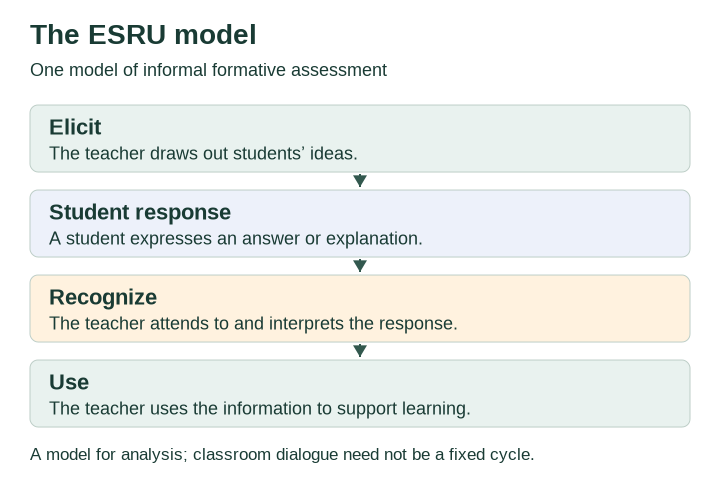
A study of nine experienced science teachers at elementary, middle and high school level reached a different conclusion about the order of the steps. The researchers coded classroom videos. They also interviewed the teachers about the purposes of their assessments. They also asked them to comment on teaching acts they thought were significant. The analysis did not find a neat cycle of eliciting, noticing, interpreting and acting. Noticing and interpreting came first and drove what teachers did next. Teachers' ways of noticing and interpreting were classed as more authoritative or more dialogic. Teachers made moves to draw out ideas and to push them forward. Both kinds of moves fell in a similar range. Teachers combined their immediate purposes with their larger learning goals as they chose each move.[20]
A learning progression is a picture of how student ideas develop in a domain.[21][22] Alonzo argues that learning progressions have real potential. They can inform teachers' formative assessment practices.[22]
One study gave six high school biology teachers a learning progression. The topic was natural selection. It recorded their assessment conversations around the same set of questions. The teachers did pick out student ideas linked to the progression. They also drew inferences about them. They did not use all parts of the progression in the same way. Several teachers treated the progression mainly as a list of misconceptions. Their aim was to squash them. They did not treat it as a guide to how understanding develops.[21]
Curriculum-embedded formative assessment means assessment tasks built into the curriculum itself.[23][24] Building such tasks requires curriculum developers and assessment specialists to work together. The tasks must be placed at chosen points in the lessons. The shift is described as a move away from summative assessment scripts. It moves toward lesson scripts for formative assessment. Teachers also need professional development that helps them rethink the role of assessment. It should help them link tasks to overall goals. A learning trajectory was proposed as a guide for teachers. It helps them find students' ideas and give feedback based on them.[24]
A cluster-randomized controlled trial tested embedded formative assessment. It ran in elementary science lessons. The lessons covered floating and sinking. The trial compared 17 classes using the embedded assessments with 11 control classes. Both the embedded assessments and general classroom process quality helped students learn. Classroom process quality covered cognitive activation and a supportive climate. It also covered classroom management.[23]
Mathematics and early grade practice
Mathematics is described as having a spiral structure by nature. Students may fail to learn one mathematics skill. That failure then harms other skills. The failure then continues at an ever faster rate. Formative assessment offers one way to find and remove these weaknesses while learning is still going on. One action research study tested this idea in secondary school mathematics. It involved 34 seventh-grade students. The topic was the circle and the circular region. The teaching ran for three weeks. The researchers gathered data through observation and interviews. They also used several formative assessment tools during the lessons. The study lasted three weeks. By the end, low-achieving and medium-achieving students had improved a lot. The overall success of the class had also changed positively.[25]
Early grades matter for one reason. Poor performance in mathematics at that stage has a negative effect on later learning. A case study of Grade 3 teachers looked at how they built formative assessment into their everyday teaching. The study took place at four schools. They were in one district of Gauteng Province in South Africa. Data came mainly from focus group interviews. It also came from watching at least three maths lessons for each teacher. Two themes stood out. Teachers used assessment for learning strategies in a tokenistic way. They did know about learning processes and what the curriculum requires. The study concluded that teachers who know children's mathematical thinking and conceptual development well tend to use formative assessment more naturally. It also described formative assessment as a shared activity. The teacher, the learner and peers all build it. The teacher does not direct it alone.[26]
Ginsburg argues that the clinical interview method can add a great deal to formative assessment. The method gives a powerful way to learn about a student's underlying cognitive competence. Assessment is only as valid as the ideas it rests on. So cognitive developmental theory matters for formative assessment. Those obstacles can lie in the mathematics itself, in the instructional materials, or in the teacher.[27]
A separate line of research asked a question. The study asked one question. How did one teacher's formative assessment practice affect students' self-regulated learning? The intervention lasted eight months. A questionnaire was given before and after it. The intervention had a significant effect. The comparison was with two control classes. It changed students' motivational beliefs about guiding their own learning. Qualitative data showed a clear improvement. Students' self-regulated learning behaviour in the classroom improved. The teacher's practice combined several aspects of formative assessment. This gives evidence of what a practice with large effects on self-regulated learning can look like.[28]
A cluster randomized field trial with 26 mathematics classes tested whether formative assessment raised interest and achievement. Classes were put at random into a control group or an intervention group. Students in the formative assessment group found the feedback more useful. Their self-efficacy was also greater. Self-efficacy is the belief in one's own ability. Interest tended to rise, but learning progress did not differ between the groups. Formative assessment had an indirect effect on interest. The effect worked through how useful people found it.[29]
Reading, writing and language learning
One classroom study tested formative assessment methods. It asked whether they improve reading comprehension. The study took place in a primary school. The school is in the Dilovası district of Kocaeli, Türkiye. It involved 50 students in the 3rd grade. One group's reading was checked with formative assessment methods. A second group was judged with traditional methods. The groups were assigned at random. The design was quasi-experimental. The texts came from the 3rd grade curriculum. The comprehension questions were written for those texts. The results showed a highly significant difference in favor of the formative assessment group. The methods helped students succeed at reading comprehension.[30]
In second-language writing, assessment has traditionally looked at finished written products. It has also looked at how well or badly students perform. Teachers act as testers and dominate the process, while students remain passive testees, so assessment is something teachers do to students rather than with them. Such assessment serves administrative and reporting purposes. That makes it summative. Because it is retrospective rather than prospective, it holds little value for teaching and learning. A formative approach instead focuses on inquiry: discovering, diagnosing and understanding. It also focuses on the chances assessment gives to improve teaching and learning. One case study followed a teacher of English as a foreign language. She tried to put formative assessment into practice in her writing classroom. The study looked at the effect on her classroom practice. It also looked at the effect on her students' beliefs and attitudes to writing.[31]
A mixed-methods study in Norway asked four teachers and 100 students how they responded. Formative assessment had just been newly emphasised in English writing classes. The findings mostly showed contradictions between how teachers and students saw formative assessment of writing. These disagreements centered on feedback, grades, text revision, self-assessment and student involvement. The study concluded that teachers and students need a shared understanding of formative assessment. Only then can it be useful and meaningful.[32]
A validation study built a 50-item Likert scale instrument. It measures formative assessment of writing. It looks at how English-language learners experience it. The instrument was first tested with three learners. It was then given to a sample of 255 learners chosen by purposive sampling. A five-factor model covered clarifying criteria and evidence of students' current learning. It also covered feedback that moves learners forward. Peer assessment and autonomy were covered too. Confirmatory factor analysis supported the five-factor structure only on absolute and parsimony fit indices. A three-factor model showed higher discriminant validity. It covered clarifying criteria, peer assessment and feedback across pre-writing and while-writing stages.[33]
Formative assessment is often misunderstood when people use it. Teachers face considerable challenges fitting it into daily classes. This is particularly true in English as a second language settings. More and more educators see it as a way to close the gap. The gap is between how students perform now and how they should perform. But views differ on what it actually consists of. One review described how formative assessment can be done in task-based language teaching.[34]
A study of 70 medical students compared two formative methods. The setting was a pathology course. One was a written assessment done alone. The other was an oral group assessment. Written accounts came from 17 students. Group interviews explored how students experienced both methods. The two methods ran a few weeks apart. Students said the assessments made them want to study. The assessments also made them aware of what they had learned. They also showed where they needed more study. The study concluded that formative assessment can serve as a tool for learning. It can shape both the process and the outcomes of learning.[35]
Motivation, self-evaluation and student views
Motivation sits at the centre of the link between formative assessment and learning. Students' motivation and the assessment are assumed to affect each other. A 2021 study tested two claims. The first was that formative assessment supports autonomous motivation. The second was that need satisfaction explains the link. The results supported both claims. Students who said they used formative assessment more also reported more autonomy and more competence. They also reported more autonomous motivation.[36]
A 2020 theoretical paper asked how formative assessment can shape a student's learning of a foreign language. It also asked how it shapes their level of self-evaluation. It argues that formative assessment is often used in practice as a small summative assessment. It acts as a check on progress. The paper says this use is wrong. The paper also reports that people misunderstand what formative assessment is. It reports misunderstandings about how it should be used in foreign language teaching.[37]
A 2006 study looked at 108 first-year university students in criminology. It examined hands-on experience with formative assessment. It also looked at students' assessment preferences and their ways of learning. Differences in assessment preferences were linked to differences in approach to learning. After real experience with a formative assessment, students' preference for assessment methods with higher-order thinking tasks was significantly lower. Students also changed how they learned after that experience. The change was toward a more surface approach. The paper calls this result surprising but in line with other recent findings. It offers possible explanations.[38]
A 2008 experiment tested whether formative assessment improves science achievement and conceptual change, a shift in how students understand a topic. It tested whether this happens directly or by raising motivation. Twelve middle-school science teachers and their students were randomly assigned to an experimental group of 6 teachers, given embedded formative assessment, or a control group of 6 teachers. Teachers varied a lot in their impact on student motivation, achievement and conceptual change. The formative assessment treatment did not produce a statistically significant change in these outcomes. The study suggested possible reasons why there was no overall effect. These were differences in teachers' classroom management. They were also differences in how much teachers used informal formative assessment, in either group.[39]
A 2016 survey asked students in seven introductory biology course sections about their views at mid-semester. All the sections used several formative assessment techniques. Most students had positive views of formative assessment. They saw it as helping their learning in a variety of ways. Students consistently saw the activities as meeting some of the five key objectives. One example was making learning expectations clear. Another was showing student thinking to the instructor. Perceptions varied more across techniques for the other objectives. The study looks at possible reasons students resist.[40]
Research
How large the effects are
A 1986 meta-analysis pooled the results of many experiments into a single average. That review used 21 controlled studies. They produced 96 relevant effect sizes. Its average weighted effect size was .70. The size of the effect varied with the type of publication. It also varied with the method used to judge the data. It varied with how the data were shown, and with the use of behavior modification.[2] Kingston and Nash note that an effect size of about .70, or .40 to .70, is often claimed for formative assessment.[3]
A 2011 review tested that figure directly. It found the research base did not support it. The reviewers looked at more than 300 studies of formative assessment in grades K-12. Many of those studies had research designs with serious flaws. This made their results impossible to interpret. Only 13 studies gave enough information to work out an effect size. These produced 42 separate effect sizes. The median effect size was .25. A weighted mean under a random effects model was .20. Effects looked larger in English language arts (.32) than in mathematics (.17) or science (.09). Two approaches did better than the rest. One was built on professional development (.30). One used computer-based formative systems (.28).[3]
A 2012 commentary raised four concerns about its methods. These were how studies were chosen and how the inclusion rules were applied. They also included whether the combined effect sizes were biased. They asked how effect size related to the features of the outcome measures. The commentary concluded that much uncertainty remains. It is unclear how formative assessment practices affect student achievement.[41]
A meta-analysis of 32 studies in Turkey found an overall mean effect size of .72.[42][43] The type of formative feedback made a big difference. Student-initiated feedback reached 1.16. Mixed feedback reached .83. Adult-initiated feedback reached .69, and computer-initiated feedback reached .42.[42]
Cognitive outcomes showed a much larger effect than affective outcomes. Affective outcomes concern attitudes and feelings. Learning domain, education level and course type showed no significant differences. Paper and pencil practices worked better than ones based on technology.[43]
A 2020 systematic review looked at 33 studies from 25 research projects in United States K-12 education. It found an overall small positive effect of d = .29. Benefits appeared for mathematics (d = .34), literacy (d = .33) and arts (d = .29). Two features raised the effect. Support for student-initiated self-assessment raised it (d = .61). Formal formative assessment evidence raised it (d = .40). One example is written feedback on quizzes. Evidence gathered within or between teaching units, a medium cycle length, was also linked to larger effects (d = .52).[44]
A meta-analysis of 48 studies with 116,051 K-12 students found a modest positive effect of formative assessment on reading achievement (ES = + 0.19).[45][46] Studies with 250 or fewer students produced much larger effects than large-sample studies. Combining teacher-directed and student-directed assessment worked better. It beat assessment started by teachers alone. Effects also differed a lot between Confucian-heritage and Anglophone cultures. The reviewers therefore warned against applying results across cultures without adaptation.[45]
A 2015 meta-analysis of experiments in grades 1 to 8 found that feedback on writing raised writing quality. Average weighted effect sizes were 0.87 for feedback from adults and 0.58 from peers. They were 0.62 from self and 0.38 from computers. Teachers' tracking of writing progress did not clearly improve students' writing. Neither did the 6 + 1 Trait Writing model.[46]
A 2024 meta-analysis looked at formative assessment in online learning. A meta-analysis pools the results of many studies. This included the COVID-19 pandemic, when online education became common. It reported gains in engagement, motivation and achievement. It also listed challenges: technical difficulties, student isolation, and the need for high involvement from students and teachers.[47]
Settings, systems and higher education
A documentary analysis of official documents and published research found gradual changes in the assessment processes set at the regulatory level. The regulation makes formative assessment the main form of assessment in the education system. Even so, it remains tied to continuous graded assessment to some extent. The analysis describes it as essentially a periodic check on learning.[48]
More and more school districts in the United States are adopting formative assessment systems. These check student skills in core subjects across the year. The idea is simple. Timely information on student skills lets teachers improve instruction. It also prepares students for high-stakes, state-mandated tests. One large urban district interviewed teachers and administrators. The interviews showed the hard choices involved. These choices were about picking formative assessments and deciding how to use them.[49]
Teachers in Bangladeshi colleges mostly agreed on one point. Formative assessment matters for improving teaching and learning. A mixed-method study surveyed 100 randomly selected teachers. They worked in Bangladeshi colleges. It also interviewed 6 more. These included teacher bias, too few teachers, large classes and poor infrastructure. They also included an unreliable power supply and heavy teacher workloads.[50]
A 2021 systematic review of trials found the evidence to be limited. The evidence was about feedback and formative assessment in higher education. Most of the evidence base comes from studies of children of compulsory school age, not from universities. Low-stakes quizzing turned out to be a particularly strong approach. Feedback from peers and tutors showed benefits. These depended on how the feedback was done. The evidence for praise, grading and technology-based feedback was mixed.[51]
One university science course shows how regular online testing can work. On an extended science degree, students were expected to do weekly online formative tests in their own time. Overall module pass rates stayed stable. But many students completed all the tests. This seemed directly linked to higher grades. More than 80% of responding students found the tests helpful. The approach encouraged students to take responsibility for their own learning.[52]
Questionnaire evidence showed that students felt these e-assessments helped them monitor their progress and increased their learning and understanding. Students reported that the formative e-assessments encouraged further study and increased their learning and understanding, and the findings let academics reflect on the benefits of adopting such assessments to permit early intervention. The study rested on student views rather than on student performance, so it records perceptions of benefit and not measured gains.[53]
A large Australian university moved from two semesters to three trimesters and used the change to add more formative assessment to a core first-year mathematics unit. One cohort gained unlimited practice with computer-assisted feedback on test questions before sitting the tests under examination conditions, and also wrote an assignment on presenting a clear solution. Overall workload, the unit's total teaching hours, syllabus and materials did not change between the two cohorts. On closely comparable final examination tasks, the cohort with the new assessments scored higher, with an effect size of 0.457 for the composite score. The effect size for the composite score was 0.457, which the authors read as showing that the unlimited practice with computer feedback and the writing assignment were working as intended.[54]
A study in the Republic of Kosovo surveyed 217 teachers and 245 students across 34 lower secondary schools. Both groups rated the effects of formative assessment positively, yet the two groups differed significantly on particular aspects of the method.[55] In higher education, one course used formative assessment to develop students' writing competence and the skills that go with it.[56]
In practice
Classroom techniques teachers use
A 2010 article set out five key practices. Teachers can use them to gather information about what students understand.[57] A 2019 paper offered 10 maxims, or short guiding rules, for putting formative assessment into practice. That paper treats assessment as a process. Teachers change their teaching strategies while students adjust how they learn.[58]
A 2015 study tested a detailed rubric. It was first designed for grading psychology reports. Those reports were written in a standard research format. Some students checked the rubric as they prepared their reports. They produced better reports than students who did not. Students also wrote better reports of their own. This came after they used the rubric to grade a classmate's report. Greenberg describes these results as some of the first evidence from studies. It shows the role of rubrics in formative assessment.[59]
A 2009 study worked with two classes of Primary 5 and 6 students. They discussed the viewpoints of the cartoon characters in small groups. The groups used support tools to judge, question and record each other's ideas. Students also drew pictures to show their ideas. One group's conversation was recorded on audio tape. These tools gave the teacher a record of student thinking. The record could be used to track progress and give feedback. The findings showed dialogue and argument between students. In these, they made their reasoning visible. The teacher's own way of talking shaped the assessment talks that followed. So did her design of the scaffolding.[60]
Classroom response systems can be used for formative assessment in large groups. A 2020 study at a state university ran for four weeks with freshman students. It compared a paper-based test with several response systems. In one system students answered on any computer, tablet or mobile phone with an internet connection. In another, students lifted a paper bearing a QR code. The instructor scanned the codes with a mobile device. Students rated the technology-supported systems as more useful. The difference was statistically significant. They rated them above the paper-based test.[61]
A 2009 paper describes formative assessment that uses technology. This is a teaching approach for science built on classroom response technology. The approach rests on four principles: instruction driven by questions, dialogical discourse, formative assessment, and communication at the meta level. Teachers carry out these principles through a question cycle. This is a repeated pattern of questioning. It can meet several teaching needs. The paper argues that most writing on response systems fails to separate the technology from the teaching method.[62]
Pre-emptive formative assessment is a term introduced in a 2007 paper. It means teacher actions that clarify what students understand. This happens before wrong ideas lead to poor learning or lost marks. The paper calls this dimension common in practice. It says its principles had not been set out in writing. The case for checking before teaching rests on two problems with feedback. Does it arrive in time, and do students get a chance to act on it?[63]
A 2009 article looks at common assessments. It asks how they can support instructional decisions. Teams of teachers create these assessments together for the same course or grade level. It also asks how their quality can be checked. And it asks how they can be used to help student learning. The article states that these benefits depend on certain conditions being met.[64]
What teachers need to make it work
A systematic review of 54 studies asked one question. What teacher prerequisites must be in place for formative assessment in the classroom?[65] A second review covered 52 studies. It sorted the influences on teachers' intentions and on their classroom use of formative assessment into personal factors and contextual factors.[66]
A study looked at 243 English teachers in central Lombok. Teachers' understanding of formative assessment was inadequate. Four dimensions of understanding appeared. Assessment served an accountability purpose, and exams or tests drove learning. Learning and assessment followed a step-by-step approach, and students took a receptive role. The study also reported too little training in assessment. It named gender as a strong predictor of teachers' understanding.[67]
A guest editor's introduction to a special issue made a related point. Teachers in classrooms find formative assessment a hard task to carry out. People have blamed this on a lack of assessment literacy, among other reasons.[68]
Buck and colleagues found a large difference before and after a methods course. The difference was in how well pre-service teachers understood formative assessment. Pre-service teachers are still in training. A study of pre-service science teachers compared two approaches in a methods course. One taught formative assessment explicitly and in context, the other implicitly. The implicit approach improved the structure of the course. It did not help pre-service teachers see that formative assessment is reflexive. Reflexive here means that assessment and teaching shape each other. The researchers recommended clear instruction. They also suggested case studies, field experiences and regular reflection.[69]
A two-year project studied how primary and secondary science teachers practised formative assessment. It described how they developed professionally, personally and socially. The personal side meant coming to appreciate the risks and uncertainties of responding to what students are learning. It also meant recognising how much teacher confidence matters. The social side meant rethinking how students and teachers interact. It also meant rethinking the tangled roles a teacher holds in teaching, learning and assessment. These roles often conflict.[70]
An earlier study found that changes in teachers' classroom practice after a professional development programme significantly raised student achievement in mathematics. This study looks at those changes. Interviews and classroom observations showed teachers adding many activities. These strengthened a formative practice. It was built on finding student learning needs and adjusting teaching to match. The changes showed how complex the practice is. They also showed why such development is likely to require major changes in most teachers' practices.[71]
Wylie and Lyon found that some parts of formative assessment get less attention. The quality varied in patterns. This suggests that more targeted professional development is needed. A study looked at 202 mathematics and science teachers. They took part in a two-year professional development program based at a school. It measured how widely and how well they used formative assessment. Data came from an annual survey at baseline and at the end of Year 2. It also came from daily logs at six points, each two weeks apart. Weekly written reflections on techniques were another source.[72]
Offerdahl and colleagues propose using a fidelity of implementation framework. This would define the critical parts of formative assessment. It would also make future impact studies more valid. One essay noted that formative assessment experiments have reported effect sizes between 0.4 and 0.7 over the years. More recent meta-analyses reported much lower effect sizes. The essay argued that it is unclear where this variability comes from. It may come from the practice itself. The cause may be differences in how the method was carried out across studies. Other factors may also play a part.[73]
A qualitative study looked at junior high school English teachers. It examined the gap between beliefs and practices in English as a foreign language classes. It looked at this through different levels of continuing professional development. The data came from interviews, classroom observations, journals and lesson plans. Teachers who took part heavily in continuing professional development held stronger beliefs in formative assessment than those less involved. Their beliefs, however, were not always put into practice well in the classroom. Participation had no real impact on the success of the practices, although it may influence beliefs. The study pointed to other factors that shape implementation. It asked teachers to weigh those factors. Then they carried out formative assessment in line with their beliefs.[74]
A scale for teachers' formative assessment practices was built and tested. It was tried with 449 primary and secondary teachers in Hong Kong and 309 in Italy. The analysis found two factors. One was teacher-directed formative assessment with six items; the other was student-directed formative assessment with four items. A further analysis supported this structure and the quality of the items. The developers noted one point. Culture shapes how teachers work. That influence should be considered when the instrument is used.[75]
How teachers notice and respond to students
To give useful feedback, teachers must act on the information students reveal during instruction. A 2015 study videotaped 6 elementary school teachers and interviewed them as they taught key science concepts through doing, reading, writing and talking. The analysis placed the teachers' work in four groups: setting learning goals, drawing out information from students, making sense of that information, and acting on it. Some elementary science teachers had low levels of pedagogical content knowledge, meaning knowledge of how to teach a subject. These teachers did not always know a scientific idea's key concepts. They also did not always know how to teach them.[76]
A 2026 article by M Burke argues that the writing plan is an important formative assessment tool. It informs teachers' planning and students' learning. The author treats writing plans as a possible source of divergent formative assessment. She distinguishes it from convergent formative assessment and from summative assessment. She calls for teachers and researchers to give writing plans more thought.[77]
Computer tools that diagnose student work add a new layer to this skill. A 2026 conceptual paper argues that AI-supported diagnostic tools widen what teachers may attend to. Teachers must now weigh AI-generated diagnostic inferences when making instructional decisions. The paper describes this as a different kind of diagnostic evidence, not simply more information. Contrastive case examples show the shift turning diagnosis into meta-diagnosis. In it, teachers judge AI-generated inferences against their own diagnostic judgments.[78]
Earle (2021) asked 142 primary teachers in 9 regions of England what action they took after classroom interactions during a focused assessment activity in science. The teachers' next steps varied in timing: some changed course within the lesson, others set follow-up activities, and others adapted their teaching over the longer term. Responses took many forms, such as helping pupils reflect on investigations, discussing vocabulary or concepts, allowing more exploration time, or modeling science skills explicitly. These decisions were made for the whole class rather than as individual adaptations. The study argues that helping teachers state their tacit, unspoken decision-making more explicitly could make their use of assessment information more formative.[79]
Interviews and observations of 32 teachers of English in Jamaican secondary schools supported formative assessment as a unified framework. The same data showed how Jamaica's colonial past and the language context of its classrooms required changes to a widely accepted framework, including the sequencing of its five aspects.[80] Teachers can also study their own assessment decisions, and such teacher-led research can produce valid interpretations and applicable findings.[81]
Assessment literacy and teacher development
A 2025 systematic review of 20 peer-reviewed studies found that definitions of this literacy vary a lot. They often borrow from assessment literacy or from formative assessment traditions. The review reports that research on the topic is still emerging. Most studies are set in Asian contexts and involve in-service language teachers. Commonly identified dimensions of the literacy cover conceptual, practical and socio-emotional aspects. Lei and Lei call for clearer definitions. They also want professional development that fits each setting and lasts, and study designs with stronger methods.[82]
Two university researchers ran a collaborative action research project with a team of teacher-researchers. They studied and developed formative classroom assessment in primary schools. In one project, two university researchers worked alongside a team of teachers. The teachers also served as researchers. The project described shifts in classroom practice. One was in how assessment criteria were made clear to pupils and shared with them. It also traced how those shifts came about.[83]
A socio-cultural theorisation published in 2008, drawing on empirical research conducted over eleven years from infant schools to postgraduate education, treats formative assessment as a discursive social practice. That account stresses dialectical processes, sometimes conflictual, in which issues of power arise. Learners' and teachers' identities are involved in them. Pryor and Crossouard add that institutional discourses and the demands of summative assessment set the frame. That frame decides what is accepted as legitimate knowledge.[84]
Holmes, Minott and Hopkins describe assessment rubrics as a central part of building students' assessment literacy. A 2025 study evaluated a formative-specific rubric designed for formative feedback alongside a distinct rubric designed for summative assessment. Data came from an online questionnaire completed by 45 postgraduate students. It also came from informal conversations with colleagues and students. Holmes, Minott and Hopkins report that the formative-specific rubric helped students grasp the standard of work expected at postgraduate level. It also helped them build their assessment literacy. Students also judged the summative rubric helpful for moving on to later assignments in their master's programme. Holmes, Minott and Hopkins put forward the idea of a fixed-formal formative assessment process.[85]
A 2026 article proposes a technological framework for developing formative assessment competence in educators. The framework gives special attention to cognitive, diagnostic, operational and reflective dimensions of that competence. The article is based on theoretical analysis and argues for integrating formative assessment technologies to support instructional decision-making and continuous improvement of teaching practice.[86]
At the start, one teacher in the program had no clear targets for teaching, learning and assessment, and she shared no targets with her students. By the end of the 12 weeks, her knowledge, beliefs and practices in formative assessment had improved significantly. Her goal setting for teaching, learning and assessment was then deliberately aligned with the subject core competencies named in the senior secondary English curriculum.[87]
Kim (2022) analyzed four pre-service teachers' lesson plans for fifth and sixth graders and found that none of them designed self-assessment, though one designed peer-assessment. None of the four gave feedback systematically, and none carried out formative assessment in the closing 5 minutes of a class.[88] A 2006 paper on one teacher education institution examined how assessment techniques were used with beginning teachers, within a national policy push to spread formative assessment in schools.[89]
Bruun and Evans (2020) report that changes in attributes of self-efficacy were partial evidence of teachers developing their formative assessment practices through collaboration with researchers and other teachers. In a European project, local working groups in six countries discussed and reflected on four assessment formats, and teachers completed a 12-item questionnaire before and after. Network analysis of the questionnaire answers showed, for example, that one group of teachers felt they held knowledge about using formative assessment but lacked the skills to apply it well. The researchers suggested that future projects could use this method to find groups that respond differently to training and adjust guidance for them.[90]
What this looks like when you study
Cowie and Bell (1999) spent two years watching science lessons taught by 10 teachers. In planned assessment they drew out and interpreted information about learning, then acted on it, mostly with the whole class. In interactive assessment they noticed, recognised and responded, mostly with individual students or small groups. Planned formative assessment happened with the whole class: the teacher asked questions, read the answers, and then changed the next step. Interactive formative assessment happened with one student or a small group, as the teacher noticed, recognised and responded in the moment.[4]
One group was assessed with formative methods, the other with traditional methods, and the groups were randomly assigned. After the lessons, 20 of the 22 students in the formative group improved their comprehension scores, and none declined. The formative group's mean post-test score was 14.09, against 11.29 for the control group, a significant difference.[30]
Later developments
How the research has developed
A 2025 content analysis looked at 60 studies of formative assessment. The studies came from several databases. That analysis found that the number of published studies on formative assessment has risen in recent years. Teachers and secondary school students made up the main sample in the studies reviewed. The most common data collection tools were the interview form and the achievement test. Content analysis was the most used method of analysis. The analysis describes formative assessment as a field. The field is dynamic and changing. It has great potential for improving educational outcomes.[91]
One review sets out guiding theories of expertise. These theories inform assessment for learning. It also covers theoretical and empirical evidence and approaches to validation.[92] Another review evaluates the theories that form the basis of the formative assessment process. It stresses high-quality interactions in class.[93]
A 2018 paper argues that classroom assessment design should rest on a theory of learning based on research. It favors sociocultural theory. That theory links self-regulation and self-efficacy to cognitive development. That paper calls for formative assessment built on tasks and questions specific to each subject. These should give a qualitative sense of student thinking.[94]
A survey covered 67 teachers. They worked in 24 lower and middle schools in one local authority. It found a range of views about formative assessment. Those teachers agreed it had value for learning. But they seemed less sure than they claimed about putting strategies into practice. Some views were significantly linked to school phase and to length of teaching experience.[95]
A study looked at 300 basic school teachers in the Cape Coast Metropolis of Ghana. It found positive perceptions of formative assessment. It also found a positive link between perception and practice. Those teachers reported some practices most often. These included taking part in class and discussing feedback with students. They also included question and answer during teaching, and homework.[96]
A case study looked at three high school science teachers. It found clear differences in their personal theories of assessment practice.[97] A professional development study followed six remedial reading teachers. They asked questions about their own formative assessment practices. All six showed professional growth. These teachers had at-risk first grade students. On one measure, those students scored higher on reading readiness than at-risk students of other teachers.[98]
A 2017 review of online formative assessment sums up how it is delivered. It also sums up the research on its benefits and limits. That review reports gains in achievement scores. It also reports growth in complex thinking processes such as self-regulation. It notes that online assessment is used differently in K-12 and higher education.[99]
A 2025 review traces the shift from assessment of learning to assessment for learning. It then looks at feedback practices. It stresses what assessment can do when students take an active part through peer assessment. It also sets out the challenges of building the skill to judge work.[100]
One analysis makes an argument. Formative assessment will pay off for learning only under one condition. Short reports must be used routinely. Teachers and students must be able to use them easily.[101]
One study looked at a series of assessments across a whole module. It found no measurable effect on student learning. Usage data and student feedback did show high engagement.[102]
A 2010 paper proposes a view of formative assessment. It treats it as a disciplinary meta-discourse. It suggests its frameworks may be used as rough guides.[103]
A 2006 article argues that new teachers need to notice and use students' prior knowledge. They should not just judge whether students get a concept. Its model rests on Vygotsky's theory of concept formation. It draws on a 3-year study of preservice teachers.[104]
Digital tools and platforms in practice
A 2025 bibliometric analysis, which maps patterns across published papers, examined 742 publications by 701 authors. The topic was adopting AI in classroom-based assessment practices. That analysis found that AI made formative assessment more efficient through automated scoring and feedback. It also let it handle large amounts of work. It also named problems that remain: protecting data privacy, guarding fairness against bias tied to gender, ethnicity or culture, and keeping people and AI working together.[105]
One study tested a free game-based platform. A teacher builds quizzes in it, and the top responders for each question are revealed. A cross-sectional study looked at 100 first-year medical students at one institute in Hyderabad. Most questionnaire items were rated positively, except the platform's ability to simplify complex subject matter. Those students saw formative assessment through the platform as engaging and motivating.[106] The need for achievement rose, while changes in avoidance of failure differed across groups. The effect varied between students from mining family backgrounds and other students.[107]
Platforms that track individual growth aim to give real-time feedback that can be acted on. This supports personalized learning paths.[108] One computer-based system assigned scenario-based tasks and analyzed 250 samples of data. It used social network analysis to show the learning path during a course. A Bayesian network then inferred each learner's 21st century learning skills. It did so over multiple time points.[109]
Recorded-voice feedback has been studied in a small-scale case study of creative writing students. Their personal investment in their submissions was treated as a further factor. That case study supported the claim that written feedback seemed worse than recorded-voice feedback for this group.[110] Sari, Wicaksana and Rahman reviewed 137 empirical studies indexed from 2000 to 2026. They report that adaptive instructional systems had a significant positive effect on children's emotional maturity and inclusive attitudes.[111]
Subject settings and institutional pressures
Dufresne and Gerace define formative assessment as assessment designed to improve teaching and learning. In introductory physics, a simple model of classroom formative assessment has been proposed. It includes example activities and advice on putting them into practice. Even so, regular classroom formative assessment is rare in secondary and post-secondary science education.[112]
A study of science teaching embedded formative assessments in a nationally used middle-school curriculum. It tested the effects in a small randomized trial. The trial looked at students' motivation, achievement and conceptual change.[113]
Physical education teachers often have no formal training in formative assessment. Putting it into practice is a complex and demanding task for them. One study followed 15 physical education teachers through an 18-month professional development programme. The teachers designed and used formative activities in their lessons. Teachers reported clearer learning outcomes and success criteria for students, and greater student involvement. They also described difficulties. These included shifting teacher roles and too little feedback literacy among students. Slingerland, Weeldenburg and Borghouts conclude that putting formative assessment into practice works best as a long, joint effort with support behind it.[114]
In law schools, American Bar Association standards now require formative assessment in courses. A guide for tax professors describes techniques that take little time and effort. It also describes ones that take more work but may have greater impact.[115] In language teaching, formative assessment is described as assessment for learning. Summative assessment, by contrast, evaluates the outcomes of teaching.[116]
Classroom-based assessment in teaching English as a foreign language has been criticized. The criticism is a lack of research-based evidence for its claimed benefits. The gap between its claimed advantages and its measured efficiency is blamed mainly on teacher assessment identity. A literacy model has been proposed to improve teachers' and students' assessment capability.[117]
Formative assessment is poorly defined, so its contribution to student learning and retention is probably not being maximised. One article discusses it in the political and structural setting of higher education. It asks how it might better support student development and retention, especially in the first year of a programme.[118]
Dorn adds that even with high-stakes accountability, the definition stays fuzzy and adoption stays inconsistent. The outlook for future use is questionable. Possible explanations include the gap between research and practice. The policy environment around educational accountability may also play a part. In special education, a practical question is who at the school level coordinates the collection, analysis and answering of formative-assessment data.[119]
Criticism
Criticisms and open questions
A 2011 critical review by Bennett examined six linked problems in the research on formative assessment. One problem is that the term does not yet name a clear set of materials or practices. So results should be expected to differ greatly. The review also judged the size of common quantitative claims for effectiveness to be suspect. Those claims came from sources that were untraceable, flawed, dated or unpublished. The review still accepted that the general practices linked to formative assessment can help learning.[120]
A second criticism concerns content. The literature focuses on teacher strategies. It overlooks the subject matter being assessed. A 2011 analysis of four well-known publications found little attention to the student reasoning they described. Those publications treated content as correct information. They treated assessment as separate from other classroom activity. The analysis offered a different picture of formative assessment. It centred on engagement with ideas in the subject. It was illustrated with a high school biology class.[121]
A 2012 paper described the field as at a crossroads, even an impasse. Different theoretical justifications and different examples had been clear for many years. The practice is widespread but often limited in scope. It uses only part of the range of possible approaches. In higher education, the stated aim is to develop independent learners who think critically. Yet in practice, assessment procedures are designed to demand high conformity.[122]
A 2009 article found that the reasoning behind assessment for learning is neither aligned nor coherent. Contradictions follow in practice. It proposed basing the definitions of formative and summative assessment on assessment processes. These would replace functions as the basis.[123]
A 2005 paper traced the tension to different conceptions of mind. Classical test theory came from behaviourist learning theories. Formative assessment came from cognitive and constructivist theories.[124] A 2015 paper noted that no single definition of formative assessment is shared. Even so, its effectiveness is widely accepted.[125]
A 2000 study of nine inner-city primary schools argued that the line between formative and summative assessment is less clear than it often seems.[126] A 2021 study of an introductory statistics course in Hong Kong found a strong link. Individual assignments were strongly related to the exam score. Group projects did not help. They were in fact linked to lower exam scores.[127]
A 2009 study tested a measurement question. How reliably can teacher knowledge for teaching mathematics be measured? It found that teachers drew reasonable inferences about student understanding more easily. Deciding the next teaching steps was harder for them.[128]
Artificial intelligence may change both the problems and the possibilities of formative assessment. A 2023 perspective article examined how uses of AI may affect the feedback teachers give. It also looked at peer and self-assessment and support for student learning. It discussed the chances AI brings to address existing challenges. It also discussed the new problems AI brings. The article argued that self-regulated learning remains important. It also argued that critical thinking deserves renewed emphasis in an age shaped by artificial intelligence.[129]
New work should build clear approaches around process and method. These should be based within specific content areas. Those approaches should include basic rules of measurement. These help teachers and students see that assessment involves inference. They should also allow considerable time and professional support. Most teachers would need both to become skilled users.[120]
Theorists have also asked how classroom talk shapes the teaching-assessment interaction between teachers and students. A 2004 study looked at two elementary classrooms with many ethnic groups and languages. It argued that research on that question should be guided by theory.[130] A 2015 analysis compared three approaches. They were data-based decision making, assessment for learning, and diagnostic testing. It argued that combining them can create learning environments with better information.[125]
Zemlyanskaya (2016) presents a definition of formative assessment and its significance for education, and discusses the risks of its use and how they might be reduced. A 2016 review of foreign studies describes the idea's development and names risks in its use, along with ways those risks might be reduced. That review also examines how formative assessment relates to final evaluation, including national curriculum levels.[131] Zemlyanskaya (2016) discusses some techniques and examples of formative assessment, and Tekin (2025) reviews a book on techniques for checking understanding in the classroom.[131][132]
Tekin (2025) writes that analyzing understanding gives teachers some evidence about learners' learning processes during the curriculum. A 2025 book on checking for understanding argues that teachers need evidence about learners' processes as the curriculum unfolds. It describes the teacher as moving through a growing awareness of the student and of the teacher's own understanding.[132]
Common misconceptions
A figure of about .70, or a range of .40 to .70, is often claimed for the effectiveness of formative assessment, and this claim is not supported by the existing research base. A review of more than 300 studies found only 13 with designs good enough to calculate an effect size.[3]
Bennett (2011) concluded that the term formative assessment does not yet stand for a well-defined set of practices or materials. Bennett (2011) concluded that the label covers no settled collection of tools or teaching methods. Bennett (2011) argued that current definitions allow many different versions of the practice. Results should therefore differ greatly between one version and the next, and between one group of students and another.[120]
Key studies
| Year | Study | Sample | Design | Finding |
|---|---|---|---|---|
| 1986 | Fuchs & Fuchs[2] | 21 controlled studies | meta-analysis | Across 21 controlled studies, which produced 96 effect sizes, the average weighted effect size of formative evaluation on achievement was .70. |
| 1999 | COWIE & BELL[4] | 2-year research project on formative assessment in the science classrooms of 10 teachers | Teachers used planned formative assessment with the whole class and interactive formative assessment with individuals or small groups. | |
| 2008 | Yin et al.[39] | 12 middle-school science teachers and their students | randomized controlled trial | The formative assessment treatment had no statistically significant effect on motivation, achievement or conceptual change. |
| 2011 | Kingston & Nash[3] | more than 300 studies, of which 13 yielded 42 effect sizes | meta-analysis | The median observed effect size was .25 and the weighted mean was .20; estimates were .32 for English language arts, .17 for mathematics and .09 for science. |
| 2012 | Weurlander et al.[35] | 70 medical students, with written accounts from 17 | interview and written-account study | Students said formative assessments motivated them to study and showed what they had learned and where to study more. |
| 2015 | Greenberg[59] | comparison of rubric users and non-users | Students who used the rubric wrote higher quality reports and improved after grading a classmate's report. | |
| 2015 | Decristan et al.[23] | 17 classes in the formative group and 11 in the control group | cluster-randomized controlled trial | Curriculum-embedded formative assessment and classroom process quality each promoted learning and interacted with each other. |
| 2015 | Graham et al.[46] | Meta-analysis of true and quasi-experiments, grades 1 to 8. | Feedback from adults, peers, self, and computers yielded effect sizes of 0.87, 0.58, 0.62, and 0.38. | |
| 2016 | Brazeal et al.[40] | students in seven introductory biology course sections | midsemester survey with open and closed questions | Most students held positive views of formative assessments and saw them as helping their learning. |
| 2020 | ŞAHİN[61] | freshman students at a state university | four-week study in which freshman students used a paper-based test, Kahoot, Quizizz and Plickers | Students rated Kahoot, Quizizz and Plickers as more useful than a paper-based test. |
| 2020 | Lee et al.[44] | 33 studies from 25 research projects | systematic review with meta-regression | Across 126 effect sizes from 33 studies, the overall effect of formative assessment on learning was d = .29, and support for student-initiated self-assessment raised the effect to d = .61. |
| 2021 | Leenknecht et al.[36] | Empirical study testing two assumptions about motivation. | More perceived use of formative assessment was associated with more autonomy, competence, and autonomous motivation. | |
| 2022 | SÖNMEZ & ÇETİNKAYA[30] | 50 third-grade students in a primary school in Türkiye | quasi-experimental study with randomly assigned groups | The formative group's mean post-test reading comprehension score was 14.09, against 11.29 for the control group. |
| 2023 | ÖZCAN & KURTULUŞ[25] | 34 seventh-grade students in Türkiye | three-week action research project | Low- and medium-achieving students improved substantially after formative assessment-based teaching on circles. |
See also
References
- Bell, B., & Cowie, B. (2001). The characteristics of formative assessment in science education. Science Education, 85(5), 536-553. doi:10.1002/sce.1022
- Fuchs, L. S., & Fuchs, D. (1986). Effects of Systematic Formative Evaluation: A Meta-Analysis. Exceptional Children, 53(3), 199-208. doi:10.1177/001440298605300301
- Kingston, N., & Nash, B. (2011). Formative Assessment: A Meta-Analysis and a Call for Research. Educational Measurement: Issues and Practice, 30(4), 28-37. doi:10.1111/j.1745-3992.2011.00220.x
- COWIE, B., & BELL, B. (1999). A Model of Formative Assessment in Science Education. Assessment in Education: Principles, Policy & Practice, 6(1), 101-116. doi:10.1080/09695949993026
- Roskos, K., & Neuman, S. B. (2012). Formative Assessment: Simply, No Additives. The Reading Teacher, 65(8), 534-538. doi:10.1002/trtr.01079
- Kula Kartal, S. (2024). Do we really understand what formative assessment is? Examining the formative assessment definitions within the measurement and evaluation textbooks. Eğitimde ve Psikolojide Ölçme ve Değerlendirme Dergisi, 15(1), 50-64. doi:10.21031/epod.1343575
- Taras, M. (2008). Summative and formative assessment: Perceptions and realities. Active Learning in Higher Education, 9(2), 172-192. doi:10.1177/1469787408091655
- Menéndez, I. Y. C., Napa, M. A. C., Moreira, M. L. M., & Zambrano, G. G. V. (2019). The importance of formative assessment in the learning teaching process. International journal of social sciences and humanities, 3(2), 238-249. doi:10.29332/ijssh.v3n2.322
- Wiliam, D. (2006). Formative Assessment: Getting the Focus Right. Educational Assessment, 11(3-4), 283-289. doi:10.1080/10627197.2006.9652993
- Black, P., & Wiliam, D. (2003). ‘In praise of educational research’: formative assessment. British Educational Research Journal, 29(5), 623-637. doi:10.1080/0141192032000133721
- Harris, L. (2007). Employing formative assessment in the classroom. Improving Schools, 10(3), 249-260. doi:10.1177/1365480207082558
- Berry, R. (2011). Assessment trends in Hong Kong: seeking to establish formative assessment in an examination culture. Assessment in Education: Principles, Policy & Practice, 18(2), 199-211. doi:10.1080/0969594x.2010.527701
- Stiggins, R. (2005). From Formative Assessment to Assessment for Learning: A Path to Success in Standards-Based Schools. Phi Delta Kappan, 87(4), 324-328. doi:10.1177/003172170508700414
- Ketabi, S., & Ketabi, S. (2014). Classroom and Formative Assessment in Second/Foreign Language Teaching and Learning. Theory and Practice in Language Studies, 4(2). doi:10.4304/tpls.4.2.435-440
- Nicol, D. J., & Macfarlane‐Dick, D. (2006). Formative assessment and self‐regulated learning: a model and seven principles of good feedback practice. Studies in Higher Education, 31(2), 199-218. doi:10.1080/03075070600572090
- Lecturer Of Journalism And Mass Communications University Of Uzbekistan, & Begim, I. (2024). Dialogic teaching: Empowering formative assessment in the classroom. International Journal Of Management And Economics Fundamental, 4(1), 38-42. doi:10.37547/ijmef/volume04issue01-06
- Jiang, Y. (2014). Exploring Teacher Questioning as a Formative Assessment Strategy. RELC Journal, 45(3), 287-304. doi:10.1177/0033688214546962
- Orsmond *, P., Merry, S., & Callaghan, A. (2004). Implementation of a formative assessment model incorporating peer and self‐assessment. Innovations in Education and Teaching International, 41(3), 273-290. doi:10.1080/14703290410001733294
- Cagasan, L., Care, E., Robertson, P., & Luo, R. (2020). Developing a Formative Assessment Protocol to Examine Formative Assessment Practices in the Philippines. Educational Assessment, 25(4), 259-275. doi:10.1080/10627197.2020.1766960
- Dini, V., Sevian, H., Caushi, K., & Orduña Picón, R. (2020). Characterizing the formative assessment enactment of experienced science teachers. Science Education, 104(2), 290-325. doi:10.1002/sce.21559
- Furtak, E. M. (2012). Linking a learning progression for natural selection to teachers' enactment of formative assessment. Journal of Research in Science Teaching, 49(9), 1181-1210. doi:10.1002/tea.21054
- Alonzo, A. C. (2018). An argument for formative assessment with science learning progressions. Applied Measurement in Education, 31(2), 104-112. doi:10.1080/08957347.2017.1408630
- Decristan, J., Klieme, E., Kunter, M., Hochweber, J., Büttner, G., Fauth, B., Hondrich, A. L., Rieser, S., Hertel, S., & Hardy, I. (2015). Embedded Formative Assessment and Classroom Process Quality: How Do They Interact in Promoting Science Understanding? American Educational Research Journal, 52(6), 1133-1159. doi:10.3102/0002831215596412
- Ayala, C. C., Shavelson, R. J., Araceli Ruiz-Primo, M., Brandon, P. R., Yin, Y., Furtak, E. M., Young, D. B., & Tomita, M. K. (2008). From Formal Embedded Assessments to Reflective Lessons: The Development of Formative Assessment Studies. Applied Measurement in Education, 21(4), 315-334. doi:10.1080/08957340802347787
- ÖZCAN, H., & KURTULUŞ, A. (2023). An examplary application of mathematics teaching based on formative assessment. International Journal of Assessment Tools in Education, 10(4), 741-764. doi:10.21449/ijate.1352605
- Govender, P. (2019). Formative assessment as ‘formative pedagogy’ in Grade 3 mathematics. South African Journal of Childhood Education, 9(1). doi:10.4102/sajce.v9i1.739
- Ginsburg, H. P. (2009). The Challenge of Formative Assessment in Mathematics Education: Children’s Minds, Teachers’ Minds. Human Development, 52(2), 109-128. doi:10.1159/000202729
- Granberg, C., Palm, T., & Palmberg, B. (2021). A case study of a formative assessment practice and the effects on students’ self-regulated learning. Studies in Educational Evaluation, 68, 100955. doi:10.1016/j.stueduc.2020.100955
- Rakoczy, K., Pinger, P., Hochweber, J., Klieme, E., Schütze, B., & Besser, M. (2019). Formative assessment in mathematics: Mediated by feedback's perceived usefulness and students' self-efficacy. Learning and Instruction, 60, 154-165. doi:10.1016/j.learninstruc.2018.01.004
- SÖNMEZ, M., & ÇETİNKAYA, F. Ç. (2022). The Effect of formative assessment on reading comprehension. International Journal of Assessment Tools in Education, 9(Special Issue), 88-108. doi:10.21449/ijate.1104868
- Lee, I. (2011). Formative Assessment in EFL Writing: An Exploratory Case Study. Changing English, 18(1), 99-111. doi:10.1080/1358684x.2011.543516
- Burner, T. (2016). Formative assessment of writing in English as a foreign language. Scandinavian Journal of Educational Research, 60(6), 626-648. doi:10.1080/00313831.2015.1066430
- TAVAKOLİ, E., AMİRİAN, M. R., BURNER, T., DAVOUDİ, M., & GHANİABADİ, S. (2019). Formative Assessment of Writing (FAoW): A Confirmatory Factor Structure Study. International Journal of Assessment Tools in Education, 6(3), 344-361. doi:10.21449/ijate.544277
- Gan, Z., & Leung, C. (2020). Illustrating formative assessment in task-based language teaching. ELT Journal, 74(1), 10-19. doi:10.1093/elt/ccz048
- Weurlander, M., Söderberg, M., Scheja, M., Hult, H., & Wernerson, A. (2012). Exploring formative assessment as a tool for learning: students’ experiences of different methods of formative assessment. Assessment & Evaluation in Higher Education, 37(6), 747-760. doi:10.1080/02602938.2011.572153
- Leenknecht, M., Wijnia, L., Köhlen, M., Fryer, L., Rikers, R., & Loyens, S. (2021). Formative assessment as practice: the role of students’ motivation. Assessment & Evaluation in Higher Education, 46(2), 236-255. doi:10.1080/02602938.2020.1765228
- Kuatova, A., & Kassymova, G. (2020). Influence of formative assessment on students’ self-evaluation in foreign language learning: Theoretical aspects. Педагогика и Методы Обучения(2 (53) 2020), 5-11. doi:10.47344/sdu20bulletin.v53i2.338
- Gijbels, D., & Dochy, F. (2006). Students’ assessment preferences and approaches to learning: can formative assessment make a difference? Educational Studies, 32(4), 399-409. doi:10.1080/03055690600850354
- Yin, Y., Shavelson, R. J., Ayala, C. C., Ruiz-Primo, M. A., Brandon, P. R., Furtak, E. M., Tomita, M. K., & Young, D. B. (2008). On the Impact of Formative Assessment on Student Motivation, Achievement, and Conceptual Change. Applied Measurement in Education, 21(4), 335-359. doi:10.1080/08957340802347845
- Brazeal, K. R., Brown, T. L., & Couch, B. A. (2016). Characterizing Student Perceptions of and Buy-In toward Common Formative Assessment Techniques. CBE—Life Sciences Education, 15(4), ar73. doi:10.1187/cbe.16-03-0133
- Briggs, D. C., Ruiz‐Primo, M. A., Furtak, E., Shepard, L., & Yin, Y. (2012). Meta‐Analytic Methodology and Inferences About the Efficacy of Formative Assessment. Educational Measurement: Issues and Practice, 31(4), 13-17. doi:10.1111/j.1745-3992.2012.00251.x
- KARAMAN, P. (2021). The Effect of Formative Assessment Practices on Student Learning: A Meta-Analysis Study. International Journal of Assessment Tools in Education, 8(4), 801-817. doi:10.21449/ijate.870300
- Gençaslan, D., Çalışır, M., Odabaşı, S., & Kaya Uyanık, G. (2026). Formative Assessment in K-12 Education in Türkiye: A Meta-Analysis of Cognitive and Affective Learning Outcomes. Sage Open, 16(3). doi:10.1177/21582440261477511
- Lee, H., Chung, H. Q., Zhang, Y., Abedi, J., & Warschauer, M. (2020). The Effectiveness and Features of Formative Assessment in US K-12 Education: A Systematic Review. Applied Measurement in Education, 33(2), 124-140. doi:10.1080/08957347.2020.1732383
- Xuan, Q., Cheung, A., & Sun, D. (2022). The effectiveness of formative assessment for enhancing reading achievement in K-12 classrooms: A meta-analysis. Frontiers in Psychology, 13. doi:10.3389/fpsyg.2022.990196
- Graham, S., Hebert, M., & Harris, K. R. (2015). Formative Assessment and Writing: A Meta-Analysis. The Elementary School Journal, 115(4), 523-547. doi:10.1086/681947
- Ahmad, Rustam, A., Zulaeha, O., & Maryanti, E. (2024). Meta-Analysis of the Effectiveness of Formative Assessment in Online Learning. Arus Jurnal Sosial dan Humaniora, 4(2), 915-920. doi:10.57250/ajsh.v4i2.578
- Alfredo, F. C. H. (2026). Formative assessment in education in Angola. Revista Diálogo Educacional, 26, 794-808. doi:10.7213/1981-416x.26.089.ds03en
- Sharkey, N. S., & Murnane, R. J. (2006). Tough Choices in Designing a Formative Assessment System. American Journal of Education, 112(4), 572-588. doi:10.1086/505060
- MOHAMAD HANEFAR, S. B., ANNY, N., & RAHMAN, S. (2022). Enhancing teaching and learning in higher education through formative assessment: Teachers’ Perceptions. International Journal of Assessment Tools in Education, 9(1), 61-79. doi:10.21449/ijate.946517
- Morris, R., Perry, T., & Wardle, L. (2021). Formative assessment and feedback for learning in higher education: A systematic review. Review of Education, 9(3). doi:10.1002/rev3.3292
- C. Jacoby, J., Heugh, S., Bax, C., & Branford-White, C. (2014). Enhancing learning through formative assessment. Innovations in Education and Teaching International, 51(1), 72-83. doi:10.1080/14703297.2013.771970
- McCallum, S., & Milner, M. M. (2021). The effectiveness of formative assessment: student views and staff reflections. Assessment & Evaluation in Higher Education, 46(1), 1-16. doi:10.1080/02602938.2020.1754761
- Freislich, M. R., & Bowen-James, A. (2020). Effects of a change to more formative assessment among tertiary mathematics students. ANZIAM Journal, 61, C255-C272. doi:10.21914/anziamj.v61i0.15166
- Thaçi, L., & Sopi, X. (2022). The differences in formative assessment evaluation between teachers and students – a non- parametric analysis. Cypriot Journal of Educational Sciences, 17(5), 1631-1646. doi:10.18844/cjes.v17i5.7256
- Jurāne-Brēmane, A. (2015). Formative assessment in higher education: analysis of the experience. SOCIETY, INTEGRATION, EDUCATION. Proceedings of the International Scientific Conference, 1, 114. doi:10.17770/sie2014vol1.739
- Cauley, K. M., & McMillan, J. H. (2010). Formative Assessment Techniques to Support Student Motivation and Achievement. The Clearing House: A Journal of Educational Strategies, Issues and Ideas, 83(1), 1-6. doi:10.1080/00098650903267784
- Prashanti, E., & Ramnarayan, K. (2019). Ten maxims of formative assessment. Advances in Physiology Education, 43(2), 99-102. doi:10.1152/advan.00173.2018
- Greenberg, K. P. (2015). Rubric Use in Formative Assessment: A Detailed Behavioral Rubric Helps Students Improve Their Scientific Writing Skills. Teaching of Psychology, 42(3), 211-217. doi:10.1177/0098628315587618
- Chin, C., & Teou, L. (2009). Using Concept Cartoons in Formative Assessment: Scaffolding students’ argumentation. International Journal of Science Education, 31(10), 1307-1332. doi:10.1080/09500690801953179
- ŞAHİN, M. (2020). Classroom Response Systems as a Formative Assessment Tool: Investigation into Students’ Perceived Usefulness and Behavioural Intention. International Journal of Assessment Tools in Education, 6(4), 693-705. doi:10.21449/ijate.576249
- Beatty, I. D., & Gerace, W. J. (2009). Technology-Enhanced Formative Assessment: A Research-Based Pedagogy for Teaching Science with Classroom Response Technology. Journal of Science Education and Technology, 18(2), 146-162. doi:10.1007/s10956-008-9140-4
- Carless, D. (2007). Conceptualizing pre‐emptive formative assessment. Assessment in Education: Principles, Policy & Practice, 14(2), 171-184. doi:10.1080/09695940701478412
- Stiggins, R., & DuFour, R. (2009). Maximizing the Power of Formative Assessments. Phi Delta Kappan, 90(9), 640-644. doi:10.1177/003172170909000907
- Schildkamp, K., van der Kleij, F. M., Heitink, M. C., Kippers, W. B., & Veldkamp, B. P. (2020). Formative assessment: A systematic review of critical teacher prerequisites for classroom practice. International Journal of Educational Research, 103, 101602. doi:10.1016/j.ijer.2020.101602
- Yan, Z., Li, Z., Panadero, E., Yang, M., Yang, L., & Lao, H. (2021). A systematic review on factors influencing teachers’ intentions and implementations regarding formative assessment. Assessment in Education: Principles, Policy & Practice, 28(3), 228-260. doi:10.1080/0969594x.2021.1884042
- Arrafii, M. A., & Sumarni, B. (2018). Teachers’ Understanding of Formative Assessment. Lingua Cultura, 12(1), 45. doi:10.21512/lc.v12i1.2113
- Yongqi GU, P., & LAM, R. (2023). Developing Assessment Literacy for Classroom-Based Formative Assessment. Chinese Journal of Applied Linguistics, 46(2), 155-161. doi:10.1515/cjal-2023-0201
- Buck, G. A., Trauth‐Nare, A., & Kaftan, J. (2010). Making formative assessment discernable to pre‐service teachers of science. Journal of Research in Science Teaching, 47(4), 402-421. doi:10.1002/tea.20344
- Bell, B., & Cowie, B. (2017). Teacher development for formative assessment. Waikato Journal of Education. doi:10.15663/wje.v7i1.430
- Andersson, C., & Palm, T. (2017). Characteristics of improved formative assessment practice. Education Inquiry, 8(2), 104-122. doi:10.1080/20004508.2016.1275185
- Wylie, E. C., & Lyon, C. J. (2015). The fidelity of formative assessment implementation: issues of breadth and quality. Assessment in Education: Principles, Policy & Practice, 22(1), 140-160. doi:10.1080/0969594x.2014.990416
- Offerdahl, E. G., McConnell, M., & Boyer, J. (2018). Can I Have Your Recipe? Using a Fidelity of Implementation (FOI) Framework to Identify the Key Ingredients of Formative Assessment for Learning. CBE—Life Sciences Education, 17(4), es16. doi:10.1187/cbe.18-02-0029
- Universitas Negeri Malang, Indonesia, idaayuwidia@unmas.ac.id, Widiastuti, I. A. M. S., Mukminatien, N., English Language Teaching, Universitas Negeri Malang, Indonesia, nur.mukminatien.fs@um.ac.id, Prayogo, J. A., English Language Teaching, Universitas Negeri Malang, Indonesia, johannes.ananto.fs@um.ac.id, Irawati, E., & English Language Teaching, Universitas Negeri Malang, Indonesia, enny.irawati.fs@um.ac.id (2020). Dissonances between Teachers’ Beliefs and Practices of Formative Assessment in EFL Classes. International Journal of Instruction, 13(1), 71-84. doi:10.29333/iji.2020.1315a
- Yan, Z., & Pastore, S. (2022). Assessing Teachers’ Strategies in Formative Assessment: The Teacher Formative Assessment Practice Scale. Journal of Psychoeducational Assessment, 40(5), 592-604. doi:10.1177/07342829221075121
- Haug, B. S., & Ødegaard, M. (2015). Formative Assessment and Teachers' Sensitivity to Student Responses. International Journal of Science Education, 37(4), 629-654. doi:10.1080/09500693.2014.1003262
- M Burke, W. (2026). Transactional Writing: Divergent Formative Assessment and Writing Plans. Journal of Applied Language Learning, 03(02), 01-10. doi:10.33140/jall.03.02.02
- Hoppe, T., Loibl, K., & Leuders, T. (2026). Rethinking teachers’ diagnostic skills in AI-supported formative assessment: from diagnosis to meta-diagnosis. Frontiers in Education, 11. doi:10.3389/feduc.2026.1857661
- Earle, S. (2021). Formative Decision-Making in Response to Primary Science Classroom Assessment: What to do Next? Frontiers in Education, 5. doi:10.3389/feduc.2020.584200
- Williams-McBean, C. (2021). Contextual Considerations: Revision of the Wiliam and Thompson (2007) Formative Assessment Framework in the Jamaican Context. The Qualitative Report. doi:10.46743/2160-3715/2021.4800
- Gu, P. Y., & Yu, G. (2020). Researching Classroom-Based Assessment for Formative Purposes. Chinese Journal of Applied Linguistics, 43(2), 150-168. doi:10.1515/cjal-2020-0010
- Lei, W., & Lei, Z. (2025). Formative assessment literacy: a systematic review. Language Testing in Asia, 16(1). doi:10.1186/s40468-025-00418-0
- Torrance, H., & Pryor, J. (2001). Developing Formative Assessment in the Classroom: Using action research to explore and modify theory. British Educational Research Journal, 27(5), 615-631. doi:10.1080/01411920120095780
- Pryor, J., & Crossouard, B. (2008). A socio‐cultural theorisation of formative assessment. Oxford Review of Education, 34(1), 1-20. doi:10.1080/03054980701476386
- Holmes, A., Minott, M., & Hopkins, P. (2025). Fixed ‘Formative-Specific' Assessment Rubrics and ‘Formal’ Formative Assessment? What’s the point? Evolving formative assessment processes for a large-scale international student taught master’s Education module. Enhancing Teaching and Learning in Higher Education, 2, 95-130. doi:10.62512/etlhe.21
- Solijonovich, O. G. (2026). Technology for Developing Formative Assessment Competence. International Journal Of Literature And Languages, 06(05), 362-364. doi:10.37547/ijll/volume06issue05-73
- LI, J., & Yongqi GU, P. (2023). Developing Classroom-Based Formative Assessment Literacy: An EFL Teacher’s Journey. Chinese Journal of Applied Linguistics, 46(2), 198-218. doi:10.1515/cjal-2023-0204
- The Korea English Language Testing Association, & Kim, J. S. (2022). Investigation of Improving Pre-service Teachers’ Competence for Formative Assessment Aligned with Primary English Classroom Activities. The Korea English Language Testing Association, 17(1), 115-129. doi:10.37244/ela.2022.17.1.115
- Mitchell, J. (2006). Formative Assessment and Beginning Teachers: Ready or not? Scottish Educational Review, 38(2), 186-200. doi:10.1163/27730840-03802006
- Bruun, J., & Evans, R. H. (2020). Network Analysis of Survey Data to Identify Non-Homogeneous Teacher Self-Efficacy Development in Using Formative Assessment Strategies. Education Sciences, 10(3), 54. doi:10.3390/educsci10030054
- Bahadır, E., & Ozan, C. (2025). Content Analysis of Studies on Formative Assessment. Sınırsız Eğitim ve Araştırma Dergisi, 10(1), 34-55. doi:10.29250/sead.1551766
- Kulasegaram, K., & Rangachari, P. K. (2018). Beyond “formative”: assessments to enrich student learning. Advances in Physiology Education, 42(1), 5-14. doi:10.1152/advan.00122.2017
- Clark, I. (2010). Formative Assessment: ‘There is Nothing so Practical as a Good Theory’. Australian Journal of Education, 54(3), 341-352. doi:10.1177/000494411005400308
- Shepard, L. A., Penuel, W. R., & Pellegrino, J. W. (2018). Using Learning and Motivation Theories to Coherently Link Formative Assessment, Grading Practices, and Large‐Scale Assessment. Educational Measurement: Issues and Practice, 37(1), 21-34. doi:10.1111/emip.12189
- Sach, E. (2012). Teachers and testing: an investigation into teachers’ perceptions of formative assessment. Educational Studies, 38(3), 261-276. doi:10.1080/03055698.2011.598684
- Asare, E. (2020). Basic Teachers’ Perception and Practices of Formative Assessment in the Cape Coast Metropolis of Ghana: Basic Teachers’ Perception and Practices of Formative Assessment in the Cape Coast Metropolis of Ghana. Journal of Applied Educational and Policy Research, 5(1). doi:10.55370/jaepr.v5i1.1053
- Box, C., Skoog, G., & Dabbs, J. M. (2015). A Case Study of Teacher Personal Practice Assessment Theories and Complexities of Implementing Formative Assessment. American Educational Research Journal, 52(5), 956-983. doi:10.3102/0002831215587754
- Brookhart, S. M., Moss, C. M., & Long, B. A. (2010). Teacher inquiry into formative assessment practices in remedial reading classrooms. Assessment in Education: Principles, Policy & Practice, 17(1), 41-58. doi:10.1080/09695940903565545
- McLaughlin, T., & Yan, Z. (2017). Diverse delivery methods and strong psychological benefits: A review of online formative assessment. Journal of Computer Assisted Learning, 33(6), 562-574. doi:10.1111/jcal.12200
- Vegliante, R. (2025). Formative Assessment and Educational Benefits. Encyclopedia, 5(2), 68. doi:10.3390/encyclopedia5020068
- POPHAM, W. J. (2022). Formative assessment: Stalled by too few right-size reports. International Journal of Assessment Tools in Education, 9(Special Issue), 1-5. doi:10.21449/ijate.1196705
- Evans, D. J. R., Zeun, P., & Stanier, R. A. (2014). Motivating student learning using a formative assessment journey. Journal of Anatomy, 224(3), 296-303. doi:10.1111/joa.12117
- Pryor, J., & Crossouard, B. (2010). Challenging formative assessment: disciplinary spaces and identities. Assessment & Evaluation in Higher Education, 35(3), 265-276. doi:10.1080/02602930903512891
- Otero, V. K. (2006). Moving Beyond the “Get it or Don’t” Conception of Formative Assessment. Journal of Teacher Education, 57(3), 247-255. doi:10.1177/0022487105285963
- Darmawan, D., Rullu, S. M., & Sabata, Y. N. (2025). FORMATIVE ASSESSMENT IN EFL CLASSROOM (A Bibliometric Analysis of Adopting Artificial Intelligence in Classroom- Based Assessment Practices). BABASAL English Education Journal, 6(2), 27-37. doi:10.32529/beej.v6i2.4426
- Narasipuram, A., & Vajir Shaik, J. (2024). Kahoot-a formative assessment tool in medical education. GLOBAL JOURNAL FOR RESEARCH ANALYSIS, 135-136. doi:10.36106/gjra/8107745
- Murinová, V., & Vicherková, D. (2026). Digitally Supported Formative Assessment and Achievement Motivation: Evidence from the REFRESH ProjectDigitally Supported Formative Assessment and Achievement Motivation: Evidence from the REFRESH Project. European Conference on e-Learning, 25(1), 555-564. doi:10.34190/ecel.25.1.5438
- Teacher of the Department of Pedagogy and Psychology, University of Business and Science, Uzbekistan, & Hoshimjonovich, S. X. (2025). The Role Of Formative Assessment Platforms In Monitoring Students’ Individual Growth. Current Research Journal of Pedagogics, 6(10), 73-77. doi:10.37547/pedagogics-crjp-06-10-13
- Choi, Y., & Cho, Y. I. (2020). Learning Analytics Using Social Network Analysis and Bayesian Network Analysis in Sustainable Computer-Based Formative Assessment System. Sustainability, 12(19), 7950. doi:10.3390/su12197950
- West, P. (2002). Recorded-Voice Formative Assessment for Creative Writing Students: A Case Study. TEXT, 6(2). doi:10.52086/001c.33088
- Sari, N. K., Wicaksana, M. F., & Rahman, M. A. (2025). Adaptive AI-Driven Formative Assessment in Early Childhood Education: A Systematic Review and Meta-Analysis on Cultivating Social-Emotional Learning and Early Moderatio. Child Education Journal, 7(3). doi:10.33086/cej.v7i3.8412
- Dufresne, R. J., & Gerace, W. J. (2004). Assessing-To-Learn: Formative Assessment in Physics Instruction. The Physics Teacher, 42(7), 428-433. doi:10.1119/1.1804662
- Shavelson, R. J., Young, D. B., Ayala, C. C., Brandon, P. R., Furtak, E. M., Ruiz-Primo, M. A., Tomita, M. K., & Yin, Y. (2008). On the Impact of Curriculum-Embedded Formative Assessment on Learning: A Collaboration between Curriculum and Assessment Developers. Applied Measurement in Education, 21(4), 295-314. doi:10.1080/08957340802347647
- Slingerland, M., Weeldenburg, G., & Borghouts, L. (2024). Formative assessment in physical education: teachers’ experiences when designing and implementing formative assessment activities. European Physical Education Review, 30(4), 620-637. doi:10.1177/1356336x241237398
- Field, H. M. (2019). A Tax Professor's Guide to Formative Assessment. Florida Tax Review, 22(2). doi:10.5744/ftr.2019.1001
- Perishko, I. (2020). Formative assessment as an essential component of successful language teaching. Naukovì zapiski Nacìonalʹnogo unìversitetu «Ostrozʹka akademìâ». Serìâ «Fìlologìâ», 1(9(77)), 114-117. doi:10.25264/2519-2558-2020-9(77)-114-117
- Trinh, A. H. (2024). Classroom-based assessment in TEFL as a form of formative assessment: Enquiries into theory and practice. Working Papers in Language Pedagogy, 18. doi:10.61425/wplp.2023.18.80.102
- Yorke, M. (2001). Formative Assessment and its Relevance to Retention. Higher Education Research & Development, 20(2), 115-126. doi:10.1080/758483462
- Dorn, S. (2010). The Political Dilemmas of Formative Assessment. Exceptional Children, 76(3), 325-337. doi:10.1177/001440291007600305
- Bennett, R. E. (2011). Formative assessment: a critical review. Assessment in Education: Principles, Policy & Practice, 18(1), 5-25. doi:10.1080/0969594x.2010.513678
- Coffey, J. E., Hammer, D., Levin, D. M., & Grant, T. (2011). The missing disciplinary substance of formative assessment. Journal of Research in Science Teaching, 48(10), 1109-1136. doi:10.1002/tea.20440
- Torrance, H. (2012). Formative assessment at the crossroads: conformative, deformative and transformative assessment. Oxford Review of Education, 38(3), 323-342. doi:10.1080/03054985.2012.689693
- Taras, M. (2009). Summative assessment: the missing link for formative assessment. Journal of Further and Higher Education, 33(1), 57-69. doi:10.1080/03098770802638671
- Roos, B., & Hamilton, D. (2005). Formative assessment: A cybernetic viewpoint. Assessment in Education: Principles, Policy & Practice, 12(1), 7-20. doi:10.1080/0969594042000333887
- Van der Kleij, F. M., Vermeulen, J. A., Schildkamp, K., & Eggen, T. J. H. M. (2015). Integrating data-based decision making, Assessment for Learning and diagnostic testing in formative assessment. Assessment in Education: Principles, Policy & Practice, 22(3), 324-343. doi:10.1080/0969594x.2014.999024
- Rea-Dickins, P., & Gardner, S. (2000). Snares and silver bullets: disentangling the construct of formative assessment. Language Testing, 17(2), 215-243. doi:10.1177/026553220001700206
- Li, T., Li, T., Li, T., & Li, T. (2021). How formative are assessments for learning activities towards summative assessment? International Journal of Teaching and Education, 9(2), 42-57. doi:10.52950/te.2021.9.2.004
- Heritage, M., Kim, J., Vendlinski, T., & Herman, J. (2009). From Evidence to Action: A Seamless Process in Formative Assessment? Educational Measurement: Issues and Practice, 28(3), 24-31. doi:10.1111/j.1745-3992.2009.00151.x
- Hopfenbeck, T. N., Zhang, Z., Sun, S. Z., Robertson, P., & McGrane, J. A. (2023). Challenges and opportunities for classroom-based formative assessment and AI: a perspective article. Frontiers in Education, 8. doi:10.3389/feduc.2023.1270700
- Leung, C., & Mohan, B. (2004). Teacher formative assessment and talk in classroom contexts: assessment as discourse and assessment of discourse. Language Testing, 21(3), 335-359. doi:10.1191/0265532204lt287oa
- Zemlyаnskaya, E. N. (2016). Formative assessment (assessment for learning) educational achievements of students. Journal of Modern Foreign Psychology, 5(3), 50-58. doi:10.17759/jmfp.2016050305
- Tekin, Ş. (2025). Checking for Understanding Formative Assessment Techniques for Your Classroom. Temel Eğitim Araştırmaları Dergisi, 5(1), 131-138. doi:10.55008/te-ad.1622621
Cite this page: Atlas Nova editors. (2026). Formative assessment. Atlas Nova. https://velocer.io/atlas/formative-assessment/