

Method · Teaching
Feedback in learning
Information about learner performance
Feedback in learning is information given to learners about their performance. Lefroy, Watling, Teunissen and Brand (2015) call helpful feedback a supportive conversation. It makes a trainee more aware of the competencies they are building and prompts them to set goals for improvement.[1][2]
Across 435 studies, feedback had a medium effect on student learning.[3] Feedback can help or harm learning depending on its type and timing.[4]
Key facts
| 0.48 | average effect of feedback on learning in Wisniewski, Zierer and Hattie (2020)[3] |
|---|---|
| 494% | increase in final retention from feedback after incorrect answers in Pashler and colleagues (2005)[5] |
| 3,204 | students whose essays were studied by Hattie and colleagues (2021)[6] |
| 1740 | tertiary students surveyed on peer feedback by Liu and Carless (2006)[7] |
What feedback is and how it works
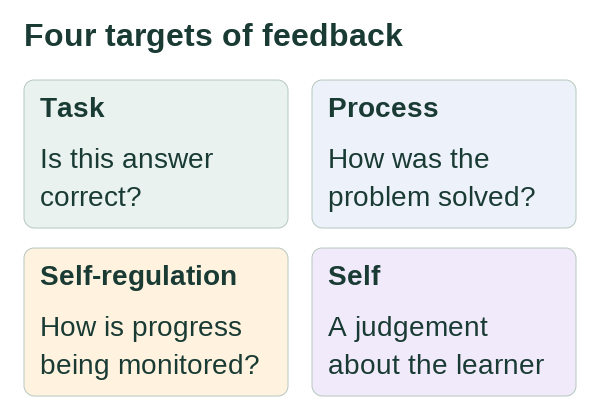
One study looked at 2,250 field notes. The notes came from a family medicine residency program in Canada. Of these, 422 (18%) contained no feedback at all. Of all 2,250 field notes, 1,105 (60%) recorded a single feedback level. Task feedback was the most common single level (835; 76%). No note in that study recorded all four levels together.[8]
A second view of feedback puts the learner at the centre of the process, not the teacher.[9][10] One analysis compares two models. In the first, teachers drive feedback. In the second, learners generate and seek out their own feedback. That second model is said to prepare students beyond the immediate task. It also avoids false expectations that a course cannot meet.[9]
A related argument holds that feedback works best when students actively create, process and respond to feedback information. In this account, students also give themselves feedback. They do this by comparing their own work with the work of others.[10]
How large the effects are
A later meta-analysis tested that claim on a much larger body of research. That 2020 meta-analysis pooled 435 studies and 994 effect sizes. It included more than 61,000 people. The average effect of feedback on student learning was d = 0.48. That is a medium effect. The data showed significant heterogeneity, meaning the results varied a lot from study to study. So feedback cannot be treated as one single, consistent form of treatment.[3]
The average also hides differences by type of outcome. A moderator analysis found that the effect depended strongly on what information the feedback contained. The meta-analysis concluded that each form of feedback should be measured on its own.[3]
Evidence from universities is thinner than evidence from schools. A 2021 systematic review looked at trials in higher education. It found that the evidence base is limited for now. Low stakes quizzing stood out as a particularly strong approach. Feedback from peers and from tutors showed benefits. The benefits depended on how the feedback was carried out. The evidence for praise, grading and technology-based feedback was mixed.[11]
Gan, An and Liu (2021) surveyed 308 university students. They asked about teachers' feedback practices and students' feedback motivation and behavior. They also asked about course satisfaction and exam performance. A 2021 survey of 308 university students in an English Studies course compared a key and a non-key university. Students at the key university said they used teacher feedback more. They also showed more motivation to give feedback and more feedback behavior. At the non-key university, students' feedback behavior strongly predicted both course satisfaction and exam results.[12]
A 2024 study in Queensland, Australia, tested a teacher training program. The program was for English writing in primary school. It compared students in 13 schools that used the program with students in 9 other schools. More detailed analyses found significantly greater increases in perceived helpfulness among intervention students. This held for six feedback strategies.[13]
What changes whether feedback helps
In a transfer experiment, more specific feedback helped learners respond to good performance. It hurt their learning from poor performance. The study concluded that detailed feedback can raise immediate performance. At the same time it can weaken the learning needed for later, more independent performance. Part of this effect ran through the chances to practise responding to different task conditions.[14]
In one study, 258 people learned Luganda-English word pairs. Giving the correct answer after a wrong response raised final retention after 1 week by 494%. Feedback after correct answers made little difference. This held whether it was given at once or later.[5]
One study looked at 98 Japanese college students. They learned 16 word pairs, each English with its Japanese match. The researchers controlled for the gap to the test. After that, when feedback came had little effect on vocabulary learning.[2]
When learning from multiple-choice tests, delayed feedback gave better final test scores than immediate feedback. In that study, students kept answering until they were correct. This gave the same result as simply showing the correct answer.[15]
Roelle, Berthold and Fries (2011) found that feedback on learning strategies helped learners with little expertise. It was harmful for high-expertise learners. One field study followed 246 university students. They wrote learning journals over a term. The researchers tied this to the expertise reversal effect. Guidance that helps beginners can weigh down learners who already have good strategies.[16]
A survey in Hong Kong asked 1740 college students and 460 academics. Many students resisted peer assessment that used grades. Most said students never or rarely grade each other. The paper argued that grading can undermine the learning value of peer feedback.[7] One study looked at 45 English teachers in training. Students who gave and received online peer feedback reached higher levels of self-regulated learning than a control group.[17]
A review of 48 articles on automated writing evaluation found that this feedback improved writing somewhat. It was not as effective as human feedback from a teacher or peer. Students in those studies mostly found automated feedback useful. But students saw it as often inaccurate and vague. It tended to be generic and to follow a formula.[18]
What this looks like when you study
Of the combined effects, 17% were negative.[3] A computer-based meta-analysis covered 40 studies and 70 effect sizes. Elaborated feedback, which includes an explanation, produced an effect of 0.49. Feedback that only said whether the answer was right or wrong produced an effect of 0.05. Giving the correct answer produced 0.32.[19]
A study looked at 129 student teachers. Those supported in writing feedback with sentence starters had higher feedback quality. Rubrics and sentence starters together helped self-efficacy most in the long run.[20]
A study of 3,204 high school and university students found that 'where to next' feedback led to the greatest gains. The gains ran from first to final essay submission. Of the feedback words, 50 percent answered 'How am I going?'. Another 31 percent answered 'Where am I going?', and 19 percent 'Where to next?'.[6]
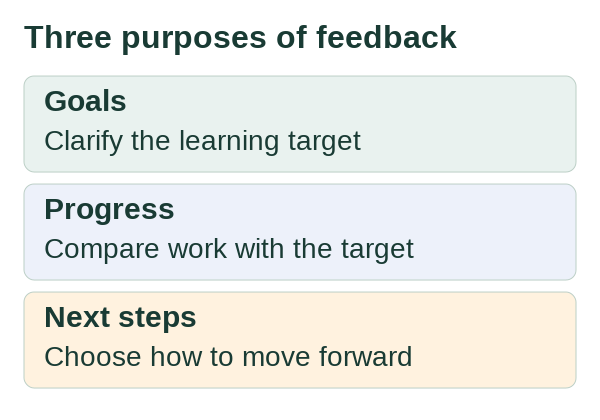
No field notes included all four levels of the feedback model.[8] Hattie's visible learning names three forms of feedback, about the past, the present and the future. They are how the learner is going, where the learner is going, and where to next. Self-regulation feedback concerns how a learner monitors and controls the strategies used for a task. It also builds the confidence to keep developing.[21]
Common misconceptions
A common view treats feedback as nothing more than one person passing information to another so the other can improve. Feedback works as a social exchange. Culture, values, expectations, personal histories, relationships and power all shape it. Some people view feedback only as specific information about the gap between performance and a standard. That view ignores these complex influences.[1]
Using feedback well and its limits
Practical guidance for clinical supervisors was gathered into 32 do and don't guidelines. Each one has a summary of the evidence behind it. The guidelines cover both how feedback is given and what it says. They also cover the learning culture that supports or limits it. The authors define helpful feedback as a supportive conversation. It makes clear what a trainee knows about skills they are still building. It also raises self-efficacy, a person's belief in their own ability to improve. Such a talk also pushes the trainee to set goals. It helps the trainee work out ways to reach them. The authors state that feedback is not easy to get right. They say their guidelines rest on consensus and evidence, not on a systematic review.[1]
Written feedback given while work is still in progress can help students improve their writing. It works when it gives them support, models and encouragement.[22] Comments about where to go next gave the greatest gains. That study used a computer system. It collected comments written by teachers. It also collected comments generated by the computer.[6] In a vocational high school, 36 eleventh-grade students got steady spoken feedback while they worked. Their understanding, participation and confidence rose across six learning measures.[23]
In workplaces, assessment for learning and assessment of learning can pull against each other. Trainee doctors said that entrustable professional activities may work well as drivers of feedback and learning. These are clearly defined tasks. The same trainees described three dilemmas. These were standard outcomes against flexible assessment, performance standards against learning opportunities, and numeric scores against narrative dialogue.[24]
Some feedback compared how students weighed clinical information with the correct weighting. This helped them spot urinary tract infection more accurately. It worked better than feedback on the diagnosis alone.[25]
Where the idea of feedback comes from
McPherson, Blackwell and Hattie (2022) draw on the idea of feedback proposed by John Hattie and his colleagues. Their writing on feedback has strongly shaped school education. It has done so through many publications. This is especially true of their writing on showing students where to go next. Later work has applied this educational psychology view of feedback to music performance teaching at several levels. That work argues that music education has lacked understanding of the topic. It offers ways for teachers to refocus their use of feedback.[21]
A newer idea is feedback literacy. It names the skills students need to use feedback well. This idea gives students a share of the responsibility in the feedback process. One study held focus group talks with 38 students about their feedback experiences. The researchers then built a prototype tool. That early version was checked with 16 students in one-to-one interviews.[26]
Peer feedback is becoming more popular among academic teachers. They use it to promote deeper learning and to reduce heavy marking loads.[27] Researchers disagree about peer feedback in second language writing. Some call it ineffective and prefer feedback from teachers. Others report thinking and social benefits for writing classes.[28]
Feedback in language and skill learning
A 2010 meta-analysis combined 33 primary studies. Of these, 22 were published papers and 11 were doctoral dissertations. The effect of implicit feedback lasted better over time than the effect of explicit feedback. Studies in labs showed larger effects than studies in classrooms. Shorter treatments produced larger effects than longer ones. Studies in foreign language settings produced larger effects than studies in second language settings.[29]
The conditions combined metacognitive instruction with two feedback types. The two types were conversational recasts, which provide input, and clarification requests, which prompt output. It added no benefit to clarification requests. Which feedback type worked better depended on the grammar point being taught.[30]
Learner age and the setting of the exchange both shape how feedback unfolds. Learners got negative feedback on utterances that did not match the target. Age and context affected the pattern of interaction.[31]
In motor skill learning, self-controlled feedback lets learners choose when to receive feedback. A 2025 meta-analysis looked at 29 studies with 1147 participants. It compared this feedback with feedback received passively and with yoked feedback. Self-controlled feedback gave no significant advantage during learning. It helped in the retention phase and the transfer phase. During the learning stage, clear effects appeared only in people with cognitive impairment.[32]
Feedback from computers and digital tools
A computer can give feedback in several ways. The way it is given changes how much students learn. They ranged from −0.78 to 2.29. Elaborated feedback explains an answer. This was especially true for higher order learning outcomes. Effects were larger in mathematics than in social sciences, science and languages. Delayed feedback was linked to smaller effects.[19]
A later meta-analysis covered 116 interventions. It found a summary effect of .41 for digitally delivered instructional feedback. Feedback focus, discipline, assessment type and learner control were significant influences on learning performance. Even simple feedback, such as saying whether an answer is right, works better than no feedback at all.[33]
Students who knew more at the start gained more from delayed summative feedback.[34] Interactive feedback works differently. It guides a learner step by step through a task. This comes after one or more independent tries. The study involved 299 Italian students in grade 8. Step-by-step guidance helped learners improve their results more than other activities did. The effects were stronger for students from poorer backgrounds.[35]
A meta-analysis found 35 articles, with 2,222 participants in total. Feedback from human-machine interaction had clear effects on learning. The effect size was 0.594 for the learning process and 0.407 for learning outcomes. The positive effects depended on the direction, form and type of feedback. The review recommended two-way feedback. It also recommended technology that can give emotional feedback.[36]
In a 15-week writing course, 205 university students used a large language model. It gave them feedback on weekly essays, using set criteria. They revised their drafts before they submitted them. Students found the feedback immediate and specific. Their content accuracy and language proficiency improved. Some students found the feedback too complex or not relevant.[37]
A review of generative AI in programming education found that such tools can explain concepts and help fix errors. They can also reduce grading workload. The same tools may also lead to overreliance. They may also lead to weak critical thinking. Understanding may stay shallow.[38] In a survey of 368 Chinese university students, students who engaged critically with AI-generated feedback reported more sustainable learning engagement, while uncritical acceptance was linked to less.[39]
Feedback between teachers and students
Students say the feedback they receive is not adequate and does not arrive in time. Their teachers say students ignore the advice they are given. A 2006 paper compared university teachers' written comments on student assignments. It set these against what those same teachers said they believed about feedback.[40]
A 2013 study drew on five interviews with history lecturers in higher education. It explored how they understood student unhappiness with feedback. That study noted a figure from one wide review of assessment and feedback. Only 7.1% of the research articles looked only at lecturers' views.[41]
Not all students go looking for feedback when it is offered. At the University of Aberdeen Medical School, 360 third-year students could collect formative feedback on their degree essays. Less than half of them did so: 46% overall, 47% in 2004 and 45% in 2005. Female students were significantly more likely than male students to seek it. Higher achievers were significantly more likely than lower achievers.[42]
Morris and Chikwa (2016) explored whether students prefer audio or written feedback. They also studied how each type affected their later assignments. In a study of 68 students, one group received audio feedback on a first assignment. The other group received written feedback. The type of feedback received did not affect grades on the next assignment. Students were mostly positive about audio feedback. But they strongly preferred written feedback for future work.[43]
Researchers surveyed 764 Chinese university students in an English course. Scaffolding feedback, verification feedback and criticism predicted students' motivation to use feedback. Whether students enjoyed feedback predicted whether they engaged with it. How useful they thought it was did not. Motivation carried part of the effect of teacher feedback on student engagement.[44]
Gormally, Evans and Brickman (2014) describe feedback on teaching in higher education. Most of it now comes from student evaluations or from peer observation. Most feedback on teaching at universities comes through student evaluations. These tend to give no specific advice for improvement.[45]
A 2016 review looked at 183 feedback studies. It examined feedback from senior assessors to the assessors they supervise in national assessment organisations. The review set out core factors and social and cultural factors. These are linked to feedback that supports professional learning.[46]
Feedback between peers and its effects
In a 2021 quasi-experiment, 129 student teachers gave repeated peer feedback on learning strategies. A digital tool helped them. Some students were helped to write their comments. They produced better feedback than students who were not helped. The study concluded that judging work and writing feedback are distinct skills that should be trained separately.[20]
A 2016 case study described a 15 credit course unit of about 90 final year students. Their 500 word essay was peer assessed in groups of four. That peer feedback, together with a tutor mark, then served as feed forward for a longer essay of 2 to 2,500 words.[47]
They reported higher self-efficacy for assessing learning strategies and for giving feedback.[20] Under the new structure, students learned more deeply and gave positive responses. Complaints about grades on the main essay fell. Students were also better prepared for the final exam.[47]
A 2021 workshop study asked students to help build the assessment criteria. They then marked their own work with them. That workshop encouraged a deeper level of reflection. It also encouraged a greater connection between feedback and both past and future assessments.[48]
Among receivers of online peer feedback, the three types studied did not act alike. The types were affective, cognitive and metacognitive. A 2026 study had 248 undergraduates take part in online peer feedback in a blended English writing course. Only metacognitive feedback had a significant direct effect on receivers' learning outcomes.[49]
One study looked at master students reviewing literature reviews. Feedback quality and quantity did not define the performance mark. A 2021 study of master students learning to write literature reviews coded reviewers' comments along four dimensions, including describing problems versus prescribing directions and constructive versus negative. No links were found between review patterns, performance mark and the amount of feedback received. Specific review patterns did correlate with separate category scores, and the constructive versus negative and high versus low level dimensions correlated with most category scores. The students could give useful, high-level comments.[50]
Feedback for students who struggle
The studies compared children with learning disabilities to peers of the same reading level or age.[51] One 1988 experiment tested four feedback conditions. The boys were in Grades 1 through 4, had learning disabilities, and were still learning to decode words. The boys read nonsense words aloud. The words were built from consonant-vowel-consonant patterns. The boys got one of four things: general feedback, corrective feedback with modeling, corrective feedback with a sound-it-out prompt, or no feedback. Any feedback beat none. Both corrective forms beat general feedback on the immediate task measure. Modeling the correct response also outperformed the sound-it-out prompt.[52]
A 1990 study found that direct feedback and practice significantly raised metaphor performance in children with learning disabilities. In that study, grade level and reading level were linked to how well the children did on metaphors.[53] Students who listened to passages found significantly more grammar and syntax errors than students who only read them. In a 1988 comparison, students either listened to passages or read them. Two groups found fewer errors than an age-matched group did. One group had learning disabilities, and the other was matched on reading level.[51]
The approach rests on self-efficacy, a person's belief about his or her own capability at a task. That belief is thought to shape which activities a person chooses and how much effort is spent. It also shapes how long the person persists and what gets accomplished. Schunk and Cox (1986) studied strategy training and attributional feedback with learning disabled students.[54]
Individualized feedback that is skill-based and offers strategies helped students far more. It gave them a greater understanding of their strengths and weaknesses than an achievement level alone. A 2018 multiple case study gave individualized diagnostic feedback and intervention support to six junior elementary students. The profiles for the six used several data sources. These included interests, learning preferences and reading readiness levels.[55]
A 2023 study compared 14 children aged 8 to 12 with developmental language disorder with 15 typically developing peers. Children with the disorder did worse on two tasks: a declarative word-learning task and a probabilistic classification task. Their brain responses to feedback differed by task. The authors proposed a feedback parity hypothesis. It says the learning system that dominates a task also dominates feedback processing in these children.[56]
Feedback, motivation and how students feel
In a 2020 experiment, 102 people (63 female, 39 male) did 5 min of mental arithmetic on a computer. The experimental group then received positive feedback. The control group received none. Both groups then did a second 5 min session of mental arithmetic tasks. Mediation analyses confirmed one path. Specific self-efficacy carried a positive effect of positive feedback onto flow. It also carried that effect onto both performance measures, quality and quantity. Feedback showed no significant direct effect on flow or on performance. So other mechanisms may also be at work.[57]
Positive feedback from teachers raised students' motivation to learn. A 2022 qualitative descriptive case study took place at Leyte Normal University in the Philippines. It asked what feedback teachers gave first-year social studies students. It also asked how that feedback affected their motivation during new normal learning after the Covid-19 pandemic. When feedback was negative or absent, students felt demotivated. They turned to motivating themselves. The study concluded that teacher feedback affects motivation directly. How much depends on the quality of the feedback given.[58]
In online courses, the way feedback is delivered shapes what students take from it. A 2024 study asked forty-two students in an online distributed learning environment. They rated the feedback they received from their instructor. The questionnaire had 6 closed-ended, 5 Likert scale and 4 open-ended questions. The analyses stressed that learners want more interaction with the online instructor. They also want learner-to-learner feedback that builds relationships and knowledge. The study describes feedback as an assessment of learning that promotes motivation.[59]
A 2016 retrospective descriptive study looked at 283 third-year nursing students. Most valued verbal feedback and anecdotal notes. Those students preferred to get feedback before their next learning experience. They found its quality varied by instructor.[60]
A 2026 cross-sectional study surveyed 131 medical students in North India. About 79% agreed that formative assessment questions reflected skills developed in sessions. Another 79% believed formative assessment improved their learning and academic performance. Nearly 73% said formative assessments tested whether they could apply knowledge to real-life situations.[61]
Limits, engagement and open questions
In a 1986 experiment, undergraduate psychology students at the University of Colorado worked with a scrambled passage. The passage had 26 sentences about Watergate. Half rebuilt the passage. The other half read either the scrambled version or the original. The amount of feedback available made no statistically significant difference. It did not change the percentage of idea units recalled or the recognition scores. More feedback did raise concordance. This measures how closely a student's final sentence order matched the original sequence. That closer match to the original order came without higher recall or recognition scores.[62]
A 1979 review of laboratory studies found that results depended on the type and mix of feedback children received. Verbal and symbolic feedback led to faster learning than tangible feedback. Results for the right-wrong combination, which marks both correct and incorrect answers, were inconsistent. Several variables interact with feedback, including incentive value, instructions and mode of delivery. These had not been systematically evaluated. The review concluded that applied researchers had overlooked important findings and issues from laboratory work.[63]
Students also ignore feedback they receive, and the channel used to deliver it may matter. A 2024 quasi-experimental study involved 171 undergraduate students. They received elaborated feedback through a learning platform the day after each assignment. Of these, 78 received written feedback and 93 received video feedback. The written group opened the feedback messages more often. Even so, the video group scored better. Academic engagement moderated the link between format and performance. This suggests that students with lower engagement may benefit from video feedback.[64]
A 2011 programme at one university carried feedback from second-year research projects into the next year's dissertation teaching. A questionnaire measured how 74 undergraduate students rated the programme. Students went through their past feedback in detail with the dissertation supervisor. They then judged that feedback to have had a much larger impact. How engaged a student was with the feedback did not depend significantly on the grade earned. The grade came from the assignment that produced the feedback.[65]
Automated feedback built on learning analytics raises open questions about student autonomy. A 2024 philosophical paper describes a tension. Hopes for self-regulated learning clash with fears that learners are reduced to numeric constructs. The paper proposes a list of design considerations for such systems. The list is built on a conception of limited, situated autonomy.[66]
Key studies
| Year | Study | Sample | Design | Finding |
|---|---|---|---|---|
| 1986 | Wigton et al.[25] | teaching experiment | Students given feedback comparing their weighting of clinical information with the correct weighting diagnosed urinary tract infection more accurately than controls. | |
| 2005 | Pashler et al.[5] | 258 students learning Luganda-English word pairs | experiment | Supplying the correct answer after an incorrect response increased final retention by 494 percent, while feedback after correct responses made little difference. |
| 2007 | Butler et al.[15] | participants who read 12 prose passages and took a multiple-choice test | two experiments on feedback type and timing | Delayed feedback led to better final test performance than immediate feedback, while feedback type did not matter. |
| 2011 | Roelle et al.[16] | 246 university students | field study with within-subject design | Feedback on learning strategies helped low-expertise learners but was reversed for high-expertise learners. |
| 2015 | Nakata[2] | 98 Japanese college students studying 16 English-Japanese word pairs | experiment | When the gap to test was controlled, feedback timing had little effect on vocabulary learning. |
| 2015 | Van der Kleij et al.[19] | 40 studies with 70 effect sizes | meta-analysis | Elaborated feedback produced an effect of 0.49, compared with 0.05 for right-wrong feedback and 0.32 for correct-answer feedback. |
| 2018 | Sato & Loewen[30] | 83 adult English as a foreign language learners in intact classes | four-condition classroom experiment | Metacognitive instruction enhanced the effect of conversational recasts but added no benefit for clarification requests. |
| 2020 | Wisniewski et al.[3] | 435 studies with 994 effect sizes and more than 61,000 students | meta-analysis | The average effect of feedback on learning was d = 0.48 after removing extreme values, with 17% of effects negative. |
| 2021 | Bürgermeister et al.[20] | 129 student teachers | quasi-experiment | Support in writing feedback with sentence starters improved feedback quality, and the combination of rubrics and sentence starters was most advantageous in the long run. |
| 2021 | Hattie et al.[6] | 3,204 high school and university students | analysis of essay feedback and revisions | 'Where to next' feedback led to the greatest gains from first to final submission. |
| 2021 | Eika[50] | master students writing literature reviews | study of peer feedback features and writing performance | Students provided useful and high-level comments, and specific review patterns correlated with separate category scores. |
| 2021 | Candel et al.[34] | computer-based environment, final learning test one day later | Neither delayed question-based nor delayed summative feedback outperformed immediate elaborated feedback. | |
| 2024 | Fu et al.[18] | 48 articles from journals | review of 48 articles | Automated writing evaluation feedback can improve writing somewhat but is not as effective as human feedback. |
| 2025 | Compagna et al.[8] | 2,250 field notes from a family medicine residency program | retrospective cross-sectional observational study | 60 percent of notes contained a single feedback level, mostly task level, and none included all four levels. |
See also
References
- Lefroy, J., Watling, C., Teunissen, P. W., & Brand, P. (2015). Guidelines: the do’s, don’ts and don’t knows of feedback for clinical education. Perspectives on Medical Education, 4(6), 284-299. doi:10.1007/s40037-015-0231-7
- Nakata, T. (2015). Effects of feedback timing on second language vocabulary learning: Does delaying feedback increase learning? Language Teaching Research, 19(4), 416-434. doi:10.1177/1362168814541721
- Wisniewski, B., Zierer, K., & Hattie, J. (2020). The Power of Feedback Revisited: A Meta-Analysis of Educational Feedback Research. Frontiers in Psychology, 10. doi:10.3389/fpsyg.2019.03087
- Hattie, J., & Timperley, H. (2007). The Power of Feedback. Review of Educational Research, 77(1), 81-112. doi:10.3102/003465430298487
- Pashler, H., Cepeda, N. J., Wixted, J. T., & Rohrer, D. (2005). When Does Feedback Facilitate Learning of Words? Journal of Experimental Psychology: Learning, Memory, and Cognition, 31(1), 3-8. doi:10.1037/0278-7393.31.1.3
- Hattie, J., Crivelli, J., Van Gompel, K., West-Smith, P., & Wike, K. (2021). Feedback That Leads to Improvement in Student Essays: Testing the Hypothesis that “Where to Next” Feedback is Most Powerful. Frontiers in Education, 6. doi:10.3389/feduc.2021.645758
- Liu, N. F., & Carless, D. (2006). Peer feedback: the learning element of peer assessment. Teaching in Higher Education, 11(3), 279-290. doi:10.1080/13562510600680582
- Compagna, K., Ross, S., & Lee, A. (2025). An Exploration of Feedback Using Hattie and Timperley’s Feedback Levels. Family Medicine, 57(7), 508-512. doi:10.22454/fammed.2025.362243
- Boud, D., & Molloy, E. (2013). Rethinking models of feedback for learning: the challenge of design. Assessment & Evaluation in Higher Education, 38(6), 698-712. doi:10.1080/02602938.2012.691462
- Carless, D. (2022). From teacher transmission of information to student feedback literacy: Activating the learner role in feedback processes. Active Learning in Higher Education, 23(2), 143-153. doi:10.1177/1469787420945845
- Morris, R., Perry, T., & Wardle, L. (2021). Formative assessment and feedback for learning in higher education: A systematic review. Review of Education, 9(3). doi:10.1002/rev3.3292
- Gan, Z., An, Z., & Liu, F. (2021). Teacher Feedback Practices, Student Feedback Motivation, and Feedback Behavior: How Are They Associated With Learning Outcomes? Frontiers in Psychology, 12. doi:10.3389/fpsyg.2021.697045
- Brooks, C., Burton, R., Van der Kleij, F., Ablaza, C., Carroll, A., Hattie, J., & Salinas, J. G. (2024). “It actually helped”: students’ perceptions of feedback helpfulness prior to and following a teacher professional learning intervention. Frontiers in Education, 9. doi:10.3389/feduc.2024.1433184
- Goodman, J. S., & Wood, R. E. (2004). Feedback Specificity, Learning Opportunities, and Learning. Journal of Applied Psychology, 89(5), 809-821. doi:10.1037/0021-9010.89.5.809
- Butler, A. C., Karpicke, J. D., & Roediger, H. L. (2007). The effect of type and timing of feedback on learning from multiple-choice tests. Journal of Experimental Psychology: Applied, 13(4), 273-281. doi:10.1037/1076-898x.13.4.273
- Roelle, J., Berthold, K., & Fries, S. (2011). Effects of Feedback on Learning Strategies in Learning Journals: Learner-Expertise Matters. International Journal of Cyber Behavior, Psychology and Learning, 1(2), 16-30. doi:10.4018/ijcbpl.2011040102
- Öztürk, M., Yüce, E., & Türker, P. M. (2025). Online Peer Feedback Versus Online Teacher Feedback? Effect of Online Feedback on Students’ Self-Regulated Learning. Technology, Knowledge and Learning, 30(2), 769-787. doi:10.1007/s10758-024-09812-8
- Fu, Q. K., Zou, D., Xie, H., & Cheng, G. (2024). A review of AWE feedback: types, learning outcomes, and implications. Computer Assisted Language Learning, 37(1-2), 179-221. doi:10.1080/09588221.2022.2033787
- Van der Kleij, F. M., Feskens, R. C. W., & Eggen, T. J. H. M. (2015). Effects of Feedback in a Computer-Based Learning Environment on Students’ Learning Outcomes: A Meta-Analysis. Review of Educational Research, 85(4), 475-511. doi:10.3102/0034654314564881
- Bürgermeister, A., Glogger-Frey, I., & Saalbach, H. (2021). Supporting Peer Feedback on Learning Strategies: Effects on Self-Efficacy and Feedback Quality. Psychology Learning & Teaching, 20(3), 383-404. doi:10.1177/14757257211016604
- McPherson, G. E., Blackwell, J., & Hattie, J. (2022). Feedback in Music Performance Teaching. Frontiers in Psychology, 13. doi:10.3389/fpsyg.2022.891025
- Zainab, B. H., & Toh, H. H. D. (2018). How does formative, written feedback help students improve their geographical writing. HSSE Online, 7(1). doi:10.32658/hsseo.2018.7.1.5
- Az-Zahra, R., & Roslaini, R. (2026). Formative feedback to deepen students' understanding of English report texts. Teacher in Educational Research, 8(1). doi:10.33292/ter.v8i1.558
- Martin, L., Sibbald, M., Brandt Vegas, D., Russell, D., & Govaerts, M. (2020). The impact of entrustment assessments on feedback and learning: Trainee perspectives. Medical Education, 54(4), 328-336. doi:10.1111/medu.14047
- Wigton, R. S., Patil, K. D., & Hoellerich, V. L. (1986). The effect of feedback in learning clinical diagnosis: . Academic Medicine, 61(10), 816-22. doi:10.1097/00001888-198610000-00006
- Jin, F., Maheshi, B., Martinez-Maldonado, R., Gašević, D., & Tsai, Y. S. (2024). Scaffolding Feedback Literacy: Designing a Feedback Analytics Tool with Students. Journal of Learning Analytics, 11(2), 123-137. doi:10.18608/jla.2024.8339
- Thoirs, K. (2010). Using online peer feedback in formative assessment for medical sonography students teaching: the student view. Radiographer, 57(2), 26-33. doi:10.1002/j.2051-3909.2010.tb00125.x
- Bijami, M., Kashef, S. H., & Nejad, M. S. (2013). Peer Feedback in Learning English Writing: Advantages and Disadvantages. Journal of Studies in Education, 3(4), 91. doi:10.5296/jse.v3i4.4314
- Li, S. (2010). The Effectiveness of Corrective Feedback in SLA: A Meta‐Analysis. Language Learning, 60(2), 309-365. doi:10.1111/j.1467-9922.2010.00561.x
- Sato, M., & Loewen, S. (2018). Metacognitive Instruction Enhances the Effectiveness of Corrective Feedback: Variable Effects of Feedback Types and Linguistic Targets. Language Learning, 68(2), 507-545. doi:10.1111/lang.12283
- Oliver, R. (2000). Age Differences in Negotiation and Feedback in Classroom and Pairwork. Language Learning, 50(1), 119-151. doi:10.1111/0023-8333.00113
- Wang, B., Tao, T., Yuan, Y., & Guo, W. (2025). Self-Controlled Feedback and Behavioral Outcomes in Motor Skill Learning: A Meta-Analysis. Behavioral Sciences, 15(9), 1291. doi:10.3390/bs15091291
- Brummer, L., de Boer, H., Mouw, J. M., & Strijbos, J. W. (2024). A meta-analysis of the effects of context, content, and task factors of digitally delivered instructional feedback on learning performance. Learning Environments Research, 27(3), 453-476. doi:10.1007/s10984-024-09501-4
- Candel, C., Máñez, I., Cerdán, R., & Vidal‐Abarca, E. (2021). Delaying elaborated feedback within computer‐based learning environments: The role of summative and question‐based feedback. Journal of Computer Assisted Learning, 37(4), 1015-1029. doi:10.1111/jcal.12540
- Barana, A., Marchisio, M., & Sacchet, M. (2021). Interactive Feedback for Learning Mathematics in a Digital Learning Environment. Education Sciences, 11(6), 279. doi:10.3390/educsci11060279
- Liao, M., Zhu, K., & Wang, G. (2024). Can human-machine feedback in a smart learning environment enhance learners’ learning performance? A meta-analysis. Frontiers in Psychology, 14. doi:10.3389/fpsyg.2023.1288503
- Campos, M. (2025). AI-assisted feedback in CLIL courses as a self-regulated language learning mechanism: students’ perceptions and experiences. European Public & Social Innovation Review, 10, 1-14. doi:10.31637/epsir-2025-1568
- Giao, D. T. K. (2026). Generative AI in Programming Education: A Review of Learning Support, Feedback, and Assessment Challenges. Global Journal of Engineering and Technology Research, 02(07). doi:10.65150/ep-gjetr/v2e7/2026-03
- Huang, Y., & Li, Y. (2026). Responsible Use of AI-Generated Feedback and Sustainable Learning Engagement Among Chinese University Students: A Dual-Path Model of Feedback Literacy and Feedback Dependence. Sustainability, 18(19), 9801. doi:10.3390/su18199801
- Orrell, J. (2006). Feedback on learning achievement: rhetoric and reality. Teaching in Higher Education, 11(4), 441-456. doi:10.1080/13562510600874235
- Burns, A. (2013). Negotiating feedback: lecturer perceptions of feedback dissatisfaction. Journal of Learning Development in Higher Education(6). doi:10.47408/jldhe.v0i6.150
- Sinclair, H. K., & Cleland, J. A. (2007). Undergraduate medical students: who seeks formative feedback? Medical Education, 41(6), 580-582. doi:10.1111/j.1365-2923.2007.02768.x
- Morris, C., & Chikwa, G. (2016). Audio versus written feedback: Exploring learners’ preference and the impact of feedback format on students’ academic performance. Active Learning in Higher Education, 17(2), 125-137. doi:10.1177/1469787416637482
- Gan, Z., & Wang, X. (2025). Perceived teacher feedback practices, student feedback motivation and engagement in English learning: a survey of Chinese university students. Applied Linguistics Review, 16(1), 455-476. doi:10.1515/applirev-2023-0136
- Gormally, C., Evans, M., & Brickman, P. (2014). Feedback about Teaching in Higher Ed: Neglected Opportunities to Promote Change. CBE—Life Sciences Education, 13(2), 187-199. doi:10.1187/cbe.13-12-0235
- Johnson, M. (2016). Feedback effectiveness in professional learning contexts. Review of Education, 4(2), 195-229. doi:10.1002/rev3.3061
- Wagner, S. M. (2016). Peer feedback: moving from assessment of learning to assessment for learning. Journal of Learning Development in Higher Education. doi:10.47408/jldhe.v0i0.335
- Smith, M., & Lowe, C. (2021). DIY assessment feedback: Building engagement, trust and transparency in the feedback process. Journal of University Teaching and Learning Practice, 18(3). doi:10.53761/1.18.3.9
- Zhang, E., Zhang, Z., Li, X., Li, J., & Liu, H. (2026). Not All Received Peer Feedback Is Equal: The Self‐Regulation Bridge Between Online Peer Feedback and Learning Outcomes. Journal of Computer Assisted Learning, 42(4). doi:10.1002/jcal.70288
- Eika, E. (2021). Is Peer Feedback Helpful When Learning Literature Review Writing? A Study of Feedback Features and Quantity. English Linguistics Research, 10(1), 10. doi:10.5430/elr.v10n1p10
- Espin, C. A., & Sindelar, P. T. (1988). Auditory Feedback and Writing: Learning Disabled and Nondisabled Students. Exceptional Children, 55(1), 45-51. doi:10.1177/001440298805500105
- Perkins, V. L. (1988). Feedback Effects on Oral Reading Errors of Children with Learning Disabilities. Journal of Learning Disabilities, 21(4), 244-248. doi:10.1177/002221948802100412
- Baechle, C. L., & John Lian, M. G. (1990). The Effects of Direct Feedback and Practice on Metaphor Performance in Children with Learning Disabilities. Journal of Learning Disabilities, 23(7), 451-456. doi:10.1177/002221949002300710
- Schunk, D. H., & Cox, P. D. (1986). Strategy training and attributional feedback with learning disabled students. Journal of Educational Psychology, 78(3), 201-209. doi:10.1037/0022-0663.78.3.201
- Van der Boom, E., & Jang, E. E. (2018). The Effects of Holistic Diagnostic Feedback Intervention on Improving Struggling Readers’ Reading Skills. Journal of Teaching and Learning, 12(2), 54-69. doi:10.22329/jtl.v12i2.5105
- Gul, A., Baron, L. S., Black, K. B., Schafer, A. L., & Arbel, Y. (2023). Declarative Learning Mechanisms Support Declarative but Not Probabilistic Feedback-Based Learning in Children with Developmental Language Disorder (DLD). Brain Sciences, 13(12), 1649. doi:10.3390/brainsci13121649
- Peifer, C., Schönfeld, P., Wolters, G., Aust, F., & Margraf, J. (2020). Well Done! Effects of Positive Feedback on Perceived Self-Efficacy, Flow and Performance in a Mental Arithmetic Task. Frontiers in Psychology, 11. doi:10.3389/fpsyg.2020.01008
- Leyte Normal University, Tacloban City 6500, Philippines (2022). Teachers' Feedback: Influence on First Year Social Studies Students' Motivation towards New Normal Learning in Leyte Normal University. International Journal of Social Science and Human Research, 05(07). doi:10.47191/ijsshr/v5-i7-30
- Samaranayake, P. (2024). Online Learning and Instructor Feedback. Journal of Online Learning Research, 10(1), 75-89. doi:10.70725/206908kkidum
- Quance, M. A. (2016). Nursing Students’ Perceptions of Anecdotal Notes as Formative Feedback. International Journal of Nursing Education Scholarship, 13(1), 75-85. doi:10.1515/ijnes-2015-0053
- Singh, A., & Singh, A. (2026). Perception and feedback of Medical Students about Formative Assessment of Self-directed learning skill in a Medical College in North India. Acta Medica International, 13(2), 411-416. doi:10.21276/amit.2026.v13.i2.714
- Langer, P., Keenan, V., & Medosch-Schonbeck, C. (1986). Some Possible Limitations of Feedback in Instruction. Psychological Reports, 59(2), 731-741. doi:10.2466/pr0.1986.59.2.731
- Barringer, C., & Gholson, B. (1979). Effects of Type and Combination of Feedback upon Conceptual Learning by Children: Implications for Research in Academic Learning. Review of Educational Research, 49(3), 459-478. doi:10.3102/00346543049003459
- Máñez, I., Skrobiszewska, N., Descals, A., Cantero, M. J., Cerdán, R., García, Ó. F., & García‐Ros, R. (2024). Channelling feedback through audiovisual presentations: Do higher education students perceive, use and benefit from video feedback compared to written feedback? Journal of Computer Assisted Learning, 40(4), 1886-1897. doi:10.1111/jcal.12993
- O'Siochru, C. (2011). Using Staff-Student Reviews of Past Feedback to Increase the Impact of that Feedback on Current Assignments. Psychology Learning & Teaching, 10(2), 118-127. doi:10.2304/plat.2011.10.2.118
- Weydner-Volkmann, S., & Bär, D. (2024). Student autonomy and Learning Analytics: Philosophical Considerations for Designing Feedback Tools. Journal of Learning Analytics, 1-14. doi:10.18608/jla.2024.8313
Cite this page: Atlas Nova editors. (2026). Feedback in learning. Atlas Nova. https://velocer.io/atlas/feedback-in-learning/