
Theory · Motivation and self-regulation
Self-efficacy
Psychological concept about capability
Self-efficacy is a person's belief in their own capability to organize and carry out the actions needed to reach a set level of performance.[1]
Key facts
| 350 | students in a path analysis of math self-efficacy and problem solving (Pajares and Miller, 1994)[2] |
|---|---|
| .56 | correlation predicting final social studies grades from self-motivation variables and prior grades (Zimmerman, Bandura, and Martinez-Pons, 1992)[3] |
| 272 | children in a prospective study of career aspirations and trajectories (Bandura, Barbaranelli, Caprara, and Pastorelli, 2001)[4] |
Overview
The theory in brief
The theory holds that psychological procedures of any kind change two things. They change the level and the strength of a person's self-efficacy. Self-efficacy means a person's expectation of personal efficacy: the belief that he or she can carry out the actions a situation demands.[5] In a 1986 commentary, Bandura argued that this theory explains and predicts behavior across many lines of research. The same commentary examined conceptual and empirical questions about how people perceive their own efficacy.[6]
Bandura proposed that efficacy expectations decide whether coping behavior starts at all. They also set how much effort a person spends. They set how long the effort lasts when obstacles and unpleasant experiences appear.[5]
The 1977 model says efficacy beliefs come from four main sources of information. The more dependable the experiential sources, the greater the change in perceived self-efficacy.[5] A 2016 review of general education and music research describes the same four sources. They are enactive mastery experience, vicarious experience, verbal and social persuasion, and physiological and affective states.[7]
Some activities feel threatening but are in fact fairly safe. Sticking with them produces experiences of mastery. Those mastery experiences raise self-efficacy further and reduce defensive behavior. Bandura also named several factors that shape how people process efficacy information. That information comes from enactive, vicarious, exhortative and emotive sources.[5]
Later work applied the theory to memory. It argued that beliefs about one's memory can help or harm performance. They do this through cognitive, emotional or motivational processes.[8]
History
What self-efficacy means and where it came from
Self-efficacy is a person's belief in their own ability. It is the belief that a person can organize and carry out the actions needed. Those actions must reach a set level of performance. Researchers often describe it as task-specific self-confidence, meaning the belief is tied to a particular job rather than to the person in general.[1]
Self-efficacy cannot be sensed as one whole thing. It is not a single overall rating of the self. The belief shapes how people think, feel, motivate themselves and act.[9]
Albert Bandura set out the theory in a 1977 article in Psychological Review. He proposed a framework to explain and predict psychological change. Expectations of personal efficacy were said to decide whether coping behavior starts, how much effort goes into it, and how long it lasts when obstacles appear.[10]
A 1982 article in American Psychologist described the self-efficacy mechanism as central to human agency, the capacity to act on purpose. That article reported a link. Students with higher caused self-efficacy also had higher performance accomplishments. They also went with lower emotional arousal.[11]
Self-efficacy sits inside social learning theory, the view that people learn by watching others and by being reinforced. One account of the theory says motivation to learn rests on two beliefs. One is that a person can learn and apply the subject. The other is that a positive outcome will follow.[12]
A 1989 review in Annual Review of Sociology placed the topic in a wider body of work. That work covered human agency, mastery and control. Its narrower focus is how people see and judge their own competence, effectiveness and causal agency. The review noted that the idea fits Western values. These include mastery, self-reliance and achievement.[13]
Bandura's 1990 article in Revista Española de Pedagogía treated beliefs about perceived self-efficacy as a causal factor. These beliefs start human action and predict how people perform.[14] A 2024 article in the journal Psihologìâ ì suspìlʹstvo presented a concept of personal self-efficacy. It called this one of the basic thinking mechanisms of human development. That article described self-efficacy as a conscious ability. It said three factors form this ability. These were personality, environment and behavior. It also listed four main sources of information about efficacy. These were achievement of productivity, watching others' behavior, verbal persuasion, and partners' relationships and body states.[15]
Main ideas
How self-efficacy differs from self-concept and self-esteem
Academic self-concept covers more than that. It mixes what a student believes about his or her ability with feelings about the self. Comparing oneself with other people shapes it strongly. Self-efficacy, by contrast, was called mainly a thinking judgment. It is a judgment of what a person can do. People judge it against a standard of mastery.[16]
The 1999 review found that self-efficacy research used measures tied more closely to context. This was true for both the belief and the outcome. Research on self-concept used wider measures. That review also reported that self-efficacy studies more often used experimental designs. Self-concept studies depended mostly on correlational data, meaning data that only show two things moving together.[16]
One study asked 205 university students to complete measures of three things. These were academic self-concept, general academic self-efficacy and math-specific self-efficacy. Statistical analysis showed that each measure stood for a separate part of how students saw themselves. The dimensions were linked to one another.[17] Career-specific measures correlated more highly with general self-efficacy than with overall self-esteem.[18]
One study looked at self-esteem tied to a person's organization. It also looked at general self-efficacy. It tracked job performance and job satisfaction as results. Self-esteem based in the organization turned out to predict better. It predicted performance ratings and satisfaction.[19]
Not every study finds that self-efficacy predicts school results. One study of college students compared general self-efficacy with confidence for six career themes. It set these against ACT scores and grade point average. ACT score was not linked to general self-efficacy. It was also not linked to confidence for the other themes.[20]
Four sources of efficacy beliefs
The French study also found differences between boys and girls. Boys did better in mathematics. They also reported more confidence in their math ability. They felt more confident about controlling their own learning. They reported more mastery experience and more social persuasions. They also reported lower physical arousal.[21]
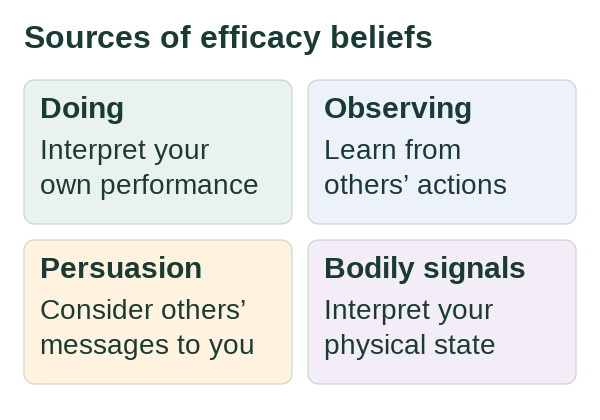
The 2008 review also found problems and things it had missed. These were in how the four sources had been conceptualized and measured in school research.[22] A 1992 review of theory in organizational behavior proposed a model of what shapes self-efficacy. It argued that the construct is both complex and changeable.[23]
Why beliefs change what students do
People hold beliefs about their ability to do a task. These beliefs can influence which activities they choose to take on.[24] Bandura grouped the influence of self-efficacy beliefs into four major processes. These were cognitive, motivational, affective and selection.[25]
Self-efficacy can affect effort, persistence and achievement. It also helps predict motivation and performance. This holds in both cognitive and sport domains.[24]
A 1990 experiment tested 64 Canadian college students. It asked whether belief in one's ability matters when knowledge is equal. The result suggests that self-efficacy matters for academic tasks that require steady self-monitoring.[26]
Students start a learning activity with goals in mind. They also begin with self-efficacy for reaching those goals. As they work, learners observe their own performance and judge their progress toward the goal. Watching oneself, judging oneself and reacting to oneself all affect self-efficacy. They also affect goal setting. When students see satisfactory progress, they feel able to improve their skills. Students who reach a goal with high self-efficacy set new, harder goals. Teachers can help students set upper and lower goal limits. Games, contracts and conferences also help.[27]
How close a goal is matters. The children had large deficits and little interest in mathematics. They followed a program in which students direct their own learning. It used near subgoals, distant goals or no goals. Distant goals showed no clear effects. Near goals also led to high agreement. The children judged their own math self-efficacy. Those judgments matched how they did later.[28]
Some studies reported that belief in one's abilities and personal goals can work against a person. A 2003 reply checked those findings against 9 meta-analyses. These combined the effect sizes of self-efficacy beliefs. It also checked them against the large body of research on goal setting.[29]
A 2012 commentary said some studies reported harmful effects. Others reported no effect at all. It said these studies failed to meet key requirements in four areas. These were theory, method, analysis and how the test was built.[30]
Reading, writing and mathematics
Belief in oneself as a writer is not one belief but several. That is the claim of a three-factor model tested in two studies. A second confirmatory factor analysis used data from 563 students. They came from 2 high schools. It also showed a good model fit.[31]
Anxiety, procrastination and emotion
The value was r = -0.359, with a 95% confidence interval from -0.405 to -0.312. Grade level and region did not significantly change the size of the link. Neither did the test anxiety measure. The tool used to measure academic self-efficacy did affect how strong the link was. The review calls this finding early and only a hint. Some subgroups held only one or two studies. Those results should be read with caution.[32]
Social cognitive theory explains the link through a person's sense of control over threats. People who believe they can manage a potential threat do not dwell on worrisome thoughts. It does not unsettle them. Some people doubt they can manage threatening events. They show high anxiety and personal distress. They also show autonomic arousal and the release of catecholamines. On this view, the main source of anxiety is not the frightening thought itself. It is the belief that one cannot switch it off.[33]
Exam grades give a short-term test of the same pattern. One study looked at 110 college students. Questionnaires measured anxiety and self-efficacy just before one exam. They measured them again just after it. The instructor gave the grades. Test anxiety and self-efficacy both showed a strong link with exam grades.[34]
Putting off work is another behaviour tied to these beliefs. A study of 330 undergraduates used two scales. The students attended one university in Lahore, Pakistan. One measured putting things off. One measured students' belief in their own academic ability. The other measured efficacy for self-regulated learning. Correlation and regression analyses found a reverse link. The link was statistically significant. Students with stronger academic self-efficacy reported less academic procrastination.[35]
Negative emotions more broadly have been tracked in a four-year panel. It covered more than 2000 Chinese college students who started in 2008. The study looked at several unpleasant feelings. Of these, only anxiety significantly predicted academic performance. Stress and depression did not. Academic self-efficacy raised academic performance by a significant amount. It declined from freshman to junior year.[36]
Beliefs about handling feelings seem to act through other beliefs. One study that looked ahead followed 464 adolescents. They were aged 14 to 19 at the first measurement and 16 to 21 at the second. Confidence in managing good and bad feelings came with high confidence for three things. These were managing academic development, resisting antisocial pressure and responding with empathy. Confidence in managing feelings worked mainly through those behavioural forms of self-efficacy. It did not act directly on helpful behaviour, delinquency or depression. Belief in one's own empathy went with helpful behaviour and low delinquency. But in teenage girls it also went with a greater risk of depression.[37]
Research
How strong is the link to achievement
A 2026 meta-analysis combined 30 peer-reviewed studies on mathematics. A meta-analysis combines results from many studies. They were published from 2017 to 2025. It reported a moderate combined effect size.[38] An effect size is a statistical calculation of how large a measurable effect is, for example the difference between the averages of two groups divided by the standard deviation.[39]
The result was statistically significant. The effect was for math interest and self-efficacy together. Researchers measured it by math achievement. The studies in that pool differed widely from one another. The results varied a lot between studies, with I2 above 80%. So the authors used a random-effects model.[38] In a meta-analysis, a random-effects model is a statistical model that includes both the variance within each study and the variance between studies when it assesses how uncertain the combined effect is.[40]
Writing has been studied with college students at the start of a course. Among college freshmen, belief in their own writing ability shaped how they saw their academic ability. It also shaped their own standards for good writing. Those standards and beliefs then led to goals for mastering writing skills. The level of writing instruction had no direct link to course grades. Verbal aptitude showed none either. Belief in one's own academic ability affected writing grades. It did so directly and through the goals students set for themselves.[41]
Researchers tracked persistence in science and engineering majors for a year. One study looked at 42 students in a 10-week career-planning course. Students who felt able to meet school requirements usually earned higher grades. Those students also stayed longer in technical and scientific majors. This held over the following year. Students with low self-efficacy did not.[42]
Military training offers a test outside ordinary classrooms. The long-term data came from three military academies in Norway. It linked conscientiousness to performance in the military and in school. Conscientiousness is a personality trait. Self-efficacy partly explained the link between conscientiousness and performance.[43]
One large survey in south-west Nigeria found a significant link. It linked academic self-efficacy and academic performance. The sample was 384 senior secondary students in public schools. They came from six states. The study was prompted by results in external examinations. Those results kept changing. The West African Examination Council ran these from 2020 to 2024.[44]
A meta-analysis looked at 114 studies outside school. It covered 157 correlations and 21,616 people. It found an average link of .38 between self-efficacy and work performance. The average was weighted.[45]
Differences across students and settings
One study looked at international students in the United States. It modelled English self-efficacy, efficacy for using English to learn, and academic self-efficacy. English self-efficacy affected academic self-efficacy in an indirect way. It worked through belief in using English to learn. The results suggest that using English and using English to learn are two distinct constructs. That means two qualities, each measured on its own. The study concluded that international students who are not native English speakers need academic English support.[46]
A path analysis looked at Syrian refugee undergraduate students in Turkey. It tested resilience, perceived social support, life satisfaction and self-regulation as influences on academic self-efficacy.[47] A 1993 study defined college self-efficacy for Hispanic college students. It meant confidence in doing college tasks. Examples are taking notes or asking a question in class. The College Self-Efficacy Inventory was tested with 164 Mexican-American and Latino-American college students. It produced three subscales: course efficacy, social efficacy and roommate efficacy.[48]
A study of 200 university students found cultural differences in parenting style. 100 were in China and 100 in Spain. Spanish mothers were warmer and showed more affection. Chinese parents were stricter. The two groups showed no statistically significant difference in academic self-efficacy. Rejecting parenting was linked to lower self-efficacy. It was also linked to lower academic performance. Warm, emotional parenting was linked to both in a positive way.[49]
One study looking ahead tested a model with 272 children. The model asked how social and thinking influences shape career hopes and paths. Family income and status were linked to children's career paths only indirectly. The link ran through parents' sense of their own effectiveness and their hopes for school. Children judged which jobs they could do. Their perceived academic, social and self-regulatory efficacy shaped those judgments. This worked directly. It also worked through hopes about schoolwork.[4]
One study looked at 190 university students in Ecuador. It found that general self-efficacy and academic self-efficacy rose together. The higher one was, the higher the other.[50] Positive personality traits raised two kinds of confidence: in communicating well and in academic work. Belief in one's own ability to communicate linked the two.[51]
Online, digital and technology-supported learning
One study looked at 200 nursing students in the 2022 to 2023 school year. It measured digital skills, self-efficacy and academic performance. Digital skill and self-efficacy were both high in this group.[52]
Some researchers found little or no effect of social media use on academic performance. Other studies found harmful effects, and some found helpful ones. One study looked at 808 students in ten public tertiary institutions. It looked at social media use for education. It also looked at three other things. These were cumulative grade point average, academic self-efficacy and innovation characteristics. Using social media for education was linked to better academic performance. The study also reported that social media use can harm performance.[53]
What the evidence shows in classrooms
Bartimote-Aufflick and colleagues reviewed 64 articles published since 2000. They found a strong link between self-efficacy and learning results for university students. That review also noted a limit in some of the studies it examined. Problems in how the studies were designed or analysed made them weaker.[54]
An earlier review of research in school settings reported a finding. Self-efficacy beliefs help explain and predict academic performance. The same review found that measures tied closely to the specific task beat broad, general measures. The close measures explained the predicted outcomes better.[55]
One meta-analysis combined 30 studies with 2,298 participants. It found a moderate positive link between self-efficacy and math ability. The correlation was r = 0.553. In that analysis, the strength of the relationship did not change with two things. These were the students' educational level and their geographical location.[56] A second meta-analysis used 37 studies.[57]
In one study, postgraduate students rated their confidence. They rated how well they could cope with their course's intellectual demands. Those ratings predicted 11.5% of the variance in end-of-semester grades 13 weeks later.[58] One study looked at 205 postgraduate students. It found that self-efficacy carried the effect of earlier performance accomplishments through to later academic performance.[59]
Beliefs about one's own ability to learn and do math strongly and positively predicted math achievement.[60] One study looked at 500 high school students. It found that academic self-efficacy was positively and significantly related to academic performance.[61] The sample was 1,852 adolescents aged 12 to 19 in Spain.[62]
How self-efficacy beliefs are measured
A 1994 comparison looked at 5 common ways of measuring self-efficacy. A single task-specific confidence rating agreed least with the other measures. That single rating also varied most in one way. It varied in how it correlated with the causes and outcomes researchers expected self-efficacy to relate to.[63]
Newer scales follow the same logic of naming tasks. A scale for university students was built around 8 factors. These include planning academic activities, learning strategies and stress management.[64]
A 2026 meta-analysis pooled 32 Cronbach's alpha coefficients. Alpha is a common statistic for reliability. These came from 31 studies with 10,072 people who took the Mathematics Self-Efficacy Scale. The average alpha was .829. The 95% confidence interval ran from .812 to .844. The 95% prediction interval ran from .726 to .893. This is the range for a future result. A researcher who uses the scale in a new sample should expect a value in that range. The meta-analysis concluded that reliability should be estimated in each sample. It should not be borrowed from earlier studies.[65]
Timing matters too. In one study, 24 students rated their self-efficacy for an oral presentation before and after giving it. Their ratings before the performance were significantly higher than after it. This held in all three parts of the talk: language, delivery and organization. The study read this gap as evidence that belief and performance affect each other.[66]
Evidence from school and university samples
One early path analysis followed 350 students solving mathematics problems. Math self-efficacy predicted problem-solving performance better than math self-concept, perceived usefulness of mathematics, prior experience with mathematics, or gender. They did so largely through self-efficacy. Self-efficacy mediated their effect. Men scored higher on performance, self-efficacy and self-concept. They scored lower on anxiety, but self-efficacy explained much of these gaps.[2]
A path model of 1992 traced how efficacy beliefs and goals reach final grades. Four self-motivation variables plus prior grades predicted students' final grades in social studies. The result was R = .56.[67]
A 1996 study of children found that efficacy to regulate learning helped school achievement. It did so directly and by raising academic aspirations. Perceived social efficacy worked through academic hopes and a low level of depression. Socioeconomic status was linked to achievement only indirectly.[68]
Persistence and course choice have also been tied to efficacy beliefs. The study took place in a 10-week career-planning course. 42 students reported their ability to meet the educational requirements and job duties of technical and scientific occupations. Scores on self-efficacy showed a moderate link with standard measures of academic aptitude and achievement.[69]
Confirmatory factor analyses test whether questionnaire items form separate dimensions. These analyses found three separate but related dimensions: academic self-concept, global academic self-efficacy and mathematics-specific self-efficacy.[70] Language skills self-efficacy showed no significant relationship with performance in English. Academic self-concept did show a relationship.[71] A survey looked at 3,639 junior secondary students in Edo State. It reported a negative relationship between self-efficacy and mathematics performance.[72]
A cross-sectional study looked at 258 university students. Academic self-efficacy correlated strongly with academic engagement and academic performance. One mediation analysis found that self-efficacy predicted achievement directly. It also predicted achievement in an indirect way, through academic engagement.[73] College self-efficacy was significantly associated with college satisfaction. Social and general self-efficacy added no unique variance.[74]
In practice
Self-efficacy, goals and self-regulated learning
A path analysis followed students through one semester of social studies. At the start, the study measured the goals parents set. It also measured students' efficacy beliefs and the goals students set for themselves. A model combined four self-motivation variables and earlier grades. It predicted final grades with a correlation of R = .56. Confidence in managing one's own learning raised how confident students felt about academic achievement. That in turn shaped the goals students set and their final achievement. Earlier grades predicted the grade goals that parents set. Those parental goals were linked to the goals students set for themselves.[3][75]
Goal orientation describes why a student takes on a task. It divides into mastery goals, which mean improving ability. It also includes performance-approach goals, which mean showing ability. One study compared two groups of college students. One group was in good academic standing, with a grade point average of 2.0 or higher. The other group was on academic probation, below 2.0. Students in good standing reported higher self-efficacy. They also set significantly more mastery goals than students on probation.[76]
Self-efficacy and self-regulated learning had a correlation of 0.466. That study reported that self-efficacy explained 21.7% of the variance in self-regulated learning.[77] The sample was 101 psychology students at Universitas Padjadjaran. Self-efficacy and self-regulation of learning had a correlation of 0.456. In the same sample, self-regulation and achievement had a correlation of 0.304. It found a link of 0.263 between self-efficacy and achievement.[78]
A smaller study looked at 46 students training to teach biology. They attended a university in Makassar. It reported a very strong link between three things. They were self-efficacy, self-regulated learning and academic achievement.[79]
The pattern coefficients were the same for boys and girls. They were also the same across elementary, middle and high school. Elementary school students reported more confidence in self-regulated learning than middle and high school students did.[80]
A reliability meta-analysis pooled 78 alpha coefficients. There were 32,116 participants. It found a mean raw alpha of .85. The studies differed a great deal from one another (I 2 = 97.6%). Only the language of the test clearly predicted reliability. Values were slightly higher in versions not in English.[81]
What teachers and programmes can do
A 2006 article for teachers set out these three sources as a practical guide. It covered what to do and say to students who avoid work. It also included students who give up quickly.[82]
76 students answered an e-mail invitation. Half of them got a message written to strengthen their efficacy beliefs. The other half got a neutral note. The message that raised efficacy changed self-efficacy beliefs by a significant amount. Those beliefs were strongly tied to exam scores.[83]
One 2026 study randomly split 40 sixth-grade students into two groups of 20. One group got 8 sessions of a combined teaching method.[84] A second 2026 study compared the Five-I Instructional Model with usual teaching. It used two whole Grade 9 biology classes, 50 students in total. The Five-I group showed an extremely large gain in self-efficacy (d = 1.936). It showed a moderate gain in academic performance (d = 0.643).[85]
The quasi-experimental study compared a treatment group with a comparison group. It measured students' belief in their own reading ability and their reading motivation. The programme made a significant difference to motivation. It made no real difference to belief in one's own ability.[86]
Outdoor programmes are another way to do it. A 2026 systematic review and meta-analysis combined controlled studies. It also pooled one-group pre-post studies. The studies came from Chinese and English databases. Studies that tested one group before and after also showed clear improvement. Differences between studies were negligible. The review calls the evidence base small. It also says the methods vary a lot. It calls for more tightly controlled studies.[87]
Teachers, medical students and language learners
Teachers named mastery experiences, meaning past successes at the work itself, more often than encouragement from others or watching colleagues succeed. Physical and emotional states came up rarely. When they did, they usually concerned bad experiences. Those experiences made students less confident. Beginning teachers reported more negative mastery experiences than new teachers with 2 to 3 years of experience.[88]
Medical students are a growing focus of this research. How well it is measured varies. A review of 74 published articles on medical students' self-efficacy found the field was becoming more international. The same review found one problem with the measures. 46% of the measures labelled self-efficacy did not match the definition set by self-efficacy experts.[89]
One review looked at 32 articles on learning a second language. They were published between 2003 and 2012. It found that self-efficacy strongly predicted performance. This held across different language skills and tasks.[90]
Subject-verb agreement went down as self-efficacy went up. The other grammar skills were not correlated with it. In the study, no grammar skill affected self-efficacy.[91]
Research self-efficacy was highest in research ethics and integrity (M=3.55). M stands for the mean, or average score. It was lowest in data analysis (M=3.38). Research mentoring experience had the highest mean (M=3.63). This was among the factors that might predict this confidence. The research training setting scored lowest (M=3.31). All the factors were linked to self-efficacy in research. The coefficients ran from r = 0.16 to 0.78. In regression analysis, only two things significantly predicted research self-efficacy. These were investigative interest (β=0.41, p<0.001). The other was the research training environment (β=0.12, p=0.019).[92]
Changing beliefs through modelling and feedback
In a 1984 experiment, training was used to change self-efficacy and task strategies. Ability, self-efficacy, goals and task strategies each related to how well people performed. In that study, some ratings best predicted later performance. Those ratings were for moderate to difficult levels.[93]
A 2003 article for teachers suggests several steps so students feel able during hard tasks. These include letting students choose and teaching literacy strategies. They also include having students evaluate their own work and changing how assessment is done.[94]
A 2023 meta-analysis, meaning a study that pools the results of many studies, found a small pooled effect of rubrics on self-efficacy. The effect was g = 0.18, based on k = 3 studies and m = 5 effect sizes, 95% CI [-0.81, 0.91]. That confidence interval runs from below zero to well above it. So the result on belief in one's own ability is uncertain. The same review found a moderate positive effect of rubrics on academic performance. The figures were g = 0.45, k = 21, m = 54, 95% CI [0.312, 0.831].[95]
A 2009 study of 268 elementary and middle school students had them review a model. They then used a rubric to judge their own drafts. Average self-efficacy ratings rose as students wrote. This happened in every condition. The rise was bigger for girls in the rubric group. It was smaller for girls in the comparison group. Long-term rubric use was linked only to girls' self-efficacy.[96]
A 2018 meta-analysis pooled 30 studies. It had 2,300 treated subjects and 1,957 in control or comparison groups. Each of three groups of study designs produced a significant effect. Treatment against control gave g = 0.24, 95% CI [0.10, 0.39]. Treatment against comparison gave g = 0.44, 95% CI [0.04, 0.84]. Pretest against posttest gave g = 0.36, 95% CI [0.16, 0.57]. The studies differed from one another a great deal, and grade level, the number of sources shaping reading self-efficacy, the measurement index and journal publication each changed the size of the effect. Some interventions also measured reading comprehension. In those, the link between understanding and reading self-efficacy was strong.[97]
Not every intervention works. One program aimed to raise creativity. It was tested with 23 students, using questionnaires and interviews. It had no significant effect on self-efficacy or on creative self-efficacy. Creative self-efficacy is the belief that one can produce creative results. Participants did report a better understanding of the topic afterwards.[98]
One quasi-experiment compared 23 eighth-grade students taught with a flipped classroom, in which lesson content is studied before class, plus interactive media with 25 students in a control class. The flipped group scored higher on mathematical self-efficacy (F = 15.874, p < .001).[99] A 2022 experiment with 40 children ran 12 workshops. The workshops used two tools from the Feuerstein method. It reported a significant rise in perceived self-efficacy.[100] A 2023 action research study of tenth-grade students found one result. Lessons with software improved their beliefs about their own math ability.[101]
Teachers and the beliefs they bring
Levels are often high. Among 1764 Finnish practicing teachers, overall self-efficacy was high. Special education teachers scored highest on every part. Teachers of single subjects scored lowest.[102]
A survey of 269 classroom teachers in Elazığ, Turkey, found adequate confidence in two areas. These were classroom management and student participation. Confidence in instructional strategies was somewhat higher.[103]
Feedback appears to matter too. The study looked at 379 teachers in Kosovo. More frequent evaluation went with stronger confidence in classroom management. More frequent feedback did too. Feedback aimed specifically at classroom management showed a strong positive link with that same confidence.[104]
Training can also shift beliefs. A meta-analysis of 18 studies found a modest positive effect. Professional development raised in-service STEM teachers' self-efficacy, with Hedges' g = 0.551. Hedges' g is a measure of effect size.[105]
Practice in a safe setting may help as well. Sixty-six trainee teachers practiced with avatar children aged 3 to 5 in virtual reality before their school placement. That study did not measure changes in beliefs about ability. It described how repeated practice packed mastery experiences, modelling and feedback into one low-risk setting.[106]
One study looked at 365 public school teachers in Antique, Philippines. Self-efficacy and psychological empowerment together predicted classroom management practices. Belief in one's own ability was the stronger predictor.[107] Teachers' traits and self-efficacy significantly predicted classroom management.[108]
Beliefs about discipline may change this. The study looked at 480 pre-service teachers in Sri Lanka. Beliefs in punishment weakened an indirect path. That path ran from course perceptions to confidence in managing an inclusive classroom.[109]
Teacher confidence also relates to how satisfied teachers are with their work. A meta-analysis of 39 studies across 18 countries found a positive correlation between self-efficacy and job satisfaction. The value of r was 0.41. That link was stronger for teachers in high school and post-secondary settings. It was also stronger in countries in the Southern Hemisphere. The studies varied widely (I2 = 97%).[110]
Classroom management practices were significantly correlated with pupils' self-efficacy. This was in a study of the Talisayan District, Philippines, during the 2024 to 2025 school year.[111] The pattern differed by type of teacher. Subject teachers with firm self-efficacy beliefs saw three things more favourably. These were classroom disruptions, teacher-student relationships and classroom management. Their students agreed.[112]
A meta-analysis of 22 studies in Türkiye put music teaching self-efficacy at a pooled mean of 59.63. The scale ran from 0 to 100. Confidence was moderate but varied a lot. Education level and professional status made no significant difference.[113] Among 252 classroom teachers in Osmaniye, Turkey, confidence about teaching gifted students did not differ by years of service. It did differ by gender, by postgraduate study, and by having a gifted student in class.[114]
Interventions that raise efficacy beliefs
Children given proximal subgoals, meaning short-term goals close at hand, advanced quickly. They gained substantial mastery of mathematical operations. Those children also developed a sense of personal efficacy and a real interest in arithmetic. At first the subject had little appeal for them. Distal goals lie further in the future. They had no clear effects in the same experiment. Under proximal subgoals, children's judgments of their math self-efficacy matched their later performance closely.[115]
Modeling, in which a student watches someone demonstrate a skill, is described as an effective way to build self-regulatory skills and to raise self-efficacy.[116] Schunk's 2003 summary of research on academic learning described how modeling, goal setting and self-evaluation shape self-efficacy, motivation and learning. In that account, students judge their own progress as they learn. These self-evaluations keep self-efficacy and motivation going.[117]
A 1999 experiment used college students who had not chosen a career. It compared a performance accomplishment treatment with a vicarious learning treatment. Students were randomly assigned to one of four groups. They got performance accomplishment only, vicarious learning only, both together, or nothing. The last was a control group. The performance accomplishment treatment and the combined treatment had clear effects on several measured outcomes. These included math and science self-efficacy, career interests, aspirations and course choices.[118]
A 2022 systematic review sorted mathematics self-efficacy interventions into three groups by how they work.[119] A 2025 literature review reported one finding. Problem-based learning combined with self-efficacy can improve critical thinking and problem solving. It can also raise confidence in one's ability, learning motivation and learning independence.[120]
A school-based program gave 129 Turkish high school students an 11-week intervention. It aimed at self-efficacy for academic and university exams. Exam anxiety fell significantly. In the same study, a sense of school belonging and exam anxiety predicted self-efficacy beliefs.[121]
Teachers, subjects and digital settings
A meta-analysis of 87 studies grouped 22 factors linked to teachers' confidence in managing the classroom. Those factors sit at the teacher level, the classroom level and the school level. 15 of them showed small to large correlations with classroom management self-efficacy. Teacher-level factors included job satisfaction, teacher stress and teacher burnout. Classroom-level factors included students' misbehaviour, students' achievement and the student-teacher relationship.[122]
A separate meta-analysis looked at 35 studies from 2000 to 2018. It found a positive, moderate overall effect size. This was for the link between teachers' self-efficacy beliefs and job satisfaction. That effect size differed significantly by study year, study location, school type and the scales the studies used.[123]
Math self-efficacy had an indirect effect on that relationship.[124] Mathematics anxiety was higher than average, and mathematics literacy self-efficacy was much higher. The two measures were positively related.[125]
In music, one study looked at graded performance examinations. It found self-efficacy was again the most important predictor of achievement. This matches earlier work on school academic subjects.[126] For teachers of English as a foreign language, a review of studies reported that teachers' self-efficacy and collective efficacy predicted students' academic engagement.[127]
That relationship varied with teachers' career stage. It did not vary with gender, teaching stage, discipline or measurement tool.[128] Digital literacy affected computer programming self-efficacy.[129] One study looked at 146 tenth-grade students in Soacha, Colombia. It found that adaptive scaffolding, support adjusted to the learner, strongly affected academic and online self-efficacy.[130]
A meta-analysis of seven studies covered 1,971 university students in total. It found a large link between self-efficacy and self-regulated learning in digital learning (r = 0.66, p < .001). The studies differed a lot (I² = 97.6%).[131] A survey of 4,953 university students looked at three things in online learning during the COVID-19 pandemic. They were self-efficacy, technology readiness and self-directed learning.[132]
What this looks like when you study
In one experiment, children who were far behind in arithmetic and disliked it worked through a program of self-directed learning. Children worked on mathematics under one of three conditions: proximal subgoals, distal goals, or no goals. Children with near-term subgoals learned quickly, mastered the operations, and grew to enjoy arithmetic they had first disliked. The distant goals produced no measurable effect at all.[28]
In a French study of 395 third-grade students, mastery experience and social persuasions predicted mathematics self-efficacy. For French self-efficacy, mastery experience, social persuasions, physiological state, and the classroom's average self-efficacy all predicted the result. For self-efficacy in regulating their own learning, every one of the four sources mattered in both subjects, with one exception: vicarious experience did not predict it in French.[21]
A meta-analysis of 30 studies with 2,300 treated students and 1,957 comparison students found that reading self-efficacy can be raised. The effect was g = 0.24 against control groups and g = 0.44 against comparison groups, both significant. The size of the effect depended on grade level and on how many sources of efficacy information the intervention used.[97]
A source recommends that you set both an upper and a lower goal limit for a task, so progress can be judged against a realistic range. When you reach a goal and feel capable, the source says, you should set a new and more challenging goal.[27]
Later developments
How the idea spread beyond psychology
In 1982 a research team published a scale for self-efficacy. It was built on one view. Past experiences produce different levels of general self-efficacy expectations. It matters whether success is credited to skill or to chance. A factor analysis of that scale gave two subscales. One was a General Self-efficacy subscale with 17 items. The other was a Social Self-efficacy subscale of 6 items. The scale predicted success in work, education and the military. The team treated this as evidence of criterion validity.[133]
A 1983 follow-up study reported one result. People who expected to do well also showed better personal adjustment. Sherer and Adams saw this as support for the scale. In their view, it measures well a person's expectation of starting a behavior and keeping it up.[134]
Health research took up the concept early. A 1986 review by Strecher and colleagues found a strong tie. Self-efficacy was strongly tied to whether people changed health behaviors and kept them up. That review looked at smoking, weight control, birth control, alcohol abuse and exercise. The same review noted something else. When researchers changed self-efficacy in experiments, it could be raised. The rise went with later changes in health behavior.[135]
Work settings followed. A 1995 survey of Canadian managers and professionals built and checked a measure of computer self-efficacy. This means beliefs about one's ability to use computers well. Computer self-efficacy influenced expectations about the outcomes of computer use, emotional reactions to computers, and actual computer use.[136]
A 2001 paper noted a gap. Common general self-efficacy measures had little work behind them on construct validity, meaning whether they measure the right thing. Problems included low content validity and multidimensionality. That team built a new general self-efficacy scale. They compared it with the General Self-Efficacy Scale by Sherer and others. The studies took place in two countries. The new scale was shorter. It showed better construct validity than the older one. It also predicted self-efficacy for specific tasks in many settings.[137]
A 2001 study by Pastorelli and colleagues asked one question. Do the Children's Perceived Self-Efficacy scales keep the same structure in Italy, Hungary and Poland? The structure of children's social and academic efficacy was the same in all three countries. Confidence to resist peer pressure toward bad conduct grouped somewhat differently for Hungarian children. Girls in all three societies reported a higher sense of efficacy for two things. These were academic activities and resisting peer pressure.[138]
A 1990 meta-analysis combined 26 studies of children under 16. There were 1692 participants in all. Across studies published from 1977 to 1989, the mean effect size (r) was .334. It linked self-efficacy to later behavior.[139]
Adult learning was also drawn in. A 2005 study used data from the National Child Development Study. It found a link between taking courses and changes in self-efficacy for all cohort members. The link was strongest for adults with low achievement at school.[140]
Open questions about culture and technology
Academic self-efficacy affected the link between two things. One was how strongly students identified with the university. The other was academic performance. Identification brought bigger benefits for students with higher self-efficacy. Identification did not significantly predict performance. It also did not explain the link between cynicism and performance.[141]
A 2023 review of 53 studies reached one conclusion. Academic self-concept is a related but different belief. It had a positive effect on self-efficacy. That review also warned that gender may change such effects. This is especially true in STEM courses.[142]
A study of 301 university students in Lima reported a link. Self-efficacy and self-regulation strategies were linked to accepting technology. That acceptance, in turn, related to performance and perceived learning.[143]
A 2022 meta-analysis looked at online learners around the world. It found generally no significant gender differences in outcomes. A few countries were the exception. In the USA, females showed significantly higher self-efficacy than males.[144]
A 2026 meta-analysis pooled 23 studies with data. They were published between January 2005 and February 2025. It found a significant positive effect of AI on self-efficacy in learning. The effect size was 0.758. The subject taught significantly moderated that effect. So did the specific role played by the AI.[145]
Some results remain uncertain even within single settings. A survey of 52 physical education students in Beijing found a significant link.[146] A 2024 study of 200 male students in Tehran found that digital self-efficacy carried a link between two things. The indirect effect was 0.22 and the total effect was 0.64.[147]
Criticism
Criticisms, measurement problems and open questions
A 1996 review of the field set out problems in self-efficacy research. It argued that measures tied to a particular task predict related outcomes better than general measures do. That review also separated self-efficacy beliefs from other beliefs about what leads to results. Examples are the beliefs in expectancy-value theory and self-concept theory.[148]
A 1989 commentary on memory functioning raised the multidimensionality and measurement of perceived memory capabilities as open issues. The same commentary asked how accurate people are when they judge their own memory. It called this question the truthfulness of memory self-appraisal. Veridicality means how accurate the judgment is.[149]
A study of 484 Greek business administration students found a link. General self-efficacy carried the effect of an optimistic outlook on entrepreneurial self-efficacy.[150] A study in the United Kingdom looked at 163 first-year psychology undergraduates. It measured two beliefs. These were self-efficacy in reading academic texts and in essay writing. It did not measure a general belief.[151]
A training programme for older adults combined strategy training with self-efficacy elements. It improved belief in one's memory. It also improved recall of names and recall of stories. The comparison was a wait-list control group.[152]
A 1985 article on classroom learning noted how students judge their own ability. They read signals such as performance results and attributions. They also weighed how believable the person persuading them seemed. That article called for research on how students combine several cues into one efficacy judgment.[153]
The 1985 article asked how two sets of mental processes affect each other. One set is used when understanding instruction. The other is used in judging self-efficacy.[153]
The 1989 commentary asked about training in memory skills. Could it carry over beyond the setting where it was taught?[149] A 1991 review of self-efficacy and academic motivation identified substantive issues. Self-efficacy research still had to deal with them.[154]
Common misconceptions
Most earlier meta-analyses of self-efficacy and anxiety examined domain-general self-efficacy, a broad confidence across all life domains, rather than academic self-efficacy. The review reports that academic self-efficacy, meaning confidence in specific school subjects, predicts test anxiety more strongly than confidence across all areas of life. The overall correlation between academic self-efficacy and test anxiety was r = -0.359.[32]
Key studies
| Year | Study | Sample | Design | Finding |
|---|---|---|---|---|
| 1981 | Bandura & Schunk[28] | children with gross deficits and disinterest in mathematical tasks | experiment with three goal conditions | Children with proximal subgoals progressed rapidly and developed efficacy and interest, while distal goals had no demonstrable effects. |
| 1984 | Lent et al.[42] | 42 students in a 10-week career-planning course | 42 students in a 10-week career-planning course reported their self-efficacy for technical and scientific majors, and their grades and persistence were followed over the next year. | Students with high self-efficacy for educational requirements achieved higher grades and persisted longer in technical and scientific majors over the following year. |
| 1994 | Zimmerman & Bandura[41] | college freshmen in a writing course | path analysis | Writing self-efficacy shaped both academic self-efficacy and the standards students set for good writing. High standards and academic self-efficacy then led students to adopt goals for mastering writing, and academic self-efficacy affected grades both directly and through goal setting. |
| 1994 | Pajares & Miller[2] | 350 students | path analysis | Among the predictors tested with 350 students, math self-efficacy was the strongest predictor of problem solving, ahead of math self-concept, perceived usefulness of mathematics, prior experience and gender. |
| 1999 | Luzzo et al.[118] | career undecided college undergraduates with at least moderate math ability | randomized experiment with four conditions | Performance accomplishment and combined treatments had significant effects on math and science self-efficacy, career interests, goals, and actions. |
| 2009 | Andrade et al.[96] | 268 elementary and middle school students | intervention with rubric self-assessment | Average self-efficacy ratings increased as students wrote, and the increase for girls in the treatment group was larger than for girls in the comparison group. |
| 2013 | Barrows et al.[34] | 110 college students | pre- and post-exam questionnaires with regression | Test anxiety and self-efficacy both predicted exam grades, and self-efficacy moderated the effects of anxiety. |
| 2018 | Unrau et al.[97] | 2,300 treated students and 1,957 control or comparison students across 30 studies | meta-analysis of interventions | Treatment-control effect was g = 0.24, treatment-comparison g = 0.44, and pretest-posttest g = 0.36, all significant. |
| 2023 | Qureshi[35] | 330 undergraduate students in Lahore, Pakistan | correlational and regression study | Academic self-efficacy had a significant negative relationship with academic procrastination, r = -0.168. |
| 2023 | Panadero et al.[95] | studies synthesized in a meta-analysis | meta-analysis of rubric effects | Rubrics had a moderate positive effect on academic performance (g = 0.45) and a small pooled effect on self-efficacy (g = 0.18, k = 3). |
| 2026 | He[32] | 27,865 Chinese secondary school students in 30 studies | meta-analysis | Academic self-efficacy and test anxiety had a moderate negative correlation of r = -0.359. |
See also
References
- Artino Jr., A. R. (2012). Academic self-efficacy: from educational theory to instructional practice. Perspectives on Medical Education, 1(2), 76-85. doi:10.1007/s40037-012-0012-5
- Pajares, F., & Miller, M. D. (1994). Role of self-efficacy and self-concept beliefs in mathematical problem solving: A path analysis. Journal of Educational Psychology, 86(2), 193-203. doi:10.1037/0022-0663.86.2.193
- Zimmerman, B. J., Bandura, A., & Martinez-Pons, M. (1992). Self-Motivation for Academic Attainment: The Role of Self-Efficacy Beliefs and Personal Goal Setting. American Educational Research Journal, 29(3), 663-676. doi:10.3102/00028312029003663
- Bandura, A., Barbaranelli, C., Caprara, G. V., & Pastorelli, C. (2001). Self-Efficacy Beliefs as Shapers of Children's Aspirations and Career Trajectories. Child Development, 72(1), 187-206. doi:10.1111/1467-8624.00273
- Bandura, A. (1977). Self-efficacy: Toward a unifying theory of behavioral change. Psychological Review, 84(2), 191-215. doi:10.1037/0033-295x.84.2.191
- Bandura, A. (1986). The Explanatory and Predictive Scope of Self-Efficacy Theory. Journal of Social and Clinical Psychology, 4(3), 359-373. doi:10.1521/jscp.1986.4.3.359
- Hendricks, K. S. (2016). The Sources of Self-Efficacy: Educational Research and Implications for Music. Update: Applications of Research in Music Education, 35(1), 32-38. doi:10.1177/8755123315576535
- Bandura, A. (1989). Regulation of cognitive processes through perceived self-efficacy. Developmental Psychology, 25(5), 729-735. doi:10.1037/0012-1649.25.5.729
- Zulkosky, K. (2009). Self-Efficacy: A Concept Analysis. Nursing Forum, 44(2), 93-102. doi:10.1111/j.1744-6198.2009.00132.x
- Bandura, A. (1977). Self-efficacy: Toward a unifying theory of behavioral change. Psychological Review, 84(2), 191-215. doi:10.1037/0033-295x.84.2.191
- Bandura, A. (1982). Self-efficacy mechanism in human agency. American Psychologist, 37(2), 122-147. doi:10.1037/0003-066x.37.2.122
- Howell, S., & Hickman, C. (2022). Self-Efficacy. EdTechnica. doi:10.59668/371.6509
- Gecas, V. (1989). The Social Psychology of Self-Efficacy. Annual Review of Sociology, 15(1), 291-316. doi:10.1146/annurev.so.15.080189.001451
- Bandura, A. (1990). Perceived self-efficacy in the exercise of personal agency. Revista Española de Pedagogía, 48(187). doi:10.22550/2174-0909.1953
- Bandura, A. (2024). Self-efficacy mechanism in human agency. Psihologìâ ì suspìlʹstvo, 90(2), 63-94. doi:10.35774/pis2024.02.063
- Bong, M., & Clark, R. E. (1999). Comparison between self-concept and self-efficacy in academic motivation research. Educational Psychologist, 34(3), 139-153. doi:10.1207/s15326985ep3403_1
- Lent, R. W., Brown, S. D., & Gore, P. A. (1997). Discriminant and predictive validity of academic self-concept, academic self-efficacy, and mathematics-specific self-efficacy. Journal of Counseling Psychology, 44(3), 307-315. doi:10.1037/0022-0167.44.3.307
- Betz, N. E., & Klein, K. L. (1996). Relationships Among Measures of Career Self-Efficacy, Generalized Self-Efficacy, and Global Self-Esteem. Journal of Career Assessment, 4(3), 285-298. doi:10.1177/106907279600400304
- Gardner, D. G., & Pierce, J. L. (1998). Self-Esteem and Self-Efficacy within the Organizational Context: An Empirical Examination. Group & Organization Management, 23(1), 48-70. doi:10.1177/1059601198231004
- Lindley, L. D., & Borgen, F. H. (2002). Generalized Self-Efficacy, Holland Theme Self-Efficacy, and Academic Performance. Journal of Career Assessment, 10(3), 301-314. doi:10.1177/10672702010003002
- Joët, G., Usher, E. L., & Bressoux, P. (2011). Sources of self-efficacy: An investigation of elementary school students in France. Journal of Educational Psychology, 103(3), 649-663. doi:10.1037/a0024048
- Usher, E. L., & Pajares, F. (2008). Sources of Self-Efficacy in School: Critical Review of the Literature and Future Directions. Review of Educational Research, 78(4), 751-796. doi:10.3102/0034654308321456
- Gist, M. E., & Mitchell, T. R. (1992). Self-Efficacy: A Theoretical Analysis of Its Determinants and Malleability. The Academy of Management Review, 17(2), 183. doi:10.2307/258770
- Schunk, D. H. (1995). Self-efficacy, motivation, and performance. Journal of Applied Sport Psychology, 7(2), 112-137. doi:10.1080/10413209508406961
- Bandura, A. (1993). Perceived Self-Efficacy in Cognitive Development and Functioning. Educational Psychologist, 28(2), 117-148. doi:10.1207/s15326985ep2802_3
- Bouffard-Bouchard, T. (1990). Influence of Self-Efficacy on Performance in a Cognitive Task. The Journal of Social Psychology, 130(3), 353-363. doi:10.1080/00224545.1990.9924591
- Schunk, D. H. (1990). Goal Setting and Self-Efficacy During Self-Regulated Learning. Educational Psychologist, 25(1), 71-86. doi:10.1207/s15326985ep2501_6
- Bandura, A., & Schunk, D. H. (1981). Cultivating competence, self-efficacy, and intrinsic interest through proximal self-motivation. Journal of Personality and Social Psychology, 41(3), 586-598. doi:10.1037/0022-3514.41.3.586
- Bandura, A., & Locke, E. A. (2003). Negative self-efficacy and goal effects revisited. Journal of Applied Psychology, 88(1), 87-99. doi:10.1037/0021-9010.88.1.87
- Bandura, A. (2012). On the Functional Properties of Perceived Self-Efficacy Revisited. Journal of Management, 38(1), 9-44. doi:10.1177/0149206311410606
- Bruning, R., Dempsey, M., Kauffman, D. F., McKim, C., & Zumbrunn, S. (2013). Examining dimensions of self-efficacy for writing. Journal of Educational Psychology, 105(1), 25-38. doi:10.1037/a0029692
- He, W. (2026). The relationship between academic self-efficacy and test anxiety: a meta-analysis of Chinese secondary school students. Frontiers in Psychology, 17. doi:10.3389/fpsyg.2026.1891963
- Bandura, A. (1988). Self-efficacy conception of anxiety. Anxiety Research, 1(2), 77-98. doi:10.1080/10615808808248222
- Barrows, J., Dunn, S., & A. Lloyd, C. (2013). Anxiety, Self-Efficacy, and College Exam Grades. Universal Journal of Educational Research, 1(3), 204-208. doi:10.13189/ujer.2013.010310
- Qureshi, Z. (2023). Relationship between Academic Self-Efficacy and Academic Procrastination: Understanding How Academic Self Efficacy affect Academic Procrastination in Undergraduate Students. Journal of Applied Research and Multidisciplinary Studies, 4(2). doi:10.32350/jarms.42.10
- Liu, X., Gao, X., & Ping, S. (2019). Post-1990s College Students Academic Sustainability: The Role of Negative Emotions, Achievement Goals, and Self-efficacy on Academic Performance. Sustainability, 11(3), 775. doi:10.3390/su11030775
- Bandura, A., Caprara, G. V., Barbaranelli, C., Gerbino, M., & Pastorelli, C. (2003). Role of Affective Self-Regulatory Efficacy in Diverse Spheres of Psychosocial Functioning. Child Development, 74(3), 769-782. doi:10.1111/1467-8624.00567
- Asare, B., Arthur, Y. D., & Obeng, B. A. (2026). A meta-analysis of the combined effect of self-efficacy and students' mathematics interest on mathematics achievement. Journal of Applied Research in Higher Education, 1-18. doi:10.1108/jarhe-12-2025-1072
- ERIC Thesaurus (n.d.). Effect Size. ERIC Thesaurus. https://eric.ed.gov/?ti=Effect+Size
- HTA Glossary (health technology assessment) (n.d.). random effects model. HTA Glossary (health technology assessment). https://htaglossary.net/random-effects-model
- Zimmerman, B. J., & Bandura, A. (1994). Impact of Self-Regulatory Influences on Writing Course Attainment. American Educational Research Journal, 31(4), 845-862. doi:10.3102/00028312031004845
- Lent, R. W., Brown, S. D., & Larkin, K. C. (1984). Relation of self-efficacy expectations to academic achievement and persistence. Journal of Counseling Psychology, 31(3), 356-362. doi:10.1037/0022-0167.31.3.356
- Fosse, T. H., Buch, R., Säfvenbom, R., & Martinussen, M. (2015). The impact of personality and self-efficacy on academic and military performance: The mediating role of self-efficacy. Journal of Military Studies, 6(1), 47-65. doi:10.1515/jms-2016-0197
- OLUGBENGA TIMOTHY AJADI (2025). Academic self-efficacy and student’s academic performance in south-west nigerian secondary schools. Innovare Journal of Social Sciences, 1-5. doi:10.22159/ijss.2025v13i5.55944
- Stajkovic, A. D., & Luthans, F. (1998). Self-efficacy and work-related performance: A meta-analysis. Psychological Bulletin, 124(2), 240-261. doi:10.1037/0033-2909.124.2.240
- Wang, C. h., Harrison, J., Cardullo, V., & Lin, X. (2018). Exploring the Relationship Among International Students' English Self-efficacy, Using English to Learn Self-efficacy, and Academic Self-efficacy. Journal of International Students, 8(1). doi:10.32674/jis.v8i1.163
- YAHSİ SARİ, H., GELBAL, S., & SARI, H. (2020). Factors Affecting Academic Self-efficacy of Syrian Refugee Students: A Path Analysis Model. International Journal of Assessment Tools in Education, 7(2), 266-279. doi:10.21449/ijate.702041
- Solberg, V. S., O'Brien, K., Villareal, P., Kennel, R., & Davis, B. (1993). Self-Efficacy and Hispanic College Students: Validation of the College Self-Efficacy Instrument. Hispanic Journal of Behavioral Sciences, 15(1), 80-95. doi:10.1177/07399863930151004
- Xin, X. (2024). Mothers' parenting styles, academic self-efficacy and academic performance: Chinese-Spanish Cross-Cultural Study. EHQUIDAD. Revista Internacional de Políticas de Bienestar y Trabajo Social. doi:10.15257/ehquidad.2024.0018
- DARÍO GUERRERO-VACA et al. (2023). General self-efficacy and academic self-efficacy in university students in ecuador. Russian Law Journal, 11(6s). doi:10.52783/rlj.v11i6s.1060
- Aydın, E. (2024). The Effect of Turkish Teacher Candidates’ Personality Traits on Academic Self-efficacy and Effective Communication Self-efficacy. Sage Open, 14(4). doi:10.1177/21582440241305046
- Ibrahim, R. K., & Aldawsari, A. N. (2023). Relationship between digital capabilities and academic performance: the mediating effect of self-efficacy. BMC Nursing, 22(1). doi:10.1186/s12912-023-01593-2
- Boahene, K. O., Fang, J., & Sampong, F. (2019). Social Media Usage and Tertiary Students’ Academic Performance: Examining the Influences of Academic Self-Efficacy and Innovation Characteristics. Sustainability, 11(8), 2431. doi:10.3390/su11082431
- Bartimote-Aufflick, K., Bridgeman, A., Walker, R., Sharma, M., & Smith, L. (2016). The study, evaluation, and improvement of university student self-efficacy. Studies in Higher Education, 41(11), 1918-1942. doi:10.1080/03075079.2014.999319
- Pajares, F. (1996). Self-Efficacy Beliefs in Academic Settings. Review of Educational Research, 66(4), 543-578. doi:10.3102/00346543066004543
- Suparman, S., & Juandi, D. (2022). Self-Efficacy and Mathematical Ability: A Meta-Analysis of Studies Conducted in Indonesia. Pedagogika, 147(3), 26-57. doi:10.15823/p.2022.147.2
- Atasoy, A. (2021). The Relationship Between Writing Self-Efficacy and Writing Skill: A Meta-Analysis Study. Education and Science, 46(208), 213-236. doi:10.15390/eb.2021.10024
- Lane, J., & Lane, A. (2001). Self-efficacy and academic performance. Social Behavior and Personality: an international journal, 29(7), 687-693. doi:10.2224/sbp.2001.29.7.687
- Lane, J., Lane, A. M., & Kyprianou, A. (2004). Self-efficacy, self-esteem and their impact on academic performance. Social Behavior and Personality: an international journal, 32(3), 247-256. doi:10.2224/sbp.2004.32.3.247
- Ozkal, N. (2019). Relationships between self-efficacy beliefs, engagement and academic performance in math lessons. Cypriot Journal of Educational Sciences, 14(2), 190-200. doi:10.18844/cjes.v14i2.3766
- Zeinalipour, H. (2022). School Connectedness, Academic Self-Efficacy, and Academic Performance: Mediating Role of Hope. Psychological Reports, 125(4), 2052-2068. doi:10.1177/00332941211006926
- Usán, P., Salavera, C., & Quílez-Robres, A. (2022). Self-Efficacy, Optimism, and Academic Performance as Psychoeducational Variables: Mediation Approach in Students. Children, 9(3), 420. doi:10.3390/children9030420
- Lee, C., & Bobko, P. (1994). Self-efficacy beliefs: Comparison of five measures. Journal of Applied Psychology, 79(3), 364-369. doi:10.1037/0021-9010.79.3.364
- Greco, A., Annovazzi, C., Palena, N., Camussi, E., Rossi, G., & Steca, P. (2022). Self-Efficacy Beliefs of University Students: Examining Factor Validity and Measurement Invariance of the New Academic Self-Efficacy Scale. Frontiers in Psychology, 12. doi:10.3389/fpsyg.2021.498824
- Özdemir, F. (2026). A Reliability Generalization Meta-Analysis of the Mathematics Self-Efficacy. Eğitimde ve Psikolojide Ölçme ve Değerlendirme Dergisi, 17(3), 177-196. doi:10.21031/epod.1791303
- Wattananan, P., & Tepsuriwong, S. (2015). Students’ Intuition-Based Self-Efficacy and Evidence-Based Self-Efficacy towards Their Oral Presentation. rEFLections, 20, 1-18. doi:10.61508/refl.v20i0.113976
- Zimmerman, B. J., Bandura, A., & Martinez-Pons, M. (1992). Self-Motivation for Academic Attainment: The Role of Self-Efficacy Beliefs and Personal Goal Setting. American Educational Research Journal, 29(3), 663-676. doi:10.3102/00028312029003663
- Bandura, A., Barbaranelli, C., Caprara, G. V., & Pastorelli, C. (1996). Multifaceted Impact of Self-Efficacy Beliefs on Academic Functioning. Child Development, 67(3), 1206. doi:10.2307/1131888
- Lent, R. W., Brown, S. D., & Larkin, K. C. (1984). Relation of self-efficacy expectations to academic achievement and persistence. Journal of Counseling Psychology, 31(3), 356-362. doi:10.1037/0022-0167.31.3.356
- Lent, R. W., Brown, S. D., & Gore, P. A. (1997). Discriminant and predictive validity of academic self-concept, academic self-efficacy, and mathematics-specific self-efficacy. Journal of Counseling Psychology, 44(3), 307-315. doi:10.1037/0022-0167.44.3.307
- Paltingca, B., & Duat, R. (2025). ENGLISH Language Skills Self-Efficacy, Academic Self-Concept, and Academic Performance in English of Technical-Vocational and Livelihood Track STUDENTS. International Journal of Education Research, 32(2). doi:10.17158/976xnh84
- Asika, M. O. (2021). Self-Concept, Self-Efficacy and Self Esteem as Predictors of Academic Performance in Mathematics among Junior Secondary School Students in Edo State. International Journal of Educational Studies, 4(2), 65-74. doi:10.53935/2641-533x.v4i2.158
- Meng, Q., & Zhang, Q. (2023). The Influence of Academic Self-Efficacy on University Students’ Academic Performance: The Mediating Effect of Academic Engagement. Sustainability, 15(7), 5767. doi:10.3390/su15075767
- DeWitz, S. J., & Walsh, W. B. (2002). Self-Efficacy and College Student Satisfaction. Journal of Career Assessment, 10(3), 315-326. doi:10.1177/10672702010003003
- Zimmerman, B. J., Bandura, A., & Martinez-Pons, M. (1992). Self-Motivation for Academic Attainment: The Role of Self-Efficacy Beliefs and Personal Goal Setting. American Educational Research Journal, 29(3), 663-676. doi:10.3102/00028312029003663
- Hsieh, P. (. H., Sullivan, J. R., & Guerra, N. S. (2007). A Closer Look at College Students: Self-Efficacy and Goal Orientation. Journal of Advanced Academics, 18(3), 454-476. doi:10.4219/jaa-2007-500
- Paulina, M., Mutiah, D., & Panaemalae, A. R. A. (2023). THE EFFECT OF SELF EFFICACY ON SELF REGULATED LEARNING AMONG STUDENTS OF STATE ISLAMIC UNIVERSITY DURING ONLINE LEARNING: self efficacy dan self regulated learning pada mahasiswa Islam. Psikis : Jurnal Psikologi Islami, 9(1), 52-60. doi:10.19109/psikis.v9i1.14340
- Agustiani, H., Cahyad, S., & Musa, M. (2016). Self-efficacy and Self-Regulated Learning as Predictors of Students Academic Performance. The Open Psychology Journal, 9(1), 1-6. doi:10.2174/1874350101609010001
- Anisa, A., Magfirah, N., & Thahir, R. (2020). Peranan Self Efficacy dan Self Regulated Learning Terhadap Prestasi Akademik Mahasiswa: (The Role of Self Efficacy and Self Regulated Learning on Student Academic Achievement). BIODIK, 7(2), 63-70. doi:10.22437/bio.v7i2.12824
- Usher, E. L., & Pajares, F. (2008). Self-Efficacy for Self-Regulated Learning: A Validation Study. Educational and Psychological Measurement, 68(3), 443-463. doi:10.1177/0013164407308475
- Yildirim, O., & Bilican Demir, S. (2026). The Bandura’s Self-Efficacy for Self-Regulated Learning Scale: A Reliability Generalization Meta-Analysis. Psychological Reports. doi:10.1177/00332941261416397
- Margolis, H., & Mccabe, P. P. (2006). Improving Self-Efficacy and Motivation: What to Do, What to Say. Intervention in School and Clinic, 41(4), 218-227. doi:10.1177/10534512060410040401
- Jackson, J. W. (2002). Enhancing Self-Efficacy and Learning Performance. The Journal of Experimental Education, 70(3), 243-254. doi:10.1080/00220970209599508
- Sheykholeslami, A., Ghadimi, M., & Parsa, K. (2026). Effect of Integrated Teaching Method on Elementary Students’ Academic Self-Efficacy, Academic Engagement, and Academic Performance. Studies in Educational Management, 19, 35-55. doi:10.32038/sem.2026.19.03
- Cammagay, O. G. (2026). Five-I Instructional Model and the Students’ Attitude, Motivation, Self-Efficacy, Creativity, and Academic Performance in Biology. INTERNATIONAL JOURNAL OF INNOVATIVE RESEARCH IN MULTIDISCIPLINARY EDUCATION, 05(05). doi:10.58806/ijirme.2026.v5i5n07
- Rhew, E., Piro, J. S., Goolkasian, P., & Cosentino, P. (2018). The effects of a growth mindset on self-efficacy and motivation. Cogent Education, 5(1). doi:10.1080/2331186x.2018.1492337
- Li, Z. (2026). Effects of Outdoor Experiential Education and Adventure-Based Training on Students’ Self-Efficacy: A Systematic Review and Meta-Analysis. Journal of Experiential Education. doi:10.1177/10538259261478523
- Gale, J., Alemdar, M., Cappelli, C., & Morris, D. (2021). A Mixed Methods Study of Self-Efficacy, the Sources of Self-Efficacy, and Teaching Experience. Frontiers in Education, 6. doi:10.3389/feduc.2021.750599
- Klassen, R. M., & Klassen, J. R. L. (2018). Self-efficacy beliefs of medical students: a critical review. Perspectives on Medical Education, 7(2), 76-82. doi:10.1007/s40037-018-0411-3
- Raoofi, S., Hoon Tan, B., & Heng Chan, S. (2012). Self-efficacy in Second/Foreign Language Learning Contexts. English Language Teaching, 5(11). doi:10.5539/elt.v5n11p60
- Southern de Oro Philippines College, Cagayan de Oro City, Philippines, & Salering, M. D. (2025). Students’ English Grammar Competencies and Their Self-Efficacy. INTERNATIONAL JOURNAL OF MULTIDISCIPLINARY RESEARCH AND ANALYSIS, 08(11). doi:10.47191/ijmra/v8-i11-46
- Sanchez, R., & Ederio, N. (2026). Predictors of Research Self-Efficacy of STEM Graduates in a Science Investigatory Project Class: Toward a Research Self-Efficacy Promotion Model. Predictors of Research Self-Efficacy of STEM Graduates in a Science Investigatory Project Class: Toward a Research Self-Efficacy Promotion Model, 2(1), 23-40. doi:10.69481/prssg
- Locke, E. A., Frederick, E., Lee, C., & Bobko, P. (1984). Effect of self-efficacy, goals, and task strategies on task performance. Journal of Applied Psychology, 69(2), 241-251. doi:10.1037/0021-9010.69.2.241
- Walker, B. J. (2003). The cultivation of student self-efficacy in reading and writing. Reading & Writing Quarterly, 19(2), 173-187. doi:10.1080/10573560308217
- Panadero, E., Jonsson, A., Pinedo, L., & Fernández-Castilla, B. (2023). Effects of Rubrics on Academic Performance, Self-Regulated Learning, and self-Efficacy: a Meta-analytic Review. Educational Psychology Review, 35(4). doi:10.1007/s10648-023-09823-4
- Andrade, H. L., Wang, X., Du, Y., & Akawi, R. L. (2009). Rubric-Referenced Self-Assessment and Self-Efficacy for Writing. The Journal of Educational Research, 102(4), 287-302. doi:10.3200/joer.102.4.287-302
- Unrau, N. J., Rueda, R., Son, E., Polanin, J. R., Lundeen, R. J., & Muraszewski, A. K. (2018). Can Reading Self-Efficacy Be Modified? A Meta-Analysis of the Impact of Interventions on Reading Self-Efficacy. Review of Educational Research, 88(2), 167-204. doi:10.3102/0034654317743199
- Capron Puozzo, I., & Audrin, C. (2021). Improving self-efficacy and creative self-efficacy to foster creativity and learning in schools. Thinking Skills and Creativity, 42, 100966. doi:10.1016/j.tsc.2021.100966
- Stephanus, J. R. (2025). Pengaruh Model Flipped Classroom Berbantuan Genially terhadap Kemampuan Pemecahan Masalah dan Self-Efficacy Matematis Siswa. Al-Alam: Islamic Natural Science Education Journal, 4(2), 180-186. doi:10.33477/al-alam.v4i2.11699
- Aurel Vlaicu University of Arad, Romania, & Dughi, T. S. (2022). Students’ self-efficacy and feurstein instrumental enrichment. Journal Plus Education, 30(1/2022), 53-66. doi:10.24250/jpe/1/2022/tsd/ri
- BARÇIN, N., & AYDOĞAN YENMEZ, A. (2023). GeoGebra Software on the Mathematical Language Developments and Self-Efficacy Perceptions of Students. International e-Journal of Educational Studies, 7(15), 682-704. doi:10.31458/iejes.1340349
- Saloviita, T., & Almulla, A. A. (2024). Self-efficacy among Classroom, Subject and Special Education Teachers. Journal of Ecohumanism, 3(4), 1655-1662. doi:10.62754/joe.v3i4.3695
- GÖKYER, N., & KARAKAYA CİRİT, D. (2018). Self-Efficacy Levels of Classroom Teachers. Adıyaman Üniversitesi Eğitim Bilimleri Dergisi, 8(2), 135-151. doi:10.17984/adyuebd.429830
- Krasniqi, D., & Ismajli, H. (2022). Teacher Evaluation Feedback and Their Self-Efficacy in Classroom Management Skills. lnternational Electronic Journal of Elementary Education. doi:10.26822/iejee.2022.275
- Liu, J., Wang, K., & Pan, Z. (2025). The Effectiveness of Professional Development in the Self-Efficacy of In-Service Teachers in STEM Education: A Meta-Analysis. Behavioral Sciences, 15(10), 1364. doi:10.3390/bs15101364
- Devi, A., & Cutri, J. (2026). Bandura in Virtual Reality: Examining Self-Efficacy-Related Learning Through Immersive Classroom Simulations. Education Sciences, 16(6), 856. doi:10.3390/educsci16060856
- MAGUAD, F. (2026). Teachers’ Psychological Empowerment, Self-Efficacy, And Classroom Management Practices. International Journal on Science and Technology, 17(1). doi:10.71097/ijsat.v17.i1.9907
- Suico, C. (2021). Teachers' Attributes and Self-Efficacy as Predictors of Classroom Management. International Journal of Asian Education, 2(2), 195-212. doi:10.46966/ijae.v2i2.176
- Sakthivel, Y. (2025). Moderated Mediation Effect: Pre-Service Teachers' Perceptions, Classroom Management Beliefs, and Proactive Classroom Management Self-Efficacy. International Journal of Educational Methodology, 11(3), 403-421. doi:10.12973/ijem.11.3.403
- Xiao, Y., & Zheng, L. (2025). The Relationship Between Self-Efficacy and Job Satisfaction: A Meta-Analysis from the Perspective of Teacher Mental Health. Healthcare, 13(14), 1715. doi:10.3390/healthcare13141715
- Southern de Oro Philippines College, Cagayan de Oro City, Philippines, Sumastre, M. F., M. Oco, R., & DepEd Division of Misamis Oriental, Cagayan de Oro City, Philippines (2025). Teachers’ Classroom Management Practices and Pupils’ Self-Efficacy. International Journal of Multidisciplinary Research and Analysis, 8(04). doi:10.47191/ijmra/v8-i04-13
- Wettstein, A., Ramseier, E., & Scherzinger, M. (2021). Class- and subject teachers’ self-efficacy and emotional stability and students’ perceptions of the teacher–student relationship, classroom management, and classroom disruptions. BMC Psychology, 9(1). doi:10.1186/s40359-021-00606-6
- Sen, C. (2026). Music teaching self-efficacy among generalist teachers in preschool and primary education: a meta-analysis from Türkiye. Frontiers in Psychology, 17. doi:10.3389/fpsyg.2026.1767641
- ASLAN, İ., & YURTAL, F. (2023). Classroom teachers' self-efficacy regarding gifted education. Journal for the Education of Gifted Young Scientists, 11(4), 557-568. doi:10.17478/jegys.1377665
- Bandura, A., & Schunk, D. H. (1981). Cultivating competence, self-efficacy, and intrinsic interest through proximal self-motivation. Journal of Personality and Social Psychology, 41(3), 586-598. doi:10.1037/0022-3514.41.3.586
- Schunk, D. H., & Zimmerman, B. J. (2007). Influencing Children's Self-Efficacy and Self-Regulation of Reading and Writing Through Modeling. Reading & Writing Quarterly, 23(1), 7-25. doi:10.1080/10573560600837578
- Schunk, D. H. (2003). Self-efficacy for reading and writing: Influence of modeling, goal setting, and self-evaluation. Reading & Writing Quarterly, 19(2), 159-172. doi:10.1080/10573560308219
- Luzzo, D. A., Hasper, P., Albert, K. A., Bibby, M. A., & Martinelli, E. A. (1999). Effects of self-efficacy-enhancing interventions on the math/science self-efficacy and career interests, goals, and actions of career undecided college students. Journal of Counseling Psychology, 46(2), 233-243. doi:10.1037/0022-0167.46.2.233
- Zakariya, Y. F. (2022). Improving students' mathematics self-efficacy: A systematic review of intervention studies. Frontiers in Psychology, 13. doi:10.3389/fpsyg.2022.986622
- Ruslaini, R., Yusnadi, Y., & Surya, E. (2025). Problem-Based Learning Model Integrated with Self Efficacy: A Literature Review on Improving Self-Efficacy in Critical Thinking. Proceedings of International Conference on Education, 3(1), 162-166. doi:10.32672/pice.v3i1.3469
- Yurtsever, A. (2024). We Can Help! A School-Based Intervention: The outcomes of multifaced academic self-efficacy intervention among Turkish high school students. Journal of European Psychology Students, 14(2). doi:10.59477/jeps.574
- Duan, S., Bissaker, K., & Xu, Z. (2024). Correlates of teachers’ classroom management self-efficacy: A systematic review and meta-analysis. Educational Psychology Review, 36(2). doi:10.1007/s10648-024-09881-2
- Kalkan, F. (2020). The Relationship Between Teachers' Self-Efficacy Beliefs and Job Satisfaction Levels: A Meta-Analysis Study. Education and Science, 45(204), 317-343. doi:10.15390/eb.2020.8549
- Palestro, J. J., & Jameson, M. M. (2020). Math self-efficacy, not emotional self-efficacy, mediates the math anxiety-performance relationship in undergraduate students. Cognition, Brain, Behavior. An interdisciplinary journal, 24(4), 379-394. doi:10.24193/cbb.2020.24.20
- DAĞDELEN, M., & YILDIZ, A. (2022). The Relationship between the Secondary School Students’ Mathematics Anxiety and Mathematical Literacy Self-Efficacy. Journal of Computer and Education Research, 10(20), 636-655. doi:10.18009/jcer.1165625
- McPherson, G. E., & McCormick, J. (2006). Self-efficacy and music performance. Psychology of Music, 34(3), 322-336. doi:10.1177/0305735606064841
- Lu, Q., & Mustafa, Z. (2021). Toward the Impact of EFL Teachers' Self-Efficacy and Collective Efficacy on Students' Engagement. Frontiers in Psychology, 12. doi:10.3389/fpsyg.2021.744586
- Zeng, Y., Wang, Y., & Li, S. (2022). The relationship between teachers' information technology integration self-efficacy and TPACK: A meta-analysis. Frontiers in Psychology, 13. doi:10.3389/fpsyg.2022.1091017
- Gümüş, M. M., Kukul, V., & Korkmaz, Ö. (2024). Relationships between middle school students’ digital literacy skills, computer programming self-efficacy, and computational thinking self-efficacy. Informatics in Education. doi:10.15388/infedu.2024.20
- Triana-Vera, S., & López-Vargas, O. (2025). Academic self-efficacy, online self-efficacy, and fixed and faded scaffolding in computer-based learning environments. Contemporary Educational Technology, 17(2), ep570. doi:10.30935/cedtech/16030
- Aji Bagus Priyambodo, Fitri Andriani, & Pramesti Pradna Paramita (2025). Self-Efficacy and Self-Regulated Learning among College Students in Digital Learning: A Meta-analytic Study. Journal of Educational, Health and Community Psychology, 1232-1254. doi:10.12928/jehcp.vi.31416
- Titiek Murniati, C., Hartono, H., & Cahyo Nugroho, A. (2022). Self-directed Learning, Self-efficacy, and Technology Readiness in E-learning Among University Students. KnE Social Sciences. doi:10.18502/kss.v7i14.11970
- Sherer, M., Maddux, J. E., Mercandante, B., Prentice-Dunn, S., Jacobs, B., & Rogers, R. W. (1982). The Self-Efficacy Scale: Construction and Validation. Psychological Reports, 51(2), 663-671. doi:10.2466/pr0.1982.51.2.663
- Sherer, M., & Adams, C. H. (1983). Construct Validation of the Self-Efficacy Scale. Psychological Reports, 53(3), 899-902. doi:10.2466/pr0.1983.53.3.899
- Strecher, V. J., McEvoy DeVellis, B., Becker, M. H., & Rosenstock, I. M. (1986). The Role of Self-Efficacy in Achieving Health Behavior Change. Health Education Quarterly, 13(1), 73-92. doi:10.1177/109019818601300108
- Compeau, D. R., & Higgins, C. A. (1995). Computer Self-Efficacy: Development of a Measure and Initial Test. MIS Quarterly, 19(2), 189-211. doi:10.2307/249688
- Chen, G., Gully, S. M., & Eden, D. (2001). Validation of a New General Self-Efficacy Scale. Organizational Research Methods, 4(1), 62-83. doi:10.1177/109442810141004
- Pastorelli, C., Caprara, G. V., Barbaranelli, C., Rola, J., Rozsa, S., & Bandura, A. (2001). The Structure of Children's Perceived Self-Efficacy: A Cross-National Study. European Journal of Psychological Assessment, 17(2), 87-97. doi:10.1027//1015-5759.17.2.87
- Holden, G., Moncher, M. S., Schinke, S. P., & Barker, K. M. (1990). Self-Efficacy of Children and Adolescents: A Meta-Analysis. Psychological Reports, 66(3), 1044-1046. doi:10.2466/pr0.1990.66.3.1044
- Hammond, C., & Feinstein, L. (2005). The effects of adult learning on self-efficacy. London Review of Education, 3(3). doi:10.1080/14748460500372754
- Tosun, B., & Çetin, F. (2025). Mitigating Student Cynicism for Sustainable Academic Performance: University Identification and Academic Self-Efficacy. Sustainability, 17(10), 4263. doi:10.3390/su17104263
- Wang, L., & Yu, Z. (2023). Gender-moderated effects of academic self-concept on achievement, motivation, performance, and self-efficacy: A systematic review. Frontiers in Psychology, 14. doi:10.3389/fpsyg.2023.1136141
- Navarro, R., Vega, V., Bayona, H., Bernal, V., & Garcia, A. (2023). Relationship between technology acceptance model, self-regulation strategies, and academic self-efficacy with academic performance and perceived learning among college students during remote education. Frontiers in Psychology, 14. doi:10.3389/fpsyg.2023.1227956
- Yu, Z., & Deng, X. (2022). A Meta-Analysis of Gender Differences in e-Learners' Self-Efficacy, Satisfaction, Motivation, Attitude, and Performance Across the World. Frontiers in Psychology, 13. doi:10.3389/fpsyg.2022.897327
- Ren, L., Stephens, J. M., & Lee, K. (2026). The Impact of AI on Learners’ Self-Efficacy: A Meta-Analysis. Behavioral Sciences, 16(1), 158. doi:10.3390/bs16010158
- Bahir, H., & Wang, X. (2023). Correlation effects of self-regulation on academic performance and self-efficacy in college physical education MOOC learning. Scientific Journal of Sport and Performance, 2(3), 395-401. doi:10.55860/kghp5564
- Rezai, M., Vahhab, Z., Izadi, F., & Jahanbani, F. (2024). Examining the Mediating Role of Digital Self-Efficacy in the Relationship Between Academic Self-Concept and Academic Performance of Students. Journal of Adolescent and Youth Psychological Studies, 5(11), 43-51. doi:10.61838/kman.jayps.5.10.6
- Pajares, F. (1996). Self-Efficacy Beliefs in Academic Settings. Review of Educational Research, 66(4), 543. doi:10.2307/1170653
- Bandura, A. (1989). Regulation of cognitive processes through perceived self-efficacy. Developmental Psychology, 25(5), 729-735. doi:10.1037/0012-1649.25.5.729
- Charokopaki, A., & Douros, P. (2025). Optimism, General Self-Efficacy, and Entrepreneurial Self-Efficacy Among Greek Students: Research, Management, and Society. Administrative Sciences, 15(7), 242. doi:10.3390/admsci15070242
- Prat‐Sala, M., & Redford, P. (2010). The interplay between motivation, self‐efficacy, and approaches to studying. British Journal of Educational Psychology, 80(2), 283-305. doi:10.1348/000709909x480563
- West, R. L., Bagwell, D. K., & Dark-Freudeman, A. (2008). Self-Efficacy and Memory Aging: The Impact of a Memory Intervention Based on Self-Efficacy. Aging, Neuropsychology, and Cognition, 15(3), 302-329. doi:10.1080/13825580701440510
- Schunk, D. H. (1985). Self-efficacy and classroom learning. Psychology in the Schools, 22(2), 208-223. doi:10.1002/1520-6807(198504)22:2<208::aid-pits2310220215>3.0.co;2-7
- Schunk, D. H. (1991). Self-Efficacy and Academic Motivation. Educational Psychologist, 26(3-4), 207-231. doi:10.1080/00461520.1991.9653133
Cite this page: Atlas Nova editors. (2026). Self-efficacy. Atlas Nova. https://velocer.io/atlas/self-efficacy/