Learners · Motivation and self-regulation
Test anxiety
Educational performance anxiety
Test anxiety is a reaction-bound stress phenomenon tied to situations of training, learning and performance in education. It involves feelings such as fear, irritation, shame, shyness and distress, and researchers have not agreed on an exact definition.[1]
Test anxiety causes poor performance and relates to fears of negative evaluation.[2] A review of 562 studies found that reducing test anxiety consistently improved test performance and grades.[2] In a sample of 2,435 English secondary students, 16.4% reported being highly test anxious.[3]
Key facts
| 562 | number of studies integrated by Hembree (1988) on test anxiety[2] |
|---|---|
| 16.4% | share of English secondary students highly test anxious in Putwain and Daly (2014)[3] |
| 0.65 | mean effect size for anxiety reduction programs in Ergene (2003)[4] |
| 4,000 | undergraduates studied by Chapell and colleagues (2005) on test anxiety and grades[5] |
Overview
What test anxiety is
The cognitive side includes worry and intrusive thoughts. The 2024 review links these thoughts to inner factors. These include personality traits, perfectionism and beliefs about one's own thinking.[6]
History
How the idea developed
In 1958, Sarason, Davidson, Lighthall, and Waite published a test anxiety scale for children. Earlier work on the effects and links of test anxiety had used college students as subjects. College students are a narrowly chosen group. This limits any generalisations one can make from them. The team also believed that test anxiety took root well before a student reached college. Earlier work suggested that many children have common worries. One of them is fear of failing at school. The team hoped that reliable detection of this anxiety would have practical and clinical value in the school setting.[7]
The 1958 report gave the first findings of a long-term project. The project measured anxiety in school-age children and what went with it.[7] A later review, published in 1989, gathered the literature on how test anxiety develops in elementary and secondary school children. It traced the roots of anxiety to how parents react. The focus was children's early efforts to achieve. Its development is tied to children's growing ability to judge their school performance. They compare it with their own earlier performance and with that of other children. It also relates to the stricter ways of judging work that children meet as they move up through school. The review said future research needs new ways to measure children's anxiety. It named this as an important issue.[8]
Policy changes in the UK and the USA renewed interest in test anxiety. One theme was how test anxiety differs from anxiety in general. They also covered the differing ideas about it in the literature. They looked at its link to other related constructs. Another theme was how concerns about measurement have shaped the construct. They also covered two things that make the definition hard to pin down. One is attention to worry, and the other is poor performance. One was to keep studying test anxiety alongside other related ideas. The other was to develop qualitative ways of studying it.[9]
A 1992 article noted that students face more tests and evaluations each year. This runs from kindergarten until the end of high school. Most students meet these situations with normal amounts of nervousness. Some students handle tests badly. They feel moderate to severe anxiety. This damages their test performances and, in turn, their progress. Teachers of developmental reading to college freshmen reported many bright, able students who did poorly on tests. Those students blamed their performance on extreme nerves going into the test. Others blamed an inability to think or concentrate during the test.[10]
Main ideas
Worry, emotionality and other parts
A 1997 study tested whether more parts were needed. It used 218 American and 218 German university students. The researchers combined two questionnaires. These were the Revised Test Anxiety scale and the German Test Anxiety Inventory. They then ran a confirmatory factor analysis. This is a statistical method that checks whether data fit a proposed set of parts. The best fit came from a model with three main parts. They were worry, emotionality, and lack of confidence. Distraction and self-efficacy, a person's belief in their own ability, looked more like related traits than like parts of test anxiety itself.[11]
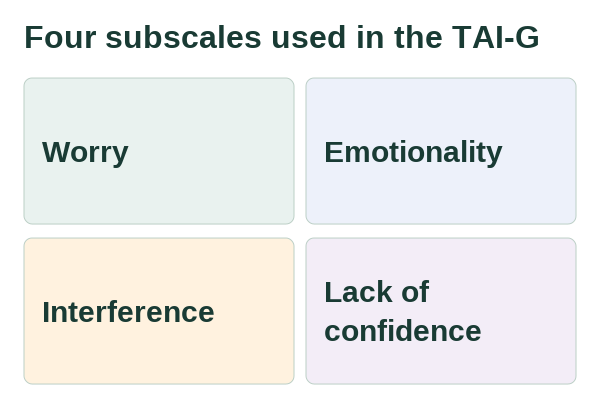
A 1994 study checked this four-part structure in a new sample. The people tested were American and Egyptian. That study built a 20-item Revised Test Anxiety scale. Its items came from two earlier questionnaires. These were the Test Anxiety Inventory and the Reactions To Tests scale. When cross-validated, the four dimensions kept their structure. The estimates stayed steady and exact enough.[12]
The parts matter because they connect to different ways of coping. A 2004 study asked 162 students how they handled nerves and doubt before important exams. There were 75 males and 87 females. The coping strategies studied were task-orientation and preparation, seeking social support, and avoidance. They looked at each dimension on its own and controlled for overlap between them. This showed a more specific pattern. Worry went with task focus and preparation. It went against cognitive avoidance. Worried students tended to prepare and not to avoid. Low confidence was linked only to avoidance.[13]
Coping itself has been sorted into types. A 1986 study did this with 590 high school students. A principal component analysis is a method for grouping related items. It found four clear dimensions. Together they explained 32% of the total variance. Two of the parts ease feelings: anxiety control and repression. The other two help with action: danger control and situation control. The final questionnaire on coping with tests had good measurement properties.[1]
Researchers have not agreed on an exact definition of anxiety. The paper treats it as a state of excitation and tension that appears early in development. Anxiety can show itself in expecting a threat, in feeling it at the time, or in recalling a personal insecurity or danger. It is activated by cues that in general have been learned. Test anxiety concerns the situations and conditions in education that often set off anxiety. These include training, learning, and performance.[1]
Who is more likely to feel it
A 1991 study gave the Test Anxiety Inventory to 501 college freshmen. They were at a large city university. There were 219 men and 282 women. The two-part structure of worry and emotionality held for both groups. The groups did differ, however, in the unique variances of their factors. They also differed in how the factors varied together. They also differed in their average levels of worry and emotionality.[14]
Not every study finds gender a significant predictor. A 2017 study looked at 249 university students. Sex did not significantly predict test anxiety.[15]
Students who doubt their school ability tend to report more test anxiety.[16][15] A 2026 meta-analysis combined 30 studies with 27,865 Chinese secondary school students. It found a significant moderate negative correlation between academic self-efficacy and test anxiety, r = -0.359.[16] A meta-analysis is a statistical method that combines the estimates from two or more similar studies into one overall estimate of an effect.[17]
The 95% confidence interval ran from -0.405 to -0.312. The individual studies had reported correlations from −0.105 to −0.792. Grade level, geographic region and the test anxiety instrument did not significantly change the strength of the link. The tool used to measure academic self-efficacy did affect the link. The authors called that evidence preliminary. Some subgroups held only one or two studies.[16]
Family relationships also predict test anxiety in adolescents. All scales of differentiation of self had a negative link with both types of anxiety. The links were strongest for emotional reactivity and I-position. The results suggested a risk. Teenagers who are less differentiated may be at risk of high test anxiety. They may also risk low cognitive performance.[18]
Students with learning disabilities report more of some parts of test anxiety than other students do. A 2007 study compared 195 students with learning disabilities and 579 without them. In all, 774 students in Grades 4 through 12 took part. All of them completed a measure with several parts. It is called the Test Anxiety Inventory for Children and Adolescents. The factor structure of the scores was similar across the groups. Scores could therefore be compared fairly. Having a learning disability predicted higher Cognitive Obstruction/Inattention scores. It predicted lower scores on Performance Enhancement/Facilitation Anxiety and on the Lie scale.[19]
Why anxious students may score lower
Two explanations have competed for the poor test scores of anxious students. Anxiety blocks what was already learned, or the students lack study and test-taking skills. A 1985 review weighed two accounts. The first says anxiety gets in the way of recalling earlier learning. The second says study or test-taking skill deficits explain the findings. The review judged the two accounts as fitting together, not as rivals. Both could be true at once. It then proposed that anxiety harms performance by cutting the mental capacity available for solving the task. In this view, good study and test-taking skills help by cutting the mental capacity that different tasks demand.[20]
One study had 17 subjects with high test anxiety and 19 with low anxiety. They did a verbal memory task and a spatial memory task. A camera watched them. The highly anxious group reported more worry and self-concern about thinking. The low-anxiety group reported less. That group also took longer, on average, to respond on the verbal memory task. On the spatial memory task, however, there was no difference in how well people performed.[21]
Texts came at a fixed rate, either sentence by sentence or word by word. Students were high or low in test anxiety. The conditions were no interference, articulatory suppression (repeating sounds to occupy the loop), and irrelevant speech played aloud. This was especially true with irrelevant speech. When words appeared one at a time, anxious students understood less than non-anxious students. This held in both conditions that disrupt the articulatory loop. With no interference, the two groups understood equally well.[22]
Researchers disagree about whether that link causes the effect. It may be that weak skills produce both the cognitive test anxiety and the lower scores. Most causal theories hold that people differ in cognitive test anxiety. The reason is that they differ in how competent they see themselves to be. Priming competence weakened the link between cognitive test anxiety and test performance. It raised the scores of students with cognitive test anxiety.[23]
One study measured worry and distraction three months before exams. It used them to predict the grades of undergraduate students. Worry about tests was linked to being easily distracted. The link was not quite what the researchers expected. Worry predicted academic grades. The same was true of being pulled off task by harmless material unrelated to the exam.[24]
What makes tests more stressful
A 2021 quasi-experiment compared two formats. It used a group of 142 psychology education students. They signed up in 2018. Students reported slightly higher anxiety for multiple-choice questions than for a matching format. The means were 2.17 and 2.07 on the Reaction to Test scale.[25]
In a 1995 experiment, graduate students in an intermediate statistics course were randomly assigned to a timed or an untimed exam. Both low-anxious and high-anxious students did better on the final course examination. That exam had no time limit. The gain from removing the limit was larger for the high-anxious students. The researchers explained the pattern through differences in motivation. They also pointed to where attention goes during an evaluation.[26]
A 2010 study had 69 psychology students take the same exams in class and online. The design changed the order for different students. Students who were usually very anxious in class reported less anxiety online. Students with low classroom anxiety showed the opposite shift. The link between anxiety and exam performance was weaker online than in the classroom.[27]
A 1999 study compared paper and computer-adaptive versions of the GRE General Test. It found no support for the idea that the computer version would ease anxiety. The link between test anxiety and scores was similar for both versions.[28]
A 1993 study compared college students' reported anxiety in four subjects. These were English, mathematics, physical science and social science. Most of the sample was African American, Hispanic or Asian American. Physical science produced the highest self-reported anxiety about being judged. This held after controlling for how difficult the subject seemed and what the test demanded. Anxiety scores rose with how hard the subject seemed, whatever the subject. Telling students about test demands made no significant difference.[29]
Correlations between mathematics anxiety and test anxiety measures were nearly as high as correlations within each measure. The factor analysis gave some support for treating them as separate. But the two factors were fairly strongly linked.[30] A 1989 structural model used 219 university students. It found that statistics test anxiety differed from general test anxiety. Math self-concept and statistics achievement both had a negative link to statistical test anxiety.[31]
Safety behaviors and perfectionism in test anxiety
One study of 134 university students split perfectionism into adaptive and maladaptive forms and measured four goal orientations, which describe why a student pursues a task. Cognitive test anxiety went with lower scores on both performance measures. These were a word list recall test and grade point average. That anxiety was positively linked with maladaptive perfectionism. It was also linked with avoidance goal orientations. Gender, goal orientations and perfectionism together explained almost half of the variance in cognitive test anxiety, close to 50%.[32]
A larger study of 625 undergraduates used latent profile analysis, a method that sorts people into groups with similar patterns of scores. The best model had three similar groups, labeled low, medium, and high test anxiety. Three things predicted which group a student belonged to. They were gender, self-critical perfectionism and rigid perfectionism. They did so differently across the three groups.[33] Other work links test anxiety to putting off academic work and to burnout.[34][35]
Researchers studied 202 prelicensure nursing students. Most said they put off weekly reading assignments the most. Students with higher grade point averages put off academic work less.[34]
A survey studied 340 future mathematics teachers in Turkey. Both differed significantly by grade level.[35] Researchers studied 341 female high school students. Anxious thoughts had a positive, direct effect on test anxiety. Frustration tolerance and learning strategies had a negative, direct effect.[36]
Research
How common it is
Test anxiety is common enough that large surveys find a substantial minority of students reporting it.[3][37] A 2014 study looked at 2435 secondary school students in 11 English schools. It found that 16.4% called themselves highly test anxious.[3] An earlier study collected test anxiety scores from 1348 Key Stage 4 students in seven secondary schools in the North of the UK. It used the Test Anxiety Inventory, a questionnaire published by Spielberger in 1980.[38]
Reviews of the wider research point the same way. Tests are a major source of worry for many children in compulsory education. A 2001 review of the literature on children in compulsory education reported that test anxiety seems to be growing more common overall. The review suggested this rise may come from more testing in schools and the pressure it brings.[39]
Many said that getting help would make them look weak to their fellow students. Another 20.5% said they thought professors could not or would not help. This negative view may make it hard to spot students with test anxiety. Faculty and helping professionals can miss them. It may also make it hard to step in effectively.[37]
Most prevalence figures rest on self-report questionnaires, and the UK study called for further research on whether a North American measure of test anxiety suits a UK context.[38] The 2001 review also stressed that individual differences and the testing environment affect how much anxiety changes performance.[39] Even so, a large group of students may still gain from targeted support and intervention.[3]
Does anxiety lower test scores
The largest single test of the link came from 4,000 undergraduate and 1,414 graduate students. That 2005 study found a small but real inverse link between test anxiety and grade point average. The gap was visible in the averages. Undergraduates with low test anxiety averaged a B+. High-test-anxious students averaged a B. The pattern held for female graduate students. Their low-test-anxious members had much higher grade point averages than their high-test-anxious peers. Among male graduate students, however, the low and high test-anxious groups showed no significant difference in grade point average. Female undergraduates and female graduate students both reported significantly higher test anxiety than the men in their groups.[5]
A 2023 study looked at 114 pupils in Morocco, aged 16 to 17. It found a statistically significant link between test anxiety and academic achievement.[40] A 2001 experiment used 61 students past high school. It randomly placed them in a high or low threat of evaluation group. All the students did poorly and were less motivated. This was true in the highly evaluative classrooms. The test-anxious ones did especially poorly.[41]
A 2022 study asked whether anxious students do worse than their own knowledge would predict. It studied 309 medical students preparing for a high-stakes exam. They used a digital learning platform. Log files tracked each student's knowledge during the preparation phase. Mock exams shortly before the final exam gave an average performance score. Once knowledge level was controlled for, test anxiety did not predict exam performance.[42]
Measuring test anxiety
Newer scales also measure anxiety in children and adolescents. Their reliability has been combined across studies. A 2025 meta-analysis combined 38 alpha coefficients. They came from 34 studies of the Children's Test Anxiety Scale, or CTAS. Pooled reliability was .915 for the total scale and .867 for thoughts. It was .795 for autonomic reactions and .740 for off-task behaviors. The estimates varied between studies. School level, continent, country, scale type, language, publication type, mean age and mean scale score were all statistically significant moderators. The meta-analysis supported the CTAS as a reliable tool.[43]
The Test Anxiety Inventory for Children and Adolescents, or TAICA, is a self-report measure. It has 45 items. It is for elementary and secondary school students. It gives a Total Test Anxiety score and four subscales for harmful test anxiety. It also gives one scale for helping test anxiety and a Lie scale. The four harmful subscales are Cognitive Obstruction/Inattention, Physiological Hyperarousal, Social Humiliation and Worry. The sample was 206 children and adolescents who volunteered. TAICA scores showed strong to very strong internal consistency. They also stayed stable over a 1- to 3-week test-retest interval.[44]
Another measure for teenagers is the FRIEDBEN Test Anxiety Scale. It has 23 items and three subscales. The subscales are Social Derogation, Cognitive Obstruction and Tenseness. Social Derogation covers worries about being belittled by people who matter. This happens after failing a test. Cognitive Obstruction covers poor concentration and failure to recall. It also covers trouble solving problems before or during a test. Tenseness covers both bodily and emotional discomfort.[45]
The Cognitive Test Anxiety Revised scale is also called CTAR25. It was adapted for Portuguese teenagers. They were aged 12 to 19. They were in middle and high schools. The sample numbered 279 adolescents. They also filled in questionnaires. These covered test anxiety, self-esteem, procrastination and worry. The Portuguese version showed solid internal consistency, solid test-retest reliability, and solid validity.[46]
The English version went to 360 students from 22 countries. Of these, 123 were female and 237 were male. A confirmatory factor analysis backed the three-factor structure. The fit indices included χ2/df=1.94, CFI=.98, NFI=.96, NNFI=.98, IFI=.98, RMSEA=.05 and SRMR=.05. The alpha scores for internal consistency were .81, .77, .91 and .92. These were for Physiological effects, Psychosocial effects, Cognitive effects and the total scale, in that order. The Stratified Alpha score was .93.[47]
Short forms matter when time limits make a full questionnaire impractical. The TAI was completed by 333 undergraduate psychology students, and item-remainder correlations compared short forms of varying length. The researchers measured internal consistency. They also tested concurrent validity and construct validity. They did this in imagined and real exam settings. A short form of 5 items had the best reliability and validity. It drew evenly on the Worry and Emotionality subscales.[48]
A 2021 study tested the invariance of the State Test Anxiety Scale. It used 956 university students. They varied by gender, faculty and socioeconomic level. The scale has 22 items and three parts: cognitive, psychosocial and physiological. Metric equivalence held for gender in all three dimensions. For faculty, it held in the thinking dimension. For socioeconomic status, metric equivalence was shown only for the scale as a whole. None of the variables examined met scalar and strict equivalence. These are levels of measurement equality across groups.[49]
The German Test Anxiety Inventory, or PAF, is one of the most widely used scales for teenagers. Given to Italian students, it showed evidence of validity, a supported five-factor structure and good internal consistency.[50]
A study of 437 college undergraduates found that TAI scores rose for females. Scores for males stayed constant. Females and males both showed positive correlations between the TAI and the state-trait anxiety inventory. The TAI had a significant negative link with grade point average. This held in females only. The researchers said to be careful when drawing conclusions from the original TAI norms. This applied especially to female undergraduates.[51]
Groups at risk and open questions
A 1988 meta-analysis of 562 studies named ability, gender and school grade level as conditions that give rise to different levels of test anxiety.[2] A study looked at 1,023 students aged 18 to 26 in Singapore and the United States. Females scored significantly higher than males on all five test anxiety scales used.[52] Among 916 Chinese high school students, girls also scored higher than boys on trait test anxiety.[53] A study of 56 primary school students with intellectual disabilities found that girls reported much higher test anxiety than boys.[54] One study of 100 ninth-grade students in India did find a significant difference between female and male students on test anxiety.[55]
One sample had 60 junior high or middle school students and 30 high school students. It also had 90 university students, all in Bulgaria. Test anxiety went down with age. The same study found higher test anxiety during the school or academic year than at its start.[56] Among 59 students at the University of Prishtina, undergraduates reported much higher test anxiety than graduate students.[57] That effect was explained by lower memory self-efficacy, a person's belief in their own memory ability.[58]
Cognitive symptoms (r = -.20) and physical symptoms (r = -.24) were also higher for the high-stakes tests.[59] School relationships appear in the same picture. Good views of teacher-student and student-student relationships predicted lower trait test anxiety.[53] Perceived teacher support correlated strongly and negatively with test anxiety (r = -0.84). Anxiety was higher in mainstream education than in special education.[54]
In a survey of 550 undergraduates in Pakistan, no relationship was found between socioeconomic status, a family's income and social position, and test anxiety. That study also found female students higher than males on both socioeconomic status and test anxiety.[60] A small study looked at 27 gifted junior high and high school students in Kansas. It found moderate levels of test anxiety. Their test anxiety scores were not significantly linked to their depression scores. The sample was too small to consider sex, age or grade.[61]
Several studies in this literature rest on small samples or a single setting.[61][62] A survey used a large, stratified random sample of GRE test takers. Students who reported more worry and emotionality tended to score lower. The link was moderate. The report said plainly that these results do not show which way cause and effect run. Anxiety could harm performance, or poor performance could raise anxiety. Other factors could also affect both. The same survey found the relationships almost the same for each ethnic or racial group it looked at.[63]
A 2025 study looked at 200 undergraduates at two institutions. It found no difference in test anxiety before the 2020 pandemic. The same was true during the move to pandemic status and during quarantine. Yet those students' levels were the highest ever compared with earlier groups. Females showed greater vulnerability in both academic stress and test anxiety.[64] Open questions remain about which of these correlates are causes, and at what levels anxiety starts to hinder rather than help a test taker.[63]
How anxiety changes thinking under time pressure
Lee's study examined how test anxiety affects each subsystem of working memory. Test anxiety lowered performance on a verbal-analogies task, which asks for reasoning with words, but not on rhyming-judgment or visual-spatial tasks. The researcher suggested that silently sounding out the rhyming words may have focused attention on the task itself. This blocked the effect of anxiety.[65]
A study of 113 eleven-year-olds found that trait test anxiety had a direct and harmful effect on working memory task performance. The task was mental arithmetic. That effect held whether state anxiety, the anxiety felt in the moment, was measured by self-report or by cortisol, a stress hormone.[66]
In three experiments, students waited for a time that was not set in advance. Then they worked on an intellective task. Students with high test anxiety estimated the waiting and performance periods as significantly longer than other students did. They also performed at a relatively low level. Sarason and Stoops proposed that anxious people under stress have cognitive interference and preoccupation. This makes time seem to pass slowly and hurts performance.[67]
Researchers studied 142 upper-division university students. Predicted scores on two examinations were inversely related to test anxiety. For the group as a whole, however, the accuracy of those predictions did not differ by level of test anxiety. One exception appeared: for females on one examination, highly test-anxious students predicted more accurately.[68]
Reiter presented the same reading comprehension items as high-stakes rather than low-stakes. Mean reported anxiety rose from 3.10 to 4.02, and mean scores fell from 7.35 to 6.78. In one study, 49 high school seniors took two 15-minute reading comprehension tests. The items were similar to those on the SAT. Mean reported anxiety rose from 3.10 on the low-stakes assessment to 4.02 on the high-stakes one, on a scale from 1 to 10. Mean reading comprehension fell from 7.35 to 6.78 across the same two assessments. The researcher concluded that how a test is presented may affect how well students perform.[69]
Csirmaz and Kasos studied two components of test anxiety: task-irrelevant behaviors and cognitive interference. Both were significantly associated with dropout. A two-year study looked at 98 Hungarian university students.[70]
Anxiety across subjects, formats and student groups
Researchers studied 301 students at a one-year English preparatory school in Turkey. Test anxiety and foreign language anxiety rose together. Foreign language anxiety was linked to lower language achievement. In that group, test anxiety itself showed no relation to language achievement scores.[71]
A study of pre-intermediate learners of English found that foreign language anxiety and test anxiety both correlated negatively with final exam grades.[72] Chinese language learners taking the HSK, a standard Chinese proficiency test, showed a moderate level of test anxiety, with a mean of 20, 43 points on the Test Anxiety Scale.[73] Statistics courses raise their own version of the problem. The study looked at female graduate students in a statistics course. High anxiety was tied more strongly to underachievement when the exam was time-limited than when it was not.[74]
Forty English students at an Egyptian university were randomly assigned to paper-and-pencil or computer-based versions of the same reading and listening tests.[75] Multiple-choice tests are a third format studied: among 727 English learners, greater use of multiple-choice test-taking strategies went with lower test anxiety and higher language achievement. That study found no gender difference in strategy use or in the degree of test anxiety.[76]
In the Turkish sample of 301 students, females scored higher than males on both the test anxiety and foreign language anxiety scales.[71] Researchers studied 100 English students at a Saudi university, 50 male and 50 female.[77] Students with vision impairment also get test anxiety. In South Australia, most adult females and all adult males with vision impairment scored high. Many adolescents scored in the high to moderate range. Many of those participants scored higher on the emotionality part of the scale, which covers bodily reactions, than on the worry part.[78] Children and young people with learning difficulties can also experience test anxiety. A systematic review found only nine papers on the topic.[79]
Among 221 Nigerian high school students, younger urban groups did better academically than older rural groups.[80] A 2006 article on multicultural learners argued that schools need ways to tell two causes of poor performance apart. One is weak knowledge, the other is test anxiety. It proposed three assessments for this purpose: the Test Anxiety Scale for Children, the Lie Scale for Children and the Defensiveness Scale for Children.[81] Not every study links anxiety to poorer results. One study looked at 415 university students in China.[82]
In practice
Interventions and how well they work
A 2003 meta-analysis pooled 56 studies with 2,482 participants. It found an overall mean effect size of 0.65, with a 95 percent confidence interval of 0.58 to 0.73.[4] An effect size is a statistical calculation of how large a measurable effect is, for example the difference between the averages of two groups divided by the standard deviation.[83]
On anxiety measures, the average person who completed treatment was better off than 74 percent of people who received no treatment. The strongest results came from programmes that combined skill-focused methods with behavioural or cognitive methods. Programmes run one on one produced the greatest changes. So did those mixing one-on-one with group counselling.[4]
In one before-and-after study, 30 nursing students at a rural university took part in a cognitive behavioural intervention. They completed the Cognitive Test Anxiety Scale. A two-tailed dependent-samples t-test found a statistically significant drop in test anxiety scores. The result was p < .001.[84]
A randomised trial had 120 senior secondary school students in South East Nigeria. It compared a cognitive behavioural therapy programme with a control group. Students in the therapy group reported lower test anxiety than the control group. Their scores were still much lower at follow-up.[85]
A short programme of three sessions was run for Iraqi university students. It combined three things: expressive emotional dialog, psychoeducation and cognitive behavioural techniques. Sixty participants were put at random into the programme or a control group. The programme reduced test anxiety. But state anxiety, the temporary kind felt in the moment, showed no significant change at post-test.[86]
A 2024 meta-analysis covered 18 primary studies and 20 comparisons. It had 1,275 participants. It found an effect size of −0.716, with a 95% confidence interval of −1.383 to −0.049. The size of the effect changed little with the average age of the participants. It also changed little with the number of sessions or how the programme was delivered. That review warned that a test for publication bias gave p = 0.025. It said the results should be read with caution.[87]
A quasi-experiment had 186 trained youths aged 12 to 18. It also had 217 matched controls. It found that online mindfulness training lowered test anxiety. The online training helped most among students with serious problems getting along with others.[88]
A randomised controlled trial took 60 college students. Each had a Test Anxiety Scale score of at least 50. They received one of two things. One group got 8 weeks of mindfulness-based stress reduction, 90 minutes per week. The other got no intervention. Right after the programme, the intervention group scored 42.5 and the control group 56.8. One month later the scores were 43.1 and 57.2. The intervention group was again much lower. Mindfulness level partly explained the effect. The mediating value was −0.32, or 45.7 percent of the total effect.[89]
A 2022 meta-analysis included 15 of 16 controlled trials. It found that exercise reduced test anxiety. The comparison was a control group that did nothing. One session of 10 to 15 minutes did not ease test anxiety. That figure is a minimum.[90]
A meta-analysis combined 7 randomised controlled trials with 425 participants. Inhaled aromatherapy lowered test anxiety in college students. The standardised mean difference was −0.67, with p < 0.01.[91] A standardized mean difference (SMD) is the difference between the mean values of two groups, divided by the standard deviation.[92]
The results varied widely, with an I² of 72%. The included studies had a moderate risk of bias. Mixed essential oils worked best, with a standardised mean difference of -0.91. So did cloths or pads as the delivery device (−1.03). Aromatherapy did not differ from placebo control groups, however.[91]
One graduate biostatistics course tested humour with 98 students. The study used humorous and serious versions of the same test content. Humorous directions had a statistically significant effect (p < .05) on constructed-response items in the first test. The effect size was .43. Anxiety before the test was very low and test performance was very high. These two features blocked any other significant effects.[93]
A 10-week emotional schema therapy programme targets beliefs about emotions. It was given to 40 female high school students in Ahvaz, Iran. They were split evenly into two groups: an experimental group and a control group. It also raised distress tolerance, academic self-efficacy and academic resilience. The result was P < 0.001.[94]
Eighth graders took part in a 10-week programme about test anxiety. It clearly lowered test anxiety and irrational belief scores in the experimental group.[95] One study split 200 college students into four groups of 50. Cognitive therapy, reading therapy, and the two combined each significantly reduced test anxiety (P < 0.05). The group without test anxiety content showed no significant change. The group given both cognitive and reading therapy showed the greatest decrease. It also got the highest personal rating of the counselling classes.[96]
Hembree's meta-analysis combined the results of 562 studies of academic test anxiety. Hembree's meta-analysis found that several kinds of treatment work. It also reported that better test performance and grade point average (GPA) consistently accompany the reduction of test anxiety. Hembree reported that this finding was contrary to prior perceptions.[97]
Von der Embse, Barterian and Segool reviewed treatment studies published between 2000 and 2010. Even so, several techniques showed promising results in that review.[98] A small semi-experimental study tested a psycho-education program with ten eighth-grade students who had high test anxiety scores. The program ran for 7 sessions. The students' test anxiety scores and personal indecisiveness fell afterward.[99]
Brodersen's integrative review covered 33 publications from 1973 to 2014. It identified 19 interventions for test anxiety in undergraduate nursing students. Experimental evidence supported aromatherapy, music therapy, and various cognitive or behavioral interventions. Nonexperimental evidence supported three methods: collaborative testing, crib sheets, and humorous exam items.[100]
A separate systematic review of 7 articles sorted nursing interventions into two groups. The groups were environmental adjustments and student behavior modifications. That review called for future research. It asked whether these interventions change examination grades.[101]
Quantitative studies of standards-based grading, an alternative grading method, found that it reduced students' test anxiety. In standards-based grading courses, a gap in test anxiety usually seen between male and female students did not appear.[102] A low-stakes trial recorded test anxiety scores from 226 students before a final exam. It surveyed them afterward. Students with high anxiety reported a statistically significant reduction compared with peers at low or medium levels (p<0.05 and Cohen's d=0.47).[103]
Ndung'u and colleagues tested an Inquiry-Based Stress Reduction intervention with pharmacy students. They found no significant reduction in pre-exam anxiety. In a randomized study of 86 pharmacy students, one group learned an Inquiry-Based Stress Reduction technique. Their anxiety scores did not differ much from a control group's before exam 2 (p = 0.99). The same held before exam 3 (p = 0.60). Average baseline anxiety was moderate to severe. It was 51/80 on the State-Trait Anxiety Inventory. Even so, 67% of the intervention group said the technique helped. Another 58% reported a new approach to taking tests, and 61% said their view of themselves had changed.[104]
Coping, support and self-protection
A 1997 study sorted the ways people cope into 79 basic tactics. These grouped into five strategy types. The five types were Positive Thinking, Relaxation, Preparation, Resignation, and Concentration. Students with high test anxiety were more likely than other students to report Preparation and Concentration.[105]
In a 1982 experiment, students with high test anxiety reported more anxiety. This happened when anxiety could explain a poor result on an intelligence test. They reported less anxiety when it could not serve as that explanation. Anxiety was not a usable excuse in that case. The same students reported putting in less effort instead. This was a second way to soften a possible failure.[106]
Study habits are part of the picture, and anxious students may differ from calm ones in how they prepare. A 1972 study found that students low in harmful test anxiety had better study habits. They also avoided putting off school tasks.[107]
The strongest significant links to academic performance came from three scales. These covered study and exam-related thoughts, time management and study strategies. A repeat study showed the same pattern. It had 156 first-year medical students at a different university. In a regression analysis, only Test Competence and Time Management contributed significantly. The multiple R was .61.[108]
Three 1981 experiments varied social support. In one study it meant a chance to be with peers. In another it meant contact with an accepting, empathetic experimenter. Social support helped the performance of highly test-anxious subjects in particular. It seemed to reduce self-preoccupation.[109]
Academic buoyancy is a broader personal quality. It is the ability to deal well with school pressures and setbacks. A 2023 review argues that academic buoyancy protects students from high test anxiety and its negative results. The review describes how buoyancy may work through the Self-Regulatory Executive Function model of test anxiety. It also raises important questions about how to define and measure buoyancy. This matters because buoyancy is linked with test anxiety.[110]
Coping styles differ. A 1999 study of undergraduates linked trait test anxiety to two distinct mental factors. The mental measures also predicted some aspects of how students responded during the examination itself.[111]
Anxiety in specific subjects and test formats
Students high and low in anxiety preferred different formats. Yet the two groups did not differ in how difficult they found each format.[112] Speaking tests can be built in two ways. In independent tasks, a student speaks without input. In integrated tasks, a student sums up reading and listening material aloud. Researchers studied 352 students of English as a foreign language. Test anxiety significantly affected performance on integrated tasks. It affected independent and integrated performance in a statistically equivalent way. That result suggests integrated tasks do not reduce test anxiety or its effect on scores. They threaten valid measurement just as independent tasks do.[113]
Among 140 pre-university students, mathematics test anxiety and numerical anxiety both correlated positively with mathematics achievement, and all the anxiety variables were statistically significant in multiple regression.[114] In general chemistry, a study of 128 freshman engineering students found that test anxiety made the strongest unique contribution to predicting course grade. That contribution was statistically significant only for students in peer-led team learning. It stayed significant after controlling for trait anxiety.[115]
Girls scored higher than boys on the four negative parts, while boys scored higher on perceived control. Age predicted only the self-focus part, and in the negative direction.[116] Other-avoidance goals did not predict the negative factors in physical education, unlike general academic test anxiety. They did negatively predict perceived control.[117]
Chiropractic training assesses students with written examinations and with objective structured clinical examinations. Worry and emotionality predicted written scores better than a total anxiety score did. Also, 85% of these students showed moderate-to-high test anxiety.[118]
Students who had repeated a year did not differ much from regular students in test anxiety symptoms.[119] A 2024 study compared nursing and nonnursing students. Test Anxiety Inventory scores differed little by major or academic level. Females reported higher levels.[120]
Body-based and alternative approaches
In one trial, 107 master's degree students were randomly assigned to a control group or to a group that practiced pranayama for one full semester. Before the final examination, only 33% of the pranayama group reported high test anxiety. In the control group the figure was 66.7%. The breathing group also had lower mean test anxiety scores (16.00 versus 19.31). They did better on the test.[121]
Each trained alone for 6 days and sent daily worksheets with photographs to the researcher. Both training groups showed large drops in test anxiety. The breathing group scored higher on positive thoughts than the reappraisal group and the control group.[122]
Progressive muscle relaxation targets the physical signs of anxiety. A survey of 404 teachers of first through fifth grade found good acceptance for using it in class. It would be used with a school psychologist or counsellor. It also needs a CD player or a digital music player. Special education teachers reported slightly lower acceptability for the digital music player version.[123]
One experiment took place in a grade XII class in Jakarta. Students heard classical music or music they preferred for fifteen minutes. This came before and during a reading comprehension test. Both kinds of music were linked to reading performance and test anxiety.[124]
A 2026 systematic review pooled 10 randomized controlled trials with 681 students. Of these, 371 were in intervention groups and 310 in control groups. Music-based interventions reduced test anxiety more than control conditions. The standardized mean difference was −1.21. The 95% CI was −1.79 to −0.63. Reductions were larger for interventions lasting 8 weeks or more (SMD = −2.14). They were also larger for sessions of 60 minutes or more (SMD = −1.89). They were larger for active music-making too (SMD = −2.21).[125]
Aromatherapy has a small evidence base for test anxiety: 3 of 4 reviewed studies found lower anxiety with it. A review of college-level studies found 4 suitable articles out of 10 first chosen. They used lemon, lavender and rosemary oils. The other study found no difference between groups. The reviewers note that more study is needed to link aromatherapy to exam scores. A firm conclusion must wait.[126]
A fatty acid mixture and therapy dogs have each been studied.[127][128] A sixteen-week study gave 6th grade students with high or extremely high test anxiety access to a therapy dog during academic testing. Scores on the Westside Test Anxiety Scale fell from the start to the end of the intervention. A t-test for paired samples confirmed this result.[127]
Two further approaches involve light exposure and eye movements.[129][130] In a randomized controlled pilot study, 35 university students received either bright light (1500 lx, 4000 K; n = 18) or standard light (100 lx, 3000 K; n = 17). Each condition ran for 4 hours over five evenings during exam preparation. By the last evening, test anxiety had fallen significantly in the bright light group. Sleep measures showed no bad effects.[130]
Eye Movement Desensitization and Reprocessing (EMDR) is a therapy used for test anxiety. A case report describes a 19-year-old patient. The patient had test anxiety and post-traumatic stress disorder. It calls EMDR a possible new treatment and gives 1-year follow-up results. The report notes that no agreement on test anxiety treatments exists yet. Other conditions often make the picture harder to read.[129]
Cognitive, mindfulness and writing interventions
Cognitive therapy for test anxiety works with the statements students make to themselves about exams. One study interviewed 32 test-anxious university students. They were interviewed after their first examination following such an intervention. Most students reacted well. But some worried that repeating positive statements about oneself might be deceptive. Those students found their own ways around the doubt. Some examined flaws in negative self-statements, and some treated reduced anxiety as evidence.[131]
One study compared mindfulness-based acceptance therapy with cognitive behavioral therapy for test anxiety. Both experimental groups scored much lower than a control group. The two treatments did not differ much from each other.[132]
A mindfulness program of 12 weekly sessions was tested with 105 university students. They were assigned non-randomly to training or control groups. Adaptability rose significantly compared with the untreated students.[133] A study of 150 students aged 17 to 18 measured state anxiety and mindfulness. They measured these before and after 12 minutes of one of three activities. The activities were free drawing, mandala coloring, or mandala coloring with recorded mindfulness instructions.[134]
In one experiment, students with high test anxiety wrote expressively or neutrally. They then did modular arithmetic under high stress. State anxiety was much higher in the control group than in the writing group under pressure. Among students with high working memory capacity, the writing group showed no significant difference between the two stress conditions. So the writing reduced the drop in performance under pressure.[135]
One brief strategy is to look through a test's problems before starting to solve them. A randomized field experiment studied 117 primary school students. Looking ahead on a math test lowered anxiety and raised performance. Students who did not look ahead did worse. The benefit appeared for all students. This held whether their anxiety level was low, medium or high.[136]
The timing of practice tests may also matter. In one study, 154 female undergraduates took online practice tests. Some took them before the midterm, others before the final exam. Both groups showed a significant fall in test anxiety over time. The fall was larger in the group that practiced early. Final exam performance had a significant negative link with test anxiety.[137]
Seminar and online formats have been tried with veterinary and university students.[138][139] A voluntary seminar used cognitive, behavioral and skill-deficit methods. It was offered to first- and second-year veterinary students at three German schools. The seminar significantly prevented and reduced test anxiety compared with control students. The effects were greatest for first-year students and for a block course format.[139] A guided internet counseling program had six modules over 6 weeks. It included weekly written contact with a therapist.[138]
Students then tore off the page and crumpled it. They threw it into the nearest aisle before starting the exam. Students could not begin the exam early. Even so, they spent only about two minutes writing. Cleaning up the papers during the exam was fairly easy. There was laughing and paper airplanes in the room. The instructors sorted the anonymous pages into categories.[140]
A later experiment tested expressive writing in a psychology class. It also tested a second intervention that gave instruction. It ran across four real exams. Neither intervention reduced test anxiety or improved exam performance.[141]
Encouragement has also been tested with large groups. One field experiment was planned in advance and registered in public. It used the whole student body of the University of Szeged in Hungary. Treated students got an automated message before exams, sent by e-mail and text message. It praised their past achievements. It also signaled trust in their success. Students in the control group received no encouragement. On average, the messages had no effect on end-of-semester exam grades. The messages changed motivation before the first exam but not before the second.[142]
A preliminary UK study assigned 47 adolescents aged 16 to 17 to eight sessions of compassionate mind training or to a control group. Assignment was quasi-random, based on when timetables were free. The 22 adolescents who got the training showed big drops in test anxiety. Their general anxiety also fell. They also showed a significant rise in self-compassion, compared with the 25 controls. The researchers called the program workable and effective. They also described the study as early or preliminary.[143]
Clinical cases and open questions
A published case report from 2025 describes a 15-year-old female student. She had significant test anxiety. Her anxiety showed up as physical discomfort and avoidance of academic work. It also brought persistent negative thoughts. Treatment combined cognitive behavioral therapy, family psychoeducation (teaching the family about the problem), and structured academic support. Symptoms fell by a measurable amount. The report treats this as evidence that early combined psychological help can ease school-related anxiety in adolescents.[144]
Students describe their own ways of handling test anxiety. These accounts include both helpful and harmful choices. Most students used positive strategies, but some reported undesirable ones, such as misuse of authorized drugs and cheating on written work.[145]
Anxiety may not harm every student's performance equally. Cai, Wang and King analyzed PISA data from 387,107 adolescents (mean age 15.80) in 51 countries. For most students, higher test anxiety went with lower achievement. For low-status students, the negative effect got weaker as status rose. For medium-status students, it got worse. For the very-high-status group, 0.03% of the sample, the effect turned positive.[146]
Csirmaz and Kasos reported the first study to examine how different components of test anxiety relate to university dropout. It used online questionnaires at three points over two years. By the final measurement, 69 had graduated or dropped out.[70]
What this looks like when you study
In a large introductory biology course of 101 students, the instructor placed a writing prompt on the cover page of each exam. Students had five minutes to write down their thoughts and feelings about the upcoming exam. They then ripped off the page, crumpled it, and threw it into the aisle before starting the test. Most students wrote for only about two minutes, and the crumpling and throwing seemed to ease tension, with laughing and paper airplanes.[140]
The instructor sorted the anonymous writings into categories such as doodling, pep talks, course content, and anxious thoughts. Pep talks were counted 19 times on the first exam and 31 times on the fourth. Anxiety-only responses dropped from 14 on the first exam to 3 on the second. The authors suggest instructors consider using this intervention because the logistics were manageable and reading students' thoughts made them more empathetic.[140]
In a randomized controlled trial, 197 Chinese senior high school students were assigned to expressive writing or a control group. For three days before their semester examination, the students wrote each day for ten minutes. The writing did not lower state test anxiety on the day before the exam, and it did not raise scores, which went against what the researchers expected. The authors suggest that writing focused on feelings about past tests, such as satisfaction, may still be beneficial.[147]
Academic self-efficacy means perceived competence in specific academic domains. He suggests directions that teachers, school counselors and education policymakers might explore when designing interventions.[16] To try the expressive writing approach, write about your thoughts and feelings about the exam for a few minutes right before the test starts.[140]
Criticism
Open questions and limits of the evidence
A 1985 study looked at students in a college statistics course. Test anxiety went with poor performance both early and late in the term. The researchers adjusted for state anxiety. The link then appeared only in the later stages of the course.[148]
A 1974 study compared two anxiety questionnaires. One questionnaire's total score predicted cumulative grade point average in men. It did not in women.[149]
A 1968 study followed 93 third-grade pupils for 1 month. They did daily arithmetic testing and daily practice. It found no difference in test anxiety between the two conditions. It also found no difference in defensiveness against admitting anxiety. This held on the immediate achievement posttest and on the delayed one.[150]
A 1985 experiment on visual vigilance used 20 male and 20 female subjects. Detection rate fell across the 36 minutes of the task. This happened among high-anxiety subjects who believed they were being tested. It also happened among low-anxiety subjects who did not.[151]
A 2024 study looked at 300 students. There were 150 males and 150 females, aged 18 to 30. It reported a correlation of -0.86 between anxiety and performance.[152]
A 2002 study looked at 112 students. They were in four undergraduate educational psychology courses. Each student got two versions of an hourly exam. One counted toward the grade and one did not. Scores for test anxiety, test performance and test motivation all showed significant main effects for whether the test counted.[153] A 1977 study found that high test anxiety made students more likely to process information at the surface level. It also led to failed attempts at recall.[154]
A 2004 series of six studies built a questionnaire. It covered joy, hope, pride, relief, anger, anxiety, shame and hopelessness about tests. Many of its links with personality, learning, achievement and perceived health problems were stronger for emotions other than anxiety.[155] A 2021 scale for science anxiety was tested in 710 students in grades 7 to 10. It was also tested in 362 students in grades 11 and 12. It showed only modest links with test anxiety and with general anxiety.[156]
A study of 290 eleventh-grade students measured well-being and test anxiety over 1 year. The worry part of test anxiety predicted later drops in grade point average.[157] A 1989 study of 82 children measured test anxiety and helplessness twice. One measure came in third grade, the other in fifth. Helplessness in the third grade predicted achievement test scores two years later. Teacher reports may be a workable way to spot it.[158]
A 2024 study looked at bioscience students in a two-semester physics course. Self-efficacy and test anxiety predicted results on high-stakes assessments. They did not predict results on low-stakes ones.[159]
Common misconceptions
Many people believe that test anxiety always lowers scores, but the link is not uniform. In a study of 387,107 adolescents across 51 countries, the effect of test anxiety on achievement followed an S-shaped pattern as socioeconomic status rose: it weakened, then grew more severe, then faded. For high-status students the negative effect gradually disappeared, and for a very small very-high-status group it became positive.[146]
Key studies
| Year | Study | Sample | Design | Finding |
|---|---|---|---|---|
| 1986 | Powers[63] | a large stratified random sample of GRE test takers | survey | A significant proportion reported at least moderate test anxiety, and higher anxiety was associated with lower GRE scores. |
| 1988 | Hembree[2] | meta-analysis of 562 studies | Test anxiety causes poor performance and relates inversely to self-esteem; treatments that reduce it also improve test performance and GPA. | |
| 2003 | Ergene[4] | meta-analysis of 56 studies with 2,482 participants | The overall mean effect size for test anxiety reduction programs was 0.65, with a 95 percent confidence interval of 0.58 to 0.73. | |
| 2005 | Chapell et al.[5] | 4,000 undergraduates and 1,414 graduate students | correlational study | Test anxiety had a significant but small inverse relationship with grade point average in both groups. |
| 2017 | Doherty & Wenderoth[140] | 101 students in an introductory biology course | feasibility study of an expressive writing intervention | Students spent approximately two minutes writing, and the exercise was manageable and seemed to ease tension. |
| 2023 | Luan et al.[91] | 425 college students across 7 randomized controlled trials | meta-analysis | Aromatherapy with inhalation reduced test anxiety (SMD = −0.67), but there was no difference from placebo control groups. |
| 2024 | Yılmazer et al.[87] | 1,275 participants across 18 studies | meta-analysis | Across the 20 comparisons, mindfulness-based interventions lowered test anxiety by an effect size of −0.716, which the review describes as a moderate to large negative effect. |
| 2024 | Ndung’u et al.[104] | 86 pharmacy students | randomized controlled trial | A 1.5-hour seminar on inquiry-based stress reduction did not significantly reduce pre-exam anxiety, though 67% of the intervention group found it helpful. |
| 2026 | Liu et al.[147] | 197 Chinese senior high school students | randomized controlled trial | Ten minutes of daily expressive writing for three days did not significantly reduce state test anxiety or improve performance. |
| 2026 | He[16] | 27,865 Chinese secondary school students across 30 studies | meta-analysis | Academic self-efficacy had a moderate negative correlation of −0.359 with test anxiety. |
| 2026 | Ge[89] | 60 college students with high test anxiety | randomized controlled trial | Eight weeks of mindfulness-based stress reduction lowered test anxiety scores significantly compared with no intervention, and the effect held at one month. |
| 2026 | Zou et al.[125] | 681 students across 10 randomized controlled trials | meta-analysis | Music-based interventions reduced test anxiety significantly (SMD = −1.21), with larger reductions for interventions lasting at least eight weeks. |
| 2026 | Cai et al.[146] | 387,107 adolescents in 51 countries | multi-layered moderation analysis of PISA data | For low-status students the negative effect of test anxiety weakened as socioeconomic status rose, for medium-status students it grew more severe, and for high-status students it disappeared. |
| 2026 | Reiter[69] | 49 high school seniors | within-subjects experiment | Mean anxiety rose from 3.10 to 4.02 and reading comprehension fell from 7.35 to 6.78 when the same test was described as high-stakes. |
See also
References
- (1986). Advances in test anxiety research. Scandinavian Journal of Behaviour Therapy, 15(3), 94-94. doi:10.1080/16506078609455769
- Hembree, R. (1988). Correlates, Causes, Effects, and Treatment of Test Anxiety. Review of Educational Research, 58(1), 47. doi:10.2307/1170348
- Putwain, D., & Daly, A. L. (2014). Test anxiety prevalence and gender differences in a sample of English secondary school students. Educational Studies, 40(5), 554-570. doi:10.1080/03055698.2014.953914
- Ergene, T. (2003). Effective Interventions on Test Anxiety Reduction: A Meta-Analysis. School Psychology International, 24(3), 313-328. doi:10.1177/01430343030243004
- Chapell, M. S., Blanding, Z. B., Silverstein, M. E., Takahashi, M., Newman, B., Gubi, A., & McCann, N. (2005). Test Anxiety and Academic Performance in Undergraduate and Graduate Students. Journal of Educational Psychology, 97(2), 268-274. doi:10.1037/0022-0663.97.2.268
- Shi, R., & Yuan, Y. (2024). Theoretical models, mechanisms, assessment methods, and intervention strategies for test anxiety: A narrative review. Journal of Clinical and Basic Psychosomatics, 3(2), 1. doi:10.36922/jcbp.3946
- Sarason, S. B., Davidson, K., Lighthall, F., & Waite, R. (1958). A test anxiety scale for children1. Child Development, 29(1), 105-113. doi:10.1111/j.1467-8624.1958.tb04866.x
- Wigfield, A., & Eccles, J. S. (1989). Test Anxiety in Elementary and Secondary School Students. Educational Psychologist, 24(2), 159-183. doi:10.1207/s15326985ep2402_3
- Putwain, D. W. (2008). Deconstructing test anxiety. Emotional and Behavioural Difficulties, 13(2), 141-155. doi:10.1080/13632750802027713
- Mealey, D. L., & Host, T. R. (1992). Coping with Test Anxiety. College Teaching, 40(4), 147-150. doi:10.1080/87567555.1992.10532238
- Hodapp, V., & Benson, J. (1997). The multidimensionality of test anxiety: A test of different models. Anxiety, Stress & Coping, 10(3), 219-244. doi:10.1080/10615809708249302
- Benson, J., & El‐Zahhar, N. (1994). Further refinement and validation of the revised test anxiety scale. Structural Equation Modeling: A Multidisciplinary Journal, 1(3), 203-221. doi:10.1080/10705519409539975
- Stöber, J. (2004). Dimensions of test anxiety: Relations to ways of coping with pre-exam anxiety and uncertainty. Anxiety, Stress & Coping, 17(3), 213-226. doi:10.1080/10615800412331292615
- Everson, H. T., Millsap, R. E., & Rodriguez, C. M. (1991). Isolating Gender Differences in Test Anxiety: A Confirmatory Factor Analysis of the Test Anxiety Inventory. Educational and Psychological Measurement, 51(1), 243-251. doi:10.1177/0013164491511024
- Onyeizugbo, E. U. (2017). Self-Efficacy, Gender and Trait Anxiety as Moderators of Test Anxiety. Electronic Journal of Research in Education Psychology, 8(20). doi:10.25115/ejrep.v8i20.1377
- He, W. (2026). The relationship between academic self-efficacy and test anxiety: a meta-analysis of Chinese secondary school students. Frontiers in Psychology, 17. doi:10.3389/fpsyg.2026.1891963
- GET-IT Glossary (plain-language health research terms) (n.d.). meta-analysis. GET-IT Glossary (plain-language health research terms). https://getitglossary.org/term/meta-analysis
- Peleg‐Popko, O. (2004). Differentiation and test anxiety in adolescents. Journal of Adolescence, 27(6), 645-662. doi:10.1016/j.adolescence.2004.06.002
- Whitaker Sena, J. D., Lowe, P. A., & Lee, S. W. (2007). Significant Predictors of Test Anxiety Among Students With and Without Learning Disabilities. Journal of Learning Disabilities, 40(4), 360-376. doi:10.1177/00222194070400040601
- Tobias, S. (1985). Test Anxiety: Interference, Defective Skills, and Cognitive Capacity. Educational Psychologist, 20(3), 135-142. doi:10.1207/s15326985ep2003_3
- Ikeda, M., Iwanaga, M., & Seiwa, H. (1996). Test Anxiety and Working Memory System. Perceptual and Motor Skills, 82(3_suppl), 1223-1231. doi:10.2466/pms.1996.82.3c.1223
- Calvo, M. G. (1996). Phonological Working Memory and Reading in Test Anxiety. Memory, 4(3), 289-306. doi:10.1080/096582196388960
- Lang, J. W. B., & Lang, J. (2010). Priming Competence Diminishes the Link Between Cognitive Test Anxiety and Test Performance: Implications for the Interpretation of Test Scores. Psychological Science, 21(6), 811-819. doi:10.1177/0956797610369492
- Keogh, E., Bond, F. W., French, C. C., Richards, A., & Davis, R. E. (2004). Test anxiety, susceptibility to distraction and examination performance. Anxiety, Stress & Coping, 17(3), 241-252. doi:10.1080/10615300410001703472
- Wahyuni, L. D., Citraini, R., Hutomo, B. A., & Gumelar, G. (2021). Anxiety and Test Form: The Differences of Test Anxiety Levels in Terms of Test Form. Jurnal Pengukuran Psikologi dan Pendidikan Indonesia (JP3I), 10(2), 184-192. doi:10.15408/jp3i.v10i2.17974
- Onwuegbuzie, A. J., & Seaman, M. A. (1995). The Effect of Time Constraints and Statistics Test Anxiety on Test Performance in a Statistics Course. The Journal of Experimental Education, 63(2), 115-124. doi:10.1080/00220973.1995.9943816
- Stowell, J. R., & Bennett, D. (2010). Effects of Online Testing on Student Exam Performance and Test Anxiety. Journal of Educational Computing Research, 42(2), 161-171. doi:10.2190/ec.42.2.b
- Powers, D. E. (1999). Test anxiety and test performance: Comparing paper‐based and computer‐adaptive versions of the GRE general test. ETS Research Report Series, 1999(2). doi:10.1002/j.2333-8504.1999.tb01813.x
- Everson, H. T., Tobias, S., Hartman, H., & Gourgey, A. (1993). Test anxiety and the curriculum: The subject matters. Anxiety, Stress & Coping, 6(1), 1-8. doi:10.1080/10615809308249528
- Kazelskis, R., Reeves, C., Kersh, M. E., Bailey, G., Cole, K., Larmon, M., Hall, L., & Holliday, D. C. (2000). Mathematics Anxiety and Test Anxiety: Separate Constructs? The Journal of Experimental Education, 68(2), 137-146. doi:10.1080/00220970009598499
- Benson, J. (1989). Structural Components of Statistical Test Anxiety in Adults: An Exploratory Model. The Journal of Experimental Education, 57(3), 247-261. doi:10.1080/00220973.1989.10806509
- Eum, K., & Rice, K. G. (2011). Test anxiety, perfectionism, goal orientation, and academic performance. Anxiety, Stress, & Coping, 24(2), 167-178. doi:10.1080/10615806.2010.488723
- Lowe, P. A. (2022). Exploration of Test Anxiety Profiles in U.S. Undergraduate Students. Higher Education Studies, 12(4), 9. doi:10.5539/hes.v12n4p9
- Custer, N. (2018). Test Anxiety and Academic Procrastination Among Prelicensure Nursing Students. Nursing Education Perspectives, 39(3), 162-163. doi:10.1097/01.nep.0000000000000291
- Takunyaci, M. (2021). An investigation on burnout, test anxiety, test motivation, and test attitude of prospective mathematics teachers in Turkey. African Educational Research Journal, 9(2), 562-569. doi:10.30918/aerj.92.21.071
- Saeedipour, M., & Pali, S. (2025). The Impact of Anxiety Thoughts, Frustration Tolerance, and Learning Strategies on Test Anxiety Among Female High School Students. Journal of Adolescent and Youth Psychological Studies, 6(1), 12-20. doi:10.61838/kman.jayps.6.1.2
- Gerwing, T. G., Rash, J. A., Allen Gerwing, A. M., Bramble, B., & Landine, J. (2015). Perceptions and Incidence of Test Anxiety. The Canadian Journal for the Scholarship of Teaching and Learning, 6(3). doi:10.5206/cjsotl-rcacea.2015.3.3
- Putwain, D. W. (2007). Test anxiety in UK schoolchildren: Prevalence and demographic patterns. British Journal of Educational Psychology, 77(3), 579-593. doi:10.1348/000709906x161704
- McDonald, A. S. (2001). The Prevalence and Effects of Test Anxiety in School Children. Educational Psychology, 21(1), 89-101. doi:10.1080/01443410020019867
- Merzaq, G. (2023). Effect of test anxiety on academic achievement of adolescents in educational practices: The effect of test anxiety on academic achievement. The Journal of Quality in Education, 13(21), 179-190. doi:10.37870/joqie.v13i21.349
- Hancock, D. R. (2001). Effects of Test Anxiety and Evaluative Threat on Students' Achievement and Motivation. The Journal of Educational Research, 94(5), 284-290. doi:10.1080/00220670109598764
- Theobald, M., Breitwieser, J., & Brod, G. (2022). Test Anxiety Does Not Predict Exam Performance When Knowledge Is Controlled For: Strong Evidence Against the Interference Hypothesis of Test Anxiety. Psychological Science, 33(12), 2073-2083. doi:10.1177/09567976221119391
- Tümtürk, E., & Sen, S. (2025). A Reliability Generalization Meta-Analysis of Children’s Test Anxiety Scale. Psychological Reports. doi:10.1177/00332941251320284
- Lowe, P. A., Lee, S. W., Witteborg, K. M., Prichard, K. W., Luhr, M. E., Cullinan, C. M., Mildren, B. A., Raad, J. M., Cornelius, R. A., & Janik, M. (2008). The Test Anxiety Inventory for Children and Adolescents (TAICA): Examination of the Psychometric Properties of a New Multidimensional Measure of Test Anxiety Among Elementary and Secondary School Students. Journal of Psychoeducational Assessment, 26(3), 215-230. doi:10.1177/0734282907303760
- Friedman, I. A., & Bendas-Jacob, O. (1997). Measuring Perceived Test Anxiety in Adolescents: A Self-Report Scale. Educational and Psychological Measurement, 57(6), 1035-1046. doi:10.1177/0013164497057006012
- Silva, J., Cunha, M., Galhardo, A., Couto, M., & Massano-Cardoso, I. (2017). Assessment of test anxiety in Portuguese adolescents: Psychometric properties of the Cognitive Test Anxiety Revised. European Psychiatry, 41(S1), S434-S434. doi:10.1016/j.eurpsy.2017.01.424
- ŞAHİN, A. (2021). Validation of a new State Test Anxiety Scale (STAS). International Journal of Assessment Tools in Education, 8(4), 872-887. doi:10.21449/ijate.838622
- Taylor, J., & Deane, F. P. (2002). Development of a Short Form of the Test Anxiety Inventory (TAI). The Journal of General Psychology, 129(2), 127-136. doi:10.1080/00221300209603133
- SELVİ, H. (2021). Investigation of Measurement Invariance of State Test Anxiety Scale. International Journal of Assessment Tools in Education, 8(3), 570-582. doi:10.21449/ijate.827105
- Donati, M. A., Izzo, V. A., Scabia, A., Boncompagni, J., & Primi, C. (2020). Measuring Test Anxiety With an Invariant Measure Across Genders: The Case of the German Test Anxiety Inventory. Psychological Reports, 123(4), 1382-1402. doi:10.1177/0033294119843224
- Szafranski, D. D., Barrera, T. L., & Norton, P. J. (2012). Test anxiety inventory: 30 years later. Anxiety, Stress, & Coping, 25(6), 667-677. doi:10.1080/10615806.2012.663490
- Lowe, P. A. (2021). Examination of Test Anxiety in a Sample of 18 to 26 year-old Singapore and U.S. Undergraduate Male and Female Students on the Test Anxiety Measure for College Students-Short Form. Journal of Psychoeducational Assessment, 39(8), 938-953. doi:10.1177/07342829211030402
- Liu, Y. Y. (2012). Students' Perceptions of School Climate and Trait Test Anxiety. Psychological Reports, 111(3), 761-764. doi:10.2466/11.10.21.pr0.111.6.761-764
- Mihăileasa, L. (2025). Test anxiety in students with disabilities. Human Education Today for Tomorrow’s World, 22(1), 77-83. doi:10.2478/hettw-2025-0018
- Rani, J., & Amuthavalli, T. G. (2021). The effect of test anxiety in IX class students. GLOBAL JOURNAL FOR RESEARCH ANALYSIS, 51-52. doi:10.36106/gjra/2807736
- Stoyanova, S. (2023). Test anxiety among secondary school students and university students. Problems of Psychology in the 21st Century, 17(1), 35-46. doi:10.33225/ppc/23.17.35
- Duraku, Z. H. (2017). Factors Influencing Test Anxiety Among University Students. The European Journal of Social & Behavioural Sciences, 18(1), 69-78. doi:10.15405/ejsbs.206
- Cavuoto, M. G., Franzese, S., & Kinsella, G. J. (2020). Pre-Test Experience and Memory Performance in Older Adults: The Impact of Test Anxiety and Self-Efficacy. Archives of Clinical Neuropsychology. doi:10.1093/arclin/acaa093
- Segool, N. K., Carlson, J. S., Goforth, A. N., von der Embse, N., & Barterian, J. A. (2013). Heightened test anxiety among young children: Elementary school students’ anxious responses to high‐stakes testing. Psychology in the Schools, 50(5), 489-499. doi:10.1002/pits.21689
- Shafiq, F., Cheema, A. B., & Khan, S. (2022). Students' SES status and Test anxiety of the Undergraduate University Students. Global Social Sciences Review, VII(II), 1-9. doi:10.31703/gssr.2022(vii-ii).01
- Beer, J. (1991). Depression, General Anxiety, Test Anxiety, and Rigidity of Gifted Junior High and High School Children. Psychological Reports, 69(3_suppl), 1128-1130. doi:10.2466/pr0.1991.69.3f.1128
- Arezi, A. A. Z., & Arezi, M. A. Z. (2025). Test Anxiety Among Special Education Students at the University of Dohuk, Iraq: Prevalence, Predictors, and Intervention Implications. Jurnal Theologia, 36(1), 1-12. doi:10.21580/teo.2025.36.1.26380
- Powers, D. E. (1986). Test anxiety and the GRE general test. ETS Research Report Series, 1986(2). doi:10.1002/j.2330-8516.1986.tb00200.x
- Manitzas Hill, H. M., Binte Alam, F., & Yeater, D. (2025). Investigating Current Academic Stress and Test Anxiety for Undergraduate Students Experiencing the Covid-19 Pandemic of 2020: Stress & Test Anxiety. Journal of the Scholarship of Teaching and Learning, 25(2). doi:10.14434/josotl.v25i2.36462
- Lee, J. H. (1999). Test Anxiety and Working Memory. The Journal of Experimental Education, 67(3), 218-240. doi:10.1080/00220979909598354
- Ng, E., & Lee, K. (2016). Test Anxiety and Children's Working Memory Task Performance: Does Trait or State Anxiety Matter More? Journal of Experimental Psychopathology, 7(3), 374-390. doi:10.5127/jep.054115
- Sarason, I. G., & Stoops, R. (1978). Test anxiety and the passage of time. Journal of Consulting and Clinical Psychology, 46(1), 102-109. doi:10.1037/0022-006x.46.1.102
- Lusk, S. L. (1981). Test Anxiety, Level and Accuracy of Predicted Performance. Psychological Reports, 49(2), 527-532. doi:10.2466/pr0.1981.49.2.527
- Reiter, M. (2026). Perceived Test Stakes, Test Anxiety, and Reading Comprehension in High School Seniors. Advances in Social Sciences Research Journal, 13(08), 188-195. doi:10.14738/assrj.1308.12086
- Csirmaz, L., & Kasos, K. (2026). Which Components of Test Anxiety Predict University Dropout? Youth, 6(1), 29. doi:10.3390/youth6010029
- Cakici, D. (2016). The Correlation among EFL Learners’ Test Anxiety, Foreign Language Anxiety and Language Achievement. English Language Teaching, 9(8), 190. doi:10.5539/elt.v9n8p190
- Salehi, M., & Marefat, F. (2014). The Effects of Foreign Language Anxiety and Test Anxiety on Foreign Language Test Performance. Theory and Practice in Language Studies, 4(5). doi:10.4304/tpls.4.5.931-940
- Junaeny, A. (2024). HSK test anxiety of chinese language learners in university students. Jurnal Cakrawala Mandarin, 8(2), 9. doi:10.36279/apsmi.v8i2.311
- Onwuegbuzie, A. J. (1995). Statistics Test Anxiety and Female Students. Psychology of Women Quarterly, 19(3), 413-418. doi:10.1111/j.1471-6402.1995.tb00083.x
- Ghaly, A. (2026). The impact of computer-based testing on EFL university students’ reading and listening skills test performance and test anxiety levels. Knowledge Management & E-Learning An International Journal, 493. doi:10.34105/j.kmel.2026.18.022
- Almalki, M. S. (2023). Multiple Choice Test-Taking Strategies, Test Anxiety, and EFL Students’ Achievement. World Journal of English Language, 13(2), 248. doi:10.5430/wjel.v13n2p248
- Falah Altamimi, D. H., & Altamimi, A. A. M. (2025). Examining Test Anxiety and Its Impact on Language Performance Among University Students: A Comparative Analysis by Gender. Journal of Curriculum and Teaching, 14(1), 106. doi:10.5430/jct.v14n1p106
- Datta, P. (2013). Test Anxiety: Benign or Malignant for Students with Vision Impairment? Disability Studies Quarterly, 33(3). doi:10.18061/dsq.v33i3.3313
- Fong, H., & Soni, A. (2022). A systematic review on test anxiety in children and young people with learning difficulties. Support for Learning, 37(1), 21-43. doi:10.1111/1467-9604.12393
- Akande, A. (1990). Influence of Urban-Rural Upbringing on Nigerian Students' Test Anxiety. Psychological Reports, 67(3_suppl), 1261-1262. doi:10.2466/pr0.1990.67.3f.1261
- Scholze, S., & Sapp, M. (2006). Understanding Test Anxiety and the Multicultural Learner. Multicultural Learning and Teaching, 1(2). doi:10.2202/2161-2412.1007
- Weng, F., & Liu, X. (2024). Exploring second language students’ language assessment literacy: impact on test anxiety and motivation. Frontiers in Psychology, 15. doi:10.3389/fpsyg.2024.1289126
- ERIC Thesaurus (n.d.). Effect Size. ERIC Thesaurus. https://eric.ed.gov/?ti=Effect+Size
- Parrish, A. R. (2022). The Impact of a Cognitive Behavioral Intervention on Test Anxiety in a BSN Program. Nursing Education Perspectives, 43(6), E97-E99. doi:10.1097/01.nep.0000000000000989
- Amedu, A. N. (2024). Reducing Economics Test Anxiety among Students as Measured by a Test Anxiety Scale: A Cognitive Behavioural Therapy. Journal of Economics Education and Entrepreneurship, 5(1), 59. doi:10.20527/jee.v5i1.9033
- Abdulbaqi, J., & Uzun, G. O. (2024). Effect of the Students’ Test Anxiety Prevention Program on Students’ Experiences of Test Anxiety: A Mixed-Methods Experiment. Sage Open, 14(4). doi:10.1177/21582440241296609
- Yılmazer, E., Hamamci, Z., & Türk, F. (2024). Effects of mindfulness on test anxiety: a meta-analysis. Frontiers in Psychology, 15. doi:10.3389/fpsyg.2024.1401467
- Liu, A., & Zhou, G. (2025). The Intervention Effect of Online Mindfulness Training in Alleviating Youths’ Test Anxiety. Youth & Society, 57(1), 117-138. doi:10.1177/0044118x241248476
- Ge, G. (2026). Intervention Effect of 8-week Mindfulness-based Stress Reduction on Test Anxiety in College Students: A Randomized Controlled Trial. Academic Journal of Education, 1(2), 46-51. doi:10.54097/bqw5vy98
- Zhang, X., Li, W., & Wang, J. (2022). Effects of Exercise Intervention on Students’ Test Anxiety: A Systematic Review with a Meta-Analysis. International Journal of Environmental Research and Public Health, 19(11), 6709. doi:10.3390/ijerph19116709
- Luan, J., Yang, M., Zhao, Y., Zang, Y., Zhang, Z., & Chen, H. (2023). Aromatherapy with inhalation effectively alleviates the test anxiety of college students: A meta-analysis. Frontiers in Psychology, 13. doi:10.3389/fpsyg.2022.1042553
- NAEP Glossary of Terms (n.d.). standardized mean difference. NAEP Glossary of Terms. https://nces.ed.gov/nationsreportcard/glossary.aspx#standardized_mean_difference
- Berk, R. A., & Nanda, J. (2006). A randomized trial of humor effects on test anxiety and test performance. Humor – International Journal of Humor Research, 19(4). doi:10.1515/humor.2006.021
- Moradpour, A., & Bavi, S. (2025). The Effectiveness of Emotional Schema Therapy on Academic Self-efficacy, Test Anxiety, Distress Tolerance, and Academic Resilience in Students with Test Anxiety. Educational Research in Medical Sciences, 14(1). doi:10.5812/ermsj-160978
- Bedel, A., Ercan, A. B., & Şahan, B. (2020). The Effect of Test Anxiety Psychoeducation Program on Test Anxiety and Irrational Beliefs. Education and Science, 45(203), 275-286. doi:10.15390/eb.2020.8570
- Du, Y., & Lan, J. (2024). Relieving Test Anxiety in College Students Through Different Psychological Intervention Programs. Journal of Engineering and Science in Medical Diagnostics and Therapy, 7(2). doi:10.1115/1.4063597
- Hembree, R. (1988). Correlates, Causes, Effects, and Treatment of Test Anxiety. Review of Educational Research, 58(1), 47-77. doi:10.3102/00346543058001047
- von der Embse, N., Barterian, J., & Segool, N. (2013). Test Anxiety Interventions for Children and Adolescents: A Systematic Review of Treatment Studies from 2000–2010. Psychology in the Schools, 50(1), 57-71. doi:10.1002/pits.21660
- Kaya, M. (2015). Psycho Education Program for Prevention of Test Anxiety on 8th Grade Students to Reduce Anxiety and Indecisiveness. European Journal of Interdisciplinary Studies, 1(1), 37. doi:10.26417/ejis.v1i1.p37-43
- Brodersen, L. D. (2017). Interventions for Test Anxiety in Undergraduate Nursing Students: An Integrative Review. Nursing Education Perspectives, 38(3), 131-137. doi:10.1097/01.nep.0000000000000142
- Quinn, B. L., & Peters, A. (2017). Strategies to Reduce Nursing Student Test Anxiety: A Literature Review. Journal of Nursing Education, 56(3), 145-151. doi:10.3928/01484834-20170222-05
- Lewis, D. (2022). Impacts of Standards-Based Grading on Students’ Mindset and Test Anxiety. Journal of the Scholarship of Teaching and Learning, 22(2). doi:10.14434/josotl.v22i2.31308
- Estrella Mountain Community College, Posta, F., Valenti, E., & Grand Canyon University (2021). Student Inspirational Posting as a Low-Stakes Intervention to Reduce Test-Anxiety. Journal of Scholarly Engagement, 4(1), 74-84. doi:10.9743/jse.2021.4.1.7
- Ndung’u, M., Galal, S., Tran, E., Peng, M., Chang, J., Vyas, D., Mayberry, J., & Chima, A. K. (2024). Impact of Inquiry-Based Stress Reduction Intervention on Pharmacy Students’ Test Anxiety. Trends in Higher Education, 3(4), 1175-1182. doi:10.3390/higheredu3040069
- Kondo, D. S. (1997). Strategies for coping with test anxiety. Anxiety, Stress & Coping, 10(2), 203-215. doi:10.1080/10615809708249301
- Smith, T. W., Snyder, C. R., & Handelsman, M. M. (1982). On the self-serving function of an academic wooden leg: Test anxiety as a self-handicapping strategy. Journal of Personality and Social Psychology, 42(2), 314-321. doi:10.1037/0022-3514.42.2.314
- Wittmaier, B. C. (1972). Test Anxiety and Study Habits. The Journal of Educational Research, 65(8), 352-354. doi:10.1080/00220671.1972.10884344
- Kleijn, W. C., van der Ploeg, H. M., & Topman, R. M. (1994). Cognition, Study Habits, Test Anxiety, and Academic Performance. Psychological Reports, 75(3), 1219-1226. doi:10.2466/pr0.1994.75.3.1219
- Sarason, I. G. (1981). Test anxiety, stress, and social support. Journal of Personality, 49(1), 101-114. doi:10.1111/j.1467-6494.1981.tb00849.x
- Putwain, D. W., Jansen in de Wal, J., & van Alphen, T. (2023). Academic Buoyancy: Overcoming Test Anxiety and Setbacks. Journal of Intelligence, 11(3), 42. doi:10.3390/jintelligence11030042
- Matthews, G., Hillyard, E. J., & Campbell, S. E. (1999). Metacognition and maladaptive coping as components of test anxiety. Clinical Psychology & Psychotherapy, 6(2), 111-125. doi:10.1002/(sici)1099-0879(199905)6:2<111::aid-cpp192>3.0.co;2-4
- Green, K. E. (1981). Test Anxiety Level and Test Format Preference. Psychological Reports, 48(2), 537-538. doi:10.2466/pr0.1981.48.2.537
- Huang, H. D., & Hung, S. A. (2013). Comparing the Effects of Test Anxiety on Independent and Integrated Speaking Test Performance. TESOL Quarterly, 47(2), 244-269. doi:10.1002/tesq.69
- Seng, E. L. K. (2015). The Influence of Pre-University Students’ Mathematics Test Anxiety and Numerical Anxiety on Mathematics Achievement. International Education Studies, 8(11), 162. doi:10.5539/ies.v8n11p162
- Eren-Sisman, E. N., Cigdemoglu, C., & Geban, Ö. (2018). Determinants of General Chemistry Success of Engineering Students in PLTL and Traditional Classroom: State Anxiety and Test Anxiety. SHS Web of Conferences, 48, 01051. doi:10.1051/shsconf/20184801051
- Danthony, S., Mascret, N., & Cury, F. (2020). Test anxiety in physical education: The predictive role of gender, age, and implicit theories of athletic ability. European Physical Education Review, 26(1), 128-143. doi:10.1177/1356336x19839408
- Danthony, S., Mascret, N., & Cury, F. (2021). The relationships between the 3 × 2 achievement goal model and test anxiety in Physical Education. European Physical Education Review, 27(3), 559-573. doi:10.1177/1356336x20971325
- Zhang, N., & Henderson, C. N. R. (2014). Test anxiety and academic performance in chiropractic students*. Journal of Chiropractic Education, 28(1), 2-8. doi:10.7899/jce-13-20
- Latas, M., Pantic, M., & Obradovic, D. (2010). Analysis of test anxiety in medical students. Medicinski pregled, 63(11-12), 863-866. doi:10.2298/mpns1012863l
- Walker, C. (2024). Differences in Test Anxiety Scores Among Baccalaureate Nursing Students and Nonnursing Students. Nurse Educator, 49(4), 200-205. doi:10.1097/nne.0000000000001578
- Nemati, A. (2013). The effect of pranayama on test anxiety and test performance. International Journal of Yoga, 6(1), 55. doi:10.4103/0973-6131.105947
- Cho, H., Ryu, S., Noh, J., & Lee, J. (2016). The Effectiveness of Daily Mindful Breathing Practices on Test Anxiety of Students. PLOS ONE, 11(10), e0164822. doi:10.1371/journal.pone.0164822
- O’Donnell, P. S., & Dunlap, L. L. (2019). Teacher acceptability of progressive muscle relaxation in the classroom for the treatment of test anxiety. Journal of Psychologists and Counsellors in Schools, 29(2), 151-165. doi:10.1017/jgc.2019.1
- Pamungkas, A. S. (2021). Pengaruh musik klasik dan preferensi pribadi terhadap test anxiety dan hasil tes membaca komprehensif siswa [the effect of classical music and personal music preference on test anxiety and reading comprehension test results]. Jurnal Teropong Pendidikan, 1(2), 86. doi:10.19166/jtp.v1i2.3458
- Zou, H., Liu, C., Luo, J., Chen, Y., He, Y., & Liu, Y. (2026). Effects of music-based interventions on test anxiety in students: a systematic review and meta-analysis. Frontiers in Psychology, 17. doi:10.3389/fpsyg.2026.1922862
- Wells, B., & Hopkins, K. (2018). Aromatherapy for test anxiety in college students: : a literature review. Journal of Contemporary Chiropractic, 1(1), 3. doi:10.67681/vfmx8549
- Markus, J., null, n., null, n., null, n., null, n., & null, n. (2017). The Effects of Animal-Assisted Therapy on the Self-Reported Test Anxiety in 6th Grade Students with Test Anxiety. Journal of Applied and Educational Research. doi:10.58809/fkzp3779
- Yehuda, S., Rabinovitz, S., & Mostofsky, D. I. (2005). Mixture of essential fatty acids lowers test anxiety. Nutritional Neuroscience, 8(4), 265-267. doi:10.1080/10284150500445795
- Özcan Çetin, K., Varlı, M. R., & Yavuz Ataşlar, E. (2025). Intervention with Eye Movement Desensitizaton and Reprocessing (EMDR) to Test Anxiety: A Case Report: Intervention with EMDR to Test Anxiety: A Case Report. Turkish Journal of Traumatic Stress, 1(1), 55-59. doi:10.63175/tjts.5
- Dick, M., Lackner, H. K., Weiss, E. M., & Canazei, M. (2025). Reducing Test Anxiety: A Randomized Controlled Pilot Study of Evening Bright Light Exposure in University Students. Depression and Anxiety, 2025(1). doi:10.1155/da/1422406
- Dundas, I., Anderssen, N., Wormnes, B., & Hauge, H. (2009). Exploring client contribution in a cognitive intervention for test anxiety. Counselling and Psychotherapy Research, 9(2), 86-92. doi:10.1080/14733140802639293
- BÜYÜKÖKSÜZ, E., & AVCI, R. (2023). The Quasi-experimental in Mixed Method: Mindfulness-Based Acceptance Therapy and Cognitive Behavioral Therapy in Test Anxiety: MINDFULNESS-BASED ACCEPTANCE THERAPY AND COGNITIVE BEHAVIORAL THERAPY IN TEST ANXIETY. Journal of Qualitative Research in Education(36), 187-215. doi:10.14689/enad.36.1810
- Yessimbekova, A., Galiyeva, A., Zhexembayeva, Z., Almukhambetova, B., & Abishev, N. (2025). Test anxiety, psychological adaptability, and learning performance: Effects of a mindfulness training intervention on university students. Journal of Education and Health Promotion, 14(1). doi:10.4103/jehp.jehp_1245_24
- Rose, S. E., & Lomas, M. H. R. (2020). The Potential of a Mindfulness‐Based Coloring Intervention to Reduce Test Anxiety in Adolescents. Mind, Brain, and Education, 14(4), 335-340. doi:10.1111/mbe.12255
- Yu, Y., & Zhang, X. (2022). Effects of Expressive Writing on “Choking under Pressure” in High Test-Anxious Individuals. International Journal of Environmental Research and Public Health, 20(1), 302. doi:10.3390/ijerph20010302
- Mavilidi, M., Hoogerheide, V., & Paas, F. (2014). A Quick and Easy Strategy to Reduce Test Anxiety and Enhance Test Performance. Applied Cognitive Psychology, 28(5), 720-726. doi:10.1002/acp.3058
- Al-Thani, A., & Akour, M. (2026). The Effect of Practice Test Timing on Students’ Test Anxiety and Exam Performance. International Journal for Research in Education, 50(2), 6-44. doi:10.36771/ijre.50.2.26-pp6-44
- Warnecke, I., Haffinger, L. M., Konradi, H., Reiss, N., Luka-Krausgrill, U., & Rohrmann, S. (2020). Design of a guided internet-delivered counseling intervention for test anxiety. The European Journal of Counselling Psychology, 8(1), 163-176. doi:10.5964/ejcop.v8i1.205
- Hahm, N., Augustin, S., Bade, C., Ammer-Wies, A., & Bahramsoltani, M. (2016). Test Anxiety: Evaluation of a Low-Threshold Seminar-Based Intervention for Veterinary Students. Journal of Veterinary Medical Education, 43(1), 47-57. doi:10.3138/jvme.0215-029r1
- Doherty, J. H., & Wenderoth, M. P. (2017). Implementing an Expressive Writing Intervention for Test Anxiety in a Large College Course. Journal of Microbiology & Biology Education, 18(2). doi:10.1128/jmbe.v18i2.1307
- Myers, S. J., Davis, S. D., & Chan, J. C. K. (2021). Does expressive writing or an instructional intervention reduce the impacts of test anxiety in a college classroom? Cognitive Research: Principles and Implications, 6(1). doi:10.1186/s41235-021-00309-x
- Keller, T., & Szakál, P. (2021). Not just words! Effects of a light-touch randomized encouragement intervention on students’ exam grades, self-efficacy, motivation, and test anxiety. PLOS ONE, 16(9), e0256960. doi:10.1371/journal.pone.0256960
- O’Driscoll, D., & McAleese, M. (2022). The feasibility and effectiveness of compassionate mind training as a test anxiety intervention for adolescents: A preliminary investigation. Counselling and Psychotherapy Research, 22(2), 301-310. doi:10.1002/capr.12447
- Begam J, M. (2025). A case of test anxiety in an adolescent: Clinical presentation and psychotherapeutic intervention. RMC Global Journal, 2, 33-36. doi:10.25259/rmcgj_11_2025
- Badrian, M., Bazrafkan, L., & Shakour, M. (2022). Medical science students’ experiences of test anxiety: a phenomenological study. BMC Psychology, 10(1). doi:10.1186/s40359-022-00896-4
- Cai, Y., Wang, C., & King, R. B. (2026). Is test anxiety bad for everyone’s academic performance? A multi-layered moderation analysis. Social Psychology of Education, 29(1). doi:10.1007/s11218-026-10284-0
- Liu, M., Yan, J., Guo, Z., Ma, L., Lu, Y., & Hu, C. S. (2026). Effects of Expressive Writing About Previous Negative Test Experiences on Test Anxiety and Performance. Collabra: Psychology, 12(1). doi:10.1525/collabra.159279
- Hunsley, J. (1985). Test anxiety, academic performance, and cognitive appraisals. Journal of Educational Psychology, 77(6), 678-682. doi:10.1037/0022-0663.77.6.678
- Harper, F. B. W. (1974). The Comparative Validity of the Mandler-Sarason Test Anxiety Questionnaire and the Achievement Anxiety Test. Educational and Psychological Measurement, 34(4), 961-966. doi:10.1177/001316447403400429
- Mann, L., Taylor, R. G., Proger, B. B., & Morrell, J. E. (1968). Test Anxiety and Defensiveness against Admission of Test Anxiety Induced by Frequent Testing. Psychological Reports, 23(3_suppl), 1283-1286. doi:10.2466/pr0.1968.23.3f.1283
- Geen, R. G. (1985). Test anxiety and visual vigilance. Journal of Personality and Social Psychology, 49(4), 963-970. doi:10.1037//0022-3514.49.4.963
- Zia, A. (2024). Personality Types, Test Anxiety and Test Performance: Personality and Gender Comparison. Regional Lens, 3(1), 9-18. doi:10.62997/rl.2024.31023
- Smith, L. F., & Smith, J. K. (2002). Relation of Test-Specific Motivation and Anxiety to Test Performance. Psychological Reports, 91(3), 1011-1021. doi:10.2466/pr0.2002.91.3.1011
- FRANSSON, A. (1977). On qualitative differences in learning: Iv—effects of intrinsic motivation and extrinsic test anxiety on process and outcome. British Journal of Educational Psychology, 47(3), 244-257. doi:10.1111/j.2044-8279.1977.tb02353.x
- Pekrun, R., Goetz, T., Perry, R. P., Kramer, K., Hochstadt, M., & Molfenter, S. (2004). Beyond test anxiety: Development and validation of the test emotions questionnaire (TEQ). Anxiety, Stress & Coping, 17(3), 287-316. doi:10.1080/10615800412331303847
- Megreya, A. M., Szűcs, D., & Moustafa, A. A. (2021). The Abbreviated Science Anxiety Scale: Psychometric properties, gender differences and associations with test anxiety, general anxiety and science achievement. PLOS ONE, 16(2), e0245200. doi:10.1371/journal.pone.0245200
- Steinmayr, R., Crede, J., McElvany, N., & Wirthwein, L. (2016). Subjective Well-Being, Test Anxiety, Academic Achievement: Testing for Reciprocal Effects. Frontiers in Psychology, 6. doi:10.3389/fpsyg.2015.01994
- Fincham, F. D., Hokoda, A., & Sanders, R. (1989). Learned Helplessness, Test Anxiety, and Academic Achievement: A Longitudinal Analysis. Child Development, 60(1), 138. doi:10.2307/1131079
- Malespina, A., Seifollahi, F., & Singh, C. (2024). Bioscience Students in Physics Courses with Higher Test Anxiety Have Lower Grades on High-Stakes Assessments and Women Report More Test Anxiety than Men. Education Sciences, 14(10), 1092. doi:10.3390/educsci14101092
Cite this page: Atlas Nova editors. (2026). Test anxiety. Atlas Nova. https://velocer.io/atlas/test-anxiety/