

Theory · Motivation and self-regulation
Achievement goal theory
Psychological motivation theory
Achievement goal theory proposes that the goal structures a learning environment emphasizes, including the classroom, shape the achievement goals that students take up. It includes both personal motivational features, called achievement goals, and contextual features, called goal structures.[1]
Each achievement goal is most strongly related to its matching classroom goal structure.[1] Classroom structures can influence children's orientation toward different achievement goals.[2]
Key facts
| 68 | number of studies in Bardach and colleagues' 2020 meta-analysis of goal structures and goals[1] |
|---|---|
| 47,975 | total students in Bardach and colleagues' 2020 meta-analysis[1] |
| 525 | junior high students in Wolters's 2004 study of goals in mathematics[3] |
| 237 | upper elementary students in Linnenbrink's 2005 five-week math study[4] |
Overview
What achievement goals are
One kind of achievement goal is about learning the content well. The other is about doing better than others or avoiding failure. The first is called a mastery goal. It is said to come from a growth mindset. That is a belief that intelligence and learning can improve. The second is called a performance goal.[5]
Achievement goal theory is a theory of motivation. It was built in recent decades. It aims to explain effort and success in social achievement and learning settings.[6] It also covers results in thinking and behavior.[6][7]
Achievement goals are defined strictly as aims. That strict definition leaves room for a separate question: why a person pursues the aim.[8] The reasons behind a goal can be autonomous, such as enjoyment or seeking a challenge. They can also be controlled, such as rewards.[9] Motivation is the process that starts and keeps up goal-directed activities.[5]
Goal setting is a mental link between motivation and motivated behavior. It is treated as a separate theory. Goals give activities a purpose and a direction. They push people to invest more effort and to keep going.[6]
Studies have tested whether appearance goals and normative goals work differently. Two university samples took part. They had 168 and 160 students. They reported their appearance goals, normative goals and mastery goals. They also said why they pursued normative goals. They reported several educational outcomes as well. Students sometimes pursued normative goals for autonomous reasons, such as enjoyment or seeking challenge. Those goals predicted self-efficacy and interest. They also fit better with mastery goals. Those goals worked just like appearance goals. They predicted help avoidance and self-handicapping.[9]
History
How the theory grew and split
The theory began with a simple split. It set a performance goal against a mastery goal.[10] In 1989 Nicholls set out a dichotomous theory built on task goals and ego goals.[11] Dweck in 1986 set mastery goals against performance goals as a good and bad pair.[9]
In 1996 Elliot and Harackiewicz split the performance goal into two separate orientations: approach and avoidance. Across two experiments, only performance goals based on avoiding failure reduced intrinsic motivation. That is the wish to do an activity for its own sake.[10]
Elliot (1997) put forward a three-part hierarchical model of approach and avoidance achievement motivation. A study looked at 336 Greek adolescents with a mean age of 13.45 years. It compared the older task and ego goals with the newer mastery and performance-approach goals. The two sets of goals were related but not identical. The older and newer versions overlapped so much that each added little prediction beyond the other.[11]
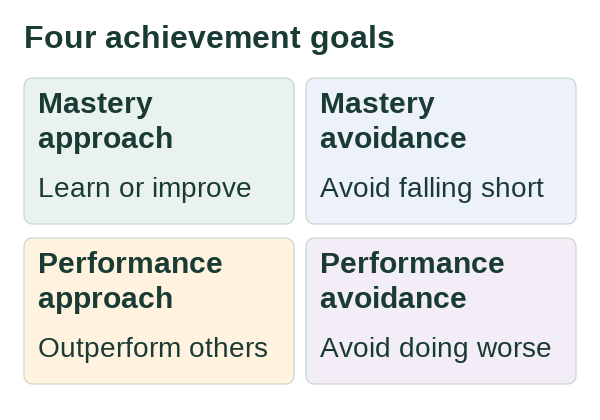
In 2001 Elliot and McGregor proposed a 2 x 2 framework with four goals. They are mastery-approach, mastery-avoidance, performance-approach and performance-avoidance. Across 3 studies, statistical analysis supported the four goals as separate constructs. They had a more positive profile than performance-avoidance goals.[12] Pintrich later built a model of multiple goals and multiple pathways to learning. Testing his 2 x 2 model was named as a direction for future research.[13]
The 2 x 2 framework has not gone unchallenged. A meta-analytic confirmatory factor analysis combined published studies. The studies used two common goal questionnaires. Models without mastery-avoidance fit the data better. The data suggest researchers should think about leaving that goal out.[14]
A parallel line of work asked whether performance goals are really one thing. The researchers offered the goal complex model as a way to unite the earlier models. It says a goal's effects depend on the student's reason for pursuing it.[9]
The 3 × 2 achievement goal framework appeared in the literature in 2011. A 2023 systematic review with meta-analysis found 56 articles. That gave 58 samples and 35,031 participants from 15 countries. Participants endorsed task-approach and self-approach goals more than the avoidance versions of each. Two things affected how strongly people endorsed goals. One was the setting (education or sport). The other was whether the setting was required. The review concluded that this literature is varied. It said the model's study must overcome built-in limits. One example is consistent response scale sets.[15]
Researchers have debated how many constructs the model includes and what those constructs are like.[14] One study tested competing models of goal structure. It looked at 134 students in grades 5 and 6 and 423 in grades 7 to 9. In the middle-school sample, the best fit came from a model with three factors. They were presentation goals, competition goals, and simple evaluation or mastery goals. In the junior-high sample, the best fit had three factors. One was avoidance. One was competition. One combined simple evaluation with mastery. Both age groups showed separate competition goals, but these were rare. Simple evaluation goals were closely tied to mastery goals.[16]
A 2016 paper proposed a 2 x 2 model of standpoints. It is built on two contrasts. One is development versus demonstration. The other is approach versus avoidance. In that work, development-approach and development-avoidance goals predicted higher intrinsic motivation. Demonstration-avoidance goals predicted it negatively.[17]
The revisions have not settled every dispute.[18] Gong and Li (2024) also look at the model where students hold several achievement goals at once. They suggest where later research should go.[7]
The 2 × 2 achievement goal framework sorts goals into four kinds. Combining the two questions yields four goals.[12]
Main ideas
Why goals lead to different outcomes
Students who see ability as fixed tend to endorse performance goals. Students who see ability as acquirable tend to pursue mastery goals.[19][20] An entity view treats ability as a fixed amount. It cannot change. An incremental view treats it as a skill that can be acquired. One study compared 48 students with an entity view of ability and 48 with an incremental view.[19]
Two studies found that perceived competence directly predicted achievement goals. It did not change the effects of implicit theories or goals.[21] Goal orientations affected achievement in an indirect way. The effect worked through perceived competence. Implicit theories of intelligence were not linked to academic achievement in that sample.[22]
How hard a goal looks to reach matters too. A mastery-approach or performance-approach goal that seemed harder to reach was pursued less often. That lower pursuit came with bad effects on task interest and achievement. People generally judged mastery-approach goals easier to reach than performance-approach goals.[23]
One study of 669 first-year college students found that mastery goals predicted more enjoyment. Enjoyment, in turn, predicted achievement. Mastery goals also predicted less boredom.[24]
Five studies looked at students in Grades 5 and 6. A performance-approach orientation went with more achievement, effort and persistence. It also went with less anxiety and depression. Negative feelings, low achievement and depression were linked to performance-avoidance goals.[25]
One process model says goals predict emotions. Emotions then predict learning strategies. Strategies in turn predict later achievement. Learning strategies affected later achievement only in the second semester. There, elaboration predicted gains.[26]
One review suggests that harmful emotions need close attention. These are the strong negative feelings that get in the way of performance. The review argues that managing these emotions is especially important. It matters for understanding how performance-approach goals relate to academic processes and achievement.[27]
Mastery-approach goals are thought to promote relational encoding, which links items. Performance-approach goals are thought to promote item-specific encoding. Three experiments used a retrieval-practice task. A meta-analysis combined their results. Retrieval-induced forgetting is the temporary loss of unpracticed items after others are practiced. The result was not statistically significant for mastery-approach goals. The results suggest that motivational factors can affect inhibition and forgetting.[28]
Goals also connect to the explanations students give for their results. This is the subject of attribution theory. The study looked at 224 high school students. Their achievement goals accounted for four kinds of attribution. No single goal type was clearly the strongest or most consistent predictor of them.[29]
A survey covered 516 students at private universities in Yogyakarta. Mastery-approach goals were the type that most consistently raised well-being. Performance-avoidance goals consistently lowered it. Performance-approach goals had various effects. Mastery-avoidance goals had no effect on academic self-efficacy.[30]
What shapes a student's goal orientation
A survey studied 1215 upper secondary students with a mean age of 17.5 years. A more incremental theory was positively correlated with two things. They were perseverance of effort and consistency of interest. A more incremental theory went with stronger learning goals and higher intrinsic motivation.[31]
Belief in the incremental theory of intelligence helped achievement.[32] Stronger learning goals went with stronger belief that intelligence can grow with effort.[33] A growth mindset positively predicted a mastery learning goal orientation.[34]
A study followed 2613 Chinese middle school students for one and a half years. Love withdrawal directly predicted lower academic achievement.[35] Only an authoritative style predicted a mastery approach. It did so positively. Permissive and authoritarian styles did not directly or indirectly predict students' goal orientations.[36]
Among 209 teachers, mastery goals for teaching predicted a classroom mastery goal structure.[37] Some pre-service teachers saw assessment as a way to hold students and schools to account. They favored a performance approach to assessment.[38] Perceived autonomy support positively predicted agentic engagement through mastery-approach goals. A controlling style, as students saw it, predicted less engagement through performance-approach goals.[39]
A review of 44 empirical studies found that students and teachers may see the motivational climate differently. Research has focused mostly on students' views.[40] A small study looked at 60 students aged 12 to 14. It found that the classroom setting affects how students view their achievement-related behavior. Those views in turn influence intrinsic motivation. That study did not support earlier findings. It called for a more systematic study of the link.[41]
Goals, feelings and the reasons behind them
Achievement goals and feelings seem to affect each other in both directions. But the influence is not equal in both directions. A 2002 model by Linnenbrink and Pintrich separates moods from emotions. It gives separate roles to personal goals. It also gives roles to the goal structures students perceive in a classroom. The same review warns that studies define and measure affect differently. So their findings are somewhat inconsistent. They are also hard to compare.[42]
A 2008 paper argues that early motivation theory placed feeling at the base of motivated behavior. That idea was mostly set aside for 30 years while social cognitive views dominated. That paper links approach and avoidance temperaments, meaning broad tendencies to move toward good things or away from bad ones, to the energy behind motives and then to goals.[43]
One study looked at 157 tenth graders and 135 eleventh graders at a Japanese girls' high school. It traced their goals back to two motives. One was wanting to succeed, and the other was wanting to avoid failure. Mastery goals, which center on learning and improving, arose mainly from the motive to achieve success. Performance-avoidance goals, which center on avoiding looking incompetent, arose mainly from the motive to avoid failure.[44]
Later work asked why a student holds a goal, not only what the goal is. It added reasons from self-determination theory, which sorts reasons into autonomous (chosen and endorsed) and controlling (pressuring). Researchers studied two samples of Turkish university students. One had 226 students (mean age 22.36) and the other had 331 students (mean age 19.5). Autonomous and controlling reasons also applied to mastery-avoidance goals.[45] A 2024 review reports that mastery aims mostly show strong links with autonomous reasons. Performance aims line up less clearly with their underlying reasons.[46]
High ego-oriented boys judge their competence against peers. They had high self-esteem only when they saw their own ability as high compared with others.[47] Self-efficacy was the only significant mediator between goal orientation and achievement. Hope, pride and hopelessness changed that link. Mastery and performance approach goals linked more strongly to motivational parts when positive emotions were higher and negative ones lower.[48]
Feedback about competence can shift which goals students pursue. In a college classroom, goal pursuit stayed largely stable through the semester. In a laboratory study, negative feedback reduced participants' mastery goal pursuit.[49]
Research
What the evidence shows
Results are mostly consistent for mastery goals, which center on learning and improving. They are less consistent for performance goals. These center on beating others or on avoiding a poor showing.[3][50]
The outcomes measured included persistence. They also included procrastination. They also included choice and use of cognitive and metacognitive learning strategies. They also included the mathematics grade.[3]
One study looked at 1,505 Peruvian students in grades 8 to 10. It found that mastery goals predicted more use of learning strategies. They also predicted higher academic achievement. Performance-avoidance goals showed the opposite pattern. They went with lower academic achievement. Performance-approach goals gave mixed results. But they showed no link to academic achievement.[50]
One study looked at 900 Filipino university students in an algebra class. It sorted them into four goal groups.[51] Not every sample shows a link between goals and grades. At the Matric, Intermediate and Bachelor levels, mastery goals showed no significant link with academic achievement. Performance goals showed none either. In that sample, performance goals did have a negative link with achievement at the masters level.[52]
Goals appear to work on achievement through study strategies, self-efficacy and test anxiety. Self-efficacy is a student's belief in being able to succeed. In an introductory statistics course, learning goals were positively linked to deep-processing strategies. They were also related to self-efficacy. They were linked to lower test anxiety. In that statistics course, performance goals went with disorganized study strategies. They also went with higher test anxiety. One surprising result was that deep-processing strategies were positively linked to effort. They were negatively related to achievement.[53]
Exam grades rose with performance-approach goals, mastery goals and strategic learning strategies. Grades had a negative link with performance-avoidance goals. They also had a negative link with a surface learning strategy. Strategic learning strategies carried the link between goals and grades.[54]
A long-term study looked at students of educational science. The motive to avoid failure predicted that students would take up avoidance goals.[55] A study followed 203 undergraduates over two years. It found that performance-approach goals predicted less critical thinking. In that study, performance-avoidance goals predicted more anxiety and more boredom. They also predicted smaller gains in achievement. Mastery-approach goals were linked to better emotions. Enjoyment went with better use of most learning strategies. Boredom came with worse time management. Anxiety came with weaker self-monitoring. It also went with a lower grade point average.[26]
A meta-analysis covered 355 studies with 155,208 participants. It examined six achievement goals and fifteen achievement emotions. Mastery goals and performance goals were linked to activity emotions. These emotions arise from doing the task. They were also linked to outcome emotions, which arise from success or failure. Work-avoidance goals were linked most strongly to negative feelings about activities. This matched what the theory predicted. Relational goals were linked to positive feelings. They were also linked to enjoyment. The researchers concluded that goals and emotions should be studied at a specific level. Studying them only at a general level is not enough.[56]
Experiments that assign a goal give a different kind of evidence. The goal comes before the outcome.[57][58] A meta-analysis covered 90 experiments, with 235 effect sizes and 11,247 participants. It found that induced mastery-approach goals improved performance. That gain held against performance-approach goals, performance-avoidance goals and no goal. But motivation did not get better. The advantage of mastery-approach goals depended on the standard used to define success. It also depended on how the goal was framed.[57]
A study looked at 1,201 students in Singapore, aged 13 to 17. A performance-approach goal went with higher intrinsic motivation. It also went with better mathematics performance. The model explained 35.9% of the variance in intrinsic motivation. It accounted for 13.8% of mathematics performance.[59]
How goals are measured and compared
A 2001 comparison put PALS alongside two other popular measures of task and ego goal orientations, meaning goals focused on learning the work versus goals focused on beating others.[60] The scale was given to 431 students in Indonesia. It showed good reliability. Every item met the required validity coefficient in an item correlation test.[61]
The revised questionnaire was given to 105 Greek university students. It kept its four-factor structure when questions were tied to one course. It did not keep it when questions asked about academic work in general. In that course-specific setting, a three-factor model fit as well as the four-factor one. Reliability for the factors ranged from .90 to .98.[62]
A newer scale, the Hexagonal Achievement Goal Scale for Students, splits mastery goals into task and learning parts. It splits performance goals into two parts: normative and appearance. The researchers first held cognitive interviews with 20 students. They then gave the scale to 1,131 secondary school students. Confirmatory factor analyses supported the six-part structure. The structure held across genders, age groups and a 6-week interval. School grades had a weak link to mastery goals. They also had a weak link to the normative facet.[63]
Two studies used such a measure. In them, about 85% of people reported a dominant achievement goal. The four groups showed distinct profiles on variables such as need for achievement, perfectionism and graded performance.[64] A later version of this dominant-goal method was tested on 165 university students. It captured the distribution of dominant goals, but the scores did not predict academic attainment.[65]
Goal measures differ in factorial validity and construct validity. They also differ in internal consistency reliability and in distributional characteristics.[60] Some scales cover schoolwork in general, while others are tied to one course. The Greek test showed that this choice can change whether the expected structure appears.[62] Work-avoidance goals predicted a lower academic grade in 165 university students.[65]
Later models also find support. One study of 149 students took place during the COVID-19 pandemic. It used a 3x2 questionnaire. It covered task, self and other goals, each split into approach and avoidance. That study found a significant link between goal orientations and achievement. Total goal orientations did not affect achievement. No differences appeared by gender.[66]
In practice
Classroom goal structures
The theory holds that these structures shape the achievement goals each student comes to hold.[1] A 1992 article described classroom structures by how they make different achievement goals stand out. It named three dimensions of the classroom that can turn children toward different goals. They are task, evaluation, recognition and authority. Ames argued for identifying the classroom structures that support a mastery orientation. That is a focus on learning and effort. She also called for working out how those structures relate to each other.[2]
A 2020 meta-analysis asked how closely students' ratings of goal structures match their own goals. It combined 68 studies with 47,975 students. It covered four goal structures and four personal goals. Each personal goal was most strongly linked to its matching classroom structure. Education level and world region changed how strong some links were. For most pairings, measures that framed a structure as a climate gave higher correlations. Measures that used the teacher as the reference point gave lower scores.[1]
One dimension was task design. This concerns tasks that are challenging and varied. It and the time dimension predicted mastery-approach and mastery-avoidance goals.[67]
A 2020 study surveyed 2,105 students in their first year of middle school. Perceived autonomy, recognition of competence and teacher support went with mastery goals. They also went with grades. Mastery goals predicted grades on their own. But the link disappeared when needs and goals were analysed together. No indirect path through mastery goals was found.[68]
Goal structures also relate to how students behave. This includes disruption. A 2002 study surveyed 388 ninth-grade students in 60 maths classrooms across five ethnically diverse high schools. Students' own mastery goals went with fewer reports of disruptive behaviour. Personal performance goals came with more. Disruption differed from one classroom to another. Pooled ratings of a mastery structure went with less of it. Pooled ratings of a performance-approach structure went with more.[69]
A performance goal structure changed how reading skill related to reading achievement. In those classrooms, a nonlinear model fitted the data. It explained 54% of the variance in real word identification. A mastery climate showed no such effect, and a linear model fit the data better. The study concluded that a stronger performance message in a class goes with sudden, unpredictable shifts in reading performance.[70]
Goals in subject areas and stages
A 2004 study looked at how people learn languages. It studied 135 third-year students in a preservice English teacher program. It found they stressed task mastery goals most. That focus on mastery was tied to language achievement. The researchers measured it with a TOEFL test. Mastery goals had a negative link with work-avoidance.[81]
A 2019 mixed-methods study looked at 165 Spanish second language students. Most held mastery approach goals, but all four goal orientations appeared in the sample. In that study, 67.1% of students named communication and speaking as a top goal. Another 41.8% named grammar as a main goal.[82]
A 2005 study looked at Taiwanese college seniors majoring in English. Some writers had stronger mastery goals than performance goals. They used monitoring, revising and compensating strategies more often than the other group. Two things strongly predicted better writing outcomes. One was how often students revised strategies. The other was mastery orientations.[83] A 2025 paper argues that studying only mastery and performance goals holds language researchers back. It says they then miss work avoidance, social goals and personal best goals.[84]
Writing researchers have built a subject-specific goal measure. Nursing educators have argued for combining achievement goal theory with the growth mindset model.[85][86] A writing achievement goal scale was tested with 697 middle school students. It was then tested with 563 high school students. The high school sample fit the data well. The model linked writing goals, writing self-efficacy, liking of writing and writing achievement.[86]
A 2024 article argues that mastery goals are part of the growth mindset model. It says they can be concrete signs for judging how nursing skills develop. The article notes that many nursing schools are moving to a competency-based model. Medical information and skills are growing more complex.[85]
Most links between goals and outcomes were small. These outcomes included learning strategies and motivations. The largest were between 0.30 and 0.42.[15]
A 2018 study looked at 103 student teachers in Singapore. They specialized in music, visual art or physical education. Achievement goals differed by subject. They were highest in each person's own specialty. Mastery-approach goals predicted enjoyment in each specialty.[87]
Mastery goals and performance-approach goals predicted more strategy use and higher intrinsic motivation. In that study, performance-avoidance goals predicted less use of effective strategies. Some students pursued both mastery and performance-approach goals. They showed better learning patterns than students with other goal profiles.[88] A 2006 study of students with ADHD found several interesting differences from students without ADHD. The differences were clearest for performance-avoidance goals.[89]
A 2022 experiment compared normative performance goals with non-normative ones. It involved 16 college students with dyslexia. The normative condition showed lower alpha and beta wave amplitudes. It also showed higher muscle tension and heart rate variability. This suggests more anxiety and stress.[90]
What students and teachers can do
A 2024 experiment tested whether encouraging mastery goals helps a scoring exercise. It involved amateur field hockey players. Encouraging a mastery goal raised scoring accuracy. This happened among players who held self-adopted performance goals strongly. It also helped players who did not strongly hold mastery goals of their own. The researchers did not expect this. The study found no support for one idea. Encouraging performance goals would not help players who already hold mastery goals. The findings suggest a mastery goal works best for people who do not already hold one strongly.[91]
How a teacher presents a mastery goal may matter, not just the goal itself. The study looked at 1,331 students. Some students saw their teachers as supportive of mastery goals. Those students were more likely to endorse those goals and to take part in class. Students' own reasons for learning helped explain that link. When students saw teachers as controlling, they tended to pull away. This showed up only inside classrooms. The researchers concluded that teachers should use more supportive practices and fewer controlling ones. That should help students take up mastery goals.[92]
Mastery goals predicted achievement only when presented as socially useful. They did not predict it when it was presented as socially desirable. The pattern was strongest among low achievers. These students most need mastery goals to succeed.[93]
Three later studies had 99, 94 and 130 students. Mastery-approach goals predicted performance only when students did not see them as socially desirable. Effort in behavior and interest in the topic carried that effect.[94]
Teachers hold achievement goals too, and these goals relate to how they seek help. Among 212 teachers, mastery goals predicted positive views of help seeking. They also predicted a preference for independent help and more frequent help seeking. Ability-avoidance goals predicted negative views. They also predicted avoiding help.[95]
Mastery goals for teaching and performance-approach goals for teaching both went with better instruction. Instructors who saw intelligence as changeable leaned more toward mastery goals. They leaned less toward work avoidance.[96]
Interventions that shift goal orientation
A 2016 study at Farhangian University of Isfahan, Iran, tested a teaching package built on Van Hiele theory. The design was quasi-experimental, with a pretest, a posttest and a control group. The 176 student teachers were randomly assigned to the two groups. This held for mastery-approach goals only. The difference was not significant for the other three orientations.[97]
A 2026 study in Debre Tabor City, Ethiopia, compared two forms of guided inquiry-based instruction. The subject was solid geometry. It compared them with a traditional teaching method. The 102 grade ten students were assigned to groups at random. The groups were guided inquiry with variation theory, guided inquiry alone, and traditional teaching. The 2026 study tested whether guided inquiry-based instruction helped when supported by variation theory. It compared this with guided inquiry alone and with a traditional method. Both inquiry groups scored significantly higher than the traditional group. The score was on the math achievement posttest. Gender, performance-approach posttest scores and the two teaching contrasts together explained 47.0% of the variance in achievement posttest scores. The study recommends adding this approach to teacher training. It also recommends adding it to curricula.[98]
Goals in sport and physical activity
Achievement goal theory in sport and physical activity is often built on approach and avoidance goals. Researchers study these across competitive sport, leisure activity and physical education. A meta-analysis covered 116 studies up to 1 December 2018, with 43,133 participants. It found the mastery-approach goal was endorsed more than the other three. Sport participants endorsed the performance-approach goal more than leisure-time physical activity and physical education groups did.[99]
A review covered 30 studies with 8708 participants. Task climate correlated 0.20 with sport performance and task orientation 0.17, both small. The authors warn that prediction intervals ran from negative to positive.[100] Archers with high goal orientation also made pre-competition score predictions that matched their actual results more closely.[101]
A meta-analysis covered 22 journal articles and 12 dissertations from Korea. Task orientation was more strongly linked to sport confidence than ego orientation was.[102] Across 37 independent samples, sport confidence correlated 0.33 with task climate and 0.27 with task orientation. It correlated 0.11 with ego orientation and −0.08 with ego climate.[103]
A meta-analysis of studies in Korea found task orientation had large effect sizes with sport confidence. Ego orientation had large effect sizes only for proving skills.[102] A meta-analysis of 41 independent samples found that task orientation correlated moderately to highly with positive affect. It correlated negatively with negative affect, at a moderate to small level. Ego orientation showed positive but very small correlations with both kinds of affect.[104]
Mastery-approach goals showed their largest corrected correlations with four outcomes. These were intrinsic motivation (0.52), relative autonomy (0.47), positive affect (0.42) and effort (0.40).[99] The mastery goal was linked to persistence, effort and one-mile run performance. The mastery goal combined with a perceived mastery-focused climate predicted one-mile run performance.[105]
Forty-eight Spanish national or international female team-sport athletes showed a strong mastery-approach goal in dominance and in pursuit, in both practice and competition. That profile stayed stable after a painful defeat, which did raise burnout and lower self-determined motivation.[106] The pattern of predictors differed between the two activities.[107]
Goals in college and adult work
A survey looked at 777 students in remedial and college-level math at a community college. It found goal patterns the researcher called adaptive. Those students wanted to develop competence. They also believed they could handle challenging work. The 777 community college mathematics students also reported avoiding self-handicapping behaviors. They held a positive mathematics self-concept. Interviews with the instructors of those courses showed a more negative view of the same students. The researcher suggested that instructors may not be using the confidence and motivation students bring to class.[108]
In general chemistry, students on average reported higher task and self orientations than other orientation. Task orientation means focusing on finishing the task well, Lewis says. It was positively linked to exam performance. Lewis describes self orientation as judging performance against one's own past performance. It was negatively related to exam performance. Students with low preference across all three orientations scored lowest on exams.[109]
A cluster analysis of accounting students produced four groups. They were multiple-goal, mastery, performance and low motivation. The results suggested that combining mastery and performance goals may give better course grades than holding one alone. It may also reduce harmful outcomes.[110]
Hadsell examined achievement goals in introductory and intermediate microeconomics. He also looked at locus of control and fear of failure. Hadsell described mastery orientation as a focus on learning and understanding. He described performance orientation as a focus on creating an aura of competence.[111]
One study looked at 363 postgraduate students at a college of education. Academic self-efficacy correlated positively with mastery-approach goals and with academic achievement.[112] Achievement goal orientation carried part of the effect of academic self-efficacy on achievement.[113] A survey of 256 university students took place in an English-Medium Instruction course in Taiwan. It found reading efficacy was the strongest predictor of academic achievement. Performance-avoidance goals came next, followed by organization strategies, reading involvement, and time and study environment strategies.[114]
Goal orientations have also been studied in school principals' goals for leading and in employees' burnout alongside their leaders' goals.[115][116] A factor analysis used scores from 270 Norwegian principals. It separated mastery goals for leading from performance goals for leading. Mastery goals for leading correlated positively with principals' efficacy beliefs for leading. They also correlated positively with autonomy and with trust between teachers and principals. Performance goals were weaker or not significantly correlated with those constructs.[115]
Two studies linked leaders' goals to employee burnout. The first had 362 members and 72 leaders, the second 177 employees and 46 leaders. Employees reported less burnout when their leaders held strong mastery-approach goals. This held even after the employees' own goals were taken into account. Leaders' performance-approach goals were positively related to burnout. This held in the first study and in the combined analysis.[116] One study looked at 621 Chinese faculty members. Innovative research behavior was positively linked to task-approach goals and negatively linked to learning-approach goals.[117]
What this looks like when you study
The class goal was set to mastery, performance-approach, or both together.[4] A separate survey of 525 junior high students looked at mathematics. A mastery classroom structure and a mastery orientation went with better persistence, less procrastination, and more learning strategies. The patterns for performance-approach structure were less uniform across those outcomes. So were the patterns for performance-approach and performance-avoidance orientations.[3]
Thirty-eight Taiwanese English-major college seniors took part in a study of writing goals. Nineteen of them had strong mastery and weak performance goals, and 19 showed the opposite pattern. The frequency of revising strategies and mastery orientation both predicted better writing outcomes.[83]
In one experiment, students were primed to pursue mastery goals or social comparison goals before they attempted tracing puzzles. Some students viewed ability as fixed. They improved when primed for mastery rather than social comparison, whether they had first seen success or failure feedback. Students who saw ability as learnable did about the same under either prime.[19]
Mastery-approach goals gave better performance than performance-approach goals in two cases. One was when mastery goals were set against task-referenced standards. The other was when social comparison was the standard used to create the performance-approach goals.[57]
The link between mastery goals and grades was then no longer significant.[68] Two studies had 317 and 1,331 students. Teachers who supported autonomy when presenting mastery goals had students who endorsed those goals and engaged more. That pattern appeared only at the within-classroom level.[92]
A learner trying a mastery goal can set the standard against their own past work on the same kind of task. In the meta-analysis, mastery-approach goals produced the best performance when they were based on task-referenced standards.[57] Students who see that teacher as supporting their autonomy then report stronger endorsement of mastery goals and more behavioral engagement.[92]
Later developments
Goals beyond the individual student
Most research on achievement motivation has focused on two achievement goals: task goals and ability goals. A 1995 review argued that schools can be understood better if researchers also study social goals. It defined social goals as the social purposes a student sees behind academic work. It set out seven areas for later research. The review also proposed that the learning environment can shape a student's social goal orientation.[118]
A socially oriented achievement goal was measured in 196 Chinese university students in Singapore. Of these, 144 were female and 52 male. The items were written around the important people in students' lives. A factor analysis grouped them into one factor, not four. This socially oriented goal went with stronger performance goals. It also went with a competitive motive. It showed no link to a mastery motive, work ethic or interest in learning. It predicted lower future engagement. Once mastery and performance goals were controlled, it did not predict test anxiety.[119]
A study of 1,210 Korean high school students grouped them by their social achievement goals: development, demonstration-approach and demonstration-avoidance. Four profiles emerged. They ran from a Development-Focused Low Social group of 7% to an Active Socialites group of 9%. The Active Socialites reported the highest academic achievement goals overall. They also reported more pride, anxiety and shame. The study described social motivation as central to how adolescents manage academic goals and emotions. The setting was a highly competitive Korean school.[120]
A mastery goal was positively linked to perceived psychosocial abilities (β = .16). It was negatively linked to low frustration tolerance (β = -.22).[121] Mastery goals were linked to a lower chance of dropping out. Performance goals were positively associated with it.[122]
Goals in digital and online learning
One survey of 238 pharmacy students, reported in 2022, measured achievement goal orientation during online learning. The average scores of the separate orientations showed no significant difference. This included the approach and avoidance dimensions. Even so, the average performance goal score was above the average mastery goal score in this group. Herdian and Subekti (2022) suggest that pharmacy students may be affected in their achievement goal orientation. They are members of a collectivist society.[123]
A study of 275 children in grades 4 through 6 found that mastery goals and performance goals both mattered. Each mattered for self-efficacy and for mastery experience in creativity. That motivation appeared to work through two routes. One was the experience of flow states. The other was stronger self-determination and self-efficacy. The same children spent a large share of their after-school time playing digital games.[124]
Open educational resources are low-cost alternatives to expensive textbooks. One question remains: do students stay motivated to learn when cost barriers are removed? A latent class analysis studied 247 college students in open educational resource courses. It found learner profiles of achievement goals. These were based on the 3 x 2 model. Three goal profiles appeared: an ambitious group, an independent group and an indifferent group. Students in the indifferent group scored much lower than students in the ambitious and independent groups.[125]
A 12-week quasi-experiment studied 148 second-year English majors. A mastery-approach orientation strengthened the effect of AI writing feedback on writing self-efficacy. A performance-approach orientation weakened it. One group got feedback from a GPT-4-based evaluation platform. A control group got ordinary feedback from teachers. The AI feedback raised writing self-efficacy with an effect size of d = 0.94. The largest gains came in ideation and self-regulation. A mastery-approach goal partly explained that gain and accounted for 33.4% of the total effect. A performance-approach goal did not mediate the relationship.[126]
Goals in sports, work and adult life
A 2018 study surveyed basketball players in the Polish II League, an amateur level. It also surveyed the Extraleague, a professional level. Kuczek (2018) measured task motivational orientation and task-oriented climate among Polish basketball players. In that study, task orientation and a task-oriented climate did not lower anxiety levels among the players. The results therefore did not confirm that achievement goal theory applies to high-level competitive sports.[127]
A 2024 survey asked 393 fitness center members about their goals. Mastery-oriented goals predicted higher perceived physical literacy than performance-oriented goals did. Participants aged 18 to 24 reported higher confidence and knowledge in physical literacy than participants aged 35 and above.[128] A 2017 review looked at studies in K-12 physical education. It examined how achievement goals relate to students' thinking, feelings and behavior in class.[129]
Furness (2020) tested whether several changeable psychosocial constructs predicted career adaptability. The study surveyed 210 people from three organizations. Setting mastery goals predicted career adaptability. This held only when people felt their supervisor supported their career autonomy. Anxious attachment predicted lower career adaptability. Avoidant attachment did not.[130]
A 2026 survey of 385 public institution employees looked at learning from mistakes at work. A mastery climate had positive effects on cause analysis, which is working out why a mistake happened. It also had good effects on strategy development. The hypotheses came from achievement goal theory. The results for performance climate did not support them.[131]
Two studies of 1151 and 771 German university scholars found that goals for teaching and goals for research can be separated. The two sets of goals still shared 26 to 67% of their variance. Goal pursuit worked more smoothly in the research setting. It varied more in the teaching setting.[132]
Family, culture and disadvantage
Parents shape the goals a student adopts. The effect depends on the kind of parenting the student perceives. The study surveyed 323 secondary school students aged 14 to 17. Some students saw their parents as authoritative. They reported mastery goals more often than students who saw their parents as authoritarian or permissive. Gender and parenting style together predicted mastery-approach and avoidant goals. No such combined effect appeared for performance goals.[133]
Researchers studied high school students. Family orientations, plus students' views of their parents' goals and of classroom goal structures, predicted achievement motivation. One study looked at 331 ninth graders in a United States high school. Family orientations strongly predicted a wish to outperform peers, partly because of inner pressure to meet parents' expectations.[134]
Cultural values relate to goals in ways that vary by group. Conformity to norms was negatively linked to performance-approach goals. Collectivism was positively related to mastery goals and to performance-approach goals.[135] A separate study looked at 715 students at two United States universities. It found that American students and international students learning English as a Second Language differed in their goal orientations and in their academic stressors. Student status and academic stressors predicted the students' different goal orientations.[136]
A study covered 273,269 students in 10,785 schools across 33 countries. Income inequality at the national and school level weakened the positive link between mastery-approach goals and achievement. The weakening was especially strong for students of lower socioeconomic status. It appeared in math, reading and science.[137]
Disadvantaged settings can also steer students toward performance goals. A survey covered 300 grade 12 Physical Sciences students in 6 South African schools from disadvantaged communities. It found a much stronger performance goal orientation than a mastery goal orientation. The students felt their teacher, school and parent stressed that same orientation. The researcher noted that poor results in the national Physical Sciences examination suggest a performance goal orientation may not serve these students well.[138]
Criticism
Performance goals and their defenders
Harackiewicz, Barron, Pintrich, Elliot and Thrash replied in 2002. They disputed how the challenge had described the findings. Their reply gave three reasons to revise the theory. The first was this: goals aimed at approaching success should be separated from goals aimed at avoiding failure. The second was that performance-approach goals can have good effects. The third was that these goals can combine with mastery goals to support good motivation. Mastery goals focus on learning the material. The reply supported what researchers call a multiple goal perspective. That is the view that holding more than one kind of goal can be useful.[139] A 2011 review said the debate was still running. The multiple goal view drew criticism from theorists who favor mastery goals.[18]
A 2005 classroom study tested this with 237 upper elementary students. They were in a 5-week math unit taught in small groups. The combined condition produced the most helpful pattern of results. Students' own mastery goals helped on 11 of 12 outcomes, including achievement. Students' own performance-approach goals hurt achievement and raised test anxiety. They showed no link to the other outcomes. The effect of the classroom condition was the same whatever goals students brought with them.[4]
A 2006 interview study of high school seniors found four broad kinds of reason. Students pursue performance goals for these reasons. The four were appearance-approach, appearance-avoidance, competition-approach and competition-avoidance. Within these categories, students gave many purposes. Examples are pleasing parents or proving something to themselves.[140]
Criticisms and open questions
There is an ongoing debate about the model. Should mastery-avoidance goals be included in it? A meta-analytic confirmatory factor analysis is a statistical check of whether test items measure what they claim.[14]
Other work found that mastery-avoidance goals came with higher cognitive anxiety, negative affect and fear of failure. The study looked at 96 college students facing a stressful exam. A second study looked at 70 students giving in-class presentations. Students with mastery-avoidance goals were more aroused than students with any other goal type.[141]
Another line of work asks why students pursue a goal, not only what it is.[9][8] One proposal draws on self-determination theory. It separates autonomous reasons from controlled reasons. It sets out five propositions for studying this why.[8]
Future goals seemed to matter a lot in how motivated adolescents were at school. The study called for research across all four domains.[142] The 2011 review of the field also named open controversies. It set future directions meant to join the traditional and multiple goal views.[18] The 3 × 2 model appeared in 2011 and splits goals by standard as well as by direction. Reviewers note that task goals and self goals still need to be told apart.[15]
Common misconceptions
Many people believe that mastery goals and performance goals are simply opposites, one good and one bad. A later revision argued that both goals can bring benefits and can be pursued together. Both views may be partly right, because they define performance goals differently. One means appearing competent, the other means outperforming peers.[9]
It is commonly assumed that the task and ego goals of Nicholls and the mastery and performance-approach goals of Elliot are the same constructs. A study of 336 Greek adolescents found that a model with five separate factors fit best. So the goals measured by the two questionnaires are related but independent.[11]
Mastery goals have traditionally been portrayed as the best goal for performance and well-being, which led to advice that teachers and coaches should encourage them. The expected benefit of inducing performance goals for players who already held mastery goals did not appear.[91]
Key studies
| Year | Study | Sample | Design | Finding |
|---|---|---|---|---|
| 1999 | Rawsthorne & Elliot[58] | meta-analysis of experimental studies on performance and mastery goals and intrinsic motivation | Performance goals undermined intrinsic motivation relative to mastery goals, but the effect depended on competence feedback and on whether the goal was approach or avoidance. | |
| 2001 | Elliot & McGregor[12] | three studies testing a 2 x 2 achievement goal framework | The four goal constructs were independent, and mastery-avoidance goals showed a more negative profile than mastery-approach goals and a more positive one than performance-avoidance goals. | |
| 2004 | Wolters[3] | 525 junior high school students | self-report survey | Wolters (2004) found that a mastery structure and a mastery orientation went with adaptive outcomes in every area measured. The links for performance-approach structure and for performance-approach and performance-avoidance orientations varied by outcome [3]. |
| 2005 | Thompson & Musket[19] | experiment with goal priming | Students with an entity view improved when primed for mastery rather than social comparison goals [5]. | |
| 2005 | Linnenbrink[4] | 237 upper elementary students | quasi-experimental classroom study over five weeks | The combined mastery and performance-approach condition showed the most beneficial pattern for help seeking and achievement [39]. |
| 2005 | He[83] | think-aloud study | The high-mastery-low-performance group used monitoring, revising, and compensating strategies more often [43]. | |
| 2007 | Matos et al.[50] | 1,505 Peruvian eighth to tenth graders | cross-sectional survey | Mastery goals predicted more strategy use and higher achievement, and performance-avoidance goals predicted lower achievement [100]. |
| 2020 | Bardach et al.[1] | 47,975 students from 68 studies | meta-analysis | Each achievement goal was most strongly related to its matching classroom goal structure [17]. |
| 2020 | Theis et al.[68] | 2,105 first-year middle school students | survey with multilevel models | Perceived need fulfilment correlated with mastery goals and grades, but mastery goals did not mediate that link [40]. |
| 2021 | Noordzij et al.[57] | 11,247 participants from 90 studies | meta-analysis of experiments | Induced mastery-approach goals raised performance but not motivation compared with other goal conditions [22]. |
| 2021 | Benita & Matos[92] | 317 students in Study 1 and 1,331 in Study 2 | two linked survey studies | Autonomy support for mastery goals was linked to stronger endorsement and engagement, mediated by autonomous reasons [69]. |
| 2023 | Fritz et al.[74] | 19,787 participants from 33 studies | meta-analysis | Mastery goals were negatively linked to academic dishonesty, while performance goals showed mixed results [15]. |
| 2023 | Lochbaum et al.[15] | 35,031 participants from 58 samples in 15 countries | systematic review with meta-analysis | Participants endorsed task and self-approach goals more than their avoidance counterparts [25]. |
| 2024 | Bross et al.[56] | 155,208 participants from 355 studies | meta-analysis | Mastery-approach goals had a large positive association with enjoyment (r = .43) and positive affect (r = .35) [13]. |
See also
References
- Bardach, L., Oczlon, S., Pietschnig, J., & Lüftenegger, M. (2020). Has achievement goal theory been right? A meta-analysis of the relation between goal structures and personal achievement goals. Journal of Educational Psychology, 112(6), 1197-1220. doi:10.1037/edu0000419
- Ames, C. (1992). Classrooms: Goals, structures, and student motivation. Journal of Educational Psychology, 84(3), 261-271. doi:10.1037/0022-0663.84.3.261
- Wolters, C. A. (2004). Advancing Achievement Goal Theory: Using Goal Structures and Goal Orientations to Predict Students' Motivation, Cognition, and Achievement. Journal of Educational Psychology, 96(2), 236-250. doi:10.1037/0022-0663.96.2.236
- Linnenbrink, E. A. (2005). The Dilemma of Performance-Approach Goals: The Use of Multiple Goal Contexts to Promote Students' Motivation and Learning. Journal of Educational Psychology, 97(2), 197-213. doi:10.1037/0022-0663.97.2.197
- Cook, D. A., & Artino, A. R. (2016). Motivation to learn: an overview of contemporary theories. Medical Education, 50(10), 997-1014. doi:10.1111/medu.13074
- Cheng, X. (2023). Looking through goal theories in language learning: A review on goal setting and achievement goal theory. Frontiers in Psychology, 13. doi:10.3389/fpsyg.2022.1035223
- Gong, Y., & Li, H. (2024). A Review of Achievement Goal Theory. International Research in Higher Education, 9(2), 14. doi:10.5430/irhe.v9n2p14
- Vansteenkiste, M., Lens, W., Elliot, A. J., Soenens, B., & Mouratidis, A. (2014). Moving the Achievement Goal Approach One Step Forward: Toward a Systematic Examination of the Autonomous and Controlled Reasons Underlying Achievement Goals. Educational Psychologist, 49(3), 153-174. doi:10.1080/00461520.2014.928598
- Senko, C., & Tropiano, K. L. (2016). Comparing three models of achievement goals: Goal orientations, goal standards, and goal complexes. Journal of Educational Psychology, 108(8), 1178-1192. doi:10.1037/edu0000114
- Elliot, A. J., & Harackiewicz, J. M. (1996). Approach and avoidance achievement goals and intrinsic motivation: A mediational analysis. Journal of Personality and Social Psychology, 70(3), 461-475. doi:10.1037/0022-3514.70.3.461
- Barkoukis, V., Ntoumanis, N., & Nikitaras, N. (2007). Comparing dichotomous and trichotomous approaches to achievement goal theory: An example using motivational regulations as outcome variables. British Journal of Educational Psychology, 77(3), 683-702. doi:10.1348/000709906x171901
- Elliot, A. J., & McGregor, H. A. (2001). A 2 × 2 achievement goal framework. Journal of Personality and Social Psychology, 80(3), 501-519. doi:10.1037/0022-3514.80.3.501
- Harackiewicz, J. M., & Linnenbrink, E. A. (2005). Multiple Achievement Goals and Multiple Pathways for Learning: The Agenda and Impact of Paul R. Pintrich. Educational Psychologist, 40(2), 75-84. doi:10.1207/s15326985ep4002_2
- Strunk, K. K., Lester, W. S., Lane, F. C., Hoover, P. D., & Betties, J. S. (2021). Testing the mastery-avoidance construct in achievement goal theory: a meta-analytic confirmatory factor analysis (MA-CFA) of two achievement goals scales. Educational Psychology, 41(4), 383-400. doi:10.1080/01443410.2020.1824268
- Lochbaum, M., Sisneros, C., & Kazak, Z. (2023). The 3 × 2 Achievement Goals in the Education, Sport, and Occupation Literatures: A Systematic Review with Meta-Analysis. European Journal of Investigation in Health, Psychology and Education, 13(7), 1130-1157. doi:10.3390/ejihpe13070085
- Lemos, M. S., Gonçalves, T., Lens, W., & Rodrigues, L. P. (2014). The Nature and Dimensions of Achievement Goals: Mastery, Evaluation, Competition, and Self-Presentation Goals. The Spanish Journal of Psychology, 17. doi:10.1017/sjp.2014.77
- Korn, R. M., & Elliot, A. J. (2016). The 2 × 2 Standpoints Model of Achievement Goals. Frontiers in Psychology, 7. doi:10.3389/fpsyg.2016.00742
- Senko, C., Hulleman, C. S., & Harackiewicz, J. M. (2011). Achievement Goal Theory at the Crossroads: Old Controversies, Current Challenges, and New Directions. Educational Psychologist, 46(1), 26-47. doi:10.1080/00461520.2011.538646
- Thompson, T., & Musket, S. (2005). Does priming for mastery goals improve the performance of students with an entity view of ability? British Journal of Educational Psychology, 75(3), 391-409. doi:10.1348/000709904x22700
- Rhodewalt, F. (1994). Conceptions of Ability, Achievement Goals, and Individual Differences in Self‐Handicapping Behavior: On the Application of Implicit Theories. Journal of Personality, 62(1), 67-85. doi:10.1111/j.1467-6494.1994.tb00795.x
- Cury, F., Elliot, A. J., Da Fonseca, D., & Moller, A. C. (2006). The social-cognitive model of achievement motivation and the 2 × 2 achievement goal framework. Journal of Personality and Social Psychology, 90(4), 666-679. doi:10.1037/0022-3514.90.4.666
- Leondari, A., & Gialamas, V. (2002). Implicit theories, goal orientations, and perceived competence: Impact on students' achievement behavior. Psychology in the Schools, 39(3), 279-291. doi:10.1002/pits.10035
- Senko, C., & Hulleman, C. S. (2013). The role of goal attainment expectancies in achievement goal pursuit. Journal of Educational Psychology, 105(2), 504-521. doi:10.1037/a0031136
- Daniels, L. M., Stupnisky, R. H., Pekrun, R., Haynes, T. L., Perry, R. P., & Newall, N. E. (2009). A longitudinal analysis of achievement goals: From affective antecedents to emotional effects and achievement outcomes. Journal of Educational Psychology, 101(4), 948-963. doi:10.1037/a0016096
- Sideridis, G. D. (2005). Goal Orientation, Academic Achievement, and Depression: Evidence in Favor of a Revised Goal Theory Framework. Journal of Educational Psychology, 97(3), 366-375. doi:10.1037/0022-0663.97.3.366
- Ranellucci, J., Hall, N. C., & Goetz, T. (2015). Achievement goals, emotions, learning, and performance: A process model. Motivation Science, 1(2), 98-120. doi:10.1037/mot0000014
- Tyson, D. F., Linnenbrink-Garcia, L., & Hill, N. E. (2009). Regulating Debilitating Emotions in the Context of Performance: Achievement Goal Orientations, Achievement-Elicited Emotions, and Socialization Contexts. Human Development, 52(6), 329-356. doi:10.1159/000242348
- Ikeda, K., Castel, A. D., & Murayama, K. (2015). Mastery-Approach Goals Eliminate Retrieval-Induced Forgetting: The Role of Achievement Goals in Memory Inhibition. Personality and Social Psychology Bulletin, 41(5), 687-695. doi:10.1177/0146167215575730
- Wolters, C. A., Fan, W., & Daugherty, S. G. (2013). Examining Achievement Goals and Causal Attributions Together as Predictors of Academic Functioning. The Journal of Experimental Education, 81(3), 295-321. doi:10.1080/00220973.2012.700498
- Ariani, D. W. (2022). How achievement goals affect students' well-being and the relationship model between achievement goals, academic self-efficacy and affect at school. Journal of Applied Research in Higher Education, 14(1), 111-134. doi:10.1108/jarhe-08-2020-0273
- Karlen, Y., Suter, F., Hirt, C., & Maag Merki, K. (2019). The role of implicit theories in students' grit, achievement goals, intrinsic and extrinsic motivation, and achievement in the context of a long-term challenging task. Learning and Individual Differences, 74, 101757. doi:10.1016/j.lindif.2019.101757
- Chen, W. W., & Wong, Y. L. (2015). Chinese mindset: theories of intelligence, goal orientation and academic achievement in Hong Kong students. Educational Psychology, 35(6), 714-725. doi:10.1080/01443410.2014.893559
- Ablard, K. E. (2002). Achievement Goals and Implicit Theories of Intelligence among Academically Talented Students. Journal for the Education of the Gifted, 25(3), 215-232. doi:10.1177/016235320202500302
- Scott C. Marley, & M. Jeanne Wilcox (2022). Implicit Theories of Intelligence and Achievement Goal Orientations: How are they Associated with College Student Academic Achievement? Social Education Research, 279-298. doi:10.37256/ser.3220221625
- Xu, L., He, J., Wei, X., Zhang, Y., & Zhang, L. (2024). Parental Psychological Control and Adolescent Academic Achievement: The Mediating Role of Achievement Goal Orientation. Behavioral Sciences, 14(3), 150. doi:10.3390/bs14030150
- Asanjarani, F., Aghaei, K., Fazaeli, T., Vaezi, A., & Szczygieł, M. (2022). A Structural Equation Modeling of the Relationships Between Parenting Styles, Students’ Personality Traits, and Students’ Achievement Goal Orientation. Frontiers in Psychology, 12. doi:10.3389/fpsyg.2021.805308
- Shim, S. S., Cho, Y., & Cassady, J. (2013). Goal Structures: The Role of Teachers’ Achievement Goals and Theories of Intelligence. The Journal of Experimental Education, 81(1), 84-104. doi:10.1080/00220973.2011.635168
- Daniels, L. M., & Poth, C. A. (2017). Relationships between pre-service teachers’ conceptions of assessment, approaches to instruction, and assessment: an achievement goal theory perspective. Educational Psychology, 37(7), 835-853. doi:10.1080/01443410.2017.1293800
- Jiang, A. L., & Zhang, L. J. (2021). University Teachers' Teaching Style and Their Students' Agentic Engagement in EFL Learning in China: A Self-Determination Theory and Achievement Goal Theory Integrated Perspective. Frontiers in Psychology, 12. doi:10.3389/fpsyg.2021.704269
- Fejes, J. B., Mahavong, A., Shernoff, D. J., & Shernoff, E. S. (2026). Motivational climate through the eyes of teachers: a scoping review based on achievement goal theory. Social Psychology of Education, 29(1). doi:10.1007/s11218-026-10181-6
- Chophy, V. (2018). Classroom Goal Structure and Students’ Achievement Goal: A Study of Intrinsic Motivation of Secondary School Students in Nagaland. International Journal of Psychological Studies, 10(3), 53. doi:10.5539/ijps.v10n3p53
- Linnenbrink, E. A., & Pintrich, P. R. (2002). Achievement Goal Theory and Affect: An Asymmetrical Bidirectional Model. Educational Psychologist, 37(2), 69-78. doi:10.1207/s15326985ep3702_2
- Bj⊘rnebekk, G. (2008). Positive Affect and Negative Affect as Modulators of Cognition and Motivation: The rediscovery of affect in achievement goal theory. Scandinavian Journal of Educational Research, 52(2), 153-170. doi:10.1080/00313830801915788
- Tanaka, A., & Yamauchi, H. (2001). A Model for Achievement Motives, Goal Orientations, Intrinsic Interest, and Academic Achievement. Psychological Reports, 88(1), 123-135. doi:10.2466/pr0.2001.88.1.123
- Michou, A., Matos, L., Gargurevich, R., Gumus, B., & Herrera, D. (2016). Building on the Enriched Hierarchical Model of Achievement Motivation: Autonomous and Controlling Reasons Underlying Mastery Goals. Psychologica Belgica, 56(3), 269-287. doi:10.5334/pb.281
- Janke, S. (2024). Dynamic or Static Goal Regulation: Implications of Weak and Strong Bonds Between Autonomous/Controlled Reasons and Aims for Achievement Goal Striving. Educational Psychology Review, 36(4). doi:10.1007/s10648-024-09968-w
- Kavussanu, M., & Harnisch, D. L. (2000). Self‐esteem in children: Do goal orientations matter? British Journal of Educational Psychology, 70(2), 229-242. doi:10.1348/000709900158074
- Frumos, F. V., Leonte, R., Candel, O. S., Ciochină-Carasevici, L., Ghiaţău, R., & Onu, C. (2024). The relationship between university students’ goal orientation and academic achievement. The mediating role of motivational components and the moderating role of achievement emotions. Frontiers in Psychology, 14. doi:10.3389/fpsyg.2023.1296346
- Senko, C., & Harackiewicz, J. M. (2005). Regulation of Achievement Goals: The Role of Competence Feedback. Journal of Educational Psychology, 97(3), 320-336. doi:10.1037/0022-0663.97.3.320
- Matos, L., Lens, W., & Vansteenkiste, M. (2007). Achievement Goals, Learning Strategies and Language Achievement among Peruvian High School Students. Psychologica Belgica, 47(1), 51. doi:10.5334/pb-47-1-51
- Dela Rosa, E. D., & Bernardo, A. B. I. (2013). Testing Multiple Goals Theory in an Asian Context: Filipino University Students' Motivation and Academic Achievement. International Journal of School & Educational Psychology, 1(1), 47-57. doi:10.1080/21683603.2013.782594
- Sarwar, M., Yousuf, M. I., Hussain, S., & Noreen, S. (2009). Relationship Between Achievement Goals, Meta-Cognition And Academic Success In Pakistan. Journal of College Teaching & Learning (TLC), 6(5). doi:10.19030/tlc.v6i5.1141
- Bandalos, D. L., Finney, S. J., & Geske, J. A. (2003). A model of statistics performance based on achievement goal theory. Journal of Educational Psychology, 95(3), 604-616. doi:10.1037/0022-0663.95.3.604
- Diseth, Å., & Kobbeltvedt, T. (2010). A mediation analysis of achievement motives, goals, learning strategies, and academic achievement. British Journal of Educational Psychology, 80(4), 671-687. doi:10.1348/000709910x492432
- Bjørnebekk, G., Diseth, Å., & Ulriksen, R. (2013). Achievement Motives, Self-Efficacy, Achievement Goals, and Academic Achievement at Multiple Stages of Education: A Longitudinal Analysis. Psychological Reports, 112(3), 771-787. doi:10.2466/14.09.pr0.112.3.771-787
- Bross, T., Nett, U. E., & Daumiller, M. (2024). Interrelations Among Achievement Goals and Achievement Emotions: A Meta-Analytic Examination. Educational Psychology Review, 36(3). doi:10.1007/s10648-024-09931-9
- Noordzij, G., Giel, L., & van Mierlo, H. (2021). A meta-analysis of induced achievement goals: the moderating effects of goal standard and goal framing. Social Psychology of Education, 24(1), 195-245. doi:10.1007/s11218-021-09606-1
- Rawsthorne, L. J., & Elliot, A. J. (1999). Achievement Goals and Intrinsic Motivation: A Meta-Analytic Review. Personality and Social Psychology Review, 3(4), 326-344. doi:10.1207/s15327957pspr0304_3
- Liu, W. C. (2021). Implicit Theories of Intelligence and Achievement Goals: A Look at Students’ Intrinsic Motivation and Achievement in Mathematics. Frontiers in Psychology, 12. doi:10.3389/fpsyg.2021.593715
- Jagacinski, C. M., & Duda, J. L. (2001). A Comparative Analysis of Contemporary Achievement Goal Orientation Measures. Educational and Psychological Measurement, 61(6), 1013-1039. doi:10.1177/00131640121971626
- Psychology Faculty, Universitas Muhammadiyah Purwokerto, Indonesia, & Wahidah, F. R. N. (2021). Reliability And Correlation Item On Achievement Goal Orientation Scale Of The Students College In Indonesia. International Journal of Multidisciplinary Research and Analysis, 04(06). doi:10.47191/ijmra/v4-i6-10
- Apostolou, M. (2013). Psychometric Properties of the Achievement Goal Questionnaire-Revised Administered to Greek University Students. Psychological Reports, 113(2), 380-403. doi:10.2466/14.11.pr0.113x22z1
- Beck, J., & Daumiller, M. (2025). Secondary School Students Pursue Differentiated Achievement Goals: The Hexagonal Achievement Goal Scale for Students (HEX-S). European Journal of Psychological Assessment. doi:10.1027/1015-5759/a000920
- Van Yperen, N. W. (2006). A Novel Approach to Assessing Achievement Goals in the Context of the 2× 2 Framework: Identifying Distinct Profiles of Individuals With Different Dominant Achievement Goals. Personality and Social Psychology Bulletin, 32(11), 1432-1445. doi:10.1177/0146167206292093
- Smith, D., & Oliver, E. (2020). Dispositional goals and academic achievement: Refining the 2x2 achievement goal model. Sport & Exercise Psychology Review, 16(1), 20-37. doi:10.53841/bpssepr.2020.16.1.20
- Alasqah, S. S. (2022). Goal Orientation and Its Impact on University Students’ Academic Achievement During the COVID-19 Pandemic. Sage Open, 12(2). doi:10.1177/21582440221093617
- Fokkens-Bruinsma, M., Van Rooij, E. C. M., & Canrinus, E. T. (2020). Perceived classroom goal structures as predictors of students’ personal goals. Teachers and Teaching, 26(1), 88-102. doi:10.1080/13540602.2020.1740195
- Theis, D., Sauerwein, M., & Fischer, N. (2020). Perceived quality of instruction: The relationship among indicators of students’ basic needs, mastery goals, and academic achievement. British Journal of Educational Psychology, 90(S1), 176-192. doi:10.1111/bjep.12313
- Kaplan, A., Gheen, M., & Midgley, C. (2002). Classroom goal structure and student disruptive behaviour. British Journal of Educational Psychology, 72(2), 191-211. doi:10.1348/000709902158847
- Sideridis, G. D., Stamovlasis, D., & Antoniou, F. (2016). Reading Achievement, Mastery, and Performance Goal Structures Among Students With Learning Disabilities: A Nonlinear Perspective. Journal of Learning Disabilities, 49(6), 631-643. doi:10.1177/0022219415576524
- Poortvliet, P. M., & Darnon, C. (2010). Toward a More Social Understanding of Achievement Goals: The Interpersonal Effects of Mastery and Performance Goals. Current Directions in Psychological Science, 19(5), 324-328. doi:10.1177/0963721410383246
- Marijn Poortvliet, P., Janssen, O., Van Yperen, N. W., & Van de Vliert, E. (2007). Achievement Goals and Interpersonal Behavior: How Mastery and Performance Goals Shape Information Exchange. Personality and Social Psychology Bulletin, 33(10), 1435-1447. doi:10.1177/0146167207305536
- Darnon, C., & Butera, F. (2007). Learning or Succeeding? Conflict Regulation With Mastery or Performance Goals. Swiss Journal of Psychology, 66(3), 145-152. doi:10.1024/1421-0185.66.3.145
- Fritz, T., González Cruz, H., Janke, S., & Daumiller, M. (2023). Elucidating the Associations Between Achievement Goals and Academic Dishonesty: a Meta-analysis. Educational Psychology Review, 35(1). doi:10.1007/s10648-023-09753-1
- Corrion, K., D'Arripe-Longueville, F., Chalabaev, A., Schiano-Lomoriello, S., Roussel, P., & Cury, F. (2010). Effect of implicit theories on judgement of cheating acceptability in physical education: The mediating role of achievement goals. Journal of Sports Sciences, 28(8), 909-919. doi:10.1080/02640414.2010.484065
- Urdan, T. C., & Maehr, M. L. (1995). Beyond a Two-Goal Theory of Motivation and Achievement: A Case for Social Goals. Review of Educational Research, 65(3), 213-243. doi:10.3102/00346543065003213
- King, R. B., McInerney, D. M., & Watkins, D. A. (2012). Studying for the sake of others: the role of social goals on academic engagement. Educational Psychology, 32(6), 749-776. doi:10.1080/01443410.2012.730479
- ZUSHO, A., & CLAYTON, K. (2011). Culturalizing Achievement Goal Theory and Research. Educational Psychologist, 46(4), 239-260. doi:10.1080/00461520.2011.614526
- Kim, J. I., Schallert, D. L., & Kim, M. (2010). An integrative cultural view of achievement motivation: Parental and classroom predictors of children's goal orientations when learning mathematics in Korea. Journal of Educational Psychology, 102(2), 418-437. doi:10.1037/a0018676
- Bernardo, A. B. I. (2008). Individual and social dimensions of Filipino students' achievement goals. International Journal of Psychology, 43(5), 886-891. doi:10.1080/00207590701837834
- Tercanlioglu, L. (2004). Achievement Goal Theory: A Perspective on Foreign-Language-Learners' Motivation. TESL Canada Journal, 21(2), 34. doi:10.18806/tesl.v21i2.173
- Miller, A. M. (2019). Exploring achievement goal theory, ACTFL's 5 Cs, and the L2 classroom: What goals do students set? Foreign Language Annals, 52(2), 237-254. doi:10.1111/flan.12391
- He, T. h. (2005). Effects of Mastery and Performance Goals on the Composition Strategy Use of Adult EFL Writers. The Canadian Modern Language Review, 61(3), 407-431. doi:10.3138/cmlr.61.3.407
- Li, J., Mendoza, N. B., & King, R. B. (2025). Beyond achievement goals: How different goals drive second language learning and achievement. Studies in Second Language Learning and Teaching, 15(2), 325-348. doi:10.14746/ssllt.48242
- Williams, C. (2024). Achievement Goal Theory and Mindsets: Keys for Competency Development in Nursing. Nurse Educator, 49(5), 274-277. doi:10.1097/nne.0000000000001694
- Yilmaz Soylu, M., Zeleny, M. G., Zhao, R., Bruning, R. H., Dempsey, M. S., & Kauffman, D. F. (2017). Secondary Students' Writing Achievement Goals: Assessing the Mediating Effects of Mastery and Performance Goals on Writing Self-Efficacy, Affect, and Writing Achievement. Frontiers in Psychology, 8. doi:10.3389/fpsyg.2017.01406
- Wang, C. K. J., Tan, L., & Dairianathan, E. I. (2018). Achievement Goals, Implicit Theories, and Intrinsic Motivation: A Test of Domain Specificity Across Music, Visual Art, and Sports. Journal of Research in Music Education, 66(3), 320-337. doi:10.1177/0022429418784563
- Shih, S. S. (2005). Role of Achievement Goals in Children's Learning in Taiwan. The Journal of Educational Research, 98(5), 310-319. doi:10.3200/joer.98.5.310-319
- Barron, K. E., Evans, S. W., Baranik, L. E., Serpell, Z. N., & Buvinger, E. (2006). Achievement Goals of Students with ADHD. Learning Disability Quarterly, 29(3), 137-158. doi:10.2307/30035504
- Alkhadim, G. S. (2022). Motivating Students With Dyslexia: The Debilitating Effects of Normative Performance Goals on Their Physiological Arousal. Frontiers in Education, 7. doi:10.3389/feduc.2022.882164
- Winkens, J., & Hamstra, M. R. W. (2024). Does encouraging mastery goals benefit performance in a scoring exercise? It may depend on chronic self‐adopted achievement goals. Scandinavian Journal of Psychology, 65(2), 339-345. doi:10.1111/sjop.12979
- Benita, M., & Matos, L. (2021). Internalization of Mastery Goals: The Differential Effect of Teachers’ Autonomy Support and Control. Frontiers in Psychology, 11. doi:10.3389/fpsyg.2020.599303
- Dompnier, B., Darnon, C., Meier, E., Brandner, C., Smeding, A., & Butera, F. (2015). Improving Low Achievers’ Academic Performance at University by Changing the Social Value of Mastery Goals. American Educational Research Journal, 52(4), 720-749. doi:10.3102/0002831215585137
- Dompnier, B., Smeding, A., Meier, E., Darnon, C., Baumberger, B., & Butera, F. (2025). Only “genuine” mastery goals lead to academic performance through effort and interest. Motivation and Emotion. doi:10.1007/s11031-025-10184-4
- Butler, R. (2007). Teachers' achievement goal orientations and associations with teachers' help seeking: Examination of a novel approach to teacher motivation. Journal of Educational Psychology, 99(2), 241-252. doi:10.1037/0022-0663.99.2.241
- Stockinger, K., Dresel, M., Dickhäuser, O., & Daumiller, M. (2021). University instructors’ implicit theories of intelligence, achievement goals for teaching, and teaching quality. Educational Psychology, 41(10), 1280-1299. doi:10.1080/01443410.2021.1937575
- Mostafa, M., Mohammad Javad, L., & Reza, O. H. (2016). The Effect of Van Hiele Theory-Based Teaching Educational Package on Achievement Goal Orientation of Student Teachers. Review of European Studies, 9(1), 93. doi:10.5539/res.v9n1p93
- Yeshanew, A., Belachew, T., Gezahegn, H., & Tesfa, T. (2026). Guided inquiry-based instruction assisted by variation theory as a strategy to enhance students’ achievement and goal orientations in solid geometry. European Journal of STEM Education, 11(1), 15. doi:10.20897/ejsteme/18145
- Lochbaum, M., Zanatta, T., & Kazak, Z. (2019). The 2 × 2 Achievement Goals in Sport and Physical Activity Contexts: A Meta-Analytic Test of Context, Gender, Culture, and Socioeconomic Status Differences and Analysis of Motivations, Regulations, Affect, Effort, and Physical Activity Correlates. European Journal of Investigation in Health, Psychology and Education, 10(1), 173-205. doi:10.3390/ejihpe10010015
- Lochbaum, M., & Sisneros, C. (2024). Situational and Dispositional Achievement Goals and Measures of Sport Performance: A Systematic Review with a Meta-Analysis. Sports, 12(11), 299. doi:10.3390/sports12110299
- Isik, U. (2018). The Impact of Pre-Competition Estimated Results for Elite Archers on Performance According to Achievement Goal Theory. World Journal of Education, 8(4), 146. doi:10.5430/wje.v8n4p146
- Lee, J., Kim, Y., & An, D. (2024). Meta-analysis of the Correlation between Sport Achievement Goal Orientation and Sport Confidence in Korea. The Asian Journal of Kinesiology, 26(3), 10-18. doi:10.15758/ajk.2024.26.3.10
- Quick, H., & Lochbaum, M. (2026). Situational and Dispositional Achievement Goals’ Relationships with Measures of State and Trait Sport Confidence: A Systematic Review and Meta-Analysis. European Journal of Investigation in Health, Psychology and Education, 16(2), 18. doi:10.3390/ejihpe16020018
- Ntoumanis, N., & Biddle, S. J. H. (1999). Affect and achievement goals in physical activity: a meta‐analysis. Scandinavian Journal of Medicine & Science in Sports, 9(6), 315-332. doi:10.1111/j.1600-0838.1999.tb00253.x
- Xiang, P., Bruene, A., & McBride, R. E. (2004). Using Achievement Goal Theory to Assess an Elementary Physical Education Running Program. Journal of School Health, 74(6), 220-225. doi:10.1111/j.1746-1561.2004.tb07936.x
- Fernández-Rio, J., Cecchini, J. A., & Méndez-Giménez, A. (2017). Does Context, Practice or Competition Affect Female Athletes’ Achievement Goal Dominance, Goal Pursuit, Burnout and Motivation? Journal of Human Kinetics, 59(1), 91-105. doi:10.1515/hukin-2017-0150
- Warburton, V., & Spray, C. (2013). Antecedents of approach-avoidance achievement goal adoption: An analysis of two physical education activities. European Physical Education Review, 19(2), 215-231. doi:10.1177/1356336x13486055
- Mesa, V. (2012). Achievement Goal Orientations of Community College Mathematics Students and the Misalignment of Instructor Perceptions. Community College Review, 40(1), 46-74. doi:10.1177/0091552111435663
- Lewis, S. E. (2018). Goal orientations of general chemistry students via the achievement goal framework. Chemistry Education Research and Practice, 19(1), 199-212. doi:10.1039/c7rp00148g
- Dull, R. B., Schleifer, L. L. F., & McMillan, J. J. (2015). Achievement Goal Theory: The Relationship of Accounting Students’ Goal Orientations with Self-efficacy, Anxiety, and Achievement. Accounting Education, 24(2), 152-174. doi:10.1080/09639284.2015.1036892
- Hadsell, L. (2010). Achievement Goals, Locus of Control, and Academic Success in Economics. American Economic Review, 100(2), 272-276. doi:10.1257/aer.100.2.272
- Alsunaydi, A. A. (2025). The level of academic self-efficacy and its relationship to achievement goal orientations and academic achievement. International Journal of Education and Practice, 13(2), 706-722. doi:10.18488/61.v13i2.4128
- Liu, C., Liu, X., & Gao, H. (2026). The effect of academic self-efficacy on academic achievement among university students: a moderated mediation model of achievement goal orientation and teacher’s transformational leadership. Frontiers in Psychology, 17. doi:10.3389/fpsyg.2026.1674113
- Chou, M. H. (2025). Achievement Goals, Reading Efficacy, and Self-Regulated Learning in EMI: Their Impact on University Students' Performance. Social Education Research, 64-79. doi:10.37256/ser.7120268351
- Brandmo, C., Tiplic, D., & Elstad, E. (2014). The achievement goal theory as an approach to study school principals’ leadership motivation. Problems of Education in the 21st Century, 58(1), 27-38. doi:10.33225/pec/14.58.27
- Sijbom, R. B. L., Lang, J. W. B., & Anseel, F. (2019). Leaders’ achievement goals predict employee burnout above and beyond employees’ own achievement goals. Journal of Personality, 87(3), 702-714. doi:10.1111/jopy.12427
- Gao, C., & Han, J. (2022). Sustainable Development of Mastery Goals and Innovative Behavior: Evidence from Chinese Faculty Members. Sustainability, 14(15), 8989. doi:10.3390/su14158989
- Urdan, T. C., & Maehr, M. L. (1995). Beyond a Two-Goal Theory of Motivation and Achievement: A Case for Social Goals. Review of Educational Research, 65(3), 213. doi:10.2307/1170683
- Chang, W. C., & Wong, K. (2008). Socially oriented achievement goals of Chinese university students in Singapore: Structure and relationships with achievement motives, goals and affective outcomes. International Journal of Psychology, 43(5), 880-885. doi:10.1080/00207590701836398
- Kim, B. (2026). Profiles of Social Achievement Goals Among Korean High School Students: Associations with Academic Achievement Goals and Emotions. Behavioral Sciences, 16(1), 94. doi:10.3390/bs16010094
- Madjar, N., Bachner, Y. G., & Kushnir, T. (2012). Can achievement goal theory provide a useful motivational perspective for explaining psychosocial attributes of medical students? BMC Medical Education, 12(1). doi:10.1186/1472-6920-12-4
- Godke, C. d. F. G., De Lima Begnini, D., & Simone (2026). Achievement goals and dropout potential in Accounting undergraduate programs: a perspective based on Achievement Goal Theory. Revista de Educação e Pesquisa em Contabilidade (REPeC), 20. doi:10.17524/repec.v20.e3863
- Herdian, & Logisian Subekti, R. (2022). Achievement Goal Orientation in Online Learning Is Performance Goal More Important Than Mastery Goal In Farmachy Student? International Journal of Scientific Research and Management, 10(04), 1052-1056. doi:10.18535/ijsrm/v10i4.sh02
- Yeh, Y. ‐., & Lin, C. S. (2018). Achievement goals influence mastery experience via two paths in digital creativity games among elementary school students. Journal of Computer Assisted Learning, 34(3), 223-232. doi:10.1111/jcal.12234
- Tang, H., Yang, Y., & Bao, Y. (2026). College Students’ Achievement Goals in OER-Based Courses: Insights from Latent Class Analysis. Technology, Knowledge and Learning. doi:10.1007/s10758-026-10001-y
- Kan, X., & Li, L. (2026). The mediating and moderating roles of achievement goal orientation in the relationship between AI writing feedback and English writing self-efficacy among Chinese university students. Frontiers in Psychology, 17. doi:10.3389/fpsyg.2026.1860723
- Kuczek, P. (2018). On the possibility of applying achievement goal theory in competitive sports. Human Movement, 14(2), 129-137. doi:10.2478/humo-2013-0015
- Temel, A. S., Tükel, Y., & Akçakese, A. (2024). Goal Orientation as a Predictor of Perceived Physical Literacy Among Fitness Participants: An Application of the Achievement Goal Theory. Journal of Educational Studies and Multidisciplinary Approaches, 4(2). doi:10.51383/jesma.2024.106
- Liu, J., Xiang, P., Lee, J., & Li, W. (2017). Developing Physically Literacy in K-12 Physical Education Through Achievement Goal Theory. Journal of Teaching in Physical Education, 36(3), 292-302. doi:10.1123/jtpe.2017-0030
- Furness, M. P. (2020). What Predicts Career Adaptability?: An Application of Achievement Goal Theory and Adult Attachment Theory. Journal of Career Development, 47(6), 671-685. doi:10.1177/0894845318815610
- Ulukapı Yılmaz, H. (2026). The effect of motivational climate perception on learning from mistakes at workplace: the achievement goal theory perspective. Hitit Sosyal Bilimler Dergisi, 19(1), 327-343. doi:10.17218/hititsbd.1748424
- Daumiller, M., & Dresel, M. (2020). Teaching and research: Specificity and congruence of university faculty achievement goals. International Journal of Educational Research, 99, 101460. doi:10.1016/j.ijer.2019.08.002
- Sultan, S., Kanwal, F., & Kanwal, S. (2020). A Prognostic Role of Perceived Parenting Styles in Mastery vs. Performance Goal Orientations among Students. University of Wah Journal of Social Sciences, 3(1), 51-70. doi:10.56220/uwjss.v3i1.88
- Kim, J. I., De Long, S. P. A., Gorelik, W., Penwell, K., Donovan, C., & Chung, H. (2020). Family Orientation and Achievement Goal Orientations Among the Children of Immigrant and Non-Immigrant Families. International Journal of Educational Psychology, 9(2), 132. doi:10.17583/ijep.2020.4422
- Lin, X., Lei, P., Tan, Q., & Xiong, B. (2025). Culture, goal orientation and achievement of vocational college students. Frontiers in Psychology, 16. doi:10.3389/fpsyg.2025.1639938
- Lin, X., Su, S., & McElwain, A. (2019). Academic Stressors as Predictors of Achievement Goal Orientations of American and ESL International Students. Journal of International Students, 9(4), 1134-1154. doi:10.32674/jis.v9i4.752
- Chen, Y., King, R. B., & Elliot, A. J. (2026). Achievement Goals and Income Inequality: How Inequality Weakens the Positive Association Between Mastery-Approach Goals and Achievement. Journal of Pacific Rim Psychology, 20. doi:10.1177/18344909251412611
- Ramnarain, U. (2013). The achievement goal orientation of disadvantaged physical sciences students from south africa. Journal of Baltic Science Education, 12(2), 139-151. doi:10.33225/jbse/13.12.139
- Harackiewicz, J. M., Barron, K. E., Pintrich, P. R., Elliot, A. J., & Thrash, T. M. (2002). Revision of achievement goal theory: Necessary and illuminating. Journal of Educational Psychology, 94(3), 638-645. doi:10.1037/0022-0663.94.3.638
- Urdan, T., & Mestas, M. (2006). The goals behind performance goals. Journal of Educational Psychology, 98(2), 354-365. doi:10.1037/0022-0663.98.2.354
- Sideridis, G. D. (2008). The regulation of affect, anxiety, and stressful arousal from adopting mastery‐avoidance goal orientations. Stress and Health, 24(1), 55-69. doi:10.1002/smi.1160
- Mansfield, C. (2012). Rethinking Motivation Goals for Adolescents: Beyond Achievement Goals. Applied Psychology, 61(4), 564-584. doi:10.1111/j.1464-0597.2012.00506.x
Cite this page: Atlas Nova editors. (2026). Achievement goal theory. Atlas Nova. https://velocer.io/atlas/achievement-goal-theory/
Social, cultural and interpersonal effects
Achievement goals also shape how students treat other people. A 2010 review across several areas of psychology reached a conclusion. Mastery goals lead students to invest in exchange relationships. Mastery goals mean working to improve your own performance. Performance goals mean trying to do better than others. They may instead lead to social behaviors that do not work well. The review named three promising paths for later work. These were studying goals in combination, taking different levels of analysis into account, and examining the role of status differences.[71]
Experiments on information exchange show how these differences appear in real behavior. Two studies found that people with performance goals shared less information with a partner. People with mastery goals or no goal were more open. The second study traced this to an exploitation orientation toward information exchange. People with performance goals did use more high-quality information from their partner. They used it to raise their own task performance. They also ignored low-quality information they received more carefully.[72]
Goals also change what happens when two people disagree. In one study, participants discussed issues that caused conflict. They did so under performance goals, mastery goals, or no goals. In the mastery goals condition, disagreement predicted epistemic conflict regulation. This regulation focuses on understanding the task. That kind of regulation focuses on confirming competence.[73]
Cheating is another social result that researchers have studied. A 2023 meta-analysis pooled 163 effect sizes from 33 studies. In total, 19,787 people took part. Findings for performance goals were mixed. These goals focus on showing competence. Positive links appeared in behavioral and intentional measures of dishonesty. They did not appear in self-reports. The meta-analysis found that correlational designs were used far more often than other designs. It also used self-report measures of dishonesty and measures of personal goals. It found no sign of publication bias.[74] Mastery-approach and mastery-avoidance goals helped explain the link between an incremental theory of ability and those judgments.[75]
Some researchers argue that mastery and performance goals leave out an important kind of goal. A 1995 review proposed that social goals be studied alongside task goals and ability goals. Social goals are the social purposes students see in academic achievement. That review developed hypotheses about where social goals come from and what they lead to. It ended by naming seven topics for later research on what social goals are and what they do.[76]
Later work tested this idea with 1,147 Filipino secondary school students. They answered questionnaires about social goals, achievement goals and academic engagement. The study controlled for mastery goals and performance goals. Even then, some kinds of social goals still predicted academic engagement. The social goals studied were affiliation, approval, concern, responsibility and status.[77]
Culture can change what a mastery or performance goal means. One analysis set out four ways to study culture. It judged existing research against three positions. These were absolutism, relativism and universalism.[78]
A study of Korean students found that perceptions of classroom goals predicted students' own goals. They did so more strongly than perceptions of parents' goals did. How strongly Korean students took up mastery goals was tied mostly to identified regulation. That is a form of self-regulated motivation. It was not mostly tied to intrinsic motivation.[79] Mastery goals and performance-approach goals each had a positive link to academic achievement. Bernardo (2008) suggested that achievement motivation in Asian cultures may be socially oriented.[80]