Theory · Motivation and self-regulation
Attribution theory
Social psychology theory
Attribution theory concerns the causes people give for outcomes and events. It asks how those explanations shape later motivation and emotion.[1]
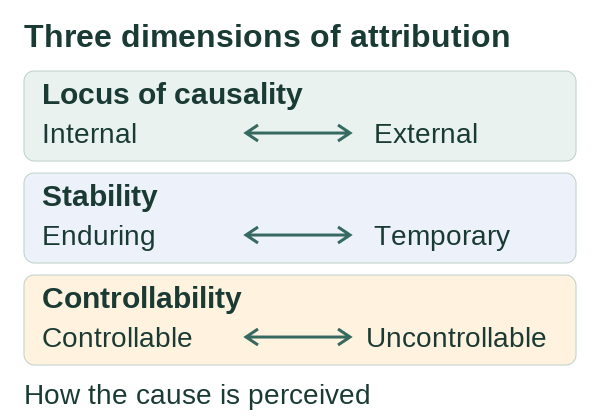
People explain success and failure by causes that differ in locus, stability and controllability.[1] Students with learning disabilities reported lower academic self-concept and lower academic attributional style scores than typically achieving peers.[2] Attributional retraining improved college students' perceptions of control, success and emotions, and their academic performance.[3]
Key facts
| 256 | first-year college students in Ruthig and colleagues' 2004 attributional retraining study[4] |
|---|---|
| 79 | studies of teachers' causal attributions reviewed by Wang and Hall (2018)[5] |
| 496 | participants in Schmidt and Weiner's 1988 helping-behavior experiments[6] |
| 24% | increase in weekly steps in Sarkisian and colleagues' 2007 pilot study[7] |
Overview
What attribution theory explains
Attribution theory describes how people explain the success or failure of their own behavior. It also covers how they explain other people's behavior.[8] The process links events to the underlying causes behind them.[9] In the achievement area, two causes dominate everyday thinking: ability and effort. People also name many other causes. The causes they name differ from one area of life to another.[1]
Researchers compared causes such as ability and effort. They found shared properties that any cause can have. Three of these properties are called dimensions. They are locus, stability and controllability. The article lists intentionality and globality as other possible features of a cause. A cause can seem stable or unstable. That sense of steadiness shapes how likely a person thinks success is after a success or a failure.[1]
The dimensions are linked to specific emotions. Pride is linked to locus. Hopelessness and giving up are tied to stable causes. Anger, gratitude, guilt, pity and shame are linked to controllability. The outcome itself also shapes the emotions felt after a goal is reached or missed. So does the specific cause a person names.[1] Attribution theory also names mastery as a final cause of action. It names keeping society running as another.[10]
Explanations are often sorted into two broad kinds: situational and dispositional.[11] One review found self-serving effects for both success and failure. This held in most but not all experimental setups. Some processes can block that effect. Others can even reverse it.[12]
A 1980 critique argued that the theory treats people as statisticians. It ignores the social setting where people make their explanations. The same critique said the theory never states when people make attributions and when they make none.[11]
The theory has been applied to learning. This includes how college students learn. Its ideas may help advisors understand how students see themselves. They may also show what motivates students in school.[13] Teachers in formal and informal settings can use the theory. It can help them support what learners know and understand.[8]
History
Where the idea came from
Fritz Heider published The Psychology of Interpersonal Relations in 1958. Fifty years later, attribution research was still active but no longer dominant. A 2008 review examined Fritz Heider, Edward Jones and Harold Kelley, among others. It looked at them as people who helped this line of work last.[14]
Consensus is one of the dimensions in Kelley's model. A 1979 study tested how these two kinds of information feed into judgments. The judgments were about success and failure. High consistency made people blame stable factors more. Low consistency led people to blame causes that change. High consensus led people to blame outside factors. Low consensus raised internal attributions.[15]
Earlier motivation theorists had put emotion into one pleasure and pain principle. Atkinson changed this with his theory of achievement motivation. Atkinson argued that striving to achieve is driven by expected emotions. These are pride and shame. Attribution theorists then proposed many more emotional reactions to success and failure. These reactions depend on what people see as the causes of outcomes. They also depend on the dimensions those causes share. A 2014 review lists the emotions tied to success. These include admiration, confidence, envy, gratitude and pride. For failure it lists anger, guilt, helplessness, hope, hopelessness, pity, regret, scorn, shame and sympathy.[16]
Later work has connected the two models rather than choosing between them.[15] A 1991 paper argued that all the major attribution theories rest on what might have been. Counterfactual information means asking a question. Would the event have happened without the cause being tested? Because that information is hard to obtain, people often use two stand-ins for it. The stand-ins are covariation data and information about other possible explanations. The paper used this framework to compare three theories. They were Kelley's model, Jones and Davis' correspondent inference theory, and Weiner's theory of success and failure attributions.[17]
The field never settled on one account.[9] A 2018 comment called Weiner's theory a cornerstone. It explains emotion and motivated behavior. The same comment asked for better ways to test its claims. It also called for wider frameworks. These would treat causal explanations alongside other sources of motivation.[18]
Main ideas
The main dimensions and how they are measured
The Causal Dimension Scale II is a tool for measuring causal explanations. Scores from the adapted instrument fit well, but not excellently. It was not negative. That study also argued that measurement had to be settled first. Only then could researchers study how attributions affect classroom learning.[19]
A 2020 study set out to build a scale for causal attributions in language learning. At the time, no valid and reliable scale designed for that setting existed. The problem it named was practical. When many people take part, open answers are hard to collect as numbers. Such answers may be about effort, ability or the teacher. The stated aim was to help teachers and researchers spot students at risk of losing motivation.[20]
The perceived control of the attribution process model has 2 parts. The first is perceived control of attributions. This is the belief that one can influence one's own causal thinking. A 2017 study found the 2 beliefs were structurally independent. It also found them linked in different ways to motivational outcomes. Levels of both beliefs varied a lot between controllable and uncontrollable events. The 2 beliefs were linked to ways of reframing thoughts. These in turn led to a helpful attribution style, independence and well-being.[21]
One measure asked observers to rate four named causes. These were ability, effort, task difficulty and luck. Participants rated how strong and how important each cause was. The model assumed results could be blamed on the person or on the situation. It also assumed these causes could be seen as stable or unstable. Three of the 4 hypotheses were strongly supported.[22]
How attributions shape emotion and effort
Help giving is one domain where the full chain has been tested. In a 1988 study, 496 participants were placed in four separate experimental conditions. They judged how much people helped. When people saw the cause of the need as controllable, they reported anger. That anger predicted neglect, not help. When the cause seemed uncontrollable, participants felt pity. Pity predicted judgments that help should be given. Some people were told to focus on themselves, others on the other person. Others were told to stay objective and ignore feelings. These instructions did not change the paths.[6]
Weiner has argued that two common stories capture the two motivational domains. These domains are at the center of this research. Weiner offers the stories as early, uncertain evidence that the pattern may be universal. He does not offer them as proof.[23]
Weiner's wider account lists emotions among the direct causes of motivation. These are the immediate causes of action. Ultimate determinants sit further back. Examples are mastery and keeping society running.[10]
Learned helplessness and failure-prone students
Some students stop trying after a failure, and that habit has a name: learned helplessness. One early account tied this overreaction to a belief. The belief was that personal outcomes do not depend on what the person does. A 1981 article proposed that this helplessness pattern could help redefine children's learning problems.[24]
In one study, 429 first-year Canadian undergraduates explained their academic procrastination, or putting off academic work. These students blamed procrastination mainly on causes inside themselves. They also blamed factors that stay stable over time. They blamed it less on factors they could personally control. Students who blamed themselves also reported more negative emotions. The study also found strong direct effects of procrastination on negative emotions. The design was exploratory. The researchers called for future longitudinal work. That means studies that follow the same people over time.[25]
Students with learning disabilities are one group whose explanations have been studied. A 2002 study compared these students with peers who were doing as expected. It looked at self-concept, self-efficacy beliefs and attributional style. The study also looked at students who had a learning disability and attention deficit hyperactivity disorder (ADHD). In the research literature, reported overlap between the two conditions ranges from 40% to 80%. On those academic measures, students with both conditions differed little from students with learning disabilities alone. The group with both conditions did report much lower peer-relation self-concept. This was lower than in the other two groups.[2]
A 1985 study asked 225 students with hearing loss to explain school success and failure. Their patterns of causes closely resembled those of hearing students. The study also found evidence of an in-group bias. Hearing-impaired students gave more weight to the personal qualities of students like themselves. They did this when explaining success.[26]
One attempt tried to raise internal attributions for effort among learning disabled students. Neither of its hypotheses was supported. A 1982 study tested whether learning disabled students' attribution levels could be changed. The experimental reading program moved students gradually from errors decided by the teacher to errors decided by the student. It also had teachers urge students to try harder. Two comparison groups got errors chosen by the teacher only. The other group got only errors chosen by students. The researchers predicted higher internal attribution for effort in the experimental group. They also predicted the biggest gains for students who started lowest on internal attribution. The results suggest that changing students' attributions is hard. This indirect approach may not be enough.[27]
A later study asked whether attribution retraining needs to be explicit at all. Sixty children with learning disabilities were split into two training groups and a control group. Another control group was 20 students doing normally at school. One training version taught reading comprehension strategies. It also taught students ways to manage their own learning. The other version added clear training in how to attribute causes. Children in both training groups improved on measures of cognitive strategies. Their gains on measures of thinking about thinking were very low. These measures concern awareness of one's own thinking. Students in both groups showed equally good attribution profiles. Their training condition made no difference.[28]
A 3-week attribution retraining program was designed to change harmful beliefs about academic failure. The students were African-American middle school students. The lessons aimed to help students change unhelpful explanations for failure. They also aimed to show that good results could follow more preparation and effort. The participants were 64 sixth graders classed as low achieving. They were randomly assigned to a treatment group or a wait-list control group. The treatment group gained much more in helpful attributions than the control group. It also lost ground in harmful attributions.[29]
Two ways to divide up attributions
Attribution theory sorts the causes people give for events. One common split is internal versus external. In 1977, Kruglanski proposed replacing this internal-external partition with a different one. His alternative sets endogenous and exogenous attributions apart. The paper compares this contrast to the difference between means and ends.[30]
Zuckerman (1977) raised several objections to the proposal. One objection was that the proposal's treatment of the traditional internal-external partition gets much of the theory and research on that partition wrong. Second, the endogenous-exogenous model lacks specific criteria. So it is sometimes hard to apply or test. Third, the distinction between endogenous and exogenous attributions partly restates the correspondence model of Jones and Davis. Fourth, methodological problems weaken Kruglanski's use of the model to explain studies of intrinsic motivation.[30]
A 1982 study tested how the two partitions relate. Undergraduates rated intentional actions on four attributional scales: internal-external, enjoyment, endogenous-exogenous and freedom. They also rated the actions on one methodological scale. The endogenous-exogenous scale did not join that group.[31]
Attributions in children and parents
Attribution theory has served as a useful conceptual framework for studying how children come to understand emotions. A review of research on children's emotional development used this attributional point of view. It examined happiness, sadness, anger, pity, guilt, pride and gratitude. The review also asked what a developmental view adds to an adult theory of emotion.[33]
In a knowledge-attribution task, children aged 3 to 5 years were biased by their own knowledge when judging what a less informed person knew. This curse-of-knowledge bias, the pull of one's own knowledge when judging another mind, was stronger in younger children than in older ones. The errors were asymmetric: they appeared only when the child knew more than the other person, not when the child knew less. That pattern fits the curse of knowledge better than general self-centeredness or rationality accounts.[34]
Social attribution skills mature steadily in childhood, according to Hu, Chan and McAlonan (2010). One study looked at 154 healthy children (76 boys, 78 girls) aged 6 to 13 years. It used a modified social attribution task with animal figures to make the judgments easier. On that changed task, scores rose steadily from age 6. Girls did significantly better than boys. On the usual task with moving shapes, children under 9 years performed at baseline. No gender differences appeared. Neither task correlated with executive function once age and verbal IQ were held constant.[35]
Parents' own explanations of their children's abilities form a further line of attribution research. One study looked at parents whose children attended a program for gifted and talented students. It asked how they explained the children's artistic capabilities. Parents credited those capabilities mainly to inborn talent and inner motivation. Estimates of accumulated hours of involvement in art, however, showed the children had patterns of involvement similar to people with strong records of achievement in other domains. The study discussed other explanations for achievement, including deliberate practice theory.[36]
Research
Evidence that attributions predict achievement
Explaining bad events by their wide reach went with poorer performance. This held in every school. Explanations that treated bad events as lasting went with better results in high-achieving schools. In low-achieving schools this link did not appear. Internal explanations for negative events went with higher performance. This held only in low-achieving schools.[37]
A smaller American study looked at 91 upper-level undergraduates. It compared scores for how people explain events with total grade point average. Students with higher depression scores had lower grade point averages. The study called for long-term evaluation of changes in these links.[38]
A 2025 study in Nigeria looked at attribution pattern, study habit and achievement together. It covered 672 teenagers from 54 schools. Achievement was measured with students' Junior School Certificate Examination results. Attribution pattern and study habit strongly predicted academic achievement. Gender was a moderator. A belief that one controls one's own results, with good study habits, pointed to academic achievement.[39]
A study looked at 300 senior secondary students in Lagos State, Nigeria. It found no significant links between attributional style and math performance. The same study did find differences by gender. They appeared on the stability and globality scales. It also found differences by socio-economic status. It also found differences in attitudes toward mathematics. Its authors suggested repeating the work on other samples.[40]
The scales mattered for male, white and coloured learners who saw their achievement positively. Study milieu was one of the strongest single predictors of mathematics achievement. Problem-solving behaviour was the other one. This held for both genders and for black and white learners.[41]
Park and Kim ran two studies. The first study compared honour students with students on academic probation. The second study compared Korean, Korean-Chinese and Chinese university students. Honours students were more likely to credit success to effort. They also gave credit to the influence of other people. For failure, they were less likely to blame a lack of ability. They were also less likely to blame a lack of support from significant others. Among Korean students, higher grades went with more internal attribution. They also went with less external attribution. The Korean-Chinese sample showed no significant differences.[42]
An early study looked at how Black high school and college students explained results. It also looked at self-esteem and school grades. A style that blamed oneself for bad events went with lower self-esteem. A steady style for negative events went with poorer academic performance. Blaming positive events on oneself was also linked to lower academic performance.[43]
Over the long term, gifted students were more likely to blame failure on not working hard enough. They were less likely to blame not being smart. Boys and girls chose different causes for general academics, science, mathematics and language arts.[44]
How large are retraining effects
In one college experiment, retraining raised scores on a test about a lecture. This happened only when the lecture itself was well taught. That study ran two experiments with low-risk and high-risk students. The students watched a recorded lecture from an effective or an ineffective instructor.[45]
A year-long study followed 256 first-year college students through one academic year. High optimism is usually treated as an advantage. For students who did not receive retraining, it turned out to be an academic risk factor. Students high in optimism who got the training gained more. Students with low optimism benefited less.[4]
A remedial program at a university worked with 130 first-year students. They had failed an economics test in the middle of the term. One group watched a video of older students. The students described their early difficulties and what caused them. They also described how they did better later. A second group watched the same tape and took an individual study skills course. Both trained groups scored higher than students who got no training. The scores came from the next economics exam. The gain carried over to all first-year examinations. There, trained students earned a higher average mark. The program did not change how many students eventually passed the first year.[46]
One study looked at 327 high school students in Iran. Retraining came by video, then by group discussion. The program shifted the causes students gave for their English results, as predicted. It also raised their scores on a final English achievement test.[47]
The 30 sixth-grade girls were split evenly between a trained group and a control group. The trained group showed a significant drop in academic procrastination. Procrastination is the habit of delaying schoolwork. The result was p < .01.[48]
A related Iranian study gave retraining to 30 children aged 7 to 10 with reading learning disorder. It followed them for two months. The intervention significantly reduced academic burnout. The effect held at follow-up.[49]
Twenty-nine students with learning disabilities took part. Their average age was 13.3 years. They used a math computer program for eight 30-minute sessions. It gave either attribution retraining or neutral feedback. The retraining did not clearly change how the students explained events. Even so, trained students finished significantly more levels of the program. They also scored significantly higher on a test of the practiced problems.[50]
An employment interview study randomly assigned 50 co-operative education students. Some went to a writing-based retraining condition and the rest to a control group. Retraining led to more controllable failure explanations and higher expectations. It also led to motivated behavior and success in interviews. This was especially true for people whose first explanations were unhelpful. Its effects on emotions worked through the explanations students held after treatment.[51]
A study without random assignment in South-West Nigeria screened 787 male secondary students. Those who met criteria for conduct disorder were split into two groups. Treatment had 55 students and control had 47. Student ratings showed a significant drop in emotional difficulty scores. Total difficulty scores also dropped significantly. Teacher ratings were less consistent: some problems rose and others fell. The control group showed no significant change in statistical terms.[52]
A training program with 35 college beginner tennis players changed attributions for a tennis task. The new attributions lasted up to 3 weeks and spread to a different tennis task. Players who shifted to more useful attributions also expected more future success. They also said they felt positive emotions.[53]
What changes the size of the effect
A moderator is a condition that changes how strongly a treatment works, and attributional retraining has several.[45][4] Prior performance is one factor that changes the results.[45]
Optimism changes the size of the effect.[4] A related trait is a strong tendency to avoid failure. This means a tendency to protect self-worth by avoiding failure. Some students were high in that orientation. For them, retraining improved expected course grades. It also improved judgments of course responsibility. It also improved course grade and grade point average.[54]
Locus of control also makes a difference.[45][55] In one experiment, retraining improved achievement for low-achieving students with an external locus. It gave no advantage to low-achieving students with an internal locus. The training also changed students who began with an external locus. They moved toward blaming themselves more. That rise depended on students also getting good teaching.[45]
One study looked at 60 college students. Some people saw outcomes as outside their control. This is an external career locus of control. After a retraining procedure on video, their belief in their own career decision-making rose significantly.[55]
One study added clear attribution retraining to strategy instruction. It gave no extra benefit. The other group got the same procedures plus clear attributional retraining.[28]
A 1996 overview noted that retraining methods had worked in clinics and labs. Two studies reported very promising results. One worked with German high school students in mathematics. The other worked with female university students in statistics.[56]
In sport, 7 male rugby players took part in an intervention. It used cognitive-behavioral techniques to retrain how people explain events. The numbers gave very little support for the program. Still, participants' attributions became more external for negative events. Interviews suggested the players coped better in hard times. They also became more confident in their sport.[57]
Measuring attributions in surveys and scales
Al-Khafaji and colleagues (2023) built a scale of runner attribution for middle school students. They followed a theory from Weiner (1979). That scale has 33 items, three areas and four answer choices for each item. Its builders checked every item for how well it separated high scorers from low scorers. They also checked its correlation with the rest of the scale. They reported that all items were statistically significant on both counts. The data were analyzed with the SPSS program. The study ended with recommendations and suggestions.[58]
A study of 415 Form Five students in Nigeria measured three things. The students were 201 men and 214 women. These were the need to appear socially desirable, achievement motivation, and attributions for academic outcomes. For the men, that need and the attribution of academic outcomes moved in opposite directions. For the women, the link was positive and significant. This suggests women may need more to explain outcomes in socially desirable ways. The study offered a second reading of the same pattern. The wish to look socially desirable may raise men's acceptance of personal responsibility for outcomes more than women's. How women explained outcomes predicted their drive to achieve. For men, it did not.[59]
Some researchers have tried to model attributions with learning theory rather than with questionnaires alone. One 1983 paper argued that a 1972 theory of conditioning by Rescorla and Wagner can explain some kinds of causal attribution. In that model, learned associations drive changes in attributions. The size of each change follows the rules of classical conditioning. The model treats the growth of an attribution and its decay as symmetric. The paper claimed that known attribution findings follow from it.[60]
Citation counts have been used to judge how much research attention a theory gets. A 1990 analysis used Heider's 1958 book as the marker for attribution theory. It used Festinger's book on cognitive dissonance as the marker for dissonance theory. It listed citations to both from 1958 to 1987. The lists came from the Science Citation Index and the Social Science Citation Index. Citations to dissonance theory fell a lot over the last 15 years of that span. Citations to attribution theory stayed fairly steady. The gap was even clearer in general psychology journals.[61]
Attribution in learning motivation research
That split is one reason understanding of motivation in these classrooms is still incomplete. A 1985 study examined 423 students in 21 fourth through sixth grade classrooms. The study drew motivational variables from locus of control theory and from attribution theory at the same time. From attribution theory it took self-concept of ability, expectancy of success, and causal attributions.[62][63]
Students filled in the motivation questionnaires in groups in their own classrooms. Achievement data came from school files that already existed. Correlational and multiple regression analyses gave limited support for predictions within locus of control theory. The same analyses gave partial support for predictions within attribution theory.[62][63]
A 1989 paper reviewed the development of Weiner's attribution theory of achievement motivation and the studies related to it. The attributional framework of Bernard Weiner had become widely popular in achievement motivation research. Weiner changed and extended his own theory. Others had criticized it for problems and confusion in its methods. The review also saw a need to compare Weiner's framework with other achievement motivation theories that use attributional concepts. The review also set out problems in how attributions are measured and how key concepts are defined. It compared Weiner's framework with the social learning theory of Rotter and the learned helplessness theory of Seligman. The review ended by proposing directions for future research.[64]
Attribution patterns in real student groups
A 2012 study separated students with high causal attributions from students with low causal attributions. One study surveyed 490 tenth-grade students in Rawalpindi and Islamabad, Pakistan. They came from mainstream and religious schools. It found a significant gap in academic achievement. The gap was between intrinsically motivated students with high causal attributions and extrinsically motivated students with low causal attributions. The researchers took this result as support for Weiner's attribution theory.[66]
A 2018 study examined junior high students' motivation, attitudes toward learning English and achievements together. One study used questionnaires, classroom observation and interviews. It covered 112 junior high students in two classes in Xinxiang, Henan province, China. It also interviewed three teachers. Achievement, motivation and attitudes toward learning English rose and fell together. Four factors significantly influenced motivation and attitudes: school circumstances, classroom atmosphere, teachers and home environment.[67]
A survey of 431 Chinese nursing undergraduates examined their career maturity. Career maturity was moderate in this group. Together those three factors explained 37.6% of the variance in career maturity. The adjusted R(2) was 0.376.[68]
A 2025 study compared 429 nursing and educational sciences students. It looked at their research attitudes, academic motivation, goal orientation and attributional styles. Interest in research fell as students got older. Interest did not differ significantly between genders. But the female group showed a stronger link between interest and motivation. Students at public universities linked interest to motivation. Students at private universities linked interest to performance. Students in both fields showed neutral values of interest in research, directly related to academic motivation.[69]
One study looked at psychology students in Ukraine. It examined their self-development at different levels of optimistic attributional style. Internality strongly helped self-development when optimistic attribution was medium. Self-development decreased among students with high internality when their optimistic style was also highly developed. The highest self-development scores belonged to students with medium optimistic style and high internality. The lowest self-development was typical of students with high internality and a pessimistic attributional style.[70]
Attribution in applied and unusual settings
A 2010 brain imaging study asked 30 healthy subjects to read short sentences about positive and negative social events. Participants imagined each event and decided its main cause. They then labeled that cause as internal (inside themselves) or external (outside themselves). Internal attributions, compared with external ones, came with activity along the right temporoparietal junction (TPJ). The reverse contrast activated a left-sided network. It included the temporoparietal junction, the precuneus and the superior and medial frontal gyrus. The self-serving bias means internal attributions for good events and external ones for bad events. This bias activated the dorsal anterior cingulate and the dorsal striatum. That pattern suggests these attributions carry a rewarding value.[71]
A 2017 study tested whether emotioncy guides causal judgments. A 2017 study built two scales, one for attribution and one for emotioncy. It used ten imagined situations. The scales rested on ten made-up situations and were completed by 309 participants. Confirmatory factor analysis supported the construct validity of the two scales. Structural equation modeling then examined links among the sub-constructs of the two scales. As participants' emotioncy level rose, they were more likely to blame external factors. People described as involved blamed outside factors for causes. Those described as exvolved blamed internal factors.[72]
A 2022 study analyzed entrepreneurial failure. It used failure attribution and failure learning. One 2022 study surveyed heads of new ventures in Xi'an. It gave out 300 questionnaires and got 209 back. The Corrected Item-Total Correlation (CITC) value of R-1 was 0.65. The CITC value of R-2 was 0.35.[73]
A second 2022 study surveyed students at one university. It found weak awareness of entrepreneurship, insufficient publicity, an outdated curriculum and unqualified teachers. That study traced these problems to traditional concepts, insufficient attention and incomplete system construction. A simulated management strategy for a new venture met its expected effect.[74]
A 2025 study examined how attributional style affects impulsive consumption among college students. A 2025 paper reports three experiments with undergraduates at a university in Changsha, China. Students with optimistic attributional styles showed significantly lower impulsive consumption than those with pessimistic styles. Anger clearly reduced impulsive buying. It also had an effect with attributional style.[75]
A 2024 analysis looked at the punishment dilemma in primary and secondary education. It names three sources of the problem: incomplete laws, strained home-school relationships and negative societal attitudes. It calls for parents, schools and society to work together. It also asks for clearer laws on teachers' disciplinary rights and better home-school communication. It wants a more positive view of disciplinary actions.[76]
One approach to teacher motivation pairs attribution theory with nudge theory. A 2017 case study describes an approach used in India. It aims to shift how teachers see themselves. That shift is meant to change their motivation over the long term. Brinkmann reports that more motivated teachers tend to teach better. Their students tend to be more motivated, and the teachers enjoy better overall well-being.[77]
Hospitality education offers a further setting. A 2025 study used semi-structured interviews with 18 hospitality students to form hypotheses. It then tested them with 124 students in a two-group experiment. In-person classes significantly raised students' views of their own abilities and lowered task difficulty. That led to more engagement and more self-efficacy. Online learning was convenient but made communication harder. The study extends attribution theory to include educational accessibility.[78]
A 2014 survey of 627 university students compared attributional complexity, emotional intelligence and fluid intelligence across demographic groups. Of the students, 270 were male and 357 were female. Female students' fluid intelligence scores were statistically higher than male students' scores. Fourth-grade students scored higher on attributional complexity than second-grade students. As students got older, fluid intelligence scores fell and attributional complexity scores rose.[79]
A 1980 paper set out a theory of mental disorder based on explanations. It was built mainly to explain social status effects. That tendency, in turn, is said to change how open a person is to a mental disorder. The data came from two panel studies, in which the same people are questioned more than once. The data suggested that styles of causal attribution could play a central part. They may link social conditions to disorder. The paper compared two versions of the model. It reported that a simple, linear reading of the effects of fatalism may fit best.[80]
Some participants viewed each face in a natural way. Or they imagined the person felt sad or happy because of them, which is an internal attribution. They also imagined the person felt that way because of something else. On questionnaires, patients showed the non-self-serving style more than controls did. But when patients were told which causes to apply, they handled positive and negative emotions about as well as controls did. Raising happiness through internal rather than external causes used the parahippocampal gyrus only in controls. Reducing sadness through external attributions used the superior frontal gyrus only in patients. The results point to disturbed processing of positive emotions in depression. The authors called for research on attribution training during psychotherapy.[81]
One treatment study compared attribution retraining group therapy with a common class of antidepressant drugs. The patients had major depressive disorder, generalized anxiety disorder or obsessive-compulsive disorder. It recruited 109 outpatients between 2007 and 2008. They were assigned to the therapy group (n=63) or the drug group (n=66) for 8 weeks. 54 outpatients in the therapy group and 55 in the drug group completed the study. Symptom scores fell a lot in both groups (p< 0.001).[82]
Attribution retraining has also been tried with children who have epilepsy. A 2015 study randomly chose 30 children from an epilepsy association in Tehran. There were 17 boys and 13 girls. It put them in an experimental group or a control group. The experimental group had 11 sessions of attribution retraining. Each lasted 45 minutes, twice a week. At a follow-up 6 weeks later, however, the two groups no longer differed much.[83]
A 2022 pilot study tested attributional retraining for older adults in poor health. They went to a day hospital. The sample was small: 37 people with a mean age of 80. They were assigned at random to retraining or to a no-retraining condition. After treatment, the researchers adjusted for age, sex and how sick people were. Those who got the retraining reported feeling less helpless. They also felt more control over their health than those who did not. The authors said the work laid the groundwork for more research. That research would involve older adults in poor health.[84]
In practice
What attributional retraining involves
The lessons aim to replace harmful beliefs about failure. The new idea is that preparation and effort lead to good outcomes. It was built directly on attribution theory.[29]
A program for sixth-grade girls in Hamadan, Iran, used 11 sessions of 45 minutes each. It was based on a program developed by Seligman and colleagues in 1996. That study had 30 girls. They were assigned at random to an experimental group of 15 or a control group of 15. The control group got no help or training.[48]
A long-term study of 203 college students compared three conditions. They were no retraining, a writing version, and an aptitude test version. Both retraining formats improved students' end-of-year views of control and success. They also improved their emotions, course performance and overall performance. Students who often used elaborative learning strategies, which means linking new material to what they already know, scored higher on these measures than students who rarely did so.[3]
Some versions give students spoken or written feedback about the causes of their results. They do not give a full course. In one experiment, junior high students below the class average in math were put into four groups at random. The groups received one of four things. These were oral attributional feedback, written attributional feedback, reinforcement feedback, or no treatment. They scored significantly higher than the control group. They scored higher on perseverance and on math achievement. The reinforcement feedback group did not differ much from the attributional groups. Attributional feedback worked better for low achievers than for underachievers. This held for both forms.[85]
In two studies, retraining changed students' attribution profiles. Some students had an external locus, meaning they credit outcomes to outside forces. They became more internal. It also raised hopes of later success. This held for both externals and internals. That rise appeared only when students also got good teaching.[45] For students high in failure avoidance, retraining also went with better course grades. It went with a better grade point average too.[54]
Retraining is often combined with other instruction rather than given alone.[86][45] One review looked at how students with mental retardation and learning disabilities learn strategies. It placed beliefs about the causes of success inside a model of metacognition. Metacognition is knowledge about one's own thinking. Two studies in that review showed a result. Retraining beliefs about causes, alongside other teaching about thinking, helped students move strategies to new tasks.[86]
The two college studies looked at retraining and a lecture-based test. Retraining raised scores only when it was paired with effective teaching. The researchers concluded that program designers must think about two things. These are the quality of instruction and differences between individuals.[45]
Attributions in classrooms and among teachers
Students' beliefs about why they succeed or fail in school depend heavily on the subject. In one study, junior high school students recalled real successes and failures. The subjects were English, math, general music and physical education. They then rated eight possible causes for each outcome. The results showed that beliefs about causes depend on the setting. They are also closely linked to the grades students reported. Instead, outside causes tended to carry over between subjects. Inside causes stayed tied to a single subject area.[87]
Students tended to blame failure on causes inside themselves. They tended to give outside causes credit for success.[88] An interview study in Poland in the 2019/20 school year asked 37 high school students a question. How did they see success and failure in learning English? The researchers studied the students' stories, both positive and negative. They found a range of attributions.[89]
Of these, 111 were male and 105 were female. Some personality traits were clearly linked to attribution sub-scales. Male and female learners did not differ much on any attribution sub-construct.[90]
One survey asked 130 music students in southern Brazil. They most often credited success to effort (77.7%), persistence (65.4%) and interest in the performance (63.1%). Failure was most often explained by emotional factors (60.8%), task difficulty (36.2%) and lack of effort (30.8%). Students with more musical experience rated their own performances as good or excellent. Those with little experience did not.[91]
Ability and effort are internal causes, and they drew the highest ratings. Task difficulty and luck are external causes, and they drew the lowest ratings. Reported practice time was strongly linked to intrinsic motivational beliefs. It also went with internal explanations about practice.[92]
Teachers make their own cause-and-effect judgments about students. A review of 79 studies since the 1970s examined these beliefs. The review looked at how teachers explain student performance and misbehavior. It also looked at how they explained their own stress at work. Teachers' explanations for events were clearly linked to their emotions and thoughts. They also showed links to student outcomes. The review also found that key background variables change the strength of these attributions. The findings were discussed in terms of the fundamental attribution error, the tendency to overrate a person's character and underrate the situation.[5]
One study looked at 276 British primary and secondary teachers. It compared those who saw inclusive education as effective for all students with colleagues who held more negative beliefs. The more positive group gave more positive feedback and felt less frustrated. They also expected more future failure.[93]
One survey asked 181 Canadian teachers in training who were graduating. As students' ability levels fell, sympathy rose. Expectations of future failure also increased. As students' effort increased, teacher feedback became more positive. Frustration also fell. Sympathy rose, and the expectation of future failure fell.[94] A survey covered 240 Australian and Chinese trainee teachers near the end of their training. The Chinese group's pattern of causes was more positive than the Australian group's.[95]
One study looked at 87 fourth-grade students. Praise for effort led more of them to choose learning goals. Each child took a simple rhythm-tapping test and then got one of three treatments. The treatments were verbal praise for effort, verbal praise for talent, or no praise. The results led the researcher to make a suggestion. Music teachers should rethink how they present talent or ability in class.[96]
One study asked 201 trainee teachers about plagiarism. The plagiarism could be controlled. Then they saw the student as more responsible and felt anger toward them. A study of 201 pre-service teachers had them read scenarios of plagiarism. The scenarios differed in how much control people had over them. This means whether the act was on purpose or an accident. They also felt anger toward the student and supported punishment. They recommended reporting the student.[97] When students saw a disagreement with an instructor as caused by themselves, all three forms of dissent rose.[98]
How teachers explain classroom disruption
Letuma and Mdodana-Zide (2024) report on how teachers manage disruptive behavior. The cause a teacher gives for that behavior is one factor in how well it is managed. A 2024 case study interviewed six members of a school management team. It also held a focus group with seven teachers from four secondary schools. Those teachers traced classroom disruptions to three kinds of cause. They were the characteristics and attributes of learners, contextual elements within the school, and outside factors. The study argues that behavior strategies should consider all three when they are designed. Its evidence comes from a small qualitative sample, so the three-part pattern describes these teachers' accounts rather than a measured rate across schools.[99]
Ye (2024) calls the fundamental attribution error a cognitive bias. It affects how teachers and students interact and how blame is judged. Its impact varies across cultural settings. A 2024 review of research and theory describes the error as a general cognitive bias. It shapes teacher-student interactions and judgments of who is accountable. The review reports that the same mental mechanism appears across cultures. Its effects differ from one culture to another. It draws on Garcia's work on the miseducation of Latina girls. That work shows how such bias can steer educational paths. It can also keep existing inequalities in place. The review is an analysis of existing work rather than a new experiment, and it calls for further research and for interventions that reduce the influence of biases such as this one.[100]
Lorenzetti and Johnson (2023) propose that teachers' causal attributions may explain lower behavioral expectations for Black students. Teachers tend to expect less of Black students' behavior than of White students' behavior, according to research cited by Lorenzetti and Johnson (2023). A 2023 study asked 233 teacher education students to complete the racial bias section of an implicit assessment test. They also answered questions about four short stories of student misbehavior. Lorenzetti and Johnson (2023) argue that teacher training should look at these inner beliefs. Programs should consider how these beliefs shape what future teachers learn. The beliefs concern what teachers expect for students' behavioral regulation.[101]
Attributions in online and technology-supported learning
Maymon and colleagues (2018) applied Weiner's attribution theory of achievement motivation to academic computing problems. One line of research asked North American university students about computing problems in academic settings. It used both imagined scenarios and controlled changes to the situation. The two studies together included 559 students from traditional and online universities. Maymon and colleagues (2018) found that stable attributions for unexpected computing problems went with more helplessness, boredom and guilt. The researchers called this pattern emotionally maladaptive. In Maymon and colleagues' second study, online students blamed minor computing problems on outside causes they could control. This helped them emotionally, with more hope and less anxiety.[102]
For students at traditional universities, stable explanations for unexpected problems predicted more anxiety. Students in online degree programs showed a different pattern for small problems. The harmful effect of stable explanations held across both studies. Results for controllable explanations were mixed. External explanations for computing problems brought an emotional benefit. The benefit was unexpected. The researchers said this result needs more study.[102]
Kamilah (2021) found that three high school language teachers in Situbondo, Indonesia, saw their own resistance to technology as stable and uncontrollable. It asked why they resisted using technology in class. They said they had no control over their ability. They believed younger colleagues were gifted with the ability to use information technology fluently in the classroom. The study concluded that the teachers held back. They feared failure when they used technology in class. It suggested that how strongly a teacher makes attributions could shape what that teacher gains from professional development.[103]
Lestari (2023) interviewed five EFL students who failed Basic Grammar. The students named lack of knowledge, internet connection and their own factors as causes. These early results come from a small interview sample, so they describe reasons offered rather than measured effects on later performance.[104]
Ren (2026) tested whether college students' sense of relying on generative AI advice matches how much that advice shapes their judgments. An experiment with 342 undergraduate students compared three things. Students worked alone, used open multi-turn chat support, or used the same support with a brief prompt to reflect on their own thinking. Open chat support raised students' confidence in their final answers. It was linked to acceptance of 62.4% of incorrect AI advice. The reflection prompt cut acceptance of incorrect advice to 39.7%. The odds ratio was 0.40 (95% CI [0.28, 0.56], p < 0.001). Reflection also raised awareness calibration to 0.59 against 0.41. It lowered an attribution-bias index to 0.21, against 0.42. The AI's advice was about as accurate in the two assisted groups. The researchers limited their claims to short decision tasks rather than long-term learning.[105]
Retraining, feedback and attempts to change attributions
One test of attribution retraining used it as a structured group counseling program. Participants were first classified as having an adaptive or a nonadaptive attributional style, meaning their usual way of explaining events. The treated group was made up of nonadaptive participants who received attribution retraining. The experiment caused a failure the students could not control. They blamed it in more helpful ways. That group also reported less depressive mood than the untreated nonadaptive group. The researchers called these results only partial support.[106]
A study of 120 junior high students examined feedback about the causes of failure in music. Students were randomly assigned to nine treatment conditions. These crossed outcome attribution with goal structure. They read a scenario about a made-up music student's failure. Most participants expected the student to feel bad. Expected future behavior was most constructive when failure was blamed on poor strategies. Blaming the failure on lack of effort came next in helpfulness. Blaming it on lack of ability came last. Guilt, anger and upset after failure related more strongly to constructive future behaviour than shame and embarrassment did. Classroom goal structures produced no significant results.[107]
One experimental study applied Schunk's model of attributional feedback to elementary school students in grades III and IV. Their mathematics achievement was below average. They scored higher on self-efficacy and mathematics achievement than students who got no treatment. Oral feedback and reinforcement feedback worked better than written feedback. They raised mathematics self-efficacy and achievement more.[108]
A review of motivation theories warns that researchers must define, operationalise and measure motivational constructs carefully. This avoids confusion between concepts.[109] One review of motivational theory notes that the structure of the education system can work against students' sense of ability and self. So can educators' deliberate or accidental actions. Van der Putten (2017) cautions that neither kind of program is likely to reach every factor behind student motivation.[110]
Attributions in sport and performance settings
Among female soccer players, the two sides of perfectionism went with different patterns. These were patterns of motivation and of explaining success and failure. A study of 74 female soccer players split perfectionism into two parts. Striving for perfection was linked to hope of success and to taking credit for success. The two parts of the measure overlapped, and the study controlled for that. Once it did, striving was also linked to less fear of failure and fewer self-blaming explanations for failure. Negative reactions to imperfection showed the opposite pattern: more fear of failure and more self-blaming explanations. The researchers concluded that striving may help performance. Negative reactions are likely to make it weaker.[111]
A study of 111 elite athletes found self-handicapping at the top of sport, not only among amateurs. More than half of these athletes competed at international level. This includes European and World Championships or Olympic Games. Perfectionistic concerns were positively related to self-handicapping. Perfectionistic striving was negatively related to self-handicapping. Explanations for negative sport events partly carried both links. The researchers describe the work as a first step. The aim is to train top athletes to change those explanations and reduce self-handicapping.[112]
Seventy experienced recruiters from an Australian organization read four interview transcripts. The transcripts were about an applicant who had missed a deadline. The transcripts varied the applicant's ability (high or low) and effort (high or low). Recruiters noticed these differences in the causes applicants gave. Those causes then shaped what the recruiters expected of future job performance. They also shaped their view of the applicant's responsibility for the failure and their recommendation to hire.[113]
An earlier proposal argued that selection interviews are weak on reliability and validity. Part of the reason, it said, is the attributions interviewers make about personal characteristics. That proposal blamed biased explanations and conflicting role expectations. Both lead interviewers to draw dispositional attributions from behavior that is inappropriate for such inferences. It recommended training interviewers to reduce those biases. It also recommended agreeing on role expectations at the start of each interview.[114]
A 1989 review examined how applicants' explanations affect the job search. It also looked at early job success. It also examined how employers' attributions shape the use of resumes, letters of recommendation, interviews and employment testing.[115]
Attributions in work, advice and conflict
A 1981 paper proposed an administrative attribution theory for studying educational administration. A 1981 proposal called Administrative Attribution Theory argued that research on how people assign causes offers many ideas. These ideas help explain the administrative process. The proposal rested on five ideas. Asymmetry means people's explanations of causes show a general positive bias. Concomitance means they vary with mind sets shaped in advance. Enhancement means attributions give the individual psychological control of the environment. Process means the attributional process applies very widely. Reconstruction means outside variables may be changed to alter existing attributions. The proposal offered example research questions to encourage field testing in educational administration.[116]
A 2023 review looked at 22 articles published from 2013 to 2023. It surveyed how attribution theory has been used in leadership and organizational behavior. The review found that how leaders communicate shapes the leadership attributions that form in virtual teams. It also found that when leaders support work-life balance, employees show fewer harmful behaviors. The reason is that work-family conflict goes down.[117]
Advising is another setting where causal explanations matter. This comes from a 1982 article in a journal for academic advising. The article gave two reasons why advisors' attributions matter. They relate to what advisors do later. They also help when planning training programs for advisors. Suppose advisors blame poor advising sessions on advisees. Or they blame traits outside the advisor. Training to improve advisors and advising would then be unlikely to strike a responsive chord. The article described workshops for advisors. There, advisors share their attributions about students in public. It said this practice generally produces surprise, embarrassment and some defensiveness.[118]
Feldman (1981) treated performance appraisal as the outcome of two processing systems. He did not treat it as one act of judgment. One handles evaluation and one handles decision making. Attention, categorization, recall and information integration each run either automatically or under conscious control. In the automatic process, people notice features of an employee. They also notice features of the employee's behavior. This automatic process dominates except when decisions are problematic. The employee is later recalled, and memory is skewed by the traits of prototypes. Prototypes are abstract images of the categories the employee was placed in.[119]
Knickle and McNaughton (2008) noted that the perceptions and attributions people assign to others' behavior often lead to conflict. That conflict is left unaddressed and unresolved. The article described an interactive workshop. It used a live simulation of a dispute stopped at its most heated point. It has been delivered internationally and locally across professions since early 2005. Participants then discussed what they had seen, noticed and assumed. They practiced communication approaches in either role. Participants said they understood conflict better when it came from the traits others are assigned. Early results suggested the simulated approach taught conflict resolution skills well. The article stated that more research is needed. It should study how such an intervention affects competence and whether the skills are kept.[120]
Teaching and testing attribution ideas
McArthur (2011) designed a classroom activity around unclear prompts. It had three stated learning outcomes. Students should be able to describe the inner steps of making an attribution. That means deciding why something happened. The activity suits courses such as Introduction to Communication, Interpersonal Communication, Group Communication and Communication Theory.[121]
A second exercise looks at attribution bias in a low-stakes setting. There the goal is a deeper understanding of the theory itself. It is usually not treated as a graded assignment. It is a chance to explore and discuss. After finishing it, students should be able to say what attribution theory is. They should also be able to state personality attribution, situational attribution and attribution bias. They should also give examples of personality attributions and of situational attributions. They should say why and when each kind is made. The activity fits classes in interpersonal communication, introduction to communication, and small group communication.[122]
A third exercise shows how three information cues help a supervisor find the cause of a performance problem. The cues are consistency, consensus and distinctiveness. These cues allow comparisons across time, people and tasks. The exercise presents them as graphs. It applies to courses in organizational behavior, personnel, managerial decision-making and operations management.[123]
A videotaped illustration works differently. It presents sets of behavioral situations in order. Students then analyze the information with Kelley's (1973) covariation model. The videotape illustrates Kelley's (1973) covariation attribution model. Informal observation suggested the videotape worked very well. Students easily made suitable attributions and applied them to real-life situations.[124]
Korn and colleagues (2016) tested whether positive and negative performance feedback changes how people judge task-related stimuli. Healthy people tend to blame positive feedback on their own abilities. They blame negative feedback on outside factors. This pattern is called a positivity bias. Earlier demonstrations of this bias had at least one of three drawbacks. Participants judged explicit causes, imagined events rather than experiencing them, or rated performance only after feedback. A newer task had participants rate how credible actors were when they expressed emotions. They then did an emotion recognition task with or without feedback. Then they rated credibility again. Evaluations became more positive after positive feedback. A control group got no feedback. Correct or incorrect performance alone could not explain the shift.[125]
Judgments of blame can also be measured with hypothetical scenarios. In one study, 201 preservice teachers read scenarios of plagiarism. Preservice teachers are students training to become teachers. The scenarios varied in controllability. That means how much the act was under the student's control. They did so less when the act was not seen as controllable.[126]
How attributions guide classroom helping
A 2006 study asked a question. Can attribution theory explain helping behavior in a classroom like this one? The study surveyed students in 6 community college communication classes. All were taught by the same instructor. Students read situations about a group member who was not taking part in the group work. Some situations were simulated scenarios. Others drew on students' actual experiences. The classes used three levels of cooperative learning.[127]
The main finding concerned the cause students gave for the classmate's nonparticipation. Students were more willing to help when they judged the cause of nonparticipation uncontrollable. They were less willing when they judged it controllable. Students' in-class responses to real experiences differed from the responses they gave to the simulated scenarios. Emotional and behavioral responses did not vary by age, gender, ethnicity, or the level of cooperative learning used in the class. The results support attribution theory as a useful framework for explaining helping in simulated situations. This leaves open questions about using the theory in real classrooms.[127]
What this looks like when you study
One study looked at 130 first-year students who had failed a mid-term economics exam. They watched a videotape of senior students describing their early learning difficulties, their causes, and how their scores improved. On the next economics exam, both treated groups scored higher than the control group. Their marks also averaged higher across all first-year exams.[46]
The lessons helped students change unhelpful beliefs about failure. They also helped them understand that positive outcomes could come from increased preparation and effort. Compared with the control group, the treated sixth graders became more likely to give adaptive attributions for failure. They became less likely to give maladaptive ones.[29] The retraining significantly reduced academic procrastination, which is putting off schoolwork, compared with the control group.[48]
One study looked at 979 pupils from high- and low-achieving schools. Internal, stable, and global attributions for positive events predicted higher academic performance. Pupils who explained negative events by broad, global causes did worse in every school in the sample.[37]
Later developments
Culture, stigma and group differences
One comparison surveyed 198 college students at East China Normal University in Shanghai. It also surveyed 193 students at the University of Missouri at Columbia. The Chinese students took more responsibility than the U.S. students for failures that involved other people. They did the same for failures not involving them. They also took less credit for success with other people. These styles adapt poorly. These factors explained much of the Chinese students' higher scores on depression and loneliness. The pattern fits earlier work. That work described the United States as a relatively more independent culture. It described China as relatively more interdependent. Yet the links between attributional style and distress were very similar in the two samples. This may show a general human need to feel effective.[128]
Later work used perceived responsibility in self and others as a framework. It studied aggression toward peers and achievement values among African American youth. It included a program aimed at aggressive African American boys. The intervention tried to change biased beliefs. These beliefs were about how far others are to blame for negative outcomes. The paper calls for research on social problems such as aggression and achievement failure. This research should be driven by theory.[129]
In one study, participants of both races took a verbal test. They then judged the probability that each of their answers was correct. Some Black participants scored high in stereotype vulnerability. Their judgments were less accurate than those of other participants. Their confidence did not match their accuracy well. In a second study, people rated their self-efficacy twice a day for 8 days. The results suggest that stigma gets in the way of academic self-knowledge. It also gets in the way of mental performance.[130]
Gender differences have drawn attention in mathematics and the hard sciences. A 1996 overview noted that girls and women underestimate their own talents in these areas. From a motivational view, they explain successes and failures in ways that block motivation further.[56]
One argument holds that critical race theory and whiteness theory describe society at a broad level. But they fall short on the subtle ways discrimination enters daily practice. Stigma, stereotyping and attribution may work together. Policymakers could then see how views of race, ethnicity, gender and socio-economic status shape teachers' expectations for students.[131]
A feminist approach treats social positionality, a person's place in social hierarchies, as an essential part of the attribution process. The approach treats the views of marginalized groups as valuable sources of knowledge. It asks how the position of those in power affects attributions of blame.[132]
Uses beyond the classroom
A wide review of workplace research found that attributions predicted job outcomes. The effect sizes were like those of more commonly used predictors.[133] A review of 65 papers on human resource management sorted this work into three streams. They concerned explanations about the strength of HR systems. They also concerned attributions within specific HR functions. They also asked what employees believe about why these practices are used. That review found the three streams rarely overlap. It described the use of attribution theories in HR as still very new.[134]
One study asked 230 male arbitrators to judge a made-up dismissal case. Their decisions followed their views on who caused the problem. All else equal, those arbitrators set lighter penalties when the employee was female than when male. More experienced arbitrators tended to rule fully for one side. Less experienced people tended to choose a middle position.[135]
In sport, a 1983 review argued that research on attributions had been too narrow. It centered on how athletes explain their own wins and losses.[136] Long spells on the bench were linked to lower training effort and weaker performance. This loop fed on itself.[137]
Health research has used attributions to explain how people respond to impaired driving. It has also looked at how older adults who sit a lot might walk more.[138][7] Work on drunk driving found that how serious the behavior seems varies with its results. Impaired driving is not seen as very negligent when no one else is harmed. People also tended to deny that such situations applied to them.[138]
A pilot study taught inactive adults aged 65 and older. It taught them that sitting more is not a fixed part of aging and can be changed. After four weekly sessions plus exercise classes, mean steps per week rose from 24,749 to 30,707. That is a 24% increase. Expectations about aging rose by 30%. The study was small and had no control group. Its authors called for more research.[7]
Consumers use attributions to decide whom to believe. This happens when they hear bad things about a brand. In experiments, brand ratings fell when receivers blamed the brand for negative word of mouth. Ratings rose when they blamed the person spreading it. How the message was conveyed and the brand's name both shaped those attributions.[139]
Some children judged that television commercials meant to persuade them. These children believed them less and liked them less. They also asked to buy the products less often.[140] Restaurant managers in South Korea took part in a scenario experiment. Managers who blamed particulate matter on internal sources showed stronger intentions to reduce it. That effect worked partly through better attitudes toward prevention.[141]
Attributions in language learning
Fielden and Rico (2018) studied beliefs about why one fails or succeeds. The study looked at 51 adult students of English for hospitality. They were in vocational courses in Extremadura, Spain. Most of their explanations were negative. Even so, these students said strongly that effort could help them improve. The study linked these beliefs to how students saw the instructor and the course. It also linked them to the social setting where the beliefs formed. Fielden and Rico aimed to study motivation in order to prevent program dropout. They describe dropout as high in Spain.[142]
A mixed-method study looked at Chinese university students learning English. It found a moderate level of willingness to communicate in class. Girls were more willing to communicate than boys. The largest significant gaps between high and low groups came in three causes: effort, strategy and the teacher's instruction. Effort had the strongest positive link to willingness to communicate. Belief in a language gift, by contrast, led away from willingness to communicate. The study drew a teaching suggestion from these results: train students to reattribute their results.[143]
Zhang and Huang (2021) surveyed 93 graduate students in a physical education school. They asked about anxiety over learning English, learning attitude, and motivation to invest. A 2020 questionnaire study looked at 93 master's students in a physical education school. Zhang and Huang stated that internal causes exist in individual different behaviors. It proposed that outside causes lie in exam situations. Social factors also produce anxiety in English learning. The study recommended preparing fully for tests, reviewing carefully during them, and reviewing again afterward. The aim was to relieve anxiety. It also proposed using changes in learning attitude to stir up motivation for English.[144]
A questionnaire study looked at 235 Chinese college students. It looked at their loss of motivation in English learning and their preferred causes. It also looked at the link between the two. Differences between individuals were large. Language ability and learning methods were the main causes of that loss of motivation. Most students blamed success or failure in English on the subject and on the learner. Attribution preference and demotivation showed a significant positive correlation. The study suggested that teachers can ease demotivation by training students to attribute causes actively and on time.[145]
Asghari, Fatemi and Pishghadam (2012) studied 216 English learners. They found a significant link between some personality traits and sub-scales of attribution theory. Regression analyses showed that some personality factors predicted the causes learners give for success or failure.[146]
Meccawy and Sebai (2024) interviewed six female master's students in Saudi Arabia. Most who stopped learning a third language gave temporary reasons. Six women studying for a master's degree in Saudi Arabia had learned a third language outside school. Interviews asked why they stopped. These included lack of time or busy work and life duties. They had been motivated at the start. Social media and the internet strongly shaped how they learned.[147]
Attributions in mathematics and science
Attribution theory has been used to study what students believe causes their success and failure in math.[148][149] One interview study asked 15 eighth grade students, aged 13 to 14, why they did well or poorly in math. Effort was one of the causes students named most often for success or failure in math. Causes that pointed to ability were not very popular among these students. Solving more questions or failing to solve them stood out as an obvious cause. The researcher linked this pattern to heavy practice solving questions for the national high school entrance exam.[148]
A larger study in China followed 266 middle school students from year 7 to year 9. The study tracked how students thought about failure in mathematics. It also tracked their interest in the subject, their confidence and their anxiety. It tracked how well they did. Dong, Jia and Fei (2023) measured students' growth mindset, the belief that ability can change. They also measured how the students explained failure in mathematics. In this sample, growth mindset did not directly predict math achievement. Failure attributions and math self-efficacy together carried part of the link between growth mindset and achievement.[150]
A study of college algebra asked what students mean when they call an error a simple mistake. Eight students talked about errors from a recent exam in interviews. They explained why each error was or was not simple. Students in every group said repeated practice can prevent simple mistakes. Memorization can prevent them too. They said not simple mistakes call for help seeking. Students in different groups used these same strategies in different ways. The same words meant very different things from one student to another. The researchers advised instructors to ask what students mean first. Then they should give guidance. The results also support calls to retrain students. They should favor causes they see as controllable and changeable.[149]
A survey in the Onitsha Education Zone of Nigeria drew 720 students from 12 co-educational schools. The population was 4241 students in 26 public secondary schools. It compared attribution style with achievement in biology. The overall link was very low and negative, at r = -0.05. For male and female students taken separately, the link was not significant.[151]
Attribution theory has also been taught as a way to improve scientific reasoning itself. A classroom activity begins with a lecture on Inference to the Best Explanation, the argument form that picks the explanation that fits the evidence best. Students then build such arguments by sorting premises and conclusions drawn from correspondent inference theory, a 1965 account of how people infer traits from behavior. The class then discusses how strong each argument is. Fifty-two students in an introductory social psychology class rated the activity well. A nonequivalent control group experiment showed that taking part improved their reasoning ability. Teachers can change the activity for other psychology courses.[152]
Attributional style and self-esteem
Some students blamed bad events on causes inside themselves. They tended to score lower on self-esteem. Those students also tended to do less well in school. It also reported a negative link between an internal style for good events and academic performance. The researchers concluded that attributional style could help explain self-esteem and academic performance in this group. Belgrave, Johnson and Carey called their study exploratory.[153]
Ruibytė measured locus of control with a 27-statement scale. Students with higher self-esteem scored higher on internality. Students with high and low self-esteem explained their successes in different ways. Those with higher self-esteem gave more weight to their own stable qualities. They gave less to unstable outside factors. Externals were more likely than internals to expect outside causes to decide an exam grade. Among girls, those with higher internality had better grades than girls who were more external. For boys, the data showed no reliable statistical link between internality and grade.[154]
One study looked at 125 university students training to teach English. It looked at their attributional styles, their academic self-concept and their self-esteem. Vera Sagredo and Vega Pinochet (2024) measured academic self-concept in 125 university students of English Pedagogy. These students tended to blame failures on lack of effort and lack of ability. Their academic self-efficacy was moderate. Female students more often blamed failure on lack of ability. They also blamed family conflicts. Several dimensions were connected to one another. The clearest was a negative link between internal causes and lack of effort.[155]
A cross-sectional study looked at 242 adolescents in clinical settings. It measured self-acceptance, social comparison and attributional style. It also measured depression and anxiety. Lower self-acceptance and higher social comparison went with higher levels of depression and anxiety. The correlations ranged from r s = 0.32 to 0.88. Some adolescents leaned toward explanations outside themselves. They scored higher on depression (Cohen's d = 0.61) and anxiety (d = 0.58) than those who leaned toward internal causes. Social comparison carried part of the link from self-acceptance to depression. The effect size was -0.04, 95% CI -0.08 to -0.01. It also carried part of the link to anxiety (effect size -0.06, 95% CI -0.10 to -0.02). Social comparison affected mental health in very different ways. The size of the effect depended on attributional style. The researchers called for more work to confirm these findings in other groups.[156]
A correlational study looked at 150 secondary students in Tehran. Attribution styles and emotion regulation styles together explained 23% of the variance in social well-being (p < 0.01). Negative emotion regulation and positive attribution styles each added significantly to that variance. The researchers recommended that schools teach students to manage emotions. Schools should also teach them to explain life experiences in healthy ways.[157]
A study of high school students in Kazeron City linked fathers' parenting attitudes to students' attributional style. An authoritative parenting style was linked to the globality and internality dimensions. An authoritarian attitude was negatively related to stability in a negative situation (p < 0.001). A permissive attitude was strongly linked to general attribution styles. This held for internality and stability in a positive situation (p < 0.001). Boys and girls described their parents' attitudes in much the same way.[158]
Attributions and self-regulated study behavior
Here attribution means the cause a student gives for a success or a failure. Examples are effort, ability or how hard the task is.[159] Dunn and Hayakawa (2021) asked a question. Do self-directed causes and self-regulation predict how much online graduate students put off their work? Dunn and Hayakawa tested whether two things predicted procrastination in graduate students taking online classes at the same time. The two things were causes given to ability and effort, and how engaged students felt in self-regulation. The researchers chose attributions to ability and effort. They also chose adaptive self-regulation of learning. Earlier work suggested these can change with training. The study asked whether these variables were linked in this group of students.[160]
A survey covered 320 elementary, junior high and senior high school students. They were in Lianga I District, Surigao del Sur. It found a moderate level of procrastination. Failure attributions were strongly linked to students' tendency to put off tasks. They also went with fear of not completing them. Many of these students blamed academic failure on factors beyond their control. They said they lacked intelligence, had poor memory, had little talent or had a limited natural capacity for academic work. Teacher professional development had a significant effect on how much students procrastinated. But it did not clearly carry the link between procrastination and failure attribution. The study called for more research on teacher training. It asked how such training affects student behavior. It also asked about other things that shape academic performance.[161]
Poor performers tended to overestimate their grades. The researchers read these overestimates as wishful thinking. The students gave them with low confidence. Self-efficacy was a significant contributor to how far off students' predicted grades were. It also affected how confident they felt in those predictions. The researchers argued that knowing how learners predict their results can guide strategies for academic success.[162]
Students at STKIP Abdi Pendidikan Payakumbuh answered a 32-item questionnaire. It asked about their attributions in online learning. Most said their success and failure in online learning came mainly from their own effort. That is an internal factor. Task difficulty is an outside factor. It was the least cited cause of success and failure in that setting. That factor was a lack of effort. The study asked for ways to keep students motivated. It also asked how to keep them working on their own.[159]
Sulistyawati and Mbato ran a study of graduate students in Indonesia. It used mixed methods. They examined the students' attributional beliefs and their metacognitive reading strategies. Most students blamed success or failure on internal factors. These were effort and strategies. Many said they often had trouble reading during online learning. The researchers advised teachers to help students develop internal attributions. They also recommended metacognitive strategies for academic reading.[163]
Ability, effort and the primacy effect
Siegle, Rubenstein, Pollard and Romey (2010) report the main causes students give. Students give them for success and failure. A study of 149 college freshmen in a university honors program asked students to rate their own skill. They rated it in 15 talent areas. Students who were more interested in a talent area also rated their skill in it higher. The strongest links between interest and self-rated skill were often in areas outside school. The honors students knew they had strong ability. The students held beliefs about whether intelligence is fixed or can grow. These beliefs did not appear to shape how much importance they gave ability in academic performance.[164]
For some talents, males gave more weight to natural ability. Females said personal effort led to high performance.[164] Another study of gender and achievement used two methods. It compared explanations for how men and women succeed. The first method followed Weiner's two-dimensional attribution model. This model sorts causes by locus of causality and stability. That method gave the same results as before. It found no differences between male and female observers. The second method used attributional semantic space, a way of mapping word meanings. It showed that men and women use different words when they explain achievement. In that study, men judged another man's performance differently from a woman's. Women judged the two the same way. The researchers concluded that free responses capture the judges' beliefs better than the classical method does.[165]
A classroom exercise published in 1985 lets students feel the primacy effect for themselves. The effect appears in judgments about ability. In the exercise, students judge other people's ability. The activity then starts a discussion of key issues in experimental design and in attribution theory. McAndrew presents the activity as a starting point for discussion. He also presents it as a way to explore experimental design and attribution theory.[166]
Hostile intent attribution and aggression
De Castro and colleagues (2002) studied when children see peers as hostile on purpose.[167] Meta-analyses, statistical reviews that pool the results of many studies, have asked whether this habit goes with aggressive behavior in children. Both found a positive link. Both found that the size of the link varied widely from study to study.[167][168]
Effects were larger when the aggressive behavior was more severe. They were also larger when rejection by peers was one criterion for choosing children. Effects were also larger when participants were 8 to 12 years old. They were larger when studies did not control for intelligence. How the social situation was presented also made a difference. Video and picture stimuli gave smaller effects than audio presentation. Acting out real social interactions gave the largest effects.[167]
Effect sizes varied widely from study to study. Its results suggested that blaming others for hostility works as a general trait. This tendency guides behavior in many different settings. The strength of the link to aggression depended on how emotionally involved people were. The link was stronger when hostile intent was measured more reliably. The link was no stronger for reactive aggression than for aggression in general. The effect was also not stronger for children who also had attention-deficit hyperactivity disorder.[168]
The reviews agree on the direction of the link and on its variability. Both hold that the conditions of a study change the size of the effect. The 2002 review found larger effects in four cases. These were more severe aggressive behavior, peer rejection as a selection criterion, participants aged 8 to 12, and no control for intelligence. Both reviews report links between how children interpret events and how they behave. Both reviews stress that knowing what changes effect size matters for building theory.[167][168]
Practice question: a study finds a weaker link between hostile intent attribution and aggression than an earlier study did. Name one feature of the sample and one feature of the stimulus presentation that the 2002 review would suggest checking first. Answer: the age of the participants and how the stimuli were presented.[167]
Attributions in families and conflict
Doherty (1981) proposed that family members in an ongoing conflict ask themselves attributional questions. One example is who or what is causing the problem. The first is a causal question, such as who or what is causing this problem. The second is an efficacy question, such as whether the family can solve the problem.[171]
A 2012 paper by Sammut and Sartawi describes two studies. Both look at how people explain ignorance in social relations. In this move, one person treats the other's view as something to be taught or corrected. The move sets up a semantic barrier, meaning a block in the exchange of meaning, that leaves the first person's own view untouched and unchallenged. The paper argues that this limits dialogue between people. It removes the need to take the other person's perspective.[172]
In the social relations studies, an attribution of ignorance is a way of communicating. It is a way of speaking that keeps the speaker's own view safe.[172] The family model is presented as a conceptual model. It suggests links between questions and conflict behavior. It does not report measured effects.[171] The ignorance studies are described as two studies. The paper reports no sample sizes or effect sizes in its abstract.[172]
Attributions in organizations and leadership
Attribution theory asks how people explain why events and behavior happen. Researchers have used it to study workplaces.[173] In the automatic process, a supervisor notices aspects of an employee's behavior. The supervisor then puts the employee into a category without conscious monitoring. A controlled, closely watched process takes over mainly when a decision is hard. When an employee is later recalled, the features of prototypes bias that recall. A prototype is a general mental image that stands for a category. The employee was put in that category. Sorting people into groups also twists the later search for information about the employee. Along with the type of task, it causes halo, leniency or stringency biases. It also causes bias based on race, sex, ethnicity and personal traits. The same automatic and controlled processes can also explain accurate evaluations.[174]
A 1983 review argued that attribution theories of organizational behavior set too narrow a frame. How people explain events may depend on the question they are asked. They may also differ in how much information processing fits situational or motivational factors. That review sorted several principles of explanation into a typology. The typology used the type of question and the level of processing. The review also listed boundary conditions. These are limits on when particular principles apply.[175]
A 2024 study of 590 hotel employees linked sources of workplace stress to attribution behavior. Stress from relations between managers and employees was linked to blaming outside causes. This was one of the main dimensions of organizational stress. Organizational structure was another major dimension. The study advised providing suitable working conditions. This would help manage external attribution. It also advised building an effective communication environment to manage internal attribution. The study also noted that intense stress at work can lead to poor performance. It can also cause communication problems and a wish to leave the job.[176]
Attribution theory and religion
Proudfoot and Shaver (1975) argued that it is especially promising for studying religion. Proudfoot and Shaver noted that recent studies in anthropology and sociology had stressed the mental functions of religion. Yet few of those scholars had drawn on the relevant work of cognitive social psychologists. Proudfoot and Shaver argued that attribution theory suited the study of religion well. It deals directly with how people read their own experiences and behavior. They reviewed three lines of research on attribution. They showed how each could help explain certain religious events.[177]
People use that shared understanding to draw inferences from other people's emotions. They also use it to sway them. Later work added more emotions and appraisals. It also added the role of context. It is still unclear when people rely on this naive knowledge. It is also unclear when it rests on clear understanding rather than automatic processes.[178]
Attribution theory in law and public opinion
One legal analysis asks a question. Can a defendant's urge of conscience reduce or remove a sentence? Sinaga, Somawijaya and Takariawan (2022) studied whether judges in Indonesia can use the attribution correspondence inference theory. They asked whether it helps judges weigh mitigating and aggravating circumstances. The analysis is normative legal research. It is built from statutes, concepts and library materials rather than from new data. It argues that judges in Indonesia could use attribution ideas when weighing mitigating circumstances. These are facts that lessen a penalty. The same ideas could apply to aggravating circumstances, which increase it. It also proposes that a defendant's conscience could count as a mitigating factor. Behavioral jurisprudence theory could help judges make fair decisions.[179]
Weiner's attribution theory of controllability makes a prediction about gay people. Some people see being gay as controllable, through learning, environment or choice. That view brings negative feelings toward gay people. It also brings less support for gay rights. A cause seen as uncontrollable, such as biology or genes, should bring positive feelings. It should also bring more support. Two national surveys of adults backed both predictions. In fact, attributions were the strongest predictor of support. The analysis also looked at how religion, belief systems and experience shape those explanations.[180]
A 2025 study by Bantugan and colleagues looked at how college students view cancel culture. It also looked at how it spreads on social media. It held online focus group talks with 10 college students from different schools in Metro Manila. The students saw cancel culture as a flawed way to hold people accountable. They favored education over blame. They said it can promote social justice. But it often makes bullying seem normal and blocks open discussion. They traced it to a desire for quick justice and to peer pressure. The students said cancel culture sets standards for behavior. It does this by focusing on inner causes and flaws in character. This leads to harsh judgments. They favored dialogue, attention to context and mitigating circumstances, and restorative justice. That approach puts empathy and reconciliation before punishment. They argued that cancel culture should be a last resort. It should be used with care. Consider how serious the offenses are and the chance for reform.[181]
Group differences and cultural patterns in attribution
Hewstone (1990) reviewed studies of causal attributions for acts by ingroup and outgroup members. Attributions favored the ingroup in most of the 19 studies. A 1990 review of 19 studies looked at how people explain acts by their own group (the ingroup) and by outsiders (the outgroup). It appeared in three kinds of research design. These were explanations for good and bad outcomes, for success and failure, and for differences between groups. The strongest findings included more internal attribution for positive acts by ingroup members than by outgroup members. Negative acts by ingroup members drew less internal attribution. People blamed outgroup failure on lack of ability more often than ingroup failure. They explained away outgroup success as good luck, high effort or an easy task. Hewstone (1990) found only limited support for Pettigrew's 1979 idea of an "ultimate attribution error," a broad bias in explaining group behavior. The evidence covered only certain dimensions in each study.[182]
Crittenden (1991) explains how women university students in Taiwan explain events. The explanation uses cultural norms and gender-role stereotypes. A 1991 study compared women university students in Taiwan with men students in Taiwan. It also compared them with women students in the United States. Crittenden (1991) reports that women students in Taiwan were more self-effacing than Taiwan men students. They were also more external and self-effacing than American women students, with external meaning they credited outside forces rather than themselves. Both styles and stereotypes describe women as socially responsible and likable but relatively incompetent.[183]
A research program compared Black and white children. It looked at how they explained success and failure at school exams. The program also studied feelings that come before people call themselves able or hardworking. It looked at how people's beliefs about causes affect expected success and teacher evaluation. The 1988 report documented both similarities and differences between racial groups in how they used attributional concepts. It treated both kinds of finding as material for the theory.[184]
A 2023 study asked first-generation Latina women at a mostly white institution how their first-generation status affected college. It also asked where they saw themselves in five years. The written responses showed that these students stayed hopeful about reaching their goals. That hope strengthened their drive to work hard through obstacles. They took active steps to find student resources. They took pride in handling the challenges of asking for help. Through peers from similar backgrounds, they drew strength from knowing they were not alone. Many pictured careers that would improve life in low-income Latino communities. That goal matched their values and sense of self.[185]
Attributions across cultures and beliefs
Most tests of Weiner's attribution theory have been conducted in the West. So its cultural boundaries are not well established. A 1986 study tested the main claims of Weiner's model among Asian Indian students in a conservative setting. Students who expected to do well credited their success to ability more than their failure. Their reactions to results depended less on the outcome itself. Indian women had slightly lower general expectations than Indian men. When their first expectations were low, they credited outcomes to ability less. The overall pattern led the researchers to call Weiner's model quite generalizable to a non-Western Asian setting.[186]
One 2011 paper argued that Western attribution theory carries the cultural values of rationalism, individualism, liberalism and competitionism. A 2011 cultural review examined the main schools of Western attribution theory. The review drew on studies of East-West differences. It criticized how the theory handled attribution factors, dimensions and biases in other cultures. It proposed two principles for studying attribution in Chinese culture.[187] Crandall and colleagues (2007) noted that Heider saw people as making attributions. These attributions keep their view of others in line with their feelings.[188]
A 2023 case study looked at communication in an Islamic boarding school. Such a school is called a pesantren. It interviewed community members about how they read messages from the school. The study reported that this communication produced self-awareness, a positive image, public education and collaboration. It used attribution theory to explain how people give meaning to the school's actions.[189]
A 2013 survey looked at 225 high school students in Anar County. It compared their attribution style across study fields. Attribution style was measured as locus of control. Literature students had the highest averages for social acceptance and for external locus of control. This held in both the girls' and the boys' groups. Mathematics students had the lowest averages in both groups. The difference in locus of control between fields of study was significant.[190]
Attributional style has also been studied alongside attitudes toward migrants. A 2017 study of 50 Moscow students aged 15 to 17 found no link between personal attributional style and feelings about migrants. It also found no link with fear of migrants or scores on a cognitive reflection test.[191]
A 2022 Korean paper reflecting on meritocracy argued that the causes of behavioral outcomes should be attributed in different ways. This depends on the person or the situation. It also called for moving from a closed meritocracy to an open one. It asked for wider forms of educational equality.[192]
Criticism
Criticism and unresolved problems
One long-standing objection concerns the picture of the person that attribution theory assumes. A 1980 critique argued that the theory models the everyday explainer on a statistician. It also uses the image of a machine that processes raw data. That model, the critique held, leaves out the social context in which people interpret events. It also credits ordinary people with a rationality close to that of a rational statistician. The critique said this brings the theory close to ideology.[11]
A 1990 analysis raised three related problems. All three came from the habit of giving people written vignettes, short invented scenarios, and asking them to draw inferences. The first was an asocial idea of information that was not explained. The second was a realist view of linguistic description, meaning the treatment of a description as a plain copy of the facts. The third was a constrained account of what participants are actually doing when they explain. One study looked at a dispute between public figures. In it, the line between consensus information and the attributions drawn from it became unworkable.[193]
Earlier research on attributions and academic performance gave contradictory findings. A 2016 study said these were not resolved.[37]
Self-serving attributions are claims of more credit for success than for failure. People have read them in two ways. A 1975 review found evidence for the effect after success. It found none after failure. It treated the effect as a bias in how people process information.[12]
Measurement and theory building are still open problems.[18] A 2026 review of research papers looked at 333 English-language journal articles. It said research on attribution in higher education was growing fast. It said the field was splitting into separate strands. That review found the field still lacks syntheses that connect its clusters and contexts.[194]
Common misconceptions
Menec and colleagues noted a gap. The effects of student and classroom characteristics on attributional retraining had not been studied systematically. The retraining helped neither students who had done well before nor low-achieving students who already attributed outcomes to themselves.[45]
Key studies
| Year | Study | Sample | Design | Finding |
|---|---|---|---|---|
| 1985 | Weiner[1] | review of theory and studies on causal dimensions and emotion | Three causal dimensions, locus, stability and controllability, link specific causes to emotions such as pride, hopelessness and anger. | |
| 1989 | VAN OVERWALLE et al.[46] | 130 freshmen who had failed a mid-term economics examination | experiment with videotape and study skills conditions plus control | Treated students scored higher than controls on the next economics exam and averaged higher marks across the first year, but the pass rate did not change. |
| 1994 | Menec et al.[45] | low- and high-risk college students in two studies | experiment with attributional retraining and videotaped lectures | Retraining enhanced achievement only when combined with effective teaching, improving students who had previously performed poorly and low-achieving externals. |
| 1999 | Anderson[128] | 198 students from East China Normal University and 193 from the University of Missouri | cross-cultural comparison | Chinese students accepted more responsibility for failures and took less credit for interpersonal success, which accounted for much of their higher depression and loneliness scores. |
| 2002 | De Castro et al.[167] | meta-analysis | A significant association was found between hostile attribution of intent and aggressive behavior, with larger effects for more severe aggression and for staged social interactions. | |
| 2006 | Ahles & Contento[127] | students in 6 community college communication classes | survey with simulated and actual scenarios | Students were more willing to help a group member when the cause of nonparticipation was uncontrollable rather than controllable. |
| 2007 | Sarkisian et al.[7] | pre-post community-based pilot study | Mean steps per week rose from 24,749 to 30,707, a 24% increase, after attribution retraining plus exercise classes. | |
| 2016 | Houston[37] | 979 pupils from high- and low-achieving schools | hierarchical regression and moderation analyses | Internal, stable, and global attributions for positive events predicted higher performance, and global attributions for negative events related to poorer performance in all schools. |
| 2018 | Wang & Hall[5] | systematic review of 79 studies of teachers' causal attributions | Teachers' attributions for student performance and misbehavior related significantly to their emotions and cognitions and to student outcomes. | |
| 2019 | Verhoef et al.[168] | multilevel meta-analysis | Hostile intent attribution was positively associated with aggression, and the relation was stronger for more reliable measures and higher emotional engagement. | |
| 2020 | Erin N. Cue & April Z. Taylor[29] | 64 sixth graders identified as low achieving | randomized experiment with wait-list control | A three-week attribution retraining program significantly increased adaptive attributions and decreased maladaptive attributions compared with the control group. |
| 2020 | Lee & Hall[25] | 429 first-year Canadian undergraduates | exploratory survey study | Students attributed procrastination mainly to internal and stable factors, and those who blamed themselves reported higher levels of negative emotions. |
| 2025 | Akbari et al.[48] | 30 sixth-grade female students in Hamadan, Iran | quasi-experimental pretest-posttest with control group and follow-up | Eleven sessions of 45-minute attributional retraining significantly reduced academic procrastination (p < .01). |
| 2026 | Ren[105] | 342 undergraduate students | three-condition between-subjects experiment | Open AI support was associated with 62.4% acceptance of incorrect advice, and a reflection prompt reduced this to 39.7%. |
See also
References
- Weiner, B. (1985). An attributional theory of achievement motivation and emotion. Psychological Review, 92(4), 548-573. doi:10.1037/0033-295x.92.4.548
- Tabassam, W., & Grainger, J. (2002). Self-Concept, Attributional Style and Self-Efficacy Beliefs of Students with Learning Disabilities with and without Attention Deficit Hyperactivity Disorder. Learning Disability Quarterly, 25(2), 141-151. doi:10.2307/1511280
- Hall, N. C., Hladkyj, S., Perry, R. P., & Ruthig, J. C. (2004). The Role of Attributional Retraining and Elaborative Learning in College Students' Academic Development. The Journal of Social Psychology, 144(6), 591-612. doi:10.3200/socp.144.6.591-612
- Ruthig, J. C., Perry, R. P., Hall, N. C., & Hladkyj, S. (2004). Optimism and Attributional Retraining: Longitudinal Effects on Academic Achievement, Test Anxiety, and Voluntary Course Withdrawal in College Students 1. Journal of Applied Social Psychology, 34(4), 709-730. doi:10.1111/j.1559-1816.2004.tb02566.x
- Wang, H., & Hall, N. C. (2018). A Systematic Review of Teachers’ Causal Attributions: Prevalence, Correlates, and Consequences. Frontiers in Psychology, 9. doi:10.3389/fpsyg.2018.02305
- Schmidt, G., & Weiner, B. (1988). An Attribution-Affect-Action Theory of Behavior: Replications of Judgments of Help-Giving. Personality and Social Psychology Bulletin, 14(3), 610-621. doi:10.1177/0146167288143021
- Sarkisian, C. A., Prohaska, T. R., Davis, C., & Weiner, B. (2007). Pilot Test of an Attribution Retraining Intervention to Raise Walking Levels in Sedentary Older Adults. Journal of the American Geriatrics Society, 55(11), 1842-1846. doi:10.1111/j.1532-5415.2007.01427.x
- Rubenstein, E. D., & Thoron, A. C. (2014). Attribution Theory: How is it Used?: AEC498/WC162, 9/2014. EDIS, 2014(7). doi:10.32473/edis-wc162-2014
- Mirsadeghi, S. (2013). A Review on the Attribution Theory in the Social Psychology. IOSR Journal of Humanities and Social Science, 8(6), 74-76. doi:10.9790/0837-0867476
- Weiner, B. (2011). Ultimate and Proximal Determinants of Motivation Given an Attribution Perspective and the Metaphors Guiding Attribution Theory. Group & Organization Management, 36(4), 526-532. doi:10.1177/1059601111410564
- Semin, G. R. (1980). A gloss on attribution theory. British Journal of Social and Clinical Psychology, 19(4), 291-300. doi:10.1111/j.2044-8260.1980.tb00356.x
- Zuckerman, M. (1979). Attribution of success and failure revisited, or: The motivational bias is alive and well in attribution theory. Journal of Personality, 47(2), 245-287. doi:10.1111/j.1467-6494.1979.tb00202.x
- Demetriou, C. (2011). The Attribution Theory of Learning and Advising Students on Academic Probation. NACADA Journal, 31(2), 16-21. doi:10.12930/0271-9517-31.2.16
- Weiner, B. (2008). Reflections on the History of Attribution Theory and Research: People, Personalities, Publications, Problems. Social Psychology, 39(3), 151-156. doi:10.1027/1864-9335.39.3.151
- Read, S. J., & Stephan, W. G. (1979). An Integration of Kelley's Attribution Cube and Weiner's Achievement Attribution Model. Personality and Social Psychology Bulletin, 5(2), 196-200. doi:10.1177/014616727900500215
- Weiner, B. (2014). The Attribution Approach to Emotion and Motivation: History, Hypotheses, Home Runs, Headaches/Heartaches. Emotion Review, 6(4), 353-361. doi:10.1177/1754073914534502
- Lipe, M. G. (1991). Counterfactual reasoning as a framework for attribution theories. Psychological Bulletin, 109(3), 456-471. doi:10.1037//0033-2909.109.3.456
- Pekrun, R., & Marsh, H. W. (2018). Weiner’s attribution theory: Indispensable—but is it immune to crisis? Motivation Science, 4(1), 19-20. doi:10.1037/mot0000096
- Tournat, T. (2014). Attribution Theory: Measurement Foundations for an Emerging Research Area Within Applied Linguistics. JALT Journal, 36(2), 201. doi:10.37546/jaltjj36.2-3
- Erten, İ. H., & Çağatay, S. (2020). Construct Validity of Language Achievement Casual Attribution Scale. Journal of Language Teaching and Learning, 10(1), 19-37. doi:10.66887/jltl.v10i1.186
- Fishman, E. J., & Husman, J. (2017). Extending attribution theory: Considering students’ perceived control of the attribution process. Journal of Educational Psychology, 109(4), 559-573. doi:10.1037/edu0000158
- Valle, V. A., & Valle, R. S. (1977). A probabilistic model of attribution applied to an achievement situation. Social Behavior and Personality: an international journal, 5(1), 113-123. doi:10.2224/sbp.1977.5.1.113
- Weiner, B. (2026). A Social Psychologist, Guided by Attribution Theory, Explores the Components and Structure of Some Myths. Journal of Arts Humanities and Linguistics, 2(4). doi:10.47363/jahl/2026(2)142
- Grimes, L. (1981). Learned Helplessness and Attribution Theory: Redefining Children's Learning Problems. Learning Disability Quarterly, 4(1), 91-100. doi:10.2307/1510719
- Lee, S. Y., & Hall, N. C. (2020). Understanding Procrastination in First-Year Undergraduates: An Application of Attribution Theory. Social Sciences, 9(8), 136. doi:10.3390/socsci9080136
- Wolk, S. (1985). The Attributional Beliefs of Hearing-Impaired Students Concerning Academic Success and Failure. American Annals of the Deaf, 130(1), 32-38. doi:10.1353/aad.2012.0912
- Pflaum, S. W., & Pascarella, E. T. (1982). Attribution Retraining for Learning Disabled Students: Some Thoughts on the Practical Implications of the Evidence. Learning Disability Quarterly, 5(4), 422-426. doi:10.2307/1510926
- Miranda, A., Villaescusa, M. I., & Vidal-Abarca, E. (1997). Is Attribution Retraining Necessary? Use of Self-Regulation Procedures for Enhancing the Reading Comprehension Strategies of Children with Learning Disabilities. Journal of Learning Disabilities, 30(5), 503-512. doi:10.1177/002221949703000506
- Erin N. Cue, & April Z. Taylor (2020). Modifying Harmful Beliefs About Academic Setbacks: An Attribution Retraining Intervention for African-American Middle School Students at Risk for Academic Failure. Journal of Education and Development, p30. doi:10.20849/jed.v4i3.799
- Zuckerman, M. (1977). On the Endogenous-Exogenous Partition in Attribution Theory. Personality and Social Psychology Bulletin, 3(3), 387-399. doi:10.1177/014616727700300307
- Weiten, W., & Upshaw, H. S. (1982). Attribution Theory: A Factor-Analytic Evaluation of Internal-External and Endogenous-Exogenous Partitions. Personality and Social Psychology Bulletin, 8(4), 699-705. doi:10.1177/0146167282084016
- McDonnell, T. E. (1983). Attribution Theory and School Social Work. Children & Schools, 5(2), 97-108. doi:10.1093/cs/5.2.97
- Graham, S., & Weiner, B. (1986). From an Attributional Theory of Emotion to Developmental Psychology: A Round-Trip Ticket? Social Cognition, 4(2), 152-179. doi:10.1521/soco.1986.4.2.152
- Birch, S. A. J., & Bloom, P. (2003). Children Are Cursed: An Asymmetric Bias in Mental-State Attribution. Psychological Science, 14(3), 283-286. doi:10.1111/1467-9280.03436
- Hu, Z., Chan, R. C., & McAlonan, G. M. (2010). Maturation of social attribution skills in typically developing children: an investigation using the social attribution task. Behavioral and Brain Functions, 6(1). doi:10.1186/1744-9081-6-10
- Hyllegard, R. (2000). Parental Attribution of Artistic Ability in Talented Children. Perceptual and Motor Skills, 91(3_suppl), 1134-1144. doi:10.2466/pms.2000.91.3f.1134
- Houston, D. M. (2016). Revisiting the relationship between attributional style and academic performance. Journal of Applied Social Psychology, 46(3), 192-200. doi:10.1111/jasp.12356
- Fazio, N. M., & Palm, L. J. (1998). Attributional Style, Depression, and Grade Point Averages of College Students. Psychological Reports, 83(1), 159-162. doi:10.2466/pr0.1998.83.1.159
- Adewoye, S. E. (2025). The Relationship Among Attribution Pattern, Study Habit, and Academic Achievement of In-School Adolescents in Nigeria. Futurity Education, 5(1), 4-23. doi:10.57125/fed.2025.03.25.01
- Lapite, A. O., Maree, J. G., & Jordaan, J. (2022). The effects of the attributional style on the mathematics performance of senior secondary school students. South African Journal of Education, 42(3), 1-17. doi:10.15700/saje.v42n3a2113
- Moodaley, R. R., Grobler, A. A., & Lens, W. (2006). Study Orientation and Causal Attribution in Mathematics Achievement. South African Journal of Psychology, 36(3), 634-655. doi:10.1177/008124630603600312
- Park, Y. S., & Kim, U. (1998). Locus of Control, Attributional style, and Academic Achievement: Comparative Analysis of Korean‐Chinese, and Chinese Students. Asian Journal of Social Psychology, 1(2), 191-208. doi:10.1111/1467-839x.00013
- Belgrave, F. Z., Johnson, R. S., & Carey, C. (1984). Attributional Style and Its Relationship to Self-Esteem and Academic Performance in Black Students. Journal of Black Psychology, 11(1), 49-56. doi:10.1177/009579848401100106
- Assouline, S. G., Colangelo, N., Ihrig, D., & Forstadt, L. (2006). Attributional Choices for Academic Success and Failure by Intellectually Gifted Students. Gifted Child Quarterly, 50(4), 283-294. doi:10.1177/001698620605000402
- Menec, V. H., Perry, R. P., Struthers, C. W., Schonwetter, D. J., Hechter, F. J., & Eichholz, B. L. (1994). Assisting At‐Risk College Students With Attributional Retraining and Effective Teaching 1. Journal of Applied Social Psychology, 24(8), 675-701. doi:10.1111/j.1559-1816.1994.tb00607.x
- VAN OVERWALLE, F., SEGEBARTH, K., & GOLDCHSTEIN, M. (1989). Improving performance of freshmen through attributional testimonies from fellow students. British Journal of Educational Psychology, 59(1), 75-85. doi:10.1111/j.2044-8279.1989.tb03078.x
- Mahmoodi, M. H., & Doosti, M. (2018). Investigating the Effects of Attributional Retraining Procedures on High School Students’ Foreign Language Causal Attributions and their Foreign Language Achievement. Journal of Language Teaching and Learning, 8(2), 28-44. doi:10.66887/jltl.v8i2.63
- Akbari, H., Pirani, Z., & Taghvaei, D. (2025). The Effectiveness of Attributional Retraining on Academic Procrastination in Sixth-Grade Female Students. Journal of Study and Innovation in Education and Development, 4(5), 74-86. doi:10.61838/jsied.4.5.5
- Sarami, P., & Ghasemi, M. (2022). The effectiveness of the intervention based on attributional retraining on academic burnout and academic procrastination of students with reading learning disorder. Journal of Assessment and Research in Applied Counseling, 4(4), 26-41. doi:10.61838/kman.jarac.4.4.3
- Okolo, C. M. (1992). The Effects of Computer-Based Attribution Retraining on the Attributions, Persistence, and Mathematics Computation of Students with Learning Disabilities. Journal of Learning Disabilities, 25(5), 327-334. doi:10.1177/002221949202500507
- Jackson, S. E., Hall, N. C., Rowe, P. M., & Daniels, L. M. (2009). Getting the Job: Attributional Retraining and the Employment Interview 1. Journal of Applied Social Psychology, 39(4), 973-998. doi:10.1111/j.1559-1816.2009.00468.x
- Awhangansi, S., Lewis, M., Karim, K., Abdulmalik, J., Archard, P., Okewole, A., & O'Reilly, M. (2023). Impact of problem-solving skills and attributional retraining intervention on conduct disorder among junior male students at public secondary school in Nigeria: a non-randomized control study. The Journal of Forensic Practice, 25(4), 321-337. doi:10.1108/jfp-02-2023-0002
- Orbach, I., Singer, R., & Price, S. (1999). An Attribution Training Program and Achievement in Sport. The Sport Psychologist, 13(1), 69-82. doi:10.1123/tsp.13.1.69
- Boese, G. D. B., Stewart, T. L., Perry, R. P., & Hamm, J. M. (2013). Assisting failure‐prone individuals to navigate achievement transitions using a cognitive motivation treatment (attributional retraining). Journal of Applied Social Psychology, 43(9), 1946-1955. doi:10.1111/jasp.12139
- Luzzo, D. A., Funk, D. P., & Strang, J. (1996). Attributional Retraining Increases Career Decision‐Making Self‐Efficacy. The Career Development Quarterly, 44(4), 378-386. doi:10.1002/j.2161-0045.1996.tb00453.x
- Heller, K. A., & Ziegler, A. (1996). Gender Differences in Mathematics and the Sciences: Can Attributional Retraining Improve the Performance of Gifted Females? Gifted Child Quarterly, 40(4), 200-210. doi:10.1177/001698629604000405
- Parkes, J. F., & Mallett, C. J. (2011). Developing Mental Toughness: Attributional Style Retraining in Rugby. The Sport Psychologist, 25(3), 269-287. doi:10.1123/tsp.25.3.269
- MUHAMMAD GHALIB JAAFAR AL-KHAFAJI et al. (2023). B runner attribution scale among middle school students. Russian Law Journal, 11(11s). doi:10.52783/rlj.v11i11s.1977
- Eyo, I. E. (1984). Relationships between Need to Appear Socially Desirable, Achievement Motivation, and Attribution of Academic Outcomes in Secondary School Students. Psychological Reports, 55(1), 247-252. doi:10.2466/pr0.1984.55.1.247
- Algom, D., & Bizman, A. (1983). Attribution Theory: A Conditioning Interpretation. Perceptual and Motor Skills, 56(3), 767-774. doi:10.2466/pms.1983.56.3.767
- Bagby, R. M., Parker, J. D. A., & Bury, A. S. (1990). A Comparative Citation Analysis of Attribution Theory and the Theory of Cognitive Dissonance. Personality and Social Psychology Bulletin, 16(2), 274-283. doi:10.1177/0146167290162008
- Greene, J. C. (1985). Relationships among Learning and Attribution Theory Motivational Variables. American Educational Research Journal, 22(1), 65. doi:10.2307/1162987
- Greene, J. C. (1985). Relationships Among Learning and Attribution Theory Motivational Variables. American Educational Research Journal, 22(1), 65-78. doi:10.3102/00028312022001065
- NASU, M. (1989). A study of weiner's attribution theory of achievement motivation. The Japanese Journal of Educational Psychology, 37(1), 84-95. doi:10.5926/jjep1953.37.1_84
- Midkiff, R. M., & Burke, J. P. (1991). An empirical examination of the integration of causal attribution and social learning theories in achievement situations. Social Behavior and Personality: an international journal, 19(3), 177-193. doi:10.2224/sbp.1991.19.3.177
- Batool, S., Yousuf, M. I., & Parveen, Q. (2012). A Study of Attribution Patterns among High and Low Attribution Groups: An Application of Weiner’s Attribution Theory. The Anthropologist, 14(3), 193-197. doi:10.1080/09720073.2012.11891238
- Liu, G., & Zhang, L. (2018). Study of the Correlation among Junior High Students’ English Learning Motivation, Attitudes and Achievements—From the Perspective of Attribution Theory. Journal of Language Teaching and Research, 9(5), 970. doi:10.17507/jltr.0905.10
- Cheng, C., Yang, L., Chen, Y., Zou, H., Su, Y., & Fan, X. (2016). Attributions, future time perspective and career maturity in nursing undergraduates: correlational study design. BMC Medical Education, 16(1). doi:10.1186/s12909-016-0552-1
- Alcalá-Albert, G. J., & Parra-González, M. E. (2025). Comparative study of attitude towards research, academic motivation, goal orientation and attributional styles in nursing and educational sciences students. Edelweiss Applied Science and Technology, 9(1), 493-504. doi:10.55214/25768484.v9i1.4162
- Ketler-Mytnytska, T., & Shevchenko, N. (2022). The Relationship between Internality and Self-development of Psychology Students: the Effect of Optimistic Attributional Style. Social Welfare: Interdisciplinary Approach, 12, 56-70. doi:10.15388/sw.2022.12.14
- Seidel, E. M., Eickhoff, S. B., Kellermann, T., Schneider, F., Gur, R. C., Habel, U., & Derntl, B. (2010). Who is to blame? Neural correlates of causal attribution in social situations. Social Neuroscience, 5(4), 335-350. doi:10.1080/17470911003615997
- Pishghadam, R., & Abbasnejad, H. (2017). Introducing Emotioncy as an Invisible Force Controlling Causal Decisions: A Case of Attribution Theory. Polish Psychological Bulletin, 48(1), 129-140. doi:10.1515/ppb-2017-0016
- Xie, S., Luo, J., Zheng, Y., & Ma, C. (2022). Entrepreneurship education of college students and entrepreneurial psychology of new entrepreneurs under causal attribution theory. Frontiers in Psychology, 13. doi:10.3389/fpsyg.2022.943779
- Wang, C., Liu, Q., Li, H., & Liu, Y. (2022). The Path of College Students’ Entrepreneurship Education Under Causal Attribution Theory From the Perspective of Entrepreneurial Psychology. Frontiers in Psychology, 13. doi:10.3389/fpsyg.2022.810615
- Zhou, G., Sun, W., & Qu, W. (2025). Influence of attributional style, anger, and self-control on college students’ impulsive consumption. Frontiers in Psychology, 16. doi:10.3389/fpsyg.2025.1641481
- LIU, Q. (2024). Attribution and path analysis of punishment dilemma in primary and secondary school education from the perspective of stakeholder theory. Region - Educational Research and Reviews, 6(3), 238. doi:10.32629/rerr.v6i3.1939
- Brinkmann, K. (2017). How to Raise Teachers’ Motivation through “Nudges” and Attribution Theory. Open Journal of Social Sciences, 05(11), 11-20. doi:10.4236/jss.2017.511002
- Russen, M., Wu, X., Tin Tun Kirkpatrick, C., & Smith, S. (2025). Empowering Students in Hospitality Education Using Attribution Theory. Journal of Hospitality & Tourism Education, 1-14. doi:10.1080/10963758.2025.2491126
- Korkman, H., & Deniz, M. E. (2014). The İnvestigations University Students’ Some Demographic Variables In Terms of Attributional Complexity, Emotional Intelligence, Flud Intelligence. Anatolian Journal of Educational Leadership and Instruction, 2(2). doi:10.67361/ajeli/225888
- Wheaton, B. (1980). The Sociogenesis of Psychological Disorder: An Attributional Theory. Journal of Health and Social Behavior, 21(2), 100. doi:10.2307/2136730
- Loeffler, L. A. K., Radke, S., Habel, U., Ciric, R., Satterthwaite, T. D., Schneider, F., & Derntl, B. (2018). The regulation of positive and negative emotions through instructed causal attributions in lifetime depression – A functional magnetic resonance imaging study. NeuroImage: Clinical, 20, 1233-1245. doi:10.1016/j.nicl.2018.10.025
- Wang, C., Zhang, N., & Zhang, Y. (2013). 785 – Attributional Retraining Group Therapy Versus Selective Serotonin Reuptake Inhibitors: Neurobiological Effects. European Psychiatry, 28(S1). doi:10.1016/s0924-9338(13)75979-0
- Pourmohamadreza Tajrishi, M., Abbasi, S., Najafi Fard, T., Yousefi, S., Mohammadi Malek Abadi, A., & Delavar Kasmaei, H. (2015). Efficacy of Attribution Retraining on Mental Health of Epileptic Children. Iranian Red Crescent Medical Journal, 17(10). doi:10.5812/ircmj.19393
- Parker, P. C., Chipperfield, J. G., Hamm, J. M., Perry, R. P., Krylova, M. V., Chuchmach, L. M., & Hladkyj, S. (2022). Attributional retraining: Promoting psychological wellbeing in older adults with compromised health. Frontiers in Sports and Active Living, 4. doi:10.3389/fspor.2022.949501
- Muhammad, A. (2024). The Effectiveness of Attributional Feedback in Improving Perseverance and Learning Achievement of Low-Achievers and Under-Achievers Students in Mathematics of Junior High School Students. Advances in Social Sciences Research Journal, 11(9), 301-310. doi:10.14738/assrj.119.17679
- Borkowski, J. G., Weyhing, R. S., & Turner, L. A. (1986). Attributional Retraining and the Teaching of Strategies. Exceptional Children, 53(2), 130-137. doi:10.1177/001440298605300205
- Vispoel, W. P., & Austin, J. R. (1995). Success and Failure in Junior High School: A Critical Incident Approach to Understanding Students’ Attributional Beliefs. American Educational Research Journal, 32(2), 377-412. doi:10.3102/00028312032002377
- Gobel, P., & Mori, S. (2007). Success and failure in the EFL classroom: Exploring students’ attributional beliefs in language learning. EUROSLA Yearbook, 7, 149-169. doi:10.1075/eurosla.7.09gob
- Sobkowiak, P. (2024). Perception of success and failure in EFL learning: investigating students’ attributional beliefs. Studia Anglica Posnaniensia, 59(1). doi:10.14746/stap.2025.59.05
- Hosseini Fatemi, A., & Asghari, A. (2012). Attribution Theory, Personality Traits, and Gender Differences among EFL Learners. International Journal of Education, 4(2), 181. doi:10.5296/ije.v4i2.1455
- Schneider Grings, A. F., & Hentschke, L. (2017). Attributional Theory in investigating public music performance in higher music education. International Journal of Music Education, 35(1), 31-46. doi:10.1177/0255761415619393
- Schatt, M. D. (2011). High School Instrumental Music Students’ Attitudes and Beliefs Regarding Practice: An Application of Attribution Theory. Update: Applications of Research in Music Education, 29(2), 29-40. doi:10.1177/8755123310396981
- Woodcock, S. (2021). Teachers' beliefs in inclusive education and the attributional responses toward students with and without specific learning difficulties. Dyslexia, 27(1), 110-125. doi:10.1002/dys.1651
- Woodcock, S. (2014). Attributional Beliefs of Canadian Trainee Teachers toward Students with a Learning Disability. Alberta Journal of Educational Research, 60(1), 119-134. doi:10.55016/ojs/ajer.v60i1.55808
- Woodcock, S., & Jiang, H. (2018). A Cross-National Comparison of Attributional Patterns Toward Students With and Without Learning Disabilities. Journal of Learning Disabilities, 51(1), 3-17. doi:10.1177/0022219416664865
- Droe, K. L. (2013). Effect of Verbal Praise on Achievement Goal Orientation, Motivation, and Performance Attribution. Journal of Music Teacher Education, 23(1), 63-78. doi:10.1177/1057083712458592
- Goegan, L., & Daniels, L. M. (2023). Pre-Service Teachers Beliefs about Plagiarism: An Attribution Theory Lens. Canadian Perspectives on Academic Integrity, 6(1). doi:10.55016/ojs/cpai.v6i1.76505
- LaBelle, S., & Martin, M. M. (2014). Attribution Theory in the College Classroom: Examining the Relationship of Student Attributions and Instructional Dissent. Communication Research Reports, 31(1), 110-116. doi:10.1080/08824096.2013.846257
- Letuma, M. C., & Mdodana-Zide, L. (2024). Attribution to Classroom Disruptive Behavior: Insights from Secondary Teachers. Journal of Culture and Values in Education, 7(2), 16-35. doi:10.46303/jcve.2024.10
- Ye, S. (2024). Fundamental Attribution Error in the Classroom: Why and How Bias Hurts? Lecture Notes in Education Psychology and Public Media, 61(1), 27-34. doi:10.54254/2753-7048/61/20240427
- Lorenzetti, N., & Johnson, H. (2023). Teacher Education Students’ Implicit Racial Attitudes and Interpersonal Attribution of Racialized Student Behavior. Journal of Contemporary Issues in Education, 18(1), 98-116. doi:10.20355/jcie29535
- Maymon, R., Hall, N. C., Goetz, T., Chiarella, A., & Rahimi, S. (2018). Technology, attributions, and emotions in post-secondary education: An application of Weiner’s attribution theory to academic computing problems. PLOS ONE, 13(3), e0193443. doi:10.1371/journal.pone.0193443
- Kamilah, N. (2021). Attribution theory in EFL teacher’s resistance of using technology. UAD TEFL International Conference, 2, 165. doi:10.12928/utic.v2.5752.2019
- Lestari, P. I. (2023). Exploring Students’ Attribution: Why Did Students Fail in Their Online Basic Grammar Class?: -. Journal of English and Education (JEE), 9(1), 22-32. doi:10.20885/jee.v9i1.28046
- Ren, S. (2026). College students' metacognitive awareness of generative-AI reliance: an experimental study of decision confidence and attribution bias. Frontiers in Psychology, 17. doi:10.3389/fpsyg.2026.1926110
- GREEN‐EMRICH, A., & ALTMAIER, E. M. (1991). Attribution Retraining as a Structured Group Counseling Intervention. Journal of Counseling & Development, 69(4), 351-355. doi:10.1002/j.1556-6676.1991.tb01520.x
- Vispoel, W. P., & Austin, J. R. (1993). Constructive response to failure in music: the role of attribution feedback and classroom goal structure. British Journal of Educational Psychology, 63(1), 110-129. doi:10.1111/j.2044-8279.1993.tb01045.x
- Asrori, A. (2017). Feedback Effectiveness Attributional Modification Schunk Model for Improvement of Academic Self-Efficacy Primary School Students in Math Lesson. JETL (Journal Of Education, Teaching and Learning), 2(2), 170. doi:10.26737/jetl.v2i2.281
- Cook, D. A., & Artino, A. R. (2016). Motivation to learn: an overview of contemporary theories. Medical Education, 50(10), 997-1014. doi:10.1111/medu.13074
- Van der Putten, S. (2017). A Trace of Motivational Theory in Education through Attribution Theory, Self-Worth Theories and Self-Determination Theory. SFU Educational Review, 10(1). doi:10.21810/sfuer.v10i1.311
- Stoeber, J., & Becker, C. (2008). Perfectionism, achievement motives, and attribution of success and failure in female soccer players. International Journal of Psychology, 43(6), 980-987. doi:10.1080/00207590701403850
- Török, L., Szabó, Z. P., & Orosz, G. (2022). Elite Athletes’ Perfectionistic Striving vs. Concerns as Opposing Predictors of Self-Handicapping With the Mediating Role of Attributional Style. Frontiers in Psychology, 13. doi:10.3389/fpsyg.2022.862122
- Carless, S., & Waterworth, R. (2012). The Importance of Ability and Effort in Recruiters' Hirability Decisions: An Empirical Examination of Attribution Theory. Australian Psychologist, 47(4), 232-237. doi:10.1111/j.1742-9544.2011.00038.x
- HERRIOT, P. (1981). Towards an attributional theory of the selection interview. Journal of Occupational Psychology, 54(3), 165-173. doi:10.1111/j.2044-8325.1981.tb00056.x
- Knouse, S. B. (1989). The Role of Attribution Theory in Personnel Employment Selection: A Review of the Recent Literature. The Journal of General Psychology, 116(2), 183-196. doi:10.1080/00221309.1989.9711122
- FRASHER, J. M., & FRASHER, R. S. (1981). Administrative attribution theory. Journal of Educational Administration, 19(2), 153-176. doi:10.1108/eb009845
- Safira, M., Sari, R., Muda, I., & Kesuma, S. A. (2023). The implementation of attribution theory in leadership: a systematical literature review. Brazilian Journal of Development, 9(12), 31872-31885. doi:10.34117/bjdv9n12-088
- KRAMER, H. C. (1982). Advising and Causal Attribution Theory. NACADA Journal, 2(1), 1-7. doi:10.12930/0271-9517-2.1.1
- Feldman, J. M. (1981). Beyond attribution theory: Cognitive processes in performance appraisal. Journal of Applied Psychology, 66(2), 127-148. doi:10.1037/0021-9010.66.2.127
- Knickle, K., & McNaughton, N. (2008). Collegial conflict: experiencing attribution theory through simulation. Medical Education, 42(5), 541-542. doi:10.1111/j.1365-2923.2008.03072.x
- McArthur, J. (2011). “What Happened?” Teaching Attribution Theory Through Ambiguous Prompts. Communication Teacher, 25(1), 32-36. doi:10.1080/17404622.2010.528001
- Robinson, J. A. (2017). Exploring attribution theory and bias. Communication Teacher, 31(4), 209-213. doi:10.1080/17404622.2017.1358387
- Brown, K. A., & Mitchell, T. R. (1983). Teaching Attribution Theory With Graphical Displays of Performance Comparisons. Exchange: The Organizational Behavior Teaching Journal, 8(4), 23-28. doi:10.1177/105256298300800406
- White, M. J., & Lilly, D. L. (1989). Teaching Attribution Theory with a Videotaped Illustration. Teaching of Psychology, 16(4), 218-219. doi:10.1207/s15328023top1604_14
- Korn, C. W., Rosenblau, G., Rodriguez Buritica, J. M., & Heekeren, H. R. (2016). Performance Feedback Processing Is Positively Biased As Predicted by Attribution Theory. PLOS ONE, 11(2), e0148581. doi:10.1371/journal.pone.0148581
- Goegan, L. D., & Daniels, L. M. (2023). An Attribution Theory Lens on Plagiarism: Examining the Beliefs of Preservice Teachers. Canadian Perspectives on Academic Integrity, 6(2). doi:10.55016/ojs/cpai.v6i2.77102
- Ahles, P. M., & Contento, J. M. (2006). Explaining Helping Behavior in a Cooperative Learning Classroom Setting Using Attribution Theory. Community College Journal of Research and Practice, 30(8), 609-626. doi:10.1080/10668920500210191
- Anderson, C. A. (1999). Attributional Style, Depression, and Loneliness: A Cross-Cultural Comparison of American and Chinese Students. Personality and Social Psychology Bulletin, 25(4), 482-499. doi:10.1177/0146167299025004007
- Graham, S. (1997). Using attribution theory to understand social and academic motivation in African American youth. Educational Psychologist, 32(1), 21-34. doi:10.1207/s15326985ep3201_2
- Aronson, J., & Inzlicht, M. (2004). The Ups and Downs of Attributional Ambiguity: Stereotype Vulnerability and the Academic Self-Knowledge of African American College Students. Psychological Science, 15(12), 829-836. doi:10.1111/j.0956-7976.2004.00763.x
- Riley, T. A. (2018). Stigma, Stereotypes, and Attributional Theory: A Successful Merger. Journal of Educational Thought / Revue de la Pensée Educative, 44(2), 229-246. doi:10.55016/ojs/jet.v44i2.52251
- DelGreco, M., Denes, A., Davis, S., & Webber, K. T. (2021). Revisiting Attribution Theory: Toward a Critical Feminist Approach for Understanding Attributions of Blame. Communication Theory, 31(2), 250-276. doi:10.1093/ct/qtab001
- Harvey, P., Madison, K., Martinko, M., Crook, T. R., & Crook, T. A. (2014). Attribution Theory in the Organizational Sciences: The Road Traveled and the Path Ahead. Academy of Management Perspectives, 28(2), 128-146. doi:10.5465/amp.2012.0175
- Hewett, R., Shantz, A., Mundy, J., & Alfes, K. (2018). Attribution theories in Human Resource Management research: a review and research agenda. The International Journal of Human Resource Management, 29(1), 87-126. doi:10.1080/09585192.2017.1380062
- Bemmels, B. (1991). Attribution Theory and Discipline Arbitration. ILR Review, 44(3), 548-562. doi:10.1177/001979399104400310
- Rejeski, W. J., & Brawley, L. R. (1983). Attribution Theory in Sport: Current Status and New Perspectives. Journal of Sport Psychology, 5(1), 77-99. doi:10.1123/jsp.5.1.77
- Ulas, M., Adilogullari, İ., & Şenel, E. (2025). Qualitative analysis of elite football players’ causal attribution to not playing: A perspective of attribution theory. PLOS One, 20(6), e0325174. doi:10.1371/journal.pone.0325174
- DeJoy, D. M. (1989). An Attribution Theory Perspective on Alcohol-Impaired Driving. Health Education Quarterly, 16(3), 359-372. doi:10.1177/109019818901600305
- Laczniak, R. N., DeCarlo, T. E., & Ramaswami, S. N. (2001). Consumers’ Responses to Negative Word‐of‐Mouth Communication: An Attribution Theory Perspective. Journal of Consumer Psychology, 11(1), 57-73. doi:10.1207/s15327663jcp1101_5
- Robertson, T. S., & Rossiter, J. R. (1974). Children and Commercial Persuasion: An Attribution Theory Analysis. Journal of Consumer Research, 1(1), 13. doi:10.1086/208577
- Jang, E., Yoo, J. J. E., & Cho, M. (2023). Particulate matter source attribution and restaurant mitigation behavioral intentions: an application of attribution theory. International Journal of Contemporary Hospitality Management, 35(5), 1901-1921. doi:10.1108/ijchm-05-2022-0632
- Fielden, L. V., & Rico, M. (2018). Attribution Theories in Language Learning Motivation: Success in Vocational English for Hospitality Students. English Language Teaching, 11(11), 44. doi:10.5539/elt.v11n11p44
- Han, X. (2024). The Study of the Correlation between EFL University Students’ L2WTC in English Class and Achievement Attribution. Education, Language and Sociology Research, 5(2), p79. doi:10.22158/elsr.v5n2p79
- Zhang, H., & Huang, Y. (2021). Attribution Analysis of English Learning Anxiety for Master’s Degree Graduates of Physical Education and Examination Relief Countermeasures —— From the perspective of Weiner’s attribution theory. Sports & Social Psychology, 1(1). doi:10.37420/j.ssp.2021.006
- ., S., & ., L. (2022). Correlation study of demotivation and attribution preference in english learning among chinese college students. Education Sustainability & Society, 5(2), 76-80. doi:10.26480/ess.02.2022.76.80
- Asghari, A., Fatemi, A. H., & Pishghadam, R. (2012). Attribution Theory and Personality Traits among EFL Learners. International Journal of Linguistics, 4(2). doi:10.5296/ijl.v4i2.1451
- Meccawy, Z., & Sebai, N. (2024). Third Language Learning: Insights from MA Students Through the L2 Motivational Self-System & Attribution Theory Lenses. Journal of Education and Learning, 14(2), 282. doi:10.5539/jel.v14n2p282
- BAŞTÜRK, S. (2023). An investigating of eighth grade students’ causal attribution of success and failure in mathematics. SOCIAL SCIENCE DEVELOPMENT JOURNAL, 8(40), 39-52. doi:10.31567/ssd.1044
- Ryals, M., Hill-Lindsay, S., Pilgrim, M. E., & Burks, L. C. (2026). 'Simple Mistakes' in College Algebra: an Analysis of Students' Perceptions of Their Errors Using Attribution Theory. International Journal of Research in Undergraduate Mathematics Education, 12(1), 141-168. doi:10.1007/s40753-025-00269-3
- Dong, L., Jia, X., & Fei, Y. (2023). How growth mindset influences mathematics achievements: A study of Chinese middle school students. Frontiers in Psychology, 14. doi:10.3389/fpsyg.2023.1148754
- Okoli, J. N., & Ezenwata, G. A. (2024). Attribution Style as Correlates of Secondary School Students’ Academic Achievement in Biology in Onitsha Education Zone. Asian Journal of Advanced Research and Reports, 18(8), 211-216. doi:10.9734/ajarr/2024/v18i8723
- Eflin, J. T., & Kite, M. E. (1996). Teaching Scientific Reasoning through Attribution Theory. Teaching of Psychology, 23(2), 87-91. doi:10.1207/s15328023top2302_3
- Belgrave, F. Z., Johnson, R. S., & Carey, C. (1985). Attributional Style and Its Relationship to Self-Esteem and Academic Performance in Black Students. Journal of Black Psychology, 11(2), 49-56. doi:10.1177/009579848501100203
- Ruibytė, L. (2018). Relationship between Individual Attributional Style, Self-Esteem, Locus of Control and Academic Achievement of Vytautas Magnus University Students. Baltic Journal of Sport and Health Sciences, 4(67). doi:10.33607/bjshs.v4i67.535
- Vera Sagredo, A., & Vega Pinochet, H. (2024). Psychological Profile of English Pedagogy Students: Attributional Styles, Academic Self-Concept and Self-Esteem. REVISTA CUHSO, 34(1), 517-534. doi:10.7770/cuhso-v34n1-art641
- Ruan, Q. N., Shen, G. H., Yang, J. S., & Yan, W. J. (2023). The interplay of self-acceptance, social comparison and attributional style in adolescent mental health: cross-sectional study. BJPsych Open, 9(6). doi:10.1192/bjo.2023.594
- Akbarnia, H., & Vatankhah, H. R. (2025). The Relationship between Attributional Style and Emotion Regulation Styles with Social Well-Being in Students. International Journal of Education and Cognitive Sciences, 6(3), 1-8. doi:10.61838/kman.ijecs.6.3.15
- (2024). Parenting Attitudes and Attributional Style in the First Secondary School Students of kazeron City. Journal of Psychology and Neuroscience. doi:10.47485/2693-2490.1092
- Yenti, D., & Nifriza, I. (2021). Students’ Attribution in Online Learning at English Department Students of Stkip Abdi Pendidikan Payakumbuh. Modality Journal: International Journal of Linguistics and Literature, 1(2), 115. doi:10.30983/mj.v1i2.5125
- Dunn, K., & Hayakawa, T. (2021). Destination Irrational Procrastination: An Exploration of the Role of Attributional Thinking and Self-Regulation on Procrastination in Synchronous Online Graduate Students. Online Learning, 24(4). doi:10.24059/olj.v24i4.2205
- Loren, V. L. (2024). Academic Procrastination on the Academic Failure Attribution of Students as Mediated by Teacher Professional Development. Multicultural Education Journal. doi:10.63186/mej.vi.67
- Hamann, K., Pilotti, M. A. E., & Wilson, B. M. (2020). Students’ Self-Efficacy, Causal Attribution Habits and Test Grades. Education Sciences, 10(9), 231. doi:10.3390/educsci10090231
- Sulistyawati, E. E., & Mbato, C. L. (2021). Indonesian graduate students’ attributional beliefs and metacognitive strategies in the academic reading comprehension. International Journal of Humanity Studies (IJHS), 5(1), 57-72. doi:10.24071/ijhs.v5i1.3679
- Siegle, D., Rubenstein, L. D. V., Pollard, E., & Romey, E. (2010). Exploring the Relationship of College Freshmen Honors Students’ Effort and Ability Attribution, Interest, and Implicit Theory of Intelligence With Perceived Ability. Gifted Child Quarterly, 54(2), 92-101. doi:10.1177/0016986209355975
- Sousa, E., & Leyens, J. (1987). A priori vs. spontaneous models of attribution: The case of gender and achievement. British Journal of Social Psychology, 26(4), 281-292. doi:10.1111/j.2044-8309.1987.tb00791.x
- McAndrew, F. T. (1985). A Classroom Demonstration of the Primacy Effect in the Attribution of Ability. Teaching of Psychology, 12(4), 209-211. doi:10.1207/s15328023top1204_6
- De Castro, B. O., Veerman, J. W., Koops, W., Bosch, J. D., & Monshouwer, H. J. (2002). Hostile Attribution of Intent and Aggressive Behavior: A Meta-Analysis. Child Development, 73(3), 916-934. doi:10.1111/1467-8624.00447
- Verhoef, R. E. J., Alsem, S. C., Verhulp, E. E., & De Castro, B. O. (2019). Hostile Intent Attribution and Aggressive Behavior in Children Revisited: A Meta-Analysis. Child Development, 90(5), e525-e547. doi:10.1111/cdev.13255
- Sultan, D. S., & Kanwal, F. (2018). Attributional Complexity: A Required Constituent for Social Competence among Students. University of Wah Journal of Social Sciences, 1(1), 40-53. doi:10.56220/uwjss.v1i1.73
- Korkman, H., & Deniz, M. E. (2014). The investigations university students’ attributional complexity scores in terms of emotional intelligence, fluid intelligence. Asia Pacific Journal of Education and Society, 2(2), 27-37. doi:10.20897/apjes/16932
- Doherty, W. J. (1981). Cognitive processes in intimate conflict: I. extending attribution theory. The American Journal of Family Therapy, 9(1), 3-13. doi:10.1080/01926188108250380
- SAMMUT, G., & SARTAWI, M. (2012). Perspective‐Taking and the Attribution of Ignorance. Journal for the Theory of Social Behaviour, 42(2), 181-200. doi:10.1111/j.1468-5914.2011.00485.x
- Lin, E. (2024). Research on the Application of Attribution Theory in Organizational Behavior. Advances in Economics, Management and Political Sciences, 111(1), 202-205. doi:10.54254/2754-1169/2024.17767
- Feldman, J. M. (1981). Beyond attribution theory: Cognitive processes in performance appraisal. Journal of Applied Psychology, 66(2), 127-148. doi:10.1037/0021-9010.66.2.127
- Lord, R. G., & Smith, J. E. (1983). Theoretical, Information Processing, and Situational Factors Affecting Attribution Theory Models of Organizational Behavior. The Academy of Management Review, 8(1), 50. doi:10.2307/257167
- Kumaş, G., & Sarı Çallı, D. (2024). Determinants of organizational stress: A research the framework of attribution theory. Journal of Tourism Leisure and Hospitality, 6(1), 1-26. doi:10.48119/toleho.1291862
- Proudfoot, W., & Shaver, P. (1975). Attribution Theory and the Psychology of Religion. Journal for the Scientific Study of Religion, 14(4), 317. doi:10.2307/1384404
- Hareli, S. (2014). Making Sense of the Social World and Influencing It by Using a Naïve Attribution Theory of Emotions. Emotion Review, 6(4), 336-343. doi:10.1177/1754073914534501
- Sinaga, C. D., Somawijaya, S., & Takariawan, A. (2022). Implications of Correspondence Inference Attribution Theory & Behavioral Jurisprudence Theory: Judge's Conciderations on Conscience. SASI, 78-88. doi:10.47268/sasi.v28i1.745
- Haider-Markel, D. P., & Joslyn, M. R. (2008). Beliefs About the Origins of Homosexuality and Support For Gay Rights: An Empirical Test of Attribution Theory. Public Opinion Quarterly, 72(2), 291-310. doi:10.1093/poq/nfn015
- Bantugan, B., Abayon, C., Baylon, N., Hilario, G., Roquim, N., & Uriarte, L. A. (2025). Selected Students’ Perceptions and Attitudes on Cancel Culture: Reflections on Public Opinion, Attribution Theory, Compassionate Education, and Restorative Justice. International Journal of Research and Innovation in Social Science, IX(IIIS), 398-425. doi:10.47772/ijriss.2025.903sedu0025
- Hewstone, M. (1990). The ‘ultimate attribution error’? A review of the literature on intergroup causal attribution. European Journal of Social Psychology, 20(4), 311-335. doi:10.1002/ejsp.2420200404
- CRITTENDEN, K. S. (1991). Asian Self-Effacement or Feminine Modesty?: Attributional Patterns of Women University Students in Taiwan. Gender & Society, 5(1), 98-117. doi:10.1177/089124391005001005
- Graham, S. (1988). Can Attribution Theory Tell Us something About Motivation in Blacks? Educational Psychologist, 23(1), 3-21. doi:10.1207/s15326985ep2301_1
- Gutierrez-Serrano, G., Romo, L. F., & Chagolla, D. (2023). Latina First-Generation College Students’ Motivation to Persist: An Attribution Theory and Self-determination Theory Perspective. Journal of Latinos and Education, 22(5), 2164-2177. doi:10.1080/15348431.2022.2096611
- Murphy-Berman, V., & Sharma, R. (1986). Testing the Assumptions of Attribution Theory in India. The Journal of Social Psychology, 126(5), 607-616. doi:10.1080/00224545.1986.9713633
- 杜, 林. (2011). Thinking about Western Attribution Theory. Advances in Psychology, 01(01), 7-12. doi:10.12677/ap.2011.11002
- Crandall, C. S., Silvia, P. J., N'Gbala, A. N., Tsang, J. A., & Dawson, K. (2007). Balance Theory, Unit Relations, and Attribution: The Underlying Integrity of Heiderian Theory. Review of General Psychology, 11(1), 12-30. doi:10.1037/1089-2680.11.1.12
- Subki, I., Hefniy, H., & R, A. H. A. (2023). Decoding Perspectives: Attribution Theory in Islamic Boarding School Communication. Journal of Educational Management Research, 2(1), 53-68. doi:10.61987/jemr.v2i1.248
- Aliakbari, A., & Khosropoor, F. (2013). An Investigation into the Difference of Attributional Styles and Social Acceptance between High School Students of Different Study Fields in Anar County. International Journal of Psychology and Psychiatry, 1(2). doi:10.5958/j.2320-6233.1.2.006
- Zhed, A. V. (2017). Relationship between Attributional Style, Attitude towards Migrants and Acculturation Expectations in High School Students. Psychological-Educational Studies, 9(2), 96-106. doi:10.17759/psyedu.2017090209
- Yoon, O. h. (2022). A Reflection on Meritocracy Discourse from the Perspective of Educational Equality and Attribution Theory. The Korean Association of General Education, 16(3), 73-80. doi:10.46392/kjge.2022.16.3.73
- Potter, J., & Edwards, D. (1990). Nigel Lawson's tent: Discourse analysis, attribution theory and the social psychology of fact. European Journal of Social Psychology, 20(5), 405-424. doi:10.1002/ejsp.2420200504
- Xiong, L., Tan, R. S. E., Liang, Z., & Korosteleva, N. (2026). Mapping Attribution Research on Academic Achievement in Higher Education: A Bibliometric Review. Sage Open, 16(3). doi:10.1177/21582440261466755
Cite this page: Atlas Nova editors. (2026). Attribution theory. Atlas Nova. https://velocer.io/atlas/attribution-theory/