Concept · Second language acquisition
Willingness to communicate
Language learning psychology concept
Willingness to communicate is the intention to initiate communication, given a choice.[1][2][3]
A study of 1,836 Thai students found a weak to moderate link between willingness and proficiency.[1] Willingness can change from second to second during a speaking task.[4] In class, enjoyment raised willingness at both the student and the classroom level, while anxiety lowered it only at the student level.[5]
Key facts
| 1,836 | Thai university students whose test scores were compared with their willingness (Darasawang and Reinders, 2021)[1] |
|---|---|
| 1,528 | secondary school students in Iran studied for emotions and classroom environment (Khajavy and colleagues, 2018)[5] |
| 297 | Japanese university students in a model linking attitude, motivation and willingness (Yashima, 2002)[6] |
Overview
What willingness to communicate means
Willingness to communicate is the plan to start talking when a person can freely choose whether to speak.[2] A 2002 study looked at 297 Japanese university students. It treated willingness to communicate as one part of a larger model of second language communication. In that model, motivation was shaped by a broad outlook toward the international community. It was also shaped by an outlook toward learning a foreign language. Motivation then shaped how good their English was. Motivation also affected self-confidence in second language communication. This confidence made them more willing to communicate.[6]
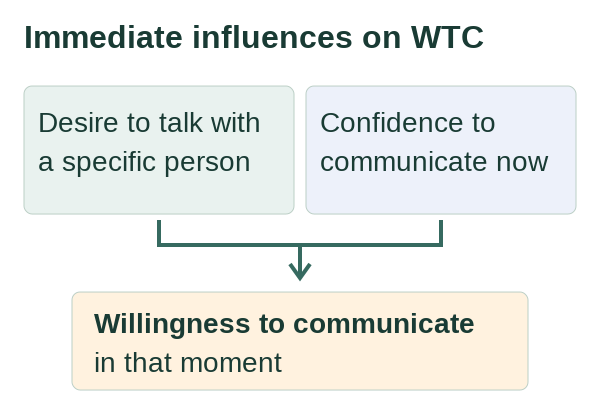
Researchers treat willingness to communicate as a stable trait. They also treat it as a state that changes from moment to moment.[7] A 2007 paper argued that choosing to begin communication at a particular moment is a volitional process. That means a freely chosen one.[3] A 2020 paper described second language communication as a very changeable process. It is shaped by processes within the person and between people.[8]
Grade 9 students in a French immersion program lived in a community that mostly spoke English. Students were asked how willing they were to communicate in speaking, writing, reading and understanding.[2] A qualitative study looked at French immersion students aged 12 to 14. It collected 241 entries about the situations where willingness to communicate was greatest. The two sets of situations were mostly alike. Small differences in context set them apart.[9]
McCroskey and Baer in 1985 described willingness to communicate as a person's tendency to speak. At the core of the idea is free choice: the speaker decides whether to talk.[10] Researchers treat the concept as one factor that predicts how often learners actively take part in communication in a foreign language. It is also described as linked to other ideas, among them motivation, anxiety, self-perceived communicative competence (a learner's own judgment of how well they can communicate), self-confidence and language proficiency.[11]
Some studies treat willingness to communicate as a trait that stays fairly fixed, as in the model tested by Amirzadi and Vibulphol, who placed confidence, motivation, anxiety and grit alongside it.[12] Other studies examine situational willingness to communicate. This is the kind that can change within a lesson. A case study followed twelve learners of English for academic purposes in New Zealand. It ran for five months. The study used classroom observations, recall interviews and reflective journals. These showed that learners' willingness in second language classes could rise and fall over time. That study described the change as a process shaped jointly by learners' cognitive condition, language factors and classroom environment factors.[13]
One set of 35 course outlines came from a Hong Kong university English department. Of these, 34 courses graded class participation. So students had no free choice about communicating. In those courses, willingness to communicate was required, not optional. Clear rules for grading participation were mostly missing.[10]
History
How the idea developed
A Russian regional university used the McCroskey Willingness to Communicate Scale to measure readiness to speak. It also used a survey in which people rated their own communication apprehension. That scale asked people how ready they were to talk in public speaking, in a small group, at a meeting, and in interpersonal talk. A 2020 study looked at 52 students at a Russian regional university. It used the McCroskey scale together with a survey of self-rated communication fear.[14]
A 2021 theoretical review describes willingness to communicate as a speaker's decision to communicate in a specific situation. It assumes the speaker has the right to choose. The same review argues that willingness to communicate may help language learning itself. That is why many instructors now treat it as a goal of teaching.[15] In communicative language teaching, a classroom approach built around real use of the language, learners' willingness to communicate is treated as the link between self-perceived competence, anxiety and motivation.[16]
Lee and Jin added English proficiency to willingness to communicate. This formed a combined measure of intentions and abilities to communicate. They tested whether it predicted learners' English use. One 2023 analysis pooled 67 samples with 17,811 learners. It found that this combined measure predicted English use, with a path coefficient of .525 (p = .02).[16] A 2023 research protocol notes that studies from Japan, Turkey and Pakistan differ enough in their limitations. Because of this, combining their effect sizes is difficult.[17]
Main ideas
Why willingness rises and falls
One study looked at 25 sixth-semester English majors in Indonesia. It found that students were willing to speak. They reported high motivation and a positive attitude toward learning English. They also felt sure about their own language ability.[18]
A study of 56 English majors at a private university in Ankara, Turkey, measured the ideal second-language self, the future picture a learner holds of themselves as a fluent user. In that group, 32.1% had high willingness to communicate in class. Another 30.4% had moderate willingness. 37.5% had low willingness. The ideal second-language self was clearly linked to it.[19]
In a Canadian bilingual university, 130 Anglophone majority students and 248 Francophone minority students took part in a study of context, norms and group vitality, meaning the standing of a language community. Context, individual and social factors all helped decide second-language use. The pattern of links differed with the vitality of each group. Subjective norms are what a learner believes others expect. They moderated the link between confidence and identity among Francophones.[20]
Willingness also shifts quickly inside a single lesson as tasks and partners change.[21] In one mixed-methods study, 20 Farsi-speaking learners of English did three-minute speaking tasks. They rated how their willingness changed. They were also interviewed afterward. A statistical test showed a significant difference in willingness from task to task. The reasons fell into seven categories. These included having supporting ideas, individual factors, context, vocabulary and grammar.[22]
A second study had 20 participants. It tracked willingness second by second. It found steady periods, called attractor states. These rested on content and on language and thinking factors.[4]
Advanced learners in four conversation classes rated their willingness. The scale ran from -10 to +10. They said it rose when they spoke with familiar partners in small groups or pairs. The talk was about personal experiences.[21]
One study took place in a regular English class at a Chinese university. There, 23 students rated how willing they were. It did not differ much between whole-class interaction and pair or group work.[23]
Confidence is one variable that research links to willingness to communicate, the readiness to speak a language one is learning. One survey looked at 187 undergraduates in Malaysia. Willingness to communicate rose with confidence in communicating. It also rose with how competent students felt at communicating. The same survey found that the wish to communicate fell as communication fear rose.[24]
Fear of mistakes and of bad judgment act as barriers. This is especially true during interactions with lecturers. The classroom atmosphere works the other way too. Support from peers and a safe setting made students more willing to speak.[25]
One study looked at 153 senior high school students in Bekasi, Indonesia. The link between classroom setting and the wish to communicate was moderate but significant. The figures were r = 0.413 and p < 0.01. Feeling supported by peers and teachers gave those students the confidence to speak English.[26]
Familiarity matters too. Students were more willing with peers they knew well. They also reported greater willingness with partners they saw as less dominant. Familiar, engaging topics raised it too.[25]
The class was a speaking class of 29 English majors. The topic was the strongest variable affecting willingness to communicate. The same class showed that the gender and age of the interlocutor made no difference.[27] Willingness is not fixed. It shifts with mental readiness, language ability, relationships and teaching methods.[25]
Learners in different settings
In Japan, a long-term study followed 190 high school English learners. They filled in a questionnaire three times, one year apart. The data showed two separate constructs. One was willingness to communicate with friends and acquaintances. The other was willingness to communicate with strangers. Neither measure changed much over the 3 years of high school. Interviews with some of the students pointed to several possible reasons for the questionnaire results.[28]
Turjoman compared Saudi female English majors from private schools with those from public schools. Willingness to communicate in English differed a lot between students from private schools and students from public schools. The researcher recommended more studies. These should find out why willingness to communicate was held down. They also asked why English was not used among these students.[29]
A later Saudi study tested predictors of the wish to communicate inside and outside the classroom. Adding openness to experience improved the prediction of the wish to communicate in class. The R square change was .025, with p=.001.[30]
Communication apprehension was correlated with willingness to communicate at only a moderate level. Surprisingly, the wish to communicate could not predict the learners' second language achievement.[31] A Turkish study looked at 701 tourism students at Balıkesir University. It found a moderate level of willingness to communicate in English. Those students were more willing to communicate outside the classroom than inside it. The difference was statistically significant.[32]
One quantitative study examined Chinese postgraduate students' willingness to communicate in classroom interactions. The setting was a British university. It noted that learners may find it hard to change their beliefs about proper classroom behaviour.[33]
A survey covered 400 Chinese university students at five public universities in Shaanxi Province. It found that their ideal second language self and the classroom setting affected the wish to communicate. The ideal second language self had the stronger influence. Together the two factors explained 52.6% of the variance in willingness to communicate (R² = 0.526, p < 0.01).[34]
Sixteen older adult learners were eager to speak English during an information-gap activity. The task type seemed to have a positive influence on their willingness to communicate. They also valued the part played by the conversation partner. In-class willingness to communicate correlated strongly and positively with how long they had been learning English.[35]
At the other end of the age range, a case study looked at one young learner. It looked at willingness to communicate shown in several ways, not only speech. The findings showed that gestures can signal more than a wish to join a conversation. They also showed that use of the first language can signal a wish to communicate in the second. The learner used many different semiotic resources, or meaning-making tools, to help willingness to communicate. The learner also used them to keep engagement in talk going.[36]
Research
What the studies find
One correlational study looked at 1836 Thai university students. It found a weak to moderate link between English proficiency and the wish to communicate.[1] A smaller study followed 16 Hong Kong students over two weeks. It collected 1,120 reports of willingness at the moment. Those with better language skills reported higher willingness to communicate in class. They also reported higher willingness in digital settings.[37] One study looked at over 1,000 grade 12 students in Flanders learning French as a second language. It used standard listening tests to study the same question.[38]
Anxiety has been linked to lower willingness to communicate. One study looked at 627 Chinese senior high school students. There, it was a significant negative predictor.[39]
One study covered 1528 secondary school students. They were in 65 classrooms in Iran. Anxiety lowered students' willingness to communicate.[5] A pilot study looked at 51 older adults at a University of the Third Age. The negative link between anxiety and willingness held only for tasks focused on meaning.[40] The Flanders study reported that outside the classroom, anxiety matters more than it does in class.[38]
Enjoyment shows up as a positive link in several samples.[40][5][41] The Iranian study used several levels of analysis. It found that enjoyment raised willingness. This held at both the student level and the classroom level.[5]
The pilot study of 51 older adults found a moderate, positive link. It linked willingness with enjoyment of the foreign language. Enjoyment itself was very high.[40]
One study looked at 547 undergraduates in the United States. They were learning languages other than English. Anxiety, boredom and enjoyment were all tied to willingness to speak in class. In that study, classroom social climate and language mindset had no direct effect on willingness in class. Both worked indirectly through emotions. Enjoyment mattered most.[41]
Newer studies treat classroom climate and grit as conditions that work together. A survey covered 227 undergraduate English learners in Turkey. A warmer social climate in the classroom directly predicted a stronger wish to communicate. Grit strongly predicted willingness. So grit partly explained the link between climate and willingness.[42]
The Iranian multilevel study reported the same pattern. A positive classroom environment is linked to more willingness and enjoyment. It is also linked to less anxiety.[5]
Two personality traits best predicted willingness to communicate. They were openness to experience and extraversion. The paths from those two traits to unwillingness to communicate were not significant. Being unwilling led to lower willingness.[43]
One study looked at 426 students at a language institute in Jeddah. Emotional intelligence and mindfulness together explained 33.0% of the variance in willingness. Mindfulness was the stronger predictor.[44]
A 2026 meta-analysis combined 152 effect sizes. These came from 53 studies. It found moderate positive links with two parts of the L2 motivational self system. The ideal L2 self was linked to willingness to communicate at r = .46. The ought-to L2 self showed a negligible effect of r = .20. Earlier studies had reported links for it that were non-significant, positive or negative. Effect sizes changed with region, education level and the language being learned. They also changed with statistical methods, communication settings and ways of checking constructs.[45]
Anxiety appears in several studies of willingness to communicate, and its role differs from one model to another.[46][12] One study looked at 124 tenth-grade students at a vocational school in Kerinci. Willingness to communicate stayed high overall. Anxiety was positively linked to willingness to communicate.[46]
One model was built from 488 university students in Iran. Grit acted as a mediator. Motivation was the strongest predictor in that model. It had both direct and indirect effects.[12] Higher L2 grit went with a stronger wish to speak. The link got weaker as anxiety rose.[47]
Researchers have also measured personality and critical thinking against the wish to communicate.[48][49] The study included 310 Kurdish university students. Willingness to communicate rose with extraversion. It also rose with conscientiousness. Those students were more willing to join passive activities than interactive ones. They were also more willing to talk with first-language English speakers.[49]
One study looked at 360 English majors in Tehran. Every psychological level of critical thinking tested was positively correlated with willingness to communicate.[48] A meta-analysis of 11 studies found a small-to-medium negative link. It linked boredom in foreign language learning to willingness to communicate. The correlation was r = -0.302. Two things affected that link with boredom. They were the share of each gender in the samples and the scale used to measure willingness.[50]
What changes willingness
A five-week intervention took place in an adult English as a second language class. It used goal-setting and self-visualization activities to raise students' wish to communicate.[51] One quasi-experiment used two groups of advanced Iranian learners of English as a foreign language. Both groups took a pre-test and a post-test. Only the treated group rated their peers' performances with a peer assessment form. Afterwards the two groups differed a lot in willingness to communicate. The researchers concluded that peer assessment can help raise these learners' willingness to communicate.[52] The published account describes the intervention and offers suggestions for using it in other settings, without reporting measured results.[51]
One-on-one interviews have also been used to link school English to students' future plans. In a future time perspective intervention, Iranian learners of English discussed their long-term goals. The gain came from a stronger commitment to goals. It also came from greater autonomy. It also came through more positive feelings and values about learning English.[53]
A twelve-month study looked at seventy-seven intermediate learners. It tested whether knowing multi-word expressions predicts later willingness to communicate. The experimental group (n = 58) received direct teaching in these expressions. The control group (n = 19) followed the standard curriculum. Both groups were assessed at five time points. Gains in the expressions strongly predicted increases in willingness to communicate. Interviews showed the phrases raised confidence in communicating. They also encouraged risk-taking.[54]
A public Japanese junior high school ran an online exchange with Norwegian students. It had three video sessions and eleven English practice sessions. Questionnaires, reflective writing and interviews showed that the wish to communicate rose overall. Individual students varied, though. Task type, peer relationships and support systems were named as factors that influenced the changes.[55]
A study used mixed methods. It looked at Turkish first-year student teachers. One group did ten real-life tasks in a virtual world, one task each week. The experimental group reported a stronger wish to communicate than those who did not take part. They also reported less anxiety about communicating.[56]
Four Japanese learners of English did interactive speaking tasks with a researcher. Their levels ran from low-intermediate to advanced. Their willingness to communicate changed with the type of corrective feedback. It also changed with its timing and delivery. The study argues that well-timed, helpful feedback can support both communication and motivation.[57]
A mixed-method study asked whether learners' horoscopes relate to their wish to communicate. Surveys of Turkish learners of English found no significant effect of horoscope sign. Interviews did suggest that Leos were somewhat more willing to speak with friends, classmates and strangers.[58]
A quantitative survey looked at Arabic education students at several universities. It found that artificial intelligence had a positive and significant effect on willingness to communicate. The reason given was a learning setting that was supportive, interactive and adaptable. In it, personal feedback raised students' confidence.[59]
In practice
Classrooms, activities and open questions
What students do in class can change their willingness to communicate.[60][61] The same survey found that cooperation predicted more willingness in activities focused on meaning. Equity predicted less willingness in activities focused on form.[60]
One qualitative study looked at 15 English education students. Task type, topic understanding, and speaking in groups or pairs shaped their willingness to speak. The researcher suggested that teachers explain these factors. Students would then know what makes them want to talk.[61]
A study with 300 elementary learners found that a simulated setting had positive effects on willingness to communicate. That study measured speaking only. Its author asked for similar work on writing, listening and reading.[62] Digital games are a related case. Five students took part in a fifteen-week game-based program at a Thai university. Based on 30 interviews, they reported fewer barriers to learning and more wish to communicate.[63]
Online settings look different from face-to-face ones. Among 281 university students, willingness was highest in normal face-to-face classrooms. In live online lessons, willingness fell whenever students had to use more ways to communicate.[64]
A survey of 1,119 Thai undergraduates named several factors in online willingness. These were communication channels, students' beliefs, peer influence and teacher characteristics. They also included teaching methods and online classroom atmosphere.[65] Students at one Indonesian vocational school preferred written English to spoken English in an online classroom.[66]
One study of expatriates learning a new language covered only a short time span. Its author suggested longer studies. These would follow change over time.[67]
One study of 10 first-year students found individual and external factors linked together, which makes single causes hard to separate.[68] A Czech version of a classroom willingness scale proposed fewer items. It reported a Cronbach's alpha of .82. This number measures internal consistency.[69]
Some studies have tested activities meant to raise willingness to communicate. They did not only describe it.[70][71][72] Students wrote reflections after these activities. The reflections suggested the activities raised their wish to communicate. The rise was especially clear in their plan to speak. The same reflections linked the activities to more motivation.[70]
A virtual exchange put students into groups of two French and two Hungarian undergraduates. They did tasks on Microsoft Teams over three video meetings in one semester. Logbook entries after each meeting showed steady, regular gains.[71]
Online exchanges with peers who are not first-language English speakers have also been tested with younger learners. In one study, 61 Korean elementary school students held ten online sessions with Japanese and Indian peers. They used the usual English curriculum. Scores on a willingness to communicate questionnaire rose after the sessions. Interviews described efforts to communicate that students chose to make.[72]
Online settings are not always easier. Technical problems and trouble taking turns can lower students' wish to speak.[71] These intervention studies gathered evidence through reflections, logbooks, questionnaires and interviews.[70][71][72]
The largest open question is whether speaking is really a free choice in a classroom. In those courses, students had to communicate. It was not a free choice. Students could not easily tell what was expected of them. The case study warns that grading participation may put some students at a disadvantage. Willingness to communicate varies a great deal between individuals. It recommends clear criteria and teaching students how to take part. It also suggests offering different forms of communication in assessment.[10]
What this looks like when you study
After each task the learners rated their own willingness second by second. Then they explained the ratings in recall interviews. Willingness differed a lot from task to task. The group average was highest on the first task, about food. It was lowest on the second and third. The interviews produced seven kinds of reasons. They also included how well the learner thought the task had gone.[22]
One study looked at 281 university students. Willingness to communicate was highest in a face-to-face classroom. The mean was 3.40 on the questionnaire scale. The same students reported lower willingness in online lessons that used video. The mean was 2.45. They reported slightly higher figures for audio and text-based communication. The authors suggest that responsibility and face-saving, meaning the wish not to look foolish, affect how much students join in online classes.[64] Another team gave 300 elementary learners of English a simulated environment. The group that used it showed higher willingness to communicate than the control group.[62]
Zarrinabadi, Ketabi and Tavakoli (2019) tested an intervention. It linked students' school English learning to their future goals. It raised their willingness to communicate. Zarrinabadi, Ketabi and Tavakoli (2019) interviewed students one at a time. It was also to build positive feelings about the value of speaking English. It did so by affecting their commitment to goals, their autonomy, their feelings and the values they attached to learning English.[53]
Humaera, Jumiati and Hasanah Safei (2022) describe information gap activities as a teaching method. Teachers can use it in English classes. Humaera, Jumiati and Hasanah Safei (2022) ran three meetings with 31 students. They reported that pair and group information gap work raised the students' motivation. It also raised their confidence to speak English.[70]
Criticism
Open questions and limits
Some work looks at willingness that shifts from moment to moment during a classroom task. A 2025 report says this work has relied on self-report data alone. That report paired learners' ratings of recalled moments with brain electrical recordings and facial expression analysis. It found links between the reported willingness and these body measures.[73]
A 2016 study in New Zealand compared teachers' beliefs about encouraging talk with class observations. Teachers said they used a range of strategies. Observations confirmed some of them. But no one was seen clearly encouraging practice outside class.[74]
Studies have surveyed 160 Japanese teenage learners of English. Another surveyed 60. They have also surveyed 81 Japanese language students at three universities and 194 Iranian students at private institutes.[75][76][77] Other researchers have interviewed 30 Saudi students at one university. They have also run a network analysis of 474 Japanese university students.[78][79]
A 2021 study looked at 80 learners of Chinese at three universities in China. It found no link between the wish to communicate and pragmatic awareness or understanding. Lv, Ren and Li measured pragmatic awareness and pragmatic comprehension. They also measured the wish to communicate and self-perceived communication skill. Self-perceived communication competence is the learner's own rating of skill. It did relate to pragmatic comprehension in that study.[80]
One case study followed learners for 10 weeks. They talked with speakers of their target languages on a language exchange site.[81] A study-abroad program in the United States involved 60 students. Their frequency of communication correlated with satisfaction in interpersonal relationships during the sojourn.[75]
A regression analysis of 81 students found that three factors together explained only 19% of willingness inside the classroom. The factors were language anxiety, self-rating and virtual intercultural experiences. In digital settings, they explained 22.5%. The rest of the variation points to other variables that matter more.[76]
Lambert compared learners' own ratings of willingness to communicate on a task with physical measures of feeling and effort. The 2025 report describes its own study as a brief step that expands the research agenda. It calls for future work on willingness during task-based language teaching.[73] Leeming and Vitta found that students higher in willingness to communicate produced language with greater lexical diversity. They did not use more advanced vocabulary.[82]
Common misconceptions
For years, researchers treated willingness to communicate as a fixed tendency based on personality. Nematizadeh (2022) reports this. They used measures based on numbers. This missed changes during communication. This holds within the same learners.[22]
Rahayu Firlas and Triastuti (2025) studied 124 vocational school students. They found a positive correlation between anxiety and willingness to communicate. They describe the link as a reluctance to take part in foreign language communication. Their anxiety was mainly fear of negative evaluation. The authors say this shows that higher anxiety went with greater reluctance to engage.[46]
Key studies
| Year | Study | Sample | Design | Finding |
|---|---|---|---|---|
| 2002 | Yashima[6] | 297 Japanese university students | structural equation modeling survey | International posture influenced motivation, which influenced English proficiency and self-confidence, which led to willingness to communicate. |
| 2013 | Watanabe[28] | 190 Japanese high school English learners | longitudinal questionnaire given three times at yearly intervals, with follow-up interviews | Neither willingness with friends and acquaintances nor willingness with strangers changed significantly over three years, and willingness with strangers stayed low. |
| 2016 | Pawlak et al.[21] | advanced learners in four conversation classes | mixed-methods study with self-ratings from minus ten to plus ten and immediate reports | Willingness was enhanced with familiar receivers in small groups or pairs and on topics related to personal experiences. |
| 2018 | Khajavy et al.[5] | 1528 secondary school students from 65 classrooms in Iran | doubly latent multilevel analysis | A positive classroom environment was related to higher willingness and enjoyment and lower anxiety. |
| 2019 | Zarrinabadi et al.[53] | Iranian EFL students | person-centred future time perspective intervention with one-on-one interviews | The intervention was successful in enhancing students' willingness to communicate in English. |
| 2021 | Darasawang & Reinders[1] | 1836 Thai university students | correlational study | Willingness to communicate correlated weakly to moderately with English proficiency, and self-confidence was the most strongly correlated part. |
| 2022 | Nematizadeh[22] | 20 Farsi-speaking English as a Second Language participants | mixed-methods idiodynamic study with three-minute speaking tasks, second-by-second ratings and stimulated recall interviews | Willingness varied significantly from task to task (F(3, 57) = 3.092, p < .05, partial eta squared = .14). |
| 2022 | Topalov et al.[64] | 281 university students | cross-sectional survey with factorial ANOVAs | Willingness was highest face-to-face (mean 3.40) and lowest with video communication (mean 2.45). |
| 2022 | BİJANİ & ABBASİ[62] | 300 elementary-level EFL learners | experimental and control groups with a willingness questionnaire | The simulated environment had positive effects on the participants' willingness to communicate. |
| 2022 | Humaera et al.[70] | 31 students, 14 males and 17 females, mean age sixteen | qualitative study over three weeks using student reflections | Information gap activities increased willingness to communicate, motivation and confidence, especially in pair and group work. |
| 2025 | Universitas Negeri Yogyakarta et al.[46] | 124 tenth-grade vocational school students in Kerinci | quantitative correlational study using anxiety and willingness scales | Anxiety was mainly fear of negative evaluation, overall willingness remained high, and the correlation between anxiety and willingness was positive. |
| 2025 | Liu & Mi[50] | 11 studies on boredom and willingness to communicate | correlational meta-analysis with random-effects models | Boredom had a small-to-medium negative correlation with willingness to communicate (r = minus 0.302). |
| 2026 | Wang et al.[41] | 547 undergraduate students learning languages other than English in the United States | structural equation modeling | Anxiety, boredom and enjoyment were associated with willingness in class, and classroom climate and mindset worked indirectly through emotions. |
| 2026 | Zhang & Chinokul[45] | 152 effect sizes from 53 empirical studies | three-level meta-analysis | The ideal L2 self and the L2 learning experience each correlated with willingness at r = .46, and the ought-to L2 self at r = .20. |
See also
References
- Darasawang, P., & Reinders, H. (2021). Willingness to Communicate and Second Language Proficiency: A Correlational Study. Education Sciences, 11(9), 517. doi:10.3390/educsci11090517
- MacIntyre, P. D., Baker, S. C., Clément, R., & Conrod, S. (2001). Willingness to communicate, social support, and language-learning orientations of immersion students. Studies in Second Language Acquisition, 23(3), 369-388. doi:10.1017/s0272263101003035
- MACINTYRE, P. D. (2007). Willingness to Communicate in the Second Language: Understanding the Decision to Speak as a Volitional Process. The Modern Language Journal, 91(4), 564-576. doi:10.1111/j.1540-4781.2007.00623.x
- Nematizadeh, S. (2021). Willingness to Communicate and Second Language Speech Fluency: An Idiodynamic Investigation of Attractor States. Journal for the Psychology of Language Learning, 3(1), 26. doi:10.52598/jpll/3/1/2
- Khajavy, G. H., MacIntyre, P. D., & Barabadi, E. (2018). Role of the emotions and classroom environment in willingness to communicate: Applying doubly latent multilevel analysis in second language acquisition research. Studies in Second Language Acquisition, 40(3), 605-624. doi:10.1017/s0272263117000304
- Yashima, T. (2002). Willingness to Communicate in a Second Language: The Japanese EFL Context. The Modern Language Journal, 86(1), 54-66. doi:10.1111/1540-4781.00136
- Li, Z., & Li, B. (2022). Individual Differences and Willingness to Communicate in Second Language: The Role of Student Age, Gender and Socioeconomic Status. Language Teaching Research Quarterly, 30, 18-31. doi:10.32038/ltrq.2022.30.02
- MacIntyre, P. (2020). Expanding the theoretical base for the dynamics of willingness to communicate. Studies in Second Language Learning and Teaching, 10(1), 111-131. doi:10.14746/ssllt.2020.10.1.6
- MACINTYRE, P. D., BURNS, C., & JESSOME, A. (2011). Ambivalence About Communicating in a Second Language: A Qualitative Study of French Immersion Students’ Willingness to Communicate. The Modern Language Journal, 95(1), 81-96. doi:10.1111/j.1540-4781.2010.01141.x
- Lin, V., & Forey, G. (2026). Exploring the underexplored: Assessing students' willingness to communicate in the curriculum. Review of Education, 14(1). doi:10.1002/rev3.70151
- (2022). Students' Willingness to Communicate in EFL Context. Journal Ishraqat Tanmawya, 33. doi:10.51424/ishq.33.34
- Amirzadi, A., & Vibulphol, J. (2023). A Model of Willingness to Communicate in English in Iranian EFL Classroom Context. English Language Teaching, 16(8), 118. doi:10.5539/elt.v16n8p118
- Cao, Y. (. (2013). Exploring dynamism in willingness to communicate: A longitudinal case study. Australian Review of Applied Linguistics, 36(2), 160-176. doi:10.1075/aral.36.2.03cao
- Guzikova, M., Gudova, M., & Kocheva, O. (2020). Assessing Willingness to Communicate in the Multilingual Environment. KnE Social Sciences. doi:10.18502/kss.v4i13.7696
- Kahrimanović, E. (2021). To Speak or not to Speak? Theoretical Framework of Willingness to Communicate. MAP Social Sciences, 1(1), 37-47. doi:10.53880/2744-2454.2021.1.1.37
- The Korea English Language Testing Association, Lee, H., & Jin, S. (2023). Measuring Communicative Intentions and Capabilities: Learners’ English Proficiency as a Supplement to Willingness to Communicate. The Korea English Language Testing Association, 18(1), 97-117. doi:10.37244/ela.2023.18.1.97
- Olobia, L. P. (2023). Willingness to Communicate in English as a Second Language: A Research Protocol for Meta-Analysis. Journal of Natural Language and Linguistics, 1(1), 8-12. doi:10.54536/jnll.v1i1.1423
- Syam, H. (2017). Investigating Situational Willingness to Communicate (WTC) within EFL Classroom. Journal of English Education, 2(2). doi:10.31327/jee.v2i2.327
- Bursali, N., & Oz, H. (2017). The Relationship between Ideal L2 Self and Willingness to Communicate Inside the Classroom. International Journal of Higher Education, 6(4), 229. doi:10.5430/ijhe.v6n4p229
- Clément, R., Baker, S. C., & MacIntyre, P. D. (2003). Willingness to Communicate in a Second Language: The Effects of Context, Norms, and Vitality. Journal of Language and Social Psychology, 22(2), 190-209. doi:10.1177/0261927x03022002003
- Pawlak, M., Mystkowska-Wiertelak, A., & Bielak, J. (2016). Investigating the nature of classroom willingness to communicate (WTC): A micro-perspective. Language Teaching Research, 20(5), 654-671. doi:10.1177/1362168815609615
- Nematizadeh, S. (2022). Investigating the dynamics of change in second language willingness to communicate. OLBI Journal, 12, 207-232. doi:10.18192/olbij.v12i1.5997
- Peng, J. E. (2020). Teacher interaction strategies and situated willingness to communicate. ELT Journal, 74(3), 307-317. doi:10.1093/elt/ccaa012
- (2023). Examining Willingness to Communicate in the English Language Classroom. Asian Journal of Research in Education and Social Sciences. doi:10.55057/ajress.2023.5.4.5
- Syafitri, M., Munir, & Ariyani, A. (2025). The Analysis Factors Affecting Students' Willingness to Communicate In EFL Classroom. International Journal of Language, Education, and Literature, 2(3), 407-416. doi:10.66720/t7m14x90
- Maulana, S., & Kaniadewi, N. (2025). Exploring the Supportive Classroom Environment in Relation with Students’ Willingness to Communicate in English. Jurnal Studi Guru dan Pembelajaran, 8(2), 1295-1305. doi:10.30605/jsgp.8.2.2025.6567
- Susanti, E. (2021). Contributing factors on students’ willingness to communicate (WTC). UAD TEFL International Conference, 2, 41. doi:10.12928/utic.v2.5734.2019
- Watanabe, M. (2013). Willingness to Communicate and Japanese High School English Learners. JALT Journal, 35(2), 153. doi:10.37546/jaltjj35.2-1
- Turjoman, M. O. A. A. (2016). Willingness to Communicate in English among Saudi Female University Students. International Education Studies, 9(7), 170. doi:10.5539/ies.v9n7p170
- Almesaar, O. (2023). Predictors of L2 Willingness to Communicate in Saudi Context. World Journal of English Language, 14(1), 206. doi:10.5430/wjel.v14n1p206
- Subekti, A. S. (2019). Willingness to Communicate in English of Non-English Major University Students in Indonesia. Lingua Cultura, 13(1), 55. doi:10.21512/lc.v13i1.5155
- Basoz, T., & Erten, I. H. (2018). Investigating Tertiary Level EFL Learners’ Willingness to Communicate in English. English Language Teaching, 11(3), 78. doi:10.5539/elt.v11n3p78
- Shaanxi Normal University, China, Qian, R., & Yuan, S. (2022). Chinese Postgraduate Students’ Willingness to Communicate in the Classroom Interactions in a British University. International Journal of Learning and Teaching, 290-293. doi:10.18178/ijlt.8.4.290-293
- (2025). Determinants of Chinese University Students’ Willingness to Communicate in English: A Structural Equation Model (SEM). Asian Journal of Research in Education and Social Sciences. doi:10.55057/ajress.2025.7.3.40
- Borkowska, A. (2024). Older Adult Learners’ Willingness to Communicate in English during Task Performance. Anglica Wratislaviensia, 62(1), 125-147. doi:10.19195/0301-7966.62.1.8
- Wong, N. (2024). A multimodal translingual approach to study a young learner's willingness to communicate. TESOL Journal, 15(3). doi:10.1002/tesj.781
- Lee, J. S., & Chiu, M. M. (2024). Modelling trait and state willingness to communicate in a second language: An experience sampling approach. Studies in Second Language Learning and Teaching. doi:10.14746/ssllt.37541
- DENIES, K., YASHIMA, T., & JANSSEN, R. (2015). Classroom Versus Societal Willingness to Communicate: Investigating French as a Second Language in Flanders. The Modern Language Journal, 99(4), 718-739. doi:10.1111/modl.12276
- Lin, Y., Wang, B., Zhang, G., & Su, Y. (2025). The relations among foreign language anxiety, academic buoyancy and willingness to communicate in EFL classroom. Frontiers in Psychology, 16. doi:10.3389/fpsyg.2025.1634054
- Borkowska, A. (2025). Older adults’ willingness to communicate and emotions in the EFL classroom context: Results of a pilot study. Neofilolog(65/1), 84-103. doi:10.14746/n.2025.65.1.5
- Wang, H., Patterson, M. M., & Peng, A. (2026). Predictors of second language willingness to communicate among US undergraduate students: Classroom social climate, emotions, and language mindset. Language Teaching Research, 30(7), 3875-3899. doi:10.1177/13621688241237214
- Erdel, D. (2026). Classroom climate and EFL students’ willingness to communicate: the mediating role of L2 grit. Frontiers in Psychology, 17. doi:10.3389/fpsyg.2026.1808101
- Khany, R., & Nejad, A. M. (2017). L2 Willingness to Communicate, Openness to Experience, Extraversion, and L2 Unwillingness to Communicate: The Iranian EFL Context. RELC Journal, 48(2), 241-255. doi:10.1177/0033688216645416
- Hassan Saleem Alqurashi (2026). Psychological Predictors of EFL Learners’ Willingness to Communicate: The Roles of Emotional Intelligence and Mindfulness. Journal of Arts, Literature, Humanities and Social Sciences(130), 615-634. doi:10.33193/jalhss.130.2026.1729
- Zhang, H., & Chinokul, S. (2026). The Relationship Between L2 Motivational Self System and Willingness to Communicate: A Three-Level Meta-Analysis. Language Teaching Research. doi:10.1177/13621688261492630
- Universitas Negeri Yogyakarta, Rahayu Firlas, M., Triastuti, A., & Universitas Negeri Yogyakarta (2025). The Correlation Between Anxiety and Willingness to Communicate in EFL Vocational School. INTERNATIONAL JOURNAL OF MULTIDISCIPLINARY RESEARCH AND ANALYSIS, 08(06). doi:10.47191/ijmra/v8-i06-71
- Ye, X. (2026). L2 Grit and Classroom Willingness to Communicate: The Moderating Role of Anxiety. Journal of Language, Culture and Education, 3(5), 81-91. doi:10.70267/jlce.v3n5.8191
- Yaghoubi, A. (2017). Critical Thinking and Willingness to Communicate among EFL Students. Journal of Language Teaching and Research, 8(2), 375. doi:10.17507/jltr.0802.22
- Sarkawt Muhammad Qadir (2026). Silent Minds, Speaking Selves: Big Five Personality Traits as Predictors of Willingness to Communicate in English. Zanco Journal of Humanity Sciences, 30(SpC), 27-45. doi:10.21271/zjhs.30.spc.3
- Liu, M., & Mi, H. (2025). Unveiling Foreign Language Learning Boredom’s Relationships with L2 Engagement and Willingness to Communicate: A Meta-Analysis. Journal of Language and Education, 11(4), 185-213. doi:10.17323/jle.2025.24510
- Eliza Lizdas (2024). Using Self-Visualization and Goal-Setting Activities to Increase Willingness to Communicate. GATESOL Journal, 33(1), 25-29. doi:10.52242/gatesol.192
- Niknejad, S., & Nazari, B. (2015). Willingness to Communicate: Tracking Movement through Peer Assessment. Communication & Language at Work, 4(4), 3. doi:10.7146/claw.v1i4.20770
- Zarrinabadi, N., Ketabi, S., & Tavakoli, M. (2019). Using a Person-Centred Future Time Perspective Intervention to Enhance EFL Learners’ Willingness to Communicate. RELC Journal, 50(2), 341-349. doi:10.1177/0033688217716536
- Heidari, K. (2026). Multi-word expressions and communicative engagement: A longitudinal study of L2 learners’ willingness to communicate. Applied Linguistics. doi:10.1093/applin/amag044
- Otsuki, Y. (2022). JHS Online-communication Experience: Enhancing Willingness to Communicate. JALT Postconference Publication, 2021(1), 243. doi:10.37546/jaltpcp2021-28
- Galip (2018). Willingness To Communicate And Communication Anxiety Of Efl Learners In A Virtual World. i-manager's Journal of Educational Technology. doi:10.26634/jet.15.3.14549
- Sato, R. (2025). Japanese EFL Speakers’ Fluctuation of Willingness to Communicate: Its Interplay and Association with Feedback. Language Teaching Research Quarterly, 48, 69-83. doi:10.32038/ltrq.2025.48.05
- Necmettin Erbakan University, Turkey, & Ekizer, F. N. (2022). The Influence of Horoscopes on Turkish EFL Students’ Willingness to Communicate. Education Quarterly Reviews, 5(3). doi:10.31014/aior.1993.05.03.549
- Said, A. S., Setiyawan, A., & Saleh, Z. (2025). Pengaruh Artificial Intelligence (AI) terhadap Willingness to Communicate pada Pembelajaran Bahasa Arab. Kalamuna: Jurnal Pendidikan Bahasa Arab dan Kebahasaaraban, 6(2), 261-272. doi:10.52593/klm.06.2.04
- Han, H., & Li, B. (2025). Perceptions of social interactions and second language willingness to communicate in different activities. Asian-Pacific Journal of Second and Foreign Language Education, 10(1). doi:10.1186/s40862-024-00312-x
- Qamaria, N. A. (2024). Situational Factors Influencing Students' Willingness to Communicate. AL LUGHAWIYAAT, 4(1). doi:10.31332/alg.v4i1.4079
- BİJANİ, H., & ABBASİ, M. (2022). Exploring how the use of a simulation technique can affect EFL students’ willingness to communicate. International Journal of Assessment Tools in Education, 9(3), 613-630. doi:10.21449/ijate.987659
- Reinders, H., & Wattana, S. (2015). Affect and willingness to communicate in digital game-based learning. ReCALL, 27(1), 38-57. doi:10.1017/s0958344014000226
- Topalov, J., Knežević, L., & Halupka-Rešetar, S. (2022). What it takes to communicate: Comparing EFL students’ willingness to communicate in traditional and online classroom. Годишњак Филозофског факултета у Новом Саду, 47(2), 41-57. doi:10.19090/gff.2022.2.41-57
- Punyaporn, P., & Soontornwipast, K. (2022). An Exploration of Students’ Willingness to Communicate in Thai EFL Online Classroom. Arab World English Journal(8), 70-87. doi:10.24093/awej/call8.5
- Chotmaniyah, C., Basthomi, Y., & Anugerahwati, M. (2026). Students' Willingness to Communicate in English Through Virtual Classroom. Jurnal Pendidikan Humaniora, 8(4). doi:10.17977/2442-3890.1109
- Tarp, G. (2025). English as a Lingua Franca and its Impact on Willingness to Communicate in a Second Language. Language Teaching Research Quarterly, 48, 125-138. doi:10.32038/ltrq.2025.48.08
- Ilyas, F. S. (2022). Exploring University Students’ Willingness to Communicate and Unwillingness to Communicate in EFL. J-SHMIC : Journal of English for Academic, 9(1), 28-41. doi:10.25299/jshmic.2022.vol9(1).8743
- Jelínková, J., Chytrý, V., Gregor, P., & Laue, A. (2022). Studentsʼ Willingness to Communicate in English: Czech Adaptation of Willingness to Communicate Inside the Classroom Scale. ORBIS SCHOLAE, 16(1), 29-53. doi:10.14712/23363177.2022.15
- Humaera, I., Jumiati, W. O., & Hasanah Safei, N. (2022). Developing Students' Willingness to Communicate Using Information Gap Activities. KnE Social Sciences, 127-137. doi:10.18502/kss.v7i8.10731
- Simon, K., & Schug, D. (2025). Analyzing the Impact of Virtual Exchanges on Students’ L2 Willingness to Communicate. Alsic, 28(2). doi:10.4000/145ia
- The Korea Association Of Primary English Education, & Choi, S. (2024). Exploring Intercultural Communicative Competence and Willingness to Communicate of Korean elementary students in Online Intercultural Exchanges. The Korea Association of Primary English Education, 30(2), 129-151. doi:10.25231/pee.2024.30.2.129
- Lambert, C. (2025). Neural Correlates of Task‐Specific Willingness to Communicate: Expanding the Research Agenda. TESOL Quarterly, 59(S2). doi:10.1002/tesq.3395
- Vongsila, V., & Reinders, H. (2016). Making Asian Learners Talk: Encouraging Willingness to Communicate. RELC Journal, 47(3), 331-347. doi:10.1177/0033688216645641
- Yashima, T., Zenuk‐Nishide, L., & Shimizu, K. (2004). The Influence of Attitudes and Affect on Willingness to Communicate and Second Language Communication. Language Learning, 54(1), 119-152. doi:10.1111/j.1467-9922.2004.00250.x
- Muliadi, M. (2022). The Affecting Factors of Willingness to Communicate of Inside Classroom, Outside Classroom, and Digital Setting on Japanese Language Students. Japanese Research on Linguistics, Literature, and Culture, 5(1), 1-11. doi:10.33633/jr.v5i1.5895
- Aliakbari, M., Kamangar, M., & Khany, R. (2016). Willingness to Communicate in English among Iranian EFL Students. English Language Teaching, 9(5), 33. doi:10.5539/elt.v9n5p33
- Alenezi, S. (2020). Exploring the Factors Affecting Saudi University Students’ In-Class Willingness to Communicate in English. International Journal of English Linguistics, 10(5), 75. doi:10.5539/ijel.v10n5p75
- Ito, T. (2021). The Influence of Socio-Ecological Networks on Willingness to Communicate in English for Japanese People. Frontiers in Psychology, 12. doi:10.3389/fpsyg.2021.580448
- Lv, X., Ren, W., & Li, L. (2021). Pragmatic Competence and Willingness to Communicate Among L2 Learners of Chinese. Frontiers in Psychology, 12. doi:10.3389/fpsyg.2021.797419
- Lloyd, E. (2012). Language Learners' "Willingness to Communicate" through Livemocha.com. Alsic, Vol. 15, n°1. doi:10.4000/alsic.2437
- Leeming, P., & Vitta, J. P. (2026). Willingness to Communicate and Lexical Complexity: Exploring Cognitive Engagement during Tasks. Vocabulary Learning and Instruction, 15, 103233. doi:10.29140/vli.2026.103233
Cite this page: Atlas Nova editors. (2026). Willingness to communicate. Atlas Nova. https://velocer.io/atlas/willingness-to-communicate/