Method · Language teaching
Communicative language teaching
Language teaching approach
Communicative language teaching is an approach that makes communicative competence the goal of language teaching and develops procedures for teaching listening, speaking, reading and writing. Classroom activities of a collaborative kind let students put forward their own ideas and views.[1]
Its main aim is to make individuals competent in communication, and the emphasis falls on that goal rather than on language structures and lexical collocations.[1] A review of 37 studies found teachers and pupils view it positively for speaking skills.[2] In China, a top-down CLT policy failed to improve students' interactive competence.[3] It gives learners more chances to develop communicative ability than older methods.[4]
Overview
What communicative language teaching is
Communicative language teaching is usually shortened to CLT. It is an approach to teaching a second or foreign language. It treats interaction as both the way people learn a language and the goal of that learning.[8] The basic idea is that instruction should aim at communicative proficiency. Mastery of structures alone is not the goal. Bai (2024) reports that British applied linguists developed the approach.[9]
CLT makes communicative competence the goal of language teaching. The approach also sets out ways to teach four language skills. These are listening, speaking, reading and writing. Group activities in class give learners room to say what they think and feel. Alamri (2018) says the approach fills the learning environment with new kinds of activities and materials. These are interactive and real.[1]
CLT is an approach, not a specific method. Teachers must choose one suitable method, or a mix of methods. The aim is to build communicative competence in their own classrooms.[10] Bai (2024) reports that Richards and Rodgers summed up five principles. Uses of the approach follow them.[9]
The approach brings social skills to students. It can be used with young and adult learners. Teachers can build their skills at managing classroom interaction.[10] Hien (2021) writes that CLT gives learners more chances to build communicative ability. The Grammar-Translation method gives fewer. It also gives them a larger part in classroom activities.[4]
CLT is described as the leading approach to language teaching worldwide. Schools, colleges, universities and language institutes in most countries use the approach.[1] It is also described as an important theory of foreign language teaching. It is the mainstream idea in the field.[11] The approach has led to major changes in the ways language is taught and learned.[1] Kurniawan recommends the approach for any language programme that aims to build communicative competence.[10]
History
Where the idea came from
The central claim was that language is not a fixed set of items learned one by one. Brumfit described language instead as a process of negotiating meaning in language and culture. Speakers work out meaning together. On this view, students must learn to use language for their own purposes. They must also respond to the purposes of other language users. Brumfit (1980) argued that syllabuses tend to focus on the product, or content. He said this focus should give way to methodology.[12]
Brumfit (1980) held that discussing how to organize a syllabus was not enough. The methodological implications mattered much more. Language may not be discrete in principle. If so, teaching is poorly served by assuming a learner's product can be specified exactly. He concluded that it was time to stop defining syllabuses. That work had been done well enough for the current state of classroom practice.[12]
The approach did not spread smoothly from scholars to teachers. A 1993 paper called the change an incomplete revolution. It noted that needless debate and confusion had slowed the move of its principles into teaching. That paper suggested further progress depended on ending division. It also depended on turning agreement into standard course materials. Those materials had to suit local teaching conditions.[13] The approach had greatly influenced theoretical work on second language teaching. Yet there was little evidence of change in its practical use.[14]
Main ideas
Communicative competence and its parts
Mammadova (2026) calls speaking arguably the most essential form of language. So speaking a second language well needs steady, planned teaching and focused practice.[15] One 2023 review of 37 articles published between 2018 and 2022 found that teachers and pupils viewed communicative teaching positively. They saw it as keeping speaking skills going, despite challenges.[2]
Mammadova (2026) lists control of vocabulary and grammar among the goals of speaking instruction.[15] A study of an Indonesian English classroom described teacher talk as supporting linguistic, strategic, sociocultural, actional and discourse competencies.[16]
Applied pragmatics studies the speech acts that happen in classrooms. It asks how these acts affect foreign language learning.[17] Communicative classrooms rely on pair and group work. That social interaction requires interpersonal skills. Students who lack confidence in those interpersonal skills may hold back from communicative activities. One article argues that social skills should be taught in the language classroom. It gives practical suggestions for building them.[18]
Correction should not break the flow of speech. Errors that keep coming back are better saved for focused practice later.[15] Jarad (2009) found that learners with stronger communicative competence tended to hold different attitudes to classroom interaction than weaker ones. Jarad argues that students' own views about which classroom activities work should be heard and studied.[19]
Mammadova (2026) writes that assessment of speaking should stress communicative efficiency. It should also stress relevance to the workplace. Whether classroom practice turns into real speaking ability depends heavily on the teacher's skill in choosing strategies, supports and tasks that carry meaning.[15]
Goestina and Sugirin (2025) studied an Indonesian classroom. They concluded that two kinds of exchange matter for language growth. One is between teacher and students, the other among students.[16] The 2023 review called for future research on how education stakeholders see communicative teaching in English as a second language settings.[2]
Why interaction is thought to work
One 2024 paper states the idea in its title: language is not taught, it is caught. The paper argues that meaningful communication is the best route to language acquisition. Learning by rote is not. Revathy (2024) bases the argument on Krashen's Input Hypothesis and on Vygotsky's socio-cultural theory. Revathy (2024) names interaction, real-life application and sociolinguistic competence as important for building communicative skills.[20]
A 2026 paper on early childhood language education makes a related argument about classroom talk. In many preschool language activities, the teacher asks and the children answer. The talk goes one way only. Children get chances to answer but few chances to use language in real contexts. The paper argues that education should return to children's lived worlds. It should give them reasons to use language naturally with teachers, peers and their surroundings.[21]
A 2026 study of school foreign language lessons measured engagement. It defined engagement as one combined construct. Its parts were cognitive, emotional and social. The researchers tracked learners' body responses with heart and movement measurements. They did this in regular German classes. A questionnaire recorded the learners' own views of their engagement. Kołsut and Szumilas (2026) saw the highest level of engagement during productive tasks. The results support a task-based approach. They give teachers a reason to add productive tasks in place of receptive ones. Kołsut and Szumilas (2026) found that a peer-learning part mattered a lot. It helped build inner motivation and social skills.[22]
A 2025 survey studied 891 Chinese college students learning English. It tested how three things fit together: teaching approach, teacher-student relationships and communicative competence. Neither teaching approach had a significant direct effect on communicative competence. This suggests the link runs through how people relate to each other. Zhou and Li (2025) note that the design was cross-sectional. They also note that some scales had only moderate reliability. Zhou and Li (2025) therefore treat the results as exploratory. They call for objective assessments and studies that follow learners over time.[5]
Gunn (2003) reports a classroom study. In it, both the learners and the teacher-researcher came to understand more. One study followed two girls and two boys, aged 11 to 13 and of four nationalities. They learned English at an international school in Thailand over six months. The researcher combined analysis of the students' performances with the students' own reflections on those performances. The study looked at what students do and what they say about what they do. This allowed discussion of communicative competence over time.[23]
Students practiced reading to interpret and writing to present. They also learned about their partners' cultures and everyday speech. The project reported gains in both communicative and cultural proficiency. This was based on qualitative and quantitative data.[24]
Gloriez (2022) reports teachers' perceptions of CLT and of how they implement it in online learning. Gloriez (2022) surveyed 30 teachers from junior and senior high schools in Tanjungpinang-Bintan and Batam. The teachers understood the principles of the approach well. Most of those teachers held a misconception, however, that the approach means not teaching grammar. The same teachers used the approach in online learning. They believed it was appropriate and effective. They had enough platform media and internet access. However, teaching materials were not enough.[25]
A 2022 mixed-methods study paired a receptive-skills mobile application with weekly hour-long lessons centered on meaningful communication, reducing error-aversion tendencies, cultural awareness and presentation skills. Adult learners at a company improved, according to standardized test scores, the learners' own reflections and survey answers. The paper notes that most such applications favor memorizing vocabulary and grammar rules over tools for interaction.[26]
Grammar, feedback and the learner's first language
A common wrong belief holds that communicative language teaching leaves out grammar. A 2016 paper argues that this wrong idea has led grammar to be ignored. It says grammar materials need a change in what they select and how they order it. That paper reports that grammar is being ignored in some classrooms. Learners then write less well than they speak.[27]
Zamani Roodsari and Harrison (2024) note that content-based instruction applies form-focused instruction to some features of the target language. Content-based instruction builds lessons around subject matter. A 2024 account describes it as sharing the principles of communicative teaching. The participants were future language teachers. They were taking a graduate course in second language acquisition. The course was taught through a foreign language. The data came from observations, reflective journals and assignment artifacts. It was analyzed with a grounded theory approach.[28]
Sheen (2004) compared four settings for communication. The four settings were French immersion in Canada, English as a second language in Canada, English as a second language in New Zealand, and English as a foreign language in Korea. Recasts were far more common in the Korean and New Zealand classes, at 83% and 68%. They were less common in the Canadian immersion and Canadian ESL settings, at 55% each. Uptake and repair after recasts were also more frequent in New Zealand and Korea than in Canada. The study suggests recasts may work better when they are shortened or partial, so the correction stands out. They may also work better when students watch for form rather than meaning.[29]
Janulienė (2008) discusses the pros and cons of using the first language in a communicative adult classroom. Janulienė (2008) adds that adults may question their teachers' methods. They may feel uneasy when only the target language is spoken.[30]
Adil (2020) interviewed 20 professors and lecturers in Saudi Arabia. The topic was translation as a way to teach language. Those teachers said translation helped build the communicative ability their learners needed. Adil (2020) concludes that translation should be used with care. Its use should depend on the learner's skills and level of competence.[31]
A 2013 account of teaching German at an institute in Bangladesh shows how testing can pull a communicative course off course. The study tested reading and writing, not all four skills. So the class was adjusted toward reading and writing. The 11 schoolteachers in the course ended with elementary reading and writing. Their speaking and listening were poor.[32]
Textbooks, tasks and materials
Nguyen and Le (2020) evaluated the tasks and activities in English 6. It is a required textbook for all students in grades 6 to 9 in Vietnam since 2001. Nguyen and Le (2020) worked with 8 teachers and 126 students. The four secondary schools were in the Mekong Delta. The study found little variety in the activities and tasks. Most of them focused on form. Nguyen and Le (2020) concluded that such tasks do not help learners build communicative competence.[6]
Firiady (2018) reports a pre-use evaluation of a revised textbook. It was used for Level 1 students at a language centre. The speaking activities were analysed with Littlewood's 1981 framework. That framework lists suggested communicative activities. The book held a range of activity types. These included pre-communicative activities, structural activities, listening, vocabulary building and reading. The communicative activities in the book fell into functional communication and social interaction. Functional communication activities were the most common. Examples are class surveys and information gaps. Firiady (2018) notes that only a general overview had been done before. Limits on time and resources caused this.[33]
Li, Noordin and Ismail (2025) studied project-based learning with Chinese Business English majors. The project group gained a lot in fluency, vocabulary and confidence in communicating. The control group gained significantly in none of these. The learners also had positive attitudes toward project-based learning. They stressed its role in soft skills such as teamwork, creativity and self-management.[34]
Task-based learning also appears in proposals for training language teachers. So do authentic communication scenarios.[35] A framework for elementary English lists role play, group discussions and interactive tasks as communicative activities. These improved students' confidence and their ability to communicate. The same study found that limited teacher proficiency, a lack of instructional resources and traditional teaching practices constrained these activities. Dzulqa and Mulyasari (2026) conclude that successful implementation of CLT requires adequate teacher training and adaptation to context.[36]
Research
Evidence on speaking and language gains
A 2026 systematic review gathered 18 empirical studies from an initial pool of 309 records. All were published between 2015 and 2025. Chen and Shuib (2026) concluded that CLT helps students communicate better. The clearest gains were in speaking, listening and taking part in class. Evidence for grammar, reading and writing development was less consistent. Studies differed in how they planned instruction and what they tested.[49]
Hendriyani (2026) reported that learners' English improved. The biggest gains were in speaking, listening and interaction. The report tied this to practical teaching centred on learners.[50]
One true experiment at Manado State University tested third-semester students in two groups of 12. It used a pre-test and post-test design. The CLT group's mean score was 23.75, against 12.08 for the control group. The calculated t-test value was 2.932, above the table value of 2.074.[51]
A quasi-experiment at a senior high school in Indonesia split 40 students into two classes of 20. It found a significant difference between the methods. CLT was more effective for speaking ability.[52] A comparative study of secondary school students in India reported that CLT significantly improved fluency, pronunciation and interaction skills. It also raised overall confidence.[53]
A quasi-experiment studied two groups of 60 intermediate Chinese middle-grade learners. It found that the audio-lingual method and CLT both improved grammar proficiency. Both also improved attitudes to learning. Learners taught with CLT did better on grammar than those taught with the audio-lingual method.[54]
A 2026 comparison of existing studies concluded that grammar-based teaching builds a strong base in grammar and accuracy. This is especially true in controlled settings. That comparison also concluded that CLT works better for fluency and for pragmatic competence (using language in fitting ways in context). It also works better for learner engagement through real use of the language. It proposed a balanced approach that draws on both methods. The choice depends on learners' goals and contexts.[55]
Sitorus and colleagues (2023) tested CLT in essay writing. They used one group with a pre-test and post-test. Siu (2022) tested a combined structural and communicative approach to vocabulary. The study had 52 foundation degree students.[56][57]
It found CLT effective for essay writing. The calculated t value was 4.30 against a table value of 1.70329. Students in that study said they enjoyed essay writing classes. They also felt motivated to improve their writing.[57] Pre-tests and post-tests each had 25 words and 25 definitions. Both groups studied how words are formed.[56]
A Malaysian study looked at secondary students taught at home. It used pre-tests, post-tests, observation, a questionnaire and a structured interview. It found significant gains in the experimental group. Those students said they learned more vocabulary through group discussions. They also reported better reading comprehension when exchanging ideas and opinions.[58]
A descriptive case study of Bahasa Indonesia instruction involved five pre-service teachers and eleven international learners. It reported that CLT built a setting for communication. It also raised learners' engagement and confidence. Challenges included mixed skill levels, the need to address culture, and few real materials.[59]
CLT in online and technology-rich settings
Communicative language teaching (CLT) began in the 1970s and 1980s. Attention shifted from grammar to the skills needed for purposes such as making requests and giving advice.[60] Schools moved to online learning during the pandemic. Teachers had to find methods that kept students engaged with the material. One account describes online CLT through dialogue, discussion and role play. Teachers used applications to support the lessons. The same account notes a problem with online lessons. Teachers cannot be sure every student understands the material. It also lists skills that online CLT can target. These include building vocabulary, searching for information and arguing a personal opinion.[61]
A systematic review looked at 40 articles on technology in CLT. All were listed in Scopus, a large database of academic publications. The review found that 2024 produced the most articles on the topic, with 5. The United Kingdom contributed the most articles, with 6. The review also reported problems in putting CLT into practice. It discussed the learning media and teaching methods that the reviewed studies described. Its authors say research on technology in CLT is still scarce. This is especially true over a long timeframe.[62]
Nykyporets, Ibrahimova and Medvedieva describe the flipped classroom as one new way to organise education during the pandemic. Nykyporets, Ibrahimova and Medvedieva discuss models and features of using the flipped classroom in higher education institutions. A 2021 article describes the flipped classroom as one new way to organise teaching. It was used during the quarantine caused by the SARS-CoV-2 pandemic. That article discusses using it with students in non-language majors at higher education institutions.[63]
A later experiment tested the approach on five aspects of written communicative competence. These were lexis (vocabulary), syntax (sentence structure) and cohesion (how sentences link). They also included pragmatics (using language well in context) and discourse (organising longer stretches of text). The experiment involved two classes of Chinese undergraduates. They were taking a standard college English course. One class learned through the flipped approach. The other group got ordinary lectures. Pre-test and post-test scores showed the flipped class doing better than the lecture class overall. Li, He, Tao and Liu read this as an overall positive role for the approach. The effects differed by aspect, however. Significant group differences appeared only in vocabulary, cohesion and pragmatics. There were no differences in sentence structure or longer stretches of text. The researchers conclude that the flipped method might be used in planned ways to support language development.[64]
Chen, Yin and Faya Ornia surveyed 656 students at seven Chinese colleges and universities. The survey asked about taking part in CLT classrooms. A survey of 656 college students at 7 colleges and universities across China tested a model. It linked CLT classroom participation to commitment to learning a second language. The study found that taking part in CLT classrooms had a positive effect on students' engagement in second language learning. Classroom atmosphere and self-efficacy for second language acquisition (a learner's belief in their own capacity to learn the language) each carried part of that influence. The two together formed a chained mediation path. Participation worked partly through atmosphere and then through self-efficacy. The researchers call this the first systematic joining of social cognitive theory and social constructivism in a CLT model for Chinese educational culture.[65]
Wardoyo, Herda, Kozuka and Majid reviewed 40 Scopus-indexed articles on technology in CLT, published from 2010 to 2025.[62] The flipped classroom experiment found gains in some writing skills but not others.[64] The online teaching account rests on classroom practice rather than a controlled comparison.[61]
CLT and assessment
One study asked whether English final tests in Oman were themselves communicative. It analyzed five final tests given between 2011 and 2016. The tests were checked against a model of language ability and the grade 10 test specifications. The tests departed from their own specifications. Communicative competence was not fully covered. The input in the tests was not authentic. Most parts used suitable language in a limited setting. Some had limited instructions. Constructed responses, where students write or speak at length rather than pick answers, were scarce, and no two skills were integrated except for a random pairing of vocabulary and reading.[66]
Direct test preparation is common in test preparation courses. Negative washback could occur. It compared communicative teaching with a control group. Lertcharoenwanich states that CLT can be an effective method. It can reduce negative washback. It can also raise both proficiency and test scores.[67]
Yede compared traditional methods with CLT among secondary school students in Lagos State, Nigeria. A Nigerian study took place in Lagos State. Secondary students given extra communicative teaching scored higher than a control group on a test of specific communicative tasks. That study concluded that the traditional method used in second-language English classes could not build the communicative competence these learners need.[68]
Blitar is in East Java. There, a survey of 40 elementary school teachers found that a communicative approach did not significantly change students' results in the national examination. Some activities in that approach did show a significant link to results in social science.[69]
Siregar, Hasibuan, Barus and Sembiring measured mental effort in translation tasks. They also measured writing motivation. They studied 62 students in North Sumatra. With communicative teaching, their mental effort and writing motivation in translation tasks improved.[70]
An experiment with 40 students found a significant effect of communicative teaching on speaking skill. The F value was 7.08 against a table value of 4.49.[71] A survey asked 183 students at universities in Bahawalpur. They judged communicative teaching suitable for the classroom. It also found the method had not produced fluent English speakers.[72] A conceptual comparison of communicative teaching with critical thinking pedagogies concluded that the two share elements of an educational culture, but not the pedagogy of independence.[73]
In practice
What the classroom looks like
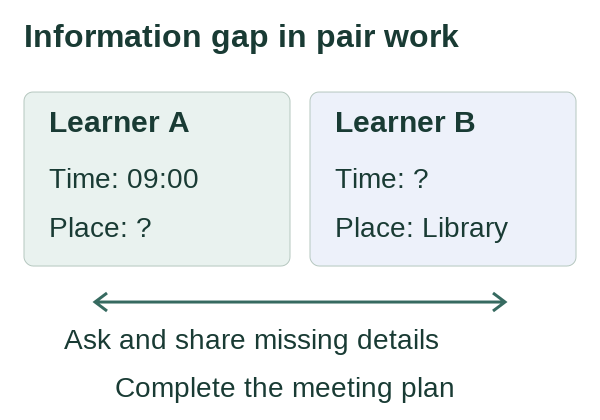
Lessons draw on role plays, group discussion, pair work and debates. They also use tasks with missing information, presentations and problem solving. The aim is a shift from passive language learning to active language use.[74]
Sekiziyivu and Mugimu (2017) write that the approach changes the teacher's role. The teacher moves from passing on knowledge to helping language learning.[75] The teachers who were observed guided students and gave vocabulary support. They also made chances for students to interact. They gave clear instructions and built a comfortable, supportive space. They also urged students to speak without fear of mistakes.[76]
Classroom routines offer another route. These are repeated daily activities that reuse the same language units. Learners keep new language units better when repetition is frequent. It also helps when the repetition is tied to real life and personal. Learning by rote works less well. Well-organized routines are said to cut teacher talking time and raise student talking time. The routines are meant to give memorization the repetition it needs without becoming boring.[77]
Competition can be added to classroom activities. One action study reported that healthy competition raised students' ability to communicate. That study describes communicative competence as four areas: grammatical, sociolinguistic, discourse and strategic. It argues that activities should be designed to make students perform that competence, with students and teachers working together.[78] A published lesson plan for a communicative lesson sets out each activity with its reason. It then weighs the plan's strengths and weaknesses.[79]
Implementation varies with the class, and teachers report obstacles. These include students' lack of confidence and limited vocabulary. They also include differing levels of English proficiency. One study concludes that the approach works when teachers adapt it to students' needs. It also works when they adapt it to classroom conditions.[76] A survey of 25 questionnaire items compared teachers' beliefs about the approach with their classroom practices. The largest gap between belief and practice was fluency versus accuracy.[80]
Adapting CLT to local settings
Japan's education ministry revised the national syllabus to stress speaking and listening. It also called for much greater use of communicative language teaching. A questionnaire study of 48 Japanese university students described the present situation of that approach in Japan. Many Japanese people avoid speaking English because they see themselves as poor speakers. This holds even after at least six years of English in junior and senior high school.[7]
China's education system is run by the central government. A top-down policy push for communicative language teaching failed. It did not improve students' interactive competence.[3]
Holliday (1997) observed six communicative university English classes in China and India. All were taught by teachers who were not first-language speakers. Classes had 25 to 45 students. The study questioned a common view of the approach. Instead, cultural continuity between traditional and new forms came out as an essential feature of successful communicative teaching.[81]
In Taiwan, researchers reported a gap between policy and practice in the shift toward communicative-focused instruction.[82] In Bangladesh, English teaching at secondary level has long concerned the government. Commissions and task forces have followed since 1974.[83]
In Morocco, observers watched secondary English classes. Classes not run in a communicative way outnumbered communicative ones. Communicative features dominated in 34.16% of the classes observed. Karfa (2019) called this share fairly high given the limits found. Those limits included the foreign language setting and the formal classroom. They also included students' ideas about taking part, role relationships, and assessment methods. Other factors were few varied materials and equipment, and large classes. The findings suggested that Moroccan secondary teaching had moved away from teacher-centred classrooms. It had moved toward more communicative teaching. They also suggested that the approach can work in foreign language settings. It is not impossible there.[84]
A separate Moroccan study interviewed secondary teachers. They held positive attitudes. They said the approach improves speaking skills and learner independence. Those teachers also said the curriculum barely stresses communication skills. They said it needs reform and redesign.[85]
In a Saudi university context, 42 English teachers were studied with mixed methods. These combined observation with other data. The teachers held positive views of communicative language teaching. Their beliefs and their classroom practice differed, though. Alghamdi (2021) found that most instructors still used traditional methods. These were grammar translation and the audio-lingual approach. The study concluded that teachers in that setting need closer links between their beliefs and their practices.[86] In Afif, a non-urban district of Saudi Arabia, a qualitative study of seven female students in two primary schools reported that communicative teaching had a positive effect on English comprehension.[87]
Quetta is in Balochistan. There, a survey of 204 students at two government secondary schools in Pakistan found positive attitudes toward communicative language teaching. The group was 102 female and 102 male students. The same students had less favorable or neutral attitudes toward grammar translation. The study suggested that policy makers consider adopting or adapting the communicative approach in those schools.[88]
A qualitative case study looked at 10 teachers in Turkish vocational high schools. It found teacher-controlled activities. It also found a classroom layout mostly centered on the teacher. A large share of class time went to grammar instruction. English teaching there relied heavily on textbooks, with some audiovisual materials now and then. The teachers agreed that curricula, teaching aids and assessment tools needed improvement.[89]
How teachers learn and use CLT
Classroom English covers the phrases and expressions a teacher needs. These are used for classroom management, content delivery and feedback. In India, the National Curriculum Framework of 2005 and 2009 said teachers need classroom English. An online test covered 36 pre-service teachers, meaning people training to teach. They were at colleges in Telangana and Andhra Pradesh. It found they needed training in these phrases. The test covered teachers of all subjects, not just future English teachers.[90]
In a micro teaching course, peer teaching lets student teachers practise classroom English. They do this before a school placement. One English education department in Indonesia required student teachers to take a micro teaching class. They took it before a one-semester teaching internship at a school. A study described peer teaching, in which trainees teach each other. There, it served as practice for using classroom English to give instructions.[91]
Trainees still struggle at this stage. A study of pre-service teachers at a university in Makassar found ten classroom management problems during micro teaching. These included trouble using language to communicate during teaching exchanges. They also included using language functions well. They covered giving feedback and evaluation before the lesson ended.[92]
Jiang and Paulino designed communicative activities. The activities are a guide for instructors putting CLT into practice. A document analysis of Chinese vocational college teaching sorted suitable strategies into two kinds. Group activities included role-play, pair and group work, interviews and information gap tasks. Individual activities included storytelling, describing pictures and sharing opinions. Jiang and Paulino list information gap activities among group-oriented strategies. These can be changed to fit vocational college students. The analysis gave lesson plans that combine these strategies as a guide for instructors. It also argued that teachers are the main agents of change in educational practice. They need to know what is actually happening in their classrooms.[93]
Teachers also set conditions for the lesson: real language input, chances to practise, feedback, and material that fits learners' needs. Ablakulov adds two more teacher practices: teaching functional language use and promoting intercultural communication. It recommends a classroom where learners feel free to share ideas, opinions and feelings in English.[94] A study of 120 university students over one academic year identified structured communicative environments, task-based instructional design, authentic materials and formative assessment as the best combination of conditions.[95]
A one-month teaching practice took place at an Islamic boarding school senior high school. It used role-play, group discussion and real-life interaction tasks without digital tools. Observation, reflective journals and student interviews showed a change. Engagement and speaking confidence improved. Students reported more motivation in real-life communication activities. They reported less in rote learning. Limited time and uneven skill levels sometimes blocked balanced participation. Varied instruction, visual aids and role-based tasks helped fix this.[96]
A study with 30 students tested a teaching method for speaking. The method was built on CLT principles. Speaking scores rose significantly from pre-test to post-test. The t-value was 11.221, against a t-table value of 2.045. The significance value was 0.000, against a threshold of 0.05.[97]
Observers watched three secondary teachers in Nepal. All three types of classroom interaction were present. But the teacher often led and controlled the talk.[98]
In one secondary school study, good interaction happened only at the start of the lesson. After that the teacher started and students answered in phrases or single words. Students there often talked to each other, but mostly not about the English topic. Reported causes included low motivation and limited vocabulary. They also included embarrassment and fear of mistakes.[99]
A survey covered 123 students and three teachers at private senior high schools in Ruteng, Flores. CLT features scored 66.7% and teacher role 79.7%, mostly high. Starting interaction was mostly low, at 61.8%. Teachers there mostly used books or handouts and hardly ever used games or technology. Students were not engaged in learning on their own.[100]
CLT with different ages and learners
A study in Manta, Ecuador watched a first-grade class of 25 students. It then focused on three of them. Vocabulary was consistently named as an area for improvement. The classroom showed practices tied to communicative language teaching. These were meaning-centered instruction, chances to interact, feedback, a friendly setting, and visual aids. Comprehension was a relative strength for the three children. Vocabulary was named again and again as the area needing work. Pronunciation, fluency, expression, intonation, listening, eye contact and confidence varied a lot from one child to another. The study concluded that young learners still need suitable language scaffolding (temporary teacher support), steady language modeling, and enough time to answer.[101]
Istiantika, Jatuporn and Setiawan used games and other communicative activities. They worked with students in grades three to six at SDN Jambangan. One program used communicative language teaching with grades three to six. It ran at a school in Indonesia during a campus teaching placement. Its activities fell into four kinds: communicative English teaching, practice questions, a question and answer session, and a guessing game. According to the report, students took part actively. They also followed the teacher's instructions cooperatively.[102]
A 2024 review of recent articles on Indonesian primary English reached a similar view. It looked at the Kurikulum Merdeka, the country's current school curriculum. That review found that communicative teaching gave children real chances to communicate. It also encouraged active engagement. It raised their motivation and overall language ability.[103]
Older adults form a distinct group. One paper defines a third-age learner as a healthy retiree interested in learning. A 2022 report described two studies of communicative teaching with such learners. One was in a face-to-face community class and one was online. Both used mixed methods. They compared learners' self-reflections and video performances. One also added assessments from independent evaluators. The activities examined were planned focus on form, practice of communication strategies, and timed conversation. Most of the third-age learners got better at communicating. The report treats this as some evidence that a communicative approach works for them. The same report notes that research on practical teaching methods for third-age learners is still scarce. Demand for their education is rising.[104]
In higher education, communicative teaching is described as turning students into active participants rather than listeners.[105] A 2026 theoretical article argues that linguistic competence now means using grammar, vocabulary and sounds well and meaningfully in real situations. Knowing them is not enough. That article argues the approach works best with steady classroom interaction and meaningful tasks. It also calls for real materials and teaching centred on students. It asks for assessment of real communicative performance.[106]
A 2025 article on English teaching in higher education reports that communicative lessons build speaking and writing skills. They also build skill at communicating with others. It also states that the approach has advantages over traditional methods, based on data it analyzes.[105]
Several classroom studies at this level report gains in speaking.[107][108][109] A mixed-methods study looked at 30 students at private universities in Bangladesh. After a communicative teaching program, their speaking improved by a statistically significant amount, with more fluency and complexity. The students also liked the method. They judged it effective for their speaking skills.[107]
A classroom action research project had 30 students at a teacher training college in Central Lampung. It ran for about four cycles. It reported a positive, meaningful effect on speaking.[108] The class was 31 first-semester students at a college in North Sulawesi. The share rated excellent rose from 0% before teaching to 10% by the third cycle. The share needing improvement fell from 10% to 0%.[109]
Learners preparing for particular jobs show their own preferences. A 2023 survey looked at 80 first-year nursing students in Abha and 80 in Muhayil. All were at a Saudi university. It found that 82.5% liked learning medical English through communicative activities. In the same survey, 76.2% strongly wanted to improve their medical English skills. More than 70% preferred learning medical terms with visual aids, mind maps and puzzles. About 75% preferred learning medical texts and terms through group activities. They also liked teaching the information to friends and family. Self-motivation had a moderate positive link with attitude toward communicative teaching. It also had a moderate positive link with learning style preferences.[110]
Some studies test communicative teaching against another method, not against no teaching.[111][112] A quasi-experiment studied dental nursing students in Makassar. The class taught communicatively improved its English speaking much more. The class taught by grammar translation improved less.[111] An experiment studied 36 grade XI students at a school in Aek Natas. It found that communicative teaching had a significant effect on writing hortatory text, a text type that argues a position.[112]
A pre-experimental study of one class at a junior secondary school in South Halmahera reported that the method improved English vocabulary.[113] Rahmati ran classroom action research with 32 second-year students. They were at a senior secondary school in Lhokseumawe. Reading comprehension scores were 89.06 points in the first cycle and 95.6 points in the second. In Rahmati's questionnaire, all the students said the CLT method was interesting. The observation sheet showed very good results on study habits.[114]
Tuan surveyed 221 fourth-year students at five universities in Vietnam. The survey asked about their linguistic and discourse competence. It found their skill was a factor of their parents' academic influence.[115]
A case study looked at 18 students at a private school in Yogyakarta. The school was moving from the 2013 curriculum to the Merdeka curriculum. The study found seven models of actional competence in presentations. Actional competence means the ability to respond to and understand communication well. This covers speech and body language. Information exchange was the most often used model. This suggests the students focused on giving and receiving information.[116]
CLT in specific contexts and subjects
Communicative language teaching (CLT) is an approach. It puts real communication at the center of language learning.[117] In 1987, Swales reviewed work on CLT in English for specific purposes settings.[118] Aubakirov and Dolgopolova suggest that CLT, widely used for teaching English, could be adapted for Kazakhstan's conditions.[119]
Swales wrote in 1987 that five years earlier, book-length studies of ESP came down to Munby's Communicative Syllabus Design (1978) and Robinson's ESP (1980). Swales wrote that five years earlier the short list had gained Widdowson (1984), Kennedy and Bolitho (1984), McDonough (1984) and Trimble (1985). The same review notes a steady stream of ESP articles, papers, theses and monographs.[118]
A 2021 study at South East European University surveyed 10 English teachers and 27 first-year students. Most were aged 18 to 20. Their degree subjects included international communication, business administration, business and economics, and computer sciences. Both groups held positive beliefs about CLT. This was especially true for the roles of teachers and students, and for pair and group work.[120]
Harjanne studied Finnish-speaking students practising Swedish out loud in a foreign language classroom. A Finnish case study examined Swedish lessons. In them, students practised speaking through cooperative and elaboration tasks. Recordings of the oral practice showed a lot of dedication, cooperation and self-generated communication in Swedish. Many students also used their first language, Finnish, to build shared understanding. They used it to help one another.[121]
A 2018 paper from Kazakhstan proposed adapting CLT to teach Kazakh. The setting was Karaganda State Technical University. Students there speak Russian. The paper gives a model of a lesson based on communication. It reports that the model proved effective for these students. It also suggests the model could be used more widely to train adults in Kazakhstan.[119] Rudiuk reports that the study proves the proposed teaching model works in high school.[122]
Lașcu (2021) analyses the principles behind the discursive approach to the literary text. It covers both inner and outer parts of the literary text. This approach covers both the inside and the outside of a text. The paper says this allows a more complex analysis.[123]
A 2022 paper on Spanish in the classroom applies CLT ideas to second language acquisition. This is the process by which people learn another language. It examines how instruction and acquisition relate. It also looks at how approaches aimed at communication change the learning process.[124]
In other languages, students may fall back on their first language for support. The Finnish study found this.[121] A 2024 bibliometric analysis looked at 649 documents on CLT from 2013 to 2024. It named use in languages beyond English as a path for further research. The same analysis pointed to CLT developing across several fields. It also pointed to more practical variants of the method.[117]
What this looks like when you study
In one classroom study, a researcher watched four students aged 11 to 13. Over the six months, the researcher could see how the students' communicative competence developed.[23]
In Vietnam, 8 teachers and 126 students took part. They came from four secondary schools and judged the tasks in their compulsory English textbook. Most activities asked students to listen and repeat dialogues or practice them with a partner using substitutions. The textbook lacked tasks with an information gap. It also lacked open-ended discussion that pushes learners to exchange real opinions. The researchers concluded that these tasks mostly focus on form. They do not build the ability to communicate.[6]
The students rated their own experience of communicative teaching, form-focused instruction, teacher-student relationships and communicative competence. Communicative teaching was positively linked to the quality of teacher-student relationships. The correlation was 0.457. Those relationships were in turn strongly linked to communicative competence. The correlation was 0.512. Communicative teaching and form-focused instruction showed no significant direct effects on competence. The authors call these results exploratory because the data came from one point in time.[5]
One study looked at 68 business English students. One group prepared for the TOEIC test through communicative language teaching. The other group used a direct test preparation method. The communicative group's official TOEIC scores were significantly higher than the control group's scores.[67]
One source recommends starting with real-life or daily-life material. It advises avoiding artificial material.[10] A study of older learners recommends timed conversation practice, repeating a talk in rounds of four, then three, then two minutes.[104]
Criticism
Criticism, gaps and open questions
A small 2019 study observed 8 Thai teachers. They called themselves supporters of communicative teaching. It used classroom observations and interviews after lessons. Those lessons shared four features. They used small talk in the target language. They also used a warm-up plus presentation at the start. They reacted positively to learners' errors. They stressed semi-communicative activities. The teachers said they played several roles at once. They were lesson designers, class managers and English users with a certain level of skill.[125]
A quasi-experiment at one Indonesian school compared the approach with the usual method teachers used there.[52] Xethakis (2022) studied 598 Japanese university learners in a required oral communication course. They felt more enjoyment than anxiety. Enjoyment went with positive attitudes toward English. It also went with self-reported proficiency higher than classmates. It went with more active use of English too. Students named peer interaction and a sense of achievement as sources of enjoyment. They named being unable to express meaning or understand others' English as sources of anxiety.[126]
Mekhmanova (2026) addresses challenges in using the communicative approach in Russian language teaching.[127] A 2023 survey studied 65 students in class XI at one Indonesian secondary school. It found high approval of the communicative approach and a friendly class atmosphere. That survey recommended that teachers master teaching and learning theory. It also said teachers should know students' skills so they can build interest. It added that future researchers should study how speaking skills develop under the approach.[128]
A 2021 study looked at a design thinking course taught by two Japanese university teachers. It linked the course to student enjoyment, confidence in communicating and flexible thinking. Cleminson and Cowie (2021) concluded that learners may need time to build communication during tasks. They may also need a focused way to teach report writing. This comes before communicative competence can be supported.[129]
Common misconceptions
Many teachers believe that communicative language teaching means grammar is not taught. In a survey of 30 teachers, most showed this wrong belief about grammar in CLT.[25]
Many teachers assume that if learners are communicating, they must be learning. The source calls this belief wrong and possibly harmful. It warns that learners' attention may stay on meaning while language form is neglected.[1]
Key studies
| Year | Study | Sample | Design | Finding |
|---|---|---|---|---|
| 2003 | Gunn[23] | four students aged 11 to 13 at an international school in Thailand | classroom investigation over six months | The researcher could see how the students' communicative competence developed over time. |
| 2004 | Sheen[29] | four communicative classroom settings in Canada, New Zealand and Korea | observational study of corrective feedback | Recasts were the most frequent feedback type, at 83% in Korean EFL and 68% in New Zealand ESL. |
| 2019 | Karfa[84] | 120 English classes in Moroccan secondary schools | classroom observation study | 34.16% of classes were communicatively oriented and 61.66% were not. |
| 2020 | Nguyen & Le[6] | 8 teachers and 126 students in four secondary schools in Vietnam | questionnaires, interviews and classroom observation | The textbook lacked varied activities and mostly focused on form, so it did not help develop communicative competence. |
| 2020 | Adil[31] | Interviews with 20 professors and lecturers in Saudi Arabia | Translation was seen as effective for developing communicative ability when used judiciously. | |
| 2021 | Alghamdi[86] | 42 Saudi EFL teachers | mixed methods with classroom observation | Teachers held positive views of CLT but most continued to use traditional methods. |
| 2022 | Gloriez[25] | survey with two questionnaires | Teachers understood CLT principles but many wrongly believed CLT means not teaching grammar. | |
| 2022 | McNeill[104] | 14 adult learners aged 60 to 85 in Japan | mixed-methods study of community classes | Most learners improved their ability to communicate, and 12 of 14 could use openers and closers by the end. |
| 2022 | Lertcharoenwanich[67] | 68 business English students | experiment with experimental and control groups | The communicative group's official TOEIC scores were significantly higher than the control group's. |
| 2023 | Banafi[110] | online questionnaire survey | 82.5% liked to develop skills through communicative activities, and self-motivation correlated positively with attitude toward CLT. | |
| 2023 | Hui & Yunus[2] | Systematic review of 37 CLT-related articles from 2018 to 2022 | Teachers and pupils view CLT positively for sustaining speaking skills despite challenges. | |
| 2025 | Li et al.[64] | two groups of Chinese undergraduates in a college English course | experiment with pre-test and post-test | The flipped group performed better overall, with significant differences only in lexical, cohesive and pragmatic competencies. |
| 2025 | Zhou & Li[5] | 891 Chinese college students learning English | cross-sectional survey with structural equation modeling | CLT was linked to teacher-student relationships (r = 0.457), which were linked to communicative competence (r = 0.512). |
| 2026 | Kołsut & Szumilas[22] | Physiological monitoring and questionnaires in German classes | Engagement was highest during productive tasks, supporting a task-based approach. |
See also
References
- Alamri, W. A. (2018). Communicative Language Teaching: Possible Alternative Approaches to CLT and Teaching Contexts. English Language Teaching, 11(10), 132. doi:10.5539/elt.v11n10p132
- Hui, S. M., & Yunus, M. M. (2023). Revisiting Communicative Language Teaching Approach in Teaching ESL Speaking Skills. Journal of Language Teaching and Research, 14(6), 1515-1523. doi:10.17507/jltr.1406.09
- Song, B. e. (2018). The Research on Effectiveness of Communicative Language Teaching in China. Asian Culture and History, 11(1), 1. doi:10.5539/ach.v11n1p1
- Hien, L. T. N. (2021). Communicative Language Teaching in Teaching ESL for University Students. Journal of English Language Teaching and Applied Linguistics, 3(6), 49-57. doi:10.32996/jeltal.2021.3.6.7
- Zhou, D., & Li, Q. (2025). The role of teacher-student developmental relationships in linking communicative language teaching and communicative competence. Frontiers in Psychology, 16. doi:10.3389/fpsyg.2025.1635428
- Nguyen, C. T., & Le, D. T. K. (2020). Communicative Language Teaching: Do Tasks and Activities in School Textbooks Facilitate Learners’ Development of Communicative Competence? Journal of Language Teaching and Research, 11(5), 688. doi:10.17507/jltr.1105.04
- Abe, E. (2013). Communicative language teaching in Japan: current practices and future prospects: Investigating students' experiences of current communicative approaches to English language teaching in schools in Japan. English Today, 29(2), 46-53. doi:10.1017/s0266078413000163
- Sekhar, G. R. (2016). Communicative language teaching approach in the teaching of english language: a comprehensive study. ACADEMICIA: An International Multidisciplinary Research Journal, 6(7). doi:10.5958/2249-7137.2016.00025.2
- Bai, J. (2024). The Discussion of Communicative Language Teaching in Language Classrooms. Frontiers in Sustainable Development, 4(2), 1-4. doi:10.54691/jckqrt49
- Kurniawan, A. B., & ., S. (2022). Communicative Language Teaching Approach Potential for English Language Teaching. KnE Social Sciences. doi:10.18502/kss.v7i7.10648
- Chen, X. (2024). A Literature Review of Communicative Language Teaching: Effectiveness and Deficiencies. Frontiers in Sustainable Development, 4(11), 59-63. doi:10.54691/29x4vp51
- Brumfit, C. J. (1980). From Defining to Designing: Communicative Specifications versus Communicative Methodology in Foreign Language Teaching. Studies in Second Language Acquisition, 3(1), 1-9. doi:10.1017/s0272263100000140
- Whitley, M. S. (1993). Communicative Language Teaching: An Incomplete Revolution. Foreign Language Annals, 26(2), 137-154. doi:10.1111/j.1944-9720.1993.tb01162.x
- (2002). Communicative Language Teaching の実現を促す英語科組織の経営特性 -高等学校の英語科経営に関する質問紙調査を通して- (Organizational Effectiveness of Upper Secondary School English Language Departments and Their Commitment toward Communicative Language Teaching). JALT Journal, 24(1), 33. doi:10.37546/jaltjj24.1-2
- Mammadova, H. (2026). Developing communicative efficiency in English: goals, methods, and classroom practices for teaching speaking skills. InterConf(65(279)), 6-19. doi:10.51582/interconf.19-20.01.2026.001
- Goestina, G., & Sugirin, S. (2025). Exploring Classroom Practice Develop Students' Communicative Competence. International Journal of Multicultural and Multireligious Understanding, 12(8), 362. doi:10.18415/ijmmu.v12i8.6913
- Campo Collante, E., & Zuluaga Gómez, J. (2017). Applied pragmatics: Exploring communicative events in the classroom. Revista Folios(11), 80. doi:10.17227/01234870.11folios80.88
- Schmidt-Fajlik, R. (2011). Improving interpersonal competence in the communicative classroom. The Language Teacher, 35(3), 25. doi:10.37546/jalttlt35.3-5
- Ismail Jarad, N. (2009). The Effect of Communicative Competence on Classroom Interaction1. International Journal of Arabic-English Studies, 10(1), 219-236. doi:10.33806/ijaes2000.10.1.14
- Revathy, B. R. (2024). Language is not taught, it is caught: Embracing the communicative approach in the primary classroom. i-manager’s Journal on English Language Teaching, 14(4), 36. doi:10.26634/jelt.14.4.21198
- Shih, Y. H. (2026). From “Teaching Language” to “Using Language”: Approaches to Early Childhood Language Education in Authentic Communicative Contexts. Social Science and Human Research Bulletin, 03(09). doi:10.55677/sshrb/2026-3050-0902
- Kołsut, S., & Szumilas, M. (2026). Exploring student engagement in task-based and communicative language classrooms. Language Teaching Research, 30(5), 2577-2606. doi:10.1177/13621688231188800
- Gunn, C. L. (2003). Exploring second language communicative competence. Language Teaching Research, 7(2), 240-258. doi:10.1191/1362168803lr124oa
- Frank, N. (2016). The Globalized Classroom: Integrating Technology to Improve Communicative and Cultural Proficiency. International ResearchScape Journal, 4. doi:10.25035/irj.04.01.11
- Gloriez, P. (2022). Communicative Language Teaching and Its Implementation in Online Learning: The Teachers’ Voice. Journal of English Language Teaching and Linguistics, 7(1), 157. doi:10.21462/jeltl.v7i1.751
- Pool, J. (2022). Mobile assisted language learning in the context of communicative classroom practices. International Journal of Modern Education, 4(14), 31-39. doi:10.35631/ijmoe.414004
- (2016). Necessity for a Revolution in Teaching Communicative English Grammar to Bangladeshi Learners in CLT Classroom. The Millennium University Journal, 1(1), 48-55. doi:10.58908/tmuj.v1i1.5
- Zamani Roodsari, S., & Harrison, J. (2024). Content-Based Instruction In Communicative Language Teaching. Journal of Classroom Action Research, 3(2), 24-35. doi:10.52622/jcar.v3i2.265
- Sheen, Y. (2004). Corrective feedback and learner uptake in communicative classrooms across instructional settings. Language Teaching Research, 8(3), 263-300. doi:10.1191/1362168804lr146oa
- Janulienė, A. (2008). On the Use of L1 in Communicative Adult EFL Classroom. Studies about Languages(13), 77-81. doi:10.5755/j01.sal.1.13.43325
- Adil, M. (2020). Exploring the Role of Translation in Communicative Language Teaching or the Communicative Approach. Sage Open, 10(2). doi:10.1177/2158244020924403
- Shirin, P. (2013). How Communicative is the Communicative Approach? – The German Teacher’s Experience. Journal of NELTA, 17(1-2), 83-92. doi:10.3126/nelta.v17i1-2.8095
- Firiady, M. (2018). Communicative language teaching through speaking activities designed in a textbook. LLT Journal: A Journal on Language and Language Teaching, 21(1), 104-113. doi:10.24071/llt.v21i1.708
- Li, C., Noordin, N. B., & Ismail, L. (2025). Effectiveness of Project-Based Learning in Improving Chinese EFL Learners’ Oral Communicative Competence. English Language Teaching, 18(8), 63. doi:10.5539/elt.v18n8p63
- USWLU., Uzbekistan, & Nishonbekova, S. U. (2025). An Integrative Approach to Enhancing Communicative and Methodological Competence in English Language Teacher Education. European International Journal of Pedagogics, 5(5), 265-268. doi:10.55640/eijp-05-05-59
- Dzulqa, E. T., & Mulyasari, E. (2026). Integrating communicative language teaching into elementary English curriculum: A framework for multidimensional competency development. Al-TA'DIB: Jurnal Kajian Ilmu Kependidikan, 19(2), 312-327. doi:10.31332/atdbwv19i2.14535
- Banjongjit, B., & Boonmoh, A. (2018). Teachers’ Perceptions towards Promoting Intercultural Communicative Competence in the EFL Classroom. rEFLections, 25(2), 76-97. doi:10.61508/refl.v25i2.165393
- Naqeeb, H. (2025). Intercultural Communicative Competence: Definition, Models, Measurement Instruments, and Empirical Practice in the EFL Classroom. Dibon Journal of Education, 1(1), 23-41. doi:10.64169/dje.15
- Sujarani Mathew (2022). Implications of Intercultural Communicative Competence in English Language Teaching/Learning in the 21st Century. Journal of English Language Teaching, 64(3), 3-10. doi:10.66121/sse1zf87
- qizi, T. M. O. (2026). Developing Intercultural Communicative Competence Among Tourism Students Through English Language Teaching. International Journal of Pedagogics, 06(05), 420-423. doi:10.37547/ijp/volume06issue05-96
- SIAW JUN NING, & MEGAWATI SOEKARNO (2024). Beyond communicative competence: Integration of intercultural communicative competence in primary ESL classroom. MANU Jurnal Pusat Penataran Ilmu dan Bahasa (PPIB), 35(1), 1-27. doi:10.51200/manu.v34i1.4806
- Snigdha, S. S. (2022). Developing intercultural communicative competence in EFL classroom through intercultural materials: Necessity and incorporation. Khulna University Studies. doi:10.53808/kus.2022.19.02.2203-ah
- Nurhidayah, A. (2022). The effectiveness of intercultural communicative language teaching (iclt) model for learning intercultural communication: A case study. Journal of English Teaching, Applied Linguistics and Literatures (JETALL), 5(1), 45. doi:10.20527/jetall.v5i1.11814
- Jiménez Carlos, T. A., & Fajardo Dack, T. (2023). Voices of IB Learners: Social Justice Education in the EFL Classroom – Opening Doors to a More Communicative Approach. Pacha. Revista de Estudios Contemporáneos del Sur Global, 5(13), e240239. doi:10.46652/pacha.v5i13.239
- Brown, S. (2026). Social justice language education through communicative language teaching. Elt Journal. doi:10.1093/elt/ccag006
- Xing, Q. (2022). Pedagogical Review on the Learner-Centered, Communicative and Intercultural Language Classroom. Research and Advances in Education, 1(6), 86-93. doi:10.56397/rae.2022.12.11
- Mao, M. (2025). To Create a Learner-centered, Communicative, Intercultural Classroom. International Education Forum, 3(9), 135-144. doi:10.26689/ief.v3i9.12265
- Sun, M., & Wang, J. (2024). Creating a Communicative, Learner-Centred, Intercultural EFL Classroom. New Explorations in Education and Teaching, 2(4). doi:10.18686/neet.v2i4.4369
- Chen, L., & Shuib, T. R. B. (2026). Communicative Language Teaching (CLT) in English as Foreign Language (EFL) Classrooms: A Systematic Review of Its Pedagogical Effectiveness and Classroom Implementation. International Journal of Research and Scientific Innovation, 13(1), 651-660. doi:10.51244/ijrsi.2026.13010056
- Ida Hendriyani (2026). Systematic Literature Review on the Effectiveness of Communicative Language Teaching (CLT) in Enhancing EFL Students’ Speaking Skills. Jurnal Sosial Humaniora dan Pendidikan, 5(1), 958-971. doi:10.55606/inovasi.v5i1.6154
- Lumy, J. (2018). Enhancing Students’ Speaking Skill Using Communicative Language Teaching Method. Journal of English Language and Literature Teaching, 3(01). doi:10.36412/jellt.v3i01.738
- S, I., Mujahidah, M., & Asni, Y. (2023). Effectiveness of communicative language teaching (CLT) method to improve students speaking skill. Al-Irsyad: Journal of Education Science, 2(2), 161-167. doi:10.58917/aijes.v2i2.79
- Kashif Taufeeque, M. (2026). A Study on the Effectiveness of Communicative Language Teaching in Enhancing Speaking Competence among Secondary School Students. International Journal of Advances in Social Sciences, 14(3), 143. doi:10.52711/2454-2679.2026.00028
- Miao, Z. (2023). Effectiveness of Audio-Lingual Method and Communicative Language Teaching in Enhancing the English Language Grammar Proficiency and Attitude among Intermediate Chinese EFL Learners. World Journal of Educational Research, 10(5), p58. doi:10.22158/wjer.v10n5p58
- Muxarramxon Nasimxo’ja qizi, Z. (2026). The effectiveness of grammar-based versus communicative language teaching. INTERNATIONAL JOURNAL OF SCIENCE AND TECHNOLOGY, 3(04), 66-69. doi:10.70728/conf.edu.v3.i4.014
- SIU, F. K. (2022). The Effectiveness of a Structural-cum-Communicative Approach to Vocabulary Teaching. Language, Education and Culture Research, 2(1), p53. doi:10.22158/lecr.v2n1p53
- Sitorus, N., Sinaga, N. T., Siahaan, R., & Claudia, N. (2023). The Effectiveness of Communicative Language Teaching towards Students’ Ability in Essay Writing. EDUKATIF : JURNAL ILMU PENDIDIKAN, 5(1), 276-285. doi:10.31004/edukatif.v5i1.4505
- Hon Kai Lai (Kellie) (2021). The Effectiveness of Teaching Reading Skill Using Communicative Approach in Malaysian Secondary Homeschooling ESL Classroom. International Journal of Linguistics, Literature and Translation, 4(1), 131-158. doi:10.32996/ijllt.2021.4.1.14
- Rahim, T. R., Muflihun, M., & Suwandi, E. (2026). The effectiveness of communicative language teaching (CLT) in BIPA instruction by english education students. KLASIKAL : JOURNAL OF EDUCATION, LANGUAGE TEACHING AND SCIENCE, 8(1), 507-515. doi:10.52208/klasikal.v8i1.1830
- Jimmy Sharma (2022). Enhancing Communicative Competence of Undergraduate Students Using Communicative Language Teaching Approach (CLT). Journal of English Language Teaching, 64(2), 11-19. doi:10.66121/h1mnxm60
- Amir, F., & Anggitasari, A. (2021). The Using Communicative Language Teaching in the Online Class through SoundCloud, Zoom, and Google Classroom Applications. Aplinesia (Journal of Applied Linguistics Indonesia), 5(2), 29-33. doi:10.30595/aplinesia.v5i2.13443
- Wardoyo, E., Herda, R. K., Kozuka, Y., & Majid, S. (2025). Revolutionizing English Teaching: A Systematic Literature Review on the Role of Technology in Communicative Language Teaching. JETLEE : Journal of English Language Teaching, Linguistics, and Literature, 5(2), 234-252. doi:10.47766/jetlee.v5i2.6474
- Nykyporets, S., Ibrahimova, L., & Medvedieva, S. (2021). «flipped classroom» approach for communicative competence development among students of non-linguistic universities in foreign language lessons. ГРААЛЬ НАУКИ(6), 294-299. doi:10.36074/grail-of-science.25.06.2021.049
- Li, S., He, J., Tao, Y., & Liu, X. (2025). The effects of flipped classroom approach in EFL teaching: Can we strategically use the flipped method to acquire communicative competence? Language Teaching Research, 29(3), 1165-1188. doi:10.1177/13621688221081575
- Chen, Y., Yin, H., & Faya Ornia, M. G. (2026). The application of Communicative Language Teaching in English education at Chinese universities: the serial mediation role of classroom atmosphere and second language acquisition self-efficacy. Frontiers in Education, 11. doi:10.3389/feduc.2026.1762227
- Al Mamari, M. R. H., Al-Mekhlafi, A. M., & Al-Barwani, T. A. (2018). Is Communicative Language Teaching Being Tested Communicatively? An Analysis of English Tests in Oman. English Language Teaching, 11(11), 83. doi:10.5539/elt.v11n11p83
- Lertcharoenwanich, P. (2022). The Effect of Communicative Language Teaching in Test Preparation Course on TOEIC Score of EFL Business English Students. Journal of Language Teaching and Research, 13(6), 1188-1195. doi:10.17507/jltr.1306.06
- Yede, F. S. (2020). A Comparative Analysis of Traditional Methods and Communicative Language Teaching in Relation to Students’ Academic and Communicative Achievement. European Scientific Journal, ESJ, 16(13), 134. doi:10.19044/esj.2020.v16n13p134
- Wiyono, B. B., Gipayana, M., & Ruminiati, R. (2017). The Influence of Implementing Communicative Approach in the Language Teaching Process on Students’ Academic Achievement. Journal of Language Teaching and Research, 8(5), 902. doi:10.17507/jltr.0805.08
- Siregar, R., Hasibuan, A. L., Barus, E., & Sembiring, M. (2023). Communicative Language Teaching Impact on Students’ Cognition and Writing Motivation in Translation Practice. Journal of English Language Teaching and Applied Linguistics, 5(2), 48-56. doi:10.32996/jeltal.2023.5.2.6
- Nugroho, N. (2017). The Effects af Communicative Language Teaching and Brain Functioning Upon Students’ Speaking Skills. DEIKSIS, 9(02), 147. doi:10.30998/deiksis.v9i02.844
- Ilyas, S., Khaliq, A., & Ahmad, R. (2021). The Impact of Communicative Language Teaching: A Study at University Level in Bahawalpur. Global Language Review, VI(I), 290-297. doi:10.31703/glr.2021(vi-i).31
- Winch, J. (2019). Does Communicative Language Teaching Help Develop Students’ Competence in Thinking Critically? Journal of Language and Education, 5(2), 112-122. doi:10.17323/jle.2019.8486
- K, P. (2026). Interactive Classroom Activities –A Communicative Language Teaching Approach. Advanced International Journal for Research, 7(5). doi:10.63363/aijfr.2026.v07i05.7995
- Sekiziyivu, S., & Mugimu, C. B. (2017). Communicative Language Teaching Strategies for German as a Foreign Language in Uganda. Journal of Language Teaching and Research, 8(1), 8. doi:10.17507/jltr.0801.02
- Nurdiana, Iskandar, & Munir (2026). Teachers’ Implementation of Communicative Language Teaching in English Language Teaching. International Journal of Language, Education, and Literature, 3(2), 164-167. doi:10.66720/ehp6ec70
- (2020). The use of Classroom routines in memorization and further development of communicative competence. Teaching languages at higher institutions(37). doi:10.26565/2073-4379-2020-37-06
- Ningtyas, T. R., & Amirudin, A. (2024). Competition In Classroom Activities To Enhance Students’ Communicative Competence. Wistara: Jurnal Pendidikan Bahasa dan Sastra, 5(1), 103-113. doi:10.23969/wistara.v5i1.17558
- Cui, J. (2022). Applying Communicative Language Teaching in Classroom English Language Lesson Curriculum. Journal of Contemporary Educational Research, 6(11), 48-60. doi:10.26689/jcer.v6i11.4531
- Setyaningrum, T. (2026). Teachers’ Beliefs about Communicative Language Teaching (CLT) and the Implementation in Classroom Practices. Jurnal Pendidikan Humaniora, 6(4). doi:10.17977/2442-3890.1168
- Holliday, A. (1997). Six lessons: cultural continuity in communicative language teaching. Language Teaching Research, 1(3), 212-238. doi:10.1177/136216889700100303
- Chang, M., & S. Goswami, J. (2011). Factors Affecting the Implementation of Communicative Language Teaching in Taiwanese College English Classes. English Language Teaching, 4(2), 3. doi:10.5539/elt.v4n2p3
- Ahmed, S. (2012). English Language Teaching At Secondary School Level In Bangladesh: An Overview Of The Implementation Of Communicative Language Teaching Method. i-manager's Journal on English Language Teaching. doi:10.26634/jelt.2.3.1961
- Karfa, A. E. (2019). The Communicative Orientation of English Language Teaching Classrooms in Moroccan Secondary Schools. English Language Teaching, 12(11), 97. doi:10.5539/elt.v12n11p97
- AIT HATTANI, H. (2018). Communicative Language Teaching in the Moroccan EFL Classroom. Journal of English Language Teaching and Linguistics, 3(2), 87. doi:10.21462/jeltl.v3i2.108
- Alghamdi, A. (2021). The Impact of EFL Teachers’ Pedagogical Beliefs and Practices: Communicative Language Teaching in A Saudi University Context. English Language Teaching, 14(12), 171. doi:10.5539/elt.v14n12p171
- Nawaf Eid Alroqi, A. (2024). Effectiveness of Communicative Language Teaching in Non-Urban Areas’ Primary Schools: The Case of Afif, Saudi Arabia. Arab World English Journal(317), 1-52. doi:10.24093/awej/th.317
- Muhammad, Z. (2016). Pakistani Government Secondary Schools Students’ Attitudes towards Communicative Language Teaching and Grammar Translation in Quetta, Balochistan. English Language Teaching, 9(3), 258. doi:10.5539/elt.v9n3p258
- Karataş, S., Aksoy, B., Göçer, O., At, E., Çiftçi, S., & Caner, M. (2024). The power of the communicative approach: An investigation of classroom practices of English teachers working in vocational high schools. Psychology in the Schools, 61(7), 2778-2799. doi:10.1002/pits.23191
- B, L. D. (2023). Communicative Classroom English of Pre-service Teachers. ELTALL: English Language Teaching, Applied Linguistic and Literature, 4(2), 40-47. doi:10.21154/eltall.v4i02.5919
- Rokhayani, A., Nurcahyo, A. D., Rukmini, D., & Sofwan, A. (2017). Peer Teaching as a Simulation for Communicative Classroom English Rehearsal. Celt: A Journal of Culture, English Language Teaching & Literature, 17(1), 103. doi:10.24167/celt.v17i1.1164
- Sujariati, S., AR, N., & Ananda.P, R. A. (2024). Pre-teacher student with problems of handling english teaching practice in microteaching class activity: Managing classroom interaction and applying communicative language teaching-based. KLASIKAL : JOURNAL OF EDUCATION, LANGUAGE TEACHING AND SCIENCE, 6(3), 648-663. doi:10.52208/klasikal.v6i3.1222
- Jiang, L., & Paulino, F. B. (2024). Rethinking Communicative Language Teaching in College English Teaching: Strategies and Lesson Plan. Journal of Language Teaching and Research, 15(2), 607-616. doi:10.17507/jltr.1502.29
- Assistant Teacher, The Department Of English Linguistics Faculty Of Foreign Philology National University Of Uzbekistan, & Ablakulov, I. S. (2023). Formation of communicative competence in english language teaching. American Journal Of Philological Sciences, 03(05), 73-76. doi:10.37547/ajps/volume03issue05-13
- kizi, Y. S. O. (2026). Organizational and Pedagogical Conditions for Developing Communicative Competence of Students Based on English Language Teaching. International Journal of Pedagogics, 06(04), 235-241. doi:10.37547/ijp/volume06issue04-54
- Salviya, N., & Zainuddin, Z. (2025). Implementing communicative learning strategies in english language teaching for senior high school students: A reflective study during teaching practice. Interling : International Journal of English Language Teaching, Literature and Linguistics, 3(1), 17-23. doi:10.55210/interling.v3i1.2089
- Student of Master of English Education, University of Lampung, Indonesia, Khasanah, U., Setiyadi, A. B., Professor of English Education, University of Lampung, Indonesia, Sinaga, T., & Lecturer of English Education, University of Lampung, Indonesia (2024). Developing Teaching Procedure based on Communicative Language Teaching Principles to Teach Speaking. International Journal of Current Science Research and Review, 07(08). doi:10.47191/ijcsrr/v7-i8-76
- Tiwari, T. D. (2021). Classroom Interaction in Communicative Language Teaching of Public Secondary Schools in Nepal. IJELTAL (Indonesian Journal of English Language Teaching and Applied Linguistics), 5(2), 373. doi:10.21093/ijeltal.v5i2.766
- Lesiana, N., Mulyadi, Aswadi Jaya, & Pratiwi, E. (2023). Classroom interaction in communicative language teaching of secondary school. Esteem Journal of English Education Study Programme, 7(1), 61-71. doi:10.31851/esteem.v7i1.12661
- Daar, G. F., & Ndorang, T. A. (2020). Analysis the Implementation of Communicative Language Teaching and Classroom Interaction in the Effort to Increase Learners’ Speaking Skills. International Journal for Educational and Vocational Studies, 2(12). doi:10.29103/ijevs.v2i12.2969
- Zambrano Ruperti, G. E., Cedeño Zambrano, R. Y., & Peñafiel Chávez, E. N. (2026). Exploring Communicative Language Teaching Practices and Oral Communicative Performance in a First-Grade EFL Classroom. Ciencia Latina Revista Científica Multidisciplinar, 10(5), 3761-3789. doi:10.37811/cl_rcm.v10i5.26241
- Istiantika, I., Jatuporn, J., & Setiawan, A. (2023). Teaching English for Elementary School Students through Communicative Language Teaching. International Journal of Research in Education, 3(2), 115-125. doi:10.26877/ijre.v3i2.14075
- Ramadhani, G., Nidi, I. V., & Zahra, L. (2024). The Role of Communicative Language Teaching (CLT) in Teaching English to Indonesian Elementary School Students within the Kurikulum Merdeka. STAIRS: English Language Education Journal, 5(2), 143-151. doi:10.21009/stairs.5.2.7
- McNeill, S. (2022). Developing Third-Age Learners’ Communicative Competence Using Communicative Language Teaching. JALT Postconference Publication, 2021(1), 41. doi:10.37546/jaltpcp2021-06
- Tashkent Chemical Technology Institute, Assistant teacher at Department of “Foreign languages”, Uzbekistan, & Abdullayevich, S. H. (2025). The Effectiveness of The Communicative Approach in Teaching English In Higher Education. International Journal of Pedagogics, 5(6), 301-304. doi:10.37547/ijp/volume05issue06-81
- Dovronovich, E. D. (2026). The Role of The Communicative Approach in Developing Students’ Linguistic Competencies. European International Journal of Pedagogics, 06(05), 255-260. doi:10.55640/eijp-06-05-54
- Nisha, P. R. (2024). Communicative Language Teaching (CLT) in Improving Speaking Skills of Tertiary Level EFL Students of Bangladesh. FOSTER: Journal of English Language Teaching, 5(2), 120-130. doi:10.24256/foster-jelt.v5i2.174
- Saputra, J. B. (2015). Communicative Language Teaching: Changing Students’ Speaking Skill. PREMISE JOURNAL:ISSN online: 2442-482x, ISSN printed: 2089-3345, 4(1). doi:10.24127/pj.v4i1.277
- Sedubun, N., & Tulung, G. J. (2019). Improving Students’ Oral Competency Through Communicative Language Teaching Approach. Kajian Linguistik, 5(2). doi:10.35796/kaling.5.2.2017.24785
- Banafi, N. (2023). Nursing Students’ Self-Motivation, Attitude Toward Communicative Language Teaching, and Learning Style Preferences Concerning Medical English Language Skills. Theory and Practice in Language Studies, 13(5), 1287-1294. doi:10.17507/tpls.1305.24
- Basir, A. (2024). Students’ Speaking Skills through Communicative Language Teaching. BATARA DIDI : English Language Journal, 3(1), 1-12. doi:10.56209/badi.v3i1.97
- Tarigan, F. N., & Husein, R. (2014). The effect of communicative language teaching on the students™ achievement in writing hortatory. TRANSFORM: Journal of English Language Teaching and Learning, 3(4). doi:10.24114/tj.v3i4.1842
- Asrul, A., & Dahlan, S. (2022). The Use of Communicative Language Teaching (CLT) Method in Improving Students’ English Vocabulary. Journal of Languages and Language Teaching, 10(4), 541. doi:10.33394/jollt.v10i4.5669
- Rahmati, R. (2022). Improving Students’ Reading Comprehension through Communicative Language Teaching(CLT). International Journal of English and Applied Linguistics (IJEAL), 1(3), 298-306. doi:10.47709/ijeal.v1i3.1699
- Tuan, V. V. (2017). Communicative Competence of the Fourth Year Students: Basis for Proposed English Language Program. English Language Teaching, 10(7), 104. doi:10.5539/elt.v10n7p104
- Afifah, E., Pratiwi, D., & Gharamah, F. M. A. (2024). Students’ Actional Competence in Presentation Skills in EFL Classroom: A Lesson of Communicative Language Teaching Implementation. Journal of Languages and Language Teaching, 12(4), 1965. doi:10.33394/jollt.v12i4.11787
- Liu, H., & Jin, J. (2024). Research Trends in Communicative Language Teaching: A Bibliometric Analysis from 2014 to 2023. English Language Teaching and Linguistics Studies, 6(5), p256. doi:10.22158/eltls.v6n5p256
- Swales, J. (1987). Communicative Language Teaching in ESP Contexts. Annual Review of Applied Linguistics, 8, 48-57. doi:10.1017/s026719050000101x
- Aubakirov, N. M., & Dolgopolova, A. A. (2018). Communicative Language Teaching Method in Teaching the Kazakh Language to Russian-Speaking Technical Students in Kazakhstan. Higher Education in Russia, 27(8-9), 152-158. doi:10.31992/0869-3617-2018-27-8-9-152-158
- Radosavlevikj, N. (2021). Teachers’ and students’ perceptions and challenges in communicative language teaching. Journal of Teaching English for Specific and Academic Purposes, 307. doi:10.22190/jtesap2003307r
- Harjanne, P. (2016). Finnish Students’ Dedication to and Interaction in Communicative Oral Practice in Foreign Language Classroom. Journal of Language Teaching and Research, 7(6), 1057. doi:10.17507/jltr.0706.01
- Rudiuk, T. V. (2021). Teaching family vocabulary during Ukrainian language lessons (communicative approach). Linguistics and Culture Review, 5(S4), 1400-1412. doi:10.21744/lingcure.v5ns4.1763
- Lașcu, T. (2021). Fundamental principles of the discursive approach of the literary text in the development of the communicative competence in the english classroom. InterConf, 237-245. doi:10.51582/interconf.19-20.02.2021.020
- Lyu, T. (2022). Second Language Acquisition in a Spanish Classroom: The Implement of Communicative Language Teaching. Advances in Education, Humanities and Social Science Research, 1(1), 244. doi:10.56028/aehssr.1.1.244
- Jansem, A. (2019). Teaching Practices and Knowledge Base of English as a Foreign Language Teachers’ Communicative Language Teaching Implementation. International Education Studies, 12(7), 58. doi:10.5539/ies.v12n7p58
- Xethakis, L. (2022). Foreign Language Enjoyment and Anxiety in the Communicative Classroom. JALT Postconference Publication, 2021(1), 72. doi:10.37546/jaltpcp2021-09
- Mekhmanova, N. (2026). Communicative Approach in Teaching Russian as a Foreign Language. Scientific and Innovative Therapy, 5(1), 698-713. doi:10.64582/ivit.uz.587
- Universitas Klabat, Nurhayati, N., Ganna, N. V. J., & Universitas Klabat (2023). Students’ perception of communicative language teaching (clt) approach. Jurnal Kata : Bahasa, Sastra, dan Pembelajarannya, 11(1), 121-132. doi:10.23960/kata/v11i1.2023.13
- Cleminson, T., & Cowie, N. (2021). Using design thinking as an approach to creative and communicative engagement in the English as a Foreign Language (EFL) classroom. Journal of University Teaching and Learning Practice, 18(4). doi:10.53761/1.18.4.7
Cite this page: Atlas Nova editors. (2026). Communicative language teaching. Atlas Nova. https://velocer.io/atlas/communicative-language-teaching/