Research methods · Research methods
Action research
Teacher-led systematic inquiry method
Action research is a method of systematic inquiry that teachers use to study their own classroom work and the learning of their students, and it is valued for its practicality. It is viewed as a form of insider research carried out by practitioners in their own settings.[1]
A review of graduate programs found action research used as reflection, critical inquiry and preparation for teacher leadership.[2] Ethical issues unique to insider research have received less attention than the method itself.[1] Preservice teachers who did action research expanded their conceptions of teaching.[3]
Key facts
| five | pairs of preservice and mentor teachers doing collaborative action research (Levin and Rock, 2003)[4] |
|---|---|
| six | teachers in an action research group on STS education (Pedretti and Hodson, 1995)[5] |
| 11 | preservice teachers whose action research experiences were examined (Price, 2001)[6] |
| three | classes of boys aged 11 to 12 in a tennis action research unit (Casey and Dyson, 2009)[7] |
Overview
What action research is
Action research is a form of inquiry in which practitioners change something in their own practice and then study what the change produced. The work proceeds in cycles: a change is implemented, its effects are researched, and the findings feed the next round of improvement. Educational action research is not one procedure but a wide family of strategies and methods. It is described as both pragmatic and emancipatory: pragmatic because it addresses the practical needs and problems teachers meet in their work, and emancipatory because it aims at their empowerment and continuing professional development. The research is done by teachers or with them, so that the questions come from practice rather than from outside it.[8]
Action research instead seeks to enhance practice in the real world by identifying issues in that practice, developing and testing interventions to address them, and evaluating the effects of those interventions.[9] The approach is usually, though not inevitably, collaborative, with a team of researchers and practitioners working together on a project. It is participatory, in that team members take part directly or indirectly in carrying out the research. The approach also evaluates itself: changes are assessed as the situation unfolds, and the aim throughout is to make practice better in some respect.[10]
One review set action research beside case study, a second research approach, and compared the two directly. Action research aims to improve educational practice through reflective cycles and has variants that follow different paradigms, from technical to critical visions. A case study is an umbrella term for research that focuses on understanding classroom situations in real contexts. The defining features of case study are widely shared among authors, but its classifications are numerous and sometimes overlap.[11]
Action research has been presented as a tool for teachers to become agents of change rather than recipients of knowledge. That argument holds that change is consolidated when teachers enter into dialogue with researchers, because the utterances of a single individual stay barren until other individuals grant them meaning. The same account questions whether action research can be applied in any context, and judges that it is not fulfilling its hopes because teachers are not well supported. It nonetheless treats attempts to re-describe inquiry and abandon old terminologies inherited from traditional predecessors as worthwhile, provided the precondition of collaboration is met.[12]
History
Where the idea came from
That emancipatory foundation, in the account given in a 2009 article, is under threat from efforts to limit this engaged form of knowledge generation to narrowly defined problems that are cut off from critiques of unjust social conditions. Participatory action research, in which a range of stakeholders rather than only the researcher take part in all phases of the action and reflection cycle, is offered as a way to recover that potential. The approach is described as openly political: it names and unsettles relationships of power, and it shifts inquiry from an individual to a collective effort aimed at personal, organizational and structural change.[13]
In Latin America, popular educational participatory action research rose to prominence over the two decades before 1992, and the rise counts among the major developments in educational reform there. Both traditions were influenced by the work of the Brazilian educator Paulo Freire, and they share epistemological, theoretical, methodological and political elements.[14]
Action research is widespread in the Anglo-Saxon tradition of education, but in the Nordic countries it has drawn more on outcomes from other areas, such as work science. A case study of an early childhood teacher named Mia shows how the personal, professional and political sides of action research play out both within the individual and beyond the individual. The same case illustrates a Nordic variant of action research that shows parallels with knowledge creation in study and research circles and that rests on collaboration between education professionals and between researchers and practitioners.[15]
Youth participatory action research brings young people into the participatory frame. The book presents youth participatory action research as a radical challenge to traditional research practice, and also as a means of raising critical consciousness, building knowledge for resistance and transformation, and producing social change.[16] A 2026 review of a planning guide by Stephen Kemmis, Robin McTaggart and Rhonda Nixon describes critical participatory action research as resting on collaboration, democratic participation and critical reflection. The guide draws on Jürgen Habermas's idea of the public sphere and on the notion of practice architectures.[17]
Main ideas
The reflective cycle in practice
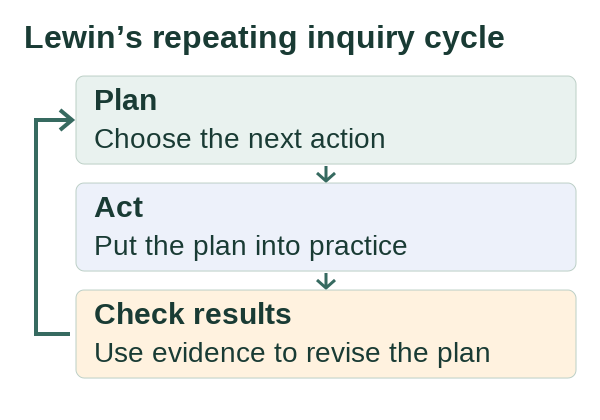
The cycle is described as iterative, open and inquiring, so that each round of reflection can reshape the next round of action.[18] A reflective practitioner is an active person who explores ways to solve problems in practice and who stays reflectively open to reexamining their own opinion. Because the process of education is exposed to constant inspection and improvement, the cycle treats no settled practice as finished.[19]
Reflective monitoring of research practices is treated as essential to doing action research well. Formal training in these practices is often lacking, and published accounts seldom describe how the inquiry actually unfolded. One account of a large action research project reports many dilemmas and uncertainties about the researchers' own roles and interventions, and it treats those uncertainties as a catalyst for learning and for sharpening theoretical and empirical skills. In that project, first-person inquiry, meaning reflection by an individual on their own practice, gradually developed into second-person inquiry, in which researchers reflect together. Reflective conversations of this kind make tacit assumptions in a particular situation explicit, which opens alternative strategies for handling uncertainty. Such conversations work best within a relationship of trust and should not be confined to any particular value scheme of action research.[18]
A reflective orientation to teaching stresses giving good reasons for educational actions. Prospective teachers are asked to weigh the aims and values of distinct educational traditions, among them conservative, progressive and radical ones, and to notice their own implicit social and cultural beliefs. They are also encouraged to understand schools as institutions and the communities around them, and action research is proposed as one way to prompt reflection on educational rationales and practices.[20]
Collier and Zuber-Skerritt set out a theoretical framework for action research in higher education that treats professional development as one of its parts. That framework begins from practical reasoning and from the two-way relation between theory and practice in higher education. It draws on theories of knowing and learning, including Kelly's personal construct theory and Leontiev's theory of action, and integrates theory and practice through action research as an educational research methodology.[21]
Teachers' skills for running the cycle have been measured with a Likert-type scale, a questionnaire on which respondents rate their agreement with statements. The scale rests on five factors: diagnostic skills, attitudes towards action research, data collecting skills, practical skills, and the skills needed for conducting action research. Among 305 respondents in the Republic of Serbia, teachers with long experience differed statistically significantly from teachers with only a few years of experience, at p<0.05. The study presents itself as an attempt to change practice at the micro level in order to improve teaching, with the aim of later changes at the meso and macro levels of the education system.[19]
Participatory and youth-led forms
Participatory action research (PAR) is a qualitative research methodology that its advocates describe as democratic, equitable, liberating and life-enhancing, and as distinct from other qualitative approaches. In PAR the participant takes an active part in making informed decisions across all stages of the research process, and the researcher does not control or manipulate the participant's feelings, views and patterns. The stated purpose of the work is social change, with a specific action or set of actions as the final goal.[22]
How action research is defined
Li (2024) calls action research an inquiry-based pedagogy that elicits continuous education. Li (2024) sets out to clarify the epistemological and practical values of action research and to examine its inquiry cycle closely.[23]
Participatory action research brings practitioners together with the people affected by the practice, and it seeks to emancipate marginalized groups through engagement in the research.[24][25] A teacher-specific version, Teacher Participatory Action Research, takes account of the marginalization by association that some teachers face in their positions.[25] Participatory action research has also been used as a pedagogy in university classrooms, where its practitioners describe relationship development as a political act and stress the value of emergent, responsive teaching.[26]
How and why it works
Action research is built on a repeating cycle in which a teacher or team plans a change, carries it out, observes what happens and reflects on the results before planning the next round. The Kemmis model names these steps as plan, act, observe and reflect. A study of third-year pre-service teachers at a South African university used that model to identify deficiencies in their lesson planning and then correct them. By the end of that project, the third-year pre-service students could prepare lesson plans that were appropriate.[27]
A university researcher facilitated an action research group that studied multiple intelligences theory in science classrooms. She described reflective practice, during the study and after it ended, as how she came to understand the action research process and how to support collaborative inquiry in a group.[28] One analysis argues that reflexive confession has become a favoured practice in professional and higher education settings, and that it can stand in for participation and turn researchers toward work on themselves and only on themselves.[29]
A middle school study in mother tongue education collected data through semi-structured interviews, semi-structured observations, a log form and activity files, and observed that students' cultural literacy skills developed at each of three stages: cultural awareness, cultural diversity and cultural literacy.[30] Participants in a university in-service course on education for sustainable development found gathering and analyzing data systematically, and writing a study, hard work but good for learning. That course also found that a balance of provocation and support in its design offered space for more in-depth reflections on education for sustainable development.[31]
Research
What the evidence shows
A 2020 systematic review of the outcomes of using action research in education concluded that taking the role of teacher-researcher may support sustainable development at the level of the classroom and may advance teachers' professional careers. That review framed action research as a flexible, self-reflective and critical approach through which a teacher can build critical thinking skills and become a more self-reliant problem-solver for challenges specific to that teacher's own classroom.[32] A systematic review is a summary of the studies on a clearly stated question that uses explicit, systematic methods to find, select and critically appraise the relevant studies.[33] An analytical review of action research in science education, published in 2018, described aims that recur across settings: understanding and developing teaching practices, and contributing to teachers' continuous professional development. The same review found a variety of methodological approaches, ranging from more technical interpretations to more emancipatory ones.[34]
A review of action research in graduate teacher education covering literature published between 2000 and 2015 found that its use had moved beyond a single course toward an integrative theoretical and practical approach. That review drew out three goals for action research in graduate teacher education: reflection, participatory critical inquiry, and preparation for teacher leadership.[2]
A multiyear mixed-method study based on 176 surveys concluded that research plays an important role in teachers' professional lives, for both preservice and in-service teachers.[35] Mixed methods research is research that uses multiple techniques for collecting and analyzing data, typically combining qualitative and quantitative approaches.[36] The teachers surveyed wanted more time to do research and wanted collaboration with, and assistance from, colleagues and administrators. Ethnographic data from three participants in that study showed that each teacher understood research differently, and that these differences affected what unfolded in their classrooms.[35]
Work on judging the quality of action research is sparse, and a 2020 exploratory-sequential mixed method study set out to identify the qualities research experts consider useful when evaluating it. Using the Analytic Hierarchy Process, a multiple decision-making method for weighing criteria against one another, the experts held that quality action research should show its contribution to theory and practice and should require actionability and reflexivity from researchers and participants.[37]
Teachers researching their own classrooms
A survey of 81 teachers at Child Development Centres run by a Local Administrative Organisation in Thailand found that most had carried out informal classroom research, chiefly to address children's behaviour problems and to support children's development. Those teachers tended to use their own findings more than other sources, though the amount of such use was still small. When the same study compared outcomes, instruction based on classroom action research scored significantly higher than instruction meeting only the standard requirement, at the .05 level of significance. The measurement form used in that comparison had validity between 0.80 and 1.00 and reliability of 0.968.[38]
For teachers of English, action research has been described as a means of continual professional development, meaning learning that continues throughout a teaching career. In that form it is initiated, conducted and monitored systematically by one teacher or a group of teacher-researchers, and it draws teachers into assessing and developing their own practice. A study of English teachers in engineering colleges in Telangana State, India, began with questionnaires and semi-structured interviews that found limited opportunities for professional development and uncertainty about designing tailored materials and choosing suitable methods. The main phase then offered teachers two weeks of training in teacher action research, after which they identified problems in their texts, prepared model course material and tested whether it worked. Participants were reported to have improved their teaching practice, their research skills and their awareness of their profession and of learners' problems.[39]
In Vietnam, research skill counts as part of teachers' professional competence, and the national professional standards approved by the Ministry of Education and Training name it as an indicator. Many activities have been organised in Vietnamese schools to strengthen teachers' research skills, and action research has been proposed as one route into professional development.[40]
A case study in a heavily centralized education system followed three English Language Teaching teachers who carried out action research. The teachers proved capable of doing the research and were quite positive about it, and they were hopeful that it could help them overcome some inadequacies in their educational environment. The study concluded that action research was an asset for personal and professional development despite the centralized system, and it noted that action research as an in-service teacher education strategy had not received due attention in practice.[41]
At Wat Wangyang School, teachers' status in classroom action research was at the bottom level while their problems and needs were at the highest level, and a participatory programme of workshop training, research conduct, monitoring and evaluation followed. At one Thai primary school, 8 teachers took part in a participatory action research project, a form in which participants help plan and carry out the study, run from June 2021 to April 2022 through four steps: planning, action, monitoring and reflection. The programme organised workshop training in the formal 5 chapters of classroom action research, led by a scholar with experience in classroom research, and then had teachers conduct research following the steps. Monitoring and evaluation found better understanding after the workshop than before it, and 8 classroom action research studies of high quality.[42]
Traldi Júnior and Fernandes conclude that the school and interaction with peers are important conditions for reflective practice and for teachers' professional development. A qualitative action research study with five teachers from a public school who teach Mathematics, grounded in Vygotsky's socio-interactionist perspective, in criteria for effective professional development and in learning communities, used field diaries, audio recordings and teachers' written work. The results point to a move from planning alone to planning together, to tasks designed with pedagogical intent, and to a stance that investigates how students reason.[43]
Action research in teacher education
Kitchen and Stevens, an instructor and a teaching assistant, introduced preservice teachers to action research while also studying their own practice, and they modelled for those students the teaching and learning that an interdisciplinary approach can produce. A significant number of the preservice teachers said that taking part in action research expanded their conceptions of teaching, an expansion the educators saw as holding potential for change in schools.[3]
A study of 11 preservice teachers examined how they linked pedagogy, research and change. It argued that an action research course needs careful design, because what the course contains can shape how its students go on to teach. A close study of three teacher candidates' action research projects showed how they used this framework as a starting point for developing their commitments, ideas and practices as beginning teachers.[6] Some colleges and universities require preservice teachers to carry out action research projects in place of larger essay assignments, and a 2011 textbook was written for undergraduates completing assignments of this kind. The book's author indicates that it may also serve other settings where action research is often used, such as management or public relations.[44]
A qualitative study in Hong Kong followed one group of preservice English language teachers through an action research project that formed part of their undergraduate teacher training. The study drew on a theory that treats teacher identity as built both through practice and through discourse, so that becoming a teacher is shaped by what teachers do and by how teaching is spoken about. As teacher researchers, the trainees contested earlier perceptions about their own engagement in teaching, their images of teachers and teaching, and their alignment with some aspects of contemporary educational discourse.[45] An explorative study of three Dutch initial teacher education programmes treated action research both as a means of professional development and as a necessary professional qualification.[46]
Graduate programmes have introduced action research into courses for beginning language teachers at the college level. One report describes adding an action research component to an existing graduate foreign language teaching methodology course for graduate teaching assistants and graduate students, and discusses the implementation, benefits and caveats of the project using feedback from journals, evaluations and follow-up interviews. The graduate teaching assistants were positive about the project on the whole, and at the same time they raised concerns about time constraints and about the risk of doing action research as beginning teachers. The report noted that the teaching assistants' understanding of action research was limited in depth, listed four possible options for change, and drew conclusions about how important a cyclical and exploratory approach to change is in foreign language teacher education programmes.[47]
Subject teaching and curriculum change
In Turkey, a search of the official database of graduate work found that the first action research theses in science education were doctoral dissertations completed in 2008, supervised by the same professor at the same university. That search identified 243 action research graduate studies in all fields in Turkey, of which 62 were in science education, just about 25 percent. One third of these studies (21) were completed in 2019.[48]
A project at The Ontario Institute for Studies in Education in Toronto examined how action research could put STS education into practice. The most significant outcome reported was a further theme, complex in character, that combined reinforcement, extending horizons and building professional confidence.[5]
A review of action research in music education found that such studies cover a wide variety of subject matter, integrate research and action, are collaborative, are grounded in a body of existing knowledge and lead to powerful learning for the participants. The same review found that few music education projects run in cycles, take up social transformation or broad historical, political or ideological settings, and that reflexivity, the researcher's examination of his or her own role and assumptions, receives little attention. The review concluded that high-quality action research calls for a sound grasp of action research itself, a focused use of the research literature, and a defensible position on how data are analysed and trustworthy findings produced.[49]
In physical education, one teacher and researcher taught a tennis unit to three classes of boys aged 11 to 12, combining cooperative learning with Teaching Games for Understanding, an approach in which games come before isolated skill drills. Data included teacher and pupil evaluations of skill, pupils' reflections on lessons, pupil interviews, a teacher field journal, and the unit's course materials. The results support the view that putting any new pedagogical approach into practice takes time and heavy labour. For the teacher, handing control to students was one of the hardest steps and one of the most important outcomes.[7] That project argued that cooperative learning placed social and academic learning goals on an even footing, focusing on pupils' understanding and improvement of athletics skills alongside their interpersonal development.[50]
In language curricula, a practitioner research study followed a language program director who analysed the reflections of 30 students in an advanced undergraduate German course in the United States. The course used exploratory practice, a framework in which learners pursue their own questions, called puzzles, about the subject.[51]
Equity, safety and inclusion projects
In Purwokerto, Indonesia, a participatory action research project began from signs of verbal, physical, social and cyberbullying in junior and senior high schools, among students and from teachers as well. The project started by mapping the bullying problem and building relationships with stakeholders before any action was planned. Students and teachers then took part in prevention workshops, anti-bullying agents were formed, and focus group discussions were held. Reported results included a rise in students' knowledge about bullying, anti-bullying campaigns using posters, and written standard operating procedures for intervening when bullying occurs.[52]
School safety in South Africa has been studied through a participatory approach that treats the surrounding community as a resource rather than a bystander. The study cites around 1600 schools robbed, vandalized or set alight during the COVID-19 period, and on 10 July 2020 four schools in Limpopo Province were broken into and groceries taken at gunpoint.[53] A separate South African project, the Chess Development Project, was started by pre-service teachers at a university and introduced chess at one township school to reduce violence. Field notes, student assistant notes, interviews, questionnaires and transcribed team reflections were collected, and the findings were described as transformative, with participants becoming more aware of the daily challenges schools and communities face in township areas.[54]
Representation in reading material has been tackled by action research in a diverse British primary school, where eight teachers worked with a trainee educational psychologist to use more books showing characters from a Global Majority background. The study drew on focus groups with 18 children and interviews with eight teachers, and children were described as connecting with books in which they saw themselves, with improved engagement and motivation to read. Children who were not represented also appeared to benefit by learning about others through the texts.[55]
Outdoor play and learning was the focus of a critical participatory action research project run through an online community of practice with 18 experienced teachers from Kindergarten to grade eight across British Columbia. Regular meetings over six months produced dialogue that identified a need for quality resources accessible to all teachers, and the group decided to develop a website made by teachers experienced in outdoor play and learning.[56] In early childhood care and education, which covers children from birth to age four, a South African study used a participatory action learning and action research design with six teachers and two practitioner trainers. All interactions took place on the WhatsApp platform because of pandemic social distancing, and data came from a baseline questionnaire, photovoice (participants' own photographs used as data), reflective journals and purposeful conversations across two iterative cycles. The first cycle found that some participants held a narrow view of inclusion centred on disability, treated inclusion as a product rather than a process, saw some advantages in segregation, and confused inclusion with assimilation and integration. The second cycle, planned to address these misunderstandings, showed that becoming inclusive means revisiting dominant ideologies and becoming critically aware of small everyday exclusions.[57]
Religious education in Greek secondary schools was the setting for a blended participatory action research study with ethnographic elements during the 2017-2018 school year, in one High School and one Upper School where the researcher taught. Questionnaires, focus groups, journals and the Most Significant Change technique gathered data from students, teachers, parents and the researcher. Analysis showed that religious knowledge taught for religious literacy can support respect for cultural diversity when it is treated as experience and applied through understanding, reflection and action. The study concluded that religious education can keep its religious content while achieving a high degree of recognition of religious diversity and, to some extent, a change in attitude toward immigrants and refugees.[58]
Conditions that help or hinder
Studies in several school systems report obstacles to action research. These include limited time for teachers of English as a second language, tensions around mandated projects in Alberta, the absence of a reflective culture in the Maldives, and structural constraints in Singapore.[59][60][61][62] One practitioner argued from her own work that a principled research perspective can still be used productively by busy teachers in ordinary teaching situations, and she gave written student feedback in various forms as an example of a tool that serves both teacher and learners.[59]
Official sponsorship can help or hurt. In the Canadian province of Alberta, action research became part of state-mandated teacher professional development, and interviews with teachers and professional development leaders raised the question of whether such mandated projects produce genuine professional development. Within that ambiguous position, the three teachers worked out their own understandings of professional development.[60]
In Singapore, a Ministry of Education push for greater autonomy, diversity and innovation at school level brought action research growing attention from school leaders. Those leaders also saw it as a route to teacher professional development and professionalism. The Teachers Network there runs its own form of action research called Learning Circles in support of that view. Action research projects in Singapore are not free of problems, however, and the structures that constrain them were the main subject of one 2006 discussion.[62]
A study in the Maldives asked whether a culture of reflective practice is a necessary condition for sustaining action research, or whether more is required. As in many developing country contexts, practical difficulties such as time constraints can keep teachers from engaging in action research. The study argued that a working familiarity with reflective practices in teaching may be needed before action research can develop in the Maldives, which would make reflective practice in initial teacher training the first step. It also argued that the assumptions and practices within action research need careful and critical consideration, and that action research should be adapted for use as a professional development tool.[61]
High-stakes policy settings add a further set of pressures. Standardization, student achievement and diversity have sharply changed teaching in early childhood programs across the United States. Teacher educators must help practicing and preservice teachers answer policymakers' high-stakes demands while attending to the best practices of early childhood and to children's linguistic, cultural, socioeconomic and political worlds. Analysis of those experiences showed how teacher educators can support teachers in answering governmental, institutional and local demands while trying to design learning experiences that reflect their students' sociocultural worlds.[63]
Evidence on outcomes and impact
Fifty secondary teachers from 21 schools in Pangasinan Division II took part in a survey that combined quantitative and qualitative methods. The teachers said action research had a positive impact on teaching and learning, on their professional development, particularly promotion, and on curriculum creation. Those teachers also said the work was hard because of limits on money and time and because of the Division Office's procedure.[64] A questionnaire study of 16 Turkish teachers of English as a foreign language enrolled in a master's program in Istanbul reported positive attitudes, personal and professional growth, and barriers of time, knowledge and support from other teachers.[65]
Sato, Mutoh and Kleinsasser (2022) followed secondary teachers of English as a foreign language in Japan over four years of collaborative action research. A four-year mixed methods study followed Japanese secondary teachers of English as a foreign language in collaborative action research. It identified three overlapping stages: challenging beliefs through trial and error with communicative activities, making sense of teaching by adapting communicative language teaching theories, and gaining confidence from seeing students change. The stages appeared regardless of how many years the teachers had taught, and the researchers note that they overlap and are not mutually exclusive.[66] A nine-month social constructivist mentoring program worked with seven teachers of English academic writing at private universities in Indonesia. The qualitative study, analyzed by thematic analysis, reported that the teachers widened their pedagogical knowledge and practices and changed their attitudes and mindsets, and that their students' learning activities became more engaging.[67]
One study followed five mentor teachers and five preservice partners through a semester-long internship in professional development schools. It reported what each group saw as the costs and benefits of collaborative action research.[4] At a small private Chilean university, a new program in 2016 involved five teachers of English as a foreign language and aimed to help them conduct research and write for peer-reviewed journals.[68]
A 2023 review argues that development activities which begin from research are easier to carry out because they rest on evidence and fit their context, and it credits action research with revitalizing school communities, changing classroom practices and empowering teachers and students as problem solvers.[69] A survey of graduates of a master's program in education management at the University of Ulster found that most used some form of action research. They used it to adjust to and make more efficient the operations of their organizations, work the researchers describe as bounded by the market values of the Education Reform Order (Northern Ireland) (1989).[70]
In practice
Youth participatory action research in schools
Participatory action research (PAR) more broadly develops interventions with direct input from stakeholders. In schools it has been used to gather the views of staff, parents and children before a program is designed.[71] One stated aim is to challenge adultism, the pattern in which youth are oppressed and their experiences dismissed, by giving students voice and input and by building on the assets they already possess.[72] In social justice education, PAR is described as engaging students in their social context and helping them acquire knowledge to initiate personal and social transformation.[73] YPAR has also been presented as an instructional practice that could reverse the depoliticizing and softening of multicultural education and improve the educational experiences and outcomes of youth traditionally underserved by schools.[74]
One school-based project described by Carl and Ravitch had high school students investigate racism and sexism at their own school.[75] In a program called the Social Justice Education Project, Latina/o high school students conducted PAR on problems that limited their possibilities for self-determination, with the required curriculum supplemented by advanced readings in Chicana/o studies, critical race theory and critical pedagogy.[76] High school students there worked in small project groups of five to six members, aiming to change themselves, policies and practices.[73] At a publicly funded Australian school implementing positive education, a PAR group of 10 students researched the school community about well-being during the school year.[77] In South Africa, reflective writing, metaphor and photovoice supported 30 secondary school learners in exploring diversity, drug abuse, gangsterism and violence and how those issues affected them.[78]
Ozer and Wright (2012) report that youth-led participatory research enabled processes of student professionalization, produced new collegial interactions between students and adults, and expanded the domains of student influence. A qualitative study in two urban high schools suggested that YPAR enabled processes of student professionalization, produced new collegial interactions between students and adults, and expanded the domains of student influence.[79] In the Australian case study, results suggested benefits for the participating students, particularly in engagement and self-efficacy.[77] The Green Committee project reported that the children remained motivated when supported by committed adult educators, that their process led others into action and change, and that their engagement gave them a sense of belonging.[80] YPAR has been found to support critical consciousness, help youth develop a sense of identity, and encourage social change. In a study of six school counselor trainees, YPAR was described as a fun, interactive, youth-centered approach that did not feel like counseling or therapy, and participants reported development of counseling skills and confidence.[81]
Cook, Levy and Whitehouse (2020) list as one theme the implementation challenges of youth participatory action research, which required planning, time and commitment. The same counselor trainees described implementation challenges requiring planning, time and commitment.[81] The school project on racism and sexism discussed both the successes and the challenges of YPAR as a methodological approach to address inequity in schools.[75] One argument holds that YPAR serves liberation when it is treated as a contact zone, as problem-posing education and as a process rather than a product, and that it requires challenging research norms, encouraging reflexivity and promoting youth-centered approaches.[72]
What this looks like when you study
In a study of 81 teachers at Child Development Centre schools in Thailand, most teachers ran informal classroom research to solve children's behaviour problems (86.42%). The next most common purpose was to increase children's development in physical, emotional, mental, social and intellectual terms (80.25%). Improving teaching techniques for pre-school children was a purpose for 38.27% of the teachers. Complying with teacher performance requirements and regulations was a purpose for 22.22%. Most of these teachers wrote short reports of 1 to 2 pages rather than full five-chapter reports.[38]
In a participatory project in Purwokerto, Indonesia, junior high school students' average knowledge score about bullying rose from 41.2 on the pre-test to 43.6 on the post-test. Students were named anti-bullying agents, and these agents designed posters for an anti-bullying campaign. Focus group discussions with agents, parents, teachers and principals produced standard operating procedures for handling bullying cases.[52]
Before the project these teachers rated their classroom research conditions at a low level and their problems and needs at the highest level. A workshop run by a scholar experienced in classroom research covered the formal five chapters of classroom action research. After the workshop the teachers understood classroom research better than before, and they produced 8 classroom action research reports of high quality.[42]
A source recommends that you begin by naming the problem in your own class that affects your teaching or student learning. Next, state that problem as a research problem with detailed research questions, then set objectives, a design, relevant persons, facilities and a schedule. Then try the method or innovation, collect data on what happens, and analyse the results. Finally, present the results objectively and discuss them with colleagues, administrators or parents to plan the next round.[38]
Later developments
Universities, ethics and open questions
Action research has found a place in higher education in two main areas: the teaching and staff development work of academics, and the engagement of students in investigating and improving their own learning. A literature review of work published up to 2017 describes action research as a central approach in both areas, used to investigate, reflect on and improve practice, while noting limits in the published literature itself.[82] Teaching people to carry out action research is a separate problem from doing it, and the published work on how action research is taught inside universities is rather meagre. One response has been to borrow from adult education, whose theories and models of experience and reflection offer a basis for understanding how practitioners turn their experience into written reflections meant to communicate research-based insights to the scientific community.[83]
Ethical review is one place where insider research sits awkwardly with university procedures. Drawing on several professional associations' principles for research practice, two reviewers identified potential ethical issues that arise in action research in K-12 schools. They also described the difficulties action researchers meet in the policies and procedures of institutional review boards, the committees that approve research with human participants. Their recommendations went to institutional review boards, to K-12 school professionals and teacher educators, and to national professional and representative organizations.[1]
Sustaining action research as an institutional strategy has proved harder than running it in single classrooms. One action researcher reviewed his own failed attempts to make action research a sustainable teaching, research and extension strategy at his university. Those experiences showed that action research works well in the classroom and in small projects at the margins, but that the same small scale, marginality and invisibility leave such efforts fragile and short-lived. Action researchers, in this account, had not yet used action research strategies successfully to guide reforms in the relation between universities and stakeholders outside them, or to deepen collaboration within universities among students, staff and administrators.[84]
The structures that organize universities in the 21st century shape what can be practiced, taught and learned there. One analysis describes the neo-liberal and Taylorist structures that shape higher education, then sets the practice and study of action research in that setting to sketch how action research might help higher education toward a better future.[85]
Three members of a teachers' special interest group in Japan, long committed to writing and publishing inclusive practitioner research about learner development, described their work on the Learner Development Journal, a journal of practitioner research. Practitioner research differs fundamentally from academic research, so writing about it means turning away from traditional academic forms. It means looking for forms that put the practitioner's voice and experience first and that also carry the voices and experiences of learners. The group proposed personalized, reflective writing for practitioner research and raised broader unresolved questions about writing about and publishing inclusive practitioner research.[86]
Exploratory Practice is a form of practitioner research that offers a contrast to action research as usually conceived. Its case rests on a perceived need to rethink practitioner research, to refocus it on understanding and, in the end, on the quality of life in the language classroom for teachers and learners alike.[87] A 2025 thought-piece on inclusive practitioner research examines why inclusivity matters and what it means for practitioner researchers, and considers the contributions practitioners make to debates about social justice.[88]
Criticism
Challenges, limits and open questions
Writing from Spain, one commentator traces the question back to the post-Franco 1960s, when teachers asked what changes the profession needed in order to answer the demands of a democratic society. The same account argues that the dilemma of who rules the change cannot be resolved and that this unresolved tension is the essence of action research and its justification. It further holds that the structure of systems tends to reproduce a conventional model of dual systems and of professional models built on technical rationality, a pressure that pulls against the educational discourse of the newer age of liquid modernity. That contradiction is said to lead to three possible scenarios, each with practical consequences for curricular development, for teaching professionalism and for the type of research required.[96]
Common misconceptions
Judah and Richardson (2006) report that many teachers in state-mandated school-based projects were pulled between two sets of expectations: one favoring personal empowerment and individual autonomy, the other built on outside demands for accountability and excellence. Teachers in state-mandated school-based projects in Alberta, Canada, found themselves caught between that discourse and externally driven measures of accountability and excellence. The three teachers studied negotiated their own understandings of professional development inside this complex and ambiguous location.[60]
Moosa (2018) examines whether action research in the Maldives can be sustained only when a reflective culture is present, and concludes that teachers' prior acquaintance with reflective practice in teaching may be needed before action research can take hold there. The author argues that familiarity with reflective practices may be a prerequisite, so reflective practice should enter initial teacher training first.[61]
Key studies
| Year | Study | Sample | Design | Finding |
|---|---|---|---|---|
| 2001 | Price[6] | 11 pre-service teachers | close study of three teacher candidates' action research studies | An action research course framework helped beginning teachers develop their commitments, ideas and practices. |
| 2003 | Levin & Rock[4] | Study of five pairs of preservice teachers and experienced mentor teachers during a semester-long internship | The study presents novice and experienced teachers' views of the costs and benefits of collaborative action research and offers guidelines for engaging such pairs successfully. | |
| 2007 | Nolen & Putten[1] | Review drawing on professional associations' principles for research practice, focused on K-12 schools | The authors identify a series of potential ethical issues unique to insider action research and difficulties with institutional review board policies, then make recommendations to three groups. | |
| 2010 | Trent[45] | one group of pre-service English language teachers in Hong Kong | qualitative study of an action research project in undergraduate teacher training | Trainee teachers contested their earlier perceptions of teaching, images of teachers, and alignment with contemporary educational discourse. |
| 2012 | Miskovic et al.[35] | 176 preservice and in-service teachers | multiyear mixed-method study with surveys and ethnography of three participants | Teachers valued research in their professional lives and wanted more time and more collaboration with colleagues and administrators. |
| 2013 | Duenkel & Pratt[92] | four cohorts of students in an ecological education graduate degree | analysis of data from capstone action research projects | Action research produced transformative learning and a newly felt sense of empowerment among teacher-researchers. |
| 2020 | Meesuk et al.[38] | 81 teachers of the Child Development Centre of the Local Administrative Organisation | multi-stage random sampling survey with interviews and a learning outcomes measure | Classroom action research-based instruction scored significantly higher than standard requirement instruction at the .05 level of significance. |
| 2020 | Osmanović-Zajić & Maksimović[19] | 305 respondents in the Republic of Serbia | descriptive method with a Likert-type scale and factor analysis | Teachers with long experience and those with few years of experience differed significantly in action research skills, p<0.05. |
| 2020 | Cook et al.[81] | six school counselor trainees | interpretative phenomenological analysis of youth participatory action research as counseling practice | Themes included a fun, youth-centered approach and development of counseling skills and confidence. |
| 2021 | Kola[27] | third-year pre-service teachers at a South African university | action research using the Kemmis model of plan, act, observe and reflect | The pre-service teachers were able to prepare appropriate lesson plans after the action research. |
| 2022 | Faculty of Psychology, Universitas Muhammadiyah Purwokerto, Indonesia & Wulandari[52] | junior high and high school students in Purwokerto, Indonesia | participatory action research with pre-test and post-test | Average bullying knowledge rose from 41.2 to 43.6 for junior high students and from 33.4 to 36.9 for high school students. |
| 2022 | Koukounaras Liagkis[58] | students, teachers, parents and the researcher in a Greek high school and upper school | blended participatory action research with ethnographic elements during the 2017-2018 school year | Religious knowledge taught as experience supported respect for and understanding of cultural diversity. |
| 2022 | Sato et al.[66] | secondary teachers of English as a foreign language in Japan | longitudinal mixed-methods study of collaborative action research over four years | Teachers moved through three overlapping stages, from challenging beliefs to adapting communicative language teaching to building confidence by seeing students change. |
| 2023 | Semathong[42] | 8 teachers of Wat Wangyang School, Nakhon Sawan, Thailand | mixed-method participatory action research in four steps over June 2021 to April 2022 | After a workshop on the five chapters of classroom research, teachers understood classroom research better and produced 8 high-quality reports. |
See also
References
- Nolen, A. L., & Putten, J. V. (2007). Action Research in Education: Addressing Gaps in Ethical Principles and Practices. Educational Researcher, 36(7), 401-407. doi:10.3102/0013189x07309629
- Vaughan, M., & Burnaford, G. (2016). Action research in graduate teacher education: a review of the literature 2000–2015. Educational Action Research, 24(2), 280-299. doi:10.1080/09650792.2015.1062408
- Kitchen, J., & Stevens, D. (2008). Action research in teacher education: Two teacher-educators practice action research as they introduce action research to preservice teachers. Action Research, 6(1), 7-28. doi:10.1177/1476750307083716
- Levin, B. B., & Rock, T. C. (2003). The Effects Of Collaborative Action Research On Preservice And Experienced Teacher Partners In Professional Development Schools. Journal of Teacher Education, 54(2), 135-149. doi:10.1177/0022487102250287
- Pedretti, E., & Hodson, D. (1995). From rhetoric to action: Implementing sts education through action research. Journal of Research in Science Teaching, 32(5), 463-485. doi:10.1002/tea.3660320505
- Price, J. N. (2001). Action research, pedagogy and change: The transformative potential of action research in pre-service teacher education. Journal of Curriculum Studies, 33(1), 43-74. doi:10.1080/00220270118039
- Casey, A., & Dyson, B. (2009). The implementation of models-based practice in physical education through action research. European Physical Education Review, 15(2), 175-199. doi:10.1177/1356336x09345222
- Eilks, I. (2018). Action Research in Science Education: A twenty-year personal perspective. Action Research and Innovation in Science Education, 1(1), 3-14. doi:10.51724/arise.5
- Nikolić, M. (2025). The role of action research and reflective practice in enhancing the work of preschool teachers. SCIENCE International Journal, 2(4), 93-100. doi:10.35120/sciencej0204093n
- Siyaswati, S. (2018). THE MOVEMENT OF ACTION RESEARCH IN EDUCATION: (Sharing problems, goals, and respect for teachers and students). Buana Pendidikan Jurnal Fakultas Keguruan dan Ilmu Pendidikan, 7(13). doi:10.36456/bp.vol7.no13.a1211
- Sáez Bondía, M. J., & Cortés Gracia, A. L. (2022). Action research in education: a set of case studies? Educational Action Research, 30(5), 850-864. doi:10.1080/09650792.2020.1866631
- Shakouri, N. (2013). On the viability of action research in education. International Journal of Research Studies in Education, 3(1). doi:10.5861/ijrse.2013.544
- Brydon‐Miller, M., & Maguire, P. (2009). Participatory action research: contributions to the development of practitioner inquiry in education. Educational Action Research, 17(1), 79-93. doi:10.1080/09650790802667469
- Torres, C. A. (1992). Participatory action research and popular education in Latin America. International Journal of Qualitative Studies in Education, 5(1), 51-62. doi:10.1080/0951839920050107
- Rönnerman, K., & Salo, P. (2012). Collaborative and action research within education – A Nordic perspective. Nordic Studies in Education, 32(01), 1-16. doi:10.18261/issn1891-5949-2012-01-01
- Richards-Schuster, K. (2010). Revolutionizing education: Youth participatory action research in motion. Gateways: International Journal of Community Research and Engagement, 3, 187-189. doi:10.5130/ijcre.v3i0.1157
- Al Munim, A. (2026). The Action Research Planner – Doing Critical Participatory Action Research. JOURNAL OF APPLIED AND ACTION RESEARCH IN ISLAMIC EDUCATION, 1(1), 72-74. doi:10.70771/jaarie.v1i1a5
- Bjørn, P., & Boulus, N. (2011). Dissenting in reflective conversations: Critical components of doing action research. Action Research, 9(3), 282-302. doi:10.1177/1476750310396949
- Osmanović-Zajić, J., & Maksimović, J. (2020). Contemporary teachers' action research: Basis for the development of reflective practice in education. Research in Pedagogy, 10(2), 354-366. doi:10.5937/istrped2002354o
- Liston, D. P., & Zeichner, K. M. (1990). Reflective Teaching and Action Research in Preservice Teacher Education. Journal of Education for Teaching, 16(3), 235-254. doi:10.1080/0260747900160304
- Collier, G., & Zuber-Skerritt, O. (1993). Professional Development in Higher Education: A Theoretical Framework for Action Research. British Journal of Educational Studies, 41(1), 78. doi:10.2307/3122438
- MacDonald, C. (2012). Understanding participatory action research: A qualitative research methodology option. The Canadian Journal of Action Research, 13(2), 34-50. doi:10.33524/cjar.v13i2.37
- Li, Y. (2024). Action Research Facilitates Education as a Continuum - Secondary School Curriculum Development based on Action Research. Journal of Higher Education Teaching, 1(6), 13-17. doi:10.62517/jhet.202415603
- Jacobs, S. D. (2016). The Use of Participatory Action Research within Education-Benefits to Stakeholders. World Journal of Education, 6(3). doi:10.5430/wje.v6n3p48
- Stapleton, S. R. (2021). Teacher participatory action research (TPAR): A methodological framework for political teacher research. Action Research, 19(2), 161-178. doi:10.1177/1476750317751033
- Dancis, J. S., Coleman, B. R., & Ellison, E. R. (2023). Participatory Action Research as Pedagogy: Stay Messy. Journal of Participatory Research Methods, 4(2). doi:10.35844/001c.75174
- Kola, M. (2021). Pre-service teachers’ action research: technology education lesson planning in a South African University. Educational Action Research, 29(1), 99-117. doi:10.1080/09650792.2019.1686043
- Goodnough, K. (2003). Facilitating action research in the context of science education: reflections of a university researcher. Educational Action Research, 11(1), 41-64. doi:10.1080/09650790300200203
- Burman, E. (2006). Emotions and reflexivity in feminised education action research. Educational Action Research, 14(3), 315-332. doi:10.1080/09650790600847636
- Bal, M., & Mete, F. (2019). Cultural Literacy in Mother Tongue Education: an Action Research. Qualitative Research in Education, 8(2), 215. doi:10.17583/qre.2019.4186
- Rauch, F., Steiner, R., & Kurz, P. (2022). Action research for education for sustainable development: the case of the university in-service course ‘education for sustainable development – innovations in school and teacher education (BINE)*. Educational Action Research, 30(4), 632-637. doi:10.1080/09650792.2021.1971098
- Messikh, D. (2020). A Systematic Review of the Outcomes of Using Action Research in Education. Arab World English Journal, 11(1), 482-488. doi:10.24093/awej/vol11no1.32
- GET-IT Glossary (plain-language health research terms) (n.d.). systematic review. GET-IT Glossary (plain-language health research terms). https://getitglossary.org/term/systematic+review
- Laudonia, I., Mamlok-Naaman, R., Abels, S., & Eilks, I. (2018). Action research in science education – an analytical review of the literature. Educational Action Research, 26(3), 480-495. doi:10.1080/09650792.2017.1358198
- Miskovic, M., Efron, E. S., & Ravid, R. (2012). Action Research in Action: From University to School Classrooms. Education Research International, 2012, 1-11. doi:10.1155/2012/389736
- ERIC Thesaurus (n.d.). Mixed Methods Research. ERIC Thesaurus. https://eric.ed.gov/?ti=Mixed+Methods+Research
- Barcelona, A. B. (2020). An analytic hierarchy process for quality action researches in education. International Journal of Evaluation and Research in Education (IJERE), 9(3), 517. doi:10.11591/ijere.v9i3.20626
- Meesuk, P., Sramoon, B., & Wongrugsa, A. (2020). Classroom Action Research-based Instruction: The Sustainable Teacher Professional Development Strategy. Journal of Teacher Education for Sustainability, 22(1), 98-110. doi:10.2478/jtes-2020-0008
- E., K. C. (2021). Teacher action research (TAR): An effective tool for english language teachers’ continual professional development (CPD). Towards Excellence, 622-633. doi:10.37867/te130250
- Huy, N. H. D., Anh, N. N. Q., & Dieu, B. T. (2018). Action Research in Vietnamese Schools as a Tool for Teacher Professional Development. International Research in Education, 6(2), 15. doi:10.5296/ire.v6i2.13037
- Kayaoglu, M. N. (2015). Teacher researchers in action research in a heavily centralized education system. Educational Action Research, 23(2), 140-161. doi:10.1080/09650792.2014.997260
- Semathong, S. (2023). Participatory Action Research to Develop the Teachers on Classroom Action Research. Shanlax International Journal of Education, 11(3), 29-36. doi:10.34293/education.v11i3.6118
- Traldi Júnior, A., & Fernandes, J. R. M. (2026). Professional development: action research on in-service teacher education for those who teach Mathematics. Educação Matemática Debate, 10(19), 1. doi:10.46551/emd.v10n19a23
- Aberdeen, T. (2012). Costello, P. J. M. (2011). Effective action research: Developing reflective thinking and practice (2nd Ed.). New York, New York: Continuum. Pp. 132. The Canadian Journal of Action Research, 13(1), 69-70. doi:10.33524/cjar.v13i1.31
- Trent, J. (2010). Teacher education as identity construction: insights from action research. Journal of Education for Teaching, 36(2), 153-168. doi:10.1080/02607471003651672
- Ax, J., Ponte, P., & Brouwer, N. (2008). Action research in initial teacher education: an explorative study. Educational Action Research, 16(1), 55-72. doi:10.1080/09650790701833105
- Crookes, G., & Chandler, P. M. (2001). Introducing Action Research into the Education of Postsecondary Foreign Language Teachers. Foreign Language Annals, 34(2), 131-140. doi:10.1111/j.1944-9720.2001.tb02818.x
- Taşar, M. F. (2020). Action Research Studies in Science Education in Turkey. Action Research and Innovation in Science Education, 3(1), 1-2. doi:10.51724/arise.27
- Cain, T. (2008). The characteristics of action research in music education. British Journal of Music Education, 25(3), 283-313. doi:10.1017/s0265051708008115
- Casey, A., Dyson, B., & Campbell, A. (2009). Action research in physical education: focusing beyond myself through cooperative learning. Educational Action Research, 17(3), 407-423. doi:10.1080/09650790903093508
- Crane, C. (2025). What puzzles L2 learners about German grammar? Using practitioner research to explore threshold concepts in language curricula. Language Teaching Research, 29(8), 3277-3296. doi:10.1177/13621688241290496
- Faculty of Psychology, Universitas Muhammadiyah Purwokerto, Indonesia, & Wulandari, D. A. (2022). Bullying Prevention and Intervention in Schools: Implications of Participatory Action Research. International Journal of Social Science and Human Research, 05(04). doi:10.47191/ijsshr/v5-i4-13
- Samson Mabade, A. (2021). Ensuring Quality Safety in Schools: A Participatory Action Research Approach. Advances in Social Sciences Research Journal, 8(1), 539-551. doi:10.14738/assrj.81.9637
- Esau, O. (2023). Reducing Violence Through Chess: Involving Pre-service Teachers in Participatory Action in Schools. The Canadian Journal of Action Research, 23(3), 97-111. doi:10.33524/cjar.v23i3.617
- Capron, H. (2026). Including representative children’s books in primary schools: A participatory action research study. Educational and Child Psychology, 43(1), 96-108. doi:10.53841/bpsecp.2026.43.1.96
- Zeni, M., Schnellert, L., & Brussoni, M. (2024). Outdoor Play and Learning in Elementary Schools: A Critical Participatory Action Research Project. The Canadian Journal of Action Research, 24(3), 105-126. doi:10.33524/cjar.v24i3.675
- Mahadew, A., & Hlalele, D. J. (2022). Understanding inclusion in early childhood care and education: A participatory action learning and action research study. South African Journal of Childhood Education, 12(1). doi:10.4102/sajce.v12i1.1073
- Koukounaras Liagkis, M. (2022). The Socio-Pedagogical Dynamics of Religious Knowledge in Religious Education: A Participatory Action-Research in Greek Secondary Schools on Understanding Diversity. Religions, 13(5), 395. doi:10.3390/rel13050395
- Gunn, C. (2005). Prioritizing practitioner research: an example from the field. Language Teaching Research, 9(1), 97-112. doi:10.1191/1362168805lr156xx
- Judah, M. L., & Richardson, G. H. (2006). Between a rock and a (very) hard place: The ambiguous promise of action research in the context of state mandated teacher professional development. Action Research, 4(1), 65-80. doi:10.1177/1476750306060543
- Moosa, D. (2018). Does successful Action Research Merely Require a Culture of Reflective Practice or is There More to it? International Journal of Social Research & Innovation, 1(1). doi:10.55712/ijsri.v1i1.13
- Salleh, H. (2006). Action research in Singapore education: constraints and sustainability. Educational Action Research, 14(4), 513-523. doi:10.1080/09650790600975684
- Brown, C. P., & Weber, N. B. (2016). Struggling to Overcome the State’s Prescription for Practice: A Study of a Sample of Early Educators’ Professional Development and Action Research Projects in a High-Stakes Teaching Context. Journal of Teacher Education, 67(3), 183-202. doi:10.1177/0022487116636452
- Abrenica, J. T., & Cascolan, H. M. S. (2022). Impact of Action Research in Education: Experiences and Challenges Faced by Teachers. International Journal of Scientific and Management Research, 05(02), 01-15. doi:10.37502/ijsmr.2022.5201
- Khalil, E. (2019). EFL Instructors' Perceptions Regarding Conducting Action Research: . International Journal of Teacher Education and Professional Development, 2(2), 53-67. doi:10.4018/ijtepd.2019070104
- Sato, K., Mutoh, a. N., & Kleinsasser, R. C. (2022). Longitudinal research on EFL teacher professional development in (Japanese) contexts: Collaborative action research projects. Language Teaching Research, 26(3), 477-503. doi:10.1177/1362168819893814
- Nugroho, K. Y., Anwar, C., & Hartono, H. (2024). Social Constructivist Mentoring Program to Support Teacher Professional Development: An Action Research Approach. The Qualitative Report. doi:10.46743/2160-3715/2024.6634
- Burns, A., & Westmacott, A. (2018). Teacher to Researcher: Reflections on a New Action Research Program for University EFL Teachers. Profile: Issues in Teachers´ Professional Development, 20(1), 15-23. doi:10.15446/profile.v20n1.66236
- Oranga, J., & Gisore, B. (2023). Action Research in Education. OALib, 10(07), 1-10. doi:10.4236/oalib.1110306
- Hutchinson, B., & Whitehouse, P. (1999). The Impact of Action Research and Education Reform in Northern Ireland: education in democracy. British Educational Research Journal, 25(2), 141-155. doi:10.1080/0141192990250202
- Ostmeyer, K., & Scarpa, A. (2012). Examining School‐Based Social Skills Program Needs and Barriers for Students with High‐Functioning Autism Spectrum Disorders Using Participatory Action Research. Psychology in the Schools, 49(10), 932-941. doi:10.1002/pits.21646
- Bettencourt, G. M. (2020). Embracing problems, processes, and contact zones: Using youth participatory action research to challenge adultism. Action Research, 18(2), 153-170. doi:10.1177/1476750318789475
- Cammarota, J., & Romero, A. (2011). Participatory Action Research for High School Students: Transforming Policy, Practice, and the Personal With Social Justice Education. Educational Policy, 25(3), 488-506. doi:10.1177/0895904810361722
- Irizarry, J. G. (2009). Reinvigorating Multicultural Education Through Youth Participatory Action Research. Multicultural Perspectives, 11(4), 194-199. doi:10.1080/15210960903445905
- Carl, N. M., & Ravitch, S. M. (2021). Addressing inequity through youth participatory action research: Toward a critically hopeful approach to more equitable schools. Action Research, 19(2), 433-448. doi:10.1177/1476750318804623
- Cammarota, J., & Romero, A. F. (2009). A social justice epistemology and pedagogy for Latina/o students: Transforming public education with participatory action research. New Directions for Youth Development, 2009(123), 53-65. doi:10.1002/yd.314
- Halliday, A. J., Kern, M. L., Garrett, D. K., & Turnbull, D. A. (2019). The student voice in well-being: a case study of participatory action research in positive education. Educational Action Research, 27(2), 173-196. doi:10.1080/09650792.2018.1436079
- Sonn, B., Santens, A., & Ravau, S. (2011). Hearing Learner Voice in health promoting schools through participatory action research. Perspectives in Education, 29(1), 93-104. doi:10.38140/pie.v29i1.1675
- Ozer, E. J., & Wright, D. (2012). Beyond School Spirit: The Effects of Youth‐Led Participatory Action Research in Two Urban High Schools. Journal of Research on Adolescence, 22(2), 267-283. doi:10.1111/j.1532-7795.2012.00780.x
- Blanchet-Cohen, N., & Di Mambro, G. (2015). Environmental education action research with immigrant children in schools: Space, audience and influence. Action Research, 13(2), 123-140. doi:10.1177/1476750314553679
- Cook, A. L., Levy, I., & Whitehouse, A. (2020). Exploring Youth Participatory Action Research in Urban Schools: Advancing Social Justice and Equity-Based Counseling Practices. Journal for Social Action in Counseling and Psychology, 12(1), 27-43. doi:10.33043/jsacp.12.1.27-43
- Gibbs, P., Cartney, P., Wilkinson, K., Parkinson, J., Cunningham, S., James-Reynolds, C., Zoubir, T., Brown, V., Barter, P., Sumner, P., MacDonald, A., Dayananda, A., & Pitt, A. (2017). Literature review on the use of action research in higher education. Educational Action Research, 25(1), 3-22. doi:10.1080/09650792.2015.1124046
- Levin, M., & Martin, A. W. (2007). The praxis of educating action researchers: The possibilities and obstacles in higher education. Action Research, 5(3), 219-229. doi:10.1177/1476750307081014
- Greenwood, D. J. (2007). Teaching/learning action research requires fundamental reforms in public higher education. Action Research, 5(3), 249-264. doi:10.1177/1476750307081016
- Greenwood, D. J. (2012). Doing and learning action research in the neo-liberal world of contemporary higher education. Action Research, 10(2), 115-132. doi:10.1177/1476750312443573
- Barfield, A., Ashwell, T., & Stewart, A. (2025). Writing and publishing for inclusive practitioner research: Local practices and wider issues. Language Teaching Research, 29(8), 3375-3395. doi:10.1177/13621688231221599
- Allwright, D. (2003). Exploratory Practice: rethinking practitioner research in language teaching. Language Teaching Research, 7(2), 113-141. doi:10.1191/1362168803lr118oa
- Hanks, J. (2025). Shifting perceptions of inclusive practitioner research: Epistemological affordances of exploratory practice. Language Teaching Research, 29(8), 3357-3374. doi:10.1177/13621688241265432
- Slimani-Rolls, A., Crane, C., Hanks, J., & de Miller, I. K. (2025). Introduction to the special issue: Challenges and practices to advance sustainable and inclusive practitioner research. Language Teaching Research, 29(8), 3222-3236. doi:10.1177/13621688241293155
- Wu, Z. (2006). Understanding practitioner research as a form of life: an Eastern interpretation of Exploratory Practice. Language Teaching Research, 10(3), 331-350. doi:10.1191/1362168806lr200oa
- Edwards, E., & Burns, A. (2025). Inclusivity and sustainability in language practitioner researcher development: A sociocultural ecological framework. Language Teaching Research, 29(8), 3237-3257. doi:10.1177/13621688241250363
- Duenkel, N., & Pratt, J. (2013). Ecological education and action research: A transformative blend for formal and nonformal educators. Action Research, 11(2), 125-141. doi:10.1177/1476750313477156
- Gedžūne, I., & Gedžūne, G. (2011). Exploring and Promoting Ecological Consciousness in Teacher Education: the Possibilities of Educational Action Research in Education for Sustainable Development. Journal of Teacher Education for Sustainability, 13(1), 43-61. doi:10.2478/v10099-011-0004-2
- Salīte, I. (2008). Educational Action Research for Sustainability: Constructing a Vision for the Future in Teacher Education. Journal of Teacher Education for Sustainability, 10(2008), 5-16. doi:10.2478/v10099-009-0021-6
- Weikle, E., & Coles, D. (2025). Developing music-specific culturally responsive teaching professional development: an autoethnographic action research study. Journal of Teacher Development and Education, 3(1), 1-13. doi:10.29329/journalted.40
- Rué, J. (2003). Action Research in Education, in the Era of Liquid Modernity [1]. Educational Action Research, 11(2), 197-212. doi:10.1080/09650790300200217
Cite this page: Atlas Nova editors. (2026). Action research. Atlas Nova. https://velocer.io/atlas/action-research/