Method · Teaching
Inquiry-based learning
Student-centred teaching approach
Inquiry-based learning is a student-centred approach in which learners take an active part in the work, and it is driven by questions. Spronken-Smith and colleagues (2008) describe the teacher as mainly a facilitator or mentor who guides and encourages students through the inquiry process.[1][2]
A meta-analysis of 72 studies found guidance improves learning outcomes.[3] In a rural South African district, teachers held positive beliefs about inquiry but were less inclined to use it in their lessons.[4] Inquiry can improve understanding and develop research skills.[2]
Overview
What inquiry-based learning means
Buchanan and colleagues (2016) describe inquiry-based learning as constructivist and student-centred. One review links the approach to student motivation and engagement. It says the work is grounded in authentic, relevant study.[1]
A separate review of theory describes inquiry as an activity. In it, learners ask useful questions that lead to relevant answers. That review adds that learners are shown how knowledge is made and expressed. They also learn how to gain the abilities needed to keep learning through life.[8]
One study looked at learning tasks that 224 university teachers gave as examples of inquiry-based learning. The teachers came from three universities in Australia. Under the varied language, it found only a limited number of distinct task forms. Those teachers shared a broad idea of inquiry. The tasks came from many subjects, at undergraduate and postgraduate levels. They came from both smaller and larger classes.[9]
Tawfik (2025) reports that K-12 teachers did not agree on several features of inquiry-based learning. A Delphi study is a structured process for building agreement among experts. In one, 15 K-12 teachers reached early agreement on teacher-student collaboration, student inquiry and teacher facilitation. The same teachers did not agree on case design or problem complexity. They also did not agree on debriefing and reflection. Tawfik (2025) notes that teachers adjust instruction to fit their settings. This leaves the definition and the practical form of inquiry-based learning unclear.[10]
History
Where the idea came from
Davis (2007) argued that inquiry-based learning would gain from more philosophy. That essay located successful enquiry in a classroom. The classroom had been developed into a true community of inquiry. The essay said such a community has roots firmly planted in the traditions of philosophy.[11]
Quebec's education ministry is known by its French initials MELS. It made inquiry-based activities part of the science curriculum. It also tests students on them. A 2009 article discussed why inquiry-based laboratory experiments matter. It also looked at the challenges teachers face when using this kind of teaching.[12]
Indonesia's 2013 curriculum requires a scientific approach to learning. That approach sets out five stages. Banawi (2019) examined how those five stages match the steps of discovery and inquiry learning models. The study reported that the scientific approach can be used with those models. Its five stages can be synchronized with their existing steps.[13]
Kubieck (2005) argued that inquiry-based learning can improve science teaching. It does this by getting students involved in real investigations. Kubieck (2005) reported that students usually left school without science literacy. They also left without a sense of why science matters in society. The article said that engagement gives students a more realistic idea of scientific work. It also gives a setting that is more learner-centred and more motivating. Kubieck (2005) added that the same approach can support teaching about the nature of science.[14]
Kubieck (2005) noted that teachers praise the inquiry approach. Yet it is still not common in classrooms and is often misused. Kubieck (2005) named several possible causes. These included the amount of classroom time. They also included weak ways for students to investigate on their own. They also included the difficulty of linking abstract ideas to inquiry. Limited teacher expertise and experience were also listed. The article also argued that computer technology had advanced enough to help inquiry learning greatly on many levels. It called that help promising for science education. This holds as long as its built-in limits are recognized. Technology must serve as a tool rather than as a foundation.[14]
Main ideas
The inquiry cycle and its phases
Inquiry-based learning is often divided into inquiry phases. Together these phases make up an inquiry cycle. A 2015 systematic review looked at 32 articles. These described parts of inquiry or full inquiry cycles. The reviewers found five general phases in the 32 articles. These were Orientation, Conceptualization, Investigation, Conclusion and Discussion. Several of these phases contain sub-phases, smaller steps grouped under the main stage. No existing framework in the research brought all the phases and sub-phases together. So the reviewers built a combined cycle that includes them all.[5]
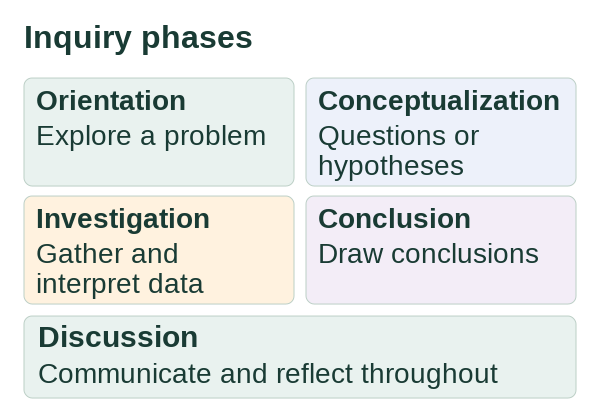
The combined cycle starts with Orientation. It then moves to Conceptualization. That phase splits into two other sub-phases. These are Questioning and Hypothesis Generation. The cycle then moves to Investigation, which has three sub-phases. The first is Exploration or Experimentation. Then comes Data Interpretation. In this framework, the work can go through several cycles of investigation before it ends. Inquiry-based learning usually ends with the Conclusion phase.[5]
Unlike the other phases, Discussion can be present at every point in the cycle. It connects to all the other phases. It can happen during the inquiry itself. The reviewers call this discussion in-action. It can also happen afterwards, when looking back. This is called discussion on-action.[5]
Levy and Petrulis (2012) found that first-year undergraduates experienced inquiry and research in four different ways. A qualitative study looked at first-year university students in the arts, humanities and social sciences. Two of these were research as gathering information and research as exploring others' ideas. Both were linked to learning by working independently with a body of knowledge. The other two were research as showing and developing one's own ideas, and research as making discoveries. Both were linked to a growing sense of taking part in building knowledge. Students said that framing their own lines of inquiry gave them a strong sense of power. They said it helped their intellectual and personal development. They said the same of open-ended work aimed at building knowledge. The same students also stressed that they needed support to carry out research and inquiry.[15]
Wu and Hsieh (2006) suggest that each phase of inquiry offers a different kind of learning. One study looked at 58 sixth graders in two science classes. The classes used a series of inquiry activities. The activities were built around four skills used to build explanations. These skills were finding cause-and-effect links and describing the reasoning process. They also used data as evidence and judged explanations. The analyses suggested that each phase of inquiry offers a different kind of learning opportunity. They also interact with how students' inquiry skills develop.[16]
Published case studies show how inquiry-based learning is conceived, planned and guided in different subjects. A teaching centre at the University of Sheffield supported projects in inquiry-based learning. The cases were written to share what students and staff experienced in those activities.[17]
How much guidance students need
Lazonder and Harmsen (2016) asked what type of guidance is adequate, and for whom. Inquiry-based learning can work better than expository teaching, where the teacher explains and students receive. This holds as long as students get enough support. Most earlier research looked at only one type of guidance and one type of learner. That made the question hard to answer. A 2016 meta-analysis combined 72 studies. It compared guidance types across age groups. A meta-analysis is a statistical method that pools results across separate studies.[3]
The effect on learning activities was d = 0.66. The 95% confidence interval was 0.44 to 0.88.[3] A confidence interval is a range of values below and above an estimate that has a given probability of including the true value.[18]
The effect on performance success was d = 0.71. The 95% confidence interval was 0.52 to 0.90. The effect on learning outcomes was d = 0.50. The 95% confidence interval was 0.37 to 0.62. The type of guidance changed the effect on performance success. It did not change the effects on learning activities or learning results. Effects on learning activities varied a lot. The fairly small number of studies did not allow a firm conclusion about differences between age groups.[3]
Tawfik, Hung and Giabbanelli (2020) compared three approaches. They were problem-based learning, lecture before problem solving, and case-based learning. A 2020 experiment with 91 students compared three methods. These approaches differ in how student-centered they are. They also differ in how much support the instructor gives. The problem-based learning group scored highest on conceptual knowledge. On causal reasoning, that group found more correct connections than the other conditions. But it also produced the most wrongly identified concepts. The three conditions did not differ much on self-efficacy.[19]
Cognitive load theory looks at how much work a task puts on the mind. From this view, generating answers during inquiry adds both intrinsic and extraneous load. A 2018 experiment with 133 sixth and seventh graders compared two things. One task was building science reasoning skills during an inquiry task. The other group simply read about the experimental design. Direct instruction was clearly better for learning the control-of-variables strategy. This was right after the inquiry task. After one week, the two conditions turned out to work equally well. A generation effect is the advantage for material students produce themselves. After the one-week delay, it appeared only among students who were very good at generating their own answers.[20]
Zhao and colleagues (2021) note that students sometimes find open-inquiry activities hard. A 2021 study of laboratory activities found that students' ratings of how much inquiry an exercise held matched the amount the instructor intended. In written explanations, students linked their ratings to feeling free, capable and supported during the activities. The results suggest that instructors should think about student motivation when they plan inquiry-based activities.[21]
Critical thinking and higher-order skills
Several inquiry studies look at critical thinking. Wale and Bishaw (2020) list its core skills. These are interpretation, analysis, evaluation, inference, explanation and self-regulation.[22] Antonio and Prudente (2023) treat higher-order thinking skills as a separate outcome. They measure them in science lessons.[23]
A 2025 review combined 25 articles, split into 36 studies. They were published between 2000 and 2024. It found a mean effect size of 1.27, with a 95% confidence interval from 0.78 to 1.76. The reviewers called this substantial.[24]
A 2023 meta-analysis looked only at science lessons. It also looked only at higher-order thinking skills. It drew 26 effect sizes from 20 studies. It covered 1,349 students. They were taught by inquiry-based and conventional approaches. The result held across students' education level, scientific subject and level of inquiry. This came from the moderator analysis. Only a few of the studies combined inquiry with technology.[23]
A 2026 meta-analysis asked one question. Does the choice of comparison group change the answer? It combined 57 studies from 51 articles published from 2015 to 2025. Unlike earlier reviews, it was not limited to science subjects. The overall effect on critical thinking was large and significant. It was g = 1.336. The 95% confidence interval ran from 1.061 to 1.611. Differences between studies were large again, at I² = 92.09%. The type of control group was the one moderator that reached significance (Qm = 5.21; p = .022). Subject area, education level and country did not significantly change the effect. Their p values were .698, .774 and .650. The effect was larger when inquiry was compared with teacher-centered learning. It was smaller than in other student-centered learning.[25]
A smaller classroom experiment tested inquiry in one science unit. It involved 90 sixth grade students in four classes of one secondary school. The design used a pre-test and posttest control group. The unit was the particle structure of matter. The researchers wrote a set of guided activities for it. Students taught with inquiry activities reached a higher level of critical thinking. Students taught by traditional lecturing did not reach that level.[6]
Researchers have also studied language classes. Wale and Bishaw (2020) worked with 20 EFL undergraduates in an advanced writing course. One study followed 20 undergraduate students learning English as a foreign language. The design used a single group. Students took three argumentative essay pretests. They took the tests before and after lessons in inquiry-based argumentative writing.[22]
Harapan and colleagues (2026) found that how well inquiry-based learning worked depended on the type of control group.[25] The 2025 review and the 2026 analysis both reported very high differences between studies. Their I² values were 92.0% and 92.09%.[24][25] The 2023 science meta-analysis found the effect steady across levels of inquiry. The 2026 analysis found that control-group type mattered and subject did not.[23][25]
Research
Overall effects on learning outcomes
Öztürk, Kaya and Demir (2022) used a second-order meta-analysis. This is a review that combines other meta-analyses. It combined the effects of inquiry-based learning on learning outcomes. One such review gathered 10 meta-analyses. They were published between 2015 and 2022. They were chosen so their primary studies overlapped as little as possible. The effect sizes did not differ much by grade level, subject area, location or study quality. They also did not differ by type of primary research report or by publication bias.[26] An effect size is a statistical calculation of how large a measurable effect is, for example the difference between the averages of two groups divided by the standard deviation.[27]
A 2024 analysis looked at 21 articles published between 2018 and 2023. It placed the average effect size in the high category.[28] Another 2024 meta-analysis looked at 25 articles. It reported an average effect size of 7.33%. It called the influence of the inquiry model very high.[29]
A 2025 meta-analysis looked at 21 studies published between 2020 and 2024. It found a small but significant overall effect. It was d = 0.444. That review noted that earlier results had varied widely. They went from significant positive effects to no impact at all.[30]
Some reviews test whether other factors change the size of the effect. These moderator analyses add detail.[26][30] The second-order review found that three versions of inquiry had high-level positive effects. They were a mobile model based on inquiry, a learning cycle model, and a text model for changing concepts.[26]
The 2025 review found the impact especially clear in science and mathematics education. That review also reported three influences on how effective inquiry-based learning was. They were educational level, instructional design and student engagement.[30]
One meta-analysis covered a single country. It compared grade levels. It found inquiry-based learning worked better at high school level than at other levels. That review covered 30 articles and theses from Turkey. They were carried out between 01.01.2000 and 01.03.2020. It concluded that inquiry-based learning clearly raises academic achievement. It also found no significant differences between articles and theses as types of publication.[31]
Effects on understanding in science and mathematics
A 2025 meta-analysis combined 12 studies. It covered 14 effect sizes and 786 students. It tested inquiry-based learning in science and mathematics. The studies came from several countries, school levels and subjects, and were published between 2014 and 2024. Across these studies, inquiry-based learning raised conceptual understanding. The effect size was g = 0.913. The effect was g = 1.191 in mathematics and g = 1.176 in senior high school. Open inquiry had the largest effect of all (g = 1.530).[32]
Mediana, Funa and Dio (2025) read the open inquiry result as showing that student autonomy matters. Its authors call for more research on different inquiry strategies. The pattern should not be treated as settled yet.[32]
Team-based inquiry learning uses team-based learning to carry out inquiry-based learning. Lewis and Estis (2020) tested it in intermediate-level mathematics courses. Students in the team-based inquiry courses showed greater mastery of content. Those students also took a more flexible approach to solving problems.[33]
Guided discovery learning is a variant of inquiry, and two classroom studies report results from it.[34][35] In one study, 28 eighth-grade students in Palembang, Indonesia, learned statistics through guided discovery. More than 20 of them met the set markers of concept understanding. Answers averaged 80% to 93%, with a mean score of 83.88.[34]
The other study followed one chemistry class of eleventh graders. The topic was reaction rates. It again had no control class and used a time-series design. At the third meeting results fell sharply, by about 53.16%. Classroom observations showed the lesson was not carried out well that day.[35]
One comparison pitted inquiry-based learning against problem-based learning, a close relative in which a practical problem drives the work. The study took 24 eighth graders in each group from a school in Kuwus, Indonesia. It measured gains from pretest to posttest. The two groups differed, with t = 2.566 and a significance value of 0.014. The abstract does not say which method produced the larger gain. The result shows a difference rather than a winner.[36]
Technology, simulations and mobile tools
A review of 62 studies looked at mobile learning through inquiry. It sorted the activities these tools support. It found five types and twelve subtypes. The five types are direct instruction, access to content, data collection, peer-to-peer communication and contextual support. Contextual support includes augmented experiences, immersive experiences and adaptive feedback. The review also offered a framework with six dimensions. These judge how much agency each activity allows, meaning the learner's own control over the work. Those dimensions are goals, content, actions, strategies, reflection and monitoring. Suárez and colleagues (2018) noted a lack of practical strategies. Teachers need to balance freedom for learners with support from the technology.[37]
One study looked at 34 future physics teachers. They used PhET simulations in inquiry lessons. The lessons covered direct current electricity. Many of those students solved problems with unstructured methods. They worked from memory or with no clear approach at all. Students who took a scientific approach solved problems better than students who used the other approaches.[38]
A European project gave teachers a platform for planning and running lessons. It covered virtual labs, virtual games, simulations and augmented reality applications. The study looked at 668 uses in 453 schools. It ran over one school year. The students' average age was 14.4 years. Each user made an average of 22 digital inquiry scenarios. Each scenario took about 50.14 minutes to finish. The scenarios led to large learning gains. Between 20 and 29 percent of students reached a high level of achievement. The PISA study found an average of 10 percent.[39]
Web-based multimedia can add prompts and feedback to an inquiry cycle without changing inquiry fidelity. A quasi-experimental study worked with 157 senior high school students. They were in North Aceh, Indonesia. Both groups followed the same inquiry cycles in chemistry. Only the experimental group used interactive visualizations, simulations, inquiry prompts and automated feedback. The experimental group showed much higher engagement in science process skills. These are the skills of observing, measuring and reasoning through an investigation. A Mann-Whitney U test gave p < 0.001 and r = 0.71. That group also gained more in scientific literacy. Its mean normalized gain was 0.52, against 0.40 for the control group.[40]
Mobile devices can carry multimedia versions of data collected in a physical experiment. A cluster-randomized controlled study ran from 2017 to 2018. It took place in 11 secondary schools in Germany. An application showed the measurement data in several forms. A multilevel regression analysis found that the approach clearly lowered extraneous cognitive load. It also led to better understanding of concepts. A path analysis traced these effects to the treatment itself. Teacher behavior had no significant effect on them.[7]
Researchers have reviewed how schools use augmented reality in inquiry learning. The review found that augmented reality was mostly used with success for thinking goals. It was used less often for motivational goals and for emotional goals. Such tools were used mainly in the conceptualization phase of inquiry. They were used less in the investigation phase. Their possible uses in the orientation, conclusion and discussion phases still need study.[41]
Infrared imaging shows temperature distribution right away. It also shows heat flow as it happens. Teaching heat transfer with infrared imaging was first discussed in 2001. At that time the cameras were too expensive for most schools. By 2011 a basic handheld camera cost teachers less than $900. One model offered a temperature sensitivity of 0.1 degrees Celsius. The article presented these low-cost cameras as tools for visualization, inquiry and discovery.[42]
One research program looked at scientific visualization software in the geosciences. It described 5 major challenges to using inquiry learning in classrooms. That work covered 4 generations of software and curriculum. It set out design strategies to meet the challenges.[43]
The European platform study found no obstacles that could not be overcome. Teachers had been given tools to build their own inquiry scenarios. They also had tools to track how well students did.[39]
Teachers, assessment and school conditions
A survey looked at Grade 10 Physical Sciences teachers in a rural district of Mpumalanga, South Africa. It found a positive attitude toward inquiry in teaching and learning. Those teachers named some benefits. One example was dealing with learner motivation. They also said it helped students understand abstract science ideas. Yet the same teachers were less willing to use inquiry-based learning in their lessons. Teachers said putting it into practice was very hard. They named laboratory facilities, teaching materials, time to finish the curriculum, and large classes.[4]
Beliefs also shape how teachers assess. A case study looked at two experienced secondary science teachers. Their beliefs about inquiry matched how they taught and assessed it. Teachers who saw themselves as facilitators used more open guided inquiry. Teachers who saw themselves as shepherds used more directed approaches.[44]
A study examined the principal's role in inquiry-based teaching. The school was an elementary school in a large Canadian city. The study used interviews. The analysis looked at the principal's own earlier experience. That experience was of inquiry-based teaching and learning. It also described the hard choices a principal faces when leading inquiry teaching. Towers and Panayotidis (2012) found that mainly system-wide features of the school workplace work against inquiry. These features work against efforts to start and keep inquiry going in schools.[45] Spronken-Smith and colleagues (2011) studied 10 cases of inquiry-based learning in undergraduate education. They found that supportive senior management was an enabling factor.[46]
Attard, Berger and Mackenzie (2021) report that teacher professional learning and industry partnerships seemed to affect student engagement. A qualitative study in Sydney, Australia, interviewed primary and secondary teachers. They had taken part in professional learning about inquiry-based teaching methods. Their students had done inquiry projects based on local infrastructure programs. Attard, Berger and Mackenzie (2021) found that three things together raised student engagement. The gains covered three areas: doing, thinking and feeling. These were teacher professional learning, student inquiry, and partnerships between schools and local industry. Professional learning also improved teachers' teaching relationships. It also widened the range of teaching methods they could use. The study judged these gains were not possible with more usual industry-school partnerships.[47]
Mao (2023) reports that the evaluation system for inquiry-based learning is not clear enough. A 2023 review found three problems. Current methods follow general standards for judging learning. Those standards ignore what makes inquiry different. Personal bias among evaluators can also sway an evaluation. Mao (2023) argued that inquiry-based science learning needs a way to be evaluated. It should help three things develop together. These are students' knowledge and skills, their processes and methods, and their emotional attitudes and values.[48]
The two-teacher case study recorded teacher-student conversations in inquiry lessons. It analysed them with the ESRU model and the Convergent/Divergent assessment framework. Its findings suggest that student autonomy in inquiry depends on what teachers believe about their role.[44]
Chen and Chen (2025) report that some learning analytics tools could strongly support inquiry processes. A systematic review looked at 51 studies of learning analytics in inquiry-based learning. Chen and Chen (2025) report on 51 studies. Most tracked students' general engagement in inquiry, alone and in groups. They also tracked the specific behaviours students used to investigate. Few paid attention to key stages. These include forming hypotheses, interpreting data and working together in groups. Few studies looked at how these tasks with several stages affect each other. They could help students carry out inquiry better. They could also help teachers plan and run inquiry activities. But evidence from real studies is still not enough. It does not yet show how these tools shape student inquiry processes and outcomes.[49]
Spronken-Smith and colleagues (2011) list challenges to inquiry-based learning at department and institution level. Challenges at the department and school level included timetables and room allocation. Another problem was finding teachers in a setting focused on research. On the enabling side, it named teacher traits. These were student-centred, reflective but rebellious. Spronken-Smith and colleagues (2011) also named course design features that help. These include questions that drive learning, group work, and inquiry skills built up in stages. They also include required student preparation and constructive alignment.[46]
Learners who struggle and questions of equity
A cross-case analysis followed six middle school students with learning disabilities in a Midwestern city. Each student was in a general science class taught through inquiry. Most of the six had trouble learning science process knowledge. These students relied on peer supports to carry their learning forward. This came from interviews, classroom observations and student portfolios.[50]
English language learners are among the fastest growing groups of students. They have not matched peers who are fluent in English in school success. This is especially true in science. A meta-analysis of 26 articles found that inquiry instruction helped English language learners in science more than direct instruction did. The gains were significantly greater. The same analysis found a different learning effect. The approach still worked better for non-English language learners than for English language learners. Some features of the setting change these effects. The review names them and discusses them.[51]
International students are another group. Researchers have studied how well they fit with inquiry-based learning. Enrollment from overseas is rising in the United Kingdom. Research and teaching are also linked more closely. Bache and Hayton (2012) drew on research in a politics department at a UK university. The university had a strong record in research. They suggested possible next steps for students and staff in inquiry-based programmes.[52]
Achievement level also shapes the experience. An exploratory study assessed 272 teacher-nominated students on flow, the state of deep absorption in an activity. The students were in Grades 5 through 9. Their average achievement ran from high to low, and their mean age was 11.7 years. High-achieving participants reported the most flow in inquiry and in their favorite subjects, and in both settings they could help determine the content. All of them also chose hard work over easy work, but for different reasons. All of them stressed feeling able to succeed and holding an interest in the activity as conditions for flow.[53]
Curiosity is a personal trait that may matter for inquiry. A study of 7- to 9-year-olds measured curiosity with a game. The game was called Underwater Exploration. It measured inquiry learning with a Scientific Discovery task. The task was about designing experiments that inform. Van Schijndel, Jansen and Raijmakers (2018) found that curiosity went with gaining more knowledge. It did not go with better exploration. For children low in intelligence, more structure in the setting improved the quality of exploration. It did not improve how much knowledge students gained. Curiosity and the structure of the setting showed no interaction. The results support two separate processes. One is designing experiments. The other is reflecting on the experiments performed.[54]
A quasi-experimental study looked at 56 pre-service science teachers in Turkey. It compared a test group with a control group. Arsal (2017) found no statistically significant extra progress in critical thinking dispositions. The author advises teacher educators that inquiry-based learning may not be an effective way to improve those dispositions.[55]
Creativity, innovation and research skills
Rodríguez and colleagues (2019) studied an open inquiry course for 529 undergraduate human biology and medical students. The course built creative and research skills. Acar and Tuncdogan (2019) suggested that open inquiry offers the most room for innovation skills. They did not test this idea.[56][57]
Interprofessional means students from different fields working together. The open inquiry approach helped students build creative and research skills. Working with people from other professions raised creativity. The creativity workshop used methods meant to spark ideas. It led to better learning results. The researchers judged these results from student surveys, focus groups and final learning results. They noted limits to the approach in health sciences studies.[56]
A 2019 conceptual model argues that inquiry-based learning can prepare students for innovative work. The model describes inquiry-based learning as an approach. In it, students follow the processes scientists use to build knowledge. Acar and Tuncdogan (2019) name three design choices that teachers control. An inquiry can be open or closed. It can focus on discovery or information, and be done alone or in teams. According to the model, open, discovery-focused, team-based inquiry offers the greatest potential for building innovation skills. That claim rests on a conceptual model rather than a test of student outcomes.[57]
A 2023 meta-analysis of 18 studies found that inquiry-based learning through mobile learning had a significant effect on creative thinking (z = 6.713; p < 0.001). Its effect size, a measure of how large a difference is, was rRE = 0.885. The authors call this high.[58] A 2024 meta-analysis of 15 studies published from 2018 to 2023 examined guided inquiry built around STEM, the combined teaching of science, technology, engineering and mathematics. Dewanto and colleagues (2024) reported an overall effect size of 0.99 (95% CI [0.79; 1,19]).[59]
Smaller classroom studies report gains as well. Talakua and Sahureka (2020) combined POGIL with discovery learning. Afterward, 80% of 23 students were in the good category for analytical thinking. One 2020 study looked at 23 tenth-grade biology students at a Christian high school. They worked through guided inquiry and discovery learning on the classification of living things.[60]
Madhuri and colleagues (2012) designed a laboratory course for first-year engineering chemistry students. The course was built around inquiry and Bloom's taxonomy, a classification of thinking skills. Students were assessed on running experiments, designing new ones and connecting the course to real life. The paper reports no numerical result.[61]
A 2025 experiment in a private junior high school tested two methods in Islamic Cultural History lessons. Inquiry-based learning and project-based learning both improved creative thinking. Nur and colleagues (2025) found that project-based learning scored slightly higher on average than inquiry-based learning. They also found a significant interaction between teaching strategy and students' creativity levels.[62]
Invention and business offer another setting for inquiry. A student case study on the development of Taxol, a cancer drug, showed the kinds of knowledge students gained. The paper also lists the challenges of this course type, as well as its benefits.[63]
Comparing inquiry with other active methods
Utami and Sundari (2019) reviewed thirteen articles published from 2014 to 2018. Ten of them reported better student learning with inquiry learning. The other 3 found no effect on outcomes, though learning motivation rose.[64]
Panasan (2010) found no difference between project-based and inquiry-based activities. This held for learning achievement, science process skills and analytical thinking (p>0.05). Kumara and Asih (2026) found problem-based learning worked better than inquiry learning for IPAS learning outcomes.[65][66] In a 2010 study, 88 fifth grade students in Thailand were split into two groups of 44. One group was taught through project-based activities and one through inquiry activities. The researchers concluded that science teachers could use either method to suit their learners.[65]
A 2026 quasi-experiment with fifth grade students in Indonesia pointed the other way. Both models raised learning results in Kumara and Asih (2026). Problem-based learning reached an N-Gain of 0,7 (high category). Inquiry learning reached 0,5 (moderate category), a significant difference (p < 0,05).[66]
Putri (2021) found no significant difference in mathematical problem solving between guided discovery learning and problem-based learning. Kumara and Asih (2026) found a significant difference between problem-based learning and inquiry learning (p < 0,05).[67][66] The percentage of achievement in both classes was moderate.[67] The 2026 fifth grade experiment, by contrast, favored problem-based learning over inquiry for science learning outcomes.[66]
Nugroho and Zulfiani (2021) compared structured inquiry with guided inquiry. Guided inquiry, the more complex of the two, produced better cognitive learning outcomes. It found clear differences in cognitive learning outcomes. Students in guided inquiry did better. The effect size for structured inquiry studies was in the medium category. Guided inquiry studies fell in the large to extremely large categories.[68] A 2024 meta-analysis of 5 chemistry studies reported an average effect size of 1.42. That is a high value.[69]
Khalaf (2018) found that a gap remains. Current learning methods fall short of what education systems expect. The systems want learners to build knowledge and skills. Khalaf (2018) concluded that a new teaching design is needed. It should keep the strengths of both models and remove their weaknesses.[70]
In practice
Inquiry skills, process skills and literacy
Classroom studies show which process skills students practice during inquiry activities. Forty seventh-grade students in Turkey did four inquiry activities on electrical circuits. The work lasted four weeks. Their 32 reflective worksheets were scored with a rubric and checked for content. They got better at defining the problem, forming a hypothesis, observing and interpreting results. The same students got better at using scientific terms. They also got better at drawing clear scientific figures. They got better at making scientific explanations. They also reported more positive views of the learning process.[71]
Gormally and colleagues (2009) measured students' science literacy skills and research skills. They did this in inquiry courses and in traditional laboratory courses. The inquiry students also grew more confident in scientific abilities. The traditional students gained even more confidence. The authors read this as possible over-confidence in the traditional group. Inquiry students valued the real contact with science. But they found the complexity and frustration of real scientific work hard. This may explain why many students resist inquiry courses.[72]
A 2016 review of the research looked at how information literacy fits with inquiry-based learning. The review suggested reasons why so few studies exist on the topic. These included the state of information literacy programs and librarian training. They also included how institutions view information literacy. It concluded that inquiry-based learning allows better integration of information literacy content. It also encourages reflection and student agency. It also helps students learn how to learn.[73]
Nunaki and colleagues (2019) tested whether inquiry-based learning trains students' metacognitive skills. Scores from a rubric for metacognitive skill were compared before and after. The comparison used a paired sample t-test. They showed that inquiry-based learning trained the students' metacognitive skills well. An independent sample t-test found no real difference between male and female students' metacognitive skills.[74]
Variations across ages and school subjects
A 2025 meta-analysis looked at 6 studies published from 2018 to 2025. It looked at inquiry-based learning with elementary school students. The review reported average gains of 19.73% in learning outcomes and scientific literacy. The high was 30.00% and the low was 7.9%.[75]
At university level, a 2006 course redesign in undergraduate geology gathered quantitative and qualitative data. The course was inquiry-based. Apedoe, Walker and Reeves (2006) found that inquiry-based learning helped students build science inquiry skills. This held when the learning was well structured. The course designers argued that success required several parts to line up. These were objectives, content, teaching design, tasks, assessment, and the roles of instructor and student.[76]
In geography, a 2008 paper described uses from short questioning exercises in a class to whole courses or degrees built on inquiry. That paper warned about inquiry elements sitting inside a more traditional curriculum. Students and teachers then need careful guidance on what the learning should produce.[2]
A 2004 introductory chemistry laboratory combined traditionally scripted experiments with an inquiry-based group project. Students were given a list of topics. They could explore them as written or change them to fit their own interests. These prompts let students begin in a timely manner. In most cases they finish a project within a single semester. The instructors reported that scripted laboratories plus an inquiry project gave the best introduction to careful chemical measurement. It also showed students the uncertainties of scientific work.[77]
Engineering education has produced a four-phase model. It is called Inquiry-Based Laboratory for Engineering, or IBL-E. Its phases are problem definition, experimentation, reflection, and validation of results. The model came from a review of the literature and classroom observations. It used simulation tools such as MATLAB, VISSIM, PyroSim, and Ansys. A digital portfolio system tracked student progress. The 2026 paper reports that the model raised engagement and independence. It also improved understanding of complex technical processes. It also names two limits: staff preparation and laboratory infrastructure.[78]
In reading, a 2022 community service program in Indonesia used inquiry-based learning. It dealt with students' difficulty with English texts. The program attributed that difficulty mainly to lack of practice and limited vocabulary. It also blamed too few strategies for understanding text. Students were trained to handle reading comprehension problems. They worked with others and asked the teacher. The report concluded that students understood English reading well afterward. It also said the approach works in formal and non-formal school settings.[79]
A 2026 teaching experiment at a teacher-training university involved 298 pre-service primary school teachers. Of these, 152 were in a control group and 146 in an experimental group. Both groups improved on all five parts (p < .001). The groups did not differ much at post-test (p > .05). Effect sizes between groups were small. The researchers said these findings do not support a claim. The claim is that inquiry-based learning beats traditional instruction.[80]
In a 2015 Australian teacher education course, pre-service teachers worked through a place-based simulation. The simulation was the main way of asking questions in a humanities subject. Surveys before and after the model suggested more engagement and better learning results. The authors noted that little research and few examples exist for inquiry in primary humanities. More analysis is needed. It should judge how deeply students understood inquiry approaches.[81]
Motivation, engagement and classroom participation
Inquiry tasks are often brought into science lessons to catch students' interest. They also draw students into taking part.[82] In the fall of 2022, 176 students were placed in small groups. They were in an introductory animal science laboratory course. They worked on a 45-minute inquiry case. A control group got a teacher-centered lecture. Students in the lecture control group reported less readiness to learn. Students at all three inquiry levels reported more. They also showed less cognitive processing and weaker motivation. Those students also described different levels of challenge, novelty and attention demand. The inquiry versions differed from traditional lectures in these ways. The researchers concluded that the inquiry levels helped students' experience. Students showed greater interest, motivation and autonomy.[83]
A larger survey of 255 Grade 9 students in the Philippines looked at how inquiry strategies relate to motivation. It covered the 2024-2025 school year. Asking deep questions, exploring on one's own and solving complex problems each added a lot to students' motivation. The study reported that doing inquiry tasks and assignments made that motivation stronger still.[84]
A much smaller action research study in Thailand followed 8 seventh-grade students. They were chosen because they showed few inquiry learning behaviors in class. The students went through two cycles that combined a five-step inquiry model with game-based learning. Their inquiry characteristics then reached an effectiveness index of 75/76.36, against a set criterion of 70. The researcher read this as a sign that the combined design built inquiring habits in those science lessons.[85]
In such groups, students ask questions to clarify what they understand. They weigh evidence that may explain a phenomenon and predict possible solutions. The review stresses the teacher's part in two things. The teacher shows students ways of thinking and reasoning. The teacher also gives them chances to work with others.[82]
Discussion quality also depends on how a conversation is set up, according to a 2024 network analysis of online inquiry discussions. Carefully designed inquiry discussions produced fairly cohesive groups. Their patterns of interaction were spread evenly and stayed in proportion. Discussions built on questions from the Practical Inquiry Model (PIM) drew more interaction than discussions with other questions. Students gave more responses than required. Individual participation and influence shifted from one discussion to the next. The moderator's role showed no effect on participation or interaction.[86]
In interviews, 24 secondary agriculture students said they preferred inquiry-based learning. They saw it as a way to improve their critical thinking. Interviews with 24 secondary agriculture students found that they called inquiry hands-on. They said it required them to work by themselves and involved questions. They knew such lessons might sharpen their critical thinking.[87]
Conradty and Bogner (2019) found that one four-hour STEAM module built long-term knowledge. It also built steady motivation from within. Creativity as students rated it did not change. The authors concluded that regular training is needed to develop it. A four-hour STEAM module adds arts to science, technology, engineering and mathematics. It was tested with 160 students aged 11 to 12. They worked at their own pace with a passive tutor. The module produced long-term knowledge gains and steady scores for intrinsic motivation, meaning interest in the work for its own sake. The researchers argued that creativity needs regular training in a suitable setting to develop over time.[88]
Training teachers to run inquiry lessons
Tatar (2012) found that open inquiry activities developed two preservice teachers' beliefs about learning science through inquiry and their ability to apply a scientific inquiry process.[89][90] The course was taught to 30 third-year preschool education students. They studied at Taizhou College of Nanjing Normal University. After the course, students' mean score on a scientific inquiry teaching ability rubric was 19.83 out of 24. The standard deviation was 1.72. This was above the preset criterion of 70 percent at the .01 level (t = 9.64, p=0.001). Chunyan and colleagues (2025) reported a large effect on inquiry teaching ability among the 30 students.[90]
Past experience shapes what preservice teachers take from inquiry training. Tatar (2012) used a case study to follow two student teachers. The two had different backgrounds in earlier science education. Interviews, observations and written documents showed how the two teachers' past experiences shaped their beliefs. Activities that allowed discussion, teamwork and interaction improved those beliefs. They also improved the teachers' ability to carry out a scientific inquiry process. The study concluded that inquiry activities should often be part of preservice teacher education.[89]
In real classrooms, inquiry teaching often falls short of its aims. A 2015 Malaysian study recorded 92 chemistry lessons. They were taught by 23 chemistry teachers. It transcribed them word for word. Most questions from teachers and students were closed-ended questions. Teachers did pause after asking questions. But most student questions were followed by a teacher answer. Student answers were followed by a teacher explanation. Most students followed the teacher's explanation or the textbook steps before running an experiment. On average, their ability to give further explanation was very low. The researchers proposed a model of inquiry teaching based on verbal interaction. It aims to guide chemistry teachers toward the Malaysian National Science Education Standards.[91]
Collaboration and communication during inquiry
A 2024 study of eleventh-grade chemistry students in Padang, Indonesia, compared two group-based models. The topic was chemical equilibrium. Under guided inquiry learning, 9.09 percent of students reached the model level in oral communication. 90.09 percent reached the proficient level. For written communication, 90.90 percent were rated very satisfactory. Another 9.09 percent were rated satisfactory. Under the same model, collaboration ratings were 36.36 percent model and 63.63 percent proficient. The companion guided discovery model produced a wider spread in oral communication: 20 percent model, 62.85 percent proficient and 17.14 percent developing.[92]
Kolstø (2018) proposes theoretical principles for teachers' use of dialogue to scaffold, that is, to support, students' inquiry-based learning. A 2018 analysis of six published models of inquiry-based science teaching found that all six recommend dialogue, but only for certain stages of the inquiry process. Only three of the six documents give reasons for why dialogue matters. Those reasons come from theories of language and learning. Two argue that language use which feels personally meaningful to the student supports learning.[93]
In a three-year study, 18 students took part in inquiry-based computer-supported collaborative learning. Another 8 formed a comparison group. Across 161 interviews, the inquiry group described deeper strategies. These included monitoring their own work, building representations and sharing information with peers. The comparison group described more surface strategies, such as memorization. The picture was not all positive. The comparison group reported significantly more strategies for evaluating content.[94]
Combining collaboration with inquiry has been tested in school mathematics. A 2024 quasi-experiment involved 142 fourth-grade students. They were at a public primary school in Chengdu, China. The study used pre-tests and post-tests to measure how well the model worked. Students taught with a model built on collaborative and inquiry-based learning improved significantly more in analytical thinking and reasoning than students taught in the traditional way.[95]
At college level, a 2021 module for English as a foreign language learners used the 5E approach. Its five stages are engagement, exploration, explanation, elaboration and evaluation. The module added industry field trips, reflective writing and project presentations. It reported a favorable effect on engagement, critical thinking, collaboration and communication.[96] Kaur (2024) writes that every phase of inquiry-driven instruction uses social skills for working together. The review names three skills: communication, interpersonal skills and decision making.[97]
Inquiry in informal and out-of-school settings
Outside the classroom, inquiry often begins with a person's own question rather than a teacher's assignment. A case study examined who used a music-education collection of modules. The modules were published at Connexions and visited often. Those who answered a voluntary survey included teachers, students, self-directed learners, members of music ensembles and casual learners. Most respondents reported that they found single modules by themselves, in order to pursue a particular question right away. Most respondents said they did not act on institutional directives. They also did not follow entire online courses. Records from the computer logs supported this pattern. Most visitors reached a module after an Internet search using terms specific to that module.[98]
In open learning spaces, a system can supply the questions that keep inquiry moving. One project set out to train learners' meta-cognitive skills. The training happened during self-directed study of history. Learners used a learning environment that supports and regulates their learning processes through inquiry-based learning. The system generated inquiry questions automatically from that semantic information. These questions were designed to point learners toward new information. They were also meant to trigger historical thinking.[99]
In museums, what an adult already knows shapes how the inquiry goes. The children were about 10.0 years old on average. Half the pairs were assigned at random to a group. In that group, the parent was shown the task's solution beforehand, without the child's knowledge. Parents with this pre-knowledge inquired longer and asked more open-ended wh-questions and more closed questions. They interpreted results less often than parents without it. Their children more often described evidence and interpreted results. They also handled materials alone more often and solved the task accurately.[100]
Individual differences also mattered in the museum study. Children who reported a stronger inquiry attitude asked fewer closed questions and more open-ended ones. Parents handled materials with boys more often than with girls. Fathers with pre-knowledge, but not mothers, let the child manipulate more on their own than fathers without pre-knowledge did.[100]
Inquiry across national and cultural contexts
Reports on inquiry-based learning come from several school systems. Kaiyrzhan and colleagues (2023) describe how teachers in Kazakhstan use the method, and Koterwas (2022) describes its use in an International Baccalaureate primary school in Poland.[101][102] In Kazakhstan, a 2023 article describes how teachers there use research learning in their classrooms. That article reports the advantages and disadvantages teachers experienced. It concludes that the method can raise student motivation and develop creative skills.[101]
In Romania, a 2025 analysis of TIMSS data from 2019 looked at how science is taught. The survey covered 610 science teachers. They came from 194 schools in different regions of the country. Most of them, 422 respondents, involve their students in scientific experiments only now and then. Interviews at one school that runs yearly inquiry-based science projects found the main challenge was time. Inquiry-based learning is time consuming. Teachers also named students' lack of practical skills and their inability to identify lab equipment. They named the unpredictability of learning through inquiry and class management difficulties.[103]
In the Philippines, a 2024 study developed an inquiry-based learning resource for Grade 4 science. The school was Del Remedio Elementary School in San Pablo City. The resource met the criteria for being highly acceptable. The criteria covered graphic design and layout, construction, language and content. Students' pre-test and post-test scores on integrated science process skills differed significantly. The study reads this as improvement after inquiry-based learning. The study also reports a significant link between the inquiry-based technique and students' level of integrated science process skills. The significance level was 0.05.[104]
A 2022 article examined inquiry-based learning in one non-public international elementary school in Poland. The school follows the International Baccalaureate programme. It concludes that the method, with support from the International Baccalaureate Organization, can be implemented in early childhood education within the Polish system. The article adds that in Poland this approach is largely unrecognized. This is especially true in early childhood education.[102]
Inquiry in language and reading classrooms
In reading classrooms, inquiry-based learning asks students to search for and study a topic in a systematic, critical, logical and analytical way. Students then reach their own findings with confidence. A quasi-experimental study of English as a foreign language (EFL) students tested this method against ordinary teaching. The study used purposive sampling. It measured reading with a reading test. Students taught through inquiry improved their reading ability. Their scores differed significantly from those of students taught without it. The method was said to push students to ask questions about a phenomenon and make field observations. It also pushed them to analyze the data and draw conclusions.[105]
A study at Shaqra University in Saudi Arabia worked with 106 first-year university students, 53 male and 53 female. They were in two classrooms in urban and suburban areas. The design was quasi-experimental with one group. The skills identified for the students were guessing, description, analyzing and identifying the main idea. Scores on a reading comprehension test rose from pretest to posttest. The difference was statistically significant at the .05 level. The study gave the inquiry-based strategy credit for this gain. The gain was in metacognitive reading comprehension skills at university level.[106]
In writing classrooms, one collaborative classroom action research project followed first-year students at UMS Rappang in an EFL setting. A researcher and a collaborating teacher planned, taught and reflected together. Each cycle had four meetings: three for treatment and one for a writing test. The data came from several records: checklists filled in during observation, writing tests, portfolios, field notes, and the writing the students produced. The inquiry sequence had five steps. Students answered the teacher's questions on a topic. Then they observed pictures, objects and texts and shared their ideas, then took notes. They discussed and peer edited their work. Then they reread it for content and clarity before submitting a final version. Students worked in mixed groups, regardless of achievement, so they could interact and help each other. The teacher controlled and guided the activities.[107]
A researcher and a teacher worked together to design the lessons. They taught them and reflected on each cycle together.[107] A 2025 article on inquiry-based learning argues that the approach builds students' skill at seeking, judging and using educational information on their own. That article examines various case studies and educational practices. It reports benefits of inquiry-based learning for students' research skills and information-seeking behavior.[108]
Inquiry in undergraduate and professional education
Wide use of such methods could improve learning outcomes. In the end, it could keep more students in college mathematics.[109] A quasi-experimental study with 60 second-year undergraduates compared inquiry instruction with traditional lecture-based instruction. Students taught by inquiry scored much better on a validated multiple-choice test, with a very large effect size. The unusually high values call for cautious interpretation. Prior academic achievement strongly predicted post-test performance. This points to the importance of how prepared learners are at the start.[110]
In nursing education, one study measured critical thinking with the Watson Glaser Critical Thinking Appraisal (WGCTA). The test was given to 228 nursing students during their first semester. A second administration covered 257 students in their final semester. Scores were then split into groups. The mean score rose clearly in the low group and stayed the same in the medium group. It fell clearly in the high group.[111]
Wang and Guo (2021) built a student-centered inquiry course model on renewable energy sources. It was for 27 students at China University of Petroleum (East China). It was built on the Taylor Principle and a Plan, Do, Check, Act cycle. The case study found a link between the new curriculum model and students' academic performance. The improvement was larger for low-achievement students than for high-achievement students. The model also helped students transfer knowledge and learn methods, reductionism and consciousness formation. Its designers offer it as a template for improving renewable energy education.[112]
What this looks like when you study
In a German study, 286 high school students with an average age of 15.6 used tablets to measure motion in physics experiments. The tablets showed the measurement data in multiple representations. The study ran between 2017 and 2018 in 11 secondary schools. Students who used the tablets carried less unnecessary mental load and learned more physics concepts than students who did not.[7]
In a Turkish study, 90 sixth graders in four classes studied the particulate structure of matter with guided inquiry activities. The researchers compared these students with a control group taught by traditional lecturing. The inquiry group scored higher on a critical thinking test, and its scores rose in every dimension measured.[6] In another study, 58 sixth graders took part in a series of inquiry activities and were tested before and after. Their skills at identifying causal relationships, describing reasoning and using data as evidence improved significantly. Their skill at evaluating explanations improved only slightly.[16]
In a Dutch study, 105 parent-child pairs, with children about 10 years old, did an inquiry task at a science museum. Half the parents were shown the solution beforehand, without the child knowing. Those parents inquired for about one minute longer, asked more open questions, and their children described evidence and solved the task more accurately.[100] In a university study, 529 human biology and medical students took an open, interprofessional inquiry course. Of these, 198 also attended a creativity workshop. Students rated the course highly for developing research skills and creativity, and working with students from another field boosted creativity.[56]
Kaiser, Mayer and Malai (2018) tested 133 sixth and seventh graders. Students who read about the experimental design scored higher right after the task than students who generated the reasoning skills themselves. One week later, the two groups did equally well.[20]
Criticism
Criticisms, mixed findings and open questions
Large international surveys of student achievement have reported a negative effect of inquiry-based learning on science literacy. One analysis of the PISA 2015 Finnish sample argues that those surveys left out two things. They left out the quality of instruction and the type of inquiry used. The Finnish data were analyzed with both factors included. The teacher-student relationship was the strongest predictor of science literacy. That relationship, and classroom management, changed how strongly guided inquiry and open inquiry related to science literacy. In the same analysis, open inquiry predicted science literacy better than guided inquiry.[113]
Cairns (2019) found that the picture depends on which inquiry practice is counted. It also depends on how often that practice is used. That study looked at the nine practices behind the PISA 2015 measure of inquiry-based instruction. The measure covered 69 countries. Some practices showed a significant, straight-line, positive link with science achievement. This was particularly true of practices that place science learning in a real context. Two practices showed a curved link instead. These were explaining their ideas and doing experiments. Some students carry out experiments in the lab in some lessons. They score higher than students who do experiments in every lesson. Cairns (2019) found the best frequency for each practice.[114]
Sam (2024) notes that students differ in readiness for self-directed learning. Inquiry also needs a lot of support from teachers. In self-directed learning, the student plans and monitors the work.[115]
Implementation is difficult for another reason. The term covers very different ideas and practices in education. Researchers in the United States have found that inquiry-based learning supports deep, meaningful content knowledge. Yet using it in real classrooms has been hard. Part of that difficulty comes from differing ideas of inquiry-based learning from one field to another.[116]
A 2010 analysis looked at three university cases. It found that the link between teaching and research differed a lot among them. One was a structured inquiry medicine module. One was a guided inquiry course in political communications. One was an open inquiry course in ecology. That analysis concluded that strong links between teaching and research call for an open approach. The approach should be aimed at discovery. More structured, guided forms can build specific inquiry skills step by step.[117]
One case study in college mathematics followed undergraduates at two institutions. It looked at their later grades and course choices. Some students had done poorly before. For them, the impact on grades was large and lasting. The authors of that study offered methodological advice for future work of the same kind. This suggests the design of such studies is not yet settled.[118]
Cairns (2019) analysed nine items. These items described the PISA 2015 idea of inquiry-based instruction. Their links with achievement pointed in different directions.[114]
Zafra-Gómez, Román-Martínez and Gómez-Miranda (2015) found exam grades rose with attendance at classes and tutorials. Grades also rose with the use of inquiry-based learning. Student satisfaction was tied to three things. These were attendance, motivation and how useful students found inquiry-based learning.[119]
Key studies
| Year | Study | Sample | Design | Finding |
|---|---|---|---|---|
| 2006 | Wu & Hsieh[16] | 58 sixth graders in two science classes | pre/post test with multiple data sources | Inquiry skills improved significantly overall, but evaluating explanations improved only slightly. |
| 2009 | Gormally et al.[72] | Study comparing inquiry lab instruction with traditional curricula | Inquiry students showed greater improvements in science literacy and research skills, but traditional students gained more self-confidence. | |
| 2015 | Pedaste et al.[5] | Systematic literature review of 32 articles describing inquiry phases or cycles | Five general inquiry phases were identified: Orientation, Conceptualization, Investigation, Conclusion, and Discussion. | |
| 2016 | Lazonder & Harmsen[3] | 72 studies | meta-analysis | Guidance improved learning outcomes (d = 0.50), learning activities (d = 0.66) and performance success (d = 0.71). |
| 2016 | Duran & Dökme[6] | 90 sixth grade students | pre-test and posttest control group experiment | Students taught with guided inquiry activities scored higher on critical thinking than students taught by traditional lecturing. |
| 2018 | Estrella et al.[51] | 26 articles | meta-analysis | Inquiry instruction produced greater science achievement for English language learners than direct instruction, but gains were larger for non-ELLs. |
| 2019 | Rodríguez et al.[56] | 529 undergraduate human biology and medical students | interprofessional inquiry course with surveys and focus groups | The open inquiry course promoted research skills and creativity, and interprofessional work acted as a creativity enhancer. |
| 2020 | Becker et al.[7] | 286 high school students in 11 German schools | cluster-randomized controlled study | Tablet-supported inquiry reduced extraneous cognitive load and produced greater conceptual knowledge in physics. |
| 2020 | Franse et al.[100] | 105 parent-child pairs | randomized museum experiment | Parents shown the solution beforehand inquired longer and asked more open questions, and their children solved the task more accurately. |
| 2020 | Sotiriou et al.[39] | 668 implementations across 453 schools | large-scale e-learning implementation study | Inquiry lessons averaged about 50 minutes and raised the share of high achievers to 20 to 29%, above the 10% PISA average. |
| 2022 | Öztürk et al.[26] | 10 meta-analyses | second-order meta-analysis | Inquiry-based learning had a medium positive effect on learning outcomes (d = 0.62). |
| 2023 | Antonio & Prudente[23] | 20 studies with 1,349 students | meta-analysis | Inquiry-based approaches had a large positive effect on higher-order thinking skills in science (g = 0.893). |
| 2025 | Mediana et al.[32] | 12 studies with 786 students | meta-analysis | Inquiry-based learning had a significant positive effect on conceptual understanding in science and mathematics (g = 0.913). |
| 2026 | Harapan et al.[25] | 57 studies from 51 articles | meta-analysis | Inquiry-based learning had a large positive effect on critical thinking (g = 1.336), larger against teacher-centered than student-centered controls. |
See also
References
- Buchanan, S., Harlan, M., Bruce, C., & Edwards, S. (2016). Inquiry Based Learning Models, Information Literacy, and Student Engagement: A literature review. School Libraries Worldwide, 23-39. doi:10.29173/slw6914
- Spronken-Smith, R., Bullard, J., Ray, W., Roberts, C., & Keiffer, A. (2008). Where Might Sand Dunes be on Mars? Engaging Students through Inquiry-based Learning in Geography. Journal of Geography in Higher Education, 32(1), 71-86. doi:10.1080/03098260701731520
- Lazonder, A. W., & Harmsen, R. (2016). Meta-Analysis of Inquiry-Based Learning: Effects of Guidance. Review of Educational Research, 86(3), 681-718. doi:10.3102/0034654315627366
- Department of Science and Technology Education, Faculty of Education, University of Johannesburg, Johannesburg, South Africa, Ramnarain, U., & Hlatswayo, M. (2018). Teacher beliefs and attitudes about inquiry-based learning in a rural school district in South Africa. South African Journal of Education, 38(1), 1-10. doi:10.15700/saje.v38n1a1431
- Pedaste, M., Mäeots, M., Siiman, L. A., de Jong, T., van Riesen, S. A. N., Kamp, E. T., Manoli, C. C., Zacharia, Z. C., & Tsourlidaki, E. (2015). Phases of inquiry-based learning: Definitions and the inquiry cycle. Educational Research Review, 14, 47-61. doi:10.1016/j.edurev.2015.02.003
- Duran, M., & Dökme, İ. (2016). The Effect Of The Inquiry-Based Learning Approach On Student’s Critical Thinking Skills. EURASIA Journal of Mathematics, Science and Technology Education, 12(12). doi:10.12973/eurasia.2016.02311a
- Becker, S., Klein, P., Gößling, A., & Kuhn, J. (2020). Using mobile devices to enhance inquiry-based learning processes. Learning and Instruction, 69, 101350. doi:10.1016/j.learninstruc.2020.101350
- Meirbekov, A., & Salikhanova, Y. (2021). Inquiry-based learning: strategies and benefits. Journal of Educational Sciences, 67(2), 18-26. doi:10.26577/jes.2021.v67.i2.03
- Aditomo, A., Goodyear, P., Bliuc, A. M., & Ellis, R. A. (2013). Inquiry-based learning in higher education: principal forms, educational objectives, and disciplinary variations. Studies in Higher Education, 38(9), 1239-1258. doi:10.1080/03075079.2011.616584
- Tawfik, A. A. (2025). How K-12 Teachers Define Inquiry-Based Learning: A Delphi Study. Interdisciplinary Journal of Problem-Based Learning, 19(1). doi:10.14434/ijpbl.v19i1.35154
- Davis, R. (2007). Putting The Community Back Into Inquiry Based Learning. Why Inquiry Based Learning Should Look Back As Well As Forward. Teachers Work, 4(2), 99-104. doi:10.24135/teacherswork.v4i2.482
- Comley, M. (2009). The Inquiry-Based Science Pedagogy Debate. LEARNing Landscapes, 2(2), 155-166. doi:10.36510/learnland.v2i2.301
- Banawi, A. (2019). Implementasi Pendekatan Saintifik Pada Sintaks Discovery/Inquiry Learning, Based Learning, Project Based Learning. Biosel Biology Science and Education, 8(1), 90-100. doi:10.33477/bs.v8i1.850
- Kubieck, J. P. (2005). Inquiry-based learning, the nature of science, and computer technology: New possibilities in science education. Canadian Journal of Learning and Technology / La revue canadienne de l’apprentissage et de la technologie, 31(1). doi:10.21432/t29c77
- Levy, P., & Petrulis, R. (2012). How do first-year university students experience inquiry and research, and what are the implications for the practice of inquiry-based learning? Studies in Higher Education, 37(1), 85-101. doi:10.1080/03075079.2010.499166
- Wu, H., & Hsieh, C. (2006). Developing Sixth Graders’ Inquiry Skills to Construct Explanations in Inquiry‐based Learning Environments. International Journal of Science Education, 28(11), 1289-1313. doi:10.1080/09500690600621035
- Wood, J. P. (2009). Design for Inquiry-based Learning Case Studies. Journal of Learning Development in Higher Education(1). doi:10.47408/jldhe.v0i1.13
- HTA Glossary (health technology assessment) (n.d.). confidence interval (CI). HTA Glossary (health technology assessment). https://htaglossary.net/confidence-interval-%28CI%29
- Tawfik, A. A., Hung, W., & Giabbanelli, P. J. (2020). Comparing How Different Inquiry-based Approaches Impact Learning Outcomes. Interdisciplinary Journal of Problem-Based Learning, 14(1). doi:10.14434/ijpbl.v14i1.28624
- Kaiser, I., Mayer, J., & Malai, D. (2018). Self-Generation in the Context of Inquiry-Based Learning. Frontiers in Psychology, 9. doi:10.3389/fpsyg.2018.02440
- Zhao, F., Roehrig, G., Patrick, L., Chantal, L. B., & Cotner, S. (2021). Using a Self-Determination Theory Approach to Understand Student Perceptions of Inquiry-Based Learning. Teaching & Learning Inquiry, 9(2). doi:10.20343/teachlearninqu.9.2.5
- Wale, B. D., & Bishaw, K. S. (2020). Effects of using inquiry-based learning on EFL students’ critical thinking skills. Asian-Pacific Journal of Second and Foreign Language Education, 5(1). doi:10.1186/s40862-020-00090-2
- Antonio, R. P., & Prudente, M. S. (2023). Effects of Inquiry-Based Approaches on Students’ Higher-Order Thinking Skills in Science: A Meta-Analysis. International Journal of Education in Mathematics, Science and Technology, 12(1), 251-281. doi:10.46328/ijemst.3216
- Arifin, Z., Sukarmin, S., Saputro, S., & Kamari, A. (2025). The effect of inquiry-based learning on students’ critical thinking skills in science education: A systematic review and meta-analysis. Eurasia Journal of Mathematics, Science and Technology Education, 21(3), em2592. doi:10.29333/ejmste/15988
- Harapan, A., Setiawan, R., Santi Kurnia, T., Sakimin, A., Marjan, A., Joni Harto, S., Ametepey, I., Ibrahim, F., & Bilaku, A. (2026). Does Inquiry-Based Learning Improve Students’ Critical Thinking? A Meta-Analysis Accounting for Control Group Variations. F1000Research, 15, 730. doi:10.12688/f1000research.180569.3
- Öztürk, B., Kaya, M., & Demir, M. (2022). Does inquiry-based learning model improve learning outcomes A second-order meta-analysis. Journal of Pedagogical Research. doi:10.33902/jpr.202217481
- ERIC Thesaurus (n.d.). Effect Size. ERIC Thesaurus. https://eric.ed.gov/?ti=Effect+Size
- Putri, Y. E. (2024). Effectiveness of Using Inquiry-Based Learning Models on Student Learning Outcomes: Meta Analysis. The Indonesian Journal of Computer Science, 13(2). doi:10.33022/ijcs.v13i2.3935
- Fitri Rahmadani, A., Syafrijon, Jalinus, N., Ridwan, Rijal Abdullah, & Nurhasan Syah (2024). Meta-Analysis: Inquiry-Based Learning Model in Improving Student Academic Achievement. The Indonesian Journal of Computer Science, 13(2). doi:10.33022/ijcs.v13i2.3934
- Harleni, H., Ganefri, G., Yulastri, A., Giatman, M., Irfan, D., & Effendi, H. (2025). Unveiling The Impact of Inquiry-Based Learning: A Meta-Analysis of Student Learning Outcomes. AL-ISHLAH: Jurnal Pendidikan, 17(3). doi:10.35445/alishlah.v17i3.7061
- Kaçar, T., Terzi, R., Arıkan, İ., & Kırıkçı, A. C. (2021). The Effect of Inquiry-Based Learning on Academic Success: A Meta-Analysis Study. International Journal of Education and Literacy Studies, 9(2), 15. doi:10.7575/aiac.ijels.v.9n.2p.15
- Mediana, N., Funa, A., & Dio, R. (2025). Effectiveness of Inquiry-based Learning (IbL) on Improving Students’ Conceptual Understanding in Science and Mathematics: A Meta-Analysis. International Journal of Education in Mathematics, Science and Technology, 13(2), 532-552. doi:10.46328/ijemst.4769
- Lewis, D., & Estis, J. (2020). Improving Mathematics Content Mastery and Enhancing Flexible Problem Solving through Team-Based Inquiry Learning. Teaching & Learning Inquiry, 8(2). doi:10.20343/teachlearninqu.8.2.11
- Ramananda, P. C., Arifin, S., & Liana, L. (2024). Kemampuan Pemahaman Konsep Siswa dengan Pembelajaran Guided Discovery Learning. SJME (Supremum Journal of Mathematics Education), 8(1), 129-141. doi:10.35706/sjme.v8i1.10081
- Karlina, V., & Asma, R. (2022). Efektivitas Penggunaan Model Guided Discovery Learning Terhadap Hasil Belajar Siswa Pada Materi Laju Reaksi Di Kelas XI. Integrated Science Education Journal, 3(3), 72-77. doi:10.37251/isej.v3i3.274
- Nasar, A., & Kurniati, K. (2020). Comparing Students’ Learning Outcomes Using Problem Based Learning Model and Inquiry Based Learning Model. Jurnal Pendidikan Fisika, 8(1), 43-55. doi:10.26618/jpf.v8i1.2127
- Suárez, Á., Specht, M., Prinsen, F., Kalz, M., & Ternier, S. (2018). A review of the types of mobile activities in mobile inquiry-based learning. Computers & Education, 118, 38-55. doi:10.1016/j.compedu.2017.11.004
- Physics Department, Faculty of Mathematics and Natural Sciences, Universitas Negeri Malang (State University of Malang), Indonesia, lia.yuliati.fmipa@um.ac.id, Yuliati, L., Riantoni, C., Science Education Department, Faculty of Education, Jambi University, Indonesia, Mufti, N., & Physics Department, Faculty of Mathematics and Natural Sciences, Universitas Negeri Malang (State University of Malang), Indonesia (2018). Problem Solving Skills on Direct Current Electricity through Inquiry-Based Learning with PhET Simulations. International Journal of Instruction, 11(4), 123-138. doi:10.12973/iji.2018.1149a
- Sotiriou, S. A., Lazoudis, A., & Bogner, F. X. (2020). Inquiry-based learning and E-learning: how to serve high and low achievers. Smart Learning Environments, 7(1). doi:10.1186/s40561-020-00130-x
- Rita Zahara, S., Alvina, S., Imanda, R., & Mellyzar, M. (2026). Web-Based Interactive Multimedia as A Catalyst for Science Process Skills and Scientific Literacy in Inquiry-Based Learning. Investigações em Ensino de Ciências, 31(3), 01-24. doi:10.22600/1518-8795.ienci/2026v31n3p01
- Pedaste, M., Mitt, G., & Jürivete, T. (2020). What Is the Effect of Using Mobile Augmented Reality in K12 Inquiry-Based Learning? Education Sciences, 10(4), 94. doi:10.3390/educsci10040094
- Xie, C., & Hazzard, E. (2011). Infrared Imaging for Inquiry-Based Learning. The Physics Teacher, 49(6), 368-372. doi:10.1119/1.3628268
- Edelson, D. C., Gordin, D. N., & Pea, R. D. (1999). Addressing the Challenges of Inquiry-Based Learning Through Technology and Curriculum Design. Journal of the Learning Sciences, 8(3-4), 391-450. doi:10.1080/10508406.1999.9672075
- Correia, C. F., & Harrison, C. (2020). Teachers’ beliefs about inquiry-based learning and its impact on formative assessment practice. Research in Science & Technological Education, 38(3), 355-376. doi:10.1080/02635143.2019.1634040
- Towers, J., & Panayotidis, E. L. (2012). Leading Inquiry-based Learning. Journal of Teaching and Learning, 8(2). doi:10.22329/jtl.v8i2.3127
- Spronken-Smith, R., Walker, R., Batchelor, J., O'Steen, B., & Angelo, T. (2011). Enablers and constraints to the use of inquiry-based learning in undergraduate education. Teaching in Higher Education, 16(1), 15-28. doi:10.1080/13562517.2010.507300
- Attard, C., Berger, N., & Mackenzie, E. (2021). The Positive Influence of Inquiry-Based Learning Teacher Professional Learning and Industry Partnerships on Student Engagement With STEM. Frontiers in Education, 6. doi:10.3389/feduc.2021.693221
- Mao, Y. (2023). Issues and Strategies in Inquiry-Based Learning Evaluation. Open Journal of Social Sciences, 11(04), 422-440. doi:10.4236/jss.2023.114030
- Chen, F., & Chen, G. (2025). Learning analytics in inquiry-based learning: a systematic review. Educational technology research and development, 73(4), 2131-2161. doi:10.1007/s11423-025-10507-9
- McGrath, A. L., & Hughes, M. T. (2018). Students With Learning Disabilities in Inquiry-Based Science Classrooms: A Cross-Case Analysis. Learning Disability Quarterly, 41(3), 131-143. doi:10.1177/0731948717736007
- Estrella, G., Au, J., Jaeggi, S. M., & Collins, P. (2018). Is Inquiry Science Instruction Effective for English Language Learners? A Meta-Analytic Review. AERA Open, 4(2). doi:10.1177/2332858418767402
- Bache, I., & Hayton, R. (2012). Inquiry-based learning and the international student. Teaching in Higher Education, 17(4), 411-423. doi:10.1080/13562517.2011.640998
- Borovay, L. A., Shore, B. M., Caccese, C., Yang, E., & Hua, O. (. (2019). Flow, Achievement Level, and Inquiry-Based Learning. Journal of Advanced Academics, 30(1), 74-106. doi:10.1177/1932202x18809659
- van Schijndel, T. J. P., Jansen, B. R. J., & Raijmakers, M. E. J. (2018). Do individual differences in children’s curiosity relate to their inquiry-based learning? International Journal of Science Education, 40(9), 996-1015. doi:10.1080/09500693.2018.1460772
- Arsal, Z. (2017). The impact of inquiry-based learning on the critical thinking dispositions of pre-service science teachers. International Journal of Science Education, 39(10), 1326-1338. doi:10.1080/09500693.2017.1329564
- Rodríguez, G., Pérez, N., Núñez, G., Baños, J. E., & Carrió, M. (2019). Developing creative and research skills through an open and interprofessional inquiry-based learning course. BMC Medical Education, 19(1). doi:10.1186/s12909-019-1563-5
- Acar, O. A., & Tuncdogan, A. (2019). Using the inquiry-based learning approach to enhance student innovativeness: a conceptual model. Teaching in Higher Education, 24(7), 895-909. doi:10.1080/13562517.2018.1516636
- Suyatmo, S., Yustitia, V., Santosa, T. A., Fajriana, F., & Oktiawati, U. Y. (2023). Effectiveness of the Inquiry Based Learning Model Based on Mobile Learning on Students' Creative Thinking Skills: A Meta-Analysis. Jurnal Penelitian Pendidikan IPA, 9(9), 712-720. doi:10.29303/jppipa.v9i9.5184
- Dewanto, D., Santosa, T. A., Ratih, A., Asrizal, A., & Hardeli, H. (2024). The Influence of the Stem-Based Guided Inquiry Model on Students’ Creative Thinking Skills in Science Learning: A Meta-Analysis Study. Jurnal Penelitian Pendidikan IPA, 10(3), 88-95. doi:10.29303/jppipa.v10i3.6777
- Talakua, C., & Sahureka, M. (2020). Pembelajaran Process Oriented Guided Inquiry Learning (POGIL) diintegrasikan Discovery Learning untuk meningkatkan kemampuan berpikir analisis peserta didik: (Process Oriented Guided Inquiry Learning (POGIL) integrated with Discovery Learning to improve students' analytical thinking skills). BIODIK, 7(2), 196-204. doi:10.22437/bio.v7i2.13056
- Madhuri, G. V., Kantamreddi, V. S. S. N., & Prakash Goteti, L. N. S. (2012). Promoting higher order thinking skills using inquiry-based learning. European Journal of Engineering Education, 37(2), 117-123. doi:10.1080/03043797.2012.661701
- Nur, F., Daulai, A. F., & Sapri, S. (2025). Inquiry Based Learning (IBL) and Project Based Learning (PjBL) Strategies in Encouraging Students' Creative Thinking. Academia Open, 10(2). doi:10.21070/acopen.10.2025.11617
- Pittaway, L. (2009). The Role of Inquiry-Based Learning in Entrepreneurship Education. Industry and Higher Education, 23(3), 153-162. doi:10.5367/000000009788640251
- Utami, S., & Sundari, S. (2019). Inquiry-Based Learning for Improving Student Learning Outcomes: Literature Review. Jurnal Penelitian & Pengembangan Pendidikan Fisika, 5(1), 49-62. doi:10.21009/1.05106
- Panasan (2010). Learning Outcomes of Project-Based and Inquiry-Based Learning Activities. Journal of Social Sciences, 6(2), 252-255. doi:10.3844/jssp.2010.252.255
- Kumara, W., & Asih, S. S. (2026). Perbandingan Efektivitas Inquiry Learning dan Problem Based Learning Pada Pembelajaran IPAS. Journal of Classroom Action Research, 8(2), 1106-1111. doi:10.29303/jcar.v8i2.14753
- Putri, S. R. (2021). Mathematical Problem Solving Ability: Comparison of Guided Discovery Learning Model and Problem Based Learning Model: Kemampuan Pemecahan Masalah Matematis: Perbandingan Model Guided Discovery Learning dan Model Problem Based Learning. Journal of Vocational Education and Information Technology (JVEIT), 2(1), 10-18. doi:10.56667/jveit.v2i1.93
- Nugroho, B., & Zulfiani*, Z. (2021). A Causal-Comparative Study of Inquiry-Based Science Learning Based on Levels of Students' Cognitive Learning Outcomes: Systematic Review. Jurnal Pendidikan Sains Indonesia, 9(4), 655-670. doi:10.24815/jpsi.v9i4.20579
- Rindiany, N. A., & Aini, F. Q. (2024). Meta-analysis: The guided inquiry learning model’s effect on students’ learning outcomes in chemical learning. Chimica Didactica Acta, 12(2), 79-84. doi:10.24815/jcd.v12i2.41489
- Language Academy, UTM, Malaysia. E-Mail: bk1142015@gmail.com, & Khalaf, B. K. (2018). Traditional and Inquiry-Based Learning Pedagogy: A Systematic Critical Review. International Journal of Instruction, 11(4), 545-564. doi:10.12973/iji.2018.11434a
- Mutlu, A. (2020). Evaluation of students’ scientific process skills through reflective worksheets in the inquiry-based learning environments. Reflective Practice, 21(2), 271-286. doi:10.1080/14623943.2020.1736999
- Gormally, C., Brickman, P., Hallar, B., & Armstrong, N. (2009). Effects of Inquiry-based Learning on Students’ Science Literacy Skills and Confidence. International Journal for the Scholarship of Teaching and Learning, 3(2). doi:10.20429/ijsotl.2009.030216
- GASQUE, K. C. G. D. (2016). Information literacy for inquiry-based learning. Transinformação, 28(3), 253-262. doi:10.1590/2318-08892016000300001
- Universitas Papua, Indonesia, j.nunaki@unipa.ac.id, Nunaki, J. H., Damopolii, I., Corresponding author, Universitas Papua, Indonesia, i.damopoli@unipa.ac.id, Kandowangko, N. Y., Dr. Universitas Negeri Gorontalo, Indonesia, novrikandowangko@ung.ac.id, Nusantari, E., & Dr. Universitas Negeri Gorontalo, Indonesia, elyanusantari@ung.ac.id (2019). The Effectiveness of Inquiry-based Learning to Train the Students' Metacognitive Skills Based on Gender Differences. International Journal of Instruction, 12(2), 505-516. doi:10.29333/iji.2019.12232a
- Ayu Safitri, Septia Fairis Ramadhani, & Agung Setyawan (2025). A Meta-Analysis Study of the Effectiveness of Inquiry-Based Learning in Improving Science Literacy and Elementary School Students' Learning Outcomes. Examinations: Jurnal Pendidikan Guru Sekolah Dasar, 1(2), 99-105. doi:10.65118/exam.v1i2.14
- Apedoe, X. S., Walker, S. E., & Reeves, T. C. (2006). Integrating Inquiry-based Learning into Undergraduate Geology. Journal of Geoscience Education, 54(3), 414-421. doi:10.5408/1089-9995-54.3.414
- Cummins, R. H., Green, W. J., & Elliott, C. (2004). "Prompted" Inquiry-Based Learning in the Introductory Chemistry Laboratory. Journal of Chemical Education, 81(2), 239. doi:10.1021/ed081p239
- ŚMIGLEWICZ, A., & KRZYŻEWSKA, I. (2026). Inquiry Laboratory – Application of Inquiry-Based Learning in Technical Education. Communications of International Proceedings. doi:10.5171/2025.4632125
- Kholili, A. (2022). Upaya Meningkatkan Pemahaman Membaca Bahasa Inggris melalui Pembelajaran Berbasis Inkuiri (Inquiry-Based Learning. Literasi Jurnal Pengabdian Masyarakat dan Inovasi, 2(2), 1494-1501. doi:10.58466/literasi.v2i2.1441
- Кариев, А., Каримова, Р., & Шарипходжаева, Ж. (2026). Болашақ бастауыш сынып мұғалімдерінің зерттеу дағдыларын дамытудағы Inquiry-based learning технологиясының педагогикалық әлеуеті. Педагогика и Методы Обучения(3(76)), 64-76. doi:10.47344/tcee6k27
- Preston, L., Harvie, K., & Wallace, H. (2015). Inquiry-based Learning in Teacher Education: A Primary Humanities Example. Australian Journal of Teacher Education, 40(12). doi:10.14221/ajte.2015v40n12.6
- Gillies, R. M. (2023). Using Cooperative Learning to Enhance Students’ Learning and Engagement during Inquiry-Based Science. Education Sciences, 13(12), 1242. doi:10.3390/educsci13121242
- Karcher, E., & Ragland, E. (2025). Influence of group inquiry-based learning experimentation on student interest, experience, and motivation in an introductory animal agriculture course: Inquiry Learning Improves Engagement. NACTA Journal, 69(1). doi:10.56103/nactaj.v69i1.202
- Southern de Oro Philippines College, Cagayan de Oro City, Philippines, S. Edillor, D., S. Mongas, C. J., & DepEd Division of Bukidnon, Bukidnon, Philippines (2025). Inquiry-Based Learning: Its Impact to Students’ Motivation. INTERNATIONAL JOURNAL OF MULTIDISCIPLINARY RESEARCH AND ANALYSIS, 08(11). doi:10.47191/ijmra/v8-i11-39
- Thangjai, N., & Worapun, W. (2022). Developing Inquiry Learning Characteristics of Grade 7 Students Using Integrated 5E’s of Inquiry-Based Learning and Game-Based Learning. Journal of Educational Issues, 8(1), 137. doi:10.5296/jei.v8i1.19547
- Sadaf, A. (2024). Empowering Learning Networks: Insights from Social Network Analysis in Inquiry-Based Discussions. Online Learning, 28(4). doi:10.24059/olj.v28i4.4635
- Baldock, K., & Murphrey, T. P. (2020). Secondary Students’ Perceptions of Inquiry-based Learning in the Agriculture Classroom. Journal of Agricultural Education, 61(1), 235-246. doi:10.5032/jae.2020.01235
- Conradty, C., & Bogner, F. X. (2019). From STEM to STEAM: Cracking the Code? How Creativity & Motivation Interacts with Inquiry-based Learning. Creativity Research Journal, 31(3), 284-295. doi:10.1080/10400419.2019.1641678
- Tatar, N. (2012). Inquiry-based science laboratories: An analysis of preservice teachers’ beliefs about learning science through inquiry and their performances. Journal of Baltic Science Education, 11(3), 248-266. doi:10.33225/jbse/12.11.248
- Chunyan, G., Onyon, N., & Choichareon, T. (2025). Implementation of Early Childhood Science Education Course Based on Inquiry-Based Learning and Phenomenon-Based Learning to Enhance Scientific Inquiry Teaching Ability of Pre-service Early Childhood Teachers. International Journal of Sociologies and Anthropologies Science Reviews, 5(4), 227-240. doi:10.60027/ijsasr.2025.6381
- Siew Li, W. S., & Arshad, M. Y. (2015). Inquiry Practices in Malaysian Secondary Classroom and Model of Inquiry Teaching based on Verbal Interaction. Malaysian Journal of Learning and Instruction, 12. doi:10.32890/mjli.12.2015.7684
- Yurmaniati, Y., & Fitriza, Z. (2024). the Analysis Ability Communication and Collaboration Student Through Learning Models Guided Inquiry Learning and Guided Discovery Learning on Material Chemical Equilibrium. Entalpi Pendidikan Kimia, 5(1). doi:10.24036/epk.v5i1.347
- Kolstø, S. D. (2018). Use of dialogue to scaffold students’ inquiry-based learning. Nordic Studies in Science Education, 14(2), 154-169. doi:10.5617/nordina.6164
- Salovaara, H. (2005). An exploration of students' strategy use in inquiry‐based computer‐supported collaborative learning. Journal of Computer Assisted Learning, 21(1), 39-52. doi:10.1111/j.1365-2729.2005.00112.x
- Yu, S., Jantharajit, N., & Srikhao, S. (2024). An instructional approach in mathematics learning for fourth-grade students based on collaborative learning and inquiry-based learning. Asian Journal of Contemporary Education, 8(2), 77-92. doi:10.55493/5052.v8i2.5099
- Chen, R. H. (2021). Fostering Students’ Workplace Communicative Competence and Collaborative Mindset through an Inquiry-Based Learning Design. Education Sciences, 11(1), 17. doi:10.3390/educsci11010017
- Kaur, K. (2024). Inquiry based learning to develop social skills: Research review. Shodh Sari-An International Multidisciplinary Journal, 03(02), 198-206. doi:10.59231/sari7696
- Schmidt-Jones, C. A. (2012). An open education resource supports a diversity of inquiry-based learning. The International Review of Research in Open and Distributed Learning, 13(1), 1. doi:10.19173/irrodl.v13i1.1141
- JOUAULT, C., & SETA, K. (2014). Inquiry-based learning for meta-cognitive training in semantic open learning space. International Conference on Computers in Education. doi:10.58459/icce.2014.358
- Franse, R. K., Van Schijndel, T. J. P., & Raijmakers, M. E. J. (2020). Parental Pre-knowledge Enhances Guidance During Inquiry-Based Family Learning in a Museum Context: An Individual Differences Perspective. Frontiers in Psychology, 11. doi:10.3389/fpsyg.2020.01047
- Suleimen Demirel University, Kaskelen, Kazakhstan, Kaiyrzhan, M. M., Abdimazhitova, M. B., & Suleimen Demirel University, Kaskelen, Kazakhstan (2023). Application of inquiry-based learning by kazakhstani instructors in the classroom. DULATY UNIVERSITY BULLETIN, 2(10), 42-46. doi:10.55956/dlig3903
- Koterwas, A. (2022). Inquiry-based learning on the example of the IB International School Programme of Inquiry. Problemy Opiekuńczo-Wychowawcze, 613(8), 66-76. doi:10.5604/01.3001.0016.0745
- Ion, N. A. (2025). Inquiry-based learning in science classes: challenges and benefits. Review of Psychopedagogy, 14(1), 131-148. doi:10.56663/rop.v14i1.95
- Del Remedio Elementary School, San Pablo City, Philippines, & Ederon, L. (2024). Inquiry-Based Learning Resource Material for Improved Integrated Process Skills in Elementary Science. INTERNATIONAL JOURNAL OF MULTIDISCIPLINARY RESEARCH AND ANALYSIS, 07(04). doi:10.47191/ijmra/v7-i04-40
- Sari, F. (2017). Enhancing students reading ability through inquiry based learning to efl students. English Community Journal, 1(1), 60. doi:10.32502/ecj.v1i1.653
- Alshammari, R. F. (2022). The Effect of Inquiry-Based Learning Strategy on Developing Saudi Students’ Meta-Cognitive Reading Comprehension Skills. English Language Teaching, 15(5), 43. doi:10.5539/elt.v15n5p43
- Hermansyah, S., & Sadapotto, A. (2021). Interplay of writing skill and inquiry–based learning strategy in EFL classroom. UAD TEFL International Conference, 2, 236. doi:10.12928/utic.v2.5765.2019
- Senior Lecturer, Karshi state technical university, Repablic of Uzbekistan, Karshi city, & ugli, R. E. K. (2025). The impact of inquiry-based learning on students' ability to find educational information. International Journal of Pedagogics, 5(3), 162-164. doi:10.37547/ijp/volume05issue03-45
- Laursen, S. L., Hassi, M. L., Kogan, M., & Weston, T. J. (2014). Benefits for Women and Men of Inquiry-Based Learning in College Mathematics: A Multi-Institution Study. Journal for Research in Mathematics Education, 45(4), 406-418. doi:10.5951/jresematheduc.45.4.0406
- Pei, Z. (2025). Investigating the effectiveness of inquiry-based learning (IBL) on students’ academic achievement. Research Studies in English Language Teaching and Learning, 3(3), 469-482. doi:10.62583/rseltl.v3i3.89
- Magnussen, L., Ishida, D., & Itano, J. (2000). The Impact of the Use of Inquiry-Based Learning as a Teaching Methodology on the Development of Critical Thinking. Journal of Nursing Education, 39(8), 360-364. doi:10.3928/0148-4834-20001101-07
- Wang, X., & Guo, L. (2021). How to Promote University Students to Innovative Use Renewable Energy? An Inquiry-Based Learning Course Model. Sustainability, 13(3), 1418. doi:10.3390/su13031418
- Kang, J. (2022). Interrelationship Between Inquiry-Based Learning and Instructional Quality in Predicting Science Literacy. Research in Science Education, 52(1), 339-355. doi:10.1007/s11165-020-09946-6
- Cairns, D. (2019). Investigating the relationship between instructional practices and science achievement in an inquiry-based learning environment. International Journal of Science Education, 41(15), 2113-2135. doi:10.1080/09500693.2019.1660927
- Sam, R. (2024). Systematic review of inquiry-based learning: assessing impact and best practices in education. F1000Research, 13, 1045. doi:10.12688/f1000research.155367.1
- Levy, B. L. M., Thomas, E. E., Drago, K., & Rex, L. A. (2013). Examining Studies of Inquiry-Based Learning in Three Fields of Education: Sparking Generative Conversation. Journal of Teacher Education, 64(5), 387-408. doi:10.1177/0022487113496430
- Spronken‐Smith, R., & Walker, R. (2010). Can inquiry‐based learning strengthen the links between teaching and disciplinary research? Studies in Higher Education, 35(6), 723-740. doi:10.1080/03075070903315502
- Kogan, M., & Laursen, S. L. (2014). Assessing Long-Term Effects of Inquiry-Based Learning: A Case Study from College Mathematics. Innovative Higher Education, 39(3), 183-199. doi:10.1007/s10755-013-9269-9
- Zafra-Gómez, J. L., Román-Martínez, I., & Gómez-Miranda, M. E. (2015). Measuring the impact of inquiry-based learning on outcomes and student satisfaction. Assessment & Evaluation in Higher Education, 40(8), 1050-1069. doi:10.1080/02602938.2014.963836
Cite this page: Atlas Nova editors. (2026). Inquiry-based learning. Atlas Nova. https://velocer.io/atlas/inquiry-based-learning/