Theory · Learning strategies
Cognitive load theory
Instructional design theory
Cognitive load theory is an instructional theory. It rests on a model of how the mind handles information: working memory is limited, while long-term memory is not, and it holds organized knowledge structures called schemas. It aims to develop instructional design guidelines from that model.[1]
Working memory can hold only a limited number of information elements at once.[2] Conventional problem solving uses much cognitive capacity, leaving little for schema acquisition.[3] Lower cognitive load is not always beneficial to learning.[4] Design guidelines for novice learners differ from those for more experienced learners.[1]
Overview
What cognitive load theory claims
The theory sorts the demands a task places on working memory into three named loads.[5] Intrinsic load comes from doing the essential parts of the task itself. Germane load comes from the deliberate use of cognitive strategies. These strategies help a person learn. A task can impose more total load than the learner's working memory can hold. Then both performance and learning get worse.[2]
The theory recommends designing teaching that makes the best use of working memory capacity. It also recommends avoiding overloading it.[6] In practice, this means cutting extra load. It also means adjusting intrinsic load to the learner's stage of development. It also means directing any working memory capacity left over toward germane load. Germane load is the mental strategies that help learning. One way to adjust intrinsic load is to simplify a task. The task must keep its real context.[2]
The theory also holds that teaching methods for early learners may not help more advanced learners. This pattern is called the expertise reversal effect. A technique that helps a beginner may fail to help a learner who is further along. It may even hinder that learner. As learners progress, curricula therefore need to attend to that effect. They should not keep one method fixed. The theory is especially relevant to some tasks. These need several sets of knowledge, skills and behaviors combined at one time and place. Such tasks carry high element interactivity, meaning their parts must be held in mind together. The load they impose may exceed working memory capacity.[2]
History
Where the theory came from
Cognitive load theory grew out of research comparing experts with novices.[7] In 1988, John Sweller made an argument. Schemas are organized mental frameworks. The knowledge held in them is the main thing that separates experts from novices at problem solving. He also noted that evidence was piling up. Ordinary problem solving does not build schemas well. His explanation was that problem solving and schema building use mental processes that barely overlap. Problem solving takes a fairly large amount of cognitive processing capacity. That capacity is a limited mental resource, so little is left free for schema building. Sweller supported the claim with a computer model. He also used evidence from experiments.[3]
A 1990 paper by Cooper brought together findings in educational psychology. These findings led to cognitive load theory. The theory was then applied to the format of instruction. Cooper described cognitive load as the mental energy needed to process a given amount of information. More information to process means a greater cognitive load. The theory holds that effective instructional material sends cognitive resources toward activities that are relevant to learning. It does not send them toward processes that sit beside learning.[7]
One kind of poor instruction forces learners to mentally combine separate sources of information. These sources refer to each other. An example is text and diagrams kept apart. Such split-source information can create a heavy cognitive load. The material must be joined together in the mind before learning can start. A 1991 article by Chandler and Sweller reported six experiments. They looked at split-source information and integrated information. The first experiment compared conventional and integrated instructions over several months in industrial training. The materials made no sense without mental integration. Integrated instructions did better for all 3 months of the study.[8]
In some areas, sources did not need to be combined to be understood. Experiments 3, 4 and 5 found that extra explanatory material could cause harm. It seemed useful but was not essential. One example is a written comment on a diagram. The harm appeared even when the format was integrated. Experiment 6 found that physical integration was needed again. This happened when the material was organized so that individual units could not be understood alone. From these results and earlier findings, the article offered suggestions for instructional packages. These were guided by what is known about thinking.[8]
First, natural information processing systems are treated as systems that change over time. New principles are added as the systems grow more complex. Second, a sixth principle is added at the level of human cognition: the explicit intention to learn. That sixth principle is meant to address how controlled mechanisms emerge for biologically secondary information. These show up as conscious processing in working memory. It is also meant to address how learner motivation works in such processes. The view comes from an evolutionary perspective.[9]
Main ideas
Element interactivity and task complexity
The structure of the information can be measured by counting the interacting elements in a learning task. The knowledge side is harder, because it cannot be counted directly. Teacher judgment or knowledge tests can only estimate it. Researchers have offered many definitions of task complexity. They have not agreed on how to measure it. The element interactivity approach offers concrete examples of how to estimate the levels. These levels set intrinsic load and extraneous load.[10]
Students were assigned at random to one of two methods. These were a High Element-Interactivity Method and a Low Element-Interactivity Method. The low element-interactivity group did better on practice problems. It also did better on simple post-test problems. The researchers took this as evidence. Lower element interactivity reduced the cognitive load the instruction imposed. In both groups, practice problem scores were positively linked to post-test results. Students' beliefs about doing their best were not linked to the cognitive load set by the teaching design.[11]
A 2006 study with three groups of 13-year-old students showed that lowering element interactivity helps some learners and harms others. One group learned through part-tasks, with the elements kept apart from each other. This strategy is called element isolation. A second group received whole tasks with all elements fully integrated. A third moved from part-tasks to whole tasks. The part-task strategy lowered cognitive load for all students. It improved learning only for students with low prior knowledge. Students with higher prior knowledge learned significantly more from whole tasks than from part-tasks. The mixed method did not work for either level of prior knowledge.[12]
The main instructional effects
A 2010 review of the theory lists fifteen design guidelines for instruction. It groups them by the kind of load they address. Extraneous load comes from processes that do not help learning. Intrinsic load comes from how complex the task itself is. The review names three ways to cut unneeded load: worked examples, completion tasks and goal-free tasks. These are three things. They are integrating different sources of information, using more than one mode of presentation, and removing redundant material. The same review adds a warning. Designs that help novices differ from designs that help learners with more experience.[1]
The 2010 review recommends worked examples and completion tasks, in which learners finish a partly solved problem, as ways to reduce extraneous load.[1] A 2024 experiment compared two versions of worked examples. The topic was angle theorems in geometry. It used 64 seventh-grade students in Sleman Regency, Indonesia. One version separated the diagram from the text and added signalling, meaning visual cues that point to relevant parts. The other combined a diagram and text. The students were beginners. They showed no significant difference between the two versions. This held for retention and transfer. It also held for reported cognitive load.[13]
The split-attention effect appears in one case. An example is text and a diagram.[8] The 2010 review treats combining those sources as a way to lower extraneous load.[1]
In a 2004 study, Grade 4 students learned about temperature and time graphs. They used either a split-attention format or an integrated format. Imagining the material helped those students only when the diagram and text were combined. It did not help when they were separated.[14]
The modality effect occurs when audio plus visual instructions work better than visual-only instructions. A 2011 study tested this with 24 primary school students. They got instructions on reading a temperature graph. Written text with a diagram beat spoken text with a diagram, reversing most earlier results. A second experiment had 64 students and shortened both versions. The usual modality effect came back. Spoken text was now ahead.[15]
A 2004 classroom study in Belgium also found a reverse modality effect. It had 111 second-year university students. Spoken text in place of written text lowered both retention and transfer scores. One proposed reason is that the learner paced the lesson rather than the system. Earlier laboratory studies worked differently.[16]
The imagination effect occurs when learners imagine a procedure or concept. They then perform better on a later test than learners who study it.[17] In a 2004 experiment, adults who imagined contour maps did better on later test questions than adults who studied them.[14]
A 2008 experiment with elementary school students tested whether the effect grows as material gets more complex. The effect was larger with material of high intrinsic cognitive load. It was smaller with less complex material of low intrinsic cognitive load. The conclusion was that imagination instructions help most when the information is complex.[17]
The signalling effect comes from adding visual cues that mark the most relevant parts of a text or picture. In a 2021 experiment, 138 university students read a text about how tsunamis form. Students who saw colour cues outperformed those who saw no cues on a transfer test. The researchers explained the gain as less cognitive load in the cued condition. The font of the text, easy or hard to read, did not change learning outcomes.[18] The 2004 classroom study found only a weak cueing effect, with visual cues raising retention scores. That study concluded that the modality and cueing effects do not easily carry over to real settings.[16]
Extraneous load from poor design
Cognitive load theory holds that this unneeded load should be cut. That leaves enough mental resources for the learning itself.[19] One study tested decorative animated images of the kind built into presentation packages. Students recalled less content when a decorative but relevant animation appeared alongside it. They remembered more when a still image appeared. The drop in recall appeared with two different topics. They were human physiology and enzyme kinetics. Students also found the animations themselves harder to remember than still images. They reported a higher mental workload for the task. The researchers classed such decorative animations as seductive details. These are interesting additions that are unrelated to the learning and that harm it.[20]
Interference by task-irrelevant information may be purely semantic. It may also reflect sheer perceptual interference. This is still an open question. A 2019 experiment asked university students to learn links between words and digits. The words were printed in black or in a mismatched ink colour. Learning suffered when the words concerned colour, but not when they did not. The result suggests that interference from irrelevant information in learning reflects a conflict of meaning. It is not only about perception.[21]
Digital and online learning has raised harder questions. What counts as extraneous load is now less clear. A 2022 paper named five design factors as major challenges. They challenge the usual rule that extraneous load should be cut. They were interactive media, immersion, disfluency, realism, and redundant elements. Studies show these factors add load that does not help the task. They still raise motivation and learning. No single approach yet exists for fitting such effects into cognitive load theory. The review proposed weighing both load effects of a design factor, the positive and the negative. It also noted that some good effects of digital learning appear only with a suitable assessment method.[19]
The COVID-19 pandemic pushed one group of educators to widen the idea of extraneous load. They went beyond instructional materials. They described the pandemic as an unprecedented social and educational environment. They also called it threatening, held back and confusing. Their 2022 paper argued for acknowledging the psychological setting in which learning occurs, not only the design of the lesson. The team used cognitive load principles to reduce extra load for its students during the disruption. The measures covered online learning and presentation technologies. They also covered a classroom atmosphere in a virtual setting, discussion in large online groups, group work, virtual office hours, and planning ahead for coming semesters. The paper cited earlier evidence for the principles of cognitive load theory.[22]
Germane load and the debate around it
Cognitive load theory separates three types of load. They are intrinsic, extraneous and germane.[5] In this scheme, intrinsic load comes from the task itself and extraneous load comes from the design of the learning material. A 2020 review of questionnaire studies tested whether learners' answers reflect these three separate categories. It drew on six example studies from different subject areas. Each used a different variation of the learning material. The review reported that the questionnaire predicted expected effects well. This ability is called prognostic validity.[23]
A 2014 study asked what germane load means. That study ran a two-phase experiment. It looked at how well people remember information from online news stories. Phase 1 had 92 people. It examined how multimedia content such as animations and pictures affected performance. Phase 2 had 36 people. It recorded eye movements. This gave objective measures of mental effort. The results showed the expected opposite relationship. Germane load and extraneous load moved in opposite directions. They also found a positive link between germane load and cognitive absorption. The relationship between intrinsic load and germane load was not a straight line.[24]
The 2020 review set out three main hypotheses about the different load types. Changes in task difficulty should show up on the intrinsic load scale. Changes in the design of the material should show up on the extraneous load scale. Changes that push learners toward deeper processing should show up on the germane load scale. The review found support for these patterns across the six studies. It also pointed to limitations and a need for more research.[23]
Other researchers have tried to measure germane load with brain activity rather than with self-report. A 2022 study used event-related potentials, which are electrical brain responses recorded at the scalp. Students did mathematics addition tasks during the study. It compared additions that require carrying a number to the next column with additions that do not. The problems appeared in three formats: plain Arabic numerals, colourful Arabic numerals, and Chinese numerals. The design treated one brain signal, the P2 component, as a marker of extraneous load. It treated another, the N1 component, as a marker of germane load. The largest P2 response appeared with Chinese numerals. The N1 response appeared with colourful Arabic numerals. The two parts were negatively correlated with each other during the calculations. The study described itself as a preliminary examination. Its brain markers are a first step rather than a settled method.[25]
Working memory limits and the three loads
Cognitive load means the mental effort a learner's cognitive system spends while carrying out a particular task.[26] Working memory is limited, and cognitive load theory treats those limits as the starting point for designing teaching materials.[27][28] The theory was developed in the 1980s by psychologist John Sweller.[29]
Intrinsic load refers to the inherent complexity of the material being learned.[27] Extraneous load comes from the design of the learning materials or the strategies used in the lesson.[30] Germane load is the mental effort directed toward understanding and organizing information. It also covers integrating that information into long-term memory.[31]
One 2023 questionnaire was built to measure all three types. It was tested in five studies and showed satisfactory internal consistency. The same work found that germane load is still debated. Researchers disagree on how to measure it and where it fits in the theory.[28]
Researchers have built questionnaires to measure the three types of load. The construct of germane load remains controversial in its measurement and in its theoretical place in the theory.[28] A 2021 study of 31 students in cell biology lectures measured unneeded load with a questionnaire. It found mental effort generally in the lower category.[32]
A 2022 quasi-experiment studied 56 high school students. Extraneous load was significantly lower in the group taught with a chunking technique combined with a writing strategy. It was higher in the control group.[30] A 2019 survey of 300 eleventh and twelfth grade students in Amman reported a high level of cognitive load overall. That survey also found higher cognitive load among students in the scientific specialization than among those in the literary specialization.[33]
Research
How researchers measure cognitive load
Cognitive load is a hidden psychological construct. That means it is a mental quantity that cannot be observed directly.[34] A 2003 review of measurement methods argued that load measures can reveal information. Traditional measures based on performance do not always reflect that information. The same review stated that combining performance scores with cognitive load scores gives a reliable estimate. The estimate covers how mentally efficient a teaching method is.[35]
Subjective rating scales are the main way cognitive load studies take measurements. On these scales, learners report how much effort or difficulty they felt. Single-item scales are the usual form. They ask either about invested mental effort or about how hard the task felt. A 2025 study tested both single items against relative task difficulty. It also tested them against task demands. These included the mental processes a task requires and the answer options. The results supported the validity of single-item ratings. Such ratings can show overall cognitive load. The same results showed that the mental effort item and the task difficulty item measure different parts of overall load. They do not measure the same thing. Single-item scales are easy to use even in huge samples. They take little time and suit repeated measures.[36]
Multi-item surveys try to separate the parts of load. These include intrinsic load and extraneous load. A 2017 paper built two instruments for this purpose. The first study had 97 learners. One strategy trained them to tell the load concepts apart. They could then rate 24 learning situations in an informed way. The other method is called naive rating. It used a questionnaire of two to three items per load type. Informed rating looked likely to work. But it was judged not economic or feasible for larger studies. It would also need standard training. The improved naive rating was tested with 65 to 95 learners for each task. It proved useful, workable and reliable.[37]
The order of survey items can bias what learners report. In two studies, asking learners about their intrinsic load first raised their answers on that subscale. It had little effect on extraneous load ratings. The effect still appeared when extra load was added on purpose. Most cognitive load research aims to find ways of reducing extraneous load. The paper suggested thinking carefully about whether and when intrinsic load items are included.[38] Timing matters as well. Delayed ratings were closely tied to the harder items within a set of items.[36]
Body measures record signals from the body, such as heart rate and eye movements. The recorded signals came from the heart and lungs, the eyes, the skin, and the brain. Almost all of the body measures showed some validity. Their sensitivity to small shifts in intrinsic load, however, differed widely. Eye measures were the most sensitive, followed by heart and lungs, skin, and brain. Subjective measures had the highest validity. The review concluded that combining physiological and subjective measures detects changes in intrinsic load best.[39]
An earlier study of two experiments found something. A subjective rating-scale technique met the requirements for instructional research. A heart and blood vessel technique did not.[40]
Eye-tracking studies can also try to predict which kind of load a learner is under. In one 2025 study, participants did mental calculations at different levels to create intrinsic load. A visual search task changed the extraneous load. A discriminant model built from these indicators could tell intrinsic load from extraneous load. It could also tell low levels from high.[41]
A different approach skips self-report and models test performance itself. Item response modelling estimates how hard an item is compared with others. This is the gap between item difficulty and person ability. That estimate can serve as a linear measure. It combines mental load, mental effort and performance. They took standard numeracy and literacy tests. Higher capacity was related to lower cognitive load, in line with the theory's predictions.[34]
Learner control and self-pacing
The lesson came in three animated versions. It also came in one version with narration only. One animation ran all the time on a fixed schedule. One moved in separate steps the learner chose, and one used stop and play buttons. Both learner-paced groups scored higher on the test. They also showed somewhat lower mental load than the two groups that could not control the pace. This happened even though the stop and play buttons were rarely used. The test score differences appeared only on the harder questions. These had many parts that interact.[42]
A 2013 study asked what kind of cognitive load learner control causes. It also asked whether the load it causes is linked to learning outcomes. Learner control takes extra effort. Students must monitor their own learning while they learn. So learner control may add to cognitive load. It may even overload the mind. Half of the students could choose their tasks and half could not. Within each group, some students did only the learning task. Others also did a second task. Control did not raise cognitive load. This was judged by secondary task scores and mental effort ratings.[43]
A 2022 paper reports two experiments. They added interactions to e-learning systems. In the first experiment, novices learned software with or without an interactive animation. The interactive animation greatly lowered cognitive load during learning. This held for content of high or low complexity. It had no significant effect on the knowledge test. The paper suggests the benefit may come from embodied cognition. This idea links mind and body. In the second experiment, a talking, animated avatar increased interaction. Learners did not have to do anything extra. When the avatar appeared alongside other visual elements, it increased students' cognitive load. The paper reads this as agreeing with the redundancy effect. That is especially true for very complex content.[44]
Collaboration and group learning
Cognitive load theory began as an account of one person learning alone. It was later extended to groups. This extension is called collaborative cognitive load theory. It keeps the theory's basic picture of working memory and long-term memory.[45]
The theory holds that working memory has a limited capacity. Its duration is limited too. Learning changes long-term memory. These changes reduce the limits.[46]
Teaching effects built on this picture also shape how efficient and effective collaborative learning is. This holds whether the group meets face to face or works through computers. Those effects are often left out when collaborative lessons are designed. They are also left out when collaboration is studied.[45]
The extension rests on the idea of a collective working memory. In it, individuals share the work of processing information. A second idea is mutual cognitive interdependence. People learn what each other knows well. They come to depend on their partners' expertise. A third idea is transaction costs. These are the burden placed on a person's working memory capacity. The burden comes when communicating and coordinating collaborative activities.[47]
Transactive activities of this kind, and their costs, are part of collaboration itself. Cognitive load theory had only now and then looked at such details of group work. Examples are the collective working memory and these transactive costs. Adding these ideas lets the theory explain collaborative learning. It can also produce principles for designing and studying it.[45]
The load equation changes in a group because the work of processing can be split among members. The same division of work creates new demands. Members must talk to each other and coordinate their work.[47]
An evolutionary view adds one more condition. Working memory limits may matter most in one case. This is when learners acquire culturally important knowledge that humans have not specifically evolved to acquire. That knowledge is called biologically secondary information. Limits may matter less for information the brain has evolved to process.[46]
Research on computer-supported collaborative learning, or CSCL, has usually asked one question. How do features of students, groups, tasks and technology shape collaboration? What does that teamwork produce? Cognitive load theory, by contrast, was traditionally used to study how single people learn. It also studied the instructional effects present during that learning, such as the expertise reversal effect. Collaborative cognitive load theory can be applied to CSCL. It can also be used to form testable hypotheses for pressing issues in that research. This view allows study of variables tied to students, groups, tasks and technology. The approach also points to steps CSCL research needs to take. These concern measuring variables and the methods used to analyze data.[47] One practical suggestion is to let biologically primary information help learners acquire secondary information. Working memory limits may matter less for primary information.[46]
Individual differences and prior knowledge
The theory sorts information into two kinds. Biologically primary information is what people have evolved to process and learn without conscious effort. Secondary information takes conscious effort. Secondary information is either worked out during problem solving or taken in from other people. It passes through working memory, which is limited in capacity and in duration. Then it is stored in long-term memory. Once stored, that information can return to working memory to guide action. Working memory shows no known limits on capacity or duration when handling it. The theory holds that differences in stored knowledge produce differences in expertise. This may be the only source of changeable cognitive differences between learners.[48]
A 2024 reasoning study compared two kinds of problems. One was built on primary content, such as food. The other was based on secondary content, such as grammar rules. Primary knowledge gave efficiency a positive boost. This was especially so when the problems themselves demanded many mental resources. Extra load added to the task did not change performance on secondary content. It did improve performance on primary content. The researchers suggest that secondary knowledge overloads cognitive resources. Primary knowledge leaves room to take in the extra load.[49]
Aging changes working-memory capacity and mental speed. It also changes the ability to suppress irrelevant information. Much research links cognitive aging to a smaller working-memory capacity. It also links aging to slower thinking. It links aging to a weaker ability to block out irrelevant information. A 2000 paper proposed that teaching built on cognitive load theory should work especially well for older learners. The reason is that it manages limited resources carefully. This kind of teaching keeps extraneous cognitive load low. That is the part of load that does not help build mental schemas. It also raises germane cognitive load. That is the portion that directly supports building them. The paper concluded that cognitive load theory can guide teaching of new complex skills to elderly people.[50]
A 2024 survey studied 1287 students in years 7 to 10 at four Australian high schools. It measured motivation, engagement and cognitive load. It also measured the teaching strategies and motivating style their teachers were seen to use. Teachers' load-reducing strategies were linked to lower cognitive load. They were also linked to relatively autonomous motivation, engagement and achievement. Motivating styles marked by autonomy support and structure were also linked to less extraneous load. They were linked to less intrinsic cognitive load too. The same paper notes that research on cognitive load and research on motivation had mostly grown apart.[51]
Evidence from worked examples and instructional design
Worked examples are among the design changes that cognitive load theory recommends.[1] A 2003 experiment studied 80 humanities and social science students. They learned probability either from worked examples or by solving problems. A second task ran alongside the lesson. The pattern of learning results and reaction times matched what cognitive load theory predicts.[52]
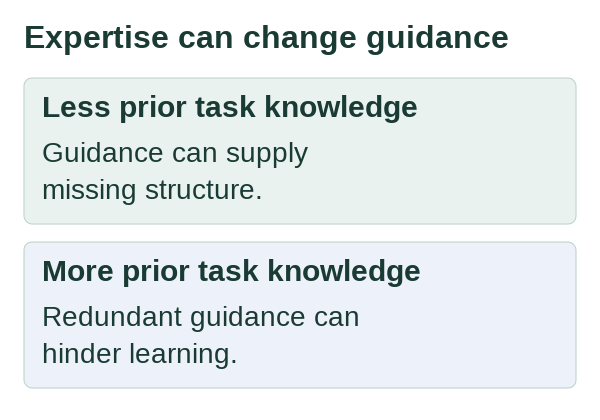
Instruction that helps lower-knowledge students can disadvantage higher-knowledge students, a pattern known as the expertise reversal effect. Two experiments studied Grade 8 and 9 students turning sentences into algebraic equations. An added checking method at first held them back. After a longer period of practice, students with low mathematical knowledge did much better with the checking instructions. Students with higher knowledge were continually disadvantaged by the same method.[53]
Splitting a video or animation into smaller chunks helped novice students learn from complex moving visualisations. Prospective teachers learned seven teaching skills from a classroom video or an animation. Some versions added signalling or segmenting, and some did not. The control group did better on retaining the theory. But it did worse than most video and animation groups at applying the skills to a classroom scenario. Groups given segmented material did better than groups given whole material on all learning measures.[54]
A 2007 themed issue of a journal gathered seven empirical papers. They examined when instructional animations work.[55] The closing paper of that issue drew on the seven papers. It recommended principles for developing effective instructional animations.[56]
One study looked at 25 lower sixth Biology students in Brunei. Test scores rose after theory-based videos in all 12 lesson cycles. Effect sizes ranged from .76 to .93. The study recommended measuring students' cognitive load directly in future work.[57]
Researchers tested tracing worked examples with the index finger. They asked whether it helped students transfer to new problems. One study asked 106 school students to follow computer instructions. They traced parts of worked examples about angle relationships. Earlier studies found a tracing effect on transfer tests. This study repeated that finding. The predicted effects on self-reported intrinsic and extraneous load were not supported.[58]
Two experiments tested interleaving. It gave no advantage when the two topics were clearly different. It gave a clear advantage when the topics were hard to tell apart. A second experiment used topics that were harder to tell apart. The interleaved group showed a clear advantage. Its cognitive load also rose.[59]
A systematic review argues that spacing and interleaving need separate explanations. Spacing works as recovery of working memory during rest. Interleaving helps students tell topics apart.[60]
Multimedia supports have been tested during the planning phase of inquiry learning in science lessons. Two studies with 250 ninth and eleventh grade students looked at a biological phenomenon. Cognitive load fell a lot with higher grade level. Cognitive-visual and verbal abilities influenced extraneous and germane load. The number of eye fixations predicted extraneous load.[61]
A 2 × 2 experiment tested help that explained how corresponding structures relate. This help supported coherence formation. It worked especially well when combined with surface-level help such as hyperlinks.[62]
A study of 37 first-year chemistry students in Turkey used a design based on cognitive load theory. The design supported retention and transfer in subjects with high element interactivity.[63] Not every design change shows up on every measure. In one study, pictures left problem-solving speed and accuracy unchanged. Yet a pupil-based measure did show a shift in load.[64]
In practice
Applications in medicine and health
The theory rests on a simple picture of the mind. Working memory is the small mental workspace that holds what a person is thinking about right now. It is limited, while long-term memory is not. Parallels between the theory and clinical practice are especially clear in complex clinical settings. Resuscitation medicine is one example. One 2021 paper built a version of the theory for complex professional work. It used resuscitation medicine as its case study.[65] A 2017 review noted that studies inspired by the theory have produced guidelines for designing medical education. Reviews of its practical effects did the same.[66]
A 2015 paper argued that cognitive load theory fits teaching in the simulation laboratory closely. The same paper called it a useful framework. It can guide the design or study of simulation training. That paper warned that results from simulation experiments are hard to apply more widely. Learner groups, teaching methods and technologies vary a great deal.[67]
Debriefing is the discussion held after a simulation. It is a key part of simulation-based training for health professionals. Learning to run a debriefing is itself hard. A debriefer must handle several competing priorities at once. That high mental workload can harm the debriefer's performance. In turn, it can harm learner outcomes. A 2018 paper treated the debriefer as a learner of debriefing skills. It used cognitive load theory to sort the mental loads that affect faculty who run debriefings. It then described strategies that faculty development programmes can use to reduce those loads.[68]
For whole curricula, a 2015 review proposed a model with three dimensions. Task complexity is the number of information elements in a task. Teaching support runs from worked examples (highest) to completion tasks to independent performance (lowest). The model sets out three steps. Start with strong support on low-fidelity, low-complexity tasks. Take that support away as learners improve. Then repeat the sequence for low-fidelity tasks that are more complex. Repeat both steps at higher levels of realism.[4] A 2016 article turned the same three dimensions into twelve tips for curriculum design. Each dimension got four tips.[69]
Adoption brought wrong ideas, and a 2015 review named two. The other is continued use of dated concepts and methods. The review warned that such errors can lead to improper use of the theory's principles. This affects the design and study of medical education.[4]
A 2017 paper offered medical educators three guidelines. Cut mental activity that does not help learning. Teach with specific learning goals in mind. Treat the link between learning and assessment as many-sided. The same paper said finding evidence for each type of mental load is still a serious challenge.[66]
A 2020 systematized review searched four databases on 1 September 2018. It included 27 articles drawn from 46 records. It also included 23 papers found by snowballing and hand searching. The review suggested mental imagery, also called visualization, as a useful way to improve germane load. It argued that mental images give access to brain circuits. These circuits are involved in sensory, motor, executive and decision-making pathways.[70]
The theory has also moved beyond clinical teaching into health and behavior change programs. These programs aim to improve health behaviors at individual and family levels. Such programs have trouble keeping people involved and coming back. They usually show a small effect. A 2025 paper proposed using the theory to design these programs, their materials and their interfaces. The aim is to reduce demands on working memory. The paper argued the approach may help most when heavy mental load and stress shrink working memory. It also stated that more research is needed to reach this potential. Work across fields is needed too.[71]
Applications in school subjects and digital tools
In beginning reading, adding pictures to simple passages did not help. Experiment 1 compared passages alone with the same passages plus informative illustrations showing their content. Reading proficiency improved more when there were no illustrations. Uninformative illustrations did better than informative ones. Illustrations that added no information did not differ significantly from no illustrations. The researchers concluded that helpful illustrations are redundant. They add extra load on working memory. That load gets in the way of learning to read.[72]
For mathematics, a 2022 library study listed several design strategies. They were drawn from the theory. The list covered the goal-free effect, the worked example effect, the split-attention effect, the redundancy effect, the modality effect, the element interactivity effect, the imagination effect and the guidance fading effect.[73]
One experiment tested two arrangements. Placing text and musical notation together on the page beat separated placement of the same visual materials. Playing spoken text alongside notation did the same. These results showed the split-attention and modality effects. A second experiment found that music notation made no difference. Presenting two or three information sources at the same time beat presenting them one after another.[74]
A 2006 paper argued that displays should be designed to reduce unneeded mental effort. What a person already knows also matters. It shapes how easily a learner takes in and reads a visual in working memory. The paper called for more research on the continuum from novice to expert.[75] For anatomy, a 2005 paper gave strategies for designing dynamic visualizations. These should match learners' cognitive architecture and levels of expertise.[76]
A science reading system using augmented reality was tested in an elementary school natural science course. It was based on the contiguity principle of multimedia learning. Students using it made large gains in learning achievements. Their motivations rose too. This was compared with conventional multimedia science learning. Students also reported significantly less extraneous cognitive load while working with the system.[77]
French students of law and political science heard an audio document. It was about the European Court of Human Rights. They heard it under four conditions. Hearing the content in French first helped both content and language learning. The second language came after. Listening in the second language first lowered content acquisition. It also made language learning worse.[78]
The students were native Arabic speakers at university. Those who read English words and sentences alone did better on listening tests. Those who read and listened at the same time did worse.[79] A 2018 paper made a recommendation for teaching English tenses. It named five effects to reduce extraneous load and build schemas.[80]
A 2021 analysis looked at an English textbook for class VIII in Indonesia. It found principles that help build schemas and make them automatic.[81] In second language academic writing, thinking in the second language may reduce mental load. This can free capacity for syntax and vocabulary, compared with translating from the first language.[82]
A 2022 review looked at leading computing education forums since 2010. Most citations only mention the theory as a design influence. Authors mostly cited old versions of the theory, and hypotheses phrased in terms of load components were rare. Only a small selection of cognitive load measures had been applied. People used them only rarely.[83]
A 2024 article described how visualization, commenting and pair programming can reduce load in programming tasks. It paid special attention to Parson's problems. These lower extraneous load and focus attention on the key parts of a task.[84]
A 2023 paper offered guidelines for craft eLearning. The guidelines keep cognitive load in check. They also promote active learning and support a gradual transition. A craft eLearning course used the guidelines as a case study.[85]
A 2017 paper made an argument about computer-based learning. Massive open online courses have mostly been built with little attention to how the human mind handles information. Such courses offer open internet-based education to unlimited numbers of participants. It proposed the theory as a basis for designing online instruction.[86] A 2024 study of digital classrooms found that poorly combined multimedia often causes high cognitive load. Segmenting information and reducing unnecessary complexity lowered load and improved outcomes.[87]
A 2024 survey of 300 participants in India examined one question. How does cognitive load relate to how well microlearning modules work? The modules were rated highly effective for knowledge retention, engagement and learning outcomes. Earlier microlearning experience also changed how effective it was.[88]
A questionnaire study of online virtual experiments used 610 valid samples. It found that user interface quality and communication quality both predicted learning outcomes. Extra mental load explained part of these links. Better interaction quality helped partly by reducing needless mental effort.[89]
A study of military training found a result. Participants using two computer displays reported lower unnecessary cognitive load than those using one.[90] In an art education experiment, a high-immersion virtual reality system produced a greater sense of presence than a tablet. It also added less extra load. Enjoyment and attention rose with the sense of being present. Extra load did not always predict them.[91]
A 2012 paper argued that accounting instructors had paid little attention to cognitive load theory. This was especially true of those teaching introductory courses, even though the theory describes the mental limits of new learners facing complex tasks. The same paper proposed that the theory offers specific methods for improving learning efficiency.[92] A 2018 article described three techniques for accounting teaching. They were reducing instructional steps that split students' attention, matching instruction to students' level of expertise, and replacing some problem-solving exercises with worked examples. Those techniques suit students meeting a topic for the first time better than final-year students already introduced to it.[93]
A 2014 article described an undergraduate pharmacology course for nursing students. It was built around four strategies. These were opening review activities and lecture notes given to students. They also included a "Top Five" prototype approach and separating "Need to Knows" from "Nice to Knows." Students gave positive feedback on the teaching style. The course was reported to promote a student-centered environment and active learning. On that basis, the article suggested the theory may be a successful framework for undergraduate pharmacology. It may also suit other nursing courses.[94]
In physics, a 2026 systematic review and meta-analysis examined 32 studies. They were reported in 28 papers published in English over the previous ten years. The studies varied widely in how much they reduced cognitive load. The results showed high heterogeneity. Three groups of strategies, immersive technologies, simulations and mobile learning, tended to reduce load more than others.[95] A 2025 article argued that Teaching Games for Understanding, a physical education approach, had been understood almost entirely through social constructivism. It said cognitive load theory might explain how the approach supports learning.[96]
Students often find Arabic hard. It involves many language elements that must be understood at once. A 2026 descriptive study measured the three parts of cognitive load. It studied 36 tenth-grade students learning Arabic at a school in Sumenep, Indonesia. The study concluded that Arabic instruction should use structured presentation and suitable media. Clear instructions should also reduce extraneous load.[97]
A 2024 paper argued that teachers in inclusive mathematics classrooms should adjust instruction. They should match students' differing thinking skills and prior knowledge. The paper framed inclusion as a right under Indian law. It cited Article 21A of the Constitution and the Right to Education Act 2009. It proposed that cognitive load theory can guide teaching in mixed-ability mathematics classrooms. In these classrooms, students of varying abilities learn mathematics together.[98]
A 2022 review of virtual mathematics laboratories described such animations as a way to visualize abstract phenomena and support problem solving. That review tracked searches from 2002 to 2022 in the SCOPUS database. The data was collected in July 2022.[99]
A 2018 paper proposed using cognitive load theory as a diagnostic tool. Educators could then spot load-heavy moments in online courses and adjust course design.[100] A 2023 paper investigated which factors shape online learning effectiveness for adolescent students. It used the theory to look for an optimal learning path.[101]
Two papers, from 2019 and 2025, examined college English flipped classrooms.[102][103] The 2019 paper analyzed problems in that model through correlated, external and internal cognitive load.[102] The 2025 study surveyed students and proposed control strategies to reduce cognitive stress and raise interest in learning English.[103] A 2013 laboratory experiment on online security training found that training with low levels of distracting stimuli improved secure behavior more than training with high levels. That result questioned elaborate training programs and suggested that simple, direct modules work best.[104]
Load reduction in classrooms and professional training
Cognitive load theory has been applied to simulation design in nursing education. It has also been applied to curriculum design in health sciences education.[105][31] In basic sciences such as anatomy and pathology, the sheer volume of information creates a high intrinsic load, the load that comes from the difficulty of the material itself. For these subjects, the load cannot be reduced. Memorizing looks like the only route. Even so, the load makes learning hard for many students. One proposal is to give students worked examples built from the mental schemata that experts have developed. Schemata are organized knowledge structures, and building on them may make clinical reasoning easier to acquire.[106] In simulation-based nursing and medical training, good design should minimize extraneous load, the load caused by poor presentation, while optimizing the intrinsic load for the learner.[105]
At Harvard Medical School, a preparatory evaluation process surveyed about 170 first-year students. It covered 97 flipped sessions from 2017 to 2019. Repeated revisions raised the cognitive load and time efficiency of the preparatory materials. The effect sizes were large (p < .01). Students also came to spend more time on hard content. Their overall workload did not rise.[107]
In nursing classrooms, a study embedded simple-to-complex activities in cooperative learning and problem-based learning. It found no statistically significant differences. A small interaction pointed to less mental effort and less intrinsic load under problem-based learning.[108]
An earlier nursing study compared an interactive computerized case study with a hand-written paper case study. It found no significant statistical differences between groups. Students given the interactive case study called it more fun and more interactive than the paper version. They also scored consistently higher on follow-up quiz items in their third semester.[109]
Researchers have also used cognitive load theory to explain the problems student teachers face. Among 26 pre-service teachers, mental effort fell for three tasks. These were watching students' attention, meeting the needs of different learners, and handling distractions. Planning lessons itself added cognitive load. Too much cognitive load limited the ability to make changes during teaching.[110]
A six-week study looked at 31 pre-service preschool teachers. Cognitive load dropped a lot over time. Initial excitement, fear and panic faded as practice became automatic. That study had a small sample and one specific setting. This limits how far the findings can be generalized.[111]
A 2009 review of mathematics studies found little evidence for the strong claim. The claim was that all minimally guided instruction produces poorer learning than direct instruction.[112] A virtual mathematics laboratory built on the theory was judged valid and suitable for use. 80% of its teaching materials matched the school curriculum.[113]
Students with learning difficulties and special education
Cognitive load theory has shaped mainstream teaching design for four decades. Its use in special education, however, has grown in a scattered and uneven way. A 2024 paper argues that the theory belongs at the centre of special education research. Limits on working memory sit at the core of most learning difficulties. Those difficulties run from dyslexia and dysgraphia to intellectual disability and autism. The same paper is conceptual rather than empirical and reports no new intervention data.[114]
Another 2024 paper notes that studies using the theory in special education are growing. Yet the field still lacks a shared plan to guide steady progress. That paper proposes a research agenda with seven strategic pillars. They include theory development, intervention research, measurement and assessment, and teacher development.[115]
The meaning of cognitive load theory shifts when researchers apply it to students with disabilities. Writers in special education often treat phrases like load reduction, instructional efficiency and scaffolding as the same thing as the theory. Each phrase, though, comes from a different line of thought. Each of these terms carries a different theoretical history. A 2026 concept analysis drew on 70 empirical, theoretical and review sources. It covered twelve disability categories. The analysis lists the concept's defining attributes. It also lists the conditions that must hold before it applies. It also sets out what follows from its use and how researchers measure it. It ends with a proposed operational definition for researchers and practitioners.[116]
Students with learning disabilities often struggle in reading, writing and mathematics. Much of that struggle comes from the limits of their working memory. Within each phase it adds a cognitive load audit. This step asks designers to check load conditions before moving on. The framework is meant to be adaptable across subjects and age groups. The article offers testable propositions for future research.[117]
A 2024 conceptual analysis compares the theory with each of these frameworks. It asks where they agree, differ and strengthen one another. It proposes an integrated model. In it, cognitive load theory works as a cognitive engine underneath existing frameworks rather than as a rival theory. The paper calls for future research to test this integration with data.[118]
One classroom study tested load reduction in chemistry for students in 3T areas, a term for regions with limited access to quality learning resources. The strategy broke the material into parts, added scaffolding and made concepts visual. It also drew on analogies and real contexts in stoichiometry, the calculation of quantities in chemical reactions. The study ran a quasi-experiment with a pretest, a posttest and a control group. Students were split into an experimental group and a control group. The experimental group showed a significant increase in posttest scores compared with the control group. Those students also kept more of what they learned and held fewer misconceptions after the strategy was used.[119]
What this looks like when you study
In one study, 215 first-year students in medical, dentistry and nutrition programs attended a normal face-to-face lecture and then, eight weeks later, an online lecture built on cognitive load theory. The online lecture raised comprehension scores and self-perceived learning (both p < 0.001) and lowered both intrinsic and extraneous load (p < 0.001).[120] Integrated instructions present mutually referring sources of information together, so that learners do not first have to mentally integrate separate text and diagrams before learning can begin.[8]
In a study of 91 Year 2 learners, working memory capacity predicted a cognitive load index on numeracy and literacy tests, so higher working memory went with lower load.[34] In a study of 64 seventh-grade students learning angle theorems, split-attention worked examples with signaling were compared with integrated worked examples. The two formats did not differ significantly on retention, transfer or cognitive load.[13]
When material is unintelligible unless text and diagrams are combined, present them in integrated form rather than as separate sources.[8] Ayres found that a mixed strategy, moving from part-tasks to whole tasks, was ineffective for students at both levels of prior knowledge.[12] Pace your own viewing of animations: students who controlled the segments showed higher test performance with lower cognitive load than students who watched a continuous animation.[42] Remove decorative animations and pictures that do not carry the content, because students recalled less when a decorative animation was present than when a still image was shown.[20] Van Merriënboer and Sweller list worked examples among the design guidelines that reduce extraneous load. Van Merriënboer and Sweller tie their design guidelines to the expertise reversal effect, which indicates that guidelines suited to novices differ from those suited to more experienced learners.[1]
Later developments
Why the theory keeps changing
A 1991 paper set out the theory's essential features and traced its short history. Part of its aim was to answer two published critiques of its research methods.[121] A 2006 discussion described how the theory began. It used knowledge of human cognition to design instruction. Where those instructional procedures worked, they strengthened the theory behind them. The theory grew to span the evolutionary origins of human cognitive structures and their teaching consequences.[122] A 2024 bibliometric study noted that the theory has influenced educational practice since the 1990s.[123]
A 2010 special issue reported rapid recent progress in the theory. The papers came from the 3rd International Cognitive Load Theory Conference. It was held in 2009 in Heerlen, The Netherlands. The contributors offered new conceptualizations of the different categories of cognitive load. They also joined process-oriented research with cognitive load research on collaborative learning. They linked cognitive and social-cognitive approaches to learning from worked examples. A further specification focused on how learners acquire general knowledge structures. The paper ties these structures to flexible problem solving.[124]
A 2026 paper proposed adding the idea of understanding to the theory's picture of the mind. In that account, understanding is a process of chunking. Meaning is built by grouping the many elements of high element interactivity material into a single element held in long-term memory. The term understanding is never applied to low element interactivity material. That holds even when the material is hard to learn because there is so much of it. On this view, understanding has occurred when working memory can easily handle high element interactivity information as one chunk. The chunk may also be a small number of elements, depending on the learner's expertise.[125]
The newest pressure comes from generative artificial intelligence, which the 2026 paper describes as a dynamic information-processing partner in the cognitive system. A 2026 paper argues that the theory's familiar advice was built for static settings. That advice says to cut extraneous load so working memory is free for learning, and it assumes the learner is the only thinking agent. A generative tool acts as a dynamic partner in the thinking. The paper says the theory's three-part structure does not capture that partner's contribution well. The paper reports an Effort-Load Paradox. A tool improved learning outcomes without changing perceived effort or cognitive load, and germane load did not act as the mechanism in between. It draws on a quasi-experimental study with N = 184 in Indian management education. It also draws on a synthesis of the theory's literature on technology-enhanced learning. From these it proposes two extensions. The first is dependency-induced extraneous load. This is the new burden created when AI scaffolding is suddenly withdrawn, and it is felt most sharply at Bloom's application level. The second is an efficiency pathway. By this route, such tools improve outcomes by raising the quality of information rather than by reducing the amount of load. Standard rating tools would not detect that pathway.[126]
New technologies and open questions
Generative artificial intelligence and related educational AI systems have spread quickly across education. Researchers now ask what consequences this has for learners' cognitive load. Of 16 studies that measured extraneous load separately, 7 found lower extraneous load and 3 found no difference. One reported higher extraneous load. One found a curved pattern. Of 22 studies reporting a single overall load score, 11 found lower load, 5 found no difference and 2 found higher load. The review's most common verdict was conditional (21 studies), against 16 beneficial and 2 mixed. Benefits depended on scaffolding, dosage, prior knowledge and task design. Only 13 of the 39 studies described AI use as cognitive offloading, handing mental work to a tool, and the review argues that load components should be measured separately in future work.[127]
Augmented reality (AR) adds computer images on top of the physical world. Its effect on load is still debated. A 2026 meta-analysis of 27 experimental and quasi-experimental studies found a small-to-moderate effect of AR in reducing cognitive load. The result was Hedges' g = -0.383, 95% CI [-0.740, -0.027], p = 0.035. The studies differed very widely (I² = 92.7%, p < 0.001). Two things changed the effect. One was how often the intervention ran (Q = 10.369, p = 0.006). The other was the form of feedback (Q = 13.245, p = 0.004).[128]
A 2025 field study took place at a German vocational college. It found that extraneous load fell in a group using Merge Cubes, physical cubes that display AR models. The load rose significantly in a control group. Intrinsic motivation rose in both groups, with no significant difference between them.[129]
A 2025 meta-analysis covered 21 articles with 34 comparisons. It found that pupil dilation was larger in hard task conditions than in easy ones (d = 0.72, CI = 0.3672 to 1.072, p < 0.0001). Fixation duration and the number of fixations did not tell easy levels from hard levels.[130]
A 2026 university experiment studied bilingual English-Chinese teaching. Pupil-diameter variation correlated with cognitive load at r = 0.72, p < 0.01. One video-based presentation method was tested under B1-level language difficulty, specialized knowledge and intermediate proficiency. It raised effective fixation duration by 35%, cut cognitive load by 28% and improved knowledge retention by 22%.[131]
A basic open question is whether students can judge their own load. Two training attempts in one study were unsuccessful. Study 1 (N = 99) tested pre-training with a theoretical introduction to cognitive load theory. The intervention was unsuccessful. Study 2 (N = 80) tested post-training that asked students to consider all impressions during problem solving.[132]
A 2026 Indonesian study of a 17-item self-report extraneous load questionnaire with 38 students found that the 5-point scale worked poorly, because categories 4 and 5 were almost never used. The instrument could serve as an initial measure. But several items needed revision, and new items were needed for precision.[133]
Several questions remain open, including whether screen use directly causes cognitive impairment and how cognitive load should be measured in such studies. A 2026 review covered 13 studies of screen exposure in children aged 6 to 11 and adolescents aged 12 to 18. It linked rapid or multitasked media to attention difficulties and weaker working memory. Interactive and purposeful digital activities were sometimes linked to neutral or helpful outcomes. Most studies were observational, so the evidence does not show that screen use directly causes cognitive impairment.[134] A 2024 review proposed cognitive reappraisal, reframing the beliefs behind an emotional response, as a way to reduce load caused by unhelpful emotion, though it offered no trial data.[135] A 2021 review of human-computer interaction noted that the idea of relevant cognitive load, where more load can help, has received little attention until now.[136]
Criticism
Criticism, replication and open questions
One defender of the theory argues that contradictory evidence does not always mean the data were collected badly. A theory that starts out too vague can produce a failed replication. Adding detail can then show why the first result did not hold. On this account, each failure to replicate became a step in the theory's development, not a defeat.[137]
A 2022 critique examined the assumptions behind cognitive load theory. It judged them to be in error, vaguely or confusingly expressed, or used to draw conclusions that do not follow. The same critique argues that educational research which weakens the theory's claims is often ignored. The dispute turns partly on how critical thinking is understood. Critical thinking may mix knowledge, skills and habits of mind. These can be studied on their own. If so, it can be targeted on purpose and explicitly. Cognitive load theory treats critical thinking as a general skill that teaching can hardly change. It grows best through knowledge of the content. On that view, an explicit focus on thinking skills is misplaced. It may even distract.[138]
Little research has looked at how closely subjective and objective measures of cognitive load agree. The most common way to measure cognitive load is a self-report questionnaire. Objective body measures such as heart rate are used only now and then. Heart rate variability is a measure based on facts, not opinion. It was linked to self-reported mental effort but not to self-reported mental load. Self-reported measures of mental effort and mental load predicted task performance better than the heart rate measures did.[139]
Self-concept also went with one of the objective heart rate measures.[139] An experimental intervention study tested two ways of making students aware of their own conceptions. It involved 602 upper secondary biology students. Self-assessing one's conceptions did not lower self-efficacy. Self-efficacy is a person's belief in their own ability. It gave students more accurate beliefs about their abilities. That self-assessment raised mental load. This partly held back its good effect on conceptual knowledge. Instruction on when a conception is appropriate or not did not raise mental load. Students with stronger general thinking about concepts reported lower mental load.[140]
A 2012 collection of papers set out current challenges to the theory. These included when cognitive load is measured and how often. They also included two topics. One was how to design instructional animations. The other was how eye tracking can show learners' cognitive processes.[141]
Electroencephalography has been discussed as a way to measure cognitive load continuously and objectively.[142] A 2023 discussion weighed the strengths and weaknesses of 9 papers in a special issue. It also pointed to chances for future studies.[143]
Common misconceptions
Many people believe that lower cognitive load is always better for learning, a misconception named in a review of cognitive load theory in medical education. In some cases an increase in cognitive load can bolster learning, which is why researchers proposed a third type of load that is beneficial.[4] In a reasoning study, higher additional load improved performance for primary knowledge content, especially on harder syllogisms.[49]
Key studies
| Year | Study | Sample | Design | Finding |
|---|---|---|---|---|
| 1988 | Sweller[3] | Theoretical and experimental paper on problem solving | When people solve problems by means-ends analysis, the work takes up a large share of cognitive processing capacity. Little is left for building schemas. | |
| 2006 | Ayres[12] | three groups of 13-year-old students | experimental comparison of three instructional strategies | Part-tasks lowered load for all but helped only low prior knowledge students, while whole tasks helped higher prior knowledge students more. |
| 2007 | Hasler et al.[42] | primary school students | experiment comparing three versions of an audio-visual animation with a narration-only presentation | Learner-paced groups showed higher test performance with lower cognitive load, and differences appeared only on high element interactivity questions. |
| 2010 | Van Merriënboer & Sweller[1] | Review of design guidelines for health professional education | Fifteen design guidelines are discussed, including goal-free tasks, worked examples, and simple-to-complex ordering. | |
| 2011 | Leahy & Sweller[15] | Two experiments with primary school students (N = 24 and N = 64) | Visual text with a diagram beat audio text with a diagram in Experiment 1, but audio/visual instructions were superior in Experiment 2. | |
| 2013 | Vandewaetere & Clarebout[43] | students assigned to learner control or no control | experiment with single-task and dual-task treatments | Learner control did not raise cognitive load, judging by scores on the secondary task and by ratings of mental effort. |
| 2015 | Leppink & Van den Heuvel[4] | Review of the evolution of cognitive load theory and its application to medical education | Some misconceptions, such as the belief that less cognitive load is always better for learning, can lead to poor use of cognitive load theory principles. | |
| 2017 | Klepsch et al.[37] | 97 students in Study 1 and 65 to 95 per task in Study 2 | instrument development and validation | The naive rating questionnaire was reliable, with alpha of 0.86 for intrinsic, 0.80 for extraneous and 0.80 for germane load. |
| 2020 | Pink & Newton[20] | students learning two topics | experiment comparing decorative animation with still image | Students recalled less with a decorative animation and reported higher mental workload. |
| 2021 | Hadie et al.[120] | 215 first-year undergraduate students in medical, dentistry and nutrition programs | pre-post quasi-experimental study | A cognitive load theory-based online lecture raised comprehension and lowered intrinsic and extraneous load (p < 0.001). |
| 2021 | Ehrich et al.[34] | 91 Year 2 learners | item response modeling of standardized test performance | Working memory capacity significantly predicted the cognitive load index in both numeracy and literacy. |
| 2024 | Rafiah & Retnowati[13] | 64 seventh-grade students | posttest-only control group experiment | Signaled split-attention and integrated worked examples did not differ significantly on retention, transfer or cognitive load. |
| 2024 | Evans et al.[51] | 1287 students in years 7 to 10 in four Australian high schools | survey study | Teachers' load-reducing strategies were related to lower cognitive load and positively associated with motivation, engagement and achievement. |
| 2026 | Ngu et al.[11] | randomized experiment | The low element-interactivity method outperformed the high element-interactivity method on practice and simple post-test problems. |
See also
References
- Van Merriënboer, J. J. G., & Sweller, J. (2010). Cognitive load theory in health professional education: design principles and strategies. Medical Education, 44(1), 85-93. doi:10.1111/j.1365-2923.2009.03498.x
- Young, J. Q., Van Merrienboer, J., Durning, S., & Ten Cate, O. (2014). Cognitive Load Theory: Implications for medical education: AMEE Guide No. 86. Medical Teacher, 36(5), 371-384. doi:10.3109/0142159x.2014.889290
- Sweller, J. (1988). Cognitive Load During Problem Solving: Effects on Learning. Cognitive Science, 12(2), 257-285. doi:10.1207/s15516709cog1202_4
- Leppink, J., & Van den Heuvel, A. (2015). The evolution of cognitive load theory and its application to medical education. Perspectives on Medical Education, 4(3), 119-127. doi:10.1007/s40037-015-0192-x
- Clark, C., & Kimmons, R. (2023). Cognitive Load Theory. EdTechnica. doi:10.59668/371.12980
- de Jong, T. (2010). Cognitive load theory, educational research, and instructional design: some food for thought. Instructional Science, 38(2), 105-134. doi:10.1007/s11251-009-9110-0
- Cooper, G. (1990). Cognitive load theory as an aid for instructional design. Australasian Journal of Educational Technology, 6(2). doi:10.14742/ajet.2322
- Chandler, P., & Sweller, J. (1991). Cognitive Load Theory and the Format of Instruction. Cognition and Instruction, 8(4), 293-332. doi:10.1207/s1532690xci0804_2
- Kalyuga, S. (2023). Evolutionary Perspective on Human Cognitive Architecture in Cognitive Load Theory: a Dynamic, Emerging Principle Approach. Educational Psychology Review, 35(3). doi:10.1007/s10648-023-09812-7
- Chen, O., Paas, F., & Sweller, J. (2023). A Cognitive Load Theory Approach to Defining and Measuring Task Complexity Through Element Interactivity. Educational Psychology Review, 35(2). doi:10.1007/s10648-023-09782-w
- Ngu, B. H., Phan, H. P., & Usop, H. (2026). Optimizing Instruction to Reduce Element Interactivity in Fraction Multiplication: Recommendations From Cognitive Load Theory. Applied Cognitive Psychology, 40(1). doi:10.1002/acp.70169
- Ayres, P. (2006). Impact of reducing intrinsic cognitive load on learning in a mathematical domain. Applied Cognitive Psychology, 20(3), 287-298. doi:10.1002/acp.1245
- Rafiah, I., & Retnowati, E. (2024). Signaling reduce extraneous cognitive load from split attention effects. Jurnal Pedagogi Matematika, 10(3). doi:10.21831/jpm.v10i3.21761
- Leahy, W., & Sweller, J. (2004). Cognitive load and the imagination effect. Applied Cognitive Psychology, 18(7), 857-875. doi:10.1002/acp.1061
- Leahy, W., & Sweller, J. (2011). Cognitive load theory, modality of presentation and the transient information effect. Applied Cognitive Psychology, 25(6), 943-951. doi:10.1002/acp.1787
- Tabbers, H. K., Martens, R. L., & Van Merriënboer, J. J. G. (2004). Multimedia instructions and cognitive load theory: Effects of modality and cueing. British Journal of Educational Psychology, 74(1), 71-81. doi:10.1348/000709904322848824
- Leahy, W., & Sweller, J. (2008). The imagination effect increases with an increased intrinsic cognitive load. Applied Cognitive Psychology, 22(2), 273-283. doi:10.1002/acp.1373
- Beege, M., Nebel, S., Schneider, S., & Rey, G. D. (2021). The effect of signaling in dependence on the extraneous cognitive load in learning environments. Cognitive Processing, 22(2), 209-225. doi:10.1007/s10339-020-01002-5
- Skulmowski, A., & Xu, K. M. (2022). Understanding Cognitive Load in Digital and Online Learning: a New Perspective on Extraneous Cognitive Load. Educational Psychology Review, 34(1), 171-196. doi:10.1007/s10648-021-09624-7
- Pink, A., & Newton, P. M. (2020). Decorative animations impair recall and are a source of extraneous cognitive load. Advances in Physiology Education, 44(3), 376-382. doi:10.1152/advan.00102.2019
- Miller, P., Hazan-Liran, B., & Cohen, D. (2019). Does task-irrelevant colour information create extraneous cognitive load? Evidence from a learning task. Quarterly Journal of Experimental Psychology, 72(5), 1155-1163. doi:10.1177/1747021818781425
- Taylor, T. A. H., Kamel-ElSayed, S., Grogan, J. F., Hajj Hussein, I., Lerchenfeldt, S., & Mohiyeddini, C. (2022). Teaching in Uncertain Times: Expanding the Scope of Extraneous Cognitive Load in the Cognitive Load Theory. Frontiers in Psychology, 13. doi:10.3389/fpsyg.2022.665835
- Klepsch, M., & Seufert, T. (2020). Understanding instructional design effects by differentiated measurement of intrinsic, extraneous, and germane cognitive load. Instructional Science, 48(1), 45-77. doi:10.1007/s11251-020-09502-9
- Debue, N., & van de Leemput, C. (2014). What does germane load mean? An empirical contribution to the cognitive load theory. Frontiers in Psychology, 5. doi:10.3389/fpsyg.2014.01099
- Wang, C. C., Cheng, P. K. H., & Wang, T. H. (2022). Measurement of Extraneous and Germane Cognitive Load in the Mathematics Addition Task: An Event-Related Potential Study. Brain Sciences, 12(8), 1036. doi:10.3390/brainsci12081036
- Zhu, C. (2022). A Study on EFL Instructional Design from the Perspective of Cognitive Load Theory. Learning & Education, 10(8), 165. doi:10.18282/l-e.v10i8.3106
- Bostanova, S. N. (2026). Cognitive load theory as a methodological basis for designing educational materials. KANT, 58(1), 340. doi:10.24923/2222-243x.2026-58.47
- Krieglstein, F., Beege, M., Rey, G. D., Sanchez-Stockhammer, C., & Schneider, S. (2023). Development and Validation of a Theory-Based Questionnaire to Measure Different Types of Cognitive Load. Educational Psychology Review, 35(1). doi:10.1007/s10648-023-09738-0
- Abduqahhorova, M., & Khazratkulova, E. (2025). Cognitive load theory and its application for learning. Инновации в современной лингвистике и преподавании языков(1), 143-145. doi:10.47689/zttctoi-vol1-iss1-pp143-145
- Putri, M. D., Rahmat, A., & Sanjaya, Y. (2022). Teknik Chunking Dipadu Writing is Thinking untuk Mengendalikan Extraneous Cognitive Load Siswa. Bioedukasi: Jurnal Pendidikan Biologi, 15(1). doi:10.20961/bioedukasi-uns.v15i1.57407
- Rana, K., Alford, S., Moore, A., & Chimoriya, R. (2026). Cognitive Load Theory-Informed Curriculum Design in Health Sciences Education. Encyclopedia, 6(5), 102. doi:10.3390/encyclopedia6050102
- Juanengsih, N., Rahmat, A., Wulan, A. R., & Rahman, T. (2021). Students’ extraneous cognitive load in cell biology lectures. Cypriot Journal of Educational Sciences, 16(1), 267-276. doi:10.18844/cjes.v16i1.5524
- Aburayash, H. M. (2019). Cognitive load and its relationship with mental capacity in accordance with their levels at students of the secondary stage in terms of sweller theory. Journal of Education and Learning (EduLearn), 13(3), 349-356. doi:10.11591/edulearn.v13i3.13244
- Ehrich, J. F., Howard, S. J., Bokosmaty, S., & Woodcock, S. (2021). An Item Response Modeling Approach to Cognitive Load Measurement. Frontiers in Education, 6. doi:10.3389/feduc.2021.648324
- Paas, F., Tuovinen, J. E., Tabbers, H., & Van Gerven, P. W. M. (2003). Cognitive Load Measurement as a Means to Advance Cognitive Load Theory. Educational Psychologist, 38(1), 63-71. doi:10.1207/s15326985ep3801_8
- Schuessler, K., Fischer, V., & Walpuski, M. (2025). Investigating construct validity of cognitive load measurement using single-item subjective rating scales. Instructional Science, 53(1), 71-97. doi:10.1007/s11251-024-09692-6
- Klepsch, M., Schmitz, F., & Seufert, T. (2017). Development and Validation of Two Instruments Measuring Intrinsic, Extraneous, and Germane Cognitive Load. Frontiers in Psychology, 8. doi:10.3389/fpsyg.2017.01997
- Skulmowski, A. (2023). Learners Emphasize Their Intrinsic Load if Asked About It First: Communicative Aspects of Cognitive Load Measurement. Mind, Brain, and Education, 17(3), 165-169. doi:10.1111/mbe.12369
- Ayres, P., Lee, J. Y., Paas, F., & van Merriënboer, J. J. G. (2021). The Validity of Physiological Measures to Identify Differences in Intrinsic Cognitive Load. Frontiers in Psychology, 12. doi:10.3389/fpsyg.2021.702538
- Paas, F. G. W. C., van Merriënboer, J. J. G., & Adam, J. J. (1994). Measurement of Cognitive Load in Instructional Research. Perceptual and Motor Skills, 79(1), 419-430. doi:10.2466/pms.1994.79.1.419
- Ekin, M., Krejtz, K., Duarte, C., Duchowski, A. T., & Krejtz, I. (2025). Prediction of intrinsic and extraneous cognitive load with oculometric and biometric indicators. Scientific Reports, 15(1). doi:10.1038/s41598-025-89336-y
- Hasler, B. S., Kersten, B., & Sweller, J. (2007). Learner control, cognitive load and instructional animation. Applied Cognitive Psychology, 21(6), 713-729. doi:10.1002/acp.1345
- Vandewaetere, M., & Clarebout, G. (2013). Cognitive Load of Learner Control: Extraneous or Germane Load? Education Research International, 2013, 1-11. doi:10.1155/2013/902809
- Darejeh, A., Marcus, N., & Sweller, J. (2022). Increasing learner interactions with E-learning systems can either decrease or increase cognitive load depending on the nature of the interaction: . L’Année psychologique, Vol. 122(3), 405-437. doi:10.3917/anpsy1.223.0405
- Kirschner, P. A., Sweller, J., Kirschner, F., & Zambrano R., J. (2018). From Cognitive Load Theory to Collaborative Cognitive Load Theory. International Journal of Computer-Supported Collaborative Learning, 13(2), 213-233. doi:10.1007/s11412-018-9277-y
- Paas, F., & Sweller, J. (2012). An Evolutionary Upgrade of Cognitive Load Theory: Using the Human Motor System and Collaboration to Support the Learning of Complex Cognitive Tasks. Educational Psychology Review, 24(1), 27-45. doi:10.1007/s10648-011-9179-2
- Janssen, J., & Kirschner, P. A. (2020). Applying collaborative cognitive load theory to computer-supported collaborative learning: towards a research agenda. Educational Technology Research and Development, 68(2), 783-805. doi:10.1007/s11423-019-09729-5
- Sweller, J. (2024). Cognitive load theory and individual differences. Learning and Individual Differences, 110, 102423. doi:10.1016/j.lindif.2024.102423
- Lespiau, F., & Tricot, A. (2024). Reasoning More Efficiently with Primary Knowledge Despite Extraneous Cognitive Load. Evolutionary Psychology, 22(2). doi:10.1177/14747049241252694
- W. M. Van Gerven, Fred G. W. C. Paa, P. (2000). Cognitive load theory and the acquisition of complex cognitive skills in the elderly: Towards an integrative framework. Educational Gerontology, 26(6), 503-521. doi:10.1080/03601270050133874
- Evans, P., Vansteenkiste, M., Parker, P., Kingsford-Smith, A., & Zhou, S. (2024). Cognitive Load Theory and Its Relationships with Motivation: a Self-Determination Theory Perspective. Educational Psychology Review, 36(1). doi:10.1007/s10648-023-09841-2
- Renkl, A., Gruber, H., Weber, S., Lerche, T., & Schweizer, K. (2003). Cognitive Load beim Lernen aus Lösungsbeispielen: Cognitive Load During Learning from Worked-Out Examples. Zeitschrift für Pädagogische Psychologie, 17(2), 93-101. doi:10.1024//1010-0652.17.2.93
- Pawley, D., Ayres *, P., Cooper, M., & Sweller, J. (2005). Translating words into equations: a cognitive load theory approach. Educational Psychology, 25(1), 75-97. doi:10.1080/0144341042000294903
- Moreno, R. (2007). Optimising learning from animations by minimising cognitive load: cognitive and affective consequences of signalling and segmentation methods. Applied Cognitive Psychology, 21(6), 765-781. doi:10.1002/acp.1348
- Ayres, P., & Paas, F. (2007). Making instructional animations more effective: a cognitive load approach. Applied Cognitive Psychology, 21(6), 695-700. doi:10.1002/acp.1343
- Ayres, P., & Paas, F. (2007). Can the cognitive load approach make instructional animations more effective? Applied Cognitive Psychology, 21(6), 811-820. doi:10.1002/acp.1351
- Azman, A. N., & Johari, M. (2022). Investigating the Effectiveness of Videos Designed Using Cognitive Load Theory on Biology Students’ Academic Achievement. Jurnal Pendidikan IPA Indonesia, 11(3), 461-468. doi:10.15294/jpii.v11i3.37324
- Ginns, P., Hu, F., & Bobis, J. (2020). Tracing enhances problem‐solving transfer, but without effects on intrinsic or extraneous cognitive load. Applied Cognitive Psychology, 34(6), 1522-1529. doi:10.1002/acp.3732
- Chen, O., Retnowati, E., Castro-Alonso, J. C., Paas, F., & Sweller, J. (2023). The Relationship between Interleaving and Variability Effects: A Cognitive Load Theory Perspective. Education Sciences, 13(11), 1138. doi:10.3390/educsci13111138
- Chen, O., Paas, F., & Sweller, J. (2021). Spacing and Interleaving Effects Require Distinct Theoretical Bases: a Systematic Review Testing the Cognitive Load and Discriminative-Contrast Hypotheses. Educational Psychology Review, 33(4), 1499-1522. doi:10.1007/s10648-021-09613-w
- Kastaun, M., Meier, M., Küchemann, S., & Kuhn, J. (2021). Validation of Cognitive Load During Inquiry-Based Learning With Multimedia Scaffolds Using Subjective Measurement and Eye Movements. Frontiers in Psychology, 12. doi:10.3389/fpsyg.2021.703857
- Seufert, T., & Brünken, R. (2006). Cognitive load and the format of instructional aids for coherence formation. Applied Cognitive Psychology, 20(3), 321-331. doi:10.1002/acp.1248
- Kala, N., & Ayas, A. (2023). Effect of instructional design based on cognitive load theory on students’ performances and the indicators of element interactivity: Research Article. Journal of Turkish Science Education, 20(3), 468-489. doi:10.36681/tused.2023.027
- Zheng, R., & Cook, A. (2012). Solving complex problems: A convergent approach to cognitive load measurement. British Journal of Educational Technology, 43(2), 233-246. doi:10.1111/j.1467-8535.2010.01169.x
- Szulewski, A., Howes, D., van Merriënboer, J. J. G., & Sweller, J. (2021). From Theory to Practice: The Application of Cognitive Load Theory to the Practice of Medicine. Academic Medicine, 96(1), 24-30. doi:10.1097/acm.0000000000003524
- Leppink, J. (2017). Cognitive load theory: Practical implications and an important challenge. Journal of Taibah University Medical Sciences, 12(5), 385-391. doi:10.1016/j.jtumed.2017.05.003
- Fraser, K. L., Ayres, P., & Sweller, J. (2015). Cognitive Load Theory for the Design of Medical Simulations. Simulation in Healthcare: The Journal of the Society for Simulation in Healthcare, 10(5), 295-307. doi:10.1097/sih.0000000000000097
- Fraser, K. L., Meguerdichian, M. J., Haws, J. T., Grant, V. J., Bajaj, K., & Cheng, A. (2018). Cognitive Load Theory for debriefing simulations: implications for faculty development. Advances in Simulation, 3(1). doi:10.1186/s41077-018-0086-1
- Leppink, J., & Duvivier, R. (2016). Twelve tips for medical curriculum design from a cognitive load theory perspective. Medical Teacher, 38(7), 669-674. doi:10.3109/0142159x.2015.1132829
- Ghanbari, S., Haghani, F., Barekatain, M., & Jamali, A. (2020). A systematized review of cognitive load theory in health sciences education and a perspective from cognitive neuroscience. Journal of Education and Health Promotion, 9. doi:10.4103/jehp.jehp_643_19
- Baxter, K. A., Sachdeva, N., & Baker, S. (2025). The Application of Cognitive Load Theory to the Design of Health and Behavior Change Programs: Principles and Recommendations. Health Education & Behavior, 52(4), 469-477. doi:10.1177/10901981251327185
- Torcasio, S., & Sweller, J. (2010). The use of illustrations when learning to read: A cognitive load theory approach. Applied Cognitive Psychology, 24(5), 659-672. doi:10.1002/acp.1577
- Sholihah, D. A. (2022). Strategi Pembelajaran Matematika Berdasarkan Cognitive Load Theory untuk Meminimalkan Extraneous Cognitive Load. EQUALS: Jurnal Ilmiah Pendidikan Matematika, 5(1), 13-23. doi:10.46918/equals.v5i1.1197
- Owens, P., & Sweller, J. (2008). Cognitive load theory and music instruction. Educational Psychology, 28(1), 29-45. doi:10.1080/01443410701369146
- Cook, M. P. (2006). Visual representations in science education: The influence of prior knowledge and cognitive load theory on instructional design principles. Science Education, 90(6), 1073-1091. doi:10.1002/sce.20164
- Khalil, M. K., Paas, F., Johnson, T. E., & Payer, A. F. (2005). Design of interactive and dynamic anatomical visualizations: The implication of cognitive load theory. The Anatomical Record Part B: The New Anatomist, 286B(1), 15-20. doi:10.1002/ar.b.20078
- Lai, A., Chen, C., & Lee, G. (2019). An augmented reality‐based learning approach to enhancing students’ science reading performances from the perspective of the cognitive load theory. British Journal of Educational Technology, 50(1), 232-247. doi:10.1111/bjet.12716
- Roussel, S., Tricot, A., & Sweller, J. (2022). The advantages of listening to academic content in a second language may be outweighed by disadvantages: A cognitive load theory approach. British Journal of Educational Psychology, 92(2), 627-644. doi:10.1111/bjep.12468
- Moussa‐Inaty, J., Ayres, P., & Sweller, J. (2012). Improving Listening Skills in English as a Foreign Language by Reading Rather than Listening: A Cognitive Load Perspective. Applied Cognitive Psychology, 26(3), 391-402. doi:10.1002/acp.1840
- Suek, L. A. (2018). Applying cognitive load theory in teaching tenses for second language learners. Englisia Journal, 5(2), 66. doi:10.22373/ej.v5i2.3072
- Assis Hornay, P. M. (2021). Cognitive Load Theory and the English Language Instruction. ACCENTIA: Journal of English Language and Education, 1(1), 43-55. doi:10.37598/accentia.v1i1.1015
- A. F, N. (2018). Cognitive load theory in the context of second language academic writing. Higher Education Pedagogies, 3(1), 385-402. doi:10.1080/23752696.2018.1513812
- Duran, R., Zavgorodniaia, A., & Sorva, J. (2022). Cognitive Load Theory in Computing Education Research: A Review. ACM Transactions on Computing Education, 22(4), 1-27. doi:10.1145/3483843
- Butarev, K. V. (2024). Learning programming from the perspective of cognitive load theory. Informatics in school, 23(5), 5-11. doi:10.32517/2221-1993-2024-23-5-5-11
- Partarakis, N., & Zabulis, X. (2023). Applying Cognitive Load Theory to eLearning of Crafts. Multimodal Technologies and Interaction, 8(1), 2. doi:10.3390/mti8010002
- Chen, O., Woolcott, G., & Sweller, J. (2017). Using cognitive load theory to structure computer‐based learning including MOOCs. Journal of Computer Assisted Learning, 33(4), 293-305. doi:10.1111/jcal.12188
- Surbakti, R., Umboh, S. E., Pong, M., & Dara, S. (2024). Cognitive Load Theory: Implications for Instructional Design in Digital Classrooms. International Journal of Educational Narratives, 2(6), 483-493. doi:10.70177/ijen.v2i6.1659
- Lopez, S. (2024). The Impact of Cognitive Load Theory on the Effectiveness of Microlearning Modules. European Journal of Education and Pedagogy, 5(2), 29-35. doi:10.24018/ejedu.2024.5.2.799
- Yin, P., & Sun, T. (2026). The impact of system interaction quality on learning outcomes in online virtual experiment teaching: the mediating role of extraneous cognitive load. Frontiers in Psychology, 16. doi:10.3389/fpsyg.2025.1739300
- Miller, R. A., Stenmark, C. K., & Ittersum, K. v. (2020). Dual computer displays reduce extraneous cognitive load. Journal of Computer Assisted Learning, 36(6), 890-897. doi:10.1111/jcal.12442
- Tang, Q., Wang, Y., Liu, H., Liu, Q., & Jiang, S. (2022). Experiencing an art education program through immersive virtual reality or iPad: Examining the mediating effects of sense of presence and extraneous cognitive load on enjoyment, attention, and retention. Frontiers in Psychology, 13. doi:10.3389/fpsyg.2022.957037
- Mostyn, G. R. (2012). Cognitive Load Theory: What It Is, Why It's Important for Accounting Instruction and Research. Issues in Accounting Education, 27(1), 227-245. doi:10.2308/iace-50099
- Sithole, S. T. M. (2018). Application of Cognitive Load Theory in Accounting Education. International Journal of Accounting and Financial Reporting, 8(4), 197. doi:10.5296/ijafr.v8i4.13744
- Kaylor, S. K. (2014). Preventing Information Overload: Cognitive Load Theory as an Instructional Framework for Teaching Pharmacology. Journal of Nursing Education, 53(2), 108-111. doi:10.3928/01484834-20140122-03
- Radulović, B., Živković Radovanović, J., & Bajc, J. (2026). Contribution of Different Teaching Approaches to Reducing Learners’ Cognitive Load in Physics Classrooms: A Systematic Review and Meta-Analysis. Education Sciences, 16(8), 1296. doi:10.3390/educsci16081296
- Harvey, S., & Cope, E. (2025). Making Learning Happen in Teaching Games for Understanding with Cognitive Load Theory. Education Sciences, 15(5), 631. doi:10.3390/educsci15050631
- Mufidha, U., Mubaligh, A., & Faisol, M. (2026). Intrinsic, Extraneous, and Germane Cognitive Load in Arabic Learning: A Descriptive Study Based on John Sweller’s Theory: Beban Kognitif Intrinsik, Ekstrinsik, dan Relevan dalam Pembelajaran Bahasa Arab: Sebuah Studi Deskriptif Berdasarkan Teori John Sweller. ELOQUENCE : Journal of Foreign Language, 5(2), 365-381. doi:10.58194/eloquence.v5i2.3582
- Trisha Banerjee, & Dr. Manish Kumar Gautam (2024). Inclusive mathematics classroom practices for children with diverse learning needs from the perspective of cognitive load theory. EPRA International Journal of Multidisciplinary Research (IJMR), 548-555. doi:10.36713/epra16279
- Hery Murtianto, Y., Agus Herlambang, B., & ., M. (2022). Cognitive Load Theory on Virtual Mathematics Laboratory: Systematic Literature Review. KnE Social Sciences. doi:10.18502/kss.v7i19.12461
- Kehrwald, B. A., & Bentley, B. (2018). Towards the use of cognitive load theory as a diagnostic tool in online learning. ASCILITE Publications, 434-439. doi:10.14742/apubs.2018.1953
- Zhao, Y. (2023). The Impact of Cognitive Load Theory on Online Learning Outcomes for Adolescent Students. Journal of Education, Humanities and Social Sciences, 18, 50-55. doi:10.54097/ehss.v18i.10946
- Zhu, C. (2019). Explore the Reform and Practice of College English Flipped Classroom Teaching Model from the Perspective of Cognitive Load Theory. Advances in Higher Education, 3(2), 206. doi:10.18686/ahe.v3i2.1449
- Huang, F. (2025). Research on the Optimal Control Strategy of Cognitive Load in Flipped Classroom Teaching of College English. International Education Forum, 3(7), 58-64. doi:10.26689/ief.v3i7.11533
- Jenkins, J. L., Durcikova, A., & Burns, M. B. (2013). Simplicity is Bliss: Controlling Extraneous Cognitive Load in Online Security Training to Promote Secure Behavior. Journal of Organizational and End User Computing, 25(3), 52-66. doi:10.4018/joeuc.2013070104
- Reedy, G. B. (2015). Using Cognitive Load Theory to Inform Simulation Design and Practice. Clinical Simulation in Nursing, 11(8), 355-360. doi:10.1016/j.ecns.2015.05.004
- Qiao, Y. Q., Shen, J., Liang, X., Ding, S., Chen, F. Y., Shao, L., Zheng, Q., & Ran, Z. H. (2014). Using cognitive theory to facilitate medical education. BMC Medical Education, 14(1). doi:10.1186/1472-6920-14-79
- Fischer, K., Sullivan, A. M., Cohen, A. P., King, R. W., Cockrill, B. A., & Besche, H. C. (2023). Using cognitive load theory to evaluate and improve preparatory materials and study time for the flipped classroom. BMC Medical Education, 23(1). doi:10.1186/s12909-023-04325-x
- Smith, N. E., Barbé, T., & Randolph, J. (2022). Application of the cognitive load theory in prelicensure nursing education: a quantitative measurement focusing on instructional design. International Journal of Nursing Education Scholarship, 19(1). doi:10.1515/ijnes-2021-0127
- Hessler, K. L., & Henderson, A. M. (2013). Interactive Learning Research: Application of Cognitive Load Theory to Nursing Education. International Journal of Nursing Education Scholarship, 10(1), 133-141. doi:10.1515/ijnes-2012-0029
- Moos, D. C., & Pitton, D. (2014). Student teacher challenges: using the cognitive load theory as an explanatory lens. Teaching Education, 25(2), 127-141. doi:10.1080/10476210.2012.754869
- Dilek, H. (2025). Pre-Service Teachers' Cognitive Processes Concerning Early Childhood Education Pedagogical Skills Through the Perspective of Cognitive Load Theory. Uluslararası Türk Eğitim Bilimleri Dergisi, 13(1), 207-253. doi:10.46778/goputeb.1627316
- Aditomo, A. (2009). Cognitive Load Theory and Mathematics Learning: A Systematic Review. ANIMA Indonesian Psychological Journal, 24(3), 207-217. doi:10.24123/aipj.v24i3.4427
- Hery Murtianto, Y., Muhtarom, M., & Agus Herlambang, B. (2022). Virtual Mathematics Laboratory Based on Cognitive Load Theory. KnE Social Sciences. doi:10.18502/kss.v7i14.12018
- Mehtab Hussain (2024). Cognitive Load Theory in Special Education: Rationale, Opportunities, and Future Directions. The Critical Review of Social Sciences Studies, 2(2), 1891-1912. doi:10.59075/en63az44
- Mehtab Hussain (2024). Building a Research Agenda for Cognitive Load Theory in Special Education. SOCIAL PRISM, 1(4), 45-62. doi:10.69671/socialprism.1.4.2024.87
- Hussain, M. (2026). Cognitive Load Theory in Special Education: A Concept Analysis of Its Meaning, Attributes, and Educational Applications. Turkish Journal of Special Education Research and Practice, 8(2), 1-25. doi:10.37233/trsped.drr.2004007
- Hussain, M. (2025). Operationalizing Cognitive Load Theory for Students with Learning Disabilities: A Phase-Based Instructional Design Framework. ACADEMIA International Journal for Social Sciences, 4(2), 2907-2923. doi:10.63056/academia.4.2.2025.1651
- Mehtab Hussain (2024). Integrating Cognitive Load Theory with Contemporary Special Education Frameworks: A Conceptual Analysis. Research Journal of Psychology, 2(3), 405-422. doi:10.59075/rjs.v2i3.423
- Damayanti, Y. D., & Putri, R. A. (2025). Cognitive load reduction strategy in learning stoichiometry for 3t students: An approach to overcoming cognitive load in chemistry numeration. International Journal of Active Learning, 10(1), 18-23. doi:10.15294/ijal.v10i1.22475
- Hadie, S. N. H., Tan, V. P. S., Omar, N., Nik Mohd Alwi, N. A., Lim, H. L., & Ku Marsilla, K. I. (2021). COVID-19 Disruptions in Health Professional Education: Use of Cognitive Load Theory on Students' Comprehension, Cognitive Load, Engagement, and Motivation. Frontiers in Medicine, 8. doi:10.3389/fmed.2021.739238
- Sweller, J., & Chandler, P. (1991). Evidence for Cognitive Load Theory. Cognition and Instruction, 8(4), 351-362. doi:10.1207/s1532690xci0804_5
- Sweller, J. (2006). Discussion of ‘emerging topics in cognitive load research: using learner and information characteristics in the design of powerful learning environments’. Applied Cognitive Psychology, 20(3), 353-357. doi:10.1002/acp.1251
- Yang, D. (2024). Cognitive Load Theory: A Bibliometric Study over a Decade and Pedagogical Implications. Journal of Education and Educational Research, 10(1), 357-361. doi:10.54097/q7eyhd58
- Paas, F., van Gog, T., & Sweller, J. (2010). Cognitive Load Theory: New Conceptualizations, Specifications, and Integrated Research Perspectives. Educational Psychology Review, 22(2), 115-121. doi:10.1007/s10648-010-9133-8
- Chen, O., Marcus, N., & Sweller, J. (2026). The Role of “Understanding” in Human Cognitive Architecture: A Cognitive Load Theory Perspective. Educational Psychology Review, 38(1). doi:10.1007/s10648-026-10233-5
- Ramachandran, R. B. (2026). Beyond extraneous load: Reconceptualizing cognitive load theory for generative AI-mediated learning environments. Ubiquity Proceedings, 37. doi:10.5334/uproc.259
- Qian, W., Yang, F., Cao, Y., Yi, L., Gu, R., & Wang, Z. (2026). Generative AI and cognitive load in education: a systematic review of WoS/SSCI-indexed studies through the lens of cognitive load theory. Frontiers in Psychology, 17. doi:10.3389/fpsyg.2026.1921504
- Zhu, X., Peng, K., Yu, S., & Wang, G. (2026). Can augmented reality technology reduce learners' cognitive load? A meta-analysis. Smart Learning Environments, 13(1). doi:10.1186/s40561-025-00429-7
- Fehrmann, R. (2025). Implementing Augmented Reality Models in the Classroom Environment Using Merge Cubes: A Quantitative Study of the Effects on Students’ Cognitive Load and Motivation. Education Sciences, 15(4), 414. doi:10.3390/educsci15040414
- Ekin, M., Krejtz, K., & Krejtz, I. (2025). Cognitive Load and Oculometrics in the Educational Scenarios: A Systematic Review and Meta-Analysis. Proceedings of the ACM on Human-Computer Interaction, 9(3), 1-19. doi:10.1145/3725832
- Yang, J. M., Wang, Y., Lyu, Y. L., & Le, F. (2026). A Study on the Effects of Teaching Presentation Styles in Bilingual English-Chinese Instruction on Students’ Cognitive Processing Based on Eye-Tracking Technology and Cognitive Load Theory. Advanced Electromagnetics, 15(3), 5904-5913. doi:10.7716/aem.v15i3.3644
- Krieglstein, F., Schmitz, M., Wesenberg, L., & Rey, G. D. (2024). How to Help Students Make Informed Assessments of Cognitive Load: Examining the Role of Training Interventions. Applied Cognitive Psychology, 38(5). doi:10.1002/acp.4247
- Putri, I. I., Hidayati, N., Kalsum, U., Suryanti, S., Fauziah, N., Ferazona, S., Hendrizal, A., & Lestari, W. Y. (2026). Rasch Model Dalam Evaluasi Instrumen Extraneous Cognitive Load Pada Media Pembelajaran Berbantuan Artificial Intelligence. Jurnal Kajian Pendidikan IPA, 6(1), 37-49. doi:10.52434/jkpi.v6i1.43181
- Al Kalbani, H., & Kitt-Lewis, E. (2026). Screen exposure and cognitive outcomes in school-aged children and adolescents: a narrative review through the lens of Cognitive Load Theory. Frontiers in Developmental Psychology, 4. doi:10.3389/fdpys.2026.1958088
- Brockbank, R. B., & Feldon, D. F. (2024). Cognitive Reappraisal: The Bridge between Cognitive Load and Emotion. Education Sciences, 14(8), 870. doi:10.3390/educsci14080870
- Mishra, V. K. (2021). An overview on cognitive load theory and concepts of human-computer interaction. Asian Journal of Multidimensional Research, 10(12), 591-597. doi:10.5958/2278-4853.2021.01170.8
- Sweller, J. (2023). The Development of Cognitive Load Theory: Replication Crises and Incorporation of Other Theories Can Lead to Theory Expansion. Educational Psychology Review, 35(4). doi:10.1007/s10648-023-09817-2
- Ellerton, P. (2022). On critical thinking and content knowledge: A critique of the assumptions of cognitive load theory. Thinking Skills and Creativity, 43, 100975. doi:10.1016/j.tsc.2021.100975
- Minkley, N., Xu, K. M., & Krell, M. (2021). Analyzing Relationships Between Causal and Assessment Factors of Cognitive Load: Associations Between Objective and Subjective Measures of Cognitive Load, Stress, Interest, and Self-Concept. Frontiers in Education, 6. doi:10.3389/feduc.2021.632907
- Hartelt, T., & Martens, H. (2024). Self-regulatory and metacognitive instruction regarding student conceptions: influence on students’ self-efficacy and cognitive load. Frontiers in Psychology, 15. doi:10.3389/fpsyg.2024.1450947
- Ayres, P., & Paas, F. (2012). Cognitive Load Theory: New Directions and Challenges. Applied Cognitive Psychology, 26(6), 827-832. doi:10.1002/acp.2882
- van Gog, T., Paas, F., & Sweller, J. (2010). Cognitive Load Theory: Advances in Research on Worked Examples, Animations, and Cognitive Load Measurement. Educational Psychology Review, 22(4), 375-378. doi:10.1007/s10648-010-9145-4
- Sweller, J. (2023). Discussion of the special issue on cognitive load theory. British Journal of Educational Psychology, 93(S2), 402-410. doi:10.1111/bjep.12606
Cite this page: Atlas Nova editors. (2026). Cognitive load theory. Atlas Nova. https://velocer.io/atlas/cognitive-load-theory/