Method · Learning strategies
Interleaving
Learning practice schedule
Interleaving is a practice schedule in which problems or examples from different topics are mixed together, as in abcbcacab, instead of being grouped by topic, as in aaabbbccc.[1][2]
Mixing different skills or tasks in practice is called interleaving.[1] In a large classroom trial, interleaved practice raised test scores from 38% to 61%.[3] Two large classroom experiments found no interleaving benefit for angle relations.[4] Learners tend to believe blocking works better, even after interleaving has helped their own performance.[5]
Key facts
| 61% versus 38% | test scores for interleaved and blocked groups in Rohrer and colleagues (2020)[3] |
|---|---|
| d = 0.83 | effect size in the Rohrer and colleagues (2020) classroom trial[3] |
| 50% and 125% | median improvements on two physics tests in Samani and Pan (2021)[6] |
| 0.42 and 0.79 | effect sizes on immediate and delayed tests in Rohrer and colleagues (2015)[7] |
Overview
What interleaving is and where it comes from
Mixing is a way of arranging practice. Different kinds of problems or tasks are mixed together rather than grouped by type.[1][2] The opposite plan is called blocked practice. In it, all problems come from the lesson just taught.[2] A simple way to picture the difference is the order abcbcacab, which mixes the types. Compare it with aaabbbccc, which keeps each type in its own block.[1]
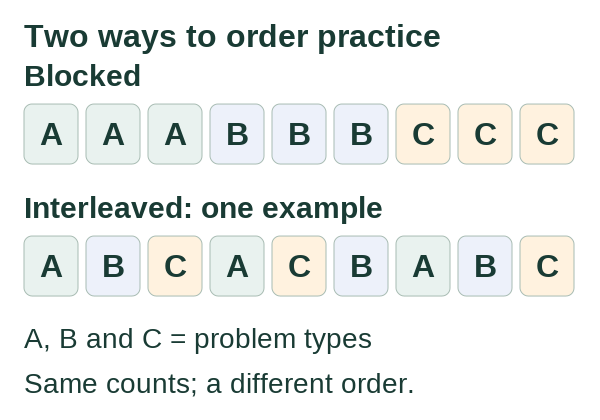
Mixing has two separate features. Problems on the same topic are spread out, or spaced, across many sets. Problems on different topics sit side by side within each set.[2] Spacing practice by itself often improves test scores. So a benefit seen in a mixed set may come from spacing, not from the mixing itself.[1]
Researchers found that mixing different tasks in practice led to better long-term memory than blocking them. Performance during practice was worse. Later work tested whether the effect holds for small movement sequences learned without awareness. It used a serial reaction time task with three eight-item sequences. Some participants said they were not aware of the sequences. Even they did better at remembering and applying what they learned after mixed practice than after blocked practice.[8]
A 2009 review of experiments on math problems concluded that each feature of mixed review usually boosts later performance. The gains are often large.[2] A 2010 experiment had children practice four kinds of math problems. The order was mixed or blocked. The amount of spacing was held fixed. Mixing lowered scores during the practice session. It doubled scores on a test given one day later.[1]
Not every classroom test has found this benefit. Two large classroom experiments looked at angle relations, a clearly defined math category. They found no interleaving effect, even though the samples were very large.[4]
Main ideas
Why mixing helps and when it does not
One explanation for mixing is that it makes the differences between categories stand out. This proposal is called the discriminative-contrast hypothesis. Three experiments used photographs of butterflies and birds. Spacing that broke up the side-by-side comparison of mixed categories was harmful. This held even when total spacing was held constant.[9]
A study of 12 new artists used eye-tracking equipment, which records where people look. It supported the same account over a rival idea. Performance was much better when the contrast between categories was high. It was worse when the contrast was medium or low.[10]
The benefit depends on how similar the categories are to each other. Sometimes categories were highly similar both within and between. Then interleaved study led to better generalization than blocked study.[11]
The learner's strategy also matters. For memorizing, interleaving beat blocking when learners classified by similarity. When searching for a rule, blocking beat interleaving for classifying by that rule. That pattern held on a transfer test given right after learning. It held again at a delay of about 48 h.[12]
Interleaving can be a harmful difficulty for beginners with weak prior knowledge. A hybrid schedule used both blocked and interleaved practice. It produced longer-lasting retention than either schedule alone.[13] In the blocked condition, learners with higher working memory capacity gained more than those with lower capacity. The gain was in the speed of relative clause use.[14]
Learners often misjudge which schedule helps them more. They tend to believe grouping improves learning by example. They hold this belief even after their own performance has gained from mixing. Two influences help create this false impression. Blocking gives a feeling of easy recall of a category's features during study. Learners also arrive believing that grouping by topic is better. Some attempts tried to correct this bias. They explained why blocking only seems better. Or they drew attention to the link between schedule and performance. These attempts had only modest effects.[5]
Research
The evidence and how large the effect is
In math, interleaving means arranging problems so that no two in a row need the same strategy. A randomized controlled trial studied 54 seventh-grade math classes. They did mixed or grouped assignments over 4 months. One month later, students took a test they had not been told about. The mixed group scored 61% and the grouped group scored 38%. The difference was d = 0.83. Teachers made the change without training. They later supported mixed practice in an anonymous survey. They finished it before they knew the results.[3] An earlier experiment gave 126 seventh graders the same problems over 3 months. The problems were arranged either mixed or grouped.[7]
Interleaving has also been tested in physics, science quizzes and spelling.[6][15][16] An introductory university physics course had two lecture sections. For 8 weeks, students did homework problems. The problems were mixed or grouped by topic. Two surprise tests used new and harder problems. Interleaved practice raised scores. The median gain was 50% on test 1 and 125% on test 2. Students rated the mixed homework as more difficult. They wrongly believed they had learned less from it.[6]
In science courses, 155 students took weekly quizzes. The quizzes were grouped by concept or mixed. They then took a test a month after the final quiz.[15] A preregistered classroom experiment studied 147 German third graders. They made fewer spelling errors on words practiced in the interleaved condition. This held right after training and at an 8-week follow-up.[16]
A small remedial study looked at grade one arithmetic, with 15 pupils in each group.[17] A meta-analysis looked at mixed practice. It also looked at the conditions that change how well it works. Effects were stronger when material was more similar between categories. The effect was also stronger when items within a set were less alike. The meta-analysis concluded that interleaving should be used with care for explanatory texts and words.[18]
Studies of category learning show the benefit is not limited to mathematics. Undergraduates learned chemical categories from diagrams. The diagrams were shown mixed together or in blocks. They were tested on new examples 2 days later. Interleaved presentation produced better performance for visually simple categories. It also helped for relatively more complex ones. The advantage held even when study materials pointed out the features. Those features tell one category from another.[19]
How the brain responds to mixed practice
Interleaved practice means mixing different tasks or sequences in one session. Repetitive practice means drilling one at a time. Three 4-element sequences were practiced on 2 successive days. They were practiced either in a repetitive order or in an interleaved order. Functional magnetic resonance imaging scanned the brain during practice. It scanned again at a later memory test. This connectivity with sensorimotor cortical areas, the brain's movement and touch regions, grew stronger. The size of the increase matched the benefit of interleaved practice at retention.[20]
Activity in the prefrontal cortex looks less simple than a story of more effort under mixed practice. A study used near-infrared spectroscopy, which shines light through the skull to track oxygenated and deoxygenated hemoglobin, a blood protein that carries oxygen, in both sides of the prefrontal cortex. Participants trained discrete key pressing sequences under interleaved and repetitive schedules. They were tested after a 24-h delay. Sequence performance was slower under interleaved practice. Even so, oxygenated and deoxygenated hemoglobin values in the prefrontal cortex did not differ between the two practice conditions. At test, slower performance after repetitive practice coincided with lower deoxygenated hemoglobin in the right prefrontal cortex.[21]
One experiment randomly assigned 81 seventh-grade Chinese students to four conditions of online micro-lectures. The lectures were blocked or interleaved by subject matter, each with auditory or visual text. Self-reported cognitive load, attention level, EEG data, which records electrical brain activity, and test results were collected over 40 min of online learning. One condition mixed both subject matter and the channel through which material arrives. It showed the best overall outcomes: best performance, low reported mental effort and high attention. The study framed interleaving as a mental shift that may help students recover from cognitive overload, drawing on attention restoration theory, which holds that a change of focus lets attention recover.[22]
How interleaving is measured in experiments
In one experiment, two obviously different topics were interleaved. No interleaving effect appeared. A second experiment used a similar design. It chose topics that were harder to tell apart. There the interleaved group showed a clear advantage. The gain came with more cognitive load, the mental effort a task demands. Chen, Retnowati, Castro-Alonso, Paas and Sweller (2023) read that pattern as support for one view. Interleaving and variability effects are closely related.[23]
A task interleaving study asked 211 participants to switch among realistic tasks. The tasks were reading, mathematics, question-answering and recognition. A computer model that learned to switch from experience predicted individual behavior better than a flat model without levels. It also beat a baseline that always knew the best option. The model also reproduced known patterns. These included sensitivity to the cost of resuming a task and to rewards earned inside a task.[24]
In practice
How students and teachers actually use it
In mathematics, most assignments group problems that need the same method. Students know the method before they read each problem. An interleaved assignment mixes different kinds of problems instead. Students must choose the method from the problem itself. They then took an unannounced test two weeks later. Mean test scores were 72 % for interleaved practice and 38 % for blocked practice, a difference of d = 1.05. The gain held even when the problem types looked quite different from one another.[25] A later quasi-experimental study found that two interleaved formats improved math performance and retention. Neither format improved the transfer of knowledge.[26]
In one study, learners of French practiced the pronoun y at three tenses. They used an ABC-ABC-ABC order or an AAA-BBB-CCC order. The blocked group used the structure more fluently. The interleaved group used it more accurately but less fluently.[27]
Two experiments studied adults learning French. Interleaving made learning harder, but test scores were generally higher. This was especially true on the test right after study. That advantage faded over time when cues were reliable. It lasted longer when cues were less reliable.[28]
A study looked at English learners at a university in China. Over time, mixed practice made their suggestions and requests more accurate. Blocked practice made them more fluent.[29] In one experiment, adults learning German or Polish vocabulary gained from mixed practice. They did not gain in a second experiment that included a break halfway through.[30]
Studies in professional training have given different results. Interleaving helped nursing students identify lung sounds. Blocked practice gave better final quiz scores to first-year medical students learning to read heart traces.[31][32]
Second-year nursing students practiced lung auscultation, listening to body sounds. Those who practiced in interleaved order performed better than students who practiced in blocks. Many of those students did not know interleaving had helped them. They found it more effortful.[32]
In a fashion design course, 134 Chinese vocational students mixed three things. They were stitch type, grainline orientation and seam placement. These students scored higher on trained tasks (M = 7.13) than blocked learners (M = 6.42), with d = 0.49. The mixed group also did better on near-transfer. They also kept more over the long term.[33] The case was different for 80 first-year medical students learning to read electrocardiograms. On a delayed final test, blocked practice beat mixed practice, 34 % versus 24 %.[31]
Mixed practice means switching between different topics or problem types within one study session. A chapter on classroom use describes interleaving as mixing diverse topics or problem types within one study session. The same chapter names digital technology, gamification and personalised approaches as trends that may shape how interleaving is used.[34]
One nursing course used an escape room, a team puzzle game, to interleave essential concepts. The students were in their first semester of an accelerated bachelor's degree.[35] A study of interleaving-based worked examples added prompts about achievement goal orientation, a learner's reason for engaging in a task. Those prompts raised motivation, especially mastery orientation. That was one of the two goal types the study compared.[36]
Why learners avoid mixing and how to change that
Most learners do not mix topics when they study on their own, and many hold mistaken beliefs about how learning should be scheduled. One survey asked undergraduates at two large universities. One was in North America and one in Southeast Asia. It was almost unknown to them. The same survey found that interleaving and spaced practice were both often underused. Both were seen as only mixed in effectiveness.[37]
Students also misjudge which schedule works better. In one study, 193 undergraduates built practice plans for an imagined math class. Most rated plans with little spacing and interleaving as the most effective. A second study asked 175 undergraduates to choose among five made-up schedules. They rated schedules with more spacing and mixing as harder, less enjoyable and less common.[38]
One explanation is that learners see the extra effort of mixing as a sign of poor learning. In two experiments, learners practiced telling bird families apart. They used blocked and interleaved schedules. They then rated each schedule for effort, learning and familiarity. Learners who found interleaving harder also judged that they had learned less from it. They were less inclined to pick it again. Familiarity with a strategy also predicted choice. Again, this worked through how much students felt they learned. In the second experiment, the less familiar mixed schedule actually produced better learning. This was the reverse of what learners judged.[39]
One program combined corrections of false beliefs with prompts to think about learning. It raised the use of mixed practice. In a pre-registered experiment, undergraduates were put at random into an intervention group or a control group. They learned visual categories while choosing the study order themselves. It corrected students' mistaken beliefs. Before the intervention, students used more grouped practice. Afterward, mixed practice rose significantly on tasks done right away and on tasks done later. More mixing went with better sorting performance.[40]
Two experiments looked at why learners rarely mix their practice. The categories in the experiments were easy to confuse. Experiment 1 had 190 learners. Experiment 2 had 134. Blocking was a deliberate effort to find what members of a category share. It was not simply avoiding effort. Two prompts together raised interleaving. One stressed why telling confusable items apart matters. The other told learners that telling items apart means noticing differences.[41]
What this looks like when you study
In a four-month trial, 54 seventh-grade mathematics classes completed interleaved or blocked assignments, and both groups later did an interleaved review. One month later, on an unannounced test, the interleaved group scored 61% and the blocked group scored 38%. The teachers used the new assignments without training and later supported interleaving in an anonymous survey.[3]
Over eight weeks, undergraduates in two introductory physics lecture sections did homework three times a week. Most interleaved assignments in the study held nine problem types, each needing its own strategy, while most blocked assignments held three. Students solved fewer problems correctly on the mixed homework, yet on two surprise tests they recalled more and solved more problems after mixed practice. The median improvement was 50% on the first test and 125% on the second.[6] A month after the last quiz, students scored 63% on concepts from mixed quizzes, 54% on concepts from blocked quizzes, and 47% on concepts never quizzed.[15]
In a spelling study, 147 German third graders had one blocked and one interleaved training session on words governed by spelling rules. Interleaved practice produced fewer spelling errors than blocked practice, but the lasting benefit fell mainly to children who already spelled many of the words correctly before training.[16]
Hwang (2025) studied 107 low-achieving adolescents learning English vocabulary. A hybrid schedule, which began with blocked practice and later mixed the words, produced stronger long-term retention than pure blocking or pure interleaving.[13] Mixing problems from different lessons improves students' ability to pair a problem with the concept or procedure it requires.[2] Learners who were told that telling confusable items apart depends on finding their predictive differences, and who saw why that skill had value, chose to interleave more often.[41] In the physics homework study, students solved fewer interleaved problems correctly than blocked ones (0.69 versus 0.74 in Stage 1). They also rated the interleaved sets as harder, yet they scored higher on the later surprise tests.[6]
Later developments
Mixed practice across skills and senses
One mixed group switched between blocks of physical practice and videos of successful aiming. After 100 practice trials, every group improved. All showed gains when tested again 24 hours later. The alternating group was as accurate at retention as the massed physical practice group, which suggests that observation can stand in for some physical practice when it is supplied intermittently.[42]
A preregistered set of four experiments tested interleaving when learners could not see the material at all. Participants studied six categories of six examples each, using birdcalls, tealeaves, ingredient mixtures and stones, and each set was studied either mixed or one category at a time. No single experiment showed a significant effect of interleaving. A meta-analysis pooled the data from all four experiments and found a significant small effect. This suggests that mixing can aid perceptual learning across the senses. Learners in the mixed condition underestimated how well they had classified the items. Overall, they did not rate mixing as less effective than blocking. That last result conflicts with earlier studies, in which learners consistently preferred blocking.[43]
Category induction, the process of forming a general rule from specific examples, has also been studied with mixed practice. Two experiments each used 40 students, one with paintings and one with written material. The students studied examples from several categories in massed or mixed order. Induction was tested either shortly after study or after a week's delay. The interleaving effect appeared at the short interval. The study reported the first evidence that mixing also affected retention after a week. In most groups, students judged massing to be more effective than mixing. Their test scores often showed the opposite.[44]
Speaking practice has had one direct test. A 24-day online experiment compared mixed practice with block practice. It had 36 undergraduate learners of English as a second language. The mixed group did slightly better at speaking. The difference was not statistically significant. Scores on interaction, pronunciation, fluency and coherence, and vocabulary and grammar stayed the same across the experiment. The groups did not differ in attitude or motivation.[45]
A review of interleaving for continuing professional development makes an argument. Mixing related but different areas of study pushes the brain to reconcile them while learning each one well. The review reports that reports of interleaving in health professions teaching have started to appear in published work.[46]
A design study split 60 senior product design students into two groups of 30. They were at King Mongkut's Institute of Technology Ladkrabang. One group was taught in a teacher-centered way. The other used an integration of STEM and a flipped classroom. The integrated group scored higher on a test of creative ideas. The statistical significance level was .05.[47]
Materials, formats and long-term retention
In 2023, three experiments had participants study examples from different rock categories. They later classified new examples. Mixing the categories during study beat studying them in blocks. This held for both simple rule-based categories and categories that required combining several features. Written descriptions of the features raised accuracy only in one case. That was when the features actually signaled which category an example belonged to. That gain appeared for rule-based learning and did not carry over to the categories that required combining features. Participants also predicted their own learning poorly. They did not notice the benefit of mixing, and they expected more from feature descriptions even when those descriptions did not improve performance.[48]
The form in which a subject is shown can itself be mixed. One method had learners master whole anatomy first, then move to sectional anatomy. This is the standard transfer approach. The other alternated whole and sectional views throughout. Alternating the two representations was more efficient. It cost nothing in long-term retention or in recognizing new images from the Visible Human and MRI sets.[49]
When study techniques were assessed, mixing got a moderate rating for usefulness. A 2013 review looked at 10 easy-to-use techniques. It gave practice testing and spread-out practice high ratings for usefulness. Interleaved practice received a moderate rating. Elaborative interrogation and self-explanation received the same rating. The review judged the evidence for interleaving limited. Its benefits had only begun to be systematically explored. Summarizing, highlighting, the keyword memory trick, mental images for text and rereading all got low ratings. The review still recommended the moderate-rated techniques in appropriate situations. Interleaving was among them.[50]
Interleaving in motor and cognitive training
Some experiments put short rests between practice attempts. They fill those rests with brain stimulation. A 2020 study trained people on an explicit motor learning task while delivering 10-Hz interleaved repetitive transcranial magnetic stimulation to the primary motor cortex. The stimulation ran during rest periods between active training phases. A control condition stimulated the vertex. Stimulation over the hand area of the nondominant hand improved consolidation after training. This was measured 6 h after training. Training performance itself was unchanged. The benefit carried over to a mirror-symmetric sequence performed with the untrained dominant hand. The result suggests consolidation begins during the short rests inside a training session. It does not begin only after training ends.[51]
A pair of 2026 pilot studies tested one question. Can computerized cognitive training be interleaved with stimulation in people with mild cognitive impairment? One group had amnestic mild cognitive impairment and included 21 participants. Each participant received 24 sessions of accelerated intermittent theta burst stimulation over 3 days. That was 8 sessions per day. Between stimulation sessions were 10- to 15-minute intervals. During these, participants did cognitive exercises on a computer platform. In the laboratory, both groups practiced about the same amount. The medians were 107 and 111 minutes. Both groups generally rated the platform positively. They rated their experience, the exercises and the perceived benefit to mood and functioning well.[52]
During the 4-week follow-up, participants were asked to practice at home for 20 minutes a day. The memory group received weekly reminders and the stroke group did not. Practice time rose in the memory group, to a median of 450 min. It fell in the stroke group, to a median of 142 min.[52]
Criticism
Limits, open questions and mixed findings
Interleaving improved sorting accuracy for both children and young adults. Young adults gained more. In one study, children and young adults learned natural rock categories. Mixing also changed how well learners judged their own learning. It made children too sure of themselves. It made young adults too unsure.[53]
A study of 236 German third graders compared mixed and blocked practice of subtraction strategies. It ran over 14 lessons. Prior knowledge helped students in the grouped condition. It did not help them in the mixed condition. Need for cognition, a measure of how much a person enjoys mental effort, helped students in the interleaved condition and had no influence in the blocked condition. Those two differences between conditions were not statistically significant.[54]
Two experiments with 40 students each found a mixed-practice benefit. It showed on a test given shortly after study and also after a week's delay.[55] A systematic review of 26 studies found the benefit held on delayed tests. That review found memory benefits with effect sizes up to 0.65. Transfer to new items reached 0.66. The benefit was greatest when differences between items were subtle. The review also found that most of the research is lab work with university students.[56]
The discriminative-contrast account did not explain the interleaving benefit for complex perceptual categories. One example is artists' painting styles. One study tested mixed practice with complex visual categories. It found no evidence that the leading explanation, discriminative contrast, accounts for the benefit with such categories.[57] Discriminative contrast holds that mixing helps learners tell similar categories apart.[58][57]
Chen, Paas and Sweller (2021) argue that spacing and interleaving need separate explanations. Their review of the research supports this. One review argues that spaced practice is a mental effort effect. Working memory resources run down during effort and recover during rest. That review argues that discriminative contrast explains mixed practice better. This idea helps learners tell topic areas apart.[58] A systematic review of concept learning was registered in advance to examine such boundary conditions, the factors that change how well mixing works.[59]
Common misconceptions
Many learners believe that studying one topic at a time is the better way to learn, a belief that researchers describe as a common misconception. In one set of experiments, learners still preferred blocking even after their own test scores had benefited from interleaving. The blocked order feels fluent during study, and that smooth feeling is mistaken for learning.[5]
Students often assume that a method which feels more effortful must be teaching them less, which researchers call a mistaken judgment. In two experiments, the more effortful interleaving felt, the less learners believed they had learned and the less willing they were to use it again. Yet the less familiar interleaved schedule produced better learning than the familiar blocked one.[39]
Key studies
| Year | Study | Sample | Design | Finding |
|---|---|---|---|---|
| 2010 | Taylor & Rohrer[1] | children practicing four kinds of mathematics problems | experiment holding spacing constant | Interleaving lowered practice scores but doubled test scores one day later. |
| 2013 | Lin et al.[20] | brain-imaging study of motor sequence practice | Interleaved practice produced greater connectivity between frontal and sensorimotor regions, and this connectivity correlated with later retention. | |
| 2014 | Rohrer et al.[25] | 140 seventh-grade students | classroom experiment over nine weeks | Two weeks after practice, interleaved practice produced 72% correct against 38% for blocked practice, d = 1.05. |
| 2017 | Monteiro et al.[31] | 80 first-year medical students | 2 by 2 factorial study of instruction and practice schedules | On the delayed final test, students who had practiced in blocked order averaged 34% correct and those who had practiced in mixed order averaged 24%. |
| 2019 | Brunmair & Richter[18] | meta-analysis of interleaved learning studies | meta-analysis | Interleaving effects were stronger for more similar material between categories and more complex material, but caution is needed for expository texts and words. |
| 2020 | Rohrer et al.[3] | 54 seventh-grade mathematics classes | preregistered cluster randomized controlled trial | On an unannounced test one month later, the interleaved group scored 61% and the blocked group 38%, d = 0.83. |
| 2021 | Samani & Pan[6] | eight-week homework study with surprise tests | Interleaved homework lowered homework accuracy but raised surprise test scores, with median gains of 50% and 125%. | |
| 2021 | Firth et al.[56] | 26 studies (17 in meta-analysis) | systematic review and meta-analysis | Interleaving showed benefits for memory (Hedges' g up to 0.65) and transfer (up to 0.66), especially when differences between items were subtle. |
| 2022 | Sana & Yan[15] | 155 science students | four-week classroom quiz study | A month later, concepts from interleaved quizzes scored 63%, blocked quizzes 54%, and unquizzed concepts 47%. |
| 2024 | Onan et al.[40] | preregistered experiment on self-organized study order | An intervention combining refutations and metacognitive prompts increased interleaved practice, and more interleaving was linked to better classification. | |
| 2025 | Klimovich & Richter[16] | 147 German third graders | preregistered classroom experiment | Children made fewer spelling errors after interleaved sessions than blocked ones, both immediately and eight weeks later. |
| 2025 | Hwang[13] | 107 low-achieving adolescents in a Korean vocational high school | randomized vocabulary learning experiment | Interleaving alone was too hard at first, and a hybrid of blocked then interleaved practice gave the best long-term retention. |
| 2025 | Pan et al.[37] | undergraduates at two universities in North America and Southeast Asia | survey of study strategies and beliefs | Interleaved practice was virtually unknown to students, and both spacing and interleaving were often underused. |
| 2026 | Xian et al.[33] | 134 first-year vocational fashion design students | classroom experiment | Interleaved practice scored 7.13 on trained tasks against 6.42 for blocked practice, d = 0.49, with better long-term retention. |
See also
References
- Taylor, K., & Rohrer, D. (2010). The effects of interleaved practice. Applied Cognitive Psychology, 24(6), 837-848. doi:10.1002/acp.1598
- Rohrer, D. (2009). Research Commentary: The Effects of Spacing and Mixing Practice Problems. Journal for Research in Mathematics Education, 40(1), 4-17. doi:10.5951/jresematheduc.40.1.0004
- Rohrer, D., Dedrick, R. F., Hartwig, M. K., & Cheung, C. N. (2020). A randomized controlled trial of interleaved mathematics practice. Journal of Educational Psychology, 112(1), 40-52. doi:10.1037/edu0000367
- Rowlandson, P., & Simpson, A. (2025). Interleaving in Mathematical Category Learning. Journal for Research in Mathematics Education, 56(3), 125-147. doi:10.5951/jresematheduc-2024-0055
- Yan, V. X., Bjork, E. L., & Bjork, R. A. (2016). On the difficulty of mending metacognitive illusions: A priori theories, fluency effects, and misattributions of the interleaving benefit. Journal of Experimental Psychology: General, 145(7), 918-933. doi:10.1037/xge0000177
- Samani, J., & Pan, S. C. (2021). Interleaved practice enhances memory and problem-solving ability in undergraduate physics. npj Science of Learning, 6(1). doi:10.1038/s41539-021-00110-x
- Rohrer, D., Dedrick, R. F., & Stershic, S. (2015). Interleaved practice improves mathematics learning. Journal of Educational Psychology, 107(3), 900-908. doi:10.1037/edu0000001
- Schorn, J. M., & Knowlton, B. J. (2021). Interleaved practice benefits implicit sequence learning and transfer. Memory & Cognition, 49(7), 1436-1452. doi:10.3758/s13421-021-01168-z
- Birnbaum, M. S., Kornell, N., Bjork, E. L., & Bjork, R. A. (2013). Why interleaving enhances inductive learning: The roles of discrimination and retrieval. Memory & Cognition, 41(3), 392-402. doi:10.3758/s13421-012-0272-7
- Ge, Y., Li, F., Li, X., & Li, W. (2021). What Is the Mechanism Underlying the Interleaving Effect in Category Induction: An Eye-Tracking and Behavioral Study. Frontiers in Psychology, 12. doi:10.3389/fpsyg.2021.770885
- Carvalho, P. F., & Goldstone, R. L. (2014). Putting category learning in order: Category structure and temporal arrangement affect the benefit of interleaved over blocked study. Memory & Cognition, 42(3), 481-495. doi:10.3758/s13421-013-0371-0
- Little, J. L., & Nepangue, J. A. (2025). Whether Interleaving or Blocking Is More Effective for Long-Term Learning Depends on One’s Learning Strategy. Behavioral Sciences, 15(5), 662. doi:10.3390/bs15050662
- Hwang, H. (2025). Undesirable Difficulty of Interleaved Practice: The Importance of Initial Blocked Practice for Declarative Knowledge Development in Low‐Achieving Adolescents. Language Learning, 75(1), 5-41. doi:10.1111/lang.12659
- Suzuki, Y., Yokosawa, S., & Aline, D. (2022). The role of working memory in blocked and interleaved grammar practice: Proceduralization of L2 syntax. Language Teaching Research, 26(4), 671-695. doi:10.1177/1362168820913985
- Sana, F., & Yan, V. X. (2022). Interleaving Retrieval Practice Promotes Science Learning. Psychological Science, 33(5), 782-788. doi:10.1177/09567976211057507
- Klimovich, M., & Richter, T. (2025). Spelling acquisition in children through interleaved practice: the role of instructional guidance. Cognitive Research: Principles and Implications, 10(1). doi:10.1186/s41235-025-00680-z
- Bonite, J. (2025). Interleaved Practice in Remediating Basic Arithmetic Proficiency in Grade One. Journal of Interdisciplinary Perspectives, 3(6). doi:10.69569/jip.2025.238
- Brunmair, M., & Richter, T. (2019). Similarity matters: A meta-analysis of interleaved learning and its moderators. Psychological Bulletin, 145(11), 1029-1052. doi:10.1037/bul0000209
- Eglington, L. G., & Kang, S. H. K. (2017). Interleaved presentation benefits science category learning. Journal of Applied Research in Memory and Cognition, 6(4), 475-485. doi:10.1016/j.jarmac.2017.07.005
- Lin, C. (., Chiang, M., Knowlton, B. J., Iacoboni, M., Udompholkul, P., & Wu, A. D. (2013). Interleaved practice enhances skill learning and the functional connectivity of fronto‐parietal networks. Human Brain Mapping, 34(7), 1542-1558. doi:10.1002/hbm.22009
- Immink, M. A., Pointon, M., Wright, D. L., & Marino, F. E. (2021). Prefrontal Cortex Activation During Motor Sequence Learning Under Interleaved and Repetitive Practice: A Two-Channel Near-Infrared Spectroscopy Study. Frontiers in Human Neuroscience, 15. doi:10.3389/fnhum.2021.644968
- Chen, W., Chen, C., Li, B., & Zhang, J. (2022). Applying Interleaving Strategy of Learning Materials and Perceptual Modality to Address Secondary Students’ Need to Restore Cognitive Capacity. International Journal of Environmental Research and Public Health, 19(12), 7505. doi:10.3390/ijerph19127505
- Chen, O., Retnowati, E., Castro-Alonso, J. C., Paas, F., & Sweller, J. (2023). The Relationship between Interleaving and Variability Effects: A Cognitive Load Theory Perspective. Education Sciences, 13(11), 1138. doi:10.3390/educsci13111138
- Gebhardt, C., Oulasvirta, A., & Hilliges, O. (2021). Hierarchical Reinforcement Learning Explains Task Interleaving Behavior. Computational Brain & Behavior, 4(3), 284-304. doi:10.1007/s42113-020-00093-9
- Rohrer, D., Dedrick, R. F., & Burgess, K. (2014). The benefit of interleaved mathematics practice is not limited to superficially similar kinds of problems. Psychonomic Bulletin & Review, 21(5), 1323-1330. doi:10.3758/s13423-014-0588-3
- Bondoc, R. K. P., & Duque, R. (2026). Exploring the Robust Benefits of Optimized Pure and Hybrid Interleaved Learning on Mathematics Performance, Retention, and Transfer. The International Journal of Learning in Higher Education. doi:10.18848/2327-7955/cgp/a360
- Buhot, N., & Xing, Q. (2026). The effects of interleaving and blocking practice on L2 contextualized grammar learning. Journal of Second Language Studies, 9(1), 45-72. doi:10.1075/jsls.00047.buh
- Xiong, Y., & Wu, S. (2026). Interleaved Practice in L2 Grammar Learning: Variation Across Grammatical Patterns and Cue Reliability. The Modern Language Journal. doi:10.1111/modl.70082
- Zhang, Y. (2023). The effects of interleaved and blocked corpus-based practice on L2 pragmatic development. Studies in Second Language Acquisition, 45(4), 812-837. doi:10.1017/s0272263123000062
- Libersky, E., Sobus, S., Slawny, C., & Kaushanskaya, M. (2026). The effects of interleaving and rest on L2 vocabulary learning. Second Language Research, 42(4), 773-790. doi:10.1177/02676583251338768
- Monteiro, S., Melvin, L., Manolakos, J., Patel, A., & Norman, G. (2017). Evaluating the effect of instruction and practice schedule on the acquisition of ECG interpretation skills. Perspectives on Medical Education, 6(4), 237-245. doi:10.1007/s40037-017-0365-x
- Onan, E., Onan, A., Ozgun, E., Gundogdu, S., Bektas, H., & de Bruin, A. B. H. (2025). Improving Diagnostic Accuracy of Lung Auscultation Through Interleaved Practice: A Quasi‐Experimental Field Study. Applied Cognitive Psychology, 39(3). doi:10.1002/acp.70063
- Xian, W., Corbeta-Gomez, S., & E. Borines, M. (2026). Interleaved Practice Promotes Transfer and Long-Term Retention of Design Rules in Vocational Education Evidence from a Chinese Fashion Course. Journal of Educational and Social Research, 16(1), 166. doi:10.36941/jesr-2026-0245
- Alex, J. K., & Mukuka, A. (2024). Chapter 18: Interleaved practice in classrooms. Open Books and Proceedings, 127-135. doi:10.38140/obp1-2024-18
- Traister, T. (2025). Interleaving Foundational Nursing Concepts for Accelerated Nursing Students Through Gamification. Nursing Education Perspectives, 46(4), 262-263. doi:10.1097/01.nep.0000000000001272
- Yogyakarta State University, Yogyakarta, Indonesia (2025). Achievement Goal Orientation Prompts in Interleaving-Based Worked Examples: Effects on Transfer, Cognitive Load, And Motivation. International Journal of Mathematics And Computer Research, 13(10). doi:10.47191/ijmcr/v13i10.08
- Pan, S. C., González‐Cabañes, E., Teo, A. Z. J., Zung, I., Sana, F., & Cooke, J. E. (2025). Distributed Practice and Interleaved Practice: Undergraduate Students' Strategies, Experiences, and Beliefs. Applied Cognitive Psychology, 39(3). doi:10.1002/acp.70071
- Hartwig, M. K., Rohrer, D., & Dedrick, R. F. (2022). Scheduling math practice: Students’ underappreciation of spacing and interleaving. Journal of Experimental Psychology: Applied, 28(1), 100-113. doi:10.1037/xap0000391
- Macaluso, J. A., Beuford, R. R., & Fraundorf, S. H. (2022). Familiar Strategies Feel Fluent: The Role of Study Strategy Familiarity in the Misinterpreted-Effort Model of Self-Regulated Learning. Journal of Intelligence, 10(4), 83. doi:10.3390/jintelligence10040083
- Onan, E., Biwer, F., Abel, R., Wiradhany, W., & de Bruin, A. (2024). Optimizing self-organized study orders: combining refutations and metacognitive prompts improves the use of interleaved practice. npj Science of Learning, 9(1). doi:10.1038/s41539-024-00245-7
- Abel, R., de Bruin, A., Onan, E., & Roelle, J. (2024). Why Do Learners (Under)Utilize Interleaving in Learning Confusable Categories? The Role of Metastrategic Knowledge and Utility Value of Distinguishing. Educational Psychology Review, 36(2). doi:10.1007/s10648-024-09902-0
- Larssen, B. C., Ho, D. K., Kraeutner, S. N., & Hodges, N. J. (2021). Combining Observation and Physical Practice: Benefits of an Interleaved Schedule for Visuomotor Adaptation and Motor Memory Consolidation. Frontiers in Human Neuroscience, 15. doi:10.3389/fnhum.2021.614452
- Abel, R. (2023). Interleaving Effects in Blindfolded Perceptual Learning Across Various Sensory Modalities. Cognitive Science, 47(4). doi:10.1111/cogs.13270
- Zulkiply, N., & Burt, J. S. (2013). Inductive Learning: Does Interleaving Exemplars Affect Long-Term Retention? Malaysian Journal of Learning and Instruction, 10, 133-155. doi:10.32890/mjli2013.10.7
- PhD Scholar, Dept of English, Tezpur University, Kakoti, S., Doley, S. K., & Asst. Prof, Dept of English, Tezpur University (2021). English Speaking Skill and Indian Undergraduate ESL Learners: Interleaving or Block Practice? Rupkatha Journal on Interdisciplinary Studies in Humanities, 13(4). doi:10.21659/rupkatha.v13n4.57
- Van Hoof, T. J., Sumeracki, M. A., & Madan, C. R. (2022). Science of Learning Strategy Series: Article 3, Interleaving. Journal of Continuing Education in the Health Professions, 42(4), 265-268. doi:10.1097/ceh.0000000000000418
- Egwutvongsa, S. (2022). Creative Skills: Flipped Classroom by Applying an Interleaving Technique for Product Design Students. Journal of Educational and Social Research, 12(3), 223. doi:10.36941/jesr-2022-0081
- Do, L. A., & Thomas, A. K. (2023). The Underappreciated Benefits of Interleaving for Category Learning. Journal of Intelligence, 11(8), 153. doi:10.3390/jintelligence11080153
- Pani, J. R., Chariker, J. H., & Naaz, F. (2013). Computer‐based learning: Interleaving whole and sectional representation of neuroanatomy. Anatomical Sciences Education, 6(1), 11-18. doi:10.1002/ase.1297
- Dunlosky, J., Rawson, K. A., Marsh, E. J., Nathan, M. J., & Willingham, D. T. (2013). Improving Students’ Learning With Effective Learning Techniques: Promising Directions From Cognitive and Educational Psychology. Psychological Science in the Public Interest, 14(1), 4-58. doi:10.1177/1529100612453266
- Rumpf, J. J., May, L., Fricke, C., Classen, J., & Hartwigsen, G. (2020). Interleaving Motor Sequence Training With High-Frequency Repetitive Transcranial Magnetic Stimulation Facilitates Consolidation. Cerebral Cortex, 30(3), 1030-1039. doi:10.1093/cercor/bhz145
- Campbell, L. M., Aghamoosa, S., Horn, O., Fleischmann, H. H., Lopez, J., Rbeiz, K. S., Madden, K., Antonucci, M., Revuelta, G., McTeague, L. M., & Benitez, A. (2026). Feasibility of Interleaving Computerized Cognitive Training With Repetitive Transcranial Magnetic Stimulation: Pilot Studies in Mild Cognitive Impairment Due to Alzheimer’s Disease and Stroke. JMIR Neurotechnology, 5, e81437-e81437. doi:10.2196/81437
- Dong, X., He, X., Fang, L., Xing, Q., & Ren, R. (2025). Learning Natural Categories: Effects of Interleaving Practice in Children and Young Adults. Journal of Intelligence, 13(9), 107. doi:10.3390/jintelligence13090107
- Nemeth, L., & Lipowsky, F. (2024). The role of prior knowledge and need for cognition for the effectiveness of interleaved and blocked practice. European Journal of Psychology of Education, 39(2), 907-929. doi:10.1007/s10212-023-00723-3
- Zulkiply, N., & Burt, J. S. (2013). Inductive Learning: Does Interleaving Exemplars Affect Long-Term Retention? Malaysian Journal of Learning and Instruction, 10. doi:10.32890/mjli.10.2013.7655
- Firth, J., Rivers, I., & Boyle, J. (2021). A systematic review of interleaving as a concept learning strategy. Review of Education, 9(2), 642-684. doi:10.1002/rev3.3266
- Yan, V. X., & Sana, F. (2019). Interleaving Benefits the Learning of Complex Perceptual Categories: Evidence Against the Discriminative-Contrast Hypothesis. Journal of Cognitive Education and Psychology, 18(1), 35-51. doi:10.1891/1945-8959.18.1.35
- Chen, O., Paas, F., & Sweller, J. (2021). Spacing and Interleaving Effects Require Distinct Theoretical Bases: a Systematic Review Testing the Cognitive Load and Discriminative-Contrast Hypotheses. Educational Psychology Review, 33(4), 1499-1522. doi:10.1007/s10648-021-09613-w
- Firth, J., Rivers, I., & Boyle, J. (2019). A Systematic Review of Interleaving as a Concept Learning Strategy. Social Science Protocols, 2, 1-7. doi:10.7565/ssp.2019.2650
Cite this page: Atlas Nova editors. (2026). Interleaving. Atlas Nova. https://velocer.io/atlas/interleaving/