Method · Learning strategies
Elaborative interrogation
Study method
Overview
What elaborative interrogation is
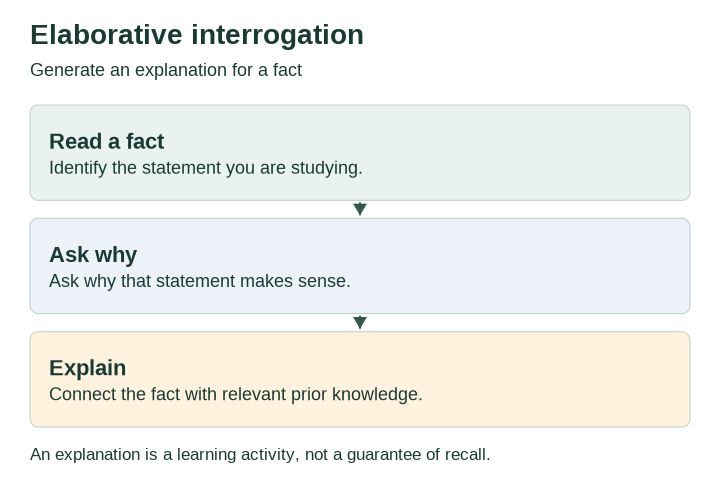
Elaborative interrogation is a study strategy. The learner answers why-questions about facts in order to remember them.[1][6] A student using it reads a stated fact. The student then explains why that fact would be true. In one classroom study, children in grades 6 and 7 were told to explain why facts were true. The facts were about Canada and the U.S.[1]
In a laboratory study, university students answered why facts about the cardiovascular system made sense.[6] The strategy belongs to a wider family called elaboration. This concerns how a learner studies or practices information judged to be a priority.[7]
Elaborative interrogation differs from self-explanation, a close relative. In self-explanation, learners say what facts mean to them. They also say how the facts connect to what they already know. Researchers compared the two strategies directly. Students who used self-explanation scored much higher than students who answered why-questions. This was on tests of cued recall and recognition.[6]
Learning scientists have described and tested elaborative interrogation. It is one of several study strategies.[7][3] A 2013 monograph reviewed 10 learning techniques. These included elaborative interrogation, self-explanation, summarization, highlighting, rereading, practice testing and distributed practice. That review gave elaborative interrogation a moderate rating for usefulness. This was lower than the high ratings for practice testing and distributed practice. The moderate rating reflected limited evidence. It did not mean the strategy failed. The technique had not been well tested in classrooms.[3] A 2024 book chapter recommends the method for teachers and students. It covers three levels: primary, secondary and tertiary.[8]
Main ideas
Why it works and what changes it
The data mostly supported elaborative interrogation for studying alone or in pairs. This was especially true when learners already knew something about the new information.[2] A 1992 experiment studied adults from Canada and West Germany. It found that what learners already knew strongly shaped their learning. This held for students who explained why each fact was true. It also held for students who read to understand.[9]
The kind of why-question matters. A question can ask learners to confirm a fact. It can also ask them to explain why it was unexpected.[10]
A 2004 study looked at reading text that explains a topic. Elaborative interrogation affected all three aspects of learning measured: recall, inference and coherence. The effect on inference was larger for students with less interest. The effect on coherence was higher for students with less knowledge.[11]
One study put 123 German students into four conditions. These studies paired elaborative interrogation questions with a positive or negative emotional state. Learners using elaborative interrogation found the material harder. They did better on transfer for concepts they had to generate. There was no effect on retention. Emotional state showed no effect. The two factors also showed no interaction.[4]
A second study had 228 German students. It used positive, neutral and negative emotional designs. The design meant to be negative turned out like the positive one. There, learners in the positive design gained more from reading than from answering the questions. This was on transfer questions about the concepts that were elaborated.[5]
One study had 97 people. Using up self-control before study did not change retention or transfer. The strategy itself showed no effect in that study. A 2019 experiment had 97 people. It tested whether draining self-control changes the value of elaborative interrogation. The results add to doubts about ego depletion. That is the idea that self-control runs down like a fuel tank. This holds at least for mental tasks.[12]
A 1996 study combined analogy with key-word highlighting. This raised fact learning to levels like those of literal-text conditions. Picture diagrams did not help students learn facts or make inferences. Elaborative interrogation gave large gains in factual and inference learning. This held whether or not it was combined with analogy.[13]
A 2016 study had 198 undergraduates learn posterior probability. Elaborative interrogation hurt learning compared with reading the lesson twice. The answers may have been poor. In that study, diagrams helped learning more than text alone. This happened when students read the lesson twice.[14]
A 2026 action research study in Ozamiz City worked with Grade 8 students. It combined dual coding, which pairs words with pictures, and elaborative interrogation prompts. Scores rose a lot from pretest to posttest (t = 8.50, p < .001).[15]
When prior knowledge helps or gets in the way
Half of the students were told to read the sentences for understanding. The rest were told to use what they already knew. They had to explain why each fact was true. This prompt is called elaborative interrogation. Some students answered why questions. They did much better than the reading controls on free recall and cued recall. They also did better on recognition tests. These were taken right away and after 14 days. In general, the quality of a student's written answer to the why question did not affect learning in that experiment. Every student, in both groups, recognized more of the facts that agreed with prior knowledge than of the facts that contradicted it.[16]
The why questions led to larger learning gains. They beat both reading for understanding and self-chosen study. Recall and recognition were measured right away. They were measured again after 30 and 60 days. Studying alone and studying as a pair made no overall difference to performance. Here the quality of the answer did matter. A student produced an answer, or heard a partner produce one, that clarified the fact. That fact was learned better than after other kinds of answers.[17]
The 1999 study found a result. Two treatments matched the processing the text itself encouraged. Those two produced much better performance than the other two treatments.[18]
The 2004 study found the best performance when text and activity were balanced and complementary. Performance was worst when they were not complementary. That study's conclusion called its results equivocal. It was unclear whether complementary but unbalanced processing can get in the way of learning concepts from text.[19]
Comparisons with other study strategies
Elaborative interrogation asks a learner to explain why a stated fact is true. People recalled the ordered reasons better when mnemonic peg-words were added to the prompting. Prompting alone worked less well. Students prompted to explain recalled more explanations than students given the reasons with explanations already supplied. Those prompted students also linked each reason to its explanation more accurately.[20]
Researchers have compared concept mapping directly with retrieval practice. Retrieval practice means recalling material from memory. A 2011 study reported that retrieval practice produced more learning. It beat elaborative studying with concept mapping.[21] A published comment questioned that finding. It raised doubts about the methods and about what counts as knowledge.[22]
The original researchers answered that the comment rested on misreadings of their paper. It also rested on guesswork rather than evidence. They argued that randomized, controlled studies are needed, in laboratories and in classrooms. Such studies can identify effective strategies.[21] A later study of 93 undergraduates found a result. Concept mapping in a retrieval setting, with the learning material put away, worked as well as mapping with the material at hand.[23]
Differential-associative processing is a comparative elaboration strategy. People use it to learn definitions of related concepts, such as genotype and phenotype. It beat example elaboration for learning definitions of related concepts. Example elaboration is a strategy that ties ideas together. This held even though students spent more time in the example elaboration condition. For unrelated concepts, the two strategies did about the same.[24]
Researchers have also compared deep-elaborative processing with shallow-reiterative processing. A 1990 paper reported a result. Students who processed information deeply and with elaboration did better than students who processed it shallowly, by repetition. The courses were management accounting and accounting information systems.[25]
Elaboration as a family of memory strategies
In one member of the family, seven professional actors described how they learn theatrical scripts. All seven said they do not memorize lines by rote. They read the script many times to infer why each character says those exact words. That active search for meaning appeared to produce word-for-word retention. It made line-by-line memorizing unnecessary.[26]
A second member ties new material to the self. College students wrote sentences about words using "I" or "me." They later recalled more definitions than students who used "he," "she" or "it." Those students saw each word and its definition for 45 seconds. They were tested after 10 minutes and after 1 week. People recalled definitions of unrelated words better than definitions of related words. Retention dropped a lot between the two tests.[27]
Self-reference helped recall. But the results did not support the idea that it works only by giving the material an organizational structure.[27] Two preregistered experiments showed young adults object images. They matched each image to a word. The word was either the closest in meaning among three options or the closest in size. Matching by meaning, which the study calls controlled semantic retrieval, improved concept-level recognition compared with matching by size. It also helped people spot the source of a memory better. The first experiment had 78 participants. The second had 64. Greater effort at encoding, measured by slower judgments, did not significantly affect later memory on any measure.[28]
Giving judgments improved memory for distinct related word pairs but not for synonym pairs. Synonyms are closely related in meaning. Yet they allow only shallow elaboration of that relation, because the two words are so similar.[29]
An EEG study found that making judgments of learning improved recognition performance. It also changed several brain signals during learning. Those findings support one account. In it, judging increases engagement and prompts elaborative processing.[30]
Sign-naive subjects learned American Sign Language signs in a paired associates task. They saw each sign's word gloss 3 seconds after the sign. Signs of high translucency were learned more easily. The researchers had predicted this. A second prediction was not confirmed. Signs high in cheremic similarity were expected to slow learning.[31]
Research
Evidence from classrooms and experiments
Two experiments had children in Grades 4 to 8 learn facts about animals. The children studied under several teaching conditions.[32] Children in grades 4 to 8 recalled more facts when they made their own explanations. They did worse when they studied explanations supplied for them. The finding comes from 6 studies. They covered elementary school children and preschoolers. Children with larger, better developed knowledge bases gained more than less knowledgeable peers.[33]
A 2025 study trained undergraduate students in the technique. It found the method may help learning, but only in very specific situations.[34] Asking why and choosing your own study method both beat repetition. This was for facts about familiar animals. The two did not differ much.[35]
In one classroom study, recall did not differ by group size.[36] With college students, written and oral versions of the strategy worked equally well. Both improved scores on a test that asked students to match facts to their associates. Neither improved free recall.[37] Cooperative pairs have been tested with 6th graders. They learned 36 facts about six animals.[38]
Inserted why questions and what questions gave almost the same recall. Neither effect was significant.[39] Korean high school students read a narrative. Essay writing differed much in quantity and quality across the question groups. A recall test showed no difference.[40] A study had 86 adults read five texts on climate change. Why prompts did not much improve combining or linking ideas from multiple sources.[41]
Using it and where it falls short
A study had 114 sixth and seventh graders. Some students made their own explanations. They remembered main ideas better than students who only underlined. Some students underlined, then added an explanation. They did better on an inference problem than students who only underlined. The features of the students' explanations did not change the chance of learning the target fact.[42]
Students took an online course in basic human anatomy. Some students studied alone. They used spoken study and elaborative interrogation. They scored the same on exams as students who worked with a peer. Students who reported high social anxiety preferred to do the exercise alone. Students with weaker science reasoning preferred the partnered version.[43]
Case-based teaching is popular in many applied fields. One study tested elaborative interrogation in a case-based ethics course. A two-day ethics program covered responsible research conduct. Asking learners why each point was true improved internally focused ethical sensemaking, the process of weighing one's own biases, limits and emotions.[44]
The method depends on what learners already know.[33] The medical pilot was small. It covered one topic: gastrointestinal pathophysiology. Its authors call for a larger group and other topics before firm conclusions.[45]
In practice
How the strategy is taught and prompted
In its simplest spoken form, elaborative interrogation means asking a learner why a stated fact should be true, as when students were asked why Nobunaga Oda burned down Enryakuji Temple. A 2000 study compared three ways of handling such a why question about each target sentence. A free recall test was given without warning. Students who generated their own answers recalled more than students in the other two conditions, which did not differ from each other. On name-matching and name-selection tests, the self-generated and self-choice groups both scored higher. Both beat the group given the experimenter's answer.[46]
Written prompts put the why question inside the reading material itself. They often sit in the margin beside the relevant text. One study had volunteers read a lengthy text delivered over the Internet. Questions appeared in the right margins. Printed and online materials often place them there. Testing was immediate and delayed. At both points, the results supported placing such prompts in technology-enhanced settings.[47]
A later eye-tracking study of 132 undergraduate students paired the embedded why question with a relevance instruction, a direction telling readers which information matters for the task. Some readers got the why question and a clear instruction to answer it. They read more strategically. Their first-pass and look-back reading times showed this. They also recalled more of the information the question asked about.[48]
Scruggs, Mastropieri and Sullivan (1994) studied elementary school students with mild disabilities. The students were placed in one of three groups. One was a control group, one was given an explanation by the experimenter, and one generated its own explanation. Students taught relational thinking did better than the control group on immediate recall. The difference was statistically significant. They also did better than the experimenter-provided explanation condition on that test, by a descriptive measure. Students who made their own explanations did better than both other groups. The gain was on delayed recall of facts, and it was statistically significant.[49]
A prompt alone does not guarantee that students will elaborate. A 2024 experiment gave 94 participants an elaboration prompt. They read an academic passage at the same time. The other 112 did not. The prompted group did not outperform the unprompted group on the knowledge test. In both conditions, more use of elaboration strategies went with better test scores. The correlation was r = 0.17. In the same study, 42.15% of students reported using no additional learning strategies beyond the prompt. Others used low-utility strategies such as relying on memory or skimming.[50]
What this looks like when you study
Some students worked in pairs and used their prior knowledge to say why each fact was true. Others answered the why questions alone. A third group simply read the facts for understanding. They recalled more facts on immediate tests than the readers did. The solo why-question students still remembered more than readers 60 days later.[38]
A study of 114 6th and 7th graders compared four ways of studying a prose passage. One group underlined only. One underlined and read provided elaborations, one generated elaborations, and one used a study sheet.[42]
When you study a fact, first ask yourself why it would be true.[1][2] Answer using something you already know. Explanations that include prior knowledge predict recall better than explanations that are merely adequate.[1] In a study of 6th graders, students remembered facts best when their why answers were scientifically correct and drew on relevant prior knowledge.[38]
Later developments
Elaboration while reading and listening
A 1997 meta-analysis combined 29 studies. These covered training in elaboration or simple exposure to it. It found that elaboration improves higher-order learning. This is the ability to solve problems not explicitly stated in the texts. Higher-order learning here means solving problems whose answers are not stated in the text. That benefit appeared when students received direct instruction. This means explicit teaching, modelling, feedback, and practice applying the strategy to the material.[51]
In a 1999 experiment, 100 undergraduates read an eight-page passage on childhood education. They were then tested with free recall and multiple-choice questions. Students who used elaborative interrogation without support had difficulty recognizing the main ideas in the passage. The strategy worked best when the main ideas were already underlined. It improved further when specific why questions were added to those underlinings.[52]
Elaborated passages produced significantly better reading comprehension than unmodified passages. Gender had no significant effect.[53] Among 160 learners of Korean, elaborated input raised comprehension. The size of the gain differed across elaboration types. Simplification did not differ significantly from elaboration.[54] A smaller study looked at 49 Chinese learners of Korean. There was only a trend in favor of elaboration.[55]
In one experiment, 24 Spanish words were learned under three conditions: rating pleasantness, counting letters, or doing one's best with no elaboration. Overall recall was higher with no elaboration than with semantic elaboration or structural elaboration. Semantic processing seemed to hinder encoding of a word's form.[56]
The students were Iranian learners of English at intermediate reading level. Lexical elaboration alone had no statistically significant effect on incidental vocabulary learning from reading. The best scores came from combining lexical elaboration with typographical enhancement, which makes target words stand out visually. The scores were not significantly better than enhancement alone.[57]
In three experiments, listeners followed spoken instructions. They drew pictures or changed drawings. All of them, speakers of the language and learners alike, had much more difficulty when the instructions contained unnecessary detail. Marked paraphrase helped comprehension in some cases.[58]
A 2026 study of advanced Chinese learners of English tested 12 infrequent adjective-noun collocations. Each appeared once in the text. Reading with text elaboration beat plain reading on form and meaning recall in immediate tests. It kept its advantage only on meaning recall in delayed tests. Learners did not like reading while listening. This held with or without elaboration.[59]
Feedback, questions and guided prompts
Elaborative prompts can be built into teaching materials, and several studies test whether the added prompts and feedback help learners.[60][61][62] In one line of work, students read a science text. They then answered a series of multiple-choice questions that tested inference. After each answer, students got corrective feedback (right or wrong). They also got automatic elaborative feedback. They then had a second attempt to answer. Three types were compared: feedback that elaborated the correct answer, feedback that corrected incorrect ideas, and a neutral message. When the text was unavailable, feedback that corrected incorrect ideas produced a significantly higher proportion of correct responses. This beat feedback that explained the correct answer. Both groups performed better than the neutral control. With the text in view, the differences between feedback types grew smaller.[60]
Web-based feedback has also been tested on reading comprehension in a first-year language course. Fifty first-year students took part: 25 in an experimental group and 25 in a control group. The design was quasi-experimental. Pre-test scores placed students at elementary comprehension level. The treatment group scored 34% and the comparison group 37%. Post-test scores differed significantly between the groups. The result was t = 6.174, df = 48, p = 0.000. The mean scores were 17.84 and 13.16.[61]
A quasi-experiment studied 113 Emirati students of English as a second language. For the whole sample, it found no significant difference between elaborative feedback and knowledge of response feedback. Feedback type also had no significant effect for high-proficiency readers. Low-proficiency readers who received elaborative feedback performed significantly better on the post-test.[63]
Prior knowledge was held constant. The instruction to generate as many reasons as possible improved argument development and the exploration of opposing views. This held only for students who knew a lot about the issue. Question elaboration helped all students build balanced arguments. The gain was largest for students with low knowledge.[62]
Elaborative prompts have been placed in short introductory videos for a physics course. More than 60 videos were produced. Each covered a single physics principle or definition. Each video had a short opening and a pretest. The pretest questions called for elaborative encoding. It also had answers to those questions, a posttest and a prompt to retrieve an equation. The course had about 150 students. The researchers ran interviews (n = 13) and surveys of two cohorts (n = 50 and 44).[64]
Prompts can also take visual form: a study gave 72 middle school students with learning disabilities map-like displays of American Revolution battles. Students were assigned at random to maps marked with reconstructive elaborations of battle names, mnemonic keywords, or realistic drawings. In every condition, students recalled locations better than event information. Elaborative encoding led to better recall of event information than the mnemonic map did.[65]
Parents can be trained to supply elaborative prompts in conversation, a practice called elaborative reminiscing, in which an adult draws out a child's account of past personal experiences.[66][67] A long-term intervention trained mothers when children were 1-1/2 to 2-1/2 years old. It tested children's memory at 2-1/2 years (N = 115) and at 3-1/2 years (N = 100). At both posttests, trained mothers were more elaborative than untrained mothers. Children of trained mothers also gave richer memories at both posttests. But this happened only when their self-awareness was high at the start.[66]
A caregiver training for autistic children aged 6 to 15 years was tested with 26 caregiver-child pairs. Caregivers became more elaborative after the intervention. They kept this up at follow-up. After the intervention, children did better on supported memory and on some measures of social learning. These gains held at follow-up. Gains in unsupported memory appeared at post-intervention but did not last.[68]
An earlier pre-post study tested a manualized caregiver training. It had no control group. It affirmed the training's potential for raising caregivers' elaborateness and improving children's episodic memory, the memory for past personal experiences, and it called for further tests of effectiveness.[67]
Everyday settings and mixed results
In one randomized study, 63 preschoolers heard two fairytales a day across three sessions. Target words were taught in one of two ways. One was an explicit definition; the other used elaborative techniques such as gesture and metaphor. Both approaches produced similarly large gains in target vocabulary. They also made similarly large gains in retelling stories. During storytelling, children who heard the elaborative approach were less restless than those in the explicit condition.[69] An older study gave individual instruction in elaborative language to 24 children with intellectual disability for 18 weeks. The 12 children also asked to picture the words they were learning showed significantly better elaborative language in their descriptive stories than the other 12.[70]
One paper describes a deep-elaborative teaching approach for introductory management accounting. It reports how this relates to student learning. It also reports how it relates to students' recommendation of the approach.[71]
A study looked at good, average and poor readers. Good readers produced substantially more precise sentence elaborations and recalled more information than the other two groups. Average and poor readers performed alike on both measures. The researchers linked this to the average group. It was made up mostly of low-average readers. A second study used a self-questioning procedure to train low-average and poor readers in precise sentence elaboration. Its results matched earlier work. The exception was the performance and training of the low-average readers.[72]
An imaging study found that dividing attention lowered activity in prefrontal and hippocampal regions. It also weakened the connection between them. Under full attention, links between the hippocampus and medial prefrontal cortex increased with elaboration. It fell with elaboration when attention was divided. Participants also set their reported levels of elaboration largely by what is typical for the material. They did not set them by what they had actually achieved.[73]
In persuasion research, elaborative processing changes how a message is used. The study ran three experiments. Participants who could concentrate on a message first estimated the likelihood of each described outcome. They then judged its desirability. Distracted participants instead relied on the feelings the message aroused. Giving people more time to think removed the effect of distraction on argument strength.[74]
Newer tools raise a related worry: that ready-made summaries replace the effortful processing that deep comprehension requires. A survey asked 608 undergraduates in Changchun, China. Use of generative AI summarization tools correlated negatively with elaborative processing (r = −0.41). It also correlated negatively with deep reading comprehension (r = −0.24). Elaborative processing itself related positively to comprehension (r = 0.59). The negative indirect link through elaborative processing was significant at low and average reading motivation. It was not significant at high motivation. The design was cross-sectional. The modeled paths therefore show associations and do not prove causal effects.[75]
Key studies
| Year | Study | Sample | Design | Finding |
|---|---|---|---|---|
| 1993 | Symons & Greene[1] | Canadian children in grades 6 and 7 | two experiments with three study conditions | Recall was highest, though not always significantly, in the elaborative interrogation condition; across both experiments the average effect size was 0.40 SD against reading controls and 0.56 SD against provided elaborations. |
| 1993 | Scruggs et al.[20] | comparison of direct teaching, elaborative interrogation, and mnemonic elaborative interrogation | Both elaborative interrogation groups produced more explanations at recall than the direct teaching group did. | |
| 1993 | Seifert[42] | 114 6th and 7th graders | Four groups: underline only, underline plus a provided elaboration, generate an elaboration, and generate an elaboration with a study sheet | Students who generated their own elaboration recalled main ideas better than students who underlined only. |
| 1994 | Scruggs et al.[49] | elementary school students with mild disabilities | three conditions: control, experimenter-provided explanation, student-generated explanation | Students in the student-generated explanation condition outperformed both other groups on delayed factual recall. |
| 1994 | Kahl & Woloshyn[38] | 6th-grade students | comparison of cooperative elaborative interrogation, solo elaborative interrogation, cooperative learning, and reading for understanding | Solo elaborative interrogation students kept a significant advantage over reading controls on a 60-day associative matching test. |
| 1994 | Woloshyn et al.[16] | 140 6th and 7th graders | comparison of elaborative interrogation and reading for understanding on consistent and inconsistent facts | Elaborative-interrogation students performed significantly better than reading controls on all memory measures. |
| 1998 | O'Reilly et al.[6] | 55 university students | comparison of self-explanation, elaborative interrogation, and repetition | Self-explanation participants outperformed elaborative interrogation and repetition, and elaborative interrogation was no more effective than repetition. |
| 2004 | Ozgungor & Guthrie[11] | students reading expository text | experiment on elaborative interrogation, knowledge, and interest | The effect on inference was larger for students with less interest, and the effect on coherence was higher for students with less knowledge. |
| 2013 | Dunlosky et al.[3] | review of 10 learning techniques | monograph reviewing evidence | Elaborative interrogation received a moderate utility assessment because evidence in educational contexts is limited. |
| 2016 | Clinton et al.[14] | 198 undergraduate students | three questioning conditions crossed with three diagram conditions | Adding elaborative interrogation to the lesson lowered learning compared with reading the lesson twice. |
| 2019 | Navratil & Kühl[4] | 123 German students | 2 x 2 experiment with instructional material and emotional state | Elaborative interrogations led to better transfer for concepts that had to be generated, but had no effect on retention. |
| 2019 | Farooq[41] | 86 participants via Amazon Mechanical Turk | experiment with elaborative interrogation prompts | Prompts did not significantly improve transformation and integration of ideas from multiple sources. |
| 2022 | Novak et al.[43] | students in an online introductory human anatomy course | quasi-experimental comparison of partnered and solo teach-and-question assignments | Exam scores did not differ by treatment, and this held even among students who reported high social anxiety. |
| 2024 | Ruffin et al.[50] | random assignment to an elaboration prompt or no prompt | The prompt group did not outperform the control group on the knowledge test, but extent of elaboration use correlated with performance (r = 0.17). |
See also
References
- Symons, S., & Greene, C. (1993). Elaborative interrogation and children's learning of unfamiliar facts. Applied Cognitive Psychology, 7(3), 219-228. doi:10.1002/acp.2350070306
- Woloshyn, V. E., Wood, E., & Willoughby, T. (1994). Considering prior knowledge when using elaborative interrogation. Applied Cognitive Psychology, 8(1), 25-36. doi:10.1002/acp.2350080104
- Dunlosky, J., Rawson, K. A., Marsh, E. J., Nathan, M. J., & Willingham, D. T. (2013). Improving Students’ Learning With Effective Learning Techniques: Promising Directions From Cognitive and Educational Psychology. Psychological Science in the Public Interest, 14(1), 4-58. doi:10.1177/1529100612453266
- Navratil, S. D., & Kühl, T. (2019). Learning with elaborative interrogations and the impact of learners' emotional states. Journal of Computer Assisted Learning, 35(2), 218-227. doi:10.1111/jcal.12324
- Navratil, S. D., Kühl, T., & Heidig, S. (2018). Why the Cells Look Like That – The Influence of Learning With Emotional Design and Elaborative Interrogations. Frontiers in Psychology, 9. doi:10.3389/fpsyg.2018.01653
- O'Reilly, T., Symons, S., & MacLatchy-Gaudet, H. (1998). A Comparison of Self-Explanation and Elaborative Interrogation. Contemporary Educational Psychology, 23(4), 434-445. doi:10.1006/ceps.1997.0977
- Van Hoof, T. J., Sumeracki, M. A., Madan, C. R., & Meehan, T. P. (2025). Science of Learning Strategy Series: Article 6, Elaboration. Journal of Continuing Education in the Health Professions, 45(2), 109-112. doi:10.1097/ceh.0000000000000580
- Killian, O. T. P., Ahmad, D. A., & Adu, E. O. (2024). Chapter 20: Using elaborative interrogation in classroom settings. Open Books and Proceedings, 147-155. doi:10.38140/obp1-2024-20
- Woloshyn, V. E., Pressley, M., & Schneider, W. (1992). Elaborative-interrogation and prior-knowledge effects on learning of facts. Journal of Educational Psychology, 84(1), 115-124. doi:10.1037/0022-0663.84.1.115
- Martin, V. L., & Pressley, M. (1991). Elaborative-interrogation effects depend on the nature of the question. Journal of Educational Psychology, 83(1), 113-119. doi:10.1037//0022-0663.83.1.113
- Ozgungor, S., & Guthrie, J. T. (2004). Interactions Among Elaborative Interrogation, Knowledge, and Interest in the Process of Constructing Knowledge From Text. Journal of Educational Psychology, 96(3), 437-443. doi:10.1037/0022-0663.96.3.437
- Kühl, T., & Bertrams, A. (2019). Is Learning With Elaborative Interrogation Less Desirable When Learners Are Depleted? Frontiers in Psychology, 10. doi:10.3389/fpsyg.2019.00707
- McDaniel, M. A., & Donnelly, C. M. (1996). Learning with analogy and elaborative interrogation. Journal of Educational Psychology, 88(3), 508-519. doi:10.1037/0022-0663.88.3.508
- Clinton, V., Alibali, M. W., & Nathan, M. J. (2016). Learning About Posterior Probability: Do Diagrams and Elaborative Interrogation Help? The Journal of Experimental Education, 84(3), 579-599. doi:10.1080/00220973.2015.1048847
- Eleccion, M. J. M., Dinulos, J. M. V., & Baluyos, G. R. (2026). Enhancing Students’ Conceptual Retention in Science Through the Integration of Dual Coding and Elaborative Interrogation Prompts. International Journal of Research and Innovation in Applied Science, 11(8), 2720-2733. doi:10.51584/ijrias.2026.11080199
- Woloshyn, V. E., Paivio, A., & Pressley, M. (1994). Use of elaborative interrogation to help students acquire information consistent with prior knowledge and information inconsistent with prior knowledge. Journal of Educational Psychology, 86(1), 79-89. doi:10.1037/0022-0663.86.1.79
- Woloshyn, V. E., & Stockley, D. B. (1995). Helping students acquire belief‐inconsistent and belief‐consistent science facts: Comparisons between individual and dyad study using elaborative interrogatin, self‐selected study and repetitious‐reading. Applied Cognitive Psychology, 9(1), 75-89. doi:10.1002/acp.2350090106
- Hamilton, R. J. (1999). The role of elaboration within a text processing and text adjunct context. British Journal of Educational Psychology, 69(3), 363-376. doi:10.1348/000709999157770
- Hamilton, R. J. (2004). Material appropriate processing and elaboration: The impact of balanced and complementary types of processing on learning concepts from text. British Journal of Educational Psychology, 74(2), 221-237. doi:10.1348/000709904773839851
- Scruggs, T. E., Mastropieri, M. A., Sullivan, G. S., & Hesser, L. S. (1993). Improving Reasoning and Recall: The Differential Effects of Elaborative Interrogation and Mnemonic Elaboration. Learning Disability Quarterly, 16(3), 233-240. doi:10.2307/1511329
- Karpicke, J. D., & Blunt, J. R. (2011). Response to Comment on “Retrieval Practice Produces More Learning than Elaborative Studying with Concept Mapping”. Science, 334(6055), 453-453. doi:10.1126/science.1204035
- Mintzes, J. J., Canas, A., Coffey, J., Gorman, J., Gurley, L., Hoffman, R., McGuire, S. Y., Miller, N., Moon, B., Trifone, J., & Wandersee, J. H. (2011). Comment on “Retrieval Practice Produces More Learning than Elaborative Studying with Concept Mapping”. Science, 334(6055), 453-453. doi:10.1126/science.1203698
- Becker, L. B., Welter, V. D. E., & Großschedl, J. (2021). Effects of Strategy Training and Elaboration vs. Retrieval Settings on Learning of Cell Biology Using Concept Mapping. Education Sciences, 11(9), 530. doi:10.3390/educsci11090530
- Hannon, B. (2012). Differential-associative processing or example elaboration: Which strategy is best for learning the definitions of related and unrelated concepts? Learning and Instruction, 22(5), 299-310. doi:10.1016/j.learninstruc.2011.11.005
- Tan, K., & Choo, F. (1990). A note on the academic performance of deep‐elaborative versus shallow‐reiterative information processing students. Accounting & Finance, 30(1), 67-81. doi:10.1111/j.1467-629x.1990.tb00114.x
- Noice, H. (1992). Elaborative memory strategies of professional actors. Applied Cognitive Psychology, 6(5), 417-427. doi:10.1002/acp.2350060506
- Flannagan, D. A., & Blick, K. A. (1991). Item Relatedness and Elaborative Processing in Recall of Word Definitions. Perceptual and Motor Skills, 73(3), 743-746. doi:10.2466/pms.1991.73.3.743
- Lancelotte, F., & Morcom, A. (2026). The contribution of semantic control to elaborative episodic encoding. Memory & Cognition. doi:10.3758/s13421-026-01932-z
- Scholten, F., & Niese, Z. A. (2026). An afforded elaboration mechanism of judgment of learning reactivity. Metacognition and Learning, 21(1). doi:10.1007/s11409-026-09478-w
- Li, B., Pastötter, B., Zhong, Y., Su, N., Huang, T., Zhao, W., Hu, X., Luo, L., & Yang, C. (2024). Judgments of Learning Reactively Improve Memory by Enhancing Learning Engagement and Inducing Elaborative Processing: Evidence from an EEG Study. Journal of Intelligence, 12(4), 44. doi:10.3390/jintelligence12040044
- Luftig, R. L. (1985). Elaboration & Interference: Influences on Sign Learning? Sign Language Studies, 49(1), 387-390. doi:10.1353/sls.1985.0020
- Wood, E., Pressley, M., & Winne, P. H. (1990). Elaborative interrogation effects on children's learning of factual content. Journal of Educational Psychology, 82(4), 741-748. doi:10.1037//0022-0663.82.4.741
- Wood, E., Miller, G., Symons, S., Canough, T., & Yedlicka, J. (1993). Effects of Elaborative Interrogation on Young Learners' Recall of Facts. The Elementary School Journal, 94(2), 245-254. doi:10.1086/461764
- Jáñez, Á., Parra-Domínguez, J., Gajate Bajo, M., & Guzmán-Ordaz, R. (2025). Effective Use of Elaborative Interrogation to Improve Academic Performance. Reading Psychology, 46(6), 606-622. doi:10.1080/02702711.2025.2482627
- Wood, E., Willoughby, T., Reilley, S., Elliott, S., & DuCharme, M. (1995). Evaluating students' acquisition of factual material when studying independently or with a partner. British Journal of Educational Psychology, 65(2), 237-247. doi:10.1111/j.2044-8279.1995.tb01145.x
- Wood, E., Fler, C., & Willoughby, T. (1992). Elaborative interrogation applied to small and large group contexts. Applied Cognitive Psychology, 6(4), 361-366. doi:10.1002/acp.2350060407
- Hanson‐Tafel, J., & Dretzke, B. J. (1996). Effects of written and oral variations of elaborative interrogation in group settings. Reading Psychology, 17(4), 333-356. doi:10.1080/0270271960170403
- Kahl, B., & Woloshyn, V. E. (1994). Using elaborative interrogation to facilitate acquisition of factual information in cooperative learning settings: One good strategy deserves another. Applied Cognitive Psychology, 8(5), 465-478. doi:10.1002/acp.2350080505
- Brantmeier, C., Callender, A., & McDaniel, M. (2011). The effects of embedded questions and elaborative interrogation questions on L2 reading comprehension. Reading in a Foreign Language, 23(2), 187-207. doi:10.64152/10125/66849
- Kim, S. y. (2014). The Effects of Embedded Questions and Elaborative Interrogation on Korean EFL Students' Reading Comprehension. Korean Journal of Applied Linguistics, 30(1), 61. doi:10.17154/kjal.2014.03.30.1.61
- Farooq, O. (2019). The Effect of Elaborative Interrogation on the Synthesis of Ideas from Multiple Sources of Information. Open Information Science, 3(1), 76-87. doi:10.1515/opis-2019-0006
- Seifert, T. L. (1993). Effects of elaborative interrogation with prose passages. Journal of Educational Psychology, 85(4), 642-651. doi:10.1037//0022-0663.85.4.642
- Novak, R. T., Bailey, E. G., Blinsky, B. D., Soffe, B. W., Patterson, D., Ockey, J., & Jensen, J. L. (2022). Verbalized Studying and Elaborative Interrogation in the Virtual Classroom: Students with Social Anxiety Prefer Working Alone, but Working with a Peer Does Not Hurt Their Learning. Journal of Microbiology & Biology Education, 23(1). doi:10.1128/jmbe.00232-21
- Johnson, J. F., Bagdasarov, Z., MacDougall, A. E., Steele, L., Connelly, S., Devenport, L. D., & Mumford, M. D. (2014). Improving Ethical Knowledge and Sensemaking from Cases through Elaborative Interrogation and Outcome Valence. Accountability in Research, 21(5), 265-299. doi:10.1080/08989621.2013.848803
- Alorda, A., Ray, J. R., Cohen, S., & Gue, S. (2026). The Breakfast Club: Enhancing Emergency Medicine Education Through Spaced Retrieval and Elaborative Interrogation Techniques. AEM Education and Training, 10(2). doi:10.1002/aet2.70168
- Toyota, H., & Tsujimura, M. (2000). The Self-Choice Elaboration Effects on Incidental Memory of Japanese Historical Facts. Perceptual and Motor Skills, 91(1), 69-78. doi:10.2466/pms.2000.91.1.69
- Dornisch, M. M., & Sperling, R. A. (2006). Facilitating Learning From Technology-Enhanced Text: Effects of Prompted Elaborative Interrogation. The Journal of Educational Research, 99(3), 156-166. doi:10.3200/joer.99.3.156-166
- Moreno, J. D., León, J. A., Kaakinen, J. K., & Hyönä, J. (2020). Relevance Instructions Combined with Elaborative Interrogation Facilitate Strategic Reading: Evidence from Eye Movements. Psicología Educativa, 27(1), 51-65. doi:10.5093/psed2020a20
- Scruggs, T. E., Mastropieri, M. A., & Sullivan, G. S. (1994). Promoting Relational Thinking: Elaborative Interrogation for Students with Mild Disabilities. Exceptional Children, 60(5), 450-457. doi:10.1177/001440299406000507
- Ruffin, M. A., Tudor, R. N., & Beier, M. E. (2024). Prompting Strategy Use and Beyond: Examining the Relationships between Elaboration, Quantity, and Diversity of Learning Strategies on Performance. Behavioral Sciences, 14(9), 764. doi:10.3390/bs14090764
- Sahari, M. (1997). Elaboration as a Text-Processing Strategy: a Meta-Analytic Review. RELC Journal, 28(1), 15-27. doi:10.1177/003368829702800102
- Boudreau, R. L., Wood, E., Willoughby, T., & Specht, J. (1999). Evaluating the Efficacy of Elaborative Strategies for Remembering Expository Text. Alberta Journal of Educational Research, 45(2). doi:10.55016/ojs/ajer.v45i2.54666
- Asl, S. E., & Mahmoudi, A. (2017). Effect of Elaborative Text Modification on Pre-intermediate Male and Female EFL Learners’ Reading Comprehension. Journal of Language Teaching and Research, 8(2), 337. doi:10.17507/jltr.0802.16
- Kong, D. K. (2017). Effects of Text Elaboration on Korean Reading Comprehension. The Korean Language in America, 21(1), 53-88. doi:10.5325/korelangamer.21.1.0053
- The Korean Society of Bilingualism, Kim, Y., Lee, S., & Lee, J. (2009). A Study on How to Improve Readability of Korean Text Through Text Elaboration. The Korean Society of Bilingualism, 41, 57-81. doi:10.17296/korbil.2009..41.57
- Barcroft, J. (2002). Semantic and Structural Elaboration in L2 Lexical Acquisition. Language Learning, 52(2), 323-363. doi:10.1111/0023-8333.00186
- SOHBATİ, A. H., BOROUMAND, M., & KHAKZAD ESFAHLAN, F. (2021). Lexical Elaboration and Typographical Enhancement: Their Discrete and Combined Impact on Incidental Vocabulary Learning. International e-Journal of Educational Studies, 5(9), 1-11. doi:10.31458/iejes.757203
- Derwing, T. M. (1996). Elaborative Detail: Help or Hindrance to the NNS Listener? Studies in Second Language Acquisition, 18(3), 283-297. doi:10.1017/s0272263100015035
- Tran, H. M. (2026). Impact of Text Elaboration and Reading and Reading‐While‐Listening Input Modalities on Incidental Collocation Learning: Insights From ESL Students. International Journal of Applied Linguistics. doi:10.1111/ijal.70159
- Martínez, T., García, A., Cerdán, R., & Vidal‐Abarca, E. (2026). Repairing Errors With Elaborative Feedback in Computerised Learning Environments. Journal of Computer Assisted Learning, 42(2). doi:10.1002/jcal.70199
- Biresaw, A. L., & Bogale, B. H. (2023). Web-based elaborative feedback provision and the development of reading skills. ELT Forum: Journal of English Language Teaching, 12(3), 166-173. doi:10.15294/elt.v12i3.67591
- Golanics, J. D., & Nussbaum, E. M. (2008). Enhancing online collaborative argumentation through question elaboration and goal instructions. Journal of Computer Assisted Learning, 24(3), 167-180. doi:10.1111/j.1365-2729.2007.00251.x
- Bown, A. (2017). Elaborative Feedback to Enhance Online Second Language Reading Comprehension. English Language Teaching, 10(12), 164. doi:10.5539/elt.v10n12p164
- Gjerde, V. (2025). Short introductory videos for elaborative encoding of physics principles. Nordic Journal of STEM Education, 9(1), 101-117. doi:10.5324/njsteme.v9i1.5922
- Brigham, F. J., Scruggs, T. E., & Mastropieri, M. A. (1995). Elaborative maps for enhanced learning of historical information: Uniting spatial, verbal, and imaginal information. The Journal of Special Education, 28(4), 440-460. doi:10.1177/002246699502800404
- Reese, E., & Newcombe, R. (2007). Training Mothers in Elaborative Reminiscing Enhances Children’s Autobiographical Memory and Narrative. Child Development, 78(4), 1153-1170. doi:10.1111/j.1467-8624.2007.01058.x
- Brien, A., & Hutchins, T. (2022). Development of a Manualized Intervention to Support Episodic Memory in Autistic Children: Elaborative Reminiscing Is Key. Seminars in Speech and Language, 43(04), 299-315. doi:10.1055/s-0042-1750349
- Brien, A. R., & Hutchins, T. L. (2024). The Key to Successful Social Interactions: Elevating Social Learning and Memory in Autism Through Elaborative Reminiscing and Caregiver Connection. Topics in Language Disorders, 44(4), 265-284. doi:10.1097/tld.0000000000000353
- Vaahtoranta, E., Suggate, S., Jachmann, C., Lenhart, J., & Lenhard, W. (2018). Can explaining less be more? Enhancing vocabulary through explicit versus elaborative storytelling. First Language, 38(2), 198-217. doi:10.1177/0142723717737452
- Christiansen, T. (1969). Visual Imagery as a Factor in Teaching Elaborative Language to Mentally Retarded Children. Exceptional Children, 35(7), 539-541. doi:10.1177/001440296903500704
- Choo, F., & Tan, K. B. (2011). Deep-Elaborative Learning Of Introductory Management Accounting For Business Students. College Teaching Methods & Styles Journal (CTMS), 1(2), 93. doi:10.19030/ctms.v1i2.5233
- Wong, B. Y. L., & Sawatsky, D. (1984). Sentence Elaboration and Retention of Good, Average and Poor Readers. Learning Disability Quarterly, 7(3), 229-236. doi:10.2307/1510480
- Buchsbaum, B. R., Moscovitch, M., Tang, K., Ziegler, M., & Craik, F. I. M. (2024). The interactive effects of divided attention and semantic elaboration on associative recognition memory: an fMRI study. Cerebral Cortex, 34(12). doi:10.1093/cercor/bhae464
- Albarracin, D., & Wyer, R. S. (2001). Elaborative and Nonelaborative Processing of a Behavior-Related Communication. Personality and Social Psychology Bulletin, 27(6), 691-705. doi:10.1177/0146167201276005
- Bai, R. (2026). Generative AI summarization tools and deep reading comprehension among Chinese university students: the mediating role of elaborative processing and the moderating role of reading motivation. Frontiers in Psychology, 17. doi:10.3389/fpsyg.2026.2002898
Cite this page: Atlas Nova editors. (2026). Elaborative interrogation. Atlas Nova. https://velocer.io/atlas/elaborative-interrogation/