Theory · Memory
Levels of processing
Memory research framework
Levels of processing is a way of studying memory in which a memory trace is treated as a by-product of the perceptual analyses a person carries out.[1]
Words processed for meaning are remembered better than words processed for their perceptual or shallow features.[2] Deep processing led to higher rates of recall than shallow processing.[3] No suitable measures exist for the depth or the spread of encoding.[4] Deep processing yields superior retention and is a practical means of improving learning.[5]
What levels of processing means
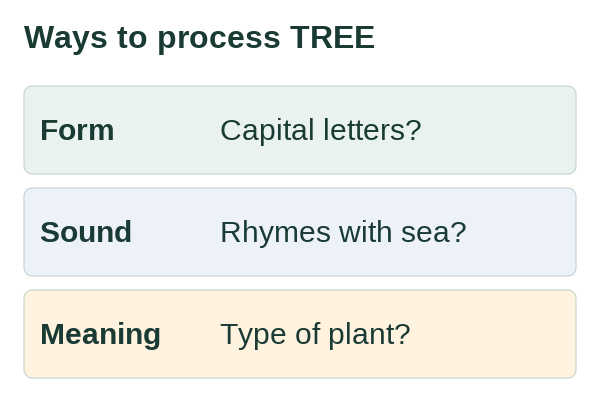
Levels of processing is a framework for memory research. Craik and Lockhart set it out in 1972.[8][9] Those analyses are pictured as a series of processing hierarchies. They run from a shallowest level to a deepest level. Perceptual processing is at the shallow end. Here a person notices the physical and sensory features of a stimulus. At the deep end sits semantic processing. This involves recognizing patterns and pulling out meaning.[9] Depth here means how much mental involvement goes into analyzing a stimulus.[1]
Evidence for the effect
The basic finding is simple. Words studied for their meaning are remembered better than words studied for their sound or their letters.[2][10] In a 1980 study, people judged pairs of words as same or different. They judged by spelling, by sound or by meaning. Spelling judgments led to poor memory on recognition tests. Sound judgments did better, and meaning judgments did better still.[10]
A 1994 brain imaging study asked 12 subjects to judge nouns on a screen. They judged them in two ways. One task was to detect the letter a. The other was to decide whether each noun was living or nonliving. Recognition memory was much better for nouns judged living or nonliving.[2]
A 2002 review of PET and fMRI studies found that frontal and medial-temporal regions respond more strongly with deeper processing, and that this activity predicts later memory performance. The review also found that some sensory regions are active again during recall. These regions were active during first perception.[11]
Electrical recordings taken during study show a similar pattern.[10][12] In the 1980 study, a late positive component of the ERP responded to the type of judgment. It appeared to measure recognition accuracy.[10]
A 1993 study recorded ERPs from nine subjects during a memory task. The task used meaning decisions and rhyming decisions. Words judged by meaning were more often recognized than words judged by rhyme. ERPs to words judged by meaning were more positive than ERPs to rhyming words. This was in the 400 to 800 millisecond range.[12]
A 1976 study varied how deeply spoken prose could be processed. It removed the semantic level of analysis, then the syntactic level. Immediate recall fell in steps. The steps followed the clause structure of the material.[13]
A 1981 study tested recall of connected text. It used three semantic and three orthographic interference conditions, plus a normal control. Recall was measured right away, at one week and at two weeks.[14]
Six experiments compared two kinds of question. Physical questions such as "Is this angular?" led to better free and cued recall of visual scenes. Semantic questions such as "Is this edible?" did worse. The same physical questions were repeated throughout a session. This removed the advantage for pictures. In some cases it turned that advantage into a disadvantage.[15]
An online study with 307 participants compared two kinds of judgment. Deep size judgments required knowing an object's real-life size. Shallow judgments were about the size shown. Memory was better after the deep judgments. The new tasks also reduced competing explanations.[16] Four experiments with 187 participants tested memory for object-color and fractal-color pairs. All four showed steady levels-of-processing effects for basic visual features in visual associative memory.[6]
One study looked at pianists. Deep instructions asked them to focus on aesthetic elements of an unfamiliar score. Shallow instructions asked for non-aesthetic elements. High elaboration meant four different examples of the focus. It favored cued recall of deeply processed music over shallowly processed music. Low elaboration meant one example of the focus. Under it, the effects did not differ.[17]
Two experiments compared words studied under deep instructions with words studied under shallow ones. The deeply studied words were recalled better on immediate tests and on delayed recall tests. The pattern held regardless of trial length.[18]
A 2024 set of three experiments asked whether deep processing also slows forgetting. Recognition accuracy was measured immediately. It was also measured at delays of 30 minutes, 2 hours and 24 hours. One experiment also used 6 hours. Across the three experiments, levels of processing had a large effect on immediate performance. It had a medium-to-large effect on delayed recognition. Level of processing and delay did not affect each other. The rate of forgetting did not differ much between deep and shallow processing.[5]
Deep processing can also cause memory errors. In a 2005 study, words appeared once or twice. Each was followed by a question about meaning, sound or spelling. At test, subjects judged how often each word had occurred. Deeper processing improved frequency judgments for words shown twice. It also made words shown only once seem repeated. The result suggests that remembering involves evaluation and inference, not simple retrieval.[19]
What changes the size of the effect
One study looked at three German adult age groups. Younger adults recalled a 500-word story better than older adults overall. In that study, people were told to remember on purpose. Their recall was significantly better than after the two deep processing tasks. Both deep tasks still led to better recall than the shallow task. The shallow task asked readers to focus on features not related to meaning.[20] Among old adults, age differences shrank only under one condition. Deep and active processing had to come with retrieval support, such as cues at recall.[21]
Words were tested at 18.00, 22.00, 02.00 and 06.00 hours. Total recall scores were the same at all these times. Words studied by their typographic features were recalled more easily at 02.00 than at 18.00. Words encoded by meaning were recalled less well at night than during the day. At 22.00 and 02.00, participants also recalled words from the end of the list better.[22]
The kind of word matters too. One study had two experiments. In both, words for living things were recalled more often than words for nonliving things. That advantage held in every processing condition. This included shallow and deep tasks and a survival scenario.[3]
Setting reprimands aside, Turkish-English bilinguals recalled taboo words best. Positive words came next. Negative words were not remembered better than neutral words. Apart from that, the emotion effects were similar in the two languages.[23]
People differ in how much they gain from deep processing. A cued recall task used rhyme and meaning judgments. Most participants showed a levels of processing effect. Its size varied a lot. Bigger effects went with better long-term memory. They also went with larger pupil responses during encoding, but not with working memory.[24]
Self-reference, judging whether a word describes oneself, produced higher retention than semantic processing in one study of vocabulary learning.[25][26] The study had 72 college students learning unfamiliar words. Self-reference gave significantly higher retention of definitions than semantic processing, which in turn beat rote learning.[25]
In one study, 86 high school students read a text with a map. Four conditions varied how deeply they processed text and map. None of the four conditions differed reliably on the recognition and recall tests. Some students had high reading ability. Those who got questions and cues to inspect the map recalled more information about the events in the text. A second study with 94 students found that drawing on the map helped. It helped only when reading ability was high.[27]
In web interaction, 24 participants did information-finding tasks on printed web pages. They worked under navigation or content orientations. The two tasks were very different. They differed in how they remembered locations and features of relevant and irrelevant elements.[7]
In e-learning, 90 high school students studied material at shallow, medium and deep levels of processing. They did this in two navigation layouts. Items processed deeply were remembered better. Both processing level and navigation design had significant main effects on memory performance.[28]
What this looks like when you study
In one classroom experiment, 16-year-old schoolchildren saw nouns and either found rhymes for them or sorted each word into a meaning category. Schoolchildren aged 16 years showed poorer incidental learning for nouns when the orienting task was finding rhymes than when it was assigning each word to a semantic category. The rhyming group also made significantly more phonemic errors on a recognition test. Those who assigned each word to a semantic category produced significantly more semantic confusions. A separate group was told to picture each noun, and their results looked like the meaning-sorting group.[29]
In a study of 88 intermediate learners of Spanish, students read a passage containing a difficult verb form, the imperfect subjunctive. Some learners thought aloud while reading, and depth of processing was measured with think-aloud protocols. Learners given the more explicit instruction produced more instances of processing, and deeper processing went with more accurate production of the target form. Deeper processing also went with better comprehension of the reading passage.[30]
In an online study with 307 participants, people judged pictures under deep and shallow encoding tasks. In the shallow size task, they compared an object's size with the displayed size of a reference object on the screen.[16]
In a study of 90 high school students learning online, researchers built lessons with shallow, medium and deep processing tasks. How strong the stored memory trace was depended on the mental processes each type of task required.[28]
Common misconceptions
The levels-of-processing framework assumes that deep processing leads to slower forgetting than shallow processing. But the slopes of forgetting for deep and shallow items did not differ significantly, so the rates of forgetting were independent of depth.[5]
Uses, criticisms and open questions
Many teachers discuss a difference between deep and surface knowledge. Learning scientists and psychologists have given much theoretical and empirical attention to a matching idea, levels of processing. In both research and practice, shallower processing is predicted and generally found to limit the knowledge learners gain. It also shortens how long new knowledge lasts. One proposal uses this levels view to study self-regulated learning. That is the process where learners survey task conditions, set goals, do the task and adapt for future tasks.[31]
A central criticism is that the framework is hard to test. A 1978 critique made this point. It still granted that the framework usefully directs attention to mental events and processes.[4]
A reply that year noted a split in the original formulation. Some statements could possibly be proven false. Others could not. The general idea is that a memory trace comes from cognitive and perceptual operations. That idea probably cannot be tested directly by experiment. Researchers could test one idea. Repeating analyses already done should not improve memory. They have tested it.[32]
A 2004 study tested levels effects on priming in implicit memory tasks. It asked whether these effects reflect deficits in lexical processing. The deficits would occur during shallow study tasks. In two experiments, placing the encoding question after the target word increased depth of processing in explicit memory tasks, which require conscious recollection. By contrast, the position of the question had no such effect. This was true for the priming seen in implicit memory tasks.[33]
One is how to define the levels idea so it can be measured in studies of self-regulated learning.[31] Watkins (2002) argued that the idea is best seen as a functional heuristic. It is purely psychological.[34] A third is how word-level processing adds to levels effects on implicit tests.[33]
Where the idea came from
The psychology of thought and memory had long been split between associationism and its opponents. George Mandler described this in a 2002 analysis. Organisation theory grew partly out of Gestalt ideas. It was the most successful and outspoken of those opponents. Mandler placed the levels-of-processing framework within that effort. The effort aimed to overcome associationist habits of thought.[35]
Mandler then analysed the levels approach in terms of organisational concepts. He asked what the levels are levels of.[35] Craik and Lockhart also compared their ideas with earlier work by the Soviet psychologist P. I. Zinchenko, in a 2008 article. That article reports many similarities between the two sets of ideas. Meshcheryakov had pointed this out. It also notes differences. Craik and Lockhart wrote that memory studies would benefit from closer integration of ideas from activity theory and from the Western tradition.[36]
How the brain carries out deep encoding
A 2014 review gathered neuroimaging findings. It covered the brain activity that goes with deep and shallow encoding of items. It also gathered evidence from drugs and brain stimulation. The review noted that researchers still do not fully know why items encoded for meaning are remembered better. It also reported that deep encoding can be changed by acting on specific brain regions or systems. That result points toward ways to boost episodic encoding selectively, the review suggested.[37]
In one imaging study, participants made a deep or shallow decision about one word. They then tried to recall it after a delay. The delay was filled either with repeating the word or with a distracting math task. Recalling the word after 10 sec of distraction showed signs of retrieval from long-term memory. The signs were behavioral and neural. They included depth effects and activity in the medial temporal lobe. Some regions showed a depth effect at encoding. These included the left ventrolateral prefrontal cortex and the anterior temporal lobes. They became active again at recall, especially after distraction. Three brain areas predicted recall success after distraction.[38]
A 2007 review of visual masking examined a brief image hidden by a following one. It found that a masked word or digit can influence processing. This holds at perceptual, lexical and semantic levels. Imaging directly shows the brain activation such a hidden stimulus produces. The activation appears in several cortical areas. That activation is often weaker than under conscious viewing. But there are enough exceptions to show that strong activation alone does not guarantee conscious access. The review argued that consciousness needs both a strong enough input and top-down attention.[39]
A 2024 study tested children aged 5 to 12 and adults. The tasks were color discrimination and number magnitude discrimination. Masking delays ran from 16.7 to 266.7 ms. The threshold for objective discrimination was much higher in 5 to 6 year-olds. It was lower in 7 to 12 year-olds. The threshold for subjective awareness was not. The shift into awareness was more gradual for the number task than for the color task. The results supported the level of processing hypothesis. They also suggested its effects may differ across stages of development.[40]
Depth in classrooms and language learning
Vocabulary research often assumes one thing. Processing a word's meaning helps learners remember it. It cites experiments by Craik and Tulving on English nouns. The gap suggests that preexisting knowledge representations limit how much a learner gains from semantic processing of words.[41]
A 2019 review looked at 25 brain-imaging studies. It found that depth was tested with tightly controlled, simplified language items stripped of context. In half of the cases no theoretical framework was named. The study gave no clear definition of levels of processing.[42]
Entwistle and Waterston (1988) compared dimensions from two inventories, one built on concepts from cognitive psychology and one from educational research. A 1988 study gave shortened versions of two questionnaires to 218 mainly first-year university students. One questionnaire came from cognitive psychology and the other from educational research. Correlations between the subscales, and factor analyses of them, showed substantial agreement between the main concepts the two traditions use to describe study strategies.[43]
Adrada-Rafael (2017) examined how deeply 88 intermediate learners of second-language Spanish processed a grammar form, the imperfect subjunctive, while reading. Thinking aloud did not alter performance, so the researchers combined the silent and think-aloud versions into three conditions that varied in how explicit the instruction was. Learners took interpretation, controlled-production and comprehension tests before instruction, after it, and again after a delay, with 2 weeks between tests. The condition with the most explicit instruction yielded the greatest number of processing instances.[30]
Depth and memory errors
A 2015 study tested three things. They were the level of processing at encoding, the strength of misleading information and a warning at retrieval. The study asked how each affected suggestibility. The level of processing was an important factor in how suggestible people's memories became. Intentional processing at encoding produced more suggestibility than automatic processing did. A warning at retrieval made people more open to misleading pictures. It also raised accuracy for pictures that were not misleading. The study concluded that suggestibility comes from both automatic and intentional processing.[44]
A 1974 experiment compared four activities during the presentation of 5-item lists. The activities were silent rehearsal and overt rehearsal. They also included making rhymes and making verbal associates. The two rehearsal conditions were clearly better in immediate free recall. In final delayed recall, however, those same rehearsal conditions did worse than the lists for which associates had been generated. The negative recency effect is weaker recall of the last items after a delay. It seemed to follow from processing strategies that maximize recency in immediate recall.[45]
A 1988 double-blind study gave 45 healthy volunteers one of three treatments. Two were benzodiazepines: lorazepam at 1 or 2 mg or oxazepam at 15 or 30 mg. The third was a placebo. Some volunteers were given the drugs. They processed semantic information more slowly than those given placebo. The drugs weakened memory on recognition tests, and more drug meant more harm. But the size of the impairment did not change with how deeply the material was first processed. Curran and colleagues concluded that the levels of processing framework does not suit the amnesic effects of benzodiazepines.[46]
How orienting tasks set depth
In one study, each trial began with a decision word. Subjects made either a semantic or a non-semantic orienting decision about it. After the decision came a word in coloured ink, which subjects named as quickly as they could. Colour naming took longer on associate trials in the semantic condition. The non-semantic condition showed no such gap. Incidental recall, the recall of words that were not studied for a later test, was also higher after the semantic condition.[47]
One experiment tested how far cue overload, as described by Watkins and Watkins (1975, 1976), followed from semantically similar or dissimilar material placed between study and test. Semantically similar material led to increased cue overload only if that material was itself processed semantically. When the same kinds of material were processed non-semantically, the conditions did not differ. These results support the view that different types of orienting task produce qualitative differences in the nature of processing itself.[48]
The experimenters controlled environmental conditions, the age of the target population and the educational background of the participants. The experiment used a single-blind technique to reduce practice effects and fatigue effects. Semantic encoding led to greater retention and a deeper memory trace, whereas structural encoding led to shallow processing of memory. A Mann-Whitney U test, a statistical test for comparing two groups, separated the deep and shallow conditions by number of words recalled. The study also raised limitations. These were generalizations, rehearsal and ecological validity.[49]
In the first, children had to find rhymes for the items. In the second, children had to assign each word to a semantic category. Other children were instructed to construct an image for each noun. The children who found rhymes showed poorer incidental learning of the nouns than the children who sorted the words into categories. The image group performed in a pattern similar to the categorizing group.[29]
A recognition task followed, and it included homophone and synonym foils. Children in the categorizing condition produced a significantly greater number of semantic confusions. Davies and Cubbage read these results through Herriot's 1974 view that different levels of processing are tied to the coding of different clusters of stimulus attributes.[29]
Depth in reading and spoken language
Spoken word recognition has been described as having two levels of representation and process. One is the lexical level, concerned with whole words. The other is the sublexical level, concerned with word parts such as sound sequences. It varied two things. One was probabilistic phonotactics, the likelihood that certain sound sequences occur in a language. The other was similarity-neighborhood density, the number of words that sound alike. Higher phonotactic probability has been linked to faster recognition. Greater neighborhood density usually slows recognition, because similar words compete. With real words, the competing effect of neighborhood density appeared. With nonsense words, which removed strong word effects, the helpful effect of phonotactics emerged. The results fit a two-level framework of process and representation. Some models of spoken word recognition use this framework.[50]
Some studies looked at ambiguous pronouns, which can refer to more than one earlier noun. These studies had produced contradictory results. Some work found that ambiguity slowed processing. Other work found an ambiguity advantage, a benefit for ambiguous sentences. A 2022 study asked about the source of the disagreement. Did it come from how deeply participants processed the sentences? Dutch sentences were read word by word at the reader's own pace. Each embedded clause held a personal pronoun that was either ambiguous or made clear by gender features. Under deep processing, ambiguous sentences took significantly longer to read than unambiguous ones; under shallow processing, this ambiguity penalty did not appear. No significant ambiguity advantage appeared at either depth. The earlier finding was repeated with a different method and a larger sample. The study concluded that resolving ambiguous pronouns is flexible. It depends on how deeply the relevant information is processed.[51]
Limits and later criticisms
Craik (2002) listed the measurement of depth in the levels of processing framework among the issues he discussed. Craik also asked whether memory can be regarded as pure processing. He questioned the reality of levels of processing. The role of short-term memory within the framework, encoding-retrieval interactions and the concept of consolidation were further points he raised.[52]
A 2003 fMRI study included 9 men with schizophrenia and 9 male control subjects. They judged whether words were abstract or concrete, or judged the font size of words. Both groups showed the expected depth effect. They remembered semantically encoded words better than perceptually encoded ones. Control subjects showed increased activation of the left inferior prefrontal cortex under semantic encoding, but the patients showed similar activation patterns regardless of condition. Patients also failed to show the repetition priming effect. This held in behavior and as a decrease in that prefrontal activity.[53]
In a 1979 study, a letter was flashed below awareness to one hemisphere, left or right. The flash lasted 15 or 30 msec. Guesses about visuo-spatial position were more accurate for right-hemisphere presentations. Verbal recognition was more accurate for left-hemisphere presentations. The 30-msec exposure raised the accuracy of the guesses. The findings were discussed in terms of levels of hemispheric processing.[54]
Key studies
| Year | Study | Sample | Design | Finding |
|---|---|---|---|---|
| 1976 | Davies & Cubbage[29] | schoolchildren aged 16 years | incidental learning with orienting tasks and a recognition test | Children who found rhymes for the nouns showed poorer incidental learning than children who assigned each word to a semantic category, and the rhyming group made significantly more phonemic errors. |
| 1980 | Sanquist et al.[10] | participants in a verbal comparison task with ERP recording | event-related potential study of orthographic, phonemic and semantic judgments | Orthographic processing led to poor recognition, while phonemic and semantic processing led to increasingly better performance. |
| 1984 | Dixon & von Eye[20] | three German adult age groups compared with an earlier American sample | text recall study with four orienting conditions | Recall in the intentional condition was significantly better than recall in either deep processing condition. Both deep conditions in turn produced better recall than the shallow condition. |
| 1985 | Intraub & Nicklos[15] | six experiments | physical versus semantic orienting questions on pictures at durations from 125 to 2,000 ms | Physical questions were associated with better free and cued recall of visual scenes, a physical superiority effect that disappeared when the same physical questions were repeated. |
| 1994 | Kapur et al.[2] | 12 subjects | PET scan study with two encoding tasks | Recognition was substantially better for nouns in the living/nonliving task than in the letter-a task, with significant activation in the left inferior prefrontal cortex. |
| 1998 | Scevak & Moore[27] | 86 high school students in Study 1 and 94 in Study 2 | text with a geographical map under varied processing conditions | Study 1 found no significant differences among conditions, while Study 2 found that drawing on the map helped only students with high reading ability. |
| 2001 | Segalowitz et al.[17] | pianists with performing experience | musical recall study with deep or shallow focus and high or low elaboration | High elaboration favored cued recall of deeply processed music, while low elaboration showed no difference between deep and shallow processing. |
| 2009 | AYÇIÇEGI-DINN & CALDWELL-HARRIS[23] | Turkish-English bilinguals | deep and shallow tasks on five word categories, then surprise recall | Taboo words had the highest recall, followed by positive words, and negative words had no recall advantage over neutral words. |
| 2012 | BIRD[41] | replication of Craik and Tulving Experiment 5 | Depth effects appeared for all participants, but speakers of English as a second language gained less from semantic encoding than first-language speakers of English did. | |
| 2014 | Dikbas Torun & Altun[28] | 90 high school students | e-learning experiment with shallow, medium and deep tasks and two navigation designs | Deeply processed elements were remembered better, and both levels of processing and navigation design had significant main effects on memory. |
| 2017 | ADRADA-RAFAEL[30] | 88 intermediate learners of second language Spanish | think-aloud reading study with pre-, post- and delayed tests | The more explicit condition yielded more instances of processing, and deeper processing went with more accurate production of the target form and better comprehension of the reading passage. |
| 2024 | Peng et al.[5] | recognition experiments with deep and shallow encoding and delays up to 24 hours | Deep encoding gave a large immediate advantage (d prime 2.61 vs 2.10) and a medium-to-large delayed advantage, but the forgetting slopes did not differ. | |
| 2024 | Unsworth & Miller[24] | participants completing cued recall with pupillary recording | individual-differences study with rhyme and semantic judgments | Deep processing gave higher accuracy and larger pupillary responses, and most participants showed the effect but its size varied substantially. |
| 2025 | Dubravac et al.[16] | 307 online participants | online experiment with novel size-judgment tasks for pictures | Memory was better after deep encoding (pleasantness judgment, real-life size judgment) than after shallow encoding (line judgment, displayed size judgment). |
See also
References
- Gardiner, J. M. (1974). Levels of processing in word recognition and subsequent free recall. Journal of Experimental Psychology, 102(1), 101-105. doi:10.1037/h0035694
- Kapur, S., Craik, F. I., Tulving, E., Wilson, A. A., Houle, S., & Brown, G. M. (1994). Neuroanatomical correlates of encoding in episodic memory: levels of processing effect. Proceedings of the National Academy of Sciences, 91(6), 2008-2011. doi:10.1073/pnas.91.6.2008
- Leding, J. K. (2018). The Animacy Advantage in Memory: Manipulations of Levels of Processing and Survival Processing. The American Journal of Psychology, 131(3), 273-281. doi:10.5406/amerjpsyc.131.3.0273
- Eysenck, M. W. (1978). Levels of processing: A critique. British Journal of Psychology, 69(2), 157-169. doi:10.1111/j.2044-8295.1978.tb01643.x
- Peng, N., Logie, R. H., & Della Sala, S. (2024). Effect of levels-of-processing on rates of forgetting. Memory & Cognition. doi:10.3758/s13421-024-01599-4
- Ovalle-Fresa, R., Uslu, A. S., & Rothen, N. (2021). Levels of Processing Affect Perceptual Features in Visual Associative Memory. Psychological Science, 32(2), 267-279. doi:10.1177/0956797620965519
- Oulasvirta, A. (2004). Task demands and memory in web interaction: a levels of processing approach. Interacting with Computers, 16(2), 217-241. doi:10.1016/j.intcom.2003.12.004
- Lockhart, R. S., & Craik, F. I. M. (1990). Levels of processing: A retrospective commentary on a framework for memory research. Canadian Journal of Psychology / Revue canadienne de psychologie, 44(1), 87-112. doi:10.1037/h0084237
- Ekuni, R., Vaz, L. J., & Bueno, O. F. A. (2011). Levels of processing: The evolution of a framework. Psychology & Neuroscience, 4(3), 333-339. doi:10.3922/j.psns.2011.3.006
- Sanquist, T. F., Rohrbaugh, J. W., Syndulko, K., & Lindsley, D. B. (1980). Electrocortical Signs of Levels of Processing: Perceptual Analysis and Recognition Memory. Psychophysiology, 17(6), 568-576. doi:10.1111/j.1469-8986.1980.tb02299.x
- Nyberg, L. (2002). Levels of processing: A view from functional brain imaging. Memory, 10(5-6), 345-348. doi:10.1080/09658210244000171
- Ferlazzo, F., Conte, S., & Gentilomo, A. (1993). Event-related potentials and recognition memory within the ‘levels of processing' framework: . NeuroReport, 4(6), 667-670. doi:10.1097/00001756-199306000-00016
- Marslen-Wilson, W., & Tyler, L. K. (1976). Memory and levels of processing in a psycholinguistic context. Journal of Experimental Psychology: Human Learning & Memory, 2(2), 112-119. doi:10.1037//0278-7393.2.2.112
- Burton, J. K., Niles, J. A., & Wildman, T. M. (1981). Levels of Processing Effects on the Immediate and Delayed Recall of Prose. Journal of Reading Behavior, 13(2), 157-164. doi:10.1080/10862968109547403
- Intraub, H., & Nicklos, S. (1985). Levels of processing and picture memory: The physical superiority effect. Journal of Experimental Psychology: Learning, Memory, and Cognition, 11(2), 284-298. doi:10.1037/0278-7393.11.2.284
- Dubravac, M., Sachdeva, C., & Rothen, N. (2025). Levels of Processing Effects on Memory for Color-Object Associations. Journal of Cognition, 8(1), 25. doi:10.5334/joc.437
- Segalowitz, N., Cohen, P., Chan, A., & Prieur, T. (2001). Musical Recall Memory: Contributions of Elaboration and Depth of Processing. Psychology of Music, 29(2), 139-148. doi:10.1177/0305735601292004
- Loaiza, V. M., McCabe, D. P., Youngblood, J. L., Rose, N. S., & Myerson, J. (2011). The influence of levels of processing on recall from working memory and delayed recall tasks. Journal of Experimental Psychology: Learning, Memory, and Cognition, 37(5), 1258-1263. doi:10.1037/a0023923
- Kronlund, A., & Whittlesea, B. W. A. (2005). Seeing double: Levels of processing can cause false memory. Canadian Journal of Experimental Psychology / Revue canadienne de psychologie expérimentale, 59(1), 11-16. doi:10.1037/h0087454
- Dixon, R. A., & von Eye, A. (1984). Depth of Processing and Text Recall in Adulthood. Journal of Reading Behavior, 16(2), 109-117. doi:10.1080/10862968409547508
- Sauzeon, Bernard N'Kaoua, Veronique, H. (2000). Age Effect in Recall Performance According to the Levels of Processing, Elaboration, and Retrieval Cues. Experimental Aging Research, 26(1), 57-73. doi:10.1080/036107300243687
- Maury, P., & Queinnec, Y. (1992). Influence of time of 24‐hour day on depth of processing in recall memory. British Journal of Psychology, 83(2), 249-260. doi:10.1111/j.2044-8295.1992.tb02439.x
- AYÇIÇEGI-DINN, A., & CALDWELL-HARRIS, C. L. (2009). Emotion-memory effects in bilingual speakers: A levels-of-processing approach. Bilingualism: Language and Cognition, 12(3), 291-303. doi:10.1017/s1366728909990125
- Unsworth, N., & Miller, A. L. (2024). An examination of individual differences in levels of processing. Memory, 32(5), 615-626. doi:10.1080/09658211.2024.2355309
- Flannagan, D. A., & Blick, K. A. (1989). Levels of Processing and the Retention of Word Meanings. Perceptual and Motor Skills, 68(3_suppl), 1123-1128. doi:10.2466/pms.1989.68.3c.1123
- Vochatzer, K. G., & Blick, K. A. (1989). Levels of Processing and the Retention of Paired-Associates. Perceptual and Motor Skills, 69(1), 349-350. doi:10.2466/pms.1989.69.1.349
- Scevak, J. J., & Moore, P. J. (1998). Levels of Processing Effects on Learning from Texts with Maps. Educational Psychology, 18(2), 133-155. doi:10.1080/0144341980180201
- Dikbas Torun, E., & Altun, A. (2014). The effect of levels of processing with navigation design types on recall and retention in e-learning environments. Behaviour & Information Technology, 33(10), 1039-1047. doi:10.1080/0144929x.2014.945963
- Davies, G., & Cubbage, A. (1976). Attribute Coding at Different Levels of Processing. Quarterly Journal of Experimental Psychology, 28(4), 653-660. doi:10.1080/14640747608400591
- ADRADA-RAFAEL, S. (2017). Processing the Spanish imperfect subjunctive: Depth of processing under different instructional conditions. Applied Psycholinguistics, 38(2), 477-508. doi:10.1017/s0142716416000308
- Winne, P. H. (2018). Theorizing and researching levels of processing in self‐regulated learning. British Journal of Educational Psychology, 88(1), 9-20. doi:10.1111/bjep.12173
- Eysenck, M. W. (1978). Levels of processing: A reply to Lockhart and Craik. British Journal of Psychology, 69(2), 177-178. doi:10.1111/j.2044-8295.1978.tb01645.x
- Newell, B. R., & Andrews, S. (2004). Levels of Processing Effects on Implicit and Explicit Memory Tasks: Using Question Position to Investigate the Lexical-Processing Hypothesis. Experimental Psychology, 51(2), 132-144. doi:10.1027/1618-3169.51.2.132
- Watkins, M. J. (2002). Limits and province of levels of processing: Considerations of a construct. Memory, 10(5-6), 339-343. doi:10.1080/09658210244000162
- Mandler, G. (2002). Organisation: What levels of processing are levels of. Memory, 10(5-6), 333-338. doi:10.1080/09658210244000153
- Craik, F. I. M., & Lockhart, R. S. (2008). Levels of Processing and Zinchenko's Approach to Memory Research. Journal of Russian & East European Psychology, 46(6), 52-60. doi:10.2753/rpo1061-0405460605
- Galli, G. (2014). What Makes Deeply Encoded Items Memorable? Insights into the Levels of Processing Framework from Neuroimaging and Neuromodulation. Frontiers in Psychiatry, 5. doi:10.3389/fpsyt.2014.00061
- Rose, N. S., Craik, F. I. M., & Buchsbaum, B. R. (2015). Levels of Processing in Working Memory: Differential Involvement of Frontotemporal Networks. Journal of Cognitive Neuroscience, 27(3), 522-532. doi:10.1162/jocn_a_00738
- Kouider, S., & Dehaene, S. (2007). Levels of processing during non-conscious perception: a critical review of visual masking. Philosophical Transactions of the Royal Society B: Biological Sciences, 362(1481), 857-875. doi:10.1098/rstb.2007.2093
- Watanabe, R., & Moriguchi, Y. (2024). Development of emergent processes and threshold of consciousness with levels of processing. Frontiers in Psychology, 15. doi:10.3389/fpsyg.2024.1337589
- BIRD, S. (2012). Expert knowledge, distinctiveness, and levels of processing in language learning. Applied Psycholinguistics, 33(4), 665-689. doi:10.1017/s014271641100052x
- Catrysse, L., Gijbels, D., & Donche, V. (2019). A Systematic Review on the Conceptualization and Operationalization of Students' Levels of Processing in Functional Magnetic Resonance Imaging Studies. Mind, Brain, and Education, 13(3), 198-210. doi:10.1111/mbe.12199
- ENTWISTLE, N., & WATERSTON, S. (1988). Approaches to studying and levels of processing in university students. British Journal of Educational Psychology, 58(3), 258-265. doi:10.1111/j.2044-8279.1988.tb00901.x
- Cao, X. J., Tu, S., & Chen, X. (2015). Influences of Levels of Processing, Misleading Intensity and Warnings on Memory Suggestibility. Psychology, 06(06), 708-717. doi:10.4236/psych.2015.66069
- Mazuryk, G. F., & Lockhart, R. S. (1974). Negative recency and levels of processing in free recall. Canadian Journal of Psychology / Revue canadienne de psychologie, 28(1), 114-123. doi:10.1037/h0081971
- Curran, H. V., Schiwy, W., Eves, F., Shine, P., & Lader, M. (1988). A ‘levels of processing’ study of the effects of benzodiazepines on human memory. Human Psychopharmacology: Clinical and Experimental, 3(1), 21-25. doi:10.1002/hup.470030105
- Parkin, A. J. (1979). Specifying Levels of Processing. Quarterly Journal of Experimental Psychology, 31(2), 175-195. doi:10.1080/14640747908400718
- Parkin, A. J. (1980). Levels of Processing and the Cue Overload Principle*. Quarterly Journal of Experimental Psychology, 32(3), 427-434. doi:10.1080/14640748008401836
- Dipal Patel, Dr. Mehul Jadav, & Fr. Sanil Mathew SJ (2015). Levels of Processing. International Journal of Indian Psychology, 2(3). doi:10.25215/0203.030
- Vitevitch, M. S., & Luce, P. A. (1998). When Words Compete: Levels of Processing in Perception of Spoken Words. Psychological Science, 9(4), 325-329. doi:10.1111/1467-9280.00064
- Creemers, A., & Meyer, A. S. (2022). The processing of ambiguous pronominal reference is sensitive to depth of processing. Glossa Psycholinguistics, 1(1). doi:10.5070/g601166
- Craik, F. I. M. (2002). Levels of processing: Past, present... and future? Memory, 10(5-6), 305-318. doi:10.1080/09658210244000135
- Kubicki, M. (2003). An fMRI study of semantic processing in men with schizophrenia. NeuroImage, 20(4), 1923-1933. doi:10.1016/s1053-8119(03)00383-5
- Charman, D. K. (1979). An Examination of Relationship between Subliminal Perception, Visual Information Processing, Levels of Processing, and Hemispheric Asymmetries. Perceptual and Motor Skills, 49(2), 451-455. doi:10.2466/pms.1979.49.2.451
Cite this page: Atlas Nova editors. (2026). Levels of processing. Atlas Nova. https://velocer.io/atlas/levels-of-processing/