Research finding · Memory
Serial position effect
Memory recall phenomenon
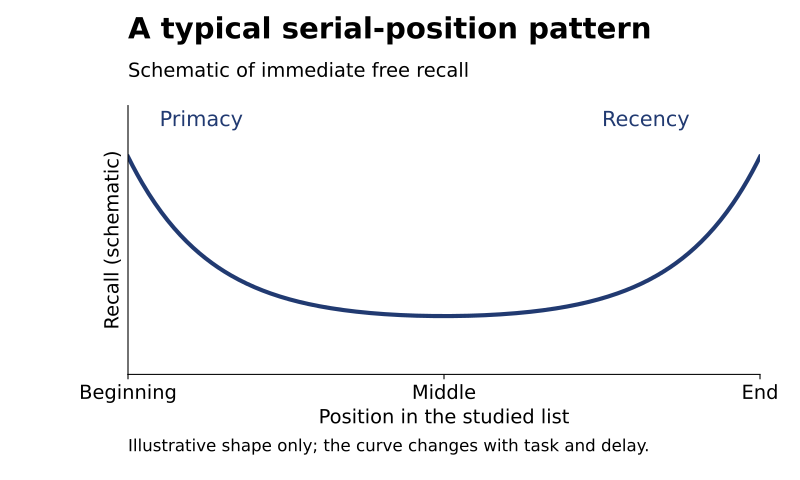
The serial position effect is the finding that items at the start and at the end of a list are remembered better than items in the middle.[1]
In free recall, the first three or four words are recalled well, and the last eight words are recalled well.[2] In a study of 2,677 television commercials, primacy and recency had only modest effect sizes.[3] In a study of 88 students, a recency effect in attitude change appeared when attention was maintained.[4]
Overview
What the serial position effect is
The basic curve consistently emerges. Experiments have changed its slope and its symmetry. It still appears. In one study, 25 graduate students heard a 20-minute audio-taped lecture. It held 30 evenly spaced items, and they were tested with multiple-choice questions. Scores for the first, middle and final parts of the lecture averaged 6.68, 5.16 and 5.72 items out of 10. A statistical test found this serial effect significant. It favored initial and final items over middle items.[6]
History
Where the idea came from
Lists held 5, 10 or 20 items, and each subject took part in only one experiment per day. Learning speed turned out to be independent of position in the list. Statistical tests also showed that learning speed did not depend on item difficulty. It did not depend on list length or the kind of material either. The initial learning probability formed a U-shaped curve across list positions.[7]
Proactive and retroactive inhibition stayed the same across all the experiments for each subject. It fell as the list grew longer. The amount of immediate memory did not depend on list length. It fell as items became harder. The amount of immediate memory was plotted against the number of digits. The plot used a logarithmic scale. The result was a straight line. With those relations, the model was extended to cover every case. That ran from 2 to 6 digits per item and 5 to 20 items per list.[7]
In 1968, Brewer and King extended a cognitive probability model to more cases. They used the serial position effect to explain decay in the chance of recall.[8] In 1975, Kaplan presented lists of 5 to 10 digits spoken at 2 digits per second to 10 subjects. The last digit in each list had also appeared earlier. Subjects wrote down the digit that followed its earlier occurrence. A single principle tied the three together. It described how each item's chance of recall changed. The change depended on how many items came before and after it.[9]
Main ideas
What changes the shape of the curve
A 1983 review reported that the last few items of a spoken sequence are recalled better. The same items written down are recalled less well. That auditory advantage also appeared in long-term memory and when items were lip-read or signed, so it cannot rest on echoic memory alone, the brief sensory trace of sound.[10] A 1993 set of six experiments found that familiarity and discriminability (how easy items are to tell apart) raised overall recall greatly but never significantly increased recency on their own. What mattered was whether the items were undegraded speech sounds.[11]
Overall, people recalled fewer words in the writing condition. The same pattern held at serial positions 1 to 3. At position 4, the three conditions did not differ. At positions 5 and 6, listening and writing both beat reading. The researchers concluded that writing interferes with working memory. It is not advised when the aim is to recall information immediately.[12]
The type of material matters. In a 2009 study, people recalled the order of odours, unfamiliar faces and pure tones. Odours showed no serial position effects. Faces showed both primacy and recency.[13]
A 2010 study used lists of 4 items with children aged 5 to 6 years. These children showed phonologically coded storage (storage by sound) at all 4 positions. They showed semantically coded storage (storage by meaning) only at positions 1 and 2. A group of people with Down syndrome showed no semantic coding. They showed phonological coding only at position 4. This suggests a verbal short-term memory capacity of 1 item.[14]
A 2010 study used picture, word and spatial sequences. It varied stimulus content, spatial information, grouping and the number of distractors. Even so, a large primacy advantage appeared in every case. A small 1-item recency advantage did the same.[15]
Age changes the curve. In a 1998 study, 40 young and 30 elderly people remembered faces, and a second experiment tested non-verbal shapes with 30 new people in each age group. Young participants showed a U-shaped curve for both kinds of stimuli.[16]
Memory was tested with word lists of 15 words each. Some people showed the sympathetic marker in response. In them, the recency effect increased right after the stressor. This did not happen in non-responders. In cortisol responders, the primacy effect fell 20 minutes after the stressor. People whose cortisol did not rise showed no change.[17]
Noise and lighting have been tested less often. A small 2021 study tested adults with normal hearing. They heard lists of seven sentences in quiet or in four-talker babble, a mixture of several voices. The primacy effect still appeared with noise interference. Reading span scores measure verbal working memory. People with higher scores recalled significantly more than those with lower scores. This held in both the quiet and babble conditions.[18]
A 2019 study had 21 adults memorize a 20-item list of nonsense spellings. They worked under bright light of 1,000 lx or dim light of 300 lx. Retention was tested 24 hours later. In the dim condition, memory for primacy, middle and recency items differed significantly (F = 4.16, p = .02).[19]
Research
How large the effect is
In the picture study, extra written words came before the pictures. This lowered recall at positions 1 to 4. This was compared with a control condition.[20]
People also acted out the actions named in the phrases. Then the primacy effect disappeared and the recency effect grew longer. Under that task, the classical U-shaped curve lost its primacy effect. It gained a stronger recency effect.[21]
How the curve is measured
In Murdock's 1962 data, the curve has three parts. A steep primacy effect means better recall of early items. It extends over the first 3 or 4 words, and its rise may be exponential. An S-shaped recency effect, meaning better recall of late items, extends over the last 8 words.[2]
A study of 4140 respondents found a pattern. People recalled the most items from 5-item tests and the fewest from 9-item tests. The same study found a significant difference in how many items people recalled. More respondents recalled items from the beginning than items from the end. Primacy was higher than recency regardless of list length, whether the test held 5, 7, or 9 items.[22]
People recall several lists in a row. The first items tend to be reported first on the opening list. On later lists, the last items take over and are reported first. That shift was stable. It held even under list conditions designed to counteract ordinary position effects.[23]
The curves for items 14 and 15 fell steadily. People with higher measured ability were less likely to recall those words. Dropping those four items gave a better fit. Ignoring a word's position can lower the validity of a list recall test as a measure of memory for events.[5]
A serial position curve is a graph of how often each item in a list is remembered, plotted by the item's place in the list.[24] In one set of experiments, the curve looked different in two cases. People either recalled a whole list in order or were probed for a single item.[25]
In free recall, a person hears or sees a list and then writes or says as many items as possible, in any order. A study of 40 adults used this method with two word lists. One was spoken in a disordered voice and one in a normal voice. The normal voice list produced a u-shaped curve. It showed a significant primacy effect: better memory for the start of the list than the middle.[24]
In serial recall people reproduce a whole list, while in probed recall they are asked about a single item. Avons, Wright and Pammer (1994) found the word-length effect much smaller in probed than in serial recall. The serial position curves suggested a recency component was operating in probed recall. A second experiment confirmed a recency effect in probed recall. This effect was insensitive to word length and resisted an auditory suffix. The small recency effect in serial recall was different. There was visual presentation and no concurrent articulation. There was no recency effect for either recall method.[25]
Heim and Rein (1977) tested the serial position effect using a serial anticipation procedure, in which items are presented one at a time in a fixed order for learning. That result led to a conclusion. The serial position effect should not be analysed in terms of those two error types.[26]
Running memory span is another method: long digit sequences arrive at a rate of 2 per second, and the person recalls a specified number of items from the end. Five experiments used this method. Some lists were exactly as long as the specified recall series. These critical lists showed marked primacy effects and a rebound effect. Rebound means poorer recall of terminal items than at baseline. The rebound effect occurred even when recall of earlier items was not required.[27]
Fific (2002) used a probe-recognition task. The curve was scored from both mean response times and errors. The probe-recognition task ran over six blocks. A serial position effect appeared in every block. Both primacy and recency effects were found. Primacy was located in the first two blocks, giving a non-linear serial position effect. The function became linear from the third block on. The pattern of errors closely matched the pattern of reaction times.[28]
Macrae (1969) set out a scheme for judging serial position effects and sequential dependencies. It applied when the same people received each treatment more than once. A published scheme evaluates serial position and sequential dependencies in repeated measures designs. In these designs, a person may receive a treatment more than once. It concludes that such plans should be used where the situation permits. These effects are of interest in their own right, and the extra experimenter time is often small.[29]
Heim and Rein (1977) scored errors as intra-list intrusions and failures to respond. They found that these two types departed from their usual distributions. A free-recall test of an original serial anticipation list, given after a number-syllable paired association task, showed a symmetrical trend, while transfer-to-position measured by that task was skewed.[26]
Small changes to the usual serial anticipation procedure did not remove the serial position effect. One was intra-list intrusions, items from the list given in the wrong place. The other was failures to respond.[26]
What happens when the test is delayed
The recency advantage, meaning the better recall of the last few items in a list, depends on what happens right after the list ends. The recency effect is weakened when a period of distracting activity follows the final item.[30] In one comparison, recency effects for free recall disappeared. This happened when a delay was inserted before the test.[31]
Delaying a recognition test also lowered performance on the final item. This was found in Kerr, Avons and Ward's experiments, with 4 novel items per series. That drop held whether the gaps between items were kept constant or varied.[32]
The recency advantage can return in one case. Every item, not just the last one, is followed by a distracting task.[30] Long-term recency was largely reduced in one case. Participants recalled words from the early part of the list before the rest.[33]
A final cumulative test, which asks for recall of a whole series of lists at the end, can reverse the usual pattern at the end of the curve. One experiment found no negative recency effect. This held for both pictures of objects and their names. That result supports the suggestion that negative recency comes from failing to use mental imagery as a memory code for the final list positions. Visual presentation is thought to encourage imagery use throughout a list.[34] Martin and Jones proposed a change to a widely used technique for measuring primary memory. The change takes account of negative recency in delayed recall.[35]
In 3 experiments, participants received words at the slow rate of one word every hour. They recalled them later. Free recall showed weak serial position effects. The recency effect was very limited. Serial recall showed clear primacy effects. Recency did appear in a final two-alternative forced choice recognition task. Cortis Mack and colleagues did not find steady support for strong long-term recency effects. This held when the experimenters controlled the stimuli.[36]
The curve in memory disorders and animals
Patients with Alzheimer's disease consistently show an exaggerated recency effect. They recall a disproportionate share of the last-presented items. A 2008 study gave the Rey Auditory Verbal Learning Test to 623 middle-aged children of Alzheimer's patients and 157 controls. The test is a list of 15 unrelated nouns.[37]
A 2024 study had 20 bilingual participants who later received an Alzheimer's diagnosis. They showed reduced primacy scores. Their recency scores matched those of 37 stable controls.[38]
Nineteen people with mild vascular dementia kept both a primacy and a recency effect. The test was the California Verbal Learning Test. Seventeen people with moderate vascular dementia showed neither effect. The researchers suggested a possible cause. Losing both ends of the curve may occur in advanced dementia of any type.[39]
After mild closed-head injury, the curve can look different in another way. The patients also had poorer total recall than controls. That poorer recall did not depend on how long before testing the injury occurred.[40] In temporal lobe epilepsy, 20 chronic patients did worst on the recency portion of the curve, which the researchers had not expected. Evidence from a further 30 cases suggested the patients had spent their rehearsal on earlier items. They lost later ones as a result.[41]
Animal studies link the curve to specific brain structures. Normal rats ran an eight-arm radial maze. They remembered both the first and last arms of an eight-item list well. Rats with damage to the dorsal hippocampus, a brain region important for memory, lost the primacy component but kept the recency component. A 10-minute delay before the test impaired all components of the curve.[42]
Pigeons can remember the order of two keys they just pecked. The memory lasts more than 4 seconds.[43] Seven monkeys did short-term memory tasks. They responded best when a test image matched the most recently presented one. Their response rates depended linearly on how recently an image had appeared, even for images they were meant to ignore.[44]
In practice
The effect in classrooms and lessons
A recorded lecture can show the same pattern as a word list. In a 1969 study, 269 tenth-grade students heard one of two taped lectures. They then took a test on it. Scores plotted by position in the lecture showed a serial position effect. Boys and girls did not differ. The researchers concluded that classroom practice should take the effect into account.[45]
The pattern is not guaranteed in every classroom. Five Primary 1 students in Ipoh, Perak, Malaysia heard three lists. Each list had 14 English words, and they recalled them. These children showed beginning and middle effects. This only partly matched the standard theory. That small case study concluded that the theory is not fully true for its subjects.[46]
About 60 sixth-grade students read and recalled eight passages. Two things predicted whether a proposition appeared in recall. They were its rated importance and its position. A curved term for position was also a significant predictor. This points to a recency effect.[47]
Summarizing a passage also shows an advantage for early items. Two experiments changed the order in which the halves of a passage were presented. Both supported a primacy effect. Neither idea was supported. Low interest did not strengthen it, and interest did not raise the amount summarized.[48]
One paper on learning English words makes an argument. The effect helps students see the mental processes behind memorizing words. It links the effect to chunking, which is grouping items into larger units. It also links the effect to repeating words at the right times, as the forgetting curve predicts.[49]
Testing earlier material can also change where later material is remembered. In one experiment, participants studied three lists. They were tested or restudied on the first two. On the third list, early items gained more from testing than middle and late items did.[50]
What this looks like when you study
In a study of 4,140 respondents, people recalled more items from 5-item lists than from 7-item or 9-item lists. The same study found that people recalled a combination of symbols and text better than text alone or symbols alone. Across tests of 5, 7, and 9 items, the primacy effect outweighed the recency effect at every list length.[22] In a study of 40 adults, a speaker with a voice disorder removed the primacy effect that appeared with a normal voice. The recency effect remained in both voice conditions.[24]
One experiment asked participants to recall lists of six words after reading them, hearing them, or writing them down as they heard them. Writing overloaded working memory most at the early list positions, so the first words suffered most. The authors recommend not writing when the goal is to recall information immediately.[12]
Johnston and Calhoun (1969) argued that classroom teaching should allow for the serial position effect, and that further research is needed on how to control and use it.[45] If you must take notes during a talk, know that writing while listening lowered immediate recall of the first words in a six-word list.[12] Keep lists short when you want to remember every item, since 5-item lists were recalled better than 9-item lists. Combine a symbol with its text rather than using either alone, because that combination was recalled best.[22] In the graduate-student study, the middle section of the lecture produced the lowest mean score, 5.16, against 6.68 for the initial section and 5.72 for the final section.[6]
Later developments
Order effects beyond the word list
A 2022 analysis of classical rhetoric describes primacy and recency as two processes. They shape how audiences receive an argument. The analysis names two factors that set the size of each effect. They are the time between messages. They are also the time the audience has to judge the claim. It proposes ways to strengthen either effect. One way is to lengthen or shorten a speech at three levels. These are the order of the speeches, the order of the information, and the structure of the argument.[51]
Some students kept attending closely to the materials. They showed a recency effect in attitude change. The study treats this as support for the attention decrement hypothesis. This is the idea that attention to a message fades as more messages arrive.[4]
First impressions of a person also depend on the order of the information received. Yet this study found 4 primacy effects, and 2 were significant. Ratings of loudness, forcefulness and clarity predicted which effect appeared. Those differences were small, which shows how easily minor variables shift order effects.[52] A separate study tested 120 introductory psychology students on an impression task. It varied whether the material was congruent, meaning consistent in tone, or incongruent.[53]
Courtroom evidence shows a recency pattern rather than a primacy one.[54] Investors show a similar pattern. This happens when a company releases a long run of news in one direction. Three experiments found recency effects in every condition. These were significantly greater when disclosures came one after another. They were smaller when all came at once in the 40-cue experiments. A supplemental experiment found that nonprofessional investors can actively seek information. Doing so can stop attention from fading.[55]
In a 2×2 experiment, participants thought about a five-day holiday hotel experience. A negative critical incident had a greater negative impact on overall satisfaction when it came at the end rather than the beginning. For positive critical incidents, no significant difference appeared between primacy and recency effects.[56] Two experiments used a virtual online shopping setting. They found a result. Decisions made in a separate evaluation mode were more prone to the recency effect.[57]
An analysis of a marketplace database of 2,677 television commercials found large effect sizes. These were for duration, competition and the time lag until a commercial begins. Primacy and recency had only modest effect sizes.[3] In a laboratory simulation, college students viewed lists of 15 commercials. They then recalled brand names. In an immediate test, they showed both primacy and recency.[58]
Viewers' memory of the 2006 Super Bowl commercials confirmed a strong primacy effect. Earlier commercials in a pod, and earlier pods, produced better brand memory.[59] A 1954 experiment looked at where a story sat in a radio newscast. Position had a significant effect on the chance it would be recalled.[60]
Three experiments found that memory for end enjoyment of a pleasant taste determined how soon people wanted to repeat it. Memory for beginning enjoyment did not.[61] In one experiment, participants learned a cause-effect relation. It grew stronger or weaker over time. This happened either in a rapid procedure or over 24 days on a mobile phone. People detected the change in both settings. Summary judgments showed a recency effect for most measures over the long timeframe. They showed neither effect over the short one.[62]
Primacy and recency in other materials
A 2016 experiment read 21 common concrete nouns aloud at a rate of 1 second per word. Recall showed a significant main effect of serial position. The same study presented the words as printed text and as pictures. The mode of presentation did not significantly change the serial position effect. Desai called for more study in larger studies. Firm conclusions about presentation mode should wait for that.[63]
A series of studies presented abstract visual patterns. Subjects then chose which of two test items had been in the list. A recency effect appeared. That recency effect did not depend on how similar the items were. Tasks placed between presentation and test did not remove it. Recency did vary with how similar the items were in location within the visual display.[64]
Odours and spatial positions show the same two ends, with conditions attached.[65][66] Recognition was tested after 17 odours. Primacy appeared only when participants were told to rehearse the odours verbally. Recency appeared with or without those instructions. Recall of odour names showed the same pattern. The verbal instructions did not significantly change overall performance on either test.[65]
In free recall of spatial position sequences, a primacy effect appeared at all sequence lengths. Recency appeared only in the longer sequences. Slowing the presentation rate increased primacy and removed recency.[66]
Listeners recalled synthesized vowel sequences played in noise. They showed a primacy effect, stronger at higher presentation rates and longer sequence lengths. Most listeners also showed recency.[67]
Twenty musicians memorised a 36-bar exercise. They made fewer errors in the first and last phrases. So both serial position and musical structure shaped accuracy.[68] Task performance was influenced by the first step.[69]
Detection of target words rose when the target sat near either end of a 16-item presentation. The study called this a perceptual serial position effect. The early-item advantage, or primacy, appeared in all three attention conditions. The study read this as more efficient processing of end items than of middle ones. The study proposed that the same principles may underlie primacy in short-term memory curves.[70]
Sequences of visual displays show similar biases. Yoo, Bahg, Turner and Krajbich (2025) asked people to report the running average of a series of displays. Participants gave strong weight to recent items and modest weight to early ones. The same weighting profile held across perceptual and value-based judgments. Brain imaging showed more activity in a network of cognitive control regions. This was in people with a stronger primacy than recency bias.[71] A network model of working memory links this recency bias to contraction bias. Contraction bias is the pull of judgments toward the average of past observations.[72]
Judgments of other people's performances can reverse the usual pattern. In a 1975 experiment, 115 participants saw one of four graphs. The graphs showed a student's results on concept-formation exercises. Observers credited ability mainly from the student's performance in the second half of the task. This is a strong recency effect, where primacy is typical.[73]
Expert judges can also favor early items. In a blind tasting on a cooking competition show, judges preferred the first dish tasted. The pattern held across English-speaking versions of the show. That study found no evidence of a recency effect.[74]
Emotion can change the curve for neutral material. In three experiments, neutral words were shown alone or paired with positive or negative images placed before each word. Emotional images in the early and late clusters lowered recall accuracy. Images among the middle words reduced forgetting of those words.[75]
Social context matters too. Five studies covered a workweek, a spring break and two brief simulated experiences. Strong social connection raised the weight given to the first episode. It lowered the weight given to the last.[76]
In a 1969 study, 48 male participants saw 24 items, half words and half simple line drawings. Some were told to try to remember them. Participants given a learning set reported rehearsing items during presentation. Those without the set did not.[77] A 1991 study told participants to rehearse earlier list items, or not to rehearse them. The rates were 1 word per 0.5 sec, 1 word per sec, and 1 word per 2 sec.[78]
Criticism
Limits, disputes and open questions
In a 2023 study, participants learned the same objects in one of three ways. They saw one of three things. These were a plain word list, a spatial description of a room, or a story with no spatial information. After a recognition task, accuracy changed across item position in the word list and story conditions, but stayed flat in the spatial description condition. The researchers concluded that a spatial description prompts a spatial mental representation. This improves retention of the items and removes the serial position effect.[79]
A 2025 experiment with 55 students tested the effect in virtual reality interface designs. There, information appeared in lists and tree layouts. Familiar items in the middle of a sequence were recalled as well as items at the start or end. Earlier exposure can override the effect in that setting.[80]
Some findings run against the standard account of how the curve is produced.[81][82][83] Recall order ran backward between blocks and forward within a block. The primacy effect was absent. No serial position effects were significant except for items in the fifth block.[81]
Four experiments in 1984 asked people to recall two things. These were the operations they performed and the information they worked on. Recency effects were generally absent, while primacy effects remained. Primacy was stronger when operations were actively carried out. It was weaker when a list was simply received.[82]
A 1994 study found primacy and recency in an implicit test, word-stem completion. These effects were transient. They vanished in the second half of testing or after a 1-min filled delay. Primacy in explicit free recall held up with immediate testing. It also held up after a filled delay.[83]
A 2013 study used brief pulses of repetitive transcranial magnetic stimulation. This method briefly disrupts activity in one brain area. The pulses were applied as each word of a list was heard. Stimulation over the left dorsolateral prefrontal cortex worsened primacy only. Stimulation over the left intraparietal lobe worsened recency only. This is a double dissociation: each manipulation harms one effect and spares the other. It matches the pattern seen in patients with damage to short-term or long-term memory.[84]
A 2004 study recorded event-related potentials, electrical brain responses measured at the scalp. Subjects held one or five digits in working memory. One early brain response, the N100, was larger for the first item of a five-digit set. A later brain response, the late positive wave, grew steadily across positions. The researchers proposed that different brain regions handle primacy and recency. Each acts at a different moment of retrieval.[85]
A 2005 study showed unfamiliar faces one at a time. It then asked people to rebuild the order. The resulting curves looked like those for words. They showed considerable primacy and one item of recency. These effects appeared after viewing times as short as 300 ms. They survived a 6-s retention interval filled with a task that blocks silent rehearsal of words. The researchers concluded that serial memory for faces does not rest on verbal encoding. Key elements of serial memory may be general across senses.[86]
A 1992 recall task used 36 words and 30 subjects. Words were recalled best when they were pleasant or unpleasant, active, short and common. They also had to be in a primacy or recency position. Serial position had the strongest main effect, with a value of .41. Activation, order, frequency and length each had effects of roughly equal strength. The average was .24. Several two-way interactions showed that these variables combine in complex ways.[87]
Common misconceptions
The serial position effect is the tendency to remember items at the start and end of a list better than items in the middle. Subon and Al-Saggaf (2024) noted that more studies are needed to test whether it holds for all learners. A case study of five Primary 1 students in Malaysia found primacy and a middle effect but almost no recency effect. The authors concluded that the standard theory is not fully true and applicable for these young learners.[46]
Santoro and colleagues (2023) tested whether the context in which items are presented changes the serial position effect. When objects were described in a spatial description of a room, recognition accuracy did not change across item position. The authors concluded that spatial descriptions eliminate the serial position effect.[79]
Key studies
| Year | Study | Sample | Design | Finding |
|---|---|---|---|---|
| 1962 | Murdock[2] | Free recall experiment with word lists | The curve had a steep primacy effect over the first 3 or 4 words, an S-shaped recency effect over the last 8 words, and a horizontal asymptote in between. | |
| 1969 | Johnston & Calhoun[45] | 269 tenth-grade students | tape-recorded lecture with test | The serial position effect was present, with no sex differences. |
| 1975 | Newhouse & Holen[6] | 25 graduate students | 20-minute audiotaped lecture with 30 items | Section means were 6.68, 5.16 and 5.72, but 14 of 25 students showed atypical patterns. |
| 1982 | Kesner & Novak[42] | rats with dorsal hippocampal lesions and a 10-minute delay before the retention test | Hippocampal lesions disrupted primacy but not recency, and a 10-minute delay impaired all components. | |
| 1997 | Pieters & Bijmolt[3] | Field study of 2,677 television commercials | Primacy and recency had only modest effect sizes, while duration, competition, and time lag had large effect sizes. | |
| 2002 | PAUL et al.[39] | California Verbal Learning Test | Mild dementia kept primacy and recency, while moderate dementia showed neither. | |
| 2015 | Tindle & Longstaf[12] | recall of six-word lists in three modes | Writing produced 2.82 words recalled versus 3.76 for listening and 3.51 for reading. | |
| 2017 | Cortis Mack et al.[36] | words presented one per hour over 10 days | Primacy was significant but recency was weak and failed to reach significance. | |
| 2018 | Schroeder & Rembrandt[24] | 40 adults | free recall of words in normal and disordered voices | The disordered voice removed the primacy effect but kept the recency effect. |
| 2019 | Becker & Rohleder[17] | 33 participants | cold-pressor stress test with 15-word lists | Recency rose immediately after stress, and primacy fell 20 minutes later in cortisol responders. |
| 2021 | Koo et al.[18] | free recall of spoken words in noise | The primacy effect was present apart from noise interference, and reading span correlated with recall. | |
| 2023 | Bartoš & Gangur[22] | 4140 respondents | free recall of visually displayed lists | 5-item lists were recalled best, and primacy was larger than recency at all lengths. |
| 2023 | Santoro et al.[79] | participants in three conditions | recognition after word list, spatial description or narrative | The spatial description condition showed no change in accuracy across item position. |
| 2024 | SUBON & AL-SAGGAF[46] | five Primary 1 students in Malaysia | case study with three 14-word English lists | Primacy and a middle effect appeared, but the recency effect was very weak. |
See also
References
- Guo, Y. (2023). What Would Influence Primacy and Recency Memory in Serial Position. Lecture Notes in Education Psychology and Public Media, 6(1), 449-452. doi:10.54254/2753-7048/6/20220420
- Murdock, B. B. (1962). The serial position effect of free recall. Journal of Experimental Psychology, 64(5), 482-488. doi:10.1037/h0045106
- Pieters, R. G. M., & Bijmolt, T. H. A. (1997). Consumer Memory for Television Advertising: A Field Study of Duration, Serial Position, and Competition Effects. Journal of Consumer Research, 23(4), 362. doi:10.1086/209489
- Crano, W. D. (1977). Primacy versus Recency in Retention of Information and Opinion Change. The Journal of Social Psychology, 101(1), 87-96. doi:10.1080/00224545.1977.9923987
- Gavett, B. E., & Horwitz, J. E. (2012). Immediate List Recall as a Measure of Short-Term Episodic Memory: Insights from the Serial Position Effect and Item Response Theory. Archives of Clinical Neuropsychology, 27(2), 125-135. doi:10.1093/arclin/acr104
- Newhouse, R. C., & Holen, M. C. (1975). Individual Difference in Serial Position Effects with Connected Discourse. Psychological Reports, 37(3), 824-824. doi:10.2466/pr0.1975.37.3.824
- KUNO, U. (1965). An analytic research on serial position effect in verbal learning. The Japanese journal of psychology, 36(3), 112-122. doi:10.4992/jjpsy.36.112
- Brewer, J. K., & King, F. J. (1968). A Note on a Cognitive Probability Model Incorporating the Serial Position Effect. Psychometrika, 33(2), 249-252. doi:10.1007/bf02290157
- Kaplan, I. T. (1975). A Unifying Principle of Memory Span, Forgetting, and Serial Position Effect. Perceptual and Motor Skills, 41(3), 779-786. doi:10.2466/pms.1975.41.3.779
- Gardiner, J. M. (1983). On recency and echoic memory. Philosophical Transactions of the Royal Society of London. B, Biological Sciences, 302(1110), 267-282. doi:10.1098/rstb.1983.0054
- Surprenant, A. M., Pitt, M. A., & Crowder, R. G. (1993). Auditory Recency in Immediate Memory. The Quarterly Journal of Experimental Psychology Section A, 46(2), 193-223. doi:10.1080/14640749308401044
- Tindle, R., & Longstaf, M. G. (2015). Writing, Reading, and Listening Differentially Overload Working Memory Performance Across the Serial Position Curve. Advances in Cognitive Psychology, 11(4), 147-155. doi:10.5709/acp-0179-6
- Johnson, A. J., & Miles, C. (2009). Short Article: Single-probe serial position recall: Evidence of modularity for olfactory, visual, and auditory short-term memory. Quarterly Journal of Experimental Psychology, 62(2), 267-275. doi:10.1080/17470210802303750
- Purser, H., & Jarrold, C. (2010). Short- and long-term memory contributions to immediate serial recognition: Evidence from serial position effects. Quarterly Journal of Experimental Psychology, 63(4), 679-693. doi:10.1080/17470210903067635
- BONK, W. J., & HEALY, A. F. (2010). Learning and Memory for Sequences of Pictures, Words, and Spatial Locations: An Exploration of Serial Position Effects. The American Journal of Psychology, 123(2), 137-168. doi:10.5406/amerjpsyc.123.2.0137
- Bruyer, R., & Vanberten, M. (1998). Short-Term Memory for Faces: Ageing and the Serial Position Effect. Perceptual and Motor Skills, 87(1), 323-327. doi:10.2466/pms.1998.87.1.323
- Becker, L., & Rohleder, N. (2019). Time course of the physiological stress response to an acute stressor and its associations with the primacy and recency effect of the serial position curve. PLOS ONE, 14(5), e0213883. doi:10.1371/journal.pone.0213883
- Koo, M., Jeon, J., Moon, H., Suh, M., Lee, J., Oh, S., & Park, M. (2021). Effects of Noise and Serial Position on Free Recall of Spoken Words and Pupil Dilation during Encoding in Normal-Hearing Adults. Brain Sciences, 11(2), 277. doi:10.3390/brainsci11020277
- Lee, C. W., Kim, J. H., & Hwang, I. K. (2019). A Study on the Serial Position Effect of Memory according to Illumination of LED Light. E3S Web of Conferences, 120, 01002. doi:10.1051/e3sconf/201912001002
- Cohen, G. (1972). Serial Position Effects in the Recall of Picture Sequences. Quarterly Journal of Experimental Psychology, 24(1), 41-47. doi:10.1080/14640747208400266
- Seiler, K. H., & Engelkamp, J. (2003). The role of item-specific information for the serial position curve in free recall. Journal of Experimental Psychology: Learning, Memory, and Cognition, 29(5), 954-964. doi:10.1037/0278-7393.29.5.954
- Bartoš, P., & Gangur, M. (2023). The List Length Effect and Immediate Free Recall of Visually Displayed Information in Various Forms. TEM Journal, 1533-1540. doi:10.18421/tem123-34
- HELSTRUP, T. (1984). Serial position phenomena: Training and retrieval effects. Scandinavian Journal of Psychology, 25(3), 227-250. doi:10.1111/j.1467-9450.1984.tb01015.x
- Schroeder, S., & Rembrandt, H. (2018). How Effectively Do People Remember Voice Disordered Speech? An Investigation of the Serial-Position Curve. Brain Sciences, 8(2), 25. doi:10.3390/brainsci8020025
- Avons, S. E., Wright, K. L., & Pammer, K. (1994). The Word-Length Effect in Probed and Serial Recall. The Quarterly Journal of Experimental Psychology Section A, 47(1), 207-231. doi:10.1080/14640749408401151
- HEIM, J., & REIN, J. G. (1977). The serial position effect and different error types in anticipation learning. Scandinavian Journal of Psychology, 18(1), 121-126. doi:10.1111/j.1467-9450.1977.tb00265.x
- Hockey, R., & Hamilton, P. (1977). The Basis of the Primacy Effect: Some Experiments with Running Memory. Quarterly Journal of Experimental Psychology, 29(1), 49-63. doi:10.1080/00335557743000026
- Fific, M. (2002). Dynamics of serial position change in probe-recognition task. Psihologija, 35(3-4), 261-285. doi:10.2298/psi0203261f
- Macrae, K. D. (1969). Serial Position and Sequential Dependencies in Repeated Measures Designs. Perceptual and Motor Skills, 29(3), 736-738. doi:10.2466/pms.1969.29.3.736
- Neath, I. (1993). Contextual and Distinctive Processes and the Serial Position Function. Journal of Memory and Language, 32(6), 820-840. doi:10.1006/jmla.1993.1041
- Sato, K. (1990). Recency Effects and Temporal Distinctiveness: Dissociation between Free Recall and Memory for Position/Order. Perceptual and Motor Skills, 71(3_suppl), 1339-1351. doi:10.2466/pms.1990.71.3f.1339
- Kerr, J. R., Avons, S. E., & Ward, G. (1999). The effect of retention interval on serial position curves for item recognition of visual patterns and faces. Journal of Experimental Psychology: Learning, Memory, and Cognition, 25(6), 1475-1494. doi:10.1037//0278-7393.25.6.1475
- Sato, K. (1989). Effect of Recall Order on Long-Term Recency. Psychological Reports, 64(3), 803-808. doi:10.2466/pr0.1989.64.3.803
- Richardson, J. T. E. (1978). Memory for Pictures and Words, and the Negative Recency Effect. Perceptual and Motor Skills, 47(3), 967-970. doi:10.2466/pms.1978.47.3.967
- Martin, M., & Jones, G. V. (1979). Negative recency and measurement of primary memory. British Journal of Psychology, 70(3), 441-443. doi:10.1111/j.2044-8295.1979.tb01714.x
- Cortis Mack, C., Cinel, C., Davies, N., Harding, M., & Ward, G. (2017). Serial position, output order, and list length effects for words presented on smartphones over very long intervals. Journal of Memory and Language, 97, 61-80. doi:10.1016/j.jml.2017.07.009
- La Rue, A., Hermann, B., Jones, J. E., Johnson, S., Asthana, S., & Sager, M. A. (2008). Effect of parental family history of Alzheimer's disease on serial position profiles. Alzheimer's & Dementia, 4(4), 285-290. doi:10.1016/j.jalz.2008.03.009
- Mizrahi, R., Cromheecke, O., Salmon, D. P., & Gollan, T. H. (2024). Disruption of the serial position effect as an early marker of Alzheimer’s disease in Spanish–English bilinguals. Journal of the International Neuropsychological Society, 30(2), 162-171. doi:10.1017/s1355617723000310
- PAUL, R. H., COHEN, R. A., MOSER, D. J., ZAWACKI, T. M., & GORDON, N. (2002). The serial position effect in mild and moderately severe vascular dementia. Journal of the International Neuropsychological Society, 8(4), 584-587. doi:10.1017/s1355617702814369
- Hall, S., & Bornstein, R. A. (1991). Serial-Position Effects in Paragraph Recall following Mild Closed-Head Injury. Perceptual and Motor Skills, 72(3_suppl), 1295-1298. doi:10.2466/pms.1991.72.3c.1295
- Powell, G. E., Sutherland, G., & Agu, G. A. (1984). Serial position, rehearsal and recall in temporal lobe epilepsy. British Journal of Clinical Psychology, 23(2), 153-154. doi:10.1111/j.2044-8260.1984.tb00641.x
- Kesner, R. P., & Novak, J. M. (1982). Serial Position Curve in Rats: Role of the Dorsal Hippocampus. Science, 218(4568), 173-175. doi:10.1126/science.7123228
- Shimp, C. P. (1976). Short‐term memory in the pigeon: Relative recency 1. Journal of the Experimental Analysis of Behavior, 25(1), 55-61. doi:10.1901/jeab.1976.25-55
- Wittig, J. H., & Richmond, B. J. (2014). Monkeys rely on recency of stimulus repetition when solving short-term memory tasks. Learning & Memory, 21(6), 325-333. doi:10.1101/lm.034181.113
- Johnston, J. O., & Calhoun, J. A. P. (1969). The Serial Position Effect in Lecture Material. The Journal of Educational Research, 62(6), 251-258. doi:10.1080/00220671.1969.10883835
- SUBON, F., & AL-SAGGAF, M. A. (2024). Serial position effect: A case study among primary school students. Quantum Journal of Social Sciences and Humanities, 5(6), 285-296. doi:10.55197/qjssh.v5i6.504
- Freebody, P., & Anderson, R. C. (1986). Serial position and rated importance in the recall of text. Discourse Processes, 9(1), 31-36. doi:10.1080/01638538609544630
- Warr, P. B. (1966). A Serial Position Effect in the Preparation of Abstracts. Language and Speech, 9(4), 228-236. doi:10.1177/002383096600900404
- Zhang, G. (2014). Serial Position Effects and Forgetting Curves: Implications in Word Memorization. Studies in English Language Teaching, 2(3), 306. doi:10.22158/selt.v2n3p306
- Pastötter, B., Engel, M., & Frings, C. (2018). The Forward Effect of Testing: Behavioral Evidence for the Reset-of-Encoding Hypothesis Using Serial Position Analysis. Frontiers in Psychology, 9. doi:10.3389/fpsyg.2018.01197
- PETRINSKI, G. (2022). Argumentative aspects of the primacy and recency effects: A return to classical rhetoric. İmgelem, 6(10), 159-182. doi:10.53791/imgelem.1092432
- Wilson, W. (1968). Primacy or Recency of Communications as a Function of Forcefulness of Presentation. Psychological Reports, 23(3_suppl), 1135-1141. doi:10.2466/pr0.1968.23.3f.1135
- Labbie, S. (1973). Primacy-Recency Effects in Impression Formation and Congruity-Incongruity of Stimulus Material. Perceptual and Motor Skills, 37(1), 275-278. doi:10.2466/pms.1973.37.1.275
- Schweitzer, K., & Nuñez, N. (2021). The effect of evidence order on jurors' verdicts: Primacy and recency effects with strongly and weakly probative evidence. Applied Cognitive Psychology, 35(6), 1510-1522. doi:10.1002/acp.3884
- Pinsker, R. (2011). Primacy or Recency? A Study of Order Effects When Nonprofessional Investors are Provided a Long Series of Disclosures. Behavioral Research in Accounting, 23(1), 161-183. doi:10.2308/bria.2011.23.1.161
- Garnefeld, I., & Steinhoff, L. (2013). Primacy versus recency effects in extended service encounters. Journal of Service Management, 24(1), 64-81. doi:10.1108/09564231311304198
- Zhu, Z., Peng, N., Niu, Y., Wang, H., & Xue, C. (2021). The Influence of Commodity Presentation Mode on Online Shopping Decision Preference Induced by the Serial Position Effect. Applied Sciences, 11(20), 9671. doi:10.3390/app11209671
- Terry, W. S. (2005). Serial Position Effects in Recall of Television Commercials. The Journal of General Psychology, 132(2), 151-164. doi:10.3200/genp.132.2.151-164
- Li, C. (2010). Primacy effect or recency effect? A long‐term memory test of Super Bowl commercials. Journal of Consumer Behaviour, 9(1), 32-44. doi:10.1002/cb.291
- Tannenbaum, P. H. (1954). Effect of Serial Position on Recall of Radio News Stories. Journalism Quarterly, 31(3), 319-323. doi:10.1177/107769905403100305
- Garbinsky, E. N., Morewedge, C. K., & Shiv, B. (2014). Interference of the End: Why Recency Bias in Memory Determines When a Food Is Consumed Again. Psychological Science, 25(7), 1466-1474. doi:10.1177/0956797614534268
- Rottman, B. M., & Zhang, Y. (2025). Learning about causal relations that change over time: primacy and recency over long timeframes in causal judgments and memory. Cognitive Research: Principles and Implications, 10(1). doi:10.1186/s41235-025-00614-9
- Desai, D. (2016). The Significance Of Mode Of Presentation On The Serial Position Effect : An Exploratory Study. Indian Journal of Mental Health(IJMH), 3(3), 298. doi:10.30877/ijmh.3.3.2016.298-304
- Broadbent, D. E., & Broadbent, M. H. P. (1981). Recency Effects in Visual Memory. The Quarterly Journal of Experimental Psychology Section A, 33(1), 1-15. doi:10.1080/14640748108400762
- Annett, J. M., & Lorimer, A. W. (1995). Primacy and Recency in Recognition of Odours and Recall of Odour Names. Perceptual and Motor Skills, 81(3), 787-794. doi:10.2466/pms.1995.81.3.787
- Bonanni, R., Pasqualetti, P., Caltagirone, C., & Carlesimo, G. A. (2007). Primacy and Recency Effects in Immediate Free Recall of Sequences of Spatial Positions. Perceptual and Motor Skills, 105(2), 483-500. doi:10.2466/pms.105.2.483-500
- Shen, Y. (2018). Primacy and recency effects in serial recall of synthesized vowel sequences. The Journal of the Acoustical Society of America, 143(3_Supplement), 1749-1749. doi:10.1121/1.5035718
- Mishra, J. (2010). Effects of structure and serial position on memory errors in musical performance. Psychology of Music, 38(4), 447-461. doi:10.1177/0305735609351919
- Barnard‐Brak, L., Mutua, K., & Williamson, A. (2023). Primacy and recency effects in task analyses: Preliminary results. Applied Cognitive Psychology, 37(1), 228-231. doi:10.1002/acp.4035
- Underwood, G. (1972). Response Organization in Attention Control and a Perceptual Serial Position Effect. Quarterly Journal of Experimental Psychology, 24(3), 340-351. doi:10.1080/14640747208400289
- Yoo, M., Bahg, G., Turner, B., & Krajbich, I. (2025). People display consistent recency and primacy effects in behavior and neural activity across perceptual and value-based judgments. Cognitive, Affective, & Behavioral Neuroscience, 25(4), 923-940. doi:10.3758/s13415-025-01285-1
- Boboeva, V., Pezzotta, A., Clopath, C., & Akrami, A. (2024). Unifying network model links recency and central tendency biases in working memory. eLife, 12. doi:10.7554/elife.86725.3
- Feldman, R. S., & Allen, V. L. (1975). Attribution of Ability: An Unexpected Recency Effect. Psychological Reports, 36(1), 59-66. doi:10.2466/pr0.1975.36.1.59
- Reimão, M. E., Sabbadini, R., & Rego, E. (2025). Serial Position Bias Among Experts: Evidence From a Cooking Competition Show. Kyklos, 78(2), 701-717. doi:10.1111/kykl.12436
- Giovannelli, F., Innocenti, I., Santarnecchi, E., Tatti, E., Cappa, S. F., & Rossi, S. (2022). Emotional Context Shapes the Serial Position Curve. Brain Sciences, 12(5), 581. doi:10.3390/brainsci12050581
- Bhargave, R. P., & Montgomery, N. V. (2015). My Recency, Our Primacy: How Social Connection Influences Evaluations of Sequences. Journal of Behavioral Decision Making, 28(4), 382-394. doi:10.1002/bdm.1860
- Sampson, J. R. (1969). Influence of Rehearsal on Serial-Position Effects in Immediate Free Recall. Psychological Reports, 25(3), 893-894. doi:10.2466/pr0.1969.25.3.893
- Titus, T. G. (1991). Effects of Rehearsal Instructions on the Primacy Effect in Free Recall. Psychological Reports, 68(3_suppl), 1371-1377. doi:10.2466/pr0.1991.68.3c.1371
- Santoro, I., Sors, F., Mingolo, S., Prpic, V., Agostini, T., & Murgia, M. (2023). Spatial Descriptions Eliminate the Serial Position Effect. The Open Psychology Journal, 16(1). doi:10.2174/18743501-v16-230223-2022-71
- Kaliyaperumal, S., Hurst, W., & Sagayam, K. M. (2025). Exploring the Serial Position Effect Theory in a Virtual Reality User Interface Design. PRESENCE: Virtual and Augmented Reality, 34, 177-188. doi:10.1162/pres_a_00446
- Tsuboi, T. (1982). The role of recall order in serial position effect. The Japanese journal of psychology, 53(1), 38-41. doi:10.4992/jjpsy.53.38
- HELSTRUP, T. (1984). Serial position phenomena: Memory for acts, contents and spatial position patterns. Scandinavian Journal of Psychology, 25(2), 131-146. doi:10.1111/j.1467-9450.1984.tb01006.x
- Gershberg, F. B., & Shimamura, A. P. (1994). Serial position effects in implicit and explicit tests of memory. Journal of Experimental Psychology: Learning, Memory, and Cognition, 20(6), 1370-1378. doi:10.1037/0278-7393.20.6.1370
- Innocenti, I., Cappa, S. F., Feurra, M., Giovannelli, F., Santarnecchi, E., Bianco, G., Cincotta, M., & Rossi, S. (2013). TMS Interference with Primacy and Recency Mechanisms Reveals Bimodal Episodic Encoding in the Human Brain. Journal of Cognitive Neuroscience, 25(1), 109-116. doi:10.1162/jocn_a_00304
- Golob, E. J., & Starr, A. (2004). Serial Position Effects in Auditory Event-related Potentials during Working Memory Retrieval. Journal of Cognitive Neuroscience, 16(1), 40-52. doi:10.1162/089892904322755548
- Smyth, M. M., Hay, D. C., Hitch, G. J., & Horton, N. J. (2005). Serial Position Memory in the Visual—Spatial Domain: Reconstructing Sequences of Unfamiliar Faces. The Quarterly Journal of Experimental Psychology Section A, 58(5), 909-930. doi:10.1080/02724980443000412
- Paul, N., & Whissell, C. (1992). Memory for Words in a Serial List as a Function of Primacy-Recency, Frequency, Length, Order, and Location in a Two-Dimensional Emotional Space. Perceptual and Motor Skills, 74(2), 427-432. doi:10.2466/pms.1992.74.2.427
Cite this page: Atlas Nova editors. (2026). Serial position effect. Atlas Nova. https://velocer.io/atlas/serial-position-effect/