Concept · Memory
Memory consolidation
Long-term memory stabilization process
Memory consolidation is the process by which a long-term memory becomes stable after it is acquired. The term usually covers two processes. Synaptic consolidation takes place in the first minutes to hours after learning, while system consolidation takes far longer.[1]
New memories stabilize slowly over time, and hormones and neural processes regulate this stabilization.[2] During sleep, the brain reactivates recent memories and redistributes them to long-term storage.[3] The evidence that rapid-eye-movement sleep consolidates memory is weak and contradictory.[4]
Key facts
| 100 years | How long the consolidation hypothesis has guided memory research, per McGaugh (2000).[2] |
|---|---|
| 160 word pairs | Word pairs learned before sleep in Schabus and colleagues' (2004) spindle study.[5] |
| 24 healthy subjects | Participants in Schabus and colleagues' (2004) sleep spindle experiment.[5] |
| at least a year | How long reduced fear responses lasted in Schiller and colleagues' (2010) study.[6] |
Overview
What memory consolidation means
Memory consolidation is the steady stabilizing of a long-term memory after it is learned.[1] A second review calls it a hypothetical process. The process turns an item in memory into a long-term form.[7] Consolidation begins after acquisition. That means after the learning experience has ended.[1] Researchers commonly describe consolidation at two levels, and the two levels run on very different timetables.[1][7]
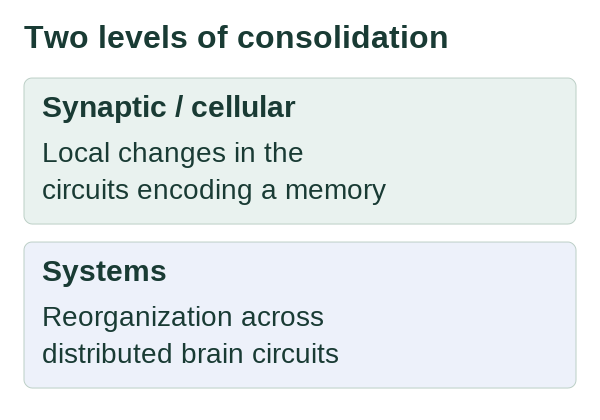
In systems consolidation, memories first depend on the hippocampus. They then reorganize and may no longer depend on it.[1] The hippocampus quickly links events together as they happen.[8]
In systems consolidation, the hippocampus guides a reorganization of what the neocortex stores. In time, the memory no longer needs the hippocampus.[9] As this maturation goes on, the hippocampus and neocortex interact closely. Associations become stable across spread-out circuits in the neocortex.[8]
Systems consolidation is thought to use synaptic consolidation mechanisms as subroutines.[7] Systems consolidation has been reported for episodic memories and for semantic memories. It has also been reported for spatial and nonspatial material alike. Studies still disagree about these issues. Theoretical disagreements remain too.[9]
The textbook account says consolidation begins and ends once for each item in memory. That debate concerns what the memory trace is like. It also concerns how it matures, how long it persists, and how far it can be retrieved and modified.[1] One review concludes that consolidation may never truly finish. This holds for at least some long-term memories.[7]
The speed of consolidation changes with different factors. One example is the amount of knowledge already there.[9] Methods have also changed what researchers can see. Genetic methods can tag neurons that were active during encoding. Researchers can then follow their reactivation at later retrieval. Electrical recording and imaging methods have found signs of gradual refinement in memory representations. They have also found signs of the hippocampal-neocortical dialogue that underlies it.[8]
History
A century of the consolidation hypothesis
Müller and Pilzecker proposed that memories need time to settle. This came a century before a 2000 review of the field. Their proposal is called the memory consolidation hypothesis. It holds that new memories consolidate, meaning they become stable, slowly over time.[2]
One early definition described consolidation as a process. In it, a memory becomes more resistant to interference as time passes. A 2003 study looked at a finger-tapping motor skill. It found at least three different stages of processing in human motor memory. These came after the first round of learning. That study also reported that reactivation while awake can return a consolidated memory to a fragile state. That state must be made stable again. This process is called reconsolidation.[10]
A 2009 study tested 12 patients with amnesia. It tested how well they kept new verbal material. Retention was much higher when interference came at the end of a 9-min delay. It was lower when interference came in the middle or at the start. The researchers argued that short-term rehearsal could not explain this pattern. Interference should have blocked rehearsal in all three conditions. They concluded that some severe forgetting in amnesia may come from disrupted consolidation. Interference right after learning may cause this.[11]
Studies of epilepsy patients pointed to a long period of memory consolidation. On the long-term test, patients with left temporal lobe foci did far worse than those with right temporal lobe foci.[12]
A 1997 review reported that retrograde amnesia after damage to the hippocampal complex can be extensive. It can cover much of a person's lifetime. The review added that the amount of loss may depend on the type of memory being tested. Its authors suggested that the hippocampal formation and nearby structures take part in some kinds of memory. Examples include memory for personal events and memory for places. They do so for as long as those memories exist. The same structures also help change and steady other forms of memory. Those memories are stored elsewhere in the brain.[13]
Main ideas
The hippocampus teaches the cortex
A new memory in a mammal first depends on the hippocampus. The hippocampus stores it and brings it back. Over time the neocortex takes over these functions. The memory then becomes independent of the hippocampus. Researchers call this transfer systems memory consolidation. The transfer is not always permanent. Reactivating a well-consolidated memory can briefly return it to a state that depends on the hippocampus. This is called systems memory reconsolidation.[14] A 2026 review describes the hippocampus as an original source of fear memory. It sends memory contents to other regions, including the neocortex.[15]
Computer models try to explain how the transfer works. They use rules of synaptic plasticity, the strengthening or weakening of connections between neurons. One model, published in 2020, is built on known mechanisms of synaptic plasticity and stability. It reproduces many findings from the consolidation and reconsolidation literature.[14]
A 2024 model proposes recall-gated consolidation. In this idea, the long-term system stores mainly the synaptic changes. These are the changes that agree with earlier updates to the short-term system. This gate shields long-term memory from spurious synaptic changes. It lets long-term memory focus on reliable signals in the environment. In the model the gate is set by signals such as prediction accuracy, decision confidence or familiarity. The model also reproduces the effects of spaced learning. It also reproduces consolidation rates that depend on the task.[16]
At the level of networks, consolidation is thought to rely on replay. Replay is the repeating of patterns of neuronal firing that stood for particular places and paths. This replay occurs in the circuit that links the hippocampus and the entorhinal cortex. It happens during sharp wave ripple events in sleep or rest. Dopamine released in response to novelty or reward may control which cell assemblies are replayed.[17]
A 2013 study combined electroencephalography and functional magnetic resonance imaging. It found that activity patterns for a specific stimulus come back on their own after learning. Healthy participants learned pairs of items and spatial positions. A pattern-classification method found the brain activity pattern for each item. Those patterns, tied to each stimulus, came back on their own. This happened during rest after learning and during sleep. No sensory cue brought them out. How often an item was reactivated predicted later memory for that item. This held in both the awake resting state and sleep. The researchers concluded that this spontaneous reactivation matters for behavior. It helps keep memory traces stable against interference.[18]
Glucocorticoids and noradrenaline released during training triggered the effect. So stress during emotional learning acts as a switch. Moderate stress produced a detailed memory. Highly stressful training produced a general, gist-like memory.[19]
A 2017 study from the same group found that learning a second, high-intensity shock context reorganized the brain structures used for retrieval. It sped up cortical involvement and reduced hippocampal participation. That study proposed systems consolidation as a possible biological mechanism. It may reduce interference between similar memory traces.[20]
Not every result fits the transfer story. Fear memory provides a clear counterexample. In a 2008 experiment, rats learned to fear a tone and a context paired with foot shock. They received dorsal, ventral or complete hippocampal damage 2 days or 12 weeks later. A retention test came 2 weeks after surgery. Rats with damage at either interval showed very little freezing to the context. The severity of the deficit tracked the extent of the damage. The damaged rats showed amnesia for the more remote memories that was no less severe. The authors took this to support a key and possibly permanent role for the hippocampus in fear memory.[21]
Sleep rhythms that carry memories
During deep sleep the brain produces several rhythms at once, and memory consolidation is thought to depend on how these rhythms line up in time.[22][23] A slow oscillation is a slow wave of cortical activity. It runs at about 0.5 to 1 Hz.[24][25]
A sleep spindle is a burst of faster activity at about 12 to 15 Hz.[24] One review describes these rhythms as working in sequence. Together they strengthen selected memories across hippocampal and cortical networks. The order is slow oscillations, then spindles, then ripples.[23]
In a 2015 study, healthy people were given the drug zolpidem. This raised the coupling between slow oscillations and spindles. It also increased improvement in verbal memory. That result suggests something about timing. Spindles are best placed to support consolidation during shifts to the cortical slow oscillation Up state.[24]
A 2012 nap study found that spindle density was much higher in deep sleep. It also related strongly to retention of declarative memory. That correlation was absent for light sleep. This suggests the benefit of spindles depends on their occurring together with slow oscillations.[26]
An earlier study in 2004 tested 24 healthy adults aged 20 to 30. The overnight gain in recalled words rose with increased spindle activity in stage 2 sleep (r24 = .63, P < .01). Absolute memory performance did not. Time spent in each sleep stage could not explain that relationship.[5]
Ripples during nREM sleep triggered replay of activity from a late encoding window (500-1200 ms). This happened for items that were remembered later. Ripples during waking rest did not. This replay was stronger for forgotten items. The researchers called this the first electrical evidence in humans of replay tied to consolidation.[27]
In rats, cells that had learned a spatial task formed coordinated groups during delta waves. These waves are not periods of complete silence. The groups formed in response to brief reactivation of hippocampal activity during ripples.[28]
A 2018 study found that cues played during a nap increased fast spindles. Brain activity during the spindle window showed the category of the cued memory. How accurately that category was decoded predicted the behavioral gain in retention. This is correlational evidence. It suggests spindles carry information used for consolidation.[29]
A 2023 study timed deep brain stimulation to the active phase of slow waves. The waves were in the medial temporal lobe. This raised the number of spindles. It also improved the linking of ripples with thalamocortical oscillations. The timed stimulation also made recognition memory more accurate. Identical stimulation without precise timing did not. It sometimes made these effects worse. Memory accuracy varied from person to person. These differences were closely linked to the electrical effects.[30]
A 2019 study looked across the adult lifespan. Younger adults showed fine-tuned coupling of fast spindles (12.5-16 Hz) to the slow oscillation peak. Older adults lacked it. Older adults instead showed most clearly a rise in slow spindle power (9-12.5 Hz). It came at the end of the slow oscillation's up-state. That slow spindle pattern came with worse memory consolidation. This held even in young age. Tight coupling of slow oscillations to fast spindles helped consolidation in both age groups. In old age, the health of the brain regions that make these rhythms strengthened the helpful coupling. These include the medial prefrontal cortex, thalamus, hippocampus and entorhinal cortex.[25]
During sleep, the direction of information flow in the brain reverses: population bursts that begin in the hippocampus spread into the neocortex. These bursts, called sharp wave bursts, occur during slow wave sleep and carry stored representations to neocortical areas. A 1998 review proposed that these sleep patterns are essential for preserving the synaptic changes that experience produces.[31]
Slow waves are oscillations at 0.5 to 4 Hz. Slow-wave power changes with experience and correlates with how much has been learned, and manipulating slow waves can enhance or impair consolidation. Average synaptic strength in the cortex rises during wakefulness and falls during sleep, and sleep may sharpen the contrast between synapses that store a memory and those that do not. Interactions between cortex and hippocampus during slow wave sleep are proposed to consolidate declarative memory, but interactions for non-declarative memory remain largely uninvestigated.[32]
A 2025 meta-analysis of 23 studies and 297 effect sizes found strong evidence that precise and strong coupling of slow oscillations with fast spindles in the frontal lobe predicts memory consolidation. The strength of that link depended on memory type, aging, spindle frequency and cortical location.[33] A 2020 review describes methods for modulating these oscillations with the aim of affecting memory consolidation.[34]
Disruption studies test whether these rhythms do the work. In animals, blocking an enzyme called protein kinase A in the hippocampus during sleep after fear learning suppressed long-term fear memory, while the same block during wakefulness had no effect. Activating the enzyme during wakefulness rescued memory impairments caused by sleep deprivation.[35] In people, sleep deprivation on the first night after threat conditioning widened implicit generalization to new cues similar to the learned threat, but deprivation on the seventh night did not.[36]
Chemistry and hormones that tune consolidation
During active waking, acetylcholine levels are high. Hasselmo proposed in 1999 that this high level partly suppresses excitatory feedback connections. That lets the hippocampus store new information without interference from what is already stored.[37]
A 2004 experiment in humans tested whether slow-wave sleep really needs its low acetylcholine. Gais and Born gave subjects 0.75 mg of physostigmine after they learned pairs of words. The drug raises cholinergic activity. The infusion fully blocked consolidation of the word pairs. That consolidation normally follows sleep rich in slow waves. It did not interfere with a mirror tracing task. The same drug did not change consolidation during waking. At that time, cholinergic tone is already at its highest. The result fits a prediction. Low cholinergic tone during slow-wave sleep is essential for declarative memory.[38]
Low doses of glucocorticoids given after training can strengthen memory consolidation. High doses do not work or harm memory. A 2006 study tested whether this pattern holds for cortisol the body releases on its own. Healthy men and women read a fairly neutral story. They then received cold-pressor stress or a control procedure, and were tested 1 week later. The stressor raised cortisol in saliva in both sexes. It improved memory only in the men. Among the stressed men, cortisol released after training showed a significant inverted-U link with later memory. This was the first time that curve was shown for naturally released stress hormones in human memory.[39]
Cortisol and sleep interact, and the direction of the effect depends on the state of the brain. A 2015 study found that resting cortisol levels during learning rose with later memory. But this held only after a period of sleep, not after a period of wakefulness. The benefit was strongest for items that were negative and arousing. Eye tracking showed how cortisol changed the handling of negative material. It strengthened the link between how long a person looked at an item and later memory for it. The researchers suggested that higher cortisol may mark attended information as important to remember at encoding. Sleep-based processes could then make it stable in a selective way.[40]
In rats, the picture reverses with state. A 2014 experiment infused corticosterone, a glucocorticoid, straight into the hippocampus. Rats received it during 80-minute retention periods. They slept or stayed awake. The hormone weakened consolidation when given during sleep. It improved consolidation during the time spent awake. The same infusions did not change a task that tests memory for new objects. That task does not require the hippocampus.[41]
Several neuromodulatory systems meet there. They influence noradrenergic and muscarinic cholinergic activation. The basolateral complex then adjusts consolidation through links to other regions. These include the caudate nucleus, the nucleus accumbens and the cortex. In human brain imaging, emotional arousal during encoding drives amygdala activation. The amount of that activation relates strongly to later recall. This holds whether the material was pleasant or unpleasant.[42]
A 2003 review reached a similar conclusion. Emotional arousal affects consolidation. It works through stress hormones from the adrenal glands and brain chemicals. These act on the noradrenergic system in the amygdala. Amygdala activity then controls consolidation in other brain regions. That review also suggested the system may help form traumatic memories and posttraumatic stress disorder in humans.[43]
Reconsolidation and the unstable engram
A consolidated memory is usually treated as fixed, but retrieving it can return it to a soft, changeable state for a short time. After retrieval, a process makes the memory stable again. Researchers call that process reconsolidation. In a 2000 study, rats learned a fear memory. The memory was later brought back during retrieval. Anisomycin is a drug that blocks protein synthesis. Infusing it into the amygdala soon after reactivation caused amnesia on later tests. The same infusion worked in both cases. Reactivation came either 1 day or 14 days after the original training. Without reactivation, the drug left the memory intact. Waiting 6 hours after reactivation before infusing it produced no amnesia. The results suggested that a recalled fear memory briefly needs new proteins. It needs them to become stable again.[44]
Later work asked whether reconsolidation simply repeats consolidation or uses different machinery. Reconsolidation used Zif268 but not BDNF.[45] Both depended on NMDA receptor activation. Yet an MEK inhibitor and an IKK inhibitor affected them differently. The work described an NMDA receptor-ERK1-BDNF pathway for consolidation. It also described an NMDA receptor-IKK-alpha-Zif268 pathway for reconsolidation.[46]
Reactivating a memory does not always lead to reconsolidation. Its effects can appear without it. A 2012 review argued that reactivation makes a memory easier to reach. It also makes the memory malleable. In this short state, its content can be changed or updated.[47]
Rats were trained to run to three feeders for rewards. A reminder in the same context let a second set of feeders blend into the first memory. These intrusions appeared when retrieval took place in the same context as encoding. They were highest when recall came right after that learning.[48]
Surprise seems to help decide whether a reminder destabilizes a memory. In one study, 48 participants watched 18 videos of actions and outcomes. They saw them again the next day. The videos stopped before the outcome. That makes the reminder incomplete. This left memories open to interference from a new set of videos. This created memories of events that never happened. A second sample of 408 people rated the videos. The more surprising ones produced more false memories when interrupted. A third study had 24 people in it. It found the effect depended on timing, as reconsolidation theory predicts.[49]
How long a memory is retrieved matters. Brief and long reminders push it in opposite directions. Brief retrieval causes reconsolidation. This keeps fear or makes it stronger. Long retrieval weakens the fear. In mice, researchers found a middle phase after reconsolidation but before extinction. It stopped reconsolidation without yet causing extinction. During that phase, blocking ERK signaling in the amygdala, hippocampus or medial prefrontal cortex let reconsolidation strengthen the fear memory again.[50]
Reconsolidation and extinction also differ in their chemistry. Blocking cannabinoid receptor 1 blocked extinction. So did blocking L-type calcium channels. It did not block reconsolidation. The same study reported that younger and weaker memories were more easily reconsolidated. Older and stronger memories were harder to reconsolidate.[51]
In a 2010 experiment, old fear memories were updated. Non-fearful information was given during the reconsolidation window. Fear responses were no longer expressed. The effect lasted at least a year, and it was selective to the reactivated memories.[6] A single isolated reminder trial before an extinction session permanently weakened a fear memory without drugs.[52]
A 2011 human study found that an extinction procedure after retrieval did not erase the fear. Reminder shocks and reacquisition brought the startle response back. Blocking beta-adrenergic receptors during reconsolidation did erase the fear-arousing part of the memory. It also weakened fear generalization.[53] A review notes that reconsolidation has been proposed as a treatment target for drug addiction. Use in patients still faces problems.[54]
What changes the rate of consolidation
When a schema, a body of related knowledge, already exists, new information can be absorbed far faster than the usual slow route. Rats trained on flavor-place pairs built up such a schema slowly. Once it existed, traces learned in a single trial became independent of the hippocampus almost at once. The schema did not only go along with fast learning. It played a causal role in creating lasting associative memories during one-trial learning.[55]
Participants spent 2 weeks building a schema. Their schema benefit grew across a 24-hour interval that contained a night of sleep. Denser sleep spindles predicted less decay of the schema-related facts. Sleep spindles are short bursts of brain activity during sleep. Denser spindles also predicted more release of the hippocampus from those facts.[56]
In a preregistered study, volunteers learned links between objects and scenes. These usually paid high or low reward. Memory was tested immediately for 29 of them and the next day for 30. Reward had only a small effect on memory in general. It did not make consolidation stronger. Its effect did not spread to related items. The result marks a boundary condition, a limit on where a reward effect holds.[57]
How practice is spread over time changes the rate at which memories are forgotten. Two experiments spread learning over a 24-hour gap. This left immediate memory no better than massed learning. The spaced schedule instead slowed forgetting afterwards. The saving applied to relational memory, which is memory for links between items. It did not apply to memory for single items.[58]
Practice on a motor skill ended. Within 6 hours, brain activity had shifted. It moved from prefrontal regions to premotor, posterior parietal and cerebellar cortex. Performance stayed the same. That shift was specific to recall of an established skill. It may explain why the skill grows more resistant to interference.[59]
Sixteen right-handed volunteers watched two films in a virtual museum. One was the evening before scanning, one just before. Objects seen the evening before drew more hippocampal activity than recently seen ones. This held only in participants classed as good navigators. Navigationally relevant objects showed the same overnight gain in the parahippocampal gyrus, again only in good navigators. The study offers first evidence of a link between consolidation and navigational ability. It does not measure how large that link is.[60]
Verbal memory was tested after a period with eyes closed. People either rested quietly or focused on their breath. Breath-focus did not harm memory overall. But participants who said they kept their focus well forgot more. The finding fits poorly with one idea. That idea says rest helps simply by shielding the brain from outside sights and sounds.[61]
Emotional content adds another condition. At 12 hours, sleep preserved negative and neutral pictures. It also kept their emotional tone. By 60 hours, negative and neutral memories had fallen much more in the sleep group. So the effect of sleep on emotional memory depends on when it is measured.[62]
Reward, stress and emotional modulation
Emotional arousal and stress hormones can change how strongly a memory is stored after the event has ended. In a 2003 study, people viewed slides of varying emotional content. Cold pressor stress raised salivary cortisol levels in the participants. One week later, the stressed group remembered the emotionally arousing slides better than the controls did. Memory for the relatively neutral slides was not affected by the stress. The result supports one view. Stress hormone activity after learning works together with arousal at encoding to modulate memory consolidation.[63]
Reward can also act after the fact. It can strengthen related memories that were not themselves rewarded. In a 2017 study, reward motivation improved memory after the fact. It helped for conceptually related items at a 24-hour test. No such gain appeared when memory was tested right away. That pattern suggests a role for consolidation processes that occur after encoding.[64]
Studies of acute stress have not agreed with each other. Some reports suggest that cortisol, a stress hormone, can enhance consolidation and impair retrieval. Others report no effect on either. In a 2019 study, young adults underwent the Trier Social Stress Test, a procedure that induces stress, either right after encoding or right before retrieval. Stress during consolidation improved discrimination of highly similar stimuli. Better discrimination went with larger cortisol responses. Stress during retrieval had no significant effect on memory performance.[65]
In one study, dream-related affect did not predict consolidation of positive or negative information. This went against the prediction. A 2023 online study had 103 participants with valid data. They viewed emotional pictures and rated the emotional intensity of their dreams the next morning. Dream-related feelings increased, especially anxiety. These increases predicted better retention of all information.[66]
A 2023 study of 34 college students compared those with high and low mood symptoms. It found no group differences in memory accuracy or emotional selectivity. Its early analyses did link more depressive symptoms to a more liberal response bias for negative stimuli (r = -0.357, p=.04).[67]
Cells, proteins and selective strengthening
Stable long-term memories require protein synthesis. Consolidation takes place minutes to hours after acquisition. Protein levels are set by synthesis (building proteins), degradation (breaking them down) and transport (moving them). These processes can act locally and at set times, so a single protein or a group of proteins can be adjusted where and when it matters. Memory and synaptic plasticity, the changing strength of connections between neurons, appear to share similar molecular machinery during consolidation.[68]
Synaptic plasticity is the leading cellular explanation for learning and memory, and many studies have tried to link it causally to memory-related behavior. After learning, memory is first encoded in the hippocampus, a seahorse-shaped structure deep in the brain, and later stabilized in regions such as the cortex for long-lasting storage. Researchers call this shift systems memory consolidation, and how it works at the cellular level has long been a basic open question.[69]
Consolidation is also selective. Some experiences are more likely than others to reach long-term memory. In the model's analysis, recall-gated consolidation greatly raises the signal-to-noise ratio, the strength of a memory relative to background noise, when memories are stored in noisy settings. The model also produces spaced learning effects and task-dependent rates of consolidation.[70]
Blocking consolidation raises a basic question. Is the memory trace destroyed, or is it still stored but out of reach? One approach measures the brain mechanisms of long-term memory directly. If amnesia were only a retrieval failure, these measures should stay near the levels of trained, unimpaired animals. A 2020 review examined studies that caused amnesia by targeting memory maintenance or reconsolidation, the restabilizing of a memory after recall. It found the amnesia came from storage, not retrieval, problems. The review also notes weaknesses in the purely behavioral protocol. That protocol was used to claim recovery from amnesia.[71]
An older study used 2880 newborn chicks, trained in a one-trial avoidance task. Flurothyl vapor caused amnesia, and weak treatments slowed consolidation instead of stopping it. In that study, apparent consolidation times ranged from 4 minutes to 24 hours. The 4 minutes came under weak conditions (0.85% flurothyl, 1-minute exposure), and the 24 hours under strong conditions (1.7% flurothyl, 8-minute exposure).[72]
Why sleep matters for consolidation
A 2004 summary of human experiments found that declarative memory gains mainly from sleep periods dominated by slow-wave sleep, and not consistently from periods rich in rapid eye movement sleep. One proposed mechanism is that newly learned patterns are reactivated in hippocampal networks, which then stimulates a transfer and integration of these patterns into networks across the cortex. During early sleep after intense declarative learning, spindle activity and slow oscillation-related EEG coherence increase, which points toward reprocessing of the learned material in the cortex.[73]
A 2023 review of 19 systematic reviews and meta-analyses concluded that sleep enhances memory consolidation, especially for complex declarative information. In older adults, sleep-dependent memory consolidation drops noticeably, particularly for declarative memory, and the decline is likely linked to a loss of slow-wave sleep.[74]
Participants recalled more textual details in the sleep condition, and sleep cycles were positively associated with prose memory performance.[75] A 2021 meta-analysis of 10 studies with 177 participants tested whether short sounds played during slow-wave sleep boost overnight memory. The combined effect size was 0.25, with p = 0.07.[76]
Gist, sequences and other memory types
Gist memory is the memory of the generalities across related experiences, such as the center of a set of spatial locations. Item memory is the memory of a specific episode, such as one encoded spatial location. In two experiments, 173 people learned spatial locations drawn from a distribution and then reported both kinds of memory for 1 to 2 months. After 1 month, memory for the gist held up better than memory for the individual items, though the two stayed positively correlated.[77]
Motor sequences, which are ordered strings of movements, are also reshaped by consolidation. One imaging study compared brain patterns while people produced sequences that were already consolidated with patterns for newly learned ones. Representations in the dorsolateral striatum, prefrontal cortex and secondary motor cortex were greater when executing consolidated sequences than untrained ones. Representations in the hippocampus and in the dorsomedial striatum became less engaged for those same sequences.[78] A review of human imaging work reached a related split: the hippocampal system triggers later sleep-dependent gains in performance, while the striatal system maintains the motor behavior over time.[79]
The hippocampus and striatum interact during initial learning of a motor sequence, and their early representations can predict subsequent sleep-related memory consolidation.[79] The hippocampus may matter for consolidation even when a task does not need it at first. People with hippocampal damage and matched controls learned a motor sequence task about equally well at first, but only the controls showed evidence of overnight consolidation.[80] A synthesis of work on prefrontal cortex, hippocampus, striatum and dopamine cells proposes that goal-directed behavior is organized in nested loops, with higher frontal loops starting and timing activity in lower ones.[81]
Research
How large are the effects
A meta-analysis pooled 91 experiments with 212 effect sizes and 2,004 participants. It measured one method, targeted memory reactivation. This brings back learning-related cues during sleep. The effect held for two stages of non-rapid-eye-movement sleep. It was g = 0.32 in Stage 2 and g = 0.27 in slow-wave sleep. The same analysis found no effect during REM sleep. This stage is marked by rapid eye movements. It found none during wakefulness either. Gains appeared in several kinds of memory. These included declarative memory and skill learning.[82]
People recalled face-location pairs better after a 12-hour interval that included sleep. Recall was lower after 12 hours of waking. Retention was also higher over a 24-hour sleep-wake interval than over a 24-hour wake-sleep interval. Sleep helped most right after learning.[83]
In a virtual navigation task, topographical orientation gained largely from sleep. Ten hours of daytime wakefulness gave no similar gain. That gain in navigation appeared after the first night of sleep. A second night brought no more improvement. Sleep deprivation blocked any improvement. Later recovery sleep did not reverse the loss.[84]
Daytime naps produce measurable gains, at least for motor skill. Two groups trained a left-hand motor task in the morning. They were tested 8 hours later. One group took a 60 to 90 minute midday nap and the other stayed awake. The awake group showed no significant improvement. The nap group showed a highly significant gain. Within the nap group, the size of the improvement was linked to the amount of Stage 2 sleep. The strongest link was with the difference in spindle activity. It compared the learning hemisphere with the other hemisphere. That difference did not appear for either hemisphere alone.[85]
The infants were 6 and 12 months old. Only those who napped within 4 hours of learning remembered the target actions at test. This held after both a 4-hour and a 24-hour delay.[86]
Thirty-three children aged 6 to 12 years improved by 14% on a non-word learning task after sleep. They improved by 25% on the Tower of Hanoi puzzle, with no significant change after wake. In that study, sleep quality and duration were not related to task performance.[87] A study of 255 participants aged 7 to 76 years found procedural knowledge retained equally well in every age group. Offline improvement in general skill was also similar across groups.[88]
Recall was better after rest than after all other post-learning conditions. This matches the usual finding. Rest protects new memories from interference. That result contrasts with an earlier report. In it, the 2-back task produced performance similar to a wakeful rest condition. The authors of the 2022 study describe the evidence for rest as accumulating rather than settled.[89]
In practice
Cuing memories during sleep
The idea rests on a simple observation: newly formed memories reactivate on their own during sleep, and that reactivation strengthens them. A cue tied to the learning episode can be delivered in sleep. The cue can then trigger reactivation of the memory.[90]
A 2007 study put this to the test. It presented an odor during learning and then again during sleep. Re-exposure to the odor during slow-wave sleep improved retention of declarative memories. The same odor did nothing for procedural memories. These are skills that do not depend on the hippocampus. The cue did not work during rapid eye movement sleep. It also failed during wakefulness. It also failed when the odor had been left out of the original learning session.[91]
Brain imaging supported the behavioral result. Functional magnetic resonance imaging showed significant hippocampal activation when the odor returned during slow-wave sleep.[91] A 2004 review argued that declarative memories change in waking and in sleep. This reprocessing can bind the separate parts of a memory more tightly together.[92]
Sound works as a cue too, though the results are narrower. A 2017 study had fifteen healthy participants sleep 3 nights in a laboratory. They were tested on 4 memory tasks. On the stimulation night, a computer program worked on its own. It timed single sounds to the negative peak of slow waves in slow-wave sleep. The sounds raised slow-wave activity (p = .002). They also raised sleep spindle activity (p < .001). Overnight improvement appeared on the word pair task. It did not appear on the other memory tasks. The stimulation changed neither the structure of sleep nor how good sleep felt. The researchers concluded that the memory effect was specific to verbal associative memory.[93]
Cuing does not always help, and the outcome depends on how the material was learned. A 2023 review noted that most studies finding a benefit used simple associations. In these, one cue brings back one tested memory. Real-life memories often sit in rich, complex networks of associations. One cue can then bring back several tested memories at once. In some of those studies the memories interacted well and all gained. In others they got in each other's way. This caused selective problems in retrieval. The review stressed that study design details change what reactivation does. These include details that change the nature of learning, or the participant's intentions. It also stated that this area of research has not yet been studied in a systematic way.[90]
One 2024 study tested implicit visuospatial memory. This is learning that happens without instructions to memorize. Participants copied a complex geometric figure. They did this while inhaling peppermint or a control odor. Then they took a 135-minute nap. The analysis used data from 28 of the 56 participants. These were the ones who showed slow-wave sleep. One group breathed in peppermint during learning. In that group, slow-spindle power in the prefrontal cortex during sleep was lower than in the control group. That power was below average. Then the peppermint group showed a bigger change in hit rate on the figure test. Above the average, the difference went away. The authors suggested that the olfactory cortex, the brain's smell region, may suppress this activity. This could turn unstable memories into lasting ones.[94]
What this means for studying and teaching
A second point concerns what gets kept: sleep does not treat all memories alike. Memories seen as useful later are marked during learning. They are then given priority for consolidation in the sleep that follows. The selection favors memories that are emotional or were hard to learn. It also favors memories expected to be needed again or tied to a reward.[95]
Two patients had electrodes placed inside the brain. They were tested on repeated items. Immediate repetition raised activity in the left medial temporal lobe. This happened between 250 and 400 milliseconds. This was compared with new items and items repeated after a delay. That study concluded that new information starts a consolidation process in the left hippocampal area. This process stays fragile while it is actively kept up. The same recordings showed that this process becomes more effective during off-line processing, the periods when the brain is not taking in new input.[96]
A fourth point concerns what happens during sleep itself. A computer model of the thalamocortical network tested how slow oscillations change connection strength between neurons. The network is a set of connected brain regions. The oscillations were 0.2 to 1 Hz, during stage 3 and 4 sleep. In the model, an input copying hippocampal ripples produced lasting changes in connection strength. Ripples are brief bursts of activity. The input promoted replay of specific firing sequences.[97]
Waking rest and quiet consolidation
Several studies ask whether a period of quiet, eyes-closed waking rest after learning helps new memories settle.[98] Consolidation is the process by which a fresh memory becomes more stable over the hours after learning. Brain imaging shows that resting activity changes after learning a sensorimotor task. These changes appeared only after a task that required learning. They did not appear after movement without learning.[99] In a 2014 study, resting connectivity shifted across a 6 h period after learning. Different networks were active at 0.1, 0.5 and 6 h.[100]
Behavioural tests of rest give a mixed picture. A 2019 replication was planned in advance with stated predictions. It tested whether eyes-closed rest after training improved declarative memory compared with a distractor task. It did fall within the 95% confidence interval of the earlier finding. The paper argues that sampling and measurement error best explain the conflicting results. The studies were often too small to detect a smaller-than-expected effect. Exploratory analyses found that more frequent daydreaming in daily life went with poorer memory retention during eyes-closed rest.[98]
A 2021 object-location study failed to probe the effect of quiescence, or quiet rest, on reconsolidation. It did find an unexpected delayed effect. Quiet rest helped consolidation even when taken later and after a period of task engagement.[101]
Drugs, stimulation and brain chemistry
Several attempts have tried to change memory consolidation directly, using drugs or weak electrical currents.[102][103] In one rat experiment, adult male Long-Evans rats learned to run a straight-alley maze for food. After a form of learning called latent extinction, the rats received injections of D-cycloserine at 15 mg per kg of body weight, or a saltwater solution. D-cycloserine is a drug that partly activates NMDA receptors. On probe trials a day later, rats given D-cycloserine took significantly longer to reach the goal box than rats given saline. The result suggests that this drug can strengthen consolidation of a memory that depends on the hippocampus.[102]
A current oscillating at 5 Hz, a theta rhythm, was applied during non-rapid eye movement sleep. During non-rapid eye movement sleep, this theta current lowered slow oscillatory activity overall. It also reduced frontal slow spindle power at 8 to 12 Hz. It also caused a drop in consolidation of declarative memory. During rapid eye movement sleep, the same current appeared to increase global gamma activity at 25 to 45 Hz. Its effect depended on the brain state.[103]
A 2026 systematic review examined whether approved medicines change how well memories are consolidated during sleep. It covered healthy people, rats and mice. The review included 65 studies, and only a limited number of them lent themselves to a meta-analysis, a statistical pooling of results. For zolpidem, the pooled result showed better consolidation of a word-pair association task in human adults. The effect size was 0.57 (95% confidence interval 0.04 to 1.10).[104]
Brain chemistry offers another route into consolidation. Acetylcholine has drawn attention. Acetylcholine is a chemical messenger. It is present at high levels during waking and during rapid eye movement sleep. New findings in human subjects indicated that deep slow-wave sleep may mediate a memory consolidation process. Its low acetylcholine levels may also play a part.[105] Cortisol, a stress hormone, influences many brain systems involved in memory, and its concentration rises over the course of a night's sleep.[106] The precise mechanisms by which sleep may aid memory storage are not known.[105]
What this looks like when you study
Overnight improvement in word pairs averaged 21.1 (SD 7.7) after the sound night and 15.6 (SD 8.1) after the control night. The sound stimulation did not improve face-name association, picture recognition or finger tapping.[93]
In a study of amnesia, 12 patients learned new verbal material and then met interference at different points in a 9 minute delay. Retention was significantly higher when interference came at the end of the delay than at the middle or beginning. The authors suggest that some severe forgetting in amnesia comes from disruption of consolidation by immediate postlearning interference.[11]
A meta-analysis of 91 experiments with 2,004 participants found that cuing memories during sleep improved memory overall. The overall effect was Hedges' g = 0.29, a small to moderate benefit.[82]
A meta-analysis of 10 studies found a moderate benefit of quiet, eyes-closed waking rest for verbal memory (d = 0.38). The benefit required the mind to be free from attention to external tasks or spontaneous thought. A preregistered replication in that same paper did not find a significant effect, though it fell within the earlier confidence interval.[98]
Criticism
The case for and against sleep
The claim that sleep benefits memory rests on more than a century of research. A 2013 review of the field said so. That review describes sleep as a brain state that improves memory consolidation. The waking brain is better suited to taking memories in.[3]
A 2010 review reached a similar position. It argued that sleep improves consolidation. This depends on the conditions of learning and the timing of sleep. Consolidation during sleep changes memories in amount and in quality. It does not only change their strength.[107]
A 2006 review noted that sleep scientists have debated the idea for decades. The public widely accepts that a good night of sleep improves memory. Even so, how sleep helps memory and brain plasticity was still unclear.[108]
A 2001 review judged the evidence for a special REM role in memory consolidation to be weak and contradictory. Animal studies linked changes in REM sleep to learning. But the results were inconsistent. The effects of stress also confused them. Some humans had REM sleep suppressed by drugs or by brain lesions. They showed no memory deficits. Human sleep-learning studies did not give consistent results. Time spent in REM sleep was not correlated with learning ability across humans. It also did not relate to brain size across species. That review concluded that sleep matters for learning and for doing tasks well. But it said a major role in memory consolidation is unproven.[4]
A 2000 review made the case against REM sleep even more directly. It surveyed studies that took REM sleep away from animals. The reports were about evenly split. Some showed harm to learning or memory, and some showed none. Some studies linked REM sleep and memory. Those studies drew strong criticism. The criticism was that very stressful deprivation methods had confounding effects. Three main classes of antidepressant drugs strongly reduce REM sleep. They are monoamine oxidase inhibitors, tricyclic antidepressants and selective serotonin reuptake inhibitors. Monoamine oxidase inhibitors almost completely remove REM sleep. The other two classes of drugs cut REM sleep by 40 to 85% at once. Their lasting reductions are 30% to 50%. This suppression was clear. Even so, these drug classes on the whole do not disrupt learning or memory. A few patients survived damage to both sides of the pons, a brainstem structure, with few lasting problems. They reportedly led normal lives. Yet the damage almost completely removed REM sleep. Brain imaging in humans showed activity patterns during REM sleep. These fit with dreaming but not with memory consolidation. That review proposed that REM sleep mainly gives periodic internal stimulation. This keeps the central nervous system active through the night. It concluded that REM sleep has no role in consolidating memory.[109]
The 2013 review reported that recent work showed slow-wave sleep matters for memory consolidation. Older research had focused on REM sleep. Consolidation begins with reactivation of recently encoded neuronal memory representations during slow-wave sleep. The REM sleep that follows may make the changed memories stable.[3]
The 2010 review linked slow-wave sleep to system consolidation. It linked REM sleep to synaptic consolidation.[107] A 2019 review likewise treated long-term memory formation during sleep as active systems consolidation. Repeated replay of representations from the hippocampus drives it. This happens during slow-wave sleep.[110]
Sleep continuity means unbroken stretches of sleep. It may matter for memory consolidation. A 2011 study used optogenetics to activate arousal-related neurons in mice at intervals. This broke sleep into pieces. The total amount and strength of sleep stayed the same. Mice learned to recognize a new object. Breaking up their sleep afterward clearly lowered their performance the next day. Memory was not affected, however, if sleep episodes averaged 62 to 73% of normal length. The study concluded that memory consolidation needs a smallest unit of sleep without interruption. This held whatever the total amount or strength of sleep.[111]
The synaptic homeostasis hypothesis offers an account of why the brain needs sleep. While awake, learning statistical patterns about the environment strengthens connections throughout the brain. This raises the cell's needs for energy and supplies. It lowers signal-to-noise ratios and saturates learning.[112]
The 2019 review placed systems consolidation during sleep inside this process. The process is a global scaling down of synapses.[110] The 2014 account of the hypothesis also named open issues. These concern sleep and plasticity.[112]
When consolidation goes wrong
Accelerated long-term forgetting is a memory problem. Learning and early retention look normal. But later forgetting is unusually fast. It is most often linked to epilepsy. One form, called transient epileptic amnesia, or TEA, starts late in life. One proposal held that the cause was a failure of sleep-dependent consolidation. That is the strengthening of memories during sleep. A 2014 study tested this. It compared a night of sleep with a day of wakefulness. The groups were TEA patients and healthy controls. Sleep improved memory retention in the patients. The benefit was no smaller than in the controls. The patients scored worse than controls only after the day of wakefulness, not after sleep. The researchers concluded that faster forgetting is not caused by disrupted sleep-dependent consolidation. They suggested a hidden encoding problem instead. Or it could be a consolidation deficit that does not depend on sleep.[113]
Insomnia has been studied with a four-group design of 86 people. Some had primary insomnia and some were good sleepers. Each group spent 12 hours either asleep at night or awake during the day. Sleep was recorded by polysomnography. Polysomnography, a recording of brain waves and other body signals during sleep, showed clearly disturbed sleep in the insomnia group. Good sleepers showed better verbal and procedural memory after a night of sleep than after equal daytime wakefulness. People with insomnia kept less procedural memory after sleep than good sleepers did. Across daytime wake periods, the groups did not differ. The pattern suggests that healthy sleep helps consolidation. It also suggests that procedural memory consolidation is impaired in primary insomnia.[114]
Schizophrenia has been tied to a specific sleep feature: a shortage of sleep spindles. Patients show the spindle deficit. So do their relatives without the illness. These links point to the thalamic reticular nucleus. This structure generates spindles. It also gates sensory signals to the cortex.[115]
A 2023 study of Parkinson's disease compared patients with matched controls. They ran two memory experiments. In the first, people held 2 or 5 colored rectangles in mind for 7 seconds. Sometimes 3 unrelated items were added. Patients scored lower in every load condition of that task. In the second task, items numbered 2 to 6 and the delay was 2 seconds. Patients also had a thinner cortex in the left superior temporal gyrus. This is a part of the brain's attention system. Thinner cortex there predicted lower memory scores. This held in the low-load conditions of the first task. It also predicted lower scores in the 4- and 5-item conditions of the second. The findings suggest that memory deficits in Parkinson's disease may partly reflect faulty filtering of distractions. Faulty consolidation may also play a part.[116]
In a 2011 experiment, fruit flies were given a way to sleep on demand. This happened when the temperature was raised to 31°C. The study used a training schedule too weak to produce lasting memory. Four hours of induced sleep after it was enough for long-term memory to form. Turning on the same brain region without sleep did not make memory last.[117]
In another study, rats were given drugs that block the COX-2 enzyme after training. They showed worse retention a day later. The same drugs had no effect when given 2 hours after training. They also had no effect on a task that depends on a different brain region.[118]
Other experiments look inside the cell itself.[119][120] Certain immediate-early genes switch on quickly after neural activity. Blocking them in the hippocampus impaired long-term memory. It did not disturb learning or short-term memory.[119]
Switching off a receptor called NMDA in one hippocampal region during the consolidation period also blocked consolidation.[120] Fruit flies show at least three separate memory stages after training. Cold anesthesia disrupted memory only within about 20 minutes of training. Two feeding treatments acted soon after training and 3 hours later.[121]
A 2024 study in mice tested etifoxine. This drug acts on two targets and is used for anxiety disorders. Etifoxine was given right after a memory was reactivated. It improved later recognition of a familiar object. It was given 6 hours after reactivation, or 24 hours after learning without reactivation. Changes in movement or exploration did not explain the gain.[122]
Open questions and disputed claims
Several basic questions about memory consolidation remain open, and the evidence on them is mixed.[123][124] Some researchers have proposed that memories grow more stable over weeks after learning. They also become harder to break up. Blocking a receptor called NMDAR-NR2B disrupted memory formation. The drug anisomycin weakened consolidation and reconsolidation of both recent and remote fear memory.[124]
A second dispute is whether findings in animals carry over to human episodic memory, the memory for particular events. A 2017 set of three experiments tried to repeat a well-known result. The result was about reconsolidation in people. The task asks participants to recall objects from lists. A second experiment used a testing room with very distinct features. It produced a replication in kind but small in size. A third experiment did not support the key assumption. The assumption was that the target list is reactivated and destabilized when the person sees the study context again. The researchers noted that ordinary interference during retrieval can explain the findings instead. No extra process that destabilizes a stored memory is needed.[123]
Fieldwork at Dalit monuments in Uttar Pradesh examined how memory is consolidated in individuals and in groups. The study argues that Dalits hold an unequal place in the caste-based memory structure. It also argues that dominant castes build and mobilize this placement. Shared memory building has helped Dalits form counter-memories against Hindutva meta-narratives. Yet dominant castes still shape how Dalits remember together. They do this by taking over Dalit icons.[125]
Common misconceptions
Many people believe that REM sleep is the main stage for memory consolidation. A review found the evidence for this hypothesis weak and contradictory. People whose REM sleep was suppressed by drugs or by brain lesions did not show memory deficits, Siegel (2001) reported.[4]
Key studies
| Year | Study | Sample | Design | Finding |
|---|---|---|---|---|
| 2000 | Nader et al.[44] | protein synthesis inhibitor infusion after memory reactivation | Anisomycin after reactivation produced amnesia, showing that reactivated memories return to a labile state. | |
| 2000 | McGaugh[2] | Review of a century of consolidation research. | The consolidation hypothesis that Müller and Pilzecker put forward a century earlier still guides memory research. | |
| 2001 | Siegel[4] | review of animal and human studies | review of the REM sleep-memory consolidation hypothesis | Evidence for REM sleep's role in memory consolidation was weak and contradictory, and REM-suppressing drugs did not disrupt memory. |
| 2004 | Dudai[1] | Review of consolidation studies across memory systems. | Synaptic consolidation occurs within minutes to hours after learning, while system consolidation takes much longer. | |
| 2006 | Andreano & Cahill[39] | healthy men and women | cold-pressor stress after reading a neutral story, tested one week later | The cold-pressor stress raised salivary cortisol in both sexes, but memory improved only in the men, and among those men cortisol release after training showed a significant inverted-U link to later memory. |
| 2007 | Nishida & Walker[85] | two groups of subjects trained on a motor-skill task | nap versus wake comparison with polysomnography | The nap group showed a large consolidation gain, while the awake group showed no significant improvement. |
| 2007 | Rasch et al.[91] | odor cuing during slow-wave sleep, REM sleep and wakefulness | Odor re-exposure during slow-wave sleep improved declarative memory but not procedural memory. | |
| 2009 | Dewar et al.[11] | 12 patients with amnesia | delayed interference during a 9 minute interval | Retention was significantly higher when interference came at the end of the delay rather than the middle or beginning. |
| 2011 | NISSEN et al.[114] | 86 participants in a four-group parallel design | sleep versus wake comparison in primary insomnia and good sleepers | Healthy sleep enhanced procedural and declarative memory, but procedural consolidation was impaired in primary insomnia. |
| 2017 | Leminen et al.[93] | 15 healthy participants | three laboratory nights with sound stimulation during slow-wave sleep | Word-pair recall improved by 21.1 items after the sound night versus 15.6 after the control night, with no effect on other tasks. |
| 2018 | Sinclair & Barense[49] | 48 participants in Study 1 and 408 in Study 2 | video-based episodic memory reconsolidation experiment | Incomplete reminders that interrupted videos made memories vulnerable to interference and produced more false memories. |
| 2019 | Humiston et al.[98] | 10 similar studies plus a preregistered replication | meta-analysis and behavioral replication | Waking rest gave a moderate benefit for verbal memory (d = 0.38), though the replication alone was not significant. |
| 2020 | Hu et al.[82] | 91 experiments with 2,004 participants | meta-analysis of targeted memory reactivation studies | Overall sleep cuing improved memory (g = 0.29), with effects in stage 2 (g = 0.32) and slow-wave sleep (g = 0.27) but not REM or wake. |
| 2023 | Geva-Sagiv et al.[30] | 18 neurosurgical patients with intracranial electrodes | closed-loop deep brain stimulation during sleep | Stimulation synchronized to slow waves enhanced sleep spindles and improved recognition memory accuracy. |
See also
References
- Dudai, Y. (2004). The Neurobiology of Consolidations, Or, How Stable is the Engram? Annual Review of Psychology, 55(1), 51-86. doi:10.1146/annurev.psych.55.090902.142050
- McGaugh, J. L. (2000). Memory--a Century of Consolidation. Science, 287(5451), 248-251. doi:10.1126/science.287.5451.248
- Rasch, B., & Born, J. (2013). About Sleep's Role in Memory. Physiological Reviews, 93(2), 681-766. doi:10.1152/physrev.00032.2012
- Siegel, J. M. (2001). The REM Sleep-Memory Consolidation Hypothesis. Science, 294(5544), 1058-1063. doi:10.1126/science.1063049
- Schabus, M., Gruber, G., Parapatics, S., Sauter, C., Klösch, G., Anderer, P., Klimesch, W., Saletu, B., & Zeitlhofer, J. (2004). Sleep Spindles and Their Significance for Declarative Memory Consolidation. Sleep, 27(8), 1479-1485. doi:10.1093/sleep/27.7.1479
- Schiller, D., Monfils, M. H., Raio, C. M., Johnson, D. C., LeDoux, J. E., & Phelps, E. A. (2010). Preventing the return of fear in humans using reconsolidation update mechanisms. Nature, 463(7277), 49-53. doi:10.1038/nature08637
- Dudai, Y. (2012). The Restless Engram: Consolidations Never End. Annual Review of Neuroscience, 35(1), 227-247. doi:10.1146/annurev-neuro-062111-150500
- Takehara‐Nishiuchi, K. (2021). Neurobiology of systems memory consolidation. European Journal of Neuroscience, 54(8), 6850-6863. doi:10.1111/ejn.14694
- Squire, L. R., Genzel, L., Wixted, J. T., & Morris, R. G. (2015). Memory Consolidation. Cold Spring Harbor Perspectives in Biology, 7(8), a021766. doi:10.1101/cshperspect.a021766
- Walker, M. P., Brakefield, T., Allan Hobson, J., & Stickgold, R. (2003). Dissociable stages of human memory consolidation and reconsolidation. Nature, 425(6958), 616-620. doi:10.1038/nature01930
- Dewar, M., Garcia, Y. F., Cowan, N., & Sala, S. D. (2009). Delaying interference enhances memory consolidation in amnesic patients. Neuropsychology, 23(5), 627-634. doi:10.1037/a0015568
- Blake, R. V. (2000). Accelerated forgetting in patients with epilepsy: Evidence for an impairment in memory consolidation. Brain, 123(3), 472-483. doi:10.1093/brain/123.3.472
- Nadel, L., & Moscovitch, M. (1997). Memory consolidation, retrograde amnesia and the hippocampal complex. Current Opinion in Neurobiology, 7(2), 217-227. doi:10.1016/s0959-4388(97)80010-4
- Helfer, P., & Shultz, T. R. (2020). A computational model of systems memory consolidation and reconsolidation. Hippocampus, 30(7), 659-677. doi:10.1002/hipo.23187
- Park, H., & Kaang, B. K. (2026). Role of the hippocampus in systems consolidation of remote fear memory. Experimental & Molecular Medicine, 58(4), 1010-1016. doi:10.1038/s12276-026-01680-9
- Lindsey, J. W., & Litwin-Kumar, A. (2024). Selective consolidation of learning and memory via recall-gated plasticity. eLife, 12. doi:10.7554/elife.90793
- Atherton, L. A., Dupret, D., & Mellor, J. R. (2015). Memory trace replay: the shaping of memory consolidation by neuromodulation. Trends in Neurosciences, 38(9), 560-570. doi:10.1016/j.tins.2015.07.004
- Deuker, L., Olligs, J., Fell, J., Kranz, T. A., Mormann, F., Montag, C., Reuter, M., Elger, C. E., & Axmacher, N. (2013). Memory Consolidation by Replay of Stimulus-Specific Neural Activity. The Journal of Neuroscience, 33(49), 19373-19383. doi:10.1523/jneurosci.0414-13.2013
- Pedraza, L. K., Sierra, R. O., Boos, F. Z., Haubrich, J., Quillfeldt, J. A., & de Oliveira Alvares, L. (2016). The dynamic nature of systems consolidation: Stress during learning as a switch guiding the rate of the hippocampal dependency and memory quality. Hippocampus, 26(3), 362-371. doi:10.1002/hipo.22527
- Pedraza, L. K., Sierra, R. O., Crestani, A. P., Quillfeldt, J. A., & de Oliveira Alvares, L. (2017). Sequential learning during contextual fear conditioning guides the rate of systems consolidation: Implications for consolidation of multiple memory traces. Hippocampus, 27(5), 518-528. doi:10.1002/hipo.22708
- Sutherland, R. J., O'Brien, J., & Lehmann, H. (2008). Absence of systems consolidation of fear memories after dorsal, ventral, or complete hippocampal damage. Hippocampus, 18(7), 710-718. doi:10.1002/hipo.20431
- Nokia, M. S., & Penttonen, M. (2022). Rhythmic Memory Consolidation in the Hippocampus. Frontiers in Neural Circuits, 16. doi:10.3389/fncir.2022.885684
- Staresina, B. P. (2024). Coupled sleep rhythms for memory consolidation. Trends in Cognitive Sciences, 28(4), 339-351. doi:10.1016/j.tics.2024.02.002
- Niknazar, M., Krishnan, G. P., Bazhenov, M., & Mednick, S. C. (2015). Coupling of Thalamocortical Sleep Oscillations Are Important for Memory Consolidation in Humans. PLOS ONE, 10(12), e0144720. doi:10.1371/journal.pone.0144720
- Muehlroth, B. E., Sander, M. C., Fandakova, Y., Grandy, T. H., Rasch, B., Shing, Y. L., & Werkle-Bergner, M. (2019). Precise Slow Oscillation–Spindle Coupling Promotes Memory Consolidation in Younger and Older Adults. Scientific Reports, 9(1). doi:10.1038/s41598-018-36557-z
- Cox, R., Hofman, W. F., & Talamini, L. M. (2012). Involvement of spindles in memory consolidation is slow wave sleep-specific. Learning & Memory, 19(7), 264-267. doi:10.1101/lm.026252.112
- Zhang, H., Fell, J., & Axmacher, N. (2018). Electrophysiological mechanisms of human memory consolidation. Nature Communications, 9(1). doi:10.1038/s41467-018-06553-y
- Todorova, R., & Zugaro, M. (2019). Isolated cortical computations during delta waves support memory consolidation. Science, 366(6463), 377-381. doi:10.1126/science.aay0616
- Cairney, S. A., Guttesen, A. á. V., El Marj, N., & Staresina, B. P. (2018). Memory Consolidation Is Linked to Spindle-Mediated Information Processing during Sleep. Current Biology, 28(6), 948-954.e4. doi:10.1016/j.cub.2018.01.087
- Geva-Sagiv, M., Mankin, E. A., Eliashiv, D., Epstein, S., Cherry, N., Kalender, G., Tchemodanov, N., Nir, Y., & Fried, I. (2023). Augmenting hippocampal–prefrontal neuronal synchrony during sleep enhances memory consolidation in humans. Nature Neuroscience, 26(6), 1100-1110. doi:10.1038/s41593-023-01324-5
- BuzsÁk, G. (1998). Memory consolidation during sleep: a neurophysiological perspective. Journal of Sleep Research, 7(S1), 17-23. doi:10.1046/j.1365-2869.7.s1.3.x
- Miyamoto, D., Hirai, D., & Murayama, M. (2017). The Roles of Cortical Slow Waves in Synaptic Plasticity and Memory Consolidation. Frontiers in Neural Circuits, 11. doi:10.3389/fncir.2017.00092
- Ng, T., Noh, E., & Spencer, R. M. (2025). Bayesian meta-analysis reveals the mechanistic role of slow oscillation-spindle coupling in sleep-dependent memory consolidation. eLife, 13. doi:10.7554/elife.101992
- Ghorbani, M., & Marshall, L. (2020). Manipulating neural activity and sleep-dependent memory consolidation. Neuroforum, 26(2), 93-99. doi:10.1515/nf-2020-0002
- Cho, J., Sypniewski, K. A., Arai, S., Yamada, K., Ogawa, S., & Pavlides, C. (2018). Fear memory consolidation in sleep requires protein kinase A. Learning & Memory, 25(5), 241-246. doi:10.1101/lm.046458.117
- Manassero, E., Giordano, A., Raimondo, E., Cicolin, A., & Sacchetti, B. (2022). Sleep Deprivation During Memory Consolidation, but Not Before Memory Retrieval, Widens Threat Generalization to New Stimuli. Frontiers in Neuroscience, 16. doi:10.3389/fnins.2022.902925
- Hasselmo, M. E. (1999). Neuromodulation: acetylcholine and memory consolidation. Trends in Cognitive Sciences, 3(9), 351-359. doi:10.1016/s1364-6613(99)01365-0
- Gais, S., & Born, J. (2004). Low acetylcholine during slow-wave sleep is critical for declarative memory consolidation. Proceedings of the National Academy of Sciences, 101(7), 2140-2144. doi:10.1073/pnas.0305404101
- Andreano, J. M., & Cahill, L. (2006). Glucocorticoid Release and Memory Consolidation in Men and Women. Psychological Science, 17(6), 466-470. doi:10.1111/j.1467-9280.2006.01729.x
- Bennion, K. A., Mickley Steinmetz, K. R., Kensinger, E. A., & Payne, J. D. (2015). Sleep and Cortisol Interact to Support Memory Consolidation. Cerebral Cortex, 25(3), 646-657. doi:10.1093/cercor/bht255
- Kelemen, E., Bahrendt, M., Born, J., & Inostroza, M. (2014). Hippocampal corticosterone impairs memory consolidation during sleep but improves consolidation in the wake state. Hippocampus, 24(5), 510-515. doi:10.1002/hipo.22266
- McGaugh, J. L. (2004). The amygdala modulates the consolidation of memories of emotionally arousing experiences. Annual Review of Neuroscience, 27(1), 1-28. doi:10.1146/annurev.neuro.27.070203.144157
- McINTYRE, C. K., POWER, A. E., ROOZENDAAL, B., & McGAUGH, J. L. (2003). Role of the Basolateral Amygdala in Memory Consolidation. Annals of the New York Academy of Sciences, 985(1), 273-293. doi:10.1111/j.1749-6632.2003.tb07088.x
- Nader, K., Schafe, G. E., & Le Doux, J. E. (2000). Fear memories require protein synthesis in the amygdala for reconsolidation after retrieval. Nature, 406(6797), 722-726. doi:10.1038/35021052
- Lee, J. L. C., Everitt, B. J., & Thomas, K. L. (2004). Independent Cellular Processes for Hippocampal Memory Consolidation and Reconsolidation. Science, 304(5672), 839-843. doi:10.1126/science.1095760
- Lee, J. L. C., & Hynds, R. E. (2013). Divergent cellular pathways of hippocampal memory consolidation and reconsolidation. Hippocampus, 23(3), 233-244. doi:10.1002/hipo.22083
- Gisquet-Verrier, P., & Riccio, D. C. (2012). Memory reactivation effects independent of reconsolidation. Learning & Memory, 19(9), 401-409. doi:10.1101/lm.026054.112
- Jones, B., Bukoski, E., Nadel, L., & Fellous, J. M. (2012). Remaking memories: Reconsolidation updates positively motivated spatial memory in rats. Learning & Memory, 91-98. doi:10.1101/lm.023408.111
- Sinclair, A. H., & Barense, M. D. (2018). Surprise and destabilize: prediction error influences episodic memory reconsolidation. Learning & Memory, 25(8), 369-381. doi:10.1101/lm.046912.117
- Fukushima, H., Zhang, Y., & Kida, S. (2021). Active Transition of Fear Memory Phase from Reconsolidation to Extinction through ERK-Mediated Prevention of Reconsolidation. The Journal of Neuroscience, 41(6), 1288-1300. doi:10.1523/jneurosci.1854-20.2020
- Suzuki, A., Josselyn, S. A., Frankland, P. W., Masushige, S., Silva, A. J., & Kida, S. (2004). Memory Reconsolidation and Extinction Have Distinct Temporal and Biochemical Signatures. The Journal of Neuroscience, 24(20), 4787-4795. doi:10.1523/jneurosci.5491-03.2004
- Monfils, M. H., Cowansage, K. K., Klann, E., & LeDoux, J. E. (2009). Extinction-Reconsolidation Boundaries: Key to Persistent Attenuation of Fear Memories. Science, 324(5929), 951-955. doi:10.1126/science.1167975
- Soeter, M., & Kindt, M. (2011). Disrupting reconsolidation: Pharmacological and behavioral manipulations. Learning & Memory, 18(6), 357-366. doi:10.1101/lm.2148511
- Milton, A. L. (2023). Drug memory reconsolidation: from molecular mechanisms to the clinical context. Translational Psychiatry, 13(1). doi:10.1038/s41398-023-02666-1
- Tse, D., Langston, R. F., Kakeyama, M., Bethus, I., Spooner, P. A., Wood, E. R., Witter, M. P., & Morris, R. G. M. (2007). Schemas and Memory Consolidation. Science, 316(5821), 76-82. doi:10.1126/science.1135935
- Hennies, N., Lambon Ralph, M. A., Kempkes, M., Cousins, J. N., & Lewis, P. A. (2016). Sleep Spindle Density Predicts the Effect of Prior Knowledge on Memory Consolidation. The Journal of Neuroscience, 36(13), 3799-3810. doi:10.1523/jneurosci.3162-15.2016
- Schultz, H., Stoffregen, H., & Benoit, R. G. (2023). A reward effect on memory retention, consolidation, and generalization? Learning & Memory, 30(8), 169-174. doi:10.1101/lm.053842.123
- Litman, L., & Davachi, L. (2008). Distributed learning enhances relational memory consolidation. Learning & Memory, 15(9), 711-716. doi:10.1101/lm.1132008
- Shadmehr, R., & Holcomb, H. H. (1997). Neural Correlates of Motor Memory Consolidation. Science, 277(5327), 821-825. doi:10.1126/science.277.5327.821
- Janzen, G., Jansen, C., & Turennout, M. v. (2008). Memory consolidation of landmarks in good navigators. Hippocampus, 18(1), 40-47. doi:10.1002/hipo.20364
- Collins, M. B., & Wamsley, E. J. (2020). Effect of postlearning meditation on memory consolidation: level of focused attention matters. Learning & Memory, 27(6), 250-253. doi:10.1101/lm.051151.119
- Zeng, S., Lin, X., Wang, J., & Hu, X. (2021). Sleep’s short-term memory preservation and long-term affect depotentiation effect in emotional memory consolidation: behavioral and EEG evidence. Sleep, 44(11). doi:10.1093/sleep/zsab155
- Cahill, L., Gorski, L., & Le, K. (2003). Enhanced Human Memory Consolidation With Post-Learning Stress: Interaction With the Degree of Arousal at Encoding. Learning & Memory, 10(4), 270-274. doi:10.1101/lm.62403
- Patil, A., Murty, V. P., Dunsmoor, J. E., Phelps, E. A., & Davachi, L. (2017). Reward retroactively enhances memory consolidation for related items. Learning & Memory, 24(1), 65-69. doi:10.1101/lm.042978.116
- Jiang, A., Tran, T. T., Madison, F. N., & Bakker, A. (2019). Acute stress-induced cortisol elevation during memory consolidation enhances pattern separation. Learning & Memory, 26(4), 121-127. doi:10.1101/lm.048546.118
- du Plessis, L., & Lipinska, G. (2023). The modulation of emotional memory consolidation by dream affect. Frontiers in Sleep, 2. doi:10.3389/frsle.2023.1239530
- Banik, N., Harrington, C., Baran, B., Kapucu, A., Ersoy, P. K., & Arpaci, H. (2023). 0069 Effects of Depression and Anxiety Symptoms on Sleep-Dependent Consolidation of Emotional Memory in College Students. SLEEP, 46(Supplement_1), A32-A32. doi:10.1093/sleep/zsad077.0069
- Rosenberg, T., Gal-Ben-Ari, S., Dieterich, D. C., Kreutz, M. R., Ziv, N. E., Gundelfinger, E. D., & Rosenblum, K. (2014). The roles of protein expression in synaptic plasticity and memory consolidation. Frontiers in Molecular Neuroscience, 7. doi:10.3389/fnmol.2014.00086
- Goto, A. (2022). Synaptic plasticity during systems memory consolidation. Neuroscience Research, 183, 1-6. doi:10.1016/j.neures.2022.05.008
- Lindsey, J. W., & Litwin-Kumar, A. (2024). Selective consolidation of learning and memory via recall-gated plasticity. eLife, 12. doi:10.7554/elife.90793.3
- Haubrich, J., Bernabo, M., Baker, A. G., & Nader, K. (2020). Impairments to Consolidation, Reconsolidation, and Long-Term Memory Maintenance Lead to Memory Erasure. Annual Review of Neuroscience, 43(1), 297-314. doi:10.1146/annurev-neuro-091319-024636
- Cherkin, A. (1969). Kinetics of memory consolidation: Role of amnesic treatment parameters. Proceedings of the National Academy of Sciences, 63(4), 1094-1101. doi:10.1073/pnas.63.4.1094
- Gais, S., & Born, J. (2004). Declarative memory consolidation: Mechanisms acting during human sleep. Learning & Memory, 11(6), 679-685. doi:10.1101/lm.80504
- Weighall, A., & Kellar, I. (2023). Sleep and memory consolidation in healthy, neurotypical children, and adults: a summary of systematic reviews and meta-analyses. Emerging Topics in Life Sciences, 7(5), 513-524. doi:10.1042/etls20230110
- Conte, F., Malloggi, S., De Rosa, O., Ficca, G., Righi, S., Viggiano, M. P., & Giganti, F. (2025). Sleep Benefits Prose Memory Consolidation in University Students. Brain Sciences, 15(3), 265. doi:10.3390/brainsci15030265
- Wunderlin, M., Züst, M. A., Hertenstein, E., Fehér, K. D., Schneider, C. L., Klöppel, S., & Nissen, C. (2021). Modulating overnight memory consolidation by acoustic stimulation during slow-wave sleep: a systematic review and meta-analysis. Sleep, 44(7). doi:10.1093/sleep/zsaa296
- Zeng, T., Tompary, A., Schapiro, A. C., & Thompson-Schill, S. L. (2021). Tracking the relation between gist and item memory over the course of long-term memory consolidation. eLife, 10. doi:10.7554/elife.65588
- Pinsard, B., Boutin, A., Gabitov, E., Lungu, O., Benali, H., & Doyon, J. (2019). Consolidation alters motor sequence-specific distributed representations. eLife, 8. doi:10.7554/elife.39324
- Albouy, G., King, B. R., Maquet, P., & Doyon, J. (2013). Hippocampus and striatum: Dynamics and interaction during acquisition and sleep‐related motor sequence memory consolidation. Hippocampus, 23(11), 985-1004. doi:10.1002/hipo.22183
- Schapiro, A. C., Reid, A. G., Morgan, A., Manoach, D. S., Verfaellie, M., & Stickgold, R. (2019). The hippocampus is necessary for the consolidation of a task that does not require the hippocampus for initial learning. Hippocampus, 29(11), 1091-1100. doi:10.1002/hipo.23101
- Rusu, S. I., & Pennartz, C. M. A. (2020). Learning, memory and consolidation mechanisms for behavioral control in hierarchically organized cortico‐basal ganglia systems. Hippocampus, 30(1), 73-98. doi:10.1002/hipo.23167
- Hu, X., Cheng, L. Y., Chiu, M. H., & Paller, K. A. (2020). Promoting memory consolidation during sleep: A meta-analysis of targeted memory reactivation. Psychological Bulletin, 146(3), 218-244. doi:10.1037/bul0000223
- Talamini, L. M., Nieuwenhuis, I. L. C., Takashima, A., & Jensen, O. (2008). Sleep directly following learning benefits consolidation of spatial associative memory. Learning & Memory, 15(4), 233-237. doi:10.1101/lm.771608
- Ferrara, M., Iaria, G., Tempesta, D., Curcio, G., Moroni, F., Marzano, C., De Gennaro, L., & Pacitti, C. (2008). Sleep to find your way: The role of sleep in the consolidation of memory for navigation in humans. Hippocampus, 18(8), 844-851. doi:10.1002/hipo.20444
- Nishida, M., & Walker, M. P. (2007). Daytime Naps, Motor Memory Consolidation and Regionally Specific Sleep Spindles. PLoS ONE, 2(4), e341. doi:10.1371/journal.pone.0000341
- Seehagen, S., Konrad, C., Herbert, J. S., & Schneider, S. (2015). Timely sleep facilitates declarative memory consolidation in infants. Proceedings of the National Academy of Sciences, 112(5), 1625-1629. doi:10.1073/pnas.1414000112
- Ashworth, A., Hill, C. M., Karmiloff‐Smith, A., & Dimitriou, D. (2014). Sleep enhances memory consolidation in children. Journal of Sleep Research, 23(3), 304-310. doi:10.1111/jsr.12119
- Tóth-Fáber, E., Nemeth, D., & Janacsek, K. (2023). Lifespan developmental invariance in memory consolidation: evidence from procedural memory. PNAS Nexus, 2(3). doi:10.1093/pnasnexus/pgad037
- King, O., & Nicosia, J. (2022). The effects of wakeful rest on memory consolidation in an online memory study. Frontiers in Psychology, 13. doi:10.3389/fpsyg.2022.932592
- Antony, J. W., & Schechtman, E. (2023). Reap while you sleep: Consolidation of memories differs by how they were sown. Hippocampus, 33(8), 922-935. doi:10.1002/hipo.23526
- Rasch, B., Büchel, C., Gais, S., & Born, J. (2007). Odor Cues During Slow-Wave Sleep Prompt Declarative Memory Consolidation. Science, 315(5817), 1426-1429. doi:10.1126/science.1138581
- Paller, K. A., & Voss, J. L. (2004). Memory reactivation and consolidation during sleep. Learning & Memory, 11(6), 664-670. doi:10.1101/lm.75704
- Leminen, M. M., Virkkala, J., Saure, E., Paajanen, T., Zee, P. C., Santostasi, G., Hublin, C., Müller, K., Porkka-Heiskanen, T., Huotilainen, M., & Paunio, T. (2017). Enhanced Memory Consolidation Via Automatic Sound Stimulation During Non-REM Sleep. Sleep, 40(3). doi:10.1093/sleep/zsx003
- Ahn, J., & Takahashi, T. (2024). 0076 Memory Consolidation During SWS of Implicit Visuospatial Memory Associated with Odor. SLEEP, 47(Supplement_1), A33-A34. doi:10.1093/sleep/zsae067.0076
- Li, M. (2023). Selectivity in sleep-dependent memory consolidation. Journal of Student Research, 10(4). doi:10.47611/jsrhs.v10i4.1937
- Nahum, L., Gabriel, D., Spinelli, L., Momjian, S., Seeck, M., Michel, C. M., & Schnider, A. (2011). Rapid consolidation and the human hippocampus: Intracranial recordings confirm surface EEG. Hippocampus, 21(7), 689-693. doi:10.1002/hipo.20819
- Wei, Y., Krishnan, G. P., & Bazhenov, M. (2016). Synaptic Mechanisms of Memory Consolidation during Sleep Slow Oscillations. The Journal of Neuroscience, 36(15), 4231-4247. doi:10.1523/jneurosci.3648-15.2016
- Humiston, G. B., Tucker, M. A., Summer, T., & Wamsley, E. J. (2019). Resting States and Memory Consolidation: A Preregistered Replication and Meta-Analysis. Scientific Reports, 9(1). doi:10.1038/s41598-019-56033-6
- Albert, N. B., Robertson, E. M., Mehta, P., & Miall, R. C. (2009). Resting state networks and memory consolidation. Communicative & Integrative Biology, 2(6), 530-532. doi:10.4161/cib.2.6.9612
- Sami, S., Robertson, E. M., & Miall, R. C. (2014). The Time Course of Task-Specific Memory Consolidation Effects in Resting State Networks. The Journal of Neuroscience, 34(11), 3982-3992. doi:10.1523/jneurosci.4341-13.2014
- Craig, M., Knowles, C., Hill, S., & Dewar, M. (2021). A study on episodic memory reconsolidation that tells us more about consolidation. Learning & Memory, 28(2), 30-33. doi:10.1101/lm.052274.120
- Gabriele, A., & Packard, M. G. (2007). D-Cycloserine enhances memory consolidation of hippocampus-dependent latent extinction. Learning & Memory, 14(7), 468-471. doi:10.1101/lm.528007
- Marshall, L., Kirov, R., Brade, J., Mölle, M., & Born, J. (2011). Transcranial Electrical Currents to Probe EEG Brain Rhythms and Memory Consolidation during Sleep in Humans. PLoS ONE, 6(2), e16905. doi:10.1371/journal.pone.0016905
- Mischke, J., Luedtke, K., & Marshall, L. (2026). Effects of antidepressants, anesthetics and sedatives/hypnotics on sleep-associated memory consolidation – A systematic review. Journal of Psychopharmacology. doi:10.1177/02698811261456185
- Power, A. E. (2004). Slow-wave sleep, acetylcholine, and memory consolidation. Proceedings of the National Academy of Sciences, 101(7), 1795-1796. doi:10.1073/pnas.0400237101
- Payne, J. D., & Nadel, L. (2004). Sleep, dreams, and memory consolidation: The role of the stress hormone cortisol. Learning & Memory, 11(6), 671-678. doi:10.1101/lm.77104
- Diekelmann, S., & Born, J. (2010). The memory function of sleep. Nature Reviews Neuroscience, 11(2), 114-126. doi:10.1038/nrn2762
- Frank, M. G., & Benington, J. H. (2006). The Role of Sleep in Memory Consolidation and Brain Plasticity: Dream or Reality? The Neuroscientist, 12(6), 477-488. doi:10.1177/1073858406293552
- Vertes, R. P., & Eastman, K. E. (2000). The case against memory consolidation in REM sleep. Behavioral and Brain Sciences, 23(6), 867-876. doi:10.1017/s0140525x00004003
- Klinzing, J. G., Niethard, N., & Born, J. (2019). Mechanisms of systems memory consolidation during sleep. Nature Neuroscience, 22(10), 1598-1610. doi:10.1038/s41593-019-0467-3
- Rolls, A., Colas, D., Adamantidis, A., Carter, M., Lanre-Amos, T., Heller, H. C., & de Lecea, L. (2011). Optogenetic disruption of sleep continuity impairs memory consolidation. Proceedings of the National Academy of Sciences, 108(32), 13305-13310. doi:10.1073/pnas.1015633108
- Tononi, G., & Cirelli, C. (2014). Sleep and the Price of Plasticity: From Synaptic and Cellular Homeostasis to Memory Consolidation and Integration. Neuron, 81(1), 12-34. doi:10.1016/j.neuron.2013.12.025
- Atherton, K. E., Nobre, A. C., Zeman, A. Z., & Butler, C. R. (2014). Sleep-dependent memory consolidation and accelerated forgetting. Cortex, 54, 92-105. doi:10.1016/j.cortex.2014.02.009
- NISSEN, C., KLOEPFER, C., FEIGE, B., PIOSCZYK, H., SPIEGELHALDER, K., VODERHOLZER, U., & RIEMANN, D. (2011). Sleep-related memory consolidation in primary insomnia: Sleep-related memory consolidation in insomnia. Journal of Sleep Research, 20(1pt2), 129-136. doi:10.1111/j.1365-2869.2010.00872.x
- Manoach, D. S., & Stickgold, R. (2019). Abnormal Sleep Spindles, Memory Consolidation, and Schizophrenia. Annual Review of Clinical Psychology, 15(1), 451-479. doi:10.1146/annurev-clinpsy-050718-095754
- Lee, E. Y. (2023). Memory Deficits in Parkinson’s Disease Are Associated with Impaired Attentional Filtering and Memory Consolidation Processes. Journal of Clinical Medicine, 12(14), 4594. doi:10.3390/jcm12144594
- Donlea, J. M., Thimgan, M. S., Suzuki, Y., Gottschalk, L., & Shaw, P. J. (2011). Inducing Sleep by Remote Control Facilitates Memory Consolidation in Drosophila. Science, 332(6037), 1571-1576. doi:10.1126/science.1202249
- Teather, L. A., Packard, M. G., & Bazan, N. G. (2002). Post-Training Cyclooxygenase-2 (COX-2) Inhibition Impairs Memory Consolidation. Learning & Memory, 9(1), 41-47. doi:10.1101/lm.43602
- Guzowski, J. F. (2002). Insights into immediate‐early gene function in hippocampal memory consolidation using antisense oligonucleotide and fluorescent imaging approaches. Hippocampus, 12(1), 86-104. doi:10.1002/hipo.10010
- Shimizu, E., Tang, Y. P., Rampon, C., & Tsien, J. Z. (2000). NMDA Receptor-Dependent Synaptic Reinforcement as a Crucial Process for Memory Consolidation. Science, 290(5494), 1170-1174. doi:10.1126/science.290.5494.1170
- Xia, S., Liu, L., Feng, C., & Guo, A. (1997). Memory consolidation in Drosophila operant visual learning. Learning & Memory, 4(2), 205-218. doi:10.1101/lm.4.2.205
- Zhao, S., & Yu, L. (2024). TSPO ligand etifoxine enhances memory reconsolidation in novel object recognition memory. Molecular & Cellular Biomechanics, 21, 278. doi:10.62617/mcb.v21.278
- Klingmüller, A., Caplan, J. B., & Sommer, T. (2017). Intrusions in episodic memory: reconsolidation or interference? Learning & Memory, 24(5), 216-224. doi:10.1101/lm.045047.117
- Einarsson, E. Ö., & Nader, K. (2012). Involvement of the anterior cingulate cortex in formation, consolidation, and reconsolidation of recent and remote contextual fear memory. Learning & Memory, 19(10), 449-452. doi:10.1101/lm.027227.112
- Choudhary, V. K. (2024). The Promise of Memory: Politics of Memory and Caste Inequality in Collective Memory Consolidation. CASTE / A Global Journal on Social Exclusion, 5(2), 201-219. doi:10.26812/caste.v5i2.908
Cite this page: Atlas Nova editors. (2026). Memory consolidation. Atlas Nova. https://velocer.io/atlas/memory-consolidation/