

Method · Memory
Chunking
Chunking is the process of recoding smaller pieces of information into larger units that are already familiar. A chunk is one unit assembled from several smaller elements, and chunking is the act of building it.[1][2]
Chunking can reduce the load on working memory.[2] Chunk limits and length limits can both operate, depending on the task.[3]
Key facts
| five to seven | chunks held in short-term memory, according to Simon (1974)[4] |
|---|---|
| about four | chunks in a central capacity limit, according to Cowan (2001)[5] |
| 50,000 | chunks stored by chess Masters, according to Gobet and Simon (1996)[6] |
| up to 15 pieces | size of chunks replaced by Masters, according to Gobet and Clarkson (2004)[7] |
Overview
What a chunk is
A chunk is one unit built from several smaller elements. Chunking is the act of building it. One widely used definition calls a chunk a collection of elements. The elements are strongly linked to one another and weakly linked to elements in other chunks.[1] Miller observed that recoding information into meaningful units let people recall more information.[8]
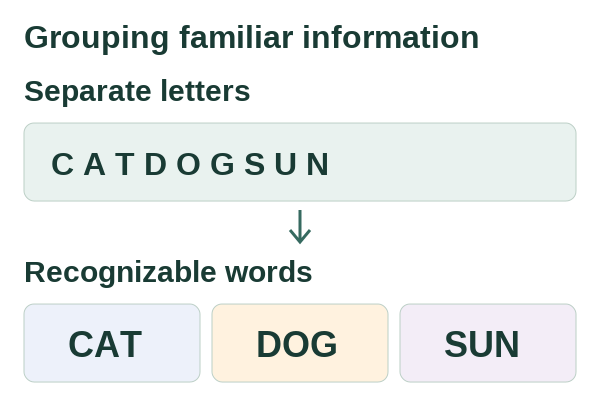
Chunking can work in two different ways. The first is strategic regrouping based on familiarity or prior knowledge. One example is breaking a string of letters into known acronyms. These include AWOL, NASA and MIA.[8]
The second is grouping by features the senses pick up, such as similarity or nearness. This is more common with visual material. Both count as chunking, but research has concentrated on the first kind, the deliberate, goal-directed grouping of verbal material. Gilchrist (2015) calls chunking one of the best-known ways to raise the amount of information that memory can hold.[8]
The words carry several meanings, and writers often mix them up. This causes a lot of confusion. A 2016 taxonomy by Gobet et al. set out the main meanings of both terms in order to separate them.[1]
A second split concerns where the benefit of chunking comes from. One view holds that chunking is a form of data compression. It lets more information fit in the space available. The other holds that chunks exist only in long-term memory. There they help short-term memory rebuild a faded trace more reliably, a process called redintegration.[9]
Researchers use many methods to measure how chunks form and how they are retrieved. It is unclear whether most of these methods show the internal processes that actually form a chunk. Nearly 60 years after Miller's paper, understanding of chunking is still incomplete.[8] A 1974 review by Simon judged that the chunk had been shown to be psychologically real with fair clarity.[4]
History
Miller, Simon and the origin of the idea
Miller gathered evidence that short-term memory holds about seven chunks in such tasks. Cowan (2001) notes that Miller gave seven as a rough estimate and a figure of speech. It was not a measured ceiling.[5] Simon combined data from several experiments to obtain information that, combined with theoretical models, has implications for human performance. He used this approach to identify and measure basic parameters of the human information processing system. He put the chunk capacity of short-term memory at five to seven.[4]
Chase and Simon found that chess players at different skill levels differed in copying and recalling positions. They said experts store thousands of chunks in long-term memory. That, they argued, explains those differences. A chunk here means a patterned cluster of pieces, a group of items held together as one unit. Gobet and Simon concluded that the two-second gap between chunks still marks chunk boundaries. They also concluded that chunks are real in the mind. Gobet and Simon (1998) also found that the Masters in their study used much bigger chunks than the Master tested in 1973.[10]
A 2004 study by Gobet and Clarkson set the predictions of chunking theory against those of template theory. With game positions on a computer display, chess Masters replaced very large chunks of up to 15 pieces. Recall tasks using physical boards and computer displays typically yielded no more than three replaced chunks. The same results suggest that a limit of four chunks in short-term memory may be too high.[7]
Cowan brought together many kinds of data on capacity limits. He argued that a smaller limit is real. Others had already suggested a more precise limit of only three to five chunks. Cowan proposed one central capacity limit. It averages about four chunks.[5]
He also listed four basic conditions for spotting chunks and seeing capacity limits. One condition is when too much information limits chunks to single items. Another is when steps are taken specifically to block the recoding of items into larger chunks.[5] A 2001 commentary by Beaman called the data a persuasive case for a fundamental limit on short-term memory of about four items.[11]
Main ideas
How many chunks can be held
In these conditions, rehearsal and long-term memory cannot merge items into chunks of unknown size. Some storage has no capacity limit, such as sensory memory. Even so, it cannot refill the limited store during recall. The review separated a pure capacity limit, counted in chunks, from mixed limits. Compound limits arise when the number of separately held chunks is unclear.[5]
A 2005 study taught new paired associations between words to create two-word chunks. In free recall of 12-word lists, 6 pre-learned pairs were recalled about as well as 6 pre-exposed single words. This suggests a chunk limit. Other conditions gave results in between. This suggests that sometimes both limits work together.[3]
A 2008 study asked whether older adults recall fewer chunks or struggle to bind words into multi-unit chunks. Four conditions varied spoken sentence and list chunk number and length. Older adults accessed fewer clauses than younger adults during recall. No age deficit appeared in completing the specific clauses that were accessed. The study traced the poorer memory for spoken language to a smaller working memory capacity, counted in chunks.[12]
Gobet and Clarkson (2004) found four of six recall conditions estimated capacity near two chunks. Authors proposed limited hand capacity breaks large chunks. Physical-board game positions showed Class B players at 4.8 chunks versus Masters at 4.5.[7]
Chunks in working memory and compression
One such trick is to store items in a compressed format. Some researchers call this memory compression.[13] Chunking means recoding smaller pieces of information into larger units that are already familiar.[2] The compression account asks whether this recoding lets people hold more information online, meaning available for immediate use.[13]
Visual working memory got better when pairs of colors were predictably paired. A later set of experiments tested another idea. Familiar groups of items may be attached to a label with no content of its own. One example is remembering red-white-blue as "American flag". Under that alternative, the label retrieves the parts of a chunk only when a response is needed. If so, reaching compressed items should take longer than reaching uncompressed ones.[13]
Experiment 1 used visual material. Experiment 2 used verbal material. Both found response times much longer in patterned, compressed conditions than in control conditions. In Experiments 3 and 4, the gains from regularity vanished with short response deadlines of 1000 or 875 ms. The conclusion was that regularities can give access to larger amounts of information. But that information may not be available on the spot the way single items are.[13]
A second line of work asked whether chunking really reduces the load on working memory. Four experiments found chunking benefits. The benefits appeared for recall of the chunked material. They also appeared for other information held at the same time that was not chunked. Chunk size made no difference to the benefit in one case only. That was when every chunk had unique elements, so its first element could stand in for the whole.[2]
The chunk-size effect remained when participants did articulatory suppression, a task that keeps the voice busy. So the length of rehearsal does not explain it. Chunks placed early in the list helped recall of the other material. Chunks placed at the end did not. The account says a chunk lowers load by pulling a compact chunk representation from long-term memory. This replaces the separate representations of its parts.[2]
A related account treats chunking as a rational strategy for lossy data compression in visual working memory. In this account, features that look alike are encoded together by chunking. This helps performance on visual working memory tasks. Nassar, Helmers and Frank (2018) hold that chunking can raise effective storage capacity. At the same time it lowers how precise recall is.[14]
People did a variant of a standard working memory task. Their performance showed advantages and losses in precision. It also showed links between items and adjustments from trial to trial. People seemed to differ in working memory capacity. These differences came from how each person carried out chunking.[14]
Researchers reanalyzed 11 previously available datasets, with 137,986 trials in total. They found strong evidence that representations are not independent. Chunking and use of the gist of a display, meaning its overall sense, appeared in nearly every study at every set size. The researchers proposed that visual working memory utilizes clusters of items and the gist of the display rather than independent representations. They argue that memory should be studied as clusters, chunks and gist, not as independent items.[15]
One study showed observers four pictures of fruit. It asked them to remember eight features: four colors and four shapes. In congruent trials the fruit's color matched its natural appearance, as with a red apple. In incongruent trials it did not, as with a red banana. Memory capacity was highest in the congruent condition.[16]
Response times there were significantly faster than in the incongruent condition. A decoding step would have made congruent responses slower. So the study concluded that visual features of real-world objects are not stored in a chunk.[16] Grouping what is perceived over time may also help. Rapid serial visual presentation with ERP recording distinguished attentional from memory-related processing. N2pc amplitude reflected actual target count while CDA and P3 components tracked perceived target numbers.[17]
Sometimes two targets in a row were reported as one combined target. Then memory-related brain responses were as low as for a single target.[17] Information already in long-term memory may also lower the need to store it in working memory. This pattern is called offloading. Two experiments varied positions of pre-learned pairs within four word pair lists. Performance improved with those pairs regardless of list position, consistent with offloading rather than proving a unique mechanism.[18]
Two explanations compete to say why this happens.[19][9] The first is data compression. The input is actively recoded into chunks. Each chunk uses less memory capacity than its separate items would.[19]
Six experiments tested these two accounts. They used two-choice forced-choice recognition and immediate serial recall. Small chunks of 2 words showed a pattern that suggests redintegration. Larger chunks of 3 words showed a pattern that fits data compression.[19]
Recoding material into chunks in short-term memory carries a cost. With smaller chunks, that cost appears to outweigh the benefit of recoding the words.[19] Verbal short-term memory can hold only so much. Given these limits, chunking can sometimes use its information capacity more efficiently.[9]
Two groups of 10 third grade children took part, matched on several cognitive measures. They were asked to remember groups of words presented one after another. Recall was higher when the words formed sentences. That sentence advantage was much greater for the children judged to be more skillful readers. This was contrary to an earlier report.[20]
Researchers analyzed self-paced reading data from 181 participants. They found repeating patterns at about 2 Hz, or roughly two cycles per second. A computer procedure defined the multi-word chunks. It used dependency annotations and part-of-speech tags to define multi-word chunks. The behavioral periodicity lined up in time with those multi-word chunks. The finding suggests that chunks built from local dependency clusters may keep memory demands low during sentence processing.[21]
Expertise and the chess evidence
The chunking theory was later extended to explain large retrieval structures called templates.[10] In this view, chunks are reached through a discrimination net, a sorting system that tests simple perceptual features one after another. Chunks can then grow into more complex data structures. These are specific to classes of positions.[22]
Gobet and Simon (1996) tested what players retain. They used positions taken from games, positions altered in several ways, and random positions. Recall dropped when positions were changed by mirror image reflection. This suggests that each chunk stands for a specific pattern of pieces in a specific place.[6]
Gobet (1998) set four accounts of expert chess memory side by side. They were the chunking theory of Chase and Simon and the SEEK theory of Holding. They also included the long-term working memory theory of Ericsson and Kintsch. They included the template theory of Gobet and Simon too. The clearest separations came from recall of random and altered positions, recall after very brief presentations, and interference studies. The chunking theory faced repeated criticism in the literature.[22]
Even so, it was found to fit most of the data. The template theory, however, explained the evidence best. The comparison pointed to two needs for the study of expertise in general. The first is detailed process models of expert behavior. The second is data that cross the usual lines between perception, memory, and problem solving.[22]
Brain imaging has tested what chunk-based theories predict. The theories predict that players draw on long-term memory chunks of information specific to their field. These are probably stored in the temporal lobes. Functional MRI data collected during chess recognition tasks supported these theoretical predictions. Activation occurred in temporal lobes for long-term chunks and frontal-parietal areas for working memory.[23]
Chunking in motor and sequence learning
People and other animals learn such sequences by splitting them into smaller groups called motor chunks. A chunk shows up as faster speed for a group of movements within the sequence. Song and Cohen (2014) judge chunking success by how chunks form, how they carry over, and how they join into longer chunks.[24]
Several tasks have been used to study chunking. These include the serial reaction task, the discrete sequence production task, and the m × n task. In these tasks the setting or the task itself sets the order of stimuli. So the stimulus drives the responses.[25]
Chunking also appears when people work out the order of actions themselves. No outside guide is needed. In one study, participants did a grid-sailing task. They had to move across a 10 × 10 grid from a start to a goal position by making keypresses in sequence.[25]
Three cursor movement directions were each mapped to one of three keyboard buttons. Response times showed unique temporal patterns for each subject. This is evidence of spontaneous chunking, with no structures set in advance or guided from outside. This result matched earlier findings in a less constrained sequencing task guided from within.[25]
Tosatto, Fagot, Nemeth and Rey (2022) studied 18 Guinea baboons. The baboons pointed at a moving target on a touch screen. They made one fixed sequence of nine movements across 1000 trials. Response times showed a clear chunking pattern for each baboon.[26]
Those patterns shifted as the experiment went on, and chunks grew fewer and longer. Two routes drove the reorganization: old chunks were recombined, and two separate chunks were joined into one.[26] A later study tested sequences of 4 movements over 2000 trials. It also tested sequences of 5 movements over 4000 trials. Guinea baboons produced fewer, longer chunks with practice after initial short chunks. Sequence length influenced the dynamics and evolution of these chunking patterns. Average chunk size reached a plateau after extended practice, indicating fundamental limits.[27]
One account treats chunking as a trade-off between the cost of planning and the efficiency of movement. A compound movement can be split into chunks, each planned over a shorter stretch. This can cut the computing cost but caps how efficient the movement can become. This trade-off suggests a low-cost learning strategy. Start with many short chunks.[28]
Then let the chunk structure change toward more efficient movements. This happens as practice lowers the barriers to more complex computation. Monkeys practiced a reaching sequence over a long period. They followed this strategy. Their movements can be described as locally best paths.[28]
Song and Cohen (2014) had 80 subjects learn a motor sequence. Some learned with conscious intent and some without. Performance was tested before training and up to 1 wk after it. Chunk formation, carryover and joining were the same in both groups. Chunk formation, carryover, and concatenation did not improve during training or on later tests. Motor learning improved without any gain in chunking, with or without conscious intent. This points to other mechanisms behind successful motor learning.[24]
Pauses between keypresses at fixed locations supported the growth of integrated sequence representations. The results rejected the idea that a rhythm is learned. A transfer phase used different sequences. Performance fell sharply unless the sequence was fairly short.[29]
There also had to be plenty of time to prepare. This shows that motor chunks are tied to particular content. Chunks fail to appear when there is no time to load the motor buffer in advance. They also fail when the buffer cannot hold the whole sequence.[29]
Skilled typewriting shows control at several levels, with chunks handled at each level of processing. Scrambling the order of letters in words stopped skilled typists from chunking letters. The experiments compared typing words and scrambled words. Changing stimulus quality showed chunking in perception. Changing concurrent memory load showed chunking in short-term memory. The number of letters in words and nonwords was varied.[30]
This showed chunking in motor planning. A laser-projection keyboard altered usual haptic feedback, requiring typists to monitor keystrokes. Typists had to watch their keystrokes. This changed neither the number of motor chunks nor the number of short-term memory items. Yamaguchi and Logan (2014) conclude that hierarchical control is used when the input can be chunked. It does not depend on whether the output comes out automatically.[30]
What changes chunking: age and materials
One study heard lists of short sentences, long sentences and random words read with sentence-like intonation. The listeners were 7-year-olds, 12-year-olds and adults. Younger children recalled words from fewer clauses than older participants. The proportion of words recalled within accessed clauses remained constant across ages, supporting growth in chunk number rather than size.[31]
The studies separated access to a studied group, meaning recall of at least one item from it, from completion of that group, the share of its items recalled. Access rates rose with age even when completion rates were held constant. This points to a growing capacity in chunks.[32]
One study looked at people aged 13 to 19. They were put at random into three layouts: chunking, linking memory, and random natural chunking. Chunking layouts yielded the best short-term memory performance among conditions. Linking memory layouts produced slower responses after fatigue adjustment, possibly due to increased cognitive load. Participants did not consistently report using the techniques on purpose. So layout seemed to shape memory without deliberate strategy use.[33]
The physical length of the frames, long, medium or short, made no significant difference. Still, low scorers did worse (p < .05) and showed signs of overloading. Both high and low memory groups performed better on required response chunks than non-required ones. The number of words per chunk did not affect performance outcomes. Required responses determined difficulty level rather than physical frame length.[34]
Event segmentation is a way of encoding. A person splits continuous activity into meaningful chunks. Being able to split activity into parts is linked to remembering those events later. This ability gets weaker with age. Training meant to improve event segmentation has improved memory in both young and older adults.[35]
Research
How chunking is measured in the laboratory
Seventy-five participants memorized 24-letter English alphabet sequences arranged randomly in a classic 1967 experiment. The letters appeared either 1, 3, 4, 6 or 8 at a time, and after reaching the criterion of 1 perfect recitation, participants were asked to recite backward. The main variable the researchers changed was grouping. Timing between letters during the criterion and backward recitations revealed chunking induced by presentation grouping sizes.[36]
Artificial grammar learning offers a second route. People view letter strings built by a finite state rule system. They then judge new strings as grammatical or not. They have little conscious grasp of the rules. Their judgments rest partly on abstract rules.[37]
They also rest partly on surface similarity to training strings, a similarity called chunk strength. A balanced design separates chunk strength from rule use. It found right caudate activation linked to rule adherence. It found medial temporal lobe activation linked to chunk strength.[37]
Sequence production tasks are a standard tool for studying motor learning, consolidation and habituation. Acuna and colleagues (2014) note that learned movements tend to be gathered into smaller sets, or chunks. Their example is the common habit of memorizing a telephone number in groups. People use two groups of three digits and one group of four. Studies usually estimate chunking from response times or error rates.[38]
A 2014 analysis showed that chunking shows up in reaction times, errors and their correlations all at once. Acuna and colleagues (2014) proposed a Bayesian algorithm that estimates chunks and avoids overfitting.[38] A 2024 study looked at switching between action sequences. It found costs from repetition, not benefits. Repeating a long sequence, compared with switching, delayed the start and raised the error rate.[39]
Isbilen, McCauley, Kidd and Christiansen (2020) built a recall task in which participants first hear or see an artificial language. They then recall strings that follow its statistics. They also recall strings of the same syllables in random order. The task measured learning in both hearing and vision. In the hearing mode it was more reliable across repeat tests than a standard two-choice task.[40]
Two accounts of artificial language learning make similar predictions in similar settings. That makes them hard to tell apart. Two experiments used a serial reaction time task with two artificial language regularity sets. The language sets were either completely unrelated or shared transitions in different word-boundary roles.[41]
The study aimed to contrast chunking and transitional-probability explanations. When cues helped participants break up the sequence, they learned the words of the artificial language. With no cues, the transitional probabilities between syllables strongly shaped performance.[41] A 2026 study compared two kinds of chunking.[42]
Multiword chunking was tested by recall of three-word sequences. Clausal chunking was tested by placing boundaries while listening. The study found no correlation between the two. That result casts doubt on a single view of chunking. Still, the tasks used to test it have limits.[42]
Chunking in the brain and in other minds
Jin, Lu and Ding (2020) recorded brain responses to spoken words using magnetoencephalography. Cortical activity tracked chunks defined by task-related rules, with a response phase locked to chunk boundaries. In one experiment, listeners heard spoken words while a scanner recorded magnetic fields from the brain. The method is called magnetoencephalography (MEG). The listeners were asked to group pairs of words into chunks.[43]
The pairs either had similar meanings or different meanings. A clear brain response appeared at the rate of the chunks. It lined up with chunk boundaries, not with meaning. The response also changed with the task.[43]
This suggests the cortex can track chunks built from rules learned on the spot.[43] A 2012 review proposed that chunking activates the prefrontal parietal network. It is activated more strongly than by working memory or mental arithmetic.[44]
Lungu and colleagues (2014) found that a global training regimen recruited additional cerebellar and temporal lobe regions. Mediotemporal activity during chunk cores was higher after global training than after incremental training.[45] A 1998 paper proposed that the basal ganglia recode action sequences into chunks that run as single units. Graybiel (1998) proposed that the basal ganglia contribute to habit learning and recode action sequences into chunks.[46] People practiced an 8-element motor sequence over 4 days, with 2 sessions each day.[45]
They used either a step-by-step or a whole-sequence method. Striatal and fronto-parietal regions were active under both methods. A shared prefrontal network appeared when a chunk began. Mediotemporal activity involving the hippocampus was higher during chunk execution after global training than after incremental training.[45]
Dallal and Meck (1990) trained male Sprague-Dawley rats on a 12-arm radial maze. With stable, differentiable baiting arrangements, the rats chose arms in hierarchically ordered patterns by food type. Macuda and Roberts (1995) reproduced the earlier finding, showing faster learning and clustering of arm choices by food type. Learning was again faster, and arm choices again clustered by food type when foods stayed in fixed locations.[47][48]
Infants can use social knowledge to hold more in mind. In one experiment, 16-month-olds (n = 32) remembered as many as four hidden dolls. They succeeded when the dolls had faced one another and interacted in pairs. The infants did not remember four dolls when the dolls faced and interacted with the infant. In a second experiment (n = 16), they also failed when the dolls faced each other without interacting.[49] Adults show a similar pull toward social pairs: in a change-detection task, people reported changes in arrays of facing pairs more accurately than in arrays of non-facing pairs. That advantage held under extra memory load only when the facing pairs showed meaningful interactions.[50]
Some minds chunk less easily, and the pattern differs by condition.[51][52][53][54] Children with autism aged 8 to 16 (20 with autism, 20 matched peers) showed a bias toward local processing and had difficulty applying chunking strategies in spatial working memory. Instead, they relied more on a frame of reference. The researchers called this a compensatory strategy.[53] Participants with dyslexia were slower than controls at a 6-key sequence. The sequence required switching between chunks.[51]
They were not slower at a sequence that repeated one 3-key chunk.[51] In early Alzheimer's disease, 28 patients and 15 elderly controls took part. All recalled structured digit sequences better than unstructured ones. On a spatial task, controls and patients with very mild disease gained from structure. Patients with mild disease showed no significant difference.[52]
Among 23 typically developing and 14 language-delayed Korean-English bilingual children aged 4 to 6, the typically developing group was more accurate, and both groups did better with sentence order than random order. Accuracy fell as word lists grew from 3 to 5 to 7 words. It was higher in Korean than in English. Time spent using and hearing each language helped the typically developing children. Exposure to both languages at once hurt the language-delayed children.[54]
In practice
Chunking in language learning
One 1996 account argues that much of language acquisition is really sequence learning. This covers vocabulary, the sound units of a language, and the order in which those sounds occur. The same account holds that stored knowledge of these sequences becomes the database. Learners build knowledge of grammar from it. It further proposes that learning vocabulary, idioms, collocations and grammar all depend on one skill. That skill is how well a learner can remember simple verbal strings in order.[55]
Second-language learners usually end up with fewer multiword expressions stored than first-language speakers. These gaps leave them open to slower processing in real time. They also lead to weaker comprehension during conversation and to characteristic production errors. One explanation draws on Brian MacWhinney's Unified Competition Model of first- and second-language acquisition. Under that model, deeply fixed first-language representations can block second-language chunking. They do this by leading learners to split input into smaller pieces. Deeply established first-language patterns also pull attention away from the grammatical elements inside prefabricated multiword units.[56]
A 2026 study tested how well learners join single words into complete multiword expressions. It used tasks done alone and tasks done alongside a second task. Attention was split by a second task. Even so, first-language speakers still bound words into a complete expression held as one unit. Second-language learners under the same divided attention struggled. They held the material as several smaller chunks instead. Better language skill and repeated practice through training both went with forming larger chunks.[57]
Computer modeling suggests that children and adults may rely on language units of different size. A 2017 study used a model called the Chunk-Based Learner. It compared how well chunk-based knowledge explained second-language learners' speech and how well it explained children and adults speaking a first language. The results suggest multiword units probably do play a part in second-language learning. Adults, however, may learn less useful chunks and rely on them less. They may also arrive at them by different means than children learning a first language.[58]
The experiments found that alliteration has real potential as a memory aid for chunk learning. Three experiments involved advanced young adult Dutch-speaking language majors. Tasks assessed memory for alliterative versus non-alliterative phrases, spontaneous noticing, and brief teacher-led noticing. They also found learners are not very likely to notice that potential on their own.[59]
A 2025 discussion argues that memorizing isolated words has not given people working ability in English as a second language. Grammar-translation practice is one example of this. It proposes that lexical chunks, collocations, fixed expressions and formulaic sequences can move vocabulary learning away from rote memorization. They can move it toward meaningful use in context.[60]
Chunking in the classroom
One experiment tested chunked reading passages with 30 tenth- and eleventh-grade students with learning disabilities. The students were put into three groups. One group read passages on a computer screen, split into word groups with related meanings. Another group read the same chunked passages in the traditional printed form.[61]
A control group used computer-assisted instruction. Their passages were not chunked. On a posttest, the computer chunked group showed higher gains. But its mean score was not significantly higher than that of the traditional chunked group.[61]
In one study, Mandarin learners at two high schools were randomly put in a treatment group or a control group. The treatment group learned Chinese characters through meaningful interpretation and chunking. The control group used rote repetition in stroke order. Outcomes were measured three ways. There were daily quizzes, a retention test one week later, and an application test two months after the experiment.[62]
The combined method improved immediate learning and retention of characters. Teacher-cued and familiar independent work beat teacher-instructed and unfamiliar independent work. The size of the effect varied with what was measured: meaning or perception. It also varied with the level of instruction and between heritage and non-heritage learners.[62]
Memory training built on chunking has been tested with nursing students and with younger children.[63][64][65] A pre-experimental one-group study assessed eighty nursing students using a perceived memory questionnaire before and after intervention. The design lacked a separate control group for comparison. Eighty first-year nursing students in Puducherry received a 45-minute presentation on vital signs. It combined mnemonics, chunking and mind mapping. They were tested one week later.[63] A quasi-experiment in Punjab gave one session to the experimental group.[64]
It involved 100 undergraduate nursing students. It lasted one and a half hours and covered mnemonics and chunking for one day. At post-test, the experimental group averaged 21.80 on a memory questionnaire. A waitlist control group averaged 15.90.[64]
A program combined simple movement exercises with a method of remembering numbers broken into smaller chunks. 68 third and fourth graders participated in a one-group pretest-posttest design. Questionnaire data analyzed via Wilcoxon test showed significant improvement following the combined brain gym and chunking intervention. Average short-term memory scores rose from 7.01 to 10.14.[65]
Students in virtual learning environments are frequently required to sustain focus for extended periods. Mills (2025) reports online engagement drops after 10 to 15 minutes from cognitive demand and information quantity mismatch.[66] A study of chemistry students found that learners spotted color changes more accurately inside visual chunks. These chunks are common in chemistry representations. That result held whether the structure was two- or three-dimensional. It also held whether or not the display had redundant elements.[67]
Chunking in reading, speaking and listening
Samhudi (2022) taught reading comprehension to 24 ninth-grade students in North Aceh with a chunking strategy. A control group of 22 students was taught without it. After three meetings, the chunking group averaged 83,2 on the post-test. The comparison group averaged 70,3. Before teaching, the two groups had averaged 66,8 and 64,5.[68] A quasi-experiment with 62 students at a vocational school in Karanganyar found a significant positive effect of the strategy on reading comprehension, with a significance value of 0.002.[69] An action research study of junior high students at Sibugay Integrated School also found a significant difference between pre-test and post-test scores after chunking instruction.[70]
One cycle of chunking instruction raised test scores and reading fluency. Observations showed more participation and confidence. A few students in that class showed no improvement, though their scores did not fall.[71]
Kosaka (2024) tested whether training changes learners' word chunking skills. This quasi-experiment had 29 Japanese secondary school students. They received chunk reading strategy training in 10 sessions of 15 to 20 minutes. A further 21 students read in block format. On a self-paced reading task, only the trained group significantly improved its word chunking skills.[72]
Chunking has also been tried for speaking.[73][74] The study looked at 52 tenth-grade students in Pekalongan. The group taught with chunking averaged 89 on a story retelling post-test, against 83 for the control group. The significance value was 0.044.[73] A study of undergraduate English learners found a significant gain in speaking fluency for the group given chunking practice.[74]
Undergraduate EFL learners reported positive attitudes toward chunking for speaking fluency.[74] Eighteen members of an English club at a high school in Semarang Regency practiced chunking and pausing. They gained 2.6 points on speech fluency and 1.3 on pronunciation and accent.[75] For listening, one article describes how teachers can mark a lecture transcript into speech units.[76]
Pre-sessional EAP students struggle with note-taking and answering questions during lengthy lectures. Students then see that a single word is not the only unit of speech. Segmenting speech using conceptual and phonetic criteria is a pedagogical proposal. Teaching examples show pauses signal new topics while intonation units convey concepts and regulate flow.[76]
Chunking in mathematics, science and music
In one chemistry study, 41 experts and 130 non-experts saw sequences of chemical symbols for 30 seconds. They wrote them down a minute later. Four sequences were real chemical equations. Four were fakes made by randomly mixing the symbols. Experts recalled the real equations much better than the fakes. They also did better than novices.[77]
The two groups recalled the fake sequences about equally well. Novices reproduced both kinds of sequence symbol by symbol from left to right. Mistakes rose in that same order. Experts took in real equations as wholes. They also grouped some chains within the fake sequences and recalled those chains better than others.[77]
Zhang, Indyk and Greenstein (2021) tested a visual aid. Coloring and marks highlighted the elements of a schematic chunk, a pattern stored in long-term memory.[78][79] A cheat sheet of related theorems raised the chunking benefit only on difficult one-step problems that used rarely seen theorems, and only for students with math difficulties.[78] An earlier study looked at four third-graders with math difficulties. Visual chunking images improved their geometry problem solving. Interviews confirmed the students preferred that format.[80]
A later study looked at three tenth graders. Teaching the schematic chunking strategy improved all three students' geometry work. Some barriers still got in the way of using it. The authors of that study warned that the strategy works only if students already know how to spot meaningful chunks and recall related theorems. They advised using it alongside geometry instruction, not in place of it.[79]
A quasi-experimental study assigned 56 high school students to learn the human reproductive system. The intervention combined chunking techniques with a writing-is-thinking strategy using a post-test control design. Statistical tests showed significant group differences across intrinsic, extraneous, and germane cognitive load components. The experimental group reported low intrinsic and extraneous loads but high germane cognitive load.[81]
Sixty college students were assigned to traditional instruction or chunking-based lessons. The chunking-based lesson group achieved a mean problem-solving post-test score of 33.2. Traditionally taught peers scored 25.90.[82]
A separate classroom action research study involved 19 first-semester industrial engineering students over two cycles. Instruction integrated Direct Instruction with chunking techniques alongside formative assessment and immediate feedback. The share meeting the minimum mastery criteria rose from 15.8% before the intervention to 36.8% in the first cycle. It reached 84.2% in the second.[83] In a grade XI biology experiment with 90 students, thinking levels differed significantly across chunking with writing, chunking alone, and lecture, with the combined method highest.[84]
Pike and Carter (2010) note that sight-playing well needs two things. Players must recognize patterns and carry out the needed motor skills. In one experiment, 43 beginning group-piano students worked on 12 sight-reading examples over six class sessions. One group practiced the examples plainly. Two others first drilled either rhythm or pitch patterns. The pitch group made significant gains in pitch accuracy, rhythm accuracy and continuity.[85]
The control group gained only in pitch accuracy. Students reported grouping notes by rhythm and pitch even when limited motor skills held back their playing.[85] Rhythm perception has also been tested with long cycles from North Indian Classical Music, which run past the 2 to 3 seconds usually given as the limit of working memory. Unfamiliar musicians told these cycles apart better when their digit-span scores were higher. Accuracy fell as cycle duration grew. Performance was better for isochronous cycles, those with evenly spaced beats, than for non-isochronous ones.[86][87]
Chosen grouping strategies went with higher accuracy for shorter cycles but not for longer ones.[86][87] Lörch, Lemaire and Portrat (2023) built a computer model of a working memory task. In it, musicians recalled sequences of twelve note symbols. Note sequences presented to musicians contained meaningful major triads or arbitrary trichords. Higher-expertise hobby musicians demonstrated greater chunk recognition probability than lower-expertise participants in these simulations. In the simulations, hobby musicians with more expertise stored items faster and spent less time searching for chunks. Music students showed only small differences by expertise.[88]
What this looks like when you study
Huang and Awh (2018) tested visual memory with color pairs. Participants recalled more colors when pairs were predictably linked. Response times slowed significantly for these patterned memory items.[13]
Brief response deadlines eliminated the performance advantage entirely.[13] Thalmann et al. (2019) investigated how chunks are used in working memory tasks across four experiments. Chunk size independence for chunking benefit occurs only when chunks contain unique elements.[2]
Overlapping element sets disabled the first-element replacement strategy.[2] Gobet and Simon (1998) studied chess players of different skill levels copying and recalling positions. Gobet and Simon (1998) found the two-second inter-chunk interval reliably defines chunk boundaries.[10]
Xu and Padilla (2013) taught Chinese characters using meaning. Treatment groups outperformed rote learners on retention tests.[62] Sankar et al. (2025) combined mnemonics, chunking, and mind mapping techniques.[63]
Later developments
How chunking develops across the lifespan
In a 1989 study, younger and older adults were shown four-letter sequences in a paired-associate serial recall task, with no external cue telling them how to group the letters. Older adults recalled fewer correct sequences than the young adults did. Yet a measure of where recall broke down showed that both age groups grouped the four letters into two sets of two. The study concluded that the two groups did not differ in their basic organization, but that older adults showed a deficit in serial recall, meaning recall of items in their presented order.[89]
A 1992 study tested young, middle-aged and older adults on six-letter sequences, again without telling them how to group the letters. The same breakdown measure showed that all three age groups grouped the six letters into two sets of three. That study, read with two earlier papers, suggested no appreciable age differences in functional chunk capacity, though older adults recalled serial material less well.[90]
Work with children suggests a different pattern: children may group syllable sequences into smaller units than adults do.[91] A 1998 model defined working memory limits by relational complexity, the number of related dimensions a person can process at once. That model holds that more complex ideas are handled by conceptual chunking, in which representations are collapsed to reduce their processing load, at the cost of making some relational information inaccessible. The model states that the complexity of relations children process increases with age.[92]
With syllable sequences, overlap between sequences reduced this learning only in children. However, overlapping word lists slowed Hebb repetition learning for both children and adults in the first experiment. In a third experiment with adults, pauses were inserted into the syllable sequences to force small chunks, and the adults then showed the same behavioral effects as the children.[91]
Chunking in problem solving and insight
An insight problem is one that first leaves the solver stuck, in an impasse where the next step is not clear. A 1999 paper proposed that such impasses break when the solver changes how the problem is represented in mind. It described two ways this change can happen: relaxing a constraint on the solution, and decomposing a perceptual chunk. Four matchstick arithmetic experiments tested predictions regarding problem difficulty and transfer effects. Results were consistent with predictions of constraint relaxation and chunk decomposition.[93]
A 2013 study separated two sources of difficulty in chunk decomposition: chunk familiarity and chunk tightness. Participants solved problems that required breaking Chinese characters into elements so the elements could be reorganized into a new meaning. Brain activity was recorded with the electroencephalogram and functional magnetic resonance imaging. Familiarity could be overcome by inhibiting familiar meanings, while overcoming tightness required visual-spatial processing. Familiarity added further difficulty when tightness was high, so the two sources of difficulty did not simply add up.[94]
Two studies presented arguments for and against a hypothetical exam policy in chunked or unchunked form and in varying orders. Chunked meant the information was grouped into explicitly labeled categories of distinct valence. Under chunked conditions, participants highly motivated to think showed more primacy effects, favoring earlier arguments, than those low in motivation. Under unchunked conditions the pattern reversed, and the highly motivated showed more recency effects, favoring later arguments.[95]
Criticism
Criticisms and open questions
A third criticism holds that chunking is too variable to explain the structure of language. On this view, the memory bottleneck varies more than one influential account assumed. The chunking mechanisms proposed to cope with it vary more too. These constructs are too weak to support that account's claims about the nature of language. Instead, key parts of language's hierarchical structure come from how subgoals are ordered during planning in language production.[96]
A fourth debate asks what people learn from sequences. Is it chunks, or the odds between items?[97] The transitional probability approach says learning works by figuring out the odds between items in a sequence. The two approaches make opposite predictions. Chunking says that pulling out whole units weakens processing of their parts. The probability approach says that both units and subunits should strengthen.[98]
Several chunk-based models made much better predictions in a number of experiments. Yet they rest on very different conceptual frameworks. A review twelve years after the 2006 review noted the link between contrasting theories and historical traditions disappeared. The reviewed studies strongly question prevalent pairwise-association statistical-computation accounts.[97]
Bayesian word segmentation, PARSER, and TRACX models have differing conceptual frameworks.[97] A pre-registered experiment with sequentially organized visual stimuli found that processing of subunits, but not unit-initial stimuli, was impeded in altered triplets, a pattern in line with the chunking approach. The paper identifies a limitation of earlier work. Most past studies measured learning with a two-choice forced-choice task.[98]
Chess partitioning task groupings varied widely within and between participants despite standardized instructions. Few expected effects appeared due to this variability in groupings.[7]
Common misconceptions
Miller (1956) gathered findings suggesting that short-term memory holds roughly seven chunks. Cowan (2001) argues that Miller offered this figure as a rough estimate and a rhetorical device, not as a true capacity limit.[5]
Norris, Kalm and Hall set out two possible explanations for the gain from chunking. For small chunks of two words, the evidence instead fits redintegration, in which a long-term memory representation helps reconstruct a degraded short-term trace.[19]
People often assume that chunking is one general ability that works the same way across all language tasks. In one study, performance on a multiword recall task and on a clausal boundary task showed no correlation. The authors treat this as initial support for multiple chunking mechanisms rather than a single unitary skill.[42]
Key studies
| Year | Study | Sample | Design | Finding |
|---|---|---|---|---|
| 1974 | Simon[4] | parameter-estimation analysis linking laboratory findings and models of cognitive processes | Chunk capacity of short-term memory is five to seven chunks. | |
| 1988 | Casteel[61] | 30 learning-disabled tenth and eleventh graders | three-group experiment | Both chunked reading groups beat the unchunked group, and computer versus paper presentation made no significant difference. |
| 1998 | Gobet & Simon[10] | chess players of several skill levels including Masters | copy and recall experiments | The two-second inter-chunk interval held up, and chunks showed psychological reality. |
| 2001 | Cowan[5] | review of many short-term memory studies | A single central capacity limit averages about four chunks. | |
| 2010 | Pike & Carter[85] | 43 beginning group-piano students | pretest-posttest with rhythm and pitch drill groups | Pitch accuracy, rhythm, and continuity improved significantly within the pitch group. |
| 2013 | Xu & Padilla[62] | Mandarin learners at two high schools | randomized treatment and control groups | Meaningful interpretation and chunking improved immediate learning and one-week retention of Chinese characters. |
| 2013 | Zhilin & Tkachuk[77] | 41 chemistry experts and 130 novices | recall of real and fake chemical equations | Experts recalled real equations better than fakes and better than novices, while fake sequences showed no expert advantage. |
| 2014 | Song & Cohen[24] | 80 subjects | motor sequence learning with and without conscious intent | Chunk formation, carryover and concatenation were comparable across groups and did not improve over training. |
| 2016 | Ramkumar et al.[28] | two adult macaque monkeys | extended reaching sequence training | Chunking emerged as a cost-effective trade-off between movement efficiency and computational complexity. |
| 2018 | Huang & Awh[13] | visual and verbal working memory experiments | Patterned pairs raised estimated capacity (4.79 vs. 3.48 in Experiment 1) but slowed responses (1291 ms vs. 1108 ms). | |
| 2019 | Thalmann et al.[2] | Thalmann, Souza and Oberauer (2019) ran four experiments on how chunks are used in working memory tasks. | Chunking reduced load on working memory and freed capacity for other material, but the benefit depended on chunk size and position. | |
| 2022 | Tosatto et al.[26] | 18 Guinea baboons | 1000 trials of a nine-movement sequence | Chunks became progressively fewer and longer through recombination and concatenation. |
| 2025 | Sankar et al.[63] | one-group pretest-posttest | Mean perceived memory scores rose from 9.88 to 16.18 after a 45-minute lesson combining mnemonics, chunking and mind mapping. | |
| 2025 | Umar Fayaz Lone et al.[64] | 100 undergraduate nursing students in Punjab | quasi-experimental with waitlist control | The mnemonics and chunking group scored 21.80 on the post-test against 15.90 for the waitlist control group. |
See also
References
- Gobet, F., Lloyd-Kelly, M., & Lane, P. C. R. (2016). What's in a Name? The Multiple Meanings of “Chunk” and “Chunking”. Frontiers in Psychology, 7. doi:10.3389/fpsyg.2016.00102
- Thalmann, M., Souza, A. S., & Oberauer, K. (2019). How does chunking help working memory? Journal of Experimental Psychology: Learning, Memory, and Cognition, 45(1), 37-55. doi:10.1037/xlm0000578
- Chen, Z., & Cowan, N. (2005). Chunk Limits and Length Limits in Immediate Recall: A Reconciliation. Journal of Experimental Psychology: Learning, Memory, and Cognition, 31(6), 1235-1249. doi:10.1037/0278-7393.31.6.1235
- Simon, H. A. (1974). How Big Is a Chunk?: By combining data from several experiments, a basic human memory unit can be identified and measured. Science, 183(4124), 482-488. doi:10.1126/science.183.4124.482
- Cowan, N. (2001). The magical number 4 in short-term memory: A reconsideration of mental storage capacity. Behavioral and Brain Sciences, 24(1), 87-114. doi:10.1017/s0140525x01003922
- Gobet, F., & Simon, H. A. (1996). Recall of random and distorted chess positions: Implications for the theory of expertise. Memory & Cognition, 24(4), 493-503. doi:10.3758/bf03200937
- Gobet, F., & Clarkson, G. (2004). Chunks in expert memory: Evidence for the magical number four … or is it two? Memory, 12(6), 732-747. doi:10.1080/09658210344000530
- Gilchrist, A. L. (2015). How should we measure chunks? a continuing issue in chunking research and a way forward. Frontiers in Psychology, 6. doi:10.3389/fpsyg.2015.01456
- Norris, D., & Kalm, K. (2021). Chunking and data compression in verbal short-term memory. Cognition, 208, 104534. doi:10.1016/j.cognition.2020.104534
- Gobet, F., & Simon, H. A. (1998). Expert Chess Memory: Revisiting the Chunking Hypothesis. Memory, 6(3), 225-255. doi:10.1080/741942359
- Beaman, C. P. (2001). The size and nature of a chunk. Behavioral and Brain Sciences, 24(1), 118-118. doi:10.1017/s0140525x01263924
- Gilchrist, A. L., Cowan, N., & Naveh-Benjamin, M. (2008). Working memory capacity for spoken sentences decreases with adult ageing: Recall of fewer but not smaller chunks in older adults. Memory, 16(7), 773-787. doi:10.1080/09658210802261124
- Huang, L., & Awh, E. (2018). Chunking in working memory via content-free labels. Scientific Reports, 8(1). doi:10.1038/s41598-017-18157-5
- Nassar, M. R., Helmers, J. C., & Frank, M. J. (2018). Chunking as a rational strategy for lossy data compression in visual working memory. Psychological Review, 125(4), 486-511. doi:10.1037/rev0000101
- Chunharas, C., & Brady, T. F. (2026). Chunking, Attraction, Repulsion, and Ensemble Effects Are Ubiquitous in Visual Working Memory. Open Mind, 10, 182-215. doi:10.1162/opmi.a.312
- Luo, T., & Tian, M. (2022). Chunking in Visual Working Memory: Are Visual Features of Real-World Objects Stored in Chunks? Perceptual and Motor Skills, 129(6), 1641-1657. doi:10.1177/00315125221121228
- Akyürek, E. G., Kappelmann, N., Volkert, M., & van Rijn, H. (2017). What You See Is What You Remember: Visual Chunking by Temporal Integration Enhances Working Memory. Journal of Cognitive Neuroscience, 29(12), 2025-2036. doi:10.1162/jocn_a_01175
- Bartsch, L. M., & Shepherdson, P. (2023). Chunking, boosting, or offloading? Using serial position to investigate long-term memory's enhancement of verbal working memory performance. Attention, Perception, & Psychophysics, 85(5), 1566-1581. doi:10.3758/s13414-022-02625-w
- Norris, D., Kalm, K., & Hall, J. (2020). Chunking and redintegration in verbal short-term memory. Journal of Experimental Psychology: Learning, Memory, and Cognition, 46(5), 872-893. doi:10.1037/xlm0000762
- Caltagirone, P., Carmean, S., & Lamb, G. (1985). Chunking Differences Associated with Reading Skill. Psychological Reports, 56(1), 107-110. doi:10.2466/pr0.1985.56.1.107
- Lo, C. W., Anderson, M., Henke, L., & Meyer, L. (2023). Periodic fluctuations in reading times reflect multi-word-chunking. Scientific Reports, 13(1). doi:10.1038/s41598-023-45536-y
- Gobet, F. (1998). Expert memory: a comparison of four theories. Cognition, 66(2), 115-152. doi:10.1016/s0010-0277(98)00020-1
- CAMPITELLI, G., GOBET, F., HEAD, K., BUCKLEY, M., & PARKER, A. (2007). Brain localization of memory chunks in chessplayers. International Journal of Neuroscience, 117(12), 1641-1659. doi:10.1080/00207450601041955
- Song, S., & Cohen, L. (2014). Impact of conscious intent on chunking during motor learning. Learning & Memory, 21(9), 449-451. doi:10.1101/lm.035824.114
- Bera, K., Shukla, A., & Bapi, R. S. (2021). Motor Chunking in Internally Guided Sequencing. Brain Sciences, 11(3), 292. doi:10.3390/brainsci11030292
- Tosatto, L., Fagot, J., Nemeth, D., & Rey, A. (2022). The Evolution of Chunks in Sequence Learning. Cognitive Science, 46(4). doi:10.1111/cogs.13124
- Tosatto, L., Fagot, J., Nemeth, D., & Rey, A. (2024). Chunking as a function of sequence length. Animal Cognition, 28(1). doi:10.1007/s10071-024-01835-z
- Ramkumar, P., Acuna, D. E., Berniker, M., Grafton, S. T., Turner, R. S., & Kording, K. P. (2016). Chunking as the result of an efficiency computation trade-off. Nature Communications, 7(1). doi:10.1038/ncomms12176
- Verwey, W. B. (1996). Buffer loading and chunking in sequential keypressing. Journal of Experimental Psychology: Human Perception and Performance, 22(3), 544-562. doi:10.1037/0096-1523.22.3.544
- Yamaguchi, M., & Logan, G. D. (2014). Pushing typists back on the learning curve: Revealing chunking in skilled typewriting. Journal of Experimental Psychology: Human Perception and Performance, 40(2), 592-612. doi:10.1037/a0033809
- Gilchrist, A. L., Cowan, N., & Naveh-Benjamin, M. (2009). Investigating the childhood development of working memory using sentences: New evidence for the growth of chunk capacity. Journal of Experimental Child Psychology, 104(2), 252-265. doi:10.1016/j.jecp.2009.05.006
- Cowan, N., Hismjatullina, A., AuBuchon, A. M., Saults, J. S., Horton, N., Leadbitter, K., & Towse, J. (2010). With development, list recall includes more chunks, not just larger ones. Developmental Psychology, 46(5), 1119-1131. doi:10.1037/a0020618
- Wang, Z. (2026). How Successfully Can Laying Out Information in Distinct Designs Induce People to Utilize Chunking and Linking Memory? Journal of Education, Humanities and Social Sciences, 62, 403-410. doi:10.54097/ttyye246
- Furukawa, J. M. (1972). Critical Chunk, Physical Length, and Number of Words per Chunk in Programmed Instruction. The Journal of Educational Research, 65(8), 361-364. doi:10.1080/00220671.1972.10884348
- McGatlin, K. C., Newberry, K. M., & Bailey, H. R. (2018). Temporal Chunking Makes Life’s Events More Memorable. Open Psychology, 1(1), 94-105. doi:10.1515/psych-2018-0007
- McLean, R. S., & Gregg, L. W. (1967). Effects of induced chunking on temporal aspects of serial recitation. Journal of Experimental Psychology, 74(4, Pt.1), 455-459. doi:10.1037/h0024785
- Lieberman, M. D., Chang, G. Y., Chiao, J., Bookheimer, S. Y., & Knowlton, B. J. (2004). An Event-related fMRI Study of Artificial Grammar Learning in a Balanced Chunk Strength Design. Journal of Cognitive Neuroscience, 16(3), 427-438. doi:10.1162/089892904322926764
- Acuna, D. E., Wymbs, N. F., Reynolds, C. A., Picard, N., Turner, R. S., Strick, P. L., Grafton, S. T., & Kording, K. P. (2014). Multifaceted aspects of chunking enable robust algorithms. Journal of Neurophysiology, 112(8), 1849-1856. doi:10.1152/jn.00028.2014
- Brown, R. M., & Koch, I. (2024). Repetition costs in sequence chunking. Psychonomic Bulletin & Review, 31(2), 802-818. doi:10.3758/s13423-023-02338-7
- Isbilen, E. S., McCauley, S. M., Kidd, E., & Christiansen, M. H. (2020). Statistically Induced Chunking Recall: A Memory‐Based Approach to Statistical Learning. Cognitive Science, 44(7). doi:10.1111/cogs.12848
- Franco, A., & Destrebecqz, A. (2012). Chunking or not chunking? How do we find words in artificial language learning? Advances in Cognitive Psychology, 8(2), 144-154. doi:10.5709/acp-0111-3
- Rivera, C., & Christiansen, M. H. (2026). Is Chunking Ability Unitary Across Levels of Linguistic Representation? Cognitive Science, 50(7). doi:10.1111/cogs.70249
- Jin, P., Lu, Y., & Ding, N. (2020). Low-frequency neural activity reflects rule-based chunking during speech listening. eLife, 9. doi:10.7554/elife.55613
- Bor, D., & Seth, A. K. (2012). Consciousness and the Prefrontal Parietal Network: Insights from Attention, Working Memory, and Chunking. Frontiers in Psychology, 3. doi:10.3389/fpsyg.2012.00063
- Lungu, O., Monchi, O., Albouy, G., Jubault, T., Ballarin, E., Burnod, Y., & Doyon, J. (2014). Striatal and Hippocampal Involvement in Motor Sequence Chunking Depends on the Learning Strategy. PLoS ONE, 9(8), e103885. doi:10.1371/journal.pone.0103885
- Graybiel, A. M. (1998). The Basal Ganglia and Chunking of Action Repertoires. Neurobiology of Learning and Memory, 70(1-2), 119-136. doi:10.1006/nlme.1998.3843
- Dallal, N. L., & Meck, W. H. (1990). Hierarchical structures: Chunking by food type facilitates spatial memory. Journal of Experimental Psychology: Animal Behavior Processes, 16(1), 69-84. doi:10.1037//0097-7403.16.1.69
- Macuda, T., & Roberts, W. A. (1995). Further evidence for hierarchical chunking in rat spatial memory. Journal of Experimental Psychology: Animal Behavior Processes, 21(1), 20-32. doi:10.1037//0097-7403.21.1.20
- Stahl, A. E., & Feigenson, L. (2014). Social Knowledge Facilitates Chunking in Infancy. Child Development, 85(4), 1477-1490. doi:10.1111/cdev.12217
- Paparella, I., & Papeo, L. (2022). Chunking by social relationship in working memory. Visual Cognition, 30(5), 354-370. doi:10.1080/13506285.2022.2064950
- De Kleine, E., & Verwey, W. B. (2009). Motor Learning and Chunking in Dyslexia. Journal of Motor Behavior, 41(4), 331-338. doi:10.3200/jmbr.41.4.331-338
- Huntley, J., Bor, D., Hampshire, A., Owen, A., & Howard, R. (2011). Working memory task performance and chunking in early Alzheimer's disease. British Journal of Psychiatry, 198(5), 398-403. doi:10.1192/bjp.bp.110.083857
- Li, S., Hu, J., Chang, R., Li, Q., Wan, P., & Liu, S. (2021). Eye Movements of Spatial Working Memory Encoding in Children with and without Autism: Chunking Processing and Reference Preference. Autism Research, 14(5), 897-910. doi:10.1002/aur.2398
- Lee, J. S., & Yim, D. (2025). Comparison of Chunking Abilities Based on Language Experience Between Typically Developing and Language-Delayed Korean-English Bilingual Children. Communication Sciences & Disorders, 30(1), 48-59. doi:10.12963/csd.250101
- Ellis, N. C. (1996). Sequencing in SLA: Phonological Memory, Chunking, and Points of Order. Studies in Second Language Acquisition, 18(1), 91-126. doi:10.1017/s0272263100014698
- Y. Wang, S., & H. Christiansen, M. (2024). Chunking in the Second Language: Implications for Language Learning and Teaching. Language Teaching Research Quarterly, 44, 84-106. doi:10.32038/ltrq.2024.44.09
- Wei, Y., Wang, J., & MacWhinney, B. (2026). Chunking words into multi-word expressions: exploring chunking ability in immediate recall among second language learners of Chinese. Applied Psycholinguistics, 47. doi:10.1017/s0142716425100441
- McCauley, S. M., & Christiansen, M. H. (2017). Computational Investigations of Multiword Chunks in Language Learning. Topics in Cognitive Science, 9(3), 637-652. doi:10.1111/tops.12258
- Lindstromberg, S., & Boers, F. (2008). The Mnemonic Effect of Noticing Alliteration in Lexical Chunks. Applied Linguistics, 29(2), 200-222. doi:10.1093/applin/amn007
- Patel, C. (2025). From memorisation to meaning: Lexical chunking and the transformation of vocabulary acquisition among ESL learners. Towards Excellence, 701. doi:10.37867/te170456
- Casteel, C. A. (1988). Effects of Chunked Reading among Learning Disabled Students: An Experimental Comparison of Computer and Traditional Chunked Passages. Journal of Educational Technology Systems, 17(2), 115-121. doi:10.2190/ebnp-6q4w-1bjw-g5hm
- Xu, X., & Padilla, A. M. (2013). Using Meaningful Interpretation and Chunking to Enhance Memory: The Case of Chinese Character Learning. Foreign Language Annals, 46(3), 402-422. doi:10.1111/flan.12039
- Sankar, C., VasanthaNila, M., Nandakumar, S., Neelakandan, P., & Suresh, G. (2025). Mnemonics, Chunking, and Mind Mapping in Enhancing the Perceived Memory of Nursing Students. International Journal of Nutrition, Pharmacology, Neurological Diseases, 15(2), 209-213. doi:10.4103/ijnpnd.ijnpnd_32_25
- Umar Fayaz Lone, Manu Kohli, & Kanika Guleria (2025). A Study to Assess the Effect of Mnemonics and Chunking on Memory of the Undergraduate Nursing Students Studying in the Selected Colleges of Punjab. International Journal of Psychiatric Nursing, 11(1), 13-21. doi:10.37506/3q8sc655
- Harmiardillah, S., Kusbiantoro, D., & Safitri, D. I. A. (2025). Improving Short-Term Memory of School-Age Children through Brain Gym with the Chunking Technique Mnemonic Approach. Pijar : Jurnal Penelitian Bidang Pendidikan dan Pembelajaran, 5(1), 1-10. doi:10.56393/pijar.v5i1.2836
- Mills, J. (2025). Chunking to Increase Executive Function Utility in Virtual Learning. eLearn, 2025(10). doi:10.1145/3771272.3708804
- Stieff, M., Werner, S., DeSutter, D., Franconeri, S., & Hegarty, M. (2020). Visual chunking as a strategy for spatial thinking in STEM. Cognitive Research: Principles and Implications, 5(1). doi:10.1186/s41235-020-00217-6
- Samhudi (2022). The Use of Chunking Strategy in Teaching Reading Comprehension. Pedagogika: Jurnal Ilmu-Ilmu Kependidikan, 2(2), 1-4. doi:10.57251/ped.v2i2.663
- Faza Elsa Sefrina, & Ida Ayu Panuntun (2025). The effectiveness of chunking strategy in improving reading comprehension at EFL students. Esteem Journal of English Education Study Programme, 8(2), 1104-1115. doi:10.31851/9xpdm672
- Abejuela, J., Apundar, M., Berame, M. I., Barcoso, R., Gabisay, C., & Pasay, J. (2023). Chunking Strategy to Improve Students' Reading Comprehension: An Action Research. International Journal of Science and Management Studies (IJSMS), 100-105. doi:10.51386/25815946/ijsms-v6i1p107
- Zuhriya, N. A., & Musyarofah, L. (2026). Enhancing EFL reading comprehension through chunking strategies: Classroom research in vocational education. EDUCATIONAL : Jurnal Inovasi Pendidikan & Pengajaran, 6(2), 920-931. doi:10.51878/educational.v6i2.9989
- Kosaka, T. (2024). The effects of chunk reading strategy training on the word chunking skills of L1-Japanese English learners. System, 126, 103495. doi:10.1016/j.system.2024.103495
- Nia, R., & Ekaningsih, N. (2020). The effectiveness of chunking strategy in developing student's ability in story retelling. Prominent, 3(2). doi:10.24176/pro.v3i2.4821
- Monica, M. (2022). Enhancing EFL Undergraduate Students’ Speaking Fluency through Chunking. MATAI: International Journal of Language Education, 2(2), 98-104. doi:10.30598/matail.v2i2.5946
- Hardiany, D. R., & Budiati (2024). The effectiveness of chunking and pausing technique on english speech fluency ability of senior high school students at SMA negeri 2 ungaran. Philosophica: Jurnal Bahasa, Sastra, dan Budaya, 7(1), 78-86. doi:10.35473/pho.v7i1.3161
- Badio, J. (2024). Chunking a Transcription of a Lecture to Help Students at EAP Courses Improve their Listening Comprehension Skill(S). Research in Language, 22(4), 250-269. doi:10.18778/1731-7533.22.4.01
- Zhilin, D. M., & Tkachuk, L. E. (2013). Chunking in Chemistry. International Journal of Physics and Chemistry Education, 5(1), 39-56. doi:10.51724/ijpce.v5i1.73
- Zhang, D., Indyk, A., & Greenstein, S. (2021). Effects of Schematic Chunking on Enhancing Geometry Performance in Students With Math Difficulties and Students at Risk of Math Failure. Learning Disability Quarterly, 44(2), 82-95. doi:10.1177/0731948720902400
- Al Hadi, M., & Zhang, D. (2025). Effects of Schematic Chunking Intervention on Enhancing Geometry Performance in High School Students With Geometry Learning Difficulties. Learning Disability Quarterly, 48(4), 257-270. doi:10.1177/07319487241310876
- Zhang, D., Ding, Y., Stegall, J., & Mo, L. (2012). The Effect of Visual–Chunking–Representation Accommodation on Geometry Testing for Students with Math Disabilities. Learning Disabilities Research & Practice, 27(4), 167-177. doi:10.1111/j.1540-5826.2012.00364.x
- Dwiningtyas Putri, M., Rahmat, A., & Sanjaya, Y. (2024). The Use of Chunking Technique Combined with the Writing Is Thinking Technique to Control Students' Cognitive Load When Learning About the Human Reproductive System. KnE Social Sciences. doi:10.18502/kss.v9i8.15489
- Ibañez, E., Castro, B. L., Collantes, L., & Taganap, E. (2026). The Effectiveness of Chunking Technique on the Mathematical Problem-Solving Skills of College Students. International Journal of Sustainability and Advanced Integrated Research, 2(1), 330-338. doi:10.65339/ijsair.v2.i1.37
- Atmaja, D. A. S. P., Yusup, M., Lau, E. A., Rosanti, I., Purbawati, P., & Ruliana, T. (2026). Implementation of Direct Instruction Based on Formative Assessment with Chunking Technique to Improve Students’ Understanding of Basic Economic Concepts in Semester I. Buletin Poltanesa, 27(1). doi:10.51967/tanesa.v27i1.3698
- Awan, S., Mu'min Z, N., Salmiati, & Erniati, N. (2026). The Effect on the Integrated Chunking Techniques Combined with Writing is Thinking on Students Thinking Levels in the Topic of the Human Circulatory. BIO-EDU: Jurnal Pendidikan Biologi, 11(1), 52-65. doi:10.32938/jbe.v11i1.10314
- Pike, P. D., & Carter, R. (2010). Employing cognitive chunking techniques to enhance sight-reading performance of undergraduate group-piano students. International Journal of Music Education, 28(3), 231-246. doi:10.1177/0255761410373886
- Ahmad, N., Clayton, M., & Eerola, T. (2026). Rhythmic Structure, Working Memory Capacity, and Chunking in the Perception of Unfamiliar Long Rhythmic Cycles. Routledge Open Research, 4, 9. doi:10.12688/routledgeopenres.19547.2
- Ahmad, N., Clayton, M., & Eerola, T. (2025). Influence of Memory and Chunking Strategies in the Perception of Culturally Unfamiliar Long Rhythmic Cycles. Routledge Open Research, 4, 9. doi:10.12688/routledgeopenres.19547.1
- Lörch, L., Lemaire, B., & Portrat, S. (2023). A Hebbian Model to Account for Musical Expertise Differences in a Working Memory Task. Cognitive Computation, 15(5), 1620-1639. doi:10.1007/s12559-023-10138-3
- Allen, P. A., & Coyne, A. C. (1989). Are There Age Differences in Chunking? Journal of Gerontology, 44(6), P181-P183. doi:10.1093/geronj/44.6.p181
- Allen, P. A., & Crozier, L. C. (1992). Age and Ideal Chunk Size. Journal of Gerontology, 47(1), P47-P51. doi:10.1093/geronj/47.1.p47
- Smalle, E. H. M., Bogaerts, L., Simonis, M., Duyck, W., Page, M. P. A., Edwards, M. G., & Szmalec, A. (2016). Can Chunk Size Differences Explain Developmental Changes in Lexical Learning? Frontiers in Psychology, 6. doi:10.3389/fpsyg.2015.01925
- Halford, G. S., Wilson, W. H., & Phillips, S. (1998). Processing capacity defined by relational complexity: Implications for comparative, developmental, and cognitive psychology. Behavioral and Brain Sciences, 21(6), 803-831. doi:10.1017/s0140525x98001769
- Knoblich, G., Ohlsson, S., Haider, H., & Rhenius, D. (1999). Constraint relaxation and chunk decomposition in insight problem solving. Journal of Experimental Psychology: Learning, Memory, and Cognition, 25(6), 1534-1555. doi:10.1037/0278-7393.25.6.1534
- Wu, L., Knoblich, G., & Luo, J. (2013). The role of chunk tightness and chunk familiarity in problem solving: Evidence from ERPs and fMRI. Human Brain Mapping, 34(5), 1173-1186. doi:10.1002/hbm.21501
- Petty, R. E., Tormala, Z. L., Hawkins, C., & Wegener, D. T. (2001). Motivation to Think and Order Effects in Persuasion: The Moderating Role of Chunking. Personality and Social Psychology Bulletin, 27(3), 332-344. doi:10.1177/0146167201273007
- MacDonald, M. C. (2016). Memory limitations and chunking are variable and cannot explain language structure. Behavioral and Brain Sciences, 39. doi:10.1017/s0140525x15000898
- Perruchet, P. (2019). What Mechanisms Underlie Implicit Statistical Learning? Transitional Probabilities Versus Chunks in Language Learning. Topics in Cognitive Science, 11(3), 520-535. doi:10.1111/tops.12403
- Emerson, S. N., & Conway, C. M. (2023). Chunking Versus Transitional Probabilities: Differentiating Between Theories of Statistical Learning. Cognitive Science, 47(5). doi:10.1111/cogs.13284
Cite this page: Atlas Nova editors. (2026). Chunking. Atlas Nova. https://velocer.io/atlas/chunking/