Method · Study methods
Note-taking
Study skill
Note-taking is cognitively demanding: students must hold incoming speech in mind, turn it into meaningful units, and write those units down before the information is lost.[1]
Students take notes to help remember and to store information for later.[2] A meta-analysis of 33 studies found substantial overall effects of taking and reviewing notes.[3] Students often fail to record nearly half of what a lecturer says but miss only 12 percent of material written on the board.[4] Better notes are linked to higher grade point averages in a survey of 160 students.[5]
Key facts
| 33 | number of studies in Kobayashi's 2006 meta-analysis of note-taking and reviewing[3] |
|---|---|
| 160 | students surveyed by Salame and colleagues in 2020 about strategic note-taking[5] |
| 12 percent | material written on the board that students missed, in Locke's 1977 study[4] |
| 251 | university students in Aragón-Mendizábal and colleagues' 2016 handwriting versus typing study[6] |
Overview
What note-taking is and why students do it
One definition describes it as writing down knowledge that is new, unknown or attention-grabbing. The notes are brief, so the material can be remembered later. Students rarely write down every word spoken in class. They record short notes and sometimes shorten words in a way only they can understand. A 2019 study looked at 163 Turkish teacher candidates. It found that many of them confused note-taking with summarization, a related but separate activity.[7]
A later study interviewed 23 college science students 5 times. The interviews ran during a semester-long genetics course. It compared their notes with a standard of good note-taking set by experts. That study found many similarities with the earlier student theory. It also found signs of poor note-taking strategies. It found weak strategies for self-regulating learning. It also found gaps. What students said about their notes did not match what they clearly did with them.[8]
Students said they felt very sure of their note-taking ability. The two groups of students gave similar answers about why they take notes.[2] A survey looked at 200 students at the City College of New York in fall 2022. Most said note-taking is vital for higher academic performance. Those students also believed good note-taking helps them remember and recall information.[9]
A study looked at learners' spoken reports about their work on language tasks. It found five distinct kinds of note-taking strategy, each used for a different purpose.[10] A study of 20 junior high school science students used interviews and document analysis. It found four themes: how they take notes, how they see its use, its effectiveness and impact, and better practice.[11]
Medical study covers a very large amount of material to learn and repeat. Nachiappan (2022) treats taking notes and making notes as part of effective learning in that setting. Notes of that kind are said to simplify learning and ease last minute revision. They are also said to improve presentation skills in examinations.[12]
Malloy (2021) writes that lecture notes get thrown away or left in a pile. This happens once they have served their practical purpose. On rare occasions a set of notes becomes a valuable asset. This can happen in a student's later academic or professional career. Malloy (2021) reflects on the life of Elizabeth Cook-Lynn. Her lecture notes served as a reminder of the principles of her discipline. The feelings from that lecture came back in her memoir over a decade later.[13] The researcher behind the science class study concluded that note-taking raises student engagement and comprehension. The researcher recommended that teachers encourage good habits and teach the skills involved.[11]
Main ideas
Why notes help memory and understanding
A 1975 experiment assigned college students at random to 7 note-taking and review conditions. It tested how much each function mattered. Recall was best when students both took notes and reviewed them. Reviewing an outline of the lecture worked about as well.[14] A 1974 study assigned 112 college students to 4 groups. The groups combined note-taking and review in different ways, and the study found no treatment effects on recall.[15]
A review links traditional note-taking to theories of thinking and learning. It also discusses how taking notes relates to the process of concentrating.[16] A 2024 review describes note-taking and reviewing as encoding and externally storing new material. The aim is to advance learning and assessment results. The same review notes that it refers to cognitive and metacognitive functions but gives little detail on how they influence note-taking.[17] A 1989 review examined how efficiently students take lecture notes. It also looked at how far they learn directly or indirectly from doing so.[18]
In the 1974 study, students who preferred detailed notes recalled more when assigned to take detailed notes. The link was weaker for students assigned to take no notes. Some students were assigned to note only main points. For them, that preference correlated negatively with recall, though not significantly.[15]
A 2008 study of note-taking from web-based text found results that did not match earlier research. Interviews suggested some experimental conditions distracted students unexpectedly. That study also found many students used a more effective note-taking strategy. This differed from students in a similar condition in earlier research.[19]
Copying, pasting and verbatim records
Notes can become near-verbatim records when a student copies and pastes text or writes down a source word for word.[20][21] Some students copied and pasted text, while others keyed in their own notes. The notes were also arranged in one of two ways. They were either vertically scaffolded notes or horizontally scaffolded notes. Only the application test, which asked students to use the material, showed a significant main effect for notes format.[20]
Three qualitative studies looked at an electronic tool that records notes word for word. Most students rated it useful, yet several did not adopt it. Two were long-term with realistic time limits, and one was in a laboratory. The overwhelming majority of students gave positive evaluations of the tool's utility. Several participants still did not use it. Their reasons included fixed expectations from earlier experience. They also named the extra effort it demanded of their study habits, and weak commitment to the products of study. Some students were ready to rework their study habits. They used its functions and said it helped them understand and study better.[21]
Fossa (2019) argues that copying the blackboard does not fit a constructivist view of math teaching. The view covers eleven topics, including dialogue and student autonomy. A 2019 analysis describes note-taking as the main and preferred student activity in college math classes. It means copying quickly and accurately what the professor puts on the blackboard. The analysis compares that activity with eleven topics in the constructivist theory of mathematics education, a view that learners build understanding themselves. The analysis finds note-taking incompatible with the constructivist position on each topic. The topics include student-centered environment, metacognition and assessment.[22]
Research
How large are the learning effects
A 2006 meta-analysis combined 33 studies. It asked how much taking notes and then reviewing them adds to school learning. It reported that note-taking and reviewing had large overall effects. The comparison was with no note-taking and no reviewing. The extra gain from training was modest, but clearly greater than zero. Two things changed the size of that training advantage. They were whether notes were given and the academic level of the participants. Giving students a framework or the instructor's notes helped more than pre-training or spoken instruction alone. Students at lower academic levels gained more from these interventions than students at a higher academic level.[3]
A 2024 meta-analysis looked at note-taking. Learners were exposed to input in a second language. It drew 28 effect sizes from 21 studies, with a total of 1992 learners. The overall effect on learning was small to medium. Hedges' g was 0.56, with a 95% confidence interval from 0.24 to 0.88. The size of the effect varied with learner variables. These included context, region, writing systems and institutional level. It also changed with the treatment variables. These included the mode of input and the type of material. Note-taking features mattered too. These were the behavior itself, the number of sessions, whether strategy instruction was given, its type and total length, and whether learners could review their notes.[23]
In a 1979 study, half of an undergraduate class was chosen at random. Those students took notes in their usual way during a guest lecture. The other half did not take notes. The note-taking group scored significantly better overall on a quiz given right after the lecture. They also did better on a second quiz ten days later. Both groups did significantly worse on the delayed quiz than on the immediate one.[24]
One set of experiments compared three methods: repeated reading, repeated testing and repeated note-taking. Final tests came after 5 minutes, 1 week or 2 weeks. On the immediate test, learning was best after note-taking. A second experiment compared repeated testing with note-taking plus note-reading. It also compared it with note-taking plus testing, using only a 2-week delay.[25]
A 2017 review looked at the encoding effect. That is the deeper processing that comes from taking notes. The review called the research fragmented. That review sorted the studies into four lines. They were changing the lecture material, changing the note-taking method, individual differences, and the testing procedure used. It also described five forms of cognitive load, the mental effort that note-taking demands. It used cognitive load theory to tie the differing results together.[26]
A 5-week program took place in Taiwan. It gave 349 fourth-grade students in 2 elementary schools about 40 minutes of note-taking instruction each week. Two comparison groups got no instruction. One took free notes, and one wrote free recall. The instructed students scored significantly higher on a note-taking task. They also scored higher on a reading comprehension test. Poor readers gained the most in note-taking skill from the instruction.[27]
Boyle (2013) tested a method called strategic note-taking with middle school students in inclusive classrooms. Students trained in the technique did better than students using conventional note-taking. They did better on immediate recall and comprehension. The report notes limits to the research and calls for further study.[28]
In nursing education, a retrospective analysis of an accelerated baccalaureate course examined a note-taking guide built from the textbook. The analysis supports the guide as a low-cost way to prepare for Health Education Systems, Inc. (HESI) examinations. It may also help students improve their scores. Students said the guides showed the instructor was engaged and mindful of students' time.[29]
Šarić-Grgić, Grubišić and Žitko (2021) studied note-taking practice inside Tutomat. Tutomat is an intelligent tutoring system. Their clustering approach detected note-taking practice with a prediction accuracy of 85%. It compared groups of students by how they interacted with the system. Students differed in their interaction depending on their note-taking practice.[30]
Fukawa-Connelly, Weber and Mejía-Ramos (2017) found that students in proof-based mathematics lectures usually recorded content written on the board. They usually did not record informal content that was only spoken. In proof-based advanced math lectures, informal content appeared on average 32 times per lecture. This means ways of reasoning not captured in formal symbols. Most of this content was spoken rather than written on the board. Students typically recorded written content but not oral content.[31]
Writing by hand or typing on a keyboard
A 2016 study compared the two directly. It looked at 251 university students in social and health science courses. Of these students, 211 took notes by hand and 40 took notes by computer. The computer group did better on tasks that involved writing the alphabet and writing sentences. They also did better at recognizing words they had noted. The differences were significant at p<.05. The handwriting group did better on a free recall task, also at p<.05. The researchers reported that the computer let students take notes faster. Handwriting raised grades on memory tasks.[6]
Three experiments published in 2013 tested whether trying to transcribe a lecture word for word helps or hurts. In the first experiment, students typed the lecture on a computer. They showed the best recall on immediate tests. Across all three experiments, note quantity consistently predicted recall for the transcribers, while for the organized note-takers working memory predicted note quantity, which in turn predicted recall. The results suggested that students with poor working memory can still take effective notes. They can do this if they use a strategy such as transcribing on a computer.[32]
Not every study finds handwriting ahead. A 2022 study gave 33 high school students aged 13 to 18 a video to watch. It randomly assigned them to type notes, write them by hand or take no notes. There was a distractor task of multiplication problems, then an assessment. Typing came out as the most efficient medium, with the highest memory retention.[33]
A 2024 review of the laptop note-taking literature reported positive, negative and neutral effects on learning performance. The review argued that distraction and multitasking might not be the main cause of low performance. It said individual traits and preference for teaching styles should be considered.[34]
A 2024 questionnaire study asked 108 university students about note-taking. It asked about notes in class and during revision. Students who took notes on paper did not rate their method as more effective. But they reported more rewording and less multitasking. Students who typed were more likely to reformat their notes. They were also more likely to reformulate at a later stage. For all students, review sheets were mostly made on paper. The researchers concluded that students may not see the benefit of reformulation. That benefit comes with handwriting in class. Yet those students choose handwriting when revising. They do it for deeper processing.[35]
What predicts good notes and good recall
A 1977 study compared student notes with an ideal set for each of 12 college courses. Almost all errors were missing entries, not wrong ones. The average student missed nearly half of the material the lecturer did not write on the board. They missed only 12 percent of the material that was written there. Completeness dropped steadily as a lecture went on. This is a fatigue effect. Courses that presented a lot of new material produced more complete notes.[4]
Note completeness and course grades were positively correlated. This held only for material not written on the board.[4] A 1978 study looked at 69 introductory psychology students. It examined the content, layout and legibility of notes handed in after an ordinary lecture. Women took much more notes than men. Years at university mattered for men. They did not matter for women. Final course marks did not differ by sex or years at university. But the rough-note takers scored 5.4 per cent lower than the rest.[36]
For students working in a second language, note quality can be a sign of listening skill. A 2012 study scored notes for levels of information. It compared them with listening tasks that had no fixed answer. The number of topical ideas in the notes was a good sign of second-language academic listening proficiency. How those ideas were organized was also a good sign. Links between listening measures and note quality were slightly stronger with an outline format than with a blank page.[37]
Peverly and colleagues (2007) ran two studies. They looked at three processes they thought would predict how good lecture notes are. The three were how fluently a student writes words down, memory for spoken words, and skill at spotting main ideas. Only transcription fluency predicted the quality of the notes. The quality of the notes was the only significant predictor of test performance. The researchers linked this result to writing research on children. They suggested that practice aimed at transcription fluency might improve lecture note-taking.[38]
Oefinger and Peverly (2020) compared high school students with and without a learning disability. Students without the diagnosis scored significantly higher on handwriting speed, listening comprehension, background knowledge and sustained attention. They also scored higher on note quality and test performance. Oefinger and Peverly (2020) set out to see whether the same pattern holds for high school students. They compared students diagnosed with a learning disability against students without one. Regression analyses linked note-taking (f2 = 1.94) and test-taking (f2 = 2.69) mainly to listening comprehension and background knowledge. The study reported limitations and called for replication before drawing firm conclusions.[39]
Nurwanti (2023) surveyed 30 students. The survey asked about their interest in using a note-taking strategy for listening. Every student chose either the very high option or the high option. One survey drew 30 students from a group of 208. Of these, 11 students (36.67%) rated their interest in note-taking for listening as very high. 19 (63.33%) rated it high. The mean interest score was 84.47.[40]
A qualitative study looked at 24 students in an English education department. It found they were well aware of note-taking strategies during listening. Those students reported focusing on main points and paraphrasing ideas in their own words. They also used symbols and color-coding to mark important information.[41]
Reviewing, revising and summarizing notes
Writing summaries during a lecture produced longer-lasting learning than taking notes alone. In one experiment, students in an Introductory Psychology lecture heard a 21-minute talk. They wrote three summaries during 4-minute pauses. A second group took notes and reviewed them only during the pauses. A control group took notes with no pauses.[42]
Revising notes after class is a separate step. A 2025 experiment asked what learners consult when they do it. Participants changed their notes using their memories of the class. They also used the text on the course materials. Showing learners other students' notes as visual displays also helped revision. Pictures of notes, of important highlights and of unclear highlights each led to different kinds of description. These included symbols, highlights, elaboration and organization. The researchers say revising notes matters, but more research is needed to back this up.[43]
Students' own notes and expert notes have been compared directly. Where the notes came from made no difference to average performance. The matrix format worked best when students used it for taking notes and for review. Girls did better than boys on tests of recall and recognition of factual items. Part of the reason was that girls recorded more notes.[44]
Working together on notes online did not by itself raise learning. The setting was a flipped scientific writing course at a Korean university. The study had 92 students. The control group watched course videos and took notes alone. The experimental group wrote shared notes in an online document. Scores were significantly higher, however, for groups that took notes actively. They were also higher for individuals who added a lot to the shared notes.[45]
Note-taking in a second language
Students describe the strain in concrete terms: fast speech, unfamiliar vocabulary and divided attention all make it hard to keep writing while the speaker continues. Interviews with 5 of those students pointed to code-switching, close attention to discourse markers (words such as "however" that signal structure), and briefly dropping notes to keep up with meaning.[46] A qualitative study looked at five second-year English majors in Hanoi. They reported a similar list: new topics, new terms, the speaker's accent, telling main ideas from details, statistics, and background noise.[47]
A teacher in Uzbekistan wrote from classroom experience. The teacher described students who struggled at first. They knew few words and understood little of what they heard.[48]
Students themselves tend to see note-taking as helpful, even when it is hard.[47][46] In the Ho Chi Minh City survey, 83% said they took notes "always" or "often". 62% did so mainly with pen and paper. Students agreed with statements about benefits. These ranged from understanding and memory to test scores and lasting attention. Agreement ranged from 84% to 93%.[46]
The Hanoi students also saw benefits for listening tasks done during and after the lecture. They saw benefits for their long-term learning too.[47] These are reports of belief, not measures of learning, so they show what students think rather than what note-taking does.[47][46]
Tests of listening comprehension give a mixed picture.[49][50][51] One small study looked at 28 third-year translation students. Those who took notes while listening to lectures did better than those who did not.[49]
A study of the Test of English as a Foreign Language found the opposite. Allowing notes had little effect on performance. Urging students to take notes made it significantly worse. That held even for students who often took notes or had been taught to do so. Perhaps the short talks were built to test listening with little demand on memory.[51]
Teaching note-taking in English classes can follow a planned cycle rather than a single tip. Eighty-seven intermediate-level Japanese university learners did note-taking tasks. They did them before and after the instruction. They also filled in a questionnaire.[52] Note-taking should be taught step by step. Teaching should start with simple General English tasks and move toward academic contexts.[48]
Translanguaging and mixing languages in notes
The strongest test of translanguaging in notes compared three groups of note-takers directly. The participants were 101 Chinese graduate students in English L2 programs. English was their second language. They studied at universities in several English-speaking countries. Each student watched a five-minute English video without subtitles. They took notes in Chinese only, in English only, or by translanguaging. On the immediate test, the English-only group beat the Chinese-only group on simple fact questions. The three language groups did not differ much on main topic questions. They also did not differ on the overall score. On the retention test, the English-only group beat the Chinese-only group on the overall score. It also won on all question types except number-based questions. Earlier study abroad made no difference to understanding the video lecture. The researcher concluded that translanguaging did not help these advanced learners in immersion settings. It might help learners with lower skill levels more.[53]
A classroom study in Türkiye taught note-taking in an academic listening course. The students were 45 Turkish learners of English. The course used both Turkish and English note-taking. The study tested the effect on the students' English listening test scores. The students' achievement level was examined as a moderating variable, a factor that may change the size of an effect.[54]
A qualitative case study in China looked at note-taking in English medium instruction. It used the views and experiences of two university students. Both students used resources such as symbols and diagrams on purpose. They also used strategies such as codeswitching, which means switching between languages, and cognitive reminders. Their practices covered cognitive, motivational and affective aspects, meaning thinking, motivation and feeling. They followed either a product orientation or a process orientation. The study presents note-taking as a mediating means. That is a tool that stands between the student and the demands of English medium instruction.[55]
Students with learning disabilities and other support needs
One study looked at 90 middle school students. It compared students with learning disabilities to students with no learning disabilities. It looked at notes taken during science lectures. The students with learning disabilities did significantly worse in the type and amount of notes recorded. They also did worse on tests.[56] The gap also appears at university. There, researchers compared the notes of 30 students with learning disabilities and 30 students without disabilities.[57]
One experiment used 40 middle school students with learning disabilities. They were put at random into an experimental or a control group. The experimental group was taught strategic note-taking. This is a set of steps for recording notes on their own while watching a videotaped science lecture.[58]
Researchers interviewed 20 seventh-grade students with learning disabilities. The interviews suggested the method helped them spot important information. It also helped them organize what they heard.[59]
The studies included 125 students with different disabilities. They examined three different note-taking techniques used during lectures.[60] A practical article describes two ways teachers can help. They can change how they present lectures. They can also teach methods such as strategic note-taking and guided notes.[61]
The high school students remembered more of the lecture with speech-to-text support than with interpreter support. A second study looked at 48 deaf and hard-of-hearing college students. It found no difference between the two kinds of support. It also found no difference between studying notes and not studying them. Reading skill was also linked to how much these students remembered.[62]
Lectures, handouts and what teachers provide
In 1994, a survey asked 100 academic staff how and why they used lectures. The staff were drawn as an equal probability sample. Almost all of them wanted students to take lecture notes. For most, a major purpose of those notes was to help with further study. The share of respondents who used lecture handouts in their teaching was high. This suggests that not all staff see lecturing as a plain passing on of information.[63]
A 2000 study used questionnaires and interviews. It compared staff and student views on handouts and on lecture notes posted online. Lecturers were keen to give students that opportunity. The students wanted as much information as possible.[64]
Over the 5 years of the course, 351 students answered a questionnaire, a response rate of 84%. So did 35 staff, 76%. Staff and students held different views on how often handouts should be used. They also disagreed on their educational value. They disagreed on whether they should be complete or partial. More students than staff thought that taking notes in lectures gets in the way of understanding. More staff than students agreed that overhead transparencies often hold too much information.[65]
Medical teaching still debates whether to hand out pre-printed instructor notes before lectures. Supporters say provided notes help because they carry information accurately. Critics say they stop students thinking or make them less likely to attend.[66]
Slides can work against note-taking when they carry too much, too fast. A 2025 study using mixed methods examined PowerPoint-based lectures. It looked at 60 first-year students at Mukuba University, from four disciplines. Fast-paced, information-dense slides contributed to cognitive overload, the point at which the mind cannot process more at once. Students found it hard to split their attention. They tried to copy slides while also processing the teacher's spoken explanation. This led to shallow, passive learning. These lectures were teacher-centred. That reduced chances for active engagement and critical thinking. Students focused on copying rather than interacting with the material. Writing notes word for word was common. So was photographing slides. Both weakened deeper engagement. Both made information harder to retain. The study recommended simpler slides, interactive teaching strategies, and clear guidance on effective note-taking.[67]
The style of a class can change what notes are for. In one course the professor assumed students should read texts on their own. Lectures were one-way talks, and students mostly studied from their class notes. In the other, the professor held class discussions based on readings done in and outside class. Students said this pushed them to use their notes to rethink how relevant the reading was. Talking, reading and note-taking gave each other context. That dialogical style wove reading and writing into the subject matter. It also encouraged an active approach to building meaning.[68]
Digital tools, video and online learning
That higher interaction with videos did not change how complete the group notes were. The researchers suggested that teachers encourage active viewing strategies. These are deliberate ways of watching that keep a learner involved.[69]
An online field experiment tested note-taking during a short how-to video on plumbing. It involved 59 psychology students. Students who took notes scored higher than those who did not. The posttest was about the video content. Mean daily smartphone usage time worked as a risk factor for learning in that experiment.[70]
Podcasts offer a further choice: listen to the audio, read a transcript, or do both. How students got the material mattered less for exam performance. How engaged they were with it mattered more. Some types of notes gave students an advantage. Multitasking, doing other tasks at the same time, put students at a disadvantage on exams. Note-taking and multitasking were linked. Students who took notes were less likely to multitask.[71]
One group combined collaborative notes with support from an artificial intelligence chatbot, a program that responds to typed questions. That group outperformed the conventional collaborative group on semantic learning outcomes, which concern word meanings. The outcomes included performance, achievement and self-efficacy (a learner's belief in their own ability). They also included metacognition (thinking about one's own thinking) and less anxiety.[72]
Mobile devices make notes available anywhere. They can also pull attention away from the material. In a qualitative study, eight students tried various mobile devices for 6 weeks. They shared their experiences in five group interviews. All the students agreed they would not commit to using only one application or device. They used more than one device. They sometimes used several applications on those devices. The choice depended on their educational setting.[73]
Response rates ranged from 73 to 95 percent. Students made the digital materials their own. They did this by making comments, underlining, marking images and drawing. They said the visual nature of the materials helped them learn. In clinical studies, medical students met resistance from teachers. Teachers had mixed feelings about mobile device use. This limited the full benefit of the technology in that setting.[74]
A quasi-experiment ran for three months. It involved 72 first-year high school students in a computer science course. The 40 students who typed their notes scored much higher than the 32 who wrote by hand. Students labelled excellent and those labelled low-performing were the most likely to gain from digital note-taking.[75]
Online courses differ from one another, and note-taking appears to differ with them. A study compared a blended learning course, which mixes online and in-person teaching, with a fully online course at university level. The two courses also differed in how students' traits added to learning performance.[76]
Of their responses, 66.12 percent preferred digital note-taking. Those students said they chose it because it is faster and easier. The digital tool they used most was the mobile phone, with 54.84 percent of responses. They chose it because it is handy.[77]
How notes are judged and measured
Researchers judge notes in several different ways. A study of first-year psychology students used three measures of this kind. The measures came from copies of notes collected after a lecture.[78]
A study of high school students compared the amount and the quality of notes. Students wrote with paper and pen, on a tablet computer, or not at all. Students writing on paper covered more lesson items than those using the tablet. The quality of the notes showed no significant difference between the two devices. How much students wrote and how well they wrote it showed no significant link with exit and summative test scores.[79]
A different line of work describes note-taking as a set of skills rather than a single product. One proposed taxonomy splits lecture note-taking into skills and subskills. It is modelled on lists built for listening and reading comprehension. Such a list can show how complex the activity is. It can also guide short, controlled skills training, especially for second-language college freshmen.[80] A concept analysis of note-taking among nursing students named its defining features. The student must be an active learner, must use note-taking as a learning strategy, and must keep a positive mindset.[81]
In practice
Teaching note-taking skills in school
The setting was a non-graded university course on sexual behavior. Two experimental groups and one control group went to the lectures. Two experimental groups raised the share of key lecture points in their notes. This held from the start of training to the end. The gains were 23 and 18 percent. Over the same period the control group's percent of critical lecture points fell by 9 percent.[82]
A survey asked 160 students at the City College of New York about their views. It asked what they believed about the benefits of strategic note-taking. Students said note-taking helped them recall material and understand content better. It also helped them get ready for exams. Students who took better notes had higher GPAs.[5]
Instruction in note-taking has also been proposed as a route to deeper learning. This applies when students read in order to write. A 2024 presentation argued that teaching note-taking deserves more attention. The usual focus is on paraphrasing. The presenter noted that very little research looks directly at how note-taking strategies affect the reading-to-write process.[83]
A study examined note-taking strategy and English achievement. It looked at 75 eleventh-grade science students at a selective private senior high school. Students' mean note-taking score was 3.16, judged a moderate level. Their mean English achievement score was 72.14, judged a low level. The correlation analysis found a significant positive link between note-taking and English achievement. The result was p <.000.[84]
Note-taking in interpreting and professional practice
Here, note-taking is a trained skill. Interpreter programmes teach it as an aid to memory.[85] A 2016 review of the research found two streams of work on interpreting notes. Prescriptive publications ask how notes should be taken. They present established note-taking systems and principles. Descriptive studies ask how notes are actually taken. They use data from simulated interpreting practice. The review judged that the prescriptive stream lacks systematic empirical research. The descriptive stream is mostly product-oriented and has not run true experiments.[86]
One study looked at consecutive interpreting. The link between how much interpreters wrote and how well they performed was positive but weak. It held only in the easy segments. One study had 20 professionals and 29 students interpret an English speech. It had two easy parts and two hard parts. Eye-tracking and pen-recording tracked their notes. The professionals' performance was negatively correlated with the cognitive effort of note-taking, while almost no significant correlations appeared for the students. The researchers concluded that how students took notes was not closely tied to how well they interpreted. They said note-taking should be taught more carefully in training programmes.[87]
A study looked at six translation and interpreting students in Northeast China. It found that the number of symbols used did not affect interpreting quality. That study also listed five problems in students' notes. Key information was missing, abbreviations were inconsistent, the logic was unclear, figures and their meaning were recorded incompletely, and dense information was poorly recorded.[88]
In one training study, three dimensions of note-taking proficiency developed over the programme. A fourth did not. One study tested a note-taking fluency scale. The students were in a Master in Translation and Interpreting program in Macao. The test came at the start and end of a training programme. Three of the four dimensions on the scale improved over the training. These were when students took notes, how systematically they organised them, and how they used them afterwards. The report calls the coordination between listening and note-taking the more stagnant part. It stayed the same after several months of training.[89]
A study of six professional trainee interpreters traced their difficulties to limited working memory capacity and poor management of attention between listening and writing. Other causes included dense ideas in the source material and hidden links between sentences. Being unfamiliar with the subject also played a part.[90]
Teachers of interpreting face a problem. They must analyse students' notes and give feedback in very limited class time. One response is a digital pen, tested in note-taking classes at Innsbruck University, which records the process of writing so that teachers and students can review how notes were made.[91]
Another approach is self-assessment. Over four semesters, four groups of about twenty students each saved their notes, analysed them in class, and set their own goals after five sessions. The strategy raised motivation and confidence. It also led to overall improvement.[92] A qualitative case study found that translator candidates could identify their own strengths and weaknesses through self-assessment. They also made progress in note-taking.[93]
Outside interpreting, note-taking carries formal weight in nursing. There it is part of professional documentation. Interviews with three senior nursing practice visitors found three themes. These were limits to students' vocabulary and literacy, and a mismatch between trusts that left students unable to put their experience into words. The clarity and accuracy of notes also mattered. The study reported that writing abilities differ widely among students. These abilities directly affect the consistency and accuracy of written notes.[94]
In hiring, note-taking is a key component of the structured interview, a format in which every candidate is asked the same set of job questions. A field study found that the total number of notes interviewers took was positively related to the ratings they gave applicants. Their level of detail was too. Interviewer ratings of applicants who were hired predicted their later job performance ratings. These ratings also mediated the link between note-taking and performance. The study also showed that, if left uncontrolled, interviewer nesting, meaning which interviewer collected which ratings, can produce misleading conclusions about the value of detailed notes.[95]
Notes in reading, mathematics and science inquiry
A classroom action research study ran in two cycles. After note-taking was taught as a technique, the mean reading comprehension score was 51 in the first cycle and 76 in the second.[96] A pre-experimental study had 20 students, eight meetings and a reading test. It reported a t-test value of 6.29 against a t-table value of 2.093.[97]
In one study, 11th-grade students at a high school who used the Cornell method scored higher on reading comprehension. A control group used conventional strategies.[98] A pre-experimental study looked at thirty first-grade students. It reported a mean score of 54.38 before the Cornell method was taught. The mean was 79.06 after.[99]
Seven sessions were held outside school time. Both conditions showed significant differences in recognition of reading strategy use. Interviews with some of the experimental participants reported positive views of the method. Those same participants also reported some trouble applying the note-taking skills.[100]
Students may read to learn subject terms in a second language. How much they take notes, and what kind, is linked to how many terms they learn. In an experiment with Swedish students, new English terminology was presented and students could take notes. Learning was measured by a multiple-choice test. Students who took more extensive notes and engaged with the text better learned more terms.[101]
An early study used multilevel analysis to link note-taking measures to later success at science inquiry. The students were middle schoolers in two scenarios of an open-ended computer setting. Content elaborative note-taking showed an advantage over content reproductive note-taking, but only depending on the source of the notes taken. Other measures were less consistent between the two scenarios.[102] Two experiments used a computer environment. Participants solved 5 scientific reasoning problems in a row, and some could use an online notepad.[103]
Motivation, discipline and classroom conditions
Rewards and punishments were then applied over three cycles of planning, action and reflection. The share of students meeting the note-taking standards rose from 45% before the cycles to 58%, then 81%, then 93%. The action counted as a success once at least 85% of students met the discipline criteria. By the third cycle, the share reached 93%.[104]
Twenty-one undergraduate and graduate students used a tablet system. It showed where classmates had written notes and highlights. Seeing which parts others marked as important encouraged note-taking. Seeing unclear parts seemed to prompt self-monitoring. Showing others' notes may be hard to use as a reference. Learners cannot see the specific descriptions. About 23% of the descriptions students added while revising came from that shared view.[105]
A senior capstone psychology course was taught in two versions. One had traditional student note-taking, and one had complete instructor notes that made student notes unnecessary. In the version without notes, the nature of in-class participation rose a lot. Final grades showed a modest improvement. Students were overwhelmingly positive about the approach. The report links this to less divided attention, which note-taking demands.[106]
Science students struggled with abstract topics such as atoms, ions and molecules. They used a Note-Taking, Discussion, Reflective strategy in two research cycles. Average scores rose by 4.2% from the first cycle to the second. A minimum completeness score of 75 was reached in the second cycle. Students responded well to the discussion activities, the note-taking, the learning opportunities and the group work.[107]
One survey of university students found that male and female students alike responded well to the effectiveness of note-taking. University students in their sixth semester had used note-taking during their courses. They answered a questionnaire and took part in semi-structured interviews. Male and female students both responded positively about how effective note-taking was. The researchers describe this result as opposite to most earlier studies.[108]
Notes beyond the classroom
Note-taking also serves people who must remember what they hear in official settings. Jurors in a courtroom are one example. In a 2016 experiment, mock jurors watched a video of a trial. Three-quarters of them were allowed to take notes while watching. The other jurors took no notes. They also did a filler task afterwards. All were then tested on their memory of the trial through free recall. Taking notes improved recall of the trial. Reviewing the notes before recall added a further improvement.[109]
A 2021 study analysed video of monitoring visits in Denmark. Social supervision representatives interviewed parents and facility leaders. They typed notes on laptops at the same time. The recordings showed that talking and note-taking very often happened together. Representatives wrote extensively while the other party spoke. Both parties treated this at the same time as appropriate. While writing, the representatives gave verbal signs that they were still listening, which prompted speakers to continue. Representatives also often paused their writing to briefly face the speakers. The speakers took this as encouragement to go on.[110]
A 2016 study looked at videotaped talks between a counselor and an undergraduate at a Finnish university. It focused on moments when a question and answer are followed by note-taking. Listening and note-taking appeared as a dual involvement. It depends partly on the same embodied resources, especially gaze and bodily orientation. The shift from listening to writing often began with a clear nod as writing started.[111]
One analyst of analytic sessions reported that recording as much data as possible at first was not reliably helpful. At first it actively got in the way of recall in later sessions. That analyst then sorted session information into four categories. This allowed a choice of what to record in notes.[112]
A 2025 theoretical analysis examined public note-taking as a managerial tool for online meetings in the information technology industry, where common problems include process inefficiencies, role ambiguity and fragmented decision-making. The analysis reports that public note-taking improves communication clarity and supports managerial control. It also makes decisions easier to trace. It also lists the skills needed to do it well. These are combining information in real time, speaking fluently, doing several tasks at once, and guiding a group. The study calls for more work on note-taking tools powered by artificial intelligence. It also calls for work on uses of public note-taking in sectors beyond the IT industry.[113]
Doctoral students doing fieldwork must also plan how they will record what they observe. A 2018 article assessed the methods used in doctoral fieldwork. The fieldwork took place inside the civil service of the European Parliament. Its findings include a selection of methodologies. Among them are participant observation and note-taking. These methods help build skills in managing time, working under high pressure, and producing careful, high-quality reports. The article states that the methods it describes can be used in fieldwork. This includes legal, political and policy-making institutions.[114]
What students believe about their own notes
In interviews, college students described their own theory of note-taking. They built it up over four phases and checked it in a fifth. An interview study of college students built that theory over 4 phases. It checked the theory in a 5th phase. The students' account agreed with earlier findings in the note-taking literature. It also added insights into how note-taking works that earlier research had not identified. The students' theory was combined with earlier theory and evidence. This gave a fuller account of note-taking as something students manage for themselves.[115]
First-year education students in a pilot study rated their own notes highly for legibility, neatness and ease of learning. They rated them low for originality. A pilot study looked at first-year students training to be teachers. The most common formats were linear notes and outline notes, a variation on them. Handwritten notes were preferred, though a large group also reported taking digital notes. They named concentration and motivation as main challenges. They also named choosing what to record, lecture pace, how content was presented and the speed of writing.[116]
Many people believe in note-taking. Students link it to memory, understanding and grades. A survey looked at 150 Thai and non-Thai students at one international university in Thailand. It found broad agreement that note-taking helps academic achievement. Open-ended answers listed benefits for memory, comprehension, achievement and simplifying content.[117]
A study of 154 nursing students found that 72.1% preferred a mix of digital and handwritten notes. Those students saw digital and hybrid notes as helpful for organization, engagement and exam preparation, while traditional notes stayed useful for complex concepts. The same study found no significant link between note-taking method and academic performance (p = 0.473).[118]
One experiment tested 108 psychology students, each in more than one condition. Charting notes gave a mean quiz score of 84.8% and outlining notes 80.6%, a difference that was not significant. Digital charting notes and outlining notes led to similar immediate recall, with mean scores of 84.8% and 80.6%. That experiment ran online with no control group and unequal materials. So its result has limits.[119]
At one university, taking notes on a mobile phone was a regular habit among students. It did not differ significantly by sex, based on 300 students and 20 professors.[120] Lecturers at colleges of education in Kwara State, Nigeria, said students' note-taking and note-making skills affect academic performance. This came from a survey of lecturers at the three state government owned colleges.[121]
What this looks like when you study
In a study of 108 university students, those who took notes on paper reported more reformulation and less multitasking than those who typed. The researchers suggested that students may not know about the benefits of reformulation from handwriting during class.[35] In a study of 251 social and health science students, those who typed performed better on tasks like writing sentences and recognizing words. However, students who wrote notes by hand performed better on free recall tasks.[6]
A meta-analysis of 33 studies found that taking and reviewing notes together had substantial overall effects on school learning. Interventions that provided a framework or instructor's notes were more effective than pre-training or verbal instruction alone.[3]
Note-taking produced a small to medium gain in learning from second language input, g = 0.56. How large the note-taking effect was depended on the learners and their setting, and on how the input was presented. The authors recommended that teachers incorporate note-taking in second language classrooms.[23]
Wang compared three groups of 101 Chinese graduate students who were learning in English. On low-level fact-based comprehension questions, the group that wrote notes in English scored higher than the group that wrote them in Chinese. There was no significant difference among the three language groups on other types of questions and the overall score. Two weeks later, the English-notes group again scored higher than the Chinese-notes group on the overall retention score and on every question type except number-based questions.[53]
In a study of 70 students in mathematics lectures, guided notes helped students maintain attention and understand content during the lecture. Across the five goals of note-taking that Van Meter and colleagues described in 1994, students judged themselves more likely to succeed in a guided-notes lecture than in a traditional one. However, many students still just noted what the instructor had written down.[122]
A study of 349 fourth-grade students in Taiwan found that a 5-week note-taking skills program improved note-taking and reading comprehension.[27] The treatment involved reducing statements into concise ideas, recording them as pictographic and conventional notes, and expanding them into oral reports. On several measures of note quality and of oral report quality, the treated children improved more than the control children, and the gap was significant. The speech-language pathologists attributed the benefits to simplicity, visuals, oral practice, repeated opportunities, and visible progress.[123]
Later developments
Structured methods and guided notes
The Cornell method divides the page into three parts. There is a main note-taking area and a column for key words and cues. There is also a short summary of the contents.[124]
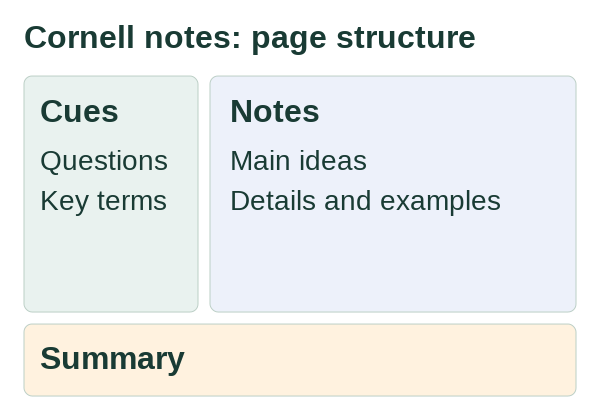
Parallel note-taking combines note-taking with reading strategies. It is designed for students who are given online lecture notes.[125] Guided notes are a changed copy of the instructor's notes. Certain blanks are left for students to fill in during the lecture.[122]
A 2026 randomized controlled trial tested four methods. It used 134 people training to be primary school teachers. Chance decided which students got Cornell, Parallel, Digital or Sentence notes. The intervention ran for 5 weeks at 2 hours per week, after a one-session orientation. At the post-test, no significant pairwise differences appeared between any of the groups. Learning motivation rose clearly in the Cornell and Parallel groups. The Digital and Sentence groups showed no significant change. In regression analyses, motivation was clearly linked with retention. Cognitive load was not.[126]
A quasi-experimental study with 99 senior high school students placed them in three groups. They used conventional, structured or camera-captured note-taking. It tested them on direct circuits. Post-test performance did not differ much between the groups. This suggests that no method was more effective than the others. All three groups made significant gains from pretest to posttest. So note-taking by any of these methods went with better understanding.[127]
Two days later they reviewed for 10 minutes. Then they took factual and application tests. On the factual test, the type of notes had no effect. The amount of information had no effect either. On the application test, graphic organizers did better than outlines. Partial notes beat complete notes. Building the notes oneself helps.[128]
A 2007 study gave college students partly complete computer-based graphic organizers. These varied in note type (summary or verbatim) and in bite size (large or small). On transfer performance, note type and bite size interacted. Large bites worked best with summary notes. Small bites worked best with word-for-word notes. The type of notes provided also changed how good the notes the students took were.[129]
Guided notes have been studied in mathematics lectures. In these lectures students often cannot think about the material while writing it down. A study using mixed methods found that many students saw guided notes as helpful. The notes helped with several parts of their note-taking. The results indicated that guided notes can address some problems of note-taking. These problems arise in traditional mathematics lectures. They also create new problems that teachers need to know about.[122]
Parallel note-taking was developed after watching students struggle with online notes. A survey confirmed those difficulties. It also suggested the method was suitable.[125]
Teachers of content area classes can build specific accommodations into their lessons. These help students with disabilities record notes successfully. This matters because lectures with note-taking make up a majority of instruction in many inclusive and general education classrooms. For students with disabilities, note-taking is a key skill. It helps them learn efficiently in those classes.[130]
Sketch and Speak combines two kinds of notes with spoken practice. Ukrainetz (2019) ran a preliminary study. The students were in fourth to sixth grade and had language-related learning disabilities. The children came from 9 schools. They were placed in a treatment group or a control group. In Ukrainetz (2019), the treatment group received 6 sessions of 30 minutes each. School speech-language pathologists ran them individually or in pairs. Students cut statements from grade-level science articles down to short ideas. They wrote them as picture notes and ordinary notes, then expanded the notes into full spoken sentences. The gains were on several quality features of notes and oral reports. The amount of content was not significantly better. Neither was the overall quality of the oral report, nor written reports given 1 to 3 days later.[123]
Boyle, Frith and Joyce (2023) describe smartpens. This technology stores spoken information during a lecture. Students can later sync that audio with their notes and amend them. Boyle, Frith and Joyce (2023) say students with disabilities are often unsure about three things. They do not know which content to record or how much detail to include. They also cannot write fast enough to match the teacher's pace.[131]
A smartpen is a pen that stores the spoken lecture and later syncs the audio to the written notes, so students can fill in gaps. Many students with learning disabilities have trouble with listening comprehension and written expression. Both skills matter for taking notes during lectures.[1]
In one study, ninth-grade English Language Arts students with and without disabilities used a smartpen strategy created by researchers. The pen was a Livescribe smartpen. Joyce and Boyle (2020) found that students with disabilities who got the smartpen intervention wrote more words in their notes. The same students also scored higher on word count in an immediate free recall test.[132] An overview of smartpen research describes two smartpen strategies. Both improved the note-taking of students with learning disabilities.[133]
One experiment compared two second-semester English classes at an Indonesian university. Each class had 15 students, and a listening test was given before and after. The experimental class began with a pretest mean of 58.67.[134] A quasi-experiment took place with ninth-grade girls in Irbid, Jordan. It put 24 students in a note-taking group and 25 in a control group taught with the standard listening strategy. The note-taking group showed better listening comprehension on the post-test.[135]
Two studies tested the Cornell note-taking method in language classes.[136][137] At Albaha University in Saudi Arabia, 40 first-year male students in a preparatory listening course were split into two equal groups. The trained group made clear progress over the control group. The control group did poorly. The researcher tied this to little knowledge of note-taking methods and little practice with feedback.[136]
One study looked at 70 intermediate learners of English as a foreign language. There were 44 males and 26 females. They were taught Cornell notes before grammar lessons. The trained group did better than the control group on a grammar test. No significant difference appeared between genders.[137]
A mixed-methods study gave 33 university students 7 weeks of KWL Plus training. It compared them with 33 students who received standard instruction. The trained group improved a lot in note-taking skills. It also improved a lot in academic listening. Students reported positive experiences with the method. They described it as systematic and effective.[138]
Dictogloss asks the teacher to read a short text aloud while students listen. Students then work in groups to rebuild the text. Two listening classes at a Vietnamese university took part. The 47 students used dictogloss from week 2 to week 14 of a 15-week course. Listening and note-taking performance improved significantly. Most students found the method effective and engaging. Some students, however, said they felt stress and anxiety while using it.[139] An experiment with 29 English majors in Banda Aceh, Indonesia, found mean scores rising from 38,2 before dictogloss teaching to 53,8 after, a significant difference on a paired samples test.[140]
Criticism
Open questions and limits of the evidence
One trial of a note-taking resource followed 22 fourth-year translation students over several weeks. That trial found no statistically significant advantage for the trained group over the control group. This was true during the trial itself.[141] A study of Swedish dental students interviewed 3 of the 24 students who handed in their notes.[142]
A survey of 1072 undergraduates asked which strategies they used in class and after class. After class, elaboration was most common. Organisation and help-seeking came next.[143]
In a quiet setting, 21 participants recalled more words when they wrote notes on paper. They recalled fewer when they typed or took no notes. The setting had both sound and visual distraction. The same participants recalled more words when they took no notes at all.[144]
A later experiment on lecture videos found that note-taking helped memory. It did not matter whether students used a laptop or wrote by hand. In that experiment, performance fell as video speed rose from 1x to 2x. The drop was significant in the laptop experiment. Students who took notes at 2x speed did about as well as students who took no notes at 1x speed.[145]
One experiment found that note-taking improved performance at the situation model level. This is a deeper level of understanding. This held in both a reading and a lecture condition.[146] A dental lecture study compared mean test scores before and after a lecture. With notes, scores went from 5.47 to 9.89; without notes, from 5.21 to 8.04.[147]
Experiments with repeated lectures showed that students stress the most important information in their notes. This held whether a lecture was played once or three times. Less important information was poorly represented after one presentation. It rose greatly on later ones.[148]
A study of 40 Persian learners of English split students into two groups. The experimental group had 20 students and the control group had 20. It reported that note-taking helped reading comprehension.[149] A study of 39 undergraduates found that note-taking predicted vocabulary gains. Gender and use of a game-based tool did not. The same study reported an R-squared of 0.564 for the model including note-taking and 0.486 without it, which leaves much of the variation unexplained.[150]
Data from one New Zealand university suggested that first-year students often struggle to take good notes. They would rather be given notes by the teacher. The same account asks whether rapid technological change challenges note-taking in lectures. It also asks whether it challenges the lecture as a format for learning.[151]
Dental students' notes shifted during their course. They moved from writing in real time to include multimodal and delayed writing. Note-taking became more of a writing practice.[142] One philosophical account argues that note-taking matters as a way of paying attention to a live lecture. It is not only a record to review later.[152]
Key studies
| Year | Study | Sample | Design | Finding |
|---|---|---|---|---|
| 1994 | Hughes & Suritsky[57] | comparison of notes from 30 university students with learning disabilities and 30 nondisabled students | Students with learning disabilities performed significantly lower on all note-taking variables, including cued and noncued information units and abbreviations. | |
| 2000 | Katayama & Robinson[128] | 117 undergraduates | experimental study | Partial graphic organizers were better than complete notes on application tests. |
| 2006 | Kobayashi[3] | 33 studies | meta-analysis | Taking and reviewing notes together had substantial overall effects on school learning. |
| 2007 | Peverly et al.[38] | two studies (a pilot and Study 1) on cognitive processes in lecture note-taking | Transcription fluency was the only predictor of note quality, and note quality was the only significant predictor of test performance. | |
| 2015 | Chang & Ku[27] | 349 fourth-grade students in Taiwan | 5-week instructional program | Note-taking instruction improved note-taking and reading comprehension, with poor readers gaining most. |
| 2016 | Aragón-Mendizábal et al.[6] | 251 social and health science students | comparative experimental study | Handwritten notes led to better free recall, while typed notes were faster. |
| 2016 | Thorley[109] | mock jurors | mock-juror study | Note-taking enhanced recall of trial information, and note reviewing offered an additional enhancement. |
| 2019 | Ukrainetz[123] | preliminary study | The treatment group showed significantly greater improvement on multiple quality features of notes and oral reports. | |
| 2021 | Wang[53] | 101 English L2 Chinese graduate students | quasi-experimental three-arm study | English-only notes outperformed Chinese-only notes on fact-based questions and retention. |
| 2022 | Feudel & Panse[122] | 70 students in mathematics lectures | mixed-method study | Guided notes helped students maintain attention and understand content during lectures. |
| 2024 | Cojean & Grand[35] | 108 university students | questionnaire study | Students who took notes on paper reported more reformulation and less multitasking than those who typed. |
| 2024 | Jin & Webb[23] | 1,992 learners in 21 studies | meta-analysis | Pooled across 21 studies, note-taking gave a small to medium gain in learning from second language input, g = 0.56 [7]. |
| 2026 | Yıldırım[126] | 134 primary-level teacher candidates | randomized controlled experiment | On the retention test, the Cornell group was the only one whose score was significantly above the Sentence group's score [71]. |
See also
References
- Boyle, J. R., & Joyce, R. L. (2019). Using Smartpens to Support Note-Taking Skills of Students with Learning Disabilities. Intervention in School and Clinic, 55(2), 86-93. doi:10.1177/1053451219837642
- Witherby, A. E., & Tauber, S. K. (2019). The current status of students’ note-taking: Why and how do students take notes? Journal of Applied Research in Memory and Cognition, 8(2), 139-153. doi:10.1016/j.jarmac.2019.04.002
- Kobayashi, K. (2006). Combined Effects of Note‐Taking/‐Reviewing on Learning and the Enhancement through Interventions: A meta‐analytic review. Educational Psychology, 26(3), 459-477. doi:10.1080/01443410500342070
- Locke, E. A. (1977). An Empirical Study of Lecture Note Taking among College Students. The Journal of Educational Research, 71(2), 93-99. doi:10.1080/00220671.1977.10885044
- Asst. Prof., The Department of Chemistry and Biochemistry and the School of Education, The City College of New York of the City University of New York, USA, isalame@ccny.cuny.edu, Salame, I. I., Thompson, A., & B.S., Psychology, The City College of New York, USA, athomps002@citymail.cuny.edu (2020). Students’ Views on Strategic Note-taking and its Impact on Performance, Achievement, and Learning. International Journal of Instruction, 13(2), 1-16. doi:10.29333/iji.2020.1321a
- Aragón-Mendizábal, E., Delgado-Casas, C., Navarro-Guzmán, J. I., Menacho-Jiménez, I., & Romero-Oliva, M. F. (2016). A comparative study of handwriting and computer typing in note-taking by university students. Comunicar, 24(48), 101-107. doi:10.3916/c48-2016-10
- Hüseyin, Ö., & Okan, S. (2019). Evaluation of Turkish teacher candidates perception of note taking concept. Educational Research and Reviews, 14(3), 78-86. doi:10.5897/err2018.3623
- Bonner, J. M., & Holliday, W. G. (2006). How college science students engage in note‐taking strategies. Journal of Research in Science Teaching, 43(8), 786-818. doi:10.1002/tea.20115
- Assoc. Professor, The Department of Chemistry and Biochemistry, The City College of New York of the City University of New York, USA, isalame@ccny.cuny.edu, Salame, I. I., Tuba, M., Psychology Department and Department of Chemistry and Biochemistry, The City College of New York of the City University of New York, USA, mtuba001@citymail.cuny.edu, Nujhat, M., & Biology Department, The City College of New York of the City University of New York, USA, mnujhat000@citymail.cuny.edu (2024). Note-taking and Its Impact on Learning, Academic Performance, and Memory. International Journal of Instruction, 17(3), 599-616. doi:10.29333/iji.2024.17333a
- White, C. J. (1996). Note-Taking Strategies and Traces of Cognition in Language Learning. RELC Journal, 27(1), 89-102. doi:10.1177/003368829602700105
- Piloton-Narca, M., & Alda, R. (2025). Students' Note-Taking Patterns and Practices in Science Classes: A Narrative Inquiry. JPI (Jurnal Pendidikan Indonesia), 14(3), 712-719. doi:10.23887/jpi-undiksha.v14i3.85414
- Nachiappan, S. (2022). Note-taking and note-making: The ever-cherished art! Indian Journal of Ophthalmology, 70(12), 4438-4444. doi:10.4103/ijo.ijo_1780_22
- Malloy, K. J. (2021). Lecture Notes: Reminders, Challenges, and Inspiration. Wicazo Sa Review, 36(2), 124-126. doi:10.1353/wic.2021.a919179
- Annis, L., & Davis, J. K. (1975). The Effect of Encoding and an External Memory Device on Note Taking. The Journal of Experimental Education, 44(2), 44-46. doi:10.1080/00220973.1975.11011522
- Fisher, J. L., & Harris, M. B. (1974). Effect of Note-Taking Preference and Type of Notes Taken on Memory. Psychological Reports, 35(1), 384-386. doi:10.2466/pr0.1974.35.1.384
- AEM ( Azerbaijan Science Center ), & Ismailli, T. (2024). Aims and methods of note-taking. SCIENTIFIC RESEARCH, 4(10), 23-26. doi:10.36719/2789-6919/38/23-26
- Carroll, K. (2024). The Relationship Between Note taking, Revision, and Learning in Tertiary Education: A Review of Literature. All Ireland Journal of Higher Education, 16(1). doi:10.62707/aishej.v16i1.781
- Isaacs, G. (1989). Lecture Note-taking, Learning and Recall. Medical Teacher, 11(3-4), 295-302. doi:10.3109/01421598909146416
- Igo, L. B., Kiewra, K. A., & Bruning, R. (2008). Individual Differences and Intervention Flaws: A Sequential Explanatory Study of College Students' Copy-and-Paste Note Taking. Journal of Mixed Methods Research, 2(2), 149-168. doi:10.1177/1558689807313161
- Katayama, A. D., Shambaugh, R. N., & Doctor, T. (2005). Promoting Knowledge Transfer with Electronic Note Taking. Teaching of Psychology, 32(2), 129-131. doi:10.1207/s15328023top3202_9
- Palaigeorgiou, G. E., Despotakis, T. D., Demetriadis, S., & Tsoukalas, I. A. (2006). Synergies and barriers with electronic verbatim notes (eVerNotes): note taking and report writing with eVerNotes. Journal of Computer Assisted Learning, 22(1), 74-85. doi:10.1111/j.1365-2729.2006.00161.x
- Fossa, J. A. (2019). on note-taking. REMATEC, 14(32), 47-66. doi:10.37084/rematec.1980-3141.2019.n32.p47-66.id203
- Jin, Z., & Webb, S. (2024). The effectiveness of note taking through exposure to L2 input: A meta-analysis. Studies in Second Language Acquisition, 46(2), 404-426. doi:10.1017/s0272263123000529
- Weiland, A., & Kingsbury, S. J. (1979). Immediate and Delayed Recall of Lecture Material as a Function of Note Taking. The Journal of Educational Research, 72(4), 228-230. doi:10.1080/00220671.1979.10885160
- Rummer, R., Schweppe, J., Gerst, K., & Wagner, S. (2017). Is testing a more effective learning strategy than note-taking? Journal of Experimental Psychology: Applied, 23(3), 293-300. doi:10.1037/xap0000134
- Jansen, R. S., Lakens, D., & IJsselsteijn, W. A. (2017). An integrative review of the cognitive costs and benefits of note-taking. Educational Research Review, 22, 223-233. doi:10.1016/j.edurev.2017.10.001
- Chang, W. C., & Ku, Y. M. (2015). The Effects of Note-Taking Skills Instruction on Elementary Students’ Reading. The Journal of Educational Research, 108(4), 278-291. doi:10.1080/00220671.2014.886175
- Boyle, J. R. (2013). Strategic Note-Taking for Inclusive Middle School Science Classrooms. Remedial and Special Education, 34(2), 78-90. doi:10.1177/0741932511410862
- Sienkiewicz, T., & Williams, E. (2026). Textbook-Based Note-Taking Guides Improve HESI Scores for Accelerated BSN Students. Journal of Christian Nursing, 43(4), 240-245. doi:10.1097/cnj.0000000000001414
- Šarić-Grgić, I., Grubišić, A., & Žitko, B. (2021). The Impact of Note-Taking on the Learning Process in Intelligent Tutoring System Tutomat. Applied Computer Systems, 26(1), 31-37. doi:10.2478/acss-2021-0004
- Fukawa-Connelly, T., Weber, K., & Mejía-Ramos, J. P. (2017). Informal Content and Student Note-Taking in Advanced Mathematics Classes. Journal for Research in Mathematics Education, 48(5), 567-579. doi:10.5951/jresematheduc.48.5.0567
- Bui, D. C., Myerson, J., & Hale, S. (2013). Note-taking with computers: Exploring alternative strategies for improved recall. Journal of Educational Psychology, 105(2), 299-309. doi:10.1037/a0030367
- Khurana, T., & Frishman, J. (2022). Impact of Note-Taking Mediums on Memory Recognition. Journal of Student Research, 11(4). doi:10.47611/jsrhs.v11i4.3148
- Shi, Y., & Yu, Z. (2024). The Effect of Laptop Note-Taking on Students’ Learning Performance, Strategies, and Satisfaction. Electronic Journal of e-Learning, 22(1), 78-91. doi:10.34190/ejel.22.1.3396
- Cojean, S., & Grand, M. (2024). Note‐taking by university students on paper or a computer: Strategies during initial note‐taking and revision. British Journal of Educational Psychology, 94(2), 557-570. doi:10.1111/bjep.12663
- Nye, P. A. (1978). Student Variables in Relation to Note‐taking during a Lecture. Programmed Learning and Educational Technology, 15(3), 196-200. doi:10.1080/0033039780150303
- Song, M. Y. (2012). Note-taking quality and performance on an L2 academic listening test. Language Testing, 29(1), 67-89. doi:10.1177/0265532211415379
- Peverly, S. T., Ramaswamy, V., Brown, C., Sumowski, J., Alidoost, M., & Garner, J. (2007). What predicts skill in lecture note taking? Journal of Educational Psychology, 99(1), 167-180. doi:10.1037/0022-0663.99.1.167
- Oefinger, L. M., & Peverly, S. T. (2020). The Lecture Note-Taking Skills of Adolescents With and Without Learning Disabilities. Journal of Learning Disabilities, 53(3), 176-188. doi:10.1177/0022219419897268
- Nurwanti, & Chindy Lorena Chansa (2023). Students’ Interest Level In Learning Listening By Using Note-Taking Strategy. EDULEC : Education, Language, and Culture Journal, 3(2), 204-209. doi:10.56314/edulec.v3i2.150
- Episiasi, E., Wahidin, W., Suramto, S., & Kencana, N. (2025). Students’ Perception on the Use of Note-taking Strategy in Listening. JURNAL PERSPEKTIF PENDIDIKAN, 19(1), 96-105. doi:10.31540/jpp.v19i1.3478
- Davis, M., & Hult, R. E. (1997). Effects of Writing Summaries as a Generative Learning Activity during Note Taking. Teaching of Psychology, 24(1), 47-49. doi:10.1177/009862839702400112
- Kondo, T., ISHII, K., Misono, T., Inaba, R., & Watanabe, Y. (2025). Impact of Visualizing Others’ Note-Taking Situations on Note Revision and Review. The Journal of Applied Instructional Design, 14(2). doi:10.59668/2222.21481
- Risch, N. L., & Kiewra, K. A. (1990). Content and Form Variations in Note Taking: Effects Among Junior High Students. The Journal of Educational Research, 83(6), 355-357. doi:10.1080/00220671.1990.10885981
- Baldwin, M. P., Fanguy, M., & Costley, J. H. (2019). The Effects of Collaborative Note-Taking in Flipped Learning Contexts. Journal of Language and Education, 5(4), 25-35. doi:10.17323/jle.2019.9726
- Chau, N. N., & Hong, N. X. (2026). Students’ Perceptions of Note-taking as a Listening Comprehension Strategy: A Mixed-methods Study of Vietnamese EFL Majors. International Journal of Current Science Research and Review, 09(07). doi:10.47191/ijcsrr/v9-i7-32
- Nguyễn Quang Hưng, & Đinh Thị Bảo Hương (2024). Second-year english majors’ perceptions of note-taking in mini-lectures. Tạp chí Khoa học Ngoại ngữ(74), 28-49. doi:10.56844/tckhnn.74.723
- EFL teacher, Chirchik State Pedagogical University, Uzbekistan, & qizi, N. M. B. (2026). The Importance Of Note-Taking Skills. European International Journal of Pedagogics, 6(1), 104-105. doi:10.55640/eijp-06-01-25
- Teacher, English Philology Department, Alisher Navo’i Tashkent State University Of Uzbek Language And Literature, Uzbekistan, & Komilova, M. M. Q. (2023). The influence of note-taking on listening comprehension in an academic context. CURRENT RESEARCH JOURNAL OF PEDAGOGICS, 04(01), 56-61. doi:10.37547/pedagogics-crjp-04-01-09
- Hayati, A. M., & Jalilifar, A. (2009). The Impact of Note-taking Strategies on Listening Comprehension of EFL Learners. English Language Teaching, 2(1). doi:10.5539/elt.v2n1p101
- Hale, G. A., & Courtney, R. (1994). The effects of note-taking on listening comprehension in the Test of English as a Foreign Language. Language Testing, 11(1), 29-47. doi:10.1177/026553229401100104
- Siegel, J. (2016). A pedagogic cycle for EFL note-taking. ELT Journal, 70(3), 275-286. doi:10.1093/elt/ccv073
- Wang, X. (2021). An analysis of note-taking strategies: The effect of translanguaging on content comprehension and knowledge retention. Journal of Language Teaching, 1(1), 18-37. doi:10.54475/jlt.2021.020
- Irgin, P. (2025). Note-taking in Academic Listening: A Translanguaging Perspective. RELC Journal. doi:10.1177/00336882251322253
- Yuan, R. (2025). Navigating EMI learning through note-taking in higher education. Journal of Multilingual and Multicultural Development, 46(9), 2915-2929. doi:10.1080/01434632.2024.2316272
- Boyle, J. R. (2010). Note-Taking Skills of Middle School Students With and Without Learning Disabilities. Journal of Learning Disabilities, 43(6), 530-540. doi:10.1177/0022219410371679
- Hughes, C. A., & Suritsky, S. K. (1994). Note-Taking Skills of University Students With and Without Learning Disabilities. Journal of Learning Disabilities, 27(1), 20-24. doi:10.1177/002221949402700105
- Boyle, J. R. (2010). Strategic Note-Taking for Middle-School Students with Learning Disabilities in Science Classes. Learning Disability Quarterly, 33(2), 93-109. doi:10.1177/073194871003300203
- Boyle, J. R., Rosen, S. M., & Forchelli, G. (2016). Exploring metacognitive strategy use during note-taking for students with learning disabilities. Education 3-13, 44(2), 161-180. doi:10.1080/03004279.2014.929722
- Boyle, J. R., & Rivera, T. Z. (2012). Note-Taking Techniques for Students With Disabilities: A Systematic Review of the Research. Learning Disability Quarterly, 35(3), 131-143. doi:10.1177/0731948711435794
- Boyle, J. R. (2001). Enhancing the Note taking Skills of Students with Mild Disabilities. Intervention in School and Clinic, 36(4), 221-224. doi:10.1177/105345120103600405
- Stinson, M. S., Elliot, L. B., Kelly, R. R., & Yufang Liu (2009). Deaf and Hard-of-Hearing Students' Memory of Lectures with Speech-to-Text and Interpreting/Note Taking Services. The Journal of Special Education, 43(1), 52-64. doi:10.1177/0022466907313453
- Isaacs, G. (1994). Lecturing practices and note-taking purposes. Studies in Higher Education, 19(2), 203-216. doi:10.1080/03075079412331382047
- Sutton, P. (2000). Using lecture notes on the internet as learning support materials for lectures: Student and staff perspectives on note-taking. Psychology Teaching Review, 9(1), 26-37. doi:10.53841/bpsptr.2000.9.1.26
- McLENNAN, M., & ISAACS, G. (2002). The role of handouts, note‐taking and overhead transparencies in veterinary science lectures. Australian Veterinary Journal, 80(10), 626-629. doi:10.1111/j.1751-0813.2002.tb10969.x
- Morrison, E. H., McLaughlin, C., & Rucker, L. (2002). Medical students' note‐taking in a medical biochemistry course: an initial exploration. Medical Education, 36(4), 384-386. doi:10.1046/j.1365-2923.2002.01167.x
- Gerald, C., & Joseph, M. (2025). Challenges of note-taking in powerpoint-based lectures: An analysis of first-year students at mukuba university. Sprin Journal of Arts, Humanities and Social Sciences, 4(3), 6-12. doi:10.55559/sjahss.v4i3.505
- Cartolari, M., Carlino, P., & Colombo, L. (2013). Reading and Note Taking in Monological and Dialogical Classes in the Social Sciences. Australian Journal of Teacher Education, 38(6). doi:10.14221/ajte.2013v38n6.7
- M Almusharraf, N., Costley, J., & Fanguy, M. (2020). The Effect of Postgraduate Students’ Interaction with Video Lectures on Collaborative Note-taking. Journal of Information Technology Education: Research, 19, 639-654. doi:10.28945/4581
- Hefter, M. H. (2024). Note-taking fosters distance video learning: smartphones as risk and intellectual values as protective factors. Scientific Reports, 14(1). doi:10.1038/s41598-024-67898-7
- Oslawski-Lopez, J., & Kordsmeier, G. T. (2025). Examining Engagement, Note-Taking, and Multitasking in Podcast-Based Learning. Teaching Sociology, 53(3), 191-208. doi:10.1177/0092055x251327956
- Chen, M. R. A. (2024). The AI chatbot interaction for semantic learning: A collaborative note-taking approach with EFL students. Language Learning & Technology, 28(1), 1-25. doi:10.64152/10125/73586
- van Wyk, M., & van Ryneveld, L. (2018). Affordances of mobile devices and note-taking apps to support cognitively demanding note-taking. Education and Information Technologies, 23(4), 1639-1653. doi:10.1007/s10639-017-9684-0
- Pyörälä, E., Mäenpää, S., Heinonen, L., Folger, D., Masalin, T., & Hervonen, H. (2019). The art of note taking with mobile devices in medical education. BMC Medical Education, 19(1). doi:10.1186/s12909-019-1529-7
- Sun, D., & Li, Y. (2019). Effectiveness of Digital Note-Taking on Students’ Performance in Declarative, Procedural and Conditional Knowledge Learning. International Journal of Emerging Technologies in Learning (iJET), 14(18), 108. doi:10.3991/ijet.v14i18.10825
- Nakayama, M., Mutsuura, K., & Yamamoto, H. (2017). Effectiveness of Student's Note-Taking Activities and Characteristics of Their Learning Performance in Two Types of Online Learning: . International Journal of Distance Education Technologies, 15(3), 47-64. doi:10.4018/ijdet.2017070104
- Murtafi'ah, M., Asmiyah, S., & Fitriah, F. (2020). Is Technology Based Note-Taking More Preferable For Millenial Students? Exploration Of English Students' Note-Taking Habit. IJET (Indonesian Journal of English Teaching), 9(2), 207-216. doi:10.15642/ijet2.2020.9.2.207-216
- Wilding, J., & Hayes, S. (1992). Relations between approaches to studying and note‐taking behaviour in lectures. Applied Cognitive Psychology, 6(3), 233-246. doi:10.1002/acp.2350060305
- Gorospe, M. J. M., & Abad, L. S. (2023). Note-taking behaviors of high school students. Cognizance Journal of Multidisciplinary Studies, 3(6), 200-211. doi:10.47760/cognizance.2023.v03i06.011
- Al-Musalli, A. M. (2015). Taxonomy of Lecture Note-Taking Skills and Subskills. International Journal of Listening, 29(3), 134-147. doi:10.1080/10904018.2015.1011643
- Kendrick, A., & Cross, L. A. (2024). The Practice of Note-taking: A Concept Analysis. Research and Theory for Nursing Practice, RTNP-2023-0137.R1. doi:10.1891/rtnp-2023-0137
- Robin, A., Foxx, R. M., Martello, J., & Archable, C. (1977). Teaching Note -Taking Skills to Underachieving College Students. The Journal of Educational Research, 71(2), 81-85. doi:10.1080/00220671.1977.10885042
- Weber, Z. (2024). Step away from the paraphrase: teaching note-taking as a gateway to knowledge transformation. Journal of Learning Development in Higher Education(32). doi:10.47408/jldhe.vi32.1460
- Ganap, D., & Kondo, P. (2025). Note-Taking Strategy and Students English Achievement at Selective Private Senior High School. Global Education Journal, 3(2), 315-326. doi:10.59525/gej.v3i2.721
- Velimirovici, I., & Şimon, S. (2026). Exploring Students’ Views on Note-Taking during Interpreting Tasks. Scientific Bulletin of the Politehnica University of Timişoara Transactions on Modern Languages, 25(1), 145-155. doi:10.59168/vfiz4870
- Chen, S. (2016). Note-taking in consecutive interpreting: a review with special focus on Chinese-English literature. The Journal of Specialised Translation(26), 151-171. doi:10.26034/cm.jostrans.2016.282
- Kuang, H., & Zheng, B. (2022). How does interpreting performance correlate with note-taking process, note-taking product and note-reading process? An eye-tracking and pen-recording study. Across Languages and Cultures, 23(2), 167-186. doi:10.1556/084.2022.00281
- Liu, Y., Luo, W., & Wang, X. (2023). Exploring the relationship between students’ note-taking and interpreting quality: a case study in the Chinese context. Frontiers in Education, 8. doi:10.3389/feduc.2023.1157509
- Han, L., Lu, J., & Wen, Z. (. (2022). Note-Taking Proficiency in Interpreting Teaching: Putting the Note-Taking Fluency Scale to the Test. Theory and Practice in Language Studies, 12(10), 2024-2035. doi:10.17507/tpls.1210.09
- Zheng, Y., Xu, H., & Hu, T. (2022). Using Stimulated Recall to Probe Note-taking and Note-related Difficulties Perceived by Professional Trainee Interpreters. International Journal of Chinese and English Translation & Interpreting. doi:10.56395/ijceti.v2i2.24
- Romano, E. (2018). Teaching Note-Taking to Beginners Using a Digital Pen. Między Oryginałem a Przekładem, 24(42), 9-16. doi:10.12797/moap.24.2018.42.01
- Trlifajová, M. (2023). Reflective Approach in Teaching Note-Taking. CLINA Revista Interdisciplinaria de Traducción Interpretación y Comunicación Intercultural, 9(2), 161-182. doi:10.14201/clina202392161182
- OKATAN, S. (2023). Examining Translator Candidate Students’ Strengths and Weaknesses in Note-taking System While Interpreting Consecutively. RumeliDE Dil ve Edebiyat Araştırmaları Dergisi(37), 1432-1446. doi:10.29000/rumelide.1406033
- Tavener-Smith, T. (2021). Note-taking by nursing students: the case for implementing writing strategies to encourage best practice. British Journal of Nursing, 30(3), 172-176. doi:10.12968/bjon.2021.30.3.172
- Fischer, J., & Breaugh, J. (2021). An Investigation of Interviewer Note Taking in the Field. Personnel Assessment and Decisions, 7(2). doi:10.25035/pad.2021.02.002
- Rusdiansyah, R. (2019). Note-taking as a technique in teaching reading comprehension. IDEAS: Journal on English Language Teaching and Learning, Linguistics and Literature, 7(2). doi:10.24256/ideas.v7i2.1033
- Nurmila (2020). Improving the Students’ Reading Skill trough Note-Taking Technique: A Pre-Experimental Research. Journal La Edusci, 1(1), 25-32. doi:10.37899/journallaedusci.v1i1.29
- FLE, Thai Nguyen University of Education, Thai Nguyen University, Linh, D. K., Kien, P. T., & FLE, Thai Nguyen University of Education, Thai Nguyen University (2025). Applying the Cornell Note-Taking Method to Enhance Reading Comprehension for High School Students. International Journal of Social Science and Human Research, 08(03). doi:10.47191/ijsshr/v8-i3-45
- Bakri, R. A., Ismail, H., Saiful, S., & Syam, H. (2022). Empowering Students’ Reading Comprehension Through Cornell Note-Taking Method. BATARA DIDI : English Language Journal, 1(1), 12-19. doi:10.56209/badi.v1i1.25
- Phan, M. P. K. (2020). Application of Metacognitive Note-taking Skills in Reading Lessons to EFL College Students. Journal of Effective Teaching in Higher Education, 3(1), 30-49. doi:10.36021/jethe.v3i1.64
- Mežek, Š. (2013). Learning terminology from reading texts in English: The effects of note-taking strategies. Nordic Journal of English Studies, 12(S1), 133-161. doi:10.35360/njes.279
- Jiang, Y., Clarke-Midura, J., Keller, B., Baker, R. S., Paquette, L., & Ocumpaugh, J. (2018). Note-taking and science inquiry in an open-ended learning environment. Contemporary Educational Psychology, 55, 12-29. doi:10.1016/j.cedpsych.2018.08.004
- Trafton, J. G., & Trickett, S. B. (2001). Note-Taking for Self-Explanation and Problem Solving. Human–Computer Interaction, 16(1), 1-38. doi:10.1207/s15327051hci1601_1
- Jannah, A., Suryelita, & Gazali, F. (2026). Improving Students' Note-Taking Discipline in Chemistry Learning Through Reward and Punishment. SEARCH: Science Education Research Journal, 5(1), 98-107. doi:10.47945/search.v5i1.3267
- Kondo, T., Yokoyama, K., Misono, T., Inaba, R., & Watanabe, Y. (2024). Effects of Nudges by Visualization of Others’ Note-Taking on In-Class Learning Behavior. The Journal of Applied Instructional Design. doi:10.59668/1269.15641
- Long, G. M. (2014). Positive Effects of Restricting Student Note-Taking in a Capstone Psychology Course: Reducing the Demands of Divided Attention in the Classroom. Teaching of Psychology, 41(4), 340-344. doi:10.1177/0098628314549707
- Sabtiawan, W. B. (2018). Classroom action research: Penerapan strategi belajar note-taking, discussion, reflective (NDR) untuk meningkatkan hasil belajar mahasiswa ipa. Jurnal Pendidikan Matematika dan IPA, 9(2), 89. doi:10.26418/jpmipa.v9i2.26814
- Murtafi'ah, M., Muflihah, M., & Zen, E. L. (2023). Note-Taking: The Gender Difference on Students’ Perception. Scope : Journal of English Language Teaching, 7(2), 226. doi:10.30998/scope.v7i2.15361
- Thorley, C. (2016). Note Taking and Note Reviewing Enhance Jurors' Recall of Trial Information. Applied Cognitive Psychology, 30(5), 655-663. doi:10.1002/acp.3240
- Nielsen, S. B. (2021). Interactional integration of talk and note-taking. Psychology of Language and Communication, 25(1), 145-167. doi:10.2478/plc-2021-0007
- Svinhufvud, K. (2016). Nodding and note-taking: Multimodal analysis of writing and nodding in student counseling interaction. Language and Dialogue, 6(1), 81-109. doi:10.1075/ld.6.1.03svi
- Plaut, A. B. J. (2005). 1. On note taking. Journal of Analytical Psychology, 50(1), 45-58. doi:10.1111/j.0021-8774.2005.00510.x
- Волох, Д. С. (2025). An effective management practice: Public note-taking in virtual team collaboration. Управління змінами та інновації(14), 141-144. doi:10.32782/cmi/2025-14-22
- Panades-Estruch, L. (2018). Note-taking and Notability: How to Succeed at Legal Doctoral Fieldwork. Croatian International Relations Review, 24(83), 104-123. doi:10.2478/cirr-2018-0016
- Van Meter, P., Yokoi, L., & Pressley, M. (1994). College students' theory of note-taking derived from their perceptions of note-taking. Journal of Educational Psychology, 86(3), 323-338. doi:10.1037/0022-0663.86.3.323
- Smoter, K. (2025). Note-taking as a Learning Strategy for First-Year Students Majoring in Pedagogy – Pilot Study. Podstawy Edukacji, 18, 267-284. doi:10.16926/pe.2025.18.16
- Kitjaroonchai, N., Marshall, P., Phasook, J., & Thararuenroeng, N. (2025). University Students’ Perceptions on Note-Taking and Its Impact on Academic Performance. JET (Journal of English Teaching), 11(1), 1-19. doi:10.33541/jet.v11i1.6373
- Desate, N. R., Huertas, M. S. M., & Piamonte, J. R. (2026). Digital Note-Taking and Academic Performance of Nursing Students of University of Perpetual Help System- DALTA Calamba Campus. QualiSearch Journal of Educational Research and Practice. doi:10.66437/qjerp.v2i2.002
- Wardhani, N., Athaya, Z. A., Widiantari, A. R., Desyana, V., Putri, S. A., & Rahman, N. N. (2025). Digital Charting and Outlining Note-taking Types on Memory Retention: A Within-Subjects Experimental Study Among University Students. Kajian Psikologi dan Kesehatan Mental, 3(1), 39-51. doi:10.35912/kpkm.v3i1.6801
- Kundu, A., & Bej, T. (2019). Mobile phone vs paper-pencil mode of note-taking, a case study among the students of Bankura University. Interactive Technology and Smart Education, 17(1), 1-13. doi:10.1108/itse-09-2018-0063
- COMFORT, F. B., & EMMANUEL, F. A. (2025). Perceived influence of note- taking and note- making skills and students’ academic performance in kwara state colleges of education. International Journal of Research in Education Humanities and Commerce, 06(06), 287-306. doi:10.37602/ijrehc.2025.6622
- Feudel, F., & Panse, A. (2022). Can Guided Notes Support Students’ Note-taking in Mathematics Lectures? International Journal of Research in Undergraduate Mathematics Education, 8(1), 8-35. doi:10.1007/s40753-021-00146-9
- Ukrainetz, T. A. (2019). Sketch and Speak: An Expository Intervention Using Note-Taking and Oral Practice for Children With Language-Related Learning Disabilities. Language, Speech, and Hearing Services in Schools, 50(1), 53-70. doi:10.1044/2018_lshss-18-0047
- Hendel, R. J. (2024). Using the Cornell Note Taking Method for Instruction. Journal of Systemics, Cybernetics and Informatics, 22(5), 7-13. doi:10.54808/jsci.22.05.7
- Pardini, E. A., Domizi, D. P., Forbes, D. A., & Pettis, G. V. (2005). Parallel note-taking: A strategy for effective use of Webnotes. Journal of College Reading and Learning, 35(2), 38-55. doi:10.1080/10790195.2005.10850172
- Yıldırım, M. (2026). The effects of note-taking methods on lasting learning: the role of motivation and cognitive load. Frontiers in Psychology, 16. doi:10.3389/fpsyg.2025.1697151
- Salem, R. R. (2020). Conventional, Structured and "Camera-Captured" Note-taking Methods: A Comparative Analysis. The Normal Lights, 14(2). doi:10.56278/tnl.v14i2.1650
- Katayama, A. D., & Robinson, D. H. (2000). Getting Students “Partially” Involved in Note-Taking Using Graphic Organizers. The Journal of Experimental Education, 68(2), 119-133. doi:10.1080/00220970009598498
- Crooks, S. M., White, D. R., & Barnard, L. (2007). Factors Influencing the Effectiveness of Note Taking on Computer-Based Graphic Organizers. Journal of Educational Computing Research, 37(4), 369-391. doi:10.2190/ec.37.4.c
- Boyle, J. R., Forchelli, G. A., & Cariss, K. (2015). Note-Taking Interventions to Assist Students With Disabilities in Content Area Classes. Preventing School Failure: Alternative Education for Children and Youth, 59(3), 186-195. doi:10.1080/1045988x.2014.903463
- Boyle, J. R., Frith, D. M., & Joyce, R. L. (2023). Using JIGSAW to Complete the Note-Taking Puzzle. TEACHING Exceptional Children, 55(6), 446-453. doi:10.1177/00400599221117815
- Joyce, R. L., & Boyle, J. R. (2020). Improving Note-Taking Skills for Students With Disabilities Through a Smartpen Intervention. Journal of Special Education Technology, 35(4), 225-235. doi:10.1177/0162643419856275
- Boyle, J., & Joyce, R. (2021). Smartpens: Note-Taking Technology for Students with Learning Disabilities. Learning Disabilities: A Multidisciplinary Journal, 26(1). doi:10.18666/ldmj-2021-v26-i1-10363
- Suyadi, S., Safitri, B., & Putriani, P. (2023). Note-Taking Method for Listening Ability of University Students. Jurnal Ilmiah Universitas Batanghari Jambi, 23(1), 792. doi:10.33087/jiubj.v23i1.3309
- Al-Quraan, S. E., & Bani Abdelrahman, A. (2025). The Effect of Note-taking Strategy on EFL Ninth-Grade Students’ Listening Comprehension. Jordanian Educational Journal, 10(1), 720-741. doi:10.46515/jaes.v10i1.1420
- Abualzain, O. Y. (2024). The Effect of Implementing Cornell Note-Taking Strategies on New Students’ Performance in Listening Comprehension. Theory and Practice in Language Studies, 14(8), 2379-2388. doi:10.17507/tpls.1408.10
- Davoudi, M., Moattarian, N., & Zareian, G. (2015). The Impact of Cornell Note-Taking Method Instruction on Grammar Learning of Iranian EFL Learners. Journal of Studies in Education, 5(2), 252. doi:10.5296/jse.v5i2.6874
- Karagöl, E. (2025). The Impact of the KWL Plus Strategy on University Students’ Note-Taking and Academic Listening Skills: A Mixed-Methods Research. SAGE Open, 15(4). doi:10.1177/21582440251379210
- Nguyen, L. B. N., & Nguyen, H. P. M. (2023). Vietnamese EFL Students’ Perception on Using Dictogloss in Listening and Note-taking Classes. Proceedings of the AsiaCALL International Conference, 4, 35-44. doi:10.54855/paic.2343
- Bahri, S. (2025). Quantitative Study on Using Dictogloss in Improving Students’ Note-taking Skills in Listening Class. Educator Development Journal, 3(1), 83-100. doi:10.22373/edj.v3i1.7508
- Mankauskienė, D., & Carsten, S. (2023). Evaluating the effectiveness of ORCIT’s note-taking resource. Onomázein, 39-58. doi:10.7764/onomazein.ne13.03
- Lindberg, V., Jounger, S. L., Christidis, M., & Christidis, N. (2020). Characteristics of dental note taking: a material based themed analysis of Swedish dental students. BMC Medical Education, 20(1). doi:10.1186/s12909-020-02441-6
- Chen, P. H. (2021). In-class and after-class lecture note-taking strategies. Active Learning in Higher Education, 22(3), 245-260. doi:10.1177/1469787419893490
- Lin, L., & Bigenho, C. (2011). Note-Taking and Memory in Different Media Environments. Computers in the Schools, 28(3), 200-216. doi:10.1080/07380569.2011.594989
- Chen, A., Murphy, D. H., Brabec, J. A., Bjork, R. A., & Bjork, E. L. (2024). The effects of lecture speed and note‐taking on memory for educational material. Applied Cognitive Psychology, 38(1). doi:10.1002/acp.4166
- Bohay, M., Blakely, D. P., Tamplin, A. K., & Radvansky, G. A. (2011). Note Taking, Review, Memory, and Comprehension. The American Journal of Psychology, 124(1), 63-73. doi:10.5406/amerjpsyc.124.1.0063
- Kumar, S., Jain, S., Taksande, B., & Bhowate, R. (2014). Assessment of Impact of Note-taking on Cognition of Undergraduate Dental Student during Lectures. Journal of Research in Medical Education & Ethics, 4(3). doi:10.5958/2231-6728.2014.00910.x
- Kiewra, K. A., Mayer, R. E., Christensen, M., Kim, S. i., & et al (1991). Effects of repetition on recall and note-taking: Strategies for learning from lectures. Journal of Educational Psychology, 83(1), 120-123. doi:10.1037//0022-0663.83.1.120
- Bahrami, F., & Nosratzadeh, H. (2017). The Effectiveness of Note-Taking on Reading Comprehension of Iranian EFL Learners. International Journal of Applied Linguistics and English Literature, 6(7), 308. doi:10.7575/aiac.ijalel.v.6n.7p.308
- Villacrés Ochoa, Y. E. (2024). Note taking and Educaplay: Their Influence on Vocabulary Acquisition in English as a Foreign Language Students. Kronos – The Language Teaching Journal, 5(1), 22-36. doi:10.29166/kronos.v5i1.5954
- van der Meer, J. (2012). Students’ note-taking challenges in the twenty-first century: considerations for teachers and academic staff developers. Teaching in Higher Education, 17(1), 13-23. doi:10.1080/13562517.2011.590974
- Marin, L., & Sturm, S. (2021). ‘Why aren’t you taking any notes?’ On note-taking as a collective gesture. Educational Philosophy and Theory, 53(13), 1399-1406. doi:10.1080/00131857.2020.1744131
Cite this page: Atlas Nova editors. (2026). Note-taking. Atlas Nova. https://velocer.io/atlas/note-taking/