Research finding · Study methods
Longhand versus laptop note-taking
Longhand versus laptop note-taking
Longhand note taking means writing notes by hand; laptop note taking means typing them on a portable computer. Mueller and Oppenheimer asked whether laptop note taking impairs learning even when the laptop is used only for notes.[1][2]
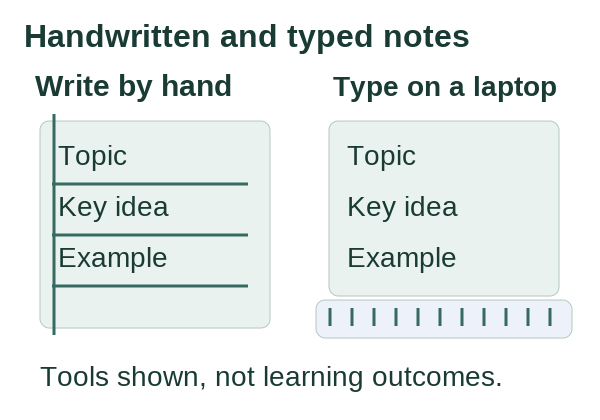
Students who typed notes wrote more words and copied more of the lecture word for word.[2] In a direct replication with 74 laptop note takers and 68 longhand note takers, the laptop group did not do better on the quiz.[2] A study of 68 students found no difference in recall for tablet, laptop and handwritten notes.[3] Handwriting produced more widespread brain connectivity than typing in 36 university students.[4]
Overview
The claim and its first test
Taking notes on a laptop instead of by hand became common in classrooms. Many researchers argued the laptop was the weaker tool for learning. Earlier studies had focused on students' ability to multitask and be distracted when they use laptops. In 2014, Mueller and Oppenheimer asked a narrower question. Does the laptop harm learning even when it is used only for note-taking?[1]
Oppenheimer and Ellefson note that the longhand advantage spread widely. It influenced classroom laptop policies around the world. A later follow-up by Urry and colleagues in 2021 found no evidence for the longhand advantage. Oppenheimer and Ellefson say two studies disagree: Mueller and Oppenheimer (2014) and Urry et al. (2021). They say this shows a need. It shows a need to tell direct replications apart from generalization studies.[6]
Main ideas
Why writing by hand may differ
Olive and Barbier studied how the format of a source text affects longhand note taking. Students read a source text set out with bullets or as a single paragraph. They then jotted notes and wrote a summary. Students who read the bulleted text spent less time reading. They recorded more ideas in their notes. While writing the summary, only students who had read the bulleted text kept choosing ideas from their notes. The finished summaries did not differ between the two formats.[7]
Smoker and colleagues studied possible links between hand movement in handwriting and memory. One study compared recall and recognition for common words. It found better memory for words that had been written down than for words that had been typed. The researchers suggested that writing is a complex task. The extra context it gives may lead to better memory.[8]
A later study used the drawing versus handwriting method. It added a typing condition. Drawn words were recalled better than handwritten ones. The evidence did not show that handwriting gave better free recall than typing.[9]
One study looked at how spelling processing affects handwriting and typing. The students practice handwriting a great deal but type less. Thirty-six 9th-grade students in Italy handwrote and typed dictated words and pseudowords. The items differed in length and orthographic complexity. Typing showed stronger word-level and letter-level effects. Handwriting showed a different pattern of processing. Reading and visual-motor integration skills (hand and eye working together) acted differently with the two writing modes.[10]
One study looked at 28 Burmese beginners given 40 hours of Chinese instruction. The typing group did better on character recognition and dictation. The handwriting group scored higher on meaning recognition. The researchers read this as stronger links between written form and meaning.[11]
The children were five years old and had not yet learned to read. They printed, typed or traced letters. They then viewed them during functional MRI scanning. This scanning maps brain activity. Earlier work described a reading circuit. It was active when children saw letters only if they had first written those letters by hand. Typing or tracing the same letters did not produce this response.[12]
The patterns appeared at theta and alpha frequencies. These are brain wave rates. Earlier work linked them to memory formation and to storing new information.[4]
For new words, handwriting has been linked to stronger learning than typing. An EEG experiment measured the N400 priming effect for foreign words. EEG records brain waves. The words were learned with an ink pen, a digital pen or a keyboard. Students used to digital pens showed a greater N400 effect. Mood during learning was much more positive during handwriting than during typing. The behavioral measures did not differ by tool.[13]
Speed, transcription and cognitive load
A 1988 study used 12 adults who typed with two fingers, not by touch. Their median keyboard experience was ten years. They wrote a short memorized passage. They also copied a four paragraph passage by pen and by keyboard. Typing was over five words per minute faster than handwriting. This held for both the memorized and the copied passages. Writing from memory ran about ten words per minute faster than copying. This held whichever method was used. Typing a copied passage produced more errors than any other condition.[14] After the lessons, handwriting speed and keyboarding speed were clearly linked. Their accuracy was not.[15]
Researchers timed the pauses between letters, called interletter intervals. They did this at three points: before the digraph, inside it, and after it. The pause before the digraph was longest in both methods and both age groups. This suggests the next letter sequence was planned in advance. In handwriting the pauses grew shorter across the three positions. In typing they stayed constant inside and after the digraph. The adolescents had more trouble starting digraphs and the vowels after them. This was especially so in typing, the method they knew less well.[16]
When lecture speed rises, note-taking may absorb some of the cost. In a 2024 study, participants watched lecture videos at normal speed or at 2x speed. Some took notes at the same time. They used a laptop in one experiment and longhand in the other. Test performance fell as speed rose, in number terms. The drop was significant in the laptop experiment. Taking notes improved memory whether the notes were typed or written by hand. Post-hoc analyses, comparisons chosen after the data were seen, found no significant difference between people who took notes at 2x speed and people who took no notes at normal speed. The study concluded that note-taking may offset the learning disadvantage of faster lectures. It recommended taking notes when watching accelerated videos.[17]
What handwriting does for memory and letters
In one set of experiments, 72 five-year-old children learned new Greek symbols under 6 different conditions. The remaining three conditions paired looking with speaking. Children saw and said typed symbols in one font, typed symbols in varied fonts, and handwritten examples. Some conditions used highly varied examples of a symbol. These improved symbol sorting compared with conditions using similar examples. This held whether or not the hand was involved.[18]
Studies with preschool children point the same way for early literacy. A training program had 16 sessions. It taught eight letters of the German alphabet to kindergarten children in Germany. Children learned either by writing with a pen on paper or by typing on a keyboard. Typing showed no advantage over handwriting on letter recognition, naming, writing, word reading or word writing. The researchers proposed that handwriting links action and perception. This builds sensory-motor memory traces that support written language.[19]
A later experiment tested whether handwriting helps reading itself. It used letters from an unfamiliar writing system. Fifty kindergarten children, average age 5.4 years, were assigned at random to copy novel letters and words by hand while hearing their pronunciations, or to type the same items on a computer. The handwriting group did better at naming the learned letters. They also did better at decoding new words built from them, and at visually identifying the new words. Only in the handwriting group were phonological skills (sound skills) linked to learning outcomes. How well a child decoded words predicted how well the child identified those words. This held only among children who had learned by hand.[20]
A 2025 synthesis covered two decades of cognitive neuroscience research. It describes a similar pattern for second-language learners of Chinese. Typing Chinese through Pinyin input uses sound-based pathways. It draws less on the visual and motor circuits used for characters. Handwriting, by contrast, strengthens a visual-motor pathway. It is linked to better long-term retention of characters. The synthesis presents this as a direction for teaching, not a finished model of instruction.[21]
One classroom account comes from a gateway science course in higher education. Handwriting was built in there as a study skill. The instructor combined scaffolding with one-to-one consultations. These stressed rewriting and keeping good notes. The course also used take-home and in-class hybrid essay exams. These were meant to strengthen written fluency, curb procrastination and provide retrieval practice. It showed positive results for student retention, engagement and overall success.[22]
Common misconceptions
Many people believe that taking notes on a laptop is less effective than longhand for learning, a view that researchers have suggested.[1] However, a direct repeat with 74 laptop and 68 longhand participants found no difference in quiz performance.[2] A study of 68 medical students also found no significant difference in recall scores across tablet, laptop, and handwritten note-taking.[3]
Research
What the later studies found
In 2021, a repeat of Mueller and Oppenheimer's Study 1 used 74 laptop note takers and 68 longhand note takers. Laptop notes again held more words. They also held more words copied word for word from the lecturer. This held in both the original study and the repeat. Longer notes went with better quiz scores. More copied wording went with worse scores. Urry and colleagues concluded that their results give no support to one claim. The claim is that taking notes by hand improves immediate learning through better encoding.[2]
The course was a professional doctorate course in pharmacy. In it, 11 students agreed to take longhand notes. They scored about 3.5 percentage points higher on later exams than laptop note takers. The longhand group was small, and the paper called for more research. Longhand note takers were also less likely to report distraction in class.[5]
There, 68 students were assigned to longhand, laptop or tablet note-taking groups. They were then tested on factual and conceptual recall. Recall scores did not differ significantly. The P value was 0.61. Median word counts were 131.5 for tablets, 121.0 for handwriting and 297.0 for laptops (P=0.01). The tablet group used the most drawing, highlighting and other media. The authors concluded that longhand note-taking was not better.[3]
Overall test scores did not differ significantly between the handwriting, typing and no-notes conditions. One test item favored handwriting. Another favored typing. Handwritten notes held more information units than typed notes. They also held more word-for-word copying and more nonlinguistic elements.[23]
Frangou and colleagues tested 63 children aged 10 to 11 and 43 adolescents aged 16. Children who wrote dictated stories by hand recalled more details later. Those who typed on a laptop, tablet or mobile phone recalled fewer.[24] One study looked at 50 adolescents aged 13 to 16. They showed faster recall and higher accuracy after handwriting than after typing (p < 0.01).[25]
One study compared 24 Indonesian high school students. Typists had a higher mean score (90.2) than handwriters (83.6). But the gap was not statistically significant. The p value was 0.201.[26]
College students reported how they took notes during a regular lecture: by hand, laptop or tablet. They then took a quiz 2 days later. The study looked at inattentive symptoms of attention-deficit/hyperactivity disorder (ADHD). As these symptoms rose, lecture learning fell for handwritten notes. The authors called this a preliminary finding. They stressed differences between individuals.[27]
How the two methods are measured
Factual recall asks students to remember specific content. A 2021 study used 138 Japanese university students of English. They copied a short text by paper or by smartphone, then took a quiz straight away.[28] In one such experiment, 40 medical students were split at random into a handwriting group and a typing group. Each group watched a video about 15 minutes long.[29]
Typing was more efficient for students who had studied Chinese longer. This was especially true when paired with reinforcement strategies.[30] A 2024 review of the literature found positive, negative and neutral effects of laptop note-taking on learning performance. It argues that distraction and multitasking may not be the main cause of low performance. That review says a student's own traits and preferred teaching style should be taken into account.[31] A 6-week course study points the same way. Collaborative note-taking beat laptop and longhand note-taking on achievement and on cognitive load.[32]
Laptops in the classroom and distraction
One study tracked the actual online activity of students in an introductory psychology course. Students logged into a proxy server during class. Nonacademic internet use was common among the students who brought laptops, and it was inversely related to class performance, meaning grades tended to fall as such use rose. That link held after the researchers allowed for motivation, interest in the course material and intelligence. Internet use related to the class was not linked to any gain in classroom performance. Earlier work relied on students reporting their own habits. This study measured time, frequency and browsing history directly.[33]
A survey asked 177 undergraduate university students, 89 males and 88 females, about the helpful and the harmful sides of classroom laptop use. Reported benefits included note-taking, in-class laptop-based academic tasks, collaboration, better organization and efficiency, and help with special needs. Reported challenges included other students' distracting laptop behaviour. They also included messaging, web browsing, games, films and reduced focus. Nearly three-quarters of the students said laptops were useful in supporting their academic experience, and twice as many benefits were reported as challenges. The researchers speculated about which side students experience. They suggested that building meaningful laptop activities into a course is a critical determinant.[34]
The Laptop Effectiveness Scale (LES) was built to measure in-class laptop use. No reliable and valid scale for that purpose had yet been developed. The scale measured four things. One was academic use. The other three were non-academic: communication, watching movies and playing games. The scale was tested on 177 higher education students. It showed acceptable internal reliability, construct validity, content validity and convergent validity. Student feedback suggested the scale could be widened. It could cover a broader range of laptop-related behaviour.[35]
One-to-one laptop programs give every student in a class or school a laptop. These programs have spread steadily through schools. A review examined what one-to-one laptop programs do for teaching and learning in K-12 schools. It covered 65 journal articles and 31 doctoral dissertations. These were published between January 2001 and May 2015. That review included a meta-analysis of 10 studies. It found clearly positive average effect sizes on academic achievement in English, writing, mathematics and science. The review also reported mostly positive findings for wider teaching and learning processes.[36]
Zucker and Light found little evidence that large laptop programs work in other learning areas. Zucker and Light also suggested that such programs work best within balanced initiatives. These should address education goals, curricula, teacher training and assessment.[37]
Students tend to prefer typing. A survey of secondary students at Hsinchu International School found that a majority preferred typing their assignments over handwriting them. The survey authors suggested that convenience, speed and ease of editing may explain the preference. They called for more research on the reasons behind it.[38]
What the research review says about notes
A 2024 review of international research examined note-taking and revision among students in tertiary education, meaning study after secondary school. Its author, Carroll, argues that taking and reviewing notes is complex. He also says it is central to academic achievement. The review describes note-taking as encoding, the process of taking new material in, and as external storage, keeping it outside the mind. In this account, both processes serve one purpose: advancing learning and attainment in assessment. The review's main finding on method concerns note-taking. Taking notes, by longhand or by typing, gives better results than neither taking nor reviewing notes.[39]
Instruction in note-taking has a positive impact. The review also describes teaching strategies. It sets out note-taking methods classed as linear and non-linear. Carroll reports that these strategies and methods lead students to take and revise notes.[39]
Carroll names the review's own limits rather than leaving them for readers to find. The paper refers to cognitive and metacognitive functions, the mental processes of thinking and of monitoring one's own thinking, but gives little detail on their influence on note-taking. Carroll suggests a further review of these factors. It would deepen understanding of how note-taking and revision raise students' ability to recall, understand and know.[39]
Handwriting speed and legibility in secondary school
A 1998 survey of one secondary school by Caroline Roaf measured how fast and how neatly pupils write by hand. Roaf asserts that writing quickly and neatly is still an important feature of effective learning. This holds even as technology changes. Roaf reported that 25 per cent of the pupils she studied were struggling with handwriting. She called this figure worrying. The same share of struggling pupils could exist in many other schools.[40]
In practice
Classrooms, exams and open questions
Tracking software recorded laptop use by undergraduates in an introductory psychology course. It recorded both class-related and off-task use. Class-related use, mostly from viewing lecture slides, was linked to higher exam scores. The study could not say which students keep their laptops to class work. It also could not say whether other means could replace slide viewing.[41]
Students mostly trust their typing. At two universities, one in the UK and one in Australia, most said they type at least as fast as they handwrite.[42] At one institution, students were encouraged to choose handwriting or word processing for an essay exam. Few chose to word process.[43]
Speed tests tell a similar story. Typing was faster than handwriting in both groups studied. But students with Inclusive Support Plans typed and wrote more slowly than their peers. These plans are institutional documents listing exam accommodations. Most students said they used non-standard typing methods. They also said they had not received touch-typing instruction. They preferred typing for speed, comfort and legibility. The findings raise doubt about whether the usual accommodations suit students with additional needs.[44]
One study looked at 952 students aged 11 to 17 across 19 secondary schools. Almost half of those with slow handwriting had average or better typing speeds. Horne and colleagues found that nearly a third of the students whose handwriting was slow on the computer-based task had no prior record of support needs.[45]
Grading may also change with the medium. In one study, 411 teachers marked English Language and Literature essays. The essays were handwritten or wordprocessed. Wordprocessed English Language essays gained a grade on average. English Literature work of relatively high quality was not affected. Lower quality work tended to gain more than higher quality work.[46]
Some students describe pen and paper as changing how they learn. The study looked at handwritten essays by master's students in Informatics. The essays were written during a five-week course. The study found one main theme, New connections, with four sub-themes. They were note making by hand, being present for learning, the freedom to think, and the material side of reading and writing.[47]
In a Slovenian biology class, sixth graders wrote a textbook chapter by hand. The typed versions showed less knowledge and less accuracy with terms. They also showed a weaker grasp of how the information fitted together.[48]
It is unclear which students can keep themselves to class-related laptop activity. It is also unclear whether other means could give the benefits of slide viewing.[41] It is also unresolved whether the accommodations offered to students with additional needs are the right ones. And it is unresolved whether extra typing support would help.[44]
Students who struggle with handwriting
Students with learning disabilities often have trouble with handwriting and spelling. A 1999 review reported that these difficulties can interfere with other parts of composing. They can hold back writing development. They can lead a child to be seen as a poor writer. The review proposed explicit and systematic instruction in handwriting and spelling, alongside more incidental learning, to limit that damage.[49]
A 2026 study compared handwriting with typing in Spanish-speaking adults. There were 17 with dyslexia and 16 controls. Adults with dyslexia showed lower fluency and more errors than controls on every task. The gap was wider when they typed. Typing was faster overall. But the dyslexia group had more trouble moving between keystrokes. Handwriting was slower but gave greater accuracy and fewer mechanical errors. Handwriting fluency dropped more sharply with longer sentences or inconsistent spellings. The study linked this to the heavy motor demands of writing. The adults with dyslexia also paused longer before the last words of a sentence. This was especially true when writing by hand.[50]
Nine sixth-grade students with learning disabilities in Northern Ontario wrote by hand and on an iPad. Their mean age was 11.5. Writing on the iPad clearly improved spelling accuracy. It also improved the number of T-units and the number of ideas expressed. Gains in writing productivity, sentence count and grammatical errors were not significant.[51]
A 1987 study looked at teenage students with mild mental handicap. On a word processor they spent more time and wrote longer letters with more revisions. Their handwritten letters contained more words per unit of time. Judges rated the quality of both versions about the same.[52]
Seven junior high students with moderate mental handicap were taught sight words. They learned them by handwriting or by typing. Typing speed rose at an accelerated rate, copying by typing was consistently more accurate than copying by hand, and typing worked as well as handwriting for learning the words.[53]
Computer instruction can also aim at the writing skills themselves. It need not serve only as a substitute for pen and paper. A 2015 study gave 35 students in grades 4 to 9 18 two-hour lessons on an iPad. All had diagnosed writing disabilities. The lessons targeted letter formation, spelling and sentence building. They did this through listening, speaking, reading and writing. The group improved significantly from pretest to posttest. Gains appeared on three handwriting measures, four spelling measures, and sentence construction in both writing and speech. All but the oral task were tested with pen and paper. So the gains carried over to handwriting. Each student tended to improve most in the skill tied to that student's diagnosis.[54]
Schools in England have little firm guidance on when a struggling student should switch to typing. Interviews with 13 practitioners who support handwriting difficulties found tension. They were committed to handwriting but unsure of the right approach. Student and family, school environment and national context all shaped the decision to move from handwriting to a word processor. The 2024 report called for national guidance. It also called for research on which handwriting interventions work in secondary school, and on when typing should begin.[55]
Laptops in writing classrooms and homework excuses
A 2010 study looked at how writing was taught and learned in ten different K-12 schools. In each school, all the students in at least one classroom had their own laptop computer. The researcher reported large positive changes at every stage of the writing process. Students found information sources more easily when planning and pre-writing. Drafting papers became easier. This helped especially students whose physical or cognitive disabilities made handwriting laborious. Feedback also became easier to get. A teacher could get through a printed paper faster than a handwritten one. In some schools, automated writing evaluation programs added more feedback. Students revised their work more often and more extensively. They also had greater chances to publish final papers or share them with real audiences.[56]
A 2006 account described how laptops changed the excuses students give for late homework. Teachers may hear the excuse that the dog ate the homework. More technology, and laptops in particular, entered the classroom. That excuse may be replaced by a new one: "But it wasn't on WebCT!!!" The author of the account first heard this excuse at Trinity College School. It is a co-educational boarding and day school for Grades 5-12 in Port Hope, Ontario. The school ran a laptop program. All Senior School students in Grades 9-12 had a personal laptop and brought it to class every day. The school kept its course information in WebCT, a course management system that runs on the web.[57]
What this looks like when you study
In August 2018, 68 medical students at the University of California, Irvine took part in a study. They watched a presentation and took notes by hand, on a laptop, or on a tablet.[3]
Kim randomly assigned 305 adults. Their first language was Korean and their second was English. They handwrote, typed, or took no notes during TOEFL iBT lecture comprehension tasks. Overall test scores showed no significant differences among the handwriting, typing, and no note-taking conditions. Kim advises letting students choose how they take notes. She also advises lessons in several note-taking methods they can try.[23]
As inattentive ADHD symptoms increased, lecture learning decreased for students who took notes by hand. It increased for those using tablets or laptops. The authors stress that individual differences matter when note-taking strategies are examined.[27] Carroll's review reports that taking notes, by hand or by keyboard, works better than not taking and reviewing notes. The review also notes that skills training and modeling are generally not taught or built into curricula in tertiary education.[39]
To apply these findings, you can choose the note-taking method that appeals most to you. The medical student study suggests this.[3] Note-taking can offset some of the learning cost of a faster lecture. So it is worth doing while watching a sped-up video.[17] If you struggle with handwriting, consider that handwriting with a digital pen on a tablet can increase learning compared with keyboard typing once you are accustomed to it.[13]
Later developments
Writing tools, artificial intelligence and open questions
Texts written with digital resources were longer. They also scored better on spelling, structure and content. The gains were clearest for students with Swedish as their second language. Speech synthesis seemed to play a large part in improving the students' writing. Most students used more action verbs when writing digitally. They used more words for feelings and speech when writing by hand.[58]
Key studies
| Year | Study | Sample | Design | Finding |
|---|---|---|---|---|
| 2009 | Smoker et al.[8] | participants in a memory experiment | comparison of recall and recognition for written versus typed words | People remembered common words better after writing them by hand than after typing them. |
| 2014 | Mueller & Oppenheimer[1] | students in three studies | experimental studies | Students who typed their notes scored lower on conceptual questions than students who wrote them by hand. |
| 2018 | Desselle & Shane[5] | pharmacy students, with 11 in the longhand cohort | small group comparison with survey | On later exams, the longhand group scored about 3.5 percentage points higher than the laptop group (longhand n=11). |
| 2019 | Frangou et al.[24] | 63 children aged 10-11 and 43 adolescents aged 16 | within-subjects experiment comparing handwriting, keyboarding, and touchscreen keyboarding | Handwriting led to better recollection; for 16-year-olds, mean recall was 6.46 for handwritten texts, 4.74 for laptop-keyboarded texts, and 5.44 for touchscreen-keyboarded texts. |
| 2021 | Day et al.[41] | undergraduate students in an introductory psychology course | tracking software monitoring laptop use | Off-task laptop use was negatively correlated with exam scores (r = -0.23), while viewing lecture slides was positively correlated (r = 0.25). |
| 2021 | Urry et al.[2] | 74 laptop and 68 longhand participants | direct replication of Mueller and Oppenheimer's Study 1 | Laptop note takers wrote more words than longhand note takers, yet their quiz scores were no higher. |
| 2021 | Ihara et al.[13] | participants learning foreign language words | EEG experiment comparing ink pen, digital pen, and keyboard | Among participants used to digital pens, words learned with a digital or ink pen showed a larger N400 priming effect than words learned by typing. Among those unfamiliar with digital pens, only the ink pen beat typing. Mood was more positive during handwriting than typing in both groups. |
| 2022 | Wiechmann et al.[3] | 68 medical students | observational study with three note-taking groups | Tablet, laptop, and handwritten note-taking groups did not differ significantly in factual recall (P=0.38) or conceptual recall (P=0.61). |
| 2023 | Richardson & Lacroix[9] | within-subjects experiment on drawing, handwriting, and typing words | Drawn words were recalled better than handwritten or typed words, with no handwriting advantage over typing. | |
| 2024 | Chen et al.[17] | participants watching lecture videos | two experiments with note-taking at 1x or 2x speed | Test performance numerically declined as speed increased, and note-taking had a mnemonic benefit regardless of modality. |
| 2024 | Van der Weel & Van der Meer[4] | 36 university students | high-density EEG study | Handwriting led to far more elaborate brain connectivity patterns than typewriting, with widespread theta/alpha coherence in parietal and central regions. |
| 2025 | Shimko et al.[27] | college students in an introductory course | classroom study with quiz two days later | As inattentive ADHD symptoms increase, lecture learning decreases with handwritten notes and increases with tablet and laptop modalities. |
| 2025 | Snigdh[25] | 50 adolescents aged 13 to 16 | within-subjects counterbalanced crossover study | Handwriting produced faster recall (about 21 minutes versus 35 to 36 minutes) and higher accuracy (about 89% versus 78%). |
| 2026 | Kim[23] | 305 L1-Korean L2-English adults | randomized experiment with handwriting, typing, or no note-taking | No significant differences in overall test scores across modes, but handwritten notes contained more information units and verbatim transcription. |
See also
References
- Mueller, P. A., & Oppenheimer, D. M. (2014). The Pen Is Mightier Than the Keyboard: Advantages of Longhand Over Laptop Note Taking. Psychological Science, 25(6), 1159-1168. doi:10.1177/0956797614524581
- Urry, H. L., Crittle, C. S., Floerke, V. A., Leonard, M. Z., Perry, C. S., Akdilek, N., Albert, E. R., Block, A. J., Bollinger, C. A., Bowers, E. M., Brody, R. S., Burk, K. C., Burnstein, A., Chan, A. K., Chan, P. C., Chang, L. J., Chen, E., Chiarawongse, C. P., Chin, G., & ... Zarrow, J. E. (2021). Don’t Ditch the Laptop Just Yet: A Direct Replication of Mueller and Oppenheimer’s (2014) Study 1 Plus Mini Meta-Analyses Across Similar Studies. Psychological Science, 32(3), 326-339. doi:10.1177/0956797620965541
- Wiechmann, W., Edwards, R., Low, C., Wray, A., Boysen-Osborn, M., & Toohey, S. (2022). No difference in factual or conceptual recall comprehension for tablet, laptop, and handwritten note-taking by medical students in the United States: a survey-based observational study. Journal of Educational Evaluation for Health Professions, 19, 8. doi:10.3352/jeehp.2022.19.8
- Van der Weel, F. R. (., & Van der Meer, A. L. H. (2024). Handwriting but not typewriting leads to widespread brain connectivity: a high-density EEG study with implications for the classroom. Frontiers in Psychology, 14. doi:10.3389/fpsyg.2023.1219945
- Desselle, S. P., & Shane, P. (2018). Laptop Versus Longhand Note Taking in a Professional Doctorate Course: Student Performance, Attitudes, and Behaviors. INNOVATIONS in pharmacy, 9(3), 15. doi:10.24926/iip.v9i3.1392
- Oppenheimer, D. M., & Ellefson, M. R. (2026). How to interpret discrepancies in empirical results from educational intervention studies. Scholarship of Teaching and Learning in Psychology, 12(2), 328-334. doi:10.1037/stl0000427
- Olive, T., & Barbier, M. L. (2017). Processing Time and Cognitive Effort of Longhand Note Taking When Reading and Summarizing a Structured or Linear Text. Written Communication, 34(2), 224-246. doi:10.1177/0741088317699898
- Smoker, T. J., Murphy, C. E., & Rockwell, A. K. (2009). Comparing Memory for Handwriting versus Typing. Proceedings of the Human Factors and Ergonomics Society Annual Meeting, 53(22), 1744-1747. doi:10.1177/154193120905302218
- Richardson, L., & Lacroix, G. (2023). Which modality results in superior recall for students: Handwriting, typing, or drawing? Journal of Writing Research, 15(3), 519-540. doi:10.17239/jowr-2024.15.03.04
- Cerni, T., & Job, R. (2024). Spelling processing during handwriting and typing and the role of reading and visual-motor skills when typing is less practiced than handwriting. Reading and Writing, 37(1), 205-237. doi:10.1007/s11145-023-10418-2
- Shi, Q., Hu, B., & Zhu, Z. (2026). Orthography‐sound vs. orthography‐meaning mapping in Chinese character learning: Evidence on typing and handwriting. Foreign Language Annals, 59(2), 477-499. doi:10.1111/flan.70053
- James, K. H., & Engelhardt, L. (2012). The effects of handwriting experience on functional brain development in pre-literate children. Trends in Neuroscience and Education, 1(1), 32-42. doi:10.1016/j.tine.2012.08.001
- Ihara, A. S., Nakajima, K., Kake, A., Ishimaru, K., Osugi, K., & Naruse, Y. (2021). Advantage of Handwriting Over Typing on Learning Words: Evidence From an N400 Event-Related Potential Index. Frontiers in Human Neuroscience, 15. doi:10.3389/fnhum.2021.679191
- Brown, C. M. “. (1988). Comparison of Typing and Handwriting in “Two-Finger Typists”. Proceedings of the Human Factors Society Annual Meeting, 32(5), 381-385. doi:10.1177/154193128803200533
- Preminger, F., (Tamar) Weiss, P. L., & Weintraub, N. (2004). Predicting Occupational Performance: Handwriting Versus Keyboarding. American Journal of Occupational Therapy, 58(2), 193-201. doi:10.5014/ajot.58.2.193
- Cerni, T. (2026). The impact of orthographic complexity on handwriting and typing in a shallow orthography. Reading and Writing, 39(2), 559-576. doi:10.1007/s11145-025-10693-1
- Chen, A., Murphy, D. H., Brabec, J. A., Bjork, R. A., & Bjork, E. L. (2024). The effects of lecture speed and note‐taking on memory for educational material. Applied Cognitive Psychology, 38(1). doi:10.1002/acp.4166
- Li, J. X., & James, K. H. (2016). Handwriting generates variable visual output to facilitate symbol learning. Journal of Experimental Psychology: General, 145(3), 298-313. doi:10.1037/xge0000134
- Kiefer, M., Schuler, S., Mayer, C., Trumpp, N. M., Hille, K., & Sachse, S. (2015). Handwriting or Typewriting? The Influence of Penor Keyboard-Based Writing Training on Reading and Writing Performance in Preschool Children. Advances in Cognitive Psychology, 11, 136-146. doi:10.5709/acp-0178-7
- Ibaibarriaga, G., Acha, J., & Perea, M. (2026). The impact of handwriting and typing on the reading acquisition process: a study using an unfamiliar orthography. Reading and Writing, 39(6), 2389-2411. doi:10.1007/s11145-025-10703-2
- Çimen, Y. (2025). Orthography, handwriting, and neuroplasticity in chinese L2 learning: A synthesis of current evidence. Doğu Dilleri Dergisi, 10(3), 355-374. doi:10.61134/audodilder.1828897
- Akkaraju, S. (2018). Handwriting to Learn: Embedding a Crucial Study Skill in a Gateway Science Course. Journal of Effective Teaching in Higher Education, 1(1), 55-72. doi:10.36021/jethe.v1i1.14
- Kim, J. (2026). Handwritten Versus Typed Notes: The Impact of Note‐Taking Modes in Second Language Listening Tests. TESOL Quarterly. doi:10.1002/tesq.70185
- Frangou, S. M., Wikgren, J., Sintonen, S., Kairaluoma, L., & Vasari, P. (2019). The effect of writing modality on recollection in children and adolescents. Research in Learning Technology, 27(0). doi:10.25304/rlt.v27.2239
- Snigdh, S. (2025). The Cognitive Advantage of handwriting: A study on Adolescents’ Memorization of Conceptual Knowledge. INDIAN JOURNAL OF MULTIDISCIPLINARY RESEARCH, 2(1), 227-234. doi:10.70798/ijomr/020040026
- Syafitri, M., Amalia, W., Aulia, Z., & Aulia, R. (2026). Pengaruh Metode Mencatat (Handwriting Vs Typing) terhadap Daya Ingat (Memory Recall) pada SMA Bakti Idhata. AKADEMIK: Jurnal Mahasiswa Humanis, 6(3), 1278-1288. doi:10.37481/jmh.v6i3.2177
- Shimko, G. A., Fyfe, E. R., & James, K. H. (2025). A Classroom Study on Notetaking Modalities and Inattentive Attention‐Deficit/Hyperactivity Disorder Symptoms. Applied Cognitive Psychology, 39(4). doi:10.1002/acp.70105
- Lee, B. J. (2021). Comparing factual recall of tapped vs. handwritten text. Acta Psychologica, 212, 103221. doi:10.1016/j.actpsy.2020.103221
- Widjaja, C., & Sumali, S. S. (2020). Short-Term Memory Comparison Of Students Of Faculty Of Medicine Pelita Harapan University Batch 2015 Between The Handwriting And Typing Method. Medicinus, 7(4), 108. doi:10.19166/med.v7i4.2385
- Wang, Y. (2026). A study on the impact of typing mode and handwriting mode on the short-term memory effectiveness of Chinese vocabulary—a case study of high school students in Gangwon-do, South Korea. Journal of Education and Educational Policy Studies, 4(3), 102-113. doi:10.54254/3049-7248/2026.34012
- Shi, Y., & Yu, Z. (2024). The Effect of Laptop Note-Taking on Students’ Learning Performance, Strategies, and Satisfaction. Electronic Journal of e-Learning, 22(1), 78-91. doi:10.34190/ejel.22.1.3396
- Shi, Y., Yang, H., Yang, Z., Liu, W., Wu, D., & Yang, H. H. (2022). Examining the effects of note-taking styles on college students’ learning achievement and cognitive load. Australasian Journal of Educational Technology, 1-11. doi:10.14742/ajet.6688
- Ravizza, S. M., Uitvlugt, M. G., & Fenn, K. M. (2017). Logged In and Zoned Out: How Laptop Internet Use Relates to Classroom Learning. Psychological Science, 28(2), 171-180. doi:10.1177/0956797616677314
- Kay, R. H., & Lauricella, S. (2011). Exploring the Benefits and Challenges of Using Laptop Computers in Higher Education Classrooms: A Formative Analysis. Canadian Journal of Learning and Technology. doi:10.21432/t2s59
- Lauricella, S., & Kay, R. (2010). Assessing laptop use in higher education classrooms: The Laptop Effectiveness Scale (LES). Australasian Journal of Educational Technology, 26(2). doi:10.14742/ajet.1087
- Zheng, B., Warschauer, M., Lin, C. H., & Chang, C. (2016). Learning in One-to-One Laptop Environments: A Meta-Analysis and Research Synthesis. Review of Educational Research, 86(4), 1052-1084. doi:10.3102/0034654316628645
- Zucker, A. A., & Light, D. (2009). Laptop Programs for Students. Science, 323(5910), 82-85. doi:10.1126/science.1167705
- Hu, K. L., & Campbell, C. (2026). Student work preferences: Typing or handwriting in the digital era. Journal of Emerging Investigators. doi:10.59720/24-346
- Carroll, K. (2024). The Relationship Between Note taking, Revision, and Learning in Tertiary Education: A Review of Literature. All Ireland Journal of Higher Education, 16(1). doi:10.62707/aishej.v16i1.781
- Roaf, C. (1998). Slow Hand: A Secondary School Survey of Handwriting Speed and Legibility. Support for Learning, 13(1), 39-42. doi:10.1111/1467-9604.00053
- Day, A. J., Fenn, K. M., & Ravizza, S. M. (2021). Is it worth it? The costs and benefits of bringing a laptop to a university class. PLOS ONE, 16(5), e0251792. doi:10.1371/journal.pone.0251792
- Mogey, N., & Fluck, A. (2015). Factors influencing student preference when comparing handwriting and typing for essay style examinations. British Journal of Educational Technology, 46(4), 793-802. doi:10.1111/bjet.12171
- Mogey, N., Cowan, J., Paterson, J., & Purcell, M. (2012). Students’ choices between typing and handwriting in examinations. Active Learning in Higher Education, 13(2), 117-128. doi:10.1177/1469787412441297
- Stuart, N., & Barnett, A. L. (2026). Handwriting and typing in students with and without additional needs in higher education: Product, process and perceptions. Journal of Research in Special Educational Needs, 26(1). doi:10.1111/1471-3802.70058
- Horne, J., Ferrier, J., Singleton, C., & Read, C. (2011). Computerised assessment of handwriting and typing speed. Educational and Child Psychology, 28(2), 52-66. doi:10.53841/bpsecp.2011.28.2.52
- Peacock, M. (1988). Handwriting versus wordprocessed print: an investigation into teachers' grading of English Language and Literature essay work at 16 +. Journal of Computer Assisted Learning, 4(3), 162-172. doi:10.1111/j.1365-2729.1988.tb00173.x
- van der Velden, M. (2023). ‘I felt a new connection between my fingers and brain’: a thematic analysis of student reflections on the use of pen and paper during lectures. Teaching in Higher Education, 28(4), 784-801. doi:10.1080/13562517.2020.1863347
- Kordigel Aberšek, M., Aberšek, B., & Flogie, A. (2018). Writing versus typing during science teaching: Case study in slovenia. Journal of Baltic Science Education, 17(1), 84-96. doi:10.33225/jbse/18.17.84
- Graham, S. (1999). Handwriting and Spelling Instruction for Students with Learning Disabilities: A Review. Learning Disability Quarterly, 22(2), 78-98. doi:10.2307/1511268
- Suárez-Coalla, P., Orviz, A. C., González-Nosti, M., & Martínez-García, C. (2026). Writing performance in Spanish adults with dyslexia: handwriting versus typing. Reading and Writing, 39(2), 529-558. doi:10.1007/s11145-025-10709-w
- Corkett, J. K., & Benevides, T. (2016). iPad Versus Handwriting: Pilot Study Exploring the Writing Abilities of Students with Learning Disabilities. Journal of International Special Needs Education, 19(1), 15-24. doi:10.9782/jisne-d-15-00011.1
- Vacc, N. N. (1987). Word Processor versus Handwriting: A Comparative Study of Writing Samples Produced by Mildly Mentally Handicapped Students. Exceptional Children, 54(2), 156-165. doi:10.1177/001440298705400209
- Calhoun, M. L. (1985). Typing Contrasted with Handwriting in Language Arts Instruction for Moderately Mentally Retarded Students. Education and Training of the Mentally Retarded, 20(1), 48-52. doi:10.1177/001312378502000105
- Berninger, V. W., Nagy, W., Tanimoto, S., Thompson, R., & Abbott, R. D. (2015). Computer instruction in handwriting, spelling, and composing for students with specific learning disabilities in grades 4–9. Computers & Education, 81, 154-168. doi:10.1016/j.compedu.2014.10.005
- Sumner, E., Nightingale, R., Gurney, K., Prunty, M., & Barnett, A. L. (2024). Doing the ‘write’ thing: handwriting and typing support in secondary schools in England. Literacy, 58(1), 25-36. doi:10.1111/lit.12333
- Warschauer, M. (2010). Learning to Write in the Laptop Classroom. Writing & Pedagogy, 1(1), 101-112. doi:10.1558/wap.v1i1.101
- O'Seasnain, A. (2006). The Use of Laptops in the Classroom: Taking the Lead. Teaching and Learning, 3(2). doi:10.26522/tl.v3i2.42
- Dahlström, D., & Boström, B. (2017). Pros and Cons: Handwriting Versus Digital Writing. Nordic Journal of Digital Literacy, 12(4), 143-161. doi:10.18261/issn.1891-943x-2017-04-04
Cite this page: Atlas Nova editors. (2026). Longhand versus laptop note-taking. Atlas Nova. https://velocer.io/atlas/longhand-vs-laptop-notes/