Method · Learning theories
Scaffolding
Instructional support strategy
Instructional scaffolding is the temporary support that a more knowledgeable person gives a learner while the learner works on a task.[1]
The main challenge in scaffolding research is how to measure it.[2] Scaffolding lets students handle complex content and skills they could not otherwise manage.[3]
Overview
What scaffolding means
The more knowledgeable person can be an adult, such as a parent or a teacher. It can also be a peer who knows more about the task.[1] That early use described support given by one more expert person to one learner, not support built into a classroom or a piece of software.[6]
History
Where the idea came from
Scaffolding was first used to describe the interactions between a tutor and a student.[7] A review of research from the following decade found three key features of scaffolding: contingency, fading and transfer of responsibility.[2]
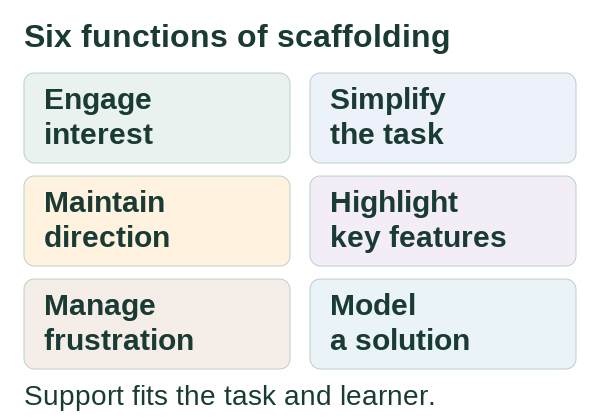
The wider use came at a cost. Some critical elements of scaffolding are missing when the word is applied to tools. New curricula and software described as scaffolds offered new ways to support learning. But ongoing diagnosis, adjusted support and fading were being neglected. One proposal was to design tools around the many levels of student understanding found in a classroom. The tools themselves might then be removed to achieve fading.[7]
Research on scaffolding has also had to settle what counts as scaffolding at all. There is much discussion about how it is defined, how it appears and how well it works. The main challenge in that research appears to be its measurement.[2]
Main ideas
How scaffolding works in steps
One mechanism is structuring the learning task, which means guiding learners through its key parts and supporting their planning and performance. The two mechanisms sometimes work well together and sometimes pull against each other, so designers face tradeoffs when they build scaffolded tools. Scaffolding also depends on a classroom system of supports rather than on a single tool acting alone.[3]
Researchers have described distributed scaffolding through three patterns, each tied to the teaching concerns it targets. The result of that interaction is a strong form of support, shown through classroom examples.[9]
The framework was built through repeated rounds of inductive and theory-based analysis. The framework does not set designs; it offers designers heuristics, meaning rules of thumb, and examples of ways to address the challenges learners face.[10]
Scaffolding talk between teachers and students
One detailed analysis followed the spoken moves of a single teacher in free-flowing small-group discussions led by children. The effects went both ways rather than one way: some children picked up the teacher's moves and began to use them on their own in later discussions.[11]
A teaching experiment studied whole-class scaffolding of language in a mathematics classroom with pupils aged 10 to 12, where the class used several languages. It named three key features: diagnosis, responsiveness and handover to independence. The data showed these features can be used online, during whole-class interaction, and offline, outside it. Lesson design can help students hand over to working on their own. Whole-class scaffolding is often spread over time and builds up over time, so pupils' independence comes from many diagnostic and responsive actions over time.[12]
The teacher checked classroom norms all the time and changed strategies as the norms emerged and then became stable. After nine months, students used argumentation-based inquiry norms on their own, without needing the teacher present. Interviews with the teacher gave more insight into what she intended and showed how she adjusted to students' new ways of working.[13]
Classroom data also separate scaffolding designed into a unit of work from contingent scaffolding, which is help given at the point of need. The analysis used Systemic Functional Linguistics, a theory of how language makes meaning, to describe the talk and the mixed ways of communicating that make up scaffolding.[14]
Scaffolding reading, writing and language
Whether teachers scaffold comprehension rather than just test it is a separate question. A 2016 study used a questionnaire and structured interviews with non-native English language teachers. It found that these teachers did not know the nature of the scaffolding strategies they used. The teachers used such strategies to assess students' comprehension, not to scaffold it. The study recommended that English language teachers get adequate training in scaffolding strategies.[15]
Scaffolding for second language learners must respond to their smaller store of words in the language of instruction. A 2022 study filmed twelve lessons in science, geography and social science in one 11th-grade class taught through a second language in Norway. A coding manual identified which scaffolding strategies three teachers used. Natural science teaching used more visual aids, and social science teachers let students talk more. The study concluded that these teachers needed more specific learning activities to support students.[16]
A 2006 framework treats scaffolding for second language learners as both structure and process. It combines different levels of support, ranging from planning curricula over time to moment-to-moment help that changes as the interaction goes on.[17]
Scaffolding also shapes who gets to speak in a language classroom. In small group work and student-led discussions, scaffolding did not happen or mostly failed. Power struggles among students were the main issue, and students were also less responsive with their peers.[18]
For writing, a 2003 paper describes a group of intermediate learners of English who were writing their first academic essays. Support stayed flexible throughout the writing of the essays, and the paper discusses each feature of that support. The writers argue that the approach helps learners work on their own by focusing on a real task and making the task's expectations clear.[19]
Help that is too complete can shut learners out of the work. Curriculum tools gave students too much support in their interactions, without anyone meaning it, and this limited how much they took part in productive and substantive ways. Too much scaffolding may leave emergent bilinguals as passive responders and stop them taking an active part in their language and literacy learning. The authors call for scaffolding that adapts to learners and keeps them productively engaged.[20]
Computer-based and online scaffolding
An intelligent tutoring system is software built to copy what a human tutor does, supporting learning by doing. Such systems have done well in academic studies, yet industry has not widely adopted them. Building one demands deep technical skill and knowledge of the subject. A 2022 study proposed a tool for building tasks, that is, software for building tutoring systems, aimed at beginner authors with little programming experience. The tool gives real-time scaffolding when a learner's answer is incomplete or wrong, and it chooses among the best scaffolding techniques. A survey after the experiment found the tutor model worked well, had an easy-to-use interface, and gave enough control over choosing and using the techniques.[21]
Intensive scaffolding means a set of supports for ideas that always let the user reach the solution to a problem. Some studies have reported bad effects of scaffolding. The main risk is that a student solves problems without engaging with their content.[22]
Support can come from peers, teachers or technology, and it can be a static or a dynamic interaction. By purpose, the review sorted scaffolding into four types: procedural, conceptual, metacognitive and strategic.[23]
Scaffolding thinking, reflection and emotion
A 2006 paper proposed a broader view of scaffolding and named four key elements. The first element is scaffolding agency, which can be expert, reciprocal or self-scaffolding. The second is the scaffolding domain, which splits into conceptual and heuristic scaffolding.[24]
A 2011 study tested computer-based scaffolds for thinking about learning. The students using them were working together in a new kind of learning arrangement, and the scaffolds were built into the learning process as it happened. They took either a structuring form or a problematizing form, and two experimental groups received scaffolds. Scaffolding showed no effect on group performance and no effect on the subject knowledge each student gained. It did show a small effect on the individual metacognitive knowledge acquired.[25]
Even so, reflection can be learned and taught, and planned interventions and careful scaffolding can help. The paper sets out a framework for scaffolding reflection that covers each of four learning phases, which are part of learning curricula based on experience in higher education.[26]
Support can also target how students feel about the subject. One practice became a focus: shaping how students feel about a specific part of the subject. Teachers did this by choosing how to present the material. This practice was named emotional scaffolding. The article offers several examples and a typology of approaches to it.[27] A 2026 simulation study describes a framework for metacognitive scaffolding in an automated tutoring system. The framework is built on a model of self-regulated learning.[28]
Scaffolding with peers and tutors
Scaffolding does not always come from a teacher. Peers can supply it too, and sometimes the help moves in both directions. A 2000 study looked at 2 intermediate college students learning English as a second language. It watched a reader and a writer revise a narrative text together. In the first half of the session the reader acted as the main mediator. This is the person who guided the other student's work. Later both students became active partners, and guided support passed back and forth between them. The study concluded that peer revision support in a second language may be mutual. It may not be one-way.[29]
A 2022 review traced the scaffolding principle back to early definitions. These described social support given to a student during a learning task. It linked the principle to peer tutoring as an inclusive classroom method. Peer tutoring aims to increase back-and-forth between students, guided by peers. Each person's functioning should improve, and both parties should develop.[30]
A 2026 study described a method called Systematised Reciprocal Peer Tutoring. This is a structured approach in which students take turns as tutor and tutee. The approach was used in 4th-grade Danish language classrooms with students aged 10 to 11. Its aim was to raise students' participation in social and academic life. Teachers and students both got clear instruction in how to support one another. They also learned to hold meaningful academic dialogue during pair work. Even so, the teacher stayed central. The teacher designed tasks and put students in pairs. The teacher also showed them how to work together.[31]
A 2023 true experiment compared class IX A with class IX D at one Indonesian middle school. The topic was the human excretory system in biology. Scaffolding through peer tutoring did not affect cognitive learning outcomes. These were measured by a multiple choice posttest. It did affect feelings and physical skills. These were measured by a questionnaire and a student worksheet.[32]
A 2023 survey looked at 74 middle school science teachers in Lampung, Indonesia. It found that combining scaffolding with peer tutoring looked promising. The same analysis found that most of those teachers had not used peer tutoring in class. They had also not used scaffolding to move students from current to potential skills.[33]
A 2026 development study built a peer tutoring model as social scaffolding, as part of project-based learning for academic writing. One hundred twenty undergraduates from two Indonesian universities took part. They were taking courses in academic writing. The model scored 0.94 on a content validity index and 89.1% on a measure of practicality. Writing scores rose from a pretest mean of 54.62 to a posttest mean of 76.14. That is a gain of 21.52, with p < .001 and Cohen's d = 1.98.[34] Cohen's d is a measure of effect size based on the difference between two means, where a value near 0.5 counts as a medium effect and a value near 0.8 as a large one.[35]
A 2009 microanalysis looked at one writing center conference at a university. The tutor was experienced, and the student was one he had never met. The analysis coded three things: direct instruction, cognitive scaffolding and motivational scaffolding. It also recorded the tutor's hand movements. Topic gestures gave instruction and cognitive support. Interactive gestures gave support for motivation.[36]
Research
How large the effects are
A 2017 review combined 144 experimental studies with 333 outcomes. The studies covered computer-based scaffolding in science, technology, engineering and mathematics. The effect did not change with support tailored to the context. It also did not vary with whether the scaffolding changed during use, or with the logic behind that change.[4]
A 2020 meta-analysis covered 64 effect sizes from 18 journal articles in eight countries, published from 2010 to 2019. It found a large effect of scaffolding on learning outcomes in online learning, and the effect was statistically significant.[5] An effect size is a statistical calculation of how large a measurable effect is, for example the difference between the averages of two groups divided by the standard deviation.[37] A 2023 meta-analysis of online learning used 83 effect sizes from 32 articles published between 2011 and 2021. Its overall effect size was 0.53, a significant gain in online learning performance. Discipline, the type of learning outcome and the type of scaffolding each changed the size of that effect.[38]
A 2023 meta-analysis of 46 articles found a moderate overall effect of 0.587. For self-regulated learning, group awareness tools had the strongest support, at 0.61. Grade level, academic subject and cooperation each had a significant impact on how large these effects were.[39]
One review measured change within the same students rather than between groups. Scaffolding had a consistently strong effect across student groups, subjects and levels of assessment. The effect size was especially large among students with learning disabilities, at 3.13.[40]
What changes the result
A study of 143 third-graders in an inquiry-based science setting tested a fixed scaffold. In it, the teacher openly showed how the reasoning worked. Students with little prior knowledge fell behind without the scaffold. With it, students with different prior knowledge learned to a similar, higher level. The support also almost fully removed a disadvantage. This held for students whose teachers rated their logical reasoning as lower.[41]
At the other end of basic schooling, a quasi-experiment studied 48 sixth-graders in Blitar Regency. It compared inquiry learning with scaffolding against a control class. The scaffolded group showed a positive effect on scientific literacy. The F count was 4.841 against an F table of 4.05. Scientific literacy and science learning outcomes also moved together under the inquiry scaffolding model. The figures were F of 29.0742 and p less than 0.05.[42]
In mathematics, a quasi-experiment took place in Imo State. It included 237 senior secondary students. It found instructional scaffolding effective for achievement. It also reported that the method reduced gender bias.[43]
One literature study compared two units for 101 non-native English undergraduates. It was a within-subjects quasi-experiment. It compared a poetry unit with scaffolding to a drama unit taught by lecture. Students scored higher on the unit taught the traditional way: 11.88 against 10.83 out of 15. The effect size was small, d = 0.40. Unit order and literary genre were not swapped between groups. So that difference cannot be credited to teaching method alone.[44]
An intervention study trained 17 of 30 prevocational social studies teachers. The training covered a four-step model of contingent teaching. The steps were diagnosing understanding, checking the diagnosis, giving support that fits it, and checking learning. Trained teachers improved more than untrained teachers, especially in the contingent steps. They also finished more full cycles of contingent teaching. Less successful teachers tended to give less support. They wrongly believed that prompting students was not part of scaffolding.[45]
Survey evidence from Ghana links scaffolding to how teachers judge students' learning needs. The study surveyed 100 basic school teachers. They were chosen from a group of 132 people across 16 regions. The study used 14 text items. Their reliability was 0.976. Scaffolding, differentiated techniques and inclusion approaches were each positively related to diagnostic assessment. Scaffolding was the strongest predictor. The three approaches were reported to predict diagnostic assessment at 91%, 87% and 82%. Each figure is for one approach, in that order.[46]
Scaffolding in assessment and feedback
One study looked at 76 assessment tasks. They were written by 33 science teachers. It also looked at 707 samples of student work. All five were clearly linked to how well students explained their ideas. This held even after accounting for differences between teachers and students' backgrounds. A real-world context had the largest effect. It did so alone and when combined with other scaffolds. The study concluded that scaffolds must be of high quality. It also found that planned combinations can help students at every achievement level.[47]
Two classes of Primary 5 and 6 students discussed these opposing views in small groups. They used scaffolding tools to guide discussion and to record and challenge each other's ideas. The tools gave the teacher a record of students' thinking. That record could be used to monitor students and give feedback. Students argued back and forth and made their reasoning visible. Their questions and claims pushed the group toward exploratory, reflective talk.[48]
A quasi-experimental study with 50 students tested a scaffolded writing intervention. The task was source-based argumentative writing. Writers must use evidence from several texts. Self-efficacy means confidence in one's own ability. It was measured 3 weeks before the intervention, just before it, and just after it. The intervention clearly raised confidence in three things. These were organizing ideas, summarizing sources, and revising essays. It produced no clear change in confidence about three things. These were judging whether evidence is strong, finding weaknesses in arguments, and writing a counterargument. Higher overall self-efficacy was positively related to two aspects of writing performance. These were use of sources and organization. Interviews with 13 students backed the intervention's value.[49]
One study coded 1,199 moves by teachers and students. The moves came from one-to-one Reading Recovery lessons. These were moments when children met difficulty while reading a new book. It compared teachers whose students made lower gains (n = 6) with teachers whose students made higher gains (n = 4). The two groups did not differ much in how much information they gave at difficulty. They also did not differ in how often they offered help. They differed sharply in what they focused on when helping. Teachers of higher-gain students had 8.3 times the odds of prompting students to use information sources they were neglecting. This happened while students worked out a word.[50]
How research on scaffolding has grown
A 2025 study mapped research on instructional scaffolding around the world, covering Scopus publications from 2000 to 2025. Recent work is moving toward adaptive learning systems and artificial intelligence, and toward teaching methods that use technology. Two main groups of researchers appear: one studies cognitive and metacognitive scaffolding, and the other studies look at intelligent tutoring and automated support.[51]
A book by Brian R. Belland reviewed in 2024 gathers the STEM evidence in one place. It focuses on computer-based scaffolding used in problem-centered approaches, including project-based and inquiry-based learning. It covers conceptual, strategic and motivational scaffolding.[52]
Reviews of artificial intelligence as a scaffolding tool have appeared more recently. A 2025 scoping review covered studies from 2023 to 2025 and looked at AI scaffolding in higher education. It names five types of AI-driven support: managed cues and prompts, cognitive assistants, designed chatbots, AI-assisted assignment design and generated recommendations. It concludes that such tools work only when deeply integrated into learning and able to raise students' cognitive engagement.[53]
A 2026 systematic review looked at empirical work from 2015 to 2026 across Asia-Pacific contexts. It examined feedback from AI alongside peer support and guided self-reflection, and it reports gains in peer feedback quality, self-regulation and writing proficiency. It also lists problems that persist: overreliance on AI, feedback quality that varies across skill levels, and tension between automated efficiency and human dialogue. It calls for studies over long periods and in different settings.[54]
In practice
Scaffolding across subjects and school stages
In mathematics classrooms, scaffolding has been studied as a way to connect a teacher's temporary help with classroom talk that builds understanding. A review of recent mathematics education research used 21 publications that met its criteria. They covered 2010 to 2015. It also drew on 14 articles in one special issue that centre on scaffolding.[55]
One classroom experiment tested scaffolding against ordinary instruction for geometry. It involved 130 female students in SSII classes in Niger State, Nigeria. Students taught with the scaffolding method scored higher on average than those taught conventionally. The study recommended that geometry teaching include scaffolding.[56]
In science, a study of 147 primary pupils in Rivers State, Nigeria, compared teaching with modeling and cueing questions against a conventional method. Pupils taught with modeling and cueing questions had a mean attitude score toward Basic Science and Technology that was clearly different from that of pupils taught the usual way. The study found no significant interaction of treatment, gender and achievement level.[57] A book on the subject names support strategies that best help higher-order thinking and problem solving, and that also support deep content knowledge. It stresses fitting support to each learner's needs.[52]
Health sciences programmes are hard to run. Scaffolding is used to help students become skilled professionals. The applications included putting educational activities in order. They also included using scaffolding tools or resources. They also included frameworks for applying scaffolding, modelling, and fading. The review suggests that knowing about these uses could improve students' development of competence. This could happen when scaffolding is used across all learning platforms.[58]
Museums that serve young children plan supports for the adults who come with them. Exhibition studies at The Children's Museum of Indianapolis showed the impact of planning for family learning. Museum staff can build from simple concepts toward mastery of ideas, and curators, educators and exhibit developers must work together to set levels of accessibility. These range from entry-level ideas to harder, more abstract content for older children and adults.[59] In a kindergarten classroom, guided play combines child-led exploration with intentional scaffolding and specific guidance from the teacher. One paper sets out methods for teaching writing through guided play across four kindergarten classroom spaces, with materials and scaffolding strategies for each area.[60]
One review used cognitive load theory as its frame. It looked at demonstration, segmented practice and feedback scaffolding in Guzheng learning. The review finds several practices that look promising for Guzheng teaching. These are joined-up notation and practice in short segments. They also include worked examples whose support is withdrawn, and feedback tuned to the learner. Direct evidence from the instrument itself is still thin. The review calls for more research on retention, transfer and differences among learners. It also calls for validation of instructional designs grounded in psychology for Guzheng education.[61]
Scaffolding writing and academic literacy
The support can take many forms, including visual aids, graphic organizers, guided questions and peer collaboration. Which form a teacher picks depends on the learning objective and on the needs of the individual student.[62] The term is used widely in literacy teaching but is often used in broad or conflicting ways. One account treats scaffolding as a process that starts with choosing a suitable task and continues through the teacher's instructional decisions and manner.[63]
A study of two elementary teachers showed these scaffolding functions at work. They worked between two points. One was students' current writing knowledge in English; the other was expert understanding of the narrative genre.[64]
One analysis looks at secondary writing instruction for adolescents. It draws on the original theory of scaffolding. That analysis ends by advising teachers on how to use scaffolding well. The advice is about teaching literacy to teenagers.[63]
One classroom action research study involved 26 students at a senior high school in Bandung who worked on English analytical exposition texts. The scaffolding process ran in two cycles of action research and improved their writing in every aspect the study scored: content, organization, grammar, vocabulary and mechanics. The students also reported a positive view and said they liked the scaffolding activities used in class.[65] A study looked at three English as a foreign language college teachers in Kuwait and found they often used rhetorical scaffolding and prior knowledge scaffolding. The same teachers used contextual scaffolding and language development scaffolding less often in the writing classroom. That study recommended training courses for these teachers to orient them in scaffolding strategies and their best uses for writing.[66]
One survey looked at university level and asked 133 English majors taking a writing course in the 2022-2023 academic year which scaffolding activities they valued. Students who gave each other feedback scored 3.87, lecturers who gave sample texts scored 3.8, and reading specialized documents and articles scored 3.76. Doing a set of exercises scored 3.47, lower than the other activities. The students said teachers should help them develop ideas for articles and build article structure, and should also help with language, paragraphs and linking sentences.[62]
The Koori Centre paper describes a scaffolding methodology for teaching academic literacy to Indigenous adults returning to formal study. One program taught Indigenous adults returning to study at the Koori Centre of the University of Sydney, where they learned to read academic texts and make notes from reading, then wrote new texts from those notes. The paper reports strong gains in students' literacy and describes how teaching approaches at the Koori Centre changed.[67] In the Philippines, many such learners struggle to state their claims and lack knowledge of how to conduct and write a research paper. Mean error scores fell from 75.52 to 20.52, which the study read as a significant improvement in research writing.[68]
Scaffolding, combined with visual assignments, has been tried in a university course as one way to address cheating. One proposal names four features of a learning environment that can lower a student's wish to cheat: mastering material for its own sake, doing low-stakes assignments, feeling intrinsic motivation, and expecting to succeed. Scaffolding has been described as a useful method that can raise students' belief that they will succeed. The instructor tried poster presentations and other visual and spatial assignments, paired with scaffolding, in a second year Religious Studies course on Death. Very early qualitative data supported the hypothesis that students were cheating less and learning more.[69]
Scaffolding language learners in the classroom
In English-only settings, teachers need to support translanguaging activities with scaffolds and must help students see that using their other languages can help school learning. Steady, well-designed scaffolding can help a classroom community treat translanguaging as a normal part of lessons.[70] A 2026 meta-synthesis compared English-only policies with multilingual scaffolding, covering studies published between 2015 and 2025. English-only policies improved oral fluency and structural accuracy but caused emotional difficulties for learners with low proficiency. Multilingual scaffolding helped conceptual understanding and engagement, though it did not always fix gaps in basic language knowledge.[71]
Vocabulary activities can themselves act as a scaffold before reading tasks. Thirty business students at the University of Rwanda took part in a class inquiry, and vocabulary activities before reading raised their understanding of texts and helped them swap ideas. Students also said the vocabulary work helped them write more freely and apply new terms.[72] In first-grade classrooms, teachers scaffolded academic language during lessons about cause and effect by modeling, by recasting (restating a child's idea in fuller language), and by highlighting useful words. Those teachers also used several modes of expression and changed the support as students worked. The same study found that strict attention to set academic language sometimes limited student participation, and students took part less in making meaning.[73]
Scaffolding means breaking large tasks into smaller steps, which lets teachers watch and guide students until students can work with little or no help.[74] A reflective account described five speaking activities with 12 Chinese learners aged 9 to 11 and how a teacher handled a mixed-ability group. The teacher decided when learners needed models or written prompts and when support could be reduced. The account reports that taking part depended on clear procedures and easy starting points, and also on clear expectations for learners and timely feedback. Common difficulties included reliance on scripts and uneven participation, and others rushed in competitive tasks and had little time to correct their work. That account did not measure gains in proficiency.[75] One study looked at 34 students in eleventh grade, and after the teacher used a scaffolding strategy, 94 percent did well on a speaking test.[76] A study of 30 foreign language students found a positive view of scaffolding for speaking, with no significant difference between courses or genders.[77]
Peer scaffolding lets students help each other, and a study of 10 English majors in Thailand examined it during writing lessons. Questioning was the most common peer scaffolding behavior, and no learner used greeting in the writing activities. The 10 learners used various peer scaffolds in pre-writing but rarely in post-writing. Expert and novice learners both acted as scaffolders, and each could be expert in a different area.[78]
Learner reports and test scores can point in different directions. In an Indonesian higher education setting, learners said they understood and remembered lessons better with scaffolding. Their test scores, however, improved more under direct transmission, in which the lecturer provides the knowledge.[79] Three teachers of non-English majors were interviewed. They suggested that instructional scaffolding gave students many chances to be active, and in the teachers' view it also made lessons more effective.[80]
Digital tools that carry the support
Some computer programs carry the support themselves, and researchers have measured what changes when they do. A 2001 report described a computer system for making concept maps that offered two settings. In the first, students built a concept map and received evaluation results with hints; in the second, students also got a map with parts missing. The construct-on-scaffold setting had the better effect on learning in biology, and both computer-based procedures helped students finish their maps.[81]
One study tested a web concordancer with 26 senior high school students in Taiwan, and proofreading performance improved a lot when students could search the concordancer. One group was given scaffolding for its searches, and that group scored significantly higher than the group without it. That gain seemed to last after the scaffolding was removed, and the prompts also made students more sure about their proofreading. Students' answers to a questionnaire suggested a mostly favorable view: they viewed the tool and the support well.[82]
Mobile devices have taken scaffolds outdoors. A bird-watching learning system gave each learner a personal digital assistant with a wireless network card, and a formative evaluation explored what roles and scaffolding aids the device offered for bird-watching activities. The evaluation also asked whether students learned more because the device could move with them, be carried easily and be used alone.[83] A later online course built in scaffolding techniques for a junior-level class that covered four programming languages and surveyed learners of low to high knowledge. The survey asked whether students thought these reinforcing techniques gave every student their own path to success in the course.[84]
Virtual laboratories have produced mixed results. One 2020 study added metacognitive scaffolding to a unit on Heat and Specific Heat taught over six lessons of 45 minutes each, and reported effects on students' data modeling competences. The virtual laboratory and metacognitive scaffolding both had effects.[85] One physics study used guided inquiry with Google Classroom and compared 30 students in an experimental group with 30 in a control group. On a 20-question concept test, the control group averaged 58.6 and the experimental group averaged 73, with an effect size of d = 1.08.[86]
Augmented reality has been combined with an educational board game, and a dual-scaffolding framework combined peer scaffolding with cognitive scaffolding. Forty-four college students took part, and the researchers studied their flow, their acceptance of the game, and their patterns of collaborative behaviour. Collective flow was the mean of the flow scores of a group's members, and learners' flow and acceptance were positively correlated. Both kinds of scaffolding helped their problem-solving process. Groups with high collective flow showed more reflection and analysis behaviours, and groups with low collective flow showed fewer.[87]
Students were assigned at random to one of two groups. One group got the support; the other got information on self-regulated learning with no support. The supported group showed higher gains in self-regulated learning level than the control group.[88]
A network-based tutoring system gave 68 student teachers a tool that recommended online resources. Some got a dynamic version and some a static one. Those using the dynamic version spent less time in the learning session. They were more efficient at seeking and getting information. They also reported gains in knowledge. They did not perform better than the static condition on designing a lesson plan.[89]
A fully online course used six technological tools in a nested scaffolding design and served 215 college students in China. The tools effectively replaced face-to-face interactions and also clearly improved use of the supporting learning platform. The tools supported inner and outer learning cycles and improved the quality of scaffolding conversations. They also cut the time cost for teachers and made one-to-one support instructions work better.[90]
Scaffolding teachers and other adults
A school-based professional development program was built for secondary science teachers. Its designers based it on a guiding principle they called "guiding by scaffolding." Seven experienced teachers took part in institutional meetings and taught at school during the program. The program was about open-inquiry teaching on the topic of water quality. The program helped teachers learn to scaffold students in open inquiry. This was especially true when judging when and how to combine structure for inquiry learning with enough space for it.[91]
Scaffolding has also been used to help trainee and serving teachers reflect. One study examined guided reflection in two literacy education courses. The courses were at an urban university in the southwestern United States. The study analyzed teachers' online and written reflections. It found that scaffolding helped them form and state their personal belief systems. The same support did not much help them question larger ideas about teaching, learning and students.[92]
A university supervisor can help a preservice teacher understand instructional scaffolding. A study followed two people: a supervisor from the university and a preservice teacher of English language arts. The two worked together at two different sites for field experience. Classroom observations and mentoring conversations showed how the supervisor helped the preservice teacher. The teacher carried instructional tools from a university program into a high school classroom, and the teacher education program's conceptual base played a big part in that transfer.[93]
Instructional scaffolding has been tried in graduate library leadership education. In asynchronous online settings, leadership skills are harder to build. One study looked at scaffolding in five sections of a master's course. The course was on management in information organizations. The course was built around skills set by the Library Leadership & Management Association. Discussion circles, field experience and peer support within the cohort were proposed as support mechanisms. The aim was to raise students' intrinsic motivation and engagement with the material.[94]
Scaffolding in museums, games and the arts
A 2012 article describes repeated exhibition studies at The Children's Museum of Indianapolis that tested how families learn together. Hands-on learning, adult-guided experiences and scaled-down settings are now more common. Families often expect them when young children visit. Lessons from children's museums can serve as models for other kinds of museums. These museums want to meet the needs of early learners.[59]
In drama, the teacher can join the fiction as a character, a technique called Teacher-in-Role. From that position, the teacher can scaffold students' role plays. Most drama-in-education activities leave the teacher outside the dramatic process. This creates a gulf between the students' fictional world and the teacher's real one. That gulf makes it hard for teachers to scaffold and challenge students. Doing so without breaking the fictional world is hard. A 2021 article analyzes what Teacher-in-Role does, its types, its benefits and its possible challenges. It also gives examples of its use.[95]
One teacher's English 201 course used scaffolded visual activities, going beyond concept mapping. The aim was to make learning visible. It also aimed to develop analysis, critical thinking, writing and problem-solving skills.[96] A 2015 article describes multimodal scaffolding in a secondary English classroom. There, teachers use specific strategies to help students read harder and harder texts.[97]
Undergraduates made autobiographical comics. They were in a composition course at Nevada State University. The workshop was built on multimodal scaffolding. They did so while studying two published graphic memoirs. The workshop put three ways of composing into stages. These were a mind map, a written reflection and a six-panel comic.[98]
Scaffolding for students who struggle
Scaffolding is often recommended for students who face extra barriers. Studies of it in real classrooms show both promise and strain. One California high school serves low-income youth, mostly Latina/o, many of them English learners. A study there followed two teachers for a year and a half. Teachers gave heavy support to students they hoped would succeed but saw as needing many supports. They judged this from past low test scores and some academic failure. Most support went to basic and intermediate reading and writing tasks. There was less evidence of support for subject-specific literacy and higher-order thinking. Planned sequences of activities dominated, and only one of the two teachers showed support that was contingent, faded over time and handed responsibility to students.[99]
In two first-grade classrooms, teachers supported the academic language of students learning English. The children were exploring cause and effect in Ezra Jack Keats' text The Snowy Day. Supports included modeling, recasting and highlighting academic language during subject learning. Sometimes students were held strictly to set uses of academic language. This held back their part in making meaning in class. The study calls for scaffolds that adapt and stay flexible. It also calls for scaffolding from the community.[73]
A 2022 paper argues that differently abled students do not learn well from traditional teaching alone. They need added guidance from a more knowledgeable other. It lists techniques such as modeling and demonstration, cooperative learning, slicing, tapping prior learning, giving time to talk and breaking the unit.[100]
A 2025 quasi-experiment in Niger State, Nigeria, tested scaffolding against conventional teaching. It looked at anxiety about mathematics in geometry. The sample was 130 SSII female students, drawn from two of 8 public schools in Agaie.[56] A 2020 experiment studied 147 basic four pupils in Rivers State, Nigeria.[57]
Scaffolding in mathematics and science classrooms
A 2020 paper describes scaffolding in mathematics as support from the teacher, a peer group or even parents. It is aimed at tasks a student cannot yet manage alone. The same paper sets out stages for applying it to problem solving: exploitation, reviewing, restructuring and developing conceptual thinking.[101] A 2012 article presents scaffolding as a way of observing how a learner is helped toward potential learning.[102]
One survey looked at Grade IV mathematics teachers. In it, feedback was the most common scaffolding practice, and feedback mechanisms were used most often. Their overall rating was Always. Questioning techniques had the lowest average score, though still rated Always. Pupils' mean performance score was 84.78, and no pupil fell in the failing group. Yet the extent of scaffolding showed no significant correlation with pupils' numeracy performance, and the study concludes that its impact on numeracy skills remains limited. The study recommends professional development on scaffolding specific to numeracy, and it also calls for stronger emphasis on dynamic modelling and student-created visuals.[103] A 2025 study followed 33 preservice teachers over eight weeks. Experts gave support at the end of each of four modelling activities, and that support carried over to later tasks.[104]
Whole-class discussion is one setting where teachers try to provide analytic scaffolding, which is support that moves the talk toward the lesson's math goals. One case study followed an experienced mathematician teaching differential equations with an inquiry-oriented curriculum. Strong content knowledge and long teaching experience did not remove the difficulty of providing analytic scaffolding in whole-class discussion.[105]
Calor and colleagues built a tool to help teachers decide how and when to support small groups, and the support is aimed at groups, not individuals. A tool built around three features of group-level scaffolding was tested with four teachers, whose seventh grade classes used it during Early Algebra lessons. Support stays responsive to the group, content help is withdrawn once the group can carry on alone, and responsibility for the learning passes to the group. The tool helped teachers when groups discussed mathematics, and the researchers say it needs changes.[106]
A 2025 mixed-method study looked at Grade X students. It found that both one-to-one and peer scaffolding significantly improved mathematics achievement. One-to-one scaffolding gave direct teacher guidance but tended to make students dependent, while peer scaffolding encouraged students to work together and act on their own.[107]
In science, scaffolding has been tested against four higher-order thinking skills. These are application, analysis, evaluation and creation. A quasi-experimental study in Saudi Arabia tested 84 grade 9 students with 20 multiple-choice questions. The students were split into an experimental group of 42 and a control group of 42. Scaffolding strategies had a significant effect on all four skills at p <.01.[108]
A 2025 descriptive quantitative study looked at 46 sixth-semester students in a Complex Variable Functions course. It reported high standards for reaching higher-order thinking and for how time was allocated. Also, 86.33% of students responded well to the learning activities.[109]
Kim followed a Grade 5-6 classroom of 23 students for 4 months. The class was studying a unit on electricity and electromagnetism. The teacher probed and expanded the edges of thinking and built collective reasoning. The teacher also modelled the inquiry process alongside the students. Those strategies spread the work of reasoning across the class. They went beyond the common pattern of teacher question, student answer and teacher evaluation.[110]
A study taught biology with cueing questions for 6 weeks. It involved 140 secondary students in Udi Education Zone, Enugu State. Students were more interested in biology than with teaching without the questions. That study also reported a significant interaction. Gender and strategy together affected interest scores.[111]
Results for science achievement are less even. The learners were in sixth standard in West Bengal. Peer scaffolding significantly helped achievement on one of three units under a problem solving method. It had no significant effect under a play way method.[112]
Scaffolding in project and problem-based learning
One project across subjects built scaffolding into three places: the coursework, the supervision and the design of the problem itself. The interdisciplinary approach succeeded only after some redesign. The teaching team's own scaffolding strategy is offered as an idea that other teacher teams can adapt. The case study also notes one condition: students should feel at home in their own programme while being empowered to work with other specialists.[113]
Problem-based learning has a mixed record on academic achievement compared with other forms of teaching. Some problem-based groups used scaffolding. In those groups, preparation before tutorials rose at every level of the undergraduate programme, measured by attendance and academic achievement, compared with groups without scaffolding and with lecture-based groups.[114]
Medical problem-based learning has also been supported by digital tools. In a "deteriorating patient" role play, an interactive whiteboard let the teacher see all the information each subgroup shared. That broader view cut the need to structure the task, and it left more time to raise the complexity of the problem and so engage students in challenging situations. Good scaffolding still depended on the teacher's subject knowledge and teaching experience, and technology widened the choices available.[115]
Tromp describes a bachelor course in Philosophy of Science built around compulsory flipped workgroups. Online videos and optional joint classes serve as preparation. The findings were mixed. Students found the joint classes neither very stimulating nor strongly positive for their learning. Most preferred to prepare on their own. Attendees and non-attendees differed a lot in what they did and how they learned. They also differed in how much they valued the classes as support and as activation.[116] A separate 2022 paper proposes a framework for scaffolding self-regulation, the monitoring and guiding of one's own learning, in a flipped classroom environment.[117]
Ill-structured problems are harder than well-defined ones, because they combine several domains and allow more than one solution. A 2017 review found that metacognitive scaffolding was the main type used to guide ill-defined problem solving. That scaffolding helps correct a person's thinking, which lets them take proactive steps during problem solving. Most of the reviewed studies of this scaffolding were carried out in higher institutions rather than schools, and they also took place within formal platforms such as a learning management system.[118]
A 2026 quasi-experiment compared project-based learning with and without scaffolding. It had 34 students, 17 in each group. The scaffolding group showed lower mental effort, 56.88 on average against 71.65, and higher creativity, 91.18 against 69.82. Working memory averaged 86.35, against 64.65, and a Complex Span Task showed a 58% increase in working memory capacity in the scaffolding group. The study concludes that structured support can reduce extraneous cognitive load, which frees working memory for deeper creative thinking.[119]
Nurse practitioner education had no standard method for this. A workgroup of educators therefore sorted visit types to place case scenarios for early, middle or late-stage learners. The types were wellness, acute, chronic and transition of care visits. The result was a structured system of categories with set criteria. The workgroup says it can be used with many kinds of learning resources.[120]
In 2006, Kirschner, Sweller and Clark argued that minimal guidance during instruction does not work. They grouped problem-based learning and inquiry-based learning with unguided discovery learning. A 2007 response by Hmelo-Silver, Duncan and Chinn answered that the two approaches are highly scaffolded. So the comparison was wrong. The response said both approaches use scaffolding a great deal. This reduces cognitive load, the burden on working memory, and lets students work in complex domains.[121]
Greening (1998) examines the learning support structure in problem-based learning, an environment built on student independence, and challenges the assumption that support matters less in such a setting.[121][122] A 1998 paper looked at scaffolding that helps students succeed in problem-based learning. It noted that the method rests on a teaching model that differs from the usual teacher-led teaching, and it added that many institutions have adopted it.[122]
In these settings, scaffolding can target a specific group: learners who achieve at a low level. A 2018 study in a vocational school compared 3 scaffolding approaches with a control group, and all groups worked on a learning module that used computer spreadsheets. Results differed a lot among the 4 groups. One group used a partly collaborative approach with a worksheet, and that group scored much higher on posttests than the other groups. The study concluded that scaffolding helps low achievers in problem-based learning, and it also identified the most effective type of scaffolding.[123]
A 2025 study in Lagos State, Nigeria tested instructional scaffolding. It involved 108 junior secondary students. They were in three whole classes from three schools. Scaffolding as a strategy also beat conventional teaching by modified lecture. Students under scaffolding did better than the lecture group (t(66) = 4.47, p < 0.05). The study found no significant link between gender and the techniques used [F (2,102) = 0.244; p > 0.05]. It recommended that gender not be considered when planning scaffolding lessons.[124]
How can scaffolding keep the task at the right level of difficulty? This is called the best level of challenge. In K-12 problem-based learning, students may struggle with tasks beyond their current ability levels. These systems help students feel a sense of control and skill by offering several types of scaffolding, each type matched to different needs and problems. Students control what kind of scaffolding they get and how often, based on their needs and ability. The paper said this improves their self-directed learning skills, and it added that peer scaffolding between students of similar ability meets their need to feel connected.[125]
Scaffolding in early childhood and at home
Mermelshtine writes that contingent instruction behaviours like these occur from infancy. A 2017 review of more than 40 years of research describes these contingent behaviours, meaning responses timed to the child's observed ability, as present from infancy. The same review links this parent behaviour to children's executive function and language learning. It also links it to cognitive and academic abilities. The review treats scaffolding as a product of the family and the wider setting. It is shaped by parent traits, child traits and the environment they live in.[8]
One study tested children at ages 2, 3 and 4. It found that parental scaffolding during a problem-solving puzzle at age 3 had a direct effect on executive function at age 4. Scaffolding at age 2 had an indirect effect on executive function at age 4, acting through the child's verbal ability at age 3.[126] Bibok and colleagues examined when parents spoke compared with what the child was doing at that moment.[127]
A 2025 paper argues that research on scaffolding has been shaped by a dogma of harmony. It describes harmful cases where scaffolds can work against learners' wellbeing. That paper describes two maladaptive cases. One is scaffolds that work unevenly because children differ. The other is scaffolds whose value depends on when in development they are given.[128]
Everyday chores offer one setting for early scaffolding. Sixty mother and toddler pairs took part, with children aged 18 to 24 months. They were observed during a cleanup chore and while sharing an emotionally laden book, and researchers then measured children's helping in five tasks with an experimenter. Mothers' scaffolding of everyday helping predicted differences in how much children helped, and children's sociability also predicted these differences. The study concludes that such differences appear early and are tied to both temperament and parents' efforts to encourage helpfulness.[129]
Reynolds and Evans observed parents scaffolding their children's storytelling while reading the wordless book Frog, Where Are You. In one study, 20 shy and 20 matched nonshy children told a story from a wordless picture book, and a parent helped. Shy children spoke less and offered less story content than their peers. Parents, however, did not differ in how they scaffolded turns or in how much story information they supplied, so different adult scaffolding did not explain the difference in speech.[130]
One study looked at playground interaction at a preschool in Brisbane, Australia, where the children came from many cultures and languages. It described a four-year-old bilingual child telling stories in his second language from a storytelling chair. There, the support was given jointly, through a teacher's responsiveness and the other children's skill as storyteller and listeners.[131]
A 2026 article on preschool children aged 3 to 5 reports that effective scaffolding improves vocabulary variety, narrative coherence and overall language comprehension. It adds that support must be adjusted to each child's needs. It should be withdrawn gradually as competence grows.[132]
A review of early literacy practices names seven techniques. They include reading aloud interactively more than once and writing jointly. They also include giving prompts and supports, modelling by an expert, and assessing as work goes on. That review says good scaffolding depends on teacher and child interaction. It also needs support that fits the child's development. Continuous formative assessment must adjust teaching to learners' needs.[133]
Bruce studied how therapists support and challenge talk with children whose language is delayed for their age. Commenting and giving feedback worked better than asking many questions or issuing commands.[134] One case study looked at a kindergarten girl whose home language differed from the language of instruction. It described building on that home language as the founding scaffold. The study reported that an approach biased toward one language did not allow the child's language identity.[135]
A study looked at four 4-year-old Dutch preschoolers whose first language was Spanish. It found that an assessor's mediation adapted to each child, producing distinct patterns of interaction. Children differed in their potential to learn. They also differed in their ability to draw scaffolding from the assessor.[136]
Scaffolding for special educational needs and disability
Scaffolding has been proposed as a teaching strategy for children with special educational needs, and it speeds up learning how to solve problems. Scaffolding shares much with differentiated instruction, which adjusts teaching to different learners, but the two approaches have their own features and can be combined to reach goals better. A 2020 article reviewed types of scaffolding and gave tips for using it well in the classroom.[137]
Some middle grade students have reading disabilities or high functioning autism. Others have emotional and behavioral disorders. They often fail to draw knowledge-based inferences from informational texts. Barth and Thomas describe knowledge-based inference-making as a skill that supports reading comprehension. Some students are at risk for reading failure because of poverty. They often struggle with the same inferences, and as a result cannot read for understanding or learn from grade-level texts. Many special educators had little training in inference-making or in how to teach it explicitly. Yet teaching comprehension skills such as inference-making often falls to them alone. A 2022 article set out to give special educators resources. The resources were for teaching knowledge-based inference-making to these middle grade students.[138]
Scaffolding can also go wrong. A 1998 commentary argued that current practices in many schools may produce a kind of reverse-scaffolding, which prevents the transfer of responsibility for a task rather than encouraging it.[139]
Computers can vary the help they give as a learner works. Computer assisted learning can involve a computerised intelligent learning environment, meaning one that adapts automatically, dynamically and continuously to the learning context. One part of that adaptation is adjusting instruction automatically as each learner performs, which makes learning easier and errors fewer.[140]
For children with autism, scaffolding has been studied in several forms. A 1988 article described a language intervention for children with pervasive developmental disorders who had limited generative language. They were taught to use earlier language context to take part in structured, interactive dialogues.[141]
A case study of two children with autism taught the concept of a birthday party with video and pictures. The children improved significantly at learning nouns, but they lagged at learning the verbs tied to the event. The study suggested that visual experience helped the children learn nouns, and that having no experience of performing the actions may explain the poorer learning of verbs.[142] A 2026 paper proposed Synthetic Therapeutic Scaffolding, in which an AI avatar gives brief, limited rehearsal of an individualized skill. Practice with people follows, and then the synthetic support is slowly removed. Beckman wrote that the evidence so far justifies investigating the approach, but does not yet show that the approach works or that it is safe.[143]
Scaffolding in online and distance courses
Ludwig-hardman and Dunlap put level of interaction and support at the top of the factors behind attrition in online programs. A 2003 article described learner support services that can address these retention problems, using examples from Western Governors University. The same article lists advising and a learning community as supports that matter, and these supports help students studying at a distance.[144] A 2025 survey of 245 students at the University of Namibia found many barriers in the online space during the Covid-19 pandemic.[145]
A 2022 multiple case study asked four full time faculty members how they build scaffolding into online courses. The instructors defined scaffolding as support that helps students meet the course outcomes. Each instructor thought about scaffolding and used it in different ways. Discipline, teaching philosophy and features of the online course all played a part.[146]
Feedback is harder to give when the instructor is not there in person. The online platform also limits what can be shown. The 87 undergraduate students at a British university received each type of feedback. The study measured its effect on the learning process and on learning outcomes.[147]
Online discussion can make people think again, but students often agree with one another instead of forming counter-arguments. An experiment with 48 undergraduates tested note starters and elaborated cases covering two issues in educational psychology. Note starters had a significant positive main effect on how often students disagreed with one another. The starters seemed most useful for students low in openness to ideas or assertiveness, and they also helped students who were not overly anxious. The study reported interactions with several personality characteristics.[148]
A design experiment in a teacher education course compared two semesters, both involving e-mail discussions about field experiences in urban schools. Higher levels of reflection were rare in the first semester, but after changes to the design and support, students in the second semester wrote at higher levels. Some scaffolds seemed to matter for deeper reflection: tailored and general questions from the instructor and peers, critical readings and particular discussion threads.[149]
A 2012 study looked at undergraduate courses over four semesters. It examined how online quiz settings related to classroom exam scores. The number of attempts students made on quizzes was unrelated to their exam scores. This held whatever settings were used. More time spent on quizzes went with lower exam scores. Quiz scores predicted exam scores beyond attempts, time allowed and SAT Reading and SAT Math scores. The study notes that time limits can cause anxiety. It calls for evidence on how not counting all quiz scores toward the final grade affects quiz performance.[150]
Scaffolding with artificial intelligence and adaptive software
One 2026 study asked what levels of cognitive demand dialogue-based AI tutoring systems support in programming education. Most instructional support was at the understanding and applying levels, and prompting and explaining were the most used strategies. Scaffolding for analyzing, evaluating and creating was rare or absent. The sessions ran in repeating cycles of prompting and explaining, with little movement toward harder tasks. Perez and colleagues concluded that AI tutoring works well for basic learning but lacks ways to push students toward deeper thinking.[151]
Wang and Stojković propose treating generative AI as a metacognitive and dialogic scaffold rather than as a tool for grammar correction or paraphrasing. A 2026 design-based study took place in an English as a Second Language course. It taught students strategic prompting in a Socratic style. It also guided their use of AI at each stage of writing. Students said their arguments became clearer in structure. Their awareness of how to persuade grew. They saw personal AI feedback as a guide that motivated them. But this was true only when they could help direct the interaction with planned prompting strategies.[152]
A quasi-experimental study tested generative AI as guided scaffolding over eight sessions with 64 eighth-grade students. The 32 students in the experimental group did eight sessions that moved from finding a problem to thinking back on it, while the 32 control students received conventional instruction. The researchers tied the result to guided scaffolding rather than use of the tool as a provider of final answers.[153]
AI-assisted scaffolding has also been tested on vocabulary retention, the lasting recall of new words. A 2025 quasi-experimental study at Ton Duc Thang University compared two groups. One had 32 first-year non-English majors using AI-assisted scaffolding in vocabulary tasks. The other had 34 students taught in the traditional way. On the pre-test and post-test measures, the experimental group kept significantly more vocabulary than the control group (p < 0.05). In interviews, eight students said the scaffolding held their interest, gave them support, and helped fix vocabulary in memory.[154]
Automated support can also be aimed at teachers, whose load grows in classrooms where students differ in language background. A 2026 paper proposed a conceptual framework for AI-automated scaffolding, with the aim of reducing the mental effort English language teachers face in multilingual classrooms. The framework was built by repeated modeling from secondary sources, including peer-reviewed papers, web sources and policy documents on multilingualism in education, with a focus on India. It points to machine translation, instant feedback, analysis of word forms and vocabulary in texts, and pattern recognition, and these capacities could free teachers for other roles. The paper offers the framework as a proposal and recommends its adoption in Indian language classrooms, but reports no trial of its effects.[155]
What this looks like when you study
Students scored higher on the drama unit exam than on the poetry unit exam. Group-based scaffolding also carried a real implementation cost from uneven group participation. AlAli says this offers actionable guidance.[44]
One study used computer-based concept mapping. Students in a construct-on-scaffold condition received an incomplete concept map, with some nodes and links left blank. That scaffolded condition produced better learning in biology than making maps alone or with paper and pencil.[81] One study used an intelligent tutoring system with 48 students. Students first worked with a single scaffolding technique and later with multiple techniques. Learning gain averaged 1.77 points with one technique and 2.583 points with multiple techniques.[21]
A professional development program taught 17 of 30 teachers a four-step model: diagnose, check the diagnosis, give contingent support, and check learning. Teachers who worked with the model increased their teaching quality more than the others, especially in the steps of contingent teaching.[45]
Criticism
Criticisms and open questions
A 1996 study looked at the writing part of Reading Recovery. That is a daily one-to-one reading programme for children who struggle after one year of school. It followed 17 children taught by 7 trained teachers. The lessons shared many features with scaffolding. Yet the study concluded that some ideas needed to be rethought. Pupils were learning a messy set of rules that they never fully mastered. It also drew a distinction between scaffolding studied in short experimental tasks with one problem to solve and scaffolding in long instruction where the curricular goals keep rising.[156]
A 2022 review looked at 22 articles on online scaffolding in problem-based learning. It found that question prompts given in a complicated or difficult way could hinder learning. They did not promote it.[157] A 2026 perspective article warns about scaffolding in games. Too little scaffolding, or the wrong kind, may harm the playing experience. It may also harm the learning outcomes.[158]
A 2024 mixed-method study looked at a programming system built on ChatGPT. Most students had positive attitudes. Their computational thinking improved in general. Their problem-solving skills did not improve. The study concluded that more scaffolding strategies were needed. This was especially true for problem solving.[159]
Common misconceptions
Research describes over-scaffolding as a real problem in classrooms. In a cross-aged peer-tutoring program, curriculum tools over-scaffolded students' interactions without meaning to. This limited their productive engagement. The over-supported students fell into the initiate-respond-evaluate discourse pattern in their partner discussions. Daniel, Martin-Beltrán, Peercy and Silverman support responsive scaffolding that adjusts to the learner. This keeps learners productively engaged.[20]
Researchers say important features of scaffolding are often missing when software tools are described as scaffolds. Ongoing diagnosis, calibrated support, and fading are neglected in many tools, resources, and curricula now called scaffolds. The tools themselves should then be removable.[7]
Key studies
| Year | Study | Sample | Design | Finding |
|---|---|---|---|---|
| 2001 | Chang et al.[81] | students learning biology with computer-based concept mapping | study comparing construct-by-self, construct-on-scaffold and paper-and-pencil concept mapping | Constructing maps on a scaffold with blank nodes and links produced better learning than constructing maps alone or on paper. |
| 2010 | van de Pol et al.[2] | review of a decade of scaffolding research | The small number of effectiveness studies suggests that scaffolding is effective, but more research is needed. | |
| 2013 | Smit et al.[12] | teaching experiment with examples from a multilingual mathematics classroom | Whole-class scaffolding involved diagnosis, responsiveness, and handover to independence, enacted both during and outside lessons. | |
| 2014 | van de Pol et al.[45] | 30 prevocational social studies teachers, 17 in the program | experimental intervention study | Teachers trained in the four-step contingent teaching model improved more, especially in giving contingent support. |
| 2014 | KANG et al.[47] | 76 assessment tasks from 33 science teachers and 707 student work samples | regression analysis of task features | All five scaffold types were linked to better explanations, and contextualized phenomena had the largest effect. |
| 2016 | Daniel et al.[20] | design-based research, first year of a cross-aged peer-tutoring program | Curriculum tools unintentionally over-scaffolded peer interactions and pushed students into a passive initiate-respond-evaluate pattern. | |
| 2016 | Rodgers et al.[50] | 38 Reading Recovery teachers in training, with 6 lower-gain and 4 higher-gain teachers compared | hierarchical linear modeling of 1,199 coded moves | Teachers of higher-outcome students had 8.3 greater odds of prompting students to use neglected sources of information. |
| 2020 | Doo et al.[5] | meta-analysis of 64 effect sizes from 18 journal articles, 2010 to 2019, online higher education | Scaffolding in an online learning environment had a large and statistically significant effect on learning outcomes. | |
| 2022 | Anwar et al.[21] | paired t-tests on pretest and posttest scores, 47 degrees of freedom | Multiple scaffolding techniques produced a mean learning gain of 2.583 points, compared with 1.77 for a single technique. | |
| 2024 | Allagui[49] | 50 second-language students, with 13 interviewed | quasi-experimental double pretest-posttest | A scaffolded writing intervention raised self-efficacy for organizing ideas, summarizing sources, and revising essays. |
| 2025 | Ahmad et al.[56] | 130 female secondary students in Nigeria | quasi-experimental pretest-posttest control group | Students taught geometry with scaffolding had higher mean achievement scores than those taught conventionally. |
| 2026 | AlAli[44] | 101 non-native English literature undergraduates, with 89 in the exam analysis | within-subjects quasi-experiment | The drama unit taught by lecture scored higher than the scaffolded poetry unit (11.88 vs. 10.83 out of 15), but order and genre were not balanced. |
| 2026 | Kusmanto et al.[34] | research and development with pre- and post-tests | Academic writing scores rose from a mean of 54.62 to 76.14, a gain of 21.52 with a large effect size (d = 1.98). | |
| 2026 | Tuada et al.[119] | 34 prospective physics teachers, 17 per group | quasi-experimental pretest-posttest control group | Scaffolding-based project learning lowered cognitive load (56.88 vs. 71.65) and raised creativity and working memory scores. |
See also
References
- Stone, C. A. (1998). The Metaphor of Scaffolding: Its Utility for the Field of Learning Disabilities. Journal of Learning Disabilities, 31(4), 344-364. doi:10.1177/002221949803100404
- van de Pol, J., Volman, M., & Beishuizen, J. (2010). Scaffolding in Teacher–Student Interaction: A Decade of Research. Educational Psychology Review, 22(3), 271-296. doi:10.1007/s10648-010-9127-6
- Reiser, B. J. (2004). Scaffolding Complex Learning: The Mechanisms of Structuring and Problematizing Student Work. Journal of the Learning Sciences, 13(3), 273-304. doi:10.1207/s15327809jls1303_2
- Belland, B. R., Walker, A. E., Kim, N. J., & Lefler, M. (2017). Synthesizing Results From Empirical Research on Computer-Based Scaffolding in STEM Education: A Meta-Analysis. Review of Educational Research, 87(2), 309-344. doi:10.3102/0034654316670999
- Doo, M. Y., Bonk, C., & Heo, H. (2020). A Meta-Analysis of Scaffolding Effects in Online Learning in Higher Education. The International Review of Research in Open and Distributed Learning, 21(3). doi:10.19173/irrodl.v21i3.4638
- Sherin, B., Reiser, B. J., & Edelson, D. (2004). Scaffolding Analysis: Extending the Scaffolding Metaphor to Learning Artifacts. Journal of the Learning Sciences, 13(3), 387-421. doi:10.1207/s15327809jls1303_5
- Puntambekar, S., & Hubscher, R. (2005). Tools for Scaffolding Students in a Complex Learning Environment: What Have We Gained and What Have We Missed? Educational Psychologist, 40(1), 1-12. doi:10.1207/s15326985ep4001_1
- Mermelshtine, R. (2017). Parent–child learning interactions: A review of the literature on scaffolding. British Journal of Educational Psychology, 87(2), 241-254. doi:10.1111/bjep.12147
- Tabak, I. (2004). Synergy: A Complement to Emerging Patterns of Distributed Scaffolding. Journal of the Learning Sciences, 13(3), 305-335. doi:10.1207/s15327809jls1303_3
- Quintana, C., Reiser, B. J., Davis, E. A., Krajcik, J., Fretz, E., Duncan, R. G., Kyza, E., Edelson, D., & Soloway, E. (2004). A Scaffolding Design Framework for Software to Support Science Inquiry. Journal of the Learning Sciences, 13(3), 337-386. doi:10.1207/s15327809jls1303_4
- Jadallah, M., Anderson, R. C., Nguyen-Jahiel, K., Miller, B. W., Kim, I. H., Kuo, L. J., Dong, T., & Wu, X. (2011). Influence of a Teacher’s Scaffolding Moves During Child-Led Small-Group Discussions. American Educational Research Journal, 48(1), 194-230. doi:10.3102/0002831210371498
- Smit, J., A. A. van Eerde, H., & Bakker, A. (2013). A conceptualisation of whole‐class scaffolding. British Educational Research Journal, 39(5), 817-834. doi:10.1002/berj.3007
- Makar, K., Bakker, A., & Ben-Zvi, D. (2015). Scaffolding norms of argumentation-based inquiry in a primary mathematics classroom. ZDM, 47(7), 1107-1120. doi:10.1007/s11858-015-0732-1
- Sharpe, T. (2006). ‘Unpacking’ Scaffolding: Identifying Discourse and Multimodal Strategies that Support Learning. Language and Education, 20(3), 211-231. doi:10.1080/09500780608668724
- Salem, A. A. M. S. (2016). Scaffolding Reading Comprehension Skills. English Language Teaching, 10(1), 97. doi:10.5539/elt.v10n1p97
- Mahan, K. R. (2022). The comprehending teacher: scaffolding in content and language integrated learning (CLIL). The Language Learning Journal, 50(1), 74-88. doi:10.1080/09571736.2019.1705879
- Walqui, A. (2006). Scaffolding Instruction for English Language Learners: A Conceptual Framework. International Journal of Bilingual Education and Bilingualism, 9(2), 159-180. doi:10.1080/13670050608668639
- Kayi-Aydar, H. (2013). Scaffolding language learning in an academic ESL classroom. ELT Journal, 67(3), 324-335. doi:10.1093/elt/cct016
- Cotterall, S. (2003). Scaffolding for second language writers: producing an academic essay. ELT Journal, 57(2), 158-166. doi:10.1093/elt/57.2.158
- Daniel, S. M., Martin-Beltrán, M., Peercy, M. M., & Silverman, R. (2016). Moving Beyond Yes or No : Shifting From Over-Scaffolding to Contingent Scaffolding in Literacy Instruction With Emergent Bilingual Students. TESOL Journal, 7(2), 393-420. doi:10.1002/tesj.213
- Anwar, A., Haq, I. U., Mian, I. A., Shah, F., Alroobaea, R., Hussain, S., Ullah, S. S., & Umar, F. (2022). Applying Real-Time Dynamic Scaffolding Techniques during Tutoring Sessions Using Intelligent Tutoring Systems. Mobile Information Systems, 2022, 1-9. doi:10.1155/2022/6006467
- González‐Calero, J. A., Arnau, D., Puig, L., & Arevalillo‐Herráez, M. (2015). Intensive scaffolding in an intelligent tutoring system for the learning of algebraic word problem solving. British Journal of Educational Technology, 46(6), 1189-1200. doi:10.1111/bjet.12183
- Suwastini, N. K. A., Ersani, N. P. D., Padmadewi, N. N., & Artini, L. P. (2021). Schemes of Scaffolding in Online Education. RETORIKA: Jurnal Ilmu Bahasa, 7(1), 10-18. doi:10.22225/jr.7.1.2941.10-18
- Holton, D., & Clarke, D. (2006). Scaffolding and metacognition. International Journal of Mathematical Education in Science and Technology, 37(2), 127-143. doi:10.1080/00207390500285818
- Molenaar, I., van Boxtel, C. A. M., & Sleegers, P. J. C. (2011). Metacognitive scaffolding in an innovative learning arrangement. Instructional Science, 39(6), 785-803. doi:10.1007/s11251-010-9154-1
- Coulson, D., & Harvey, M. (2013). Scaffolding student reflection for experience-based learning: a framework. Teaching in Higher Education, 18(4), 401-413. doi:10.1080/13562517.2012.752726
- Rosiek, J. (2003). Emotional Scaffolding: An Exploration of the Teacher Knowledge at the Intersection of Student Emotion and the Subject Matter. Journal of Teacher Education, 54(5), 399-412. doi:10.1177/0022487103257089
- Upadhyay, S. (2026). NEMESIS: A neuro-symbolic framework for metacognitive scaffolding in agentic tutoring systems, architecture and simulation study. EPJ Web of Conferences, 381, 00003. doi:10.1051/epjconf/202638100003
- De Guerrero, M. C. M., & Villamil, O. S. (2000). Activating the ZPD: Mutual Scaffolding in L2 Peer Revision. The Modern Language Journal, 84(1), 51-68. doi:10.1111/0026-7902.00052
- Nardacchione, G., & Peconio, G. (2022). Peer Tutoring and Scaffolding Principle for Inclusive Teaching. Elementa. Intersections between Philosophy, Epistemology and Empirical Perspectives, 1(1-2). doi:10.7358/elem-2021-0102-nape
- Hansen, K. R. (2026). Help to Self-Help: Scaffolding Help in Systematised Reciprocal Peer Tutoring (SYKL) in Danish L1 Classrooms. International Journal of Research in Education and Science, 12(2), 255-274. doi:10.46328/ijres.5120
- Astuti, W., & Sianipar, M. H. (2023). The Effect of Scaffolding Using the Peer Tutoring Method on Biology Learning Outcomes in the Material of the Human Excretory System. Indonesian Journal of Education Research (IJoER), 4(2), 43-48. doi:10.37251/ijoer.v4i2.582
- Putri, D. P., Jalmo, T., & Suyatna, A. (2023). Scaffolding with Peer Tutoring in the Teacher's Perspective: Could Its Implementation in Learning Programs Improve Scientific Communication Skills and HOTS. Jurnal Penelitian Pendidikan IPA, 9(4), 1902-1908. doi:10.29303/jppipa.v9i4.3004
- Kusmanto, H., Purnomo, E., Santoso, T., Kamaluddin Mabruri, Z., Gita Putri, A., & Setiyoningtiyas, D. (2026). Developing a Peer Tutoring–Based Social Scaffolding Model in Project-Based Learning to Enhance University Students’ Academic Writing Skills. Jurnal VARIDIKA. doi:10.23917/varidika.v38i3.16081
- OpenStax Introductory Business Statistics 2e (n.d.). cohen’s d. OpenStax Introductory Business Statistics 2e. https://openstax.org/details/books/introductory-business-statistics-2e
- Thompson, I. (2009). Scaffolding in the Writing Center: A Microanalysis of an Experienced Tutor’s Verbal and Nonverbal Tutoring Strategies. Written Communication, 26(4), 417-453. doi:10.1177/0741088309342364
- ERIC Thesaurus (n.d.). Effect Size. ERIC Thesaurus. https://eric.ed.gov/?ti=Effect+Size
- Zuo, M., Kong, S., Ma, Y., Hu, Y., & Xiao, M. (2023). The Effects of Using Scaffolding in Online Learning: A Meta-Analysis. Education Sciences, 13(7), 705. doi:10.3390/educsci13070705
- Shao, J., Chen, Y., Wei, X., Li, X., & Li, Y. (2023). Effects of regulated learning scaffolding on regulation strategies and academic performance: A meta-analysis. Frontiers in Psychology, 14. doi:10.3389/fpsyg.2023.1110086
- Belland, B. R., Walker, A. E., & Kim, N. J. (2017). A Bayesian Network Meta-Analysis to Synthesize the Influence of Contexts of Scaffolding Use on Cognitive Outcomes in STEM Education. Review of Educational Research, 87(6), 1042-1081. doi:10.3102/0034654317723009
- Grimm, H., Edelsbrunner, P. A., & Möller, K. (2023). Accommodating heterogeneity: the interaction of instructional scaffolding with student preconditions in the learning of hypothesis-based reasoning. Instructional Science, 51(1), 103-133. doi:10.1007/s11251-022-09601-9
- Hamidah, L. N., Koeshandayanto, S., & Mashfufah, A. (2024). The Influences of Inquiry Learning Model with Scaffolding on Scientific Literacy and Learning Outcomes. Scaffolding: Jurnal Pendidikan Islam dan Multikulturalisme, 6(3), 32-44. doi:10.37680/scaffolding.v6i3.5186
- Ihechukwu, N. B. (2020). Impact of Instructional Scaffolding Approach on Secondary School Students Achievement in Mathematics. Malikussaleh Journal of Mathematics Learning (MJML), 3(2), 46. doi:10.29103/mjml.v3i2.3168
- AlAli, A. (2026). Instructional scaffolding and critical literary analysis among EFL undergraduates: a brief research report. Frontiers in Education, 11. doi:10.3389/feduc.2026.1949299
- van de Pol, J., Volman, M., Oort, F., & Beishuizen, J. (2014). Teacher Scaffolding in Small-Group Work: An Intervention Study. Journal of the Learning Sciences, 23(4), 600-650. doi:10.1080/10508406.2013.805300
- Senyefia, B. A., Eunice, O. A., & Henry, O. (2020). Factor Analysis Model for Diagnostic Assessment and Instructional Approaches in Ghana’s New Curriculum: The Case of Differentiation, Scaffolding and Inclusion. Archives of Current Research International, 1-16. doi:10.9734/acri/2020/v20i430185
- KANG, H., THOMPSON, J., & WINDSCHITL, M. (2014). Creating Opportunities for Students to Show What They Know: The Role of Scaffolding in Assessment Tasks: SCAFFOLDING IN ASSESSMENT TASKS. Science Education, 98(4), 674-704. doi:10.1002/sce.21123
- Chin, C., & Teou, L. (2009). Using Concept Cartoons in Formative Assessment: Scaffolding students’ argumentation. International Journal of Science Education, 31(10), 1307-1332. doi:10.1080/09500690801953179
- Allagui, B. (2024). A scaffolding intervention to improve self-efficacy in source-based argumentative writing. Frontiers in Psychology, 15. doi:10.3389/fpsyg.2024.1454104
- Rodgers, E., D'Agostino, J. V., Harmey, S. J., Kelly, R. H., & Brownfield, K. (2016). Examining the Nature of Scaffolding in an Early Literacy Intervention. Reading Research Quarterly, 51(3), 345-360. doi:10.1002/rrq.142
- Judijanto, L. (2025). Visualizing Research Trends on Instructional Scaffolding: A Science Mapping Study Based on Scopus Data. The Eastasouth Journal of Learning and Educations, 3(03), 267-277. doi:10.58812/esle.v3i03.830
- Ibrahim, M. S. N., & Julius, A. (2024). Book Review: Instructional Scaffolding in STEM Education – Strategies and Efficacy Evidence. Asean Journal of Engineering Education, 8(2), 110-113. doi:10.11113/ajee2024.8n2.170
- Tenisheva, K., & Litvinova, A. (2025). Artificial Intelligence as a Mediator of Scaffolding: A Scoping Review. Ojkumena. Regional Researches, 19(3), 31-39. doi:10.63973/1998-6785/2025-3/31-39
- Shuib, A., Mahzan, S. K., & Yaacob, A. (2026). Dubbing artificial intelligence in scaffolding: A systematic review of peer scaffolding, guided reflection, and AI-mediated feedback in an integrated feedback model. Journal of International Students, 16(16), 215-242. doi:10.32674/2vs8yp30
- Bakker, A., Smit, J., & Wegerif, R. (2015). Scaffolding and dialogic teaching in mathematics education: introduction and review. ZDM, 47(7), 1047-1065. doi:10.1007/s11858-015-0738-8
- Ahmad, M. U., Zakariyya, A. A., Isa, A. D., & Ndagara, A. S. (2025). Effects of Scaffolding and Conventional Instructional Methods on Female Students’ Academic Achievement and Mathematics Anxiety in Geometry. Journal of Instructional Mathematics, 5(2), 136-145. doi:10.37640/jim.v5i2.2188
- Princewill Okechukwu, E. (2020). Effect of Scaffolding Instructional Strategies on Pupils’ Attitude to Basic Science and Technology in Rivers State, Nigeria. Archives of Current Research International, 1-9. doi:10.9734/acri/2019/v19i330155
- Masava, B., Nyoni, C. N., & Botma, Y. (2022). Scaffolding in Health Sciences Education Programmes: An Integrative Review. Medical Science Educator, 33(1), 255-273. doi:10.1007/s40670-022-01691-x
- Wolf, B., & Wood, E. (2012). Integrating Scaffolding Experiences for the Youngest Visitors in Museums. Journal of Museum Education, 37(1), 29-37. doi:10.1080/10598650.2012.11510715
- Sanchez, A. (2025). Guided Play in the Kindergarten Classroom: One Teacher’s Inquiry into Scaffolding Play-Based Writing Instruction. Early Childhood Education Journal, 53(6), 2089-2098. doi:10.1007/s10643-025-01931-w
- Wu, Y. (2026). Optimizing cognitive load in Guzheng learning: a narrative review of demonstration, segmented practice, and feedback scaffolding. Frontiers in Psychology, 17. doi:10.3389/fpsyg.2026.1881131
- The University of Khanh Hoa, & Phuong, V. T. (2023). The effects of instructional scaffolding for writing skill of English majored students. Perspectives of Science and Education, 64(4), 158-169. doi:10.32744/pse.2023.4.10
- Benko, S. L. (2012). Scaffolding: An Ongoing Process to Support Adolescent Writing Development. Journal of Adolescent & Adult Literacy, 56(4), 291-300. doi:10.1002/jaal.00142
- Ng, C. H., & Cheung, Y. L. (2018). Mediation in a Socio-Cognitive Approach to Writing for Elementary Students: Instructional Scaffolding. Education Sciences, 8(3), 92. doi:10.3390/educsci8030092
- Nurlatifah, L., & Yusuf, F. N. (2024). Optimizing scaffolding to improve students' writing analytical exposition in an EFL classroom context [mengoptimalkan scaffolding untuk meningkatkan kemampuan menulis eksposisi analitis siswa dalam konteks kelas EFL]. Polyglot: Jurnal Ilmiah, 20(2), 44-61. doi:10.19166/pji.v20i2.8139
- Wu, S. h., & Alrabah, S. (2023). Instructional Scaffolding Strategies to Support the L2 Writing of EFL College Students in Kuwait. English Language Teaching, 16(5), 53. doi:10.5539/elt.v16n5p53
- Rose, D., Chivizhe, L. L., Mcknight, A., & Smith, A. (2003). Scaffolding Academic Reading and Writing at the Koori Centre. The Australian Journal of Indigenous Education, 32(1), 41-50. doi:10.1017/s1326011100003811
- Martinez, V. C. (2019). The Performance of SHS Learners in Writing Scholarly Research with the Aid of Instructional Scaffolding. JPAIR Multidisciplinary Research, 38(1), 110-124. doi:10.7719/jpair.v38i1.727
- Hale, M. (2018). Thwarting Plagiarism in the Humanities Classroom: Storyboards, Scaffolding, and a Death Fair. Journal of the Scholarship of Teaching and Learning, 18(4). doi:10.14434/josotl.v18i4.23174
- Daniel, S. M., Jiménez, R. T., Pray, L., & Pacheco, M. B. (2019). Scaffolding to make translanguaging a classroom norm. TESOL Journal, 10(1). doi:10.1002/tesj.361
- Sellote, R., Duterte, C. M., & Dante, A. (2026). Comparative Efficacy of English-Only Policies and Multilingual Scaffolding: A Meta-Synthesis of Language Proficiency Outcomes. Journal of Language Development and Linguistics, 5(1), 111-128. doi:10.55927/jldl.v5i1.16526
- Manirakiza, E., & Hakizimana, I. (1970). Using Vocabulary as An Instructional Scaffolding Technique to Boost English Language Skills. European Journal of Teaching and Education, 2(2), 82-93. doi:10.33422/ejte.v2i2.202
- Pacheco, M. B., Daniel, S. M., & Pray, L. C. (2017). Scaffolding Practice: Supporting Emerging Bilinguals’ Academic Language Use in Two Classroom Communities. Language Arts, 95(2), 63-76. doi:10.58680/la201729332
- Boştină-Bratu, S., Negoescu, A. G., & Morar, L. (2022). Scaffolding Strategies in Overpassing Language Learning Difficulties. Land Forces Academy Review, 27(3), 210-215. doi:10.2478/raft-2022-0027
- Sun, C. (2026). Differentiated Scaffolding for Mixed-Ability Young EFL Learners: A Reflective Classroom Account. Studies in English Language Teaching, 14(3), p40. doi:10.22158/selt.v14n3p40
- Kinasih, A., & Novita, D. (2022). Analysis of Students' Speaking Skill Using Scaffolding Strategy. Academia Open, 6. doi:10.21070/acopen.6.2022.2238
- Rizakhojayeva, G. (2026). Applying scaffolding approach in advancing communication skills. Buketov Language Review, 1(1), 11-16. doi:10.31489/3135-2316/2026-1-1/11-16
- Chairinkam, J., & Yawiloeng, R. (2021). Peer Scaffolding Behaviors in English as a Foreign Language Writing Classroom. Asian Journal of Education and Training, 7(4), 226-234. doi:10.20448/journal.522.2021.74.226.234
- Purnomo, A., & Yuyun, I. (2019). EFL classroom and learner’s perception on direct transmission scaffolding. LLT Journal: A Journal on Language and Language Teaching, 22(1), 98-110. doi:10.24071/llt.v22i1.1538
- Anita, A. (2019). Teacher’s Instructional Scaffolding in Teaching Speaking To Kampung Inggris Rafflessia Rejang Lebong Participants. Al-Lughah: Jurnal Bahasa, 8(2), 18. doi:10.29300/lughah.v8i2.2360
- Chang, K. E., Sung, Y. T., & Chen, S. F. (2001). Learning through computer-based concept mapping with scaffolding aid. Journal of Computer Assisted Learning, 17(1), 21-33. doi:10.1046/j.1365-2729.2001.00156.x
- Chang, W. L., & Sun, Y. C. (2009). Scaffolding and web concordancers as support for language learning. Computer Assisted Language Learning, 22(4), 283-302. doi:10.1080/09588220903184518
- Chen, Y. S., Kao, T. C., & Sheu, J. P. (2003). A mobile learning system for scaffolding bird watching learning. Journal of Computer Assisted Learning, 19(3), 347-359. doi:10.1046/j.0266-4909.2003.00036.x
- Cunningham, M., & Robbins, R. (2012). Instructional Scaffolding: The Computerized Classroom. International Journal of Web-Based Learning and Teaching Technologies, 7(3), 20-36. doi:10.4018/jwltt.2012070102
- Hung, J. F., & Tsai, C. Y. (2020). The effects of a virtual laboratory and meta-cognitive scaffolding on students' data modeling competences. Journal of Baltic Science Education, 19(6), 923-939. doi:10.33225/jbse/20.19.923
- Rahayu, M., Asyhari, A., & Anjani, A. V. (2022). Scaffolding in guided inquiry learning with google classroom: Effect on physics conceptual understanding. Jurnal Inovasi Pendidikan IPA, 8(2), 174-184. doi:10.21831/jipi.v8i2.48365
- Hou, H. T., & Keng, S. H. (2021). A Dual-Scaffolding Framework Integrating Peer-Scaffolding and Cognitive-Scaffolding for an Augmented Reality-Based Educational Board Game: An Analysis of Learners’ Collective Flow State and Collaborative Learning Behavioral Patterns. Journal of Educational Computing Research, 59(3), 547-573. doi:10.1177/0735633120969409
- Song, D., & Kim, D. (2021). Effects of self-regulation scaffolding on online participation and learning outcomes. Journal of Research on Technology in Education, 53(3), 249-263. doi:10.1080/15391523.2020.1767525
- Poitras, E., Mayne, Z., Huang, L., Udy, L., & Lajoie, S. (2019). Scaffolding student teachers' information‐seeking behaviours with a network‐based tutoring system. Journal of Computer Assisted Learning, 35(6), 731-746. doi:10.1111/jcal.12380
- Yang, J., Jiang, R., & Su, H. (2022). A technology-enhanced scaffolding instructional design for fully online courses. Australasian Journal of Educational Technology, 21-33. doi:10.14742/ajet.6991
- van der Valk, T., & de Jong, O. (2009). Scaffolding Science Teachers in Open‐inquiry Teaching. International Journal of Science Education, 31(6), 829-850. doi:10.1080/09500690802287155
- Bean, T. W., & Stevens, L. P. (2002). Scaffolding Reflection for Preservice and Inservice Teachers. Reflective Practice, 3(2), 205-218. doi:10.1080/14623940220142343
- George E., N., & Sean P., C. (2011). “Why Do You Think That?” A Supervisor’s Mediation of a Preservice English Teacher’s Understanding of Instructional Scaffolding. English Education, 43(3), 225-261. doi:10.58680/ee201114001
- Trembach, S. (2023). Developing Library Leadership Competencies through Experiential Learning: The Use of Instructional Scaffolding in Asynchronous Environments. Proceedings of the ALISE Annual Conference. doi:10.21900/j.alise.2023.1316
- Rathore, C. S. (2021). Teacher-in-Role as a Tool for Scaffolding Role Plays in the English Classroom. JALT PIE SIG Mask and Gavel, 9(1), 28. doi:10.37546/jaltsig.pie9.1-3
- Goldenthal, A. (2016). Scaffolding visual learning in the classroom for increased engagement. Innovations in Teaching & Learning Conference Proceedings, 8. doi:10.13021/g88c8x
- Boche, B., & Henning, M. (2015). Multimodal Scaffolding in the Secondary English Classroom Curriculum. Journal of Adolescent & Adult Literacy, 58(7), 579-590. doi:10.1002/jaal.406
- Moayeri Pazargadi, L. (2026). Retracing memory: Using multimodal scaffolding to create autographics in the classroom. TEXT, 30(Special 77). doi:10.52086/001c.165627
- Athanases, S. Z., & de Oliveira, L. C. (2014). Scaffolding Versus Routine Support for Latina/o Youth in an Urban School: Tensions in Building Toward Disciplinary Literacy. Journal of Literacy Research, 46(2), 263-299. doi:10.1177/1086296x14535328
- Bhattacharjee, S., & Roy, P. (2022). The Effect of Scaffolding: As Instructional Technique on Differently Abled Student. RESEARCH REVIEW International Journal of Multidisciplinary, 7(2), 52-55. doi:10.31305/rrijm.2022.v07.i02.008
- Retnodari, W., Faddia Elbas, W., & Loviana, S. (2020). Scaffolding dalam pembelajaran matematika. LINEAR: Journal of Mathematics Education, 15. doi:10.32332/linear.v1i1.2166
- Amiripour, P. (2012). Scaffolding as effective method for mathematical learning. Indian Journal of Science and Technology, 5(9), 1-4. doi:10.17485/ijst/2012/v5i9.6
- Baguinon, E. R. (2026). Teachers’ Extent of Use of Instructional Scaffolding Practices Towards the Level of Mathematics Performance of Grade IV Pupils. AIDE Interdisciplinary Research Journal, 16, 01-15. doi:10.56648/aide-irj.v16i1.265
- Çakmak Gürel, Z. (2025). Indication of Scaffolding in Mathematical Modeling. International Journal of Science and Mathematics Education, 23(7), 2597-2628. doi:10.1007/s10763-025-10576-5
- Speer, N. M., & Wagner, J. F. (2009). Knowledge Needed by a Teacher to Provide Analytic Scaffolding During Undergraduate Mathematics Classroom Discussions. Journal for Research in Mathematics Education, 40(5), 530-562. doi:10.5951/jresematheduc.40.5.0530
- Calor, S. M., Dekker, R., van Drie, J. P., & Volman, M. L. L. (2022). Scaffolding small groups at the group level: Improving the scaffolding behavior of mathematics teachers during mathematical discussions. Journal of the Learning Sciences, 31(3), 369-407. doi:10.1080/10508406.2021.2024834
- Kusmaryono, I., & Wijayanti, D. (2025). Evaluating One-to-One Scaffolding and Peer–Scaffolding in Mathematics Learning: Which is Effective? AL-ISHLAH: Jurnal Pendidikan, 17(1). doi:10.35445/alishlah.v17i1.6199
- Alrawili, K. S., Osman, K., & Almuntasheri, S. (2020). Effect of scaffolding strategies on higher-order thinking skills in science classroom. Journal of Baltic Science Education, 19(5), 718-729. doi:10.33225/jbse/20.19.718
- Simanullang, M. C., Panjaitan, M., & Manurung, N. (2025). Keefektifan Scaffolding Berorientasi Keterampilan Berpikir Tingkat Tinggi pada Perkuliahan Fungsi Variabel Kompleks. Mathematics Education And Application Journal (META), 6(2), 141-154. doi:10.35334/meta.v6i2.6150
- Kim, M. (2020). Teacher Scaffolding Strategies to Transform Whole-classroom Talk into Collective Inquiry in Elementary Science Classrooms. Alberta Journal of Educational Research, 66(3). doi:10.55016/ojs/ajer.v66i3.56957
- I.E., R., & M.Z., U. (2019). The Effects of Cueing Questions as Instructional Scaffolding of Students’ Interest in Biology. International Journal of Integrated Research in Education, 89-99. doi:10.36265/ijired.2019.010213
- Jana, S. S., & Kar, S. (2021). Scaffolding as evincive on science achievement. INTERNATIONAL JOURNAL OF SCIENTIFIC RESEARCH, 71-76. doi:10.36106/ijar/6120856
- MacLeod, M., & van der Veen, J. T. (2020). Scaffolding interdisciplinary project-based learning: a case study. European Journal of Engineering Education, 45(3), 363-377. doi:10.1080/03043797.2019.1646210
- Smith, M., & Cook, K. (2012). Attendance and Achievement in Problem-based Learning: The Value of Scaffolding. Interdisciplinary Journal of Problem-Based Learning, 6(1). doi:10.7771/1541-5015.1315
- Lu, J., Lajoie, S. P., & Wiseman, J. (2010). Scaffolding problem-based learning with CSCL tools. International Journal of Computer-Supported Collaborative Learning, 5(3), 283-298. doi:10.1007/s11412-010-9092-6
- Tromp, C. (2025). Scaffolding the Flipped Classroom to Enhance Students’ Learning Process. Teaching and Learning Inquiry, 13. doi:10.20343/teachlearninqu.13.26
- Farhana Jumaat, N., & Che Lah, N. H. (2022). A Framework for Scaffolding Learners' Self-Regulation in a Flipped Classroom Learning Environment. KnE Social Sciences. doi:10.18502/kss.v7i19.12495
- Jamari, D., Mohd Zaid, N., Abdullah, Z., Mohamed, H., & Aris, B. (2017). Instructional Scaffolding To Support Ill-Structured Problem Solving: A Review. Sains Humanika, 9(1-4). doi:10.11113/sh.v9n1-4.1122
- Tuada, R. N., Hutapea, B., & A, F. (2026). PjBL Berbasis Scaffolding dalam Kreativitas Mahasiswa: Tinjauan dari Beban Kognitif dan Memori Kerja: Scaffolding-Based PjBL in Student Creativity: A Review of Cognitive Load and Working Memory. Edu Cendikia: Jurnal Ilmiah Kependidikan, 5(03), 1246-1258. doi:10.47709/educendikia.v5i03.7494
- Ainslie, M., Hebert, D., Miller, J., Griffith, P. B., Moore, J., Luke, S., & Venzke, M. H. (2025). Scaffolding Case Studies: Advancing Competency-Based Nurse Practitioner Education. Nurse Educator, 50(4), 179-182. doi:10.1097/nne.0000000000001825
- HMELO-SILVER, C. E., DUNCAN, R. G., & CHINN, C. A. (2007). Scaffolding and Achievement in Problem-Based and Inquiry Learning: A Response to Kirschner, Sweller, and Clark (2006). Educational Psychologist, 42(2), 99-107. doi:10.1080/00461520701263368
- Greening, T. (1998). Scaffolding for Success in Problem-Based Learning. Medical Education Online, 3(1). doi:10.3402/meo.v3i.4297
- Haruehansawasin, S., & Kiattikomol, P. (2018). Scaffolding in problem-based learning for low-achieving learners. The Journal of Educational Research, 111(3), 363-370. doi:10.1080/00220671.2017.1287045
- (2025). Developing Problem-Solving Skills in Students through Instructional Scaffolding. Asian Journal of Assessment in Teaching and Learning(15), 36-48. doi:10.37134/ajatel.vol15.1.3.2025
- Kim, N. J., Belland, B. R., & Axelrod, D. (2018). Scaffolding for Optimal Challenge in K–12 Problem-Based Learning. Interdisciplinary Journal of Problem-Based Learning, 13(1). doi:10.7771/1541-5015.1712
- Hammond, S. I., Müller, U., Carpendale, J. I. M., Bibok, M. B., & Liebermann-Finestone, D. P. (2012). The effects of parental scaffolding on preschoolers' executive function. Developmental Psychology, 48(1), 271-281. doi:10.1037/a0025519
- Bibok, M. B., Carpendale, J. I. M., & Müller, U. (2009). Parental scaffolding and the development of executive function. New Directions for Child and Adolescent Development, 2009(123), 17-34. doi:10.1002/cd.233
- Carranza-Pinedo, V., & Diprossimo, L. (2025). Scaffolding and Individuality in Early Childhood Development. Topoi, 44(2), 491-503. doi:10.1007/s11245-024-10155-3
- Hammond, S. I., & Carpendale, J. I. M. (2015). Helping Children Help: The Relation between Maternal Scaffolding and Children's Early Help. Social Development, 24(2), 367-383. doi:10.1111/sode.12104
- REYNOLDS, K. P., & EVANS, M. A. (2009). Narrative performance and parental scaffolding of shy and nonshy children. Applied Psycholinguistics, 30(2), 363-384. doi:10.1017/s0142716409090158
- Theobald, M. (2019). Scaffolding storytelling and participation with a bilingual child in a culturally and linguistically diverse preschool in Australia. Research on Children and Social Interaction, 3(1-2), 224-247. doi:10.1558/rcsi.37294
- Samina Aziz,Dr. Nuzhat Naz (2026). The Role of Scaffolding in Language Development of Preschool Children age 3to5. Journal of Innovative Research and Technology, 1(1), 1-10. doi:10.66857/7357
- Amani, J., Shukia, R., & Fussy, D. (2025). Developing Early Literacy Skills among Pre-Primary Children Through Scaffolding. Education Journal of Teaching and Learning, 1(2), 1. doi:10.37759/ejtl.2025.1.2.1
- Bruce, B. (2014). Inviting Small Children to Dialogue – Scaffolding and Challenging Conversational Skills. Educare(2), 107-120. doi:10.24834/educare.2014.2.1156
- K.C., L. (2020). Scaffolding multilingualism in kindergarten children: A case study. Scholars' Journal, 3, 16-29. doi:10.3126/scholars.v3i0.37127
- Mata, S., Van Geert, P., & Van der Aalsvoort, G. (2017). Scaffolding Young Children: The Utility of Mediation in a Classification Test. Electronic Journal of Research in Education Psychology, 15(42), 441-466. doi:10.25115/ejrep.42.16117
- Плужник, О. (2020). Strategy of “Scaffolding” for teaching children with special educational needs. Pedagogika. Studia i Rozprawy, 29, 103-111. doi:10.16926/p.2020.29.06
- Barth, A. E., & Thomas, C. N. (2022). Scaffolding Inference-Making for Adolescents With Disabilities That Impact Reading. Intervention in School and Clinic, 57(4), 219-226. doi:10.1177/10534512211024929
- Biemiller, A., & Meichenbaum, D. (1998). The Consequences of Negative Scaffolding for Students Who Learn Slowly—-A Commentary on C. Addison Stone's “The Metaphor of Scaffolding: Its Utility for the Field of Learning Disabilities”. Journal of Learning Disabilities, 31(4), 365-369. doi:10.1177/002221949803100405
- Beale, I. L. (2005). Scaffolding and integrated assessment in computer assisted learning (CAL) for children with learning disabilities. Australasian Journal of Educational Technology, 21(2). doi:10.14742/ajet.1332
- Kirchner, D. M. (1988). Using Verbal Scaffolding To Facilitate Conversational Participation and Language Acquisition in Children With Pervasive Developmental Disorders. Journal of Childhool Communication Disorders, 14(1), 81-98. doi:10.1177/152574018801400106
- Editor JECCE (2023). Autism and Scaffolding Language Learning: A Case Study of Two Children with Autism: Huma Batool, Aimun Noor, Rabbia Noreen. JECCE, 6(2). doi:10.30971/jecce.v6i2.800
- Beckman, T. (2026). Synthetic therapeutic scaffolding for skill generalization in autistic children. International Journal of Advanced Research, 14(09), 1648-1658. doi:10.21474/ijar01/24246
- Ludwig-hardman, S., & Dunlap, J. C. (2003). Learner Support Services for Online Students: Scaffolding for success. The International Review of Research in Open and Distributed Learning, 4(1). doi:10.19173/irrodl.v4i1.131
- Nyambe, J. (2025). Scaffolding Epistemological Access and University Students’ Success during Crisis Periods: Implications for Digital and Online Learning. Journal of Learning for Development, 12(2), 372-385. doi:10.56059/jl4d.v12i2.1442
- Richardson, J. C., Caskurlu, S., Castellanos-Reyes, D., Duan, S., Duha, M. S. U., Fiock, H., & Long, Y. (2022). Instructors’ conceptualization and implementation of scaffolding in online higher education courses. Journal of Computing in Higher Education, 34(1), 242-279. doi:10.1007/s12528-021-09300-3
- Alharbi, W. (2017). E-Feedback as a Scaffolding Teaching Strategy in the Online Language Classroom. Journal of Educational Technology Systems, 46(2), 239-251. doi:10.1177/0047239517697966
- Nussbaum, E. M., Hartley, K., Sinatra, G. M., Reynolds, R. E., & Bendixen, L. D. (2004). Personality Interactions and Scaffolding in On-Line Discussions. Journal of Educational Computing Research, 30(1-2), 113-137. doi:10.2190/h8p4-qjuf-jxme-6jd8
- Whipp, J. L. (2003). Scaffolding Critical Reflection in Online Discussions: Helping Prospective Teachers Think Deeply about Field Experiences in Urban Schools. Journal of Teacher Education, 54(4), 321-333. doi:10.1177/0022487103255010
- Anthis, K., & Adams, L. (2012). Scaffolding: Relationships Among Online Quiz Parameters and Classroom Exam Scores. Teaching of Psychology, 39(4), 284-287. doi:10.1177/0098628312456629
- Perez, J., Naga, J., & Naga-Marohombsar, S. (2026). Instructional scaffolding in dialogue-based programming tutoring. International Journal of Evaluation and Research in Education (IJERE), 15(3), 2478. doi:10.11591/ijere.v15i3.38919
- Wang, S., & Stojković, N. (2026). AI meta prompting as cognitive scaffolding in teaching writing. Journal of Teaching English for Specific and Academic Purposes, 229-249. doi:10.22190/jtesap251211015w
- Herman, H., Nasir, M., Putra, A., & Hidayatullah, M. E. (2026). Generative AI as Instructional Scaffolding: Effects on Critical Thinking and Classroom Engagement in Secondary Education. Journal La Edusci, 7(6), 2086-2101. doi:10.37899/journallaedusci.v7i6.5931
- Uyen, H. T. N. (2025). The effects of AI-assisted scaffolding on vocabulary retention among non-English-major students at Ton Duc Thang University. The University of Danang - Journal of Science and Technology, 31-36. doi:10.31130/ud-jst.2025.23(10a).525e
- Pramanik, A., & Rani, A. (2026). Mitigating English Language Teachers' Cognitive Load in Multilingual Classroom through AI-Automated Scaffolding: An Iterative Conceptual Framework. The Asian Quarterly, 2(2), 271-280. doi:10.65813/aq/020230
- Hobsbaum, A., Peters, S., & Sylva, K. (1996). Scaffolding in Reading Recovery. Oxford Review of Education, 22(1), 17-35. doi:10.1080/0305498960220102
- Abdullah, Z., & Girei, M. M. (2022). Implementation of Instructional Scaffolding through Online to Support Problem-based Learning in Education - A Scoping Review. NeuroQuantology, 20(1), 178-188. doi:10.14704/nq.2022.20.1.nq22072
- Hou, H. T. (2026). Beyond single scaffolding: a multidimensional scaffolding framework for flow-driven Game-Based Learning. Frontiers in Psychology, 17. doi:10.3389/fpsyg.2026.1950695
- Liao, J., Zhong, L., Zhe, L., Xu, H., Liu, M., & Xie, T. (2024). Scaffolding Computational Thinking With ChatGPT. IEEE Transactions on Learning Technologies, 17, 1628-1642. doi:10.1109/tlt.2024.3392896
Cite this page: Atlas Nova editors. (2026). Scaffolding. Atlas Nova. https://velocer.io/atlas/scaffolding/