Research finding · Learning strategies
Worked-example effect
Instructional learning effect
The worked-example effect is the learning advantage that studying worked solutions can provide over solving problems without those examples, especially for novices. A worked example is an instructional device that gives a learner an expert's solution to a problem to study.[1][2][3]
For students with low prior knowledge, worked examples outperformed problem solving.[4] For students with high prior knowledge, problem solving outperformed worked examples.[4] Booth and colleagues (2015) describe fading examples, prompting self-explanation of examples, and comparing multiple examples as ways to use worked examples in lessons.[5]
Overview
What worked examples are and where the idea came from
A worked example is a teaching tool. It gives a learner an expert's solution to a problem to study. A 2000 review calls worked examples the product of a research program in cognitive experiments. That program matters for teaching in the classroom. Atkinson and colleagues (2000) drew teaching design rules from that research. One principle says good examples have parts that fit closely together. They also use more than one mode of presentation. At the lesson level, the review recommends several examples for each type of conceptual problem. Formats should vary within a type.[3]
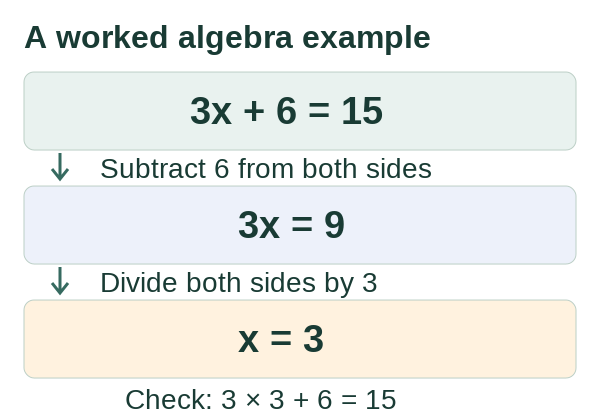
In usual practice, the learner solves many problems alone after a lesson. A 2015 policy review recommends putting worked-out solutions into practice sessions instead. This applies to science, technology, engineering and mathematics classrooms. The review also describes ways to use examples. These include fading the examples, prompting self-explanation, adding incorrect examples, and comparing several examples.[5] Atkinson and colleagues (2000) advise asking learners to explain examples to themselves. This can come through direct training or through the structure of the example itself.[3]
Yamada and Tsuji (1989) call a worked example the record of an expert's problem solving. The paper argues that an expert finds such a record easier to supply. The general rules for when to apply each step are harder to supply.[8] Stone and colleagues (2026) showed videos to children aged 4.01 to 6.96 years. In them, an agent shared toys using a correct or a wrong strategy.[9]
Azizah and Prihandhika (2025) reviewed 12 articles on worked examples in mathematics learning. One article reported that it did not work.[10]
Main ideas
Why studying examples helps novices
Apriani and Mahmudi (2025) describe worked examples as a way to cut extra mental load. That is mental effort that does not help learning.[11] Chen, Retnowati and Kalyuga (2020) compared tasks low and high in element interactivity. They measured the second factor more than once. Some materials have many interacting elements. For these, worked examples followed by problem solving worked better than the reverse order. For materials low in element interactivity, the two sequences did not differ. This held among learners who knew more.[1]
The benefit depends on how much the learner already knows. It was strongest for novices.[1][12] Two geometry experiments found a related pattern. Students who had not yet fully learned the theorems did better with theorem and step guidance. Students who had learned them did best with step guidance alone.[12]
Bichler and colleagues (2022) describe a model of learning from examples. The model says the quality of self-explanation carries the effect of examples to learning outcomes. Bichler and colleagues (2022) built a coding scheme. It rates how well students explain unclear statistics problems to themselves. One reading is that examples work directly by showing a solution strategy. This may matter most when no step-by-step procedure exists.[13]
Hesser (2015) introduced faded worked examples. These keep support inside problem solving as learning improves. This was a college chemistry course. Some students were seen as underprepared in mathematics. They said faded worked examples improved their learning and problem solving.[14]
Segmented examples come in separate pieces. Blank lines separate the pieces. They took less effort to reach equal learning outcomes than nonsegmented ones. Telling students to break the examples into parts themselves raised their effort. It did not improve their performance.[15] Showing an example in steps gave a higher feeling of competence and lower cognitive load. Students remembered the solution more correctly and reproduced more steps only when strategic prompts were added.[16]
Solving problems after examples also changes what learners know about their own understanding. Fifth grade children studied an example, then solved a problem. They judged their learning more accurately, with less overestimation. The accuracy of their decisions about what to restudy did not differ.[17]
One limit concerns the testing effect. Testing helps long-term memory more than restudying does. Among 40 students, those who only studied worked examples matched those who switched between study and problem solving. The test came after 5 min. On a delayed test after 1 week, the example-only group performed better. Van Gog and Kester (2012) suggest a limit. Testing may not beat restudying when students learn to solve problems from worked examples.[18]
Design choices that change the result
One study looked at 174 university students. Showing worked examples at the same time helped procedural knowledge. Mixing them helped students understand the ideas.[19]
One version pairs a correct example with a wrong one. Students compare a wrong step with the matching correct step. They explain why it is wrong. Two experiments on linear equations had 43 and 68 students. This correct-and-incorrect group did not outperform either a worked-example group or a problem-solving group. The same experiments found the usual expertise reversal effect. Worked examples beat problem solving for students with low prior knowledge. The reverse held for high prior knowledge students.[4]
Safadi and Ababsy (2020) tested a troubleshooting activity. Students look for errors in examples. They then score them against a rubric that shows worked examples. Six 8th grade classes diagnosed wrong examples. One class used the new activity. It had 45 students. It learned more from the erroneous examples than the class using traditional troubleshooting with worked examples but no rubric (46 students).[20]
Liao (2023) found that mapping principle to example led to fewer nonrelational comparisons. This was for a simple principle. One study looked at 138 college students. For a complex principle, linking principle to example gave fewer single concepts but more linked concepts. Mapping example to example did not. The two forms of mapping led to equal gains in structural and conceptual knowledge.[21]
Comparing two worked examples has also helped English Learners in algebra. Worked example pairs changed for Language Support improved students' algebra problem solving. Their written explanations improved too. The gains held across English proficiency levels after controlling for prior knowledge.[22]
Ginns and colleagues (2016) found that some students did better on transfer problems. These students traced their index fingers over paper-based worked examples. They beat students who only studied the examples visually. This was in triangle geometry (52 students) and order of operations (54 students). They did better on transfer problems than students who only read them. The reported effect sizes were d = .78 and d = .50. Self-reports of cognitive load during testing did not support the proposed explanation.[23]
A delayed test 4 weeks later found that the tracing group (30 students) beat the non-tracing group (30 students) on angle relationships. The tracing group also rated the test as less difficult.[24] Animated worked examples showed subgoals one after another over time. They beat static examples with all subgoals shown at once on transfer.[6] High school students (94 in total) used animation-based worked examples in augmented reality. They showed much higher achievement and motivation than students who used paper-based worked examples.[25]
Lechner and colleagues (2024) compared faded and non-faded video worked examples. A control group got no worked examples. Fading gave no extra benefit. The example groups had higher motivation and lower extraneous load. Neither difference was statistically significant.[26] Mixing examples across principles helped conceptual knowledge. Neither arrangement changed how students did on tasks that asked them to tell the principles apart.[19]
Apriani and Mahmudi (2025) designed worked examples for the Pythagorean theorem. They used real-life settings, such as staircases and electrical installations.[11] A related design followed the three OECD mathematical literacy processes. These are formulating, employing and interpreting. It also avoided split attention and redundancy.[27]
In programming, 75 non-computer majors in a first course used examples. The examples included guided questions that prompted self-explanation. That combination improved transfer learning regardless of motivation, and high-motivated learners did better on retention and transfer in every condition.[28] A review of worked example designs for programming found little research on such designs.[29]
In statistics, about 114 undergraduates in online and in-person courses preferred step-by-step examples. They liked the steps to get harder as they went. Online students asked for fewer extra examples. This suggests online settings make it harder to ask for academic help.[30]
Kopp, Stark and Fischer (2008) ran a medical education experiment. It had 153 students. Knowledge of errors grew mainly when wrong examples came with detailed feedback. Those effects held whatever the time on task and prior knowledge. They also lasted on a later multiple-choice test.[31]
JACMART and colleagues (2025) taught equation solving to 47 second-year secondary students in French-speaking Belgium. In that region, mathematics anxiety runs high and equation performance runs low. Worked examples clearly improved students' math performance, with or without extra help. Neither group showed a significant change in mathematics-related anxiety. One group reached extra support through QR codes, and that support spelled out each step. It made no significant difference to anxiety or performance compared with worked examples alone.[32]
A study of negative numbers with number lines took place among seventh-grade students. It compared a worked-example strategy with teaching that did not use worked examples. Kurniawan and Retnowati (2024) found that the number-line worked example strategy had a greater influence than instruction without it. This held when mathematics anxiety was considered. On understanding of the concept, the two groups showed the same level of effect.[33]
Students who received worked examples significantly outperformed the usual-instruction group. The measure was verbal explanations of fractions concepts. Students who saw both correct and incorrect solutions explained fractions significantly better than those who saw correct solutions only. On fractions proficiency, however, the differences between the groups were not significant.[34]
Juana and Lutfi (2026) ran a quasi-experimental study. This compares existing classes rather than assigning students at random. It drew on 32 Grade 11 students from a private senior high school in Tangerang, Indonesia. The researchers adjusted for pretest scores. Collaborative learning with worked examples then showed no significant advantage over usual instruction on integral calculus problems. The sample was small and not randomized, so the result should be read cautiously. It does not show the two approaches are equal.[35]
An experiment with 55 eighth graders, average age 14,12 years, placed students by chance in a team tournament game or in individual learning. Both used worked-example booklets. Students learning alone scored significantly higher than those in the game. The effect size was 0,15. The gap was large for the more complex topic, at Cohen's d = 0,87. It was not significant for the simpler one.[36]
How worked examples are presented and studied
In one study, learners studied screencasts of calculus problems in three ways. They saw worked examples, example-problem pairs, or they produced the screencast themselves. That study compared three conditions: studying worked examples alone, alternating worked examples with problem solving, and solving problems without examples. Switching between examples and problems beat studying examples alone on hard transfer questions. There was no significant difference on moderate and easy questions. The three conditions did not differ significantly in cognitive load during learning or testing. Cognitive load is the mental effort a task demands.[37]
A second study tested worked examples with voice notes against worked examples without them. Voice notes are short recorded spoken explanations. The study looked at 62 students learning derivatives of polynomial algebraic functions. The version without voice notes was more effective and produced less cognitive load. The two versions did not differ significantly in computational thinking skills. The study warned that voice notes may create redundancy effects.[38]
A study with 130 Chinese children (mean age 8.78 years) compared online mathematics examples. It tested examples with subgoal labels against examples without them. Subgoal-labeled examples increased working memory resource depletion and did not improve scores. Depletion is a measure of how much a limited mental store is used up. A focused subgoal label did not improve learning. A label the learner chose personally improved near-transfer scores and reduced mental effort.[39]
A study of 62 seventh-grade students (mean age 13 years) compared process-oriented examples with product-oriented examples in financial literacy. The two formats did not differ significantly on near transfer or cognitive load. The process-oriented group did significantly better on far transfer.[40]
Self-explanation prompts ask learners to explain a solution to themselves. Rexhäuser and colleagues (2026) compared specific prompts with general prompts. They found no significant difference between them. One experiment used 154 automotive technician trainees in 77 pairs. Self-explaining worked examples improved declarative knowledge of collaborative diagnostic reasoning strategies and process quality. The comparison was with solving problems. Worked examples did not improve use of that strategy knowledge or reduce mental workload. Problem solving produced a higher-quality outcome. Whether the prompts were specific or general showed no significant effects.[41]
Self-assessment accuracy after studying examples also depends on how learners are prompted to judge themselves. In Experiment 1, judging from performance-based cues gave better self-assessment accuracy than judging from explanation-based cues. Performance-based cues mean actual problem-solving results. In Experiment 2 this held only when learners received no further instructional support. Telling learners in advance which cue would be monitored improved accuracy, and explanation-based judges matched performance-based judges only when given cue criteria and self-explaining prompts.[42]
Research
The evidence and how large the effect is
Halabi, Tuovinen and Farley (2005) compared worked examples with problem-solving exercises. They used these as teaching material in introductory accounting. In one accounting study, 93 students worked through computer-based materials. The materials covered one introductory topic. This was for students who had not studied accounting before.[43]
College algebra courses have tested worked examples added to an existing class.[44][45] In one large lecture course, two sections were picked at random as the experimental group. Another class was the control group. The experimental group got worksheets of examples and problems from the previous week's material. The control group received a question-and-answer session.[45]
A later study gave a half-semester course to 30 college algebra students. The course was built on worked example worksheets. Those 30 students did much better than non-participants on total course points. They also did better on quizzes and on tests 3 and 4. Participants also earned a significantly higher course grade point average. They came to more lectures and scored higher on the final exam.[44]
Large courses have used recorded worked examples. In these, an instructor solves a problem while narrating the steps. One introductory business statistics course used these videos with 2265 students over three semesters. Students used the videos heavily before assessment deadlines. They often used active learning strategies while watching. Academic performance and course satisfaction improved compared with earlier groups.[46]
Asrafil, Guntur and Wicaksono (2022) report on adding a deep isomorphism problem with too little guidance. It was added to a worked example and problem-solving pair. This raised learning independence and lowered cognitive load. Seventh grade students were learning algebra. It lowered cognitive load to the low category. In that study, 75% of students met the minimum pass criterion of 65.[47]
A classroom action study of 31 eighth-grade students combined problem-based learning with worked examples. It also used interactive quizzes. Average interest scores, observation sheets and student responses all improved after the change.[48]
In practice
Using worked examples in classrooms and online
A worksheet on systems of linear equations with two variables was tried with 10 eighth-grade students in Indonesia. It drew 80% from media experts and 87% from subject experts. Both rated it good and usable without revision. Students answered a questionnaire about that worksheet. They gave it 86%, a very good rating.[49]
A statistics e-module is an electronic teaching module. For eighth grade it scored 3.45 from media validators (highly valid) and 3.17 from subject validators (valid). Its readability test reached 90.87%. Student responses reached 88.54%, and teacher responses reached 97.22%.[50] A seventh grade module on data presentation drew 87% from subject experts, 72% from media experts and 98% from teachers. Student feedback was 86% positive.[51]
Studies comparing worked examples with ordinary teaching have found differing results. One quasi-experiment found significant differences in two mathematics abilities. A second found no advantage over conventional instruction. A third found higher average post-test scores that did not reach significance.[52][53][54]
In one quasi-experiment, 32 eleventh-grade students learned matrices through realistic mathematics education with a worked example strategy. A second class of 31 students formed the control group. The worked example group averaged higher procedural fluency. The control group scored higher on creative thinking on average. Both differences were significant (0.046 and 0.037).[52]
A study of 32 eleventh-grade students in Tangerang found no significant advantage for collaborative learning with worked examples. This held after pretest scores were adjusted (p = .686). That study's sample was small and not randomized. So the result should be read with care.[53] A third comparison found post-test averages of 60 for the worked example class and 53.13 for the control class. The gap fell short of significance (Asymp.Sig = 0.086).[54]
Students' self-confidence scores in mathematics learning reached 82.36% in the first cycle. They reached 88.24% in the second.[55] In a postgraduate accounting subject, twelve worked example videos with embedded polls were made. Some students watched the videos and voted. They scored significantly better on the final exam and overall marks than students who did not.[56]
A large chemistry engineering course moved online in 2020. More than half the students gave the new activity their highest effectiveness ranking. By the end of the term, one kind of submission made up about one-quarter of all submissions. These were follow-along work completed before the content was presented in class.[57]
What this looks like when you study
Students watched about 47,000 times. Viewing peaked in the days before each assessment deadline. Groups with access to the videos had higher median final percentages than earlier groups without them. Their pass rates were higher too.[46]
In a chemical engineering course of more than 200 students, fourteen video worked examples were posted. Each was followed by a short piece of work to submit. More than half of the students ranked video worked examples highest among eight course activities. The ranking was for developing their knowledge and skills.[57]
A study looked at 147 higher education students learning the trapezoidal rule. Learners chose their own tasks from a database of 45. Almost all started with an example at the lowest complexity level. Examples stayed popular through the fifth of six tasks. On average they picked examples 64.3% of the time and practice problems 35.7% of the time.[58]
One source advises studying an example. Then solve a matching practice problem placed close to it. It also recommends that you explain each step of the example to yourself. This can follow direct training, or the example can be built to invite it.[3]
When a worked example fades, later steps are left blank. You complete them as your skill grows.[14] If you study several examples of one principle, compare them. Comparing multiple examples is one of the methods the research supports.[5]
Later developments
Worked examples beyond mathematics
In a worked example, an expert sets out a full solution to a problem. A learner can then study each step.[59] Researchers have tested worked examples outside mathematics. Examples include teaching chest tomography to medical students. Another is teaching fourth graders to write Chinese descriptions.[59][60]
In radiology, a 2022 experiment with medical students compared online lectures with worked examples. Grades rose a lot from before to after training (F1; 74 = 46.008; p < 0.001). The worked-example group and the lecture group did not differ significantly (F2; 74 = 1.401; p = 0.240). Reported mental effort also did not differ between groups (F1; 69 = 0.092; p = 0.762). Second-year students did report significantly higher effort. The researchers concluded that worked examples worked as well as lectures for this topic.[59]
Sectional anatomy has also been taught with worked examples. It is the study of the body cut into slices. One group used a website on its own, while the other watched a demonstration first. In both experiments, the demonstration group showed more effective and efficient learning. This held on measures of knowledge, mental effort and cognitive load. The researchers suggested that novice learners may need demonstrations to guide their attention. Advanced students may manage more self-directed study.[61]
In programming, a seven-week experiment with foundation engineering students compared two digital designs. One group (n = 53) used a complete program with an instructional explanation. The other group (n = 51) used a faded version. It removes steps to prompt self-explanation. Fading was significantly effective for near transfer performance but not for far transfer performance. Screencast technology was not significantly effective. It did not transfer basic programming knowledge into program writing skills. Students preferred the faded design over the complete one.[62]
A separate study compared labelled and visualised worked examples in introductory programming. More students preferred the visualised design. Students said both designs helped them understand the solution. The visualised design also helped students understand the problem and the programming process.[63]
Worked examples have also been tried in descriptive writing and in proportional reasoning. Proportional reasoning is the reasoning students use when working with proportions.[60][64] A study of 79 fourth-grade students compared worked examples in a spherical video-based virtual reality setting with worked examples beside ordinary videos. The virtual reality group scored significantly higher only on figurative expression. There were no significant differences in organization, sensory details or creativity. Students with high engagement outperformed low engagement students on all four writing dimensions.[60]
In one elementary school in East Java, Indonesia, a worked example strategy significantly improved students' proportional reasoning. The researchers suggested that teachers can use the strategy. Students then get used to copying problem-solving steps before they develop more complex solutions.[64]
Worked examples in medicine, science and programming
A 2022 experiment compared video lectures with worked examples for teaching chest tomography. The students were medical students in early and late clinical phases. Scores rose significantly after training (F1; 74 = 46,008; p < 0,001). They also differed between course phases (F2; 148 = 19,452; p < 0,001). Reported mental effort was similar (F1; 69 = 0,092; p = 0,762). The researchers concluded that worked examples were as effective as the established lecture method for radiology.[65]
A second medical study asked whether worked examples could teach pediatric cardiac auscultation. That is the skill of listening to a child's heart with a stethoscope. Soares and Ibiapina (2023) randomly assigned 56 fourth-year students at the Universidade Federal de Minas Gerais to worked examples or traditional lectures. Both methods produced significant gains on the pretest, immediate posttest and delayed posttest (p < 0,001). The two groups performed similarly whatever the method (p = 0,863). Here too, worked examples matched traditional teaching.[66]
In atmospheric dynamics, students must apply calculus and physics to fluid flow. The results can be counterintuitive. Davenport (2019) compared students who took the atmospheric dynamics course as a traditional lecture and derivation-based course. The other group was taught through expert-constructed worked examples. The examples used real-world scenarios and self-explanation prompts. These prompts ask students to explain each step to themselves. Comparisons with the earlier lecture-based course found significant improvements, especially in the first semester. Students said they were very satisfied with the approach.[67]
In science classrooms, video worked examples show how to perform an inquiry skill. They also give pupils a plan for the inquiry activity. A quasi-experimental study with 44 fifth and sixth graders ran two classroom interventions in a row. For most science process skills, the video group improved steadily in both interventions. The control group's gains were less predictable.[68]
Functional programming is a second programming paradigm for many students. It can be hard to teach because students hold strong preconceptions about programming. A 2015 paper proposed teaching types through step-by-step calculations of type expressions. It also set out a worked-example format for beginners.[69]
Language teaching has also borrowed the idea. A course at a UK higher education institution used simplified conversation transcripts with guided noticing questions. Learners' reflections and interviews showed greater awareness of turn-taking, co-construction and task management in assessed group discussions.[70]
It is still an open question whether worked examples suit novices and advanced students equally. A 2024 study compared three setups: examples only, problems only, and examples alternating with problems. Each was followed by self-explanation prompts. Novices learned significantly more concepts when examples alternated with problems. Problems alone gave less conceptual learning. Advanced students who studied examples only did not improve significantly. The study recommended alternating examples and problems for novices.[71]
Criticism
Learner differences, limits and open questions
Not every learner gains equally from studying worked examples. One experiment with 98 students (mean age 13.9 years) found that only some learners benefited. These were learners with a high mastery approach goal orientation. Prior knowledge was the only factor that affected transfer performance.[2]
One study looked at 1,072 students. They were in an 8-week introductory mathematics course. It found six distinct learner profiles in how they chose feedback, including worked examples and hints. How well learners used these scaffolds differed from student to student. So patterns at an overall level were hard to find.[7]
A study of example order found an indirect effect on learning through mental load. The study calls this support for the expertise reversal effect. Correct examples came first and wrong examples came second. This led to a lower mental load. That lower load was linked to better learning performance. The reverse order led to a more accurate self-assessment of learning performance.[72]
147 college students picked their own tasks from 45 choices. Example use declined and task complexity rose over time. Even so, examples and the easiest tasks stayed fairly popular. Students' choices were compared with instructional design principles. How closely they matched had no link to learning outcomes, mental effort or motivation measures.[58]
Rodiawati (2018) argues that worked examples built on messy problems can train higher order thinking skills.[73] Worked examples of peer interactions have served as feedback and a learning resource. They help with spoken interaction skills. This topic has drawn relatively little research attention.[74]
Klopp and Stark (2018) used a training program with worked examples and a fading procedure. It involved 46 psychology students at a German university. After the intervention, the trained group showed much higher explanation skill than the control group.[75]
Teachers are learners too. In professional development, 30 in-service mathematics teachers worked with interactive examples of non-routine problems. Teachers said analyzing the examples was active problem solving. They mentioned self-explanation and building mental models. They did not see it as passive observation. They gained insights into mathematics and teaching at the same time. But the study used only one setting. So these mechanisms still need testing by comparison.[76]
In a model teaching activity, five teachers were followed for a full school year. Much of what they learned carried over to the classroom. How they put it into practice varied.[77]
Key studies
| Year | Study | Sample | Design | Finding |
|---|---|---|---|---|
| 2008 | Kopp et al.[31] | 153 medical students, with a subgroup of 52 compared with 145 controls | 2 x 2 experiment on erroneous examples and elaborated feedback | Diagnostic knowledge was mainly supported by erroneous examples combined with elaborated feedback, and the effects were sustained. |
| 2012 | Spanjers et al.[15] | experiment on segmentation and active segmenting | Segmented examples required less effort for equal learning outcomes, while actively segmenting increased effort without better performance. | |
| 2012 | van Gog & Kester[18] | forty students | comparison of studying only worked examples with testing after each example | Both groups were equal after 5 minutes, but the study-only group did better after 1 week. |
| 2016 | Ginns et al.[23] | 52 students in Experiment 1 and 54 in Experiment 2 | two experiments on tracing with the index finger | In both experiments, students who traced the worked examples scored higher than non-tracers on transfer problems, with effect sizes of d = .78 and d = .50. |
| 2020 | Koretsky[57] | more than 200 chemical engineering students | course modification with student rankings of eight activities | More than half of the students gave video worked examples the highest ranking among the eight activities they judged for how well each built their knowledge and skills. |
| 2020 | Chen et al.[1] | 2 x 2 experimental design with element interactivity manipulated | Worked example then problem solving was better for high element interactivity materials, especially for novices, with no difference for low element interactivity materials. | |
| 2020 | Schalk et al.[19] | 174 university students | experiment crossing blocked versus interleaved with sequential versus simultaneous presentation | Simultaneous presentation benefited procedural knowledge, while interleaved presentation benefited conceptual knowledge. |
| 2020 | Safadi & Ababsy[20] | six eighth-grade classes, 45 students in the new activity and 46 in the traditional one | pretest, intervention, posttest in three schools | Scoring erroneous examples with a rubric showing worked examples helped more students learn than traditional troubleshooting. |
| 2022 | Miller & Schraeder[44] | thirty college algebra students in a half-semester course | quasi-experimental intervention compared with non-participants | Participants significantly outperformed non-participants on total points, quizzes, tests 3 and 4, course GPA and final exam score. |
| 2022 | DART[46] | 2,265 business statistics students over three semesters | cohort comparison with video usage and survey data | Students watched about 47,000 times, mostly before deadlines, and cohorts with the videos had higher median final percentages and pass rates. |
| 2022 | van Harsel et al.[58] | 147 higher education students | self-regulated learning task-selection study | Students chose examples 64.3% of the time and started almost always with an example at the lowest complexity level. |
| 2024 | Lee & Ayres[2] | 98 learners with a mean age of 13.9 years | experiment measuring mastery approach goal orientation | Worked examples improved retention but not transfer, and only learners with a high mastery approach goal orientation benefited. |
| 2025 | Ngu et al.[4] | experimental comparison of correct and incorrect examples versus problem solving | The worked example group beat the problem-solving group for low prior knowledge students, and the reverse held for high prior knowledge students. | |
| 2026 | Fonseca et al.[61] | 110 Year 1 and 59 Year 2 medical students | two randomized experiments with a demonstration before using a website | The worked example group showed higher posttest knowledge, with normalized gains of 0.70 versus 0.53 in Year 1 and 0.58 versus 0.27 in Year 2. |
See also
References
- Chen, O., Retnowati, E., & Kalyuga, S. (2020). Element interactivity as a factor influencing the effectiveness of worked example–problem solving and problem solving–worked example sequences. British Journal of Educational Psychology, 90(S1), 210-223. doi:10.1111/bjep.12317
- Lee, H. M., & Ayres, P. (2024). The Worked-Example Effect and a Mastery Approach Goal Orientation. Education Sciences, 14(6), 597. doi:10.3390/educsci14060597
- Atkinson, R. K., Derry, S. J., Renkl, A., & Wortham, D. (2000). Learning from Examples: Instructional Principles from the Worked Examples Research. Review of Educational Research, 70(2), 181-214. doi:10.3102/00346543070002181
- Ngu, B. H., Chen, O., Phan, H. P., Usop, H., & Anding, P. N. (2025). Can Correct and Incorrect Worked Examples Supersede Worked Examples and Problem-Solving on Learning Linear Equations? An Examination from Cognitive Load and Motivation Perspectives. Education Sciences, 15(4), 504. doi:10.3390/educsci15040504
- Booth, J. L., McGinn, K. M., Young, L. K., & Barbieri, C. (2015). Simple Practice Doesn’t Always Make Perfect: Evidence From the Worked Example Effect. Policy Insights from the Behavioral and Brain Sciences, 2(1), 24-32. doi:10.1177/2372732215601691
- Lusk, M. M., & Atkinson, R. K. (2007). Animated pedagogical agents: does their degree of embodiment impact learning from static or animated worked examples? Applied Cognitive Psychology, 21(6), 747-764. doi:10.1002/acp.1347
- Tempelaar, D. T., Rienties, B., & Nguyen, Q. (2020). Individual differences in the preference for worked examples: Lessons from an application of dispositional learning analytics. Applied Cognitive Psychology, 34(4), 890-905. doi:10.1002/acp.3652
- Yamada, S., & Tsuji, S. (1989). Acquisition of macro-operators from worked examples in problem solving. ACM SIGART Bulletin(108), 171-172. doi:10.1145/63266.63303
- Stone, T., Fish, L. R., Chernyak, N., Guadalupe, G., & Cordes, S. (2026). The Role of Worked Examples in Supporting Early Math Learning. Journal of Intelligence, 14(9), 192. doi:10.3390/jintelligence14090192
- Azizah, N., & Prihandhika, A. (2025). Systematics literature review: Efektivitas worked example dalam pembelajaran matematika. JUPIKA: JURNAL PENDIDIKAN MATEMATIKA, 8(1), 31-42. doi:10.37478/jupika.v8i1.5407
- Yogyakarta State University, Yogyakarta, Indonesia, Apriani, Y., Mahmudi, A., & Yogyakarta State University, Yogyakarta, Indonesia (2025). Design Worked Examples for Mathematical Problem Solving in Real-Life Contexts: A Focus on Learning the Pythagorean Theorem. International Journal of Mathematics And Computer Research, 13(10). doi:10.47191/ijmcr/v13i10.14
- Bokosmaty, S., Sweller, J., & Kalyuga, S. (2015). Learning Geometry Problem Solving by Studying Worked Examples: Effects of Learner Guidance and Expertise. American Educational Research Journal, 52(2), 307-333. doi:10.3102/0002831214549450
- Bichler, S., Stadler, M., Bühner, M., Greiff, S., & Fischer, F. (2022). Learning to solve ill-defined statistics problems: does self-explanation quality mediate the worked example effect? Instructional Science, 50(3), 335-359. doi:10.1007/s11251-022-09579-4
- Hesser, T. L., & Gregory, J. L. (2015). Exploring the Use of Faded Worked Examples as a Problem Solving Approach for Underprepared Students. Higher Education Studies, 5(6), 36. doi:10.5539/hes.v5n6p36
- Spanjers, I. A. E., van Gog, T., & van Merriënboer, J. J. G. (2012). Segmentation of Worked Examples: Effects on Cognitive Load and Learning. Applied Cognitive Psychology, 26(3), 352-358. doi:10.1002/acp.1832
- Schmidt-Weigand, F., Hänze, M., & Wodzinski, R. (2009). Complex Problem Solving and Worked Examples: The Role of Prompting Strategic Behavior and Fading-in Solution Steps. Zeitschrift für Pädagogische Psychologie, 23(2), 129-138. doi:10.1024/1010-0652.23.2.129
- Baars, M., van Gog, T., de Bruin, A., & Paas, F. (2014). Effects of Problem Solving after Worked Example Study on Primary School Children's Monitoring Accuracy. Applied Cognitive Psychology, 28(3), 382-391. doi:10.1002/acp.3008
- van Gog, T., & Kester, L. (2012). A Test of the Testing Effect: Acquiring Problem‐Solving Skills From Worked Examples. Cognitive Science, 36(8), 1532-1541. doi:10.1111/cogs.12002
- Schalk, L., Roelle, J., Saalbach, H., Berthold, K., Stern, E., & Renkl, A. (2020). Providing worked examples for learning multiple principles. Applied Cognitive Psychology, 34(4), 813-824. doi:10.1002/acp.3653
- Safadi, R., & Ababsy, R. (2020). Learning from troubleshooting activities when contrasting erroneous examples with worked examples in the physics classroom. Physics Education, 55(5), 055024. doi:10.1088/1361-6552/ab9e1b
- Liao, H. (2023). Mapping principles and worked examples for structural learning: effects of content complexity. Frontiers in Psychology, 14. doi:10.3389/fpsyg.2023.1241873
- Ke, X., & Newton, K. J. (2024). English learners learn from worked example comparison in algebra. Instructional Science, 52(5), 831-858. doi:10.1007/s11251-024-09668-6
- Ginns, P., Hu, F., Byrne, E., & Bobis, J. (2016). Learning By Tracing Worked Examples. Applied Cognitive Psychology, 30(2), 160-169. doi:10.1002/acp.3171
- (2024). Mathematics Worked Examples with Tracing Gesture Makes Learning Last. International Journal of Advanced Research in Education and Society. doi:10.55057/ijares.2024.6.3.30
- CEVAHİR, H., ÖZDEMİR, M., & BATURAY, M. H. (2022). The Effect of Animation-Based Worked Examples Supported with Augmented Reality on the Academic Achievement, Attitude and Motivation of Students towards Learning Programming. Participatory Educational Research, 9(3), 226-247. doi:10.17275/per.22.63.9.3
- Lechner, M., Moser, S., Pander, J., Geist, J., & Lewalter, D. (2024). Learning scientific observation with worked examples in a digital learning environment. Frontiers in Education, 9. doi:10.3389/feduc.2024.1293516
- Department of Mathematics Education, Yogyakarta State University,Indonesia, Sianipar, W. A., Wustqa, D. U., & Department of Mathematics Education, Yogyakarta State University,Indonesia (2025). Design Worked Examples for Mathematical Literacy: A Focus on Learning the Pythagorean Theorem. International Journal of Mathematics And Computer Research, 13(12). doi:10.47191/ijmcr/v13i12.07
- Chen, C. Y. (2025). Effects of Worked Examples with Explanation Types and Learner Motivation on Cognitive Load and Programming Problem-solving Performance. ACM Transactions on Computing Education. doi:10.1145/3732791
- Nainan, M., Balakrishnan, B., & Mohamad Ali, A. Z. (2021). Design of Worked Examples for Learning Programming. International Journal of Instruction, Technology and Social Sciences, 1(3), 8-16. doi:10.47577/ijitss.v1i.26
- Hu, Q., & Lin, X. (2026). Designing Statistics Worked Examples for Online Versus In‐Person Learning Environments. Teaching Statistics. doi:10.1002/test.70052
- Kopp, V., Stark, R., & Fischer, M. R. (2008). Fostering diagnostic knowledge through computer‐supported, case‐based worked examples: effects of erroneous examples and feedback. Medical Education, 42(8), 823-829. doi:10.1111/j.1365-2923.2008.03122.x
- JACMART, S., Dragone, L., Temperman, G., & Lièvre, B. D. (2025). The effect of worked examples and extra help on math anxiety and equation learning in French-speaking Belgium. American Journal of Education and Learning, 10(2), 226-248. doi:10.55284/ajel.v10i2.1603
- Kurniawan, A. D., & Retnowati, E. (2024). Apakah kecemasan siswa menjadi rendah dan pemahaman konsep menjadi tinggi? Pembelajaran bilangan negatif dengan strategi worked example garis bilangan. Jurnal Pedagogi Matematika, 10(3). doi:10.21831/jpm.v10i3.20423
- Wang, A. Y., Schumacher, R. F., Dougherty, B. J., Wavell, S., Dimino, J., & Gersten, R. (2024). Using worked examples to promote explanations of fractions concepts: A formative pilot study. Learning Disabilities Research & Practice, 39(2), 87-100. doi:10.1177/09388982241230131
- Juana, N. A., & Lutfi, M. K. (2026). Efektivitas Pembelajaran Kolaboratif Menggunakan Worked Example terhadap Kemampuan Pemecahan Masalah Matematis. Wacana Akademika: Majalah Ilmiah Kependidikan, 10(1), 11-20. doi:10.30738/wacanaakademika.v10i1.23616
- Retnowati, E., & Marissa, M. (2026). Are worked examples always effective in learning? An experimental study with eighth graders. Psychological Science and Education, 31(3), 233-245. doi:10.17759/pse.2026310317
- Yang, I., & Lau, B. T. (2017). Effects of using learners’ produced screencast as worked examples in learning. EAI Endorsed Transactions on e-Learning, 4(15), e3. doi:10.4108/eai.29-11-2017.153390
- Maryati, W. E., Retnowati, E., & Thoe, N. K. (2022). Learning Mathematics Formulas by Listening and Reading Worked Examples. Indonesian Journal of Teaching in Science, 2(1), 61-74. doi:10.17509/ijotis.v2i1.45801
- Guan, X., Du, X., & Lin, H. (2022). Impact of Subgoal Labeling on Online Worked Example Learning in Mathematics for Primary School Students. Frontiers in Education, 7. doi:10.3389/feduc.2022.832901
- Hamid, H. W. R., & Retnowati, E. (2026). Process- vs. Product-Oriented Worked Examples: Effects on Knowledge Transfer and Cognitive Load in Financial Literacy Learning. Journal of Teaching Innovation and Reform, 2, 11-19. doi:10.65638/2978-5634.2026.02.02
- Rexhäuser, D., Radkowitsch, A., Richters, C., Glogger-Frey, I., Vogel-Blaschka, D., Meier, J., & Abele, S. (2026). Effects of specificity of self-explanation prompts for worked examples on computer-supported learning of collaborative diagnostic reasoning. International Journal of Computer-Supported Collaborative Learning, 21(3), 369-415. doi:10.1007/s11412-026-09468-9
- Waldeyer, J., Endres, T., Roelle, J., Baars, M., & Renkl, A. (2024). How to Optimize Self-Assessment Accuracy in Cognitive Skill Acquisition When Learning from Worked Examples. Educational Psychology Review, 36(4). doi:10.1007/s10648-024-09944-4
- Halabi, A. K., Tuovinen, J. E., & Farley, A. A. (2005). Empirical Evidence on the Relative Efficiency of Worked Examples versus Problem-Solving Exercises in Accounting Principles Instruction. Issues in Accounting Education, 20(1), 21-32. doi:10.2308/iace.2005.20.1.21
- Miller, D., & Schraeder, M. (2022). Worked Example Mid-Semester Intervention in College Algebra: Worked Example Mid-Semester Intervention. Journal of Research in Mathematics Education, 11(2), 140-158. doi:10.17583/redimat.9645
- Miller, D. A., & Schraeder, M. (2021). Using Worked Examples with Active Learning in a Large lecture College Algebra Course. International Journal of Education in Mathematics, Science and Technology, 10(1), 1-23. doi:10.46328/ijemst.2011
- DART, S. (2022). Evaluating the impact of worked example videos for blended learning in a large-enrolment business statistics course. STATISTICS EDUCATION RESEARCH JOURNAL, 21(1), 8. doi:10.52041/serj.v21i1.93
- Asrafil, A., Guntur, M. I. S., & Wicaksono, A. B. (2022). Optimization of Worked Example-Problem Solving Pair to Increase Learning Independence and Reduce Cognitive Load. Indonesian Journal of Mathematics Education, 4(2), 53-65. doi:10.31002/ijome.v4i2.6246
- Nur Fadila, R., Mahmudi, A., & Rosnawati, R. (2026). Improving Students' Interest in Mathematics Learning through Problem-Based Learning with Worked Examples and Interactive Quizzes on SPLDV. Jurnal Inovasi Matematika, 8(1), 15-32. doi:10.35438/inomatika.v8i1.551
- Lubis, R. A., & Wahyuni, S. (2022). Development of Mathematics Student Worksheets Based on Mathematical Understanding with a Worked Example Approach. EduMatika: Jurnal MIPA, 2(3), 69-74. doi:10.56495/emju.v2i3.243
- Lukum, F. M., Zakaria, P., & Irfah, A. (2026). Pengembangan E-Modul Pembelajaran Statistika Kelas VIII SMP Berbasis Worked Example. Research Review: Jurnal Ilmiah Multidisiplin, 5(2), 771-780. doi:10.54923/researchreview.v5i2.418
- Longkun, E. M., Majid, & Takaendengan, B. R. (2026). Pengembangan Modul Berbasis Cognitive Load Theory dan Worked Example untuk Memfasilitasi Berpikir Kritis Siswa Kelas VII. Research Review: Jurnal Ilmiah Multidisiplin, 5(2), 763-770. doi:10.54923/researchreview.v5i2.417
- Salma, J. (2026). Pengaruh Model RME Dengan Strategi Worked Example terhadap kelancaran prosedural dan kemampuan berpikir kreatif. Griya Journal of Mathematics Education and Application, 6(3). doi:10.29303/griya.v6i3.1395
- Juana, N. A., & Lutfi, M. K. (2026). Efektivitas Pembelajaran Kolaboratif Menggunakan Worked Example terhadap Kemampuan Pemecahan Masalah Matematis. Wacana Akademika: Majalah Ilmiah Kependidikan, 10(1), 11-20. doi:10.30738/wa.v10i1.23616
- Nuraeni, Z., Simarmata, R. H., & Tarigan, A. H. Z. (2023). Implementation worked example-based learning to improve junior high school students' mathematical representation ability. Jurnal Pendidikan Matematika (JUPITEK), 6(1), 36-41. doi:10.30598/jupitekvol6iss1pp36-41
- Rustanuarsi, R. (2019). Improving Self Confidence of Students in Mathematics Learning Using Think Pair Share (TPS) Cooperative Model with Worked Example Assisted. JP2D (Jurnal Penelitian Pendidikan Dasar) UNTAN, 2(3), 105. doi:10.26418/jp2d.v2i3.88
- Marsland, E., Kemp, A., & Hogarth, K. (2024). How worked example Echo360 videos and embedded polls with students as partners improved learning outcomes in accounting. ASCILITE Publications, 374-379. doi:10.14742/apubs.2024.1120
- Koretsky, M. D. (2020). Re-flipping in the Remote Classroom: The Surprising Uptake of Video-Recorded Worked Examples. Journal of Chemical Education, 97(9), 2754-2759. doi:10.1021/acs.jchemed.0c00711
- van Harsel, M., Hoogerheide, V., Janssen, E., Verkoeijen, P., & van Gog, T. (2022). How do higher education students regulate their learning with video modeling examples, worked examples, and practice problems? Instructional Science, 50(5), 703-728. doi:10.1007/s11251-022-09589-2
- Barros, P. I. S., Ibiapina, C. d. C., Diniz, L. M., & Damião, B. M. (2022). Can the traditional class be replaced by the Worked Example in the teaching of Radiology? Revista Brasileira de Educação Médica, 46(3). doi:10.1590/1981-5271v46.3-20220046.ing
- Huang, Y. P., Zheng, X. L., Chiu, C. K., Lei, J., Yang, G., Kim, H., & Wang, F. (2021). Towards Figurative Expression Enhancement: Effects of the SVVR-Supported Worked Example Approach on the Descriptive Writing of Highly Engaged Students. Sustainability, 13(21), 12260. doi:10.3390/su132112260
- Fonseca, G. R. B. C., Tipoe, G. L., & Ganotice, F. A. (2026). Comparing the outcomes of the technology‐enhanced learning of sectional anatomy with and without preceding demonstrations: A study about the worked‐example effect in anatomy education. Anatomical Sciences Education, 19(9), 1396-1414. doi:10.1002/ase.70267
- (2019). Digital Worked Example: an Experiment on Strategies to Enhance Computer Programming Skills. International Journal of Recent Technology and Engineering, 8(3S2), 571-576. doi:10.35940/ijrte.c1126.1083s219
- Nainan, M., Balakrishnan, B., & Mohamad Ali, A. Z. (2020). Exploring Two Worked Example Designs for Learning Introductory Programming from Students’ Perspectives. Journal of Technology and Humanities, 1(2), 20-29. doi:10.53797/jthkkss.v1i2.3.2020
- Ibrahim, B. K., & Amir, M. F. (2024). Penalaran Proporsional Siswa dalam Strategi Worked Example. Jambura Journal of Mathematics Education, 5(1), 50-61. doi:10.37905/jmathedu.v5i1.23798
- Barros, P. I. S., Ibiapina, C. d. C., Diniz, L. M., & Damião, B. M. (2022). A aula tradicional pode ser substituída pelo Worked Example no ensino da radiologia? Revista Brasileira de Educação Médica, 46(3). doi:10.1590/1981-5271v46.3-20220046
- Soares, L. M., & Ibiapina, C. d. C. (2023). Worked example como método de ensino da ausculta cardíaca pediátrica para estudantes de Medicina. Revista Brasileira de Educação Médica, 47(3). doi:10.1590/1981-5271v47.3-2023-0136
- Davenport, C. E. (2019). Using Worked Examples to Improve Student Understanding of Atmospheric Dynamics. Bulletin of the American Meteorological Society, 100(9), 1653-1664. doi:10.1175/bams-d-18-0226.1
- Solé-Llussà, A., Aguilar, D., & Ibáñez, M. (2022). The Effect of an Instructional Intervention Based on the Use of Video-Worked Examples to Promote Elementary Students’ Science Process Skills. International Journal of Education in Mathematics, Science and Technology, 10(3), 753-772. doi:10.46328/ijemst.2158
- TIRRONEN, V., & ISOMÖTTÖNEN, V. (2015). Teaching types with a cognitively effective worked example format. Journal of Functional Programming, 25. doi:10.1017/s0956796814000021
- Stephenson, M., Lam, D. M. K., & Leyland, C. (2026). Teaching interactional competence via ‘worked examples’. ELT Journal. doi:10.1093/elt/ccag039
- SHAREGHI NAJAR, A., & MITROVIC, A. (2024). Do novices and advanced students benefit differently from worked examples and ITS? International Conference on Computers in Education. doi:10.58459/icce.2013.17
- Wesenberg, L., Krieglstein, F., Jansen, S., Rey, G. D., Beege, M., & Schneider, S. (2022). The influence of the order and congruency of correct and erroneous worked examples on learning and (meta-)cognitive load. Frontiers in Psychology, 13. doi:10.3389/fpsyg.2022.1032003
- Rodiawati, A. (2018). Worked example using ill-structured problem: Trained high order thinking skill. AKSIOMA: Jurnal Program Studi Pendidikan Matematika, 7(2), 308-313. doi:10.24127/ajpm.v7i2.1402
- Lam, D. M. K. (2025). Worked examples for peer interaction: a feedback and learning resource. ELT Journal, 79(1), 44-54. doi:10.1093/elt/ccae029
- Klopp, E., & Stark, R. (2018). Learning Scientific Explanations by Means of Worked Examples – Promoting Psychology Students’ Explanation Competence. Psychology Learning & Teaching, 17(2), 144-165. doi:10.1177/1475725718757171
- Ovadiya, T. (2026). Beyond Problem-Solving: Interactive Worked Examples as Pathways to Dual Teacher Expertise. Journal of Intelligence, 14(9), 203. doi:10.3390/jintelligence14090203
- Newton, K. J., & Star, J. R. (2013). Exploring the Nature and Impact of Model Teaching With Worked Example Pairs. Mathematics Teacher Educator, 2(1), 86-102. doi:10.5951/mathteaceduc.2.1.0086
Cite this page: Atlas Nova editors. (2026). Worked-example effect. Atlas Nova. https://velocer.io/atlas/worked-example-effect/