Technology · Language models
Fine-tuning (deep learning)
Fine-tuning adapts a model to a specific task, and it works well when labeled data for that task are limited.[1][2]
Fine-tuning adjusts a pre-trained model's parameters to suit a specific task or domain.[3] A pre-trained model with adequate fine-tuning matched or beat training from scratch in four medical imaging applications.[2] Fine-tuning all parameters of a colossal model and keeping separate copies per task is practically infeasible.[4]
Key facts
| 67.6% | Flan-PaLM accuracy on MedQA medical licensing-style questions (Singhal et al., 2023)[5] |
|---|---|
| 1.2M | Learnable parameters added by LLaMA-Adapter to a frozen 7B model (Zhang et al., 2023)[6] |
| 2,100 | Fine-tuning trials released across four GLUE datasets (Dodge et al., 2020)[7] |
| 99.17% | Validation accuracy for COVID-19 versus normal X-ray classification (Hossain et al., 2022)[8] |
What fine-tuning means
Fine-tuning is the continued training of a model that was first trained on a large general dataset, so that it adapts to a specific task.[1][2] The first stage, pretraining, learns transferable representations from large-scale data.[1]
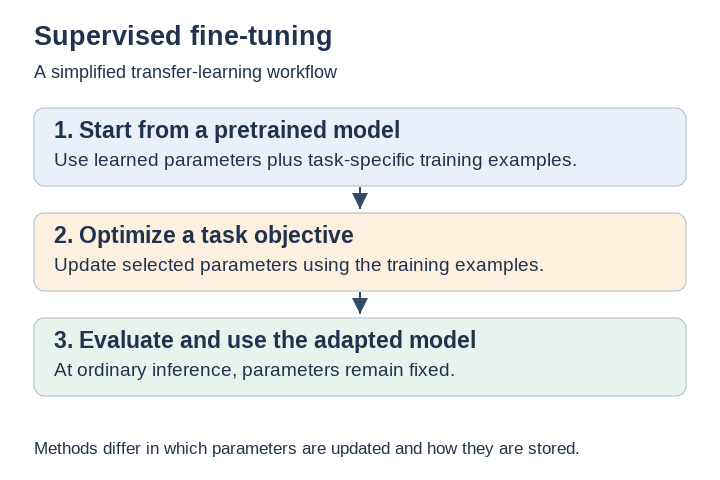
Fine-tuning is popular, but it has drawbacks, and researchers have proposed variants that adjust only part of a pretrained network. Across 7 public image classification datasets, that method reduced the average classification error of standard fine-tuning by 2.54%.[9]
Where the idea came from
ULMFiT was proposed as an efficient transfer learning method usable for any natural language processing activity, the broad field of getting computers to handle text. The method used a 3-layer architecture and greatly surpassed the previous best results on text classification tasks, reducing error on most datasets.[10]
As pretrained language models spread, researchers began adjusting the fine-tuning step itself. A 2020 paper argued that the standard fine-tuning loss has shortcomings that can lead to weaker generalization and to instability during training. Combined with cross-entropy, this objective gave significant improvements over a strong baseline on several GLUE datasets, a standard collection of language understanding tests, with few labeled examples.[11]
A 2019 paper applied reward learning, in which a model of what people want is built by asking humans questions, to four natural language tasks. For stylistic continuation, good results came from only 5,000 comparisons evaluated by humans. For summarization, models trained with 60,000 comparisons copied whole sentences from the input but skipped irrelevant preamble.[12]
How much fine-tuning helps
On the first dataset DenseNet121 reached 97% accuracy, while on the second dataset MobileNetV2 did best at 81%.[13] Another 2022 study fine-tuned ResNet50 with ten different sets of pretrained weights on the COVID-19 Radiography Database. Its best model, pretrained on the iNat2021 Mini dataset with the SwAV algorithm, reached 99.17% validation accuracy and 99.95% training accuracy for separating COVID from normal cases.[8]
A 2021 study asked whether fine-tuned pretrained networks can match more elaborate new designs, which matters when a tool must be deployed quickly. It fine-tuned AlexNet, GoogleNet, and SqueezeNet without data augmentation on 2-class and 3-class tasks using 3 public chest X-ray databases. The conclusion was that these three networks need the least training time among pretrained models, and that suitable training settings give excellent classification results without augmentation.[14]
A 2022 breast cancer study fine-tuned ResNet50 on mammogram images from a digital database for screening mammography. It tested three optimizers, adaptive gradient, adaptive moment estimation, and stochastic gradient descent, together with data augmentation and a learning rate scheduler. The results indicated that the classifier could sort breast masses into benign and malignant groups from the mammogram images.[15]
Why a good starting point helps
One 2018 study trained networks on synthetic images and then fine-tuned them on photorealistic images rendered from CT scans. The fine-tuned networks required less training data to converge to an optimal solution than networks without fine-tuning. Fine-tuning on images rendered under a variety of photorealistic conditions also stopped the network from learning patient-specific information, which aided generalizability.[16]
The cost of full fine-tuning
The standard approach updates every one of those numbers for each new task. Researchers describe the resulting adaptation costs as prohibitive for large-scale pretrained language models.[4] The scale of these models also brings significant computational and storage costs, as a 2025 survey of the field puts it.[17]
A 2023 guide describes the aim as training only a small subset of parameters to meet the challenges of fine-tuning large language models.[18] Delta tuning largely reduces both the computation and storage costs of adaptation.[4]
A 2026 review reports that PEFT reduces the number of fine-tuning parameters and memory use while reaching performance comparable to full fine-tuning.[19] The Nature Machine Intelligence review reports that a series of delta tuning methods can match full-parameter fine-tuning.[4] The 2023 guide counts over 50 papers published between early 2019 and mid-2024 on such methods.[18]
Adapters and small inserted modules
Only the inserted blocks are trained, which lets a pretrained model move to a new task with minimal retraining of the base model parameters. A 2024 study built a method on the UniPELT framework and added a PromptTuning Layer, reporting performance comparable to full model fine-tuning on three kinds of data.[20]
A 2024 study applied adapters and Low-Rank Adaptation to two models across four benchmark datasets. Sequentially arranged adapter modules reached competitive performance while fine-tuning only about 1 to 6% of model parameters, against 40 to 55% in traditional fine-tuning. Using 2 to 3 adapters per transformer block gave the best balance of performance and efficiency in that study. The study concluded that the effect of these methods varies with dataset complexity and model architecture.[21]
A 2023 paper groups BitFit with Adapters, prefix tuning and LoRA as proposed strategies for training few parameters. That paper notes these designs were hand-crafted separately and asks whether shared design patterns exist. Methods built on these patterns beat the strategies the paper examined across different backbone models and natural language processing tasks.[22]
A 2024 analysis of BERT, a widely used language model, asked which part changes most during fine-tuning. The output LayerNorm changed more than any other component when the model was fine-tuned for different GLUE tasks. Using a measure called Fisher information, the study identified the most important part of LayerNorm. Fine-tuning only that small portion solved many GLUE tasks with negligible loss of performance.[23]
LLaMA-Adapter is a lightweight method for turning the LLaMA 7B language model into one that follows instructions. It adds only 1.2M learnable parameters to the frozen model and uses 52K self-instruct demonstrations. Fine-tuning took less than one hour on 8 A100 graphics processors. The approach also extended to image-conditioned instructions, with strong reasoning results on the ScienceQA and COCO Caption benchmarks.[6]
Low-rank adaptation and its variants
Low-rank adaptation, usually shortened to LoRA, is a way to fine-tune a large model without changing most of its weights. The pre-trained weights stay frozen, and each task-specific change is stored as the product of two smaller matrices.[24]
Structure-aware low-rank adaptation (SaLoRA) targets a different weakness: LoRA picks its target modules and layers by rule of thumb and gives them the same rank. Tests with pre-trained models of different scales, on GLUE and on the task-agnostic Yelp and GYAFC sets, showed consistent gains over LoRA without much loss of training efficiency.[25]
MoRA questions the low-rank update itself, arguing that it may limit a model's ability to learn and memorize new knowledge. Its fix is a square matrix that achieves high-rank updating while keeping the same number of trainable parameters, with non-parameter operators that shrink the input and expand the output. Those operators also let the weight be merged back into the model, so MoRA can be deployed like LoRA.[26]
QLoRA with rank 16 reached 79.92 ± 0.75% against 78.26 ± 0.94% for full fine-tuning, training 1.060 M parameters, or 3.67% of the adapted model. It also recorded the lowest peak training GPU memory, 1727 MB versus 2478 MB, about 30% below full fine-tuning. That memory figure came with batch size 16 while the other methods used batch size 32, so the study treats it as a whole-configuration effect rather than a pure quantization effect.[27]
Several questions remain open across the family of methods.[24] The photovoltaic study adds that batch-matched memory tests, direct profiling on embedded devices, and validation on other datasets are needed before deployment-level claims can be made.[27]
Prompt and prefix tuning
Prompt tuning is a way of fine-tuning a language model by training a small set of extra input vectors instead of the model's own weights. Prompt tuning keeps competitive results with fewer trainable parameters than other parameter-efficient methods, and its parameter count does not grow sharply as the model gets larger.[28]
Semantic Knowledge Tuning, or SK-Tuning, replaces the random tokens with meaningful words. The processed prompt is then combined with the input text to improve performance on a particular task. In experiments, SK-Tuning trained faster, used fewer parameters and performed better on text classification and understanding tasks than other tuning methods.[29]
Prompting can also be added to an ordinary fine-tuning run rather than replacing it. One study tested this on a Hungarian language model called huBERT, using benchmark datasets from HuLU. The largest gain came on HuWNLI, where accuracy rose from 65% to 85%.[30]
Choosing and combining methods
Choosing among fine-tuning methods is itself a research problem, because the best settings are not obvious in advance.[31][32] A 2024 review compared many parameter-efficient methods, which update only a small share of a model's weights, across text generation, medical imaging, protein modeling and speech synthesis.[33] A 2024 study of few-shot image classification, where each new class has only a few examples, ran over 1.8k controlled experiments on the Meta-Dataset and ORBIT benchmarks. The study found that inconsistent experimental conditions made it hard to separate a method's benefit from other factors, such as the feature extractor architecture, the pre-trained initialization and the fine-tuning algorithm.[34]
Because manual design choices are likely to be suboptimal, one line of work searches for configurations automatically. AutoPEFT, published in 2023 and in a journal version in 2024, builds a search space from several representative parameter-efficient modules as building blocks. It then uses multi-objective Bayesian optimization, a search method that balances competing goals, in a low-cost setup. The search returns a Pareto-optimal set of configurations, meaning no member can be improved on one goal without loss on another, with strong performance-cost trade-offs across different parameter counts.[31][32]
Most existing parameter-efficient methods suffer from task overfitting, because the general knowledge of the pre-trained model is forgotten while a few learnable parameters are fitted to a small target data set. PEFT-MetaR, published in 2026, meta-learns both the regularizer and the learnable parameters, drawing task-specific knowledge from the downstream task and general knowledge from the pre-trained model. It also generates multiple virtual tasks to reduce meta-overfitting, and its experiments on various datasets improved the generalizability of parameter-efficient methods.[35]
Settings that change the outcome
A 2020 study re-examined several common practices of setting hyperparameters for fine-tuning, based on extensive empirical evaluation on various transfer learning benchmarks. The study found that momentum, a setting that prior work had left relatively unexplored for fine-tuning, also affects fine-tuning performance.[36]
A separate 2022 study on image retrieval found that loss reduction in fine-tuning deep networks can stagnate even while weights are largely updated. To escape that stagnated state, the study proposed rolling back some of the weights to the pretrained values. The rollback scheme drove the learning path to a gentle basin that provided more generalized features than a sharp basin.[37]
What this looks like in practice
In a study of pedestrian detection, researchers fine-tuned three detectors, Faster R-CNN Inception v2, SSD Inception v2 and SSD Mobilenet v2, on five different amounts of training data. Precision and recall were the most sensitive measures to the amount of training data. A training share of 60% to 80% gave highly comparable performance, and 80% of the data produced efficient detectors with only 700 samples. Faster R-CNN Inception v2 outperformed the two SSD detectors on the evaluated metrics, while the SSD models converged relatively quickly during training.[38]
For breast tumor classification, a custom convolutional neural network reached 84% accuracy, above four pretrained models whose accuracies ranged from 74% to 82%. After hyperparameter tuning with two metaheuristic optimizers, the custom network refined with Modified Gorilla Troops Optimization reached 93.13% accuracy in just 10 iterations. The experiments used histopathology images from the BreakHis dataset, with resizing, data partitioning and augmentation before feature extraction and classification.[39]
A study of COVID-19 screening on chest X-rays compared VGG-16 and VGG-19 backbones trained with different numbers of fine-tuned blocks. The best result came from fine-tuning only 2 of the 5 blocks of VGG-16, with accuracy 95.9%, specificity 97.5%, sensitivity 92.5% and an AUC of 0.950. Accuracy fell when more than three convolutional blocks were fine-tuned, and VGG-19 models were less accurate than VGG-16 models regardless of the number of tuned blocks. The authors conclude that a deeper layer depth may not guarantee better results when medical image data are limited.[40]
In a study of ultrasound image segmentation, fine-tuning the last layers of a U-Net, the usual practice for classification networks, was often the worst strategy. Fine-tuning the shallow layers was more appropriate for ultrasound segmentation, and it was faster than fine-tuning the whole network even when a large ultrasound dataset was available. Amiri, Brooks and Rivaz note that the early layers of a U-Net pick up low-level image features, and that these features matter for segmenting medical images automatically.[41] Kandel and Castelli reached a similar conclusion for histopathology images: tuning every layer is not always the best choice, and for shallow networks tuning only the top blocks can reduce the time and computing power needed.[42]
Risks, limits and open questions
A fine-tuned model can sound confident and still state false things, a failure often called hallucination. One 2023 study fine-tuned a model called Llama-2 on automatically generated rankings of which answers were more factual. At the 7B scale, this training cut the factual error rate by 58% for biographies and by 40% for medical questions, compared with Llama-2-chat.[43]
Memorization is a separate concern: models can reproduce pieces of their training data, which raises privacy and copyright questions. A 2023 analysis examined memorization during fine-tuning, the shorter stage that adapts a model to a task. Fine-tuning usually involves more sensitive data and more varied goals than pre-training, so its privacy risks may differ. Across tasks, the amount of memorization varied strongly from one fine-tuning task to another.[44]
Fine-tuning can also install a hidden weakness on purpose, known as a backdoor attack. A 2022 defense called Fine-mixing starts from the clean pre-trained weights, which are usually still available. It first blends the poisoned fine-tuned weights with those clean weights, then fine-tunes the blend on a small set of clean data. On three single-sentence sentiment tasks and two sentence-pair tasks, Fine-mixing beat typical defenses by a considerable margin in every case.[45]
How much of the network to retrain
A pre-trained network is organised into layers, and fine-tuning can retrain some of them or all of them.[42][40] The usual practice keeps the shallow layers, those nearest the input, unchanged and modifies the deeper layers, which sit closer to the output.[41] The depth of tuning is measured by how many of these layer blocks are unfrozen and allowed to change during training.[42][40] One study of histopathology images compared block-wise fine-tuning across three network architectures and found that training the entire network is not always the best option. For shallow networks in particular, retraining only the top blocks saved time and computing power and produced classifiers that generalised more reliably.[42]
Amiri, Brooks and Rivaz (2020) tested two schemes for fine-tuning a pretrained U-Net on simulated ultrasound images, two human ultrasound data sets and a chest X-ray data set. They reported that fine-tuning the last layers, the usual practice for classification networks, was often the worst strategy, and that fine-tuning shallow layers was the faster approach, even with a large ultrasound data set. Amiri, Brooks and Rivaz found that the usual recipe for classification networks, retraining only the deepest layers, was often the worst choice for ultrasound segmentation with a U-Net.[41] A study of sign language recognition unfroze layers in phases from the top down and reached significantly better accuracy in fewer training epochs than earlier fine-tuning techniques.[46]
Work on language models asks whether every task needs its own full copy of the network. Using BERT as an example, one study found that fine-tuned models stay close to the pre-trained one in parameter space, with the closeness varying from layer to layer. That study found that adjusting only the layers that matter most is enough, and that zeroing out selected values in selected layers of the pre-trained weights still leaves many workable solutions. The result points to savings in both task-specific parameter storage and computation.[47] A separate method noted that a single learning rate across all layers produces weight changes that do not match the idea that lower layers hold general features and higher layers hold specific ones, and it tuned learning rates per layer while pruning the network.[48]
Tuning the whole network is one option among several, and studies of object detection and fault detection compare it with partial tuning and with training from scratch.[49][50] On a chess piece dataset of at least 1000 images, a fine-tuned transfer learning YOLO V4 model was more accurate than the other models under fully supervised learning.[49] For detecting brake fluid leakage in gondola wagons from acoustic signals, three strategies were compared, from scratch, partial fine-tuning and full fine-tuning, and accuracy above 94% was reported.[50] A skin burn study with 1000 training images and 150 validation images reported a highest validation accuracy of 82.67% for a fine-tuned VGG16 model, which outperformed the classical machine learning models tested.[51]
Fine-tuning when labelled data are scarce
Deep networks learn best from large labelled datasets, and a small labelled set can leave a model trained from scratch worse than a shallow network.[52] Collecting reliable ground truth is slow and costly, especially in medicine, so researchers often start from a model already trained on a large dataset and adjust it to the new task, a procedure called fine-tuning.[53][54] A 2024 review describes transfer learning as taking representations learned on a large dataset such as ImageNet and applying them to a target task with limited labelled data, which improves learning and generalisation. The same review notes a limitation: the pre-training domain and the target domain may not match, and that mismatch can weaken the transfer.[54] A study of few-shot learning, the setting in which only a handful of examples per class are available, describes fine-tuning as a simple and effective method for that setting and asks which layers should be adjusted.[52]
Mustafid, Pamuji and Helmiyah worked with a small wayang dataset of 50 images for each of 24 character classes and applied transfer learning and fine-tuning to classify the characters. A study of Indonesian shadow puppets used 50 images for each of 24 character classes and found that transfer learning with fine-tuning raised accuracy and validation accuracy substantially, reaching 100% on training for EfficientNetB0 and MobileNetV3-small and 98.33% and 98.75% on validation respectively.[55] A tomato pest dataset of 859 images across 10 categories reached its best result, 94.87%, with transfer learning by DenseNet201 combined with data augmentation, in a comparison that also ran fine-tuning and training from scratch.[56] On 4,317 flower images in 5 classes, with a balancing method applied because the classes were uneven, fine-tuned models reached 74.61% for a plain CNN, 87.45% for GoogleNet, 93.92% for DenseNet and 88.34% for MobileNet.[57]
How much of the model to adjust is itself a choice, and one method selects the adjustable layers automatically. The Differential Evolution based Fine-Tuning method searches for which layers to retrain under given constraints and, on an osteosarcoma imaging dataset, beat a conventionally trained network, a pre-trained model and a model with hand-picked adjustable layers by margins of 4.45% to 32.75% in accuracy.[53] A 2021 paper proposes Self-Tuning, which combines the use of labelled and unlabelled data with a pre-trained model and adds a mechanism that reduces reliance on pseudo-labels, the guessed labels assigned to unlabelled examples. Across five tasks Self-Tuning beat its semi-supervised and transfer-learning counterparts by wide margins, including doubling the accuracy of fine-tuning on the Cars dataset when 15% of labels were used. The paper frames the problem as a dilemma: self-training from scratch can be misled by inaccurate pseudo-labels, while fine-tuning from few labels risks under-transfer caused by model shift.[58]
Self-supervised learning offers a different route to the same goal, training on tasks that need no manual annotation so that representations can be learned from unlabelled data and then fine-tuned for the target task. The 2024 review reports that this approach reduces the need for extensive labelled data but requires careful design of the pretext tasks, the artificial problems used for pre-training, to ensure the representations are meaningful.[54] Crowdsourcing has been tried as a way to obtain annotations cheaply. A layer that aggregates labels was added to a convolutional network so that noisy labels from crowd platforms could be used for training. That method was tested on a public breast cancer histology database and compared against majority voting as a baseline.[59] A 2016 study of computer-aided detection lists training from scratch, off-the-shelf pre-trained features, and unsupervised pre-training followed by supervised fine-tuning as the three main ways convolutional networks are applied to medical image classification, and it examined when transfer learning from ImageNet helps.[60]
Adapting models to new domains and tasks
A model trained on one set of data often meets different data when it is put to work, and this mismatch is called domain shift or distribution shift. In the monitoring of rotating machinery, limited operating history encourages overfitting, and the variability of real operation adds further distribution shift that lowers detection accuracy. One response is sequential domain adaptation: a model is first trained on simulated or source data, then adjusted with a small number of observations from the target setting.[61] The fine-tuned model reached an overall accuracy of 98.7%, a macro-F1 score of 97.6%, an intersection over union (a measure of overlap between predicted and true regions) of 0.54 and a Dice coefficient of 0.64. It could capture burn areas smaller than 250 m2, though it represented the full extent of fires less well. Cloud interference, gaps in satellite coverage over time and limited reference data for training remained open problems.[62]
Adaptation can also run in stages within one task, with each stage using a different dataset.[63][64] A greenhouse tomato-counting method trained a YOLO11n detection model on a large specialized dataset and then fine-tuned it on a small custom dataset reflecting real greenhouse conditions, including dense vegetation and occlusions. The resulting model reached a mean average precision (mAP50) above 0.83, precision above 0.75 and recall above 0.73, while requiring fewer computational resources.[63] For summarizing Russian-language dialogues, a two-stage scheme first tuned the Qwen2.5-7B model on a general Russian dataset and then on a specialized dialogue dataset, using low-rank adaptation, a method that trains a small set of added weights instead of the whole model. The two-stage scheme improved the ROUGE-1 score on dialogue texts by 90% and kept performance on general texts, compared with tuning on a single dataset.[64] A related idea, called twice fine-tuning, first tunes a model on several related natural language tasks and then on the target paraphrase task; it gave a 3.4 percentage point absolute improvement over tuning on the paraphrase data alone, except in one case.[65]
When the data themselves change over time, fine-tuning can be repeated as new labelled examples arrive. A just-in-time framework for soft sensors, which are models that estimate hard-to-measure process variables, trains a stacked autoencoder offline and then, for each new query sample, selects the most similar labelled historical samples, weights them by similarity and fine-tunes the network with a weighted loss. The labelled database is updated whenever new laboratory analysis becomes available, which lets the model follow the current state of a time-varying industrial process; the approach was demonstrated on an industrial hydrocracking process.[66]
Combining a pre-trained BERT model with a one-dimensional convolutional neural network and fine-tuning it for medical relation extraction improved the F1 score relative to a traditional classifier by 22.2%, 7.77% and 38.5% on three corpora.[67] For Arabic sarcasm detection, a new corpus was built and three pre-trained Arabic transformer models were fine-tuned. A hybrid approach combining Word2Vec embeddings with Arabic BERT scored 8% above earlier best models on a shared benchmark and raised the F1 score by 5% on another dataset.[68] For Bangla sentiment analysis, transferring a BERT model into a CNN-BiLSTM network gave binary classification performance that outperformed word-embedding methods and classical algorithms.[69]
Gains from adaptation are not automatic, and benchmark scores can overstate how well a model has learned. After the effect was reduced by separating the vocabulary of training and test data, performance stayed significantly below human level, especially for language models of the sizes in common use when the study was done.[70]
Fine-tuning in medical imaging and diagnosis
In medical imaging, a pretrained network is often adapted to a diagnostic task by fine-tuning, which means continuing training on images from the new task so the network's learned features shift toward that task.[39][71] A 2024 study on breast tumor classification used histopathology images from the BreakHis dataset, which are microscope images of stained tissue. Applying metaheuristic optimizers, search methods that adjust settings by iterative improvement, raised the custom network to 93.13% accuracy after 10 iterations.[39]
Lung and colon cancer work has fine-tuned a pretrained ResNet101 network for histopathology images, adding regularization, batch normalization and hyperparameter optimization. On the LC2500 dataset, the fine-tuned model reported average precision of 99.84%, recall of 99.85%, F1-score of 99.84%, specificity of 99.96% and accuracy of 99.94%.[72] A separate 2025 study sorted lung tissue images from a Kaggle dataset into three classes: benign tissue, adenocarcinoma and squamous cell carcinoma. That study trained a sequential convolutional network and a 2D convolutional network and found the 2D model more promising after tuning its hyperparameters.[73]
Brain tumor classification from magnetic resonance imaging (MRI) has drawn many fine-tuning studies, with reported accuracies near the top of the scale on small, curated datasets.[74][75] One 2023 study reconstructed and fine-tuned several transfer learning architectures on the Figshare MRI dataset of 3,064 images. Accuracies were 99.40% for Xception, 99.68% for ResNet50V2, 99.36% for InceptionResNetV2 and 98.72% for DenseNet201.[74] A fine-tuned vision transformer, a network built on the attention mechanism rather than convolution, reached 98.13% accuracy on a dataset of 5,712 brain tumor images.[75]
A lightweight fine-tuned EfficientNet variant reported average test accuracy of 98.48%, recall of 98%, precision of 98.5% and sensitivity of 98.71% across three datasets covering meningioma, glioma and pituitary tumors.[76] Other studies report lower figures: a fine-tuned Inception-v3 model reached 94.34% test accuracy, and a fine-tuned Xception model reached 96.11% on a Kaggle dataset of tumor and non-tumor images.[77][78] A 2022 comparison of CNN, ResNet, VGG16 and Inception architectures on MRI images concluded that the plain CNN architecture gave the highest accuracy.[79] A YOLOv5 object detection model, fine-tuned on the BraTS 2021 dataset, reached 88% precision for locating brain tumors.[80]
Moussa, Khachnaoui, Guetari and Khlifa describe ultrasonography as a valuable and evidence-based diagnostic method for thyroid nodules, whose diagnosis is otherwise made visually by the practitioner.[81] A 2017 study fine-tuned a pretrained GoogLeNet model on thyroid ultrasound images and passed the extracted features to a cost-sensitive random forest classifier. It reported 98.29% accuracy, 99.10% sensitivity and 93.90% specificity on an open access database, and 96.34% accuracy, 86% sensitivity and 99% specificity on images from a local health region.[71] A 2020 study fine-tuned a ResNet-50 model on 814 ultrasound images and reported that it outperformed a VGG-19 model.[81]
Vogado, Veras, Aires, Araújo, Silva and Ponti tested how well their LeukNet model carried over to unseen data by cross-dataset validation, and the accuracies on three datasets were 97.04, 82.46 and 70.24%. A 2021 study built a network called LeukNet, modeled on the convolutional blocks of VGG-16 but with smaller dense layers, and evaluated it on 18 image datasets with differing resolution, contrast, color and texture. Five-fold cross-validation gave 98.61% accuracy, but cross-dataset tests on three datasets gave 97.04%, 82.46% and 70.24%.[82]
Fine-tuning beyond images
In agriculture, a 2023 study fine-tuned ResNet-50, a convolutional network already trained on ImageNet, on a subset of the MYLPherbs-1 dataset covering two local perennial herb species from Malaysia, and the fine-tuned version gave the best overall performance among the settings tested.[83] A separate 2023 study combined VGG16, VGG19 and DenseNet201 into hybrid models for leaf images of 30 medicinal plant classes from the Mendeley Medicinal Leaf Dataset. The VGG19 plus DenseNet201 ensemble reached 99.12% accuracy on the test set, an improvement of 7.43% and 5.8% over VGG19 and VGG16 alone.[84] Crop disease work follows the same pattern: a 2023 comparison of fine-tuned VGG-16, VGG-19, Inception-V3 and Xception on a public cotton dataset found Xception highest at 98.70% accuracy, and that model was built into a web application for farmers.[85] A 2025 comparison of convolutional networks and vision transformers for leaf disease found an optimized CNN at 99.58% accuracy against 95.22% for a transformer-based model, with the transformer offering easier interpretation of its decisions rather than higher accuracy.[86]
TeutongNet, a modified ResNet50V2 trained on a curated set of fire and non-fire images, reported 98.68% accuracy with low false positive and false negative rates, and its ROC curve, a plot of detection against false alarms, indicated strong separation of the two classes.[87] In hydrology, a 2026 study used knowledge distillation, in which a stronger teacher model guides a weaker student model, across 421 catchments in the contiguous United States. When lower-quality reanalysis weather inputs replaced higher-quality observations, distillation improved median Nash-Sutcliffe efficiency by more than 25% for catchments not used in training. The same study distilled an ensemble of five streamflow models into a single model that performed substantially better than models trained without distillation.[88]
Bakır built an ensemble voting classifier from three fine-tuned deep learning models, CNN-ANN, pure CNN and pure ANN, for detecting malicious Android applications, and classification accuracy exceeded 97% in all experiments. VoteDroid combined three fine-tuned networks, a CNN-ANN hybrid, a pure CNN and a pure ANN, into an ensemble voting classifier for Android malware, with structures chosen by random search, and classification accuracy exceeded 97% in all experiments.[89] A phishing detector fine-tuned a bidirectional recurrent network on page text and shipped as a browser extension, reaching a mean accuracy of 98.55%.[90] For internet of things traffic, a fine-tuned attention-based model reported 99.44% accuracy on the UNSW-NB 15 dataset and 98.6% on ToN-IoT.[91] A road-type classifier fine-tuned VGG-16, VGG-S and GoogLeNet on public images and reported 99% for VGG-16, 100% for VGG-S and up to 98% for GoogLeNet.[92]
A 2024 aerodynamic study pre-trained a model on pseudo-labelled data, fine-tuned it with an attention mechanism, and tested it on simulations of an airfoil and a spherical blunt cone, reporting a large reduction in labelled data alongside better accuracy than conventional data-driven methods.[93] In seismic processing, a U-Net with residual blocks initialized from ImageNet object-detection weights was fine-tuned on fewer than 10 manually picked shots per survey; random weights and longer training reached lower training loss but overfit, with higher test error than the pre-trained network.[94] A 2026 reflectivity study pre-trained on large amounts of synthetic seismic data and then fine-tuned on field data under physics-based constraints, using well-log correlation to decide when to stop training.[95] For lithium-ion batteries, weights from offline training were transferred and fine-tuned on partial target data across three batches with different charging policies, giving relative errors of 8.70%, 6.38%, 9.52%, 7.58%, 1.94% and 2.29% for six target batteries.[96]
Instruction tuning and large language models
Fine-tuning a large language model begins with a general-purpose base model. A small set of labeled training data then adapts it to one downstream application.[97] A 2024 study assembled and released the first dataset of Chinese patent medicine instructions and fine-tuned the ChatGLM-6B base model on it, producing a model called CPMI-ChatGLM. That model reached scores of 0.7641 on BLEU-4, 0.8188 on ROUGE-1, 0.7738 on ROUGE-2, 0.8107 on ROUGE-L and -2.4786 on BARTScore, and it outperformed four large language models of similar parameter scale in comparison experiments and human evaluation. The training ran on consumer-grade graphics cards, and the study examined how the choice of adaptation method, the amount of data and the instruction data settings changed performance.[98]
One 2025 study combined retrieval-augmented generation with fine-tuning to extract knowledge from unstructured user-generated content and compared open-source models with proprietary systems. GPT-4 reached an F1 score of 0.683, while Mistral 7B scored 0.632 with a 40% reduction in computational cost and 92% accuracy retention, which the study presents as suitable for resource-constrained settings.[99] A 2026 study addressed a practical problem in this setting: the synthetic training data that commercial large language models generate for retrieval-grounded question answering varies in quality. Its selection protocol scored candidate answers on question relevance, answer faithfulness, question-answer coherence and semantic similarity, then kept one answer per task before fine-tuning. A faithfulness-based selector exceeded random selection on Gemma-2-9B-IT with a change in F1 of +0.106 (95% confidence interval [+0.043, +0.174], Holm-corrected p = 0.019), and quality-selected sets of 50 rows matched training on the full 150-row pool while using one third of the data. Across six instruction-tuned models ranging from 2B to 27B parameters, the best quality axis depended on the model, and the two smallest models gained nothing from selection.[100]
In a 2024 study, GPT-3.5 was fine-tuned on six science assessment tasks using middle-school and high-school student responses with expert scores, comprising two multi-label and four multi-class tasks. Fine-tuned GPT-3.5 raised automatic scoring accuracy by an average of 9.1% over a fine-tuned BERT model, whose average accuracy was 0.838 with a standard deviation of 0.069, at p = 0.001. The gain was 7.1% on the second multi-label item and averaged 10.6% across the four multi-class items.[101] Summarization enters the same picture through evaluation: the retrieval-augmented study judged outputs with BERTScore, ROUGE and BLEU, which compare generated text against reference text.[99]
Fine-tuning demands more than inference does, and the introductory examples in a 2021 guide require modest programming skills and access to a graphics processing unit.[97] A 2026 analysis of LLaMA models reported that one low-rank adaptation method gave a 9-fold improvement in training efficiency with only 1.2M additional parameters for 7B models, and that memory optimization cut peak graphics processing unit use from 64GB to 37GB. The same analysis reported healthcare applications with 13-35% improvements in AUROC, a standard measure of how well a classifier separates two classes, and software engineering tasks with 34-56% solve rates.[102] Human feedback is another cost: a 2023 study noted that sourcing it is labor intensive and costly, and replaced it with automated checks of controllers against independently provided specifications, raising the share of specifications satisfied from 60% to 90% in autonomous driving tests.[103]
One open-source application, adaptMLLM, was built to manage the whole translation workflow for such languages. Fine-tuned on English to Irish, it gained 5.2 BLEU points in one direction and 40.5 in the other, relative improvements of 14% and 117%.[104]
The KazSim model was built on multilingual large language models and trained on 8709 pairs of complex and simple Kazakh sentences. On an automatically built test set, KazSim reached BLEU 33.50, SARI 56.38 and F1 87.56, with a length ratio of 0.98. Remaining errors clustered into changes of tone, changes of tense and drift in meaning.[105]
Dialogue systems that carry out tasks have also been fine-tuned with small inserted modules rather than full retraining. On the Multi-WOZ 2.0 benchmark it used about 4% of the parameters and improved the combined score by 4% over a T5-based baseline. Training time fell by 20% and storage needs by up to 95%.[106]
Code generation is another target, because full fine-tuning of models with billions of parameters is costly where computing resources are scarce. Across several models and three Python datasets, Conala, CodeAlpacaPy and APPS, the parameter-efficient methods came out ahead.[107]
Databases are a third setting, and most text-to-SQL systems have focused on English. Execution accuracy reached 90.24% and validity 97.56%, against 44% and 80% for the untuned baseline. Complex nested queries and dialectal variation still caused trouble.[108]
Content moderation for children's stories pairs a fine-tuned generator with a separate classifier. Fine-tuned Mistral-7B reached a ROUGE-1 score of 0.4785 against 0.3185 for the base model, and Zephyr-7B-Beta reached a METEOR score of 0.4154 against 0.3602. The BERT classifier flagged unsuitable content with precision 0.95 and recall 0.97.[109]
Brittleness and reproducibility problems
Fine-tuning a pretrained language model can give noticeably different results from one run to the next, even when every setting is held fixed. A 2020 study fine-tuned BERT hundreds of times on each of four datasets from the GLUE benchmark, a standard collection of language understanding tasks. Only the random seed changed, the number that controls the random starting weights and the order in which training examples are shown. Results varied substantially across seeds, and the study recorded training and validation scores for 2,100 trials in a public release. Two factors tied to the seed, the initial weight values and the order of the training data, contributed comparably to the variance in performance on held-out data. Some starting weight settings performed well across all the tasks examined. On small datasets, many runs diverged partway through training, and the study offered practices for stopping less promising runs early.[7]
Because a single run is unreliable, the number of attempts matters: the study measured how the best model found improved as the number of fine-tuning trials grew. Early stopping, the practice of halting training before the model overfits, is one lever a practitioner controls, and the study treats it as a way to cut losses on runs that are going badly.[7]
One method, called ID3, recalculates which parameters matter throughout training and unmasks them gradually, balancing the search for new parameters against reliance on ones already chosen. Across 16 tasks in language understanding, mathematical reasoning and summarization, this dynamic approach outperformed techniques that fix the selected parameters in advance. The method also halved the number of gradient updates, and the authors report that it tolerates random initialization of neurons.[110]
Magnitude pruning, which discards weights by size, is widely used in ordinary supervised learning but is less effective when a pretrained model is adapted to a new task. Movement pruning instead scores weights by how far they move during fine-tuning, and it showed clear gains at high levels of sparsity. Combined with distillation, in which a smaller model is trained to imitate a larger one, the approach kept accuracy loss minimal with as little as 3% of the model parameters.[111]
AdaLoRA assigns the parameter budget to weight matrices according to an importance score rather than spreading it evenly, and it prunes unimportant updates by shrinking their singular values, the scale factors in a matrix factorization. The gains over baseline methods were largest in low-budget settings.[112] IncreLoRA takes the opposite route, adding trainable parameters during training based on each module's importance score, so the final rank is not fixed by an initial setting. On the GLUE benchmark it was more parameter-efficient than baselines, with the largest advantage in low-resource settings.[113]
Pruning has also been applied after an initial round of low-rank training. The LoRPA method begins with a relatively large rank, then removes less significant parameters by magnitude, an application of the lottery ticket hypothesis, the idea that a trained network contains a smaller subnetwork that can match its performance. On GLUE with RoBERTa it matched LoRA at the base scale and beat LoRA across several rank sizes by 0.04% to 0.74% at a large scale. On summarization with BART-base on the CNN/DailyMail and XSum datasets, it outperformed LoRA at the standard rank and other parameter-efficient methods on most metrics.[114]
Fine-tuning in agriculture and environmental monitoring
Plant disease detection is one such case, and the motivation is economic: the Food and Agriculture Organization of the United Nations estimates that plant diseases cut global crop yields by roughly 10-16% each year. Farmers have traditionally relied on naked-eye inspection, which can delay identification and allow losses to grow. Among several deep networks compared on plant disease classification, DenseNet-201 performed better than the earlier methods, and a fine-tuned model built on it, called SympDense, surpassed the other deep learning models in accuracy.[115] Fruit and vegetable sorting has been approached by tuning hyperparameters, the settings that control training, rather than the network weights alone. On a dataset of 36 classes with 1,000 images per class, a batch size of 64 and 25 training epochs gave the best configuration, with training accuracy of 99.02%, validation accuracy of 95.73% and a minimum loss of 6.06%.[116]
Soil and crop decisions have also been framed as image classification. Starting from 781 original soil images covering clay, alluvial, red and black soil, and augmenting them to 3,702 images, a comparison of pretrained networks found DenseNet201 at 100% validation accuracy, VGG16 and MobileNetV2 at 99%, ResNet50V2 at 98% and a proposed SoilNet model at 97%.[117] Waste sorting offers a second environmental example.[118][119] An early study used 2,527 images in 6 garbage classes, split evenly between training and testing, and fine-tuned AlexNet, VGG16, GoogLeNet and ResNet, with the combination of GoogLeNet and a support vector machine reaching the highest accuracy at 97.86%.[118]
Remote sensing and aerial monitoring raise the question of how much labeled data fine-tuning needs.[38][120] Fine-tuning ResNet50 through network surgery, a new network head and a piecewise learning rate schedule, with stochastic gradient descent with momentum as the optimizer, produced competitive results against the state of the art on five datasets: UC Merced Land Use, RSSCN, SIRI-WHU, Corel-1K and Corel-1.5K.[120]
Two studies show where fine-tuning helps less than expected.[121][122] Errors clustered between morphologically adjacent classes rather than appearing at random, and for ordinal traits mistakes spanning two or more class levels were rare.[121] For earthquake damage assessment from drone images, an adapted VGG16 was compared with YOLOv8 and Detectron2, and YOLOv8 detected damaged buildings best, particularly where bounding boxes overlapped only moderately. That work also examined frame splitting and threading to run several models at once and reduced model size so processing could happen on drones, which are limited in computing power.[122]
Fine-tuning for safety and identity systems
Fine-tuning has been applied to identity and safety systems where labeled data are scarce, sensors are unreliable, or the cost of a wrong decision is high.[123][124][125] In person re-identification, the task of matching the same pedestrian across different cameras, a 2017 method called progressive unsupervised learning transfers a pretrained convolutional neural network to an unseen domain without labels. The method alternates between grouping pedestrian images into clusters and fine-tuning the network, and it inserts a selection step because the cluster assignments can be very noisy. Early in training, fine-tuning uses only a small set of reliable examples near cluster centroids, and later iterations add more images as the model improves, a schedule the authors describe as self-paced learning. Experiments on three large-scale re-identification datasets showed that the procedure produces discriminative features and improves accuracy.[124]
A 2023 study used tongue prints as a biometric identifier, reasoning that the tongue is protected by the lips and cannot easily be photographed by force, and that fingerprints can be altered and faces distorted by car accidents. The researchers built a database of 1,104 images from 138 students at Mustansiriyah University College of Science, an average of eight images per person, and fine-tuned the VGG16 network on it. Accuracy exceeded 91%, which the authors compare with earlier studies.[123] For Arabic sign language, a 2020 paper fine-tuned two deep convolutional networks, VGG16 and ResNet152, loading pretrained weights and adding a softmax classification layer, to recognize 32 hand gestures from ordinary two-dimensional images. The networks reached accuracy of nearly 99%.[126]
Facial attractiveness prediction has been framed as a regression problem for fine-tuned networks. A 2015 model used a cascaded fine-tuning scheme in which a convolutional network received several versions of each face: the original color image, a detail layer and a lighting layer. The design combined a deep structure, a large input size and small convolutional kernels, and it reached a prediction correlation of 0.88. Visualizing the learned hidden layers indicated that facial contours and the appearance of features such as the eyes and mouth mattered most, which the authors say agrees with psychology studies and with human visual intuition.[127]
Propaganda detection on social media has been treated as a multi-label, multi-class problem, in which a post can carry more than one label and each label belongs to one of several categories. A 2025 framework fine-tuned the RoBERTa language model for this task and compared it with term-weighting with n-grams, conditional random fields and long short-term memory networks. The fine-tuned model reached the highest overall accuracy at 88%, above the baselines, while the long short-term memory networks performed strongly at capturing sequential patterns. The study was set during the COVID-19 pandemic, when social platforms spread both information and propaganda rapidly.[128]
Autonomous driving perception has been tested under two different pressures: limited computing hardware and missing sensors.[129][125] A 2024 study deployed a custom-trained YOLOv8 detector across vehicle, edge and cloud layers and found that its accuracy, reported as 0.842 mAP@0.5, stayed consistent regardless of device type or layer. Inference time did vary: the Jetson AGX without a graphics processor cut inference time by 72% relative to the Raspberry Pi without one, and the Jetson AGX Xavier with a graphics processor cut it by 90% relative to the Jetson AGX ARMv8 without one.[129] A 2026 student abstract describes a parameter-efficient framework that maps LiDAR, radar, camera, inertial and satellite navigation inputs into a shared latent space, using low-rank adaptation and adapter layers, so that detection holds up under sensor dropout and fast motion. Experiments on the nuScenes benchmark reported superior accuracy.[125]
Fine-tuning in engineering and the physical sciences
Fine-tuning carries the same basic procedure, adapting an already trained network to a narrower task with less data, into settings where the inputs are not photographs but sensor readings, seismic velocities or treatment plans.[130][131][132] In power system protection, a current transformer measures the current that a relay uses to decide whether to trip a circuit breaker, and saturation of that transformer can distort the measurement. A 2017 study trained autoencoders, networks that learn compact representations of their input without labels, to extract features from simulated current signals, then applied supervised fine-tuning to classify saturated and unsaturated regions and different levels of saturation. The work was motivated by the risk that poorly handled saturation can destabilize a power system and may even cause a complete blackout. The reported results describe classification of the saturation levels with high accuracy under standard classification metrics, though the evidence comes from simulation tests rather than field recordings.[130]
Geophysical inversion estimates subsurface structure from sparse measurements, and a 2025 study replaced traditional interpolants with a deep network for scatter interpolation of velocity data. The network was first pre-trained with supervised learning on a large set of synthesized scatter-velocity model pairs, then adapted to specific tasks by physics-guided unsupervised fine-tuning, in which smoothness loss functions encode prior assumptions about the medium. The design allows multisource information to enter through the input or a supervised loss and geophysical laws to enter through an unsupervised loss, which the authors present as a route to inversion problems that fit data and physical laws together. The experiments validate the workflow, and the paper describes its potential rather than a deployed system.[131]
Ptychography reconstructs an image from many overlapping diffraction patterns recorded as a beam scans a sample, and next-generation synchrotron light sources make it one of the most data-intensive scanning imaging methods. A 2023 study refined the architecture of a neural network and fine-tuned a large pre-trained model on a variety of datasets, finding that the pre-trained model generalized well while the fine-tuning step improved reconstruction quality.[132] In proton therapy planning, a 2022 framework called SWFT-Net was built to re-tune spot weights, the per-beamlet intensities that shape a dose distribution, when a plan must be adapted. Using one head and neck case, the study generated three datasets by modifying spot weights at different adjustment levels and split each into training and testing groups at a ratio of 8:2, with 6400 samples for training and 1706 for testing. On the 1706 test samples the normalized root mean square error of spot weights was 0.41% for the smallest adjustment level, 1.05% for the middle level and 2.04% for the largest, and the mean relative dose difference was 0.64%, 0.92% and 0.88% respectively. The mean Gamma passing rate, a standard measure of agreement between planned and delivered dose, stayed above 95% for all three datasets at both the 1 mm/1% and 3 mm/3% settings. An adapted plan was produced in less than a second on one graphics card.[133]
Stereo matching finds the pixel-by-pixel offset between two views of the same scene, and deep networks for the task can lose accuracy when applied to satellite images from places unlike their training data. Ground-truth offsets are expensive to obtain across large remote sensing areas, so a 2022 study fine-tuned established networks including GCNet, PSMNet and LEAStereo. It used disparity maps from semi-global matching, a classical algorithm, as a substitute for that ground truth. An energy map from that algorithm selected high-confidence measurements, and image texture limited the selection to textured regions, across 20 study sites chosen to span varied complexity and density. The fine-tuning improved transferability to unseen regions both visually and numerically, without requiring ground truth for the target data.[134]
Software reliability assessment asks how many faults a product will produce, and two 2023 papers by the same authors applied fine-tuned deep learning to fault data recorded on Bugzilla, the bug-tracking system used by many open-source projects.[135][136] One paper frames the work around open-source products in general software development, where cost savings and standardization have made their quality important.[135] The other places the assessment in edge computing, in which servers close to internet-of-things devices compensate for the devices' small storage, and notes that open-source software is updated version by version.[136] Both papers propose reliability evaluation built on fine-tuning, and neither abstract reports measured error rates for the approach.[135][136]
A 2023 study built MultiMedQA, a test set that combines six existing medical question sets with a new set of questions people searched for online. The team also proposed a human review scheme that scores answers on factuality, comprehension, reasoning, possible harm and bias. They tested PaLM, a language model with 540 billion parameters, and an instruction-tuned version called Flan-PaLM. With a mix of prompting strategies, Flan-PaLM reached 67.6% accuracy on MedQA, a set of questions styled on the US Medical Licensing Exam, beating the prior best by more than 17%. Human review still found important gaps, so the team added instruction prompt tuning, which adjusts a model to a new field using a few examples. The resulting model, Med-PaLM, did well but remained inferior to clinicians.[5]
Summarizing medical text is another task where fine-tuning has been compared directly with lighter methods. A 2026 paper compared three approaches on the Flan-T5 family of models using the PubMed medical summarization dataset. Across several random seeds, LoRA beat full fine-tuning, scoring 43.52±0.18 ROUGE-1 on Flan-T5-Large with only 0.6% trainable parameters, against 40.67±0.21 for full fine-tuning.[137]
Protein language models learn patterns from large collections of protein sequences, and fine-tuning adapts them to a specific task. Full fine-tuning of large protein models demands computing power and memory that many research groups lack. For the interaction task, training only the final classification head also stayed competitive with full fine-tuning, using five orders of magnitude fewer parameters.[138]
A 2024 framework called PEFT-SP added LoRA to ESM-2 protein models to predict signal peptides, including categories with little labeled data. Adapter tuning, which inserts small trainable modules, improved the prior best by up to 28.1% for small samples and 3.8% overall.[139]
Fine-tuning has also been turned to generating new materials rather than reading existing ones. A 2024 study fine-tuned language models on atomistic data written as text, and around 90% of sampled structures obeyed physical constraints on atom positions and charges. The models' grasp of key crystal symmetries improved with model scale.[140]
Fine-tuning for forecasting and pandemic response
A common use of fine-tuning in pandemic research is to take a network already trained on large image collections and adjust it to sort medical images into disease and no-disease groups.[141][142] One 2021 study trained and tested the DenseNet image classifiers DenseNet121, DenseNet169 and DenseNet201 on the same set of chest X-ray images, and DenseNet201 performed best among them. That model reached an accuracy of 95.2 percent, and the choice of optimizer mattered: RMSprop, Adagrad and Adamax did better than the alternatives tested.[141] A 2023 study fine-tuned five newer classifiers, EfficientB0, VGG-19, DenseNet121, EfficientB7 and MobileNetV2, to label both CT scans and chest X-rays as positive or negative for COVID-19.[142]
Fine-tuning also serves forecasting, where the goal is to predict future counts rather than label a single image. A 2024 study compared classical linear regression with deep learning models for predicting COVID-19 pandemic data, and a long short-term memory network, a model designed to carry information across a sequence of time steps, gave the most accurate predictions with the smallest errors. Careful tuning was used to address overfitting, in which a model fits its training data too closely and generalizes poorly, and underfitting, in which it fits too loosely. The study reported a limit that matters for any forecasting result: differences among countries and among dataset attributes made universally optimal predictions hard to achieve. The same work proposed using the model to forecast demand for healthcare resources and to plan hospital management, and it named vaccination rates and immune percentages as attributes that future versions should add.[143]
Hyperparameter tuning, the setting of training choices such as learning rate and optimizer before training begins, is itself a subject of pandemic studies. A 2021 method split samples into subsets by bootstrap sampling, a resampling procedure that draws samples repeatedly with replacement, and tuned the subsets with the Adam optimizer. The output of that layer then fed a convolutional neural network, a network built for image data, with further hyperparameter tuning at each layer by a Bayesian optimizer, a method that chooses settings by updating a probabilistic model of how they perform. The approach was designed to avoid a separate denoising step and to improve features relative to conventional extraction, and it reported an accuracy of 97.35 percent for predicting COVID-19 from X-ray images.[144]
Reported accuracies in this area should be read alongside the evaluation choices behind them. A 2024 paper on fine-tuned EfficientNet models, trained on a COVID-19 X-ray dataset of 2000 images, reported accuracies of 99.55 percent for Xception, 97.32 percent for InceptionResNetV2, 99.11 percent for ResNet50, 99.55 percent for ResNet50V2, 99.11 percent for EfficientNetB0 and 100 percent for EfficientNetB4. The same paper reported 99.17 percent accuracy, 99.13 percent precision, 99.16 percent recall and 99.14 percent F1 score for EfficientNetB4 on a separate chest X-ray dataset of 4,350 images for lung disease. That paper has since been retracted, so its figures are best treated as an illustration of how such results are reported rather than as settled evidence.[145]
Fine-tuning in cell biology and bioimage analysis
A bioimage analysis workflow for living cells usually moves through several stages, from capturing images and preparing them to separating individual cells, sorting the resulting objects and following them over time. Cell segmentation means identifying and separating individual cells in microscopy images, while cell tracking links those segmented objects across time-lapse sequences so that cell movement, shape, and dynamic behavior can be measured. Such work is difficult because microscopy datasets differ in image quality. They can also carry imaging noise, uneven staining, cells that overlap, varied cell shapes and acquisition conditions that change. Over the past decade the field has shifted away from heuristic, rule-based image processing and toward deep learning. Convolutional neural networks, foundation models and increasingly standardized datasets have supported that shift. The change has gone together with data formats that different tools can share, common benchmarks and open-source ecosystems for bioimage analysis. A 2026 review describes data-centric strategies, meaning approaches that raise performance mainly by improving data selection, annotation, fine-tuning and expert feedback, not by architecture design alone. The review gives particular attention to small-sample fine-tuning and to workflows with a person in the loop. These adapt pretrained segmentation and tracking models to microscopy data from a particular laboratory, cutting annotation effort and making the biological conclusions drawn downstream more reliable.[146]
Spatial transcriptomics foundation models, which learn from measurements that combine gene activity with the physical position of cells in tissue, can be large enough that adapting them is expensive. SpatialPEFT, a framework published in 2026, adapts spatial transcriptomics models of up to 1.4 billion parameters on one 16 GB consumer-grade graphics card. It combines Low-Rank Adaptation, which trains small added matrices instead of the full model weights, with gradient checkpointing, a memory-saving technique that recomputes some intermediate values during training, and a spatial-aware adapter. The framework reduces peak graphics memory use by over 87% while substantially improving downstream spatial annotation accuracy. It is written in Python and released under the MIT license, with source code, documentation, and tutorials freely available.[147]
Blood film screening is one setting where fine-tuning pretrained image models has been tested directly. A 2025 study used 171,374 expert-classified images from 961 patients, resized, denoised, normalized, and augmented them, and split the data into training and testing sets at a ratio of 8:2. The model was built by transfer learning on the pretrained Inception-ResNet v2 network as a backbone, and three different fine-tuning techniques were compared. Training ran for 10 epochs, and the Reinhard stain normalization method gave better accuracy than the Mackenko method. The best model reached 96.7% accuracy and an area under the receiver operating characteristic curve of 99.87% in separating normal from abnormal cells, while the second technique reached 91.46% accuracy and an area under the curve of 97.23%. The three most common cell types in the dataset were segmented neutrophils at 29,424 images, erythroblasts at 27,395, and lymphocytes at 26,242.[148]
Spiking neural networks, which pass signals as discrete spikes in a style loosely modeled on biological neurons, have been trained in two phases rather than one. A 2018 study pretrained the convolutional kernels layer by layer with Spike-Timing-Dependent Plasticity, an unsupervised rule that adjusts connection strengths according to the timing of spikes. It then fine-tuned the synaptic weights with supervised gradient descent backpropagation driven by spikes.[149] Parameter-efficient adaptation has also been applied to clinical interview text, where data scarcity limits what full fine-tuning can achieve. A 2023 study adapted a pretrained language model to predict the Patient Health Questionnaire-8 depression score by tuning only a small set of prefix vectors, which are learned inputs prepended to guide the model.[150]
Key studies
| Year | Study | Sample | Design | Finding |
|---|---|---|---|---|
| 2019 | Özkaya & Seyfi[118] | 2527 images in 6 classes of garbage | comparative fine-tuning experiment | GoogleNet with a Support Vector Machine classifier gave the highest accuracy, 97.86%. |
| 2019 | Chen et al.[67] | BERT combined with a 1d-CNN and fine-tuned on three biomedical relation extraction datasets | F1 score improved by 22.2%, 7.77% and 38.5% relative to a traditional 1d-CNN classifier. | |
| 2020 | Lee et al.[40] | chest X-ray images in three classes: COVID-19, pneumonia and normal | comparative transfer-learning experiment | VGG-16 fine-tuned on 2 of 5 blocks reached accuracy 95.9%, specificity 97.5%, sensitivity 92.5% and AUC 0.950, the highest of the tested models. |
| 2020 | Amiri et al.[41] | simulated ultrasound images, two human ultrasound datasets and a chest X-ray dataset | comparative experiment on U-Net fine-tuning depth | Fine-tuning the last layers was often the worst strategy, and fine-tuning shallow layers was faster than fine-tuning the whole network. |
| 2020 | Kandel & Castelli[42] | two histopathology datasets with three state-of-the-art architectures | block-wise fine-tuning experiment | Fine-tuning the entire network was not always the best option, and tuning the top blocks of shallow networks saved time and computation. |
| 2020 | Dodge et al.[7] | BERT fine-tuned hundreds of times on four GLUE datasets, varying only random seeds, 2,100 trials | Different random seeds produced substantially different results, and many trials on small datasets diverged partway through training. | |
| 2021 | Amisse et al.[38] | three detectors tested under five variations of training data, with 700 data samples in one setting | comparative experiment on pedestrian detection | A training share of 60% to 80% gave highly comparable performance, and 80% of the data produced efficient detectors with only 700 samples. |
| 2021 | Shanthini & Vinodhini[144] | COVID-19 X-ray images | ensemble of CNNs with Bayesian hyperparameter tuning | The method reached 97.35% accuracy for predicting COVID-19 from X-ray images. |
| 2023 | Obaid et al.[123] | 1,104 tongue images from 138 students, about eight images per person | transfer-learning and fine-tuning experiment | VGG16 fine-tuned for tongue print identification reached more than 91% accuracy. |
| 2023 | Singhal et al.[5] | PaLM and Flan-PaLM evaluated on MultiMedQA, six medical question answering datasets plus HealthSearchQA | Flan-PaLM reached 67.6% accuracy on MedQA, more than 17% above the prior state of the art, but human evaluation found key gaps and Med-PaLM remained inferior to clinicians. | |
| 2023 | Zhang et al.[6] | LLaMA-Adapter fine-tuning of a frozen LLaMA 7B model on 52K self-instruct demonstrations | Adding 1.2M learnable parameters and training under one hour on 8 A100 GPUs gave responses comparable to a fully fine-tuned 7B model. | |
| 2024 | Heikal et al.[39] | histopathology images from the BreakHis dataset | comparative experiment with hyperparameter tuning | The custom CNN reached 84% accuracy, above pretrained models at 74% to 82%, and 93.13% after MGTO optimization in just 10 iterations. |
| 2025 | Mutar et al.[148] | 171,374 images from 961 patients | transfer-learning experiment with stain normalization | The best model, using Reinhard stain normalization, reached 96.7% accuracy and an AUC of 99.87% in classifying normal from abnormal blood cells. |
| 2025 | Ahmad et al.[128] | public social media discussions during the COVID-19 pandemic | multi-label, multi-class classification experiment | The fine-tuned RoBERTa model reached the highest overall accuracy at 88%, above TF-IDF, Conditional Random Fields and LSTM baselines. |
See also
References
- Nkosi, K. (2023). Deep Learning Enhancements Using Pretraining and Fine-Tuning. International Journal of Applied Data Science & Modern Computing, 6, 01-13. doi:10.67228/30713498/ijadsmc-2023pii0q6w
- Tajbakhsh, N., Shin, J. Y., Gurudu, S. R., Hurst, R. T., Kendall, C. B., Gotway, M. B., & Liang, J. (2016). Convolutional Neural Networks for Medical Image Analysis: Full Training or Fine Tuning? IEEE Transactions on Medical Imaging, 35(5), 1299-1312. doi:10.1109/tmi.2016.2535302
- Han, Z., Gao, C., Liu, J., Jeff, & Qian, Z. S. (2024). Parameter-Efficient Fine-Tuning for Large Models: A Comprehensive Survey. arXiv. doi:10.48550/arxiv.2403.14608 Free full text
- Ding, N., Qin, Y., Yang, G., Wei, F., Yang, Z., Su, Y., Hu, S., Chen, Y., Chan, C. M., Chen, W., Yi, J., Zhao, W., Wang, X., Liu, Z., Zheng, H. T., Chen, J., Liu, Y., Tang, J., Li, J., & Sun, M. (2023). Parameter-efficient fine-tuning of large-scale pre-trained language models. Nature Machine Intelligence, 5(3), 220-235. doi:10.1038/s42256-023-00626-4
- Singhal, K., Azizi, S., Tu, T., Mahdavi, S. S., Wei, J., Chung, H. W., Scales, N., Tanwani, A., Cole-Lewis, H., Pfohl, S., Payne, P., Seneviratne, M., Gamble, P., Kelly, C., Babiker, A., Schärli, N., Chowdhery, A., Mansfield, P., Demner-Fushman, D., & ... Natarajan, V. (2023). Large language models encode clinical knowledge. Nature, 620(7972), 172-180. doi:10.1038/s41586-023-06291-2
- Zhang, R., Han, J., Chris, L., Gao, P., Zhou, A., Hu, X., Yan, S., Lu, P., Li, H., & Qiao, Y. (2023). LLaMA-Adapter: Efficient Fine-tuning of Language Models with Zero-init Attention. arXiv. doi:10.48550/arxiv.2303.16199 Free full text
- Dodge, J., Ilharco, G., Schwartz, R., Farhadi, A., Hajishirzi, H., & Smith, N. A. (2020). Fine-Tuning Pretrained Language Models: Weight Initializations, Data Orders, and Early Stopping. arXiv. doi:10.48550/arxiv.2002.06305 Free full text
- Hossain, M. B., Iqbal, S. M. H. S., Islam, M. M., Akhtar, M. N., & Sarker, I. H. (2022). Transfer learning with fine-tuned deep CNN ResNet50 model for classifying COVID-19 from chest X-ray images. Informatics in Medicine Unlocked, 30, 100916. doi:10.1016/j.imu.2022.100916
- Guo, Y., Li, Y., Wang, L., & Rosing, T. (2020). AdaFilter: Adaptive Filter Fine-Tuning for Deep Transfer Learning. Proceedings of the AAAI Conference on Artificial Intelligence, 34(04), 4060-4066. doi:10.1609/aaai.v34i04.5824
- Reddy, R. N. (2023). Universal Language Model Fine-Tuning for Text Classification. International Journal for Research in Applied Science and Engineering Technology, 11(6), 3111-3116. doi:10.22214/ijraset.2023.53887
- Gunel, B., Du, J., Conneau, A., & Stoyanov, V. (2020). Supervised Contrastive Learning for Pre-trained Language Model Fine-tuning. arXiv. doi:10.48550/arxiv.2011.01403 Free full text
- M., Z. D., Stiennon, N., Wu, J., B., B. T., Radford, A., Amodei, D., Christiano, P. F., & Irving, G. (2019). Fine-Tuning Language Models from Human Preferences. arXiv. doi:10.48550/arxiv.1909.08593 Free full text
- Aggarwal, S., Gupta, S., Alhudhaif, A., Koundal, D., Gupta, R., & Polat, K. (2022). Automated COVID‐19 detection in chest X‐ray images using fine‐tuned deep learning architectures. Expert Systems, 39(3). doi:10.1111/exsy.12749
- Pham, T. D. (2021). Classification of COVID-19 chest X-rays with deep learning: new models or fine tuning? Health Information Science and Systems, 9(1). doi:10.1007/s13755-020-00135-3
- Mudeng, V., Jeong, J. w., & Choe, S. w. (2022). Simply Fine-Tuned Deep Learning-Based Classification for Breast Cancer with Mammograms. Computers, Materials & Continua, 73(3), 4677-4693. doi:10.32604/cmc.2022.031046
- Mahmood, F., Chen, R., Sudarsky, S., Yu, D., & Durr, N. J. (2018). Deep learning with cinematic rendering: fine-tuning deep neural networks using photorealistic medical images. Physics in Medicine & Biology, 63(18), 185012. doi:10.1088/1361-6560/aada93
- Wang, L., Chen, S., Jiang, L., Pan, S., Cai, R., Yang, S., & Yang, F. (2025). Parameter-efficient fine-tuning in large language models: a survey of methodologies. Artificial Intelligence Review, 58(8). doi:10.1007/s10462-025-11236-4
- Lialin, V., Deshpande, V., Xiaowei, Y., & Rumshisky, A. (2023). Scaling Down to Scale Up: A Guide to Parameter-Efficient Fine-Tuning. arXiv. doi:10.48550/arxiv.2303.15647 Free full text
- Xu, L., Xie, H., Qin, S. J., Tao, X., & Wang, F. L. (2026). Parameter-Efficient Fine-Tuning Methods for Pretrained Language Models: A Critical Review and Assessment. IEEE Transactions on Pattern Analysis and Machine Intelligence, 48(6), 6107-6126. doi:10.1109/tpami.2026.3657354
- Chen, K., Pang, Y., & Yang, Z. (2024). Parameter-Efficient Fine-Tuning With Adapters. arXiv. doi:10.48550/arxiv.2405.05493 Free full text
- Abou Baker, N., Rohrschneider, D., & Handmann, U. (2024). Parameter-Efficient Fine-Tuning of Large Pretrained Models for Instance Segmentation Tasks. Machine Learning and Knowledge Extraction, 6(4), 2783-2807. doi:10.3390/make6040133
- Chen, J., Zhang, A., Shi, X., Li, M., Smola, A. J., & Yang, D. (2023). Parameter-Efficient Fine-Tuning Design Spaces. arXiv. doi:10.48550/arxiv.2301.01821 Free full text
- ValizadehAslani, T., & Liang, H. (2024). LayerNorm: A key component in parameter-efficient fine-tuning. arXiv. doi:10.48550/arxiv.2403.20284 Free full text
- Wei, S. (2026). Low-Rank Adaptation for Parameter-Efficient Fine-Tuning of Large Language Models. Theoretical and Natural Science, 186(1), 1-7. doi:10.54254/2753-8818/2026.36279
- Hu, Y., Xie, Y., Wang, T., Chen, M., & Pan, Z. (2023). Structure-Aware Low-Rank Adaptation for Parameter-Efficient Fine-Tuning. Mathematics, 11(20), 4317. doi:10.3390/math11204317
- Ting, J., Huang, S., Luo, S., Zhang, Z., Huang, H., Wei, F., Weiwei, D., Sun, F., Zhang, Q., Wang, D., & Zhuang, F. (2024). MoRA: High-Rank Updating for Parameter-Efficient Fine-Tuning. arXiv. doi:10.48550/arxiv.2405.12130 Free full text
- Bayat Toksöz, S., Işık, G., Şahin, G., & Akin, E. (2026). Parameter-Efficient Fine-Tuning for Photovoltaic Cell Defect Classification: A Systematic Comparison of LoRA, QLoRA, and Full Fine-Tuning on ConvNeXt-Tiny. Sensors, 26(12), 3659. doi:10.3390/s26123659
- Shi, Z., & Lipani, A. (2023). DePT: Decomposed Prompt Tuning for Parameter-Efficient Fine-tuning. arXiv. doi:10.48550/arxiv.2309.05173 Free full text
- Prottasha, N. J., Mahmud, A., Sobuj, M. S. I., Bhat, P., Kowsher, M., Yousefi, N., & Garibay, O. O. (2024). Parameter-efficient fine-tuning of large language models using semantic knowledge tuning. Scientific Reports, 14(1). doi:10.1038/s41598-024-75599-4
- Yang, Z. G., & Ligeti-Nagy, N. (2023). Improve Performance of Fine-tuning Language Models with Prompting. Infocommunications journal, 15(Special Issue), 62-68. doi:10.36244/icj.2023.5.10
- Zhou, H., Wan, X., Vulić, I., & Korhonen, A. (2024). AutoPEFT : Automatic Configuration Search for Parameter-Efficient Fine-Tuning. Transactions of the Association for Computational Linguistics, 12, 525-542. doi:10.1162/tacl_a_00662
- Zhou, H., Wan, X., Vulić, I., & Korhonen, A. (2023). AutoPEFT: Automatic Configuration Search for Parameter-Efficient Fine-Tuning. arXiv. doi:10.48550/arxiv.2301.12132 Free full text
- Balne, C. C. S., Bhaduri, S., Roy, T., Jain, V., & Chadha, A. R. (2024). Parameter Efficient Fine Tuning: A Comprehensive Analysis Across Applications. arXiv. doi:10.48550/arxiv.2404.13506 Free full text
- Basu, S., Hu, S., Massiceti, D., & Feizi, S. (2024). Strong Baselines for Parameter-Efficient Few-Shot Fine-Tuning. Proceedings of the AAAI Conference on Artificial Intelligence, 38(10), 11024-11031. doi:10.1609/aaai.v38i10.28978
- Park, J., Ko, J., Lee, S., Choi, J., & Kim, H. J. (2026). Parameter-Efficient Fine-Tuning via Meta-Regularizer. International Journal of Computer Vision, 134(4). doi:10.1007/s11263-025-02693-z
- Hao, L., Chaudhari, P., Yang, H., Lam, M., Ravichandran, A., Bhotika, R., & Soatto, S. (2020). Rethinking the Hyperparameters for Fine-tuning. arXiv. doi:10.48550/arxiv.2002.11770 Free full text
- Ro, Y., Choi, J., Heo, B., & Choi, J. Y. (2022). Rollback Ensemble With Multiple Local Minima in Fine-Tuning Deep Learning Networks. IEEE Transactions on Neural Networks and Learning Systems, 33(9), 4648-4660. doi:10.1109/tnnls.2021.3059669
- Amisse, C., Jijón-Palma, M. E., & Centeno, J. A. S. (2021). Fine-tuning deep learning models for pedestrian detection. Boletim de Ciências Geodésicas, 27(2). doi:10.1590/s1982-21702021000200013
- Heikal, A., El-Ghamry, A., Elmougy, S., & Rashad, M. Z. (2024). Fine tuning deep learning models for breast tumor classification. Scientific Reports, 14(1). doi:10.1038/s41598-024-60245-w
- Lee, K. S., Kim, J. Y., Jeon, E. t., Choi, W. S., Kim, N. H., & Lee, K. Y. (2020). Evaluation of Scalability and Degree of Fine-Tuning of Deep Convolutional Neural Networks for COVID-19 Screening on Chest X-ray Images Using Explainable Deep-Learning Algorithm. Journal of Personalized Medicine, 10(4), 213. doi:10.3390/jpm10040213
- Amiri, M., Brooks, R., & Rivaz, H. (2020). Fine-Tuning U-Net for Ultrasound Image Segmentation: Different Layers, Different Outcomes. IEEE Transactions on Ultrasonics, Ferroelectrics, and Frequency Control, 67(12), 2510-2518. doi:10.1109/tuffc.2020.3015081
- Kandel, I., & Castelli, M. (2020). How Deeply to Fine-Tune a Convolutional Neural Network: A Case Study Using a Histopathology Dataset. Applied Sciences, 10(10), 3359. doi:10.3390/app10103359
- Tian, K., Mitchell, E., Yao, H., Manning, C. D., & Finn, C. (2023). Fine-tuning Language Models for Factuality. arXiv. doi:10.48550/arxiv.2311.08401 Free full text
- Zeng, S., Li, Y., Ren, J., Liu, Y., Han, X., He, P., Xing, Y., Wang, S., Tang, J., & Yin, D. (2023). Exploring Memorization in Fine-tuned Language Models. arXiv. doi:10.48550/arxiv.2310.06714 Free full text
- Zhang, Z., Lyu, L., Ma, X., Wang, C., & Xu, S. (2022). Fine-mixing: Mitigating Backdoors in Fine-tuned Language Models. arXiv. doi:10.48550/arxiv.2210.09545 Free full text
- Sarhan, N., Lauri, M., & Frintrop, S. (2022). Multi-phase Fine-Tuning: A New Fine-Tuning Approach for Sign Language Recognition. KI - Künstliche Intelligenz, 36(1), 91-98. doi:10.1007/s13218-021-00746-2
- Radiya-Dixit, E., & Wang, X. (2020). How fine can fine-tuning be? Learning efficient language models. arXiv. doi:10.48550/arxiv.2004.14129 Free full text
- Ro, Y., & Choi, J. Y. (2021). AutoLR: Layer-wise Pruning and Auto-tuning of Learning Rates in Fine-tuning of Deep Networks. Proceedings of the AAAI Conference on Artificial Intelligence, 35(3), 2486-2494. doi:10.1609/aaai.v35i3.16350
- Öztürk, C., Taşyürek, M., & Türkdamar, M. U. (2023). Transfer learning and fine‐tuned transfer learning methods' effectiveness analyse in the CNN‐based deep learning models. Concurrency and Computation: Practice and Experience, 35(4). doi:10.1002/cpe.7542
- Reis, J., Garcia, R., & Varejão, F. (2026). Enhancing Wagon Fault Detection Using Acoustic Signals and Deep Transfer Learning: From Scratch to Full Fine-Tuning. International Journal of Prognostics and Health Management, 17(1). doi:10.36001/ijphm.2026.v17i1.4707
- Ashraf, M., Hafiz MuhammadAfzaal, Muhammad Azam, Ashraf, M., AbdulRasheed, & Tahir Akram (2024). A Study on the Effectiveness of Fine-Tuning VGG16 Versus Classical Machine Learning and Deep Learning Models for Skin Burn Detection. Journal of Innovative Computing and Emerging Technologies, 4(2). doi:10.56536/jicet.v4i2.125
- Peng, P., & Wang, J. (2020). How to fine-tune deep neural networks in few-shot learning? arXiv. doi:10.48550/arxiv.2012.00204 Free full text
- Vrbancic, G., & Podgorelec, V. (2020). Transfer Learning With Adaptive Fine-Tuning. IEEE Access, 8, 196197-196211. doi:10.1109/access.2020.3034343
- Zhao, Z., Alzubaidi, L., Zhang, J., Duan, Y., & Gu, Y. (2024). A comparison review of transfer learning and self-supervised learning: Definitions, applications, advantages and limitations. Expert Systems with Applications, 242, 122807. doi:10.1016/j.eswa.2023.122807
- Mustafid, A., Pamuji, M. M., & Helmiyah, S. (2020). A Comparative Study of Transfer Learning and Fine-Tuning Method on Deep Learning Models for Wayang Dataset Classification. IJID (International Journal on Informatics for Development), 9(2), 100-110. doi:10.14421/ijid.2020.09207
- Pattnaik, G., Shrivastava, V. K., & Parvathi, K. (2021). Tomato pest classification using deep convolutional neural network with transfer learning, fine tuning and scratch learning. Intelligent Decision Technologies, 15(3), 433-442. doi:10.3233/idt-200192
- Praskatama, V., Shidik, G. F., & Ningrum, A. P. (2024). Comparative Study: Flower Classification using Deep Learning, SMOTE and Fine-Tuning. Journal of Applied Informatics and Computing, 8(2), 557-568. doi:10.30871/jaic.v8i2.8730
- Ximei, W., Gao, J., Long, M., & Wang, J. (2021). Self-Tuning for Data-Efficient Deep Learning. arXiv. doi:10.48550/arxiv.2102.12903 Free full text
- Albarqouni, S. (2018). Fine-Tuning Deep Learning by Crowd Participation. IEEE Pulse, 9(5), 21-21. doi:10.1109/mpul.2018.2866356
- Shin, H. C., Roth, H. R., Gao, M., Lu, L., Xu, Z., Nogues, I., Yao, J., Mollura, D., & Summers, R. M. (2016). Deep Convolutional Neural Networks for Computer-Aided Detection: CNN Architectures, Dataset Characteristics and Transfer Learning. IEEE Transactions on Medical Imaging, 35(5), 1285-1298. doi:10.1109/tmi.2016.2528162
- Rezazadeh, N., Perfetto, D., de Oliveira, M., De Luca, A., & Lamanna, G. (2026). A fine-tuning deep learning framework to palliate data distribution shift effects in rotary machine fault detection. Structural Health Monitoring, 25(2), 661-683. doi:10.1177/14759217241295951
- Anand, A., Imasu, R., Dhaka, S. K., & Patra, P. K. (2025). Domain Adaptation and Fine-Tuning of a Deep Learning Segmentation Model of Small Agricultural Burn Area Detection Using High-Resolution Sentinel-2 Observations: A Case Study of Punjab, India. Remote Sensing, 17(6), 974. doi:10.3390/rs17060974
- Glukhikh, I., Glukhikh, D., Gubina, A., & Chernysheva, T. (2025). Deep Learning Method with Domain-Task Adaptation and Client-Specific Fine-Tuning YOLO11 Model for Counting Greenhouse Tomatoes. Applied System Innovation, 8(3), 71. doi:10.3390/asi8030071
- Suin, A. (2026). Fine-tuning Large Language Models for Russian Dialogue Summarization: A Two-Stage Approach. Artificial societies, 21(1), 0. doi:10.18254/s207751800037155-9
- Ko, B., & Choi, H. (2020). Twice fine‐tuning deep neural networks for paraphrase identification. Electronics Letters, 56(9), 444-447. doi:10.1049/el.2019.4183
- Wu, Y., Liu, D., Yuan, X., & Wang, Y. (2021). A Just-in-Time Fine-Tuning Framework for Deep Learning of SAE in Adaptive Data-Driven Modeling of Time-Varying Industrial Processes. IEEE Sensors Journal, 21(3), 3497-3505. doi:10.1109/jsen.2020.3025805
- Chen, T., Wu, M., & Li, H. (2019). A general approach for improving deep learning-based medical relation extraction using a pre-trained model and fine-tuning. Database, 2019. doi:10.1093/database/baz116
- A. Galal, M., Hassan Yousef, A., H. Zayed, H., & Medhat, W. (2024). Arabic sarcasm detection: An enhanced fine-tuned language model approach. Ain Shams Engineering Journal, 15(6), 102736. doi:10.1016/j.asej.2024.102736
- Prottasha, N. J., Sami, A. A., Kowsher, M., Murad, S. A., Bairagi, A. K., Masud, M., & Baz, M. (2022). Transfer Learning for Sentiment Analysis Using BERT Based Supervised Fine-Tuning. Sensors, 22(11), 4157. doi:10.3390/s22114157
- Roussinov, D., Sharoff, S., & Puchnina, N. (2023). Fine-tuning language models to recognize semantic relations. Language Resources and Evaluation, 57(4), 1463-1486. doi:10.1007/s10579-023-09677-w
- Chi, J., Walia, E., Babyn, P., Wang, J., Groot, G., & Eramian, M. (2017). Thyroid Nodule Classification in Ultrasound Images by Fine-Tuning Deep Convolutional Neural Network. Journal of Digital Imaging, 30(4), 477-486. doi:10.1007/s10278-017-9997-y
- El-Ghany, S. A., Azad, M., & Elmogy, M. (2023). Robustness Fine-Tuning Deep Learning Model for Cancers Diagnosis Based on Histopathology Image Analysis. Diagnostics, 13(4), 699. doi:10.3390/diagnostics13040699
- Achal Sharma, & Dr. Rahul Mishra (2025). A Fine Tuned Deep Learning Model for Accurate Cancer Cell Classification. Journal of Carcinogenesis, 24(3s), 110-119. doi:10.64149/j.carcinog.24.3s.110-119
- Talukder, M. A., Islam, M. M., Uddin, M. A., Akhter, A., Pramanik, M. A. J., Aryal, S., Almoyad, M. A. A., Hasan, K. F., & Moni, M. A. (2023). An efficient deep learning model to categorize brain tumor using reconstruction and fine-tuning. Expert Systems with Applications, 230, 120534. doi:10.1016/j.eswa.2023.120534
- Asiri, A. A., Shaf, A., Ali, T., Shakeel, U., Irfan, M., Mehdar, K. M., Halawani, H. T., Alghamdi, A. H., Alshamrani, A. F. A., & Alqhtani, S. M. (2023). Exploring the Power of Deep Learning: Fine-Tuned Vision Transformer for Accurate and Efficient Brain Tumor Detection in MRI Scans. Diagnostics, 13(12), 2094. doi:10.3390/diagnostics13122094
- Priyadarshini, P., Kanungo, P., & Kar, T. (2024). Multigrade brain tumor classification in MRI images using Fine tuned efficientnet. e-Prime - Advances in Electrical Engineering, Electronics and Energy, 8, 100498. doi:10.1016/j.prime.2024.100498
- Noreen, N., Palaniappan, S., Qayyum, A., Ahmad, I., & O. Alassafi, M. (2021). Brain Tumor Classification Based on Fine-Tuned Models and the Ensemble Method. Computers, Materials & Continua, 67(3), 3967-3982. doi:10.32604/cmc.2021.014158
- Rastogi, D., Johri, P., Donelli, M., Kumar, L., Bindewari, S., Raghav, A., & Khatri, S. K. (2025). Brain Tumor Detection and Prediction in MRI Images Utilizing a Fine-Tuned Transfer Learning Model Integrated Within Deep Learning Frameworks. Life, 15(3), 327. doi:10.3390/life15030327
- Gamare, V., Kharaje, V., Borole, S., & Ingle, S. (2022). A comparative study of fine-tuning deep learning models for MRI Images. ITM Web of Conferences, 44, 03041. doi:10.1051/itmconf/20224403041
- Shelatkar, T., Urvashi, D., Shorfuzzaman, M., Alsufyani, A., & Lakshmanna, K. (2022). Diagnosis of Brain Tumor Using Light Weight Deep Learning Model with Fine-Tuning Approach. Computational and Mathematical Methods in Medicine, 2022, 1-9. doi:10.1155/2022/2858845
- Moussa, O., Khachnaoui, H., Guetari, R., & Khlifa, N. (2020). Thyroid nodules classification and diagnosis in ultrasound images using fine‐tuning deep convolutional neural network. International Journal of Imaging Systems and Technology, 30(1), 185-195. doi:10.1002/ima.22363
- Vogado, L., Veras, R., Aires, K., Araújo, F., Silva, R., Ponti, M., & Tavares, J. M. R. S. (2021). Diagnosis of Leukaemia in Blood Slides Based on a Fine-Tuned and Highly Generalisable Deep Learning Model. Sensors, 21(9), 2989. doi:10.3390/s21092989
- Fatimah Khalid, & Amirul Azuani Romle (2023). Herbal Plant Image Classification using Transfer Learning and Fine-Tuning Deep Learning Model. Journal of Advanced Research in Applied Sciences and Engineering Technology, 35(1), 16-25. doi:10.37934/araset.34.3.1625
- Hajam, M. A., Arif, T., Khanday, A. M. U. D., & Neshat, M. (2023). An Effective Ensemble Convolutional Learning Model with Fine-Tuning for Medicinal Plant Leaf Identification. Information, 14(11), 618. doi:10.3390/info14110618
- Islam, M. M., Talukder, M. A., Sarker, M. R. A., Uddin, M. A., Akhter, A., Sharmin, S., Mamun, M. S. A., & Debnath, S. K. (2023). A deep learning model for cotton disease prediction using fine-tuning with smart web application in agriculture. Intelligent Systems with Applications, 20, 200278. doi:10.1016/j.iswa.2023.200278
- Prashanthi, B., Praveen Krishna, A. V., & Mallikarjuna Rao, C. (2025). A Comparative Study of Fine-Tuning Deep Learning Models for Leaf Disease Identification and Classification. Engineering, Technology & Applied Science Research, 15(1), 19661-19669. doi:10.48084/etasr.9017
- Idroes, G. M., Maulana, A., Suhendra, R., Lala, A., Karma, T., Kusumo, F., Hewindati, Y. T., & Noviandy, T. R. (2023). TeutongNet: A Fine-Tuned Deep Learning Model for Improved Forest Fire Detection. Leuser Journal of Environmental Studies, 1(1), 1-8. doi:10.60084/ljes.v1i1.42
- Jahangir, M. S., Quilty, J., Steinschneider, S., & Adamowski, J. (2026). Knowledge Distillation for Improving Deep Learning‐Based Hydrological Prediction and Fine‐Tuning. Journal of Geophysical Research: Machine Learning and Computation, 3(3). doi:10.1029/2025jh001081
- Bakır, H. (2024). VoteDroid: a new ensemble voting classifier for malware detection based on fine-tuned deep learning models. Multimedia Tools and Applications, 84(12), 10923-10944. doi:10.1007/s11042-024-19390-7
- Benavides-Astudillo, E., Fuertes, W., Sanchez-Gordon, S., & Nuñez-Agurto, D. (2024). NDLP Phishing: A Fine-Tuned Application to Detect Phishing Attacks Based on Natural Language Processing and Deep Learning. International Journal of Interactive Mobile Technologies (iJIM), 18(10), 173-190. doi:10.3991/ijim.v18i10.45725
- Leni, A. E. S., Anand, R., Mythili, N., & Pugalenthi, R. (2025). An improved cyber-attack detection and classification model for the internet of things systems using fine-tuned deep learning model. International Journal of Sensor Networks, 47(1), 11-25. doi:10.1504/ijsnet.2025.143909
- Saleh, Y., & Otoum, N. (2020). Road-Type Classification through Deep Learning Networks Fine-Tuning. Journal of Information & Knowledge Management, 19(01), 2040020. doi:10.1142/s0219649220400201
- Li, J., Zhang, X., Peng, W., Liu, X., Wang, W., & Yao, W. (2024). Accelerating aerodynamic simulations with a hybrid fine-tuned deep learning model. Physics of Fluids, 36(11). doi:10.1063/5.0238746
- Mardan, A., Blouin, M., Fabien‐Ouellet, G., Giroux, B., Vergniault, C., & Gendreau, J. (2024). A fine‐tuning workflow for automatic first‐break picking with deep learning. Near Surface Geophysics, 22(5), 539-552. doi:10.1002/nsg.12316
- Wang, Y., Li, J., Sun, X., & Wu, X. (2026). Deep learning-based seismic reflectivity estimation by pre-training on labelled synthetic data and physics-guided fine-tuning in field data. Geophysical Journal International, 247(2). doi:10.1093/gji/ggag317
- Chou, J. H., Wang, F. K., & Lo, S. C. (2023). A Novel Fine-Tuning Model Based on Transfer Learning for Future Capacity Prediction of Lithium-Ion Batteries. Batteries, 9(6), 325. doi:10.3390/batteries9060325
- Church, K. W., Chen, Z., & Ma, Y. (2021). Emerging trends: A gentle introduction to fine-tuning. Natural Language Engineering, 27(6), 763-778. doi:10.1017/s1351324921000322
- Liu, C., Sun, K., Zhou, Q., Duan, Y., Shu, J., Kan, H., Gu, Z., & Hu, J. (2024). CPMI-ChatGLM: parameter-efficient fine-tuning ChatGLM with Chinese patent medicine instructions. Scientific Reports, 14(1). doi:10.1038/s41598-024-56874-w
- Zhang, Y. (2025). Enhancing Contextual Data Analysis through Retrieval-Augmented Fine-Tuning of Large Language Models. Informatica, 49(29). doi:10.31449/inf.v49i29.8094
- Cho, S., & Jung, H. Y. (2026). Quality-Aware Selection for Retrieval-Augmented Fine-Tuning of Small Language Models. Mathematics, 14(17), 3026. doi:10.3390/math14173026
- Latif, E., & Zhai, X. (2024). Fine-tuning ChatGPT for automatic scoring. Computers and Education: Artificial Intelligence, 6, 100210. doi:10.1016/j.caeai.2024.100210
- Yang, B., & Xian, J. (2026). Modern Approaches to LLaMA Fine-Tuning: Parameter-Efficient Methods for Targeted Domain. Computer Life, 14(1), 1-5. doi:10.54097/nk7bve15
- Yang, Y., Bhatt, N. P., Tyler, I., William, W., Carr, S., Zhangyang, W., & Topcu, U. (2023). Fine-Tuning Language Models Using Formal Methods Feedback. arXiv. doi:10.48550/arxiv.2310.18239 Free full text
- Lankford, S., Afli, H., & Way, A. (2023). adaptMLLM: Fine-Tuning Multilingual Language Models on Low-Resource Languages with Integrated LLM Playgrounds. Information, 14(12), 638. doi:10.3390/info14120638
- Toleu, A., Tolegen, G., & Ualiyeva, I. (2025). Fine-Tuning Large Language Models for Kazakh Text Simplification. Applied Sciences, 15(15), 8344. doi:10.3390/app15158344
- Mo, Y., Yoo, J., & Kang, S. (2023). Parameter-Efficient Fine-Tuning Method for Task-Oriented Dialogue Systems. Mathematics, 11(14), 3048. doi:10.3390/math11143048
- Weyssow, M., Zhou, X., Kim, K., Lo, D., & Sahraoui, H. (2025). Exploring Parameter-Efficient Fine-Tuning Techniques for Code Generation with Large Language Models. ACM Transactions on Software Engineering and Methodology, 34(7), 1-25. doi:10.1145/3714461
- Taj, M., Zayed, M., Alhetar, A., Rajeh, M., Al-Sharafi, M. A., & Munassar, B. A. (2026). Enabling Arabic Database Querying via Parameter-Efficient Fine-Tuning of Large Language Models. مجلة جامعة صنعاء للعلوم التطبيقية والتكنولوجيا, 4(1), 1507-1519. doi:10.59628/jast.v4i1.2248
- Punnaivanam, M., & Velvizhy, P. (2024). Contextual Fine-Tuning of Language Models with Classifier-Driven Content Moderation for Text Generation. Entropy, 26(12), 1114. doi:10.3390/e26121114
- Agarwal, A., Ramesh, S. K., Sengupta, A., & Chakraborty, T. (2025). Step-by-Step Unmasking for Parameter-Efficient Fine-Tuning of Large Language Models. Transactions of the Association for Computational Linguistics, 13, 1767-1788. doi:10.1162/tacl.a.59
- Sanh, V., Thomas, W., & Rush, A. M. (2020). Movement Pruning: Adaptive Sparsity by Fine-Tuning. arXiv. doi:10.48550/arxiv.2005.07683 Free full text
- Zhang, Q., Chen, M., Bukharin, A., Nikos, K., He, P., Cheng, Y., Chen, W., & Zhao, T. (2023). AdaLoRA: Adaptive Budget Allocation for Parameter-Efficient Fine-Tuning. arXiv. doi:10.48550/arxiv.2303.10512 Free full text
- Zhang, F., Li, L., Chen, J., Jiang, Z., Wang, B., & Qian, Y. (2023). IncreLoRA: Incremental Parameter Allocation Method for Parameter-Efficient Fine-tuning. arXiv. doi:10.48550/arxiv.2308.12043 Free full text
- Kim, J., Kim, G., & Kang, S. (2024). Lottery Rank-Pruning Adaptation Parameter Efficient Fine-Tuning. Mathematics, 12(23), 3744. doi:10.3390/math12233744
- Jayswal, H. S., Chaudhari, J., Patel, A., Makwana, A., Patel, R., Dubey, N., Ghajjar, S., & Sharma, S. (2025). Plant diseases detection and classifications using SympDense- A fine-tuning deep learning model. Journal of Intelligent & Fuzzy Systems: Applications in Engineering and Technology, 49(1), 79-93. doi:10.3233/jifs-239531
- Mamat, A. R., Mohamed, M. A., Kadir, M. F. A., Rawi, N. A., Aziz, A. Z. A., & Awang, W. S. W. (2025). Comparative study on fine-tuning deep learning models for fruit and vegetable classification. International Journal of Advances in Applied Sciences, 14(2), 384. doi:10.11591/ijaas.v14.i2.pp384-393
- Pawaskar, P., H K, Y., B, P., & Yogish, D. (2025). Fine-tuning pre-trained deep learning models for crop prediction using soil conditions in smart agriculture. International Journal of Electrical and Computer Engineering (IJECE), 15(6), 5667. doi:10.11591/ijece.v15i6.pp5667-5678
- Özkaya, U., & Seyfi, L. (2019). Fine-Tuning Models Comparisons on Garbage Classification for Recyclability. arXiv. doi:10.48550/arxiv.1908.04393 Free full text
- Samgar, J. F., & Rachmat, N. (2026). Klasifikasi Jenis Sampah Menggunakan Transfer Learning Berbasis EfficientNetV2-B0 dengan Strategi Fine-Tuning. Jutisi : Jurnal Ilmiah Teknik Informatika dan Sistem Informasi, 15(4), 1818-1828. doi:10.35889/jutisi.v15i4.3773
- Shabbir, A., Ali, N., Ahmed, J., Zafar, B., Rasheed, A., Sajid, M., Ahmed, A., & Dar, S. H. (2021). Satellite and Scene Image Classification Based on Transfer Learning and Fine Tuning of ResNet50. Mathematical Problems in Engineering, 2021, 1-18. doi:10.1155/2021/5843816
- Lee, E., Jeong, Y., Bae, H. J., Lee, Y. J., Kim, S. H., Na, Y. W., Cheong, H. s., & Choi, I. (2026). Fine-tuning improves deep learning-based digital phenotyping of lettuce genetic resources. Frontiers in Plant Science, 17. doi:10.3389/fpls.2026.1970840
- Kizilay, F., Narman, M. R., Song, H., Narman, H. S., Cosgun, C., & Alzarrad, A. (2024). Evaluating fine tuned deep learning models for real-time earthquake damage assessment with drone-based images. AI in Civil Engineering, 3(1). doi:10.1007/s43503-024-00034-6
- Obaid, A. S., Y. Kamil, M., & Hamza, B. H. (2023). People identification via tongue print using fine-tuning deep learning. International Journal of Reconfigurable and Embedded Systems (IJRES), 12(3), 433. doi:10.11591/ijres.v12.i3.pp433-441
- Fan, H., Zheng, L., & Yang, Y. (2017). Unsupervised Person Re-identification: Clustering and Fine-tuning. arXiv. doi:10.48550/arxiv.1705.10444 Free full text
- Rezaei, A., & Sookhak, M. (2026). PEFT-DML: Parameter-Efficient Fine-Tuning Deep Metric Learning for Robust Multi-Modal 3D Object Detection in Autonomous Driving (Student Abstract). Proceedings of the AAAI Conference on Artificial Intelligence, 40(48), 41362-41364. doi:10.1609/aaai.v40i48.42270
- Saleh, Y., & Issa, G. F. (2020). Arabic Sign Language Recognition through Deep Neural Networks Fine-Tuning. International Journal of Online and Biomedical Engineering (iJOE), 16(05), 71-83. doi:10.3991/ijoe.v16i05.13087
- Xu, J., Jin, L., Liang, L., Feng, Z., & Xie, D. (2015). A new humanlike facial attractiveness predictor with cascaded fine-tuning deep learning model. arXiv. doi:10.48550/arxiv.1511.02465 Free full text
- Ahmad, P. N., Shah, A. M., & Lee, K. (2025). Enhanced Propaganda Detection in Public Social Media Discussions Using a Fine-Tuned Deep Learning Model: A Diffusion of Innovation Perspective. Future Internet, 17(5), 212. doi:10.3390/fi17050212
- Khan, M. J., Khan, M. A., Turaev, S., Malik, S., El-Sayed, H., & Ullah, F. (2024). A Vehicle-Edge-Cloud Framework for Computational Analysis of a Fine-Tuned Deep Learning Model. Sensors, 24(7), 2080. doi:10.3390/s24072080
- Ali, M., Son, D. H., Kang, S. H., & Nam, S. R. (2017). An Accurate CT Saturation Classification Using a Deep Learning Approach Based on Unsupervised Feature Extraction and Supervised Fine-Tuning Strategy. Energies, 10(11), 1830. doi:10.3390/en10111830
- Guo, Z., Wu, X., & Xie, D. (2025). Supervised pre-training and prior-guided fine-tuning for deep learning-based scatter interpolation and geophysical inversion. Geophysical Journal International, 242(2). doi:10.1093/gji/ggaf200
- Pan, X., Wang, S., Zhou, Z., Zhou, L., Liu, P., Li, C., Wang, W., Zhang, C., Dong, Y., & Zhang, Y. (2023). An efficient ptychography reconstruction strategy through fine-tuning of large pre-trained deep learning model. iScience, 26(12), 108420. doi:10.1016/j.isci.2023.108420
- Zhang, G., Zhou, L., Han, Z., Zhao, W., & Peng, H. (2022). SWFT-Net: a deep learning framework for efficient fine-tuning spot weights towards adaptive proton therapy. Physics in Medicine & Biology, 67(24), 245010. doi:10.1088/1361-6560/aca517
- Albanwan, H., & Qin, R. (2022). Fine-tuning deep learning models for stereo matching using results from semi-global matching. ISPRS Annals of the Photogrammetry, Remote Sensing and Spatial Information Sciences, V-2-2022, 39-46. doi:10.5194/isprs-annals-v-2-2022-39-2022
- Tamura, Y., & Yamada, S. (2023). Deep Learning Based on Fine Tuning with Application to the Reliability Assessment of Similar Open Source Software. International Journal of Mathematical, Engineering and Management Sciences, 8(4), 632-639. doi:10.33889/ijmems.2023.8.4.036
- Tamura, Y., & Yamada, S. (2023). A Method of Reliability Assessment Based on Fine Tuning Deep Learning Model for Open Source Software in Edge Computing. International Journal of Reliability, Quality and Safety Engineering, 30(04). doi:10.1142/s0218539323500109
- Shernazarov, U., Svitsov, R., & Shi, B. (2026). Parameter-efficient fine-tuning for medical text summarization: A comparative study of lora, prompt tuning, and full fine-tuning. NLP & Text Mining, 01-09. doi:10.5121/csit.2026.160601
- Sledzieski, S., Kshirsagar, M., Baek, M., Dodhia, R., Lavista Ferres, J., & Berger, B. (2024). Democratizing protein language models with parameter-efficient fine-tuning. Proceedings of the National Academy of Sciences, 121(26). doi:10.1073/pnas.2405840121
- Zeng, S., Wang, D., Jiang, L., & Xu, D. (2024). Parameter-efficient fine-tuning on large protein language models improves signal peptide prediction. Genome Research, 34(9), 1445-1454. doi:10.1101/gr.279132.124
- Gruver, N., Sriram, A., Madotto, A., Wilson, A. G., Zitnick, C. L., & Ulissi, Z. W. (2024). Fine-Tuned Language Models Generate Stable Inorganic Materials as Text. arXiv. doi:10.48550/arxiv.2402.04379 Free full text
- Bohmrah, M. K., & Kaur, H. (2021). Classification of Covid-19 patients using efficient fine-tuned deep learning DenseNet model. Global Transitions Proceedings, 2(2), 476-483. doi:10.1016/j.gltp.2021.08.003
- Almuayqil, S., Abd El-Ghany, S., & Shehab, A. (2023). Multimodality Imaging of COVID-19 Using Fine-Tuned Deep Learning Models. Diagnostics, 13(7), 1268. doi:10.3390/diagnostics13071268
- López, A. P., Martínez-Béjar, R., Kusrini, K., Setyanto, A., & Agastya, I. M. A. (2024). Enhancing COVID-19 forecasting through deep learning techniques and fine-tuning. International Journal of Electrical and Computer Engineering (IJECE), 14(1), 934. doi:10.11591/ijece.v14i1.pp934-943
- Shanthini, A., & Vinodhini, G. (2021). Surveil and Prediction of Pandemic Disease by Fine-Tuning Hyperparameters in Deep Learning. International Journal of Uncertainty, Fuzziness and Knowledge-Based Systems, 29(06), 855-873. doi:10.1142/s0218488521500380
- Talukder, M. A., Layek, M. A., Kazi, M., Uddin, M. A., & Aryal, S. (2024). RETRACTED: Empowering COVID-19 detection: Optimizing performance through fine-tuned EfficientNet deep learning architecture. Computers in Biology and Medicine, 168, 107789. doi:10.1016/j.compbiomed.2023.107789
- Kiss, Á. R. (2026). Standardization, Benchmarking, and Fine-Tuning in Deep Learning-Based Cell Segmentation and Tracking. Periodica Polytechnica Electrical Engineering and Computer Science, 70(1), 60-67. doi:10.3311/ppee.44574
- Zou, X., & Lei, X. (2026). SpatialPEFT: a parameter-efficient fine-tuning framework for spatial transcriptomics foundation models. Bioinformatics, 42(7). doi:10.1093/bioinformatics/btag503
- Mutar, M. T., Alalsaidissa, J. N., Hameed, M. M., & Almothaffar, A. (2025). Optimizing deep learning for accurate blood cell classification: A study on stain normalization and fine-tuning techniques. Iraqi Journal of Hematology, 14(1), 60-65. doi:10.4103/ijh.ijh_110_24
- Lee, C., Panda, P., Srinivasan, G., & Roy, K. (2018). Training Deep Spiking Convolutional Neural Networks With STDP-Based Unsupervised Pre-training Followed by Supervised Fine-Tuning. Frontiers in Neuroscience, 12. doi:10.3389/fnins.2018.00435
- Lau, C., Zhu, X., & Chan, W. Y. (2023). Automatic depression severity assessment with deep learning using parameter-efficient tuning. Frontiers in Psychiatry, 14. doi:10.3389/fpsyt.2023.1160291
Cite this page: Atlas Nova editors. (2026). Fine-tuning (deep learning). Atlas Nova. https://velocer.io/atlas/fine-tuning/