Technology · Language models
Foundation model
Artificial intelligence model type
A foundation model is a model trained on broad data at scale that can be adapted to a wide range of downstream tasks. Examples include BERT, DALL-E and GPT-3.[1]
These models are trained on broad data and can be adapted to many different tasks.[1] One model trained on over a million hours of geophysical data beat operational forecasts.[2] Every adapted model downstream inherits the defects of the foundation model it came from.[1] Their effectiveness across so many tasks gives an incentive toward homogenization.[1]
Key facts
| more than one million hours | geophysical data used to train Aurora, per Bodnar and colleagues (2025)[2] |
|---|---|
| 1.6 million | unlabelled retinal images used to train RETFound, per Zhou and colleagues (2023)[3] |
| 1.3 billion | pathology image tiles used to pretrain Prov-GigaPath, per Xu and colleagues (2024)[4] |
| 36 million | cells embedded in the Integrated Mega-scale Atlas, per Rosen and colleagues (2023)[5] |
Overview
What a foundation model is
A foundation model is an artificial intelligence system trained on a very large body of general data and then adapted to many narrower jobs.[1][6] The term comes from a 2021 report by Bommasani, Hudson, Adeli, Altman, Arora, Arx and other researchers. That report named three examples of the new kind of system: BERT, DALL-E and GPT-3. The researchers chose the word foundation because these models are central to later systems yet incomplete on their own.[1] A 2024 paper by Schneider, Meske and Kuss calls foundation models a new paradigm, meaning a new standard pattern, for developing AI systems.[6]
Schneider, Meske and Kuss describe a pre-train and adapt approach. A model is adjusted for each application, for example by fine-tuning, which means further training on data specific to that application.[6] A 2022 paper by Narayan, Chami, Orr and Ré says that at very large scale, such models can take on new tasks with no finetuning aimed at the task. That paper tested five data cleaning and integration tasks, which involve tidying and combining datasets, by posing them as prompts, meaning instructions given to the model.[7]
The 2021 report notes that foundation models rest on standard deep learning and transfer learning. What is new, the report argues, is scale: at large size these models show emergent capabilities. Their effectiveness across so many tasks also encourages homogenization, the report says. That sharing has a cost, because any defect in the foundation model is passed on to every adapted model built from it.[1]
The 2021 report also sets limits on what the term implies. It states that researchers still lack a clear understanding of how these models work, when they fail, and what they are capable of. The report calls the models fundamentally sociotechnical and asks for deep collaboration across disciplines to study them.[1] Alfasly and colleagues report that representations from foundation models did worse than those from much smaller conventional networks on retrieval tasks in digital pathology.[8]
History
How the idea came about
Fei and colleagues note that most existing AI methods have only a single cognitive ability. Fei and colleagues describe the common practice as weak or narrow AI and set against it strong or generalized AI. The alternative goal, strong or generalized AI, is the aim Fei and colleagues set for their multimodal model.[9]
Post-training adapts foundational models to downstream tasks, according to the 2026 survey. The 2026 survey lists supervised fine-tuning and reinforcement learning as post-training methods.[10] The 2025 review of industrial uses described the models as rooted in traditional deep learning and transfer learning. That review added that the scale and complexity of these models bring new behaviors that demand careful consideration.[11]
A 2022 study trained one model on huge multimodal data, meaning data of several kinds such as images and words together. The data was gathered from the internet and had only weak semantic correlation, the authors say. The team reported promising results on a wide range of downstream tasks after quick adaptation. The study presented the work as a step from weak or narrow AI toward strong or generalized AI.[9]
The 2025 review lists challenges in integrating foundation models into industrial settings. Industries often prefer standardized methods for applying AI because they simplify processes. That preference can embed existing flaws or biases inside the adapted models. The review argued that handling this problem takes more than technical skill, because ethical and domain-specific questions meet the technology.[11] A 2024 theoretical survey reviews interpretable methods for revealing how foundation models work. It called foundation models black boxes and said explaining their decisions after the fact has limits in faithfulness and in the resources it requires.[12]
The name and its short history
Training is not aimed at one task; it uses data at large scale. The resulting model can then be adapted to many downstream tasks, whether by fine-tuning, by few-shot learning or by zero-shot learning. Task-agnostic here means the training does not target one particular job; few-shot learning means adapting from a handful of examples, and zero-shot learning means adapting with no examples at all.[13] A second survey offers the same core definition in different words.[14] The label is used across fields rather than in one specialty: a 2024 survey of multimodal foundation models covers systems with vision and vision-language capabilities, and a 2023 survey applies the same definition to remote sensing.[15][14] A 2024 nursing primer treats the term as covering the currently available foundation models and related artificial intelligence tools that clinicians are being asked to evaluate for use in practice.[16]
The word foundation marks a change in emphasis from earlier pretrained models, which were built for a specific purpose. One survey frames the field as a shift from specialist models to general-purpose assistants. It treats models pretrained for particular purposes, such as vision backbones for visual understanding or text-to-image generation, as a separate group from newer models built to act as general assistants.[15] A 2025 review draws a contrast with task-specific artificial intelligence of the conventional kind. In its account, generative models gain more advanced skills as scale grows, and that growth is what permits zero-shot and few-shot generalization. The same review lists GPT, PaLM, and DALL·E as examples of foundation models trained on massive datasets spanning multiple modalities, meaning more than one type of data such as text and images.[17]
The definition travels with qualifications. A 2024 vision paper on geospatial artificial intelligence tested large language models on several text-only geospatial tasks, among them toponym recognition, location description recognition, and forecasting of dementia time series at US state and county level. Tasks that draw on several data modalities told a different story. Point-of-interest based urban function classification, urban noise intensity classification from street view images, and remote sensing image scene classification all remained harder for existing foundation models than for models built for the task.[13] A 2025 opinion piece on medicine and medical imaging asks for a measured approach before widespread adoption. It names 4 major limitations: bias in the data and limits on generalizability, difficulty interpreting the models, scarcity and narrow diversity of data, and the computing resources and infrastructure required.[18]
Main ideas
Self-supervised learning and the pretraining recipe
Self-supervised learning is a training technique that foundation models often use, according to Khan and colleagues.[19] In remote sensing, Zhou, Qian and Gamba describe a self-supervised pattern of unlabeled datasets, model pre-training, then downstream tasks.[20] The appeal is practical: a large amount of unlabeled data is available, so self-supervised training has more development significance than fully supervised training in remote sensing.[21]
Sun and colleagues built RingMo on generative self-supervised learning and a large dataset of two million remote sensing images. The training method was designed for dense and small objects in complicated remote sensing scenes. The resulting model reached state-of-the-art results on eight datasets across four downstream tasks. The builders of RingMo argued that most earlier self-supervised methods used contrastive learning, whose performance is sensitive to data augmentation, extra information, and the choice of positive and negative pairs.[21]
Recent remote sensing research focused mainly on the method and the dataset size, with limited emphasis on parameter count. One study tested that gap directly by pretraining models at 86M, 605.26M, 1.3B, and 2.4B parameters. On every benchmark dataset and downstream task tested, both performance and data efficiency rose with the parameter count. The same work reported the first billion-scale foundation model in remote sensing and state-of-the-art results on several datasets, including DIOR-R, Postdam, and LoveDA.[22]
Touvron and colleagues trained LLaMA on trillions of tokens, and LLaMA-13B outperformed GPT-3, a model with 175B parameters, on most benchmarks. LLaMA-65B matched the strongest models of its time, Chinchilla-70B and PaLM-540B.[23]
Zhou, Qian and Gamba report that remote sensing foundation models show limits in cross-modal generalization and multi-task learning when data are multimodal.[20] In medicine, foundation models trained with self-supervised learning serve as a versatile base for many downstream tasks, and surveys of the field also point to open research questions and risks.[19]
Language models as the leading example
Code Llama was released in 7B, 13B, 34B and 70B parameter versions, each in foundation, Python and instruction-following flavors. The Code Llama family, released in 2023, was built on Llama 2 and offered versions with 7B, 13B, 34B and 70B parameters each. The family came in several forms: a general foundation model, Python specializations, and instruction-following models. The instruction-following versions can carry out programming requests without any task-specific training first.[24]
Code Llama was released under a permissive license that allows both research and commercial use. The release reported top scores among open models on several code benchmarks, which are standard test sets for comparing models. Its scores reached up to 67% on HumanEval and 65% on MBPP. The Python-specialized 7B model outperformed Llama 2 70B on HumanEval and MBPP. All the released models outperformed every other publicly available model on MultiPL-E, a benchmark covering many programming languages.[24]
Yang and colleagues note that foundation language models still struggle with catastrophic forgetting.[25] Evaluation surveys likewise report both success and failure cases for these models across different tasks.[26]
Why pretraining transfers to new tasks
A foundation model is pretrained once on a large body of data and then reused for many downstream tasks, which are the specific jobs a user wants done.[27] The reuse works because training on that data builds a representation, a compact internal description of the input that captures its meaningful structure rather than its surface details. In language models, the self-supervision dataset is a set of sentences with some words masked out, produced by a computer without human involvement, and the model learns by predicting the masked words from the unmasked part of the text. The learned representation can then serve downstream tasks after fine-tuning on additional annotated datasets, or it can be used to generate new content in generative models.[28]
The transformer, a deep learning architecture built on self-attention, a mechanism that lets each part of the input weigh the relevance of every other part, was first developed for natural language processing to overcome the limits of recurrent neural networks on sequence-to-sequence tasks. Its expressivity and scalability then carried it into other domains, and transformers applied to images are called vision transformers. Foundation models also show emergent abilities, skills that were not explicitly intended during training and that improve as the scale of the model increases. Those abilities open the possibility of zero-shot or few-shot prediction on a novel task without additional training on an annotated dataset, which reduces the effort of building datasets.[28]
Of those studies, 473 supplied controlled comparative evidence. Across them, no consistent ranking appeared among frozen, parameter-efficient, partial or full updating, nor across the wider adaptation families. Results shifted with the task, the amount of data, the comparator and the evaluation setting.[29] Low-rank adaptation, which fine-tunes a foundation model by dramatically reducing the number of trainable parameters, is one resource-efficient option, and it has been combined with federated learning, a framework in which multiple users fine-tune a model collaboratively while mitigating data privacy risks.[30] A related approach ships an off-the-shelf foundation model to distributed clients who cooperatively train shared soft prompts on very few local data, updating only the prompts rather than the whole model so that local training and global aggregation both speed up.[31]
Theory asks what a pretrained model can guarantee once it is reused, and one analysis uses category theory, a branch of mathematics that studies structure-preserving mappings, to prove three results about the question. The first result sets a limit on prompt-based learning: prompts let a model solve a downstream task only when that task is representable.[32]
Prompting is the main technique used to direct and apply text-based foundation models, Burkhardt and Rieder write. Prompting makes these models programmable, in the sense that a written instruction steers what the model produces.[33]
Multi-modal models trained on internet image-text pairs can be applied to various downstream zero-shot tasks, Liu and colleagues write. Researchers have pursued few-shot adaptation of multi-modal foundation models through three technical approaches, Liu and colleagues report. The first approach is prompt-based fine-tuning, the second is adapter-based fine-tuning, and the third relies on external knowledge.[34]
Low-rank adaptation offers a resource-efficient way to fine-tune foundation models, Yang and colleagues write. Low-rank adaptation, often shortened to LoRA, dramatically reduces the number of trainable parameters during fine-tuning. A 2025 survey describes federated learning as a collaborative framework in which multiple users fine-tune foundation models while reducing risks to data privacy.[35]
Adaptation can also happen outside the model's weights, by connecting a foundation model to other software. TaskMatrix.AI links a foundation model to millions of application programming interfaces, or APIs. In that design the foundation model acts as a central system that proposes a solution outline, and the interfaces carry out the subtasks in the outline. The approach responds to a specific weakness: foundation models lack sufficient domain-specific data from pretraining and can make errors in computations that require accurate execution.[36]
Reasoning and multi-step problem solving
Reasoning is the ability to work through a complex problem in steps, and surveys of the field describe it as a basic method in the pursuit of artificial general intelligence, a hypothetical system that would match human performance across many tasks. The same surveys give negotiation, medical diagnosis and criminal investigation as settings where reasoning matters, and they note growing interest in testing foundation models on reasoning tasks as these models have developed.[37][38][39] A 2025 survey in ACM Computing Surveys reviews the foundation models proposed or adaptable for reasoning, along with the tasks, methods and benchmarks used to study them. That review also considers how reasoning ability might emerge in foundation models, and it links the topic to multimodal learning, autonomous agents and super alignment, the problem of keeping systems that may exceed human ability under human control.[39]
One way to elicit reasoning is to have several models work on the same problem and combine their answers. In a 2026 framework, solver models each produce an independent draft, a critic agent then critiques and revises each draft, and an aggregator agent merges the results into a single consensus solution, while a scoring module checks semantic, numerical and procedural quality. The framework was tested on a benchmark that covers calculus, physics, chemistry, biology, economics, optimization, statistics and mathematics. Four setups were compared: a single model, a shared-model setup, repeated sampling from one model, and a mix of different specialized models. Structure and repeated sampling produced only modest gains, whereas mixing different models drove the largest improvement, reaching step-wise accuracy of 0.64 against 0.54 for individual models and a stated 2.3 times improvement over the shared-model setups, with lower variance across categories and difficulty levels. Correctness of intermediate steps improved markedly only when the models differed, which the framework's authors attribute to complementary error detection and refinement across agents.[40]
A second approach has outside agents guide a foundation model rather than combine several models. A 2024 survey proposes a framework in which agents update the underlying model, help with prompting it, or evaluate its output, and it sorts existing methods by how much each agent role takes part. The survey explains the need for such guidance by noting that foundation models are trained with loss functions that reconstruct the training corpus in a self-supervised manner, so nothing guarantees that an output matches what a user wants for a given task. It frames knowledge augmentation and reasoning as the main routes by which agents can make models more trustworthy and usable in real systems.[41]
A third line of work treats a language model as a model of the world and uses it to mediate between people who report information in natural language. A 2024 paper proposes mechanisms that collect agent reports in ordinary language and use a large language model to choose outcomes and assign payoffs, and it sets conditions under which such mechanisms give agents an incentive to report honestly and still produce efficient results.[42]
Research
Vision, multimodal and graph models
A vision foundation model is trained on large, varied image data and can then be adapted to many picture tasks without being rebuilt for each one. The tasks range from sorting images into classes to finding objects, answering questions about a picture and writing a caption for it. A 2021 model called Florence was built to stretch its representations from whole scenes down to single objects, and from still images to video. Florence set new best results on most of 44 standard tests, including 83.74 percent top-1 accuracy when sorting unseen images into classes with no extra training.[43] A 2025 survey describes these systems as models that bridge the gap between modalities such as images, text, audio and depth. That bridge supports contextual reasoning, generalization and prompting at test time, meaning a person can change the output with a request rather than retraining.[44]
CLIP, ALIGN and Wu Dao 2.0 focused mainly on mapping images and text into one shared representation.[43] CoCa reached 86.3 percent top-1 accuracy on ImageNet classification with zero-shot transfer, and 91.0 percent after its encoder was fine-tuned.[45] A 2026 survey notes that vision-language models combine pictures and words for jobs such as answering questions about images, writing captions and generating images.[46]
Zhou and colleagues review image segmentation, a long-studied problem in computer vision. Researchers have adapted existing foundation models such as CLIP, Stable Diffusion and DINO for segmentation, and have also built models made for segmentation alone, such as SAM. A 2024 survey sorts this work into generic image segmentation (semantic, instance and panoptic) and promptable image segmentation (interactive, referring and few-shot). That survey reviews more than 300 segmentation approaches.[47] The 2025 vision survey gives the example of segmenting a particular object by supplying a bounding box, a rectangle drawn around it.[44]
A 2024 survey of video foundation models analyzes over 200 methods across 15 video tasks, grouped into three main categories. Image-based video models consistently outperformed video-based ones on most video understanding tasks. Models that drew on several modalities performed better than both on all the video tasks examined.[48]
A 2025 article introduces the idea of graph foundation models: models pretrained on extensive graph data and then adapted to various graph tasks. The article sorts existing work into three categories, based on how it depends on graph neural networks and large language models. It also notes a lack of clear definitions and systematic analyses in this new area.[49]
Awais and colleagues discuss open challenges for foundation models in computer vision. The 2025 vision survey lists open challenges: hard evaluation and benchmarking, weak real-world understanding, limits on contextual understanding, biases, exposure to adversarial attacks, and problems of interpretability.[44] The 2026 survey raises computing efficiency, changing environments, data needs, resistance to disturbance, explainability and real-time deployment as challenges.[46]
Medicine and the life sciences
A 2023 review in Nature proposed a paradigm it called generalist medical AI (GMAI): models built by self-supervision on large, diverse datasets. Such models would handle a wide range of tasks with little or no labelled data made for each task, the review argued. They would read combinations of medical data flexibly, among them images, health records, lab results, genomic data, graphs and clinical text. The review expected these applications to put pressure on present rules for approving and checking medical AI devices.[50]
RETFound, described in Nature in 2023, was trained on 1.6 million unlabelled retinal images by self-supervised learning.[3] A 2024 review in the British Journal of Ophthalmology described ophthalmology as a possible exemplar for other medical specialties, while listing privacy, bias and clinical validation as major challenges.[51]
Earlier models often looked at only a small portion of tiles for each slide, which missed important context at the level of the whole slide. Prov-GigaPath was pretrained on 1.3 billion 256 × 256 pathology image tiles drawn from 171,189 whole slides at a large US health network with 28 cancer centres. Those slides came from more than 30,000 patients and covered 31 major tissue types. On a benchmark of 9 cancer subtyping tasks and 17 pathomics tasks, it reached the best performance on 25 of 26 tasks. Prov-GigaPath reached state-of-the-art performance on 25 of 26 benchmark tasks, and on 18 of them it improved on the second-best method by a significant margin.[4] A second pathology model, Virchow, reported pan-cancer detection with 0.95 specimen-level area under the curve across nine common and seven rare cancers. With less training data, its pan-cancer detector matched tissue-specific clinical-grade models in production and outperformed them on some rare variants of cancer.[52]
Genomics and cell biology have their own foundation models. The Nucleotide Transformer was pretrained on DNA sequences from 3,202 diverse human genomes and 850 genomes from a wide range of species. Its sequence representations alone matched or outperformed specialized methods on 12 of 18 prediction tasks, and on up to 15 after fine-tuning. With no supervision, the models learned to place attention on key genomic elements, among them enhancers, which help control gene expression.[53]
The Universal Cell Embedding model learned from cell atlas data of humans and other species. New cells can be mapped into its shared space with no additional labelling, training or fine-tuning. The embedding also displayed behaviour outside its explicit training, such as tracing developmental lineages and embedding data from species missing from the training set.[5]
Reported gains come with limits. A 2025 review of radiology foundation models noted greater adaptability and generalizability than traditional narrow AI, but also the opacity of model decision-making. That review listed risks to data privacy, ethical concerns such as bias and fairness, and uncertain regulatory frameworks. It called rigorous validation essential to address the inherent randomness of these models and the risk of hallucination.[54] A 2025 survey of healthcare foundation models pointed to challenges in data, algorithms and computing infrastructure that stand between these models and wide application.[55]
Robotics, decision making and tool use
Different kinds of pretrained model do different jobs inside a robot. Large language models can write code or supply common sense reasoning, while vision-language models, which handle images and text together, allow open-vocabulary visual recognition.[56] A 2024 review of real-world robot applications describes the same shift in practical terms, as foundation models replace specific components of existing robot systems. That review covers the models' role in perception, motion planning and control.[57]
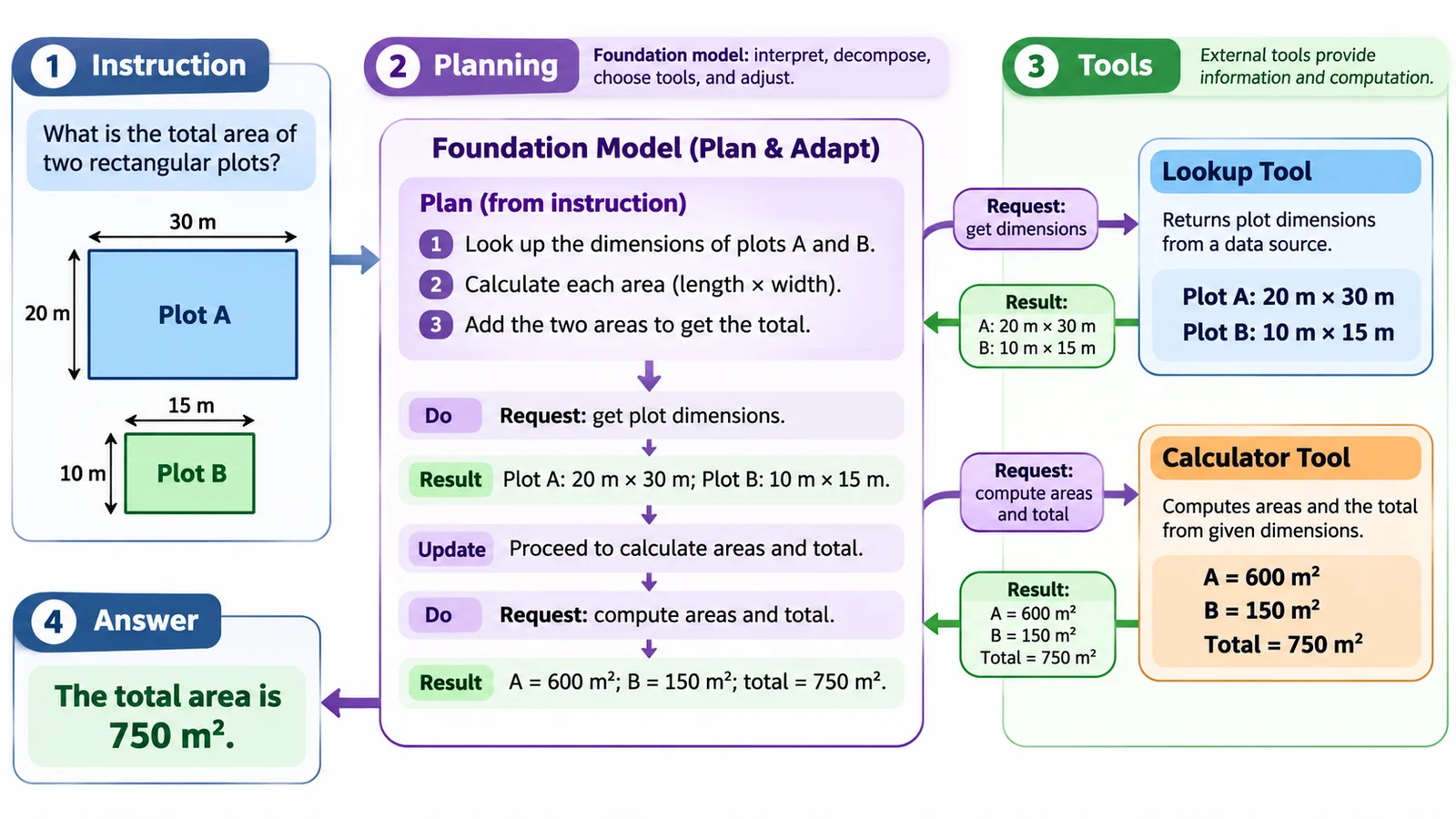
A 2023 review notes that when such models are deployed in real environments, they inevitably interact with other entities and agents. It describes new methods for grounding models in practical decisions, including prompting, planning, optimal control and reinforcement learning.[58] A 2026 survey of deep reinforcement learning and foundation models sorts this work into model-centric, reinforcement-centric and hybrid integration pathways. It also reviews how reinforcement learning from human feedback and from AI feedback refine what a foundation model can do.[59]
A 2025 survey of intelligent decision making describes agents that break complex tasks into manageable steps. It reports that multimodal foundation approaches combine vision, language and sensory data into one decision process. The survey lists healthcare, life sciences and education among the fields affected.[60]
A 2025 review of tool learning with foundation models sets out a general procedure for this. The model first reads the user's instruction, then splits a complex task into several subtasks. It adjusts its plan through reasoning and handles each subtask by choosing a suitable tool. The review argues that combining tools with models can improve accuracy, efficiency and automation in problem solving.[61]
Robot-relevant training data is scarce, and safety guarantees and uncertainty quantification are unresolved.[56] The tool learning review adds open questions about trustworthy tool use, tool creation by models and personalization.[61]
Costs, efficiency and system design
Training and serving a foundation model strains hardware in several ways at once. A 2024 survey lists substantial computing power, memory consumption and bandwidth demands as the main challenges.[62] A 2025 survey describes the gains in versatility and performance as coming at a significant cost in hardware resources.[63]
A 2024 survey sorts efficient training and serving methods into network, computing and storage categories.[62] Another 2024 survey separates model design from system design, saying both aim to save computational resources. Its stated goal is to make large language models more efficient, affordable and accessible.[64] A 2025 paper argues that foundation models are becoming complex enough to need engineering methods borrowed from software development. That paper proposes treating data and models as source code and building automated, unified interfaces for managing them.[65]
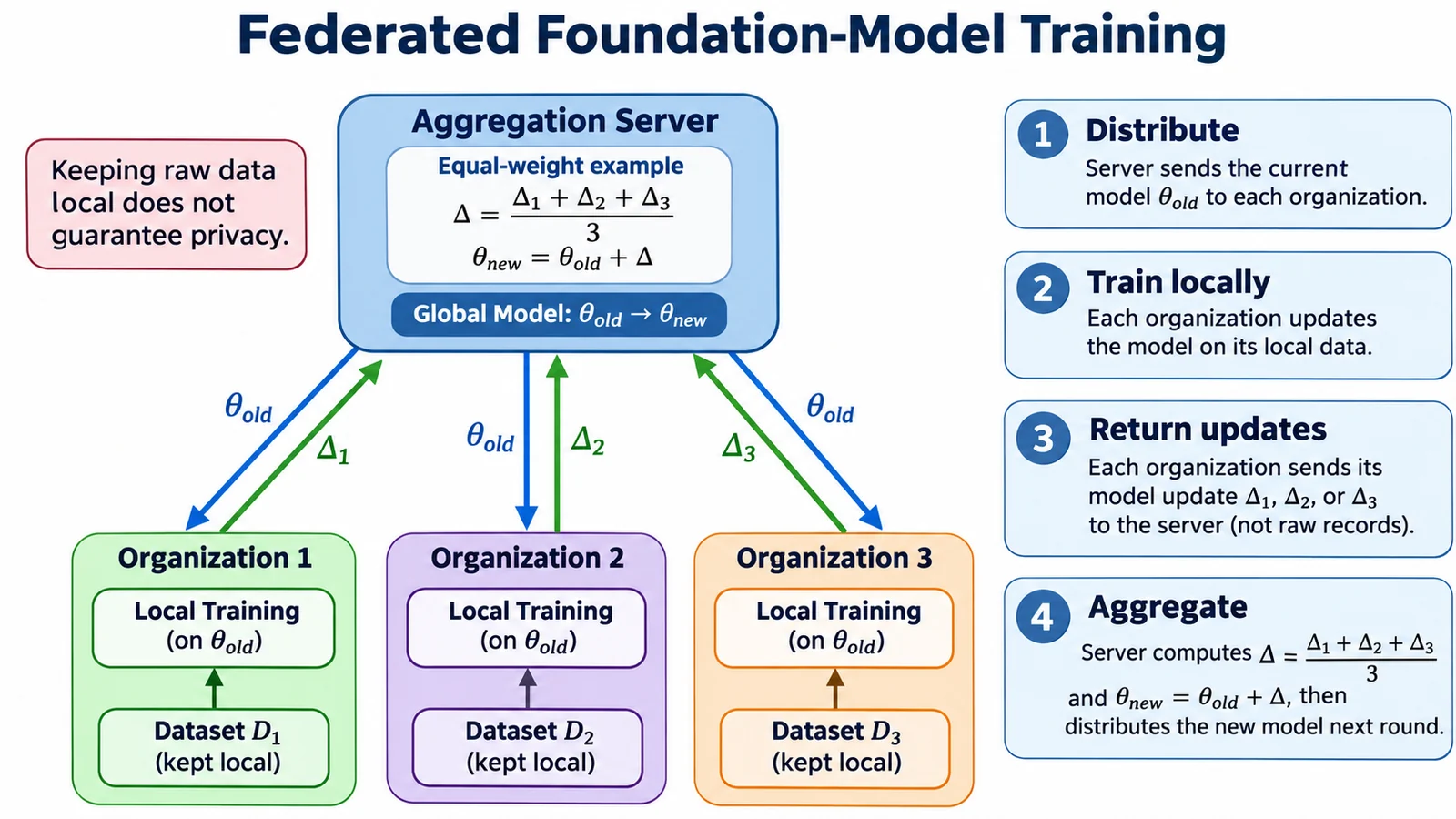
A 2025 survey examines combining foundation models with federated learning in biomedical research. The survey describes the pairing as a promising strategy for using the models' analytical power while safeguarding sensitive medical data. It points to applications in medical diagnostics and personalized treatment. It also lists open problems: scaling the models, managing data diversity and improving communication efficiency within federated frameworks.[66]
A 2026 survey sets out a multi-tiered taxonomy of federated foundation models, covering training, aggregation, trustworthiness and incentivization. It discusses how federated learning can cope with high computational demands, privacy, contribution evaluation and communication efficiency. The survey also raises communication, scalability and security problems in training or fine-tuning foundation models this way. The integration is presented as addressing privacy, data decentralization and computational efficiency at the same time.[67]
Benchmarks and how models are compared
A benchmark is a fixed set of tasks, data and scoring rules used to compare models on equal terms, and builders of foundation models have assembled many such sets because a single score says little about a model that is meant to serve many purposes.[68][69][70] PFMBench evaluates protein foundation models on 38 tasks spanning 8 areas of protein science, running hundreds of experiments on 17 leading models to expose how tasks relate to one another and which models do best.[68] BenchECG gathers eight public datasets covering 421,171 patients and 1,674,704 recordings, and scores models on ten distinct tasks that include classification, detection, regression, survival analysis and segmentation, with explicit out-of-distribution testing.[70] In pathology, one benchmark covered 13 patient cohorts, 6,818 patients and 9,528 slides from cancers of the lung, colorectum, stomach and breast. It compared 19 histopathology foundation models on weakly supervised tasks tied to biomarkers, tissue shape and prognosis.[71] A medical image benchmark collected 22,349 images from several institutes across five clinical tasks, among them chest X-ray screening, lesion detection in endoscopy images and diabetic retinopathy grading, and reported both accuracy and cost for each baseline method.[72]
Benchmarks differ in how much of a model they hold fixed, and that choice changes what a score means.[73][71] One diabetic retinopathy study froze the weights of three pretrained encoders and trained only an identical small classifier head on top, so that differences in results came from the learned representations rather than from the adaptation procedure. On the development set all three encoders reached near-identical binary AUC, between 0.980 and 0.985; AUC measures how well a model separates cases from non-cases. On an external set the medical vision-language encoder held an AUC of 0.915, while the retinal self-supervised model fell to 0.697 and the ImageNet-supervised model to 0.745. The same study found that temperature scaling, a standard method for adjusting predicted probabilities, lowered calibration error on the development set to 0.014 to 0.022 but was ineffective under domain shift, with external calibration error of 0.086 to 0.149. Its conclusion was blunt: discrimination measured on a development set is not enough to judge an encoder, and calibration metrics such as the Brier score should be reported as standard practice.[73]
Contamination is the risk that test data, or close relatives of it, appeared in a model's pretraining material, so that a high score reflects memory rather than general skill.[74] A related audit of neural decoding benchmarks varied how far stimuli overlapped between training and test sets, while test trials, training participants and stimulus counts stayed fixed. Overlap raised decoding accuracy in every one of ten tasks drawn from seven EEG emotion datasets. On one dataset it accounted for 77% of above-chance performance on seen stimuli. Such a design cannot separate transfer to new stimuli from recognition of familiar material. The audit therefore proposed that participant generalization and stimulus generalization be evaluated as separate questions.[75]
Domain shift means the test data come from a different source than the training data, such as another hospital, scanner or patient group, and it is where benchmark scores most often fail to travel.[76][73] A comparison of ten histopathology foundation models on two multi-source cohorts found near-saturated performance on slide-level tumor versus benign classification, but clear generalization gaps on patch-level tissue classification, where scanner-induced shift was harder than center-induced shift and losses concentrated in telling epithelial tissue apart. The study concluded that standard cross-validation that mixes sources can overestimate how well a model generalizes across centers and scanners.[76] A time series benchmark tested the open-source Moirai model against specialized neural networks for probabilistic electricity price forecasting across several market regions and found promising zero-shot predictions, meaning predictions made without task-specific training, though the general model still underperformed the domain-specific networks. Fine-tuning improved calibration, but the architecture did not yet make full use of exogenous features, the outside variables supplied alongside the price history.[77]
Even the data behind a benchmark can fall short of what a fair test requires. An audit of three open-access musculoskeletal radiograph resources found that one contained no pixel-level segmentation annotations at all, and that the second supplied whole-bone-quality masks for only 175 of its 4,083 images, or 4.3%, with 61.4% of masks covering the fracture region only. Synthetic radiographs built from computed tomography scans had complete bone masks but a substantial gap from real radiographs, with a mean structural similarity of 0.41 and a Fréchet Inception Distance of 87.3. On the audit's five-criterion readiness score out of 25, the three resources scored 4, 8 and 16, and no dataset reached the proposed publication threshold under any of the tested cutoffs.[78]
What a benchmark can show is bounded by the tasks it contains and the way it scores them.[79][80][81] A proposal for physics foundation models argues that scoring accuracy on problems drawn from the training distribution, at the training resolution, measures approximation within that domain. It does not show whether a model has learned continuous physics. The proposal suggests testing generalization to harder problems and consistency of predicted dynamics when resolution changes.[79]
A study of three DNA language models across 57 real datasets found that the choice of how to pool token embeddings changed results. Averaging token embeddings improved average AUC by 4.3% to 9.7% depending on the model, and the differences between models shrank under that setting.[80] A benchmark for low-level visual perception and image quality assessment, built from 2,990 question-annotated images and 499 expert descriptions, found that general-purpose multimodal models had preliminary low-level visual skills that were still unstable and relatively imprecise.[81] Reproducibility has become part of benchmark design itself, with platforms such as OmniGenBench offering one-command evaluation of genomic models across five benchmark suites and integration of more than 31 open-source models, and with pathology and protein benchmark teams releasing automated pipelines for outside use.[82][69][68]
Data, transparency and the model ecosystem
LAION-5B consists of 5.85 billion CLIP-filtered image-text pairs, of which 2.32 billion contain English, and the authors state that no datasets of this size had previously been made openly available to the research community. LAION-5B, released in 2022, holds 5.85 billion image-text pairs filtered with CLIP, a model that scores how well an image matches a caption, and 2.32 billion of those pairs contain English text. The dataset was built so that outside researchers could replicate and fine-tune foundational models such as CLIP, GLIDE and Stable Diffusion. It ships with nearest neighbor indices, a web interface for exploring the data and forming subsets, and detection scores for watermarks, NSFW content and toxic content. Earlier language-vision systems had shown that heavy training on noisy image-text pairs, with no costly accurate labels, yields strong text-guided image generation. It also yields zero-shot classification, in which a model sorts images into classes it never saw labeled.[83]
Treating training data as an asset raises the question of what that asset is worth. A 2026 framework by Park values training data through an income approach. It estimates the economic useful life of data with exponential decay and links performance gains to business measures such as conversion rates and average revenue per user through elasticities, which give the percentage change in one quantity per percentage change in another. Those links feed into free cash flow and net present value, the value today of future cash flows. To decide how much of the value the data deserves, the framework favors with/without and ablation experiments, in which a component is removed to see what changes. It then combines production functions, a Data Contribution Index and Shapley values, a way of splitting a joint payoff among contributors, in a way meant to avoid overvaluation. The final market value applies a reuse factor and a rights and contract multiplier to the net present value, reflecting exclusivity and field of use, and the framework calls for documenting data provenance and validating results externally so the estimate can be reproduced.[84]
Developers seldom publish details about the data and labor behind their flagship models, and none of the 10 developers scored disclosed substantial information on downstream effects, such as user counts, the market sectors touched, or ways for harmed users to seek redress. The Foundation Model Transparency Index scored 10 major developers against 100 indicators, and no developer disclosed much about how its flagship model affects downstream users, such as user counts or how users can seek redress for harm. The Foundation Model Transparency Index, introduced in 2023, scores 10 major developers against 100 indicators covering upstream resources such as data, labor and compute, details of the model itself, and downstream use such as distribution channels and affected geographies. Each developer is scored on its flagship model, for example GPT-4 for OpenAI, PaLM 2 for Google and Llama 2 for Meta. Among the index's findings, no developer disclosed significant information about what its flagship model does downstream. Examples of missing detail include the number of users, the market sectors affected, and how users can seek redress for harm.[85] Ecosystem Graphs, a documentation framework proposed the same year, records datasets, models and applications as assets joined by dependencies that mark technical relationships, such as how Bing relies on GPT-4, and social ones, such as how Microsoft relies on OpenAI. As of March 16, 2023, the project annotated 262 assets (64 datasets, 128 models, 70 applications) from 63 organizations, linked by 356 dependencies.[86]
Firms that build products on foundation models usually do not own the model itself, and the provider sets how it behaves, when it is available, what it costs and when it is retired. Aljadaan (2026) describes five ways such firms adapt, among them running several models side by side and owning the customer workflow. Workflow ownership means holding control over the customer process, the data context, the integration logic, the evaluation criteria, and the governance and assurance around model inference. Customer value then persists when the upstream model changes.[87]
Compression, serving and resource limits
A large language model is expensive to run because of its size and its computing demands, and the burden falls hardest where resources are scarce.[88] The gains in versatility and performance that large language models, vision transformers, diffusion models and multimodal models bring come at a significant cost in hardware resources. Researchers have therefore put considerable effort into resource-efficient strategies, so that these models can grow in a way that is scalable and environmentally sustainable. That work spans both algorithms and system design, from model architectures and training and serving methods to practical implementations.[89]
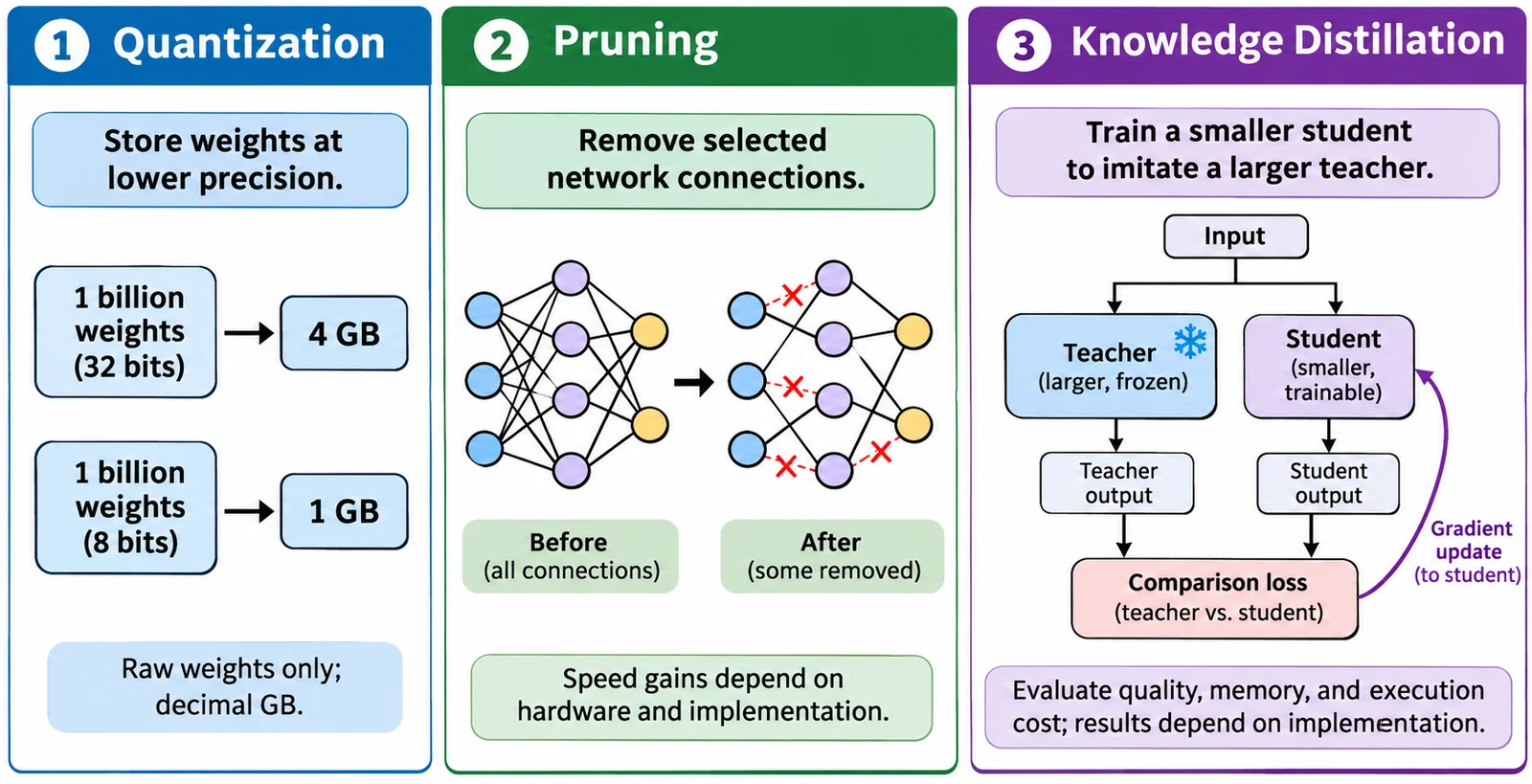
Model compression is the name for a group of techniques that shrink a model or lower its computing needs, and it has become a key research area for large language models. The main families are quantization, which stores the model's numbers at lower precision, pruning, which removes parts of the model, and knowledge distillation, in which a smaller model is trained to imitate a larger one. A survey of the field also covers benchmarking strategies and evaluation metrics, the means by which a compressed model is judged against the original. The stated aim of that work is to improve the efficiency and real-world applicability of large language models.[88]
Cost also shapes how training data is gathered, since deep learning depends on abundant labeled data and annotation is expensive. Deep active learning addresses this by annotating only a subset of the training data, balancing model performance against annotation cost. The approach has drawn more attention as large foundation models, which rely heavily on substantial computing resources and extensive training data, have spread. A survey of the area argues that specialized deep active learning methods tailored to foundation models are needed, and it sets out sample query strategies, data querying considerations and training paradigms as the elements such methods must combine.[90]
In practice
Education, work and everyday use
Educators see foundation models as a possible source of personalized learning and as a way to address education inequality. A 2024 article also names reasoning capability as a strength of these models and warns of risks from overreliance and from effects on creativity.[91] A 2021 paper on risks in education argues that foundation models are unlikely to deliver the promised benefits to learners and may add new harms.[92]
A 2025 survey of 66 articles describes how foundation models can take part in narrative visualization, the turning of data into stories for a broad audience. The survey sorts this work into four phases: analysis, narration, visualization and interaction. Within those phases it identifies eight specific tasks, such as insight extraction and authoring.[93] A 2025 survey of visual analytics describes foundation models helping with visual mapping, observation and manipulation.[94]
Biometrics is another application area, according to Otroshi Shahreza and Marcel. A 2025 survey reports that foundation models allow efficient zero-shot and few-shot learning. The survey states that these models reach state-of-the-art results on downstream tasks and highlights current limitations.[95]
Li and colleagues describe a six-layer architecture for reliable foundation models in the metaverse. A 2023 paper notes that foundation models typically hold hundreds of billions of hyperparameters, the adjustable settings inside a network, and were trained on hundreds of gigabytes of data. The paper says this black-box vulnerability exposes the models to data poisoning attacks, which pass on misinformation or purposely introduce machine bias.[96]
How large the gains are in practice
A cancer imaging study trained a foundation model on 11,467 radiographic lesions and found that task-specific models built on it significantly outperformed conventional supervised models and other pretrained implementations, especially when training sets were very small. The same model was more stable to input variations than the alternatives it was compared with.[97] In pathology, a whole-slide model called TITAN was pretrained on 335,645 whole-slide images together with pathology reports and 423,122 synthetic captions generated by a generative AI tool. TITAN needed neither fine-tuning nor clinical labels to beat region-level and slide-level foundation models on linear probing, few-shot and zero-shot classification, retrieval of rare cancers, and generation of pathology reports.[98]
For tabular data, meaning spreadsheets of rows and columns, a model called TabPFN outperformed all previous methods on datasets of up to 10,000 samples by a wide margin. In a classification setting it beat an ensemble of the strongest baselines tuned for 4 hours while taking 2.8 seconds. The comparison covers small tables only; the study states its advantage for datasets up to that size.[99]
Echocardiography offers a case where a single model was tested against several separate tasks at once. EchoCLIP was trained on 1,032,975 cardiac ultrasound videos paired with expert text and predicted left ventricular ejection fraction with a mean absolute error of 7.1% on an external validation dataset. It identified implanted pacemakers, percutaneous mitral valve repair and artificial aortic valves with areas under the curve of 0.84, 0.92 and 0.97, where an area under the curve of 1.0 would mean perfect separation of cases from non-cases. A longer-context variant identified unique patients across multiple videos with an area under the curve of 0.86 and detected heart transplants and cardiac surgery with values of 0.79 and 0.77.[100]
Using 84,875 preoperative notes from surgical cases between 2018 and 2021, pretrained language models predicted six postoperative risks better than traditional word embeddings by an absolute 38.3% in area under the receiver operating characteristic curve and 33.2% in area under the precision-recall curve. Self-supervised fine-tuning added 3.2% and 1.5%, and a unified foundation model gave the best results, improving on self-supervision by 3.6% and 2.6%.[101] A multi-center study of structured electronic health records tested a model trained on 2.57 million patient records from one institution against data from two other hospitals. Adapting that model matched gradient boosting machines trained locally on all data and improved performance by 13% when few task-specific labels were available. After continued pretraining on local data, it needed fewer than 1% of the training examples to match the fully trained gradient boosting machine and was 60 to 90% more sample-efficient than training a local foundation model from scratch.[102]
Not every comparison favours the foundation model.[103][104] A neuroanatomy segmentation study used 1,113 brain scans and found that a standard UNet model outperformed two foundation segmentation models, with median Dice scores of 0.88 against 0.82 and 0.84, where the Dice score measures overlap between predicted and true regions. The UNet kept pace down to a single training volume, and the foundation models reached median Dice scores of 0.66 and 0.59 when given no training examples at all. The authors concluded that the benefit of a foundation model depends on the task and on the particular model, so each application should be benchmarked against standard supervised methods.[103] An evaluation across eight single-cell analysis tasks reached a similar caution, finding that single-cell foundation models did not consistently beat task-specific methods.[104]
Prithvi-EO-2.0 was trained on 4.2 million global time series samples at 30-m resolution and outperformed its predecessor by 8% across a benchmark suite, and it also outperformed six other geospatial foundation models on tasks ranging from 0.1 m to 15 m resolution.[105] BrainLM was trained on 6,700 hours of fMRI recordings and, after fine-tuning, predicted clinical variables such as age, anxiety and PTSD and generalized to external cohorts not seen during training.[106] Nicheformer was pretrained on a collection of over 57 million dissociated cells and 53 million spatially resolved cells across 73 tissues, and models trained only on dissociated data failed to recover the complexity of spatial microenvironments.[107]
Adapting models with little labelled data
The simplest route is fine-tuning, in which the pretrained weights are trained further on labelled examples of the target task. A 2026 study tested this route on neuroanatomic segmentation. It drew 1,113 T1-weighted 3D MRI scans from the Young Adult cohort of the Human Connectome Project, each with manually refined segmentations of 93 gray and white matter regions. The scans were split into 891 training volumes (80%), 111 validation volumes (10%) and 111 test volumes (10%). On the full training set, a standard UNet beat two foundation segmentation models, SAM and MedSAM, in most regions. The UNet also matched or beat MedSAM as the training set shrank, down to a single 3D volume, which contradicts the expectation that pretraining pays off most when labelled data are scarce.[103]
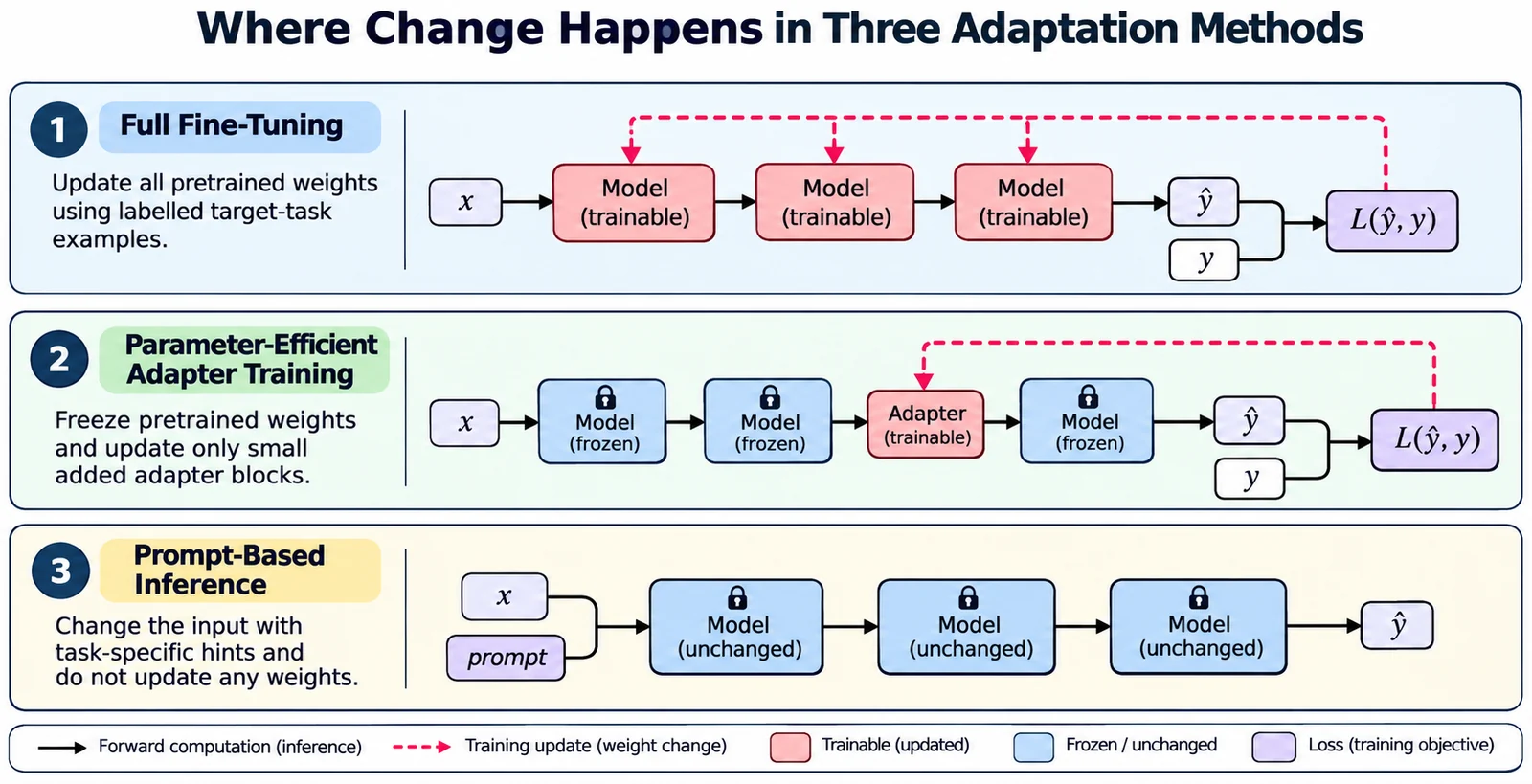
Parameter-efficient adaptation leaves most of the pretrained model frozen and trains a small set of added parameters, which lowers the compute and memory needed for each new task. A 2026 survey of efficient medical image segmentation groups such methods, together with knowledge distillation, under the heading of efficient adaptation of foundation models, aimed at tailoring the Segment Anything Model to medical domains. The same survey places semi-supervised and federated learning among data-efficient strategies meant to address a scarcity of annotations. It also notes that clinical deployment of the largest models is held back by quadratic computational complexity and substantial resource demands, particularly when several imaging sensors and modalities are combined.[108]
Prompt-based methods skip weight updates altogether: the model input is augmented with task-specific hints called prompts, and predictions are adjusted for the new task without extensive labelled data or retraining. A 2023 survey of foundation models in medical imaging describes these prompt capabilities as operating at test time, alongside contextual reasoning and generalization. The same survey lists interpretability, data management and computational requirements among the open problems for such models in medical imaging.[109] In the segmentation study, the zero-shot setting, with no training volumes at all, gave overall median Dice scores of 0.66 for SAM and 0.59 for MedSAM.[103]
Combining foundation models with cross-silo federated learning, in which a few organizations hold the data, introduces strategic client behavior such as knowledge hoarding and free-riding, according to a 2025 paper in Scientific Reports. That paper proposes screening participants, a contribution metric that weighs accuracy gains, cost and participation patterns, and a two-stage Stackelberg game between server and clients; simulations report up to 21.9% higher model accuracy than existing benchmarks.[110] A 2026 survey frames personalized federated intelligence as a way to adapt foundation models to individual users while keeping data private, covering personalization at the edge, trustworthy adaptation and refinement through retrieval-augmented generation.[111]
Remote sensing and Earth observation
Foundation models, which are large pretrained models that can be adapted to many tasks, have been surveyed for this field in a 2025 review that sorts the models by architecture, pretraining data and training method. The review reports that pretraining methods, especially self-supervised learning, in which a model learns from unlabelled images by solving tasks it sets itself, improve the performance of these models and their steadiness under variation. Contrastive learning and masked autoencoders recur in that work. The first pulls matching views of the same scene together and pushes other views apart. The second hides parts of an image and trains the model to reconstruct them. The review also names the needs that remain: high-quality data, computing resources and better generalization to new conditions.[112]
SpectralGPT, described in 2024, was built to handle spectral remote sensing images with a three-dimensional generative pretrained transformer, a model that generates missing parts of its input. It was trained on one million spectral remote sensing images and produced models with over 600 million parameters, the adjustable numerical weights that make up a neural network. Its evaluations covered four tasks: single-label and multi-label scene classification, semantic segmentation, which assigns a class to every pixel, and change detection.[113]
HyperSIGMA, a vision transformer model scalable to over one billion parameters, was pretrained on HyperGlobal-450K, a dataset of about 450 K hyperspectral images that the authors describe as significantly larger than existing datasets. HyperSIGMA adds a sparse sampling attention mechanism to cope with the redundancy of spectral and spatial information, and a spectral enhancement module that combines spatial and spectral features.[114] SpectralEarth, a multi-temporal dataset built from the Environmental Mapping and Analysis Program (EnMAP), contains 538,974 image patches covering 415,153 unique locations from 11,636 scenes across two years of archive. At 17.5% of those locations more than one timestamp is available, which allows analysis of the same ground at different times.[115]
SARATR-X, presented as the first attempt at a foundation model for synthetic aperture radar automatic target recognition, was trained on 0.18 M unlabelled radar target samples collected from existing benchmarks. The authors describe that collection as the largest publicly available dataset of its kind at the time, and they designed a backbone network and a two-step self-supervised method suited to the properties of radar images. Tests covered classification with few labelled examples and under conditions meant to test steadiness, plus detection across categories and scenes. There the model was often competitive with, or better than, fully supervised, semi-supervised and self-supervised methods. The stated motivation is that earlier radar recognition methods learned from massive amounts of samples annotated by expert analysts and generalized poorly beyond the categories they were trained on.[116]
Several models pair images with text so that a description can be matched to a picture. RemoteCLIP, described in 2024 as the first vision-language foundation model for remote sensing, was trained on a dataset 12 times larger than the combination of all available datasets. Its builders converted existing annotations into image-caption pairs and added drone imagery.[117] A 2026 survey argues that models trained on general image datasets perform poorly on Earth observation for lack of geospatial data, and it reviews newer vision-language geo-foundation models fine-tuned on geospatial image-text pairs.[118]
Change detection compares images of the same area taken at different times to find shifts in land cover, and a 2024 framework called BAN adapts a frozen foundation model such as CLIP to the task through a bi-temporal adapter branch and bridging modules. BAN improved existing change detection methods by up to 4.08% intersection over union, a measure of overlap between predicted and true changed areas, while adding only a few learnable parameters.[119] Prithvi-EO-2.0 was trained at 30-m resolution on 4.2 million time series samples drawn from NASA's Harmonized Landsat and Sentinel-2 archive. On the GEO-Bench benchmark it beat its predecessor by 8% across a range of tasks.[105]
A 2026 pretraining task called Knowledge Guided Variable-Step Forecasting treats forecasting as conditional generation, with driver variables such as weather informing predictions of response variables such as satellite imagery. Embeddings learned this way performed better than those from other standard pretraining approaches on crop type mapping, soil moisture estimation and image forecasting.[120] Other work adapts a pretrained model to multimodal remote sensing classification without fine-tuning its parameters, adding cross-spatial and cross-channel interaction modules and testing on three multimodal datasets.[121] A plain vision transformer of about 100 million parameters with a rotated varied-size window attention mechanism reached 81.24% mean average precision on the DOTA-V1.0 detection dataset.[122]
Weather and climate forecasting has long relied on numerical models that solve physics equations for the atmosphere. Such models capture complex interactions between many variables, but they are computationally intensive, especially at fine spatial and temporal resolution. Machine learning offered an alternative: train a deep neural network to map inputs directly to a forecast. Early data-driven networks were trained on curated, homogeneous datasets for one specific task, so they lacked the generality of numerical models. ClimaX, presented in 2023, was built to close that gap as a flexible model for weather and climate science. The pretrained model can then be fine-tuned for many tasks, including variables and scales it never saw during pretraining. It beat existing data-driven baselines on weather forecasting and climate projection benchmarks, even when pretrained at lower resolution and with smaller compute budgets.[123]
Xiao and colleagues describe Earth observation tasks that span the surface, atmosphere and oceans. Remote sensing poses hard problems for AI: complex environments, diverse sensor types, varying spatial and spectral resolution, and change over time. Large foundation models had succeeded mainly on natural images and video, and their performance degraded or failed on remote sensing data of various nonoptical kinds. That gap prompted a growing effort to build remote sensing foundation models for Earth observation tasks. A 2025 survey reviews this field across visual models, visual-language models and large language models, and benchmarks them on public datasets.[124]
Machine-learned force fields have transformed atomistic modeling, Batatia and colleagues write. The MACE-MP-0 model, reported in 2025, was trained on a public dataset of moderate size. It runs stable molecular dynamics across many molecules and materials. Its accuracy was shown on solids, liquids, gases, chemical reactions and interfaces, and even on the dynamics of a small protein. The developers say this lowers the barrier to entry for beginners and lets experienced users get reliable results faster.[125]
Chemistry more broadly has drawn foundation models aimed at materials discovery and at understanding how structure relates to properties. Conventional machine learning models in these areas often face limits, including scarce data and poor generalization to new cases.[126] Agriculture has its own foundation models, applied to crop classification, pest detection and crop image segmentation. A 2025 review also describes uses in answering agricultural questions, analysing images and video, supporting decisions, and robotics. The review lists data acquisition, training efficiency, data shift and practical application as challenges for these models.[127]
Computer chips are designed with software called electronic design automation, and researchers have explored AI for this work for years. Circuit foundation models are built in two stages: self-supervised pretraining on large amounts of unlabeled circuit data, then efficient fine-tuning for specific tasks. Typical downstream tasks include judging design quality early, generating circuit-related context and checking that a design functions correctly. A 2026 survey covers over 160 relevant works, and more than 90% of them were published in or after 2022. The survey sorts these models into encoder-based methods, which learn general circuit representations for prediction, and decoder-based methods, which use large language models for generation. It says circuit properties have motivated many works in the field and differentiate them from general AI techniques.[128]
Clinical imaging and hospital records
Reviews of radiology describe foundation models as trained on extensive corpora of unlabelled data and able to perform well across many tasks, and they stress that training data requirements, training methods and evaluation strategy all need clinical input.[129] Foundation models for medical imaging can process images, text, audio and video together. A specific task can be reached through transfer learning, fine-tuning, prompt engineering, few-shot learning or zero-shot learning, in which the model handles a task it was not explicitly trained on. Some of these models also generate synthetic medical images, which helps when annotated images are scarce.[130] Vision-language models combine pictures with text such as radiology reports and clinical notes, and a review of work published from 2022 to 2024 catalogued their uses in disease classification, image segmentation, cross-modal retrieval and automated report generation.[131]
Pathology has moved from glass slides to whole-slide images viewed on a monitor, which turns tissue analysis into a computer vision workflow. Older task-specific models, such as convolutional neural networks, reached above-human performance on many image-processing tasks, but their accuracy depended on large annotated training sets, and they often failed to generalize to new datasets or to unseen differences in image acquisition, staining or tissue type.[132] Virchow is a vision transformer with 632 million parameters, trained by self-supervised learning on 1.5 million hematoxylin and eosin stained whole-slide images. It reached 0.949 overall specimen-level AUC, a standard measure of discrimination, across 17 cancer types, and 0.937 AUC on 7 rare cancer types.[133]
RudolfV was built with pathologist expertise and semi-automated data curation from more than 15 laboratories, covering 58 tissue types and 129 histochemical and immunohistochemical staining modalities. It surpassed existing state-of-the-art foundation models on benchmarks for tumour microenvironment profiling, biomarker evaluation and reference case search.[134] A review of pathology foundation models lists reported uses in disease and rare cancer diagnosis, prediction of patient survival, prediction of biomarker expression and scoring of immunohistochemical staining intensity.[135]
In dermatology, PanDerm was pretrained by self-supervised learning on more than 2 million real-world skin disease images. The images came from 11 clinical institutions and 4 imaging modalities, and the model was evaluated on 28 benchmarks, among them skin cancer screening, risk stratification, differential diagnosis, lesion segmentation, longitudinal monitoring and metastasis prediction. PanDerm reached state-of-the-art performance on all 28 evaluated tasks and often outperformed existing models when given only 10% of the labelled data.[136] In ophthalmology, the first foundation model, RETFound, outperformed traditional deep learning models on specific tasks even when fine-tuned on small datasets, and medical large language models such as Med-Gemini and Medprompt GPT-4 performed better than general-purpose versions on ophthalmology tasks. The same review reports a significant deficiency in ophthalmology-specific multimodal models, attributed to the substantial computing resources needed to train them and to limits in high-quality ophthalmology datasets.[137]
Molecules, genes and drug discovery
ChemBERTa-2 treats a molecule's SMILES string, a line of text that encodes its atoms and bonds, as a sentence and learns from unlabeled compound libraries, which are plentiful where labeled data for molecular prediction tasks is scarce. Its pretraining set reached up to 77M compounds from PubChem. The developers describe that set as one of the largest used for molecular pretraining up to that time.[138] A later study applied ablation, a method that removes or alters parts of a model to see what each part contributes, to 3 ChemBERTa-based models finetuned on distinct datasets and proposed internal mechanisms within each model layer that produce the final predictions.[139]
Gene regulation has drawn models that predict how DNA sequence and chromatin state set the level of gene expression. In fetal erythroblasts, GET found distal regulatory regions more than 1Mbp away that earlier models missed. In B cells, it found a lymphocyte-specific interaction between transcription factors that explains the functional significance of a germline mutation predisposing to leukemia.[140] GeneCompass took a cross-species route, pretraining on more than 120 million human and mouse single-cell transcriptomes, of which 101,768,420 remained after preprocessing, and integrating four types of prior biological knowledge. After fine-tuning, GeneCompass outperformed state-of-the-art models on diverse single-species applications. Predicted candidate genes successfully induced human embryonic stem cells to differentiate into the gonadal fate.[141]
Single-cell data have produced a crowded field of foundation models, and independent evaluation has tempered early claims. One evaluation tested ten single-cell foundation models across eight downstream tasks and named scGPT, Geneformer and CellFM as the top performers when both performance and user accessibility were considered. Set against methods built for one task, however, the single-cell foundation models did not consistently excel on every task. The evaluators read that result as a challenge to the case for building foundation models for single-cell analysis.[104] Models trained only on dissociated cells failed to recover the complexity of spatial microenvironments, which the developers cite as grounds for integrating data at several scales.[107]
BigRNA was trained on thousands of genome-matched datasets. From DNA sequence it predicts tissue-specific RNA expression, splicing, microRNA sites and the specificity of RNA binding proteins. Unlike approaches restricted to missense variants, it can identify pathogenic effects of non-coding variants across mechanisms including polyadenylation, exon skipping and intron retention. It accurately predicted how steric blocking oligonucleotides, short molecules that block access to RNA, would raise expression for 4 out of 4 genes. It also predicted their splicing effects for 18 out of 18 exons across 14 genes, including genes involved in Wilson disease and spinal muscular atrophy.[142] DNA methylation, an epigenetic modification that affects development, aging and disease, has its own model in CpGPT, pretrained on more than 2,000 datasets encompassing over 150,000 samples. CpGPT imputes and reconstructs genome-wide methylation profiles from limited input and, when finetuned for aging-related tasks, outperformed the specialized GrimAge2 and PCGrimAge models for mortality and morbidity estimation.[143]
Drug repurposing looks for new therapeutic uses for drugs already approved, and much of it has been serendipitous and opportunistic. T x GNN, a graph foundation model trained on a medical knowledge graph, ranks drugs as potential indications and contraindications across 17,080 diseases, including diseases with limited treatment options or no existing drugs. Benchmarked against eight methods under stringent zero-shot evaluation, in which the model is tested on diseases it never saw in training, T x GNN improved prediction accuracy for indications by 49.2% and for contraindications by 35.1%. An Explainer module traces the multi-hop paths through medical knowledge behind each prediction. Many of the model's novel predictions match off-label prescriptions that clinicians write in a large healthcare system.[144] A perspective on the field argues that correlation is not causation. It links systems biology, causal reasoning and machine learning in the hope of informing later work in molecular medicine.[145]
Physics, industry and infrastructure
In geophysics, a seismic foundation model was pretrained with self-supervised learning, a method that learns from unlabeled data, on 2,286,422 two-dimensional seismic images drawn from 192 three-dimensional seismic volumes collected worldwide. The pretrained transformer, a neural network architecture built on attention, produced all-purpose seismic features that worked across facies classification, geobody identification, interpolation, denoising and inversion, and it outperformed baseline models on those tasks. The work was framed as a response to poor generalization, a lack of labels and repeated training of task-specific models.[146] For the Sun, SDOFMv2 was trained on more than 500,000 observations from two instruments on the Solar Dynamics Observatory, the Atmospheric Imaging Assembly and the Helioseismic and Magnetic Imager, spanning most of Solar Cycle 24 from 2010 to 2018. Its masking objective tells solar-disk, prominence and background regions apart, and a denoising stage was added for magnetic-field observations. Modality-specific models and joint models each did better on some tasks than others, across reconstruction, solar activity regression and solar wind classification.[147]
Models trained on the defect-containing, higher k-point density Alexandria data set performed much better than those trained on Materials Project data alone. Thermal conductivity scores indicated metallurgical performance better than energy errors on the convex hull, the hull being a geometric construction used to judge which crystal structures are stable. Even the accurate models remain much more computationally expensive than bespoke potentials, so selection is a tradeoff between accuracy, compute time and setup time.[148] A 2025 review of foundation models for materials discovery covers property prediction, synthesis planning and molecular generation, and expects new methods of data capture and new data modalities to shape the field.[149] For interatomic potentials, a correction scheme built on a model's own internal atomic representation improved results on sulfur overlayers on copper, silver and gold surfaces, and the need for correction was traced to scarce metal-sulfur environments in the training database.[150]
Transformer models with a masked autoencoder design, pretrained without labels and then fine-tuned, detected anomalies on three operational viaducts with 99.9% accuracy over a monitoring span of 15 windows, where a principal component analysis method first reached 95.03% accuracy only at 120 windows. On two traffic load estimation tasks the models reached an R2 score of 0.97 and 0.90 for light and heavy vehicles on the first benchmark, against 0.91 and 0.84 for the best prior method, a random forest, and 0.54 against 0.51 on the second.[151] A proposed industrial foundation model system would pretrain on multimodal industrial data, fine-tune with fundamental industrial mechanisms, and adapt the base model into task-oriented models for specific domains. The authors identify specialized data modalities, tasks that vary across scenarios and processes, and the requirement for trustworthy output as reasons general foundation models fall short in industry.[152] A separate overview of the process industry sets out a framework, key capabilities and open issues for foundation models there.[153]
The case for it rests on aging infrastructure, growing system complexity and more frequent extreme weather, which are said to make deterministic models and human-in-the-loop decision making insufficient.[154] In telecommunications, conventional AI models are designed for single tasks and depend on extensive labeled data that requires specialized expertise to collect and maintain, and they often fail to generalize across deployment scenarios. A 2024 paper outlines a process for developing telecom foundation models that could be fine-tuned for many tasks with minimal task-specific labels, and it discusses limitations and challenges as sixth-generation networks approach.[155]
Fusion experiments have not adopted foundation models in production.[156] In heavy-ion collision physics, a point-cloud diffusion model trained on simulation data generates complete collision events containing 26 distinct hadron species as lists of particle momentum vectors with particle identifiers. Its proposed uses include solving inverse problems and accelerating model calculations and detector simulations.[157]
Time series and forecasting
A time series is a sequence of numbers recorded in order over time, such as daily electricity output or weekly case counts, and forecasting means predicting the values that come next.[158] Deep learning, the branch of machine learning built on multilayer neural networks, was slow to beat older methods on this task. In the well-known Makridakis forecasting competitions, the top performers have only recently been combinations of traditional statistical or machine learning techniques. Architectures such as encoder-decoders with attention, transformers and graph neural networks have since begun to show clear advantages for forecasting.[159] Transformers, networks that weigh how strongly each part of an input relates to every other part, handle long-range dependencies well, yet recent work has found that simple linear layers can outperform them. That finding helped open the field to hybrid models, diffusion models, Mamba models and foundation models, a diversification one 2025 survey describes as a renaissance in forecasting architecture.[158]
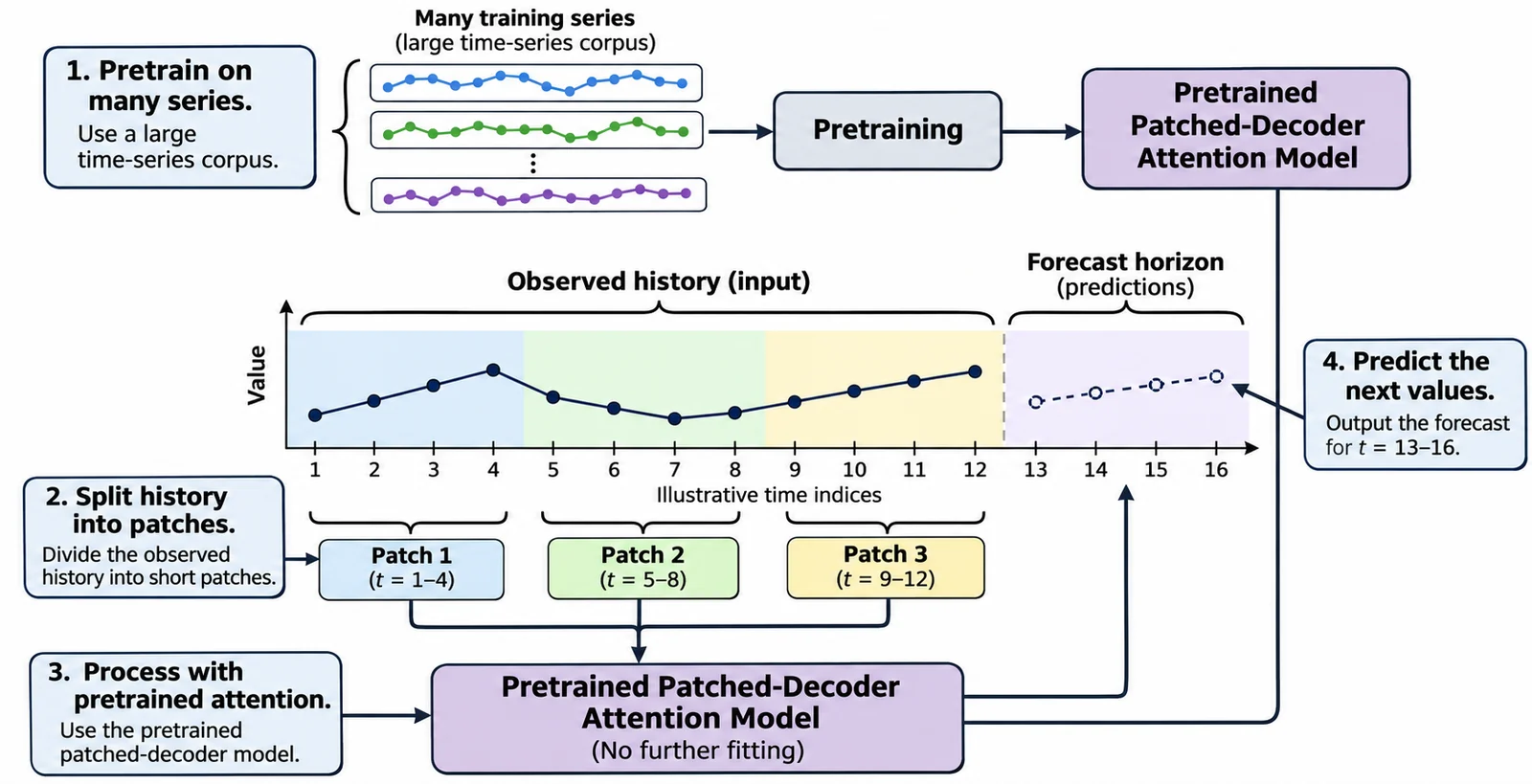
One such model pretrains a patched-decoder attention network, which splits a series into short segments and predicts ahead from them, on a large time-series corpus. Used out of the box with no further fitting, its accuracy on a range of public datasets comes close to that of supervised forecasting models trained separately for each dataset. The same model works across different history lengths, prediction lengths and temporal granularities, meaning it copes with series sampled hourly, daily or at other intervals.[160] Pretraining also lets a model learn patterns that transfer to related problems before extensive training data for those problems exists, which matters in fields such as pandemic prediction where a series is too short for effective training. Pandemic forecasting adds further difficulties for deep models: accumulated scientific knowledge goes unused, and the model's reasoning is hard to interpret.[159]
In the cold-start setting, a photovoltaic operator must forecast production before observations from the target site are available. When a photovoltaic plant is commissioned, its operators must forecast production before any target-site observations are available, which limits the direct use of standard supervised forecasters. Across 440 photovoltaic sites in four datasets spanning diverse climate regimes, covariate-aware foundation models outperformed classical baselines by approximately 1.7 to 2 times. TabPFN-TS achieved the lowest error under a real-feedback strategy, with a mean absolute error of 0.514 and a root mean square error of 0.721 in kilowatt-hours per kilowatt-peak per day. Chronos-2 held up best under self-forecast feedback. Performance was largely insensitive to the source of the synthetic history, which suggests that accuracy depends more on having plausible temporal context than on the particular generator used.[161]
Speech, signals and the human body
Heart recordings have drawn similar work. ECG-FM is an open-weight model for the electrocardiogram, the standard recording of the heart's electrical activity, and it was pretrained on 1.5 million 12-lead ECGs using a mix of masked reconstruction and contrastive learning with ECG-specific augmentation. Its developers evaluated it on multi-label ECG interpretation and on predicting reduced left ventricular ejection fraction, a measure of how much blood the heart's main pumping chamber expels with each beat, and released a public benchmark on the MIMIC-IV-ECG dataset. The developers describe the model as generalizable, as needing few labels, and as able to discriminate for screening, risk stratification and monitoring. They also present it as built for practical gains when labels are scarce.[162] A separate 2023 effort, EchoAI, was trained by self-supervised learning on 1.5 million echocardiograms, which are ultrasound recordings of the heart. Fine-tuning it to estimate ejection fraction gave a mean absolute percentage error of 9.40%, a level its developers say aligns with expert sonographers.[163]
A 2026 sleep foundation model integrated polysomnography time-series signals, the multichannel recordings made during a sleep study, with electronic medical record data. The dataset covered 10,000 people over a mean observation period of 14.5±7.1 years, and clustering the model's representations identified subpopulations with different health trajectories. The highest risk group showed a strong association with all-cause mortality (unadjusted hazard ratio 4.83, 95% confidence interval 3.60-6.50, p<0.001), and with cardiovascular and neurological outcomes, even after accounting for traditional measures. Validation in an external National Sleep Research Resource cohort confirmed the findings.[164]
Speech processing has moved toward foundation models as well. A 2026 survey of speaker diarization, the task of determining who spoke when in a recording, traces a shift from pipelines that detected voice activity, extracted features and clustered speakers separately to end-to-end models that learn segmentation and overlap detection jointly. On the AMI single-distant-microphone corpus, assessed under a consistent no-collar approach, the lowest reported diarization error rate fell from roughly 26.2% (VBx, re-evaluated in 2024) to 15.1% (DiariZen, 2025).[165]
ChatGPT was more resistant to noisy data, where Word2Vec did worse. Amin, Cambria and Schuller concluded that it is a good generalist but falls short of a model specialized for a downstream task.[166] A 2025 model called Centaur took a different route, fine-tuning a language model on Psych-101, trial-by-trial data from more than 60,000 participants making in excess of 10,000,000 choices across 160 experiments, to predict human behavior in experiments expressible in natural language. Centaur captured the behavior of held-out participants better than existing cognitive models. It also generalized to cover stories it had not seen, to structural changes in a task, and to entirely new domains. After fine-tuning, its internal representations became more aligned with human neural activity.[167]
Domain models outside the usual fields
Foundation models have been applied to dental education, to extracting structured data from pharmaceutical regulatory documents, and to predicting subsequent actions in soccer matches.[168][169][170] In dental teaching, a 2024 paper describes large language models and multimodal foundation models, which can combine text, images and audio, as tools that could give students personalized feedback, generate case scenarios and create educational content. The same paper names periodontal charting, the recording of gum measurements around each tooth, as a use case for outlining what such models can do. It also lists risks: bias and inaccuracy in generated content, privacy and security concerns, and overreliance on the model, and it argues that guidance and oversight are needed for ethical integration.[168]
Pharmaceutical regulation offers a second test case, in which unstructured Summary of Product Characteristics documents must be turned into structured records under the IDentification of Medicinal Products standard. A 2025 preliminary experiment combined foundation language models with retrieval-augmented generation, a method that fetches relevant passages before the model answers. It compared Claude 3.5 Sonnet with Gemini 1.5 Flash, several embedding models, and rule-based retrieval. Claude 3.5 Sonnet significantly surpassed Gemini 1.5 Flash, retrieval-augmented approaches with semantic search beat rule-based methods overall, and prompts that included context, action and examples worked better than prompts giving only a role and steps. For the medicinal product section, the approach reached a BERT F1 score of up to 0.98, a measure of how closely extracted fields matched the reference labels.[169]
For wireless networks, a 2024 paper argues that simply applying language models built for natural language processing is not enough, and it proposes large multi-modal models designed for 6G systems. The proposed design rests on processing multi-modal sensing data, grounding physical symbols in real wireless systems through causal reasoning and retrieval-augmented generation, and adapting to feedback from the wireless environment. Preliminary experiments reported that grounding through retrieval-augmented generation worked and that the models aligned with wireless system designs, and the paper closes with open questions and recommendations.[171]
A 2026 survey of foundation models for the internet of things, the network of connected devices, notes that these models rely less on labeled data and generalize across tasks better than traditional machine learning, which addresses key limits of earlier methods. Most existing methods were built for specific tasks, the survey adds, which makes comparison across device domains difficult, so it organizes the work around four shared objectives: efficiency, context-awareness, safety, and security and privacy.[172]
Mining has its own proposal: a 2024 architecture for smart mines with three levels, a mining industrial internet of things platform, mining operating systems and foundation models, intended to support autonomous transport equipment. The paper reports that applying and validating the approach improved mining efficiency and reduced safety risks.[173] In soccer analytics, a 2024 proof of concept trained a transformer, a neural network architecture built on attention, on three seasons of data from a professional league to predict the next actions in a match from a sequence of earlier actions. Its performance was compared quantitatively and qualitatively with a Markov model and a multi-layer perceptron, and an open-source implementation was released.[170]
Recommender systems, which suggest items to users, have attracted a body of foundation model work surveyed in 2024, organized by data characteristics, representation learning, model type and downstream tasks. That survey sets out open problems and emerging trends rather than a single result.[174]
What this looks like in practice
A survey of remote sensing foundation models compared several pretrained models on the BigEarthNet classification dataset. The model msGFM reached a mean average precision of 92.90%, and SkySense followed at 92.09%. SkySense gained an average improvement of 2.76% over recent models by using multigranularity contrastive learning on 21.5 million optical and radar sequences. The survey states that pretraining methods, and self-supervised learning techniques such as contrastive learning and masked autoencoders in particular, improved how well foundation models perform and how well they hold up.[112]
A separate study tested existing foundation models on seven geospatial tasks. On text-only tasks such as toponym recognition and county-level dementia forecasting, large language models beat task-specific fully supervised models in zero-shot or few-shot settings. On tasks that mix data types, such as street view image classification of urban noise, the foundation models still underperformed task-specific models. The authors conclude that a major challenge is the multimodal nature of geospatial tasks.[13]
Later developments
Open questions and what comes next
A 2026 review of foundation models in omics research, the study of molecular data such as DNA and proteins, names the lack of standardized benchmarks as a critical barrier to adoption. That review also reports high computational costs and interpretability challenges, meaning difficulty in explaining why a model produced its output. It describes omics as a field fragmented by diverse tokenization strategies, the different ways of chopping raw data into units a model can read, and by differing architectural choices. To support reproducible research, the review offers a curated catalog of essential datasets and evaluation frameworks.[175]
Continual learning appears among the future research directions in a 2026 materials science survey. The same survey lists persistent limitations: problems with generalizability, interpretability, data imbalance, safety concerns and limited fusion of different data types.[176] For omics, a proposed roadmap calls for architectures that go beyond statistical correlation to include causal reasoning, temporal dynamics and autonomous experimental validation.[175]
A 2025 survey of remote sensing, the imaging of Earth from satellites and aircraft, finds that differences between natural photographs and remote sensing images hinder the use of foundation models there. Open challenges concerning data, model and task keep foundation models far from practical use in that domain, the survey states.[177] A 2026 survey of time series forecasting, which predicts future values from past records, places foundation models as one stage in a longer line of methods. That line runs from statistical learning through deep learning architectures and Transformer-based models to foundation models and large-language-model agents. The survey argues that forecasting is slowly moving from models built for one task toward systems that can learn, reason and decide on their own.[178]
Criticism
Hallucination, bias and other failures
A foundation model can produce fluent output that is simply wrong, and researchers have a name for it: hallucination. A 2023 survey of the problem sorts hallucination types specific to large foundation models and sets out criteria for measuring how much of it a model shows. The same survey reviews existing strategies for reducing hallucination and points to directions for later research.[179] Kim and colleagues trace hallucination to autoregressive training objectives that favor token likelihood over factual accuracy.[180]
A 2025 study defined medical hallucination as any model output that is factually wrong, logically inconsistent, or unsupported by authoritative clinical evidence in a way that could change a clinical decision. The team tested 11 foundation models, 7 general-purpose and 4 medical-specialized, on seven tasks in medical reasoning and biomedical information retrieval. General-purpose models gave a higher median share of hallucination-free responses than medical-specialized models: 76.6% against 51.3%, a difference of 25.2% (95% CI: 18.7 to 31.3%). One top model passed 97% accuracy when prompted to reason step by step, up from 87.6% without that prompting. Step-by-step reasoning reduced hallucinations in 86.4% of the tested comparisons after correction for multiple testing (q < 0.05). Physician audits traced 64% to 72% of the remaining hallucinations to failures in causal or temporal reasoning rather than missing knowledge. In a survey of 70 clinicians worldwide, 91.8% reported encountering medical hallucinations, and 84.7% thought such errors could harm patients.[180]
A 2023 study examined a published chest radiography foundation model for biases that could produce unequal performance across sex and race. Statistical tests compared the model's internal features across patient groups, and 10 of 12 pairwise comparisons by sex and race showed significant differences, against 4 in a baseline model. Differences appeared between male and female patients (P < .001) and between Asian and Black patients (P < .001) in the features that mainly capture disease. Relative to average performance across all subgroups, classification on the "no finding" label fell between 6.8% and 7.8% for female patients.[181]
Claims about foundation models for health records rest on thin evidence. A 2023 narrative review examined 84 foundation models trained on non-imaging electronic medical record data, meaning clinical text or structured data. Most of these models were trained on small, narrowly scoped clinical datasets or on broad public biomedical text collections. They were evaluated on tasks that do not show whether they would help a health system. The review proposed an evaluation framework tied more closely to measures that matter in health care.[182] Interpretation is a related difficulty: a 2025 survey notes that the complexity of foundation models makes them hard to explain, even as they are used to build explainable models.[183]
Safety, ethics and unresolved problems
Foundation models are increasingly deployed in settings where security matters and the stakes are high, among them healthcare, cybersecurity, software engineering and intelligent infrastructure. Their open-ended interfaces and ability to handle several kinds of input at once open new ways to attack them. These include prompt injection (hidden instructions slipped into input), jailbreaking (prompts that talk a model past its own restrictions), hallucination (confident output that is not true), adversarial fine-tuning and manipulation across input types. A systematic review of 94 peer-reviewed studies, covering January 2021 to July 2026, found that these vulnerabilities are rarely isolated. Risks at the prompt, model, data and deployment levels often interact, particularly in high-stakes domains. Red-teaming, the practice of probing a model for failures on purpose, has grown more structured. Even so, practices differ across threat models, benchmarks, attack settings and reporting standards.[184]
In medicine, foundation models often reach real-world use without rigorous testing or oversight, which sets them apart from traditional medical technologies. Ranisch and Haltaufderheide argue in 2025 that this use amounts to a social experiment, because the models are unpredictable and partly uncontrollable. They propose an ethical framework that sets conditions for responsible experimentation rather than aiming at full predictability, which they call unattainable.[185]
Geographic coverage is uneven. A natural-language geo-guessing experiment on GPT-4, using DBpedia abstracts as a ground-truth corpus, found that the model may encode insufficient knowledge about several geographic feature types at a global level. At a local level the experiment observed both this insufficiency and disparities between regions on UNESCO World Heritage Sites, and the disparities may become smaller as the geographic scale increases. The experiment also found differences between GPT-4's unimodal and multimodal variants on the same task.[186] In face recognition, pre-trained foundation models tended to underperform similar architectures trained specifically for the task, and the authors noted slightly higher demographic biases in certain settings when using foundation models compared with models trained from scratch.[187]
Evaluation itself remains fragmented. The 94-study review lists major gaps including fragmented benchmarking, limited multilingual and low-resource assessment, insufficient studies of adaptive adversaries and long-term deployment, and weak integration between technical defences and governance mechanisms. It concludes that trustworthy deployment requires standardised threat models, reproducible red-teaming protocols and transparent safety metrics. It also calls for layered defences matched to the security risks of each domain.[184] A 2022 legal analysis warns that dominant frames from neoclassical economics and doctrinal law, which align with neoliberal assumptions, tend to pass largely unnoticed and may become embedded in the natural language processing systems that foundation models underpin, perpetuating inequalities.[188]
Common misconceptions
A common assumption is that foundation models learn from small training sets more efficiently than standard models. Trained on the full set of 891 training volumes, the standard UNet scored a median Dice of 0.88, against 0.82 for MedSAM and 0.84 for SAM, and it came out ahead in most of the 93 segmented regions (p < 0.001). UNet continued to perform as well as or better down to a single 3D volume, contrary to the foundation model hypothesis.[103]
Key studies
| Year | Study | Sample | Design | Finding |
|---|---|---|---|---|
| 2021 | Bommasani et al.[1] | review of opportunities and risks across capabilities, techniques and applications | Foundation models build on standard deep learning and transfer learning, yet their scale yields new capabilities that emerge with size. | |
| 2023 | Wornow et al.[182] | 84 foundation models trained on non-imaging electronic medical record data | narrative review | Most models were trained on narrow or broad public datasets and evaluated on tasks that do not show health system usefulness. |
| 2023 | Sun et al.[21] | two million remote sensing images from satellite and aerial platforms | self-supervised pretraining and downstream evaluation | RingMo reached state-of-the-art results on eight datasets across four downstream tasks. |
| 2023 | Zhou et al.[3] | model trained on 1.6 million unlabelled retinal images, then adapted to disease detection | The adapted model consistently beat comparison models in diagnosing sight-threatening eye diseases. It also predicted later heart failure and myocardial infarction with fewer labelled data. | |
| 2024 | Mai et al.[13] | seven geospatial tasks across multiple domains | benchmark comparison of existing foundation models | Language models beat task-specific models on text-only tasks but underperformed on multimodal tasks. |
| 2024 | Xu et al.[4] | 1.3 billion image tiles from 171,189 slides from more than 30,000 patients | model pretraining and benchmark evaluation | Prov-GigaPath reached state-of-the-art performance on 25 of 26 pathology tasks. |
| 2025 | Lu et al.[112] | multiple remote sensing foundation models across several benchmark datasets | survey with performance comparison | msGFM reached 92.90% mAP on BigEarthNet, and SkySense gained an average 2.76% improvement using 21.5 million optical and SAR sequences. |
| 2025 | Kim et al.[180] | 11 foundation models (7 general-purpose, 4 medical-specialized) and 70 clinicians | benchmark evaluation and clinician survey | General-purpose models had a median 76.6% hallucination-free rate versus 51.3% for medical-specialized models. |
| 2025 | McKeen et al.[162] | 1.5 million 12-lead ECGs | foundation model pretraining and downstream evaluation | ECG-FM outperformed strong task-specific models especially in the small-to-medium data regime. |
| 2025 | Li et al.[116] | 0.18 million unlabelled SAR target samples | self-supervised pretraining and few-shot evaluation | SARATR-X was often competitive with or superior to fully supervised and semi-supervised methods. |
| 2026 | Nair et al.[103] | 1,113 T1-weighted 3D MRIs from the Human Connectome Project | fine-tuning comparison across dataset sizes | UNet reached a median Dice of 0.88 versus 0.82 for MedSAM and 0.84 for SAM. |
| 2026 | Cha et al.[22] | foundation models with 86M, 605.26M, 1.3B and 2.4B parameters | scaling experiment on remote sensing benchmarks | On every benchmark dataset and downstream task tested, models with more parameters scored higher and made more efficient use of the training data. |
| 2026 | Poyrazer et al.[73] | 3,662 fundus images for development and 1,744 for external validation | frozen-encoder transfer benchmark | MedSigLIP kept an external AUC of 0.915, while RETFound fell to 0.697 and EfficientNet-B0 to 0.745. |
| 2026 | Liu et al.[104] | eleven open-source single-cell foundation models on 8 tasks and 29 datasets | benchmark evaluation | Single-cell foundation models did not consistently excel over task-specific methods across all tasks. |
See also
References
- Bommasani, R., Hudson, D. A., Adeli, E., Altman, R. B., Arora, S., Arx, S. v., Bernstein, M. S., Bohg, J., Bosselut, A., Brunskill, E., Brynjolfsson, E., Buch, S., Card, D., Castellon, R., Chatterji, N. S., Chen, A., Creel, K., Davis, J. Q., Demszky, D., & ... Wang, W. Y. (2021). On the Opportunities and Risks of Foundation Models. arXiv. doi:10.48550/arxiv.2108.07258 Free full text
- Bodnar, C., Bruinsma, W. P., Lucic, A., Stanley, M., Allen, A., Brandstetter, J., Garvan, P., Riechert, M., Weyn, J. A., Dong, H., Gupta, J. K., Thambiratnam, K., Archibald, A. T., Wu, C. C., Heider, E., Welling, M., Turner, R. E., & Perdikaris, P. (2025). A foundation model for the Earth system. Nature, 641(8065), 1180-1187. doi:10.1038/s41586-025-09005-y
- Zhou, Y., Chia, M. A., Wagner, S. K., Ayhan, M. S., Williamson, D. J., Struyven, R. R., Liu, T., Xu, M., Lozano, M. G., Woodward-Court, P., Kihara, Y., UK Biobank Eye & Vision Consortium, Allen, N., Gallacher, J. E. J., Littlejohns, T., Aslam, T., Bishop, P., Black, G., Sergouniotis, P., & ... Keane, P. A. (2023). A foundation model for generalizable disease detection from retinal images. Nature, 622(7981), 156-163. doi:10.1038/s41586-023-06555-x
- Xu, H., Usuyama, N., Bagga, J., Zhang, S., Rao, R., Naumann, T., Wong, C., Gero, Z., González, J., Gu, Y., Xu, Y., Wei, M., Wang, W., Ma, S., Wei, F., Yang, J., Li, C., Gao, J., Rosemon, J., & ... Poon, H. (2024). A whole-slide foundation model for digital pathology from real-world data. Nature, 630(8015), 181-188. doi:10.1038/s41586-024-07441-w
- Rosen, Y., Roohani, Y., Agrawal, A., Samotorcan, L., Tabula Sapiens Consortium, Quake, S. R., & Leskovec, J. (2023). Universal Cell Embeddings: A Foundation Model for Cell Biology. openRxiv. doi:10.1101/2023.11.28.568918
- Schneider, J., Meske, C., & Kuss, P. (2024). Foundation Models: A New Paradigm for Artificial Intelligence. Business & Information Systems Engineering, 66(2), 221-231. doi:10.1007/s12599-024-00851-0
- Narayan, A., Chami, I., Orr, L., & Ré, C. (2022). Can Foundation Models Wrangle Your Data? Proceedings of the VLDB Endowment, 16(4), 738-746. doi:10.14778/3574245.3574258
- Alfasly, S., Nejat, P., Hemati, S., Jibran, K., Lahr, I., Alsaafin, A., Shafique, A., Comfere, N. I., Murphree, D. H., Meroueh, C., Yasir, S., Mangold, A. R., Lisa, B., Shah, V. H., García, J. J., & Tizhoosh, H. R. (2023). When is a Foundation Model a Foundation Model. arXiv. doi:10.48550/arxiv.2309.11510 Free full text
- Fei, N., Lu, Z., Gao, Y., Yang, G., Huo, Y., Wen, J., Lu, H., Song, R., Gao, X., Xiang, T., Sun, H., & Wen, J. R. (2022). Towards artificial general intelligence via a multimodal foundation model. Nature Communications, 13(1). doi:10.1038/s41467-022-30761-2
- Zhao, W. X., Zhou, K., Li, J., Tang, T., Dong, Z., Hou, Y., Zhang, B., Min, Y., Zhang, J., Liu, P., Wang, X., Du, Y., Yang, C., Chen, Y., Chen, Z., Jiang, J., Ren, R., Li, Y., Tang, X., & ... Wen, J. R. (2026). A Survey of Large Language Models. Frontiers of Computer Science, 20(12). doi:10.1007/s11704-026-60308-3
- Ayyat, M., Osman, M., & Nadeem, T. (2025). Opportunities and Challenges of Foundation Models in Industrial Manufacturing. IEEE Access, 13, 138745-138775. doi:10.1109/access.2025.3589777
- Fu, S., Yuzhu, C., Wang, Y., & Tao, D. (2024). A Theoretical Survey on Foundation Models. arXiv. doi:10.48550/arxiv.2410.11444 Free full text
- Mai, G., Huang, W., Sun, J., Song, S., Mishra, D., Liu, N., Gao, S., Liu, T., Cong, G., Hu, Y., Cundy, C., Li, Z., Zhu, R., & Lao, N. (2024). On the Opportunities and Challenges of Foundation Models for GeoAI (Vision Paper). ACM Transactions on Spatial Algorithms and Systems, 10(2), 1-46. doi:10.1145/3653070
- Jiao, L., Huang, Z., Lu, X., Liu, X., Yang, Y., Zhao, J., Zhang, J., Hou, B., Yang, S., Liu, F., Ma, W., Li, L., Zhang, X., Chen, P., Feng, Z., Tang, X., Guo, Y., Quan, D., Wang, S., & ... Feng, J. (2023). Brain-Inspired Remote Sensing Foundation Models and Open Problems: A Comprehensive Survey. IEEE Journal of Selected Topics in Applied Earth Observations and Remote Sensing, 16, 10084-10120. doi:10.1109/jstars.2023.3316302
- Li, C., Gan, Z., Yang, Z., Yang, J., Li, L., Wang, L., & Gao, J. (2024). Multimodal Foundation Models: From Specialists to General-Purpose Assistants. Foundations and Trends® in Computer Graphics and Vision, 16(1-2), 1-214. doi:10.1561/0600000110
- Ross, A., McGrow, K., Zhi, D., & Rasmy, L. (2024). Foundation Models, Generative AI, and Large Language Models: Essentials for Nursing. CIN: Computers, Informatics, Nursing, 42(5), 377-387. doi:10.1097/cin.0000000000001149
- Narapareddy, V. S. R. (2025). Generative AI and Foundation Models. Universal Library of Innovative Research and Studies, 02(02), 07-21. doi:10.70315/uloap.ulirs.2025.0202002
- Medetalibeyoglu, A., Velichko, Y. S., Hart, E. M., & Bagci, U. (2025). Foundational artificial intelligence models and modern medical practice. BJR|Artificial Intelligence, 2(1). doi:10.1093/bjrai/ubae018
- Khan, W., Leem, S., See, K. B., Wong, J. K., Zhang, S., & Fang, R. (2026). A Comprehensive Survey of Foundation Models in Medicine. IEEE Reviews in Biomedical Engineering, 19, 283-304. doi:10.1109/rbme.2025.3531360
- Zhou, G., Qian, L., & Gamba, P. (2025). Advances on Multimodal Remote Sensing Foundation Models for Earth Observation Downstream Tasks: A Survey. Remote Sensing, 17(21), 3532. doi:10.3390/rs17213532
- Sun, X., Wang, P., Lu, W., Zhu, Z., Lu, X., He, Q., Li, J., Rong, X., Yang, Z., Chang, H., He, Q., Yang, G., Wang, R., Lu, J., & Fu, K. (2023). RingMo: A Remote Sensing Foundation Model With Masked Image Modeling. IEEE Transactions on Geoscience and Remote Sensing, 61, 1-22. doi:10.1109/tgrs.2022.3194732
- Cha, K., Seo, J., & Lee, T. (2026). A Billion-Scale Foundation Model for Remote Sensing Images. IEEE Journal of Selected Topics in Applied Earth Observations and Remote Sensing, 19, 16363-16378. doi:10.1109/jstars.2024.3401772
- Touvron, H., Lavril, T., Izacard, G., Martinet, X., Lachaux, M. A., Lacroix, T., Rozière, B., Goyal, N., Hambro, E., Faisal, A., Rodriguez, A., Joulin, A., Grave, É., & Lample, G. (2023). LLaMA: Open and Efficient Foundation Language Models. arXiv. doi:10.48550/arxiv.2302.13971 Free full text
- Rozière, B., Gehring, J., Gloeckle, F., Sootla, S., Itai, G., Tan, X. E., Adi, Y., Liu, J., Romain, S., Remez, T., Rapin, J., Kozhevnikov, A., Evtimov, I., Bitton, J., Bhatt, M., Ferrer, C. C., Grattafiori, A., Xiong, W., Alexandre, D., & ... Synnaeve, G. (2023). Code Llama: Open Foundation Models for Code. arXiv. doi:10.48550/arxiv.2308.12950 Free full text
- Yang, Y., Zhou, J., Ding, X., Huai, T., Liu, S., Chen, Q., Xie, Y., & He, L. (2025). Recent Advances of Foundation Language Models-based Continual Learning: A Survey. ACM Computing Surveys, 57(5), 1-38. doi:10.1145/3705725
- Chang, Y., Wang, X., Wang, J., Wu, Y., Yang, L., Zhu, K., Chen, H., Yi, X., Wang, C., Wang, Y., Ye, W., Zhang, Y., Chang, Y., Yu, P. S., Yang, Q., & Xie, X. (2024). A Survey on Evaluation of Large Language Models. ACM Transactions on Intelligent Systems and Technology, 15(3), 1-45. doi:10.1145/3641289
- Hussain, A., Farwa, U. E., Ali, S., & Kim, H. C. (2026). The Rise of Foundation Models: Opportunities, Technology, Applications, Challenges, Recent Trends, and Future Directions. Applied System Innovation, 9(2), 35. doi:10.3390/asi9020035
- Jung, K. H. (2023). Uncover This Tech Term: Foundation Model. Korean Journal of Radiology, 24(10), 1038. doi:10.3348/kjr.2023.0790
- Phuntsho, K., Abdullah, Lee, K., Lee, I., & Ahn, E. (2026). Adaptation of foundation models in medical image analysis: mechanisms, evidence, and deployment considerations. Artificial Intelligence Review. doi:10.1007/s10462-026-11733-0
- Yang, Y., Long, G., Lu, Q., Zhu, L., Jiang, J., & Zhang, C. (2024). Federated Low-Rank Adaptation for Foundation Models: A Survey. Proceedings of the Thirty-ThirdInternational Joint Conference on Artificial Intelligence, 10779-10787. doi:10.24963/ijcai.2024/1196
- Guo, T., Guo, S., Wang, J., Tang, X., & Xu, W. (2024). PromptFL: Let Federated Participants Cooperatively Learn Prompts Instead of Models – Federated Learning in Age of Foundation Model. IEEE Transactions on Mobile Computing, 23(5), 5179-5194. doi:10.1109/tmc.2023.3302410
- Yang, Y. (2022). On the Power of Foundation Models. arXiv. doi:10.48550/arxiv.2211.16327 Free full text
- Burkhardt, S., & Rieder, B. (2024). Foundation models are platform models: Prompting and the political economy of AI. Big Data & Society, 11(2). doi:10.1177/20539517241247839
- Liu, F., Zhang, T., Dai, W., Zhang, C., Cai, W., Zhou, X., & Chen, D. (2024). Few-shot adaptation of multi-modal foundation models: a survey. Artificial Intelligence Review, 57(10). doi:10.1007/s10462-024-10915-y
- Yang, Y., Long, G., Lu, Q., Zhu, L., Jiang, J., & Zhang, C. (2025). Federated Low-Rank Adaptation for Foundation Models: A Survey. Proceedings of the Thirty-Fourth International Joint Conference on Artificial Intelligence, 10779-10787. doi:10.24963/ijcai.2025/1196
- Liang, Y., Wu, C., Song, T., Wu, W., Xia, Y., Liu, Y., Ou, Y., Lu, S., Ji, L., Mao, S., Wang, Y., Shou, L., Gong, M., & Duan, N. (2024). TaskMatrix.AI: Completing Tasks by Connecting Foundation Models with Millions of APIs. Intelligent Computing, 3. doi:10.34133/icomputing.0063
- Sun, J., Zheng, C., Xie, E., Liu, Z., Chu, R., Liu, J., Xu, J., Ding, M., Li, H., Geng, M., Wu, Y., Wang, W., Chen, J., Yin, Z., Ren, X., Fu, J., He, J., Yuan, W., Liu, Q., & ... Li, Z. (2023). A Survey of Reasoning with Foundation Models. Center for Open Science. doi:10.31219/osf.io/ac4sp
- Sun, J., Zheng, C., Xie, E., Liu, Z., Chu, R., Qiu, J., Xu, J., Ding, M., Li, H., Geng, M., Wu, Y., Wang, W., Chen, J., Yin, Z., Ren, X., Fu, J., He, J., Wu, Y., Liu, Q., & ... Li, Z. (2023). A Survey of Reasoning with Foundation Models. arXiv. doi:10.48550/arxiv.2312.11562 Free full text
- Sun, J., Zheng, C., Xie, E., Liu, Z., Chu, R., Qiu, J., Xu, J., Ding, M., Li, H., Geng, M., Wu, Y., Wang, W., Chen, J., Yin, Z., Ren, X., Fu, J., He, J., Wu, Y., Liu, Q., & ... Li, Z. (2025). A Survey of Reasoning with Foundation Models: Concepts, Methodologies, and Outlook. ACM Computing Surveys. doi:10.1145/3729218
- Curtò, J. d., & Zarzà, I. d. (2026). Collective Intelligence with Foundation Models. arXiv. doi:10.48550/arxiv.2607.07729 Free full text
- Bhattacharjya, D., Lee, J., Agravante, D. J., Ganesan, B., & Marinescu, R. (2024). Foundation Model Sherpas: Guiding Foundation Models through Knowledge and Reasoning. arXiv. doi:10.48550/arxiv.2402.01602 Free full text
- Penna, N. D. (2024). Natural Language Mechanisms via Self-Resolution with Foundation Models. arXiv. doi:10.48550/arxiv.2407.07845 Free full text
- Yuan, L., Chen, D., Chen, Y., Codella, N., Dai, X., Gao, J., Hu, H., Huang, X., Li, B., Li, C., Liu, C., Liu, M., Liu, Z., Lu, Y., Shi, Y., Wang, L., Wang, J., Xiao, B., Xiao, Z. Y., & ... Zhang, P. (2021). Florence: A New Foundation Model for Computer Vision. arXiv. doi:10.48550/arxiv.2111.11432 Free full text
- Awais, M., Naseer, M., Khan, S., Anwer, R. M., Cholakkal, H., Shah, M., Yang, M. H., & Khan, F. S. (2025). Foundation Models Defining a New Era in Vision: A Survey and Outlook. IEEE Transactions on Pattern Analysis and Machine Intelligence, 47(4), 2245-2264. doi:10.1109/tpami.2024.3506283
- Yu, J., Wang, Z., Vijay, V., Yeung, L., Seyedhosseini, M., & Wu, Y. (2022). CoCa: Contrastive Captioners are Image-Text Foundation Models. arXiv. doi:10.48550/arxiv.2205.01917 Free full text
- Dixit, S. (2026). Intelligent visual perception beyond classification: a survey of deep learning and foundation models. Future Digital Technologies and Artificial Intelligence, 2(2), 29-36. doi:10.55670/fpll.fdtai.2.2.3
- Zhou, T., Wang, X., Zhang, F., Chang, B., Wang, W., Yuan, Y., A, E. K., & Cremers, D. (2024). Image Segmentation in Foundation Model Era: A Survey. arXiv. doi:10.48550/arxiv.2408.12957 Free full text
- Madan, N., Møgelmose, A., Modi, R., Rawat, Y. S., & Moeslund, T. B. (2024). Foundation Models for Video Understanding: A Survey. Institute of Electrical and Electronics Engineers (IEEE). doi:10.36227/techrxiv.171769139.99464428/v1
- Liu, J., Yang, C., Lu, Z., Chen, J., Li, Y., Zhang, M., Bai, T., Fang, Y., Sun, L., Yu, P. S., & Shi, C. (2025). Graph Foundation Models: Concepts, Opportunities and Challenges. IEEE Transactions on Pattern Analysis and Machine Intelligence, 47(6), 5023-5044. doi:10.1109/tpami.2025.3548729
- Moor, M., Banerjee, O., Abad, Z. S. H., Krumholz, H. M., Leskovec, J., Topol, E. J., & Rajpurkar, P. (2023). Foundation models for generalist medical artificial intelligence. Nature, 616(7956), 259-265. doi:10.1038/s41586-023-05881-4
- Chia, M. A., Antaki, F., Zhou, Y., Turner, A. W., Lee, A. Y., & Keane, P. A. (2024). Foundation models in ophthalmology. British Journal of Ophthalmology, 108(10), 1341-1348. doi:10.1136/bjo-2024-325459
- Vorontsov, E., Bozkurt, A., Casson, A., Shaikovski, G., Zelechowski, M., Severson, K., Zimmermann, E., Hall, J., Tenenholtz, N., Fusi, N., Yang, E., Mathieu, P., van Eck, A., Lee, D., Viret, J., Robert, E., Wang, Y. K., Kunz, J. D., Lee, M. C. H., & ... Fuchs, T. J. (2024). A foundation model for clinical-grade computational pathology and rare cancers detection. Nature Medicine, 30(10), 2924-2935. doi:10.1038/s41591-024-03141-0
- Dalla-Torre, H., Gonzalez, L., Mendoza-Revilla, J., Lopez Carranza, N., Grzywaczewski, A. H., Oteri, F., Dallago, C., Trop, E., de Almeida, B. P., Sirelkhatim, H., Richard, G., Skwark, M., Beguir, K., Lopez, M., & Pierrot, T. (2025). Nucleotide Transformer: building and evaluating robust foundation models for human genomics. Nature Methods, 22(2), 287-297. doi:10.1038/s41592-024-02523-z
- Akinci D’Antonoli, T., Bluethgen, C., Cuocolo, R., Klontzas, M. E., Ponsiglione, A., & Kocak, B. (2025). Foundation models for radiology: fundamentals, applications, opportunities, challenges, risks, and prospects. Diagnostic and Interventional Radiology. doi:10.4274/dir.2025.253445
- He, Y., Huang, F., Jiang, X., Nie, Y., Wang, M., Wang, J., & Chen, H. (2025). Foundation Model for Advancing Healthcare: Challenges, Opportunities and Future Directions. IEEE Reviews in Biomedical Engineering, 18, 172-191. doi:10.1109/rbme.2024.3496744
- Firoozi, R., Tucker, J., Tian, S., Majumdar, A., Sun, J., Liu, W., Zhu, Y., Song, S., Kapoor, A., Hausman, K., Ichter, B., Driess, D., Wu, J., Lu, C., & Schwager, M. (2025). Foundation models in robotics: Applications, challenges, and the future. The International Journal of Robotics Research, 44(5), 701-739. doi:10.1177/02783649241281508
- Kawaharazuka, K., Matsushima, T., Gambardella, A., Guo, J., Paxton, C., & Zeng, A. (2024). Real-world robot applications of foundation models: a review. Advanced Robotics, 38(18), 1232-1254. doi:10.1080/01691864.2024.2408593
- Yang, S. X., Nachum, O., Du, Y., Jason, W., Abbeel, P., & Schuurmans, D. (2023). Foundation Models for Decision Making: Problems, Methods, and Opportunities. arXiv. doi:10.48550/arxiv.2303.04129 Free full text
- Mienye, I. D., Esenogho, E., & Modisane, C. (2026). Deep Reinforcement Learning in the Era of Foundation Models: A Survey. Computers, 15(1), 40. doi:10.3390/computers15010040
- Huang, J., Xu, Y., Wang, Q., Wang, Q. (., Liang, X., Wang, F., Zhang, Z., Wei, W., Zhang, B., Huang, L., Chang, J., Ma, L., Ma, T., Liang, Y., Zhang, J., Guo, J., Jiang, X., Fan, X., An, Z., & ... Fei, A. (2025). Foundation models and intelligent decision-making: Progress, challenges, and perspectives. The Innovation, 6(6), 100948. doi:10.1016/j.xinn.2025.100948
- Qin, Y., Hu, S., Lin, Y., Chen, W., Ding, N., Cui, G., Zeng, Z., Zhou, X., Huang, Y., Xiao, C., Han, C., Fung, Y. R., Su, Y., Wang, H., Qian, C., Tian, R., Zhu, K., Liang, S., Shen, X., & ... Sun, M. (2025). Tool Learning with Foundation Models. ACM Computing Surveys, 57(4), 1-40. doi:10.1145/3704435
- Zhou, J., Chen, Y., Hong, Z., Chen, W., Yu, Y., Zhang, T., Wang, H., Zhang, C., & Zheng, Z. (2024). Training and Serving System of Foundation Models: A Comprehensive Survey. IEEE Open Journal of the Computer Society, 5, 107-119. doi:10.1109/ojcs.2024.3380828
- Xu, M., Cai, D., Yin, W., Wang, S., Jin, X., & Liu, X. (2025). Resource-efficient Algorithms and Systems of Foundation Models: A Survey. ACM Computing Surveys, 57(5), 1-39. doi:10.1145/3706418
- Liu, D., Yanxuan, Y., Yite, W., Jing, W., Zhongwei, W., Sina, A., Lengerich, B. J., & Nian, W. Y. (2024). Designing Large Foundation Models for Efficient Training and Inference: A Survey. arXiv. doi:10.48550/arxiv.2409.01990 Free full text
- Ran, D., Wu, M., Yang, W., & Xie, T. (2025). Foundation Model Engineering: Engineering Foundation Models Just as Engineering Software. ACM Transactions on Software Engineering and Methodology, 34(5), 1-18. doi:10.1145/3719005
- Li, X., Peng, L., Wang, Y. P., & Zhang, W. (2025). Open challenges and opportunities in federated foundation models towards biomedical healthcare. BioData Mining, 18(1). doi:10.1186/s13040-024-00414-9
- Ren, C., Yu, H., Peng, H., Tang, X., Zhao, B., Yi, L., Tan, A. Z., Gao, Y., Li, A., Li, X., Li, Z., & Yang, Q. (2026). Advances and Open Challenges in Federated Foundation Models. IEEE Communications Surveys & Tutorials, 28, 2087-2126. doi:10.1109/comst.2025.3552524
- Gao, Z., Wang, H., Tan, C., Chenrui, X., Liu, M., Bozhen, H., Linlin, C., Zhang, X., & Li, S. Z. (2025). PFMBench: Protein Foundation Model Benchmark. arXiv. doi:10.48550/arxiv.2506.14796 Free full text
- Campanella, G., Chen, S., Singh, M., Verma, R., Muehlstedt, S., Zeng, J., Stock, A., Croken, M., Veremis, B., Elmas, A., Shujski, I., Neittaanmäki, N., Huang, K. l., Kwan, R., Houldsworth, J., Schoenfeld, A. J., & Vanderbilt, C. (2025). A clinical benchmark of public self-supervised pathology foundation models. Nature Communications, 16(1). doi:10.1038/s41467-025-58796-1
- Lunelli, R., Nicolson, A., Pröll, S. M., Reinstadler, S. J., Bauer, A., & Dlaska, C. (2026). BenchECG and xECG: a benchmark and baseline for ECG foundation models. npj Digital Medicine. doi:10.1038/s41746-026-03196-y
- Neidlinger, P., El Nahhas, O. S. M., Muti, H. S., Lenz, T., Hoffmeister, M., Brenner, H., van Treeck, M., Langer, R., Dislich, B., Behrens, H. M., Röcken, C., Foersch, S., Truhn, D., Marra, A., Saldanha, O. L., & Kather, J. N. (2025). Benchmarking foundation models as feature extractors for weakly supervised computational pathology. Nature Biomedical Engineering, 10(6), 1113-1123. doi:10.1038/s41551-025-01516-3
- Wang, D., Wang, X., Wang, L., Li, M., Da, Q., Liu, X., Gao, X., Shen, J., He, J., Shen, T., Duan, Q., Zhao, J., Li, K., Qiao, Y., & Zhang, S. (2023). A Real-world Dataset and Benchmark For Foundation Model Adaptation in Medical Image Classification. Scientific Data, 10(1). doi:10.1038/s41597-023-02460-0
- Poyrazer, M., Yağcı, H., & Erten, R. (2026). How well do frozen foundation models transfer? A calibration-focused benchmark for diabetic retinopathy grading. Frontiers in Medicine, 13. doi:10.3389/fmed.2026.1815982
- Ali, S. (2026). Auditing pretraining contamination in single-cell foundation model benchmarks. arXiv. doi:10.48550/arxiv.2607.20572 Free full text
- Cui, H., Zhu, Y., Huang, S., & Xu, T. (2026). Stimulus overlap confounds generalization in EEG foundation-model benchmarks. openRxiv. doi:10.64898/2026.10.07.757228
- Akebli, H., & Della Mea, V. (2026). Domain Generalization of Histopathology Foundation Models in Multicenter, Multi-Scanner Cohorts: A Comparative Benchmark. Journal of Imaging, 12(8), 381. doi:10.3390/jimaging12080381
- Marchesi, G., Ballarino, A., & Brusaferri, A. (2025). Assessing Time Series Foundation Models for Probabilistic Electricity Price Forecasting: Toward a Unified Benchmark. Energies, 18(23), 6269. doi:10.3390/en18236269
- Zallipalli, S. N., Juvvadi, K. R., Asokan, G., Linga, S., Thotapalli, N. D., & Asokan, P. (2026). Benchmark Readiness of Open-access Musculoskeletal Radiograph Datasets for Foundation Model Segmentation: A Systematic Audit. Journal of Medical Physics, 51(3), 662-671. doi:10.4103/jmp.jmp_146_26
- Jiang, S., & Queiruga, A. F. (2026). What Should Physics Foundation Model Benchmarks Measure? Computing in Science & Engineering, 28(3), 68-74. doi:10.1109/mcse.2026.3698434
- Feng, H., Wu, L., Zhao, B., Huff, C., Zhang, J., Wu, J., Lin, L., Wei, P., & Wu, C. (2025). Benchmarking DNA foundation models for genomic and genetic tasks. Nature Communications, 16(1). doi:10.1038/s41467-025-65823-8
- Wu, H., Zhang, Z., Zhang, E., Chen, C., Liao, L., Wang, A., Li, C., Sun, W., Yan, Q., Zhai, G., & Lin, W. (2023). Q-Bench: A Benchmark for General-Purpose Foundation Models on Low-level Vision. arXiv. doi:10.48550/arxiv.2309.14181 Free full text
- Heng, Y., Cole, J., Li, Y., Chen, R., Geyong, M., & Li, K. (2025). OmniGenBench: A Modular Platform for Reproducible Genomic Foundation Models Benchmarking. arXiv. doi:10.48550/arxiv.2505.14402 Free full text
- Schuhmann, C. G., Beaumont, R., Vencu, R., Gordon, C., Wightman, R., Cherti, M., Coombes, T., Katta, A., Clayton, M., Wortsman, M., Schramowski, P., Kundurthy, S., Crowson, K., Schmidt, L., Robert, K., & Jitsev, J. (2022). LAION-5B: An open large-scale dataset for training next generation image-text models. arXiv. doi:10.48550/arxiv.2210.08402 Free full text
- Global Venture Research Institute, & Park, H. (2026). A Market Valuation Model for Training Data in Generative AI Foundation Model Development. Global Venture Research Institute, 6(1), 142-164. doi:10.54794/enesg.2026.6.1.142
- Bommasani, R., Klyman, K., Longpre, S., Kapoor, S., Maslej, N., Xiong, B., Zhang, D., & Liang, P. (2023). The Foundation Model Transparency Index. arXiv. doi:10.48550/arxiv.2310.12941 Free full text
- Bommasani, R., Soylu, D., Liao, T., Creel, K., & Liang, P. (2023). Ecosystem Graphs: The Social Footprint of Foundation Models. Research Square Platform LLC. doi:10.21203/rs.3.rs-2961271/v1
- Aljadaan, F. (2026). When the Model Moves: Entrepreneurial Adaptation to Foundation-Model Dependency in AI Startups. European Conference on Innovation and Entrepreneurship, 21(1), 29-37. doi:10.34190/ecie.21.1.5477
- Zhu, X., Li, J., Liu, Y., Ma, C., & Wang, W. (2024). A Survey on Model Compression for Large Language Models. Transactions of the Association for Computational Linguistics, 12, 1556-1577. doi:10.1162/tacl_a_00704
- Xu, M., Yin, W., Cai, D., Rongjie, Y., Xu, D., Wang, Q., Wu, B., Zhao, Y., Yang, C., Wang, S., Zhang, Q., Lu, Z. Y., Zhang, L., Wang, S., Li, Y., Liu, Y., Jin, X., & Liu, X. (2024). A Survey of Resource-efficient LLM and Multimodal Foundation Models. arXiv. doi:10.48550/arxiv.2401.08092 Free full text
- Wan, T., Xu, K., Yu, T., Wang, X., Feng, D., Ding, B., & Wang, H. (2023). A Survey of Deep Active Learning for Foundation Models. Intelligent Computing, 2. doi:10.34133/icomputing.0058
- Xu, T., Tong, R., Liang, J., Fan, X., Li, H., & Wen, Q. (2024). Foundation Models for Education: Promises and Prospects. IEEE Intelligent Systems, 39(3), 20-24. doi:10.1109/mis.2024.3398191
- Blodgett, S. L., & Madaio, M. (2021). Risks of AI Foundation Models in Education. arXiv. doi:10.48550/arxiv.2110.10024 Free full text
- He, Y., Xu, K., Cao, S., Shi, Y., Chen, Q., & Cao, N. (2025). Leveraging Foundation Models for Crafting Narrative Visualization: A Survey. IEEE Transactions on Visualization and Computer Graphics, 31(10), 9303-9323. doi:10.1109/tvcg.2025.3542504
- Hutchinson, M., Jianu, R., Slingsby, A., & Madhyastha, P. (2025). Foundation model assisted visual analytics: Opportunities and Challenges. Computers & Graphics, 130, 104246. doi:10.1016/j.cag.2025.104246
- Otroshi Shahreza, H., & Marcel, S. (2025). Foundation Models and Biometrics: A Survey and Outlook. IEEE Transactions on Information Forensics and Security, 20, 9113-9138. doi:10.1109/tifs.2025.3602233
- Li, X., Tian, Y., Ye, P., Duan, H., & Wang, F. Y. (2023). A Novel Scenarios Engineering Methodology for Foundation Models in Metaverse. IEEE Transactions on Systems, Man, and Cybernetics: Systems, 53(4), 2148-2159. doi:10.1109/tsmc.2022.3228594
- Pai, S., Bontempi, D., Hadzic, I., Prudente, V., Sokač, M., Chaunzwa, T. L., Bernatz, S., Hosny, A., Mak, R. H., Birkbak, N. J., & Aerts, H. J. W. L. (2024). Foundation model for cancer imaging biomarkers. Nature Machine Intelligence, 6(3), 354-367. doi:10.1038/s42256-024-00807-9
- Ding, T., Wagner, S. J., Song, A. H., Chen, R. J., Lu, M. Y., Zhang, A., Vaidya, A. J., Jaume, G., Shaban, M., Kim, A., Williamson, D. F. K., Robertson, H., Chen, B., Almagro-Pérez, C., Doucet, P., Sahai, S., Chen, C., Chen, C. S., Komura, D., & ... Mahmood, F. (2025). A multimodal whole-slide foundation model for pathology. Nature Medicine, 31(11), 3749-3761. doi:10.1038/s41591-025-03982-3
- Hollmann, N., Müller, S., Purucker, L., Krishnakumar, A., Körfer, M., Hoo, S. B., Schirrmeister, R. T., & Hutter, F. (2025). Accurate predictions on small data with a tabular foundation model. Nature, 637(8045), 319-326. doi:10.1038/s41586-024-08328-6
- Christensen, M., Vukadinovic, M., Yuan, N., & Ouyang, D. (2024). Vision–language foundation model for echocardiogram interpretation. Nature Medicine, 30(5), 1481-1488. doi:10.1038/s41591-024-02959-y
- Alba, C., Xue, B., Abraham, J., Kannampallil, T., & Lu, C. (2025). The foundational capabilities of large language models in predicting postoperative risks using clinical notes. npj Digital Medicine, 8(1). doi:10.1038/s41746-025-01489-2
- Guo, L. L., Fries, J., Steinberg, E., Fleming, S. L., Morse, K., Aftandilian, C., Posada, J., Shah, N., & Sung, L. (2024). A multi-center study on the adaptability of a shared foundation model for electronic health records. npj Digital Medicine, 7(1). doi:10.1038/s41746-024-01166-w
- Nair, K., Razavian, N., & Lui, Y. W. (2026). Impact of dataset size on fine‐tuning foundation models for neuroanatomic segmentation: Testing the foundation model hypothesis. Medical Physics, 53(2). doi:10.1002/mp.70337
- Liu, T., Li, K., Wang, Y., Li, H., & Zhao, H. (2026). Evaluating the Utilities of Foundation Models in Single‐Cell Data Analysis. Advanced Science, 13(27). doi:10.1002/advs.202514490
- Szwarcman, D., Roy, S., Fraccaro, P., Gislason, T. E., Blumenstiel, B., Ghosal, R., de Oliveira, P. H., de Sousa Almeida, J. L., Sedona, R., Kang, Y., Chakraborty, S., Wang, S., Gomes, C., Kumar, A., Gaur, V., Truong, M., Godwin, D., Khallaghi, S., Lee, H., & ... Moreno, J. B. (2026). Prithvi-EO-2.0: A Versatile Multitemporal Foundation Model for Earth Observation Applications. IEEE Transactions on Geoscience and Remote Sensing, 64, 1-20. doi:10.1109/tgrs.2025.3642610
- Caro, J. O., Fonseca, A. H. d. O., Averill, C., Rizvi, S. A., Rosati, M., Cross, J. L., Mittal, P., Zappala, E., Levine, D., Dhodapkar, R. M., Han, I., Karbasi, A., Abdallah, C. G., & van Dijk, D. (2023). BrainLM: A foundation model for brain activity recordings. openRxiv. doi:10.1101/2023.09.12.557460
- Tejada-Lapuerta, A., Schaar, A. C., Gutgesell, R., Palla, G., Halle, L., Minaeva, M., Vornholz, L., Dony, L., Drummer, F., Richter, T., Bahrami, M., & Theis, F. J. (2025). Nicheformer: a foundation model for single-cell and spatial omics. Nature Methods, 22(12), 2525-2538. doi:10.1038/s41592-025-02814-z
- Shu, X., Xiong, Y., Ma, Z., Zhang, X., & Yuan, D. (2026). Efficient Medical Image Segmentation in Multisensor Imaging: A Survey in the Era of Mamba and Foundation Models. Sensors, 26(8), 2558. doi:10.3390/s26082558
- Azad, B., Azad, R., Eskandari, S., Bozorgpour, A., Kazerouni, A., Rekik, I., & Merhof, D. (2023). Foundational Models in Medical Imaging: A Comprehensive Survey and Future Vision. arXiv. doi:10.48550/arxiv.2310.18689 Free full text
- Zhang, N., Xu, X., Liu, X., Wu, J., & Tang, H. (2025). Incentive mechanism of foundation model enabled cross-silo federated learning. Scientific Reports, 15(1). doi:10.1038/s41598-025-10195-8
- Qiao, Y., Le, H., Raha, A., Tran, P. N., Adhikary, A., Zhang, M., Nguyen, L. X., Huh, E. N., Niyato, D. (., & Hong, C. S. (2026). A Survey on Foundation Models for Personalized Federated Intelligence. ACM Computing Surveys. doi:10.1145/3844947
- Lu, S., Guo, J., Zimmer-Dauphinee, J. R., Nieusma, J. M., Wang, X., VanValkenburgh, P., Wernke, S. A., & Huo, Y. (2025). Vision Foundation Models in Remote Sensing: A survey. IEEE Geoscience and Remote Sensing Magazine, 13(3), 190-215. doi:10.1109/mgrs.2025.3541952
- Hong, D., Zhang, B., Li, X., Li, Y., Li, C., Yao, J., Yokoya, N., Li, H., Ghamisi, P., Jia, X., Plaza, A., Gamba, P., Benediktsson, J. A., & Chanussot, J. (2024). SpectralGPT: Spectral Remote Sensing Foundation Model. IEEE Transactions on Pattern Analysis and Machine Intelligence, 46(8), 5227-5244. doi:10.1109/tpami.2024.3362475
- Wang, D., Hu, M., Jin, Y., Miao, Y., Yang, J., Xu, Y., Qin, X., Ma, J., Sun, L., Li, C., Fu, C., Chen, H., Han, C., Yokoya, N., Zhang, J., Xu, M., Liu, L., Zhang, L., Wu, C., & ... Zhang, L. (2025). HyperSIGMA: Hyperspectral Intelligence Comprehension Foundation Model. IEEE Transactions on Pattern Analysis and Machine Intelligence, 47(8), 6427-6444. doi:10.1109/tpami.2025.3557581
- Braham, N. A. A., Albrecht, C. M., Mairal, J., Chanussot, J., Wang, Y., & Zhu, X. X. (2025). SpectralEarth: Training Hyperspectral Foundation Models at Scale. IEEE Journal of Selected Topics in Applied Earth Observations and Remote Sensing, 18, 16780-16797. doi:10.1109/jstars.2025.3581451
- Li, W., Yang, W., Hou, Y., Liu, L., Liu, Y., & Li, X. (2025). SARATR-X: Toward Building a Foundation Model for SAR Target Recognition. IEEE Transactions on Image Processing, 34, 869-884. doi:10.1109/tip.2025.3531988
- Liu, F., Chen, D., Guan, Z., Zhou, X., Zhu, J., Ye, Q., Fu, L., & Zhou, J. (2024). RemoteCLIP: A Vision Language Foundation Model for Remote Sensing. IEEE Transactions on Geoscience and Remote Sensing, 62, 1-16. doi:10.1109/tgrs.2024.3390838
- Zhou, Y., Zhong, Z., Feng, L., Zhang, W., Jiang, X., Yan, J., & Yang, X. (2026). Towards Vision‐Language Geo‐Foundation Models: A Survey. The Photogrammetric Record, 41(196). doi:10.1111/phor.70066
- Li, K., Cao, X., & Meng, D. (2024). A New Learning Paradigm for Foundation Model-Based Remote-Sensing Change Detection. IEEE Transactions on Geoscience and Remote Sensing, 62, 1-12. doi:10.1109/tgrs.2024.3365825
- Ravirathinam, P., Parthasarathy, A., Khandelwal, A., Ghosh, R., & Kumar, V. (2026). Towards Knowledge Guided Pretraining Approaches for Multimodal Foundation Models: Applications in Remote Sensing. ACM Transactions on Spatial Algorithms and Systems. doi:10.1145/3806229
- He, X., Chen, Y., Huang, L., Hong, D., & Du, Q. (2024). Foundation Model-Based Multimodal Remote Sensing Data Classification. IEEE Transactions on Geoscience and Remote Sensing, 62, 1-17. doi:10.1109/tgrs.2023.3344698
- Wang, D., Zhang, Q., Xu, Y., Zhang, J., Du, B., Tao, D., & Zhang, L. (2023). Advancing Plain Vision Transformer Toward Remote Sensing Foundation Model. IEEE Transactions on Geoscience and Remote Sensing, 61, 1-15. doi:10.1109/tgrs.2022.3222818
- Nguyen, T. T., Brandstetter, J., Kapoor, A., Gupta, J. K., & Grover, A. (2023). ClimaX: A foundation model for weather and climate. arXiv. doi:10.48550/arxiv.2301.10343 Free full text
- Xiao, A., Xuan, W., Wang, J., Huang, J., Tao, D., Lu, S., & Yokoya, N. (2025). Foundation Models for Remote Sensing and Earth Observation: A survey. IEEE Geoscience and Remote Sensing Magazine, 13(4), 297-324. doi:10.1109/mgrs.2025.3576766
- Batatia, I., Benner, P., Chiang, Y., Elena, A. M., Kovács, D. P., Riebesell, J., Advincula, X. R., Asta, M., Avaylon, M., Baldwin, W. J., Berger, F., Bernstein, N., Bhowmik, A., Bigi, F., Blau, S. M., Cărare, V., Ceriotti, M., Chong, S., Darby, J. P., & ... Csányi, G. (2025). A foundation model for atomistic materials chemistry. The Journal of Chemical Physics, 163(18). doi:10.1063/5.0297006
- Choi, J., Nam, G., Choi, J., & Jung, Y. (2025). A Perspective on Foundation Models in Chemistry. JACS Au, 5(4), 1499-1518. doi:10.1021/jacsau.4c01160
- Yin, S., Xi, Y., Zhang, X., Sun, C., & Mao, Q. (2025). Foundation Models in Agriculture: A Comprehensive Review. Agriculture, 15(8), 847. doi:10.3390/agriculture15080847
- Fang, W., Wang, J., Lu, Y., Liu, S., Wu, Y., Ma, Y., & Xie, Z. (2026). A Survey of Circuit Foundation Model: Foundation AI Models for VLSI Circuit Design and EDA. ACM Transactions on Design Automation of Electronic Systems. doi:10.1145/3827602
- Paschali, M., Chen, Z., Blankemeier, L., Varma, M., Youssef, A., Bluethgen, C., Langlotz, C., Gatidis, S., & Chaudhari, A. (2025). Foundation Models in Radiology: What, How, Why, and Why Not. Radiology, 314(2). doi:10.1148/radiol.240597
- Tavakoli, N., Shakeri, Z., Gowda, V., Samsel, K., Bedayat, A., Ghasemiesfe, A., Bagci, U., Hsiao, A., Leiner, T., Carr, J., Kim, D., & Rahsepar, A. A. (2025). Generative AI and Foundation Models in Radiology: Applications, Opportunities, and Potential Challenges. Radiology, 317(2). doi:10.1148/radiol.242961
- Ryu, J. S., Kang, H., Chu, Y., & Yang, S. (2025). Vision-language foundation models for medical imaging: a review of current practices and innovations. Biomedical Engineering Letters, 15(5), 809-830. doi:10.1007/s13534-025-00484-6
- Waqas, A., Bui, M. M., Glassy, E. F., El Naqa, I., Borkowski, P., Borkowski, A. A., & Rasool, G. (2023). Revolutionizing Digital Pathology With the Power of Generative Artificial Intelligence and Foundation Models. Laboratory Investigation, 103(11), 100255. doi:10.1016/j.labinv.2023.100255
- Vorontsov, E., Bozkurt, A., Casson, A., Shaikovski, G., Zelechowski, M., Liu, S., Severson, K., Eric, Z., James, H., Neil, T., Nicolo, F., Philippe, M., Eck, A. v., Lee, D., Viret, J., Eric, R., Wang, Y. K., D., K. J., H., L. M. C., & ... Fuchs, T. J. (2023). Virchow: A Million-Slide Digital Pathology Foundation Model. arXiv. doi:10.48550/arxiv.2309.07778 Free full text
- Dippel, J., Feulner, B., Winterhoff, T., Timo, M., Tietz, S., Schallenberg, S., Dernbach, G., Kunft, A., Simon, H., Marie-Lisa, E., Julika, R. I., Rosemarie, K., Philipp, A., Prenißl, N., Jurmeister, P. S., Horst, D. A., Ruff, L., Müller, K., Klauschen, F., & Alber, M. (2024). RudolfV: A Foundation Model by Pathologists for Pathologists. arXiv. doi:10.48550/arxiv.2401.04079 Free full text
- (2025). Pathology Foundation Models. JMA Journal, 8(1), 121-130. doi:10.31662/jmaj.2024-0206
- Yan, S., Yu, Z., Primiero, C., Vico-Alonso, C., Wang, Z., Yang, L., Tschandl, P., Hu, M., Ju, L., Tan, G., Tang, V., Ng, A. B., Powell, D., Bonnington, P., See, S., Magnaterra, E., Ferguson, P., Nguyen, J., Guitera, P., & ... Ge, Z. (2025). A multimodal vision foundation model for clinical dermatology. Nature Medicine, 31(8), 2691-2702. doi:10.1038/s41591-025-03747-y
- Sevgi, M., Ruffell, E., Antaki, F., Chia, M. A., & Keane, P. A. (2025). Foundation models in ophthalmology: opportunities and challenges. Current Opinion in Ophthalmology, 36(1), 90-98. doi:10.1097/icu.0000000000001091
- Ahmad, W., Simon, E. P., Chithrananda, S., Grand, G., & Ramsundar, B. (2022). ChemBERTa-2: Towards Chemical Foundation Models. arXiv. doi:10.48550/arxiv.2209.01712 Free full text
- Müller, A., Cardenas-Cartagena, J., & Pollice, R. (2025). Uncovering Internal Prediction Mechanisms of Transformer-Based Chemical Foundation Models. American Chemical Society (ACS). doi:10.26434/chemrxiv-2025-d1j8k
- Fu, X., Mo, S., Buendia, A., Laurent, A. P., Shao, A., Alvarez-Torres, M. d. M., Yu, T., Tan, J., Su, J., Sagatelian, R., Ferrando, A. A., Ciccia, A., Lan, Y., Owens, D. M., Palomero, T., Xing, E. P., & Rabadan, R. (2025). A foundation model of transcription across human cell types. Nature, 637(8047), 965-973. doi:10.1038/s41586-024-08391-z
- Yang, X., Liu, G., Feng, G., Bu, D., Wang, P., Jiang, J., Chen, S., Yang, Q., Miao, H., Zhang, Y., Man, Z., Liang, Z., Wang, Z., Li, Y., Li, Z., Liu, Y., Tian, Y., Liu, W., Li, C., & ... Li, X. (2024). GeneCompass: deciphering universal gene regulatory mechanisms with a knowledge-informed cross-species foundation model. Cell Research, 34(12), 830-845. doi:10.1038/s41422-024-01034-y
- Celaj, A., Gao, A. J., Lau, T. T. Y., Holgersen, E. M., Lo, A., Lodaya, V., Cole, C. B., Denroche, R. E., Spickett, C., Wagih, O., Pinheiro, P. O., Vora, P., Mohammadi-Shemirani, P., Chan, S., Nussbaum, Z., Zhang, X., Zhu, H., Ramamurthy, E., Kanuparthi, B., & ... Frey, B. J. (2023). An RNA foundation model enables discovery of disease mechanisms and candidate therapeutics. openRxiv. doi:10.1101/2023.09.20.558508
- de Lima Camillo, L. P., Sehgal, R., Armstrong, J., Melnikas, M., Miller, H. E., Ding, J., Ferruci, L., Lasky-Su, J. A., Higgins-Chen, A. T., Horvath, S., & Wang, B. (2024). CpGPT: a Foundation Model for DNA Methylation. openRxiv. doi:10.1101/2024.10.24.619766
- Huang, K., Chandak, P., Wang, Q., Havaldar, S., Vaid, A., Leskovec, J., Nadkarni, G. N., Glicksberg, B. S., Gehlenborg, N., & Zitnik, M. (2024). A foundation model for clinician-centered drug repurposing. Nature Medicine, 30(12), 3601-3613. doi:10.1038/s41591-024-03233-x
- Lobentanzer, S., Rodriguez-Mier, P., Bauer, S., & Saez-Rodriguez, J. (2024). Molecular causality in the advent of foundation models. Molecular Systems Biology, 20(8), 848-858. doi:10.1038/s44320-024-00041-w
- Sheng, H., Wu, X., Si, X., Li, J., Zhang, S., & Duan, X. (2025). Seismic foundation model: A next generation deep-learning model in geophysics. Geophysics, 90(2), IM59-IM79. doi:10.1190/geo2024-0262.1
- Hong, J., Martin, D., & Gallego, J. (2026). SDOFMv2: A Multi-Instrument Foundation Model for the Solar Dynamics Observatory with Transferable Downstream Applications. Solar Physics, 301(9). doi:10.1007/s11207-026-02740-z
- Marchand, D. (2025). Foundation models for metallurgy? MRS Bulletin, 50(7), 805-818. doi:10.1557/s43577-025-00911-0
- Pyzer-Knapp, E. O., Manica, M., Staar, P., Morin, L., Ruch, P., Laino, T., Smith, J. R., & Curioni, A. (2025). Foundation models for materials discovery – current state and future directions. npj Computational Materials, 11(1). doi:10.1038/s41524-025-01538-0
- Christiansen, M. P. V., & Hammer, B. (2025). Δ-model correction of foundation model based on the model’s own understanding. The Journal of Chemical Physics, 162(18). doi:10.1063/5.0268264
- Benfenati, L., Pagliari, D. J., Zanatta, L., Velez, Y. A. B., Acquaviva, A., Poncino, M., Macii, E., Benini, L., & Burrello, A. (2025). Foundation Models for Structural Health Monitoring. IEEE Transactions on Sustainable Computing, 10(6), 1103-1115. doi:10.1109/tsusc.2025.3592097
- Ren, L., Wang, H., Dong, J., Jia, Z., Li, S., Wang, Y., Laili, Y., Huang, D., Zhang, L., & Li, B. (2025). Industrial Foundation Model. IEEE Transactions on Cybernetics, 55(5), 2286-2301. doi:10.1109/tcyb.2025.3527632
- Ren, L., Wang, H., Wang, Y., Huang, K., Wang, L., & Li, B. (2025). Foundation Models for the Process Industry: Challenges and Opportunities. Engineering, 52, 53-59. doi:10.1016/j.eng.2025.03.023
- Zhang, Q., & Xie, L. (2025). PowerAgent: A Road Map Toward Agentic Intelligence in Power Systems: Foundation Model, Model Context Protocol, and Workflow. IEEE Power and Energy Magazine, 23(5), 93-101. doi:10.1109/mpe.2025.3579718
- Zanouda, T., Gebre, F. G., Masoudi, M., & Dohler, M. (2024). Telecom Foundation Models: Applications, Challenges, and Future Trends. Institute of Electrical and Electronics Engineers (IEEE). doi:10.36227/techrxiv.172296173.35282215/v1
- Churchill, R. M. (2025). AI foundation models for experimental fusion tasks. Frontiers in Physics, 12. doi:10.3389/fphy.2024.1531334
- Omana Kuttan, M., Zhou, K., Steinheimer, J., & Stoecker, H. (2025). Toward a foundation model for heavy-ion collision experiments based on point-cloud diffusion. Physical Review C, 112(5). doi:10.1103/6ndd-d1nl
- Kim, J., Kim, H., Kim, H., Lee, D., & Yoon, S. (2025). A comprehensive survey of deep learning for time series forecasting: architectural diversity and open challenges. Artificial Intelligence Review, 58(7). doi:10.1007/s10462-025-11223-9
- Miller, J. A., Mohammed, A., Saeed, F., Barna, N. H., Rana, S., Arpinar, I. B., & Liu, N. (2024). A Survey of Deep Learning and Foundation Models for Time Series Forecasting. arXiv. doi:10.48550/arxiv.2401.13912 Free full text
- Abhimanyu, D., Kong, W., Sen, R., & Zhou, Y. (2023). A decoder-only foundation model for time-series forecasting. arXiv. doi:10.48550/arxiv.2310.10688 Free full text
- Longarini, L., Rongoni, A., Silenzi, S., Frontoni, E., & Rosati, R. (2026). Time series Foundation Models based on Physics-Informed Synthetic Histories for Cold-Start Photovoltaic Forecasting. arXiv. doi:10.48550/arxiv.2606.07457 Free full text
- McKeen, K., Masood, S., Toma, A., Rubin, B., & Wang, B. (2025). ECG-FM: an open electrocardiogram foundation model. JAMIA Open, 8(5). doi:10.1093/jamiaopen/ooaf122
- Adil, D., Zakka, C., Kumar, A., Tang, L. H., Shad, R., Fong, R., & Hiesinger, W. (2023). Echocardiogram Foundation Model -- Application 1: Estimating Ejection Fraction. arXiv. doi:10.48550/arxiv.2311.12582 Free full text
- Bilal, E., Araujo, M. L. D., Beck, K. L., Heinzinger, C. M., Ghosn, S., Saab, C. Y., Foldvary-Schaefer, N., Rogers, J. L., & Mehra, R. (2026). A foundation model for sleep-based risk stratification and clinical outcomes. Nature Communications, 17(1). doi:10.1038/s41467-026-75326-9
- Hothi, V., & Gohil, N. (2026). Neural Speaker Diarization from End-to-End to Foundation Models: A Critical Survey of Architectures, Benchmarks, and Open Problems (2019–2026). International Journal of Next-Generation Computing. doi:10.47164/ijngc.v17i1.2007
- Amin, M. M., Cambria, E., & Schuller, B. W. (2023). Will Affective Computing Emerge From Foundation Models and General Artificial Intelligence? A First Evaluation of ChatGPT. IEEE Intelligent Systems, 38(2), 15-23. doi:10.1109/mis.2023.3254179
- Binz, M., Akata, E., Bethge, M., Brändle, F., Callaway, F., Coda-Forno, J., Dayan, P., Demircan, C., Eckstein, M. K., Éltető, N., Griffiths, T. L., Haridi, S., Jagadish, A. K., Ji-An, L., Kipnis, A., Kumar, S., Ludwig, T., Mathony, M., Mattar, M., & ... Schulz, E. (2025). A foundation model to predict and capture human cognition. Nature, 644(8078), 1002-1009. doi:10.1038/s41586-025-09215-4
- Claman, D., & Sezgin, E. (2024). Artificial Intelligence in Dental Education: Opportunities and Challenges of Large Language Models and Multimodal Foundation Models. JMIR Medical Education, 10, e52346-e52346. doi:10.2196/52346
- Kadi, H., Abdellatif, A., Kemajou Njamen, D. I., & Pereme, F. (2025). Automatic extraction of SmPC document for IDMP data model construction using foundation LLM and RAG: a preliminary experiment for pharmaceutical regulatory affairs. Frontiers in Medicine, 12. doi:10.3389/fmed.2025.1598979
- Baron, E., Hocevar, D., & Salehe, Z. (2024). A Foundation Model for Soccer. arXiv. doi:10.48550/arxiv.2407.14558 Free full text
- Xu, S., Kurisummoottil Thomas, C., Hashash, O., Muralidhar, N., Saad, W., & Ramakrishnan, N. (2024). Large Multi-Modal Models (LMMs) as Universal Foundation Models for AI-Native Wireless Systems. IEEE Network, 38(5), 10-20. doi:10.1109/mnet.2024.3427313
- Wei, H., Lee, D. Y., Rohal, S., Hu, Z., Rossi, R., Fang, S., & Pan, S. (2026). A survey of foundation models for IoT: taxonomy and criteria-based analysis. CCF Transactions on Pervasive Computing and Interaction, 8(1), 1-29. doi:10.1007/s42486-025-00208-w
- Chen, L., Li, Y., Silamu, W., Li, Q., Ge, S., & Wang, F. Y. (2024). Smart Mining With Autonomous Driving in Industry 5.0: Architectures, Platforms, Operating Systems, Foundation Models, and Applications. IEEE Transactions on Intelligent Vehicles, 9(3), 4383-4393. doi:10.1109/tiv.2024.3365997
- Huang, C., Yu, T., Xie, K., Zhang, S., Yao, L., & McAuley, J. (2024). Foundation Models for Recommender Systems: A Survey and New Perspectives. arXiv. doi:10.48550/arxiv.2402.11143 Free full text
- Liu, H., Cai, W., Sun, Y., Liu, H., Zou, Z., Zhao, Q., Georgaka, S., Zhou, H., & Sun, J. (2026). Foundation models in omics research: a comprehensive survey. Briefings in Bioinformatics, 27(4). doi:10.1093/bib/bbag439
- Van, M. H., Verma, P., Zhao, C., & Wu, X. (2026). A Survey of AI for Materials Science: Foundation Models, LLM Agents, Datasets, and Tools. ACM Computing Surveys, 58(14), 1-37. doi:10.1145/3822503
- Huo, C., Chen, K., Zhang, S., Wang, Z., Yan, H., Shen, J., Hong, Y., Qi, G., Fang, H., & Wang, Z. (2025). When Remote Sensing Meets Foundation Model: A Survey and Beyond. Remote Sensing, 17(2), 179. doi:10.3390/rs17020179
- Yang, Z. (2026). A Survey of Automated Time Series Forecasting: From Deep Learning to Foundation Models with Financial Applications. Exploring Science Academic Conference Series, 16, 316-325. doi:10.70267/aitia.2026316325
- Rawte, V., Sheth, A., & Amitava, D. (2023). A Survey of Hallucination in Large Foundation Models. arXiv. doi:10.48550/arxiv.2309.05922 Free full text
- Kim, Y., Jeong, H., Chen, S., Li, S. S., Park, C., Lu, M., Alhamoud, K., Mun, J., Grau, C., Jung, M., Gameiro, R. R., Fan, L., Park, E., Lin, T., Yoon, J., Yoon, W., Sap, M., Tsvetkov, Y., Liang, P. P., & ... Breazeal, C. (2025). Medical Hallucination in Foundation Models and Their Impact on Healthcare. openRxiv. doi:10.1101/2025.02.28.25323115
- Glocker, B., Jones, C., Roschewitz, M., & Winzeck, S. (2023). Risk of Bias in Chest Radiography Deep Learning Foundation Models. Radiology: Artificial Intelligence, 5(6). doi:10.1148/ryai.230060
- Wornow, M., Xu, Y., Thapa, R., Patel, B., Steinberg, E., Fleming, S., Pfeffer, M. A., Fries, J., & Shah, N. H. (2023). The shaky foundations of large language models and foundation models for electronic health records. npj Digital Medicine, 6(1). doi:10.1038/s41746-023-00879-8
- Kazmierczak, R., Berthier, E., Frehse, G., & Franchi, G. (2025). Explainability and vision foundation models: A survey. Information Fusion, 122, 103184. doi:10.1016/j.inffus.2025.103184
- Chowdhury, A., Joti, T. J., Afikuzzaman, M., Bithi, A. N., Hafiz, M. F. B., & Khan, N. A. (2026). Towards trustworthy foundation models: a systematic review of safety, evaluation, and defence mechanisms. International Journal of Information Security, 25(6). doi:10.1007/s10207-026-01339-6
- Ranisch, R., & Haltaufderheide, J. (2025). Foundation models in medicine are a social experiment: time for an ethical framework. npj Digital Medicine, 8(1). doi:10.1038/s41746-025-01924-4
- Liu, Z., Janowicz, K., Currier, K., & Shi, M. (2024). Measuring Geographic Diversity of Foundation Models with a Natural Language–based Geo-guessing Experiment on GPT-4. AGILE: GIScience Series, 5, 1-7. doi:10.5194/agile-giss-5-38-2024
- Chettaoui, T., Damer, N., & Boutros, F. (2025). FRoundation: Are foundation models ready for face recognition? Image and Vision Computing, 156, 105453. doi:10.1016/j.imavis.2025.105453
- Williams, C. (2022). Framing the Future: The Foundation Series, Foundation Models and Framing AI. Law, Technology and Humans, 4(2), 109-123. doi:10.5204/lthj.2452
Cite this page: Atlas Nova editors. (2026). Foundation model. Atlas Nova. https://velocer.io/atlas/foundation-models/