Technology · Machine learning
Transformer (deep learning architecture)
Deep learning architecture
A Transformer is a deep learning architecture built solely on attention mechanisms, with no recurrence and no convolution in its core.
That single design choice is what separates it from the sequence models that came before, and it is the reason the same architecture now appears in translation software, image analysis, protein structure prediction and chemistry.
Overview
A network built on attention
A concrete case makes the idea tangible. Suppose the task is to translate an English sentence into German. Older systems read the English words one after another, in order, carrying a running memory of what they had seen; the Transformer instead lets every word in the sentence look at every other word at once and decide which ones matter for the word being produced. The mechanism that does this is called self-attention: each position in the input is compared with all the other positions, and the result is a representation of that position that depends on its whole context.


Because every position can be handled at the same time rather than in strict order, the model is more parallelizable and requires significantly less time to train. The original presentation of the architecture described models that were superior in quality while being more parallelizable and requiring significantly less time to train than the recurrent and convolutional networks that had dominated sequence work.[1] That combination, better output and cheaper training, is why the design spread quickly beyond the translation task it was built for.
The spread is the second half of the story. A review of vision transformers notes that the architecture, first applied to natural language processing, is a type of deep neural network mainly based on the self-attention mechanism, and that transformer-based models perform similar to or better than other network types such as convolutional and recurrent networks on a variety of visual benchmarks.[4] The same pattern repeats elsewhere: attention-based models have been trained on DNA, on protein sequences and on electronic health records.[5][6][7] A perspective on large language models describes the Transformer as a novel type of neural network introduced in 2017 that learns contextual information from sequential data, whether time series from wearables, videos, textual words or audio signals.[8]
One architecture, many data types: attention over a sequence is general enough to treat words, image patches, nucleotides and amino acids the same way.
What makes this more than a coincidence is that attention imposes very little assumption on the data. That flexibility is the thread running through the rest of this chapter, from the internal workings of a single attention layer to the systems that predict protein structures and read whole pathology slides.
History
Before the Transformer: recurrence and its costs
Before the Transformer, the standard way to turn one sequence into another was an encoder-decoder arrangement: one network reads the input sequence and compresses it into an internal representation, and a second network generates the output from that representation. The dominant versions of this design were built from recurrent neural networks, which process a sequence one element at a time and carry a hidden state forward from step to step, and from convolutional networks, which slide small filters over the input.


The cost of recurrence is structural rather than incidental.
This is the constraint the Transformer was designed to remove. Its authors proposed a new simple network architecture built solely on attention mechanisms, dispensing with recurrence and convolutions entirely.[1] The word "entirely" matters: the design does not keep a recurrent backbone and add attention on top, nor does it keep convolutional layers and supplement them. Every connection between positions is made by attention, and every position can therefore be computed at the same time as every other. The same paper reported that these models were superior in quality while being more parallelizable and requiring significantly less time to train than the recurrent and convolutional baselines.[1]
The gain is easiest to see as a change in what limits the model. In a recurrent network the binding constraint is the length of the chain of sequential steps;
The 2017 paper and its first results
The architecture was introduced in a single paper whose title states its thesis outright: attention is all you need. Its authors tested the design on machine translation, reporting results on two machine translation tasks, WMT 2014 English-to-German and English-to-French. On the WMT 2014 English-to-German translation task the model reached 28.4 BLEU, a score that measures how closely machine output matches reference translations, improving over the existing best results, including ensembles of several models, by more than 2 BLEU. On the English-to-French task of the same year it established a new single-model state of the art at 41.8 BLEU.[1]
The training cost behind those numbers is the part that made people pay attention. The English-to-French model was trained for 3.5 days on eight GPUs, which the authors describe as a small fraction of the training costs of the best models in the literature at the time.[1] A model that is both better and cheaper to build is a strong argument for the new design.
Translation alone would not have shown that the idea generalizes, so the same paper applied the model to a different kind of language problem: English constituency parsing, the task of recovering the grammatical structure of a sentence as a nested tree. The model was applied successfully both with large and with limited training data. Parsing is not translation; it asks for a structural description rather than a rendering in another language, and the fact that the same architecture was applied successfully to both tasks is an early signal that attention over a sequence is a general-purpose tool.[1]
That generality is the thread that runs through everything that followed. The paper's own framing was modest, a new simple network architecture for sequence transduction, but the results carried a larger implication: if a model can relate any two positions in a sequence directly, the particular kind of sequence matters less than the relations it can learn. A perspective on large language models later describes the work as seminal, introducing a novel type of neural network that learns contextual information from sequential data, whether time series, videos, text or audio.[8] The scores above are the first evidence for that claim, and the chapters that follow trace where it led.
The first results were strong on quality and striking on cost: better translations, trained in days on eight GPUs.
How it works
Queries, keys and values: how self-attention works
Self-attention is easiest to grasp as a matching procedure run at every position of a sequence at once. Each position produces three vectors, and the names come from a library analogy. A query is what that position is looking for; a key is what every position offers as a description of itself; a value is the content a position will hand over if it is judged relevant. The query of one position is compared with the keys of all positions, including its own, and the comparisons become weights. The output for that position is the weighted blend of all the values, so a word ends up represented by a mixture of the words that matter to it.
The comparison is a similarity score, usually a dot product: two vectors pointing in similar directions score high. Those raw scores are then passed through a softmax, a function that turns a list of numbers into positive weights summing to one, so a position that matches strongly can dominate while the rest keep a small share. This is why the result is called context-dependent. The same word in two different sentences meets different keys and so collects different values, and its representation shifts accordingly. A survey of attention mechanisms in deep learning treats this pattern, a query matched against keys to weight values, as the general form that most attention variants share.[9]
Multi-head attention runs several of these comparisons side by side, with queries, keys and values projected into several lower-dimensional versions, each head performing its own matching and blending, and the outputs combined.[1] The original architecture relies on this multi-head arrangement rather than a single attention operation, and a review of vision transformers identifies the self-attention mechanism as the base component of the architecture, the part that does the relating of positions to one another.[1][4]
A small worked case shows the effect. Under self-attention, the query formed at "it" scores highest against the key of whichever earlier word fits the surrounding context, and the value of that word flows into the representation of "it".
These attention operations sit inside a larger arrangement. The original design pairs an encoder, which reads the input sequence and builds representations of it, with a decoder, which produces the output sequence while attending to what the encoder built.[1] The blocks themselves, and what else they contain besides attention, are covered later.
Attention is a soft lookup: every position asks a question, every position advertises what it holds, and the answer is a weighted mix of the best matches.
What this buys is a representation built from relations rather than from fixed neighbourhoods. A position does not receive a summary of the few items beside it and pass that along; it receives a blend chosen fresh at every layer, and the choice is learned from data rather than set by hand. That is the machinery the rest of the architecture is assembled around.
The parts of a transformer block
A transformer block is a small assembly of parts, repeated many times, and each part does one job. The first is the multi-head attention layer described earlier: it lets every position gather information from every other position. On its own, though, attention only mixes existing representations together; it is a weighted average, and averaging cannot invent a new feature. Something has to transform what the mixture contains.
That something is the feed-forward network, sometimes called the position-wise network. It is an ordinary small neural network, typically two linear layers with a nonlinear function between them, applied to each position separately and identically. Because it never looks across positions, it adds no new mixing; its role is to process each position's gathered context into a richer representation. Attention moves information between positions, and the feed-forward network works on what arrives. The two alternate, layer after layer, and that alternation is the core of the block.
The remaining two parts exist to make deep stacks trainable. A residual connection, also called a shortcut, adds a layer's input to its output, so the block computes a modification of what came in rather than a replacement for it. This matters because in very deep networks the parameters of earlier layers can be poorly updated during training because they are too far from the output layer, a problem known as the vanishing gradient problem, which ResNet addressed by introducing residual blocks with skip connections between layers.[10] The second stabilizer is layer normalization, which rescales the values at each position so that training stays numerically well behaved. Where that normalization is placed turns out to matter: an analysis using mean field theory showed that in the original arrangement, with normalization between the residual blocks, the expected gradients near the output layer are large at initialization, which is why a learning-rate warm-up stage is needed, whereas moving the normalization inside the residual blocks gives well-behaved gradients and lets the warm-up be dropped without comparable loss of results.[11]
These four parts are the whole recipe. AlphaFold2's Evoformer, for instance, is built from transformer-based layers arranged in two pathways, one acting on the alignment of related sequences and one on pairwise distances between residues, with communication channels letting each pathway inform the other; the blocks number 48 and do not share weights. The original architecture, for its part, is composed of an encoder module and a decoder module, each a stack of transformer blocks of the same architecture, and each block holds a multi-head attention layer, a feed-forward network, a shortcut connection and layer normalization.[12]
A block is attention to mix, a feed-forward network to transform, and residual plus normalization to keep a deep stack trainable.
Why attention replaced recurrence
The case for attention over recurrence comes down to the length of the path between two positions. In a recurrent network, information about the first word reaches the last word only by being carried through every intermediate step, so the two ends of a long sentence are linked by a chain of operations that grows with distance. In a Transformer, any position can attend to any other in a single step, and the number of operations between them does not depend on how far apart they sit. The original architecture was built on this premise, dispensing with recurrence and convolutions entirely.[1] The practical consequence is that the model does not have to learn to preserve a distant detail across many steps; it can simply look.
The second consequence is speed of training. Because positions are not processed in order, the computation for a whole sequence can be carried out at once and spread across many processors, which is what allowed the original models to be trained in a fraction of the time taken by the recurrent systems they replaced.[1] A recurrent network cannot be parallelized along its sequence without changing what it computes, so its training time grows with the length of the sequences it must read.
Chemistry offers a clean demonstration of why the difference matters, because a molecule written as a text string has no relation between where a fragment sits in the string and where it sits in three-dimensional space. A model that assumes nearby tokens are the related ones will be misled. The Molecular Transformer, a multihead attention model that treats reaction prediction as translation between reactant and product strings, was compared against an earlier sequence-to-sequence model built on recurrent networks. The recurrent model imposes the inductive bias that tokens far apart in the string are less related, and that bias is erroneous because position in the string bears no relation to distance between atoms in space. The result was systematic failure: on a simple nucleophilic substitution and on a Buchwald–Hartwig coupling, the recurrent model predicted products that were not only incorrect but chemically unreasonable, joining distal groups together as an artifact of where they appeared in the string, while the attention model predicted both correctly.[2]
That is the argument in miniature. Attention does not presume that proximity in the input means relatedness; it learns which pairs to weigh, and it can weigh a pair that sits far apart as easily as a neighbouring one. The Molecular Transformer's advantage over the recurrent model in virtually every single reaction class is attributed to exactly this ability of the multihead attention layer to process long-range interactions between tokens.[2] Recurrence, by contrast, builds the assumption of locality into its structure, and no amount of training removes it.
Recurrence carries information step by step and assumes near means related; attention connects any two positions directly and learns which connections matter.
Attention as a general-purpose tool: sets, graphs and decision sequences
The sections above have treated attention as something applied to sequences: words, nucleotides, amino acids, image patches. Nothing in the mechanism requires that. A set is a collection of items with no order, and self-attention is naturally suited to one, because it weighs every item against every other without regard to where they sit in a list. The Set Transformer builds an encoder and a decoder that both rely on attention and are designed to model interactions among the elements of an input set, so that the result does not depend on the order in which the elements were listed.[13] That property, permutation invariance, is what a model of a set must have: shuffling the input should not change the answer. The same work reduces the computation time of self-attention from quadratic to linear in the number of elements, using an attention scheme inspired by inducing point methods from sparse Gaussian process literature.[13]


Graphs push the idea further, because a graph is a set of nodes plus a set of edges, and the edges may be of several kinds. Graph Transformer Networks generate new graph structures rather than accepting the one given: a graph transformer layer learns a soft selection of edge types and composite relations, building multi-hop connections the authors call meta-paths, and node representations are then learned on those new graphs end to end. The point is that the useful connections between nodes need not be the ones present in the original data, and the model can propose them from the data and the task without domain knowledge or hand-specified paths.[14]
Reinforcement learning, where an agent chooses actions to maximise a reward, looks unlike any of these, yet it too can be recast as a sequence problem. The Decision Transformer treats the task as conditional sequence modeling: given a desired return, the past states and the past actions, a causally masked transformer, one that can only look backwards in the sequence, outputs the next action. No value function is fitted and no policy gradient is computed; the model simply generates actions that achieve the target return.[15]
What these three cases share is the move made throughout this chapter: write the problem as a collection of items, let attention learn which items bear on each other, and predict from the result. A survey of attention mechanisms in deep learning treats attention as a mechanism that can be employed for a variety of models across many different domains and tasks, and these are three of the shapes that generality takes.[9]
Attention needs items and relations, not a sentence: sets, graphs and action histories all fit the same mould.
Uses
Language models and the foundation-model turn
A perspective on generative AI describes the architecture as the basis of large language models that can contain up to trillions of parameters, and notes that LLMs, introduced for text-to-text conversion, were adapted with minor fine-tuning and in combination with further algorithms for generating other data modalities such as text-to-image, text-to-audio and text-to-video schemes.[8]
A common training pattern is pretraining on a large body of data followed by fine-tuning on downstream tasks. A common training pattern is pretraining on a data-rich task followed by fine-tuning on a downstream task.[16] The pattern is not unique to text. A systematic study of transfer learning in natural language processing converted all text-based problems into a single text-to-text format, so that translation, summarization, question answering and classification all became the same operation of reading one string and writing another, and compared pretraining objectives, architectures and data sets across dozens of language understanding tasks.[16]
What the model is actually doing
It helps to be precise about the mechanism, because the output looks more intelligent than the computation behind it. A model trained this way learns statistical correlations between the relative positions of words in the text it has read, and uses that knowledge to iteratively predict which words most likely follow a given prompt. The prompt is the text the user supplies, and the model draws on those learned correlations to guess what comes next. The model has no means to assess by itself whether the material it produces contains falsehoods or tells the truth.[8]
That is why the fluent surface and the reliability of the content come apart. Because such models are trained on vast internet text with limited filtering, they have ingested facts as much as misinformation and biased content as much as fair content, and without a means to assess which is which before answering, they are at risk of reproducing and amplifying problematic material. The same source notes that the models comprehend none of the language they deal with, neither the prompts they are fed nor their responses, and that it is predominantly the power of scale, the enormous size of training data and model parameters, that makes the answers often correct and convincing.[8]
The same objective in a brain
The next-word prediction task is interesting beyond engineering because it resembles something people appear to do. Nine participants listened to a 30-minute podcast while their brain responses were recorded using electrocorticography, a method that measures electrical activity directly from the surface of the brain, and the recordings were compared with the internal signals of an autoregressive language model, one that generates text word by word from left to right. The brain, like the model, was engaged in continuous next-word prediction before word onset, matched its pre-onset predictions to the incoming word to calculate post-onset surprise, and relied on contextual embeddings, vector representations of a word that depend on the words around it, to represent words in natural contexts. The authors are careful about what this does not show: the parallel concerns shared computational principles, not a shared implementation, and they describe Transformer models as an impressive engineering achievement that is not biologically feasible, since the architecture parallelizes a task the brain appears to carry out largely in serial.[17]
Pretraining on unlabelled text plus fine-tuning on small labelled sets is the pattern that turned one architecture into a general tool; the model predicts the next word, and fluency is not the same as truth.
The same move, applied to sequences that are not text at all, is taken up later.
Reading DNA and protein sequences
A genome and a protein are, at the level a computer sees them, strings. DNA is a chain of four nucleotide letters; a protein is a chain of twenty amino acid letters. That resemblance to text is what made these sequences an early target for the Transformer, and the transfer is more than a metaphor. A protein sequence stores its structure and function entirely in the order of its amino acids, much as a sentence stores its meaning in the order of its words, and the analogy between the two has been noted for decades.[18] What the architecture supplies is a way to learn from those strings without being told in advance which positions belong together.
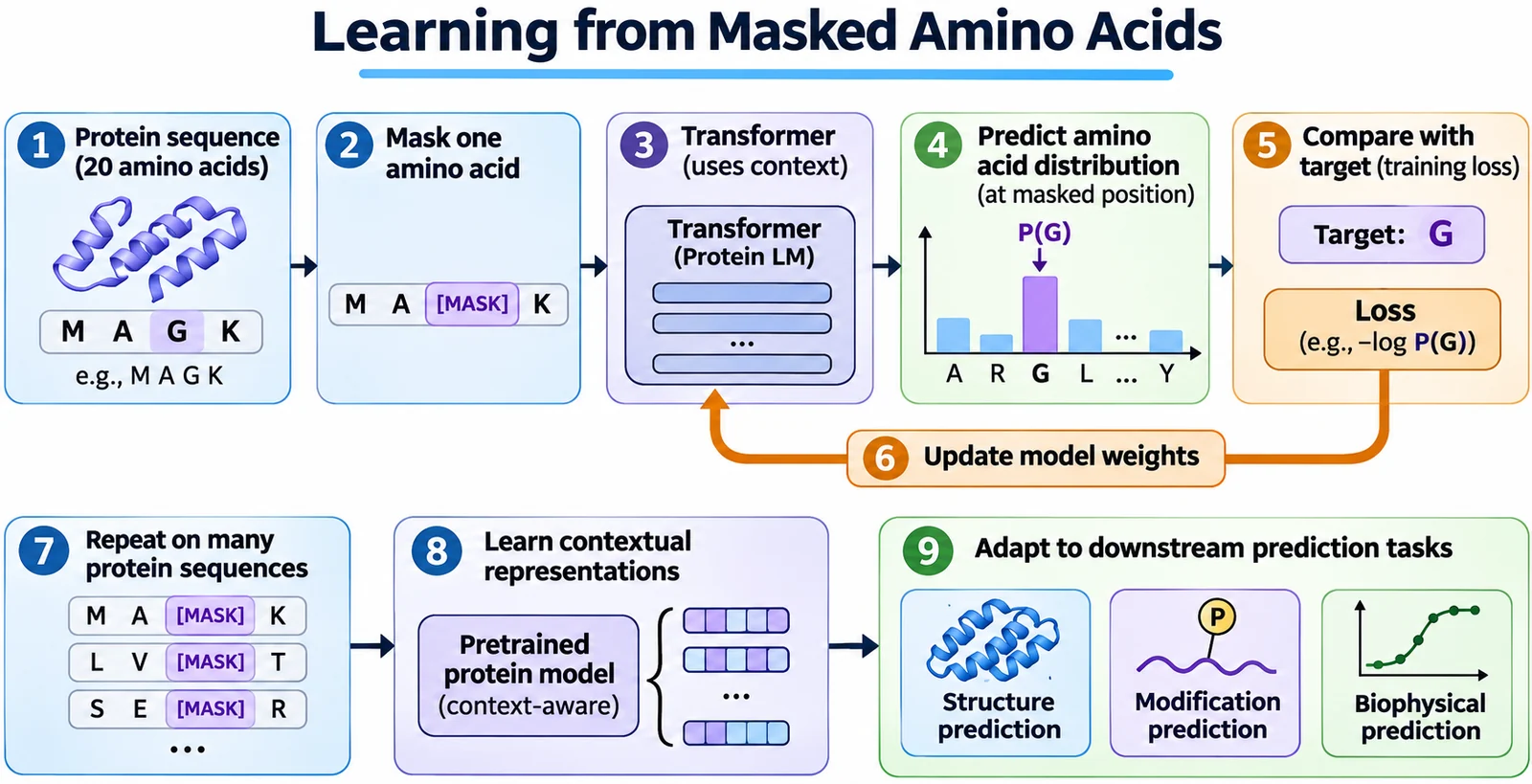
The first move is the same one that worked for language: pretrain on a very large unlabelled corpus, then fine-tune on small labelled sets. DNABERT applies this to the genome, a pretrained bidirectional encoder that captures the up- and downstream nucleotide context of a stretch of DNA and can then be adapted with small task-specific data. It was shown to reach state-of-the-art performance on predicting promoters, splice sites and transcription factor binding sites, three kinds of regulatory element, and a model pretrained on the human genome could be applied to other organisms as well.[5] The point of pretraining here is the same as in text: the unlabelled genome is vast, the labelled examples for any one task are few, and the pretrained representation carries knowledge that the small labelled set could not supply on its own.
Scale is the lever that makes this work, and it has been pushed hard. The Nucleotide Transformer family ranges from 50 million up to 2.5 billion parameters and integrates information from 3,202 human genomes and 850 genomes from diverse species. Training the largest of these took 128 GPUs across 16 compute nodes for 28 days, though once trained the models can be applied to new tasks at relatively low cost. One finding from that work is worth pausing on: models trained on genomes from different species outperformed those trained exclusively on human sequences in most of the human prediction tasks considered, which suggests the models captured genomic features whose importance carries across species.[19] The pretraining data, in other words, is not just a bigger pile of the same thing; its diversity is part of what is learned.
Proteins have been treated the same way. ProteinBERT is a language model designed for protein sequences that combines ordinary language modelling, filling in masked amino acids, with a second pretraining task of predicting Gene Ontology annotations, a curated vocabulary of about 45,000 terms describing molecular functions, biological processes and subcellular locations. It was pretrained on roughly 106 million proteins and reaches near state-of-the-art results on a range of benchmarks covering structure, post-translational modifications and biophysical attributes, while being far smaller and faster than competing models.[6] A different line of work scaled the same idea further: a contextual language model trained on 86 billion amino acids across 250 million protein sequences learned representations that contain information about biological properties, with secondary and tertiary structure encoded in them and recoverable by simple linear projections, all from sequence data alone and with no supervision beyond the sequences themselves.[20]
Generating sequences rather than labelling them
Reading a sequence and writing one are different skills, and a branch of this work trains models to write. ProtGPT2 is an autoregressive Transformer with 738 million parameters, trained on about 50 million non-annotated sequences spanning the protein space, that generates new protein sequences in a high-throughput fashion. Its output was checked against the properties of natural proteins: the generated sequences display natural amino acid propensities, and disorder predictions indicate that 88 percent of them are globular, in line with natural sequences. The model generates sequences in seconds on a standard workstation.[18]
A pretrained sequence model is a knowledge container: the unlabelled corpus teaches it the grammar of the molecule, and a small labelled set teaches it the task.
What ties these efforts together is the bet that the order of letters in a biological sequence carries enough information to be learned statistically, without a hand-built model of the chemistry. That bet pays off most visibly when the model is asked for something the sequence alone seems to determine, such as the three-dimensional shape a protein will fold into, which is where the next section turns.
Protein structure and molecular property prediction
Predicting the three-dimensional shape a protein will fold into from its amino acid sequence had been an open problem for more than fifty years, and experimental methods had determined structures for only a small fraction of known proteins.[21] AlphaFold2, the system DeepMind entered in the 14th Critical Assessment of protein Structure Prediction, or CASP14, was built on the transformer. Its Evoformer module, described earlier, is a deep stack of transformer-based layers that pass two representations back and forth: an alignment of the input sequence against its evolutionary relatives, and a matrix of pairwise relations between residues. The structure module that follows is also a transformer network, and it takes each residue as a separate object, predicting the rotations and translations needed to place it, which turns an abstract representation into three-dimensional atom coordinates.[12]
The evolutionary half of that design carries real biological weight. Protein structure is more conserved than amino acid sequence, so that a sequence changing by 80 percent between distant species may keep almost the same three-dimensional shape, and when two residues mutate in step across species, that co-evolution usually signals that the two touch in the folded protein.[12] The alignment representation is where that signal is read. The Evoformer's key benefit is that its two pathways exchange information: the alignment can be reinterpreted as the pairwise picture improves, and the pairwise picture improves again as the alignment is reinterpreted, block after block across 48 blocks that do not share weights.[12]
At CASP14 the system predicted structures with atomic-level accuracy, and the GDT_TS backbone accuracy values for medium and difficult targets, which had improved significantly only in CASP13 and CASP14, reached more than 85 percent, largely through AlphaFold2's contribution.[12] The result that mattered for the field was not a single score but the range of cases: the method could regularly predict structures with atomic accuracy even where no similar structure was known, the situation in which earlier methods fell furthest short. A prediction that runs in graphics processing unit minutes to hours per protein, rather than the months to years of laboratory work a single experimental structure can take, addresses the bottleneck on structural coverage.[21]
Reactions as translation
The same architecture has been pointed at chemistry, where the task is to predict the products formed when reactants and reagents are mixed. The Molecular Transformer treats this as machine translation between SMILES strings, a text notation for molecules, so that a reaction becomes a sentence in one chemical language to be rendered into another. It uses no handcrafted rules and needs no atom mapping, the scheme that ties each product atom back to its reactant, which earlier template-based methods depended on and which is itself an unsolved problem. The model handles subtle selectivity: it correctly predicted which of several functional groups in a molecule would react, and where within a group, on reactions absent from its training data, and its multihead attention can process long-range interactions between tokens.[2]
Matching drugs to targets
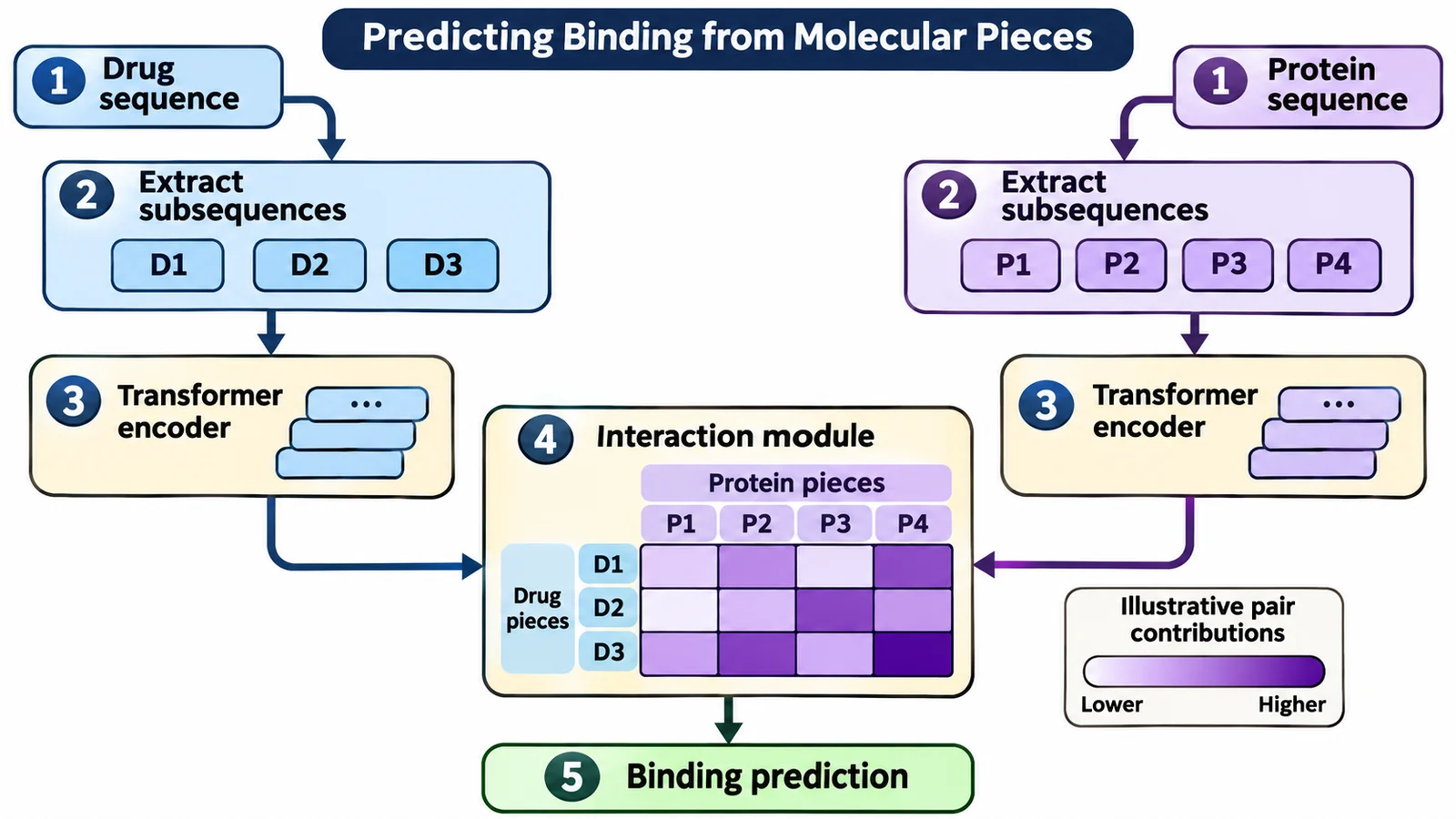
Drug–target interaction prediction asks whether a small molecule will bind a given protein, a question that underpins virtual screening and the search for new uses of existing drugs. MolTrans starts from the observation that such interactions are sub-structural: only relevant pieces of the drug and of the protein are involved, so representing each by its whole structure introduces noise and leaves the prediction hard to explain. The model mines frequent consecutive sub-sequences from millions of unlabelled drug and protein sequences to obtain those pieces, then uses an augmented transformer encoder to capture the relations among them, and an interaction module that maps which sub-structure combinations drove the outcome. On realistic settings, including unseen drugs or targets and scarce training data, it improved prediction over the best baseline by up to 25 percent.[22]
The pattern repeats across these domains: represent the object as a sequence or a set of parts, let attention learn which parts bear on each other, and predict from that.
What unites the three cases is that the relation being predicted is long-range by nature. Two residues that touch in a folded protein may sit far apart in the sequence; two atoms that bond may sit far apart in a SMILES string; a drug's active fragment matters more than its bulk. Attention, which weighs any pair of positions on equal footing, is suited to exactly that shape of problem.
Vision, pathology and other data types
An image is not a sentence, but it can be cut into one. A vision transformer divides the picture into a grid of small square patches, flattens each patch into a vector, and treats the resulting list of patches as a sequence of tokens, exactly as a language model treats a list of words. Position information is added so the model knows where each patch sat, and self-attention then relates every patch to every other. A review of the field describes the architecture this way, as a deep neural network mainly based on the self-attention mechanism, and reports that on a variety of visual benchmarks transformer-based models perform similar to or better than other network types such as convolutional and recurrent networks.[4] The appeal is that the model arrives with less built-in assumption about the data: a convolutional network is designed around the idea that nearby pixels belong together, while attention learns which patches matter to which, whether they sit side by side or at opposite corners of the image.
Pathology is a natural fit, because a scanned tissue slide is enormous. A standard gigapixel slide may comprise tens of thousands of image tiles, and earlier models often subsampled a small portion of them, losing the context that spans the whole slide. Prov-GigaPath handles this in two stages: a tile encoder turns each small tile into a compact vector, and a slide encoder built on a transformer then reads the whole sequence of tile vectors and produces a representation that takes the entire slide into account. It was pretrained on 1.3 billion tiles drawn from 171,189 slides from more than 30,000 patients, and on a benchmark of 9 cancer subtyping and 17 pathomics tasks it attained state-of-the-art performance on 25 of the 26.[23] A related effort, UNI, pretrained a general-purpose pathology model on more than 100 million images from over 100,000 slides across 20 major tissue types, and evaluated it on 34 tasks of varying diagnostic difficulty.[24]
The same trick extends past flat images. A point cloud, the set of three-dimensional coordinates a depth sensor or scanner returns, has no natural ordering, and a model that processes it should not depend on the order in which the points happen to be listed. The Point Cloud Transformer notes that the architecture is inherently permutation invariant when processing a sequence of points, which makes it well suited to this data, and reports state-of-the-art results on shape classification, part segmentation and related tasks.[25]
Once several kinds of data are each turned into sequences of tokens, they can be fed to one model together. A survey of multimodal learning with transformers describes the architecture as a promising learner that has been applied to data combining text, images and other modalities, both for pretraining on large mixed corpora and for specific tasks.[26] The common thread across patches, tiles, points and paired modalities is the one established earlier: attention imposes little structure on its input, so the same machinery adapts to whatever can be written as a sequence.
Cut the data into tokens, add position, and let attention relate the pieces; the same move carries from image patches to slide tiles to point clouds.
Adapting the architecture to structured records: electronic health records and seismic signals
Records that are not prose

An electronic health record is a patient's history written as a list of coded events: diagnoses, visits, measurements, each stamped with a time. It is sequential, like a sentence, but the vocabulary is a set of medical codes rather than words, and the order of events carries clinical meaning. BEHRT adapts the Transformer to this material, treating a patient's visits as a sequence and predicting the likelihood of 301 conditions in future visits. Trained and evaluated on data from nearly 1.6 million individuals, it showed an improvement of 8.0 to 13.2 percent in average precision over existing deep models for health records.[7] Average precision summarises how well a ranked list of predicted conditions matches the ones that later occurred, so the gain describes better ordering of future diagnoses rather than a higher hit rate alone.
Med-BERT takes the pretraining route instead, learning from a very large unlabelled record set before being adapted to specific tasks. It was pretrained on a structured dataset of 28,490,650 patients, then fine-tuned on two prediction problems drawn from two clinical databases: heart failure among patients with diabetes, and onset of pancreatic cancer.[3] Fine-tuning raised the area under the receiver operating characteristic curve, a measure of how well a model ranks patients by risk, by 1.21 to 6.14 percent. The gain was largest where fine-tuning sets were small, with the pretrained model reaching an AUC as high as a model trained on ten times as many examples.[3] That is the same logic seen with text and protein sequences: a large unlabelled corpus supplies what a small labelled set cannot.
Waves instead of words
A seismogram is a different kind of sequence again, a continuous recording of ground motion in which an earthquake appears as a brief pattern of arrivals. Two tasks sit on top of it. Detection asks whether a signal is an earthquake at all; phase picking measures the arrival times of the P and S waves, the two distinct pulses that travel through the ground, and those times locate the event. EQTransformer performs both at once on single-station data, using a hierarchical attention mechanism with one level attending to the whole waveform to identify an earthquake and a second attending locally to pick out individual phases within it.[27] The design rests on the observation that not all parts of a seismic signal matter equally for a given decision, so it helps to learn which sections to weigh.
Applied to five weeks of continuous recordings from the 2000 Tottori earthquake sequence in Japan, the model detected and located two times more earthquakes using only a portion (less than 1/3) of the seismic stations.[27] Its arrival-time picks came close to those made by human analysts, and the extra events were not confined to the two main faults but included sparse activity under the eastern flank of Mt. Daisen.[27] The gain in sensitivity, in other words, changed the picture of where the ground was moving, not merely how precisely a known event was timed.
Research
Evidence on accuracy and efficiency
What the benchmarks measured
Claims about a deep learning architecture are worth only what its measurements support, and the Transformer's case rests on a small number of well-defined tests. The first was translation. On the WMT 2014 English-to-German task the original model reached 28.4 BLEU, a score comparing machine output against reference translations, improving on the best existing results, ensembles included, by more than 2 BLEU; on English-to-French it set a new single-model state of the art at 41.8 BLEU. The efficiency half of that result is the training cost: the English-to-French model was trained for 3.5 days on eight GPUs, which the authors describe as a small fraction of the cost of the best models in the literature at the time.[1] Better output at lower cost is the combination that made the design hard to ignore.
Accuracy figures only mean something against a stated benchmark and a stated baseline, so it is worth being precise about each. The Molecular Transformer, which treats reaction prediction as translation between strings of chemical notation, reached 90.4 percent top-1 accuracy and 93.7 percent top-2 accuracy on a common benchmark data set, where top-1 means the single most likely product was correct and top-2 means the correct product was among the two highest-ranked. That figure came from a single model trained on data-augmented versions of the set, chosen deliberately over an ensemble so the comparison with earlier methods was fair; ensembling two independently initialized runs pushed top-1 to 91 percent.[2]
Knowing when the model is wrong
A raw accuracy number hides a second question: does the model know which of its answers to trust? For reaction prediction this matters more than it might seem, because synthesis is usually multi-step, and a method correct 80 percent of the time has only about a 1 percent chance of getting an 18-step sequence right if the steps are independent.[2] Errors compound, so a model that can flag its own weak predictions lets a chemist order the risky steps early and fail cheaply.
The Molecular Transformer estimates its own uncertainty, and that estimate was tested directly: the uncertainty score had an ROC-AUC of 0.89 at classifying whether a given reaction was correctly predicted.[2] An ROC-AUC of 0.89 on a yes-or-no classification means the score separates correct from incorrect predictions well, though not perfectly; a value of 0.5 would be no better than guessing. The practical value is that a chemist can set a threshold and treat low-confidence predictions with suspicion rather than taking every output at face value.
Structure prediction at atomic resolution
The most demanding test the architecture has faced is protein structure prediction, where the target is a set of three-dimensional coordinates rather than a label. AlphaFold2 entered the 14th Critical Assessment of protein Structure Prediction, a blind competition in which participants predict structures for sequences whose experimental structures are known but not yet released, and predicted with atomic-level accuracy. The assessment scores backbone accuracy using GDT_TS, a multi-scale metric indicating the proximity of the Cα atoms in a model to those in the experimentally determined structure. For easy targets, scores had sat around or above 80 percent across the competition's history; for medium and difficult targets, accuracy improved significantly only in the 13th and 14th rounds, and in the 14th the scores for those harder categories reached more than 85 percent, largely through AlphaFold2's contribution. The jump on difficult targets is the informative part, because those are cases such as proteins with unfolded domains or many loops, and with no available structures of homologous proteins to copy from.[12]
Gains on clinical records
Medical prediction offers a different kind of evidence, because the data are messy and the labels scarce. Med-BERT adapts the same pretrained-then-fine-tuned pattern to structured electronic health records, and was pretrained on a dataset of 28,490,650 patients. Fine-tuning on two disease prediction tasks drawn from two clinical databases, predicting heart failure among patients with diabetes and predicting the onset of pancreatic cancer, it boosted the area under the receiver operating characteristic curve by 1.21 to 6.14 percent. That curve, usually shortened to AUC, measures how well a model ranks patients by risk; a few points of gain on a clinical task is a meaningful margin, and the improvement was largest where fine-tuning sets were small, with pretrained Med-BERT obtaining an AUC as high as a model trained on a set ten times larger.[3]
A second record-based model, BEHRT, was trained and evaluated on data from nearly 1.6 million individuals and predicts the likelihood of 301 conditions in future visits. Against the existing state-of-the-art deep models for health records it showed an absolute improvement of 8.0 to 13.2 percent in average precision across tasks.[7] Average precision is a summary of how well a ranked list of predicted conditions matches the ones that actually occurred, so the gain describes better ordering of future diagnoses, not merely a higher hit rate.
Scale as a lever
One pattern runs through the sequence models: more parameters and more data tend to buy more accuracy. The Nucleotide Transformer family spans 50 million to 2.5 billion parameters, and across 18 genomic prediction tasks increasing model size led to consistently improved performance. That relationship is a trend across a family of models on a fixed set of tasks, not a guarantee that any larger model will beat any smaller one on any problem, and the largest models required 128 GPUs across 16 compute nodes for 28 days to train.[19] The pattern is consistent with what the translation and chemistry results showed in their own terms: the architecture's returns have so far kept rising as it was given more capacity and more data, which is why the engineering questions of cost and long sequences, taken up later, matter as much as they do.
Each number above is tied to its own benchmark and baseline; read together, they show the same architecture improving as it is given more data, more parameters and a task suited to long-range relations.
Risks and limits
Costs, limits and open problems
The attention operation that gives the architecture its reach also sets its price. Every position is compared with every other position, so a sequence of length L requires L times L such comparisons, and the total grows with the square of the length. Doubling a sequence does not double the work; it roughly quadruples it. The cost is paid mainly in memory, because the attention scores for all pairs of positions must be held while the layer runs, and that memory is what limits how long an input a model can be trained on with a given piece of hardware.
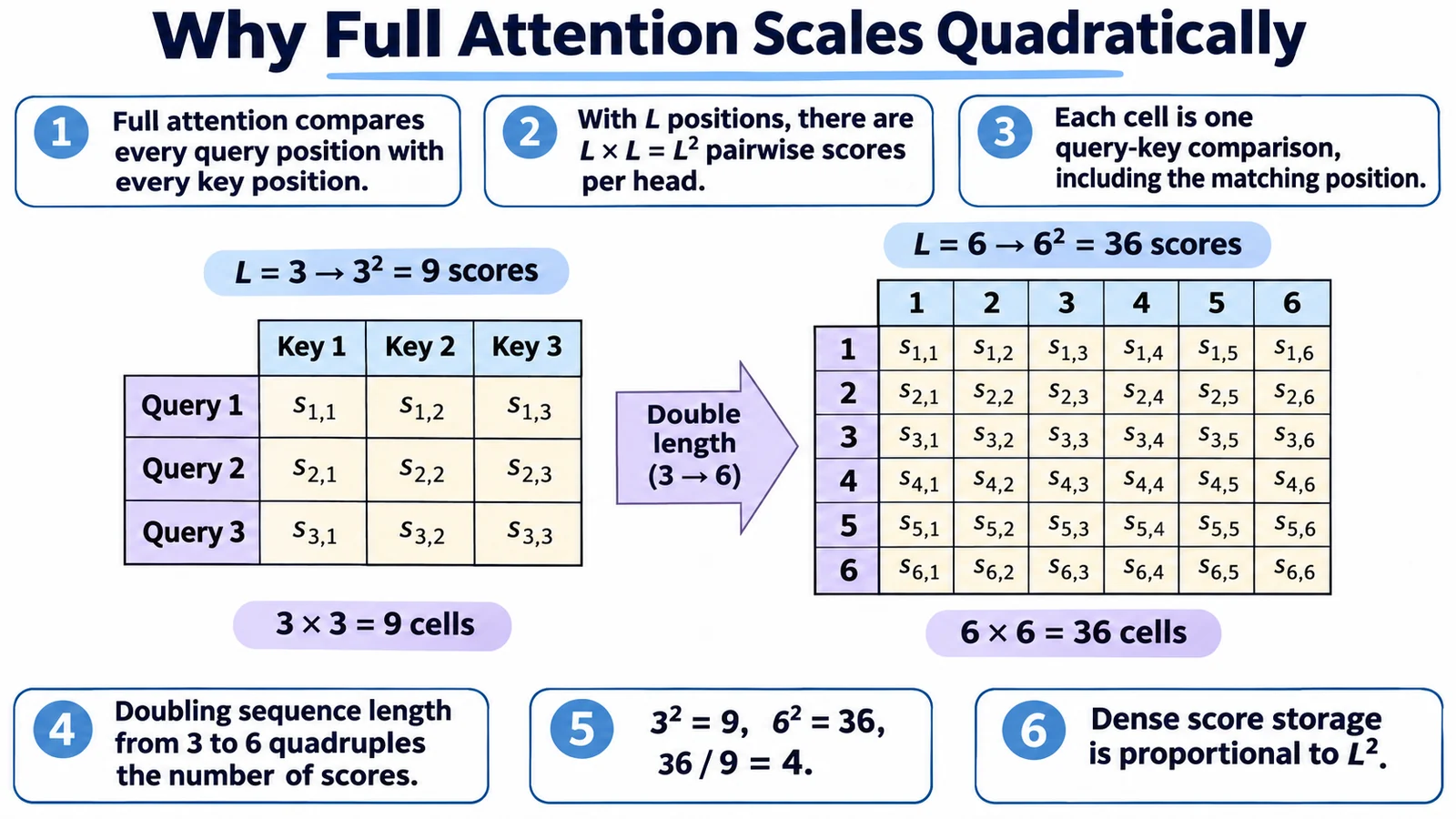
The consequence is a hard ceiling on context. A sparse-attention design introduced to address this describes the quadratic dependency, mainly in terms of memory, on sequence length as one of the core limitations of transformer models built on full attention. The same work reduces that dependency to linear by letting each position attend to only a selection of others rather than to all of them, and shows the resulting model can handle sequences up to eight times longer than was previously possible on similar hardware.[28] The saving is not free in principle, since a position no longer sees everything, so the design has to preserve the model's expressive power while dropping most of the pairwise comparisons.
A second line of attack changes how the comparisons are computed rather than how many are kept. The Reformer replaces the standard dot-product attention with one that uses locality-sensitive hashing, a technique that groups similar vectors together so that a position need only compare itself with the ones likely to matter, changing the complexity from growing with the square of the sequence length to growing as the length times its logarithm. The same model stores activations once during training instead of once per layer, by using reversible residual layers, which cuts memory further.[29] Sparse factorizations of the attention matrix take a related route, reducing the cost to a growth between linear and quadratic and allowing sequences tens of thousands of steps long to be modelled with hundreds of layers.[30]
These engineering responses buy length, but they do not make the problem disappear, and the trade between handling long inputs and keeping accuracy on short ones remains open. A separate limit has nothing to do with compute. A model trained to predict the next word learns the statistics of its training text and nothing more: it comprehends none of the language it deals with, neither the prompts it is fed nor its responses, and it has no means to assess whether the material it produces is true or false. Because it is trained on vast internet text with limited filtering, it has absorbed misinformation and biased content alongside facts, and it can reproduce and amplify either without signalling which it is doing.[8] Fluent output and reliable output are therefore different properties, and the gap between them is not closed by making the model larger.
Data requirements impose a further limit, and one that is easy to miss because pretraining hides it. A model trained from scratch on a small labelled set learns little; the pretrained-then-fine-tuned pattern works because a large unlabelled corpus supplies what the small set cannot. The same constraint appears in genomics, where a model can only predict for the cell types and assays represented in its training data and cannot generalize to new ones. Enformer, which predicts gene expression from DNA sequence, carries exactly this limitation: it can model only the cell types and assays it was trained on.[31] A model is bounded by what it has seen, and no amount of attention changes that.
Attention costs grow with the square of the sequence length, and a model's knowledge stops at the edge of its training data; the engineering work of the coming years is largely about pushing both boundaries outward.
How far those boundaries can be pushed, through longer context windows, cheaper fine-tuning and the scaling of models to more data, is taken up later.
Later developments
Where the architecture is heading
Longer context without losing the short case
The attention cost described earlier sets the agenda for current work: a model that compares every position with every other grows quadratically with sequence length, so progress is partly a contest over how much sequence a model can read at once. A survey of efficient transformers characterizes a large selection of "X-former" models, Reformer, Linformer, Performer and Longformer among them, as improvements on the original architecture, many of them aimed squarely at computational and memory efficiency. The survey characterizes these X-former models as improvements upon the original Transformer architecture, many of which make improvements around computational and memory efficiency.[32]
Genomics shows both the promise and the ceiling of that work. The Nucleotide Transformer models have an attention span that remains limited, while the Enformer model's authors argued that increasing the perception field up to 200 kb is necessary to capture long-range dependencies in the human genome, reasoning that gene expression is controlled by distal regulatory elements usually located far greater than 10–20 kb from the transcription start site. Processing inputs that large is intractable with the standard architecture, given the quadratic scaling of self-attention with sequence length, and Enformer works around it by passing sequences through convolution layers to shrink the input before the transformer layers, a choice that hampers its effectiveness in language modelling. The open question is stated plainly: developing transformer models that handle long inputs while maintaining high performance on shorter ones is a promising direction for the field.[19]
Fine-tuning a sliver of the model
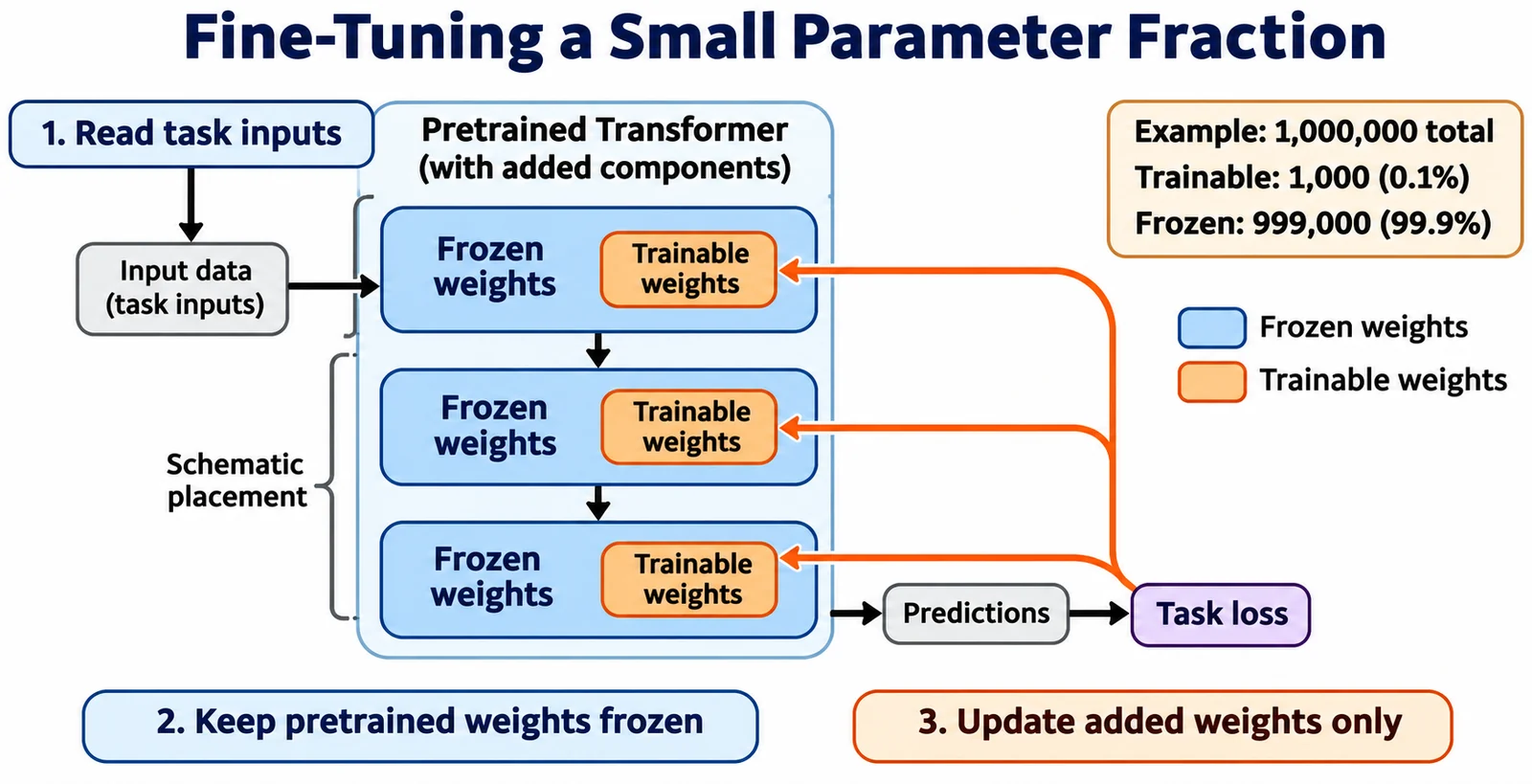
A second direction attacks cost from the other end, not the length of the input but the expense of adapting a trained model to a new job. The usual pattern retrains the whole network on task-specific data; an alternative introduces a small number of trainable weights into the pretrained transformer and leaves the rest frozen. In the genomics work, this approach required only 0.1 percent of the total number of parameters, which allowed even the largest models to be fine-tuned in under 15 minutes on a single GPU, and it yielded better results than an extensive probing exercise while using fewer compute resources.[19] The practical consequence is that a model too large to retrain on ordinary hardware becomes adaptable on ordinary hardware, which widens who can put a foundation model to use.
Scale, and what it buys
The third direction is simply more of everything. Across 18 genomic prediction tasks, increasing model size led to consistently improved performance, and the family spans 50 million to 2.5 billion parameters.[19] Pathology shows the same lever pulled on data rather than parameters: GigaPath pretrained on the larger Prov-Path data outperformed GigaPath pretrained on the smaller TCGA data, and GigaPath, which has more parameters, outperformed HIPT when both were pretrained on Prov-Path. Those two comparisons point the same way, that larger pretraining sets and larger models each contribute, though the authors present them as indications that performance may improve further with more pretraining rather than as settled law.[23]
The three directions converge on one goal: more sequence, more data and cheaper adaptation, without giving up what the model already does well on small inputs.
Key studies
| Year | Study | Sample | Design | Finding |
|---|---|---|---|---|
| 2018 | Lee et al.[13] | Permutation-invariant attention module proposal and evaluation | The Set Transformer reduces self-attention computation from quadratic to linear in the number of elements and achieves state-of-the-art performance on set-structured data. | |
| 2019 | Yun et al.[14] | Graph Transformer Network proposal and evaluation | On all three benchmark node classification tasks, Graph Transformer Networks came out ahead of state-of-the-art methods that depend on meta-paths defined in advance from domain knowledge, and they did so without domain-specific graph preprocessing. | |
| 2020 | Kitaev et al.[29] | Efficiency technique proposal and evaluation | Reformer replaces dot-product attention with locality-sensitive hashing, changing complexity from O(L^2) to O(L log L), and performs on par with Transformer models while being more memory-efficient and faster on long sequences. | |
| 2020 | Zaheer et al.[28] | Sparse attention mechanism proposal and evaluation | BigBird reduces the quadratic dependency to linear and handles sequences up to 8 times longer, improving performance on question answering and summarization. | |
| 2020 | Li et al.[7] | Deep neural sequence transduction model for electronic health records | BEHRT showed an improvement of 8.0-13.2% in average precision scores over existing state-of-the-art deep EHR models for predicting 301 conditions. | |
| 2020 | Mousavi et al.[27] | A deep-learning model that detects earthquakes and picks seismic phases at the same time | Applied to 5 weeks of continuous data during the 2000 Tottori earthquakes, the model detected and located two times more earthquakes using less than 1/3 of seismic stations. | |
| 2021 | Jumper et al.[21] | Computational method validation in a blind assessment | In the 14th Critical Assessment of protein Structure Prediction (CASP14), the redesigned AlphaFold reached accuracy close to that of experimental structures in most cases and clearly surpassed competing methods. | |
| 2021 | Rives et al.[20] | Unsupervised language model training on protein sequences | The model's internal representations hold information about biological properties. When those representations served as features, supervised prediction of mutational effect and of secondary structure reached the best reported performance at the time. | |
| 2021 | Avsec et al.[31] | Deep learning architecture for gene expression prediction | Enformer integrates information from long-range interactions up to 100 kb away and outperformed Basenji2 in gene expression prediction. | |
| 2021 | Rasmy et al.[3] | Pretrained contextualized embedding model for structured EHR | Med-BERT boosted the AUC by 1.21-6.14% in two disease prediction tasks and by more than 20% on tasks with small fine-tuning training sets. | |
| 2024 | Chen et al.[24] | Self-supervised model pretraining and evaluation on 34 pathology tasks | UNI outperformed previous state-of-the-art models and demonstrated new capabilities such as classifying up to 108 cancer types in the OncoTree system. | |
| 2025 | Vaswani et al.[1] | Architecture proposal with experiments on translation benchmarks | The Transformer reached 28.4 BLEU on WMT 2014 English-to-German, where training the big model took 3.5 days on 8 P100 GPUs, and 41.0 BLEU on WMT 2014 English-to-French. |
See also
References
- Vaswani, A., Shazeer, N., Parmar, N., Uszkoreit, J., Jones, L., N.Gomez, A., Kaiser, L., & Polosukhin, I. (2025). Attention Is All You Need. Shenzhen Medical Academy of Research and Translation. doi:10.65215/2q58a426
- Schwaller, P., Laino, T., Gaudin, T., Bolgar, P., Hunter, C. A., Bekas, C., & Lee, A. A. (2019). Molecular Transformer: A Model for Uncertainty-Calibrated Chemical Reaction Prediction. ACS Central Science, 5(9), 1572-1583. doi:10.1021/acscentsci.9b00576
- Rasmy, L., Xiang, Y., Xie, Z., Tao, C., & Zhi, D. (2021). Med-BERT: pretrained contextualized embeddings on large-scale structured electronic health records for disease prediction. npj Digital Medicine, 4(1). doi:10.1038/s41746-021-00455-y
- Han, K., Wang, Y., Chen, H., Chen, X., Guo, J., Liu, Z., Tang, Y., Xiao, A., Xu, C., Xu, Y., Yang, Z., Zhang, Y., & Tao, D. (2023). A Survey on Vision Transformer. IEEE Transactions on Pattern Analysis and Machine Intelligence, 45(1), 87-110. doi:10.1109/tpami.2022.3152247
- Ji, Y., Zhou, Z., Liu, H., & Davuluri, R. V. (2021). DNABERT: pre-trained Bidirectional Encoder Representations from Transformers model for DNA-language in genome. Bioinformatics, 37(15), 2112-2120. doi:10.1093/bioinformatics/btab083
- Brandes, N., Ofer, D., Peleg, Y., Rappoport, N., & Linial, M. (2022). ProteinBERT: a universal deep-learning model of protein sequence and function. Bioinformatics, 38(8), 2102-2110. doi:10.1093/bioinformatics/btac020
- Li, Y., Rao, S., Solares, J. R. A., Hassaine, A., Ramakrishnan, R., Canoy, D., Zhu, Y., Rahimi, K., & Salimi-Khorshidi, G. (2020). BEHRT: Transformer for Electronic Health Records. Scientific Reports, 10(1). doi:10.1038/s41598-020-62922-y
- Harrer, S. (2023). Attention is not all you need: the complicated case of ethically using large language models in healthcare and medicine. eBioMedicine, 90, 104512. doi:10.1016/j.ebiom.2023.104512
- Brauwers, G., & Frasincar, F. (2023). A General Survey on Attention Mechanisms in Deep Learning. IEEE Transactions on Knowledge and Data Engineering, 35(4), 3279-3298. doi:10.1109/tkde.2021.3126456
- Kim, H. E., Cosa-Linan, A., Santhanam, N., Jannesari, M., Maros, M. E., & Ganslandt, T. (2022). Transfer learning for medical image classification: a literature review. BMC Medical Imaging, 22(1). doi:10.1186/s12880-022-00793-7
- Xiong, R., Yang, Y., He, D., Zheng, K. W., Shuxin, Z., Xing, C., Zhang, H., Lan, Y., Wang, L., & Liu, T. (2020). On Layer Normalization in the Transformer Architecture. arXiv. doi:10.48550/arxiv.2002.04745 Free full text
- Yang, Z., Zeng, X., Zhao, Y., & Chen, R. (2023). AlphaFold2 and its applications in the fields of biology and medicine. Signal Transduction and Targeted Therapy, 8(1). doi:10.1038/s41392-023-01381-z
- Lee, J., Lee, Y., Kim, J., Kosiorek, A. R., Choi, S., & Teh, Y. W. (2018). Set Transformer: A Framework for Attention-based Permutation-Invariant Neural Networks. arXiv. doi:10.48550/arxiv.1810.00825 Free full text
- Yun, S., Jeong, M., Kim, R., Kang, J., & Kim, H. J. (2019). Graph Transformer Networks. arXiv. doi:10.48550/arxiv.1911.06455 Free full text
- Chen, L., Kevin, L., Rajeswaran, A., Lee, K., Grover, A., Michael, L., Abbeel, P., Srinivas, A., & Mordatch, I. (2021). Decision Transformer: Reinforcement Learning via Sequence Modeling. arXiv. doi:10.48550/arxiv.2106.01345 Free full text
- Raffel, C., Shazeer, N., Adam, R., Lee, K., Narang, S., Matena, M. S., Zhou, Y., Li, W., & Liu, P. J. (2019). Exploring the Limits of Transfer Learning with a Unified Text-to-Text Transformer. arXiv. doi:10.48550/arxiv.1910.10683 Free full text
- Goldstein, A., Zada, Z., Buchnik, E., Schain, M., Price, A., Aubrey, B., Nastase, S. A., Feder, A., Emanuel, D., Cohen, A., Jansen, A., Gazula, H., Choe, G., Rao, A., Kim, C., Casto, C., Fanda, L., Doyle, W., Friedman, D., & ... Hasson, U. (2022). Shared computational principles for language processing in humans and deep language models. Nature Neuroscience, 25(3), 369-380. doi:10.1038/s41593-022-01026-4
- Ferruz, N., Schmidt, S., & Höcker, B. (2022). ProtGPT2 is a deep unsupervised language model for protein design. Nature Communications, 13(1). doi:10.1038/s41467-022-32007-7
- Dalla-Torre, H., Gonzalez, L., Mendoza-Revilla, J., Lopez Carranza, N., Grzywaczewski, A. H., Oteri, F., Dallago, C., Trop, E., de Almeida, B. P., Sirelkhatim, H., Richard, G., Skwark, M., Beguir, K., Lopez, M., & Pierrot, T. (2025). Nucleotide Transformer: building and evaluating robust foundation models for human genomics. Nature Methods, 22(2), 287-297. doi:10.1038/s41592-024-02523-z
- Rives, A., Meier, J., Sercu, T., Goyal, S., Lin, Z., Liu, J., Guo, D., Ott, M., Zitnick, C. L., Ma, J., & Fergus, R. (2021). Biological structure and function emerge from scaling unsupervised learning to 250 million protein sequences. Proceedings of the National Academy of Sciences, 118(15). doi:10.1073/pnas.2016239118
- Jumper, J., Evans, R., Pritzel, A., Green, T., Figurnov, M., Ronneberger, O., Tunyasuvunakool, K., Bates, R., Žídek, A., Potapenko, A., Bridgland, A., Meyer, C., Kohl, S. A. A., Ballard, A. J., Cowie, A., Romera-Paredes, B., Nikolov, S., Jain, R., Adler, J., & ... Hassabis, D. (2021). Highly accurate protein structure prediction with AlphaFold. Nature, 596(7873), 583-589. doi:10.1038/s41586-021-03819-2
- Huang, K., Xiao, C., Glass, L. M., & Sun, J. (2021). MolTrans: Molecular Interaction Transformer for drug–target interaction prediction. Bioinformatics, 37(6), 830-836. doi:10.1093/bioinformatics/btaa880
- Xu, H., Usuyama, N., Bagga, J., Zhang, S., Rao, R., Naumann, T., Wong, C., Gero, Z., González, J., Gu, Y., Xu, Y., Wei, M., Wang, W., Ma, S., Wei, F., Yang, J., Li, C., Gao, J., Rosemon, J., & ... Poon, H. (2024). A whole-slide foundation model for digital pathology from real-world data. Nature, 630(8015), 181-188. doi:10.1038/s41586-024-07441-w
- Chen, R. J., Ding, T., Lu, M. Y., Williamson, D. F. K., Jaume, G., Song, A. H., Chen, B., Zhang, A., Shao, D., Shaban, M., Williams, M., Oldenburg, L., Weishaupt, L. L., Wang, J. J., Vaidya, A., Le, L. P., Gerber, G., Sahai, S., Williams, W., & Mahmood, F. (2024). Towards a general-purpose foundation model for computational pathology. Nature Medicine, 30(3), 850-862. doi:10.1038/s41591-024-02857-3
- Guo, M. H., Cai, J. X., Liu, Z. N., Mu, T. J., Martin, R. R., & Hu, S. M. (2021). PCT: Point cloud transformer. Computational Visual Media, 7(2), 187-199. doi:10.1007/s41095-021-0229-5
- Xu, P., Zhu, X., & Clifton, D. A. (2023). Multimodal Learning With Transformers: A Survey. IEEE Transactions on Pattern Analysis and Machine Intelligence, 45(10), 12113-12132. doi:10.1109/tpami.2023.3275156
- Mousavi, S. M., Ellsworth, W. L., Zhu, W., Chuang, L. Y., & Beroza, G. C. (2020). Earthquake transformer—an attentive deep-learning model for simultaneous earthquake detection and phase picking. Nature Communications, 11(1). doi:10.1038/s41467-020-17591-w
- Zaheer, M., Guruganesh, G., Dubey, A., Ainslie, J., Alberti, C., Ontañón, S., Pham, P., Ravula, A., Wang, Q., Li, Y., & Ahmed, A. A. (2020). Big Bird: Transformers for Longer Sequences. arXiv. doi:10.48550/arxiv.2007.14062 Free full text
- Kitaev, N., Kaiser, Ł., & Levskaya, A. (2020). Reformer: The Efficient Transformer. arXiv. doi:10.48550/arxiv.2001.04451 Free full text
- Child, R., Gray, S., Radford, A., & Sutskever, I. (2019). Generating Long Sequences with Sparse Transformers. arXiv. doi:10.48550/arxiv.1904.10509 Free full text
- Avsec, Ž., Agarwal, V., Visentin, D., Ledsam, J. R., Grabska-Barwinska, A., Taylor, K. R., Assael, Y., Jumper, J., Kohli, P., & Kelley, D. R. (2021). Effective gene expression prediction from sequence by integrating long-range interactions. Nature Methods, 18(10), 1196-1203. doi:10.1038/s41592-021-01252-x
- Tay, Y., Dehghani, M., Bahri, D., & Metzler, D. (2023). Efficient Transformers: A Survey. ACM Computing Surveys, 55(6), 1-28. doi:10.1145/3530811
Cite this page: Atlas Nova editors. (2026). Transformer (deep learning architecture). Atlas Nova. https://velocer.io/atlas/transformers/