Technology · Machine learning
Synthetic data
Artificially generated data records
Synthetic data are records generated to imitate the key information in real data, so that valid statistical inferences can still be drawn while privacy and confidentiality concerns are reduced.[1]
In a review of 19 health datasets, most models trained on synthetic data were less accurate.[2] Training repeatedly on model-made text can cause permanent defects called model collapse.[3]
Key facts
| 92% | share of models trained on synthetic data that were less accurate than real-data models (Rankin et al., 2020)[2] |
|---|---|
| 72.6% | share of reviewed healthcare studies using deep learning based synthetic data generators (Pezoulas et al., 2024)[4] |
| 84.2% | F-measure for text detection trained on synthetic images on a standard benchmark (Gupta et al., 2016)[5] |
| over a thousand | training examples extracted from image diffusion models, including photos of people (Carlini et al., 2023)[6] |
Overview
What synthetic data are and where the idea began
One review describes them as computer-generated data that imitate and stand in for real observations without matching any real-world event directly.[7] A statistical definition is narrower: a generated data set built to copy key information in an actual data set, so that valid statistical inferences can still be drawn from it. That second aim matters because access to data, especially data paid for with public funds, is in growing demand, while concern about revealing who respondents are keeps collectors restricting access. Generated records are offered as a way to widen access to data for analysis while easing privacy and confidentiality worries.[1]
The statistical idea is usually dated to a 1993 paper by Rubin in the Journal of Official Statistics, which proposed generating synthetic data to broaden access to sensitive microdata.[8] Synthetic data are records simulated from a statistical model rather than collected from people or measuring devices.[9] Developments in computer science stimulated that growth, at least in part.[8]
A 1987 paper in Biometrika built synthetic times by enlarging the gaps between successive ordered observations, then applied ordinary least squares to them. Under suitable regularity conditions, that estimator was shown to be Fisher consistent and asymptotically normal, meaning it converges on the true value as data grow and has a known large-sample distribution.[10]
Simulation is one of the primary methods for synthesizing data, and the reality gap it produces has troubled physicists, computer scientists and engineers since before the birth of modern computing. In each episode, data were assumed at the outset so that a simulation could be set up and data collection avoided. The paper argues that the reality gap, the failure of models trained on synthetic data when they meet conventional data, is not new.[11]
A 2016 paper in the Journal of Statistical Software introduced the synthpop package for the R language, which generates synthetic versions of original data sets. The package produces data that mimic the observed data and preserve the relationships between variables, but contain no records that disclose identities.[12]
Synthetic data are widely used today in privacy protection, machine learning and simulation. Use of synthetic data in the US Census and the American Community Survey makes reflection on what such data are and what they imply urgent, according to a 2024 paper.[7]
Main ideas
Definitions and the statistical model view
The model is fitted to a real dataset, and the fitted model then produces new records that imitate the patterns of the original without copying any single real record.[9][13] Because the output is an artificial dataset containing no identifiable information, synthetic data is described as a privacy-protecting mechanism for sharing sensitive material for secondary purposes.[13] A 2022 explainer written for a non-technical audience includes some formal definitions to give clarity to specialists.[14]
A common distinction separates fully synthetic data from partially synthetic data.[15] In the fully synthetic case every record is generated by the model, so no row of the released file corresponds to a real person.[15][13] In the partially synthetic case some values are real and others are replaced by simulated values, which keeps more of the original detail at the cost of a closer link to the underlying records.[15] A third use, augmentation, keeps the real records and adds generated ones, for example to increase the coverage of rare cases in a training set.[9] A 2023 review of tabular and latent space generation lists anonymization, regularization, oversampling and semi-supervised and self-supervised learning among the tasks that generated data can serve, and it reviews 70 generation algorithms across six machine learning problems.[16]
In the statistical view, synthetic data are simulated from some statistical model, and agencies can release record-level information this way while reducing disclosure risks. Approaches covered under this view include sequential modeling, synthesis under differential privacy, deep generative models and large language models.[9] Differential privacy is a formal promise about how much any single person's record can change what a data release reveals, and it is the guarantee most often attached to synthetic data, which are records generated by a model rather than copied from real people.[17][18] Each method involves trade-offs among data usefulness, privacy protection and model reliability.[9] A 2026 paper on population data argues that a high-fidelity generator must reproduce every variable, such as forename, surname and date of birth, and must include realistic errors at the right frequency and of the right types.[19] A 2021 study of healthcare data found that choices made before and during generation, including data pre-processing and whether tuning is applied to models trained on the synthetic data, affect the utility of the result, measured by propensity score and classification accuracy.[13]
The definition carries an unresolved boundary question: whether synthetic data should itself count as personal data and therefore be subject to privacy controls that limit re-identification risk.[15] A 2026 review of provision notes that the field is still relatively new, that norms and precedents have yet to fully emerge, and that standards and consistent approaches are lacking. That review proposes a structured workflow of planning, creating, validating and releasing a synthetic dataset, starting with data of low disclosure risk, which is typically of low fidelity.[20]
How synthetic data are generated
A survey published in 2023 divides deep generative models for synthetic data into many specialized streams. That survey notes that models for making text for language processing cannot readily be compared with models for making health records. The same survey treats sequential data, meaning records that come in an order such as words in a sentence, as an important and challenging sub-category. It judges such data on five criteria: representativeness, novelty, realism, diversity and coherence, each measured against the original data.[21]
A 2014 framework trained text recognition models only on data from a synthetic text generation engine, which its authors describe as highly realistic and sufficient to replace real data.[22] A 2016 method built a fast and scalable engine that overlays synthetic text onto existing background photographs. The overlay accounts for the local 3D scene geometry, so the added text sits in the scene in a natural way. Images from that engine trained a detection network that reached an F-measure of 84.2% on the standard ICDAR 2013 benchmark.[5]
A 2024 article presents one such methodology, the Generic Methodology for Constructing Synthetic Data Generation, or GeMSyD. The article applies it to event-based data modeling, namely records of how people interact with smart devices. The resulting datasets imitate the dynamics of human-device interactions, including temporal dependencies, meaning patterns that depend on the order and timing of events. Experiments then used these datasets to test a neural-network prediction model for smart device interaction.[23]
A 2022 approach needs no task-specific data at all. A unidirectional model generates class-conditioned texts guided by prompts. Those generated texts are then used as training data for fine-tuning a bidirectional model. Training examples are kept or dropped based on the generation probability, and label smoothing and temporal ensembling are applied during fine-tuning. Across seven classification tasks of the GLUE benchmark, the method scored 72.3 and 73.8 on MNLI-m and MNLI-mm and 92.8 on SST-2. Those results beat zero-shot prompting methods and came close to strong few-shot approaches that used 32 training samples per class.[24]
A 2025 survey describes how large language models, or LLMs, now generate synthetic training data for both natural language and code. In the code domain, functional correctness can be checked automatically. The survey also names challenges: generated text can contain factual errors, can fall short in stylistic or distributional realism, and can amplify bias. Proposed remedies include filtering and weighting synthetic outputs, and reinforcement learning with execution feedback for code.[25]
A 2025 method generates synthetic text by matching gradients. It uses the Alternating Direction Method of Multipliers to adjust the embeddings of synthetic examples. The adjustments aim to make the synthetic examples match the noisy gradient computed from the target training or validation data. The examples are then mapped to sequences of text tokens with low perplexity. The method's authors describe it as the first theoretically rigorous approach of this kind. They say it offers convergence, performance and privacy guarantees when LLMs are fine-tuned on a target task.[26]
Synthetic text and language model training
Collecting human-written and human-annotated text is often the hardest step in building a language model, so researchers have tested whether generated text can stand in for it. One 2020 approach trained a model only on utterances from a synthetic data generator, then mapped natural utterances onto that synthetic language using learned sentence embeddings as a distance measure. Trained on synthetic data alone, the method equaled or beat the best models built on natural language data across several domains.[27] A sentiment analysis system called SentiGEN used a fine-tuned T5 transformer, optimized with an evolutionary algorithm, to produce training text, and models trained on that output beat the same models trained on real data on the SST-2 and Yelp benchmarks.[28] A 2024 data set of 4,972 synthetic utterances, prompted from GPT-4 to match five psychodynamic personality dimensions, was validated through 14 tests.[29]
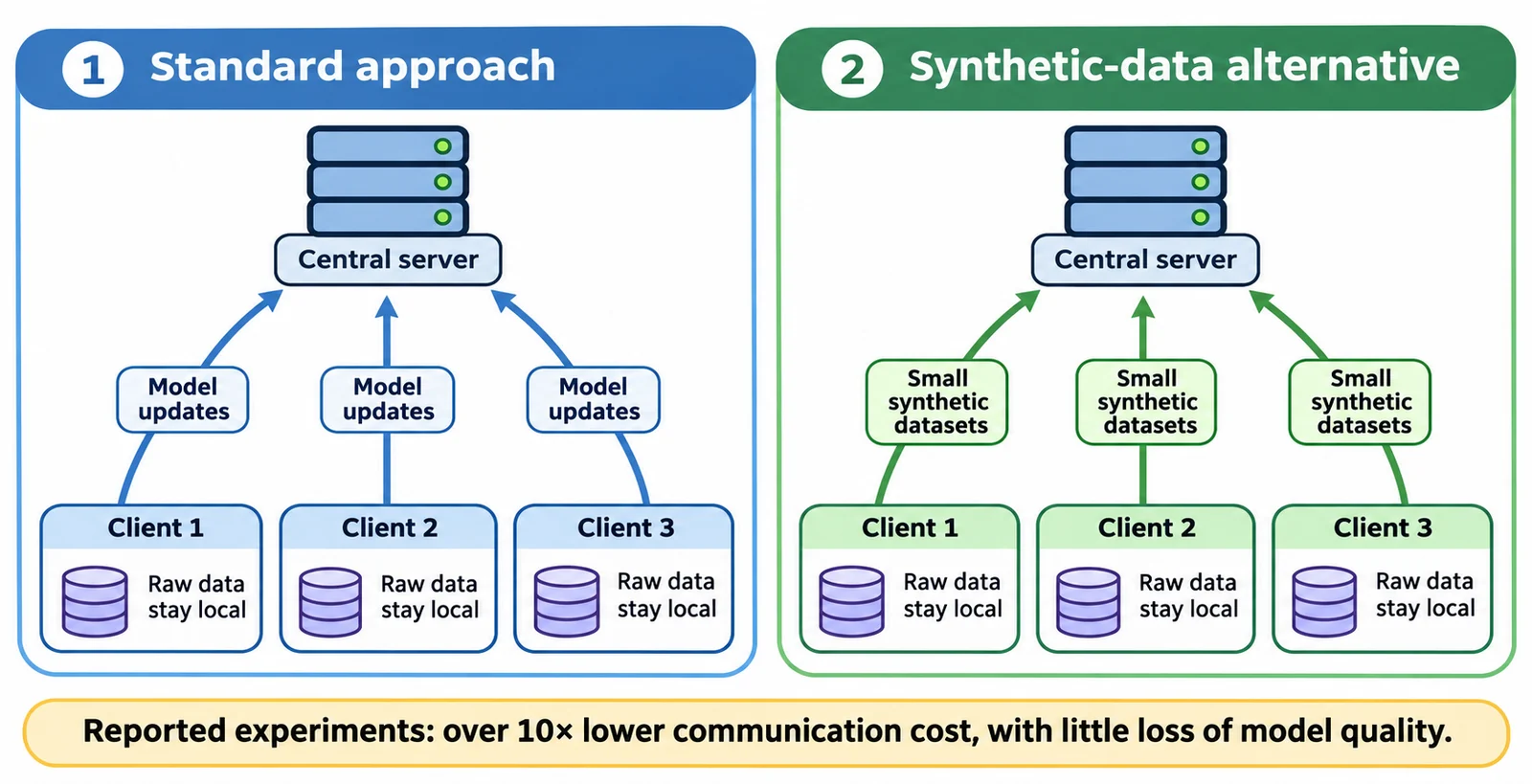
In federated learning, a model is trained across many clients without the clients sending their raw data to a central server. The standard method sends model updates, which for modern neural networks can run to millions of parameters and impose significant computational costs on clients. A 2020 alternative sends a small quantity of synthetic data to the server in place of a gradient update. Experiments pointed to a reduction in communication cost of more than one order of magnitude, with little loss in model quality.[30] A consumer-scale next-word prediction model was trained with federated learning and differentially private federated averaging, a method that adds noise so that no single user's contribution can be recovered from the trained model. That deployment measured unintended memorization end to end in a production training system.[31]
Replacing or supplementing real text with generated text raises a concern about training future models on their own output. Foundation model training sets are now so large that they include almost all data available on the Internet, and researchers expect future models to take in even more tokens. One response is to feed generated data back into training. That step raises a hazard called model collapse, in which a model is corrupted by its own rendering of reality.[32]
Research
Why researchers turn to generated records
Machine learning depends heavily on data, and real applications often run into data problems. Records may be of poor quality, and too few data points can lead to under-fitting of machine learning models. Access can also be blocked by concerns about privacy, safety and regulations. Synthetic data generation, the making of artificial records by computer, is offered as an alternative in these cases. It lets data be shared and used in ways that real-world data cannot easily allow.[33]
Medical diagnostics, remote sensing and low-resource languages are named as examples of data-scarce domains. Cost is one barrier, alongside privacy and simple scarcity.[34] When data are scarce or of poor quality, synthetic records can improve the performance of machine learning models.[35] In computer vision, obtaining enough images for a target task is often hard, and one workaround is to synthesize training images from scratch.[36]
Synthetic data are described as a way to address privacy concerns in machine learning applications. The stated aim is to keep the patterns and behaviors found in the original dataset while changing its actual content.[37] A 2019 survey reviews work on generating synthetic datasets with differential privacy guarantees, a formal promise about how much any one person's record can affect the output.[38]
A pipeline built for data-scarce domains was tested in healthcare imaging and industrial defect detection. That evaluation reported improved model accuracy and generalizability when synthetic data pipelines were used.[34] Simulation environments supply another route to hard-to-collect situations, including outdoor and urban scenes for autonomous driving and indoor scenes for navigation.[38] Synthetic data are also used to combat algorithmic biases in machine learning applications.[37]
A 2024 systematic review finds that current methods still carry drawbacks in computational requirements, training stability and privacy-preserving measures.[37] A 2019 survey also flags the synthetic-to-real domain adaptation problem, which arises when a model trained on artificial records meets real ones.[38]
Early uses in images, text and code
A 2018 study built face images from a 3D morphable face model. That model allowed full control over pose, illumination and background, and over the number of facial identities. Training on synthetic faces cut the amount of real training data needed for competitive face recognition. Combining large real datasets with synthetic images raised performance further, and pre-training on synthetic images caused no observed negative effects.[39]
A 2025 study addressed errors in optical character recognition, a process called Context Leveraging OCR Correction. The study fine-tuned a language model on synthetic data made with a character-level Markov corruption process. Models trained this way cut character error rate by 55% and word error rate by 32%, compared with the base model. The work released a dataset of 11,000 synthetic 19th century newspaper articles and a software library for creating corrupted text.[40]
A 2024 review in Radiology reports that synthetic images can enlarge and anonymize real scans, and can support new uses such as translating one imaging method into another and training radiologists.[41] A 2024 study tested whether medical vision-language pre-training, which learns from paired images and reports, can work on purely synthetic data. Mixing synthetic and real data added a further 9.07%.[42]
Hiring is one field where generated text has been used to fill sparse categories. A 2023 study used a commercial language model interface to write structured and unstructured resumes for specific job criteria. Two models were trained on an augmented dataset of 60 percent real resumes, taken from a job website, and 40 percent synthetic ones. The transformer model reached high accuracy, while a feedforward neural network scored lower.[43]
Legal question answering has been improved with generated training material. A 2025 study fine-tuned the Qwen-7B language model on synthetic data and added retrieval-augmented generation. The trained model improved on both answer accuracy and explainability. Human raters also judged its responses precise and easy to understand.[44]
A 2026 study extracted 1,467 frames from videos made by the diffusion-transformer model Sora, to classify strawberry leaf disease. Six lightweight networks were trained on these frames and tested on 618 real photographs. The best, ResNet-18, reached 98.71% on accuracy, precision, recall and F1-score. A statistical test found no significant difference between that model and a much smaller one, MobileNetV3-Small.[45]
Synthetic records for privacy and health research
Health records are tightly controlled, and that control can slow research, new products and new services. A 2023 review of the health care literature found seven use cases for synthetic data. They are simulation and prediction research, testing of hypotheses and algorithms, public health research, health information technology development, education and training, public release of datasets, and linking data. The review judged that real data remains the preferred choice, while synthetic data can help close gaps in access for research and evidence-based policymaking.[46]
Partially synthetic records keep the people who were actually surveyed but replace some values with draws from statistical models. A 2009 paper describes how to estimate the risk that a person in such a file is identified. Because the original records remain on the file, identification risks remain too. The estimates account for the released information from the multiple datasets, the model that generated the synthetic values, and the way values were chosen for synthesis.[47]
Synthetic data generation with differential privacy offers a newer way to release data that remains useful for analysis while the privacy of the people in it is preserved. A 2021 study evaluated several such algorithms using actual synthetic datasets created by contestants in a National Institute of Standards and Technology data challenge.[48]
Synthetic data cannot entirely remove privacy risks, as is also true of other anonymization methods. A 2023 framework called Anonymeter measures three privacy risks in synthetic tables: singling out, linkability and inference. Under data protection law, including the European General Data Protection Regulation, these three are key indicators that data have been truly anonymized. In experiments with deliberately inserted privacy leakages, the three risks scaled linearly with the amount of leakage. Synthetic data showed the lowest vulnerability against linkability, which indicates that one-to-one relationships between real and synthetic records are not preserved.[49]
A 2025 scoping review examined how researchers evaluate the privacy and utility of synthetic medical data. It found many methods for assessing utility but no consensus on which method is best in which scenario. Most studies in the review did not evaluate the privacy protection that synthetic data provided. Those that did often significantly underestimated the risks.[50]
A 2024 legal analysis argued that the line between personal and anonymised data is sometimes overlooked, which creates risks for individuals' rights and freedoms.[51] Another 2024 article noted that studies have recently raised worries about whether people can be re-identified from synthetic data. It argued for clear guidelines for generating and processing synthetic data, with priority on transparency, accountability and fairness.[52]
Synthetic records have been tested as a stand-in for real patient data in prediction models. A 2024 study made a synthetic version of the ever-smokers in the UK Biobank, using generators built specifically to preserve privacy. Prognostic models for lung cancer were then built under several assumptions about how data would be released. The study reported that synthetic data could serve at every stage of building a medical prognostic model, even if the real data were never accessed.[53]
A 2020 experiment trained five supervised machine learning models on synthetic versions of 19 open health datasets and tested them on real data. A total of 92% of models trained on synthetic data had lower accuracy than models trained on real data. Tree-based models trained on synthetic data showed accuracy deviations of 0.177 (18%) to 0.193 (19%), while other models showed deviations of 0.058 (6%) to 0.072 (7%).[2]
A 2019 validation study checked an open-source generator called Synthea against clinical quality measures. Of 1,193,439 synthetic Massachusetts patients, 394,476 were eligible for colorectal cancer screening and 248,433 (63%) were counted as compliant, against reported rates of 77.3% in Massachusetts and 69.8% nationally. Of 409 eligible patients, 0.7% died within 30 days after a COPD exacerbation, versus 7% in Massachusetts and 8% nationally. No synthetic residents had complications after hip or knee replacement, against 2.9% in Massachusetts and 2.8% nationally. The study concluded that Synthea models demographics and the probabilities of services being offered well, but models outcomes after services poorly.[54]
Public bodies have begun writing formal strategies for releasing synthetic records. Users at a workshop said low fidelity, unlinked datasets were useful for data discovery early in a project. Synthetic data can also train users in administrative data and allow earlier code development, reducing time spent in secure settings with real data.[55] A UK community group with more than 140 stakeholders from over 35 organizations produced the VSTAR Framework, with five principles: Valuable, Safe, Transparent, Accessible and Representative. The framework is meant to guide how synthetic datasets in trusted research environments are generated, evaluated and disseminated.[56]
Synthetic data in finance, industry and public planning
Financial firms use generated records to test investment strategies against market crashes too rare to appear in past price records. A 2024 article describes generative adversarial networks, or GANs, as a way to create such records.[57]
Retailers face legal and security problems when they train predictive models on raw customer data. A 2023 review examines generation frameworks for retail AI, including deep learning methods such as GANs and variational autoencoders. Fidelity is scored with Wasserstein distance and Jensen-Shannon distance. Utility is scored by performance on prediction tasks, using Accuracy, Lift and Conviction.[58]
A 2021 dataset covers heating, ventilation and air conditioning, lighting, plug loads, occupant counts and energy use at 10-minute intervals. It was built from 1395 annual simulations of a medium-sized reference office building from the U.S. Department of Energy. The simulations used 30 years of historical weather for Miami, San Francisco and Chicago, with three levels of energy efficiency. Assumptions about occupant movement, temperature preferences, lighting and plug loads were added to reflect realistic operations. The set is stored as a 1.2 TB compressed file and is meant for tasks such as energy model calibration and testing load prediction algorithms.[59]
A 2023 project released an open-source synthetic population for Canada at a fine geographical level, for 2021, 2023 and 2030. It was based on 2016 census data and population projections and records age, sex, income, education, employment and location, with people grouped into households. A comparison of the 2021 synthetic population with 2021 census data across several areas supported its reliability. Users can extract zones to explore what-if scenarios and can run the code to generate populations up to 2042.[60]
What the evidence means for research practice
One validation study replicated a published colon cancer trial analysis on synthetic data from 1543 control-arm patients.[61] A separate test with GPT-4o produced 6,166 case files that matched real perioperative data on 12 of 13 parameters.[62] Yet a comparison of thirteen language models found that some produced synthetic medical text that a classifier could easily tell apart from real text.[63]
In one engineering education study, synthetic transcripts raised a classifier's average accuracy from 68.4% to 81% with Llama 3.1. The same models sometimes added extraneous details and missed instructor-led discussion, so the gain came with known flaws.[64] A thermal tracking study found that a network trained on synthetic data beat one trained on available real data, and combining both sources improved results further.[65]
A 2024 review of language models and synthetic health data lists evaluation metrics and data efficiency among six directions for further study.[66] Wider use of synthetic data in health and life sciences still needs more education, research and policy work.[67]
Evaluation metrics and quality benchmarks
Because synthetic data can be judged in several unrelated ways, researchers usually report more than one measurement rather than a single score.[68][69] One family of measures asks how closely a synthetic set matches the real data statistically, for example by comparing the shapes of distributions and the correlations between variables. A 2024 case study of financial records from Polish limited liability companies for 2020 compared two generators. CTGAN is a generative adversarial network, in which one network learns to produce data and another learns to spot fakes; TVAE is built on autoencoders, networks trained to compress data and rebuild it. The overall quality score favoured TVAE, yet closer inspection showed that CTGAN kept the statistical properties of the real data better, while TVAE did better on a principal component analysis, a method that compresses many variables into a few summary directions. The study's recommendation was to generate data with several algorithms, evaluate each result and then choose the best option.[69]
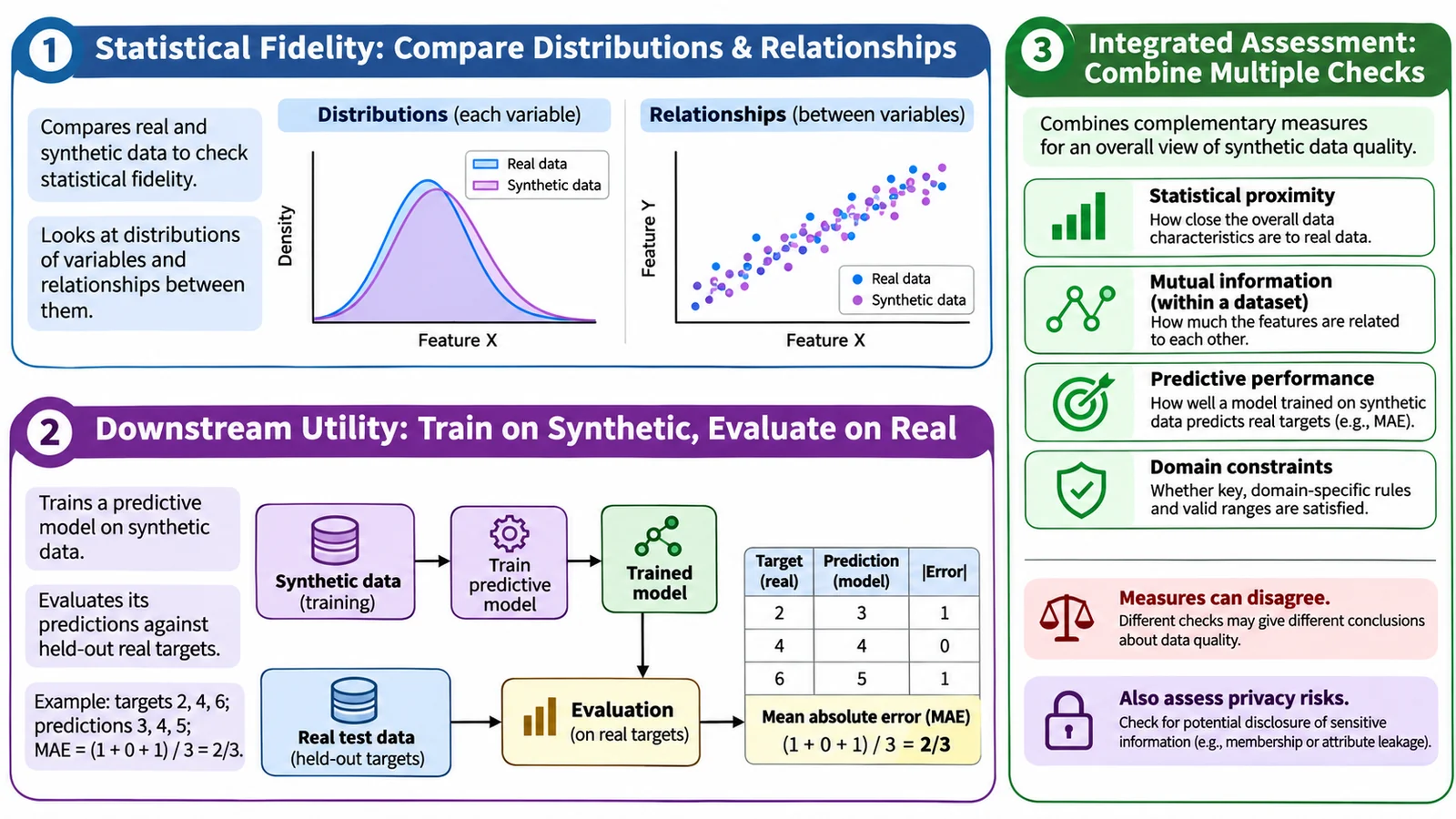
A second family measures downstream task performance: a model is trained on synthetic data and then tested on real data.[68][70] In weather and climate modelling, a copula-based generator (a copula is a function that ties separate variables together into a joint distribution) improved the mean absolute error of a neural network emulator by up to 62 %, from 1.17 to 0.44 W m−2.[71] For image recognition, adding samples from a fine-tuned text-to-image diffusion model to the ImageNet training set produced significant gains in classification accuracy over strong ResNet and Vision Transformer baselines.[70] Synthetic images can also stand in for a held-out validation set when real data is scarce, provided the synthetic error estimate is first calibrated to match the real domain.[72] A 2022 study of text-to-image models examined both data-scarce classification and large-scale pre-training for transfer learning, and reported shortcomings alongside the benefits.[73]
A third approach folds several criteria into one integrated score. One 2026 algorithm for medical synthetic data combines statistical proximity measured by KL-divergence (a measure of how much one probability distribution differs from another), mutual information between characteristics, predictive efficiency and subject-specific constraints in a single functional. On its tests the synthetic data gave a KL value of 0.6035 and a mutual information value of 0.0072, a model trained on it reached 80.4 % accuracy, and the domain matching criterion scored its maximum of 1.0.[68]
No single metric settles the question because the measures can point in different directions and because synthetic data carries its own risks.[74][69] A 2025 mixed-methods analysis reported that synthetic data raised hallucination rates by a factor of 4.7 while improving resistance to perturbation by 23 %, with factual mistakes in 22 % of natural language outputs and clinically dangerous errors in 3.7 % of healthcare incidences. The same analysis found that hybrid data regimes with no more than 60 % synthetic content cut mistakes by 41 % without loss of performance.[74] A 2024 review of large language models for text classification likewise listed developing metrics for assessing synthetic data quality as an open research gap.[75]
Synthetic images and video for vision systems
Synthetic images and video are used mainly to train computer vision models, the deep learning systems that detect and classify objects in pictures, when real footage is costly to annotate, unbalanced or restricted by privacy rules. A 2024 review of video surveillance applications names the tasks that synthetic training data now serve: crowd counting, detection and tracking of objects and pedestrians, behaviour analysis, person re-identification, and face recognition. The review notes that surveillance footage is typically captured under unconstrained conditions and that models must often work across different scenes, which makes synthetic training data more attractive in this setting.[76]
In one evaluation, synthetic images made up as much as 75% of the training data while model performance stayed in the same range as with 100% hand-annotated real images.[77] A 3:1 mix of hybrid data raised that model to 90.3% mAP@50, better than equal amounts of real and synthetic data, and an attention-augmented variant, YOLOv8-CBAM, reached 91% at 50 epochs, 0.7% above the baseline.[78]
Synthetic data can also carry a model from simulation to real footage. A convolutional neural network trained only on generated drone images, with textures, backgrounds and orientations varied at random, classified three drone models in real videos with 92.4% overall accuracy, 88.8% precision, 88.6% recall and an f1 score of 88.7%.[79] For traffic signs, augmenting a small real dataset with images from a generative adversarial network, a pair of networks that learn to produce realistic pictures, raised recognition accuracy to 84.9% on YOLO V3 and 89.33% on YOLO V4.[80]
Generated records in science and engineering
A 2019 study of crumpled thin sheets trained machine learning models on a scarce experimental dataset of crease networks, then added simulated data from rigid flat-folded sheets, a simpler system that shares statistical properties with the experimental one. The added simulated data improved the model's predictive power on a pattern completion test, showing that learning can work when experimental data are good but scarce.[81] Seismic and other waveform work faces a related problem. Networks trained on synthetic waveforms have labels that are easy to obtain, yet synthetic records often miss the source signature, noise and reflectivity of field data. Performance then drops when the model is applied to real recordings. One proposed remedy applies linear operations to both training and application data so that their distributions match, and the method was demonstrated on passive seismic data for locating microseismic event sources and on active seismic data for predicting low frequencies.[82]
Deep learning has also been used for seismic inversion, the problem of inferring subsurface structure from recorded waves. A 2023 study paired a conditional generative adversarial network, a model that learns to produce data resembling its training examples, with a mathematical method for generating many multi-stratified heterogeneous velocity models, and the resulting system reconstructed velocity models from a single seismic shot. The method was reported to carry over to linear multi-layer models, to curved or folded structures, to structures with salt bodies, and to finer structures built from geological images.[83]
In atomistic machine learning, a 2022 study labelled a large dataset with per-atom energies taken from an existing machine learning potential model rather than from quantum-mechanical calculation, which is far more expensive. Cheap labels made it possible to generate millions of datapoints. That volume supported a detailed comparison of regression frameworks and an exploration of visualisation from learned representations. Learning from the synthetic labels also served as a pre-training step before fine-tuning on small datasets.[84]
A 2024 method called Synthetic Wells used a probabilistic autoregressive synthesizer to simulate groundwater level time series for approximately 100 wells from the US Geological Survey's National Water Information System. It reached a quality score of 70.94%, and a case study in Mississippi, USA, found that the synthetic data improved the accuracy of time series forecasting models.[85] For streamflow, a 2023 study added synthetic data to the observed training set of a random forest model with a regression enhancement. The synthetic cases came from the physically based Iber model, run on synthetic precipitation of different return periods. For streamflow values larger than a three-year return period, the combined model's root mean squared error and percentage bias fell by 23.1% and 38.7% respectively compared with a model trained only on observed data, and the utility of the model rose by 10.5%.[86] In the energy industry, a 2022 conference paper described generating synthetic images with 3D rendering software such as Blender and Unity for visual inspection tasks. These included flange integrity and classifying lever positions as open or closed, and the trained models were checked against a relatively small subset of real labelled images.[87]
Fusion research offers a case where the target device has no experimental data at all. For the upcoming ITER tokamak, a machine that confines hot plasma with magnetic fields, experimental data should be entirely unavailable at first and disruptive discharges should be strictly avoided thereafter, which conflicts with the large data needs of deep learning. A 2026 study trained a disruption prediction model on data from the EAST tokamak and tested it without further training on the J-TEXT tokamak, where it reached an area under curve, a standard measure of classification performance, of 0.52 across 1578 real J-TEXT discharges. Adding synthetic diagnostic data generated from only 18 J-TEXT magnetohydrodynamic simulation cases raised the area under curve to 0.61, while adaptation using the same number of real J-TEXT cases reached 0.71. A performance gap therefore remains between synthetic and real target-device data, though the synthetic pipeline was judged able to supplement scarce experimental data.[88]
Tabular data, imputation and simulation models
Missing values can be inserted in only one feature (a univariate configuration) or in several features (a multivariate configuration), at different missing rates. Because the way gaps are created sets the basis for any imputation experiment, the review argues that an ill-defined setup can make the conclusions drawn from it invalid.[89]
Spatial microsimulation builds a synthetic population of individuals for each small area and then predicts how policy changes might affect them; a 2009 study of a city found that area-specific synthetic populations gave more accurate population estimates for future policy work than traditional global configurations.[90] A 2023 dataset of city-scale individual vehicle trips, generated from historical trip records, matched the real data at the aggregated level and was judged reasonable from the individual perspective.[91] A 2024 study trained a decision tree on a mix of synthetic and actual patient records for dengue hemorrhagic fever, varicella and COVID-19 and reached 91.98% average accuracy, higher than training on real data alone.[92]
A simulator can also fix in advance the patterns that are later reported as detection findings, and a 2026 tax-risk benchmark states this risk plainly. That study's simulator follows a specified mechanism: it enforces given income-statement and balance-sheet identities, builds a panel of 10,000 firms over three years, and injects four risk strategies set in advance. It uses no administrative audit data. Raw CTGAN failed both row-level accounting identities, while deterministic projection restored 100% validity but worsened dependence fidelity. At 1% prevalence, XGBoost held ROC-AUC at 0.9720 while PR-AUC dropped to 0.6703, and the study gives this drop as the reason metrics sensitive to prevalence are needed.[93]
Synthetic data in healthcare and rare disease
Synthetic patient records are generated by simulation, built to mirror the properties of an original dataset, and they are used in healthcare where real records are scarce, restricted or imbalanced.[94][95] The pharmaceutical industry has begun to treat such records as a way to improve data utility and sharing in response to growing demands for privacy.[94] Generative models including generative adversarial networks, variational autoencoders and Gaussian mixture models can produce records that reproduce the statistical properties of real patient data while keeping patients from being identified.[96][95] Clinical use faces higher stakes, potential liabilities and distrust from practitioners than comparable uses in finance and economics.[97]
Rare disease research is a particular target, because limited patient numbers and strict privacy rules that block data sharing have long held back analysis.[96] In silico clinical trials, meaning trials run partly by computer simulation, use virtual cohorts of patients generated as synthetic biomedical data to reduce this burden, in line with the 3R principles of replacement, reduction and refinement in animal experimentation. The US Food and Drug Administration acknowledges that for many novel devices, practical limits call for other routes, among them computer modeling and engineering tests, in place of large randomized studies.[98]
Sensor traces from homes can be simulated as well. One method trains hidden Markov models and regression models on real annotated smart home data, and its time series score as more realistic by distance measures than random data, data from another home, or data from another time period. Where ground truth is scarce, semi-supervised learning with that generated data raised activity recognition accuracy above what the small real dataset gave on its own.[99] On an immunotherapy dataset, a random forest classifier scored 81% precision, 82% recall, 81% f-measure, 88% accuracy, 95% sensitivity and 60% specificity on real data. With synthetic data added, the same measures rose to 91%, 96%, 93%, 93%, 96% and 73%.[100]
The privacy case rests on generation that preserves statistical structure without exposing individual records, and differential privacy combined with federated learning has been proposed as further protection against breaches and re-identification.[96] Privacy risks remain, including misuse of data and the chance that generated records can be traced back to the people they describe.[97] Bias in generative models, the ethics of synthetic records in care, and the tradeoff between fidelity to real data and privacy are open concerns.[96] Proposed safeguards include differential privacy, a documented chain of custody for each dataset to preserve integrity and traceability, and regulators who promote transparency and accountability.[97]
In practice
Augmentation and oversampling of scarce classes
One common use of artificial records is to enlarge a training set that is too small or too lopsided, a practice known as data augmentation.[101][102] In deep learning, augmentation means generating artificial data so that the classifier varies less from sample to sample, with the aim of reducing the number of errors.[101] A class is imbalanced when its categories are not approximately equally represented, so that most examples are normal and only a small percentage are abnormal or interesting. Misclassifying an abnormal example as normal often costs much more than the reverse error, which is why a lopsided training set matters beyond its raw proportions.[103] Data limitations can also come from regulatory restrictions, privacy concerns and the plain scarcity of relevant records, and these constraints often produce class imbalance in classification tasks.[104]
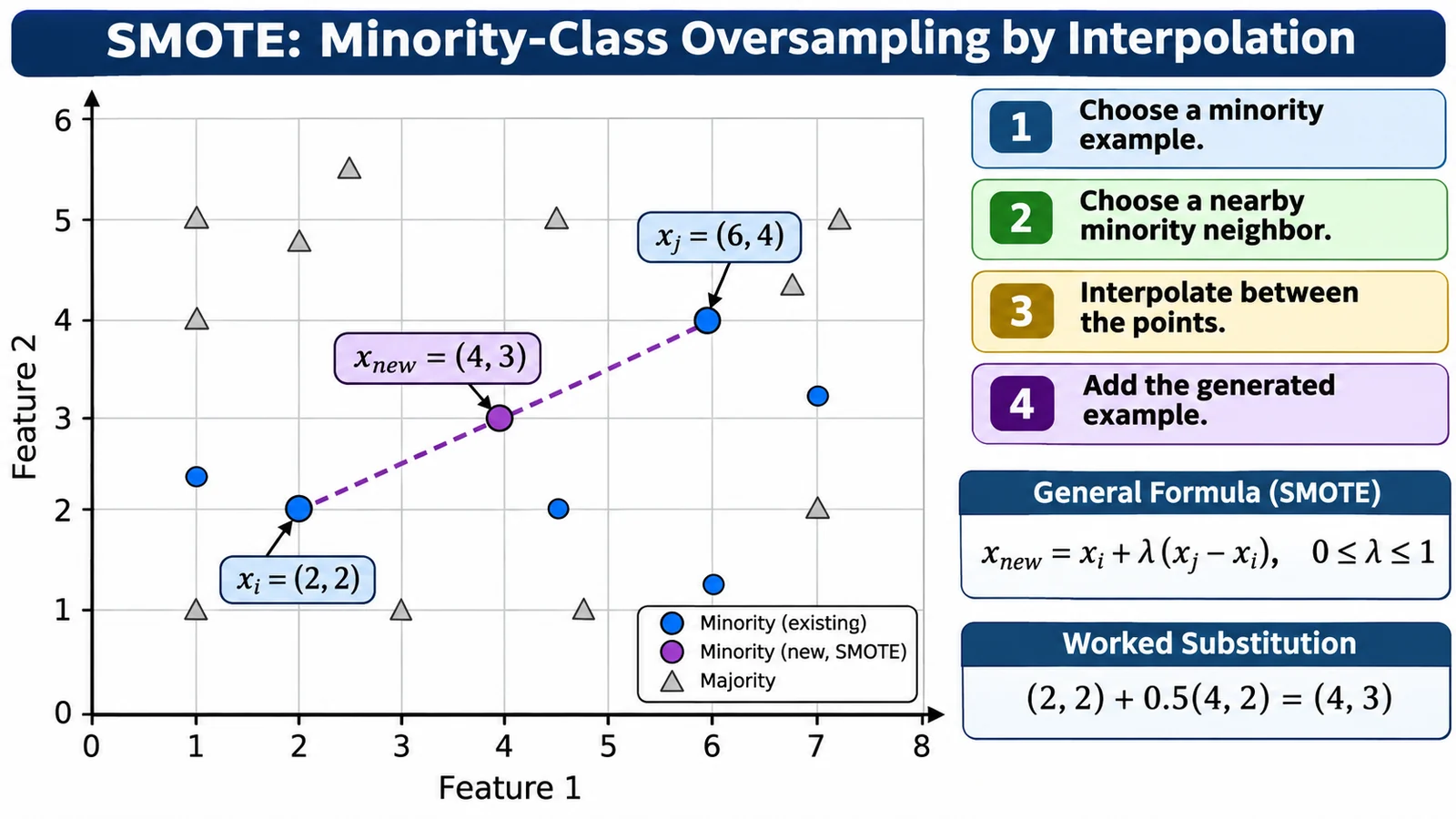
SMOTE, the Synthetic Minority Over-sampling Technique published in 2002, creates new examples of the minority class rather than copying existing ones. Pairing this minority over-sampling with under-sampling of the majority class produced better classifier performance in ROC space than under-sampling the majority class on its own. The same combination also outperformed varying the loss ratios in Ripper or the class priors in Naive Bayes.[103] Later work grouped such generators into two families: distance-based shallow models, which place new points in the local space between existing points, and deep generative models that estimate a probability distribution and sample from it. On smaller datasets deep generative models often struggle to estimate the distribution of the whole data, and a hybrid approach that mixes the two families was reported to perform favorably against other current hybrid methods on benchmark datasets.[104]
A related framework called model-based synthetic sampling fits regression models to the links among features and keeps the generated records varied. Across 13 datasets compared with 10 methods, that approach was reported as both comparative and stable.[105] For time series, ordered sequences of measurements, augmentation had not been investigated thoroughly for classification, even though small datasets that overfit could potentially benefit. Experiments on the UCR time series benchmark used a method based on the Dynamic Time Warping distance, a way of measuring similarity between sequences that may run at different speeds. That method could drastically increase a deep convolutional network's accuracy on some datasets and significantly improve it when used in an ensemble.[101]
Simulators, procedural rendering and industrial test data
Industrial platforms often refuse to share sensor and machine data, and in that situation the only option may be synthetic data obtained by simulation. Simulated data can fail as research material when its quality is poor or its quantity is limited, and algorithms tested on such data do not give credible results. One proposed remedy is a mathematically grounded quality assessment built around the specific problem to be solved, here a multivariate prediction whose results feed a binary classification. The assessment checks the predictive power of the independent variables, applies threshold values set by a human assessor, and, if all assumptions pass, treats the data as suitable for research.[106]
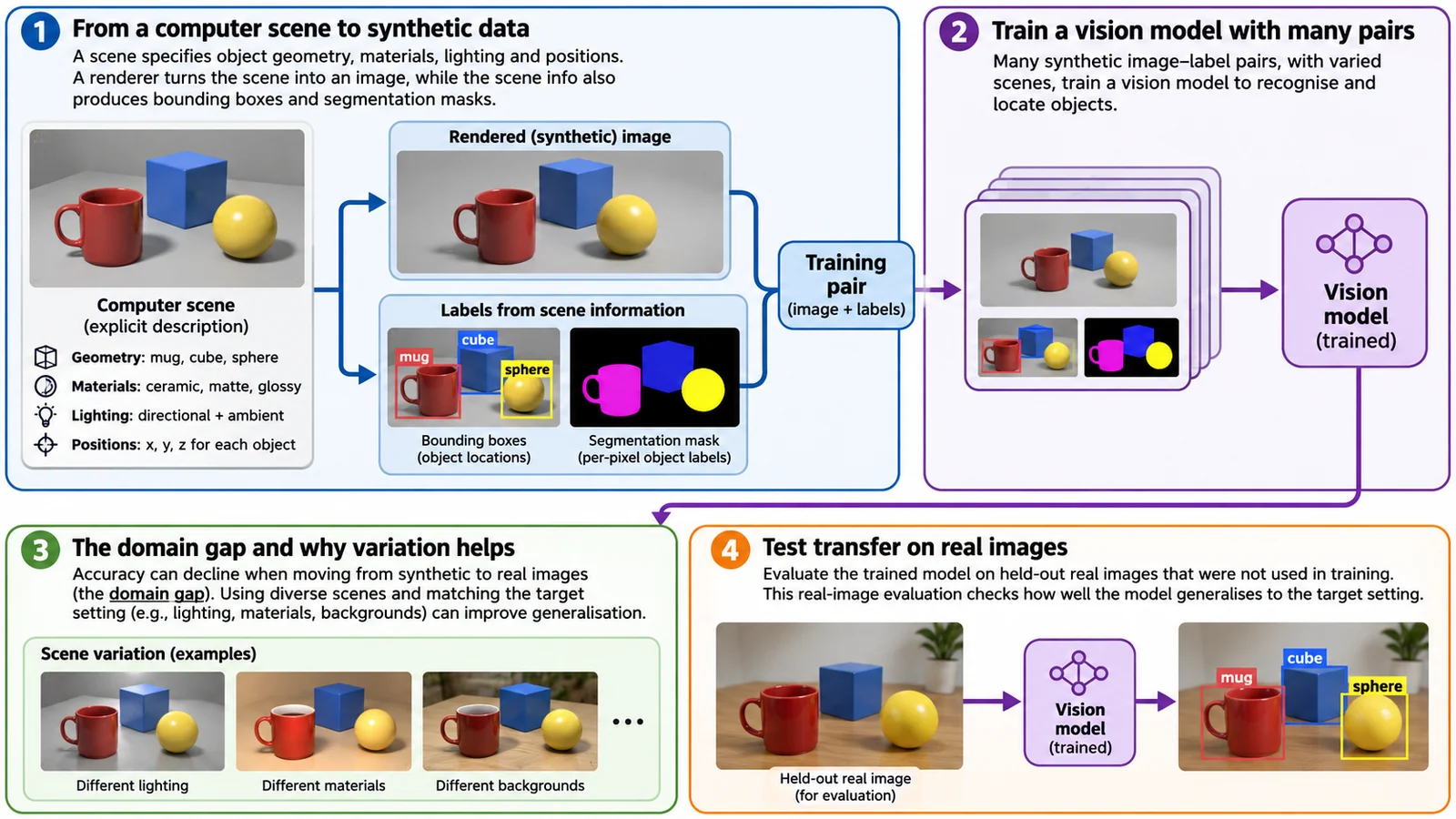
Rendering pipelines build labelled images from computer models rather than from cameras, which matters because creating large labelled datasets by hand is tedious, time consuming and expensive, especially in low-volume high-variance manufacturing. CAD2Render is a synthetic data generator for training object detection and pose estimation models in industrial settings, built on a GPU-accelerated rendering pipeline.[107] A procedural approach to world modeling, combined with physically accurate image synthesis, departs from hand-modeled virtual worlds and approximate image synthesis used in real-time applications. That approach gives image synthesis that is flexible, physically accurate and scalable, covers many classes and features without listing them, and allows complete introspection of the data for annotations. Together these support quality and cost efficiency. Evaluated on semantic segmentation for autonomous vehicles and robotic navigation, it improved network performance, and even modest implementation efforts produced state-of-the-art results.[108]
A model trained on synthetic inputs usually loses accuracy on real inputs, a shortfall called the domain gap. Experiments used the Dataset of Industrial Metal Objects (DIMO), which holds both real and synthetic images. Its synthetic part includes exact copies of the real data and copies in which certain aspects were randomised, so the work could identify which kinds of variation help synthetic training data and which aspects should closely match the target data. The experiments also examined which training techniques aid generalisation to real data and how real images can be used when training on synthetic images, with all results validated on real data and benchmarked against models trained on real data.[109] A depth-completion method sidesteps part of the gap by learning natural shapes from sparse depth alone, without images, so that transferring the learned model from synthetic to real data is not affected by covariate shift, a change in the input distribution between the two settings.[110]
A systematic review of 86 peer-reviewed articles published since 2020 sorts synthetic data techniques for predictive maintenance into four groups. These are data augmentation, generative models, physics-based simulations with hybrid approaches, and feature-based transformations. That review finds hybrid and physics-informed models particularly valuable in safety-critical domains. Such settings demand transparency of the model and conformity to physical laws.[111]
For power systems, a top-down stochastic model generates synthetic load profiles of flexible duration and time resolution by clustering users with Ward's hierarchical clustering and building, for each cluster and season, a time-inhomogeneous Markov chain whose states map to a time-varying power consumption range. Across three datasets, the median values of the synthetic profiles' mean and standard deviation usually stayed within ±10% of the values for the original reference distributions. Some significant outliers did occur.[112]
Synthetic patients and electronic health records
A synthetic patient is a simulated record built by a program rather than taken from a real person, and several systems now produce them at scale. The project released one million synthetic patient records online in standard health data formats, including Health Level-7 Fast Healthcare Interoperability Resources, with access through an application program interface. The design allows additional disease and treatment modules to be added by a user community, so the generated records are meant to become more detailed over time.[113]
Statistical approaches offer an alternative to hand-built simulators by learning the structure of real records and sampling from it. One method learns a Bayesian network, a probabilistic graph in which each variable depends on a small set of others, and then simulates patient records from the learned structure. Tested on public heart disease and diabetes datasets and on a critical care diagnoses database, the Bayesian network model outperformed or equaled the comparison method, called medBGAN, on all key metrics. Clear gains appeared in capturing rare variables and preserving association rules. The authors reported that the generated data resembled the original closely with minimal disclosure risk, and that the approach offered transparency, computational efficiency and support for more data types.[114] A 2020 evaluation compared three families of generators, namely probabilistic models, classification-based imputation models and generative adversarial networks, on cancer registry data covering more than 360,000 cases of breast, respiratory and non-solid cancers diagnosed between 2010 and 2015.[115]
Longitudinal records, which follow the same patient across many visits, pose harder problems because clinical decisions mix continuous measurements with discrete codes. EHR-M-GAN, a generative adversarial network, was built to synthesize mixed-type time series in one pass, and it was validated on three public intensive care databases holding records from a total of 141,488 unique patients. Prediction models for intensive care outcomes performed significantly better when their training data were augmented with the generated time series.[116] In hematology, a conditional generative adversarial network produced synthetic cohorts for myelodysplastic syndromes and acute myeloid leukemia from 7,133 patients, including clinical features, genomics, treatment and outcomes. Starting from 944 patients with myelodysplastic syndromes recorded since 2014, the team generated a cohort enlarged by 300 percent and anticipated a molecular classification and scoring system that later work derived from 2,043 and 2,957 real patients. A synthetic cohort built from 187 patients treated with luspatercept in a trial reproduced all of the study's clinical end points.[117]
Quality is the recurring weakness of these systems, and drift is one form of it. A 2022 study reported that simulated longitudinal records drift from the real data distribution over time, and that the usual check, in which a critic model tries to tell real records from synthetic ones, often fails to flag poor simulations. The proposed framework, LS-EHR, was tested on records from Vanderbilt University Medical Center and the All of Us Research Program. Its improved critic raised the area under the receiver operating characteristic curve, a measure of how well real and synthetic records can be told apart, from 0.655 to 0.909 on the Vanderbilt data and from 0.692 to 0.918 on the All of Us data. With that critic guiding generation, the discrimination score of the generated data fell from 0.909 to 0.758 and from 0.918 to 0.806, which the authors read as better simulated records.[118]
Reviews of the field describe a young literature with uneven evaluation.[119] A 2024 review of open-source tools found deep learning generators in 72.6 percent of the included studies and 75.3 percent of generators implemented in Python.[4] A 2023 survey of healthcare synthetic data warned that synthetics can introduce flaws and blind spots and can propagate or exaggerate biases even as they support privacy, equity and safety.[120] A 2025 review of conditional generative models, which produce records conditioned on chosen patient features, noted two limits of real medical datasets: narrow patient diversity and no way to simulate hypothetical outcomes. Technical, medical and ethical challenges remain before such models can be deployed safely.[121]
Differential privacy and formal privacy guarantees
A systematic review of 105 recent studies of privacy in synthetic data generation found differential privacy to be the most common privacy-preserving technique, and found the privacy budget, the setting that fixes how much privacy is spent, to be the usual measure of the trade-off. The review also reported that a high percentage of the implementations it examined were based on generative adversarial networks, a pair of competing neural networks in which one proposes records and the other judges them, and that healthcare was the main field of application.[17] A 2020 framework for judging private synthetic data treats data quality as a subjective concept. It measures quality along two dimensions: against the training data or against an underlying population, and by general similarity of distributions or by performance on specific tasks such as inference or prediction.[122]
Privacy and fidelity pull against each other, and the size of the privacy budget sets how far a release can lean toward one or the other.[122][123] The 2020 framework states that meeting every quality goal at once is a formidable challenge and invites researchers to advance the frontier between privacy and quality jointly.[122] A 2026 theoretical treatment describes differential privacy as forcing basic trade-offs in synthetic data generation between privacy and statistical fidelity. That work introduces PubMix, a mechanism that builds public data directly into the privacy mechanism rather than using it only in pre-processing or post-processing, and its experiments show significantly better synthetic data quality than mechanisms that ignore the data domain.[123] A 2018 method called the pMSE mechanism maximizes the distributional similarity of the synthetic data to the original data under epsilon-differential privacy, and it relaxes common differential privacy assumptions about the distribution and boundedness of the original data. Simulations in that work compared the accuracy of linear regression coefficients from the synthetic data with non-private synthetic data and with other differentially private methods.[18]
Some guarantees come with explicit error bounds rather than only an empirical comparison.[124][125][126] AIM, a 2022 algorithm, selects queries, measures them privately, and generates synthetic data from the noisy measurements, iterating toward the most useful measurements for a given workload of queries. It also gives analytic expressions that bound per-query error with high probability, so that confidence intervals can be constructed. McKenna and colleagues report that AIM consistently outperforms many existing mechanisms across a range of experimental settings.[124]
A 2026 mechanism, Adaptive Pruned-PMM, is pure epsilon-differentially private and combines private depth selection with a pruned variant of the Private Measure Mechanism of He and colleagues from 2023. For datasets of size n on the unit cube in d dimensions with d at least 2, existing pure epsilon-differentially private mechanisms achieve expected 1-Wasserstein error of order (epsilon n) to the power minus 1/d. The paper calls this rate optimal in the worst case but overly pessimistic when the data lie on a lower-dimensional set. Under a multiscale packing-growth condition with dimension k, the expected 1-Wasserstein error is of order (epsilon n) to the power minus 1/k for k greater than 1 as n grows, and a matching lower bound shows the exponent 1/k is sharp within that framework.[125] That framework was developed because accurately generating private synthetic data of certain kinds is known to be NP-hard, and it is presented as a way around the computational hardness of the problem.[126]
What this looks like in practice
A team studying job-description classification faced sparse samples in many job categories, so it used the OpenAI API to write structured and unstructured resumes to specified criteria. The resumes were cleaned and preprocessed, then used to train a transformer model (BERT) and a feedforward neural network with Universal Sentence Encoder 4 embeddings. The authors read this as support for augmenting real data with generated resumes when training samples are limited.[43]
Researchers testing synthetic clinical records used Synthea, an open-source generator, to build a cohort of 1,193,439 Massachusetts patients. They computed four clinical quality measures on that cohort and compared the rates with publicly reported Massachusetts and national figures. Colorectal cancer screening compliance came out at 63 percent, against 77.3 percent in Massachusetts and 69.8 percent nationally. The authors concluded that Synthea models demographics and service probabilities well but does not capture deviations in care and their outcomes.[54]
A privacy study compared synthetic data publishing with earlier anonymisation techniques across a range of state-of-the-art generative models. The evaluation found that synthetic data either fails to prevent inference attacks or fails to retain data utility. Because it is impossible to predict which signals a synthetic dataset keeps and which it loses, the privacy gain varies widely and the utility loss is unpredictable. Stadler, Oprisanu and Troncoso conclude that synthetic data falls well short of being the ideal answer to publishing data while protecting privacy.[127]
Later developments
What model collapse is
Model collapse is the name for a decline in a model's performance that appears when a new model is trained on synthetic data made by an earlier model. The new model's output then feeds later models, and the cycle repeats in what researchers call a recursive training loop.[128] A 2024 study in Nature gave the effect its clearest description and reported that it appears in several kinds of learned generative models.[3]
The most visible symptom is the loss of the tails of the original distribution, meaning the rare and unusual cases at the edges of the data.[128][3] As those tails disappear, later generations of models forget the initial real distribution they were first built from.[128]
A 2024 statistical analysis of language models reached a firm conclusion about training on generated text alone. When training uses only synthetic data, model collapse cannot be avoided, according to that analysis. Mixing real and synthetic data changes the picture, and the analysis gives an estimate of a largest share of synthetic data below which collapse can eventually be avoided.[128]
A 2025 note reports two different long-run behaviours, depending on whether an outside source of samples also contributes, even a small one.[129] A 2025 probabilistic study treats recursive training as a random walk of the model estimate, a path that drifts step by step. In that view, the sample size at each step sets the size of the step, and the estimation method sets its direction and bias. The study concludes that collapse can be prevented only if the sample size grows at every training step.[130]
A 2024 paper on the rate of collapse examined simple distributions under maximum likelihood or near maximum likelihood estimation. For discrete distributions, the time to forget a word depended roughly in a straight line on how often that word appeared in the original corpus. For Gaussian models, the spread of the distribution fell to zero after roughly n iterations.[131]
Model collapse is a training-dynamics problem, and a 2026 paper separates it from AI slop, which is a problem of content quality.[132] The 2024 Nature study noted that data on genuine human interactions with systems will grow more valuable as generated text spreads across the web.[3]
How large the collapse effect is
A 2026 study in Management Science fine-tuned large language models on machine translation, a language task with established scoring methods. Training on text generated by the model itself or by other models handicapped the performance of fine-tuned LLMs. Three remedies helped somewhat: keeping only high-quality generated text, mixing text from several models, and favoring generated text that resembles human text. The picture was not uniform: on a creative ideation task, fine-tuning on model-generated ideas with human preference ratings improved performance.[133]
A 2024 theoretical study described collapse as a change in scaling laws, the regular patterns that relate model size and data size to performance. The framework predicted several distinct decay patterns, including loss of scaling, scaling that shifts with the number of generations, and the un-learning of skills. It also predicted grokking, a sudden jump in performance, when human and synthetic data are mixed. Large-scale experiments with a transformer, a common neural network design, on an arithmetic task and on text generation with the Llama2 model supported the theory.[134]
A 2024 study in Political Analysis asked the chatbot ChatGPT to play different personas and rate 11 sociopolitical groups on a feeling thermometer. The average scores came close to averages from the 2016 to 2020 American National Election Study, a large national survey. The spread of responses was narrower than in the real surveys, however, and regression coefficients often differed significantly from the survey estimates. Small changes in prompt wording shifted the distribution of answers, and the same prompt gave significantly different results over a 3-month period. The study concluded that such synthetic survey data raise serious concerns about quality, reliability and reproducibility.[135]
Why the damage happens
Under mild conditions, the sample size at each training step must grow to prevent collapse, the 2025 analysis shows. When the estimation is unbiased, the required growth follows a superlinear pattern.[130] A 2026 theoretical paper frames the same problem as a trade-off between using synthetic data and keeping model performance. In some cases, the best weight for real data was the reciprocal of the golden ratio.[136]
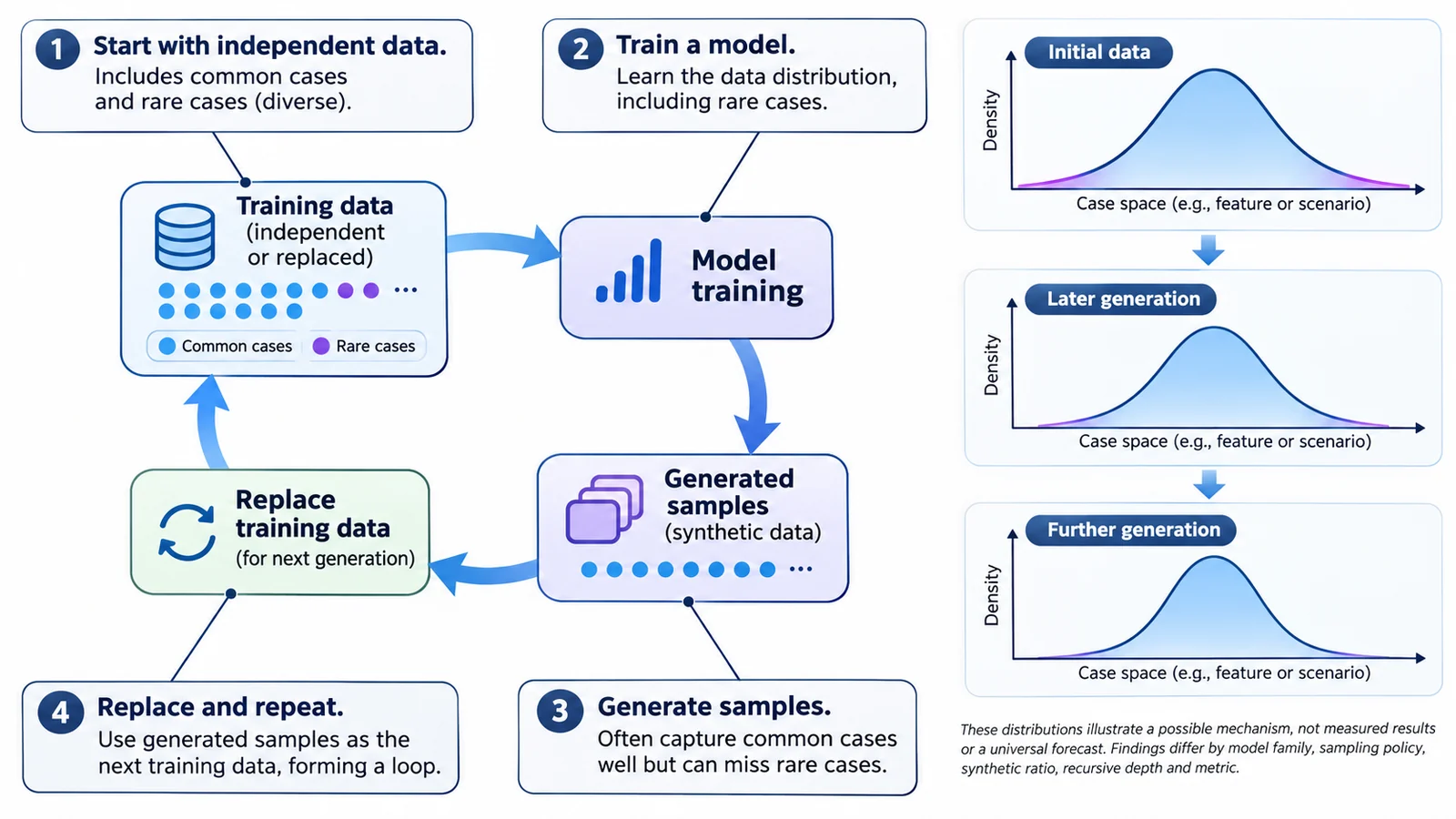
Models trained recursively on their own increasingly homogenized output show diversity collapse, a 2026 study reports.[137] The 2026 review links repeated replacement of independent observations with unverified outputs to tail loss and declining diversity. Studies of recursive image generation report a further shift toward memorization, repeating stored examples rather than generating new ones.[138]
A 2025 study trained vision-language models, which pair pictures with captions, and text-to-image diffusion models in recursive loops. Collapse appeared there too, but with distinct features, including improved vision-language alignment and increased variance in image captioning.[139] The 2026 review cautions that findings differ by model family, by sampling policy, by synthetic ratio, by recursive depth and by metric.[138]
Conditions that make collapse worse or milder
A 2024 study introduced a measure of synthetic dataset diversity and ran controlled experiments with models of 350M and 1.4B parameters. Higher scores on that diversity measure went with better performance in both pre-training and supervised fine-tuning. The same study found that diversity in pre-training affected later fine-tuning more strongly than it affected pre-training itself, even for the smaller models.[140]
A benchmark called AgoraBench synthesized 1.26 million training instances using 6 language models and trained 99 student models on the results. The generators showed distinct strengths: one model excelled at writing new problems, while another performed better at improving existing ones. A model's skill at producing data did not necessarily track its skill at solving problems. Response quality, perplexity (a measure of how surprised a model is by text) and instruction difficulty together predicted data quality better than problem-solving scores did.[141]
In one 2025 study, generated mathematics questions covering linear algebra and abstract algebra were used to fine-tune GPT-3. Accuracy rose by roughly 18.2 percent on an abstract algebra benchmark, by about 1.6 times on a linear algebra theorems benchmark, and by approximately 24.0 percent on linear algebra calculations. Smaller models of 7B parameters showed around 2 times accuracy gains on linear algebra calculations after similar fine-tuning.[142] Template-based question generation carries its own limits, including the risk of overfitting (fitting the training examples too closely) and the constraints of pre-defined templates.[143]
A 2026 conceptual analysis argues that synthetic data cannot be defined by contrast with other kinds of data.[144] The 2026 collapse study reports that confidence-aware training objectives substantially delayed the onset of collapse rather than preventing it outright. Its authors also released an open-source benchmark for studying collapse in mixed-data settings, so the conditions can be tested rather than assumed.[145]
Ways to prevent or slow collapse
Model collapse is the severe loss of performance seen when a model is trained on data made by earlier models, and several countermeasures have been proposed. One option is to keep real data in the mix at every round of training.[136]
Iterative self-training, in which a language model keeps training on its own output, tends to produce increasingly alike synthetic data. Earlier selection methods raised diversity but used fixed rules that could not react as the model and its data changed. A 2026 framework called dynamic center-edge sampling (DCES) selects data dynamically, adapting to the evolution of the model state and data distribution. In experiments across multiple model architectures, the framework beat the comparison methods on perplexity, a measure of how surprised a model is by text, and on loss. It also slowed the decline in expected calibration error, which records how far a model's stated confidence sits from its actual accuracy, and in entropy, a measure of variety. The framework prevented mode collapse, the loss of variety in what a model produces.[137]
A 2023 paper showed that treating synthetic data as if it were real leads to downstream models and analyses that generalize poorly to real data. The authors introduced Deep Generative Ensemble (DGE), a framework that approximates the range of possible generative models rather than committing to one. DGE improved downstream model training, evaluation and uncertainty quantification, and vastly outperformed the naive approach on average. The largest gains came for minority classes and for low-density regions of the original data, where uncertainty about the generative process is greatest.[146]
One 2025 framework builds a context graph from entities and concepts in the original corpus, then samples along it to keep cross-document links. It adds two strategies, Chain-of-Thought and Contrastive Clarifying, to strengthen reasoning and the ability to tell similar cases apart. The framework beat state-of-the-art methods on multi-hop and domain-specific question answering and was competitive on long-context reading comprehension.[147]
Criticism
Criticism, limits and open questions
A 2021 study proposed a holdout-based test, in which part of the real data is set aside and the synthetic records are compared against it.[148] A 2022 comparison of four recent data synthesizers covered 19 datasets of different sizes and feature counts. It noted that utility metrics often give conflicting conclusions, which makes direct comparison of generators difficult. The paper sorted those metrics into four dimensions: attribute fidelity, bivariate fidelity, population fidelity, and application fidelity.[149] A 2025 analysis observed that there is still no consensus on what counts as high-quality synthetic data, even across the fairness, policy, privacy and critical data communities that use it.[150]
A further doubt concerns leakage of real records, and it has been shown directly: querying GPT-2 recovered hundreds of verbatim text sequences from its training data, including names, phone numbers, email addresses and 128-bit UUIDs. In 2020, researchers demonstrated a training data extraction attack. The recovered material included names, phone numbers and email addresses, chat logs, code, and 128-bit UUIDs. Each of those sequences appeared in just one document in the training data, and larger models proved more vulnerable than smaller ones.[151] A 2023 study found the same problem in image diffusion models. Diffusion models were much less private than earlier generative models such as GANs, or generative adversarial networks, and fixing this may need new advances in privacy-preserving training.[6]
A 2024 review for business readers lists legal and ethical questions around personal data, information security, and the need for public acceptance among the challenges that data-driven organisations face.[152] A 2026 review of methods to detect shared training data in large language models, which are often trained on undisclosed data, sorted the techniques into five families. These are lexical or semantic overlap metrics, memorization analysis, temporal alignment using models' knowledge cutoffs, adversarial susceptibility correlation, and synthetic fingerprinting that embeds detectable artifacts in training data. The review found the methods highly siloed, with little exchange between research communities, inconsistent evaluation, and ethical risks that are understudied and may violate data privacy laws.[153]
Anonymisation claims and re-identification risk
Synthetic data is often advertised as a solution to privacy-preserving data publishing, a way to release data that keeps the statistical patterns of an original dataset while offering perfect protection against privacy attacks. A 2020 study gave the first quantitative measure of how much privacy synthetic data publishing gains, and set it against earlier anonymisation techniques, which alter or remove identifying details from real records before release. Stadler, Oprisanu and Troncoso tested many state-of-the-art generative models. The evaluation concluded that synthetic data offers no better balance of privacy against utility than traditional anonymisation techniques do.[127]
The argument that follows is that privacy protection has to be tested on each synthetic dataset rather than assumed from the method that produced it.[127] One 2025 paper sorts synthetic data into three kinds: fully synthetic, partially synthetic and hybrid synthetic. The sorting rests on generation methods and on identifiability risk, the risk that a record can be traced to a person. The paper argues that fully synthetic data may not count as personal data, yet its later use in clinical or decision-making systems can still raise concerns about fairness, bias and accountability. It calls for standards specific to each sector, benchmarks for the quality of generation, and governance mechanisms for digital health.[154]
A 2024 analysis of synthetic data and the European General Data Protection Regulation notes that methods for creating synthetic data that reconcile the privacy of clinical trial participants with the utility of data for analysis are rapidly evolving. Challenges that remain include getting proper consent for the use of real patient data in creating synthetic datasets, removing bias from synthetic data, and making sure that data privacy concerns can be addressed.[155] Work on generating synthetic data for private training offers a different framing, in which users set privacy preferences and trade privacy against utility through fine-grained, object-level control over the reference images used for generation. In experiments on three specialized model training tasks, that system improved the performance of specialized models without compromising users' privacy preferences.[156]
Fairness, development data and political choices
A synthetic dataset is built by someone, and that builder decides which features of the world it records, which it smooths away, and which populations it stands in for.[157][158] One analysis of synthetic data's core promises argues that the technique can further de-politicize data production, and calls for treating synthetic data as living information whose conditions of generation should be accounted for, much as with collected data.[157] A second analysis frames synthetic training data as carrying ethicopolitical implications. Such data promise algorithms a rich source of exposure to variability, and they promise to place algorithms beyond the reach of risk.[158] A 2024 report on synthetic data in artificial intelligence likewise describes challenges and potential biases that synthetic datasets may harbor, and calls for mechanisms to ensure fairness and mitigate biases.[159]
Techniques marketed as fair synthetic data aim to reduce bias in prediction by generating artificial training datasets with idealized fairness properties. A 2026 argument in Big Data & Society contends that current fair synthetic data approaches fail to substantively improve fairness while increasing the social autonomy of model owners and shielding them from accountability. Benchmarking analysis reported there finds no significant statistical fairness advantages over traditional methods, while the techniques are less trustworthy. They can also cut implementation costs and limit how far predictors are exposed to normative scrutiny.[160]
Development work on sensitive topics supplies a concrete case, because synthetic data have begun to inspire data-driven projects in highly sensitive development contexts. A collaboration between the International Organization for Migration and Microsoft Research released four Global Synthetic Datasets on human trafficking, and the 2025 iteration contains information on over 222,000 trafficking survivors. A 2025 case study of those datasets, drawing on publicly available materials and three key informant interviews, applies Linnet Taylor's 2017 data justice framework to ask how synthetic data extend and reconfigure questions of political economy, visibility, disengagement and non-discrimination in development.[161]
That 2017 paper treats a good synthetic dataset as having two properties: it represents the original data, and it gives strong guarantees about privacy. It describes a tool that generates a structurally and statistically similar dataset, so collaborators can begin developing models while owners need not release their data.[162] Educational research raises a related trade-off. A purely synthetic dataset built from aggregate distributions and specific mappings, rather than from individual student records, lowers the risk of exposing real student data, while limited similarity to real-world data can reduce its downstream utility.[163]
Common misconceptions
Synthetic data is frequently promoted as a single fix for publishing data without exposing the people in it, and Stadler, Oprisanu and Troncoso test that promotion against earlier anonymisation methods. Across a broad set of current generative models, Stadler, Oprisanu and Troncoso found that synthetic data fails on one side or the other: it either leaves inference attacks possible or loses the usefulness of the data. The privacy-utility tradeoff of synthetic data publishing is also hard to predict, unlike that of traditional anonymisation.[127]
Key studies
| Year | Study | Sample | Design | Finding |
|---|---|---|---|---|
| 2019 | Chen et al.[54] | 1,193,439 synthetic Massachusetts patients | validation study using clinical quality measures | Screening compliance was 63 percent against 77.3 percent in Massachusetts, and no synthetic patient had hip or knee complications against 2.9 percent reported. |
| 2020 | Stadler et al.[127] | a wide range of state-of-the-art generative models | quantitative privacy evaluation | Synthetic data either did not prevent inference attacks or did not retain data utility, giving no better tradeoff than traditional anonymisation. |
| 2020 | Rankin et al.[2] | Experiment on 19 open health datasets with three generators and five models | 92% of models trained on synthetic data had lower accuracy than models trained on real data. | |
| 2021 | Li et al.[59] | 1,395 annual simulations of a medium-sized office building | simulation dataset construction | The dataset covered HVAC, lighting, occupant counts and energy use at 10-minute intervals across three climates and was saved as a 1.2 TB compressed file. |
| 2022 | Zhang et al.[118] | longitudinal simulation framework comparison | The LS-EHR critic raised discrimination AUROC from 0.655 to 0.909 and from 0.692 to 0.918, and the generation model reduced AUROC to 0.758 and 0.806. | |
| 2023 | Skondras et al.[43] | resumes generated with the OpenAI API and real resumes from the Indeed website | Training run: a transformer model (BERT) and a feedforward neural network with Universal Sentence Encoder 4 embeddings, both trained on an augmented dataset of 60 percent real resumes from Indeed and 40 percent synthetic resumes from ChatGPT. | A transformer trained on 60 percent real and 40 percent synthetic resumes reached exceptional accuracy, while a feedforward network was lower. |
| 2023 | Giomi et al.[49] | synthetic tabular datasets with deliberately inserted privacy leakages | attack-based privacy evaluation | The three measured privacy risks scaled linearly with the amount of leakage, and synthetic data showed the lowest vulnerability to linkability. |
| 2024 | Kim et al.[141] | 1.26 million training instances from 6 language models and 99 student models | benchmark comparison of models as data generators | A model's data generation ability did not necessarily correlate with its problem-solving ability; response quality, perplexity and instruction difficulty were better indicators. |
| 2024 | Bisbee et al.[135] | feeling thermometer scores for 11 sociopolitical groups | comparison of ChatGPT personas with the American National Election Study | Average scores matched closely, but responses varied less than in real surveys and regression coefficients often differed significantly. |
| 2024 | Pezoulas et al.[4] | Review of healthcare synthetic data studies in PubMed and Scopus | Deep learning based generators appeared in 72.6% of included studies, and 75.3% of generators were implemented in Python. | |
| 2025 | Bourne[40] | 11,000 synthetic 19th century newspaper articles | fine-tuning experiment for OCR error correction | Models trained on synthetic data reduced character error rate by 55 percent and word error rate by 32 percent over the base model and beat models trained on real data. |
| 2026 | Miski[45] | 1,467 synthetic images and 618 real-world test images | image classification experiment with six lightweight architectures | ResNet-18 reached 98.71 percent on accuracy, precision, recall and F1-score, and a McNemar test found no significant difference from the lighter MobileNetV3-Small. |
| 2026 | Liu et al.[88] | 1,578 real J-TEXT experimental discharges | zero-shot cross-device disruption prediction experiment | A model trained only on EAST data reached an AUC of 0.52, rising to 0.61 with synthetic diagnostic data from 18 simulation cases and 0.71 with real target cases. |
| 2026 | Fan[93] | 10,000 firms in a three-year panel | mechanism-guided simulation with classifier benchmarking | Raw CTGAN failed both row-level accounting identities, while deterministic projection restored 100 percent validity but worsened dependence fidelity. |
See also
References
- Raghunathan, T. E. (2021). Synthetic Data. Annual Review of Statistics and Its Application, 8(1), 129-140. doi:10.1146/annurev-statistics-040720-031848
- Rankin, D., Black, M., Bond, R., Wallace, J., Mulvenna, M., & Epelde, G. (2020). Reliability of Supervised Machine Learning Using Synthetic Data in Health Care: Model to Preserve Privacy for Data Sharing. JMIR Medical Informatics, 8(7), e18910. doi:10.2196/18910
- Shumailov, I., Shumaylov, Z., Zhao, Y., Papernot, N., Anderson, R., & Gal, Y. (2024). AI models collapse when trained on recursively generated data. Nature, 631(8022), 755-759. doi:10.1038/s41586-024-07566-y
- Pezoulas, V. C., Zaridis, D. I., Mylona, E., Androutsos, C., Apostolidis, K., Tachos, N. S., & Fotiadis, D. I. (2024). Synthetic data generation methods in healthcare: A review on open-source tools and methods. Computational and Structural Biotechnology Journal, 23, 2892-2910. doi:10.1016/j.csbj.2024.07.005
- Gupta, A., Vedaldi, A., & Zisserman, A. (2016). Synthetic Data for Text Localisation in Natural Images. arXiv. doi:10.48550/arxiv.1604.06646 Free full text
- Carlini, N., Hayes, J., Nasr, M., Jagielski, M., Sehwag, V., Tramèr, F., Balle, B., Ippolito, D., & Eric, W. (2023). Extracting Training Data from Diffusion Models. arXiv. doi:10.48550/arxiv.2301.13188 Free full text
- Offenhuber, D. (2024). Shapes and frictions of synthetic data. Big Data & Society, 11(2). doi:10.1177/20539517241249390
- Drechsler, J., & Haensch, A. C. (2024). 30 Years of Synthetic Data. Statistical Science, 39(2), 221-242. doi:10.1214/24-sts927
- Liu, Y., & Reiter, J. P. (2026). Synthetic Data: A Tool for Privacy Protection and Model Empowerment. Annual Review of Statistics and Its Application. doi:10.1146/annurev-statistics-042925-122848
- SUE, L. (1987). Linear models, random censoring and synthetic data. Biometrika, 74(2), 301-309. doi:10.1093/biomet/74.2.301
- Steinhoff, J., & Hind, S. (2025). Simulation and the reality gap: Moments in a prehistory of synthetic data. Big Data & Society, 12(1). doi:10.1177/20539517241309884
- Nowok, B., Raab, G. M., & Dibben, C. (2016). synthpop : Bespoke Creation of Synthetic Data in R. Journal of Statistical Software, 74(11). doi:10.18637/jss.v074.i11
- Dankar, F. K., & Ibrahim, M. (2021). Fake It Till You Make It: Guidelines for Effective Synthetic Data Generation. Applied Sciences, 11(5), 2158. doi:10.3390/app11052158
- James, J., Szpruch, Ł., Houssiau, F., Bottarelli, M., Cherubin, G., Maple, C. R., Cohen, S. N., & Weller, A. (2022). Synthetic Data -- what, why and how? arXiv. doi:10.48550/arxiv.2205.03257 Free full text
- Myles, P., Mitchell, C., Redrup Hill, E., Foschini, L., & Wang, Z. (2024). High-fidelity synthetic patient data applications and privacy considerations. Journal of Data Protection & Privacy, 6(4), 344. doi:10.69554/lqom5698
- Fonseca, J., & Bacao, F. (2023). Tabular and latent space synthetic data generation: a literature review. Journal of Big Data, 10(1). doi:10.1186/s40537-023-00792-7
- Osorio-Marulanda, P. A., Epelde, G., Hernandez, M., Isasa, I., Reyes, N. M., & Iraola, A. B. (2024). Privacy Mechanisms and Evaluation Metrics for Synthetic Data Generation: A Systematic Review. IEEE Access, 12, 88048-88074. doi:10.1109/access.2024.3417608
- Snoke, J., & Slavković, A. (2018). pMSE Mechanism: Differentially Private Synthetic Data with Maximal Distributional Similarity. arXiv. doi:10.48550/arxiv.1805.09392 Free full text
- White, Z. (2026). Generating realistic synthetic data. International Journal of Population Data Science, 11(5). doi:10.23889/ijpds.v11i5.3554
- Oliver, E. (2026). Guiding principles for the provision of synthetic data. International Journal of Population Data Science, 11(5). doi:10.23889/ijpds.v11i5.3704
- Eigenschink, P., Reutterer, T., Vamosi, S., Vamosi, R., Sun, C., & Kalcher, K. (2023). Deep Generative Models for Synthetic Data: A Survey. IEEE Access, 11, 47304-47320. doi:10.1109/access.2023.3275134
- Jaderberg, M., Simonyan, K., Vedaldi, A., & Zisserman, A. (2014). Synthetic Data and Artificial Neural Networks for Natural Scene Text Recognition. arXiv. doi:10.48550/arxiv.1406.2227 Free full text
- Tolas, R., Portase, R., & Potolea, R. (2024). GeMSyD: Generic Framework for Synthetic Data Generation. Data, 9(1), 14. doi:10.3390/data9010014
- Yu, M., Huang, J., Yu, Z., & Han, J. (2022). Generating Training Data with Language Models: Towards Zero-Shot Language Understanding. arXiv. doi:10.48550/arxiv.2202.04538 Free full text
- Nadǎş, M., Dioşan, L., & Tomescu, A. (2025). Synthetic Data Generation Using Large Language Models: Advances in Text and Code. IEEE Access, 13, 134615-134633. doi:10.1109/access.2025.3589503
- Nguyen, D., Li, Z., Bateni, M., Mirrokni, V., Razaviyayn, M., & Mirzasoleiman, B. (2025). Synthetic Text Generation for Training Large Language Models via Gradient Matching. arXiv. doi:10.48550/arxiv.2502.17607 Free full text
- Marzoev, A., Madden, S. R., Kaashoek, M. F., Cafarella, M., & Andreas, J. (2020). Unnatural Language Processing: Bridging the Gap Between Synthetic and Natural Language Data. arXiv. doi:10.48550/arxiv.2004.13645 Free full text
- Sundarreson, P., & Kumarapathirage, S. (2024). SentiGEN: Synthetic Data Generator for Sentiment Analysis. Journal of Computing Theories and Applications, 1(4), 461-477. doi:10.62411/jcta.10480
- Neuman, Y., & Cohen, Y. (2024). A Data Set of Synthetic Utterances for Computational Personality Analysis. Scientific Data, 11(1). doi:10.1038/s41597-024-03488-6
- Goetz, J., & Tewari, A. (2020). Federated Learning via Synthetic Data. arXiv. doi:10.48550/arxiv.2008.04489 Free full text
- Ramaswamy, S., Thakkar, O. D., Mathews, R., Andrew, G., McMahan, H. B., & Beaufays, F. (2020). Training Production Language Models without Memorizing User Data. arXiv. doi:10.48550/arxiv.2009.10031 Free full text
- Zimmer, Z. (2026). Outlier and collapse: The enron corpus and foundation model training data. Big Data & Society, 13(1). doi:10.1177/20539517261421474
- Lu, Y., Lulu, C., Yuanyuan, Z., Minjie, S., Huazheng, W., Xiao, W., Rechem, C. V., Tianfan, F., & Wenqi, W. (2023). Machine Learning for Synthetic Data Generation: A Review. arXiv. doi:10.48550/arxiv.2302.04062 Free full text
- Walmart, Bentonville, Arkansas, USA, & Agarampalli, D. R. (2024). Synthetic Data Pipelines for Training AI Models in Data-Scarce Domains. International Journal of Innovative Research in Science Engineering and Technology, 14(04). doi:10.15680/ijirset.2025.1404005
- Figueira, A., & Vaz, B. (2022). Survey on Synthetic Data Generation, Evaluation Methods and GANs. Mathematics, 10(15), 2733. doi:10.3390/math10152733
- Mumuni, A., Mumuni, F., & Gerrar, N. K. (2024). A Survey of Synthetic Data Augmentation Methods in Machine Vision. Machine Intelligence Research, 21(5), 831-869. doi:10.1007/s11633-022-1411-7
- Goyal, M., & Mahmoud, Q. H. (2024). A Systematic Review of Synthetic Data Generation Techniques Using Generative AI. Electronics, 13(17), 3509. doi:10.3390/electronics13173509
- Nikolenko, S. (2019). Synthetic Data for Deep Learning. arXiv. doi:10.48550/arxiv.1909.11512 Free full text
- Kortylewski, A., Andreas, S., Thomas, G., Egger, B., Morel-Forster, A., & Vetter, T. R. (2018). Training Deep Face Recognition Systems with Synthetic Data. arXiv. doi:10.48550/arxiv.1802.05891 Free full text
- Bourne, J. (2025). Scrambled text: fine-tuning language models for OCR error correction using synthetic data. International Journal on Document Analysis and Recognition (IJDAR), 28(4), 741-755. doi:10.1007/s10032-025-00522-0
- Koetzier, L. R., Wu, J., Mastrodicasa, D., Lutz, A., Chung, M., Koszek, W. A., Pratap, J., Chaudhari, A. S., Rajpurkar, P., Lungren, M. P., & Willemink, M. J. (2024). Generating Synthetic Data for Medical Imaging. Radiology, 312(3). doi:10.1148/radiol.232471
- Liu, C., Wan, Z., Wang, H., Chen, Y., Qaiser, T., Chen, J., Yousefi, F., Burlutskiy, N., & Arcucci, R. (2024). Can Medical Vision-Language Pre-training Succeed with Purely Synthetic Data? arXiv. doi:10.48550/arxiv.2410.13523 Free full text
- Skondras, P., Zervas, P., & Tzimas, G. (2023). Generating Synthetic Resume Data with Large Language Models for Enhanced Job Description Classification. Future Internet, 15(11), 363. doi:10.3390/fi15110363
- Ma, H., Lu, Y., Xiao, Z., Feng, J., Zhang, H., & Yu, J. (2025). SDD-LawLLM: Advancing Intelligent Legal Systems Through Synthetic Data-Driven Fine-Tuning of Large Language Models. Electronics, 14(4), 742. doi:10.3390/electronics14040742
- Miski, A. (2026). Evaluating video-based synthetic data for training lightweight models in strawberry leaf disease classification. PeerJ Computer Science, 12, e3521. doi:10.7717/peerj-cs.3521
- Gonzales, A., Guruswamy, G., & Smith, S. R. (2023). Synthetic data in health care: A narrative review. PLOS Digital Health, 2(1), e0000082. doi:10.1371/journal.pdig.0000082
- Reiter, J. P., & Mitra, R. (2009). Estimating Risks of Identification Disclosure in Partially Synthetic Data. Journal of Privacy and Confidentiality, 1(1). doi:10.29012/jpc.v1i1.567
- Bowen, C. M., & Snoke, J. (2021). Comparative Study of Differentially Private Synthetic Data Algorithms from the NIST PSCR Differential Privacy Synthetic Data Challenge. Journal of Privacy and Confidentiality, 11(1). doi:10.29012/jpc.748
- Giomi, M., Boenisch, F., Wehmeyer, C., & Tasnádi, B. (2023). A Unified Framework for Quantifying Privacy Risk in Synthetic Data. Proceedings on Privacy Enhancing Technologies, 2023(2), 312-328. doi:10.56553/popets-2023-0055
- Kaabachi, B., Despraz, J., Meurers, T., Otte, K., Halilovic, M., Kulynych, B., Prasser, F., & Raisaro, J. L. (2025). A scoping review of privacy and utility metrics in medical synthetic data. npj Digital Medicine, 8(1). doi:10.1038/s41746-024-01359-3
- D'Acquisto, G. (2024). Synthetic data and data protection laws. Journal of Data Protection & Privacy, 6(3), 227. doi:10.69554/hfos8421
- Beduschi, A. (2024). Synthetic data protection: Towards a paradigm change in data regulation? Big Data & Society, 11(1). doi:10.1177/20539517241231277
- Qian, Z., Callender, T., Cebere, B., Janes, S. M., Navani, N., & van der Schaar, M. (2024). Synthetic data for privacy-preserving clinical risk prediction. Scientific Reports, 14(1). doi:10.1038/s41598-024-72894-y
- Chen, J., Chun, D., Patel, M., Chiang, E., & James, J. (2019). The validity of synthetic clinical data: a validation study of a leading synthetic data generator (Synthea) using clinical quality measures. BMC Medical Informatics and Decision Making, 19(1). doi:10.1186/s12911-019-0793-0
- Adair, L. (2023). A synthetic data strategy for Scotland: Using synthetic data to improve access to public sector data for research. International Journal of Population Data Science, 8(2). doi:10.23889/ijpds.v8i2.2215
- Hotchkiss, L., Squires, E., Thompson, S., Oliver, E., McCall, S., Magder, C., Rittman, T., Gallacher, J., Arora, A., & Lugg-Widger, F. (2026). UK Synthetic Data Community Group - The VSTAR Framework for Responsible Synthetic Data. International Journal of Population Data Science, 11(5). doi:10.23889/ijpds.v11i5.3645
- Investment portfolio manager, MBA, Almaty, Kazakhstan, & Yernar, Z. (2024). Using synthetic data to model a portfolio in conditions of high volatility. How synthetic data allows you to test strategies for rare market events. Examples of generative models application. The American Journal of Management and Economics Innovations, 6(12), 55-62. doi:10.37547/tajmei/volume06issue12-06
- Agarwal, U., & Gupta, A. (2023). Synthetic Data Generation Frameworks for Training Retail AI Models at Scale. International Journal of Emerging Research in Engineering and Technology, 4, 137-142. doi:10.63282/3050-922x.ijeret-v4i1p114
- Li, H., Wang, Z., & Hong, T. (2021). A synthetic building operation dataset. Scientific Data, 8(1). doi:10.1038/s41597-021-00989-6
- Prédhumeau, M., & Manley, E. (2023). A synthetic population for agent-based modelling in Canada. Scientific Data, 10(1). doi:10.1038/s41597-023-02030-4
- Azizi, Z., Zheng, C., Mosquera, L., Pilote, L., & El Emam, K. (2021). Can synthetic data be a proxy for real clinical trial data? A validation study. BMJ Open, 11(4), e043497. doi:10.1136/bmjopen-2020-043497
- Barr, A. A., Quan, J., Guo, E., & Sezgin, E. (2025). Large language models generating synthetic clinical datasets: a feasibility and comparative analysis with real-world perioperative data. Frontiers in Artificial Intelligence, 8. doi:10.3389/frai.2025.1533508
- Dolinar, L., Calcina, E., & Novak, E. (2025). Evaluating Open-Source Large Language Models for Synthetic Non-English Medical Data Generation Using Prompt-Based Techniques. Informatica, 49(27). doi:10.31449/inf.v49i27.7763
- Fuchs, S., Werth, A., Méndez, C., & Butcher, J. (2025). Leveraging AI ‐generated synthetic data to train natural language processing models for qualitative feedback analysis. Journal of Engineering Education, 114(4). doi:10.1002/jee.70033
- Zhang, L., Gonzalez-Garcia, A., van de Weijer, J., Danelljan, M., & Khan, F. S. (2019). Synthetic Data Generation for End-to-End Thermal Infrared Tracking. IEEE Transactions on Image Processing, 28(4), 1837-1850. doi:10.1109/tip.2018.2879249
- Smolyak, D., Bjarnadóttir, M. V., Crowley, K., & Agarwal, R. (2024). Large language models and synthetic health data: progress and prospects. JAMIA Open, 7(4). doi:10.1093/jamiaopen/ooae114
- Rajotte, J. F., Bergen, R., Buckeridge, D. L., El Emam, K., Ng, R., & Strome, E. (2022). Synthetic data as an enabler for machine learning applications in medicine. iScience, 25(11), 105331. doi:10.1016/j.isci.2022.105331
- Primovich, J. G., & kizi, J. D. M. (2026). Algorithm for Assessing the Quality of Medical Synthetic Data Based on The Multi-Criteria and Pac-Bayesian Model. American Journal of Applied Science and Technology, 06(03), 118-124. doi:10.37547/ajast/volume06issue03-23
- Szymura, A. (2024). Synthetic Financial Data: A Case Study Regarding Polish Limited Liability Companies Data. Econometrics, 28(2), 1-17. doi:10.15611/eada.2024.2.01
- Azizi, S., Kornblith, S., Saharia, C., Norouzi, M., & Fleet, D. J. (2023). Synthetic Data from Diffusion Models Improves ImageNet Classification. arXiv. doi:10.48550/arxiv.2304.08466 Free full text
- Meyer, D., Nagler, T., & Hogan, R. J. (2021). Copula-based synthetic data augmentation for machine-learning emulators. Geoscientific Model Development, 14(8), 5205-5215. doi:10.5194/gmd-14-5205-2021
- Shoshan, A., Bhonker, N., Kviatkovsky, I., Fintz, M., & Medioni, G. G. (2021). Synthetic Data for Model Selection. arXiv. doi:10.48550/arxiv.2105.00717 Free full text
- He, R., Shuyang, S., Yu, X., Xue, C., Zhang, W., Torr, P. H. S., Bai, S., & Qi, X. (2022). Is synthetic data from generative models ready for image recognition? arXiv. doi:10.48550/arxiv.2210.07574 Free full text
- Silva-Atencio, G. (2025). Synthetic Data in AI: Performance Gains versus Hallucination Risk. Artificial Intelligence and Applications. doi:10.47852/bonviewaia52026620
- Pamidi venkata, A. K., & Gudala, L. (2024). The Potential and Limitations of Large Language Models for Text Classification through Synthetic Data Generation. INTERNATIONAL RESEARCH JOURNAL OF ENGINEERING & APPLIED SCIENCES, 8-15. doi:10.55083/irjeas.2024.v12i02002
- Delussu, R., Putzu, L., & Fumera, G. (2024). Synthetic Data for Video Surveillance Applications of Computer Vision: A Review. International Journal of Computer Vision, 132(10), 4473-4509. doi:10.1007/s11263-024-02102-x
- Faltings, U., Bettinger, T., Barth, S., & Schäfer, M. (2021). Impact on Inference Model Performance for ML Tasks Using Real-Life Training Data and Synthetic Training Data from GANs. Information, 13(1), 9. doi:10.3390/info13010009
- Arshad, M., & Kumar, P. (2025). Impact of Synthetic Data on Training and Improved Yolov8 Models for Helmet Detection. Journal of Machine and Computing, 1439-1449. doi:10.53759/7669/jmc202505114
- Wisniewski, M., Rana, Z. A., & Petrunin, I. (2022). Drone Model Classification Using Convolutional Neural Network Trained on Synthetic Data. Journal of Imaging, 8(8), 218. doi:10.3390/jimaging8080218
- Dewi, C., Chen, R. C., Liu, Y. T., Jiang, X., & Hartomo, K. D. (2021). Yolo V4 for Advanced Traffic Sign Recognition With Synthetic Training Data Generated by Various GAN. IEEE Access, 9, 97228-97242. doi:10.1109/access.2021.3094201
- Hoffmann, J., Bar-Sinai, Y., Lee, L. M., Andrejevic, J., Mishra, S., Rubinstein, S. M., & Rycroft, C. H. (2019). Machine learning in a data-limited regime: Augmenting experiments with synthetic data uncovers order in crumpled sheets. Science Advances, 5(4). doi:10.1126/sciadv.aau6792
- Alkhalifah, T., Wang, H., & Ovcharenko, O. (2022). MLReal: Bridging the gap between training on synthetic data and real data applications in machine learning. Artificial Intelligence in Geosciences, 3, 101-114. doi:10.1016/j.aiig.2022.09.002
- Parasyris, A., Stankovic, L., & Stankovic, V. (2023). Synthetic Data Generation for Deep Learning-Based Inversion for Velocity Model Building. Remote Sensing, 15(11), 2901. doi:10.3390/rs15112901
- Gardner, J. L. A., Beaulieu, Z. F., & Deringer, V. L. (2022). Synthetic data enable experiments in atomistic machine learning. arXiv. doi:10.48550/arxiv.2211.16443 Free full text
- Pulla, S. T., Yasarer, H., & Yarbrough, L. D. (2024). Synthetic Time Series Data in Groundwater Analytics: Challenges, Insights, and Applications. Water, 16(7), 949. doi:10.3390/w16070949
- López-Chacón, S. R., Salazar, F., & Bladé, E. (2023). Combining Synthetic and Observed Data to Enhance Machine Learning Model Performance for Streamflow Prediction. Water, 15(11), 2020. doi:10.3390/w15112020
- Alnumay, Y., Alrasheed, A. J., Trigui, H., Halawani, A., Alshiekh, M., & Patel, S. (2022). Synthetic Data Generation for Machine Learning Applications in the Energy Industry. ADIPEC. doi:10.2118/211821-ms
- Liu, Z., Xue, F., Xue, S., Guo, B., Chen, D., Zheng, W., Zhu, P., & J-TEXT team (2026). Experiment-free disruption prediction for new devices enabled by synthetic diagnostic data augmentation. Plasma Physics and Controlled Fusion, 68(10), 105011. doi:10.1088/1361-6587/aea7d3
- Santos, M. S., Pereira, R. C., Costa, A. F., Soares, J. P., Santos, J., & Abreu, P. H. (2019). Generating Synthetic Missing Data: A Review by Missing Mechanism. IEEE Access, 7, 11651-11667. doi:10.1109/access.2019.2891360
- Smith, D. M., Clarke, G. P., & Harland, K. (2009). Improving the Synthetic Data Generation Process in Spatial Microsimulation Models. Environment and Planning A: Economy and Space, 41(5), 1251-1268. doi:10.1068/a4147
- Li, G., Chen, Y., Wang, Y., Nie, P., Yu, Z., & He, Z. (2023). City-scale synthetic individual-level vehicle trip data. Scientific Data, 10(1). doi:10.1038/s41597-023-01997-4
- Husni Iskandar Pohan (2024). The Effect of Combined Synthetic Tabular Data Generated Using CTGAN Model with Actual Data on Performance of DHF, Varicella, and COVID-19 Recognition Model. Journal of Electrical Systems, 20(5s), 2801-2807. doi:10.52783/jes.2913
- Fan, X. (2026). A mechanism-guided simulation framework for synthetic tax-risk data: Constraint validation and reproducible benchmarking. PLOS One, 21(10), e0353137. doi:10.1371/journal.pone.0353137
- James, S., Harbron, C., Branson, J., & Sundler, M. (2021). Synthetic data use: exploring use cases to optimise data utility. Discover Artificial Intelligence, 1(1). doi:10.1007/s44163-021-00016-y
- de Melo, P. (2025). Augmented and synthetic data in artificial intelligence. International Journal of Artificial Intelligence & Applications, 16(3), 93-108. doi:10.5121/ijaia.2025.16307
- Goyal, M. K. (2023). Synthetic Data Revolutionizes Rare Disease Research: How Large Language Models and Generative AI are Overcoming Data Scarcity and Privacy Challenges. International Journal on Recent and Innovation Trends in Computing and Communication, 11(11), 1368-1380. doi:10.17762/ijritcc.v11i11.11411
- Giuffrè, M., & Shung, D. L. (2023). Harnessing the power of synthetic data in healthcare: innovation, application, and privacy. npj Digital Medicine, 6(1). doi:10.1038/s41746-023-00927-3
- Simalatsar, A. (2023). Synthetic biomedical data generation in support of In Silico Clinical Trials. Frontiers in Big Data, 6. doi:10.3389/fdata.2023.1085571
- Dahmen, J., & Cook, D. (2019). SynSys: A Synthetic Data Generation System for Healthcare Applications. Sensors, 19(5), 1181. doi:10.3390/s19051181
- Mahmoud, A. Y., Neagu, D., Scrimieri, D., & Abdullatif, A. R. A. (2023). Early diagnosis and personalised treatment focusing on synthetic data modelling: Novel visual learning approach in healthcare. Computers in Biology and Medicine, 164, 107295. doi:10.1016/j.compbiomed.2023.107295
- Fawaz, H. I., Forestier, G., Weber, J., Idoumghar, L., & Müller, P. A. (2018). Data augmentation using synthetic data for time series classification with deep residual networks. arXiv. doi:10.48550/arxiv.1808.02455 Free full text
- Shorten, C., Khoshgoftaar, T. M., & Furht, B. (2021). Text Data Augmentation for Deep Learning. Journal of Big Data, 8(1). doi:10.1186/s40537-021-00492-0
- Chawla, N. V., Bowyer, K. W., Hall, L. O., & Kegelmeyer, W. P. (2002). SMOTE: Synthetic Minority Over-sampling Technique. Journal of Artificial Intelligence Research, 16, 321-357. doi:10.1613/jair.953
- Bhat, K. A., & Sofi, S. A. (2024). From shallows to depths: unveiling hybrid synthetic data modeling for enhanced learning with privacy considerations in naturally imbalanced datasets. International Journal of Computers and Applications, 46(12), 1088-1103. doi:10.1080/1206212x.2024.2409989
- Liu, C. L., & Hsieh, P. Y. (2020). Model-Based Synthetic Sampling for Imbalanced Data. IEEE Transactions on Knowledge and Data Engineering, 32(8), 1543-1556. doi:10.1109/tkde.2019.2905559
- Iantovics, L. B., & Enăchescu, C. (2022). Method for Data Quality Assessment of Synthetic Industrial Data. Sensors, 22(4), 1608. doi:10.3390/s22041608
- Moonen, S. (2023). CAD2Render: A Synthetic Data Generator for Training Object Detection and Pose Estimation Models in Industrial Environments. Advances in Artificial Intelligence and Machine Learning, 03(02), 977-995. doi:10.54364/aaiml.2023.1158
- Tsirikoglou, A., Kronander, J., Wrenninge, M., & Unger, J. (2017). Procedural Modeling and Physically Based Rendering for Synthetic Data Generation in Automotive Applications. arXiv. doi:10.48550/arxiv.1710.06270 Free full text
- Vanherle, B., Moonen, S., Reeth, F. V., & Michiels, N. (2022). Analysis of Training Object Detection Models with Synthetic Data. arXiv. doi:10.48550/arxiv.2211.16066 Free full text
- Wong, A., Cicek, S., & Soatto, S. (2021). Learning Topology From Synthetic Data for Unsupervised Depth Completion. IEEE Robotics and Automation Letters, 6(2), 1495-1502. doi:10.1109/lra.2021.3058072
- Nieminen, W., Gebreweld, H., Liuha, A., Nissinen, M., Verdugo, M., Mikkola, A., & Kutvonen, A. (2026). Synthetic Data for Predictive Maintenance: A Systematic Review and Framework for Industry 4.0 Applications. Journal of Intelligent Manufacturing. doi:10.1007/s10845-026-02795-6
- Dalla Maria, E., Secchi, M., & Macii, D. (2021). A Flexible Top-Down Data-Driven Stochastic Model for Synthetic Load Profiles Generation. Energies, 15(1), 269. doi:10.3390/en15010269
- Walonoski, J., Kramer, M., Nichols, J., Quina, A., Moesel, C., Hall, D., Duffett, C., Dube, K., Gallagher, T., & McLachlan, S. (2018). Synthea: An approach, method, and software mechanism for generating synthetic patients and the synthetic electronic health care record. Journal of the American Medical Informatics Association, 25(3), 230-238. doi:10.1093/jamia/ocx079
- Kaur, D., Sobiesk, M., Patil, S., Liu, J., Bhagat, P., Gupta, A., & Markuzon, N. (2021). Application of Bayesian networks to generate synthetic health data. Journal of the American Medical Informatics Association, 28(4), 801-811. doi:10.1093/jamia/ocaa303
- Goncalves, A., Ray, P., Soper, B., Stevens, J., Coyle, L., & Sales, A. P. (2020). Generation and evaluation of synthetic patient data. BMC Medical Research Methodology, 20(1). doi:10.1186/s12874-020-00977-1
- Li, J., Cairns, B. J., Li, J., & Zhu, T. (2023). Generating synthetic mixed-type longitudinal electronic health records for artificial intelligent applications. npj Digital Medicine, 6(1). doi:10.1038/s41746-023-00834-7
- D'Amico, S., Dall’Olio, D., Sala, C., Dall’Olio, L., Sauta, E., Zampini, M., Asti, G., Lanino, L., Maggioni, G., Campagna, A., Ubezio, M., Russo, A., Bicchieri, M. E., Riva, E., Tentori, C. A., Travaglino, E., Morandini, P., Savevski, V., Santoro, A., & ... Della Porta, M. G. (2023). Synthetic Data Generation by Artificial Intelligence to Accelerate Research and Precision Medicine in Hematology. JCO Clinical Cancer Informatics(7). doi:10.1200/cci.23.00021
- Zhang, Z., Yan, C., & Malin, B. A. (2022). Keeping synthetic patients on track: feedback mechanisms to mitigate performance drift in longitudinal health data simulation. Journal of the American Medical Informatics Association, 29(11), 1890-1898. doi:10.1093/jamia/ocac131
- Rujas, M., Martín Gómez del Moral Herranz, R., Fico, G., & Merino-Barbancho, B. (2025). Synthetic data generation in healthcare: A scoping review of reviews on domains, motivations, and future applications. International Journal of Medical Informatics, 195, 105763. doi:10.1016/j.ijmedinf.2024.105763
- McDuff, D., Curran, T. B., & Kadambi, A. (2023). Synthetic Data in Healthcare. arXiv. doi:10.48550/arxiv.2304.03243 Free full text
- Liu, K., & Altman, R. B. (2025). Conditional Generative Models for Synthetic Tabular Data: Applications for Precision Medicine and Diverse Representations. Annual Review of Biomedical Data Science, 8(1), 21-49. doi:10.1146/annurev-biodatasci-103123-094844
- Christian, A., & Neunhoeffer, M. (2020). Really Useful Synthetic Data -- A Framework to Evaluate the Quality of Differentially Private Synthetic Data. arXiv. doi:10.48550/arxiv.2004.07740 Free full text
- Vithana, S., Jung, S., Hu, H., Cadambe, V. R., Calmon, F. P., & Jeong, H. (2026). Optimal Domain-Aware Privacy Mechanisms for Synthetic Data Generation. arXiv. doi:10.48550/arxiv.2607.18021 Free full text
- McKenna, R., Mullins, B., Sheldon, D., & Miklau, G. (2022). AIM: an adaptive and iterative mechanism for differentially private synthetic data. Proceedings of the VLDB Endowment, 15(11), 2599-2612. doi:10.14778/3551793.3551817
- Moayedi, R. Z., Asadi, A. R., Yassaee, M. H., & Aminian, G. (2026). Geometry-Adaptive Mechanisms for Private Synthetic Data. arXiv. doi:10.48550/arxiv.2609.33363 Free full text
- Boedihardjo, M., Strohmer, T., & Vershynin, R. (2023). Privacy of Synthetic Data: A Statistical Framework. IEEE Transactions on Information Theory, 69(1), 520-527. doi:10.1109/tit.2022.3216793
- Stadler, T., Oprisanu, B., & Troncoso, C. (2020). Synthetic Data -- Anonymisation Groundhog Day. arXiv. doi:10.48550/arxiv.2011.07018 Free full text
- Seddik, M. E. A., Chen, S. W., Hayou, S., Youssef, P., & Debbah, M. A. (2024). How Bad is Training on Synthetic Data? A Statistical Analysis of Language Model Collapse. arXiv. doi:10.48550/arxiv.2404.05090 Free full text
- Borkar, V. S. (2025). A theoretical basis for model collapse in recursive training. arXiv. doi:10.48550/arxiv.2506.09401 Free full text
- Xu, S., He, H., & Cheng, G. (2025). A Probabilistic Perspective on Model Collapse. arXiv. doi:10.48550/arxiv.2505.13947 Free full text
- Suresh, A. T., Thangaraj, A., & Kishore, A. N. (2024). Rate of Model Collapse in Recursive Training. arXiv. doi:10.48550/arxiv.2412.17646 Free full text
- Dewal, S. S. (2026). When AI Starts Training on AI: Model Collapse, AI Slop, and the Emerging Crisis of Data Provenance. International Journal of Research and Scientific Innovation, 13(8), 3181-3185. doi:10.51244/ijrsi.2026.1308000186
- Zhang, J., Yang, M., Qiao, D., & Wei, Q. (2026). Regurgitative Training: The Value of Real Data in Training Large Language Models. Management Science. doi:10.1287/mnsc.2024.07005
- Elvis, D., Feng, Y., Pu, Y., Charton, F., & Kempe, J. (2024). A Tale of Tails: Model Collapse as a Change of Scaling Laws. arXiv. doi:10.48550/arxiv.2402.07043 Free full text
- Bisbee, J., Clinton, J. D., Dorff, C., Kenkel, B., & Larson, J. M. (2024). Synthetic Replacements for Human Survey Data? The Perils of Large Language Models. Political Analysis, 32(4), 401-416. doi:10.1017/pan.2024.5
- He, H., Xu, S., & Cheng, G. (2026). Recursive learning without collapse: a weighting-based stabilization framework. Journal of the Royal Statistical Society Series B: Statistical Methodology. doi:10.1093/jrsssb/qkag099
- Zhu, B., & Xie, Y. (2026). Countering Model Collapse in Iterative Self-Training via Dynamic Center-Edge Sampling. Electronics, 15(4), 869. doi:10.3390/electronics15040869
- Tian, R. (2026). Model Collapse in Recursive Synthetic Data Training: Mechanisms, Evaluation, and Mitigation Strategies. Exploring Science Academic Conference Series, 16, 473-481. doi:10.70267/aitia.2026473481
- Hu, Z., Rostami, M. G., & Thomason, J. (2025). Multi-modal Synthetic Data Training and Model Collapse: Insights from VLMs and Diffusion Models. arXiv. doi:10.48550/arxiv.2505.08803 Free full text
- Chen, H., Waheed, A., Li, X., Wang, Y., Wang, J., Raj, B., & Abdin, M. (2024). On the Diversity of Synthetic Data and its Impact on Training Large Language Models. arXiv. doi:10.48550/arxiv.2410.15226 Free full text
- Kim, S., Suk, J., Yue, X., Viswanathan, V., Lee, S., Wang, Y., Gashteovski, K., Lawrence, C., Welleck, S., & Neubig, G. (2024). Evaluating Language Models as Synthetic Data Generators. arXiv. doi:10.48550/arxiv.2412.03679 Free full text
- Han, Z., & Jiang, W. (2025). Synthetic Data Enhances Mathematical Reasoning of Language Models Based on Artificial Intelligence. Information Technology and Control, 54(1), 345-358. doi:10.5755/j01.itc.54.1.39713
- Gholami, S., & Omar, M. (2023). Does Synthetic Data Make Large Language Models More Efficient? arXiv. doi:10.48550/arxiv.2310.07830 Free full text
- Pashevich, E., & Hansen, J. U. (2026). On the Conceptualization of Synthetic Data: Why Not All Synthetic Data are Useful and Some are. Minds and Machines, 36(2). doi:10.1007/s11023-026-09781-0
- Zibakhsh Shabgahi, S., Aghazadeh, P., Mirhoseini, A., & Koushanfar, F. (2026). ForTIFAI: fending off recursive training induced failure for AI model collapse. npj Artificial Intelligence, 2(1). doi:10.1038/s44387-026-00127-w
- Breugel, B. v., Qian, Z., & Schaar, M. v. d. (2023). Synthetic data, real errors: how (not) to publish and use synthetic data. arXiv. doi:10.48550/arxiv.2305.09235 Free full text
- Ma, S., Jiang, X., Xu, C., Yang, C., Zhang, L., & Guo, J. (2025). Synthesize-on-Graph: Knowledgeable Synthetic Data Generation for Continue Pre-training of Large Language Models. arXiv. doi:10.48550/arxiv.2505.00979 Free full text
- Platzer, M., & Reutterer, T. (2021). Holdout-Based Empirical Assessment of Mixed-Type Synthetic Data. Frontiers in Big Data, 4. doi:10.3389/fdata.2021.679939
- Dankar, F. K., Ibrahim, M. K., & Ismail, L. (2022). A Multi-Dimensional Evaluation of Synthetic Data Generators. IEEE Access, 10, 11147-11158. doi:10.1109/access.2022.3144765
- Capasso, M. (2025). Synthetic data as meaningful data. On Responsibility in data ecosystems. Big Data & Society, 12(4). doi:10.1177/20539517251386053
- Carlini, N., Tramèr, F., Wallace, E., Jagielski, M., Herbert-Voss, A., Lee, K., Adam, R., Tom, B., Song, D. X., Erlingsson, Ú., Oprea, A., & Raffel, C. (2020). Extracting Training Data from Large Language Models. arXiv. doi:10.48550/arxiv.2012.07805 Free full text
- Patel, P. (2024). Synthetic data. Business Information Review, 41(2), 48-52. doi:10.1177/02663821241231101
- Naser, M. Z. (2026). Auditing the Shadows: A Review of Methods to Detect Shared Training Data in Large Language Models. ACM Computing Surveys, 58(7), 1-34. doi:10.1145/3774897
- Nisevic, M., Milojevic, D., & Spajic, D. (2025). Synthetic data in medicine: Legal and ethical considerations for patient profiling. Computational and Structural Biotechnology Journal, 28, 190-198. doi:10.1016/j.csbj.2025.05.026
- Dwivedi, S. (2024). Synthetic data and European General Data Protection Regulation: Ethics, quality and legality of data sharing. Journal of Data Protection & Privacy, 6(4), 332. doi:10.69554/ldiy2897
- Zhang, J., Sequeira, R., & Psounis, K. (2025). SPINML: Customized Synthetic Data Generation for Private Training of Specialized ML Models. Proceedings on Privacy Enhancing Technologies, 2025(2), 140-156. doi:10.56553/popets-2025-0054
- Wiehn, T. (2024). Synthetic Data: From Data Scarcity to Data Pollution. Surveillance & Society, 22(4). doi:10.24908/ss.v22i4.18327
- Jacobsen, B. N. (2023). Machine learning and the politics of synthetic data. Big Data & Society, 10(1). doi:10.1177/20539517221145372
- Hao, S., Wenfeng, H., Jiang, T., Li, Y., Wu, H., Zhong, C., Zhou, Z., & Tang, H. (2024). Synthetic Data in AI: Challenges, Applications, and Ethical Implications. arXiv. doi:10.48550/arxiv.2401.01629 Free full text
- Bogachov, M. (2026). Fair synthetic data is not about fairness. Big Data & Society, 13(3). doi:10.1177/20539517261473353
- Ravn, L. (2025). Towards synthetic data justice for development: A case study of synthetic datasets on human trafficking. Big Data & Society, 12(4). doi:10.1177/20539517251381670
- Howe, B., Stoyanovich, J., Ping, H., Herman, B., & Gee, M. (2017). Synthetic Data for Social Good. arXiv. doi:10.48550/arxiv.1710.08874 Free full text
- Nicolas, A., & Sakib, S. K. (2026). PipelineEDU: Creating Synthetic Data for Educational Research and Applications. ACM AI Letters, 1(3), 1-10. doi:10.1145/3838598
Cite this page: Atlas Nova editors. (2026). Synthetic data. Atlas Nova. https://velocer.io/atlas/synthetic-data/