Technology · Machine learning
Diffusion model
Generative machine learning model
A diffusion model is a deep generative model. It has a forward stage that adds Gaussian noise to data over several steps, and a reverse stage that learns to recover the original data.[1]
A 3.5 billion parameter text-conditional model was favored by human evaluators over DALL-E.[2] Sampling is slow because it needs many steps.[1] Synthetic medical images improved a breast segmentation model when data was scarce.[3]
Overview
What a diffusion model is
A diffusion model is a deep generative model, a system that learns to produce new data resembling its training data. The model has two parts: one that adds noise and one that removes it. During the forward stage, Gaussian noise is added to the input in a series of steps. The reverse stage trains a model to undo that noise one step at a time and get back the original input.[1]


One review describes diffusion models as systems that learn patterns in order to model and sample from data distributions.[6] A diffusion model can also serve as a sampler, drawing new samples that are steered toward properties a task requires.[7]
Researchers group diffusion models into three generic modeling frameworks. The three frameworks rest on denoising diffusion probabilistic models, on noise conditioned score networks, and on stochastic differential equations.[1][8] Diffusion models are valued for covering the full range of the data and for the quality of their samples, even though they are costly to compute.[8]
Diffusion models form a newer family of deep generative models. They have set records in image synthesis, video generation and molecule design, among other uses.[9] Diffusion models turn ideas into concrete outputs in many areas, among them images, text, speech, biology and healthcare.[10]
One review treats variational diffusion models as a special case of a Markovian hierarchical variational auto-encoder. Three assumptions there make the ELBO tractable to compute and scalable to optimize. Training a variational diffusion model reduces to teaching a neural network to predict one of three targets. The targets are the original input, the noise that was added, or the score function at a given noise level.[11]
The theoretical underpinnings of diffusion models are very limited. That gap may slow down principled methodological innovations for further improving diffusion models.[7] Surveys also note the current limitations of diffusion models and point to directions for future research.[1]
History
Where the idea came from
Diffusion models draw on ideas from physics as well as computer science. A 2024 review of molecular generation states that these models were inspired by nonequilibrium statistical physics.[12]
An earlier design for image generation is the Generative Adversarial Network, or GAN. A GAN sets a generator that makes images against a discriminator that judges them. A 2025 survey of text-to-image generation lists several GAN variants, including DCGAN, WGAN, MGGAN and StyleGAN. Those GANs pioneered image synthesis through adversarial training, but they suffered from training instability, mode collapse and a lack of diversity.[13]
Diffusion models offer a way around those problems, and the 2025 survey names DDPM, Guided Diffusion, GLIDE, Stable Diffusion and Imagen as representative examples.[13]
On datasets such as COCO and CUB, quantitative comparisons put diffusion models ahead of GANs on FID, IS and CLIP score.[13] A 2023 survey of image generation models notes that Google's Imagen, OpenAI's DALL-E 2 and stable diffusion models have shown impressive capabilities in generating images. The same survey observes that open-source stable diffusion models and their underlying mathematics let the academic community analyze current image models and improve them.[14]
Generating images from text has become a research topic in its own right. A 2023 survey reviews the progress of text-to-image diffusion models, which generate images from written descriptions.[15]
Diffusion models now compete with GANs in most applications without adversarial training, according to a 2024 paper on denoising diffusion probabilistic models. That paper uses DDPM as its example and derives the model's mathematical principles from two different perspectives. It also compares diffusion models with five other kinds of generative model: GANs, Variational Autoencoders, Autoregressive models, Normalizing flows and Energy-based models. The paper closes with open questions, among them when and why diffusion models beat other networks on particular tasks.[16] The 2025 survey adds that critical challenges remain, among them generation efficiency, understanding of complex prompts and safety controls.[13]
Main ideas
The forward and reverse processes
A 2021 paper showed that the standard training bound, called the variational lower bound, simplifies to a short expression based on the signal-to-noise ratio. Using this result, the paper proved that several diffusion models proposed in the literature are equivalent to one another.[17]
Training objectives and the noise schedule
Training a diffusion model means teaching a neural network to undo a gradual noising process, and the standard recipe compares the network's prediction with the noise that was added at each step.[18] The denoising diffusion probabilistic model, or DDPM, is the version of this recipe that first produced high-quality images without adversarial training, in which a second network tries to tell real samples from generated ones. The training objective is shared across variants: denoising diffusion implicit models reuse the same training procedure as DDPMs while changing only how samples are drawn afterwards. Because the objective does not fix the sampling path, changes to the training choices and changes to the sampler can be studied separately.[19]
A 2021 study by Nichol and Dhariwal found that a few simple modifications let DDPMs reach log-likelihoods competitive with other generative models while keeping sample quality high. That reduction matters for practical deployment, where each forward pass is one run of the network. Sample quality and likelihood in these models were also reported to scale smoothly with model capacity and training compute, which the study described as making the models easily scalable.[18]
Theory has begun to explain why the training and sampling procedure works as well as it does in practice. Convergence guarantees for DDPMs had generally made the number of iterations proportional to the ambient data dimension, the full number of coordinates used to describe each data point, which gave bounds too conservative to account for the method's practical efficiency. A 2026 analysis proved that for a broad class of data distributions the iteration complexity of the DDPM grows nearly linearly with the intrinsic dimension, the smaller number of directions in which the data actually vary. That rate is optimal when distributional discrepancy is measured with the Kullback-Leibler divergence. The result concerns automatic exploitation of unknown low dimensionality, so the training procedure gains its speed without being told the intrinsic dimension in advance.[20]
A 2024 overview notes that the theory of diffusion models remains very limited relative to their empirical success, which may slow principled methodological innovation. The same overview organizes existing results around the statistical properties of the models and their sampling capabilities, starting from unconditional models and then connecting to conditional ones.[21] For conditional generation, a 2021 systematic comparison and theoretical analysis of score-based diffusion models supported one of the strongest existing estimators of the conditional score, the quantity that steers sampling toward data matching a given condition. That work also introduced a multi-speed diffusion framework, whose new conditional score estimator performed on par with previous state-of-the-art approaches.[22]
Conditioning and guidance in practice
The 2024 report on visual computing lists conditioning among the important aspects of diffusion tools and discusses available datasets, metrics, open challenges and social implications alongside it.[23] The 2022 thesis reports that its own text-to-image model, built with modifications to reduce computational cost, produced images of reasonably good quality. It did so without the heavy training expense of the leading text-to-image models.[24]
Research
How quality is measured and compared
In 2021, a team reported an FID of 2.97 on ImageNet images at 128 by 128 pixels, 4.59 at 256 by 256 pixels and 7.72 at 512 by 512 pixels. Adding an upsampling step improved those last two scores to 3.94 and 3.85.[25] A 2025 paper reports a 12% better FID score than baseline models for generated 512 by 512 images, using its own set of training changes.[26]
A 2023 medical imaging study used recall to compare a diffusion model called Medfusion with several generative adversarial networks, or GANs. Medfusion reached a recall of 0.40 against 0.19 for its GAN rival on one dataset of eye images, and 0.41 against 0.02 and 0.24 on a dataset of tissue images. On a dataset of chest X-rays it reached 0.32 against 0.17 and 0.08. Its precision, the realism score, was equal or higher on all three datasets.[27]
In 2021, a study reported that diffusion models could beat the best existing generative models on image sample quality. For images generated from a class label, the team added classifier guidance, a cheap method that trades variety for realism using a separate classifier's gradients. With it, diffusion matched a strong GAN called BigGAN-deep using as few as 25 forward passes per sample, while covering more of the data distribution.[25]
Reviews from 2024 describe the trade-off in plainer terms. Diffusion models are credited with high-fidelity, detailed images and with better stability and controllability.[28][29] The price is heavy computing demand, which makes diffusion less suited to settings with limited resources.[28]
Text-to-image generation
A text-to-image diffusion model is a diffusion model that builds a picture from a written description, called a prompt.[2] A review from 2025 describes this shift as a move from random generation to controllable creation.[30]
A 2021 study compared two guidance strategies for text-conditional image synthesis: CLIP guidance and classifier-free guidance. Human evaluators preferred classifier-free guidance for both photorealism and caption similarity. Samples from a 3.5 billion parameter model using classifier-free guidance were favored over those from DALL-E, even when DALL-E used costly CLIP reranking.[2]
A cascaded design splits the job across a pipeline of several diffusion models that produce images of increasing resolution. A standard diffusion model makes a small image first, and one or more super-resolution models then enlarge it and add finer detail. The pipeline's quality depended heavily on conditioning augmentation, a proposed method that augments the low-resolution inputs fed to the super-resolution models. Conditioning augmentation prevented errors from compounding during sampling, according to experiments on the class-conditional ImageNet benchmark. At 256x256 they also reached classification accuracy of 63.02% (top-1) and 84.06% (top-5), beating VQ-VAE-2.[4]
A latent design runs the diffusion process inside a compressed representation rather than in pixel space, where pixels are the raw image points. A 2021 study applied diffusion models in the latent space of powerful pretrained autoencoders, which are networks that compress and rebuild images. Training in that space reached a near-optimal point between lower complexity and preserved detail, greatly boosting visual fidelity. Adding cross-attention layers turned the models into flexible generators for general conditions such as text or bounding boxes. These latent diffusion models set a new record for image inpainting. They also need far less computation than diffusion models that work in pixel space.[31]
Imagen, presented in 2022, paired large transformer language models with diffusion image generation. Its key finding was that generic large language models pretrained on text alone, such as T5, were surprisingly effective at encoding text for image synthesis. Enlarging the language model raised both sample fidelity and image-text alignment far more than enlarging the image diffusion model did. Imagen reached an FID score of 7.27 on COCO without training on COCO. Human raters judged its samples equal to the COCO data itself in matching images to text. The same work introduced DrawBench, a benchmark for comparing text-to-image models, and raters preferred Imagen over VQ-GAN+CLIP, latent diffusion models and DALL-E 2 in side-by-side comparisons.[5]
A 2024 paper argues that Imagen relies on a T5 language model alone for text processing, which cannot guarantee that the text's meaning is learned. That paper proposes Swinv2-Imagen, which adds a scene graph carrying a semantic layout and extracts features of entities and their relationships. It reports that Swinv2-Imagen outperforms several popular state-of-the-art methods on three real-world datasets: MSCOCO, CUB and MM-CelebA-HQ.[32]
Editing, control and personalization
One early method, Iterative Latent Variable Refinement (ILVR), guides the generation process toward a reference image. The refinement lets a single model produce images directed by that reference, including paint-to-image and editing with scribbles.[33] A 2025 survey sorts editing methods by learning strategy and by the kind of input the user supplies. It gives special attention to inpainting, which fills a missing region of a picture, and outpainting, which extends a picture beyond its edges.[34]
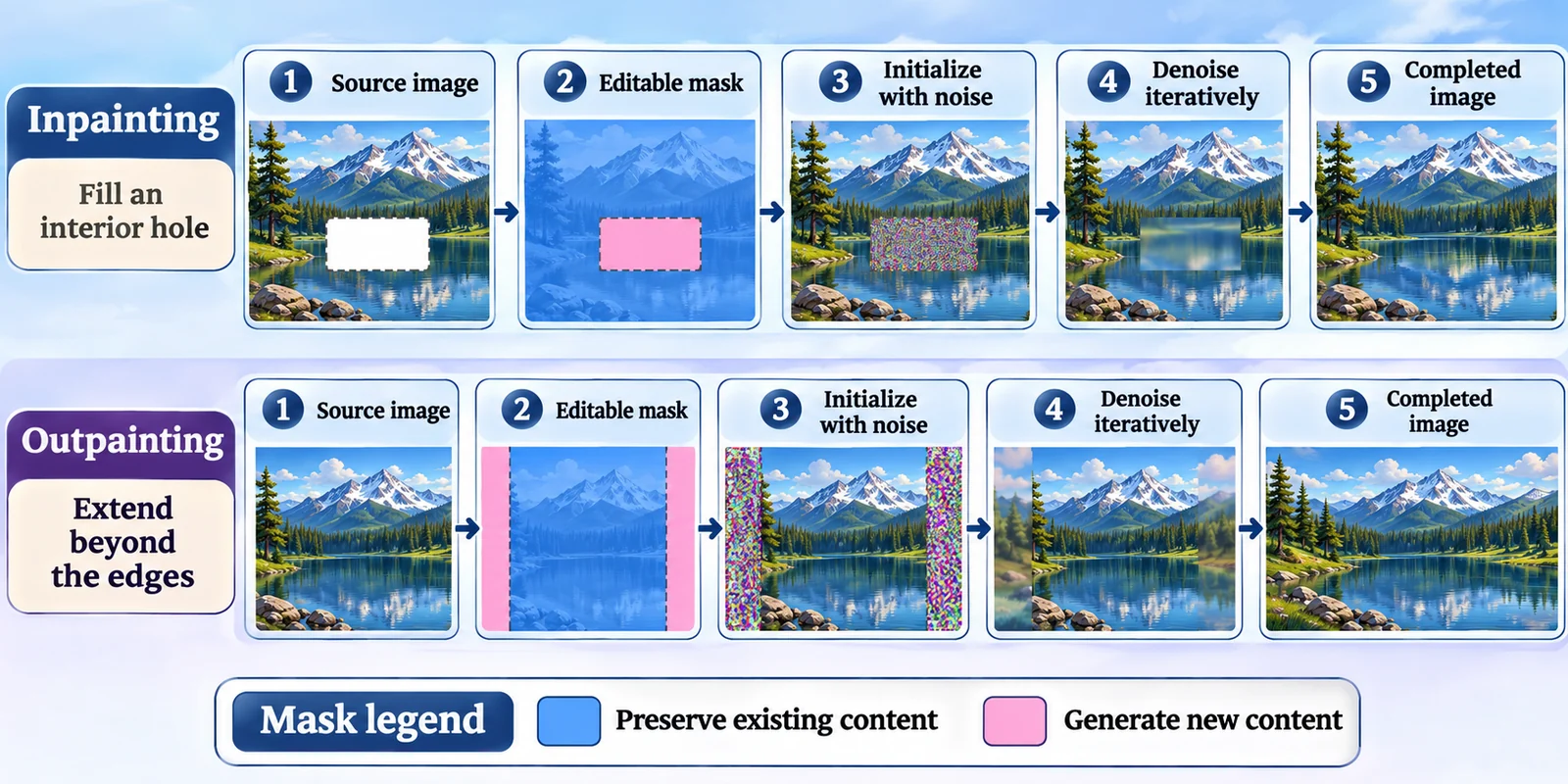
Text alone does not cover every requirement an application may have, so researchers add other conditions to a pretrained text-to-image model. A 2026 survey groups this work into generation with a specific condition, generation with several conditions, and universal controllable generation.[35] A second 2026 survey defines precision as meeting semantic, spatial, structural, identity, interaction and domain constraints, not pixelwise copying alone.[36]
Prompts sometimes fail outright: the model leaves out a subject the text asked for. A 2023 study of the public Stable Diffusion model called this failure catastrophic neglect. The study also found cases where the model attached an attribute, such as a color, to the wrong subject.[37]
Reproducing one particular subject takes a different route, called personalization. DreamBooth, published in 2022, fine-tunes a pretrained text-to-image model on just a few images of a subject. The result places the subject in poses, views and lighting absent from the reference images while keeping its key features. The team also released a dataset and an evaluation protocol for this task of subject-driven generation.[38]
Video, motion and audio
A 2022 study proposed a diffusion model for video that extends the standard image diffusion architecture to this task. The model can be trained jointly on image data and video data, which the study reports reduces the variance of minibatch gradients and speeds up optimization. To make longer and higher-resolution videos, the study introduced a conditional sampling technique for extending a video in space and in time.[39] A 2025 survey divides video diffusion research into video generation, video editing, and other tasks that involve understanding video. The survey notes that diffusion models are gradually replacing methods based on generative adversarial networks and auto-regressive Transformers in video work.[40]
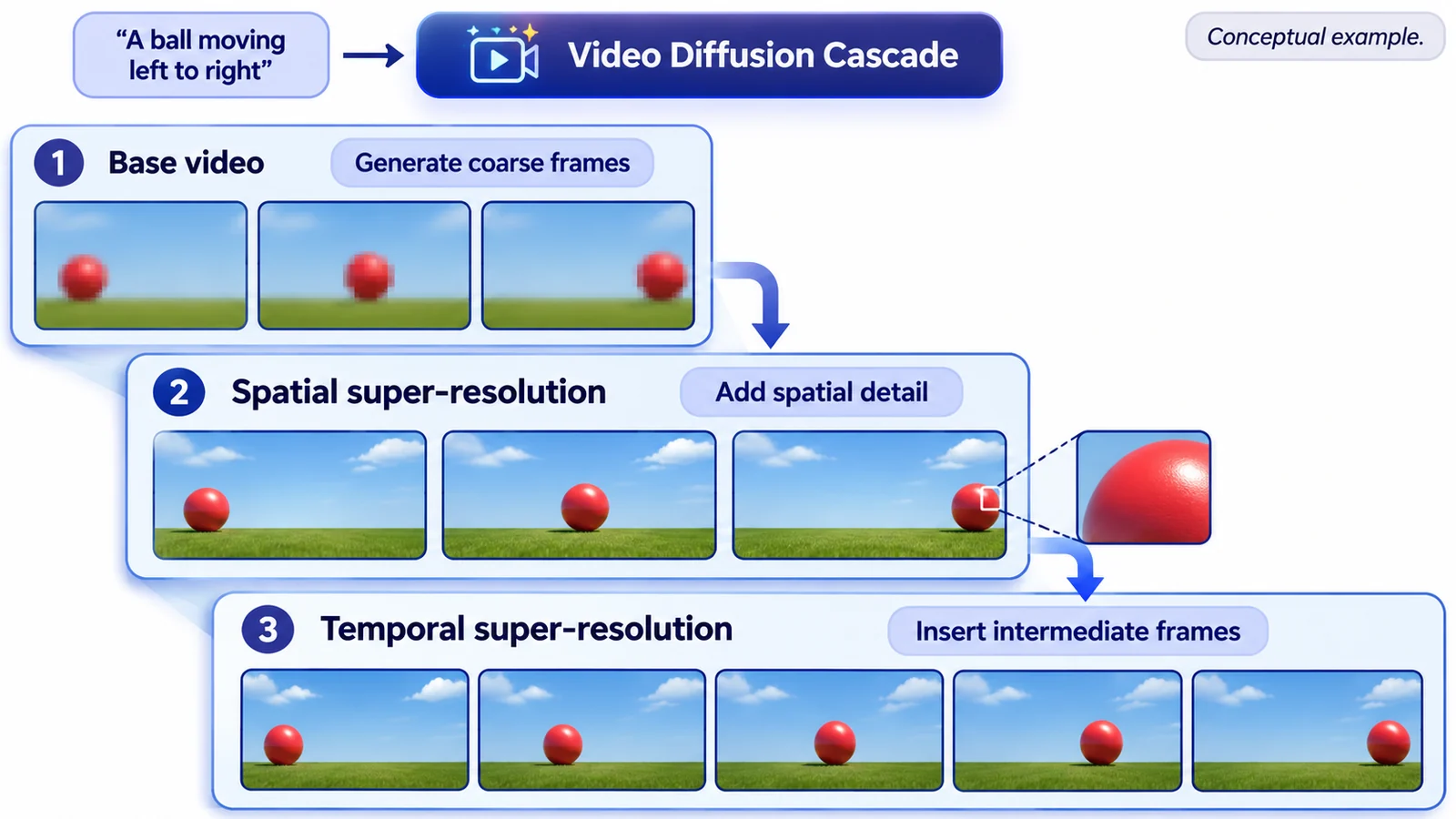
Imagen Video, described in 2022, is a text-conditional system built from a cascade of video diffusion models. It starts with a base video generation model and then passes the result through interleaved spatial and temporal super-resolution models. The designers chose fully-convolutional super-resolution models at certain resolutions and a particular setting called v-parameterization. The system produced videos of high fidelity with a high degree of controllability, including text animations in various artistic styles and some 3D object understanding.[41]
A 2022 model called the Motion Diffusion Model adapted a classifier-free diffusion model to human motion. It is transformer-based, and at each diffusion step it predicts the motion sample itself rather than the noise. That choice allows geometric losses on the positions and speeds of the motion, such as a loss for foot contact. The model trained on modest resources yet set state-of-the-art results on leading benchmarks for generating motion from text and from actions.[42]
MotionDiffuse, one of the first diffusion frameworks for generating motion from text, produces motion over a series of denoising steps that inject variation. It responds to fine-grained instructions on body parts and can synthesize motion of arbitrary length from time-varied text prompts. Its experiments report that it outperforms existing state-of-the-art methods by convincing margins on text-driven and action-conditioned motion generation.[43]
DiffWave, proposed in 2020, is a diffusion model for conditional and unconditional waveform generation. In a vocoding task, which rebuilds a waveform from a mel spectrogram (a compact picture of sound frequencies), DiffWave matched a strong WaveNet vocoder on speech quality. The mean opinion scores were 4.44 and 4.43. It synthesized orders of magnitude faster than that vocoder. In the harder unconditional generation task, it significantly outperformed autoregressive and GAN-based waveform models on audio quality and sample diversity.[44]
Medical imaging and data scarcity
Synthetic scans may help protect patient privacy and can be used to enlarge small datasets. One 2023 study showed that diffusion models can synthesize high-quality magnetic resonance imaging (MRI) and computed tomography (CT) data. Two radiologists rated the synthesized images on realistic appearance, anatomical correctness, and consistency between slices. The synthetic images also improved breast segmentation models trained on scarce data, raising the Dice score from 0.91 to 0.95.[3]
Small datasets are a common obstacle in medical image analysis, and generative models offer one way around it. A 2024 study trained diffusion models with text prompts and example images to produce brain MRI scans showing low-grade gliomas, contrast-enhanced spectral mammography, and chest and lung X-rays. That approach keeps patients anonymous and lowers the risk that a person could be re-identified during data exchange for research.[45] A 2024 pipeline called MAM-E used conditional diffusion models to generate full-field digital mammograms and to paint synthetic mass-like lesions onto healthy mammograms. Its authors note that diffusion models have drawn attention for high image quality and a less complex training process than generative adversarial networks, though medical use remains at an early stage.[46]
Diffusion models can also translate one kind of scan into another.[47][48] Cone-beam CT is a scan taken in the treatment room during radiotherapy, but it carries severe artifacts and inaccurate Hounsfield unit values. A 2024 conditional diffusion model converted cone-beam CT into synthetic CT in brain and head-and-neck patient studies. In the brain study, mean absolute error fell from 40.63 to 25.99 Hounsfield units and peak signal-to-noise ratio rose from 27.87 to 30.49 decibels. The method beat four other diffusion models and one Cycle GAN on visual quality and quantitative analysis.[47] A 2023 method named SynDiff used adversarial diffusion modeling to translate between imaging types, including multi-contrast MRI and MRI to CT.[48]
A 2024 diffusion approach filled in the missing projection data and was trained without any information about metal objects. On clinical CT images with virtually introduced metal, it also gave better quality than the other three models.[49] Diffusion models have likewise been applied to denoising positron emission tomography, or PET, scans. A 2022 study used 120 18F-FDG datasets and 140 18F-MK-6240 datasets and found that diffusion-based denoising beat nonlocal mean and Unet-based methods. Adding an MR prior, meaning a reference scan from another imaging type, improved results further, but relying on the MR prior alone produced large bias.[50]
Three medical physicists tried to tell synthetic images from real ones and averaged 0.64 accuracy, where 50 percent would mean the images were indistinguishable. For a COVID-19 classification task, accuracy was 0.88 with real images alone, 0.89 with synthetic images alone, and 0.93 with a mix of both.[51] A 2023 study generated musculoskeletal ultrasound images from a small set of real images across four muscles. The pixel intensity histograms of the real and synthetic sets were statistically similar, and the two sets scored very high on the LPIPS, SSIM, FID, and PSNR metrics. The synthetic data also improved an Attention-UNet trained to measure muscle thickness.[52]
A 2025 study compared four fine-tuning methods on a balanced histopathology dataset of 664 images per tissue class: normal, serrated, adenocarcinoma, and adenoma. HyperNetwork and DreamBooth gave the best fidelity and diversity, with HyperNetwork reaching an FID of 77.27 for adenocarcinoma. Textual Inversion did worst, with FID scores above 158 and low recall. The study concludes that standard metrics may miss clinical usefulness and that review by medical professionals remains essential.[53]
Diffusion models can also edit a diseased scan into a healthy-looking version. A 2025 method combined two diffusion sampling schemes to change lesion areas while rebuilding normal anatomy elsewhere. Comparing the healthy version with the original yields a pixel-by-pixel map of what looks abnormal. On brain lesion segmentation, the method reached the highest mean Dice and IoU scores among the weakly supervised models compared.[54] A 2024 review of diffusion models for biomedical segmentation describes the field as promising but still facing challenges from uncertain and variable imaging data.[55]
Science and engineering applications
Structure-based drug design aims to propose small molecules that bind tightly and specifically to a chosen protein target. DiffSBDD, an equivariant diffusion model reported in 2024, generates new candidate molecules conditioned on the shape of a protein pocket.[56]
Proteins have received similar treatment. A 2022 model generates both protein structure and sequence, starting from a compact description of the protein's topology. It was learned entirely from experimental data and produces a full-atom backbone plus sequence and side-chain predictions. The developers reported that it operates at significantly larger scales than earlier molecular generative models.[57]
CRS-Diff, reported in 2024, generates remote sensing images under text, metadata or image conditions, alone or combined. Its developers describe it as the first remote sensing generative model with multiple controllable conditions. The model can also act as a data engine, producing training images for tasks such as road extraction.[58] RSDiff works in two stages: a low-resolution model draws an image from a text prompt, and a super-resolution model sharpens it. On the Remote Sensing Image Captioning Dataset, it produced satellite images with correct geographical detail and sharper spatial resolution.[59]
Underwater photography suffers from light attenuation and scattering, which distort color, lower contrast and add noise. DiffWater guides a diffusion model with a color-compensated copy of the degraded image and was tested on four real underwater datasets. Its developers report better enhancement quality and stronger generalization than comparison methods.[60] DDPM-CD pretrains a diffusion model on unlabeled remote sensing images, then reuses its internal features to train a small change classifier.[61]
A two-stage model segmented polymetallic nodules in seabed photographs, then predicted nodule abundance from the measured coverage with a linear regression. It performed well even under uneven illumination and dense nodule distributions.[62] Well logs, the depth-by-depth records taken during drilling, often contain noise and gaps. A conditional diffusion model imputes all missing components at once and returns probability distributions rather than single values. On a real dataset it surpassed conventional data-driven techniques.[63]
In fluid dynamics, a two-stage method used spectral filtering to restore the high-wavenumber, fine-scale components of turbulence. It recovered turbulence with accurate statistics on an 8x upsampling task for Kolmogorov flow and Rayleigh-Benard convection.[64] A 2024 point cloud model, PCCDiff, predicts the missing parts of incomplete 3D scans without assuming any structure such as symmetry.[65]
Wind and solar output fluctuate across time scales, which raises the risk of imbalance between supply and demand. A multi-resolution model generated renewable energy scenarios and reached a Wasserstein Distance of 0.0156 for wind power. That compared with 0.0185 for a plain diffusion model and 0.0305 for Monte Carlo, and the new model raised the Global Coverage Rate by 15% over Monte Carlo and other baselines.[66] In factories, fault diagnosis suffers from a shortage of training data. One model compresses data into a smaller latent space before a conditional diffusion model generates extra examples, improving sample quality, speed and interpretability. Tests on three mechanical systems supported the approach.[67]
Most sequential recommenders represent each item as a fixed vector, which captures limited information about a user's varied tastes. DiffuRec instead represents items as distributions and reverses noise into the target item's representation using the user's history. Across four datasets it outperformed strong baselines by a large margin.[68]
Diff-POI samples a user's spatial preference to suggest the next place to visit, and experiments on four real-world datasets showed it beat state-of-the-art baselines.[69] One study generated realistic brain recordings, including EEG, ECoG and LFP signals, from rats, macaques and humans. The synthetic traces matched frequency spectra, phase-amplitude coupling and sharp wave-ripples, and could be conditioned on brain state.[70] A separate model detected seizures in EEG without labels by resampling abnormal stretches and comparing the result with the original.[71]
A diffusion model can be trained to produce synthetic versions of geological and engineering data that are expensive or impossible to observe directly, and several studies have tested this idea on rock masses, fracture networks, microscopy images and radar imagery.[72][73][74][75] In rock mechanics, a stochastic structural plane is a fracture surface inside a rock mass whose orientation and position are described by probability distributions rather than fixed values. The conventional Monte Carlo method generates each parameter of such planes separately, so it ignores correlations between the parameters. A 2024 study instead trained a denoising diffusion probabilistic model, a generative model that learns to reverse a step-by-step noising process, on structural plane parameters taken together as one input, and the model captured the correlations between parameters without any assumed probability distribution. The approach was applied to the Oernlia slope in Nordland County, north-central Norway, and checked with descriptive statistics, several similarity measures and linear regression plots of dip direction against dip angle.[72]
Fracture networks underground carry fluids, mass and heat, and describing them accurately matters for reservoir engineering, yet direct observation is costly and the indirect data used for inversion are sparse. A 2024 conference paper introduced a latent diffusion model for discrete fracture networks, a generative model that works in a compressed low-dimensional space rather than on the full network. Trained on network samples built with established fracture statistics, the model generated high-quality networks from that latent space and reproduced the main distributions of fracture location, length and orientation. The stated use of the model is as a compact parameterization that makes inversion for subsurface characterization more tractable.[73]
At the atomic scale, a 2022 study trained a progressive transformer diffusion model on a small set of atomistic simulations of brittle failure. The trained model reproduced crack dynamics, instabilities and initiation mechanisms, and it generalized to validation cases that grew progressively more distinct from the training data, including geometries containing microstructures produced by a generative neural network. The reported benefit is a rapid assessment of dynamic fracture for complex geometries, extending beyond the original simulation results.[76]
Materials scientists have used diffusion models to generate scanning electron microscope images of metal microstructures. One study assembled a dataset of 27 cast-forged AZ80 magnesium alloy components made with varied process parameters, held some conditions back from training, and tested whether the model could predict images for unseen conditions. Measured microstructural properties of the generated images differed from real images by an average error of 6.36% ± 0.42 for seen conditions and 6.67% ± 0.85 for unseen conditions. The model also captured the physical relationships between process parameters and microstructure features.[74]
In remote sensing, pansharpening recovers a high-resolution multispectral image by fusing a high-resolution panchromatic image, which records brightness in a single broad band, with a low-resolution multispectral image. Most pansharpening methods learn a direct mapping from the two inputs to the output. A 2023 method called PanDiff instead learns the distribution of difference maps between the high-resolution result and an interpolated multispectral image. It treats the two inputs as conditions that guide a U-Net, a convolutional network shaped like a letter U, through a multi-step process that starts from random Gaussian noise. A modal intercalibration module was added to strengthen that guidance, and tests on a freely available benchmark dataset of GaoFen-2, QuickBird and WorldView-3 images showed strong fusion performance and generalization.[77]
Synthetic Aperture Radar images are degraded by speckle, a multiplicative noise that affects all coherent imaging systems and can harm tasks such as automatic target recognition and change detection. SAR-DDPM, a 2023 diffusion method, adds noise to clean images step by step and then predicts and removes that noise iteratively, conditioned on the speckled image, with a cycle spinning inference strategy added to improve results on synthetic and real images.[75] A 2025 examination of diffusion models for the same task modified the framework with a non-uniform step size and spread, early stopping, and a secondary aggregating U-Net that combines partially denoised samples, and both changes improved accuracy while reducing inference time through fewer iterations. That study also reported a limit: diffusion models produce sharper and more realistic radar imagery but sometimes hallucinate, meaning they invent detail not present in the scene. They can score lower on quantitative measures than a standard U-Net denoiser, which points to a need for better metrics.[78]
Restoration, segmentation and other vision tasks
SR3, published in 2022, starts from pure random noise and refines it repeatedly, guided by the low-resolution input. On an 8× face super-resolution task using the CelebA-HQ dataset, SR3 reached a fool rate close to 50%. Older methods built on generative adversarial networks did not exceed a fool rate of 34% on the same task. SR3 also beat those baselines on a 4× task on ImageNet, judged by human raters and by a ResNet-50 classifier trained on high-resolution images.[79]
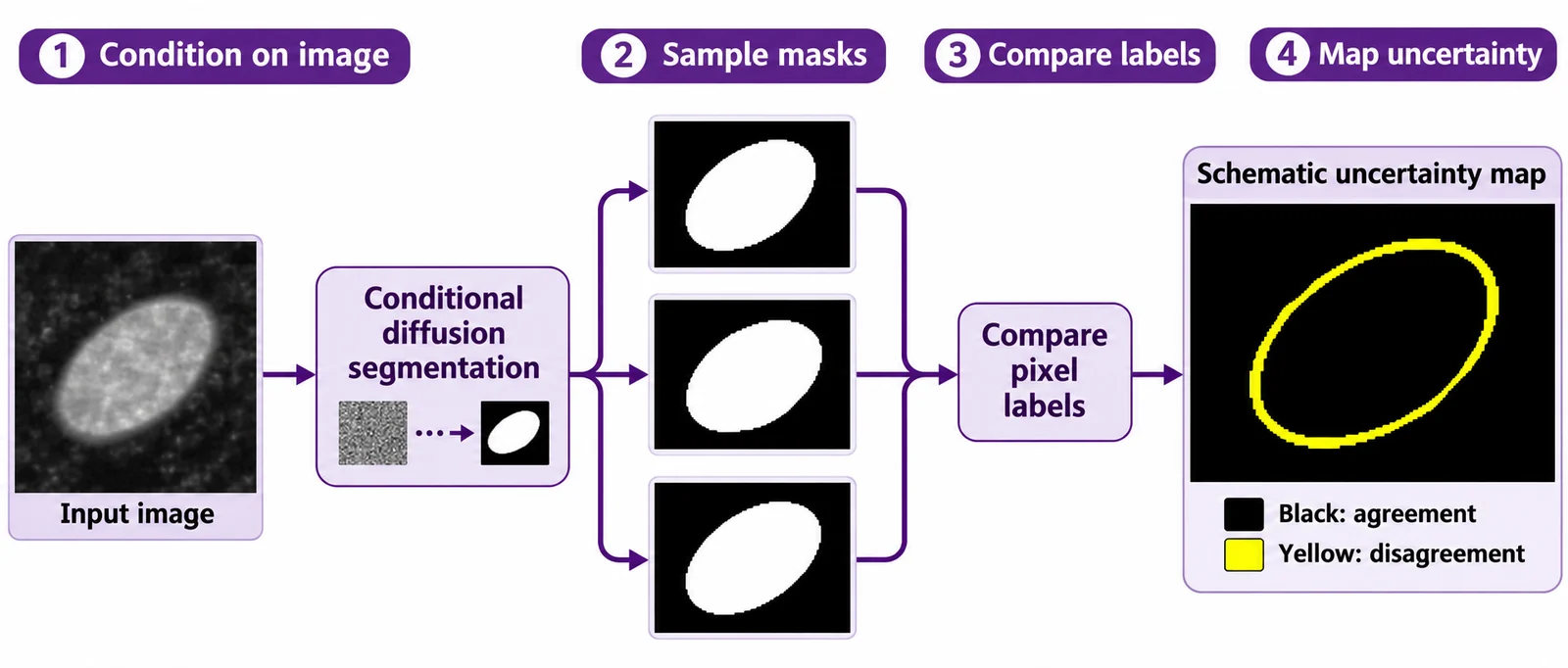
A 2021 study showed that the internal activations of a pretrained diffusion model, the patterns its network produces mid-step, carry useful semantic information. A simple method built on those activations beat existing alternatives on several datasets, given the same amount of human supervision. It can work even when only a few labelled training images are provided.[80] Another 2021 method trained on ground-truth masks and used the image as a prior at every sampling step. Because sampling is random, it produces a distribution of masks, which yields pixel-wise uncertainty maps and an implicit ensemble of segmentations. On the BRATS2020 brain tumor dataset, this approach gave good segmentation results plus detailed uncertainty maps.[81]
Diffusion models have also been used to translate images between domains, such as colour to multispectral imagery, without paired examples. A 2021 method called UNIT-DDPM trains both translation directions at once and needs no adversarial training. It reported state-of-the-art Fréchet Inception Distance scores on several public datasets, beating adversarial methods of the time.[82] A 2022 model called 3DiM turned a single view of an object into consistent views from other angles. On the SRN ShapeNet dataset, its completions from one view had much higher fidelity than prior work while being approximately 3D consistent.[83]
A diffusion model can also clean an image that an attacker has deliberately corrupted. This defense is called adversarial purification: add a small amount of noise to the suspect image, then recover a clean version through the reverse process. The 2022 DiffPure method does not assume any particular form of attack or classifier, so it can protect existing classifiers against unseen threats. Tests on CIFAR-10, ImageNet and CelebA-HQ with ResNet, WideResNet and ViT classifiers gave state-of-the-art results, often by a large margin.[84]
A 2025 paper introduced DiffAttack, which crafts hard-to-see perturbations in the latent space of a diffusion model instead of in raw pixels. The paper describes this as the first use of diffusion models in the adversarial attack field. Tests across CNNs, Transformers and MLPs, on ImageNet, CUB-200 and Stanford Cars, found it stronger than iterative, GAN-based and ensemble attacks.[85] A 2024 study used a diffusion model to fuse infrared intensity and polarization information for road detection. It matched leading methods even with fewer training samples, which addresses the shortage of datasets in that field.[86]
In practice
Speed and cost of sampling
A diffusion model builds an image by starting from random noise and cleaning it up in small stages, called denoising steps. A standard denoising diffusion probabilistic model, or DDPM, trains and samples across 1,000 time steps.[87] Generating a high-quality sample this way can take many hundreds or even thousands of model evaluations.[88] Training a diffusion model on medical images usually takes days to weeks, and sampling one image volume takes minutes to hours.[87] The iterative denoising process also creates high latency (delay before a result appears), memory consumption and deployment cost.[89]
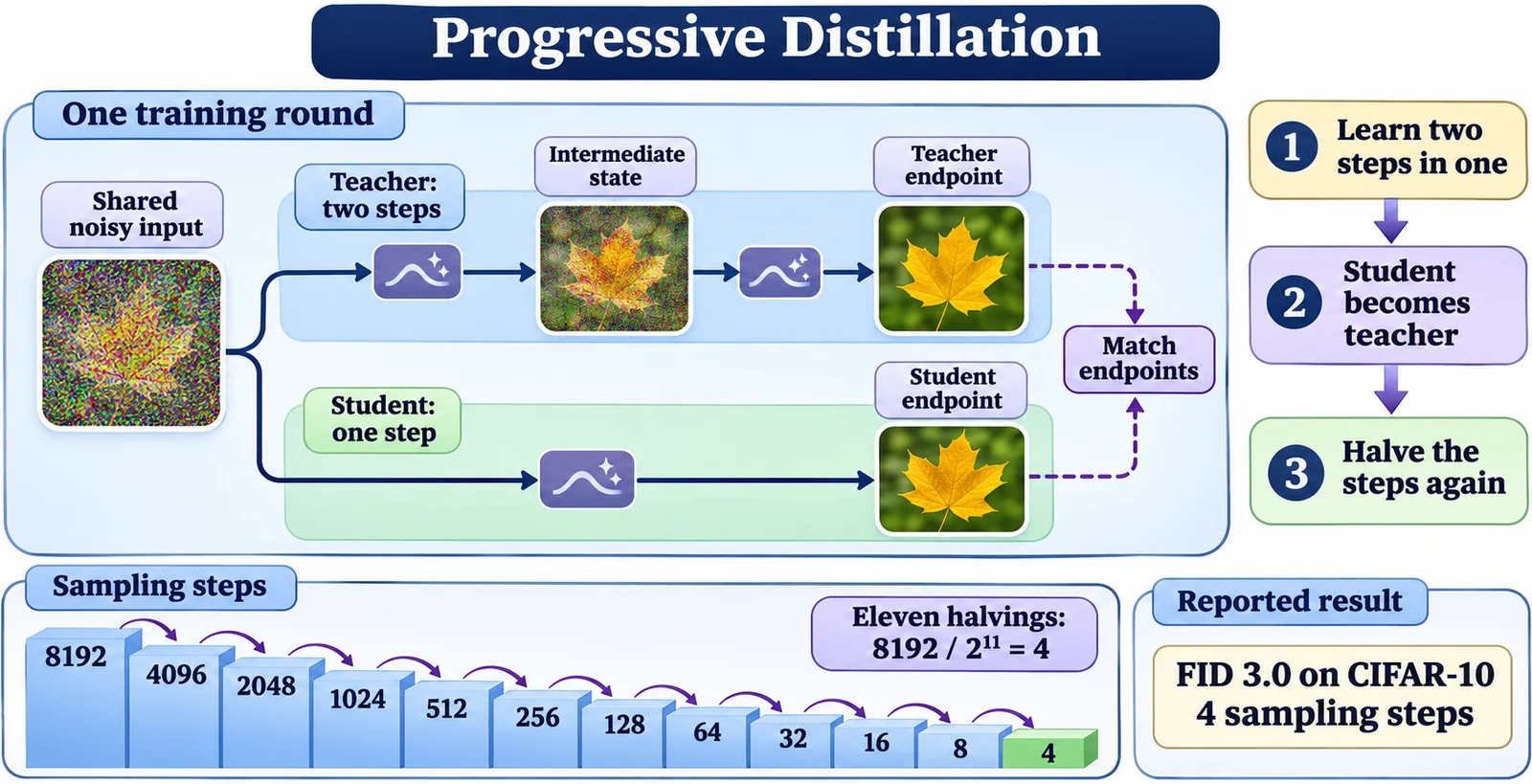
Progressive distillation starts with a trained sampler that uses many steps and produces a model that takes half as many. Repeating the procedure halves the step count again each time. On benchmarks such as CIFAR-10, ImageNet and LSUN, samplers with as many as 8192 steps were distilled down to 4 steps. Perceptual quality dropped only slightly. Running the full progressive distillation took no more time than training the original model.[88]
Fast-DDPM trains and samples using only 10 time steps instead of 1,000, with two noise schedulers: one with uniform time step sampling and one with non-uniform sampling. Fast-DDPM beat DDPM and other leading methods on three medical image-to-image tasks: super-resolution, denoising and translation. It reduced training time to 0.2 times that of DDPM and sampling time to 0.01 times.[87]
Step Saver is a language model fine-tuned to work out the fewest denoising steps a given text prompt needs. The method is described for the DDIM scheduler but can be adapted to others, such as Euler, Heun and UniPC.[90]
A 2026 survey warns that using fewer sampling steps is not by itself enough to make diffusion efficient. It breaks inference cost into three parts: how many denoising function evaluations are made, the cost of each step, and overhead from conditioning, decoding, memory movement and deployment frameworks. Practical speedups therefore have to weigh image quality, latency, memory, training cost and hardware limits against one another.[89]
Faster samplers and cheaper inference
A standard diffusion model draws a sample by running a long chain of denoising steps, and each step is one evaluation of the neural network, so the cost of a sample grows with the number of steps. Denoising diffusion implicit models, introduced in 2020, keep the same training procedure as earlier denoising diffusion probabilistic models but replace the Markov chain with a class of non-Markovian processes that share the same training objective and can be sampled from much faster. In wall-clock time the implicit models produced high quality samples 10 times to 50 times faster than the probabilistic models, and they allowed computation to be traded off against sample quality. The same work showed that semantically meaningful image interpolation could be performed directly in the latent space.[19]
A second route moves the diffusion process out of the pixel grid and into a wavelet representation, which splits an image into a coarse low-frequency part and finer high-frequency detail. One wavelet-based model learns how clean images are distributed in the wavelet domain, given the wavelet spectrum of the degraded input. Each sampling step is then cheaper than modeling in the spatial domain. Its low-frequency and high-frequency spectra are learned by separate modules, and an efficient conditional sampling strategy cut the total number of sampling steps to around 5. Across twelve benchmark datasets covering raindrop removal, rain streak removal, dehazing, defocus deblurring, demoiréing and denoising, that model reached state-of-the-art performance at an efficiency comparable to traditional one-pass methods and over 100 times faster than existing restoration methods built on plain diffusion models.[91] A related low-light enhancement model pairs a wavelet-based conditional diffusion model with a high-frequency restoration module that uses vertical and horizontal detail to fill in diagonal information, and it reported large efficiency gains over earlier diffusion-based methods without sacrificing information.[92]
Medical imaging offers a third kind of saving, in which the diffusion is confined to part of the data rather than shortened everywhere. In fast magnetic resonance imaging the low-frequency region of k-space (the raw frequency data the scanner records) is typically fully sampled, so a diffusion process run over the whole image or the whole of k-space introduces uncertainty where the measurements are already good. A stochastic differential equation designed to diffuse only in high-frequency space keeps the fully sampled low-frequency regions deterministic and speeds up the reverse sampling procedure. On the public fastMRI dataset this method beat traditional parallel imaging, supervised deep learning and existing diffusion models in reconstruction accuracy and stability, and its faster convergence was confirmed in both theoretical and experimental checks.[93]
Implicit sampling explicitly trades computation against sample quality, so fewer steps can mean worse samples.[19] The wavelet approach accepts a more elaborate training setup, with separate modules for low and high frequencies, in exchange for cheaper steps and a step count near 5.[91] Restricting diffusion to high-frequency space depends on the low frequencies already being fully sampled, a condition that holds in fast MRI but not in every setting.[93] A 2025 survey of diffusion models in low-level vision, the field of image restoration and enhancement, notes that current diffusion models still carry limitations and sets out directions for further research.[94]
Synthetic data for training other models
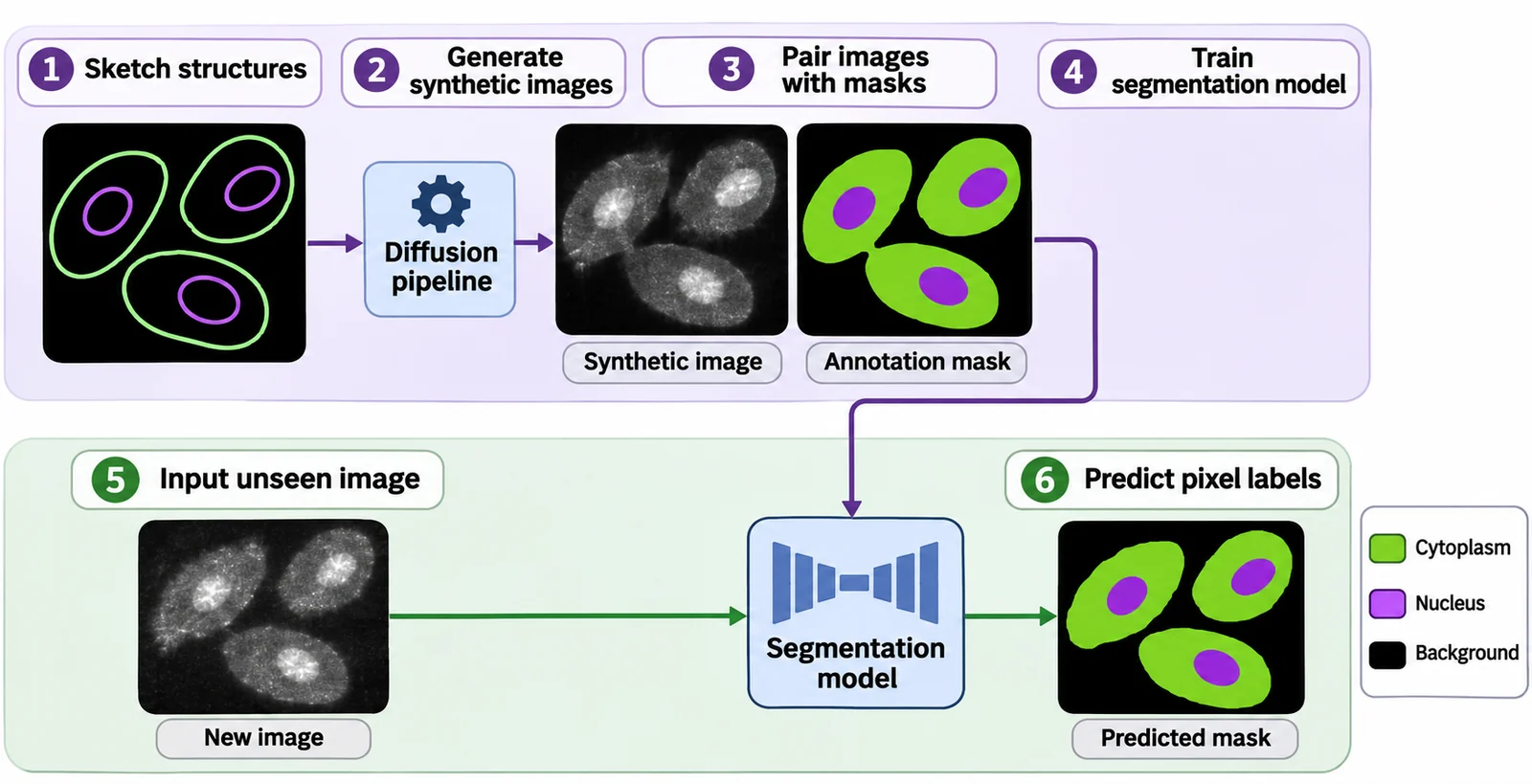
In microscopy, a diffusion pipeline can build fully annotated image sets from rough sketches of the structures a researcher wants to see. Segmentation models, which assign a class label to each pixel, trained on a small set of such synthetic images reached accuracy comparable to generalist models trained on a large and diverse collection of manually annotated images. The approach reduces reliance on manual annotation, which is slow and requires trained specialists.[95]
Citrus disease diagnosis faces a related shortage: agricultural growing conditions vary greatly, and real disease databases are too small to train a classifier well. One 2023 study generated synthetic citrus leaf images with a diffusion model and trained a Swin Transformer, a vision model built on attention, in two ways. Pre-training on the synthetic images and then fine-tuning on real leaves reached 96.3% validation accuracy, while fine-tuning an ImageNet-pretrained model on real plus synthetic images reached 99.8%. Both methods reduced overfitting on the small dataset, and the study reports that they outperformed VGG16, EfficientNet, ShuffleNet, MobileNetV2 and DenseNet121 to some extent.[96]
Handwritten signature verification is limited by how few genuine signatures each person provides. A 2024 method modified the noise prediction step of a diffusion model so that it could generate signatures for a chosen class, and added an auxiliary classifier to keep the output close to the originals. On the CEDAR signature dataset, the generated signatures reached an average structural similarity index of 0.9806 and a root mean square error of 0.1819 against real signatures. Retraining the verification model with the generated signatures added to the training data raised test accuracy to 94.87%, an improvement of 0.061 percentage points over training on the original data alone.[97]
For classifiers, ordinary augmentation rotates, flips or crops existing images, which leaves high-level content such as the animal species in a scene unchanged. A 2023 method instead used a pretrained text-to-image diffusion model to edit images so that their semantics changed, and it generalized to new visual concepts from a few labeled examples. Evaluated on few-shot image classification and on a real-world weed recognition task, the method improved accuracy in the tested domains. The report gives no effect sizes, so the size of the improvement cannot be compared across tasks.[98]
Chest X-rays illustrate both the promise and the caveats for medical images. In a 2025 study, models pretrained on synthetic X-rays within a self-supervised framework, which learns from unlabeled images before fine-tuning, performed comparably to or better than models pretrained on real data. On pneumonia classification the model pretrained on synthetic data scored 99.1 for area under the curve and 96.1% for F1. On segmentation it reached a Dice score of 0.85. The study argues that such data preserve critical medical biomarkers while protecting patient confidentiality.[99]
What this looks like in practice
In one medical study, diffusion models were trained on four small public datasets: 998 brain MRI studies, 1010 chest CT studies, 1844 breast MRI studies and 1250 knee MRI studies. Each model converged and produced realistic synthetic images without tuning any hyperparameters for the different datasets, and no training run showed mode collapse, a failure in which the model produces only a few repeated outputs. The same architecture handled volumes of 64 × 64 × 64 voxels for brain MRI, 128 × 128 × 128 voxels for chest CT, and 256 × 256 × 32 voxels for breast and knee MRI.[3]
Two radiologists with nine years and five years of experience rated 50 synthetic images from each dataset. Of the 200 synthetic images, Reader A judged 189 to be at least largely realistic, with only minor unrealistic areas. That reader found 191 of the 200 consistent between most slices, and rated 185 of the 200 as showing only minor anatomic inconsistencies or none at all.[3]
A latent diffusion model called Medfusion was compared with generative adversarial networks, or GANs, on fundoscopy, radiograph and histopathology images. Medfusion reached a diversity score (recall) of 0.40 against 0.19 on the AIROGS dataset, 0.41 against 0.02 and 0.24 on the CRCDX dataset, and 0.32 against 0.17 and 0.08 on the CheXpert dataset.[27]
For speed, progressive distillation halves the number of sampling steps repeatedly, taking a sampler from as many as 8192 steps down to as few as 4 without losing much perceptual quality. That procedure reached an FID of 3.0 on CIFAR-10 in 4 steps, and training the distilled model took no more time than training the original.[88] Learning the variances of the reverse diffusion process is one cited route to faster sampling: it cuts the number of forward passes by an order of magnitude, and sample quality changes by a negligible amount.[18]
Later developments
What remains unsettled
In fingerprint generation, advanced diffusion frameworks already let users adjust attributes such as style, quality and sensor type, and keep identity information intact.[100] A 2025 study in Diagnostics went further, adapting Stable Diffusion v1.4 with two ordinal embeddings to turn discrete disease severity scores into continuous progression representations. The better of the two, the Additive Ordinal Embedder, reached a CMMD of 0.4137 and a recall of 0.6331, with disease consistency close to real data.[101]
Denoising diffusion probabilistic models need hundreds to thousands of iterations to produce a final sample, according to a 2022 paper on pseudo numerical methods. Earlier speed-up tricks that adjusted the variance schedule or the denoising equation could not hold sample quality and sometimes added new noise at high speed-up rates. The paper treats the models as solving differential equations on manifolds, curved surfaces in a mathematical sense. Its pseudo numerical methods reached higher-quality images in only 50 steps than 1000-step versions of an earlier fast method, a 20x speedup.[102]
A 2021 paper introduced Discrete Denoising Diffusion Probabilistic Models, which generalize an earlier multinomial diffusion model beyond corruption processes with uniform transition probabilities. The choice of transition matrix, the rule for how data are corrupted step by step, proved an important design decision that improved results in image and text domains. On character-level text generation the models gave strong results and scaled to large vocabularies on LM1B.[103]
Diffusion on non-Euclidean and discrete data
A submanifold is a smooth surface inside ordinary space, and a level set is the collection of points where a function takes one fixed value; a sphere, for instance, is the level set of a distance function. Riemannian denoising diffusion probabilistic models, proposed in 2026, learn distributions on submanifolds of Euclidean space. These submanifolds are level sets of functions, a class that covers most of the manifolds relevant to applications. Earlier manifold methods needed substantial geometric information, such as geodesic curves (shortest paths on the surface) or eigenfunctions of the Laplace-Beltrami operator, and so worked only where that information could be computed. The projection-based method instead requires only the ability to evaluate the defining function and its first order derivatives, which widens the range of manifolds it can handle. A theoretical analysis in the continuous-time limit links these models to score-based generative models on manifolds. Demonstrations cover distributions over complex manifolds represented implicitly as level sets, with uses in statistical mechanics and molecular dynamics.[104]
Tabular data pose a different problem, because a single row can mix continuous features with discrete ones, and the heterogeneity makes accurate modeling difficult. TabDDPM, introduced in 2022, is a diffusion model designed to apply to any tabular dataset and to handle any type of feature. On a wide set of benchmarks it outperformed existing generative adversarial network and variational autoencoder alternatives, a result consistent with the advantage diffusion models show in other fields. The method is also eligible for privacy-oriented settings in which the original data points cannot be shared publicly.[105]
Symbolic music, written as discrete notes rather than recorded sound, resisted diffusion at first because the standard sampling procedure is Langevin-inspired and suits continuous values. The approach is non-autoregressive. It learns to produce sequences of latent embeddings through the reverse process, and it generates them in parallel with a constant number of iterative refinement steps. It gave strong unconditional generation and post-hoc conditional infilling results when compared with autoregressive language models operating over the same continuous embeddings.[106]
Quantum states form a further target. Quantum denoising diffusion probabilistic models, published in 2024, learn in steps and resolve earlier training issues, but they require high-fidelity scrambling unitaries, which is a challenge for near-term hardware. A mixed-state variant proposed in 2025 removes that requirement by adapting the quantum noise channels to the model architecture. Its forward diffusion process uses depolarizing noise channels, and its backward denoising steps use parameterized quantum circuits with projective measurements. Several refinements accompany the design: a cosine-exponent schedule of noise interpolation, a single-qubit random ancilla, and cost functions based on superfidelity to improve convergence. Evaluated on quantum ensemble generation tasks, the mixed-state model performed successfully.[107]
Time series, traffic and physical fields
A diffusion model can be applied to data that arrive in order over time, not only to images, and a 2024 survey groups the resulting methods into three uses: forecasting future values, filling in missing values (imputation), and generating new sequences that resemble observed data. The survey presents each of these three applications in its own section and compares competing methods for the same application, noting where the methods are related. It closes by identifying limitations shared by diffusion-based methods for time series and by pointing to directions for further work.[108]
Network traffic is one kind of sequence that has been generated this way. A 2025 framework called diffusion-attention traffic generation (DATG) pairs a diffusion model with a self-attention mechanism, a component that lets each position in a sequence draw on information from positions elsewhere in the sequence. The diffusion model's step-by-step removal of noise is meant to make generation stable, while the self-attention part is meant to capture dependencies across the whole sequence.[109]
In astrophysics, a 2023 study trained a diffusion model to infer the volume density, or number density, of giant molecular clouds from projected maps of mass surface density. The training data came from magnetohydrodynamic simulations, which model gas as a conducting fluid coupled to a magnetic field, run with different global magnetic field strengths and large-scale motions, including noncolliding and colliding clouds. The model learned from surface density maps paired with their mass-weighted number density maps as seen from different viewing angles. Against a traditional empirical fit with two or three power-law components, and against a conventional neural network, the diffusion model improved the accuracy of predicted number density by an order of magnitude. The method was then applied to column density maps of Taurus and of the infrared dark clouds G28.37+0.07 and G35.39-0.33. The output was a map of mean volume density for each.[110]
Engineering flows have been treated as a distribution to be learned rather than a single answer to be predicted. A 2024 study used denoising diffusion probabilistic models to build an uncertainty-aware surrogate, a fast stand-in for a costly simulation, for flow around airfoils of various shapes, Reynolds numbers and angles of attack. The models captured the whole distribution of simulation solutions and therefore estimated simulation uncertainty, and they outperformed Bayesian neural networks and heteroscedastic models on a range of accuracy metrics. One stated advantage is access to complete uncertainty distributions rather than a fixed set of parameters, which allows realistic and detailed samples to be drawn from the distribution of solutions.[111]
Diffusion models have also been used in data assimilation, the process of combining observations with a running model to estimate the state of a system. A 2025 study formulated an ensemble score filter (EnSF) in which diffusion models generate a set of analysis ensemble members, and the filter requires no training. Tested on a surface quasigeostrophic model, a simplified model of geophysical turbulence, the filter performed stably without localization, a standard technique for limiting the influence of distant observations. The widely used local ensemble transform Kalman filter (LETKF) performed best when observations were linear functions of the entire state and the model was perfect. The diffusion-based filter improved on LETKF when the observations were nonlinear and the system carried unexpected model errors, with the largest gains at large scales (small wavenumbers), where LETKF lacked sufficient ensemble spread. The study describes this as an initial application to a model of intermediate complexity and calls for further development toward more realistic problems.[112]
Criticism
Limits, risks and open questions
A diffusion model can reproduce images from its training set, which makes privacy a real concern. A 2023 study built a pipeline that generates many images and filters them, then used it to pull over a thousand training examples out of state-of-the-art models. The extracted examples included photographs of individual people and trademarked company logos.[113]
A 2022 study found that as training data become scarce, diffusion models suffer severe loss of diversity in what they produce. Fine-tuning a model already trained on a large source domain sped up convergence and improved quality and diversity. Even so, the tuned models lost some diverse features and could only make coarse images. A further method that kept the relative distances between generated samples during adaptation did better than the best GAN-based approaches on a series of few-shot tasks.[114]
In fault diagnosis for industrial equipment, imbalanced data lower diagnosis accuracy and can put safety and reliability at risk. A 2024 method built on a diffusion model generated samples through physical simulation rather than adversarial training, which avoided the instability and mode collapse that trouble GANs. That method reached diagnosis accuracies of 97.00%, 96.48% and 98.30% on three different datasets, all above the compared state-of-the-art augmentation algorithms.[115]
A 2022 model called DiffuSeq was designed for sequence-to-sequence text generation, where one piece of text is turned into another. Across a wide range of such tasks it matched or beat six established baselines, including a leading model based on pre-trained language models. Its generation was also highly diverse, a property many of these tasks want.[116]
A 2024 study proposed a semantic consistency score and found statistically significant differences between two open-source models, Stable Diffusion XL and PixArt-α. Its score agreed with pooled human ratings 94% of the time. The study also found that a version of Stable Diffusion XL fine-tuned with LoRA, a lightweight tuning method, had significantly higher semantic consistency than the original.[117]
Open questions about theory and evaluation
A diffusion model is a generative model that learns to turn random noise into data through a sequence of denoising steps, and its theory is far less developed than its practical success.[21] Sharp convergence guarantees exist for the denoising diffusion probabilistic model (DDPM), a widely used variant, but the number of iterations those guarantees require grows in proportion to the dimension of the data, which makes the theory more pessimistic than practice. Real data often lie close to a lower-dimensional surface inside a high-dimensional space, and recent work asks whether the DDPM exploits that hidden structure automatically. For a broad class of data distributions, one 2026 analysis proves that the iteration count grows nearly linearly with the intrinsic dimension, the effective number of dimensions the data occupy.[20] A 2024 overview describes diffusion theory as very limited overall, and treats this gap as a possible brake on principled new methods.[21]
Conditional diffusion models generate samples steered toward a label, a text prompt or another input, and how their variants should be compared is unsettled. A 2021 study compared several ways of learning conditional probability distributions with score-based diffusion models, a family that learns the gradient of the log data density. It proved results that support one of the strongest existing estimators of the conditional score. The comparison came with an open source library, MSDiff, built to support further research on multi-speed models.[22]
An appendix of systematic experiments on model bending, the manipulation of a generative model's internal activations for creative purposes, applies the technique to a Stable Diffusion model through a plugin. All results use the prompt "Analog style portrait of a person" with one fixed model file, seed 42, 20 steps, a CFG value of 7, the DPM++ 2M sampler, the Karras scheduler, denoise 1 and 512 by 512 pixel images. Each layer's activations are scaled by 0, 0.5, 1.5 and 2. The setup varies one factor at a time: layers under the same prompt and seed, seeds under the same prompt, prompts under the same seed, and timesteps under the same seed, prompt and layer.[118]
Common misconceptions
Diffusion models are valued for the quality and diversity of the samples they generate, though sampling is slow because it involves a high number of steps.[1] Denoising diffusion implicit models, or DDIMs, use the same training procedure but a non-Markovian reverse process that samples 10 to 50 times faster in wall-clock time.[19] Progressive distillation can cut a sampler from 8192 steps to 4 steps while keeping an FID of 3.0 on CIFAR-10.[88]
Dhariwal and Nichol (2021) report that diffusion models produce images whose sample quality exceeds that of the leading generative models of the time, a result they obtained on the class-conditional ImageNet benchmark as well as on unconditional synthesis. With a better architecture and classifier guidance, diffusion models reached an FID of 2.97 on ImageNet 128×128, 4.59 on 256×256 and 7.72 on 512×512, beating the state of the art at the time.[25] On medical images, Medfusion also matched or exceeded GAN fidelity while showing greater diversity.[27]
Two radiologists rated synthetic 3D images from four datasets, and their scores indicate that the generated images appear realistic to radiologists. Two radiologists rated 189 of 200 synthetic images as at least largely realistic, and 185 of 200 as having only minor or no anatomic inconsistencies.[3]
Key studies
| Year | Study | Sample | Design | Finding |
|---|---|---|---|---|
| 2020 | Kong et al.[44] | waveform generation tasks including neural vocoding | audio synthesis comparison | DiffWave reached a mean opinion score of 4.44 against 4.43 for a strong WaveNet vocoder, and its synthesis was orders of magnitude faster. |
| 2020 | Song et al.[19] | image generation benchmarks | non-Markovian sampling comparison | DDIMs produced high quality samples 10 to 50 times faster in wall-clock time than DDPMs. |
| 2021 | Nichol et al.[2] | a 3.5 billion parameter text-conditional diffusion model | human evaluation of text-to-image samples | Samples using classifier-free guidance were favored over DALL-E samples, even when DALL-E used CLIP reranking. |
| 2021 | Ho et al.[4] | class-conditional ImageNet generation benchmark | cascaded diffusion pipeline experiment | FID scores for the cascaded pipeline were 1.48 at 64x64, 3.52 at 128x128 and 4.88 at 256x256; top-1 accuracy at 256x256 was 63.02%. |
| 2021 | Dhariwal & Nichol[25] | ImageNet at 128×128, 256×256 and 512×512 | architecture ablations and classifier guidance | FID reached 2.97 at 128×128, 4.59 at 256×256 and 7.72 at 512×512, matching BigGAN-deep with as few as 25 forward passes. |
| 2022 | Salimans & Ho[88] | CIFAR-10, ImageNet and LSUN benchmarks | progressive distillation of samplers | Samplers taking up to 8192 steps were distilled to as few as 4 steps, reaching an FID of 3.0 on CIFAR-10 in 4 steps. |
| 2022 | Saharia et al.[5] | Text-to-image model built on a large language model, compared with other models on DrawBench | Imagen reached an FID of 7.27 on COCO without training on COCO, and human raters preferred it over other models in side-by-side comparisons. | |
| 2023 | Khader et al.[3] | four public datasets of 998, 1010, 1844 and 1250 studies, rated by two radiologists | model training and expert rating study | Reader A rated 189 of 200 synthetic images as at least largely realistic, and synthetic data raised a segmentation Dice score from 0.91 to 0.95. |
| 2023 | Müller-Franzes et al.[27] | fundoscopy, radiograph and histopathology image datasets | comparison of latent diffusion and GANs | Medfusion reached recall of 0.40 versus 0.19 on AIROGS, 0.41 versus 0.02 and 0.24 on CRCDX, and 0.32 versus 0.17 and 0.08 on CheXpert. |
| 2023 | Xu et al.[110] | magnetohydrodynamic simulations of giant molecular clouds | density prediction comparison | The diffusion model predicted number density an order of magnitude more accurately than other methods, with a mean offset near 10% and total standard deviation near 38%. |
| 2023 | Azqadan et al.[74] | 27 cast-forged AZ80 magnesium alloy components | microstructure image generation and prediction | Average error was 6.36% ± 0.42 for seen conditions and 6.67% ± 0.85 for unseen conditions. |
| 2023 | Croitoru et al.[1] | Survey of diffusion models in computer vision, covering three modeling frameworks | Diffusion models are valued for sample quality and diversity, but sampling is slow because of the high number of steps. | |
| 2025 | KUZMIN & BEREZSKY[53] | 664 images per tissue class across four classes | comparison of four fine-tuning methods | HyperNetwork reached an FID of 77.27 for adenocarcinoma, while Textual Inversion stayed above 158. |
| 2025 | Hosseini & Serag[99] | chest X-ray images | self-supervised pretraining on synthetic data | For pneumonia classification, the model pretrained on synthetic data scored 99.1 on Area Under the Curve and 96.1% on F1-score; for segmentation it reached a Dice score of 0.85. |
See also
References
- Croitoru, F. A., Hondru, V., Ionescu, R. T., & Shah, M. (2023). Diffusion Models in Vision: A Survey. IEEE Transactions on Pattern Analysis and Machine Intelligence, 45(9), 10850-10869. doi:10.1109/tpami.2023.3261988
- Nichol, A., Dhariwal, P., Aditya, R., Shyam, P., Mishkin, P., McGrew, B., Sutskever, I., & Chen, M. I. C. (2021). GLIDE: Towards Photorealistic Image Generation and Editing with Text-Guided Diffusion Models. arXiv. doi:10.48550/arxiv.2112.10741 Free full text
- Khader, F., Müller-Franzes, G., Tayebi Arasteh, S., Han, T., Haarburger, C., Schulze-Hagen, M., Schad, P., Engelhardt, S., Baeßler, B., Foersch, S., Stegmaier, J., Kuhl, C., Nebelung, S., Kather, J. N., & Truhn, D. (2023). Denoising diffusion probabilistic models for 3D medical image generation. Scientific Reports, 13(1). doi:10.1038/s41598-023-34341-2
- Ho, J., Saharia, C., Chan, W., Fleet, D. J., Norouzi, M., & Salimans, T. (2021). Cascaded Diffusion Models for High Fidelity Image Generation. arXiv. doi:10.48550/arxiv.2106.15282 Free full text
- Saharia, C., William, C., Saurabh, S., Li, L., Whang, J., Denton, E., Ghasemipour, S. K. S., Ayan, B. K., Mahdavi, S. S., Lopes, R. G., Salimans, T., Ho, J., Fleet, D. J., & Norouzi, M. (2022). Photorealistic Text-to-Image Diffusion Models with Deep Language Understanding. arXiv. doi:10.48550/arxiv.2205.11487 Free full text
- Chang, Z., Koulieris, G. A., Chang, H. J., & Shum, H. P. H. (2026). On the design fundamentals of diffusion models: A survey. Pattern Recognition, 169, 111934. doi:10.1016/j.patcog.2025.111934
- Chen, M., Mei, S., Fan, J., & Wang, M. (2024). Opportunities and challenges of diffusion models for generative AI. National Science Review, 11(12). doi:10.1093/nsr/nwae348
- Kazerouni, A., Aghdam, E. K., Heidari, M., Azad, R., Fayyaz, M., Hacihaliloglu, I., & Merhof, D. (2023). Diffusion models in medical imaging: A comprehensive survey. Medical Image Analysis, 88, 102846. doi:10.1016/j.media.2023.102846
- Yang, L., Zhang, Z., Song, Y., Hong, S., Xu, R., Zhao, Y., Zhang, W., Cui, B., & Yang, M. H. (2024). Diffusion Models: A Comprehensive Survey of Methods and Applications. ACM Computing Surveys, 56(4), 1-39. doi:10.1145/3626235
- Cao, H., Tan, C., Gao, Z., Xu, Y., Chen, G., Heng, P. A., & Li, S. Z. (2024). A Survey on Generative Diffusion Models. IEEE Transactions on Knowledge and Data Engineering, 36(7), 2814-2830. doi:10.1109/tkde.2024.3361474
- Luo, C. (2022). Understanding Diffusion Models: A Unified Perspective. arXiv. doi:10.48550/arxiv.2208.11970 Free full text
- Alakhdar, A., Poczos, B., & Washburn, N. (2024). Diffusion Models in De Novo Drug Design. Journal of Chemical Information and Modeling, 64(19), 7238-7256. doi:10.1021/acs.jcim.4c01107
- Xiao, Y. (2025). From Gans to Diffusion Models: Text-To-Image Generation. Highlights in Science, Engineering and Technology, 160, 80-87. doi:10.54097/79d59267
- Tianyi, Z., Wang, Z., Huang, J., Tasnim, M. M., & Wei, S. (2023). A Survey of Diffusion Based Image Generation Models: Issues and Their Solutions. arXiv. doi:10.48550/arxiv.2308.13142 Free full text
- Zhang, C., Zhang, C., Zhang, M., Kweon, I. S., & Kim, J. (2023). Text-to-image Diffusion Models in Generative AI: A Survey. arXiv. doi:10.48550/arxiv.2303.07909 Free full text
- Jiang, Y. (2024). Research on Denoising Diffusion Probabilistic Models. Highlights in Science, Engineering and Technology, 107, 560-572. doi:10.54097/sxd49274
- Kingma, D. P., Salimans, T., Poole, B., & Ho, J. (2021). Variational Diffusion Models. arXiv. doi:10.48550/arxiv.2107.00630 Free full text
- Nichol, A., & Dhariwal, P. (2021). Improved Denoising Diffusion Probabilistic Models. arXiv. doi:10.48550/arxiv.2102.09672 Free full text
- Song, J., Meng, C., & Ermon, S. (2020). Denoising Diffusion Implicit Models. arXiv. doi:10.48550/arxiv.2010.02502 Free full text
- Huang, Z., Wei, Y., & Chen, Y. (2026). Denoising Diffusion Probabilistic Models Are Optimally Adaptive to Unknown Low Dimensionality. Mathematics of Operations Research. doi:10.1287/moor.2024.0769
- Chen, M., Song, M., B, J. F. A., & Wang, M. (2024). An Overview of Diffusion Models: Applications, Guided Generation, Statistical Rates and Optimization. arXiv. doi:10.48550/arxiv.2404.07771 Free full text
- Batzolis, G., Stanczuk, J., Schönlieb, C., & Etmann, C. (2021). Conditional Image Generation with Score-Based Diffusion Models. arXiv. doi:10.48550/arxiv.2111.13606 Free full text
- Po, R., Yifan, W., Golyanik, V., Aberman, K., Barron, J. T., Bermano, A., Chan, E., Dekel, T., Holynski, A., Kanazawa, A., Liu, C. K., Liu, L., Mildenhall, B., Nießner, M., Ommer, B., Theobalt, C., Wonka, P., & Wetzstein, G. (2024). State of the Art on Diffusion Models for Visual Computing. Computer Graphics Forum, 43(2). doi:10.1111/cgf.15063
- Zbinden, R. (2022). Implementing and Experimenting with Diffusion Models for Text-to-Image Generation. arXiv. doi:10.48550/arxiv.2209.10948 Free full text
- Dhariwal, P., & Nichol, A. (2021). Diffusion Models Beat GANs on Image Synthesis. arXiv. doi:10.48550/arxiv.2105.05233 Free full text
- Tian, C. (2025). Comparison of Improving Methods for Image Generation Models Targeted on Large-Scale Image Datasets: An Exploration of Improvement Directions for Derived Models Based on Gans, Autoregressive Models, and Diffusion Models. Highlights in Science, Engineering and Technology, 160, 88-99. doi:10.54097/x92mcf49
- Müller-Franzes, G., Niehues, J. M., Khader, F., Arasteh, S. T., Haarburger, C., Kuhl, C., Wang, T., Han, T., Nolte, T., Nebelung, S., Kather, J. N., & Truhn, D. (2023). A multimodal comparison of latent denoising diffusion probabilistic models and generative adversarial networks for medical image synthesis. Scientific Reports, 13(1). doi:10.1038/s41598-023-39278-0
- Wang, H. (2024). Comparative Analysis of GANs and Diffusion Models in Image Generation. Highlights in Science, Engineering and Technology, 120, 59-66. doi:10.54097/9gba9v27
- Peng, Y. (2024). A Comparative Analysis Between GAN and Diffusion Models in Image Generation. Transactions on Computer Science and Intelligent Systems Research, 5(1), 189-195. doi:10.62051/0f1va465
- Zhuo, C. (2025). Conditional Image Generation Technology Based on Diffusion Models. Highlights in Science, Engineering and Technology, 160, 53-59. doi:10.54097/hhyga387
- Rombach, R., Blattmann, A., Dominik, L., Patrick, E., & Ommer, B. (2021). High-Resolution Image Synthesis with Latent Diffusion Models. arXiv. doi:10.48550/arxiv.2112.10752 Free full text
- Li, R., Li, W., Yang, Y., Wei, H., Jiang, J., & Bai, Q. (2024). Swinv2-Imagen: hierarchical vision transformer diffusion models for text-to-image generation. Neural Computing and Applications, 36(28), 17245-17260. doi:10.1007/s00521-023-09021-x
- Choi, J., Kim, S., Jeong, Y., Gwon, Y., & Yoon, S. (2021). ILVR: Conditioning Method for Denoising Diffusion Probabilistic Models. arXiv. doi:10.48550/arxiv.2108.02938 Free full text
- Huang, Y., Huang, J., Liu, Y., Yan, M., Lv, J., Liu, J., Xiong, W., Zhang, H., Cao, L., & Chen, S. (2025). Diffusion Model-Based Image Editing: A Survey. IEEE Transactions on Pattern Analysis and Machine Intelligence, 47(6), 4409-4437. doi:10.1109/tpami.2025.3541625
- Cao, P., Zhou, F., Song, Q., & Yang, L. (2026). Controllable Generation With Text-to-Image Diffusion Models: A Survey. IEEE Transactions on Pattern Analysis and Machine Intelligence, 48(4), 4771-4791. doi:10.1109/tpami.2025.3646548
- Qi, J., Xu, W., Zhu, Q., Chu, X., & Wang, Y. (2026). Collaborative Control in Diffusion Models for Precise Image Generation: A Survey. Mathematics, 14(15), 2737. doi:10.3390/math14152737
- Chefer, H., Alaluf, Y., Vinker, Y., Wolf, L., & Cohen-Or, D. (2023). Attend-and-Excite: Attention-Based Semantic Guidance for Text-to-Image Diffusion Models. ACM Transactions on Graphics, 42(4), 1-10. doi:10.1145/3592116
- Ruiz, N., Li, Y., Jampani, V., Pritch, Y., Michael, R., & Aberman, K. (2022). DreamBooth: Fine Tuning Text-to-Image Diffusion Models for Subject-Driven Generation. arXiv. doi:10.48550/arxiv.2208.12242 Free full text
- Ho, J., Salimans, T., Gritsenko, A. A., William, C., Mohammad, N., & Fleet, D. J. (2022). Video Diffusion Models. arXiv. doi:10.48550/arxiv.2204.03458 Free full text
- Xing, Z., Feng, Q., Chen, H., Dai, Q., Hu, H., Xu, H., Wu, Z., & Jiang, Y. G. (2025). A Survey on Video Diffusion Models. ACM Computing Surveys, 57(2), 1-42. doi:10.1145/3696415
- Ho, J., William, C., Saharia, C., Whang, J., Gao, R., Gritsenko, A. A., Kingma, D. P., Poole, B., Norouzi, M., Fleet, D. J., & Salimans, T. (2022). Imagen Video: High Definition Video Generation with Diffusion Models. arXiv. doi:10.48550/arxiv.2210.02303 Free full text
- Tevet, G., Raab, S., Gordon, B. A., Shafir, Y., Cohen‐Or, D., & Bermano, A. H. (2022). Human Motion Diffusion Model. arXiv. doi:10.48550/arxiv.2209.14916 Free full text
- Zhang, M., Cai, Z., Pan, L., Hong, F., Guo, X., Yang, L., & Liu, Z. (2024). MotionDiffuse: Text-Driven Human Motion Generation With Diffusion Model. IEEE Transactions on Pattern Analysis and Machine Intelligence, 46(6), 4115-4128. doi:10.1109/tpami.2024.3355414
- Kong, Z., Ping, W., Huang, J., Zhao, K., & Catanzaro, B. (2020). DiffWave: A Versatile Diffusion Model for Audio Synthesis. arXiv. doi:10.48550/arxiv.2009.09761 Free full text
- Kidder, B. L. (2024). Advanced image generation for cancer using diffusion models. Biology Methods and Protocols, 9(1). doi:10.1093/biomethods/bpae062
- Montoya-del-Angel, R., Sam-Millan, K., Vilanova, J. C., & Martí, R. (2024). MAM-E: Mammographic Synthetic Image Generation with Diffusion Models. Sensors, 24(7), 2076. doi:10.3390/s24072076
- Peng, J., Qiu, R. L. J., Wynne, J. F., Chang, C., Pan, S., Wang, T., Roper, J., Liu, T., Patel, P. R., Yu, D. S., & Yang, X. (2024). CBCT‐Based synthetic CT image generation using conditional denoising diffusion probabilistic model. Medical Physics, 51(3), 1847-1859. doi:10.1002/mp.16704
- Özbey, M., Dalmaz, O., Dar, S. U. H., Bedel, H. A., Özturk, Ş., Güngör, A., & Çukur, T. (2023). Unsupervised Medical Image Translation With Adversarial Diffusion Models. IEEE Transactions on Medical Imaging, 42(12), 3524-3539. doi:10.1109/tmi.2023.3290149
- Karageorgos, G. M., Zhang, J., Peters, N., Xia, W., Niu, C., Paganetti, H., Wang, G., & De Man, B. (2024). A Denoising Diffusion Probabilistic Model for Metal Artifact Reduction in CT. IEEE Transactions on Medical Imaging, 43(10), 3521-3532. doi:10.1109/tmi.2024.3416398
- Gong, K., Johnson, K. A., Fakhri, G. E., Li, Q., & Pan, T. (2022). PET image denoising based on denoising diffusion probabilistic models. arXiv. doi:10.48550/arxiv.2209.06167 Free full text
- Pan, S., Wang, T., Qiu, R. L. J., Axente, M., Chang, C. W., Peng, J., Patel, A. B., Shelton, J., Patel, S. A., Roper, J., & Yang, X. (2023). 2D medical image synthesis using transformer-based denoising diffusion probabilistic model. Physics in Medicine & Biology, 68(10), 105004. doi:10.1088/1361-6560/acca5c
- Katakis, S., Barotsis, N., Kakotaritis, A., Tsiganos, P., Economou, G., Panagiotopoulos, E., & Panayiotakis, G. (2023). Generation of Musculoskeletal Ultrasound Images with Diffusion Models. BioMedInformatics, 3(2), 405-421. doi:10.3390/biomedinformatics3020027
- KUZMIN, S., & BEREZSKY, O. (2025). Analysis of diffusion models and biomedical image generation tools. Computer systems and information technologies(2), 8-19. doi:10.31891/csit-2025-2-1
- Fontanella, A., Mair, G., Wardlaw, J., Trucco, E., & Storkey, A. (2025). Diffusion Models for Counterfactual Generation and Anomaly Detection in Brain Images. IEEE Transactions on Medical Imaging, 44(9), 3574-3585. doi:10.1109/tmi.2024.3460391
- Liu, Z., Ma, C., She, W., & Xie, M. (2024). Biomedical Image Segmentation Using Denoising Diffusion Probabilistic Models: A Comprehensive Review and Analysis. Applied Sciences, 14(2), 632. doi:10.3390/app14020632
- Schneuing, A., Harris, C., Du, Y., Didi, K., Jamasb, A., Igashov, I., Du, W., Gomes, C., Blundell, T. L., Lio, P., Welling, M., Bronstein, M., & Correia, B. (2024). Structure-based drug design with equivariant diffusion models. Nature Computational Science, 4(12), 899-909. doi:10.1038/s43588-024-00737-x
- Anand, N., & Achim, T. (2022). Protein Structure and Sequence Generation with Equivariant Denoising Diffusion Probabilistic Models. arXiv. doi:10.48550/arxiv.2205.15019 Free full text
- Tang, D., Cao, X., Hou, X., Jiang, Z., Liu, J., & Meng, D. (2024). CRS-Diff: Controllable Remote Sensing Image Generation With Diffusion Model. IEEE Transactions on Geoscience and Remote Sensing, 62, 1-14. doi:10.1109/tgrs.2024.3453414
- Sebaq, A., & ElHelw, M. (2024). RSDiff: remote sensing image generation from text using diffusion model. Neural Computing and Applications, 36(36), 23103-23111. doi:10.1007/s00521-024-10363-3
- Guan, M., Xu, H., Jiang, G., Yu, M., Chen, Y., Luo, T., & Zhang, X. (2024). DiffWater: Underwater Image Enhancement Based on Conditional Denoising Diffusion Probabilistic Model. IEEE Journal of Selected Topics in Applied Earth Observations and Remote Sensing, 17, 2319-2335. doi:10.1109/jstars.2023.3344453
- Bandara, W. G. C., Nair, N. G., & Patel, V. M. (2022). DDPM-CD: Denoising Diffusion Probabilistic Models as Feature Extractors for Change Detection. arXiv. doi:10.48550/arxiv.2206.11892 Free full text
- Shao, M., Song, W., & Zhao, X. (2023). Polymetallic Nodule Resource Assessment of Seabed Photography Based on Denoising Diffusion Probabilistic Models. Journal of Marine Science and Engineering, 11(8), 1494. doi:10.3390/jmse11081494
- Meng, H., Lin, B., Zhang, R., & Jin, Y. (2024). A Missing Well-Logs Imputation Method Based on Conditional Denoising Diffusion Probabilistic Models. SPE Journal, 29(05), 2165-2180. doi:10.2118/219452-pa
- Sardar, M., Skillen, A., Zimoń, M. J., Draycott, S., & Revell, A. (2024). Spectrally decomposed denoising diffusion probabilistic models for generative turbulence super-resolution. Physics of Fluids, 36(11). doi:10.1063/5.0231664
- Li, Y., Peng, F., Dou, F., Xiao, Y., & Li, Y. (2024). PCCDiff: Point Cloud Completion with Conditional Denoising Diffusion Probabilistic Models. Symmetry, 16(12), 1680. doi:10.3390/sym16121680
- Li, D., Zhao, X., Xu, W., Ge, C., & Li, C. (2025). A Novel Renewable Energy Scenario Generation Method Based on Multi-Resolution Denoising Diffusion Probabilistic Models. Energies, 18(14), 3781. doi:10.3390/en18143781
- Zhang, T., Lin, J., Jiao, J., Zhang, H., & Li, H. (2024). An Interpretable Latent Denoising Diffusion Probabilistic Model for Fault Diagnosis Under Limited Data. IEEE Transactions on Industrial Informatics, 20(8), 10354-10365. doi:10.1109/tii.2024.3393002
- Li, Z., Sun, A., & Li, C. (2024). DiffuRec: A Diffusion Model for Sequential Recommendation. ACM Transactions on Information Systems, 42(3), 1-28. doi:10.1145/3631116
- Qin, Y., Wu, H., Ju, W., Luo, X., & Zhang, M. (2024). A Diffusion Model for POI Recommendation. ACM Transactions on Information Systems, 42(2), 1-27. doi:10.1145/3624475
- Vetter, J., Macke, J. H., & Gao, R. (2024). Generating realistic neurophysiological time series with denoising diffusion probabilistic models. Patterns, 5(9), 101047. doi:10.1016/j.patter.2024.101047
- Wang, J., Sun, M., & Huang, W. (2024). Unsupervised EEG-Based Seizure Anomaly Detection with Denoising Diffusion Probabilistic Models. International Journal of Neural Systems, 34(09). doi:10.1142/s0129065724500473
- Meng, H., Qi, X., & Mei, G. (2024). A Deep Learning Approach for Stochastic Structural Plane Generation Based on Denoising Diffusion Probabilistic Models. Mathematics, 12(13), 1997. doi:10.3390/math12131997
- Teng, Z., Wu, H., Zhang, J., & Ju, X. (2024). A Generative Model of Discrete Fracture Networks Based on Latent Diffusion Model. International Geomechanics Conference. doi:10.56952/igs-2024-0455
- Azqadan, E., Jahed, H., & Arami, A. (2023). Predictive microstructure image generation using denoising diffusion probabilistic models. Acta Materialia, 261, 119406. doi:10.1016/j.actamat.2023.119406
- Perera, M. V., Nair, N. G., Bandara, W. G. C., & Patel, V. M. (2023). SAR Despeckling Using a Denoising Diffusion Probabilistic Model. IEEE Geoscience and Remote Sensing Letters, 20, 1-5. doi:10.1109/lgrs.2023.3270799
- Buehler, M. J. (2022). Modeling Atomistic Dynamic Fracture Mechanisms Using a Progressive Transformer Diffusion Model. Journal of Applied Mechanics, 89(12). doi:10.1115/1.4055730
- Meng, Q., Shi, W., Li, S., & Zhang, L. (2023). PanDiff: A Novel Pansharpening Method Based on Denoising Diffusion Probabilistic Model. IEEE Transactions on Geoscience and Remote Sensing, 61, 1-17. doi:10.1109/tgrs.2023.3279864
- Paul, A., & Savakis, A. (2025). On Denoising Diffusion Probabilistic Models for Synthetic Aperture Radar Despeckling. Sensors, 25(7), 2149. doi:10.3390/s25072149
- Saharia, C., Ho, J., Chan, W., Salimans, T., Fleet, D. J., & Norouzi, M. (2022). Image Super-Resolution Via Iterative Refinement. IEEE Transactions on Pattern Analysis and Machine Intelligence, 1-14. doi:10.1109/tpami.2022.3204461
- Baranchuk, D., Rubachev, I., Voynov, A. S., Khrulkov, V., & Babenko, A. (2021). Label-Efficient Semantic Segmentation with Diffusion Models. arXiv. doi:10.48550/arxiv.2112.03126 Free full text
- Wolleb, J., Sandkühler, R., Bieder, F., Valmaggia, P., & Cattin, P. C. (2021). Diffusion Models for Implicit Image Segmentation Ensembles. arXiv. doi:10.48550/arxiv.2112.03145 Free full text
- Sasaki, H., Willcocks, C. G., & Breckon, T. P. (2021). UNIT-DDPM: UNpaired Image Translation with Denoising Diffusion Probabilistic Models. arXiv. doi:10.48550/arxiv.2104.05358 Free full text
- Watson, D., William, C., Martin-Brualla, R., Ho, J., Tagliasacchi, A., & Norouzi, M. (2022). Novel View Synthesis with Diffusion Models. arXiv. doi:10.48550/arxiv.2210.04628 Free full text
- Nie, W., Guo, B., Huang, Y., Xiao, C., Vahdat, A., & Anandkumar, A. (2022). Diffusion Models for Adversarial Purification. arXiv. doi:10.48550/arxiv.2205.07460 Free full text
- Chen, J., Chen, H., Chen, K., Zhang, Y., Zou, Z., & Shi, Z. (2025). Diffusion Models for Imperceptible and Transferable Adversarial Attack. IEEE Transactions on Pattern Analysis and Machine Intelligence, 47(2), 961-977. doi:10.1109/tpami.2024.3480519
- Li, K., Qi, M., Liu, Y., & Zhuang, S. (2024). Fusing infrared polarization images for road detection via denoising diffusion probabilistic models. Optics Letters, 49(18), 5312. doi:10.1364/ol.538600
- Jiang, H., Imran, M., Zhang, T., Zhou, Y., Liang, M., Gong, K., & Shao, W. (2025). Fast-DDPM: Fast Denoising Diffusion Probabilistic Models for Medical Image-to-Image Generation. IEEE Journal of Biomedical and Health Informatics, 29(10), 7326-7335. doi:10.1109/jbhi.2025.3565183
- Salimans, T., & Ho, J. (2022). Progressive Distillation for Fast Sampling of Diffusion Models. arXiv. doi:10.48550/arxiv.2202.00512 Free full text
- Mai, J. (2026). Efficient Diffusion Models for Image Generation: A Cost-Decomposition Perspective. Applied and Computational Engineering, 263(1), 45-51. doi:10.54254/2755-2721/2026.ld36928
- Yu, J., & Barad, H. (2024). Step Saver: Predicting Minimum Denoising Steps for Diffusion Model Image Generation. arXiv. doi:10.48550/arxiv.2408.02054 Free full text
- Huang, Y., Huang, J., Liu, J., Yan, M., Dong, Y., Lv, J., Chen, C., & Chen, S. (2024). WaveDM: Wavelet-Based Diffusion Models for Image Restoration. IEEE Transactions on Multimedia, 26, 7058-7073. doi:10.1109/tmm.2024.3359769
- Jiang, H., Luo, A., Fan, H., Han, S., & Liu, S. (2023). Low-Light Image Enhancement with Wavelet-Based Diffusion Models. ACM Transactions on Graphics, 42(6), 1-14. doi:10.1145/3618373
- Cao, C., Cui, Z. X., Wang, Y., Liu, S., Chen, T., Zheng, H., Liang, D., & Zhu, Y. (2024). High-Frequency Space Diffusion Model for Accelerated MRI. IEEE Transactions on Medical Imaging, 43(5), 1853-1865. doi:10.1109/tmi.2024.3351702
- He, C., Shen, Y., Fang, C., Xiao, F., Tang, L., Zhang, Y., Zuo, W., Guo, Z., & Li, X. (2025). Diffusion Models in Low-Level Vision: A Survey. IEEE Transactions on Pattern Analysis and Machine Intelligence, 47(6), 4630-4651. doi:10.1109/tpami.2025.3545047
- Eschweiler, D., Yilmaz, R., Baumann, M., Laube, I., Roy, R., Jose, A., Brückner, D., & Stegmaier, J. (2024). Denoising diffusion probabilistic models for generation of realistic fully-annotated microscopy image datasets. PLOS Computational Biology, 20(2), e1011890. doi:10.1371/journal.pcbi.1011890
- Li, Y., Guo, J., Qiu, H., Chen, F., & Zhang, J. (2023). Denoising Diffusion Probabilistic Models and Transfer Learning for citrus disease diagnosis. Frontiers in Plant Science, 14. doi:10.3389/fpls.2023.1267810
- Hong, D. J., Chang, W. D., & Cha, E. Y. (2024). Handwritten Signature Generation Using Denoising Diffusion Probabilistic Models with Auxiliary Classification Processes. Applied Sciences, 14(22), 10233. doi:10.3390/app142210233
- Trabucco, B., Kyle, D., Gurinas, M., & Salakhutdinov, R. (2023). Effective Data Augmentation With Diffusion Models. arXiv. doi:10.48550/arxiv.2302.07944 Free full text
- Hosseini, A., & Serag, A. (2025). Self-Supervised Learning Powered by Synthetic Data From Diffusion Models: Application to X-Ray Images. IEEE Access, 13, 59074-59084. doi:10.1109/access.2025.3555619
- Zheng, B. (2026). Fingerprint Image Generation Using Deep Generative Models: From GANs to Diffusion Models. ITM Web of Conferences, 84, 03028. doi:10.1051/itmconf/20268403028
- Kurt, M. M., Çağlar, Ü. M., & Temizel, A. (2025). Progressive Disease Image Generation with Ordinal-Aware Diffusion Models. Diagnostics, 15(20), 2558. doi:10.3390/diagnostics15202558
- Liu, L., Ren, Y., Lin, Z., & Zhao, Z. (2022). Pseudo Numerical Methods for Diffusion Models on Manifolds. arXiv. doi:10.48550/arxiv.2202.09778 Free full text
- Austin, J., D., J. D., Ho, J., Tarlow, D., & Berg, R. v. d. (2021). Structured Denoising Diffusion Models in Discrete State-Spaces. arXiv. doi:10.48550/arxiv.2107.03006 Free full text
- Liu, Z., Zhang, W., Schütte, C., & Li, T. (2026). Riemannian denoising diffusion probabilistic models. Communications in Mathematical Sciences, 24(5), 1267-1295. doi:10.4310/cms.260505104427
- Kotelnikov, A., Baranchuk, D., Rubachev, I., & Babenko, A. (2022). TabDDPM: Modelling Tabular Data with Diffusion Models. arXiv. doi:10.48550/arxiv.2209.15421 Free full text
- Mittal, G., Engel, J., Hawthorne, C., & Simon, I. (2021). Symbolic Music Generation with Diffusion Models. arXiv. doi:10.48550/arxiv.2103.16091 Free full text
- Kwun, G., Zhang, B., & Zhuang, Q. (2025). Mixed-state quantum denoising diffusion probabilistic model. Physical Review A, 111(3). doi:10.1103/physreva.111.032610
- Lin, L., Li, Z., Li, R., Li, X., & Gao, J. (2024). Diffusion models for time-series applications: a survey. Frontiers of Information Technology & Electronic Engineering, 25(1), 19-41. doi:10.1631/fitee.2300310
- Wang, Z., Guan, Z., Liu, X., Qiao, M., Sun, X., & Li, J. (2025). Diffusion–Attention Traffic Generation: Traffic Generation Based on the Fusion of a Diffusion Model and a Self-Attention Mechanism. Electronics, 14(10), 1977. doi:10.3390/electronics14101977
- Xu, D., Tan, J. C., Hsu, C. J., & Zhu, Y. (2023). Denoising Diffusion Probabilistic Models to Predict the Density of Molecular Clouds. The Astrophysical Journal, 950(2), 146. doi:10.3847/1538-4357/accae5
- Liu, Q., & Thuerey, N. (2024). Uncertainty-Aware Surrogate Models for Airfoil Flow Simulations with Denoising Diffusion Probabilistic Models. AIAA Journal, 62(8), 2912-2933. doi:10.2514/1.j063440
- Bao, F., Chipilski, H. G., Liang, S., Zhang, G., & Whitaker, J. S. (2025). Nonlinear Ensemble Filtering with Diffusion Models: Application to the Surface Quasigeostrophic Dynamics. Monthly Weather Review, 153(7), 1155-1169. doi:10.1175/mwr-d-24-0069.1
- Carlini, N., Hayes, J., Nasr, M., Jagielski, M., Sehwag, V., Tramèr, F., Balle, B., Ippolito, D., & Eric, W. (2023). Extracting Training Data from Diffusion Models. arXiv. doi:10.48550/arxiv.2301.13188 Free full text
- Zhu, J., Ma, H., Chen, J., & Yuan, J. (2022). Few-shot Image Generation with Diffusion Models. arXiv. doi:10.48550/arxiv.2211.03264 Free full text
- Yang, X., Ye, T., Yuan, X., Zhu, W., Mei, X., & Zhou, F. (2024). A Novel Data Augmentation Method Based on Denoising Diffusion Probabilistic Model for Fault Diagnosis Under Imbalanced Data. IEEE Transactions on Industrial Informatics, 20(5), 7820-7831. doi:10.1109/tii.2024.3366991
- Gong, S., Li, M., Feng, J., Wu, Z., & Kong, L. (2022). DiffuSeq: Sequence to Sequence Text Generation with Diffusion Models. arXiv. doi:10.48550/arxiv.2210.08933 Free full text
- Bent, B. (2024). Semantic Approach to Quantifying the Consistency of Diffusion Model Image Generation. arXiv. doi:10.48550/arxiv.2404.08799 Free full text
- Nick, B. K., Corey, F., Zheng, S. J., Kennedy, H., Chamberlain, A., Lewis, M., Hemment, D., Li, Z., Wu, Q., Xiao, L., Xia, G., Rezwana, J., Clemens, M. P., & Vigliensoni, G. (2024). Model Bending Experiments: Appendix for "Unboxing Diffusion Models for the Arts". arXiv. doi:10.48550/arxiv.2406.14485 Free full text
Cite this page: Atlas Nova editors. (2026). Diffusion model. Atlas Nova. https://velocer.io/atlas/diffusion-models/