

Technology · Machine learning
Generative adversarial network
Generative machine learning model
A generative adversarial network is a type of artificial intelligence algorithm built to tackle the generative modeling problem. It studies training examples and learns the probability distribution that generated them, then generates more examples from that estimate.[1]
A generator and a discriminator compete, and that competition produces the learning signal.[2] They are among the most successful generative models, especially for realistic high-resolution images.[1] Training is often unstable and remains a research challenge.[3] They have been applied to many tasks, mostly in research settings.[1]
Key facts
| 36.8 to 52.52 | Inception score rise reported by Zhang and colleagues in 2018[4] |
|---|---|
| 27.62 to 18.65 | Frechet Inception distance fall reported by Zhang and colleagues in 2018[4] |
| 5.59 to 2.42 | CIFAR-10 record FID improvement reported by Karras and colleagues in 2020[5] |
| 8.80 | Record unsupervised CIFAR10 inception score reported by Karras and colleagues in 2017[6] |
Overview
What a generative adversarial network is
A generative model is a program that studies a collection of training examples and learns the probability distribution that produced them. Once that distribution is estimated, the model can generate more examples from it. A generative adversarial network, usually shortened to GAN, is one kind of artificial intelligence algorithm built to solve this generative modeling problem. GANs are among the most successful generative models built on deep learning, especially at producing realistic high-resolution images.[1]
A GAN is assembled from a generator and a discriminator, which compete with each other during learning.[7] The discriminator sends feedback to the generator, so the generator can improve its fake samples.[8] Broadly, the method aims to work out the distribution that real data samples come from, then to draw fresh samples from that estimate.[7]
GANs do not rely on assumptions about the shape of the data distribution.[9] The goal can also be framed as unsupervised learning: the network studies how the data are distributed, without labels, and uses that to produce more accurate results. The framework allows deep representations to be learned even when substantial labelled training information is absent.[10]
The idea has spread widely since 2014, and a large number of GAN algorithms have been proposed.[11] Researchers have put GANs to work on many different tasks, largely within research settings.[1] The learned representations can be put to work in classification, in style transfer, in raising image resolution, in editing images by their meaning, and in synthesizing images.[2]
A generative adversarial network (GAN) is a type of machine learning system that creates new data that looks realistic, like images or text. It works by using two parts: a generator and a discriminator. The generator makes new data, trying to copy the style of real data it has seen before. The discriminator checks the new data and tries to decide whether it is real or fake. The two parts train together in a process called adversarial training. During training, the generator gets better at making realistic data, and the discriminator gets better at telling real from fake.[12]
The generator starts with random numbers and uses them to create new data, such as images or text. It learns to spot patterns that show whether the data is real or made up. The generator tries to trick the discriminator by making data that looks more and more like real data.[12]
The training process is based on a competition between the two parts. This competition is similar to a game where the generator tries to win by making better fakes, and the discriminator tries to win by finding the fakes. The goal is for the generator to eventually make data that is so realistic that the discriminator can no longer tell it apart from real data. This kind of training is called a minimax game, where one part tries to minimize the chance of being caught, and the other part tries to maximize it. The process uses a mathematical method called backpropagation to update the parts and improve their performance.[12]
The generator and discriminator are both made of layers of simple math functions called neural networks. These networks are trained using a large set of real data, such as images of faces or text samples. The generator starts with random input and gradually learns to create realistic outputs based on the patterns in the training data. The discriminator is trained to recognize the differences between real data and the fake data made by the generator. The two parts are trained together, with each step improving the performance of both.[12]
The result is a system that can create new data that looks like it comes from the same source as the training data. For example, a GAN trained on images of faces can create new images that look like real faces. The quality of the generated data depends on how well the generator and discriminator are trained.[12]
A 2015 method called categorical generative adversarial networks learned a discriminative classifier from unlabeled or partially labeled data. Its objective weighed mutual information between examples and their predicted class distributions against resistance to an adversarial generator.[13] A 2016 semi-supervised extension reported that forcing the discriminator to output class labels gave a more data-efficient classifier and higher quality samples than a regular GAN.[14] A 2017 auto-encoding approach combined the standard GAN algorithm, which separates real from generated data, with a reconstruction loss from an auto-encoder.[15]
A generative adversarial network (GAN) uses two main components: the generator and the discriminator. The generator creates synthetic data, such as images or text, that mimic real data from a training set. It takes random input, often called a latent vector, and transforms it into an output that resembles real data. The discriminator acts as a classifier that evaluates whether a given data sample is real or fake. It receives data from both the training set and the generator and tries to determine which is which. The discriminator outputs a probability that the input sample is real rather than generated.[12]
The generator and discriminator work together in a competitive process, where each tries to outperform the other. The generator improves by learning to create more realistic data, while the discriminator improves by better detecting fakes. This competition is modeled as a minimax game, where the generator tries to maximize the probability of the discriminator making a mistake. The generator is trained to produce outputs that the discriminator cannot distinguish from real data. The discriminator is trained to correctly classify whether a given sample is from the training data or from the generator. Both models are typically implemented using multilayer perceptrons, a type of neural network with multiple layers of processing units.[12]
The training process involves feeding the generator random noise and letting it generate a sample. The generated sample is then passed to the discriminator, which tries to determine whether it is real or fake. The generator receives feedback based on how well the discriminator classifies its output. If the discriminator correctly identifies the sample as fake, the generator adjusts its parameters to produce more realistic data. The discriminator also adjusts its parameters to better detect the generator's output.[12]
The generator and discriminator are trained simultaneously using backpropagation, a method for adjusting neural network weights based on error gradients. Backpropagation allows the models to learn from their mistakes and improve over time. The generator's success is measured by how well it can fool the discriminator into thinking its output is real. The discriminator's success is measured by how well it can correctly identify real and fake samples. The ultimate goal is for the generator to produce high-quality synthetic data that matches the real data distribution. This process is repeated many times during training, with both models improving until a stable solution is reached.[12]
History
Where the idea came from
Generative adversarial networks, usually shortened to GANs, began in 2014, and researchers have studied them since that year.[16][17] A 2024 survey, ten years after the method appeared, describes it as a generative network and a discriminative network in a minimax game.[17] The 2016 tutorial by one of the method's originators set out why generative modeling is worth studying and how GANs compare with other generative models.[18]
A 2019 survey analyzed the basic theory of GANs and summarized differences among generative models developed in recent years.[19] A 2023 review noted that a large number of GAN algorithms had been proposed but that few broad studies explained how the variants connect and evolve.[16]
In February 2018, GAN took the top position on the Top Ten Global Breakthrough Technologies List published by the Massachusetts Science and Technology Review. Over the years, many variants appeared, including conditional GAN, Wasserstein GAN, cycle-consistent GAN and StyleGAN.[17]
Main ideas
How training works step by step
Least Squares GANs take a different route, using a least squares loss for the generator and for the discriminator alike. The least squares version produced higher quality images than regular GANs and trained more stably.[20]


Boundary-seeking GANs use the discriminator's estimated difference measure to compute importance weights for generated samples. The method was demonstrated on discrete image and character-based natural language generation.[21] A related approach derives a new objective from the discriminator's output that corresponds to the log-likelihood, a measure of how well the model explains the data. That objective is proved consistent in theory and was reported as beneficial in practice on various discrete datasets.[22]
During training, the generator tries to fool the discriminator, and the discriminator tries to correctly identify whether the data is real or fake. This process is based on a minimax game, where the generator maximizes the probability of the discriminator making a mistake, and the discriminator minimizes that probability. The training alternates between updating the discriminator with real and fake data and updating the generator based on the feedback from the discriminator. The generator receives no direct labels, only the probability that the discriminator assigns to its generated data being real.[12]
The adversarial loss function measures how well the generator is at fooling the discriminator and how well the discriminator is at detecting fake data. This loss function is based on the difference between the discriminator's predictions for real and fake data, pushing both models to improve over time. The generator is trained to minimize the probability that the discriminator correctly identifies its output as fake, while the discriminator is trained to maximize its ability to distinguish real from fake data. This creates a feedback loop: as the generator improves, the discriminator must also improve to keep up, and vice versa. The training process is iterative, with each model being updated in turn using backpropagation and gradient descent.[12]
One challenge in training GANs is that the generator and discriminator must reach a balance, known as a Nash equilibrium, where neither can improve further. However, this equilibrium is hard to achieve in practice, and training can become unstable due to problems like vanishing gradients or mode collapse.[23] Researchers have proposed various optimization techniques, such as averaging and extrapolation, to help stabilize the training process. These methods aim to improve the convergence of the models by adjusting how gradients are used during training.[24] Despite these challenges, the adversarial training process has led to impressive results in generating realistic images, videos, and other data types.[12]
How the two networks learn from each other
A generative adversarial network trains two neural networks at the same time, and the two are defined by what each one is asked to do. The generator produces new instances meant to resemble a training data set, while the discriminator estimates the probability that a given instance came from the generator rather than from the training data.[25] Reviews describe this arrangement as a competitive learning algorithm in which two networks are pitted against each other, and as an adversarial method built on zero-sum game theory, in which one network's gain is the other's loss.[26][27][28]
The training loop alternates between the two networks rather than updating them as a single model. The discriminator is shown real examples from the training set and generated examples, and its error signal rewards correct judgments on both kinds. The generator's error signal comes from the discriminator's verdicts on its outputs, so the generator is pushed toward whatever the current discriminator still misjudges.[25] Implementations report the generator's and the discriminator's errors separately, together with the accuracy the model reaches, as training proceeds through successive cycles, called epochs, over the data.[29] The two error curves therefore move in opposition: as the discriminator becomes better at spotting generated instances, the pressure on the generator to change its outputs increases.[25][27]
What the generator ends up producing is shaped by this contest rather than by any explicit description of the data. One review states that a sufficiently deep model trained this way is capable of producing data close to any given data distribution, and that the adversarial method learns features more efficiently than conventional machine learning models.[27] Another review describes the outputs of the competition as crisper and more discrete than those of the alternatives it compares.[28]
Research
Fixes for unstable training
With this penalty, training stayed stable across many GAN architectures and needed almost no tuning of hyperparameters. The tested architectures included 101-layer ResNets and language models over discrete data. The method also produced high quality generations on the CIFAR-10 and LSUN bedrooms image datasets.[30] A 2018 paper proposed a consistency term as another way to enforce the same Lipschitz condition. That approach reached an inception score above 5.0 using only 1,000 CIFAR-10 images. It was also the first method reported to exceed 90% accuracy on CIFAR-10 using only 4,000 labeled images.[31]
A 2018 paper described the technique as computationally light and easy to add to existing implementations. On CIFAR10, STL-10 and ILSVRC2012, spectrally normalized GANs produced images of better or equal quality compared with earlier stabilization techniques.[3] A 2020 analysis found that spectral normalization controls two failure modes: exploding and vanishing gradients. The analysis linked the method to LeCun initialization, a standard way of setting starting weights. That link helps explain why the most popular implementation needs no hyperparameter tuning, while stricter versions perform poorly out of the box. The same work proposed Bidirectional Scaled Spectral Normalization, which gave better gradient control and better sample quality and stability on several benchmark datasets.[32]
Unrolled GANs change what the generator is trained against. The 2016 paper reported that the technique solved the common problem of mode collapse. It also stabilized training of GANs with complex recurrent generators and increased the diversity and coverage of the data distribution.[33]
Parameter averaging keeps a running average of the network's weights instead of using only the latest values. A 2018 study examined two versions: a moving average, which averages the parameters over time, and an exponential moving average, which gives recent values more weight. The study gave the first theoretical arguments in support of the exponential version. Experimentally, both versions improved inception and FID scores across different architectures and GAN objectives.[34]
A 2026 review of ten papers found that no single method dominates across all scenarios, though hybrid combinations gave the best generalizability and stability under limited data or real-time constraints.[35] A 2025 review reached a similar conclusion: the strengths of optimization algorithms vary sharply, and the choice depends on the application and the GAN architecture. That review noted that methods such as ProGAN and TTUR are complex and slow to train, while DCGAN and LSGAN converge faster but may lose stability.[36]
Training generative adversarial networks (GANs) can be unstable, causing problems like mode collapse and poor image quality.[37][38] Researchers have proposed several methods to make training more stable, including Wasserstein GANs, spectral normalization, and consistency regularization.[37][38][39] Wasserstein GANs (WGANs) improve stability by using a different way to measure the difference between real and generated data. This method helps avoid mode collapse and gives more useful feedback during training, making it easier to track progress. WGANs also provide a more stable optimization process compared to traditional GANs.[37]
Spectral normalization is another technique that helps prevent the discriminator from becoming too powerful during training. It limits the maximum value of the weights in the discriminator, which helps keep the training process balanced. This method has been shown to work well with different GAN architectures and loss functions. Spectral normalization also reduces the need for complex tuning of hyperparameters.[38]
Consistency regularization is a method that encourages the discriminator to give similar outputs for similar inputs. It adds small random changes to the input data and penalizes the discriminator if its output changes too much. This helps the discriminator become more stable and less sensitive to small variations in the input. Experiments show that consistency regularization works well with spectral normalization and improves image quality on datasets like CIFAR-10 and CelebA. It also leads to better results than other regularization methods, with lower FID scores for both unconditional and conditional image generation.[38]
A 2017 paper set out to explain the training dynamics of these networks on theoretical grounds, not to propose one new algorithm. That work proved rigorously that instability and saturation arise when such networks are trained.[40]
A 2017 study of the numerics of GANs, meaning how the numerical training algorithms behave, found two causes of poor convergence. The first cause was that some eigenvalues of the Jacobian of the gradient vector field had a real part of zero. The second was eigenvalues with a big imaginary part.[41]
A 2018 paper argued that this requirement is necessary, not merely convenient. A 2018 counterexample showed that when the distributions are not absolutely continuous, training without regularization does not always converge.[42]
A third explanation treats training as a contest between a generator and a discriminator rather than as one network minimizing an error. That view contrasts with the popular idea that training steadily reduces a divergence, a measure of difference, between the real and generated distributions. A 2017 study observed that these local equilibria often come with sharp changes in the discriminator's output near certain real data points.[43]
A 2020 analysis set out a theoretical account of why different types of GAN behave stably or unstably during training. The 2020 analysis also explained and clarified why various stabilization techniques exist, including Lipschitz constraints, gradient penalties and smooth activation functions.[44]
Generative adversarial networks (GANs) are difficult to train because the generator and discriminator are trained at the same time in a competitive way. This competition can lead to problems like vanishing gradients, where the generator gets no useful information to improve its output. Vanishing gradients happen when the discriminator becomes too strong and gives no meaningful feedback to the generator. This can stop the generator from learning, even if the overall system is not yet working well.[45]
Another issue is non-convergence, where the generator and discriminator never reach a stable solution. The generator might keep changing its output in a way that never satisfies the discriminator, or the discriminator might become too confident too soon. This back-and-forth can cause the training to fail or produce poor results. Oscillations are another problem, where the generator and discriminator keep changing their behavior in a cycle. This can prevent the model from settling into a good solution and makes the output unpredictable.[45]
The adversarial nature of GANs makes training more unstable than other deep learning models. This constant competition can lead to instability if the models are not carefully balanced.[45]
Researchers have studied how noise in the training process affects GAN performance. Stochastic gradient noise, caused by using random samples during training, can prevent the model from converging. One solution is to use a variance-reduced extragradient algorithm, which reduces the impact of this noise. This method improves training stability and can match the performance of batch methods while using less computation.[46]
To address vanishing gradients, some methods use probability ratio clipping to limit how much the generator can change in one step. This prevents the generator from making large, unhelpful updates that can destabilize training. Another approach is to re-weight the samples used to train the discriminator, so that poor-quality fake samples have less influence. This helps the discriminator focus on the most informative examples and improves training stability. These methods have been tested on tasks like text generation and image creation, and they show better performance than standard GAN training.[47]
Mode collapse and how it is studied
A generative adversarial network pairs a generator, which makes fake samples, with a discriminator, which judges them. In practice, these networks tend to produce samples with little diversity, even when the training data are diverse. This failure is called mode collapse: the generator keeps returning a narrow set of outputs instead of covering the full spread of the data.[48]
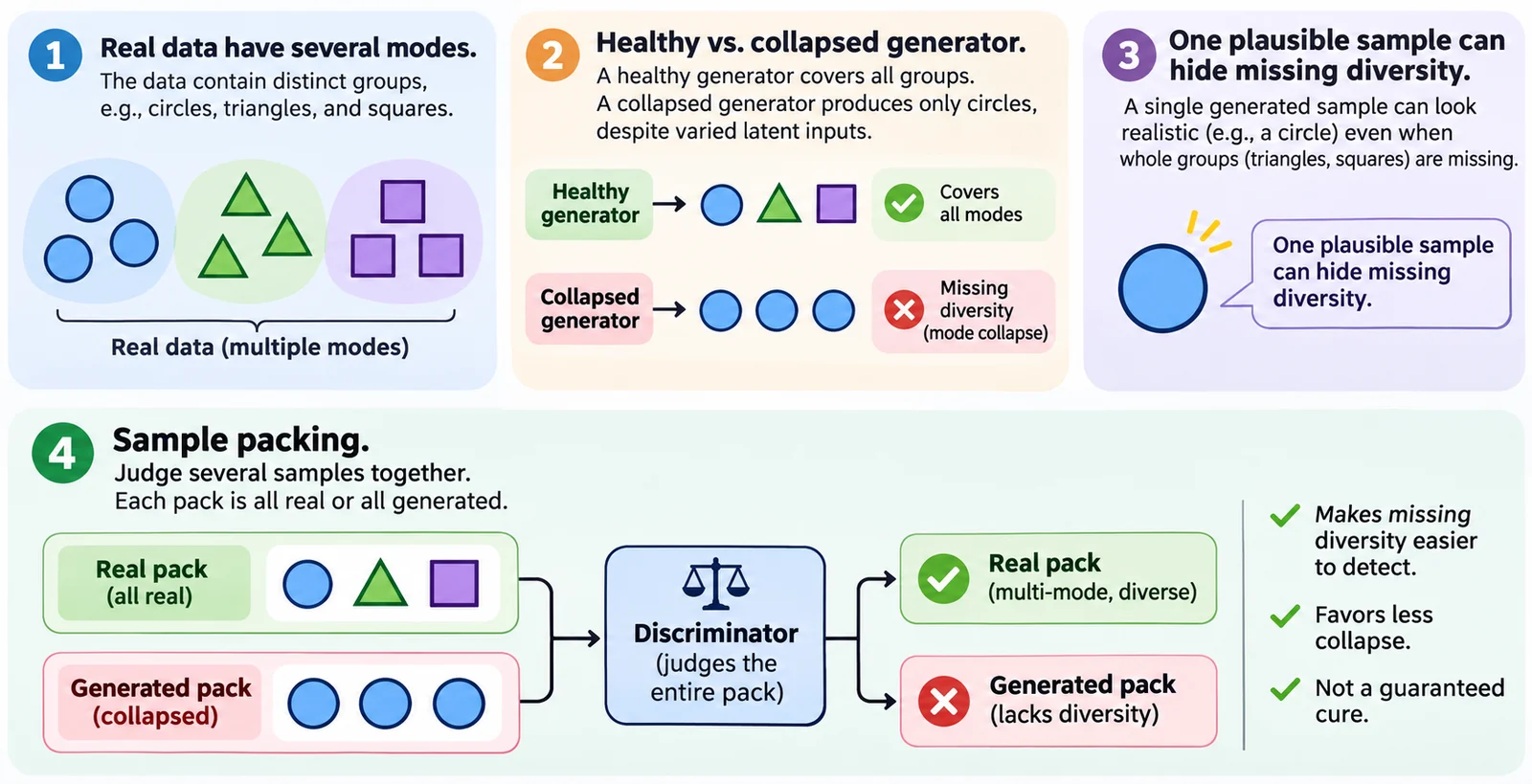
One line of work blames the shape of the trained discriminator in high dimensional spaces. That shape can readily leave training stuck, or push probability mass the wrong way, toward a tighter concentration than the real data show.[49]
A second line of work targets conditional generators, which take an input and should produce outputs that vary with a latent code, a hidden vector of numbers fed to the generator. Conditional distributions in practice are multi-modal, meaning they have many modes. Most conditional approaches instead learn a distribution that is too simple, mapping an input to one output no matter how the latent code varies. The remedy is a regularizer that explicitly pushes the generator to vary its outputs with the latent code.[50]
A third approach, called packing, changes what the discriminator sees. Rather than judging samples one by one, the discriminator decides on the basis of several samples of the same class, whether real or artificially generated. The argument borrows tools from binary hypothesis testing, the statistics of choosing between two explanations, including a result of Blackwell from 1953. With those tools, the work proves a fundamental connection between packing and mode collapse. Packing naturally penalizes generators with mode collapse, so training favors generator distributions with less collapse. Numerical experiments on benchmark datasets suggest that packing also gives significant improvements in practice.[48]
A fourth proposal softens the boundary the discriminator draws between real and generated data. The Soft Generative Adversarial Network uses a dynamic borderline softening mechanism, which aims to solve mode collapse and improve training stability. Early in training, when generated and real data differ greatly, the entropy principle guides learning; late in training, as the two distributions converge, the coverage principle dominates.[51]
A related problem concerns the hidden space from which the generator draws its inputs. ClusterGAN shows that cluster structure is not retained in that latent space, so groups present in the data are not automatically kept apart there. Latent variables are sampled from a mix of one-hot encoded variables and continuous latent variables, and an inverse network is trained jointly with a loss specific to clustering. The results reveal that these networks keep latent space interpolation working across categories, even though the discriminator never sees such vectors. The method performed better than various clustering baselines on both synthetic and real datasets.[52]
Mode collapse is a problem in generative adversarial networks (GANs) where the generator creates only a limited range of outputs, even if the training data has more variety. This means the generator might produce many similar images or outputs, missing other types of data present in the training set. Researchers have studied this issue to understand why it happens and how to prevent it during training.[45] Another method involves changing the architecture of the GAN, such as using Wasserstein GANs, which improve training stability and reduce mode collapse. Wasserstein GANs use a different mathematical approach to measure the distance between real and generated data, which helps avoid some training problems.[37]
Researchers have also used consistency regularization, where the model is trained to produce similar outputs for similar inputs, even with small changes. This method adds noise to the input and ensures the discriminator does not react too strongly to these small changes. Experiments showed that this technique improved the quality of generated images on datasets like CIFAR-10 and ImageNet-2012.[38]
Despite these efforts, mode collapse remains a challenge, and many stabilization methods require careful tuning of parameters and training settings. Some methods also increase the computational cost, making training slower or more resource-intensive. Researchers continue to explore new ways to improve GAN training, including better loss functions, regularization techniques, and architectural changes.[45] Each new method is tested against standard datasets to measure its effectiveness in reducing mode collapse and improving image quality.[38]
Measuring whether a GAN is any good
A 2019 review examined more than 24 quantitative measures and 5 qualitative measures for evaluating generative models, with emphasis on GANs. It concluded that no consensus exists on which measure best captures a model's strengths and limits or allows fair comparison. The review also set out 7 desiderata, meaning desired properties, and checked whether each measure or family of measures met them. Its author argued that settling on one or a few good measures would help steer progress in the field.[53]
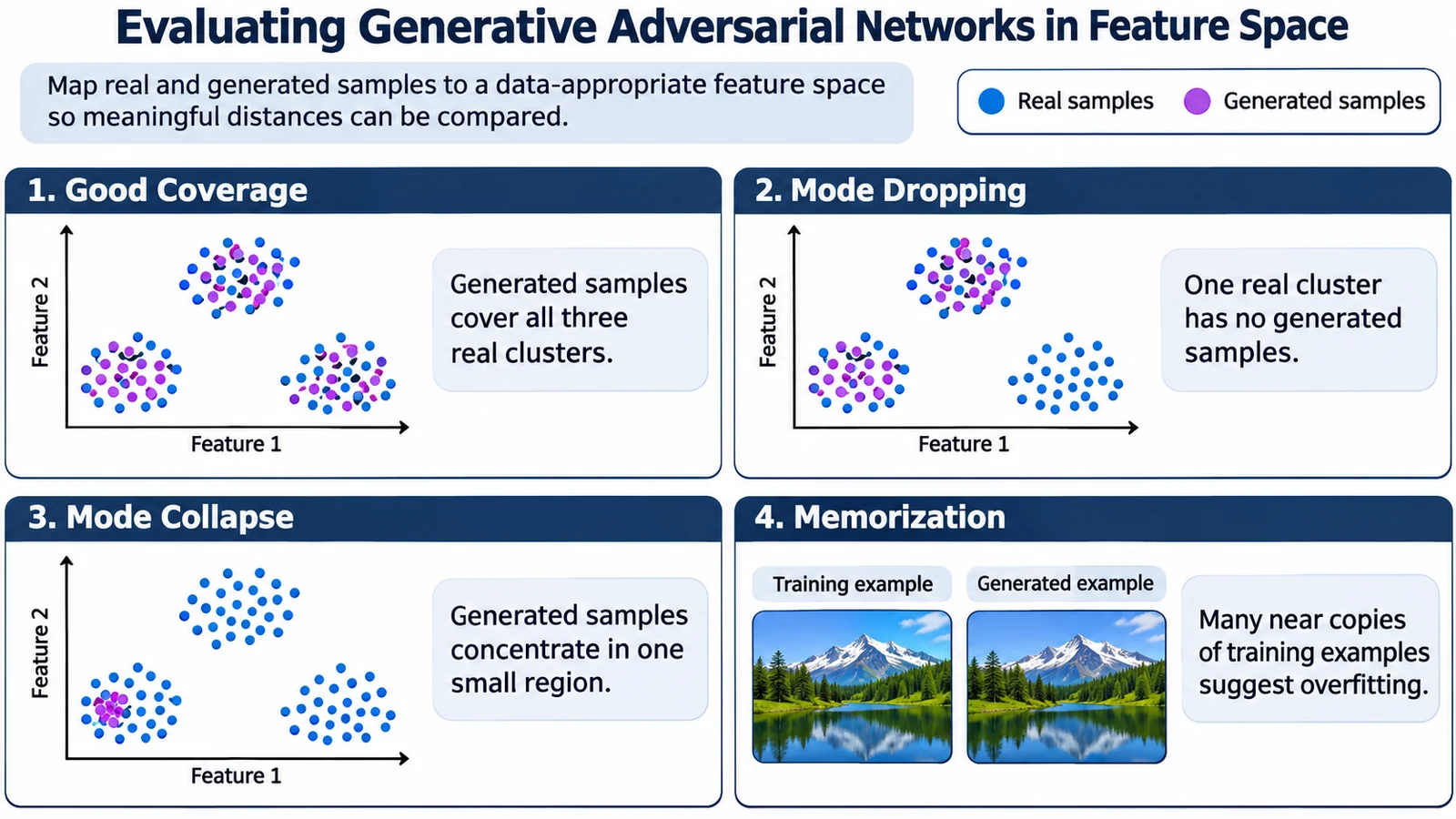
Xu, Huang, Yang, Guo, Sun, Wu and colleagues (2018) describe the evaluation of generative adversarial networks as inherently challenging. The same study sets out necessary conditions that a metric must meet to produce meaningful scores, among them telling real samples apart from generated ones, spotting mode dropping and mode collapsing, and detecting overfitting.[54]
How well these metrics work depends on computing the distances between samples in a feature space that suits the data. The experiments of Xu, Huang, Yang, Guo, Sun, Wu and colleagues (2018) also examine whether popular GAN models memorize their training samples and how far those models are from learning the target distribution. Xu, Huang, Yang, Guo, Sun, Wu and colleagues (2018) identify strengths and limitations of existing sample-based metrics in practical settings through a series of designed experiments.[54]
Working with small or private datasets
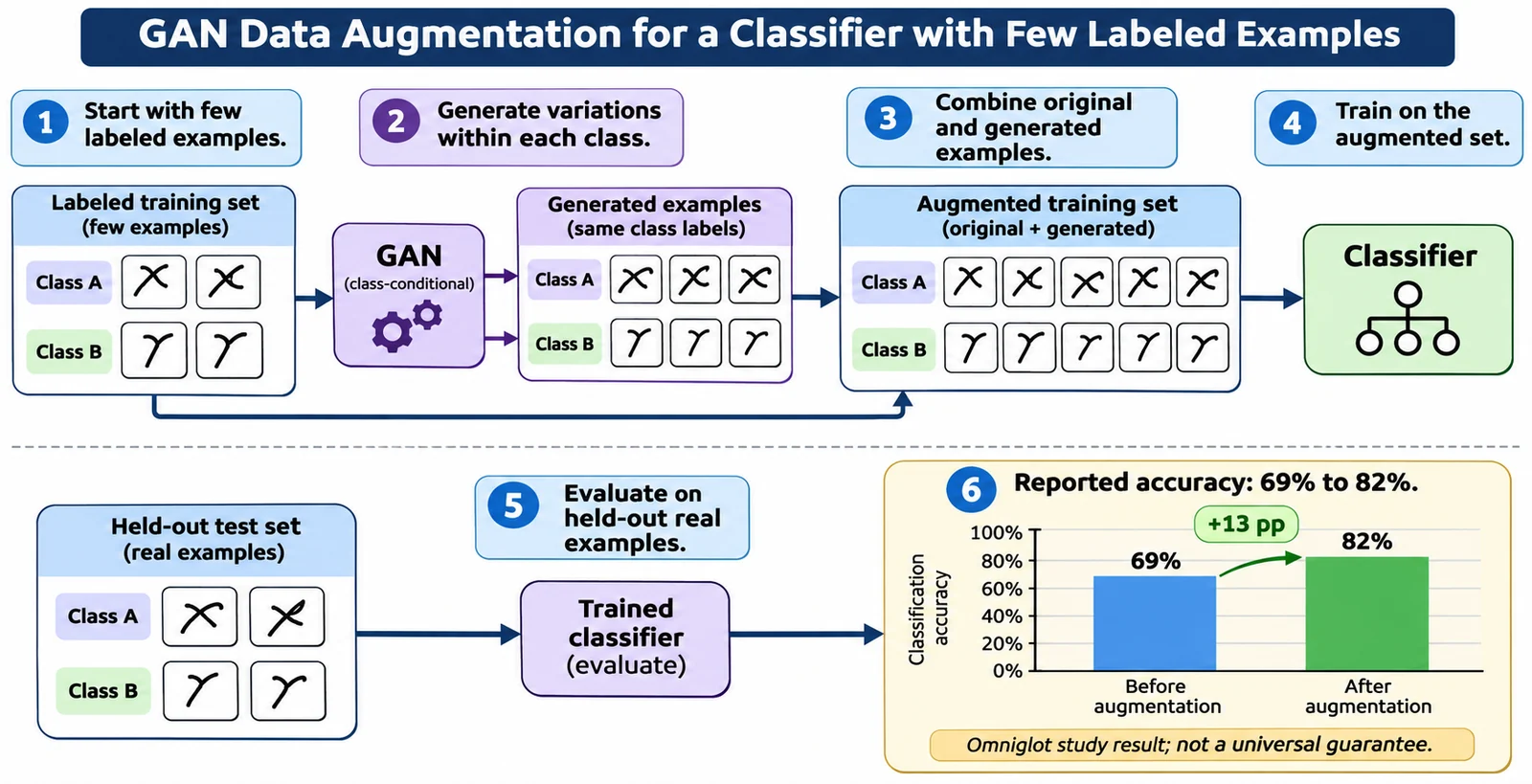
Ordinary augmentation, however, produces only a limited set of plausible alternative data. One 2017 design trained a generative model, called a Data Augmentation Generative Adversarial Network, to create broader augmentations. The model takes a data item from a source domain and learns to generate other within-class items. In low-data experiments, the method raised accuracy from 69% to 82% on Omniglot, from 73.9% to 76% on EMNIST, and from 4.5% to 12% on VGG-Face. Inside Matching Networks, a system for learning from very few examples, gains were smaller: 0.5% on Omniglot (from 96.9% to 97.4%) and 1.8% on EMNIST (from 59.5% to 61.3%).[55]
A 2020 method called adaptive discriminator augmentation stabilizes GAN training in limited data regimes. It requires no changes to loss functions or network architectures. It applies both when a GAN is trained from scratch and when an existing GAN is fine-tuned on a different dataset. Across several datasets, a few thousand training images were enough for good results, often matching StyleGAN2 with ten times fewer images. The same work found that the widely used CIFAR-10 set is in fact a limited data benchmark, and improved its record FID from 5.59 to 2.42.[5]
Differentiable augmentation, proposed in 2020, applies transformations that can be trained through to both real and fake samples. Earlier attempts to augment the training data directly manipulated the distribution of real images and yielded little benefit. Augmenting the generated samples as well effectively stabilizes training and leads to better convergence. The method gave steady gains across many GAN architectures and loss functions, for class-conditional generation and for unconditional generation. It reached an FID of 6.80 with an IS of 100.8 on ImageNet 128x128. Given 1,000 images, it reduced FID by 2 to 4 times on FFHQ and LSUN. With only 20% of the training data, it matched the top performance on CIFAR-10 and CIFAR-100. It also produced high-fidelity images from just 100 images with no pre-training, matching existing transfer learning algorithms.[56]
A separate 2020 study by Zhao, Zhang, Chen, Singh and Zhang tested existing augmentation techniques for GAN training across many settings. Plain GANs, with no added regularization, reached generation quality equal to recent state-of-the-art results once augmentations were applied to real and generated images alike. Adding augmentation-based regularizers, among them contrastive loss and consistency regularization, pushed image quality higher still.[57]
Privacy adds a second problem for sensitive datasets, because a GAN can remember training samples. A 2018 model called a differentially private GAN, or DPGAN, achieves differential privacy by adding carefully designed noise to gradients during learning. A 2018 study gave a rigorous proof of the privacy guarantee and empirical evidence that the method produces high quality data points at a reasonable privacy level.[58] A zero-centered gradient penalty pushed the discriminator toward that optimum and guaranteed generalization and convergence, with experiments on synthetic and large scale datasets.[59]
Generative adversarial networks (GANs) can help when datasets are small or private, by creating new data that looks realistic.[60][61][62] A small dataset may not have enough samples to train a deep learning model well, but GANs can generate extra examples to improve training. One approach is data augmentation, where GANs generate new images or data points that are similar to the original ones but not exact copies. A 2022 study introduced MA-GAN, a method that uses attention mechanisms to improve the quality of generated images for data augmentation. MA-GAN added channel-attention and self-attention to the generator and discriminator parts of the GAN, helping to focus on important image features. The method was tested on small datasets like CelebA, MNIST, and CIFAR-10, and it improved classification accuracy compared to other methods like WGAN-GP and SAGAN.[60]
For private datasets, GANs can be used to create synthetic data that keeps the statistical patterns but hides personal information. A 2018 paper introduced table-GAN, a method that generates fake data tables using GANs, ensuring that the data looks realistic but does not reveal private details. The synthetic data was tested on four real-world datasets, and models trained on it performed nearly as well as those trained on the original data. This property is called model compatibility, meaning the synthetic data can be used without losing much accuracy in machine learning tasks.[61] Another use of GANs is in data imputation, where missing values in a dataset are filled in with realistic guesses. A 2022 study introduced DEGAIN, a GAN-based method for imputing missing data in datasets like Letter Recognition and SPAM.[62]
However, GANs can still face challenges like unstable training or poor-quality outputs, especially when the original data is very limited or noisy. Researchers are working on improving GANs by adding attention mechanisms, normalization techniques, and better training strategies.[60] These improvements help GANs generate more realistic and useful data for tasks like classification, prediction, and analysis.[60][61][62]
Known failure modes and open questions
Training instability is the most frequently documented weakness of generative adversarial networks, and it has driven a run of proposed fixes. A 2025 paper describes instability as a critical challenge that limits practical use, and proposes a training scheme that introduces frequency bands from low to high, reporting gains of 10.55% to 21.03% across FID, Inception Score, Density and Coverage, and Precision and Recall metrics. The same work reports that its model keeps training stable at high learning rates, a setting in which conventional GANs fail completely.[63] Another 2025 study trains two generators in parallel while generator and discriminator each raise resolution step by step, and reports faster, steadier convergence, with FID about 17.6% better than SNGAN and about 5.7% better than ProGAN, and Inception Score about 5.2% above SNGAN.[64]
A 2025 survey states that GAN results depend heavily on large-scale training data and decline quickly when the available data are limited. The survey benchmarks current GANs in that limited-data setting and reviews methods that attempt to address it from different angles.[65] Imbalance in image datasets is a related difficulty: a 2021 survey notes that computer vision performance can significantly deteriorate when training data are imbalanced, and that such imbalance is inevitable in problems such as anomaly detection, medical image analysis and fraud detection.[66]
Evaluating what a GAN has learned is itself unsettled. The stability studies above judge their models with FID, Inception Score, Density and Coverage, and Precision and Recall, and report results as percentage changes against named baseline models rather than as absolute quality.[63][64] A 2023 survey of generative artificial intelligence lists open problems and future challenges for the field without resolving them.[67]
Misuse is a documented concern, particularly in hiding information inside images.[68][69] A 2025 approach, AGASI, uses an encoder as the generator to make hidden images harder for steganalysis tools, which are detectors that look for concealed content, to find. Under a PGD attack at higher disturbance levels, its adversarial stego-images kept secret-image quality while reaching an 84.73% misclassification rate in neural network detection, 23.31% above images of the same visual quality.[69]
Offert (2021) argues that generative adversarial networks are not only technically but also epistemically opaque: where they seem to enhance the view of an object under investigation, they present a technically and historically predetermined space of visual possibilities. A 2021 analysis argues that GANs are opaque in an epistemic sense as well as a technical one. Where they seem to sharpen a view of an object under investigation, Offert argues, they present a space of visual possibilities fixed by technical and historical choices. The argument is developed through applications in astronomy and medicine and through established theories of scientific images.[70] A separate line of work treats GANs as a defense. A 2020 conditional GAN maps adversarial images, inputs perturbed to mislead a model, back toward clean images before they reach the target model, and tests on MNIST and CIFAR10 defended against multiple attack types while maintaining good performance.[71]
Visualizing what a trained generator has learned
A trained generative adversarial network, or GAN, is a pair of neural networks trained together: one network, the generator, produces images, and the other, the discriminator, judges them. The work of Bau, Zhu, Strobelt, Zhou, Tenenbaum, Freeman and colleagues notes that GANs have not been well visualized or understood. A 2018 framework called GAN Dissection set out to answer a basic question: how does a GAN represent the visual world internally? The framework works at the unit level, the object level and the scene level. It starts by finding a group of interpretable units, meaning units closely related to object concepts. The search uses a segmentation-based network dissection method, in which an image is divided into labeled regions and each unit's responses are compared against those labels.[72]
Finding a unit that responds to an object does not show that the unit causes the object to appear, so the framework tests causation directly by intervening on units and measuring how much control that gives over objects in the output. The same approach examines context: discovered object concepts are inserted into new images to see how the units relate to their surroundings. This dissection revealed practical uses, including comparing internal representations across different layers, models, and datasets, and interactively manipulating objects in a scene.[72]
The framework also addressed the artifacts, the visible flaws in generated images, that appear in GAN results. By locating units that cause artifacts and removing them, researchers improved the network's output, which ties an understanding of internal structure to a concrete repair. The work left a further question open, namely how architectural choices affect what a GAN learns, and it released open source interpretation tools so that other researchers and practitioners could examine their own models.[72]
In practice
Uses in images, video and other data
A 2022 survey of the field argues that computer vision is where GANs have had their largest impact. That survey names plausible image generation, image-to-image translation and facial attribute manipulation among the successes.[73] Image-to-image translation means learning to map one visual representation of an input onto another representation. A 2020 review lists multimodal translation, super-resolution and object transfiguration among the tasks treated this way. The same review reports that these methods suffer from mode collapse, instability and a lack of diversity.[74]
A 2017 method called DiscoGAN discovers cross-domain relations from unpaired data. Using the relations it finds, DiscoGAN transfers style from one domain to another while keeping key attributes such as orientation and face identity.[75] A coupled GAN, proposed in 2016, learns a joint distribution of multi-domain images without any tuple of corresponding images. A weight-sharing constraint between the networks favors a joint solution over a simple product of the separate distributions. The method was applied to color and depth images and to face images with different attributes, and also to domain adaptation and image transformation.[76] A triangle GAN of 2017 handles semi-supervised matching between domains, where only a few paired samples provide supervision. It uses two generators and two discriminators, and was tested on image-label, image-image and image-attribute pairs.[77]
Faces have drawn a large body of GAN work of their own. A 2022 survey of facial GANs reports that architectures have been designed to learn variations of faces in cross pose, age, expression and style.[78] Beyond faces, a 2017 survey by Wu, Xu and Hall covers image editing, image-to-image translation, image inpainting and texture synthesis.[79] A 2016 model called the spatial GAN extended the input noise from a single vector to a whole spatial tensor for texture synthesis. A 2016 study describes its model as the first successful texture synthesis method based on GANs that is completely data-driven. It reports high image quality, high scalability in output texture size, fast real-time generation and the ability to fuse several source images.[80]
Video synthesis is a newer area, and a 2023 review calls itself the first to survey video GAN models. That review divides video GANs into conditional and unconditional models. It then sorts the conditional models by the kind of condition supplied: audio, text, video or image.[81] A 2021 overview in Proceedings of the IEEE describes GANs as enabling high-resolution photorealistic images and videos, a task it calls challenging or impossible with prior methods.[82]
A 2023 systematic review of GANs in time series notes that applications have diversified beyond computer vision into time series and sequence generation.[83] A 2024 model called DTAE-CGAN was built to fill in missing values in tables. Its developers tested it on six real datasets of varying sizes against four classic imputation baselines. They report that it consistently showed better imputation accuracy.[84]
GANs have also been used to help classify complex sensor data. A 2018 study applied a GAN to the classification of hyperspectral images, which record light across many wavelength bands. In that design, one convolutional network generates fake inputs and another tries to tell real from fake, and the two train together. The adversarial training improved the generalization of the classifying network, which matters when training samples are limited. The classifiers were tested on three widely used hyperspectral datasets: Salinas, Indiana Pines and Kennedy Space Center. The results were competitive with state-of-the-art methods.[85] A 2022 survey by Cai, Xiong, Xu, Wang, Li and Pan notes that the model can generate realistic examples that plausibly come from an existing distribution of samples. That survey states that work on GANs for privacy and security is still at a very early stage and faces challenges not yet well addressed.[86]
Text-to-image synthesis is one use of GANs, in which written descriptions are turned into images. Reed and colleagues reported that their model could produce believable pictures of birds and flowers when given detailed written descriptions.[87] Detecting images made by GANs is difficult, however. A 2026 study tested a detection model using EfficientNetB0. It worked well when tested on the same GAN it was trained on, but failed when tested on different GANs. When the GAN used a similar architecture, the detection model still worked. When the GAN used a new design, such as an alias-free architecture, the model failed to detect the fake images. This points to a large problem: detection systems trained on one GAN often fail when tested on others. The failure is called the generalization gap.[88]
Uses in medicine, science and design
A 2019 review described rapid adoption of adversarial training for image reconstruction, segmentation, detection, classification and cross-modality synthesis.[89] One recurring problem is dose: computed tomography (CT) scans expose patients to radiation, and lowering the dose adds noise and artifacts. Tests on clinical CT images reduced noise while trying to keep critical information.[90]
An earlier 2017 study trained a generator to turn low-dose CT images into routine-dose images, with a discriminator judging the output. The work used an anthropomorphic phantom, a model of the body containing calcium inserts, plus patient cardiac scans taken at 20% and 100% of routine clinical dose. Training on voxelwise loss alone gave the highest peak signal-to-noise ratio, a standard measure of image fidelity. Networks trained with the adversarial loss instead matched the image statistics of routine-dose scans more closely. The denoised images improved measurement of low-density calcified inserts and allowed coronary calcium scoring in noisy low-dose scans. Testing took under 10 s per CT volume.[91]
Drug discovery is another field where generative models have been tried, because design and development are slow and costly. A 2021 review listed generative adversarial networks among the algorithms applied to drug design, from molecule design to toxicity prediction.[92] A 2018 strategy called ReLeaSE used two networks, one generative and one predictive, trained separately and then jointly with reinforcement learning. The generative network wrote molecules as SMILES strings, a text notation for chemical structure, and the predictive network forecast their properties. In a proof-of-concept study the method built chemical libraries biased toward structural complexity, toward melting point or hydrophobicity, or toward compounds active against Janus protein kinase 2.[93]
Single-cell studies face a related problem: measurements from different datasets are hard to compare directly. A 2021 paper presented scVI, a probabilistic method for joint representation of single-cell RNA sequencing data that accounts for biological and measurement noise. Both methods compared favorably with other leading methods on accuracy, scalability and adaptability to difficult settings. Unlike existing methods, they integrate several datasets in a single generative model that can feed directly into later tasks such as differential expression.[94]
In product design, the first stage is generating ideas, and designers can become attached to one concept too early. A 2023 study built a model in which a generative adversarial network combined images of a target object with images of biological objects. The aim was new product images inspired by nature. Applied to an aircraft design problem, the resulting sketches prompted designers to produce new and creative variants in a case study. The approach raised the quality of the ideas produced and made the process of generating concepts simpler.[95]
Reviews of generative adversarial networks list medical image conversion and the generation of electronic health records data among their applications in biomedical informatics. The same review lists data augmentation and data imputation among the tasks that generative models can support when handling large amounts of data. In medical imaging analysis, the review describes applications of Cycle-GAN. The review also covers the latest applications of GANs in medical informatics and bioinformatics.[96] GANs are also used in scientific research to predict crystal structures. Kim, Noh, Gu, Aspuru-Guzik and Jung applied a generative adversarial network to Mg-Mn-O ternary materials and evaluated their photoanode properties for high-throughput virtual screening.[97]
In mechanical design, Wang, Melkote and Rosen embedded topology optimization into a conditional generative adversarial network to generate functional designs at early design stages. A 2023 study combined GANs with a method called topology optimization. The two-stage formulation lets design constraints such as volume fraction be enforced. The study showed that GANs can create many different designs quickly. Wang, Melkote and Rosen tested several combinations of loss terms and several parameter settings inside the topology optimization step, and the resulting designs varied. Once the first stage is trained, Wang, Melkote and Rosen report, the second stage can be adjusted for new load and boundary conditions by changing its parameters, so the first stage does not need to be trained again.[98]
Applications across science and industry
A 2024 review of deep learning in medical image analysis lists segmentation, reconstruction, detection, denoising and registration among the tasks where GANs have been applied, and credits them with addressing class imbalance and small dataset size in healthcare.[99] About 80% of those 37 studies compared their GAN model with other approaches and reported that the GAN model performed better, by 0.1% to 158.6%, though the review cautions that the findings rest on methodological weaknesses.[100]
You, Kim, Ryu and Yoo reviewed 48 peer-reviewed papers on GANs in ophthalmology imaging and concluded that clinical validation there remains at a very early stage compared with deep learning classification methods.[101] A 2022 review of optical coherence tomography, a fast non-invasive eye imaging method, describes GANs as offering applications that most other deep learning methods cannot, with the potential for more accurate and more reliable analysis.[102]
Remote sensing and the physical sciences use GANs both to sharpen images and to propose new designs.[103][104] One 2023 study proposed a super-resolution method for single remote sensing images that adds dense residual connections and a channel attention mechanism to the SRGAN network. It reported better objective metrics and visual quality than VDSR, SRGAN and ESRGAN on the AID, UCAS_AOD and China Gaofen-1 datasets.[103] In materials science, a 2020 study trained GANs on simulation data from millions of randomly generated architectures sorted by crystallographic symmetry. Mao, He and Zhao then modeled and tested more than 400 two-dimensional architectures with porosities from 0.05 to 0.75 whose isotropic elastic stiffness comes close to the Hashin-Shtrikman upper bounds.[104] A 2021 study used conditional GANs to propose cell candidates for acoustic metamaterials, structures arranged periodically to affect how sound travels, and checked the candidates with finite element simulations.[105]
In the earth sciences and physics, GANs serve as fast substitutes for expensive simulation.[106][107] A 2023 study built a GAN-based model that generates earthquake ground motion time histories directly, without assuming a physical or statistical model, and reported that it approximated the distribution of observed records and produced realistic time histories in both the time and frequency domains.[106] A 2019 study generated analysis-specific simulated events for the Large Hadron Collider, producing muon four-momenta in Z to muon pairs events at limited computing cost, and found that adding regression terms to the generator loss improved performance and convergence speed.[107]
Energy, finance and security applications center on scenario generation and intrusion detection.[108][109][110][111] A 2018 study used GANs to generate wind and photovoltaic power scenarios from NREL integration data, capturing production patterns in time and space across many correlated resources and conditioning scenarios on weather events or time of year.[108] For network security, a 2024 paper added an extreme learning algorithm at the discrimination point of a GAN and reported intrusion detection accuracy of 100%. That was higher than DCGAN by 19% and LSGAN by 23%, and the intrusion cracking rate of its layer 5 neural network reached 92% at 2.5 seconds of a simulated intrusion.[110]
What this looks like in practice
For a classifier short of labeled examples, one study trained a GAN to turn any data item into other within-class items, and accuracy in the low-data regime rose from 69% to 82% on Omniglot.[55] A separate study added channel attention and self-attention to both networks and spectral normalization to keep training stable, and its augmented data gave higher classification accuracy than WGAN-GP or SAGAN on small benchmarks.[60]
Privacy work used a GAN called table-GAN to synthesize fake tables that are statistically similar to an original table yet do not leak information. Models trained on the synthetic tables performed similarly to models trained on the original table for unseen test cases, a property the authors call model compatibility. Across four real-world datasets, only table-GAN consistently balanced privacy level and model compatibility.[61] In the oilfield study, a Generative Adversarial Imputation Network filled values that had been masked at random, and the completed data supported later analysis with accuracy the paper describes as surprising.[112] A nature-inspired design study combined target object and biological object images in a GAN to sketch aircraft concepts, and the resulting sketches inspired designers to generate new variants in a case study.[95] To probe what a trained generator has learned, one framework identified interpretable units tied to object concepts, measured how intervening on them controlled objects in the output, and used the findings to locate and remove artifact-causing units.[72]
Later developments
Architectures that improved image quality
Ordinary convolutional generators build fine detail only from nearby points in a coarse feature map, so distant parts of a picture are decided separately. The Self-Attention Generative Adversarial Network, proposed in 2018, let the generator draw on cues from all feature locations when making details. Its discriminator could then check that highly detailed features in distant portions of an image agree with each other. On ImageNet, a large labeled image dataset, the method raised the best published inception score from 36.8 to 52.52. On the same dataset it reduced the Frechet Inception distance, a measure of how far generated images sit from real ones, from 27.62 to 18.65. Visualizations showed the attention layers using neighborhoods that follow object shapes rather than fixed local regions.[4]
A 2021 follow-up found that typical GAN generators depend on absolute pixel coordinates in an unhealthy way. The visible symptom was detail that appeared glued to image coordinates instead of to the surfaces of depicted objects. Small architectural changes that treat all signals as continuous stopped unwanted information from leaking into the synthesis process. The resulting networks matched the FID of StyleGAN2, an earlier style-based model, but differed dramatically in their internal representations.[113]
A different route to higher resolution stacks several networks instead of enlarging one. A second stage then took that result and the text and produced a high-resolution image with photo-realistic details. An advanced version, StackGAN-v2, arranged multiple generators and multiple discriminators in a tree-like structure, with images at several scales coming from different branches. That version trained more stably than the two-stage design by approximating several distributions at once.[114]
Self-modulation, described in 2018, lets the intermediate feature maps of a generator change as a function of the input noise vector, with no labeled data needed. In a large empirical study it produced a relative decrease in FID of 5% to 35%. Adding the change improved performance in 124 of 144 studied settings, or 86%, and required no extra parameter tuning.[115] LR-GAN, from 2017, instead generated background and foreground separately and recursively, then stitched the foregrounds onto the background in a contextually relevant way. Experiments found it produced more natural images, with objects more recognizable to people, than an earlier convolutional design called DCGAN.[116]
Some GAN designs improved the quality of generated images by changing how the generator builds images. One example is ProGAN, introduced in 2017. ProGAN uses a method called progressive growing, where the generator starts with low-resolution images and adds more detail as training continues. This approach helps the model learn large structures first, then focus on smaller details, which makes training faster and more stable. ProGAN also improved the variety of images it could create and reached a high score on a standard image quality test called the inception score. The researchers also created a better version of the CelebA dataset, which includes high-quality images of human faces.[6]
Another GAN design, called BEGAN, was introduced in 2017 and focused on balancing the generator and discriminator during training. BEGAN uses a loss function based on the Wasserstein distance, which helps the generator and discriminator work together more smoothly. This method allows for better control over the trade-off between image quality and diversity in the generated images. BEGAN also provides a new way to measure how close the generated images are to real ones, which helps assess training progress. The model achieved high visual quality and worked well even at higher image resolutions.[117]
In 2021, researchers introduced StyleGAN, which changed how GANs control the style of generated images. StyleGAN uses a generator that separates high-level features, like facial structure, from random variations, like freckles or hair texture. This separation allows for more intuitive control over image details at different scales, making it easier to adjust specific features. StyleGAN improved the quality of image distributions and allowed for better interpolation between different images. The researchers also introduced new methods to measure how well a generator separates different features and how smoothly it can transition between images.[39]
Together, these models helped push the limits of image generation by improving stability, quality, and control. ProGAN, BEGAN, and StyleGAN each introduced new ideas that became important in later GAN research and applications.[6][117][39]
Early image results and the convolutional turn
A second 2015 model attacked image quality by building images in stages rather than all at once. The Laplacian pyramid of adversarial networks placed a cascade of convolutional networks inside a pyramid framework, with a separate generative model trained at each level so that the image was produced from coarse to fine.[118]
Later variants changed what the discriminator was asked to do. The energy-based GAN treats the discriminator as an energy function that assigns low values near the data and higher values elsewhere, and the generator is trained to produce samples with minimal energy. One version of that framework put an auto-encoder, a network trained to reconstruct its input, in place of the discriminator and used the reconstruction error as the energy. This form behaved more stably during training than regular GANs, and a single-scale architecture could be trained to generate high-resolution images.[119]
InfoGAN took a different route, adding an objective that maximizes the mutual information, a measure of how much one quantity tells about another, between a small subset of the latent input variables and the generated observation. Trained without labels, it separated writing styles from digit shapes on MNIST and pose from lighting in 3D rendered images. On SVHN it told background digits apart from the central digit, and on the CelebA face dataset it found visual concepts such as hair styles, the presence or absence of eyeglasses, and emotions.[120]
Variants that changed the training objective
The original training rule asks a generator to fool a discriminator that judges whether a sample is real or fake, and several reformulations replace that rule with a different scoring signal.[121][122] In a simulation experiment, that dual Wasserstein method produced more accurate inversion results than earlier GAN-based inversion methods and held up when the seismic data were noisy. The same method also gave accurate results on recorded seismic data when labeled well-log data were scarce.[123]
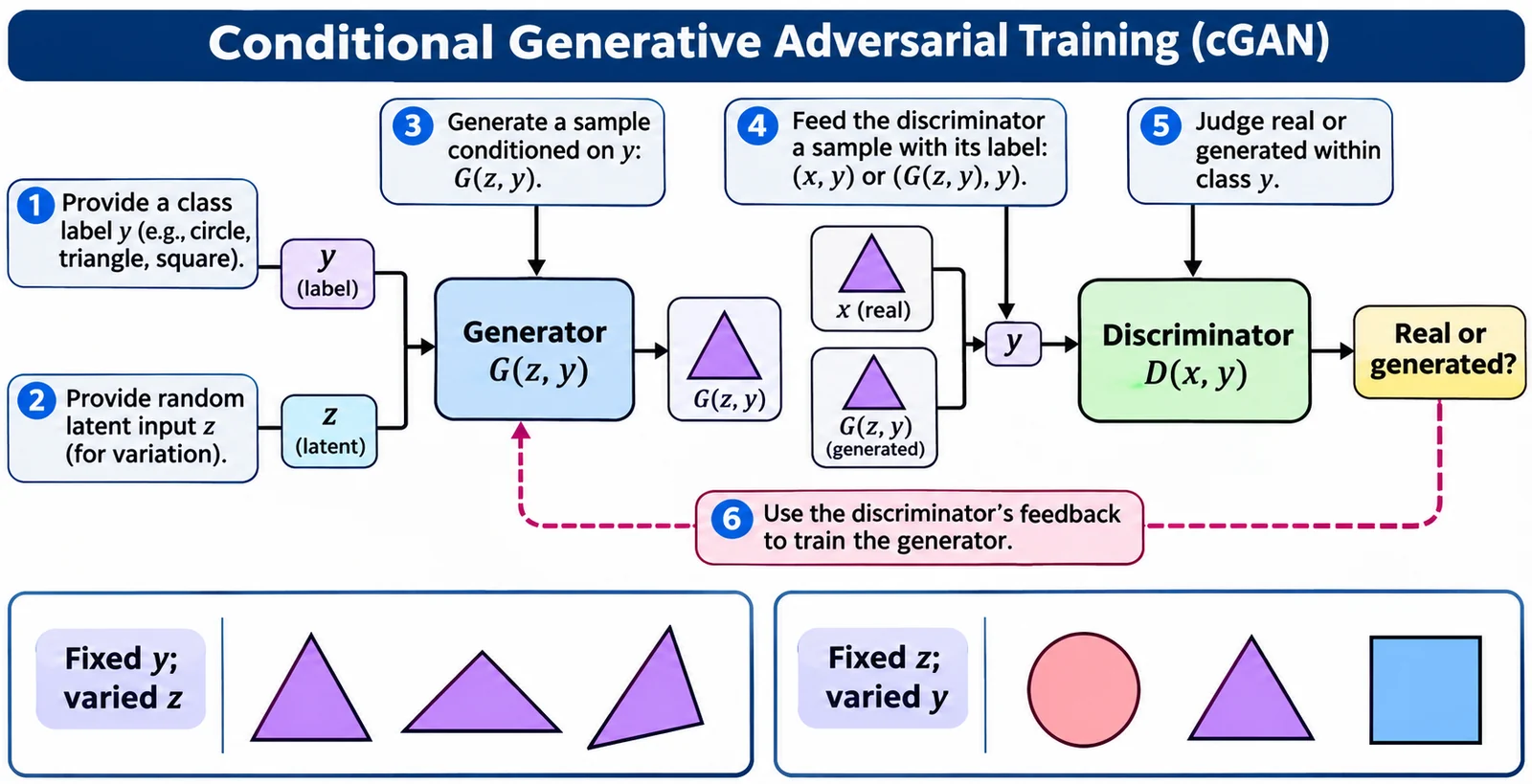
Conditional training supplies the network with a label or context so that it generates samples of a chosen class rather than an arbitrary one.[124][125] A regime-specific conditional GAN for financial time series assigns class labels that correspond to distinct market regimes, found by a structural breakpoint algorithm that segments the series into regime classes. That model simulated univariate series matching specific empirical regimes, and it did better than unconditional GANs of the same configuration trained only on crisis-regime data. Its design also gives the user a hyperparameter that trades the fidelity of synthetic data to real data against the variety of the synthetic data.[124] A mixture density conditional GAN for time series forecasting estimates a probability distribution over future values rather than a single point forecast, and with a Gaussian mixture model as its output distribution it produces posterior predictions that are not Gaussian. That model performed well against a set of benchmark methods, particularly when noise formed a significant part of the observed series.[125]
Score-guided training adds an evaluator built from a pretrained network and uses an evaluation metric as a rough guide for the generator. The score-guided GAN avoids overfitting the Inception network, the pretrained image classifier behind the Inception score, by substituting another pretrained network, so that generated samples do not become adversarial examples of that classifier. The evaluation metric serves only an auxiliary role in training. On the CIFAR-10 dataset the model reached an Inception score of 10.36 ± 0.15, and on CIFAR-100 it reached a Fréchet Inception distance of 13.98, a measure of similarity between generated and real image distributions in which lower values indicate closer agreement.[121]
Two formal links place GAN training beside other families of models.[122][126] Adversarial variational Bayes trains a variational autoencoder, a latent variable model that learns probability distributions from data, with an arbitrarily expressive inference model by adding an auxiliary discriminative network that recasts maximum likelihood as a two-player game. In the nonparametric limit the method yields an exact maximum-likelihood assignment for the generative model's parameters and the exact posterior distribution over latent variables given an observation.[122] A GAN can also be viewed as an actor-critic method, a reinforcement learning setup in which an actor chooses actions and a critic scores them, in a setting where the actor has no influence on the reward. Both fields have gained a reputation for being difficult to optimize, and the connection lets stabilization strategies from each side inform the other.[126]
Quantum versions of adversarial training
Quantum machine learning is seen as a likely early general-purpose use of near-term quantum devices, machines that exploit quantum mechanics and remain limited by noise and modest numbers of qubits.[127] In 2018, Dallaire-Demers and Killoran extended adversarial training to the quantum domain, and Lloyd and Weedbrook introduced quantum generative adversarial networks, in which a generator tries to produce statistics matching a true data set while a discriminator tries to tell true data from generated data.[127][128] One proposal sets up quantum generative adversarial networks in which the data are quantum states or classical data, and quantum information processors equip both the generator and the discriminator. That work shows the quantum adversarial game has a unique fixed point, at which the generator reproduces the statistics of the data. Neither model needs quantum tomography, the reconstruction of a quantum state from many repeated measurements; a linear program drives both to the optimum. Quantum systems are intrinsically probabilistic, so the proof for the quantum case differs from the classical one and is simpler. When the data are samples of measurements on high-dimensional spaces, quantum adversarial networks may show an exponential advantage over classical ones.[128]
The companion proposal shows how to build generative adversarial networks from quantum circuits and how to compute the gradients used in training with another quantum circuit. It also gives an example of a simple circuit ansatz, a parametrized circuit layout, for quantum machine learning models, and a small numerical experiment indicating that such networks can be trained successfully.[127]
Later work has combined quantum and classical parts in a single model. A 2026 study proposes HQMSGAN, a hybrid quantum-classical network whose multiscaling discriminators remove adversarial attacks, small deliberate perturbations of input data, through adversarial training. During training the model performs quantum projections that encode features into quantum states, couples features using quantum entanglement, and learns the probability distribution of both clean and perturbed data while reducing the loss over iterations. The experiment induced four different adversarial attacks and defended against them using quantum simulators in the noisy intermediate-scale quantum era, and it reported favorable performance on image similarity, signal-to-noise, distribution-distance and classification-accuracy measures after training. The same study notes that how well quantum generative models resist adversarial perturbations, and how effective adversarial training with quantum-classical architectures is, remain less explored than in classical models.[129]
Filling gaps in scientific and technical data
A generative adversarial network can also supply values that a dataset is missing, a task called imputation.[130][112] The usual alternatives include deleting incomplete cases, filling gaps with statistics, or fitting ordinary machine learning models. Qin and Wang report that such methods cannot handle temporal information, or that their results are unstable. ImputeGAN, a model built on adversarial training with an iterative correction step guided by the gradient of the filled values, was tested on three large-scale datasets and filled missing entries in multivariate time series more accurately than traditional methods.[130]
Oilfield records pose the same problem, because priorities for which data matter vary from company to company and knowledge of a single field can differ from place to place. A 2021 study applied a Generative Adversarial Imputation Network, an adaptation of the standard GAN approach, to a fully observed dataset from which smaller sets with randomly masked missing values were created, so that filled values could be compared with the originals. At various percentages of missing data, the filled-in values supported further analytics with surprising accuracy. The study compared the network with common imputation methods and with cropping or filling in average values.[112]
Elevation models built from photogrammetry or LiDAR, which measures distance with laser pulses, often contain voids caused by instrument artifacts or ground occlusion. A multiattention model proposed in 2022 first fills voids with a multiscale feature fusion generation network, then recovers terrain detail around each void with a second network, and is trained with a combined reconstruction and adversarial loss. Three groups of experiments covered hillsides, valleys, ridges and hills. Structural similarity around filled voids reached 80 to 90 percent on the first three terrain types, at least 10 percent better than Kriging, IDW and Spline interpolation, and reached 57.4 percent in hilly areas where other deep learning models reached 43.2, 17.1 and 11.4 percent.[131]
Subsurface models raise a related problem: relating physical parameters to model state variables in both directions, which is hard when the number of parameters is high. SPID-GAN, presented in 2018, learned these bidirectional mappings at the same time on a series of representative problems in subsurface flow modeling and achieved satisfactory performance.[132] For reservoirs with complex non-Gaussian geology, such as carbonate reservoirs, a multi-source information fused model called MSIGAN combines a variational autoencoder and a GAN. It learns geological features from facies distribution, microseismic data and inter-well connectivity, and integrated with an ensemble data assimilation method it improved the accuracy of history matching on two reservoir models with fluvial facies.[133]
Synthetic records and signals for health research
A generative adversarial network (GAN) can stand in for records and signals that are hard to collect, because a generator learns the patterns of real data and then produces new examples that imitate them. Electronic health records are a valuable asset for clinical research and point-of-care applications, yet privacy concerns limit how far they can be shared and used collaboratively.[134][135] medGAN, proposed in 2017, combines an autoencoder with a GAN to produce high-dimensional discrete variables such as binary and count features from real patient records.[134] A 2024 survey of GANs for structured electronic health records organizes the field by source datasets and by how faithfully and how privately the synthetic records behave.[135]
Biomedical signals pose a related shortage: recording large amounts of electroencephalogram (EEG) data is difficult, so data augmentation, the artificial enlargement of a dataset, is one response.[136] SynSigGAN, described in 2020, pairs a bidirectional grid long short-term memory generator with a convolutional neural network discriminator and can create new signals from a small original dataset. It was tested on four kinds of biomedical signals (electrocardiogram, electroencephalogram, electromyography and photoplethysmography), and other models classified the generated signals with high accuracy.[137] A 2019 model built from a bidirectional long short-term memory network and a convolutional network was trained on 48 electrocardiogram records from the MIT-BIH database and produced traces with high morphological similarity to real recordings.[138] A 2023 overview reports that GANs have been used to augment EEG in brain-computer interface paradigms such as motor imagery and P300-based systems, and in emotion recognition and epileptic seizure detection and prediction.[136]
Animal studies remain hard to avoid in evaluating chemical and drug safety, and AnimalGAN was developed to simulate 38 rat clinical pathology measures from legacy study results. It held up for drugs that differ substantially from the training set in chemical structure, drug class and year of FDA approval, matched real animal data in hepatotoxicity assessment and outperformed 12 conventional quantitative structure-activity relationship approaches. A virtual experiment of 100,000 rats ranked the hepatotoxicity of three structurally similar drugs in a trend similar to that observed in human populations.[139] Substitution has limits: the survey of electronic health record work closes by discussing open challenges in GAN development and by proposing recommended practices rather than declaring the problem solved.[135]
Security, networks and adversarial misuse
A generative adversarial network, or GAN, pairs a generator that produces synthetic samples with a discriminator that tries to tell those samples from real ones, and security researchers have turned this contest toward both detecting attacks and mounting them.[140][141] One line of work uses GANs to repair a weakness in network intrusion detection: the training data for such systems is imbalanced, with far more examples of some classes of traffic than others, so classifiers handle rare attacks poorly.[142][143] An imbalanced GAN (IGAN) enriched the minority samples in a network intrusion dataset and, combined with an ensemble of the LeNet 5 and long short-term memory classifiers, reached above 98% accuracy.[143] A modified conditional GAN (MCGAN) generated oversamples to balance minority and majority classes, and with a Bi-LSTM classifier on the NSL-KDD+ dataset it reported 95.16% accuracy, 94.21% precision, a 2.1% false positive rate and a 96.7% F1-score using 20 selected features.[142]
Mobile malware detection has been approached the same way: a model called MDGAN processed GoogleNet and LSTM features of grayscale images and API sequences through a conditional GAN, and on the combined AndroZoo and Drebin database it reported 96.2% classification accuracy and a 94.7% F-score.[141] Trolls, online users who deliberately disrupt discussions and incite conflict, have been targeted with a semi-supervised GAN whose generator, discriminator and classifier share an LSTM layer. Tested on two Twitter troll datasets, a small labeled set of 14,940 instances and a corpus of approximately three million Russian troll-related tweets, the TrollGAN model scored higher on accuracy and F1-score than LSTM and logistic regression baselines.[140]
GANs also serve offense: an autonomous penetration testing framework used a conditional sequence GAN to generate cross-site scripting attack payloads aimed at web applications protected by web application firewalls.[144] In radar, a UNet-GAN refined adversarial examples for synthetic aperture radar automatic target recognition, because optimization-based attacks that minimize mean-squared reconstruction error leave smooth target edges and blurry weak scattering centers. The generated examples, with sharp target edges and explicit weak scattering centers, fooled recognition models built on several advanced convolutional neural networks trained on measured images of ground vehicle targets.[145]
Criticism
Criticisms, limits and open questions
Generative adversarial networks learn complex, high-dimensional distributions over images, audio and data, but training them runs into mode collapse, non-convergence and instability. Training itself is the first of these: mode collapse, non-convergence and instability are described as major challenges.[146] Later work describes existing GANs as tending to suffer from instability and mode collapse as generative tasks grow harder.[147]
A 2019 study found that this auxiliary classifier can hardly guide the generator well when the classifier itself overfits. Separating the classifier from the discriminator and training it with data augmentation gave an Inception score of 8.61 ± 0.10 on the CIFAR-10 image dataset.[148] A 2024 paper reports that conditioning on a latent vector, the generator's input code, still struggles to yield high-quality images that match the requested condition.[149]
A 2019 study of steerability notes that many models perform very well on standard benchmarks yet fail to generalize outside the lab. Shifting the distribution in latent space, called steering, still produced realistic images. The study suggests the size of that shift relates to how broad the training data distribution is.[150]
A 2017 study states that the original GAN formulation offers no ready-made way to reverse the mapping from latent vectors to images. Its gradient-based technique, stochastic clipping, recovered the latent pre-images of GAN-generated images 100% of the time. The method also withstood noise and appeared to recover unique encodings for images it had not seen.[151] A 2019 technique projects images into latent space using a pretrained GAN and uses the reconstruction loss to compare models on three image datasets.[152]
A 2025 theoretical paper argues that most stability studies give no relatively complete proof, and it supplies a proof for the gradient penalty constant of 1. The same paper notes that weight clipping in Wasserstein GANs causes insufficient capacity use and gradient vanishing.[153] A 2022 framework adds noise through a forward diffusion chain and reports images that are more realistic, with greater stability and better use of data than strong baselines.[154] A 2025 study of an adaptive optimizer reports reduced oscillation and a lower risk of mode collapse in image super-resolution.[155] A 2025 pre-training framework reports generator and discriminator losses of 39.4% and 38.2%, more than 5% below random search.[156]
Generative adversarial networks (GANs) face several limitations, including unstable training and mode collapse. Training GANs often leads to non-convergence, vanishing or exploding gradients, and other instability problems. These issues make it difficult to reliably train GANs to produce high-quality outputs. Mode collapse is another major issue, where the generator produces limited variations of outputs, ignoring parts of the data distribution. Researchers have proposed many methods to stabilize GAN training, but open questions remain about how to fully solve these problems.[45]
HAG-NET is a method based on image carriers, jointly trained by an encoder, a decoder and an attacker. Its encoder generates adversarial steganographic examples that are adversarial to the target classification network, and its decoder can recover secret data from those examples. One study proposed HAG-NET, a method that embeds secret data into images while making them adversarial to classification networks. This method achieved over 99% success in embedding and recovering data on datasets like MNIST and CIFAR-10. Fan and Wang trained the encoder, decoder and attacker together, and the encoder produces adversarial steganographic examples that fool the target classification network while the decoder recovers the hidden data from them.[157]
Wiatrak, Albrecht and Andrew survey methods for stabilizing GAN training, discuss the advantages and disadvantages of each approach, and close with a discussion of open problems.[45] Researchers are also exploring how to expand GANs to new domains, such as cybersecurity and anomaly detection. One system combined GANs with traditional machine learning algorithms to detect network intrusions and anomalies. The GAN module generated synthetic data to improve the detection system's performance across nine attack categories.[158]
Common misconceptions
Training a generative adversarial network on too little data tends to make the discriminator overfit, and training then diverges, according to Karras, Aittala, Hellsten, Laine, Lehtinen and Aila (2020). Training with too little data typically leads the discriminator to overfit, which causes training to diverge. Adaptive discriminator augmentation stabilized training without changes to loss functions or architectures and matched StyleGAN2 results with an order of magnitude fewer images.[5]
Zhao, Liu, Lin, Zhu and Han (2020) attribute the poor performance of generative adversarial networks on limited training data mainly to the discriminator memorizing the exact training set. Augmenting both real and fake samples, rather than only the real data, effectively stabilized training and led to better convergence.[56]
Key studies
| Year | Study | Sample | Design | Finding |
|---|---|---|---|---|
| 2017 | Antoniou et al.[55] | Omniglot, EMNIST and VGG-Face datasets | experiments with a Data Augmentation GAN | Accuracy rose from 69% to 82% on Omniglot, 73.9% to 76% on EMNIST and 4.5% to 12% on VGG-Face. |
| 2017 | Wolterink et al.[91] | an anthropomorphic phantom and patient cardiac CT images | comparison of three training strategies | Voxelwise loss alone gave the highest peak signal-to-noise ratio, while adversarial loss captured routine-dose statistics better. |
| 2018 | Zhu et al.[85] | Salinas, Indiana Pines and Kennedy Space Center datasets | GAN-based hyperspectral classification | The proposed models gave competitive results compared with state-of-the-art methods. |
| 2018 | Park et al.[61] | four real-world datasets from four domains | comparison with anonymization, perturbation and generation methods | Only table-GAN consistently balanced privacy level and model compatibility. |
| 2018 | Bau et al.[72] | trained GAN models | segmentation-based network dissection framework | Interpretable units tied to object concepts were identified and used to locate and remove artifact-causing units. |
| 2018 | Lloyd & Weedbrook[128] | quantum and classical data settings | theoretical analysis of a quantum adversarial game | Quantum adversarial networks may show an exponential advantage when data are measurements on high-dimensional spaces. |
| 2018 | Creswell et al.[2] | Review article in IEEE Signal Processing Magazine, 2018 | A GAN learns deep representations without needing extensive annotation, because the competitive process between a generator and a discriminator supplies the signals that backpropagation uses. | |
| 2018 | Miyato et al.[3] | Methods paper testing spectral normalization on CIFAR10, STL-10 and ILSVRC2012 | Spectrally normalized GANs generated images of better or equal quality relative to previous training stabilization techniques. | |
| 2018 | Zhang et al.[4] | Methods paper on ImageNet with self-attention GAN | The Inception score rose from 36.8 to 52.52 and the Frechet Inception distance fell from 27.62 to 18.65. | |
| 2020 | Karras et al.[5] | several datasets including CIFAR-10 | training with adaptive discriminator augmentation | Good results were possible with only a few thousand images, and the CIFAR-10 record FID improved from 5.59 to 2.42. |
| 2020 | Zhao et al.[56] | FFHQ, LSUN, CIFAR-10 and CIFAR-100 | training with differentiable augmentation | With 20% of the training data the method matched top CIFAR-10 and CIFAR-100 results, and FID fell 2-4x given 1,000 images on FFHQ and LSUN. |
| 2021 | Andrews & Gorell[112] | a gathered fully observed dataset with randomly masked values | comparison of imputation methods | Across the tested shares of missing values, the completed data supported later analysis with accuracy the paper describes as surprising. |
| 2022 | Yang et al.[60] | CelebA, MNIST and CIFAR-10 | data augmentation with mixed attention GAN | The method gave higher classification accuracy than WGAN-GP and SAGAN. |
| 2023 | YÜKSEL & BÖRKLÜ[95] | an aircraft design case study | nature-inspired GAN design experiment | The resulting sketches inspired designers to generate new variants and improved the quality of ideas produced. |
See also
References
- Goodfellow, I., Pouget-Abadie, J., Mirza, M., Xu, B., Warde-Farley, D., Ozair, S., Courville, A., & Bengio, Y. (2020). Generative adversarial networks. Communications of the ACM, 63(11), 139-144. doi:10.1145/3422622
- Creswell, A., White, T., Dumoulin, V., Arulkumaran, K., Sengupta, B., & Bharath, A. A. (2018). Generative Adversarial Networks: An Overview. IEEE Signal Processing Magazine, 35(1), 53-65. doi:10.1109/msp.2017.2765202
- Miyato, T., Kataoka, T., Koyama, M., & Yoshida, Y. (2018). Spectral Normalization for Generative Adversarial Networks. arXiv. doi:10.48550/arxiv.1802.05957 Free full text
- Zhang, H., Goodfellow, I., Metaxas, D., & Odena, A. (2018). Self-Attention Generative Adversarial Networks. arXiv. doi:10.48550/arxiv.1805.08318 Free full text
- Karras, T., Aittala, M., Hellsten, J., Laine, S., Lehtinen, J., & Aila, T. (2020). Training Generative Adversarial Networks with Limited Data. arXiv. doi:10.48550/arxiv.2006.06676 Free full text
- Karras, T., Aila, T., Laine, S., & Lehtinen, J. (2017). Progressive Growing of GANs for Improved Quality, Stability, and Variation. arXiv. doi:10.48550/arxiv.1710.10196 Free full text
- Wang, K., Gou, C., Duan, Y., Lin, Y., Zheng, X., & Wang, F. Y. (2017). Generative adversarial networks: introduction and outlook. IEEE/CAA Journal of Automatica Sinica, 4(4), 588-598. doi:10.1109/jas.2017.7510583
- Sajeeda, A., & Hossain, B. M. M. (2022). Exploring generative adversarial networks and adversarial training. International Journal of Cognitive Computing in Engineering, 3, 78-89. doi:10.1016/j.ijcce.2022.03.002
- Hong, Y., Hwang, U., Yoo, J., & Yoon, S. (2020). How Generative Adversarial Networks and Their Variants Work: An Overview. ACM Computing Surveys, 52(1), 1-43. doi:10.1145/3301282
- Thakur, A. (2021). Generative Adversarial Networks. International Journal for Research in Applied Science and Engineering Technology, 9(8), 2307-2325. doi:10.22214/ijraset.2021.37723
- Gui, J., Sun, Z., Wen, Y., Tao, D., & Ye, J. (2020). A Review on Generative Adversarial Networks: Algorithms, Theory, and Applications. arXiv. doi:10.48550/arxiv.2001.06937 Free full text
- (2017). GAN(Generative Adversarial Nets). Journal of Japan Society for Fuzzy Theory and Intelligent Informatics, 29(5), 177-177. doi:10.3156/jsoft.29.5_177_2
- Springenberg, J. T. (2015). Unsupervised and Semi-supervised Learning with Categorical Generative Adversarial Networks. arXiv. doi:10.48550/arxiv.1511.06390 Free full text
- Odena, A. (2016). Semi-Supervised Learning with Generative Adversarial Networks. arXiv. doi:10.48550/arxiv.1606.01583 Free full text
- Rosca, M., Lakshminarayanan, B., Warde-Farley, D., & Mohamed, S. (2017). Variational Approaches for Auto-Encoding Generative Adversarial Networks. arXiv. doi:10.48550/arxiv.1706.04987 Free full text
- Gui, J., Sun, Z., Wen, Y., Tao, D., & Ye, J. (2023). A Review on Generative Adversarial Networks: Algorithms, Theory, and Applications. IEEE Transactions on Knowledge and Data Engineering, 35(4), 3313-3332. doi:10.1109/tkde.2021.3130191
- Chakraborty, T., Reddy K S, U., Naik, S. M., Panja, M., & Manvitha, B. (2024). Ten years of generative adversarial nets (GANs): a survey of the state-of-the-art. Machine Learning: Science and Technology, 5(1), 011001. doi:10.1088/2632-2153/ad1f77
- Goodfellow, I. (2016). NIPS 2016 Tutorial: Generative Adversarial Networks. arXiv. doi:10.48550/arxiv.1701.00160 Free full text
- Pan, Z., Yu, W., Yi, X., Khan, A., Yuan, F., & Zheng, Y. (2019). Recent Progress on Generative Adversarial Networks (GANs): A Survey. IEEE Access, 7, 36322-36333. doi:10.1109/access.2019.2905015
- Mao, X., Li, Q., Xie, H., Lau, R. Y. K., Wang, Z., & Smolley, S. P. (2019). On the Effectiveness of Least Squares Generative Adversarial Networks. IEEE Transactions on Pattern Analysis and Machine Intelligence, 41(12), 2947-2960. doi:10.1109/tpami.2018.2872043
- Hjelm, R. D., Jacob, A. P., Che, T., Trischler, A., Cho, K., & Bengio, Y. (2017). Boundary-Seeking Generative Adversarial Networks. arXiv. doi:10.48550/arxiv.1702.08431 Free full text
- Che, T., Li, Y., Zhang, R., Hjelm, R. D., Li, W., Song, Y., & Bengio, Y. (2017). Maximum-Likelihood Augmented Discrete Generative Adversarial Networks. arXiv. doi:10.48550/arxiv.1702.07983 Free full text
- Jabbar, A., Li, X., & Omar, B. (2022). A Survey on Generative Adversarial Networks: Variants, Applications, and Training. ACM Computing Surveys, 54(8), 1-49. doi:10.1145/3463475
- Gidel, G., Berard, H., Vignoud, G., Vincent, P., & Lacoste-Julien, S. (2018). A Variational Inequality Perspective on Generative Adversarial Networks. arXiv. doi:10.48550/arxiv.1802.10551 Free full text
- Sr Vehicle Integration Engineer GM, & Shah, C. V. (2022). Exploring Generative Adversarial Networks: Applications of GANs in AI and Big Data. Global Research and Development Journals, 7(5), 11-20. doi:10.70179/grdjev09i100011
- (2024). Generative adversarial networks applications. resmilitaris, 10(1). doi:10.48047/resmil.v10i1.13
- Agrawal, R., Seth, S., & Patil, N. (2021). Recent Advancement in Generative Adversarial Network Models. International Journal of Advanced Research in Science, Communication and Technology, 28-32. doi:10.48175/ijarsct-1205
- Dash, A., Ye, J., & Wang, G. (2024). A Review of Generative Adversarial Networks (GANs) and Its Applications in a Wide Variety of Disciplines: From Medical to Remote Sensing. IEEE Access, 12, 18330-18357. doi:10.1109/access.2023.3346273
- Ilichev, V. Y., & Chukhraev, I. V. (2021). Data processing using deep learning of the generative-adversarial neural network (GAN). Neurocomputers. doi:10.18127/j19998554-202105-04
- Gulrajani, I., Faruk, A., Arjovsky, M., Dumoulin, V., & Courville, A. C. (2017). Improved Training of Wasserstein GANs. arXiv. doi:10.48550/arxiv.1704.00028 Free full text
- Xiang, W., Gong, B., Zixia, L., Lu, W. B., & Wang, L. (2018). Improving the Improved Training of Wasserstein GANs: A Consistency Term and Its Dual Effect. arXiv. doi:10.48550/arxiv.1803.01541 Free full text
- Lin, Z., Sekar, V., & Fanti, G. C. (2020). Why Spectral Normalization Stabilizes GANs: Analysis and Improvements. arXiv. doi:10.48550/arxiv.2009.02773 Free full text
- Metz, L., Poole, B., Pfau, D., & Sohl‐Dickstein, J. (2016). Unrolled Generative Adversarial Networks. arXiv. doi:10.48550/arxiv.1611.02163 Free full text
- Yazıcı, Y., Foo, C. S., WINKLER, S. S., Yap, K., Piliouras, G., & Chandrasekhar, V. (2018). The Unusual Effectiveness of Averaging in GAN Training. arXiv. doi:10.48550/arxiv.1806.04498 Free full text
- MURALI, C., & Anand, R. (2026). Stability In Gan Training: Balancing Techniques And Performance Evaluation. International Journal For Multidisciplinary Research, 8(4). doi:10.36948/ijfmr.2026.v08i04.84354
- Al Maawali, R., & AL-Shidi, A. (2025). Optimization Algorithms in Generative AI for Enhanced GAN Stability and Performance. Applied Computing Journal, 359-371. doi:10.52098/acj.20244225
- Arjovsky, M., Chintala, S., & Bottou, L. (2017). Wasserstein GAN. arXiv. doi:10.48550/arxiv.1701.07875 Free full text
- Zhang, H., Zhang, Z., Odena, A., & Lee, H. (2019). Consistency Regularization for Generative Adversarial Networks. arXiv. doi:10.48550/arxiv.1910.12027 Free full text
- Karras, T., Laine, S., & Aila, T. (2021). A Style-Based Generator Architecture for Generative Adversarial Networks. IEEE Transactions on Pattern Analysis and Machine Intelligence, 43(12), 4217-4228. doi:10.1109/tpami.2020.2970919
- Arjovsky, M., & Bottou, L. (2017). Towards Principled Methods for Training Generative Adversarial Networks. arXiv. doi:10.48550/arxiv.1701.04862 Free full text
- Mescheder, L., Nowozin, S., & Geiger, A. (2017). The Numerics of GANs. arXiv. doi:10.48550/arxiv.1705.10461 Free full text
- Mescheder, L., Geiger, A., & Nowozin, S. (2018). Which Training Methods for GANs do actually Converge? arXiv. doi:10.48550/arxiv.1801.04406 Free full text
- Kodali, N., Abernethy, J., Hays, J. H., & Kira, Z. (2017). On Convergence and Stability of GANs. arXiv. doi:10.48550/arxiv.1705.07215 Free full text
- Chu, C., Kentaro, M., & Fukumizu, K. (2020). Smoothness and Stability in GANs. arXiv. doi:10.48550/arxiv.2002.04185 Free full text
- Wiatrak, M., Albrecht, S. V., & Andrew, N. (2019). Stabilizing Generative Adversarial Networks: A Survey. arXiv. doi:10.48550/arxiv.1910.00927 Free full text
- Chavdarova, T., Gidel, G., Fleuret, F., & Lacoste-Julien, S. (2019). Reducing Noise in GAN Training with Variance Reduced Extragradient. arXiv. doi:10.48550/arxiv.1904.08598 Free full text
- Wu, Y., Zhou, P., Wilson, A. G., Xing, E. P., & Hu, Z. (2020). Improving GAN Training with Probability Ratio Clipping and Sample Reweighting. arXiv. doi:10.48550/arxiv.2006.06900 Free full text
- Lin, Z., Khetan, A., Fanti, G., & Oh, S. (2020). PacGAN: The Power of Two Samples in Generative Adversarial Networks. IEEE Journal on Selected Areas in Information Theory, 1(1), 324-335. doi:10.1109/jsait.2020.2983071
- Che, T., Li, Y., Jacob, A. P., Bengio, Y., & Li, W. (2016). Mode Regularized Generative Adversarial Networks. arXiv. doi:10.48550/arxiv.1612.02136 Free full text
- Yang, D., Hong, S., Jang, Y., Zhao, T., & Lee, H. (2019). Diversity-Sensitive Conditional Generative Adversarial Networks. arXiv. doi:10.48550/arxiv.1901.09024 Free full text
- Li, W., & Tang, Y. (2024). Soft Generative Adversarial Network: Combating Mode Collapse in Generative Adversarial Network Training via Dynamic Borderline Softening Mechanism. Applied Sciences, 14(2), 579. doi:10.3390/app14020579
- Mukherjee, S., Asnani, H., Lin, E., & Kannan, S. (2019). ClusterGAN: Latent Space Clustering in Generative Adversarial Networks. Proceedings of the AAAI Conference on Artificial Intelligence, 33(01), 4610-4617. doi:10.1609/aaai.v33i01.33014610
- Borji, A. (2019). Pros and cons of GAN evaluation measures. Computer Vision and Image Understanding, 179, 41-65. doi:10.1016/j.cviu.2018.10.009
- Xu, Q., Huang, G. M., Yang, Y., Guo, C., Sun, Y., Wu, F., & Weinberger, K. Q. (2018). An empirical study on evaluation metrics of generative adversarial networks. arXiv. doi:10.48550/arxiv.1806.07755 Free full text
- Antoniou, A., Storkey, A., & Edwards, H. S. (2017). Data Augmentation Generative Adversarial Networks. arXiv. doi:10.48550/arxiv.1711.04340 Free full text
- Zhao, S., Liu, Z., Lin, J., Zhu, J. Y., & Han, S. (2020). Differentiable Augmentation for Data-Efficient GAN Training. arXiv. doi:10.48550/arxiv.2006.10738 Free full text
- Zhao, Z., Zhang, Z., Chen, T., Singh, S., & Zhang, H. (2020). Image Augmentations for GAN Training. arXiv. doi:10.48550/arxiv.2006.02595 Free full text
- Xie, L., Lin, K., Wang, S., Wang, F., & Zhou, J. (2018). Differentially Private Generative Adversarial Network. arXiv. doi:10.48550/arxiv.1802.06739 Free full text
- Thanh-Tung, H., Tran, T., & Venkatesh, S. (2019). Improving Generalization and Stability of Generative Adversarial Networks. arXiv. doi:10.48550/arxiv.1902.03984 Free full text
- Yang, Y., Sun, L., Mao, X., & Zhao, M. (2022). Data Augmentation Based on Generative Adversarial Network with Mixed Attention Mechanism. Electronics, 11(11), 1718. doi:10.3390/electronics11111718
- Park, N., Mohammadi, M., Gorde, K., Jajodia, S., Park, H., & Kim, Y. (2018). Data synthesis based on generative adversarial networks. Proceedings of the VLDB Endowment, 11(10), 1071-1083. doi:10.14778/3231751.3231757
- Shahbazian, R., & Trubitsyna, I. (2022). DEGAIN: Generative-Adversarial-Network-Based Missing Data Imputation. Information, 13(12), 575. doi:10.3390/info13120575
- Lee, C. E., & Hoon Jung, S. (2025). Applying Progressive Frequency Bands to Improve Image Quality and Training Stability of GAN. IEEE Access, 13, 116104-116117. doi:10.1109/access.2025.3585951
- Byeon, J., Park, B., & Yang, D. (2025). Paralled Stepwise Training GAN for Efficient Stability Training. The Journal of Korean Institute of Information Technology, 23(2), 11-21. doi:10.14801/jkiit.2025.23.2.11
- Mitri, O. d., Wang, R., & Huber, M. F. (2025). Generative Adversarial Networks with Limited Data: A Survey and Benchmarking. arXiv. doi:10.48550/arxiv.2504.05456 Free full text
- Sampath, V., Maurtua, I., Aguilar Martín, J. J., & Gutierrez, A. (2021). A survey on generative adversarial networks for imbalance problems in computer vision tasks. Journal of Big Data, 8(1). doi:10.1186/s40537-021-00414-0
- Cao, Y., Li, S., Liu, Y., Zhiling, Y., Dai, Y., Yu, P. S., & Sun, L. (2023). A Comprehensive Survey of AI-Generated Content (AIGC): A History of Generative AI from GAN to ChatGPT. arXiv. doi:10.48550/arxiv.2303.04226 Free full text
- Zhang, R., Dong, S., & Liu, J. (2019). Invisible steganography via generative adversarial networks. Multimedia Tools and Applications, 78(7), 8559-8575. doi:10.1007/s11042-018-6951-z
- Fan, H., Jin, C., & Li, M. (2025). AGASI: A Generative Adversarial Network-Based Approach to Strengthening Adversarial Image Steganography. Entropy, 27(3), 282. doi:10.3390/e27030282
- Offert, F. (2021). Latent Deep Space: Generative Adversarial Networks (GANs) in the Sciences. Media+Environment, 3(2). doi:10.1525/001c.29905
- Yu, F., Wang, L., Fang, X., & Zhang, Y. (2020). The Defense of Adversarial Example with Conditional Generative Adversarial Networks. Security and Communication Networks, 2020, 1-12. doi:10.1155/2020/3932584
- Bau, D., Zhu, J. Y., Strobelt, H., Zhou, B., Tenenbaum, J. B., Freeman, W. T., & Torralba, A. B. (2018). GAN Dissection: Visualizing and Understanding Generative Adversarial Networks. arXiv. doi:10.48550/arxiv.1811.10597 Free full text
- Wang, Z., She, Q., & Ward, T. E. (2022). Generative Adversarial Networks in Computer Vision: A Survey and Taxonomy. ACM Computing Surveys, 54(2), 1-38. doi:10.1145/3439723
- Alotaibi, A. (2020). Deep Generative Adversarial Networks for Image-to-Image Translation: A Review. Symmetry, 12(10), 1705. doi:10.3390/sym12101705
- Taeksoo, K., Cha, M., Kim, H. S., Lee, J. K., & Kim, J. (2017). Learning to Discover Cross-Domain Relations with Generative Adversarial Networks. arXiv. doi:10.48550/arxiv.1703.05192 Free full text
- Liu, M. Y., & Tuzel, O. (2016). Coupled Generative Adversarial Networks. arXiv. doi:10.48550/arxiv.1606.07536 Free full text
- Gan, Z., Chen, L., Wang, W., Pu, Y., Zhang, Y., Liu, H., Li, C., & Carin, L. (2017). Triangle Generative Adversarial Networks. arXiv. doi:10.48550/arxiv.1709.06548 Free full text
- Kammoun, A., Slama, R., Tabia, H., Ouni, T., & Abid, M. (2022). Generative Adversarial Networks for face generation: A survey. ACM Computing Surveys. doi:10.1145/1122445.1122456
- Wu, X., Xu, K., & Hall, P. (2017). A survey of image synthesis and editing with generative adversarial networks. Tsinghua Science and Technology, 22(6), 660-674. doi:10.23919/tst.2017.8195348
- Jetchev, N., Bergmann, U., & Vollgraf, R. (2016). Texture Synthesis with Spatial Generative Adversarial Networks. arXiv. doi:10.48550/arxiv.1611.08207 Free full text
- Aldausari, N., Sowmya, A., Marcus, N., & Mohammadi, G. (2023). Video Generative Adversarial Networks: A Review. ACM Computing Surveys, 55(2), 1-25. doi:10.1145/3487891
- Liu, M. Y., Huang, X., Yu, J., Wang, T. C., & Mallya, A. (2021). Generative Adversarial Networks for Image and Video Synthesis: Algorithms and Applications. Proceedings of the IEEE, 109(5), 839-862. doi:10.1109/jproc.2021.3049196
- Brophy, E., Wang, Z., She, Q., & Ward, T. (2023). Generative Adversarial Networks in Time Series: A Systematic Literature Review. ACM Computing Surveys, 55(10), 1-31. doi:10.1145/3559540
- Liu, J., Duan, Z., Hu, X., Zhong, J., & Yin, Y. (2024). Detracking Autoencoding Conditional Generative Adversarial Network: Improved Generative Adversarial Network Method for Tabular Missing Value Imputation. Entropy, 26(5), 402. doi:10.3390/e26050402
- Zhu, L., Chen, Y., Ghamisi, P., & Benediktsson, J. A. (2018). Generative Adversarial Networks for Hyperspectral Image Classification. IEEE Transactions on Geoscience and Remote Sensing, 56(9), 5046-5063. doi:10.1109/tgrs.2018.2805286
- Cai, Z., Xiong, Z., Xu, H., Wang, P., Li, W., & Pan, Y. (2022). Generative Adversarial Networks: A Survey Toward Private and Secure Applications. ACM Computing Surveys, 54(6), 1-38. doi:10.1145/3459992
- Reed, S., Akata, Z., Yan, X., Logeswaran, L., Schiele, B., & Lee, H. (2016). Generative Adversarial Text to Image Synthesis. arXiv. doi:10.48550/arxiv.1605.05396 Free full text
- Hartadi, R., & Rakasiwi, S. (2026). AI Image Detection Using EfficientNetB0 Architecture on Generative Adversarial Network. Journal of Applied Informatics and Computing, 10(2), 2057-2065. doi:10.30871/jaic.v10i2.12481
- Yi, X., Walia, E., & Babyn, P. (2019). Generative adversarial network in medical imaging: A review. Medical Image Analysis, 58, 101552. doi:10.1016/j.media.2019.101552
- Yang, Q., Yan, P., Zhang, Y., Yu, H., Shi, Y., Mou, X., Kalra, M. K., Zhang, Y., Sun, L., & Wang, G. (2018). Low-Dose CT Image Denoising Using a Generative Adversarial Network With Wasserstein Distance and Perceptual Loss. IEEE Transactions on Medical Imaging, 37(6), 1348-1357. doi:10.1109/tmi.2018.2827462
- Wolterink, J. M., Leiner, T., Viergever, M. A., & Isgum, I. (2017). Generative Adversarial Networks for Noise Reduction in Low-Dose CT. IEEE Transactions on Medical Imaging, 36(12), 2536-2545. doi:10.1109/tmi.2017.2708987
- Gupta, R., Srivastava, D., Sahu, M., Tiwari, S., Ambasta, R. K., & Kumar, P. (2021). Artificial intelligence to deep learning: machine intelligence approach for drug discovery. Molecular Diversity, 25(3), 1315-1360. doi:10.1007/s11030-021-10217-3
- Popova, M., Isayev, O., & Tropsha, A. (2018). Deep reinforcement learning for de novo drug design. Science Advances, 4(7). doi:10.1126/sciadv.aap7885
- Xu, C., Lopez, R., Mehlman, E., Regier, J., Jordan, M. I., & Yosef, N. (2021). Probabilistic harmonization and annotation of single‐cell transcriptomics data with deep generative models. Molecular Systems Biology, 17(1). doi:10.15252/msb.20209620
- YÜKSEL, N., & BÖRKLÜ, H. R. (2023). Nature-inspired design idea generation with generative adversarial networks. International Journal of 3D Printing Technologies and Digital Industry, 7(1), 47-54. doi:10.46519/ij3dptdi.1239487
- Lan, L., You, L., Zhang, Z., Fan, Z., Zhao, W., Zeng, N., Chen, Y., & Zhou, X. (2020). Generative Adversarial Networks and Its Applications in Biomedical Informatics. Frontiers in Public Health, 8. doi:10.3389/fpubh.2020.00164
- Kim, S., Noh, J., Gu, G. H., Aspuru-Guzik, A., & Jung, Y. (2020). Generative Adversarial Networks for Crystal Structure Prediction. ACS Central Science, 6(8), 1412-1420. doi:10.1021/acscentsci.0c00426
- Wang, Z., Melkote, S., & Rosen, D. W. (2023). Generative Design by Embedding Topology Optimization into Conditional Generative Adversarial Network. Journal of Mechanical Design, 145(11). doi:10.1115/1.4062980
- Sindhura, D. N., Pai, R. M., Bhat, S. N., & Pai, M. M. M. (2024). A review of deep learning and Generative Adversarial Networks applications in medical image analysis. Multimedia Systems, 30(3). doi:10.1007/s00530-024-01349-1
- Ng, C. (2023). Generative Adversarial Network (Generative Artificial Intelligence) in Pediatric Radiology: A Systematic Review. Children, 10(8), 1372. doi:10.3390/children10081372
- You, A., Kim, J. K., Ryu, I. H., & Yoo, T. K. (2022). Application of generative adversarial networks (GAN) for ophthalmology image domains: a survey. Eye and Vision, 9(1). doi:10.1186/s40662-022-00277-3
- Kugelman, J., Alonso-Caneiro, D., Read, S. A., & Collins, M. J. (2022). A review of generative adversarial network applications in optical coherence tomography image analysis. Journal of Optometry, 15, S1-S11. doi:10.1016/j.optom.2022.09.004
- Shou-Quan Che, S. Q. C., & Shou-Quan Che, J. F. L. (2023). Remote Sensing Image Super-Resolution Using Texture Enhancing Generative Adversarial Network. 電腦學刊, 34(5), 087-101. doi:10.53106/199115992023103405007
- Mao, Y., He, Q., & Zhao, X. (2020). Designing complex architectured materials with generative adversarial networks. Science Advances, 6(17). doi:10.1126/sciadv.aaz4169
- Gurbuz, C., Kronowetter, F., Dietz, C., Eser, M., Schmid, J., & Marburg, S. (2021). Generative adversarial networks for the design of acoustic metamaterials. The Journal of the Acoustical Society of America, 149(2), 1162-1174. doi:10.1121/10.0003501
- Matsumoto, Y., Yaoyama, T., Lee, S., Hida, T., & Itoi, T. (2023). Fundamental study on probabilistic generative modeling of earthquake ground motion time histories using generative adversarial networks. JAPAN ARCHITECTURAL REVIEW, 6(1). doi:10.1002/2475-8876.12392
- Hashemi, B., Amin, N., Datta, K., Olivito, D., & B, M. P. (2019). LHC analysis-specific datasets with Generative Adversarial Networks. arXiv. doi:10.48550/arxiv.1901.05282 Free full text
- Chen, Y., Wang, Y., Kirschen, D., & Zhang, B. (2018). Model-Free Renewable Scenario Generation Using Generative Adversarial Networks. IEEE Transactions on Power Systems, 33(3), 3265-3275. doi:10.1109/tpwrs.2018.2794541
- B*, Z. (2024). Improved Generative Adversarial Network Stock Price Prediction Method. Open Access Journal of Data Science and Artificial Intelligence, 2(1). doi:10.23880/oajda-16000111
- Wen, Z. (2024). Application of ELM algorithm-based generative adversarial network model in network security. Applied Mathematics and Nonlinear Sciences, 9(1). doi:10.2478/amns.2023.2.00057
- Xu, D., & Cao, B. (2025). Adaptive Multiobjective Evolutionary Generative Adversarial Network for Metaverse Network Intrusion Detection. Research, 8. doi:10.34133/research.0665
- Andrews, J., & Gorell, S. (2021). Generating Missing Oilfield Data Using A Generative Adversarial Imputation Network GAIN. SPE Western Regional Meeting. doi:10.2118/200766-ms
- Karras, T., Aittala, M., Laine, S., Härkönen, E., Hellsten, J., Lehtinen, J., & Aila, T. (2021). Alias-Free Generative Adversarial Networks. arXiv. doi:10.48550/arxiv.2106.12423 Free full text
- Zhang, H., Xu, T., Li, H., Zhang, S., Wang, X., Huang, X., & Metaxas, D. N. (2019). StackGAN++: Realistic Image Synthesis with Stacked Generative Adversarial Networks. IEEE Transactions on Pattern Analysis and Machine Intelligence, 41(8), 1947-1962. doi:10.1109/tpami.2018.2856256
- Chen, T., Lučić, M., Houlsby, N., & Gelly, S. (2018). On Self Modulation for Generative Adversarial Networks. arXiv. doi:10.48550/arxiv.1810.01365 Free full text
- Yang, J., Kannan, A., Batra, D., & Parikh, D. (2017). LR-GAN: Layered Recursive Generative Adversarial Networks for Image Generation. arXiv. doi:10.48550/arxiv.1703.01560 Free full text
- Berthelot, D., Schumm, T., & Metz, L. (2017). BEGAN: Boundary Equilibrium Generative Adversarial Networks. arXiv. doi:10.48550/arxiv.1703.10717 Free full text
- Denton, E., Chintala, S., Szlam, A. D., & Fergus, R. (2015). Deep Generative Image Models using a Laplacian Pyramid of Adversarial Networks. arXiv. doi:10.48550/arxiv.1506.05751 Free full text
- Zhao, J., Mathieu, M., & LeCun, Y. (2016). Energy-based Generative Adversarial Network. arXiv. doi:10.48550/arxiv.1609.03126 Free full text
- Xi, C., Duan, Y., Houthooft, R., Schulman, J., Sutskever, I., & Abbeel, P. (2016). InfoGAN: Interpretable Representation Learning by Information Maximizing Generative Adversarial Nets. arXiv. doi:10.48550/arxiv.1606.03657 Free full text
- Lee, M., & Seok, J. (2022). Score-Guided Generative Adversarial Networks. Axioms, 11(12), 701. doi:10.3390/axioms11120701
- Mescheder, L., Nowozin, S., & Geiger, A. (2017). Adversarial Variational Bayes: Unifying Variational Autoencoders and Generative Adversarial Networks. arXiv. doi:10.48550/arxiv.1701.04722 Free full text
- Wang, Z., Wang, S., Zhou, C., & Cheng, W. (2022). Dual Wasserstein generative adversarial network condition: A generative adversarial network-based acoustic impedance inversion method. Geophysics, 87(6), R401-R411. doi:10.1190/geo2021-0600.1
- Huang, A., Khushi, M., & Suleiman, B. (2023). Regime-Specific Quant Generative Adversarial Network: A Conditional Generative Adversarial Network for Regime-Specific Deepfakes of Financial Time Series. Applied Sciences, 13(19), 10639. doi:10.3390/app131910639
- Zand, J., & Roberts, S. (2021). Mixture Density Conditional Generative Adversarial Network Models (MD-CGAN). Signals, 2(3), 559-569. doi:10.3390/signals2030034
- Pfau, D., & Vinyals, O. (2016). Connecting Generative Adversarial Networks and Actor-Critic Methods. arXiv. doi:10.48550/arxiv.1610.01945 Free full text
- Dallaire-Demers, P. L., & Killoran, N. (2018). Quantum generative adversarial networks. Physical Review A, 98(1). doi:10.1103/physreva.98.012324
- Lloyd, S., & Weedbrook, C. (2018). Quantum Generative Adversarial Learning. Physical Review Letters, 121(4). doi:10.1103/physrevlett.121.040502
- Stanly, H., Selvaraj, M. S., & Paul, R. (2026). HQMSGAN: Enhancing Adversarial Robustness Using Hybrid Quantum-Classical Multi-Scale Generative Adversarial Network. Entropy, 28(10), 1089. doi:10.3390/e28101089
- Qin, R., & Wang, Y. (2023). ImputeGAN: Generative Adversarial Network for Multivariate Time Series Imputation. Entropy, 25(1), 137. doi:10.3390/e25010137
- Zhou, G., Song, B., Liang, P., Xu, J., & Yue, T. (2022). Voids Filling of DEM with Multiattention Generative Adversarial Network Model. Remote Sensing, 14(5), 1206. doi:10.3390/rs14051206
- Sun, A. Y. (2018). Discovering State‐Parameter Mappings in Subsurface Models Using Generative Adversarial Networks. Geophysical Research Letters, 45(20). doi:10.1029/2018gl080404
- Zhang, K., Yu, H. Q., Ma, X. P., Zhang, J. D., Wang, J., Yao, C. J., Yang, Y. F., Sun, H., Yao, J., & Wang, J. (2022). Multi-source information fused generative adversarial network model and data assimilation based history matching for reservoir with complex geologies. Petroleum Science, 19(2), 707-719. doi:10.1016/j.petsci.2021.10.007
- Choi, E., Biswal, S., Malin, B., Duke, J. D., Stewart, W. F., & Sun, J. (2017). Generating Multi-label Discrete Patient Records using Generative Adversarial Networks. arXiv. doi:10.48550/arxiv.1703.06490 Free full text
- Ghosheh, G. O., Li, J., & Zhu, T. (2024). A Survey of Generative Adversarial Networks for Synthesizing Structured Electronic Health Records. ACM Computing Surveys, 56(6), 1-34. doi:10.1145/3636424
- Habashi, A. G., Azab, A. M., Eldawlatly, S., & Aly, G. M. (2023). Generative adversarial networks in EEG analysis: an overview. Journal of NeuroEngineering and Rehabilitation, 20(1). doi:10.1186/s12984-023-01169-w
- Hazra, D., & Byun, Y. C. (2020). SynSigGAN: Generative Adversarial Networks for Synthetic Biomedical Signal Generation. Biology, 9(12), 441. doi:10.3390/biology9120441
- Zhu, F., Ye, F., Fu, Y., Liu, Q., & Shen, B. (2019). Electrocardiogram generation with a bidirectional LSTM-CNN generative adversarial network. Scientific Reports, 9(1). doi:10.1038/s41598-019-42516-z
- Chen, X., Roberts, R., Liu, Z., & Tong, W. (2023). A generative adversarial network model alternative to animal studies for clinical pathology assessment. Nature Communications, 14(1). doi:10.1038/s41467-023-42933-9
- Ahmadi, A., & Khansari, M. (2026). Troll detection using generative adversarial network (GAN) based on social network features. Scientific Reports. doi:10.1038/s41598-026-72755-w
- Mazaed Alotaibi, F., & Fawad (2022). A Multifaceted Deep Generative Adversarial Networks Model for Mobile Malware Detection. Applied Sciences, 12(19), 9403. doi:10.3390/app12199403
- Babu, K. S., & Rao, Y. N. (2023). MCGAN: Modified Conditional Generative Adversarial Network (MCGAN) for Class Imbalance Problems in Network Intrusion Detection System. Applied Sciences, 13(4), 2576. doi:10.3390/app13042576
- Rao, Y. N., & Suresh Babu, K. (2023). An Imbalanced Generative Adversarial Network-Based Approach for Network Intrusion Detection in an Imbalanced Dataset. Sensors, 23(1), 550. doi:10.3390/s23010550
- Chowdhary, A., Jha, K., & Zhao, M. (2023). Generative Adversarial Network (GAN)-Based Autonomous Penetration Testing for Web Applications. Sensors, 23(18), 8014. doi:10.3390/s23188014
- Du, C., & Zhang, L. (2021). Adversarial Attack for SAR Target Recognition Based on UNet-Generative Adversarial Network. Remote Sensing, 13(21), 4358. doi:10.3390/rs13214358
- Saxena, D., & Cao, J. (2022). Generative Adversarial Networks (GANs): Challenges, Solutions, and Future Directions. ACM Computing Surveys, 54(3), 1-42. doi:10.1145/3446374
- Wang, C., Xu, C., Yao, X., & Tao, D. (2019). Evolutionary Generative Adversarial Networks. IEEE Transactions on Evolutionary Computation, 23(6), 921-934. doi:10.1109/tevc.2019.2895748
- Lee, M., & Seok, J. (2019). Controllable Generative Adversarial Network. IEEE Access, 7, 28158-28169. doi:10.1109/access.2019.2899108
- Kim, J., Ji, J., & Oh, H. (2024). Improvement of Training Stability and Controlability for GAN via Reusing Pre-trained Autoencoder and Multi-label Classifier. Journal of the Institute of Electronics and Information Engineers, 61(2), 88-100. doi:10.5573/ieie.2024.61.2.88
- Jahanian, A., Chai, L., & Isola, P. (2019). On the "steerability" of generative adversarial networks. arXiv. doi:10.48550/arxiv.1907.07171 Free full text
- Lipton, Z. C., & Tripathi, S. (2017). Precise Recovery of Latent Vectors from Generative Adversarial Networks. arXiv. doi:10.48550/arxiv.1702.04782 Free full text
- Creswell, A., & Bharath, A. A. (2019). Inverting the Generator of a Generative Adversarial Network. IEEE Transactions on Neural Networks and Learning Systems, 30(7), 1967-1974. doi:10.1109/tnnls.2018.2875194
- 张, 惠. (2025). A Theoretical Study of Improving the Training Stability of GAN Based on Wasserstein Distance as Optimization Objective. Advances in Applied Mathematics, 14(05), 601-613. doi:10.12677/aam.2025.145286
- Wang, Z., Zheng, H., He, P., Chen, W., & Zhou, M. (2022). Diffusion-GAN: Training GANs with Diffusion. arXiv. doi:10.48550/arxiv.2206.02262 Free full text
- Cai, K., Cai, J., Li, H., Wang, X., & Zhong, C. (2025). Enhancing GAN Training Stability for Image Super-Resolution Reconstruction with AdaBelief Optimization Strategy. American Journal of Neural Networks and Applications, 11(2), 42-50. doi:10.11648/j.ajnna.20251102.11
- Jo, Y. (2025). A Stable GAN Training Framework Using Pretrained Parameters. Academic Society for Appropriate Technology, 11(3), 112-117. doi:10.37675/jat.2025.00696
- Fan, H., & Wang, J. (2024). HAG-NET: Hiding Data and Adversarial Attacking with Generative Adversarial Network. Entropy, 26(3), 269. doi:10.3390/e26030269
- B, J., & K V, M. I. (2026). Anomaly Detection Using Generative Adversarial Networks (GAN). International Journal of Research Publication and Reviews, 7(6), 3270-3277. doi:10.55248/gengpi.07.0626.17a22
Cite this page: Atlas Nova editors. (2026). Generative adversarial network. Atlas Nova. https://velocer.io/atlas/generative-adversarial-networks/