Method · Language teaching
Corrective feedback in language learning
Second language teaching method
Corrective feedback in language learning is a response to linguistic errors made by second language learners.[1][2]
A meta-analysis of 33 studies found a medium overall effect that held over time.[3] Learners tend to want more correction than teachers feel they should give.[2]
Overview
What corrective feedback is and where the debate began
Corrective feedback is a response to language errors made by second language learners.[1] Written corrective feedback is also called grammar correction or error correction.[6]
Oral corrective feedback comes in several forms. Researchers have identified these types and compared them.[2] In ordinary conversation, people who speak the language natively also correct errors, and much of this correction comes at transition points in the talk rather than as an interruption.[7]
The argument over whether correction helps or harms goes back at least to a 1996 essay. John Truscott wrote it in the journal Language Learning. That essay prompted many researchers to begin new programs of study. Others wrote syntheses and arguments about the topic.[6]
Learners tend to want more correction than teachers feel they should provide.[2] A survey of 100 grade ten students at a Philippine high school found that students agreed corrective feedback was efficient. They also held positive beliefs about it.[8] A review of 34 studies published between 1995 and 2025 found that studies of correction preferences used inconsistent definitions. They also swapped terms for one another. That review also found no clear evidence for the value teachers place on learners' preferences.[9]
Main ideas
What changes the result
Researchers define feedback timing in several ways. One common split is between immediate feedback, given during a learning task, and delayed feedback, given after the task ends. A third option is interim feedback. It comes after the first task is finished and before the second one starts. Other studies call feedback immediate when it follows an error at once. They call it delayed when it waits until a later point, such as one week later. A further approach defines timing by its distance from instruction, not from errors.[10]
Learners and teachers can also disagree about timing. In one survey of 250 students and 24 teachers in Vietnam, students preferred immediate feedback. Teachers worried about emotional upset and interrupted speech.[11]
The best form of feedback appears to depend on the grammatical feature being taught. One review looked at studies of learners whose first language was Korean. It found that grammar features very close to the first language gained more from indirect reformulations called recasts. Explicit feedback means direct feedback and metalinguistic feedback. It looked more useful for complex features, such as the English article and the past hypothetical conditional.[12]
One study looked at 74 learners of Spanish. Recasts and clearer positive evidence both beat a control group.[13] Recasts can also go unnoticed.[14] Gesture is another channel. In one ESL reading class, a teacher corrected form and used gesture at the same time. The student then took up this tool for his own use.[15]
Researchers videotaped 10 hours of lessons in Chinese as a foreign language for adults. Twelve feedback types appeared, and teacher and student views of their frequency did not match.[16] In a college Chinese classroom, recasts were the most used feedback type. Beginners mostly preferred them. Advanced learners' preferences were more scattered.[17]
Immediate uptake is a learner's quick response to a correction. It may not signal lasting learning. With intermediate learners of English, recasts produced the most correct uptake. Metalinguistic feedback produced the most learning and retention.[18]
Automated tools have also been reviewed. Reports of their accuracy rates are mixed. A review of 82 articles published over five years found 43 automated feedback tools. They were used for writing, grammar, spelling, and word use. The learners were often undergraduates studying English as a second language.[19]
One computer-assisted system gave feedback that started with broad, indirect hints. The hints then grew more specific and direct. It helped learners fix several grammar problems on their own. A tutor still had to step in when the system failed.[1]
Why recasts are often missed
Some researchers have argued that recasts are ambiguous for this reason. A learner may hear confirmation of meaning rather than feedback on form.[20] Philp (2003) treats accurate immediate recall of a recast as evidence that the learner noticed it. Philp (2003) tested this with adult learners of English as a second language. They did oral tasks in pairs with speakers of the target language. Over five sessions, learners received recasts of their incorrect question forms. The learners noticed over 60 to 70% of the recasts, so many corrections did get through. Accurate recall depended on the learner's level. It also depended on the length of the recast and the number of changes in it.[21]
Timing, repetition and where feedback happens
Corrective feedback can come while a learner is working or after the work is done. Researchers call this difference feedback timing. A 2023 systematic review searched peer-reviewed databases and doctoral dissertations and analyzed 20 studies published between 2006 and 2021 on this question. Xu and Zeng (2023) concluded that research has not settled when second language errors should be treated. Xu and Zeng (2023) report that no single theory guided the reviewed studies. The studies used different theories to explain results that did not agree.[22]
A 2026 replication study tested an earlier claim. The claim was that immediate feedback beats delayed feedback because it offers more practice. The participants were first-year learners of English as a second language at a vocational college. They did two dictogloss tasks, in which learners reconstruct a short text from notes, and received feedback on errors with the English passive voice. Interim feedback came between the two tasks. Interim feedback did better on a test of explicit knowledge taken right after the treatment. Interim and immediate feedback produced similar results. No group showed clear gains in implicit knowledge, the kind a learner holds without being able to state the rule.[23]
Repeating a task is one condition that may change what feedback does. Task repetition improved writing fluency, and indirect synchronous written feedback (delivered while learners wrote) lowered fluency during collaborative writing but raised accuracy in their writing. Synchronous written feedback showed no significant benefit for learning the target grammatical features.[24]
In a separate study, learners of English as a second language at an American university worked in pairs on two computer-mediated animation description tasks. Some learners got indirect feedback on English articles from the researcher. They improved in accuracy over time more than a group that did the same tasks without feedback. How much each learner contributed to revising the text predicted delayed posttest scores. Pretest scores were held constant.[25]
Feedback also differs by who gives it and where. A classroom study looked at intermediate learners of German. One group was corrected by its instructor, and another was trained to guide each other at the start of a two-day treatment. Both groups improved significantly in grammar accuracy on the German present perfect tense. The largest improvement appeared in the peer feedback group.[26] A classroom study worked with 167 university learners of English in Japan. It trained two classes to give each other prompts or recasts.[27]
Online settings add their own patterns. A 9-week eTandem chat exchange took place between Grade 6 students in Quebec and Ontario. They were learning English and French as second languages and exchanged messages weekly. The study analyzed six tasks from 13 pairs. The students gave explicit feedback, recasts and negotiation of form, and they preferred explicit feedback. The researchers linked that preference to the tandem approach, which trains students in how to give feedback. They also linked it to school culture.[28] A survey asked 50 students taking English for Specific Purposes courses at a polytechnic in Subang. They preferred face-to-face feedback from teachers over online feedback.[29]
Automated tools now give feedback too. Researchers have measured when that feedback arrives. One evaluation compared an automated writing feedback tool with the spelling and grammar checker in a word processor. Both were tested on the same set of student texts. The automated tool flagged 10 times as many common second language error types as the benchmark checker. It also showed an average delay of 17.5 seconds in giving feedback. That was beyond the distraction threshold set for the students in the sample.[30]
In a study of computer-automated metalinguistic feedback (feedback that explains the rule), 117 intermediate learners of English practiced the simple past tense in error correction drills. The feedback groups did better than a no-feedback group on a second drill. But no effect for group appeared on improvement in later writing tasks.[31] For pronunciation, 30 Chinese speakers trained on nine English sound contrasts. Their feedback was 100% accurate, 66% accurate or 33% accurate. Both beat 33% accuracy, so feedback that is good enough can still help.[32]
What learners believe about being corrected
Students asked about correction tend to report that they want it and find it useful. A 2025 study looked at corrective feedback, meaning correction of spoken and written errors. Students had positive attitudes toward both oral and written feedback. The students in that study agreed on one point. Correcting simple errors and more complex errors changes a learner's interlanguage. They also said written work should be corrected thoroughly. It should come with a metalinguistic explanation, meaning an explanation of the grammar rule behind the error. In the same study, delayed corrective feedback was much more preferred than immediate corrective feedback.[33]
Students compared feedback from different sources. They leaned toward teacher feedback, and toward a mix of teacher and artificial intelligence feedback. A 2024 pilot study had pairs of English as a foreign language students write a short text. They then revised it after feedback from peers, from an artificial intelligence tool and from the teacher. Participants judged the artificial intelligence feedback and the teacher feedback effective. Most also regarded peer feedback as effective. The study used a qualitative survey. So these are stated perceptions, not measured learning gains.[34]
A 2023 qualitative study using interviews and observation examined English as a foreign language students' beliefs about corrective feedback in a cooperative learning environment, where students work together in small groups. Students in that study said they could find solutions to their problems through cooperative learning. The study also reported that teachers were keen to provide a suitable cooperative learning setting. This made the corrective feedback they gave more effective.[35]
Two tutors worked with four advanced graduate second language writers in one-on-one sessions. The researchers watched the sessions and recorded the tutors' thoughts on them. Handling errors required talking things over with the students. It also meant departing from the set tutoring protocol to serve student needs. The tutors judged how well a session had gone in different ways. The judgment depended on which types of errors had been addressed. The study concluded that feedback rules for advanced writers need to be flexible. It also said tutors need training in these views.[36]
The targeted error type was subject-verb agreement, the grammar rule that links a verb's form to its subject. Some students got corrections and saw subject-verb agreement as the target. On immediate posttests, they improved more than students corrected without that view. The advantage held on delayed posttests. There, the aware group also did better than the group that received no corrections.[37]
Some evidence suggests that how correction is delivered can shift how students receive it. A 2020 review looked at grammar correction in China's English classes. It draws on the author's own language learning experience and recommends grammar correction as a teaching method there. The review says correction with poor methods will stir negative feelings in learners. Even so, learners may still gain useful information if the feedback itself works. It advises teachers not to underestimate learners' capacity for self-reflection and independent learning during correction. It also stresses that teachers should attend to learners' emotions to keep corrective feedback effective.[38]
How learners read and use corrections
Noticing has been treated as an important idea in accounts of how corrective feedback supports second language acquisition. One study measured four kinds of noticing: of the corrective intent, of the target form, of the gap, and of the rule. Both recasts and prompts led learners to notice the corrective intent, the target form, the gap and the rule. Recasts led to more noticing than prompts in every category. The largest difference was in noticing the gap.[39]
Recasts can be ambiguous. A learner may hear one as a plain repetition rather than a correction. In one study, 34 advanced learners of English watched video clips of task-based interaction. The clips contained recasts and repetitions. Some learners did not hear the original incorrect utterance. They were much less able to tell recasts from repetitions. A post hoc analysis in that study found that learners recognized morphosyntactic recasts less accurately than phonological or lexical recasts. The contrast between the problem utterance and the recast helps learners. It helps them read the recast as corrective.[40]
A study looked at 58 Thai university learners. Recasts predicted growth in English question formation, and so did learners' primed production of the target question forms. In a 9-week study, 58 Thai university students learning English did communicative tasks. They also completed four tests. So did responses in which learners produced the corrected question form themselves. Repeating the recast right away was not linked to development.[41] Anxiety also shapes this response. Among learners given recasts on English articles, less anxious learners produced more modified output and benefited more.[42]
In writing, learners' uptake and retention of feedback may be affected by the type of errors they make and, more importantly, by their attitudes, beliefs and goals. A case study of pairs revising texts found that uptake and retention of feedback depended on the errors learners made and, more importantly, on their beliefs and goals.[43] A think-aloud study compared direct, coded and underlined feedback on three short essays by heritage, second and third language learners. Feedback type interacted with depth of processing, a measure of how deeply learners thought about the correction. Learner background and error type shaped that interaction.[44]
A 15-week study took place at a Japanese women's university. It called into question how well feedback works when students take it home and read it outside class time. Students spent a 15-week semester at a Japanese university. They received marked homework online and were urged to read the feedback before the next assignment.[45]
In collaborative writing, 53 beginning learners of Korean got no feedback, indirect feedback or direct feedback over 6 weeks. Direct feedback helped students write accurately. Both feedback types helped them learn new features, and students saw the two conditions in a similar way.[46]
Common misconceptions
Lyster (1998) asked whether young learners in immersion classrooms notice recasts as evidence about what is not acceptable in the target language. Lyster (1998) recorded over 18 hours across 27 lessons in 4 primary immersion classrooms. The study found 377 recasts. Teachers used noncorrective repetition just as often and for the same functions, so the corrective part of a recast could easily be missed.[14]
Yoshida (2010) found that learners' responses to corrective feedback did not always show that they had noticed or understood it. Yoshida (2010) observed 2 teachers and 7 learners for one semester. The class was a Japanese course at an Australian university. Teachers also overestimated how much strong students noticed correct forms.[47]
Xu and Zeng (2023) reviewed 20 studies of feedback timing published between 2006 and 2021. They found no clear answer about when errors should be corrected. Xu and Zeng (2023) blamed the mixed results on the type of communication studied. They also blamed differences in research design, such as how clear the feedback was and how timing was measured.[22]
Research
How large the effects are
A meta-analysis pools the results of separate studies. One such review gathered 33 primary studies of corrective feedback. That review was published in 2010. Studies run in a laboratory showed a larger effect than studies run in a classroom. Shorter treatments produced a larger effect than longer ones.[3]
One study compared prompts, recasts and no feedback. Prompts also let learners retrieve the correct forms faster on a computerized task.[48] One study looked at Korean learners of English. It found recasts as effective as metalinguistic feedback for the target construction. Metalinguistic feedback comments on the rule behind an error.[49]
A critical synthesis describes four decades of debate. The debate is over whether written corrective feedback helps.[50] A 2022 systematic review and meta-analysis pooled 20 articles. The topic was Chinese as a second language. Of these, 18 were master's theses and 2 were journal papers. That review found recasts had the highest use rate but a much lower repair rate. Prompts, especially metalinguistic clues and elicitation, were best for learners' self-correction. It also reported that error type, teaching link, language proficiency and research setting all affect the utilization and repair rates of feedback, in decreasing order of influence.[51]
Prompts, explicit correction and comparison studies
Prompts and recasts both beat the control group on written and oral posttests. Prompts came out ahead of recasts. The size of the recast effect depended on the structure. Recasts helped more with the simple comparative than with the dative case after a preposition.[52]
A quasi-experimental study of Mandarin-speaking university students in China found recasts highly effective for wh-questions, interrogative questions and irregular past tense verbs. In the same China study, negotiated prompts were moderately effective at most testing times for interrogative questions and for irregular and regular past tense verbs.[53] One study looked at 100 ninth-grade students in English-medium schools in Upper Dir. It reported a positive effect of explicit correction on English conditional sentences. That study concluded that secondary students need clear correction to master this complex structure.[54]
A Swedish classroom study had 49 upper secondary learners. It compared explicit correction, metalinguistic feedback and analogy-based feedback on subject-verb agreement. Analogy-based feedback gives a corrected version with a similar word that the learner must work out. It often scored lowest on the immediate test but improved by the delayed test.[55] A study of college students learning beginning Japanese found no significant difference between recast, metalinguistic and no-feedback conditions overall. In Iizuka and Nakatsukasa (2020), corrective feedback benefited learners who received it directly and classmates who only observed it about equally.[56]
One study looked at pronunciation among elementary learners of English as a foreign language. Recasts and prompts both improved consonant and vowel accuracy. That study found no significant difference between the two feedback types.[57] A speech perception study tested 100 Korean learners of English. Three groups given auditory feedback improved much more on trained words than a control group given none. The group given visual feedback fared less well than the auditory groups.[58]
A study of Japanese learners of English gave four hours of form-focused instruction on English /ɹ/. Learners who also got recasts showed significant acoustic change. Learners given the same instruction without feedback did not. It was still unclear whether that gain extended to unfamiliar words.[59]
Recasts in special settings and populations
Recasts have also been tested with children, with learners who have language difficulties, and in speech-sound teaching.[60][61][62] Children who did less cognitively demanding tasks gained more. Children who did complex decision-making tasks gained less. Scores on one aptitude test, LLAMA E, predicted gains. The gains were measured by an elicited imitation test. Scores on another test, LLAMA D, predicted gains in oral and written production. This was under the complex task conditions.[60]
A 2015 review and meta-analysis examined conversational recasts. It looked at grammatical development in children with language impairments. Study quality and the strength of evidence varied a lot. The authors called the available evidence limited but supportive. Average effect sizes were .96 on proximal measures and .76 on distal measures. That is a benefit of about 0.75 to 1.00 standard deviation.[61]
A smaller study looked at 17 preschoolers with specific language impairment. It asked which features of recasting sessions predicted learning of third person singular -s. Noncorrective recasts predicted short-term and long-term gains. Recasts of sentences with no subject were linked to poorer results, though that effect was fairly small.[63]
Grammar test scores did not change much in any condition. No participant mentioned the recasts or the prepositions in a later recall session. Both recast groups did much better than the control group on an oral production test. Only the recasts-plus-gesture group kept that gain on the delayed posttest.[64]
Learners were randomly assigned to one of three groups across four hours of lessons. The groups were form-focused instruction with recasts, form-focused instruction only, or a control group. The instruction-only group improved on trained words. The recast group made similar gains, and these also held for untrained words. The results suggest that recasts help learners shift attention from whole words to the sounds within them.[62]
In practice
Written feedback, learner engagement and open questions
Dynamic written corrective feedback is one approach to written corrective feedback. It uses a coding system on short texts written by students, plus routine self-editing. A 2023 review of the published studies found that this approach has mostly been tested in real classrooms. Examples are intensive English programs and developmental writing classes. The research has largely reported gains in accuracy for a number of error types. It has also reported gains in fluency, for particular students writing short texts. The same review notes that the approach may be easily adapted. It can fit different student and program needs.[65]
In it, students worked through errors with their instructor's guidance. The 38 intermediate learners of English as a foreign language came from three intact classes. The classes met at a language center in Vietnam. Students' mental engagement with the feedback was moderately linked to their uptake.[5]
Researchers have studied written corrective feedback for more than a decade. What the research shows, and what it means for teaching, is still in dispute. Some researchers study second language acquisition. They ask whether written feedback helps learners acquire particular language features. Other researchers study second language writing. They ask whether feedback helps students make their texts more effective overall. These different starting points may explain why reviews of the topic reach conflicting conclusions.[66]
How teachers give feedback in class
Teachers respond to spoken errors in a few recognizable ways. Classroom studies count how often each one appears. A 2016 meta-analysis pooled classroom observation studies. It found that recasts made up 57% of all corrective feedback, while prompts made up 30%. Grammar errors drew the largest share of feedback, at 43%.[67]
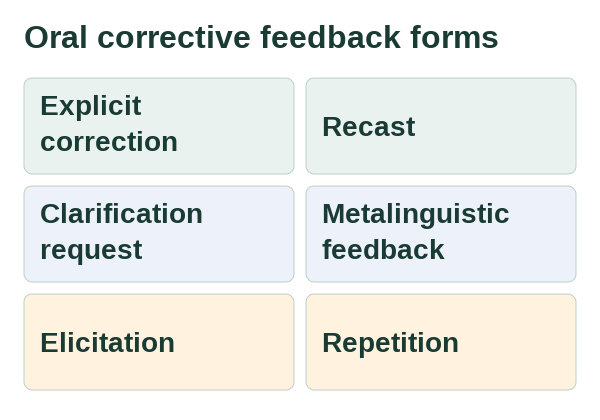
The four teachers showed a very strong tendency to use recasts. Yet recasts rarely led students to fix their own errors. Four feedback types produced student-generated repair more successfully. These were elicitation, metalinguistic feedback, clarification requests and repetition.[68]
The 2016 meta-analysis says context may change these shares. It names student proficiency, teacher experience, and whether the setting is a second or foreign language context. It also reports that few general conclusions about context had been reached before that synthesis.[67]
A 2019 study audiotaped 36 hours of interaction in three upper-intermediate English classes. The classes had 59 students and three teachers. Within the prompt category, Shirani (2019) found that clarification requests produced the largest share of uptake. Elicitations produced the largest share of repair. More explicit recasts led to higher percentages of both uptake and repair than implicit ones.[69]
A 2006 study of recasts in English classrooms found that the length of recasts, their linguistic focus and the type of change they made were significantly related to uptake. Sheen (2006) also linked those features to learner repair. The features included mode, use of reduction and number of changes. That study suggests explicit recasts work better. They target one feature, and the corrected item stands out to learners.[70]
Implicit feedback was used much more often than explicit feedback, and it did not tend to lead learners to notice the correction. Teachers tended to overestimate how much strong students noticed feedback. They also overestimated how well those students understood the correct forms when they responded. Some learners answered without noticing. They seemed to do this to avoid social strain or embarrassment in class.[47]
One study looked at 20 hours of Japanese foreign language classes. Recasts with stressed intonation or facial expression led to more noticing and self-correction than plain recasts. Prompts were not affected by such emphasis to a similar extent.[71]
One observation looked at a mainstream teacher and about 25 pupils in Dearborn, Michigan. The pupils were in kindergarten through 5th grade, and the teacher gave a lot of corrective oral feedback.[72] One study looked at four adult English learners. Recasts and prompts did not differ in whether the corrected items were kept two weeks later. The same participants could still identify the correct forms. They were asked to judge whether sentences were grammatical.[73]
Preferences, beliefs and classroom conditions
At Sirte University in Libya, 97 students of English as a foreign language answered a 36-item questionnaire. Eight of them also gave interviews. These students preferred feedback from the teacher. They also favored learners correcting their own work and taking responsibility for correction. The oral corrective feedback types those learners preferred were elicitation and repetition. They liked to be corrected immediately and also at the end of a conversation, and attitudes did not differ significantly by gender.[74]
Fifty students took English for Specific Purposes courses at State Polytechnic of Subang in Indonesia. They filled in a questionnaire, and a focus group discussion followed. They preferred face-to-face corrective feedback. Mean ratings were 3,95 for learning effectiveness, 4,12 for learning accuracy and 4,02 for learning experience. In the discussion, these students said teachers should guide their learning. They should also use communicative ways and draw on students' learning preferences.[75]
A study looked at 35 Moroccan teachers of English as a foreign language. They understood corrective feedback techniques but needed professional development in this area. These teachers reported using two corrective feedback techniques most. They were elicitation and implicit correction. Many of them did not use digital tools to provide feedback. They cited technological limitations, training deficiencies or resistance to change.[76]
In classes where subject content is taught in English, teachers correct language problems as they come up. Their habits vary by setting. A study recorded six such classes in high schools and universities in Korea. The subjects were social science, mathematics and computer science. All the teachers and lecturers gave corrective feedback. Schoolteachers did so more often and used more varied types than university lecturers. In both settings, feedback happened most often in mathematics.[77]
Observers watched nine university English classes, across 48 observations and about 65 hours of recordings. They noted that correction came with gestures and head movements. Nodding, head shaking, pointing at an object and pointing at a person were common.[78]
What this looks like when you study
Li (2010) combined 33 primary studies in one meta-analysis: 22 published and 11 dissertations. The studies were coded for 17 features. Corrective feedback had a medium overall effect. The effect held up over time. Li (2010) also reported that lab studies produced larger effects than classroom studies. Short treatments produced larger effects than long ones. Studies in foreign language settings produced larger effects than studies in second language settings.[3]
Ammar (2008) worked with French-speaking students from three intact intensive English classes. They completed 11 communicative activities. Prompts worked better than recasts and no feedback. They moved learners to more advanced stages on a scale of possessive determiners. This was especially clear for low-proficiency learners. Prompts also let learners recall the knowledge faster on a computer task.[48]
Alzi'abi (2026) compared prompts and recasts. The study had 132 intermediate Arab learners at four Jordanian universities. Prompts led to immediate uptake in 86.1% of cases, while recasts led to uptake in 43.7%. Over four weeks, however, both feedback types gave similar moderate gains in accuracy. Effect sizes were about 0.40 to 0.44.[79]
Sato and Loewen (2018) worked with 83 adult English learners in intact classes. They compared recasts and clarification requests, with and without metacognitive instruction. In Sato and Loewen (2018), metacognitive instruction improved the effect of conversational recasts. On their own, the recasts had minimal impact. It added no benefit for clarification requests, which supported learning without it.[4]
Nguyen (2024) tested a three-step writing conference with 38 intermediate English learners in Vietnam. In the conference, students focused on one form-related error. They compared standard samples to work out the rule, and then planned their correction. This conference produced better error correction and uptake than a typical teacher-student or student-student session.[5]
In it, an instructor guides students through written corrective feedback. They examine a set of standard second language samples to work out the knowledge behind it. Students then plan how to correct the error. With the instructor's guidance, they also plan how to learn the underlying knowledge in future work.[5]
Tang, Qian, Wang and Hu (2021) reported on a Chinese-English eTandem project. There, explicit written correction was the strategy partners used most in emails. Learners nevertheless preferred corrections that came with explanations and examples.[80]
Key studies
| Year | Study | Sample | Design | Finding |
|---|---|---|---|---|
| 1998 | Lyster[14] | over 18 hours of interaction in 27 lessons in 4 primary immersion classrooms | observational discourse analysis | The 377 recasts and noncorrective repetitions served identical functions in equal proportions, so recasts could easily be missed as corrections. |
| 2003 | Philp[21] | dyadic task-based interaction study | Philp (2003) found that learners noticed over 60 to 70% of recasts. Accurate recall depended on the learner's level, on the length of the recast and on the number of changes it contained. | |
| 2008 | Ammar[48] | quasi-experimental comparison of recasts, prompts and no feedback | Prompts were more effective than recasts and no feedback in moving learners to more advanced stages, especially for low-proficiency learners. | |
| 2009 | Lyster & Izquierdo[81] | 25 undergraduates in an intermediate French course | dyadic interaction experiment with recast and prompt groups | Both groups improved accuracy and reaction-time scores, with no difference between feedback types. |
| 2010 | Li[3] | 33 primary studies, 22 published and 11 dissertations | meta-analysis | Corrective feedback had a medium overall effect that was maintained over time, and lab-based studies showed larger effects than classroom-based studies. |
| 2010 | YOSHIDA[47] | 2 teachers and 7 learners in an Australian university Japanese course | classroom observation and stimulated recall interviews over one semester | Learners' responses to corrective feedback did not necessarily show noticing, and teachers overestimated strong students' noticing. |
| 2012 | Saito & Lyster[59] | experiment with form-focused instruction with and without recasts | Only the group that received recasts improved significantly in producing English /ɹ/, at both controlled and spontaneous speech levels. | |
| 2015 | Cleave et al.[61] | systematic review and meta-analysis | Recasts showed average effect sizes of .96 on proximal measures and .76 on distal measures for children with language impairments. | |
| 2016 | Brown[67] | classroom studies synthesized in a meta-analysis | meta-analysis of classroom corrective feedback | Recasts accounted for 57% of all corrective feedback while prompts comprised 30%, and grammar errors received 43% of feedback. |
| 2018 | Sato & Loewen[4] | 83 adult English as a foreign language learners in intact classes | four-condition experiment | Metacognitive instruction enhanced the effect of recasts that otherwise had minimal impact but added no benefit for clarification requests. |
| 2018 | Naeimi et al.[18] | quasi-experimental study over nine sessions | Recasts produced the most correct uptake, but metalinguistic feedback produced the most learning and retention. | |
| 2023 | Xu & Zeng[22] | 20 studies published between 2006 and 2021 | systematic review | Xu and Zeng (2023) found no settled answer on when to treat errors. Findings differed by communicative modality and by research design choices such as feedback explicitness and how timing was measured. |
| 2024 | Nguyen[5] | 38 intermediate English learners in Vietnam | between-group experiment | A three-step writing conference yielded better error correction and uptake than typical teacher-student or student-student sessions. |
| 2026 | Alzi’abi[79] | 132 intermediate Arab learners of English at four Jordanian universities | quasi-experimental comparison of prompts and recasts | Prompts led to immediate uptake in 86.1% of cases versus 43.7% for recasts, but both produced similar moderate accuracy gains over four weeks. |
See also
References
- Ai, H. (2017). Providing graduated corrective feedback in an intelligent computer-assisted language learning environment. ReCALL, 29(3), 313-334. doi:10.1017/s095834401700012x
- Lyster, R., Saito, K., & Sato, M. (2013). Oral corrective feedback in second language classrooms. Language Teaching, 46(1), 1-40. doi:10.1017/s0261444812000365
- Li, S. (2010). The Effectiveness of Corrective Feedback in SLA: A Meta‐Analysis. Language Learning, 60(2), 309-365. doi:10.1111/j.1467-9922.2010.00561.x
- Sato, M., & Loewen, S. (2018). Metacognitive Instruction Enhances the Effectiveness of Corrective Feedback: Variable Effects of Feedback Types and Linguistic Targets. Language Learning, 68(2), 507-545. doi:10.1111/lang.12283
- Nguyen, C. D. (2024). Scaffolding student engagement with written corrective feedback: Transforming feedback sessions into learning affordances. Language Teaching Research, 28(5), 1918-1939. doi:10.1177/13621688211040904
- Ferris, D. R. (2012). Written corrective feedback in second language acquisition and writing studies. Language Teaching, 45(4), 446-459. doi:10.1017/s0261444812000250
- Day, R. R., Chenoweth, N. A., Chun, A. E., & Luppescu, S. (1984). Corrective feedback in native‐nonnative discourse. Language Learning, 34(2), 19-45. doi:10.1111/j.1467-1770.1984.tb01002.x
- CORPUZ, M. J. C. (2023). Students’ beliefs on corrective feedback in language learning: Basis for developing high school students’ typology. SEAQIL Journal of Language Education, 2(2), 56-68. doi:10.70046/sjle.2.2.56-68
- Sepehrinia, S. (2026). From Corrective Preferences to Corrective Practice: A Critical Review of Attitudinal Studies on Oral Corrective Feedback. Language Teaching Research. doi:10.1177/13621688261476299
- Li, S., Ou, L., & Lee, I. (2026). The timing of corrective feedback in second language learning. Language Teaching, 59(1), 29-45. doi:10.1017/s0261444824000478
- Ha, X. V., Nguyen, L. T., & Hung, B. P. (2021). Oral corrective feedback in English as a foreign language classrooms: A teaching and learning perspective. Heliyon, 7(7), e07550. doi:10.1016/j.heliyon.2021.e07550
- Schenck, A. (2020). Using meta-analysis of technique and timing to optimize corrective feedback for specific grammatical features. Asian-Pacific Journal of Second and Foreign Language Education, 5(1). doi:10.1186/s40862-020-00097-9
- Leeman, J. (2003). RECASTS AND SECOND LANGUAGE DEVELOPMENT: Beyond Negative Evidence. Studies in Second Language Acquisition, 25(1), 37-63. doi:10.1017/s0272263103000020
- Lyster, R. (1998). Recasts, repetition, and ambiguity in l2 classroom discourse. Studies in Second Language Acquisition, 20(1), 51-81. doi:10.1017/s027226319800103x
- van Compernolle, R. A., & Smotrova, T. (2014). Corrective feedback, gesture, and mediation in classroom language learning. Language and Sociocultural Theory, 1(1), 25-47. doi:10.1558/71056194384
- Fu, T., & Nassaji, H. (2016). Corrective feedback, learner uptake, and feedback perception in a Chinese as a foreign language classroom. Studies in Second Language Learning and Teaching, 6(1), 159-181. doi:10.14746/ssllt.2016.6.1.8
- Sung, K. Y., & Tsai, H. M. (2019). Exploring Student Errors, Teachers' Corrective Feedback, Learner Uptake and Repair, and Learners' Preferences of Corrective Feedback. Journal of Language Teaching and Learning, 4(1), 37-54. doi:10.66887/jltl.v4i1.124
- Naeimi, A., Saeidi, M., & Behnam, B. (2018). Immediate Uptake of Phonological Corrective Feedback in Language Learning and Retention. Education Research International, 2018, 1-11. doi:10.1155/2018/2579421
- Shadiev, R., & Feng, Y. (2023). Using automated corrective feedback tools in language learning: a review study. Interactive Learning Environments, 1-29. doi:10.1080/10494820.2022.2153145
- Nicholas, H., Lightbown, P. M., & Spada, N. (2001). Recasts as Feedback to Language Learners. Language Learning, 51(4), 719-758. doi:10.1111/0023-8333.00172
- Philp, J. (2003). CONSTRAINTS ON “NOTICING THE GAP”: Nonnative Speakers' Noticing of Recasts in NS-NNS Interaction. Studies in Second Language Acquisition, 25(1), 99-126. doi:10.1017/s0272263103000044
- Xu, M., & Zeng, S. (2023). Optimal timing of treatment for errors in second language learning – A systematic review of corrective feedback timing. Frontiers in Psychology, 14. doi:10.3389/fpsyg.2023.1026174
- Li, S., Li, J., & Qian, J. (2026). What Is the Ideal Time to Provide Corrective Feedback? An Approximate Replication of Li, Zhu, and Ellis (2016). Language Learning, 76(3), 951-991. doi:10.1111/lang.70019
- Kim, Y., Choi, B., Yun, H., Kim, B., & Choi, S. (2022). Task repetition, synchronous written corrective feedback and the learning of Korean grammar: A classroom-based study. Language Teaching Research, 26(6), 1106-1132. doi:10.1177/1362168820912354
- Yamashita, T. (2021). Corrective feedback in computer-mediated collaborative writing and revision contributions. Language Learning & Technology, 25(2), 75-93. doi:10.64152/10125/73434
- Sippel, L., & Jackson, C. N. (2015). Teacher vs. Peer Oral Corrective Feedback in the German Language Classroom. Foreign Language Annals, 48(4), 688-705. doi:10.1111/flan.12164
- Sato, M. (2013). Beliefs about peer interaction and peer corrective feedback: Efficacy of classroom intervention. The Modern Language Journal, 97(3), 611-633. doi:10.1111/j.1540-4781.2013.12035.x
- Giguère, C., & Parks, S. (2018). Child-to-child interaction and corrective feedback during eTandem ESL–FSL chat exchanges. Language Learning & Technology, 22(3), 176-192. doi:10.64152/10125/44663
- Ferdian, N. R. (2020). ESP Students’ Preferences in Learning English: Face to Face Corrective Feedback vs Online Corrective Feedback. JETAL: Journal of English Teaching & Applied Linguistic, 2(1), 29-36. doi:10.36655/jetal.v2i1.199
- Ranalli, J., & Yamashita, T. (2022). Automated written corrective feedback: Error-correction performance and timing of delivery. Language Learning & Technology, 26(1), 1-25. doi:10.64152/10125/73465
- Gao, J., & Ma, S. (2019). The effect of two forms of computer-automated metalinguistic corrective feedback. Language Learning & Technology, 23(2), 65-83. doi:10.64152/10125/44683
- Silpachai, A., Neiriz, R., Novotny, M., Gutierrez-Osuna, R., Levis, J. M., & Chukharev, E. (2024). Corrective feedback accuracy and pronunciation improvement: Feedback that is ‘good enough’. Language Learning & Technology, 28(1), 1-16. doi:10.64152/10125/73582
- Kovač, M. M. (2025). The importance of corrective feedback in foreign language learning. Sintagma. Revista de Lingüística(37), 51-66. doi:10.21001/sintagma.2025.37.03
- Zeevy-Solovey, O. (2024). Comparing peer, ChatGPT, and teacher corrective feedback in EFL writing: Students' perceptions and preferences. Technology in Language Teaching & Learning, 6(3), 1482. doi:10.29140/tltl.v6n3.1482
- Hassan, M. U., & Dzakiria, H. (2023). EFL students’ beliefs towards usefulness of corrective feedback in cooperative learning environment. Global Journal of Foreign Language Teaching, 13(1), 87-95. doi:10.18844/gjflt.v13i1.6647
- Torres, C., & Saribas, E. (2024). Instructional Perspectives to Providing Corrective Feedback for Advanced Second Language Writers. Higher Learning Research Communications, 14(0). doi:10.18870/hlrc.v14i0.1545
- Kao, C. W. (2023). A preliminary investigation into student writers’ perception of corrective feedback focus. Feedback Research in Second Language, 1, 236-246. doi:10.32038/frsl.2023.01.13
- Zhang, J. (2020). A Review of Grammar Corrective Feedback: The Learning Experience in China’s English Classes. Studies in English Language Teaching, 8(3), p127. doi:10.22158/selt.v8n3p127
- Siow Chin, C., Pillai, S., & Zainuddin, S. Z. (2021). Recasts, prompts and noticing: A comparative study. Studies in English Language and Education, 8(2), 416-441. doi:10.24815/siele.v8i2.18546
- Carpenter, H., Jeon, K. S., MacGregor, D., & Mackey, A. (2006). Learners' interpretations of recasts. Studies in Second Language Acquisition, 28(2), 209-236. doi:10.1017/s0272263106060104
- McDonough, K., & Mackey, A. (2006). Responses to Recasts: Repetitions, Primed Production, and Linguistic Development. Language Learning, 56(4), 693-720. doi:10.1111/j.1467-9922.2006.00393.x
- Sheen, Y. (2008). Recasts, Language Anxiety, Modified Output, and L2 Learning. Language Learning, 58(4), 835-874. doi:10.1111/j.1467-9922.2008.00480.x
- Storch, N., & Wigglesworth, G. (2010). Learners’ processing, uptake, and retention of corrective feedback on writing: Case studies. Studies in Second Language Acquisition, 32(2), 303-334. doi:10.1017/s0272263109990532
- Bowles, M. A., & Gastañaga, K. (2022). Heritage, second and third language learner processing of written corrective feedback: Evidence from think-alouds. Studies in Second Language Learning and Teaching, 12(4), 675-696. doi:10.14746/ssllt.2022.12.4.7
- Barnes, A. J. (2023). Online teacher written corrective feedback outside of class time: (In)effectiveness and task engagement. Technology in Language Teaching & Learning, 5(2), 37-58. doi:10.29140/tltl.v5n2.911
- Kim, Y., Choi, B., Kang, S., Kim, B., & Yun, H. (2020). Comparing the effects of direct and indirect synchronous written corrective feedback: Learning outcomes and students' perceptions. Foreign Language Annals, 53(1), 176-199. doi:10.1111/flan.12443
- YOSHIDA, R. (2010). How Do Teachers and Learners Perceive Corrective Feedback in the Japanese Language Classroom? The Modern Language Journal, 94(2), 293-314. doi:10.1111/j.1540-4781.2010.01022.x
- Ammar, A. (2008). Prompts and recasts: Differential effects on second language morphosyntax. Language Teaching Research, 12(2), 183-210. doi:10.1177/1362168807086287
- Goo, J. (2012). Corrective feedback and working memory capacity in interaction-driven l2 learning. Studies in Second Language Acquisition, 34(3), 445-474. doi:10.1017/s0272263112000149
- Karim, K., & Nassaji, H. (2020). The effects of written corrective feedback. Instructed Second Language Acquisition, 3(1), 28-52. doi:10.1558/isla.37949
- Geng, X. (2022). Research on the Role of Corrective Feedback in Teaching of Chinese as a Second Language: A Systematic Review and Meta-Analysis. International Journal of Languages, Literature and Linguistics, 8(2), 121-125. doi:10.18178/ijlll.2022.8.2.333
- VAN DE GUCHTE, M., BRAAKSMA, M., RIJLAARSDAM, G., & BIMMEL, P. (2015). Learning New Grammatical Structures in Task‐Based Language Learning: The Effects of Recasts and Prompts. The Modern Language Journal, 99(2), 246-262. doi:10.1111/modl.12211
- Li, H. (., & Iwashita, N. (2021). The role of recasts and negotiated prompts in an FL learning context in China with non-English major university students. Language Teaching Research, 25(2), 209-233. doi:10.1177/1362168819839727
- Shah, K., Rahman, G., & Khan, A. (2022). The Impact of Explicit Corrective Feedback on Learning English Conditional Sentences. Global Language Review, VII(III), 120-132. doi:10.31703/glr.2022(vii-iii).11
- THOMAS, K. E. (2018). Comparing Explicit Exemplar‐Based and Rule‐Based Corrective Feedback: Introducing Analogy‐Based Corrective Feedback. The Modern Language Journal, 102(2), 371-391. doi:10.1111/modl.12470
- Iizuka, T., & Nakatsukasa, K. (2020). Implicit and explicit corrective feedback and feedback exposure conditions. Instructed Second Language Acquisition, 4(1), 3-48. doi:10.1558/isla.38113
- Ghalehbani, S., & Kolahi, S. (2022). The Comparative Effect of Recasts and Prompts on EFL Learners’ Vowel and Consonant Accuracy. Language Teaching Research Quarterly, 28, 31-52. doi:10.32038/ltrq.2022.28.02
- Lee, A. H., & Lyster, R. (2016). Effects of Different Types of Corrective Feedback on Receptive Skills in a Second Language: A Speech Perception Training Study. Language Learning, 66(4), 809-833. doi:10.1111/lang.12167
- Saito, K., & Lyster, R. (2012). Effects of Form‐Focused Instruction and Corrective Feedback on L2 Pronunciation Development of /ɹ/ by Japanese Learners of English. Language Learning, 62(2), 595-633. doi:10.1111/j.1467-9922.2011.00639.x
- Kourtali, N., & Révész, A. (2020). The Roles of Recasts, Task Complexity, and Aptitude in Child Second Language Development. Language Learning, 70(1), 179-218. doi:10.1111/lang.12374
- Cleave, P. L., Becker, S. D., Curran, M. K., Van Horne, A. J. O., & Fey, M. E. (2015). The Efficacy of Recasts in Language Intervention: A Systematic Review and Meta-Analysis. American Journal of Speech-Language Pathology, 24(2), 237-255. doi:10.1044/2015_ajslp-14-0105
- Saito, K. (2013). The Acquisitional Value of Recasts in Instructed Second Language Speech Learning: Teaching the Perception and Production of English /ɹ/ to Adult Japanese Learners. Language Learning, 63(3), 499-529. doi:10.1111/lang.12015
- Hassink, J. M., & Leonard, L. B. (2010). Within-Treatment Factors as Predictors of Outcomes Following Conversational Recasting. American Journal of Speech-Language Pathology, 19(3), 213-224. doi:10.1044/1058-0360(2010/09-0083)
- Nakatsukasa, K. (2016). Efficacy of recasts and gestures on the acquisition of locative prepositions. Studies in Second Language Acquisition, 38(4), 771-799. doi:10.1017/s0272263115000467
- Kurzer, K. (2023). Dynamic written corrective feedback: A scoping review. Feedback Research in Second Language, 1, 93-108. doi:10.32038/frsl.2023.01.06
- Ferris, D. R. (2010). SECOND LANGUAGE WRITING RESEARCH AND WRITTEN CORRECTIVE FEEDBACK IN SLA: Intersections and Practical Applications. Studies in Second Language Acquisition, 32(2), 181-201. doi:10.1017/s0272263109990490
- Brown, D. (2016). The type and linguistic foci of oral corrective feedback in the L2 classroom: A meta-analysis. Language Teaching Research, 20(4), 436-458. doi:10.1177/1362168814563200
- Lyster, R., & Ranta, L. (1997). CORRECTIVE FEEDBACK AND LEARNER UPTAKE: Negotiation of Form in Communicative Classrooms. Studies in Second Language Acquisition, 19(1), 37-66. doi:10.1017/s0272263197001034
- Shirani, R. (2019). Patterns of uptake and repair following recasts and prompts in an EFL context: Does feedback explicitness play a role? Studies in Second Language Learning and Teaching, 9(4), 607-631. doi:10.14746/ssllt.2019.9.4.3
- Sheen, Y. (2006). Exploring the relationship between characteristics of recasts and learner uptake. Language Teaching Research, 10(4), 361-392. doi:10.1191/1362168806lr203oa
- Takahashi, N. (2019). Stressed Intonation on Recasts: Differential Effects in Comparison with Prompts. Journal of Language Teaching and Learning, 4(2), 15-28. doi:10.66887/jltl.v4i2.161
- Pfanner, N. I. (2015). Teacher Corrective Oral Feedback in the Classroom. Journal of Language and Education, 1(2), 46-55. doi:10.17323/2411-7390-2015-1-2-46-55
- Müjdeci, Ş. (2022). The Impact of Oral Corrective Feedback on Immediate Uptake and Retention. Journal of Language Teaching and Learning, 12(1), 91-108. doi:10.66887/jltl.v12i1.481
- Milad, N., & Mohammadzadeh, B. (2021). Libyan EFL Learners’ Attitudes towards Oral Interactional Corrective Feedback: A Case of Sirte University. Journal of Language Teaching and Learning, 11(1), 53-70. doi:10.66887/jltl.v11i1.249
- Ferdian, N. R. (2020). ESP Students’ Preferences in Learning English: Face to Face Corrective Feedback vs Online Corrective Feedback. JETAL: Journal of English Teaching & Applied Linguistic, 1(2), 74-81. doi:10.36655/jetal.v1i2.199
- Rkiki, A., & Sakale, S. (2025). Digital Learning and Corrective Feedback: Analysing Moroccan In-service EFL Teachers’ Beliefs. Frontiers in English Language and Linguistics, 2(1), 01-09. doi:10.32996/fell.2025.2.1.1
- Hong, J. (2023). Content teachers’ and lecturers’ corrective feedback in EMI classes in high school and university settings. Studies in Second Language Learning and Teaching, 13(2), 451-469. doi:10.14746/ssllt.38282
- Wang, W., & Loewen, S. (2016). Nonverbal behavior and corrective feedback in nine ESL university-level classrooms. Language Teaching Research, 20(4), 459-478. doi:10.1177/1362168815577239
- Alzi’abi, S. E. (2026). Prompts and recasts in language development: impacts on uptake and grammatical accuracy. Asian-Pacific Journal of Second and Foreign Language Education, 11(1). doi:10.1186/s40862-026-00418-4
- Tang, J., Qian, K., Wang, N., & Hu, X. (2021). Exploring language learning and corrective feedback in an eTandem project. Journal of China Computer-Assisted Language Learning, 1(1), 110-144. doi:10.1515/jccall-2021-2005
- Lyster, R., & Izquierdo, J. (2009). Prompts Versus Recasts in Dyadic Interaction. Language Learning, 59(2), 453-498. doi:10.1111/j.1467-9922.2009.00512.x
Cite this page: Atlas Nova editors. (2026). Corrective feedback in language learning. Atlas Nova. https://velocer.io/atlas/corrective-feedback/