Method · Writing
Teacher feedback on writing
Written feedback on student writing
Teacher feedback on writing is the written response teachers give students on their writing, delivered with a pen, a pencil or a computer.[1][2]
Writing teachers give written feedback with pens, pencils or computers.[1] In one study, 40 students given audio feedback outperformed 40 given written feedback in argumentative writing.[3] Students in Benin mostly disliked their teachers' feedback and did not use it well.[4] Students' trust in the teacher's English and in her feedback played a part in the caring relationship between them.[5]
Key facts
| 80 | EFL students' writing samples with teacher feedback analyzed by Cheng and Zhang (2021).[6] |
|---|---|
| 40 | Students in the audio feedback group in Alharbi's (2021) experiment.[3] |
| 14 | Students in the Korean writing class studied by Lee and Schallert (2008).[5] |
| 590 | EFL college students in Taiwan surveyed by Tsao (2024).[7] |
Overview
What written feedback is and how teachers give it
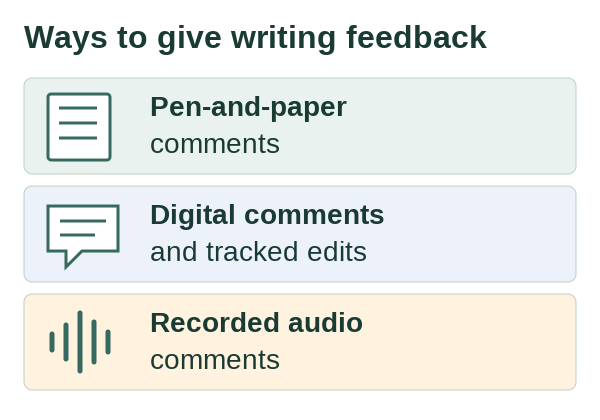
Teacher written feedback means the comments a teacher writes on a student's writing. Most writing teachers use pens, pencils or computers as the tool for giving that feedback. A 2010 article describes three modes. They are pen-and-paper comments, inserted comments, tracked changes, and recorded audio comments. Tracked changes work by deleting and adding text inside the student's document. Audio feedback is a recording of the teacher's voice.[1]
A 1991 case study followed one-to-one writing conferences. A ninth-grade English teacher held them with three of his students. The conversations differed a lot from student to student. The dialogue helped students think things through as they wrote.[8]
Program policies affect the feedback given. A teacher's personal history affects it too. A 2012 study followed 2 new teachers through their first graduate-level ESL writing course. It collected their feedback, interviews and personal stories.[9]
Teachers' language backgrounds can matter too. A 2021 study analyzed written feedback on writing samples from 80 English as a foreign language students. The setting was Chinese higher education. Teachers who spoke English natively and teachers whose first language was Chinese used similar feedback scope and strategies. But the Chinese first-language teachers gave significantly more feedback points. The two groups differed greatly in focus. Teachers who spoke English natively attended more to content and organization. Teachers whose first language was Chinese attended more to language errors.[6]
Research
What students notice and how they respond
A qualitative study looked at six undergraduates in two writing courses. It found tensions of several kinds. These included emotional, interpersonal, academic and institutional tensions. Students used strategies that either helped or hurt them. Some sought support from peers or engaged with the comments. Others avoided the comments and read only some.[10] In one group of 76 students learning English as a foreign language, some described teacher feedback as unwanted, sickening or frustrating. Those students said the comments cornered them by pinpointing weaknesses and errors, which left them stressed and more anxious.[11]
In one English as a foreign language setting in Benin, students wanted feedback that also addressed the content of their writing, not only its accuracy. This study took place in the Republic of Benin. Most students learning English as a foreign language did not like their teachers' feedback practices. They also did not use the feedback well. The teachers saw their feedback as a way to promote accuracy.[4]
A survey of 54 students and 22 teachers found that both groups preferred direct feedback. Students wanted more of it than teachers supplied. Teachers gave more indirect feedback than students expected. Students liked unfocused feedback better than focused feedback.[12]
In Bangladesh, secondary students strongly preferred indirect feedback. They said it encouraged self-learning. Their teachers used a mix of direct and indirect feedback.[13] Preferences also vary by group. In Taiwan, 71 medical students preferred feedback on writing structure over content and mechanics. For content and structure, they preferred direct feedback over indirect feedback.[14]
Students' preferences were not what the teacher expected. In a Chinese college class, students said they gained most from comments on organization. Yet the teacher's comments on organization were few. They were not specific enough.[15]
In one Korean writing class, trust between teacher and students developed through repeated rounds of feedback and revision. In a Korean university class of 14 students, trust ran both ways. Students' trust in the teacher's English, her teaching and her comments mattered. So did her trust in particular students, formed by how they revised. The researchers found that caring was carried out in complex and two-way ways. Factors from the wider society shaped it, as did the course, the teacher and the student.[5]
Praise is common but makes up less of written feedback than suggestions and criticism. In a Chinese university case study, teachers favored independent praise and praise for the quality of the text over praise tied to effort or ability, and over praise given alongside criticism. Praise was found to support dialogue between teacher and student. It also encouraged students to take charge of how they used feedback. The study described two profiles of teachers. Active praise givers used feedback to talk with student writers. Sparse praise givers spent their effort on the texts themselves.[16]
One quasi-experimental study tested an Empathic Feedback Protocol.[17] A quasi-experimental design is a kind of experiment that does not rely on randomly assigning participants to conditions.[18] The protocol measured teacher empathy through three dimensions: Seeing, Understanding and Caring. The study ran over eight weeks of email writing. Understanding was the strongest predictor of writing quality. Caring predicted motivational outcomes such as self-efficacy and openness to feedback.[17]
Effects on writing and what changes them
In one experiment, 40 undergraduates got audio feedback and 40 got written feedback. The audio group did better on argumentative essays.[3] A study of 71 Indonesian high school students looked at peer written corrective feedback. This means comments on errors in the writing. It improved writing performance more than teacher feedback did. There, teacher feedback raised all writing components except mechanics. Peer feedback raised organization and vocabulary.[19]
Another study looked at 65 first-year English language teaching students. It reported that online teacher, online peer and automated feedback all improved grammar, organization, coherence and vocabulary. Students in that study rated the instructor's feedback as most helpful. They rated peer feedback as least effective.[20]
A study looked at two classes of 35 Chinese university students each. Teacher feedback and automated feedback had different effects. The teacher feedback class scored significantly higher on revision quality. They also rated the feedback more useful and easier to use. The automated feedback class, however, scored much higher on a later writing proficiency test.[21]
Uptake is the rate at which students act on a comment. It differed little between the two sources. Comments about meaning were acted on far more often than comments about surface features.[22]
One group received traditional teacher feedback. The other sought feedback from sources of its own choosing. Both groups got much better at correcting errors. The source of the feedback made no significant difference between the groups.[23]
A case study of indirect-focused written corrective feedback found students planning how to respond and then fixing their worksheets, though two felt confused and frustrated.[24] Engagement itself varies between students given the same feedback. Writing proficiency was not clearly or steadily linked to how engaged they were.[25]
Students notice goal structures in a writing class. These relate to how they engage with feedback. The study looked at 590 college students in Taiwan. They preferred mastery goal structures over performance goal structures. Behavioral engagement was the most common response to teacher feedback. Affective, cognitive and social engagement came next. Affective engagement is the emotional response to feedback. It predicted behavioral, social and cognitive engagement, and cognitive engagement was directly linked to self-reported writing proficiency.[7]
Formats of feedback and their effects
Johnson, Stellmack and Barthel found that the format of instructor comments affected both the quality of the comments and student improvement on later drafts. In one experiment, instructors graded papers in an introductory research methods course. They used either electronic comments or handwritten ones. Electronic feedback here meant comments made in word-processing software. One example is the track changes feature in Microsoft Word. Instructors working on computer wrote longer comments. They were less likely to rewrite passages of the student's text. They were also more likely to add general observations about the writing.[26]
Alshumaimmeri and Alqarni examined teacher electronic feedback. Some was given live through online class discussion. Some was given later through Blackboard. A study at King Saud University compared two kinds of feedback. Most of this electronic feedback addressed three parts of students' writing in English as a foreign language. These were content, organization and language structure. Teachers changed their electronic comments to fit students' needs and course objectives. Both teachers and students called the electronic feedback effective and easy to get.[27]
In Chen's project, a blog linked two colleges. It served as a platform for peer collaboration and as a tool through which teachers could offer feedback. The project ran for two semesters. It involved students, two teachers and two teaching assistants. Over time the feedback changed. A new kind, mediative feedback, appeared, and shallow comments became fewer. Chen found a clear gap. The feedback type students rated highest was not the type given most often.[28]
Fitriani and Sabarniati compared teacher and student preferences for written feedback and for the writing conference, a one-to-one meeting about a draft. The class was a novice writing class for learners of English. Students submitted a 200-word assignment before a scheduled conference. They read the teacher's written comments first. Fitriani and Sabarniati found that 58% of students in the new writing class preferred the writing conference. In the English writing program, 79% of students preferred to work one-to-one with the teacher. The teacher, by contrast, preferred giving written feedback. She did acknowledge that conferences might work better at the novice level.[29]
At Chalmers University of Technology in Sweden, the Division for Language and Communication runs courses. These courses build feedback around dialogue. These designs include active feedback lectures for large classes. They also include scaffolded peer response sessions and guided feedback workshops. Börjeson and Carlsson argue that these activities may produce more useful feedback and feedforward. This may work better than the traditional written feedback between teacher and student.[30]
Pritts combined standard written comments with short, individual video responses. He did this in four sections of a fully online composition course. Grade outcomes stayed fairly stable, but submission rates improved. The report also names practical limits, including the time required. It also notes how hard the practice is to scale up.[31]
Shackel found that most students asked for written feedback because it was convenient. Some students chose written comments over face-to-face ones. This was especially true of students with dyslexia. Written comments gave them time to think the information over and take it in at their own pace. The comments were so detailed that students felt the university cared about them.[32]
Ruegg compared students assessed on feedback processes and product with students assessed on product alone. He found no clear benefit in how they perceived feedback.[33] Electronic comments during drafting are tied to better later drafts, as the experiment above found.[26]
Some writing classes still grade only the finished product, even when they teach writing as a process. A study of second-year university students in Japan compared two kinds of classes. One study assessed how students used teacher feedback in revisions. It also assessed the quality and quantity of peer feedback. That result led the researcher to call for more work. The question is whether assessing both process and product justifies the considerable time it takes.[33]
Corrective feedback and language accuracy
Parreno tested three types of written corrective feedback: direct, indirect and coded. He compared them with a no-correction approach. One study lasted a semester. It compared three ways of marking errors with a no-correction approach. The study followed 68 Thai students in an undergraduate English course. All three correction types led to much better revisions than no correction. The coded group seemed more aware of the feedback than the other groups. The study concluded that focused coded feedback helps in learning English as a second language.[34]
A later exploratory study asked whether mixing two languages in written correction changes how students use it. It involved 70 first-year Saudi university students of English at CEFR B1 level. In one group, Arabic was added mainly for complex explanations. English carried the corrected forms. The mixed-language group used a much larger share of the feedback in revision: 0.81 against 0.68. Among the 55 students who finished all three tests, the mixed-language group's error rate fell from 0.49 to 0.22, then to 0.16. The English-only group's rate rose from 0.40 to 0.45 and 0.49. The study had one class per condition, and the groups differed at the start. So its findings count as early links, not proven cause and effect.[35]
Vadakalur Elumalai followed 30 students in Advanced Writing classes over 15 weeks. They received feedback on their work. Their language skills improved a lot, especially in grammar and vocabulary.[36] In another course, 28 first-year students got 18 weeks of instruction. The instruction combined writing templates with teacher feedback. Scores on the same writing task rose significantly from pretest to posttest.[37]
Feedback on thinking and academic writing
Wang, Matsumura and Correnti address written feedback that supports higher level, analytic thinking about texts. One 2017 article for teachers set out to clarify what it means to analyze a text. That goal is not well defined. The article describes three common kinds of assignment. Each asks students to apply higher level thinking in writing. Wang, Matsumura and Correnti suggest comments a teacher can write. These comments guide students back to the thinking the task asks for.[38]
Kileri and Listyani report that many students find academic writing hard. The work demands hard critical thinking about the subject. Students have to put their ideas to work in order to build up arguments. Kileri and Listyani write that the teacher matters greatly here. The teacher offers both direct and indirect comments that help students work through problems in their essays. One study interviewed six students at a private university in Central Java, Indonesia. All had already passed the Academic Writing course. Kileri and Listyani found a split. Some students saw the teacher's comments in a good light, and others did not.[39]
Reflection includes critical and analytical skills. It is described as a key 21st century skill for students to develop. Reflective writing has been named as a possible way to make sure students have this skill. In the students' view, reflective writing added only a little to their language learning. The teacher's comments were positive in tone. Yet students called them both too few and of little effect.[40]
Kazemi, Abadikhah and Dehqan asked 21 EFL students about teacher feedback. They also asked about intra-feedback, a peer review technique. In one study, 21 EFL students answered a questionnaire and took part in follow-up semi-structured interviews. On the questionnaire, students said the teacher's comments helped them most in three areas. These were what their essays said, how they were arranged, and the language they used. The interviews drew out the students' preferences toward feedback provider, feedback focus, feedback provision and intra-feedback inclusion. In intra-feedback, two reviewers each comment on another student's piece alone. Then they talk their comments over together.[41]
Teachers and students see feedback differently
Tuzcu-Eken found that 37 prep-class students at a Turkish public university wanted their course teacher to comment on every error in their assignments. In one study, 37 students at a public university in Turkey answered a questionnaire. They also sat for interviews over two semesters. Students most liked form-focused direct feedback. Unless the teacher told them to, students usually left their texts unchanged after getting comments. Their preferences stayed the same even when the teacher changed her practices. Their satisfaction with her feedback fell as those practices changed between the first term and the second.[42]
Students do not respond to feedback in one uniform way. A qualitative study looked at students on a writing course. It used interviews and observation to record their reactions. Answers varied with each student's own preferences: some were positive, some neutral and some negative.[43]
López Casoli surveyed Argentine university students. The survey asked about the feedback their teachers gave on writing in English. Both less experienced and more experienced student-writers valued it. Those students especially valued indirect feedback given as comments and suggestions for improving the text. They also valued direct feedback. Their views shifted as they gained more practice in writing and in interpreting feedback.[44]
Sulistyo, Dewantara, Widiastuti and Marhaban found that feedback treatments worked best when a good student-teacher relationship was built. One study used mixed methods with 50 secondary school students. It split them into two groups of 25 and compared direct feedback with indirect feedback on a descriptive paragraph.[45]
A case study followed one writing teacher and one motivated undergraduate for a single semester. It traced engagement with feedback to the teacher's behaviour. Some of that behaviour raised the student's engagement, but most of it had little effect or a harmful one, which suggests that good feedback practice depends on the setting. Some teacher behaviours left effects that lasted. So did some behaviours unrelated to feedback.[46]
Feedback literacy means the set of skills a student needs to use and judge comments on written work. A study used two separate samples of 600 and 727 secondary school students in China. The study built a scale to measure this literacy. The scale had two parts: Using Feedback with 10 items and Evaluating Feedback with 4 items. Both parts had acceptable reliability. In this study, students' feedback literacy was not linked to how well they wrote. The researchers suggested that other factors may sit between the two. They also said the students' feedback literacy was limited.[47]
Teacher feedback beside peer and machine feedback
Makwana found AI-powered feedback was about as good as teacher-led feedback in several parts of writing.[48] Ekşi, Furtun and Kibar Furtun ran a quasi-experimental study. It looked at 18 learners of Turkish as a foreign language at B2 level. Both groups improved, but the difference between them was not significant. The two sources divided the work by writing dimension: ChatGPT did better on grammar, vocabulary, spelling and punctuation, while the teacher held a clear advantage in planning and organizing sentences.[49]
Biber, Nekrasova and Horn's meta-analysis found peer feedback worked better than teacher feedback for L2-English students. A meta-analysis pools the results of many studies. It reported that peer feedback worked better than teacher feedback for students learning English as a second language.[50]
Briansyah compared peer feedback with teacher-written corrections among 40 eighth-grade students in Bali. Peer feedback worked better for writing accuracy. Mean scores rose from 66.25 to 82.75, against 67.25 to 74.50.[51] Wang (2025) found teacher feedback worked better for language quality. Peer feedback improved essay content and structure more.[52] A study of 64 vocational students found teacher feedback produced higher overall uptake and more local revisions of grammar and vocabulary, while peer feedback produced more global revisions of ideas and coherence.[53]
A randomized controlled trial studied 88 intermediate learners of English as a foreign language.[54] A randomized controlled trial is a research procedure in which subjects are randomly assigned either to an experimental group that receives a treatment or to a control group that receives a different treatment or none, and the outcomes of the groups are compared.[55] The hybrid group improved most, especially in task achievement, coherence and grammatical accuracy. In that trial, AI feedback was most effective for vocabulary range. Students in the hybrid group reported more confidence and less anxiety.[54]
A 12-week study looked at 85 first-year undergraduates in China. Teacher plus peer feedback raised engagement on emotional, cognitive and behavioral measures more than teacher-only feedback.[56] Murphy ran a six-week cross-over study of 60 primary learners aged 10 to 12. Teacher-vetted AI feedback, meaning AI suggestions checked by the teacher, produced the greatest improvement in accuracy, vocabulary variety and task completion.[57]
Not every hybrid beats the teacher alone. One quasi-experimental study lasted six weeks and looked at 41 A2-level learners in Quito, Ecuador. It compared feedback from the teacher alone with feedback from ChatGPT plus the teacher. Both groups improved, from 7.17 to 9.61 and from 9.17 to 10.78. The adjusted difference of −0.40 points was not statistically significant. None of six grammar-category comparisons reached significance. The small sample, intact classes and single non-blinded rater limit the reading. Both conditions included teacher mediation. So that study cannot show what ChatGPT added on its own.[58] Zeevy-Solovey's 2024 pilot study looked at pairs of learners. They leaned toward teacher corrective feedback and toward a mix of teacher and ChatGPT feedback.[59]
In practice
How teachers decide what to mark
Mulati, Nurkamto and Drajati surveyed and interviewed two teachers. The teachers came from a secondary school in Lampung, Indonesia. The topic was written corrective feedback. The two teachers held different beliefs about how explicit the correction should be and how much of it to give. Both named their own schooling and college study as a factor shaping those beliefs. One also added practical classroom experience.[60]
Dayat did a case study of an Indonesian teacher of academic writing. He found that her own language learning experience shaped how she gave written corrective feedback. She chose corrections by weighing each student's personality and writing level.[61]
Cheng, Zhang and Yan studied four new teachers. They cared most about language errors, especially grammar. A study of four novice writing teachers in Chinese university English classes examined their stated beliefs and their actual marking of student writing.[2]
A study looked at one composition teacher in secondary schools in Bulilima, Zimbabwe. She marked compositions thoroughly and highlighted most of the errors. Her feedback matched what the syllabus asked for. Her marks also worked as a guide. They helped students see where they stood in their writing.[62]
Cheng, Zhang and Yan found both matches and mismatches. They compared what four new teachers said about feedback with what they did. The four novice teachers' beliefs matched their practice on the range of feedback. They did not match on what they focused on or how they delivered it. The study described this as a mix of matches and mismatches. The mix appeared in the link between belief and practice.[2]
An analysis looked at feedback from 26 English teachers in Hong Kong. Six of them were also interviewed. It argued that teachers must question accepted ideas about marking before their feedback can improve. That article notes that many teachers spend a lot of time marking. Yet they feel their efforts do not pay off.[63]
Leong and Lee found that students wanted more detail in the feedback they got. Their individual needs were not always met. One study at a Singapore university held separate focus groups. Nine experienced writing teachers and eight undergraduates discussed feedback. Both groups agreed on what feedback should do. It should help students become reflective and independent learners. In Leong and Lee's study, teachers often wrote comments that explained the grades given. They shaped their remarks around what each course required.[64]
Nguyen found that the teacher weighed students' proficiency levels, prior learning experiences, feedback preferences and classroom setting when giving feedback. A case study looked at an essay writing class at a university in Thailand. It examined the forms, locations, types and purposes of the teacher's feedback. Nguyen concluded that correction works best when teachers know how students have learned before, how strong their English is, what comments they like, and what the classroom allows. Nguyen reported that the teacher changed her feedback methods to fit her real teaching situation. The study warned that these findings may not hold in other places where English is a foreign language.[65] The Zimbabwe study showed one practical limit. Some students could not fully use the corrections because they did not understand the correction codes.[62]
What this looks like when you study
The researcher collected data in two ways. These were semi-structured background interviews and stimulated recall interviews. The researcher concluded that teachers should give clear, specific and constructive feedback. They should also build a supportive setting that reduces the negative effects of tension.[10]
A survey of secondary English classes in Bangladesh asked about written corrective feedback. 53% of students said they received it sometimes and 34% often. Only 13% said they always received it. Nearly 90% of those students got comments on grammar always or often. Almost 53% rarely got comments on punctuation. Teachers there mixed direct corrections with indirect marks. Almost 79% of students said they had never received coded metalinguistic feedback. The teachers named time limits, large classes and mixed proficiency levels as obstacles. The study recommended that students get the chance to discuss the feedback with the teacher.[13]
Two novice teachers who taught the same graduate writing course and came from the same training program gave the same average number of grammar corrections, 11.9 per paper across 30 papers each. Yet their comments differed in style. Cory gave the correct answer in 35% of her corrections. Emily did so in 51%. The author was one of the two teachers. She concluded that personal history and identity shape feedback as much as program policy does.[9]
One study looked at 80 English essays from a Chinese university. Four native English-speaking teachers gave 495 feedback points. Over 70% of them concerned content and organization rather than grammar or vocabulary. About 68% concerned grammar. The native English-speaking teachers gave comments on clarity and on adequacy. In one example, a teacher wrote that only one reason was given. The teacher asked the student to add a different reason to support the claim.[6]
The audio group scored higher on the essays. Students rated both kinds equally satisfactory. They found audio more detailed and personal, and written feedback clearer and easier to interpret.[3] A separate experiment on feedback format compared electronic grading with handwritten grading. Instructors working on screen wrote more and rewrote student passages less often. Students whose papers received electronic feedback improved more on later drafts.[26]
Criticism
Open questions and limits of the evidence
In a Korean comparison, both feedback styles improved writing from pre-test to post-test. But the group given chatbot-assisted feedback was demotivated by invented comments. One group got ordinary teacher feedback. Comments on content that fit their own assignment motivated them.[66] In the emotions study, students reported more positive feelings with teacher feedback. They reported more negative feelings with machine-generated feedback.[67]
Common misconceptions
A study in the Republic of Benin found that most students did not favor their teachers' feedback practices. In that study, teachers saw feedback as a tool for accuracy. Students also wanted comments on what their writing said.[4]
A study of 68 Thai students compared three kinds of feedback with no correction. Direct, indirect and coded feedback all improved revisions. Only coded feedback had a significant delayed effect. Diary entries in that study showed no general gain in accuracy in any group. All groups still reported positive attitudes.[34]
Key studies
| Year | Study | Sample | Design | Finding |
|---|---|---|---|---|
| 2012 | Feuerherm[9] | 2 novice teachers and 30 student papers from each | case study with interviews, narratives and text analysis | Both teachers averaged 11.9 grammar corrections per paper, but one supplied answers in 35% of corrections and the other in 51%, showing that personal history shapes feedback. |
| 2015 | Parreno[34] | 68 Thai undergraduate students | one-semester quasi-experimental study with a diary component | All three feedback types improved revisions compared with no correction, but only coded feedback produced a significant delayed effect, and no group showed general accuracy improvement. |
| 2016 | Zhan[15] | 62 Chinese EFL students and their teacher | questionnaires, interviews and essay analysis | Students reported benefiting most from feedback on organization, which the teacher focused on but gave in a small amount and not specifically enough [22]. |
| 2019 | Johnson et al.[26] | instructors and students in an introductory research methods course | experiment manipulating electronic versus handwritten feedback | Instructors using electronic feedback wrote longer comments and were less likely to rewrite passages, and their students improved more on later drafts. |
| 2020 | Elfiyanto & Fukazawa[19] | 71 Indonesian senior high school students | comparison of teacher and peer written corrective feedback | Peer feedback better enhanced overall writing, while teacher feedback improved all components except mechanics. |
| 2021 | Cheng & Zhang[6] | 80 EFL students' essays from a Chinese university | exploratory study comparing native and non-native English-speaking teachers | The four native English-speaking teachers gave 495 feedback points, over 70% on content and organization. The four non-native English-speaking teachers gave 792 points, about 68% on grammar. |
| 2021 | Alharbi[3] | experimental comparison of written and audio feedback | The audio feedback group outperformed the written feedback group on argumentative essays, and students found audio more detailed and personal. | |
| 2022 | Wang & Han[21] | 70 Chinese university EFL students in two classes | mixed-methods comparison of teacher and automated feedback | Teacher feedback led to higher revision scores (73.47 vs. 69.83), while automated feedback led to higher post-test writing proficiency (72.83 vs. 70.07). |
| 2023 | Kusrin & Supeno[24] | case study with reflective journals and interviews | Five of the thirty-two students found indirect feedback confusing and frustrating at first, while twenty-seven greeted it happily [14]. | |
| 2024 | Santiago Sanchez[10] | 6 undergraduate students in two L2 writing courses | qualitative study with background and stimulated recall interviews | Students experienced emotional, interpersonal, academic and institutional tensions and used both adaptive and maladaptive strategies to respond to written feedback. |
| 2025 | Rahman[13] | teachers and students from two government high schools in Bangladesh | mixed methods survey, focus groups and teacher interviews | 53% of students received written corrective feedback sometimes and 34% often, while only 13% always did; grammar was the most frequent focus and punctuation the least. |
| 2026 | Monteros Campues & Contreras-Falcones[58] | 41 A2-level EFL students in Ecuador | six-week quasi-experimental study comparing teacher-only and hybrid feedback | Both groups improved, but there was no statistically significant difference between hybrid and teacher-only feedback on grammatical accuracy. |
| 2026 | Aldosari[35] | 70 first-year Saudi EFL university students | quasi-experimental pre-test, post-test and delayed post-test study | The translanguaging group adopted 81% of feedback versus 68% for the English-only group, and its error rate fell from 0.49 to 0.16 while the English-only group's rose. |
| 2026 | Zargaran[17] | post-foundation undergraduates in a technical writing course in Oman | quasi-experimental mixed-methods study over eight weeks | An empathic feedback protocol, which builds teacher empathy into comments, produced large gains in writing quality. The largest gains appeared on higher-order criteria [16]. |
See also
References
- Nurmukhamedov, U. (2010). Teacher Feedback on Writing. Writing & Pedagogy, 1(1), 113-124. doi:10.1558/wap.v1i1.113
- Cheng, X., Zhang, L. J., & Yan, Q. (2025). Exploring teacher written feedback in EFL writing classrooms: Beliefs and practices in interaction. Language Teaching Research, 29(1), 385-415. doi:10.1177/13621688211057665
- Alharbi, M. A. (2021). Impact of teacher written vs. audio feedback on EFL undergraduates’ writing. Cypriot Journal of Educational Sciences, 16(3), 1141-1153. doi:10.18844/cjes.v16i3.5836
- Agbayahoun, J. P. (2016). Teacher Written Feedback on Student Writing: Teachers’ and Learners’ Perspectives. Theory and Practice in Language Studies, 6(10), 1895. doi:10.17507/tpls.0610.01
- Lee, G., & Schallert, D. L. (2008). Constructing Trust Between Teacher and Students Through Feedback and Revision Cycles in an EFL Writing Classroom. Written Communication, 25(4), 506-537. doi:10.1177/0741088308322301
- Cheng, X., & Zhang, L. J. (2021). Teacher Written Feedback on English as a Foreign Language Learners’ Writing: Examining Native and Nonnative English-Speaking Teachers’ Practices in Feedback Provision. Frontiers in Psychology, 12. doi:10.3389/fpsyg.2021.629921
- Tsao, J. J. (2024). Unveiling the Links Between EFL Learners’ Perceived L2 Writing Classroom Goal Structures, Engagement With Teacher Written Corrective Feedback, and Self-Reported Writing Proficiency Through Structural Equation Modeling. Sage Open, 14(4). doi:10.1177/21582440241299161
- SPERLING, M. (1991). Dialogues of Deliberation: Conversation in the Teacher-Student Writing Conference. Written Communication, 8(2), 131-162. doi:10.1177/0741088391008002001
- Feuerherm, E. (2012). Written Feedback, Student Writing, and Institutional Policies: Implications for Novice Teacher Development. The CATESOL Journal, 23(1). doi:10.5070/b5.36194
- Santiago Sanchez, H. (2024). Teacher-written feedback in L2 writing education: Insights into student tensions and responses. Feedback Research in Second Language, 2, 58-80. doi:10.32038/frsl.2024.02.04
- Listyani, L. (2021). EFL Writing Students’ Responses towards Teacher Feedback to Enhance Their Writing Quality. Theory and Practice in Language Studies, 11(1), 20. doi:10.17507/tpls.1101.03
- Aridah, A., Atmowardoyo, H., & Salija, K. (2017). Teacher Practices and Students’ Preferences for Written Corrective Feedback and Their Implications on Writing Instruction. International Journal of English Linguistics, 7(1), 112. doi:10.5539/ijel.v7n1p112
- Rahman, P. (2025). Exploring written corrective feedback (WCF) in Bangladeshi secondary English writing classes: Practices, student expectations, and teacher challenges. Feedback Research in Second Language, 3, 59-86. doi:10.32038/frsl.2025.03.05
- Reynolds, B. L., & Zhang, X. (2022). Medical School Students’ Preferences for and Perceptions of Teacher Written Corrective Feedback on English as a Second Language Academic Writing: An Intrinsic Case Study. Behavioral Sciences, 13(1), 13. doi:10.3390/bs13010013
- Zhan, L. (2016). Written Teacher Feedback: Student Perceptions, Teacher Perceptions, and Actual Teacher Performance. English Language Teaching, 9(8), 73. doi:10.5539/elt.v9n8p73
- Yu, S., Wu, P., & Liang, C. (2025). “It’s very well written!”: Revisiting praise in teacher written feedback from the perspective of feedback literacy. Applied Linguistics. doi:10.1093/applin/amaf033
- Zargaran, Z. (2026). Empathic writing feedback: The role of teacher empathy in undergraduate students' writing development. Australian Journal of Applied Linguistics, 9, 104436. doi:10.29140/ajal.2026.104436
- Noba textbook series: Psychology (n.d.). Quasi-experimental design. Noba textbook series: Psychology. https://nobaproject.com/modules/research-designs
- Elfiyanto, S., & Fukazawa, S. (2020). Effect of teacher and peer written corrective feedback on writing components in EFL classrooms. JEES (Journal of English Educators Society), 5(2), 185-191. doi:10.21070/jees.v5i2.826
- ÖZKANAL, Ü., & EREN GEZEN, E. (2023). Students’ attitudes and perceptions of e-feedback types: Online teacher feedback (OTF), online peer feedback (OPF), and automated writing evaluation feedback (AWE). Journal of Advanced Education Studies, 5, 53-79. doi:10.48166/ejaes.1343506
- Wang, Z., & Han, F. (2022). The Effects of Teacher Feedback and Automated Feedback on Cognitive and Psychological Aspects of Foreign Language Writing: A Mixed-Methods Research. Frontiers in Psychology, 13. doi:10.3389/fpsyg.2022.909802
- Pu, J. (2023). Learner Uptake with Automated Feedback and Teacher Feedback in an Online EFL Writing Context. Studies in English Language Teaching, 11(2), p43. doi:10.22158/selt.v11n2p43
- Naghdipour, B. (2023). Teacher-initiated vs. student-initiated written corrective feedback in EFL writing. Electronic Journal of Foreign Language Teaching, 20(1), 22-36. doi:10.56040/bana2012
- Kusrin, K., & Supeno (2023). Student Teacher Engagement in Teacher Indirect-Focused Written Corrective Feedback (IFWCF) in a Tertiary EFL Writing Classroom. Journal of English Education and Teaching, 7(4), 990-1008. doi:10.33369/jeet.7.4.990-1008
- Afifi, S., Rahimi, M., & Wilson, J. (2023). Student engagement with teacher and automated written corrective feedback on L2 writing: A multiple case study. The JALT CALL Journal, 19(2), 216-242. doi:10.29140/jaltcall.v19n2.1041
- Johnson, W. F., Stellmack, M. A., & Barthel, A. L. (2019). Format of Instructor Feedback on Student Writing Assignments Affects Feedback Quality and Student Performance. Teaching of Psychology, 46(1), 16-21. doi:10.1177/0098628318816131
- Alshumaimmeri, S. N., & Alqarni, R. (2022). Teacher and Student Perceptions of CALL Feedback: Synchronous and Asynchronous Teacher Electronic Feedback in EFL-Writing at King Saud University. English Language Teaching, 15(12), 114. doi:10.5539/elt.v15n12p114
- Chen, W. C. (2014). Actual and preferred teacher feedback on student blog writing. Australasian Journal of Educational Technology, 30(4). doi:10.14742/ajet.635
- Fitriani, N., & Sabarniati, S. (2019). A Feedback Investigation of Comparing Teacher and Students’ Preferences on Writing Conference in a Novice EFL Writing Class. Jurnal Ilmiah Peuradeun, 7(2), 315-330. doi:10.26811/peuradeun.v7i2.304
- Börjeson, F. C., & Carlsson, C. J. (2020). Talking about writing – designing and establishing writing feedback and tutorials to promote student engagement and learning. Journal of Academic Writing, 10(1), 128-135. doi:10.18552/joaw.v10i1.604
- Pritts, N. (2025). Personalized Video Feedback in First-Year Writing: A Scalable Practice for Online Student Engagement. Student Success. doi:10.63608/ssj.3832
- Shackel, E. (2023). The highs and lows of written feedback: student evaluation of writing centre written responses. Journal of Learning Development in Higher Education(27). doi:10.47408/jldhe.vi27.999
- Ruegg, R. (2015). The Influence of Assessment of Classroom Writing on Feedback Processes and Product vs. on Product Alone. Writing & Pedagogy, 7(2-3), 261-278. doi:10.1558/wap.v7i2-3.16672
- Parreno, A. (2015). Written Corrective Feedback Impact on Grammatical Accuracy in L2 Writing. Writing & Pedagogy, 7(2-3), 279-304. doi:10.1558/wap.v7i2-3.25991
- Aldosari, F. (2026). Beyond English-only feedback: an exploratory classroom-based study of translanguaging written corrective feedback and L2 writing accuracy. Frontiers in Education, 11. doi:10.3389/feduc.2026.1926733
- Vadakalur Elumalai, K. (2019). Teacher Constructed Corrective Feedback Enhancing Students Writing Skills in EFL Classroom. Advances in Language and Literary Studies, 10(5), 103. doi:10.7575/aiac.alls.v.10n.5p.103
- Yang, Y. C. (2025). Enhancing EFL Writing Self-efficacy through Templates and Teacher Feedback. English Language Teaching, 18(12), 55. doi:10.5539/elt.v18n12p55
- Wang, E., Matsumura, L. C., & Correnti, R. (2017). Written Feedback to Support Students’ Higher Level Thinking About Texts in Writing. The Reading Teacher, 71(1), 101-107. doi:10.1002/trtr.1584
- Kileri, Z. H., & Listyani, L. (2021). Academic Writing Students’ Perceptions on Teacher Feedback. Prominent, 4(2), 106-115. doi:10.24176/pro.v4i2.6187
- Sharif, A. M., & Zainuddin, S. Z. (2017). Students’ perceptions of their reflective essay writing experience and teacher feedback comments. Indonesian Journal of Applied Linguistics, 6(2), 204. doi:10.17509/ijal.v6i2.4845
- Kazemi, M., Abadikhah, S., & Dehqan, M. (2018). EFL Students’ Perceptions of Teacher Feedback and Intra-Feedback in Writing Essays. Khazar Journal of Humanities and Social Sciences, 21(2), 26-49. doi:10.5782/2223-2621.2018.21.2.26
- TUZCU-EKEN, D. D. (2021). Teacher Written Feedback Preferences Of University Prep-Class Students In A Foreign Language Writing Course. i-manager's Journal on English Language Teaching. doi:10.26634/jelt.11.2.17593
- Hidayat, M. T. (2020). The analysis of efl students’ responses to teacher feedback on writing. English Education and Applied Linguistics Journal (EEAL Journal), 3(1), 28-34. doi:10.31980/eealjournal.v3i1.1093
- López Casoli, M. (2023). The effectiveness of teacher feedback on writing: Teaching English as a Foreign Language students’ perceptions. Revista UCMaule(65), 60-77. doi:10.29035/ucmaule.65.60
- Sulistyo, T., Dewantara, A., Widiastuti, O., & Marhaban, S. (2024). Student-teacher relationship: Written feedback provision and writing performance. Englisia : Journal of Language, Education, and Humanities, 12(1), 113. doi:10.22373/ej.v12i1.23104
- Luo, N. (2025). Teacher behaviour and student engagement with L2 writing feedback: a case study. International Review of Applied Linguistics in Language Teaching, 63(2), 1347-1371. doi:10.1515/iral-2023-0132
- Zhang, E. D., Zhou, N., & Yu, S. (2026). Assessing L2 secondary student writing feedback literacy and its predictive effect on their L2 writing performance. Language Teaching Research, 30(6), 3033-3051. doi:10.1177/13621688231217665
- Makwana, V. (2025). A Comparative Analysis of AI-Powered and Teacher-Led Feedback: Investigating Student Perceptions and Writing Performance. Journal of English Language Teaching, 67(1), 3-12. doi:10.66121/2egpzq30
- Ekşi, S., Furtun, S., & Kibar Furtun, M. H. (2026). Artificial intelligence or the teacher? The effect of ChatGPT and teacher feedback on writing achievement in foreign language instruction. Frontiers in Education, 11. doi:10.3389/feduc.2026.1860972
- Biber, D., Nekrasova, T., & Horn, B. (2011). The effectiveness of feedback for L1‐english and L2‐writing development: A meta‐analysis. ETS Research Report Series, 2011(1). doi:10.1002/j.2333-8504.2011.tb02241.x
- Diemas Aditya Briansyah (2025). An experimental study on the effectiveness of peer feedback compared to teacher-written corrective feedback in teaching writing. Jurnal Ilmiah Manajemen, Ekonomi dan Akuntansi, 5(1), 63-77. doi:10.55606/jurimea.v5i1.878
- Wang, B. (2025). A Contrastive Study on the Effectiveness of Peer Feedback and Teacher Feedback in College English Writing Instruction. Occupation and Professional Education, 2(12), 1-6. doi:10.62381/o252c01
- Wang, Y. J. (2026). A Study on the English Writing Revision Behaviors of Vocational College Students: A Comparison Based on Teacher Feedback and Peer Feedback. Advanced Electromagnetics, 15(3), 3609-3616. doi:10.7716/aem.v15i3.3424
- Khojasteh, L., Soori, A., & Javed, F. (2025). Comparing teacher E-feedback, AI feedback, and hybrid feedback in enhancing EFL writing skills. Technology in Language Teaching & Learning, 7(3), 102626. doi:10.29140/tltl.v7n3.102626
- ERIC Thesaurus (n.d.). Randomized Controlled Trials. ERIC Thesaurus. https://eric.ed.gov/?ti=Randomized+Controlled+Trials
- Deng, M., Ehsan Mohd Said, N., Ainil Sulaiman, N., & Zhao, Y. (2025). Which Engages Students More in English Writing: Teacher+Peer Feedback or Teacher-Only Feedback? -A Study in Chinese Tertiary Education. Arab World English Journal, 16(3), 159-174. doi:10.24093/awej/vol16no3.9
- Murphy, A. P. D. (2025). Teacher-Vetted AI Feedback in Primary EFL Writing: A Classroom Cross-Over Study. International Journal of Humanities and Information Technology, 7(4), 1-14. doi:10.21590/ijhit.07.04.01
- Monteros Campues, R., & Contreras-Falcones, A. (2026). When hybrid (ChatGPT and teacher) feedback does not outperform teacher-only feedback: evidence from A2 EFL writing in Ecuador. Frontiers in Education, 11. doi:10.3389/feduc.2026.1978336
- Zeevy-Solovey, O. (2024). Comparing peer, ChatGPT, and teacher corrective feedback in EFL writing: Students' perceptions and preferences. Technology in Language Teaching & Learning, 6(3), 1482. doi:10.29140/tltl.v6n3.1482
- Mulati, D. F., Nurkamto, J., & Drajati, N. A. (2020). The teachers’ beliefs in teacher written corrective feedback on the students' writing. JOALL (Journal of Applied Linguistics & Literature), 5(1), 1-10. doi:10.33369/joall.v5i1.7644
- Dayat, D. (2021). Written corrective feedback in academic writing class: How does experienced teacher lead the effective practice? Edukasi: Jurnal Pendidikan, 19(1), 150. doi:10.31571/edukasi.v19i1.2315
- Muchemwa, S., Amimo, C., & Allida, V. (2019). Analysis of Teacher-written Corrective Feedback in Second Language Writing Pedagogy in Secondary Schools, Bulilima, Zimbabwe. Journal of Education, Society and Behavioural Science, 1-13. doi:10.9734/jesbs/2019/v31i330150
- Lee, I. (2011). Working Smarter, Not Working Harder: Revisiting Teacher Feedback in the L2 Writing Classroom. The Canadian Modern Language Review, 67(3), 377-399. doi:10.3138/cmlr.67.3.377
- Leong, A. P., & Lee, H. H. (2018). From both sides of the classroom: Perspectives on teacher feedback on academic writing and feedback practice. Journal of Teaching English for Specific and Academic Purposes, 6(1), 151. doi:10.22190/jtesap1801151l
- Nguyen, L. T. T. (2019). A Case Study of Teacher Feedback on Thai University Students’ Essay Writing. GEMA Online® Journal of Language Studies, 19(2). doi:10.17576/gema-2019-1902-08
- The Korea Association of Yeolin Education, Park, P., & Kim, T. w. (2024). The Effects of ChatGPT-Assisted Teacher Feedback on Korean College Students’ English Writing. The Korea Association of Yeolin Education, 32(6), 43-65. doi:10.18230/tjye.2024.32.6.43
- Wang, L., & An, M. (2026). L2 students’ academic emotions in teacher feedback and GAI-generated feedback on argumentative writing. Frontiers in Psychology, 17. doi:10.3389/fpsyg.2026.1816731
Cite this page: Atlas Nova editors. (2026). Teacher feedback on writing. Atlas Nova. https://velocer.io/atlas/teacher-feedback-on-writing/