

Method · Writing
Peer assessment
Educational assessment method
Peer assessment is a setup in which students size up the work or performance of classmates who are at a similar stage to themselves. The products can include writing, oral presentations, portfolios or test performance.[1]
Learners judge the work of other learners of equal status.[1] A meta-analysis of 54 studies found peer assessment raised academic performance.[2] Some students disliked giving grades to their peers.[3] Peer feedback can arrive in greater volume and more quickly than teacher feedback.[1]
Overview
What peer assessment is
Peer assessment is a setup where learners judge the level, value or quality of work by other learners of equal status.[1] A later definition adds a second step. Learners give detailed feedback and discuss their judgments with peers. They do this until they reach an agreed outcome. Judging is therefore only the start; the discussion that follows is part of the method. Peer assessment happens in primary and secondary school classrooms. It also happens in universities and colleges, and among teachers in training.[6]
The work being judged can take many forms.[1] In classroom studies the focus is mainly on interpersonal skills or group dynamics.[3] Peer assessment also covers test performance and other skilled behaviors. In professional training it can extend to professional skills.[1][7]
Peer assessment can count toward a grade or give feedback during learning. Under the formative view, the purpose is to let students help one another plan their learning. They also recognise strengths and weaknesses and choose where to focus next. It can also build metacognitive skills, along with other personal and professional skills.[1]
Some students disliked giving a grade to their peers. This was especially true in a small, well established group. One plan therefore put critical comments ahead of the mark. A mark was still required, though. Students said that scheme gave more benefits than the more usual method, in which the lecturer does the marking.[3]
The range of practice has grown wide since the first major review in 1998. One count of the field found 20 variables that describe how peer assessment designs differ. These fell into five groups. These variables cover the choices a teacher makes when setting up peer evaluation. The inventory can serve as a checklist of those decisions. The inventory also warns that one term now covers many practices. Some of these sometimes conflict with each other.[8]
Peer assessment is a kind of evaluation in which learners judge their classmates' work. They follow the teacher's instructions and criteria the class has agreed on.[9] The judgement is usually given as peer feedback: comments on a classmate's work.[10]
Peer assessment can also mean students help set the criteria. They may score one another's work and reflect on their own performance.[11] In one version, students assess each other's short essays in groups of four. The comments plus the tutor's mark then feed forward into a longer essay.[12]
Formative assessment, also called assessment for learning, uses the comments to guide improvement while the work is still in progress.[13] Peer assessment is often used to give feedback during learning. One example is when students' comments and the tutor's mark serve as feedback for a later, longer essay.[12] Researchers have also built and tested a peer assessment tool designed for formative use. They judged its quality good for that purpose.[14]
The basic mechanics are simple to describe. The teacher explains the procedure in class before it is used, so that students know what to do.[9] The teacher acts as a facilitator. The teacher directs the process and gives individual support. The teacher also gives the final assessment.[11] In practice the method is often used loosely. A study of university foreign language classes found that peer assessment was used, but not as correctly as it should be.[9]
History
Where the idea came from
A two-year observation at Loughborough University of Technology studied first-year undergraduates. Small group work built critical skills first. This came before peer assessment of tutorial contributions. The Loughborough study stressed one point. Students needed to own and understand the review criteria. The exercise gave the department the experience and detailed feedback it needed. That let it start peer assessment later.[15]
A 1995 scheme called Peer Feedback Marking tried to keep the benefits of peer assessment. It also tried to reduce its problems. Lecturer marks and peer marks matched closely. Earlier studies had found the same. Its main strength seemed to be better student learning. This came through reflection, analysis and careful criticism.[3]
Main ideas
Why judging others helps the judge
Judging a classmate's work can change how a student judges their own work. A 2016 model called the assessment cycle describes how this happens. The cycle can cover marking, analysis, feedback, conferencing and revision. Most studies of peer assessment have instead compared peer grades with teacher grades, not looked at learning.[16]
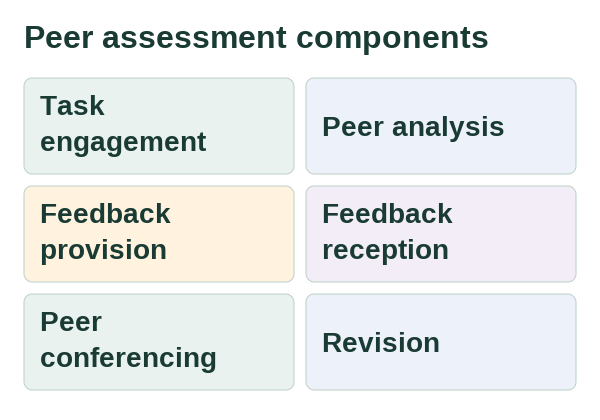
University students find it hard to produce accurate feedback on their own work. Assessing peers has been linked to better self-assessment at the time and afterwards. A 2025 online experiment tested whether the quality of the peer work matters. The 164 university students wrote an abstract. They then gave feedback on two low-quality abstracts. Each student then scored their own abstract. They wrote feedback on it and revised it. Some students saw at least one high-quality peer abstract. They revised better than students who saw only low-quality work. They also wrote more comments that named problems and suggested fixes. They also scored themselves more accurately.[17]
A qualitative study of 11 first-year undergraduates traced how peers helped self-assessment. The data came from student journals and follow-up interviews. It also came from watching peer assessment in class and from teacher interviews. Peers helped students see more clearly what good work looks like. This made their judgment sharper and their reflection deeper. Peer influence could shrink in several cases. Students might distrust peers, feel tension in feedback exchanges, compete, or be unready for peer learning.[18]
A 2026 multilevel meta-analysis pooled experimental studies. It looked at how self-assessment and peer assessment affect motivation. It covered 44 studies, 74 effect sizes and 5154 students in total. Peer assessment raised motivation with an effect size of g = 0.59, and self-assessment with g = 0.66. Training reviewers made both effects larger. In self-assessment, teacher feedback raised motivation further. Effects did not differ much by education level, subject or skill type.[19]
A 2022 study looked at 29 undergraduates in an advanced English class. It examined peer assessment of argumentative speaking. Students were rated steadily and improved in delivery, organization and language use. They were stricter with themselves than with peers. There was one case of bias against peers. Students named benefits of peer assessment. They also raised fair concerns about it.[20]
A 2010 paper on engineering education made an argument. Self and peer assessment give students chances to practise judgement and to reflect. They are not only a way to catch free-riders. The same paper reported on regular use of these activities in different settings. It asked whether this use encouraged peer learning and raised engagement.[21]
A 2022 study looked at 10 learners in a French university English class. It found that students can gain confidence in their own skills by assessing peers. That study also reported that assessing peers set regulatory processes in motion. This happened both alone and in a group.[22]
Self-regulated learning means how far learners can manage their own thinking, motivation and behaviour during learning. A 2017 study at an Iranian university compared three classes of English majors. One used self-assessment, one used peer assessment, and one was a control class. Self-assessment and peer assessment both had a positive impact. The effect was on the students' self-regulated learning.[23]
A 2022 qualitative study noted earlier findings that peer assessment raises the amount of metacognitive activity, meaning thinking about one's own thinking. That study added that good tools can increase co-regulated and socially regulated learning. They do this by giving structure to cooperative regulatory behaviours.[22]
A six-week mixed-methods study at an Indian university found that students said they gained feedback literacy. But that skill needed more work. It ran over six weeks of online peer feedback in academic writing. Students agreed that their feedback skills had grown. The study still concluded that more work was needed on how specific feedback points were and how well they were justified.[24]
A 2006 study of undergraduates found students had a positive attitude towards peer assessment. They worried, though, about whether they could assess peers well. That study said the introduction of peer assessment should focus on building evaluative skills. It should stress learning, not assessment.[25]
Reflection is often named as the mechanism, and a 2025 review reported that peer group assessment, supported by teacher facilitation and clear rubrics, promotes critical thinking and self-awareness.[26] A 2011 paper described three initiatives in a faculty of education. They used self- and peer-assessment to make students judge their own learning and that of their peers. The paper argued that assessment tasks get students' attention. But students often stop paying attention once work is submitted. They become passive receivers of results.[27]
A 2016 case study looked at a 15 credit course unit. About 90 students usually take it. Groups of four peer assessed a 500 word essay. The peer feedback and tutor mark then served as formative feedback for a longer essay of 2-2,500 words. The case study reported deeper learning and positive student feedback. It also found fewer complaints about grades on the main essay.[12]
Cultural expectations and student roles
A one-semester study looked at 145 second-year students in Vietnam. It found that students refused to take part in peer assessment within their own group. The students said they lacked confidence in swapping feedback face to face. Assessment between groups drew more interest. Students could avoid direct conflict with friends and keep face before their group. The researchers called this a conflict. It was between peer assessment and the learning culture of Vietnamese students.[28]
A study tested that belief with 217 students in China. Those students interacted less. Students responded well to peer assessment as a way of learning. Yet they doubted whether it was fair. They also felt less at ease with peer assessment as a graded exercise. They were more at ease with it as a learning exercise.[29]
A study of peer assessment in English writing classes used points from peers and from the professor. It also used class observation and analysis of the feedback given. Diakonidze found two main barriers to peer assessment. One was friendship, a social factor. The other was the lack of spoken exchange between those giving and those receiving the assessment. The recommended fix was a two-part model. Written peer assessment would have final points assigned by the professor, and assessors and assessed students would also talk in person.[30]
Sweden has a curriculum for the nine-year compulsory school. It says students should get the chance to write texts with others and to exchange feedback on them. Researchers observed a lower secondary school in Years 8 and 9. Using recordings and interviews, they studied the informal social strategies students used during formal schoolwork. Some students worked hard in ways that matched the desired learning curves. Others wanted achievement with less effort. They relied heavily on classmates and digital devices to cut corners on assignments. Their learning curves showed a broken arrow of knowledge development. This created grading dilemmas for teachers and possible mismatches in marks.[31]
One broad definition treats peer assessment as a form of active learning. In it, people on the same step of the educational hierarchy teach each other. Such peers have no administrative authority over one another. So the method leaves no room for instruction, commands or punishment.[32]
Research
How closely peers match teachers
A common worry about peer assessment is whether students' marks can be trusted next to a teacher's marks.[33][34] A meta-analysis published in 2000 combined quantitative studies. These compared peer marks with teacher marks in higher education. The pooled results showed that peer marks came closer to teacher marks under some conditions than under others. Agreement was closer when peers made overall judgements based on well understood criteria. Agreement was weaker when the marking involved assessing several separate dimensions.[33][35]
Peer marks were closer to faculty marks when academic products and processes were rated. They matched less closely when professional practice was rated. Studies with strong designs seemed to give more valid peer assessments. Studies with poor experimental design were not included. Two common guesses did not hold up in the pooled data. Peer assessments were not shown to be more valid in advanced courses than in beginner courses. They were also not more valid in science and engineering than in other fields. Collecting several ratings from several peers was not found to be better than one rating.[33][35]
A later meta-analysis asked the same question for the period after computer-assisted peer assessment began to spread. It combined studies published since 1999. It used a statistical method called variance-known hierarchical linear modelling. Across the studies, peer ratings and teacher ratings correlated at an average of .63. The review calls this level moderately strong. That average agreement was significantly higher under a set of conditions listed in the review.[34]
Agreement was higher when the peer assessment was done on paper rather than by computer. It was higher when the subject area was not medical or clinical. It was higher in graduate courses than in undergraduate or K-12 courses. It was higher when individual work was assessed rather than group work. It was higher when assessors and assessees were paired at random. It was higher when peer assessment was voluntary rather than required. It was also higher when it was not anonymous. It was also higher when peer raters gave scores and written comments. Scores alone gave a lower result. Finally, agreement was higher when peer raters helped develop the rating criteria.[34]
One study looked closely at writing courses. Peer review is often used there to create more chances to write. It looked at writing grades that peers gave to 708 students. The students were in 16 courses at 4 universities. The setting was scaffolded, meaning students were given guidance. They also got carefully built rubrics and clear incentives to take the task seriously. When at least 4 peers rated a piece of writing, their combined ratings were highly reliable. They were as valid as instructor ratings. From the students' own view, however, the same ratings gave very low estimates of reliability and validity. The study concluded that instructor worries about peer reliability and validity should not block peer evaluation. This holds at least when there are suitable scaffolds.[36]
Taken together, the reviews suggest that peer and teacher marks agree best under specific conditions.[33][34] Broad judgements against criteria everyone understands, academic work rather than professional practice, and clear guidance all go with closer agreement.[33][34][36] The evidence also has limits. The 2000 review found no advantage for multiple ratings over single ones. The later review found higher agreement for individual work than for group work.[33][34]
One small study looked at 12 postgraduate students of educational psychology. They swapped written work in pairs and assessed it. Staff and peers gave a very similar balance of positive and negative comments overall. But the balance shifted from one assessment criterion to another. Only half of all detailed comments matched between staff and peers. Yet the two groups seldom contradicted each other. Instead, they noticed different details of the same piece of work. The researchers judged this kind of peer assessment reliable and valid enough. They advised caution about applying the result more widely.[37]
Students in an introductory environmental science course assessed writing through a web-based system. It first trains students on sample texts. The results supported agreement between peers and an expert. But variation appeared at group level and at individual level. That variation was largest when students judged mid-quality or low-quality writing. This held whatever their reviewing ability. The researchers recommended clear guidelines for deciding a rating. They also recommended written explanations for rubric questions to reduce the spread of marks.[38]
In a Turkish study, 55 senior science teaching students assessed each other's lessons. A teacher also assessed them, using an observation form. Peer assessment and teacher assessment did not correlate on any of the three topics taught. Students who gave high peer-assessment scores were more likely to describe the lesson briefly and positively. The teacher's number scores and written comments agreed with each other.[39]
Rater training reduced severity and leniency among secondary school raters. It also reduced uneven severity and leniency in how students rated each other. In Ankara, 25 seventh-grade students rated classmates' compositions. They did this before and after four weeks of rater training. The training reduced how severe the raters were. It also reduced how lenient they were.[40]
A separate comparison looked at 82 Iranian university language students. The peer-assessment group had the highest course achievement. The effect size was medium (partial eta squared = .47).[41] An effect size is a statistical calculation of how large a measurable effect is, for example the difference between the averages of two groups divided by the standard deviation.[42]
Reliability in professional and oral assessment
A 1994 meta-analysis combined 21 separate findings. They came from 13 studies of peer review of the quality of care. The weighted mean kappa was .31. The review calls this quite limited against widely used standards. The review concluded that the peer review process needs changes. The aim is to make it more reliable.[43]
Medical education has produced many questionnaires for peer assessment. Many of them did not give enough psychometric data. A 2011 systematic review searched several databases up to May 2010 and found 2899 hits. Of these, 28 studies were included. They described 22 different instruments, mostly in medical settings. Most studies assessed professional behaviour. Settings, dimensions, item numbers and scoring systems varied widely.[44]
Oral presentation skills show a similar pattern of partial agreement. A 2012 study compared teacher, peer and self scores on a rubric. Teacher and peer rubric scores were positively related. But the lower intra-class correlation suggested peers and teachers still read the criteria differently. Self-assessment scores differed a lot from teacher scores. They were mostly higher than the teachers' marks. Students in that study had a very positive attitude towards peer assessment as a source of outside feedback.[45]
A 2002 study of first year undergraduates of ethnic Chinese background used a 14-item questionnaire on oral presentations. The items covered how content was organized, how language was used, and how students interacted with the audience. Before judging anything, participants attended a session. It trained them in self- and peer assessment and gave them practice. With criteria firmly set, peer feedback let students judge their peers. Their judgments were close to teachers' judgments. The same was not found to be true with self-assessment.[46]
A 2005 study asked undergraduate engineering students in Hong Kong to rate peers' English proficiency. They also rated preparation, content, organization and delivery. Students had a less positive attitude towards assessing language proficiency than towards the other criteria. Even so, their scores for language proficiency were not very different from their scores on the other criteria. Students and teachers marked work differently. They also differed in how they read oral and written proficiency. Students gained benefits from the exercise. But the study asks whether peer assessment should enter the regular assessment process until such differences are resolved.[47]
Does peer assessment improve learning
A 2020 meta-analysis by Double, McGrane and Hopfenbeck pooled 54 studies. These held 141 separate comparisons of primary, secondary and tertiary students. Peer assessment had a small to medium overall effect on academic performance. The figures were g = 0.31 and p < .001. That figure comes from experimental and quasi-experimental studies.[2]
Students who assessed peers did better than students given no assessment at all (g = 0.31, p = .004). They also did better than students assessed only by their teacher (g = 0.28, p = .007). Self-assessment is where students judge their own work. The gap between it and peer assessment was not significant (g = 0.23, p = .209). The review also tested whether other features changed the result. These were online or offline delivery, how often assessment happened, and education level.[2]
Li, Xiong, Hunter, Guo and Tywoniw published a second meta-analysis in 2020. It combined 134 effect sizes from 58 studies. When students were trained as raters, the effect size was much larger. It was larger than without such training. Peer assessment done by computer was also linked to greater learning gains than peer assessment on paper. Rating format, rating criteria and how often peer assessment occurred showed noticeable effects. These were not statistically significant.[48]
A 2025 meta-analysis by Mumpuni, Hadi and Suyanto looked only at peer assessment supported by technology. It used the PRISMA framework. It kept 24 studies with 79 data sets. Well-designed interventions in technology-facilitated peer assessment produced an effect size of 0.31. The 95% confidence interval was 0.230 to 0.413, against alternative or minimal intervention. The review reported that effective settings favour four things. These are process-oriented strategies, reciprocal roles, feedback given to individuals, and input from a single peer. It also noted that many students struggle at first to give meaningful feedback. Teachers may also doubt whether evaluations written by peers can be trusted.[49]
A separate question is whether online peer assessment builds higher-order thinking. A 2023 meta-analysis by Zhan, Yan, Wan, Wang, Zeng and Yang reviewed 17 papers. The papers were published between 2000 and 2022. Seven of those papers compared a group using online peer assessment with a control group. Another 10 compared students before and after the experience. Online peer assessment had a significant overall effect on higher-order thinking. The effect size was g = 0.76. The effect was larger for convergent thinking, such as critical thinking, reasoning and reflective thinking (g = 0.97). It was smaller for divergent thinking, such as creativity and problem-solving (g = 0.38). Swapping roles and keeping names hidden seemed to raise these effects.[50]
The 2020 review restricted itself to experimental and quasi-experimental studies with control groups.[2] The 2023 review of higher-order thinking mixed 7 controlled comparisons with 10 pre-post comparisons, which measure change within one group.[50] The 2025 review drew a conclusion. Researchers should keep testing the conditions under which peer assessment most effectively supports learning.[49]
In one intervention study, 200 Greek Cypriot learners of English as a foreign language wrote essays over one school year. Half of them, 100 students, had peer assessment plus teacher assessment. The other 100 had teacher assessment alone.[51][52] Essays from the peer assessment group gained more in word variety and correctness. They also gained in some parts of grammatical range and fluency.[51]
One study looked at 30 students in eleventh grade. Their mean narrative writing scores rose from 66.5 before the cycles to 73.2. They then rose to 78.6 and to 84.8 across three cycles. The share of those students reaching the minimum mastery criterion of 75 rose from 26.7% to 93.3%.[53]
Another action study paired debate practice with peer assessment. It ran over two cycles of four meetings each. Average speaking scores rose from 60 on the pre-test to 69, then to 75.[54] A further action study looked at students of English for specific purposes. This is the language used in a particular job or field. It reported speaking results of 56.6% in the first cycle and 96.6% in the second.[55]
A review looked at 10 studies published between 2019 and 2024. It found that peer feedback improved grammar accuracy, content organisation and overall coherence in writing. That review also judged that, when carried out well, peer feedback matches what teachers provide. The review named small sample sizes and short research durations. These were among the limits of the studies it examined.[56]
A qualitative case study looked at English juniors. It found that students used most of their peers' comments and suggestions in their revisions. A case study followed English majors over one semester. Students mostly accepted peer feedback.[57] A mixed-method study of senior high school students reported two gains from peer and self-assessment. They improved the overall quality of written work and student autonomy.[58]
A quasi-experiment took place at one senior high school. It found a statistically significant gain in writing ability after peer assessment. The assessment ran through an online classroom platform. The same study reported that a free choice of topic had the most impact on students' writing.[59]
A survey looked at 40 students at one teacher training college in Algeria. Most had favourable attitudes towards peer assessment in the writing classroom.[60] An action research account came from a Chinese college writing class. It reported that students gained benefits from peer feedback, although the practice was not welcomed at first.[61]
What the overall evidence shows
A large review of peer assessment between students in colleges and universities appeared in 1998. It proposed a definition and a set of types. A typology is a system for sorting peer assessment into types. The review found peer assessment was reliable and valid enough. This held across a wide variety of uses. Topping reports positive formative effects on achievement and attitudes. This holds for peer assessment of writing. Those effects matched or exceeded the effects of teacher assessment. Evidence for other types was more limited at that time. These included presentation skills, group work or projects, and professional skills.[62]
A 2020 overview of meta-analyses asked how well peer assessment improves academic performance. It looked at students in higher education. It chose meta-analyses about university settings. These used only experimental or quasi-experimental designs. They also described what the control group did. Two meta-analyses met those criteria. Both showed a moderate level of effectiveness on students' academic performance. The overview reported that peer assessment worked best when it was highly structured. That structure meant training students in how to evaluate, using explicit and quantitative criteria. It also meant that a computer handled the process.[63]
A 2021 meta-analysis in Turkey looked at ways of checking learning during a course. It pooled 32 studies with 47 effect sizes. These came from true experiments or quasi-experiments. Both measured learning outcomes. The overall mean effect size was .72, with a standard error of .07. The significance level was below .05. Effects differed by who started the feedback. Student-initiated feedback reached d=1.16 and mixed feedback reached d=.83. Adult-initiated feedback reached d=.69, and computer-initiated feedback reached d=.42. In that analysis, education level made no difference to student performance. Neither did publication type.[64]
A 2019 systematic review mapped 134 studies of technology-supported peer assessment. They were published between 2006 and 2017. Most activities took place in social science and higher education. Performance, oral presentations and speaking were the least common assignments assessed. Most studies ran only one round of peer assessment and gave assessors no rewards. They also gave feedback with no set structure. Most tools offered only basic functions, with no guidance.[65]
A 2023 bibliometric analysis maps publication trends and citation networks. It found that peer assessment in online language courses drew much attention after the COVID-19 outbreak. The field favors studies of online writing courses. It shows international and interdisciplinary research trends. Recent work has moved toward specific questions. These include which factors improve student engagement and feedback quality. They also include how to design peer assessment to raise its quality.[66]
A 2024 review looked at 60 articles on peer feedback in academic writing. They ran from 2014 to 2024. It listed 16 benefits and 13 types of obstacle. That review called for future research on masters' and doctoral students. It also called for quantitative approaches to deepen understanding of the effects.[67]
A study looked at a first-year Social Sciences course at the Universidade de Vigo in Spain. It compared three sets of marks. It found strong agreement between peer assessment and lecturer marks.[68]
A 2011 article on foreign language classrooms says peer assessment adds to teacher assessment and raises its reliability. It does not replace teacher assessment.[69] A 2015 article notes that most research concerns university students. It adds that limited knowledge and low confidence may make grading by peers a step too far for high school students.[70]
Students tend to accept peer assessment as one element of a course, with conditions attached.[25] A 2024 article on a partnership approach argues that students should help set clear criteria. It adds that teachers should act as facilitators. Good teacher training and favourable conditions for cooperation are needed.[11]
A 2025 study looked at foreign language students at Voronezh State University. It reported high potential for peer assessment. It also noted possible drawbacks when it is introduced at a non-language university.[71]
In practice
Feedback, criteria and training
A single overall peer mark can hide large differences in how students judge separate parts of a piece of work. One study looked at first-year biology students at university. Pairs marked a poster on nerve physiology using individual marking criteria. Each criterion was also looked at on its own. The share of students who gave the same mark as the tutor ranged from 31% to 62%. Certain areas of the marking criteria were prone to over-marking and under-marking. So comparing the tutor mark with the student peer mark may mislead anyone who uses it to judge whether peer assessment is valid. Students said they liked doing peer assessment. They felt it made them more aware of their own work.[72]
Training can teach students to define performance criteria, give feedback and write assessment reports. In one experiment, student teachers were put into groups at random. Some were experimental groups and some were control groups. The trained groups showed better assessment skill than the control groups. This was judged by the peer assessment reports the students wrote. Trained students also earned significantly higher grades on the end products of the course.[73] A second study trained student teachers in a single skill: defining performance criteria. It used four peer-assessment tasks built into an existing course.[74]
Anonymity is one way to change how students behave when they assess each other. Training is another option when anonymity cannot be arranged. In a quasi-experimental study, 77 students took part in a peer assessment activity. There were three conditions: identities revealed, anonymity provided, and identities revealed with training. The anonymity group and the training group both did better than the identity group on projects. The training group valued peer assessment more than the other two groups. They also felt less pressure during it.[75]
A review looked at studies with a control group or a within-group design. It found that anonymous peer assessment seems to improve students' views of its learning value. The same review reported more critical peer feedback and greater self-perceived social effects. It also found a slight tendency toward better performance. This was especially true in higher education and with fewer peer assessment aids. The review also concluded that the teaching context and goals need to be considered. It added that real-world research is still limited. It said future research should use stronger and more complex designs.[76]
Only 30% of the students correctly perceived their assigned condition. So the data were analysed according to the condition each student perceived. Some students believed their reviewing grade would depend on how helpful their feedback was. Those students gave more feedback, more criticism, more solutions and more localized comments. Those students also gave more consistent ratings. This was not true of students who thought their grade would depend on how consistent their ratings were. The findings suggest that writing helpful comments may affect peer assessment in general. They also suggest that consistent ratings depend on commenting.[77]
One study measured feedback quality on a scale with two dimensions. It analysed 5,606 feedback points that could be acted on. It also analysed 440 drafts by 110 students on two argumentative writing tasks. Accuracy of feedback sat at a medium level. Revision potential sat at a low level. Accuracy predicted implementation more strongly. Peer feedback quality was low overall. Feedback of medium quality was the kind most often put to use.[78]
Clear criteria and training shape how useful peer feedback turns out to be.[79][80] They used a rubric made by the researchers. After the training, the students showed less severity and leniency. They also showed less variation in how harshly or kindly they rated different peers.[40]
A 2008 study looked at English as a foreign language classrooms. A 40-minute session on how to rate oral presentations did not change the link between student and instructor ratings. Longer training in a second study also left that link unchanged. But the instructors no longer fitted poorly. This suggests the students' frame of reference had improved.[79]
In the 2008 study, trained groups produced better comments than untrained groups. They also produced more of them.[79] A 2019 case study tracked 26 first-year Japanese students. It followed them across 6 feedback sessions in low-level English academic writing classes. Without training, those students gave vague feedback that did not help. Training sessions on screencast feedback, in which a reviewer records a spoken walkthrough of the work on screen, helped them offer critically evaluative feedback that was useful for revising essays.[80] A 2016 experiment with ninety 7th graders found no significant difference in learning effectiveness from a scaffolded assessment approach, which gives students structured support during the task.[81]
Whether the feedback itself is assessed changes what students produce. A 2014 study at a Japanese university compared two classes. Both used peer feedback on every early draft for a full year. One class was assessed only on the final draft. The other was also assessed on the feedback it gave to peers. The group whose feedback was assessed addressed a wider range of points. It also produced more comments, longer comments and more words in total. Its members also annotated partners' drafts more often. They wrote more specific comments too. The accuracy of the feedback did not differ much between the two groups.[82]
A 2014 qualitative study looked at a first-semester course. Teachers and students all had positive attitudes toward peer assessment. Yet the effort they put into it was minimal.[83] A 2024 study looked at 84 university students in team-based learning. Giving the reasons behind a rating clearly affected views of usefulness and fairness. Detailed criteria alone did not.[84]
A one-way analysis of variance found real differences between the mean scores of the three groups. The differences were statistically significant. Follow-up analyses showed that the peer-assessment group did better than both other groups. This was on the writing posttest. The researchers drew a conclusion. Peer assessment, used as a cooperative technique, can help students improve their writing in language classes.[85]
A study of 116 Hong Kong undergraduates compared self-feedback and peer feedback on an abstract writing task. It looked at how many comments there were, their types, and how they were carried out. Hierarchical regression analyses showed a result. The two feedback processes together explained about 25% of the variance in writing improvement. One form contributed about 15% and the other 10%. Feedback types and the amount of feedback used both predicted improvement. The total amount of feedback had a negative effect. Putting peer comments into practice improved work more than putting self-feedback into practice did.[86]
A study looked at 65 freshman English language teaching students. It compared online teacher feedback, online peer feedback, and automated writing evaluation feedback. Participants found the instructor's electronic feedback especially helpful. They said it improved their writing most. Peer feedback was rated as less effective than the others.[87]
A study looked at 324 first- and second-year undergraduates at a Japanese university. It compared peer feedback with feedback from ChatGPT. All three kinds of engagement were higher in the ChatGPT group. The differences were significant only for affective and behavioral engagement. The difference in cognitive engagement was not significant.[88]
A 10-week intervention studied 122 Chinese students learning English as a foreign language. It compared combined AI and peer feedback with conventional peer feedback alone. The experimental group had 61 students and the control group had 61. The experimental group showed significantly higher behavioral, affective, and cognitive engagement.[89]
Peer comments mainly helped with content development, organization, reader awareness, and working together. The AI mainly helped with grammar, wording, and quick local revision. Used together, the two sources seemed to encourage repeated revision. They also seemed to raise confidence. Some students, though, felt overloaded and struggled to decide which comments to act on first.[90]
A year-long study looked at 12 students. They received either teacher feedback alone or peer feedback alone. It found similar levels of understanding of feedback in both groups. Students in the peer feedback group asked their peers for help more readily. They did this when they did not understand something. They also seemed to gain more from reading their peers' writing than from the peer feedback itself. Students in the teacher feedback group said the gap between drafts was too short. They could not make the revisions they wanted.[91]
A study looked at master's students learning to write literature reviews. It found no links between review patterns, the students' performance mark, and the amount of feedback received. Some review patterns did link to separate category scores. The constructive versus negative and high versus low dimensions linked to most category scores. The quality and amount of peer feedback did not set the performance mark. They did help individual parts of literature review writing.[92]
Peer assessment in writing classrooms
A 2016 review looked at research on peer feedback in second language writing. It covered studies published from 2005 to 2014. The review sorted this work into seven themes. These include how peer feedback compares with teacher and self-feedback. They also include what feedback-givers gain. It also examined peer feedback training, student stances and motives, and group dynamics. It looked at computer-mediated feedback and cultural issues as well.[93]
One study at a secondary school tested a writing curriculum. It asked whether peer feedback can replace teacher feedback. It used a pre-test post-test control group design. It measured long-term learning effects on writing assignments. Students who got plain peer feedback made progress. There was no significant difference from students who got feedback from a teacher. The researchers called this result support for a non-inferiority hypothesis. This means peer feedback was not worse than the teacher alternative. Both of those groups, however, improved much less than other groups. Those groups used question forms before feedback or reply forms afterward. Almost half of the students found the peer feedback they received helpful. Less than a quarter thought that giving feedback helped their own learning.[94]
Sixty freshman students at a private university in Guayaquil, Ecuador, got peer feedback on academic writing. The course lasted sixteen weeks. Their English was at middle levels, labelled B1 and B2. Their writing improved in structure, fluency and accuracy. The change was a Cohen's d of 0.39, a standardized measure of how large a change is.[95]
A smaller study looked at 21 English majors in the southernmost border provinces of Thailand. It found significant progress from pretest to post-test. That study reported an effect size of 1.97, which it described as large.[96]
High-proficiency reviewers produced far more comments than low-proficiency reviewers. Yet both groups relied heavily on local comments, especially on grammar. They gave few overall comments about content or organization. Both groups most preferred alteration comments, which propose a specific change to the text. Both groups also gave far more comments aimed at revision. Comments not aimed at revision were much rarer.[97]
Feedback literacy is the set of skills a learner needs. The learner uses them to seek, make, process and use feedback. One teaching model proposes peer feedback with teacher support. It is a way to build these capabilities in second language writing classes. The model outlines teacher support before, during and after peer feedback activities. It gives students several rounds of feedback calibration, in which they check their judgments against a standard, before they seek teacher feedback. The model has not yet been tested for implementation or effectiveness. Its author lists that as a task for future studies.[98]
A case study in Vietnam followed English as a foreign language students of varying proficiency. They gave feedback on second language writing. It used the students' feedback, reflective journals and semi-structured interviews. Students were excited about the activity. Their effort, time management, comment types, thinking processes and strategies did not stay the same. Personal and social factors explained those differences.[99]
A survey in Hong Kong covered 1740 tertiary students and 460 academics. It found that a significant number of both groups resisted peer assessment that used grades. Most said students never or rarely grade one another in assessment activities. The paper argues for peer feedback as an end in itself. It can also come before peer assessment that awards marks. It recommends having students work with criteria. It also recommends making peer involvement part of normal course processes.[4]
Group projects and individual marks
One early answer was a questionnaire. Each student filled it in about the other members of the team. The answers were used to work out a peer assessment factor. This is a percentage of the group's project mark given to each member. Goldfinch and Raeside introduced this questionnaire and the calculation method in 1990. They tested the scheme on a large first year course.[100]
Later work refined the technique to ease the administrative burden on the lecturer. The refinements also added a safeguard against a problem seen in practice. Students who gave too much credit were in effect penalising themselves.[101]
A related approach adjusts the group mark with a weighting factor. The factor is built from each member's rated contribution. An optometry course adopted it after students complained. One mark for all group members often failed to reflect individual effort fairly. A two-part weighting factor was tried first and evaluated in detail. The best parts of the first scheme were then used to make a simpler one-part factor. It was used in another subject of the same course.[102] That trial also found problems caused by the bias individual students bring to rating. A new normalisation process, a step that adjusts the raw ratings to even out that bias, was introduced to address these shortcomings.[103]
Three tools were tested in several management courses. Two used a rating scale and one used a single score. All three showed acceptable levels of reliability, meaning they gave reasonably consistent results. All three also related to measures of individual performance. Each instrument came with its own advantages and disadvantages.[104]
The format of the rating and how often ratings were collected also mattered. The two interacted significantly to affect students' motivation to rate their peers and their views of the team. That field experiment found that peer assessment is a complex process. It needs further study.[105]
A third design asks students to judge contributions by category. They do not give one overall impression. In a direct comparison, holistic peer assessment, where each student gives one overall judgement, produced many more groups in which every member received equal marks. The holistic method also left more students with a large gain or a large loss of marks. The comparison argued that the holistic approach better suits summative peer assessment, the kind that counts towards a final grade, within group project work. The category-based approach was judged more useful for formative assessment. This is the kind meant to guide improvement rather than to score.[106]
One experiment involved 210 final-year business students. They worked in 41 teams. Peers rated oral presentations with a 22-point guide. These ratings counted for 25% of the overall grade. The student and staff averages did not differ much, but their standard deviations did. This suggests the two groups are different. In the second half of the semester, student scores moved much closer to staff scores. This was true at least for the presentation part. Even so, the link between peer marks and staff marks was only moderate.[107]
One study looked at 261 students. Students were very satisfied with groupwork and with the assessment method used. Students with work experience differed fairly significantly from those without. The difference favoured those without it. Australian and international students differed substantially. International students said they were more satisfied. The study advised extending the work to other subjects and fields.[108]
Designing courses and large classes
A multiple-case study followed seven course designs. It followed undergraduates learning to write in university courses. Most students assessed their fellow students' work seriously. They also took the peer feedback into account when revising. In most conversations students gave feedback in an evaluative manner, judging the work. In others the talk was more exploratory. The study recommends combining written and oral peer feedback in a single design.[109]
A related study tested peer assessment designs in university history teaching. It judged outcomes by the revisions students made, the grades of written products and perceived progress. Most students acted on the peer feedback. They saw their writing improve as a result of peer assessment. The study found no big differences between grades. This held for groups that used peer assessment and groups that did not. Most teachers saw better-organized talk about writing problems in their classes. Three design features seemed to matter. Peer assessment should not coincide with staff assessment, it should be reciprocal, and it should run in feedback groups of three or four students.[110]
Large classes raise practical problems. Most of the literature had covered small groups taught by staff committed to the method. One project built procedures for large classes. It used a repeating cycle of action, reflection and refined action. The cycle ran in three phases. After each phase the procedures were changed in response to student and staff feedback.[111]
A randomized trial tested scaffolded peer assessment in group-oriented classrooms. It involved 37 lower-intermediate and 5 intermediate learners of English. The groups had 5 members each. The intermediate learner acted as mediator and gave feedback to the other members. Control groups had no mediator. Four sessions covered guided peer assessment of speaking. Four covered peer assessment of vocabulary learning with step-by-step support. The trial found that supported peer assessment built speaking skills and grew vocabulary size.[112]
An action research study tried peer assessment with many kinds of students. It asked how the method could be used to its full potential. Previous exposure to peer assessment, a good preparation process and student involvement in setting criteria all helped build student confidence in the method.[113]
Teacher support can be designed in response to the concerns students bring with them. In one study, English majors in China did peer assessment on nine writing tasks. Surveys before the intervention gathered learners' concerns. These concerns shaped the support strategies teachers led. Later surveys and assignment feedback showed that steady teacher support strongly affected learners' views. It also changed the nature of peer assessment and how valuable students saw it.[114]
A study at an Australian university followed formative self and peer assessment for two years. It supports other research showing that students tend to see both as helpful. Students reported gaining more insight about the assessment process. They also said they improved their own work. The study argues that self and peer assessment need careful design and implementation to work as formative assessment, which is assessment meant to guide learning rather than to grade it. It names two central parts of success. One is building students' ability to give feedback. The other is the teacher taking part often and on time. The move to self and peer assessment is described as not simple for teachers and students. It is called worthwhile and necessary for twenty-first century higher education.[115]
Student views, stress and conflict
They had a positive view of peer assessment both before and after it was used. A study at the University of Girona asked 416 students. They were in 11 subjects across four fields. It used questionnaires before and after the process. Students called peer assessment motivating and worth recommending. They said it helped them learn at different levels. They also named limits. These were the responsibility it places on them, and some distrust of fellow students' ability to judge work.[116]
One study looked at 233 students who had just done self- and peer-feedback. They felt they gained from it, even though the scheme had no training. Their comments fell into eight general dimensions. These included finding the task difficult and gaining a better understanding of marking. They also included discomfort and motivation to impress peers.[5]
The course was a writing course for 38 university students of English. Peer assessment produced no significant difference from teacher assessment of the same compositions. The study found no friendship bias, so marks were not tilted toward friends. Students' attitudes toward peer assessment also grew more positive.[117]
Undergraduates trying formative peer assessment for the first time, meaning feedback given during the course rather than for a final grade, mostly called it a positive experience for their learning. A small number of students found the process less useful. The study argued that tutors should plan for a range of learning styles.[118]
An experimental study measured the effects of assessment type and gender on student stress and performance. Female students were more stressed by self-assessment than male students. Being assessed by oneself and by peers was more stressful, yet it led to improved performance on summative tasks, which count toward a final grade.[119]
The most negative emotion came from what students saw as disrespectful behaviour and attitudes in peer reviewers. Students valued helpful feedback that seemed to show respect for others' work. Students generally had mixed feelings. They valued the learning from giving and receiving feedback. But they resisted peer assessment for summative purposes.[120]
A study of 234 Chinese undergraduates looked at attitudes. It examined which attitudes predicted participation in online peer assessment. Of these, 168 were in engineering and 66 in English. How much students took part was linked to their gender and their academic background. It was also linked to any earlier experience of peer assessment. Doubts about whether the procedure was fair and sensible went with less participation.[121]
A study of an online peer assessment community used a negative binomial regression model, a statistical method for counting events, with user fixed effects. It found that a student's knowledge self-efficacy, meaning confidence in one's own knowledge, raised task conflict. Cognitive diversity of general knowledge, or variety in what students know broadly, and network density, meaning how tightly connected users were, also raised task conflict. Two things did not strongly drive task conflict. They were interactive experience and cognitive diversity of specific knowledge.[122]
Some students have second thoughts about peer assessment. A 1997 study looked at the reasons they gave for changes in attitude. A study took place at the English Department of the Hong Kong Polytechnic University. It asked students about peer assessment before an exercise. It asked them again at the end. The report focuses on students who had second thoughts. It also covers the reasons they gave for changing their views.[123]
A study looked at 58 university students judging oral presentations. Prior experience was limited at the start. Yet students already saw the practice as good for their learning. After assessing their peers, the same students trusted their classmates more, both on surface features and on content. They also felt their own judging ability was not below that of their classmates. The researchers concluded that one session is not enough. They said steady, extended training is needed for a real change in perception.[124]
A questionnaire study asked 31 teachers and 100 students at Qafqaz University in Baku, Azerbaijan. It found that grading peer and self-assessment can bring hesitation and uncertainty. The same study reported worries about subjectivity. It also noted a lack of reliability in such grades.[125]
Among 27 Korean university students in an English course, views split by school background. Students educated mainly in English looked on peer assessment more favorably. They thought group members should get different scores for their performance. Students taught mainly in Korean wanted one shared mark for the whole group. They also found peer assessment hard. Even so, both groups liked peer assessment more than teacher assessment. This was for group oral presentations alone.[126]
Eight high school students in Hanoi were asked in interviews and through their written feedback. They were generally positive. They named better writing, sharper critical thinking and more confidence. Those students still raised doubts about how dependable the feedback was. They also questioned how good its quality was.[127]
Sixteen Saudi female undergraduates assessed classmates' tasks. They then wrote reflections. They reported more engagement in class. They also reported stronger critical thinking, writing and analysis skills.[128]
One study looked at 16 students in Portugal. The results suggested students had little experience of online peer assessment. Students judged it a suitable digital alternative. They said it supported motivation and cognitive, metacognitive and digital skills.[129]
One qualitative study asked eight students and two lecturers. They said peer assessment can help learning through working together. They also said poor practice in the review process can put students off learning from each other. A separate qualitative study gave educators one piece of advice. They should make one thing clear to students. Peer assessment is not a competitive activity.[130]
Peer assessment across school subjects
A case study in a lower secondary physics class followed students. It watched them carry out and report inquiry work. The researchers found 3 profiles of peer assessment among individual students. Some students improved their lab report after peer assessment. They reported other benefits too. Others did not improve their report. A third group gained no benefits at all. Three factors explained these differences: engagement in the inquiry work, the quality of feedback received, and understanding of formative assessment, meaning assessment meant to guide learning rather than to grade it. Most students gained something. Even so, improving one's own work and gaining other benefits both required enough success on all 3 factors.[131]
In mathematics, a study in Ghana tested peer assessment against another approach rather than against nothing. The study compared two kinds of training for senior high school students. One trained critical thinking. The other trained peer-assessment skills. Cobbinah used a quasi-experimental design. The sample was 137 students from three public senior high schools. Of these, 95 were in the experimental groups and 42 in the control group. The two kinds of training made no significant difference to mathematics achievement. Gender and age also showed no significant link with the treatments. The researcher recommended that teachers use either strategy in mathematics lessons.[132]
At the University of Ulster, second-year performance students were first assessed by panels from their own year group. In later years, final-year students formed the panels, and the reports became more objective.[133] A larger project called Peer Learning in Music began in October 1996. It spread peer-learning methods across a range of modules.[134]
In language teaching, a study in Bogota, Colombia, paired argument outlines with peer assessment. The class held 12 learners in a B1 English course. Learners had struggled to expand on their ideas during class discussion. Audio recordings and interviews showed the two tools raised learners' awareness of argumentation. They also raised their ability to take part in it. Peer assessment also appeared to support personal and collaborative learning. It seemed to encourage reflection and agency.[135]
One paper describes a teaching model for translation courses. It combines peer assessment with internet browsing. The model is offered as a classroom management strategy for English department students. It is not a tested intervention with results.[136]
In nursing, peer review and peer assessment are described as ways to get feedback. They also give outside views on one's practice. Self-assessment is described alongside them. Gopee describes peer review as a built-in part of clinical governance.[137] In drama, 10 university students assessed each other on a 32-item form scored on a five-point scale. This produced 2880 ratings.[138]
In photography, 23 fine arts students took part in a 7-week experiment. It combined game-based learning, group learning and peer assessment. The experimental group scored higher than the comparison group.[139]
In character education, a field trial took place in grade 5 of an elementary school in Surabaya. It found peer assessment worked for judging discipline and teamwork.[140] A further study reports that self-assessment and peer assessment are the most effective techniques for shaping student character. This is under Indonesia's 2013 curriculum.[141]
A 1989 article on legal education notes that law schools admit able students. Yet low grades for work lacking substance, clarity, creativity and sophistication appear every year. This happens in almost every course. The article asks why such poor work is produced. But it reports no trial of peer assessment.[142]
At RMIT University in Melbourne, construction management and quantity surveying students qualify for registration with two professional bodies on graduation. In 1994 the department reviewed its first-year technology subjects. It then built a problem-based integrated learning unit. That unit had run for ten years when a peer assessment model was applied. The paper describes the procedures and processes used to introduce the change. It also looks at the theory the model was built on.[143]
Peer assessment in teacher education
In one study, 20 pre-service teachers from three universities assessed each other's explanations of science concepts. They did this in short practice lessons called microteaching episodes. Their written feedback showed they valued explanations that connect concepts to students' ideas and experiences. This view is linked to constructivist theory. Six of these participants were interviewed during later school placements. The interviews looked at what helped and what blocked their explanations in real settings. They led the students to reframe their views. The researchers argue that peer assessment can help student teachers absorb assessment criteria. These are the criteria for good science teaching.[144]
One study surveyed 300 students on bachelor's and master's degrees. It analysed their questionnaires, peer assessments, written comments and blog posts. Students reported learning various ways to perform and assess assignments. Anonymous evaluation helped them get past shyness about judging peers' work.[145]
A study looked at 14 in-service teachers. They were working and studying English as a foreign language. It compared their self-assessment and peer assessment of presentation skills with the teacher's assessment. These experienced markers did better in peer assessment.[146]
There, 58 second-year primary teaching students worked in 11 groups of five or six. They took part in peer evaluation both in person and online. Their comments fell into four themes. These were objectivity, evaluation criteria, interaction and the features of the online platform.[147] Students preferred to stay anonymous. But anonymity may not be needed to increase their engagement.[148]
Peer assessment in professional and clinical training
Professional programmes ask students to judge each other on domains that written tests measure less well. These include interpersonal skills, humanism and teamwork. A 2005 study at one medical school asked second-year students to rate their classmates' professional competence. They used an online instrument. Statistical analysis pointed to two dimensions of professional competence. One is Work Habits, such as being prepared and taking initiative. The other is Interpersonal Habits, which includes respect and trustworthiness. The Work Habits scores were linked to all other performance measures in a wider assessment. The coefficients ran from 0.21 to 0.53. About 6 peer raters were needed to reach a generalisability coefficient of 0.70.[149]
A case study of a professional course found that peer assessment helped students learn. It also helped them grow as professionals. The study listed the conditions for using it well. These were adequate preparation and teacher help throughout. They also included matching the assessment to learning objectives and the course's wider purpose. A teacher handled a helpful discussion after the assessment with care. This was a fourth condition.[150]
An early review looked at a B.Sc(Hons) Medical Science degree programme. It surveyed staff and students and checked module descriptors for assessment content. It found little clear or detailed information about assessment strategy in the module documents. Staff used varied methods, including peer assessment, at the level of individual modules. Students' views and experiences of assessment and peer assessment were mostly positive. The review recommended a more structured approach across the whole programme.[151]
In a dental study, 309 Year-2 and Year-5 students were invited to join a structured peer assessment and feedback protocol. 108 took part. Those 108 students completed 1169 work-based forms. Of these, 516 were in the pre-clinical skills laboratory and 653 in the dental clinic. In all, 94% contained written feedback. For Year-2 students, 82% of feedback was about the clinical domain. Of it, 89% was positive and 77% was task specific, sorted into 14 themes. Year-5 feedback dealt mostly with Management and Leadership (37%) and Communication (32%). It was 64% positive and 75% task specific, and fell into 24 themes. Year-5 students gave 13% negative feedback. Year-2 students gave only 2%. Four themes appeared in the feedback of both year groups. They were efficiency, infection control, time management and working speed.[152]
Athletic training has only 2 earlier studies of peer assessment. One programme tested whether students judge peers accurately and reliably. Senior students were accurate on all clinical skills and professional behaviours. They were reliable on the Biceps Femoris Manual Muscle Test, the Thompson Test and professional behaviours. Junior students were accurate on all skills except the Lachman Test. They were reliable on the Biceps Femoris Manual Muscle Test and Noble's Compression Test. The study concluded that students can judge peers' clinical skills as consistently as instructors during a live demonstration. Year of study may still affect how students judge professional behaviours.[153]
What this looks like when you study
At a Hong Kong university, 217 Chinese students worked with the same partner for a whole term. They were in eleven business English classes. Peer feedback was generally seen as useful and happened often. But about five percent of students did not enjoy the arrangement.[29]
Twelve students of educational psychology at postgraduate level worked in pairs. They swapped written feedback on their academic writing. But only half of the detailed statements matched. There was little conflict between the two views; they simply focused on different details. Most of the 12 postgraduates called the work slow, demanding and socially awkward. They also said it improved their later writing and built other skills they could carry over.[37]
Giving feedback that named problems and suggested fixes predicted how well the assessor did on their own project. Giving or receiving grades did not predict project performance. Positive emotional feedback helped the students who received it.[154]
Later developments
Online, computerised and AI-assisted peer assessment
A 2009 systematic review looked at tools that support peer assessment. It noted that peer assessment was traditionally done with pen and paper in small classes. Online tools were then developed so that peer assessment could be applied in large classes. The review compared these tools. It found features the tools shared. It also found big differences between them.[155]
One early example was a computer-based peer assessment system. It was built into an undergraduate module in computer studies. That system changed how tutors and students relate in assessment. It had been one tutor to many students. It became a student-student relationship of many to many. The same paper looked at what the system did to plagiarism. It also analysed the results of the assessment parts in terms of student learning.[156]
Studies that compare online grading with face-to-face grading find that the setting can shift the marks. Students' grades in the face-to-face format were much higher than their grades online. They were also higher than the instructor's face-to-face grades. In the online setting, by contrast, students gave grades that looked like the instructor's. The study concluded that students give higher grades face to face. This is most likely because of peer pressure in the traditional classroom.[157]
One study took place at an Austrian university and lasted ten weeks. Each student learning English as a foreign language wrote three draft essays. Each student reviewed a classmate's draft using three free applications. These were Google Docs, the Sakai Virtual Learning Environment and the Sakai Wiki. All three applications let students exchange peer feedback. The feedback mode of each application shaped what reviewers commented on.[158]
A 2014 paper argued that the teach-learn-assess cycle is broken in a typical MOOC. Without formative assessment, which is feedback given during learning rather than a final grade, MOOCs amount to information dump or broadcasting shows rather than educational experiences. Peer assessment results without a moderator, however, lack credibility. Several methods can make peer assessment results more accurate. Some mix of them may be needed to make results accurate enough for formative assessment. Such results can also help peer learning and online discussion forums, and may possibly add to summative evaluation, the final grading used for credentials.[159]
In one study, high school students did peer assessment through an online system called iLap. Researchers counted their grade-giving and grade-receiving experiences. They coded the feedback by cognitive and affective dimensions. Student assessors gave feedback that identified problems and gave suggestions. This feedback significantly predicted the assessors' own later performance. Positive affective feedback means feedback with a warm emotional tone. It was linked to the performance of the students who received it. Peer grading behaviours, by contrast, did not significantly predict project performance.[154] In the second round, low executive students who received specific feedback significantly outperformed those who received holistic feedback, which is general rather than point by point.[160]
A 2025 survey sorted this work into six areas. They are assigning peer assessors and improving individual reviews. They are also working out peer grades and feedback, and analysing student feedback. Other topics are helping instructors oversee the process. Peer assessment systems themselves are also a topic. Its review looked at 79 papers. Almost all of them found that artificial intelligence improved peer assessment. Many papers focused on diversity in grades and feedback, on fuzzy logic, a way of handling vague categories, and on analysing feedback to equalise its quality. Relatively few papers looked at automated assignment or automated assessment. Few looked at calibration, teamwork effectiveness or automated feedback. These areas need further research. The survey also described a tool called RIPPLE. In it, trained students use a detailed rubric to vet learning resources submitted by other students. Artificial intelligence gives feedback there right away. Students are advised to check whether it is accurate.[161]
A 2022 paper noted common concerns that raise questions about trustworthiness. These include a scarcity of high-quality feedback from student assessors. They also include a lack of accuracy in assigning grades. The paper described ways to give student assessors guidelines and help during individual reviews. It also described models that combine probability and text analysis to make assigned grades more accurate. It also described feedback on reviews, which lets peer assessors review each other's work. It described a spot-checking mechanism too, to help instructors oversee the process. The aims were to address common concerns. This would increase trust in peer assessment and its use.[162]
Criticism
Open questions and limits
A 2018 study looked at 13 academics in Australia. It found that individual teachers mostly decide whether to use it. Those interviews produced seven themes about benefits and five about challenges. The academics showed strong belief in self and peer assessment as formative assessment. That focus differs from earlier writing. Earlier work centred on how accurately students mark each other.[163]
A second open question is what counts as good quality in peer assessment. Studies judge it by different standards. A 2011 analysis argued that this variety leaves a messy picture of the field. The analysis named five goals that peer assessment can serve. Each goal implies different standards of quality. So a study should be judged only against the goal it set out to reach.[164]
Written criteria and grade descriptors may not be enough. They may not make assessment standards clear to students new to a subject. In one exercise, sports studies students graded each other's work using assessment criteria. Their own marking and feedback comments were then assessed. The data showed benefits in students' use of criteria, their awareness of their own achievements and their grasp of assessment feedback.[165]
First year mathematics undergraduates (N = 194) judged pairs of scripts against one another. They did this after a written test on multivariable calculus. The students' assessments showed high validity and inter-rater reliability, meaning agreement between judges, when compared with expert and novice assessments and other module marks.[166]
A 2023 systematic review used 449 studies from 424 peer-reviewed articles. Arts and humanities was the most common subject area. Two-thirds of the studies had a formative purpose. Written work was the most used object of assessment. Beliefs and perceptions were the most studied outcomes. Gender was the most investigated moderator, meaning a factor that may change how peer assessment works. An analysis of 27 design elements found five common patterns. Only ten elements added to them in a significant way. The review concluded that peer assessment designs in research studies are less varied than they could be.[167]
Reliability is still a concern. It depends on the traits of the students doing the rating. Statistical models exist that adjust for each rater. But they are hard to fit to real peer data. The number of rater parameters grows to two or more times the number of raters. Estimating from sparse data depends heavily on settings tuned by hand. A 2016 proposal used a model with as few rater settings as possible. It learned those settings from the data. A simulation showed that it works. Experiments on real data showed this too.[168]
Design choices also shape the feedback students actually give one another. The study covered seven writing courses. Each had a different peer assessment design. Feedback focused on evaluation and rarely dealt with structure. The study suggested feedback works well when assessment is both summative and formative. It also works well in small feedback groups. It works well when written comments are explained and discussed aloud with the receiver.[169]
The reliability and validity of peer assessment are long-running concerns in the research. A 2019 study argued that many earlier studies of this problem rested on the scores students gave. They did not look at how students reached those scores. The study recorded who evaluated which item and in what order. It found a range of evaluation styles. It also found some students who did not take the task seriously.[170]
Few studies in Indian higher education look at students' feedback skills in peer feedback tasks done through technology.[24] A simulation used three million peer assessments from the edX MOOC platform. It found that peers often disagreed. Because of that disagreement, the reward for effort was fairly low. This held across all the reward schemes tested.[171] A survey of 769 teachers at six Ukrainian universities found that 15.6% used peer assessment, 62.3% used it in part and 22.1% did not use it. Among those teachers, 51.9% said they were ready to use it after a closer look.[172]
Fairness, free riding and group problems
Kao names two problems of unequal participation. One is a free rider. The other is control by one member of a group. A 2013 paper says unequal participation holds back collaborative learning tasks.[173]
Group problems can harm learning and cause stress and frustration. This comes from a 2023 study of students' group work problems. That study notes that many students report bad experiences with group projects. These come with negative emotions and group problems. Teachers often lack the time and resources to monitor and support groups, so problems can go unnoticed.[174]
After taking part, those students were much more positive about peer assessment. They still raised the possibility of bias and a lack of training.[175] McGarrigle's 2013 case study looked at a second-year module. It was part of an honours degree in early childhood education and care. The college was in the south of Ireland. Students there gave several reasons for disliking peer assessment. They feared conflict inside the class and bias in marking. They trusted their classmates' judgments less than the tutor's. The researcher suggested that peer assessment needs collaboration. That can clash with an education system built on individual competition.[176]
One design fix is to build personal accountability, meaning each student is answerable for their own contribution, into the assessment. Kao describes a 2013 method called Peer Assessment with Positive Interdependence, or PAPI. It pairs personal accountability with positive interdependence between students. Its key assumption is about two things. More positive interdependence and personal accountability may reduce or remove free riding. With this approach, each student rates work alone. So one member is unlikely to control the ratings. PAPI also lets teachers change weightings at different stages. One example is to encourage critical thinking when most students are quality achievers.[173]
A 2011 model called Authentic Self and Peer Assessment for Learning involved students in every step. This ran from creating the marking criteria to pilot marking and giving peer feedback. The results were not final. Still, most students who took part found the process helpful. They were open to trying it again.[177]
Most students said they had a positive experience with it. This held for both versions. Teachers also said it was useful. A second field study found the same positive response. The survey used five features to judge how groups worked together.[174]
Common misconceptions
A common worry is that peer assessment results in massive open online courses cannot be trusted. The reason is that novices judge novices. The source says students especially do not trust peer assessment results. It also reports comments from course evaluators who disliked the process. Suen (2014) describes several approaches. These include calibrated peer review and a Bayesian post hoc statistical correction.[159]
Many teachers believe students in Asian cultures give little useful feedback. They blame politeness norms and fear of mistakes.[29]
Key studies
| Year | Study | Sample | Design | Finding |
|---|---|---|---|---|
| 1995 | Freeman[107] | Experiment with 210 final-year business students in 41 groups | Peer and staff averages did not differ significantly, but the correlation between them was only moderate. | |
| 1996 | Orsmond et al.[72] | pairs of first-year undergraduate biology students | poster assignment marked against individual criteria | The share of students matching the tutor ranged from 31% to 62% across criteria. |
| 2000 | Falchikov & Goldfinch[33] | meta-analysis | Peer marks resembled teacher marks more closely for global judgements on well understood criteria than for several separate dimensions. | |
| 2000 | Topping et al.[37] | 12 postgraduate students of educational psychology | reciprocal paired qualitative formative peer assessment of academic writing | Only half of detailed feedback statements matched between staff and peers, with little conflict. |
| 2005 | Dannefer et al.[149] | online peer assessment for formative purposes | About 6 peer raters were needed for a generalisability coefficient of 0.70. | |
| 2006 | Cho et al.[36] | 708 students across 16 courses from 4 universities | scaffolded peer review of writing | Aggregate ratings of at least 4 peers were highly reliable and as valid as instructor ratings. |
| 2012 | Lu & Law[154] | 181 high school students | online peer assessment with multiple regression | Giving problem-identifying feedback and suggestions predicted the assessor's own project performance. |
| 2016 | Li et al.[34] | studies on peer assessment since 1999 | meta-analysis using hierarchical linear modelling | The average correlation between peer and teacher ratings was .63. |
| 2020 | Double et al.[2] | 54 studies with 141 effect sizes in primary, secondary or tertiary students | meta-analysis of experimental and quasi-experimental studies | Peer assessment improved academic performance with an overall effect of g = 0.31. |
| 2020 | Li et al.[48] | Meta-analysis of 58 studies with 134 effect sizes | Students who took part in peer assessment scored .291 standard deviations higher than those who did not. | |
| 2023 | Zhan et al.[50] | 17 papers published from 2000 to 2022 | meta-analysis of online peer assessment | Online peer assessment had an overall effect of g = 0.76 on higher-order thinking. |
| 2024 | Tursynbayeva et al.[40] | 25 seventh-grade students in Ankara | single-group pretest-posttest with four weeks of rater training | Rater training reduced severity, leniency, and differentiated severity and leniency behaviours. |
| 2025 | Alemdag & Narciss[17] | 164 university students | online experiment with three feedback conditions | Groups seeing at least one high-quality peer abstract revised better and self-scored more accurately. |
| 2026 | Yigiter[19] | 5154 students in 44 studies | two multilevel meta-analyses of experimental studies | Peer assessment had a positive effect on motivation of g = 0.59, and reviewer training increased it. |
See also
References
- Topping, K. J. (2009). Peer Assessment. Theory Into Practice, 48(1), 20-27. doi:10.1080/00405840802577569
- Double, K. S., McGrane, J. A., & Hopfenbeck, T. N. (2020). The Impact of Peer Assessment on Academic Performance: A Meta-analysis of Control Group Studies. Educational Psychology Review, 32(2), 481-509. doi:10.1007/s10648-019-09510-3
- Falchikov, N. (1995). Peer Feedback Marking: Developing Peer Assessment. Innovations in Education and Training International, 32(2), 175-187. doi:10.1080/1355800950320212
- Liu, N. F., & Carless, D. (2006). Peer feedback: the learning element of peer assessment. Teaching in Higher Education, 11(3), 279-290. doi:10.1080/13562510600680582
- Hanrahan, S. J., & Isaacs, G. (2001). Assessing Self- and Peer-assessment: The students' views. Higher Education Research & Development, 20(1), 53-70. doi:10.1080/07294360123776
- J. Topping, K. (2017). Peer Assessment : Learning by Judging and Discussing the Work of Other Learners. Interdisciplinary Education and Psychology, 1(1). doi:10.31532/interdiscipeducpsychol.1.1.007
- Topping, K. (1998). Peer Assessment between Students in Colleges and Universities. Review of Educational Research, 68(3), 249. doi:10.2307/1170598
- Gielen, S., Dochy, F., & Onghena, P. (2011). An inventory of peer assessment diversity. Assessment & Evaluation in Higher Education, 36(2), 137-155. doi:10.1080/02602930903221444
- Rasheed, Z. H., & Al Bajalani, F. R. H. (2020). Investigating Peer-Assessment in EFL Classes at University Level. Journal of University of Raparin, 7(4), 507-525. doi:10.26750/vol(7).no(4).paper24
- Hristova, I. (2025). Peer Assessment in Teacher Education. Педагогически форум, 34. doi:10.15547/pf.2025.027
- Shvedova, Y., & Sokil, T. (2024). Assessment that inspires: peer assessment as a tool for motivation and development of higher education students. The Scientific Notes of the Pedagogical Department, 82. doi:10.26565/2074-8167-2024-55-08
- Wagner, S. M. (2016). Peer feedback: moving from assessment of learning to assessment for learning. Journal of Learning Development in Higher Education. doi:10.47408/jldhe.v0i0.335
- (2014). Use Of Formative Assessment, Self- And Peer-Assessment In The Classrooms: Some Insights From Recent Language Testing And Assessment (Lta) Research. i-manager's Journal on English Language Teaching. doi:10.26634/jelt.4.1.2640
- Adawiyah, S. R., & Nofisulastri, N. (2020). Kualitas Peer Assessment sebagai Assessment Formatif. Bioscientist : Jurnal Ilmiah Biologi, 8(2), 337. doi:10.33394/bjib.v8i2.3159
- Pond, K., Ul‐Haq, R., & Wade, W. (1995). Peer Review: a Precursor to Peer Assessment. Innovations in Education and Training International, 32(4), 314-323. doi:10.1080/1355800950320403
- Reinholz, D. (2016). The assessment cycle: a model for learning through peer assessment. Assessment & Evaluation in Higher Education, 41(2), 301-315. doi:10.1080/02602938.2015.1008982
- Alemdag, E., & Narciss, S. (2025). Promoting formative self-assessment through peer assessment: peer work quality matters for writing performance and internal feedback generation. International Journal of Educational Technology in Higher Education, 22(1). doi:10.1186/s41239-025-00522-4
- To, J., & Panadero, E. (2019). Peer assessment effects on the self-assessment process of first-year undergraduates. Assessment & Evaluation in Higher Education, 44(6), 920-932. doi:10.1080/02602938.2018.1548559
- Yigiter, M. S. (2026). Effects of self-assessment and peer assessment on motivation: two multilevel meta analysis with experimental studies. Current Psychology, 45(2). doi:10.1007/s12144-025-08576-3
- Yin, S., Chen, F., & Chang, H. (2022). Assessment as Learning: How Does Peer Assessment Function in Students' Learning? Frontiers in Psychology, 13. doi:10.3389/fpsyg.2022.912568
- Willey, K., & Gardner, A. (2010). Investigating the capacity of self and peer assessment activities to engage students and promote learning. European Journal of Engineering Education, 35(4), 429-443. doi:10.1080/03043797.2010.490577
- Clayton Bernard, R., & Kermarrec, G. (2022). Peer Assessment and Video Feedback for Fostering Self, Co, and Shared Regulation of Learning in a Higher Education Language Classroom. Frontiers in Education, 7. doi:10.3389/feduc.2022.732094
- Fathi, J., Mohammad Yousefi, L., & Sedighravesh, M. (2017). The Impact of Self-assessment and Peer-assessment in Writing on the Self-regulated Learning of Iranian EFL Students. Journal of Sociological Research, 8(2), 1. doi:10.5296/jsr.v8i2.11252
- Luhach, S. (2025). Student Feedback Literacy in Technology Mediated Peer Feedback Tasks in Academic Writing. Journal of English Language Teaching, 67(3), 14-19. doi:10.66121/6fpgjs52
- Cassidy, S. (2006). Developing employability skills: peer assessment in higher education. Education + Training, 48(7), 508-517. doi:10.1108/00400910610705890
- Janjanam, N. (2025). Peer Group Assessment as a Strategy for Enhancing Reflective Learning in Classroom Contexts. International Journal For Multidisciplinary Research, 7(4). doi:10.36948/ijfmr.2025.v07i04.54930
- Thomas, G., Martin, D., & Pleasants, K. (2011). Using self- and peer-assessment to enhance students’ future-learning in higher education. Journal of University Teaching and Learning Practice, 8(1), 52-69. doi:10.53761/1.8.1.5
- Thanh, P. T. H., & Gillies, R. (2010). Designing a Culturally Appropriate Format of Formative Peer Assessment for Asian Students: The Case of Vietnamese Students. International Journal of Educational Reform, 19(2), 72-85. doi:10.1177/105678791001900201
- Roskams, T. (1999). Chinese Efl Students' Attitudes To Peer Feedback and Peer Assessment in an Extended Pairwork Setting. RELC Journal, 30(1), 79-123. doi:10.1177/003368829903000105
- Diakonidze, I. (2022). Some aspects of the integration of peer-assessment in EFL writing classroom (case of georgia). International Journal of Innovative Technologies in Social Science(4(36)). doi:10.31435/rsglobal_ijitss/30122022/7877
- Rönn, C., & Pettersson, D. (2023). Swedish students’ everyday school life and teachers’ assessment dilemmas: peer strategies for ameliorating schoolwork for assessment. Educational Assessment, Evaluation and Accountability, 35(1), 37-66. doi:10.1007/s11092-022-09400-3
- Третьякова, Г. В. (2022). Применение метода peer assessment в обучении английскому языку будущих экономистов-международников. Бизнес. Образование. Право(4(61)). doi:10.25683/volbi.2022.61.432
- Falchikov, N., & Goldfinch, J. (2000). Student Peer Assessment in Higher Education: A Meta-Analysis Comparing Peer and Teacher Marks. Review of Educational Research, 70(3), 287-322. doi:10.3102/00346543070003287
- Li, H., Xiong, Y., Zang, X., L. Kornhaber, M., Lyu, Y., Chung, K. S., & K. Suen, H. (2016). Peer assessment in the digital age: a meta-analysis comparing peer and teacher ratings. Assessment & Evaluation in Higher Education, 41(2), 245-264. doi:10.1080/02602938.2014.999746
- Falchikov, N., & Goldfinch, J. (2000). Student Peer Assessment in Higher Education: A Meta-Analysis Comparing Peer and Teacher Marks. Review of Educational Research, 70(3), 287. doi:10.2307/1170785
- Cho, K., Schunn, C. D., & Wilson, R. W. (2006). Validity and reliability of scaffolded peer assessment of writing from instructor and student perspectives. Journal of Educational Psychology, 98(4), 891-901. doi:10.1037/0022-0663.98.4.891
- Topping, K. J., Smith, E. F., Swanson, I., & Elliot, A. (2000). Formative Peer Assessment of Academic Writing Between Postgraduate Students. Assessment & Evaluation in Higher Education, 25(2), 149-169. doi:10.1080/713611428
- Russell, J., Van Horne, S., Ward, A. S., Bettis, E. A., & Gikonyo, J. (2017). Variability in students' evaluating processes in peer assessment with calibrated peer review. Journal of Computer Assisted Learning, 33(2), 178-190. doi:10.1111/jcal.12176
- Cirit, D. K. (2021). An Analysis of Self-, Peer-, and Teacher- Assessment within the Scope of Classroom Teaching Activities. Shanlax International Journal of Education, 9(S2-Sep), 150-163. doi:10.34293/education.v9is2-sep.4380
- Tursynbayeva, N., Öç, U., & Karakaya, İ. (2024). The effect of rater training on rating behaviors in peer assessment among secondary school students. International Journal of Assessment Tools in Education, 11(3), 507-523. doi:10.21449/ijate.1438798
- Khonbi, Z. A., & Sadeghi, K. (2012). The Effect of Assessment Type (self vs. peer vs. teacher) on Iranian University EFL Students' Course Achievement. Language Testing in Asia, 2(4). doi:10.1186/2229-0443-2-4-47
- ERIC Thesaurus (n.d.). Effect Size. ERIC Thesaurus. https://eric.ed.gov/?ti=Effect+Size
- Goldman, R. L. (1994). The Reliability of Peer Assessments: A Meta-Analysis. Evaluation & the Health Professions, 17(1), 3-21. doi:10.1177/016327879401700101
- Speyer, R., Pilz, W., Van Der Kruis, J., & Brunings, J. W. (2011). Reliability and validity of student peer assessment in medical education: A systematic review. Medical Teacher, 33(11), e572-e585. doi:10.3109/0142159x.2011.610835
- De Grez, L., Valcke, M., & Roozen, I. (2012). How effective are self- and peer assessment of oral presentation skills compared with teachers’ assessments? Active Learning in Higher Education, 13(2), 129-142. doi:10.1177/1469787412441284
- Patri, M. (2002). The influence of peer feedback on self- and peer-assessment of oral skills. Language Testing, 19(2), 109-131. doi:10.1191/0265532202lt224oa
- Cheng, W., & Warren, M. (2005). Peer assessment of language proficiency. Language Testing, 22(1), 93-121. doi:10.1191/0265532205lt298oa
- Li, H., Xiong, Y., Hunter, C. V., Guo, X., & Tywoniw, R. (2020). Does peer assessment promote student learning? A meta-analysis. Assessment & Evaluation in Higher Education, 45(2), 193-211. doi:10.1080/02602938.2019.1620679
- Elok Mumpuni, K., Hadi, S., & Suyanto, S. (2025). What Interventions Improve the Effectiveness of Technology-Facilitated Peer Assessment? A Meta-Analysis. Journal of Information Technology Education: Innovations in Practice, 24, 016. doi:10.28945/5606
- Zhan, Y., Yan, Z., Wan, Z. H., Wang, X., Zeng, Y., Yang, M., & Yang, L. (2023). Effects of online peer assessment on higher‐order thinking: A meta‐analysis. British Journal of Educational Technology, 54(4), 817-835. doi:10.1111/bjet.13310
- Meletiadou, E. (2021). Opening Pandora’s Box: How Does Peer Assessment Affect EFL Students’ Writing Quality? Languages, 6(3), 115. doi:10.3390/languages6030115
- Meletiadou, E. (2021). Exploring the Impact of Peer Assessment on EFL Students’ Writing Performance. IAFOR Journal of Education, 9(3), 77-95. doi:10.22492/ije.9.3.05
- Sarwanti, S., Sotlikova, R., & Winarsih, D. (2026). Enhancing Students’ Narrative Writing Skills Through Peer Dynamic Assessment: A Classroom Action Research. Journal of Languages and Language Teaching, 14(1), 183-194. doi:10.33394/jollt.v14i1.18351
- Fauzan, U. (2016). Enhancing Speaking Ability of EFL Students through Debate and Peer Assessment. EFL Journal, 1(1), 49. doi:10.21462/eflj.v1i1.8
- Muh. Hosni Mubarak, H. (2019). The Improving Speaking Ability Of ESP Students Through Self-Assessment and Peer-Assessment. Celebes Education Review, 1(2), 90-98. doi:10.37541/cer.v1i2.212
- Widyadhana, V., Meiristiani, N., Noviana, A. N., & Salma, A. K. (2026). Peer Feedback in Writing: How Effective Is It for English Education Students? Jurnal Muara Pendidikan, 11(1), 9-18. doi:10.52060/mp.v11i1.3945
- Lei, Z. (2017). Salience of Student Written Feedback by Peer-Revision in EFL Writing Class. English Language Teaching, 10(12), 151. doi:10.5539/elt.v10n12p151
- -, R. L., & -, C. O. (2025). Exploring the Role of Peer and Self-Assessment in Creative Writing: Implications for Classroom Instruction. International Journal For Multidisciplinary Research, 7(1). doi:10.36948/ijfmr.2025.v07i01.37293
- Malinda, R. P. (2021). Google Classroom Mediated Peer Assessment in Students Writing Ability. International Journal of Research and Review, 8(5), 53-57. doi:10.52403/ijrr.20210508
- Rogti, M. (2025). Peer Assessment in Writing Classroom: Exploring its Potential in Developing Students Communication Skills. Journal of Language and Literature Studies, 5(1), 125-137. doi:10.36312/jolls.v5i1.2597
- Wang, W. (2016). Peer Feedback in Chinese College English Writing Class: Using Action Research to Promote Students’ English Writing. Journal of Language Teaching and Research, 7(5), 958. doi:10.17507/jltr.0705.17
- Topping, K. (1998). Peer Assessment Between Students in Colleges and Universities. Review of Educational Research, 68(3), 249-276. doi:10.3102/00346543068003249
- Pellegrini, M. (2020). The effectiveness of peer assessment on students’ performance in higher education. Evidence of an overview of meta-analyses. Form@re - Open Journal per la formazione in rete, 20(1), 128-142. doi:10.13128/form-8339
- KARAMAN, P. (2021). The Effect of Formative Assessment Practices on Student Learning: A Meta-Analysis Study. International Journal of Assessment Tools in Education, 8(4), 801-817. doi:10.21449/ijate.870300
- Zheng, L., Chen, N. S., Cui, P., & Zhang, X. (2019). A Systematic Review of Technology-Supported Peer Assessment Research. The International Review of Research in Open and Distributed Learning, 20(5). doi:10.19173/irrodl.v20i5.4333
- Lin, Y., & Yu, Z. (2023). A Bibliometric Analysis of Peer Assessment in Online Language Courses. Languages, 8(1), 47. doi:10.3390/languages8010047
- Wei, Y., & Liu, D. (2024). Incorporating peer feedback in academic writing: a systematic review of benefits and challenges. Frontiers in Psychology, 15. doi:10.3389/fpsyg.2024.1506725
- Iglesias Pérez, M. C., Vidal-Puga, J., & Pino Juste, M. R. (2022). The role of self and peer assessment in Higher Education. Studies in Higher Education, 47(3), 683-692. doi:10.1080/03075079.2020.1783526
- Asaba, M., & Marlowe, P. (2011). Using peer assessment in the language classroom. The Language Teacher, 35(1), 29. doi:10.37546/jalttlt35.1-4
- O'Flaherty, D. (2015). Applying the Benefits of Peer Assessment to the High School English Classroom. The Language Teacher, 39(6), 19. doi:10.37546/jalttlt39.6-4
- Voronezh State University, & Shishkina, N. M. (2025). Peer Assessment as an Alternative Teaching Method in Foreign Language Educational Process. Review of Omsk State Pedagogical University. Humanitarian research, 204-208. doi:10.36809/2309-9380-2025-46-204-208
- Orsmond, P., Merry, S., & Reiling, K. (1996). The Importance of Marking Criteria in the Use of Peer Assessment. Assessment & Evaluation in Higher Education, 21(3), 239-250. doi:10.1080/0260293960210304
- Sluijsmans, D. M. A., Brand-Gruwel, S., & van Merriënboer, J. J. G. (2002). Peer Assessment Training in Teacher Education: Effects on performance and perceptions. Assessment & Evaluation in Higher Education, 27(5), 443-454. doi:10.1080/0260293022000009311
- Sluijsmans *, D. M. A., Brand-Gruwel, S., van Merriënboer, J. J. G., & Martens, R. L. (2004). Training teachers in peer-assessment skills: effects on performance and perceptions. Innovations in Education and Teaching International, 41(1), 59-78. doi:10.1080/1470329032000172720
- Li, L. (2017). The role of anonymity in peer assessment. Assessment & Evaluation in Higher Education, 42(4), 645-656. doi:10.1080/02602938.2016.1174766
- Panadero, E., & Alqassab, M. (2019). An empirical review of anonymity effects in peer assessment, peer feedback, peer review, peer evaluation and peer grading. Assessment & Evaluation in Higher Education, 44(8), 1253-1278. doi:10.1080/02602938.2019.1600186
- Patchan, M. M., Schunn, C. D., & Clark, R. J. (2018). Accountability in peer assessment: examining the effects of reviewing grades on peer ratings and peer feedback. Studies in Higher Education, 43(12), 2263-2278. doi:10.1080/03075079.2017.1320374
- He, W., & Gao, Y. (2023). Explicating peer feedback quality and its impact on feedback implementation in EFL writing. Frontiers in Psychology, 14. doi:10.3389/fpsyg.2023.1177094
- Saito, H. (2008). EFL classroom peer assessment: Training effects on rating and commenting. Language Testing, 25(4), 553-581. doi:10.1177/0265532208094276
- Irwin, B. (2019). Enhancing peer feedback practices through screencasts in blended academic writing courses. The JALT CALL Journal, 15(1), 43-59. doi:10.29140/jaltcall.v15n1.158
- Lee, C. I., Yang, Y. F., & Mai, S. Y. (2016). The Impact of a Scaffolded Assessment Intervention on Students' Academic Achievement in Web-based Peer Assessment Activities: . International Journal of Distance Education Technologies, 14(4), 41-54. doi:10.4018/ijdet.2016100104
- Akita International University, & Ruegg, R. (2014). The effect of assessment of peer feedback on the quantity and quality of feedback given. Studies in Language Assessment, 24-43. doi:10.58379/nmwl6229
- Sandvoll, R. (2014). Feeling good, but missing the mark. What happened to the assessment in peer assessment? Journal of University Teaching and Learning Practice, 11(1). doi:10.53761/1.11.1.3
- The Institute of Educational research Chonnam National University, & Kim, M. (2024). Perceptions of Peer Assessment and the Effectiveness of Peer Assessment Based on the Specificity of Assessment criteria in Team Contribution. The Institute of Educational Research Chonnam National University, 46(3), 79-101. doi:10.35510/jer.2024.46.3.79
- Meihami, H., & Esfandiari, R. (2020). Comparative effects of self-assessment, peer-assessment, and teacher assessment on EFL learners’ writing performance. XLinguae, 91-107. doi:10.18355/xl.2020.13.04.7
- Lu, Q., Zhu, X., & Cheong, C. M. (2021). Understanding the Difference Between Self-Feedback and Peer Feedback: A Comparative Study of Their Effects on Undergraduate Students' Writing Improvement. Frontiers in Psychology, 12. doi:10.3389/fpsyg.2021.739962
- ÖZKANAL, Ü., & EREN GEZEN, E. (2023). Students’ attitudes and perceptions of e-feedback types: Online teacher feedback (OTF), online peer feedback (OPF), and automated writing evaluation feedback (AWE). Journal of Advanced Education Studies, 5, 53-79. doi:10.48166/ejaes.1343506
- Huang, J., & Teng, M. F. (2025). Peer feedback and ChatGPT-generated feedback on Japanese EFL students’ engagement in a foreign language writing context. Digital Applied Linguistics, 2, 102469. doi:10.29140/dal.v2.102469
- Liu, W. (2026). AI-peer integrated feedback in second language writing classes: exploring students’ engagement and writing performance. Frontiers in Psychology, 17. doi:10.3389/fpsyg.2026.1871951
- Tsuichibaru, H. (2026). Reframing Hybrid Feedback in Japanese University EFL Writing: Complementary Roles of Peer Feedback and Generative AI. ICTE Conference Proceedings, 11, 159-171. doi:10.54855/ictep.261110
- Ruegg, R. (2017). Learner revision practices and perceptions of peer and teacher feedback. Writing & Pedagogy, 9(2), 275-300. doi:10.1558/wap.33157
- Eika, E. (2021). Is Peer Feedback Helpful When Learning Literature Review Writing? A Study of Feedback Features and Quantity. English Linguistics Research, 10(1), 10. doi:10.5430/elr.v10n1p10
- Yu, S., & Lee, I. (2016). Peer feedback in second language writing (2005–2014). Language Teaching, 49(4), 461-493. doi:10.1017/s0261444816000161
- Gielen, S., Tops, L., Dochy, F., Onghena, P., & Smeets, S. (2010). A comparative study of peer and teacher feedback and of various peer feedback forms in a secondary school writing curriculum. British Educational Research Journal, 36(1), 143-162. doi:10.1080/01411920902894070
- Intriago Cañizares, F., & Ramírez-Ávila, M. R. (2024). Peer Feedback and its impact on university students’ writing performance. AtoZ: novas práticas em informação e conhecimento, 13, 1-9. doi:10.5380/atoz.v13i0.90734
- Kuyyogsuy, S. (2019). Promoting Peer Feedback in Developing Students’ English Writing Ability in L2 Writing Class. International Education Studies, 12(9), 76. doi:10.5539/ies.v12n9p76
- The Korea English Education Society, & Jung, W. h. (2020). Patterns of Peer Feedback and Learner Proficiency in L2 Writing. The Korea English Education Society, 19(4), 45-66. doi:10.18649/jkees.2020.19.4.45
- Ma, M. (2023). Using teacher-supported peer feedback to develop student feedback literacy in L2 writing: An instructional model. Feedback Research in Second Language, 1, 76-92. doi:10.32038/frsl.2023.01.05
- Do, H. M. (2026). A case study of student engagement in peer feedback on L2 Writing: Insights from feedback providers. Journal of Writing Research, 17(4). doi:10.17239/jowr-2026.17.04.06
- Goldfinch, J., & Raeside, R. (1990). Development of a peer assessment technique for obtaining individual marks on a group project. Assessment & Evaluation in Higher Education, 15(3), 210-231. doi:10.1080/0260293900150304
- Goldfinch, J. (1994). Further Developments in Peer Assessment of Group Projects. Assessment & Evaluation in Higher Education, 19(1), 29-35. doi:10.1080/0260293940190103
- Conway, R., Kember, D., Sivan, A., & WU, M. (1993). Peer Assessment of an Individual ‘s Contribution to a Group Project. Assessment & Evaluation in Higher Education, 18(1), 45-56. doi:10.1080/0260293930180104
- Li, L. K. Y. (2001). Some Refinements on Peer Assessment of Group Projects. Assessment & Evaluation in Higher Education, 26(1), 5-18. doi:10.1080/0260293002002255
- Baker, D. F. (2008). Peer Assessment in Small Groups: A Comparison of Methods. Journal of Management Education, 32(2), 183-209. doi:10.1177/1052562907310489
- Friedman, B. A., Cox, P. L., & Maher, L. E. (2008). An Expectancy Theory Motivation Approach to Peer Assessment. Journal of Management Education, 32(5), 580-612. doi:10.1177/1052562907310641
- Lejk, M., & Wyvill, M. (2001). Peer Assessment of Contributions to a Group Project: A comparison of holistic and category-based approaches. Assessment & Evaluation in Higher Education, 26(1), 61-72. doi:10.1080/02602930020022291
- Freeman, M. (1995). Peer Assessment by Groups of Group Work. Assessment & Evaluation in Higher Education, 20(3), 289-300. doi:10.1080/0260293950200305
- Gatfield, T. (1999). Examining Student Satisfaction with Group Projects and Peer Assessment. Assessment & Evaluation in Higher Education, 24(4), 365-377. doi:10.1080/0260293990240401
- van den Berg, I., Admiraal, W., & Pilot, A. (2006). Peer assessment in university teaching: evaluating seven course designs. Assessment & Evaluation in Higher Education, 31(1), 19-36. doi:10.1080/02602930500262346
- van den Berg, I., Admiraal, W., & Pilot, A. (2006). Design principles and outcomes of peer assessment in higher education. Studies in Higher Education, 31(3), 341-356. doi:10.1080/03075070600680836
- Ballantyne, R., Hughes, K., & Mylonas, A. (2002). Developing Procedures for Implementing Peer Assessment in Large Classes Using an Action Research Process. Assessment & Evaluation in Higher Education, 27(5), 427-441. doi:10.1080/0260293022000009302
- Homayouni, M. (2022). Peer assessment in group-oriented classroom contexts: on the effectiveness of peer assessment coupled with scaffolding and group work on speaking skills and vocabulary learning. Language Testing in Asia, 12(1). doi:10.1186/s40468-022-00211-3
- Sivan, A. (2000). The Implementation of Peer Assessment: An action research approach. Assessment in Education: Principles, Policy & Practice, 7(2), 193-213. doi:10.1080/713613328
- Zhao, H. (2014). Investigating teacher-supported peer assessment for EFL writing. ELT Journal, 68(2), 155-168. doi:10.1093/elt/cct068
- Wanner, T., & Palmer, E. (2018). Formative self-and peer assessment for improved student learning: the crucial factors of design, teacher participation and feedback. Assessment & Evaluation in Higher Education, 43(7), 1032-1047. doi:10.1080/02602938.2018.1427698
- Planas Lladó, A., Soley, L. F., Fraguell Sansbelló, R. M., Pujolras, G. A., Planella, J. P., Roura-Pascual, N., Suñol Martínez, J. J., & Moreno, L. M. (2014). Student perceptions of peer assessment: an interdisciplinary study. Assessment & Evaluation in Higher Education, 39(5), 592-610. doi:10.1080/02602938.2013.860077
- Azarnoosh, M. (2013). Peer assessment in an EFL context: attitudes and friendship bias. Language Testing in Asia, 3(1). doi:10.1186/2229-0443-3-11
- Vickerman, P. (2009). Student perspectives on formative peer assessment: an attempt to deepen learning? Assessment & Evaluation in Higher Education, 34(2), 221-230. doi:10.1080/02602930801955986
- Pope*, N. K. L. (2005). The impact of stress in self‐ and peer assessment. Assessment & Evaluation in Higher Education, 30(1), 51-63. doi:10.1080/0260293042003243896
- Zhou, J., Zheng, Y., & Tai, J. H. M. (2020). Grudges and gratitude: the social-affective impacts of peer assessment. Assessment & Evaluation in Higher Education, 45(3), 345-358. doi:10.1080/02602938.2019.1643449
- Zou, Y., Schunn, C. D., Wang, Y., & Zhang, F. (2018). Student attitudes that predict participation in peer assessment. Assessment & Evaluation in Higher Education, 43(5), 800-811. doi:10.1080/02602938.2017.1409872
- Wang, Y., & Zong, Z. (2019). Why Students Have Conflicts in Peer Assessment? An Empirical Study of an Online Peer Assessment Community. Sustainability, 11(23), 6807. doi:10.3390/su11236807
- Cheng, W., & Warren, M. (1997). Having second thoughts: Student perceptions before and after a peer assessment exercise. Studies in Higher Education, 22(2), 233-239. doi:10.1080/03075079712331381064
- Gudiño, D., Fernández-Sánchez, M. J., Becerra-Traver, M. T., & Sánchez-Herrera, S. (2024). University Students’ Perceptions of Peer Assessment in Oral Presentations. Education Sciences, 14(3), 221. doi:10.3390/educsci14030221
- GURBANOV, E. (2016). The Challenge of Grading in Self and Peer-Assessment (Undergraduate Students’ and University Teachers’ Perspectives). Journal of Education in Black Sea Region, 1(2). doi:10.31578/jebs.v1i2.21
- The Korea English Education Society, & Kim, M. (2020). College Students’ Perceptions of Peer Assessment in Group Oral Presentations. The Korea English Education Society, 19(3), 57-76. doi:10.18649/jkees.2020.19.3.57
- Thi Thu Ha, N. (2025). High school students’ perceptions of written peer feedback in writing classes. Journal of Science Educational Science, 78-86. doi:10.18173/2354-1075.2025-0071
- Alshammari, A. (2024). Promoting Saudi University Students’ Experience Through Peer Assessment Practice. Theory and Practice in Language Studies, 14(8), 2484-2490. doi:10.17507/tpls.1408.21
- Loureiro, P., & Gomes, M. J. (2023). Online Peer Assessment for Learning: Findings from Higher Education Students. Education Sciences, 13(3), 253. doi:10.3390/educsci13030253
- Hilongwa, L. (2025). Incorporating Peer assessment in Students’ Academic Learning: Students and Lecturers’ Views. Journal of English Language Teaching, 67(3), 3-7. doi:10.66121/7jd1vt14
- Ketonen, L., Hähkiöniemi, M., Nieminen, P., & Viiri, J. (2020). Pathways Through Peer Assessment: Implementing Peer Assessment in a Lower Secondary Physics Classroom. International Journal of Science and Mathematics Education, 18(8), 1465-1484. doi:10.1007/s10763-019-10030-3
- Cobbinah, A. (2017). Comparative effects of critical thinking and peer-assessment skills training on Ghanaian senior high school students’ achievement in mathematics: Comparative effects of critical thinking and peer-assessment skills training on Ghanaian senior high school students’ achievement in mathematics. Ghana Journal of Education: Issues and Practice (GJE), 4, 77-88. doi:10.47963/gje.v4i.496
- Hunter, D., & Russ, M. (1996). Peer assessment in performance studies. British Journal of Music Education, 13(1), 67-78. doi:10.1017/s0265051700002953
- Hunter, D. (1999). Developing peer-learning programmes in music: group presentations and peer assessment. British Journal of Music Education, 16(1), 51-63. doi:10.1017/s0265051799000145
- Ubaque Casallas, D. F., & Pinilla Castellanos, F. S. (2016). Argumentation Skills: A Peer Assessment Approach to Discussions in the EFL Classroom. PROFILE Issues in Teachers' Professional Development, 18(2), 111. doi:10.15446/profile.v18n2.53314
- I Gst Agung Sri Rwa, J., I Komang, S., & Putu Chrisma, D. (2017). Translation classroom management through peer assessment and internet browsing. Lingua Scientia, 24(1), 10. doi:10.23887/ls.v24i1.18792
- Gopee, N. (2001). The role of peer assessment and peer review in nursing. British Journal of Nursing, 10(2), 115-121. doi:10.12968/bjon.2001.10.2.5394
- Ayçiçek, B. (2025). Peer Assessment Analysis via the Many-Facet Rasch Model. Mersin Üniversitesi Eğitim Fakültesi Dergisi, 21(2), 631-646. doi:10.17860/mersinefd.1642676
- Er, M. H. (2023). Game-Based Learnıng, Collaboratıve Learnıng, and Peer Assessment In The Photography Department. The Journal of Academic Social Resources, 8(Cilt 8 Sayı 50), 2718-2735. doi:10.29228/asrjournal.70582
- Sudarto, A. L., & Syamsudin, A. (2019). Construction of Peer Assessment Instrument to Assess Students’ Character. KnE Social Sciences. doi:10.18502/kss.v3i17.4626
- Wijayanti, A. (2022). Efektivitas Self Assessment dan Peer Assessment Dalam Pembentukan Karakter Siswa. Realita : Jurnal Penelitian dan Kebudayaan Islam, 15(2). doi:10.30762/realita.v15i2.482
- Rawson, S., & Tyree, A. L. (1989). Self and Peer Assessment in Legal Education. Legal Education Review, 1(1). doi:10.53300/001c.5977
- McLaughlin, P. (2012). Peer Assessment for Construction Management and Quantity Surveying Students. Construction Economics and Building, 3(2), 43-49. doi:10.5130/ajceb.v3i2.2918
- Cabello, V., & Topping, K. J. (2020). Pre-service teachers' conceptions about the quality of explanations for the science classroom in the context of peer assessment. LUMAT: International Journal on Math, Science and Technology Education, 8(1). doi:10.31129/lumat.8.1.1416
- Seifert, T., & Feliks, O. (2019). Online self-assessment and peer-assessment as a tool to enhance student-teachers’ assessment skills. Assessment & Evaluation in Higher Education, 44(2), 169-185. doi:10.1080/02602938.2018.1487023
- Thienpermpool, P. (2021). Teachers’ Practice and Perceptions of Self-Assessment and Peer Assessment of Presentation Skills. English Language Teaching, 14(12), 183. doi:10.5539/elt.v14n12p183
- AKÇAY, A. O., GÜVEN, U., & KARAHAN, E. (2021). The Views of Pre-Service Elementary Teachers About Online and Traditional Peer Assessment. International Journal of Assessment Tools in Education, 8(2), 409-422. doi:10.21449/ijate.762104
- Kobayashi, M. (2020). Does anonymity matter? Examining quality of online peer assessment and students’ attitudes. Australasian Journal of Educational Technology. doi:10.14742/ajet.4694
- Dannefer, E. F., Henson, L. C., Bierer, S. B., Grady‐Weliky, T. A., Meldrum, S., Nofziger, A. C., Barclay, C., & Epstein, R. M. (2005). Peer assessment of professional competence. Medical Education, 39(7), 713-722. doi:10.1111/j.1365-2929.2005.02193.x
- Vu, T. T., & Dall’Alba, G. (2007). Students’ experience of peer assessment in a professional course. Assessment & Evaluation in Higher Education, 32(5), 541-556. doi:10.1080/02602930601116896
- Mc Grath, M. F., Scott, L., & Logue-Collins, P. (2017). Peer Assessment in Medical Science: An exploration of one programme's approach to peer assessment, including staff and student perceptions. All Ireland Journal of Higher Education, 9(2). doi:10.62707/aishej.v9i2.323
- Tricio, J., Woolford, M., & Escudier, M. (2016). Analysis of dental students' written peer feedback from a prospective peer assessment protocol. European Journal of Dental Education, 20(4), 241-247. doi:10.1111/eje.12187
- Engelmann, J. M. (2016). Peer Assessment of Clinical Skills and Professional Behaviors Among Undergraduate Athletic Training Students. Athletic Training Education Journal, 11(2), 95-102. doi:10.4085/110295
- Lu, J., & Law, N. (2012). Online peer assessment: effects of cognitive and affective feedback. Instructional Science, 40(2), 257-275. doi:10.1007/s11251-011-9177-2
- Luxton-Reilly, A. (2009). A systematic review of tools that support peer assessment. Computer Science Education, 19(4), 209-232. doi:10.1080/08993400903384844
- Davies, P. (2000). Computerized Peer Assessment. Innovations in Education and Training International, 37(4), 346-355. doi:10.1080/135580000750052955
- Güven, U., Kush, J., & Bilal Sezer, B. (2023). A Comparison of Online Peer Assessment and Face-to-face Peer Assessment. Fìlologìčnì traktati, 15(2), 91-100. doi:10.21272/ftrk.2023.15(2)-10
- Canham, N. (2018). Comparing Web 2.0 applications for peer feedback in language teaching. Writing & Pedagogy, 9(3), 429-456. doi:10.1558/wap.32352
- Suen, H. K. (2014). Peer assessment for massive open online courses (MOOCs). The International Review of Research in Open and Distributed Learning, 15(3). doi:10.19173/irrodl.v15i3.1680
- Lin, S. S. J., Liu, E. Z. F., & Yuan, S. M. (2001). Web‐based peer assessment: feedback for students with various thinking‐styles. Journal of Computer Assisted Learning, 17(4), 420-432. doi:10.1046/j.0266-4909.2001.00198.x
- Topping, K. J., Gehringer, E., Khosravi, H., Gudipati, S., Jadhav, K., & Susarla, S. (2025). Enhancing peer assessment with artificial intelligence. International Journal of Educational Technology in Higher Education, 22(1). doi:10.1186/s41239-024-00501-1
- Darvishi, A., Khosravi, H., Sadiq, S., & Gašević, D. (2022). Incorporating AI and learning analytics to build trustworthy peer assessment systems. British Journal of Educational Technology, 53(4), 844-875. doi:10.1111/bjet.13233
- Adachi, C., Tai, J. H. M., & Dawson, P. (2018). Academics’ perceptions of the benefits and challenges of self and peer assessment in higher education. Assessment & Evaluation in Higher Education, 43(2), 294-306. doi:10.1080/02602938.2017.1339775
- Gielen, S., Dochy, F., Onghena, P., Struyven, K., & Smeets, S. (2011). Goals of peer assessment and their associated quality concepts. Studies in Higher Education, 36(6), 719-735. doi:10.1080/03075071003759037
- Bloxham *, S., & West, A. (2004). Understanding the rules of the game: marking peer assessment as a medium for developing students' conceptions of assessment. Assessment & Evaluation in Higher Education, 29(6), 721-733. doi:10.1080/0260293042000227254
- Jones, I., & Alcock, L. (2014). Peer assessment without assessment criteria. Studies in Higher Education, 39(10), 1774-1787. doi:10.1080/03075079.2013.821974
- Alqassab, M., Strijbos, J. W., Panadero, E., Ruiz, J. F., Warrens, M., & To, J. (2023). A Systematic Review of Peer Assessment Design Elements. Educational Psychology Review, 35(1). doi:10.1007/s10648-023-09723-7
- Uto, M., & Ueno, M. (2016). Item Response Theory for Peer Assessment. IEEE Transactions on Learning Technologies, 9(2), 157-170. doi:10.1109/tlt.2015.2476806
- van den Berg, I., Admiraal, W., & Pilot, A. (2006). Designing student peer assessment in higher education: analysis of written and oral peer feedback. Teaching in Higher Education, 11(2), 135-147. doi:10.1080/13562510500527685
- HORIKOSHI, I., & TAMURA, Y. (2019). Analysis of “Evaluation Behavior” Using Students’ Peer Assessment Process Data. International Conference on Computers in Education. doi:10.58459/icce.2019.827
- Shnayder, V., & Parkes, D. (2016). Practical Peer Prediction for Peer Assessment. Proceedings of the AAAI Conference on Human Computation and Crowdsourcing, 4, 199-208. doi:10.1609/hcomp.v4i1.13285
- Morze, N., & Vember, V. (2019). Implementation of peer assessment in educational process. OPEN EDUCATIONAL E-ENVIRONMENT OF MODERN UNIVERSITY(6). doi:10.28925/2414-0325.2019.6.4454
- Kao, G. Y. (2013). Enhancing the quality of peer review by reducing student “free riding”: Peer assessment with positive interdependence. British Journal of Educational Technology, 44(1), 112-124. doi:10.1111/j.1467-8535.2011.01278.x
- Saccardi, I., Veth, D., & Masthoff, J. (2023). Identifying Students’ Group Work Problems: Design and Field Studies of a Supportive Peer Assessment. Interacting with Computers. doi:10.1093/iwc/iwad044
- Walker, A. (2001). British Psychology Students' Perceptions of Group-Work and Peer Assessment. Psychology Learning & Teaching, 1(1), 28-36. doi:10.2304/plat.2001.1.1.28
- McGarrigle, J. G. (2013). What students think of peer assessment. All Ireland Journal of Higher Education, 5(2). doi:10.62707/aishej.v5i2.101
- Kearney, S., & Perkins, T. (2014). Engaging Students through Assessment: The Success and Limitations of the ASPAL (Authentic Self and Peer Assessment for Learning) Model. Journal of University Teaching and Learning Practice, 11(3). doi:10.53761/1.11.3.2
Cite this page: Atlas Nova editors. (2026). Peer assessment. Atlas Nova. https://velocer.io/atlas/peer-assessment/