
Method · Assessment
Assessment for, of and as learning
Classroom assessment approach
Assessment for, of and as learning describes three uses of assessment: informing teaching, judging achievement, and helping students monitor and guide their own learning. Assessment for learning treats assessment as a means to the goal of learning, with teachers integrating teaching, learning and assessment rather than focusing only on how to assess writing. Assessment as learning, in Lam's account, is the growth of students' cognitive and metacognitive capacity as they judge their own writing over time in a portfolio setting.[1][2][3]
Assessment for learning makes learning the goal and assessment the means to reach it.[2] Teachers who improved questioning, feedback, peer assessment and self-assessment saw students achieve higher scores on external tests.[4] Teachers shared learning goals but struggled to articulate what counted as quality in students' writing.[5] Students benefited from assessment as learning through improved writing efficiency and quality and a growing sense of ownership.[6]
Key facts
| 24 | secondary mathematics and science teachers in England in Black and colleagues' 2004 study[4] |
|---|---|
| 18 | middle school teachers observed in Hawe and Parr's 2014 writing study[5] |
| 29 | undergraduate students in Yin and colleagues' 2022 peer assessment study[7] |
| 120 | EFL teachers surveyed by Öz in 2014 on assessment for learning practices[8] |
Overview
Three ways assessment relates to learning
Assessment and evaluation both describe a process of collecting and interpreting evidence for some purpose. The word assessment refers to the act of gathering proof and building understanding about outcomes, such as students' achievement of particular learning goals or teachers' understanding of a subject.[9] Classroom assessment differs from examinations and other forms of student evaluation, and its fundamental purpose is to let teachers and students improve the quality of learning in the classroom. Most education systems focus on three types of classroom assessment: assessment of learning, assessment for learning and assessment as learning.[10] Several conceptualizations of how assessment and learning are related yield these three notions.[11]
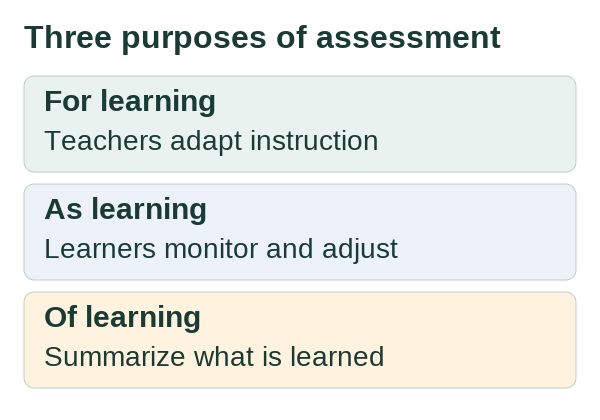
Assessment of learning looks back on learning that has already happened and serves decisions about where students are placed, whether they move up a grade, and whether they receive certificates. In this approach the comparison is with other students, and the key assessor is the teacher. Assessment for learning aims to give teachers information about how far students have met the expected competencies, so that teachers can decide what the next learning should be.[12] In English language classrooms, assessment for learning supplies students with achievement targets before assessments, communicates results through descriptive feedback, and guides the teacher's planning of later lessons.[11] Classroom assessment of this kind is commonly used to encourage and motivate students and to make sure they learn what they need to learn. That aim requires teachers' procedures to give sound and indicative information about where a student currently stands.[10]
Assessment as learning places the student in the assessor's seat. Its aim is for students to monitor and correct their own work independently, and the benchmark is the student's personal goals rather than other students or teacher criteria.[12] The stated goal of assessment for learning is likewise to bring pupils into the assessment of their own work. Pupils then reflect on their present position, see where they need to go next, and work out the steps to get there.[9]
The three approaches differ in their objectives and in the benchmark each uses for comparison. The three also differ in who judges: teachers are the key assessors in assessment of learning and assessment for learning, and students are the key assessors in assessment as learning.[12] Assessment for learning and assessment as learning are described as playing important parts in supporting students' learning and in developing autonomous learners, respectively.[11]
Assessment for learning, often shortened to AfL, treats evaluation as a continuous process that improves learning rather than a final measure of achievement. It works through formative assessment, meaning checks made while learning is still under way, together with timely feedback, self-regulation and reflective practice.[13] Brown (2021) lists among its classroom practices the involvement of students in assessment, the sharing of objectives and criteria in plain view, and open-ended questions that call for higher order thinking.[14]
Assessment as learning, or AaL, is a learner-led approach that uses assessment itself as a learning tool. Its aim is to strengthen metacognition, the awareness and control a learner has over his or her own thinking, and self-regulated learning, the ability to plan, monitor and adjust one's own work. In this approach students take on the judging role, for example by writing self-reflective journals, acting as assessors of peers, or developing unit tests. A case study of 16 B2-level students at a language school in Brisbane reported that these strategies supported self-regulated learning and critical thinking, though the author called for further research to validate the findings and widen their applicability.[15]
One New Zealand scholar has argued that assessment for learning is better described as good teaching than as assessment. The argument is that AfL activities happen fleetingly in classrooms, producing in-the-moment decisions about student learning, and that the degree of error in those judgements is never determined. Because human performance varies so much, and because the samples teachers use to judge it are not strongly representative, the judgements carry considerable error. Assessment proper, in this view, means examining data closely so that competing explanations can be weighed. It also means using methods that measure performance and check agreement among judges. The same scholar still judged the AfL activities to be good classroom teaching practices.[14]
Three phrases and what each one names
Assessment for learning names an arrangement in which the assessment is built to produce information that teachers and students can act on while learning is still under way.[16][17] In this use the tasks and the scoring guides, called rubrics, are designed together so that completing the task itself develops the intended skill. One redesign of performance assessment as assessment for learning was carried out with 11th grade high school students in West Java. It produced tasks and rubrics intended to build 21st century health literacy, and 48.6% of students reached the high category of normalized gain, a score that compares actual improvement with the improvement possible.[17]
Assessment as learning names a third relationship, in which the student's own involvement in judging work is the point rather than a by-product. A 2011 review of how teachers use these phrases argues that the wording has come to be taken for granted and proposes that teachers need a way of being in assessment, not only assessment knowledge and skills. The review illustrates this proposal with experiential stories from teaching and asks teachers to consider what the idea would mean for their own practice.[16]
History
Where the three ideas came from
A 2004 study worked with 24 secondary school mathematics and science teachers in England, who changed several things in their lessons. They used improved questioning techniques, gave feedback that focused on how to improve rather than on grades, and involved students in peer-assessment and self-assessment.[4]
Primary schools were the setting for a parallel line of work. A 2001 project set out to study and develop formative classroom assessment in primary schools, meaning assessment used to shape teaching while it is going on. It was collaborative: two university-based researchers worked with a team of teacher researchers, and the group used an action research approach, in which teachers study and adjust their own practice in repeated cycles. The changes in practice that the project reported concerned above all the clarification and communication of assessment criteria to pupils, so that children could see what counted as good work.[18]
A later book, published in 2013, examined assessment for learning interactions in primary science and technology classrooms from a sociocultural perspective, a view that treats learning as participation in the activities of a group. The book's premise is that assessment for learning can help students develop identities as accomplished learners and knowers. It also ties the approach to students becoming autonomous lifelong learners who take an active part in the classroom and beyond. It describes these interactions as taking place over multiple time scales and in more than one mode, and it argues that student autonomy is promoted when teachers give students room to exercise agency within a system of accountabilities. The book also holds that teachers' pedagogical content knowledge, their knowledge of how a subject is taught as well as what it contains, shapes how well they can respond to students, and that productive interactions reflect how a particular discipline generates and warrants knowledge.[19]
One widely discussed case is Hong Kong, where a government paper set out an assessment for learning reform proposal. That proposal became one of the most important reform proposals in the territory's education debate and produced a large body of scholarly writing. A 2022 analysis compared two articles on the subject to examine how the policy would be carried out in Hong Kong classrooms between 2014 and 2021, and it offered suggestions for the policy's later development.[20]
The Assessment for Learning Project, led by the Center for Innovation in Education, was a grantee engagement strategy aimed at building a learning community grounded in continuous reflection and in safety for taking risks. Its design rested on a learning agenda aimed at the field, on grantmaking that puts learning first, and on leadership shared across the project. Grantees were asked to respond to a Request for Learning instead of a traditional Request for Proposals, to give one another formative feedback, and to present public demonstrations of learning in place of conventional reporting. A 2020 account of the project's evaluation described how this design encouraged grantees to draw on one another for support and promoted a culture of experimentation.[21]
A 2026 study of first-grade Madrasah Ibtidaiyah students in Indonesia examined this idea during Arabic lessons on the topic Baitī (My House), using self-assessment and peer assessment with one Arabic teacher and 25 first-grade students. The study used a qualitative phenomenological design, with classroom observations and semi-structured interviews with the teacher and three students. Through self-assessment, students came to see what they had learned and to act on corrective feedback. Peer assessment gave them ways to help classmates and to join actively in the assessment. With teacher scaffolding and simplified rubrics in place, self- and peer-assessment served as occasions for reflection. They built self-awareness, engagement and responsibility, and they did not function as objective grading tools. The study was set against a 2025 ministerial decree in Indonesia, KMA Number 1503 of 2025, which stresses active, character-oriented learning in madrasahs. The study also observed that early primary evaluation often falls back on rigid testing and overlooks the developmental needs of young learners.[22]
Policy reform and classroom reality
A Hong Kong paper analyses and compares two articles to determine how the Assessment for Learning reform proposal will be implemented in Hong Kong classrooms between 2014 and 2021.[20] A qualitative case study drawing on interviews, classroom observations and document analysis across several school contexts found that teachers who built formative assessment into their teaching reported clearer learning trajectories and stronger student engagement.[23]
A survey of 376 teachers of Grades 5 to 10 in public schools in Muscat Governorate, Oman, used a 43-item questionnaire. It grouped teachers by how much they engaged in assessment for learning, assessment of learning and washback, the influence of testing on teaching. Three groups emerged, at low, moderate and high levels of engagement, and the groups differed mainly in overall amount of engagement rather than in distinct patterns across the three dimensions. Teachers of Arabic language and of Science were more likely than teachers of Mathematics to fall in the high group rather than the low one. Gender and years of teaching experience did not predict membership. The researchers suggested that professional development move away from one uniform training model toward approaches matched to teachers' existing assessment profiles.[24]
A scoping review of 75 empirical studies published since 2002 examined how secondary school students experience assessment for learning when teachers put its practices into use. Students' experience changed when they acted as co-practitioners of assessment for learning and as developers of expertise in a subject. Students' positive judgment of a practice's worth was an important precondition for a productive experience of it. The review also found that inclusive forms of assessment for learning and forms specific to a discipline are present in the field but under-represented.[25]
Northern Ireland funded a project that combined an action research policy framework with the introduction of assessment for learning across the school system. A paper from that project describes work with students as co-researchers at Key Stage 3. The account sets out the difficulties and positive outcomes of student research advisory groups, students gathering data, and students helping to interpret video-taped and image-based classroom records. It notes that externally driven agendas for improvement have increasingly used action research to help teachers develop new skills and to tailor national initiatives. Genuinely democratic roles for students in such research have been much less evident.[26]
A 2023 study surveyed 242 primary school teachers chosen by cluster random sampling, interviewed 15 of them in depth, and held informal conversations with five, all selected by purposive sampling. Closed-ended questionnaire data were analysed with means, standard deviations, analysis of variance and post-hoc methods, and the interview and conversation data were analysed through thematic verbal descriptions. Gebremariam and Gedamu (2023) grouped the challenges their interviewees described under transparency, experience, training, school problems and preference reliance.[27]
A 2020 account of the Assessment for Learning Project describes a strategy for engaging grantees, led by the Center for Innovation in Education. The design encouraged grantees to draw on one another for support, which the account describes as flipping the script on expertise, and it promoted a culture of experimentation that deepened learning relationships. The project's leadership team modelled reflection and vulnerability, co-designed with grantees to strengthen their leadership, and connected grantees to the wider field through a common learning agenda.[21]
Assessment as learning treats assessment as a continuous process that the student helps to run, rather than a final check performed on the student. In this model the student becomes an active player in assessment and in meta-reflection, which means thinking about how one's own work and thinking developed. Assessment stops being a bureaucratic duty for the teacher and becomes a shared tool that students and teachers use to build the learning path together, to co-define goals, and to make expectations and difficulties explicit. Design choices carry much of the weight: tasks that are authentic, open-ended and challenging, and rubrics (written scoring guides) that teachers and students co-design and share. Such rubrics serve objectivity and also guide the student through the task and through self-assessment.[28]
A research-training pathway on assessment ran in 2022 with primary and secondary school teachers in the Marche Region of Italy. The pathway let teachers approach assessment as learning and practise it in their own classrooms. Data came from quantitative and qualitative tools and concerned lower secondary school teachers. The analysis shows more attention to student activation in assessment and greater awareness of why self-assessment matters. The experience also produced feedback for guiding later research on how to make the proposal sustainable.[28]
Gratani reports on 2 online research-training courses about assessment for secondary schools, with 240 teachers enrolled and a training part followed by a workshop part. The courses rested mainly on teacher involvement and allowed recursive feedback processes, in which comments return to participants repeatedly over the course. Data came from an entry questionnaire, a One Minute Paper written during the course (a brief written response collected in class), and the workshop. The analysis sets out the main difficulties participants reported with assessment, together with their suggestions and reflections. Workshop and group work mattered for reflecting on how practices could change. Contact with the teachers also helped the designers judge whether the proposal could be sustained and how to refine it.[29]
Both projects respond to problems that schools already face with assessment. One is an excessive focus on grades; another is that teachers do not share a common understanding of what assessment is for or how it should be done. Assessment turns formative when the evidence it yields is used to adjust teaching to what pupils need, and progress toward assessment as learning rests on suitable tasks, on building students' capacity to judge their own work, and on drawing students into feedback processes.[29]
Main ideas
How feedback and self-regulation do the work
Assessment that is meant to improve learning depends on a loop: a learner produces work, receives information about it, and changes what the learner does next. A qualitative interview study of teachers found that assessment was often used only as a measure of learning success. It was not used for constructive feedback that would help students improve their competence in mathematics. In that study, assessment stayed focused on grades or rankings, which produced competition between students rather than improvement of the learning process. The study argues that assessment for learning and assessment as learning should be treated consistently with each other, so that together they build one assessment culture that maximizes student learning.[30]
The loop also runs through the learner's own control of thinking and effort, which is called self-regulation: the ability to manage one's environment and to fold evaluations into one's work. Traditional course assessment is a one-way process in which an instructor judges a pupil's progress toward mastery. Even conscientious feedback of this kind relies on the individual student's capacity to self-regulate. Co-regulated learning is a relatively new idea in which students evaluate themselves and each other, which helps learners improve their own work and absorb the underlying rationale of the lessons. One underexplored question is whether a co-regulated setting in which learners also evaluate the instructor leads to better outcomes.[31]
Peer assessment is one basic classroom practice of this kind, valued for its learning-oriented and formative nature, and it is treated as a tool of assessment as learning. Research into the learning processes inside peer assessment is scarce in both theory and practice, which makes its value as a tool hard to evaluate and to pinpoint. In a study of 29 undergraduate students in an advanced English class, students took part in two assessment activities on argumentative speaking. A Many-Facet Rasch Model analysis measured rater effects at the group level and at the individual level. Students rated work in a stable way and improved their argumentative speaking on every dimension examined: delivery, organization and language use. They were more stringent with themselves than with peers, although one rare case showed a bias against peers. Participants acknowledged the benefits of peer assessment but also raised reasonable concerns about it in practice.[7]
Assessment as learning seeks to build students' metacognitive awareness of how they learn, meaning their awareness of how they think and monitor their own work. It also aims to support their academic study and self-regulated abilities. In a general writing course at a Chinese university, students gained from instruction organized around assessment as learning in several ways. Their writing became more efficient and better in quality, their assessment and feedback literacy grew, and they developed a stronger sense of ownership and resilience as writers. The same students met challenges. These included conflicts between the assessment as learning training and the summative assessment requirement of the curriculum, and too little sustained teacher support in the assessment tasks.[6]
Amilhamja (2026) describes assessment for learning as an ongoing process rather than a measure taken after teaching ends. In that description, feedback given while the work is still in progress is one of the mechanisms that carries the effect, alongside the learner's own regulation of effort and reflection on what went wrong. The same account treats deeper understanding, engagement and educational equity as outcomes that follow from learner-centred assessment strategies, and it adds that effective implementation depends on assessment-literate educators and institutional support.[13]
Assessment as learning gives the student the judging role, and its stated purpose is to strengthen metacognition (thinking about one's own thinking) and self-regulated learning, the process by which a learner sets goals, monitors progress and adjusts strategy. A pedagogical framework called Democratic Assessment organises this through activities such as writing self-reflective journals as self-assessment, acting as assessors of peers, and developing unit tests as learner-created assessment. The same paper states that practical implementation of assessment as learning remains underexplored and that further research is needed to validate the findings and widen their applicability.[15]
Students' perceptions of assessment for learning had a significant effect on intrinsic motivation, and relatedness, competence and autonomy each mediated that effect significantly, according to a structural equation model estimated with partial least squares. The study concludes that formative assessment applied appropriately can help meet students' basic psychological needs and so raise motivation that comes from within the student. It recommends that teachers apply assessment for learning consistently and orient it toward strengthening social relationships, a sense of capability and freedom in learning.[32]
Diagnostic tools for learning difficulties
Sadeghi, Amani and Zolfaghari (2025) report that trained examiners administered the Persian version of the Developmental Indicators for Assessment of Learning, fourth edition, to each child individually in a sample of 678 children.[33] Two examples show the range: a reading and writing assessment built on clinical criteria for dyslexia, and a developmental screening test adapted for a new country and language.[34][33] The Persian standardization administered the DIAL-4 to each child individually and converted raw scores on the motor, concepts and language subscales into standardized developmental scores with a mean of 100 and a standard deviation of 15.[33]
A 2020 case study examined how the diagnostic criteria for dyslexia can be assessed in children who struggle with reading and writing. The criteria were taken from the specific learning difficulties category of DSM-5, the fifth edition of the Diagnostic and Statistical Manual of Mental Disorders, a standard classification of mental and developmental conditions used in clinical practice. The study worked with 65 elementary school students who showed signs of learning difficulty, identified through inability and poor learning outcomes. Testing covered reading and writing, with items addressing phonological awareness (the ability to notice and work with the sound units of speech) and orthographic aspects (knowledge of how words are spelled). Of the 65 students, 28 met the criteria indicating dyslexia. Each child also took an intelligence test, the WISC III, and the reading and writing results were combined with the intelligence scores to reach a diagnosis. The study concluded that a diagnosis of dyslexia can rest on one or more of the categories set out in DSM-5.[34]
Screening instruments for young children work differently, because they sample several areas of development before school entry rather than a single academic skill. The test has been standardized in several countries, but its norms, the reference scores against which a child is compared, may not capture the cultural, linguistic and environmental conditions that shape development elsewhere. A 2025 cross-sectional study therefore set out to establish norms for the DIAL-4 in Iran, covering children aged 2 years 6 months to 5 years 11 months. Districts in two cities were first chosen by cluster sampling to reflect socioeconomic and cultural diversity, kindergartens within them were selected at random, and the final sample comprised 678 children.[33]
The three subscales differed significantly across age groups (p < 0.05), which is expected if the test tracks development. Values below 70 were classed as severe deficits or developmental delays, and scores from 70 to 84 as mild delays. Scores from 85 to 115 fell in the normative range, scores from 115 to 129 were above average, and scores of 130 or higher marked an advanced level of functioning. Compared with American children, the Iranian children scored lower on all three subscales, a result the study read as evidence that culturally specific norms are needed for accurate developmental assessment. The study found the DIAL-4 suitable for Iranian children. The Iranian sample scored lower than American children on all three subscales, which the authors, Sadeghi, Amani and Zolfaghari, read as a reason for culturally specific norms.[33]
In the assessment of dyslexia, the behavioural signs that a child shows in reading and writing serve as the diagnostic criteria, rather than a single test score. A 2020 study by Raharjo and Wimbarti set out to assess these criteria for children with dyslexia, drawing them from the category of specific learning difficulties in DSM-5, the standard manual of psychiatric diagnoses. The signs appear in children who have difficulty in reading and writing, and the study measured them by testing the ability to read and to write. The study took a qualitative approach, using a case study method to describe its results.[34]
The reading and writing tests covered phonological awareness, the ability to notice and work with the sounds of spoken words, and orthographic aspects, the conventions by which written words are spelled and recognised. The study then administered an intelligence test, the WISC III, and combined the reading and writing results with the intelligence results to diagnose children with dyslexia.[34]
Measuring learning potential with dynamic tests
Dynamic testing measures learning potential by giving a child help during the test and scoring the gain that follows, rather than scoring only the answers given without help. The approach rests on a body of theory about how learning potential can be assessed, and a dynamic test is built around a training phase that sits between an initial attempt and a later one. Learning potential in this framework means the improvement in performance after the training phase, so the score of interest is a change rather than a level.[35]
One instrument built on these ideas is the AnimaLogica dynamic test, which was used in a set of studies carried out in the recent past. A 2016 article by Filickova, Kovalcikova and Ropovik introduced the test and reviewed those studies, then set out to compare analogical reasoning in two groups of children. The groups were children from the standard population and children identified as talented.[35]
The comparison examined three things: the level of learning potential, the nature of the prompts given during the training phase, and the strategies the children used to solve the items. The analysis found no difference between the standard and talented groups on the post-test. That result concerns performance after training in this one test of analogical reasoning, and the article reports it as the outcome of the comparison rather than as a general claim about talented children.[35]
Dynamic testing measures learning potential by recording how much a child's performance improves after a period of structured training, rather than by scoring answers given without help. The article sets out the basic features of the dynamic test and the theoretical background for dynamic testing. A dynamic test therefore has features that separate it from an ordinary test: a training phase sits between a first attempt and a later attempt, and the prompts given during training are themselves part of the procedure.[35]
One instrument built on these ideas is the AnimaLogica dynamic test, which presents analogical reasoning problems and scores the change in a child's performance after training. Studies carried out in the recent past have used this test, and a 2016 paper by Filickova, Kovalcikova and Ropovik introduced the instrument and reviewed that work. The same paper set out to compare analogical reasoning in two populations: children from the standard population and talented children.[35]
Learner autonomy as an outcome of assessment
O'Shea (2020) linked teachers' conceptions and practices of assessment for learning to the development of learner autonomy in Year 5 (9 to 10 years old) primary mathematics classrooms in the United Kingdom. One multi-case study examined how this capacity might grow from assessment for learning, the routine use of evidence about what students know to adjust teaching and involve students in judging their own work. Four cases were studied in depth, and the analysis linked teachers' conceptions and practices of assessment for learning to the developing autonomy of the children in those classes. The report proposes a typology, meaning a classification scheme, of assessment for learning in mathematics, and sets out what each type may imply for the balance between control and autonomy held by teachers and by learners.[36]
One case, that of a teacher named Alex, is presented as an example of the expert teacher, because the teacher's conceptions and use of assessment for learning led the children to become expert learners of mathematics. In that classroom the prevailing ethos placed value on personal autonomy.[36]
The evidence for children's growing independence therefore comes from a small number of intensively studied cases rather than from a large sample or a controlled comparison. The study reports how particular conceptions and practices of assessment for learning were connected to autonomy and control for both teachers and learners, and it does not report measured effect sizes or test scores.[36] An effect size is a statistical calculation of how large a measurable effect is, for example the difference between the averages of two groups divided by the standard deviation.[37] The paper was developed from a presentation first given at the ICME 13 conference in 2016.[36]
Screening young children for developmental delay
Developmental screening before school entry uses a short, standardized test to find children whose motor, language or conceptual skills may be lagging behind what is expected for their age. A screening result is not a diagnosis: it flags a possible delay so that a fuller evaluation and early intervention can follow. The point of screening before school entry is early identification, on the reasoning that support arranged before formal schooling begins can address difficulties while they are still small.[33]
Existing norms may not fully reflect the cultural, linguistic and environmental conditions that shape how children develop, so a test standardized elsewhere can misjudge a local population. A 2025 study set out to build norms for Iranian children and to test whether the instrument worked well enough there to support early identification and intervention. The work was cross-sectional, meaning children of different ages were compared at a single point in time rather than followed as they grew.[33]
Formative and summative purposes in teaching
Assessment serves different purposes depending on when it happens and what is done with the evidence it produces. Formative assessment is assessment for learning: teachers gather information during teaching and treat problems that appear in class as feedback for improving instruction and redesigning methods. A formative teacher examines students according to the changing situation of the class rather than against a fixed test at the end. Summative assessment, by contrast, is assessment of learning, a test used to measure learning outcomes at a point in time.[38]
The distinction is not always understood by the teachers who must apply it. In a case study with a descriptive method at SMA PGRI 2 Palembang, three English teachers took part through interviews, a survey questionnaire, observation and documentation. Those teachers did not know what assessment of learning involves, and their practice did not reflect the assessment knowledge they held. The study called on school principals and on government to offer professional development so that teachers' literacy in assessment of learning would improve.[39]
Teachers' priorities in assessment can also pull practice away from learning itself. A random sample of secondary school mathematics teachers, studied from a conceptual, institutional and docimological perspective, reported that pedagogical and especially cognitive issues were not a priority in their assessment practices. Those teachers focused more on the organizational side of examinations and showed a remarkable lack of concern for docimological considerations, meaning the study of how examinations are marked and scored, that would give credibility to the assessments carried out.[40]
Where assessment moves online, the practical conditions of judging learning change. A descriptive survey of secondary school teachers in Anambra state, with instruments whose reliability was 0.81 for a digital literacy test and 0.72 for the questionnaire, found several perceived challenges to online assessment of learning. These included poor internet connectivity in rural and remote areas, an indication of poorer performance for students who struggle with technology, a lack of certainty about academic integrity and cheating, and difficulty in scoring and correcting questions with open responses. The study recommended orientation for students and professional training for teachers in the use of online assessment.[41]
How the three purposes differ in practice
Assessment for learning puts the teacher's classroom assessment directly in the service of learners' development and brings learners into the process. In this purpose the teacher gathers evidence during ordinary classroom work and adjusts the next steps in teaching, so the judgement feeds back into instruction rather than into a final mark.[42] Assessment as learning shifts the judging to the students themselves, who build the assessment tasks and judge their own and their peers' work. Students described the work as a chance to design questions creatively and to practise exam-taking skills, and they expected longer-term gains in critical thinking and problem solving.[43]
Longitudinal and practical examinations as learning
Some examination formats are built so that the test itself produces learning, not only a score. An objective structured clinical examination (OSCE) is a practical test in which students rotate through stations and demonstrate clinical skills, such as taking a patient history, communicating with patients and performing a physical examination. Many medical schools use OSCEs in pre-clerkship clinical skills courses, the period before students begin supervised work on hospital wards, to measure how far students have developed these foundational skills. A curriculum described by Bernard, Thomas, Rockfeld and Cassese in 2020 links each OSCE to follow-on activities: patient write-ups, oral presentations, discussions of clinical reasoning, student-generated clinical questions and video review with faculty. In that design the OSCE acts as a starting point for further study rather than as the end of a unit.[44]
Longitudinal formats extend this idea by spreading assessment across time instead of concentrating it at one point. The extended functional practical examination (EFPE) is a postgraduate model built to address the limits of traditional single-point practical examinations. It takes a longitudinal, experiential and institution-based approach: assessment runs over an extended period, involves doing real work and is tied to the needs of the training institution. Talaat, Wasfy and Abouzeid (2026) explored its implementation across different medical schools in a reflective qualitative study, using semi-structured interviews with a convenience sample of postgraduate students and purposive, convenience samples of faculty members and medical school stakeholders. Interviews were audio recorded, transcribed verbatim and analyzed thematically. Participants approved of how well EFPE tasks matched institutional needs, and they credited feedback and mentorship with a positive part. They also reported that postgraduate students developed skills and grew in confidence. The same participants reported stress, workload, resource demands and problems with topic selection and clarity. Their suggestions included a longer EFPE, student involvement in choosing topics, continuous feedback and mentorship, and tasks that remain relevant and sustainable.[45]
Research
What the evidence shows about learning gains
The strongest subject-specific evidence comes from a correlational survey of 400 junior secondary students in Enugu State, Nigeria. They were drawn from a population of 21,989 students in the third year of junior secondary school (JSS III) during the 2022/2023 academic session. That study measured achievement with students' existing first and second term Basic Science scores. It measured teachers' practice with a questionnaire whose internal consistency was 0.84 on Cronbach's alpha, a statistic for how closely items on a scale agree with one another. Regression analysis found a correlation coefficient of 0.53 between teachers' use of assessment for learning and achievement in Basic Science. The predictive power was 28 percent, meaning the practice accounted for about that share of the variation in scores. Classroom management reached a correlation of 0.51 and a predictive power of 26 percent, and teacher-student relationships reached 0.41 and 16 percent. Assessment for learning had a correlation coefficient (R) of 0.53 with achievement in Basic Science, classroom management 0.51, and teacher-student relationships 0.41.[46]
In chemistry, a pre-experiment with class XI students at SMAN 2 Bangkalan in Indonesia used a one-group pretest-posttest design, in which every student received the same treatment and there was no untreated comparison group. Students in two classes (A and B) took a pretest, then worked through a lesson on acidic buffer solutions with assessment for learning and took a first posttest. They then worked through a lesson on basic buffer solutions the same way and took a second posttest. Scores differed significantly between the pretest and the first posttest and between the first and second posttests in both classes. A normalized gain calculation (N-Gain, which expresses improvement as a fraction of the room left to improve) also showed gains.[47]
A 2015 paper on assessment for learning in science classrooms took a different approach. Rather than reporting an outcome trial, it drew across several studies of classroom talk to set out the conditions under which feedback through assessment for learning interactions can work. That paper describes effective pedagogy of this kind as a complex set of practices in which feedback drives future learning, and it argues that both novice and experienced teachers must think carefully about how they build and revise activities and dialogue. The purpose of such dialogue, in that account, is to help students voice and develop their conceptual understanding and their understanding of how they learn.[48]
The clearest subject-specific result comes from chemistry, where a study of complex redox reactions used a one-group pretest-posttest design with 36 twelfth-grade learners in a high school in Surabaya. The average score rose from 37.22 to 86.04. The average N-gain, a measure of growth from pretest to posttest, reached 0.77, which the study describes as high growth. Of the students, 88.89% reached the high category of growth. The assessment for learning approach in that study combined defining learning objectives, holding classroom discussions and setting assignments that serve as evidence of student comprehension, giving continuous feedback, and involving students as owners of their own learning process.[49]
Evidence on how widely assessment for learning is practiced, as distinct from what it achieves, comes from a survey of 242 primary school teachers selected by cluster random sampling, supplemented by in-depth interviews with 15 teachers and informal conversations with five. The questionnaire results showed highly positive classroom environments, moderately positive learning intentions and success criteria, moderate feedback practices, and moderate self- and peer-assessment practices directed at learning. The interviews told a different story: teachers reported low confidence in their assessment for learning practice because of challenges in transparency, experience, training, school problems and reliance on personal preference.[27]
Technology, rubrics and artificial intelligence
Technology-supported formative assessment means using digital tools to gather evidence of learning and adjust teaching while the work is still in progress. A scoping review of the literature published between 2000 and 2026 (August) found that research on this topic grew faster after 2020. It shifted from technology-centred applications toward learner-centred, adaptive and data-informed formative assessment.[50]
A qualitative study of four purposefully selected Accounting teachers in South African schools examined whether Google Classroom could support assessment for learning. The teachers perceived the platform as an assessment technique that supports effective teaching and learning because it gives learners a place for active participation. They expressed interest in using it to support and strengthen learning in Accounting.[51]
An analytic rubric breaks a piece of work into separate criteria and describes performance at each level on each criterion, and washback is the effect an assessment tool has on how teachers teach and students learn. A qualitative study of nine Vietnamese lecturers of English as a foreign language found considerable variation in how analytic rubrics were implemented for writing assessment. The lecturers were drawn from two institutions and spanned novice, mid-career and near-end-career stages. Rubric use often made writing expectations clearer and helped students monitor their own work. It sometimes led to formulaic writing when the rubric was not well integrated into instruction. The study calls for professional development that is sustained, rubric design that is culturally responsive, and institutional support.[52]
A conceptual article proposes that college and university instructors can use artificial intelligence to support assessment as learning. That is the process in which students actively monitor and reflect on their own learning.[53]
Computer-based assessment for learning, often shortened to CBAfL, uses a computer to assess a student's developing skill while instruction is still going on, so that teaching and testing merge rather than take turns. A 2017 review of this work in elementary and secondary schools sorted the literature into groups: programs used as a supplement inside ordinary classrooms, web-based systems, and data-driven systems that assess continuously. Across a range of content areas, including biology, math and programming, the review found that using CBAfL in the classroom, over the Internet or embedded in a game generally improved learning and other outcomes. Two qualifications came with that finding: feedback helps learning most when it is not overly complex, and it must actually be used to have any effect. Adding feedback did not damage the quality of the assessment, measured as validity (whether a test measures what it claims to), reliability (whether it gives consistent results) and efficiency.[54]
Newer analytic methods named in the review include learning analytics, the statistical study of data left behind by learners, and stealth assessment, which gathers evidence of competence without a separate test event. The reviewers expected these techniques to move out of the laboratory into mainstream use, and they expected the boundaries between instruction, learning and assessment to blur, eventually removing the need for high-stakes tests of learning. They also predicted that teachers would gain time for targeted support and that students would face fewer exams if assessment became continuous and formative. These are forecasts rather than results, and the review set the next step as evaluating the new assessments for their psychometric properties, meaning the measurable qualities of a test, and for how well they support learning.[54]
The 2017 review describes systems that adapt remediation to the individual learner with artificial intelligence and that measure complex competencies, and it places learning analytics and stealth assessment among the advanced methods now available. The same review treats the accuracy and dependability of these new assessments as an open question, to be settled by evaluating their psychometric properties and their support of learning.[54] A 2026 paper on assessment for learning argues that integrating technology with learner-centered assessment strategies promotes deeper understanding, engagement and educational equity. That paper states the conditions for effective implementation as educators who are literate in assessment, support from the institution, and a culture that prizes growth, collaboration and steady improvement.[13]
Open questions and current directions
A 2022 theoretical paper argues that the foundation of formative assessment is insufficiently captured within a broader sociocultural context. In that context teachers and students build an assessment culture together. That paper sorts the features of formative assessment by learning metaphor, using acquisition, participation and expansion. It defines assessment for expansion as a form of formative assessment that supports expansive learning, a process of making teaching and learning better. In this account the working core of assessment for expansion is sociocultural feedback judged against situational criteria, that is, standards tied to the particular setting rather than fixed in advance.[55]
A second open question concerns measurement: how researchers can tell whether teachers actually use assessment for learning in their classrooms. One line of work produced the Assessment for Learning Measurement instrument, or AfLMi, built from data on 594 teachers in 44 elementary schools in Ireland.[56][57] The AfLMi rests on an earlier instrument, the Assessment for Learning Audit Instrument, which consists of 58 statements describing classroom practices across the same four strategies.[57]
That teacher's understanding of assessment for learning was judged sufficient to implement it, yet support from the principal, fellow teachers and students was perceived as lacking. The teacher reported sharing learning intentions and success criteria, asking questions and holding classroom discussion as helpful strategies. Teacher feedback and self and peer assessment were considered less effective. The study's findings point to a shortfall in teachers' professional competence, particularly in conducting assessment for learning.[58]
Training studies point to a related gap between knowing about the three approaches and applying them.[59][60] A workshop and mentoring programme for junior high school science teachers in Magelang Regency, Central Java, set out to raise teacher competence in assessment of, for and as learning.[60] A separate training programme for junior high school mathematics teachers in Surakarta ran from 21 August 2019 to 18 September 2019 in an in-on-in format. It concluded that participants gained good knowledge of assessment for learning and assessment as learning and had been able to implement them in class.[59] Such reports describe what teachers did after short training; they do not establish whether classroom use persists or improves student learning over time.[59][60]
The measurement instrument was designed for use before, during and following professional development, which shows that tracking change over time was an aim.[56] The case study likewise records a teacher's reported strategies and perceived support at one point in a two-year career, not later outcomes for students.[58] The theoretical proposal for assessment for expansion ends by discussing its possibilities and challenges rather than reporting tested effects. Nishizuka (2022) discusses the possibilities and challenges of assessment for expansion from theoretical and practical perspectives.[55]
Computer-based assessment for learning is the third open area, and a 2017 review of its use in elementary and secondary education sorts the literature into supplementary classroom use, web-based use, and data-driven continuous assessment. Studies across biology, mathematics and programming generally found that such assessment, delivered in class, over the internet or inside a game, enhanced learning and other outcomes. The review concludes that feedback works best when it is not overly complex and when it is actually used, and that adding feedback did not impair the validity, reliability or efficiency of the assessment. Its authors expect new assessments to be judged on their measurement properties and on how well they support learning, and they anticipate that the boundaries between instruction, learning and assessment will eventually blur.[54]
Comparing standard and talented children on dynamic tests
Dynamic testing measures learning potential by comparing a child's performance before and after a short training phase, and one study used it to ask whether children of standard ability and talented children differ in that potential. The article introduces the AnimaLogica dynamic test and reviews studies that have used it in the recent past. Learning potential was defined as the improvement in performance that followed the training phase, which is the gain score at the centre of this kind of assessment.[35]
Filickova, Kovalcikova and Ropovik (2016) compared learning potential, the nature of prompts in the training phase, and solving strategies between children from the standard population and talented children. The study is a single comparison of two populations using one dynamic test of analogical reasoning, so the result describes that test and that reasoning domain rather than dynamic testing in general. The article reports no difference on the post-test but gives no effect size, so the size of any difference the design could have detected is not stated.[35]
Earl's model applied to clinical competence
One application of the model comes from orthopaedic clinical competence, the ability to examine and assess joints and injuries by hand. A quasi-experimental study at three Canadian universities built the Standardized Orthopedic Assessment Tool (SOAT) and used Earl's model as the framework for testing it. The researchers also proposed a predictive learning assessment model (PLAM), an extension of Earl's framework in which scores on a structured assessment are used to forecast how well a clinical skill will develop. In the first treatment group the instructor could see the SOAT but could not share it explicitly with students; in the second, both instructor and students had access to the SOAT throughout the semester and used it formatively; the third group served as the comparison. At the end of the semester all students were tested with the SOAT by expert raters.[61]
An analysis of variance, a statistical test of whether group averages differ, found a significant difference between the groups in final examination grades (F2,56 = 28.6, P < .01). The effect size, calculated using eta squared, was 0.51. Post hoc analysis showed that the second treatment group differed significantly from both the first treatment group and the comparison group. The result indicates that giving students formative feedback through the SOAT taught orthopaedic assessment skills more effectively than no exposure to the tool, or than exposure limited to the instructor. The small sample and the quasi-experimental design rule out firm conclusions, yet the SOAT separated the groups, which supports the aim of showing that the tool measures the competence it is meant to measure. The study presented the SOAT as a predictive instrument that may help students develop orthopaedic assessment skill.[61]
Digital quizzes and motivation in elementary classrooms
Digital quiz games have been built and tested as instruments for assessment for learning, the use of assessment to guide teaching rather than to grade it, in elementary school subjects.[62][63][64] One line of work develops such an instrument and checks whether it is usable before testing what it changes. A 2026 development study built a Quizalize-based digital assessment for IPAS learning, an Indonesian elementary subject that combines science and social studies content, and reported a feasibility score from expert validation of 91.11% and a practicality score of 90.21% from 30 fourth-grade students. The instrument measured learning motivation with the ARCS questionnaire, a standard scale of attention, relevance, confidence and satisfaction. It measured critical thinking with a test of higher-order thinking skills, meaning tasks that ask students to analyze and evaluate rather than recall.[62][63]
The effectiveness test compared 60 fourth-grade students, 30 in an experimental group and 30 in a control group. Critical thinking scores rose from 54.53 to 83.13, and the experimental group showed higher learning motivation than the control group, with means of 76.77 and 66.57.[62][63]
A second study examined a different quiz game, Quizwhizzer, used through assessment for learning in Islamic religious and moral education. It used a quasi-experimental design with nonequivalent groups at a junior secondary school in Prambanan Sleman. One class of 32 students formed the experimental group and another class of 32 the control group, chosen by purposive sampling, meaning classes were picked deliberately rather than assigned at random. Motivation rose in the experimental group, with a paired test value of t(31) = -5.937 and p = 0.000, and the groups differed on an independent test at t(62) = 5.195 and p = 0.000. The reported effect size was large, r = 0.55 and Cohen's d = 0.83. The classes in this study were in junior secondary school rather than elementary school, and the design did not assign students to conditions at random.[64]
Mapping the research and open questions
A bibliometric analysis, meaning a statistical mapping of publications and their citation links, traced research on performance-based assessment of student learning from 1992 to 2025. The search refined Scopus records to 305 articles and used Bibliometrix and Biblioshiny to examine annual output, productive sources and countries, citations, co-citation of references, keyword co-occurrence and thematic structure. Output grew after the 2010s. The American Journal of Pharmaceutical Education produced the most articles, and the United States contributed most often by country. The mapping covers only Scopus-indexed articles that matched the chosen search terms, subject-area limit and document-type filters, so a different search strategy could give different results.[65]
In practice
What teachers know and believe
Several of those novice teachers had never heard of the three assessment types at all. That gap first appeared in an informal preliminary interview and then held up in the main study. The Bali study used a qualitative design, collecting data with a questionnaire and an interview guide and analysing the responses through an interactive model of data collection, data display, data reduction and conclusion drawing. Its author concluded that school principals and other stakeholders should stress the three concepts for novice English teachers through teacher training, workshops or seminars.[72]
In a survey of 120 teachers of English as a foreign language in Turkey, most reported depending on conventional assessment methods rather than formative assessment processes. Perceived monitoring of students was at 82.86 percent and scaffolding, the temporary support a teacher gives a learner and then withdraws, at 86.94 percent. Ratings of monitoring in support of student learning differed significantly by years of teaching experience, gender and whether the teacher worked in a public or a private school, at p<0.05. The study's author argued that teachers need outside support to see how their earlier views shape their practice. Perceptions of assessment for learning cannot change overnight or be revised by a teacher working alone.[8]
Belief in an assessment approach and enactment of it in class are separate matters, and the gap between them has been documented in Singapore. A sequential mixed-methods study of secondary Malay Language teachers surveyed 121 teachers, interviewed 20 of them and observed eight in their classrooms. The survey sorted respondents into four profiles of assessment for learning values and practice, and 69.4 percent of respondents fell into the two lower-practice groups. Close analysis of three focal cases showed three contrasting patterns of enactment, described as procedural, hybrid and dialogic. Assessment for learning was often folded into routines built around examinations, such as checking, correction and test preparation, even where teachers said they supported its principles.[73]
A survey of 242 primary school teachers, with 15 of them also interviewed in depth and five in informal conversations, found strongly positive classroom environments and moderately positive attention to learning intentions and success criteria, to feedback, and to self-assessment and peer assessment. The same teachers described low confidence in carrying out these practices, and the interviews traced that gap to problems with transparency, experience, training, school conditions and a reliance on personal preference.[27] A multi-case study examined 3 Chinese university teachers of English as a foreign language, drawn voluntarily from 2 universities in the northwest of the country. It found distinct patterns: one teacher assessed mainly to judge learning, one used assessment for learning in a convergent way that steered students toward set goals, and one used it in a divergent way that opened goals to student input.[74]
The Chinese case study named three influences on how the teachers used assessment for learning: their assessment literacy, meaning their command of assessment concepts and techniques; their beliefs about how goal orientation relates to motivation; and the level of trust between teacher and students. Wu, Zhang and Liu (2021) concluded that teacher educators should build teachers' assessment knowledge and skills. They also urged teacher educators to encourage negotiation of learning goals with students and to help teachers build trust in their classrooms, so that assessment for learning becomes part of ordinary instruction.[74]
The Assessment for Learning Project, led by the Center for Innovation in Education, built its model on a shared learning agenda, grantmaking that begins with learning, and collective leadership. Grantees applied through a Request for Learning instead of a traditional Request for Proposals, were required to give one another formative feedback, and demonstrated their learning in public rather than filing conventional reports. The design encouraged grantees to rely on one another for support and promoted a culture of experimentation, and the leadership team modelled reflection and openness to risk.[21]
Assessment as learning in writing classrooms
In writing classrooms, assessment as learning describes students building the cognitive and metacognitive capacity to judge their own writing. That capacity develops over time inside a portfolio-based setting. A portfolio in this context is a collected body of a student's drafts and finished texts, reviewed across a course rather than at a single sitting.[3]
The teaching cycle is the organizing idea in these classrooms: assessment, teaching and learning are integrated rather than treated as separate stages. Teachers implementing the approach are advised to bring teaching, learning and assessment together, rather than concentrating only on how to assess student writing.[2] In the portfolio version of the cycle, students evaluate their own writing ability on an ongoing basis, and the review connected that self-evaluation to growth in language awareness, self-assessment skill and self-reflection.[3]
A two-semester intervention at a Chinese university combined a scoring rubric based on China's Standards of English Language Ability (CSE) with the main assessment for learning activities. The CSE is a national framework intended as a guide for English language teaching in China. The activities named in the report were peer assessment and self-assessment, in which students judge classmates' drafts and their own. The instructor described pedagogical activities guided by assessment for learning and reported that students and the teacher researcher both benefited. The report itself called this conclusion temporary, based on evidence collected in the interim. The report also observed that assessment for learning practices were generally lacking in China and that the CSE needed more research for use in educational settings.[75]
A qualitative case study in a Chinese university English writing classroom followed one teacher across a semester. Its data were the teacher's reflections and assessment practices, reflections and interview excerpts from 18 students, and field notes. That patience was not steady: interacting with contextual variables inside and outside the classroom, it waned and then recovered. In its weakened state it only passively sustained the teacher's assessment for learning. The study recommended that training in patience become part of teacher education programs, so that student teachers develop the patience needed for the complexity of teaching during assessment practices.[76]
Assessment as learning treats assessment itself as a learning activity, in which students judge their own work and the work of classmates rather than only receiving a grade from the teacher. The approach is described as learner-led and as a way to strengthen metacognition, the awareness and control a student has over their own thinking, and self-regulated learning, the process of setting goals and adjusting effort while working. A case study of 16 students at level B2 of the Common European Framework of Reference for Languages found that these strategies supported self-regulated learning and critical thinking and led to improved outcomes. The same account states that further research is needed to confirm the findings and to extend the approach to other settings.[15]
In early primary schooling, assessment as learning has been studied in first-grade Arabic lessons in a Madrasah Ibtidaiyah, an Islamic primary school in Indonesia. It drew on classroom observations of one Arabic teacher and 25 first-grade students, plus interviews with the teacher and three students, all on the topic Baitī, or My House. The lessons were organized around self-assessment and peer assessment, and the analysis followed an interactive model of data condensation, data display and conclusion drawing. Normative competencies had begun to appear among the first-grade students. These included working with others, communicating, acting independently, reasoning critically, taking responsibility and following classroom norms. Maharani, Syihabuddin and Maulani (2026) describe self- and peer-assessment here not as objective grading tools but as occasions for reflection. With teacher scaffolding, temporary support that is reduced as students gain skill, and simplified rubrics, these occasions built self-awareness, engagement and responsibility.[22]
Elementary classrooms using project-based learning, in which students work over time on a complex task, have been compared across several assessment models for their effects on speaking and writing. The study presents its results as a guide for choosing and applying an assessment model for elementary students' language skills within project-based learning.[77]
In a study of assessment as learning in second language writing, cross-case analysis of two focal students found that learner engagement was positively associated with improvements in writing performance. Research on this practice in second language writing has mostly described what teachers do and how they view it. Less is known about how students' own involvement relates to the quality of the writing they produce. One case study set out to examine that relation directly.[78]
Creative writing has also been examined as a setting for students' performance assessment as learning. A 2021 account of teaching creative writing in English analysed three play presentations by the author's students. The analysis argued that using English in a play can work as a mode of subaltern resistance, a term for resistance by groups kept at the margins of power. Marwah described the students as defining themselves against the adult world. Their performances, staged during the Covid period, also built an English-speaking community among them. The account also held that English served as the language of intellection and of exchange of ideas among serious-minded students, and was used appropriately against conventional and regressive forces in the plays.[79]
Subject differences in classroom practice
Classroom assessment for learning takes different forms in different subjects, and studies in several fields show both techniques that carry over and techniques that need adapting. The clearest shared element is the short, frequent check of understanding used to find gaps and respond to them, which appears in mathematics, calculus, music and accounting classrooms alike.[80][81][82][83] What differs is the content of the check, the criteria students learn to apply, and the language demands of the classroom.[84][81][82]
In mathematics, a study of nine Grade 6 teachers in Alexandra Township, South Africa, found that the teachers understood assessment for learning as activities given at the end of a lesson to measure learner understanding.[82] A related study of nine Grade 6 mathematics teachers in township primary schools in Gauteng found that teacher-centred assessment approaches still dominated their classrooms. Assessment challenges also hindered the promotion of learner diversity.[85]
At college level, a calculus I instructor at an urban community college in the United States used weekly short assessments to diagnose gaps between students' learning and classroom teaching. The goals were to identify misconceptions and address them with an appropriate intervention. The instructor reported that the assessments helped cement students' conceptual learning and gave insight into their misunderstandings.[80]
Music assessment for learning centres on creativity rather than on a single correct answer. A study of six Canadian music educators identified strategies in four categories: developing assessment criteria, encouraging creative processes, optimizing the classroom context, and activating self-assessment.[81]
Accounting teachers face a different constraint: the subject's content and pedagogy must both be secure before assessment for learning can work. A qualitative action research study of accounting teachers found that weak subject and pedagogical content knowledge, poor assessment literacy and a lack of effective feedback each had a significant impact on implementation. The study reported a need to develop and support teachers so they can identify learning gaps and devise scaffolding, which means temporary support that is withdrawn as learners gain competence. It also equipped teachers to construct quality assessment tasks in the subject.[83]
In content and language integrated learning, usually shortened to CLIL, subject matter is taught through a second language, so assessment carries both subject and language demands. A corpus-based study of classroom recordings from bilingual primary schools in Madrid, Spain, found that implementing assessment for learning coincided with an increase in the frequency, length of time and variety of teacher motivational strategies.[84] The Madrid findings suggest that in CLIL settings assessment for learning and motivational strategy can be integrated more systematically, a link not reported in the mathematics and accounting studies.[84][82][83]
How teachers carry out assessment for learning
Assessment for learning is a classroom approach in which teachers gather evidence about what students understand and use it to adjust teaching while the work is still in progress. The approach generates feedback with the aim of raising students' performance. Students take a more active part in learning and grow more sure of what they are expected to learn and of the standard expected.[86] Research on how assessment for learning practices affect students' learning and achievement is persuasive. Bringing those practices into classrooms is nonetheless hard. Teachers have to weigh several demands at once: teaching method, curriculum and assessment, instruction tailored to different learners, and time set aside for professional learning.[87]
A multi-case study examined Year 5 mathematics lessons, with children aged 9 to 10 years, in United Kingdom primary classrooms. Four cases were studied in depth to see how teachers' conceptions and practices of assessment for learning affected autonomy and control for teachers and learners. One case, a teacher named Alex, stood out as an expert teacher in how he understood and applied assessment for learning. His children became expert learners of mathematics. In that class, personal autonomy was valued. Responsibility for learning, and control of it, were shared across a community of learners. The idea of community there took in the classroom's surroundings and its resources. Learners were thus observed working inside an expert classroom.[36]
At university level, a quantitative study surveyed 102 teachers of English as a foreign language at three public universities in Erbil: 55 at Salahaddin, 34 at Soran and 13 at Koya. The survey used a 25-item questionnaire modified from Colby (2010) and asked how far the teachers used assessment for learning, what they thought of it for developing English learning, and what challenges they faced. Despite some varied challenges and difficulties in implementing the approach in their classes, the university teachers generally held a positive perspective toward assessment for learning as a teaching and learning approach.[86]
Poskitt (2020) notes that building teachers' capability in assessment for learning is a goal many education systems set, yet few sustain it successfully over time. Education systems in many countries aim to build capability in assessment for learning, and nations find that aim hard to carry out and to maintain over time.[87] In the primary mathematics study, teachers' ideas about assessment for learning shaped how they used it and how much control learners held, so the same practices looked different from one classroom to another.[36]
A multi-case study published in 2020 examined how teachers' ideas about assessment for learning, meaning assessment used to help learning rather than to grade it, connected to their classroom practice and to the growth of learner autonomy in United Kingdom primary mathematics lessons. The project looked at mathematics lessons taught to Year 5 children, aged 9 to 10 years, and at the teachers who taught them.[36]
The idea of community in this account was widened to take in the environment and the resources inside the classroom. This widening was used to show learners working within what the study calls an expert classroom. The article grew out of a paper first presented at the ICME 13 conference in 2016.[36]
Building teacher capability across a school system
Poskitt (2020) notes that evidence for the positive effects of assessment for learning on students' learning and achievement is convincing, while putting the practice into effect is made difficult by the demands teachers must balance. Poskitt's 2020 article in Assessment Matters, published through Massey University, revisits exemplars for exactly this purpose.[87]
The difficulty described for teachers is not a shortage of evidence that assessment for learning works. It is the competition for teachers' attention among curriculum coverage, differentiated instruction and the time that professional learning requires.[87]
University teachers' views on implementation
Assessment for learning is a way of teaching and learning that produces feedback meant to raise students' performance. A 2023 survey asked English as a foreign language teachers at universities how they view this approach and what obstacles they meet when putting it into practice. The survey used a 25-item questionnaire, modified from one developed by Colby in 2010, and was completed by 102 English language teachers at three public universities in Erbil. Those teachers were distributed across Salahaddin University (55 teachers), Soran University (34 teachers) and Koya University (13 teachers), and the responses were analyzed with statistical software.[86]
The account of how feedback works in this approach is stated in general terms rather than tied to particular classroom techniques. Feedback is described as the means by which students' performance is to be improved. The survey measured teachers' perspectives and the challenges they reported; it did not test whether feedback raised students' marks.[86]
A 2023 survey asked 102 teachers of English as a foreign language at three public universities in Erbil about their use of assessment for learning and the difficulties they met. Teachers reported varied challenges and difficulties in putting the approach into practice in their classes. Even so, the teachers generally held a positive view of assessment for learning as a way of teaching and learning.[86]
Online peer assessment in higher education
Online peer assessment (OPA) is a form of assessment for learning in which students in higher education judge one another's work through digital tools rather than through a teacher alone. An exploratory study published in 2023 examined how students at one higher education institution in Portugal perceived this practice and how well it fitted their needs. The study drew on the PrACT Model, a framework intended to spread alternative assessment practices, and sorted its findings according to that framework's dimensions. Data came mainly from a survey questionnaire, and the participants were 16 students. The results pointed to a lack of student experience with online peer assessment. From the students' point of view, online peer assessment was an adequate alternative digital assessment strategy that contributed to their motivation and to the development of cognitive, metacognitive and digital skills.[88]
A separate article by teacher educators working with students in initial teacher training examined the assumptions behind digital assessment for learning in universities, which the authors call eAfL (e-Assessment for Learning). Because digital technologies are increasingly embedded in university programmes, the article argued that the quality of learning as social and political engagement in online higher education settings needs careful examination. Charteris and colleagues examined the discourses of learnification, responsibilisation and performativity as they bear on eAfL. Charteris and colleagues set out options for building practices that support student agency and draw on the knowledge, skills and dispositions students bring with them from their social and cultural backgrounds.[89]
Training teachers to use assessment for learning
A controlled training study with primary school teachers tested whether a program on assessment for learning would change what teachers did in their classrooms. The training program ran eight times over the semester, and 171 teachers took part. All trainees took a pretest and a posttest, and mean differences were calculated with the paired-samples t test, a statistic that compares two sets of scores taken from the same people. Fifty-six of the teachers also answered an open-ended survey, which supplied qualitative data to support the quantitative results.[90]
The pretest and posttest means differed significantly in favor of the posttest, which the study reads as evidence that the program helped teachers develop knowledge of assessment for learning concepts and strategies. The measured change in that study was in teachers' knowledge and reported practice, and the design compared one group of trainees before and after training without a comparison group that received no training.[90]
A qualitative study interviewed five second-year secondary pre-service teachers, all of them taking assessment for learning as a foundation course within a Bachelor of Education program. Those participants showed minimal understanding of assessment for learning, and the study concluded that they were not adequately prepared to assess students' performance within a sociocultural paradigm, an approach that treats learning as shaped by social interaction and cultural context.[91] The two studies differ in population and in method. Abdulkareem (2019) tested 171 practising primary teachers before and after a program held eight times in a semester; Rajendran (2022) interviewed five pre-service teachers once about a course they were still taking.[90][91]
Digital networks and online assessment of learning
Assessment of learning can be delivered through digital interactive social networks, in which students work on tasks inside a networked software environment and the software records what they do. Learning analytics, the systematic collection and analysis of that recorded activity, is the method used to turn such records into evidence about skills. Data came from a demonstration digital environment in 4 countries: Australia, Finland, Singapore and the U.S. The results indicated that the constructs the project developed, together with its new item forms and analytics, could be used in a large-scale digital environment.[92]
Resource banks give teachers a long-standing way to use assessment information to improve learning, and their form is changing as tasks move online. The New Zealand Curriculum observes that evidence for assessment for learning is often collected informally, and that the teacher may do the analysis and interpretation of it mentally. A growing body of research suggests that assessment for learning is not easy for teachers.[93]
Teachers report practical and ethical difficulties when assessment of learning moves online. A descriptive survey of secondary school teachers in Anambra state, Nigeria, gathered responses through Google forms on a messaging platform and tested two null hypotheses at the 0.05 level of significance. Its two instruments were a Digital Literacy Test, with reliability of 0.81 by the Kuder-Richardson formula 20, and a questionnaire on the challenges and solutions to online assessment of learning, with reliability of 0.72 by Cronbach alpha. Reported challenges included weak internet connections in rural and remote areas and signs that students who struggle with technology perform at a lower level.[41]
Subject teachers' attitudes and assessment literacy
Music teachers in Hong Kong were surveyed about a decade after assessment for learning became part of the reform of Hong Kong education. The quantitative study surveyed 97 secondary school music teachers drawn from 120 randomly selected secondary schools, using a self-administered questionnaire; the response rate was 83.3%, based on 30% of the target school population. Respondents favored achievement-oriented assessment as more suitable for their students, whatever difficulty they perceived in putting it into practice. That result differed from McClung (1997), and the discussion read it as support for Morris's (1996) view that teachers in Chinese societies emphasize students' achievement.[94]
Geography teachers in Lesotho reported obstacles to carrying out assessment for learning, including time constraints and overcrowded classrooms. A 2024 qualitative study observed lessons without taking part and conducted in-depth interviews, working within Gregory's Theory of Perception and the Keeping Learning on Track Theory of Action. The study found that teachers lacked both assessment knowledge and pedagogical content knowledge, the subject-specific knowledge of how to teach a topic. Its recommendation was full assessment training for both pre-service and in-service teachers to address those gaps. The study also noted that over the previous five years the Examinations Council of Lesotho had recorded persistent challenges in this area, possibly arising from weak assessment strategies.[95]
A 2024 case study at SMA PGRI 2 Palembang in Indonesia looked at the assessment literacy of three English teachers, meaning their knowledge of assessment and how to apply it. Interviews, a survey questionnaire, observation and documentation were used to collect data.[39]
How assessment for learning is designed and tested
Classroom designs for assessment for learning usually combine several routines rather than a single test, and one study at RUDN University examined how such routines relate to foreign language performance. That study used a sum of squares regression model to weigh knowledge of course content, knowledge of the assessment schedule, frequent assessment, feedback after assessment, an adaptive learning system, and an individualised learning environment. Knowledge of course content and frequent assessment were found to have a positive influence on effective teaching and learning. Regular testing, comments given back after a test, and a setting tailored to the individual learner were reported to help students reach the targets set for their foreign language course and so perform better.[96]
A second design route changes the tasks themselves, so that ordinary performance work carries the assessment for learning function. In West Java, a study redesigned performance assessment for 11th grade high school students to improve 21st century health literacy, with 2 classes serving as pilot classes and 1 class as the research class. The work followed a research and development method simplified through the ADDIE model, whose five stages are analysis, design, development, implementation and evaluation. The redesigned assessment consisted of tasks and rubrics built on the Partnership US-Based 21st century skills (P-21) framework. At the implementation stage the redesign was judged quite effective: 48.6% of students reached the high category of N-gain, a measure of improvement from before to after instruction, and 51.4% fell in the medium category.[17]
Assessment as learning in professional training
Assessment as learning gives students a part in producing judgments that would otherwise come from staff. Lakhtakia, Otaki, Alsuwaidi and Zary report one intervention in health professions training in which students generated their own formative assessments. The designers framed the exercise as a way to build self-regulated learning, the habit of planning, monitoring and adjusting one's own study, which they treated as a competency needed for lifelong learning in medicine. Students' overall agreement with the intervention reached 84%, and that score was strongly correlated with their ratings of ease and of impact on a 5-point Likert-type scale, a rating scale that asks how far a person agrees with a statement.[43]
The qualitative themes named engagement, effective interdependencies, novelty and time requirements as the prominent characteristics of the activity. In the short term the student authors described the task as fun and challenging, an occasion to work deeply into content, design questions creatively and improve exam-taking skills.[43]
Portfolios follow a similar principle in nursing education. Students build their own projects, among them clinical learning tasks, and present them as a clinical course draws to a close. A review of 17 articles published in Farsi and English found portfolios used in different nursing schools and courses for assessment, evaluation, training and performance improvement. Reported benefits included the development of skills, active learning, improved clinical competencies, student satisfaction with assessment and academic achievement. The same review listed limitations: a lack of clarity and time constraints for completing the portfolio. Its conclusion recommended the tool for building clinical competence at undergraduate, graduate and postgraduate levels, on the condition that the scope and purpose of the portfolio be specified and that users understand the tool and learn the skills needed to use it.[97]
What this looks like when you study
In one Chinese university, 29 first-year English learners took two rounds of argumentative speaking tasks. After each round they rated their own speaking and a peer's speaking on three standards: delivery, organization, and language use. Raters used a scale from 1 to 5, with 1 the lowest and 5 the highest. Students rated in a stable way and improved in all three dimensions.[7]
In a medical programme, 54 second-year students generated their own formative assessments through peer collaboration, tutor facilitation, and feedback. Of these students, 27 answered a survey, and their overall agreement with the activity was 84%. They reported gains in motivation and in knowledge and skills, and expected long-term benefits in critical thinking, problem solving, and clinical reasoning.[43] In a case study at a Brisbane language school, 16 students at B2 level wrote self-reflective journals, acted as assessors, and developed unit tests.[15]
One proposed framework, Democratic Assessment, lists writing self-reflective journals as a self-assessment activity.[15] In one study, 29 undergraduate English learners rated their own and their peers' argumentative speaking on delivery, organization, and language use, using a scale from 1 to 5.[7]
Later developments
Early years, higher education and other settings
Preschool classrooms have produced their own version of assessment as learning, built around pedagogical documentation, a method that records the steps by which young children's learning develops. A 2025 review of the literature examined what pedagogical documentation is, how it can be carried out in preschool education, which approaches early childhood learning and assessment currently use, and how documentation could change preschool practice. The review argues for documentation read through the assessment as learning perspective.[98]
University lecture halls present a different constraint, because the setting itself can shape which assessment techniques teachers choose. A questionnaire called the EMI Classroom Assessment Practices questionnaire was given to 40 university teachers in Taiwan who taught their subjects in English. This arrangement is known as English as a Medium of Instruction, or EMI. Techniques that were used less often were also the ones in which teachers felt less skilled. This high correlation suggests familiarity with a technique, rather than the instructional objectives, was steering practice. Teachers rated themselves as less skilled at particular learning-oriented practices, including self-assessment and the writing of test items that measure higher-level cognitive abilities. Teachers knew their students struggled with English, yet those difficulties were not commonly taken into account and accommodations were seldom made. Assessment practices were also mediated by the discipline, the size of the course and the teacher's focus of assessment.[99]
The flipped classroom, in which lecture material is studied before class and class time is used for other work, has been tested for its effect on measured learning. In a flipped biochemistry course, learning gains were assessed and compared with gains in a traditional lecture course. Measured learning gains did not differ significantly between the two courses. Students' perception of their learning gains did differ, and it indicated greater satisfaction with the flipped lecture format.[100]
Practical science classrooms have been examined against the idea of authentic assessment, in which students are judged on performance in situations resembling those they will meet in professional life. A 2024 study of the physiology practical class used a mixed approach with two instruments, a survey of students and a checklist built from the theoretical references of the subject. Students perceived the evaluative activity of the practical class as meeting their expectations and as authentic, and the checklist showed that the activity met the characteristics required for an assessment to count as authentic. The study concludes that an assessment of learning counts as authentic when it rests on situated learning and works as assessment for learning rather than assessment of learning. Its activities must match the context in which the student, and later the professional, lives and works.[101]
Across higher education more broadly, assessment practices have been slower to change than teaching practices, and one response has been to build a shared instrument for comparing them. A trilingual online survey in English, French and Spanish was developed for an international investigation of the classroom assessment practices of higher education teachers. The survey offers institutions an online platform for documenting their current practices and comparing observed trends with what happens elsewhere, in line with differing missions and traditions.[102]
In one first-year learning community program, sections differed considerably from one another. Persistence and grades were higher for first-year students in sections with a strong sense of community, where instructors were engaged and approachable, and where the link between instructors, subject matter and course organization was strong and visible. That finding concerns the classroom environment in which assessment happens rather than any particular assessment method, and it comes from sections within a single program rather than from a comparison across programs.[103]
Undergraduate courses have used self- and peer-assessment as a way to engage students who seemed disengaged from their coursework. A model created in 2011, Authentic Self and Peer Assessment for Learning, built its tasks around authentic work and involved students in every step: creating the criteria on which they would be marked, providing exemplars of work, pilot marking and giving peer feedback. The study set out to explain why students found the model engaging so that later applications, including applications to a wider audience, could be better informed.[70]
In early primary grades, assessment as learning has been tried through self-assessment and peer assessment during Arabic language instruction. It presents scaffolded, participatory assessment as a way to involve students during the transition to formal schooling.[22]
A 1997 reflection on the field drew a distinction between assessments that focus on performance and those that focus on competence, and argued that competence-based diagnostic assessments give practitioners more useful information for understanding learning disabilities and organizing special education. Piagetian theory historically opened the way to assessments of competence, but assessments based on that theory suffer from methodological shortcomings. The paper also observes that the models behind diagnostic assessment of learning disabilities are rarely set out and discussed, and that such assessments are often offered without empirical support. It points to the recent development of cognitive psychology as the source of significant changes in diagnostic assessment.[104]
Criticism
Barriers, criticism and incomplete uptake
Studies of classrooms that adopt assessment for learning report obstacles that range from the practical to the conceptual. Assessment for learning is the practice of gathering evidence of learning and using it to adjust teaching while learning is under way. A 2012 review of the research literature on these obstacles lists time and class sizes among the challenges cited as critical to promoting assessment for learning in classrooms.[105]
Classroom observation suggests that many teachers take up the procedures of assessment for learning without the underlying principle that gives them purpose. A 2006 study using video recordings of lessons and interviews with teachers drew a distinction between lessons that embody the spirit of assessment for learning and those that conform only to its letter. The study started from the hypothesis that the approach rests on a pedagogic principle that foregrounds the promotion of pupil autonomy. The nature and sequence of tasks, and especially what the study calls high organization based on ideas, appeared to matter. They mattered for lessons that captured the spirit rather than only the letter.[106]
In writing classrooms, a study of 18 middle school teachers in New Zealand found that assessment for learning was realised only in part. The teachers used an observation guide to record evidence across seven rounds of peer observation and feedback, each pair observing and feeding back in turn. This took place during writing lessons with students in Grades 6 to 8. The reported data come from the sixth round. Few teachers openly gave students focused opportunities to take a meaningful role through appraising their own and peers' writing and through building feedback jointly. The study argues that the promise of assessment for learning can be reached only when its interdependent strategies are enacted together. They must be enacted in ways that promote quality outcomes and give students a central role.[5]
Teachers' social and emotional competencies, meaning the skills they bring to managing relationships and feelings in class, have been examined as one condition for putting assessment for learning into practice. Part of a national study of Malaysian teachers' classroom assessment practices rated practice on a four-level scale: Distinguish, Proficient, Basic and Unsatisfactory. Among 30 science teachers, only two were categorised at the Basic level and the rest at the unsatisfactory level. A follow-up qualitative comparison of one teacher at the Basic level and one at the unsatisfactory level, using three video recordings for each, found that the teacher with stronger social and emotional competencies increased student engagement. The findings were said to have implications for teacher education programmes, which the study suggests should include elements of these competencies to improve teachers' assessment for learning skills.[107]
The physical and emotional setting of the classroom also shapes what assessment for learning can achieve. Feedback, dialogue, questioning and the use of exemplars all depend on interactions in which students are expected to manage their bodies, their emotions and physical materials. Students infer meaning not only from talk but from where teachers stand to survey their work and how they move about the room. Drawing on twenty years of observational studies of assessment for learning in New Zealand and Australia, a 2025 paper highlights spatial and material dynamics that are often overlooked. These affect how the approach is enacted and how effective it is. That paper argues that a growing understanding of assessment from the standpoint of students' embodied experience is needed. It is needed to make classroom assessment sustainable, healthy and manageable.[108]
DeLuca, Luu, Sun and Klinger (2012) argue for teacher professional learning that names the gaps and difficulties in assessment for learning and addresses them directly. The 2012 review argues for contemporary approaches to teacher professional learning that address gaps and challenges in implementation directly.[105]
A 2002 commentary examined how dispositions could serve as an object of learning and of assessment. It looked at the procedures proposed for assessing them and at how different functions of assessment bear on the construction and use of portfolios (collected samples of student work). Allal (2002) treats the assessment of learning dispositions as a topic still open to question, and asks how portfolios should be built and used for different purposes.[109]
Continuous assessment where resources are scarce
Zimbabwe's competence-based curriculum introduced continuous assessment of learning activities, known by the abbreviation CALA, into secondary school education, and a 2023 theoretical analysis by Dhliwayo and Jita examined whether the arrangement can work where schools are poorly resourced in information and communication technology (ICT) tools. The analysis describes CALA as a form of continuous assessment, meaning that learners are judged on activities carried out during study rather than only on a final examination. The authors frame their critique through the network society theory, a body of ideas about societies organised around digital networks, and they set out the principles of that theory that CALA could put into practice. They argue that CALA has the potential to narrow digital divides, the gaps between groups in access to and use of digital technology.[110]
Trust, power and documentation in assessment
Assessment in the workplace is a relationship as much as a measurement, because a trainee's willingness to be seen depends on trusting the person who judges the work. Castanelli, Weller, Molloy and Bearman interviewed 17 postgraduate anaesthesia trainees in Australia and New Zealand. The trainees described supervisors who could strongly affect which learning opportunities a trainee reached and how a trainee progressed through training. Trainees treated every episode in which a supervisor could observe them, from simply working together to formal workplace-based assessment, as generating assessment information with possible consequences. In response, trainees actively took on a deferential role, which helped them reach desirable expertise and reduced the risk of reputational harm. They granted trust according to how they expected a supervisor to use the power of the role, and they learned to ration how much of their authentic practice they exposed in proportion to that trust. Trainees placed more trust in supervisors who used their power to the trainee's advantage, and they were more willing to learn with those supervisors. They steered clear of workplace-based assessments with supervisors they saw as less trustworthy. Castanelli, Weller, Molloy and Bearman argue that assessment for learning in the workplace needs a changed power pattern between trainee and supervisor. Supervisor reflection and professional development could reward trainee trust, and assessment system design could move the balance toward the trainee, for instance through designated formative and summative assessments or by letting trainees pick which assessments count toward progress decisions.[111]
A second line of critique asks whether the act of recording learning serves education at all. One conceptual analysis challenges the common emphasis on documentation and assessment of learning, from the mainstream of the neoliberal accountability movement to the progressive Reggio Emilia schools, and grounds its alternative in critical dialogue. Its argument rests on two claims: that education and learning cannot be fully measured, and that students should own and author their own education. The analysis describes a student who asked to be assessed on her research project. She then took the lead in showing her peers and the teacher how to assess different parts of it. The authors contend that documentation of learning at a teacher's demand leads to surveillance, discipline, distraction and distrust between teacher and student, and that it robs students of ownership of their education, which they call anti-educational.[112]
Common misconceptions
Many people treat assessment for learning as a form of assessment, but one scholar argues it is a pedagogical method, not assessment. Assessment for learning activities happen in the moment, and teachers do not determine the degree of error in their judgements. The same source recommends positioning these activities as good classroom teaching instead.[14]
Key studies
| Year | Study | Sample | Design | Finding |
|---|---|---|---|---|
| 2004 | Black et al.[4] | study with 24 secondary school mathematics and science teachers in England | Teachers used improved questioning, feedback focused on improvement rather than grading, and peer and self-assessment; students' motivation and attitudes improved and they scored higher on externally set tests than other students at the same schools. | |
| 2013 | Lafave et al.[61] | 57 third-year athletic therapy students at three Canadian universities | quasi-experimental with random assignment to three groups | The group with shared access to the assessment tool differed significantly from the others, with an effect size of 0.51. |
| 2013 | Chueachot et al.[66] | development and test of an assessment for learning model in elementary classrooms | Students' learning achievement, self-regulation and self-efficacy all improved at a statistically significant level of .05. | |
| 2014 | Hawe & Parr[5] | 18 middle school teachers in New Zealand | seven rounds of reciprocal peer observation | Teachers shared goals but struggled to articulate literacy goals and rarely gave students a central role in appraising writing. |
| 2014 | Öz[8] | 120 EFL teachers in Turkey | online self-report questionnaire | Most relied on conventional methods; 89.17% used fill in the blank and only 40 teachers were more likely to use formative ways. |
| 2019 | Abdulkareem[90] | 171 primary school teachers, 56 of whom answered an open-ended survey | pretest and posttest with paired-samples t test | Post-test means were significantly higher than pre-test means, showing gains in knowledge of assessment for learning. |
| 2022 | Yin et al.[7] | 29 undergraduate English learners in China | mixed methods with Many-Facet Rasch Model analysis | Students rated stably and improved in delivery, organization, and language use, and were more stringent with themselves than with peers. |
| 2022 | Lakhtakia et al.[43] | 54 second-year medical students, 27 of whom responded to the survey | convergent mixed methods | Overall agreement with the student-generated assessment activity was 84%, with gains in motivation and knowledge and skills. |
| 2024 | Ifesinachi et al.[46] | 400 JSS III Basic Science students in Enugu State | correlational survey | Assessment for learning had a correlation of 0.53 with achievement and predictive power of 28%. |
| 2025 | Sadeghi et al.[33] | 678 Iranian children aged 2 years 6 months to 5 years 11 months | cross-sectional standardization of DIAL-4 | Iranian children scored lower than American children on all three subscales, and scores from 85 to 115 were within the normative range. |
| 2025 | Hadianto & Purnami[64] | quasi-experimental nonequivalent control group | The game through assessment for learning raised motivation, with an effect size of r = 0.55 and d = 0.83. | |
| 2026 | Al-Baroomi et al.[24] | 376 teachers of Grades 5 to 10 in Muscat, Oman | latent profile analysis of a 43-item questionnaire | Three profiles emerged (low, moderate, high), and Arabic and Science teachers were more likely than Mathematics teachers to be in the high profile. |
| 2026 | Rawi[73] | 121 Malay Language teachers in Singapore, with interviews of 20 and observations of eight | sequential mixed methods | 69.4% of respondents fell in the two lower-practice groups, and AfL was often folded into examination-oriented routines. |
| 2026 | Mei Suci Setyaningsih et al.[62] | 60 fourth-grade students, 30 in an experimental group and 30 in a control group | research and development with the ADDIE model | Critical thinking scores rose from 54.53 to 83.13, and the experimental group had higher motivation (M = 76.77 vs. 66.57). |
See also
References
- NSW Department of Education (n.d.). Approaches to assessment. NSW Department of Education. https://education.nsw.gov.au/teaching-and-learning/professional-learning/teacher-quality-and-accreditation/strong-start-great-teachers/refining-practice/aspects-of-assessment/approaches-to-assessment
- Lee, I. (2007). Assessment for Learning: Integrating Assessment, Teaching, and Learning in the ESL/EFL Writing Classroom. The Canadian Modern Language Review, 64(1), 199-213. doi:10.3138/cmlr.64.1.199
- Lam, R. (2016). Assessment as learning: examining a cycle of teaching, learning, and assessment of writing in the portfolio-based classroom. Studies in Higher Education, 41(11), 1900-1917. doi:10.1080/03075079.2014.999317
- Black, P., Harrison, C., Lee, C., Marshall, B., & Wiliam, D. (2004). Working inside the Black Box: Assessment for Learning in the Classroom. Phi Delta Kappan, 86(1), 8-21. doi:10.1177/003172170408600105
- Hawe, E., & Parr, J. (2014). Assessment for Learning in the writing classroom: an incomplete realisation. The Curriculum Journal, 25(2), 210-237. doi:10.1080/09585176.2013.862172
- Xiang, X., Yuan, R., & Yu, B. (2022). Implementing assessment as learning in the L2 writing classroom: a Chinese case. Assessment & Evaluation in Higher Education, 47(5), 727-741. doi:10.1080/02602938.2021.1965539
- Yin, S., Chen, F., & Chang, H. (2022). Assessment as Learning: How Does Peer Assessment Function in Students' Learning? Frontiers in Psychology, 13. doi:10.3389/fpsyg.2022.912568
- Öz, H. (2014). Turkish Teachers’ Practices of Assessment for Learning in the English as a Foreign Language Classroom. Journal of Language Teaching and Research, 5(4). doi:10.4304/jltr.5.4.775-785
- (2021). Assessment For Learning, Assessment Of Learning, Assessment As Learning: A Conceptual Framework. i-manager's Journal on Educational Psychology. doi:10.26634/jpsy.14.4.17681
- Wok Zaki, A., Darmi, R., & Selamat, S. (2022). Exploring classroom assessment and its importance in 21st-Century Learning: Meneroka pentaksiran bilik darjah dan kepentingannya dalam Pembelajaran Abad Ke-21. Sains Insani, 7(2), 84-91. doi:10.33102/sainsinsani.vol7no2.432
- Ng, M. C. W., & Faculty of Education, The Chinese University of Hong Kong, Shatin, Hong Kong, China (2018). Assessment for/as Learning in Hong Kong English Language Classrooms: A Review. International Journal of Research in English Education, 3(3), 1-12. doi:10.29252/ijree.3.3.1
- Anisah, G. (2022). Kerangka konsep assessment of learning, assessment for learning, dan assessment as learning serta penerapannya pada pembelajaran. AL-AUFA: JURNAL PENDIDIKAN DAN KAJIAN KEISLAMAN, 3(2), 65-76. doi:10.32665/alaufa.v3i2.1201
- Amilhamja, F. (2026). Assessment for Learning: Transforming Student Evaluation in the Modern Classroom. EDUCATION AND INDUSTRY REVIEW, 2(2). doi:10.62596/eir.em69gh11
- Brown, G. (2021). Responding to Assessment for Learning: A pedagogical method, not assessment. The New Zealand Annual Review of Education, 26, 18-28. doi:10.26686/nzaroe.v26.6854
- Kim, K. H. A. (2024). Assessment FOR students, OF students, BY students: Student-centred assessment with assessment as learning pedagogy. English Australia Journal, 40(3), 38-43. doi:10.61504/cfcs3902
- Earl, K., & Giles, D. (2011). An-other Look at Assessment: Assessment in Learning. Teachers Work, 8(1), 11-20. doi:10.24135/teacherswork.v8i1.546
- Fathimah, I., & Sari, D. R. (2025). Redesign performance assessment as assessment for learning to improve 21st century health literacy. BIOCHEPHY: Journal of Science Education, 5(1), 397-403. doi:10.52562/biochephy.v5i1.1510
- Torrance, H. (2001). Assessment for learning: Developing formative assessment in the classroom. Education 3-13, 29(3), 26-32. doi:10.1080/03004270185200331
- Cowie, B., Moreland, J., & Otrel-Cass, K. (2013). Expanding Notions of Assessment for Learning: Inside Science and Technology Primary Classrooms. SensePublishers. doi:10.1007/978-94-6209-061-3
- (2022). Implementation of Assessment for Learning in Hong Kong Classrooms. International Journal of New Developments in Education, 4(10). doi:10.25236/ijnde.2022.041015
- Lewis-Charp, H., Berman, D., Lench, S., & Siddall, T. (2020). Lessons From the Assessment for Learning Project: Strategies for Building an Authentic Learning Community. The Foundation Review, 12(2). doi:10.9707/1944-5660.1520
- Rhesty Widyayuning Maharani, Syihabuddin, & Hikmah Maulani (2026). Assessment of Normative Competencies: A Study of Assessment as Learning in Arabic Language Learning for First-Grade MI Students. Tadrib: Jurnal Pendidikan Agama Islam, 12(4), 481-496. doi:10.19109/tadrib.v12i4.14256
- Elen Marlez, Dev Renborw, Eka Mahargiani Rokhma, Siti Qomala Khayati, & Mohammad Abdul Munjid (2026). Assessment for Learning: Bridging the Gap Between Instruction and Student Agency. International Journal of Post Axial: Futuristic Teaching and Learning, 19-27. doi:10.59944/postaxial.v4i1.479
- Al-Baroomi, R., Al-Rashdi, B., & Al-Kharusi, H. (2026). Teachers' Assessment Practices: Washback, Assessment for Learning, and Assessment of Learning Profiles. Anatolian Journal of Education, 11(2), 199-212. doi:10.29333/aje.2026.11213a
- Arnold, J. (2022). Prioritising students in Assessment for Learning: A scoping review of research on students' classroom experience. Review of Education, 10(3). doi:10.1002/rev3.3366
- Leitch, R., Gardner, J., Mitchell, S., Lundy, L., Odena, O., Galanouli, D., & Clough, P. (2007). Consulting pupils in Assessment for Learning classrooms: the twists and turns of working with students as co‐researchers. Educational Action Research, 15(3), 459-478. doi:10.1080/09650790701514887
- Gebremariam, H. T., & Gedamu, A. D. (2023). Primary school teachers’ assessment for learning practice for students’ learning improvement. Frontiers in Education, 8. doi:10.3389/feduc.2023.1145195
- Gratani, F., Capolla, L. M., Giannandrea, L., & Rossi, P. G. (2023). Rethinking assessment practices in schools. A research-training pathway to foster assessment as learning. EDUCATION SCIENCES AND SOCIETY(1), 81-99. doi:10.3280/ess1-2023oa16050
- Gratani, F. (2021). Towards Assessment as Learning: Findings from online courses for secondary school teachers. EDUCATION SCIENCES AND SOCIETY(2), 432-433. doi:10.3280/ess2-2021oa12877
- Hidayat, R., Sujadi, I., Siswanto, & Usodo, B. (2023). Description of Assessment: Assessment for Learning and Assessment as Learning on Teacher Learning Assessment. Journal of Education Research and Evaluation, 7(4), 653-661. doi:10.23887/jere.v7i4.59950
- Nix, J. V., Song, L. M., & Zhang, M. (2022). Co-Regulated Online Learning: Formative Assessment as Learning. Intersection: A Journal at the Intersection of Assessment and Learning, 3(2). doi:10.61669/001c.36297
- Restia Ayangsa, & Susanti, D. (2025). Persepsi siswa terhadap assessment for learning dan pengaruhnya terhadap motivasi intrinsik siswa: Autonomy, competence dan relatedness sebagai variabel mediasi. Jurnal Muara Pendidikan, 10(2), 372-377. doi:10.52060/mp.v10i2.3517
- Sadeghi, M., Amani, M., & Zolfaghari, S. (2025). Standardization of Developmental Indicators for the Assessment of Learning for Persian Children. Iranian Journal of Psychiatry. doi:10.18502/ijps.v21i1.20564
- Raharjo, T., & Wimbarti, S. (2020). Assessment of learning difficulties in the category of children with dyslexia. Jurnal Konseling dan Pendidikan, 8(2), 79-85. doi:10.29210/141600
- FILICKOVA, M., KOVALCIKOVA, I., & ROPOVIK, I. (2016). Dynamic assessment of learning potential in standard and talented children. Civitas et Lex, 9(1), 23-34. doi:10.31648/cetl.2291
- O’Shea, A. (2020). Teachers’ Conceptions of Assessment for Learning: What are the Implications for Children? Polish Journal of Educational Studies, 72(1), 64-78. doi:10.2478/poljes-2019-0005
- ERIC Thesaurus (n.d.). Effect Size. ERIC Thesaurus. https://eric.ed.gov/?ti=Effect+Size
- Ridhwan, M. (2017). Understanding Formative and Summative Assessment for EFL Teachers: Theoretical Reflections on Assessment for Learning. J-SHMIC : Journal of English for Academic, 4(1), 40-50. doi:10.25299/jshmic.2017.vol4(1).505
- Nasution, I. (2024). English teachers’ assessment literacy in conducting assessment of learning. Global Expert: Jurnal Bahasa dan Sastra, 11(2), 36-46. doi:10.36982/jge.v11i2.3277
- Chafi, C., Chergui, M., & El Wahbi, B. (2024). A systemic analysis of secondary school mathematics teachers' attitudes toward assessment of learning. Journal of Education and Learning (EduLearn), 18(2), 331-341. doi:10.11591/edulearn.v18i2.21217
- Chinyere, E. N. (2021). Secondary school teachers’ perceptions of the challenges and solutions to online assessment of learning. European Journal of Education Studies, 8(9). doi:10.46827/ejes.v8i9.3915
- Harlen, W., & Winter, J. (2004). The development of assessment for learning: learning from the case of science and mathematics. Language Testing, 21(3), 390-408. doi:10.1191/0265532204lt289oa
- Lakhtakia, R., Otaki, F., Alsuwaidi, L., & Zary, N. (2022). Assessment as Learning in Medical Education: Feasibility and Perceived Impact of Student-Generated Formative Assessments. JMIR Medical Education, 8(3), e35820. doi:10.2196/35820
- Bernard, A. W., Thomas, L., Rockfeld, J., & Cassese, T. (2020). Expanding OSCE-related Learning Opportunities For Pre-Clerkship Students: Insights From an Assessment for Learning Curriculum. Journal of Medical Education and Curricular Development, 7. doi:10.1177/2382120520940663
- Talaat, W., Wasfy, N. F., & Abouzeid, E. (2026). The extended functional practical examination (EFPE): an innovative model for advancing assessment for learning in postgraduate medical education. BMC Medical Education, 26(1). doi:10.1186/s12909-026-10345-0
- Ifesinachi, E. J., Dadzie, J., & Ocheni, A. C. (2024). Enhancing students’ academic achievement in basic science: The role of assessment for learning, classroom management, and teacher-student relationships. European Journal of Education Studies, 11(5). doi:10.46827/ejes.v11i5.5298
- Hasanah, S. A., & Muchlis, M. (2024). The Effect of Assessment for Learning in Chemistry Learning on Students' Learning Outcomes. Jurnal Penelitian Pendidikan IPA, 10(8), 5992-6000. doi:10.29303/jppipa.v10i8.7611
- Harrison, C. (2015). Assessment for Learning in Science Classrooms. Journal of Research in STEM Education, 1(2), 78-86. doi:10.51355/jstem.2015.12
- Fitria, M. R., & Muchlis, M. (2026). Enhancing Students' Learning Outcomes in Chemistry Learning Through Assessment for Learning. IJCER (International Journal of Chemistry Education Research), 25-34. doi:10.20885/ijcer.vol10.iss1.art3
- Bulut, A. (2026). Technology‐Supported Formative Assessment in Higher Education: AI , Learning Analytics and the Future of Assessment for Learning. Journal of Computer Assisted Learning, 42(6). doi:10.1002/jcal.70360
- Motsoeneng, T. J., Manzi, W., & Moreeng, B. (2023). An Analysis Of Teachers’ Perspectives on the Use of Google Classroom to Enhance Assessment for Learning in Accounting. E-Journal of Humanities, Arts and Social Sciences, 43-54. doi:10.38159/ehass.20234125
- Phuong, H. Y., Le, T. T., & Pham, T. T. (2025). Assessment for learning or assessment for scoring? Washback of analytic rubrics in Vietnamese EFL classrooms. Language Testing in Asia, 15(1). doi:10.1186/s40468-025-00371-y
- Pennington, L., & Hock, M. (2026). Using AI to Build Student Feedback Literacy and Leverage Assessment as a Learning Tool. Intersection: A Journal at the Intersection of Assessment and Learning, 7(5). doi:10.61669/001c.172637
- Shute, V. J., & Rahimi, S. (2017). Review of computer‐based assessment for learning in elementary and secondary education. Journal of Computer Assisted Learning, 33(1), 1-19. doi:10.1111/jcal.12172
- Nishizuka, K. (2022). From Assessment for Learning to Assessment for Expansion: Proposing a New Paradigm of Assessment as a Sociocultural Practice. Journal of Teaching and Learning, 16(3), 44-68. doi:10.22329/jtl.v16i3.6976
- Lysaght, Z., O’Leary, M., & Ludlow, L. (2017). Measuring Teachers’ Assessment for Learning (AfL) Classroom Practices in Elementary Schools. International Journal of Educational Methodology, 3(2), 103-115. doi:10.12973/ijem.3.2.103
- (2021). An instrument for measuring Assessment for Learning (AfL) in the classroom. Research Outreach(127). doi:10.32907/ro-127-1972645432
- Sebelas Maret University, & Farikhah, N. (2022). A Novice Teacher’s Familiarity with Assessment for Learning in EFL Classroom. VELES: Voices of English Language Education Society, 6(2), 500-511. doi:10.29408/veles.v6i2.6589
- Budiyono, B., & Mardiyana, M. (2020). Peningkatan kemampuan guru-guru matematika SMP dalam melaksanakan assessment for learning dan assessment as learning. DEDIKASI: Community Service Reports, 2(1). doi:10.20961/dedikasi.v2i1.35435
- Rosana, D., Widodo, E., Setianingsih, W., & Setyawarno, D. (2020). Pelatihan Implementasi Assessment Of Learning, Assessment For Learning Dan Assessment As Learning Pada Pembelajaran IPA SMP di MGMP Kabupaten Magelang. Jurnal Pengabdian Masyarakat MIPA dan Pendidikan MIPA, 4(1), 71-78. doi:10.21831/jpmmp.v4i1.34080
- Lafave, M. R., Katz, L., & Vaughn, N. (2013). Application of “Earl's Assessment as, Assessment for, and Assessment of Learning Model” with Orthopaedic Assessment Clinical Competence. Athletic Training Education Journal, 8(4), 109-114. doi:10.4085/0804109
- Mei Suci Setyaningsih, T., Ngatmini, N., & Sulianto, J. (2026). Development and Validation of a Quizalize-Based Digital Assessment for Learning Motivation and Critical Thinking in Elementary IPAS Learning. Jurnal Pendidikan Terapan, 500-509. doi:10.61255/jupiter.v4i4.2112
- Setyaningsih, T. M. S., Ngatmini, N., & Sulianto, J. (2026). Quizalize-Based Digital Assessment for Learning Motivation and Critical Thinking in SDG 4-Oriented IPAS Learning. Jurnal Penelitian Pendidikan IPA, 12(9), 39-49. doi:10.29303/jppipa.v12i9.15823
- Hadianto, F., & Purnami, S. (2025). Analysis of The Effect of The Quizwhizzer Game on Student Learning Motivation Through Assessment for Learning in Islamic Religious Education and Moral Education Subjects. Kalijaga Journal of Islamic Religious Education, 1(1), 1-15. doi:10.14421/jire.12031
- Bıkmaz Bilgen, Ö. (2026). A Bibliometric Analysis of Performance-Based Assessment of Learning. Social Scientific Centered Issues, 8(1). doi:10.71249/ssci.2032779
- Chueachot, S., Srisa-ard, B., & Srihamongkol, Y. (2013). The Development of an Assessment for Learning Model for Elementary Classroom. International Education Studies, 6(9). doi:10.5539/ies.v6n9p119
- Wagner, S. M. (2016). Peer feedback: moving from assessment of learning to assessment for learning. Journal of Learning Development in Higher Education. doi:10.47408/jldhe.v0i0.335
- Banuag, L. (2022). Using the Art of Questioning as Classroom Assessment for Learning English in Pre-service Teaching. The Normal Lights, 16(1). doi:10.56278/tnl.v16i1.1707
- Pang(彭新强), N. S. K. (2022). Teachers’ Reflective Practices in Implementing Assessment for Learning Skills in Classroom Teaching. ECNU Review of Education, 5(3), 470-490. doi:10.1177/2096531120936290
- Kearney, S., & Perkins, T. (2014). Engaging Students through Assessment: The Success and Limitations of the ASPAL (Authentic Self and Peer Assessment for Learning) Model. Journal of University Teaching and Learning Practice, 11(3). doi:10.53761/1.11.3.2
- Banuag, L. L. (2022). Using the Art of Questioning as Classroom Assessment for Learning English in Pre-service Teaching. The Normal Lights, 16(1). doi:10.56278/tnl.v16i1.1967
- Wijaya, E. A. (2023). Novice English teachers’ knowledge about assessment of learning, assessment for learning, and assessment as learning. ELT Forum: Journal of English Language Teaching, 12(3), 157-165. doi:10.15294/elt.v12i3.62110
- Rawi, R. (2026). From Compliance to Conviction: Assessment for Learning in Singapore’s Mother Tongue Language Classrooms. Sage Open, 16(4). doi:10.1177/21582440261503348
- Wu, X. (., Zhang, L. J., & Liu, Q. (2021). Using Assessment for Learning: Multi-Case Studies of Three Chinese University English as a Foreign Language (EFL) Teachers Engaging Students in Learning and Assessment. Frontiers in Psychology, 12. doi:10.3389/fpsyg.2021.725132
- (2023). Integrating CSE and Assessment for Learning in Chinese EFL Writing Classroom. TESOL Communications. doi:10.58304/tc.20240107
- Zhang, X. (2022). The role of teacher patience in the implementation of assessment for learning (AfL): Vignettes from a writing classroom. Humanities and Social Sciences Communications, 9(1). doi:10.1057/s41599-022-01398-9
- Slamet, S. Y., Winarni, R., Syawaludin, A., Widiarto, T., & Fakhrudin, A. (2024). The influence of assessment for learning, assessment as learning, and assessment of learning on speaking and writing skills in elementary school project-based learning. Edelweiss Applied Science and Technology, 8(5), 1686-1694. doi:10.55214/25768484.v8i5.1889
- Wang, L. (2026). Learner Engagement and Writing Performance in Assessment as Learning L2 Writing. Languages, 11(4), 62. doi:10.3390/languages11040062
- Anuradha Marwah (2021). Teaching Creative Writing in English: Students’ Performance Assessment as Learning. Journal of English Language Teaching, 63(2), 24-29. doi:10.66121/mxc8yy55
- Jaafar, R., & Lin, Y. (2017). Assessment for Learning in the Calculus Classroom: A Proactive Approach to Engage Students in Active Learning. International Electronic Journal of Mathematics Education, 12(3), 503-520. doi:10.29333/iejme/628
- Bolden, B., & DeLuca, C. (2022). Nurturing student creativity through assessment for learning in music classrooms. Research Studies in Music Education, 44(1), 273-289. doi:10.1177/1321103x211054793
- Mahlambi, S. B., van den Berg, G., & Mawela, A. S. (2023). Exploring the use of assessment for learning in the mathematics classroom. Journal of Education(89), 1-24. doi:10.17159/2520-9868/i89a02
- Motsoeneng, T. J., & Moreeng, B. (2023). Exploring Accounting Teachers’ Effective Implementation of Assessment for Learning in the Classroom. Research in Social Sciences and Technology, 8(4), 257-282. doi:10.46303/ressat.2023.42
- Basse, R. (2018). Assessment for learning in the CLIL classroom. Journal of Immersion and Content-Based Language Education, 6(1), 113-137. doi:10.1075/jicb.17025.bas
- Mahlambi, S. B. (2023). Mathematics teachers’ use of assessment for learning to promote classroom diversity of learners. Pythagoras, 44(1). doi:10.4102/pythagoras.v44i1.708
- Mahmud, S. A., & M. Amin, M. I. (2023). Teachers' Perspectives towards the Implementation of Assessment for Learning at University Level. Journal of University of Raparin, 10(1), 239-258. doi:10.26750/vol(10).no(1).paper12
- Massey University, & Poskitt, J. (2020). Exemplars revisited: Building primary teachers’ capability in assessment for learning. Assessment Matters, 14, 137-161. doi:10.18296/am.0047
- Loureiro, P., & Gomes, M. J. (2023). Online Peer Assessment for Learning: Findings from Higher Education Students. Education Sciences, 13(3), 253. doi:10.3390/educsci13030253
- Charteris, J., Quinn, F., Parkes, M., Fletcher, P., & Reyes, V. C. (2015). e-Assessment for Learning in Higher Education: Is it a wolf in sheep's clothing? Journal of Learning Development in Higher Education(9). doi:10.47408/jldhe.v0i9.278
- Abdulkareem, E. (2019). The Effectiveness of an Assessment for Learning Training Program in Improving the Practice of Primary School Teachers of Assessment for Learning Strategies. Journal of Educational and Psychological Studies, 13(2), 368-387. doi:10.53543/jeps.vol13iss2pp368-387
- Assistant Professor, Department of Education, 33, Chhatra Marg, University of Delhi, Delhi -110007, India, & Rajendran, M. (2022). Sociocultural Perspective on Assessment for Learning: Exploring Pre-Service Teachers’ Understanding. International Journal of Social Science And Human Research, 05(10), 4567-4570. doi:10.47191/ijsshr/v5-i10-21
- Wilson, M., Scalise, K., & Gochyyev, P. (2016). Assessment of Learning in Digital Interactive Social Networks: A Learning Analytics Approach. Online Learning, 20(2). doi:10.24059/olj.v20i2.799
- Joyce, C., & Fisher, J. (2014). Assessment for learning, online tasks, and the new Assessment Resource Banks. Set: Research Information for Teachers(2), 51-53. doi:10.18296/set.0314
- Wong, M. W. Y. (2014). Assessment for Learning, a decade on: Self-reported assessment practices of secondary school music teachers in Hong Kong. International Journal of Music Education, 32(1), 70-83. doi:10.1177/0255761413491056
- Lebona, R., & Ayanwale, M. A. (2024). Teachers’ Perceptions on Assessment for Learning in Geography: An Exploratory Approach. Studies in Learning and Teaching, 5(1), 102-117. doi:10.46627/silet.v5i1.328
- Forgor, A. T. (2021). The impact of adopting of assessment for learning and adaptive learning system on students’ foreign language performance. LAPLAGE EM REVISTA, 7(1), 221-228. doi:10.24115/s2446-6220202171707p.221-228
- Mardanian Dehkordi, L., & Ghiyasvandian, S. (2019). Application of Portfolio in Nursing Education and Assessment of Learning. Journal of Medical Education and Development. doi:10.18502/jmed.v14i2.1348
- Riquelme-Arredondo, A., Bravo, C. V., & Gutiérrez-Martinetti, S. (2025). Pedagogical documentation from the assessment as learning approach in preschool classrooms. Ensaio: Avaliação e Políticas Públicas em Educação, 33(129). doi:10.1590/s0104-40362025003305107
- Li, N., & Wu, J. (2018). Exploring assessment for learning practices in the EMI classroom in the context of Taiwanese higher education. Language Education & Assessment, 1(1), 28-44. doi:10.29140/lea.v1n1.46
- Ojennus, D. D. (2016). Assessment of learning gains in a flipped biochemistry classroom. Biochemistry and Molecular Biology Education, 44(1), 20-27. doi:10.1002/bmb.20926
- Castillo Peña, D., Fernández Vélez, Y., & Acosta Carrazana, S. (2024). Toward achieving authentic assessment of learning in the practical physiology classroom. Salud, Ciencia y Tecnología, 4. doi:10.56294/saludcyt2024.608
- Gilles, J., Detroz, P., & Blais, J. (2011). An international online survey of the practices and perceptions of higher education professors with respect to the assessment of learning in the classroom. Assessment & Evaluation in Higher Education, 36(6), 719-733. doi:10.1080/02602938.2010.484880
- Lichtenstein, M. (2005). The Importance of Classroom Environments in the Assessment of Learning Community Outcomes. Journal of College Student Development, 46(4), 341-356. doi:10.1353/csd.2005.0038
- Grégoire, J. (1997). Diagnostic Assessment of Learning Disabilities: From Assessment of Performance To Assessment of Competence. European Journal of Psychological Assessment, 13(1), 10-20. doi:10.1027/1015-5759.13.1.10
- DeLuca, C., Luu, K., Sun, Y., & Klinger, D. A. (2012). Assessment for learning in the classroom: Barriers to implementation and possibilities for teacher professional learning. Assessment Matters, 4, 5-29. doi:10.18296/am.0104
- Marshall, B., & Jane Drummond, M. (2006). How teachers engage with Assessment for Learning: lessons from the classroom. Research Papers in Education, 21(2), 133-149. doi:10.1080/02671520600615638
- University of Malaya, Sathasivam, R. V., Abdul Rahim, S. S., & University of Malaya (2021). I do it Better: How Social and Emotional Learning Environment Enhances Assessment for Learning Strategies in Science Classrooms. Journal of International and Comparative Education, 10(2), 117-131. doi:10.14425/jice.2021.10.2.0913
- Willis, J., & Cowie, B. (2025). Embodied Stories of Assessment for Learning: How Classroom Spaces Impact Opportunities for Learning and Little Justices. Educational Assessment, 30(2), 73-90. doi:10.1080/10627197.2025.2488444
- Allal, L. (2002). The Assessment of Learning Dispositions in the Classroom. Assessment in Education: Principles, Policy & Practice, 9(1), 55-58. doi:10.1080/09695940220119184
- Dhliwayo, A., & Jita, T. (2023). An Analysis of the Relevance of the Continuous Assessment of Learning Activities (CALA) in ICT Resource Constrained Educational Environments: A Case of Zimbabwe Secondary School Education: Continuous assessment of learning activities (CALA). Artha Journal of Social Sciences, 22(2), 41-61. doi:10.12724/ajss.65.3
- Castanelli, D. J., Weller, J. M., Molloy, E., & Bearman, M. (2022). Trust, power and learning in workplace‐based assessment: The trainee perspective. Medical Education, 56(3), 280-291. doi:10.1111/medu.14631
- Matusov, E., Marjanovic-Shane, A., & Meacham, S. (2016). Pedagogical Voyeurism: Dialogic Critique of Documentation and Assessment of Learning. International Journal of Educational Psychology, 5(1), 1-26. doi:10.17583/ijep.2016.1886
Cite this page: Atlas Nova editors. (2026). Assessment for, of and as learning. Atlas Nova. https://velocer.io/atlas/assessment-for-of-as-learning/